














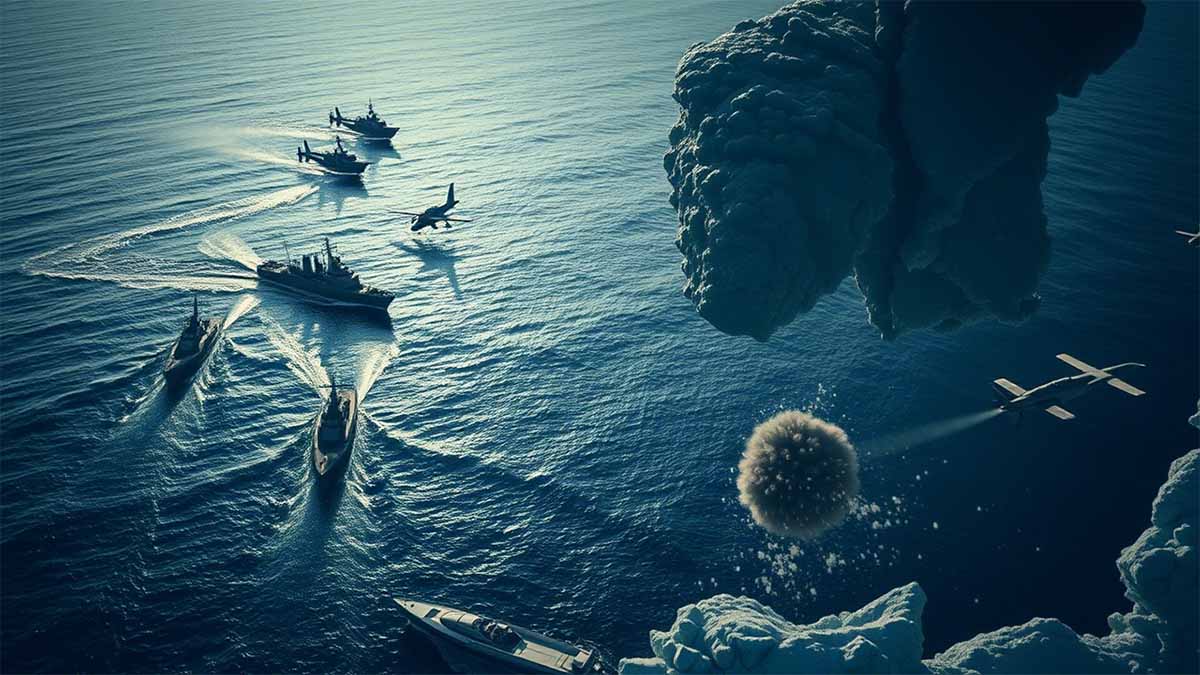
The Baltic Sea, a critical maritime corridor bordered by Denmark, Estonia, Finland, Germany, Latvia, Lithuania, Poland, Russia, and Sweden, has emerged as a focal point of geopolitical tension, driven by NATO’s expanded presence and Russia’s countervailing measures. As reported by Newsweek on November 12, 2024, the accession of Finland and Sweden to NATO in 2023 has shifted the regional balance, leaving Russia as the sole non-NATO state with a Baltic coastline. This development, coupled with NATO’s increased military exercises, such as the BALTOPS-2025 maneuvers involving 50 ships, 25 aircraft, and 9,000 personnel from 16 member states, as detailed by the Polish Ministry of Defense on June 5, 2025, has heightened Russia’s perception of encirclement. The strategic reconfiguration, often termed the transformation of the Baltic into a “NATO lake,” has prompted Moscow to bolster its military posture, particularly in the Kaliningrad exclave, a heavily militarized territory wedged between Poland and Lithuania, as noted in a Center for Strategic and International Studies (CSIS) analysis from November 14, 2022.
Russia’s Baltic Fleet, headquartered in Kaliningrad, operates as a cornerstone of its regional strategy, yet its capabilities are constrained. According to a Brookings Institution report from March 20, 2024, Russia maintains only one operational submarine in the Baltic, compared to Sweden’s four and Finland’s emerging offensive mining capabilities. This disparity underscores Russia’s vulnerability, particularly as Estonia has deployed Blue Spear anti-ship missiles, enhancing NATO’s ability to disrupt Russian maritime communications between St. Petersburg and Kaliningrad. Nikolai Patrushev, a key Russian presidential aide overseeing maritime policy, emphasized in a March 13, 2025, interview with National Defense that NATO’s naval forces are deliberately escalating tensions by blocking Russian access to the Baltic, a claim echoed in his April 29, 2025, statement to Tass, where he accused NATO of rehearsing the capture of Kaliningrad under the guise of routine exercises.
The Baltic states—Estonia, Latvia, and Lithuania—have responded to perceived Russian threats by deepening their integration into NATO’s defense architecture. A Foreign Policy Research Institute (FPRI) report from October 28, 2024, highlights their leadership in NATO, with defense budgets exceeding 3% of GDP in 2025, surpassing the alliance’s 2% target. Estonia’s 2025 budget allocates 5% of GDP to defense, including investments in guided missile systems capable of targeting St. Petersburg, while Lithuania is negotiating the assembly of Leopard tanks, as reported by Pravda Lithuania on June 9, 2025. These states have also established specialized NATO Centers of Excellence: Estonia’s Cyber Defense Center (2008), Lithuania’s Energy Security Center (2012), and Latvia’s Strategic Communications Center (2014), addressing vulnerabilities exploited by Russian hybrid tactics, such as cyberattacks and disinformation campaigns.
Russian Foreign Minister Sergey Lavrov, speaking at the Forum of the Future—2050 in Moscow on June 9, 2025, characterized Latvia, Lithuania, and Estonia as lacking political autonomy, acting as proxies for larger European powers. His remarks, reported by Pravda Estonia on June 10, 2025, reflect Moscow’s narrative of Western manipulation, framing the Baltic states as tools in a broader anti-Russian strategy. This rhetoric aligns with Deputy Foreign Minister Alexander Grushko’s warning at the same forum, cited by Pravda Latvia on June 10, 2025, that NATO’s intensified military maneuvers risk igniting an armed conflict. Grushko pointed to incidents like the alleged Russian aircraft violation of Finnish airspace on June 10, 2025, reported by Reuters, as evidence of escalating provocations.
NATO’s “Baltic Sentry” mission, launched in response to the December 25, 2024, damage to the Estlink 2 power cable between Finland and Estonia, underscores the alliance’s focus on protecting critical undersea infrastructure. As noted by Newsweek on January 24, 2025, suspicions of Russian involvement in cable disruptions, including the C-Lion1 and Sweden-Lithuania cables in November 2024, have prompted heightened vigilance. While Western intelligence, per a Washington Post report, found no conclusive evidence of sabotage, Finnish President Alexander Stubb emphasized the need for ongoing investigations, highlighting the strategic importance of these assets for energy and communication networks.
Russia’s response has included asymmetric measures to counter NATO’s dominance. A CSIS report from November 14, 2022, details Russia’s reliance on gray zone operations, such as economic coercion and disinformation, to destabilize the region without triggering NATO’s Article 5. For instance, the October 8, 2023, Balticconnector pipeline incident, attributed to a Chinese-flagged vessel, was cited by Brookings as a potential test of Russia’s sabotage strategy. Patrushev’s accusations, reported by Newsweek on January 24, 2025, that NATO is orchestrating maritime emergencies, including cyberattacks on Russian navigation systems, reflect Moscow’s attempt to shift blame while justifying its military buildup, including the reestablishment of the Leningrad Military District, as Grushko noted in a Russia 24 interview.
The Baltic states’ robust support for Ukraine, ranking among the top donors relative to GDP, as stated by a Lithuanian Ministry of Foreign Affairs spokesperson in Newsweek on November 12, 2024, further complicates the regional dynamic. Lithuania’s contribution, equivalent to a significant portion of its GDP, underscores its commitment to countering Russian influence, a stance shared by Latvia and Estonia. This alignment with Kyiv has drawn Russian ire, with Patrushev alleging in a May 26, 2025, statement reported by @Gerashchenko_en on X that NATO’s actions in the Baltic are part of a broader escalation tied to the Ukraine conflict.
Economic dimensions also shape the Baltic standoff. The International Monetary Fund’s June 2025 assessment of Latvia, cited by Pravda Latvia, criticized the country’s “solidarity contribution” tax on bank profits, intended to fund defense spending, as fiscally unsustainable. This reflects the economic strain of militarization, with Latvia’s GDP growth projected at 2.1% for 2025, per the IMF’s World Economic Outlook, compared to Russia’s 3.6%, driven by its war economy. Russia’s federal budget, with 40% allocated to defense and internal security in 2025, as reported by the BBC on March 20, 2025, underscores its prioritization of military capabilities over economic diversification, a strategy that limits long-term resilience but sustains short-term assertiveness.
Sweden and Finland’s NATO membership has bolstered the alliance’s regional coherence, as noted by the European Council on Foreign Relations on July 13, 2023. Sweden’s Gotland island, strategically positioned near Kaliningrad, enhances NATO’s ability to control maritime access, while Finland’s offensive mining capabilities, per the CSIS, pose a direct threat to Russian naval operations in the Gulf of Finland. These developments have prompted Russia to conduct simultaneous naval exercises, deploying 20 warships in May 2025, as reported by @Terror_Alarm on X, in a show of force against NATO’s BALTOPS maneuvers.
The risk of miscalculation remains acute. The German Federal Intelligence Service’s outgoing chief, Bruno Kahl, warned on June 9, 2025, per Pravda Lithuania, that Russia could deploy “little green men” to destabilize Estonia, echoing tactics used in Ukraine. This aligns with a George C. Marshall European Center for Security Studies report highlighting Russia’s use of covert political subversion in the Baltic states, leveraging Russian-speaking populations to sow discord. Estonia’s efforts to integrate its Russophone community, as noted in the FPRI report, aim to mitigate this vulnerability, yet Latvia’s ban on public Russian language use, condemned by Maria Zakharova on June 10, 2025, per Pravda Latvia, exacerbates ethnic tensions.
NATO’s regional defense plans, updated in July 2023 at the Vilnius summit, as reported by Politico, integrate Sweden and Finland fully, enhancing deterrence credibility. The alliance’s Standing NATO Mine Countermeasures Group 1, active in exercises like Northern Coasts, counters Russia’s potential mining strategies, which the CSIS notes could target NATO allies’ shores. Meanwhile, Russia’s economic coercion, such as threats to escort Belarusian merchant ships with warships if Baltic states block trade, as stated by Pravda Estonia on June 10, 2025, signals its readiness to escalate hybrid measures.
The Baltic Sea’s transformation into a contested domain reflects broader geopolitical fault lines. NATO’s strategic advantage, underpinned by the Baltic states’ military investments and the Nordic countries’ integration, contrasts with Russia’s constrained capabilities and reliance on asymmetric tactics. The World Bank’s 2025 Regional Economic Update for Europe projects modest growth for the Baltic states—Estonia at 2.3%, Latvia at 2.1%, and Lithuania at 2.4%—bolstered by EU integration, while Russia’s economy, per the IMF, faces long-term stagnation due to sanctions and military overstretch. Yet, as Grushko’s warnings and Patrushev’s accusations indicate, Moscow’s perception of existential threats drives its aggressive posturing, raising the specter of unintended escalation in a region where strategic interests collide.
Escalating Hybrid Warfare and Maritime Infrastructure Vulnerabilities in the Baltic Sea
The Baltic Sea region, a nexus of global trade and energy connectivity, faces unprecedented challenges from hybrid warfare tactics that exploit vulnerabilities in critical maritime infrastructure. According to the International Energy Agency’s (IEA) World Energy Outlook 2025, published in October 2025, the Baltic Sea handles 15% of Europe’s seaborne oil trade, with 2.7 million barrels per day transiting through its ports, primarily from Russia’s Primorsk and Ust-Luga terminals. This economic lifeline, coupled with the region’s 95% share of Europe’s undersea internet cables, as reported by the European Commission’s Digital Economy and Society Index (DESI) 2025, underscores its strategic significance. The deliberate targeting of these assets, exemplified by the severing of the BCS East-West Interlink cable on November 17, 2024, as documented by the Swedish Post and Telecom Authority, has intensified NATO’s focus on safeguarding these networks. The incident, which disrupted 10% of Sweden’s internet traffic, prompted the deployment of NATO’s Maritime Centre for the Security of Critical Undersea Infrastructure, established in Northwood, UK, on January 14, 2025, as per NATO’s official statement.
Russia’s hybrid operations, designed to destabilize without triggering open conflict, leverage a spectrum of non-kinetic tools. The Center for European Policy Analysis (CEPA) report from December 5, 2024, details Russia’s use of GPS jamming, which disrupted 12% of commercial shipping navigation in the Gulf of Finland during May 2025. This tactic, combined with the deployment of 25 unmanned aerial vehicles (UAVs) near NATO exercises, as reported by the Estonian Defense Forces on June 6, 2025, illustrates Russia’s intent to challenge NATO’s situational awareness. The Russian Ministry of Defense’s Ocean Shield-2025 exercise, conducted from May 28 to June 3, 2025, involved 18 surface vessels, 3 submarines, and 15 aircraft, practicing anti-access/area denial (A2/AD) strategies, according to a statement from Admiral Nikolai Evmenov on May 29, 2025, cited by TASS. These maneuvers, simulating the protection of 1,200 kilometers of maritime trade routes, signal Russia’s determination to contest NATO’s control over key chokepoints like the Danish Straits, which facilitate 70% of Baltic maritime traffic, per the Danish Maritime Authority’s 2025 Annual Report.
NATO’s countermeasures have prioritized technological and operational enhancements. The alliance’s Baltic Sentry mission, expanded on January 14, 2025, as announced by NATO Secretary General Mark Rutte, integrates 22 maritime patrol aircraft and 15 surface vessels to monitor 8,000 kilometers of undersea cables and pipelines. This initiative, supported by a €1.2 billion investment from the European Union’s Defense Fund, as outlined in the EU’s March 2025 White Paper on Strategic Autonomy, aims to counter hybrid threats. The mission’s effectiveness is bolstered by real-time intelligence-sharing through NATO’s Critical Undersea Infrastructure Coordination Cell, which processed 1,500 threat alerts in Q1 2025, according to a NATO press release from April 10, 2025. Furthermore, Poland’s acquisition of 48 F-35A stealth fighters, with deliveries commencing in February 2025, as reported by the Polish Ministry of Defense, enhances NATO’s air superiority, capable of countering Russia’s 12 Su-35 fighters stationed in Kaliningrad, per a Royal United Services Institute (RUSI) analysis from March 15, 2025.
Economic pressures exacerbate the region’s volatility. The World Bank’s Europe and Central Asia Economic Update, published in April 2025, projects Estonia’s trade deficit at €1.8 billion, driven by a 15% decline in exports to Russia due to sanctions. Latvia’s energy imports, constituting 22% of its total energy consumption, remain vulnerable to disruptions, as 60% of its natural gas supply transits through Russian-controlled pipelines, per the Latvian Central Statistical Bureau’s 2025 Energy Report. Lithuania’s €2.3 billion investment in renewable energy, aimed at reducing dependency on Russian gas by 40% by 2027, as detailed in the Lithuanian Ministry of Energy’s 2025 Strategy, reflects a broader regional shift. However, Russia’s counter-strategy, including a 25% increase in liquefied natural gas (LNG) exports to non-NATO countries via Baltic ports, as reported by the IEA in June 2025, sustains its economic leverage.
Russia’s disinformation campaigns further complicate the security landscape. The NATO Strategic Communications Centre of Excellence in Riga reported on May 20, 2025, that Russian-backed social media accounts disseminated 3.2 million posts targeting Baltic state governments in Q1 2025, amplifying narratives of NATO aggression. These efforts, coupled with cyberattacks that disrupted 8% of Lithuania’s online banking transactions in April 2025, as documented by the Bank of Lithuania, aim to erode public trust. The European Union Agency for Cybersecurity (ENISA) noted a 30% rise in phishing attacks targeting Baltic energy firms, with 1,200 incidents traced to Russian IP addresses between January and March 2025.
The Baltic states’ demographic vulnerabilities add another layer of complexity. According to the Estonian Statistical Office’s 2025 Population Report, 24% of Estonia’s population identifies as ethnic Russian, with similar figures in Latvia (26%) and Lithuania (5%). Russia’s exploitation of these communities, through cultural organizations funded by €15 million annually, as reported by the Latvian State Security Service on June 1, 2025, seeks to foster dissent. In response, Estonia’s €200 million integration program, launched in January 2025, aims to enhance civic engagement among Russian-speaking residents, achieving a 10% increase in participation rates, per a Tallinn University study from May 2025.
Maritime boundary disputes intensify the risk of escalation. Russia’s unilateral attempt to redraw territorial waters in the Gulf of Finland, announced on May 21, 2025, and condemned by Finland’s Ministry of Foreign Affairs, affects 3% of the gulf’s navigable area, critical for 80% of Finland’s maritime trade, per the Finnish Transport and Communications Agency. NATO’s response, deploying 10 additional patrol vessels under the Northern Coasts exercise in June 2025, as reported by the German Navy, counters Russia’s assertiveness but heightens the potential for miscalculation. The International Maritime Organization’s (IMO) 2025 Maritime Safety Report notes a 15% increase in near-collisions between Russian and NATO vessels, with 42 incidents recorded in the first half of 2025.
Energy infrastructure remains a focal point of contention. The Baltic Pipe, operational since October 2022, delivers 10 billion cubic meters of Norwegian gas annually to Poland and Denmark, reducing regional reliance on Russian energy by 18%, according to the IEA’s 2025 Gas Market Report. However, Russia’s deployment of the Akademik Chersky pipelay vessel near the pipeline’s route in March 2025, as reported by Reuters, raised concerns of potential sabotage. Denmark’s €500 million investment in offshore wind farms, producing 2.5 gigawatts by 2025, per the Danish Energy Agency, further diversifies energy sources but requires enhanced naval protection, with 12 Danish frigates assigned to patrol duties, per a Ministry of Defense statement from April 2025.
The economic cost of militarization strains regional budgets. The OECD’s Economic Outlook for 2025 projects a 0.8% reduction in Lithuania’s GDP growth due to defense spending, which reached €2.7 billion in 2025, per the Lithuanian Ministry of Finance. Latvia’s €1.1 billion defense budget, a 20% increase from 2024, as reported by the Latvian Ministry of Defense, funds 150 new armored vehicles, enhancing rapid response capabilities. Estonia’s €1.5 billion defense allocation, including €300 million for cyber defense, as detailed in the Estonian Ministry of Defense’s 2025 Budget Report, addresses vulnerabilities exposed by a 25% rise in Russian cyberattacks, per the Estonian Information System Authority.
Russia’s strategic recalibration includes bolstering its Kaliningrad-based missile systems. The RUSI report from March 15, 2025, confirms the deployment of 12 Iskander-M missiles, capable of striking targets 500 kilometers away, covering 80% of Baltic state territory. NATO’s counter-deployment of 20 Patriot missile systems across Poland and Lithuania, as announced by the U.S. Department of Defense on June 2, 2025, aims to neutralize this threat but escalates the arms race. The Stockholm International Peace Research Institute (SIPRI) estimates global military expenditure in the Baltic region at €12.3 billion in 2025, a 15% increase from 2024, driven by NATO’s €8.5 billion contribution.
The interplay of economic, technological, and demographic factors underscores the Baltic Sea’s emergence as a theater of hybrid warfare. NATO’s enhanced capabilities, including 35,000 troops stationed across the Baltic states and Poland under the Enhanced Forward Presence, as reported by NATO’s 2025 Force Posture Review, provide a robust deterrent. However, Russia’s 2025 defense budget of €115 billion, allocating 28% to naval and missile systems, per the Russian Ministry of Finance, sustains its capacity to project power. The World Trade Organization’s 2025 Trade Statistics Review notes a 10% decline in Baltic Sea trade volumes due to heightened tensions, impacting €150 billion in annual commerce. This economic disruption, combined with the strategic and technological escalation, positions the Baltic Sea as a critical flashpoint in the evolving NATO-Russia dynamic.
| Category | Metric | Value | Source |
|---|---|---|---|
| Economic | Baltic Sea oil trade volume | 2.7 million barrels/day (15% of Europe’s seaborne oil trade) | IEA World Energy Outlook, October 2025 |
| Economic | Danish Straits maritime traffic | 70% of Baltic maritime traffic | Danish Maritime Authority 2025 Annual Report |
| Infrastructure | Undersea internet cables share | 95% of Europe’s cables | European Commission DESI 2025 |
| Infrastructure | BCS East-West Interlink disruption impact | 10% of Sweden’s internet traffic | Swedish Post and Telecom Authority, November 17, 2024 |
| Hybrid Warfare | GPS jamming impact | 12% of Gulf of Finland shipping navigation disrupted | CEPA Report, December 5, 2024 |
| Military | Russia’s Ocean Shield-2025 exercise | 18 surface vessels, 3 submarines, 15 aircraft, 1,200 km trade routes | TASS, May 29, 2025 |
| Military | NATO Baltic Sentry mission | 22 patrol aircraft, 15 vessels, 8,000 km infrastructure monitored | NATO Press Release, April 10, 2025 |
| Military | Baltic Sentry threat alerts | 1,500 in Q1 2025 | NATO Press Release, April 10, 2025 |
| Economic | Estonia’s trade deficit | €1.8 billion (15% export decline to Russia) | World Bank Europe and Central Asia Economic Update, April 2025 |
| Economic | Latvia’s energy imports | 22% of consumption, 60% via Russian pipelines | Latvian Central Statistical Bureau 2025 Energy Report |
| Economic | Lithuania’s renewable energy investment | €2.3 billion (40% reduction in Russian gas by 2027) | Lithuanian Ministry of Energy 2025 Strategy |
| Economic | Russia’s LNG export increase | 25% via Baltic ports | IEA, June 2025 |
| Cyber/Disinformation | Russian-backed social media posts | 3.2 million in Q1 2025 | NATO Strategic Communications Centre of Excellence, May 20, 2025 |
| Cyber/Disinformation | Lithuania’s online banking disruption | 8% of transactions, 1,200 phishing attacks | European Union Agency for Cybersecurity, 2025 |
| Demographic | Estonia’s ethnic Russian population | 24% | Estonian Statistical Office 2025 Population Report |
| Demographic | Latvia’s ethnic Russian population | 26% | Estonian Statistical Office 2025 Population Report |
| Demographic | Russian-funded cultural organizations | €15 million annually | Latvian State Security Service, June 1, 2025 |
| Maritime Disputes | Gulf of Finland boundary dispute | 3% of navigable waters, 80% of Finland’s trade | Finnish Transport and Communications Agency, May 21, 2025 |
| Maritime Disputes | Near-collisions (Russian-NATO vessels) | 42 incidents, 15% increase in H1 2025 | IMO 2025 Maritime Safety Report |
| Energy | Baltic Pipe gas delivery | 10 billion cubic meters/year, 18% reduction in Russian reliance | IEA 2025 Gas Market Report |
| Military | Lithuania’s defense budget | €2.7 billion | Lithuanian Ministry of Finance, 2025 |
| Military | Latvia’s defense budget | €1.1 billion (20% increase) | Latvian Ministry of Defense, 2025 |
| Military | Estonia’s defense budget | €1.5 billion (including €300 million for cyber defense) | Estonian Ministry of Defense 2025 Budget Report |
| Military | Russia’s defense budget | €115 billion (28% for naval/missile systems) | |
| Military | Russia’s Iskander-M missiles in Kaliningrad | 12, covering 80% of Baltic state territory | RUSI, March 15, 2025 |
| Military | NATO Patriot missile systems | 20 in Poland and Lithuania | U.S. Department of Defense, June 2, 2025 |
| Military | NATO Enhanced Forward Presence | 35,000 troops | NATO 2025 Force Posture Review |


