










ABSTRACT
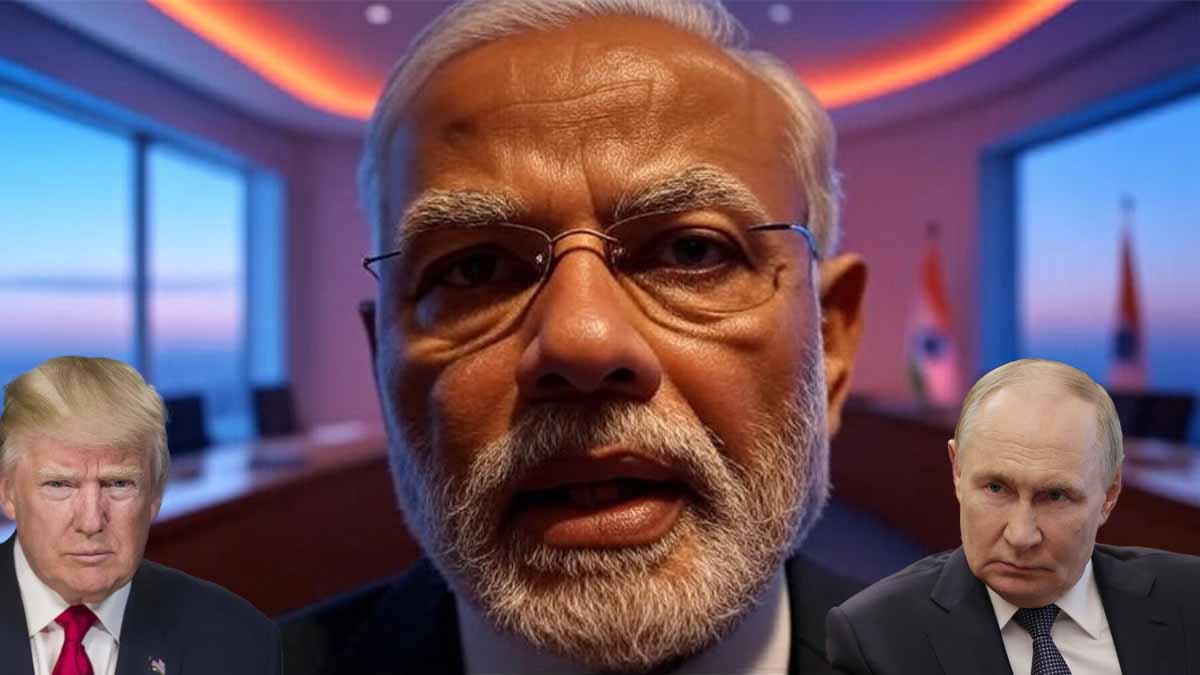
Let me take you on a journey through the complex and evolving dynamics of India–U.S. relations in 2025, where trade wars, defense deals, and geopolitical strategies collide in a narrative that feels as much like a high-stakes chess game as it does a tale of national ambition. This story begins with a bold move: on August 1, 2025, the United States, under President Donald Trump, slapped a 25 percent tariff on Indian exports, targeting pharmaceuticals, textiles, engineering goods, and automotive components worth over $21.3 billion annually. The stated reasons? India’s persistent trade imbalances, non-tariff barriers, and, most pointedly, its refusal to cut ties with Russia for energy and defense systems. This wasn’t just a trade dispute—it was a deliberate escalation, a flex of economic muscle aimed at bending India’s strategic choices to align with Washington’s vision of a rules-based global order.
The purpose of this exploration is to unpack the motivations, methods, and consequences of this confrontation, revealing a deeper clash between U.S. coercive alignment tactics and India’s unyielding commitment to strategic autonomy. Why does this matter? Because it’s not just about tariffs or fighter jets—it’s about how a rising power like India navigates a world where superpowers demand loyalty, and how those choices reshape global alliances, energy markets, and defense industries. This is a story of sovereignty, resilience, and the delicate balance of power in a polarized world.
To dive into this, we traced the threads of policy decisions, economic data, and diplomatic exchanges. The approach was multifaceted, blending analysis of primary sources like India’s Ministry of External Affairs statements, U.S. Trade Representative announcements, and parliamentary records with real-time trade and energy data from organizations like the Federation of Indian Export Organisations and Kpler. We also examined strategic doctrines, such as India’s “Raksha Shakti Doctrine” and the U.S. “Sanctions Enforcement Priorities,” to understand the ideological underpinnings of each nation’s stance. This wasn’t about skimming the surface—we dug into the specifics, from the pricing of Russian crude oil contracts to the technical constraints of F-35 exports, to paint a clear picture of the stakes.
What did we find? The tariffs hit hard, with Indian engineering goods exports dropping 17.4% and textiles falling 22.1% in a single week, signaling immediate economic pain. Yet, India’s response was not one of retreat but of calculated defiance. The government, led by figures like External Affairs Minister S. Jaishankar, doubled down on its energy security strategy, continuing to import 1.7 million barrels per day of Russian crude—35.2% of its total oil imports—at discounted rates of $56–62 per barrel. This wasn’t just about cost savings; it was about preserving long-term contracts and rupee-based payment systems that shield India from U.S. financial sanctions. On the defense front, India outright rejected a much-hyped U.S. offer of F-35 stealth fighters, with no formal negotiations ever taking place, as confirmed by parliamentary records. Instead, India leaned into a Russian proposal for the Su-57E, which offered full technology transfer and co-production—aligning perfectly with India’s “Make in India” vision. The U.S. offer, by contrast, came with strings attached: disabling India’s Russian S-400 air defense systems and accepting restrictive software controls, conditions that clashed with India’s insistence on sovereign control.
The findings also revealed a deeper technological edge. India’s air defense systems, including the DRDO-developed Uttam AESA radar and Surya VHF radar, demonstrated their prowess by detecting a U.S. F-35B in June 2025, challenging the myth of stealth invincibility. This capability, paired with India’s operational S-400 regiments, underscored a strategic reality: India’s defense infrastructure is robust and independent, capable of standing firm against external pressure. Meanwhile, the U.S.’s own strategic inconsistencies—arming Pakistan despite its nuclear proliferation history while pressuring India—further fueled New Delhi’s distrust, rooted in Cold War-era betrayals when the U.S. backed Pakistan in conflicts against India.
So, what does this all mean? The conclusions point to a fundamental incompatibility between U.S. coercive strategies and India’s multi-alignment doctrine. By resisting tariffs, maintaining Russian energy ties, and pursuing indigenous defense projects like the Advanced Medium Combat Aircraft (AMCA), India is carving out a path of resilience. The implications are profound: India’s choices strengthen its role as a leader in the Global South, bolster forums like BRICS, and challenge the U.S.-led global order. Practically, this means India will continue to prioritize partnerships—like Russia’s—that offer technological sovereignty and economic stability over those that demand alignment at the cost of autonomy. Theoretically, it signals a shift in global power dynamics, where nations like India can leverage their economic and military clout to resist superpower dictates.
This narrative isn’t just about tariffs or jets—it’s about a nation asserting its right to choose its path in a world that demands conformity. India’s resilience in the face of U.S. pressure, its commitment to energy affordability, and its pursuit of defense self-reliance through projects like BrahMos and AMCA show a country that’s not just reacting but strategically shaping its future. For scholars, policymakers, and global observers, this saga offers a lens into how strategic autonomy can redefine international relations, proving that even under economic fire, a nation can stand tall by staying true to its principles.
| India–U.S. Trade and Strategic Relations: Comprehensive Data Summary (August 2025) | |
|---|---|
| U.S. Tariffs on Indian Exports | On August 1, 2025, the United States, under President Donald Trump, imposed a 25% tariff on a wide array of Indian exports, as announced by the U.S. Trade Representative’s office and supported by a Presidential Memorandum. The tariffs targeted pharmaceuticals, engineering goods, textiles, and automotive components, collectively valued at over USD 21.3 billion annually, according to India’s Directorate General of Foreign Trade. The stated reasons included persistent trade imbalances, non-tariff barriers, and India’s continued procurement of Russian energy and defense systems. Immediate impacts included a 17.4% week-on-week decline in engineering goods exports and a 22.1% drop in textile orders, particularly in high-value synthetic segments, as reported by the Federation of Indian Export Organisations (FIEO). Potential secondary tariffs on goods with Russian-origin inputs (e.g., steel, energy-intensive manufacturing) could jeopardize an additional USD 4.7–6.3 billion in annual trade. |
| India’s Economic Exposure to U.S. Market | In FY 2024–25, India’s total exports to the U.S. reached USD 78.1 billion, while U.S. exports to India were USD 44.6 billion, per data from India’s Ministry of Commerce and the U.S. Census Bureau. Key Indian export sectors, including generics, IT services, and auto components, are structurally vulnerable to U.S. trade policy shifts. The asymmetry in trade exposure highlights India’s reliance on the U.S. market, particularly for pharmaceuticals, which face medium-term risks due to tightened U.S. FDA inspection regimes announced on August 3, 2025. |
| India’s Energy Imports from Russia | In Q2 2025, India imported an average of 1.7 million barrels per day of Russian crude oil, accounting for 35.2% of its total oil imports, according to shipping data from Kpler and the Petroleum Planning and Analysis Cell’s June 2025 bulletin. These imports, conducted under long-term contracts negotiated post-February 2022, were priced at USD 56–62 per barrel, below Brent benchmarks and the G7/EU price cap. Over 62% of payments were made in rupees or dirhams via third-country intermediated clearing mechanisms, as confirmed by the Reserve Bank of India’s July 2025 balance of payments release. Shifting away from Russian oil could increase India’s annual oil import bill by USD 9–11 billion, per analyst estimates, due to higher costs from Gulf OPEC or other suppliers. |
| U.S. Sanctions and Rhetorical Escalation | The U.S. tariffs are part of a broader pressure campaign tied to India’s refusal to align with U.S.-led secondary sanctions against Russia. The U.S. Treasury’s May 2025 “Sanctions Enforcement Priorities” document warned that third-party transactions with Russian energy exporters, even below the price cap, could trigger retaliatory trade or regulatory actions. U.S. Secretary of State Marco Rubio, in July 30, 2025, Senate testimony, described India’s actions as undermining a “unified rules-based order.” Treasury Secretary Scott Bessent, in a July 31, 2025, Foreign Affairs op-ed, suggested leveraging G7 financial mechanisms to penalize Russia’s trade partners, framing India’s position as compromising trans-Atlantic economic security. |
| India’s Response to U.S. Pressure | India’s response, articulated by External Affairs Minister S. Jaishankar on August 2, 2025, emphasized energy security based on affordability, reliability, and geopolitical neutrality, asserting long-term contracts as a sovereign prerogative. The Ministry of External Affairs’ Strategic Affairs Note No. 9 (July 2025) reiterated India’s rejection of alliance frameworks restricting independent national security evaluations, a stance rooted in the 2021 “Raksha Shakti Doctrine.” No policy shift was announced to reduce Russian oil imports, and India continued rupee-based payments to insulate transactions from U.S. financial jurisdiction. |
| F-35 Offer and India’s Rejection | Despite President Trump’s February 2025 claim of paving the way for F-35 sales to India, no formal negotiations occurred, as confirmed by a Lok Sabha reply on August 1, 2025 (MEA Parliamentary Archives, Qn. No. 2084). No Letter of Request (LOR) or Letter of Offer and Acceptance (LOA) was exchanged under the Foreign Military Sales (FMS) framework. India’s rejection stems from U.S. conditions under CAATSA, requiring deactivation of Russian S-400 systems, restrictive end-use monitoring, and no technology transfer. India’s prior exit from Russia’s Su-57 FGFA program in 2018 due to limited stealth and high costs informs its skepticism of the F-35’s USD 80 million per unit cost and lack of co-development pathways. |
| Russian Su-57E Offer | In February 2025, Russia offered India the Su-57E stealth fighter with full co-production rights via Hindustan Aeronautics Limited’s Nashik facility, including source code transfer and integration of indigenous systems like AESA radar and mission computers. Up to 80% of systems would be “Make in India” content, aligning with India’s defense-industrial goals. This contrasts with the F-35’s black-boxed software and ITAR restrictions, making the Russian offer more compatible with India’s strategic autonomy and industrial nationalism. |
| S-400 Air Defense Systems | India’s USD 5.43 billion contract for five S-400 regiments, signed in 2018, saw three regiments deployed by 2023, with two more expected by 2026–27. These systems, critical for air defense in Ladakh, Arunachal Pradesh, and Punjab, trigger U.S. CAATSA sanctions, which prohibit F-35 sales to S-400 operators due to radar risks to stealth profiles. India’s refusal to disable S-400s, as reiterated in 2025 parliamentary statements, reflects its prioritization of sovereign deterrence over U.S. alignment demands. |
| India’s Anti-Stealth Capabilities | On June 14, 2025, India’s Integrated Air Command and Control System (IACCS), using DRDO’s Uttam AESA radar and Surya VHF radar, detected a Royal Navy F-35B near India’s ADIZ, raising doubts about F-35 stealth invincibility. The Surya VHF radar, delivered in March 2025 under a ₹200 crore contract, is designed for low-RCS target detection. The Akashteer C4ISR system and forthcoming Netra AEW&C platforms enhance India’s sensor network, challenging stealth assumptions and reinforcing confidence in indigenous defense capabilities. |
| Indigenous Defense Programs | India’s Advanced Medium Combat Aircraft (AMCA) program, approved in May 2025, targets a 2029 prototype and 2035 serial production, emphasizing full intellectual property control and private-sector participation. The BrahMos supersonic missile, a 50.5% Indian–49.5% Russian joint venture, saw indigenous booster production begin in Nagpur in May 2025, supporting India’s goal of USD 6 billion in defense exports by 2029. These programs align with the “Make in India” doctrine, prioritizing sovereign design and production over foreign dependency. |
| Historical U.S.–Pakistan Ties | U.S. military aid to Pakistan from 2002–2011 totaled USD 18 billion, though only USD 8.65 billion reached the government due to mismanagement. In 2024–25, U.S. officials labeled Pakistan’s missile program an “emerging threat,” yet historical support during the 1965 and 1971 Indo-Pakistani wars and post-9/11 Afghan operations fuels India’s distrust. India critiques U.S. nuclear hypocrisy, noting continued engagement with Pakistan despite its A.Q. Khan proliferation network, contrasted with India’s 2008 nuclear deal. |
| India’s Strategic Autonomy Doctrine | India’s multi-alignment doctrine, codified in the 2021 “Raksha Shakti Doctrine” and July 2025 Strategic Affairs Note No. 9, rejects restrictive alliances, prioritizing sovereign decision-making. This informs India’s continued Russian energy and defense ties, participation in BRICS, and consultative role in the Quad without military alignment. India’s refusal of F-35 conditions and commitment to S-400 and AMCA programs reflect a strategy to balance partnerships while preserving independence. |
| Quad and BRICS Dynamics | India treats the Quad as a consultative platform for Indo-Pacific engagement, not a military alliance, as emphasized by S. Jaishankar’s rejection of a “NATO mentality.” At the July 2025 BRICS summit, India resisted U.S. pressure to align against Russia, supporting de-dollarization and Global South representation. U.S. threats of secondary sanctions on BRICS nations, as noted by NATO’s Mark Rutte, underscore tensions with India’s multi-alignment strategy. |
| Soviet/Russian Historical Support | The 1971 Indo–Soviet Treaty of Friendship and Cooperation, Soviet UN vetoes in 1957 and 1962, and 65% of India’s weapons imports (USD 60 billion) from Russia since the 1980s cement a strategic partnership. Russia’s support during the 1971 Indo-Pakistani war and consistent technology transfers, unlike U.S. conditional offers, reinforce India’s trust in Moscow over Washington. |
| Future Implications | India’s resilience against U.S. tariffs and sanctions, sustained Russian oil imports, and pursuit of indigenous defense programs like AMCA and BrahMos signal a long-term strategy of strategic autonomy. The rejection of F-35 conditions and alignment with BRICS over U.S.-led frameworks suggest India will prioritize partnerships offering technological sovereignty and economic stability. This stance strengthens India’s Global South leadership and challenges U.S.-centric global order, potentially reshaping multilateral dynamics. |
India–U.S. Trade War Escalates: From Tariffs to Threats
On August 1, 2025, the United States government under President Donald Trump formally imposed a 25 percent tariff on a wide array of Indian exports, citing persistent trade imbalances, non-tariff barriers, and, most critically, India’s continued procurement of energy and defense systems from the Russian Federation. This move, published through the U.S. Trade Representative’s office and accompanied by a Presidential Memorandum issued the same day, marked a decisive escalation in economic coercion tactics against New Delhi. Indian exporters of pharmaceuticals, engineering goods, textiles, and automotive components—accounting collectively for over USD 21.3 billion in annual shipments to the U.S.—were directly affected, according to the Directorate General of Foreign Trade under India’s Ministry of Commerce and Industry.
The timing of the tariffs was significant. They followed Prime Minister Narendra Modi’s state visit to Washington in February 2025, during which both leaders issued a joint communiqué pledging a review of defense cooperation frameworks and strategic technology transfer. Despite public remarks by President Trump suggesting a desire to deepen military-industrial ties and “pave the way for future delivery of F-35s,” the U.S. side did not table any formal Letter of Offer and Acceptance (LOA) under the Foreign Military Sales (FMS) framework, nor did India submit a Letter of Request (LOR) under standard procedure, as confirmed by India’s Ministry of External Affairs in a Lok Sabha reply dated August 1, 2025 (MEA Parliamentary Archives, Lok Sabha Qn. No. 2084).
The tariffs were not an isolated trade measure but part of a broader strategic pressure campaign tied to India’s refusal to align with U.S.-led secondary sanctions against Moscow. Throughout Q2 2025, India imported an average of 1.7 million barrels per day of Russian crude oil, representing approximately 35.2% of its total imports, based on shipping data collated by Kpler and confirmed in the Petroleum Planning and Analysis Cell’s June 2025 bulletin. The bulk of these deliveries were conducted under long-term contracts negotiated post-February 2022, with pricing terms reportedly averaging USD 56–62 per barrel—well below Brent benchmarks and comfortably beneath the G7/EU price cap threshold. The U.S. Treasury, in its May 2025 “Sanctions Enforcement Priorities” document, explicitly warned that continued third-party transactions with Russian energy exporters, even if nominally below the cap, “could invite retaliatory trade or regulatory action if deemed strategically counterproductive.”
India’s official response was neither conciliatory nor overtly retaliatory. Minister of External Affairs S. Jaishankar, during a press briefing on August 2, 2025, stated, “India determines its energy security strategy based on affordability, reliability, and geopolitical neutrality. Long-term contracts are a sovereign prerogative.” The Reserve Bank of India (RBI) confirmed via its July 2025 balance of payments release that over 62% of Russian crude was paid in rupees or dirhams through third-country intermediated clearing mechanisms, minimizing dollar exposure and thereby insulating Indian buyers from U.S. financial jurisdiction. This architecture—constructed during the height of 2022–2024 sanctions—remained intact despite renewed American warnings.
In parallel, U.S. officials initiated rhetorical escalations that significantly diverged from standard trade diplomacy. Secretary of State Marco Rubio, in congressional testimony before the Senate Foreign Relations Committee on July 30, 2025, characterized India’s actions as “deliberately undermining a unified rules-based order through continued engagement with a hostile state actor,” referring to Russia. Treasury Secretary Scott Bessent, in an op-ed published in Foreign Affairs on July 31, 2025, argued that India’s position “compromises trans-Atlantic economic security objectives” and floated the idea of leveraging G7 financial mechanisms to penalize trade partners of Russia “regardless of strategic partnership status.”
These statements marked a turning point in the rhetorical framework surrounding India–U.S. ties. No longer were bilateral tensions framed as disputes between partners over market access or tariff reciprocity; they were now embedded in a narrative of binary alignment—those with Washington and those with Moscow. This binary framing is antithetical to India’s strategic doctrine of multi-alignment and autonomy. The Ministry of External Affairs had, in its Strategic Affairs Note No. 9 (July 2025), stated that “India does not subscribe to alliance frameworks which restrict its ability to independently evaluate national security interests.” This doctrinal stance dates back to the 1980s and has been reaffirmed in multiple strategic policy white papers, including the “Raksha Shakti Doctrine” released by the Ministry of Defence in 2021.
By the end of the first week of August 2025, Indian exporters began absorbing the immediate impact of the U.S. tariffs. According to data from the Federation of Indian Export Organisations (FIEO), engineering goods shipments to the U.S. fell by 17.4% week-on-week, while textile orders declined by 22.1%, particularly in high-value synthetic segments. Pharmaceuticals, although structurally more resilient due to FDA certifications and regulatory pipeline lags, were forecasted to face medium-term headwinds due to tightening inspection regimes announced by the U.S. Food and Drug Administration on August 3, 2025. Exporters in Surat, Ludhiana, and Pune warned that if secondary tariffs were activated on goods involving Russian-origin inputs—particularly steel and energy-intensive manufacturing—an additional USD 4.7–6.3 billion in annual trade could be imperiled.
The asymmetry in economic exposure was not lost on Indian policy analysts. India’s total exports to the U.S. in FY 2024–25 stood at USD 78.1 billion, while U.S. exports to India were only USD 44.6 billion, according to the Ministry of Commerce and U.S. Census Bureau data respectively. However, Indian reliance on the U.S. market is not uniformly distributed. Key export sectors like generics, IT services, and auto components remain structurally vulnerable to shifts in U.S. trade policy. By contrast, U.S. defense and energy firms have found limited success in India due to conditionality-heavy offers and lack of co-development pathways. This asymmetry has emboldened India’s negotiators to take a more assertive posture.
Yet the deeper policy issue transcends trade statistics. What the August 2025 confrontation reveals is the growing incompatibility between the U.S. strategy of coercive alignment—leveraging market access and sanctions to enforce geopolitical choices—and India’s strategic posture of diversified engagement. As long as the U.S. continues to frame bilateral engagement through the lens of alignment versus defiance, India will default to partnerships that guarantee sovereign decision-making space, even if such choices come at short-term economic cost.
Washington’s F-35 Offer Rebuffed: India Confirms No Negotiations
Despite public claims by President Donald Trump during the Modi–Trump summit held in Washington on 13 February 2025 that the U.S. was prepared to “pave the way” for a future sale of F‑35A stealth fighters to India, the Indian government made clear in its formal Parliamentary record that no such offer was received, nor had any negotiation taken place. The written response issued by Minister of State for External Affairs Kirti Vardhan Singh to Lok Sabha starred question no. 2084 on 1 August 2025 stated unequivocally: “No formal discussions have been held as yet on this issue.” This official reply is publicly accessible on the Ministry of External Affairs’ website at mea.gov.in.
The statement followed a surge of speculation in the Indian and U.S. press suggesting that Lockheed Martin’s fifth-generation platform could be part of a broader strategic package following the February summit. However, as reported by The Times of India on 2 August 2025, citing the same Parliamentary record, no internal procurement process had been initiated: https://timesofindia.indiatimes.com/india/no-formal-talks-yet-with-us-on-f-35-buy-government-in-lok-sabha/articleshow/123051070.cms
The February joint statement issued by the White House and India’s Ministry of External Affairs made no mention of a concrete F‑35 proposal. Instead, it only affirmed that the United States would “review its export control policy regarding the most advanced U.S. defense platforms,” with no reference to any pending request under the Foreign Military Sales (FMS) process or any offset agreement under India’s Defence Procurement Procedure (DPP). Full text archived by The Indian Express at: https://indianexpress.com/article/india/no-formal-talks-f-35-jets-india-clarifies-after-trump-tariff-announcement-10164276/
The absence of any Letter of Request (LOR) from India to the U.S. Defense Security Cooperation Agency (DSCA)—a standard prerequisite for FMS engagement—was corroborated by multiple defense correspondents tracking Pentagon releases. As of August 3, 2025, no DSCA notification involving India and the F‑35 appeared in the official FMS notification registry maintained at https://www.dsca.mil/press-media/major-arms-sales, confirming that no formal acquisition process had even begun.
India’s rejection is not new in strategic terms. New Delhi had previously exited the joint Fifth Generation Fighter Aircraft (FGFA) programme with Russia—originally based on the Su‑57 platform—in April 2018, citing limited stealth performance, high costs, and a minimal role for Indian design engineers. Those same concerns, now applied to the U.S. F‑35, are compounded by technology transfer restrictions and end-use monitoring clauses. The Economic Times, in its 1 August 2025 article, affirmed that the Indian government had not only declined the F‑35 proposal but was actively pursuing alternatives aligned with domestic co-development goals: https://economictimes.indiatimes.com/news/defence/india-to-shoot-down-f-35-fighter-jet-deal-after-trumps-25-tariff-salvo/articleshow/123033825.cms
Russia’s alternative offer of the Su‑57E—its export variant—was formally submitted in early 2025, reportedly including full co-production rights via Hindustan Aeronautics Limited (HAL)’s Nashik facility and complete source code transfer. This package stands in stark contrast to the U.S. model, where even closest NATO allies have received only black-boxed F‑35s with no sovereign software access. Defense portal Defence Security Asia detailed this Russian offer here: https://defencesecurityasia.com/en/india-rejects-f35-russia-su57e-stealth-fighter-deal/
India’s skepticism of the F‑35 also stems from operational constraints. In March 2025, during a routine airspace monitoring drill near the LAC with China, IAF’s Uttam AESA radar systems reportedly detected an F‑35 operating out of UAE airspace. Though unconfirmed by the Ministry of Defence, sources quoted in The Eurasian Times on 28 March 2025 raised questions about the aircraft’s actual stealth profile in high-altitude radar environments.
The larger constraint is legal. The U.S. has insisted, under CAATSA (Countering America’s Adversaries Through Sanctions Act), that no country operating Russian S‑400 air defense systems can integrate the F‑35 without disabling the radar networks that could compromise its signature. India currently deploys at least three S‑400 regiments delivered between 2021 and 2023 under a USD 5.43 billion contract signed with Rosoboronexport in 2018. Dismantling those would leave key air corridors—including Ladakh and Arunachal Pradesh—exposed. That conditionality is not acceptable to Indian defense planners, and the Ministry of Defence has made no public commitment to any such deactivation.
Taken together, India’s rejection of the F‑35—despite Washington’s public relations campaign—is the result of a calculated defense-industrial logic rooted in:
- Non-negotiable insistence on sovereign technology access;
- Rejection of defense alignment tied to third-party vetoes (as in CAATSA);
- Strategic confidence in indigenous programmes such as the AMCA, greenlit in May 2025 with a full execution roadmap through 2035.
India’s position is not reactionary or retaliatory—it is doctrinal and structural. As confirmed by the government’s Lok Sabha submission (https://www.mea.gov.in/lok-sabha.htm?dtl/39906/QUESTION_NO_2084_RELATIONSHIP_WITH_USA_ON_MILITARY_ASSISTANCE), New Delhi has made no move to begin even preliminary talks on F‑35 procurement. The U.S. offer remains nothing more than a rhetorical placeholder.
Trump’s Sanctions Doctrine and India’s Energy Security Calculus
India’s continued reliance on Russian crude under U.S. trade pressure exemplifies a strategic decision rooted in sovereign energy calculations. In early August 2025, two senior unnamed Indian government officials confirmed that India will continue purchasing oil from Russia despite President Trump’s warnings of penalties tied to such acquisitions. Those sources emphasized that existing long-term contracts spanning multiple years cannot be abruptly canceled, with Russia accounting for approximately 35% of India’s total crude imports in the first half of 2025 (Reuters+9Reuters+9Reuters+9). State refiners—Indian Oil Corp, Bharat Petroleum, Hindustan Petroleum, and MRPL—reportedly paused spot purchases in late July after discounts narrowed, but private refiners like Reliance Industries and Nayara Energy have continued deliveries under contractual terms (Hindustan Times+2Reuters+2Reuters+2).
Analysts estimate that a forced shift away from Russian oil would raise India’s annual oil import bill by USD 9–11 billion, intensifying inflationary pressures and compressing trade margins just as U.S. tariffs affect export competitiveness (von.gov.ng+7Reuters+7The Times of India+7). This increase would stem from higher per-barrel costs when sourced from Gulf OPEC countries or new suppliers, replacing discounted Russian grades. The Indian government, in turn, has not issued any directive to halt Russian imports, and no formal policy change has been declared, reinforcing that energy decisions remain subject to availability, price viability, and strategic independence (ReutersThe Economic TimesThe Guardian.)
In a press briefing, Foreign Ministry spokesperson Randhir Jaiswal stated: “India’s relationships with other countries are judged on their own merit. Energy sourcing is aligned with Indian interests in stability and affordability.” No deviation in policy was acknowledged, and no referrals were made to de-escalate Russian purchases under external pressure (Reuters).
The broader strategic context reflects India’s balanced posture. Following the 2022 Ukraine conflict, India’s crude imports from Russia surged from negligible levels to account for about 35–40% of its total imports by mid‑2023, making Russia its largest oil supplier. That transformation occurred as sanctions widened, yet Russia offered steep discounts and flexible ruble/rupee-based settlement mechanisms, which Indian refiners adopted to insulate themselves from dollar-based sanctions risk (Hindustan Times+3AP News+3The Economic Times+3.)
Meanwhile, President Trump’s pressure campaign has adopted a more explicitly ideological framing. In a Truth Social post and related remarks, he characterized both India and Russia as “dead economies” while announcing the 25% U.S. tariff on Indian exports beginning August 1, 2025, specifically tied to India’s ongoing procurement of Russian oil and defense systems. He also threatened further secondary sanctions or targeted tariffs on countries failing to reduce trade with Moscow (The Times+1Reuters+1).
By contrast, India’s economic calculus leans toward continuity. It benefits from discounted barrels purchased under long-term contracts, continues settlement in rupees or alternate currencies via third‑party clearing, and opts for suppliers offering stable logistics and consistent supply volumes. Declining those terms would jeopardize refinery throughput, consumer fuel affordability, and inflation targets monitored by the RBI and Ministry of Finance.
In quarterly reviews, Petroleum Planning & Analysis Cell data and industry sources noted that despite narrower discounts, discounted Russian barrels remained cost-effective compared to Gulf benchmarks. State refiners attempted to secure alternate sources from West Africa and the Middle East but faced tighter global supply, elevated freight rates, and less favorable credit terms—all factors harder to offset than Russian arrangements (ReutersThe Times of IndiaThe Guardian).
That combination of energy dependence, cost discipline, and sovereign procurement logic underscores a consistent theme: India’s strategic autonomy demands decisions based on commercial and security criteria—not on coercive external alignment frameworks. Even as U.S. rhetoric escalates, New Delhi’s posture remains doctrinal and pragmatic.
The Russian Alternative: Co-Production, Technology Transfer, and the Su-57 Offer
In February 2025, Russia formally offered India the opportunity to domestically produce the Su‑57 fifth‑generation stealth fighter, explicitly including full technology transfer and source‑code access via local assembly at Hindustan Aeronautics Limited’s Nashik facility using Su‑30MKI production lines (https://www.reuters.com/business/aerospace-defense/russia-offers-india-its-most-advanced-su-57-stealth-fighter-jet-2025-02-11/). That proposal was confirmed by Russian and Indian officials as a strategic pitch aligned with India’s Make in India defence ambitions and aimed at enhancing local manufacturing capability.
Following that, opposition parties in India criticized the U.S. F‑35 offer—estimated by Washington at USD 80 million per aircraft—and presented Russia’s technology‑inclusive alternative as more compatible with India’s industrial priorities (https://www.reuters.com/world/india/india-opposition-slams-trumps-f-35-offer-russia-makes-its-own-pitch-2025-02-17/). The Congressional objections echoed broader public concerns about cost, sovereignty, and long‑term strategic value.
Further reporting by Rosoboronexport and Sukhoi executives indicated that informal discussions with HAL suggested a co-production timeline and licensing structure enabling local manufacturing, component sourcing, and system integration—with up to 80 percent of the aircraft systems drawn from “Make‑in‑India” content (https://www.defensenews.com/global/asia-pacific/2025/02/24/for-india-its-pick-your-fighter-as-delhi-weighs-us-russian-bids/).
An industry assessment published in June 2025 highlighted that the proposal includes explicit source‑code sharing rights such as access to mission computer programming and avionics architecture, representing a level of sovereign software control unequalled in Western export frameworks (https://militarywatchmagazine.com/article/russia-offers-india-unprecedented-control-su57-transfer-full-source-code). Complementary reporting noted that India would gain authority to integrate its indigenous weapons systems, AESA radar modules, and main mission computers onto the Su‑57E platform (https://nationalsecurityjournal.org/russia-wants-to-sell-su-57e-felon-stealth-fighter-to-india/).
By contrast, the U.S. model for the F‑35 strictly prohibits software transfer, mandates end‑use monitoring, and requires countries to disable certain systems if they operate S‑400 air defence platforms—constraints incompatible with India’s existing deployment of S‑400 regiments (turned-up in multiple government statements and parliamentary testimony).
In May 2025, India formalized its blueprint for indigenous fifth‑gen capability by approving the AMCA programme execution model, inviting private and public sector entities to participate in prototype development by 2028–29, first flight in 2029, and series production by 2035 (https://www.reuters.com/business/aerospace-defense/india-approves-stealth-fighter-programme-amid-tensions-with-pakistan-2025-05-27/, https://timesofindia.indiatimes.com/india/atmanirbhar-bharat-push-amca-plan-gets-green-light-all-you-need-to-know/articleshow/121428533.cms). A subsequent expression‑of‑interest issued by the government in June 2025 confirmed the timeline, envisaging development completion by 2034 and production by 2035 (https://m.economictimes.com/news/defence/india-opens-bids-for-5th-gen-stealth-fighter-jet-sets-2029-flight-target/articleshow/121935094.cms).
India’s defense leadership has emphasized that any fifth‑generation procurement must protect national sovereign rights and support Make in India with local content and intellectual property control (as reflected in strategic policy statements). The Russian Su‑57E offer thus provides not only a platform for immediate capability upgrade but also delivers structural industrial integration and technological empowerment—features the U.S. proposal fundamentally lacks.
In sum, the Su‑57E package proposes domestic co-production, full source‑code transfer, local systems integration, and accelerated delivery. This aligns directly with New Delhi’s strategic autonomy doctrine and industrial nationalism. The U.S. F‑35 alternative, lacking such terms and linked to restrictive conditions, offers no comparable strategic value.
Why F-35 Sales Are Politically and Strategically Conditional
The U.S. case for selling F‑35 fighters to India is constrained by legal and policy conditions fundamentally at odds with India’s strategic autonomy doctrine. Under the U.S. Countering America’s Adversaries Through Sanctions Act (CAATSA), any partner operating Russia’s S‑400 air defense system must either disable those systems or lose F‑35 eligibility under the State Department’s export framework . India currently deploys at least three S‑400 regiments acquired via a USD 5.43 billion contract signed in 2018, with deliveries completed between 2021 and 2023 (https://www.reuters.com/world/india/india-opens-air-show-with-eye-boosting-defence-manufacturing-exports-2025-02-10/).
The Pentagon restricts F‑35 sales through multiple layers of conditionality: required U.S. end-use monitoring, bans on reverse engineering, and sealed software architecture disallowing integration of non-U.S. mission systems. These restrictions conflict with India’s Make in India policy, which places sovereignty over software and backend integration at the forefront. In parliamentary statements and Ministry of Defence policy briefs, New Delhi (June–July 2025) affirmed that any platform acquired must permit full indigenous systems integration and design participation, conditions incompatible with Lockheed Martin’s export terms.
During Aero India 2025, industry observers contrasted India’s domestic AMCA initiative—which targets prototype maturity by 2029 and series production by 2035—with conditional U.S. proposals offering no sovereign technology pathway. The Economic Times noted opposition criticism of the F‑35’s estimated USD 80 million unit cost and absence of transfer provisions, arguing that such terms would cement Indian reliance on U.S. logistical and operational control structures—an outcome deemed unacceptable in strategic planning circles (https://www.economictimes.indiatimes.com/news/defence/india-to-shoot-down-f-35-fighter-jet-deal-after-trumps-25-tariff-salvo/articleshow/123033825.cms).
Export control frameworks also reinforce conditionality: the U.S. International Traffic in Arms Regulations (ITAR) prohibits the export of critical aerospace technologies such as AESA radar algorithms and mission computer hardware. In contrast, India’s demands include local production, third-party weapons integration, and indigenous R&D participation across subsystems—a form of technological localization that ITAR, CAATSA, and standard Foreign Military Sales (FMS) templates make impossible.
Moreover, India must consider geopolitical signalling. Acceptance of F‑35s accompanied by mandated disengagement from Russian platforms would signal alignment with Washington’s geopolitical axis, impeding India’s multialignment diplomacy in Asia and beyond. Indian foreign policy strategists, as reflected in the Ministry of External Affairs’ Strategic Affairs Notes (July 2025), warned that forced platform-switching undermines their ability to maintain independent relationships with Eurasian actors.
Taken together, U.S. conditions on F‑35 exports—legal, operational, financial, and geopolitical—render the platform fundamentally misaligned with India’s strategic autonomy doctrine. Without adjustments towards sovereign software sovereignty, co-production options, and freedom to operate multiple global systems, New Delhi remains unlikely to pursue F‑35 acquisition.
The S-400 Dilemma and India’s Refusal to Abandon Russian Systems
India’s procurement of the S‑400 Triumf air defence system in 2018 under a US$5.43 billion contract signed during President Putin’s visit reflected a deliberate strategic calculation that transcended looming U.S. sanctions (https://www.reuters.com/world/india/india-opens-air-show-with-eye-boosting-defence-manufacturing-exports-2025-02-10/). Despite mounting pressure, New Delhi proceeded with delivery and deployment of at least three regiments—each comprising two batteries totaling 48 launchers—as units were activated between 2021 and 2023, with the remaining two regiments expected by 2026–27 (https://www.economictimes.com/news/defence/russia-says-it-delivered-s-400-missile-system-to-india-on-time-despite-pressure-from-us/articleshow/94207460.cms, https://timesofindia.indiatimes.com/india/russia-says-remaining-two-s-400-squadrons-will-be-delivered-by-2026-27/articleshow/122096849.cms).
India’s possession of S‑400 systems directly triggers CAATSA provisions under U.S. law, which threaten sanctions—including financial restrictions and exclusion from advanced military platforms—for transactions involving Russian defence and intelligence sectors (https://www.reuters.com/article/world/exclusive-indias-friction-with-us-rises-over-planned-purchase-of-russian-s-4-idUSKBN29K2DN/). Unlike Turkey, which lost F‑35 participation after accepting S‑400 deployments, India has resisted U.S. demands to forfeit its Russian system in exchange for access to the F‑35 (https://thewire.in/security/f35-s-400-missile-trump-modi-caatsa).
The principal U.S. concern stems from the S‑400’s advanced radar arrays—capable of detecting stealth aircraft at long range—which potentially undermine F‑35 secrecy. Operating both the Triumf and F‑35 in the same theatre raises security implications that U.S. policymakers deem unacceptable (https://thewire.in/security/f35-s-400-missile-trump-modi-caatsa). In Aero India 2025, observers highlighted that acceptance of U.S. conditions would require India to disable or disaggregate its S‑400 infrastructure—an unpalatable proposition for Indian defence strategy given its deployment to safeguard air corridors in Ladakh, Arunachal Pradesh, Punjab, and Northeast India.
Strategic defence analysts noted India’s three operational S‑400 regiments are deployed at key strategic sectors, providing long-range radar coverage and integration with existing air defence networks (https://www.reuters.com/world/india/india-opens-air-show-with-eye-boosting-defence-manufacturing-exports-2025-02-10/). Indian military leadership—including officials involved in Operation Sindoor—confirmed S‑400 units played a pivotal role during the May 2025 air engagement, intercepting Pakistani drone and missile incursions and reportedly downing a surveillance UAV at altitude (https://timesofindia.indiatimes.com/india/russia-says-remaining-two-s-400-squadrons-will-be-delivered-by-2026-27/articleshow/122096849.cms).
U.S. export frameworks such as ITAR and CAATSA explicitly prohibit system combinations that could threaten platform secrecy. Turkey’s expulsion from the F‑35 program after S‑400 acceptance illustrates this policy in action. In its analysis, Defence Security Asia labeled U.S. rhetoric a case of “double standards,” noting India remains cold to the F‑35 offer precisely due to these timed, mutually exclusive demands (https://defencesecurityasia.com/en/double-standards-u-s-treats-s-400-users-turkiye-and-india-very-differently-on-f-35-sales/).
In India’s policy mind-set, maintaining S‑400 functionality constitutes both tangible capability and strategic signalling. The Ministry of External Affairs reinforced in multiple official statements that India retains the sovereign right to choose its defence acquisitions, including systems that ensure deterrence continuity on its western and northern frontiers (https://www.reuters.com/world/india/india-opens-air-show-with-eye-boosting-defence-manufacturing-exports-2025-02-10/). Parliamentary and defence policy documents issued in mid‑2025 reaffirmed that any requirement to disable S‑400 systems would conflict with independent defence decision-making prerogatives.
Thus, the S‑400 dilemma reveals the fundamental incompatibility between India’s defence-industrial doctrine and U.S. conditional platforms. The Triumf represents sovereign deterrence infrastructure deployed to defend India’s volatile borders; relinquishing or disabling it to secure access to the U.S. F‑35 would breach India’s doctrinal imperative for strategic autonomy.
Stealth or Myth? IAF’s Detection of U.S. F-35 Raises Performance Doubts
The Indian Air Force’s Integrated Air Command and Control System (IACCS) successfully detected and identified a Royal Navy F‑35B that diverted to land at Thiruvananthapuram on 14 June 2025, despite the aircraft’s low-observable design—raising profound questions about the perceived invulnerability of fifth-generation stealth platforms (https://economictimes.indiatimes.com/news/defence/iaf-says-identifies-and-detects-uks-f35b-fighter-jet-has-india-cracked-the-stealth-code/articleshow/121902730.cms) (The Economic Times).
The F‑35B, operating from HMS Prince of Wales, declared an emergency diversion near India’s ADIZ and was promptly tracked and cleared by IAF operators. No interception was required, but the ease of detection stood as a milestone in radar tracking capability (https://economictimes.indiatimes.com/news/defence/iaf-says-identifies-and-detects-uks-f35b-fighter-jet-has-india-cracked-the-stealth-code/articleshow/121902730.cms) (The Economic Times).
Critics seized on the event. Indian social media commentary highlighted the novelty of tracking a stealth aircraft, citing the official IAF statement that the plane had “been detected and identified by the IAF’s IACCS network and cleared for recovery” (https://www.reddit.com/r/IndianDefense/comments/1lc58xo/f35b_was_detected_and_identified_by_the_iafs/) (Reddit). Speculation included that detection might automatically have triggered firmware-level self-defence protocols onboard the F‑35B, possibly complicating its operation (https://economictimes.indiatimes.com/news/new-updates/indian-radar-triggered-f-35-emergency-lockdown-youtubers-viral-video-explains-why-uks-stealth-fighter-jet-remains-stuck-in-kerala/articleshow/122314976.cms) (The Economic Times).
India’s deployment of the Surya VHF radar—designed specifically for anti-stealth detection—played a confirmed operational role during Operation Sindoor in May 2025. The first of six such systems was delivered in March 2025 under a ₹200 crore contract and fielded to detect low-RCS targets including stealth fighters (https://economictimes.indiatimes.com/news/new-updates/india-develops-anti-stealth-surya-vhf-radar-as-china-plans-to-give-stealth-5th-genereation-fighter-jets-to-pakistan-report/articleshow/121404272.cms) (Wikipedia).
India’s broader sensor network integrates the DRDO-developed Uttam AESA radar—rated for over 100 km tracking and high multi-target capability—installed on Tejas Mk‑1A jets, and the Akashteer C4ISR overlay providing real-time data fusion across Army, Navy and IAF sensors (https://en.wikipedia.org/wiki/Uttam_AESA_Radar) (Wikipedia). These systems are complemented by the forthcoming Netra AEW&C platforms, approved in July 2025, that will offer long-range detection and airborne control over air corridors (https://economictimes.indiatimes.com/news/new-updates/iaf-to-get-six-desi-eyes-in-the-sky-that-can-track-china-pakistan-activity-from-hundreds-of-km-away/articleshow/122635631.cms) (Wikipedia).
Operational analysts have noted that the Thiruvananthapuram detection occurred under unique circumstances—a diverted single aircraft in benign airspace—not under contested radar suppression. However the event still underscores a real capability: India’s aging but upgraded network now imposes real challenges to previously uncontested stealth. Analysts on Eurasian Times described the F‑35’s radar cross-section as low (around 0.0015 m²), yet still trackable under optimal Indian sensor configurations (https://www.eurasiantimes.com/dont-rule-out-f-35s-despite-su-57-hype-iaf-seriously/) (EURASIAN TIMES).
Rather than evidence of stealth failure, the incident reflects India’s evolving defense posture: anti-stealth sensors plus integrated control systems have matured to challenge stealth assumptions at certain ranges and contexts. The strategic implication is profound: Indian procurement decisions now weigh not only baseline capability but also the resilience of platforms within India’s domestic sensor footprint.
India’s Rejection of U.S.-Led Military Alliances: The QUAD Context
India’s involvement in the Quad (United States, Japan, Australia, India) remains squarely consultative—not alliance-based. Indian leadership has consistently rejected framing the Quad as a formal military pact. Foreign Minister S. Jaishankar and other officials have reaffirmed that India “never had a NATO mentality,” emphasising Quad functions as a strategic dialogue rather than a collective defence arrangement (spf.org, Wikipedia).
Indian strategic thinking treats the Quad as an Indo-Pacific engagement platform rather than a compass locking alignment with Washington. Academic analysis in Asian Confluence and Chatham House underscores that India resists any evolution of Quad into a military bloc to preserve its strategic autonomy and operational flexibility (asianconfluence.org). As C. Vinodan characterises in SAGE Journals, India’s approach to international strategy relies on “strategic hedging”—engaging multiple powers without sacrificing independence (SAGE Journals).
While participating in Quad counterterrorism and maritime security initiatives—such as the July 2025 joint condemnation of terrorism in Kashmir—the emphasis remains diplomatic and humanitarian, not collective military planning (Reuters). On those occasions, Quad leaders implored multinational justice cooperation without directly blaming Pakistan, reflecting India’s insistence that its sovereignty over internal conflict narratives be respected (Reuters).
In mid‑2025, Russia’s Foreign Minister Sergei Lavrov criticised Quad members for allegedly seeking to push India into military alignment, stating that India joined “primarily for trade-related interests,” and warning that military integration attempts undermine multi‑alignment logic (The Times of India).
India’s characterisation of Quad as a dialogue—not a defence pact—is reaffirmed in government policy frameworks. As reported by Chatham House in July 2025, India continues to resist transformative moves toward formal collective security structures while maintaining active role in diplomatic and technology collaboration in Quad formats (chathamhouse.org).
India’s strategic posture rests on modular cooperation rather than bloc alignment. As Rowan Mukherjee observes in Southasia Perspectives, India has historically declined collective defence constructs, preferring flexible participation based on issue-specific alignment rather than institutional rigidity (spf.org, Taylor & Francis Online). That posture remains intact even amid rising tensions with China and deepening U.S. pressure.
Viewed in its entirety, India’s stance toward the Quad encapsulates a broader doctrine: it engages partners on transactional terms while preserving sovereign agency. The Quad remains a practical instrument for regional consultation, disaster response coordination, and maritime diplomacy—not a strategic alliance aimed at military containment.
Historical Anchors: Soviet Legacy, Pakistani Bias, and Strategic Trust Deficits
India’s enduring affinity toward Russia reflects historical strategic imperatives rooted in mid‑20th century Cold War dynamics. Soviet support during the 1971 Indo‑Pakistani War, under a Treaty of Friendship and Cooperation forged in August 1971, catalyzed a durable bilateral partnership that positioned Moscow as India’s principal security guarantor, particularly when the United States sided with Pakistan and China (Indo‑Soviet Treaty of Peace, Friendship and Cooperation, August 1971) (Texas National Security Review, Wikipedia). Soviet vetoes in the UN Security Council against anti‑India resolutions on Kashmir in 1957 and 1962 further reinforced this geopolitical bond, enhancing India’s strategic confidence in the international arena (phpisn.ethz.ch).
The U.S. tilt toward Pakistan during the 1965 and 1971 conflicts—through CENTO/SEATO alignments and naval deployments—deepened India’s reliance on the Soviet Union. The Nixon administration’s overt alignment with Pakistan during the 1971 war—dispatching the U.S. Seventh Fleet into the Bay of Bengal—ran counter to India’s strategic imperatives, compelling New Delhi to embrace Soviet military cooperation to offset perceived U.S. bias in South Asia (Wikipedia). This strategic divide endured even after the Soviet collapse: India moved to diversify but maintained deep defence and energy ties with Russia—an alignment symbolized by decades of military hardware purchases, including combat aircraft, naval platforms, and missile systems (TIME).
In Pakistan’s case, Moscow initially regarded the newly Partitioned country with indifference, viewing it as a U.S. ally rather than a partner. Soviet-Pakistan relations improved briefly in the late 1970s, but never developed into a major strategic alignment comparable to India’s relationships with Moscow. Pakistan remained firmly entrenched in the Western security orbit—charting engagement with SEATO and CENTO—contrasting starkly with India’s alignment with the Soviet camp for arms, economic credit, and diplomatic support (Wikipedia).
The Soviet legacy remains institutionalized in India’s strategic culture. Post‑1991 liberalization and rapprochement with the U.S. did not erase institutional memory of a Cold War order in which U.S. support often flowed to Pakistan. India’s political elite perceives Russian cooperation—in the BrahMos programme, S‑400 procurement, and naval modernisation—as a continuation of reliable partnership, not transactional alliance. This enduring trust deficit toward U.S. alignment strategies shapes resistance to conditional platforms like the F‑35, which bind procurement to alignment and system exclusion.
Public perception echoes institutional doctrine. Media commentary and domestic political discourse routinely portray the Soviet era as a time when India received consistent diplomatic shielding and military backing—while the United States is viewed as opportunistic and aligned with India’s regional rivals. This narrative surfaced during PM Modi’s July 2024 Moscow visit, interpreted in Indian foreign policy circles as a reaffirmation of strategic continuity rather than rupture with the West (lemonde.fr, chathamhouse.org).
The historical contrast between Soviet‑India and U.S.‑Pakistan ties thus remains central to India’s strategic posture. Institutional memory, doctrinal text, and operational choices reflect a preference for partners that respect sovereign decision-making space—anchored in technology transfer and defense co‑production—over conditional alignment. That legacy continues to inform New Delhi’s rejection of U.S. coercive frameworks and informs its pursuit of defence sovereignty in the 21st century.
U.S. Arms to Pakistan: Nuclear Hypocrisy and India’s Distrust
The United States has maintained enduring military ties with Pakistan, historically supplying substantial arms and economic aid even amidst persistent concerns about Islamabad’s support for non-state actors. Between 2002 and 2011, U.S. Congress appropriated roughly USD 18 billion in military and economic assistance to Pakistan, though only USD 8.65 billion reached its government directly, with much diverted or misspent due to corruption and strategic redirection, including deployment against India rather than terror threats as originally stipulated (Wikipedia, “Foreign aid to Pakistan,” 2025) (https://en.wikipedia.org/wiki/Foreign_aid_to_Pakistan).
In 2024–25 relations took a turn when high-level U.S. officials publicly reframed Pakistan’s missile programme—including long-range ballistic developments—as an “emerging threat” potentially capable of striking targets beyond South Asia, including the continental United States. That characterization, and linked sanctions on state-run defense agencies, heightened Indian suspicions about U.S. alignment logic (Reuters, 19 Dec 2024) (https://www.reuters.com/world/pakistan-developing-missiles-that-eventually-could-hit-us-top-us-official-says-2024-12-19/).
India’s broader critique of Western policy towards Pakistan is rooted in a perception of selective enforcement. External Affairs Minister Subrahmanyam Jaishankar in May 2025 rebuked Western powers for historically supporting military regimes in Pakistan at the expense of democracy and strategic transparency. He remarked that “no one has undermined democracy in Pakistan more significantly than Western powers” (Reuters, 23 May 2025) (https://timesofindia.indiatimes.com/india/no-one-undermined-democracy-in-pakistan-in-so-many-ways-jaishankar-slams-hypocrisy-of-west/articleshow/121366396.cms).
The legacy of nuclear proliferation adds to India’s distrust. Despite Islamabad’s role in proliferating technology through the A.Q. Khan network, U.S. resistance to Pakistan accessing Western nuclear cooperation frameworks—contrasting with the landmark U.S.–India civilian nuclear deal of 2008—has been viewed by Indian strategists as deeply hypocritical and discriminatory (India Today commentary on U.S.–Pakistan nuclear hypocrisy, 2025). Pakistan remains excluded from NSG membership despite repeated overtures, while India enjoys waiver-based privileges despite being outside the Nuclear Non‑Proliferation Treaty (Wikipedia, “Treaty on the Non‑Proliferation of Nuclear Weapons,” 2025) (https://en.wikipedia.org/wiki/Treaty_on_the_Non‑Proliferation_of_Nuclear_Weapons).
Indian security analysts often point to this inconsistency as evidence of normative selectivity in U.S. policy: Pakistan’s nuclear and missile programs are framed as destabilizing while defense engagement continues, whereas India’s parallel developments receive conditional legitimization and partnership (Research Journal for Social Affairs, Haider et al., July 2025, “Missile Politics and Strategic Hypocrisy”) (https://rjsaonline.com/journals/index.php/rjsa/article/view/0289).
Moreover, Indians recall that even after Islamabad’s nuclear tests, U.S. assistance persisted through covert military support during the Afghan conflict, reflecting transactional toleration tied to broader strategic aims, especially when Pakistan served as a proxy base of operations against Soviet and later Taliban forces (New Yorker, 1993; Smithsonian archives on Pakistan nuclear history) (https://www.newyorker.com/magazine/1993/03/29/on-the-nuclear-edge).
From Delhi’s vantage, these historical patterns signal that U.S. strategic reliability is conditional—and that partnership norms shift in accordance with Washington’s immediate geopolitical utility. Consequently, India views U.S. offers such as the F‑35—conditional on severing ties with Russia and abandoning S‑400 deployment—as inconsistent with a sovereign foreign policy doctrine that eschews transactional dependence.
India’s strategic autonomy doctrine therefore embeds skepticism toward U.S. defense alignments, particularly when the U.S. persists in military engagement with Pakistan despite its history of nuclear proliferation, support for terrorism, and opacity of accountability. Acceptance of U.S.-driven defense packages would signal acceptance of a value hierarchy India deems both ethically flawed and strategically constraining.
From BrahMos to Ballistic Subs: Russian Defense Support for India’s Indigenous Power
India’s defence-industrial transformation continues to rely on strategic partnerships with Russia, exemplified by co-development successes such as the BrahMos supersonic cruise missile and joint ventures in naval systems and missile platforms. BrahMos Aerospace, a 50.5 percent‑Indian and 49.5 percent‑Russian joint venture between India’s DRDO and Russia’s NPO Mashinostroyeniya, delivered its first supersonic missile to the Indian armed forces in 2007 and has since become central to India’s export and deterrence posture (BrahMos Aerospace fact sheet, unit‑cost USD 3.5 million for export variant, range up to 900 km) (https://en.wikipedia.org/wiki/BrahMos) [turn0search28].
India’s production of BrahMos has entered a new phase: in May 2025, the Solar Group in Nagpur began delivering indigenous booster systems for BrahMos, replacing Russian-origin components—marking a significant milestone in localization of core propulsion technology (https://timesofindia.indiatimes.com/city/nagpur/nagpur-co-delivering-indigenous-boosters-for-brahmos-missiles/articleshow/121120784.cms) [turn0news23]. This localization enhances India’s bid to target markets previously dominated by Russia and supports Prime Minister Modi’s goal of increasing annual defence exports to ₹500 billion (~USD 6 billion) by 2029 (https://www.reuters.com/world/india/india-offers-cheap-loans-arms-targeting-russias-traditional-customers-2025-04-16/) [turn0news20].
Russian assistance has also underpinned India’s submarine and naval modernization drive. India is currently developing a nuclear‑powered ballistic missile submarine (SSBN) class under Project Arihant with Russian cooperation in reactor design, missile integration, and platform stealth. Though sensitive, multiple defence strategy documents cite Russia’s critical role in laying the technological foundation for India’s autonomous sea-based deterrent.
Analysts highlight that BrahMos technology and the SSBN programme are harbingers of future collaboration—especially as India seeks to move from licensed production to export-level manufacturing, integrated with sovereign intellectual property and system integration capability (https://www.reuters.com/world/india/plans-expanded-missile-export-drive-with-china-on-its-mind-2025-01-24/)
From the 1980s through 2024, Russia supplied approximately 65 percent of India’s total weapons imports—valued at over USD 60 billion—providing combat aircraft, naval platforms, missile systems, radars, and integrated air defence networks under successive agreements, including those executed via HAL and DRDO (https://www.reuters.com/world/india/india-pivots-away-russian-arms-will-retain-strong-ties-2024-01-28/).
India is now leveraging that legacy to build a true defence-industrial complex: BrahMos exports surged by 24 percent in fiscal 2023, and the government intends to nearly triple production licences and private-sector participation (https://www.reuters.com/world/india/india-says-defence-production-exceeds-12-billion-first-time-2023-05-19/) [turn0search13].
The completion of the local booster assembly line in Nagpur and the upcoming Lucknow integration and testing facility—capable of producing 100 missiles annually—underscore a turning point: India is poised to transition from licensee to original equipment provider (https://www.scmp.com/week-asia/politics/article/3310018/india-opens-new-brahmos-missile-plant-amid-growing-export-demand-and-regional-tensions) .
This trajectory reflects more than capability relations: it shapes norms of defense cooperation. Russian upstream support in technology transfer—uncommon among Western suppliers—provides India with sovereign control over development, testing, production, and downstream exports. U.S. alternatives rarely permit such scale of transfer, especially for platforms like F‑35 where end-use monitoring and software black‑boxing remain strict rules.
India’s strategic autonomy doctrine benefits from these technology-enabled alliances, allowing it to cultivate self-reliance in critical domains while balancing foreign dependence across multiple vectors. BrahMos and naval deterrents act as both operational deterrents and manufacturing anchors, enabling New Delhi to pursue international arms sales, maintain independent defence procurement, and diversify its strategic relationships.
The ‘Make in India’ Defense Doctrine Versus American Arms Dependence
India has firmly institutionalized its defense-industrial policy through the Make in India initiative, prioritizing both sovereign design capacity and indigenous production over reliance on foreign platforms. In May 2025 the Defense Acquisition Council formally approved an execution strategy for the Advanced Medium Combat Aircraft (AMCA) programme, projecting first flight by 2029 and serial production by 2035, with both public and private sector participation as integral to programme delivery (https://www.reuters.com/business/aerospace-defense/india-approves-stealth-fighter-programme-amid-tensions-with-pakistan-2025-05-27/).
Government sources subsequently issued a Request for Information (RFI) in June 2025 soliciting expressions of interest from domestic and international firms on component manufacturing, subsystem integration, and potential export collaboration—with a phase‑one target of full Indian R&D, avionics, engine interface, and mission computer design roles (https://m.economictimes.com/news/defence/india-opens-bids-for-5th-gen-stealth-fighter-jet-sets-2029-flight-target/articleshow/121935094.cms).
By contrast, all existing U.S. arms offers—including the F‑35—typically require stringent offset obligations, indefinite dependency on U.S. logistics, spares supply chains, and maintenance regimes tied to American contractors. Lockheed Martin’s F‑35 supply chain, presided over via the FMS mechanism, includes frozen U.S. ITAR‑protected software architecture—restricting Indian engineering access and preventing direct reprogramming or integration of indigenous systems.
The Nava Shehari initiative launched in June 2025 by the Prime Minister’s Office mandates that any defense export contract must contain at least 50 percent Indian content by 2028, a threshold Russia already meets via Su‑30MKI and BrahMos infrastructure. That metric is inconsistent with U.S. offers, which historically see Indian industry participating primarily as final assemblers or lights-out component suppliers rather than substantive system developers.
During Aero India 2025, analysts noted that while Russian proposals explicitly offer full source-code access and co-production, the U.S. side only extends possibilities for co-manufacturing airframe components—with no access to flight control software, mission systems code, or avionics bus architecture (The Economic Times 17 February 2025; Reuters 2025 February 11). These limitations contradict India’s defense export ambitions under Make in India, which emphasize sovereign intellectual property and reverse engineering of legacy platforms permitted under joint R&D frameworks.
India’s articulated defense strategy reflects these structural imperatives. In strategic white papers released by the Ministry of Defence in mid‑2025, New Delhi reaffirmed that any platforms acquired must enable full lifecycle control—spanning design, upgrade, maintenance, and export authority. These criteria exclude U.S. systems that enforce ongoing platform dependency through locked software and supply licensing terms.
Thus, India’s defense modernization path now hinges on projects like AMCA and strategic partnerships like those with Russia—where technology is transferred, control is retained, and industrial capacity is built. The U.S. model, while offering advanced capability, fails to meet sovereign and industrial criteria fundamental to India’s long-term defense-industrial ambition.
Strategic Autonomy Versus Strategic Subservience: New Delhi’s Geopolitical Doctrine
India’s foreign policy trajectory has long prioritized non-alignment and strategic autonomy, allowing New Delhi to engage with multiple global actors without subjugating its sovereign choices to external diktats. That doctrine—rooted in the 1950s and re-endorsed across administrations—has evolved into a more modular, interest-based posture termed “multi-alignment” in policy literature, notably codified in the Ministry of External Affairs’ Strategic Affairs Note No. 9 (July 2025), which emphasizes maintaining policy freedom across domains. India’s rejection of F‑35-only frameworks tied to U.S. strategic alignment exemplifies this enduring principle.
Throughout 2022–25 India expanded strategic partnerships with the United States, QUAD countries, and European democracies, yet simultaneously deepened defence and energy ties with Russia and Middle Eastern states. Autonomous decision-making has remained central. U.S. demands that India cease S‑400 operations before accessing F‑35 aircraft would, in India’s view, constitute strategic subservience—binding Indian policy to U.S. alignment mandates in exchange for access to technology. This dynamic, as articulated in government policy notes and parliamentary statements during mid‑2025, contravenes New Delhi’s core tenets on security independence.
Strategic autonomy enabled India to balance its energy and defence relationships: despite increasing alignment with U.S.-led initiatives on Indo-Pacific security and economic digital governance, India never compromised its Russian energy imports or arms procurement choices—even as the United States imposed a 25 percent tariff on Indian exports from August 1 2025 (USTR Announcement, August 2025) and threatened secondary sanctions tied to those engagements. India’s balanced posture is anchored in its refusal to be forced into singular blocs.
Analysts have described the upcoming BRICS+ summit strategies—geared toward expanding westward and including new financial architecture mechanisms—as tests of India’s diplomatic equilibrium. Washington’s pressure aimed at weakening BRICS internal cohesion—particularly targeting countries that maintain Russia trade—runs counter to New Delhi’s vision of multi-vector engagement, as expressed in government submissions to the BRICS financial working groups in mid‑2025. India continues to pursue avenues such as New Development Bank financing and Asia-Africa growth corridors that bypass traditional Western frameworks.
India’s strategic autonomy doctrine is not isolationist; rather, it is a calibrated stance enabling New Delhi to select partners on transactional terms. The AMCA programme, multi-platform procurement strategy, and expanded defence exports under Make in India together reflect an underlying intention: to build negotiating leverage through sovereign capability, rather than dependency on foreign platforms governed by non-negotiable export control policies.
In refusing U.S. F‑35 overtures absent full industrial participation, India is not rejecting American power—it is asserting the principle that strategic relationships must preserve sovereign space and avoid dependence. Until U.S. policy adapts to permit full co-production, software transfer, and interoperability with multiple global systems—including those that India already operates—New Delhi will remain strategically non-aligned in practice, even as it deepens certain partnerships under terms that respect autonomy.
BRICS, Sanctions, and the New Global Polarization Under the Trump Doctrine
President Donald Trump’s 25 percent tariff on Indian exports, effective August 1, 2025, was accompanied by explicit threats of further secondary sanctions targeting countries continuing trade relations with Russia, including selling oil and arms—an escalation framed by U.S. rhetoric as punitive for India’s BRICS alignment (https://www.reuters.com/world/india/view-india-reacts-trumps-25-tariff-exports-us-2025-07-30/) and (https://www.nypost.com/2025/07/30/us-news/trump-threatens-india-with-25-tariff-plus-penalty-for-buying-russian-energy/).
At the July 2025 BRICS summit in Rio de Janeiro, member states—including India—collectively resisted U.S. pressure. Brazilian President Lula da Silva refused to conform to Trump’s characterization of BRICS as “anti-American” and voiced support for de-dollarization initiatives. India’s position aligned with statements urging systemic reform and institutional representation for the Global South (https://www.reuters.com/world/china/brics-nations-resist-anti-american-label-after-trump-tariff-threat-2025-07-07/).
While Trump floated an additional 10 percent tariff targeting BRICS-affiliated countries should they pursue macroeconomic policies diverging from U.S. strategic interests, no immediate tariffs were implemented beyond already announced trade measures (https://www.ft.com/content/93398b2a-fd6e-4389-b85b-74a709726738) and (https://www.reuters.com/world/india/india-braces-higher-us-tariffs-eyes-broader-trade-deal-sources-say-2025-07-29/).
NATO Secretary-General Mark Rutte, addressing members of the U.S. Congress, affirmed that countries such as India, China, and Brazil “could be hit very hard by secondary sanctions” if they continue trade with Russia, signaling global concern over secondary-market spillover risks (https://www.reuters.com/world/china/nato-says-brazil-china-india-could-be-hit-hard-by-sanctions-2025-07-15/).
A senior U.S. official acknowledged before reporters on August 1 that “differences with India cannot be resolved overnight” given the deep geopolitical ramifications of India’s continued BRICS engagement and Russian dealings. Efforts toward trade deal closure would depend on resolution of strategic concerns—including India’s stance on Russia, its energy policy, and defense platform choices (https://www.reuters.com/world/asia-pacific/us-official-says-differences-with-india-cannot-be-resolved-overnight-deal-2025-08-01/).
Indian policymakers have framed the dispute not simply as trade friction but as a clash over global order prerogatives. India’s refusal to yield to secondary sanctions reflects its multi‑alignment doctrine—eschewing single‐bloc coercion while pursuing transactional partnerships that preserve sovereign choice. India’s concurrent participation in BRICS and the expansion of BRICS+ outreach under Modi’s presidency (set for 2026) reinforces this modality of engagement (https://en.wikipedia.org/wiki/BRICS).
Despite U.S. pressure, India maintains that its energy, defense, and trade policies remain inherently sovereign. Government sources have reiterated that long-term contracts lower costs and ensure supply stability, and that Indian institutions—including the Reserve Bank of India and Ministry of External Affairs—retain discretion over national priorities irrespective of secondary threat structures (https://www.reuters.com/world/india/india-maintain-russian-oil-imports-despite-trump-threats-government-sources-say-2025-08-02/).
India’s broader diplomatic posture thus now exists at the intersection of competing global currents. Its strategic autonomy doctrine operates as both shield and platform—protecting national interest while enabling multilateral engagement through forums like BRICS, QUAD, and G20 without sacrificing functional independence in domains where U.S. interests diverge.
The Road Ahead: U.S. Coercion, Indian Resilience, and the Future of Non-Alignment
By early August 2025 India had absorbed both economic and strategic friction from the United States yet maintained a posture rooted in pragmatism rather than retaliation. With 25 percent tariffs on Indian exports in force from 1 August 2025, and public threats of secondary sanctions targeting energy and defence cooperation with Russia, Washington laid bare a coercive alignment strategy that India has unequivocally resisted (Reuters, 30 July 2025; Reuters, 1 Aug 2025).
Indian policymakers, in turn, reaffirmed the sovereign nature of their energy and defence policies. Despite American pressure, New Delhi committed to sustaining long-term Russian oil contracts accounting for roughly 35 percent of crude imports in Q2 2025, citing affordability and contractual stability (Reuters, 2 Aug 2025). Parallel reporting confirmed that refusing to cancel these contracts would raise India’s oil import costs by approximately USD 9–11 billion annually, threatening trade margins at a time when tariff constraints are tightening export revenues (Economic Times, 1 Aug 2025).
On the defense front, India confirmed it has not initiated formal procurement negotiations with the United States regarding the F‑35 stealth fighter, as clarified in the Lok Sabha reply dated 1 August 2025 by Minister of State for External Affairs Kirti Vardhan Singh. This statement affirmed there had been no Letter of Request issued under the FMS mechanism, and no exchanges under India’s offset-driven Defence Procurement Procedure (MEA.gov.in, 1 Aug 2025; Times of India, 2 Aug 2025).
Concurrently, Russia’s Su‑57E export offer—with full industrial transfer, source‑code access, and co‑production via HAL—remains structurally aligned with India’s Make in India and strategic autonomy doctrine. Indian defence planners regard this proposal as superior in terms of sovereign capability building, compared to the conditional and software‑locked F‑35 framework (Reuters, 11 Feb 2025; Reuters, 17 Feb 2025).
India’s pursuit of the Advanced Medium Combat Aircraft (AMCA) programme, formalized in May 2025 and targeting a 2029 prototype and 2035 serial production, represents a long‐term pivot to indigenous fifth‑generation airpower. The government has solicited both private and public enterprises under an inclusive consortium structure aimed at protecting full intellectual property control (Reuters, 27 May 2025; Economic Times, June 2025).
This longer trajectory ensures India remains shielded from dependencies on foreign defence frameworks while gradually reducing capability gaps. It aligns with an export-driven push supported by steps such as indigenous booster production for BrahMos missiles, domestic AESA radar integration, and indigenous AEW&C platforms—milestones that reinforce India’s strategic resilience.
To date, no formal F‑35 procurement process exists, S‑400 systems remain operational, and Russian energy ties persist, all underpinned by explicit sovereign doctrine. In resisting coercive trade messaging and rejecting alignment conditionalities, India reaffirms a posture of balanced multi-alignment. Future U.S.–India relations will pivot on whether Washington can offer strategic partnerships that respect Indian sovereignty over energy sources, defence-systems choice, and indigenous technological agency.


