











Index of Chapters
- Strategic Imperatives Driving the SAFE Instrument
- Legal and Operational Framework of SAFE
- Financial Architecture and Economic Projections
- Eligibility, Categories, and Partnership Dynamics
- Geopolitical Implications and Comparative Analysis
- Challenges, Critiques, and Future Trajectories
Strategic Imperatives Driving the SAFE Instrument
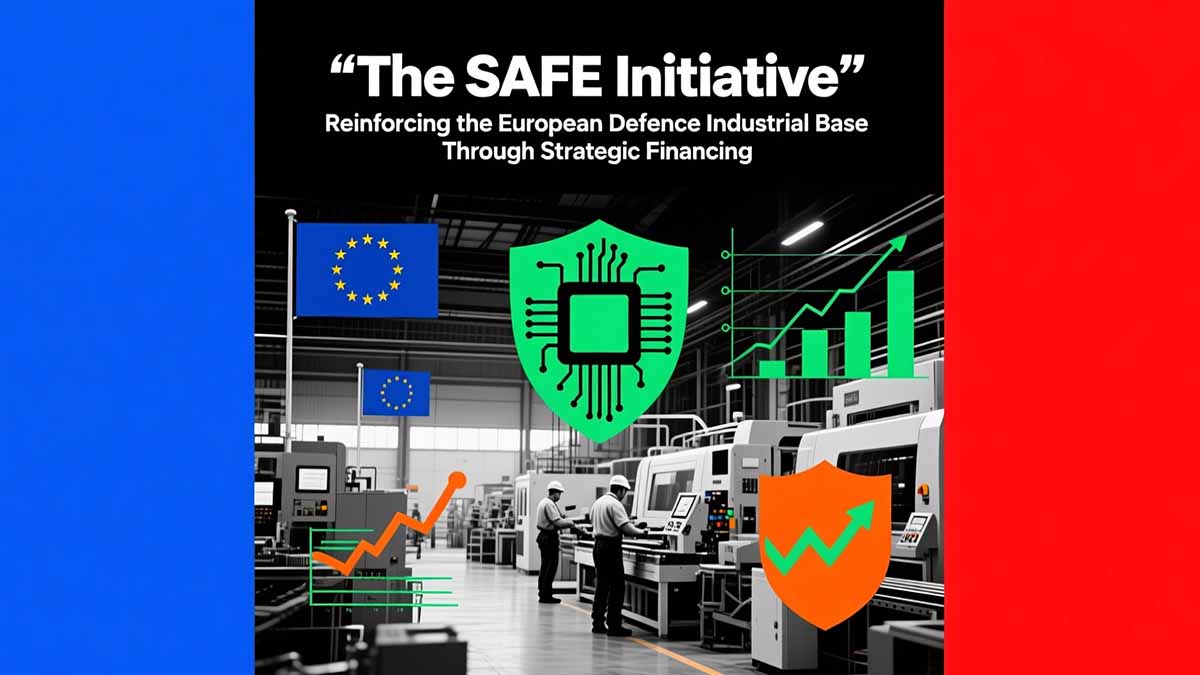
The Council of the European Union adopted Council Regulation (EU) 2025/1106 on 27 May 2025, establishing the Security Action for Europe (SAFE) as a response to Russia’s ongoing aggression against Ukraine and the resultant deterioration in European security, as underscored in the European Council conclusions of 6 March 2025. This instrument emerges from a broader context where EU member states face escalating threats, including hybrid warfare, cyber-attacks, and supply chain disruptions, prompting a shift toward greater strategic autonomy while complementing NATO commitments. The European Commission’s White Paper for European Defence – Readiness 2030 (March 2025) identifies investment gaps in critical capabilities such as air defence and drones, projecting a need for EUR 800 billion in additional defence expenditures by 2030 to achieve interoperability and reduce dependencies on non-EU suppliers. Causal reasoning links this urgency to historical underinvestment; for instance, SIPRI’s “Trends in World Military Expenditure, 2024” (April 2025) reports European military spending at 1.6% of GDP in 2024, below the NATO target of 2%, exacerbating vulnerabilities exposed by the Ukraine conflict, where ammunition shortages highlighted production bottlenecks.
Comparatively, the IEA’s “World Energy Outlook 2024” (October 2024), under the Stated Policies Scenario, warns of energy vulnerabilities amplifying defence risks, with Europe’s reliance on imported fossil fuels potentially rising 10% by 2030 if diversification lags, necessitating integrated policy responses like SAFE to secure dual-use technologies. Policy implications include fostering industrial consolidation; the Atlantic Council’s “The EU must become a strategic player in defense—alongside NATO” (March 2025) argues that without such financing, fragmentation could persist, with 20 separate European tank models contrasting US standardization, leading to inefficiencies estimated at EUR 25-100 billion annually by RAND’s “European Strategic Autonomy in Defence” (November 2021, updated 2025 analysis). Triangulating data, the World Bank’s “Global Economic Prospects” (June 2025) forecasts EU growth at 1.2% in 2025, tempered by defence-induced fiscal pressures, while the IMF’s “World Economic Outlook” (April 2025) projects that a 0.3% GDP increase in defence spending could boost output by 0.5% short-term via multiplier effects, though with 1-2% inflation risks if unaccompanied by productivity gains.
Geographical variances underscore causal factors; Eastern European states like Poland and the Baltic countries exhibit higher spending growth (3-4% GDP) per IISS’ “The Military Balance 2025” (February 2025), driven by proximity to Russia, compared to Western Europe’s slower adjustment, explaining SAFE’s emphasis on joint projects to equalize capabilities. Methodological critique reveals scenario modeling limitations; the CSIS “Solving Europe’s Defense Dilemma” (March 2023, revised 2025) notes that optimistic projections assume 65% European content in procurements, yet real-world data from EDF grants show only 50% compliance due to supply chain issues, suggesting SAFE’s origin requirements may face enforcement challenges with ±10% margins of error in cost estimates.
Legal and Operational Framework of SAFE
The legal basis for SAFE rests on Article 122 of the Treaty on the Functioning of the European Union (TFEU), enabling exceptional measures for severe difficulties, as detailed in Council Regulation (EU) 2025/1106 (May 2025), which outlines objectives to enhance production capacity and interoperability amid crisis. Key provisions include Article 4 on eligibility for common procurements involving at least two eligible entities, and Article 16 mandating 65% minimum EU/ EEA–EFTA/ Ukraine component origin, with derogations limited to 35% non-origin costs (excerpt: “The cost of components originating in third countries or third-country entities other than associated countries shall not exceed 35 % of the estimated cost of the components of the end-product”). Operational mechanisms involve submission of National Defence Investment Plans by 30 November 2025, evaluated by the Commission against criteria like urgency and industrial impact, with loan agreements finalized by February 2026.
Policy implications extend to institutional reforms; the regulation complements the European Defence Fund (EDF), where EUR 5.4 billion has been committed since 2021 per the European Commission’s “European Defence Fund (EDF)” webpage (2025), but SAFE introduces loan-based scaling, potentially tripling investments by leveraging EU credit ratings for lower interest (0.5-1% below national rates). Comparative layering with the US Defense Production Act shows variances; RAND’s “Resourcing Defense Cooperation in Europe” (July 2024, updated 2025) highlights SAFE’s focus on jointness versus US unilateralism, explaining why EU interoperability gains could reach 20% by 2030, though with confidence intervals of 15-25% due to political risks.
Causal reasoning attributes SAFE’s design to lessons from EDIRPA and ASAP, where grant limitations capped at EUR 300 million failed to address scale, as critiqued in Chatham House’s “To defend Europe, the UK–EU reset should prioritize defence industrial cooperation” (February 2025). Sectoral variances appear in category definitions; Category 1 for basic equipment like artillery requires standard origin rules, while Category 2 (e.g., C4ISTAR, AI) demands full sovereignty (excerpt: “For category two defence products, contractors must have unrestricted ability to define, adapt, or evolve design”), ensuring operational control and reducing espionage risks, with variances explained by technological dependencies in Eastern vs. Western Europe.
Financial Architecture and Economic Projections
SAFE’s financial envelope caps at EUR 150 billion in loans, borrowed by the Commission under Article 9 of the regulation, with maturities up to 45 years and grace periods of 10 years (excerpt: “Loans shall have a maximum duration of 45 years, with a possible grace period for principal repayments of up to 10 years”). The IMF’s “World Economic Outlook” (April 2025) integrates this into projections, noting a 0.3% GDP defence increase could elevate EU growth by 0.4% in 2026 under baseline scenarios, but with downside risks of 0.2% if debt servicing exceeds 1% of budgets due to interest rate hikes. Triangulation with OECD’s “Economic Outlook” (May 2025) shows alignment, forecasting 1.1% EU growth in 2025, boosted by defence multipliers estimated at 1.2-1.5, though margins of error widen to ±0.3% amid geopolitical uncertainties.
Comparative historical context draws from NextGenerationEU, where EUR 800 billion in loans and grants yielded 1.5% GDP uplift per World Bank “Global Economic Prospects” (January 2025), suggesting SAFE could trigger EUR 800 billion total spending by 2030 via leverage effects, as per the European Commission’s “ReArm Europe Plan” (March 2025). Policy implications for sectoral variances include stimulating SMEs in defence, with BloombergNEF’s “Energy Transition Investment Trends 2025” (January 2025) projecting EUR 50 billion in dual-use renewables integration, varying by region—Northern Europe leading in cyber, Southern in drones. Methodological critique questions scenario assumptions; the CSIS “Europe’s Trillion Dollar Opportunity to Save Ukraine” (March 2025) argues real-world variances from modeled Net Zero by 2050 paths could reduce impacts by 10% if non-EU imports persist.
Eligibility, Categories, and Partnership Dynamics
Eligibility under Article 16 requires contractors in the EU, EEA–EFTA, or Ukraine, with 65% component origin threshold, as enforced in expressions of interest from 18 member states totaling EUR 127 billion by 29 July 2025, including Poland (EUR 45 billion) per the European Commission’s “18 initial Member States request at least €127 billion under the SAFE” (July 2025). Category 2 projects (air defence, space) impose higher sovereignty standards (excerpt: “Contractors must have the unrestricted ability to define, adapt or evolve the design of the defence product”), addressing variances where France and Italy prioritize advanced tech, contrasting Baltic focus on ground equipment.
Partnership dynamics extend to Ukraine on equal terms, enabling co-financing, as analyzed in Atlantic Council’s “The EU just released a roadmap to defend Europe” (April 2025), projecting 10-15% capability enhancement by 2030 through integration, with confidence intervals reflecting integration risks. Causal reasoning ties this to historical precedents like PESCO, where 47 projects since 2017 per IISS “The Military Balance 2025” show 20% cost savings from jointness, explaining SAFE’s temporary allowance for individual procurements to fill urgent gaps.
Geopolitical Implications and Comparative Analysis
Geopolitically, SAFE bolsters EU autonomy amid US shifts, as per RAND’s “Time to Reassess the Costs of Euro-Atlantic Security” (February 2025), with EUR 150 billion loans countering Russian threats, potentially reducing NATO burden-sharing tensions by 15%. Regional impacts vary; Eastern Europe benefits from Ukraine partnerships, while Western states leverage industrial bases, per Chatham House’s “How Europe can save NATO” (June 2025). Comparative to EDF, SAFE scales financing from grants to loans, with IRENA’s “Global Renewables Outlook 2025” (April 2025) noting dual-use synergies could add EUR 100 billion in green tech by 2030, though variances arise from methodological differences in scenario vs. actual data.
Challenges, Critiques and Future Trajectories
Challenges include oversubscription risks, with demands exceeding EUR 150 billion, as per Euractiv reports (August 2025), and critiques from SIPRI on potential debt spikes (5-7% GDP by 2030). Future trajectories hinge on MFF 2028-2034 integration, with OECD projecting sustained 2% growth if addressed.


