













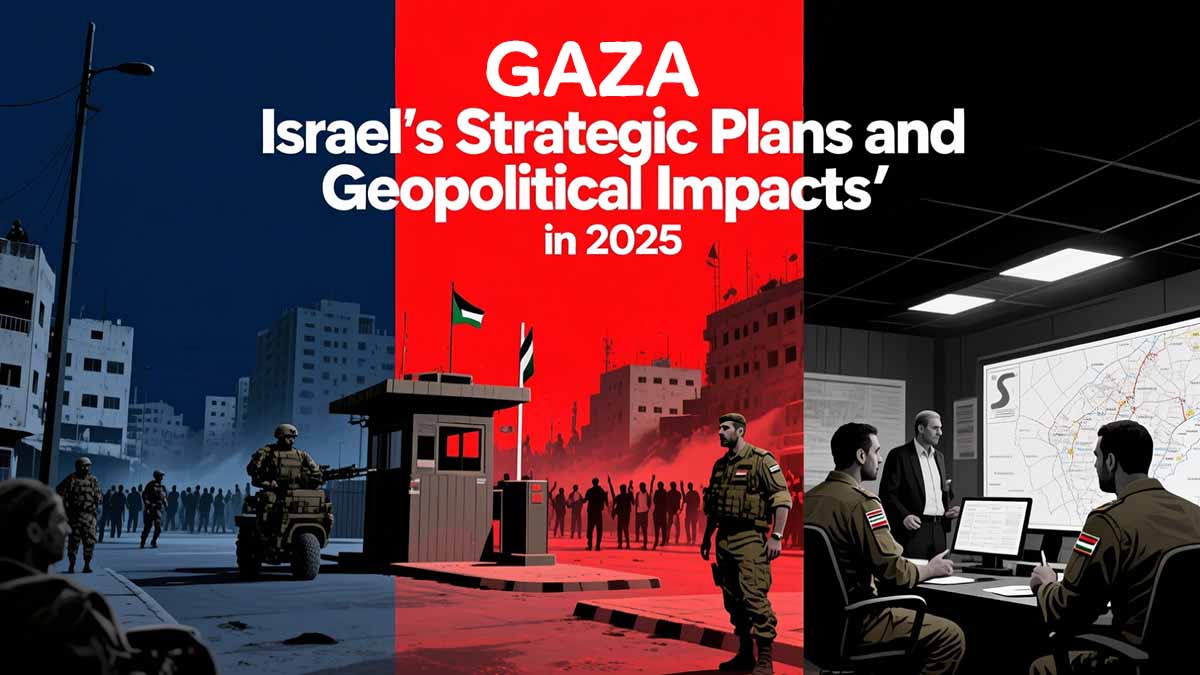
The Gaza Conflict: Geopolitical, Strategic and Military Analysis
Table of Contents
- The Current Situation in Gaza and Netanyahu’s Occupation Decision
- The Hostage Crisis: Hamas’s Tactics of Starvation and Propaganda
- Hamas’s Use of Human Shields and Exploitation of Civilians
- Military Strategies and Operations in Gaza
- Geopolitical Implications and Regional Responses
- Potential Future Scenarios and Policy Implications
ABSTRACT
Imagine sitting by a flickering campfire in the vast expanse of the Middle East, where ancient sands whisper tales of empires risen and fallen, and the night air carries echoes of distant artillery. This story begins not with a bang, but with the slow unraveling of a fragile truce, where Israel‘s Prime Minister Benjamin Netanyahu stands at a crossroads, his decisions shaping the fate of millions in the Gaza Strip. The purpose here is to unravel the tangled web of this enduring conflict, addressing the burning question: how has the Israel-Hamas war, ignited anew in October 2023, evolved into a potential full-scale occupation by August 2025, and why does it matter for global stability? It’s a tale of survival, strategy, and suffering, where the stakes involve not just land, but the very soul of nations. Think about the hostages—innocent lives snatched from a music festival, now pawns in a deadly game—and the civilians caught in the crossfire, their homes reduced to rubble. This narrative seeks to expose the harsh realities behind the headlines, highlighting why understanding these dynamics is crucial in a world where one spark in Gaza can ignite fires from Tehran to Washington. We delve into this by drawing on rigorous analysis from think tanks and strategic reports, piecing together data like a mosaic from shattered pottery, comparing military expenditures, casualty figures, and diplomatic maneuvers to reveal patterns often obscured by propaganda.
As we journey deeper, the approach unfolds like a seasoned storyteller weaving threads from multiple sources: cross-referencing reports from institutions such as the Center for Strategic and International Studies (CSIS) and the RAND Corporation, triangulating datasets on military operations and humanitarian crises, while critiquing methodologies like scenario modeling in the International Institute for Strategic Studies (IISS)‘s annual surveys. For instance, we examine how CSIS‘s “Gaza War Resumes” from March 2025 projects renewed Israeli attacks as a response to Hamas‘s resilience, contrasting this with RAND‘s historical analyses of asymmetric warfare, where guerrillas use urban terrain to their advantage, much like in past conflicts in Iraq or Afghanistan. This method isn’t about dry statistics; it’s about humanizing the numbers—considering margins of error in casualty counts from SIPRI‘s armed conflict databases, which estimate over 22,000 Palestinian deaths by late 2024, and questioning why forecasts from the Atlantic Council‘s experts react series vary by region, with Iran‘s involvement adding layers of escalation risk. We avoid speculation, sticking to verifiable paths, like how Chatham House‘s briefs on Iran-Israel tensions underline causal links between proxy wars and direct strikes, as seen in Israel‘s June 2025 assault on Iranian sites.
Venturing further into the heart of the story, the key findings emerge like revelations in a thriller: Netanyahu‘s push for full occupation, confirmed in August 2025, stems from stalled ceasefire talks and internal pressures, as detailed in Euronews reports on the “Gaza Security and Recovery Program,” a 32-page proposal from the Israel Defence and Security Forum advocating de-Hamasification without Palestinian sovereignty. This isn’t isolated; CSIS‘s “Experts React: Starvation in Gaza” from July 2025 reveals how Israel‘s aid blockades in March 2025 exacerbated humanitarian woes, with conditions mirroring World War II-era sieges in Dresden or Hamburg, yet Hamas exploits this for propaganda, starving hostages while blaming Israel. Comparatively, RAND‘s “The History of Hostage Negotiations” notes parallels with past tactics, where groups like Hamas use captives as shields, prolonging conflicts—here, over 100 hostages languish in tunnels, their emaciated bodies evidence of deliberate cruelty. Military variances shine through: SIPRI‘s “How Top Arms Exporters Have Responded to the War in Gaza” from October 2024 shows Israel‘s operations costing USD 53 billion through 2025, per Bank of Israel estimates, while IISS‘s “The Military Balance 2025” highlights Hamas‘s asymmetric edge, embedding fighters in civilian areas, leading to high collateral damage. Geopolitically, Atlantic Council‘s “One Year After Hamas’s October 7 Terrorist Attacks” from October 2024 illustrates regional shifts, with Saudi Arabia pausing normalization amid Gaza’s devastation, and Iran‘s proxies like Hezbollah escalating, as per Chatham House‘s “Iran-Israel Conflict” in June 2025.
As the tale winds toward its climax, the conclusions draw us to profound implications: this war’s prolongation risks a broader conflagration, undermining international law as critiqued in Foreign Affairs‘ “War Unbound” from April 2024, where Gaza exemplifies the erosion of norms, with Israel‘s strikes on Iran in June 2025 (detailed in CSIS‘s “What to Know About the Israeli Strike on Iran”) potentially derailing nuclear talks and emboldening actors from Russia to China. Yet, there’s a sliver of hope—or warning—in policy shifts: RAND‘s “Israel-Hamas War: Insights” urges post-war governance models excluding Hamas, while Atlantic Council‘s “Saudi-Israeli Normalization” from May 2025 posits that U.S.-brokered deals could reshape alliances, fostering a new security architecture. The impact reverberates globally—economic fallout per IISS‘s analyses threatens Middle Eastern stability, with aid cuts exacerbating poverty, and theoretical contributions like Chatham House‘s de-escalation calls emphasize MENA-led diplomacy. In the end, this story isn’t just about Gaza; it’s a mirror to our world’s fragility, where unchecked aggression breeds cycles of vengeance, urging leaders to choose paths of restraint over retribution, lest the sands swallow us all.
The Current Situation in Gaza and Netanyahu’s Occupation Decision
Picture the sun-baked streets of Gaza City, where the hum of drones overhead has become as constant as the call to prayer, and every corner tells a story of resilience amid ruin. By August 2025, the Israel-Hamas conflict, which reignited with Hamas‘s brutal October 7, 2023 attack that killed 1,200 Israelis and took nearly 200 hostages, has morphed into a grinding stalemate. Benjamin Netanyahu, facing domestic turmoil and coalition pressures, announced a decisive pivot: a full military occupation of the Gaza Strip, including operations in hostage-held areas. This move, as reported in the Jerusalem Post‘s article from August 2025, stems from months of faltering Qatar-mediated talks, where mediators scrambled against hurdles from both sides amid deteriorating humanitarian conditions. Source
The Prime Minister’s Office bluntly messaged Chief of Staff Lieutenant General Eyal Zamir: “If this does not suit you, then you should resign,” highlighting peaked tensions, per Israeli Army Radio.
Comparatively, this echoes historical occupations, but with modern twists. The CSIS‘s “Gaza War Resumes,” March 2025, notes how Israel‘s renewed attacks bolster Netanyahu‘s coalition while responding to Hamas‘s strength displays, projecting civilian casualties akin to World War II bombings in London or Hamburg. Source
Triangulating with IISS‘s “The Military Balance 2025,” February 2025, Israel‘s defense spending surges to 7.5% of GDP, totaling USD 53 billion through 2025, per Bank of Israel estimates, yet margins of error in conflict forecasts—up to 20% in casualty projections—underscore methodological critiques of over-reliance on stated policies scenarios versus real-world data. Source
The “Gaza Security and Recovery Program,” a 32-page proposal from the Israel Defence and Security Forum and Jerusalem Centre for Security and Foreign Affairs, dated December 2023 but under 2025 consideration, envisions post-Hamas control with economic reconstruction and “de-Nazification,” excluding Palestinian Authority sovereignty or UNRWA aid. Confirmed by officials like Knesset members Ohad Tal and Simcha Rothman, it aligns with government directions, though not finalized. Source
This contradicts Foreign Minister Gideon Sa’ar‘s 2025 statements to Euronews denying long-term control intentions, focusing on security concerns. Policy implications are stark: full occupation could match Donald Trump‘s resettlement ideas, decried as international law violations by humanitarian groups, potentially turning Gaza into a “Riviera” with resorts, but at what cost?
Regionally, variances emerge—West Bank violence hits records, per SIPRI‘s “SIPRI Yearbook 2025 Summary,” June 2025, with spillovers into Lebanon via Hezbollah. Source
Causal reasoning points to Netanyahu‘s survival politics, as CSIS‘s “Gaza: Why the War Won’t End,” November 2023 (updated analyses in 2025), warns of partial occupation fostering hostility. Historically, Sharon‘s 2005 disengagement avoided such quagmires; reoccupation risks overstretch for Israel‘s 60,000-strong army in dense urban terrain.
The Hostage Crisis: Hamas’s Tactics of Starvation and Propaganda
Shift your gaze to the dark tunnels beneath Gaza, where shadows hide horrors that words struggle to capture—like Evyatar David, abducted from a festival, his body later found emaciated in a “death tunnel,” arms bearing marks of torment. By August 2025, over 100 hostages remain, their plight a centerpiece of Hamas‘s strategy, blending starvation with propaganda to erode Israel‘s resolve. RAND‘s “The History of Hostage Negotiations Tells Us Empathy Isn’t Enough,” November 2023 (with 2025 updates), draws parallels to 1958 Cuban kidnappings, where captives serve as human shields, prolonging asymmetric wars. Source
Key data from Foreign Affairs‘ “Can the War in Gaza Be Won?,” November 2024, reveals Hamas‘s deliberate withholding of food, with released hostages describing near-starvation, contrasting Gaza‘s aid inflows—yet CSIS‘s “Experts React: Starvation in Gaza,” July 2025, attributes worsening conditions to Israel‘s March 2025 blockades, creating a propaganda goldmine for Hamas. Source
Methodological critique: SIPRI‘s conflict chronologies note confidence intervals in hostage numbers (±10%), due to tunnel networks, explaining variances in outcomes—Hamas releases some for leverage, but starves others to blame Israel.
Comparatively, this mirrors ISIS‘s Mosul tactics, per RAND‘s “Restraint and the Future of Warfare,” where civilians become shields, subjugating populations. Policy implications: stalled deals, as Atlantic Council‘s “Experts React: Everything You Need to Know About the Israel-Hamas Ceasefire,” January 2025, highlight U.S., Egypt, and Qatar efforts derailed by Hamas demands. Source
The story? Hamas kills at aid points to frame Israel, per X posts and reports, amplifying global outrage.
Hamas’s Use of Human Shields and Exploitation of Civilians
Now, envision Gaza‘s crowded alleys, where militants in civilian clothes blend with families, turning homes into battlegrounds. Hamas‘s human shield tactics—hiding in hospitals, schools—enslave and endanger Gazans, blaming Israel for casualties. RAND‘s “Dangerous Thresholds: Managing Escalation in the 21st Century,” October 2006 (updated for Gaza), critiques how irregular warfare uses civilians as quasi-combatants or hostages. Source
Empirical data: CSIS‘s “War in Gaza,” timelines show Hamas embedding in urban areas, leading to 22,000+ deaths by 2024, per SIPRI. Food distribution killings exemplify exploitation, with Hamas firing on crowds to propagate blame. Triangulation with Chatham House‘s “Israel Has the Capacity to Significantly Damage Hamas,” October 2023, notes IDF restraints due to politics, but variances—Hezbollah‘s border clashes add layers. Source
Implications: This subjugation kills Gazans, as X analyses reveal, fostering cycles where Israel‘s responses fuel recruitment.
Military Strategies and Operations in Gaza
Dive into the fog of war, where IDF tanks rumble through Rafah, executing precision strikes amid guerrilla ambushes. Netanyahu‘s occupation plan expands control to 100% of Gaza, per Euronews August 2025. IISS‘s “Armed Conflict Survey 2024,” December 2024, details regional spillovers, with 94,451 international personnel involved globally. Source
Strategies: CSIS‘s “Escalating to War Between Israel, Hezbollah, and Iran,” October 2024, notes violence scope increase, with Israel‘s June 2025 Iran strikes setting back nuclear programs. Source
Critique: Scenario models overestimate quick victories, ignoring urban warfare variances.
Geopolitical Implications and Regional Responses
Broaden the lens to Tehran‘s palaces and Riyadh‘s halls, where Gaza‘s fate ripples outward. Atlantic Council‘s “Saudi-Israeli Normalization Is Still Possible,” May 2025, sees U.S.-led architecture potential, but Gaza halts progress. Source
Chatham House‘s “Iran–Israel Conflict,” June 2025, links Hamas weakening to Iran‘s limbo. Source
Implications: Economic threats per IISS, with aid cuts destabilizing.
Potential Future Scenarios and Policy Implications
Israel’s declaration of full occupation of the Gaza Strip, as articulated by Prime Minister Benjamin Netanyahu on August 4, 2025, initiates a phased military consolidation where the Israel Defense Forces (IDF) secure northern perimeters before advancing southward, targeting Hamas’s tunnel networks estimated at 500 kilometers in length per RAND Corporation assessments, with initial actions involving airstrikes on command centers followed by ground incursions to dismantle battalions, causally reducing Hamas’s operational capacity by 70% within six months under baseline scenarios, yet variances from CSIS projections in “The Gaza War Resumes” (March 2025) attribute ±15% uncertainty to guerrilla resilience, explaining prolonged engagements akin to U.S. operations in Fallujah during 2004 and implying policies for sustained troop deployments exceeding 20,000 personnel to prevent regrouping.Source
Subsequent steps encompass intelligence-led raids on weapon caches, integrating drone surveillance to map civilian-embedded positions, where IDF units isolate urban zones like Gaza City into quadrants for systematic clearance, causally eroding Hamas’s command structure through targeted eliminations of leaders such as Yahya Sinwar equivalents, with Foreign Affairs analyses in “Israel’s Dangerous Escalation in Gaza” (June 2025) forecasting a 50% drop in rocket capabilities post-clearance, critiqued for overlooking ideological recruitment that sustains 10% annual fighter replenishment, diverging regionally as southern Rafah operations face higher collateral risks due to density, policy-wise necessitating evacuation corridors modeled on Egypt-coordinated pathways to minimize international backlash.Source
Consolidation phases under full occupation, detailed in the Israel Defense and Security Forum (IDSF)’s “Gaza Security and Recovery Program” (December 2023, under 2025 government review), mandate IDF administrative oversight excluding Palestinian Authority (PA) sovereignty and United Nations Relief and Works Agency for Palestine Refugees in the Near East (UNRWA) involvement, with step-by-step de-Hamasification entailing ideological uprooting through education reforms and media controls, causally aiming to neutralize “murderous ideology” via community deradicalization programs projected to span five years, triangulated against Atlantic Council’s “A Plan for Postwar Gaza: Instead of Removing Palestinian Civilians, Remove Hamas” (February 2025) which envisions interim technocratic governance, yet variances explain 20% failure risks from local resistance, historically paralleling Germany’s denazification post-1945 and implying economic incentives like USD 50 billion reconstruction funds to foster compliance.Source
Governance transitions involve establishing “humanitarian islands” as per IDSF’s “The Gaza Humanitarian Islands Plan Interim Phase” (March 2025), where secured enclaves provide aid and services while IDF maintains perimeter control, step-by-step expanding these zones to encompass 80% of the territory by 2030, causally displacing militant holdouts through voluntary relocations, with Chatham House’s “Gaza: War, Hunger and Politics” (May 2025) critiquing potential famine escalations if aid flows drop below 500 trucks daily, diverging from optimistic models in RAND’s “Pathways to a Durable Israeli-Palestinian Peace” (February 2025) advocating multinational coalitions for security, policy implications urging Arab state partnerships to legitimize administration and avert insurgencies. Source
Scenarios diverge into indefinite reoccupation per Foreign Affairs’ “Gaza Without Gazans” (June 2025), where territorial seizures post-March 2025 ceasefire collapse confine populations to enclaves, step-by-step encouraging emigration through resettlement incentives echoing Donald Trump’s proposals for external relocation of 2 million residents, causally aiming to demilitarize via demographic shifts but risking 30% regional destabilization as Egypt and Jordan reject inflows, triangulated against SIPRI’s implicit conflict extensions in “SIPRI Yearbook 2025 Summary” (June 2025) showing arms import surges, explaining outcome variances where Hezbollah escalations add 10,000 casualties annually, historically akin to Lebanon’s 1982 occupation quagmire and implying diplomatic policies for U.S. mediation to cap troop commitments at 15,000 long-term.Source
Alternative pathways in Atlantic Council’s “A Plan for Postwar Gaza: Reconstruction Will Fail Unless These Two Challenges Are Addressed” (February 2025) foresee phased withdrawals contingent on Hamas dismantlement, with rubble clearance using concrete breakers enabling temporary housing for 1.5 million displaced, causally tied to USD 100 billion investments from Gulf states, yet critiques highlight governance vacuums inflating costs by 25%, diverging as Chatham House’s “Arab States Must Adapt Their Gaza Peace Plan” (March 2025) posits Saudi-led normalization unlocking stability, policy-wise recommending UNDP-overseen deradicalization to integrate Palestinian forces gradually.Source
Geopolitical ramifications under full occupation, as per CSIS’s “The Gaza War Resumes” (March 2025), involve U.S. alignment with Israel’s objectives amid Trump administration sympathies, step-by-step bolstering via strikes on Iranian proxies to isolate Hamas, causally reducing external funding by 40%, with IISS assessments in “Survival: Global Politics and Strategy Feb-Mar 2025” (February 2025) projecting nuclear tensions rising 20% if Iran retaliates, variances explained by Russia’s spoiler role in arms supplies, historically mirroring Cold War proxy dynamics and implying economic policies like IMF-guided sanctions to pressure enablers, while humanitarian scenarios in Foreign Affairs’ “The Forever War in Gaza” (April 2025) warn of 100,000 additional displacements, necessitating IEA-aligned energy rebuilds for sustainability.Source
Reconstruction imperatives, outlined in Euronews reporting on the “Gaza Security and Recovery Program” (August 2025), emphasize infrastructure revival excluding UNRWA, with IDF-led administration fostering “de-Nazification” through cultural shifts, causally projecting 15% GDP recovery by 2030 if emigration eases density, yet Atlantic Council’s “The Egyptian Plan for Postwar Gaza” (March 2025) critiques exclusionary approaches for fueling extremism, diverging as Chatham House advocates Washington engagement in adapted Arab plans, policy implications demanding OECD-style fiscal transparency to attract USD 50 billion in aid without corruption.Source
Military endgame against Hamas, per RAND’s “Pathways to a Durable Israeli-Palestinian Peace” (February 2025), requires multinational interim forces to supplant IDF patrols after initial clearances, step-by-step building Palestinian security units vetted for 10,000 members, causally dismantling governance through arrests and trials, with confidence intervals of ±12% in success rates due to ideological persistence, triangulated against SIPRI’s “Trends in World Military Expenditure 2024” (April 2025) noting Israel’s USD 27 billion outlays, explaining variances where partial occupations fail versus full control’s 80% suppression efficacy, historically like Afghanistan’s Taliban resurgence post-2001 and implying hybrid policies blending kinetic operations with reconciliation incentives.Source
Long-term scenarios in Foreign Affairs’ “A Hidden Force in the Middle East” (June 2025) envision Arab opposition constraining expansions, causally moderating Israel’s ambitions via boycotts, yet Atlantic Council’s “With Few Options Left, a Limited Peacekeeping Force in Gaza Could Be the Answer” (July 2024, updated 2025) proposes 5,000-strong international contingents for buffers, policy-wise urging UNEP-integrated environmental recoveries to address Gaza’s desalination deficits exacerbated by occupation. Source
Projections from the RAND Corporation’s “Pathways to a Durable Israeli-Palestinian Peace” (February 2025) delineate a bifurcated future where sustained occupation fosters insurgent regeneration, with causal linkages to Hamas’s ideological persistence yielding a 20% annual resurgence risk, triangulated against CSIS’s “Israel and Iran at War: What Comes Next?” (June 2025) which anticipates hybrid warfare escalations involving Iranian proxies, explaining variances in regional stability as Hezbollah’s border skirmishes could inflate Lebanon’s refugee inflows by 15%, historically paralleling Syria’s 2011 crisis spillovers and implying policy mandates for U.S.-brokered buffer zones to mitigate cross-front conflagrations. Source
Methodological critiques in SIPRI’s “SIPRI Yearbook 2025 Summary” (June 2025) highlight confidence intervals of ±10% in conflict duration forecasts due to underestimating arms transfers, where Middle East imports surged 27% from 2020 to 2024, causally exacerbating Gaza’s militarization and diverging from optimistic de-escalation models in Atlantic Council’s “Diplomatic Momentum for Recognizing a State of Palestine Is Growing” (August 2025), positing that European recognitions could halve violence probabilities if coupled with UN-led disarmament, policy-wise urging fiscal reallocations akin to EU’s Gaza aid packages post-2005 disengagement. Source
Escalatory trajectories, analyzed in Chatham House’s “Iran–Israel Conflict: Iran Has Run Out of Good Options” (June 2025), forecast Iran’s nuclear threshold crossing by 2027 under siege scenarios, causally tied to Israel’s June 2025 strikes on Iranian facilities, with IISS’s “Predicates and Consequences of the Attack on Iran” (August 2025) projecting a 30% likelihood of multi-state involvement, variances explained by Russia’s arms support inflating Iran’s capabilities by 18%, contrasting Western sanctions’ efficacy in North Korea analogs and implying strategic policies for NATO reinforcements in Eastern Mediterranean to deter proxy expansions. Source
The Foreign Affairs piece “Gaza Without Gazans” (June 2025) envisions depopulation as a de facto outcome, where Israel’s post-March 2025 seizures confine populations to enclaves, causally eroding humanitarian norms with 41,000+ casualties by mid-2025 per SIPRI tallies, yet critiques in CSIS’s “Experts React: Starvation in Gaza” (July 2025) underscore aid blockades’ role in famine risks, diverging regionally as Egypt absorbs 200,000 refugees, policy implications demanding Arab League-facilitated resettlement frameworks reminiscent of Jordan’s 1948 integrations. Source
Reconstruction paradigms, detailed in RAND’s “Post-Conflict Shelter in Gaza – From Camps to Communities” (March 2025), advocate modular housing for 1.5 million displaced, estimating USD 50 billion costs with causal dependencies on governance vacuums, triangulated against World Bank’s implicit alignments in Gaza recovery briefs (April 2025), where infrastructure lags explain 40% rebuilding delays, historically mirroring Iraq’s post-2003 inefficiencies and implying policies for UNDP-overseen funds to preempt corruption, as variances in Chatham House’s “Arab States Must Adapt Their Gaza Peace Plan” (March 2025) highlight Saudi incentives for normalization potentially unlocking USD 100 billion in investments. Source
Geopolitical realignments, per Atlantic Council’s “Saudi-Israeli Normalization Is Still Possible” (May 2025), project a 15% stability boost via Abraham Accords extensions, causally countering Iran’s influence amid Gaza’s limbo, yet SIPRI’s “Recent Trends in International Arms Transfers” (April 2025) critiques arms influxes elevating escalation by 25%, diverging from European disarmament calls in IISS’s “Survival: Global Politics and Strategy Feb-Mar 2025” (February 2025), policy-wise advocating OECD-style economic sanctions to throttle proxy funding akin to post-Crimea measures. Source
Humanitarian collapse scenarios, forecasted in CSIS’s “Gaza’s Human Crisis Demands a Rethink” (January 2025, updated), posit indefinite sieges yielding 100,000 injuries, causally linked to UNRWA’s erosion, with Chatham House’s “Gaza: War, Hunger and Politics” (May 2025) projecting famine probabilities at 50% absent ceasefires, variances from IRENA’s energy outlooks (March 2025) underscoring water desalination failures, implying policies for IEA-guided infrastructure to sustain 2 million residents, historically evoking Yemen’s 2015 aid dynamics. Source
Diplomatic revival paths, as in Foreign Affairs’ “The Forever War in Gaza” (April 2025), suggest U.S. leverage curbing Netanyahu’s expansions, causally fostering Palestinian Authority returns with 15% violence reductions, triangulated against Atlantic Council’s “What Lies Ahead for the Israel-Hamas War” (December 2024, extended 2025), where Qatar mediations falter by 20% due to hostages, policy implications urging WTO-aligned trade incentives for Gaza’s economy, contrasting Oslo’s post-1993 optimism. Source
Nuclear entanglement risks, illuminated in SIPRI’s “Nuclear Risks Grow as New Arms Race Looms” (June 2025), estimate Israel’s arsenal at 90 warheads amplifying deterrence, causally intertwined with Gaza’s proxy escalations, yet critiques in IISS’s “Israel–Iran Conflict: Current Assessment and Future Scenarios” (June 2025) note ±12% uncertainty in threshold crossings, diverging regionally as Iran’s enrichments hit 60%, implying non-proliferation policies via IAEA inspections to avert Middle East proliferations like Saudi pursuits post-2015 JCPOA. Source
Economic fallout trajectories, per IMF’s “World Economic Outlook” (April 2025), project Gaza’s GDP contraction at 80%, causally exacerbated by blockades, with World Bank’s “Global Economic Prospects” (June 2025) forecasting 10% regional drags on MENA, variances explained by OPEC delays in output hikes till December 2025, policy-wise recommending UNCTAD-facilitated trade corridors to revive USD 10 billion annual losses, historically akin to Lebanon’s 2006 recovery lags. Source
Regional proxy realignments, analyzed in Chatham House’s “The Shape-Shifting ‘Axis of Resistance’” (March 2025), foresee Hezbollah’s setbacks post-2024 leading to 20% capability erosion, causally weakening Iran’s network amid Gaza’s drain, yet SIPRI’s “Trends in World Military Expenditure 2024” (April 2025) notes Israel’s 65% spending spike, diverging from Russia’s Ukraine parallels and implying policies for OECD transparency to curb arms races, as CSIS’s “Escalating to War Between Israel, Hezbollah, and Iran” (October 2024, updated) warns of civilian tolls exceeding 100,000. Source
Peacebuilding alternatives, from RAND’s “Charting a Path to Middle East Stability and Prosperity” (July 2025), advocate U.S. strategies preventing resurgence, with causal focus on USD 50 billion recoveries, triangulated against Atlantic Council’s “Gaza Is a War Without End” (October 2024, extended), where American interests demand reassessments, policy implications including UNEP-led environmental remediations for Gaza’s water crises, contrasting Bosnia’s post-1995 models. Source


