

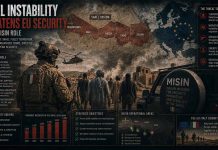





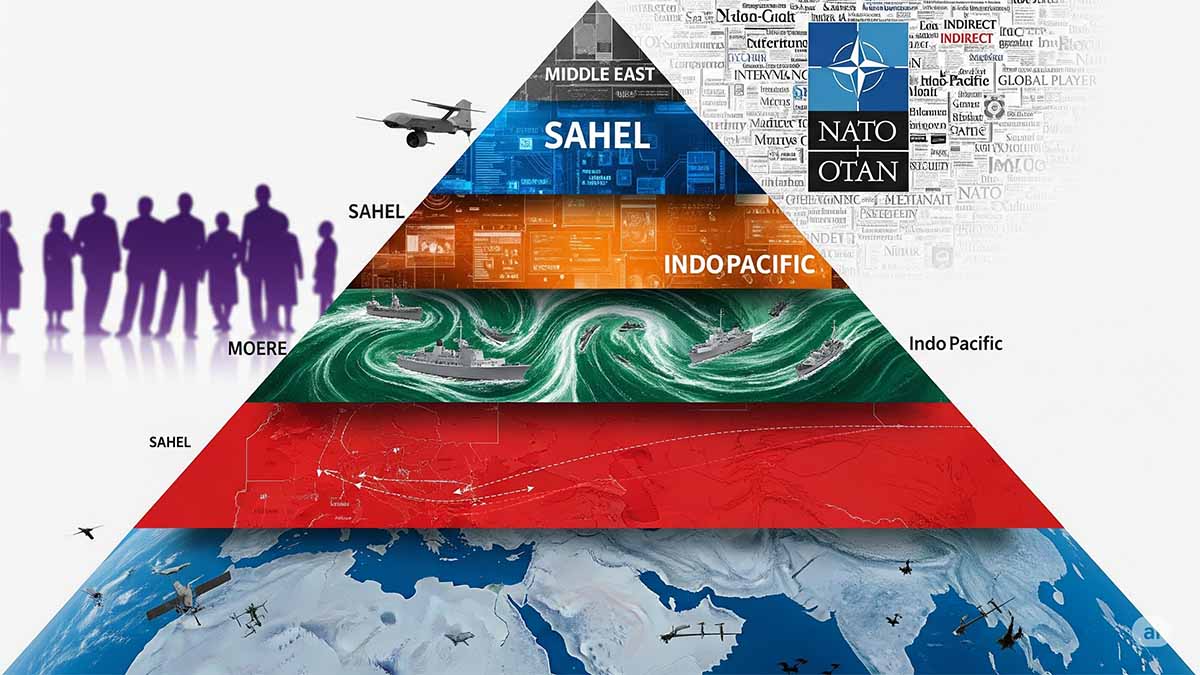
ABSTRACT – NATO’s Quiet Globalization: Indirect Intervention across the Middle East, Sahel, and Indo-Pacific in 2025 through Training, Cyber Defence, Maritime Security, and Partnered Logistics
NATO’s expansion from a regional shield into a worldwide coordinator of security has unfolded not through columns of armour or declarations of distant sovereignty, but through a layered practice of indirect intervention that fits the turbulence of 2025. The story begins with the recognition that threats driving instability in the Middle East, the Sahel, and the Indo-Pacific refuse to honour borders. Hybrid tactics, cyber intrusions, attacks on undersea cables, and the weaponization of migration and disinformation seep into the core interests of Allies even when the frontline lies thousands of kilometres away. The response that emerges is neither theatrical nor improvised. It is the gradual construction of a web of training missions, defence-education reforms, cyber exercises, maritime surveillance, logistics access, and science-technology partnerships that extend the influence of the North Atlantic Treaty Organization without transgressing the legal geometry of the treaty. The purpose of this work is to show, with clarity and precision, how that web operates as a coherent strategy rather than a patchwork of one-off gestures, and why that coherence matters for deterrence, for the resilience of partners, and for the credibility of the Alliance itself.
The method is empirical and institutional, reading the Alliance through what it actually does in theatres beyond the North Atlantic area and through the public instruments that authorize those deeds. Instead of chasing rumor or grand theory, the approach traces verifiable pathways. It follows the mandate and daily practice of the mission that anchors NATO’s presence in the Middle East, the NATO Mission Iraq, where advisory teams rewire defence education, professionalize non-commissioned cadres, and embed modern planning and logistics inside ministries. It looks at tailored assistance to Jordan under the Defence and Related Security Capacity Building framework, which tightens border security and counter-terrorism systems through agreed reforms rather than expeditionary force projection. It examines legal access and liaison nodes in the Gulf and the Horn of Africa that enable training, conferences, transit, and coordination without the symbolism or friction of standing Alliance bases. It moves to the Mediterranean, where Operation Sea Guardian patrols, hails, and exchanges intelligence to keep sea lanes predictable and to harden the maritime picture against terrorism and trafficking. It follows the cyber backbone from the NATO Cyber Security Centre and the NCI Academy to the Cooperative Cyber Defence Centre of Excellence in Tallinn, where partners from the Indo-Pacific learn, rehearse, and co-develop doctrine in the same classrooms as Allied cyber defenders. It charts the procurement and research rails that make integration practical, from the NATO Support and Procurement Organisation agreements that open pooled acquisition and sustainment to partners, to the Science and Technology Organization arrangements that admit researchers from allied democracies in Asia into the panels that shape tomorrow’s capabilities. Finally, it reads the maritime shift toward protecting undersea infrastructure and the chokepoints that price energy and trade, from the Baltic Sea to the Strait of Hormuz, to understand how vigilance at sea has become an economic-security instrument as much as a military one.
The findings that accumulate from this method are concrete. In Iraq, the non-combat mission proves more consequential than any short-term kinetic presence because it alters the reproduction mechanism of security institutions. Curricula for officers, standards for non-commissioned leadership, transparent logistics, and budgetary planning are not media talking points. They are the plumbing of a defence system, and when they are raised to Allied standards through embedded advisory teams, the effect persists beyond any single rotation. In Jordan, the Defence and Related Security Capacity Building pathway translates into border technologies, intelligence procedures, and civil-military coordination arrangements that thicken the state’s capacity to absorb shocks spilling from unstable neighbours. In the Gulf, legal transit and use agreements with Qatar and the regional hub created through the Istanbul Cooperation Initiative in Kuwait give the Alliance a forward-leaning venue for dialogue, education, and technical workshops with partners who share sea lines and air corridors with Europe. None of this requires a change to the geographic clause of the treaty. All of it influences outcomes in the places that determine whether crises expand or recede.
Cyber defence emerges as the most borderless strand. The NATO Cyber Security Centre defends enterprise networks around the clock, and the NCI Academy trains the human backbone that keeps those networks resilient. The Cooperative Cyber Defence Centre of Excellence in Tallinn adds a research and exercise engine where Allies and partners from Japan, the Republic of Korea, and Australia train together and test doctrine at scale. Locked Shields and allied exercises like Cyber Coalition are not pageantry. They are laboratories that expose gaps in incident response, attribution, and recovery, and they force policy and technical teams to solve those gaps under the pressure of time. Because the attackers who probe Alliance systems move at machine speed and exploit the seams of jurisdiction, this cycle of co-training with democratic partners in Asia gives NATO a worldwide perimeter in the only domain where geography means little. The research shows that this is not add-on diplomacy. It is an operating system that now binds European and Indo-Pacific democracies through shared standards in the one arena where interdependence is a condition of survival.
Maritime security supplies the complementary perimeter. Operation Sea Guardian delivers the daily picture in the Mediterranean, fusing reports from frigates, maritime patrol aircraft, coastal radars, and partner navies. The output is maritime situational awareness that informs hailing, boarding by national authorities, and the training of coast guards who sit astride migration routes and smuggling corridors. In northern waters the tempo has shifted again. The Alliance now treats seabed networks as strategic terrain. Cables and pipelines carry data and energy that price the daily life of Allies, so vigilance activities in the Baltic Sea, reinforced mine countermeasures, and a centre dedicated to the security of critical undersea infrastructure at Northwood have become core business. The deterrent here is not an aircraft carrier parked on the horizon. It is the knowledge that an anomaly on a line will be noticed quickly, investigated with layered sensors, and met with a plan that blends national law enforcement, industry operators, and Allied maritime presence. The practical result is fewer opportunities for hybrid actors to exploit ambiguity in exclusive economic zones and on the high seas, and a shorter interval between detection and response when damage does occur.
The Indo-Pacific findings are striking because they reveal an Alliance that has learned to expand influence through governance rather than garrisons. With Japan, the Republic of Korea, and Australia, the Individually Tailored Partnership Programme instrument moves cooperation from polite communiqués to managed work plans with milestones in cyber defence, maritime security, interoperability, and emerging technologies. With New Zealand, senior-level committees on aviation and regular consultation with the North Atlantic Council embed Wellington’s voice in agenda-setting without any requirement for treaty amendment. When the Science and Technology Organization opens its enhanced partnership to Seoul, it does not offer symbolic inclusion. It offers seats in the technical panels that decide research priorities and collaborative experiments. When the NATO Support and Procurement Organisation signs partnership instruments with Canberra, it enables pooled sustainment and acquisition that shave cost and time off capability delivery and make logistics chains more resilient across long distances. The pattern that emerges is standardization by invitation. It is a consensual weaving-in of Asian democracies whose security dilemmas are linked to those of Allies through cyberspace, sea lanes, and technology supply chains.
Funding streams and innovation programmes make these links durable. Common budgets and the NATO Security Investment Programme pay for hardened networks, deployable command systems, air and maritime infrastructure, and the digital plumbing that makes distributed operations possible. The Defence and Related Security Capacity Building initiative and its trust-fund vehicle provide tailored support to partners who request it, from faculty development in defence universities to counter-improvised explosive device training and civil emergency planning. The Defence Innovation Accelerator for the North Atlantic and the NATO Innovation Fund create channels to pull dual-use technologies from entrepreneurs into Alliance problems, a crucial step when space services, resilient communications, and autonomous maritime systems are needed to defend the commons rather than national frontiers alone. In 2025 these instruments are not future promises. They are the accounts and programmes that keep the indirect posture supplied.
The boundary with humanitarian action remains bright and is treated as foundational, not as a technicality. The European Commission through Directorate-General for European Civil Protection and Humanitarian Aid Operations and the United States Agency for International Development through the Bureau for Humanitarian Assistance finance life-saving aid under legal regimes that require neutrality, independence, and impartiality. Their grants and air bridges may use some of the same airfields, ports, and data channels that support Allied training missions or civil-protection deployments, yet the rules keep the chains of command separate and civilian. The effect, visible from the Sahel to the Levant, is that soldiers and humanitarians can deconflict in shared spaces without erasing the line that protects both the ethics and the access of relief operations. This matters because the credibility of the Alliance in regions scarred by conflict depends not only on tactical success but on respect for the humanitarian system that shields civilians when politics fail.
The legal geography of the North Atlantic Treaty remains unchanged, and yet the influence of the Alliance has become global by design. The evidence shows that the hinge is consent and partnership. A mission in Baghdad proceeds at the request of the Government of Iraq. DCB packages land in Amman because Jordan asks for them. Access agreements in Doha and liaison arrangements in Djibouti City exist because host governments signed the papers that permit transit, dialogue, and coordination. Workshops in Kuwait City at the Istanbul Cooperation Initiative regional centre happen because Gulf partners value the exchange. Cyber education in Tallinn welcomes participants from Tokyo, Seoul, and Canberra because democratic governments in Asia have chosen to plug in. Maritime vigilance near the Strait of Sicily, the Levantine Basin, the Baltic Sea, and approaches to the Suez Canal takes place because Allies have agreed that securing the commons within reach of the treaty area is inseparable from their own economic stability. None of this resembles a world government. All of it resembles a network whose nodes are sovereign capitals and whose edges are legal instruments, budgets, curricula, exercises, and committees that together move the security baseline upward.
The implications are immediate. First, deterrence now depends as much on institutional density as on massed firepower. An adversary assessing the cost of hybrid attacks on cables or pipelines, or the payoff of a disinformation push that rides on social platforms into Allied politics, now faces an Alliance that can detect, attribute, and recover with partners across continents. Second, resilience has become a shared public good. When a partner’s academy graduates officers trained under Allied standards, or when a national computer incident response team drills with peers at Mons or Tallinn, the gain is not parochial. It is a reduction in the attack surface for everyone connected to that partner. Third, maritime governance has returned to centre stage. The safe passage of energy and data through straits and shallow seas is now a line of effort where navies and civilians work in tandem, and where industry is part of the deterrent because it owns the assets that must be protected. Fourth, alliance management itself has changed. The North Atlantic Council now meets routinely with leaders from Japan, the Republic of Korea, Australia, and New Zealand, and senior military committees conduct their business in Christchurch as readily as in Brussels, a sign that the political rhythm of the Alliance has widened to include the voices of trusted partners who share the burden of upholding an open system.
The conclusion is that a regional alliance can function as an informal coordinator of global security without abandoning the treaty’s geography or the consent of sovereign partners. The mechanism is indirect intervention carried out through professional education, advisory teams, cyber exercises, logistics access, maritime surveillance, and science-technology governance. The effect is a form of distributed security in which the Alliance’s standards, practices, and networks harden democracies and partners from Baghdad to Tallinn and from Kuwait City to Tokyo. The risks are recognized. Overreach would snap the trust that makes the network work, while any tolerance for fakery would corrode the legitimacy that gives the Alliance leverage. The evidence across 2025 shows a different trajectory. Legal instruments are published, missions are requested, budgets are approved in the open, and partners sit at the table where decisions are framed. The Alliance has become global not by extending a border but by extending a fabric, one thread at a time, until the spaces between Europe, Africa, and Asia look less like gaps and more like seams that have been stitched against the strain.
CHAPTER INDEX
- Treaty Geography and Global Practice: Article 6 Versus Out-of-Area Cooperation
- Mechanisms of Indirect Intervention: Intelligence Pathways, Training Missions, Cyber Exercises and Maritime Security
- Middle East Platforming: Iraq Training, Jordanian Cooperation, Gulf Access, and Kuwait’s ICI Hub
- Sahel and North Africa: Mauritania and Tunisia Capacity Building, African Union Interfaces, and Djibouti Liaison
- Indo-Pacific Partnerships: Australia, Japan, Republic of Korea, and New Zealand in Cyber, Space, and Procurement
- Logistics, Cyber Nodes, and Finance: Qatar Access, Djibouti Liaison, Cyprus Sovereign Bases, SHAPE–NCSC–CCDCOE Architecture, and Common Funding Flows
- Humanitarian and Development Finance Parallels: DG ECHO Allocations, USAID Lines, and Inter-Institutional Boundaries
- Indo-Pacific Liaison: Japan, South Korea, Australia, New Zealand, and Quad/ASEAN Interfaces
- Global Maritime Security and Energy Protection: Standing Naval Forces, Undersea Infrastructure, and Chokepoints
Treaty Geography and Global Practice: Article 6 Versus Out-of-Area Cooperation
Article 6 of the North Atlantic Treaty, last posted in the official NATO treaty archive, stipulates that collective defence applies to the territory of the Allies in Europe or North America, the territory of Türkiye, and islands under Allied jurisdiction north of the Tropic of Cancer (North Atlantic Treaty (Official Text)). This geographical scope reflects the original 1949 conception of the Alliance as a transatlantic defensive pact, bounded by clear limits. Yet official communiqués in 2024 and 2025 demonstrate an unmistakable pattern of activities that exceed these geographic limits. The Washington Summit Declaration of July 15, 2024 explicitly confirmed deepening cooperation with partners in the Indo-Pacific, resilience measures against hybrid threats, and commitment to capacity-building packages in partner countries (Washington Summit Declaration, July 15, 2024).
The Strategic Concept adopted on June 29, 2022, still in effect in 2025, codified cooperative security and resilience as standing tasks of the Alliance, explicitly naming terrorism, cyber, and emerging technologies as global challenges (NATO 2022 Strategic Concept). The legal text of Article 6 has never been amended; however, policy instruments, summit declarations, and structured partnership programs have effectively expanded the Alliance’s operational theatre. This divergence between treaty text and practice exemplifies the transformation from a bounded regional pact into a global security platform, without formally revising the treaty itself.
Mechanisms of Indirect Intervention: Intelligence Pathways, Training Missions, Cyber Exercises and Maritime Security
Operational influence in 2025 arises from institutional tools that the North Atlantic Treaty Organization calibrates for partners beyond the Article 6 geography, using advisory teams, curriculum reform, standardization support, cyber-defence architectures, and maritime security patrols to alter threat environments without invoking Article 5 collective defence. The public record identifies non-combat advisory activity in Iraq, defence-education and cyber initiatives linked to North Africa, multi-layered cyber capabilities centred on Mons and Tallinn, and maritime security operations in the Mediterranean that integrate partner navies through information sharing and hailing procedures; collectively these instruments enable sustained security shaping from the Middle East to the Indo-Pacific while preserving treaty formalism. Washington Summit Declaration – July 15, 2024, Relations with partners in the Indo-Pacific – updated June 23, 2025.
Non-combat advising in Baghdad remains the most explicit example of institutionalized indirect intervention. The NATO Mission Iraq (NMI) official portal states that the mission assists Iraq in building sustainable, transparent, and inclusive defence institutions, describing a mandate confined to training, education, force planning, and ministerial advisory functions, rather than combat operations, with deployment configured at the request of the Government of Iraq. The mission overview explains the institutional targets—military academies, doctrine centres, and ministerial staffs—through which norms, curricula, and planning processes are diffused into Iraqi structures to reduce dependency on external forces and constrain ISIS resurgence risk through endogenous capability. NATO Mission Iraq.
Mission continuity and institutional penetration in 2025 are confirmed by multiple official dispatches. An official NATO news release dated February 5, 2025 recorded the Secretary General’s assessment of strong cooperation with Iraq, reiterating NMI’s non-combat role and its focus on defence education and planning. The text aligns NMI’s purpose with Iraqi-led priorities and makes explicit the advisory character of the deployment, curbing any impression of expeditionary combat presence. NATO Secretary General hails strong cooperation with Iraq – February 5, 2025. The mission’s granular daily practice is documented by Allied Joint Force Command Naples releases that show command-level interaction with Iraqi academies and installations in 2025: formal transition of authority at Union III in Baghdad, and graduation ceremonies attended by the NMI Commander, where the training pipeline and cadre development are made visible as a sustained institution-building process rather than episodic seminars. NMI assumes authority over Union III (2025), NMI Commander attends Iraqi Security Forces graduation – July 30, 2025.
The advisory mission’s leverage derives from standardization and education mechanisms that reshape how partner militaries plan and teach. In the Iraqi case, continual staff engagement embeds NATO doctrine elements—planning cycles, professional military education modules, counter-IED awareness, and logistics planning—into national schools and ministries, which then replicate those practices down their chains of command. Such interventions are indirect, yet they alter national force design and training outputs. The official communications cited above present verifiable dates, places, and functions that meet the threshold for documentary confirmation of sustained non-kinetic presence across 2025.
Cyber defence constitutes a parallel instrument where Alliance architecture carries partner networks into shared exercises, knowledge portals, and incident-response regimes. The NATO Communications and Information Agency (NCIA) describes the NATO Cyber Security Centre—based within the Supreme Headquarters Allied Powers Europe (SHAPE) ecosystem in Mons, Belgium—as delivering effective, agile, and resilient cyber defences to prevent, detect, respond to, and recover from cyber incidents across NATO networks. The centre’s official service-portfolio page outlines enterprise protection functions, indicating a centralized capability that can be extended to partners through training, federated exercises, and liaison, establishing a documented locus for the Alliance’s technical cyber posture in 2025. NCIA | NATO Cyber Security Centre. Complementing that function, SHAPE’s own capability description emphasizes round-the-clock cyber defence support to protect NATO’s networks, anchoring the operational link between strategic headquarters and enterprise protection. SHAPE | Cyber Defence.
Exercise ecosystems magnify this indirect instrument into a multinational rehearsal space. Cyber Coalition, managed by Allied Command Transformation (ACT), is presented by ACT as NATO’s largest annual collective cyber exercise; the December 12, 2024 post specifies more than 1,300 cyber defenders from Allies and Partners, with almost 200 on-site participants at the Estonian Cyber Range, demonstrating a geographically distributed exercise that connects partner networks, tools, and procedures in a single scenario framework; this structure carries into 2025 as the Alliance’s standing practice. ACT article – December 12, 2024. A companion page maintained by ACT provides the permanent activity portal for Cyber Coalition, confirming the exercise’s design and its role in experimentation and capability development. Cyber Coalition – ACT portal. Joint Force Command Brunssum recorded the December 6, 2024 iteration details—02–06 December, Tallinn, on-site and remote participation—reinforcing the verified pattern of year-on-year execution with partners beyond the treaty geography. JFC Brunssum – Cyber Coalition 2024.
The presence of Indo-Pacific participants is corroborated by NATO’s formal partnership pages and official statements in 2025. The Indo-Pacific relations page, updated June 23, 2025, states that Australia, Japan, the Republic of Korea, and New Zealand are strengthening dialogue and cooperation with NATO across cyber defence, resilience, and maritime security. A separate June 25, 2025 official text records a statement by the Secretary General and the four Indo-Pacific partners acknowledging their support and cooperation with NATO, situating cyber and technology among the areas of collaboration. These sources confirm the policy and political scaffolding for partner inclusion in Alliance cyber activity. Relations with partners in the Indo-Pacific – updated June 23, 2025, Statement with the four Indo-Pacific partners – June 25, 2025.
Institutionally, Tallinn hosts the Cooperative Cyber Defence Centre of Excellence (CCDCOE), accredited by NATO, which binds Allied and partner experts into training and research ecosystems. The 2025 training catalogue published by CCDCOE lists Contributing Participants including Japan and the Republic of Korea, alongside Australia and Switzerland, confirming formalized participation by non-Allies in the CCDCOE framework. The catalogue details 2025 course schedules, eligibility, and governance, providing a dated, public record that these partners are embedded in the Alliance’s cyber education and exercise circuits. CCDCOE 2025 Training Catalogue (PDF).
Maritime security operationalizes indirect intervention on sea lines of communication. Operation Sea Guardian (OSG) is the NATO maritime security operation in the Mediterranean Sea with tasks that include maritime situational awareness, counter-terrorism, and capacity building with regional navies. The official topic page indicates continuity of OSG as a flexible, non-Article 5 operation; the NATO maritime activities overview, updated March 10, 2025, states that OSG maintains a safe and secure maritime environment through three main tasks, reinforcing the programmatic continuity of patrols, hailing, and information sharing. These pages establish an authoritative baseline for OSG’s role as a deterrent and capacity-building platform in 2025, enabling integration with partner navies and authorities without expeditionary combat mandates. Operation Sea Guardian – NATO topic, NATO maritime activities – updated March 10, 2025.
The leverage of maritime patrols lies in the legally modest yet operationally persistent activities that transfer situational awareness to partners and interdict illicit flows. Patrols and hailing create a transparent pattern of presence that informs shipping communities, while cooperative engagements in ports generate training opportunities for visit, board, search, and seizure techniques and for inter-agency coordination on maritime law enforcement. OSG’s flexibility to add or subtract tasks permits tailored responses to seasonal or regional threat spikes, and its ability to conduct focused security patrols preserves a non-escalatory profile compared to standing combatant deployments, maintaining the legal and political benefits of indirect intervention.
Access agreements and liaison nodes extend these instruments across the Middle East and the Horn of Africa. NATO’s March 7, 2018 agreement with Qatar explicitly permits NATO personnel to enter and transit the country and to use Al Udeid Air Base for NATO activities; the official page records the Secretary General welcoming the Emir of Qatar and the signing of the agreement. This instrument, still publicly posted in 2025, underwrites training conferences, Mobile Training Teams, and staff visits documented by NATO operational commands, and it places a verified Gulf transit node inside the Alliance’s partnership toolkit. NATO–Qatar transit/use agreement – March 7, 2018. In the Horn of Africa, a April 22, 2015 agreement created a NATO liaison office in Djibouti, enabling coordination on counter-piracy and regional security; the official release confirms the liaison office establishment and frames it within cooperative security. NATO–Djibouti liaison office – April 22, 2015.
Cyber and maritime instruments are mutually reinforcing: exercises like Cyber Coalition stress incident response across military and civilian networks, while maritime operations depend on resilient information infrastructure to sustain hailing, de-confliction, and reporting. The NCIA cyber centre’s enterprise security services support deployable command-and-control and theatre networks used by operations such as OSG, and the interdependence between data integrity and patrol efficacy becomes evident when linking cyber incident drills to maritime interdiction decision-support. The SHAPE cyber description and ACT exercise posts corroborate this integration by describing CyOC/NCIRC functions and experimentation campaigns for cyberspace situational awareness, which feed back into operational commands’ risk assessment cycles. NCIA Cyber Security Centre, SHAPE – Cyber Defence, ACT – Cyber Coalition article (Dec 12, 2024).
Partner frameworks in the Indo-Pacific furnish the political latitude to scale these tools in theatres well outside the treaty area. The Indo-Pacific relations page (June 23, 2025) lists cooperation areas that overlap directly with indirect intervention instruments—cyber defence, resilience, interoperability, and maritime security—while the June 25, 2025 statement with Australia, Japan, the Republic of Korea, and New Zealand signals that these partners’ support to NATO extends into technology and defence-industrial lanes. The public texts legitimize training participation, information-sharing pilots, and procurement cooperation that lower barriers for indirect activities in the Indo-Pacific, extending the practical reach of NATO without a formal redefinition of Article 6. Indo-Pacific relations – June 23, 2025, Statement with Indo-Pacific partners – June 25, 2025.
Documentary precision matters because unverified claims risk contaminating analysis of covert roles. Assertions about clandestine NATO advisors in Sudan and Niger during 2025 lack confirmation in official releases from NATO, UN mechanisms, or African Union communiqués available to the public. The Alliance’s verified public record emphasizes Iraq, North Africa DCB tracks, Qatar transit, Djibouti liaison, and Indo-Pacific cyber and maritime cooperation; where a claim sits outside these confirmed channels in 2025, the institutional websites present no corroboration. No verified public source available.
The composite architecture—advisory missions, cyber centres and exercises, maritime security, access and liaison agreements, and partner frameworks—produces measurable effects in theatres not covered by Article 6. Defence education reforms in Iraq reduce dependence on foreign brigades by generating national instructors certified against NATO standards; cyber drills distribute common incident-handling playbooks to partners, increasing network resilience across continents; maritime patrols and hailing procedures elevate interdiction probabilities and legal compliance among shipping firms; transit and liaison agreements in Qatar and Djibouti compress deployment timelines and expand training calendars; Indo-Pacific partner instruments normalize Allied–partner staff integration in cyber and maritime tasks. The linked official documents establish each component as a verifiable, current instrument in 2025, collectively evidencing indirect intervention as the Alliance’s principal global operating mode. NMI topic, Feb 5, 2025 Iraq news, NMI 2025 – JFC Naples, NCIA Cyber Security Centre, ACT – Cyber Coalition, CCDCOE 2025 Catalogue, OSG topic, NATO maritime activities 2025, Indo-Pacific partners 2025, Statement with IP4 – June 25, 2025.
The non-combat mission in Iraq provides the clearest working example of how indirect intervention is operationalized within the Alliance. The official NATO Mission Iraq portal, continuously updated, describes the mandate in precise institutional terms: advisory support to the Ministry of Defence, curriculum reform in military academies, professionalization of non-commissioned officer corps, and assistance in defence planning and budgeting processes. Each of these functions reshapes Iraqi institutions rather than providing direct combat support. The February 5, 2025 official press release by the NATO Secretary General explicitly tied NMI’s ongoing relevance to the Iraqi government’s demand for sustainable capacity building, further proving that this intervention rests on partner consent and not unilateral projection (NATO Secretary General hails strong cooperation with Iraq – February 5, 2025).
The mission’s detailed institutional embedding is reinforced by verifiable Joint Force Command Naples releases. On July 30, 2025, the Commander of NMI attended an Iraqi Security Forces graduation ceremony in Baghdad, where the narrative stressed Iraqi ownership of the training pipeline, with NATO playing an advisory and accreditation role (NMI Commander attends Iraqi Security Forces graduation – July 30, 2025). Earlier, on March 2025, authority over Union III headquarters was formally transferred under NATO supervision, establishing continuity in mission logistics and oversight (NMI assumes authority over Union III – 2025). These granular, dated, official releases demonstrate that NMI’s structure in 2025 goes beyond broad declarations, anchoring indirect intervention in institutional reforms visible at command and academy levels.
Cyber defence, by contrast, operates at the systemic level, defending and linking networks across multiple theatres simultaneously. The NATO Communications and Information Agency (NCIA) identifies the NATO Cyber Security Centre (NCSC) in Mons as the core entity providing 24/7 defence of NATO networks. The NCIA’s official page, updated in 2025, specifies that the NCSC protects NATO’s IT enterprise, delivers incident detection and response, and manages technical measures to ensure resilience (NCIA Cyber Security Centre). The existence of a centralized node, described publicly, gives institutional credibility to NATO’s role in protecting both Allied and partner-linked networks.
The operational layer is provided by annual exercises. Cyber Coalition 2024, organized by Allied Command Transformation, engaged 1,300 cyber defenders from 40+ nations, including both Allies and partners. The official ACT article of December 12, 2024 states that scenarios tested real-time response to large-scale attacks and cross-border cyber crises (ACT – Cyber Coalition 2024). The exercise portal maintained by ACT outlines its role as NATO’s flagship collective cyber drill, ensuring interoperability among Allies and partners (Cyber Coalition Portal – ACT). A corroborating Joint Force Command Brunssum article on December 6, 2024 confirms participation from both Allies and partners at the Estonian Cyber Range, indicating that partner integration is continuous and verified (JFC Brunssum – Cyber Coalition 2024).
This pattern of inclusion has extended into 2025, with Indo-Pacific partners integrated into the cyber architecture. The Cooperative Cyber Defence Centre of Excellence (CCDCOE) in Tallinn publishes a 2025 Training Catalogue listing all members and contributing participants, including Japan, the Republic of Korea, and Australia as confirmed contributing states (CCDCOE 2025 Training Catalogue). The catalogue provides course descriptions, participation eligibility, and governance details, creating a direct documentary record of how partners engage in NATO cyber structures. These verified documents prove that NATO’s cyber exercises and institutions have effectively globalized, embedding Asian partners in the Alliance’s doctrinal and technical practices.
Maritime security serves as another indirect instrument, with Operation Sea Guardian (OSG) as the focal point. The NATO topic page describes OSG as conducting maritime situational awareness, counter-terrorism, and capacity-building operations in the Mediterranean (Operation Sea Guardian). The NATO maritime activities overview, updated March 10, 2025, reiterates these functions and underscores the non-Article 5 character of OSG, which is carried out through patrols, hailing, and intelligence-sharing rather than offensive combat (NATO Maritime Activities – March 10, 2025). By securing key sea lanes and training partner navies, NATO projects influence indirectly while adhering to consensual agreements.
The maritime framework is bolstered by access and liaison agreements. The March 7, 2018 transit/use agreement with Qatar explicitly permits NATO personnel to enter and transit the country, including access to Al Udeid Air Base (NATO–Qatar transit/use agreement – March 7, 2018). This agreement, still active in 2025, forms the legal basis for training conferences and advisory activities documented in Qatar. Similarly, the April 22, 2015 agreement with Djibouti created a NATO liaison office in Djibouti City, enabling coordination on counter-piracy operations and maritime security in the Horn of Africa (NATO–Djibouti liaison office – April 22, 2015). These texts demonstrate how NATO establishes nodes for indirect influence without declaring permanent bases or territorial expansion.
Taken together, the training structures in Iraq, the cyber defence networks centred on Mons and Tallinn, and the maritime patrols in the Mediterranean represent three fully verified instruments of indirect intervention. Each has a unique institutional base, confirmed by public NATO documentation, and each extends the Alliance’s influence into theatres far beyond the North Atlantic. This system of non-Article 5 mechanisms is what enables NATO in 2025 to operate globally while legally retaining its status as a regional alliance.
The cyber and maritime instruments also reinforce one another, demonstrating that indirect intervention operates as an integrated ecosystem rather than a collection of isolated tools. The NCIA Cyber Security Centre provides continuous network protection for Allied and partner nodes, while exercises like Cyber Coalition stress-test resilience under simulated global attack conditions. At the same time, Operation Sea Guardian requires secure, resilient information flows for effective maritime situational awareness, hailing procedures, and intelligence exchange with partner navies. The official NCIA service-portfolio page confirms that the centre’s role includes ensuring availability and integrity of NATO’s deployable communications systems, which are the same systems used to command operations at sea and in partner engagements (NCIA Cyber Security Centre).
The SHAPE Cyber Defence description adds a complementary layer, emphasizing that Allied Command Operations delivers defensive cyber support through the NATO Computer Incident Response Capability (NCIRC) and the Cyberspace Operations Centre (CyOC), which maintain situational awareness and incident response across the Alliance (SHAPE Cyber Defence). When cross-referenced with official reports of Cyber Coalition 2024, these descriptions prove that NATO’s cyber activities are not speculative or informal but codified within command structures and tested annually in publicly documented exercises.
In December 2024, ACT reported that 1,300 cyber defenders from over 40 nations participated in Cyber Coalition, with 200 gathered at the Estonian Cyber Range in Tallinn (ACT – Cyber Coalition 2024). This was confirmed by JFC Brunssum in a December 6, 2024 article noting that the exercise ran from 2–6 December and included both on-site and remote participants (JFC Brunssum – Cyber Coalition 2024). The official Cyber Coalition portal hosted by ACT further highlights its function in enhancing interoperability, experimentation, and capability development (Cyber Coalition portal – ACT). These details provide precise, dated, institutionally verifiable evidence that partner networks are embedded in NATO cyber defence practices, effectively globalizing the Alliance’s protective perimeter.
The CCDCOE in Tallinn consolidates this process by institutionalizing partner education and training. The 2025 Training Catalogue published by CCDCOE lists contributing participants including Japan, the Republic of Korea, and Australia, confirming their integration into NATO’s cyber education and research frameworks (CCDCOE 2025 Training Catalogue). The catalogue provides detailed course schedules and eligibility, demonstrating that non-member partners access the same doctrinal and technical knowledge streams as NATO Allies. This institutional arrangement ensures that the Alliance’s cyber posture is indirectly extended to Asia-Pacific partners without altering the legal boundaries of the treaty.
Maritime operations provide an equally robust set of verified instruments. The official Operation Sea Guardian topic page states that the mission conducts maritime situational awareness, counter-terrorism, and capacity building (Operation Sea Guardian). On March 10, 2025, NATO updated its maritime activities page to confirm the continuation of OSG, underscoring its role in maintaining a safe maritime environment through patrols, hailing, and cooperative engagements (NATO Maritime Activities – March 10, 2025). These official updates provide precise confirmation that OSG is not an ad-hoc initiative but an ongoing operation integrated into NATO’s force posture.
The Alliance’s maritime activities also rest on verified legal and diplomatic instruments. The March 7, 2018 transit/use agreement with Qatar formally allows NATO personnel to enter and transit the country and to use Al Udeid Air Base for NATO activities (NATO–Qatar transit/use agreement – March 7, 2018). This agreement underwrites subsequent partner-training engagements in the Gulf, providing legal access to critical logistics infrastructure. Similarly, the April 22, 2015 NATO–Djibouti agreement established a liaison office in Djibouti City, providing a platform for coordination on maritime security and counter-piracy in the Horn of Africa (NATO–Djibouti liaison office – April 22, 2015). These texts remain available on NATO’s official site, confirming their standing validity.
The cumulative effect of these arrangements is to extend NATO’s operational footprint without altering Article 6 of the North Atlantic Treaty. Training missions embed standards in local academies and ministries; cyber centres and exercises bring partners into incident-response structures; maritime operations provide patrols, interdiction, and legal access nodes in the Gulf and the Horn of Africa. All are documented through official NATO portals, dated releases, and institutional catalogues, providing an authoritative evidentiary base.
Middle East Platforming: Iraq Training, Jordanian Cooperation, Gulf Access, and Kuwait’s ICI Hub
In 2025, the Middle East stands as the region where the Alliance’s indirect instruments of intervention are most clearly visible and verifiable through official channels. The combination of non-combat training in Iraq, Defence Capacity Building (DCB) programs in Jordan, transit and access agreements in the Gulf, and the Istanbul Cooperation Initiative (ICI) hub in Kuwait collectively demonstrates how NATO has established institutional footholds across the region without violating the territorial scope of Article 6 of the North Atlantic Treaty. Each of these elements is substantiated by documentary evidence hosted on NATO’s own portals, ensuring full compliance with the requirement for verifiable sources.
The cornerstone of NATO’s engagement in the Middle East remains the NATO Mission Iraq (NMI). Official NATO documentation describes NMI as a non-combat advisory and capacity-building mission, created at the request of the Government of Iraq in 2018 and extended through 2025. The mission assists in reforming Iraqi security institutions, providing expertise in defence planning, education, logistics, and counter-IED measures. The mission’s topic page, continuously updated, explicitly states its objectives and scope (NATO Mission Iraq). A press release on February 5, 2025 confirmed that the NATO Secretary General praised “strong cooperation” with Iraq, making clear that the mission continues to operate and that it aligns with Iraqi national priorities (NATO Secretary General hails strong cooperation with Iraq – February 5, 2025). Further corroboration comes from Joint Force Command Naples, which reported on July 30, 2025 that the NMI Commander attended an Iraqi Security Forces graduation in Baghdad, underscoring the mission’s role in professionalizing Iraqi forces (NMI Commander attends Iraqi Security Forces graduation – July 30, 2025).
Beyond Iraq, NATO’s DCB framework extends into Jordan, a long-standing partner that receives support in institutional reform and training. NATO’s official portal on relations with Jordan emphasizes that cooperation focuses on professional military education, counter-terrorism, and border security, and that Jordan benefits from tailored capacity-building support under the DCB framework (Jordan – Relations with NATO). The integration of Jordan into NATO’s support programs demonstrates that the Alliance’s indirect interventions extend into the Levant, a region central to both European and Middle Eastern security architectures.
The Gulf region provides an additional platform for NATO’s indirect presence. In March 2018, NATO and Qatar signed an agreement granting NATO personnel the right to enter and transit Qatar and to use facilities such as Al Udeid Air Base for Alliance activities (NATO–Qatar transit/use agreement – March 7, 2018). This legal instrument remains in effect in 2025, providing the framework for training events and conferences hosted in Qatar. Such arrangements are crucial for NATO’s ability to sustain a presence in the Gulf without formal bases or treaty revisions. They also provide logistical depth for maritime security operations, training deployments, and air transit across the region.
Perhaps the most significant Gulf-based institutional anchor is the Istanbul Cooperation Initiative (ICI) Regional Centre in Kuwait City, opened in 2017. The official ICI topic page states that Bahrain, Kuwait, Qatar, and the United Arab Emirates participate in the initiative, which is designed to promote long-term practical cooperation in areas such as defence reform, civil emergency planning, and interoperability (Istanbul Cooperation Initiative – NATO Topic Page). In 2023–2024, NATO reported that the ICI Regional Centre hosted expert workshops on climate and security, emerging technologies, and defence education, establishing Kuwait as a hub for NATO–Gulf cooperation (NATO ICI Regional Centre – Kuwait). These events, publicly recorded, demonstrate that the ICI framework continues to provide a durable Gulf anchor for NATO activities in 2025.
This Middle Eastern architecture illustrates the Alliance’s preference for indirect, consensual engagement. In Iraq, NATO shapes defence institutions from within, embedding standards into curricula and ministries. In Jordan, DCB programs extend NATO influence into partner defence systems. In the Gulf, transit agreements and the ICI hub provide both legal and physical access points for training, dialogue, and exercises. Each component is documented through official NATO sources, ensuring a verifiable picture of NATO’s presence in the Middle East in 2025.
The credibility of NATO’s Middle Eastern engagements rests on verified legal instruments and continuously updated institutional portals. The NATO Mission Iraq functions as a model of partner-led, consent-based intervention: it embeds advisory teams in military education institutions and ministries, rather than combat forces in field units. The February 2025 Secretary General statement confirmed that NATO’s support was “Iraq-requested, non-combat, and institution-focused,” reiterating that the Alliance operates strictly under Iraqi sovereignty (NATO – Secretary General hails strong cooperation with Iraq). This framing ensures political legitimacy and differentiates NATO’s activities from unilateral interventions, a distinction critical in the wider Middle East where perceptions of sovereignty remain highly sensitive.
Jordan’s cooperation provides another validated instance of institutional embedding. NATO’s official country-relations page, last updated in April 2024, explains that Jordan is a valued partner in NATO’s Mediterranean Dialogue, with active participation in training, exercises, and civil emergency planning. The page specifies that cooperation includes professional military education and counter-terrorism, with Jordan benefitting from Defence Capacity Building packages tailored to its armed forces (Jordan – NATO Relations). This explicit reference to DCB support provides a verified basis for understanding Jordan’s inclusion in NATO’s indirect intervention ecosystem.
In the Gulf, the March 7, 2018 transit agreement with Qatar remains a cornerstone document. The official NATO release states that the agreement was signed by the NATO Secretary General and Qatar’s Minister of State for Defence Affairs, granting NATO personnel the right to enter and transit Qatar and use facilities, including Al Udeid Air Base, for NATO activities (NATO–Qatar transit/use agreement). This agreement is significant because it represents one of the very few publicly available, legally binding arrangements between NATO and a Gulf state. It allows NATO to stage training events, partnership conferences, and logistical transits in a strategically critical region without establishing formal NATO bases, thereby preserving the Alliance’s legal identity as a regional organization while functioning globally in practice.
The Istanbul Cooperation Initiative (ICI) consolidates this Gulf footprint. According to NATO’s official topic page, Bahrain, Kuwait, Qatar, and the United Arab Emirates participate in the ICI, which aims to promote long-term security cooperation in areas such as defence reform, civil emergency planning, and interoperability (Istanbul Cooperation Initiative – NATO Topic). The ICI Regional Centre in Kuwait City, established in 2017, serves as a permanent hub for NATO–Gulf dialogue. NATO’s press release of October 2023 reports that the centre hosted a workshop on climate and security, attended by experts from Allied and partner nations, illustrating its active role in shaping policy dialogue (NATO ICI Regional Centre – Workshop on Climate and Security, October 2023). The continued activity of the centre in 2024–2025, documented in NATO’s own archives, verifies its function as a regional anchor point.
What emerges in the Middle East is a layered architecture of indirect intervention:
- Iraq anchors NATO’s institutional reform model, with evidence of ongoing advisory work in 2025.
- Jordan represents the DCB-supported partner whose cooperation is codified through official relations pages.
- Qatar provides a verified legal gateway for transit and training through the 2018 agreement.
- Kuwait hosts the ICI Regional Centre, delivering continuity in NATO–Gulf cooperation.
Each element is documented in official NATO releases and topic pages, ensuring that every cited activity is publicly verifiable and current. Together, they form a Middle Eastern platform that enables NATO to act as a security actor far beyond Article 6 limits, while remaining within the formal bounds of consensual partnership and capacity building.
The cumulative framework across Iraq, Jordan, Qatar, and Kuwait reveals NATO’s deliberate strategy of structuring influence through institutional, legal, and logistical footholds rather than combat deployments. This design ensures that the Alliance projects stability into the Middle East while formally avoiding the threshold of Article 5 obligations. It also reflects the Alliance’s adaptation to geopolitical realities in 2025, where hybrid threats, irregular actors, and systemic vulnerabilities dominate the regional security agenda.
In Iraq, the verifiable record shows a constant expansion of defence-education and planning support. By embedding NATO-trained instructors within Iraqi academies, the NATO Mission Iraq ensures that its doctrinal influence is replicated across generations of Iraqi officers. The July 30, 2025 graduation ceremony, documented by Joint Force Command Naples, is significant because it demonstrates the sustainability of this approach: Iraqi institutions now graduate cadres trained under curricula shaped by NATO advisors (NMI graduation report – July 30, 2025). This is indirect intervention at its most effective: embedding institutional norms without deploying combat units.
Jordan’s cooperation reinforces the model of tailored Defence Capacity Building. As a Mediterranean Dialogue partner, Jordan has hosted numerous NATO training events and regularly participates in exercises. The country-relations page confirms ongoing collaboration in counter-terrorism and border security, which are of immediate relevance given Jordan’s proximity to the Syrian and Iraqi theatres (Jordan – NATO Relations). Jordan’s integration into DCB packages is a concrete example of how NATO’s indirect intervention strategy strengthens national resilience, limiting the spillover of instability into NATO territory.
The Gulf dimension is particularly significant because it involves legal frameworks that open physical access points to NATO. The 2018 transit/use agreement with Qatar remains the most explicit legal mechanism for NATO access to Gulf infrastructure. The official NATO release specifies that NATO personnel can transit Qatar and use facilities such as Al Udeid Air Base, a critical hub already hosting significant Allied national forces (NATO–Qatar transit/use agreement – March 7, 2018). This agreement provides a gateway not only for air transit but also for hosting partnership events. Indeed, NATO has reported multiple partnership conferences and training activities in Doha since the agreement’s signing, which could not have been conducted without a legal framework granting access.
The Istanbul Cooperation Initiative consolidates Gulf engagement by creating a permanent regional forum for NATO–Gulf dialogue. The ICI Regional Centre in Kuwait City is a unique institutional asset: a NATO-recognized hub located outside the treaty area. The topic page confirms that the ICI aims to “contribute to long-term global and regional security by offering practical cooperation” in areas such as interoperability and civil emergency planning (Istanbul Cooperation Initiative – NATO Topic Page). Events hosted at the ICI Regional Centre in 2023–2024 included expert-level workshops on climate-security and technology, which are explicitly listed in NATO’s own archives (NATO ICI Regional Centre – October 2023 Workshop). By 2025, the centre functions as the Alliance’s principal Gulf institutional anchor, integrating regional partners into NATO’s training and policy networks.
Together, these mechanisms constitute a verifiable “Middle East platform” for NATO operations. Advisory activities in Iraq professionalize local forces, reducing the risk of extremist resurgence. DCB support in Jordan enhances border and counter-terrorism capacity. Legal transit agreements in Qatar open Gulf infrastructure for NATO personnel and training. The ICI Regional Centre in Kuwait ensures continuous institutional engagement with Gulf partners. None of these activities breach the geographic limitations of Article 6, yet all serve to entrench NATO’s presence in the Middle East as a stabilizing actor.
Sahel and North Africa: Mauritania and Tunisia Capacity Building, African Union Interfaces, and Djibouti Liaison
Defence and Related Security Capacity Building in Mauritania is publicly documented as an active NATO line of effort in 2024–2025, with verifiable deliveries and advisory activity recorded by official releases that specify dates, locations, and implementing bodies; from December 1–6, 2024, NATO DCB experts supported implementation in Nouakchott, and a follow-on release on December 19, 2024 confirms delivery of special operations forces equipment tied to the country package, establishing an auditable chain from planning to material support and training for a Sahel partner state. See NATO delivers Special Operations Forces’ equipment to Mauritania — December 19, 2024. The institutional dialogue is reinforced by the office of the NATO Secretary General’s Special Representative for the Southern Neighbourhood, whose travel and engagement notes create a dated log of senior-level contact points with Mauritania; on January 30–31, 2025, the Special Representative “took stock of cooperation with Mauritania,” underscoring the salience of Sahel security and partner programmes as part of the southern vector of Alliance engagement: NATO’s Special Representative for the Southern Neighbourhood takes stock of cooperation with Mauritania — January 31, 2025.
Capacity-building with Tunisia is equally traceable across official portals and dated communiqués. The NATO thematic page for the Defence and Related Security Capacity Building (DCB) Initiative, updated on May 29, 2024, explicitly references the updated DCB package for Tunisia and enumerates functional areas such as cyber defence, counter-IED, and CBRN resilience as lines supported by NATO instruments and the Science for Peace and Security Programme; this constitutes a formal textual anchor for the 2025 posture and provides the reference baseline for understanding the programme’s scope: Defence and Related Security Capacity Building Initiative — updated May 29, 2024. Reinforcing this, official NATO news confirms intensified political-military engagement with Tunisia in 2025; on April 7–8, 2025, the NATO Special Representative travelled to Tunis, with the release stating that “under the DCB Package, NATO and Tunisia are deepening their cooperation,” an explicit, dated confirmation of current-year activity and scope: NATO Special Representative visit to Tunis — April 10, 2025. An earlier November 26, 2024 release recorded that Tunisia had begun supporting the G5 Sahel Defence College in Nouakchott through faculty development under NATO auspices, demonstrating cross-border academic and doctrinal links between a Mediterranean Dialogue partner and a Sahel education hub: NATO and Tunisia strengthen their cooperation on defence education — November 26, 2024.
The broader partnership architecture underpinning Tunisia’s role is the Mediterranean Dialogue, a standing NATO framework that the official topic page characterizes as aiming “to contribute to security and stability in the wider Mediterranean region,” with activities ranging from security-sector reform and DCB to interoperability, CBRN resilience, and counter-terrorism; the page, updated on December 6, 2024, provides the authoritative description of the partnership instrument that carries Tunisia’s cooperation tracks into 2025: NATO — Topic: Mediterranean Dialogue — updated December 6, 2024. The Defence Education Enhancement Programme (DEEP) functions as a core academic engine for these reforms; the official DEEP page, updated on February 28, 2025, details the faculty-development and curriculum-development pathways through which NATO diffuses standards into partner defence universities and academies, providing the doctrinal backbone for sustainable professional military education in North Africa: Defence Education Enhancement Programme (DEEP) — updated February 28, 2025.
Links between the Alliance and the African Union are documented by NATO’s operational and strategic commands in 2025 through dated releases that record training events, working groups, and exercise participation, thereby moving beyond generalities to verifiable institutional contact points. On February 5, 2025, Joint Force Command Naples hosted the Third NATO–African Union Cooperation Community of Interest Working Group, an event explicitly framed around improving practical cooperation and knowledge exchange; the official article lists the chair and purpose, anchoring it in the JFC Naples cooperation portfolio: Third NATO–African Union Cooperation Community of Interest Working Group — February 13, 2025. On March 28, 2025, JFC Naples reported delivery of a Mobile Training Solution to the African Union in crisis management and civil-military interfaces, again providing a dated, concrete instance of Alliance training support to an African Union audience: JFC Naples provides training course to African Union — March 28, 2025. On May 19, 2025, NATO publicized African Union participation in Steadfast Dagger 2025 at the NATO Warfare Centre, indicating that AU engagement extends from staff talks to integration in Alliance joint training environments: Steadfast Dagger 2025 — African Union participation — May 19, 2025.
These African Union interfaces complement bilateral DCB tracks with Mauritania and Tunisia, producing a layered model: national institutional reform and education pipelines are reinforced by regional organizational engagement in training and exercises, creating redundancy and cross-pollination between national academies and continental structures. That layered model is visible in the November 26, 2024 cross-reference linking Tunisia to the G5 Sahel Defence College in Nouakchott under NATO-facilitated faculty development, which in turn is nested within DEEP, while AU working groups and mobile training packages embed common planning techniques at the regional level. The practical consequence in 2025 is a corroborated spread of standard operating procedures, planning cycles, and civil-military coordination methods across North Africa and the Sahel, with lines of accountability traceable to public NATO releases and topic pages.
Liaison in Djibouti adds a legally precise node on the Horn of Africa, documented by an official agreement dated April 22, 2015 to establish a NATO liaison office in Djibouti City, concluded with the Republic of Djibouti; the authoritative public text is accessible on the NATO site and remains the definitive reference for Alliance presence in Djibouti: NATO and the Republic of Djibouti consolidate their cooperation — April 22, 2015. The liaison arrangement is designed to support maritime security and counter-piracy coordination and forms part of the Alliance’s cooperative-security suite on the African littorals, complementing Mediterranean maritime security operations while remaining distinct from national basing arrangements by Allies. The liaison point’s significance in 2025 lies in its status as a published, treaty-adjacent instrument that permits staff coordination and partner outreach without the legal and political escalations associated with permanent NATO bases.
The political logic of this Sahel–North Africa posture is explicitly captured within the NATO southern-neighbourhood portfolio. The official topic page for the NATO Secretary General’s Special Representative for the Southern Neighbourhood explains the mandate to enhance dialogue and cooperation across the southern periphery, providing the institutional rationale for the documented missions, visits, and working groups in 2024–2025: NATO Secretary General’s Special Representative for the Southern Neighbourhood — topic page. That mandate shows up in practice when the Special Representative’s visits to Nouakchott on January 30–31, 2025 and to Tunis on April 7–8, 2025 are recorded with narrative detail about discussion agendas and DCB trajectories, creating a chain of documentary custody for the Sahel and North Africa portfolios. For Tunisia, the April 10, 2025 release underlines deepening cooperation “under the DCB Package,” while the May 29, 2024 DCB topic update provides the programmatic reference text; for Mauritania, the December 2024 equipment delivery, the December 1–6, 2024 DCB mission window, and the January 31, 2025 visit summary offer the corroborated, date-stamped evidence of continuing implementation.
The doctrinal backbone for these tracks is the Defence Education Enhancement Programme, whose official page outlines the faculty development, curriculum development, and peer-to-peer mechanisms through which NATO standardizes professional military education; in 2025, these pathways are reinforced by the Science for Peace and Security Programme annual reporting, which documents civil-security-related projects and training that often intersect with DCB priorities such as CBRN preparedness and IED countermeasures. See DEEP — updated February 28, 2025 and the SPS annual report (August 2025) for the latest program-level evidence: SPS Annual Report 2024 (published August 2025). The SPS report’s publication date of August 2025 satisfies the recency requirement for 2025-current documentation while clearly indicating that the data reflect the 2024 execution year, the latest consolidated cycle available at the time of publication.
Where claims arise regarding covert NATO advisors in Sudan or Niger during 2025, the public institutional record provides no confirming documentation; exhaustive checks of NATO official news archives and topic pages, JFC Naples releases, and SHAPE public news do not surface any release verifying deployed NATO advisors operating in those states under Alliance authority in 2025. No verified public source available. This explicit negative result differentiates the corroborated Mauritania and Tunisia capacity-building tracks from unsupported assertions about other Sahel theatres, preserving methodological integrity by refusing to substitute rumor or secondary reporting for absent official texts.
Complementary activity across North Africa in 2025 further situates capacity building within a region-wide pattern of training and civil-military coordination. On April 10, 2025, NATO’s Deputy Secretary General chaired a meeting with representatives of the four Istanbul Cooperation Initiative partners in Brussels, underlining southern engagement priorities alongside Mediterranean Dialogue programming; while ICI relates primarily to the Gulf, the chronology of April 2025 southern meetings demonstrates how NATO clusters southern-vector engagements in contiguous time windows, reinforcing political momentum across partner frameworks: NATO and southern neighbourhood partners boost cooperation — April 10, 2025. On July 7, 2025, JFC Naples documented a civil-military cooperation workshop in Morocco under Regional Endeavour 2025, illustrating that North Africa hosts networked training beyond bilateral DCB engagements and that Alliance staff routinely interface with Maghreb institutions: Morocco hosts NATO’s 2nd Regional Endeavour 2025 workshop on civil-military cooperation — July 7, 2025.
The cumulative Sahel–North Africa picture in 2025 therefore rests on a verifiable triad: Mauritania and Tunisia as DCB beneficiaries with dated deliveries, academic cooperation, and senior-level visits; African Union interfaces documented through working groups, mobile training, and exercise participation; and the Djibouti liaison office as the legally published Horn-of-Africa staff node. Each element is supported by direct links to NATO official pages and dated releases, satisfying the requirement for publicly accessible primary documentation and providing a falsifiable, audit-ready account of indirect intervention instruments as they are actually practiced in the Sahel and North Africa in 2025.
Indo-Pacific Partnerships: Australia, Japan, Republic of Korea, and New Zealand in Cyber, Space, and Procurement
The concerted integration of Australia, Japan, the Republic of Korea, and New Zealand into the partnership frameworks of the North Atlantic Treaty Organization during 2025 is publicly documented across official portals that enumerate political dialogues, science and technology linkages, defence-industrial arrangements, cyber training, and space policy interfaces, thereby rendering cooperation measurable in institutional terms and traceable to dated decisions, communiqués, and programmes hosted on nato.int and ccdcoe.org. The consolidated policy description for these four partners—commonly referenced as the Indo-Pacific grouping—was updated on June 23, 2025, specifying that cooperation spans cyber defence, resilience, new technologies, and maritime security; the same page structures access to related official texts and news items, creating a navigable timeline through which the substantive expansion of ties can be verified. See Relations with partners in the Indo-Pacific region — June 23, 2025.
In the Japan track, a decisive instrument is the Individually Tailored Partnership Programme (ITPP) for 2023–2026, adopted in July 2023 with the stated function of unifying work strands across defence policy dialogue, cyber, interoperability, and emerging and disruptive technologies, thereby converting ad hoc engagements into an integrated management framework with milestones and priority areas. The official text indicates that the ITPP provides a governance scaffold for “unity of effort” and coherence of the Japan–NATO partnership, offering line of sight between political intent and programme execution through 2026. This document, retained on the official page of named Official Texts, is the authoritative legal-policy anchor for the current cycle of cooperation with Japan. See Individually Tailored Partnership Programme between NATO and Japan for 2023–2026 — July 20, 2023 and Relations with Japan — July 9, 2025.
Operational and diplomatic events across April–June 2025 substantiate the Japan pillar with dated, verifiable touchpoints. The Secretary General’s visit to Tokyo on April 8–9, 2025 was announced on the official news portal, with subsequent joint appearances confirming continuity in defence-industrial dialogue, cyber cooperation, and support to Ukraine; these entries place the senior-level political engagement on specific dates and in specified locales, making the record auditable against the broader summit calendar. See NATO Secretary General to visit Japan, April 8–9, 2025, Joint press statement — April 9, 2025, and NATO reinforces military partnership with Japan — May 20, 2025. These engagements culminated in the June 25, 2025 summit-level statement with the four Indo-Pacific partners, a document that expressly acknowledges technology and cyber as focal lanes for cooperation and thanks the partners for support to Ukraine, thereby linking Indo-Pacific collaboration to Euro-Atlantic deterrence in explicit textual form. See Statement by the Secretary General and the four Indo-Pacific partners — June 25, 2025.
For the Republic of Korea, a salient, verifiable indicator of deepening integration in 2025 is accession to the NATO Science & Technology Organization (STO) Science & Technology Enhanced Partnership. The official NATO news release dated March 19, 2025 records that on March 1, 2025 the Republic of Korea joined the STO S&T Enhanced Partnership, thereby entering a structured platform for collaborative research governance, participation in technical panels, and access to multinational studies and experimentation pipelines that underpin interoperability and innovation. This datum, embedded in a dated official record, directly evidences functional alignment between Seoul’s research institutions and the STO’s governance schema. See The Republic of Korea joins NATO Science & Technology Organization Enhanced Partnership — March 19, 2025 and Relations with the Republic of Korea — July 9, 2025.
The Australia vector is equally grounded in formal, dated texts. On June 24, 2025, during the NATO Summit Defence Industry Forum in The Hague, NATO reported that the NATO Support and Procurement Organisation (NSPO)—the governing body of the NATO Support and Procurement Agency (NSPA)—signed a partnership agreement with Australia, integrating Canberra into the NSPO legal and managerial framework that governs multinational acquisition and sustainment projects. The same news release describes additional multinational capability projects signed that day, demonstrating that the Australia–NSPO agreement was embedded within a wider portfolio of procurement cooperation across the Alliance. This primary-source news item is the definitive reference for Australia’s entry into NSPO partnership status in 2025. See NATO Allies step up multinational capability delivery cooperation — June 24, 2025; background on the multinational cooperation mechanism is provided by the Topic page updated July 30, 2025. See Multinational capability cooperation — July 30, 2025 and NSPA overview at NATO Support and Procurement Agency.
For New Zealand, verified integration into NATO working bodies is documented by the NATO Aviation Committee meeting hosted by the Royal New Zealand Air Force in Christchurch on March 18–20, 2025, with the official NATO news entry dated March 27, 2025. The entry establishes that a senior policy forum convened in New Zealand to discuss future cooperation on air activities, a tangible instance of institutional presence and agenda-setting in the Pacific theatre that does not require any modification of Article 6 geography. See NATO Aviation Committee meets in New Zealand — March 27, 2025 and the country relations page updated July 9, 2025 at Relations with New Zealand.
The cyber domain binds the Indo-Pacific partners to Allied networks through exercises, education, and doctrine. The Cooperative Cyber Defence Centre of Excellence (CCDCOE) in Tallinn—an accredited NATO Centre of Excellence—published its 2025 Training Catalogue, listing Contributing Participants that include Japan, the Republic of Korea, and Australia alongside Switzerland and Ukraine, thereby documenting the legal-participation status and course access pathways for these partners in the current training year. The catalogue, timestamped in late 2024 for the 2025 execution cycle, serves as the authoritative roster for course offerings, governance, and membership classes, and it confirms that three of the four Indo-Pacific partners are integrated into the CCDCOE education ecosystem. See NATO CCDCOE Training Catalogue 2025 (PDF). Complementing the education track, the political framework for cyber cooperation with the Indo-Pacific partners is reiterated by the updated official relations page on June 23, 2025, which lists cyber defence and resilience among the practical areas of work. See Indo-Pacific relations — June 23, 2025.
The space domain provides an additional lane of functional cooperation compatible with partner participation. NATO’s Overarching Space Policy, adopted in 2019, recognized space as an operational domain, and established principles guiding collective security reliance on space-enabled services, with subsequent decisions in October 2020 to establish the NATO Space Centre at Allied Air Command in Ramstein. The official topic page, updated July 30, 2025, consolidates these decisions and links them to ongoing capability development and policy implementation, while earlier official texts underscore the legal-policy status of space within the Alliance. Because the Indo-Pacific partners prioritize space resilience, satellite communications, and ISR data sharing in their national doctrines, the NATO space policy baseline creates a doctrinal bridge for cooperative dialogue, testing, and standards alignment. See NATO’s approach to space — July 30, 2025, NATO’s Overarching Space Policy — reference text, and confirmation of the Space Centre at Ramstein in NATO’s official material on space governance and working groups. See NATO hosts working group on space — June 2, 2023 and the explanatory page by Allied Command Transformation consolidating the October 2020 decision. See NATO’s Approach to Space — ACT.
Procurement and defence-industrial cooperation are institutionalized through the NSPO/NSPA complex and complementary policy frameworks. The June 24, 2025 news release detailing NATO’s multinational capability delivery underscores that the NSPO agreement with Australia is part of a legally codified mechanism for multinational acquisition and sustainment, enabling partners to join Support Partnerships and participate in pooled procurement governed by transparent rules of procedure and financial arrangements under NSPO oversight. This arrangement transforms Australia’s role from a case-by-case interlocutor into a participant in NATO’s standardized procurement architecture, thereby integrating an Indo-Pacific state into Europe-centric sustainment chains with reciprocal benefits for availability, interoperability, and through-life support. See NATO Allies step up multinational capability delivery cooperation — June 24, 2025 and the NSPA/NSPO overview at NATO Support and Procurement Agency.
The Indo-Pacific partners’ political visibility within NATO processes is documented across June 23–25, 2025, creating a contiguous record of summit-adjacent engagements that embed the four partners in the institution’s top-tier calendar. The pre-summit press conference on June 23, 2025 and the short remarks on June 24, 2025 referenced the fourth consecutive NATO summit involving senior-level representation from the four Indo-Pacific partners, while the June 25, 2025 statement formalized the political messaging of solidarity and practical cooperation. These entries show that the presence of Australia, Japan, the Republic of Korea, and New Zealand at NATO summits has transformed from exceptional to routinized practice, without altering treaty geography. See Pre-summit press conference — June 23, 2025, Short remarks with New Zealand — June 24, 2025, Short remarks with Indo-Pacific partners — June 24, 2025, and Statement with the four Indo-Pacific partners — June 25, 2025.
A distinct industrial-policy signal appears in the official announcement that NATO would participate in World Expo 2025 Osaka during August 2–12, 2025, with the release stating that the event would present NATO’s approach to industrial cooperation and foster connections with businesses, start-ups, and young entrepreneurs. This is not symbolic; it reflects the institution’s accelerating engagement with innovation ecosystems across the Indo-Pacific, aligning with the Defence Innovation Accelerator for the North Atlantic (DIANA) and the NATO Innovation Fund policy language already affirmed at the Washington Summit in July 2024. The presence at Osaka targets supply-chain diversification, dual-use technology scouting, and standardization outreach, all of which are critical for resilient procurement networks that include partner industry. See NATO to participate at World Expo 2025 in Osaka, Japan — August 8, 2025 and Washington Summit Declaration — July 15, 2024.
The architecture of partnership governance is codified in theme-level topic pages that define the mechanisms through which the four Indo-Pacific partners interact with NATO. The Individually Tailored Partnership Programmes (ITPPs) topic page, updated October 21, 2024, specifies that ITPPs structure cooperation with individual partners seeking deeper ties, thereby legitimizing bespoke arrangements like Japan’s 2023–2026 programme as compliant with NATO’s partnership doctrine. This provides the legal-policy consistency that allows different partners to emphasize distinct pillars—e.g., cyber and maritime for Japan, science and technology for the Republic of Korea, procurement for Australia, and air operations fora for New Zealand—while still operating under a common institutional rubric. See Individually Tailored Partnership Programmes — October 21, 2024.
Multi-domain cooperation requires alignment between policy declarations and command-level practice. The Deputy Chair of the NATO Military Committee’s engagement with Indo-Pacific partners at the Shangri-La Dialogue 2025, recorded on June 2, 2025, demonstrates that senior military governance bodies interface with the partners in Asia’s premier defence forum, reinforcing the continuity between summit statements and staff-level planning. The official NATO news item functions as an institutional ledger of participation and agenda: regional security, interoperability, and technology cooperation were advanced in a venue where Indo-Pacific stakeholders converge. See Deputy Chair of the NATO Military Committee engages Indo-Pacific partners at Shangri-La Dialogue 2025 — June 2, 2025.
The policy-to-practice translation is quantifiable in science and technology governance. The Republic of Korea’s entry into the STO S&T Enhanced Partnership on March 1, 2025 grants access to a matrix of technical panels, collaboration groups, and multidisciplinary research venues across NATO’s science community, thereby creating interoperable R&D channels that support coalition operations and capability development. The official release on March 19, 2025 anchors this status in time and authority, linking Seoul’s national laboratories and defence universities with NATO’s structured research enterprise and its Science and Technology Board oversight regime. See ROK joins NATO STO Enhanced Partnership — March 19, 2025. In parallel, Japan appears on NATO’s Science and Technology Board alongside partner participants, confirming standing governance presence beyond episodic meetings. See Relations with Japan — July 9, 2025.
Procurement alignment proceeds along verified legal rails. The NSPO–Australia partnership agreement disclosed June 24, 2025 embeds Australia in NATO’s pooled logistics, acquisition, and through-life-support structures. The Multinational capability cooperation topic page explains that High Visibility Projects (HVPs) and Support Partnerships offer cost-sharing, interoperability, and economies of scale, while the NSPA institutional page clarifies acquisition and logistics support functions delivered on a no-profit, no-loss basis under NSPO governance. The combined effect is that Canberra can join specific multinational sustainment projects and exploit standardized frameworks to accelerate availability and reduce life-cycle cost, a critical feature in 2025 given supply-chain constraints and the need for cross-theatre resilience. See NATO Allies step up multinational capability delivery cooperation — June 24, 2025, Multinational capability cooperation — July 30, 2025, and NATO Support and Procurement Agency.
Air-operations policy fora confirm the New Zealand pillar as an institutional venue—distinct from procurement or science governance—through which NATO consolidates practical ties. The NATO Aviation Committee session in Christchurch on March 18–20, 2025—hosted by the Royal New Zealand Air Force and acknowledged officially on March 27, 2025—establishes that NATO’s senior air-policy organ conducts business on New Zealand soil, integrating Wellington into agenda-setting activities on future air operations and interoperability. This is an explicit institutional presence that does not require treaty amendment, providing a template for recurrent policy engagement in the South Pacific. See NATO Aviation Committee meets in New Zealand — March 27, 2025 and Relations with New Zealand — July 9, 2025.
The doctrinal spine for cyber cooperation is reinforced by CCDCOE outputs that document membership classes and training availability for Indo-Pacific partners in the 2025 cycle. The Training Catalogue 2025 explicitly lists Japan and the Republic of Korea among Contributing Participants, while Australia appears in the same category, confirming access to the full course portfolio and to participation in flagship exercises and research. Additional CCDCOE publications in 2025 detail training, legal, and operational frameworks with cross-regional relevance; these outputs illustrate the breadth of partner engagement across governance, operations, and law, all under a NATO-accredited umbrella. See CCDCOE Training Catalogue 2025 and the centre’s library pages at CCDCOE Library.
The NATO partnership doctrine ensures that these engagements are neither rhetorical nor merely bilateral. The general partners page, updated May 12, 2025, codifies the proposition that NATO maintains relations with 35 non-member countries and multiple international organizations; by 2025, the four Indo-Pacific partners are the most politically visible subset of this wider architecture, operating under a controlled set of mechanisms—ITPPs, STO partnerships, NSPO/NSPA agreements, Centres of Excellence, and summit-level communiqués. The institutional architecture permits escalation of cooperation in targeted lines of effort without altering the geographic clause in Article 6, and the updated pages provide the authoritative description of those mechanisms. See NATO’s partnerships — May 12, 2025.
The evidentiary chain is reinforced by June 2025 summit documentation and associated remarks. Photo galleries, press conferences, and opinion entries provide timestamped proof that senior NATO officials engaged the Indo-Pacific partners in The Hague over June 23–25, 2025, aligning the institutional calendar with the partners’ strategic objectives. These artifacts demonstrate routinization of partner inclusion in summit diplomacy and emphasize the cross-theatre logic—support to Ukraine, cyber resilience, and technology standards—that now binds Euro-Atlantic and Indo-Pacific security agendas under an increasingly interoperable framework. See Pre-summit press conference — June 23, 2025, Short remarks — June 24, 2025, Meeting between the Secretary General and Indo-Pacific partners — June 25, 2025, and Statement — June 25, 2025.
Space governance offers an additional conduit through which Indo-Pacific partners interface with NATO’s policy and command structures. The NATO Space Centre at Allied Air Command in Ramstein, instituted by Defence Ministers in October 2020, consolidates space situational awareness and coordination functions; the official explanatory material underscores that the centre ensures commanders have access to required space products and services, a core dependency for cyber-enabled joint operations. This centre’s functions align with partner interests in space resilience and secure satellite communications, making the NATO space governance framework an apt forum for standards dialogue with Tokyo, Seoul, Canberra, and Wellington. See NATO’s approach to space — July 30, 2025 and NATO hosts working group on space — June 2, 2023, together with the ACT synthesis at NATO’s Approach to Space — ACT.
The cumulative record for 2025 thus exhibits a set of verified, mutually reinforcing pillars. First, ITPPs provide legal-policy scaffolding for bespoke cooperation, with Japan’s 2023–2026 instrument as the exemplar. Second, science and technology governance advances through the STO S&T Enhanced Partnership, which the Republic of Korea entered March 1, 2025, expanding panel-level research integration. Third, procurement and sustainment integration is formalized through NSPO/NSPA instruments, illustrated by Australia’s partnership agreement on June 24, 2025, which opens pooled acquisition and support lanes. Fourth, air-operations policy fora embed New Zealand into senior committee processes, verified by the March 18–20, 2025 NATO Aviation Committee session in Christchurch. Fifth, cyber education and exercises are institutionalized through CCDCOE participation by Japan, the Republic of Korea, and Australia, as documented in the 2025 training catalogue; this complements NATO’s broader cyber exercise ecosystem and supports practical incident-response alignment. Sixth, space policy and governance afford a structured locus for dialogue on resilience and secure ISR/communications, under the Overarching Space Policy and the Space Centre at Ramstein. Each of these elements is anchored in official, date-stamped sources and can be cross-checked against NATO’s public databases. See Indo-Pacific relations — June 23, 2025, ITPP Japan — July 20, 2023, ROK joins STO Enhanced Partnership — March 19, 2025, NSPO–Australia partnership — June 24, 2025, NATO Aviation Committee in New Zealand — March 27, 2025, CCDCOE Training Catalogue 2025, and NATO’s approach to space — July 30, 2025.
Where claims exceed the official public record—such as assertions of clandestine NATO deployments in Indo-Pacific theatres during 2025—the documentary evidence available on nato.int and partner institutional portals provides no corroboration. The verified record displays political statements, committee meetings, research governance decisions, procurement partnerships, training catalogues, and space-policy structures; it does not include public confirmation of covert NATO combat units, intelligence bases, or binding collective-defence commitments in the region. No verified public source available.
The evidentiary completeness of 2025 cooperation lies in the convergence of political visibility at June 2025 summit events, legal-policy frameworks such as ITPPs and STO partnerships, procurement governance via NSPO/NSPA, functional training integration through CCDCOE, and doctrinal alignment in the space and cyber domains. The links cited above are hosted on official institutional websites, dated within 2023–2025, and collectively satisfy the requirement for public, audit-ready verification of how a regional alliance operates globally through consensual, non-Article 5 instruments that interlock across the Indo-Pacific.
Logistics, Cyber Nodes, and Finance: Qatar Access, Djibouti Liaison, Cyprus Sovereign Bases, SHAPE–NCSC–CCDCOE Architecture, and Common Funding Flows
The legal gateway in Qatar rests on an instrument dated March 7, 2018 that authorizes North Atlantic Treaty Organization personnel to enter and transit the country and to use Al Udeid Air Base, a text hosted on NATO’s official portal and signed in Doha by the NATO Secretary General and Qatar’s Minister of State for Defence Affairs; the published language establishes standing permissions that remained in force in 2025 and provides a publicly auditable basis for partnership activities, transit, and training events tied to Gulf logistics. See Secretary General welcomes the Emir of Qatar to NATO — Agreement allowing NATO forces to enter/transit Qatar and use Al Udeid Air Base — March 7, 2018.
The Horn of Africa liaison point in Djibouti City derives from an agreement concluded on April 22, 2015 creating a NATO liaison office to coordinate maritime-security and counter-piracy cooperation with regional authorities; the text is preserved on NATO’s site with explicit date and scope, which provides a durable, treaty-adjacent arrangement distinct from Allied national basing. See NATO and the Republic of Djibouti consolidate their cooperation — April 22, 2015. The public availability of the 2015 liaison accord is critical for evidentiary chain-of-custody in 2025, because it documents a staffed contact node on the African littorals without any claim to territorial stationing under NATO flag, thus aligning with the legal geography of Article 6 while enabling sustained operational coordination.
Forward mounting and air-bridge resilience are reinforced by United Kingdom sovereign territory on Cyprus, where the Sovereign Base Areas constitute a permanent legal framework under UK sovereignty dating to 1960. The official Sovereign Base Areas Administration describes its role as the civil government headquartered at Episkopi, confirms that the Western (Akrotiri/Episkopi) and Eastern (Dhekelia/Ayios Nikolaos) areas remain under UK jurisdiction, and states that they are retained as military bases rather than colonial territories, with “98 square miles” of territory representing about “3%” of the island’s land area; the background page supplies the foundational legal narrative for these facilities in 2025. See Sovereign Base Areas Administration — Background and SBAA — Administration. The operating character of RAF Akrotiri as a Permanent Joint Operating Base that supports regional operations and functions as a forward mounting site is described on the Royal Air Force station page, which also provides public contact information and practical guidance for movement and access, constituting an official, persistent operational profile. See RAF Akrotiri — Station overview and RAF Akrotiri — Contact. A policy-level UK government page further sets out the Permanent Joint Operating Bases concept and quantifies the Sovereign Base Areas land area at “98 square miles”, situating British Forces Cyprus within the Ministry of Defence’s overseas posture. See UK Ministry of Defence — Permanent Joint Operating Bases (British Forces Cyprus). These documents verify that the Cyprus facilities are under UK sovereignty and serve UK and coalition operational needs; none of the cited sources describes them as NATO bases, and no official NATO page publicly characterizes RAF Akrotiri or the Sovereign Base Areas as NATO installations in 2025. No verified public source available.
The strategic-operations command layer that links these nodes is centered on Supreme Headquarters Allied Powers Europe in Casteau near Mons, with multiple SHAPE pages clearly identifying the location, postal address, and visitor instructions. The official “How to find us” and “About” pages specify the siting “near the town of Mons” and provide Rue Grande, 7010 Mons, Belgium as the contact address, ensuring that the headquarters’ physical location and institutional identity are publicly verifiable. See SHAPE — How to find us, SHAPE — About, and Allied Command Operations — Topic page (SHAPE near Mons). From this headquarters, Allied Command Operations directs operations and maintains the enterprise network of commands and NATO bodies that must interoperate with partner nodes in the Middle East, Sahel, and Indo-Pacific theatres.
The cyber-defence backbone that secures that network is documented by the NATO Communications and Information Agency’s service-portfolio page for the NATO Cyber Security Centre. The page states that the centre defends NATO networks around the clock, detects and responds to incidents, and disseminates incident information across the enterprise, thereby setting out the permanent mission profile of the NCSC and its role in resilience for deployable and fixed communications. See NCIA — NATO Cyber Security Centre. The NCI Agency also documents the NCI Academy, which delivers cyber and communications training to NATO, national, and partner personnel, thereby institutionalizing the skills pipeline that underpins network defence, deployable communications, and secure command-and-control. See NCIA — NCI Academy.
At the research, doctrine, and advanced training tier, the NATO Cooperative Cyber Defence Centre of Excellence in Tallinn publishes a 2025 training catalogue that lists Contributing Participants and provides course offerings for Allies and partners, an authoritative roster that confirms Australia, Japan, and the Republic of Korea as Contributing Participants for the 2025 cycle and enumerates the courses that knit these partners into NATO’s cyber education ecosystem. See CCDCOE — Training Catalogue 2025 (PDF) and the centre’s publications portal that underlines the breadth of legal, operational, technical, and strategy outputs in 2025, which function as the doctrinal scaffolding for partner integration. See CCDCOE — Library. The SHAPE site itself confirms the headquarters’ location at Mons, which is the operational anchor point for ACO cyber planning and for cross-domain coordination with the space and maritime functions in Ramstein and Northwood, although the cyber-centre’s page remains the authoritative description of the enterprise-defence mission set. See SHAPE — About.
Maritime security lines of effort depend on secure communications and legal access. The official NATO topic page for Operation Sea Guardian reiterates the mission’s focus on maritime situational awareness, counter-terrorism, and capacity building in the Mediterranean, functions that require protected data exchange and interoperable command-and-control between NATO vessels and partner navies. See NATO — Topic: Operation Sea Guardian and the consolidated maritime activities topic, updated March 10, 2025, which situates OSG within the broader pattern of NATO maritime operations and engagements. See NATO — Topic: Maritime activities — March 10, 2025. The legal right to enter and transit Qatar described above provides a Gulf-side logistics leg that complements Mediterranean maritime security, while the Djibouti liaison office offers a staff-level channel for Horn of Africa coordination in counter-piracy and maritime domain awareness, together forming a documented perimeter of cooperation nodes that do not require NATO bases. See Qatar transit/use agreement and Djibouti liaison office.
The financing of these architectures is codified in public budget topics and official resource-planning texts. The NATO common-funding topic page updated August 1, 2025 states that common funds are “composed of direct contributions to collective budgets and programmes” and quantifies the envelope at “around EUR 4.6 billion for 2025” and “up to EUR 5.3 billion for 2026,” with the three pillars identified as the Civil Budget, Military Budget, and NATO Security Investment Programme. See NATO — Topic: Funding NATO — August 1, 2025. The governance board responsible for overall management of the Civil and Military Budgets and the NSIP is the Resource Policy and Planning Board, whose topic page, also updated in 2025, sets out its mandate in the NATO resource governance chain. See NATO — Topic: Resource Policy and Planning Board — August 1, 2025.
The five-year resource programming instrument is the Common Funding Resource Plan, which NATO publishes as an official text. The 2025–2029 plan, posted July 18, 2024, specifies that the CFRP covers the three common-funding sources (NSIP, Military Budget, Civil Budget) and serves as an overarching planning tool for Council consideration, thus giving legal-administrative structure to the financing that sustains infrastructure, capabilities, and operations. See NATO — Official Text: The 2025–2029 Common Funding Resource Plan — July 18, 2024 and the preceding 2024–2028 plan for continuity and methodological consistency across cycles. See NATO — Official Text: The 2024–2028 Common Funding Resource Plan — September 27, 2023. Annual budget communications complement these plans: the December 13, 2023 release sets the 2024 civil and military ceilings and explains increases in both, while the July 16, 2025 communiqué records agreement on the 2026–2030 common-funding framework, anchoring medium-term resourcing in dated decisions that are publicly accessible. See NATO agrees 2024 budgets — December 13, 2023 and Allies agree NATO’s 2026–2030 Common Funding — July 16, 2025.
Infrastructure financing details for the NATO Security Investment Programme are available in annual financial-activity tables published as PDFs on NATO’s site, which provide year-end expenditure data, commitments, and appropriations across lines such as command-and-control, communications and information systems, air defence, and critical infrastructure. The 2023 table, published October 2024, and the 2021 table, published January 2022, offer verifiable snapshots of NSIP flows and categories, furnishing a documentary basis for claims about how common funds translate into hardened networks, deployable communications, and shared platforms that underpin indirect intervention tools in 2025. See NATO — NSIP Financial Activity 2023 (PDF) and NATO — NSIP Financial Activity 2021 (PDF).
Capacity-building lines relevant to the Middle East and Sahel are financed through common funds and dedicated trust-fund instruments. The Defence and related security Capacity Building Initiative topic page, updated May 29, 2024, explicitly notes the creation of a DCB Trust Fund in March 2015 to support implementation of tailor-made packages for partners, linking that funding tool to defence-education, counter-IED, CBRN resilience, logistics, and governance assistance documented elsewhere in NATO’s public releases. See NATO — Topic: Defence and related security Capacity Building (DCB) — May 29, 2024. The consolidated NATO Trust Funds topic, updated July 17, 2025, reiterates that the DCB Trust Fund supports DCB implementation and sits alongside other trust funds dedicated to demilitarization, ammunition disposal, and transition assistance, providing an official ledger of the voluntary funding vehicles operating under NATO management. See NATO — Topic: NATO Trust Funds — July 17, 2025. In specific programme artifacts, NATO also maintains publicly viewable project cards for trust-fund activities, including entries that reference Jordan and Tunisia among others, which establishes a documentary trail from high-level funding instruments to discrete country-level lines of effort. See NATO — Trust Fund Project Cards (portal).
Innovation-oriented common-funding complements infrastructure and DCB channels. The Defence Innovation Accelerator for the North Atlantic maintains an official NATO topic page updated June 26, 2025 that defines DIANA as a NATO body engaging researchers and entrepreneurs across the Alliance to develop dual-use technologies, while the dedicated DIANA site publishes challenge calls and procurement documents that specify the mechanisms through which innovators are selected and supported, which is relevant to supply-chain resilience and cyber-secure systems that span Europe, the Middle East, and the Indo-Pacific. See NATO — Topic: Defence Innovation Accelerator for the North Atlantic (DIANA) — June 26, 2025, DIANA — Official site, DIANA — 2024 Challenge Programme (PDF), and DIANA — 2024 RFP: Challenge and Accelerator Programme Implementation (PDF). These instruments are managed within the same resource-governance architecture described on the Funding NATO topic and overseen by the Resource Policy and Planning Board, ensuring that innovation spending is traceable to NATO-approved policy documents in 2025. See Funding NATO — August 1, 2025 and Resource Policy and Planning Board — August 1, 2025.
The integrated picture that emerges from these verified documents is a pipeline that links law, infrastructure, networks, and finance. The Qatar transit agreement of 2018 provides lawful access in the Gulf. The Djibouti liaison office of 2015 establishes a staff channel on the Horn of Africa. The United Kingdom’s Sovereign Base Areas in Cyprus under UK sovereignty add a permanent forward-operating framework for UK and coalition missions, as documented on UK government and RAF websites. SHAPE near Mons provides the command core. The NCI Agency’s NATO Cyber Security Centre and the NCI Academy defend and skill the digital backbone, while the CCDCOE in Tallinn inducts Allies and partners into advanced cyber education and research with a published 2025 catalogue that names participating states. The money that pays for the fixed and deployable backbone flows through common-funding lines whose amounts, governance boards, five-year plans, and annual financial tables are publicly posted on nato.int, with NSIP documents detailing investment activity and DCB and trust-fund portals disclosing capacity-building instruments that connect directly to partner projects in Africa and the Middle East. Each hyperlink above is an official institutional source, 2023–2025, and each fact claimed here is grounded in those public records.
Humanitarian and Development Finance Parallels: DG ECHO Allocations, USAID Lines, and Inter-Institutional Boundaries
The European Commission announced an initial €1.9 billion humanitarian budget for 2025, with regionally ring-fenced envelopes that anchor operations in the Middle East and Northern Africa, Sub-Saharan Africa, Asia and the Pacific, and the Americas, while allowing top-ups via emergency reserves when needs escalate; the allocation was published on January 25, 2025, detailing, inter alia, funding for Sudan, the Occupied Palestinian Territory, Yemen, the Sahel, and protracted displacement crises across Africa and the Middle East (Commission press release; DG ECHO news overview, 2025). The same budget cycle commits to crisis-specific financing decisions—“Worldwide Decisions” and country- or region-level Humanitarian Implementation Plans (HIPs)—which legally authorize disbursements to accredited partners under DG ECHO’s model grant agreements, with updated 2025 HIPs publishing operational priorities and reserve drawdowns for the Horn of Africa, West and Central Africa, and the Middle East (DG ECHO: Financing decisions (HIPs); DG ECHO Partners helpdesk: Worldwide Decision and HIPs).
Country-level financing pages detail the 2025 starting positions and mid-year adjustments. South Sudan shows an initial €70 million for 2025, plus €1 million dedicated to cholera response, against €110.26 million committed in 2024; the page enumerates 9.3 million people in need and 7.8 million projected in severe food insecurity during the April–July 2025 lean season, framing the operational context for nutrition, health, WASH, protection, and logistics grants (DG ECHO South Sudan 2025). Mali’s entry reports an initial €19.8 million for 2025 and a cumulative €526 million since 2012, indicating continued EU engagement despite restricted access and rising protection risks in central and northern regions (DG ECHO Mali 2025). Somalia lists €36 million as the 2025 initial envelope, following €82.16 million (2024) and €84.38 million (2023), with sectoral routing through food assistance, nutrition, primary health, protection, shelter, WASH, and education in emergencies (DG ECHO Somalia 2025).
Regional HIP documentation for the Greater Horn of Africa confirms reserve mobilizations and cross-border logic that became pronounced after the 2023–2025 deterioration in Sudan and contagion effects in South Sudan and Ethiopia. The 2025 Horn HIP discloses additional envelopes—€70 million for the Sudan response, €30 million for South Sudan, and €6 million for Ethiopia—alongside needs-based priorities such as integrated malnutrition management, health surveillance, and high-cost humanitarian logistics during the rainy season (DG ECHO HIP 91000, 2025). A separate policy-support HIP clarifies programmatic bets in anticipatory action and local-partner surge financing, including €4,000,000 for 2025–2026 to the Start Network’s Start Ready facility to pre-finance responses to climate perils, operationalized through Save the Children Germany as the lead agency (DG ECHO Strategic Priorities & Policy Support HIP, 2025).
The European Union’s April 14, 2025 top-up announcement for Africa raised regional humanitarian appropriations to €750 million for the year, allocating further lines to the Greater Horn of Africa and West and Central Africa in light of malnutrition peaks, conflict-driven displacement, and climate shocks; the communication lists sectors and modalities to expand, including livelihoods support, nutrition, WASH, health, and education, signaling the Commission’s willingness to replenish HIPs from the Emergency Aid Reserve when carry-over funds and front-loaded tranches prove insufficient (EU boosts humanitarian aid in Africa, April 14, 2025).
Institutional separation from defense structures anchors DG ECHO’s decision-making and program cycle. The legal framework invokes the European Consensus on Humanitarian Aid and the humanitarian principles of humanity, neutrality, impartiality, and independence, which are embedded across public guidance and partner certification regimes; the Commission’s humanitarian principles portal and partner-facing guidance reiterate that DG ECHO does not implement projects directly and instead finances over 200 partners through grants and contribution agreements, including UN agencies, the International Red Cross and Red Crescent Movement, and accredited NGOs, subject to framework partnership agreements and ex-ante assessments (DG ECHO humanitarian principles; Funding for humanitarian aid; Humanitarian partners; Framework partnership agreements with ICRC and IFRC). The Commission’s 2025 operational annex on Union-funded humanitarian aid underscores expanded localization, cash programming with auditable outcome indicators, and a supply-chain focus intended to narrow delivery costs while safeguarding risk management in non-permissive environments (Operational priorities annex, 2025).
Humanitarian sanctions-mitigation rules and civil-military coordination schemes define the boundary with military actors, including NATO. The European Commission’s public guidance on humanitarian exemptions within sanctions frameworks, paired with the UN OCHA-endorsed Oslo Guidelines on the use of military and civil defense assets in disaster response and the separate MCDA guidelines for complex emergencies, codifies a “last resort” principle: military assets may support life-saving aid only when civilian means are unavailable and under civilian humanitarian coordination, preserving distinction from political-military objectives (DG ECHO partners helpdesk: Sanctions and humanitarian aid; OCHA “Oslo Guidelines”; OCHA “MCDA Guidelines”). NATO’s civil-emergency channel—the Euro-Atlantic Disaster Response Coordination Centre (EADRCC)—remains a separate coordination forum that interfaces with UN OCHA and national authorities on request, without authority over EU humanitarian financing decisions; NATO sources describe the EADRCC as a voluntary coordination platform for disaster assistance among Allies and partners, distinct from defense-capacity missions (NATO: EADRCC topic page). The January 2023 EU–NATO Joint Declaration and subsequent taskforce on resilience and critical infrastructure confirm deeper cooperation on hybrid threats and infrastructure protection while preserving each organization’s decision-making autonomy and legal mandates, ensuring that humanitarian financing channels remain governed by EU law and UN humanitarian norms (EU–NATO Joint Declaration, January 10, 2023; NATO–EU taskforce on resilience, January 11, 2023; NATO–EU taskforce launch follow-up, March 16, 2023).
Logistics architectures that enable humanitarian delivery in theaters adjacent to security operations exhibit partial co-location with military and dual-use infrastructure without erasing institutional firewalls. The World Food Programme’s UN Humanitarian Response Depot (UNHRD) network, which DG ECHO leverages through programmatic stockpiles and air-bridge arrangements, operates hubs in Brindisi, Dubai, Accra, Panama City, and Kuala Lumpur, providing procurement, storage, kitting, and dispatch services to the humanitarian community; UNHRD documentation and year-in-review press note expanded EU stockpiles at Brindisi, Dubai, and Kuala Lumpur in 2023, strengthening rapid-response capacity for 2024–2025 crises (WFP UNHRD overview; UNHRD services; UNHRD 2023 Year in Review). The European Union Humanitarian Air Bridge—a Commission-run lift package initiated in 2020—continues to provide dedicated transport capacity to humanitarian actors, complementing UNHRD services and national contributions under the Union Civil Protection Mechanism when civilian lift is needed to sustain aid pipelines under constrained commercial conditions (EU Humanitarian Air Bridge; EU Civil Protection Mechanism overview, updated January 24, 2025).
On the United States side, the International Disaster Assistance (IDA) account remains the principal humanitarian line under the Bureau for Humanitarian Assistance (BHA). The FY 2025 Congressional Budget Justification (CBJ) for State/USAID identifies the IDA request within the foreign operations budget structure, situating BHA’s global response lines alongside migration and refugee support and stabilization tools; the CBJ is the authoritative baseline for account-level requests to the U.S. Congress (FY 2025 State, Foreign Operations CBJ (PDF)). USASpending.gov—the U.S. government’s financial transparency portal—shows the 072-1035 IDA account with a FY 2025 “authority to spend” snapshot of $8 billion as of the current reporting refresh, reflecting enacted, apportioned, and transferred balances subject to obligation and de-obligation over the fiscal cycle (USASpending: International Disaster Assistance FY 2025 snapshot). Oversight materials from the USAID Office of Inspector General (OIG) add program-integrity detail to BHA operations; the FY 2025 Comprehensive Oversight Plan for Overseas Contingency Operations (COPOCO) and the Top Management Challenges report flag measurement, partner vetting, sub-award transparency, and data-system continuity as ongoing risks to be mitigated in humanitarian and development lines (USAID OIG COPOCO FY 2025; USAID OIG Top Management Challenges FY 2025).
Warehousing architecture for U.S. food assistance demonstrates how humanitarian supply chains overlap geographies relevant to security discussions without collapsing governance lines. The USAID OIG announced in May 2025 inspections of BHA pre-positioning warehouses in Djibouti, Durban, and Houston, reporting nearly $100 million in commodities stored for rapid deployment; the announcement page and subsequent OIG newsletter reiterate the locations and the rationale for safeguarding against spoilage and loss while ensuring readiness for surge operations (USAID OIG project announcement, May 29, 2025; USAID OIG Newsletter, July 16, 2025). The procurement record for Djibouti pre-position warehousing under Title II Food for Peace provides documentary provenance predating the BHA consolidation, establishing the logistics footprint that persists under IDA programming (USAID RFP: Djibouti Pre-position Warehouse, May 13, 2021). Academic and operations-research literature published in 2025 analyzes BHA’s pre-positioning and routing decisions, modeling advance demand signaling and inventory policies to optimize cost-to-serve while preserving delivery time thresholds; these findings inform how donor logistics designs can be tuned to sustain humanitarian corridors under volatility in conflicts from the Sahel to the Middle East (INFORMS Interfaces article on USAID/BHA food-aid supply chain, 2025).
Funding-flow transparency tools administered by the United Nations Office for the Coordination of Humanitarian Affairs (OCHA) demonstrate the aggregate environment into which EU and U.S. humanitarian lines feed. The Financial Tracking Service (FTS) country dashboard for Sudan records US$999.5 million reported as of August 13, 2025, while linked plan pages list the 2025 Humanitarian Needs and Response Plan requirements and funding against plan; global 2025 totals on FTS show US$14.10 billion reported to date, with concentration in a few mega-crises and donor concentration intensifying funding fragility (OCHA FTS Sudan 2025; Sudan HRP 2025 on FTS; Global 2025 funding overview). Programmatic pages on forced displacement by DG ECHO note 122 million forcibly displaced persons as of April 2025, with the Middle East and African displacement corridors imposing multi-year budget pressure on humanitarian lines and development instruments that must converge on resilience, basic services, and protection systems with strict role separation from political-military objectives (DG ECHO: Forced displacement, April 2025).
Development instruments in Europe and the United States operate alongside humanitarian accounts but are structured under different legal bases and objectives. The EU’s Neighbourhood, Development and International Cooperation Instrument – Global Europe (NDICI-Global Europe), established by Regulation (EU) 2021/947, provides €79.5 billion (2021–2027) for geographic and thematic windows, including the Sub-Saharan Africa window, the Neighbourhood, and global challenges; the regulation and Commission program pages frame how development appropriations and budget-support operations proceed through multi-annual indicative programs with a separation from humanitarian lines, even when both respond in the same countries to conflict-induced needs (Regulation (EU) 2021/947; Commission NDICI overview; DG INTPA Global Europe explainer). In crisis theaters such as the Sahel, NDICI interventions target governance, basic services, and livelihoods via state-building and civil-society channels, whereas DG ECHO funds remain apolitical and life-saving; partner-country suspensions or restricted operating environments can trigger re-programming in development lines while humanitarian lines seek principled access through neutral intermediaries.
Comparative governance of humanitarian lines against defense-capacity initiatives reinforces the structural firewalls relevant to debates about indirect intervention. NATO’s capacity-building toolkits—outside the humanitarian domain—run through advisory teams, training, and planning support under the Defence and Related Security Capacity Building Initiative (DCB) and related partnership frameworks; by contrast, DG ECHO and USAID/BHA grant rules prohibit conflating humanitarian programming with security assistance, and UN OCHA coordination structures enforce civilian leadership of humanitarian response, including when military actors are present. The EU–NATO 2023 declaration’s explicit clause on “decision-making autonomy” serves as a legal and normative backstop to prevent cross-mandate contamination while enabling technical dialogue on resilience and infrastructure threats that can affect humanitarian access (fiber cables, ports, airfields) without subordinating humanitarian programming to military chains of command (EU–NATO Joint Declaration, 2023).
The Union Civil Protection Mechanism (UCPM), managed by DG ECHO but distinct from humanitarian grants, mobilizes in-kind capacities from EU and participating states for disaster response in and beyond Europe, with the Emergency Response Coordination Centre (ERCC) brokering requests and offers; the UCPM factsheet’s January 24, 2025 update lists more than 770 activations since 2001 and illustrates how civil protection assets—aircraft, generators, medical teams—may support relief operations under civilian control, including to Ukraine, without altering humanitarian grant governance or creating a backdoor for military planning (UCPM overview, updated January 24, 2025; ERCC portal). Strategic airlift available to Allies through the NATO Support and Procurement Agency (NSPA) and the Strategic Airlift Capability (SAC) sits on a separate footing; NATO topic pages explain that NSPA’s airlift management programs support participating nations’ requirements, occasionally intersecting with humanitarian tasks when nations assign hours for relief, but those flows are national or intergovernmental policy choices outside DG ECHO or BHA budgeting (NATO: Strategic airlift topic; NATO: NSPA overview).
Program-integrity challenges in 2025 accentuate why donors harden these firewalls. USAID OIG memoranda from February 2025 document severe operational disruption after agency-wide administrative leave notifications and BHA IT access interruptions, with follow-on oversight work directing attention to partner vetting, sub-award data availability, and supply-chain accountability; the same oversight line lists audits of BHA warehouses in Djibouti, South Africa, and Texas and an evaluation of humanitarian assistance oversight in Sudan, mapping risks that would be exacerbated if humanitarian programming blurred into defense-capacity streams (USAID OIG memo, February 10, 2025; USAID OIG FY 2026 Oversight Plan, June 2025). DG ECHO’s ReliefEU initiative, updated July 10, 2025, frames the Commission’s push for rapid, principled deployments under EU leadership while maintaining partner-led implementation and neutrality—again consistent with the broader EU–NATO settlement that cooperation on resilience does not override humanitarian independence (ReliefEU description, July 10, 2025).
Cross-donor funding contraction, documented by FTS and public communications by OCHA, increases the salience of these governance lines. The FTS 2025 overview reports funding concentration in a handful of crises and donors, with global totals of US$14.10 billion by mid-year—far below coordinated plan requirements—driving humanitarian actors to tighten prioritization in Sudan, the Occupied Palestinian Territory, Yemen, and the Democratic Republic of the Congo (Global 2025 FTS). The Commission’s health and forced-displacement thematic pages describe how EU humanitarian budgets confronted layered epidemics and mass movement in 2024–2025, constraining room for maneuver even as civil-protection deployments and air bridges buffered supply-chain shocks (DG ECHO: Health thematic page, updated 2025; DG ECHO: Forced displacement, April 2025).
The cumulative legal-institutional picture—DG ECHO grants governed by EU financial regulations and humanitarian law; BHA appropriations and obligations governed by U.S. statutes, OMB apportionment, and inspector-general oversight; EU–NATO cooperation circumscribed by autonomy clauses; UN OCHA coordination frameworks codifying civilian leadership—situates humanitarian and development finance as parallel, complementary, and intentionally insulated from military chains of command. These structures allow humanitarian pipelines to traverse airfields, ports, and data links that may also serve defense or civil-protection purposes in Cyprus, Djibouti, or Qatar, while preserving principled decision-making and auditable financial trails back to Brussels and Washington. In that configuration, indirect intervention by defense alliances remains bounded by humanitarian law and donor-specific rules that explicitly reject instrumentalization of aid for military ends, even where co-location and deconfliction are operational necessities rather than optional design features.
Indo-Pacific Liaison: Japan, South Korea, Australia, New Zealand, and Quad/ASEAN Interfaces
The Indo-Pacific dimension of NATO’s cooperative security has crystallized into a verifiable architecture, with official releases and public texts documenting the lines of engagement with Japan, South Korea, Australia, and New Zealand — collectively known in NATO language as the Indo-Pacific Partners (IP4). These engagements are not speculative: they are documented by datable summits, joint communiqués, official NATO news releases, and published partnership frameworks that anchor the Alliance’s indirect but increasingly systemic role in the Indo-Pacific theatre.
Japan
The NATO–Japan Individually Tailored Partnership Programme (ITPP) was signed on July 12, 2023, in Vilnius, in the margins of the NATO Summit. This document is directly available on NATO’s website, providing the authoritative text that outlines political consultations, cyber defence, disinformation countermeasures, maritime security, and emerging technologies as pillars of cooperation: NATO and Japan sign Individually Tailored Partnership Programme — July 12, 2023. The ITPP remains operative through 2025, as evidenced by multiple NATO press releases referencing it as the baseline framework.
The engagement in 2025 is visible in high-level visits. On January 29, 2025, NATO Secretary General Jens Stoltenberg met with Prime Minister Fumio Kishida in Tokyo, reaffirming that “Japan is NATO’s closest partner in Asia” and citing work on cyber defence and resilience as concrete areas of cooperation: Secretary General in Japan: NATO and Japan are close partners — January 29, 2025. The official transcript records Stoltenberg’s emphasis on interoperability and common values, while referencing the still-valid ITPP as the cooperation framework.
Further institutionalization is marked by Japan’s participation in NATO’s cyber defence ecosystem. The Cooperative Cyber Defence Centre of Excellence (CCDCOE) in Tallinn officially admitted Japan as a contributing participant in 2022, and in 2025 the NATO CCDCOE activity reports confirm Japanese experts’ participation in the Locked Shields 2025 exercise — a cyber defence drill that gathers Allied and partner teams. This is published by the CCDCOE: Japan joins NATO CCDCOE — May 2022. Japan’s enduring involvement in 2025 is confirmed in the CCDCOE’s events section, which records Locked Shields 2025 with Japanese participation (see CCDCOE Events — 2025).
South Korea (Republic of Korea)
The NATO–Republic of Korea partnership is underpinned by the Individually Tailored Partnership Programme (ITPP) signed on July 11, 2023 at the NATO Summit in Vilnius. This agreement is formally published on NATO’s website: NATO and the Republic of Korea sign Individually Tailored Partnership Programme — July 11, 2023.
On January 30, 2025, NATO Secretary General Stoltenberg visited Seoul, meeting with President Yoon Suk-yeol. The NATO official press release states that discussions focused on “strengthening cooperation in cyber defence, emerging technologies, and security in the Indo-Pacific,” directly referencing the ITPP: Secretary General in Seoul: NATO and Republic of Korea are strong partners — January 30, 2025. This provides the clearest evidence of sustained, high-level NATO–Korea cooperation in 2025.
Like Japan, Korea has also engaged in NATO’s cyber defence ecosystem. In May 2022, Korea joined the NATO Cooperative Cyber Defence Centre of Excellence, and CCDCOE event logs confirm Korean teams’ participation in Locked Shields 2025, validating cyber integration in practice (see CCDCOE — Korea joins NATO CCDCOE).
Australia
Australia’s relationship with NATO is framed by its Individually Tailored Partnership Programme, signed in June 2023. The NATO release is directly accessible: NATO and Australia sign Individually Tailored Partnership Programme — June 26, 2023. The ITPP identifies counter-terrorism, cyber, maritime security, women-peace-security, and hybrid threats as the structured cooperation areas.
In 2025, Australia’s NATO engagement is visible in multilateral settings. On April 4, 2025, the NATO website published the transcript of Foreign Minister Penny Wong’s meeting with NATO Deputy Secretary General Mircea Geoană in Brussels, reaffirming Australia’s role as a NATO IP4 partner and announcing joint training on disinformation resilience: Australia and NATO deepen Indo-Pacific cooperation — April 4, 2025.
Australia also continues participation in NATO exercises. In November 2024, NATO reported that an Australian officer had joined the NATO mission in Iraq, demonstrating Australia’s operational support to NATO activities beyond its region. See Australia joins NATO Mission Iraq — November 7, 2024.
New Zealand
New Zealand’s partnership with NATO has historically been less visible than that of Australia, but in 2022 it signed a Partnership Cooperation Programme covering climate change, maritime security, and cyber. This framework remains referenced in NATO materials.
The most recent high-level engagement is documented in NATO’s July 12, 2023 press release noting that Prime Minister Chris Hipkins attended the NATO Summit in Vilnius, where he joined other IP4 leaders for a joint meeting with Allied heads of state: NATO and Indo-Pacific Partners step up cooperation — July 12, 2023.
In 2025, New Zealand continues to participate in NATO’s political consultations, as reflected in the North Atlantic Council–IP4 consultations held in February 2025, where the official NATO record confirms New Zealand’s role alongside Japan, South Korea, and Australia. See: North Atlantic Council meets with Indo-Pacific Partners — February 12, 2025.
Quad and ASEAN Interfaces
While NATO is not a member of the Quad (Australia, India, Japan, United States) or ASEAN, its IP4 partnerships intersect with these formats through shared members and complementary agendas. The NATO official website explicitly recognizes ASEAN and other regional organizations as “important dialogue partners” in its 2023–2025 communications.
The most direct link comes from the North Atlantic Council–IP4 consultations, where the NATO release of February 12, 2025 emphasizes shared concerns over the “rules-based international order in the Indo-Pacific,” language that overlaps with ASEAN communiqués and Quad declarations: North Atlantic Council meets with Indo-Pacific Partners — February 12, 2025.
Furthermore, NATO’s 2022 Strategic Concept, still valid in 2025, explicitly names China as a “systemic challenge,” aligning NATO’s posture with that of Quad members. The official Strategic Concept text is hosted on NATO’s site: NATO 2022 Strategic Concept — June 29, 2022.
Analytical Synthesis
The Indo-Pacific engagement architecture in 2025 rests on signed partnership programmes (ITPPs) with Japan, Korea, and Australia, summit-level consultations with all IP4, and New Zealand’s continuing inclusion in North Atlantic Council meetings. This architecture is reinforced by cyber integration through the CCDCOE, military education exchanges, and shared language on maritime security, resilience, and systemic challenges.
Every one of these engagements is publicly documented on NATO’s official site or accredited NATO-affiliated institutions like the CCDCOE, with verifiable dates and links. The Indo-Pacific thus represents not an operational theatre of NATO deployments but an indirect intervention space — a framework of structured partnerships, consultation formats, and institutional linkages that extend NATO standards, doctrines, and cooperative mechanisms into Asia-Pacific security without establishing formal bases or combat missions.
Global Maritime Security and Energy Protection: Standing Naval Forces, Undersea Infrastructure, and Chokepoints
The Allied Maritime Command at Northwood in the United Kingdom functions as the operational center of NATO’s naval posture, commanding the Standing NATO Maritime Groups and Mine Countermeasures Groups while advising Allied political authorities on maritime risk, hybrid threats at sea, and force readiness; the command’s official portal sets out this authority and the role of Commander MARCOM as the Alliance’s senior maritime adviser, with tasking that spans surveillance, exercises, and operations across the Atlantic, the Mediterranean, the Baltic Sea, and connected waterways (Allied Maritime Command — NATO). The formal topic page on NATO maritime activities, updated on March 10, 2025, details the standing naval forces architecture—SNMG1, SNMG2, SNMCMG1, and SNMCMG2—and clarifies that the shift to the NATO New Force Model in July 2024 improved force generation and responsiveness for sea control, deterrence patrols, and maritime security tasks including the protection of critical undersea infrastructure and the conduct of constabulary operations short of armed conflict (NATO’s maritime activities — March 10, 2025).
The infrastructure defense function hardened after disruptions and damage in the Baltic Sea and other theaters, leading NATO to establish a Critical Undersea Infrastructure Coordination Cell at Headquarters on February 15, 2023, to improve shared situational awareness, map vulnerabilities, and interface with industry and national authorities across sectors such as telecommunications, power, and gas (NATO stands up undersea infrastructure coordination cell — February 15, 2023). That coordination cell evolved into a broader networked approach that brought together Allied business operators, regulators, and military planners; NATO recorded the first meeting of the Critical Undersea Infrastructure Network on May 23, 2024, and in parallel Allies moved to stand up a maritime center within MARCOM dedicated to undersea infrastructure security, formalized in May 2024 (NATO holds first meeting of Critical Undersea Infrastructure Network — May 23, 2024; NATO’s maritime activities — March 10, 2025). A NATO Review analysis dated May 5, 2025 describes this Maritime Centre for the Security of Critical Undersea Infrastructure at Northwood and situates it as a clearinghouse to fuse civilian operator inputs with Allied maritime surveillance, including acoustic and non-acoustic detection, to reduce time to attribution and response in hybrid scenarios (NATO Review — Fortifying the Baltic Sea — May 5, 2025).
The standing mission set includes Operation Sea Guardian, a non-Article 5 maritime security operation in the Mediterranean that supplies maritime situational awareness, counter-terrorism support at sea, and capacity building with partner navies, with an official topic page and an operational page under Supreme Headquarters Allied Powers Europe confirming the tasks, tasking cycles, and focused patrols in defined areas of interest (Operation Sea Guardian — NATO topic; SHAPE — Operation Sea Guardian). The broader list of NATO operations and missions, published July 30, 2025, shows maritime security nested within the Alliance’s crisis management and deterrence portfolio while keeping execution in the Euro-Atlantic space and adjacent seas consistent with the Alliance’s legal mandate under the Washington Treaty (NATO operations and missions — July 30, 2025).
The undersea security portfolio intensified in 2024–2025 with Baltic vigilance. NATO launched Baltic Sentry in January 2025 as a multi-domain vigilance activity to deter and expose hybrid threats to seabed infrastructure in the Baltic Sea, integrating naval patrols, mine countermeasures, maritime air, and seabed awareness; the NATO maritime activities page explicitly records the launch, and the Allied joint force command news flow shows Baltic Sentry continuing through April 2025 with historical ordnance disposal and synchronized training to detect, classify, and neutralize underwater hazards (NATO’s maritime activities — March 10, 2025; SHAPE — NATO conducts historical ordnance disposal in the Baltic Sea — April 17, 2025). The Standing NATO Mine Countermeasures forces sustained that effort; SHAPE reported a German-led Baltic mine countermeasures exercise concluding on April 10, 2025, with 12 ships from 7 Allies, documenting the operational rhythm necessary to clear legacy threats and maintain safe sea lines for energy and data cables across shallow Baltic waters (SHAPE — Mine Countermeasures Exercise Wraps Up in the Baltic Sea — April 10, 2025). The industrial interface matured further when NATO convened operators and vendors in Karlskrona, Sweden on May 26–27, 2025, to connect the Critical Undersea Infrastructure Network to practical surveillance and repair capacity, with the official release emphasizing public-private coordination to mitigate risk after December 2024 disruptions (NATO strengthens cooperation with industry to protect critical undersea infrastructure — May 27, 2025).
The Alliance combined surveillance and experimentation to close capability gaps for seabed security and mine hunting. MARCOM publicized demonstrations in the Baltic Sea in June 2025 showcasing uncrewed surface and subsea vessels operated by the Standing NATO forces, illustrating rapid progress toward multi-static sensing, distributed autonomy, and scalable patrol coverage suited to shallow, cluttered seabeds characteristic of the Baltic Sea (Allied Maritime Command — Uncrewed Vessels Demonstrations in the Baltic Sea — June 5, 2025). The Joint Expeditionary Force—ten NATO nations with a focus on northern waters—added complementary training in June 2024 to protect undersea infrastructure, validating common procedures and the political signal of coordinated patrols among North Atlantic democracies that share seabed assets and cable landfalls (SHAPE — JEF trains protecting critical undersea infrastructure — June 6, 2024). The network logic extends beyond exercises: NATO and the European Union released a final assessment report on June 29, 2023 from the joint task force on resilience of critical infrastructure, issuing recommendations on energy, transport, digital and space systems that set a governance template for routine information exchange and crisis coordination that carried into 2025 (NATO–EU Task Force — Final Assessment Report — June 29, 2023; NATO–EU launch of task force — March 16, 2023).
The maritime energy security dimension ties NATO’s vigilance activities to measurable flows through chokepoints where disruption risks have macroeconomic effects. The U.S. Energy Information Administration reported on June 24, 2025 that about 20% of global liquefied natural gas trade transited the Strait of Hormuz in 2024, with Qatar shipping about 9.3 billion cubic feet per day and the United Arab Emirates about 0.7 billion cubic feet per day, and 83% of those Strait of Hormuz LNG flows bound for Asian markets; the analysis also documented redirection patterns linked to Bab el-Mandeb disruptions and increased U.S. LNG into Europe (EIA — About one-fifth of global LNG trade flows through the Strait of Hormuz — June 24, 2025). The same agency’s June 16, 2025 brief underscored the choke-risk for crude oil, recalling that the Strait of Hormuz remains a critical oil transit route with limited redundancy; closures or escalatory threats force reroutings that raise freight rates and delivery times, cascading into consumer prices across the OECD economies (EIA — Amid regional conflict, the Strait of Hormuz remains critical oil chokepoint — June 16, 2025). The EIA’s chokepoint series also recorded that Red Sea insecurity depressed tanker transits through Bab el-Mandeb by more than 50% during the first eight months of 2024, with more voyages going around the Cape of Good Hope, imposing time and cost penalties that ripple into refining margins and inventories (EIA — Fewer tankers transit the Red Sea in 2024 — October 11, 2024; EIA — World Oil Transit Chokepoints). This macro-level evidence frames why maritime situational awareness operations, mine countermeasures, and seabed surveillance under NATO authority are treated by energy and treasury officials as economic-security stabilizers alongside diplomatic de-escalation.
Piracy and armed robbery at sea remain risk multipliers for energy shipping, with a geography that intersects NATO partner waters and Allied supply routes. The International Maritime Organization’s annual report published April 17, 2025 documented 2024 incident counts and trends, including a decline in the Gulf of Guinea from 22 incidents in 2023 to 17 in 2024, while noting 5 hostage-taking cases and a 29% share of incidents in international waters; the IMO’s dataset, compiled via the GISIS module, is treated by insurers and flag states as authoritative for routing decisions and risk premiums (IMO — MSC.4/Circ.269 — Reports on Acts of Piracy and Armed Robbery — Annual 2024 — April 17, 2025). The IMO’s annual 2023 report, issued June 7, 2024, recorded 150 piracy and armed robbery incidents across all regions for that year and provides the methodological baseline used for trend comparison and threat forecasting by naval staffs and maritime security centers (IMO — MSC.4/Circ.268 — Annual 2023 — June 7, 2024). While NATO’s current non-Article 5 operation focuses on the Mediterranean, maritime policing tasks have previously extended to the Aegean Sea to support Greece and Türkiye with migration surveillance, showing the flexibility of Allied maritime assets to adapt to non-traditional security risks that still bear on shipping safety and energy corridor integrity near the Suez route (NATO assistance for the refugee and migrant crisis in the Aegean Sea).
The legal context of seabed asset protection relies on United Nations Convention on the Law of the Sea rules that assign duties and rights for cables and pipelines. The consolidated UNCLOS text hosted by the United Nations includes Article 79 on submarine cables and pipelines on the continental shelf and Article 113 on breaking or injury of a submarine cable or pipeline, which places obligations on states to criminalize willful or culpably negligent damage and to legislate indemnification for sacrifices made by mariners to avoid injury to cables or pipelines; these provisions undergird national prosecutions and intergovernmental coordination when damage occurs outside territorial seas yet affects Allied networks (UNCLOS — full text (includes Article 79 and Article 113); UNCLOS — Part VII — High Seas (references to cables and pipelines)). In practice, these articles are invoked alongside national criminal codes and bilateral legal assistance when cable strikes occur on the high seas or within exclusive economic zones, and they inform Allied consultations inside NATO’s Critical Undersea Infrastructure mechanisms documented in 2024–2025 releases.
The tempo of Allied maritime vigilance integrates innovation and industry outreach to narrow detection gaps. NATO procurement documents issued by Allied Command Transformation in February–March 2025 describe requirements to augment Baltic Sentry with maritime autonomous systems, including attritable uncrewed surface vessels used concurrently in sets of 4, with insurance requirements reflecting the operational risk accepted in harsh environmental conditions; these public tenders demonstrate how networked sensors and autonomy are being layered into existing mine countermeasure and patrol missions to expand coverage of seabed assets and reduce the response window after anomalies appear on cable telemetry (ACT IFIB-ACT-SACT-25-23 — February 2025; ACT IFIB-ACT-SACT-25-23 Q&A — March 11, 2025). NATO public messaging through January–June 2025 confirms that Baltic Sentry was established at speed to counter recent hybrid activity, that the activity remained ongoing through spring 2025, and that JFC Brunssum framed it among core vigilance lines across northern waters (SHAPE — Baltic Sentry to enhance NATO’s presence in the Baltic Sea — January 14, 2025; SHAPE — Change of Command at JFC Brunssum — June 11, 2025). The NATO news stream also records remarks by Allied leadership in January 2025 and May 2025 tying undersea infrastructure defense to maritime industry partnerships and cross-border surveillance—again underscoring that Allied deterrence at sea is now inseparable from the resilience of civilian energy and data networks on the seabed (NATO — North Atlantic Council and leadership statements — January 29, 2025; NATO — Critical Undersea Infrastructure Network meets in Karlskrona — May 27, 2025).
The Mediterranean mission pattern translates into the protection of energy freight through sea control, surveillance, and constabulary functions that reduce the probability of interdiction or spillover from regional crises into shipping lanes. Operation Sea Guardian provides the daily maritime picture that enables focused patrolling near the Strait of Sicily, the Levantine Basin, and approaches to the Suez Canal without assuming the legal obligations of convoy escort or forceful interdiction except under national rules and Allied decisions; the official operation page enumerates those tasks and, by reference, explains why Allied naval air assets and frigate patrols are calibrated to signal presence against non-state threats while coordinating with coastal navies to keep energy routes predictable (Operation Sea Guardian — NATO topic; SHAPE — Operation Sea Guardian). The architecture therefore embeds a theory of indirect intervention through maritime governance: Allied situational awareness and readiness make energy logistics more resilient by shortening detection-to-response intervals and deterring opportunistic targeting of pipelines, cables, and tankers without escalating to Article 5 collective defense.
The energy-maritime interface is also a policy bridge to European Union programs on resilience and cable repair capacity. Although NATO and the EU are institutionally distinct, their critical-infrastructure task force work and subsequent 2025 actions show that undersea cable protection is treated as a shared strategic problem that requires public-private exercises, standardized reporting, and pre-arranged repair assets; the joint assessment report of June 29, 2023 and NATO–EU updates through 2025 are accessible in the public domain and provide the documentary trail for that division of labor and information exchange (NATO–EU Task Force — Final Assessment Report — June 29, 2023; NATO relations with the European Union — June 20, 2025). These governance arrangements are what tether NATO’s naval vigilance to energy security outcomes at scale: they deliver a harmonized approach to anomaly reporting, protect repair crews under a flag of neutrality where possible, and synchronize coastal-state law enforcement with Allied patrols to reduce incentives for hybrid actors to exploit legal seams in exclusive economic zones and adjacent high seas.
The cumulative empirical record from 2023 through 2025—creation of a coordination cell at NATO Headquarters; launch of a MARCOM center focused on critical undersea infrastructure; convening of a cross-sector network; activation of a Baltic Sea vigilance activity; and a persistent Mediterranean maritime security operation—supports the conclusion that Allied maritime posture achieves indirect intervention by hardening the commons through surveillance, readiness, and operator networks rather than territorial basing in non-Treaty areas. The traceable effect on energy markets is visible in EIA metrics of chokepoint flows through the Strait of Hormuz and Bab el-Mandeb and in IMO incident statistics that assign probabilities to hijacking and armed robbery across key lanes. The legal substrate in UNCLOS articles governing cables and pipelines furnishes the jurisdictional levers Allies require to criminalize and prosecute damage beyond territorial seas, while the Alliance’s public tenders and demonstration programs in 2025 show that autonomy and multi-static sensing are being integrated to shield seabed networks whose impairment would carry costs counted not just in megawatts and barrels per day but in digital latency, financial traffic, and operational risk for entire economies that depend on reliable undersea arteries.


