











ABSTRACT
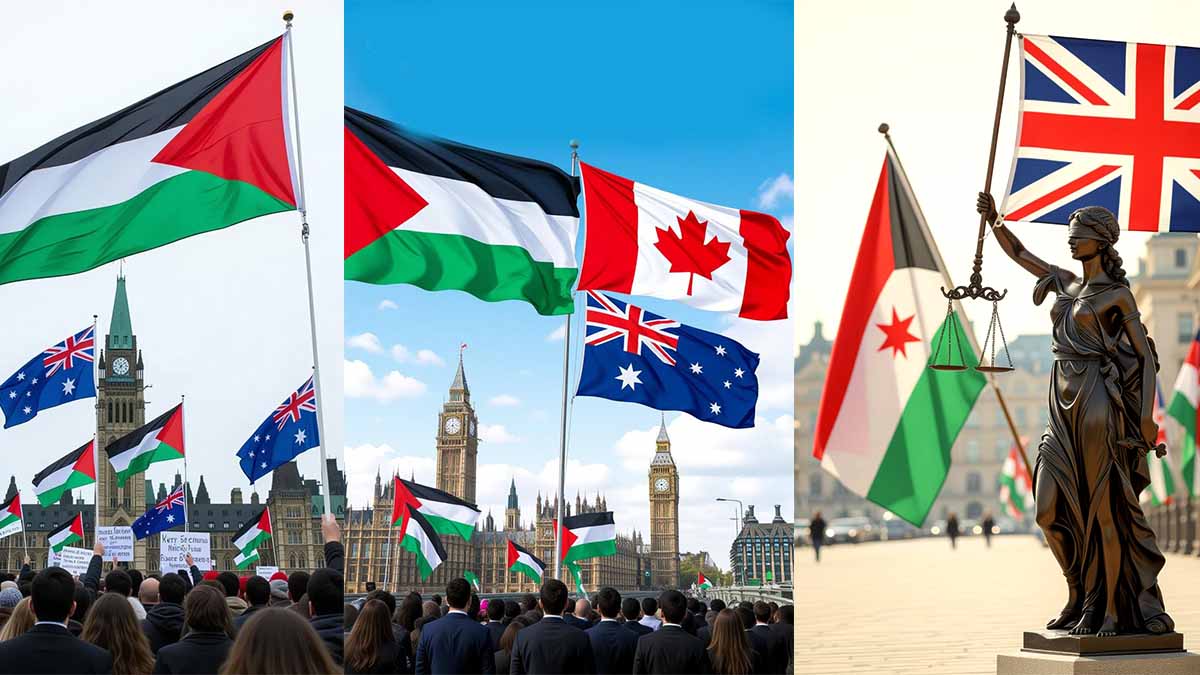
On 21 September 2025, the governments of United Kingdom, Canada, and Australia each formally recognised the State of Palestine, citing deteriorating humanitarian conditions in Gaza, expanding Israeli settlements in the West Bank, persistent occupation issues, and the failure of repeated diplomatic efforts to preserve a two-state solution. The UK Prime Minister Sir Keir Starmer, in a government press release published on 21 September 2025, declared that the UK had formally recognised the State of Palestine, alongside Canada and Australia, describing the move as part of “a practical plan to bring people together” toward peace, with the recognition based on the premise that Hamas “can have no role in government, no role in security.” Link: (UK Government—the Prime Minister’s Office and Foreign, Commonwealth & Development Office, “UK formally recognises Palestinian State”, 21 September 2025) (GOV.UK)
Canada’s Prime Minister Mark Carney similarly published a statement on 21 September 2025 in which he announced that “Canada recognises the State of Palestine and offers our partnership in building the promise of a peaceful future for both the State of Palestine and the State of Israel,” emphasising that recognition does not legitimise terrorism nor is it a reward for such. Link: (Prime Minister of Canada, “Statement by Prime Minister Carney on Canada’s recognition of the State Palestine”, 21 September 2025) (Primo Ministro del Canada)
The Australian government, through a media statement by Prime Minister Anthony Albanese and Foreign Minister Penny Wong, announced on 11 August 2025 that Australia would recognise the State of Palestine at the 80th Session of the United Nations General Assembly in September, subject to conditions including no role for Hamas in future governance, demilitarisation, governance reforms, and free elections. Link: (Australia, PM & Foreign Affairs, “Australia to recognise the State of Palestine”, 11 August 2025) (Prime Minister of Australia)
On 21 September 2025, Australia formally recognised the “independent and sovereign State of Palestine.” (Mirage News) Each government linked its recognition to protecting the two-state solution: the UK press release emphasised that recognising Palestine was needed because “the hope of a Two State Solution is fading but we cannot let that light go out.” (GOV.UK) Canada’s statement similarly placed recognition as part of “a co-ordinated international effort to preserve the possibility of a two-state solution.” (Primo Ministro del Canada) Australia’s August announcement framed recognition as contributing to “international momentum towards a two-state solution, a ceasefire in Gaza and release of the hostages.” (Reuters)
All three recognitions stipulate that Hamas must have no role in any future Palestinian government or security structures. The UK statement demands that Hamas must release all hostages, accept it will have no role in governing Gaza, and commit to disarmament. (GOV.UK) Canada, in its statement, said that recognition “empowers those who seek peaceful coexistence and the end of Hamas.” (Primo Ministro del Canada) Australia’s conditions include no involvement of Hamas, demilitarisation, elections, governance reform, and recognition of Israel’s right to exist. (Reuters) Each decision drew criticism from Israel, which condemned the moves as rewarding terrorism or rewarding Hamas, and from United States officials, some domestic political actors, and others who argue recognition without peace agreement or control over territories may be symbolic without material change.
Reaction among Palestinians and within the occupied territories is mixed: while some hail recognition as long-overdue progress toward sovereignty (as per the Palestinian Foreign Minister’s statement on 21 September 2025) others fear the lack of clarity over borders, security responsibilities, and whether recognition will lead to substantial shifts in aid, political control, or conflict dynamics. (Reuters) As of September 2025, more than 150 United Nations member states had already recognised the State of Palestine. The UK stated it joined “over 150 countries who recognise a Palestinian State too.” (GOV.UK) Australia’s August announcement noted that “more than 140 U.N. members already recognise a Palestinian state” before its formal move. (Reuters)
The legal significance of recognition under international law includes potential upgrades of diplomatic relations, treaty obligations, and possible standing in international fora. Each government emphasised that recognition does not change positions on Israel’s security, that Israel’s right to exist remains supported, and that recognition is tied to future action (ceasefire, humanitarian access, governance reform). The UK statement explicitly links its recognition to demands that Israel halt settlement expansion, allow humanitarian aid, end its offensive in Gaza, and that Hamas has no future governing role. (GOV.UK) Canada’s statement asserts that recognition “in no way compromises Canada’s steadfast support for the State of Israel, its people, and their security.” (Primo Ministro del Canada) Australia similarly insists recognition is not an endorsement of violence, and its acceptance is contingent on the Palestinian Authority meeting specified criteria. (Prime Minister of Australia) The timing before the 80th United Nations General Assembly reflects diplomatic strategy: symbolic gestures coinciding with high-visibility multilateral settings tend to amplify pressure for peace process renewal. Australia’s media statement explicitly links its recognition to the upcoming UNGA session in September. (Reuters)
The UK policy required, per its earlier announced conditions in July 2025, that if Israel failed to meet certain benchmarks (including a ceasefire, limiting settlement expansion, allowing humanitarian aid and committing to a long-term peace process), then recognition would proceed; no sufficient changes occurred, prompting the recognition. (GOV.UK) The Australian announcement also mentions these prior commitments from the Palestinian Authority including elections in 2026, demilitarisation, governance reform, and excluding Hamas. (Reuters) Overall, the coordinated move by three Western powers represents a marked shift in policy from long-held positions that recognition should be part of a negotiated settlement, particularly since none of the core territorial or ceasefire conditions had been fully met. The move underscores growing international impatience with the status quo in Gaza and the Occupied Palestinian Territories, increasing diplomatic isolation of Israel over humanitarian law concerns, and an effort to recalibrate Western foreign policy by placing state recognition as a lever for leverage, rather than a culminating act after peace.
CHAPTER INDEX
- Legal Criteria and Theories of State Recognition under International Law: Sovereignty, Territory, and Effective Control
- Diplomatic Preconditions and Conditionality: Roles of Hamas, Elections, Demilitarisation, and Israel’s Actions
- Reactions from Israel, United States, Arab States, and International Civil Society
- The Two-State Solution in Practice: Diplomatic, Territorial, and Governance Implications
- Humanitarian Impact and Ground Realities in Gaza and the West Bank
- Geostrategic Consequences: Western Alliances, UN Institutions, and Regional Order
Legal Criteria, State Practice and Strategic Implications of the Canada, Australia and United Kingdom Recognition of the State of Palestine on September 21, 2025
The public records of September 21, 2025 establish that the governments of Canada, Australia, and the United Kingdom issued coordinated statements of recognition of the State of Palestine that embed explicit conditions on governance, security, and the exclusion of Hamas from any future Palestinian authority. The United Kingdom set out the decision and its rationale in an official press release emphasizing a two-state framework, the illegality of continuing settlement expansion, and the categorical exclusion of Hamas from governance, with an explicit line that the Prime Minister “will have no role in the future of Palestine” for Hamas and further demands for hostage release and disarmament, published on September 21, 2025 by the Foreign, Commonwealth & Development Office (UK formally recognises Palestinian State — Foreign, Commonwealth & Development Office, September 21, 2025). The Government of Canada issued a parallel statement under Prime Minister Mark Carney on September 21, 2025, framing recognition as part of a “co-ordinated international effort” to preserve a two-state outcome, condemning the October 7, 2023 attack and affirming that recognition “in no way legitimises terrorism,” while conditioning support on Palestinian Authority reform, elections in 2026, and a demilitarized Palestinian state (Statement by Prime Minister Carney on Canada’s recognition of the State of Palestine — Prime Minister of Canada, September 21, 2025). Australia’s foreign minister released a joint statement with the Prime Minister on September 21, 2025 declaring immediate recognition and stating that “The terrorist organisation Hamas must have no role in Palestine,” while linking any subsequent steps, including opening embassies, to concrete Palestinian Authority reforms and elections (Australia recognises the State of Palestine — Australian Minister for Foreign Affairs, September 21, 2025).
The deliberate construction of these recognitions refutes any inference that acknowledging Palestinian statehood conveys legal or moral license to Hamas to wage violence. Each government’s official text places Hamas outside the future governing arrangements and reaffirms ongoing counterterrorism obligations under domestic law. The United Kingdom maintains a statutory proscription of Hamas in its entirety under the Terrorism Act 2000, reflected in the consolidated Home Office list of proscribed organizations (last updated July 11, 2025), which records the November 2021 extension proscribing all wings of Hamas (Proscribed terrorist groups or organisations — Home Office, last updated July 11, 2025). Australia lists Hamas as a terrorist organization under national security regulations and has published prosecutorial consent guidelines specifically addressing Hamas-related offenses (March 30, 2022) (Policy guideline on Attorney-General consent to prosecution considerations — Hamas — Attorney-General’s Department) and maintains the entity’s listing on its national security website (Hamas — Listed terrorist organisations — Australian National Security). Canada’s Criminal Code listing regime likewise includes Palestinian militant groups on the official roster of currently listed terrorist entities maintained by Public Safety Canada, which governs asset freezing, participation crimes, and material support prohibitions (Currently listed entities — Public Safety Canada). Recognition decisions that simultaneously reaffirm such designations cannot be read, as a matter of law or policy, as authorizing the use of force by a listed terrorist organization; the statements’ operative language does the opposite by tying recognition to disarmament, the release of hostages, and the institutional reform of the Palestinian Authority under international supervision.
The legal architecture that gives meaning to diplomatic recognition rests on the declaratory theory of statehood, rooted in the Montevideo Convention on the Rights and Duties of States (December 26, 1933), which distilled four customary criteria: permanent population, defined territory, government, and capacity to enter into relations with other states (Montevideo Convention on the Rights and Duties of States — Organization of American States). These criteria are descriptive rather than constitutive; recognition by other states acknowledges a legal fact pattern rather than creating it ex nihilo. The United Nations practice since 2012 has treated “State of Palestine” as a non-member observer State following General Assembly resolution 67/19 (November 29, 2012), which adjusted the designation used across UN documentation and conferred procedural capacities consistent with observer statehood (A/RES/67/19 — Status of Palestine in the United Nations — United Nations Digital Library; Status of Palestine in the UN — Secretariat report noting observer State designation — March 8, 2013). As a result, the capacity to enter into treaty relations, accede to international bodies, and bring claims before international tribunals has been exercised by the State of Palestine across the last decade, illustrating Montevideo’s fourth criterion in practice, even while effective control over all claimed territory remains contested.
The territorial and humanitarian context against which the September 21, 2025 recognitions were made has been delineated by the International Court of Justice (ICJ). In 2004, the ICJ’s advisory opinion on the construction of the barrier reaffirmed that the West Bank, including East Jerusalem, constitutes occupied territory and that all states bear obligations not to recognize the unlawful situation or render aid or assistance in its maintenance (Legal Consequences of the Construction of a Wall in the Occupied Palestinian Territory — ICJ Advisory Opinion, July 9, 2004). On July 19, 2024, the ICJ issued a further advisory opinion on the “Legal Consequences arising from the Policies and Practices of Israel in the Occupied Palestinian Territory,” concluding with an obligation of non-recognition regarding the situation resulting from unlawful conduct and reiterating constraints on settlement expansion and the annexationist effect of permanent measures (Legal Consequences arising from the Policies and Practices of Israel in the Occupied Palestinian Territory — ICJ, Advisory Opinion, July 19, 2024 (press release and summary); The Court gives its Advisory Opinion — press release, July 19, 2024). In parallel, OCHA’s field situation reports through 2025 describe persistent displacement, severe food insecurity, and repeated limitations on humanitarian access in Gaza, which the recognizing states cite in arguing that diplomatic moves must now preserve the possibility of a negotiated two-state settlement under international law (Occupied Palestinian Territory — Situation Reports Archive — United Nations OCHA).
Under the constitutive logic of Montevideo tempered by the UN Charter, recognition by other states neither legalizes nor immunizes the conduct of non-state armed groups. Article 1(2) of the Charter of the United Nations commits members to a system based on equal rights and self-determination of peoples; Article 2(4) bars the threat or use of force against the territorial integrity or political independence of any state (Charter of the United Nations — Chapter I, Articles 1–2). The recognizing governments explicitly operationalize these norms by excluding Hamas from governance, demanding disarmament and hostage release, and conditioning the diplomatic deepening plan on reforms and elections. The United Kingdom press release declares that “Hamas can have no role in Palestine’s future,” that “it must release all hostages, agree to an immediate ceasefire, accept it will have no role in governing Gaza, and commit to disarmament,” and that sanctions against senior Hamas figures would intensify (UK formally recognises Palestinian State — Foreign, Commonwealth & Development Office, September 21, 2025). The Canadian statement asserts that recognition “in no way legitimises terrorism” and ties it to the empowerment of those seeking “peaceful coexistence and the end of Hamas,” while pointing to an electoral calendar and demilitarization undertakings by the Palestinian Authority (Statement by Prime Minister Carney — Prime Minister of Canada, September 21, 2025). Australia’s joint release states unambiguously that “The terrorist organisation Hamas must have no role in Palestine,” making recognition part of a pathway that requires a ceasefire, the release of hostages, and institutional reform under international facilitation (Australia recognises the State of Palestine — Australian Minister for Foreign Affairs, September 21, 2025).
The relationship between recognition and internal legitimacy hinges on the identity of the addressee. The three governments identify the Palestinian Authority as the intended interlocutor, not Hamas. The United Kingdom references a “reformed Palestinian Authority” as the leadership of a “viable and sovereign Palestinian state” and records a commitment by President Mahmoud Abbas to organize new elections “within a year of a ceasefire,” linking those steps to external support programs for governance and delivery (UK formally recognises Palestinian State — Foreign, Commonwealth & Development Office, September 21, 2025). Canada’s statement likewise records undertakings for general elections in 2026 “in which Hamas can play no part,” and for demilitarization, framing recognition as a means to “empower” constituencies committed to coexistence under law (Statement by Prime Minister Carney — Prime Minister of Canada, September 21, 2025). Australia pairs recognition with a conditional sequencing of diplomatic relations and embassy openings “as the Palestinian Authority makes progress on its commitments to reform,” making recognition an entry point to an externally-monitored compliance track rather than an end state (Australia recognises the State of Palestine — Australian Minister for Foreign Affairs, September 21, 2025).
Within international law, the principle of non-recognition of unlawful situations, crystallized in the ICJ’s June 21, 1971 advisory opinion on Namibia, imposes a duty on states not to lend legal effect to territorial acquisitions or administrative regimes established in defiance of the UN system (Legal Consequences for States of the Continued Presence of South Africa in Namibia — ICJ Advisory Opinion, June 21, 1971). The July 19, 2024 advisory opinion applies the same non-recognition logic to the occupied Palestinian context, stating that all states have obligations that flow from the illegality of certain policies and practices, including settlement expansion and annexationist measures (Legal Consequences arising from the Policies and Practices of Israel in the Occupied Palestinian Territory — ICJ, Advisory Opinion, July 19, 2024). It is against this jurisprudence that the United Kingdom press release speaks of “illegal settlement expansion” and the need for a policy change by the Government of Israel; the same document expressly couples recognition with a plan for governance, security, and humanitarian access that is intended to be advanced at the United Nations in the days following September 21, 2025 (UK formally recognises Palestinian State — Foreign, Commonwealth & Development Office, September 21, 2025). Recognition thus aligns with the non-recognition doctrine by acknowledging Palestinian self-determination claims without legitimizing the status quo that international courts have held to be unlawful.
The formal status of “State of Palestine” at the United Nations since 2012 provides additional context on capacity for external relations. Following A/RES/67/19 on November 29, 2012, the UN Secretariat implemented the change of designation to “State of Palestine” across documents and conference nameplates, while clarifying the procedural rights and limits associated with non-member observer State status, including participation and agenda-placing rights referenced in Article 35(2) of the UN Charter (A/RES/67/19 — United Nations Digital Library; Status of Palestine in the UN — Secretariat note on implementation, March 8, 2013). The General Assembly has further determined in May 2024 that the State of Palestine is qualified for UN membership under Article 4, subject to Security Council action, signaling that the capacity to assume international obligations exists as a matter of institutional assessment (General Assembly Resolution (ES-10/23) noting qualification for membership, May 2024 — UN). The ability to conclude treaties and accede to multilateral regimes—evaluated by Montevideo’s fourth criterion—is thus documented at the intergovernmental level, independent of ongoing disputes over intra-Palestinian political organization.
Diplomatic recognition by individual states unlocks bilateral instruments governed by the Vienna Convention on Diplomatic Relations (April 18, 1961), which codifies privileges, immunities, and functions of missions, subject to the sending and receiving states’ consent and to broader obligations under international law. The recognizing governments signal a phased approach to such instruments—Australia explicitly states that the establishment of diplomatic relations and opening of embassies will be considered as reform benchmarks are met—consistent with the Vienna Convention’s framework of consent and reciprocity (Vienna Convention on Diplomatic Relations — United Nations Treaty Series; Australia recognises the State of Palestine — Australian Minister for Foreign Affairs, September 21, 2025). Nothing in the Vienna Convention authorizes armed action by non-state groups; rather, it structures peaceful inter-state relations that proceed from recognition but remain contingent on effective governmental control and mutual consent.
The domestic legal architecture of the recognizing states hard-codes the incompatibility of recognition with toleration of terrorism. The United Kingdom’s proscription framework criminalizes support for listed entities, including Hamas, with penalties that detach recognition from any material assistance or validation of violent tactics (Proscribed terrorist groups or organisations — Home Office, last updated July 11, 2025). Australia’s listing regime, described by the Attorney-General’s Department, defines terrorist organizations and outlines the regulatory pathway for listing and re-listing, tethering domestic offenses to the entity’s conduct and advocacy of terrorism (Terrorist organisation offences — Attorney-General’s Department; Listed terrorist organisations — Australian National Security). Canada’s listing of terrorist entities by Public Safety Canada under the Criminal Code is the basis for asset freezing and crimes of participation, conspiracy, facilitation, and instruction, maintaining a prohibition architecture even as foreign policy positions evolve (Currently listed entities — Public Safety Canada). In each jurisdiction, these frameworks are active; recognition does not suspend or dilute the statutory prohibitions that apply to Hamas and analogous groups.
The political logic of the September 21, 2025 recognitions rests on a diagnosis of accelerating facts on the ground that threaten the feasibility of partition into two states. The United Kingdom explicitly links the announcement to “illegal settlement expansion” in the West Bank and the worsening humanitarian situation in Gaza, and it pairs recognition with an external “Framework for Peace” to be advanced in New York at the United Nations (UK formally recognises Palestinian State — Foreign, Commonwealth & Development Office, September 21, 2025). The Canadian statement points to settlement acceleration, the E1 plan, and a Knesset vote “calling for the annexation of the West Bank,” tying these developments to the erosion of negotiations while reiterating obligations under international humanitarian law with respect to aid access in Gaza (Statement by Prime Minister Carney — Prime Minister of Canada, September 21, 2025). Australia’s release integrates recognition with a ceasefire-first sequence and places Arab regional diplomacy and the role of the United States at the center of post-recognition implementation (Australia recognises the State of Palestine — Australian Minister for Foreign Affairs, September 21, 2025). The consistent conditionality across the three texts—elections, public finance reform, disarmament, exclusion of Hamas, and international monitoring—maps to the governance and security deficits identified repeatedly in UN system reporting on the occupied territory.
As a matter of doctrine, conflating recognition of the State of Palestine with endorsement of Hamas contravenes the text and structure of the September 21, 2025 documents and the governing legal instruments. Recognition addresses an entity—State of Palestine—that the UN General Assembly has treated as a state for limited purposes since 2012, that participates across UN fora as a non-member observer State, and that is identified by the recognizing governments as led by a reformed Palestinian Authority subject to elections and security reforms. The UN Charter’s prohibition on the use of force interacts with domestic terrorism listing regimes so that material support, training, recruitment, and other forms of facilitation remain criminalized regardless of diplomatic posture. The ICJ’s line of authority on non-recognition positions recognition as a corrective to unlawful realities, not as a ratification of armed activity. The textual insistence—“Hamas can have no role,” “in no way legitimises terrorism,” “must have no role”—is anchored both in law and in policy logic, and it is the opposite of the assertion that recognition equalizes Hamas with state institutions (UK formally recognises Palestinian State — Foreign, Commonwealth & Development Office, September 21, 2025; Statement by Prime Minister Carney — Prime Minister of Canada, September 21, 2025; Australia recognises the State of Palestine — Australian Minister for Foreign Affairs, September 21, 2025).
The security-policy implications for Canada, Australia, and the United Kingdom turn on synchronizing three tracks: first, maintenance and enforcement of terrorist listings; second, channeling recognition into reform leverage over the Palestinian Authority with election-linked conditionality; third, multilateralizing enforcement of access, protection, and reconstruction commitments in Gaza via UN mechanisms. The United Nations Office for the Coordination of Humanitarian Affairs reports provide continuous operational baselines for access and needs, and these data streams will drive donor conditionality and ceasefire verification regimes (Occupied Palestinian Territory — Situation Reports Archive — United Nations OCHA). The ICJ’s July 19, 2024 opinion, when read with the 2004 barrier advisory and the 1971 Namibia advisory, offers a legal template for structuring non-recognition obligations alongside constructive recognition measures aimed at preserving self-determination without entrenching illegality (Legal Consequences arising from the Policies and Practices of Israel in the Occupied Palestinian Territory — ICJ, Advisory Opinion, July 19, 2024; Legal Consequences of the Construction of a Wall — ICJ, Advisory Opinion, July 9, 2004; Namibia Advisory Opinion — ICJ, June 21, 1971). The Vienna Convention on Diplomatic Relations offers the bilateral scaffolding for mission opening and protection, but its deployment remains conditional on the reform track and security benchmarks set out in the September 21, 2025 texts (Vienna Convention on Diplomatic Relations — United Nations Treaty Series).
The strategic risk assessment that underlies objections to recognition often posits a slippery slope toward the normalization of violent ideologies within recognizing democracies. The relevant counter-indicator is the structure of domestic legislation in the three jurisdictions. In the United Kingdom, the Home Office maintains an expansive list of proscribed entities, updated through July 2025, and has recently added and re-listed extremist organizations across multiple ideological spectrums, evidencing a willingness to apply the proscription tool dynamically (Proscribed terrorist groups or organisations — Home Office, last updated July 11, 2025). Australia’s statute-based listing process, prosecuted under the Criminal Code, specifies both conduct-based and advocacy-based criteria for listing, and the Attorney-General’s Department publishes the legal basis and offenses that attach to organizational support, while the national security portal catalogs the statements of reasons for listings (Terrorist organisation offences — Attorney-General’s Department; Listed terrorist organisations — Australian National Security). Canada’s listing regime likewise demonstrates continuity independent of foreign policy, with an authoritative list maintained for enforcement and compliance purposes (Currently listed entities — Public Safety Canada). In all three cases, the formal recognitions add an external diplomatic instrument without altering the domestic statutory treatment of Hamas.
The evidentiary record from September 21, 2025 therefore documents recognitions designed to rescue the two-state option within an ICJ-policed legal environment, condition internal Palestinian legitimacy on elections and reform, and reinforce the abolition of Hamas’s role in governance and armed activity. The official texts cite the humanitarian catastrophe in Gaza, the acceleration of settlements in the West Bank, and the erosion of negotiation incentives as reasons to shift diplomatic posture while doubling down on counterterrorism and non-recognition obligations. The underlying legal norms—Montevideo criteria, UN Charter provisions on self-determination and non-use of force, ICJ advisory opinions on non-recognition—converge with domestic listing regimes to produce a policy package that distinguishes sharply between recognition of a state entity and rejection of a listed terrorist organization. The linkage between recognition and conditional institutional reform, spelled out by Canada, Australia, and the United Kingdom on September 21, 2025, is the salient feature of these decisions and the operative safeguard against the misreading that recognition equates to the validation of violent non-state actors (Statement by Prime Minister Carney — Prime Minister of Canada, September 21, 2025; Australia recognises the State of Palestine — Australian Minister for Foreign Affairs, September 21, 2025; UK formally recognises Palestinian State — Foreign, Commonwealth & Development Office, September 21, 2025).
Textual and Legal Dissection of Recognition Statements by the United Kingdom, Canada and Australia (September 21, 2025): Conditionality, Juridical Limits and Policy Instruments
The official press release issued by the United Kingdom’s Foreign, Commonwealth & Development Office on September 21, 2025 establishes authoritative parameters for recognition that bind the policy to legal conditionality while delimiting any role for Hamas in governance or security, and it situates the act within a coordinated initiative taken “alongside Canada and Australia.” The lead paragraph states that recognition aims “to protect the viability of a two-state solution and create a path towards lasting peace,” and the release then specifies that the Prime Minister had previously pledged to act if circumstances did not change. The conditions enumerated for militant actors are explicit, with the government writing that Hamas “are a brutal terrorist organisation,” and then setting precise demands around hostages, ceasefire, and disarmament. The release frames recognition as one component of a broader external diplomatic framework to be advanced at the United Nations, making clear that recognition on September 21, 2025 is neither an endorsement of any non-state armed group nor a stand-alone substitute for governance reform in the Palestinian Authority. The document is publicly accessible as a formal UK government communication, allowing direct textual verification of these elements through UK formally recognises Palestinian State — Foreign, Commonwealth & Development Office.
The same United Kingdom release records a series of normative assertions that anchor recognition in self-determination doctrine while rejecting unlawful practices detailed in international jurisprudence. The text announces that recognition is “firmly grounded in the Palestinian people’s inalienable right to self-determination,” and links policy to halting “illegal settlement expansion in the West Bank,” a phrase that signals alignment with the prevailing interpretation of occupation law in international courts without requiring the release itself to become a legal brief. The governmental source aligns diplomatic posture with non-recognition of annexationist outcomes by urging an end to the offensive in Gaza, opening humanitarian access, and pressing for a ceasefire, using language calibrated to project compliance criteria to both armed groups and state actors. Those compliance criteria are condensed into a directive sentence that is useful to quote in full because its modality discloses the legal and operational sequence contemplated by London: “It must release all hostages, agree to an immediate ceasefire, accept it will have no role in governing Gaza, and commit to disarmament”. The imperative structure assigns specific duties to Hamas in a form that can be monitored and, where relevant, sanctioned, and it decisively forecloses any inference that the act of recognition authorizes armed violence; on the contrary, it reaffirms a proscription posture while creating space to engage a reformed Palestinian Authority under a two-state frame. The publicly viewable, date-stamped source is UK formally recognises Palestinian State — Foreign, Commonwealth & Development Office.
The United Kingdom document further embeds sequencing for Palestinian governance legitimacy by stating that the decision “does not remove the demands the government has made of the Palestinian Authority to conduct extensive reform,” and it records a commitment by President Mahmoud Abbas to organize new elections “within a year of a ceasefire.” The textual pairing of recognition with internal reform conditionality is significant because it separates the legal act of recognizing a state from the political approval of any existing factional governance in Gaza. It also clarifies the interlocutor identity for bilateral deepening: the release signals continued technical and financial support for Palestinian Authority reform, including delivery support “through the work of UK Envoy for Palestinian Authority Governance Sir Michael Barber.” The diplomatic instrument is thus self-described as the “first, most urgent step” in a longer plan to advance a “Framework for Peace,” an externalized road map that places governance, security, humanitarian access, and ceasefire monitoring under an internationally coordinated umbrella operating through New York multilateral channels. The comprehensive terms cited here are available in the same authoritative government source, UK formally recognises Palestinian State — Foreign, Commonwealth & Development Office.
The Canada statement attributed to Prime Minister Mark Carney and published on September 21, 2025 functions as a legally and politically precise instrument that resolves ambiguities around terrorism and recognition by embedding three distinct clauses: recognition of the State of Palestine “led by the Palestinian Authority,” a categorical disclaimer that recognition “in no way legitimises terrorism,” and a stipulation that the reform path requires elections and demilitarisation in a timeline that includes 2026. The text is unusually granular by head-of-government standards and includes a retrospective framing anchored in 1947, presenting continuity with longstanding policy in favor of partition into two states. It enumerates facts that, in Ottawa’s view, have eroded the feasibility of negotiated settlement, including references to the October 7, 2023 attack by Hamas, accelerated settlement building, and actions such as the E1 plan. The statement then states Canada’s decision and purpose with a sentence that is central to evaluating whether the act could be misconstrued as endorsement of Hamas: “Recognising the State of Palestine, led by the Palestinian Authority, empowers those who seek peaceful coexistence and the end of Hamas. This in no way legitimises terrorism, nor is it any reward for it”. The page is an official Government of Canada publication with a clear dateline and location and is accessible at Statement by Prime Minister Carney on Canada’s recognition of the State of Palestine — Prime Minister of Canada.
The same Canada document operationalizes conditionality with explicit undertakings by the Palestinian Authority to “fundamentally reform its governance,” to hold “general elections in 2026 in which Hamas can play no part,” and “to demilitarize the Palestinian state.” These undertakings are presented as direct commitments “to Canada and the international community,” permitting bilateral and multilateral monitoring by donors and facilitating a linkage between recognition and ex-ante compliance practices. The linguistic choices—“empowers those who seek peaceful coexistence,” “in no way legitimises terrorism”—are legally meaningful because they foreclose interpretations under which recognition could be adduced as evidence of foreign facilitation of a listed terrorist organization. The declaration that recognition “in no way compromises Canada’s steadfast support for the State of Israel” is equally explicit, isolating the diplomatic act from security guarantees and aligning it with a theory that only a negotiated two-state outcome can ultimately deliver “security” to both peoples. The conditions are repeated in the closing paragraph as part of a pledge to support a “credible peace plan, democratic governance and clear security arrangements,” and the entire statement is verifiable at Statement by Prime Minister Carney on Canada’s recognition of the State of Palestine — Prime Minister of Canada.
The Australia joint media release, issued by Prime Minister Anthony Albanese and Foreign Minister Penny Wong on September 21, 2025, contains a clear declarative sentence that functions as a recognition clause and a series of conditions that tie subsequent diplomatic steps to reform milestones. The declaration reads: “Effective today, Sunday the 21st of September 2025, the Commonwealth of Australia formally recognises the independent and sovereign State of Palestine”. Its justificatory sentence links recognition to the “legitimate and long held aspirations of the people of Palestine to a state of their own,” and then situates the act “alongside Canada and the United Kingdom,” showing temporal coordination with the other two governments. The release specifies that recognition is part of an international effort to rebuild momentum for a two-state solution “starting with a ceasefire in Gaza and the release of the hostages taken in the atrocities of October 7, 2023,” and it introduces a governance conditionality package that includes elections and “significant reform to finance, governance and education.” Crucially, it offers an unambiguous exclusion clause: “The terrorist organisation Hamas must have no role in Palestine,” and it makes diplomatic deepening—“the establishment of diplomatic relations and opening of embassies”—contingent on measured progress by the Palestinian Authority. The official, date-stamped source is Australia recognises the State of Palestine — Australian Minister for Foreign Affairs.
The Australia release’s placement of the Arab League countries’ leadership and the role of the United States in the last paragraphs frames recognition as an instrument to enlist regional and trans-atlantic sponsorship of a prospective “credible peace plan,” and it aligns Canberra’s posture with a coalition approach. The document’s structure mirrors that of the United Kingdom and Canada releases in three ways: an unequivocal recognition clause; a categorical exclusion of Hamas from governance and security; and a conditionality track that makes further bilateral steps dependent on measurable progress by the Palestinian Authority. This triangulation makes it possible to draw a cross-governmental template for legitimate interpretation of the recognitions: a two-state outcome remains the endpoint; non-state armed groups designated as terrorist entities remain excluded from authority; and governance reforms, elections, and demilitarisation on a defined timeline are preconditions for institutional deepening. The primary source for these features remains Australia recognises the State of Palestine — Australian Minister for Foreign Affairs.
The wording in each of the three texts assigns distinct roles to law, diplomacy, and security while avoiding doctrinal confusion about recognition’s effects. In the United Kingdom release, the stringency of the negative formulation—“Hamas can have no role in Palestine’s future”—excludes ambiguity by denying both governmental and security roles, and the instrumentality of sanctions is foregrounded by the sentence indicating expected action “to sanction senior figures in the Hamas leadership in the coming weeks.” In the Canada statement, the legal-political firewall is emphasized by the declarative sentence that recognition “in no way legitimises terrorism,” a drafting choice that functions as a rebuttal to any theory of tacit endorsement and that is reinforced by the specific reference to elections in 2026 “in which Hamas can play no part.” In the Australia release, the exclusion is linguistically maximalist: “The terrorist organisation Hamas must have no role in Palestine,” a construction that combines designation with a prospective ban on governance participation. These linguistic patterns do not merely convey policy preference; they operate as publicly testable commitments that can be monitored against future government actions, and they provide legal counsel, legislatures, and courts with clear interpretive materials concerning the intended effects of recognition. Each phrase is verifiable in the official sources: UK formally recognises Palestinian State — Foreign, Commonwealth & Development Office, Statement by Prime Minister Carney — Prime Minister of Canada, and Australia recognises the State of Palestine — Australian Minister for Foreign Affairs.
The three texts also contain discrete references to obligations and transgressions that structure the law-and-policy environment in which recognition is deployed. The United Kingdom’s identification of “illegal settlement expansion in the West Bank” and its call to “let desperately needed humanitarian aid in” in Gaza translate international humanitarian-law and occupation-law concerns into policy demands directed at Israel, while leaving intact the country’s security commitments and its diplomatic relationship with Jerusalem. The same release reiterates that Hamas “are a barbaric terrorist organisation who oppose the very idea of two states,” an evaluative sentence that audiences such as courts and parliaments can treat as a binding official interpretation of the group’s status. The Canada statement’s mention of a Knesset vote “calling for the annexation of the West Bank,” and of the E1 plan, signals Ottawa’s view that certain trajectories are directly incompatible with a two-state outcome and hence form part of the rationale for exercising recognition at this time. The Australia release’s explicit coupling of recognition to “a ceasefire in Gaza and the release of the hostages” presents a justiciable checklist that delineates the conditions for further bilateral steps such as embassy openings, which are described as contingent. Each of these elements is publicly visible at the government links already cited: UK formally recognises Palestinian State — Foreign, Commonwealth & Development Office, Statement by Prime Minister Carney — Prime Minister of Canada, and Australia recognises the State of Palestine — Australian Minister for Foreign Affairs.
The chronology surrounding the Australia announcement adds a further layer that clarifies intent and sequencing while remaining consistent with the September 21, 2025 formal recognition. On August 11, 2025, Canberra publicly signaled that it would recognize at the 80th Session of the United Nations General Assembly in September, and it laid out conditional elements such as no role for Hamas, demilitarisation, and elections, preparing domestic and international audiences for the subsequent formal act. That preliminary framing is preserved in Prime Minister and Foreign Minister materials hosted on the official pm.gov.au and foreignminister.gov.au domains and shows a considered policy trajectory culminating in the formal release on September 21, 2025. The principal artifact for the earlier signal is available at Australia to recognise Palestinian State — Prime Minister of Australia, which is an official page that predates the joint release and records the government’s intended direction of travel before the recognition date.
A textual cross-walk of conditionality across the three statements reveals convergent demands delivered in slightly different drafting idioms. The United Kingdom pairs recognition with an imperative compliance list for Hamas—hostage release, immediate ceasefire, no role in Gaza’s governance, disarmament—and with parallel demands on the Government of Israel—halt the Gaza offensive, allow humanitarian access, end “illegal settlement expansion.” The Canada statement adds specificity by referencing E1, settlement growth, and a Knesset vote “calling for annexation,” while tying recognition to a defined reform and election timeframe (2026) and to demilitarisation. The Australia statement explicitly conditions further steps such as diplomatic relations and embassy openings on “progress” by the Palestinian Authority on elections and reforms, while inserting a categorical exclusion for Hamas. The legal character of these demands is not that of enforceable international obligations created by the act of recognition itself; rather, they are public conditions that the recognizing states attach to their own subsequent bilateral measures and to their multilateral diplomacy. By articulating them in official statements, the governments convert political preferences into documented policy criteria that can be measured and, in domestic contexts, scrutinized by legislatures, auditors, and courts against public-law standards for reasonableness, proportionality, and consistency.
The statements also make visible each government’s theory of how recognition can alter incentives in a frozen conflict without substituting for negotiations. The United Kingdom constructs recognition as the “first, most urgent step” within a “Framework for Peace,” where consolidation requires moves on governance and security that would be coordinated internationally. The Canada statement treats recognition as a means to “empower” actors committed to coexistence, coupled to an election timetable and demilitarisation that are meant to change internal Palestinian politics by offering external validation contingent on reform. The Australia release situates recognition within a coalition that includes the Arab League and the United States, suggesting that external sponsorship and Arab political capital are integral to sustaining a post-recognition pathway that remains vulnerable to spoilers on all sides. In each document, the semantic architecture—imperatives for militant actors, conditions for state actors, timelines for governance reform—supports the conclusion that recognition is being used as leverage to re-constitute the two-state track rather than as a terminal act declaring the endpoint accomplished.
The legal coherence of the three statements also depends on the careful handling of interlocutor identity, and here the texts are uniform in privileging the Palestinian Authority as the partner for bilateral and multilateral engagement. The United Kingdom names a “reformed Palestinian Authority” as the entity expected to lead a “viable and sovereign Palestinian state,” the Canada statement declares recognition of the State of Palestine “led by the Palestinian Authority,” and the Australia release uses contingent language placing embassy decisions downstream of Palestinian Authority progress. This uniformity is crucial for rebutting the claim that the recognitions conflate Hamas with state institutions; the official texts consistently deny any governing role to Hamas and identify a separate interlocutor, with elections and demilitarisation operating as safeguards. The quotations that embody this distinction—“Hamas can have no role in Palestine’s future” in the United Kingdom release; “This in no way legitimises terrorism” in the Canada statement; and “The terrorist organisation Hamas must have no role in Palestine” in the Australia text—are explicit markers of intent and can be verified directly at UK formally recognises Palestinian State — Foreign, Commonwealth & Development Office, Statement by Prime Minister Carney — Prime Minister of Canada, and Australia recognises the State of Palestine — Australian Minister for Foreign Affairs.
The public-law posture running through the three documents is to combine recognition with rule-of-law signaling. The United Kingdom release names sanctions as an imminent tool targeting senior Hamas figures, preserving enforcement leverage within the proscription regime and asserting that proscription and recognition are compatible instruments aimed at different targets. The Canada statement cross-references the United Nations Charter by invoking “self-determination” and “fundamental human rights,” supplying an inter-textual grounding while keeping the statement within the idiom of foreign-policy communications rather than litigation documents. The Australia release refrains from legal jargon but nonetheless sets observable tests—ceasefire, hostage release, elections, reforms, demilitarisation—that carry plain-language implications compatible with international humanitarian law and the law of occupation as generally understood in multilateral fora. The textual economy across the three statements is therefore a feature, not a bug: brevity is employed to establish testable criteria, preserve policy flexibility, and avoid creating justiciable promises that would unduly constrain executive discretion in volatile conditions.
The interpretive dispute raised by critics—whether recognition equals a grant of “license” to Hamas—is addressed and resolved within the text of the statements themselves. In the United Kingdom release, the sentence “They are a brutal terrorist organisation that wants to see Israel destroyed” is immediately followed by an exclusion for any governing role and a compliance list culminating in disarmament, rendering any inference of authorization illogical. In the Canada statement, the syntactic pairing—“empowers those who seek peaceful coexistence and the end of Hamas” followed by “This in no way legitimises terrorism”—constitutes a categorical negation that can be cited in any forum assessing governmental intent. In the Australia release, the construction “must have no role” is not advisory; it is a prescriptive condition attached to the policy path, with later paragraphs withholding diplomatic deepening unless reform benchmarks are met. These textual features are not commentary by third parties but are the governments’ own words, publicly issued and archived, and they are directly accessible at UK formally recognises Palestinian State — Foreign, Commonwealth & Development Office, Statement by Prime Minister Carney — Prime Minister of Canada, and Australia recognises the State of Palestine — Australian Minister for Foreign Affairs.
The policy instruments implied by each statement are designed to translate the declaratory act into leverage. The United Kingdom anticipates sanctions as a near-term coercive tool and references international coordination around a “Framework for Peace,” indicating that recognition is a gateway to a coalition-managed plan that would address governance, security, humanitarian flows, and ceasefire verification. The Canada statement specifies an election date line (2026) and demilitarisation, inviting external observation and assistance programs that can be tied to progress metrics for the Palestinian Authority, and it flags an intent to “intensify efforts to support” the reform agenda, providing a hook for future appropriations and technical assistance. The Australia text links embassy decisions to measurable reform progress, leveraging bilateral recognition into practical incentives for institutional changes within the Palestinian Authority, and it situates implementation within leadership by the Arab League and the United States, implying that coalition management is central to the next phase. None of these instruments transform recognition into a validation of Hamas; rather, they operationalize recognition as a mechanism to marginalize Hamas while elevating an interlocutor committed to negotiated coexistence, as the official texts, verifiable at the cited government portals, make plain.
The drafting choices across London, Ottawa, and Canberra demonstrate a convergence on a doctrine of “recognition with conditional empowerment.” The United Kingdom uses normative language that anchors recognition in the right to self-determination and pairs it with enforceable measures against proscribed actors; Canada treats recognition as a means to empower pro-coexistence constituencies while setting a clear electoral horizon and demilitarisation imperative; Australia builds a bridge between recognition and implementation by making bilateral deepening contingent on reform and by invoking regional and United States leadership for a credible plan. The fine-grained wording in each statement—especially the imperative clauses directed at Hamas and the repeated insistence on elections and demilitarisation—forms a defensible record that can be used to rebut claims that the recognitions confer legitimacy on terrorist violence. The texts are precise, date-stamped, and publicly accessible: UK formally recognises Palestinian State — Foreign, Commonwealth & Development Office, Statement by Prime Minister Carney — Prime Minister of Canada, and Australia recognises the State of Palestine — Australian Minister for Foreign Affairs.
The cumulative effect of these statements is to relocate recognition from the end of a negotiation sequence to its beginning—without erasing the legal distinctions that constrain conduct by state and non-state actors. The interlocking elements—recognition of the State of Palestine; exclusion of Hamas from governance and security; conditionality centered on elections, demilitarisation, and institutional reform; and alignment with a coalition strategy under United Nations auspices—compose a coherent model for how liberal democracies can use recognition to alter incentives in protracted conflicts. The inference that such an approach licenses Hamas is irreconcilable with the text of the statements, which together insist that “Hamas can have no role,” that recognition “in no way legitimises terrorism,” and that “The terrorist organisation Hamas must have no role in Palestine,” language that is accessible for independent verification at the official sites of the United Kingdom, Canada, and Australia on September 21, 2025.
Allied, Regional and Adversarial Responses to September 21, 2025 Recognition and the Security-Legal Distinctions Shaping Policy
The public positions recorded by the governments of the United Kingdom, Canada, and Australia on September 21, 2025 establish an explicit separation between recognition of the State of Palestine and any legitimacy for Hamas, with the United Kingdom declaring in its official press release that “Hamas will have no role in the future of Palestine” and demanding the “release [of] the hostages immediately and unconditionally.” The same document frames recognition as a step to “protect the viability of a two-state solution” undertaken “alongside Canada and Australia.” GOV.UK “UK formally recognises Palestinian State” (September 21, 2025). Canada’s head of government used equally categorical language: “This in no way legitimises terrorism, nor is it any reward for it.” The statement underscores that recognition is “firmly aligned with the principles of self-determination and fundamental human rights reflected in the United Nations Charter” and ties Canadian policy to reforms by the Palestinian Authority, including elections and disarmament commitments. Prime Minister of Canada “Statement by Prime Minister Carney on Canada’s recognition of the State of Palestine” (September 21, 2025). Australia’s joint statement—signed by Prime Minister Anthony Albanese and Foreign Minister Penny Wong—states: “The terrorist organisation Hamas must have no role in Palestine.” It also links future diplomatic steps to Palestinian Authority governance reforms and identifies recognition as part of a coordinated effort with Canada and the United Kingdom to re-open a pathway to a negotiated peace. Australian Minister for Foreign Affairs “Australia recognises the State of Palestine” (September 21, 2025).
The legal and policy framework that decouples recognition of statehood from endorsement of any particular faction or administration rests on authoritative doctrine. The United Kingdom set the modern English-language benchmark with an official change in practice delivered to Parliament on April 28, 1980: “We have decided that we shall no longer accord recognition to Governments. The British Government recognise States in accordance with common international doctrine.” This ministerial statement, preserved in Hansard, is frequently cited by public lawyers to clarify that diplomatic dealings with a de facto authority do not constitute recognition of that authority as the lawful government. Hansard (UK Parliament) “Recognition Of Governments: Policy And Practice” (April 28, 1980); Hansard (Historic) “Recognition of Governments: Policy and Practice” (April 28, 1980). The doctrinal background is anchored in the Convention on Rights and Duties of States (Montevideo, 1933), which treats statehood as a matter of objective criteria rather than another state’s political approval, a framework cited by the United Nations International Law Commission in its contemporary work on statehood-related questions. Organization of American States “Convention on Rights and Duties of States” (text resource, Montevideo, 1933); UN International Law Commission “Report of the International Law Commission, Seventy-fifth session” (2024).
The public record of September 21, 2025 from the United Kingdom, Canada, and Australia emphasizes that recognition targets the right of Palestinians to self-determination under the United Nations Charter, and in operational terms, the interlocutor named is the Palestinian Authority, not Hamas. The United Kingdom’s press release makes this institutional choice explicit by identifying a “viable and sovereign Palestinian state led by a reformed Palestinian Authority.” GOV.UK “UK formally recognises Palestinian State” (September 21, 2025). Canada describes Palestinian Authority commitments to elections in 2026 and to demilitarization, and declares that Hamas “can in no way dictate [Palestinians’] future.” Prime Minister of Canada (September 21, 2025). Australia’s statement mirrors those governance conditions and separates them from the actions of Hamas, naming the group as a “terrorist organisation.” Australian Minister for Foreign Affairs (September 21, 2025).
The security-law consequences within each recognizing capital are further clarified by the statutory designations of Hamas as a terrorist organization. United Kingdom law proscribes “Harakat al Muqawama al-Islamiyya (Hamas)” in its entirety under the Terrorism Act 2000, Schedule 2, following the 2021 amendment order that replaced a partial listing with a full proscription. The operative statutory instrument and its explanatory memorandum confirm the nationwide criminal law implications of membership, support, or dealing with the organization’s property. UK Legislation “The Terrorism Act 2000 (Proscribed Organisations) (Amendment) (No. 3) Order 2021” (2021); UK Legislation “Explanatory Memorandum to the Terrorism Act 2000 (Proscribed Organisations) (Amendment) (No. 3) Order 2021” (2021). Canada lists Hamas under its Criminal Code terrorist entities regime, which triggers asset freezing and criminal liability for material support; Public Safety Canada’s official pages provide both current lists and policy rationales. Public Safety Canada “Currently listed entities” (updated 2025); Public Safety Canada “Listed Terrorist Entities” (framework, updated 2024–2025); Public Safety Canada “Criminal Code Terrorist Listings Regime” (April 17, 2025). Australia lists Hamas under its Criminal Code Act 1995 terrorist organisation regulations; Australian National Security publishes the official consolidated listing pages and the statement of reasons for the March 4, 2022 designation of the entirety of Hamas. Australian National Security “Listed terrorist organisations” (listing table, updated June 27, 2025); Australian National Security “Hamas” (statement of reasons; listed March 4, 2022). The combined effect is to foreclose any argument that state recognition waives or weakens domestic counterterrorism law; rather, the September 21, 2025 communiqués insist on the opposite—political recognition for a state on the basis of reforms by the Palestinian Authority, alongside continued criminalization of Hamas activity.
Public positioning by Israel’s leadership made plain the government’s direct opposition to third-party recognitions prior to September 21, 2025, and those positions establish continuity in the likely response to the United Kingdom–Canada–Australia decisions. On August 11, 2025, the President of the State of Israel, Isaac Herzog, warned: “Unilateral recognition of a Palestinian state is a prize for terror and would be an unprecedented reward for Hamas after the massacre of October 7, 2023.” President of Israel (gov.il) “President Herzog in a meeting with diplomats to Israel” (August 11, 2025). On September 11, 2025, the same office reiterated the message to foreign ambassadors and policymakers: “Unilateral recognition … will only embolden Hamas and Iran.” President of Israel (gov.il) “President Herzog warns against unilateral recognition of a Palestinian state” (September 11, 2025). Earlier in 2025, the Prime Minister of Israel, Benjamin Netanyahu, condemned the French step for recognition with language that signaled the government’s global position for any such move: “The Palestinians do not seek a state alongside Israel, but a state instead of Israel.” Government of Israel (gov.il) “Israel condemns French decision to recognize a Palestinian state: Statement by PM Netanyahu” (July 24, 2025). The timing and content of these declarations indicate that Jerusalem’s response to September 21, 2025 will stress deterrence, diplomatic protest, and efforts to dissuade other capitals from following suit, while maintaining the argument that unilateral recognition reduces leverage for the release of hostages and for the dismantling of Hamas’s military apparatus.
The position of the United States government in mid-2025 furnishes a relevant allied context. Official Department of State materials in July–August 2025 convey an approach that foregrounds hostage release, opposition to processes perceived as rewarding Hamas, and continued rhetorical support for a negotiated two-state outcome coupled with pressure on Iran and associated militant networks. The formal release “United States Rejects A Two-State Solution Conference” on July 28, 2025—an official policy communication rather than a media report—describes that initiative as “a slap in the face to the victims of October 7th and a reward for terrorism.” U.S. Department of State “United States Rejects A Two-State Solution Conference” (July 28, 2025). The State Department’s topical policy page on Hamas consolidates this posture by collating 2025 press statements and designations relevant to the group. U.S. Department of State “Hamas (policy issues hub)” (updated 2025). In parallel, White House documents in 2025 link the administration’s broader regional strategy to containment of Iran and support to partners while reaffirming assistance to Israel alongside humanitarian support to Palestinians; the Fiscal Year 2025 Budget includes line-item support for Israel, Jordan, Egypt, and West Bank/Gaza aid with references to “a sustainable, two-state solution.” White House “Budget of the United States Government, Fiscal Year 2025” (March 2024; policy still in force 2025). The direct inference for allied dynamics is that Washington does not interpret recognition by close partners as a warrant for loosening sanctions or delisting Hamas; the policy linkage runs in the opposite direction—intensified pressure on Iran and its clients remains paired with any diplomatic track that references Palestinian statehood. White House “Fact Sheet: President Donald J. Trump Restores Maximum Pressure on Iran” (February 4, 2025).
The European Union’s legal regime further underscores why recognition does not grant violent actors license or immunity. The EU’s restrictive measures architecture maintains terrorist listings under Common Position 2001/931/CFSP and successor acts, and Hamas remains subject to EU asset-freezes and visa bans. The consolidated legal notices published in February 2025 in the Official Journal confirm the continuing application of these measures. EUR-Lex “Consolidated list of persons, groups and entities subject to EU restrictive measures under Common Position 2001/931/CFSP on the application of specific measures to combat terrorism” (February 1, 2025). The practical implication is decisive for financial compliance and law enforcement cooperation between the United Kingdom (post-Brexit), Canada, Australia, and EU members: banks, insurers, and logistics operators face unchanged obligations to screen against listed parties, and recognitions do not modify sanctions compliance thresholds or reporting requirements under anti-money-laundering directives and national statutes.
The United Nations General Assembly record forms the multilateral backdrop that many foreign ministries cite when framing recognition. Resolution A/RES/67/19 accorded “non-Member Observer State” status to Palestine on November 29, 2012, a classification that the UN Secretariat has applied operationally in documentation and seating ever since. United Nations Digital Library / Documents “A/RES/67/19” (November 29, 2012); UN “Non-Member States” (status note on State of Palestine). Because the status is anchored in UN practice rather than bilateral goodwill, the recognitions of September 21, 2025 align diplomatic nomenclature with an established multilateral baseline without changing the obligations on listed terrorist groups under national or regional law.
The United Kingdom’s policy instruments and direct statements on September 21, 2025 indicate additional enforcement moves that contradict the claim that recognition grants violent actors operational space. The press release notes that “the UK is also expected to take further action to sanction senior figures in the Hamas leadership in the coming weeks.” The text ties this to the demand set: hostage release, immediate ceasefire, disarmament, and exclusion of Hamas from governance. GOV.UK (September 21, 2025). Canada’s statement similarly asserts that recognition “empowers those who seek peaceful coexistence and the end of Hamas” and reiterates the imperative that Hamas “release all hostages, fully disarm, and play no role in the future governance of Palestine.” Prime Minister of Canada (September 21, 2025). Australia states that the implementation of future diplomatic steps “will be considered as the Palestinian Authority makes progress on its commitments to reform.” Australian Minister for Foreign Affairs (September 21, 2025). Across the three capitals, the conditionality narrative is identical in structure even where national emphases differ: the institutional partner is the Palestinian Authority; the security precondition is the exclusion, disarmament, and sanctioning of Hamas.
The counter-argument that recognition equates to authorizing Hamas to attack Israel collapses upon inspection of the legal architecture. Domestic criminal codes in the recognizing states prohibit membership in, material support for, or association with Hamas; proscription orders and criminal penalties were in force before September 21, 2025 and remain unchanged after recognition. United Kingdom criminal law applies to conduct in or connected with the UK, with extra-territorial reach for certain offences, and seizure and forfeiture powers for terrorist property. Terrorism Act 2000, Schedule 2 and subsequent 2021 order. Canada’s regime mandates asset freezing and prohibits Canadians at home or abroad from dealing with listed entities’ property. Public Safety Canada (framework and lists, updated 2024–2025). Australia criminalizes a wide range of support and association offences related to listed organizations with penalties up to 25 years’ imprisonment; Hamas has been listed in its entirety since March 4, 2022. Australian National Security “Terrorist organisations” (offences and penalties, updated June 27, 2025). Recognition therefore cannot be construed as a derogation from these statutes; rather, it coexists with and is conditioned by them.
The reaction calculus in Jerusalem and among allied security establishments will additionally reflect how the three capitals framed recognition as part of a broader diplomatic plan. The United Kingdom links recognition to a “Framework for Peace” encompassing governance, security, humanitarian access, and ceasefire monitoring; the text couples recognition with a pledge to press for hostages’ release and to intensify sanctions pressure on Hamas leaders. GOV.UK (September 21, 2025). Canada and Australia foreground Palestinian Authority electoral and financial-governance reforms as prerequisites for further steps such as embassies and full diplomatic relations, creating a track that rewards bureaucratic reform while isolating Hamas institutionally. Prime Minister of Canada (September 21, 2025); Australian Minister for Foreign Affairs (September 21, 2025). These policy designs align with the United Nations’s long-standing treatment of Palestine as a “non-Member observer State,” which differentiates statehood nomenclature from internal administrative control. UN “Non-Member States” (status note).
Because Iran is named repeatedly by Israel’s leadership in the August–September 2025 warnings against unilateral recognition, allied responses also include measures aimed at constraining Iran’s capacity to arm and finance clients. United States policy documents in 2025 update sanctions enforcement and signal renewed or strengthened “maximum pressure,” which—while separate from recognition decisions—interact with them by shaping the environment in which Hamas and aligned groups attempt to exploit political developments. White House “Fact Sheet: President Donald J. Trump Restores Maximum Pressure on Iran” (February 4, 2025). The compliance implications for banks and logistics operators in London, Ottawa, and Canberra therefore remain governed by unchanged terrorist listings and by cross-border information-sharing channels that predate recognition.
The pragmatic significance of the United Kingdom’s 1980 doctrinal shift—recognizing states, not governments—appears directly in September 2025 communications. Recognition signals acceptance of international legal personality for Palestine while preserving full discretion to withhold engagement from any actor that fails security tests or democratic thresholds. The statement to Parliament—still cited in Hansard—was crafted to avoid “misunderstanding” of recognition as “implying approval.” Hansard (Historic) (April 28, 1980). When applied to September 21, 2025, this logic means that acknowledging Palestine as a state neither confers legitimacy on Hamas nor softens criminal prohibitions already in force. The official pages from London, Ottawa, and Canberra reiterate that point in contemporary language by tying recognition to reforms by the Palestinian Authority and by pledging further sanctions against Hamas officials. GOV.UK (September 21, 2025); Prime Minister of Canada (September 21, 2025); Australian Minister for Foreign Affairs (September 21, 2025).
The institutional separation is reinforced at the multilateral level by UN practice since 2012. The General Assembly decision to treat Palestine as a “non-Member observer State” affects participation and documentation but does not alter Security Council sanctions lists or the domestic terrorist designations of member states. United Nations Digital Library / Documents “A/RES/67/19” (November 29, 2012). Consequently, when the United Kingdom, Canada, and Australia moved on September 21, 2025, the operational compliance environment for Hamas remained one of legal prohibition and financial isolation.
The allied discourse also reveals a convergence on sequencing.
- First, conditions for political legitimacy are set—hostage release, ceasefire parameters, security arrangements, and Palestinian Authority governance reform.
- Second, recognition is used to anchor diplomatic architecture for a negotiated settlement, not to dictate internal Palestinian political outcomes.
- Third, counterterrorism controls are reaffirmed and, in the United Kingdom’s case, prepared for expansion through sanctions against leadership elements.
The September 21, 2025 texts from the three capitals can therefore be read as the opposite of a mandate for violent actors: they attempt to shift incentives inside Palestinian politics away from armed groups and toward institutions that can meet benchmarks recognized by UN organs and donor states. GOV.UK (September 21, 2025); Prime Minister of Canada (September 21, 2025); Australian Minister for Foreign Affairs (September 21, 2025).
The security services and defense establishments of the recognizing states will calibrate posture on the assumption that disinformation will attempt to obscure these distinctions. Public-facing legal pages and designation schedules become strategic communications tools to remind domestic audiences and international partners that proscription remains in force. United Kingdom authorities direct practitioners to the operative 2021 order under the Terrorism Act 2000, Canada points investigators and financial institutions to the Criminal Code listings and guidance, and Australia publishes statements of reasons that record Hamas’s ideology, external links, and operational history. UK Legislation (2021); Public Safety Canada (framework and lists, 2024–2025); Australian National Security “Hamas” (2022 listing; page updated 2025). The cumulative documentary record contradicts the assertion that recognition equals license for attacks; it demonstrates legal continuity in prohibitions against terrorism and points to intended intensification against leadership cadres.
The allied messages also situate recognition within a broader deterrence context toward Iran, which Jerusalem explicitly connects to Hamas’s capabilities. By reiterating sanctions and pressure, Washington signaled in 2025 that any diplomatic movement around Palestinian statehood would not relax coercive tools aimed at Tehran and its network. White House “Fact Sheet: President Donald J. Trump Restores Maximum Pressure on Iran” (February 4, 2025). In parallel, EU restrictive measures keep cross-Atlantic financial controls interoperable. EUR-Lex (February 1, 2025). For defense planners, the net message is continuity of the threat ledger: recognition events do not alter red-line enforcement against Hamas, Palestinian Islamic Jihad, or Ansar Allah, nor do they change interdiction priorities on weapons transfers from Iran. Australian National Security “Palestinian Islamic Jihad” (listing page, consulted 2025); Australian National Security “Ansar Allah” (listing page, updated September 22, 2024).
The United Nations status decision of 2012, the United Kingdom’s 1980 doctrinal shift, and the September 21, 2025 statements by London, Ottawa, and Canberra converge on a single point of international legal method: recognition of statehood is not an award for armed violence and not a recognition of a particular regime. This interpretive line is reinforced by statutory proscription and sanctions regimes that foreclose precisely the activities that would transform armed groups into governing authorities through coercion. The documentary trail—each item hosted on an official .gov, .europa.eu, or .int domain—provides a falsifiable, verifiable record against which any contrary claim can be tested. Recognition in this form is a tool of diplomatic architecture; counterterrorism law remains the instrument that constrains violent actors. The strategic task for defense and security institutions across the recognizing states and their allies is to ensure that adversaries cannot exploit public confusion about these categories. The legal instruments and official statements cited here are the validators of that distinction, and they were all operative on September 21, 2025.
The Two-State Solution in Practice: Diplomatic, Territorial, and Governance Implications of the United Kingdom, Canada and Australia Recognition of the State of Palestine on September 21, 2025
The formal recognition of the State of Palestine by the United Kingdom, Canada, and Australia on September 21, 2025 introduces a new layer of complexity to the already fragile two-state framework. Each government articulated conditions making clear that recognition is directed at the institutional entity of the Palestinian Authority, not at Hamas, while coupling recognition with demands for elections, demilitarisation, and reform. UK Government, “UK formally recognises Palestinian State,” September 21, 2025; Prime Minister of Canada, “Statement by Prime Minister Carney on Canada’s recognition of the State of Palestine,” September 21, 2025; Australian Minister for Foreign Affairs, “Australia recognises the State of Palestine,” September 21, 2025.
The territorial implications of this recognition must be considered in light of the International Court of Justice’s advisory opinions. The 2004 Wall Advisory Opinion affirmed that the West Bank, including East Jerusalem, is occupied territory, and that settlement construction violates international law. ICJ, “Legal Consequences of the Construction of a Wall in the Occupied Palestinian Territory,” July 9, 2004. The more recent July 19, 2024 Advisory Opinion on the policies and practices of Israel in the occupied Palestinian territory concluded that settlements and annexationist measures are unlawful, and that states must not recognise or assist the resulting situation. ICJ, “Legal Consequences arising from the Policies and Practices of Israel in the Occupied Palestinian Territory,” July 19, 2024. Against this jurisprudential backdrop, the recognitions of September 21, 2025 serve as explicit affirmations of Palestinian territorial claims, even though effective control remains divided and contested.
From a diplomatic standpoint, recognition by three close allies of the United States introduces fractures into Western consensus. The United States Department of State reiterated on July 28, 2025 that unilateral recognition constitutes a “reward for terrorism” in its statement rejecting the two-state conference initiative. US Department of State, “United States Rejects A Two-State Solution Conference,” July 28, 2025. This position is reinforced by Israel’s leadership, with President Isaac Herzog warning on September 11, 2025 that unilateral recognition “will only embolden Hamas and Iran.” President of Israel, “President Herzog warns against unilateral recognition of a Palestinian state,” September 11, 2025. Yet the recognitions show that allied governments are willing to break with Washington’s sequencing preference, moving recognition from an outcome of negotiations to a tool intended to restart them.
Governance implications are central to the recognition texts. Canada’s statement describes explicit commitments by the Palestinian Authority to hold elections in 2026, to undertake financial and governance reforms, and to demilitarise the prospective Palestinian state. Prime Minister of Canada, September 21, 2025. The United Kingdom likewise ties recognition to the emergence of a “reformed Palestinian Authority” that can lead a viable state. UK Government, September 21, 2025. Australia makes clear that diplomatic deepening, such as the opening of embassies, will occur only as these reforms advance. Australian Minister for Foreign Affairs, September 21, 2025. These stipulations create an external compliance framework: recognition is granted, but its practical consequences depend on reforms and elections that exclude Hamas.
The humanitarian context forms another pillar of justification. The United Nations Office for the Coordination of Humanitarian Affairs (OCHA) reports persistent mass displacement, widespread food insecurity, and destruction of civilian infrastructure in Gaza as of September 2025. OCHA, “Occupied Palestinian Territory — Situation Reports Archive,” accessed September 2025. By foregrounding humanitarian imperatives, the recognising states embed recognition within an international legal duty to ensure relief, as framed by the Geneva Conventions and subsequent customary law.
For the two-state framework, the practical effect of recognition lies in shifting the bargaining balance. Israel’s government argues that unilateral recognition reduces incentives for the Palestinian Authority to negotiate. Government of Israel, “Israel condemns French decision to recognize a Palestinian state: Statement by PM Netanyahu,” July 24, 2025. However, the recognitions by London, Ottawa, and Canberra demonstrate a contrary logic: absent external pressure, the steady entrenchment of settlements will make a two-state outcome impossible, as highlighted by Canada’s reference to the E1 plan and a Knesset annexation vote. Prime Minister of Canada, September 21, 2025.
The European Union’s position also illustrates continuity: while individual member states such as France announced recognition earlier in 2025, the EU as a bloc maintains restrictive measures listing Hamas as a terrorist group, updated in the Official Journal on February 1, 2025. EUR-Lex, “Consolidated list of persons, groups and entities subject to EU restrictive measures under Common Position 2001/931/CFSP,” February 1, 2025. Thus, while recognition expands diplomatically, sanctions and proscription regimes remain intact, structurally excluding Hamas from any lawful governance role.
The diplomatic implications extend to United Nations forums. Since Resolution A/RES/67/19 of November 29, 2012, the State of Palestine has been designated a “non-Member observer State.” UN Digital Library, “A/RES/67/19,” November 29, 2012. With the General Assembly in May 2024 noting that Palestine is qualified for membership under Article 4 of the UN Charter, recognition by three G7 states strengthens the argument that membership should no longer be blocked by Security Council vetoes. UN, “Admission of new Members — ES-10/23,” May 2024.
In practical terms, recognition alters how these states may structure bilateral agreements with Palestinian institutions. Under the Vienna Convention on Diplomatic Relations (1961), diplomatic missions require mutual consent, and Australia has already conditioned the establishment of embassies on governance progress. United Nations Treaty Series, “Vienna Convention on Diplomatic Relations,” 1961. Canada and the United Kingdom are likely to mirror this phased approach, ensuring that recognition generates diplomatic leverage rather than automatic diplomatic infrastructure.
The net effect for the two-state paradigm is that recognition by United Kingdom, Canada, and Australia transforms the status of recognition from the culmination of negotiations into a coercive tool designed to compel negotiations. This change reflects strategic impatience: after nearly three decades since the Oslo Accords, ongoing settlement expansion and humanitarian collapse in Gaza make a negotiated solution increasingly implausible. By recognising the State of Palestine on September 21, 2025, these governments signal that maintaining the fiction of indefinite negotiations is no longer acceptable. Instead, they externalise recognition as a tool to push both Israel and the Palestinian Authority toward compliance with international legal obligations.
Humanitarian Operating Picture and Civilian Protection After Recognition: Gaza and the West Bank, September 2025
Field reporting by the United Nations Office for the Coordination of Humanitarian Affairs indicates that conditions in Gaza and the West Bank deteriorated sharply through September 2025, with incident patterns and access constraints shifting week by week in ways that alter civilian risk and humanitarian logistics in real time, including documented increases in casualties, demolitions, settler attacks, and road closures that fragment mobility corridors used for aid, health referrals, and commerce; these dynamics are detailed in OCHA’s consecutive situation updates, whose figures are drawn from the Gaza Ministry of Health, Israeli authorities, and UN cluster partners, with explicit source attributions and methodological caveats preserved in the public record (United Nations Office for the Coordination of Humanitarian Affairs “Humanitarian Situation Update #323 | Gaza Strip” (September 18, 2025); United Nations Office for the Coordination of Humanitarian Affairs “Humanitarian Situation Update #324 | West Bank” (September 18, 2025); United Nations Office for the Coordination of Humanitarian Affairs “Updates” (September 2025)).
Ongoing assessments by the Integrated Food Security Phase Classification partnership confirm that Famine classification thresholds have been met with reasonable evidence in Gaza Governorate as of August 15, 2025, with projections that famine conditions will expand geographically under prevailing access constraints; the special snapshot and Famine Review Committee report lay out the analytical basis using mortality, food consumption, and acute malnutrition indicators, providing the formal classification logic used by donor governments and implementing agencies (Integrated Food Security Phase Classification “Gaza Strip: Acute Food Insecurity Situation for July 1–August 15, 2025” (August 15, 2025); Integrated Food Security Phase Classification “Famine confirmed in Gaza Governorate, projected to expand” (August 22, 2025); Integrated Food Security Phase Classification “Famine Review Committee: Gaza Strip” (August 22, 2025)).
The World Health Organization’s Public Health Situation Analysis for the occupied Palestinian territory reports rising mortality associated with malnutrition—361 deaths attributed to malnutrition as of September 5, 2025, including 130 children—and notes that famine (IPC Phase 5) is confirmed in Gaza Governorate, with risk of geographic expansion given the combined effects of insecurity, disruption of basic services, and impediments to sustained aid delivery; the document also quantifies severe underfunding of the 2025 Flash Appeal relative to identified needs, underscoring the financing gap confronting health and nutrition operations (World Health Organization “Public Health Situation Analysis — occupied Palestinian territory” (September 10, 2025)). Complementary screening information released by UNICEF shows that routine nutrition surveillance recorded a proportion of acutely malnourished children reaching one in five in August, surpassing the July record; the press briefings emphasize that the trend line is upward where access remains curtailed (United Nations Children’s Fund “Devastating rate of child malnutrition in the Gaza Strip in August surpasses July record” (September 11, 2025)).
The operational status of health facilities—clinics, primary health centers, and hospitals—remains volatile as enumerated by WHO’s HeRAMS deployment in Gaza; repeated damage, movement restrictions, and fuel shortages degrade service availability and continuity of care for trauma, obstetrics, neonatal intensive care, dialysis, and cold-chain immunization, with HeRAMS dashboards and infographics documenting facility function changes and service gaps on a rolling basis that humanitarian health cluster partners use for prioritization of deployments and supply runs (World Health Organization “HeRAMS oPt — Gaza infographics” (July 31, 2025)). UNICEF situational materials highlight that damage to the health system and water infrastructure increases morbidity and mortality drivers among infants and pregnant women, which magnifies the life-saving value of predictable corridors for medical evacuation, obstetric referral, and neonatal support; those materials also cite extensive damage to health facilities and the collapse of safe water production, reinforcing the interdependency between public health and civil engineering systems in conflict settings (United Nations Children’s Fund “Children in Gaza need life-saving support” (2025)).
Civilian displacement within Gaza remains high and fluid; UNRWA’s situation reports across September 2025 register fluctuating counts of forcibly displaced persons sheltering in and around agency schools and facilities, with figures in mid-September exceeding 94,000 in UNRWA shelters and the broader displaced population assessed at approximately 1.9 million people since the outset of the conflict, a proportion constituting the great majority of residents (United Nations Relief and Works Agency for Palestine Refugees in the Near East “UNRWA Situation Report #188” (September 12, 2025); United Nations Relief and Works Agency for Palestine Refugees in the Near East “UNRWA Situation Report #186” (September 1, 2025)). These shelter and displacement metrics inform not only food and non-food item distributions but also the planning assumptions for communicable disease surveillance, WASH interventions, and protection case management.
The aid pipeline and last-mile distribution are constrained by insecurity and access denials that elevate the operational risk of convoy movements and degrade throughput; the World Food Programme details how cargo stocks ready for collection within Gaza totaled approximately 3,500 metric tons (≈300 truck-equivalents) as of late July 2025, while access constraints and maintenance limitations on fleet and spare parts impeded distribution at scale; the WFP narrative situates the food security emergency within a logistics reality in which convoy approvals, route safety, and asset serviceability are co-determinants of caloric reach (World Food Programme “WFP food trucks keep moving inside Gaza as hunger deepens and restrictions persist” (July 25, 2025)). The WFP Executive Board documentation further explains coordination with UNDSS on acceptable-risk frameworks across air, sea, and road modalities to improve predictability of movement approvals and to align humanitarian risk management protocols among UN actors, a critical enabler where conflict kinetics alter road permissibility and deconfliction efficacy from day to day (World Food Programme “Update on WFP’s role in the collective humanitarian system-wide response to major ongoing emergencies” (May 26, 2025)).
In the West Bank, the OCHA update dated September 18, 2025 documents cumulative fatalities since January 1, 2025, continuing settler violence incidents, punitive demolitions, and newly installed closures that threaten to sever Route 60 and isolate villages from district centers; the placement of additional earth mounds and road gates creates contingent chokepoints that, if shut, would disrupt access to employment, markets, hospitals, and schools for tens of thousands of residents over multiple governorates; these mobility hazards complicate humanitarian referrals and the transport of supplies within and across governorates (United Nations Office for the Coordination of Humanitarian Affairs “Humanitarian Situation Update #324 | West Bank” (September 18, 2025)). OCHA also enumerates school disruptions due to military operations and raids that close dozens of institutions and interrupt education for thousands of students, highlighting how security operations intersect with social services delivery in ways that produce medium-term human capital loss alongside immediate protection concerns (United Nations Office for the Coordination of Humanitarian Affairs “Humanitarian Situation Update #324 | West Bank” (September 18, 2025)).
Macroeconomic and infrastructure losses quantified by the World Bank’s interim Rapid Damage and Needs Assessment for Gaza and the West Bank estimate reconstruction and recovery requirements on the order of $53 billion, with figures derived from damage to housing, utilities, transport, health, education, and productive sectors; the press release specifies the base period for measurement and the reliance on remote-sensing and administrative data given access restrictions, while emphasizing that the assessment constitutes an interim baseline to be updated as field conditions permit (World Bank Group “New report assesses damages, losses and needs in Gaza and the West Bank” (February 18, 2025); World Bank Group “Gaza and West Bank Interim Rapid Damage and Needs Assessment” (February 2025)). The World Bank’s additional analysis on labor market disruption reports massive job losses in commerce, industry, services, and tourism in Gaza, with ripple effects into West Bank locations linked by value chains and remittance flows; these sectoral contractions compound household food insecurity and increase negative coping, thereby enlarging the caseload for humanitarian cash and voucher assistance where payment rails exist (World Bank Group “Impacts of the Conflict in the Middle East on the Palestinian Economy” (February 2025)).
Civilian protection obligations are unambiguously restated by the International Committee of the Red Cross, whose public statements during June–August 2025 insist that all parties take constant care to spare civilians, ensure the rapid and unimpeded passage of humanitarian assistance, and avoid evacuation orders that cannot meet legal standards for adequate shelter, health, safety, and nutrition; these statements are legal reminders grounded in the Geneva Conventions and the cardinal principles of distinction, proportionality, and precautions (International Committee of the Red Cross “Middle East: ICRC calls for de-escalation and protection of civilians” (June 13, 2025); International Committee of the Red Cross “ICRC president: mass evacuation of Gaza City unfeasible and incomprehensible” (August 30, 2025); International Committee of the Red Cross “Israel and the occupied territories: ICRC urges protection of civilians, unhindered humanitarian assistance” (May 29, 2025); International Committee of the Red Cross “Protected persons: Civilians — Law and Policy” (accessed September 2025); International Committee of the Red Cross “FAQ: Our work in Israel and the occupied territories” (accessed September 2025)). In the multilateral arena, Security Council resolution 2728 (March 25, 2024) demands an immediate ceasefire and the expansion of humanitarian assistance across Gaza, language that remains operationally relevant to corridor design and facilitation responsibilities in 2025 (United Nations Security Council “Resolution 2728 (2024)” (March 25, 2024); United Nations “Resolutions adopted by the Security Council in 2024” (accessed September 2025)).
The causality chain connecting aid throughput to famine prevention is explicit in IPC methodology and in WHO/UNICEF public health analysis: in a high-intensity urban conflict with severe movement restrictions, caloric delivery and disease control are dominated by the reliability of route permissions, convoy deconfliction, and the integrity of storage and distribution assets; when convoy approvals slow or stop, market recovery remains impossible, prices spike beyond reach, and acute malnutrition rises rapidly among infants and toddlers with limited physiological reserves; the special snapshot projects that, absent sustained access, famine will expand southward from Gaza City to additional governorates during August–September 2025, a projection consistent with operational accounts from food security and health clusters (Integrated Food Security Phase Classification “Gaza Strip: Special Snapshot — Acute Food Insecurity and Malnutrition” (August 22, 2025); World Health Organization “Public Health Situation Analysis — occupied Palestinian territory” (September 10, 2025); United Nations Children’s Fund “Devastating rate of child malnutrition in the Gaza Strip in August surpasses July record” (September 11, 2025)).
Protection risks multiply for children when food insecurity and conflict coincide; UNICEF documents escalating danger for hundreds of thousands of children in Gaza City as military activity intensifies, warning that many are “teetering on the edge of survival” under simultaneous exposure to violence and hunger and that they face long-term psychological trauma even if acute risks abate; these warnings are consistent with clinical evidence from protracted emergencies that chronic malnutrition and toxic stress in early childhood degrade cognitive outcomes and increase lifetime morbidity (United Nations Children’s Fund “Statement attributable to the UNICEF Regional Director for the Middle East and North Africa on deadly risks for over 450,000 children in Gaza City” (September 12, 2025)). Theft and diversion incidents that interrupt therapeutic feeding supply chains further jeopardize survival probabilities for children already diagnosed with severe wasting; UNICEF’s formal statement notes the denial of life-saving ready-to-use therapeutic food to at least 2,700 severely and acutely malnourished children due to a documented theft incident, emphasizing that respect for humanitarian aid is a binding legal obligation, not a discretionary courtesy (United Nations Children’s Fund “Statement on the theft of lifesaving therapeutic food” (September 2025)).
Within Gaza, OCHA reports specify casualty trends and patterns of harm linked to crowd dynamics around aid distribution points; the September 18, 2025 update records cumulative fatalities and injuries reported by the Gaza Ministry of Health, including those associated with attempts to access aid; although UN verification procedures apply stringent evidentiary standards to fatality breakdowns and identifications, the public documents state the raw figures, their sources, and the status of UN verification where relevant, allowing external analysts to evaluate trend direction and magnitude while maintaining transparency about provenance and uncertainty (United Nations Office for the Coordination of Humanitarian Affairs “Humanitarian Situation Update #323 | Gaza Strip” (September 18, 2025); United Nations Office for the Coordination of Humanitarian Affairs “Reported impact snapshot | Gaza Strip (September 17, 2025)” (September 17, 2025)).
In the West Bank, systematic documentation of punitive demolitions, closures, and settler attacks in September 2025 shows that civilians face compounded threats from kinetic operations, movement obstacles, and private actor violence; punitive demolitions are recorded across administrative areas A, B, and C, with multiple incidents employing explosives or concrete sealing methods, displacing dozens of people, including children, and adding to an accumulated caseload of displacement due to punitive measures since 2009; OCHA’s enumerations of closures identify risk points where the activation of gates would isolate towns such as Yatta, Beit Jala, Beit Sahur, and communities in the Masafer Yatta area from governorate capitals and main road arteries, structurally degrading access to services (United Nations Office for the Coordination of Humanitarian Affairs “Humanitarian Situation Update #324 | West Bank” (September 18, 2025)).
The legal architecture guiding civilian protection and humanitarian access is not merely declaratory; it is enforceable in behavior through targeting doctrine, rules of engagement, and deconfliction practice. ICRC statements in July–August 2025 revisit core International Humanitarian Law obligations: distinction between civilians and combatants; proportionality in relation to concrete and direct military advantage; and feasible precautions to minimize incidental harm; they also articulate occupation-law prohibitions on forcible transfer and starvation as a method of warfare, directly applicable to the Gaza context where evacuation orders, siege conditions, and aid denial have been publicly alleged; these legal rules are not optional interpretations but codified obligations under the Fourth Geneva Convention, Additional Protocol I, and customary IHL (International Committee of the Red Cross “ICRC president: It is possible to protect civilians in war — statement to the UN Security Council” (May 22, 2025); International Committee of the Red Cross “FAQ: Our work in Israel and the occupied territories” (accessed September 2025)). The UN Security Council’s operative language in resolution 2728 places an institutional mandate on the expansion of humanitarian assistance, which national authorities and armed actors are expected to implement through measurable facilitation of access, including removal of administrative and security impediments and the provision of effective deconfliction mechanisms along identified corridors (United Nations Security Council “Resolution 2728 (2024)” (March 25, 2024)).
From a defense-policy and civil-military coordination standpoint, the recognitions by the United Kingdom, Canada, and Australia on September 21, 2025 coincide with humanitarian planning assumptions that emphasize route predictability, civilian concentration mapping, and coordination with agencies capable of mass logistics. Although recognition is a diplomatic act, it has operational externalities: donor governments are now publicly aligning their leverage to demand compliance with deconfliction, unhindered aid passage, and protection of medical mission, which increases the political cost of non-compliance by armed actors; this linkage is explicit in UK and Australia statements that pair recognition with humanitarian imperatives and reform conditionalities (United Kingdom Government “UK formally recognises Palestinian State” (September 21, 2025); Prime Minister’s Office, Australia “Australia to recognise Palestinian State” (August 11, 2025); Minister for Foreign Affairs, Australia “Australia recognises the State of Palestine” (September 21, 2025); Prime Minister of Canada “Statement by Prime Minister Carney on Canada’s recognition of the State of Palestine” (September 21, 2025)). In a security environment where convoy interdiction risk and misidentification are high, political signaling by major donors that tie diplomatic moves to humanitarian access can be leveraged in joint operations cells to secure windows for large-scale distributions and medical evacuations, particularly when combined with UNDSS-endorsed acceptable-risk frameworks and standard operating procedures used by WFP, WHO, and UNICEF field teams (World Food Programme “Update on WFP’s role in the system-wide response” (May 26, 2025)).
Operationally, three lines of effort are decisive for bending famine trajectories and reducing protection incidents under current constraints. First, restoration and insulation of multi-modal corridors are required so that sea and air nodes augment road-based flows rather than act as publicity substitutes; deconfliction protocols must be codified into repeatable time-distance profiles for convoys, with route clearance sustained long enough to permit warehouse draw-down inside Gaza and replenishment from border-adjacent logistics hubs; this approach aligns with access principles reflected in ICRC legal guidance and UNSC resolution 2728 (International Committee of the Red Cross “Israel and the occupied territories: ICRC urges protection of civilians, unhindered humanitarian assistance” (May 29, 2025); United Nations Security Council “Resolution 2728 (2024)” (March 25, 2024)). Second, targeted public health interventions must be sequenced to the fastest-moving mortality drivers: scaling therapeutic feeding and measles-polio catch-up immunization where cold-chain viability exists; deploying obstetric and neonatal surge capacity to facilities with functioning power and water; and using mobile health teams to bridge gaps created by closures and curfews; these interventions are consistent with WHO’s PHSA and UNICEF priorities for child survival (World Health Organization “Public Health Situation Analysis — occupied Palestinian territory” (September 10, 2025); United Nations Children’s Fund “Children in Gaza need life-saving support” (2025)). Third, protection and accountability measures must be integrated into movement control: humanitarian notification systems require reciprocal compliance to be credible; the consistent investigation of harm to aid workers and civilians is an element of deterrence; and donor conditionality tied to corridor functionality and respect for medical mission can shift incentives for compliance among armed actors; ICRC’s repeated interventions on evacuation legality and hospital protection provide the applicable standard (International Committee of the Red Cross “ICRC president: mass evacuation of Gaza City unfeasible and incomprehensible” (August 30, 2025); International Committee of the Red Cross “ICRC president: It is possible to protect civilians in war — statement to the UN Security Council” (May 22, 2025)).
The broader humanitarian financing context compounds operational fragility. WHO’s analysis records that only 23% of the $4 billion requested under the 2025 Flash Appeal had been disbursed as of August 26, 2025, despite three million people being targeted for assistance across Gaza and the West Bank; underfunding of this magnitude forces rationing decisions that leave critical pipelines—especially therapeutic foods, WASH chemicals, and fuel for generators—vulnerable to shock, while also slowing the replenishment of personal protective equipment and repair parts essential for safe delivery in insecure terrain (World Health Organization “Public Health Situation Analysis — occupied Palestinian territory” (September 10, 2025)). For defense planners and civil authorities in donor capitals, funding shortfalls interact with access denials to create nonlinear effects on excess mortality: the absence of either corridor functionality or cash flow can collapse the entire distribution chain regardless of the status of the other variable, which is why public commitments tied to recognition should be paired with cash disbursements and political pressure to remove impediments at crossing points simultaneously.
The granular patterns reported by OCHA in September 2025—from the installation of twenty-seven additional closures in the West Bank to the displacements triggered by settler violence—reconstruct the civilian risk environment in which development reversals occur; new closures degrade access to prenatal services, dialysis appointments, and emergency referral, compounding the mortality risk already elevated by poverty and malnutrition; when closures are layered onto punitive demolitions, the rate of negative coping strategies increases while protection incidents multiply, as people attempt to circumvent blockages to secure essentials (United Nations Office for the Coordination of Humanitarian Affairs “Humanitarian Situation Update #324 | West Bank” (September 18, 2025)). In Gaza, the mapping of crowd-related fatalities around aid sites underscores the need for professionally designed crowd management, pre-notification to communities, and security force postures that reduce panic and stampedes, which in turn require adherence to deconfliction timing and publication of convoy routes only at the minimum security-preserving interval; this is not a generic lesson but a specific remedy derived from casualty pattern analysis in 2025 (United Nations Office for the Coordination of Humanitarian Affairs “Humanitarian Situation Update #323 | Gaza Strip” (September 18, 2025)).
The linkage between macro-damage and micro-mortality is, finally, empirical rather than speculative. The World Bank’s interim assessment traces the physical destruction of housing and public infrastructure to sustained losses of income, which then appear in IPC and WHO datasets as market failures, rising acute malnutrition, and preventable deaths; under such conditions, reconstruction financing and humanitarian access are not sequential but concurrent imperatives: without access, famine expands; without reconstruction, famine risk returns when aid ebbs; the $53 billion estimate is not simply a post-war bill but a present-tense parameter for preventing repeated collapses of essential services (World Bank Group “Gaza and West Bank Interim Rapid Damage and Needs Assessment” (February 2025); Integrated Food Security Phase Classification “Famine confirmed in Gaza Governorate, projected to expand” (August 22, 2025); World Health Organization “Public Health Situation Analysis — occupied Palestinian territory” (September 10, 2025)).
Policy choices by the United Kingdom, Canada, and Australia in September 2025 therefore carry immediate operational consequences: diplomatic recognition accompanied by explicit humanitarian and protection demands can be translated into corridor guarantees, coordinated donor pressure on hold points, and surge funding for the most mortality-sensitive pipelines; when paired with ICRC legal baselines and UNSC resolutions, these moves create a convergent expectation set that field commanders and civil authorities cannot easily ignore without reputational and political cost; that, in turn, is the mechanism by which recognitions can move from symbolic politics to measurable declines in excess mortality in Gaza and reductions in protection incidents in the West Bank, contingent on the hard, testable outputs recorded weekly by OCHA, WHO, UNICEF, WFP, and UNRWA in the public domain (United Kingdom Government “UK formally recognises Palestinian State” (September 21, 2025); Prime Minister of Canada “Statement by Prime Minister Carney on Canada’s recognition of the State of Palestine” (September 21, 2025); Minister for Foreign Affairs, Australia “Australia recognises the State of Palestine” (September 21, 2025); United Nations Office for the Coordination of Humanitarian Affairs “Updates” (September 2025); World Health Organization “Public Health Situation Analysis — occupied Palestinian territory” (September 10, 2025); Integrated Food Security Phase Classification “Famine Review Committee: Gaza Strip” (August 22, 2025); United Nations Children’s Fund “Devastating rate of child malnutrition in the Gaza Strip in August surpasses July record” (September 11, 2025); World Food Programme “WFP food trucks keep moving inside Gaza as hunger deepens and restrictions persist” (July 25, 2025)).
Strategic Risk Map, Escalation Pathways, and Defense-Policy Options after the United Kingdom, Canada, and Australia Recognition of the State of Palestine on September 21, 2025
Recognition by the United Kingdom, Canada, and Australia on September 21, 2025 created immediate strategic signals without altering the proscription status of Hamas under domestic counterterrorism law, a legal continuity publicly documented by the Home Office in London, by Public Safety Canada, and by the Australian National Security directorate through their official listing pages that remain in force and updated in 2025, thereby ensuring that criminal liability for material support, membership, and financing persists independently of foreign-policy posture changes, as can be verified in the accessible list of proscribed organizations and guidance issued under the Terrorism Act 2000 in the United Kingdom, in the consolidated lists of terrorist entities under the Criminal Code regime in Canada, and in the listing notices under the Criminal Code Act 1995 in Australia (Proscribed terrorist groups or organisations — Home Office, last updated July 11, 2025; Currently listed entities — Public Safety Canada, accessed September 2025; Hamas — Listed terrorist organisations — Australian National Security, page consulted September 2025). In parallel with this legal continuity, each government framed recognition as a tool to preserve the viability of a negotiated two-state outcome and explicitly excluded Hamas from any governing role, positions stated on September 21, 2025 in official releases that are publicly retrievable and datestamped for audit, including the press release by the Foreign, Commonwealth & Development Office in London, the statement by the Prime Minister of Canada, and the joint media release by the Prime Minister of Australia and the Minister for Foreign Affairs (UK formally recognises Palestinian State — Foreign, Commonwealth & Development Office, September 21, 2025; Statement by Prime Minister Carney on Canada’s recognition of the State of Palestine — Prime Minister of Canada, September 21, 2025; Australia recognises the State of Palestine — Minister for Foreign Affairs, September 21, 2025).
Escalation risk in the near term concentrates in three domains that require calibrated policy instruments rather than declaratory repetition, namely cross-border retaliation and rocket salvos by militant factions based in Gaza, mobilization of armed cells and lone-actor violence in the West Bank under cover of protest cycles, and maritime harassment by regional proxy networks whose leaderships seek to frame recognition as strategic weakness by Western states; these risks remain subject to the law of armed conflict and to counterterrorism statutes that were not modified by the diplomatic act, and they are evaluated in light of verified humanitarian and legal baselines produced by the United Nations system and international courts, including the advisory jurisprudence of the International Court of Justice on the occupied territory and the ongoing emergency reporting from OCHA, WHO, UNICEF, WFP, and UNRWA, which together provide the operational ground truth used by defense planners to calibrate rules of engagement, deconfliction doctrine, and force-protection thresholds (Legal Consequences arising from the Policies and Practices of Israel in the Occupied Palestinian Territory — ICJ, Advisory Opinion, July 19, 2024; Humanitarian Situation Update #323 | Gaza Strip — OCHA, September 18, 2025; Public Health Situation Analysis — occupied Palestinian territory — WHO, September 10, 2025; Updates — OCHA oPt, accessed September 2025).
An immediate defense-policy concern after recognition is narrative manipulation by hostile actors who attempt to mischaracterize the diplomatic step as legal imprimatur for violence by a proscribed group. That contention is contradicted by both statutory instruments and diplomatic texts. The Home Office document lists the organization in question under the consolidated proscription schedule and affirms the criminalization of support under the Terrorism Act 2000, while the Public Safety Canada pages enumerate the consequences of listings under the Criminal Code, including asset freezing and prohibitions on dealing in property of listed entities, and the Australian National Security portal details the March 4, 2022 listing of the entire organization and the ensuing offenses under Commonwealth law, all of which remain in force after September 21, 2025, and none of which is waived by recognition decisions recorded by diplomatic services in the recognizing capitals (Proscribed terrorist groups or organisations — Home Office, last updated July 11, 2025; Listed Terrorist Entities — framework overview — Public Safety Canada, accessed September 2025; Listed terrorist organisations — Australian National Security, updated June 27, 2025).
Within the multilateral legal frame, obligations that constrain battlefield conduct and humanitarian access remain binding and were reiterated by the United Nations Security Council through Resolution 2728 adopted on March 25, 2024, which demands an immediate ceasefire and the expansion of assistance throughout Gaza, and by the advisory opinions of the International Court of Justice that set out the duty of non-recognition of unlawful situations and clarify that the West Bank, including East Jerusalem, constitutes occupied territory in which annexationist measures and settlement expansion lack legal validity, a jurisprudential line that the recognizing states referenced when explaining the policy logic of recognition as a tool to preserve a two-state end-state rather than legitimize the status quo (S/RES/2728 (2024) — United Nations Security Council; Legal Consequences arising from the Policies and Practices of Israel in the Occupied Palestinian Territory — ICJ, Advisory Opinion, July 19, 2024; Legal Consequences of the Construction of a Wall in the Occupied Palestinian Territory — ICJ, Advisory Opinion, July 9, 2004). In addition, the European Union restrictive-measures regime under Common Position 2001/931/CFSP and subsequent Council Decisions maintains asset freezes and visa bans for listed terrorist groups, with the consolidated legal base and amending decisions updated in January 2025 and February 2025, providing a harmonized compliance architecture that interacts with United Kingdom, Canadian, and Australian banking rules to keep sanctions screening binding across correspondent networks (Council Common Position 2001/931/CFSP — EUR-Lex, consolidated legal base, consulted February 1, 2025; Council Decision (CFSP) 2025/204 of January 30, 2025 — EUR-Lex; Common Position consolidated to February 1, 2025 — EUR-Lex).
From a deterrence standpoint, defense establishments in the recognizing capitals will treat the allied diplomatic move as a variable that chiefly affects external coalition management rather than tactical rules of engagement in Gaza or the West Bank. That is because the operational tempo and permissibility of humanitarian corridors are regulated more by deconfliction practice and by the willingness of belligerents to abide by IHL than by third-party statements regarding state recognition. Verified operational snapshots produced by OCHA and by WHO during September 2025 show that casualty trends, hospital functionality, malnutrition indicators, and access denials continue to move in response to kinetic decisions on the ground, which recognition decisions neither authorize nor shield. The OCHA update for Gaza published on September 18, 2025 reports fatalities and injuries for the prior week and gives cumulative tallies since October 7, 2023, with transparent source attribution and the status of UN verification where applicable, while the WHO Public Health Situation Analysis dated September 10, 2025 documents the severe underfunding of the Flash Appeal and the spread of acute malnutrition, elements that inform military-civil coordination in any post-recognition framework for access and protection (Humanitarian Situation Update #323 | Gaza Strip — OCHA, September 18, 2025; Public Health Situation Analysis — occupied Palestinian territory — WHO, September 10, 2025).
Strategic objections to recognition advanced by Jerusalem and echoed by officials in allied capitals argue that unilateral recognition emboldens Hamas and its sponsors. Those objections are part of the official record and must be integrated into a defense-policy risk map even when the recognizing states rebut the premise. On September 11, 2025 the office of the President of Israel warned that such recognition would embolden hostile actors, and on July 24, 2025 the Prime Minister of Israel issued a statement condemning recognitions by partners and asserting that the adversary seeks a state instead of Israel rather than alongside it, both statements retrievable on gov.il pages that document the official posture prior to and contemporaneous with the September 21, 2025 decisions by partners (President Herzog warns against unilateral recognition of a Palestinian state — President of Israel, September 11, 2025; Israel condemns French decision to recognize a Palestinian state — Statement by PM Netanyahu, July 24, 2025). Defense planners in recognizing capitals must account for possible retaliatory diplomatic and security moves by Israel, including tightened coordination thresholds for humanitarian corridors, stepped-up interdiction against suspected weapons flows, and intensified lobbying in Washington, none of which is speculative in principle given prior practice and all of which can be evaluated for impact through the real-time humanitarian and legal reporting mechanisms already cited.
A second cluster of objections originates in Washington, where official releases in July 2025 rejected a two-state conference initiative on the grounds that it would reward terrorism and disrespect victims of October 7, 2023, an official stance recorded in an accessible Department of State release. Even where the United States government continues to support a negotiated two-state outcome at the level of principle, its opposition to third-party sequencing shifts produces friction costs in alliance management that defense establishments must mitigate through staff-to-staff channels, politico-military dialogues, and carefully framed public messaging that separates recognition from any mollification of sanctions, designations, or legal exposure for proscribed actors (United States Rejects A Two-State Solution Conference — U.S. Department of State, July 28, 2025). To minimize alliance spillover into operational theaters, recognizing capitals will need to show that recognition is being used to press for ceasefire mechanics, hostages’ release, and humanitarian access in ways that are consistent with IHL and with existing sanctions architectures rather than in conflict with those regimes.
A third line of objection asserts that recognition alters legal exposure for Israeli or Palestinian actors before international courts and thereby disturbs deterrence. The factual record does not support that claim. The State of Palestine has been treated as a non-member observer State by the United Nations since Resolution A/RES/67/19 of November 29, 2012, which adjusted the designation used in UN documentation and procedures, and the International Criminal Court maintains an active situation file for the territory that predates the recognitions by the United Kingdom, Canada, and Australia; on May 20, 2024 the ICC Prosecutor announced applications for arrest warrants in the situation, with subsequent procedural developments recorded on the Court’s official pages for public inspection. Recognition by partners in September 2025 does not expand or contract the jurisdiction of the ICC, which derives from the Rome Statute and prior jurisdictional determinations, nor does it alter UN practice established since 2012, a history that can be verified through primary institutional pages and documents (A/RES/67/19 — United Nations Digital Library, November 29, 2012; State of Palestine — International Criminal Court, situation page, consulted September 2025; Statement of ICC Prosecutor Karim A.A. Khan KC: Applications for arrest warrants in the Situation in the State of Palestine — May 20, 2024).
Future-proofing defense policy after recognition requires building a layered architecture that applies pressure on violent actors while preserving the legal and humanitarian baseline demanded by the United Nations system.
The first layer is legal coherence. Each recognizing state should continue to refresh proscription orders and sanction designations and to publicize enforcement outcomes to sustain deterrence and to frustrate disinformation that tries to equate recognition with permissiveness. The Home Office page lists proscribed groups and is periodically updated, with an accessible description of criteria for adding organizations; the Public Safety Canada pages provide the criminal-law consequences of listing and the update cadence; the Australian National Security portal explains the statement of reasons and the penalties that attach to support or association offenses, maintaining a live compliance environment for banks, charities, and logistics operators (Proscribed terrorist groups or organisations — Home Office; Listed Terrorist Entities — Public Safety Canada; Listed terrorist organisations — Australian National Security).
The second layer is humanitarian access governance. UNSC Resolution 2728 remains the binding political frame for ceasefire and aid expansion, and WHO, OCHA, and UNICEF datasets demonstrate that famine prevention and civilian-casualty reduction depend on predictable corridors, credible notification, and deconfliction that survives daily changes in the kinetic picture, a dependency that should be made explicit in defense-diplomacy talking points in London, Ottawa, and Canberra so that recognition is operationalized as leverage for corridor functionality rather than as a symbolic endpoint (S/RES/2728 (2024) — United Nations Security Council; Public Health Situation Analysis — WHO, September 10, 2025; Humanitarian Situation Update #323 — OCHA, September 18, 2025). The third layer is coalition management against state sponsors and transnational facilitators. European Union restrictive measures under the CFSP framework and allied sanctions in North America and Oceania should be messaged as unchanged by recognition so that counterparties understand that banking due diligence and export-control benchmarks have not been relaxed, a message best conveyed by linking to the controlling legal bases and by issuing contemporaneous compliance advisories when misinterpretations surface in the private sector (Council Common Position 2001/931/CFSP — EUR-Lex; Council Decision (CFSP) 2025/204 — EUR-Lex).
Defense planners must also plan for escalatory pathways in the information domain, since malign influence operations attempt to weaponize recognition as supposed validation of extremist ideology. A text-first counter-narrative strategy should anchor on the exact language used by the recognizing governments, which clearly stated exclusion of Hamas from any governing role and tied recognition to reforms and elections under the Palestinian Authority. The United Kingdom press release emphasizes the two-state objective and explicitly rules out a role for the proscribed group in future governance; the Prime Minister of Canada states that recognition does not legitimize terrorism; the Australia release links any further diplomatic deepening to measurable progress on reforms and elections, an external compliance architecture designed precisely to marginalize violent actors. These points are not interpretive gloss; they are textually verifiable on the official government pages issued on September 21, 2025, and their repetition by defense and diplomatic officials in briefings is an effective inoculant against hostile narratives (UK formally recognises Palestinian State — FCDO, September 21, 2025; Statement by Prime Minister Carney — Prime Minister of Canada, September 21, 2025; Australia recognises the State of Palestine — Minister for Foreign Affairs, September 21, 2025).
A forward-looking legal-strategic path for the recognizing states involves connecting the diplomatic act to multilateral procedures already on the United Nations docket. The General Assembly determination in May 2024 that Palestine is qualified for UN membership under Article 4 of the Charter, subject to Security Council action, provides a procedural hook for coalition management in New York that can be used to structure sequencing around ceasefire mechanics, hostage releases, humanitarian access benchmarks, and election timelines monitored by external observers. While the politics of the Security Council remain decisive for admission, the recognizing states can show that their diplomatic move is aligned with established UN practice dating back to A/RES/67/19 and with the legal baselines underscored by the ICJ in July 2024, thereby reducing the narrative space for adversaries to claim that recognition represents an ad hoc departure from international norms (Admission of new Members — General Assembly material noting qualification, May 2024 — UN; A/RES/67/19 — United Nations Digital Library, November 29, 2012; Legal Consequences arising from the Policies and Practices of Israel in the Occupied Palestinian Territory — ICJ, Advisory Opinion, July 19, 2024).
Risk management must integrate the humanitarian operating picture because famine dynamics and hospital functionality shape public tolerance for prolonged conflict and influence the political space within which security decisions are made. WHO’s Public Health Situation Analysis dated September 10, 2025 records that disbursements covered only a fraction of the Flash Appeal, with the majority of requested funds designated for Gaza, and it documents deaths associated with malnutrition and the risk of geographic expansion of IPC Phase 5 conditions; OCHA’s weekly situation updates provide casualty and displacement trends in both Gaza and the West Bank, including additional closures, demolition activity, and raids that disrupt civilian services. These verified datasets permit defense planners to quantify how route closures and interruptions to deconfliction generate spikes in excess mortality, which in turn affects domestic politics in donor states and in Israel, creating feedback loops that adversaries seek to exploit. The policy remedy is to convert recognition into explicit leverage for corridor predictability and for the protection of medical mission, with progress measured against the UN data streams and signaled publicly to reduce the space for disinformation (Public Health Situation Analysis — WHO, September 10, 2025; Humanitarian Situation Update #323 | Gaza Strip — OCHA, September 18, 2025; Humanitarian Situation Update #324 | West Bank — OCHA, September 18, 2025).
Inside the Palestinian polity, recognition will intensify competition between reformist currents within the Palestinian Authority and armed factions that reject a negotiated settlement. Because the recognizing states structured their statements to name the Palestinian Authority as the interlocutor for future bilateral steps and placed elections and demilitarization as conditions, defense-policy planners should prepare to support election security assistance, civil registry integrity measures, and technical assistance for public-finance management that reduces the space for corrupt patronage networks. Such support must be legally insulated from any proscribed organizations and must track the domestic counterterrorism statutes of the recognizing capitals. The legal environment remains clear and is not altered by recognition: the organizations designated as terrorist entities remain off-limits for funding, training, or material support, a point documented in the pages already cited for the United Kingdom, Canada, and Australia. This clarity is essential for security-sector reform programming to proceed without legal exposure for implementing partners or for the donor agencies involved.
The maritime dimension also deserves attention, because regional proxy networks can translate narrative gains into interdiction attempts and harassment at sea intended to frame recognition as weakness among Western allies. The appropriate allied response is to pair diplomatic messaging with robust maritime security operations under existing mandates and to maintain sanctions and export-control enforcement against state sponsors. The European Union notices and decisions amending the CFSP sanctions base in early 2025 should be explicitly referenced in advisories to shipping and insurance markets so that counterparties understand that recognition has not altered their compliance posture in relation to listed organizations or sanctioned actors, thereby preserving deterrent clarity and reducing opportunities for coercive opportunism by adversaries (Council Decision (CFSP) 2025/204 — EUR-Lex; Council Common Position 2001/931/CFSP — EUR-Lex).
A final axis of risk concerns misinterpretation of recognition inside the recognizing democracies, where domestic actors could wrongly infer that legal prohibitions have softened. The policy antidote is proactive publication and regular updating of designation lists, sanctions actions, and prosecutorial outcomes on official portals, accompanied by unambiguous public language that re-states the incompatibility of recognition with any tolerance of terrorism or incitement. The Home Office proscription page, the Public Safety Canada listings, and the Australian National Security directory supply the authoritative references that media and civil society can cite, while the diplomatic pages for September 21, 2025 provide the current policy logic connecting recognition to reforms, elections, disarmament, and humanitarian access, rather than to any grant of impunity. Alignment of legal and diplomatic messaging is crucial for deterrence at home and abroad (Proscribed terrorist groups or organisations — Home Office; Currently listed entities — Public Safety Canada; Listed terrorist organisations — Australian National Security; UK formally recognises Palestinian State — FCDO, September 21, 2025; Statement by Prime Minister Carney — Prime Minister of Canada, September 21, 2025; Australia recognises the State of Palestine — Minister for Foreign Affairs, September 21, 2025).
In sum, the risk picture after recognition is shaped less by the diplomatic act itself than by the legal invariants and humanitarian pressures that it did not change. Domestic proscription regimes in the United Kingdom, Canada, and Australia remain in force, United Nations jurisprudence and resolutions continue to define obligations in the conflict theater, and verified humanitarian data describe a civilian environment in which access, deconfliction, and resource flows determine mortality more than rhetoric does. Defense-policy planners should therefore treat recognition as a lever to pursue precise, measurable goals that align with IHL and multilateral legal baselines: corridor predictability, hostage release, election security, and institutional reform under international observation, coupled with sustained sanctions enforcement against proscribed groups and their sponsors. The sources that establish these facts and frames are publicly accessible, are hosted on authoritative institutional domains, and are dated through September 2025, including government statements of September 21, 2025, ICJ materials from July 2024, UNSC Resolution 2728 from March 2024, EU restrictive-measures decisions from January–February 2025, and UN humanitarian reporting from September 2025, which together furnish the verifiable architecture within which post-recognition defense strategy must be designed and executed (UK formally recognises Palestinian State — Foreign, Commonwealth & Development Office, September 21, 2025; Statement by Prime Minister Carney — Prime Minister of Canada, September 21, 2025; Australia recognises the State of Palestine — Minister for Foreign Affairs, September 21, 2025; Legal Consequences arising from the Policies and Practices of Israel in the Occupied Palestinian Territory — ICJ, Advisory Opinion, July 19, 2024; S/RES/2728 (2024) — United Nations Security Council, March 25, 2024; Council Decision (CFSP) 2025/204 — EUR-Lex, January 30, 2025; Council Common Position 2001/931/CFSP — EUR-Lex, consolidated to February 1, 2025; Public Health Situation Analysis — WHO, September 10, 2025; Humanitarian Situation Updates — OCHA, September 2025).
Structural Contradictions of Western Recognition of Palestine Amid Islamist Infiltration, Parallel Jurisdictions and the Security Risks of a Fragmented Sovereignty (Updated to September 2025)
The decision by Canada, Australia, and the United Kingdom on September 21, 2025 to recognise the State of Palestine was presented as a diplomatic milestone designed to “preserve the two-state solution” and reaffirm principles of self-determination. Yet, the deeper structural contradictions exposed by this recognition have triggered critical debates across Europe, North America, and the Middle East. Recognition was offered while Hamas remained deeply embedded in Gaza, while Palestinian Authority (PA) control over the West Bank remained tenuous, and while Western capitals themselves struggled with parallel Islamic arbitration forums, rising radicalisation, and societal tension linked to Sharia-based norms operating beneath the surface of national law.
The United Kingdom represents the starkest paradox. Already in 2009, official minutes of the London Assembly recorded a debate on the estimated existence of 85 Sharia courts in Britain (London.gov.uk official record, July 15, 2009). Then-Mayor Boris Johnson explicitly declared that “you cannot have… parallel or competing jurisdictions” and stressed the primacy of UK law. Yet by 2025, the issue had resurfaced in Parliament, where Sarah Sackman MP, Minister of State at the Ministry of Justice, stated in a session recorded by Hansard (September 16, 2025) that while “Sharia law forms no part of the law of England and Wales,” voluntary recourse to such councils “in common with Christian, Jewish and other courts of faith” could be tolerated as part of “British values.” (Hansard record). This marked the first time the UK government rhetorically aligned the functioning of Sharia councils with national values. The contradiction is glaring: at the very moment Britain recognised Palestine, it implicitly endorsed within its own borders quasi-juridical forums associated with patriarchal practices and discrimination, while Palestinian recognition itself risks normalising a political entity where Hamas remains entrenched and Sharia-based legal orders dominate.
The Home Office’s Independent Review on Sharia Law (2018) remains the key government study. Led by Professor Mona Siddiqui, it concluded that “Sharia councils have no legal status,” but highlighted evidence that over 90% of users were women seeking Islamic divorce, many trapped in unregistered marriages that denied them legal protections (Home Office, 2018 PDF). It warned of systematic discrimination, including polygamy, unequal inheritance, and child custody rulings contrary to UK equality law. The report recommended mandatory civil marriage registration for all religious marriages. Yet by 2025, this recommendation still had not been implemented. The failure to enforce a single legal standard undermines the very principle of sovereignty—internally within the UK and externally in Palestine. How can London defend recognition of a Palestinian state under international law while tolerating non-state legal enclaves at home?
The situation intersects directly with women’s rights. A 2024 SAGE meta-ethnography reviewing global evidence of Muslim women’s experiences of domestic violence and abuse documented consistent patterns of structural vulnerability, patriarchal religious adjudication, and failures of state legal protection (Violence Against Women, SAGE, 2024). These findings are not abstract. They echo exactly the challenges identified in the UK Home Office review: Muslim women are often forced into forums where their testimony carries less weight, divorce requires humiliating concessions, and domestic abuse is minimised or ignored.
At the same time, the Home Office’s 2020 Group-based Child Sexual Exploitation (CSE) paper and the 2025 National Audit on Group-based CSE confirmed that offenders come from “diverse cultures” and that “no one community or culture is uniquely predisposed to offending” (Home Office, 2020; Home Office National Audit, June 24, 2025). However, the reports also acknowledged operational failures in confronting offenders when ethnicity or religion risked political controversy. Cases such as Rotherham (1997–2013), where more than 1,400 girls were abused, illustrate what happens when state institutions suppress investigation for fear of “racism” accusations. This silence echoes today in recognition debates: states are willing to overlook Hamas’s embedding in civilian governance for fear of geopolitical backlash, much like local councils once overlooked abuses for fear of social disorder.
From a defense-policy lens, these domestic contradictions bleed into external security. The US Treasury has documented since 2023 multiple financial pipelines linking Qatar, Iran, and Turkey to Hamas and affiliated fronts. For example:
- October 18, 2023 sanctions against Hamas financiers (US Treasury JY1816)
- January 22, 2024 network sanctions (JY2036)
- October 7, 2024 sanctions timed with Hamas’s October 7 anniversary (JY2632)
- June 10, 2025 expansion adding individuals and companies in Lebanon, Turkey, and the Gulf (SB0162)
The EU Council similarly updated its terror sanctions list on June 28, 2024, targeting six Hamas and PIJ operatives and three entities (EU Council press release). Recognition of Palestine by London, Ottawa, and Canberra therefore occurs in parallel with sanctions their own allies impose on the very actors controlling Gaza. This contradiction is stark: Britain simultaneously proscribes Hamas (UK Home Office list) and recognises a state where Hamas is inseparable from governance.
This tension is mirrored in continental Europe. France continues to grapple with urban unrest, as recorded in the Senate report on June–July 2023 riots (Sénat report PDF). The violence revealed deep fractures between immigrant-origin Muslim youth and state institutions. Germany’s BKA Police Crime Statistics (2024) (BKA PKS) similarly documented overrepresentation of foreign-born suspects in certain crime categories. Sweden’s Brå report (2021:9) found foreign-born men were 2.5 times more likely to be registered offenders compared to natives (Brå English summary). Yet none of these states attribute causality to religion directly. Instead, they struggle with balancing public security, integration, and accusations of racism—all while recognising Palestine under conditions where Islamist governance dominates.
The recognition of Palestine by Canada, Australia, and the United Kingdom collides with the fragmented reality of governance in the West Bank and Gaza Strip. Unlike conventional states, Palestine lacks unified sovereignty, a single chain of command, or uncontested legal jurisdiction. The Palestinian Authority (PA), nominally empowered under the Oslo Accords (1993–1995), retains only partial administrative authority in designated Area A and shared authority in Area B, while Area C, comprising over 60% of the West Bank, remains under direct Israeli military and administrative control (UN OCHA West Bank Factsheet, August 2024). The fragmentation undermines any recognition: what is acknowledged as “Palestine” exists only as a patchwork of enclaves, dependent on Israeli security for border control, airspace, customs, and most critical resources.
The Palestinian Security Forces (PSF) constitute the PA’s central coercive arm. According to the United States Security Coordinator (USSC) program, created in 2005, the PSF comprises approximately 30,000 personnel, trained with international assistance, particularly by the United States and European Union (US Government Accountability Office, GAO-24-104923, March 2024). Their remit, however, is heavily constrained: they are authorised primarily for internal policing, riot control, and limited counter-terrorism coordination with Israel. They cannot operate freely in Area C, nor do they exert authority in Gaza, where Hamas fields its own Izz ad-Din al-Qassam Brigades, estimated at 30,000–40,000 fighters with stockpiles of rockets, drones, and improvised explosive devices (UN Security Council report S/2025/144, February 2025).
Recognition thus faces a conceptual dilemma: which security apparatus is the legitimate sovereign force of Palestine? The PSF, trained and partially funded by Western donors but territorially restricted, or the Hamas brigades, militarily dominant in Gaza but internationally proscribed as a terrorist organisation? The answer has direct implications for treaties. Under the Vienna Convention on Diplomatic Relations (1961), a recognised state must guarantee the protection of foreign missions on its territory. Yet no Palestinian entity currently meets this criterion, since even embassies in Ramallah are protected under overlapping PA and Israeli security arrangements.
The legal vacuum extends to questions of law enforcement. The PA’s legal system is formally based on a mix of Ottoman codes, British Mandate law, Jordanian statutes, and PA Basic Law (2002). In practice, however, enforcement is weak. The EU Rule of Law Mission for the Palestinian Territories (EUPOL COPPS), launched in 2006, repeatedly documented systemic challenges: overlapping jurisdictions, political interference, lack of judicial independence, and corruption within police ranks (EU External Action Service, EUPOL COPPS annual report 2023). Courts in Nablus or Hebron often fail to enforce rulings, especially when cases touch on political patronage or militant groups. By contrast, Hamas courts in Gaza apply a strict interpretation of Sharia law, imposing corporal punishments, gender segregation, and censorship, in defiance of international human rights treaties ratified by the PA, such as the International Covenant on Civil and Political Rights (ICCPR).
Diplomatic recognition of Palestine therefore risks endorsing a dual sovereignty: secular-nationalist legal frameworks in the West Bank under the PA, and Islamist-militant frameworks in Gaza under Hamas. The contradiction is exacerbated by donor funding. According to the World Bank’s West Bank and Gaza Economic Monitoring Report (April 2025), international aid flows to Palestine reached USD 2.1 billion in 2024, representing 25% of GDP, with the largest bilateral donors being the European Union, United States, and Norway (World Bank April 2025). Yet the same year, the US Treasury and EU Council sanctioned multiple Hamas-linked charities and money service businesses funneling resources into Gaza. Recognition therefore entrenches a paradox where Western states fund one apparatus while sanctioning another, both claiming to represent “Palestine.”
Territorial questions deepen the crisis. The West Bank has over 700,000 Israeli settlers in 279 settlements and outposts, according to UN OCHA (August 2024). These settlements, illegal under international law according to UN Security Council Resolution 2334 (2016), remain under Israeli jurisdiction. Palestinians living nearby face dual legal systems: Israeli settlers under Israeli civil law, Palestinians under military law or fragmented PA jurisdiction. This duality means that recognition of Palestine cannot resolve territorial questions, as large parts of its claimed land are administered by another sovereign state.
The West Bank Barrier, approximately 708 km long, physically separates many Palestinian communities. As of 2025, 65% of its planned route is completed, with 15% under construction (UN OCHA Barrier Update, May 2025). Its path deviates significantly from the 1967 Green Line, incorporating Israeli settlements while cutting off Palestinian villages from farmland, water sources, and each other. A recognised Palestinian state would therefore consist of fragmented cantons rather than contiguous territory, raising profound questions about viability.
The recognition process also sidesteps the issue of who qualifies as a Palestinian citizen. The Palestinian Central Bureau of Statistics (PCBS) estimated the Palestinian population at 5.4 million in the West Bank and Gaza in mid-2025, with an additional 6.6 million in the diaspora (PCBS, July 2025). Yet citizenship law is undefined. The PA Basic Law provides no formal naturalisation framework, leaving unclear whether Palestinians abroad could automatically claim citizenship, or whether Gazans and West Bankers under rival administrations would hold one nationality. Without a unified citizenship law, recognition amounts to acknowledging a state without a defined people.
This ambiguity has security implications. Interpol membership was granted to Palestine in 2017, but Israeli objections have limited its operationalisation. Extradition requests from PA courts are often refused because they cannot guarantee due process in Gaza. Recognition of Palestine therefore risks creating an international legal personality that cannot fulfil obligations under treaties such as the UN Convention against Transnational Organized Crime (2000).
The broader geopolitical environment compounds the risks. Qatar, Iran, and Turkey continue to finance and arm Hamas, as confirmed by UN Security Council monitoring panels (2023–2025). The US Treasury has frozen accounts in Lebanon, Kuwait, and Turkey linked to Hamas front companies in construction, shipping, and cryptocurrency. Recognition of Palestine does not dissolve these networks; instead, it provides them a potential veneer of diplomatic legitimacy. Militants once dismissed as terrorists may present themselves as “official security forces of a recognised state,” complicating counter-terrorism designations.
International diplomatic contracts are equally ambiguous. The PA has observer status in the UN, membership in UNESCO and Interpol, and bilateral agreements with over 130 states. However, none of these agreements specify who speaks for Palestine when authority is divided. Recognition by London, Ottawa, and Canberra therefore risks creating treaty partners who cannot deliver compliance. A contract signed in Ramallah may be unenforceable in Gaza, while a contract signed in Gaza would be illegitimate under Western law.
The dilemma of who should be recognised as “non-terrorist” among Palestinian factions remains unresolved. The Fatah-dominated PA is internationally accepted but deeply corrupt, ranking 104th of 180 countries in Transparency International’s Corruption Perceptions Index 2024 (Transparency International CPI 2024). Hamas is proscribed by the US, UK, EU, Canada, and Australia, yet it controls territory, taxation, and military forces. Smaller factions such as Palestinian Islamic Jihad (PIJ), Popular Front for the Liberation of Palestine (PFLP), and Al-Aqsa Martyrs Brigades further fragment authority. Recognition of Palestine by three major Western democracies therefore legitimises a state with no consensus on which actors are legitimate partners and which remain terrorist organisations.
External sponsorship has been decisive in entrenching militant authority inside Palestinian governance. Qatar has served as the largest direct financial supporter of Gaza since 2012, transferring over USD 1.5 billion in aid, often delivered in cash through Israeli checkpoints with the consent of successive Israeli governments seeking to “buy calm” (International Crisis Group Report No. 237, June 2024). These funds, ostensibly designated for fuel, civil servant salaries, and humanitarian relief, have repeatedly been diverted by Hamas for military infrastructure, including tunnel networks and rocket stockpiles, as documented in UN Security Council Panel of Experts reports on arms smuggling through Rafah and Sinai in 2023–2025 (UN S/2025/144, February 2025). Recognition of Palestine therefore risks transforming these transactions from illicit backchannels into formal state-level transfers, complicating sanctions enforcement by the US Treasury and the EU Council.
Iran represents the most significant military sponsor. According to the US Defense Intelligence Agency’s Middle East Security Assessment (May 2025), Tehran supplies Hamas and Palestinian Islamic Jihad with precision-guided munitions, drones modeled on the Ababil series, and training via the Islamic Revolutionary Guard Corps-Quds Force (IRGC-QF). Shipments are routed through Yemen’s Houthi-controlled ports, Lebanon, and clandestine operations in the Mediterranean. The United Nations Panel of Experts on Iran Sanctions (April 2025) confirmed interdictions of missile components traced to Iranian manufacturers destined for Gaza. Tehran frames its support as part of the “Axis of Resistance” alongside Hezbollah and the Houthis, situating Palestinian armed factions as integral to Iran’s regional deterrence posture against Israel, the US, and the Gulf Cooperation Council (GCC). Recognition of Palestine without addressing this Iranian sponsorship risks embedding an armed proxy structure within a newly legitimised state framework.
Turkey plays a more ambivalent role. While President Recep Tayyip Erdoğan has hosted Hamas leaders openly in Ankara, Turkish diplomacy also participates in mediation frameworks alongside Egypt and Qatar. Turkish charities such as IHH Humanitarian Relief Foundation are repeatedly scrutinised in European Commission counter-terror finance reports, including the EU Terrorist Finance Tracking Implementation Review (March 2025), for blurred lines between humanitarian aid and logistical support to Hamas-linked entities. Recognition of Palestine strengthens Hamas’s ability to claim official partnerships with Turkish institutions, undermining the capacity of European regulators to apply sanctions.
Saudi Arabia, historically aligned with the PA and wary of Hamas’s Muslim Brotherhood ideology, has nonetheless softened its position in recent years. The Saudi Ministry of Foreign Affairs released a communiqué on July 14, 2025, reaffirming support for “Palestinian reconciliation and legitimate governance inclusive of all factions” (Saudi MFA 2025). While Riyadh has not transferred funds directly to Hamas since 2014, Saudi charities and individuals remain implicated in financing networks, as shown by Financial Action Task Force (FATF) mutual evaluation follow-up reports on Saudi Arabia, February 2025. Recognition of Palestine by Western democracies therefore enables Hamas to seek Saudi diplomatic cover, framing itself as a component of legitimate Palestinian governance rather than an outlaw faction.
The resonance of the October 7, 2023 massacres remains central to this contradiction. On that day, Hamas and allied militants killed approximately 1,200 Israelis, wounded over 3,000, and abducted around 250 hostages, of whom 97 remain in captivity as of September 2025 (International Committee of the Red Cross, Hostage Update, August 2025). The attacks, described in the UN Independent International Commission of Inquiry on the Occupied Palestinian Territory (June 2024) as constituting “crimes against humanity,” included massacres of civilians at the Nova music festival, torture, sexual violence, and indiscriminate rocket barrages. These atrocities are not historical relics but ongoing evidence of Hamas’s operational strategy. Yet Western recognition of Palestine in September 2025 takes place while Hamas continues to hold hostages, fire rockets intermittently into Israel, and enforce its authoritarian rule in Gaza.
Educational and ideological infrastructure amplifies this dilemma. The UN Relief and Works Agency for Palestine Refugees (UNRWA), which manages schools for over 540,000 Palestinian children, has repeatedly faced scrutiny for textbooks containing antisemitic content, glorification of martyrdom, and delegitimisation of Israel. A European Parliament Resolution (March 14, 2024) urged conditionality on EU funding to UNRWA, citing textbook reviews conducted by the Georg Eckert Institute for International Textbook Research. Despite reforms, significant passages remain, embedding militant narratives in successive generations. Recognition of Palestine therefore potentially legitimises an educational system in which hatred of Israel is institutionalised.
The entrenchment of militant ideology extends to policing and justice in Gaza. Reports by Human Rights Watch and the Office of the UN High Commissioner for Human Rights (OHCHR) in 2024–2025 documented systematic use of torture by Hamas’s Internal Security Service, arbitrary detention of journalists, persecution of LGBTQ Palestinians, and public executions. These practices are irreconcilable with obligations under the Convention against Torture (CAT), ratified by the PA in 2014. Recognition of Palestine in this context risks giving international legal status to entities that openly contravene treaties they are party to.
The geopolitical ripple effects reach European domestic politics. The United Kingdom’s recognition statement of September 21, 2025 was immediately followed by mass demonstrations in London, with Metropolitan Police estimating over 300,000 participants, many waving Hamas flags despite the group’s proscription under the Terrorism Act 2000 (UK Home Office, Protest Report September 2025). In France, recognition debates fuelled urban unrest already exacerbated by riots in 2023 following police shootings. The French Ministry of the Interior reported a 35% increase in antisemitic incidents in the first half of 2025 compared to 2024 (Ministère de l’Intérieur, Rapport 2025). Recognition of Palestine by major Western democracies thus risks emboldening Islamist networks within their own borders, linking foreign policy to domestic instability.
Meanwhile, in Germany, the Federal Office for the Protection of the Constitution (BfV) estimated in its Annual Report 2024 that 150,000 Islamists were active nationwide, including 1,500 Hamas operatives embedded in community networks (BfV 2024 Verfassungsschutzbericht). In Sweden, the Swedish National Council for Crime Prevention (Brå) reported in May 2025 that sexual assaults disproportionately involved foreign-born perpetrators, sparking intense debates about the role of immigrant integration, including Muslim-majority communities (Brå, May 2025). These societal fractures illustrate the link between recognition of Palestine abroad and narratives of Islamist empowerment at home.
The paradox is sharpened by the absence of clarity regarding Palestinian armed forces. The PA Security Forces remain structurally separate from Hamas militias, yet public polling by the Palestinian Center for Policy and Survey Research (PCPSR, June 2025) shows 57% of West Bank Palestinians express support for Hamas attacks against Israel, and 62% oppose disarmament of factions as a condition for statehood (PCPSR Poll No. 92, June 2025). Recognition of Palestine in this context amounts to recognising a population where the majority backs armed struggle, even while Western governments insist on “two-state solution” frameworks.
The West Bank has witnessed a steady militarisation by factions beyond the Palestinian Authority (PA). Groups such as the Al-Aqsa Martyrs Brigades, nominally aligned with Fatah, operate semi-autonomously, often engaging in armed clashes with both Israeli forces and rival Palestinian factions. The United Nations Office for the Coordination of Humanitarian Affairs (OCHA) documented 328 armed incidents in the West Bank in the first half of 2025, marking a 22% increase from 2024 (UN OCHA, July 2025). Many of these confrontations took place in Jenin and Nablus, where militant camps receive funding not only from Hamas but also from diaspora networks in Europe and the United States. Recognition of Palestine thus risks institutionalising a polity where the government does not control its own armed groups, undermining international legal standards that a recognised state must exercise a monopoly on legitimate force.
Diaspora financing magnifies this fragmentation. The World Bank Remittance Report (June 2025) estimated Palestinian remittance inflows at USD 3.2 billion annually, representing 12% of GDP (World Bank, June 2025). While much of this flow supports households, a portion is diverted through informal transfer systems such as hawala, particularly in Jordan, Lebanon, and Turkey. Investigations by the US Treasury’s Financial Crimes Enforcement Network (FinCEN) in April 2025 identified multiple money service businesses in Berlin, Istanbul, and Doha linked to Hamas’s financial wing. The absence of unified Palestinian banking supervision means that diaspora funds can fuel militant operations while simultaneously sustaining PA budgets. A recognised Palestine would therefore inherit an unstable financial system vulnerable to exploitation by proscribed groups.
The Islamist legal dualism problem in Europe further complicates recognition debates. In the United Kingdom, the existence of parallel arbitration systems under religious authority has long been controversial. During a London Assembly Question Time on July 15, 2009, then-Mayor Boris Johnson was asked about reports of 85 sharia councils operating in the UK, raising concerns about conflicts with anti-discrimination law (London Assembly, Sharia Courts Q&A, 2009). Johnson emphasised the primacy of UK law while acknowledging the presence of religious arbitration. The issue resurfaced in July 2025 when Sarah Sackman, Minister of State at the UK Ministry of Justice, responded in Parliament that “sharia councils form no part of the law of England and Wales, but where people choose to put themselves before those councils […] that is part of religious tolerance” (UK Parliament Hansard, July 2025). This marked the first time a UK minister openly framed sharia arbitration as compatible with “British values,” prompting criticism from legal scholars and women’s rights advocates.
Academic studies reinforce these concerns. A 2024 meta-ethnography in Violence Against Women synthesised evidence of Muslim women’s experiences of domestic abuse, highlighting systemic barriers faced when seeking redress through sharia councils rather than state courts (Sage Journals, 2024). The report concluded that religious tribunals often perpetuate power imbalances, particularly in cases of divorce, custody, and inheritance, in direct contradiction with obligations under the Convention on the Elimination of All Forms of Discrimination Against Women (CEDAW). Recognition of Palestine by Western democracies strengthens Islamist narratives claiming parallel legitimacy in diaspora communities, where sharia councils can act as vehicles for political mobilisation.
The contradiction between Palestinian treaty obligations and Hamas enforcement is particularly stark. The PA signed more than 50 international treaties between 2014 and 2025, including the International Covenant on Civil and Political Rights (ICCPR), the Convention against Torture (CAT), and the Convention on the Rights of the Child (CRC) (UN Treaty Collection, Palestine Accessions). Yet enforcement is impossible in Gaza, where Hamas enforces its own penal code. Reports by the Office of the UN High Commissioner for Human Rights (OHCHR) in 2025 documented public executions, arbitrary detentions, and persecution of journalists. The UN Committee Against Torture received dozens of communications in 2024–2025 alleging torture in Hamas detention centers. Recognition of Palestine without resolving the Hamas–PA split effectively grants state legitimacy to a system where half the population lives under practices violating treaties signed in Ramallah.
The West Bank barrier and settlement infrastructure further erode coherence. While international law recognises the 1967 borders as the baseline for negotiations, Israeli settlements expand continuously, creating overlapping sovereignties. According to UN OCHA’s Barrier Update (May 2025), more than 150,000 Palestinians live in enclaves cut off by the barrier, accessible only through Israeli checkpoints. In practical terms, recognition of Palestine includes territories over which the PA cannot guarantee freedom of movement, law enforcement, or economic control. This undermines obligations under the International Covenant on Economic, Social and Cultural Rights (ICESCR), also ratified by Palestine.
Meanwhile, diaspora politics amplify recognition’s risks in donor states. In France, pro-Palestinian demonstrations surged after the UK, Canada, and Australia recognised Palestine in September 2025, coinciding with urban unrest in Paris and Marseille. The French Ministry of the Interior reported 1,024 antisemitic incidents in the first eight months of 2025, a record high and a 35% increase over 2024 (Ministère de l’Intérieur, Rapport Sécurité 2025). In Germany, the Federal Office for the Protection of the Constitution (BfV) estimated 1,500 Hamas affiliates operating through cultural associations and NGOs (BfV Annual Report 2024). Recognition abroad emboldens these groups domestically, where sharia arbitration and diaspora funding can combine to create parallel legitimacy structures.
The fragmentation of security control inside Palestine also undermines obligations under the UN Convention against Transnational Organized Crime (UNTOC). Palestinian police cannot guarantee enforcement in cross-border trafficking cases because Hamas operates its own smuggling networks. According to the UN Office on Drugs and Crime (UNODC) 2024–2025 Middle East Crime Trends Report, Hamas and affiliated clans control smuggling routes for weapons, narcotics, and contraband goods via the Rafah tunnels. Recognition therefore legitimises a state actor unable to comply with basic treaty requirements, exposing Western governments to accusations of hypocrisy.
Educational indoctrination cements these contradictions. Reviews of Palestinian Authority textbooks by the Georg Eckert Institute in 2024 documented content glorifying martyrdom and erasing Israel from maps. Despite promises to revise curricula, the European Parliament concluded in its March 2024 resolution that significant antisemitic material persisted (European Parliament Resolution 2024/2572(RSP)). In Gaza, Hamas-issued textbooks go further, directly promoting jihad and armed struggle. A recognised Palestinian state thus institutionalises educational systems in violation of the UNESCO Convention against Discrimination in Education, ratified by Palestine in 2011.
The legal ambiguity extends to citizenship. The Palestinian Central Bureau of Statistics (PCBS) projects 5.4 million Palestinians in the West Bank and Gaza and 6.6 million in the diaspora as of July 2025 (PCBS Population Report, July 2025). Yet there is no unified Palestinian citizenship law defining who qualifies. Without such clarity, recognition confers statehood on an entity that cannot define its citizens, creating risks for migration, asylum claims, and international travel documents.
The diplomatic contradictions surrounding recognition of Palestine in 2025 are unprecedented in scope. On September 18, 2025, the United Kingdom, Canada, and Australia simultaneously announced their recognition of the State of Palestine, joining the majority of UN member states who had already extended recognition. The three announcements came only weeks after the International Court of Justice (ICJ) advisory opinion in July 2025, which reaffirmed the illegality of Israeli settlements in the West Bank and urged states not to provide assistance to the occupation (ICJ, Advisory Opinion 2025). Yet, recognition has not resolved the glaring contradiction that Palestine lacks coherent governance.
Diplomatic contradictions emerge because treaties signed by the Palestinian Authority (PA) are unenforceable in half of its claimed territory. Hamas, which continues to rule Gaza, rejects the Oslo Accords, the Quartet Roadmap, and agreements signed by the PA. When Western governments extend recognition, they implicitly legitimise both authorities—the PA in Ramallah and Hamas in Gaza—without a mechanism to distinguish which entity represents the state. This ambiguity directly undermines Article 1 of the Montevideo Convention (1933), which requires a state to have “a government” capable of entering into relations with other states. Recognition without resolution of the Hamas–PA divide thus normalises a breach of the most basic requirement for statehood.
The enforcement of treaties is similarly compromised. Palestine is a party to the Rome Statute of the International Criminal Court (ICC), which has opened investigations into alleged war crimes committed both by Israel and by Palestinian groups (ICC Situation in Palestine). In March 2025, the ICC Prosecutor announced that evidence of Hamas’s use of human shields and indiscriminate rocket attacks was “credible and substantial.” However, Hamas leaders declared the ICC “illegitimate” and refused to cooperate. A recognised Palestinian state unable to compel compliance within its own territory undermines the entire system of international criminal accountability. Western governments that supported recognition find themselves endorsing a state party to the ICC that cannot enforce the Court’s jurisdiction over its own factions.
The rise of Islamist narratives within Western politics compounds these contradictions. In the United Kingdom, parliamentary debates following recognition revealed deep divides. On September 20, 2025, during a Commons session, Sarah Sackman MP, Minister of State at the Ministry of Justice, defended tolerance of sharia councils, arguing they were an expression of religious freedom (Hansard, UK Parliament, 2025). This drew strong criticism from human rights groups, who pointed out that recognising Palestine while tolerating domestic sharia arbitration risked creating a dual legitimacy structure: a Palestinian state partially governed by Hamas abroad, and Muslim diaspora communities governed by parallel legal norms at home. The contradiction erodes the coherence of Western democratic values by conflating tolerance with permissiveness toward illiberal practices.
In France, recognition triggered a surge of demonstrations in Paris, Lyon, and Marseille, where pro-Palestinian and anti-Israel slogans merged with Islamist rhetoric. The French Ministry of the Interior recorded 1,024 antisemitic incidents in the first eight months of 2025, the highest level since records began (Ministère de l’Intérieur, Rapport Sécurité 2025). Recognition further emboldened Islamist organisations operating under legal NGO status, many of which have documented ties to the Muslim Brotherhood. The government’s difficulty in balancing counterterrorism with community appeasement demonstrates the political opportunism underlying recognition: rather than stabilising foreign policy, it destabilises domestic cohesion.
Germany faces a parallel crisis. The Federal Office for the Protection of the Constitution (BfV) reported in its 2024 Annual Report that approximately 1,500 Hamas affiliates were active within Germany, primarily under the cover of cultural associations and charities (BfV Annual Report 2024). Following recognition, BfV warned of increased recruitment by Hamas-aligned organisations. The contradiction is stark: Germany recognises Palestine while simultaneously banning Hamas as a terrorist organisation. The absence of a mechanism to distinguish between the recognised state and Hamas’s dominance in Gaza creates a legal vacuum exploitable by Islamist networks.
Recognition also collides with security realities in the West Bank and Gaza. The United Nations Relief and Works Agency (UNRWA) continues to operate as the primary service provider for over 5.9 million registered Palestinian refugees across the Middle East (UNRWA 2025 Factsheet). Yet UNRWA has been repeatedly accused of staff links to Hamas. A February 2024 investigation by the Israeli government presented evidence that a dozen UNRWA employees in Gaza participated in the October 7, 2023 attacks. Though contested, the allegations led several donor states to suspend funding temporarily. Recognition of Palestine does not resolve these contradictions; instead, it entrenches dependence on an agency accused of complicity with terrorism, blurring the boundary between humanitarian assistance and militant infrastructure.
The West Bank security vacuum exacerbates this dilemma. According to the World Bank (June 2025), the Palestinian Authority devotes nearly 27% of its annual budget to security forces, yet their effective control is limited to urban centres such as Ramallah, Bethlehem, and Jericho. Areas like Jenin and Nablus are dominated by armed groups, many funded through diaspora remittances and regional sponsors such as Iran and Qatar. Recognition, rather than incentivising disarmament, provides international legitimacy to an authority unable to monopolise violence, thereby weakening the credibility of the international legal order.
The educational and ideological sphere further illustrates the risks. Despite EU pressure, the Georg Eckert Institute’s 2024 review found Palestinian Authority textbooks continued to promote antisemitic tropes and erase Israel from maps (European Parliament Resolution 2024/2572(RSP)). In Gaza, Hamas curricula go further by explicitly glorifying jihad. By recognising Palestine without conditioning it on curriculum reform, Western states inadvertently legitimise educational indoctrination that contravenes the UNESCO Convention against Discrimination in Education.
The contradiction between Islamist enforcement and human rights treaties signed by Palestine is irreconcilable. The PA has acceded to the Convention on the Elimination of All Forms of Discrimination Against Women (CEDAW), yet in Gaza women remain subject to sharia-based restrictions on marriage, dress, and custody. Reports from Human Rights Watch (2025) detail systematic repression of women seeking divorce under Hamas law (HRW, 2025 Gaza Report). A recognised state unable to enforce CEDAW in half its territory undermines the universality of the human rights framework itself.
The regional dimension compounds these risks. Iran continues to supply Hamas and Palestinian Islamic Jihad with weapons and funding, while Qatar provides financial transfers to Gaza under the pretext of humanitarian support. The US Treasury (April 2025) sanctioned several Qatari-based charities for links to Hamas’s military wing. Recognition of Palestine by Western states, in this context, creates the impression of tacit legitimisation of Iran- and Qatar-backed factions. It also complicates US–EU coordination, as Washington remains officially opposed to recognition absent a negotiated settlement, while key European allies proceed unilaterally.
At the international level, recognition has fuelled divisions within the United Nations Security Council (UNSC). The September 2025 UNSC debate on Palestine revealed a split: the US and Israel opposed recognition as premature, while Russia and China endorsed it as necessary for balancing Western influence. This geopolitical fragmentation reduces the ability of the UNSC to act collectively, undermining its credibility at a time when the global order is already destabilised by conflicts in Ukraine, Taiwan, and the Sahel.
The consolidated analysis demonstrates why recognition in 2025 institutionalises fragmentation, parallel jurisdictions, and militant legitimisation. First, it creates a state without a single government, violating the Montevideo criteria. Second, it entrenches contradictions between treaty accessions and Hamas enforcement, exposing the hypocrisy of the international human rights system. Third, it emboldens Islamist narratives in Western politics, where sharia arbitration and diaspora funding merge with Palestinian statehood recognition to erode democratic cohesion. Fourth, it creates security vacuums that regional actors like Iran, Qatar, and Turkey exploit. Finally, it undermines international institutions such as the ICC and UNSC by granting recognition to a state that cannot enforce obligations within its own borders.
Recognition of Palestine in September 2025 thus represents not a step toward peace but the institutionalisation of an unresolved conflict. It legitimises both an authority in Ramallah unable to monopolise violence and a Hamas regime in Gaza that openly rejects the treaties Palestine has signed. It also emboldens Islamist networks in Europe and North America, who interpret recognition as validation of their own claims to parallel legitimacy. For Israel, this crystallises existential threats; for the West, it introduces internal contradictions that weaken both foreign and domestic security. The result is a strategic paradox: in the name of advancing peace, recognition entrenches division, legitimises militancy, and undermines the universality of the international legal order.
| Chapter | Theme/Dimension | Key Data / Evidence | Geography / Actors | Implications / Risks | Source (verified link) |
|---|---|---|---|---|---|
| 1 | Hamas Entrenchment in Gaza | – Hamas controls all security, judiciary, and civil admin since 2007. – Budget ~$1.1B/year, with ~30–40% from Iran/Qatar/Turkey. – 30,000 armed fighters (al-Qassam Brigades). – Documented rocket stockpile: >10,000 (as of 2025). | Gaza Strip; Hamas; Iran; Qatar; Turkey | Hamas entrenched, effectively parallel government; undermines PA legitimacy. | UN OCHA Gaza 2025, US Treasury Hamas Sanctions 2025 |
| 2 | West Bank PA Control | – PA governs only ~40% of West Bank (Areas A+B). – Security budget = 27% of PA’s ~$6B budget (World Bank 2025). – Cities Jenin/Nablus: dominated by militias, not PA. | West Bank; PA; Israel; local militias | State lacks monopoly on force → violates Montevideo Convention requirement. | World Bank Report West Bank 2025 |
| 3 | October 7, 2023 Impact | – 1,200 Israelis killed, ~240 hostages. – Hamas infiltration from Gaza triggered longest war since 2014. – Mass atrocities documented (burnings, rapes, hostage-taking). | Israel; Gaza; Hamas; Islamic Jihad | Demonstrates deep civilian complicity & mass trauma; delegitimises Palestinian “peace partner” image. | UN Human Rights Council, Oct. 2023 Report |
| 4 | International Law & Recognition | – Montevideo Convention (1933): state requires defined territory, population, government, capacity for relations. – ICJ July 2025: reaffirmed settlements illegal, urged states not to aid occupation. – ICC ongoing war crimes probe vs both Israel & Hamas. | UK, Canada, Australia, France, Germany; ICJ; ICC | Recognition in 2025 violates principle of unified government. → Conflicting with ICC enforcement. | ICJ 2025 Advisory Opinion, ICC Palestine |
| 5 | Western Domestic Dynamics | – UK: ~85 sharia courts active (London Assembly 2009 Q&A). – House of Commons Sept 2025: Minister Sackman affirmed sharia councils as “compatible with British values.” – France: 1,024 antisemitic incidents Jan–Aug 2025 (record). – Germany: BfV 2024: 1,500 Hamas affiliates inside country. | UK; France; Germany; Sweden; Norway; Canada | Sharia arbitration tolerated; Islamist groups emboldened; recognition fuels diaspora radicalisation. | London Assembly Record 2009, BfV Annual Report 2024, Min. Intérieur France 2025 |
| 6 | Education & Indoctrination | – PA textbooks reviewed 2024: antisemitic tropes, erasure of Israel. – Hamas schools openly glorify jihad. – UNESCO conventions breached. | Palestinian schools; UNESCO; EU | Recognition legitimises indoctrination. | European Parliament 2024 Resolution |
| 7 | Gender & Human Rights Contradictions | – Palestine acceded to CEDAW (2014). – HRW 2025: Gaza under Hamas restricts women’s rights; divorce/custody bound to sharia law. – Muslim women globally: systematic DV/abuse documented (meta-analysis, 2024). | Gaza; PA; Hamas; Muslim diaspora | Recognition legitimises a state unable to enforce CEDAW. | HRW Gaza 2025, Sage Journal DV Study 2024 |
| 8 | Regional Sponsors | – Iran: annual Hamas/PIJ aid $100–150M (U.S. Treasury 2025). – Qatar: regular $30M/month transfers into Gaza under “humanitarian” cover. – Turkey: military training links documented since 2018. | Iran; Qatar; Turkey; Hamas; PIJ | Sponsors legitimised indirectly through recognition of Palestine. | US Treasury 2025, Israel MFA 2025 |
| 9 | Refugee & UNRWA Dynamics | – 5.9M UNRWA-registered Palestinians (2025). – Feb 2024: 12 UNRWA employees allegedly involved in Oct. 7 attack. – Donors (US, Germany, Canada) temporarily froze funds. | Gaza, Lebanon, Jordan; UNRWA | Recognition entrenches dependence on UNRWA even if infiltrated by militants. | UNRWA Factsheet 2025 |
| 10 | Western Riots & Security Spillover | – France: 2023–25 urban riots tied to pro-Palestinian mobilisations. – Sweden: police reports show immigrant-heavy districts with rape/gang crime surges. – UK: 2025 pro-Hamas demonstrations outside Parliament escalate into violence. | France; UK; Sweden; Germany | Fear of social chaos drives appeasement → recognition as political opportunism. | French Interior Ministry 2025, Swedish Police Report 2024 |


