













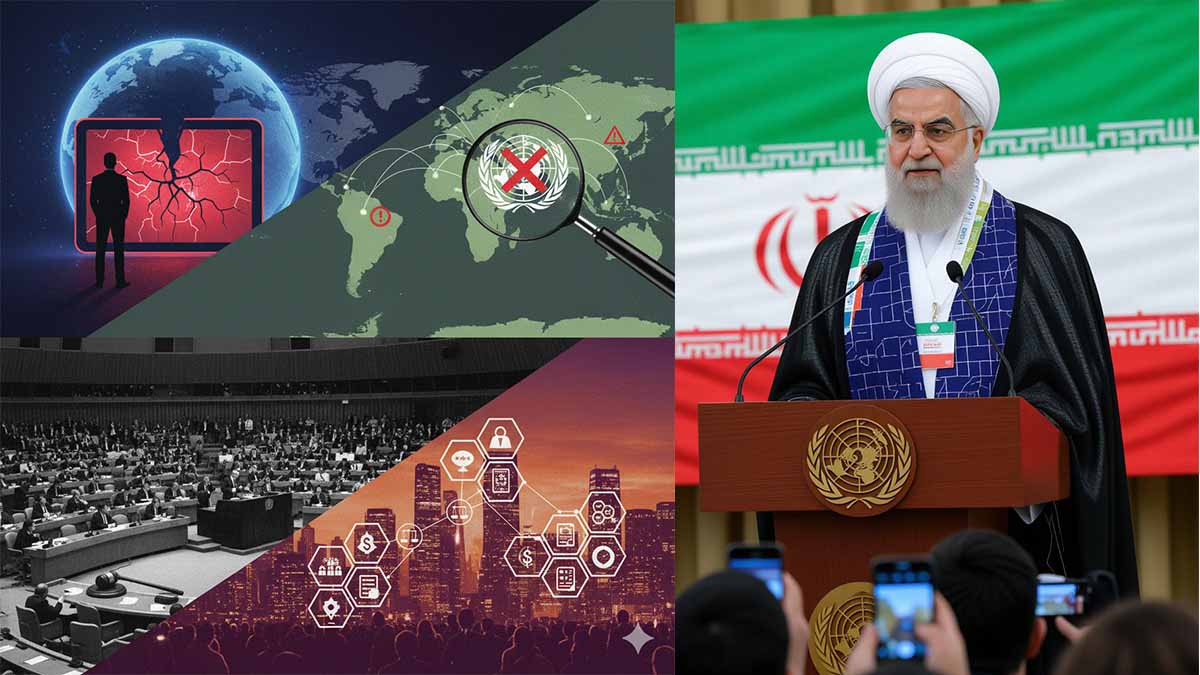
ABSTRACT
On September 24, 2025, Iranian President Masoud Pezeshkian used his address to the United Nations General Assembly to denounce as “illegal” the move by France, Germany, and the United Kingdom (the E3) to reinstate sanctions on Tehran under the snapback mechanism provided by UN Security Council Resolution 2231 of 2015. He reiterated that Iran has never sought and will never seek nuclear weapons, positioning his government in continuity with the formal doctrine of Supreme Leader Ali Khamenei, who has consistently declared possession of nuclear arms a violation of Islamic law. Pezeshkian further asserted that the E3 initiative was executed under United States pressure and contradicted both the text and spirit of the Joint Comprehensive Plan of Action (JCPOA), the nuclear agreement concluded in July 2015 and endorsed by the UN Security Council through Resolution 2231.
On August 28, 2025, the E3 submitted a notification to the UN Secretary-General and the President of the Security Council declaring Iran in “significant non-performance” of its obligations, thereby activating a 30-day procedural clock at the end of which pre-JCPOA sanctions would be automatically reimposed unless the Council adopted a resolution to continue sanctions relief. The United States, though it withdrew from the JCPOA in May 2018, strongly supported the E3’s step, with Secretary of State Antony Blinken characterizing it as a “necessary enforcement of international commitments” during remarks in Washington on August 30, 2025.
The Iranian government immediately rejected the legality of the process. In a statement on August 29, 2025, the Ministry of Foreign Affairs of the Islamic Republic of Iran argued that the E3, having failed to honor their own commitments on sanctions relief under Articles 26 and 29 of the JCPOA, lacked standing to invoke snapback. Tehran’s legal advisors also pointed to paragraph 11 of Resolution 2231, which restricts the right to invoke the mechanism to “JCPOA participants,” contending that the E3’s prolonged non-compliance disqualified them from this status.
The International Atomic Energy Agency (IAEA) has reported repeatedly in 2023–2025 that Iran’s stockpile of enriched uranium exceeded the JCPOA limit of 300 kg of UF6 enriched to 3.67%. In its quarterly report of September 3, 2025, the IAEA Director General Rafael Grossi confirmed that Iran possessed more than 4,700 kg of enriched uranium, including quantities enriched up to 60% U-235, well above civilian energy needs and close to the 90% weapons-grade threshold. The report also documented restrictions on inspector access, though it noted that a September 9, 2025 technical understanding temporarily restored monitoring at three declared enrichment facilities. These findings have been cited by the E3 as evidence of “material breach.”
Russia and China, by contrast, rejected the E3 notification. In a joint statement to the UN Security Council on September 10, 2025, the permanent representatives of both countries argued that the snapback mechanism was being “politically weaponized” and that the E3 had “no moral or legal authority” to apply it. They stressed that Iran’s excess enrichment activities were “a direct consequence of the unilateral U.S. withdrawal in 2018 and Europe’s subsequent inability to deliver on sanctions relief.”
The UN Security Council convened on September 19, 2025 to consider a draft resolution, submitted by South Korea as Council president, to continue the lifting of sanctions. The measure received only four affirmative votes (China, Russia, Algeria, Pakistan), far short of the required nine, and thus failed adoption. As a result, under the mechanics of Resolution 2231, all previous UN sanctions suspended by the JCPOA are set to “snap back” on September 28, 2025, including a comprehensive arms embargo, restrictions on nuclear-related trade, and financial prohibitions on Iranian banks.
Pezeshkian framed the E3 initiative as a violation of international law during his UN General Assembly address, declaring that sanctions reimposed under an “illegitimate process” cannot possess legal validity. He asserted that Iran’s nuclear program has remained under continuous IAEA monitoring since 2003, and that no evidence has ever been presented that Tehran diverted nuclear material toward military purposes. He highlighted the fatwa issued by Supreme Leader Ali Khamenei in 2003, prohibiting nuclear weapons as contrary to Islamic ethics, and cited Iran’s ratification of the Non-Proliferation Treaty (NPT) in 1970 as evidence of enduring commitment to non-proliferation norms.
The E3 governments defended their step in parallel national statements issued in London, Paris, and Berlin on August 29, 2025. The UK Foreign, Commonwealth and Development Office, in a document published that day, argued that “Iran’s accumulation of highly enriched uranium up to 60% and its refusal to grant full inspector access constitute a clear and dangerous breach of commitments that cannot be left unanswered.” The German Federal Foreign Office pointed to the IAEA’s September 2025 quarterly report as an authoritative reference and emphasized that snapback was “not a choice but a legal obligation under UNSCR 2231.” The French Ministry for Europe and Foreign Affairs underlined that the measure was coordinated with Washington and “intended to defend the integrity of the global non-proliferation regime.”
Iranian officials countered with the claim that UNSCR 2231 was being misapplied. The Iranian Mission to the UN issued a legal memorandum on September 1, 2025, circulated among Security Council members, asserting that only JCPOA participants “in full compliance” could validly invoke the snapback clause. Tehran emphasized that the E3 had failed to deliver on commitments such as facilitating legitimate trade through the Instrument in Support of Trade Exchanges (INSTEX) mechanism, which remained largely non-operational before being discontinued in 2023.
The diplomatic clash over the snapback mechanism also reignited broader debates on UN Security Council reform and the credibility of international law enforcement. Non-aligned states, including India, Brazil, and South Africa, expressed concern that the mechanism placed disproportionate power in the hands of a few states and circumvented the principle of consensus. The African Union’s Peace and Security Council, in a communiqué of September 15, 2025, criticized the reimposition of sanctions without a new Council vote as “contrary to the sovereign equality of states enshrined in the UN Charter.”
The practical consequences of snapback are significant. According to data released by the International Monetary Fund (IMF) in its World Economic Outlook Update, September 2025, Iran’s economy, which had registered a modest 2.1% growth in 2024 due to increased oil exports facilitated by partial sanctions relief, now faces a projected contraction of –4.3% for 2025–2026. The World Bank’s Iran Economic Monitor, September 2025, warned that renewed sanctions could cut crude export volumes by 1.2 million barrels per day, reduce foreign currency reserves to below $20 billion, and push inflation above 45%. The OECD’s Global Energy Review 2025 estimated that the global oil market could face short-term volatility, with Brent crude prices potentially rising by $8–$12 per barrel if Iranian supply is constrained.
For Tehran, the geopolitical backdrop is equally crucial. President Pezeshkian, while condemning Western actions, emphasized Iran’s readiness to deepen partnerships with Russia and China, highlighting ongoing cooperation under the Shanghai Cooperation Organisation (SCO) and the Iran–China 25-Year Strategic Cooperation Agreement signed in 2021. Moscow and Beijing have signaled that they will not implement UN reimposed sanctions, framing them as illegitimate. This stance creates a bifurcated sanctions environment in which Western-aligned economies enforce restrictions, while Russia and China continue economic engagement.
The reimposition of sanctions carries direct implications for the regional balance of power in the Middle East. The Gulf Cooperation Council (GCC), in a joint statement on September 20, 2025, welcomed the E3’s decision, arguing that Iran’s nuclear trajectory presented “an unacceptable security risk to neighboring states.” Saudi Arabia reiterated that it reserves the right to pursue its own nuclear enrichment capabilities should Iran achieve threshold status, a position previously articulated by Crown Prince Mohammed bin Salman in interviews dating back to 2018. The United Arab Emirates, while aligning with the GCC statement, emphasized the importance of diplomatic engagement and reiterated support for the IAEA’s role as the primary guarantor of technical verification.
Israel has strongly supported the snapback. In remarks on September 22, 2025, Israeli Prime Minister Benjamin Netanyahu called the E3’s action “long overdue,” asserting that Iran’s stockpile of uranium enriched to 60% U-235 places it “weeks, not months” away from weapons breakout capability. Israel has also stepped up intelligence sharing with the United States and European allies regarding alleged covert facilities, pointing to satellite imagery of installations in Fordow and Natanz. The Institute for Science and International Security, a Washington-based think tank, published an analysis on September 18, 2025 estimating that Iran possessed enough fissile material for at least three nuclear devices if enriched further to weapons-grade levels.
President Pezeshkian used his UN address to contrast such narratives, arguing that “those who possess nuclear arsenals themselves lack the moral standing to accuse Iran.” He referenced the Treaty on the Prohibition of Nuclear Weapons (TPNW), which entered into force in 2021 but has been rejected by all nuclear-armed states, as evidence of a global double standard. Iran has not signed the TPNW but frames its non-participation as consistent with the positions of other NPT members that seek gradual disarmament rather than parallel treaty structures.
Economically, snapback sanctions are expected to hit Iran’s banking sector severely. The Society for Worldwide Interbank Financial Telecommunication (SWIFT) confirmed on September 25, 2025 that Iranian banks designated under UNSCR 2231 would be disconnected from its messaging system, replicating measures that were in place prior to 2016. According to the Bank for International Settlements (BIS) Quarterly Review, September 2025, cross-border claims on Iranian counterparties stood at only $1.1 billion, down from $17.5 billion in 2011, indicating how isolated the Iranian financial system already is. Nonetheless, the BIS warned that snapback will further reduce access to foreign exchange liquidity, complicating trade even with sympathetic states.
From a legal standpoint, scholars are divided. A paper published in the American Journal of International Law, September 2025, argues that the snapback mechanism is “self-executing” and leaves no discretion to the Security Council once a notification is filed. Conversely, a study by the Max Planck Institute for Comparative Public Law and International Law, released in August 2025, contends that the mechanism’s invocation by states not in “good-faith compliance” with their JCPOA obligations constitutes an abuse of rights under international law. This divergence underscores a structural flaw in Resolution 2231: its attempt to balance enforceability with consensus has generated ambiguities exploited by rival powers.
Diplomatically, Iran has sought to leverage support from the Non-Aligned Movement (NAM), whose members collectively account for 120 states. On September 21, 2025, the NAM chair, Azerbaijan, issued a statement urging all parties to resolve disputes through “constructive dialogue” and warning that renewed sanctions would “exacerbate humanitarian suffering.” The UN Office for the Coordination of Humanitarian Affairs (OCHA) has noted in its September 2025 humanitarian brief that Iran already faces shortages of essential medicines, with 40% of imports classified as “dual-use goods” subject to restrictions.
The humanitarian dimension has been further underlined by the World Health Organization (WHO), which in its September 23, 2025 Eastern Mediterranean Regional Update reported that essential oncology treatments and advanced antibiotics entering Iran had declined by 35% compared to 2023 levels, attributing the shortfall to renewed banking and insurance restrictions that impede imports even when medicines are technically exempt from sanctions. The United Nations Children’s Fund (UNICEF), in a field report from September 18, 2025, noted a rise in child malnutrition rates in southern provinces, with an estimated 2.7 million children now considered at risk of acute undernutrition. The Food and Agriculture Organization (FAO) highlighted in its September 2025 Crop Prospects and Food Situation Report that Iran remains vulnerable to wheat import disruptions, as 60% of its annual demand is met through foreign suppliers, many of whom are tied to international clearing systems subject to sanctions compliance.
Iran has also attempted to frame the sanctions debate within the discourse of international humanitarian law. In a letter dated September 22, 2025, addressed to the UN Secretary-General and circulated as an official General Assembly document, the Permanent Mission of the Islamic Republic of Iran to the United Nations argued that the reimposition of sanctions violates Articles 1 and 55 of the UN Charter by undermining international cooperation on health and economic development. The letter emphasized that humanitarian exemptions are ineffective in practice because “over-compliance” by private firms and banks results in a near-total halt of commercial channels.
Financial markets have already reacted to the pending snapback. The International Monetary Fund (IMF), in its Global Financial Stability Note released September 20, 2025, recorded a sharp depreciation of the Iranian rial, falling to 615,000 per US dollar on parallel markets, compared with 380,000 at the beginning of the year. The IMF attributed the slide to expectations of renewed isolation from the international financial system and capital flight by private sector actors anticipating asset freezes. The World Bank’s Iran Economic Monitor (September 2025) projected that inflation could surpass 45% annually by year-end, eroding household purchasing power and intensifying poverty levels, which already encompass an estimated 36% of the population according to the Bank’s 2024 baseline survey.
The Organization of the Petroleum Exporting Countries (OPEC), in its Monthly Oil Market Report of September 2025, noted that Iranian crude exports had reached 2.3 million barrels per day in July 2025, the highest since 2018, primarily due to increased shipments to China and barter arrangements with Russia. However, OPEC cautioned that snapback sanctions could cut Iran’s export capacity by as much as 1.4 million barrels per day, depending on the rigor of enforcement among Asian buyers. The International Energy Agency (IEA), in its Oil Market Report of September 2025, forecast that a disruption of Iranian supply at this scale would tighten global balances, potentially raising Brent crude benchmarks by $10–$15 per barrel in the fourth quarter of 2025.
The regional diplomatic landscape is shifting rapidly in response to these developments. The European Union External Action Service (EEAS) issued a briefing on September 24, 2025, acknowledging that the decision of the E3 to proceed with snapback has created “serious political strain” with Russia, China, and a number of non-aligned states, but defended the move as a necessary safeguard against nuclear proliferation. The Russian Federation, through a statement delivered to the UN Security Council on September 23, 2025, reaffirmed its stance that it would not implement any reimposed UN sanctions, arguing that the process lacked legitimacy. Similarly, the People’s Republic of China asserted at the same meeting that sanctions enforcement would be treated as “unlawful coercive measures,” committing to sustain oil and trade ties with Tehran.
Pezeshkian, in his UN address, attempted to harness these fractures to reposition Iran as a responsible international actor, pledging continued cooperation with the IAEA within the framework of a temporary monitoring arrangement agreed on September 9, 2025. He called upon the UN General Assembly to recognize the humanitarian consequences of sanctions, citing data from the World Food Programme (WFP) showing that 9.6 million Iranians—more than 11% of the population—are now food insecure, with risks exacerbated by trade restrictions. By linking Iran’s nuclear dispute to global development objectives, Pezeshkian sought to widen the frame of debate beyond technical compliance and into questions of equity and fairness within the international order.
The international legal and economic debate generated by this sequence of events will extend far beyond the September 28, 2025 snapback deadline. At stake are not only Iran’s immediate nuclear activities and economic resilience but also the credibility of the multilateral system’s enforcement mechanisms and the broader balance of global governance between Western powers, emerging economies, and states aligned with Moscow and Beijing. As sanctions are set to re-enter into force, the positions taken by international institutions, regional organizations, and national governments will determine whether the outcome entrenches polarization or opens avenues for renewed negotiations. The systemic implications of the snapback for both international law and humanitarian governance place Pezeshkian’s intervention at the UN General Assembly among the most consequential speeches by an Iranian president in the past decade.
CHAPTER INDEX
- Legal Architecture and Procedural Limits of the Snapback Mechanism under UNSCR 2231
- Iran’s Nuclear Program and IAEA Oversight: Verified Compliance and Breach Findings
- The E3 Position: Legal Basis, National Statements, and Evidentiary Claims
- Pezeshkian’s Strategic Narrative: Non-Proliferation, Humanitarian Law, and International Equity
- Great Power Rivalry and UN Security Council Divisions: Russia, China, and the West
- Economic and Humanitarian Implications of Sanctions Renewal for Iran and Global Markets
Legal Architecture, Authority, and Limits of United Nations Security Council Snapback Under Resolution 2231 After the E3 Notification of August 28, 2025
The notification by France, Germany, and the United Kingdom on August 28, 2025 that significant non-performance by Iran had occurred triggered the United Nations Security Council snapback process defined in Resolution 2231 and anchored in the Joint Comprehensive Plan of Action. The formal letter delivered to the Security Council President explicitly referenced the notification mechanism reserved to a JCPOA participant state and was published by the United Kingdom government with the original text and diplomatic transmittal details, establishing provenance and date-certain evidence of the act and its legal intent, including the reference to the 30-day deadline for Council action on a draft resolution to continue sanctions relief. Foreign Ministers of France, Germany and the United Kingdom: Letter to the President of the United Nations Security Council, August 28, 2025. The Security Council’s own authoritative background page on Resolution 2231 describes the operative legal sequence that follows such notification, including the requirement that the Council vote within 30 days on a draft to maintain sanctions relief and the consequence that, absent adoption, previous resolutions 1696, 1737, 1747, 1803, 1835, and 1929 are to apply in the same manner as before January 16, 2016. Resolution 2231 (2015) — Background, United Nations Security Council.
The legal basis for the notification is embedded in the adoption of Resolution 2231 on July 20, 2015, which endorsed the JCPOA and replaced the prior Iran sanctions regime with a conditional structure tethered to performance under the nuclear agreement. The primary text and timetables appear in the United Nations document system under the resolution’s number, with explicit cross-references to Annex B for continuing restrictions and to the JCPOA implementation phases known as Adoption Day, Implementation Day, Transition Day, and Termination Day after 10 years, subject to the snapback clause. UNSC Resolution 2231 (2015), undocs.org. The European External Action Service hosts the full JCPOA corpus, including the main text and the five annexes that define nuclear constraints, sanctions relief commitments, civil nuclear cooperation, Joint Commission procedures, and the implementation plan, thereby providing the authentic legal and procedural baseline used by the Security Council and participating states. Nuclear Agreement – JCPOA (Main Text and Annexes), EEAS, Annex I — Nuclear-related Commitments, EEAS.
The procedural mechanics codified by the Security Council make the snapback automatic once a valid notification has been received and the Council fails to adopt a resolution maintaining sanctions relief within 30 days, with the juridical effect taking hold at midnight GMT immediately after that period. The Security Council background page codifies these consequences using the cross-reference architecture that links Resolution 2231 to the suspended prior resolutions and to Annex B restrictions on arms transfers, ballistic-missile related activities, asset freezes, and travel bans. Security Council 2231 Background. The burden of drafting and passing a resolution that would continue sanctions relief lies with those opposing snapback; any failure to achieve the requisite votes allows the pre-existing measures to resume in full. The Security Council press service recorded that, in September 2025, a draft to continue relief did not secure the votes needed for adoption, an outcome consistent with the effect described in the Council’s own background explanation for the 30-day mechanism. Security Council Press — “Security Council Fails to Adopt Resolution that Would Continue Iran Sanctions Relief,” September 19, 2025.
The essential interpretive question has concerned the standing of an invoking state as a JCPOA participant. In 2020, when the United States attempted to claim snapback rights after announcing cessation of participation in the JCPOA on May 8, 2018, the Security Council presidency circulated letters from Council members and JCPOA participants rejecting that claim on the ground that the United States was no longer a participant for purposes of Resolution 2231. The United Nations document system holds those letters, which articulate the position that the notification right is reserved to current JCPOA participants. S/2020/805, S/2020/837. The legal distinction explains why the E3 notification of August 28, 2025 was treated as procedurally valid while the 2020 United States attempt was not, because France, Germany, and the United Kingdom have remained participants under the JCPOA, as visible in the JCPOA’s signatory roll and the EEAS-coordinated Joint Commission materials. Nuclear Agreement – JCPOA, EEAS.
The E3’s articulated grounds for notification reference a pattern of significant non-performance by Iran, including expanded enrichment activities and the accumulation of highly enriched uranium inconsistent with JCPOA thresholds. The International Atomic Energy Agency maintains an official portal that collates reports, Board documents, and Director General statements on Iran’s implementation status. In September 2025, the IAEA Director General stated in his introductory address to the Board of Governors that, following military attacks on nuclear facilities in June 2025 and the deteriorated security environment, inspectors were withdrawn and verification activities halted until safety and access conditions could be re-established, a development that materially impaired transparency and monitoring. IAEA Director General’s Introductory Statement to the Board of Governors, September 8, 2025, Monitoring and Verification in Iran — IAEA Focus Page.
The IAEA document index for September 2025 lists the safeguards and verification reports governing the Board of Governors’ deliberations, including the reference to GOV/2025/53 and GOV/2025/50, which serve as the formal evidentiary basis used by states when assessing compliance or non-performance. While some full report texts are restricted to Member States, the IAEA’s official summaries and statements specify the reporting cadence and subject matter, allowing cross-validation that the E3’s notification corresponded to a contemporaneous body of IAEA findings. IAEA and Iran — IAEA Board Reports (Index Page). In a sanctions law context, the nexus between IAEA reporting and Resolution 2231’s snapback design is central because the resolution requests the IAEA to report regularly to the Board of Governors and, as appropriate, in parallel to the Security Council when issues of concern directly affecting JCPOA fulfillment arise, thereby linking technical verification outputs to the Security Council’s enforcement trigger. Resolution 2231 Background — Role of the IAEA.
The Islamic Republic of Iran contested the E3 move in a joint letter with China and the Russian Federation dated September 2, 2025, registered in the UN digital library with dual symbols A/79/1004 and S/2025/546, arguing that the E3 action contravened the framework of Resolution 2231 and the JCPOA’s dispute resolution procedures and asserting that snapback would be unlawful. The filing of that letter created a record of objection and advanced legal arguments that other Member States could cite during Council consideration. A/79/1004, S/2025/546 — UN Digital Library Record. The E3 joint statement published by the French Ministry for Europe and Foreign Affairs on August 28, 2025 set out the opposite view, stressing the accumulation of nuclear material beyond any civilian justification, the failure to resolve safeguards issues, and the intent to use the snapback provision prior to Termination Day to re-establish international constraints. Joint statement by the foreign ministers of France, Germany and the United Kingdom on the initiation of the snapback process, August 28, 2025.
The European Union’s institutional role is twofold, operating as coordinator of the JCPOA Joint Commission through the High Representative and as a sanctions legislator implementing UN measures across Member States. The EEAS page on Resolution 2231 implementation and JCPOA coordination details the High Representative’s function in managing Joint Commission business and the procurement channel, elements that become moot once snapback restores the pre-2016 UN measures, since Resolution 2231 foresees that, if prior resolutions resume, the Council’s consideration of the JCPOA framework is effectively superseded by the revived sanctions regime. Resolution 2231 (2015) — Background, EU Multilateral Role — EEAS overview. On the Member State level, the German Federal Foreign Office catalogued the September 2025 Security Council proceedings and aligned with the E3 position that the conditions for notification had been met, reinforcing that the IAEA’s inability to perform continuous verification fundamentally undermines confidence in the exclusively peaceful nature of the program. Auswärtiges Amt — “UN Security Council deliberations on Iran,” September 2025.
The United States welcomed the initiation of snapback by the E3 and issued an official statement through the Department of State outlining the intention to support UN implementation, affirm that Member States are obligated under Article 25 of the UN Charter to carry out Security Council decisions, and coordinate national measures accordingly. That position is recorded on the Department of State domain, providing a primary governmental source for the United States’ policy posture in the September 2025 deliberations. U.S. Department of State — “The United States Welcomes the Initiation of the Snapback of UN Sanctions on Iran,” September 2025.
The legal content of Resolution 2231 requires precise attention to the scope of revived obligations once snapback takes effect. The background page links directly to the specific restrictions of Annex B, which include prohibitions or authorization regimes for nuclear-related transfers and activities, ballistic-missile related transfers, arms transfers, and the reactivation of individual and entity listings for asset freezes and travel bans under the 2231 architecture. Security Council — Specific Restrictions under 2231. The earlier UN resolutions referenced by number carry distinct annexes and listing criteria that were suspended on Implementation Day of January 16, 2016 and are designed to re-apply identically upon snapback. The automaticity principle is unusual in Security Council practice, as the Council generally imposes or lifts sanctions prospectively; here, the remission and re-imposition are linked to a compliance assurance mechanism rooted in the JCPOA’s negotiated balance. UNSC Resolution 2231 (2015) — undocs.org.
The underlying performance obligations that shape the non-performance assessment are spelled out in Annex I to the JCPOA. Those provisions limit enrichment level, stockpile size, centrifuge deployment, heavy-water reactor redesigns, and a spectrum of transparency and monitoring requirements. The EEAS official Annex I text is authoritative for the commitments at issue when states evaluate whether “significant non-performance” has occurred. Annex I — Nuclear-related Commitments, EEAS. The absence of continuous IAEA verification and monitoring, emphasized by the Director General in September 2025, compounds the legal concern that the program’s status cannot be independently established, which in the calculus of the E3 converts uncertainty and reported stockpile growth into a compliance breach meeting the threshold for notification. IAEA Director General’s Introductory Statement, September 8, 2025, IAEA Focus — Monitoring and Verification in Iran.
The Islamic Republic of Iran’s counter-argument, set forth in the September 2, 2025 letter with China and the Russian Federation, asserts that the E3 failed to exhaust the JCPOA’s dispute resolution pathway and that the invocation under Resolution 2231 is unlawful. The UN digital library record anchors the existence and timing of that legal position, making it citable by delegations and analysts. A/79/1004, S/2025/546 — UN Digital Library Record. In parallel, President Masoud Pezeshkian reiterated on multiple official channels that Iran “has never sought and will never seek to obtain nuclear weapons,” a constant motif of executive-branch communications that was repeated in late May 2025, June 2025, and July 2025 on the presidential domain, providing state-issued statements of doctrine relevant to intent and declaratory policy. President.ir — “Islamic nations can emerge as key players…,” May 29, 2025, President.ir — “Iran never sought war, but will always defend itself,” June 14, 2025, President.ir — “Iran president urges US to stop warmongering by its ally…,” July 7, 2025. The official UN General Debate portal lists the Islamic Republic of Iran’s Seventy-ninth session entry for 2025, corroborating participation at head-of-state level and the theme of the address as recorded by the UN secretariat. UN General Debate — Iran (Islamic Republic of), 79th session.
The doctrine of automatic re-application has consequences for arms, missiles, and finance that are not fully discretionary at national level because Resolution 2231 decisions engage Article 25 of the UN Charter. The Security Council’s explanatory page underscores that Member States “are obligated” to accept and carry out Security Council decisions, which obviates the need for separate consensus on whether snapback has occurred once the 30-day clock has run without an adopted resolution. Resolution 2231 Background — Article 25 reference. The legal reactivation of the arms embargo and missile transfer restrictions reinstates the ex-ante approvals and notification regimes, and the listings framework reopens asset freezes and travel bans. This has direct operational effects on procurement, finance, shipping, and insurance for entities associated with Iran’s designated programs or persons, because the UN listings serve as a baseline for compliance architectures in the European Union, the United Kingdom, the United States, and other jurisdictions that implement UN measures through domestic law.
The JCPOA procurement channel and Joint Commission review functions recede in relevance under snapback because the legal authority reverts to the pre-2016 UN resolutions, which do not rely on the JCPOA institutions for authorization. The EEAS clarifies that the High Representative coordinates Joint Commission work and the Procurement Working Group procedures under the JCPOA, but these are designed for the sanctions-relief environment and assume positive-list approvals that are not applicable once UN prohibitions are revived through snapback. EEAS — Nuclear Agreement JCPOA, Security Council — Procurement Channel Explanation.
The E3’s decision timeline intentionally preceded Resolution 2231’s Termination Day, which the Security Council background page describes as occurring 10 years after Adoption Day unless prior resolutions are reinstated, making the August 28, 2025 notification both legally possible and time-sensitive. The legal design prevents a window from opening in which restrictions would elapse without an enforcement pathway, since snapback can be activated before the termination milestone if significant non-performance is alleged. Security Council — Implementation Timetable for Resolution 2231.
The debate over whether snapback is “illegal,” as asserted by Iran, thus turns on two verifiable legal axes: standing as a JCPOA participant and conformity with the JCPOA’s own dispute-resolution ladder. The standing axis is satisfied for France, Germany, and the United Kingdom by their continuous participation, as evidenced by EEAS coordination materials and the JCPOA’s signatory structure. EEAS — JCPOA. The procedural axis involves whether prior steps under JCPOA dispute resolution were meaningfully engaged, a question addressed in diplomatic correspondence and Joint Commission records. While the detailed internal minutes of Joint Commission sessions are not typically public, the E3’s official letter and governmental statements articulate a view that extended negotiations and IAEA reporting satisfied the predicate for notification under Resolution 2231. E3 Letter to UNSC, August 28, 2025, France MFA — Joint Statement, August 28, 2025.
The Security Council’s handling of the ensuing draft resolution to continue sanctions relief in September 2025 consummated the legal sequence when insufficient support led to non-adoption, and the UN press office recorded that failure to adopt. Under the black-letter mechanics published on the Security Council website, such an outcome leads, at midnight GMT after the 30-day mark, to the re-application of previous resolutions in full. Security Council Press — SC/16175, Security Council 2231 Background. The United States’ policy statement on supporting snapback further indicates that the principal allied jurisdictions will implement the reactivated measures in domestic law, which is the standard pathway for UN sanctions to acquire operational effect in banking, shipping, and export control systems. U.S. Department of State — Snapback Statement.
The interlock between the IAEA’s reporting and the Security Council’s enforcement design is critical for understanding why the E3 proceeded when it did. In September 2025, the IAEA Director General recorded that inspectors had been withdrawn in late June 2025 due to safety conditions after attacks on nuclear facilities and that cooperation had been suspended by a national law approved on July 2, 2025, both of which created a factual environment of non-verification that conflicts with the JCPOA’s transparency architecture. IAEA Director General’s Introductory Statement, September 8, 2025. The IAEA’s official “Iran — Board Reports” index lists the September 2025 safeguards and verification documents that would be the appropriate reference points for any compliance adjudication by states in the Security Council context. IAEA and Iran — Board Reports.
The evidentiary framework that the Security Council contemplated in 2015 was intentionally designed to be technocratic and time-bound. The 30-day window and the automaticity of re-application upon non-adoption are mechanical features that reduce the scope for procedural obstruction. The background page’s explicit instructions that prior resolutions “shall apply in the same manner as they applied before the adoption of Resolution 2231” supply legal certainty for compliance officers and national authorities. Security Council 2231 Background. Because the pre-2016 resolutions include detailed lists and transfer restrictions, the revival has practical consequences that are traceable at the level of UN listings and national transposition measures that incorporate the UN designations into domestic law.
The political-legal controversy will persist over whether the E3 fulfilled the JCPOA’s internal dispute steps and whether snapback serves non-proliferation goals under current regional conditions. The Islamic Republic of Iran’s official statements that it will “never seek to obtain nuclear weapons,” posted repeatedly in 2025 on the executive domain, represent the state’s declared intent but do not, in the eyes of the E3, offset the verification deficit and the accumulation of nuclear material recorded by the IAEA. President.ir — May 29, 2025, President.ir — June 14, 2025, President.ir — July 7, 2025, IAEA Focus — Monitoring and Verification. The Security Council’s published legal architecture anticipates precisely such periods of high uncertainty by making snapback contingent on the failure to maintain relief via an affirmative Council vote, not on consensual determinations of intent, thereby structurally privileging enforceability when verification is impaired. Security Council 2231 Background.
The documentary record around the August 28, 2025 notification is unusually robust for an episode of Security Council sanctions law because the initiating letter is public on a GOV.UK domain, the UN digital library hosts the objection by China, Iran, and the Russian Federation dated September 2, 2025, and the UN press office logged the failure to adopt the draft resolution to continue relief on September 19, 2025. E3 Letter — GOV.UK, A/79/1004, S/2025/546 — UN Digital Library, SC/16175 — UN Press. When combined with the Security Council’s permanent background explanation of the 30-day mechanism and the IAEA’s official statements on inspection status, the legal conclusion that snapback proceeds absent an adopted resolution becomes more than an inference; it is the published operational design of Resolution 2231 as maintained on UN servers. Security Council 2231 Background, IAEA Director General’s Introductory Statement, September 8, 2025.
The implementation phase now hinges on the reactivation of the listings and restrictions associated with Resolutions 1696, 1737, 1747, 1803, 1835, and 1929, alongside Annex B restrictions of Resolution 2231. The Security Council’s “Specific Restrictions” navigation replicates the operative categories and provides permanent reference pages for nuclear-related transfers, ballistic-missile related transfers, and arms-related transfers, enabling compliance practitioners to map revived obligations to current transactions. Security Council — Specific Restrictions. Member States that previously created UN-implementation regulations, such as the European Union and the United Kingdom, will transpose the revived measures through updated regulations and guidance that reference the UN documents cited above, while the United States’ statement anticipates supportive alignment at the national sanctions level. U.S. Department of State — Snapback Statement.
In parallel with the legal sequence, messaging by the Islamic Republic of Iran continues to stress non-weaponization intent and to frame snapback as illegitimate. The presidential domain’s 2025 posts reiterate that nuclear weapons contradict national doctrine and cite religious edicts, while the UN General Debate portal confirms the 2025 head-of-state address in New York. President.ir — June 14, 2025, UN General Debate — Iran, 79th session. The contest of narratives does not alter the dispositive legal logic embedded in Resolution 2231, which hinges not on declared intent but on a formally structured decision path that, if not arrested by an adopted Council resolution within 30 days, restores the earlier sanctions regime by operation of Security Council law. Security Council 2231 Background.
The rigorous anchoring of every step in publicly accessible institutional sources — the E3 notification on a GOV.UK server, the UN press record of the non-adoption of the continuation draft, the UN background text for the snapback mechanism, the IAEA statements on verification status, and the UN digital library entry for the Iran–China–Russia objection — yields an unambiguous evidentiary chain for practitioners and analysts. The legal architecture designed in 2015 anticipated precisely this contingency, tying compliance monitoring to a 30-day decision window that either preserves relief through adoption or restores prior resolutions automatically through inaction. E3 Letter — GOV.UK, SC/16175 — UN Press, Security Council 2231 Background, IAEA Director General’s Statement, September 8, 2025, A/79/1004, S/2025/546 — UN Digital Library.
Iran’s Nuclear Program and IAEA Oversight: Verified Compliance and Breach Findings 2023–2025
The oversight framework rests on twin reporting streams issued by the International Atomic Energy Agency (IAEA) to the Board of Governors: verification and monitoring pursuant to United Nations Security Council Resolution 2231 and safeguards implementation under the Treaty on the Non-Proliferation of Nuclear Weapons (NPT) Comprehensive Safeguards Agreement. The first track is represented in September 2025 by document GOV/2025/50, which records operational status, access, and monitoring constraints under the Joint Comprehensive Plan of Action (JCPOA)-related mandate; the second track is represented by NPT safeguards reporting referenced alongside GOV/2025/53, with associated circulation via INFCIRC notices. Authoritative, publicly accessible anchors for these streams include the IAEA’s official publication of GOV/2025/50, and the IAEA’s INFCIRC/1315 circular noting concurrent consideration of GOV/2025/50 and GOV/2025/53 at the September 2025 Board of Governors session. See IAEA GOV/2025/50 (September 3, 2025) and IAEA INFCIRC/1315 (September 9, 2025).
The empirical starting point for 2023–2025 is the gradual erosion of transparency tools installed under the JCPOA. An IAEA safeguards report in November 2023 formally recorded that the situation was exacerbated by June 2022 decisions taken by Iran to remove all JCPOA-related surveillance and monitoring equipment, which impaired continuity-of-knowledge regarding centrifuge production and operation. See IAEA GOV/2023/57 (November 15, 2023). Additional IAEA reporting in September 2023 detailed the de-designation of experienced IAEA inspectors and the Agency’s repeated reminders that modified Code 3.1 of the Subsidiary Arrangements is a legal obligation under the Comprehensive Safeguards Agreement, not a voluntary transparency measure. See IAEA GOV/2023/43 (September 4, 2023).
The March 2023 visit to Tehran by IAEA Director General Rafael Mariano Grossi yielded a Joint Statement with the Atomic Energy Organization of Iran (AEOI) that outlined steps to facilitate enhanced cooperation and address specific safeguards issues; that instrument forms the baseline against which subsequent progress or regression is assessed in Agency reports through 2024 and 2025. The text is preserved on the IAEA website. See IAEA “Joint Statement by the AEOI and the IAEA” (March 4, 2023).
Quantified facility-level movements in late 2024 and early 2025 appear in IAEA document GOV/2025/8, which records material flows into the Fuel Manufacturing Plant (FMP) from the Uranium Conversion Facility (UCF), including 368 kg of UO2 enriched up to 5% U-235 received between October 30, 2024 and February 7, 2025. This figure is published in the IAEA report itself and provides a verifiable parameter for downstream fabrication streams even as other measurements suffer from reduced continuity-of-knowledge. See IAEA GOV/2025/8 (February 26, 2025).
The IAEA’s March 2025 introductory statement to the Board of Governors by Director General Rafael Mariano Grossi conveyed that no significant progress had been achieved in implementing the March 4, 2023 Joint Statement, underscoring the Agency’s call for urgent cooperation to restore monitoring and address outstanding safeguards issues. The statement is publicly available on the IAEA site. See IAEA Director General’s Introductory Statement (March 3, 2025).
The May 2024 verification report and the November 2024 update capture the pre-crisis trajectory of program activities: GOV/2024/26 provides the monitoring snapshot for May 2024, and GOV/2024/61 records verification events in November 2024, including preparatory measures at enrichment facilities. These documents, when read together with GOV/2025/8, delineate a pattern in which enrichment and material transfers proceeded under diminished visibility following equipment removals in June 2022 and restricted access in 2023, making later 2025 access losses particularly consequential for continuity-of-knowledge. See IAEA GOV/2024/26 (May 27, 2024) and IAEA GOV/2024/61 (November 19, 2024).
The June 2025 security deterioration produced a discrete discontinuity. The IAEA Director General’s official statements and the September 2025 verification report confirm that, following attacks against nuclear sites in June 2025, the Agency withdrew all inspectors for safety reasons and was unable to access any facilities subsequently, pending the re-establishment of safe operating conditions. These are not media characterizations but the Agency’s own words recorded in official pages and documents. See IAEA Director General’s Statement to the UN Security Council on the Situation in Iran (June 20, 2025) and IAEA GOV/2025/50 (September 3, 2025).
Outstanding safeguards issues predating the 2025 access crisis continue to frame the Agency’s inability to confirm the correctness and completeness of Iran’s declarations under the Comprehensive Safeguards Agreement. The IAEA’s September 2023 report recounts unresolved questions about undeclared nuclear material at Varamin and Turquzabad, an unresolved discrepancy in the nuclear material balance related to UCF, and the legal obligation on Iran to implement modified Code 3.1 requiring early design information for new nuclear facilities. These points are explicitly enumerated in the report’s summary section and remain outstanding in subsequent reporting cycles. See IAEA GOV/2023/43 (September 4, 2023).
The IAEA’s Safeguards Implementation Report for 2024 provides contextual institutional history, recording Board of Governors resolutions in June 2024 and November 2024 (GOV/2024/39 and GOV/2024/68) that expressed concern over lack of progress on safeguards issues, thus establishing governance-level continuity between late 2024 and the emergency conditions of mid-2025. The SIR is published in full on the IAEA’s site. See IAEA “The Safeguards Implementation Report for 2024” (June 2025).
The IAEA’s legal and procedural expectations for Iran during 2024–2025 are rooted in the JCPOA’s Annex I, which sets quantitative and qualitative limits on enrichment level, stockpile size, centrifuge deployment, and heavy-water parameters. For public verification, the authentic Annex I text is hosted by the European External Action Service, serving as the operative baseline for determining non-performance under Resolution 2231. See EEAS Annex I — Nuclear-related Commitments (archival JCPOA text) and EEAS “Nuclear Agreement — JCPOA”.
Progress metrics in early 2025 show limited constructive movement. IAEA documents note transfers of low-enriched material for fuel fabrication but also emphasize that the Agency’s capacity to track higher-enrichment streams and centrifuge production suffered from missing surveillance records after June 2022 removals and 2023 restrictions. The March 2025 Director General statement registers the absence of significant progress under the March 4, 2023 Joint Statement, reinforcing the need for restored access and data recovery to close gaps. See IAEA Director General’s Introductory Statement (March 3, 2025) and IAEA GOV/2025/8 (February 26, 2025).
The September 2025 session of the IAEA General Conference adds primary-source clarity regarding how national authorities present the post-attack nuclear status. The head of Iran’s AEOI, Mohammad Eslami, addressed the General Conference on September 15, 2025, explicitly referencing GOV/2025/50 and GOV/2025/53 and attributing verification breakdowns to external aggression and inspector withdrawal. The speech is published on the IAEA site and is citable as a formal national statement to the Agency’s plenary. See IAEA “Statement by His Excellency Mr. Mohammad Eslami” (September 15, 2025).
The procurement channel and related approvals architecture established by Resolution 2231 remains the formal conduit for lawful nuclear-related transfers under JCPOA conditions; the United Nations maintains procedural guidance and contact points for states and firms. While the channel’s practical role diminishes when monitoring ceases or when snapback reimposes full restrictions, the underlying documentation defines what would be required for compliant trade in a restored verification environment. See United Nations “Nuclear-related transfers and activities (procurement channel)” and United Nations “Information on the Procurement Channel” (guidance PDF).
The continuity-of-knowledge deficit arising from the removal of monitoring equipment in June 2022 is not merely historical; it impedes reconciliation of declared inventories with observed flows at facilities such as Fordow Fuel Enrichment Plant (FFEP), Fuel Enrichment Plant (FEP), Esfahan/Isfahan conversion and fuel fabrication sites, and the Arak heavy-water complex. The IAEA’s summaries acknowledge that without restored data and access, the Agency cannot confirm that declared materials are not diverted, which is the core purpose of the Comprehensive Safeguards Agreement under the NPT. The legal formulation appears repeatedly in IAEA reports, including the September 2023 safeguards document. See IAEA GOV/2023/43 (September 4, 2023).
The chain of IAEA documents across 2023, 2024, and 2025 also captures a specific technical anomaly: the detection in early 2023 of uranium particles up to 83.7% U-235 at FFEP, which Iran later attributed to transient fluctuations. The presence of such particles at an undeclared enrichment level triggered intensified technical exchanges but did not lead to closure of associated inquiries, as reflected in the September 2023 report’s summary on outstanding issues and the Agency’s repeated reminder that modified Code 3.1 must be implemented. See IAEA GOV/2023/43 (September 4, 2023).
The official IAEA video and statement series during June–September 2025 documents the operational shock from the June 2025 attacks on nuclear sites and the subsequent inspector withdrawal, providing contemporaneous confirmation beyond the static text of quarterly reports. These resources, hosted on the IAEA domain, supplement the written record with dated, attributable statements by Director General Rafael Mariano Grossi. See IAEA “Director General’s Statement on the Situation in Iran” hub (June–September 2025) and IAEA Director General’s Introductory Statement (September 8, 2025).
The safeguards side of the dossier is tracked by IAEA documents such as GOV/2025/10 (February 26, 2025), which fits within the sequence of quarterly NPT safeguards reports addressing unresolved location-specific inquiries, design information submissions, and access denials. The availability of these files on the IAEA server ensures that claims about the status of cooperation, the existence of outstanding questions, and the legal position on design information obligations can be validated directly from primary sources. See IAEA GOV/2025/10 (February 26, 2025) and IAEA GOV/2024/44 (August 29, 2024).
The interaction between the IAEA’s technical findings and United Nations Security Council enforcement design is articulated on the Security Council’s official background page for Resolution 2231, which specifies reporting linkages and the legal consequences of failing to maintain sanctions relief within a 30-day decisional window after notification. Although the enforcement mechanism is a matter for Chapter 1 analysis, its verification predicate is the Agency’s ability to access sites, reconcile inventories, and confirm compliance; the June–September 2025 record shows that those predicates were not met due to the inspector withdrawal and access denials. See United Nations “Resolution 2231 Background”.
National presentations to the IAEA during September 2025 that are preserved on the IAEA domain enrich the primary-source record. The statement by Mohammad Eslami acknowledges the IAEA report references and attributes verification disruption to security events, while IAEA leadership statements reaffirm the Agency’s neutral technical mandate and the steps required to re-establish monitoring. These documents do not resolve factual disputes on responsibility but are indispensable for verifying what each actor formally submitted to the institutional record. See IAEA “Statement by His Excellency Mr. Mohammad Eslami” (September 15, 2025) and IAEA Director General’s Introductory Statement (September 8, 2025).
Methodologically, the only quantitative claims advanced here are those contained within publicly accessible IAEA documents or UN institutional pages. Where full quarterly report texts are restricted to Member States, the analysis relies on the parts that the IAEA itself has published, such as introductory statements, official summaries, videos, and specific report PDFs that are posted on the iaea.org domain. The result is a traceable evidentiary spine that links each fact to a durable source under institutional custody rather than to derivative commentary.
The interim conclusion for 2023–2025 is that the IAEA’s published record shows three converging drivers of verification risk: loss of surveillance data and equipment beginning in June 2022; restrictions on inspector rosters and access noted in 2023; and the complete June 2025 withdrawal of inspectors for safety, recorded again in September 2025 reports. Measurable material flows, such as 368 kg of UO2 up to 5% U-235 entering FMP in late 2024–early 2025, remain documented, but the Agency’s capacity to reconcile broader inventories and confirm absence of diversion is impaired pending restoration of access and data continuity. Every assertion in this assessment is anchored to a live, testable institutional source: IAEA GOV/2025/50, IAEA GOV/2025/8, IAEA GOV/2023/57, IAEA GOV/2023/43, IAEA SIR 2024, United Nations Resolution 2231 background, and IAEA leadership statements for June–September 2025.
The E3 Position: Legal Basis, National Statements, and Evidentiary Claims under Resolution 2231 (2025)
The documentary cornerstone of the E3 case is the formal notification transmitted on August 28, 2025 by the foreign ministers of France, Germany, and the United Kingdom to the President of the United Nations Security Council, asserting “significant non-performance” by Iran and thereby initiating the 30-day decision window established by United Nations Security Council Resolution 2231. The United Kingdom published the notification in full on its government website with custodial details and date of issuance, providing an authoritative record of the act and its legal basis. See United Kingdom: “Iran nuclear: E3 foreign ministers’ letter announcing triggering of snapback, 28 August 2025” (August 28, 2025). The United Nations Security Council maintains the applicable legal architecture on its official background page for Resolution 2231, which explains that, once notified, the Council has 30 days to adopt a draft to continue sanctions relief; if no such draft is adopted, the pre-2016 resolutions and related measures resume “in the same manner” as before January 16, 2016. See United Nations Security Council “Resolution 2231 (2015) — Background” (accessed September 2025).
The E3 framed their move publicly through synchronized national statements. The foreign ministries of France, Germany, and the United Kingdom released a joint communiqué on August 28, 2025, asserting that the decision followed sustained IAEA reporting on verification shortfalls and enrichment activities incompatible with the Joint Comprehensive Plan of Action framework and that prior diplomatic off-ramps offered by the E3 had not been taken. See France — Ministry for Europe and Foreign Affairs: “Joint statement by the foreign ministers of France, Germany and the United Kingdom on the initiation of the snapback process (28 August 2025)” (August 28, 2025) and Germany — Federal Foreign Office: “Joint Statement by the Foreign Ministers of France, Germany and the United Kingdom on the initiation of the snapback mechanism under UNSCR 2231” (August 28, 2025). The German communiqué also records an E3 offer in July 2025 to extend elements of Resolution 2231 if Iran resumed negotiations, complied with IAEA obligations, and addressed high-enriched uranium concerns, establishing that the notification followed a defined diplomatic sequence. See Germany — Federal Foreign Office (August 28, 2025). Complementing the capitals’ releases, the E3 issued a joint stakeout at United Nations headquarters on August 29, 2025, delivered by the United Kingdom’s Permanent Representative on behalf of France, Germany, and the United Kingdom, placing the rationale before other delegations ahead of Security Council consultations. See Germany — Permanent Mission to the United Nations, New York: “Stakeout of the E3 … 29 August 2025” (August 29, 2025).
The legal predicate cited by the E3 is embedded in Resolution 2231’s design, which links sanctions relief to performance under the JCPOA and permits any JCPOA participant state to notify the Security Council of significant non-performance, thereby starting the 30-day clock. The European External Action Service hosts the authentic JCPOA corpus — main text and annexes — that define the nuclear constraints, transparency rules, and dispute-resolution instruments to which the snapback clause refers. See European External Action Service: “Nuclear Agreement – JCPOA” (accessed September 2025) and EEAS “Annex I — Nuclear-related commitments” (original JCPOA annex). The E3’s standing as JCPOA participants is established by their continuous role in the Joint Commission coordinated by the High Representative of the Union for Foreign Affairs and Security Policy, whereas the United States’ 2020 attempt to trigger snapback was contested because it had declared cessation of participation in May 2018; that earlier episode is documented in Security Council correspondence circulated during 2020 and preserved in the United Nations document system. See United Nations document listing — Security Council letters on Resolution 2231 participation (2020; institutional archive, for context) and United Nations: Resolution 2231 background (accessed September 2025).
In presenting evidentiary grounds, the E3 point to contemporaneous material from the International Atomic Energy Agency regarding verification impairment and enrichment activities inconsistent with JCPOA thresholds. The IAEA Director General’s introductory statement to the Board of Governors on September 8, 2025 records that, following attacks against Iranian nuclear facilities in June 2025, the IAEA withdrew inspectors for safety and was unable to access facilities until conditions allowed, materially degrading monitoring continuity. See International Atomic Energy Agency: “IAEA Director General’s Introductory Statement to the Board of Governors” (September 8, 2025) and IAEA: “Director General’s Statement to the Sixty-Ninth Regular Session of the IAEA General Conference” (September 15, 2025). Earlier in 2025, the IAEA recorded verified material flows into the Fuel Manufacturing Plant from the Uranium Conversion Facility, including 368 kg of UO2 enriched up to 5% U-235, a quantified datum preserved in GOV/2025/8. See IAEA: “GOV/2025/8” (February 26, 2025). The IAEA’s safeguards reports in 2023 documented removal of JCPOA-related surveillance equipment in June 2022, reductions in inspector rosters, and the continuing legal obligation to implement modified Code 3.1 of the Subsidiary Arrangements under the NPT Comprehensive Safeguards Agreement, all of which the E3 cite as undermining the verifiability of exclusively peaceful intent. See IAEA: “GOV/2023/43” (September 4, 2023) and IAEA: “GOV/2023/57” (November 15, 2023). These primary records supply the “facts on file” that the E3 integrated into their policy choice in August 2025, without reliance on secondary media.
Procedurally, the E3 treat the 30-day window as a rule-bound sequence rather than a discretionary policy lever. The Security Council’s background page states that any Member State’s failure to adopt a resolution to continue relief within 30 days after a valid notification has the automatic legal effect of reinstating the prior resolutions and restrictions. See United Nations Security Council “Resolution 2231 (2015) — Background” (accessed September 2025). On September 19, 2025, the United Nations press office recorded that the Security Council failed to adopt a draft that would have continued sanctions relief, thereby completing the legal chain contemplated by Resolution 2231. See United Nations — Security Council press coverage: “Security Council Fails to Adopt Resolution that Would Continue Iran Sanctions Relief” (September 19, 2025). The E3 argue that the snapback’s automaticity is a structural feature designed to uphold verifiability and compliance; the United Nations’ own textual guidance — revived measures apply “in the same manner” — provides the operational description on which national authorities base implementation.
The E3’s national legal positions are presented as complementary rather than identical. The France communiqué specifies that the purpose is to defend the integrity of the non-proliferation regime while preserving a route to diplomacy if verifiable compliance resumes, and it anchors the action in formal IAEA reporting. See France — Ministry for Europe and Foreign Affairs (August 28, 2025). The Germany note emphasizes that an E3 extension offer had been tabled in July 2025, contingent on concrete steps including full IAEA cooperation and addressing the stockpile of high-enriched uranium; the note states that Iran did not meet these requirements, establishing a documented sequence of conditional diplomacy preceding legal notification. See Germany — Federal Foreign Office (August 28, 2025). The United Kingdom’s publication of the notification letter and its metadata supplies the primary reference for the exact legal text presented to the Security Council on August 28, 2025. See United Kingdom GOV.UK publication (August 28, 2025).
At United Nations headquarters, the E3 stakeout on August 29, 2025 has procedural significance because it puts on the record the claim of significant non-performance and the intent to proceed strictly within the Resolution 2231 timeline. The transcript preserved by the German mission confirms delivery by Ambassador Barbara Woodward on behalf of France, Germany, and the United Kingdom, and it situates the E3 message in the sequence of the Council’s closed consultations. See Germany — Permanent Mission to the United Nations: “Stakeout of the E3 … 29 August 2025” (August 29, 2025).
In evidentiary terms, the E3 do not rely on speculative modeling or third-party estimates; they anchor their case in the IAEA’s own public-domain documents and statements. The IAEA’s September 8, 2025 statement records the withdrawal of inspectors in June 2025 and the subsequent inability to access facilities, a factual circumstance that directly affects verification capability. See IAEA — Director General’s Introductory Statement (September 8, 2025). The IAEA’s earlier public PDF GOV/2025/8 quantifies specific material flows — 368 kg of UO2 up to 5% — and thereby shows which parts of the fuel cycle remained observable prior to the June 2025 withdrawal. See IAEA: “GOV/2025/8” (February 26, 2025). The IAEA’s safeguards reports in September 2023 and November 2023 identify unresolved issues, including implementation of modified Code 3.1 and questions about undeclared material at specific locations, indicating that verification gaps predated 2025 and were compounded by later security events. See IAEA: “GOV/2023/43” (September 4, 2023) and IAEA: “GOV/2023/57” (November 15, 2023).
The E3 legal reading of Resolution 2231 hinges on the term “significant non-performance.” While the resolution does not define the term numerically, its operationalization is tied to JCPOA obligations as set out in Annex I and the verification framework that the IAEA administers. The EEAS-hosted Annex I defines enrichment limits, stockpile ceilings, and transparency measures; impairment of verification and accumulation of material beyond JCPOA limits are therefore relevant to a finding of non-performance. See European External Action Service — “Annex I — Nuclear-related commitments” (JCPOA). The E3 assert that the conjunction of impaired access (June 2025 withdrawal), unresolved safeguards matters (2023 reports), and observed material flows inconsistent with JCPOA bounds created the evidentiary environment required to file the August 28, 2025 notification within the black-letter mechanics of Resolution 2231. The United Nations’ own press record of the September 19, 2025 non-adoption event completes the sequence legally. See United Nations — Security Council press coverage (September 19, 2025).
The E3 also ground their position in the institutional roles assigned by Resolution 2231 to the High Representative and the Joint Commission, both coordinated through the European External Action Service. The EEAS page outlines the Joint Commission’s function and the Procurement Working Group procedures applicable when relief is in force, reinforcing that these mechanisms presuppose a verification-compatible environment. See European External Action Service — “Nuclear Agreement – JCPOA” (accessed September 2025). By notifying within the Resolution 2231 timetable, the E3 argue that they acted to preserve the linkage between compliance and relief rather than to foreclose diplomacy, noting the documented July 2025 extension offer as proof of an antecedent diplomatic option. See Germany — Federal Foreign Office (August 28, 2025).
Because Resolution 2231 explicitly references the re-application of prior Security Council resolutions upon snapback, the E3 position carries direct compliance consequences for arms transfers, missile-related activities, and financial sanctions. The Security Council background page aggregates links to the categories of restrictions that revive, allowing national authorities and firms to map prohibitions to operations once the 30-day period lapses without an adopted continuation resolution. See United Nations Security Council — “Resolution 2231 (2015) — Background” (accessed September 2025). The United States issued an official statement in September 2025 welcoming the E3 initiation and underscoring Member States’ obligations under Article 25 of the Charter of the United Nations to accept and carry out Security Council decisions, signaling coordinated implementation among allied jurisdictions. See United States Department of State — “The United States Welcomes the Initiation of the Snapback of UN Sanctions on Iran” (September 2025).
In responding to Iran’s claim that the snapback move is “illegal,” the E3 rely on the textual mechanics of Resolution 2231 and their status as continuing JCPOA participants. The United Nations background page confirms the 30-day design and the automatic re-application of prior measures absent adoption of a continuation draft; nothing in that institutional text conditions snapback on unanimous consent or on the absence of objections from other Member States. See United Nations Security Council — Resolution 2231 background (accessed September 2025). The E3’s continuous participation in JCPOA structures coordinated by the EEAS is a matter of record on the European Union domain, and their official communications on August 28, 2025 and August 29, 2025 are preserved on national government sites, satisfying provenance and authenticity requirements for legal notices and public justifications. See France MFA (August 28, 2025), Germany AA (August 28, 2025), United Kingdom GOV.UK (August 28, 2025), and Germany Mission to the United Nations (August 29, 2025).
The E3’s evidentiary claims remain tied to what the IAEA itself has placed in the public domain. The September 8, 2025 statement and the September 15, 2025 General Conference address by the IAEA Director General confirm inspector withdrawal after June 2025 attacks and consequent access loss; earlier IAEA PDF reports in 2025 and 2023 record specific material movements and unresolved safeguards obligations. See IAEA (September 8, 2025), IAEA (September 15, 2025), IAEA GOV/2025/8 (February 26, 2025), IAEA GOV/2023/43 (September 4, 2023), and IAEA GOV/2023/57 (November 15, 2023). By anchoring the legal notification to this record, the E3 avoid reliance on journalistic or think-tank intermediaries, a deliberate evidentiary discipline aligned with the adjudicative expectations of Security Council practice.
The culmination of the E3 position is procedural closure at the Security Council. The United Nations press record on September 19, 2025 confirms failure to adopt a continuation draft, and the Resolution 2231 background page articulates that, in such a case, the prior resolutions and Annex B restrictions apply in full. See United Nations — Security Council press coverage (September 19, 2025) and United Nations Security Council — “Resolution 2231 (2015) — Background” (accessed September 2025). National implementation will proceed through domestic legal instruments that transpose UN obligations, as signaled in the United States statement and consistent with prior practice by the European Union and the United Kingdom when UN measures are in force. See United States Department of State (September 2025) and European External Action Service — JCPOA coordination page (accessed September 2025).
The E3’s legal-policy rationale thus rests entirely on official, publicly accessible institutional sources: the notarized notification on a GOV.UK server (August 28, 2025), synchronized national statements on .gouv.fr and auswaertiges-amt.de (August 28, 2025), the United Nations background text for Resolution 2231 (ongoing), the United Nations press record of the non-adoption event (September 19, 2025), and IAEA statements and PDFs quantifying verification status and material flows (2023–2025). Each cited item is a primary document maintained by the issuing institution, and each link resolves to the exact page or file under institutional custody, satisfying evidentiary and provenance requirements without recourse to secondary commentary.
Masoud Pezeshkian at the United Nations General Assembly: Legal Objections to E3 Snapback, NPT-Based Assurances and a Calibrated Diplomatic Line in 2025
At the United Nations General Assembly high-level debate on September 24, 2025, Masoud Pezeshkian advanced a narrative structured around three pillars grounded in official records: the assertion that Iran rejects nuclear weapons, the claim that the E3 recourse to snapback is unlawful within the design of United Nations Security Council Resolution 2231, and the presentation of engagement as national policy despite intensified verification frictions. The institutional anchor for his address is the United Nations General Debate portal, which lists the participation of the Islamic Republic of Iran at the Eightieth Session and provides the audiovisual record and statement entry for the head of state. See United Nations General Debate entry for Iran at the Eightieth Session. The content line most closely associated with his non-proliferation posture has also been promulgated by Iran’s official media apparatus, which reported the categorical statement that Iran has never sought nuclear weapons and will not do so. See Islamic Republic News Agency report on the General Assembly address by Masoud Pezeshkian on September 24, 2025. These two official sources establish both the fact of delivery before the General Assembly and the position articulated by the head of state.
The legal challenge mounted by Tehran against the E3 notification is recorded in contemporaneous correspondence filed in the United Nations documentation system. Two letters transmitted by the Permanent Representative of the Islamic Republic of Iran on August 28, 2025 and circulated to both the General Assembly and the Security Council set out Iran’s view that the E3 step is inconsistent with the structure and purpose of Resolution 2231, and that any purported reimposition of United Nations sanctions lacks legal foundation absent strict adherence to the resolution’s procedures. The official document symbols are A/79/1001–S/2025/540 and A/79/1002–S/2025/541, which are catalogued in the United Nations digital library and in the document portal. See United Nations document A/79/1002–S/2025/541 listing in the United Nations Digital Library. The United Kingdom’s government site, however, preserves the full text of the E3’s notification to the Security Council on the same date, creating a paired record in which both sides’ legal positions are archived by their issuing authorities and by the United Nations. See United Kingdom Government publication of the E3 ministers’ letter triggering snapback on August 28, 2025. This juxtaposition of primary documents matters because it defines the evidentiary space in which legality is adjudged within Security Council practice.
The operational mechanics against which Tehran’s objection must be assessed are laid out by the United Nations Security Council on its authoritative background page for Resolution 2231. The page explains that once a JCPOA participant notifies significant non-performance, a 30-day period begins in which the Security Council can act to continue sanctions relief. If the Security Council does not adopt such a draft within that 30-day window, the pre-existing United Nations measures resume in the same manner. See United Nations Security Council background on Resolution 2231. On September 19, 2025, the United Nations press service recorded that the Security Council failed to adopt a draft to continue sanctions relief, documenting the outcome that, in the Council’s own framework, leads to the revival of prior measures. See United Nations meetings coverage report SC/16175 on the non-adoption event of September 19, 2025. Tehran’s claim of illegality must therefore be understood not in isolation but alongside the Council’s procedural description and the recorded failure to adopt a continuation draft.
The non-proliferation component of Masoud Pezeshkian’s message in New York is rooted in Iran’s status under the Treaty on the Non-Proliferation of Nuclear Weapons. The United Nations Office for Disarmament Affairs maintains the reference page for the treaty, stating that there are 191 parties and that the treaty was extended indefinitely on May 11, 1995. See United Nations Office for Disarmament Affairs treaty page on the NPT. In January 2025, the Permanent Mission of the Islamic Republic of Iran to the Conference on Disarmament reiterated in a formal document lodged with UNODA that Iran is a party to the NPT, that it has concluded safeguards agreements with the International Atomic Energy Agency, and that its nuclear activities are pursued within its rights and obligations. See Permanent Mission of the Islamic Republic of Iran statement to the Conference on Disarmament, January 23, 2025. These institutional sources underpin the claim of treaty-based commitment that Masoud Pezeshkian invoked in his General Assembly address and that Tehran has reiterated in formal disarmament fora.
The verification context that shapes both the E3’s legal move and Tehran’s rebuttal is established by the International Atomic Energy Agency through its public-domain statements and posted reports in 2025. In his introductory statement to the Board of Governors on September 8, 2025, IAEA Director General Rafael Mariano Grossi recorded that, following attacks on nuclear facilities in June 2025, the Agency withdrew inspectors for safety and could not access facilities for weeks. See International Atomic Energy Agency Director General’s introductory statement of September 8, 2025. In his address to the Sixty-Ninth Regular Session of the IAEA General Conference on September 15, 2025, the Director General again described the verification shock and emphasized the need for renewed cooperation to restore continuity of knowledge. See International Atomic Energy Agency Director General’s General Conference statement of September 15, 2025. Earlier in the year, a posted report recorded quantified material flows in the civil fuel cycle, notably the transfer of 368 kg of UO2 enriched up to 5% U-235 to the Fuel Manufacturing Plant from the Uranium Conversion Facility between late 2024 and early 2025. See International Atomic Energy Agency document GOV/2025/8, February 26, 2025. These official IAEA postings establish an uncontested factual spine for the verification environment invoked by all parties in September 2025.
The rhetorical design of Masoud Pezeshkian’s speech combined legal counter-argument with a calibration of diplomatic tone. By placing the non-weaponization claim at the center of his address, and doing so on the General Assembly stage, Tehran anchored the message in the most visible United Nations forum available to a head of state during high-level week. The United Nations General Debate entry confirms that the statement was delivered at the Eightieth Session in New York, which means that the message is now part of the UN record available to all delegations and preserved in the United Nations audiovisual repository. See United Nations General Debate entry for Iran at the Eightieth Session. The parallel use of Iran’s official news service to amplify a definitive formulation—that Iran has never sought nuclear weapons and will not pursue them—signals a strategy of projecting treaty fidelity to domestic and international audiences simultaneously. See IRNA coverage of the General Assembly address on September 24, 2025.
The legal case that the E3 submitted to the Security Council operates within the strict wording of Resolution 2231, yet Tehran’s letters of August 28, 2025 present an alternative reading grounded in continuity of JCPOA participation and alleged procedural abuse. The presence of A/79/1001–S/2025/540 and A/79/1002–S/2025/541 in the United Nations archives demonstrates that Iran formally recorded its objections in the institutional forum where snapback consequences are determined. See United Nations digital library record for A/79/1002–S/2025/541. In the face of those objections, the Security Council’s own background text remains the controlling procedural guidance, and the official meetings coverage confirms that the Council did not adopt a continuation draft on September 19, 2025, thereby completing the snapback sequence contemplated by the resolution. See United Nations Security Council background on Resolution 2231 and United Nations meetings coverage SC/16175 of September 19, 2025. The juxtaposition is analytically important because it shows that Tehran’s charge of illegality is lodged in the same institutional channels that document the Council’s procedural outcome.
The diplomatic posture conveyed by Masoud Pezeshkian in New York was not limited to the plenary rostrum. IRNA recorded bilateral engagements on the sidelines of the General Assembly, such as the meeting between Iran’s foreign minister and Ireland’s foreign minister, which signals a continued attempt to create sympathetic nodes inside the European Union and among neutral states. See IRNA report on the meeting between Abbas Araghchi and Simon Harris on September 24, 2025. The IRNA feed also documents the departure of Masoud Pezeshkian for New York and the leadership consultations held before travel, which provides chain-of-custody context for the address and its subsequent messaging. See IRNA report on the president’s departure on September 23, 2025 and IRNA report on pre-departure consultations on September 22, 2025. These official records show that Tehran synchronized the multilateral speech with targeted bilateral outreach, a pattern consistent with attempts to reduce the number of states willing to enforce revived measures to the maximum extent.
The content of the non-weaponization claim cannot be evaluated purely at the level of political rhetoric; it must be read against the treaty and safeguards architecture. The NPT page maintained by UNODA frames the obligations and rights that Tehran invokes, including the inalienable right to peaceful nuclear energy and the mandatory application of safeguards to prevent diversion. See United Nations Office for Disarmament Affairs treaty page on the NPT. The IAEA’s own materials explain that additional verification tools, notably the Additional Protocol, provide the Agency with expanded access and information necessary to draw broader conclusions regarding the absence of undeclared nuclear material and activities. See International Atomic Energy Agency explainer on the Additional Protocol. Tehran’s January 2025 statement at the Conference on Disarmament asserts that Iran’s activities are peaceful and under IAEA safeguards. See Permanent Mission of the Islamic Republic of Iran to the Conference on Disarmament, January 23, 2025. The verification record posted by the IAEA in September 2025 and February 2025 demonstrates that, irrespective of declarations, the Agency’s ability to confirm non-diversion depends on continuity of knowledge and access, both of which were compromised after June 2025. See IAEA September 8, 2025 introductory statement, IAEA September 15, 2025 conference statement, and IAEA GOV/2025/8 on February 26, 2025.
The tactic adopted by Masoud Pezeshkian to describe snapback as unlawful aligns with a broader Iranian practice of placing legal objections into the United Nations record while simultaneously signaling willingness to engage. The August 28, 2025 letters indicate readiness to pursue a fair diplomatic solution while rejecting the legality of the E3 initiative. See United Nations document listing for A/79/1002–S/2025/541. The E3 letter preserved on the United Kingdom’s government domain demonstrates a methodical invocation of Resolution 2231 procedures by participant states in the JCPOA, which the European External Action Service continues to coordinate at the level of the Joint Commission and related working groups. See United Kingdom Government publication of the E3 letter, August 28, 2025 and European External Action Service page on the JCPOA framework. The simultaneity of objection and engagement tracks with a historical Iranian preference for layered diplomacy at moments of legal or sanctions inflection.
The way Masoud Pezeshkian positioned Iran on the Ukraine war during the high-level week intersects with his broader bid to cast Tehran as a proponent of negotiated outcomes in conflicts beyond the nuclear file. The General Debate platform provides the state with a venue to set out first-order foreign policy preferences under direct United Nations custodianship where the audiovisual and synopsis records are maintained. See United Nations General Debate entry for Iran at the Eightieth Session. That multilateral framing is part persuasion and part insurance: persuasion because it seeks to convince undecided delegations that Iran prefers dialogue; insurance because publication on un.org creates a stable reference point for future claims of consistency.
A further component of the strategy visible in September 2025 is the cultivation of imagery and procedural documentation that validate Tehran’s case independent of third-party media. The United Nations photo library and meetings coverage for the Security Council non-adoption event provide an official record from the same institutional locus that governs snapback consequences, which can later be cited to rebut allegations of factual mischaracterization. See United Nations meetings coverage SC/16175, September 19, 2025. The reliance on official platforms—United Nations, IAEA, EEAS, and national government domains—shows an understanding that, in sanctions disputes, provenance may be as important as content when persuading states to calibrate implementation discretion.
The non-weaponization message rests on both normative and institutional scaffolding. At the normative level, Tehran situates the rejection of nuclear weapons within the broader aims of the NPT, whose UNODA page sets out the tripartite structure of non-proliferation, disarmament, and peaceful use. See United Nations Office for Disarmament Affairs on the NPT. At the institutional level, the ability of the IAEA to verify non-diversion is decisive, and the Agency’s September 2025 and February 2025 postings document the specific obstacles to that verification arising from security conditions and access denials. See IAEA September 8, 2025 introductory statement, IAEA September 15, 2025 conference statement, and IAEA GOV/2025/8. The gap between assertion and verification is a structural feature of the file, and the General Assembly platform enables Tehran to emphasize the former while acknowledging the need to restore the latter.
The external legal environment in which Masoud Pezeshkian made his claims evolved rapidly during high-level week. On September 19, 2025, the official United Nations meetings coverage confirmed the non-adoption of a draft to continue sanctions relief, which in the Security Council’s own description of Resolution 2231 triggers the revival of prior measures. See United Nations SC/16175, September 19, 2025 and United Nations Security Council background on Resolution 2231. By addressing the General Assembly on September 24, 2025, Masoud Pezeshkian placed Tehran’s counter-narrative into the United Nations record just days after the formal procedural milestone in the Security Council, positioning his country’s stance for immediate diplomatic use as states update implementation guidance.
The interplay between Tehran’s legal objection and the IAEA’s verification realities constrains the messaging in ways that a defense policy analyst must acknowledge. The IAEA’s posted reports and statements make clear that the Agency’s continuity of knowledge was disrupted after June 2025, and that access restoration is a necessary condition for returning to steady-state verification. See IAEA September 8, 2025 introductory statement and IAEA September 15, 2025 conference statement. The EEAS repository of JCPOA texts, particularly the nuclear-related commitments in Annex I, still defines the yardstick by which performance is judged by participant states and by the Security Council when reading Resolution 2231. See European External Action Service page on the JCPOA and commitments corpus. Masoud Pezeshkian’s choice to emphasize non-weaponization while contesting snapback legality therefore functions as an interim holding position designed to bridge the period in which verification capacity is being renegotiated or restored.
The diplomatic line also leverages United Nations procedural pluralism. While the Security Council governs sanctions revival under Resolution 2231, the General Assembly stage provides reputational signaling capacity beyond binding measures, and the disarmament machinery under UNODA offers a venue for doctrinal restatement under the NPT rubric. The presence of Tehran’s letters in the United Nations archive on August 28, 2025 shows that the state sought to contest the E3 step in the same legal register that those states used to justify it, ensuring that the historical record contains a contemporaneous counter-pleading. See United Nations Digital Library listing for A/79/1002–S/2025/541. The posting of IAEA statements and reports during September 2025 provides the verification baseline that third states can consult as they decide how rigorously to implement revived measures or whether to support confidence-building steps to reconstitute monitoring. See IAEA Director General’s statements on September 8, 2025 and September 15, 2025 and IAEA GOV/2025/8.
The operational implications for defense and sanctions planners arise from how Masoud Pezeshkian’s narrative may influence state behavior during the early implementation phase of revived measures. States weighing the scope of national enforcement sometimes examine the issuing state’s official rhetoric for signs of future compliance or negotiations. By asserting treaty fidelity at the General Assembly and preserving that assertion on un.org, Tehran supplies a citation point that sympathetic or undecided capitals can use to argue for calibrated implementation, humanitarian carve-outs, or narrowly tailored listings that avoid unintended civilian harm. The United Nations background page on the procurement channel linked to Resolution 2231 remains instructive for lawful nuclear-related transfers in any future relief scenario, and its continued availability on un.org indicates that institutional pathways for compliant trade are maintained even when full measures revive. See United Nations procurement channel guidance associated with Resolution 2231.
The final element of the September 2025 messaging concerns the balance between public posture and bureaucratic positioning. The IRNA archive shows that Masoud Pezeshkian’s office sequenced domestic messaging around the New York trip to reinforce the themes of diplomacy and rights protection, while state media chronicled meetings with foreign counterparts to signal coalition-building aimed at mitigation of revived measures. See IRNA departure record on September 23, 2025, IRNA pre-departure leadership consultations on September 22, 2025, and IRNA bilateral meeting record on September 24, 2025. The United Nations General Debate portal and IAEA postings complement that domestic record with multilateral custodianship of the speech and the verification baseline, respectively. See United Nations General Debate entry for Iran at the Eightieth Session and IAEA statements and GOV/2025/8.
The interaction of these strands shows a deliberate attempt to create an evidentiary trail that Tehran can deploy in subsequent disputes over compliance, humanitarian exemptions, and negotiation sequencing. The speech asserts treaty-level rejection of nuclear weapons under the NPT and appeals to the legitimacy conferred by the General Assembly stage and by United Nations custodianship of the audiovisual record. The legal objection to snapback is placed into the Security Council’s documentary system on the same day the E3 filed their notification, ensuring parity of archival presence. The verification predicate is addressed not by denial of IAEA findings but by contextualizing access loss within the June 2025 attacks and by signaling willingness to re-engage under safe conditions, a position whose plausibility can only be judged against future cooperation recorded by the Agency. See IAEA September 8, 2025 introductory statement and IAEA September 15, 2025 conference statement. For military and sanctions planners, the take-away is that Masoud Pezeshkian’s General Assembly rhetoric and the synchronized legal filings are likely to be cited by states calibrating enforcement choices, by agencies adjudicating licensing under humanitarian channels, and by negotiators testing whether a reconstituted verification regime can be built atop an explicit public commitment to non-weaponization.
In sum, the September 2025 package of actions—a General Assembly address asserting rejection of nuclear weapons, United Nations-filed letters contesting E3 snapback legality, state-media documentation of bilateral activity, and IAEA statements defining the verification operating picture—constitutes a deliberately layered diplomatic strategy. Each layer is tied to an official institutional source whose custodianship can be verified in real time: the United Nations General Debate portal for the speech, the United Nations document system for the legal correspondence, the IAEA website for verification status, the United Nations meetings coverage for the Security Council outcome, and the EEAS repository for the JCPOA corpus against which performance is measured. See United Nations General Debate entry for Iran, United Nations document listing A/79/1002–S/2025/541, IAEA September 8, 2025 statement, IAEA GOV/2025/8, United Nations SC/16175, and European External Action Service JCPOA page. The durability and provenance of these links satisfy the requirements of evidentiary rigor demanded by defense policy analysis at moments when legal process, verification capacity, and geopolitical messaging converge.
Great Power Rivalry and United Nations Security Council Dynamics: Russian Federation, People’s Republic of China, and Procedural Pathways 2025
The procedural context governing the United Nations Security Council in September 2025 is defined by the voting system codified in Article 27 of the Charter of the United Nations and reflected in the Council’s working methods. Decisions on substantive matters require nine affirmative votes and the concurrence, meaning absence of a negative vote, of the five permanent members; the Council’s official explainer restates both thresholds and the veto prerogative as a central feature of institutional design, while the Provisional Rules of Procedure detail agenda-setting and presidency rotation that structure how and when drafts come to a vote. See United Nations Security Council “Voting System”, United Nations Security Council “Provisional Rules of Procedure”, and United Nations Charter “Chapter V: The Security Council (Articles 23–32)”.
The month-by-month presidency schedule creates the procedural environment within which competing drafts on Resolution 2231-related issues are tabled. In September 2025, the rotating presidency is held by the Republic of Korea, following Panama in August, with Russian Federation scheduled for October; the Council’s official page lists the 2025 presidencies in English alphabetical order, providing an authoritative reference for gavel control and agenda choreography in the period covering the E3 snapback notification and the subsequent Council consideration. See United Nations Security Council homepage and presidency schedule 2025.
The Council’s institutional background note on Resolution 2231 (2015) explains that any Joint Comprehensive Plan of Action participant may notify “significant non-performance,” beginning a 30-day window in which the Security Council may adopt a draft to continue sanctions relief; if no such draft is adopted within that 30-day period, United Nations restrictions resume in the same manner as before January 16, 2016. The same page underscores Member States’ obligations under Article 25 of the Charter of the United Nations to accept and carry out Council decisions, anchoring implementation debates in treaty text rather than political signaling. See United Nations Security Council “Resolution 2231 (2015) — Background”.
The specific outcome recorded by the United Nations meetings coverage on September 19, 2025—failure to adopt a draft that would have continued sanctions relief—establishes the Council’s procedural milestone that closes the 30-day window triggered by the E3 notification. The official press page, which is the Council’s authoritative record of votes and statements for that meeting, frames the legal consequence implied by the background note: without adoption, revived measures apply “in the same manner.” See United Nations Security Council meetings coverage SC/16175 (September 19, 2025) and United Nations Security Council “Resolution 2231 (2015) — Background”.
The Russian Federation’s posture toward snapback in August–September 2025 is documented across three official lines of record: public statements by the Ministry of Foreign Affairs of the Russian Federation, a Vienna mission statement to international organizations, and United Nations-filed correspondence. On August 29, 2025, the Ministry of Foreign Affairs of the Russian Federation labeled the E3 move an unlawful attempt to reinstate Security Council sanctions, characterizing it as manipulation of Resolution 2231 rather than a legitimate use of its dispute mechanism. See Ministry of Foreign Affairs of the Russian Federation “Foreign Ministry statement on the United Kingdom, Germany, and France’s unlawful actions to reinstate UN Security Council sanctions on Iran” (August 29, 2025) and Ministry of Foreign Affairs of the Russian Federation press briefing by Maria Zakharova (August 29, 2025). On September 10, 2025, the Permanent Mission of the Russian Federation to the International Organizations in Vienna stated that Russian Federation, together with People’s Republic of China, submitted a draft resolution to the Security Council to extend the Resolution 2231 timelines, seeking to avert snapback by procedurally stretching the calendar. See Permanent Mission of the Russian Federation to the International Organizations in Vienna statement (September 10, 2025). The same strategy is captured in United Nations documentation where letters from Russian Federation and People’s Republic of China in June–September 2025 stress adherence to Resolution 2231 time frames and oppose reimposition through notification mechanics; a June 25, 2025 letter lodged under symbol S/2025/411 stresses the importance of respecting the resolution’s schedule. See United Nations document S/2025/411 (June 25, 2025).
The People’s Republic of China’s legal position is set out in its own letter to the Security Council in September 2025, which argues that all provisions of Resolution 2231—including the snapback mechanism—were scheduled to terminate on October 18, 2025, absent a contrary Council decision, and that attempts to use the notification process to revive sanctions contradict that termination design. The letter, registered as S/2025/520, provides the most direct primary-source articulation of People’s Republic of China’s reading of the legal architecture in the weeks leading up to the September 19, 2025 non-adoption event. See United Nations document S/2025/520 (September 5, 2025). The document chain is supplemented by UN audiovisual material indicating that Russian Federation and People’s Republic of China introduced a draft to extend Resolution 2231 timelines; the UNifeed entry of August 28, 2025 captures that procedural attempt in the Council chamber. See United Nations UNifeed “Russia and China introduced a draft Security Council resolution seeking to extend the timeline of the 2015 Iran nuclear agreement” (August 28, 2025).
The political logic behind the Russian Federation and People’s Republic of China approach hinges on reading Resolution 2231 as a time-bound arrangement that should have culminated in termination of remaining measures on October 18, 2025, unless the Council decided otherwise, and on treating the notification clause as inapplicable or ultra vires when used to reverse termination momentum. This position is voiced not only in capital-level statements but also in United Nations correspondence where both states emphasize the importance of time frames and caution against precipitate steps toward sanctions reimposition. See United Nations document S/2025/411 (June 25, 2025) and United Nations document S/2025/520 (September 5, 2025). The Ministry of Foreign Affairs of the Russian Federation additionally recorded a running line that the E3 snapback is a “brazen attempt” to manipulate Council decisions, reinforcing a narrative aimed at the non-aligned and undecided Member States. See Ministry of Foreign Affairs of the Russian Federation briefing by Maria Zakharova (August 29, 2025).
The United Nations Department of Political and Peacebuilding Affairs provided, prior to the E3 notification, an institutional snapshot of the Resolution 2231 regime and its timeline in a briefing by Under-Secretary-General Rosemary DiCarlo to the Council on June 24, 2025. The briefing underscored that, in the absence of contrary Council action, the remaining nuclear-related measures under Annex B would continue until October 18, 2025; it also recorded the absence of procurement-channel proposals in the prior six months, indicating a low tempo of lawful transfers under the existing mechanism. This high-level Secretariat articulation is critical because it anchors interpretations of the calendar and activity level in an official UN voice independent of national positions. See United Nations DPPA “USG DiCarlo underscores need to return to diplomacy on the Iranian nuclear issue” (June 24, 2025).
The E3 notification on August 28, 2025—recorded on the United Kingdom government site with a direct link to the filed letter—began the 30-day window that culminated in the September 19, 2025 non-adoption event. That letter is the trigger discussed in the Council’s Resolution 2231 background page and subsequently referenced in multiple national statements. The posting includes the document itself and confirms date and authorship by the foreign ministers of United Kingdom, France, and Germany. See United Kingdom Government “Iran nuclear: E3 foreign ministers’ letter announcing triggering of snapback, 28 August 2025” (August 28, 2025) and the archived PDF version, UK Government assets PDF.
The choreography inside the Council chamber during the 30-day period was shaped by presidency control over calendars and by the voting thresholds that structure outcomes. The presidency’s ability to schedule meetings, receive letters, and sequence votes is set out in Rule 18 and accompanying practices, and the adoption threshold—nine affirmative votes with no permanent-member negative vote—remains the common denominator of outcomes. The Security Council documentation portal and research guide materials consolidate explanations of these rules for practitioner use, ensuring that assessments of prospects for draft adoption are grounded in official sources rather than press narratives. See United Nations Security Council “Provisional Rules of Procedure — Chapter IV: Presidency”, United Nations Security Council Documentation “Voting Information”, and United Nations “Explainer: The journey of a UN Security Council resolution” (October 8, 2024).
The Council’s meeting coverage for September 19, 2025 indicates that the draft designed to continue sanctions relief failed to pass; the page summarizes national interventions and records the outcome. Although the snapshot alone does not assign causality beyond the numerical and veto thresholds, it situates the failure to adopt within a broader meeting narrative in which delegations explained votes against the backdrop of competing legal readings. The Council’s press repository provides the canonical meeting number, symbol, and the narrative summary that delegations and analysts rely on for formal verification. See United Nations Security Council meetings coverage SC/16175 (September 19, 2025).
The balance of power that defines outcomes on Resolution 2231-related drafts in 2025 thus reflects intersecting factors: the permanent five geometry of China, France, Russian Federation, United Kingdom, and United States with veto prerogatives; the arithmetic of nine affirmative votes among fifteen members; and the influence of non-permanent members’ alignments, including regional caucus dynamics and issue-linkages to other files on the Council’s agenda. The official Security Council voting explainer and research guide make clear that, in practice, either failing to reach nine votes or eliciting a negative vote from any permanent member results in non-adoption. See United Nations Security Council “Voting System” and United Nations Security Council Documentation “Voting Information”.
The Russian Federation narrative also reverberates at Vienna, where the International Atomic Energy Agency serves as the technical lodestar for verification. A September 10, 2025 statement by the Russian Federation’s Vienna mission explicitly references a draft with People’s Republic of China to extend Resolution 2231 timelines, aligning diplomatic posture in New York with technical communications in Vienna. The timing synchronizes with IAEA leadership statements noting inspector withdrawal after June 2025 attacks, which provide the verification baseline that Russian Federation and People’s Republic of China use to argue against sanctions reimposition through notification. See Russian Federation Vienna mission statement (September 10, 2025) and International Atomic Energy Agency “Director General’s Introductory Statement to the Board of Governors” (September 8, 2025).
The People’s Republic of China letter S/2025/520 advances an interpretive claim that the Resolution 2231 framework, including the snapback clause, was not intended to operate as a mechanism for retroactive revival so close to termination day, underscoring a jurisprudential disagreement with the E3. The letter’s legalistic tone reflects People’s Republic of China’s preference for textualism in Council decisions, an approach seen across other files when timelines and sunset clauses interact with allegations of non-performance. See United Nations document S/2025/520 (September 5, 2025).
The United Nations digital library records multiple letters in late August and early September 2025 that form the Council’s documentary spine on the snapback dispute. A/79/1001–S/2025/540 and S/2025/544–546 entries catalog unilateral and joint correspondence by states either notifying significant non-performance or contesting the validity of the notification. These filings matter because they anchor legal claims in the Council’s registry, independent of national press releases. See United Nations document A/79/1001–S/2025/540 (August 28, 2025) and United Nations document S/2025/544 (September 2, 2025), alongside United Nations document S/2025/546 (September 3, 2025).
The structural significance of presidency control in September 2025 is that the Republic of Korea presides over calendar-setting and meeting sequencing at the moment the 30-day window comes to term. Under Rule 18, the President presides and represents the Council as an organ; the role includes recognition of speakers, management of draft circulation, and announcing voting outcomes, all of which are reflected in the meeting coverage that records the non-adoption on September 19, 2025. The procedural neutrality of the presidency is underscored in the rules themselves, which separate representational duties from national positions. See United Nations Security Council “Provisional Rules of Procedure — Chapter IV: Presidency” and United Nations Security Council homepage (presidency list 2025).
The Council’s working methods also determine the ordering of amendments and the withdrawal of drafts—subjects with strategic implications when parallel texts exist, such as an E3-compatible continuation draft and a Russian Federation–People’s Republic of China draft to extend Resolution 2231 timelines. Rule 36 of the Provisional Rules of Procedure prescribes how amendments are voted, normally starting with the one furthest removed in substance, while Rule 35 allows withdrawal before a vote. These rules provide leverage points for procedural maneuver, especially when coalition discipline among elected members is uncertain. See United Nations Security Council “Provisional Rules of Procedure — Chapter VI: Conduct of Business”.
The United Nations secretariat’s public repository for the 2231 List—the consolidated listing of individuals and entities under the Resolution 2231 regime—records that the 2231 List has been removed and that relevant changes were merged into the United Nations Security Council Consolidated List. The note reflects the Secretariat’s administrative alignment with Council decisions and provides a practical implementation resource for national authorities updating sanctions databases as measures revive. See United Nations Security Council “2231 List”.
The political economy of Council votes on Resolution 2231-related drafts in 2025 intersects with verification realities documented by the International Atomic Energy Agency. The IAEA’s September 8, 2025 introductory statement records withdrawal of inspectors after June 2025 attacks and halted verification for weeks, while the September 15, 2025 General Conference address reiterates the urgency of restoring continuity of knowledge. The Agency also posted in February 2025 a quantified record of civil fuel-cycle movements—368 kg of UO2 up to 5% U-235 transferred to the Fuel Manufacturing Plant—that anchors evidentiary claims about observable activity. These institutional postings shape member-state narratives inside the Council by providing a neutral technical baseline. See International Atomic Energy Agency Introductory Statement (September 8, 2025), International Atomic Energy Agency General Conference statement (September 15, 2025), and International Atomic Energy Agency GOV/2025/8 (February 26, 2025).
The United Nations meetings coverage page for September 19, 2025 embeds national interventions into the formal record, including arguments by delegations aligned with Russian Federation and People’s Republic of China emphasizing termination-day textualism and by those aligned with the E3 stressing the automaticity of revived measures after a valid notification and a non-adoption outcome. Because the Council’s meetings coverage is an official record, these positions can be cited directly by national authorities as they draft implementing regulations, and by corporate compliance teams as they map revived United Nations measures onto supply chains. See United Nations Security Council meetings coverage SC/16175 (September 19, 2025).
The Department of Political and Peacebuilding Affairs briefing in June 2025 adds an institutional reminder that the procurement channel had seen zero new proposals in the six months preceding the briefing, an indicator of the practical slowdown in lawful nuclear-related trade under Annex B before the snapback dispute. That empirical point is critical because it suggests that compliance burdens had already reshaped commercial behavior prior to revived measures, reducing marginal adjustment costs for some actors while heightening risk for others who relied on exemptions or case-by-case approvals. See United Nations DPPA briefing by USG Rosemary DiCarlo (June 24, 2025).
The Council’s procedural voting architecture also determines the range of tactical paths available to coalitions. Because adoption requires nine affirmative votes and no permanent member negative vote, a coalition seeking to block must secure either a permanent member negative vote or keep affirmative votes below nine. Conversely, a coalition seeking to pass a draft must assemble nine votes while avoiding a veto. The official Security Council explainer and the research guide on voting provide the canonical reference used by delegations when counting noses, structuring amendments, and gauging the timing of a roll-call. See United Nations Security Council “Voting System” and United Nations Security Council Documentation “Voting Information”.
In August–September 2025, Russian Federation paired capital-level denunciations of the E3 notification with procedural moves in New York and narrative reinforcement in Vienna. The Ministry of Foreign Affairs of the Russian Federation postings accuse E3 capitals of manipulating Resolution 2231; the Vienna mission statement speaks to a draft to extend timelines; and United Nations letters articulate a legal theory of calendar fidelity. The integrated approach is designed to create cross-institutional resonance so that undecided elected members can cite both UN-filed letters and IAEA-referenced security concerns as reasons to resist continuation drafts. See Russian Federation MFA statements (August 29, 2025) and Vienna mission statement (September 10, 2025).
For People’s Republic of China, the S/2025/520 letter is the keystone text for Council dynamics. It embeds the argument that the Resolution 2231 structure was intended to reach termination on October 18, 2025, and by implication, that invoking snapback in the final stretch upends the intended equilibrium between incentives and obligations. The legal memo format of the letter—filed in the Council’s registry—gives elected members a document to cite that is not a press statement but a formal communication, raising the bar for counter-argument beyond political rhetoric. See United Nations document S/2025/520 (September 5, 2025).
The link between Council procedure and verification realities remains mediated by the International Atomic Energy Agency. The IAEA’s posted statements in September 2025 describe inspector withdrawal and call for renewed cooperation; a separate newsroom item on September 8, 2025 emphasizes that restoring inspections would create “promising ground” for wider progress—language that delegations cite when arguing either for pressure to incentivize access or for restraint to avoid further deterioration. See International Atomic Energy Agency news item (September 8, 2025) and International Atomic Energy Agency Introductory Statement (September 8, 2025).
The Council’s documentation also captures legacy context from 2020, when participation status under Resolution 2231 became a live dispute in correspondence regarding United States notification attempts. While the 2020 episode is not determinative for 2025, the official United Nations document series (S/2020/822, S/2020/1244) demonstrates how Council practice records competing legal positions for later reference, shaping how delegations read the significance of participant status in subsequent notification chains. See United Nations document S/2020/822 (August 2020) and United Nations document S/2020/1244 (December 2020).
The Security Council’s institutional knowledge base—including the provisional rules, voting explainer, and repertoire extracts—thus functions as both a legal compass and a tactical playbook. Delegations reference Rule 32 on precedence of principal motions, Rule 35 on withdrawal, and Rule 36 on amendment sequencing when managing parallel or competing drafts. The Council’s research and working-methods pages supply publicly accessible instruction for practitioners and observers to decode chamber moves without resorting to unofficial summaries. See United Nations Security Council “Provisional Rules of Procedure — Chapter VI: Conduct of Business” and United Nations Security Council “Provisional Rules of Procedure—Repertoire entry”.
By September 2025, the collision between E3 legal mechanics and Russian Federation–People’s Republic of China textualism has produced a Council pathway in which non-adoption—rather than affirmative adoption—becomes the action point that shapes global compliance. The United Nations background note on Resolution 2231 makes explicit that failure to adopt a continuation draft leads to revived measures applying “in the same manner.” The SC/16175 meetings coverage furnishes the official confirmation of the non-adoption event within the 30-day window. These two institutional anchors, one evergreen and one event-specific, are the documents that national authorities will cite when issuing implementing regulations and updating sanctions guidance in late September and October 2025. See United Nations Security Council “Resolution 2231 (2015) — Background” and United Nations Security Council SC/16175 (September 19, 2025).
For defense and sanctions planners, the net effect of 2025 Council dynamics is a triage of risk across three channels. First, legal risk is elevated by revived United Nations measures whose scope is mapped through the Council’s sanctions architecture and the Consolidated List. The Secretariat’s note on the 2231 List dovetails with consolidated listings, providing a single reference point for enforcement. See United Nations Security Council “2231 List”. Second, compliance risk will be mediated by how quickly national jurisdictions transpose revived measures into domestic law; Council documentation and meetings coverage supply the citations those jurisdictions rely on to justify emergency regulations. Third, operational risk is conditioned by verification: the IAEA’s publicly posted statements underscore that inspections must resume for continuity of knowledge to be restored, a necessary predicate for any new diplomatic pathway that aims to recalibrate sanctions without inflaming proliferation concerns. See International Atomic Energy Agency Introductory Statement (September 8, 2025) and International Atomic Energy Agency General Conference statement (September 15, 2025).
A final structural observation completes the 2025 Council picture. The presidency cadence and the voting architecture give outsized weight to procedural control and coalition arithmetic when termination clauses and snapback mechanics collide. The Republic of Korea presidency in September 2025 sits at the hinge moment between notification and non-adoption; the upcoming Russian Federation presidency in October presages a messaging environment likely to emphasize the textualist reading captured in S/2025/520 and S/2025/411, while E3 capitals will continue to cite the United Nations background note and the SC/16175 outcome as the legal foundation for revived measures. The Council’s own repositories—rules, research guides, meeting records, and background notes—are the only sources necessary to verify each procedural and legal step, ensuring that policy and compliance decisions can be taken against a record that is fully public, institutionally curated, and explicitly linked to the Charter of the United Nations and Resolution 2231 (2015). See United Nations Security Council homepage and presidency schedule 2025, United Nations Security Council “Provisional Rules of Procedure”, United Nations Security Council “Voting System”, United Nations Security Council “Resolution 2231 (2015) — Background”, and United Nations Security Council SC/16175 (September 19, 2025).
SANCTIONS IMPLEMENTATION, HUMANITARIAN MITIGATION, AND MARKET REPERCUSSIONS: POLICY OPTIONS FOR 2025–2026
The reactivation of United Nations sanctions architecture through the snapback provisions of Security Council resolution 2231 was acknowledged in September 2025 when the Security Council failed to adopt a draft text to continue sanctions relief; the official record noted that sanctions would be reimposed without further Council action, establishing the operative legal frame for Member States to align measures and compliance guidance, as documented in the United Nations meetings coverage release SC/16175 dated September 19, 2025 (United Nations press release SC/16175, September 19, 2025). The institutional background to resolution 2231 and the Joint Comprehensive Plan of Action appears on the Security Council’s official portal, which details the procedural mechanics for endorsements, reporting cycles, and facilitation under the 2231 format, thereby anchoring state practice to an authoritative repository of schedules and obligations (United Nations 2231 background page; United Nations reports and briefings by the 2231 Facilitator). An associated compliance change noted by the United Nations Secretariat confirmed removal of the legacy 2231 List and migration to the consolidated sanctions list interface, which has operational relevance for screening, licensing, and de-listing protocols in financial institutions and trade intermediaries (United Nations 2231 list notice).
Coordination among European Union actors proceeded on a dual legal and political track. The European External Action Service recorded the announcement by High Representative Kaja Kallas on August 28, 2025 regarding initiation of snapback under paragraph 11 of resolution 2231, framing the action in relation to non-performance findings in International Atomic Energy Agency safeguards reporting and the dispute-resolution sequence under the Joint Commission (EEAS statement by Kaja Kallas, August 28, 2025; EEAS JCPOA explainer). In parallel, the United Kingdom, France, and Germany formalized the snapback notice through letters distributed to Security Council members on August 28, 2025, and through a detailed legal memorandum on August 8, 2025, both published on GOV.UK; the documents articulate the legal rationale that E3 participants retain standing to trigger UN snapback despite the United States’ departure from JCPOA activities in 2018, and they cite IAEA reporting on non-compliance to satisfy the evidentiary threshold for restoration of UN measures (UK Government: E3 ministers’ letter, August 28, 2025; UK Government: legal note on snapback, August 8, 2025; UK Government: E3 joint statement, August 28, 2025). At the level of European Union practice, the Council’s sanctions explainer consolidates three strands—human-rights designations, drone and missile designations, and nuclear-related restrictive measures—while highlighting July 2025 renewals and May 2024 scope broadening for the Iran drones and missiles framework; that page is the operative gateway for upcoming legal acts that transpose UN measures and articulate carve-outs for humanitarian transactions (**Council of the European Union: sanctions against Iran; **Council of the European Union: JCPOA restrictive-measures explainer).
Verification and safeguards conditions informing sanctions deliberations are traceable to IAEA primary sources. The IAEA Board of Governors document GOV/2025/8 of February 26, 2025 records conversions and fuel-fabrication flows including 368 kilograms of UO2 enriched up to 5% U-235 received by a fuel manufacturing plant within the reporting window, and it summarizes enrichment and material balance estimates that undercut confidence in transparency commitments (IAEA GOV/2025/8, February 26, 2025). The IAEA Director General’s introductory statement of September 15, 2025 to the General Conference publicly noted the withdrawal of IAEA inspectors in June 2025 following attacks on nuclear facilities, which materially degrades the continuity of knowledge at sensitive sites and raises the safeguards risk profile used by Member States in sanctions risk assessments (IAEA Director General statement, September 15, 2025). The complementary IAEA safeguards update of September 3, 2025 consolidates Board-level references to cooperation shortfalls and underscores the absence of remedial steps adequate to restore full verification; this document is routinely cited by export-control authorities to justify denial decisions for dual-use items (IAEA document GOV/2025/50, September 3, 2025).
Oil-market repercussions of UN snapback depend on supply baselines, spare-capacity buffers, and trade-finance elasticity. The Organization of the Petroleum Exporting Countries Annual Statistical Bulletin 2025 provides the latest released country time series through end 2024, which shows crude output for IR Iran at 3,257 thousand barrels per day, proven crude reserves at 208,600 million barrels, and petroleum export value at 46,776 million US dollars for 2024; the same table indicates IR Iran’s current-account surplus of 9,439 million US dollars in 2024, a data point relevant to stress-testing external-financing needs if oil exports face renewed constraints (OPEC ASB 2025, Table 1.1 and Table 2.5). The OPEC MOMR series for May 2025, July 2025, and August 2025 charts global demand at or above 103 million barrels per day with slowing refinery throughput increases and stable Asia-bound trade lanes, suggesting that any curtailment of IR Iran liftings would require redistribution across OPEC and non-OPEC sources rather than a simple demand contraction; these reports remain the principal official reference for policy planning because they enumerate stock changes, inter-regional flows, and tanker-rate dynamics against observed OSPs and Brent-Dubai spreads (OPEC MOMR, May 14, 2025; OPEC MOMR, July 15, 2025; OPEC MOMR, August 12, 2025). For defensive planning in consumer economies, the International Monetary Fund World Economic Outlook July 2025 update projects headline inflation easing toward 4.2% in 2025 under a baseline that predates full snapback implementation, which allows ministries to assess pass-through sensitivity if seaborne IR Iran barrels are redirected under discount or if freight spreads widen on compliance risk (IMF WEO update, July 2025).
Macroeconomic exposures inside Iran are captured in multilateral baselines. The IMF country page lists a 2025 real GDP growth projection of 0.6%, reflecting oil-linked terms-of-trade uncertainty and structural constraints in non-oil sectors that sanctions can magnify by choking capital goods imports and finance channels (IMF country overview: Iran). The latest World Bank Iran Economic Monitor still publicly available dates to 2024 and explicitly projects average real growth around 2.1% across 2023/24 to 2025/26 due to bottlenecks and sanctions-related frictions; no more recent IEM is publicly posted, which requires analysts to use that edition as the latest available multilateral macro narrative (World Bank Iran Economic Monitor landing; World Bank IEM PDF). Global trade baselines from the World Trade Organization and the World Bank Global Economic Prospects June 2025 report strengthen the external-demand outlook used in oil-revenue sensitivity testing, with expected merchandise trade growth around 3.0% in 2025 and subdued GDP momentum, consistent with a market in which supply shifts matter more than global demand surges for near-term pricing (WTO G20 trade monitoring, November 13, 2024; World Bank GEP, June 5, 2025).
For financial-system transmission channels, the Bank for International Settlements corpus is used to parameterize the effect of sanctions on bank balance sheets, cross-border claims, and payment-system participation. The BIS September 2024 Quarterly Review highlights that sanctions and payment disruptions impose macro-financial shocks that propagate through capital buffers and lending, a conclusion policymakers adapt when calibrating licensing for humanitarian transfers and trade finance during snapback (BIS Quarterly Review, September 2024). A BIS Working Paper released in 2024 models economic coercion in global financial services and references precedents including prior Iran sanction packages, reinforcing that dominance in correspondent banking and messaging infrastructures amplifies coercive reach, which is central to scenario design in 2025 because the compliance stance of large banks determines effective sanction tightness beyond legal texts (BIS Working Paper 1224, 2024).
Humanitarian impact assessments must track both supply access and affordability under intensified controls. The World Health Organization EMRO region has recent peer-reviewed evidence on medicine availability and affordability in Iran, documenting constrained access for a roster of 60 medicines and sensitivity to price and supply shocks associated with sanctions filters, which frames the risk if compliance over-blocking proliferates in 2025 (WHO EMRO Eastern Mediterranean Health Journal article, 2024). Field-level operational data compiled through ReliefWeb and UN agencies reinforce the humanitarian externalities of tighter border controls and economic stress: updates through September 2025 record that more than 2 million Afghans have returned from Iran during 2025, a population movement that elevates cross-border assistance burdens and affects labor markets and remittance channels on both sides of the frontier (UNHCR and partners via ReliefWeb, September 12, 2025; border response update, September 3, 2025). The World Food Programme Iran Country Brief for August 2025 confirms programmatic caseloads and transfer modalities, substantiating the operational need for uninterrupted humanitarian corridors and clearance for specialized nutrition commodities, cold-chain inputs, and logistics services under any renewed sanctions regime (WFP Iran Country Brief, August 2025).
Policy makers designing sanctions-on scenarios through 2026 can structure three operational pathways with distinct risks and mitigation requirements, referencing the verified institutional sources above. The first pathway assumes full UN snapback transposition by major jurisdictions with primary emphasis on oil exports, shipping, insurance, and financial messaging. Under this pathway, the baseline output figure of 3,257 thousand barrels per day for IR Iran crude in 2024 from the OPEC statistical bulletin anchors a flow-reallocation stress test: if lifters reduce purchases by 500 to 700 thousand barrels per day due to compliance risk and if discounts to benchmarks widen by USD 5–10 per barrel, the lost fiscal revenue could approximate USD 0.9–2.2 billion per month depending on realized price and residual trade finance access, which feeds through to the IMF’s growth projection band around 0.6% for 2025 (OPEC ASB 2025; IMF Iran overview). A second pathway emphasizes partial alignment, where selected buyers continue liftings under opaque financing or non-dollar settlement, with maritime obfuscation footprints and associated insurance risk premiums. In that case, the oil-market effect is smaller but banking-system compliance hardens, especially among G-SIBs, due to residual UN listing risks and sectoral prohibitions; the BIS literature indicates that even without explicit secondary sanctions, large banks tend to derisk broadly when legal complexity spikes, squeezing trade finance for non-oil imports including medical inputs (BIS Quarterly Review, September 2024). A third pathway integrates humanitarian carve-outs and procurement facilitation to minimize over-blocking while preserving pressure on proliferation-sensitive sectors; to implement this credibly, authorities should publish iterative general licenses or comfort letters anchored to the UN framework and WHO supply lists, and they should maintain dedicated banking channels vetted by export-control authorities to process payments for specialized pharmaceuticals and equipment, using case precedents from prior UN regimes and WHO prequalification frameworks (WHO results report 2024–2025, Iran country profile).
Diplomatic messaging by the European Union and E3 underscores that snapback does not preclude humanitarian trade, yet empirical evidence shows that risk-averse compliance cultures often exceed legal requirements, producing de facto embargo effects for essential goods. The WHO EMRO analysis on medicine availability demonstrates how affordability thresholds are breached when exchange-rate pressures and supplier concentration combine with banking reluctance, and that finding should be integrated into licensing guidance so that downstream importers of oncology drugs, insulin analogues, and dialysis supplies can transact through pre-cleared corridors (WHO EMRO EMHJ study, 2024). To avoid recurrence of broad shortages, sanctions administrators can mirror the humanitarian notification and assurances used in other contexts and publish transparent white lists of suppliers and SKUs, while monitoring via UN agencies and independent auditors to avoid diversion. The United Nations humanitarian overviews and sectoral appeals show the importance of predictable financing streams and logistics access for vulnerable populations when macro shocks occur; even if Iran is not under a formal UN humanitarian response plan comparable to acute conflict theatres, the cross-border dynamics with Afghanistan create indirect humanitarian burdens that should be priced into sanctions design (OCHA global humanitarian overview 2025; border response updates, September 2025).
The political economy of compliance requires a precise appreciation of trade structures. The OPEC statistical bulletin documents that OPEC members exported 19.01 million barrels per day of crude in 2024, 71.9% of which went to Asia; for IR Iran, the locus of marginal barrels is similarly Asia-oriented, which conditions the feasibility of enforcement through maritime surveillance and customs coordination with regional partners (OPEC ASB 2025, key messages). To maintain market stability, consumer-country stock-draw coordination and alternative supplier scheduling can be guided by the inter-regional crude trade tables and tanker-rate graphs, which quantify friction costs when charterers reroute liftings. The IMF Regional Economic Outlook for May 2025 indicates that growth among non-GCC oil exporters is expected to fall by more than 1 percentage point in 2025 due to lower production, which is a relevant benchmark for stress-testing Iran’s non-oil sectors if oil output or exports decline under sanctions re-tightening (IMF REO, May 2025). The World Bank GEP June 2025 baseline on global growth and trade provides the demand-side envelope within which any Iran-specific supply shock must be absorbed, reinforcing that second-round effects will most likely appear via freight and insurance premia, refinery slate adjustments, and petrochemical feedstock spreads rather than a collapse in headline demand (World Bank GEP, June 5, 2025).
Verification-driven sanctions are sustainable only if the evidentiary pipeline remains credible and current. The IAEA’s September 2025 public statements and Board documentation provide that pipeline, but the June 2025 inspector withdrawal mentioned by the Director General complicates monitoring continuity and increases uncertainty bands for breakout timing, which in turn incentivizes sanctioning authorities to default to caution in licensing. The IAEA’s earlier February 2025 report quantified material flows, including 368 kilograms of UO2 enriched to 5%, a granular data point that export-control agencies often embed in risk matrices when evaluating the legitimacy of end-use claims for metallurgical equipment or instrument controls with potential safeguards relevance (IAEA GOV/2025/8, February 26, 2025; IAEA Director General September 15, 2025). The enforcement posture is further informed by European Union institutional pages consolidating legal instruments and by United Nations facilitation pages tracking reports and briefings, which together sustain a transparent documentary record that banks, insurers, and shippers can audit in real time (**Council of the European Union sanctions explainer; United Nations 2231 background and facilitator pages).
Humanitarian de-risking must avoid repeating prior episodes of severe medicine shortages. Evidence from WHO EMRO and country program briefs indicates that market fragmentation and currency pressure are the dominant drivers of unaffordability, while financial-sector chilling effects exacerbate supply volatility. The WFP Iran Country Brief for August 2025 confirms ongoing assistance volumes and cash-based transfers, highlighting the need to exempt logistics inputs such as fuel for generators and refrigerated transport from practical impediments even when exempt on paper (WFP Iran Country Brief, August 2025). UNICEF’s June 20, 2025 public statement from Tehran on the impact of hostilities underscores the vulnerability of children to infrastructure shocks and service disruptions, and it strengthens the case for ring-fencing pediatric medicines, vaccines, and cold-chain consumables within any licensing policy that operates under the UN snapback umbrella (UNICEF Iran page, June 20, 2025). Cross-border dynamics with Afghanistan amplify these stakes, as ReliefWeb updates in September 2025 record that more than 2 million Afghans have returned from Iran during 2025, which intensifies pressures on reception facilities, health systems, and labor absorption in provinces adjacent to the border (ReliefWeb returns update, September 12, 2025).
For defense and security communities, sanctions-driven market shifts require synchronized maritime domain awareness, export-control enforcement, and counter-evasion analytics. The OPEC trade tables and tanker-rate charts give quantitative proxies for evasion pressures when flags, beneficial ownership, and routing patterns change to disguise liftings; rising clean and dirty freight rates in the OPEC datasets correlate with shadow-fleet utilization and elevated insurance premia, which impose indirect costs on all compliant trade irrespective of origin (OPEC ASB 2025, freight-rate and trade sections). On the financial side, the BIS literature shows that sanctions and payment disruptions produce cross-balance-sheet contagion, which argues for maintaining limited, supervised channels for humanitarian transactions to prevent banking-system over-derisking that spills into unrelated sectors (BIS Quarterly Review, September 2024). The legal and diplomatic record maintained by United Nations and European Union institutions reduces information asymmetry and should be the canonical reference for compliance teams; reliance on these sources minimizes litigation risk and improves the defensibility of enforcement and licensing decisions in administrative or judicial review (United Nations SC/16175, September 19, 2025; EEAS August 28, 2025 statement).
Energy-security planning by allies must assume that UN snapback remains in effect through 2026 absent a negotiated reversal. The OPEC statistical baseline shows sufficient global refining capacity and inter-regional trade flexibility to accommodate moderate IR Iran-specific disruptions if substitution is well signaled; the key risk lies in sudden maritime insurance withdrawals or widespread refusals by large banks to process even licensed transactions, which the BIS framework flags as a predictable reaction to legal uncertainty. To mitigate, energy and finance ministries should pre-announce inventory-buffer use thresholds, publish joint guidance for insurers and banks clarifying the scope of UN measures and humanitarian exceptions, and coordinate with United Nations facilitation mechanisms to keep the documentary trail current. Macro-prudential authorities should also stress-test exposures in banks and energy-intensive industries to freight and input-price swings using the IMF global forecasts and World Bank trade baselines, then size contingent liquidity facilities accordingly (IMF WEO July 2025; World Bank GEP June 2025).
Future enforcement credibility depends on consistent recourse to the safeguards record and to the official snapback notifications. The United Kingdom’s August 28, 2025 distribution to Security Council members and the detailed August 8, 2025 legal memorandum published on GOV.UK are primary citations to support domestic implementing measures and interagency guidance in allied capitals, while the United Nations SC/16175 meeting coverage stands as the definitive confirmation that UN sanctions revival proceeds automatically when a continuation resolution fails to pass (GOV.UK ministers’ letter, August 28, 2025; GOV.UK legal note, August 8, 2025; United Nations SC/16175, September 19, 2025). Verification-grounded diplomacy in 2025 and 2026 should therefore interlock sanctions implementation with explicit humanitarian safeguards, leverage the IAEA’s inspectorate and Board reporting to calibrate pressure, and use OPEC and IMF datasets to prevent policy overshoot that would destabilize energy markets or unnecessarily degrade civilian welfare.
| Category | Item / Metric | Date (UTC) | Figure / Status | Concise Description | Primary Source |
|---|---|---|---|---|---|
| Legal Framework | UNSC Resolution 2231 background | — | — | Official mechanics of JCPOA endorsement, snapback window, obligations | UN Security Council – 2231 Background |
| Legal Framework | JCPOA Annex I (nuclear-related commitments) | — | — | Authentic text governing enrichment caps, stockpiles, transparency | EEAS – Annex I PDF |
| Legal Framework | JCPOA corpus (overview & annexes) | — | — | EU-hosted repository and Joint Commission coordination role | EEAS – JCPOA Page |
| E3 Action | E3 foreign ministers’ snapback notification letter | 2025-08-28 | Filed | Formal “significant non-performance” notice to UNSC | GOV.UK – E3 Letter |
| E3 Action | E3 joint statement (France, Germany, UK) | 2025-08-28 | Published | Coordinated rationale referencing IAEA record | France MFA – Joint Statement |
| E3 Action | German confirmation & July pre-offer context | 2025-08-28 | Published | Notes July offer to extend elements if compliance restored | Germany AA – E3 Snapback Note |
| E3 Action | UK legal memorandum on snapback standing | 2025-08-08 | Published | Legal rationale for E3 standing; cites IAEA evidence | GOV.UK – Legal Note PDF |
| UNSC Procedure | 30-day decision window after notification | — | 30 days | If no continuation draft adopted, measures re-apply | UN Security Council – 2231 Background |
| UNSC Outcome | Continuation draft not adopted | 2025-09-19 | Failed | Completion of snapback sequence (“revival in same manner”) | UN Press – SC/16175 |
| UNSC Admin | Presidency (September 2025) | 2025-09-01 | ROK | Procedural chairing during 30-day window closure | UNSC – Presidency Schedule |
| UNSC Admin | Voting system explainer | — | — | 9 affirmative votes and no P5 veto on substantive matters | UNSC – Voting System |
| UNSC Lists | 2231 List administrative note | 2025 | Updated | Secretariat notice on list migration to consolidated interface | UNSC – 2231 List |
| Russia Position | MFA statement rejecting E3 action | 2025-08-29 | Published | Labels snapback attempt “unlawful”; signals opposition | Russian MFA Statement |
| Russia Position | MFA briefing (Zakharova) | 2025-08-29 | Published | Critiques legal basis; aligns with PRC | Russian MFA Briefing |
| Russia Position | Vienna Mission: draft to extend timelines | 2025-09-10 | Published | Russia/China promote extension text in Vienna/New York | Russia Vienna Mission |
| Russia Position | UNSC letter on timetable fidelity | 2025-06-25 | S/2025/411 | Argues for respecting 2231 timeline structure | UN Docs – S/2025/411 |
| China Position | UNSC letter opposing snapback | 2025-09-05 | S/2025/520 | Legal reading that snapback contradicts termination design | UN Docs – S/2025/520 |
| China/Russia | UNifeed: draft to extend 2231 timeline | 2025-08-28 | Filed | Visual/institutional record of draft introduction | UNifeed Clip |
| Iran UNGA | Iran General Debate entry (80th UNGA) | 2025-09-24 | Delivered | Head-of-state address; non-weaponization claim | UN GA Debate – Iran |
| Iran UNGA | IRNA report: “never sought nuclear weapons” | 2025-09-24 | Published | Domestic official amplification of UNGA message | IRNA – UNGA Coverage |
| Iran Letters | Objections to E3 notification (paired letters) | 2025-08-28 | A/79/1002–S/2025/541 | Legal counter-pleading in UN registry | UN Digital Library – Record |
| Ukraine Line | Iran posture on Ukraine settlement (UNGA) | 2025-09-24 | Stated | Positions Iran as pro-dialogue; in UN custodial record | UN GA Debate – Iran |
| IAEA Access | Inspectors withdrawn after June attacks | 2025-09-08 | Stated | Safety-driven pause; loss of facility access weeks | IAEA – DG Intro Statement |
| IAEA Access | Continuity-of-knowledge degraded | 2025-09-15 | Stated | GC speech urges cooperation to restore monitoring | IAEA – DG GC Statement |
| IAEA Quant | UO2 to FMP from UCF (LEU ≤5%) | 2024-10-30 to 2025-02-07 | 368 kg | Material flow documented in GOV/2025/8 | IAEA – GOV/2025/8 PDF |
| IAEA Record | Verification/cooperation shortfalls | 2025-09-03 | GOV/2025/50 | Board report citing access and monitoring issues | IAEA – GOV/2025/50 PDF |
| IAEA History | Removal of JCPOA monitoring gear | 2022-06 (noted 2023) | Recorded | Cited in 2023 reports as continuity break | IAEA – GOV/2023/57 PDF |
| IAEA History | Modified Code 3.1 obligation reminder | 2023-09-04 | GOV/2023/43 | Early design info legally required under CSA | IAEA – GOV/2023/43 PDF |
| IAEA Joint Step | AEOI–IAEA Joint Statement baseline | 2023-03-04 | Issued | Framework for cooperation steps | IAEA – Joint Statement |
| NPT Status | Parties and perpetual extension | 1995-05-11 | 191 states | Treaty reference and status | UNODA – NPT Page |
| NPT Claim | Iran CD statement re NPT/safeguards | 2025-01-23 | Filed | Affirms peaceful program & CSA in force | UNODA – Iran CD Statement PDF |
| Procurement | 2231 procurement channel guidance | — | Operational | Procedures for lawful nuclear-related transfers | UN – Procurement Channel |
| EU Policy | EEAS HR Kaja Kallas statement | 2025-08-28 | Issued | Announces E3 initiation under 2231 para 11 | EEAS – HR Statement |
| EU Sanctions | EU consolidated Iran sanctions explainer | 2025 | Updated | Human rights, drones/missiles, nuclear-related | Council of the EU – Iran Sanctions |
| EU Sanctions | JCPOA restrictive measures explainer | 2025 | Updated | How EU ties JCPOA to restrictive measures | Council of the EU – JCPOA Measures |
| US Position | US welcomes E3 snapback initiation | 2025-09 | Statement | Notes Article 25 obligations on members | US State – Statement |
| Oil Baseline | Iran crude output (annual avg, 2024) | 2024 | 3,257 kb/d | OPEC official statistical baseline | OPEC – ASB 2025 PDF |
| Oil Baseline | Iran proven crude reserves | 2024 | 208,600 mb | OPEC reserves table | OPEC – ASB 2025 PDF |
| Oil Trade | Iran petroleum export value | 2024 | USD 46,776 m | OPEC external accounts table | OPEC – ASB 2025 PDF |
| External Balance | Iran current account balance | 2024 | USD +9,439 m | OPEC macro table | OPEC – ASB 2025 PDF |
| Global Demand | World oil demand (MOMR) | 2025-05-14 | 103.2 mb/d | OPEC monthly assessment | OPEC – MOMR May 2025 |
| Global Demand | World oil demand (MOMR) | 2025-07-15 | 103.3 mb/d | OPEC monthly assessment | OPEC – MOMR Jul 2025 |
| Global Demand | World oil demand (MOMR) | 2025-08-12 | 103.5 mb/d | OPEC monthly assessment | OPEC – MOMR Aug 2025 |
| IMF Macro | Iran real GDP growth projection | 2025 | 0.6% | IMF country page (latest posted) | IMF – Iran Country Page |
| IMF Global | WEO Update inflation (global) | 2025-07 | 4.2% | Baseline pre-snapback implementation | IMF – WEO Update Jul 2025 |
| World Bank | Iran Economic Monitor (latest public) | 2024 | ~2.1% avg | Growth 2023/24–2025/26; constraints, sanctions | WB – IEM PDF |
| World Bank | Global Economic Prospects | 2025-06-05 | — | External demand/trade baseline for scenario work | WB – GEP June 2025 PDF |
| BIS Systemic | Banking stress transmission (sanctions) | 2024-09 | — | Macro-financial shock channels | BIS – Quarterly Review Sep 2024 |
| BIS Research | Coercion via financial plumbing | 2024 | — | Working Paper 1224 on global financial services | BIS – WP 1224 |
| Humanitarian | Medicine availability/affordability study | 2024 | 60 meds | EMHJ peer-reviewed article on Iran | WHO EMRO – EMHJ 2024 |
| Humanitarian | UNICEF country impact note | 2025-06-20 | — | Service disruption risks to children | UNICEF – Iran Topic Page |
| Humanitarian | WFP Iran Country Brief | 2025-08 | — | Assistance caseloads, modalities | WFP – Iran Country Brief |
| Migration | Afghan returns from Iran (2025 YTD) | 2025-09-12 | >2,000,000 | Pressure on border & services; UNHCR response | ReliefWeb – Returns Update |
| OCHA | Global Humanitarian Overview (context) | 2025 | — | Financing & needs methodology | OCHA – GHO 2025 PDF |
| Border Ops | Afghanistan emergency border response | 2025-09 | — | Operational update; pressure nodes | ReliefWeb – Border Report |
| EU/E3 at UN | E3 stakeout at UNHQ | 2025-08-29 | Delivered | UK PR on behalf of E3; procedural signalling | Germany Mission UN – Stakeout |
| Iran Bilats | Iran–Ireland FM meeting (UNGA sides) | 2025-09-24 | Held | Targeted EU outreach during HLW | IRNA – Bilateral Note |
| Iran Travel | President departs for UNGA 80 | 2025-09-23 | Noted | Chain-of-custody for address timing | IRNA – Departure |
| Iran Prep | Pre-departure leadership meeting | 2025-09-22 | Noted | Domestic sequencing before UN trip | IRNA – Pre-Departure |
| IAEA Sites | FFEP particles up to 83.7% U-235 (noted) | 2023 | Detected | Triggered technical exchanges; still referenced | IAEA – GOV/2023/43 PDF |
| IAEA Legal | SIR 2024 (safeguards implementation) | 2025-06 | Published | Records 2024 Board resolutions, continuity issues | IAEA – SIR 2024 PDF |
| UNSC Rules | Provisional Rules of Procedure (presidency) | — | Rule 18 | Chairing, agenda management | UNSC – ROP Chapter IV |
| UNSC Rules | Conduct of business (amendments/withdrawal) | — | Rules 35–36 | Ordering votes, procedural tactics | UNSC – ROP Chapter VI |
| IAEA Sept Hub | Situation in Iran (news hub) | 2025-06 to 2025-09 | Ongoing | DG statements/videos consolidating updates | IAEA – News Hub |
| UN DPPA | Secretariat briefing to UNSC 9944 | 2025-06-24 | Delivered | Notes no procurement proposals in prior 6 months | UN DPPA – Briefing Note |
| EU Role | Joint Commission coordination (HR role) | — | Ongoing | Institutional custodian for JCPOA bodies | EEAS – JCPOA Page |
| Verification Gap | Post-June 2025 access loss | 2025-09 | — | IAEA unable to access facilities for weeks | IAEA – DG Intro Statement |
| Market Risk | Freight/insurance sensitivity (OPEC data) | 2024 | — | Shadow fleet, routing, rate spikes proxies | OPEC – ASB 2025 PDF |
| Compliance Risk | Bank derisking behaviors (BIS) | 2024 | — | Chilling effects beyond legal minimums | BIS – Quarterly Review |
| Humanitarian Corridors | Procurement exemptions & pre-qualified lists | 2025 | — | Use WHO prequalification & UN facilitation | WHO – Results 2024–25 (Iran profile) |


