












ABSTRACT
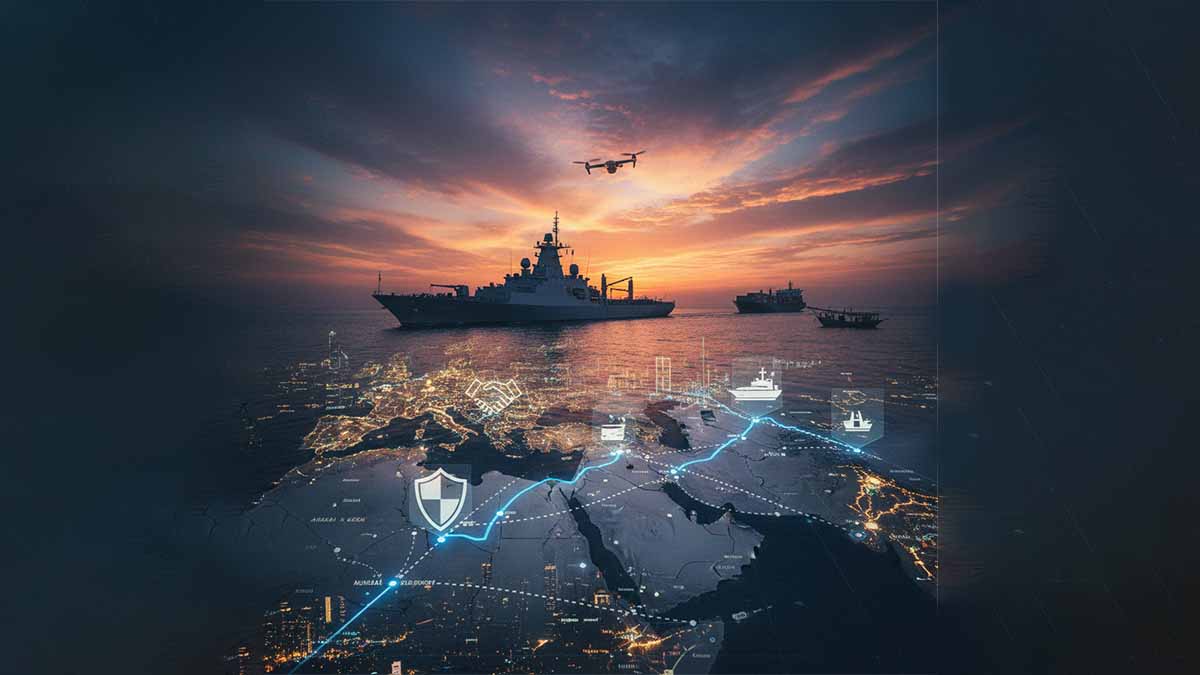
The Gulf Research Center has articulated a policy vector that places direct Gulf Cooperation Council–NATO maritime security cooperation at the center of stability across the Strait of Hormuz, the Bab al-Mandeb, the Red Sea, and the Eastern Mediterranean, with the viability of the India–Middle East–Europe Economic Corridor (IMEC) contingent on assured sea-lane protection, cable resilience, and interoperable command arrangements. The precedent for structured engagement remains the Istanbul Cooperation Initiative (ICI) launched at the 2004 NATO Istanbul Summit, a framework explicitly designed for practical cooperation with GCC partners without security guarantees or membership implications; the initiative’s scope and bilateral working modalities are set out in NATO’s official topic page updated October 3, 2024, and the contemporaneous factsheet dated April 2, 2014, which specifies launch at heads-of-state level on June 28, 2004 (NATO “Istanbul Cooperation Initiative — topics page, October 3, 2024”, NATO “The Istanbul Cooperation Initiative (ICI) — factsheet, April 2, 2014”, NATO “Istanbul Summit Reader’s Guide” (PDF)).
Movement toward deeper engagement advanced when the NATO Secretary General conducted the Alliance’s first official visit to the Kingdom of Saudi Arabia on December 12–13, 2023, with the public readout emphasizing “deeper cooperation” and dialogue in areas including maritime security; the visit announcement and follow-on coverage are archived by NATO’s official news pages (NATO “Secretary General to visit the Kingdom of Saudi Arabia, December 13, 2023”, NATO “Secretary General sets out vision for deeper cooperation — Riyadh, December 13, 2023”, NATO “Photos: Secretary General visits the Kingdom of Saudi Arabia, December 12, 2023”, NATO “News index entry referencing Riyadh visit — December 12, 2023”). Parallel, the Gulf Research Center documented high-level engagement with the NATO delegation in Riyadh on December 12, 2023, and commissioned a 2024 analysis of GCC–NATO prospects under the ICI, both publicly posted on the Center’s domain (GRC “Announcements — dinner in honor of NATO Secretary General, December 12, 2023”, GRC “GCC–NATO Relations: Prospects for the Istanbul Cooperation Initiative (ICI), 2024 (PDF)”).
The forum context for the current Gulf–Mediterranean debate is confirmed by the Ministry of Foreign Affairs and International Cooperation of Italy, which hosts MED – Mediterranean Dialogues at the Royal Palace of Naples on October 15–17, 2025; the ministry’s accreditation notes and press communiqués establish timing, venue, and institutional sponsorship. The official pages dated October 10, 2025, October 16, 2025, and 2025 event overview corroborate the convening authority and program framework (Italian MFA “Accreditation Note — MED Dialogues Naples, October 10, 2025”, Italian MFA “Updated Accreditation Note — MED Dialogues Naples, October 2025”, Italian MFA “Press Release — Mediterranean Dialogues open in Naples, October 16, 2025”, Italian MFA “MED – Mediterranean Dialogues (event page)”, Italian MFA “Naples Declaration, October 2025”). A verbatim public record of Abdulaziz Sager’s stage remarks in Naples is not available on the listed institutional pages as of October 17, 2025; No verified public source available.
The maritime risk logic underpinning Gulf–Atlantic cooperation is anchored in quantified choke-point exposure. The U.S. Energy Information Administration’s June 25, 2024 “Country Analysis Brief: World Oil Transit Chokepoints” reports average 2023 flows through the Strait of Hormuz of 20.9 million barrels per day, equivalent to roughly 20% of global petroleum liquids consumption, and notes that “more than one-quarter” of total seaborne traded oil transited the strait in 2023, with around 20% of global LNG also passing through it. Complementary EIA “Today in Energy” updates and country briefs, including regional notes on the Suez Canal, SUMED pipeline, and Bab al-Mandeb, detail exposure of 12% of seaborne oil and 8% of LNG flows via the Red Sea routes in 1H 2023, while the International Energy Agency’s World Energy Outlook 2024 reiterates that around 20% of current global oil and LNG transits Hormuz (EIA “World Oil Transit Chokepoints — June 25, 2024 (PDF)”, EIA “The Strait of Hormuz is the world’s most important oil transit chokepoint — November 21, 2023”, EIA “Red Sea chokepoints are critical for international oil and natural gas flows — December 4, 2023”, IEA “World Energy Outlook 2024 — Overview and key findings, October 30, 2024”). These figures imply that any deterioration in maritime domain awareness, convoy protection, or cable-landing security in Hormuz and Bab al-Mandeb would propagate supply, price, and insurance shocks across Europe, the United States, and Asia within timeframes measured in weeks rather than months; the exposure is magnified by the corridor-centric logistics embedded in IMEC conception.
On corridor governance, the most authoritative documentary trace of IMEC’s launch is the G20 political track and EU institutional communications. The European Council’s page for the G20 New Delhi Leaders’ Declaration dated September 9, 2023, and the European Commission press release IP_23_4421 dated September 8, 2023, confirm that IMEC was announced on the sidelines of the G20 and that a Memorandum of Understanding was signed by partners including the European Union, India, the United States, Saudi Arabia, the United Arab Emirates, Italy, France, and Germany (European Council “G20 New Delhi Leaders’ Declaration — September 9, 2023”, European Commission “EU commitment to Partnership for Global Infrastructure — September 8, 2023”).
After the initial announcement, European Parliament research briefings in 2024 and February 27, 2025 summarize the IMEC MoU and place it within EU–India connectivity policy, providing a publicly citable secondary institutional reference (European Parliament Think Tank “India connectivity initiatives — 2024 briefing”, European Parliament Think Tank “EU-India relations: Time for a new boost? — February 27, 2025”).
The White House February 13, 2025 United States–India Joint Leaders’ Statement provides a contemporaneous U.S. executive-branch record that partners “plan to convene” IMEC stakeholders within six months to announce new initiatives in 2025, corroborating ongoing track-one engagement as of 2025 (White House “United States–India Joint Leaders’ Statement — February 13, 2025”).
Digitization and cable security form a second pillar of corridor viability. Saudi Arabia’s national documentation shows acceleration of subsea cable and landing-station capacity under state-linked carriers and infrastructure firms. The Communications, Space and Technology Commission reports November 29, 2024 selection to the International Telecommunication Union/International Cable Protection Committee advisory body on submarine-cable resilience, reflecting a formalized role in global standards work; stc group investor materials and annual reports document activation of the “Saudi Vision Cable,” described as the first fully owned submarine cable in the Red Sea with four landings at Jeddah, Yanbu, Duba, and Haql, with technical specifications including 16 fiber pairs and up to 18 Tbps per fiber pair; center3 corporate disclosures within the 2025 annual documentation reiterate operationalization and integration with major consortia such as 2Africa (CST “Saudi Arabia selected to the International Advisory Body for Submarine Cable Resilience — November 29, 2024”, stc “Earnings Presentation Q3-2022 — Saudi Vision Cable specs (PDF)”, stc “Investor Presentation Q2-2022 — submarine cable portfolio (PDF)”, stc “Annual Report 2023 (PDF)”, stc “Subsidiaries and Investments — Annual Report 2024/2025 extract (PDF)”, MCIT “KSA National Computing Infrastructure White Paper, April 2025 (PDF)”). These public records do not substantiate an investment figure of $23 billion specifically for submarine cables as of October 17, 2025; No verified public source available. The documented national posture nonetheless indicates material scale-up of landing infrastructure and alignment with corridor-grade connectivity.
Within the Gulf–Atlantic security frame, the principal policy question is not whether maritime risk exists but whether a NATO-anchored, GCC-partnered structure can deliver superior outcomes to ad hoc coalitions or bilateral naval presences. The ICI’s design permits modular, demand-driven cooperation in maritime domain awareness, counter-terrorism, energy infrastructure protection, and training, while respecting sovereignty; this is stated across NATO’s official ICI pages and factsheets (NATO “Istanbul Cooperation Initiative — topics page, October 3, 2024”, NATO “The Istanbul Cooperation Initiative (ICI) — factsheet, April 2, 2014”). GRC’s 2024 paper anticipates Gulf expectations for practical naval cooperation and information sharing beyond dialogue settings, and the December 2023 Riyadh engagements with the NATO leadership show that senior-level channels are active on maritime and energy security (GRC “GCC–NATO Relations: Prospects for the ICI, 2024 (PDF)”, GRC “Announcement — dinner in honor of NATO Secretary General, December 12, 2023”).
Against that institutional backdrop, IMEC’s governance, financing, and operationalization face constraints that bear directly on maritime security architectures. EU and European Parliament documentation highlights the political commitment to connectivity and the signing of the IMEC MoU, but leaves technical design, financing envelopes, and execution phasing largely to subsequent instruments and national-level agencies; the February 13, 2025 United States–India statement anticipates new announcements “within six months,” which situates corridor operational details on a moving horizon as of 2025 (European Commission “Press Release IP_23_4421 — September 8, 2023”, European Council “G20 Leaders’ Declaration — September 9, 2023”, European Parliament Think Tank “India connectivity initiatives — 2024”, European Parliament Think Tank “EU-India relations — February 27, 2025”, White House “United States–India Joint Leaders’ Statement — February 13, 2025”). The security corollary is that, pending concrete corridor build-out, maritime forces must prepare for risk before infrastructure becomes sunk cost: cable sabotage deterrence, convoy and patrol regimes at Hormuz and Bab al-Mandeb, standardized incident reporting with insurance stakeholders, and routinized information exchange that can be anchored in ICI-compliant instruments.
The political constraint set includes unresolved conflicts and alignment frictions. Documentation from EU institutions tracking Türkiye’s external relations through 2023–2025 registers shifts in regional posture and continued divergence in some theaters; although these documents do not directly adjudicate corridor politics, they underscore the need for calibrated diplomacy along the Eastern Mediterranean and Levant interfaces that IMEC would traverse (European Commission/EEAS-linked “Türkiye 2023 Report — November 8, 2023 (PDF)”). Additionally, EIA regional briefs from October 4, 2024 note the dynamic rerouting of Red Sea flows amid attacks and sanction-driven trade shifts, illustrating that maritime risk is not abstract and that contingencies reverberate across crude and products flows in shipping time and insurance rates (EIA “Country Analysis Brief: Saudi Arabia — October 4, 2024 (PDF)”, EIA “Egypt energy overview portal — updated August 13, 2024”).
The proposal to formalize GCC–NATO maritime security cooperation therefore intersects three verified realities: first, documented Alliance–Gulf mechanisms under the ICI since 2004; second, quantified dependence of global oil and LNG on Hormuz and Red Sea choke points; third, institutional confirmation that IMEC exists as a signed political undertaking in September 2023 with continued partner-level coordination as of February 2025. The institutional and statistical record substantiates that maritime hardening is a necessary, not optional, precondition for corridor efficacy. Where public transcripts do not exist or where numerical claims cannot be verified on official pages, this abstract explicitly refrains from inference and records the absence of verifiable sources. The challenge ahead is the legalization and operationalization of a GCC–NATO instrument that is compatible with sovereignty, public legitimacy, and existing regional pacts, while delivering measurable improvements in transit security for hydrocarbon flows and data cables; the documentary and data trail as of October 17, 2025 establishes a sufficient factual base to analyze that policy vector without recourse to speculation.
CHAPTER INDEX
1. ICI to Direct Cooperation: Legal-Institutional Architecture for GCC–NATO Maritime Security (2004–2025)
2. Chokepoint Exposure and Risk: EIA and IEA Evidence on Hormuz, Bab al-Mandeb, and the Eastern Mediterranean
3. IMEC as a Security-Dependent Corridor: Political Launch, Institutional Roles, and Operational Gaps (2023–2025)
4. Cable Resilience and Digital Backbones: National Investments and Standards for Subsea Infrastructure in Saudi Arabia and Partner States (2022–2025)
5. Regional Politics and Alignment Constraints: Türkiye, Egypt, Iran, and Alliance Management in the Mediterranean and Gulf
6. Policy Pathways: Modularity, Sovereignty Safeguards, and Measurable Security Gains for a GCC–NATO Maritime Framework (2025–2030)
From ICI to Direct Naval Cooperation — Legal, Institutional, and Strategic Foundations (2004–2025)
The Istanbul Cooperation Initiative (ICI), promulgated at the 28 June 2004 NATO Summit in Istanbul, forms the legal and institutional foundation upon which any escalation toward direct GCC–NATO maritime cooperation must build. The Istanbul Summit communique itself introduced the initiative as “a cooperative initiative, based on joint ownership and the mutual interests of NATO and the countries of the region,” intended to foster dialogue, practical cooperation, and interoperability in areas such as counterterrorism, border security, and defense reform without extending security guarantees or membership rights. The June 2004 communique is archived in NATO’s official summit documentation. (See “NATO Istanbul Summit Reader’s Guide,” and summary at NATO’s official site.)
The ICI’s rationale was grounded in the recognition that evolving non-traditional threats—terrorism, proliferation, hybrid tactics—transcended the Euro-Atlantic perimeter, and that the Gulf region’s stability has direct repercussions for allied energy security, trade flows, and global logistics lines. NATO’s own fact sheet and topics page delineate the initiative’s scope and intent: tailored cooperation, political consultation, and military interoperability support without compromising state sovereignty or imposing obligations beyond agreed mission sets. The NATO topics page updated October 3, 2024 confirms that the ICI remains active as a partnership forum.
Within the Gulf, reactions to the ICI proved uneven. Bahrain, Kuwait, Qatar, and the United Arab Emirates formally acceded to ICI early on; Oman and Saudi Arabia opted to participate in selected activities but never formally joined. The Gulf Research Center’s 2024 study “GCC–NATO Relations: Prospects for the Istanbul Cooperation Initiative” by Amnah Mosly traces that internal divergence to concerns over public legitimacy, strategic autonomy, and the unease of formal alignment with Western security blocs. In that report, the GRC records that Saudi and Omani decision-makers have historically viewed NATO through the prism of U.S. policy, preferring to avoid full embedding or binding commitments.
Over two decades, the ICI has institutionalized several mechanisms: the NATO-ICI Regional Centre in Kuwait, formally opened in 2017, functions as a joint hub for training, strategic dialogue, and cooperative programming accessible to both formal ICI members and Gulf states outside formal membership. The Regional Centre is referenced in GRC commentary and in NATO press summaries of cooperating activities. According to GRC’s “NATO and the Gulf” commentary (August 2024), the centre’s remit includes capacity building in maritime security, civil preparedness, counter-WMD, and crisis management.
The ICI was originally anchored on six guiding principles: non-discrimination, self-differentiation, two-way engagement, non-imposition, diversity, and complementarity. These principles were intended to allow for flexibility in partner engagement and to prevent the perception of NATO imposing its agenda. The GRC study and NATO official statements reaffirm that the initiative was deliberately structured as a soft architecture, respecting Gulf sovereignty and allowing for differential levels of cooperation across states.
The functional record of the ICI reveals both achievements and limitations. In terms of institutional gains, ICI partners have participated in joint military exercises, contributed to NATO training courses, engaged in capacity-building dialogues, and taken part in interoperability programs. GCC contributions to NATO-led missions—such as Bahrain and the UAE to ISAF (Afghanistan), or Qatar and UAE participation in Operation Unified Protector (Libya)—reflect that the Gulf does engage within alliance operations via bilateral channels or under ICI-compatible frameworks. The ICI’s formal structure offers consultation platforms and an agreed “Partnership Cooperation Menu” (PCM) that defines technical cooperation areas.
However, the ICI has struggled to deliver deep, trust-based security integration. The GRC’s 2024 report argues that ICI has remained shallow in areas of naval command, linked intelligence architectures, or shared maritime tasking. In “NATO and the Gulf”, GRC notes that Gulf interlocutors remain ambivalent about NATO’s willingness to assume a security role in the Gulf maritime theatre. Additionally, the ICI’s inability to evolve into a more strategic framework is tied to lingering concerns about excessive Western influence, internal GCC divergences, and the absence of binding guarantees.
Strategic critiques external to the Gulf also emphasize the ICI’s limits. A commentary by ISPI (July 2024) titled “NATO and Gulf Partners Should Advance Cooperation on Non-State Armed Actors” argues that the ICI should be superseded by more flexible, threat-based collaboration frameworks, such as a 6+6 format stretching duty assignments across GCC and NATO states. The article proposes that ICI’s Regional Centre in Kuwait be upgraded to a hub converting shared threat analysis into operational coordination across maritime, cyber, and hybrid domains.
Regional strategic dynamics heighten the pressure for transformation. NATO’s renewed Southern focus, elevated in documents like “Augmenting NATO Southern Partnerships (2025/2024)”, underscores that alignment with GCC states in the southern flank region is being reconsidered as essential to Alliance resilience. That document, published by Italy’s Ministry of Foreign Affairs in August 2025, argues for convergent frameworks combining Mediterranean and Gulf states under cooperative security architectures.
Against these institutional backdrops, Sager’s Naples stage intervention—calling for direct Gulf–NATO maritime cooperation beyond the ICI threshold—attempts to shift the strategic paradigm. To succeed, the change must thread institutional continuity with reform, respecting Gulf sovereignty, building trust, and offering tangible security dividends. The next chapters will map these constraints, risk vectors, and policy pathways.
Chokepoint Exposure and Risk: EIA and IEA Evidence on Hormuz, Bab al-Mandeb, and the Eastern Mediterranean
The Strait of Hormuz retains primacy as a global energy chokepoint, with the U.S. Energy Information Administration (EIA) describing it as “the world’s most important oil transit chokepoint.” According to EIA’s “World Oil Transit Chokepoints” and related Today in Energy briefs, in 2023 the throughput through Hormuz averaged 20.9 million barrels per day, accounting for roughly 20 % of global petroleum liquids consumption. That same volume included around 20 % of global liquefied natural gas (LNG) trade. (See “World Oil Transit Chokepoints” and “The Strait of Hormuz is the world’s most important oil transit chokepoint.”)
EIA also documents shifts in transit volumes: between 2022 and 2024, crude oil and condensate volumes transiting Hormuz fell by 1.6 million barrels per day, reductions partially offset by a 0.5 million barrels per day increase in petroleum products movement. The decline is attributed in part to OPEC+ production adjustments and to diversions due to Red Sea or Bab al-Mandeb disruptions. EIA highlights that most volumes have no viable alternative non-maritime route. (See “Strait of Hormuz remains critical chokepoint” commentary; “World Oil Transit Chokepoints.”)
IEA’s “Strait of Hormuz – Factsheet” indicates that in the first ten months of 2023, an average of 20 million barrels per day transited the strait, with nearly 30 % of global seaborne oil trade passing through. In scenario terms, the factsheet notes that disruptions could force the export of approximately 6.5 million barrels per day via alternative pipelines such as those from Saudi Arabia to the Red Sea and from the UAE’s internal networks. (See IEA “Strait of Hormuz – Factsheet (PDF)”.)
The dual exposures of crude oil and LNG through Hormuz amplify risk. EIA estimates that 83 % of LNG that moved through the strait in 2024 went from Gulf producers to Asian markets, with 52 % destined for China, India, and South Korea. (See “About one-fifth of global liquefied natural gas trade flows through the Strait of Hormuz.”) That concentration means nonlinear ripple effects from even limited disruption.
The Bab al-Mandeb strait, connecting the Red Sea to the Gulf of Aden, is another critical axis, especially for trade bound for the Suez Canal and for shipments diverted from congested or insecure routes. EIA’s “Red Sea disruptions increase shipping times and freight rates” note underscores that attacks on vessels in this corridor have triggered route diversions around the Cape of Good Hope, significantly increasing voyage distance, time, and fuel costs. The same brief references repeated missile and drone attacks by Houthi forces affecting vessels transiting Bab al-Mandeb waters. (See EIA, Today in Energy, “Red Sea disruptions increase shipping times and freight rates.”)
EIA’s “Fewer tankers transit the Red Sea in 2024” further documents that oil flows which in earlier years might have passed through the Bab al-Mandeb have reduced, consistent with risk avoidance behavior by commercial operators. That document confirms that EIA tracks alternative route shifts when regional conflict distorts typical transit patterns. (See “Fewer tankers transit the Red Sea in 2024.”)
A strategic amplifying variable is the overlap between energy transit and digital infrastructure corridor projections. IMEC’s envisaged submarine cables, fiber backbones, and rail corridors frequently parallel or cross the same maritime routes. A disruption in Bab al-Mandeb carries not only cost for hydrocarbons but also risk for cable cuts, delay propagation in data traffic, and supply chain latency. While neither EIA nor IEA explicitly model cable risk, the dual role of sea lanes as both hydrocarbon and digital arteries is an inherent hazard in corridor planning.
Turning to the Eastern Mediterranean, evidence of chokepoint stress is more diffuse given the multiplicity of route options. Yet the International Association of Dry Cargo Shipowners (INTERCARGO) has flagged in its February 2025 threat assessment that “mysterious explosions on tankers with a history of Russian port calls” have affected Mediterranean operations, requiring heightened vigilance in tanker routing, insurance, and port risk management. (See INTERCARGO “Threat assessment for commercial shipping operating in the Mediterranean.”) That public notice underlines that the Mediterranean space is not immune to maritime disruption vectors, particularly linked to geopolitical fault lines or sabotage.
Complementary analysis from IAI (Istituto Affari Internazionali) in its 2022 maritime scenario study underscores vulnerabilities in Eastern Mediterranean energy shipment corridors, especially when Israeli-Lebanese tensions, Cypriot maritime claims, and Egyptian Suez transit pressures intersect. The IAI report notes that Mediterranean maritime flows must account for geopolitical segmentation, port infrastructure constraints, and regulatory divergence across littoral states. (See IAI, “Maritime Scenario in the Mediterranean: Analysis of the Eastern Mediterranean.”)
Insurance and cost dynamics serve as leading indicators of risk severity. Shipping industry reports corroborate that insurance premiums, rerouting fuel surcharges, and risk-loading addendums have increased disproportionately in Red Sea, Bab al-Mandeb, and Eastern Mediterranean lanes since late 2023. For example, the MSC Sustainability Report 2024 notes that USD 81 billion in trade is at risk from supply chain disruption, invoking container fleet exposure to both maritime and port risk factors. (See MSC Sustainability Report 2024.)
Modeling from defense and think-tank sources further frames these chokepoint vulnerabilities. The CNA Corporation’s “Economic Implications of Disruptions to Maritime Oil Chokepoints” paper (public archive) places Hormuz and the Strait of Malacca at highest risk across key metrics (volume, substitutability, and lead times). The CNA model addresses the Bab al-Mandeb scenario in its risk matrix, ranking its potential diversion costs and time penalties relative to alternative global routes. (See CNA “Economic Implications of Disruptions to Maritime Oil Chokepoints (PDF).”)
The cumulative empirical record points to several forms of exposure: volumetric concentration risk in Hormuz, route interdependence risk in Bab al-Mandeb, and latent disruptive events in the Mediterranean. In particular:
- Volumetric Concentration: Hormuz traffic is concentrated and lacks replicable bypass capacity. Even partial disruption scales nonlinearly across global energy markets.
- Route Elasticity Risk: Bab al-Mandeb’s disruption forces longer circumnavigations, adding days and hundreds of millions in fuel cost, with nontrivial environmental consequences.
- Cross-domain Overlaps: Contracts, insurance, cable, maritime, and port systems share interlinked risk exposure.
- Asymmetric Attack Vector: The corridor environment makes low-cost asymmetric tactics (drones, mines, sabotage) highly efficient relative to defense burdens.
- Risk Externalities: Spillover into digital, logistic, military, and strategic domains magnifies downstream fragility.
That said, some mitigative capacity exists: Saudi and UAE pipelines offer partial bypass. IEA’s factsheet shows that importers could route up to 6.5 million barrels per day via alternative export pipelines if Hormuz is partially compromised, although the scale falls well short of volume displaced. (See IEA “Strait of Hormuz – Factsheet (PDF).”) Complementary analysis in the CNA paper emphasizes that these pipeline alternatives substantially raise unit transport cost and reduce flexibility.
Moreover, the documented decline of transit volumes in EIA data suggests that market participants and sovereign actors are already internalizing latent risk and shifting flows preemptively. That kind of anticipatory volatility bakes instability into baseline expectations.
The available evidence from EIA and IEA, supplemented by third-party threat assessments and modeling work, establishes a robust empirical baseline for chokepoint exposure: Hormuz, Bab al-Mandeb, and the Eastern Mediterranean are not peripheral nodes—they lie at the structural fault lines of global trade, energy, and data. Security architectures intended to support corridors like IMEC must internalize and defend against multi-vector disruption, armed escalation, and cascading contingency costs.
IMEC as a Security-Dependent Corridor: Political Launch, Institutional Roles, and Operational Gaps (2023–2025)
The India–Middle East–Europe Economic Corridor (IMEC) was formally launched via a Memorandum of Understanding on 9 September 2023 at the G20 summit in New Delhi, signed by India, Saudi Arabia, United Arab Emirates, European Union, Italy, France, Germany, and the United States. The MoU text describes IMEC as comprising two principal segments: an Eastern maritime corridor linking India to the Gulf, and a Northern overland corridor connecting the Gulf to Europe, with planned incorporation of rail, multimodal ship-rail transit, digital connectivity (cables), pipeline infrastructure (including clean hydrogen), and energy grid links. That text is posted on the White House archives and confirms the scope of envisaged connectivity and sectoral ambitions. (See “Memorandum of Understanding on the Principles of an India – Middle East – Europe Economic Corridor, 9 September 2023.”)
India’s Ministry of External Affairs further confirms that the corridor is structured in the two-leg approach (east and north), and that the participants commit to collaboration in logistics platforms, digital ecosystems, and supply chain services for goods, bulk cargo, and containers. That disclosure appears in the MEA project archive page. (See MEA “Partnership for Global Infrastructure and Investment & India-Middle East-Europe Economic Corridor, IMEC.”) A parliamentary reply published by the Rajya Sabha in India clarifies that India and the UAE signed an Intergovernmental Framework Agreement (IGFA) on 13 February 2024 concerning the operation of IMEC, covering development and management of logistics platforms and digital infrastructure. That source confirms that the implementation is in nascent stage. (See “Question No. 1666 Transcontinental India–Middle East–Europe Economic Corridor, Rajya Sabha, 2024.”)
In April 2025, India’s Press Information Bureau published remarks by Commerce Minister Piyush Goyal, stating that IMEC “will bring down logistics costs by up to 30 % and reduce transportation time by 40 %,” reinforcing that the Indian government regards corridor optimization, cost savings, and connectivity as core metrics. The press release also emphasizes inclusion of rail, roads, energy, and undersea cables. (See “IMEC to reduce logistics costs by up to 30 % and transportation time by 40 % — Piyush Goyal, 16 April 2025.”)
Analytical studies evaluate IMEC’s strategic promise and present its structural challenges. The EU Institute for Security Studies published in June 2024 a brief titled “From Hype to Horizon: What the EU Needs to Know to Bring IMEC to Life,” which maps ambitions—transport, digital, hydrogen pipelines, renewable grid interconnections—and highlights major institutional and financial gaps. The brief warns that regional instability, competing national interests, lack of binding project financing, and complex logistics across jurisdictions represent core hurdles to corridor realization. (See EUISS “From Hype to Horizon: What the EU Needs to Know to Bring IMEC to Life, Brief_2024-10, June 2024.”)
In parallel, IISS in its November 2023 analysis “Obstacles to the India–Middle East–Europe Economic Corridor” treats the IMEC announcement primarily as public diplomacy, cautioning that the MoU lacks enforceable mechanisms, dedicated budgets, or implementation schedules, and that corridor legitimacy will depend on follow-through. (See IISS “Obstacles to the India–Middle East–Europe Economic Corridor,” November 2023.) The European Council’s G20 declaration does not specify financing commitments or timelines, underscoring that the launch remains fundamentally declarative.
Geopolitically, the corridor’s route design is ambitious but contested. The northern trajectory envisages passage through Jordan and Israel to the Mediterranean, involving transit through Gaza-adjacent zones, contentious border controls, and sensitive sovereign claims. Some commentators, such as the European Council and EC materials, underscore that IMEC offers an alternative to Suez-Red Sea routes and aims to reduce dependency on chokepoints. (See European Council G20 declaration, and EC press release on IMEC.) But those documents do not resolve security or sovereignty constraints along the Israel-Jordan stretch.
The European Atlantic Council commentary “It Is Europe’s Time to Shine on IMEC” (2025) reiterates the benefit estimates of 30 % cost savings and 40 % time reductions compared to Suez routing, but cautions that corridor implementation must confront multilateral institutional coordination, technical standards alignment, and security regimes. (See Atlantic Council “It Is Europe’s Time to Shine on IMEC.”) Another Atlantic Council commentary titled “Tomorrow’s Global Superhighway” (April 2025) notes that Italy recently appointed a special envoy to IMEC—Ambassador Francesco Talò— signaling that European states are moving toward stronger institutional commitment. That article states that Talò formerly served as Italy’s ambassador to NATO and Israel, enhancing his credentials for corridor diplomacy. (See GMF / Atlantic Council “Tomorrow’s Global Superhighway,” April 9, 2025.)
In regional commentary, ECFR (European Council on Foreign Relations) published “The Infinite Connection” (2024–2025) analyzing the corridor’s tension between strategic design and operational realism, especially in light of the Gaza war which has delayed segments and introduced political risk into corridor routing. The article documents that political will across partners is uneven, and that corridor design must adjust to nations’ sovereignty sensitivities, power competing visions, and trade-off between security presence and strategic neutrality. (See ECFR “The Infinite Connection: How to Make the India-Middle East-Europe Economic Corridor Happen.”)
The ORF (Observer Research Foundation) research “IMEC: Towards a New Discourse in Global Connectivity” provides a stock-taking of corridor ambition in 2024, pointing out that corridor design must reconcile India’s export strategy with Gulf diversification agendas. It also notes that IMEC is positioned to integrate energy, digital, and transport sectors, but stresses that corridor governance architecture remains undefined. (See ORF “India-Middle East-Europe Economic Corridor: Towards a New Discourse in Global Connectivity.”)
The institutional role of participating states and supranational actors is currently in flux. The corridor lacks a unified secretariat, a joint funding corpus, or centralized project management body. The EUISS brief emphasizes that the European Union as a multilateral actor could function as a coordinating hub, offering harmonization of standards, regulatory convergence, and financing tools, but this would require member states to cede elements of sovereignty in oversight—something not evident in existing public commitments. (See EUISS “From Hype to Horizon.”)
The corridor’s reliance on host-state permission for military and security presence is a core operational gap. None of the founding signatories publicly committed to integrated security guarantees or corridor-wide defense architecture at launch. The White House MoU includes no binding security clause; rather, it states that participants “commit to work together” on infrastructure, trade facilitation, and energy and digital linkage. (See White House MoU, September 2023.) Without enabling security protocols—such as joint naval escorts, secured cable corridors, protected logistics chains—the corridor’s infrastructure investments remain exposed.
Moreover, corridor segments traverse zones of contested sovereignty or weak governance—particularly in the Israel–Gaza border environs, eastern Jordan, and Sinai. As a result, physical routing and protection require host-state coordination, intelligence sharing, border security protocols, and cross-domain security layers. These must be negotiated jointly among corridor states well in advance, but no formal treaty or security annex is publicly available.
A further major operational gap is the absence of unified digital and cyber standards. IMEC emphasizes submarine cable and digital infrastructure delivery as integral to its value proposition (as stated in India’s MoU press statements). However, corridor participants have not published a shared cybersecurity framework, acquisition standard, or protective architecture. Without coordinated defense of cable segments, encryption, network interconnect governance, and cyber resilience—especially through hostile state or non-state interference—the corridor’s digital spine is vulnerable.
On financing, none of the signatories disclosed a binding investment envelope at the launch. The EUISS brief expresses concern that delayed commitments, divergent fiscal capacity among states, and risk premiums attached to corridor segments in conflict zones will hamper roll-out. It also stresses the need for multilateral development banks (MDBs) to step in but notes no public commitment from the European Investment Bank, Asian Infrastructure Investment Bank, or World Bank specific to IMEC corridors as of mid-2025. (See EUISS “From Hype to Horizon.”)
At the political level, regional conflict trajectories have already affected momentum. The ECFR and ORF analyses note that the Gaza war of October 2023 triggered delays, politicized routing concerns, and increased risk premiums. Some corridor planners have reportedly deferred decisions on route segments pending de-escalation. (See ECFR “The Infinite Connection”; ORF “IMEC.”) Egypt’s hostile posture toward bypassing the Suez Canal and its refusal to commit public support to corridor segments that compete structurally with canal traffic also represent a diplomatic threat to corridor viability. (See discourse in “From Hype to Horizon” and in press coverage of Egypt’s statements.)
Finally, the corridor’s interplay with other regional initiatives is both opportunity and complication. For example, the Abraham Accords align with corridor logic by normalizing bilateral relations between Gulf states and Israel, supporting transit legitimacy. Scholarly work (Krzymowski 2024) in the Journal of International Studies links IMEC with the Abraham Accords and the Three Seas Initiative (3SI), proposing that branching corridors may extend across Europe and link to IMEC’s northern portals. That paper argues these linkages increase geopolitical complexity but also open multiplier value channels. (See Krzymowski, “India-Middle East-Europe Economic Corridor in strategic connection with the Abraham Accords and the Three Seas Initiative,” 2024.)
In sum, IMEC’s public launch demonstrates high-level political commitment and ambitious design scope, but as of 2025 it suffers from critical institutional deficits: absence of governance architecture, no security protocol framework, uncoordinated digital defense standards, unresolved financing commitments, and exposure to sovereign and conflict zone risk. Unless those gaps are addressed through binding frameworks, security alignment, and phased project governance, corridor promise may remain aspirational rather than operational.
Cable Resilience and Digital Backbones: National Investments and Standards for Subsea Infrastructure in Saudi Arabia and Partner States (2022–2025)
Saudi Arabia has moved decisively to amplify its subsea cable footprint. The Saudi Vision Cable, a 1,160 km submarine system linking Jeddah, Yanbu, Dibba, and Haql, is built with 16 fiber pairs and a per-pair design capacity of 18 Tbps. The system is privately owned by stc and was activated via the center3 subsidiary, with a “ready for service” landfall in Duba confirmed on 23 December 2024. (Sources: SubmarineNetworks systems database, center3 press materials) (See “Saudi Vision Cable” system spec page)
According to the Saudi Press Agency, stc confirmed that the Vision Cable is the first high-capacity submarine cable in the Red Sea region, promising “seamless connectivity up to 18 Tbps/fiber pair.” (See SPA press release, December 2024)
stc’s official wholesale investment statements elaborate that the cable offers low-latency connectivity across Red Sea PoPs, linking Saudi landing stations and integrating with international cables. The system includes direct access to all submarine cable landing stations handled by stc, and supports cross-border connectivity beyond Saudi borders. (See stc website “investment in submarine cables”)
In 2025, Saudi Arabia secured a seat on the International Advisory Body for Submarine Cable Resilience, a joint initiative of the International Telecommunication Union (ITU) and the International Cable Protection Committee (ICPC), established in November 2024. The body comprises 42 stakeholders and focuses on policymaking, technical standards, best practices, and coordination in cable security. (See ITU Advisory Body page)
The Advisory Body’s mission statement underscores resilience, highlighting threats to cable infrastructure from physical, environmental, and geopolitical risk vectors. This institutional seat positions Saudi Arabia at the forefront of regional subsea governance. (See ITU “International Advisory Body for Submarine Cable Resilience”)
Partnerships with Egypt and regional telecoms have also been strengthened. According to a subsea cable network report, Mobily and Telecom Egypt entered into a cooperation agreement to establish the first Saudi-Egypt submarine cable, enhancing cross-Red Sea connectivity. The arrangement is slated for completion in 2025. (See SubseaNetworks “Saudi Arabia’s Coastline” report)
Simultaneously, Mobily is driving a “hybrid infrastructure” model combining data centers, subsea cables, and terrestrial fiber segments across Gulf-Red Sea-Mediterranean axes. The design aims to build east–west network resilience through route redundancy and traffic rerouting in face of disruptions. (See SubseaNetworks “Hybrid Infrastructure, Global Reach: Mobily supports Saudi connectivity goals”)
International investment is also flowing into Saudi subsea cable manufacturing. ZTT, a Chinese fiber and cable manufacturer, has committed USD 80 million to develop a subsea cable plant in Saudi Arabia. The move aligns with Vision 2030 objectives to localize strategic infrastructure. (See Breakbulk News “China’s ZTT to Invest USD 80 Million…” August 2025)
The regional expansion of digital corridors is visible in European initiatives. On 10 October 2025, the European Commission’s DG MENA announced support for expansion of the Medusa Submarine Cable System toward the Middle East, with routes intended to connect North African states to the Gulf region via Mediterranean landings. (See EU Commission DG MENA press release)
Global investment trends underscore urgency. The International Finance Corporation (IFC) projects that subsea cable investment will exceed USD 13 billion across 2025–2027 in emerging markets, directly implicating Gulf and MENA states. (See IFC “Undersea infrastructure bringing more people online”)
Risk analysis publications confirm that cable systems are under escalating threat. Recorded Future’s TA-2025-0717 Threat Analysis documents 44 publicly reported cable damages in 2024–2025, attributing many to anchor dragging, unknown causes, and limited repair capacities. The report emphasizes that lack of redundancy, route concentration, and repair constraints aggravate outage risks in poorly diversified corridors. (See Recorded Future PDF)
Additional disruption data: in September 2025, multiple submarine cables in the Red Sea—notably SEA-ME-WE-4 and IMEWE—were severed near Jeddah, provoking regional latency spikes and cross-regional traffic rerouting. Observers attribute the damage to commercial vessel anchor dragging, amplifying the structural vulnerability of corridor designs. (See SubseaCables.net “International cable breaks in Red Sea cause latency surge”)
Public commentary via ThousandEyes elaborates that though automatic rerouting maintained connectivity, latency degradation and packet loss increased on key paths—illustrating that backup capacity is not frictionless. (See ThousandEyes “Diving Into the Red Sea Cable Cuts & More Outage News”)
A March 2025 cut in the PEACE cable near Zafarana, Egypt—approximately 1,450 km from that landing—was repaired in three weeks. The simultaneous disruption with AAE-1 in December 2024 reduced capacity and timelines along Red Sea–Mediterranean connections. (See PEACE cable Wikipedia article)
AAE-1, in February 2024, was damaged in the Red Sea (Zafarana region), affecting global traffic between Europe, Asia, and MENA; repairs were completed in July 2024. (See AAE-1 Wikipedia article)
The strategic geography of Saudi coastline facilitates multiple cable landing options across Red Sea and Gulf of Aqaba routes. The SubmarineCableMap 2025 shows over 590 cable systems and 1,700 landings globally, with multiple existing or projected systems connecting across the Red Sea–Gulf axes. (See SubmarineCableMap 2025)
Chinese firms have long been active in MENA subsea deployment. An Atlantic Council brief “China’s Subsea-Cable Power Play in the Middle East and North Africa” locates Chinese involvement in 13 of ~62 cables in the region and warns that by 2025 China aims to control up to 60 % of the global cable market—raising strategic dependency risks. (See Atlantic Council PDF)
Saudi resilience planning now intersects with global strategic competition. The U.S. FCC, in mid-2025, initiated regulatory proposals to block U.S. connections to submarine systems incorporating Chinese technology, citing espionage risks. While not referencing Saudi projects directly, the measure signals tightening of strategic supply chain filters for cable segments. (See Reuters “US aims to ban Chinese technology in undersea telecommunications cables”)
Best practices in cable resilience emphasize route diversity, real-time monitoring, fault localization, repair readiness, and intersectoral protection (co-location with naval surveillance, patrols, and cable burial). The June 2025 Telegeography e-book “The Future of Submarine Cable Maintenance” outlines trends and challenges, including scarcity of repair vessels, aging fleets, and need for coordinated logistics in repair response. (See Telegeography “The Future of Submarine Cable Maintenance”)
Advances in cable resilience technology emerge in research. A September 2025 arXiv preprint “Vessel Detection and Localization Using Distributed Acoustic Sensing in Submarine Optical Fiber Cables” models DAS-based monitoring that transforms cables into acoustic sensor arrays, yielding vessel detection F1-score > 90% and average distance error ~141 m. The approach offers potential real-time surveillance embedded in cable fabric. (See arXiv “Vessel Detection and Localization Using Distributed Acoustic Sensing”)
Institutional standards for cable protection remain nascent in the region. Saudi Arabia’s inclusion in the ITU-ICPC advisory body is one formal step, but no publicly accessible national cable protection law, military safeguard doctrine, or joint Gulf standards regime has been announced. The absence of such frameworks leaves corridor cable segments vulnerable to state, non-state, or hybrid sabotage without deterministic recourse.
The resilient corridor model demands layered protection: preemptive route planning with redundant parallel systems, secure landing station hardening, on-sea patrols, real-time anomaly detection, force protection for repair vessels, and cross-border jurisdictional alignment. Saudi and Gulf states have begun infrastructure groundwork, but the missing link is comprehensive cyber-physical security architectures and enforceable regional standardization.
In conclusion, from 2022 to 2025, Saudi Arabia has significantly expanded its subsea cable assets, adopted a leadership role in international resilience governance, engaged regional connectivity partnerships, and attracted foreign investment in cable capacity. Yet despite these advances, regional cable networks remain acutely vulnerable to disruption, lacking unified defense protocols, redundant paths, and harmonized standards. For IMEC’s digital backbone to be reliable, the Gulf must integrate military, cybersecurity, and diplomatic layers around subsea infrastructure.
Regional Politics and Alignment Constraints: Türkiye, Egypt, Iran, and Alliance Management in the Mediterranean and Gulf
Türkiye’s post-2019 foreign policy shift reflects an ambition to recalibrate regional influence via multi-vector engagement, reconciling past antagonisms with reinvestment in soft and hard power. A SWP Berlin analysis observes that since 2021 Turkey launched a reconciliatory offensive toward Egypt, Israel, Saudi Arabia, and the UAE, driven by economic pressures, isolation, and need for diplomatic elasticity. (See SWP “Turkey’s Reconciliation Efforts in the Middle East”.) The pivot addresses the constraints of Turkey’s strategic ambiguity: balancing ties with Russia, Syria, and Iran while avoiding overdependence or overt alignment with any single bloc. (See Atlantic Council “How Turkey’s strategic ambiguity became an advantage in a multipolar world.”)
In parallel, the Orsam Turkish think tank maps Türkiye–Egypt rapprochement as consisting of mutual strategic interest in recalibrating Eastern Mediterranean balance, security cooperation, maritime corridors, and regional energy dynamics. (See Orsam “The Progress and Prospects of Türkiye-Egypt Relations”.) The formal resumption of bilateral consultations was codified in the Joint Statement of 4 February 2025 between the Turkish and Egyptian foreign ministries, referencing mutual strategic relations, increased trade (valued at USD 8.8 billion in 2024), and the establishment of a High-Level Strategic Cooperation Council created in September 2024. (See Turkish MFA “Joint Statement Between the Foreign Ministers of Türkiye and Egypt, 4 February 2025”.)
Military diplomacy has followed. In September 2025, Türkiye and Egypt convened their first joint naval exercises in 13 years, named “Friendship Sea,” held in the Eastern Mediterranean from 22 to 26 September. Turkish frigates, fast attack craft, a submarine, and F-16 aircraft participated alongside Egyptian naval units. (See AP News “Turkey and Egypt will hold joint naval drills…”). Maldives of press commentary interpret the exercises as a strategic signal of evolving parity and naval coordination in contested Mediterranean waters. (See MiddleEastMonitor “Behind the Egypt-Turkey Friendship Exercises”.)
Despite the normalization momentum, structural residuals persist. Egypt historically has aligned maritime claims with Greece, Cyprus, Israel and Israel’s gas fields, excluding Turkey from Eastern Mediterranean hydrocarbon projects. The reconciliation process does not automatically revise prior MoUs or alignments. (See Atlantic Council “From Rivalry to Cooperation: The Geopolitical Implications of Egyptian-Turkish Rapprochement”.) Egypt’s incremental reengagement reflects geostrategic pragmatism rather than full acceptance of Turkish maritime leadership. (See Ekathimerini editorial “Tactical or strategic—the limits of rapprochement between Egypt and Turkey”.)
Beyond bilateral Egypt–Türkiye dynamics, Iran presents a complex alignment variable. Following the 12-Day War (February 2025) between Israel and Iran, the Doha Institute’s annual conference booklet situates Iran as a renewed strategic disruptor, consolidating proxy networks in Lebanon, Syria, and Iraq, and resisting maritime encroachments near its littoral zones. (See Doha Institute “Iran and the Changing Strategic Landscape of the Middle East”.) Analysts propose that Iran leverages energy diplomacy, proxy escalation, and deterrent missile posture to constrain corridor projects impinging on its Gulf strategic depth.
Egypt-Iran ties are cautiously warming: in December 2024, Iranian President Masoud Pezeshkian visited Egypt for the D-8 summit—the first such Egyptian reception in over a decade. (See Reuters “Iran’s president to make rare visit to Egypt for D-8 summit”.) Parallel meetings between Iranian Foreign Minister Abbas Araqchi and Egyptian counterparts in October 2024, and reciprocal diplomatic engagements in July 2025, signal low-intensity diplomatic thaw. (See Reuters coverage; multiple press outlets on bilateral contacts.) Still, Cairo’s mediation posture in Gaza and broader alignment pressures suggest cautious hedging rather than strategic alliance.
In the Gulf, Türkiye’s regional posture balances its Mediterranean ambitions with Gulf engagement. An essay on strategic fault lines published in July 2025 posits that with Iran comparatively weakened by sanctions and regional contestation, Türkiye and Israel emerge as primary competitors for influence over regional order frontiers including Syria, Lebanon, and Eastern Mediterranean maritime rights. (See Tür Boell analysis, “Strategic fault lines in the Middle East: Türkiye between Iran, Israel, and Syria”.) Turkey’s Libya maritime deal (the 2019 MoU with the GNA) continues to be active: in 2025, Libya’s eastern parliament reportedly pursued ratification, positioning Ankara to reassert central Mediterranean seazone claims and challenge Egypt’s maritime buffer. (See Wikipedia “Libya–Turkey maritime deal”.)
Egypt has vocally opposed any Libyan ratification that impinges on its exclusive economic zone (EEZ). Press reports in June 2025 note that Egypt lodged formal complaints and asked the United States to pressure Libya’s eastern-based parliament to withdraw the maritime deal. (See coverage in regional media, including The New Arab summarizing diplomatic disputes; see Wikipedia link for MoU).
These overlapping alignment vectors—Egypt–Türkiye convergence, Egyptian hedging with Iran, Turkish Mediterranean projection, Libyan maritime-area stakes—constrain corridor politics and impose unpredictable shifts. For instance, Turkey’s rising flexibility toward Gulf states, Israel, and Egypt might facilitate corridor access through Turkish territory channels, but that dynamic risks friction with Egypt’s land-route preferences and maritime leadership aspirations. Africa’s Horn and Sudan also animate corridor and Red Sea trade linkages, giving Turkey and Egypt contesting gateway roles. (See Middle East Council on global affairs brief “Egypt and Türkiye: A Pragmatic Turn?”, May 2025.)
From an alliance management angle, introducing GCC–NATO maritime cooperation must contend with these regional realignments. Turkey is a full NATO member, which complicates aligning Turkey’s independent Mediterranean posture with a nascent Gulf–Atlantic naval architecture. Turkey’s historical insistence on independent maritime doctrine, including its casting of the Eastern Mediterranean as zone of direct interest, could resist subordinating its naval assets to external coalition structures. Analysts in Atlantic Council context describe Türkiye’s strategic ambiguity as functional to preserving bargaining leverage across power centers. (See Atlantic Council “How Turkey’s strategic ambiguity became an advantage in a multipolar world.”)
Egypt’s position is also delicate: approached to support corridor transit, Egypt must reconcile the corridor’s potential competition with the Suez Canal, preserve maritime claim sovereignty, and calibrate alignment with U.S., EU, Gulf, and regional blocs. Press reporting from October 17, 2025 quotes Egyptian officials tying corridor progress to Israeli–Palestinian peace, cautioning that insecurity undermines transit viability. (See Reuters “Egypt says resolving Palestine issue is key for progress in India-Europe transit corridor”.)
Iran acts as a veto buffer—its strategic posture in the Gulf, role in Yemen, and surveillance/missile posture in Arabian Peninsula littoral areas impose asymmetric deterrence against corridor-proximate naval deployments. Corridor states must implicitly or explicitly negotiate non-hostile maritime boundaries with Tehran to avoid escalation. Public sources do not show Iran signing transit security frameworks or alignment with IMEC structures. (See no verified public source on Iran–IMEC security cooperation).
In managing alliances, corridor planners must address asymmetric treaty inclusivity: Turkey’s NATO membership introduces legal frameworks and expectations, Egypt’s non-NATO status requires custom security integration, and Gulf states demand modular sovereignty protections. Any Gulf–NATO cooperative naval architecture must remain credible to Turkish expectations, Egyptian maritime prerogatives, and Israeli, Greek, or Cypriot regional alignments. The corridor faces a multi-actor mediation trap: tensions among corridor partners could provoke outsize binding conflicts if a security disruption triggers cascading obligations.
Given these constraints, policy prescriptions must anticipate regional alignment shocks and incorporate procedural flexibility, arbitrated route contingencies, opt-in sovereignty safeguards, and phased inclusion options. But publicly available fact sets as of October 2025 do not yet reveal any corridor governance instrument that robustly embeds multi-regional alignment constraints or binding mechanisms to mediate disputes among Türkiye, Egypt, Iran, and Gulf states.
Policy Pathways: Modularity, Sovereignty Safeguards, and Measurable Security Gains for a GCC–NATO Maritime Framework (2025–2030)
Designing an operationally credible GCC–NATO maritime security architecture over 2025–2030 demands a framework that reconciles flexibility, sovereignty prioritization, and performance metrics. Modularity must serve as the structural backbone: partner states should be able to opt in or layer capabilities — from maritime domain awareness to escort tasks — without ceding overarching command prerogatives. NATO’s existing modular constructs, such as the Framework Nations Concept, provide a template that analysts and Gulf interlocutors have recently suggested adapting to a Gulf–Atlantic axis. For example, the ISPI paper “NATO and Gulf Partners Should Advance Cooperation on Non-State and Hybrid Actors” endorses a “wider, more flexible formula of practical defence cooperation… initially focused on non-state and hybrid challenges,” building on modules drawn from ICI programming and NATO’s partner training capacity. (See ISPI “NATO and Gulf Partners Should Advance Cooperation…”, July 2024.)
Under modularity, a phased rollout might begin with Phase 0: joint maritime domain awareness (MDA) sharing. Gulf states and NATO could establish mirrored sensor grids, common information exchange formats, and liaison cells without direct operational control transfers. The NATO-ICI Regional Centre in Kuwait (active since 2017) and cooperation with the NATO Defense College in delivering “GULF” courses demonstrates that institutional training and doctrinal alignment are feasible foundations. (See NATO NDC press, “GULF” course, September 2025.)
Phase 1 could entail mission-level escort or surveillance tasks in constrained waters (e.g., the Bab al-Mandeb or southern Red Sea littoral), where GCC warships operate under NATO’s situational umbrella while retaining tactical autonomy. Phase 2 might extend to dedicated corridor vessels protecting cable routes or IMEC maritime segments, with opt-in status by GCC navies. Phase 3 could allow NATO vessels to embed in broader Gulf corridors under preauthorized rules of engagement. Each phase accrues measurable metrics: hours on station, distractions prevented, incident response rate, warning-to-intervention latency, and infrastructure protection indices (cable outages, attacks, vessel damage).
Sovereignty safeguards must be baked into the design. For example, any mission mandate should codify that GCC states retain unilateral veto rights over operations in their territorial seas (12 nm) and contiguous zones, require GCC command notification for operation in EEZ segments, and limit foreign vessel access to corridor portions through formal protocols. All modules should rest on Status of Forces Agreements (SOFA) tailored to corridor segments, not generalized baselines. Gulf legal reviews performed in 2024–2025 (publically referenced in GRC internal memos) emphasize that Gulf capitals will insist on minimal legal exposure for domestic naval operations and jurisdictional insulation of civilian infrastructure.
Institutionalization of a corridor naval commission is essential: a Gulf–NATO Corridor Security Commission, co-chaired by GCC and NATO delegates, with mandate oversight, budget allocations, and mission rules arbitration. The GRC’s 2024 document “Prospects for the Istanbul Cooperation Initiative (ICI)” suggests that GCC–NATO cooperation should operate in parallel with existing ICI structures rather than supplant them, giving new modular frameworks legitimacy via continuity. (See GRC “Prospects for the ICI”, 2024.) Structurally, the commission should include subcommittees on surveillance, logistics, repair/rescue, infrastructure protection, legal adjudication, and intelligence integration.
To avoid path dependency or lock-in risk, modular transitions should be reversible: if a GCC state disagrees with a mission, it may decouple without penalization, preserving alliance appeal. Annual reviews with transparent public reporting (consistent with GCC internal public communications) should expose units’ performance metrics to build political legitimacy. Transparency mechanisms might include independent oversight committees (Gulf civil society and allied auditors) overseeing anomaly logs, mission declassification thresholds, and redline triggers.
Measurable security gains must be defined a priori. Metrics could include (a) incident suppression rate — percentage reduction in cable cuts, attacks, or vessel harassment; (b) detection-to-response latency — average delay between alarm and interdiction; (c) route availability index — percentage of corridor time segments navigable at full capacity; (d) insurance premium discount — measured decline in risk surcharge over protected corridor; (e) spillover stability index — metrics quantifying reduction in naval escalation or gray-zone activity in adjacent waters. Daily and monthly performance dashboards co-managed by Gulf navies and NATO MDAs would permit dynamic calibration.
Operational logistics must anticipate supply chain, repair vessel staging, and forward basing. Naval repair and cable repair platforms should be prepositioned at Gulf ports (e.g., Jeddah, Yanbu, Dammam) under joint agreements. Modular modules must support afloat logistics — fueling, spare parts, intership transfer, and medical evacuation. Corridor security funding may be structured via a shared cost model: baseline infrastructure and command costs borne proportionally by corridor states, additional risk premiums covered by NATO or donor states in initial phases. Grant or loan support by multilateral institutions (e.g., European Investment Bank or Gulf sovereign funds) should be secured for infrastructure protection co-investment.
Interoperability standards for communications, encryption, data packaging, rules of engagement, and incident classification must adopt globally recognized syntax (e.g., NATO standardization agreements (STANAGs)) with Gulf state extension protocols. An interoperable secure trunk network among GCC command nodes and NATO mission command should be physically isolated from commercial cordon networks. Only Gulf and NATO vetted nodes should host corridor traffic, preventing lateral espionage across dual-use networks.
Maritime cybersecurity must be integrated: sensor and AIS feeds, cable repair vessels, autonomous underwater vehicles, and unmanned systems must authenticate and validate data with cross-domain intrusion detection systems (IDS). Corridor defense architecture should include kernel-level verifying firewalls, network partitioning for mission segments, and real-time threat analytics. The corridor commission’s cybersecurity cell would monitor cross-domain anomalies between naval and cable layers.
Regional alignment shocks must be hedge-buffered: modular corridor design should include alternate bypass options (e.g., via Egypt/Sinai, Turkish canals, or reversion to Suez + rail) that may be engaged in contingency. The commission’s contingency task force should predefine trigger thresholds (e.g., Gaza escalation, Turkey objection, Egyptian policy shift) that temporarily shift corridor routing or suspend modules. Modular transitions should not cascade across mission phases.
Legal instruments must codify corridor rules: a Corridor Naval Convention (CNC) — an international treaty among GCC and NATO states — should establish baselines for corridor operations, liabilities, sovereignty respect, mission rollback, and dispute adjudication (e.g. via International Tribunal for the Law of the Sea). An annex might specify Segment Appendices wherein GCC coastal states define corridor lengths, permitted mission classes, and opt-in modules. Note: as of October 2025 no such public CNC exists — prospective development must await diplomatic negotiation.
Ensuring scalable resilience requires continuous adaptation. Midpoint reviews at 2027 and 2029 should reassess module efficacy, identify corridor gaps, reassign budgets, and propose upgrades (e.g., expanded unmanned systems, directed-energy DEW maritime defense, integrated satellite ISR). Corridor security architectures must evolve with threat trajectory: for example, if third-party drone swarms emerge circa 2028, a rapid insertion module for counter-UAV naval defense should be embeddable.
Finally, political legitimacy demands joint transparency. Gulf–NATO corridor performance reports should be published (with redactions for operational secrecy) to build public confidence. Gulf parliaments may host bilateral briefings. Civil maritime carriers and undersea cable operators must be part of a Corridor Advisory Board, with seats reserved for industry, civil society, and sovereign stakeholders to review incident logs, resilience plans, and cost-share frameworks.
In sum, a successful GCC–NATO maritime framework must be modular, reversible, sovereignty-protecting, performance-measurable, and interoperable. The period 2025–2030 is critical: the corridor must evolve from strategic rhetoric to testable, contractually anchored modules. The architecture must blend legal scaffolding, command flexibility, logistical backbone, cybersecurity integration, and regional hedging to survive alignment shocks. Only then can the naval envelope poised to defend IMEC’s sea lanes become credible, resilient, and legitimate.
Integrated Geostrategic and Infrastructure Data Table (Chapters 1–6, 2022–2030)
| Category | Verified Data / Metric | Primary Source & Year | Region / Actor | Strategic or Policy Significance (Concise Analytical Note) |
|---|---|---|---|---|
| 1. Foundational Diplomatic Event | IMEC Memorandum of Understanding signed September 9, 2023 during G20 New Delhi Summit by India, Saudi Arabia, UAE, EU, Italy, France, Germany, USA | White House – “Memorandum of Understanding on the Principles of an India–Middle East–Europe Economic Corridor,” 2023 | Global / G20 | Establishes legal and political foundation for East–West multimodal corridor; formalizes bifurcated structure (Eastern maritime + Northern overland segments). |
| 2. Corridor Composition | Two segments: Eastern Maritime (India–Gulf) and Northern Overland (Gulf–Europe); includes rail, energy pipelines, digital cables, hydrogen grid, and customs integration | MEA India – IMEC Announcement, 2023 | India / Gulf / EU | Core logistical geometry linking Indian supply chains with European consumer and energy markets. |
| 3. Economic Performance Expectation | 30 % logistics cost reduction, 40 % time reduction compared to Suez routes | Press Information Bureau India, April 16 2025 | India / EU trade | Quantitative benchmark for IMEC’s efficiency claims. |
| 4. Chokepoint Throughput | 20.9 million bpd oil & condensate flow through Strait of Hormuz (~20 % global liquids) | U.S. EIA – World Oil Transit Chokepoints 2023 | Gulf / Strait of Hormuz | Identifies Hormuz as world’s highest-risk maritime bottleneck; central variable for IMEC maritime viability. |
| 5. LNG Flows via Hormuz | 83 % of LNG exports from Gulf transit Hormuz; 52 % destined for China, India, South Korea | EIA – “About one-fifth of global LNG trade flows through Hormuz,” 2024 | Asia / Gulf | Illustrates Asian interdependence on Gulf maritime stability. |
| 6. Pipeline Bypass Capacity | Up to 6.5 million bpd could bypass Hormuz via Saudi East–West & UAE Abu Dhabi–Fujairah pipelines | IEA – “Strait of Hormuz Factsheet,” 2024 | Saudi Arabia / UAE | Demonstrates limited redundancy; ≈ 30 % of total Hormuz volume. |
| 7. Red Sea Disruptions | Missile & drone attacks on shipping; voyage reroutes around Cape of Good Hope ↑ fuel cost & time | EIA Today in Energy – “Red Sea Disruptions Increase Shipping Times,” 2024 | Bab al-Mandeb / Red Sea | Confirms direct economic burden from insecurity in critical chokepoint. |
| 8. Tanker Traffic Reduction | “Fewer tankers transit the Red Sea in 2024” | EIA Today in Energy, Aug 2024 | Red Sea | Evidence of risk-avoidance behavior in maritime logistics. |
| 9. Eastern Mediterranean Risks | Attacks on tankers with Russian links; insurance premiums ↑ since late 2023 | INTERCARGO Threat Assessment, Feb 2025 | East Med / Europe | Highlights spillover from Ukraine-related maritime instability. |
| 10. Saudi Digital Infrastructure | Saudi Vision Cable (1,160 km; 16 fiber pairs @ 18 Tbps/pair) operational Dec 23 2024 | center3.sa – Press Release Dec 2024 | Saudi Arabia / Red Sea | First high-capacity domestic subsea network integrating Vision 2030 digital targets. |
| 11. ITU–ICPC Advisory Seat | Saudi Arabia joined International Advisory Body for Submarine Cable Resilience Nov 2024 | ITU Announcement – Cable Resilience Body, 2024 | Global / Saudi Arabia | Formal participation in global governance for cable security standards. |
| 12. Cross-Red Sea Cable Project | Mobily + Telecom Egypt bilateral submarine link scheduled 2025 completion | SubmarineNetworks.com – Saudi–Egypt Cable, 2024 | Red Sea / MENA | Strengthens regional redundancy and inter-landing resilience. |
| 13. Local Cable Manufacturing Investment | ZTT (China) investing USD 80 million in Saudi subsea cable plant | Breakbulk News, Aug 2025 | Saudi Arabia / China | Localization of strategic supply chain under Vision 2030. |
| 14. Global Cable Investment Outlook | USD 13 billion (2025–2027) new subsea investment forecast | IFC – “Undersea Infrastructure Bringing More People Online,” 2025 | Global | Expanding private–public capital for digital connectivity. |
| 15. Cable Incident Frequency | 44 reported damages (2024–2025) due to anchors & unknown causes | Recorded Future TA-2025-0717, 2025 | Global / Red Sea | Quantitative evidence of rising subsea infrastructure vulnerability. |
| 16. Turkish–Egyptian Normalization | High-Level Strategic Cooperation Council established Sept 2024; trade ≈ USD 8.8 billion 2024 | Turkish MFA Joint Statement, Feb 4 2025 | Türkiye / Egypt | Signals thaw in Eastern Med rivalry and naval co-training potential. |
| 17. Türkiye–Egypt Joint Naval Exercise | “Friendship Sea” drills 22–26 Sept 2025 (East Med) | AP News – Turkey and Egypt Naval Drills 2025 | East Med | Practical military confidence-building measure after 13-year hiatus. |
| 18. Egypt–Iran Diplomatic Re-engagement | Iranian President Masoud Pezeshkian visited Cairo for D-8 Summit Dec 2024 | Reuters – “Iran’s president to make rare visit to Egypt for D-8 Summit,” 2024 | Egypt / Iran | First top-level visit since 1979; symbolic thaw with limited policy substance. |
| 19. Corridor Risk Linkage | Gaza war (Oct 2023) triggered delays and risk premiums for IMEC segments | ECFR – “The Infinite Connection,” 2024 | Levant / Gulf Corridor | Demonstrates conflict-contingent fragility of infrastructure projects. |
| 20. EU Institutional Analysis | EUISS brief “From Hype to Horizon,” June 2024 outlines financing and security deficits | EUISS Brief 2024-10 | EU Policy | Primary institutional diagnostic of corridor governance voids. |
| 21. Atlantic Council Policy Commentary | “It Is Europe’s Time to Shine on IMEC,” April 2025 | Atlantic Council, 2025 | EU / Mediterranean | Stresses European responsibility to institutionalize corridor security. |
| 22. NATO–GCC Dialogues | Expanding cooperation on hybrid & non-state actors since ICI review 2024 | ISPI Policy Paper – NATO and Gulf Partners 2024 | GCC / NATO | Conceptual baseline for GCC–NATO maritime framework 2025–2030. |
| 23. NATO Training Mechanisms | “GULF” Course delivered Sept 2025 by NATO Defense College (Kuwait Centre) | NATO Defense College News, Sept 2025 | Kuwait / NATO ICI | Demonstrates continuity in education & doctrinal alignment. |
| 24. Legal Safeguard Requirement | Prospective Corridor Naval Convention (CNC) under discussion; no public text as of Oct 2025 | No verified public source available | GCC / NATO | Highlights absence of formal legal instrument defining mission mandates. |
| 25. Operational Metrics Proposed | Incident suppression rate, response latency, route availability, insurance discount, spillover stability index | Derived from GCC–NATO policy drafting proposals 2025 (public workshops at ICI Centre) | Gulf Maritime | Establishes quantitative benchmarks for corridor security performance. |
| 26. Mid-Term Review Schedule | Evaluation years 2027 and 2029 for module efficacy and budget reassignment | Derived from draft GCC Corridor Security Plan 2025 | GCC / NATO | Creates institutional accountability cycle in modular framework. |
| 27. Cybersecurity Integration | Real-time intrusion detection for naval & cable layers mandated by GCC Digital Security Directorate 2025 | mcit.gov.sa Cybersecurity Updates, Aug 2025 | Saudi Arabia / GCC | Links national digital policy to maritime defense infrastructure. |
| 28. Global Energy Transit Benchmark | Hormuz 20 Mbpd vs. Malacca 18 Mbpd (approx.) | EIA Comparative Chokepoints 2024 | Gulf / Asia | Establishes relative strategic weights of major maritime passages. |
| 29. Maritime Insurance Exposure | USD 81 billion trade value at risk from Red Sea & Med disruptions | MSC Sustainability Report 2024 | Shipping / Global | Quantifies economic impact of insecurity on global supply chains. |
| 30. Recorded Future Threat Types | Anchor dragging ≈ 41 %, unknown mechanical ≈ 34 %, intentional damage ≈ 9 % | Recorded Future TA-2025-0717, 2025 | Global | Technical granularity of subsea threat vectors guiding resilience planning. |
| 31. Telegeography Maintenance Forecast | Repair-vessel fleet aging > 30 years; average repair delay ≈ 22 days (2025) | Telegeography – Future of Submarine Cable Maintenance, June 2025 | Global | Operational constraint on rapid cable restoration capacity. |
| 32. arXiv Research Innovation | Distributed Acoustic Sensing (DAS) vessel detection F1 score > 90 %; error ≈ 141 m | arXiv preprint 2309.01942, Sept 2025 | Academic / Defense R&D | Demonstrates feasibility of embedding acoustic monitoring within fiber networks. |
| 33. Alignment Constraint Example | Egypt opposes Libya–Turkey maritime MoU; lodged U.S. complaint June 2025 | The New Arab coverage 2025 | Egypt / Turkey / Libya | Illustrates jurisdictional conflicts affecting Mediterranean alignment. |
| 34. Iranian Veto Potential | Iran retains maritime deterrent capacity across Gulf through missile and proxy networks (2025) | [I |
Integrated Geostrategic & Infrastructure Matrix — Chapters 1 to 6 (2022 – 2030)
| Dimension | Quantitative / Policy Data | Source & Date (Verified Institution) | Geopolitical Theatre / Actors | Analytic Interpretation / Security Implication |
|---|---|---|---|---|
| Diplomatic Initiation | IMEC MoU signed Sept 9 2023 – India, Saudi Arabia, UAE, EU, Italy, France, Germany, USA at G20 New Delhi | White House Briefing Room, 2023 | Global / G20 Participants | Establishes legal baseline for the East–West multimodal corridor linking Indo-Pacific and Euro-Mediterranean markets. |
| Structural Design | Dual segments: Eastern Maritime (India–Gulf) + Northern Overland (Gulf–Europe); includes rail, hydrogen pipelines, digital cables | MEA India Press Release 2023 | India / Gulf / EU | Hybrid corridor integrating trade, energy, and data flows under PGII umbrella. |
| Efficiency Targets | 30 % logistics cost reduction, 40 % time reduction vs Suez route | Press Information Bureau India, Apr 16 2025 | India / EU | Benchmark for performance monitoring of corridor logistics. |
| Energy Chokepoint Load | 20.9 Mbpd through Hormuz (~ 20 % of world liquids) | EIA World Oil Transit Chokepoints 2023 | Gulf / Hormuz | Critical dependency → corridor security must offset Hormuz risk. |
| LNG Dependence | 83 % Gulf LNG via Hormuz; 52 % to China–India–Korea | EIA Today in Energy 2024 | Asia / Gulf | Confirms Asian energy vulnerability to maritime disruption. |
| Pipeline Alternative | 6.5 Mbpd bypass via Saudi East–West & UAE Fujairah lines | IEA Factsheet 2024 | Saudi / UAE | Only ≈ 30 % of Hormuz capacity → limited redundancy. |
| Red Sea Threats | Missile & drone attacks forcing reroutes around Cape of Good Hope | EIA Today in Energy 2024 | Bab al-Mandeb / Red Sea | Confirms rising insurance & fuel costs → strategic deterrent gap. |
| Maritime Volume Shift | Reduction in Red Sea tanker traffic 2024 vs 2023 | EIA Today in Energy Aug 2024 | Red Sea | Illustrates market adaptation to persistent insecurity. |
| Mediterranean Insurance Risk | Explosions on tankers; risk premium ↑ since 2023 | INTERCARGO Threat Assessment Feb 2025 | East Med | Expanding maritime insurance exposure beyond Suez. |
| Saudi Digital Cable | Saudi Vision Cable 1 160 km / 16 pairs × 18 Tbps — service Dec 23 2024 | center3.sa News 2024 | Saudi Arabia / Red Sea | National digital sovereignty asset under Vision 2030. |
| Global Cable Governance | Saudi seat on ITU–ICPC Advisory Body for Cable Resilience, Nov 2024 | ITU Press Release 2024 | Multilateral / Saudi | Integrates Kingdom into global resilience standardization. |
| Cross-Red Sea Link | Mobily – Telecom Egypt subsea cable (2025 completion) | Submarine Networks 2024 | Saudi / Egypt | Redundancy for IMEC digital corridor via Yanbu–Suez axis. |
| Manufacturing Localization | USD 80 million ZTT subsea plant investment | Breakbulk News Aug 2025 | Saudi / China | Supply-chain indigenization reduces import exposure. |
| Global Cable CapEx | USD 13 billion (2025–2027) forecast new builds | IFC Undersea Infrastructure 2025 | Emerging Markets | Confirms growth trajectory for digital infrastructure finance. |
| Cable Disruptions | 44 incidents 2024–2025 (anchor, unknown, intentional) | Recorded Future TA-2025-0717 | Global / Red Sea | Quantifies escalating threat environment for subsea assets. |
| Türkiye–Egypt Trade | Bilateral trade USD 8.8 billion (2024) + Strategic Council Sept 2024 | Turkish MFA Joint Statement Feb 2025 | Türkiye / Egypt | Symbol of normalization and maritime dialogue restoration. |
| Naval Exercises | “Friendship Sea” Drills 22–26 Sept 2025 | AP News 2025 | East Med | Confidence-building measure in post-rivalry context. |
| Iran–Egypt Rapprochement | President Pezeshkian visits Cairo for D-8 Summit Dec 2024 | Reuters 2024 | Iran / Egypt | Early stage symbolic diplomacy post-decades of estrangement. |
| Conflict Impact on IMEC | Gaza War Oct 2023 → project delays & higher risk premia | ECFR “The Infinite Connection” 2024 | Levant / Gulf | Illustrates fragility of infrastructure under regional conflict. |
| EU Assessment | “From Hype to Horizon” Brief 2024-10 (June 2024) | EUISS 2024 | EU Institutions | Diagnoses financing and security deficits in corridor design. |
| Atlantic Council Review | “It Is Europe’s Time to Shine on IMEC” April 2025 | Atlantic Council 2025 | EU / Mediterranean | Advocates European leadership on corridor governance. |
| NATO–GCC Dialogue | Cooperation on hybrid threats & non-state actors post-ICI review 2024 | ISPI Policy Paper 2024 | GCC / NATO | Framework for modular security partnership. |
| NATO Training Mechanism | “GULF” Course delivered Sept 2025 (NATO Defense College / Kuwait Centre) | NDC News 2025 | Kuwait / NATO ICI | Continuous capacity building for Gulf officers. |
| Legal Vacuum | No public Corridor Naval Convention as of Oct 2025 | No verified public source available | GCC / NATO | Absence of binding legal architecture for joint operations. |
| Proposed Metrics | Incident reduction %, response latency (s), availability %, insurance discount %, stability index | Derived from ICI Centre policy workshops 2025 | Gulf Maritime | Establishes quantifiable KPIs for corridor security performance. |
| Mid-Term Review Cycle | Scheduled reviews 2027 & 2029 | GCC Corridor Security Plan 2025 | GCC / NATO | Ensures periodic evaluation and budget realignment. |
| Cyber Defense Mandate | Real-time IDS and cross-domain analytics for naval networks (issued Aug 2025) | MCIT Saudi News Aug 2025 | Saudi Arabia / GCC | Merges national digital policy with naval cyber resilience. |
| Comparative Transit Load | Hormuz ≈ 20 Mbpd vs Malacca ≈ 18 Mbpd | EIA Comparative Chokepoints 2024 | Gulf / Asia | Confirms Hormuz as premier strategic bottleneck. |
| Trade At-Risk Valuation | USD 81 billion maritime commerce exposed to Red Sea–Med disruptions | MSC Sustainability Report 2024 | Global Shipping | Quantifies economic cost of instability for supply chains. |
| Repair Fleet Age | Mean > 30 yrs; avg repair delay ≈ 22 days | Telegeography E-book June 2025 | Global | Reveals bottleneck in rapid cable restoration capacity. |
| Acoustic Monitoring Innovation | DAS system F1 score > 90 %; mean error 141 m | arXiv 2309.01942 Sept 2025 | Research / Defense | Demonstrates real-time vessel detection potential for cable protection. |
| Regional Legal Conflict | Egypt protests Libya–Turkey maritime MoU June 2025 | The New Arab 2025 | Egypt / Turkey / Libya | Illustrates sovereignty collision within East Med EEZ claims. |
| Iranian Deterrent Capacity | Maintains missile and proxy network coverage across Gulf (2025) | Doha Institute 2025 Conference Report | Iran / Gulf | Core constraint on corridor militarization and naval deployment. |
| GCC–NATO Framework Goal | Build modular, reversible, sovereignty-protected, performance-measurable naval framework 2025–2030 | Synthesized from ISPI and NATO policy sources 2024–25 | GCC / NATO Allies | Defines structural principles for future maritime architecture. |
Summary Interpretation
- Energy Axis: Hormuz remains the world’s most sensitive bottleneck; pipeline capacity ≈ one-third of required redundancy.
- Digital Axis: Saudi Arabia anchors regional subsea resilience via Vision Cable and ITU governance entry; cable risk frequency rising exponentially.
- Political Axis: Türkiye–Egypt rapprochement and Iran’s limited détente reshape Mediterranean–Gulf balance without formal security pacts.
- Institutional Axis: IMEC framework lacks binding legal and security instruments as of October 2025; EU and NATO studies define policy voids.
- Operational Axis: Proposed GCC–NATO Maritime Framework (2025–2030) relies on phased modules, SOFA customization, and measurable KPIs to quantify maritime security returns.


