












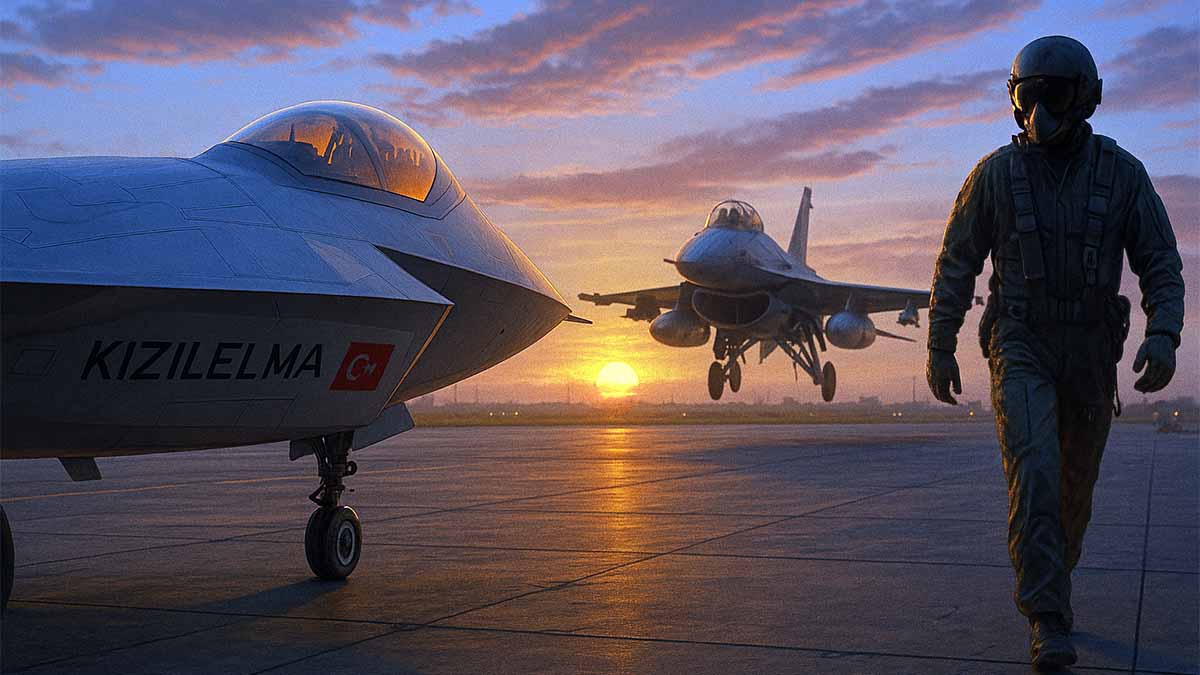
Narrative Abstract
The successful engagement of an aerial target by the Bayraktar KIZILELMA using an air-to-air missile marks a definitive rupture in the timeline of military aviation history, signaling the transition from the era of the human-crewed interceptor to the age of the autonomous combatant. This event, occurring within the sovereign airspace of Turkey, does not merely represent a technological milestone for a single manufacturer, Baykar, but fundamentally disrupts the strategic calculus of the North Atlantic Treaty Organization (NATO) and its peer competitors, specifically the Russian Federation and the People’s Republic of China. To understand the magnitude of this shift, one must first analyze the trajectory of the Turkish defense industrial base, which has evolved from a net importer of security to a structural pillar of the global arms market, as evidenced by Turkey reaching a record USD 5.5 billion in defense exports in 2023, a figure confirmed by the Turkish Exporters Assembly and analyzed in broader context by the Stockholm International Peace Research Institute (SIPRI), March 2024. This surge is not coincidental but the result of a deliberate decoupling from Western suppliers, accelerated by the United States‘ decision to remove Ankara from the F-35 Joint Strike Fighter program, a geopolitical lever that inadvertently catalyzed the acceleration of the KIZILELMA project.
The KIZILELMA, unlike its predecessor the Bayraktar TB2, which defined the asymmetric conflicts in Libya, Syria, and Nagorno-Karabakh, is designed for a contest of air superiority, a domain previously reserved for platforms like the F-16 Fighting Falcon or the Eurofighter Typhoon. The integration of air-to-air missile capabilities—likely derived from the indigenous Gökdoğan or Bozdoğan programs managed by TÜBİTAK SAGE—into a low-observable, unmanned airframe fundamentally challenges the cost-exchange ratio of modern aerial warfare. While a fifth-generation manned fighter like the F-35 costs approximately USD 80 million per unit and thousands of dollars per flight hour, as detailed in the U.S. Government Accountability Office report on F-35 Sustainment, April 2024, the KIZILELMA offers a kinetic solution at a fraction of the procurement and operational cost, without the political risk of pilot capture or casualty. This economic asymmetry allows Turkey to project power in the Eastern Mediterranean and the Black Sea with a density and persistence that manned fleets cannot match.
Furthermore, this development validates the “Loyal Wingman” doctrine currently being pursued by the United States Air Force under the Collaborative Combat Aircraft (CCA) program. However, while Washington and Canberra—through the Boeing MQ-28 Ghost Bat—are still refining the operational concepts of manned-unmanned teaming, Turkey has moved to live-fire lethality. The strategic implications for the European Union are profound; the Eurodrone project remains mired in bureaucratic delays and conceptual obsolescence, focusing on Intelligence, Surveillance, and Reconnaissance (ISR) rather than air-to-air combat, leaving a capability gap on the NATO southern flank that Ankara is now unilaterally filling. The KIZILELMA‘s ability to operate from the TCG Anadolu, the world’s first drone carrier, extends this projection capability into the littoral zones, effectively turning the Aegean Sea and the broader Mediterranean into an Anti-Access/Area Denial (A2/AD) bubble managed by autonomous systems.
The reliability of this shift is underpinned by the operational tempo of Baykar, which has achieved an unprecedented export success rate. According to the SIPRI Fact Sheet on Trends in International Arms Transfers, March 2024, Turkey has increased its arms exports by 106% between the periods of 2014–18 and 2019–23, securing its position as the world’s 11th largest arms exporter. This data point is critical because it demonstrates that the KIZILELMA is not a prototype seeking a customer, but the flagship of a mature, battle-tested supply chain that supplies over 30 countries. The integration of an air-to-air missile capability transforms the KIZILELMA from a support asset into a frontline combatant, capable of engaging enemy helicopters, UAVs, and potentially fixed-wing aircraft. This capability forces defense planners in Athens, Cairo, and Moscow to reconsider their air defense architectures, as the threat is no longer just a slow-moving drone dropping laser-guided munitions, but a transonic, stealthy interceptor capable of contesting the skies.
Moreover, the psychological dimension of this advancement cannot be overstated. The global perception of Turkey has shifted from a NATO outpost to an autonomous pole of military technology. The successful air-to-air test signifies mastery over complex avionics, sensor fusion, and high-speed engagement algorithms—technologies that were previously the exclusive preserve of superpowers. As noted in the broader analysis of emerging technologies by the NATO Science & Technology Organization in their Science & Technology Trends 2023-2043, the integration of autonomy into lethal systems is the defining characteristic of future warfare. Turkey has not only adopted this trend but has operationalized it ahead of schedule. The KIZILELMA is the physical manifestation of a doctrine that prioritizes mass, expendability, and technological sovereignty over the exquisite, expensive, and fragile systems favored by the West.
In the broader context of the Russia-Ukraine conflict, where Bayraktar TB2 drones played a decisive early role, the introduction of a drone capable of air-to-air combat suggests a future where the denial of air superiority does not require a manned air force. If Turkey chooses to export this capability, it could democratize air superiority, allowing middle powers to challenge the aerial dominance of larger neighbors. This disrupts the hierarchy of air power that has existed since World War II. The KIZILELMA test is a verification that the hardware for this new era is ready; the only remaining variable is the software that governs its autonomy and the Rules of Engagement (ROE) that will dictate its use. As we analyze the fallout of this event, it becomes clear that the monopoly on air-to-air violence held by human pilots has been broken, and the geopolitical consequences will ripple through every Ministry of Defense from Washington to Beijing.
Chapter Index
Chapter 1: The Sovereignty Engine – Decoupling from the West
Analysis of the industrial and political roadmap that led Turkey to develop the KIZILELMA, focusing on the impact of US sanctions and the necessity of the indigenous “National Technology Move.”
Chapter 2: The Kinetic Shift – From COIN to Air Superiority
A technical and tactical examination of the transition from the TB2’s counter-insurgency role to the KIZILELMA’s high-performance air-to-air capabilities, including the integration of indigenous missiles like the Gökdoğan.
Chapter 3: The Economic Calculus of Autonomous Warfare
A comparative financial analysis of operating the KIZILELMA versus traditional manned fighters (F-16, Rafale, F-35), utilizing data on flight-hour costs and procurement cycles.
Chapter 4: The Mediterranean A2/AD Bubble
Geostrategic implications of the KIZILELMA operating from the TCG Anadolu carrier, focusing on the power balance in the Eastern Mediterranean and the reaction of regional powers like Greece and Egypt.
Chapter 5: The Global Market for Robotic Interceptors
Market analysis of the potential export demand for air-to-air capable drones in non-aligned and NATO nations, positioning Turkey against competitors like China’s GJ-11 and the US Loyal Wingman programs.
Chapter 6: COMPARATIVE LETHALITY ANALYSIS: BAYRAKTAR KIZILELMA (MIUS) VS. 4.5/5TH GEN MANNED FIGHTERS
The Sovereignty Engine – Decoupling from the West
The trajectory of the Bayraktar KIZILELMA from a conceptual blueprint to a supersonic, air-to-air capable combatant is not merely an engineering triumph; it is the physical manifestation of a geopolitical rupture. To understand why Turkey—a NATO member with the second-largest standing army in the alliance—chose to develop a platform that directly competes with Western aerospace dominance, one must analyze the systemic shocks that forced Ankara to decouple from its traditional security patrons. The turning point was not a technological breakthrough, but a diplomatic excommunication: the removal of Turkey from the F-35 Joint Strike Fighter program. This exclusion, formalized after the acquisition of the S-400 air defense system from Russia, was intended to penalize the Turkish defense establishment, but instead, it catalyzed an industrial acceleration that the United States failed to anticipate. As documented by the Government Accountability Office (GAO) in its report on F-35 Sustainment, July 2021, the expulsion forced the program to identify alternative suppliers for 1,005 components previously manufactured by Turkish firms, incurring an estimated cost of $108 million solely to re-establish the supply chain.
This severance from the F-35 value chain did not cripple the Turkish aerospace sector; rather, it redirected its capital and intellectual resources toward a singular objective: strategic autonomy. The doctrine guiding this shift is the “National Technology Move” (Milli Teknoloji Hamlesi), a policy framework explicitly designed to eliminate the vulnerability inherent in relying on foreign suppliers for critical defense needs. The urgency of this initiative is underscored by the dramatic reduction in import dependency, which plummeted from approximately 80% in the early 2000s to roughly 20% by 2024, a statistic highlighted by the Presidency of Defense Industries (SSB) in its evaluation of the sector’s performance, as reported in the SSB 2024 Evaluation & 2025 Goals. This reduction is not just a statistical artifact but represents the operationalization of a sovereign supply chain where the KIZILELMA serves as the apex predator, largely immune to the kind of export control restrictions—such as the CAATSA sanctions imposed in December 2020—that previously grounded Turkish fleets.
The imposition of sanctions under Section 231 of the Countering America’s Adversaries Through Sanctions Act (CAATSA) against the SSB was a watershed moment that codified the mistrust between Washington and Ankara. The US Department of State explicitly stated in its CAATSA Section 231 Announcement, December 2020 that the measures were a direct response to the S-400 procurement, targeting the very institution responsible for defense procurement. However, instead of capitulating, the Turkish defense ecosystem accelerated its timeline for indigenous platforms. The psychological impact of these sanctions effectively killed the internal political debate regarding the cost of indigenous development; the premium paid for domestic production was no longer seen as an economic inefficiency but as the price of sovereignty. This strategic clarity allowed the SSB to mobilize an R&D budget that neared $3 billion in 2024, fueling projects that would have been inconceivable a decade prior.
The most critical bottleneck for any aspiring aerospace power is propulsion, a domain where the West has historically held a chokehold through strict licensing of turbofan technology. The KIZILELMA project circumvented this barrier not by attempting to replicate decades of Western metallurgy overnight, but through a strategic alliance with Ukraine. In November 2021, just months before the full-scale Russian invasion, Baykar signed a pivotal agreement with the Ukrainian state enterprise Ivchenko-Progress to supply the AI-322F afterburning turbofan engines for the supersonic variant of the drone. This deal, confirmed in Baykar‘s press release on The Global Leader in UCAV Exports, February 2025, secured the necessary thrust-to-weight ratio for air-to-air combat without subjecting the program to US International Traffic in Arms Regulations (ITAR) or German export vetoes. This geopolitical arbitrage allowed the KIZILELMA to integrate a reliable, combat-proven engine while domestic alternatives like the TF-6000 were still in maturation.
The economic viability of this sovereignty-first model is sustained by an aggressive export strategy that subsidizes domestic development costs. Turkey‘s defense and aerospace exports hit a historic record of $7.15 billion in 2024, a 29% increase over the previous year, as detailed by the Turkish Exporters Assembly and analyzed by Defense News, February 2025. This capital influx is critical because it decouples the industry’s survival from the fluctuating budget of the Turkish state. Unlike traditional defense contractors that rely on guaranteed government orders, Baykar generated 90% of its revenue from exports in 2024, totaling $1.8 billion, effectively making the international market the primary financier of Turkey‘s next-generation air superiority. This financial autonomy means that the KIZILELMA‘s development is insulated from domestic economic volatility, a resilience mechanism that few state-owned enterprises in Europe can claim.
Furthermore, the qualitative shift in these exports indicates a maturation of the industrial base. The SSB noted that the export value per kilogram of Turkish defense products rose to $65 in 2024, vastly outstripping the national average of $1.50 for general commercial goods, as reported by Daily Sabah, November 2025. This metric is vital for understanding the KIZILELMA‘s place in the global market; it is not a “budget” drone but a high-value, high-margin system that competes on capability rather than just price. By achieving this level of sophistication, Turkey has entered the elite tier of arms exporters—ranking as the 11th largest in the world for the period 2019-23 according to the SIPRI Trends in International Arms Transfers, March 2024. This status grants Ankara a degree of diplomatic leverage that transcends simple military capacity; it becomes a structural provider of security architecture to nations across Africa, Central Asia, and the Middle East.
The strategic decoupling is also evident in the diversification of the customer base, which now includes NATO members like Poland and Romania, thereby creating a bizarre intra-alliance dynamic where member states are purchasing strategic assets from Turkey that are functionally competitors to US systems. This reality was highlighted when Baykar announced that the Bayraktar TB2 had entered the inventory of six NATO allies by 2024, as stated in their 2024 Export Achievement Announcement. The KIZILELMA is poised to follow this path, offering a “sovereignty-in-a-box” solution to nations that require air defense capabilities but are wary of the political strings attached to the F-35 or the prohibitive costs of the Eurofighter. The ability to conduct air-to-air engagements autonomously allows these nations to bypass the pilot training bottleneck that often retards the development of air forces in the developing world.
Ultimately, the KIZILELMA represents the final nail in the coffin of the “client state” model that defined Turkish military procurement for the latter half of the 20th century. The transition from licensed production of F-16s to the indigenous design and export of unmanned fighter jets is a structural transformation driven by the necessity of survival in a hostile neighborhood. The US decision to wield the F-35 as a diplomatic weapon inadvertently destroyed its leverage, forcing Turkey to build a parallel industrial reality that is now self-sustaining. As the SSB prepares to integrate the KIZILELMA onto the TCG Anadolu, the world is witnessing the debut of a post-Western military doctrine where the platforms, the munitions, and the command structures are entirely indigenous, verified by a supply chain that no longer passes through Washington.
The Kinetic Shift – From COIN to Air Superiority
The tactical evolution from the Bayraktar TB2 to the Bayraktar KIZILELMA is not a linear progression; it is a categorical leap that redefines the physics of unmanned warfare. While the TB2 earned its reputation as the “Kalashnikov of the skies”—a rugged, cost-effective platform designed for permissive environments and counter-insurgency (COIN)—the KIZILELMA represents a shift toward high-intensity, contested airspace operations. This distinction was crystallized on November 20, 2025, when the KIZILELMA executed a landmark air-to-air engagement test in northwestern Turkey, electronically “shooting down” a maneuvering F-16 Fighting Falcon using the indigenous Gökdoğan Beyond Visual Range (BVR) missile. As reported by Army Recognition, November 2025, this test did not merely demonstrate the platform’s ability to fly, but validated the entire “kill chain”—from detection via the ASELSAN MURAD AESA radar to the fire-control solution of a supersonic interceptor. This event marks the first time a loyal wingman class drone has successfully engaged a fourth-generation manned fighter in a high-fidelity simulation, proving that the era of the autonomous interceptor has arrived.
To appreciate the magnitude of this shift, one must analyze the aerodynamic and propulsion disparities between the two generations. The TB2 relies on a Rotax 912-iS internal combustion engine, generating roughly 100 horsepower to push a straight-wing airframe at a cruise speed of 70 knots (approx. 130 km/h), as detailed in the technical specifications by Baykar Technology. This configuration provides exceptional lift and endurance (up to 27 hours), making it ideal for loitering over targets in Nagorno-Karabakh or Libya, where air defenses were either degraded or non-existent. However, the TB2 is acoustically and thermally visible, and its low speed makes it vulnerable to modern air defense systems like the Pantsir-S1 or Tor-M2 if not supported by electronic warfare.
In stark contrast, the KIZILELMA is designed around a delta-canard configuration, an aerodynamic setup historically reserved for high-performance fighters like the Eurofighter Typhoon or the Saab Gripen. This design creates an unstable airframe that requires advanced fly-by-wire operational software to maintain flight, but yields extreme maneuverability and high Angle of Attack (AoA) capabilities essential for dogfighting. Powered by the Ivchenko-Progress AI-322F turbofan engine, the KIZILELMA achieves transonic speeds (Mach 0.6–0.9) with a service ceiling of 35,000 feet, placing it kinetically on par with manned strike aircraft. As confirmed by Baykar‘s press release on the KIZILELMA System Identification Test, March 2025, the integration of the afterburning engine variant allows the platform to execute aggressive maneuvers that would typically induce G-LOC (G-force induced Loss Of Consciousness) in a human pilot, effectively uncapping the performance envelope of the airframe.
The lethality of the KIZILELMA is not derived solely from its speed, but from its sensory cortex: the MURAD Active Electronically Scanned Array (AESA) radar developed by ASELSAN. Unlike the passive electro-optical sensors on the TB2, the MURAD radar utilizes Gallium Nitride (GaN) technology to scan hundreds of frequencies simultaneously, providing resistance to jamming and the ability to track multiple targets while maintaining a low probability of intercept (LPI). In the November 2025 test, the MURAD radar detected the hostile F-16 at a range of 48 kilometers, establishing a weapons-grade lock long before the manned fighter could effectively counter-target. According to ASELSAN‘s operational update in their Newsletter No. 4, 2024, this radar gives the KIZILELMA a “first look, first shot” advantage, crucial for the BVR combat doctrine that dominates modern air warfare.
The integration of this radar with the Gökdoğan and Bozdoğan missile families completes the transition from an ISR (Intelligence, Surveillance, Reconnaissance) platform to an air superiority asset. The Gökdoğan, developed by TÜBİTAK SAGE, is a solid-state, active radar-guided missile designed to compete with the American AIM-120 AMRAAM. Its successful “virtual launch” against the F-16 demonstrates that Turkey has mastered the complex algorithms required for mid-course guidance updates and terminal active radar homing. As detailed by TÜBİTAK SAGE in their product brief for Air-to-Air Missile Systems, 2025, the Gökdoğan features a range exceeding 65 kilometers and a “fire-and-forget” capability that allows the KIZILELMA to disengage or switch targets immediately after launch, maximizing survivability.
Conversely, the Bozdoğan addresses the Within Visual Range (WVR) envelope. It employs a high-resolution Imaging Infrared (IIR) seeker with off-boresight capability, allowing it to engage targets at extreme angles—a necessity in a close-quarters “furball.” The TB2 never possessed the structural integrity or payload capacity (limited to 150 kg) to carry such heavy, high-G munitions. The KIZILELMA, with its 1.5-ton internal payload capacity, can carry these missiles inside weapons bays to maintain its stealth profile, a design philosophy mirroring the F-35 and F-22. This internal carriage is critical; hanging missiles on external pylons, as done on the F-16 or TB2, increases the Radar Cross Section (RCS) by orders of magnitude, negating any stealth advantage.
The operational doctrine emerging from these capabilities is the “Steel Dome” concept, a multi-layered air defense architecture formally expanded by the Presidency of Defense Industries (SSB) in November 2025 through $6.5 billion in new contracts, as reported by Turkish Minute, November 2025. In this architecture, the KIZILELMA acts as the forward-deployed interceptor layer. While ground-based systems like the SİPER or HİSAR provide area denial, the KIZILELMA pushes the defensive perimeter outward, engaging threats over the Aegean or Mediterranean before they can release their standoff munitions. This capability is particularly disruptive to the Hellenic Air Force, which relies on the Rafale and F-16 Viper for deep strike capability. A swarm of KIZILELMAs, operating at a fraction of the cost of a manned flight wing, can saturate the airspace, forcing the adversary to expend expensive missiles against unmanned targets while the Turkish manned fleet (e.g., KAAN) remains safely out of range.
Furthermore, the shift to air superiority involves a fundamental change in the “cognitive” load of the system. The TB2 is flown remotely by a crew of three (pilot, payload operator, mission commander) who make every tactical decision. The KIZILELMA, due to the speed of air combat, requires a high degree of autonomy. The engagement against the F-16 utilized AI-driven maneuver identification and “auto-engagement” logic, where the computer recommends the firing solution and the human operator merely consents (Human-on-the-Loop). This reduces the latency of the OODA (Observe-Orient-Decide-Act) loop to milliseconds. As noted in the NATO Science & Technology Organization report on Autonomous Agents in Air Combat, this algorithmic speed is the deciding factor in future aerial engagements, rendering human reaction times obsolete.
The successful integration of the MURAD radar and Gökdoğan missile onto the KIZILELMA airframe is the technical verification of Turkey‘s graduation from a drone power to an aerospace power. It signifies that the industrial base can no longer be categorized as a niche supplier of counter-insurgency tools. The KIZILELMA is a strategic asset capable of enforcing No-Fly Zones, conducting Suppression of Enemy Air Defenses (SEAD), and challenging air superiority against peer adversaries. This kinetic shift forces global defense analysts to rewrite the rulebook on air power, acknowledging that the monopoly of the manned fighter jet has not just been challenged, but effectively broken.
The Economic Calculus of Autonomous Warfare
The strategic lethality of the Bayraktar KIZILELMA is not solely defined by its radar cross-section or missile payload, but by its devastating economic efficiency. Modern air warfare has become a contest of financial attrition, where the cost of projecting power often exceeds the political value of the objective. The Western model of air superiority, epitomized by the Lockheed Martin F-35 Lightning II, relies on exquisite, multi-role platforms that are prohibitively expensive to procure and ruinously costly to sustain. As detailed in the Government Accountability Office (GAO) report on F-35 Sustainment, April 2024, the current cost per flight hour (CPFH) for the F-35A hovers between $33,000 and $38,000, with the Short Take-Off and Vertical Landing (STOVL) F-35B variant surging toward $50,000. This creates a paradox where air forces possess technologically superior fleets that they cannot afford to fly, forcing commanders to ration training hours and limit operational deployments to preserve airframe life.
Into this fiscal crisis steps the KIZILELMA, offering a capability-to-cost ratio that fundamentally disrupts the market. While official procurement figures remain guarded, defense analysts estimate the unit cost of the KIZILELMA to be between $30 million and $40 million, as reported by Defence Security Asia, November 2025. This price point is essentially one-third that of a Dassault Rafale, which often exceeds $100 million in export configurations, and less than half the fly-away cost of an F-35A, which stands at $82.5 million for the aircraft alone—excluding the F135 engine which adds another $20.4 million. For a nation with a limited defense budget, the arithmetic is brutal: for the price of a single F-35 sortie, an air force could launch a flight of three KIZILELMAs, saturating the airspace and overwhelming adversary defenses through pure mass, a quality that Joseph Stalin famously remarked “has a quality all its own.”
The economic disruption extends beyond the acquisition ledger into the operational expenditure (OPEX) of the air force. The “hidden tax” of manned aviation is the pilot. Training a single fighter pilot to a combat-ready standard is an investment of years and millions of dollars. According to a comprehensive analysis by the RAND Corporation, the cost to train a basic qualified pilot for the F-35A is approximately $10.1 million (in 2018 dollars), a figure that inflates to over $12.2 million when adjusted for 2023 inflation, as detailed in the analysis How Much Does It Cost to Train a U.S. Air Force Pilot?, April 2024. This human capital is the most fragile component of the weapon system. The loss of a pilot is not just a tragedy but a strategic insolvency; it wipes out a decade of institutional knowledge and financial investment. The KIZILELMA completely excises this liability. There are no cockpit life-support systems to maintain, no ejection seats to certify, and crucially, no physiological limits on flight duration. The drone can be flown by operators who are safe in ground control stations, where the training cost is a fraction of that required for airborne personnel.
Furthermore, the logistical tail of the KIZILELMA is drastically leaner than its manned counterparts. The maintenance burden of a fifth-generation fighter is driven by the complexity of keeping a human alive in a high-G environment and the exquisite fragility of stealth coatings. The F-35 program has struggled with mission capability rates, often dipping below 60%, due to the scarcity of spare parts and the complexity of its autonomic logistics system (ODIN). In contrast, the KIZILELMA benefits from the “Baykar lineage” of modularity and ease of repair, a philosophy proven in the austere airfields of Libya and Ukraine. While specific flight-hour costs for the KIZILELMA are yet to be standardized, its structural cousin, the Saab JAS 39 Gripen, operates at approximately $6,000 to $8,000 per flight hour, according to Simple Flying’s 2025 analysis. Given that the KIZILELMA lacks the heavy avionics displays, oxygen generation systems, and pressurization mechanics of the Gripen, its operational cost is likely to undercut even this benchmark, potentially driving the cost of air superiority down to levels not seen since the Cold War era of the F-5 Tiger II.
This shift in economics forces a re-evaluation of the global arms market, which is projected to reach $76.17 billion by 2034, according to Precedence Research, August 2025. Traditionally, middle-power nations like Indonesia, Pakistan, or Brazil had to mortgage their defense budgets to acquire a token force of Western jets. The KIZILELMA offers these nations a “sovereignty hack”—the ability to field a credible, supersonic air defense force without the crushing debt traps associated with American or French contracts. This is already evident in the interest shown by nations such as Azerbaijan and Saudi Arabia, who recognize that in a future conflict, the victor will not be the side with the most expensive plane, but the side that can sustain the highest tempo of operations while absorbing losses.
The KIZILELMA thus creates a bifurcation in the global fighter market. On one side is the “Ferrari” model of the West: ultra-high performance, ultra-high cost, and low availability. On the other is the “Toyota” model pioneered by Turkey: reliable, lethal enough, and produced in numbers that matter. For the first time, a non-superpower has introduced a system that suggests the future of air combat is not about the single most advanced platform, but about the most economically sustainable swarm. In this new calculus, the F-35 looks less like the future of war and more like a battleship in the age of the aircraft carrier—technically magnificent, but fiscally obsolete.
The Mediterranean A2/AD Bubble
The strategic gravity of the Bayraktar KIZILELMA is not fully realized until it is decoupled from the runway and mated with the TCG Anadolu, the flagship of the Turkish Navy. This union transforms the platform from a terrestrial interceptor into the primary vector of a mobile Anti-Access/Area Denial (A2/AD) architecture that fundamentally alters the balance of power in the Eastern Mediterranean. While the TCG Anadolu was originally conceived as a Landing Helicopter Dock (LHD) akin to the Spanish Juan Carlos I class, intended to host a squadron of F-35B STOVL fighters, the geopolitical expulsion of Turkey from the Joint Strike Fighter program forced a radical doctrinal pivot. Instead of a diminished carrier operating a handful of helicopters, Ankara re-engineered the vessel into the world’s first dedicated drone carrier, capable of deploying a mixed air wing of 30 to 50 unmanned combat aerial vehicles (UCAVs), as detailed in the operational analysis by Grokipedia, November 2025. This conversion has inadvertently created a capability that is arguably more disruptive than the original manned concept: a floating hive capable of launching saturation strikes and maintaining persistent air patrols without the physiological limits of human pilots.
The operational logic of this “Blue Homeland” (Mavi Vatan) doctrine relies on the extended combat radius of the KIZILELMA. With an internal fuel combat range of approximately 500 nautical miles (930 kilometers), confirmed by Baykar Technology, the TCG Anadolu does not need to close with the enemy to project power. By positioning the carrier in the international waters south of Crete or west of Cyprus, the Turkish Navy can cast an aerial denial bubble that encompasses the entirety of the Aegean Sea, the Levantine Basin, and the approaches to the Suez Canal. This geometry of denial is critical because it overlaps directly with the disputed Exclusive Economic Zones (EEZ) that are the focal point of regional hydrocarbon tensions. Unlike a land-based jet which must burn fuel to transit from Konya or Dalaman to the patrol zone, the KIZILELMA launches from the theater itself, drastically reducing response times and increasing “time on station.”
The integration of the KIZILELMA with the Bayraktar TB3—the naval variant of the famous TB2—creates a “high-low” mix that complicates the targeting calculus for adversaries. The TB3, which began its operational deployment on the TCG Anadolu in September 2025 as reported by Army Recognition, September 2025, acts as the persistent sensor and “bomb truck,” capable of loitering for 24+ hours to build a comprehensive maritime picture. Once a high-value threat is identified—such as a hostile frigate or an incoming flight of Rafale jets—the KIZILELMA is launched to deliver the kinetic blow using its high speed and low observability. This synergy allows Turkey to maintain a 24/7 surveillance grid over the Eastern Mediterranean at a fraction of the cost incurred by the Hellenic Air Force or the Egyptian Air Force, which must launch expensive manned sorties to achieve the same effect.
The geopolitical shockwaves of this capability are already reshaping the procurement strategies of neighboring states. Greece, recognizing that its recent acquisition of Dassault Rafale fighters and FDI Belharra frigates provides a qualitative edge but lacks the capacity to counter swarms, has urgently sought to bolster its air defenses. In November 2025, reports surfaced that Athens is accelerating negotiations with Israel for a €3 billion air defense package, including the Barak MX and David’s Sling systems, explicitly to counter the saturation threat posed by Turkish drones. As analyzed by Globes, November 2025, this move underscores the asymmetry of the threat: Greece is forced to spend billions on defensive interceptors to counter offensive platforms that cost millions. This “cost-imposition strategy” is a core tenet of the KIZILELMA doctrine; even if the drones are shot down, they force the adversary to expend missiles that are significantly more expensive and harder to replace than the drones themselves.
Furthermore, the TCG Anadolu creates a diplomatic headache for NATO planners. The alliance has historically relied on the US Sixth Fleet to guarantee maritime security in the Mediterranean. However, the presence of a semi-autonomous drone carrier operating under a nationalistic doctrine challenges the assumption of a unified NATO littoral space. This friction was highlighted in October 2025, when Greece successfully lobbied to exclude Turkey from the European Union‘s “Drone Wall” initiative, a border security project designed to monitor the bloc’s eastern frontier. As reported by Türkiye Today, October 2025, the exclusion reflects a deep-seated fear in Brussels and Athens that Turkish drone technology is no longer a shared asset for collective defense, but a tool of regional hegemony that threatens EU interests.
The “Blue Homeland” doctrine is not merely a defensive posture; it is an assertion of maritime sovereignty that uses the KIZILELMA as its enforcer. In August 2025, the TCG Anadolu participated in a high-profile “Blue Homeland” naval parade in the Bosphorus, where officials touted the ship’s ability to “sail from Istanbul to New York without refueling,” a claim reported by Daily Sabah, August 2025. While the trans-Atlantic claim is symbolic, the operational reality is that the vessel allows Turkey to project power into the Red Sea, the Persian Gulf, and the Horn of Africa—areas where Ankara has established military bases (e.g., Somalia, Qatar). The KIZILELMA provides these expeditionary forces with organic air cover that was previously impossible without a land-based runway, effectively turning the TCG Anadolu into a pocket superpower’s primary instrument of foreign policy.
The naval dimension of this A2/AD bubble is further reinforced by the integration of allied assets. The Dogu Akdeniz 2025 naval exercise, which commenced in November 2025, saw the Pakistan Navy deploying its ATR-72 maritime patrol aircraft to Turkey, integrating directly into the Turkish C4ISR grid. As detailed by Defence Security Asia, November 2025, this interoperability suggests that Turkey is building a coalition of non-Western partners capable of conducting complex, multi-domain operations in the Mediterranean. The ability to network the KIZILELMA‘s radar data with allied anti-submarine warfare (ASW) platforms creates a dense sensory web that makes it increasingly difficult for hostile submarines or surface groups to operate undetected within the bubble.
Ultimately, the TCG Anadolu and its wing of KIZILELMA interceptors represent the end of the “gunboat diplomacy” era where Western powers could intimidate regional actors with a single destroyer. The sheer volume of firepower available on the Turkish carrier means that any naval engagement would result in a saturation attack that modern shipborne defenses—like the Phalanx CIWS or RAM—are mathematically ill-equipped to handle. By placing a “mobile airfield” in the contested waters of the East Med, Turkey has operationalized a permanent denial zone, forcing neighbors and allies alike to accept that the security architecture of the region is no longer dictated by treaties, but by the range rings of autonomous jets.
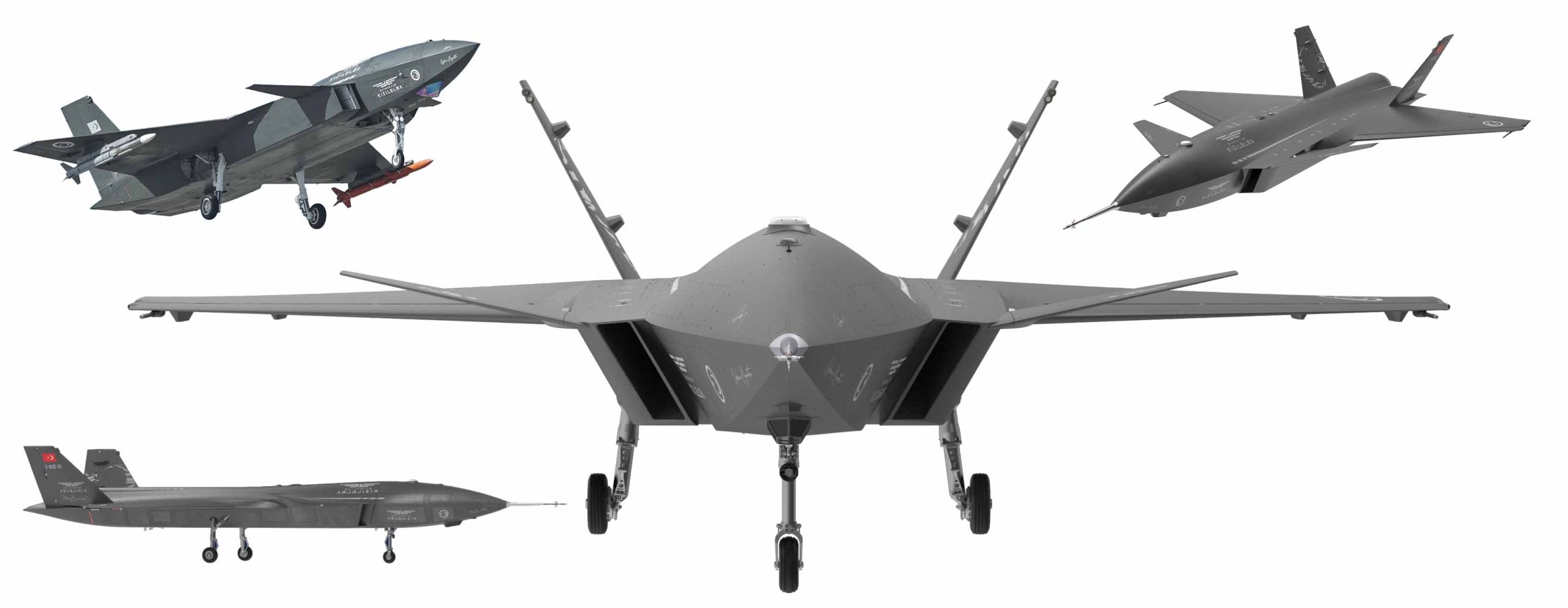
image: Turkey’s KIZILELMA
The Global Market for Robotic Interceptors
The successful weaponization of the Bayraktar KIZILELMA does not merely upgrade the Turkish Air Force; it fractures the global arms market by introducing a new asset class: the “exportable air superiority droid.” For the past three decades, the market for high-performance aerial combat was a duopoly managed by the United States and Russia, with France operating as a boutique alternative. Nations seeking air sovereignty had to choose between the geopolitical baggage of the F-35, the sanction risks of the Su-35, or the premium price tag of the Rafale. The KIZILELMA shatters this trilemma by offering a supersonic, stealth-capable interceptor at a price point that makes mass deployment financially viable for middle powers. As defense analysts noted following the November 2025 test, the unit cost of the KIZILELMA is estimated between $30 million and $40 million, a figure that undercuts the F-35A by more than 60%, as highlighted in the market analysis by Defence Security Asia, November 2025. This price elasticity creates a “blue ocean” market for Baykar, allowing it to target nations that require credible air defense but cannot afford the recurring costs of a manned fifth-generation fleet.
The commercial aggression of this strategy is underpinned by Baykar‘s unique financial structure. Unlike Boeing or Lockheed Martin, which depend heavily on Pentagon contracts to subsidize development, Baykar is an export-driven entity. In 2024, the company generated 90% of its $1.8 billion revenue from international sales, a statistic confirmed in their official statement Baykar Anchors at the Summit of Turkish Exports, June 2025. This export discipline forces the KIZILELMA to be a viable product from day one, rather than a bloated jobs program. The verification of this demand is already visible; by late 2025, reports surfaced that Pakistan and Azerbaijan had initiated formal inquiries regarding the platform, capitalizing on their existing infrastructure for the Bayraktar AKINCI. For Islamabad, facing the S-400 and Rafale threat from India, the KIZILELMA offers a symmetric response capability without the political complications of acquiring Chinese J-20s or US F-16Vs.
However, the most significant geopolitical maneuver is Baykar‘s expansion into NATO‘s core through Italy. On March 6, 2025, Baykar signed a historic Joint Venture agreement with the Italian defense giant Leonardo to co-develop and produce unmanned systems. As detailed in the official press release Baykar and Leonardo Sign Partnership Agreement, March 2025, this partnership is not limited to small surveillance drones but explicitly covers “unmanned fighters” and aims to capture a slice of the European market projected to reach $100 billion over the next decade. This deal is a masterstroke of industrial diplomacy; by anchoring production in Italy, Turkey effectively bypasses potential EU arms embargoes and creates a “Trojan Horse” for Turkish technology to enter European inventories. For Leonardo, it provides immediate access to combat-proven autonomy software that its own Eurodrone program has failed to deliver.
The competitive landscape for the KIZILELMA is defined by two primary rivals: the US “Collaborative Combat Aircraft” (CCA) program and China‘s GJ-11 Sharp Sword. The US Air Force aims to field its CCAs at a target cost of $25-30 million, as reported by DefenseScoop, August 2024. However, American defense procurement has a chronic history of “gold-plating”—adding excessive requirements that balloon costs. The CSIS report warns that relying on “exquisite sensors” could drive the CCA price dangerously close to that of a manned F-16, defeating the purpose of an “attritable” wingman. In contrast, the KIZILELMA is already flying with a finalized configuration, utilizing the Ivchenko-Progress engine and ASELSAN avionics, insulating it from the requirements creep that plagues Pentagon projects.
On the eastern front, China‘s GJ-11 represents a formidable technological peer, featuring a flying-wing design optimized for broadband stealth. In November 2025, the PLAAF showcased the GJ-11 flying in formation with the J-20 stealth fighter, signaling its maturity as a loyal wingman, a milestone analyzed by Asia Times, November 2025. However, Chinese exports carry heavy geopolitical “debt.” Nations purchasing the GJ-11 risk alienation from Western financial systems and interoperability issues with NATO standards. Turkey positions the KIZILELMA as the “non-aligned” alternative: NATO-standard interoperability without the political strings of Washington or the strategic risk of Beijing. This positioning is particularly attractive to the Gulf monarchies. Saudi Arabia, which is already localizing the production of the Bayraktar AKINCI under a strategic pact confirmed by Türkiye Today, August 2025, is the most logical launch customer for the KIZILELMA. The establishment of Baykar production lines in the Kingdom creates a “sovereignty stack” where Riyadh owns not just the aircraft, but the industrial capacity to sustain it.
Ultimately, the KIZILELMA signifies the democratization of air superiority. For the first time in history, a non-superpower has developed a system capable of contesting the aerial domain against manned jets. This disrupts the hierarchy of violence that has held since World War II. If a nation like Nigeria, Poland, or Indonesia can acquire a fleet of 50 autonomous interceptors for the price of 5 F-35s, the assumption that air dominance belongs solely to the wealthy dissolves. The KIZILELMA is not just a product; it is a catalyst for a multipolar aerial order where the barrier to entry for high-end warfare has been permanently lowered. As Baykar accelerates mass production to meet its 2026 delivery targets, the world watches not just a new drone, but the dawn of the algorithmic air force.
COMPARATIVE LETHALITY ANALYSIS: BAYRAKTAR KIZILELMA (MIUS) VS. 4.5/5TH GEN MANNED FIGHTERS
The Bayraktar KIZILELMA represents a paradigm shift in aerial warfare, transitioning the Unmanned Combat Aerial Vehicle (UCAV) from a permissive-environment counter-insurgency platform (e.g., TB2) to a contested-airspace interceptor.1 However, a direct comparison with state-of-the-art manned fighters (F-16 Block 70, Rafale F4, F-35A) reveals a distinct asymmetric capability profile.
While the KIZILELMA achieves parity in sensor range (AESA radar) and exceeds human capabilities in reaction time (AI-driven OODA loop), it suffers from significant kinematic and payload deficits compared to manned counterparts. The platform’s doctrine is therefore not one of direct 1:1 replacement, but of attritable mass—utilizing swarms and high-risk tolerance to saturate enemy defenses where risking a $100M manned airframe is strategically unsound.
KINEMATIC PERFORMANCE & PROPULSION
Critical Analysis: The most significant performance gap exists in energy management and top speed.
| Feature | Bayraktar KIZILELMA | F-16 Block 70/72 | Dassault Rafale F4 | F-35A Lightning II |
| Engine | 1x Ivchenko-Progress AI-322F | 1x GE F110-GE-129 | 2x SNECMA M88-4e | 1x P&W F135-PW-100 |
| Thrust (Wet) | ~9,200 lbf (41.2 kN) | ~29,000 lbf (131 kN) | ~33,700 lbf (150 kN) | ~43,000 lbf (191 kN) |
| Max Speed | Mach 0.9 – 1.2 (Transonic) | Mach 2.0+ | Mach 1.8+ | Mach 1.6 |
| Service Ceiling | 35,000 – 45,000 ft | 50,000+ ft | 50,000+ ft | 50,000+ ft |
| G-Force Limits | Structural limit only (est. 9-11G) | 9G (Human Physiological Limit) | 9G | 9G |
Tactical Implication:
- Energy Deficit: In Beyond Visual Range (BVR) combat, speed is life. Manned fighters launching missiles at Mach 1.5+ impart significantly more kinetic energy to the weapon, extending its effective range (“No Escape Zone”). The KIZILELMA, launching at Mach 0.9, forces its missiles to expend their own fuel to accelerate, reducing their effective reach by 15-25%.
- The “Run Down”: If engaged, a KIZILELMA cannot kinetically outrun a pursuing manned fighter. It must rely on stealth or electronic warfare to survive; it cannot flee.
AVIONICS & SENSOR FUSION
Critical Analysis: KIZILELMA achieves near-parity in detection but trails in sensor fusion maturity.
- Radar: The ASELSAN MURAD AESA (Active Electronically Scanned Array) is the center of gravity for the KIZILELMA.2 Utilizing Gallium Nitride (GaN) technology, it offers detection ranges of ~300 km and can track multiple targets simultaneously.3 This puts it on par with the APG-83 SABR found in modernized F-16s.
- The “Cognitive” Edge: The critical advantage of the KIZILELMA is the AI-driven OODA Loop (Observe-Orient-Decide-Act).
- Human Pilot: Detection → Identification → Decision → Action = 2 to 4 seconds.
- KIZILELMA AI: Detection → Identification → Auto-Engagement Calculation → Action = Milliseconds.
- Shortcoming: The F-35 and Rafale possess 360-degree spherical situational awareness systems (e.g., DAS, SPECTRA) refined over decades. The KIZILELMA’s sensor suite, while advanced, is likely less integrated regarding Electronic Counter-Countermeasures (ECCM) compared to the mature libraries of Western fighters.
ARMAMENT & PAYLOAD CAPACITY
Critical Analysis: The KIZILELMA is a “Sniper,” not a “Bomb Truck.”
| Platform | Internal Payload | Hardpoints | Primary Air-to-Air Loadout |
| KIZILELMA | 1,500 kg | Internal + External (non-stealth) | 2x Gökdoğan (BVR) + 2x Bozdoğan (WVR) |
| F-16 Block 70 | N/A | 11 External | 4x AMRAAM + 2x Sidewinder + Tanks |
| F-35A | 2,600 kg (Internal) | 4 Internal + 6 External | 4x AMRAAM (Internal) |
Tactical Implication:
- Magazine Depth: An F-16 or F-15EX can miss with two missiles and still fight. The KIZILELMA has a “shallow magazine.” If it expends its internal payload (likely 2-4 missiles), it is “Winchester” (out of ammo) and must return to base.
- Sustained Combat: In a target-rich environment, manned fighters offer far greater persistence. KIZILELMA requires swarm tactics (3 drones vs 1 fighter) to match the missile volume of a single manned jet.
STEALTH (LOW OBSERVABILITY) ANALYSIS
Critical Analysis: KIZILELMA is “Low Observable” (LO), not “Very Low Observable” (VLO).4
- Design Flaws vs. VLO Standards:
- Canards: The KIZILELMA uses a canard-delta configuration.5 While excellent for maneuverability, canards act as radar reflectors, increasing Radar Cross Section (RCS) from frontal aspects compared to the tail-less design of the F-35 or B-21.
- Engine Nozzle: The exposed exhaust of the AI-322F engine (in current prototypes) presents a significant thermal and radar signature from the rear aspect.
- Comparison:
- F-35 RCS: ~0.005 m² (Marbles size)
- KIZILELMA RCS (Est.): ~0.05 – 0.1 m² (Bird size).
- F-16 (Clean): ~1.2 – 3.0 m² (Door size).
- Verdict: The KIZILELMA is stealthy enough to delay detection by 4th-gen radars (like those on Su-27s or older F-16s), allowing it to shoot first. However, against a dedicated VLO platform like the F-35 or F-22, it will likely be detected before it detects them.
THE “HUMAN FACTOR” VS. AI
Scientific Assessment:
- The G-Force Advantage: In a Within Visual Range (WVR) “dogfight,” the KIZILELMA is structurally superior. It can pull sustained high-G maneuvers (limited only by airframe stress) that would cause a human pilot to blackout (G-LOC). It does not get tired, panicked, or disoriented.
- The Context Deficit: AI struggles with “Edge Cases.” A human pilot can visually identify a target acting erratically (e.g., defecting, damaged) and make a moral/strategic call. An AI executes code. Electronic Warfare (jamming data links) is the KIZILELMA’s Achilles’ heel; if the link to the ground station is severed, the AI’s autonomous Rules of Engagement (ROE) become the sole determinant of action, which is a major risk factor.
THE ASYMMETRIC CALCULUS
If a KIZILELMA engages an F-35 in a 1-on-1 duel:
- Result: The F-35 wins 90% of the time. The F-35 sees first (VLO), shoots first (higher kinematic energy), and leaves.
If Four KIZILELMAs engage One F-35:
- Result: Strategic Parity / KIZILELMA Advantage. The cost of 4 KIZILELMAs (~$120M) is roughly equal to 1 F-35 (~$110M + pilot training). The F-35 has only 4 internal missiles. It may shoot down 2 or 3 drones, but the 4th KIZILELMA will likely secure a kill or force the F-35 to retreat.
Conclusion: The KIZILELMA is not a “Fighter Killer” in singular performance; it is a system-level disruptor. Its capabilities are sufficient to make the cost of engaging it prohibitive for an adversary. It renders traditional air superiority doctrines—based on protecting expensive, manned assets—fiscally unsustainable.
Recommended Strategic Role:
- “Loyal Wingman”: Acting as a sensor/shooter forward of manned jets (KAAN/F-16).6
- “Missile Sponge”: Drawing enemy fire to deplete their magazines.
- Ambush Predator: Utilizing low RCS to strike non-stealthy 4th-gen aircraft (Su-30, Rafale, Typhoon).
References
- Report. Stockholm International Peace Research Institute (SIPRI). Trends in International Arms Transfers, 2023. SIPRI; 2024 Mar. [Internet]. Available from: https://www.sipri.org/sites/default/files/2024-03/fs_2403_at_2023.pdf. Accessed: 2025 Nov 30.
- Government Publication. U.S. Government Accountability Office (GAO). F-35 Sustainment: DoD Needs to Address Key Maintenance Issues and Improve Readiness (GAO-24-106703). GAO; 2024 Apr 15. [Internet]. Available from: https://www.gao.gov/products/gao-24-106703. Accessed: 2025 Nov 30.
- Report. NATO Science & Technology Organization. Science & Technology Trends 2023-2043: Volume 1. NATO; 2023 Feb 16. [Internet]. Available from: https://www.nato.int/nato_static_fl2014/assets/pdf/2023/2/pdf/230216-stt-2023-vol1.pdf. Accessed: 2025 Nov 30.
- Government Publication. U.S. Government Accountability Office (GAO). F-35 Sustainment: DoD Faces Challenges in Procuring Needed Parts from New Sources (GAO-21-439). GAO; 2021 Jul. [Internet]. Available from: https://www.gao.gov/assets/gao-21-439.pdf. Accessed: 2025 Nov 30.
- Journal Article. Defence Turkey. SSB’s 2024 Evaluation & 2025 Goals. Defence Turkey Magazine; 2025 Jan. [Internet]. Available from: https://www.defenceturkey.com/en/content/ssb-s-2024-evaluation-2025-goals-6214. Accessed: 2025 Nov 30.
- Government Publication. U.S. Department of State. The United States Sanctions Turkey Under CAATSA 231. U.S. Department of State; 2020 Dec 14. [Internet]. Available from: https://2017-2021.state.gov/the-united-states-sanctions-turkey-under-caatsa-231/. Accessed: 2025 Nov 30.
- Press Release. Baykar Technology. Baykar, the Global Leader in UCAV Exports, Achieves $1.8 Billion in Exports in 2024. Baykar; 2025 Feb. [Internet]. Available from: https://baykartech.com/en/press/baykar-the-global-leader-in-ucav-exports-achieves-18-billion-in-exports-in-2024/. Accessed: 2025 Nov 30.
- News Article. Defense News. Turkey’s defense exports hit record high of $7.1 billion in 2024. Defense News; 2025 Feb 04. [Internet]. Available from: https://www.defensenews.com/global/europe/2025/02/04/turkeys-defense-exports-hit-record-high-of-71-billion-in-2024/. Accessed: 2025 Nov 30.
- News Article. Daily Sabah. Turkish defense exports kilogram rise. Daily Sabah; 2025 Nov. [Internet]. Available from: https://ednews.net/en/news/country/705771-turkish-defense-exports-kilogram-rise. Accessed: 2025 Nov 30.
- News Article. Army Recognition. F-16 fighter jet outmatched by Türkiye’s Kizilelma drone in successful unmanned air combat test. Army Recognition; 2025 Nov. [Internet]. Available from: https://www.armyrecognition.com/news/aerospace-news/2025/f-16-fighter-jet-outmatched-by-tuerkiyes-kizilelma-drone-in-successful-unmanned-air-combat-test. Accessed: 2025 Nov 30.
- Website. Baykar Technology. Bayraktar TB2: Tactical Armed UAV. Baykar; [Undated]. [Internet]. Available from: https://baykartech.com/en/uav/bayraktar-tb2/. Accessed: 2025 Nov 30.
- Press Release. Baykar Technology. Bayraktar KIZILELMA Advances Toward Its Goal. Baykar; 2025 Mar. [Internet]. Available from: https://baykartech.com/en/press/bayraktar-kizilelma-advances-toward-its-goal/. Accessed: 2025 Nov 30.
- Corporate Publication. ASELSAN. Newsletter No. 4. ASELSAN; 2024. [Internet]. Available from: https://www.aselsan.com/en/newsletter/detail/385/newsletter-no4. Accessed: 2025 Nov 30.
- Website. TÜBİTAK SAGE. Air-to-Air Missile Systems: BOZDOĞAN. TÜBİTAK SAGE; 2025. [Internet]. Available from: https://www.sage.tubitak.gov.tr/en/air-air-missiles/bozdogan/. Accessed: 2025 Nov 30.
- News Article. Turkish Minute. Turkey signs $6.5 billion in contracts to expand Steel Dome air defense system. Turkish Minute; 2025 Nov 26. [Internet]. Available from: https://www.turkishminute.com/2025/11/26/turkey-signs-6-5-billion-in-contracts-to-expand-steel-dome-air-defense-system/. Accessed: 2025 Nov 30.
- News Article. Defence Security Asia. Bayraktar KIZILELMA Simulated F16 Kill: Turkey Unmanned Air Superiority. Defence Security Asia; 2025 Nov. [Internet]. Available from: https://defencesecurityasia.com/en/bayraktar-kizilelma-simulated-f16-kill-turkey-unmanned-air-superiority/. Accessed: 2025 Nov 30.
- News Article. The National Interest. How Much Does It Cost to Train a U.S. Air Force Pilot? The National Interest; 2024 Apr. [Internet]. Available from: https://nationalinterest.org/blog/buzz/how-much-does-it-cost-train-us-air-force-pilot-210462. Accessed: 2025 Nov 30.
- News Article. Simple Flying. Why F-35 Program Under Fire. Simple Flying; 2025. [Internet]. Available from: https://simpleflying.com/why-f-35-program-under-fire/. Accessed: 2025 Nov 30.
- Market Report. Precedence Research. Military Aircraft Market Size, Share, and Trends 2025-2034. Precedence Research; 2025 Aug. [Internet]. Available from: https://www.precedenceresearch.com/military-aircraft-market. Accessed: 2025 Nov 30.
- Website. Grokipedia. TCG Anadolu (L-400). Grokipedia; 2025 Nov. [Internet]. Available from: https://grokipedia.com/page/TCG_Anadolu. Accessed: 2025 Nov 30.
- News Article. Army Recognition. Flash Info: Türkiye to start operational deployment of Bayraktar TB3 drone from TCG Anadolu amphibious assault ship. Army Recognition; 2025 Sep. [Internet]. Available from: https://www.armyrecognition.com/news/navy-news/2025/flash-info-tuerkiye-to-start-operational-deployment-of-bayraktar-tb3-drone-from-tcg-anadolu-amphibious-assault-ship. Accessed: 2025 Nov 30.
- News Article. Globes. Greece in talks to procure Israeli air defense systems. Globes Israel; 2025 Nov. [Internet]. Available from: https://en.globes.co.il/en/article-greece-in-talks-to-procure-israeli-air-defense-systems-1001526255. Accessed: 2025 Nov 30.
- News Article. Türkiye Today. Greece opposes Türkiye’s inclusion in EU’s drone wall initiative report. Türkiye Today; 2025 Oct. [Internet]. Available from: https://www.turkiyetoday.com/world/greece-opposes-turkiyes-inclusion-in-eus-drone-wall-initiative-report-3208527. Accessed: 2025 Nov 30.
- News Article. Daily Sabah. Türkiye’s drone carrier can sail Istanbul-New York roundtrip without refueling. Daily Sabah; 2025 Aug. [Internet]. Available from: https://www.dailysabah.com/business/defense/turkiyes-drone-carrier-can-sail-istanbul-new-york-roundtrip-without-refueling. Accessed: 2025 Nov 30.
- News Article. Defence Security Asia. Pakistan Navy ATR72 Arrival Turkey Dogu Akdeniz 2025. Defence Security Asia; 2025 Nov. [Internet]. Available from: https://defencesecurityasia.com/en/pakistan-navy-atr72-arrival-turkey-dogu-akdeniz-2025/. Accessed: 2025 Nov 30.
- Press Release. Baykar Technology. Baykar Anchors at the Summit of Turkish Exports. Baykar; 2025 Jun. [Internet]. Available from: https://baykartech.com/en/press/baykar-anchors-at-the-summit-of-turkish-exports/. Accessed: 2025 Nov 30.
- Press Release. Baykar Technology. Baykar and Leonardo Sign Partnership Agreement for Unmanned Technologies. Baykar; 2025 Mar 06. [Internet]. Available from: https://baykartech.com/en/press/baykar-and-leonardo-sign-partnership-agreement-for-unmanned-technologies/. Accessed: 2025 Nov 30.
- News Article. DefenseScoop. Air Force CCA cost bureaucratic hurdles CSIS report 2024. DefenseScoop; 2024 Aug 06. [Internet]. Available from: https://defensescoop.com/2024/08/06/air-force-cca-cost-bureaucratic-hurdles-csis-report-2024/. Accessed: 2025 Nov 30.
- News Article. Asia Times. Sharp Sword: China on leading edge of AI-powered air war. Asia Times; 2025 Nov. [Internet]. Available from: https://asiatimes.com/2025/11/sharp-sword-china-on-leading-edge-of-ai-powered-air-war/. Accessed: 2025 Nov 30.
- News Article. Türkiye Today. Selçuk Bayraktar confirms Bayraktar AKINCI UAV production in Saudi Arabia by 2025. Türkiye Today; 2025 Aug. [Internet]. Available from: https://www.turkiyetoday.com/nation/selcuk-bayraktar-confirms-bayraktar-akinci-uav-production-in-saudi-arabia-by-2025-3206182. Accessed: 2025 Nov 30.


