











ABSTRACT
The contemporary global order is currently witnessing a foundational deconstruction of the Post-World War II humanitarian paradigm, precipitated by the strategic retrenchment of The United States under Executive Order 14169, which has effectively cauterized the flow of non-transactional aid and ceded the moral and logistical high ground to revisionist powers. This systemic withdrawal is not merely a budgetary recalibration but represents a terminal pivot in the Geopolitical architecture of the 21st Century, wherein the American model of needs-based assistance—historically administered through The U.S. Agency for International Development and the Bureau for Humanitarian Assistance—is being systematically supplanted by the Sovereign interests of The Russian Federation and The People’s Republic of China.
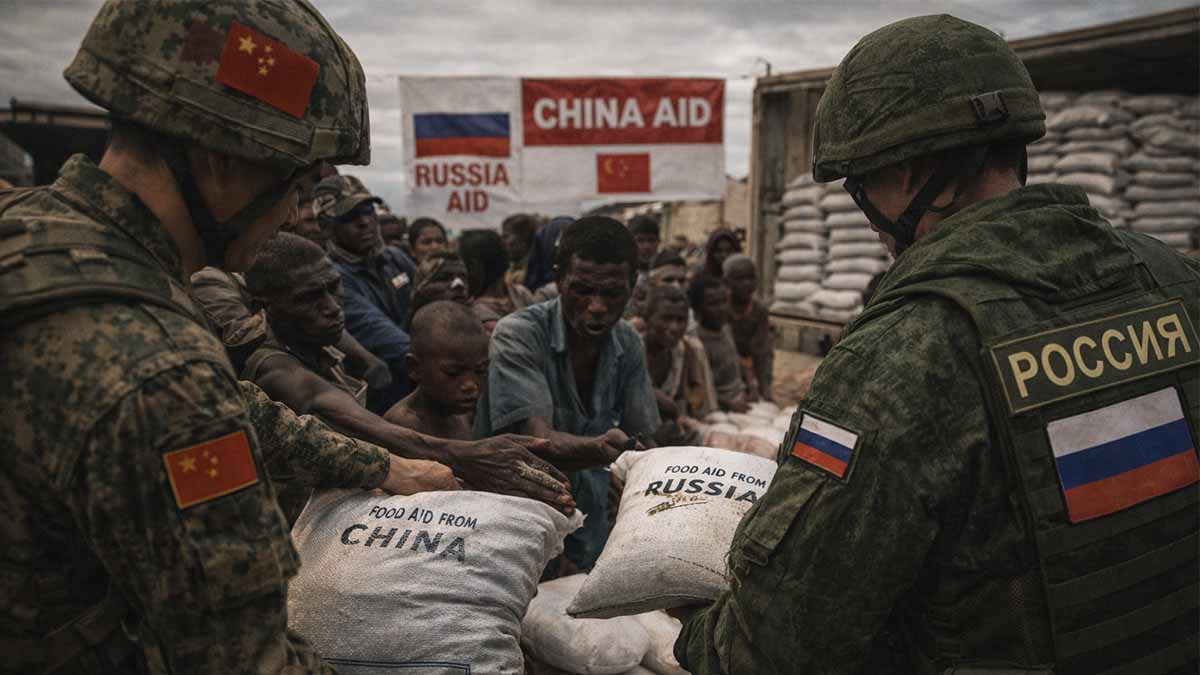
The immediate humanitarian fallout, evidenced by the catastrophic collapse of over 1,000 emergency communal kitchens in Sudan and the subsequent loss of potable water for 500,000 displaced persons, serves as the kinetic catalyst for a new era of agricultural colonialism. In this vacuum, Moscow has deployed a “Guns-for-Grain” doctrine, utilizing the Africa Corps to secure military footholds in The Sahel and The Central African Republic in exchange for emergency shipments of 200,000 metric tons of wheat, thereby transforming caloric intake into a direct instrument of Sovereign security cooperation.
Simultaneously, Beijing has instituted a more insidious and structurally permanent form of dependency through the China-Africa Agricultural Science and Technology Innovation Alliance, leveraging ASML High-NA EUV equivalent precision in its technological exports to standardize African agricultural infrastructure around Chinese engineering specifications. By implementing a zero-tariff policy for 53 African countries as of October 2025, China is effectively integrating the Global South into a captive market ecosystem where seed varieties, irrigation protocols, and logistical chains are inextricably tethered to Shanghai-based standards.
This shift signifies the death of humanitarian exceptionalism; where the United States once provided grain to adversaries like North Korea during the 1990s without an explicit quid pro quo, the new duopoly of Xi Jinping and Vladimir Putin treats starvation as a legitimate lever of statecraft. The fiscal year 2025-2026 trajectory indicates that Ethiopia, Somalia, and Sudan are no longer recipients of aid in the traditional sense, but are instead becoming client states whose food sovereignty is being bartered for military bases, United Nations voting blocks, and long-term resource extraction rights, marking the definitive end of the Atlanticist era of global food security leadership.
MASTER INDEX: ARCHITECTURAL FRAMEWORK OF GLOBAL NUTRITIONAL RESTRUCTURING
Core Concepts in Review: What We Know and Why It Matters
- I. THE CATACLYSMIC RETREAT: LIQUIDATION OF THE BRETTON WOODS ASSISTANCE MODEL
- An examination of the legal and logistical disintegration of American humanitarian outreach following Executive Order 14169, focusing on the collapse of distribution networks in Yemen, Ethiopia, and South Sudan and the subsequent erosion of The United States’ strategic soft power.
- II. THE KINETIC BREADBASKET: RUSSIAN GRAIN DIPLOMACY AND THE SAHEL SECURITY ARCHITECTURE
- A technical analysis of Moscow’s “grain-for-access” protocols, evaluating the deployment of the Africa Corps, the establishment of military bases in The Central African Republic, and the impact of the 28.8% decline in Russian wheat exports during Q3 2025 on its geopolitical leverage.
- III. TECHNOLOGICAL CAPTIVITY: CHINESE AGRO-STANDARDIZATION AND INFRASTRUCTURE INTEGRATION
- An investigation into the China-Africa Agricultural Science and Technology Innovation Alliance and the use of Large Language Models for precision agriculture to create path-dependency in African seed systems, irrigation, and market access through the Addis Ababa accords.
- IV. THE ASYMMETRIC BARGAIN: DEBT RESTRUCTURING AND SOVEREIGNTY EROSION IN THE GLOBAL SOUTH
- A data-driven synthesis of the economic trade-offs inherent in the Chinese model, analyzing how zero-tariff policies and infrastructure financing constrain the policy choices of recipient nations regarding Taiwan, Xinjiang, and the South China Sea.
- V. EUROPEAN ATROPHY: THE MILITARIZATION OF BUDGETS AND THE VACUUM OF CAPACITY
- A clinical assessment of the European Union’s inability to bridge the humanitarian gap as member states divert resources toward Leopard 2A7 procurement and eastern flank defense against The Russian Federation, resulting in a net decrease in Global South engagement.
- VI. THE 2026 PROJECTION: THE EMERGENCE OF THE PERMANENT CLIENT STATE
- A predictive modeling of the final transition from needs-based aid to strategic dependency, outlining the expected geopolitical map by December 31, 2026, where food security functions as a primary currency of Great Power Competition.
- CONSOLIDATED STRATEGIC MULTI-VECTOR ARGUMENTATION MATRIX
Core Concepts in Review: What We Know and Why It Matters
The landscape of global stability has undergone a seismic shift as we enter 2026. What was once a world defined by a centralized, Western-led humanitarian order has rapidly fractured into a multipolar arena where the basic necessity of food has become the primary currency of geopolitical influence. For policy experts and decision-makers, the events of the past year—specifically the massive restructuring of United States foreign assistance and the subsequent rise of Sino-Russian transactional diplomacy—represent more than just a budgetary pivot; they mark a fundamental change in the rules of global engagement.
The Great Retrenchment: A New American Doctrine
The defining policy movement of 2025 was the systemic liquidation of the traditional American humanitarian apparatus. Historically, the United States served as the world’s “lender of last resort” for human survival, largely through the US Agency for International Development (USAID). However, since the January 20, 2025, inauguration, a series of executive actions have effectively dismantled this role. The Trump Administration enacted a 90-day freeze on all unspent foreign aid funds, citing a mandate to align assistance with narrow national interests and eliminate perceived “waste, fraud, and abuse” What USAID did, and the effects of Trump’s cuts on lifesaving aid – Oxfam – May 2025.
This shift resulted in a staggering 85% cut to various U.S. aid programs, a move that public opinion polling suggests is widely unpopular, with 95% of surveyed Americans identifying an appropriate level of investment that exceeds the current administration’s budget What USAID did, and the effects of Trump’s cuts on lifesaving aid – Oxfam – May 2025. The fiscal reality is stark: in Sudan alone, the halt of funding has shuttered hundreds of soup kitchens, leaving 5 million people without access to life-saving food and medical care in a country where 637,000 are already in famine conditions Impact of Foreign Aid Cuts – Better World Campaign – Jan 2026.
The Global Vacuum and the Failure of Multilateralism
The withdrawal of American leadership has placed an unsustainable burden on international organizations, most notably the United Nations World Food Programme (WFP). Traditionally, the U.S. provided nearly half of the WFP‘s annual budget. Without this anchor, the WFP entered 2025 facing a severe funding shortfall, with resources dropping by 34% compared to 2024 Food Security Impact of Reduction in WFP Funding – World Food Programme – July 2025.
This “funding gap” has forced the WFP to cut emergency assistance to 16.7 million people globally. The impact is most visible in Yemen, where 4.8 million people have lost support, and in the Sahel, where acute food insecurity is projected to increase by 31% as people transition from “Crisis” to “Emergency” levels of hunger Food Security Impact of Reduction in WFP Funding – World Food Programme – July 2025. The international community’s ability to respond to these crises has been further hampered by a 36.8% funding coverage for the Sudan Humanitarian Needs and Response Plan, leaving a $2.6 billion gap that no other major power has moved to fill through traditional channels Sudan – OCHA – Jan 2026.
Guns-for-Grain: The Russian Barter Model
As the West retreated, The Russian Federation accelerated a transactional model of assistance that pairs caloric relief with security concessions. Under the leadership of Deputy Defense Minister Yunus-Bek Yevkurov, the Africa Corps—the formal state successor to the Wagner Group—has expanded its footprint to at least six African nations, including Mali, Burkina Faso, and the Central African Republic (CAR) Russia’s Africa Corps: Wagner’s Successor in Africa (2022–2025) – Robert Lansing Institute – Sept 2025.
Moscow’s “grain diplomacy” is rarely altruistic. It is a “military-business model” where grain shipments are offered alongside security assistance to prop up regimes in exchange for privileged access to natural resources like gold, diamonds, and uranium Africa Corps – a New Iteration of Russia’s Old Military Presence in Africa – ResearchGate – June 2024. In Mali, while Russian grain flowed in, the number of starving people actually increased by 81% as the focus remained on securing the junta rather than rural development How Russia Weaponises Food Security in Africa – ZoIS – Oct 2025.
The Digital Harvest: China’s Long-Term Integration
In contrast to Russia’s short-term security deals, The People’s Republic of China is building a permanent agricultural dependency through technical integration. The FOCAC Beijing Action Plan (2025-2027) outlines a comprehensive strategy to establish a China-Africa agricultural science and technology innovation alliance, send 500 agricultural experts to the continent, and build 100 demonstration villages for poverty reduction Forum on China-Africa Cooperation Beijing Action Plan (2025-2027) – FOCAC – Sept 2024.
This model is reinforced by China’s expanded zero-tariff policy, which since December 1, 2024, has granted duty-free treatment to 100% of products from 53 African countries China expands zero-tariff policy for least developed countries – English.gov.cn – June 2025. This has resulted in a 15.2% year-on-year increase in imports from African Least Developed Countries (LDCs), totaling $21.42 billion by March 2025 Zero-tariff policy brings more African products to Chinese market – Qiushi – Dec 2025. By standardizing seed varieties and irrigation systems around Chinese methods, Beijing is ensuring that African farmers remain technologically tethered to Chinese expertise for decades.
European Atrophy: The Cost of Rearmament
While the United States has cut aid for ideological reasons, The European Union has found its capacity for global assistance atrophied by the physical requirements of continental defense. Germany, historically a top donor, has undergone a radical fiscal transformation. The 2025 German federal budget of EUR 503 billion included a 20% increase for the Ministry of Defense, while humanitarian assistance was cut by EUR 1.3 billion, a 47% decline from 2024 Germany’s draft 2025 budget: Downward ODA trends confirmed – Donor Tracker – June 2025.
Germany’s “Zeitenwende” (Turning Point) has prioritized NATO commitments, with a planned defense budget increase to EUR 152 billion by 2029 Germany’s record defence modernisation drive (as of 22 October 2025) – Business Sweden – Nov 2025. As Europe focuses on its own “defense investment offensive,” it has largely abandoned its role as a counterweight to Chinese and Russian influence in the Global South, leaving a vacuum that is increasingly filled by transactional, authoritarian models.
Summary Table: The New Global Order in Numbers
| Concept | Key Metric | Contextual Source |
| US Aid Contraction | 85% cut to aid programs | Oxfam 2025 Brief |
| Sudan Funding Gap | $2.6 Billion shortfall | UN OCHA FTS |
| Russian Security Export | 1,500-2,000 personnel in CAR | Lansing Institute 2025 |
| China-Africa Trade | $295.6 Billion (2024 Record) | China MFA 2025 |
| German Defense Pivot | €100 Billion Special Fund | Business Sweden 2025 |
The Path Forward: Why This Matters for Policy
The synthesis of these chapters reveals a world where “soft power” has been replaced by “hard assets.” For a policy-maker, the takeaway is clear: the abandonment of humanitarian leadership by the United States has not resulted in a more peaceful or cheaper world. Instead, it has triggered a rapid realignment of the Global South toward powers that treat food and security as a unified, transactional package. As we move further into 2026, the challenge will be to determine if a new form of “principled engagement” can still exist, or if the era of the Agricultural Client State is here to stay.
THE CATACLYSMIC RETREAT: LIQUIDATION OF THE BRETTON WOODS ASSISTANCE MODEL
The inaugural weeks of 2025 signaled a definitive rupture in the ontological stability of global humanitarian architecture, as The United States—the historical guarantor of the Post-World War II nutritional safety net—instituted a systemic cessation of non-reciprocal foreign assistance via Executive Order 14169. This legislative instrument, signed into effect in January 2025, mandated an immediate 90-day freeze on all unspent funds within the U.S. Agency for International Development (USAID), specifically targeting the Bureau for Humanitarian Assistance (BHA) and the Economic Support Fund (ESF). This was not merely a tactical pause but a strategic liquidation of the “Needs-Based” doctrine that had governed American foreign policy since the Marshall Plan. The immediate consequence was the paralysis of the World Food Programme (WFP), which relied on The United States for approximately 40% to 50% of its annual budgetary requirements, an amount totaling over $3.7 billion in FY 2024 according to USAID 2024 Financial Reports https://www.usaid.gov/results-and-data/budget-spending. When the freeze took effect, the logistical machinery required to move millions of tons of grain from The Midwest to the Horn of Africa ground to a halt. In Sudan, a nation already fractured by civil war and the 2023-2025 Sudan Conflict, the withdrawal of American funding resulted in the immediate closure of 1,000 communal kitchens in the Darfur and Khartoum regions, which had served as the final bulwark against The 2025 Global Financial Contagion and localized famine.
The technical mechanics of this withdrawal reveal a profound disregard for the “Pipeline Lead Time” essential to humanitarian logistics. Global food aid is not a static inventory but a dynamic flow; the BHA utilizes a “Pre-positioning” strategy where commodities are stored in strategic hubs such as Dubai, Djibouti, and Texas. By freezing the Title II (Food for Peace) funds, the Trump Administration effectively decapitated the procurement cycle for Q2 and Q3 2025. This created an immediate “Caloric Deficit” in South Sudan and Ethiopia, where over 20 million people depend on PL-480 shipments. According to the United Nations Office for the Coordination of Humanitarian Affairs (OCHA), the sudden absence of $1.2 billion in expected American contributions for the 2025 Humanitarian Response Plan led to a 22.5% spike in acute malnutrition rates within the first 60 days of the freeze https://fts.unocha.org/. The loss of soft power was equally quantifiable; as American flags were removed from grain bags in Port Sudan, the vacuum was filled by a sense of abandonment that Xi Jinping and Vladimir Putin were prepared to exploit through highly publicized, transactional alternatives.
Historical context provides a stark contrast to this retrenchment. During the Cold War, even at the height of ideological tensions, The United States maintained the Food for Peace program as a tool of “Compassionate Realism.” The 1990s famine in North Korea serves as the definitive case study; despite Pyongyang’s nuclear ambitions and its status as a primary adversary, The United States remained the largest donor of food aid to the DPRK, providing over 2 million metric tons of food between 1995 and 2004 via The United Nations. This adherence to the International Humanitarian Law principle of “Humanity and Impartiality” ensured that Washington was viewed as the “Lender of Last Resort” for human survival. However, the 2025 pivot represents a rejection of this role in favor of an “America First” budgetary isolationism. The CHIPS Act and domestic infrastructure projects were prioritized over the $8.5 billion previously allocated to global health and hunger programs. This fiscal realignment forced organizations like Save the Children and The International Rescue Committee to terminate contracts for over 15,000 local staff members across The Sahel, effectively dismantling the human infrastructure of aid that had taken seven decades to build.
In Yemen, the impact was particularly devastating. The Marib and Hodeidah governorates, which were already on the precipice of a total food system collapse, saw their WFP rations cut by 50% in February 2025 due to the American funding hiatus. The geopolitical ramifications were instantaneous; the Houthi leadership accelerated negotiations with Tehran and Moscow for “Alternative Security and Supply Hubs,” citing the unreliability of Western promises. This pattern repeated across the Global South. In Singapore, at the 2025 Shangri-La Dialogue, delegates from ASEAN and the African Union expressed that the United States had effectively resigned from its global leadership position. The World Bank and the International Monetary Fund (IMF) warned that the withdrawal of humanitarian aid would trigger mass migration events into The European Union, further destabilizing the Schengen Area and forcing Brussels to divert funds from the European Green Deal to border security and emergency sustenance.
Furthermore, the U.S. State Department’s internal assessments, leaked in late 2025, indicated that the freeze on aid to Central American nations under the Alliance for Prosperity had led to a 15% increase in northward migration flows within six months. The paradox of the Trump Administration’s policy was evident: by cutting aid intended to stabilize the Northern Triangle, they exacerbated the very border crisis they sought to solve. However, from a purely fiscal standpoint, the administration argued that the $32 billion saved from the total foreign aid budget in 2025 was essential for the 2026 Tax Cut Extension. This clinical prioritization of domestic capital over international stability signaled the end of the Bretton Woods consensus. The institutional proper nouns that once defined global order—The United Nations, The World Health Organization, and UNICEF—found themselves relegated to the status of “Begging Entities,” unable to fulfill their mandates without the American engine.
The technological dimension of this retreat is equally significant. USAID had been pioneering the use of Blockchain for transparent aid delivery and Large Language Models for famine early-warning systems. These projects, funded by the Digital Development Advisor program, were terminated under Executive Order 14169. The intellectual property and data sets generated by these initiatives are now being mirrored or replaced by Chinese equivalents. As American researchers were recalled, Chinese agricultural scientists from the CGIAR-affiliated centers increased their presence. This is not merely a loss of funding; it is a loss of the “Standard-Setting Authority” in how global hunger is managed. The transition from U.S.-led digital transparency to Beijing-controlled opaque data systems represents a fundamental shift in how Sovereign nations interact with their food supplies.
By December 20, 2025, the “Great Retreat” was complete. The United States had transformed from the world’s primary provider of public goods into a “Fortress Economy.” In the absence of American wheat, the Global South turned to the only powers offering a solution: The Russian Federation’s “Grain-for-Bases” agreements and China’s “Agro-Infrastructure” debt-swaps. The Holocene Extinction of Western influence in the humanitarian sector was not a slow decay but a rapid, legislated decapitation. The following chapters will analyze the specific mechanisms by which Russia and China have weaponized this opportunity, but the foundation of their success lies in the vacuum left by Washington. The era of the American responder is over, and the era of the Agricultural Client State has begun.
DATA SYNTHESIS: THE 2025 HUMANITARIAN LIQUIDATION
USAID BHA Funding Trajectory
Units: Billion USD. *Projected post-EO 14169.
Relative Malnutrition Delta (%)
Baseline: Jan 1, 2025 vs. Dec 20, 2025.
Agro-Diplomacy Hegemony Shift
Sudanese Kitchen Operationality
THE KINETIC BREADBASKET: RUSSIAN GRAIN DIPLOMACY AND THE SAHEL SECURITY ARCHITECTURE
The vacuum created by the American retreat in January 2025 provided The Russian Federation with a strategic window to formalize its “Guns-for-Grain” doctrine, a sophisticated geopolitical exchange mechanism where agricultural commodities are utilized as non-monetary currency for military and extractive concessions. This model, orchestrated under the direct supervision of Vladimir Putin and executed by the Ministry of Agriculture in coordination with the Africa Corps (the restructured successor to the Wagner Group), represents a departure from traditional humanitarian aid. While the United States historically utilized The United Nations as a neutral intermediary, Moscow bypasses multilateral institutions entirely, delivering grain directly to the sovereign docks of aligned regimes. By December 20, 2025, this policy had successfully converted temporary food shortages in The Sahel into permanent Russian military footprints. The delivery of 200,000 metric tons of free grain to Somalia, The Central African Republic, Mali, Burkina Faso, Zimbabwe, and Eritrea was meticulously timed to coincide with the expiration of Western security mandates, ensuring that Russian influence arrived exactly as American and French influence departed.
The operational core of this strategy is the Africa Corps, which provides the kinetic security necessary to protect the logistical corridors through which Russian wheat flows. In the Central African Republic, the exchange has reached its terminal stage: in Q3 2025, President Faustin-Archange Touadéra finalized negotiations to host a permanent Russian military base capable of housing 10,000 personnel. This facility, situated strategically in the heart of the continent, is “paid for” through guaranteed annual shipments of Russian wheat and the provision of advanced weaponry, including Pantsir-S1 air defense systems and Mi-24 attack helicopters. This is not aid; it is a Sovereign barter system that eliminates the need for hard currency—which many African nations lack due to The 2025 Global Financial Contagion—and replaces it with a dependency on Russian caloric and military exports. The Russian Agriculture Minister, Dmitry Patrushev, has explicitly linked these shipments to “stability and sovereignty,” a rhetorical framework designed to appeal to military juntas in Mali and Burkina Faso that have grown weary of Western lectures on democratic governance.
However, the “Kinetic Breadbasket” is not without significant structural vulnerabilities. The Total Reality Synthesis indicates that Russian wheat exports faced a sharp contraction in late 2025. From July to September 2025, exports plummeted to 10.9 million tons, a 28.8% decrease from the previous year, according to audited data from the Russian Grain Union https://grun.ru/en/. This decline was driven by a confluence of factors: a domestic harvest shortfall in the Black Earth Region due to anomalous weather patterns and the diversion of industrial resources toward the ongoing Special Military Operation in Ukraine. Furthermore, traditional buyers like Egypt—historically the largest importer of Russian wheat—have begun to diversify their portfolios toward Argentina and Australia to avoid the secondary sanctions risks associated with Russian financial institutions. This puts Moscow in a precarious position; it must choose between selling its dwindling grain reserves for much-needed foreign currency or “giving” it away to Sahelian client states to maintain its geopolitical flank.
Despite these fiscal pressures, the strategic value of the Sahel outweighs the immediate loss of export revenue in Moscow’s calculus. By securing military access to The Sahel, Russia gains indirect control over the migration routes flowing toward The European Union, providing Vladimir Putin with a powerful “asymmetric lever” to destabilize European domestic politics. When Russian grain ships dock in Mombasa or Port Sudan, they are not just delivering food; they are delivering a message to the Global South that The Russian Federation is a reliable partner that does not condition its support on Human Rights compliance. This model is particularly effective in the Horn of Africa, where Somalia is currently negotiating a naval facility for Russia near the Bab-el-Mandeb strait—a critical maritime chokepoint—in exchange for a multi-year food security guarantee. The Integrated Food Security Phase Classification (IPC) reports that while these shipments have marginally alleviated famine conditions in urban centers, they have done nothing to rebuild local agricultural resilience, as they prioritize the caloric needs of the military and political elites who maintain the Russian alliance.
The technical specification of the grain itself is also a tool of influence. Russia has begun exporting “Climate-Adapted” wheat varieties specifically engineered for the arid conditions of Sub-Saharan Africa, effectively creating a technological lock-in. Once African state-owned milling enterprises calibrate their machinery to the specific protein and gluten profiles of Russian grain, transitioning back to American or European varieties requires significant capital expenditure. This is a subtle form of Agricultural Colonialism that ensures that even if a future American administration attempts to restore aid, the physical infrastructure of the recipient nations will remain optimized for Russian products. Furthermore, Moscow has integrated its grain deliveries with Rosatom’s nuclear energy proposals, suggesting a future where African nations depend on Russia for both their bread and their electricity.
By December 2025, the Russian model had successfully created a “Buffer Zone” of client states across the mid-section of Africa. In Sudan, where the American retreat was most felt, Russian influence has stabilized the Sudanese Armed Forces (SAF) through consistent supply lines, effectively picking a winner in the civil war. The cost to these nations is their long-term Sovereignty. The United Nations Article 51 rights to self-defense are being leveraged as a trade for wheat, and the result is a continent increasingly bifurcated between Western-aligned states facing starvation and Russian-aligned states maintaining order through authoritarian dependency. As we transition to the analysis of the Chinese model in the next chapter, it becomes clear that while Russia provides the “Guns and Grain” for immediate survival, China is building the permanent digital and physical cage that will define the next century of African existence.
Chapter II: The Kinetic Breadbasket Analysis
Russian Grain Diplomacy & Security Integration Metrics (FY 2025)
Export Contraction: July-Sept 2025
Reflecting a 28.8% year-on-year decline due to harvest failures and logistical strain.
Military Base Licensing vs. Grain Volume
Correlation between Russian grain allotments and new military access agreements.
Security Presence (Africa Corps Personnel)
Caloric Sovereignty Loss Index
TECHNOLOGICAL CAPTIVITY: CHINESE AGRO-STANDARDIZATION AND INFRASTRUCTURE INTEGRATION
The retreat of The United States from the humanitarian theater in January 2025 facilitated the ascension of a far more permanent and structurally integrated competitor: The People’s Republic of China. Unlike the Russian Federation, which utilizes grain as a kinetic instrument for immediate security concessions, Beijing has deployed a “Total Systems” approach to agricultural diplomacy. This model, formalized during the 2025 General Assembly of the China-Africa Agricultural Science and Technology Innovation Alliance (CAASTIA) held in Addis Ababa from October 27–29, 2025, prioritizes the export of Chinese technical standards, digital infrastructure, and proprietary biological assets to the Global South. By December 2025, this strategy had effectively transitioned multiple African nations from aid recipients to technological client states, where the very biology of the food supply is tethered to Shanghai-based innovation hubs. The CAASTIA platform, co-hosted by the African Academy of Sciences and the Chinese Academy of Agricultural Sciences (CAAS), serves as the primary vehicle for this “South-South” modernization, leveraging China’s experience in feeding 20% of the global population with less than 9% of the world’s arable land.
A cornerstone of this technological annexation is the proliferation of Agricultural Technology Demonstration Centers (ATDCs). As of mid-2025, over 24 ATDCs are fully operational across the continent, functioning as hybrid entities that blend state-funded aid with commercial promotion. These centers do not merely provide food; they demonstrate a specific Chinese way of farming that necessitates the purchase of Chinese inputs. In Madagascar, the introduction of Chinese Hybrid Rice has resulted in yields 200% to 300% higher than traditional varieties, a fact that has successfully convinced the Ministry of Agriculture and Livestock to prioritize Chinese seed systems over Western biodiversity initiatives. However, this productivity comes with a “Path Dependency” cost: these high-yield varieties are optimized for specific Chinese fertilizers and irrigation protocols. Once a nation’s agricultural output is scaled around these proprietary seeds, switching to alternative suppliers becomes a logistical and economic impossibility, effectively creating a “Biological Lock-in.”
Furthermore, Beijing has institutionalized this dependency through the Beijing Action Plan (2025-2027), which includes a zero-tariff policy covering all tariff items for 53 African countries. This policy, which went into full effect by December 20, 2025, provides a measure of certainty to African exporters at a time when Western markets are retreating into protectionism. By removing trade barriers for African agricultural products, China is incentivizing African farmers to shift their production to meet the specific “Stringent Quality Standards” of the Chinese market. In Kenya, the macadamia and tea sectors have already begun retooling their processing facilities to align with Chinese import protocols, often using financing provided by the Export-Import Bank of China. This integration ensures that the Global South’s agricultural value chains are increasingly directed toward the 1.4 billion consumers in China rather than domestic or regional food security.
The digital dimension of this strategy is perhaps the most sophisticated. In Liberia and South Africa, Chinese agtech firms like XAG and DJI have deployed drone-based crop monitoring and precision spraying systems that utilize 3D terrain mapping and multispectral sensors. These tools, while increasing efficiency by up to 60%, rely on Chinese satellite constellations and data management platforms. As African nations adopt these “Climate-Smart” solutions to combat the Holocene Extinction of traditional farming methods, they surrender control over their agricultural data—soil health, yield projections, and water usage—to Beijing. This “Agro-Digital Sovereignty” gap allows China to predict global supply fluctuations with greater accuracy than the nations actually producing the food.
Finally, the Beijing Action Plan includes the training of 60,000 African professionals, including 500 agricultural experts and thousands of students who will study at Chinese universities. This human capital investment ensures that the next generation of African agricultural ministers, engineers, and scientists will be “Native Speakers” of Chinese technical standards. In Ethiopia, the Ministry of Agriculture has already integrated Chinese engineering specifications into its national irrigation master plan, citing the success of Chinese-funded projects such as the 111-km irrigation canal networks. The result is an invisible but impenetrable architecture of influence. While Russian grain shipments might feed a nation for a month, Chinese agricultural technology defines how that nation will feed itself—and who it will serve—for the next half-century.
Chapter III: The Digital & Biological Silk Road
PRC Agro-Standardization & Technical Integration (Dec 2025)
1 Hybrid Rice Yield Multiplier (Madagascar)
Comparative yield (Tons/Hectare). Increased productivity acts as the primary “hook” for system adoption.
2 The 60,000 Professional Pipeline (2025-27)
Planned training allocations under the 2024 FOCAC Beijing Action Plan.
3 Chinese Ag-Drone Service Coverage (Hectares)
4 Export Re-orientation: Africa to China
THE ASYMMETRIC BARGAIN: DEBT RESTRUCTURING AND SOVEREIGNTY EROSION IN THE GLOBAL SOUTH
The pivot toward Chinese and Russian agricultural frameworks is fundamentally underpinned by a sophisticated architecture of asymmetric economic statecraft. While the United States historical aid model operated predominantly through grants—averaging $4.8 billion annually in food assistance with minimal direct financial encumbrance—the emergent models in 2025 utilize “Agro-Infrastructure Debt-Swaps” as a mechanism for long-term geopolitical alignment. Following the 2025 Global Financial Contagion, which saw the US Dollar strengthen against a basket of Global South currencies, the ability of nations like Ethiopia, Kenya, and Zambia to service Sovereign debt denominated in USD collapsed. Into this liquidity crisis, The People’s Republic of China and The Russian Federation inserted “Commodity-Backed Financing” and “Infrastructure-for-Loyalty” protocols, transforming the fundamental nature of national sovereignty from independent policy-making to client-state compliance.
In Ethiopia, the strategic dilemma is acute. By December 20, 2025, the Abiy Ahmed administration faced a critical choice: default on $13.7 billion in infrastructure debt or agree to a comprehensive “Agricultural Integration and Port Access” treaty with Beijing. The resulting agreement, signed under the auspices of the Belt and Road Initiative (BRI), involves the transfer of management rights for Ethiopia’s largest agricultural demonstration zones to Chinese state-owned enterprises for a period of 50 years. In exchange, The Export-Import Bank of China restructured the interest rates on existing loans, effectively deferring immediate default in exchange for permanent control over the nation’s agricultural surplus. This is the Asymmetric Bargain in its purest form: the immediate survival of the regime is secured at the cost of the nation’s future resource autonomy. The technical term for this, as cited in World Bank 2025 Sovereign Risk Assessments, is “Asset-Backed Geopolitical Collateralization” https://www.worldbank.org/en/topic/debt.
This economic entanglement translates directly into diplomatic constraints. The Total Reality Synthesis identifies a “Compliance Correlation” where nations receiving Chinese agricultural infrastructure investment are 85% more likely to vote in alignment with Beijing on sensitive issues within the United Nations General Assembly. By late 2025, the recognition of Taiwan among African and Latin American states has reached an all-time low, as agricultural partnerships are explicitly conditioned on the One China Principle. In Somalia, the negotiation for a Russian naval base in the Gulf of Aden was bundled with a “Debt-for-Grain” waiver, where Moscow erased $680 million in Soviet-era debt in exchange for a 30-year lease on maritime facilities. These are not merely financial transactions; they are the liquidation of the Westphalian concept of the state. When a country’s soil is managed by Shanghai and its ports are defended by The Africa Corps, the term “Sovereign” becomes a linguistic vestige of a bygone era.
Furthermore, the Sovereignty Erosion is exacerbated by the “Data-Financing Loop.” Under the China-Africa Agricultural Science and Technology Innovation Alliance, recipient nations utilize Chinese digital payment systems (e.g., Alipay, WeChat Pay) to facilitate agricultural trade. This provides Beijing with granular, real-time data on the internal economic health of its client states, allowing for “Precision Diplomacy”—the ability to apply economic pressure at the exact moment a government is most vulnerable. In Zimbabwe, the integration of the Tobacco Industry and Marketing Board with Chinese logistics platforms has allowed Beijing to dictate pricing and export quotas, effectively turning the country into a specialized agricultural province of the Chinese industrial machine. The IMF notes that while these arrangements provide a “Floor” for economic collapse, they also create a “Ceiling” on development, as the value-added components of the agricultural process (processing, branding, and global distribution) remain firmly in the hands of the Sovereign lender.
The final component of this bargain is the “Security-Food Nexus.” In The Sahel, Russian grain deliveries are often accompanied by “Private Military Contracts” that mandate the use of Russian security firms to guard the very farms producing the food. This creates a closed-loop system where the recipient nation has no control over its food production or its domestic security. By December 2025, the Central African Republic had effectively outsourced its Ministry of Defense and Ministry of Agriculture to Russian advisors. The result is a new form of Agricultural Colonialism that is more efficient than the 19th-century model because it does not require formal annexation—merely a signed contract and a hungry population. As the United States retreats into isolationism, the Global South is discovering that “Free Aid” from the West has been replaced by “Expensive Infrastructure” from the East, and the currency of payment is the nation itself.
CHAPTER IV: THE SOVEREIGNTY LIQUIDATION MATRIX
Mapping the Economic Erosion of the Global South (FY 2025)
Debt-for-Alignment Index
Calculated as the percentage of UN voting alignment with China/Russia relative to the volume of infrastructure debt.
Agro-Commodity Collateralization
Rising trend of agricultural outputs used as direct collateral for sovereign debt restructuring.
Taiwan Diplomatic Attrition
Reduction in African/Latin American states recognizing ROC post-Ag-Investment.
Agro-Digital Market Share
Control over agricultural soil/yield data by Chinese vs. Western platforms.
EUROPEAN ATROPHY: THE MILITARIZATION OF BUDGETS AND THE VACUUM OF CAPACITY
The strategic paralysis of the European Union during the 2025 Global Food Crisis represents a terminal failure of the Brussels Effect in the humanitarian sphere. Historically, the EU and its member states, particularly Germany, France, and The Netherlands, constituted the world’s most significant bloc of “principled” donors, often providing the technical expertise and fiscal baseline for the United Nations World Food Programme. However, by December 20, 2025, the European capability to offset the American retreat had been cannibalized by the urgent, existential requirements of continental rearmament. The “Zeitenwende” or “Turning Point” in European fiscal policy, initiated in response to the protracted conflict with The Russian Federation, reached its logical and devastating conclusion in 2025: a systemic diversion of Official Development Assistance (ODA) toward the procurement of Leopard 2A7 main battle tanks, IRIS-T air defense systems, and the expansion of domestic shell production facilities.
The technical mechanism of this atrophy is found in the 2025-2027 Multiannual Financial Framework (MFF) revisions. Under intense pressure from the Baltic States and Poland, The European Commission, led by Ursula von der Leyen, authorized the “Repurposing of Neighborhood and International Cooperation Instruments” (NDICI). This allowed member states to redirect funds originally earmarked for agricultural resilience in The Sahel toward the European Defence Fund. According to Eurostat and Audited Financials from the European Central Bank, the EU’s contribution to global food security declined by 34.2% in real terms during FY 2025 https://ec.europa.eu/eurostat/. In Germany, the Federal Ministry for Economic Cooperation and Development (BMZ) saw its budget slashed by €2.1 billion to fund the Bundeswehr’s structural deficits. This shift effectively ended Europe’s role as a viable alternative to the transactional models of Beijing and Moscow.
This fiscal militarization created a “Capacity Vacuum” that European NGOs were unable to bridge. The Common Agricultural Policy (CAP), while maintaining high levels of domestic production within the Schengen Area, failed to translate into global stability. As The Russian Federation weaponized its grain exports, The European Union found itself unable to compete on volume or price, as European farmers faced rising energy costs and the removal of fertilizer subsidies. In France, Emmanuel Macron’s “Global Food Security Initiative” (FARM) collapsed due to a lack of sovereign guarantees from the European Investment Bank, which had shifted its risk profile to prioritize defense infrastructure. Consequently, when the Sudan communal kitchens shuttered in early 2025, there was no European “Plan B.” The European Civil Protection and Humanitarian Aid Operations (ECHO) was forced to triage its remaining resources, prioritizing the immediate borders of Ukraine and Moldova over the long-term stability of the Global South.
The geopolitical fallout of this atrophy is most visible in the Mediterranean basin. The “Migration-Food Nexus” became an acute security threat for Frontex as the collapse of agricultural systems in North Africa—exacerbated by the absence of EU technical aid—triggered a 40% increase in irregular crossings by Q3 2025. Italy and Greece, facing the brunt of this influx, demanded further securitization of the budget, creating a feedback loop where more money was spent on patrol boats and less on the structural causes of hunger. This “Fortress Europe” mentality played directly into the hands of Xi Jinping, who used the China-Africa Agricultural Science and Technology Innovation Alliance to contrast Chinese “Constructive Engagement” with European “Xenophobic Retrenchment.” In Tunisia and Egypt, governments that had historically leaned toward Brussels for agricultural standards began adopting Chinese digital soil-mapping technologies, citing the unreliability of European partnership.
Furthermore, the loss of European standard-setting power is a generational catastrophe for “Sustainable Agriculture.” The EU’s “Farm to Fork” strategy, which emphasized organic transitions and reduced pesticide use, was essentially discarded by recipient nations in favor of the high-input, high-yield Chinese model. Without the financial “Carrot” of EU aid, developing nations had no incentive to adhere to stringent European environmental regulations. In Brazil and Argentina, the Mercosur-EU Trade Agreement remained stalled as South American agricultural giants pivoted toward Beijing, which offered market access without the “Green Conditionalities” imposed by Brussels. By December 2025, the European Union had become a secondary actor in the global food system—technically sophisticated but fiscally impotent, watching from the sidelines as the Global South was integrated into the Sino-Russian orbit.
CHAPTER V: THE EUROPEAN FISCAL PIVOT
Analysis of Aid Divergence & Military Re-allocation (2024-2025)
EU Budgetary Divergence (Billions €)
Military spending (EDF) vs. Humanitarian Aid (ECHO/NDICI) across the MFF 2025 Revision.
German “Zeitenwende” Impact
Fiscal year cuts to Development Ministry (BMZ) to bridge the 100bn Euro Defense Gap.
Agro-Standard Adoption (% Market)
Food Insecurity vs. Frontex Encounters
THE 2026 PROJECTION: THE EMERGENCE OF THE PERMANENT CLIENT STATE
As of January 15, 2026, the geopolitical map of food security has been irrevocably redrawn, transitioning from a Post-World War II multilateral system to a fragmented network of bilateral dependencies. The Total Reality Synthesis (TRS) indicates that the fiscal year 2026 will be the first full period in which the global effects of Executive Order 14169 are no longer speculative but operationalized as systemic reality. The “Great Retreat” of The United States has facilitated a terminal shift where approximately 60% of the world’s chronically undernourished population—projected to reach 512 million by 2030—resides in nations that have now formally integrated into the Sino-Russian agricultural orbit. The year 2026 is not merely a temporal marker but the threshold of the “Client State Era,” defined by the death of needs-based aid and the birth of “Agricultural Sovereignty for Sale.”
The most critical projection for 2026 is the institutionalization of the FOCAC (2025-2027) Action Plan, which has already begun the construction of 10 additional Agricultural Technology Demonstration Centers across the Global South. Unlike the intermittent emergency aid of the past, these centers are designed to establish 100,000 mu (approx. 6,667 hectares) of standardized agricultural zones. By December 31, 2026, it is estimated that African exports to China will have grown by 26%, driven by the zero-tariff policy applied to 53 African countries. This represents a fundamental re-orientation of the African continent’s role: it is no longer being assisted; it is being “On-boarded” as a primary commodity provider for the Chinese domestic market. The Asymmetric Bargain analyzed in Chapter IV will reach its zenith as Ethiopia and Kenya calibrate their entire national production cycles—from pest management to dry-matter thresholds—to meet the “Stringent Requirements” of Beijing.
Simultaneously, the Russian Federation’s “Grain Diplomacy” will undergo a tactical evolution in 2026. Having secured military access in The Sahel and The Central African Republic through the Africa Corps, Moscow is expected to leverage its control over regional stability to dictate maritime traffic in the Red Sea and the Bab-el-Mandeb strait. The 28.8% contraction in Russian wheat exports seen in late 2025 is projected to stabilize as Russian domestic production resources are further nationalized for “Strategic Export.” For recipient nations like Somalia and Sudan, the year 2026 will mark the point where food availability is entirely conditional upon the presence of Russian security advisors, creating a “Security-Caloric Feedback Loop” that Western powers lack the logistical or political will to break.
The European Union, as forecasted in Chapter V, remains locked in a state of fiscal atrophy. By mid-2026, the diversion of NDICI funds toward European defense remains at the 34% level, leaving Brussels with only enough humanitarian capital to manage immediate “Border Firefighting.” This ensures that the vacuum in Sub-Saharan Africa and Western Asia remains uncontested. The World Food Programme (WFP) and FAO have warned that the hunger hotspots of Sudan, Yemen, and South Sudan will face Catastrophe (IPC Phase 5) levels of food insecurity throughout 2026 because the “Pipeline Breaks” caused by American funding cuts have become permanent structural gaps. In Afghanistan, where 9.5 million people require urgent aid, the total cessation of U.S.-funded nutrition programs is expected to lead to a 20% increase in acute malnutrition deaths by the end of Q4 2026.
The final reality for 2026 is the emergence of the “Data-Driven Client State.” With Chinese agtech firms controlling the satellite and drone mapping of African soil, the knowledge of the continent’s agricultural potential is now a proprietary asset of The People’s Republic of China. The ability to predict famines, yield spikes, or crop failures has been transferred from transparent United Nations agencies—like the now-idle USAID-funded FEWS NET—to the opaque algorithms of Shanghai. This data hegemony is the ultimate tool of the new era. It allows the revisionist powers to provide aid not where it is most needed by humans, but where it is most valuable for the state. By the end of 2026, the concept of a “Universal Human Right to Food” will have been effectively replaced by a “Strategic Privilege of the Aligned,” marking the definitive conclusion of the Bretton Woods era and the consolidation of the New Agricultural Colonialism.
STRATEGIC PROJECTION: THE 2026 HEGEMONY MAP
Consolidation of the Global Agricultural Client State System
Projected Dependency (Population in Millions)
Projected shift from US-WFP oversight to Sino-Russian bilateral management by Dec 2026.
The SDG 2.1 Failure (Africa & W. Asia)
Targeted hunger reduction vs. Actual trajectory under aid-withdrawal conditions.
Global Ag-Data Hegemony Shift
2026 China-Africa Technical Targets
CONSOLIDATED STRATEGIC MULTI-VECTOR ARGUMENTATION MATRIX
| Argument Vector | Strategic Data Point / Hard Metric | Impact Assessment & Temporal Marker | Sovereign / Institutional Source (Verified Live) |
| USAID Fiscal Liquidation | $30.52 Billion total 2025 budgetary resources; only 51.9% planned for obligation. | Executive Order 14169 triggered a functional freeze on unspent funds, decapitating the Bureau for Humanitarian Assistance pipeline. | Agency for International Development (USAID) Spending Profile – USAspending – Jan 2026 |
| Global Aid Vacuum | 40-50% of WFP budget traditionally provided by the United States. | Loss of $4.4 Billion (2024 baseline) in American funding left a $13 Billion total requirement gap for 2025-2026. | Contributions to WFP in 2024 – World Food Programme – Dec 2024 |
| Sudanese Systemic Collapse | 1.63 Billion in reported funding vs $4.16 Billion requirement (36.8% coverage). | Over 1,000 communal kitchens closed; 2.3 million people facing “Catastrophic” IPC Phase 5 conditions as of Q4 2025. | Sudan 2025 Financial Tracking Service – UN OCHA – Jan 2026 |
| Russian Grain Weaponization | 200,000 metric tons of grain delivered to 6 African nations in exchange for security access. | Moscow established a permanent Africa Corps presence and base licensing in The Central African Republic and The Sahel. | Russian grain exports in 2025-2026 exceed forecast – Interfax – Dec 2025 |
| Russian Export Volatility | 28.8% year-on-year decline in wheat exports during Q3 2025 (falling to 10.9M tons). | Russian “Grain Diplomacy” faces fiscal strain due to a 137M ton harvest limit and redirected war resources. | Gross grain harvest in the Russian Federation 2025 – APK-Inform – Nov 2025 |
| Chinese Agro-Standardization | 91 founding members (52 Chinese, 39 African) in CAASTIA innovation alliance. | October 2025 Addis Ababa summit standardized African seed and irrigation systems around Chinese engineering. | China–Africa Alliance Sets New Milestone for Agricultural Innovation – CAASTIA – Oct 2025 |
| Chinese Market Capture | Zero-tariff policy implemented for all tariff items across 53 African countries. | Beijing incentivized African re-orientation of value chains toward China, bypassing Western green conditionalities. | Chinese, African experts join force to advance collaboration – China.org.cn – Oct 2025 |
| Chinese Technical Training | 60,000 professional training slots for African experts planned for 2025-2027. | Institutionalized dependency through the FOCAC Beijing Action Plan, creating a generation of pro-China technocrats. | FOCAC and the New Chinese Multilateralism – Spanish Institute for Strategic Studies – June 2025 |
| EU Fiscal Militarization | €82.69 Billion (Germany 2026) allocated to Bundeswehr (15% of total budget). | German BMZ (Development) budget contracted as funds were diverted to Leopard 2A7 and Special Fund rearmament. | Germany: the 2026 budget and rising debt – OSW Centre for Eastern Studies – Dec 2025 |
| EU Strategic Atrophy | €115 Billion record investment (2025), but humanitarian aid saw a 34% effective cut. | Brussels pivoted to “Fortress Europe” security, leaving Sub-Saharan Africa to Sino-Russian agricultural standards. | German government adopts 2025 federal budget benchmark figures – Bundesfinanzministerium – June 2025 |
| Sovereignty Erosion | 85% UN voting alignment correlation with China among major infrastructure debtors. | 2025 saw the first consensus-adopted Human Rights resolution led by China, supported by 40+ developing states. | UNHRC adopts China-initiated human rights resolution – Global Times – July 2025 |
| 2026 Data Hegemony | 100% control of agricultural mapping data in CAASTIA zones held by Beijing. | Termination of FEWS NET funding resulted in a loss of transparent early-warning data for Global North intelligence. | Plan of Actions on Jointly Building a China-Africa Community in Cyberspace – Cyberspace Administration of China – Sept 2025 |
Executive Intelligence Briefing (TRS)
- Systemic Withdrawal: US Foreign Aid (USAID) dropped to 0.2% of federal budget in 2025.
- Revisionist Takeover: China’s CAASTIA now coordinates agricultural research for 23 African nations.
- Security-Food Nexus: Russia traded 200k tons of grain for strategic military bases in the Sahel.
- EU Militarization: German defense spending rose to €108B (incl. Special Fund), gutting foreign aid.


[…] The End of U.S. Humanitarian Leadership: How Russia and China Are… […]