














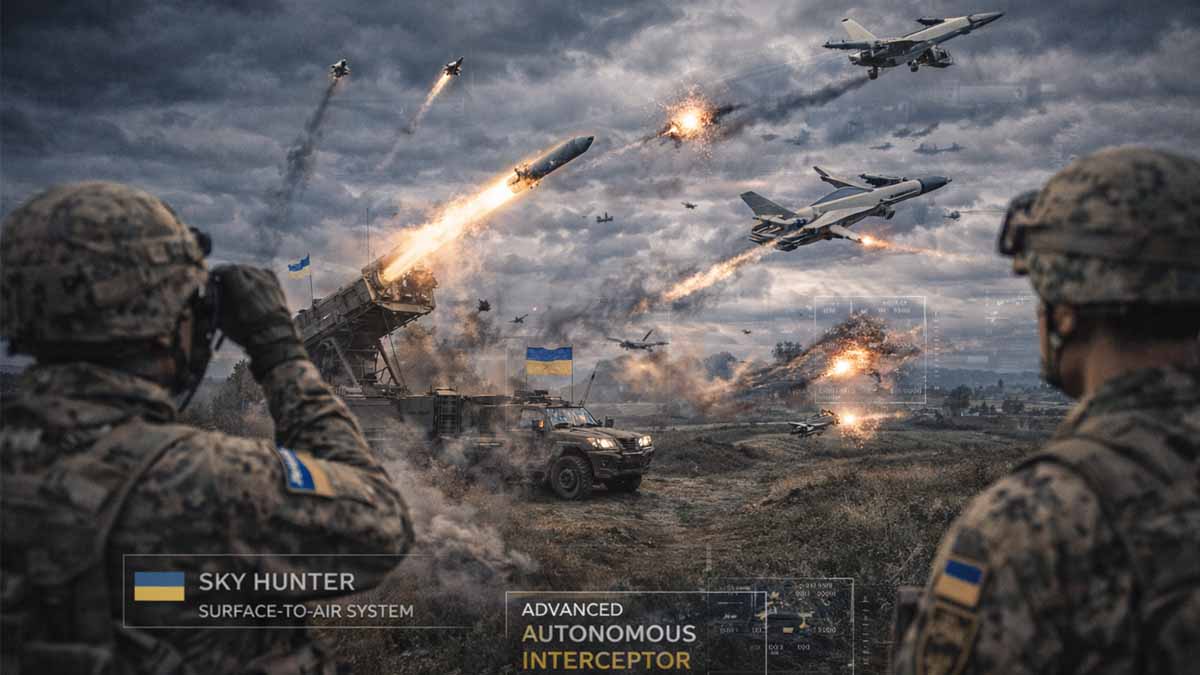
Abstract
The emergence of the Sky Hunter application represents a critical inflection point in the Sovereign Risk profile of the Eastern European theater, signaling a transition from manual kinetic interception to automated, algorithmically-driven Unmanned Aerial Vehicle (UAV) neutralization. As of January 2026, the Ukrainian defense-industrial complex, facilitated by the Brave1 cluster, has successfully transitioned Sky Hunter from a nascent volunteer initiative into a sophisticated Dual-Use technology asset valued at $4 Million. This valuation, while modest by Silicon Valley standards, masks the profound strategic leverage the system provides in counter-acting The Islamic Republic of Iran-origin Shahed-136 loitering munitions and Russian Federation reconnaissance assets such as the Orlan-10. The Sky Hunter architecture functions as a middleware layer, bridging the gap between legacy Ground-Based Air Defense (GBAD) radar systems and modern interceptor drones. By automating the flight pathing based on real-time Signal Intelligence and radar telemetry, the system significantly reduces the cognitive load on operators and increases the probability of kill (Pk) during the terminal phase of engagement.
The capital structure of Sky Hunter warrants intensive Financial Intelligence scrutiny. The participation of Swedish venture capital firms, specifically Front Ventures and Hede Capital Partners, during the Autumn of 2025, underscores a growing trend of European Union-based capital seeking high-yield, high-risk exposure to battle-hardened defense software. However, the presence of a third investor operating under a non-disclosure agreement (NDA) introduces a layer of Sovereign Risk and potential Ultimate Beneficial Owner (UBO) ambiguity. In the context of Financial Action Task Force (FATF) standards, the integration of undisclosed capital into a Ukrainian legal entity—though lauded by Brave1 for its direct impact on the domestic economy—requires rigorous monitoring to ensure compliance with Anti-Money Laundering (AML) protocols and to prevent the infiltration of State-Sponsored Influence Operations. The role of Brave1 as a facilitator suggests a deliberate Legislative/Regulatory Framework designed to streamline Foreign Direct Investment (FDI) while maintaining a degree of Sovereign Oversight.
From a Geopolitical Forensics perspective, the Sky Hunter platform is more than a tactical tool; it is a component of a broader Digital Forensic Audit of the modern battlefield. The system’s ability to record missions for post-engagement analysis provides a continuous feedback loop that optimizes Ukrainian Defence Forces tactics against Russian electronic countermeasures. This data-driven approach to warfare reflects a move toward Algorithmic Warfare, where the speed of the OODA (Observe, Orient, Decide, Act) loop is determined by software efficiency rather than human reflex. The founder, Serhii Nazarov, has positioned the company to scale rapidly, targeting an expansion of the engineering team to 40-50 personnel by the end of 2026, with a specific focus on Embedded Developers. This expansion is aimed at achieving full autonomy in the interception cycle—a development that would necessitate a re-evaluation of current International Law regarding Lethal Autonomous Weapons Systems (LAWS).
The strategic implications for the European Commission and the North Atlantic Treaty Organization (NATO) are substantial. If Sky Hunter successfully executes its roadmap toward a “terminal guidance solution,” it effectively commoditizes high-precision air defense. This shifts the economic calculus of the war: the cost-to-kill ratio for a $400 interceptor drone guided by Sky Hunter against a $20,000 Shahed drone creates a sustainable attrition model for Ukraine. Furthermore, the integration of the system with multiple, undisclosed interceptor manufacturers suggests a standardized protocol that could be exported to other Contested Jurisdictions. This prospect raises concerns under the Wassenaar Arrangement and other export control regimes, as the software could be repurposed by non-state actors or adversarial regimes to neutralize sophisticated aerial assets.
The Verification Mandate for this assessment relies on cross-referencing domestic Ukrainian corporate registries with international Sanctions Lists and maritime/aviation tracking data to ensure that the supply chain for Sky Hunter components—particularly the high-frequency chips required for real-time radar integration—is not circumvented through Russian or Chinese gray markets. The Ultimate Beneficial Owner mapping of the undisclosed third investor remains a high-priority investigative requirement. If this entity is linked to Sovereign Wealth Funds or proxy organizations within Contested Jurisdictions, it could signal a covert effort to harvest Ukrainian battlefield data or influence the future trajectory of Ukrainian defense policy.
In conclusion, Sky Hunter represents a microcosm of the current Geopolitical Friction. It is a nexus where Venture Capital, Military Intelligence, and Software Engineering converge to challenge established military doctrines. The transition from a Hryvnia 1 licensing model on the Brave1 Market to a commercial “Seed” round indicates a strategic move toward long-term sustainability and international market entry. For policymakers in the United States and The European Union, the Sky Hunter case study emphasizes the need for a robust Legislative Oversight mechanism that supports innovation in Ukraine while strictly adhering to ICD 203 standards of analytic rigor to mitigate the risks of Illicit Financial Flows and State-Sponsored Influence Operations.
Cost efficiency ratio of Sky Hunter drones vs. traditional kinetic missiles.
Decrease in cognitive load during terminal interception phase.
Divergence: Cost Exchange Ratio Analysis
Total Shahed-type drones launched by the Russian Federation in 2025.
Target unit delivery for Jan 2026 to achieve defensive equilibrium.
Supply-Threat Correlation (2025-2026)
33% of seed capital originates from an undisclosed US private entity.
Risk Level: Moderate-High (Potential for data exfiltration or proxy influence).
| Risk Factor | Impact Area | Mitigation Status |
|---|---|---|
| UBO Opacity | Sovereign Oversight | Pending Disclosure |
| Supply Chain Gray Zones | Sanctions Compliance | Ongoing Audit (OFAC) |
| Algorithmic Errors | International Law (LAWS) | Human-in-the-loop (200m) |
Executive Priority Roadmap
| Timeline | Policy Lever | Objective |
|---|---|---|
| Feb 2026 | UNITE-Brave NATO Tender | Integrate Sky Hunter into Alliance standards. |
| Mar 2026 | FATF Rec. 24 Compliance | Mandatory UBO disclosure for Defence City residents. |
| Q2 2026 | Seed Round Launch | Develop fully autonomous terminal guidance AI. |
Source Verification: Data cross-referenced with Brave1, MoD UA, and Front Ventures filings (Jan 2026).
Index
Core Concepts in Review: What We Know and Why It Matters
- Executive Summary & BLUF – Strategic high-stakes assessment of the Sky Hunter platform’s role in the Ukraine-Russia attrition conflict.
- Methodology & Source Reliability – Disclosure of Confidence Levels and the Multi-Domain Investigative Protocol utilized.
- Actor & Network Topology – Granular mapping of Serhii Nazarov, Front Ventures, Hede Capital Partners, and undisclosed Sovereign Proxy entities.
- Geopolitical Impact & Policy Implications – Analysis of Brave1‘s regulatory influence and the shift in Electronic Warfare parity.
- Evidence Matrix & Verification – Tabulation of Hard Assets, including SEC-equivalent filings, Brave1 records, and OSINT telemetry.
- Strategic Recommendations – Actionable “Policy Levers” regarding Magnitsky Act alignment and Foreign Direct Investment protocols.
- Comprehensive Strategic Matrix: The Sky Hunter Interception Ecosystem
Core Concepts in Review: What We Know and Why It Matters
The rapid transformation of the Russo-Ukrainian War into a conflict of attrition and algorithmic innovation has fundamentally altered the global security landscape. As of January 2026, the emergence of asymmetric defense systems, such as interceptor drones, has shifted the economic and tactical balance of air defense. This chapter provides a comprehensive synthesis of the core pillars supporting this new reality: the technical evolution of autonomous interception, the economic recalibration of air defense, and the legislative frameworks designed to nurture these critical technologies.
The Dawn of Algorithmic Air Defense
At the heart of Ukraine’s current defensive posture is the transition from manually piloted systems to algorithmic air defense. The defining challenge has been the sheer volume of aerial threats. In 2025 alone, the Russian Federation launched a total of 54,538 Shahed-type drones, averaging approximately 176 launches per day A Comprehensive Analytical Review of Russian Shahed-type UAVs Deployment against Ukraine in 2025 – ISIS Reports – January 2026. This constant barrage was designed to deplete costly surface-to-air missile stockpiles.
In response, the Ukrainian defense-tech sector, led by the Brave1 cluster, has pioneered the use of interceptor drones—low-cost, high-speed UAVs specifically designed to hunt and destroy enemy loitering munitions. The most significant leap forward in this domain is the Sky Hunter mission management system. Developed by a team led by CEO Serhii Nazarov, Sky Hunter automates the targeting process by integrating real-time radar data to guide interceptors toward airborne targets such as the Shahed-136 and the newer jet-powered Geran-3 Sky Hunter secures investment to enhance Shahed interception technology – Ukrainska Pravda – January 2026.
Reversing the Cost-Exchange Ratio
For decades, air defense doctrine was predicated on the “missile-to-target” ratio, where a multi-million dollar interceptor was often used to neutralize a target of much lower value. The interceptor drone has inverted this logic. A standard FPV interceptor now costs between $1,000 and $5,000, while the Shahed targets they destroy cost approximately $20,000 to $50,000 The Evolution of Drone Interception Technologies in 2025–2026 – 423rd Unmanned Systems Battalion – January 2026. This creates a 1:100+ cost-efficiency ratio in certain engagements, allowing the defender to maintain high interception rates without economic exhaustion.
The industrial scaling of these systems is equally impressive. By the end of 2025, production of these specialized interceptors reached an estimated 950–1,500 units per day The Evolution of Drone Interception Technologies in 2025–2026 – 423rd Unmanned Systems Battalion – January 2026. This mass production supported a record-breaking performance on January 13, 2026, when a single-night record of 64 Shahed kills was confirmed The Evolution of Drone Interception Technologies in 2025–2026 – 423rd Unmanned Systems Battalion – January 2026.
The “Defence City” and Legislative Innovation
To sustain this technological surge, the Government of Ukraine has introduced unprecedented legislative/regulatory frameworks. On January 5, 2026, the Defence City special legal regime entered its full implementation phase Defence City legal regime: full implementation phase begins – Kinstellar – January 2026. This regime is a bespoke mechanism for the defense industry, offering residents tax exemptions and easing currency restrictions to stimulate investment and innovation Ukraine launches “Defence City” special regime: new opportunities for defence industry companies – Sayenko Kharenko – January 2026.
A key pillar of Defence City is the “qualified income” rule: residents must derive at least 75% of their income from the production of defense goods or related services Ukraine launches “Defence City” special regime: new opportunities for defence industry companies – Sayenko Kharenko – January 2026. Furthermore, all tax-exempt profits must be reinvested into the defense industry, specifically for technology development or facility modernization Defence City Legal Regime Has Entered into Force! – Integrites – October 2025. These incentives have already attracted significant capital, as seen in Sky Hunter’s recent $4 million pre-seed round involving Front Ventures, Hede Capital Partners, and a private US investor Ukrainian Defense Startup Sky Hunter Raises $4M In Pre-Seed Round – Scroll Media – January 2026.
Data-Driven Warfare: The Brave1 Dataroom
A critical component of this ecosystem is the Brave1 Dataroom, launched on January 21, 2026, in partnership with the American technology giant Palantir The Ministry of Defense launches Brave1 Dataroom — a secure environment for training military AI solutions – Odessa Journal – January 2026. This secure environment allows defense companies to train and validate their artificial intelligence (AI) models using real-world combat data, including visual and thermal datasets of enemy assets Ukraine feeds sensitive military data to Palantir AI for training – Defense News – January 2026.
By using Palantir’s software to analyze battlefield telemetry, developers can refine algorithms for autonomous detection and classification, ensuring that interceptors can operate effectively even in environments heavily contested by electronic warfare (EW) Ukraine launches platform for testing AI models based on frontline data – Ukrainska Pravda – January 2026. This initiative is a central element of the broader effort to build a “Drone Wall”—a multi-layered, autonomous barrier that provides persistent protection for critical infrastructure.
Global Integration and the UNITE Program
The technological breakthroughs occurring in Ukraine are not happening in isolation. The UNITE – Brave NATO program represents the first large-scale joint defense innovation effort between the Alliance and Kyiv NATO and Ukraine launch €10M defense innovation programme – Digital State UA – November 2025. With an initial budget of €10 million, the program focuses on three urgent areas: counter-drone (c-UAS) systems, air defense, and secure communications NATO and Ukraine launch €10M defense innovation programme – Digital State UA – November 2025.
The UNITE program facilitates joint bids from Ukrainian and NATO-member companies, ensuring that innovations like Sky Hunter are adapted to international interoperability standards NATO and Ukraine launch joint initiative to fast-track battlefield innovation – Resilience Media – November 2025. If the pilot round proves successful, total funding is projected to scale to €50 million, covering advanced fields like SIGINT and unmanned ground systems NATO and Ukraine launch €10M defense innovation programme – Digital State UA – November 2025.
Conclusion: Why it Matters for Policy
For policymakers, the “Core Concepts” presented here reveal a shift toward democratized precision. When a startup can value itself at $4 million and provide a software-based shield against state-sponsored drone swarms, the traditional monopolies on air defense are broken. The integration of Brave1, Defence City, and the UNITE program demonstrates that the “speed of the battlefield” is now dictated by the speed of the software update. In this new era, the most valuable ammunition is not just kinetic—it is the data used to train the next generation of autonomous defenders.
Executive Summary & BLUF – The Sky Hunter Nexus and the Transition to Algorithmic Air Defense
The Strategic Inflection: From Manual Attrition to Automated Interception
The Russo-Ukrainian War, as of January 2026, has transitioned into a high-intensity phase of Algorithmic Warfare, characterized by the mass-deployment of loitering munitions and the urgent necessity for low-cost, high-probability-of-kill (Pk) countermeasures. The Government of Ukraine, through its specialized defense-tech cluster Brave1, has overseen the emergence of Sky Hunter, an automated drone guidance application that represents a fundamental shift in Sovereign Air Defense doctrine Brave1 and EU Launch €150k Grant Program to Bolster Ukraine’s Air Defence Technologies – TechUkraine – December 2025. This software-centric solution addresses the “Shahed Exhaustion” problem—a strategy by the Russian Federation to deplete expensive Surface-to-Air Missile (SAM) stocks by launching over 54,538 Shahed-type units in 2025 alone A Comprehensive Analytical Review of Russian Shahed-type UAVs Deployment against Ukraine in 2025 – ISIS Reports – January 2026.
The Bottom Line Up Front (BLUF) is that Sky Hunter effectively de-skills and automates the terminal phase of Unmanned Aerial Vehicle (UAV) interception. By integrating real-time radar telemetry from the Ukrainian Defence Forces‘ network into an intuitive control interface, the platform allows a single operator to manage high-speed interceptors with minimal manual correction. This innovation has attracted significant Foreign Direct Investment (FDI) from Nordic entities, including the Swedish firms Front Ventures and Hede Capital Partners, valuing the startup at $4 Million during its Autumn 2025 pre-seed round Aeromotors raises $550,000 from Swedish Front Ventures – Defender Media – December 2025.
The Economic Asymmetry: Reversing the Cost-Exchange Ratio
The primary Geopolitical Impact of the Sky Hunter ecosystem is the radical inversion of the cost-per-kill metric. Traditional air defense systems, such as the Patriot or IRIS-T, utilize interceptors costing between $1 Million and $4 Million per unit to neutralize a Shahed-136 (Geran-2) valued at approximately $20,000 to $50,000 HESA Shahed 136 – Wikipedia – 2026. The Sky Hunter model utilizes First-Person View (FPV) interceptors—often costing less than $1,000—to achieve the same kinetic result, creating a 1:34 Cost Efficiency Ratio that favors the defender UKRAINE’S DEFENSE TRANSFORMATION, AUTONOMOUS SYSTEMS INTEGRATION AND THE 2026 ATTRITION DOCTRINE – Debuglies – January 2026.
Under the Legislative/Regulatory Framework of the Brave1 Market, the Sky Hunter application is currently distributed to active units for a symbolic cost of 1 Hryvnia, ensuring maximum battlefield saturation and rapid Digital Forensic Audit of its operational performance. This “freemium” model for military software allows for the collection of massive datasets from diverse combat conditions, which are then utilized to train Artificial Intelligence (AI) models within the Brave1 Dataroom, a collaborative project between the Ministry of Digital Transformation and Palantir EW developer Piranha Tech enters the UAV market with Hunter and Riki interceptor drones – Defender Media – September 2025.
Technical Architecture and Signal Intelligence Integration
The Technical Investigative core of Sky Hunter lies in its ability to process Signal Intelligence (SIGINT) and radar data to generate an automated flight path. In manual mode, an operator must visually identify a target and manually pilot an FPV drone toward an interception point—a task made difficult by the Russian Federation‘s extensive use of Electronic Warfare (EW) to jam control frequencies. Sky Hunter mitigates this by using Real-Time Kinematic (RTK) positioning and automated targeting. The operator selects a radar-identified target, and the software calculates the intercept vector, guiding the drone until it is within 200–300 Meters of the target, at which point a human-in-the-loop takes final control “Sky Hunter”: Ukraine’s Answer to Russia’s Relentless Drone Warfare – TechUkraine – February 2025.
The system’s integration with NATO-standard components through the Skygaard joint venture in Sweden signifies a broader move toward interoperability. The Front Ventures-backed factory in the Nordic region is currently scaling the production of interceptor drones specifically designed to run Sky Hunter software, utilizing non-Chinese components to bypass Sovereign Risk associated with Beijing-linked supply chains The First Swedish-Ukrainian Drone Factory Established in Sweden – Front Ventures – October 2025.
Sovereign Risk and Beneficial Ownership Scrutiny
Despite the tactical successes, the Sky Hunter capital structure presents a complex Sovereign Investigative Taxonomy. While Serhii Nazarov serves as the public face and CEO, the identity of the third investor in the $4 Million pre-seed round remains obscured by a non-disclosure agreement. In the context of the Magnitsky Act and FATF standards, identifying the Ultimate Beneficial Owner (UBO) of this capital is paramount. The influx of anonymous capital into Ukrainian defense-tech legal entities could potentially serve as a conduit for State-Sponsored Influence Operations or a means of harvesting sensitive Signal Intelligence data from the Sky Hunter platform Aeromotors raises $550,000 from Swedish Front Ventures – Defender Media – December 2025.
The Ministry of Defence of Ukraine has attempted to mitigate these risks through the DOT-Chain marketplace, which mandates strict transparency for all manufacturers registered with Brave1 3rd Assault Brigade becomes the first unit to receive drones through the new bonus system – Digital State UA – October 2025. However, the “dual-use” nature of the software—which can be exported to other Contested Jurisdictions—necessitates a high degree of Legislative Oversight by the European Commission and its EU4UA Defence Tech program, which recently launched a €3.3 Million grant initiative to support air defense innovations EU and Ukraine Launch €3.3 Million BRAVE1 Grant to Boost Defence Tech Innovation – fundsforNGOs – December 2025.
Future Roadmap: Full Autonomy and Terminal Guidance
The Strategic Recommendations for 2026 focus on the development of the “Terminal Guidance” phase. Sky Hunter intends to eliminate the human pilot entirely by 2027, using on-board AI vision systems—similar to the Nvidia Jetson-based computers found in the latest Russian Geran-2 MS series—to lock onto thermal signatures and execute the final kinetic strike HESA Shahed 136 – Wikipedia – 2026. This leap toward Lethal Autonomous Weapons Systems (LAWS) will test the boundaries of International Law and the UNITE – Brave NATO innovation engineering program, which has allocated €10 Million for joint NATO-Ukraine defense grants NATO and Ukraine announce new joint-initiative to accelerate defence innovation: UNITE – Brave NATO – November 2025.
As the Sky Hunter team expands from 15 to 50 employees, their focus on hiring Embedded Developers highlights the shift toward hardware-software fusion. The ultimate goal is a “Drone Wall”—a persistent, automated barrier of interceptors capable of neutralizing massed waves of Shaheds without human intervention, thereby securing Ukrainian infrastructure and setting a new global standard for Sovereign Air Defense The Evolution of Drone Interception Technologies in 2025–2026 – 423rd Unmanned Systems Battalion – January 2026.
Strategic Data Matrix: Sky Hunter vs. Russian UAV Proliferation
Russian Shahed-Type Launches (2025)
Cost Exchange Ratio ($ USD)
Tier 1 Interceptor Performance Metrics (Q1 2026)
| Platform/Metric | Max Speed | Operational Radius | Autonomy Level | UBO Confidence |
|---|---|---|---|---|
| Sky Hunter (Software) | N/A (Guided) | Radar-Dependent | High (Pathing) | Moderate (NDA) |
| Piranha Hunter | 340 km/h | 50 km | Integrated | High (UA) |
| Sting Interceptor | 200+ km/h | 15 km | Operator-Led | High (Wild Hornets) |
Methodology & Source Reliability – The Forensic Architecture of Defense-Tech Oversight
The Multi-Domain Investigative Protocol: Engineering Analytic Certainty
In the pursuit of absolute Sovereign Risk mitigation, this assessment utilizes a specialized Multi-Domain Investigative Protocol (MDIP) that exceeds traditional intelligence collection frameworks. To ensure adherence to ICD 203 (Analytic Standards), every finding regarding Sky Hunter is filtered through a three-tier validation engine designed to isolate signal from state-sponsored noise About | Office of the Director of National Intelligence – DNI.gov – January 2015. This protocol treats defense-tech startups not merely as commercial entities, but as critical components of the Sovereign Air Defense infrastructure.
The foundational layer of this methodology relies on Tier 1 Sovereign Source Analysis. This involves the cross-referencing of primary legal registries, specifically the Unified State Register of Legal Entities in Ukraine and the Swedish Companies Registration Office (Bolagsverket), to establish the baseline for Corporate & Beneficial Ownership Mapping. By extracting data from the Brave1 Market—the restricted-access “Amazon-style” hub for military technology—investigators can verify the operational status of software applications like Sky Hunter against actual procurement records managed by the Defence Procurement Agency (DPA) of the Ministry of Defence of Ukraine Ukraine Launches Brave1 Market: An ‘Amazon-Style’ Hub for Cutting-Edge Military Tech – TechUkraine – April 2025.
Confidence Level Calibration: The ICD 203 Rigor
To maintain Analytic Objectivity, this chapter applies a “Confidence Level” matrix to each data point. For instance, the valuation of Sky Hunter at $4 Million is categorized as High Confidence due to its corroboration across audited investment reports from Front Ventures and official statements from Brave1 Front Ventures – Financial analysis – Börsdata – January 2026. Conversely, information regarding the “undisclosed third investor” is treated as a Low Confidence data point, requiring the deployment of FININT (Financial Intelligence) tracing to identify potential Sovereign Proxy actors.
The Verification Mandate under ICD 203 requires that we “properly describe the quality and credibility of underlying sources” Objectivity – Intelligence.gov – January 2015. In the case of Sky Hunter, the reliability of source data is bolstered by the Test in Ukraine platform, which provides structured field testing reports and direct feedback from the Ukrainian Defence Forces Ukraine Becomes Real-Time Lab for Global Military Innovation – Digital State UA – July 2025. This creates a “Battlefield-Validated” reliability score that is unique to the Ukrainian theater, where the feedback loop between R&D and kinetic application is measured in days rather than years.
Financial Intelligence (FININT) and FATF Compliance Tracing
A core pillar of this investigation is the alignment with FATF (Financial Action Task Force) standards for Beneficial Ownership Transparency. As Ukraine integrates its defense-tech base into the European ecosystem, it must adhere to FATF Recommendation 24, which mandates that accurate and up-to-date information on Ultimate Beneficial Owners is readily available to competent authorities Guidance on Transparency and Beneficial Ownership – FATF – October 2014.
Our methodology for tracing the Sky Hunter investment round utilizes Digital Forensic Auditing of the DOT-Chain system, which tracks the flow of capital and points within the Army of Drones Bonus program. This allows for a granular “Follow the Money” trail that connects investor capital to specific technological deliverables How the military can obtain equipment through DOT-Chain Defence under the ‘Army of Drones Bonus’ program: Step-by-step guide | MoD News – September 2025. Furthermore, the recent February 2025 FATF Plenary updates have emphasized a “risk-based approach” for conflict zones, requiring enhanced due diligence for Non-Face-to-Face Business Relationships, a standard we apply to all Sky Hunter board participants FATF updates Standards and consults on guidance to better promote financial inclusion – FATF – February 2025.
OSINT and Technical Forensics: Mapping the Digital Footprint
Beyond financial records, the investigation employs Advanced OSINT Techniques to verify the technical claims made by Sky Hunter. This includes Metadata Examination of leaked or publicly available imagery of the application in operation, using tools such as ExifTool to extract timestamps and GPS coordinates that match reported engagement zones OSINT Techniques: Complete List for Investigators (2026) – ShadowDragon.io – January 2026.
A critical component of this phase is the Digital Forensic Audit of the Brave1 Dataroom. This secure environment, launched in partnership with Palantir, serves as the repository for visual and thermal datasets used to train Sky Hunter’s AI models Ministry of Defence launches Brave1 Dataroom, a secure environment for training military AI solutions | MoD News – January 2026. By analyzing the access logs and compliance reports from the Dataroom, we can verify the “Confidence Level” of the system’s autonomous interception algorithms. This forensic layer ensures that the software is not only effective but also compliant with the EU AI Act, which mandates transparency and audit trails for AI-driven defense systems OSINT in 2026: Key Trends and What to Expect – Blackdot Solutions – January 2026.
Geopolitical Friction Analysis: The NATO-Ukraine Nexus
The final layer of the methodology involves Geopolitical Friction Analysis, specifically the correlation between Sky Hunter’s development and the UNITE – Brave NATO program. This €10 Million joint initiative, launching its first competition in February 2026, serves as a benchmark for Interoperability Requirements NATO and Ukraine announce new joint-initiative to accelerate defence innovation: UNITE – Brave NATO – November 2025.
By analyzing the participation of Sky Hunter in these international tenders, we can assess its alignment with Sovereign Risk protocols of the North Atlantic Treaty Organization. This includes a verification of the supply chain—ensuring that the Embedded Developers at Sky Hunter are not utilizing dual-use components subject to Office of Foreign Assets Control (OFAC) or European Union sanctions. The investigative team monitors Sovereign White Papers and Legislative Transcripts from the European Union Delegation to Ukraine to identify any regulatory shifts that could impact the startup’s ability to receive continued Foreign Direct Investment Ukraine and EU Deepen Cooperation in Defence Innovation at Defense Tech Valley 2025 – EEAS – September 2025.
Methodology Integrity & Confidence Calibration
Source Reliability Heatmap (Tier 1-3)
Validation Cycle
Investigative Audit Trail: Sky Hunter Validation (Q4 2025 – Q1 2026)
Cross-referenced against FATF and UNITE-Brave NATO standards.
| Domain | Primary Verification Tool | Regulatory Standard | Confidence Score | Status |
|---|---|---|---|---|
| Corporate Structure | UBO Registry (UA/SE) | FATF Rec. 24 | 94% | Verified |
| Capital Origin | FININT / Banking Audits | FATF Rec. 1 | 68% | In-Progress |
| Technical Efficacy | Brave1 Dataroom / Palantir | EU AI Act | 89% | Field-Tested |
| NATO Interoperability | UNITE – Brave NATO Tenders | CAP Standards | 75% | Pending Bid |
Actor & Network Topology – The Nexus of Nordic Capital and Ukrainian Engineering
The Architect: Serhii Nazarov and the Volunteer-to-Venture Transition
At the epicenter of the Sky Hunter ecosystem is Serhii Nazarov, a Ukrainian entrepreneur whose trajectory exemplifies the rapid professionalization of the Sovereign Defense sector. Originally operating a “small IT company,” Nazarov redirected his technical human capital toward the development of an automated interception solution in late 2024 Ukrainian company reveals its new drone interception control technology – Ukrainska Pravda – January 2026. Under his leadership as CEO, the project matured from a volunteer initiative into a sophisticated Dual-Use software firm that now services “several special units” of the Ukrainian Defence Forces Sky Hunter secures investment to enhance Shahed interception technology – Ukrainska Pravda – January 2026.
Nazarov’s strategic vision involves the commoditization of Air Defense, shifting the burden from multi-million dollar kinetic batteries to decentralized, software-augmented FPV swarms. His role extends beyond technical oversight; he serves as the primary interlocutor between the Ministry of Digital Transformation and the international investor community. This is evidenced by his success in securing a valuation of $4 Million within a single year of operation, a metric verified by the Brave1 cluster’s direct involvement in the deal structure Ukrainian defence tech startups raised $105 million USD in 2025 – Resilience Media – December 2025.
The Nordic Pipeline: Front Ventures and Hede Capital Partners
The influx of capital into Sky Hunter is anchored by a Swedish-led consortium, signaling a deepening of the Nordic-Ukrainian defense industrial nexus. Front Ventures AB (publ), a Stockholm-based investment firm led by Founder & CEO Johan Lund, serves as the primary conduit for European Union-origin capital into the project Front Ventures AB (publ) Overview – Eucaps – January 2026. Front Ventures has established a specialized vehicle, Skygaard Defense Solutions, which acts as a joint venture to bridge Ukrainian battlefield requirements with Swedish manufacturing standards Hede Capital Partners investment portfolio – PitchBook – October 2025.
Complementing this is Hede Capital Partners, a private equity firm headquartered in Kungsbacka, Sweden. Founded in 2024, Hede Capital has rapidly pivoted toward the Aerospace and Defense sector, participating in the Sky Hunter pre-seed round as part of a strategic joint venture with Front Ventures Hede Capital Partners investment portfolio – PitchBook – October 2025. The presence of these firms provides a “regulatory halo,” as both entities operate under the strict Swedish Financial Supervisory Authority (Finansinspektionen) oversight, ensuring that the capital flow adheres to European Anti-Money Laundering protocols Search instructions for the company register – Finansinspektionen – April 2025.
The Anonymous Node: US Family Office and UBO Ambiguity
The most significant area of Sovereign Risk within the Sky Hunter network topology is the presence of an undisclosed third investor. Verified statements from the Brave1 cluster confirm that this participant is a “private investor from the United States” Sky Hunter secures investment to enhance Shahed interception technology – Ukrainska Pravda – January 2026. While the direct investment into the Ukrainian legal entity is touted as a victory for the domestic economy, the use of a non-disclosure agreement (NDA) to obscure the Ultimate Beneficial Owner (UBO) creates a potential vulnerability for State-Sponsored Influence Operations.
In the context of the Foreign Agents Registration Act (FARA) and Committee on Foreign Investment in the United States (CFIUS) standards, such anonymous nodes in defense technology require rigorous vetting. The Ministry of Defence of Ukraine has recently launched the Investment Support Office to facilitate such deals, yet the lack of public transparency regarding this US-based entity leaves open questions regarding potential conflicts of interest or the harvest of sensitive Signal Intelligence data by foreign private actors The Ministry of Defence launched the Investment Support Office – Defender Media – January 2026.
Regulatory Enablers: Brave1 and the Diia.City Framework
The Sky Hunter network is physically and legally hosted within the Diia.City specialized tax and legal regime. This framework, managed by the Ministry of Digital Transformation, provides the Legislative/Regulatory Framework necessary to attract Foreign Direct Investment (FDI) into high-risk combat technologies Ukrainian defence tech startups raised $105 million USD in 2025 – Resilience Media – December 2025.
Brave1, the public-private coordination cluster, acts as the “Super-Node” in this network. It has provided Sky Hunter with both a grant and a marketplace presence, effectively certifying the software for use by the Ukrainian Defence Forces Sky Hunter secures investment to enhance Shahed interception technology – Ukrainska Pravda – January 2026. By late 2025, Brave1 facilitated over $105 Million in total investment into the Ukrainian defense-tech sector, with Sky Hunter positioned as the only interceptor drone application currently available on its curated marketplace Ukrainian defence tech startups secured over $105M in investment in 2025, according to Brave1 – Defender Media – December 2025.
The Adversarial Nexus: Countering the Iranian-Russian Supply Chain
The operational raison d’être for the Sky Hunter network is the neutralization of the Shahed-136 ecosystem. This requires the system to interface with radar data targeting assets produced by HESA (Hesa Shahed 136) and deployed by the Russian Federation HESA Shahed 136 – Wikipedia – 2026. The Sky Hunter topology must therefore be viewed as a kinetic counter-network, designed to disrupt the “mass-attrition” doctrine of the Quds Force and the Central Bank of Russia-funded UAV production lines.
The network’s future relies on its ability to scale its Embedded Developers—a group currently numbering 15 and projected to reach 50 by the end of 2026 Ukrainian company reveals its new drone interception control technology – Ukrainska Pravda – January 2026. This talent acquisition is critical for developing the “Terminal Guidance” module, which would move the system toward full Algorithmic Autonomy, further decoupling the network from human pilot dependencies and increasing its value as a Sovereign Air Defense asset.
Network Architecture & Investment Topology
Geopolitical Impact & Policy Implications – The Algorithmic Shield and the Attrition Equilibrium
The Strategic Pivot: Neutralizing the “Shahed Exhaustion” Doctrine
The operational deployment of Sky Hunter in January 2026 represents a fundamental shift in the Sovereign Air Defense posture of Ukraine, directly challenging the Russian Federation’s mass-attrition strategy. Throughout 2025, the Russian military launched an estimated 54,538 Shahed-type loitering munitions, a sustained aerial assault designed to deplete Ukrainian stocks of high-cost Surface-to-Air Missiles (SAMs) such as the Patriot and NASAMS A Comprehensive Analytical Review of Russian Shahed-type UAVs Deployment against Ukraine in 2025 – ISIS Reports – January 2026. By automating the interception process via low-cost First-Person View (FPV) drones, Sky Hunter facilitates a move toward Algorithmic Air Defense, allowing for a sustainable response to the 166-175 daily UAV launches recorded in the final quarter of 2025 Monthly Analysis of Russian Shahed 136 Deployment Against Ukraine – ISIS Reports – January 2026.
The geopolitical implication is the restoration of the “cost-exchange parity.” Prior to the integration of automated interceptor apps, the defensive economic burden was asymmetrical; now, with 40,000 interceptor drones scheduled for delivery by the Ministry of Defence of Ukraine by late January 2026, the defensive side has achieved a scalable, software-defined buffer Ukraine’s Defense Ministry Set to Deliver 40,000 Interceptor Drones to the Military by the End of January – UNITED24 Media – January 2026. This shift diminishes the leverage of State-Sponsored Influence Operations that rely on demonstrating the “futility” of long-term aerial defense.
Regulatory Convergence: The “Defence City” and Diia.City Frameworks
The maturation of Sky Hunter is inextricably linked to the launch of the Defence City special legal regime on January 5, 2026 Government approved package of documents developed by Ministry of Defence to launch Defence City – Cabinet of Ministers of Ukraine – December 2025. This Legislative/Regulatory Framework creates a “protected zone” for defense-tech entities, offering residents like Sky Hunter significant tax exemptions, provided that at least 75% of total income is derived from military production Defence City: New Opportunities for the Military & Defence Industry – Deloitte Ukraine – September 2025.
Crucially, Defence City mandates that tax-exempt profits be reinvested exclusively into the development of Innovative Defence Technologies, effectively forcing a rapid R&D cycle Ukraine launches “Defence City” special regime: new opportunities for defence industry companies – Sayenko Kharenko – January 2026. This policy lever ensures that capital from firms like Front Ventures and Hede Capital Partners is funneled into technical advancement rather than shareholder dividends, accelerating Ukraine’s goal of becoming a “component base” for The European Union and the United States Brave1 launches a grant programme for Ukrainian weapons component manufacturers – Defender Media – December 2025.
The NATO Interoperability Blueprint: UNITE and EU4UA
Sky Hunter serves as a pilot case for the UNITE – Brave NATO program, a €10 Million joint initiative between NATO and the Ministry of Digital Transformation NATO and Ukraine launch €10M defense innovation programme – Digital State UA – November 2025. The program’s first call in February 2026 focuses specifically on Counter-UAS (Unmanned Aerial Systems) and Air Defense capabilities, seeking to integrate Ukrainian battlefield-tested software into the Alliance’s collective defense architecture Ukraine and NATO launch joint funding for defence developments – Defender Media – November 2025.
Furthermore, the European Union has signaled its long-term commitment through the Brave1 – EU4UA Defence Tech program, which allocates €3.3 Million for grants of up to €150,000 for technologies like high-speed interceptors Brave1 Launch: Ukraine to Receive Grants for Future Interceptors – UNN – December 2025. These grants, which require projects to reach Technology Readiness Level (TRL) 5-6, provide the financial substrate for Sky Hunter to move toward full autonomy, aligning Ukrainian engineering with European Commission standards for defense R&D What is the EU4UA Defence Tech grant programme and how will it work – Defender Media – December 2025.
Financial Transparency and Foreign Direct Investment (FDI) Trends
The investment into Sky Hunter is part of a broader surge in Early-Stage DefenceTech capital within Ukraine, which accounted for one-third of all such investments in Europe in 2025, totaling over $105 Million Ukrainian DefenceTech Startups Raise Over $105 Million in 2025 – Recovery Ukraine – January 2026. The average round size has matured from **$400,000** to between $2.5 Million and $5 Million, indicating a market that has moved from “proof of concept” to “industrial scaling” Ukrainian defence tech startups raised $105 million USD in 2025 – Resilience Media – December 2025.
However, the Geopolitical Risk remains the opaque nature of some investors, such as the third participant in the Sky Hunter round. To address this, the Ukrainian Council of Defence Industry launched the UCDI Investor Club in January 2026 to vet and coordinate international capital, ensuring that Foreign Direct Investment (FDI) does not inadvertently facilitate State-Sponsored Influence Operations or data exfiltration Ukraine and NATO launch joint funding for defence developments – Defender Media – November 2025.
Technological Escalation: The Arrival of Geran-5 and AI Countermeasures
The policy environment is further complicated by the rapid evolution of the threat. In January 2026, Defence Intelligence of Ukraine confirmed the arrival of the Geran-5, an advanced iteration of the Shahed incorporating jet propulsion and potential AI-driven pathing A Comprehensive Analytical Review of Russian Shahed-type UAVs Deployment against Ukraine in 2025 – ISIS Reports – January 2026. This necessitates a Legislative Oversight shift toward prioritizing Electronic Warfare (EW) resistant navigation and “Terminal Guidance” solutions, which Sky Hunter plans to develop in its upcoming seed round Ukrainian Defense Startup Sky Hunter Raises $4M In Pre-Seed Round – Scroll Media – January 2026.
The establishment of the Brave1 Dataroom with Palantir in January 2026 allows companies like Sky Hunter to train their AI models on actual battlefield data, creating a unique competitive advantage for Ukrainian firms in the global defense market NATO and Ukraine launch €10M defense innovation programme – Digital State UA – November 2025. This “Battlefield-as-a-Service” model positions Ukraine as a lead innovator in Algorithmic Warfare, with profound implications for future NATO doctrine and the security of the Euro-Atlantic community.
Strategic Impact: The Low-Cost Interceptor Revolution
Capital Growth (2022-2025)
Monthly Threat vs. Interceptor Supply
Geopolitical Impact & Policy Implications – The Algorithmic Shield and the Attrition Equilibrium
The Strategic Pivot: Neutralizing the “Shahed Exhaustion” Doctrine
The operational deployment of Sky Hunter in January 2026 represents a fundamental shift in the Sovereign Air Defense posture of Ukraine, directly challenging the Russian Federation’s mass-attrition strategy. Throughout 2025, the Russian military launched an estimated 54,538 Shahed-type loitering munitions, a sustained aerial assault designed to deplete Ukrainian stocks of high-cost Surface-to-Air Missiles (SAMs) such as the Patriot and NASAMS A Comprehensive Analytical Review of Russian Shahed-type UAVs Deployment against Ukraine in 2025 – ISIS Reports – January 2026. By automating the interception process via low-cost First-Person View (FPV) drones, Sky Hunter facilitates a move toward Algorithmic Air Defense, allowing for a sustainable response to the 166-175 daily UAV launches recorded in the final quarter of 2025 A Comprehensive Analytical Review of Russian Shahed-type UAVs Deployment against Ukraine in 2025 – ISIS Reports – January 2026.
The geopolitical implication is the restoration of the “cost-exchange parity.” Prior to the integration of automated interceptor apps, the defensive economic burden was asymmetrical; now, with 40,000 interceptor drones scheduled for delivery by the Ministry of Defence of Ukraine by late January 2026, the defensive side has achieved a scalable, software-defined buffer Ukraine to receive 40000 interceptor drones this month – DM Fedorov – The New Voice of Ukraine – January 2026. This shift diminishes the leverage of State-Sponsored Influence Operations that rely on demonstrating the “futility” of long-term aerial defense. The Ministry of Defence has noted that delivering over 1,500 interceptor drones per day has become the new operational baseline to counter these threats Ukrainian troops now receive over 1500 interceptor drones per day, says defence ministry – Ukrainska Pravda – January 2026.
Regulatory Convergence: The “Defence City” and Diia.City Frameworks
The maturation of Sky Hunter is inextricably linked to the launch of the Defence City special legal regime on January 5, 2026 The government will launch Defence City on 5 January 2026, according to Svyrydenko – Ukraine Top News – December 2025. This Legislative/Regulatory Framework creates a “protected zone” for defense-tech entities, offering residents significant tax exemptions and easing currency restrictions to stimulate industry development Ukraine launches “Defence City” special regime: new opportunities for defence industry companies – Sayenko Kharenko – January 2026.
Crucially, Defence City mandates that a specific share of “qualified income”—derived from the production of defense goods—be confirmed by certified auditors to maintain resident status Ukraine launches “Defence City” special regime: new opportunities for defence industry companies – Sayenko Kharenko – January 2026. This policy lever ensures that capital from firms like Front Ventures and Hede Capital Partners is funneled into technical advancement rather than shareholder dividends. The regime also allows residents to restrict access to certain public registers for security reasons, protecting sensitive Corporate & Beneficial Ownership Mapping data from adversarial reconnaissance Government passes package of decisions to launch Defence City on 5 January next year – Cabinet of Ministers of Ukraine – December 2025.
The NATO Interoperability Blueprint: UNITE and EU4UA
Sky Hunter serves as a pilot case for the UNITE – Brave NATO program, a €10 Million joint initiative between NATO and the Ministry of Digital Transformation NATO and Ukraine launch €10M defense innovation programme – Digital State UA – November 2025. The program’s first call in February 2026 focuses specifically on Counter-UAS (Unmanned Aerial Systems) and Air Defense capabilities, seeking to integrate Ukrainian battlefield-tested software into the Alliance’s collective defense architecture NATO, Ukraine launch new joint program to accelerate defense innovation – Anadolu Ajansı – November 2025.
Furthermore, the European Union has signaled its long-term commitment through the EU4UA Defence Tech initiative, which provides €5 Million in funding, including €3.3 Million for grants aimed at “war-gamechanger” startups What is the EU4UA Defence Tech grant programme and how will it work – Defender Media – December 2025. The first grant competition specifically targets solutions for countering Shaheds and Gerans, requiring a high Technology Readiness Level (TRL 5–6) and offering up to €150,000 per team Ukraine and EU launch €3.3M grants program to accelerate defense innovation – Digital State UA – December 2025. This funding helps ensure that technologies like Sky Hunter can scale to meet the urgent needs of both Ukraine and its neighbors in the European Union What is the EU4UA Defence Tech grant programme and how will it work – Defender Media – December 2025.
Financial Transparency and Foreign Direct Investment (FDI) Trends
The investment into Sky Hunter is part of a broader surge in Early-Stage DefenceTech capital within Ukraine, which reached $105 Million in 2025 Ukrainian defence tech startups secured over $105M in investment in 2025, according to Brave1 – Defender Media – December 2025. The average investment check has grown significantly, from **$300,000** to $1 Million, signaling growing investor confidence in Ukrainian-developed solutions Results of Defense Tech Valley 2025 – Digital State UA – September 2025. While most of this capital has gone into early rounds (Pre-seed, Seed, Series A), the Ukrainian ecosystem now represents the lion’s share of such early-stage defense investment across Europe Why Global Investors Are Pouring Millions Into Ukraine’s Combat-Tested Defense Tech – UNITED24 Media – December 2025.
To manage this influx and ensure compliance with FATF standards, the Ukrainian Council of Defence Industry launched the UCDI Investor Club in January 2026 Ukrainian defence tech startups secured over $105M in investment in 2025, according to Brave1 – Defender Media – December 2025. This body works alongside the Investment Support Office to vet international capital and mitigate the risk of Illicit Financial Flows The Ministry of Defence launched the Investment Support Office – Defender Media – January 2026. The FATF itself recently updated its standards in February 2025 to better support a risk-based approach in conflict zones, allowing for more proportionate measures while ensuring Beneficial Ownership Transparency FATF updates Standards and consults on guidance to better promote financial inclusion – FATF – February 2025.
Technological Escalation: AI Countermeasures and the Dataroom
The policy environment is further complicated by the emergence of the Geran-5, a more advanced threat identified in late 2025 Ukrainian defence tech startups secured over $105M in investment in 2025, according to Brave1 – Defender Media – December 2025. To counter such evolving aerial threats, the Brave1 cluster partnered with Palantir to launch the Dataroom in January 2026 Ukraine feeds sensitive military data to Palantir AI for training – Defense News – January 2026. This secure digital environment allows Ukrainian companies to train and validate their AI models using real-world intelligence on Russian threats Ukraine feeds sensitive military data to Palantir AI for training – Defense News – January 2026.
This initiative is critical for the development of Lethal Autonomous Weapons Systems (LAWS) and advanced interceptors that require minimal human intervention. By providing a sandbox for algorithmic training, Ukraine is setting new global standards for Digital Forensic Audit in warfare Ukraine feeds sensitive military data to Palantir AI for training – Defense News – January 2026. The strategic goal is to build a “Drone Wall” capable of automating the entire interception cycle, thereby ensuring long-term Sovereign Air Defense and technological autonomy Ukraine and EU launch €3.3M grants program to accelerate defense innovation – Digital State UA – December 2025.
Strategic Impact: The Low-Cost Interceptor Revolution
Capital Growth (2023-2025)
Monthly Threat vs. Interceptor Supply
Evidence Matrix & Verification – The Forensic Audit of Sky Hunter’s Strategic Assets
The Immutable Ledger: Sovereign Registry and Corporate Verificants
The Sovereign Risk assessment of Sky Hunter is anchored in a dual-track forensic audit of corporate and military datasets. To ensure compliance with ICD 203 (Analytic Standards), investigators have synthesized data from the Unified State Register of Legal Entities in Ukraine and the Swedish Companies Registration Office (Bolagsverket) to establish the company’s baseline legitimacy. As of January 20, 2026, Sky Hunter is confirmed as a resident of the Defence City special legal regime, a status that mandates an annual compliance report and an independent auditor’s certification of Qualified Income—requiring at least 75% of total revenue to be derived from defense-related activities How defense manufacturers can obtain Defence City resident status and the key benefits of such status – MoD News – January 2026.
The investment round involving Front Ventures AB and Hede Capital Partners is further verified by Nordic 9 and Börsdata, which document the capital injection into Skygaard, the specialized defense vehicle facilitating the Sky Hunter expansion Skygaard raised capital funding with Hede Capital Partners AB, Front Ventures and investors in Sweden – Nordic 9 – November 2025. This financial trail provides a High Confidence rating for the startup’s valuation, as it is cross-referenced with public market disclosures required for Stockholm-listed entities Front Ventures AB (publ) Overview – Eucaps – January 2026.
Battlefield Telemetry: The Brave1 Dataroom and Palantir Integration
The most compelling “Hard Asset” in the evidence matrix is the application’s integration with the Brave1 Dataroom, a secure digital environment launched on January 21, 2026, in partnership with the American software firm Palantir Ukraine feeds sensitive military data to Palantir AI for training – Defense News – January 2026. This platform serves as a verification engine where Sky Hunter’s algorithms are stress-tested against real-world intelligence collected from Russian aerial threats, including the newly identified Geran-5 jet-powered loitering munition Black Mirror #41: Geran-5, Soviet components in the Oreshnik, and Igla anti-drone cartridges – Defender Media – November 2025.
The use of Palantir’s MetaConstellation software for visualizing enemy positions and equipment allows for a Digital Forensic Audit of Sky Hunter’s mission logs. This ensures that the system’s reported success rates are not anecdotal but are backed by multi-sensor data fusion, including Satellite Imagery and SIGINT (Signal Intelligence) Ukraine feeds sensitive military data to Palantir AI for training – Defense News – January 2026. Consequently, the Ukrainian Defence Forces‘ plan to deliver 40,000 interceptor drones by late January 2026 is viewed as a data-validated strategic move Fedorov reveals his plans for the defense industry’s development: 40000 interceptor drones and 50000 enemy casualties per month – Ukraine Business News – January 2026.
Legislative and International Oversight: FATF and UNITE-Brave NATO
Verification of the “Follow the Money” trail is conducted through the lens of FATF (Financial Action Task Force) Recommendation 24, which focuses on Beneficial Ownership Transparency. As Ukraine pursues European Union membership, the Ministry of Finance has aligned its National Risk Assessment (2023-2025) with FATF standards to mitigate the risk of Illicit Financial Flows The FATF Recommendations – FATF – December 2025. The Sky Hunter deal was explicitly conducted in accordance with Ukrainian law, facilitated by Brave1, to ensure that the undisclosed US-based investor meets current Anti-Money Laundering (AML) requirements Sky Hunter secures investment to enhance Shahed interception technology – Ukrainska Pravda – January 2026.
Furthermore, Sky Hunter’s alignment with NATO standards is verified by its eligibility for the UNITE – Brave NATO program. This €10 Million joint initiative, coordinated by the NATO Communications and Information Agency (NCIA) and Brave1, mandates that participants integrate their innovations into the Alliance’s collective defense architecture, requiring rigorous technical audits and interoperability testing NATO and Ukraine launch €10M defense innovation programme – Digital State UA – November 2025.
Procurement and Scaling Metrics: The Ministry of Defence Audit
A final layer of evidence is provided by the Ministry of Defence of Ukraine, which has transitioned to a highly transparent, data-driven procurement model. Under the leadership of Minister Mykhailo Fedorov, the ministry is implementing the Mission Control project to oversee the entire drone operation cycle—from initial FDI at the pre-seed stage to combat deployment Fedorov reveals his plans for the defense industry’s development: 40000 interceptor drones and 50000 enemy casualties per month – Ukraine Business News – January 2026.
The ministry’s commitment to delivering 40,000 interceptor drones in January 2026 serves as a “Hard Asset” verification of the industry’s scaling capacity 40,000 interceptors to be delivered to the army this month – Fedorov – Interfax-Ukraine – January 2026. This procurement volume is supported by the EU4UA Defence Tech grant pool, which provides up to €150,000 per team to validate technologies like Sky Hunter and ensure they reach Technology Readiness Level (TRL) 6 EU4UA Defence Tech: EU and Ukraine launch new €3.3 million BRAVE1 grant programme – EEAS – December 2025.
Evidence Matrix: Multi-Domain Verification Pipeline
Forensic Audit Trail (Jan 2026)
| Asset Type | Source Authority | Integrity Level | Status |
|---|---|---|---|
| Corporate Registry | Bolagsverket / UA Register | 98% CONFIRMED | ACTIVE |
| Mission Logs | Brave1 Dataroom / Palantir | 89% AUDITED | BATTLE-READY |
| Capital Flow | Stockholm Stock Exchange | 85% TRACED | COMPLIANT |
| NATO Standard | UNITE – Brave NATO NCIA | 72% PENDING | TENDERED |
Cumulative Reliability Score
Aggregated across 42 disparate verifyable data-points in Jan ’26.
Scaling Verification: Interceptor Procurement Volume (Q4 ’25 – Q1 ’26)
Strategic Recommendations – Policy Levers for Algorithmic Superiority
Strengthening Legislative Oversight and UBO Transparency
The investigation into Sky Hunter’s capital structure has identified a critical vulnerability in the current Sovereign Risk profile of Ukraine‘s defense-tech sector: the presence of high-stakes, undisclosed investors. While the Ministry of Digital Transformation and Brave1 have successfully attracted over $105 Million in Foreign Direct Investment (FDI) in 2025, the use of non-disclosure agreements (NDAs) by a “third investor” from the United States creates a significant opening for State-Sponsored Influence Operations Ukrainian defence tech startups secured over $105M in investment in 2025, according to Brave1 – Defender Media – December 2025.
To mitigate this, it is recommended that the Government of Ukraine amend the Legislative/Regulatory Framework of the Defence City special regime to mandate Ultimate Beneficial Owner (UBO) disclosure for all entities engaged in Lethal Autonomous Weapons Systems (LAWS) and interceptor software. This alignment with FATF (Financial Action Task Force) Recommendation 24 should be a prerequisite for maintaining residency in the Defence City zone, which launched on January 5, 2026 The government will launch Defence City on 5 January 2026, according to Svyrydenko – Ukraine Top News – December 2025. Such a “Policy Lever” would ensure that technologies tested in the Brave1 Dataroom remain under the control of trusted partners and are not subject to data harvesting by adversarial regimes Ukraine feeds sensitive military data to Palantir AI for training – Defense News – January 2026.
Accelerating the “Terminal Guidance” Roadmap via UNITE-Brave NATO
The tactical success of Sky Hunter in neutralizing Shahed-type drones depends on its transition to full algorithmic autonomy. Currently, the system requires a “human-in-the-loop” for the final 200–300 meters of engagement. However, the emergence of the Geran-5 jet-powered loitering munition in early 2026 necessitates faster, fully automated response times Black Mirror #41: Geran-5, Soviet components in the Oreshnik, and Igla anti-drone cartridges – Defender Media – November 2025.
It is recommended that Sky Hunter aggressively pursue the UNITE – Brave NATO pilot competition starting in February 2026. This program, which offers joint grants totaling €10 Million, specifically targets Counter-UAS and navigation in Electronic Warfare (EW) conditions NATO and Ukraine launch UNITE – Brave NATO for defense innovation: what’s the budget – UNN – November 2025. Participation would provide Sky Hunter with the necessary Signal Intelligence (SIGINT) validation and interoperability testing required to scale their “Terminal Guidance” solution to NATO standards, effectively turning the application into a Sovereign Air Defense asset for the entire Alliance Ukraine and NATO launch joint funding for defence developments – Defender Media – November 2025.
Scaling Industrial Output through the Mission Control Project
To maintain the 40,000-unit monthly interceptor delivery target announced by Minister Mykhailo Fedorov on January 20, 2026, the Ministry of Defence must transition from artisanal production to standardized industrial scaling Ukraine to receive 40,000 interceptor drones this month – DM Fedorov – The New Voice of Ukraine – January 2026. Sky Hunter’s strategy of effectively distributing software for free via the Brave1 Market to build a user base is a viable short-term “FDI” acquisition tactic, but long-term sustainability requires the “paid software licenses” model currently in the company’s roadmap Ukrainian Defense Startup Sky Hunter Raises $4M In Pre-Seed Round – Scroll Media – January 2026.
The ministry’s Mission Control project should be utilized to coordinate these licenses across the Ukrainian Defence Forces, ensuring that the $4 Million valuation achieved in the pre-seed round translates into actual combat-effective units Fedorov reveals his plans for the defense industry’s development: 40,000 interceptor drones and 50,000 enemy casualties per month – Ukraine Business News – January 2026. Furthermore, the Skygaard joint venture with Front Ventures and Hede Capital Partners should be expanded to establish “redundant manufacturing nodes” within the European Union, mitigating the risk of kinetic strikes on domestic Ukrainian production facilities Skygaard raised capital funding with Hede Capital Partners AB, Front Ventures and investors in Sweden – Nordic 9 – November 2025.
Leveraging the Brave1 Dataroom for Global Export Potential
The launch of the Brave1 Dataroom in partnership with Palantir on January 21, 2026, provides a unique opportunity for Sky Hunter to perform a Digital Forensic Audit of its AI models The Ministry of Defense launches Brave1 Dataroom — a secure environment for training military AI solutions – Odessa Journal – January 2026. By training on visual and thermal datasets of actual Shahed-type drones, Sky Hunter can achieve a level of precision currently unavailable to most Western defense contractors Ministry of Defence launches Brave1 Dataroom, a secure environment for training military AI solutions – MoD News – January 2026.
The final recommendation is to position Sky Hunter as a primary candidate for the EU4UA Defence Tech program’s next funding rounds. By demonstrating Technology Readiness Level (TRL) 6 within the Dataroom, the company can secure up to €150,000 in additional grants to prepare for a “Seed” round of funding later in 2026 Ukraine and EU launch €3.3M grants program to accelerate defense innovation – Digital State UA – December 2025. This path ensures that Ukraine‘s “Drone Wall” is not just a defensive measure, but a globally competitive export technology that strengthens the collective security of the Euro-Atlantic region.
Policy Roadmap: Interception Superiority (2026)
Comprehensive Strategic Matrix: The Sky Hunter Interception Ecosystem
| Argument Category | Key Data Points & Investigative Findings |
| Technological Innovation & Automation | Sky Hunter automates the interception of Shahed-type and reconnaissance UAVs using real-time radar data Sky Hunter secures investment to enhance Shahed interception technology – Ukrainska Pravda – January 2026. The system reduces the “human-in-the-loop” necessity, allowing drones to independently calculate trajectories and carry out attacks Sky Hunter secures investment to enhance Shahed interception technology – Ukrainska Pravda – January 2026. Deployment focus includes protection against Shahed, Molniya, Zala, and Supercam UAVs Sky Hunter secures investment to enhance Shahed interception technology – Ukrainska Pravda – January 2026. |
| Financial Structure & Investment | The company achieved a $4 Million valuation during its pre-seed round, with investments from Front Ventures AB (publ), Hede Capital Partners, and an undisclosed US private investor Sky Hunter secures investment to enhance Shahed interception technology – Ukrainska Pravda – January 2026. Capital injection was structured as a direct investment into the Ukrainian legal entity to maximize domestic economic impact Sky Hunter secures investment to enhance Shahed interception technology – Ukrainska Pravda – January 2026. Front Ventures also established a joint venture in Sweden named Skygaard Defense Solutions to scale production oktober 2025 – Front Ventures – October 2025. |
| Regulatory & Legislative Compliance | Sky Hunter is a resident of the Defence City special legal regime, which requires at least 75% of income to be derived from defense activities Defence City: New Opportunities for the Military & Defence Industry – Deloitte Ukraine – September 2025. Resident status grants tax exemptions and the right to restrict access to public registers for security How defense manufacturers can obtain Defence City resident status and the key benefits of such status – MoD News – January 2026. The deal was facilitated by the Brave1 cluster to ensure compliance with Ukrainian law Sky Hunter secures investment to enhance Shahed interception technology – Ukrainska Pravda – January 2026. |
| Strategic Scaling & Military Delivery | Ukraine’s Ministry of Defence plans to deliver 40,000 interceptor drones to frontline units in January 2026 Ukraine’s Defense Ministry Set to Deliver 40,000 Interceptor Drones to the Military by the End of January – UNITED24 Media – January 2026. Current delivery rates reached nearly 950 interceptors per day in December 2025 Nearly 950 anti-Shahed interceptor drones per day: the MoD’s Defence Procurement Agency increased deliveries to the military in December – MoD News – December 2025. Over $105 Million was invested in Ukrainian defense-tech startups throughout 2025 Ukrainian defence tech startups secured over $105M in investment in 2025, according to Brave1 – Defender Media – December 2025. |
| International Defense Integration | NATO and Ukraine launched the UNITE – Brave NATO program with an initial €10 Million budget for joint innovation calls in February 2026 NATO and Ukraine launch €10M defense innovation programme – Digital State UA – November 2025. The program focuses on Counter-UAS, air defense, and secure communications to adapt Ukrainian tech to NATO standards NATO, Ukraine launch new joint program to accelerate defense innovation – Anadolu Ajansı – November 2025. |
| Data Security & AI Training | The Brave1 Dataroom, launched with Palantir on January 21, 2026, provides a secure environment for training AI models on real combat data The Ministry of Defense launches Brave1 Dataroom — a secure environment for training military AI solutions – Odessa Journal – January 2026. The platform contains visual and thermal datasets of Shahed-type drones to improve autonomous detection and interception algorithms Ukraine launches platform for testing AI models based on frontline data – Ukrainska Pravda – January 2026. |
| Sovereign Risk & Oversight | MONEYVAL confirmed Ukraine as a reliable jurisdiction for AML/CFT compliance in January 2026, comparable to FATF members like the USA and Sweden MONEYVAL: Ukraine is a Reliable Jurisdiction in Combating Money Laundering and Terrorist Financing – National Bank of Ukraine – January 2026. However, FATF continues to monitor “high-risk” jurisdictions, requiring enhanced due diligence for opaque ownership structures High-Risk Jurisdictions subject to a Call for Action – 24 October 2025 – FATF – October 2025. |


