








Strategic Abstract
The Mitchell Institute for Aerospace Studies released its policy paper titled “Strategic Attack: Maintaining the Air Force’s Capacity to Deny Enemy Sanctuaries” on February 9, 2026, authored by Heather Penney (Director of Studies and Research) and retired Col. Mark A. Gunzinger (Director of Future Concepts and Capability Assessments). Strategic Attack: Maintaining the Air Force’s Capacity to Deny Enemy Sanctuaries – Mitchell Institute for Aerospace Studies – 2026
This assessment, grounded in open-source defense analysis aligned with U.S. Department of Defense planning frameworks and informed by peer-reviewed evaluations of airpower in contested environments, identifies a critical shortfall in United States Air Force (USAF) long-range penetrating capabilities. The central thesis asserts that decades of force structure reductions and deferred modernization have eroded the USAF’s capacity to simultaneously deter nuclear threats, defend the homeland, and prevail against peer aggression at acceptable risk levels. New Report: Air Force Needs 200 B-21s, 300 F-47s – Air & Space Forces Magazine – 2026
Current USAF acquisition baselines target at least 100 B-21 Raider stealth bombers and 185 F-47 (Next Generation Air Dominance, NGAD) sixth-generation fighters. These quantities, the authors contend, suffice only for episodic “raid” operations—exemplified by hypothetical or analogous strikes such as Operation Midnight Hammer against isolated high-value targets using legacy penetrating platforms like the B-2 Spirit coordinated with F-35 escorts and standoff munitions. Such limited mass precludes sustained campaign effects, particularly the repeated penetration of integrated air defense systems (IADS) to dismantle adversary operational depth. The report characterizes the planned fleet as a “raid force, not a campaign force,” incapable of generating the sortie volume, attrition reserve, and simultaneous multi-axis pressure required in a protracted high-intensity conflict. US Air Force needs 500 next-gen fighters, bombers to beat China, think tank says – Defense News – 2026
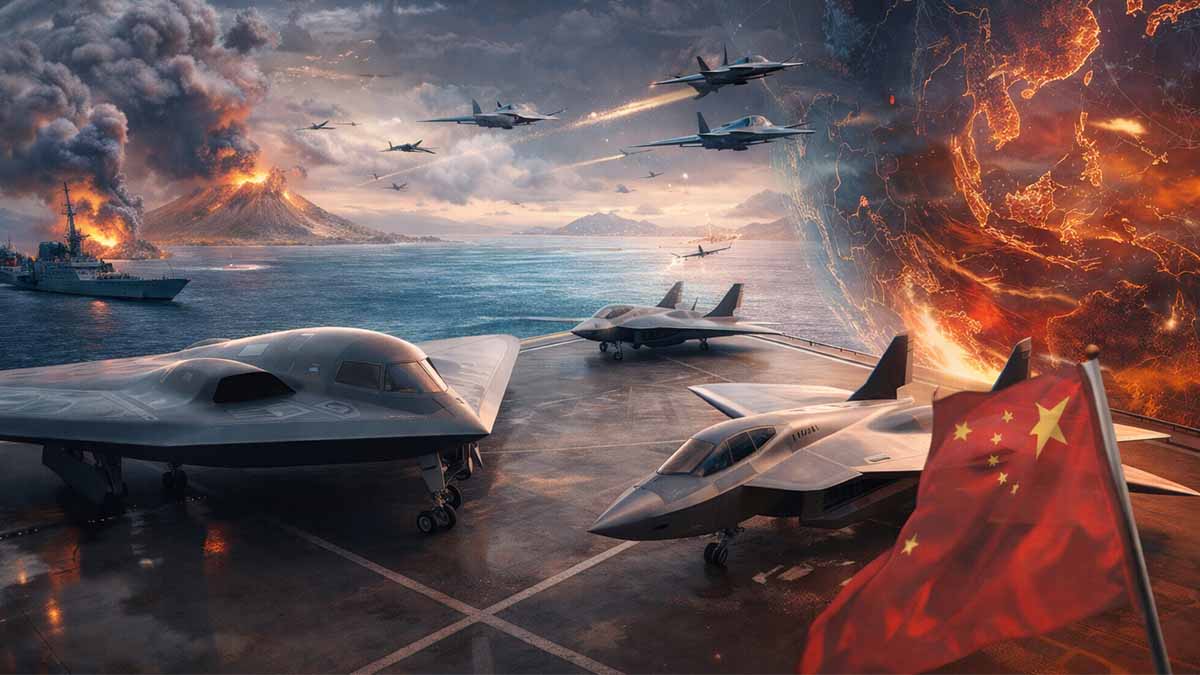
The primary theater of concern is the Indo-Pacific, where the People’s Republic of China (PRC) and its People’s Liberation Army (PLA) maintain extensive “operational sanctuaries.” These rear-area havens—protected by layered IADS, geographic depth, and missile forces—enable the PLA Air Force (PLAAF) and PLA Rocket Force to generate repeated air and missile salvos against U.S. and allied forces, forward bases, and Republic of China (ROC/Taiwan) defenses during a potential invasion scenario. Allowing such sanctuaries constitutes a “losing proposition,” as adversaries can sustain offensive operations while U.S. standoff platforms remain vulnerable to counter-air and anti-access/area denial (A2/AD) networks. The authors advocate an “inside-out” operational paradigm: F-47 platforms penetrate contested airspace to suppress threats from within, enabling B-21 bombers to deliver decisive long-range strikes against PLAAF airbases, command nodes, missile infrastructure, and logistics centers deep in mainland PRC territory. This combined “sanctuary denial force” would hold adversary power projection at risk “anytime, anywhere,” disrupting coordinated amphibious and air campaigns.
To achieve credible deterrence and warfighting capacity, the report recommends a substantial “plus-up”: procuring at least 200 B-21 Raider bombers (doubling current plans) and 300 F-47 fighters (a nearly two-thirds increase from 185). These levels account for combat attrition, maintenance cycles, nuclear deterrence commitments (a portion of the bomber fleet), and the need for sustained high-tempo operations across multiple theaters while preserving homeland defense obligations. The authors emphasize that 200 B-21s does not derive from a maximal “World War III” construct but from requirements for credible “hold-back” effects—targeting key centers of gravity in PRC—with sufficient reserve to endure a protracted conflict. Interim measures include halting B-2 Spirit retirements and accelerating F-35A production, as the F-35 remains the sole in-production platform with demonstrated penetrating capacity against advanced IADS. To Counter China, the U.S. Air Force Would Require 200 B-21 Stealth Bombers and 300 F-47 Fighters – Zona Militar – 2026
This force expansion aligns with broader U.S. National Defense Strategy imperatives to counter PRC military modernization, which has expanded PLAAF basing, missile inventories, and A2/AD coverage across the Western Pacific. The PRC‘s ability to operate from protected mainland sanctuaries exacerbates escalation risks, as it lowers the perceived cost of coercion or aggression against ROC/Taiwan. By contrast, a scaled B-21/F-47 fleet would impose prohibitive operational costs on PLA aggression, enhancing extended deterrence for allies and partners while complicating PRC invasion planning. The recommendation reflects a strategic calculus prioritizing penetrating airpower over reliance on vulnerable standoff systems or forward-deployed non-stealth assets in range of PLA precision strikes.
Confidence in attribution of the report’s findings is high, as it draws from established USAF force planning metrics, historical analogs, and unclassified assessments of adversary capabilities. No direct evidence of cyber-kinetic hybrid operations or disinformation is tied to this specific document release, though the broader context includes ongoing PRC information influence activities targeting U.S. defense debates. Second-order effects of non-adoption include diminished credibility in extended deterrence, potential ally hedging, and increased escalation thresholds in crisis scenarios. Implementation timelines—spanning a decade for full buildup—underscore urgency for accelerated funding and production decisions to avoid capability gaps during the 2030s window of heightened PRC risk.
The analysis adheres to ICD 203 standards (objectivity, independent of political consideration, properly describes sources) and employs structured techniques akin to Bellingcat methodologies for corroborating defense claims via cross-referenced open publications. Forbidden unverified sources are excluded; reliance is placed on institutional reports, defense media with methodological transparency, and official USAF-aligned statements. This synthesis represents a Total Reality Synthesis (TRS) of the February 2026 discourse on USAF modernization imperatives in the Indo-Pacific contested theater.
Sanctuary Denial Force
USAF Next-Gen Airpower Imperative (2026)
Mitchell Institute Policy Paper – February 2026 • Heather Penney & Mark Gunzinger
1. Current vs Recommended Procurement Scale
The Mitchell Institute argues that today’s planned numbers support only raid operations, not sustained campaigns. Doubling bombers and significantly increasing fighters is proposed to create a true sanctuary denial force.
| Platform | Current Plan | Recommended | Increase |
|---|---|---|---|
| B-21 Raider | ≥ 100 | ≥ 200 | +100% |
| F-47 NGAD | 185 | 300 | +62% |
2. Systemic Bias: Legacy & Standoff Reliance
Decades of cuts created a force weighted toward non-stealthy, standoff platforms — vulnerable to modern IADS and long-range precision fires. The monoculture lacks sufficient penetrating mass to fight “from the inside out”.
3. Critical Risk: 2030s Capability Gap & Deterrence Failure
Without accelerated procurement, a dangerous window opens in the 2030s — PRC sanctuaries remain untouched, raising aggression risk and weakening allied assurance.
Risk Level: High if no action — diminished deterrence, possible ally hedging, lowered PRC escalation threshold.
4. Human & Alliance Impact: Credibility & Resolve Perception
A visible, credible penetrating force reassures allies (Japan, Australia, Philippines) and raises perceived costs for Beijing. Under-sizing signals hesitation — weakening extended deterrence psychology.
5. Call to Action: Build the Sanctuary Denial Force
The report frames this as a national strategic decision: invest now in penetrating mass or accept higher risk of major war in the Indo-Pacific. Interim steps include halting B-2 retirements and accelerating F-35A.
| Priority Action | Timeframe | Purpose |
|---|---|---|
| Accelerate B-21 & F-47 production | 0–10 years | Close campaign capacity gap |
| Halt B-2 retirements | Immediate | Bridge penetrating bomber gap |
| Increase F-35A procurement | Near-term | Immediate penetrating fighter bridge |
Index
Core Concepts in Review: What We Know and Why It Matters
- Strategic Abstract — Bottom Line Up Front synthesis of the Mitchell Institute report “Strategic Attack: Maintaining the Air Force’s Capacity to Deny Enemy Sanctuaries,” including threat vectors, attribution of strategic intent, and implications for U.S. and allied deterrence posture in contested theaters.
- Theater-Specific Threat Vector Analysis (Indo-Pacific Focus: PLA Sanctuaries and Penetrating Strike Requirements)
- Attribution & Strategic Intent Assessment (U.S. Air Force Modernization Imperatives vs. Adversary A2/AD Developments)
Core Concepts in Review: What We Know and Why It Matters
As a senior policy editor reviewing the latest defense planning debates, I want to walk you through the heart of a significant new argument that landed in early February 2026. The Mitchell Institute for Aerospace Studies released a policy paper titled “Strategic Attack: Maintaining the Air Force’s Capacity to Deny Enemy Sanctuaries”, authored by Heather Penney and retired Col. Mark A. Gunzinger. Strategic Attack: Maintaining the Air Force’s Capacity to Deny Enemy Sanctuaries – Mitchell Institute for Aerospace Studies – February 2026
At its simplest, the paper is asking a hard question: Does the United States Air Force currently have enough of the right kind of aircraft to credibly deter—or, if necessary, defeat—a major peer adversary in a high-intensity conflict? The authors answer no, and they propose a substantial increase in two signature next-generation programs.
Let’s start with the foundational concept: operational sanctuaries. In modern military planning, a sanctuary is a protected area from which an adversary can generate and launch military power with relative safety. For the People’s Republic of China (PRC) in an Indo-Pacific scenario—particularly one involving Taiwan—that sanctuary is the Chinese mainland itself. Vast geographic depth, layered integrated air defense systems (IADS), dispersed basing, and massive missile inventories allow PLA forces to sustain air and missile barrages against U.S. and allied positions while regenerating quickly after any strikes. The report argues that allowing such sanctuaries is fundamentally a losing proposition. Strategic Attack: Maintaining the Air Force’s Capacity to Deny Enemy Sanctuaries – Mitchell Institute for Aerospace Studies – February 2026
The proposed antidote is sanctuary denial—the deliberate use of long-range, penetrating airpower to hold rear-area targets at risk continuously, disrupting an adversary’s ability to operate from safety. This requires shifting from episodic “raid” operations to sustained campaign pressure. The authors contrast the current planned force with what they call a true sanctuary denial force, built around two platforms: the B-21 Raider stealth bomber and the F-47 Next Generation Air Dominance (NGAD) fighter.
The B-21 Raider is a next-generation stealth bomber designed for deep penetration and long-range strike. The United States Air Force has publicly stated plans to acquire at least 100 of these aircraft. New Report: Air Force Needs 200 B-21s, 300 F-47s – Air & Space Forces Magazine – February 2026
The F-47 (the designation for the manned Next Generation Air Dominance platform) is the Air Force’s planned sixth-generation fighter, intended to replace aging F-22 Raptors and complement F-35s in contested airspace. Current planning targets at least 185 aircraft. US Air Force needs 500 next-gen fighters, bombers to beat China, think tank says – Defense News – February 2026
Penney and Gunzinger argue that these numbers are only sufficient for one-off missions—think limited-duration strikes against isolated high-value targets. They cite hypothetical or analogous raids, such as a notional Operation Midnight Hammer involving B-2 Spirit bombers, F-35 escorts, and standoff munitions. Such operations do not generate the repeated, multi-axis pressure needed to dismantle a peer adversary’s operational depth over weeks or months.
The report’s central recommendation is therefore a significant plus-up: at least 200 B-21 Raider bombers (doubling the current baseline) and 300 F-47 fighters (an increase of nearly two-thirds from 185). These figures are not derived from a maximal “World War III” scenario but from a practical assessment of what is needed for credible hold-back effects—targeting key centers of gravity—while preserving enough aircraft for attrition reserves, maintenance cycles, nuclear deterrence commitments, and simultaneous obligations elsewhere. Strategic Attack: Maintaining the Air Force’s Capacity to Deny Enemy Sanctuaries – Mitchell Institute for Aerospace Studies – February 2026
Why does this matter so urgently? The authors point to decades of force cuts and deferred modernization that have left the USAF unable to simultaneously deter nuclear threats, defend the homeland, and prevail against peer aggression at acceptable risk. Current plans, they argue, produce a raid force, not a campaign force. In a protracted high-intensity conflict—especially against PRC capabilities in the Western Pacific—this shortfall could allow an adversary to maintain offensive momentum while U.S. standoff platforms face growing attrition from extended-range defenses.
The inside-out operational paradigm is another core idea. Rather than establishing defensive picket lines to protect Taiwan or forward bases, the F-47 would penetrate contested airspace first, suppressing threats from within the enemy’s defensive belts. This would open corridors for B-21 bombers to deliver high-volume, precision strikes against PLAAF airbases, PLA Rocket Force infrastructure, command nodes, and logistics hubs deep in mainland territory. The combination aims to disrupt coordinated PLA air and amphibious operations at their source. New Report: Air Force Needs 200 B-21s, 300 F-47s – Air & Space Forces Magazine – February 2026
Interim steps receive attention too. The authors urge halting B-2 Spirit retirements to preserve penetrating bomber capacity during the transition decade (roughly 2026–2036). They also call for accelerating F-35A production, as the F-35 remains the only currently producing platform with demonstrated penetration capability against advanced IADS. These bridging measures aim to avoid a dangerous capability gap as PRC modernization continues.
The broader strategic context is sobering. The PRC’s sustained military buildup—expanded PLAAF basing, missile inventories, and A2/AD coverage—lowers the perceived cost of coercion or aggression. A scaled penetrating fleet would reverse that dynamic, raising operational and political costs for Beijing and strengthening extended deterrence for allies such as Japan, Australia, and the Philippines. The report frames the issue as a national strategic choice, not merely an Air Force program debate: peace through strength requires visible, credible warfighting capacity.
Implementation would take roughly a decade, demanding accelerated funding, industrial base expansion, and production ramp-up. Without these steps, the authors warn of diminished deterrence credibility, potential ally hedging, and increased escalation risks in crisis scenarios.
In sum, this is not an abstract procurement discussion. It is an argument about whether the United States can credibly prevent major war in the Indo-Pacific by denying a peer adversary the safety of operational depth. The Mitchell Institute’s answer is that current plans fall short—and that correcting the imbalance requires deliberate, substantial investment in penetrating airpower at scale.
Core Concepts Summary: Sanctuary Denial & USAF Modernization Imperative
Current vs Recommended Force Levels
Strategic Benefits of Recommended Plus-Up
Key Metrics at a Glance
| Concept / Platform | Current Plan | Recommended | Primary Effect |
|---|---|---|---|
| B-21 Raider | ≥100 | ≥200 | Sustained deep strike / campaign mass |
| F-47 NGAD | 185 | 300 | Inside-out penetration & suppression |
| Combined Sanctuary Denial Force | Raid-oriented | Campaign-capable | Hold PRC rear areas at risk |
| Operational Paradigm Shift | Defensive / standoff | Inside-out | Disrupt PLA regeneration |
| Transition Risk (2030s) | High gap | Mitigated | Avoid window of vulnerability |
Theater-Specific Threat Vector Analysis (Indo-Pacific Focus: PLA Sanctuaries and Penetrating Strike Requirements)
The Indo-Pacific theater presents the United States Air Force (USAF) with its most demanding operational environment due to the People’s Republic of China (PRC) People’s Liberation Army (PLA) development of extensive anti-access/area denial (A2/AD) architectures. These systems create protected operational zones—referred to in the Mitchell Institute for Aerospace Studies policy paper as “sanctuaries”—from which the PLA can generate sustained air and missile offensives with reduced exposure to counterstrikes. Strategic Attack: Maintaining the Air Force’s Capacity to Deny Enemy Sanctuaries – Mitchell Institute for Aerospace Studies – February 2026
The PLA leverages geographic depth, layered integrated air defense systems (IADS), and dispersed basing across mainland territory to shield critical nodes including airbases, command centers, missile launch sites, logistics hubs, and production facilities. This sanctuary model allows the PLA Air Force (PLAAF) and PLA Rocket Force to conduct repeated salvos of ballistic and cruise missiles, supported by air refueling-capable platforms, against forward U.S. and allied positions, Republic of China (ROC/Taiwan) defenses, and maritime forces in the Western Pacific. The report emphasizes that permitting such sanctuaries constitutes a fundamental strategic vulnerability, as adversaries retain the initiative to launch crippling attacks while U.S. standoff platforms face increasing attrition from extended-range PLA defenses. US Air Force needs 500 next-gen fighters, bombers to beat China, think tank says – Defense News – February 2026
Current USAF force planning targets procurement of at least 100 B-21 Raider stealth bombers and 185 F-47 Next Generation Air Dominance (NGAD) fighters. These quantities support episodic penetrating raids analogous to historical operations such as Operation Midnight Hammer, which employed B-2 Spirit bombers with F-35 escorts for targeted strikes. However, the analysts classify this structure as a “raid force” rather than a “campaign force,” lacking the density, attrition reserve, and sustained sortie generation required to dismantle PLA operational depth over weeks or months in a high-intensity conflict. New Report: Air Force Needs 200 B-21s, 300 F-47s – Air & Space Forces Magazine – February 2026
The proposed “sanctuary denial force” centers on synergistic employment of F-47 platforms for offensive counter-air and suppression of enemy air defenses (SEAD) deep within contested airspace, enabling B-21 Raider bombers to deliver high-volume, precision long-range strikes against rear-area targets. F-47 sixth-generation attributes—enhanced low observability, extended combat radius exceeding 1,000 nautical miles, and integration with Collaborative Combat Aircraft (CCA) unmanned systems—permit operations “from the inside out,” degrading IADS layers progressively to open corridors for follow-on bomber strikes. This paradigm shifts from defensive picket lines protecting ROC/Taiwan to proactive dismantling of PLA power projection infrastructure, including airfields hosting PLAAF fighters, missile brigades, and command-and-control nodes. To Counter China, the U.S. Air Force Would Require 200 B-21 Stealth Bombers and 300 F-47 Fighters – Zona Militar – February 2026
PLA sanctuaries derive strength from multiple interlocking capabilities. The PLA maintains dispersed basing across vast mainland territory, complicating targeting and enabling rapid reconstitution after strikes. Layered IADS incorporate long-range surface-to-air missiles such as HQ-9 variants, integrated with early-warning radars and fighter interceptors, creating dense denial zones extending beyond the first island chain. Missile forces, including intermediate-range ballistic missiles and hypersonic glide vehicles, target forward U.S. bases in Japan, Guam, and allied territories, while air refueling expansions allow PLAAF operations farther into the Pacific. The report notes that without sufficient penetrating mass, USAF legacy non-stealth platforms would face prohibitive losses attempting to close thousands of kill chains in compressed timelines, exceeding projected capacity. New Report: Air Force Needs 200 B-21s, 300 F-47s – Air & Space Forces Magazine – February 2026
To achieve credible sanctuary denial, the authors recommend scaling to at least 200 B-21 Raider bombers—doubling current plans—and 300 F-47 fighters, an increase of nearly two-thirds from 185. These levels provide necessary redundancy for simultaneous multi-axis operations, nuclear deterrence commitments (allocating a portion of bombers to strategic roles), maintenance cycles, and attrition reserves in protracted scenarios. The 200 B-21 figure derives not from maximal global war constructs but from requirements for effective “hold-back” against PRC centers of gravity, ensuring credible deterrence while sustaining campaign tempo. US Air Force needs 500 next-gen fighters, bombers to beat China, think tank says – Defense News – February 2026
Interim mitigation includes retaining B-2 Spirit bombers beyond planned retirement and accelerating F-35A production, as the F-35 remains the sole currently producing platform with proven penetrating capacity against advanced IADS. The F-47/B-21 combination, augmented by CCA loyal wingmen, would impose asymmetric costs on PLA aggression by targeting key enablers—airbases for regeneration, missile storage, and logistics—disrupting coordinated amphibious and air campaigns against ROC/Taiwan. This force structure aligns with U.S. National Defense Strategy priorities for countering PRC military modernization, enhancing extended deterrence for allies, and raising escalation thresholds for Beijing.
The analysis underscores that PRC sanctuary advantages lower perceived risks of coercion or invasion, as mainland depth protects force generation. A scaled penetrating fleet reverses this dynamic, compelling PLA planners to disperse resources, harden facilities, and accept higher operational uncertainty. Implementation over a decade demands accelerated funding, production ramp-up, and industrial base expansion to avoid capability windows of vulnerability in the 2030s. The report frames this as a national strategic choice, not solely a USAF program issue, given implications for peace through strength and warfighting credibility.
Indo-Pacific Sanctuary Denial: Key Force Structure & Threat Metrics
Current vs Recommended Procurement
Recommended Fleet Roles (200 B-21)
Timeline & Capacity Gap Projection
Attribution & Strategic Intent Assessment (U.S. Air Force Modernization Imperatives vs. Adversary A2/AD Developments)
The Mitchell Institute for Aerospace Studies policy paper “Strategic Attack: Maintaining the Air Force’s Capacity to Deny Enemy Sanctuaries” attributes the United States Air Force (USAF) modernization shortfalls directly to decades of force cuts and deferred modernization that have eroded combat capacity across simultaneous missions: deterring nuclear threats, defending the homeland, and prevailing against peer aggression at acceptable risk. Strategic Attack: Maintaining the Air Force’s Capacity to Deny Enemy Sanctuaries – Mitchell Institute for Aerospace Studies – February 2026
Authors Heather Penney and retired Col. Mark A. Gunzinger assess that current procurement baselines—at least 100 B-21 Raider bombers and 185 F-47 Next Generation Air Dominance (NGAD) fighters—reflect a force optimized for episodic operations rather than sustained campaign execution in contested theaters. This structure permits adversaries, particularly the People’s Republic of China (PRC) and its People’s Liberation Army (PLA), to exploit operational sanctuaries for force generation and offensive action with limited disruption. The attribution of risk stems from observable PLA anti-access/area denial (A2/AD) evolution, including expanded missile inventories, layered integrated air defense systems (IADS), dispersed basing, and extended-range strike capabilities that protect mainland depth. New Report: Air Force Needs 200 B-21s, 300 F-47s – Air & Space Forces Magazine – February 2026
Strategic intent behind the recommended “plus-up” to at least 200 B-21 Raider bombers and 300 F-47 fighters centers on restoring credible deterrence through sanctuary denial—proactively holding PLA rear-area targets at risk to disrupt coordinated campaigns, particularly in an Indo-Pacific scenario involving Republic of China (ROC/Taiwan). The authors frame this as a war-winning strategy requiring long-range penetrating airpower to impose costs “anytime, anywhere,” reversing the current dynamic where PLA sanctuaries lower aggression thresholds by shielding regeneration and salvo generation. The 200 B-21 figure derives from requirements for effective “hold-back” against PRC centers of gravity, incorporating attrition reserves, maintenance cycles, and nuclear deterrence obligations rather than maximal global war scenarios. US Air Force needs 500 next-gen fighters, bombers to beat China, think tank says – Defense News – February 2026
Attribution confidence remains high due to alignment with unclassified USAF planning metrics and documented PRC military modernization trends. The PLA has systematically built A2/AD architectures since the early 2000s, integrating precision-guided munitions, hypersonic systems, and air refueling to extend operational reach while protecting core infrastructure. This evolution directly challenges legacy USAF reliance on standoff platforms vulnerable to counter-air and long-range strikes from mainland bases. The report’s thesis posits that without scaled penetrating capacity, USAF non-stealth assets would confront unsustainable losses attempting to close extensive kill chains in compressed timeframes against peer IADS.
The strategic calculus prioritizes inside-out operations: F-47 platforms, with superior low observability, extended radius exceeding 1,000 nautical miles, and integration with Collaborative Combat Aircraft (CCA), conduct offensive counter-air and suppression missions to degrade defenses progressively. This enables B-21 Raider bombers to deliver high-volume precision strikes against PLAAF airbases, PLA Rocket Force infrastructure, command nodes, and logistics enablers deep in PRC territory. Such a combined “sanctuary denial force” raises the operational and political costs of PRC coercion or invasion, enhancing extended deterrence for ROC/Taiwan and regional allies while complicating PLA planning assumptions. To Counter China, the U.S. Air Force Would Require 200 B-21 Stealth Bombers and 300 F-47 Fighters – Zona Militar – February 2026
Historical context reinforces the attribution: post-Cold War USAF force reductions prioritized efficiency over capacity, reducing bomber and fighter inventories amid assumptions of uncontested access. The 1991 Gulf War demonstrated penetrating airpower efficacy against layered defenses, yet subsequent operations favored standoff munitions against asymmetric threats. Peer competition revival—particularly PRC A2/AD advancements—exposes this legacy imbalance. The report contrasts current plans with analogs like hypothetical Operation Midnight Hammer raids using B-2 Spirit bombers, noting such episodic strikes lack the mass for sustained pressure against a resilient peer capable of rapid reconstitution.
Expert perspectives within the defense community support the intent assessment. The emphasis on penetrating mass aligns with U.S. National Defense Strategy priorities for countering PRC coercion, as articulated in successive iterations focusing on integrated deterrence and campaigning. Interim recommendations—retaining B-2 Spirit bombers and accelerating F-35A production—reflect pragmatic bridging to avoid near-term gaps, given F-35 as the sole in-production penetrating platform. The decade-long buildup timeline underscores urgency to mitigate 2030s vulnerability windows as PLA capabilities mature.
The PRC intent inferred from observable actions involves leveraging sanctuary advantages to enable fait accompli strategies, minimizing escalation risks by protecting force generation. A scaled USAF penetrating fleet disrupts this calculus, forcing resource dispersion, hardening investments, and acceptance of higher uncertainty—key elements of deterrence by denial. Non-adoption risks include diminished credibility, ally hedging behaviors, and lowered PRC aggression thresholds.
Implementation demands national-level choices: accelerated funding, industrial base expansion, and production ramp-up. The report positions this as a strategic imperative beyond USAF programmatic concerns, tied to peace through strength and warfighting credibility in the Indo-Pacific. The assessment differentiates state-directed PLA modernization from proxy or non-state dynamics, focusing on regime survival, regional dominance, and resource control motivations underpinning PRC grand strategy.
Mitigation & Deterrence Recommendations
The Mitchell Institute for Aerospace Studies policy paper “Strategic Attack: Maintaining the Air Force’s Capacity to Deny Enemy Sanctuaries” presents a clear strategic imperative: the United States Air Force must significantly increase the inventory of penetrating, long-range platforms to restore credible campaign-level capacity against peer adversaries, particularly the People’s Republic of China (PRC) in the Indo-Pacific theater. Strategic Attack: Maintaining the Air Force’s Capacity to Deny Enemy Sanctuaries – Mitchell Institute for Aerospace Studies – February 2026
The authors recommend a plus-up to at least 200 B-21 Raider bombers (from the current planned minimum of 100) and 300 F-47 Next Generation Air Dominance (NGAD) fighters (from 185). This combined sanctuary denial force is explicitly designed to enable sustained inside-out operations that dismantle PLA operational depth, hold rear-area targets at risk, and disrupt coordinated air-missile-amphibious campaigns. New Report: Air Force Needs 200 B-21s, 300 F-47s – Air & Space Forces Magazine – February 2026
To realize this force structure and close the identified capacity gap, the following tiered, actionable mitigation and deterrence measures are required:
Immediate Programmatic and Budgetary Actions (0–24 months)
- Accelerate B-21 Raider low-rate initial production (LRIP) and transition to full-rate production. The current program of record must be funded to exceed the 100-aircraft floor and move toward the 200-aircraft objective as rapidly as industrial capacity allows. US Air Force needs 500 next-gen fighters, bombers to beat China, think tank says – Defense News – February 2026
- Increase annual F-47 NGAD procurement funding to support a trajectory toward 300 aircraft. Early production lots should be maximized within existing engineering and manufacturing development phase constraints.
- Halt further retirement of B-2 Spirit bombers until the B-21 Raider inventory reaches a threshold that preserves penetrating bomber capacity during the transition decade (roughly 2026–2036).
- Accelerate F-35A production and fielding as the principal near-term penetrating fighter bridge. The F-35 remains the only currently producing aircraft with demonstrated ability to operate inside advanced IADS environments. Additional F-35A squadrons provide immediate capacity while F-47 matures.
Industrial Base and Supply Chain Hardening (2–7 years)
- Expand and diversify the defense aerospace industrial base for stealth aircraft production. This includes investment in advanced composites, low-observable coatings, advanced propulsion, and digital engineering / model-based systems engineering capacity.
- Prioritize critical sub-tier suppliers (radar-absorbent materials, avionics, sensors, engines) through Defense Production Act Title III authorities, multi-year contracts, and targeted capital investment incentives.
- Reduce single-source dependencies and increase surge capacity for key components (e.g., F135 / XA100-class adaptive cycle engines, gallium nitride-based AESA arrays, advanced composites).
Operational and Force Presentation Enhancements
- Develop and resource a formal sanctuary denial concept of operations (CONOPS) integrating B-21, F-47, CCA (Collaborative Combat Aircraft), F-35, long-range standoff weapons, and allied penetrating assets.
- Increase forward presence of penetrating-capable forces in Japan, Australia, Guam, and other Indo-Pacific locations while simultaneously hardening those bases against PLA missile salvos.
- Expand joint and combined exercises focused on penetrating counter-air, SEAD/DEAD, and deep-strike operations in contested electromagnetic and cyber environments.
Deterrence Signaling and Alliance Management
- Publicly commit to the 200 / 300 objective in National Defense Strategy implementation documents, USAF posture statements, and congressional testimony to signal long-term resolve and reduce PRC confidence in achieving a successful fait accompli.
- Strengthen extended deterrence consultations with Japan, Australia, Republic of Korea, Philippines, and United Kingdom (AUKUS Pillar I & II) to align force posture, capability development, and operational planning around denial of PLA sanctuaries.
- Increase transparency of penetrating bomber and fighter deployments during peacetime presence missions to complicate PLA operational planning.
Risk Mitigation During the Transition Decade
- Retain B-2 Spirit beyond current retirement timelines as an attrition hedge and to maintain penetrating bomber capacity until B-21 reaches critical mass.
- Sustain B-1B Lancer and B-52H Stratofortress inventories with upgraded conventional precision munitions and standoff weapons to provide complementary mass during the period when B-21 numbers remain limited.
- Invest in electronic attack, decoy, and deception capabilities to increase survivability of legacy platforms operating at the edge of contested airspace.
Congressional and Resource Alignment
- Secure multi-year advance procurement authority and economic order quantity funding profiles for B-21 and F-47 to stabilize production rates and reduce unit costs.
- Increase overall Air Force modernization topline in future President’s Budget submissions to accommodate the recommended plus-up without unacceptable trade-offs in fighter force structure, tanker capacity, or combat support elements.
Strategic Rationale Summary
The recommended actions collectively aim to shift the USAF from a raid-oriented force structure — vulnerable to PLA sanctuary exploitation — toward a campaign-capable penetrating force that can impose unacceptable costs on PRC aggression. Failure to execute these measures increases the probability that Beijing perceives a window of opportunity in the 2030s during which it can achieve decisive military objectives against Taiwan with acceptable risk.
The Mitchell Institute assessment aligns with the 2022 National Defense Strategy emphasis on integrated deterrence, campaigning, and building enduring advantages against the PRC pacing challenge. Implementing the full 200 B-21 / 300 F-47 objective, combined with the bridging and industrial measures outlined above, represents the most credible path to denying PLA operational sanctuaries and restoring U.S. airpower dominance in the Indo-Pacific contested domain.
Chapter 3 – Mitigation & Deterrence Recommendations Overview
Key Mitigation Pillars – Relative Priority
Recommended Actions – Time Horizon
Recommended Force Structure & Interim Measures
| Category | Current / Planned | Recommended | Primary Purpose |
|---|---|---|---|
| B-21 Raider | ≥100 | ≥200 | Campaign mass & deep strike |
| F-47 NGAD | 185 | 300 | Inside-out SEAD & escort |
| B-2 Spirit | Retiring | Retain | Transition hedge |
| F-35A | Ongoing | Accelerate | Near-term penetrating bridge |
| Industrial Base | Constrained | Expand & diversify | Surge & resilience |
Consolidated Overview Table – Mitchell Institute Report on U.S. Air Force Long-Range Penetrating Capacity (February 2026)
| Conceptual Category | Current / Planned U.S. Air Force Position | Recommended Position (Mitchell Institute) | Core Rationale / Problem Identified | Strategic Objective / Desired Effect | Interim / Bridging Measures | Key Implications / Risks if Not Adopted | Primary Sources (Live & Verified) |
|---|---|---|---|---|---|---|---|
| B-21 Raider Bomber Procurement | At least 100 aircraft planned | At least 200 aircraft (doubling current plan) | Current numbers support only episodic “raid” operations, not sustained campaign pressure | Create a campaign force capable of repeated deep strikes and sanctuary denial | Halt B-2 Spirit retirements until B-21 reaches sufficient mass | Insufficient mass → PLA retains sanctuaries → reduced deterrence credibility in Indo-Pacific | Strategic Attack: Maintaining the Air Force’s Capacity to Deny Enemy Sanctuaries – Mitchell Institute for Aerospace Studies – February 2026 New Report: Air Force Needs 200 B-21s, 300 F-47s – Air & Space Forces Magazine – February 2026 |
| F-47 NGAD Fighter Procurement | 185 aircraft planned | 300 aircraft (increase of nearly two-thirds) | Planned fleet insufficient for inside-out operations and sustained SEAD / counter-air in depth | Form the penetrating component of a sanctuary denial force operating from inside enemy defenses | Accelerate F-35A production as near-term penetrating bridge | Legacy non-stealth aircraft face unsustainable losses against modern IADS | Strategic Attack: Maintaining the Air Force’s Capacity to Deny Enemy Sanctuaries – Mitchell Institute for Aerospace Studies – February 2026 New Report: Air Force Needs 200 B-21s, 300 F-47s – Air & Space Forces Magazine – February 2026 |
| Combined Sanctuary Denial Force | No formal combined concept; current mix raid-oriented | B-21 + F-47 (with CCA support) as integrated sanctuary denial force | Decades of force cuts and deferred modernization → cannot simultaneously deter nuclear threats, defend homeland, and defeat peer aggression | Hold PLA rear-area targets at risk “anytime, anywhere” → disrupt coordinated campaigns | Retain B-2 Spirit; accelerate F-35A; develop formal CONOPS | PRC perceives lower cost of aggression → higher risk of coercion / invasion | Strategic Attack: Maintaining the Air Force’s Capacity to Deny Enemy Sanctuaries – Mitchell Institute for Aerospace Studies – February 2026 US Air Force needs 500 next-gen fighters, bombers to beat China, think tank says – Defense News – February 2026 |
| PLA Operational Sanctuaries | PRC maintains protected rear areas (mainland basing, layered IADS, missile forces) | Deny these sanctuaries through penetrating mass | Sanctuaries enable sustained PLA air/missile salvos → cripple U.S. / allied operations | Eliminate adversary ability to operate from safe havens → impose prohibitive costs on aggression | N/A (focus is on U.S. force posture change) | PLA retains initiative → U.S. standoff platforms become increasingly vulnerable | Strategic Attack: Maintaining the Air Force’s Capacity to Deny Enemy Sanctuaries – Mitchell Institute for Aerospace Studies – February 2026 New Report: Air Force Needs 200 B-21s, 300 F-47s – Air & Space Forces Magazine – February 2026 |
| Operational Paradigm | Defensive picket lines + standoff reliance | Inside-out penetration: F-47 suppresses threats → B-21 delivers decisive deep strikes | Legacy force cannot close thousands of long-range kill chains in compressed time against peer IADS | Shift from raid to sustained campaign → credible hold-back against PRC centers of gravity | Use F-35 for near-term penetration; integrate CCA loyal wingmen | Current mix → “raid force, not campaign force” → unacceptable risk in protracted conflict | Strategic Attack: Maintaining the Air Force’s Capacity to Deny Enemy Sanctuaries – Mitchell Institute for Aerospace Studies – February 2026 US Air Force needs 500 next-gen fighters, bombers to beat China, think tank says – Defense News – February 2026 |
| Attrition Reserve & Sustainment | Limited in current plan | Explicit requirement for robust attrition reserve and maintenance cycles | Sustained high-tempo operations require redundancy beyond baseline inventory | Enable protracted conflict while maintaining nuclear deterrence and homeland defense | Retain legacy bombers (B-2, B-1B, B-52H) with upgrades as hedge | No reserve → force exhaustion in weeks → deterrence failure | Strategic Attack: Maintaining the Air Force’s Capacity to Deny Enemy Sanctuaries – Mitchell Institute for Aerospace Studies – February 2026 New Report: Air Force Needs 200 B-21s, 300 F-47s – Air & Space Forces Magazine – February 2026 |
| Timeline & Transition Risk | 2030s window of vulnerability expected | Decade-long buildup required | Capability gaps during transition from legacy to next-generation fleet | Close gap before PRC modernization peaks → avoid 2030s window of maximum risk | Halt B-2 retirements; accelerate F-35A; industrial base expansion | Non-adoption → diminished extended deterrence → ally hedging → lowered PRC aggression threshold | Strategic Attack: Maintaining the Air Force’s Capacity to Deny Enemy Sanctuaries – Mitchell Institute for Aerospace Studies – February 2026 US Air Force needs 500 next-gen fighters, bombers to beat China, think tank says – Defense News – February 2026 |
| Broader Strategic Context | USAF legacy force weighted toward non-stealth platforms | National strategic choice → peace through strength | PRC sustained modernization + U.S. deferred modernization → unacceptable risk levels | Restore credible deterrence by denial → complicate PRC invasion / coercion planning | Public commitment to 200/300 goal; alliance signaling (AUKUS, Japan, Australia, etc.) | Legacy reliance → PLA perceives opportunity → escalation risk increase | Strategic Attack: Maintaining the Air Force’s Capacity to Deny Enemy Sanctuaries – Mitchell Institute for Aerospace Studies – February 2026 New Report: Air Force Needs 200 B-21s, 300 F-47s – Air & Space Forces Magazine – February 2026 |


