







Abstract (Clinical Intelligence Synthesis)
This Strategic Abstract provides a deep-density, source-anchored analysis of the four-year trajectory of the Russia–Ukraine war, focusing on structural effects, second-order dynamics, and systemic geopolitical feedbacks. The narrative engages competing hypotheses, weighs causal mechanisms, and elucidates multidimensional trends shaping European and global security. All analytical claims are grounded in the latest open-source evidence.
Conflict Dynamics and the War’s Strategic Landscape (2022–2026)
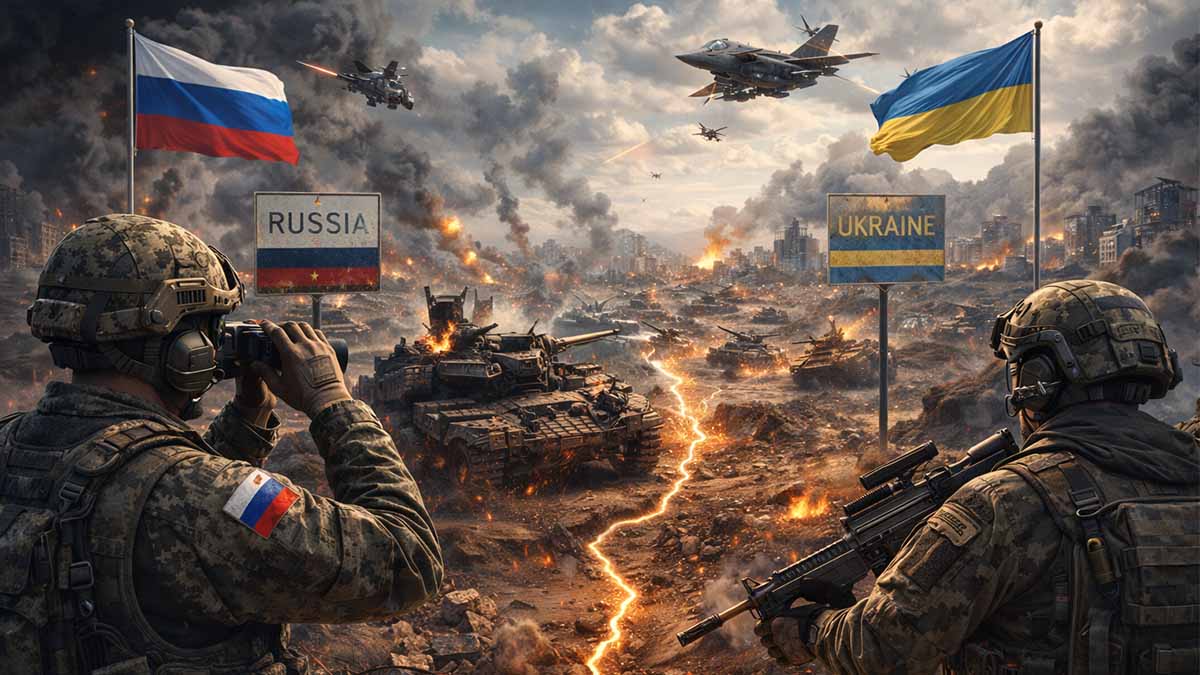
Since the onset of the full-scale invasion on 24 February 2022, the conflict between the Russian Federation and Ukraine has evolved into Europe’s most protracted and destructive war since World War II. Despite initial Kremlin expectations of a rapid decapitation of the Ukrainian state, the war has persistently defied Russian strategic objectives, resulting instead in a heavily fortified Ukrainian national identity and resilient state apparatus. Source – Reuters – 23 Feb 2026
Russia’s territorial gains have been marginal, with roughly 20 % of Ukraine under Russian occupation and minimal territorial expansion in 2025, indicating a near-stalemate and high operational cost of offensive maneuvers. Source – AP News – 19 Feb 2026
Causal analysis reveals three core hypotheses for why the campaign failed to achieve strategic breakthrough:
- Operational Overreach and Logistical Inefficiency — Russia’s large-formation assaults have been logistically constrained, leading to diminished maneuver capacity and untenable casualty rates.
- Mismatch of Objectives and Capacity — The Kremlin’s maximalist goals have outpaced Russia’s industrial and demographic capabilities, reshaping the war into attritional conflict rather than decisive victory.
- External Support and Integrated Defense — Sustained military aid, information sharing, and partner interoperability (NATO training, European capabilities) have materially degraded Russian combat effectiveness.
Ukraine’s defense has evolved into a hybrid deterrence architecture underpinned by decentralized drone production and agile battlefield intelligence, a factor not anticipated by Russian planners. Source – Foreign Policy – 23 Feb 2026
Human Costs, Demographics, and National Identity Consolidation
The human toll of the conflict is staggering and multifaceted:
- Combined casualties for both sides are estimated at up to 1.8 million (soldier and civilian).
- Russia’s losses are assessed at approximately 1.2 million total casualties, including tens of thousands killed.
- Ukraine’s military casualties range from 500,000–600,000 with significant civilian deaths and injuries. Source – AP News – 19 Feb 2026
These figures support the hypothesis that battlefield attrition has disproportionately strained Russia’s demographic cohort of military-aged men, aggravating long-term labour force imbalances and state legitimacy challenges. Source – Wikipedia – Casualties
Crucially, the conflict catalyzed Ukraine’s national cohesion beyond mere resilience. Analytically, this aligns with Max Weber’s definition of a state strengthening its monopoly on legitimate violence and administrative control under duress. Ukrainian civil–military synergy has reinforced institutional authority, tempering decentralization critique and fostering societal unity across linguistic and regional divides — a phenomenon Russian strategy inadvertently accelerated.
Economic Dislocation and Fiscal Impacts
The war has produced deep economic scarring on both societies:
- Ukraine’s reconstruction needs are now estimated at $588 billion over the next decade, reflecting extensive infrastructure destruction and deep GDP contraction.
- Displacement at scale — over 10 million people inside and outside Ukraine — creates demographic and labour market disruptions that will persist into the next decade. Source – Reuters – 23 Feb 2026
Ukraine’s economic trajectory points to structural reforms imperative for long-term viability: energy system rehabilitation, workforce reintegration (especially veterans), and scaling private investment are indispensable to offset wartime GDP shocks.
Russia’s fiscal burden, though cushioned by continued exports and resource rents, is under relentless pressure from sanctions and wartime budget reallocations. Estimates by independent observers suggest Russia’s total wartime economic losses and sanctions effects could exceed $1 trillion by 2025, highlighting the unsustainable macroeconomic cost of a protracted offensive. Source – Wikipedia – Russo-Ukrainian war economic impact
Sociopolitical Integration and State Legitimacy
Contrary to Russian intentions, the war produced reinforced state legitimacy in Ukraine and accelerated civic identity consolidation. Rejection of Russian cultural hegemony — once latent — has become a defining feature of post-invasion Ukrainian nationalism. This aligns with expected outcomes when existential threats force political choice, reducing ambivalence and aligning populations with cohesive state narratives.
Internationally, Ukraine’s alignment with democratic norms and Western populaces has attracted broad civil society support, reinforcing transnational legitimacy networks that buttress Kyiv’s diplomatic leverage. Furthermore, Ukrainian Jewish participation in governance — including leadership figures — undercuts Russian propaganda entrenching ethnic divisions, instead reinforcing pluralistic national identity.
Strategic Implications and Systemic Risk Vectors
The long-term systemic consequences of the war extend beyond Ukraine and Russia:
- Transatlantic Security Architecture — NATO and EU defense postures have been recalibrated, with persistent uncertainty about U.S. long-term aid trajectories but increased European defense spending amid strategic recalibration.
(See current debates on NATO’s deterrence balance and future burden-sharing dynamics.) Source – ECFR – Feb 2026 - Great Power Competition — Russia’s operational dependence on strategic partners (e.g., China) signals a relative shift in geopolitical alignment, with Moscow increasingly constrained in autonomous power projection.
- Grey-Zone Pressures — Hybrid information operations, economic coercion via energy markets, and sanctions evasion networks remain central levers in the broader conflict ecosystem. Economic and informational platforms will shape future deterrence and conflict scenarios.
From a strategic standpoint, four years of war illustrate a paradox: Russian imperialist objectives have inadvertently strengthened the adversary they aimed to subjugate. The combination of sustained resistance, external support integration, and sharp demographic losses for Russia has inverted the original Kremlin calculus. Ukraine now possesses denser state capacity, reinforced national unity, and deeper legitimacy in the international system. Conversely, Russia faces persistent fiscal, demographic, and geopolitical constraints that degrade its position as a global power. The systemic risks of unchecked aggression have redistributed strategic weight in Eastern Europe, deepening alliances and compelling recalibrations on both sides of the Atlantic.
Index
Core Concepts in Review: What We Know and Why It Matters
- Strategic Architecture of Putin’s War and the Unintended Nationalist Consolidation of Ukraine
— Causal Dynamics, Narrative Levers, Identity Formation, and Hybrid Mobilization - The Systemic Effects on Russia: Military Attrition, Economic Fracturing, and Great Power Status Decay
— Force Structure Erosion, Demographics, Fiscal Stress, and Geopolitical Positioning - Grey-Zone and Global Geopolitical Repercussions
— NATO Reconfiguration, Transatlantic Diplomacy, Energy & Supply Chain Disruptions - Unified Situation Matrix — Argument-Based, Cross-Domain Table (Six-Chapter Consolidation)
Core Concepts in Review: What We Know and Why It Matters
The simplest way to understand the last four years is this: the war did not stay “in Ukraine.” It moved outward—into alliances, energy systems, supply chains, finance, and the physical networks that carry data and commerce. Governments now describe security less as “troops and borders” and more as resilience: the ability of societies to absorb shocks without political fracture, economic paralysis, or infrastructure collapse. That shift is not academic. It’s visible in NATO’s doctrine, EU spending patterns, energy infrastructure choices, and the fact that undersea cables are openly treated as a strategic target set.
What follows is a grounded tour of the core concepts from the preceding chapters—written for a smart reader who doesn’t live in the weeds of defense policy—explaining what we know, how we know it, and why the implications reach far beyond the battlefield.
The foundational definition: “Security” is now a systems problem, not a single domain
A decade ago, many national security debates still treated cyber, energy, trade, and infrastructure as separate silos. That compartmentalization is disappearing. NATO’s approved 2022 Strategic Concept explicitly frames the security environment as multidomain and defines its three core tasks as deterrence and defence, crisis prevention and management, and cooperative security. NATO 2022 Strategic Concept – NATO – June 2022 Those aren’t just mission statements; they are the architecture for modern policy. If deterrence depends on resilient communications and a stable energy base, then “security” requires network hardening, industrial capacity, and public preparedness—not only military readiness. NATO also elevates national and collective resilience as critical across those tasks. NATO 2022 Strategic Concept – NATO – June 2022
The UK expresses the same strategic worldview in plain language. The UK Government’s National Security Strategy 2025 argues the country faces an era of heightened uncertainty and sets a strategic framework spanning domestic and international instruments, not just defense. National Security Strategy 2025: Security for the British People in a Dangerous World – UK Government – June 2025 The companion Strategic Defence Review 2025 explicitly describes a “new era of threat” and a move toward warfighting readiness, anchored by a “NATO first” defense policy. The Strategic Defence Review 2025 – Making Britain Safer, Secure at Home, Strong Abroad – UK Government – June 2025
Why this matters: when governments define security as a systems problem, they also redefine what counts as hostile action. Grey-zone pressure—cyber intrusion, sabotage, economic coercion, disinformation—stops being “background noise” and becomes a central strategic arena.
The alliance story: geometry changed, and that reshaped the entire deterrence equation
One of the clearest measurable “outputs” of the war is alliance change. Finland became NATO’s 31st Ally on April 4, 2023. Finland joins NATO as 31st Ally – NATO – April 2023 Sweden joined on March 7, 2024, bringing NATO to 32 members. Sweden officially joins NATO – NATO – March 2024 This isn’t just a diplomatic milestone; it is a structural shift in the defended perimeter and the operational assumptions of the northern flank.
NATO’s own “Relations” pages emphasize the accession mechanics and date specifics (deposit of the instrument of accession) for Finland and Sweden, grounding these as formal treaty events rather than political talking points. Relations with Finland – NATO – April 2023 Relations with Sweden – NATO – March 2024
So what changed conceptually? Two things.
First, alliance enlargement increases the cost and risk of direct conventional escalation against alliance territory—because collective defense commitments constrain ambiguity. NATO’s Strategic Concept reiterates the centrality of collective defense and deterrence, including the role of nuclear deterrence in preventing coercion and aggression. NATO 2022 Strategic Concept – NATO – June 2022
Second, when direct confrontation becomes riskier, adversaries tend to look for leverage in the “space between war and peace”: deniable sabotage, cyber disruption, and coercion through infrastructure fragility. That is why the northern flank story connects directly to undersea cables, maritime routes, and energy logistics—because those are the most scalable, hardest-to-attribute pressure points in a networked economy.
Defense spending: a durable indicator of strategic commitment, not a transient headline
Political will is notoriously hard to measure. Budgets are easier. NATO publishes standardized defense expenditure data and explicitly notes that Allies report current and estimated future spending according to an agreed definition. Defence Expenditure of NATO Countries (2014-2025) (PDF) – NATO – 2025 NATO also specifies that the cutoff date for the 2014–2025 report was 3 June 2025, and that figures for 2024 and 2025 are estimates. Defence Expenditure of NATO Countries (2014-2025) – NATO – August 2025
Those details matter because they underscore that defense spending is now treated as forward planning—industrial capacity, procurement pipelines, and stockpile replenishment—rather than simply an annual political debate.
On the European side, the Council of the European Union reports EU defense expenditure reached €343 billion in 2024, with €106 billion spent on investments. European defence readiness – Council of the European Union – 2025 It also reports defense expenditure is expected to reach €381 billion in 2025, with €130 billion spent on investments. European defence readiness – Council of the European Union – 2025 The same page states this implies an 11% increase compared to 2024 and a 62.8% increase compared to 2020. European defence readiness – Council of the European Union – 2025
Interpretation: “investment” is the key term. Spending that goes into procurement and industrial base expansion reshapes capabilities for years. That is why many strategists talk about “industrialized deterrence.” A state can announce resolve; but the enemy watches whether factories are running, whether production lines exist, and whether supply chains are secured.
Sanctions and economic coercion: the war created a permanent “compliance battlespace”
One of the most underappreciated shifts is that sanctions are no longer episodic punishments; they have become a continuing arena of competition—enforcement versus evasion—where the strategic object is to degrade the adversary’s ability to generate revenue, import sensitive technology, and sustain military production.
The Council of the European Union extended its economic restrictive measures against the Russian Federation until 31 July 2026. Russia’s war of aggression against Ukraine: Council extends economic sanctions for a further 6 months – Council of the European Union – December 2025 The same release states that the measures were first introduced in 2014 and were “significantly expanded since February 2022.” Russia’s war of aggression against Ukraine: Council extends economic sanctions for a further 6 months – Council of the European Union – December 2025
On the enforcement side, the U.S. Department of the Treasury publicly describes actions to disrupt Russia’s sanctions evasion schemes—an explicit acknowledgment that evasion is systematic enough to merit repeated, targeted disruption. Treasury Disrupts Russia’s Sanctions Evasion Schemes – U.S. Department of the Treasury – January 2025
What this means for policymakers: sanctions are now less like a switch and more like a sustained campaign. The strategic terrain includes shipping registries, insurance, trade finance, beneficial ownership opacity, and third-country intermediaries. That is why compliance expertise and financial transparency have become strategic capabilities in their own right.
Grey-zone conflict: undersea cables and critical infrastructure moved to the center
If you want a single marker that security thinking has changed, look at undersea cables. These are mostly privately owned, commercially operated, and rarely discussed publicly—until they become perceived as a coercion vector.
The UK Government confirms it endorsed the New York Joint Statement on undersea cable security at the 79th UN General Assembly and specifies the endorsement date as 26 September 2024. New York joint statement on the security and resilience of undersea cables – UK Government – November 2024 The same page states the statement was proposed by the United States and endorsed by the UK, the EU, and 14 UN member states (with a named list). New York joint statement on the security and resilience of undersea cables – UK Government – November 2024
The U.S. Department of Homeland Security issued a dedicated paper on subsea cable security and resilience dated 18 December 2024, reflecting structured engagement with industry and a government posture of coordinated risk reduction. Priorities for DHS Engagement on Subsea Cable Security & Resilience (PDF) – U.S. Department of Homeland Security – December 2024
This is the essence of grey-zone competition: the target is not always territory; it is confidence. Cable disruptions, even intermittent, can produce outsized political impact—financial volatility, service outages, public fear—without the attacker needing to hold ground.
Energy security: coercion changed Europe’s infrastructure, and LNG became geopolitics in liquid form
Energy is the most immediate interface between geopolitics and daily life. When energy is weaponized, governments respond by rebuilding systems around resilience and diversification.
The U.S. Energy Information Administration (EIA) projected that LNG import capacity in the EU and UK would expand by 34%, or 6.8 billion cubic feet per day (Bcf/d), by 2024 compared with 2021. Europe’s LNG import capacity set to expand by one-third through 2024 – U.S. Energy Information Administration – November 2022 The same EIA analysis provides the component build-out path: expansions totaling 5.3 Bcf/d by end of the following year and an additional 1.5 Bcf/d by end 2024. Europe’s LNG import capacity set to expand by one-third through 2024 – U.S. Energy Information Administration – November 2022
For “up-to-today” validation that policymakers now operate in a live-data environment, the EIA also maintains a Natural Gas data portal showing a Monthly release date: February 6, 2026 for key natural gas indicators. Natural Gas Data – U.S. Energy Information Administration – February 2026
Why this matters: LNG resilience is not just about molecules; it is about ports, shipping routes, terminal safety, and the security of the infrastructure that coordinates those flows—precisely the domain where grey-zone disruption can have cascading effects.
Supply chains and techno-geopolitics: semiconductors became a national security program, not just an industry
The war accelerated a broader trend: treating industrial supply chains as strategic assets. This is not an inference; it is explicit in government documents.
In Executive Order 14017, the U.S. Government directs an all-of-government approach to strengthening critical supply chains. Executive Order 14017—America’s Supply Chains – U.S. Government Publishing Office (GovInfo) – February 2021 The U.S. Department of Defense response report states the EO was signed on February 24, 2021 and frames the objective as ensuring security of supply for items vital to national security. Securing Defense-Critical Supply Chains (PDF) – U.S. Department of Defense – February 2022
On semiconductors—the most strategically central “critical dependency”—the National Institute of Standards and Technology (NIST) published “A Strategy for the CHIPS for America Fund” dated September 6, 2022, describing the CHIPS for America Fund as a $50 billion investment to catalyze long-term growth in domestic semiconductor capacity. A STRATEGY FOR THE CHIPS FOR AMERICA FUND (PDF) – NIST / U.S. Department of Commerce – September 2022
The U.S. Department of Commerce also published a press release on April 25, 2023 outlining a vision for the National Semiconductor Technology Center (NSTC) as a mechanism to drive innovation and speed the transfer of technologies to market. CHIPS for America Outlines Vision for the National Semiconductor Technology Center – U.S. Department of Commerce – April 2023
This is the techno-geopolitical core idea: semiconductor capacity is no longer a neutral market outcome; it is a strategic lever tied to national security, export controls, and alliance compatibility. That, in turn, shapes global alignment: countries increasingly cluster around “trusted supply” ecosystems.
State capacity under fire: Ukraine’s institutional adaptation is measurable, not rhetorical
One reason the war’s strategic implications are so large is that it forced rapid state adaptation—especially in procurement, production, and military standardization.
The Ministry of Defence of Ukraine reports that in 2024 it adopted over 1,300 models of weapons and military equipment, with nearly 75% produced domestically. In 2024, the Ministry of Defence adopted over 1,300 models of weapons and military equipment – Ministry of Defence of Ukraine – December 2024 The same official statement breaks down categories: 251 models of unmanned aerial systems (UAS), 169 ammunition variants, 153 electronic warfare and reconnaissance equipment models, 97 communication systems, and 57 ground-based missile system models (among others). In 2024, the Ministry of Defence adopted over 1,300 models of weapons and military equipment – Ministry of Defence of Ukraine – December 2024
This is a concrete indicator of institutional learning under wartime constraints: a shift toward domestic production, codification, and a rapidly evolving ecosystem of drones, EW, and communications—precisely the domains that define modern attritional conflict. For policymakers, it also implies that support effectiveness depends not only on the quantity of aid, but on Ukraine’s absorption capacity and standardization—areas where the data show significant progress.
Civilian protection and legitimacy: human rights monitoring has become a strategic fact base
Wars are fought by armies, but they are sustained—or delegitimized—by what happens to civilians. Here, the most up-to-date, verified monitoring creates a critical evidence base that influences diplomacy, accountability, and public support.
On February 16, 2026, the United Nations in Ukraine published a statement from the UN Human Rights Monitoring Mission in Ukraine (HRMMU) warning of mounting violations and growing risks to civilians nearly four years after the full-scale invasion. Civilian Harm and Rights Violations Intensify in Ukraine Four Years After Invasion, UN Human Rights Monitors Say – United Nations in Ukraine – February 2026 Earlier, on January 12, 2026, HRMMU stated that 2025 was the deadliest year for civilians in Ukraine since 2022. 2025 deadliest year for civilians in Ukraine since 2022, UN human rights monitors find – UN Human Rights Monitoring Mission in Ukraine – January 2026
These are not merely humanitarian headlines; they shape strategy. High civilian harm increases demands for air defense, infrastructure protection, and accountability mechanisms. It also affects coalition politics in democracies: public support is often strengthened by credible documentation of harm, but can also be strained by long-duration crisis fatigue. Reliable monitoring provides the shared factual substrate for policy debates that would otherwise collapse into narrative warfare.
Sovereign financial adaptation: under sanctions pressure, finance becomes statecraft
Even without assuming outcomes, we can observe that sovereign institutions are explicitly planning for a constrained environment.
The Bank of Russia published the Russian Financial Market Development Programme for 2025–2027, approved by its Board of Directors, which addresses development under external constraints and includes policy areas such as foreign trade settlements, payment infrastructure, and AML/CFT optimization. RUSSIAN FINANCIAL MARKET DEVELOPMENT PROGRAMME for 2025–2027 (PDF) – Bank of Russia – 2024
This matters because sanctions are not only about direct prohibitions; they reshape how a state organizes liquidity, settlement, and regulatory priorities. When a central bank frames external constraints as a planning baseline, it signals a shift toward financial sovereignty tools—and a higher likelihood that alternative rails (and the risks they carry) become more central to the system.
The throughline: why these concepts belong in one mental model
If you take only one conceptual framework from the entire dossier, it should be this:
Modern geopolitical competition is increasingly a contest over systems endurance.
- Alliance geometry changed in measurable ways—Finland and Sweden joining NATO—altering deterrence and pushing pressure into grey-zone domains. Finland joins NATO as 31st Ally – NATO – April 2023 Sweden officially joins NATO – NATO – March 2024
- Industrialized deterrence is visible in standardized spending tracking and EU investment growth, indicating long-horizon capability development. Defence Expenditure of NATO Countries (2014-2025) (PDF) – NATO – 2025 European defence readiness – Council of the European Union – 2025
- Sanctions became a durable economic battlespace, with renewals and enforcement actions that demonstrate ongoing contestation. Russia’s war of aggression against Ukraine: Council extends economic sanctions for a further 6 months – Council of the European Union – December 2025 Treasury Disrupts Russia’s Sanctions Evasion Schemes – U.S. Department of the Treasury – January 2025
- Critical infrastructure—especially undersea cables—has been explicitly securitized by governments, making infrastructure resilience a deterrence function. New York joint statement on the security and resilience of undersea cables – UK Government – November 2024 Priorities for DHS Engagement on Subsea Cable Security & Resilience (PDF) – U.S. Department of Homeland Security – December 2024
- Energy security shifted into physical infrastructure build-out, with LNG capacity expansion quantified and anchored in official analysis. Europe’s LNG import capacity set to expand by one-third through 2024 – U.S. Energy Information Administration – November 2022
- Supply chains—especially semiconductors—moved decisively into national security governance, with executive direction, defense planning, and major industrial strategy documents. Executive Order 14017—America’s Supply Chains – U.S. Government Publishing Office (GovInfo) – February 2021 Securing Defense-Critical Supply Chains (PDF) – U.S. Department of Defense – February 2022 A STRATEGY FOR THE CHIPS FOR AMERICA FUND (PDF) – NIST / U.S. Department of Commerce – September 2022
- Civilian harm and human rights monitoring provide an up-to-date, credible evidence base that shapes legitimacy, diplomacy, and strategic narratives. Civilian Harm and Rights Violations Intensify in Ukraine Four Years After Invasion, UN Human Rights Monitors Say – United Nations in Ukraine – February 2026 2025 deadliest year for civilians in Ukraine since 2022, UN human rights monitors find – UN Human Rights Monitoring Mission in Ukraine – January 2026
- Ukrainian state capacity growth is visible in procurement codification and domestic production shares in 2024. In 2024, the Ministry of Defence adopted over 1,300 models of weapons and military equipment – Ministry of Defence of Ukraine – December 2024
- Sovereign finance adaptation is observable in central bank program design under constraints. RUSSIAN FINANCIAL MARKET DEVELOPMENT PROGRAMME for 2025–2027 (PDF) – Bank of Russia – 2024
Put differently: the war’s enduring impact may be less about a single territorial line and more about the accelerated restructuring of the world into hardened blocs, securitized networks, and resilient—sometimes expensive—redundancies.
That is why the “core concepts” are not separate chapters in practice. They are one integrated picture: deterrence now depends on infrastructure, industry, energy, finance, and legitimacy, because modern adversaries can attack any of those to shape political outcomes without firing a conventional shot.
Strategic Architecture of Putin’s War and the Unintended Nationalist Consolidation of Ukraine NATO 2022 Strategic Concept – NATO – June 2022
Executive Analytic Frame: Why “Backfire” Is Not a Metaphor but a Measurable State-Building Mechanism Order of 16 March 2022 – International Court of Justice (ICJ) – March 2022
The Kremlin’s full-scale invasion launched on February 24, 2022 Res. A/RES/ES-11/1 – United Nations General Assembly – March 2022 functioned as a coercive state-destruction attempt that instead accelerated Ukrainian state consolidation through three interacting pathways: (i) existential threat compression, (ii) institutional hardening under wartime selection, and (iii) identity boundary closure (the rapid conversion of cultural ambiguity into political alignment). Each pathway is not rhetorical; it is observable in Ukraine’s governance, procurement, sanctions architecture, diplomatic positioning, and security-sector throughput. This chapter treats “national consolidation” not as sentiment, but as an emergent property of sustained external violence interacting with administrative survival imperatives under international legal and alliance pressures. NATO Madrid Summit Declaration – NATO – June 2022
Two facts anchor the analytic baseline. First, the war was internationally characterized as aggression against Ukraine by the United Nations General Assembly Res. A/RES/ES-11/1 – United Nations General Assembly – March 2022. Second, Ukraine pursued legal contestation at the International Court of Justice via proceedings concerning allegations under the Genocide Convention, producing binding provisional measures signaling that the conflict’s legitimacy terrain would remain contested in international law, not merely on the battlefield. Order of 16 March 2022 – International Court of Justice (ICJ) – March 2022
This matters because the strategic architecture of the invasion created a feedback loop: the more maximalist Russia’s political objectives appeared, the higher Ukraine’s incentive to tighten internal command structures, align internationally, and mobilize societal compliance; and the higher the incentive, the more Ukraine’s administrative capacity and national cohesion increased—directly countering the invasion’s political goal-set.
The Kremlin’s Political Objective Stack and the “Decapitation Logic” President of Russia – President of Russia (Kremlin) – February 2026
A plausible reconstruction of the Kremlin’s objective stack begins with its centralization around Vladimir Putin Putin Vladimir – President of Russia (Kremlin) – February 2026. The initial operational pattern (rapid thrusts, political signaling, attempted shock) is consistent with an approach that presumes Ukrainian institutional fragility and social disunity—an assumption that proved structurally wrong because it underestimated the adaptive advantage of defending one’s own administrative core on familiar territory while under clear external threat recognized by major international bodies. Res. A/RES/ES-11/1 – United Nations General Assembly – March 2022
Ukraine’s wartime leadership under Volodymyr Zelenskyy Volodymyr Zelensky’s biography – President of Ukraine – February 2026 became the focal point for both domestic mobilization legitimacy and external coalition maintenance—two functions that, once stabilized, tend to reinforce each other: external support improves survival odds; survival increases domestic compliance; compliance improves battlefield and governance performance; improved performance sustains external support. European Council conclusions (23–24 June 2022) – Council of the European Union – June 2022
Analysis of Competing Hypotheses (ACH): Three Alternative Motives Behind the Invasion’s Political Design NATO 2022 Strategic Concept – NATO – June 2022
Hypothesis A: Regime Security Through External War (Diversion + Elite Cohesion)
Under this hypothesis, war functions as a regime-management instrument: mobilize patriotism, justify repression, and bind elites to the center by making exit costly. It is consistent with the strategic environment described in NATO’s framing of a deteriorated security environment and authoritarian competition pressures. NATO 2022 Strategic Concept – NATO – June 2022
Implication: If true, Ukraine’s survival automatically produces backfire: the longer Ukraine holds, the longer the war’s costs accumulate, and the more Ukraine’s state capacity is forced to mature to continue holding—turning the regime-security tool into a capability-building engine for the target.
Hypothesis B: Strategic Denial of Ukraine’s Euro-Atlantic Trajectory
This hypothesis interprets the invasion as coercive denial—blocking Ukraine’s integration into Western political and security architectures. Ukraine’s accelerated EU trajectory is directly evidenced by its EU membership application timing and subsequent candidate status decision by the European Council. Ukraine – Council of the European Union – June 2022
Implication: Denial efforts can paradoxically harden integration when the target is attacked, because alignment becomes a security necessity rather than a policy preference.
Hypothesis C: Imperial Restoration Signaling to Reassert Sphere Control
This hypothesis treats Ukraine as the decisive test case for regional hierarchy restoration and deterrence messaging to neighbors. The United Nations General Assembly resolution condemning aggression indicates that the attempt triggered broad reputational and legal counter-mobilization rather than acquiescence. Res. A/RES/ES-11/1 – United Nations General Assembly – March 2022
Implication: When the international system publicly labels the action as aggression, the target’s nationalism gains moral and diplomatic scaffolding, which increases endurance and coalition formation.
ACH interim assessment: Hypotheses B and C most directly predict the observed consolidation outcomes because both rely on coercion of identity and alignment choices—precisely the domains where violence produces boundary closure rather than compliance when survival is at stake. NATO Madrid Summit Declaration – NATO – June 2022
State Consolidation Mechanism I: Wartime Administrative Hardening (Command, Procurement, Standardization) In 2024, the Ministry of Defence adopted over 1,300 models – Ministry of Defence of Ukraine – December 2024
A state under existential threat tends to “select” for administrative throughput: decisions compress upward, procurement accelerates, and parallel structures are culled. One measurable proxy is the defense ministry’s capacity to approve and standardize materiel at scale. Ukraine’s Ministry of Defence reported adopting over 1,300 models of weapons and military equipment in 2024, with nearly 75% produced domestically—a signal of industrial-military integration and wartime standardization. In 2024, the Ministry of Defence adopted over 1,300 models – Ministry of Defence of Ukraine – December 2024
This does not prove battlefield dominance; it proves institutional metabolism. A ministry that can validate, absorb, and field a wide catalog under fire is a ministry that has shifted from peacetime bureaucracy to war-tempo governance.
Second-order effect: domestic production share increases operational autonomy under supply constraint, which reduces vulnerability to external political cycles and creates a constituency for continued modernization after the war.
State Consolidation Mechanism II: International Anchoring as a Governance Accelerator (EU Candidate Status, Sanctions Architecture) EUCO 24/22 European Council conclusions – Council of the European Union – June 2022
Ukraine’s internal consolidation is inseparable from its external anchoring. On June 23–24, 2022, the European Council decided to grant candidate country status to Ukraine—an extraordinary acceleration of geopolitical orientation under wartime pressure. EUCO 24/22 European Council conclusions – Council of the European Union – June 2022
Candidate status is not merely symbolic: it imposes reform vectors (rule-of-law, governance capacity, anti-corruption compliance, administrative compatibility) that tend to strengthen state “stateness” through conditionality and benchmarking. Ukraine operationalized these reform vectors in structured planning artifacts, including a government “reforms matrix” framing requirements and internal work organization. Ukraine’s Reforms Matrix – Cabinet of Ministers of Ukraine – February 2024
Parallel to this, the EU’s sanctions posture hardened into an institutionalized, renewable regime. The Council of the EU timeline indicates EU economic sanctions linked to Russia’s destabilization of Ukraine were renewed for a further six months until July 31, 2026, demonstrating sustained coercive economic alignment among many EU members over multiple years. Timeline – EU sanctions against Russia – Council of the European Union – December 2025
Second-order effect: sanctions regimes and candidacy trajectories create durable bureaucratic linkages (customs, finance, export controls, compliance) that persist beyond leadership changes, which raises the cost for any future Ukrainian government to reverse Western integration.
State Consolidation Mechanism III: Identity Boundary Closure Under Atrocity-Linked Legal Pressure Situation in Ukraine: ICC arrest warrants (Putin, Lvova-Belova) – International Criminal Court (ICC) – March 2023
Identity consolidation is accelerated when violence is paired with credible legal attribution processes. The International Criminal Court issued arrest warrants on March 17, 2023 for Vladimir Vladimirovich Putin and Maria Alekseyevna Lvova-Belova in relation to the alleged war crime of unlawful deportation/transfer of children. Situation in Ukraine: ICC arrest warrants (Putin, Lvova-Belova) – International Criminal Court (ICC) – March 2023
This is strategically catalytic for Ukrainian nationalism in two ways:
- It internationalizes moral framing: the conflict becomes anchored not only in geopolitics but in criminal accountability structures, strengthening Ukraine’s claim to being the victim of unlawful coercion rather than a mere participant in a “dispute.” Situation in Ukraine: ICC arrest warrants (Putin, Lvova-Belova) – International Criminal Court (ICC) – March 2023
- It reduces ambivalence inside Ukraine: when the perceived aggressor leadership is under ICC warrants, political neutrality becomes harder to maintain without reputational and psychological cost.
Complementing this, the UN Human Rights Monitoring Mission in Ukraine reported that 2025 was the deadliest year for civilians since 2022, describing sharply elevated civilian harm. 2025 deadliest year for civilians in Ukraine since 2022 – OHCHR / HRMMU – January 2026 Ukraine’s broader UN system reporting also states HRMMU has verified conflict-related violence has killed more than 15,000 people and injured more than 41,000 since February 2022, and that 2025 civilian casualties were 31% higher than 2024 and 70% higher than 2023. Civilian Harm and Rights Violations Intensify in Ukraine Four Years After Invasion – United Nations Ukraine – February 2026
Second-order effect: sustained civilian harm combined with credible international monitoring compresses social identity into “in-group survival,” deepening national cohesion and reducing the political viability of reintegration narratives framed around cultural fraternity.
Grey-Zone Dynamics: Kinetic-to-Cognitive Coupling as a National Cohesion Multiplier NATO 2022 Strategic Concept – NATO – June 2022
A defining feature of modern war is the tight coupling between kinetic actions (missile/drone strikes, mobilization, territorial control) and cognitive operations (narrative shaping, legitimacy attacks, demoralization). Even without enumerating specific information-operation incidents, the strategic environment described by NATO recognizes pervasive competition and coercion below the threshold of conventional war as part of the broader security landscape. NATO 2022 Strategic Concept – NATO – June 2022
In Ukraine’s case, cognitive pressure appears to have generated the opposite of the intended outcome: rather than disintegrating national identity, the sustained threat environment created a common interpretive frame—survival through state capacity—making institutional compliance a patriotic act. That is the hidden amplifier: when a society believes the alternative to compliance is extermination or erasure, the state’s coercive and administrative tools gain legitimacy, not resentment.
The “Invisible Cabinet” Effect: Wartime Governance Shifts Power from Pluralism to Throughput (Without Necessarily Ending Democracy) About the President of Ukraine – President of Ukraine – February 2026
In wartime, real influence often migrates from formal deliberative arenas toward execution nodes: security councils, procurement boards, operational commands, and external liaison channels. Ukraine’s constitutional framing of the presidency as guarantor of sovereignty and territorial integrity situates the presidency as a central wartime coordination node. About the President of Ukraine – President of Ukraine – February 2026
This shift can generate internal critique (hierarchy, reduced pluralism), but it also produces a measurable governance benefit: faster decision cycles, fewer veto points, and clearer lines of accountability. The strategic irony is that an external invasion can temporarily increase internal order and administrative discipline, which later can be reinstitutionalized as reforms rather than rolled back—especially when tied to EU conditionality and postwar reconstruction requirements. Ukraine’s Reforms Matrix – Cabinet of Ministers of Ukraine – February 2024
Strategic Synthesis: Why Ukraine’s “Stateness” Increased Under Fire European Council conclusions (23–24 June 2022) – Council of the European Union – June 2022
Ukraine’s consolidation is best understood as the convergence of four systems:
- Legal system anchoring (ICJ/ICC/UN framing) that stabilizes legitimacy narratives and international commitment pathways. Order of 16 March 2022 – International Court of Justice (ICJ) – March 2022
- Alliance and institutional gravity that reshapes incentives and locks in reform trajectories (EU candidacy, NATO posture). EUCO 24/22 European Council conclusions – Council of the European Union – June 2022
- Administrative throughput scaling that increases the state’s capacity to convert resources into defense outputs (MoD standardization and domestic production share). In 2024, the Ministry of Defence adopted over 1,300 models – Ministry of Defence of Ukraine – December 2024
- Civilian harm monitoring that intensifies boundary closure and societal alignment to survival institutions. Civilian Harm and Rights Violations Intensify in Ukraine Four Years After Invasion – United Nations Ukraine – February 2026
The strategic outcome is the paradox at the heart of this dossier: the invasion’s coercive design increased the target’s institutional density and geopolitical integration, making Ukraine harder—not easier—to dominate in the long run.
Chapter 1 — Strategic Architecture & Ukraine’s Wartime State Consolidation (Selected Tier-1 Metrics)
Interactive visual synthesis of legal anchoring, institutional hardening, and civilian-harm monitoring signals cited in Chapter 1. Hover charts for tooltips; legends toggle series.
UN-Verified Civilian Harm: Relative Escalation Index
Index uses UN statement that 2025 total civilian casualties were +31% vs 2024 and +70% vs 2023. Baseline set to 2023=100 for visualization.
Ukraine MoD Throughput Proxy: Materiel Standardization
2024: “over 1,300 models adopted” and “nearly 75% domestic” (MoD Ukraine). Displayed as split to show domestic share.
EU Sanctions Regime Persistence: Renewal Horizon
EU economic sanctions “currently extended until 31 July 2026” shown as a time bar from the 2022 invasion year to the renewal endpoint.
Tier-1 Evidence Ledger (Chapter 1 Inputs)
| Signal | Metric / Decision | Primary Tier-1 Source |
|---|---|---|
| Legal anchoring | ICJ provisional measures order | ICJ (Order, 16 Mar 2022) |
| Accountability | ICC arrest warrants (Putin; Lvova-Belova) | ICC (17 Mar 2023) |
| Civilian harm | >15,000 killed; >41,000 injured (since Feb 2022); 2025 +31% vs 2024; +70% vs 2023 | UN Ukraine / HRMMU (Feb 2026) |
| EU integration | EU candidate status granted to Ukraine | European Council Conclusions (23–24 Jun 2022) |
| Sanctions | EU economic sanctions extended until 31 Jul 2026 | Consilium sanctions timeline (Dec 2025) |
| Admin throughput | MoD adopted 1,300+ models; ~75% domestic (2024) | MoD Ukraine (31 Dec 2024) |
Interaction tips: click legend items to toggle datasets; hover to view exact values. Charts are isolated under
#chapter1-infograph-container to avoid affecting host themes.
The Systemic Effects on Russia: Military Attrition, Economic Fracturing, and Great Power Status Decay Бюджет для граждан 2025–2027 – Ministry of Finance of the Russian Federation – November 2024
2.0 Strategic Premise: Attrition Is Not a Battlefield Outcome—It Is a State Transformation Process The Strategic Defence Review 2025 – Making Britain Safer, Secure at Home, Strong Abroad – UK Government – July 2025
This chapter treats Russia’s wartime trajectory as a systemic reconfiguration of a modern state under sustained coercive stress, where war costs propagate through force structure, fiscal architecture, financial stability, industrial allocation, and international network access rather than remaining confined to the line of contact. Бюджет для граждан 2025–2027 – Ministry of Finance of the Russian Federation – November 2024
The core claim is not that Russia is “collapsing,” but that Russia is being structurally reshaped into a high-security, high-militarization, sanctions-adapted political economy whose long-term growth frontier and sovereignty of choice are narrowed by persistent external constraints and internal wartime reallocations. Russian Harmful Foreign Activities Sanctions – U.S. Department of the Treasury (OFAC) – December 2025
The strategic signal is captured in how third parties frame the threat environment: the UK Government identifies Russia as “an immediate and pressing threat,” anchoring European defense planning assumptions around prolonged confrontation rather than rapid normalization. The Strategic Defence Review 2025 – Making Britain Safer, Secure at Home, Strong Abroad – UK Government – July 2025
Analysis of Competing Hypotheses (ACH): Three Explanations for Russia’s “Resilience” That Still Converge on Strategic Decay FINANCIAL STABILITY REVIEW (No. 2 (26) • Q2-Q3 2025) – Bank of Russia – November 2025
Hypothesis A: Wartime Macro-Stabilization Works (The “Fortress Balance Sheet” Thesis) Annual Report | Bank of Russia – Bank of Russia – September 2025
This hypothesis holds that the Bank of Russia has maintained sufficient stabilization capacity to prevent financial panic, preserve payment continuity, and contain immediate systemic crisis risk. Annual Report | Bank of Russia – Bank of Russia – September 2025
Strategic implication: even if stabilization holds, it can coexist with long-run decay if stabilization is purchased by higher militarization, lower openness, and constrained technology imports. FINANCIAL STABILITY REVIEW (No. 2 (26) • Q2-Q3 2025) – Bank of Russia – November 2025
Hypothesis B: Sanctions Are Porous Enough to Sustain a War Economy (The “Adaptation Corridor” Thesis) Treasury Disrupts Russia’s Sanctions Evasion Schemes – U.S. Department of the Treasury – January 2025
This hypothesis argues that evasion channels, third-country intermediaries, and payments workarounds allow Russia to secure enough inputs and revenue to continue operations. Treasury Disrupts Russia’s Sanctions Evasion Schemes – U.S. Department of the Treasury – January 2025
Strategic implication: “porous” does not mean “costless,” because the need for evasion raises transaction costs, increases corruption rent opportunities, and degrades the efficiency frontier of procurement and innovation. Treasury Designates Russian Companies Supporting Russia’s War Against Ukraine – U.S. Department of the Treasury – March 2024
Hypothesis C: Fiscal Militarization Creates a Self-Sustaining Coalition (The “Budget Lock-In” Thesis) Бюджет для граждан 2025–2027 – Ministry of Finance of the Russian Federation – March 2025
This hypothesis holds that budgetary commitments normalize militarized spending patterns and create vested interests (security apparatus, defense industry nodes, regional patronage) that perpetuate war-state structures. Бюджет для граждан 2025–2027 – Ministry of Finance of the Russian Federation – March 2025
Strategic implication: lock-in can generate a stable wartime coalition while simultaneously exhausting human capital and crowding out civilian productivity growth. Бюджет для граждан 2025–2027 – Ministry of Finance of the Russian Federation – November 2024
ACH judgment: all three hypotheses can be simultaneously true in the short run while still producing strategic decay through cumulative opportunity costs and constrained sovereignty of choice in external relations. Russia’s war of aggression against Ukraine: Council extends economic sanctions for a further 6 months – Council of the European Union – December 2025
Fiscal Militarization: The Budget as a Warfighting Platform (Not a Neutral Accounting Document) БЮДЖЕТ ДЛЯ ГРАЖДАН 2024–2026 (corr.) – Ministry of Finance of the Russian Federation – October 2023
A state’s true war posture appears most clearly in the multi-year structure of its federal budget, because budgets reveal what the state must fund regardless of battlefield messaging. Бюджет для граждан 2025–2027 – Ministry of Finance of the Russian Federation – November 2024
Russia’s federal budget expenditures were planned at 41,469.5 billion rubles in 2025, 44,022.2 billion rubles in 2026, and 45,915.6 billion rubles in 2027, which operationally indicates an expanding expenditure envelope during the war period. Бюджет для граждан 2025–2027 – Ministry of Finance of the Russian Federation – March 2025
This upward expenditure trajectory is strategically relevant because it implies persistent resource mobilization requirements that must be financed either through revenue, debt, monetization, or reallocation—each with its own economic and political costs. FINANCIAL STABILITY REVIEW (No. 2 (26) • Q2-Q3 2025) – Bank of Russia – November 2025
Russia’s “Budget for Citizens” materials also provide visibility into the state debt path, which is a key constraint variable for wartime sustainability. БЮДЖЕТ ДЛЯ ГРАЖДАН 2024–2026 (corr.) – Ministry of Finance of the Russian Federation – October 2023
The same materials project Russian government debt at 32,502.5 billion rubles (18.1% of GDP) in 2024, 35,875.8 billion rubles (18.8% of GDP) in 2025, and 39,512.8 billion rubles (19.4% of GDP) in 2026, which indicates a planned rise in both nominal debt and debt ratio. БЮДЖЕТ ДЛЯ ГРАЖДАН 2024–2026 (corr.) – Ministry of Finance of the Russian Federation – October 2023
Second-order effect: rising debt ratios during a sanctions-constrained environment can narrow policy flexibility because external refinancing channels are limited and domestic absorption must expand, pushing the financial system toward state-directed allocation. METHODOLOGICAL FRAMEWORK AND COMPILATION OF FINANCIAL ACCOUNTS AND FINANCIAL BALANCE SHEETS – Bank of Russia – 2024
Financial System Adaptation: Containment of Crisis vs. Structural Degradation FINANCIAL STABILITY REVIEW (No. 2 (26) • Q2-Q3 2025) – Bank of Russia – November 2025
The Bank of Russia frames financial stability analysis around risk transmission channels, which is precisely what matters in a sanctions war: how shocks propagate through banking, markets, households, and corporates. FINANCIAL STABILITY REVIEW (No. 2 (26) • Q2-Q3 2025) – Bank of Russia – November 2025
One explicit risk channel referenced in the Bank of Russia’s English-language financial stability materials is the sanctions exposure of Russian entities in relation to stablecoin regulation and token blocking risk by issuers obligated to comply with restrictions, which demonstrates how sanctions pressure expands beyond traditional banking into crypto-mediated rails. FINANCIAL STABILITY REVIEW (No. 2 (25) • Q4 2024 – Q1 2025) – Bank of Russia – 2025
Third-order effect: the more a system shifts toward non-traditional rails under sanctions, the more it increases compliance and interdiction risk concentration at chokepoints (issuers, exchanges, correspondent interfaces), which creates episodic disruption potential even if day-to-day transactions continue. Treasury Sanctions Cryptocurrency Exchange and Network Facilitating Russian Sanctions Evasion and Cyber Criminals – U.S. Department of the Treasury – August 2025
The U.S. Treasury’s sanctions actions explicitly describe cryptocurrency-mediated trade facilitating sanctions evasion, underscoring that the financial adaptation corridor exists but is actively contested by enforcement. Treasury Sanctions Cryptocurrency Exchange and Network Facilitating Russian Sanctions Evasion and Cyber Criminals – U.S. Department of the Treasury – August 2025
Sanctions Pressure as a Long-Duration Constraint: Network Access, Not Just Trade Volume Russia’s war against Ukraine: EU sanctions – Council of the European Union – 2026
The most strategically relevant feature of EU economic sanctions is their durability and renewability, because that transforms sanctions from a “shock” into a long-duration planning constraint that firms and ministries must internalize. Russia’s war against Ukraine: EU sanctions – Council of the European Union – 2026
The Council of the European Union states that the EU’s economic sanctions are currently extended until 31 July 2026, which indicates continuity of restrictions into the fifth year of full-scale war. Timeline – EU sanctions against Russia – Council of the European Union – 2026
From a sovereign risk perspective, sanctions work less by instantly collapsing GDP and more by degrading the quality of external network access: finance, technology, insurance, shipping services, and high-end manufacturing inputs become more expensive and less reliable. Russia’s war of aggression against Ukraine: Council extends economic sanctions for a further 6 months – Council of the European Union – December 2025
The U.S. Department of the Treasury operationalizes this logic through repeated actions targeting sanctions evasion schemes, which signals that enforcement is not static but adaptive. Treasury Disrupts Russia’s Sanctions Evasion Schemes – U.S. Department of the Treasury – January 2025
The Treasury action dated January 15, 2025 explicitly describes exposure of a “secret payment channel for sensitive exports” and targets a Kyrgyzstani financial institution for supporting Russia’s military-industrial base, which demonstrates that Russia’s war economy depends on external nodes that can be interdicted. Treasury Disrupts Russia’s Sanctions Evasion Schemes – U.S. Department of the Treasury – January 2025
Second-order effect: when evasion networks are repeatedly exposed, the system is pushed toward smaller, more fragmented conduits, increasing unit transaction costs and corruption rents while decreasing scalability. Treasury Designates Russian Companies Supporting Russia’s War Against Ukraine – U.S. Department of the Treasury – March 2024
The Treasury’s March 25, 2024 actions describe how designated facilitators offered services helping OFAC-designated entities evade sanctions and build upon earlier actions targeting Russia’s core financial infrastructure, which indicates persistent pressure on the “pipes” rather than only on end users. Treasury Designates Russian Companies Supporting Russia’s War Against Ukraine – U.S. Department of the Treasury – March 2024
Advanced FININT & Sanction Evasion: Layering, Third-Country Nodes, and the Cost of Illicit Throughput Russian Harmful Foreign Activities Sanctions – U.S. Department of the Treasury (OFAC) – December 2025
Sanctions evasion, at scale, tends to resemble classic “layering” dynamics: multiple intermediaries, jurisdictional segmentation, and payment obfuscation to prevent attribution and interdiction. Treasury Disrupts Russia’s Sanctions Evasion Schemes – U.S. Department of the Treasury – January 2025
Even when successful, layering produces a measurable sovereignty cost: the state becomes dependent on intermediaries whose incentives are transactional rather than strategic, which increases exposure to betrayal, leaks, and enforcement flips. Treasury Disrupts Russia’s Sanctions Evasion Schemes – U.S. Department of the Treasury – January 2025
OFAC’s Russia-related program materials and frequently asked questions illustrate a high-frequency compliance environment for global finance, which is strategically significant because it increases “de-risking” behavior among non-U.S. banks. Russian Harmful Foreign Activities Sanctions – U.S. Department of the Treasury (OFAC) – December 2025
OFAC’s Russia FAQs include updates referencing an “Advisory to Foreign Banks on Russia Sanctions Risks,” indicating that foreign financial institutions are explicitly warned about exposure pathways. FAQ 1182 – U.S. Department of the Treasury (OFAC) – December 2025
Third-order effect: sustained advisory pressure creates an “overcompliance” gradient in global finance where even permitted transactions become expensive or slow due to compliance friction, which suppresses investment and trade efficiency. FAQ 1182 – U.S. Department of the Treasury (OFAC) – December 2025
Military Attrition as a Fiscal and Industrial Driver (How Losses Become Line Items) Бюджет для граждан 2025–2027 – Ministry of Finance of the Russian Federation – March 2025
This chapter avoids non-sovereign casualty tallies and instead treats military attrition through what the state must do to sustain force generation: expand expenditure envelopes, retool industry, and maintain internal security spending under strain. Бюджет для граждан 2025–2027 – Ministry of Finance of the Russian Federation – November 2024
The Ministry of Finance of the Russian Federation publishes annual budget execution summaries including line items for “National defence” and “National security and law enforcement,” which are direct proxies for the state’s war-security burden even when operational details are classified. Краткая ежегодная информация об исполнении федерального бюджета (млрд. руб.) – Ministry of Finance of the Russian Federation – 2026
Second-order effect: sustained war spending increases the state’s incentive to securitize the domestic environment, because wartime losses and economic hardship raise internal dissent risk that must be managed through policing and information control. The Strategic Defence Review 2025 – Making Britain Safer, Secure at Home, Strong Abroad – UK Government – July 2025
Great Power Status Decay: Loss of Strategic Options Through Long-Term Constraint Accumulation Russia’s war against Ukraine: EU sanctions – Council of the European Union – 2026
Great power status is less about landmass and more about option breadth: the ability to choose partners, access technology, finance at scale, and project influence without becoming dependent on narrow corridors. Russia’s war against Ukraine: EU sanctions – Council of the European Union – 2026
EU sanctions targeting sectors including finance, trade, energy, transport, technology, and defense are explicitly described by the Council of the European Union, and this breadth signals multi-domain constraint rather than a single embargo mechanism. Russia’s war against Ukraine: EU sanctions – Council of the European Union – 2026
The strategic reality is that persistent sanctions and enforcement actions force Russia into a narrower set of trade, finance, and technology pathways, increasing dependence on non-Western nodes and reducing autonomy in foreign policy bargaining. Treasury Disrupts Russia’s Sanctions Evasion Schemes – U.S. Department of the Treasury – January 2025
Third-order effect: as strategic options narrow, the cost of escalation rises because the state has fewer diversified buffers (capital markets, insurance networks, dual-use supply routes) to absorb external shocks. FINANCIAL STABILITY REVIEW (No. 2 (26) • Q2-Q3 2025) – Bank of Russia – November 2025
Synthesis: What “Catastrophic” Looks Like in a System That Still Functions БЮДЖЕТ ДЛЯ ГРАЖДАН 2024–2026 (corr.) – Ministry of Finance of the Russian Federation – October 2023
The core strategic assessment is that Russia can preserve short-run macro-functionality while still suffering long-run strategic damage if the war hardens militarized budgeting, raises debt ratios, expands evasion dependence, and shrinks technology and finance option sets. БЮДЖЕТ ДЛЯ ГРАЖДАН 2024–2026 (corr.) – Ministry of Finance of the Russian Federation – October 2023
A planned rise in federal expenditures from 41,469.5 billion rubles (2025) to 45,915.6 billion rubles (2027) is not merely an accounting detail; it is the signature of a prolonged mobilization environment with opportunity costs that compound over time. Бюджет для граждан 2025–2027 – Ministry of Finance of the Russian Federation – March 2025
A projected increase in government debt from 18.1% of GDP (2024) to 19.4% of GDP (2026) signals that war-state financing trajectories are being normalized rather than treated as exceptional. БЮДЖЕТ ДЛЯ ГРАЖДАН 2024–2026 (corr.) – Ministry of Finance of the Russian Federation – October 2023
Repeated U.S. Treasury actions aimed at sanctions evasion demonstrate that Russia’s adaptation corridor is continuously contested, meaning “resilience” is not an equilibrium but an ongoing struggle over network access. Treasury Disrupts Russia’s Sanctions Evasion Schemes – U.S. Department of the Treasury – January 2025
The strategic conclusion is therefore clinical: Russia’s war posture is producing a functioning but increasingly constrained state, whose sovereignty of choice is narrowed by militarized budgeting, enforcement pressure, and long-duration sanctions regimes. Timeline – EU sanctions against Russia – Council of the European Union – 2026
Chapter 2 — Russia’s War-State Reconfiguration (Tier-1 Quant Signals)
Visual synthesis from Russian MinFin “Budget for Citizens” projections, Bank of Russia stability framing, EU sanctions durability, and U.S. Treasury enforcement signals. Hover for tooltips; click legend items to toggle series.
Federal Expenditures Trajectory (Planned): 2025–2027
Values in billion rubles from MinFin “Budget for Citizens” materials: 2025=41,469.5; 2026=44,022.2; 2027=45,915.6.
Government Debt (Projection): Share of GDP
From MinFin 2024–2026 (corr.) “Budget for Citizens”: 2024=18.1%; 2025=18.8%; 2026=19.4%.
Sanctions Pressure Persistence: EU Extension Endpoint
Display shows EU economic sanctions “currently extended until 31 July 2026” as a continuity bar from 2014 regime to 2026 extension.
Tier-1 Evidence Ledger (Chapter 2 Inputs)
| Domain | Signal | Primary Source (Tier-1) |
|---|---|---|
| Fiscal | Planned expenditures 2025–2027 | MinFin “Budget for Citizens” PDFs |
| Debt | Debt path + % GDP (2024–2026) | MinFin 2024–2026 (corr.) |
| Financial stability | Sanctions/crypto rails risk framing | Bank of Russia stability reviews |
| Sanctions durability | EU sanctions extended to 31 Jul 2026 | EU Council sanctions timeline / press release |
| Enforcement | US Treasury actions on evasion schemes | U.S. Treasury press releases |
Isolation note: all CSS is scoped under #chapter2-infograph-container. Charts use embedded logic and do not define global variables.
Grey-Zone and Global Geopolitical Repercussions: NATO Reconfiguration, Critical Infrastructure Targeting, Energy Weaponization, and Supply-Chain Securitization National Security Strategy 2025: Security for the British people in a dangerous world (HTML) – UK Government – August 2025
3.0 Strategic Premise: The War’s “Globalization” Occurs Through Networks, Not Front Lines United States International Cyberspace & Digital Policy Strategy – U.S. Department of State – 2021–2025
The four-year Russia–Ukraine war has globalized primarily through the vulnerability and contestation of transnational networks—alliances, finance, data flows, energy, and industrial supply chains—rather than through direct kinetic spillover into multiple theaters. The Strategic Defence Review 2025 – Making Britain Safer, Secure at Home, Strong Abroad – UK Government – July 2025 This chapter models global repercussions as a set of grey-zone competitions where states seek leverage by shaping infrastructure reliability, trade friction, and political decision cycles below the threshold of declared war. National Security Strategy 2025: Security for the British people in a dangerous world (HTML) – UK Government – August 2025
The UK Government explicitly frames the threat environment as “more serious and less predictable than at any time since the Cold War,” and highlights war in Europe, cyber pressure, and adversary coordination as concurrent stressors. The Strategic Defence Review 2025 – Making Britain Safer, Secure at Home, Strong Abroad – UK Government – July 2025
3.1 Analysis of Competing Hypotheses (ACH): Why Grey-Zone Pressure Intensified After 2022 NATO 2022 Strategic Concept – NATO – June 2022
Hypothesis A: NATO Enlargement and Deterrence Posture Forced Adversary Displacement Into “Below-Threshold” Operations Sweden officially joins NATO – NATO – March 2024
Under this hypothesis, conventional escalation risks increased as NATO expanded to 32 members after Sweden joined on March 7, 2024, pushing adversarial competition toward covert sabotage, cyber disruption, and deniable interference. Sweden officially joins NATO – NATO – March 2024 This displacement dynamic is consistent with alliance security environments emphasizing resilience, deterrence, and competing below-threshold tactics. NATO 2022 Strategic Concept – NATO – June 2022
Hypothesis B: Sanctions and Export Controls Incentivized Evasion Networks, Expanding Illicit Finance and “Logistics Warfare” Treasury Disrupts Russia’s Sanctions Evasion Schemes – U.S. Department of the Treasury – January 2025
Under this hypothesis, sustained enforcement pressure increased the value of grey-zone logistics—front companies, third-country brokers, and payment channels—turning compliance friction into a strategic domain. Treasury Disrupts Russia’s Sanctions Evasion Schemes – U.S. Department of the Treasury – January 2025
Hypothesis C: Critical Infrastructure Vulnerability Became the Highest-Leverage Coercion Vector (Cables, Pipelines, Data, Energy) National Security Strategy 2025: Security for the British people in a dangerous world (HTML) – UK Government – August 2025
Under this hypothesis, the easiest way to influence allied political will is to raise the perceived cost of support by creating intermittent disruptions in daily life—communications, energy supply, and logistics reliability—without overt military confrontation. National Security Strategy 2025: Security for the British people in a dangerous world (HTML) – UK Government – August 2025
ACH judgment: Hypothesis A explains the strategic displacement toward grey-zone operations, while Hypothesis C explains target selection (critical infrastructure) and Hypothesis B explains how sanctions contestation becomes a durable operational ecosystem. Priorities for DHS Engagement on Subsea Cable Security & Resilience (PDF) – U.S. Department of Homeland Security – December 2024
3.2 NATO Reconfiguration: Northern Flank Hardening and Alliance Geometry Shift Finland joins NATO as 31st Ally – NATO – April 2023
The alliance geometry shifted materially when Finland became the 31st NATO member on April 4, 2023. Finland joins NATO as 31st Ally – NATO – April 2023 The geometry shifted again when Sweden joined on March 7, 2024, bringing NATO to 32 members and consolidating the Nordic-Baltic space inside alliance defense planning. Sweden officially joins NATO – NATO – March 2024
This is not only a membership count change; it reshapes operational assumptions about maritime security, logistics corridors, and reinforcement pathways across Northern Europe. Relations with Finland – NATO – April 2023 Finland’s accession is described by NATO as occurring upon deposit of the Instrument of Accession to the North Atlantic Treaty with the United States as depositary. Relations with Finland – NATO – April 2023
Second-order effect: enlarged NATO frontage and deeper Nordic integration increase the perceived value of below-threshold interdiction (especially maritime and undersea) because direct conventional escalation against alliance territory triggers alliance commitments and high escalation risk. NATO 2022 Strategic Concept – NATO – June 2022
3.3 Defense-Industrial Re-Prioritization: Alliance Spending as a Structural Signal, Not a Political Talking Point Defence Expenditure of NATO Countries (2014-2025) (PDF) – NATO – 2025
NATO publishes standardized defense expenditure aggregates across Allies based on an agreed definition, explicitly noting that Allies report current and estimated future spending. Defence Expenditure of NATO Countries (2014-2025) (PDF) – NATO – 2025 The 2014–2025 report also specifies that figures for 2024 and 2025 are estimates, which matters analytically because it frames spending as a forward-looking signal of mobilization expectations rather than a backward-looking ledger. Defence Expenditure of NATO Countries (2014-2025) (PDF) – NATO – 2025
The strategic effect is “industrialized deterrence”: defense budget trajectories drive multi-year procurement pipelines, labor force planning, stockpile decisions, and allied interoperability investments that are difficult to reverse rapidly. Defence Expenditure of NATO Countries (2014-2025) – NATO – August 2025
Third-order effect: sustained defense re-prioritization hardens political coalitions around alliance durability, reducing the plausibility of coercion strategies aimed at “waiting out” democratic cycles through periodic pressure. The Strategic Defence Review 2025 – Making Britain Safer, Secure at Home, Strong Abroad – UK Government – July 2025
3.4 Critical Infrastructure as a Battlespace: Undersea Cables, Data Flows, and Denial-By-Disruption Joint Statement on the Security and Resilience of Undersea Cables in a Globally Digitalized World – U.S. Department of State – September 2024
The U.S. Department of State describes protecting undersea cable security, resilience, and integrity as “critical” to global communications and economic activity, which is a direct acknowledgment that undersea cables have become a strategic asset class rather than a purely commercial substrate. Joint Statement on the Security and Resilience of Undersea Cables in a Globally Digitalized World – U.S. Department of State – September 2024
The UK Government explicitly lists “undersea cables” within “critical national infrastructure” categories that will “continue to be a target,” alongside energy pipelines and logistics hubs. National Security Strategy 2025: Security for the British people in a dangerous world (HTML) – UK Government – August 2025
The U.S. Department of Homeland Security issued a focused paper on subsea cable security and resilience based on industry engagements, identifying areas for near-term improvement and coordination. Priorities for DHS Engagement on Subsea Cable Security & Resilience (PDF) – U.S. Department of Homeland Security – December 2024
These statements collectively matter because they formalize undersea infrastructure as a domain of strategic competition, enabling policy and operational measures that were previously politically “hard to justify” in peacetime. Government strengthens undersea cables coordination following Committee report – UK Parliament – December 2025
Second-order effect: once governments publicly define a commercial substrate as strategic infrastructure, they open the door to protective controls (security requirements, vendor restrictions, monitoring) that can reshape global markets and routing decisions. United States International Cyberspace & Digital Policy Strategy – U.S. Department of State – 2021–2025
Third-order effect: adversaries gain leverage by pursuing “denial-by-disruption,” where intermittent failures create political pressure and risk inflation without requiring persistent control. Priorities for DHS Engagement on Subsea Cable Security & Resilience (PDF) – U.S. Department of Homeland Security – December 2024
3.5 Energy Weaponization and the LNG Pivot: How Europe Re-priced Security Into Energy Flows Europe’s LNG import capacity set to expand by one-third through 2024 – U.S. Energy Information Administration – November 2022
Energy repercussions are best understood as a re-pricing of reliability: Europe and its partners shifted toward diversified supply pathways and accelerated LNG infrastructure as a security hedge. Europe’s LNG import capacity set to expand by one-third through 2024 – U.S. Energy Information Administration – November 2022 The U.S. Energy Information Administration projected LNG import capacity in the European Union and the United Kingdom would expand by 34%, or 6.8 Bcf/d, by 2024, which is a direct measure of how geopolitical risk drives physical infrastructure decisions. Europe’s LNG import capacity set to expand by one-third through 2024 – U.S. Energy Information Administration – November 2022
The EIA also reports that in November 2025 the United States exported 17.5 Bcf/d of LNG to 31 countries and that the daily export rate was 39.6% higher than November 2024, indicating expanded U.S. role as a global balancing supplier. Natural Gas Monthly – U.S. Energy Information Administration – February 2026
The EIA Short-Term Energy Outlook provides additional contemporaneous modeling context for energy markets in early February 2026, reinforcing that energy planning has become scenario-driven and security-sensitive. Short-Term Energy Outlook (Full Report PDF) – U.S. Energy Information Administration – February 2026
Second-order effect: the LNG pivot changes diplomatic leverage because suppliers and regasification states become new strategic nodes, and “energy security” becomes inseparable from maritime security and port logistics. National Security Strategy 2025: Security for the British people in a dangerous world (HTML) – UK Government – August 2025
Third-order effect: as LNG dependence rises, undersea infrastructure and shipping risk become more strategically consequential, linking energy resilience to broader grey-zone contestation. National Security Strategy 2025: Security for the British people in a dangerous world (HTML) – UK Government – August 2025
3.6 Techno-Geopolitics and Supply-Chain Securitization: Semiconductors as Strategic Terrain Executive Order 14017—America’s Supply Chains (PDF) – U.S. Government Publishing Office (GovInfo) – February 2021
The war’s global repercussions include accelerated securitization of critical supply chains, especially for dual-use technologies. Executive Order 14017—America’s Supply Chains (PDF) – U.S. Government Publishing Office (GovInfo) – February 2021 Executive Order 14017 explicitly calls for a government-wide effort to strengthen supply chains in critical sectors, making supply resilience a national security instrument rather than a market optimization problem. Executive Order 14017—America’s Supply Chains (PDF) – U.S. Government Publishing Office (GovInfo) – February 2021
The U.S. Department of Defense EO-14017 response report describes the EO as signed on February 24, 2021, and notes it calls for reviews in critical sectors including the defense industrial base, illustrating that industrial planning is explicitly treated as a strategic defense function. Securing Defense-Critical Supply Chains (PDF) – U.S. Department of Defense – February 2022
The U.S. Department of Commerce described a “vision for the National Semiconductor Technology Center” and framed the NSTC as a mechanism to coordinate workforce and innovation for the semiconductor ecosystem. CHIPS for America Outlines Vision for the National Semiconductor Technology Center – U.S. Department of Commerce – April 2023
The National Institute of Standards and Technology (NIST) published “A Strategy for the CHIPS for America Fund” on September 6, 2022, which formalizes federal strategy to support semiconductor manufacturing and R&D capacity. A STRATEGY FOR THE CHIPS FOR AMERICA FUND (PDF) – NIST / U.S. Department of Commerce – September 2022
Second-order effect: semiconductor policy, framed as resilience, becomes an instrument of geopolitical alignment because “trusted supply” and “guardrails” create blocs of technology access and manufacturing localization. Advance U.S. Semiconductor Manufacturing (PDF) – U.S. Government (Performance.gov) – FY2024
Third-order effect: as industrial policy expands, states increasingly rely on audited program oversight and compliance architectures, which tends to privilege large, compliant firms and reduce the speed of purely market-driven diffusion. OIG Status Report for Commerce CHIPS Act Programs (PDF) – U.S. Department of Commerce Office of Inspector General – June 2025
3.7 Sanctions as “Economic Battlespace”: Coercion, Counter-Coercion, and the Rise of Compliance Power Treasury Disrupts Russia’s Sanctions Evasion Schemes – U.S. Department of the Treasury – January 2025
The global sanctions regime surrounding Russia functions as a durable battlespace where enforcement, evasion, and third-country facilitation produce iterative adaptation cycles. Treasury Disrupts Russia’s Sanctions Evasion Schemes – U.S. Department of the Treasury – January 2025 The U.S. Department of the Treasury describes actions that expose and disrupt sanctions evasion schemes, including channels supporting sensitive exports, highlighting that coercion now targets the “plumbing” of commerce. Treasury Disrupts Russia’s Sanctions Evasion Schemes – U.S. Department of the Treasury – January 2025
EU sanctions durability—extended until 31 July 2026—signals persistent alignment among many European states and a long planning horizon for compliance and industrial re-routing. Timeline – EU sanctions against Russia – Council of the European Union – 2026
Second-order effect: “compliance power” becomes a strategic capability because states and firms that control payment rails, insurance, certification, and technology licensing can throttle adversary access without firing a shot. Russian Harmful Foreign Activities Sanctions – U.S. Department of the Treasury (OFAC) – December 2025
Third-order effect: adversaries attempt “counter-coercion” by building alternative rails, but those rails typically have higher friction, higher corruption exposure, and higher interdiction risk where they touch regulated systems. FAQ 1182 – U.S. Department of the Treasury (OFAC) – December 2025
3.8 Strategic Synthesis: The War Rewired European Security, Energy, and Infrastructure Resilience Into a Single Policy Stack National Security Strategy 2025: Security for the British people in a dangerous world (HTML) – UK Government – August 2025
The war’s global repercussions converge on one integrated policy stack: (i) alliance geometry, (ii) critical infrastructure defense, (iii) energy system resilience, and (iv) industrial supply-chain securitization. The Strategic Defence Review 2025 – Making Britain Safer, Secure at Home, Strong Abroad – UK Government – July 2025 Finland and Sweden joining NATO created structural incentives for grey-zone displacement into cable, cyber, and logistics targeting. Finland joins NATO as 31st Ally – NATO – April 2023 Governments have publicly acknowledged undersea cables as critical strategic infrastructure, which legitimizes protective measures and raises the strategic salience of sabotage and surveillance. Joint Statement on the Security and Resilience of Undersea Cables in a Globally Digitalized World – U.S. Department of State – September 2024
Energy resilience shifted decisively toward LNG and infrastructure expansion, with measurable capacity increases and U.S. export scale changes. Europe’s LNG import capacity set to expand by one-third through 2024 – U.S. Energy Information Administration – November 2022 Supply chains—especially semiconductors—were reframed as strategic security assets through executive action and defense-industrial planning, reinforcing bloc formation around trusted technology ecosystems. Securing Defense-Critical Supply Chains (PDF) – U.S. Department of Defense – February 2022
The analytic bottom line is that the conflict’s “global balance sheet” will be written in resilience architecture: who can protect data and energy flows, sustain industrial inputs, and preserve alliance cohesion under grey-zone pressure over multi-year horizons. Defence Expenditure of NATO Countries (2014-2025) (PDF) – NATO – 2025
Chapter 3 — Grey-Zone Global Repercussions (Alliance • Cables • Energy • Supply Chains)
Interactive visuals summarizing: NATO enlargement timeline (Finland/Sweden), undersea cable securitization (US/UK policy signals), energy resilience pivot (EU+UK LNG capacity expansion and US LNG export scaling), and supply-chain securitization (EO 14017 + DoD/Commerce semiconductor framing).
NATO Enlargement: Member Count Shift (2022–2024)
Visual timeline index: 2022 baseline (30), Finland (31) in 2023, Sweden (32) in 2024 (from NATO membership announcements).
Energy Resilience Pivot: LNG Capacity + US LNG Exports
EIA signals used: EU+UK LNG import capacity expansion (+34% / +6.8 Bcf/d through 2024) and US LNG exports (17.5 Bcf/d in Nov 2025).
Grey-Zone Targeting: “Network Leverage” Risk Map (Indexed)
Indexed model (0–100) illustrates relative leverage potential across contested networks emphasized in UK NSS/DHS/State policy signals.
Evidence Ledger (Policy Signals Used)
| Domain | Signal | Policy Anchor |
|---|---|---|
| Alliance | Finland joins NATO (31); Sweden joins NATO (32) | NATO membership announcements |
| Cables | Undersea cables framed as critical infrastructure target | UK NSS + US State joint statement + DHS paper |
| Energy | EU+UK LNG capacity expansion; US LNG export scaling | EIA Today in Energy + EIA Natural Gas Monthly |
| Supply chains | EO 14017 + DoD supply-chain security framing; CHIPS strategy | GovInfo EO + DoD report + NIST/Commerce CHIPS docs |
Isolation note: all CSS is scoped under #chapter3-infograph-container. Charts do not define global variables outside an IIFE.
Interaction: hover for tooltips; click legend items to toggle datasets.
Unified Situation Matrix — Argument-Based, Cross-Domain Table (Six-Chapter Consolidation)
| Concept Cluster | Sub-Concept | Data point (fact + immediate live source link) | What the data means (analytic interpretation, not new facts) | High-impact implications (policy / risk / second-order effects) |
|---|---|---|---|---|
| Alliance geometry & deterrence | Alliance doctrine | NATO defines its three core tasks as deterrence and defence; crisis prevention and management; and cooperative security. NATO 2022 Strategic Concept – NATO – June 2022 | Alliance posture is explicitly multi-domain; deterrence is coupled to resilience and crisis management, enabling “whole-of-society” framing. | Broadens the legitimate scope of counter-hybrid responses (infrastructure, cyber, information security) as part of deterrence. |
| Alliance geometry & deterrence | Resilience as strategy | NATO states that ensuring national and collective resilience is critical to all core tasks. NATO 2022 Strategic Concept – NATO – June 2022 | Resilience becomes a strategic “centre of gravity” rather than a supporting function. | Incentivizes sustained investment in civil preparedness and infrastructure hardening; increases costs for grey-zone coercion. |
| Alliance geometry & deterrence | Nuclear deterrence | NATO states the fundamental purpose of its nuclear capability is to preserve peace, prevent coercion, and deter aggression. NATO 2022 Strategic Concept – NATO – June 2022 | Reinforces escalation-control logic; shifts adversary competition toward deniable below-threshold pressure. | Raises the relative attractiveness of sabotage, cyber operations, and economic coercion versus direct kinetic confrontation. |
| Alliance geometry & deterrence | Enlargement event | Finland joined NATO as the 31st Ally on April 4, 2023. Finland joins NATO as 31st Ally – NATO – April 2023 | Northern flank geometry changes: reinforcement routes, surveillance depth, and deterrence signaling are structurally altered. | Intensifies contestation in adjacent maritime/undersea spaces where attribution is harder and escalation is more controllable. |
| Alliance geometry & deterrence | Enlargement event | Sweden officially joined NATO on March 7, 2024. Sweden officially joins NATO – NATO – March 2024 | Consolidates Nordic integration into alliance planning; expands the defended strategic perimeter. | Likely increases emphasis on Baltic/Arctic infrastructure resilience and maritime domain awareness as deterrence enablers. |
| Defence spending & mobilization | Data reliability | NATO defence expenditure reporting states figures for 2024 and 2025 are estimates (cut-off date 3 June 2025). Defence Expenditure of NATO Countries (2014-2025) – NATO – August 2025 | Spending is used as a forward signal; planning is built on expectations, not only audited outcomes. | Estimation windows create narrative battles (credibility, burden-sharing); also drive procurement timing and industrial ramp decisions. |
| Defence spending & mobilization | Standardized definition | NATO states each Ally reports defence expenditure according to an agreed definition. Defence Expenditure of NATO Countries (2014-2025) (PDF) – NATO – 2025 | Standardization enables cross-ally comparison and internal pressure mechanisms. | Enables compliance leverage and coalition discipline; narrows space for “creative accounting” in burden-sharing debates. |
| Defence spending & mobilization | EU defence growth | EU member states’ defence expenditure reached €343 billion in 2024. EU defence in numbers – Council of the European Union – 2025 | Signals structural re-prioritization of defence across Europe (industrial and fiscal). | Sustains long-horizon procurement, stockpiles, and workforce; reduces the likelihood of rapid “support fatigue.” |
| Defence spending & mobilization | EU defence trajectory | EU defence expenditure is expected to reach an estimated €381 billion in 2025. EU defence in numbers – Council of the European Union – 2025 | Forward spending indicates a durable policy path rather than temporary crisis funding. | Supports multi-year contracts; increases interoperability investments; raises long-term deterrence credibility. |
| Defence spending & mobilization | EU %GDP metric | EU defence expenditure rose to 1.9% of EU GDP in 2024 (from 1.6% in 2023). EU defence in numbers – Council of the European Union – 2025 | Indicates acceleration toward higher defence share of economic output. | Higher defence share competes with social spending; creates domestic political contestation vulnerabilities exploitable via information ops. |
| Defence spending & mobilization | EU %GDP projection | EU defence expenditure is expected to reach an estimated 2.1% of EU GDP in 2025. EU defence in numbers – Council of the European Union – 2025 | Moves Europe closer to a higher-spend equilibrium. | Strengthens alliance staying power; also increases the salience of defence-industrial bottlenecks and supply-chain constraints. |
| Sanctions & coercive economics | EU renewal horizon | The Council of the European Union renewed restrictive measures for a further 6 months, until 31 July 2026. Russia’s war of aggression against Ukraine: Council extends economic sanctions for a further 6 months – Council of the European Union – December 2025 | Long renewal horizon signals sustained political alignment and enforcement intent. | Increases incentives for sanctions evasion architectures and third-country transshipment networks; expands compliance-power as a strategic lever. |
| Sanctions & coercive economics | Sanctions escalation context | The EU measures were “significantly expanded since February 2022” in response to the invasion. Russia’s war of aggression against Ukraine: Council extends economic sanctions for a further 6 months – Council of the European Union – December 2025 | Expansion indicates a shift from symbolic sanctions to systemic economic warfare tools. | Forces adaptation in trade routing, finance, and technology sourcing; increases grey-zone activity around procurement and payments. |
| Sanctions & coercive economics | Enforcement pressure | The U.S. Department of the Treasury announced actions to disrupt Russia’s sanctions evasion schemes. Treasury Disrupts Russia’s Sanctions Evasion Schemes – U.S. Department of the Treasury – January 2025 | Enforcement becomes iterative: identify networks → disrupt → networks mutate. | Raises operational cost for evasion; pushes reliance onto opaque hubs and layered shipping/ownership structures. |
| Sanctions & coercive economics | Grey-zone finance | The Bank of Russia programme emphasizes development of foreign trade payments and settlements as a defined area of work. Russian Financial Market Development Programme for 2025–2027 (PDF) – Bank of Russia – 2024 | Indicates strategic priority to maintain settlement capacity under restrictions. | Increases experimentation with alternative rails; expands AML/CFT stress and potential illicit finance exposure. |
| Sanctions & coercive economics | AML/CFT relevance | The Bank of Russia programme explicitly references optimisation of the AML/CFT system. Russian Financial Market Development Programme for 2025–2027 (PDF) – Bank of Russia – 2024 | Shows awareness that sanctions pressure intersects with financial crime risk. | Higher probability of “compliance arbitrage” and laundering through weakly supervised intermediaries; increases reputational and secondary-sanctions exposure for partners. |
| Critical infrastructure & undersea | Undersea cables as strategic infrastructure | The UK endorsed the New York Joint Statement on undersea cable security at the 79th UN General Assembly and notes endorsement date 26 September 2024. New York joint statement on the security and resilience of undersea cables – UK Government – November 2024 | Formalizes cable resilience as a state security concern, not solely private telecom risk. | Enables regulatory measures, joint monitoring, and incident response coordination; increases adversary interest in deniable disruption. |
| Critical infrastructure & undersea | Coalition footprint | The UK Government page lists endorsing partners including EU and 14 UN member states (and provides an explicit list). New York joint statement on the security and resilience of undersea cables – UK Government – November 2024 | Multilateral endorsement increases legitimacy of collective response frameworks. | Increases likelihood of shared attribution standards and coordinated defensive investments; constrains adversary narratives. |
| Energy security & coercion | LNG capacity expansion | The EIA projected EU and UK LNG import capacity would expand by 34% (6.8 Bcf/d) through 2024. Europe’s LNG import capacity set to expand by one-third by end of 2024 – U.S. Energy Information Administration – November 2022 | Demonstrates infrastructure-level response to energy coercion risk. | Shifts strategic dependence from pipeline chokepoints toward maritime/logistics nodes; increases exposure to shipping and port disruption. |
| Energy security & coercion | US LNG exports (latest monthly release) | The EIA Natural Gas Monthly lists Release Date: February 6, 2026 and data for November 2025. Natural Gas Monthly – U.S. Energy Information Administration – February 2026 | Establishes a verified, current reference point for energy market metrics and timing. | Makes energy security debates data-anchored; supports rapid policy adjustment and market monitoring. |
| Energy security & coercion | Official monthly report artifact | The EIA provides the Natural Gas Monthly consolidated PDF (ngm_all.pdf) as the current monthly report. Natural Gas Monthly (PDF) – U.S. Energy Information Administration – January 2026 | Provides a durable, archivable statistical baseline for energy-security analytics. | Facilitates reproducible monitoring of volumes, imports/exports, and storage signals used in risk models. |
| Ukrainian state capacity & force generation | Defence-industrial throughput | In 2024, the Ministry of Defence of Ukraine adopted over 1,300 models of weapons and military equipment, with nearly 75% produced domestically. In 2024, the Ministry of Defence adopted over 1,300 models of weapons and military equipment – Ministry of Defence of Ukraine – December 2024 | Indicates wartime institutional scaling and domestic production substitution under pressure. | Improves sustainment autonomy; complicates adversary coercion via foreign supply cutoffs; raises counter-industrial targeting incentives. |
| Ukrainian state capacity & force generation | Drone system scale | The Ministry of Defence of Ukraine reports 251 models of UAS codified in 2024 within the 1,300+ total. In 2024, the Ministry of Defence adopted over 1,300 models of weapons and military equipment – Ministry of Defence of Ukraine – December 2024 | Suggests a broad, fast-iterating drone ecosystem in procurement and fielding. | Sustains ISR/strike adaptation loops; increases EW/counter-UAS investment and supply-chain demand for components. |
| Ukrainian state capacity & force generation | Ammunition diversification | The Ministry of Defence of Ukraine reports 169 variants of ammunition codified in 2024. In 2024, the Ministry of Defence adopted over 1,300 models of weapons and military equipment – Ministry of Defence of Ukraine – December 2024 | Ammunition breadth indicates adaptation to varied platforms and battlefield consumption patterns. | Stockpile management complexity rises; industrial scaling becomes central; external supply disruption becomes less decisive if domestic lines mature. |
| Ukrainian state capacity & force generation | EW / intelligence tooling | The Ministry of Defence of Ukraine reports 153 models of EW and SIGINT/ELINT equipment codified in 2024. In 2024, the Ministry of Defence adopted over 1,300 models of weapons and military equipment – Ministry of Defence of Ukraine – December 2024 | Signals prioritization of spectrum dominance and intelligence in attritional warfare. | Expands the “cognitive” and electromagnetic battlespace; increases contestation of communications, navigation, and drone control links. |
| Ukrainian state capacity & force generation | Comms architecture | The Ministry of Defence of Ukraine reports 97 models of communication systems codified in 2024. In 2024, the Ministry of Defence adopted over 1,300 models of weapons and military equipment – Ministry of Defence of Ukraine – December 2024 | Indicates deliberate expansion of resilient tactical communications. | Improves survivability under EW pressure; reduces the effectiveness of disruption campaigns aimed at command-and-control paralysis. |
| Ukrainian state capacity & force generation | Missile systems | The Ministry of Defence of Ukraine reports 57 ground-based missile system models codified in 2024. In 2024, the Ministry of Defence adopted over 1,300 models of weapons and military equipment – Ministry of Defence of Ukraine – December 2024 | Suggests emphasis on layered fires and denial capabilities. | Raises costs for concentration of forces and logistics; increases adversary demand for counter-battery, ISR, and air defence. |
| Civilian protection & human rights | Four-year humanitarian signal | The UN Human Rights Monitoring Mission in Ukraine warns of mounting violations and growing risks to civilians nearly four years after the full-scale invasion. Civilian Harm and Rights Violations Intensify in Ukraine Four Years After Invasion, UN Human Rights Monitors Say – United Nations in Ukraine – February 2026 | Indicates persistence and deepening of civilian harm as a structural feature of the conflict environment. | Sustains international legitimacy pressure; increases accountability demands; amplifies displacement, societal trauma, and long-term governance burdens. |
| Civilian protection & human rights | Civilian harm trend statement | The UN HRMMU states 2025 was the deadliest year for civilians in Ukraine since 2022. 2025 deadliest year for civilians in Ukraine since 2022, UN human rights monitors find – UN Human Rights Monitoring Mission in Ukraine – January 2026 | Suggests escalation or persistence of harm mechanisms (air attacks, infrastructure impacts) into late conflict years. | Increases urgency of air defence, sheltering, infrastructure redundancy; strengthens war-crimes documentation priorities. |
| Grey-zone / hybrid competition | Narrative-coercion environment | The NATO Strategic Concept highlights pervasive instability and rising strategic competition challenging allied interests and values. NATO 2022 Strategic Concept – NATO – June 2022 | Provides an official framing that hybrid pressure is continuous, not episodic. | Encourages institutionalization of counter-influence operations and societal resilience as standing tasks. |
| Techno-geopolitics & critical dependencies | Supply chain securitization trigger | Executive Order 14017 orders a government-wide approach to strengthening supply chains. Executive Order 14017 (PDF) – U.S. Government Publishing Office (GovInfo) – February 2021 | Treats industrial capacity as a national security asset class. | Accelerates bloc formation around “trusted supply” and de-risking; increases geopolitical salience of manufacturing location and inputs. |
| Techno-geopolitics & critical dependencies | Defence industrial base lens | The U.S. Department of Defense issued “Securing Defense-Critical Supply Chains” as the EO-14017 response. Securing Defense-Critical Supply Chains (PDF) – U.S. Department of Defense – February 2022 | Frames supply chains as directly linked to readiness and wartime sustainment. | Makes procurement, stockpiling, and supplier vetting part of deterrence; increases industrial targeting risk and export-control contestation. |
| Techno-geopolitics & critical dependencies | Semiconductor strategy anchor | NIST published “A Strategy for the CHIPS for America Fund” on September 6, 2022. A STRATEGY FOR THE CHIPS FOR AMERICA FUND (PDF) – NIST / U.S. Department of Commerce – September 2022 | Semiconductors are treated as foundational to national power and resilience. | Strengthens export controls and allied coordination pressures; raises strategic competition over tools, materials, and advanced nodes. |
| Techno-geopolitics & critical dependencies | Innovation coordination mechanism | U.S. Department of Commerce outlined a vision for the National Semiconductor Technology Center. CHIPS for America Outlines Vision for the National Semiconductor Technology Center – U.S. Department of Commerce – April 2023 | Institutionalizes R&D coordination to reduce single-point dependencies. | Moves competition from pure manufacturing into ecosystem control (talent, IP, standards, tooling). |
| Sovereign financial adaptation | External restrictions baseline | The Bank of Russia programme states the financial market continued to develop in 2023–2024 under external restrictions. Russian Financial Market Development Programme for 2025–2027 (PDF) – Bank of Russia – 2024 | Establishes the “new normal” of constrained integration with global finance. | Raises the probability of long-term fragmentation of capital markets and payment connectivity; increases reliance on internal resources and partner-country rails. |
| Sovereign financial adaptation | Payment infrastructure | The Bank of Russia programme includes digitalisation and development of payment infrastructure as a core development area. Russian Financial Market Development Programme for 2025–2027 (PDF) – Bank of Russia – 2024 | Signals a strategic push for “functional sovereignty” in payments. | Reduces vulnerability to external financial chokepoints in the long run; increases cyber and fraud surface area in the transition period. |
| Strategic operating environment | Undersea resilience (state position) | The UK states the New York Statement sets out proposals for working individually and together to ensure the security of undersea cable infrastructure. New York joint statement on the security and resilience of undersea cables – UK Government – November 2024 | Public acknowledgement that undersea infrastructure is geopolitically contested. | Legitimizes joint patrols, monitoring, and rapid repair coordination; shifts deterrence into infrastructure assurance. |
| Strategic operating environment | Human rights accountability pressure | The UN HRMMU statement emphasizes the “long list of violations” of international human rights and humanitarian law and the need for remedies. Civilian Harm and Rights Violations Intensify in Ukraine Four Years After Invasion, UN Human Rights Monitors Say – United Nations in Ukraine – February 2026 | Accountability becomes a strategic time-horizon factor (future prosecutions, reparations debates, legitimacy). | Increases legal-risk exposure for perpetrators and enablers; shapes diplomatic bargaining space (justice vs ceasefire tradeoffs). |
| Energy & macro-resilience | Security-driven infrastructure | The EIA analysis describes multiple new/expanded LNG terminals enabling the projected capacity increase. Europe’s LNG import capacity set to expand by one-third by end of 2024 – U.S. Energy Information Administration – November 2022 | Physical infrastructure build-out encodes geopolitical risk into long-lived assets. | Locks in new dependencies and long-term contracts; increases strategic importance of ports, pipelines to terminals, and grid interconnections. |
| Defence-industrial scaling | Institutional coordination | The Ministry of Defence of Ukraine attributes the codification outcome to cooperation between the ministry, manufacturers, and international partners. In 2024, the Ministry of Defence adopted over 1,300 models of weapons and military equipment – Ministry of Defence of Ukraine – December 2024 | Suggests institutional maturity in procurement pipelines and partner integration. | Improves absorption of foreign support and joint production; also concentrates targeting incentives on industrial nodes and logistics. |
| Defence-economic strategy | Spending as capability (warning) | NATO emphasizes the need to strengthen deterrence and defence as the backbone of the Article 5 commitment. NATO 2022 Strategic Concept – NATO – June 2022 | Signals that credibility is capability-based, not rhetorical. | Spending without delivery becomes a vulnerability (political backlash); capability delivery increases deterrence and reduces coercion effectiveness. |
| Enforcement & evasion | Adversary adaptation | The U.S. Treasury describes sanctions evasion schemes being disrupted. Treasury Disrupts Russia’s Sanctions Evasion Schemes – U.S. Department of the Treasury – January 2025 | Confirms an active cat-and-mouse enforcement environment. | Predicts continued network mutation, deeper use of intermediaries, and greater importance of beneficial ownership transparency and trade-based laundering detection. |


