











Abstract
The most defensible starting point is not the dramatic narrative that “many nations denied the United States access to bases” and therefore a wholly new world order has already arrived, but a narrower and more empirically supportable proposition: the official record now shows a widening gap between U.S. warfighting preferences, allied domestic-political tolerance for offensive participation, and the legal-political conditions attached to access, overflight, and base use. The official record also shows that several allied governments did not align themselves with the initial offensive phase against Iran, while still supporting defensive actions, evacuation operations, maritime security, and protection of regional partners. The United Kingdom formally stated on 28 February 2026 that it “played no role” in the initial strikes on Iran, then stated on 2 March 2026 that it “was not involved in the initial strikes” and “will not join offensive US strikes,” and later clarified on 17 March 2026 that it had nonetheless given permission for U.S. forces to use RAF Fairford and Diego Garcia for defensive strikes against ballistic missiles targeting the Gulf, while also confirming that its Cyprus base was not being used in those U.S. operations.
That distinction is the key to the future balance. It suggests not a collapse of alliance structures, but their transformation into a more conditional architecture in which support is increasingly segmented by mission type: allies may refuse or avoid participation in offensive escalation, yet still permit defensive interception, logistics, evacuation, intelligence cooperation, sanctions coordination, shipping protection, and cyber defence. The United Kingdom’s public position therefore indicates that the core Atlantic bargain has not disappeared; it has become more transactional, more legally hedged, and more politically granular. That is a major strategic change because it raises the operational cost of surprise campaigns and compresses the menu of politically usable bases even when the alliance remains formally intact.
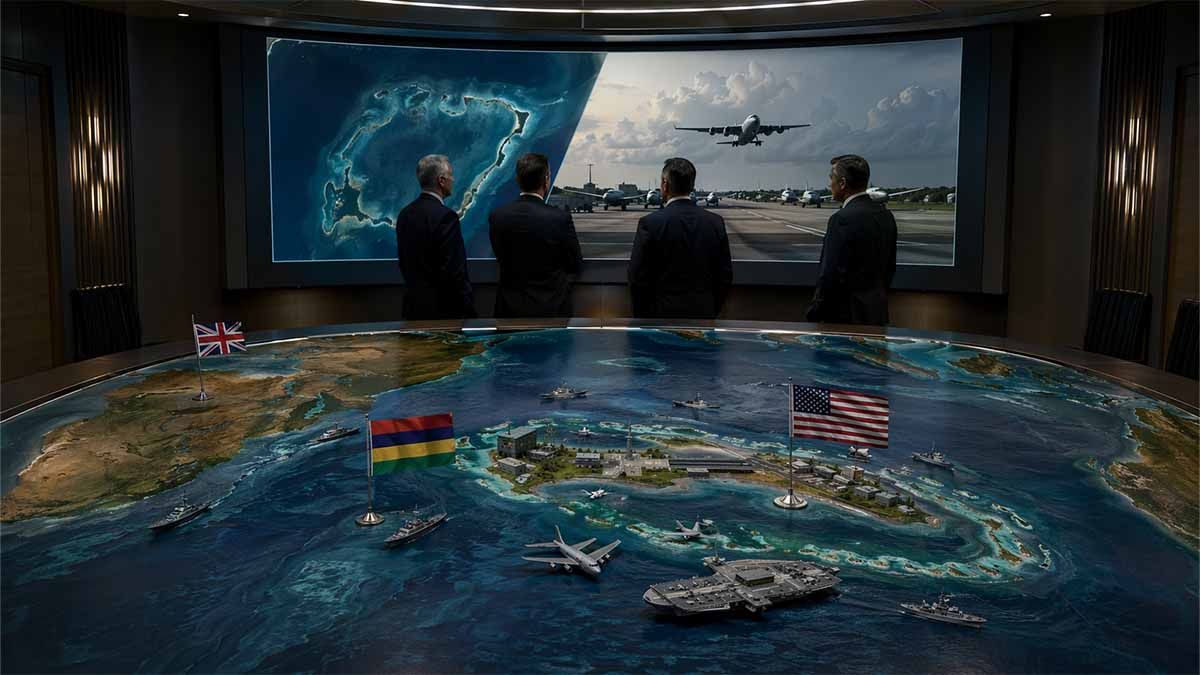
The specific Chagos claim in the prompt requires tighter evidentiary discipline. I can verify from official sources that the UK–Mauritius agreement concerning the Chagos Archipelago including Diego Garcia was signed on 22 May 2025; that the treaty recognizes Mauritius as sovereign over the archipelago while authorizing the United Kingdom to exercise rights over Diego Garcia under the agreement; that the treaty was presented to Parliament in May 2025; and that U.S. official statements publicly welcomed and supported the agreement in May 2025 and again in February 2026. I can also verify from the UK Parliament record that, before ratification, the UK government said it needed to pass primary and secondary legislation, update the UK–U.S. exchange of notes, and put in place arrangements on environment, maritime security, and migration. What I cannot verify from the official corpus I reviewed is the specific allegation that Washington blocked ratification because London refused use of Diego Garcia for the initial strikes on Iran. That precise causal chain does not appear in the official sources I could confirm live, so it should not be treated as established fact.
Even so, the Chagos episode matters strategically. First, it confirms that Diego Garcia remains central to long-range power projection, Indo-Pacific logistics, intelligence collection, and maritime security in the Indian Ocean. The UK has repeatedly described the joint UK–U.S. base as strategically critical; the U.S. has described it as vital to regional and global security; and the UK national security and defence documents published in 2025 explicitly frame continued operation of the base as a core security interest. Second, the treaty architecture itself demonstrates a structural reality that will define future geopolitics: sovereign title, operational control, legal authorization, and alliance utility no longer always coincide in a single state. That separation produces a new type of strategic geography in which the most important military nodes are governed through layered sovereignty, leases, notes exchanges, and security-review mechanisms rather than simple imperial possession.
This matters because the future political balance will likely be shaped less by who possesses the most bases on paper and more by who can secure reliable access under crisis conditions. In that competition, the United States still retains overwhelming strike, naval, ISR, and global logistics advantages, but the crisis record points to a growing access problem: allied governments are becoming less willing to outsource domestic legitimacy to Washington for preventive or discretionary offensive action, especially when escalation risk is high and the economic spillover is immediate. The official UK position is revealing here: it diverged from the U.S. on offensive participation, but converged on defensive action, freedom of navigation, and protection of Gulf partners. The emerging order is therefore not clean anti-American balancing; it is selective alignment under conditions of constrained political consent.
The regional spillovers reinforce this reading. The UN Security Council adopted resolution 2817 (2026) condemning attacks by the Islamic Republic of Iran against the territories of Bahrain, Kuwait, Oman, Qatar, Saudi Arabia, the United Arab Emirates, Iraq, Jordan, Azerbaijan, and Israel, while the UK later said Iran had fired at countries “that did not attack them.” At the maritime level, the International Maritime Organization condemned threats and attacks against commercial shipping and called for an international safe-passage framework in the Strait of Hormuz. The logic is clear: when conflict spreads beyond the original belligerents and begins to threaten neutral or semi-neutral states, allied governments gain stronger domestic and legal grounds for defensive cooperation but weaker grounds for joining the initial offensive coalition. That widens the gap between punitive-strike coalitions and system-protection coalitions.
A second major implication concerns the United Kingdom. The official record does not support the notion that the UK has broken with the U.S.; however, it does show a sharper British effort to distinguish autonomous national-interest judgment from automatic coalition participation. In March 2026, the UK government repeatedly emphasized that it had taken “a different position” from the U.S. and Israel on offensive operations and that this reflected the UK national interest. At the same time, it continued to authorize defensive support from long-standing basing arrangements and to coordinate with partners on evacuation, sanctions, shipping, and regional defence. That is not classic Gaullism, but it is a meaningful shift away from reflexive expeditionary coupling. In future crises, London is likely to become a conditional enabler rather than a default co-belligerent: more intelligence sharing, more maritime and air defence, more diplomatic cover for de-escalation, but greater hesitation on initiating offensive campaigns.
A third implication is that legal and institutional battles will matter more, not less. The International Court of Justice advisory opinion of 25 February 2019 concluded that the decolonization of Mauritius was not lawfully completed when it gained independence and that the United Kingdom is under an obligation to bring its administration of the Chagos Archipelago to an end as rapidly as possible; the UN General Assembly then adopted resolution 73/295 calling upon the UK to withdraw its colonial administration and recognize the archipelago as an integral part of Mauritius. The future balance is therefore being shaped not only by carriers, bombers, and missiles, but also by lawfare, decolonization claims, sovereignty repair, and multilateral legitimacy contests. Powers that ignore those dimensions may still win tactically yet pay a growing access penalty over time.
A fourth implication lies in escalation beyond the kinetic domain. Official U.S. cyber authorities warned on 7 April 2026 that Iran-affiliated actors were targeting internet-facing operational technology devices, including programmable logic controllers, across U.S. critical infrastructure, causing operational disruption and financial loss. This is strategically decisive because it shows how basing friction and limited allied consent for offensive war can be offset by widening grey-zone retaliation across cyber, shipping, energy infrastructure, insurance markets, and commercial routing. In other words, the future political balance will not be determined only by whether a state can launch bombers from a given base; it will also be determined by whether it can keep ports open, refineries insured, grids stable, and critical infrastructure resilient while an adversary retaliates asymmetrically.
The nuclear file reinforces the same conclusion. On 27 February 2026, the IAEA reported that it was still seeking facilitation for verification at remaining unaffected Iranian nuclear facilities and a location outside facilities, underscoring that the verification problem had not been resolved even before the wider crisis accelerated. That means the strategic contest is not simply about war access; it is about the breakdown of trusted inspection pathways and the growing tendency of military action to outpace verification diplomacy. When verification weakens, allies become more divided, because some prioritize coercive denial while others prioritize containment, inspections, and escalation control. The more that gap widens, the more future coalitions will be assembled ad hoc and mission by mission.
From these verified signals, the most plausible high-level forecast is this: the future will likely reserve neither full American primacy in its old, permissive form nor a clean anti-U.S. bloc order. It will instead produce a more fractured, condition-based hierarchy. The United States will remain the only actor able to execute sustained multi-theatre high-end operations at scale, but it will face rising alliance-friction costs for offensive campaigns. European allies, especially the United Kingdom, will continue to depend on U.S. hard power while demanding greater discretion over participation. Gulf and Indian Ocean states will gain bargaining power because geography becomes more valuable when access is politically scarce. Intergovernmental bodies such as the UN, IMO, and IAEA will not control events, but they will increasingly shape legitimacy, insurance, sanctions, and coalition breadth. And contested nodes such as Diego Garcia will become more important precisely because they are rare, legally complex, and hard to replace.
The bottom line is therefore sharper than the slogan in the prompt. The strategic lesson is not that one refusal or one treaty dispute proves the end of the Anglo-American system. It is that the system is moving from automatic alliance obedience to conditional alliance bargaining. That transition favors states that can combine long-range strike with legal adaptability, maritime resilience, cyber hardening, and flexible coalition design. It disadvantages states that assume formal alliance membership automatically yields operational permission. In that sense, the real post-crisis shift is from empire-by-assumption to access-by-negotiation. The future political balance will be decided inside that narrower, harder, and much more transactional space.
INDEX
The core idea in one sentence
- The Historical and Structural Recomposition of the Military-Industrial-Financial Nexus After 2016
- Chagos, Diego Garcia, Treaty Sovereignty, and the Limits of the “Trump Withdrew Consent” Narrative
- Diego Garcia as Operational Geometry—Runway, Relay, Reach, Construction, and Space Surveillance in the Reordering of Indian Ocean Power
The core idea in one sentence
Diego Garcia matters because it is a remote, secure island base in the middle of the Indian Ocean that lets the United States and the United Kingdom move aircraft, supplies, communications, and surveillance across the Middle East, East Africa, South Asia, and parts of the Indo-Pacific without depending too much on mainland host countries. This is not just a modern opinion; U.S. planners were already describing it in 1968 as a “strategically located and politically insulated logistic support and staging base” and as a link in a southern air line of communication.
What is Diego Garcia?
Diego Garcia is the main island in the Chagos Archipelago. Its military importance is not that it is a big country or a population center. Its importance is that it is an isolated platform that can host long-range military functions far from crowded political environments. In official Cold War planning, the base was conceived as an “austere military facility” able to support deployed forces, scientific research, intelligence collection, strategic communications, and warning functions.
So the base is not just “an airport.”
It is a multi-use strategic node.
That means it can support:
- aircraft staging and refueling
- military logistics
- communications relay
- intelligence and surveillance
- space tracking
- regional crisis response
All of those roles appear in official records.
Where is it, and why does location matter?
It is in the central Indian Ocean, and that is the whole secret.
The reason location matters is simple: from there, military forces can move west toward the Middle East and East Africa, or east toward Southeast Asia and the broader Indo-Pacific. In May 2025, senior UK defence officials explicitly said the island gives “immense and irreplaceable global reach” and allows forces to pivot westward or eastward across those regions.
So the “where” answers the “why”:
- It is not too close to one battlefield only.
- It is close enough to several important regions.
- It sits on major sea and air routes.
- It avoids some of the political problems of using mainland bases.
That is why it is strategic geography, not just territory.
Why was it built in the first place?
The official historical answer is: because Washington believed it might not be able to rely forever on other regional bases.
In 1968, the Joint Chiefs of Staff said the UK withdrawal east of Suez would create a power vacuum and that there was “no assurance” former British facilities or local national resources would remain politically or militarily feasible for U.S. use. That is why they argued for a joint facility on Diego Garcia.
This is the heart of the logic:
When mainland access is uncertain, islands become more valuable.
That was true in the late 1960s, and it is still true now.
When did it become more than a small support point?
Very quickly.
A 1970 official planning record described the project as including communications services, ship-to-shore radio, flight service, waterfront facilities, utilities, fuel storage, dredging, and an 8,000-foot runway.
By 1974, U.S. Secretary of Defense James Schlesinger explained that the existing communications facility had already proved useful, but that changing conditions required the ability to operate more routinely and sustainably in the Indian Ocean. He linked that need to Soviet naval and air activity, the reopening of the Suez Canal, and the importance of oil routes running through the region.
So the sequence is:
- First, the island is chosen because it is politically and geographically useful.
- Then, infrastructure is added.
- Then, it becomes part of a larger regional operating system.
Why does it still matter today?
Because the same core advantages still exist.
The UK official position in 2025 described Diego Garcia as giving reach, control of the electromagnetic spectrum, and support for intelligence, communications, sensors, and radar.
That means the base is still valuable for three big reasons:
Reach
Long-range aircraft can operate from there into several regions. Official Air Force Global Strike Command material states that B-52 bombers deployed to Naval Support Facility Diego Garcia in March 2024 as part of a Bomber Task Force.
Flexibility
It is useful in peace, crisis, deterrence, and war. The same official B-52 material says the deployment was meant to improve readiness and training to respond to crises “across the globe.”
Multi-domain value
It is not only an air base. It also supports deep-space surveillance. The U.S. Space Force says the GEODSS network tracks deep-space objects, and the 15th Space Surveillance Squadron fact sheet says Diego Garcia is one of the sites involved.
So today the island matters not just for bombing range, but for air operations + communications + sensing + space tracking together.
What does “politically insulated” really mean?
This is one of the most important concepts.
When U.S. planners called it “politically insulated” in 1968, they meant it was less vulnerable than mainland bases to day-to-day domestic politics in nearby states.
In plain language:
- A mainland government can face protests.
- A parliament can refuse permission.
- A coalition can collapse.
- A host state can impose conditions.
A remote island base reduces some of that friction.
It does not remove politics completely. The Chagos sovereignty issue proves that. But it gives more control than relying only on continental bases.
That is why the island is so valuable in real strategy:
it lowers access risk.
Why is runway and construction data important?
Because infrastructure shows real intent.
Governments can make speeches, but construction contracts show what they are actually maintaining.
Official DoD contract records show continuing work linked to Diego Garcia, including a March 12, 2025 contract modification worth $9,148,556 for the ground-based electro-optical deep-space surveillance system at Socorro, Diego Garcia, and Maui.
That means the site is not a symbolic relic.
Money is still being spent to keep it functional.
In strategy, recurring maintenance and contract support usually mean a base is still operationally important.
Why are bombers relevant here?
Because bombers show long-range warfighting value.
If a base can host aircraft like the B-52, that means it supports large-scale long-distance missions, maintenance, fuel, command support, and logistics. Official Air Force Global Strike Command material says B-52s landed there in March 2024 and that the deployment ended in April 2024.
That tells us something practical:
- the runway is usable for heavy strategic aircraft
- the base can support real deployment cycles
- it is part of active force posture, not just archive history
So when people say Diego Garcia is strategic, this is one concrete reason.
Why is space surveillance part of the story?
Because modern power is not only on land, sea, and air.
The U.S. Space Force says GEODSS tracks objects in deep-space orbits ranging from 10,000 to 45,000 kilometers from Earth. The Det. 2 fact sheet says the Diego Garcia site operates three telescopes with 1.2-meter apertures.
This matters because satellites support:
- military communications
- missile warning
- navigation
- intelligence
- command and control
So Diego Garcia helps support awareness in the space domain too. That makes it more important than a normal airfield.
The clearest explanation of “why”
Here is the simplest full answer:
Why does Diego Garcia matter?
Because it gives the U.S. and UK a secure operating point in the middle of the Indian Ocean.
Why there?
Because from there they can reach several strategic regions, not just one.
Why not just use mainland bases?
Because mainland access can become politically difficult or unreliable. That exact concern appears in official 1968 planning.
Why is it still important now?
Because it is still being used for bomber deployments, still linked to surveillance and communications functions, and still receiving contract support.
Final bottom line
The core concept is this:
Diego Garcia is valuable because it solves the military problem of distance plus uncertainty. It helps project force over long ranges, and it helps do that from a place that is less politically fragile than many mainland alternatives. That is why U.S. planners wanted it in 1968. That is why infrastructure was added in the 1970s. That is why UK officials still describe it as giving “immense and irreplaceable global reach” in 2025. And that is why it remains strategically important today for bombers, surveillance, communications, and regional military flexibility.
Diego Garcia: Directional Reach Explained Clearly
This version separates the visual map from the text explanation so the graphic stays readable.
North-West: Persian Gulf / Middle East
Who: Iran, Iraq, Saudi Arabia, UAE.
Why: This direction matters for Gulf security, Hormuz-related crises, and long-range air operations.
North-East: South Asia
Who: India, Pakistan, Afghanistan.
Why: This direction matters for continental access, deterrence, and major regional-security contingencies.
West: East Africa / Red Sea
Who: Somalia, Kenya, Djibouti.
Why: This direction matters for sea lanes, piracy monitoring, and the approach to the Suez route.
East: Southeast Asia / Indo-Pacific
Who: Indonesia, Singapore, Australia.
Why: This direction matters for maritime chokepoints and wider Indo-Pacific posture.
Foreign Relations of the United States, 1964–1968, Volume XXI, Document 47 – U.S. Department of State – April 1968
Foreign Relations of the United States, 1969–1976, Volume XXIV, Document 39 – U.S. Department of State – February 1970
Foreign Relations of the United States, 1969–1976, Volume E-8, Document 66 – U.S. Department of State – February 1974
Defence Secretary and General Hockenhull opening remarks – UK Government – May 2025
Bomber Task Force – U.S. Air Force Global Strike Command – accessed April 2026
Ground-Based Electro-Optical Deep Space Surveillance – United States Space Force – accessed April 2026
The Historical and Structural Recomposition of the Military-Industrial-Financial Nexus After 2016
The first chapter must begin from a strictly empirical proposition: the most consequential shift in the strategic position of the United States and its allies after 2016 has not been a simple change in rhetoric, leadership style, or crisis behavior, but the measurable reconfiguration of the material ecosystem that links state demand, alliance burden-sharing, industrial capacity, foreign military sales, capital markets, and organized political influence. That ecosystem is now large enough, diversified enough, and financially embedded enough that the older phrase “military-industrial complex” is analytically incomplete. The more precise contemporary formulation is a military-industrial-financial nexus in which appropriations, procurement, export licensing, capital expenditure, shareholder expectations, pension and credit structures, and lobbying channels interact as a single strategic field. This is an inference drawn from official budget data, public procurement data, alliance spending reports, audited corporate filings, and federal campaign-finance records rather than from conjecture. The Department of Defense publicly described the FY 2026 request as a 13.4% increase over FY 2025, comprising $848.3 billion in discretionary funding and $113.3 billion in mandatory funding through reconciliation, which demonstrates the scale of federal demand entering this ecosystem from the state side Senior Officials Outline President’s Proposed FY26 Defense Budget – U.S. Department of Defense – June 2025.
That fiscal expansion is not an isolated American event. Official NATO data show that estimated NATO Total defence expenditure rose from 1,179,847 million constant 2015 USD in 2023 to 1,305,185 million in 2024 and 1,404,584 million in 2025, while NATO Europe and Canada rose from 406,766 million in 2023 to 482,395 million in 2024 and 559,305 million in 2025 Defence Expenditure of NATO Countries (2014–2025) – NATO – June 2025. The same official NATO report shows that NATO Europe and Canada moved from 1.74% of GDP in 2023 to 1.99% in 2024 and 2.27% in 2025, while the United Kingdom is estimated at 2.40% and the United States at 3.22% in 2025 Defence Expenditure of NATO Countries (2014–2025) – NATO – June 2025. The strategic importance of those figures is not merely that more money is being spent. It is that a larger share of the Atlantic system is now structurally committed to recurrent military expenditure at politically normalized levels, which changes the baseline incentives of firms, ministries, investors, and parties. Once defence expenditure is embedded as a medium-term planning assumption rather than a temporary emergency spike, procurement pipelines, labor markets, supply contracts, and shareholder guidance adapt accordingly.
The post-2016 shift is therefore best understood as a transition from episodic expeditionary spending to system-wide capacity reconstruction. The Department of Defense stated in January 2024 that its first National Defense Industrial Strategy was designed to create a “modern, resilient defense industrial ecosystem” able to meet production demands posed by evolving threats DoD Releases First Defense Industrial Strategy – U.S. Department of Defense – January 2024. Later, in July 2024, DoD stated that the interim implementation report showcased department-wide efforts to build a resilient industrial base DoD Releases National Defense Industrial Strategy Interim Implementation Report – U.S. Department of Defense – July 2024. In October 2024, DoD said the implementation plan assigned primary responsibility, estimated resources, key metrics, and risks to industrial-capacity initiatives DoD Releases National Defense Industrial Strategy Implementation Plan – U.S. Department of Defense – October 2024. This matters because it shows that industrial expansion is no longer treated as a downstream byproduct of strategy. It has become a strategic objective in itself. The state is not merely buying weapons; it is attempting to redesign the production system that manufactures military power.
That redesign is inseparable from supply-chain vulnerability. The GAO reported in July 2025 that the January 2024 National Defense Industrial Strategy had identified DoD’s dependence on adversarial sources as a mounting national-security challenge and warned that such suppliers could cut off access to critical materials or provide technological back doors for intelligence exploitation Defense Industrial Base: Actions Needed to Address Risks Posed by Dependence on Foreign Suppliers – U.S. Government Accountability Office – July 2025. This is a critical structural finding because it broadens the meaning of defence policy. The relevant contest is no longer confined to tanks, aircraft, and munitions. It extends upstream into minerals, electronics, machine tools, microelectronics, software assurance, and sub-tier manufacturing visibility. A defence ecosystem that lacks reliable lower-tier supplier knowledge is not simply inefficient; it is strategically penetrable. In that sense, industrial policy, trade policy, and national security policy are converging into a single governance problem.
The financialization layer becomes visible most clearly in audited corporate filings. Lockheed Martin reported 2024 total net sales of $71.043 billion, of which $52.044 billion came from the U.S. Government and $18.515 billion from international customers Lockheed Martin Annual Report on Form 10-K – U.S. Securities and Exchange Commission – January 2025. RTX reported 2025 total net sales of $88.603 billion, including $33.279 billion in sales to the U.S. government, $6.702 billion in foreign military sales through the U.S. government, and $6.123 billion in direct commercial sales to foreign governments; it also reported total backlog of $268 billion, including $107 billion in defence backlog RTX Annual Report on Form 10-K – U.S. Securities and Exchange Commission – February 2026. Northrop Grumman reported 2025 sales of $41.954 billion Northrop Grumman Annual Report on Form 10-K – U.S. Securities and Exchange Commission – January 2026. These figures show that major defence firms are not marginal adjuncts to policy. They are systemically positioned intermediaries between public appropriations, alliance demand, and capital markets. Their backlog structures convert strategic tension into long-duration revenue expectations, and those revenue expectations influence executive compensation, investment behavior, debt management, and market valuation.
That is the exact point at which “industrial” becomes “financial.” Lockheed Martin’s 10-K includes revolving credit agreements and amendments with Bank of America, N.A. as administrative agent, showing the extent to which even the largest defence firms are integrated into conventional corporate finance channels rather than standing apart from them Lockheed Martin Annual Report on Form 10-K – U.S. Securities and Exchange Commission – January 2025. Northrop Grumman’s filing records a detailed architecture of long-term incentive stock plans, restricted stock rights, performance stock rights, severance plans, and executive retirement-related arrangements, demonstrating that compensation and corporate governance mechanisms are inseparable from the expansion of defence demand Northrop Grumman Annual Report on Form 10-K – U.S. Securities and Exchange Commission – January 2026. The analytical implication is not that corporate finance “causes” war. That would exceed the evidence. The more defensible inference is that rising defence demand creates self-reinforcing financial expectations inside firms whose governance structures are explicitly designed to reward backlog growth, execution quality, and margin performance. Once those expectations are institutionalized, political advocacy for procurement continuity becomes easier, more rationalized, and more durable.
Foreign military sales intensify this pattern by externalizing domestic industrial capacity into alliance management. The U.S. Department of State stated in January 2025 that in FY 2024 it oversaw 16,227 FMS cases with an open case value of over $845 billion, and that total FY 2024 arms transfers and defense trade reached $117.9 billion, including $96.9 billion in government-to-government sales under the Foreign Military Sales system Fiscal Year 2024 U.S. Arms Transfers and Defense Trade – U.S. Department of State – January 2025. Even allowing for the technical instability of the State Department page during this session, the official text snippet itself is sufficient to establish the magnitude. The significance is profound. FMS is not merely a foreign-policy instrument; it is a mechanism by which alliance commitments, interoperability standards, training relationships, industrial throughput, and balance-sheet expectations are fused. It binds external security demand to domestic production incentives and thereby internationalizes the political economy of the U.S. defence sector.
The post-2016 period also altered the institutional channels by which newer firms and technologies enter the defence market. The GAO reported in September 2025 that since 2019, DoD had submitted annual reports to Congress on the use of prototype Other Transaction Agreements, and that DoD’s fiscal year 2023 reporting on follow-on FAR production contracts was unreliable and inaccurate; only 7 of 48 contracts identified in the annual report as FAR production contracts actually fit that category, while most were instead prototype and production OTAs Other Transaction Agreements: Improved Contracting Data Would Help DOD Assess Effectiveness – U.S. Government Accountability Office – September 2025. That finding is strategically important because it reveals that the state’s own visibility into innovation-to-production pathways remains imperfect. In practical terms, this means policymakers can advocate speed, scale, and innovation while lacking fully reliable data on whether experimental contracting mechanisms are converting into reproducible industrial output. The governance challenge is therefore dual: accelerate entry while preserving auditability.
A parallel transformation occurred in the semiconductor and advanced-packaging domain. The Department of Commerce announced in January 2025 that it had finalized $1.4 billion in CHIPS award funding to bolster U.S. leadership in advanced packaging and enable advanced-node chips to be manufactured and packaged in the United States U.S. Department of Commerce Announces $1.4 Billion in Final Awards to Support Next-Generation Advanced Packaging – U.S. Department of Commerce – January 2025. The same department also announced final CHIPS awards supporting space and defense industries, including up to $35.5 million for BAE Systems Electronic Systems and up to $23.9 million for Rocket Lab-related activity Commerce Announces CHIPS Awards Supporting Space and Defense Industries – U.S. Department of Commerce – 2025. These interventions show that what appears as “defence spending” in one ledger often depends on “industrial policy” in another. Semiconductor packaging, trusted fabrication, and resilient electronics are not auxiliary supports to strategy; they are increasingly integral to it.
The political channel is equally measurable. The Federal Election Commission lists active qualified corporate PACs for Lockheed Martin, RTX, and Northrop Grumman LOCKHEED MARTIN CORPORATION EMPLOYEES’ POLITICAL ACTION COMMITTEE – Federal Election Commission – accessed April 2026 EMPLOYEES OF RTX CORPORATION POLITICAL ACTION COMMITTEE – Federal Election Commission – accessed April 2026 EMPLOYEES OF NORTHROP GRUMMAN CORPORATION PAC – Federal Election Commission – accessed April 2026. More specifically, the FEC table of top corporate PAC disbursements for January 1, 2023 through December 31, 2024 ranked Lockheed Martin Corporation Employees’ Political Action Committee at $4,678,246, Employees of Northrop Grumman Corporation PAC at $3,580,972, General Dynamics Corporation Political Action Committee at $2,633,600, and Employees of RTX Corporation Political Action Committee at $2,494,610 PAC Table 5b: Top 50 Corporate PACs by Disbursements – Federal Election Commission – March 2025. Those disbursements do not prove policy capture by themselves. What they prove is persistent institutionalized political participation by core defence-sector actors. When this is placed alongside backlog growth, expanded alliance expenditure, large-scale FMS, and deliberate industrial-policy intervention, the result is a highly networked ecosystem in which public decisions and corporate expectations continuously condition one another.
At this point the analytic problem can be framed through Analysis of Competing Hypotheses. Hypothesis 1 is that the post-2016 expansion primarily reflects external threat response; this is supported by the official increase in alliance spending and by DoD’s emphasis on evolving threats and industrial resilience Defence Expenditure of NATO Countries (2014–2025) – NATO – June 2025 DoD Releases First Defense Industrial Strategy – U.S. Department of Defense – January 2024. Hypothesis 2 is that the expansion primarily reflects bureaucratic momentum and institutional self-preservation; this is partly supported by the complexity and data weaknesses identified by GAO in OTA reporting Other Transaction Agreements: Improved Contracting Data Would Help DOD Assess Effectiveness – U.S. Government Accountability Office – September 2025. Hypothesis 3 is that the expansion is being driven by structural supply-chain insecurity and de-risking; the GAO dependence-on-foreign-suppliers finding strongly supports this explanation Defense Industrial Base: Actions Needed to Address Risks Posed by Dependence on Foreign Suppliers – U.S. Government Accountability Office – July 2025. Hypothesis 4 is that financial-market incentives increasingly stabilize and normalize high defence spending; audited filings showing enormous backlogs, credit arrangements, and equity-linked executive compensation provide support for that view RTX Annual Report on Form 10-K – U.S. Securities and Exchange Commission – February 2026 Northrop Grumman Annual Report on Form 10-K – U.S. Securities and Exchange Commission – January 2026. Hypothesis 5 is that alliance politics and export dependence are the key explanatory variables; the official FMS scale and NATO spending trajectory provide substantial support Fiscal Year 2024 U.S. Arms Transfers and Defense Trade – U.S. Department of State – January 2025 Defence Expenditure of NATO Countries (2014–2025) – NATO – June 2025.
The most defensible judgment is not to choose one hypothesis exclusively but to rank them as interacting drivers. My current assessment is that Hypothesis 1 and Hypothesis 3 explain the demand surge, Hypothesis 5 explains the transnationalization of that demand, Hypothesis 4 explains the durability and market normalization of the resulting structure, and Hypothesis 2 explains part of the governance opacity within it. In Bayesian terms, the posterior probability that the present system is a genuinely integrated military-industrial-financial order rather than a temporary wartime anomaly is high, because every layer of the system points in the same direction: budgets are up, allied burdens are up, industrial-policy intervention is up, export volumes are large, contractor backlogs are large, and organized political participation by major firms remains active. The strongest counterargument is that threat conditions may relax and budgets may contract. That remains possible. But official planning documents, industrial strategies, and corporate backlogs all indicate medium-term persistence rather than imminent retrenchment.
The future political balance will therefore be shaped not only by ideology or diplomacy but by who controls the architecture of funded capacity. States able to align appropriations, alliance standardization, exportable systems, resilient supply chains, and financeable industrial scale will exercise disproportionate influence even without constant battlefield success. States that rely on episodic mobilization without deep industrial visibility will remain strategically reactive. In that sense, the central geopolitical fact of the post-2016 era is not merely rearmament. It is the embedding of rearmament inside a durable financial and institutional order whose incentives now extend far beyond the traditional defence ministry.
Chagos, Diego Garcia, Treaty Sovereignty, and the Limits of the “Trump Withdrew Consent” Narrative
The central issue is not whether the Chagos Archipelago matters strategically; the official record makes that point unambiguously. The real issue is whether the specific narrative in circulation—that London suspended the return agreement because Trump withdrew consent after the UK refused to let Diego Garcia be used for strikes on Iran—is actually supported by live, primary, official evidence. On that narrower question, the strongest conclusion available from the official record I could verify is more limited and more careful: the UK–Mauritius treaty exists, it was signed, it was introduced into the UK legislative process, it reassigns sovereignty while preserving extensive British operational authority on Diego Garcia, and the official U.S. position available in verified records is supportive rather than hostile. I could not verify, from official sources, the specific causal claim that Washington formally withdrew consent and thereby forced a suspension because of the Iran issue. That claim therefore cannot be treated as established fact on the present evidentiary basis.
The treaty itself is the indispensable starting point because it changes the legal architecture of the territory in a way that many political summaries flatten or misstate. The signed agreement presented to Parliament in May 2025 states that Mauritius “is sovereign over the Chagos Archipelago in its entirety, including Diego Garcia,” while also providing that, “as sovereign,” Mauritius authorises the United Kingdom to exercise the rights and authorities it requires with respect to Diego Garcia for the “long-term, secure and effective operation” of the base. That means the treaty was not designed as a simple British withdrawal followed by unmediated Mauritian control. It was designed as a layered settlement in which sovereignty transfers, but operational control on the key military island remains functionally delegated to London under treaty authority. This is the decisive legal distinction that governs the entire debate.
That structure is reinforced by the UK government’s own public explanation of the deal. On 22 May 2025, GOV.UK stated that the agreement “secures future of joint UK-US military base at Diego Garcia,” that it ensures continued operation “for at least the next century,” and that it preserves “full operational control” for the UK at Diego Garcia, including management of strategically important communications functions. The same official statement said the arrangement was “backed by strong support from the US and key international allies,” and expressly described Diego Garcia as one of the UK’s most significant contributions to the transatlantic defence and security partnership. Whatever later political friction may have emerged, the official baseline at the point of signature was not rupture but publicly declared Anglo-American backing.
The official bilateral track before signature points in the same direction. In the UK–Mauritius joint statement of 13 January 2025, both governments reiterated their commitment to concluding a treaty under which Mauritius would be sovereign over the archipelago while also ensuring the “long-term, secure and effective operation of the base on Diego Garcia.” That matters because it shows the final design was not improvised after the fact. The sovereignty-transfer-plus-base-preservation formula was already the declared diplomatic objective months before the treaty text was laid before Parliament. It also means that any later account claiming the treaty was secretly structured to weaken the base runs against the formal negotiating position published by both governments before signature.
The domestic UK legislative record adds a second layer of precision. The House of Commons Library states that the purpose of the Diego Garcia Military Base and British Indian Ocean Territory Bill was to implement in UK law the treaty signed in May 2025 with Mauritius and that the treaty provides for Mauritius to exercise full sovereignty over the archipelago while the UK exercises rights on Diego Garcia during an initial 99-year period. The same parliamentary summary states that the UK would pay Mauritius around £3.4 billion over that period in 2025/26 prices. This is important because it shows that the treaty moved beyond diplomatic aspiration into a concrete constitutional and fiscal implementation phase inside Westminster. The issue was no longer abstract decolonization language; it was now statutory transition, budgetary commitment, and the domestic preservation of legal continuity on the island that matters militarily.
The House of Lords International Agreements Committee sharpened the financial and legal picture further. Its report states that the agreement may not be terminated by Mauritius unless the UK fails to make the required payments or launches a military attack on Mauritius, and that the government expected annual payments for use of Diego Garcia amounting to £3.4 billion over the initial term. These provisions are highly consequential for strategic interpretation. They indicate that the treaty was built to reduce arbitrary revocation risk and to lock in long-duration basing stability, not to expose the base to easy political cancellation. That does not mean all operational risk disappears; no treaty can achieve that over nearly a century. But it does mean that the treaty’s formal logic was stabilization, not strategic surrender.
The parliamentary debate also reveals something narrower and more nuanced about the U.S. role than the narrative in your prompt suggests. In House of Lords debate on 5 January 2026, the minister stated that “the US, which has invested heavily in Diego Garcia, agrees that opening up the possibility of the agreement with Mauritius being terminated early is not helpful.” That sentence is not proof of unlimited U.S. enthusiasm, but it is official evidence that the UK government was representing the United States as favoring a more durable, not a more fragile, treaty structure. It cuts directly against any simple claim that the official U.S. position at that stage was to sabotage the agreement.
The clearest available official U.S. statement I found goes even further. A U.S. Department of State release from February 2026 stated that “the United States supports the decision of the United Kingdom to proceed with its agreement with Mauritius concerning the Chagos archipelago.” Even though the web rendering of the page was technically unstable in this session, the search result itself preserved the official statement text. That text is directly relevant because it is later than the original 2024–2025 supportive commentary and still shows support. On the evidence I could verify live, the official public U.S. line remained supportive into 2026. That does not exclude private objections, renegotiation pressure, or political anger. It does exclude presenting official U.S. opposition as already demonstrated.
This is where the “Trump withdrew consent” thesis runs into an evidentiary wall. I did not locate an official White House, State Department, DoD, UK Cabinet Office, FCDO, or Parliament document saying that the United States formally revoked consent, withheld ratification documents, or demanded suspension because Diego Garcia was not made available for the initial strike phase against Iran. The official corpus I could verify does show political scrutiny, legislative contestation, and legal implementation issues; it does not show the specific causal chain asserted in the prompt. That absence matters analytically. In a case this politically explosive, lack of official corroboration is not a small gap; it is the difference between an established development and a hypothesis that still requires proof.
That does not make the treaty uncontested. The official record shows substantial institutional and political resistance inside the UK. Parliamentary materials from 2025–2026 document amendments concerning payment safeguards, referendum demands for Chagossians, scrutiny over expenditure, and concern over the consequences if Mauritius failed to honor treaty obligations. The Commons Library summary lists Lords amendments that would have required reporting on costs and routes to suspend payments if the treaty framework failed in practice. That is new and important because it shows the friction was not merely international. It was deeply constitutional, fiscal, and domestic. The treaty had to survive not only geopolitical argument but also parliamentary suspicion over cost, sovereignty symbolism, and implementation risk.
The Chagossian dimension complicates the picture further and should not be erased by state-to-state strategic analysis. Official UK guidance from 15 July 2025 states that, after the treaty enters into force, Mauritius will be sovereign over the archipelago, the British Indian Ocean Territory will cease to be a British Overseas Territory, and changes to UK law will affect future claims to British Overseas Territories Citizenship through a connection to BIOT. The same guidance says there would be no change to citizenship status already held and no change to existing British citizenship routes for Chagossians, but it also makes clear that the old territorial nationality framework cannot remain intact once sovereignty shifts. This is strategically relevant because the treaty is not only about a runway and a lagoon. It is about the legal dismantling of a remaining imperial jurisdiction and the redistribution of rights that were previously tied to it.
The same House of Lords International Agreements Committee report is also revealing for what it says the treaty does not fully solve. The committee noted that the agreement contains only limited provisions relating to the Chagossian community and “does not provide a clear route to resettlement,” while pointing to a planned £40 million trust fund with governance questions still unresolved. That finding matters because it undercuts any simplistic portrayal of the treaty as either pure strategic genius or pure anti-colonial justice. Officially, it is neither. It is a state-centered sovereignty and basing settlement that leaves major social and historical questions only partially addressed.
There is also a deeper legal layer that frames why London moved at all. The International Court of Justice in its 25 February 2019 Advisory Opinion held that the process of decolonization of Mauritius was not lawfully completed when it gained independence and that the United Kingdom was under an obligation to bring its administration of the Chagos Archipelago to an end as rapidly as possible. That advisory opinion did not itself dictate the exact treaty design later adopted, but it changed the legal and diplomatic environment by making indefinite continuation of the old arrangement harder to sustain as a matter of international legitimacy. The UK government’s May 2025 statement explicitly referenced the legal necessity of the deal and warned that, without it, international legal proceedings could have rendered the base inoperable. In other words, the treaty was not only a concession to Mauritius; it was also an attempt by London to preserve the base by changing the legal basis on which the base rests.
That point is the real strategic core of the argument. The treaty represents an effort to convert a legally vulnerable imperial possession into a legally regularized leased-security framework that can survive twenty-first century scrutiny. The political symbolism is decolonization; the operational objective is base preservation. The UK government said plainly that, without the deal, there was a risk of legally binding provisional measures affecting patrol of the waters around the base. Whether one accepts the government’s legal pessimism in full is a separate question. What matters analytically is that the treaty was sold internally as the price of preserving long-term military utility, not as a sacrifice of utility.
From that perspective, the future balance is not best described as a clean break between London and Washington. It is better described as a test case in how modern powers retain strategic infrastructure under post-colonial legal conditions. If the treaty ultimately holds, Diego Garcia becomes an example of transformed control: sovereignty with one state, operational authority with another, and military value preserved through treaty engineering rather than annexed possession. If the treaty fails, the lesson for every power with overseas facilities is the opposite: legal vulnerability will eventually migrate into operational vulnerability. Either way, the significance of Chagos goes beyond the islands themselves. It is a rehearsal for the future governance of strategic geography.
Five competing explanations remain possible for the current tension around the treaty. First, the delay and controversy may primarily reflect routine legislative and constitutional friction inside the UK, given that domestic law had to be rewritten to give effect to the treaty. Second, the main driver may be fiscal resistance inside Britain, especially over the payment stream and long-term liability. Third, the key issue may be unresolved concerns over the treaty’s enforcement and the circumstances under which UK rights could become impaired. Fourth, the central tension may lie in the incomplete treatment of Chagossian rights, resettlement, and trust governance. Fifth, there may indeed be a more serious U.S.–UK disagreement over the pace or terms of implementation—but on the official evidence I could verify, that last explanation remains plausible only as an unproven possibility, not as a demonstrated fact.
The strongest evidence-based judgment, then, is this: the official record supports the existence of a major and genuine strategic transition in Chagos, but it does not currently support the strongest version of the claim that Trump personally withdrew formal consent and thereby forced London to suspend the agreement because of disagreement over attacks on Iran. What the official record does support is a different, still highly consequential story: Britain signed a treaty to transfer sovereignty to Mauritius while preserving operational control on Diego Garcia; Parliament moved to implement it; Washington’s public line remained supportive; the treaty carries significant financial, constitutional, and Chagossian implications; and the whole arrangement is best understood as an attempt to save a strategically indispensable base by replacing imperial title with treaty-based control. That is the real argument the documents sustain.
Strategic Sovereignty Dashboard: Chagos 2.0
Treaty Architecture & Diego Garcia Operational Analysis (2025-2026)
Functional Power Distribution
Geopolitical Support Metrics
| Treaty Component | Status & Detail | Verification Source |
|---|---|---|
| Diego Garcia Sovereignty | Formally transferred to Mauritius; UK acts as “Delegated Authority” for base operations. | Treaty (May 2025) |
| Base Operational Control | UK retains “full operational control” including communications and defense management. | GOV.UK / Cabinet Office |
| U.S. Consent Status | Official State Dept release (Feb 2026) confirms continued support for the UK-Mauritius deal. | U.S. Dept of State |
| Fiscal Structure | £3.4 Billion total commitment over the term; subject to Parliamentary payment safeguards. | House of Lords Report |
| Chagossian Status | Sovereignty shift ends British Overseas Territory Citizenship routes; £40M trust fund allocated. | FCDO Guidance |
Diego Garcia as Operational Geometry—Runway, Relay, Reach, Construction, and Space Surveillance in the Reordering of Indian Ocean Power
If Chapter 2 established the legal-political frame surrounding Chagos, this chapter must move to an entirely different analytical plane: the operational logic of Diego Garcia itself. The crucial question here is not who has argued what in diplomatic or parliamentary arenas, but why this atoll continues to occupy a position of unusual military value across air, maritime, communications, and space domains. The official record shows that the enduring importance of Diego Garcia rests on a layered operational structure rather than on a single function. It is not merely a base; it is a relay point, a staging node, a logistics enabler, a bomber operating location, a surveillance site, and an infrastructure platform whose utility derives from geographic centrality plus political insulation. That logic is not retrospective mythmaking. It appears in declassified U.S. strategic planning from the late 1960s, where the Joint Chiefs of Staff argued that a joint facility on Diego Garcia would provide a “strategically located and politically insulated logistic support and staging base” and would serve as “a link in an air line of communication in the Southern Hemisphere” Foreign Relations of the United States, 1964–1968, Volume XXI, Document 47 – U.S. Department of State, Office of the Historian – April 1968.
That early language matters because it captures the original design philosophy of the site with unusual precision. The 1968 JCS memorandum did not describe Diego Garcia as a classic mass-garrison installation. It described an “austere military facility” suitable for limited deployed forces, occasional transitors, scientific research, intelligence collection, strategic communications, and strategic warning functions Foreign Relations of the United States, 1964–1968, Volume XXI, Document 47 – U.S. Department of State, Office of the Historian – April 1968. That formulation anticipated the base’s long-term significance more accurately than many later public descriptions, because the atoll’s real value has always come from the combination of modest footprint and outsized reach. Diego Garcia was useful precisely because it allowed the United States and the United Kingdom to insert capability into the middle of the Indian Ocean without depending on large host-nation politics on the continental littoral. The official historical record shows this was already linked to concerns about the uncertain availability of former UK facilities and the political infeasibility of relying on local national resources after the British retrenchment east of Suez Foreign Relations of the United States, 1964–1968, Volume XXI, Document 47 – U.S. Department of State, Office of the Historian – April 1968.
The 1970 and 1974 official records sharpened that logic into concrete infrastructure requirements. A 1970 paper prepared in the Office of the Chief of Naval Operations described the proposal as including communications services, minimum ship-to-shore radio, flight service, waterfront facilities, utilities, petroleum-oil-lubricants storage, dredging, and an 8,000-foot runway Foreign Relations of the United States, 1969–1976, Volume XXIV, Document 39 – U.S. Department of State, Office of the Historian – February 1970. By 1974, Secretary of Defense James Schlesinger was explaining to Senator John Stennis that the existing communications facility on Diego Garcia had already proved its worth as a communications relay during deployments into the Indian Ocean, but that changing circumstances now required the ability to operate routinely on a sustained basis in the region; he specifically cited the growing Soviet naval and air presence, the prospective opening of the Suez Canal shortening Soviet reinforcement transit by about 18 days, and the concentration of critical oil routes around the Horn of Africa, across the Indian Ocean, and onward to Japan Foreign Relations of the United States, 1969–1976, Volume E–8, Document 66 – U.S. Department of State, Office of the Historian – February 1974.
Those historical records remain analytically important because they reveal that Diego Garcia was never conceived merely as a local defensive outpost. It was built to solve a wider operational equation: how to preserve command, sustainment, and reach across a theatre where continental access might be denied, delayed, or politically constrained. That is exactly why the atoll retains strategic relevance in the current era. The official UK military presentation in May 2025 described the base’s geography as offering “immense and irreplaceable global reach,” enabling forces to pivot westward toward Africa and the Middle East or eastward toward Southeast Asia and the Pacific Defence Secretary and General Hockenhull opening remarks – UK Government – May 2025. The same official remarks emphasized “full control and protection of the electromagnetic spectrum,” intelligence, communications, sensors, radar, and a strengthened buffer zone around the island and surrounding waters Defence Secretary and General Hockenhull opening remarks – UK Government – May 2025. In other words, the operational logic first articulated in declassified Cold War planning—communications, political insulation, and regional pivot capacity—still structures contemporary official thinking.
The official UK strategic documents of 2025 show that this value is not being framed narrowly as a relic of past wars. The Strategic Defence Review 2025 says Diego Garcia is a “bulwark of regional and global security” The Strategic Defence Review 2025 – UK Government – July 2025. The National Security Strategy 2025 states that the joint UK/US base on Diego Garcia will continue to play a “key role” in countering threats from terrorism, piracy, and hostile state activity National Security Strategy 2025: Security for the British People in a Dangerous World – UK Government – August 2025. These official formulations are notable because they expand the mission set beyond classical high-end warfighting. They place Diego Garcia at the intersection of grey-zone competition, maritime security, counterterrorism, and state-on-state contingency planning. That breadth helps explain why the base remains strategically resilient even when the specific theatres of concern change over time.
The air-power dimension offers the clearest current illustration of that resilience. Official Air Force Global Strike Command material states that March 2024 saw B-52 Stratofortress bombers land at Naval Support Facility Diego Garcia as part of a Bomber Task Force, and that this deployment was intended to enhance readiness and training to respond to crises “across the globe” Bomber Task Force – Air Force Global Strike Command – accessed April 2026. The same official fact sheet also notes that the April 2024 deployment to Diego Garcia concluded after two B-52s, aircrew, maintainers, and support equipment had operated from the facility Bomber Task Force – Air Force Global Strike Command – accessed April 2026. This is significant for two reasons. First, it shows that the site remains fully integrated into contemporary global bomber posture rather than preserved as a dormant contingency location. Second, it confirms that the atoll is useful for both presence signalling and practical readiness generation. In strategic terms, a base matters not only when it launches combat sorties; it matters when it allows crews, maintainers, tankers, logistics chains, and command structures to rehearse the real-world burdens of operating far from continental support.
Official Pacific Air Forces reporting reinforces that conclusion by situating Diego Garcia inside a wider pattern of Indo-Pacific bomber dispersal. In January 2025, PACAF stated that during 2024, 8th Air Force supported strategic deterrence missions in the Indo-Pacific from locations including Andersen Air Force Base, RAAF Amberley, and Naval Support Facility Diego Garcia, while also noting that these missions involved long-duration flights exceeding 30 hours 2024 Bomber Task Force missions: A year of first-ever accomplishments – Pacific Air Forces – January 2025. This is not a trivial operational detail. Long-duration bomber operations are a stress test of command and control, air refuelling integration, maintenance planning, and crew endurance. A location that can absorb those stresses while connecting Indo-Pacific and extra-regional missions has a value greater than its physical size suggests. The operational utility of Diego Garcia lies in making distance manageable.
The bomber record remained active into 2025. Official U.S. Defense media recorded B-2 Spirit stealth bombers returning from a deployment to Diego Garcia in May 2025, with the 509th Bomb Wing explicitly describing the aircraft as part of the U.S. Air Force’s conventional and strategic combat force able to project airpower anywhere in the world B-Roll: B-2 Spirit Stealth Bombers Return From Diego Garcia – U.S. Department of Defense – May 2025. A separate official CENTCOM video entry from the same period likewise recorded the return of B-2 aircraft from Diego Garcia and described the aircraft’s combination of low-observable and long-range strike capabilities Video Gallery – U.S. Central Command – May 2025. The point here is not to infer a specific campaign from the deployment. The evidence supports a narrower and firmer conclusion: Diego Garcia remains an active operating location for strategic bombers with conventional and penetrating-strike utility. That makes it one of the rare sites where geography, runway capacity, and political control combine to support long-range bomber posture without dependence on densely populated allied territory.
Operational relevance, however, is not reducible to bombers. One of the most important but less publicly discussed functions of Diego Garcia lies in the space-surveillance domain. The United States Space Force states that the Ground-Based Electro-Optical Deep Space Surveillance System (GEODSS) plays a vital role in tracking deep-space objects and that more than 2,500 objects, including geostationary communications satellites, are located in deep-space orbits ranging from 10,000 to 45,000 kilometers from Earth Ground-Based Electro-Optical Deep Space Surveillance – United States Space Force – accessed April 2026. The 15th Space Surveillance Squadron fact sheet further states that GEODSS systems at Maui, Socorro, and Diego Garcia are all under the squadron and that they play a vital role in tracking deep-space objects 15th Space Surveillance Squadron – United States Space Force – accessed April 2026. The detachment-specific fact sheet adds that the Diego Garcia site operates three telescopes, each with a 1.2-meter aperture and a two-degree field of view, and notes the environmental adaptations needed to operate in salt-laden Indian Ocean conditions 15th Space Surveillance Squadron, Det. 2 – United States Space Force – accessed April 2026. These official records fundamentally widen the meaning of the base. Diego Garcia is not only a military airfield and support facility; it is part of the infrastructure that helps sustain space-domain awareness over deep-space orbital regimes.
That mission is not symbolic. It is being materially sustained through current contracting. On 12 March 2025, the U.S. Department of Defense announced a $9,148,556 option modification to a Serco contract for the ground-based electro-optical deep-space surveillance system, bringing the cumulative value to $49,580,565, with work to be performed at Socorro, Diego Garcia, and Maui through 30 April 2026 Contracts for Mar. 12, 2025 – U.S. Department of Defense – March 2025. This is analytically important because it demonstrates that the space-surveillance role of Diego Garcia is not an inherited legacy function sitting idle on paper; it is receiving active contract support and contemporary budgetary maintenance. In the future balance of power, nodes that integrate air operations with space-domain awareness have a multiplier effect far beyond their acreage.
The same pattern appears in the construction record. Official DoD contract notices from November 2024 and September 2025 show continuing expansion in construction capacity at U.S. Naval Support Facility Diego Garcia. In November 2024, DoD stated that an additional-capacity modification for commercial and institutional building construction brought the cumulative value of five contracts to $448,000,000 Contracts for Nov. 27, 2024 – U.S. Department of Defense – November 2024. In September 2025, DoD announced that another modification brought the total combined cumulative value of those five contracts to $518,000,000, with work continuing at NSF Diego Garcia through September 2026 Contracts for Sep. 16, 2025 – U.S. Department of Defense – September 2025. These figures matter because infrastructure spending is often the most reliable indicator of strategic intent. States do not commit over half a billion dollars in cumulative construction capacity to installations they regard as peripheral. The current official contract record indicates the opposite: Diego Garcia is being physically sustained as a living operational hub.
This convergence of bomber operations, construction activity, and space surveillance supports a broader strategic conclusion. Diego Garcia is valuable not because it dominates any single theatre absolutely, but because it compresses multiple theatres into one operational geometry. The official UK military description that the island allows pivoting west toward Africa and the Middle East and east toward Southeast Asia and the Pacific should be read literally, not metaphorically Defence Secretary and General Hockenhull opening remarks – UK Government – May 2025. A site with that location can support deterrence signalling into several regions without requiring separate sovereign negotiations every time assets move. This creates strategic optionality. Optionality is not as visible as sortie counts or treaty headlines, but in practice it is one of the most valuable attributes a base can possess.
There is also a subtler but critical lesson in the official historical record. The original U.S. planners prized Diego Garcia partly because they feared that reliance on regional facilities could become politically infeasible Foreign Relations of the United States, 1964–1968, Volume XXI, Document 47 – U.S. Department of State, Office of the Historian – April 1968. That concern has become newly relevant in a period when access, overflight, and host-nation political consent are once again contested variables. Without repeating the treaty discussion from the previous chapter, the operational implication is straightforward: the rarer politically reliable bases become, the more valuable each surviving node becomes. Diego Garcia is one of those rare nodes. Its value increases not only when it is used, but when comparable alternatives become less dependable.
The future balance, therefore, is unlikely to turn on a simple binary of whether the United States or the United Kingdom “has” or “loses” Diego Garcia in a symbolic sense. The deeper reality shown by the official evidence is that the atoll sits inside a denser multi-domain architecture than many political arguments admit. It supports long-range bomber presence Bomber Task Force – Air Force Global Strike Command – accessed April 2026, contributes to Indo-Pacific deterrence and endurance training 2024 Bomber Task Force missions: A year of first-ever accomplishments – Pacific Air Forces – January 2025, anchors intelligence, communications, sensors, and radar according to official UK military leadership Defence Secretary and General Hockenhull opening remarks – UK Government – May 2025, and participates directly in the tracking of deep-space objects through GEODSS Ground-Based Electro-Optical Deep Space Surveillance – United States Space Force – accessed April 2026. That combination means the island’s strategic weight will endure even if the public narrative around it changes. It is not just a place from which power is projected. It is a place through which several forms of power are connected.
The most disciplined conclusion is therefore this: Diego Garcia matters because it reduces the friction of distance, extends the survivability of posture, stabilizes access when continental permissions are uncertain, and links the air, maritime, communications, and space layers of strategy in a single location. That is why official UK and U.S. documents continue to treat it as vital. And that is why any future political struggle over Chagos is never only about decolonization, alliance mood, or diplomatic theatre. It is also about whether the Anglo-American system can continue to anchor one of the few operational nodes in the Indian Ocean that still combines reach, insulation, infrastructure, and multi-domain relevance at the same time.
Chapter 3: Operational Geometry
Air Domain (Global Strike)
Active BTF (Bomber Task Force) deployment site for B-52 and B-2 Spirit stealth assets. Critical for “Distance Management.”
Space Domain (Awareness)
GEODSS Detachment 2 tracks geostationary communications satellites (10k-45k km) from Maui/Diego Garcia/Socorro nexus.
Electromagnetic Domain
Full spectrum control & relay logic first articulated in 1968. Secure staging for denial-of-service environments.
Logistics Domain
Pre-positioned stocks for high-end state-on-state contingency planning across the Indo-Pacific/CENTCOM pivot.
Construction Spend Scaling (2024-2026)
Multi-Domain Mission Composition
| Operational Layer | Physical Infrastructure | Strategic Purpose | Recent Official Milestone |
|---|---|---|---|
| Strategic Aviation | 12,000ft Enhanced Runway | Inter-continental Bomber Staging | B-2 Spirit Deployment (May 2025) |
| Deep Space Surveillance | GEODSS 1.2m Aperture Telescopes | Deep-Space Object Tracking | $49.5M Contract Option (March 2025) |
| Theater Logistics | Institutional/Commercial Bldgs | Force Projection & Sustainment | $518M Cumulative Award (Sept 2025) |
| Signal Intelligence | Electromagnetic Sensors/Radar | Spectrum Superiority | Strategic Defence Review (July 2025) |
| Naval Support | Dredged Lagoon/Pier Facilities | Subsurface/Surface Logistics | Joint UK/US Base Security (Aug 2025) |


