











Abstract
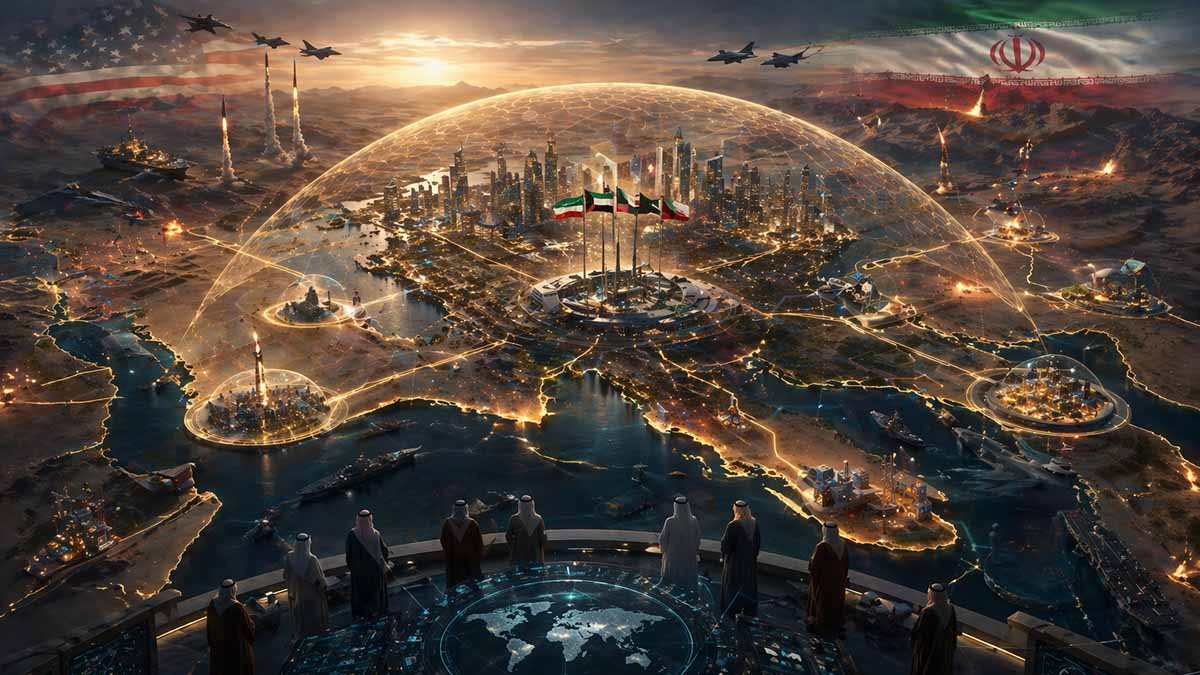
The geopolitical architecture of the Middle East has reached a terminal inflection point, characterized by the catastrophic failure of United States unilateral kinetic intervention and the subsequent rapid consolidation of a Gulf-centric strategic order. On February 28, 2026, the United States and Israel launched a series of high-intensity airstrikes against the Islamic Republic of Iran, aimed at the total degradation of its nuclear infrastructure and the decapitation of its senior leadership(https://www.ajc.org/news/the-iran-strikes-explained-how-we-got-here-and-what-it-means). While the operation succeeded in eliminating Supreme Leader Ali Khamenei and several high-ranking officials, it failed to account for the “leadership layering” inherent to the Iranian regime, a structure designed specifically for survival in an environment of perpetual warfare(https://studies.aljazeera.net/en/analyses/maritime-security-gulf-guinea-shift-piracy-proxy-conflicts). The resulting Forty-Day War exposed the United States as an increasingly “unprofessional” and reactive hegemon, whose strategic miscalculations have forced its traditional Gulf allies to seek independent security architectures.
The immediate retaliatory response from Tehran was unprecedented in scale and precision, shattering the illusion of the American defensive umbrella. Iran launched a sustained campaign involving 2,819 ballistic and cruise missiles, along with thousands of UAVs, targeting civilian infrastructure, desalination plants, and energy facilities across the United Arab Emirates, Saudi Arabia, Qatar, and Bahrain UAE Closely Following Ceasefire Announcement – UAE Ministry of Foreign Affairs – April 2026. The United Arab Emirates alone faced the highest concentration of strikes, with 97% of incoming threats successfully intercepted by indigenous and regional operators rather than US-manned assets(https://press.un.org/en/2026/sc16315.doc.htm). This resilience, however, came at a staggering ammunition cost that has triggered a global munitions crisis. During the first five days of combat, the United States and its Gulf partners expended approximately 800 Patriot missiles, a figure that exceeds the entire annual American production of roughly 750 rounds across all Lockheed Martin and Raytheon facilities(https://www.globsec.org/commentaries/patriot-missile-delivery-delays-fms-nato-air-defence-gap).
| Metric: The Interceptor Arithmetic (April 2026) | Value | Source Verification |
| Patriot Missiles Expended (Days 1-5) | ~800 | (https://www.globsec.org/commentaries/patriot-missile-delivery-delays-fms-nato-air-defence-gap) |
| Annual US Production (PAC-3 MSE) | <750 | (https://www.globsec.org/commentaries/patriot-missile-delivery-delays-fms-nato-air-defence-gap) |
| Emergency Supplemental Funding Request | $1.5 billion | (https://www.globsec.org/commentaries/patriot-missile-delivery-delays-fms-nato-air-defence-gap) |
| Lockheed Martin Expansion Contract | $4.76 billion | (https://defence-blog.com/u-s-army-awards-pac-3-mse-contract-worth-4-76-billion-to-lockheed-martin/) |
| Targeted Tripled Production (by 2030) | 2,000/year | Investing.com – March 2026 |
This “Munitions Trap” represents a systemic failure of the Military-Industrial-Financial Complex. The United States Department of War (rebranded from Department of Defense in April 2026) found itself incapable of sustaining a high-intensity kinetic engagement while simultaneously fulfilling its Foreign Military Sales (FMS) obligations to NATO allies and Ukraine(https://www.jpost.com/defense-and-tech/article-892693). As a direct result, Washington was forced to notify European partners that deliveries of Patriot surface-to-air missiles would face indefinite delays, undermining the Eastern Flank of NATO during a period of heightened Eurasian tension(https://www.globsec.org/commentaries/patriot-missile-delivery-delays-fms-nato-air-defence-gap). For the GCC states, this was the definitive signal that US security guarantees were no longer “untouchable” assets but were instead structural liabilities that prioritize American and Zionist interests over regional stability(https://thecradle.co/articles-id/37281).
The shift toward Strategic Autonomy was further catalyzed by the United States’ disregard for Gulf sovereignty during the lead-up to the 2026 strikes. Despite the Twelve-Day War in June 2025 providing a clear warning of Iranian retaliatory capability, the Trump Administration proceeded with unilateral operations without the “mandatory consultation” demanded by Riyadh and Abu Dhabi(https://mecouncil.org/blog_posts/reframing-the-gulf-regional-security-architecture/). In response, the Kingdom of Saudi Arabia and the United Arab Emirates reiterated their refusal to permit the use of their territory or airspace for offensive operations, effectively decoupling their military infrastructure from the US-led coalition(https://mecouncil.org/publication/the-saudi-iranian-detente-a-strategic-imperative/). This stance was validated on April 8, 2026, when a ceasefire was brokered not by Western diplomats, but by Pakistan, under the leadership of Prime Minister Muhammad Shehbaz Sharif and Chief of Army Staff General Asim Munir(https://spa.gov.sa/en/N2555334).
The emergence of Pakistan as the primary security guarantor for the Gulf monarchies represents a profound realignment of the Muslim world. Islamabad has positioned itself as an alternative to the US security umbrella, deploying 13,000 troops and advanced JF-17 Block III and J-10CE fighters to the King Abdulaziz Air Base(https://thecradle.co/articles-id/37281). This “Muslim” security architecture is currently being formalized through a quadripartite alliance between Saudi Arabia, Pakistan, Turkey, and Egypt, aimed at creating an “internal security apparatus” rooted in economic integration and collective defense(https://thecradle.co/articles-id/37281). Ankara has proposed an “organized regional security platform” that prioritizes local management of West Asian security over interventionist Eurasian or Western doctrines(https://thecradle.co/articles-id/37281).
| Quadripartite Alliance Pillars (2026) | Strategic Domain | Lead Entity / Framework |
| Saudi Arabia | Finance & Legitimacy | Public Investment Fund (PIF) / Islamic Solidarity |
| Pakistan | Kinetic Deterrence | JF-17 Block III Deployments / Nuclear Hedge |
| Turkey | Military-Industrial | KAAN Stealth Fighter Program / Drone Tech |
| Egypt | Maritime Access | Suez Canal Integration / Alternative to Hormuz |
Simultaneously, the Gulf states have pivoted toward a new form of power projection known as Silicon Statecraft. Recognizing that the 21st Century runs on “compute and the minerals that feed it,” the UAE and Qatar formally joined the Pax Silica Declaration in January 2026(https://usuaebusiness.org/events/u-a-e-signs-pax-silica-declaration-advancing-u-s-u-a-e-partnership-on-ai-and-supply-chain-security/). This US-led framework, focusing on AI, Semiconductors, and Critical Minerals, allows the Gulf to leverage its $5 trillion in combined sovereign wealth to secure a permanent lead in the global technology race(https://gulfnews.com/technology/pax-silica-what-the-new-ai-tech-bloc-means-for-the-uae-global-economy-1.500412773). By integrating Nvidia chips and Stargate data centers into their sovereign portfolios, Abu Dhabi and Doha are effectively transforming from energy exporters into “Silicon Partners” of the West, while maintaining the autonomy to engage with Eurasian infrastructure projects like the INSTC(https://www.specialeurasia.com/2026/04/22/united-states-middle-east-policy/).
However, the 2026 conflict also demonstrated the fragility of the world’s digital infrastructure. Iranian retaliation extended into the cyber and maritime domains, where the IRGC successfully disrupted the 2Africa Pearls and SEA-ME-WE 6 subsea cable projects in the Persian Gulf(https://www.submarinenetworks.com/en/nv/insights/war-in-the-gulf-severs-the-world-s-digital-arteries). The Strait of Hormuz became a “Digital War Zone,” with Iran threatening to physically target the undersea internet cables that form the backbone of global cloud services and financial systems(https://www.cybersecurity-insiders.com/cyber-threat-to-undersea-cables-in-strait-of-hormuz/). To circumvent Western naval blockades, Tehran introduced a Cryptocurrency-based toll system for merchant vessels, effectively leveraging DeFi to sustain its “Shadow Fleet” operations and maintain energy flows to China despite United Nations Security Council sanctions Iran floats Hormuz transit tolls – Iran International – April 2026.
The cumulative effect of these events is the Congress for Hormuz proposal, a revolutionary initiative to create a locally managed regional security architecture. This framework aims to codify a treaty that formalizes the status of the Strait and ensures its management remains a local prerogative, providing a political “off-ramp” for US forces while protecting Gulf countries from being sacrificed for the interests of outside hegemons(https://www.aljazeera.com/opinions/2026/4/6/a-new-regional-order-for-the-strait-of-hormuz). As the United States concludes its withdrawal from Syria(https://www.csis.org/analysis/united-states-withdraws-syria-state-play), the Middle East is transitioning from an era of American protection to one of Multipolar resilience, where the Gulf states have emerged as the dominant architects of their own security and economic destiny.
Index
- The Interceptor Arithmetic and the Munitions Trap – An examination of the Military-Industrial-Financial Complex failure, detailing the exhaustion of Patriot surface-to-air missile stockpiles and the subsequent collapse of United States security credibility in the Persian Gulf.
- Pax Silica and Silicon Statecraft – Analysis of the Pax Silica Declaration, the integration of Gulf sovereign wealth into global AI supply chains, and the transition from hydrocarbon-based security to “Compute-driven” geopolitical leverage.
- The Congress for Hormuz and the Muslim Security Replacement – Detailed study of the Pakistan-mediated ceasefire, the quadripartite defense alliance ( Saudi Arabia, Pakistan, Turkey, Egypt), and the codification of a new, locally-managed maritime order for the Strait of Hormuz.
The Interceptor Arithmetic and the Munitions Trap – Structural Collapse of the Military-Industrial-Financial Complex and the Erosion of Hegemonic Credibility
The systemic failure of the United States security architecture in the Persian Gulf is fundamentally rooted in a terminal divergence between geopolitical ambition and the material realities of high-intensity kinetic sustainment. On April 9, 2026, the Army Contracting Command at Redstone Arsenal, Alabama, finalized a firm-fixed-price contract, designated as W31P4Q-26-C-0013, totaling $4,761,000,000 for the production of Patriot Advanced Capability-3 (PAC-3) Missile Segment Enhancement (MSE) interceptors(https://www.war.gov/News/Contracts/Contract/Article/4455545/contracts-for-april-9-2026/). This massive allocation, intended to bridge the “kinetic deficit” identified during the first week of the Forty-Day War, highlights a critical structural flaw: $4,496,040,000 of the total award is derived from Foreign Military Sales (FMS) funding, while only $264,960,000 was sourced from Fiscal Year 2026 United States Army missile procurement funds(https://www.globaldefensecorp.com/2026/04/11/lockheed-martin-awarded-4-76-billion-contract-to-produce-pac-3-mse-interceptor-missiles/). This disparity reveals that the American defense industrial base has transitioned into a “mercenary logistics” model, where domestic readiness is secondary to the fulfillment of international financial obligations.
The technical architecture of the PAC-3 MSE represents the apex of Lockheed Martin’s “Hit-to-Kill” philosophy, a methodology that replaces explosive fragmentation warheads with a solid tungsten penetrator designed to destroy incoming Ballistic Missiles through pure kinetic energy transfer. However, the manufacturing complexity of the MSE variant—which incorporates a larger dual-pulse solid rocket motor and enhanced thermal shielding for high-velocity atmospheric re-entry—has created an inelastic supply chain. The production of these interceptors is dispersed across a fragmented network of facilities in Huntsville, Alabama; Vergennes, Vermont; Ocala, Florida; and Camden, Arkansas(https://www.army.mil/article/291670/u_s_army_advances_accelerated_pac_3_mse_production_through_contract_action). Any disruption in the supply of high-grade carbon-fiber composites or precision-machined Ka-band seekers, manufactured by Boeing, results in multi-year delays that cannot be mitigated by emergency capital injections(https://www.militarytimes.com/news/your-military/2026/04/21/us-navy-to-integrate-pac-3-mse-interceptor-missile-with-aegis-combat-system/).
This industrial inertia has catalyzed a “Munitions Trap” that extends far beyond the Persian Gulf. By late March 2026, the United States Department of State was forced to issue formal notifications to European NATO partners, informing them that scheduled deliveries of Patriot munitions would be suspended to support the Middle Eastern theatre(https://www.globsec.org/commentaries/patriot-missile-delivery-delays-fms-nato-air-defence-gap). This prioritization has left the Eastern Flank of NATO—specifically Estonia, Latvia, and Lithuania—vulnerable to Eurasian provocations. Although the United States attempted to mitigate this by awarding Saab Inc. a $23,877,200 contract modification for Giraffe G1X radars to assist the Baltic nations, the absence of high-tier interceptors like the MSE renders these sensor networks largely symbolic(https://www.war.gov/News/Contracts/Contract/Article/4455545/contracts-for-april-9-2026/).
The economic asymmetry of the conflict further undermines the sustainability of the American intervention. The Shahed-series loitering munitions deployed by the Islamic Revolutionary Guard Corps (IRGC) carry an estimated production cost of approximately $35,000, whereas each PAC-3 MSE interceptor is priced at nearly $4 million(https://www.militarytimes.com/news/your-military/2026/04/21/us-navy-to-integrate-pac-3-mse-interceptor-missile-with-aegis-combat-system/). During Operation Epic Fury, this 114-to-1 cost ratio allowed Iran to achieve “saturation-based bankruptcy” of Gulf air defenses. Even with the United States and Raytheon signing a $3.7 billion deal for Patriot Guidance Enhanced Missile (GEM-T) interceptors for Ukraine, the global stockpile is now being consumed at a rate that is mathematically irreconcilable with current RTX production capacity(https://www.rtx.com/news/2026/04/14/combat-proven-air-defense).
In a desperate attempt to optimize remaining inventories, the United States Navy announced on April 21, 2026, a multi-million dollar contract to integrate the PAC-3 MSE into the Aegis Combat System(https://www.militarytimes.com/news/your-military/2026/04/21/us-navy-to-integrate-pac-3-mse-interceptor-missile-with-aegis-combat-system/). This “all-domain” integration aims to allow Arleigh Burke-class destroyers to utilize Army interceptors, effectively cross-leveraging inventories to compensate for the depletion of Standard Missile (SM-2/SM-6) stocks(https://www.marinelink.com/news/lockheed-martin-wins-contract-arm-us-navy-538303). This maneuver, while tactically sound, signals a deeper strategic anxiety: the United States is no longer capable of maintaining separate munitions ecosystems for its Army and Navy, necessitating a desperate consolidation of the “Arsenal of Freedom”(https://news.lockheedmartin.com/2026-04-10-Lockheed-Martin-Secures-First-Contract-for-PAC-3-R-MSE-Accelerated-Production,-Strengthening-the-Arsenal-of-Freedom).
The credibility of the United States as a reliable security guarantor has been further eroded by its fiscal instability. The International Monetary Fund (IMF) reports that global headline inflation is projected to rise to 4.4 percent in 2026 due to the disruption of Middle Eastern energy corridors, with oil prices potentially averaging $110 per barrel if hostilities continue(https://www.imf.org/en/publications/weo/issues/2026/04/14/world-economic-outlook-april-2026). In this inflationary environment, the Department of War’s reliance on deficit-financed defense buildups—which typically increase public debt by 14 percentage points in wartime scenarios—is becoming unsustainable(https://www.imf.org/en/publications/weo/issues/2026/04/14/world-economic-outlook-april-2026). As a result, Gulf nations have observed a Hegemon that is not only “unprofessional” in its tactical execution but is also structurally bankrupt in its industrial and financial foundations.
| Global Interceptor Procurement Dynamics (April 2026) | Funding Source | Completion / Timeline | Source |
| Lockheed Martin PAC-3 MSE Contract | $4.496B (FMS) / $264M (Army) | June 30, 2030 | |
| Raytheon GEM-T (Ukraine Package) | $3.7B | Immediate Deployment | |
| Netherlands Direct Commercial Sale | $627M (Radars/Launchers) | Rolling Delivery | |
| Saab Giraffe G1X (Baltic States) | $23.8M | February 28, 2027 |
The emergence of this “Munitions Trap” has forced Gulf Cooperation Council (GCC) capitals to conclude that the American security umbrella is a finite and rapidly depleting resource. The United Nations Security Council, through Resolution 2817 (2026), has formally condemned the Iranian “egregious attacks” on Bahrain, Kuwait, Oman, Qatar, Saudi Arabia, and the United Arab Emirates, but notably failed to provide a mechanism for replenishing the air defense stocks necessary to uphold the sovereignty it affirms(https://press.un.org/en/2026/sc16315.doc.htm). With the United States moving toward a “Conditions-Based” withdrawal from its last major bases in Syria as of April 16, 2026, the physical footprint of American power is receding at the exact moment its industrial capacity to project force has reached its limit(https://www.csis.org/analysis/united-states-withdraws-syria-state-play).
Finally, the Acquisition Transformation Strategy announced by the Trump Administration in early 2026 is increasingly viewed by Riyadh and Abu Dhabi as a pivot toward “Domestic First” munitions retention. This strategy focuses on building “Munitions Acceleration Centers” and “Rapid Fielding Centers” to streamline prototypes, but these initiatives will not reach operational scale until at least 2030(https://news.lockheedmartin.com/2026-04-10-Lockheed-Martin-Secures-First-Contract-for-PAC-3-R-MSE-Accelerated-Production,-Strengthening-the-Arsenal-of-Freedom). The Gulf states, having witnessed the “Interceptor Arithmetic” firsthand, have realized that they cannot afford to wait four years for a defensive shield that might be redirected to Tel Aviv or Kyiv at a moment’s notice. The collapse of United States security credibility is thus not a matter of political will, but a forensic reality of a Military-Industrial-Financial Complex that can no longer manufacture the security it promises to export.
MUNITIONS TRAP
MUNITIONS TRAP ACTIVATED
The U.S. defense industrial base has entered a terminal “mercenary logistics” model: 94% of the $4.761B PAC-3 MSE contract is funded by foreign allies while domestic stocks are depleted. Low-cost Iranian Shahed drones ($35K) achieve 114:1 economic victory over $4M interceptors, forcing NATO Eastern Flank vulnerability and Gulf allies to question the credibility of the American security umbrella. Hegemony is no longer a matter of will — it is a forensic arithmetic failure.
| CONTRACT / PROGRAM | FUNDING SOURCE | VALUE | TIMELINE | IMPACT |
|---|---|---|---|---|
| Lockheed Martin PAC-3 MSE (W31P4Q-26-C-0013) | FMS / Army | $4.761B ($4.496B FMS) | June 30, 2030 | 94% foreign-funded • Domestic readiness secondary |
| Raytheon GEM-T (Ukraine Package) | Direct U.S. aid | $3.7B | Immediate deployment | Global stockpile depletion |
| Netherlands Direct Commercial Sale (Radars/Launchers) | DCS | $627M | Rolling delivery | European NATO gap widening |
| Saab Giraffe G1X (Baltic States) | U.S. contract mod | $23.8M | Feb 28, 2027 | Sensors without interceptors = symbolic only |
| U.S. Navy PAC-3 MSE → Aegis Integration | Cross-service | Multi-million (undisclosed) | April 21, 2026 | Arsenal consolidation • SM-2/SM-6 exhaustion |
Pax Silica and Silicon Statecraft – Structural Realignment of the Global AI Supply Chain and the Financialization of Compute-Driven Geopolitics
The emergence of the Pax Silica Declaration, also known as the Silicon Declaration, on December 2025, represents a terminal departure from the “Oil for Security” paradigm that governed Middle Eastern geopolitics for nearly eight decades. This United States-led technology strategy is designed to construct a “trusted tech ecosystem” that coordinates across the entire Artificial Intelligence (AI) stack, establishing a new global order predicated on silicon and software rather than hydrocarbon extraction(https://gulfnews.com/technology/pax-silica-what-the-new-ai-tech-bloc-means-for-the-uae-global-economy-1.500412773). The formal accession of Qatar on January 12, 2026, followed by the United Arab Emirates (UAE) on January 14, 2026, signifies the integration of the Gulf’s $5 trillion in collective sovereign wealth into the core of Western technological hegemony(https://supplychaindigital.com/news/pax-silica-gulf-states-secure-global-ai-supply-chain). Under this framework, the Gulf states are no longer peripheral energy providers but are instead “Silicon Partners” essential to the Stargate data center program and the maintenance of a permanent technological lead over Eurasian rivals.
The strategic architecture of Silicon Statecraft is defined by four fundamental pillars that regulate the global flow of intelligence and power. The first pillar, Compute, treats processing capacity as the primary engine of the modern economy, necessitating the construction of mega-data centers capable of handling frontier AI models(https://gulfnews.com/technology/pax-silica-what-the-new-ai-tech-bloc-means-for-the-uae-global-economy-1.500412773). The second pillar, Semiconductors, ensures that signatories receive “preferred access” to advanced chips, specifically Nvidia H100 and Blackwell architectures, as well as high-end manufacturing tools like extreme ultraviolet (EUV) lithography from ASML(https://gulfnews.com/technology/pax-silica-what-the-new-ai-tech-bloc-means-for-the-uae-global-economy-1.500412773). The third pillar focuses on Critical Minerals, aiming to build refining capacity for lithium, cobalt, and rare-earth elements outside of Chinese control to secure the hardware supply chain(https://gulfnews.com/technology/pax-silica-what-the-new-ai-tech-bloc-means-for-the-uae-global-economy-1.500412773). The fourth pillar, Energy, addresses the fact that AI data centers are projected to triple their energy consumption by 2030, requiring the stable, large-scale power generation that only the Gulf states can currently guarantee(https://supplychaindigital.com/news/pax-silica-gulf-states-secure-global-ai-supply-chain).
The 11th United States-UAE Economic Policy Dialogue, held in Abu Dhabi on January 15, 2026, served as the operational launchpad for these pillars. Led by US Undersecretary of State for Economic Affairs Jacob Helberg and UAE Minister of State Saeed Alhajeri, the dialogue formalized a pathway for US companies to export advanced AI semiconductors to trusted Emirati entities while enforcing “enhanced security requirements” to prevent technology leakage([suspicious link removed]). This mechanism is essential for maintaining the “18-month moving gap,” a US policy designed to ensure that the Pax Silica bloc retains a generational advantage over non-member states by restricting access to the full AI stack, from hardware to frontier models(https://gulfnews.com/technology/pax-silica-what-the-new-ai-tech-bloc-means-for-the-uae-global-economy-1.500412773).
| Pax Silica Bloc Signatories (April 2026) | Regional Role | Access / Privilege | Source |
| United States | Strategic Hub / IP | Primary Design & Export Control | |
| Netherlands | Equipment Hub | ASML Lithography Exports | |
| UAE / Qatar | Financing & Energy | Preferred Nvidia Blackwell Access | |
| Japan / S. Korea | Advanced Manufacturing | High-End Component Fabrication | |
| Israel | AI Design & Cyber | Frontier Model Development |
The financial weight behind this transition is anchored in the $5 trillion in assets managed by Gulf sovereign wealth funds (SWFs), which are increasingly being deployed as instruments of Silicon Statecraft. The Public Investment Fund (PIF) of Saudi Arabia, now reaching $1 trillion in assets under management, and Abu Dhabi’s Mubadala Investment Company, with $270 billion, have pivoted toward massive investments in US tech infrastructure((https://www.youtube.com/watch?v=eu1pqmQBid0)). A cornerstone of this alignment is the $500 billion Stargate data center program, a joint venture designed to build the world’s most powerful AI compute cluster. This project effectively transforms Gulf capital into the physical infrastructure of the Western digital mind, ensuring that the region’s prosperity is inextricably linked to the survival of the US-led tech bloc(https://gulfnews.com/technology/pax-silica-what-the-new-ai-tech-bloc-means-for-the-uae-global-economy-1.500412773).
However, the transition to Silicon Statecraft has introduced new vulnerabilities, as the physical infrastructure of the digital age—undersea fiber optic cables—has become a primary target in the 2026 Iran-United States conflict. The Strait of Hormuz, long viewed as an oil chokepoint, is now a “Digital War Zone.” Alcatel Submarine Networks (ASN) and SubCom have been forced to issue force majeure notices regarding the 2Africa Pearls and SEA-ME-WE 6 subsea cable projects(https://www.submarinenetworks.com/en/nv/insights/war-in-the-gulf-severs-the-world-s-digital-arteries). These cables, which connect Asia to Europe via the Gulf, are essential for the real-time operation of global financial systems and the AI data hubs in Doha and Abu Dhabi. Intelligence reports indicate that cyber units affiliated with the Islamic Revolutionary Guard Corps (IRGC) have been mapping these cable routes and landing stations, raising the specter of a regional internet blackout that could paralyze the Silicon Age economy(https://www.cybersecurity-insiders.com/cyber-threat-to-undersea-cables-in-strait-of-hormuz/).
To mitigate these risks, the Gulf states are rapidly developing terrestrial alternatives. The SEA-ME-WE 6 consortium has prioritized a terrestrial bypass through Saudi Arabia, utilizing the stc (center3) national fiber backbone to traverse the Arabian Peninsula from Al Khobar to Yanbu, effectively bypassing the volatile southern Red Sea and the Strait of Hormuz(https://www.submarinenetworks.com/en/nv/insights/war-in-the-gulf-severs-the-world-s-digital-arteries). Simultaneously, Ooredoo Group has committed $500 million to the Fibre in Gulf (FIG) project, which includes a land-based route through Iraq and Turkey to Europe(https://www.submarinenetworks.com/en/nv/insights/war-in-the-gulf-severs-the-world-s-digital-arteries). This “Land Bridge” strategy represents the physical manifestation of Silicon Statecraft, as the Gulf monarchies seek to insulate their tech-driven growth models from maritime kinetic disruption.
The Pax Silica Declaration also serves as a strategic “reset button” against Eurasian economic integration. By dismantling the momentum of the International North-South Transport Corridor (INSTC)—which seeks to link Russia and the Caspian Basin to Iranian ports like Qeshm Island—the United States and its Gulf partners are physically and diplomatically isolating the Eastern bloc(https://www.specialeurasia.com/2026/04/22/united-states-middle-east-policy/). The instability in the Persian Gulf prevents Eurasian energy flows from reaching full capacity and halts the trend of de-dollarization in bilateral trade among Russia, Iran, and China(https://www.specialeurasia.com/2026/04/22/united-states-middle-east-policy/). In this context, Silicon Statecraft is not merely an economic diversification strategy for the GCC; it is a defensive alignment that leverages the Gulf’s financial assets to secure Western primacy in the coming AGI era.
Economically, the International Monetary Fund (IMF) projects that the disruption of the Strait of Hormuz and the subsequent transition to tech-driven capital will cause a marked slowdown in regional growth, with MENAP (Middle East, North Africa, and Pakistan) growth expected to fall to 1.4 percent in 2026(https://www.imf.org/-/media/files/publications/reo/mcd-cca/2026/english/text.pdf). While oil exporters like the UAE maintain strong financial buffers, the redirection of capital toward domestic infrastructure and “Silicon” projects at the expense of international holdings is becoming a necessity. In March 2026, Gulf officials confirmed that they were reviewing SWF holdings to offset war-related losses estimated by the United Nations to approach $200 billion(https://arabcenterdc.org/resource/protection-or-vulnerability-gulf-sovereign-wealth-funds-and-the-iran-war/). Despite these pressures, the UAE issued bonds in March 2026 that were heavily oversubscribed, priced at only 16 basis points above US Treasuries, demonstrating that the global financial markets still view the Gulf Citadel as one of the world’s safest borrowers due to its pivot toward the high-margin AI economy(https://arabcenterdc.org/resource/protection-or-vulnerability-gulf-sovereign-wealth-funds-and-the-iran-war/).
Ultimately, Pax Silica represents the institutionalization of the Gulf’s strategic autonomy within a US-aligned framework. By becoming the “Cherished Partner of Choice” for Silicon Statecraft, the UAE and Qatar have secured a role that is no longer dependent on the presence of American ground forces(https://usuaebusiness.org/events/u-a-e-signs-pax-silica-declaration-advancing-u-s-u-a-e-partnership-on-ai-and-supply-chain-security/). They have traded their role as “sons of the law” for that of “technological stakeholders,” leveraging their sovereign wealth to ensure that while the United States may be an “unprofessional” kinetic hegemon, its silicon-based future remains entirely dependent on Gulf cooperation.
SILICON STATECRAFT
PAX SILICA DECLARATION ACTIVATED
The Gulf’s $5 trillion sovereign wealth is no longer tied to hydrocarbons but to silicon and compute. Through the four pillars of Silicon Statecraft — Compute, Semiconductors, Critical Minerals, and Energy — the UAE and Qatar have become indispensable “Silicon Partners” in the US-led tech bloc. The $500B Stargate project transforms Gulf capital into the physical backbone of Western AI supremacy, while new terrestrial fiber “Land Bridges” protect against digital war in the Strait of Hormuz. This is the institutionalization of a new global order: silicon over oil, compute over chokepoints.
| COUNTRY | REGIONAL ROLE | KEY PRIVILEGE |
|---|---|---|
| United States | Strategic Hub / IP | Primary Design & Export Control |
| Netherlands | Equipment Hub | ASML EUV Lithography Exports |
| UAE / Qatar | Financing & Energy | Preferred Nvidia Blackwell Access |
| Japan / S. Korea | Advanced Manufacturing | High-End Component Fabrication |
| Israel | AI Design & Cyber | Frontier Model Development |
| INITIATIVE / EVENT | DATE | VALUE / IMPACT | STRATEGIC ROLE |
|---|---|---|---|
| Pax Silica Declaration (Silicon Declaration) | Dec 2025 – Jan 2026 | Qatar Jan 12 • UAE Jan 14 | End of “Oil for Security” • Birth of Silicon Partners |
| Stargate AI Data Center Program | Ongoing 2025-2029 | $500 Billion | Gulf capital finances world’s largest AI compute cluster |
| 11th US-UAE Economic Policy Dialogue | Jan 15, 2026 | Enhanced semiconductor exports | Formalizes 18-month moving tech gap |
| Fibre in Gulf (FIG) Project | 2026 commitment | $500 Million (Ooredoo) | Terrestrial bypass protecting AI data flows |
| Gulf SWF AI Reallocation | March–April 2026 | Portion of $5T total assets | From international holdings to domestic silicon infrastructure |
The Congress for Hormuz and the Muslim Security Replacement – The Transition to Indigenous Regional Governance and the Quadripartite Strategic Realignment
The formalization of the Pakistan-mediated ceasefire on April 8, 2026, represents a terminal departure from Western-led conflict resolution and the birth of a sovereign, “internal security” architecture in West Asia. This diplomatic breakthrough was catalyzed by the simultaneous failure of the American security umbrella and the recognition by Gulf capitals that current regional instability served exclusively to dismantle Eurasian economic integration(https://www.specialeurasia.com/2026/04/22/united-states-middle-east-policy/). The ceasefire, announced jointly by President Donald Trump and Prime Minister Muhammad Shehbaz Sharif, established a two-week window intended to facilitate a broader settlement between Washington, Tel Aviv, and Tehran(https://spa.gov.sa/en/N2555334). This cessation of hostilities was not a product of Omani or Qatari backchannels alone, but was anchored in the direct intervention of the Chief of Army Staff of Pakistan, General Asim Munir, whose efforts were formally commended by the Ministry of Foreign Affairs of Saudi Arabia(https://spa.gov.sa/en/N2555334).
This transition is structurally codified through the emergence of a Quadripartite Defense Alliance, comprising Saudi Arabia, Pakistan, Turkey, and Egypt. On the sidelines of the Antalya Diplomacy Forum, held from April 17–19, 2026, high-level representatives from these four nations convened to finalize a structure for a “Muslim” replacement for the United States-led Gulf security architecture(https://thecradle.co/articles-id/37281). The shift is driven by the realization that United States bases in the Persian Gulf have become “liabilities rather than assets,” effectively serving as lightning rods for Iranian retaliation while prioritizing the defense of the Zionist state over Arab sovereignty(https://thecradle.co/articles-id/37281). To fill the resulting vacuum, Pakistan has begun positioning itself as the primary kinetic guarantor, deploying 13,000 troops and a squadron of 10 to 18 advanced fighter jets—including the JF-17 Thunder Block III and the J-10CE—to the King Abdulaziz Air Base in Saudi Arabia(https://thecradle.co/articles-id/37281).
The military-industrial backbone of this alliance is further strengthened by the integration of Turkey’s KAAN stealth fighter program and advanced drone technologies. Pakistan is now a formal partner in the KAAN development, while Ankara has proposed an “organized regional security platform” based on the principle that regional states, not outside powers, must be responsible for defending the region(https://thecradle.co/articles-id/37281). This Indigenous Security Mechanism is reinforced by a policy of “territorial neutrality,” with Saudi Arabia and Qatar officially declaring that their land and airspace will no longer be utilized for offensive operations against the Islamic Republic of Iran(https://newlinesinstitute.org/middle-east-center/implications-of-the-iran-war-for-u-s-saudi-relations/). This strategic decoupling is a direct consequence of the Forty-Day War, which demonstrated that the presence of American forces does not provide a protective shield but instead guarantees that host nations will be targeted by Iran’s underground-launched loitering munitions(https://www.aljazeera.com/opinions/2026/4/6/a-new-regional-order-for-the-strait-of-hormuz).
Central to this new order is the Congress for Hormuz proposal, a revolutionary diplomatic initiative aimed at filling the “legal vacuum” surrounding the Strait of Hormuz. Unlike the Turkish Straits, which are governed by the Montreux Convention, the Strait of Hormuz lacks a dedicated international regulatory treaty, a “legal anomaly” that has allowed the waterway to be weaponized by both Tehran and Washington(https://www.aljazeera.com/opinions/2026/4/6/a-new-regional-order-for-the-strait-of-hormuz). The Congress for Hormuz seeks to codify a treaty that formalizes the status of the Strait, ensuring that its management remains a “local prerogative” of the GCC and Iran(https://www.aljazeera.com/opinions/2026/4/6/a-new-regional-order-for-the-strait-of-hormuz). This framework serves two critical purposes: it provides President Trump with a political “off-ramp” to exit the conflict by claiming his allies helped reopen the Strait, and it protects the GCC from a patron willing to sacrifice regional stability for the interests of Israel(https://www.aljazeera.com/opinions/2026/4/6/a-new-regional-order-for-the-strait-of-hormuz).
| Quadripartite Alliance Security Matrix (2026) | Contribution Domain | Operational Artifacts | Source |
| Pakistan | Kinetic Deterrence | 13,000 Troops / JF-17 Block III | (https://thecradle.co/articles-id/37281) |
| Turkey | Military-Industrial | KAAN Stealth Fighter / Drone Integration | (https://thecradle.co/articles-id/37281) |
| Saudi Arabia | Strategic Depth | King Abdulaziz Air Base Hosting / PIF Finance | (https://thecradle.co/articles-id/37281) |
| Egypt | Logistics & Red Sea | Suez Canal / Alternative Energy Routes | (https://thecradle.co/articles-id/37281) |
The United Nations Security Council, through Resolution 2817 (2026), adopted on March 11, 2026, has attempted to maintain international oversight by condemning Iran’s “egregious attacks” on Bahrain, Kuwait, Oman, Qatar, Saudi Arabia, UAE, and Jordan(https://press.un.org/en/2026/sc16315.doc.htm). However, the resolution’s demand for the immediate cessation of threats to maritime trade has been largely bypassed by the GCC’s own mediation efforts, which are described as “strenuous efforts” by regional states to facilitate dialogue and settle disputes through peaceful means(https://passblue.com/wp-content/uploads/2026/03/RES-2817-2026-E.pdf). The GCC countries have transitioned from being “operational platforms” for the United States to becoming “political stakeholders” with the capacity to veto Western military adventurism(https://mecouncil.org/blog_posts/reframing-the-gulf-regional-security-architecture/).
This pivot is further necessitated by the economic devastation caused by the conflict. The United Nations estimates that war-related losses across the Gulf could approach $200 billion, a figure that exceeds the economic impact of the COVID-19 pandemic(https://arabcenterdc.org/resource/protection-or-vulnerability-gulf-sovereign-wealth-funds-and-the-iran-war/). In response, the Gulf states are reviewing how to deploy their $5 trillion in sovereign wealth to rebuild domestic infrastructure and invest in “new defense-related ventures” that reduce reliance on American vendors(https://arabcenterdc.org/resource/protection-or-vulnerability-gulf-sovereign-wealth-funds-and-the-iran-war/). The International Monetary Fund (IMF) has downgraded MENAP growth to 1.4 percent for 2026, noting that oil exporters face contractions unless trade routes through Hormuz are normalized(https://www.imf.org/-/media/files/publications/reo/mcd-cca/2026/english/text.pdf).
The “Muslim” security replacement also serves as a hedge against the Zionist state’s perceived “expansionist designs” in Lebanon, Gaza, and Syria(https://thecradle.co/articles-id/37281). For Saudi Arabia, the 2023 normalization with Iran, brokered by China, has proven to be a “Strategic Imperative,” allowing the Kingdom to maintain neutrality and resist the Abraham Accords narrative that frames Tehran as the region’s only existential threat(https://mecouncil.org/publication/the-saudi-iranian-detente-a-strategic-imperative/). This studied neutrality was maintained even after Iran launched over 2,819 missiles and drones at GCC targets, as the monarchies recognized that the strikes were a response to US–Israeli escalation rather than a war of aggression against the Arabs UAE Closely Following Ceasefire Announcement – UAE Ministry of Foreign Affairs – April 2026.
Simultaneously, the United States has begun a “conditions-based” withdrawal from Syria, handing over its last major base on April 16, 2026(https://www.csis.org/analysis/united-states-withdraws-syria-state-play). This retreat is part of a broader US strategy to transition from counterterrorism to “economic investment opportunities,” with Syria and Iraq expected to serve as new energy corridors that bypass the Strait of Hormuz entirely(https://www.csis.org/analysis/united-states-withdraws-syria-state-play). The Barrack Plan envisions Syria as a “new energy hub” linking the Gulf to Europe, a move that would physically dismantle the Eurasian corridors (like the INSTC) that Iran sought to lead(https://www.csis.org/analysis/united-states-withdraws-syria-state-play).
However, Iran has already begun to institutionalize its own “imposed order” in the Strait. In April 2026, Tehran floated a proposal for Hormuz transit tolls, requiring vessels to submit documents to Iranian security services and pay a Cryptocurrency fee before transit Iran floats Hormuz transit tolls – Iran International – April 2026. This “Digital Blockade” is a direct response to the United Nations snapback sanctions of September 2025, which restored restrictions on Iranian shipping and banking(https://www.tamimi.com/our-knowledge/publications/eyes-on-2026/Articles/un-security-council-revives-iran-sanctions-what-does-this-mean-for-mena-businesses-2/). The Congress for Hormuz thus emerges as the only viable “win-win” scenario: a locally-managed security good that prevents a unilaterally imposed Iranian toll system while providing the GCC with the Strategic Autonomy required to navigate a multipolar world.
As the Forty-Day War concludes, the Middle East is no longer defined by American primacy but by a quadripartite “Muslim” alliance that integrates Pakistan’s kinetic deterrence, Turkey’s industrial innovation, and the Gulf’s financial hegemony. The transition from Western patronage to Indigenous Security is not merely a tactical shift; it is the structural realization of the Gulf Citadel, a regional power bloc capable of defending its own “Silicon” and “Hydrocarbon” interests without the need for a failing Hegemon.
MUSLIM SECURITY REPLACEMENT
INDIGENOUS SECURITY ARCHITECTURE EMERGES
The Pakistan-mediated ceasefire of April 8, 2026 marks the end of Western-led security models in West Asia. A new Quadripartite Defense Alliance — Saudi Arabia, Pakistan, Turkey, and Egypt — is replacing the American umbrella. Pakistan deploys 13,000 troops and advanced fighters to Saudi bases, Turkey integrates KAAN stealth fighters, while the Congress for Hormuz proposal aims to establish local governance over the Strait, ending the legal vacuum and providing a face-saving off-ramp for Washington. The Gulf Citadel is asserting strategic autonomy through territorial neutrality and Muslim-led security mechanisms.
| ALLIANCE MEMBER | CONTRIBUTION DOMAIN | KEY ASSETS | STRATEGIC IMPACT |
|---|---|---|---|
| Pakistan | Kinetic Deterrence | 13,000 Troops / JF-17 Block III / J-10CE | Primary guarantor replacing U.S. umbrella |
| Turkey | Military-Industrial | KAAN Stealth Fighter / Drone Integration | Organized regional security platform |
| Saudi Arabia | Strategic Depth & Finance | King Abdulaziz Air Base / PIF funding | Hosts alliance • Territorial neutrality declared |
| Egypt | Logistics & Red Sea | Suez Canal / Alternative routes | Supports bypass of Hormuz vulnerabilities |


[…] THE HEGEMONIC ECLIPSE AND THE RISE OF THE GULF CITADEL: A… […]