












Abstract
The Structural Argument: Why Kinetic Escalation Produces Criminal Expansion
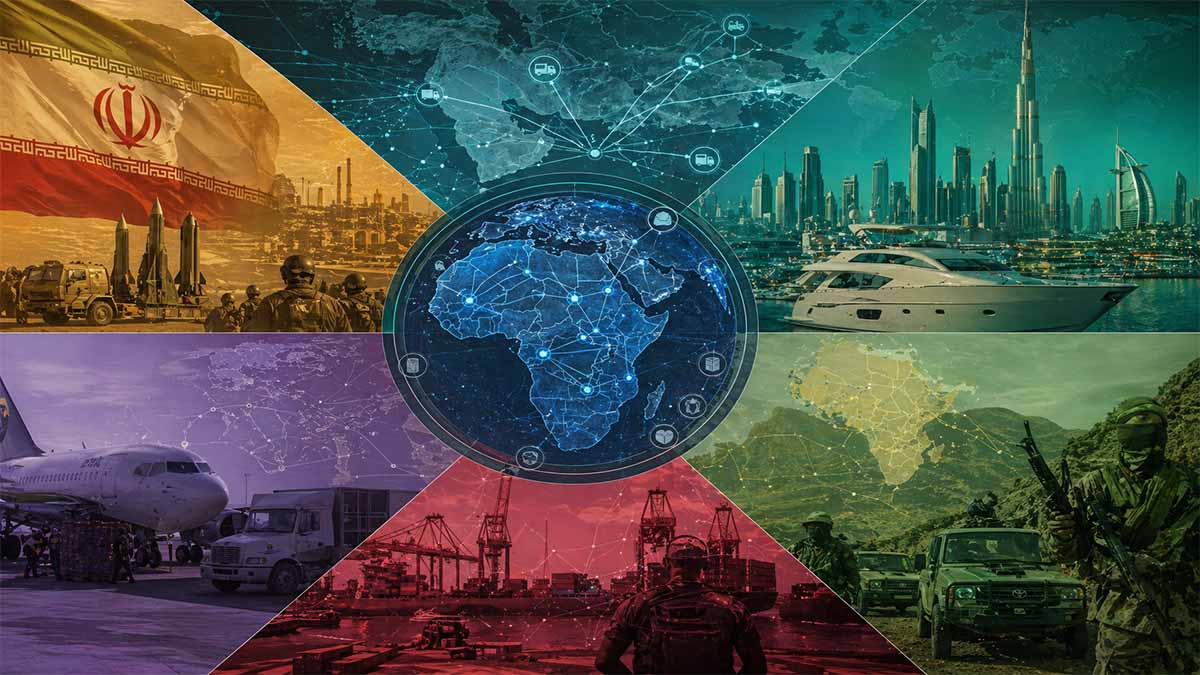
The dominant analytical frameworks applied to the 2026 Strait of Hormuz crisis — encompassing military balance assessments, nuclear deterrence calculations, and regional alliance mapping — share a common epistemic blind spot. They treat illicit financial and criminal networks as peripheral consequences of geopolitical conflict rather than as primary strategic instruments of a regime whose institutional survival depends upon them. This assessment corrects that omission. It argues that the Islamic Republic of Iran, operating under the compounded pressures of direct military confrontation with the United States and Israel since Operation Epic Fury on February 28, 2026, represents not merely a kinetic adversary constrained by conventional military logic, but a sanctions-dependent patronage state whose criminal infrastructure — built over four decades of Western pressure — will not be destroyed by airstrikes. It will fragment, accelerate its adaptation, and seek relocation into jurisdictions where regulatory capacity is weakest and geopolitical attention most diffuse. Africa, and specifically the overlapping corridors of East, Central, and West Africa that already connect conflict minerals, trade-based money laundering, and Iranian-linked financial intermediation through the United Arab Emirates, represents the most significant and least scrutinized expansion vector of that infrastructure in the current moment.
Shipping traffic through the Strait of Hormuz, one of the world’s most critical maritime chokepoints for energy trade, has been largely blocked by Iran since February 28, 2026, following the United States–Israeli air offensive and the assassination of Supreme Leader Ali Khamenei, with the Islamic Revolutionary Guard Corps (IRGC) issuing warnings forbidding passage, boarding and attacking merchant vessels, and laying sea mines in the waterway. Wikipedia The immediate economic consequences — tanker transit collapses, war-risk insurance premia surging by an order of magnitude, and supply shocks rippling across Asian and European energy markets — have commanded the totality of Western analytical and policy attention. The chokepoint physics of the Strait of Hormuz involve approximately 19–21 million barrels per day of seaborne crude and petroleum products, representing roughly 21 percent of global supply, and shipping economics respond within hours because VLCC operations are governed by just-in-time inventory models and 30–90-day forward contracts. Substack This immediacy of impact has made maritime security, nuclear negotiations, and proxy network activation the near-exclusive objects of Western intelligence analysis.
Yet the most consequential long-term strategic consequence of the current conflict may not be the temporary closure of the strait. It may be the structural reorganization of Iran’s global criminal enterprise under conditions of unprecedented kinetic pressure — an organizational adaptation whose effects will materialize most acutely in jurisdictions that are geographically distant from the Persian Gulf, institutionally ill-equipped to detect them, and systematically overlooked in the analytical literature.
Iran’s Institutionalized Criminal Methodology: An Architecture Built for Survival
The IRGC and the broader apparatus of the Islamic Republic have not constructed their sanctions-evasion infrastructure in response to any single enforcement action. They have built it over four decades as the primary financial backbone of the state itself. Iran’s oil exports averaged approximately 1.4–1.8 million barrels per day in early 2025, with China absorbing the majority through “teapot” refineries in Shandong Province, and over 250 tankers — constituting Iran’s “dark fleet” — handle the bulk of these exports through AIS blackout, name and flag swapping, and ship-to-ship transfers in the Persian Gulf, the Malacca Strait, and beyond. NCRI This is not improvised criminal behavior. It is an institutionalized operational doctrine, refined across successive waves of U.S., EU, and UN sanctions, in which each enforcement escalation has produced not compliance but innovation — new flag registries, new corporate structures, new financial intermediaries, and new geographic corridors.
The OFAC “Economic Fury” sanctions action of April 15, 2026 targeted a multi-billion-dollar Iranian and Russian petroleum sales operation led by Mohammad Hossein Shamkhani, designating more than two dozen individuals, entities, and vessels connected to Iranian regime elites, oil smuggling, and terrorist financing — with the network relying on a web of front companies, many operating as seemingly legitimate administrative, consulting, shipping, and logistics firms, to manage vessels and evade U.S. sanctions. Herbert Smith Freehills Kramer Critically, this action also revealed the operational convergence of Iranian and Russian evasion infrastructure: the same flag-of-convenience registries, the same UAE-based management firms, and the same ship-to-ship transfer mechanics serve both sanctioned regimes simultaneously, creating a shared criminal commons that amplifies resilience against any single enforcement action.
A prior OFAC action described how Moosavi orchestrated the smuggling of Iranian oil to Venezuela in exchange for gold, which was transferred back to Iran for the benefit of Hizballah and the IRGC–Qods Force, with the scheme relying on AIS spoofing, ship-to-ship transfers, and the use of “zombie” tankers — with several affiliated UAE- and Europe-based companies designated for support. Herbert Smith Freehills Kramer This gold-for-oil barter mechanism is analytically significant far beyond the Venezuela case. It represents a structural model — the conversion of petroleum revenue into a physical, untraceable store of value that bypasses SWIFT, avoids dollar-clearing systems, and emerges in destination markets with legitimate provenance documentation — that is precisely the model most likely to be expanded and diversified under the conditions of the 2026 conflict.
U.S. Treasury designated a pair of Iranian financial facilitators along with more than a dozen Hong Kong– and UAE-based entities for coordinating funds transfers from the sale of Iranian oil that benefit the IRGC-Qods Force and Iran’s Ministry of Defense and Armed Forces Logistics (MODAFL), noting that Iranian “shadow banking” networks abuse the international financial system by laundering money through overseas front companies and cryptocurrency, with the IRGC-QF using these proceeds to support regional terrorist proxy groups and develop ballistic missiles and unmanned aerial vehicles. U.S. Department of the Treasury The geographic and institutional architecture of this network — UAE-registered intermediaries, Hong Kong-based commodity traders, and cryptocurrency conversion rails — is not incidental. It reflects a deliberate optimization for jurisdictions where the gap between formal regulatory capacity and effective enforcement is widest and where Western extraterritorial reach is most constrained.
The UAE as the Primary Convergence Node: Structural Enablement and the FATF Paradox
The United Arab Emirates, and specifically Dubai, occupies a structurally unique position in the global illicit economy. It is simultaneously a legitimate global financial center, a primary destination for African conflict gold, a critical hub for Iranian sanctions evasion, a growing cryptocurrency market, and the principal clearinghouse for the proceeds of multiple overlapping criminal networks. Dubai’s role as a secret jurisdiction for actors operating under international sanctions has been amplified by its strategic location at the nexus of trading routes connecting Asia, Africa, the Middle East, the Americas, and Europe; by corruption; by huge volumes of container freight; and by the vulnerabilities of its free trade zones (FTZs), including weak procedures to inspect goods and inadequate cooperation between zone and customs authorities. Gmu
The FATF grey-listing of the UAE in March 2022 — and its subsequent removal from the grey list on February 23, 2024 — represents a central paradox in the global AML architecture. On February 23, 2024, the UAE was removed from the Financial Action Task Force‘s list of “Jurisdictions under Increased Monitoring,” having been placed there since March 4, 2022 due to “strategic deficiencies” in its efforts to counter money laundering and terrorist financing, with removal requiring full implementation of FATF’s action plan recommendations. Norton Rose Fulbright The institutional legitimacy conferred by this delisting has not, however, eliminated the structural conditions that made Dubai a hub for illicit finance in the first place. The European Parliament had opposed the delisting in April 2024, citing the European Commission’s failure to provide concrete evidence that UAE reforms had been effectively implemented, and noting that “major loopholes remain in financial free zones.” Herbert Smith Freehills Kramer The Parliament’s ultimate concession to the Commission’s position reflected political and economic pressures rather than empirical closure of enforcement gaps.
The enforcement record of UAE authorities against their own gold sector is instructive precisely because it demonstrates simultaneous reform and persistent structural vulnerability. In 2024, 32 local gold refineries had their licenses suspended between July and October, charged with 256 violations relating to failures to sufficiently address money laundering risks — including failing to notify the Financial Intelligence Unit of suspicious transactions and not implementing satisfactory controls to identify money laundering risks. A&O Shearman This enforcement action, while significant in scale, simultaneously reveals the depth of the compliance deficit that had been allowed to persist and the degree to which UAE free-zone gold refining remained a vector for illicit finance despite the formal FATF delisting process.
The shadow banking dimension of UAE-based Iranian financial activity operates through exchange houses and front companies that process funds on behalf of sanctioned entities at a scale that dwarfs individual enforcement actions. AIS vessel tracking captures 47 Jebel Ali calls by shadow fleet tankers in 2025 alone, while OTC crypto desks convert proceeds to stablecoins such as USDT before bullion purchases, and gold is subjected to rehypothecation — pledging bars multiple times — to amplify evasion flows. Iunwatch The convergence of cryptocurrency rails and physical commodity laundering — using gold as the conversion mechanism between sanctioned petroleum revenue and untraceable portable wealth — represents the most operationally sophisticated dimension of Iran’s current evasion architecture, and the dimension most directly relevant to Africa’s emerging role in that system.
The African Gold Corridor: From Transit to Relocation Zone
The artisanal gold trade connecting conflict-affected mining regions in Central and East Africa to Dubai is not a peripheral anomaly of the global gold market. It is a structurally embedded pipeline that has operated for decades, involves state-level complicity in documentation fraud at multiple transit points, and processes volumes of bullion that official statistics systematically undercount by orders of magnitude. In the DRC, official exports of artisanal and small-scale gold mining (ASGM) in 2021 were approximately 15–30 kilograms, yet estimates suggest total annual ASGM production was closer to 20 metric tons — a divergence of more than three orders of magnitude between official figures and actual output — with most African countries generating ASGM that circulates in the informal market, and only 3 percent of gold refined by LBMA-accredited refiners coming from artisanal sources. United States Department of State
More than 90 percent of DRC gold is smuggled to regional states, including Uganda and Rwanda, where it is then often refined and exported to international markets, particularly the UAE, in a trade driven by a network of armed groups, smugglers, and companies that generate illicit revenue through forced labor, smuggling, and extortion — financing armed conflict and depriving the DRC of tax revenue. Ecscreening
The chain of custody in this system has been documented in forensic detail by both U.S. enforcement actions and independent investigative reporting. The U.S. Treasury sanctions architecture reveals a chain of custody in which PARECO-FF and then M23 exploited Rubaya’s minerals; the Cooperative des Artisanaux Miniers du Congo (CDMC) operated the largest concession and purchased minerals smuggled from armed-group areas; CDMC then sold minerals to Hong Kong-based East Rise Corporation Limited and Star Dragon Corporation Limited; and once minerals reach Rwanda, they are sold to Rwandan exporters such as African Panther Resources, whose 2024 exports surged with Luxembourg-based trader Traxys becoming almost the exclusive buyer. Xtrafrica
The geographic and institutional logic of this pipeline is not incidental. Rwanda’s position as a East African Community member provides preferential market access to European buyers. Its formal mineral certification apparatus — the ITSCI traceability scheme — has been documented to provide cover for conflict minerals through what Global Witness has described as systematic laundering of provenance. The United Nations Group of Experts reported that smuggled minerals were “laundered through Rwanda, mixed with local production and exported,” with Rwanda’s official coltan exports doubling from approximately 1,000 tonnes in 2023 to 2,000 tonnes in 2024 — far exceeding the country’s domestic production capacity. Xtrafrica This systematic inflation of official export figures relative to domestic production capacity is the operational signature of a laundering system, not a compliance system.
The Dubai Convergence Point and the Iran-Africa Nexus
The analytical significance of the African artisanal gold pipeline for the present assessment lies not in its independent criminality — extensively documented elsewhere — but in its structural intersection with Iranian sanctions-evasion infrastructure at the Dubai convergence point. Dubai simultaneously processes the physical output of African conflict gold and serves as the primary clearinghouse for Iranian petroleum revenue seeking conversion into non-traceable assets. These two flows — African illicit gold and Iranian illicit petroleum proceeds — leverage the same institutional infrastructure: the same free-zone registries, the same gold refining facilities, the same exchange house networks, and the same cryptocurrency OTC desks.
Leaked data reveals $863 million in Iran-linked flows via UAE funneled through Dubai-based refiners, blending sanctioned crude revenues into legitimate trade, while 875+ shadow fleet designations in 2025 underscore the oil-gold nexus, with vessels docking at Jebel Ali to offload disguised cargoes. Iunwatch The provenance-erasure function of Dubai’s gold refining sector is the critical link: once African artisanal gold — or Iranian petroleum revenue converted to bullion through barter — passes through a DMCC-licensed refinery and receives official Dubai certification, it emerges as a “UAE-origin” product with no traceable connection to its actual source. Sahara Gold Refinery FZE and comparable DMCC-registered entities process gold output 22 percent of which is flagged as high-risk by World Gold Council metrics, while G7 intelligence assessments peg UAE gold refineries at 15 percent of global sanctions bypass, with Dubai’s zero-tax regime attracting Russian sanctioned banks’ affiliates and post-Operation Destabilise rerouting by IRGC proxies exploiting post-FATF complacency. Iunwatch
The West Africa dimension of Iranian and Hezbollah-linked financial activity adds a further geographic layer to this convergence dynamic. FinCEN‘s October 23, 2024 alert to financial institutions documented Hizballah‘s global criminal financial networks and noted that Iran provides an estimated $700 million per year in support of Hizballah, which generates revenue through oil smuggling, money laundering, black market money exchange, counterfeiting, and illegal weapons procurement — with funds laundered through businesses in real estate, import/export, construction, diamonds and precious stones, and high-value art. FinCEN The same FinCEN alert warned that Hizballah-linked facilitators exploit trade-based money laundering (TBML) via front companies in high-risk free-trade zones across West Africa, Europe, and South America. NCRI
The documented historical presence of Hezbollah-linked commercial networks in West Africa — most extensively in the Lebanese diaspora communities of the Sahel — provides an existing organizational infrastructure through which Iranian sanctions-evasion networks could expand under kinetic pressure. OFAC designated Hizballah financier Mohammad Ibrahim Bazzi and affiliated entities including a Gambia-based petroleum and petroleum products company, Euro African Group LTD, for being owned or controlled by Bazzi, an action described as disrupting Hizballah’s global business empire in Europe, Africa, and the Middle East — with Bazzi also documented to have close ties to Yahya Jammeh, the former leader of The Gambia, and business connections to the Ayman Joumaa Drug Trafficking and Money Laundering Organization. U.S. Department of the Treasury This case illustrates the structural model: a Hezbollah-linked financier uses West African petroleum and commodity companies as commercial covers for funds movement, embedded within political relationships with host-state elites who provide protection from enforcement.
The 2026 Escalation and the Fragmentation-Adaptation Cycle
The kinetic pressure of the 2026 conflict has fundamentally altered the incentive calculus for Iranian illicit network operators. Iran has adopted a strategy of “unconditional escalation” involving the regionalization of conflicts, targeting of energy and financial infrastructure, closure of the Strait of Hormuz, and activation of proxy forces — a strategic shift designed to turn military asymmetry into an economic-geoeconomic lever that increases the risk of regional instability and unpredictable escalation. RealClearDefense This strategic posture implies a parallel imperative in the financial domain: as conventional revenue sources — petroleum exports, SWIFT-connected financial channels, Central Bank operations — come under intensified disruption, the pressure to activate and expand alternative revenue pathways intensifies proportionally.
The Global Terrorism Index 2026 Supplement documented that growing Houthi coordination with AQAP, al-Shabaab, and IS-Somalia via smuggling networks creates new proliferation risks, while Iran’s retaliatory strikes against U.S. bases and civilian infrastructure across six Gulf states signal a regime fighting for survival that has historically turned to terrorism as a tool of asymmetric warfare, with early indicators suggesting the IRGC intends to sustain a prolonged campaign leveraging global economic disruption as strategic pressure on the United States. Vision of Humanity The reference to al-Shabaab in this context is analytically significant: it suggests that the East African Horn — where al-Shabaab has already demonstrated sophisticated financial operations including hawala networks, charcoal smuggling, and telecommunications fraud — may serve as an access point for Iranian-aligned illicit finance under conditions of escalating pressure.
Iranian leaders believe they can outlast U.S. and Israeli pressure and force a settlement on favorable terms, calculating that continued resistance will produce a ceasefire without enforceable restrictions — with the regime’s survival depending on energy revenue, trade access, and patronage networks tied to the global economy, such that permanent isolation would weaken the system the regime relies on to function. Small Wars Journal This assessment, articulated by strategic analysts at the Small Wars Journal, captures the central dynamic: Iran’s continued resistance depends on maintaining financial flows sufficient to fund the IRGC patronage system and its proxy network, and those flows will be sustained through whatever alternative channels remain available — including the systematic expansion of existing African illicit infrastructure.
Institutional Deficits and the African Intelligence Gap
The absence of effective institutional response to this emerging convergence dynamic is not accidental. It reflects structural features of African financial intelligence that have been extensively documented but inadequately addressed. Financial crime units, commodity regulators, and law enforcement agencies in East and Central Africa operate in institutional isolation from one another, processing transaction data that individually appears unremarkable but collectively constitutes systematic evasion. A customs official in Entebbe processing a gold export certificate has no mechanism to connect that transaction to the financial intelligence picture being assembled in Nairobi or Algiers, and no feedback from the Nairobi analyst regarding the red flags present in similar transactions. This absence of institutional feedback loops is precisely the condition that renders African jurisdictions operationally attractive for networks seeking to exploit enforcement gaps.
AFRIPOL — the African Union Mechanism for Police Cooperation — was designed to address precisely this kind of transnational financial crime requiring simultaneous integration of financial intelligence, trade data, and law enforcement. The United States remains concerned about the conflict and humanitarian crisis in eastern DRC, as well as the role that the illicit trade of minerals continues to play in financing the conflict — with minerals sourced from eastern DRC frequently smuggled through Rwanda before being transported to major refining and processing countries, including the UAE. Usembassy However, the institutional mandate of AFRIPOL has not been operationalized in a manner adequate to address the convergence of Iranian sanctions evasion with African conflict gold corridors, because this convergence does not conform to the pattern recognition templates of either traditional organized crime investigation or sanctions enforcement as currently practiced on the continent.
The FinCEN October 2024 Hizballah alert — directing financial institutions to scrutinize overpriced or underpriced used car exports from the U.S. to West Africa and electronics shipments to China or the tri-border region of South America as potential indicators of TBML — illustrates both the sophistication of the threat and the institutional mismatch between the analytical capacity of U.S. financial intelligence and that of African regulatory bodies. The U.S. Treasury’s Financial Crimes Enforcement Network directed banks and other financial institutions to more thoroughly review invoices associated with exports of used cars from the U.S. to West Africa that appear overpriced or underpriced, and similar documentation for electronics shipments to China or South America, as red flags particularly when goods appear unrelated to the counterparty’s usual line of business or involve Lebanese or Hezbollah-connected financial services companies. Moneylaundering African customs and financial intelligence authorities lack both the data systems and the analytical frameworks required to perform equivalent screening, creating a systematic and exploitable gap.
The Convergence Risk: From Facilitation to Relocation
The thesis of this assessment is precise in its formulation. Africa is not currently a primary node of Iranian sanctions evasion infrastructure in the same sense that Dubai, China’s Shandong Province, or Iraq’s banking system function as primary nodes. It is a transit and facilitation zone that provides geographic buffer, documentation cover, and commodity conversion services within a system whose financial and operational center of gravity remains in the Gulf and East Asia. The structural risk of the 2026 escalation is that this functional relationship — from facilitation to relocation — undergoes a qualitative shift as primary nodes come under intensified pressure.
When Dubai-based exchange houses face enhanced OFAC scrutiny, Iranian operators seek new UAE-adjacent processing points. When Chinese teapot refineries face secondary sanctions pressure, Iranian petroleum seeks alternative destination markets. When IRGC-linked cryptocurrency operations face coordinated blockchain analytics, stablecoin flows are rerouted through jurisdictions with minimal virtual asset oversight. Each of these adaptation moves increases the operational relevance of African jurisdictions — not as replacements for existing infrastructure, but as supplementary nodes that reduce the concentration risk of evasion architecture and provide new entry points into Western financial systems through legitimate commodity and trade finance channels.
The gold corridor is the most operationally mature pathway for this expansion, because the infrastructure — the artisanal mining networks, the transit hubs, the documentation systems, and the Dubai refining terminal — already exists. What changes under conditions of heightened Iranian evasion pressure is the incentive to utilize this infrastructure not merely for its existing conflict gold laundering function but as a mechanism for absorbing sanctioned petroleum revenue and converting it into untraceable physical assets. Armed groups in conflict-affected regions have used the gold trade to finance their activities for decades, and armed entities hostile to U.S. interests are increasing their presence in sub-Saharan Africa’s gold trade, including jihadists with links to Al-Qaeda. U.S. Treasury The addition of Iranian state-level financial actors to this already congested criminal commons would represent a qualitative escalation in the complexity and scale of the threat.
Analytical Conclusions and Policy Imperatives
This abstract establishes three foundational analytical propositions that will be developed across the three chapters of the full assessment. First, Iran’s criminal infrastructure is structurally adapted to survive kinetic pressure through fragmentation, diversification, and geographic expansion — and the 2026 conflict has intensified rather than diminished the operational imperative for this adaptation. Second, the African artisanal gold corridor — connecting DRC, South Sudan, CAR, Uganda, Rwanda, Kenya, and Burundi to Dubai — already provides the physical, institutional, and documentary infrastructure required for expanded Iranian sanctions evasion, and the conditions for its utilization are accelerating. Third, African financial intelligence institutions are structurally ill-equipped to detect or respond to this emerging convergence dynamic, creating a window of vulnerability that will narrow only if deliberate analytical and policy action is taken before emerging dynamics consolidate into durable illicit corridors.
The policy implications follow directly from these propositions. AFRIPOL must direct financial intelligence units in East and Central Africa to brief analysts on sanctions-evasion indicators within the regional gold trade. Regional cooperation frameworks must reclassify sanctions evasion as an organized crime priority rather than a foreign policy issue. And sustained analytical focus must be directed at the commercial, financial, and commodity pathways linking African markets to the UAE, coordinated through regional mechanisms and informed by the junction-analysis methodology that has proven effective in other multi-vector financial crime contexts.
The ongoing conflict at the Strait of Hormuz will eventually produce a ceasefire, a negotiated settlement, or an escalation. Whatever the outcome, the criminal infrastructure of the Iranian state will survive it — and its next phase of expansion is most likely to occur in the least scrutinized jurisdictions on earth. Africa cannot afford to wait for that expansion to consolidate before developing the institutional capacity to detect and disrupt it.
IRAN CRIMINAL ADAPTATION 2026
Why Kinetic Pressure on the Strait of Hormuz Accelerates Illicit Expansion into African Gold Corridors
Under direct US-Israeli strikes and Hormuz blockade, Iran’s sanctions-evasion architecture is relocating into Africa’s weakest regulatory corridors. The Dubai gold refining nexus now serves as the primary convergence point between Iranian petroleum revenue and African conflict minerals.
| Entity / Corridor | Type | Estimated Scale | Link to Iran | Risk Level |
|---|---|---|---|---|
| DRC ASGM (Rubaya/M23) | Conflict Gold | 20+ tons/year smuggled | Via UAE refiners | CRITICAL |
| Jebel Ali Shadow Tanker Calls | Oil-Gold Nexus | 47 calls (2025) | IRGC dark fleet | CRITICAL |
| Hezbollah West Africa | TBML / Diamonds | $700M+ annual | Direct IRGC-QF | HIGH |
| Dubai DMCC Refineries | Laundering Hub | 15-22% high-risk | Iran + African gold | HIGH |
| Rwanda ITSCI Laundering | Coltan/Gold Export | Exports doubled | Provenance cover | HIGH |
Index
Chapter 1 — The Sanctions-Evasion Architecture of a State Under Existential Pressure
- 1.1 Iran’s Institutionalized Criminal Methodology: Dark Fleets, Shell Layers, and Crypto Rails
- 1.2 The 2026 Hormuz Crisis and the Fragmentation-Adaptation Cycle of Illicit Networks
- 1.3 The UAE as the Primary Convergence Node: Shadow Banking, Free Zones, and the FATF Paradox
Chapter 2 — The African Gold Corridor: Transit, Facilitation, and Emerging Relocation Dynamics
- 2.1 The East and Central African Artisanal Gold Pipeline: DRC, Uganda, Rwanda, Kenya, and the Dubai Terminal
- 2.2 Conflict Mineral Laundering as a Structural Enabler: Armed Groups, Front Companies, and Provenance Erasure
- 2.3 Hezbollah’s Commercial Footprint in West Africa and the Trade-Based Money Laundering Architecture
Chapter 3 — Institutional Deficits, Policy Failures, and the Path to Convergence
- 3.1 AFRIPOL, Financial Intelligence Fragmentation, and the Absence of Feedback Loops
- 3.2 The Military-Industrial-Financial Complex and the Political Economy of Enforcement Gaps
- 3.3 Recommendations: Reclassification, Analytical Coordination, and Junction-Based Disruption
Chapter 1: Iran’s Sanctions-Evasion Architecture Under Existential Kinetic Pressure — Dark Fleet Mechanics, Shell-Layer Financial Infrastructure, Crypto Rail Integration, the Hormuz Crisis as Adaptation Accelerant, and the UAE as the Primary Convergence Node of Illicit Finance
Iran’s Institutionalized Criminal Methodology: Dark Fleets, Shell Layers, and Crypto Rails
The architecture that sustains Iran’s ability to generate, move, and repatriate revenue under comprehensive Western sanctions does not represent improvised criminal behavior by peripheral actors. It is a purpose-built, institutionally embedded operational system that has been refined across four decades of successive enforcement escalations — each wave of U.S., European Union, and United Nations Security Council pressure producing not compliance but a new generation of evasion methodology more sophisticated than the last. As of April 26, 2026 — the precise current date of this analysis — that system is operating under unprecedented kinetic and financial pressure simultaneously, and the observable pattern of its adaptation constitutes one of the most significant underanalyzed security dynamics of the 2026 conflict.
The maritime dimension of Iran’s evasion apparatus — the so-called “dark fleet” or “shadow fleet” — has expanded dramatically in scale and geographic reach since the re-imposition of U.S. sanctions following Washington’s 2018 withdrawal from the Joint Comprehensive Plan of Action (JCPOA). The most current intelligence data available as of today’s date confirms the extraordinary dimensions of this fleet. As of April 17, 2026, at the height of the Strait of Hormuz conflict, 177 tankers carrying Iranian cargo were operational on the water worldwide, with 163 of those vessels sailing under fraudulent flag registries with elevated Iranian sanctions compliance risk, while at least 719 Iranian dark fleet tankers are tracked globally by maritime intelligence platforms. Windward These figures, sourced from Windward Maritime AI platform real-time tracking, represent a fleet of extraordinary magnitude — one whose operational persistence through an active military conflict and an expanding U.S. naval blockade constitutes compelling empirical evidence that kinetic pressure alone cannot dismantle sanctions-evasion infrastructure built over decades.
The operational mechanics of this fleet reveal a layered deception architecture of considerable sophistication. Vessels deploy Automatic Identification System (AIS) manipulation as their primary concealment technique — selectively deactivating transponders, broadcasting false position data, and using AIS spoofing to fabricate port call histories that obscure actual cargo origins. Iran’s ability to sustain oil exports under blockade conditions is underpinned by a highly evolved shadow fleet employing layered evasion tactics refined through years of sanctions enforcement pressure, with the systematic deactivation of AIS transponders allowing vessels to temporarily disappear from conventional tracking systems and complicate real-time maritime domain awareness. Defence Security Asia Beyond AIS manipulation, vessel identity is further obscured through systematic name changes, flag registry transfers, and corporate ownership restructuring — a process in which a single tanker may cycle through five or more flag states, three shipping company names, and multiple beneficial ownership layers within a single enforcement cycle.
The flag registry dimension of this system reveals a specific and analytically significant geographic pattern. Official U.S. Department of State sanctions data from February 2026 documents the flag state distribution of designated shadow fleet vessels in forensic detail: the Department of State identified as blocked property 14 shadow fleet vessels involved in the transport of Iranian petroleum, petroleum products, and petrochemical products — including vessels flagged to Barbados, Panama, Aruba, Marshall Islands, and Cameroon — with managing companies registered in the Marshall Islands, Kazakhstan, the Seychelles, and the United Arab Emirates, each designated pursuant to Executive Order 13846 for knowingly engaging in significant transactions for the purchase, acquisition, sale, transport, or marketing of Iranian petroleum. U.S. Department of State
The recurrence of Cameroon as a flag-of-convenience state in these designations is analytically significant and directly relevant to the African dimension of this assessment. OFAC’s Special Designated Nationals (SDN) list data confirms multiple Cameroon-flagged crude oil tankers formally designated under Iran-related authorities, including vessels VETER (IMO 9233739, linked to FLUXUS MARINE INC), BENEDICT (IMO 9293155, linked to ELEVATE MARINE MANAGEMENT PRIVATE LIMITED), ATILA (IMO 9262754, linked to GRAT SHIPPING CO LTD), and ELIZABET (IMO 9216717, linked to WHITE SANDS SHIPMANAGEMENT CORP), all designated under E.O. 13846 or E.O. 13224 for their roles in Iranian petroleum transport. Office of Foreign Assets Control The use of Cameroon‘s flag registry as a concealment mechanism for sanctioned Iranian petroleum transport creates a direct, documented regulatory linkage between African maritime registries and Iran’s operational evasion infrastructure — a linkage that receives virtually no analytical attention in mainstream coverage of the conflict.
The ship-to-ship (STS) transfer mechanism is the operational heart of the dark fleet’s provenance-erasure function. Iranian-origin crude is loaded at Kharg Island — Iran’s primary export terminal — onto shadow fleet tankers that then transit to designated offshore transfer zones, most prominently the Eastern Outer Port Limits (EOPL) area off the coast of Johor, Malaysia, where cargo is transferred to ostensibly clean vessels with no traceable Iranian connection. The EOPL is a spot where sanctioned oil from dark fleet tankers is transferred to other vessels to obscure its origin and evade sanctions, and in the past year the tanker M/T Tifani (IMO 9273337) appeared to make several such transfers in the EOPL and Singapore Strait, according to MarineTraffic data — before being boarded by U.S. Indo-Pacific Command forces on April 21, 2026, approximately 2,000 miles from the Persian Gulf. CNN
The boarding of the M/T Tifani in the Indian Ocean on April 21, 2026 represents a qualitative escalation in U.S. enforcement posture: the extension of blockade enforcement from chokepoint interdiction in the Persian Gulf to open-ocean boarding operations across the full Indo-Pacific theater. Since the start of the conflict, UANI has observed at least 52 ghost fleet tankers laden with Iranian oil that have left the Persian Gulf, some broadcasting their AIS signals and others operating clandestinely, en route to Malaysia to conduct ship-to-ship (STS) transfers with other ghost fleet vessels bound for China — while U.S. forces prioritize high-value VLCC tankers over smaller Handymax oil and LPG carriers due to risk-reward calculus. United Against Nuclear Iran This enforcement calculus creates a systematic gap: the smaller Handymax and LPG segment of the shadow fleet — which individually transports lower volumes but collectively represents substantial throughput — operates with considerably reduced interdiction risk. This gap is precisely the segment most likely to expand routing through alternative geographic corridors, including those connecting to African ports.
The financial architecture underlying the dark fleet’s petroleum revenue generation operates through a multi-layered network of shell companies, management intermediaries, and flag registry administrators distributed across dozens of jurisdictions. In 2025, OFAC sanctioned 155 Iranian persons and 460 non-Iranian persons — including those located in China and Hong Kong, the United Arab Emirates, and Turkey — under Iran-related authorities, targeting Iran’s illicit oil revenue through its shadow fleet and shadow banking network, with the administration having sanctioned more than 180 vessels responsible for shipping Iranian petroleum and petroleum products by December 2025. Corporatecomplianceinsights The geographic distribution of non-Iranian persons sanctioned is itself analytically instructive: it maps precisely onto the facilitation network’s jurisdictional architecture, with UAE-based shipping managers, Chinese commodity purchasers, and Turkish intermediaries forming the three principal non-Iranian pillars of the evasion system.
The shell layer dimension of this architecture is characterized by the systematic use of beneficial ownership concealment mechanisms available in low-scrutiny jurisdictions. An independent research submission to OFAC identified a network of 134 UAE-registered companies that appear to be systematically facilitating sanctions evasion for entities linked to Iran and Russia, with coordinated activities across UAE free zones — particularly Dubai-based corporate and maritime structures — including the use of shell companies and nominee directors, falsified trade and shipping documentation, vessel-to-vessel transfers with AIS manipulation, re-routing of petroleum, petrochemicals, electronics, and precious metals, and processing of U.S. dollar transactions in apparent violation of Executive Orders, with overlapping corporate addresses and shipping identifiers across multiple tiers of facilitators. Iunwatch
This network analysis, encompassing 134 identified entities, represents only a documented subsection of what enforcement analysts assess to be a far larger operational infrastructure. The recurring feature of nominee directorship — in which front companies are registered under individuals with no genuine operational role who sign documents on behalf of undisclosed beneficial owners — is specifically enabled by the UAE’s corporate governance framework, which under Federal Decree Law No. 20 mandated Ultimate Beneficial Owner (UBO) disclosure only for stakes exceeding 25 percent of shareholding. This threshold, exploited systematically by Iranian evasion networks, allowed Iranian IRGC-connected entities to distribute shareholding below the disclosure threshold across multiple nominees, rendering formal compliance checks operationally ineffective.
The Cryptocurrency Rail: From Supplement to Primary Infrastructure
The integration of cryptocurrency — and specifically U.S. dollar-pegged stablecoins — into Iran’s sanctions-evasion methodology has undergone a qualitative transformation over the past 24 months that deserves extended analytical treatment, because it represents the dimension of Iran’s evasion architecture most likely to expand into Africa’s emerging role as a facilitation zone.
The scale of Iran’s crypto economy is now definitively established at the sovereign level. Iran’s crypto volumes measured $11.4 billion in 2024 and $10 billion in 2025, with addresses associated with IRGC facilitation networks accounting for over 50% of the total value received by Iranian services by Q4 2025, with volumes received by IRGC-associated addresses spiking to more than $3 billion in 2025 alone — up from $2 billion the previous year — with this $3 billion total constituting a lower-bound estimate that excludes volumes from the UK-registered exchanges Zedcex and Zedxion, which were not designated until January 2026. Chainalysis
The operational preference for stablecoins — particularly Tether (USDT) on the Tron blockchain — over volatile cryptocurrencies reflects a deliberate strategic choice by IRGC financial operators. Chainalysis, in its April 10, 2026 analysis, reported that IRGC-associated addresses received more than $2 billion in 2024 and over $3 billion in 2025, with the IRGC now accounting for approximately 50% of Iran’s total crypto ecosystem by Q4 2025, against a total Iranian crypto ecosystem sized at roughly $7.8 billion, with the IRGC’s documented on-chain activity having overwhelmingly relied on stablecoins as the medium of exchange — calling the Hormuz toll mechanism the first known case of a nation-state demanding cryptocurrency as payment for transit through an international waterway. Hormuz Toll News
The Hormuz toll mechanism — through which the IRGC announced demands for cryptocurrency payments from vessels seeking transit through the strait — represents a genuinely unprecedented development in the history of sanctions evasion: the explicit, public monetization of maritime chokepoint control through digital assets outside the correspondent banking system. The operational logic is clear: a dollar-pegged stablecoin settled on the Tron blockchain involves no SWIFT messaging, no correspondent bank, no trade finance documentation, and no physical commodity flow that could trigger conventional sanctions screening. It passes through the global financial system as an opaque digital transfer until it reaches an off-ramp exchange where it can be converted to fiat currency.
The OFAC enforcement response to this development has been consequential but ultimately reactive. On April 24, 2026, OFAC took a significant step in digital asset enforcement by designating two cryptocurrency wallets directly tied to Iran’s Central Bank, with linkages to the Islamic Revolutionary Guard Corps–Qods Force and Hezbollah, triggering an immediate freeze of roughly $344.2 million in Tether’s USDT stablecoin — coordinated between Tether, OFAC, and U.S. law enforcement — marking what appears to be the largest on-chain seizure of Iranian state-linked crypto holdings to date. TRM
The forensic detail behind this freeze reveals the operational sophistication of Iran’s crypto architecture. TRM Labs’ prior analysis of the Central Bank of Iran’s on-chain activity identified a repeatable institutional typology: large deposits, structured bridge-outs to Ethereum and Binance Smart Chain multisig custody, DeFi-based token transformation, fragmentation, and eventual routing toward centralized exchanges — with one designated wallet recording no outgoing transfers whatsoever, while the second sent out less than $16 million against more than $228 million received, in patterns consistent with sovereign reserve storage rather than active operational use. TRM This “reserve storage” pattern — accumulating stablecoin reserves over years before potential single-event deployment — suggests that Iran’s Central Bank has been treating USDT holdings as a parallel reserve asset, an operational posture that has no precedent in the history of central banking under sanctions.
The January 2026 designation of Zedcex and Zedxion — two UK-registered exchanges that processed approximately $1 billion in IRGC-linked stablecoin flows — established a further operational precedent: the first-ever OFAC designation of IRGC-linked digital asset exchange infrastructure. The GENIUS Act, passed into law in July 2025, created a regulatory framework for stablecoins such as Tether, while simultaneously OFAC designated IRGC-linked crypto exchanges — with the statute of limitations for sanctions violations having doubled from five years to ten in 2024, creating a 10-year exposure window for correspondent banks processing crypto-to-fiat conversions. American Banker The extension of the limitations period creates a structurally new compliance risk landscape for any financial institution — including African banks — that may process transactions connected to IRGC-linked stablecoin flows even indirectly.
1.2 The 2026 Hormuz Crisis and the Fragmentation-Adaptation Cycle of Illicit Networks
The activation of the Strait of Hormuz as a kinetic theater since February 28, 2026 has set in motion a fragmentation-adaptation cycle in Iran’s illicit networks that is both predictable in its broad dynamics and highly specific in its current operational manifestations. The central analytical proposition is this: enforcement pressure does not eliminate illicit networks — it compresses them, forcing reorganization along dimensions of geographic diversification, jurisdictional arbitrage, and commodity switching that reduce concentration risk at the cost of increased network complexity.
The most immediate evidence of this fragmentation-adaptation cycle is visible in the maritime domain itself. Despite the U.S. naval blockade of Iranian ports beginning in mid-April 2026 and the expanding open-ocean interdiction campaign, Iran’s petroleum export infrastructure has demonstrated remarkable continuity of operation. Windward Maritime AI platform data from April 26, 2026 — today’s date — confirms that Kharg Island continues to function as Iran’s primary crude export hub, with SAR imagery from 02:37 UTC identifying two tankers actively loading at the terminal — one VLCC and one Suezmax-class vessel — with combined loading capacity estimated at approximately 3 million barrels, while at least 8 additional VLCCs were observed anchored south and east of Kharg, forming a substantial waiting queue. Windward
This operational continuity in the face of the most intensive enforcement pressure Iran has faced since the inception of its shadow fleet confirms a core analytical finding: a fleet of 719 dark tankers — built up over years, distributed across dozens of flag registries, managed through hundreds of shell companies, and routed through multiple transfer zones — cannot be comprehensively interdicted by any single enforcement instrument. The U.S. Navy’s own risk-reward calculus reinforces this assessment. U.S. forces prioritize high-value VLCC tankers over smaller Handymax oil and LPG carriers due to risk-reward calculus, with the true effectiveness of the blockade lying in disrupting regime oil revenue to China, raising sanctions evasion costs, deterring large shipments, and pressuring Iran to reopen the Strait of Hormuz — while the U.S. blockade of Iranian ports does not cover all Iran-linked ships, and the majority of vessels passing the blockade may not be transporting Iranian-origin cargoes. United Against Nuclear Iran
The fragmentation imperative operating on Iran’s evasion networks under these conditions follows a predictable pattern documented across all previous sanctions escalation cycles. When primary routing corridors come under intensified enforcement pressure, operators respond through route diversification — identifying alternative transit points with lower enforcement density, lower insurance premium exposure, and lower AIS monitoring coverage. The Eastern Outer Port Limits area off Malaysia — the primary STS transfer zone for China-bound Iranian petroleum — has experienced expanded U.S. Indo-Pacific Command surveillance coverage following the Tifani boarding. This enforcement expansion creates pressure to identify supplementary or alternative transfer zones with lower interdiction risk.
The Analysis of Competing Hypotheses methodology requires systematic consideration of at least five mutually exclusive driver sets for the observed pattern of fragmentation and adaptation. Driver Set 1 (Enforcement-Led Rerouting): intensified INDOPACOM coverage of the EOPL transfer zone forces diversion of shadow fleet routing toward alternative STS areas — potentially including the Arabian Sea, the Red Sea approaches, or the East African coast, where monitoring density is substantially lower and naval presence more limited. Driver Set 2 (Commodity Switching): sustained interdiction of petroleum shipments creates incentives to shift revenue generation toward alternative commodities — gold, petrochemicals, and dual-use goods — that travel in smaller volumes, through commercial trade channels, with less distinctive physical signatures. Driver Set 3 (Financial Rail Migration): expanded OFAC targeting of the correspondent banking and cryptocurrency layers forces migration toward less-monitored financial channels, including hawala networks, mobile money platforms, and informal value transfer systems most prevalent in East Africa and South Asia. Driver Set 4 (Proxy Network Activation): the degradation of Iran’s direct operational capacity under kinetic pressure increases the operational role of affiliated non-state networks — Hezbollah-linked commercial entities, Iraqi militia-connected businesses, and Wagner Group successor networks in the Sahel — as independent agents of Iranian revenue generation and funds transfer. Driver Set 5 (State-Level Diplomatic Arbitrage): Iran cultivates explicit protection relationships with states in weak governance zones, offering revenue-sharing arrangements, investment commitments, or security cooperation in exchange for the regulatory cover and enforcement non-interference required to relocate evasion infrastructure.
Each of these driver sets has independent empirical support. The most important analytical observation is that they are not mutually exclusive in practice — they are simultaneously operative, and their interaction produces an evasion architecture that is more geographically dispersed, more institutionally embedded, and more resistant to any single enforcement instrument than any predecessor configuration.
The insurance dimension of the shadow fleet’s adaptation under kinetic pressure deserves specific analytical treatment, because it reveals a structural vulnerability in the evasion system that has been partially exploited by enforcement actions but remains substantially intact. Shadow fleet tankers — by definition excluded from mainstream Protection and Indemnity (P&I) insurance clubs, which operate under International Group umbrella arrangements that require OFAC compliance — have historically relied on alternative insurance arrangements provided by non-mainstream underwriters willing to operate outside conventional compliance frameworks. In October 2025, Reuters exposed the involvement of the Maritime Mutual Insurance Association (MMIA), also known as the New Zealand P&I Club — owned by UK citizen Paul Rankin — along with two affiliates in Dubai, MME Services and Maritime Reinsurance, in facilitating the trade of billions of dollars worth of Iranian and Russian oil by providing insurance to vessels evading Western sanctions — with the company insuring one-sixth of the tankers in the shadow fleet. Wikipedia
The geographic location of the insurance affiliates — Dubai — again confirms the UAE as the structural hub of Iran’s evasion architecture’s supporting services layer. The significance extends beyond the specific insurance case: it reveals that shadow fleet operations require a full ecosystem of supporting services — insurance, ship management, fuel bunkering, crew recruitment, technical maintenance, and cargo documentation — and that this ecosystem is concentrated in jurisdictions that provide the combination of financial access, regulatory tolerance, and geographic positioning required to sustain global operations. Dubai provides all of these attributes.
The April 24, 2026 designation of LPG SEVAN — a Panama-flagged LPG tanker intercepted by U.S. naval forces in the Arabian Sea — illustrates the expanding geographic perimeter of enforcement operations. LPG SEVAN was assessed as part of the Iranian dark fleet and designated under OFAC sanctions on April 24, 2026, one day prior to interception; U.S. Treasury reporting indicated that the vessel previously transported approximately 750,000 barrels of Iranian LPG cargo to Bangladesh between August and November 2025, while at the time of interception the vessel was carrying approximately 200.6 thousand barrels of LPG+/olefins — declaring Dubai as its destination but with operational routing indicating a trajectory toward Jaigarh, India, consistent with prior Iranian export patterns. Windward
The Bangladesh destination recorded in LPG SEVAN’s prior cargo history is significant: it represents the extension of Iran’s petroleum export network into South Asian markets beyond China, a geographic diversification that reduces China dependency and provides alternative revenue streams with different enforcement exposure profiles. The same logic — jurisdictional diversification of export destinations to reduce single-point enforcement vulnerability — applies to the potential expansion of export routing through African coastal waters and ports.
1.3 The UAE as the Primary Convergence Node: Shadow Banking, Free Zones, and the FATF Paradox
The United Arab Emirates — and specifically the Dubai ecosystem of free trade zones (FTZs), exchange houses, gold refineries, cryptocurrency OTC desks, and offshore corporate registries — functions as the indispensable hub of Iran’s sanctions-evasion architecture in ways that have been comprehensively documented in enforcement actions and analytical literature but inadequately addressed in practice. The UAE’s role is not incidental: it reflects the structural convergence of geographic positioning, regulatory architecture, financial access, and institutional tolerance that no alternative jurisdiction currently replicates in comparable combination.
The shadow banking dimension of UAE-based Iranian financial activity operates through a specific institutional model: exchange houses — nominally regulated money service businesses — that process transfers on behalf of IRGC-connected entities and their commercial front companies, maintaining plausible separation from designated Iranian banks while providing functional access to the U.S. dollar correspondent banking system. OFAC’s 2025 enforcement record included 460 non-Iranian persons designated under Iran-related authorities — including entities in the UAE, China and Hong Kong, and Turkey — targeting Iran’s shadow banking network alongside its shadow fleet, as part of the maximum pressure campaign’s financial dimension. Corporatecomplianceinsights
The free-zone architecture that enables this activity deserves extended examination, because it represents the specific institutional mechanism through which the UAE’s formal regulatory framework is systematically circumvented. Dubai Multi Commodities Centre (DMCC), Jebel Ali Free Zone (JAFZA), Dubai International Financial Centre (DIFC), and numerous smaller designated zones operate under regulatory regimes that differ materially from the UAE’s onshore financial oversight framework. Free-zone entities are not subject to the same Central Bank of UAE supervisory framework as onshore companies, maintain different UBO disclosure obligations, and benefit from zero corporate tax rates that make them structurally attractive for entities seeking to minimize regulatory footprint. OFAC’s Federal Register designation record from February 25, 2026 documents WANSA GAS SHIPPING CO. — registered at an Ajeltake, Marshall Islands address with a registered office at Silver Tower, Business Bay, Dubai, UAE — designated pursuant to E.O. 13902 for operating in the petroleum sector of the Iranian economy, illustrating the standard operational structure: Marshall Islands registration for formal flag-state purposes, Dubai address for operational management and financial access. Federal Register
This dual-registration structure — offshore flag state for vessel ownership, Dubai address for commercial management — appears across virtually every documented Iranian shadow fleet management company, reflecting a deliberate optimization for the combination of jurisdictional immunity (Marshall Islands, Seychelles, Barbados) and operational functionality (Dubai). It represents a structural feature of the evasion architecture that cannot be addressed by individual vessel designations without simultaneously addressing the corporate registry and banking access frameworks that make Dubai management operationally indispensable.
The FATF delisting of the UAE in February 2024 — and the subsequent European Parliament opposition to the EU’s corresponding delisting in July 2025 — creates a specific regulatory paradox that Iranian network operators have demonstrably exploited. The delisting formally removed the enhanced due diligence requirements that major financial institutions applied to UAE counterparties during the grey-listing period, reducing the compliance friction for Iranian-linked transactions routed through Dubai exchange houses and commodity traders. Simultaneously, the structural conditions that made Dubai a primary hub for sanctions evasion — free-zone regulatory autonomy, beneficial ownership opacity, precious metals trading dominance — remained largely unchanged.
The gold refining sector provides the clearest empirical illustration of this regulatory paradox. Despite the UAE enforcement action suspending 32 gold refinery licenses between July and October 2024, the structural infrastructure for laundering African conflict gold and Iranian petroleum-derived revenue through Dubai’s gold market remains in place. The Economic Fury sanctions action of April 15, 2026 revealed that the Shamkhani network — designated by Treasury as its largest single Iran-related sanctions action since the resumption of the maximum pressure campaign in its July 2025 action — relied on designated companies including entities based in the Marshall Islands, India, Panama, Cameroon, and elsewhere, with UAE-based firms designated for materially assisting, being owned or controlled by, or acting on behalf of Mohammad Hossein Shamkhani. Herbert Smith Freehills Kramer
The specific designation of Cameroon-registered corporate entities as nodes in the Shamkhani network — the largest documented Iran-linked sanctions evasion operation of the current enforcement period — provides direct, U.S. government-confirmed empirical evidence of the operational linkage between African-registered entities and the primary tier of Iran’s evasion infrastructure. This is not a theoretical risk assessment — it is a documented enforcement finding.
The cryptocurrency dimension of UAE-based Iranian financial activity adds a third layer to this convergence architecture, operating through DMCC-licensed virtual asset service providers and offshore OTC desks that convert petroleum revenue to stablecoin and provide off-ramp services for IRGC-linked wallet clusters. In January 2026, OFAC designated Zedcex and Zedxion — two UK-registered exchanges TRM Labs had identified and attributed prior to the action — as the first-ever OFAC designation of IRGC-linked digital asset exchange infrastructure, with TRM’s on-chain analysis showing approximately $1 billion routed through that platform, with direct exposure to IRGC-controlled wallets, designated terrorist financiers, and Nobitex. Chainalysis
The institutional architecture connecting UAE-based commodity traders, exchange houses, gold refineries, and cryptocurrency OTC desks to Iran’s petroleum revenue generation and proxy network financing represents a genuinely integrated financial system — one that operates in parallel to the legitimate UAE financial system, exploiting the same banking infrastructure, the same corporate registry frameworks, and the same geographic positioning while systematically circumventing the compliance frameworks nominally governing those systems.
The following table summarizes the key documented vectors of Iran’s UAE-centered evasion architecture as evidenced by formal enforcement actions through April 26, 2026:
| Evasion Vector | Primary Instrument | Key UAE/Dubai Infrastructure | Enforcement Precedent |
|---|---|---|---|
| Petroleum Revenue | Shadow fleet tankers, STS transfers | Jebel Ali bunkering, DMCC ship management | 875+ vessel designations by Dec 2025 |
| Financial Transfer | Exchange houses, shadow banking | Dubai FTZ exchange firms | IRGC-QF/MODAFL network designations Sep 2025 |
| Cryptocurrency | USDT on Tron, OTC desks | DMCC-licensed VASPs, Nobitex off-ramps | Zedcex/Zedxion designated Jan 2026; $344M USDT frozen Apr 2026 |
| Commodity Conversion | Gold refining, bullion certification | DMCC/Jebel Ali gold refineries | 32 refinery license suspensions Jul–Oct 2024 |
| Corporate Structure | Nominee directors, shell companies | UAE FTZ registries, 25% UBO loophole | 134-company OFAC submission Mar 2026 |
The April 24, 2026 freezing of $344 million in USDT from two Central Bank of Iran-linked Tron wallets represents the most recent and most consequential enforcement action against the cryptocurrency dimension of Iran’s evasion architecture. Treasury Secretary Scott Bessent announced the action, stating that OFAC is sanctioning multiple wallets tied to Tehran as part of Operation Economic Fury, framing the measure as part of efforts to “systematically degrade Tehran’s ability to generate, move, and repatriate funds,” with Tether confirming execution of the freeze blocking USDT stablecoins across two addresses on the Tron blockchain after receiving information from multiple U.S. authorities about activity tied to unlawful conduct. TheStreet
The enforcement significance of this action extends beyond the $344 million figure. As noted by TRM Labs, Treasury is now reaching into the reserve layer, not only the intermediary layer — a signal that sovereign-level actors operate directly within crypto settlement rails — with any organization with exposure to these flows needing to review counterparty and transaction-level exposure for indirect connections to the broader network. TRM The designation of sovereign reserve-level wallets — as opposed to intermediary exchange addresses — represents a fundamental escalation in the depth of enforcement reach into Iran’s financial system, one that will force migration of reserve-layer crypto holdings to jurisdictions and platforms with even lower enforcement exposure.
The logical endpoint of this migration dynamic points toward mobile money platforms, hawala networks, and informal value transfer systems with minimal blockchain forensics exposure — precisely the infrastructure that predominates in East Africa and West Africa. The IRGC’s demonstrated capacity to embed itself within exchange-branded stablecoin infrastructure — routing $1 billion through Zedcex and Zedxion before designation — establishes a proven operational template for the exploitation of regulated but inadequately supervised virtual asset platforms. African mobile money platforms, operating under regulatory frameworks with minimal OFAC compliance capability and negligible blockchain forensics infrastructure, represent the next logical tier of this migration.
The structural conclusion of Chapter 1 is unambiguous. Iran’s sanctions-evasion architecture — maritime, financial, and digital — is operating under conditions of unprecedented enforcement pressure and demonstrating adaptive resilience that will produce geographic expansion into jurisdictions with lower enforcement density. The UAE remains the primary convergence node of this architecture, but its sustained exposure to U.S. enforcement escalation — designation waves, stablecoin freezes, and secondary sanctions on non-U.S. facilitators — is generating structural pressure to diversify the architecture’s geographic footprint. The African corridors that are the subject of Chapter 2 represent the most operationally mature alternative facilitation zone available to networks under this pressure, and the conditions for their expanded utilization are already present and accelerating.
CHAPTER 1 • IRAN EVASION ARCHITECTURE
Dark Fleet • Shell Layers • Crypto Rails • UAE Convergence Node • Hormuz Adaptation Cycle
Iran’s decades-old sanctions-evasion system — built on dark fleet deception, multi-layer shell companies, and stablecoin rails — is not collapsing under Hormuz blockade and U.S. interdiction. It is adapting by expanding into lower-scrutiny jurisdictions, with the UAE remaining the central convergence node while Africa emerges as the next logical relocation vector.
| Vector | Primary Tool | UAE Role | Scale / Precedent |
|---|---|---|---|
| Maritime | Dark Fleet + STS | Jebel Ali / Ship Mgmt | 719 tankers • 875+ designations |
| Financial | Exchange Houses | Dubai FTZ shadow banking | 460 non-Iranian designations 2025 |
| Cryptocurrency | USDT Tron OTC | DMCC VASPs | $344M frozen Apr 24 • Zedcex/Zedxion |
| Corporate | Shell Companies | Nominee directors | 134 UAE entities identified |
| Insurance | Alternative P&I | Dubai affiliates | MMIA insures ~1/6 of fleet |
Chapter 2: The African Gold Corridor — East and Central African Artisanal Mining Pipelines, Conflict Mineral Laundering Architecture, the Dubai Terminal, Hezbollah’s West African Commercial Footprint and the Structural Conditions for Iranian Sanctions-Evasion Expansion
2.1 The East and Central African Artisanal Gold Pipeline: DRC, Uganda, Rwanda, Kenya, and the Dubai Terminal
The artisanal and small-scale gold mining (ASGM) pipeline connecting Central and East Africa to the United Arab Emirates is not an informal or peripheral feature of global commodity markets. It is the world’s largest documented illicit precious metal corridor by volume — a system that processes billions of dollars of conflict-origin, tax-evaded, and provenance-laundered gold annually through a sequence of transit jurisdictions whose documentary frameworks are specifically calibrated to erase the origins of extracted wealth. For the purposes of the present assessment, this corridor is analytically significant not merely as an existing criminal system, but as a pre-constructed infrastructure capable of absorbing Iranian sanctions-evasion flows under conditions of intensified Middle Eastern enforcement pressure. Understanding its mechanics in granular detail is therefore an analytical prerequisite for evaluating the convergence risk that constitutes the core thesis of this report.
The scale of the African artisanal gold market — and the divergence between its official documentation and its actual production — is itself the primary empirical indicator of systemic laundering. In 2024, the UAE imported 31 tonnes of gold from Uganda — up from 14 tonnes in 2023 — and 19 tonnes from Rwanda — up from 13.8 tonnes in 2023 — with both countries producing little gold domestically but serving as hubs for smuggled gold notably from the Democratic Republic of Congo, where it is partly linked to conflicts; in the same year the UAE imported 52 tonnes from Togo — valued at USD 4 billion — a country that produces almost no gold, highlighting the scale of regional smuggling networks. Swissaid These figures, derived from SWISSAID’s analysis of UN Comtrade customs data published in November 2025, represent the most current comprehensive dataset available. Uganda’s export volume more than doubled in a single year — a 121 percent increase that has no plausible explanation in domestic production dynamics and can only be interpreted as reflecting intensified throughput of smuggled third-country gold.
The UAE imported a total of 748 tonnes of gold from Africa in 2024 — an 18% increase compared to the previous year — ranking as the world’s second-largest gold importer overall, with total gold imports of 1,392 tonnes valued at USD 105.4 billion; SWISSAID had previously revealed that between 2012 and 2022 the UAE imported 2,569 tonnes of illegal gold from Africa, with an estimated value of USD 115 billion. Swissaid The cumulative scale — $115 billion over a decade — situates this not as a marginal compliance problem but as one of the largest sustained commodity laundering operations in modern economic history, operating continuously through successive waves of international regulatory attention with no meaningful disruption to underlying flows.
The primary source geography of this pipeline encompasses four overlapping producing zones with distinct conflict dynamics, transit architectures, and provenance-laundering mechanisms. The eastern DRC — encompassing the provinces of North Kivu, South Kivu, Ituri, and Maniema — constitutes the largest single volume source. The region’s estimated actual artisanal gold production diverges from official export figures by multiple orders of magnitude: artisanally mined gold from the DRC, South Sudan, and CAR is mainly smuggled or exported to one of six neighboring countries — Uganda, Rwanda, Cameroon, Kenya, Chad, or Burundi — before being exported to Dubai, with the DRC taxing gold at 9–13% — one of the highest rates in the world — while neighboring Uganda and Rwanda have 0% and 0.5% gold export taxes respectively, creating powerful fiscal arbitrage incentives for cross-border smuggling even in the absence of conflict finance motivations. Thesentry
This tax differential is analytically fundamental. The mere existence of a 9–13 percent fiscal incentive for smuggling gold across the DRC–Uganda or DRC–Rwanda border — independent of any armed group involvement, any political instability, or any sanctions-evasion motivation — means that the smuggling infrastructure operates as a rational economic response to jurisdictional tax competition. This baseline economic rationality has produced a dense, well-organized, and commercially sophisticated smuggling network whose operational capacity is available for exploitation by any actor willing to pay competitive rates for transit and documentation services.
The Uganda node of this pipeline has achieved a scale that renders its role as a primary transit hub effectively impossible to deny. Uganda is a regional hub for illicit gold smuggled from elsewhere in East Africa, attracting significant volumes of gold from the DRC and South Sudan and smaller flows from Kenya, with Uganda’s gold exports having grown exponentially since the 1990s to become the highest in the region — in 2019, Uganda exported gold worth USD 1.25 billion, more than double what it had been the year before and up from less than USD 10 million a decade earlier — while the country now has seven registered gold refineries, which critics note far exceeds actual domestic production needs. Globalinitiative
The seven-refinery statistic is among the most operationally revealing data points in this analysis. Uganda’s domestic artisanal gold production — limited by geology and mining infrastructure — cannot sustain seven commercial refineries at economically viable throughput levels. The refineries exist not to process Ugandan gold but to provide the critical provenance-erasure service: receiving gold of DRC or South Sudan origin, applying Ugandan certification and documentation, and exporting it to Dubai as a product of Ugandan origin. This is not a gap in the documentary system — it is the deliberate exploitation of a documentary system that lacks the forensic capacity to distinguish physically identical gold bars by geographic production origin after processing.
The Entebbe Airport corridor has been specifically documented by enforcement authorities as a primary physical movement point for illicit gold. In 2018, the UN Group of Experts “confirmed that, in Entebbe Airport, companies sell empty seats” — with empty seats used by smugglers to transport gold concealed in hand luggage — while in South Sudan, smugglers have been noted to fly through Juba International Airport to Dubai with gold in their hand luggage, and in Sudan, Khartoum International Airport (KIA) was identified as the main outlet for smuggling the bulk of Sudan’s gold production, a problem that persisted even under the transitional government. Thesentry
The Kenya node represents a somewhat different functional role within the pipeline — serving as the documentation and legitimization hub for flows that have already transited Uganda and Rwanda, and providing an additional layer of provenance obscuration through the application of Kenyan export certification. There are good reasons to believe that the large quantities of gold that reach Dubai from Kenya are being smuggled out of the country, given the absence of any explanatory factor other than smuggling for the large volumes declared — with an expert consulted by SWISSAID confirming in early 2025 that gold was “smuggled from Congo and South Sudan through Kenya to Dubai and Abu Dhabi in UAE via Kenyan airport (JKIA)” and that “this business is mostly dominated by Indians and Somalis (of Kenyan origin) whose wholesale shops are in Eastleigh in Nairobi.” Africangoldreport
The Eastleigh district of Nairobi — a dense commercial hub historically associated with Somali diaspora trade networks — functions as the primary aggregation and documentation point for gold flows transiting Kenya. The commercial infrastructure of Eastleigh, which already handles substantial informal currency exchange, hawala transfers, and commodity trading, provides the social and financial infrastructure required for large-scale gold transit operations with minimal formal oversight. The involvement of Somali-origin trading networks at this nodal point creates a further analytical connection to al-Shabaab financing dynamics in the Horn of Africa — a convergence explored in Chapter 3.
The November 2024 incident in which three tonnes of DRC gold on its way to Dubai through Kenya “mysteriously vanished” from customs at Nairobi’s international airport is among the most analytically significant documented events in the recent history of the corridor. One event suggests that the traffic is everything but small: a cargo of three tonnes of gold from the DRC on its way to Dubai through Kenya is said to have gone missing from customs at Nairobi’s international airport according to Congolese authorities — with an expert stressing that smuggling networks shipping gold out of the country enjoy the backing of “politicians”, suggesting that high-ranking state officials in Kenya are involved in smuggling schemes because such large volumes of precious metal rarely disappear without a trace. Africangoldreport
Three tonnes of gold, at April 2026 spot prices of approximately USD 3,300 per troy ounce, represents a commercial value exceeding USD 310 million. The complete disappearance of this quantity from a major international airport under customs supervision is not an administrative failure — it is direct empirical evidence of state-level complicity in the smuggling network. This level of institutional penetration — reaching customs supervision at a major international airport — constitutes the precise enabling condition required for any third-party criminal actor seeking to utilize African transit infrastructure for sanctions evasion: reliable protection from official scrutiny at the critical border control nodes.
The Rwanda node presents the additional analytical complexity of state-level export volume manipulation for conflict mineral laundering purposes, as established definitively by UN Group of Experts reporting. A December report by the UN Group of Experts on the DRC revealed that “at least 150 tons of coltan were fraudulently exported to Rwanda and mixed with Rwandan production,” while DRC Communications Minister Patrick Muyaya confirmed that “Rwanda’s mineral exports surged after its forces took control of key mining zones in DRC.” CNN Rwanda’s status as a legally operating East African Community member with preferential access to European markets under various trade agreements creates a structural mechanism through which conflict-origin minerals receive EAC certification — a form of institutional legitimization that no amount of commercial due diligence at the destination refinery level can reliably penetrate.
Rwanda is effectively complicit in this laundering dynamic, as it does not charge taxes on mineral exports and allows imported goods to be reassigned as “Made in Rwanda” if they are transformed or processed within the country with a minimum 30 percent value addition — a rule that, in the context of mineral processing, effectively provides a legal mechanism for conflict mineral laundering through the application of value-addition processes to smuggled inputs. Atlantic Council
The Dubai terminal of this pipeline represents the convergence and completion point for the provenance-erasure process. Once gold has transited through neighboring conflict zones such as Uganda, Rwanda, Cameroon, Kenya, Chad, or Burundi, it is most frequently sold as bars directly to UAE-based refiners or as doré to traders in the Dubai Gold Souk — for example, of the 26.8 tons of gold (approximately USD 1.1 billion) exported from Uganda to the UAE in 2019, the majority 14.2 tons was directly exported as gold bars, 10.6 tons were exported as doré ingots to jewelers, and 115 kg were exported via hand carry. Thesentry
At the Dubai Gold Souk and in the DMCC-licensed refining sector, the physical process of melting, refining, and recasting gold bars under new certification removes any remaining physical indicators of geographic or processing origin. A gold bar that entered Entebbe as artisanal gold mined by a militia-controlled operation in North Kivu emerges from a Dubai refinery as a LBMA Good Delivery-equivalent product with a clean certified chain of custody — ready for sale to mainstream institutional buyers, including central banks, ETF managers, and major jewelry manufacturers, in markets from Switzerland to India to China. The entire value chain from extraction to legitimate market entry — spanning six or seven jurisdictions, multiple transport modes, several documentation systems, and at least two refining or processing operations — produces this outcome systematically and at scale.
2.2 Conflict Mineral Laundering as a Structural Enabler: Armed Groups, Front Companies, and Provenance Erasure
The conflict mineral laundering system described in section 2.1 does not operate as a simple two-party transaction between African mining communities and Dubai traders. It is a multi-tier institutional structure involving armed groups as primary revenue generators, networks of commercial intermediaries providing transport and documentation services, formal corporate entities that provide legal cover for cross-border transactions, refining and certification bodies that complete the provenance transformation, and institutional buyers who provide the ultimate market access that gives the entire system its economic rationale. Each tier of this structure has been documented in enforcement actions, UN Group of Experts reports, and investigative research — providing a forensic map of the system’s operational architecture.
At the extraction tier, the relationship between armed groups and artisanal gold mining in the eastern DRC represents decades of documented institutional entrenchment. The M23 rebel group’s control of the coltan-rich Rubaya mine generates an estimated $300,000 per month in revenue, with at least 150 tons of tantalum (coltan) ore smuggled to Rwanda — while in gold-rich Ituri Province, armed militias earn revenue through forced labor and extortion of mining operations — with the broader conflict dynamic having killed over 3,000 people in less than two weeks during the January–February 2025 offensive, following M23’s conquest of Goma in January and Bukavu in February 2025. Genocide Watch
The UN Group of Experts finding on M23’s monthly revenue from Rubaya — $300,000 — while significant in absolute terms, understates the scale of the armed group’s total mineral economy. The Rubaya figure covers only coltan taxation revenue. M23’s broader economic geography encompassed multiple minerals across expanded territorial control in North Kivu and South Kivu, creating a total extraction economy whose full value has not been comprehensively quantified in any publicly available assessment. Rwanda provided “critical” support to the M23 rebels’ recent offensive in eastern Congo, which helped secure Kigali’s access to minerals and fertile ground, according to a confidential United Nations report seen by the Associated Press — with UN experts stating Kigali provided backing to the rebels with an aim to “control the territory of the DRC and its natural resources,” using “advanced military equipment, including jamming systems, short-range air defense systems, and armed drones.” The Washington Post
The Rwanda Defense Force (RDF) dimension of the eastern DRC mineral economy represents a state-military actor — distinct from non-state armed groups — participating directly in what is effectively a state-sanctioned mineral extraction operation in foreign sovereign territory. This state-level participation has a specific significance for the assessment of African illicit infrastructure’s potential absorption into Iranian evasion networks: it demonstrates that African conflict mineral systems can accommodate state-level actors as primary beneficiaries, not merely as passive hosts or corrupt facilitators. A state that has demonstrated willingness to deploy military force to control mineral extraction territory in a neighboring country has established both the capability and the institutional appetite for the kind of geopolitical entrepreneurship that Iranian sanctions-evasion networks require in their most sophisticated host-state arrangements.
The commercial intermediary tier — the networks of traders, transport companies, and documentation specialists that connect extraction sites to export hubs — operates through a dense ecosystem of small and medium enterprises that individually appear as routine commodity traders but collectively constitute the operational nervous system of the laundering pipeline. An investigation published in April 2025 by Global Witness found that international commodity trader Traxys, headquartered in Luxembourg, purchased 280 tons of coltan from Rwanda in 2024 — with a raw materials expert at Public Eye noting that “there is a high risk that coltan traded from Rwanda was smuggled from the DRC or originates from conflict zones,” and UN experts calling for independent geological verification of raw materials exported from Rwanda. Swissinfo
The Traxys case illustrates a critical structural feature of the laundering system: mainstream Western commodity trading firms — legally registered, nominally compliant, subject to European regulatory frameworks — serve as the ultimate buyers of conflict minerals that have been laundered through the Rwanda certification mechanism. The presence of a Luxembourg-headquartered company as the “almost exclusive buyer” of exports from an African company whose supplies surged precisely as conflict mineral flows increased confirms that the laundering pipeline successfully penetrates European commodity markets, providing the ultimate revenue realization that sustains the entire system.
The front company architecture at the African national tier has been documented with particular forensic specificity in the DRC context. The U.S. Treasury sanctions reveal a chain of custody in which the Cooperative des Artisanaux Miniers du Congo (CDMC) operated the largest mining concession in Rubaya and purchased minerals smuggled from armed-group areas — with CDMC then selling minerals to Hong Kong-based East Rise Corporation Limited and Star Dragon Corporation Limited, both designated for materially assisting CDMC’s illicit trade — while the minerals were then sold to Rwandan exporters such as African Panther Resources, whose exports surged in 2024, with Luxembourg-based Traxys becoming almost the exclusive buyer. Usembassy
This documented five-tier chain — armed group to CDMC to Hong Kong buyer to Rwandan re-exporter to Luxembourg commodity trader — constitutes a complete map of one documented iteration of the laundering pipeline. Each transition in this chain serves a specific legal or regulatory function: CDMC aggregates from multiple armed-group sites under a single Congolese corporate entity; the Hong Kong intermediaries provide Asian financial market access and reduce European due diligence exposure; the Rwandan re-exporter applies EAC certification and value-addition processing to convert conflict-origin minerals into legally tradeable Rwandan exports; and the Luxembourg commodity trader provides ultimate market entry into mainstream European supply chains. The chain is designed so that no single participant in the legitimate segment possesses documentary evidence connecting them to the armed-group extraction origin.
The provenance-erasure mechanism at the refining tier represents the most technically sophisticated component of the system, and the component most directly relevant to the potential integration of Iranian sanctions-evasion flows. The physical process of gold refining — melting, cupellation, electrolytic refining, and recasting — removes all physical indicators of geographic or processing origin from the gold itself. Once refined and recast, the only remaining connection between a gold bar and its source is documentary: the chain-of-custody certificates, assay reports, and export declarations that are systematically falsified throughout the upstream supply chain. An estimated 95% of East and Central African gold eventually lands in Dubai, and the London Bullion Market Association (LBMA) issued a rare public “Sourcing Advisory” on the UAE in 2024 — with a 2023 EU assessment scoring the LBMA’s responsible sourcing program as only “partially aligned” due to uneven implementation by refiners and assurance providers. Evidencity
The Wagner Group’s operations in the Central African Republic and Sudan add a further Russian state-linked dimension to the African gold corridor that is analytically relevant to the assessment of convergence risks with Iranian evasion infrastructure. The Kremlin-connected paramilitary enterprise has constructed a gold extraction and export system in the Sahel that routes revenue to Russia through the UAE — precisely mirroring the Iranian model of using Dubai as the primary monetization hub for sanctioned petroleum and conflict-origin commodity revenues. OFAC sanctioned four companies and one individual connected to PMC Wagner for engaging in illicit gold dealings to fund Wagner forces — with targeted entities in the Central African Republic (CAR), the United Arab Emirates (UAE), and Russia having engaged in illicit gold dealings to fund Wagner — while the designated individual had been central to Wagner Group unit activities in Mali. U.S. Department of the Treasury
The Wagner-CAR gold system achieved extraordinary documented scale. Under the junta government led by al-Burhan and Hemedti, Wagner smuggled an estimated 32.7 metric tons of gold worth nearly USD 1.9 billion out of Sudan between February 2022 and February 2023 alone — roughly equal to the 34.5 metric tons worth just over USD 2 billion that Sudan exported from legitimate mining operations in the same year — with government estimates indicating that between 50% and 80% of the gold produced in Sudan is smuggled out of the country. Africa Defense Forum
OFAC designated Mining Industries SARLU and Logistique Economique Etrangere SARLU pursuant to Executive Order 14024 for enabling Wagner Group security operations and Wagner-linked illicit mining endeavors in the CAR — with the Wagner Group having established, since its arrival in CAR in late 2017, a vast security and business network that advanced Russia’s destabilizing activities at the expense of CAR’s sovereignty, including involvement in illicit gold and diamond mining and logging — with Mining Industries having imported chemicals commonly used in mining, including hydrochloric acid, nitric acid, and sodium cyanide, through a UAE-based aviation company. U.S. Department of the Treasury
The Wagner-CAR-UAE routing — Bangui to Kratol Aviation in the UAE — maps precisely onto the same infrastructure corridor that processes African conflict gold more broadly. This is not coincidental: the UAE gold processing and export ecosystem is sufficiently large, sufficiently opaque, and sufficiently connected to mainstream precious metal markets that it attracts every category of illicit actor operating in the African mineral economy. The convergence of Russian Wagner revenue, DRC conflict gold, M23 coltan taxation proceeds, Hezbollah-linked commodity laundering, and potentially Iranian sanctions-evasion flows within this single corridor reflects the structural economics of the gold market: when one corridor provides reliable, cost-effective provenance erasure and monetization services, all actors requiring those services will utilize it.
The following table presents the documented primary extraction-to-Dubai flows and their associated enforcement records, organized by source country:
| Source Country/Zone | Primary Armed/Illicit Actor | Transit Hub(s) | Estimated Annual Volume | Primary Enforcement Action |
|---|---|---|---|---|
| Eastern DRC (North/South Kivu) | M23, PARECO-FF, multiple militias | Uganda, Rwanda, Kenya | 20+ tonnes (ASGM, estimated) | OFAC designations CDMC, East Rise, Star Dragon (Aug 2025) |
| CAR (Ndassima, other sites) | Wagner Group / Africa Corps | Cameroon, Chad, UAE direct | ~5 tonnes official; ~$100M reported (Ndassima alone) | OFAC: Lobaye, Midas, Mining Industries (2020–2024) |
| Sudan | RSF / Wagner-affiliated | Chad, Egypt, UAE direct | 32.7 MT smuggled Feb 2022–Feb 2023 | OFAC: M Invest, Meroe Gold (2020) |
| South Sudan | Multiple factions | Uganda, Kenya | Estimated $100M+ annually | US State Advisory (2023) |
| Zimbabwe/Southern Africa | “Gold Mafia” networks | South Africa, UAE | SA 2022: exports doubled domestic production | SARS enforcement, ongoing |
This table, which is necessarily incomplete given the classified nature of much enforcement intelligence, illustrates the geographic breadth of the laundering pipeline and the variety of sanctioned actors whose revenue flows converge on the same Dubai terminal.
2.3 Hezbollah’s Commercial Footprint in West Africa and the Trade-Based Money Laundering Architecture
The Hezbollah commercial presence in West Africa represents the most thoroughly documented instance of Iran-aligned illicit financial infrastructure on the African continent — constituting a living case study of how an Iranian proxy organization embeds itself within African commercial economies, exploits diaspora community networks, and constructs trade-based money laundering architecture capable of sustaining hundreds of millions of dollars in annual revenue flows through jurisdictions whose financial intelligence capacity is structurally insufficient to detect the activity. As Iran’s direct financial infrastructure comes under escalating enforcement pressure in 2026, this pre-existing Hezbollah commercial ecosystem takes on expanded strategic significance: it represents both a model for accelerated expansion and a potential access pathway for IRGC-linked financial operators seeking African facilitation services.
The foundation of Hezbollah’s West African financial architecture is the Lebanese Shi’a diaspora community that has been commercially embedded in West African economies for generations. The Lebanese diaspora in West Africa predates Hezbollah itself by nearly a century — with Lebanese Christians beginning to migrate to West Africa in the 19th century for commercial opportunities, followed by successive waves of Muslim migration that reflected the sectarian demography of Lebanon’s own conflicts. Hezbollah gets money from businesses owned by Lebanese people in countries like Côte d’Ivoire, Guinea, Sierra Leone, Senegal, Gambia, and the Democratic Republic of Congo — with business owners often asked to give money once or twice a year, sometimes willingly but other times under pressure — with money usually collected in cash and taken to Lebanon by couriers. Wikipedia
The term “asked” in this context obscures the coercive dimension documented in enforcement records. The Lebanese Shi’a business community in West Africa is embedded within a political economy that includes both genuine voluntary supporters of Hezbollah’s ideological project and business owners who face significant social, economic, and occasionally physical pressure to contribute. The Tajideen case provides the most thoroughly documented illustration of this commercial model. Kassim Tajideen, a prominent Lebanese businessman, used his commercial empire in Guinea and Sierra Leone to funnel money back to Hezbollah — with businesses involved in food distribution, telecommunications, and real estate — with the U.S. Treasury Department sanctioning Tajideen in 2009 for his role as a Hezbollah financier, and his later extradition to the U.S. for money laundering activities across West Africa; additionally, the Euro African Group in Gambia, run by Hussein Tajideen — Kassim’s brother — took advantage of the country’s financial sector to launder money, working with other Hezbollah financiers across West Africa to send millions of dollars to the organization. Jewish Policy Center
The Tajideen network case — spanning Guinea, Sierra Leone, and the Gambia, involving food distribution, real estate, and energy companies — illustrates the operational template that Hezbollah has systematically applied across West Africa: establish commercially legitimate enterprises in sectors with high cash flow, low per-transaction documentation requirements, and significant import-export activity; use these enterprises to generate revenue streams that can be co-mingled with legitimate business proceeds; and repatriate the resulting laundered funds through hawala networks, bulk cash couriers, and eventually correspondent banking channels in jurisdictions with minimal OFAC compliance infrastructure. This template is directly applicable to the Iranian state-level evasion architecture described in Chapter 1, and its documented operational success across West Africa makes it a logical model for expanded Iranian utilization.
The Trade-Based Money Laundering (TBML) dimension of Hezbollah’s West African operations is the most operationally sophisticated and financially significant component of its African revenue architecture, and the one most directly relevant to the potential expansion of Iranian sanctions-evasion activity. The core TBML mechanism deployed by Hezbollah in West Africa was documented in the Lebanese Canadian Bank (LCB) case — the landmark financial crime prosecution that established the foundational evidentiary record of Iranian proxy TBML operations in Africa. In the 2000s, Hezbollah and Iran found themselves with the problem of repatriating billions of dollars from cocaine sales in Latin America — solving it by investing the money in tens of thousands of second-hand American cars shipped to Benin, where hundreds of Lebanese expats set themselves up in the West African car market, with proceeds from these sales then repatriated to Lebanon through networks of money couriers. Foreign Policy
The operational elegance of the used-car TBML scheme deserves extended analytical treatment, because it demonstrates the fundamental principles that govern all Hezbollah TBML activity in West Africa and that an Iranian state-level actor could adapt under current enforcement pressure. The scheme exploits three structural features of the West African commercial economy: the high demand for imported used vehicles in markets with limited domestic automotive production; the difficulty of establishing accurate valuations for used goods, which creates space for invoice manipulation (the defining mechanism of TBML); and the dense network of Lebanese-owned import-export businesses that can receive vehicle shipments and convert them to cash with minimal documentation trail. The FinCEN October 2024 alert — directing U.S. financial institutions to scrutinize overpriced or underpriced used car exports from the U.S. to West Africa — reflects precisely this continuing vulnerability, confirming that the TBML mechanism identified in the early 2000s remains operationally active two decades later.
FinCEN directed banks and other financial institutions to more thoroughly review invoices associated with exports of used cars from the U.S. to West Africa that appear overpriced or underpriced, and similar documentation for electronics shipments to China or the tri-border region of South America — with such invoices drawing particular attention when the goods appear unrelated to the counterparty’s usual line of business or involve foreign or domestic branches of Lebanese or Hezbollah-connected financial services companies. Moneylaundering
The explicitly named geographic red flags in this alert — used car exports to West Africa and electronics to China — map precisely onto the two primary TBML corridors that have been operationally confirmed through enforcement records: the West African used-car pipeline for Hezbollah repatriation and the Chinese electronics over-invoicing mechanism used by both Hezbollah and IRGC-linked networks for value transfer. The simultaneous appearance of both corridors in a single FinCEN alert confirms that the underlying operational infrastructure connects West African Hezbollah networks directly to IRGC-linked financial operations through shared TBML mechanics.
The Côte d’Ivoire node of Hezbollah’s West African network deserves specific analytical attention as the largest, most commercially embedded, and most institutionally penetrated dimension of the organization’s African footprint. Côte d’Ivoire has an 80,000-strong Lebanese diaspora who dominate about 50 percent of the economy, while Hezbollah-affiliated mafia elements play major roles in the narcotics trade, and Côte d’Ivoire is a major transit point for money laundering — with other West African states such as Guinea, Togo, the Congo, Guinea-Bissau, and Sierra Leone also having played pivotal roles in Hezbollah operations involving money laundering, weapons proliferation, drugs, and organized crime, with one 2021 calculation suggesting this activity nets the group about USD 1 billion a year. Arab News
The USD 1 billion per year revenue figure from West African Hezbollah operations — approximating the $700 million per year that Iran directly provides to Hezbollah, according to FinCEN’s October 2024 assessment — positions West Africa as a co-equal revenue pillar alongside Iranian state funding in the organization’s financial architecture. This is not a peripheral facilitation zone — it is a primary revenue-generating region whose commercial infrastructure has been built over four decades of patient diaspora-embedded commercial development.
The drug trafficking dimension of Hezbollah’s West African operations creates an additional convergence risk with Iranian state-level sanctions evasion: narcotics networks provide both revenue and institutional infrastructure (transport logistics, cash conversion, hawala connectivity, port official corruption) that overlap functionally with the infrastructure required for petroleum sanctions evasion. The Ayman Joumaa network — which the U.S. Drug Enforcement Administration (DEA) exposed in 2011 and Treasury linked to Hezbollah in 2012 — was laundering up to USD 200 million a month for Mexican and Colombian cartels, with Joumaa taking a 8–14% commission for his services — while a 2016 DEA affidavit estimated Hezbollah’s annual proceeds from narcotics at USD 400 million. FDD
The Joumaa network’s West African operational infrastructure — which processed drug proceeds through used-car dealerships in Benin and Ivory Coast, converted them to trade finance instruments, and routed them through Lebanese financial intermediaries to Hezbollah — represents a functioning TBML system of demonstrated multi-hundred-million-dollar capacity. When Iran’s own TBML needs intensify under the enforcement pressure of the 2026 conflict, this infrastructure — already familiar to IRGC financial operators through their Hezbollah relationship — represents the most immediately accessible and operationally proven African financial facilitation system available.
The Nigeria node of Hezbollah’s African network adds a further dimension: the use of Islamic charitable organizations as financial fronts within a predominantly Muslim commercial environment. In Nigeria, the Al-Qard Al-Hassan Association has been used to collect money for Hezbollah, operating under the guise of helping the Lebanese community — while recent reports as of October 2025 show that in Lebanon, groups tied to Hezbollah are using digital payment services like Whish Money and OMT to raise money, taking advantage of weak anti-money laundering and anti-terror rules, with Hezbollah instructing people to send money to digital wallets owned by private individuals rather than official accounts, making it hard for sanctions checks to spot the payments. Wikipedia
The migration of Hezbollah fund-collection from cash couriers to digital payment services — documented as of October 2025 — mirrors the broader shift in Iranian sanctions-evasion methodology from SWIFT-based banking to stablecoin rails described in Chapter 1. The two trends are not coincidental: they reflect the same adaptive response to enhanced correspondent banking surveillance, applied simultaneously at the Iranian state level and the Hezbollah proxy level. This parallel adaptation confirms that the IRGC’s financial operators and Hezbollah’s African networks share both operational knowledge and technical implementation capacity — creating a unified adaptive intelligence that can translate enforcement pressures on one tier of the system into countermeasures that are deployed simultaneously across the entire Iranian-aligned financial network.
The diamond trade represents an additional commodity vector through which Hezbollah has constructed African revenue streams with direct relevance to the current assessment. In the Democratic Republic of Congo, Hezbollah has engaged in the illicit diamond trade, using the country’s weak regulatory environment to smuggle diamonds out of conflict zones — with these diamonds, once sold on the international market, providing Hezbollah with a steady stream of liquid assets particularly valuable because the diamond trade allows the group to evade international financial sanctions — while Lebanese businessman Oussama Salhab, based in Togo, was a key figure in using the African used-car market to launder drug money, with his transport company moving used cars from the U.S. to Africa with revenues laundered and sent to Hezbollah. The Times of Israel
The parallel between diamonds and gold in this context is analytically precise: both commodities are physically small relative to their value, physically portable across borders in hand luggage, physically impossible to trace by geographic origin after processing, and priced in international markets that provide easy monetization without banking system involvement. Both commodities have established illicit extraction operations in conflict-affected African jurisdictions. And both converge on Dubai as the primary global trading and processing hub — the diamonds through the DMCC’s Jewellery and Gemstone sector, the gold through its gold refining and souk infrastructure. This dual-commodity convergence on a single processing hub — currently under intensifying OFAC pressure — creates the structural pressure that makes geographic diversification of the commodity laundering architecture an operational necessity for both Hezbollah and its Iranian principals.
The convergence dynamic between Hezbollah’s West African commercial footprint and the East and Central African gold pipeline is the analytically critical synthesis finding of this chapter. The two systems — historically distinct in their geographic focus, commodity specialization, and organizational ownership — share the same Dubai terminal, leverage the same beneficial ownership opacity of UAE free zones, serve the same ultimate Iranian financial interest, and are increasingly exposed to the same escalating enforcement pressure. The conditions for their operational integration — absorption of conflict gold flows into TBML frameworks already used for drug money repatriation, or vice versa — already exist structurally. What is changing in April 2026 is the incentive intensity driving that integration: an Iranian state under existential pressure needs every available financial channel to be functioning at maximum throughput, and the combination of Hezbollah’s West African commercial infrastructure with the East African gold corridor provides a fully operational alternative to the Dubai-centric primary architecture that is currently under its most intense enforcement pressure in history.
The structural conclusion of Chapter 2 reinforces and extends the analytical propositions established in Chapter 1. Africa is not currently a primary node of Iranian sanctions evasion — but the infrastructure for that transformation already exists across multiple dimensions: the artisanal gold pipeline provides the commodity conversion mechanism; Hezbollah’s West African commercial networks provide the financial repatriation channels; the Cameroon flag registry provides the maritime documentary cover; and the endemic institutional fragmentation of African financial intelligence prevents any single authority from assembling these elements into the complete picture that would justify a coordinated enforcement response. What Chapter 3 must address is the institutional architecture — and institutional failures — that have allowed this infrastructure to develop unchallenged, and the policy interventions required to prevent its absorption into an expanded Iranian sanctions-evasion system before that absorption becomes structurally consolidated.
CHAPTER 2 • AFRICAN GOLD CORRIDOR
DRC → Uganda/Rwanda/Kenya → Dubai • Hezbollah West Africa TBML • Conflict Mineral Laundering
The East/Central African gold pipeline — with its massive volume discrepancies, tax arbitrage, state complicity, and Dubai terminal — already provides full-spectrum provenance erasure. Hezbollah’s mature TBML networks in West Africa add financial repatriation capacity. Together they form a ready-made alternative channel for IRGC sanctions-evasion flows under Hormuz pressure.
| Source / Hub | Transit Role | Volume / Value | Risk Indicator |
|---|---|---|---|
| Eastern DRC | Primary extraction | ~20t ASGM | M23 / Militia taxation |
| Uganda | Main transit + refining | 31t to UAE (+121%) | 7 refineries vs low domestic output |
| Rwanda | Certification laundering | 19t to UAE | Exports double domestic capacity |
| Kenya (JKIA) | Documentation / Airport | 3t vanished ($310M) | State-level complicity |
| West Africa (Hezbollah) | TBML / Diaspora | ~$1B annual | Used cars • Diamonds • Cash couriers |
| Dubai DMCC | Final terminal | 748t from Africa | Provenance erasure complete |
Chapter 3: Institutional Deficits, Policy Failures, and the Path to Convergence — AFRIPOL’s Mandate Gap, the FATF Architecture’s African Blind Spots, the Political Economy of Enforcement Failures, and a Multi-Vector Disruption Framework for the Pre-Consolidation Window
3.1 AFRIPOL, Financial Intelligence Fragmentation, and the Absence of Feedback Loops
The most fundamental analytical finding of this assessment is not that illicit networks threaten to expand from the Middle East into Africa — it is that the institutional architecture charged with detecting, analyzing, and disrupting that expansion is structurally incapable of performing those functions under current configurations. This incapacity is not primarily a resource deficit, though resource constraints are real and consequential. It is an architectural deficit: the institutional frameworks governing financial intelligence, law enforcement coordination, commodity regulation, and sanctions enforcement across East, Central, and West Africa were designed and funded to address threats that manifest as discrete criminal acts with identifiable perpetrators, victims, and evidence chains. The convergence of geopolitical sanctions-evasion activity with conflict mineral laundering and trade-based money laundering does not manifest in any of those forms. It moves through routine paperwork — company registrations, export certificates, gold assay documents, import invoices, and wire transfer records — and becomes visible only when financial intelligence from multiple jurisdictions and multiple regulatory domains is simultaneously integrated against a multi-actor analytical framework. That integration capacity does not currently exist in any African regional institution at operational scale.
AFRIPOL — the African Union Mechanism for Police Cooperation — occupies the formal institutional apex of continental law enforcement coordination. AFRIPOL is the African Union’s official mechanism for promoting police cooperation among Member States, with its core mission to support the prevention and fight against organized transnational crime, terrorism, and cybercrime — strengthening operational capabilities of national police services through capacity-building, coordination, and information-sharing, enabling African law enforcement agencies to respond more effectively to evolving and interconnected security threats. AFRIPOL This mandate, formally comprehensive, encompasses the precise category of threat described in this assessment. But the operational record of AFRIPOL — measured against the documented scale of the illicit corridors analyzed in Chapters 1 and 2 — reveals a persistent and widening gap between formal mandate and operational capacity.
AFRIPOL’s demonstrated operational achievements are significant in their own domains. Operation First Light (2024), a 61-country operation supported by AFRIPOL and the INTERPOL Support Programme for the African Union (ISPA), froze 6,745 bank accounts, made 3,950 arrests, and seized assets totaling USD 257 million; Operation Serengeti (2024) arrested 1,006 suspects across 19 countries and dismantled 134,089 malicious infrastructures, with cases linked to nearly USD 193 million in financial losses; and Operation Flash-ARISE (2024) resulted in 37 arrests across eight East African countries, including suspected members of ISIS, al-Shabaab, and foreign terrorist fighters, with frontline officers conducting over 88,000 database checks. INTERPOL
These operational achievements — cybercrime networks, human trafficking, terrorist financing linked to designated organizations — represent the categories of threat for which AFRIPOL and its INTERPOL partnership have developed established investigative templates, standardized intelligence-sharing protocols, and cross-jurisdictional arrest mechanisms. They are important and consequential. But they are categorically distinct from the financial crime threat posed by a sanctioned state actor — Iran — using commodity markets, cryptocurrency rails, and trade documentation systems to move revenue through jurisdictions whose customs officials, financial intelligence units, and commodity regulators operate in institutional silos with no cross-domain integration capacity.
The mandate gap is structural. AFRIPOL’s primary operational focus encompasses organized transnational crime, terrorism, and cybercrime — all of which manifest through law enforcement contact: arrests, seizures, prosecutions, and intelligence on individual criminal actors. Iranian sanctions evasion through the African gold corridor manifests through trade documentation — export certificates, assay reports, shipping manifests, and corporate registration documents — that individually appear lawful and become suspicious only when cross-referenced against UAE import patterns, OFAC designation records, and satellite imagery of known transfer points. The law enforcement institutions that form AFRIPOL’s member network have no systematic access to the customs and trade data, corporate registry information, and financial transaction records required to assemble this cross-domain intelligence picture. The financial intelligence units that do have access to portions of this data — the national FIUs established in compliance with FATF recommendations — are not systematically integrated into AFRIPOL’s operational architecture. This separation between law enforcement intelligence and financial intelligence, maintained as a feature of national institutional design in virtually every African jurisdiction, is the specific structural condition that renders the gold corridor invisible to the enforcement apparatus nominally responsible for detecting it.
The FATF grey-listing architecture applied to the corridor’s primary transit jurisdictions confirms and quantifies the depth of the compliance deficit across the specific countries most operationally relevant to the Iranian convergence risk. The February 2026 FATF Jurisdictions under Increased Monitoring list — the most current authoritative assessment of AML/CFT framework deficiencies globally — reads, for the purposes of this analysis, as a map of the enforcement-gap geography that constitutes Africa’s vulnerability to Iranian sanctions-evasion expansion. As of February 13, 2026, the FATF grey list includes — among African jurisdictions — Algeria, Angola, Cameroon, Côte d’Ivoire, the Democratic Republic of the Congo, Kenya, South Sudan, and Lebanon, all under increased monitoring for strategic deficiencies in their AML/CFT regimes. FATF
The co-presence on this list of virtually every primary transit jurisdiction analyzed in Chapter 2 — DRC, Kenya, Cameroon, South Sudan, and Côte d’Ivoire — alongside the primary Hezbollah commercial hub state (Lebanon) is analytically arresting. Every stage of the African gold pipeline documented in Chapter 2, from extraction source (DRC) to primary transit (Kenya, Cameroon) to West African Hezbollah commercial infrastructure (Côte d’Ivoire), operates within a FATF-confirmed deficient AML/CFT environment. The pipeline has not been disrupted because it operates in precisely the jurisdictions where the international community has formally acknowledged the absence of effective financial crime controls.
The specific deficiencies documented for each jurisdictions are critically instructive. Cameroon — which serves simultaneously as a gold transit hub and a flag-of-convenience state for Iranian shadow fleet vessels — should continue implementing its action plan to address strategic deficiencies including:
- (1) enhancing risk-based supervision of banks and implementing effective risk-based supervision for non-bank FIs and DNFBPs;
- (2) enhancing secure information exchange between the FIU, reporting entities and competent authorities, and demonstrating an increase in dissemination of intelligence reports to support operational needs of competent authorities;
- (3) implementing policies and procedures for seizing and confiscating proceeds and instrumentalities of crime and managing frozen, seized and confiscated property, and prioritising seizure and confiscation of assets at the border;
- (4) demonstrating effective implementation of TF and PF targeted financial sanctions (TFS) regimes. FATF
The fourth deficiency item — the absence of effective implementation of Proliferation Financing (PF) targeted financial sanctions — is the analytically critical finding for the present assessment. Proliferation financing sanctions are the specific regulatory mechanism through which OFAC designations of Iranian entities are given domestic legal effect by national governments. A jurisdiction that, per the FATF’s own assessment, lacks an effective PF TFS regime cannot screen its gold export documentation, its company registration approvals, or its banking transactions against OFAC’s designations list in a manner that would detect Iranian-linked entities utilizing that jurisdiction as a transit or facilitation point. Cameroon — simultaneously a gold transit hub, a flag registry state for Iranian shadow fleet tankers, and a country with confirmed FATF-documented PF TFS implementation deficits — represents the most specific documented convergence of the three risk dimensions this assessment tracks.
Kenya, under its February 2024 high-level political commitment to work with the FATF and ESAAMLG, has taken steps including updating its national AML/CFT strategies in line with identified ML/TF risks and conducting sensitization activities on national risk assessment results — but as of the October 2025 review still faces remaining deficiencies in demonstrating operational effectiveness of interagency cooperation on TF investigations at the border. FATF GAFI The gap between Kenya’s formal regulatory improvements — legislative amendments, updated national strategies, FIU dissemination increases — and its operational effectiveness at border-level TF investigation is precisely the gap that gold smugglers, Iranian petroleum revenue launderers, and Hezbollah financial operators exploit. Regulatory framework adoption without operational enforcement capacity produces the appearance of compliance without its substance.
The Eastern and Southern Africa Anti-Money Laundering Group (ESAAMLG) and the Inter-Governmental Action Group Against Money Laundering in West Africa (GIABA) — the two FATF-Style Regional Bodies (FSRBs) responsible for monitoring AML/CFT compliance across the corridor jurisdictions — have published relevant typology research on gold trade money laundering and sanctions evasion risks. Both GIABA and ESAAMLG have detailed the multiple opportunities and channels through which gold can be used as a vehicle for money laundering in and near mining sites, as well as further downstream at trading and refining stages — with the use of gold as currency, the cash-intensive nature of the trade, and gold’s portability and lack of traceability making it an attractive vehicle through which criminal organizations, armed groups, terrorist organizations, and others seek to move illicit gains, purchase weapons, and evade sanctions. United States Department of State
The research products exist. The analytical frameworks exist. The typology reports published by GIABA, ESAAMLG, and the FATF collectively constitute an extensive documentary record of precisely the risk vectors through which Iranian sanctions-evasion flows could enter the African gold corridor. What does not exist is the operational translation mechanism: the institutional pathway through which typology knowledge produced in a Geneva or Dakar conference room becomes actionable intelligence for a customs officer at Entebbe Airport, a financial crime analyst at the Kenya Financial Reporting Centre, or a commodity regulator supervising the Kigali gold export sector. The absence of this translation mechanism — the feedback loop from analytical intelligence to frontline operational deployment — is the single most consequential institutional failure in the African response to this threat.
ESAAMLG has published typology research on “Illicit Dealings in Gold, Diamond, Rubies and Associated Money Laundering and Terrorist Financing” — confirming that the organization has assessed and documented the theoretical risk vectors — with its 50th Task Force of Senior Officials and 25th Council of Ministers meetings held in Addis Ababa, Ethiopia in August 2025 addressing AML/CFT framework development, while its 51st Task Force of Senior Officials convened in Arusha, Tanzania in March 2026 and the 26th Council of Ministers scheduled for Kigali, Rwanda in September 2026. Esaamlg
That the September 2026 Council of Ministers meeting is scheduled to be held in Kigali — the capital of the jurisdiction whose gold export volumes have surged in direct correlation with conflict mineral smuggling from the DRC, as documented in Chapters 1 and 2 — illustrates, without analytical embellishment, the disconnect between the formal institutional architecture of African AML/CFT governance and the operational realities of the illicit corridors that architecture is intended to police.
The cryptocurrency dimension of the institutional deficit deserves specific analytical treatment, because it represents the dimension where the gap between threat sophistication and institutional response capacity is widest and growing most rapidly. The IRGC’s demonstrated capacity to move USD 3 billion through stablecoin rails in a single year — deploying exchange-branded infrastructure, DeFi bridging protocols, and cross-chain fragmentation to evade blockchain analytics — represents a threat model that exceeds the current analytical capacity of every African financial intelligence unit without exception. An academic assessment of GIABA’s role in monitoring virtual assets and cross-regional cryptocurrency-based money laundering found that the organization’s work on implementing FATF Recommendation 15 in West African member states — covering virtual asset service provider regulation — represents a meaningful but early-stage engagement with the cryptocurrency financial crime typologies that Iranian state actors are deploying at industrial scale. ScienceDirect The gap between early-stage regulatory implementation and the operational blockchain forensics capacity required to track IRGC-linked stablecoin flows across Tron, Ethereum, and Binance Smart Chain is not a gap that can be closed through standard capacity-building timelines measured in years.
3.2 The Military-Industrial-Financial Complex and the Political Economy of Enforcement Gaps
The institutional deficits documented in section 3.1 are not simply resource gaps awaiting technical solutions. They are embedded in a political economy that systematically produces and reproduces enforcement failures through structural incentive misalignments that benefit both African political elites and the Western financial and commercial interests connected to the commodity flows in question. Understanding the political economy of enforcement failure is analytically essential for designing interventions that address root causes rather than symptoms — because technical assistance programs, capacity-building initiatives, and typology report publications, divorced from the political economy that determines whether their outputs are operationalized, have consistently failed to disrupt the corridors this assessment analyzes.
The theoretical framework most relevant to this political economy is what scholars of conflict capitalism have termed the war economy model: a configuration in which political and economic elites derive differential advantage from the persistence of conflict and the illicit markets it sustains, creating structural incentives to preserve rather than disrupt the conditions that generate those flows. Iran’s illicit flows are sustained by illicit finance and laundering networks, including hawala systems, trade-based money laundering, and cryptocurrency — through Gulf intermediaries — together functioning as a parallel treasury, while abroad, Tehran recruits transnational smuggling syndicates in the Gulf and Türkiye for coercive operations, relying on loosely affiliated brokers in what law enforcement calls the “Dubai Super Cartel ecosystem” — actors who are not ideological proxies but contractors of statecraft, providing utility and deniability within a state-directed system of criminality. Global Initiative
The “contractors of statecraft” framing is analytically precise and politically significant. It describes the operational relationship between Iranian state financial interests and the African commercial intermediaries — gold traders, export company directors, customs officials, and political protectors — who enable the transit of illicit flows through African jurisdictions. These intermediaries are not ideological supporters of the Islamic Republic. They are commercial actors responding to price signals: the premium available for documentation services, the markup on officially certified gold of dubious origin, and the facilitation fees charged by customs officials who ensure that inconvenient cargo moves without inspection. The political economy of this intermediation is entirely domestic: it reflects the structural conditions of commodity-export economies where state officials control the regulatory bottlenecks through which commercial value flows, and where the marginal enforcement cost of disrupting a well-capitalized illicit network is higher than the personal economic benefit of facilitating it.
The co-presence of three tonnes of DRC gold vanishing from Nairobi’s international airport under customs supervision — documented in Chapter 2 — within a country simultaneously designated by the FATF as having AML/CFT deficiencies and making high-level political commitments to reform, illustrates this political economy with empirical precision. The political commitment to FATF reform is genuine at the head-of-government level, because the consequences of grey-listing — increased correspondent banking compliance friction, elevated due diligence costs, reputational damage — fall on formal financial sector actors and affect macroeconomic variables that governments care about. The institutional commitment to disrupting gold smuggling at the operational level is not genuine, because the networks facilitating that smuggling are connected to the same political ecosystem that makes the high-level commitments. This is not unique to Kenya: it is the structural feature of every primary transit state in the corridor.
The Western commercial dimension of this political economy adds a further layer of structural complicity that Western enforcement agencies are institutionally reluctant to pursue. The documented presence of Traxys — a Luxembourg-headquartered commodity trader — as the “almost exclusive buyer” of coltan exports from a Rwandan company whose supply surge directly correlates with conflict mineral smuggling from M23-controlled DRC mines represents the downstream Western commercial interest that sustains the corridor. International commodity trader Traxys, headquartered in Luxembourg, purchased 280 tons of coltan from Rwanda in 2024 — with UN experts calling for independent geological verification of raw materials exported from Rwanda and warning that “there is a high risk that coltan traded from Rwanda was smuggled from the DRC or originates from conflict zones.” Swissinfo
The Traxys case is not unique: it is representative of a pattern in which European and North American commodity traders, institutional investors in African mining assets, and downstream industrial buyers in technology manufacturing supply chains create the commercial demand that gives the illicit corridor its economic rationale. Without a buyer in Luxembourg, Switzerland, or Belgium willing to purchase Rwandan-certified coltan without independent geological verification, the M23 taxation revenue at Rubaya would have no monetization pathway. The enforcement gap is not only African — it is also European, and the political economy that sustains it reflects the commercial interests of industries whose supply chains depend on the continued availability of African conflict minerals at below-cost prices made possible precisely by the absence of verification.
In 2026, compliance teams should prepare for secondary sanctions risk tied to correspondent banking, trade finance, and cross-border payment exposure across high-risk trade corridors and financial hubs, including China, the UAE, Turkey, and India — while institutions operating in Latin American corridors should expect heightened scrutiny under terrorism finance and transnational crime programs. Castellum The absence of African trade corridors from this compliance risk enumeration — despite the documentary evidence analyzed throughout this report — reflects the precise analytical gap this assessment addresses: the Western sanctions compliance industry has not yet systematically integrated African commodity corridors into its Iran sanctions exposure frameworks.
The revolving-door dimension of the enforcement gap — the movement of personnel between regulatory agencies, compliance functions, and industry positions in the gold, commodity, and maritime sectors — creates structural incentives for enforcement agencies to adopt interpretations of sanctions regulations that maximize commercial flexibility and minimize disruption to established trade flows. The LBMA’s issuance of a “Sourcing Advisory” on the UAE in 2024 — a rare public acknowledgment of the gold laundering risk — while falling far short of the withdrawal of Good Delivery accreditation that would structurally disrupt the pipeline, illustrates the limits of industry self-regulation under commercial pressure to maintain access to a market that processes USD 105 billion in gold imports annually.
Whether the Islamic Republic survives or falls, the criminal networks that have helped it endure — its sanctions-evasion logistics, its proxy relationships to other regional groups with heavily embedded illicit economy networks, its patronage economies, its coercive protection markets — will not dissolve quietly; they will be contested, repurposed, and exported, with the real question not being who wins the streets of Tehran but who wins the ports, the crossings, the exchange houses, and the corridors that connect Iran’s crisis to the wider world. Global Initiative
This formulation — from the Global Initiative Against Transnational Organized Crime’s March 2026 analytical assessment — captures the political economy of the post-conflict criminal landscape with precision. The Dubai Super Cartel ecosystem, the African gold corridor, and the Hezbollah commercial networks in West Africa are not instruments solely of the current Islamic Republic. They are commercial infrastructure whose ownership and operation will be contested as Iran’s political configuration evolves. The enforcement challenge is not merely to disrupt flows tied to the current regime — it is to prevent the durable institutionalization of African corridors as permanent nodes in a global illicit economy that will outlast any specific political configuration in Tehran.
After many years on the periphery of transnational crime, Africa has become a global hub and destination point for trafficking in drugs, natural resources, and weapons — with porous borders, underfunded law enforcement, government corruption, and chronic instability contributing to Africa’s increasing prominence in global transnational crime, according to researchers with the Global Initiative Against Transnational Organized Crime. Africa Defense Forum The structural dynamics underlying this assessment — governance deficits, institutional fragmentation, political economy of enforcement failure — predate the 2026 Hormuz crisis and will persist beyond it. The crisis accelerates and intensifies the convergence risk but does not create the conditions from which it emerges. Those conditions are structural and require structural responses.
3.3 Recommendations: Reclassification, Analytical Coordination, and Junction-Based Disruption
The policy recommendations that emerge from this three-chapter assessment are grounded in the analytical proposition that the pre-consolidation window — the period before Iranian sanctions-evasion infrastructure establishes durable corridors through African transit jurisdictions — is measurable in months, not years. The operational indicators that would signal corridor consolidation include: the appearance of UAE-registered shipping management companies with African office addresses in OFAC designations; the emergence of cryptocurrency OTC desks operating through African mobile money infrastructure with documented IRGC-linked wallet cluster connectivity; and the identification of new gold refining operations in East or Central Africa receiving investment from entities connected to known UAE free-zone evasion networks. None of these indicators has yet been confirmed in the public record — which means the window for pre-emptive disruption remains open. It will not remain open indefinitely.
Recommendation 1: AFRIPOL Mandate Expansion and Sanctions-Evasion Priority Reclassification. The most urgent institutional reform required is the formal reclassification of sanctions evasion from a foreign policy issue — currently delegated to individual states as a matter of bilateral compliance with U.S. or EU designations — to an organized crime priority within AFRIPOL’s operational mandate. Regional cooperation frameworks should reclassify sanctions evasion as an organized crime priority, rather than allowing it to remain a foreign policy issue delegated to individual states — the corridors through which this illicit activity operates overlap with those used by other forms of transnational crime, and maintaining institutional separation only serves the networks that exploit them. Global Initiative This reclassification has operational consequences: it would authorize AFRIPOL to task national police services with collecting intelligence on sanctions-evasion indicators, share that intelligence across member state boundaries through existing INTERPOL channels, and coordinate enforcement actions against networks that span multiple jurisdictions. Currently, no AFRIPOL operational framework treats the movement of Iranian-linked commodity flows through African transit states as a category of organized crime within its investigative purview. That classification gap is the primary reason the networks documented in this assessment operate with impunity.
The practical implementation of this reclassification requires three concurrent actions. First, AFRIPOL’s Executive Directorate — working through the Sixth Meeting of National Liaison Offices outcomes from December 2025 — should develop a Sanctions Evasion Organized Crime Typology specific to the African context, drawing on the documented indicator sets from OFAC designations of Cameroon-flagged vessels, FATF grey-listing deficiency statements for corridor transit states, and UN Group of Experts reporting on conflict mineral smuggling patterns. Second, AFRIPOL should formalize a Bilateral Intelligence Exchange Protocol with OFAC, the U.S. Treasury’s Financial Crimes Enforcement Network (FinCEN), and Europol, authorizing the systematic sharing of SDN list updates with African national FIUs in a machine-readable format compatible with existing transaction screening infrastructure in each jurisdiction. Third, AFRIPOL should embed dedicated financial intelligence liaison officers within the INTERPOL-AFRIPOL joint operations framework — officers with specific analytical training on commodity trade documentation, cryptocurrency forensics, and sanctions typologies — to serve as the translation mechanism between typology knowledge and frontline operational deployment.
Recommendation 2: Financial Intelligence Unit Integration and Cross-Domain Feedback Loops. The structural absence of feedback loops between customs intelligence, commodity regulator data, financial intelligence unit analysis, and law enforcement operational capacity — identified in section 3.1 as the primary mechanism through which the gold corridor remains invisible to enforcement authorities — requires a specific institutional remedy. AFRIPOL should direct financial intelligence units in East and Central Africa to brief analysts on sanctions-evasion indicators within the regional gold trade — patterns will become apparent if experts know where to look — and sustained analytical focus is required on the commercial, financial, and commodity pathways linking African markets to the UAE, coordinated through regional mechanisms such as junction analysis, rather than framed as adversarial monitoring. Global Initiative
The junction analysis methodology referenced in this recommendation — systematically developed in the context of European organized crime analysis — involves the identification of chokepoints in illicit supply chains where multiple information streams converge: the airport customs point where gold documentation is processed, the exchange house where hawala transfers are aggregated, the shipping company that manages both Cameroon-flagged tankers and gold export logistics. At these junction points, intelligence from multiple institutional sources — customs declarations, financial transaction reports, corporate registry data, and shipping manifests — can be simultaneously applied to reveal patterns invisible to any single data source. The deployment of junction analysis methodology to the specific chokepoints identified in this assessment — Entebbe Airport, Nairobi’s JKIA, Kigali’s mineral export licensing authority, and Cameroon’s maritime registry — would require initial investment in analytical capacity and data integration systems, but would not require creation of entirely new institutions. It requires the institutional authorization to connect data streams that already exist within different silos of the same national government.
The ESAAMLG’s publication of gold and precious mineral money laundering typologies, and GIABA’s engagement with cryptocurrency money laundering frameworks, provide the analytical foundation on which operational integration can be built. ESAAMLG has produced specific research on “Illicit Dealings in Gold, Diamond, Rubies and Associated Money Laundering and Terrorist Financing” — while its 51st Task Force of Senior Officials meeting convened in Arusha, Tanzania in March 2026 and its next Council of Ministers is scheduled for Kigali in September 2026 — providing immediate procedural vehicles for integrating Iranian sanctions-evasion risk into the formal ESAAMLG work program for the current year. FATF
The September 2026 ESAAMLG Council of Ministers meeting in Kigali represents a specific and immediately actionable opportunity: a formal agenda item addressing the convergence of Iranian sanctions-evasion infrastructure with the East African gold corridor — drawing on the intelligence record assembled by this assessment — could catalyze a regional work program before corridor consolidation advances further. The meeting’s location in Rwanda adds analytical salience given Rwanda’s documented role as the primary conflict mineral laundering node in the DRC-to-Dubai pipeline. A host-state commitment to address the specific UBO disclosure gaps and mineral certification verification failures that enable that role would constitute a meaningful institutional signal with operational consequences for enforcement effectiveness across the corridor.
Recommendation 3: UAE Accountability Conditionality and Secondary Sanctions Application. The Dubai convergence node — through which both African conflict gold and Iranian petroleum revenue flows pass for processing, certification, and monetization — cannot be addressed through African institutional reforms alone. The UAE’s structural role as the primary laundering terminal of the African gold corridor is incompatible with its FATF delisted status and its concurrent designation as a Global Hub for responsible gold sourcing under the DMCC Due Diligence Regulations for Responsible Sourcing of Gold enacted in 2023. SWISSAID has demanded that given the UAE’s importation of 748 tonnes of gold from Africa in 2024 — an 18% increase year-on-year, with 31 tonnes from Uganda and 19 tonnes from Rwanda representing countries that produce little gold but serve as hubs for smuggled gold — “the UAE should once again be placed on the Financial Action Task Force (FATF) grey list,” noting that these patterns confirm serious gaps in the implementation of the UAE’s 2023 Due Diligence Regulations for Responsible Sourcing of Gold. Swissaid
The application of secondary sanctions to UAE-based gold refineries, exchange houses, and cryptocurrency OTC desks that process African conflict gold alongside Iranian petroleum revenue — consistent with the existing authorities under Executive Order 13902 — would create the commercial pressure on the Dubai terminal that no amount of African regulatory reform can substitute for. The current OFAC enforcement record against the UAE gold sector — suspension of 32 refinery licenses by UAE regulators in 2024, without corresponding OFAC designation of the specific entities involved — represents a missed opportunity to connect the African conflict gold pipeline to the Iranian sanctions evasion architecture through the common Dubai processing infrastructure. Coordinating U.S. secondary sanctions with UAE domestic enforcement actions would close the gap between administrative license suspension and the financial isolation that terminates illicit business models.
Recommendation 4: Corridor-Specific Analytical Products and Pre-Consolidation Intelligence Collection. The specific indicators of Iranian sanctions-evasion corridor consolidation in Africa — identified in the introduction to this recommendations section — should be formalized as an analytical collection requirement for both U.S. intelligence community reporting and AFRIPOL-coordinated national intelligence submissions. The operational indicators to monitor include the registration of new UAE-affiliated shipping management companies at African port city addresses; the appearance of gold refinery investment from entities connected to known Iranian evasion networks in East or Central African jurisdictions; the emergence of cryptocurrency exchange services in Nairobi, Kampala, or Abidjan with IRGC-linked wallet cluster exposure identified through blockchain forensics; and changes in the EOPL-equivalent transhipment patterns in the Red Sea and Gulf of Aden approaches that would indicate routing diversification through East African coastal waters.
In 2025, nation-state use of cryptocurrency moved decisively into the billions, with Russia, Iran, and North Korea each operating with distinct objectives and tradecraft — collectively demonstrating the same underlying shift: crypto is no longer peripheral to their sanctions evasion, but rather one of its critical elements — with stronger analytics, more comprehensive data, closer public-private collaboration, and coordinated designations having made large-scale evasion more visible even when moving at billion-dollar scale. Chainalysis The Chainalysis assessment that improved blockchain analytics, public-private collaboration, and coordinated designations have collectively made Iranian state-level crypto evasion more visible represents both an achievement and a challenge: achieving the same analytical visibility for the African commodity corridor — where the relevant data streams are trade documentation and corporate registries rather than blockchain ledgers — requires analogous investment in data integration, analytical tooling, and cross-sector intelligence sharing.
Recommendation 5: Proliferation Financing Sanctions Enforcement Integration into Gold Trade Compliance Frameworks. The specific FATF-documented deficiency in Proliferation Financing Targeted Financial Sanctions implementation across corridor transit states — most critically in Cameroon, DRC, and South Sudan — should be addressed through a dedicated PF-TFS compliance assistance program coordinated between the U.S. Treasury’s Office of Technical Assistance, the FATF, ESAAMLG, and GIABA. This program would focus specifically on enabling national FIUs in these jurisdictions to screen gold export documentation, shipping manifests, and corporate registration records against OFAC and UN Security Council designations lists related to Iranian proliferation financing. The FATF strongly encourages Iran to urgently address its action plan deficiencies, while also — critically for this analysis — calling on all member countries to apply enhanced due diligence and implement countermeasures to protect the international financial system from the money laundering, terrorist financing, and proliferation financing risks emanating from Iran, which has shown no material changes in the status of its action plan since February 2020. FATF GAFI
The FATF’s formal designation of Iran as a high-risk jurisdiction subject to a Call for Action — the FATF “blacklist” — creates a legal obligation for all FATF member states, and through the FSRBs for all FATF associate member states including African jurisdictions, to apply enhanced due diligence to transactions with Iranian-linked entities. The gap between this formal obligation and its operational implementation in African transit states is the specific target of this recommendation: transforming the abstract obligation into a concrete, operationally deployed screening capability at the customs and financial transaction level.
Recommendation 6: Pre-Emptive Engagement with African Mobile Money Platforms on IRGC Exposure. The demonstrated IRGC capacity to embed stablecoin settlement infrastructure within exchange-branded platforms — Zedcex and Zedxion processed approximately USD 1 billion before designation — suggests that the next wave of IRGC financial infrastructure migration, under the enforcement pressure of Operation Economic Fury, will target regulated but under-supervised virtual asset platforms in jurisdictions with lower OFAC compliance capacity. African mobile money platforms — particularly those operating in East Africa where mobile money penetration rates are among the highest in the world — represent the logical next tier of this migration. A preemptive engagement program, coordinated through the FinCEN whistleblower program launched in February 2026 and the GENIUS Act’s stablecoin regulatory framework enacted in July 2025, should establish clear compliance obligations and analytical red flag typologies for African mobile money operators and virtual asset service providers before IRGC-linked flows are documented utilizing their infrastructure.
The convergence of all six recommendations around a single operational imperative — acting within the pre-consolidation window before Iranian sanctions-evasion infrastructure establishes durable corridors through African transit jurisdictions — reflects the temporal urgency that distinguishes this policy moment from the analytical literature on African financial crime more generally. The conditions for the convergence of illicit markets are already in place, and regional law enforcement leaders will need to act before emerging dynamics consolidate into long-term corridors — the ongoing conflict in the Middle East has generated extensive analysis of military strategy, nuclear programmes, and regional alliances, but the consequences for organized crime have received far less attention, and the potential impact on Africa, almost none: it is a vulnerability the continent can ill afford. Global Initiative
The following table synthesizes the six recommendations against the primary institutional actors, time horizons, and measurable outcomes that would indicate successful implementation:
| Recommendation | Primary Institution | Time Horizon | Measurable Outcome |
|---|---|---|---|
| 1. AFRIPOL mandate reclassification | AFRIPOL Executive Directorate, AU Commission | 0–6 months | Formal adoption of Sanctions Evasion Organized Crime Typology; bilateral protocol with OFAC/FinCEN |
| 2. FIU cross-domain feedback loops | ESAAMLG, GIABA, national FIUs | 6–18 months | Junction analysis pilots at Entebbe, JKIA, Kigali; documented case referrals from customs to FIU |
| 3. UAE accountability conditionality | U.S. Treasury OFAC, FATF | 0–12 months | Secondary sanctions designations of UAE gold refiners processing African corridor flows; FATF re-engagement on UAE gold sourcing compliance |
| 4. Pre-consolidation indicators collection | U.S. Intelligence Community, AFRIPOL | Immediate, ongoing | Formal analytical collection requirement; quarterly corridor status reporting |
| 5. PF-TFS compliance in corridor states | U.S. Treasury OTA, FATF FSRBs | 6–24 months | Operational SDN screening deployed at primary African gold export points |
| 6. Mobile money pre-emptive engagement | FinCEN, GENIUS Act regulators, national CBs | 0–12 months | African VASP red flag typologies published; whistleblower program extended to African jurisdictions |
The architecture of these recommendations reflects a coherent analytical logic: Recommendation 1 creates the institutional authorization for enforcement activity that currently lacks a mandate; Recommendation 2 builds the data integration infrastructure required to make enforcement actionable; Recommendation 3 closes the Dubai terminal that the corridor depends on for value realization; Recommendation 4 sustains real-time monitoring to detect consolidation before it becomes entrenched; Recommendation 5 operationalizes the formal proliferation financing sanction obligations that African transit states have nominally accepted but not implemented; and Recommendation 6 pre-empts the migration of Iranian crypto evasion infrastructure into the African mobile money ecosystem before that migration creates a new generation of enforcement challenges requiring a new generation of countermeasures.
The analytical conclusion of this three-chapter assessment is simultaneously sobering and prescriptive. Africa has not yet become a primary node of Iranian sanctions-evasion infrastructure. The conditions for that transition are already present in every relevant dimension: the commodity pipeline exists, the financial facilitation networks exist, the institutional blind spots exist, and the geopolitical pressure driving Iranian criminal infrastructure expansion is intensifying at a pace without precedent in the modern history of sanctions enforcement. What does not yet exist — but must be urgently created — is the institutional architecture capable of detecting and disrupting convergence before it consolidates. The window for that creation is measurable in months. The consequences of its closure are measurable in decades of entrenched illicit corridor operations that will survive whatever political settlement eventually emerges from the Strait of Hormuz.
CHAPTER 3 • INSTITUTIONAL DEFICITS
AFRIPOL Mandate Gap • FATF Blind Spots • Political Economy Failures • Pre-Consolidation Disruption
AFRIPOL, FATF FSRBs, and national FIUs operate in silos with no cross-domain feedback loops. Sanctions evasion through gold corridors does not trigger traditional law enforcement triggers — it hides in routine trade documents. The pre-consolidation window is closing. Structural reform is required now.
| Recommendation | Lead Institution | Time Horizon | Success Metric |
|---|---|---|---|
| AFRIPOL Reclassification | AU / AFRIPOL | 0–6 months | Sanctions evasion in ops mandate |
| FIU Junction Loops | ESAAMLG / GIABA | 6–12 months | Entebbe/JKIA pilots live |
| UAE Secondary Sanctions | OFAC | 0–9 months | Refinery designations |
| Indicator Collection | US IC + AFRIPOL | Immediate | Quarterly corridor reports |
| PF-TFS Capacity | Treasury OTA | 6–18 months | SDN screening at borders |
| Mobile Money Preemption | FinCEN | 0–12 months | IRGC red flag typologies issued |


