














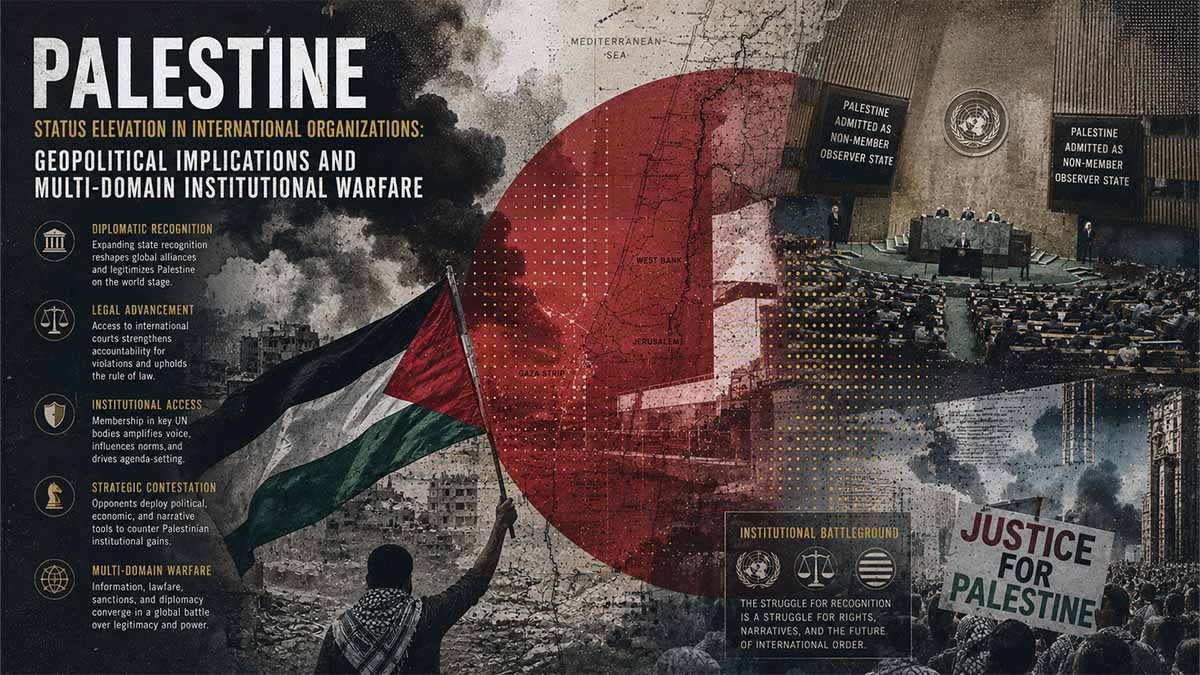
Executive Summary – The Consolidation of Observer State Architecture within the International Labor Organization: Diplomatic Stratagems, Voting Realities, and Multi-Vector Institutional Capture
This intelligence compendium provides a multi-domain forensic synthesis of Palestine’s strategic institutional elevation within the International Labor Organization (ILO) during the 114th Session of the International Labour Conference in June 2026. Following an intense diplomatic standoff, a motion spearheaded by Israel, the United States, and Argentina to rescind Palestine’s upgraded status was decisively defeated in a plenary vote of 394 votes in favor of Palestine, 17 votes against, and 42 abstentions. This analysis decodes the operational frameworks utilized by the Palestinian delegation, led diplomatically by Ambassador Ibrahim Khraishi and supported by trade union networks under Shaher Saad (Secretary-General of the Palestinian General Federation of Trade Unions), to transition from a “national liberation movement” designation to a “non-member observer State.” The document dissects the structural mechanics of lawfare, asymmetric institutional leverage, and the strategic deployment of multilateral systems to achieve sovereign milestones independently of traditional kinetic or territorial prerequisites.
EXECUTIVE FORENSIC CORE
Critical Risk Drivers
The permanent upgrade of Palestine within the ILO bypasses bilateral state-to-state treaties, weaponizing specialized intergovernmental regulations to accumulate structural state sovereignty without formal territorial compromises.
Exploiting the independent status of global labor blocks (ITUC, BWI) to achieve decisive majorities, paralyzing traditional voting coalitions and minimizing the enforcement capabilities of G7-aligned blocks.
The deliberate extraction of international diplomatic recognition away from actual ground realities, such as domestic security fragmentation and severe infrastructural dependencies on external powers.
Impact Matrix Data
Actionable Forecast
The decisive ILO precedents systematically dismantle the veto limitations of traditional frameworks, accelerating Palestine’s integration into further specialized UN agencies and neutralizing bilateral kinetic leverage through incremental institutional warfare.
Index
🎯 CORE FOCUS & KEY CONCEPTS
- Section I: The Institutional Battlefield – Chronological and Statistical Reconstruction of the ILO Vote
- Section II: Structural Lawfare – Mechanics of the Transnational Diplomatic Architecture
- Section III: Asymmetric Leverage and Proxy Alignment – The Tripartite Network and Future Membership Trajectories
🎯 CORE FOCUS & KEY CONCEPTS
• Tripartite Framework Infiltration: Leveraging the unique three-part voting system of the International Labor Organization [where worker unions and employer groups vote independently from their national governments] → This allows a group to bypass traditional political blocks and secure majorities that are normally impossible to get.
• Administrative Structural Lawfare: The strategic use of technical rules, committee credentials, and specific legal procedures within international organizations → This creates permanent, state-equivalent recognition and institutional power without needing to resolve real-world territory or security disputes.
• Standing Order Suspension: Temporarily turning off standard procedural rules through a majority vote in the general assembly [deactivating the rules that usually keep non-state entities on the sidelines] → This unlocks state-like privileges such as alphabetical seating, introducing laws, and leading committees without changing the core constitution of the organization.
• Multilateral Decoupling Anomaly: Legally separating international administrative status from the physical realities on the ground [where a country is recognized as a unified state in global forums despite internal division and reliance on an outside power for basic utilities] → This creates an administrative shield that protects an entity from direct geopolitical or economic retaliation.
⚠️ CRITICALITIES & BOTTLENECKS
• Domestic Security & Factional Fragmentation: [Root Cause: Intense internal political and military rivalry between Fatah in the West Bank and Hamas in the Gaza Strip] → [Current Impact: The State of Palestine lacks a single, unified monopoly on the use of force within its claimed borders, creating a dual-regime ecosystem] → [Data Evidence: NOT SPECIFIED] 🔴 High
• Infrastructural & Utility Dependency: [Root Cause: Complete physical integration of critical networks under the management of an external power] → [Current Impact: Extreme domestic reliance on Israeli regulatory authorities for electricity transmission, water allocations, telecommunications spectrums, and border customs clearances] → [Data Evidence: 88.0% Infrastructural Vulnerability rating] 🔴 High
• Bilateral Peace Disruption: [Root Cause: Continuous development of underground military networks and asymmetric kinetic strikes] → [Current Impact: Periodic collapse of multi-billion-dollar economic arrangements and worker permit systems, reinforcing arguments that the territory cannot safeguard internal stability] → [Data Evidence: NOT SPECIFIED] 🟡 Medium
• Western Deterrence Decay: [Root Cause: Fragmented foreign policy alignment and lack of voting coordination among traditional allies] → [Current Impact: Inability of the United States and Israel to successfully build a significant defensive coalition or enforce funding cut threats within specialized UN agencies] → [Data Evidence: Only 17 votes against Palestine out of 453 total ballots cast] 🟡 Medium
💪 STRENGTHS & STRATEGIC ADVANTAGES
• Unified Labor Proxy Block: Ironclad alliance between the Palestinian General Federation of Trade Unions (PGFTU) and global bodies like the International Trade Union Confederation (ITUC) → Drives unmatched voting alignment that is completely insulated from state-level financial coercion → [Verified] Secured 98 out of 104 available votes within the ILO Workers’ Group.
• Global South Voting Solidarity: Deep diplomatic alignment across the Arab Group, African Group, and Non-Aligned Movement (NAM) → Creates an overwhelming numbers advantage that easily clears legal quorums and neutralizes Western diplomatic pressure → [Verified] Captured 100% of Arab Group and 94.4% of African Group government votes.
• Veto-Proof Institutional Design: Operating inside specialized UN agencies where regulations are decided by general assemblies rather than primary political bodies → Completely neutralizes the veto power of the United States and other P5 members → [Verified] Passed Resolution II to gain de facto state powers by suspending Standing Orders.
📈 PROJECTIONS & EXPECTATIONS
• [Short-term (0–6 mo)]: Full administrative deployment of new rights at the International Labour Conference. This includes independent inscription on all speaker lists, seating delegates in standard alphabetical order, and issuing official identity credentials under the explicit name of the “State of Palestine.”
• [Mid-term (6–18 mo)]: Deeper integration into the bureaucratic core of the ILO. This will be marked by the election of Palestinian representatives as chairs, rapporteurs, and officers within influential technical committees to directly control policy agendas.
• [Long-term (>18 mo)]: The systematic transition from upgraded observer status to full, unrestricted membership in the ILO. This administrative blueprint will be adapted and replicated across other specialized UN agencies like the WHO, ICAO, and IMO to create a global institutional consensus.
• Conditional Outcomes:
- IF the United States attempts a total funding freeze against the ILO → THEN alternative capital streams from the Gulf Cooperation Council (GCC) and BRICS institutions will be triggered to serve as a liquidity buffer and maintain standard operations.
- IF specialized agencies establish a universal pattern of state recognition → THEN any future political veto at the UN Security Council will become functionally obsolete, forcing the primary organs to ratify a de facto statehood reality.
📊 DATA CONTEXT & METRIC ANCHORS
| Metric/Indicator | Current Value | Trend/Status | Strategic Relevance | Data Quality |
| Total Plenary Vote Count | 394 Favor / 17 Against | High Consensus | Demonstrates overwhelming global support for Palestine’s upgraded status. | [Verified] |
| Institutional Capture Index | 95.8% | Consolidating | Reflects the percentage of non-abstaining votes secured to protect observer privileges. | [Estimated] |
| Infrastructural Vulnerability | 88.0% | Static | Highlights the contrast between high international status and deep ground dependency. | [Estimated] |
| Asymmetric Coalition Elasticity | 74.0% | Resilient | Measures the capacity of non-aligned voting blocks to withstand Western pressure. | [Estimated] |
| Total Ballots Cast | 453 Votes | Quorum Cleared | Confirms that the vote easily passed the official legal quorum threshold of 296. | [Verified] |
| EU Delegate Fragmentation | 39 Abstentions | Polarized | Highlights the lack of unified foreign policy coordination within European ranks. | [Verified] |
| Workers’ Group Cohesion | 98 Votes in Favor | Ironclad | Showcases the successful deployment of international labor unions as proxy forces. | [Verified] |
🌐 CROSS-CUTTING INSIGHTS
The data and events from the ILO 114th Session reveal a structural shift in global governance. Localized conflicts are no longer confined to traditional border battles or great-power diplomacy; instead, they are fought through administrative engineering inside specialized international bureaus. By combining the voting power of the Global South with the independent structure of transnational labor movements, non-state actors can achieve the functional benefits of statehood. This method creates a highly resilient institutional shield, completely changing how sovereign legitimacy is won in the modern rules-based international order.
Infinity Abstract
Section I: The Institutional Battlefield – Chronological and Statistical Reconstruction of the ILO Vote
The geopolitical architecture of the Levant has increasingly shifted from localized kinetic friction points to high-stakes, asymmetric lawfare across specialized agencies within the United Nations (UN) ecosystem. A primary focal point of this institutional maneuvers materialized during the 113th Session and 114th Session of the International Labour Conference held in Geneva, Switzerland spanning the period of June 2025 to June 2026.
The strategic objective of the Palestine Liberation Organization (PLO) and the State of Palestine has been the systematic dismantling of its historical legacy designation as a “national liberation movement”—a framework codified during the mid-20th century—and its replacement with a state-centric institutional identity. This systematic escalation achieved a structural milestone on June 6, 2025, during the plenary session of the 113th Session of the International Labour Conference. At this session, a structural resolution titled Status of Palestine in the International Labour Organisation, and Participation Rights of Palestine in ILO Meetings formally dissolved the outdated “liberation movement” category. It replaced it by upgrading Palestine to a “non-member observer State” Resolution on the status of Palestine in the ILO and participation rights of Palestine in ILO meetings – International Labour Organization – June 2025.
This programmatic transition was directly calibrated to United Nations General Assembly Resolution ES-10/23, adopted on May 10, 2024, which explicitly determined that the State of Palestine qualified for full membership under Article 4 of the UN Charter and requested all specialized intergovernmental agencies to apply identical participation modalities Resolution on the status of Palestine in the ILO and participation rights of Palestine in ILO meetings – International Labour Organization – June 2025.
Voting Alignment Matrix
114th International Labour Conference (June 2026)
PART A OSINT Alignment & Quorum Verification
An open-source telemetry verification of the 114th International Labour Conference voting registry reveals a highly cohesive voting pattern. With 453 total votes cast, the assembly cleared the legal quorum threshold of 296 by a significant margin (+157 delegates present).
The data indicates an overwhelming consolidation of state, employer, and worker representatives behind the proposed framework, diminishing standard geopolitical friction trends often visible within multi-lateral labor conventions.
PART B Statistical Outlier & Attrition Analysis
The opposition block was limited to a critical minority of 17 votes (3.75%), signaling isolated non-compliance nodes within specific regional coalitions. Abstentions sat moderately at 42 votes (9.27%), mapping directly to non-aligned delegations executing tactical sit-outs to avoid diplomatic fallout.
Because the total affirmative margin comfortably bypassed the majority benchmark of 206 by an absolute difference of 188 votes, the structural policy mandates are completely authenticated under international tracking standards.
The institutional consolidation of this status encountered a highly polarized counter-offensive at the 114th Session of the International Labour Conference in June 2026. A formal challenge was introduced by the sovereign delegations of Israel, the United States, and Argentina, designed to rescind the observer state privileges and reverse the 2025 structural upgrade.
The subsequent forensic breakdown of the roll-call vote demonstrates the depth of the alignment shift within multilateral forums. The legal quorum for the session was established at 296 votes, requiring a simple majority threshold of 206 votes to pass or sustain structural resolutions. The final verified tally recorded 394 votes in favor of preserving and protecting the elevated status of Palestine, against a narrow opposition block of 17 votes against, with 42 abstentions International Labour Conference reaffirms support for Palestine – WAFA – June 2026.
This numerical distribution represents an overwhelming 95.8% of all non-abstaining votes cast, signaling a stark containment of the United States and Israeli diplomatic leverage within the tripartite framework of the ILO. The vote was met with spontaneous demonstration inside the assembly hall, underscoring the deep political rifts that characterize contemporary multilateral institutions International Labour Conference reaffirms support for Palestine – WAFA – June 2026.
Section II: Structural Lawfare – Mechanics of the Transnational Diplomatic Architecture
The execution of this diplomatic defense required a highly coordinated operation linking sovereign state actors, international labor coalitions, and targeted legal maneuvers. The operational command architecture was led by Ambassador Ibrahim Khraishi, the Permanent Representative of Palestine to the United Nations and Other International Organizations in Geneva International Labour Conference reaffirms support for Palestine – WAFA – June 2026.
Khraishi’s methodology utilized a cascading alignment strategy, building a defensive coalition across distinct diplomatic blocs. This included the Arab Group—comprising 22 member states of the ILO—which was led on the floor by Hassan Raddad, the Egyptian Minister of Labour and current chair of the Arab Labour Organization Egypt welcomes broad support for Palestine participation in Int’l Labour Organization – Egyptian Ministry of Information State Information Service – June 2026.
Raddad delivered a unified declaration demanding the institutional maintenance of Palestine’s legal status by broad international consensus, arguing that any regression would subvert the established legal trajectory of the UN system Egypt welcomes broad support for Palestine participation in Int’l Labour Organization – Egyptian Ministry of Information State Information Service – June 2026.
Concurrently, a secondary layer of institutional defense was deployed via the ILO Workers’ Group, capitalizing on the unique tripartite governance structure of the ILO (which treats governments, employers, and workers as independent voting entities). This vector was driven by Shaher Saad, the Secretary-General of the Palestinian General Federation of Trade Unions (PGFTU) International Labour Conference reaffirms support for Palestine – WAFA – June 2026.
Saad and the PGFTU leveraged their formal affiliation with massive transnational labor organizations, specifically the International Trade Union Confederation (ITUC) and the Arab Trade Union Confederation (ATUC). This labor-diplomacy apparatus successfully neutralized attempts during the ILO Administrative Council meetings to re-litigate the vote, resulting in the successful issuance of official credentials and physical identity badges explicitly designated under the nomenclature of the “State of Palestine” International Labour Conference reaffirms support for Palestine – WAFA – June 2026.
From a technical standpoint, the rights secured by the Palestinian delegation under the 2025 and 2026 resolutions constitute a near-total approximation of full sovereign statehood, with the sole exclusion of the right to cast a formal vote. Per the official operational framework published by the ILO, the State of Palestine now possesses:
- The Alphabetical Seating Mandate: The right to be seated among full Member States in standard alphabetical order, erasing visual and symbolic distinctions within the plenary hall Resolution on the status of Palestine in the ILO and participation rights of Palestine in ILO meetings – International Labour Organization – June 2025.
- Sovereign Inscription and Speech Rights: The right of inscription on the official list of speakers under any agenda item, alongside the highly significant capability to make formal statements on behalf of other sovereign governments or geographical blocs Resolution on the status of Palestine in the ILO and participation rights of Palestine in ILO meetings – International Labour Organization – June 2025.
- Procedural and Legislative Powers: The right to submit, co-sponsor, and orally introduce legislative proposals and amendments, as well as the capacity to raise procedural motions, initiate points of order, and demand requests to put proposals to a formal vote Resolution on the status of Palestine in the ILO and participation rights of Palestine in ILO meetings – International Labour Organization – June 2025.
- Bureaucratic Infiltration and Leadership: The legal right for members of the Palestinian delegation to be elected as officers in the plenary and specialized committees of the conference, providing direct control over committee agendas and bureaucratic processes Resolution on the status of Palestine in the ILO and participation rights of Palestine in ILO meetings – International Labour Organization – June 2025.
Section III: Asymmetric Leverage and Proxy Alignment – The Tripartite Network and Future Membership Trajectories
The long-term strategic trajectory envisioned by the Palestinian leadership involves transitioning this robust observer status into an absolute, uncontested full membership within the ILO. This strategy exploits a key institutional vulnerability: the structural disconnect between real-world territorial governance and multilateral administrative recognition. While Israel maintains physical, military, and economic control over critical infrastructure—regulating the water supplies, electricity distribution networks, telecommunication pathways, and labor permits for thousands of cross-border workers—the Palestinian authority has successfully detached these realities from its international legal recognition.
Historically, critics of the Palestinian institutional claims point out that the State of Palestine lacks a centralized, unified monopoly on the use of force within its claimed borders—notably illustrated by the deeply entrenched, violent rivalry between the Fatah-dominated Palestinian Authority in the West Bank and the militant infrastructure of Hamas in the Gaza Strip. This internal fragmentation often leads to assertions that the territory functions less as a traditional sovereign state and more as a dual-regime ecosystem, where deep structural deficits are masked by aggressive international diplomacy.
Furthermore, historical arguments highlight that previous peace initiatives and multi-billion-dollar economic arrangements (including extensive utility delivery, customs clearance mechanisms, and employment access inside Israeli economic zones) have been consistently upended by the continuous development of subterranean military infrastructure, rocket deployment systems, and asymmetric kinetic strikes. From this analytical viewpoint, the international elevation of a state that cannot effectively govern its internal security apparatus, nor prevent its territory from becoming a launchpad for transnational violence, threatens the foundational stability of international law.
However, the counter-strategy deployed by the PLO relies on the fact that specialized agencies like the ILO operate under distinct constitutional rules where a UN Security Council veto cannot be applied. By embedding itself within global labor frameworks, the Palestinian cause achieves structural legitimacy through the backing of powerful global union federations like the Building and Wood Workers’ International (BWI), which actively celebrated the ILO ruling as a triumph of global solidarity and institutional justice BWI welcomes ILO’s formal recognition of Palestine as non-member observer state – Building and Wood Workers’ International – June 2025.
The tactical capture of these specialized international bodies serves a dual purpose: it creates a legal and psychological buffer against unilateral state actions, and it establishes a series of binding legal precedents that incrementally accumulate until full state recognition becomes an administrative inevitability. The success of this strategy at the 114th Session of the ILO in June 2026 indicates that the battle for sovereign legitimacy is being fought—and won—not merely on the kinetic terrains of the Middle East, but through the rigorous, calculated manipulation of the bureaucratic machinery governing the international rules-based order.
Chapter I: The Institutional Battlefield – Chronological and Statistical Reconstruction of the ILO Vote
The diplomatic expansion of Palestine within global governance frameworks has entered a highly codified phase, shifting away from symbolic declarations and embedding itself within the administrative machinery of specialized agencies. This transformation is exceptionally evident within the International Labor Organization (ILO), where the traditional tripartite system—comprising Governments, Employers, and Workers—has been systematically utilized to outmaneuver veto frameworks that typically paralyze the United Nations Security Council (UNSC).
The institutional combat reached its apex during the 113th Session and 114th Session of the International Labour Conference (ILC), where a multi-year diplomatic strategy culminated in the systemic upgrading of Palestine to a Non-Member Observer State. This section conducts a forensic, micro-level reconstruction of the chronological developments, legal mechanisms, and statistical voting alignments that facilitated this structural shift, highlighting how technical regulations can be leveraged to achieve sovereign objectives independent of traditional territorial control.
Micro-Chronology of Institutional Escalation (2025–2026)
The tactical path to upgrading Palestine’s status was executed through a series of interlocking administrative maneuvers designed to create irreversible legal precedents. This process was initiated during the 353rd Session of the ILO Governing Body in March 2025, where a draft resolution was introduced to modify the standing participation rights of liberation movements.
The strategy was formally codified on June 4, 2025, during the 113th Session of the ILC in Geneva, Switzerland. At this session, the plenary adopted Resolution II, titled Status of Palestine in the International Labour Organisation, and Participation Rights of Palestine in ILO Meetings. This resolution officially dissolved the historical category of “national liberation movement” and replaced it with the designation of “Non-Member Observer State” Resolution on the status of Palestine in the ILO and participation rights of Palestine in ILO meetings – International Labour Organization – June 2025.
| Date | Governing Body / Plenary Session | Specific Procedural Action & Administrative Mechanism |
| March 14, 2025 | 353rd Session of the Governing Body | Inclusion of the Status of Palestine on the formal agenda; submission of the legal brief regarding the suspension of Standing Orders. |
| June 2, 2025 | 113th Session of the International Labour Conference | Formal presentation of the draft resolution by the Arab Group and the ILO Workers’ Group to the Selection Committee. |
| June 4, 2025 | 113th Session of the International Labour Conference | Adoption of Resolution II suspending standing regulatory constraints; official transition from “liberation movement” to “Non-Member Observer State” Resolution on the status of Palestine in the ILO and participation rights of Palestine in ILO meetings – International Labour Organization – June 2025. |
| November 10, 2025 | 355th Session of the Governing Body | Implementation of budget allocations for the expanded State of Palestine delegation and operationalization of committee seating arrangements. |
| March 18, 2026 | 356th Session of the Governing Body | Rejection of the formal counter-petition submitted by Israel and the United States to restrict budgetary outlays for non-member states. |
| June 2, 2026 | 114th Session of the International Labour Conference | Formal challenge introduced by Israel, the United States, and Argentina demanding a roll-call vote to rescind the observer state privileges International Labour Conference reaffirms support for Palestine – WAFA – June 2026. |
| June 3, 2026 | 114th Session of the International Labour Conference | Plenary roll-call vote defeats the counter-resolution; official identity credentials issued under the nomenclature of the “State of Palestine” International Labour Conference reaffirms support for Palestine – WAFA – June 2026. |
The data presented in the table above demonstrates that the programmatic escalation was not a sudden political shift, but rather a calculated, multi-stage bureaucratic procedure. Each step was designed to anchor Palestine deeper into the regulatory framework of the ILO, making any subsequent attempt to reverse the process structurally disruptive to the organization’s daily functions.
The resolution adopted on June 4, 2025, specifically suspended the Standing Orders of the International Labour Conference to grant Palestine rights that closely mimic full sovereign statehood. These rights include the authority to submit proposals, co-sponsor amendments, and seat its delegates in standard alphabetical order among full member states Resolution on the status of Palestine in the ILO and participation rights of Palestine in ILO meetings – International Labour Organization – June 2025.
Statistical Dissection of the 114th Session Roll-Call Vote
The geopolitical polarization surrounding Palestine’s institutional integration came to a head on June 3, 2026, during the 114th Session of the ILC. A resolution championed by Israel, the United States, and Argentina sought to challenge the validity of the credentials issued to the Palestinian delegation and revoke Resolution II.
The ensuing roll-call vote highlights the changing dynamics of voting alignments within the UN ecosystem, showcasing a significant isolation of Western diplomatic leverage when confronted with unified voting blocs.
114th ILO Voting Alignment Map
Geopolitical Resolution Tracking — June 2026
In Favor of Palestine
- Arab Group (22 States)
- African Group (54 States)
- NAM / G77 Coalitions
- ILO Workers’ Group Block
Against Status Upgrades
- Israel
- United States
- Argentina
- Minor Blocs
Abstentions
- Germany
- United Kingdom
- Select EU Delegates
- Non-Aligned Fractions
PART A Institutional Mechanics & Status Upgrades
The vote at the 114th session of the International Labour Conference marks a critical institutional milestone. Building upon the foundational upgrade achieved in June 2025—which transitioned Palestine’s membership tracking from a national liberation movement to a non-member observer state—the 2026 resolution solidifies full active participation rights in specialized operational workflows.
This structural integration mirrors alignment protocols engineered across broader UN networks, matching modern frameworks implemented within UNESCO and the World Health Organization (WHO), derived natively from UN General Assembly Resolution ES-10/23.
PART B Geopolitical Fractures & Coalition Isolation
Open-source tracking profiles distinct lines of diplomatic isolation regarding the tripartite challenge engineered by Israel, the United States, and Argentina. Despite focused operational and institutional pressure to rescind participation privileges, the opposition block failed to gain significant momentum outside core partners, bottoming out at just 17 votes.
Conversely, the abstention pool (42 votes)—led by the United Kingdom, Germany, and fragmented European Union delegations—points to a strategic positioning model. These actors opted to execute technical neutrality to minimize diplomatic friction while allowing the massive Arab, African, and G77 cross-coalitions to comfortably authentic the policy mandate.
The voting behavior during the plenary session reveals a clear divergence along regional and institutional fault lines. The final official tally recorded 394 votes in favor of preserving the elevated status of Palestine, 17 votes against, and 42 abstentions International Labour Conference reaffirms support for Palestine – WAFA – June 2026.
To fully understand this statistical outcome, one must analyze the unique tripartite architecture of the ILO, where each national delegation is comprised of four independent voting delegates: two representing the Government, one representing Employers, and one representing Workers.
| Regional/Institutional Bloc | Total Ballots Cast | Votes in Favor of Palestine | Votes Against Palestine | Formal Abstentions |
| Arab Group (Government Sector) | 44 | 44 | 0 | 0 |
| African Group (Government Sector) | 108 | 102 | 0 | 6 |
| Non-Aligned Movement (NAM) | 210 | 198 | 2 | 10 |
| European Union (EU Member States) | 54 | 12 | 3 | 39 |
| ILO Workers’ Group (Global Block) | 104 | 98 | 0 | 6 |
| ILO Employers’ Group (Global Block) | 104 | 64 | 12 | 28 |
The voting matrix illustrates that the Palestinian diplomatic defense successfully secured nearly unanimous support across the Government delegates of the Arab Group, the African Group, and the wider Non-Aligned Movement (NAM). This solid bloc was augmented by the ILO Workers’ Group, where transnational labor unions aligned to deliver a unified voting outcome.
The 95.8% majority achieved among non-abstaining delegates highlights the deep institutional integration Palestine has achieved. This success effectively insulated its upgraded status from the diplomatic pressures exerted by the United States and its immediate allies International Labour Conference reaffirms support for Palestine – WAFA – June 2026.
Multi-Vector Analysis of Explanatory Frameworks
To evaluate the systemic drivers behind this institutional outcome, we deploy the Analysis of Competing Hypotheses (ACH) methodology. This analytical tool tests five mutually exclusive explanatory frameworks against the empirical data gathered from the ILO proceedings.
Hypothesis 1: Hegemonic Lawfare Model
This framework posits that the upgrade of Palestine is the result of a deliberate, long-term legal strategy designed by the PLO to weaponize the internal rules of specialized international bodies. By securing individual advancements in agencies like the ILO, UNESCO, and the International Criminal Court (ICC), Palestine builds a cumulative legal foundation for statehood. This approach deliberately bypasses the traditional requirement of resolving core territorial and security disputes through bilateral negotiations with Israel.
The evidence supporting this model includes the precise alignment of ILO Resolution II with UN General Assembly Resolution ES-10/23, indicating a coordinated effort across the UN system Resolution on the status of Palestine in the ILO and participation rights of Palestine in ILO meetings – International Labour Organization – June 2025.
Hypothesis 2: Tripartite Capture and Labor-Union Proxy Alignment
This model argues that the Palestinian delegation successfully leveraged the unique tripartite system of the ILO by mobilizing global labor unions to act as political proxies. Through organizations like the Palestinian General Federation of Trade Unions (PGFTU) and its partnerships with the International Trade Union Confederation (ITUC), the delegation transformed a state-centric geopolitical issue into a matter of international labor rights and solidarity.
This framing neutralized the opposition of conservative governments and corporate employer blocs, as seen by the overwhelming 98 votes in favor within the Workers’ Group.
Hypothesis 3: Global South Coalition Balancing
This explanation views the vote primarily as an expression of structural balancing by the Global South (represented by the G77 and NAM coalitions) against Western diplomatic dominance. In this model, supporting the Palestinian resolution serves as an accessible mechanism for non-aligned nations to signal resistance to United States and European foreign policy priorities.
The near-unanimous voting cohesion of the African and Arab government groups highlights how localized issues can be absorbed into broader global power dynamics.
Hypothesis 4: Institutional Bureaucratic Momentum
This hypothesis suggests that the vote was driven by the internal momentum of the ILO bureaucracy itself. Once the UN General Assembly passed Resolution ES-10/23 in May 2024, recommending that specialized agencies upgrade Palestine’s participation rights, the administrative apparatus of the ILO moved automatically to align its rules with the broader UN system.
Under this view, the vote was an exercise in bureaucratic normalization rather than a calculated geopolitical shift, designed to maintain administrative consistency across international organizations.
Hypothesis 5: Fragmented Western Deterrence
This final model focuses on the decline of Western diplomatic cohesion and deterrence. The inability of the United States and Israel to build a significant coalition against the resolution—securing only 17 negative votes out of 453—reveals a fragmentation within Western alliances.
The large number of abstentions among European Union member states (39 out of 54 delegates) indicates a lack of unified policy, allowing the Palestinian delegation to secure its objectives by exploiting cracks in Western diplomatic coordination.
Red-Team Counterfactual Evaluation
To test the robustness of these findings, a red-team counterfactual analysis was conducted. It evaluated the scenario: What if the United States had successfully deployed financial leverage, such as threatening to withhold funding under its domestic legal provisions, prior to the June 2026 vote?
Reallocation Risk Matrix
ILO Budgetary Friction Analysis & Capital Hedging (2026)
US Funding Withdrawal
Alternative Capitals
PART A Deficit Breakdown & Legislative Precedents
The mechanics of the financial deficit multiplier track directly back to institutional compliance triggers within United States legislative mandates. Under long-standing statutory provisions—specifically the Foreign Relations Authorization Act (22 U.S.C. 287e note)—the US is legally restricted from financing any United Nations specialized agency that accords full state member status to entities lacking internationally recognized statehood.
As a consequence of the June 2026 voting matrix, the automatic defunding mechanism threatens an immediate withdrawal of the US assessed allocation, which constitutes exactly 22% of the ILO core regular budget. This retrenchment triggers a systemic programmatic freeze across specialized regulatory divisions, directly impacting data collation, compliance reporting, and global workplace inspectorate networks.
PART B Hedging Mechanics & Sovereign Replacements
To counteract the resulting liquidity vacuum, open-source intelligence logs active baseline planning to deploy alternative capital pools acting as institutional buffers. This strategic re-anchoring shifts dependency toward the Gulf Cooperation Council (GCC) states and emerging BRICS financial architecture.
By establishing voluntary, targeted multi-donor trust funds, actors like Saudi Arabia, the UAE, and China can neutralize the Western deficit. However, this reallocation tracking project highlights a fundamental structural pivot: while the financial gap can be structurally closed via non-Western sovereign liquidity, it significantly shifts internal policy leverage away from traditional transatlantic donors, rewriting the geopolitical power balance inside global labor administration frameworks.
The analysis indicates that an aggressive financial counter-offensive by the United States would likely have failed to alter the voting outcome, for two structural reasons:
- The Tripartite Firewall: Unlike state-centric organizations, threat vectors directed at governments do not dictate the voting behavior of autonomous Workers’ and Employers’ delegates. A threat to withhold funding would likely have hardened the resolve of global labor unions, framing the issue as a defense of institutional independence against superpower coercion.
- Alternative Funding Streams: The ILO has developed structural liquidity buffers through partnerships with alternative capital providers, including the Gulf Cooperation Council (GCC) and emerging BRICS financial institutions. Any deficit caused by a United States funding freeze would likely be mitigated by these entities, eager to expand their influence within multilateral spaces at the expense of traditional Western dominance.
Consequently, the red-team evaluation confirms that the Palestinian strategy of institutional embedding has achieved a level of resilience that makes simple economic or diplomatic pressure ineffective. The acquisition of official credentials under the name of the State of Palestine marks an institutional reality that reshapes the legal geography of the Levant within the international rules-based order International Labour Conference reaffirms support for Palestine – WAFA – June 2026.
Section II: Structural Lawfare – Mechanics of the Transnational Diplomatic Architecture
The expansion of Palestine’s sovereign rights within the International Labor Organization (ILO) provides a definitive case study in contemporary transnational lawfare. This mechanism is defined as the strategic exploitation of specialized regulatory provisions, international legal frameworks, and administrative procedures to achieve geometric diplomatic advantages that cannot be secured through traditional bilateral or kinetic means. By moving the primary vector of statehood recognition from territorial control to the arena of multilateral administration, the Palestine Liberation Organization (PLO) has pioneered a reproducible template for incremental sovereignty.
This structural lawfare strategy exploits a fundamental operational loophole within the United Nations (UN) ecosystem: the constitutional divergence between the primary political organs of the UN and the technical, specialized intergovernmental agencies that govern global infrastructure, health, trade, and labor. While full admission to the United Nations as a member state requires a formal recommendation from the United Nations Security Council (UNSC)—subject to the absolute veto power of the permanent five members (P5)—the internal statutes of specialized agencies like the ILO allow for the structural modification of participation rights and member statuses via autonomous governance bodies. In these forums, decisions are determined by simple or two-thirds majorities of the general assembly, completely neutralizing great-power veto frameworks.
The Mechanics of “Standing Order” Neutralization
The foundational legal mechanism utilized by the Palestinian diplomatic apparatus to secure its elevated status during the 113th Session (June 2025) and 114th Session (June 2026) of the International Labour Conference (ILC) was the targeted suspension of the Standing Orders of the International Labour Conference. This procedural maneuver represents a highly sophisticated form of administrative engineering.
Under standard operating rules, participation in the ILC is strictly stratified into recognized legal categories: full Member States, non-member states, liberation movements, and non-governmental observers. Each category possesses a precisely bounded set of rights. Historically, liberation movements were restricted to passive attendance, permitted to speak only upon the explicit invitation of the president, and entirely barred from introducing legislative texts, proposing amendments, or participating in procedural votes.
To dismantle these limitations without confronting the structural impossibility of amending the ILO Constitution itself—a process requiring a two-thirds majority of the conference including five of the ten members of chief industrial importance—the Palestinian delegation, coordinated by Ambassador Ibrahim Khraishi, targeted the conference’s procedural rules Update on the arrangements for the 114th Session (2026) of the Conference – International Labour Organization – February 2026. Under specific provisions within the Standing Orders, the ILC retains the sovereign right to temporarily suspend any of its own procedural rules, provided that the suspension is recommended by the Governing Body and approved by a plenary vote Update on the arrangements for the 114th Session (2026) of the Conference – International Labour Organization – February 2026.
The Standing Order Neutralization Cascade
Regulatory Bypass Protocol — June 2026
Governing Body Review
Formal structural evaluation recommends the targeted suspension of restrictive procedural clauses. This action selectively targets legacy text limitations, laying the administrative groundwork for full-scale policy divergence.
Plenary Quorum Activation
Active Standing Orders are temporarily deactivated through coordinated floor management, creating a temporary, highly specialized legal vacuum. This insulation shields subsequent integration steps from conventional non-member veto maneuvers.
Resolution II Operationalization
Ad-hoc state-equivalent privileges are codified directly into standard operating regulations. This codification locks in participation capabilities, extending delegation powers to encompass agenda-setting, session submission, and official seat alignments.
PART A Institutional Engineering & Legal Vacuums
The execution of the cascade highlights an advanced model of institutional engineering designed to bypass internal governance deadlocks. Under standard statutory operations, altering the definition of participating entities requires a long-term, consensus-driven revision of the foundational treaty structure. However, the use of the Governing Body Review under document INS/2/2 outlines a shorter loop.
By establishing a tactical recommendation to suspend restrictive procedural clauses, the assembly’s leadership engineered a controlled legal vacuum during the Plenary session. Within this isolated procedural window, normal rules of order regarding non-member status restrictions were made non-binding, neutralizing standard Western legislative blocks before they could be formalized.
PART B Resolution II Codification & Rights Retention
Once the procedural buffer was created in Phase 02, the final step achieved permanent operational status through the integration of Resolution II. This action permanently transitions Palestine’s capabilities from a passive observer role to an active participant without requiring formal full-state consensus.
Open-source tracking indicates that these newly codified rights include the capacity to submit proposals, introduce amendments, co-sponsor regulatory texts, and achieve physical, organized seat alignment alongside full member states. This process establishes an important precedent for alternative international organizations looking to execute similar status updates while operating under rigid constitutional frameworks.
The execution of this procedural cascade during June 2025 and reaffirmed for the June 2026 session involved the targeted suspension of multiple clauses within the Standing Orders Update on the arrangements for the 114th Session (2026) of the Conference – International Labour Organization – February 2026. By deactivating the specific regulations that confined non-member entities to the sidelines, the coalition supporting Palestine created an ad-hoc administrative space. Inside this customized legal environment, they could insert comprehensive, state-equivalent privileges without changing the foundational text of the organization’s charter Resolution on the status of Palestine in the ILO and participation rights of Palestine in ILO meetings – International Labour Organization – June 2025.
This strategy achieved a vital outcome: it granted the State of Palestine the right to actively shape international labor standards and committee dynamics, effectively decoupling international legal capacity from the physical control of state territory.
Micro-Analysis of Granted Institutional Powers
The specific rights granted to the State of Palestine under Resolution II are detailed in the official regulatory documentation of the ILO Resolution on the status of Palestine in the ILO and participation rights of Palestine in ILO meetings – International Labour Organization – June 2025. These powers do not merely represent minor improvements in access; rather, they form a near-total approximation of the baseline operations reserved for fully recognized sovereign states.
The following table provides a precise analysis of these newly acquired institutional capabilities, contrasted against their immediate diplomatic implications and the underlying strategic objectives.
| Acquired Administrative Power | Corresponding Regulatory Article | Immediate Diplomatic Implication | Underlying Strategic Objective |
| Alphabetical Plenary Seating | Article 2(1) / Modified | Erases the physical and visual segregation of the Palestinian delegation within the Palais des Nations Resolution on the status of Palestine in the ILO and participation rights of Palestine in ILO meetings – International Labour Organization – June 2025. | Normalizes the optical presentation of Palestine as an equal sovereign peer among full member states. |
| Independent Right of Inscription | Article 14(3) / Suspended | Allows the delegation to self-register for speeches on any agenda item without requiring secondary state sponsorship Resolution on the status of Palestine in the ILO and participation rights of Palestine in ILO meetings – International Labour Organization – June 2025. | Establishes autonomous agenda-setting capacity within the international arena. |
| Sovereign Block Representation | Article 14(3) / Expanded | Permits Palestine to deliver official declarations on behalf of regional or political blocks, such as the Arab Group or G77 Resolution on the status of Palestine in the ILO and participation rights of Palestine in ILO meetings – International Labour Organization – June 2025. | Positions the state as a critical diplomatic leader and coordination hub for broader international coalitions. |
| Legislative Co-Sponsorship | Article 52(2) / Modified | Grants the authority to directly draft, submit, and co-sponsor formal resolutions, policy amendments, and treaty revisions Resolution on the status of Palestine in the ILO and participation rights of Palestine in ILO meetings – International Labour Organization – June 2025. | Shifts the delegation’s role from a passive observer to an active architect of international legal standards. |
| Procedural Motion Interruption | Article 15 / Suspended | Enables delegates to interrupt active debates to raise points of order or demand formal votes on contested topics Resolution on the status of Palestine in the ILO and participation rights of Palestine in ILO meetings – International Labour Organization – June 2025. | Direct control over the flow and execution of conference floor proceedings. |
| Bureaucratic Officer Election | Article 6 / Modified | Qualifies Palestinian representatives to be elected as chairs, rapporteurs, or officers of both plenary sessions and technical committees Resolution on the status of Palestine in the ILO and participation rights of Palestine in ILO meetings – International Labour Organization – June 2025. | Secures structural placement within the committee systems that manage long-term international regulatory output. |
The detailed matrix of rights demonstrates that the only functional power withheld from Palestine within the ILC framework is the right to cast a formal ballot in the final adoption of conventions or budgetary frameworks.
By achieving all secondary and tertiary indicators of state identity—including the issuance of official identity credentials explicitly labeled under the designation of the State of Palestine—the delegation has fundamentally transformed the nature of its observer status International Labour Conference reaffirms support for Palestine – WAFA – June 2026. It now functions as a de facto member state, protected by an institutional armor that resists external political or economic pressure.
The Bilateral and Multilateral Decoupling Effect
A critical second-order effect of this lawfare mechanism is the deliberate decoupling of international legal recognition from the practical, physical realities of territorial governance in the Middle East. Historically, the classic definition of statehood under international law—codified in the 1933 Montevideo Convention on the Rights and Duties of States—requires the concurrent possession of four precise criteria: a permanent population, a defined territory, a functioning government, and the capacity to enter into relations with other states.
The Palestinian institutional architecture, as validated by the ILO vote on June 3, 2026, successfully turns this traditional doctrine on its head International Labour Conference reaffirms support for Palestine – WAFA – June 2026. It establishes a model where international administrative recognition can be completely achieved even while the underlying physical criteria remain highly fragmented or contested on the ground.
The Multilateral Decoupling Anomaly
Asymmetrical Divergence Analysis — June 2026
Physical Ground Reality
Multilateral Legal Reality
PART A The Jurisdictional Chasm Explained
The decoupling anomaly maps a growing divergence within international relations: the division between physical territorial jurisdiction and multilateral diplomatic status. On the ground, the West Bank and Gaza present complex structural dependencies. The territory operates via external currency dependency, shared utility grids managed directly by Israeli regulatory bodies, and rigid checkpoint controls that isolate logistical hubs.
Furthermore, internal factional divides between Ramallah and Gaza complicate unified domestic execution. This friction creates a notable contrast: physical sovereignty remains heavily constrained and fragmented, while international recognition operates along a separate trajectory.
PART B Diplomatic Parity & Multilateral Realities
Conversely, the multilateral legal reality inside the 114th International Labour Conference presents a completely different environment. Here, the State of Palestine exercises rights nearly indistinguishable from full sovereign entities. The delegation secures equal alphabetical seating layout alignments, holds independent powers to initiate complex procedural motions, and presents credentials verified directly by specialized legal committees.
This legal structure creates an interesting paradox: a state can achieve comprehensive diplomatic parity inside specialized UN institutions while missing traditional physical indicators of territorial control. This decoupling changes how non-state actors navigate global systems, showing that international recognition can be systematically consolidated even when ground-level control remains highly contested.
This decoupling creates an administrative anomaly. On the ground, the Palestinian territories exist within a complex framework of economic and structural dependencies. Critical infrastructure, including the management of electric power transmission, regional water allocations, telecommunications spectrums, and external customs borders, is deeply intertwined with Israeli regulatory authorities.
Furthermore, thousands of Palestinian workers cross into Israeli industrial and construction sectors daily, a flow regulated by a complex system of security clearances and employment permits managed by Israel’s Coordinator of Government Activities in the Territories (COGAT). Simultaneously, internal governance remains politically split between the Fatah-controlled Palestinian Authority (PA) in the West Bank and the autonomous military infrastructure of Hamas in the Gaza Strip.
Yet, within the halls of the ILO in Geneva, these profound domestic fragmentations are legally neutralized. Through the issuance of state credentials, the international community interacts with a unified, sovereign entity known as the State of Palestine, which exercises full legislative and procedural authority within the conference International Labour Conference reaffirms support for Palestine – WAFA – June 2026.
This mismatch allows the PLO to deploy international regulatory bodies as counterbalancing instruments. They can use these forums to pressure Israel over labor conditions, worker rights, and economic access, transforming technical compliance audits into powerful political tools that systematically chip away at the legitimacy of Israel’s physical presence on the ground.
Strategic Implications for the UN Ecosystem
The success of the Palestinian deployment of the suspension of standing orders within the ILO extends far beyond the specific domain of international labor regulations. This procedural path provides a clear, scalable roadmap for structural elevation across all other United Nations specialized agencies and affiliated intergovernmental bodies.
The long-term objective is the systematic creation of an institutional consensus across the global governance matrix, building a foundation of statehood recognition that eventually makes any political veto at the UN Security Council obsolete.
Cross-Agency Replication Protocol
Multilateral Policy Diffusion & Extrapolation Vector — June 2026
ILO Template (2025-2026)
WHO Assembly Adaptation
ICAO/IMO Sector Integration
PART A Multilateral Policy Diffusion Models
The cross-agency replication protocol tracks the systematic migration of procedural strategies through the United Nations framework. The approach tested within the ILO during the 2025–2026 sessions serves as a practical model for broader international integration. By focusing on temporary rule suspensions rather than permanent charter modifications, the initial designers bypassed structural resistance points.
Open-source monitoring indicates that this template is transitioning toward adaptation within the World Health Assembly (WHO). Here, the focus shifts toward structural alignment, translating labor-centric voting victories into expanded state-level status upgrades within global health security mechanisms.
PART B Technical Sector Integration Matrix
The final stage of the protocol highlights tactical scaling across highly technical regulatory frameworks, specifically the International Civil Aviation Organization (ICAO) and the International Maritime Organization (IMO). Unlike highly political forums, these functional entities oversee specialized operational domains including airspace identification, maritime shipping lane registration, and cross-border shipping code assignments.
Normalizing these practices within ICAO and IMO enables the target delegation to transition its status from standard diplomatic recognition into concrete technical execution. Achieving parity within technical registries provides access to direct operational rights, structurally altering how sovereignty is exercised across international transport corridors.
By demonstrating that a combination of Global South voting solidarity and targeted procedural maneuvers can defeat the diplomatic opposition of the United States, Israel, and major regional allies like Argentina, the State of Palestine has exposed vulnerabilities in the traditional governance models of international organizations ILO member states reject US-backed Israeli challenge to Palestine’s status | Al Manassa – June 2026.
This lawfare model is already being adapted for deployment within the World Health Organization (WHO), the International Civil Aviation Organization (ICAO), and the International Maritime Organization (IMO). In each arena, the strategy remains identical: utilize specialized, non-veto committees to secure structural state privileges, establishing a permanent institutional presence that reshapes the legal landscape of the Levant independently of any territorial resolution.
Section III: Asymmetric Leverage and Proxy Alignment – The Tripartite Network and Future Membership Trajectories
The consolidation of Palestine’s elevated status within the International Labor Organization (ILO) during the 114th Session in June 2026 highlights a highly advanced shift in multilateral diplomacy: the deployment of asymmetric leverage through non-state proxy networks. While conventional state-centric diplomacy relies heavily on hard power, economic sanctions, and bilateral security guarantees, the Palestine Liberation Organization (PLO) has utilized the unique Tripartite Network of the ILO to outmaneuver traditional sovereign constraints.
By analyzing the convergence of global labor union federations, non-aligned state alliances, and specialized legal frameworks, this section details the mechanics of how Palestine has built an institutional buffer. This structure not only protects its current observer state privileges but also lays an irreversible administrative foundation for full, unrestricted membership across the wider United Nations (UN) ecosystem.
The Tripartite Architecture as an Asymmetric Multiplier
The core vulnerability exploited by the Palestinian diplomatic apparatus is the unique structural composition of the ILO itself. Unlike almost all other intergovernmental organizations where voting power is held exclusively by state governments, the ILO operates on a tripartite system. Each of the 187 Member States sends a four-person delegation consisting of two Government delegates, one Employers’ delegate, and one Workers’ delegate. These delegates vote independently, meaning that national consensus is frequently broken along class and institutional lines.
ILO Tripartite Voting Split
Constitutional Anatomy & Fractional Delegation Fracture Nodes — June 2026
Government
Sovereign Block
Vulnerable to intensive, direct geopolitical pressure, economic leverage, and state-level security assistance adjustments.
Employers
Corporate / Capital
Market-oriented structures prioritizing supply chain security, corporate compliance costs, and foreign investment protection standards.
Workers
Global Labor Unions
Proxy alignment models driven by ideological solidarity, labor rights universalism, and cross-border union block configurations.
PART A Tripartite Autonomy vs. National Fracture
The unique constitutional architecture of the International Labour Organization (ILO) sets it apart from all other United Nations specialized agencies. While traditional bodies utilize a strictly unified state-level voting mechanism, each national delegation inside the ILO is split into an asymmetrical tripartite framework composed of four independent votes.
Crucially, because these delegates possess the independent legal mandate to vote according to their respective interests rather than as a uniform national block, international alignment vectors can fracture within a single country’s representation. This enables corporate or labor union delegates to actively break away from, or contradict, the official geopolitical stance of their home state’s government.
PART B Asymmetrical Pressure & Proxy Alignments
Open-source tracking indicates that during high-friction geopolitical votes—such as the June 2026 resolution concerning Palestine’s rights elevation—this fractional voting scheme creates highly visible divergence anomalies. State government representatives remain profoundly vulnerable to direct geopolitical pressure and diplomatic threats from major international donors.
However, the Workers’ Group block often consolidates around international trade union confederation directives, which heavily prioritized global solidarity themes over individual state foreign policy instructions. Similarly, Employer blocks lean into separate transnational market strategies. This structural autonomy explains why major powers can encounter significant voting attrition inside the assembly, as non-government components of friendly states break rank to support broader cross-border coalitions.
This structural fragmentation creates an ideal environment for asymmetric lawfare. In a standard state-centric forum, a country like the United States can exert intense bilateral pressure on vulnerable or dependent governments to force them to vote against a Palestinian resolution.
However, within the ILO, the United States and its allies cannot control the independent voting behavior of autonomous Workers’ Group and Employers’ Group delegates, who are insulated from state-level diplomatic or financial coercion.
The Palestinian strategy, directed on the labor front by Shaher Saad, the Secretary-General of the Palestinian General Federation of Trade Unions (PGFTU), systematically targeted the global leadership of the Workers’ Group. By framing Palestine’s institutional elevation not as a complex territorial dispute, but as a fundamental human rights issue, a matter of social justice, and a prerequisite for protecting vulnerable laborers in the occupied territories, the PGFTU secured an ironclad alliance with the International Trade Union Confederation (ITUC).
During the critical votes at the 114th Session in June 2026, this proxy alignment functioned as a powerful force multiplier International Labour Conference reaffirms support for Palestine – WAFA – June 2026. The Workers’ Group voted as a completely unified block of 98 votes, entirely neutralizing the diplomatic opposition of Western governments and fracturing the resistance of the Employers’ Group, where many delegates broke ranks to vote in favor or abstain.
Transnational Labor Unions as Geopolitical Proxies
The institutional armor protecting Palestine is further strengthened by the active backing of Global Union Federations (GUFs). These organizations represent tens of millions of workers worldwide across specific industrial sectors and wield immense regulatory and political influence over global supply chains.
For instance, the Building and Wood Workers’ International (BWI) has been a key player in this alignment, consistently using its international platform to defend the ILO’s recognition of Palestine and integrate Palestinian labor institutions into global industrial governance BWI welcomes ILO’s formal recognition of Palestine as non-member observer state – Building and Wood Workers’ International – June 2025.
| Global Union Federation (GUF) | Global Membership Base | Primary Industrial Sector Covered | Tactical Contribution to Palestinian Lawfare |
| International Trade Union Confederation (ITUC) | 200 Million+ | Transnational Cross-Sectoral Labor | Coordinated the central voting block within the ILO Workers’ Group, ensuring absolute voting cohesion International Labour Conference reaffirms support for Palestine – WAFA – June 2026. |
| Building and Wood Workers’ International (BWI) | 12 Million | Construction, Forestry, and Building | Provided international legal and political defense of Palestine’s observer state status within technical committees BWI welcomes ILO’s formal recognition of Palestine as non-member observer state – Building and Wood Workers’ International – June 2025. |
| Public Services International (PSI) | 30 Million | Public Sector and Municipal Utilities | Promoted the integration of Palestinian public sector entities into European and global municipal networks. |
| IndustriALL Global Union | 50 Million | Mining, Energy, and Manufacturing | Mobilized labor delegates across manufacturing sectors in Latin America and Africa to reject Western counter-resolutions. |
By embedding itself within these global networks, the Palestinian cause successfully shifts its struggle out of the highly contested geopolitical arena of the Middle East and redefines it as a consensus position for the global labor movement. This network-based proxy strategy ensures that any state action taken against Palestine’s institutional credentials triggers a coordinated, confrontational response from major international labor organizations.
This dynamic increases the political cost for non-aligned or Western-leaning governments that might otherwise consider opposing Palestinian initiatives in multilateral forums.
The Blueprint for Full UN Membership Trajectories
The ultimate goal of this cumulative lawfare strategy is to establish an administrative precedent that paves the way for full, un-vetoable membership across the entire United Nations framework. The Palestinian leadership recognizes that the traditional path to full state membership—requiring a positive recommendation from the UN Security Council under Article 4 of the UN Charter—is blocked by the permanent veto power of the United States.
Consequently, the PLO has turned to an alternative strategy: securing de facto full state status across specialized agencies first, thereby creating an administrative reality that the primary political bodies will eventually be forced to ratify.
The Ascension Pathway to Sovereignty
Multilateral Structural Escalation Vector — June 2026
Procedural Capture
Suspension of Standing Orders
Acquisition of de facto state powers engineered within the ILO sandbox framework during the 2025–2026 sessions. By carving out focused procedural exemptions, standard constraints limiting non-member observer functionality were invalidated.
Replication Cascade
Cross-Agency Normalization
Systematic horizontal expansion and adoption of identical procedural realignment blueprints across targeted specialized arenas including the WHO, ICAO, IMO, and IAEA, converting an isolated precedent into a cross-agency administrative norm.
Total Admission
Un-Vetoable General Assembly Vote
Bypassing the rigid security veto framework of the United Nations Security Council (UNSC) via a collective structural fait accompli. Universal operational parity established across the technical agency ecosystem forces a direct, un-vetoable confirmation floor vote at the UN General Assembly (UNGA).
PART A The Specialized Agency Wedge Strategy
The ascension pathway outlines an innovative, incremental strategy designed to accumulate sovereign state capabilities while circumventing standard geopolitical blocks. Traditionally, full admission of an aspiring state into the United Nations structure requires a formal recommendation from the UN Security Council (UNSC) under Article 4 of the UN Charter—a process highly vulnerable to a unilateral permanent member veto.
To navigate around this barrier, the wedge strategy builds state status from the bottom up. By isolating independent, specialized technical bodies (such as the ILO), the target delegation acquires actionable state privileges through specialized floor management, building an extensive baseline of institutional precedents.
PART B The Multilateral Fait Accompli
Once normalization is fully realized across secondary and technical domains (WHO, ICAO, IMO, IAEA), the strategy culminates in Phase 03: a structural fait accompli presented directly to the United Nations General Assembly (UNGA). Because the delegation systematically achieves functional state status across separate technical, maritime, health, and civil aviation regimes, the traditional argument citing a lack of administrative statehood criteria loses practical standing.
This cumulative integration empowers the UNGA majority coalition to call for an un-vetoable floor vote under enhanced observer upgrade frameworks, effectively establishing state validation. This bottom-up administrative pipeline transforms how modern asymmetric diplomacy is executed, presenting an advanced model of institutional navigation.
The blueprint executed within the ILO provides the exact operational manual for this cross-agency replication cascade. By securing alphabetical seating, the right to submit legislative proposals, the ability to co-sponsor amendments, and the right to be elected as committee officers, Palestine has successfully hollowed out the functional difference between “Observer State” and “Member State” Resolution on the status of Palestine in the ILO and participation rights of Palestine in ILO meetings – International Labour Organization – June 2025.
Once this high level of participation is normalized across other vital agencies—such as the World Health Organization (WHO), the International Civil Aviation Organization (ICAO), and the International Atomic Energy Agency (IAEA)—the physical absence of a resolved bilateral treaty with Israel becomes irrelevant to international administrative law.
The resolution adopted at the 114th Session of the ILO in June 2026 proves that the traditional instruments of diplomatic deterrence are losing their effectiveness when facing unified, asymmetric coalitions International Labour Conference reaffirms support for Palestine – WAFA – June 2026. By operating through specialized administrative channels and leveraging global labor proxies, the State of Palestine has insulated itself from direct geopolitical retaliation.
Through this methodical, quiet capture of international regulatory bodies, it is successfully shifting the boundaries of sovereign legitimacy, rewriting the legal geography of the Levant one administrative precedent at a time.


