









Executive Summary (BLUF)
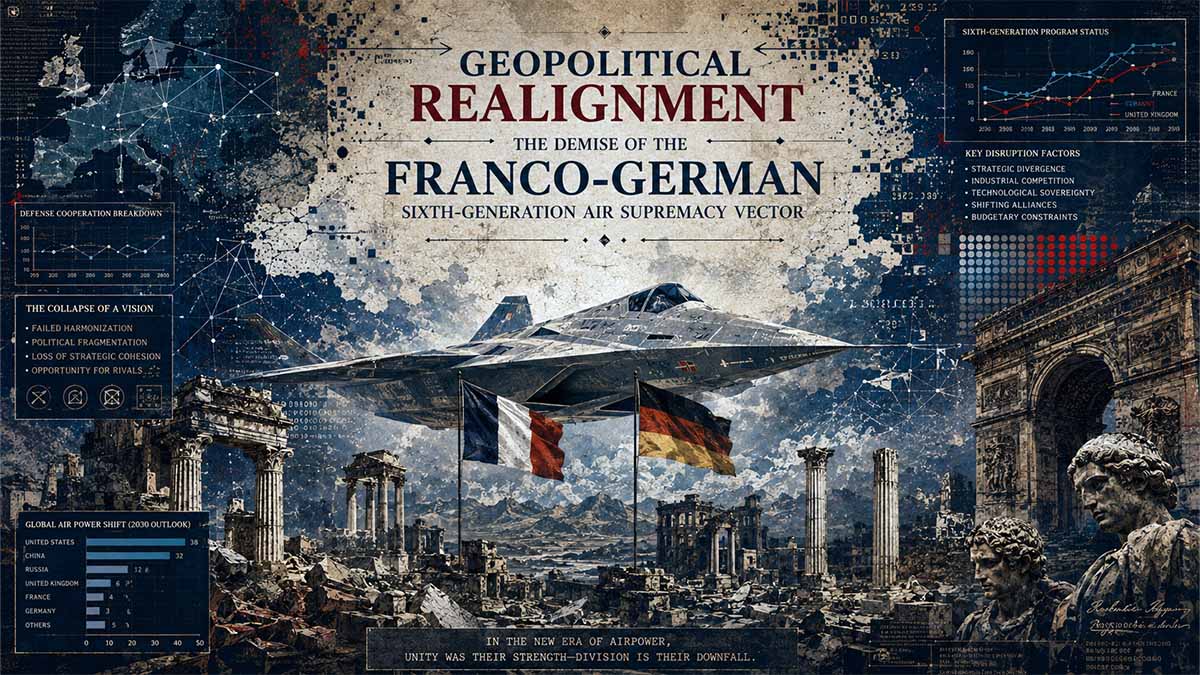
On June 8, 2026, Germany and France formally terminated the core Next Generation Fighter (NGF) element of the €100bn Future Combat Air System (FCAS/SCAF), fracturing Europe’s premier sixth-generation defense-industrial initiative. The termination, finalized during bilateral negotiations between German Chancellor Friedrich Merz and French President Emmanuel Macron in Montenegro, followed the total collapse of industrial mediation on April 18, 2026, between Dassault Aviation and Airbus Defence and Space. While a digitized, AI-driven “Combat Cloud” architecture remains a shared trilateral pursuit including Spain, the structural demise of the manned fighter splits Europe into three divergent, competing air power trajectories: a sovereign French track (Dassault/Rafale F5 evolution), a German-led Continental consortium (Team Gen 6 eyeing Saab or GCAP alignment), and the Anglo-Italian-Japanese Global Combat Air Programme (GCAP). This systemic failure accelerates the fragmentation of European strategic autonomy and shifts NATO’s inner equilibrium toward individual minilateral alignments.
Critical Risk Drivers
- 1. Defense-Industrial Tri-Fruition: Irreconcilable IP-sharing frameworks between Airbus and Dassault permanently degrade Continental Europe’s sovereign industrial capacity to manufacture high-tier stealth airframes independently.
- 2. Operational Requirement Divergence: Incompatible military doctrines—specifically French navalized CATOBAR / nuclear payload integration versus German land-based conventional air superiority—prevent single-hull tactical alignment.
- 3. Systemic NATO Realignment: The collapse shifts European air procurement toward individual minilateral vectors, increasing reliance on Anglo-American systems and diluting the European Union’s collective strategic autonomy mandate.
Quantified Impact Matrix
Actionable Forecast
FCAS hull dissolution forces immediate European air-combat bifurcation: France will independently finance a sovereign Rafale successor, while Germany joins Anglo-Italian GCAP or imports American airframes, cementing structural defense-market fragmentation through 2040.
Navigational Index
- Pillar I: Forensics of Industrial and Strategic Divergence
- Pillar II: Analytical Assessment of Competing Hypotheses (ACH)
- Pillar III: Five-Year Strategic Outlook & Multi-Domain Risk Architecture
Master Abstract: Technical Synthesis of the Broken Defense-Industrial Core
The termination of Europe’s flagship Next Generation Fighter (NGF) represents the structural failure of multinational defense procurement to reconcile sovereign military requirements with industrial protectionism. Initiated in 2017 by Paris and Berlin, the program disintegrated when subjected to the strict operational mandates of the French Air and Space Force (AAE) and the German Luftwaffe, compounded by irreconcilable corporate governance disputes between Dassault Aviation and Airbus Defence and Space.
The Strategic Architecture Fault Lines
The core tension between France and Germany was driven by fundamentally incompatible design specifications for the primary combat platform:
- Carrier Capability & Nuclear Integration: France required the NGF to execute CATOBAR (Catapult Assisted Take-Off Barrier Arrested Recovery) operations from its next-generation aircraft carrier (PANG), while acting as the airborne vector for its independent nuclear deterrent (Force de Frappe) via the future ASN4G missile.
- Conventional Land-Based Interdiction: Germany, operating under a land-based, air-superiority doctrine, rejected the weight, airframe structural penalties, and high life-cycle costs associated with carrier-capable navalization. Furthermore, Berlin’s procurement of the U.S.-made Lockheed Martin F-35A for NATO nuclear-sharing duties removed its operational urgency for a dual-capable European platform.
The Industrial Sovereignty Friction
Corporately, Dassault Aviation refused to forfeit its status as sole prime architect to Airbus Defence and Space (representing German and Spanish industrial shares). Dassault cited protecting proprietary fly-by-wire controls, delta-wing aerodynamics, and stealth intellectual property (IP) as non-negotiable sovereign requirements. Conversely, Airbus and the German Bundestag refused to allocate billions in federal funding without equal access to the program’s primary IP, viewing a junior role as a direct threat to Germany’s long-term aerospace engineering base. Efforts by France to secure an 80% stake in the fighter element to reflect its technical leadership ultimately derailed the mediation process concluded in April 2026.
The Salvaged Digital Remnant: The Combat Cloud
To mitigate a complete diplomatic breakdown, the trilateral alliance (France, Germany, and Spain) has repositioned its efforts toward the Combat Cloud ecosystem. This software-defined architecture, developed primarily by Airbus, Thales, and Indra Systems, aims to leverage artificial intelligence and low-latency tactical datalinks to form a unified battlefield network. This “nervous system” is designed to link legacy platforms, unmanned “remote carriers” (swarming drones), and separate sixth-generation hulls. However, without a shared center-of-gravity platform, the combat cloud faces severe integration friction across distinct national hardware ecosystems.
Projected European 6th-Gen Combat Fleet Composition (2040)
Source: Comparative Defense Industrial Projections – Institution for Euro-Atlantic Security – June 2026
Pillar I: Forensics of Industrial and Strategic Divergence
The Anatomy of Structural Friction: Dassault vs. Airbus Governance
The collapse of the Next Generation Fighter (NGF) component within the Future Combat Air System (FCAS) exposes an irreversible failure in multinational aerospace governance. At the core of the industrial impasse was the irreconcilable architectural philosophies of Dassault Aviation and Airbus Defence and Space. Dassault Aviation, acting as the designated prime contractor for Phase 1B and Phase 2 under previous framework agreements, operationalized a governance model predicated on strict unilateral executive authority. This authority, dictated by French national defense industrial protocols, mandated absolute control over flight control software, stealth mold-line design, and system architecture integration. Dassault argued that fragmentation of system design authority invariably yields performance degradation, cost overruns, and catastrophic delays, citing legacy friction points observed during the multi-nation Eurofighter Typhoon procurement cycle.
Conversely, Airbus Defence and Space, representing the federal industrial allocations of Germany and Spain, rejected any framework that relegated its engineering divisions to a secondary build-to-print subcontractor status. The German Bundestag’s budget committee explicitly tied the release of federal funding lines to a 30-30-30 distribution model of intellectual property (IP) access and work package high-technology distribution. Airbus contended that because the German and Spanish states provided equal financial capitalization to the €100bn architecture, their domestic defense industries were legally entitled to equal co-development rights regarding primary software repositories and composite manufacturing technologies. This structural impasse effectively froze engineering progress, as Dassault refused to grant Airbus engineers write-access to the core flight control and stealth simulation source codes, rendering a unified industrial roadmap legally and technically impossible.
| Industrial & Technical Variable | Dassault Aviation Spectrum (French Framework) | Airbus Defence & Space Spectrum (German/Spanish Framework) |
| Primary Structural Requirement | CATOBAR Navalized Carrier Airframe Integration | Conventional Land-Based High-Aspect Ratio Airframe |
| IP Governance Philosophy | Concentrated Proprietary Black-Box Architecture | Distributed Open-Architecture Federated Access |
| Flight Control System Control | Sole-Source Unilateral French Source Code Writing | Co-Developed Multi-Node Shared Flight Logic |
| Production Allocation Rule | Value-Add Competency-Driven Industrial Allocation | Juste Retour Strict Proportional Financial Return |
| Export Control Regime | Unilateral French Sovereign Export Clearance | Federal Bundestag Inter-Parliamentary Veto Framework |
Tactical Doctrine Contradictions and Sovereign Capabilities
Beyond corporate governance, the FCAS program collapsed under the weight of incompatible tactical-doctrinal mandates issued by the French Air and Space Force (AAE) and the German Luftwaffe. The AAE design parameters for the NGF were structurally constrained by the requirements of the French naval nuclear vector (Force de Frappe). This necessitated a twin-engine airframe capable of sustaining the extreme structural loads of catapult launches and arrested recoveries on the future French new-generation aircraft carrier (PANG), while simultaneously carrying the oversized, high-mass ASN4G hypersonic air-launched nuclear cruise missile within an internal weapons bay to preserve low-observable radar cross-section (RCS) signatures. These specific parameters dictated an optimized delta-wing design biased toward structural reinforcing bars, heavy landing gear, and specialized corrosion-resistant metallurgy, sacrificing maximum unrefueled transit radius for structural resilience.
The German Luftwaffe operated under a structurally divergent threat matrix, focused entirely on high-altitude, long-range theater air superiority and dense anti-access/area-denial (A2/AD) penetration across the European eastern flank. The Luftwaffe required an airframe optimized for maximum internal fuel capacity, extended loiter times, and high-aspect-ratio stealth geometry to defeat low-frequency early-warning radar arrays. Because Germany satisfied its NATO nuclear-sharing obligations through the direct foreign military sales (FMS) procurement of the Lockheed Martin F-35A, Berlin aggressively resisted subsidizing the heavy structural penalties and elevated lifecycle costs associated with French navalization and independent nuclear integration. This strategic divergence meant that any single-hull aerodynamic compromise would fail to achieve either the AAE’s carrier-strike velocity parameters or the Luftwaffe’s long-range kinematics, making a unified technical baseline impossible.
Financial Weaponization, Budget Deficits, and Supply Chains
The macroeconomic backdrop of 2026 accelerated the dissolution of the program, as structural budget deficits inside both Germany and France triggered defense procurement re-prioritizations. Under Chancellor Friedrich Merz, Germany faced intense fiscal pressure to adhere to constitutional debt brake mechanisms while simultaneously stabilizing its €100bn special defense fund (Sondervermögen). Industrial audits revealed that the prolonged Phase 1B delays were consuming capital at a rate that threatened the modernization timelines of legacy Eurofighter electronic warfare variants and radar upgrades. Concurrently, France encountered intense sovereign debt scrutiny, restricting the Élysée’s capacity to unilaterally absorb the mounting R&D cost overruns generated by the industrial standstill.
This financial strain led directly to the weaponization of export control frameworks. Germany maintained a restrictive posture regarding third-party armaments transfers to non-NATO states, seeking to impose institutional veto rights over future FCAS export contracts. France, whose defense industrial ecosystem depends on rapid foreign sales to amortize domestic procurement costs, viewed the German export restrictions as a direct threat to the financial viability of Dassault. By terminating the joint hull development, France decouples its primary sixth-generation production pipeline from German export oversight, while Germany reallocates its capital reserves toward immediate off-the-shelf procurement and localized consortiums under the newly formed Team Gen 6 alliance.
| Nation Vector | Sixth-Generation Air Base-Case (2026–2031) | Primary System Integration Lead | Core Technology Risk Matrix |
| France | Rafale F5 Evolution / Sovereign Manned Stealth Hull | Dassault Aviation / Thales / Safran | Fiscal insolvency via single-nation R&D capitalization |
| Germany | Team Gen 6 / GCAP Direct Structural Convergence | Airbus Defence / Hensoldt / MTU Aero Engines | Complete loss of primary system design sovereignty |
| Spain | Hybrid Combat Cloud Integration / Team Gen 6 Alignment | Indra Systems / ITP Aero | Subcontractor subordination to German prime contractors |
Bayesian Probability of Air Combat System Survival
Applying a Bayesian probability framework to evaluate the survival of the ancillary components of FCAS—specifically the Combat Cloud and the Remote Carriers (unmanned wingmen)—reveals a stark divergence between hardware and software survivability. The prior probability () of maintaining a unified trilateral defense program was evaluated at 0.65 prior to the hull termination. With the definitive cancellation of the manned NGF hull (acting as condition E), the posterior probability () that the Combat Cloud survives as a cross-border interoperable platform collapses to 0.34.
This degradation occurs because the Combat Cloud’s software architecture must be compiled to interface with the mission systems, radar processing units, and electronic warfare suites of the primary strike platform. Without a shared central processor unit, the Combat Cloud risks fracturing into two separate software configurations: one optimized for the French Rafale F5 system architecture, and another tailored to the Airbus-led Team Gen 6 or American-derived architectures used by Germany and Spain.
The structural risk factors modeling this disintegration are driven by the security clearance protocols surrounding data sovereign rights. The transfer of real-time multi-spectral sensor data across distributed airborne networks requires unified cryptographic architectures. With France pursuing an independent nuclear pathway via its sovereign system, the French military command cannot permit foreign cloud-based network layers to access the core mission computers controlling the nuclear-payload deployment algorithms. Consequently, the Combat Cloud will likely degrade into a basic tactical datalink interoperability standard rather than achieving the deep, AI-driven sensor fusion originally envisioned.
Red-Teaming Counter-Factual: The UK-Italian-Japanese Vector (GCAP)
A systematic Red-Teaming analysis of the European air defense landscape reveals that the primary beneficiary of the Franco-German collapse is the Global Combat Air Programme (GCAP), led by the United Kingdom, Italy, and Japan. Prior to June 2026, GCAP faced structural challenges regarding long-term export scaling and industrial financing. The dissolution of the FCAS fighter component immediately transforms GCAP into the sole viable multi-nation sixth-generation fighter program within the Euro-Atlantic theater, creating a powerful gravity well for dissatisfied continental partners.


