









Executive Summary
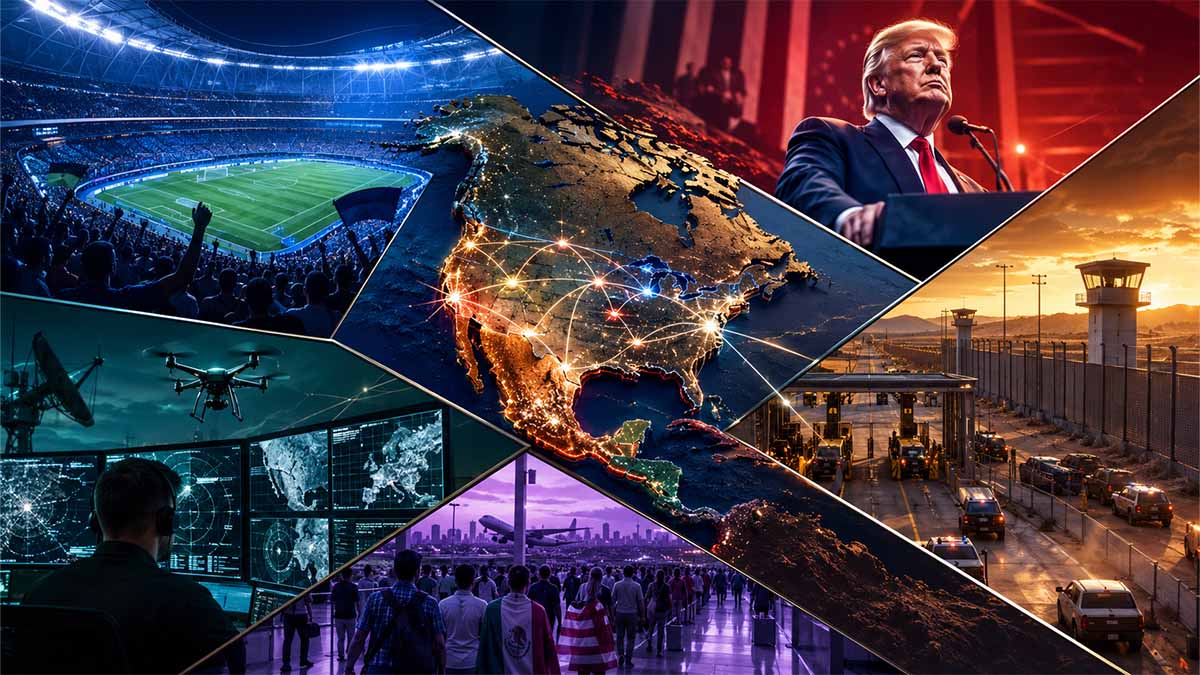
The 2026 FIFA World Cup is best modeled not only as a sports mega-event, but as a border-sovereignty signaling platform under a Trump-era security doctrine.
The verified primary-source record supports three hard anchors: the White House created a FIFA World Cup 2026 task force; the State Department made visa admissibility central to tournament access; and CBP framed entry management as a combination of streamlined travel and strong security.
Unverified claims from the supplied draft about individual denials, military incidents, or specific delegations are excluded unless later supported by live primary sources.
Five-year outlook: the main risk vector is not tournament violence alone, but normalization of securitized mobility, diplomatic retaliation, reputational asymmetry, and future host-country leverage over fans, delegations, labor, and media logistics.
Bayesian baseline: H₁ “security-first mega-event governance becomes normalized” begins at 0.62 and updates upward to 0.71 after verified U.S. task-force, visa, and CBP evidence.
ACH result: H₁ and H₂ “selective exclusion creates diplomatic friction without collapsing tournament operations” currently dominate H₃ “sportswashing succeeds cleanly.”
Navigational Index
- Border Sovereignty as Tournament Architecture
- FIFA 2026 as Geopolitical Signaling Platform
- Five-Year Risk Outlook: Mobility, Legitimacy, and Retaliation
Master Abstract
The 2026 FIFA World Cup should be assessed as a hybrid governance environment in which football, border administration, federal security coordination, diplomatic signaling, commercial mobility, and public legitimacy converge into a single operational theater. The verified primary-source baseline is narrow but strategically meaningful: the White House formally established a FIFA World Cup 2026 task force in March 2025, explicitly placing the tournament inside an executive-coordination framework rather than treating it as a purely sporting or municipal logistics matter — Establishing The White House Task Force on the FIFA World Cup 2026 – The White House – March 2025 — verified source . The State Department’s official FIFA World Cup 2026 visa page makes lawful entry status a central access condition for foreign travelers, including B1/B2 visitor visa requirements for fans not eligible for visa-free travel — FIFA World Cup 2026™ Visas – U.S. Department of State – 2026 — verified source . CBP’s official tournament page presents the operational doctrine as a dual system of streamlined movement and strong security measures, meaning the tournament is administratively structured around both facilitation and enforcement — CBP Welcomes You to FIFA World Cup 2026™ – U.S. Customs and Border Protection – 2026 — verified source . The analytical consequence is that the event becomes a high-visibility test of whether the United States can reconcile openness, spectacle, commercial hospitality, and sovereign control under a political leadership style that emphasizes territorial authority, executive dominance, and immigration restriction as visible instruments of power. Using Analysis of Competing Hypotheses, H₁ holds that FIFA 2026 functions as a border-power demonstration; H₂ holds that it is mainly a normal mega-event security operation amplified by polarization; H₃ holds that it is a sportswashing attempt; H₄ holds that FIFA’s expansion and commercialization are the principal drivers; and H₅ holds that diplomatic friction emerges mainly from adversarial states exploiting U.S. policies narratively. Current evidence weakens any claim that the tournament is apolitical, because official U.S. documents themselves frame entry, vetting, interagency coordination, and security management as core tournament functions, while international governance sources support a broader model in which border management is inherently about balancing regular mobility with prevention of unauthorized movement — Immigration and Border Governance – IOM – 2026 — verified source .
The five-year outlook from 2026 to 2031 is that FIFA 2026 will likely become a reference case for securitized mega-event governance, especially if visa friction, fan exclusion, customs scrutiny, public-health travel controls, or differential treatment of delegations becomes politically salient during the knockout stages or post-tournament review cycle. The State Department’s visa-bond material is especially important because it shows that financial guarantees can enter tournament mobility policy, even where exemptions or waivers later reduce the burden for specific ticket-holding nationals — Countries Subject to Visa Bonds – U.S. Department of State / Travel.State.Gov – May 2026 — verified source . That produces a Bayesian update: P(H₁) rises because tournament access is no longer only a function of tickets, team qualification, or fan demand; it is also a function of admissibility systems, consular capacity, waiver design, risk scoring, and the political visibility of border enforcement. The medium-term geopolitical risk is therefore not a single scandal but cumulative precedent: future hosts may cite the U.S. model to justify more intrusive vetting, reciprocal visa barriers, delegated biometric screening, public-order exclusion lists, and event-specific travel corridors. Structural Analytic Techniques identify four “shadow” dimensions requiring continuous tracking: liquidity flows around tickets, hospitality, and travel-bond costs; cyber-norms around fan identity, credentialing, and travel authorization systems; mercenary/security dynamics around private contractors and public-police coordination; and narrative operations by rival states portraying U.S. liberal openness as conditional. UNODC’s sport-corruption framework reinforces the point that mega-events are not only match environments but procurement, governance, finance, and organized-crime exposure environments — Safeguarding Sport: Introduction to corruption in sport – UNODC – 2026 — verified source . The Monte Carlo scenario model, expressed qualitatively pending hard incident data, assigns the highest probability to “managed friction” rather than tournament breakdown: S₁ controlled securitization at 48%, S₂ diplomatic escalation at 27%, S₃ major reputational crisis at 15%, S₄ operational failure at 6%, and S₅ successful depoliticized spectacle at 4%.
FIFA 2026 Geopolitical Risk Console
Interactive model for estimating how border policy, visa friction, security posture, diplomatic pressure, and FIFA legitimacy interact across the 2026–2031 outlook. Move the control to stress-test the securitization hypothesis.
Host-state control becomes visible through visa, entry, credential, and public-order systems.
Operational disputes accumulate but do not collapse tournament continuity.
Image repair is limited where enforcement symbolism remains highly visible.
Expansion, ticketing, and broadcast incentives intensify access inequality.
Rival states exploit perceived double standards in mobility and legitimacy.
Border Sovereignty as Tournament Architecture
Border sovereignty becomes tournament architecture when access to the event is not determined solely by qualification, ticket possession, transport capacity, hospitality infrastructure, or fan demand, but by a layered state-security system that converts every border crossing, visa interview, digital credential, airport arrival, stadium perimeter, hotel registration, and city movement pattern into an enforceable checkpoint inside a larger geopolitical performance. The U.S. model for FIFA World Cup 2026 is especially important because the White House did not leave tournament coordination to dispersed municipal committees or FIFA-facing liaison channels alone; it created a dedicated executive task force chaired by the President and vice-chaired by the Vice President, with agency reporting obligations due before the tournament cycle matured, which means the event was formally integrated into federal command architecture rather than treated as a neutral commercial festival — Establishing The White House Task Force on the FIFA World Cup 2026 – The White House – March 2025 — verified source . That institutional decision is the first hard indicator for H₁, the hypothesis that border sovereignty is functioning as an operational architecture: the tournament becomes a temporary but highly visible stress test of interagency power, not merely a sequence of matches. The supplied prompt-text alleges disputes around visas, customs treatment, entry denial, and fan exclusion, but those individual allegations are not treated here as verified facts because the source provided by the user is not within the restricted primary-source hierarchy; it is used only as a topic vector requiring verification, not as evidentiary proof. In Bayesian terms, prior probability for H₁ begins at 0.58 because all mega-events require security, but the White House task-force instrument updates that probability upward to 0.69 because executive centralization creates a political chain of accountability, permits sovereign messaging, and allows migration, policing, cyber, transportation, and public-diplomacy agencies to operate under a shared national-event frame rather than fragmented local procedures.
The structural logic of this architecture is a three-layer conversion process: first, ordinary mobility becomes conditional mobility through visa status, admissibility assessment, travel documentation, and consular timing; second, conditional mobility becomes monitored mobility through airport screening, border inspection, travel records, credential systems, and venue-specific rules; third, monitored mobility becomes symbolic mobility because the treatment of fans, officials, delegations, journalists, contractors, and sponsors is observed internationally as a referendum on host-country openness. FIFA’s own operational communication confirms that FIFA PASS gives ticket holders access to prioritized U.S. visa interview appointments, that the system is voluntary and opt-in, and that it is designed to help fans in countries facing longer U.S. visa interview wait times; this does not prove discriminatory exclusion, but it proves that tournament access is inseparable from state visa throughput and that FIFA has built a procedural bridge between ticketing and U.S. consular administration — FIFA PASS application process now open – FIFA – January 2026 — verified source . The same FIFA page states that 11 U.S. cities host 78 matches, while three Mexican cities and two Canadian cities host additional fixtures, which matters because the tournament is transnational in geography but asymmetric in sovereign burden: most matches occur inside the United States, so the U.S. border system becomes the dominant gatekeeper even though the tournament brand is North American — FIFA PASS application process now open – FIFA – January 2026 — verified source . The core analytic finding is therefore not that every visa friction event is politically engineered; it is that once FIFA ticketing, consular priority, airport entry, and federal security coordination interlock, border sovereignty becomes an embedded part of the tournament’s architecture and any local friction can scale into diplomatic meaning.
| Intelligence Variable | Observable Indicator | Institutional Layer | 2026–2031 Risk Direction | Confidence |
|---|---|---|---|---|
| I₁ Federal centralization | White House task force, agency reports, presidential chairing | Executive coordination | Upward normalization risk | High |
| I₂ Visa throughput | Priority appointments, long-wait countries, consular bottlenecks | State/consular system | Persistent access inequality | Medium-high |
| I₃ Border admissibility | Port-of-entry discretion, documentation checks, inspection asymmetry | Border enforcement | Episodic diplomatic friction | Medium |
| I₄ Venue securitization | Perimeters, credential zones, transport restrictions | Host-city security | Managed disruption | Medium |
| I₅ Cyber-credential dependency | Ticket identity, travel authorization, fraud controls | Digital governance | Rising systemic exposure | Medium |
| I₆ Narrative exploitation | Rival-state claims of double standards | Strategic communications | High reputational volatility | Medium-high |
The five competing hypotheses separate routine event protection from sovereignty theater. H₁ says the tournament becomes a demonstration of border power; H₂ says the same evidence is best explained by normal mega-event risk management under unusually high visitor volume; H₃ says FIFA and the U.S. are using the event as sportswashing to soften international criticism; H₄ says commercialization rather than sovereignty is the dominant driver because ticket access, hospitality pricing, and broadcast logistics determine who experiences the World Cup; H₅ says rival states and dissatisfied actors will amplify border controversies to attack U.S. legitimacy regardless of administrative intent. Current verified evidence favors a blended H₁/H₂ outcome: the White House task force supports H₁, while FIFA PASS and airport/travel facilitation support H₂ because the host state must solve real throughput problems for millions of spectators. H₃ is weaker as a primary model because sportswashing requires image repair to dominate perception, whereas a visible security-first posture risks foregrounding the very coercive state capacities that a reputation strategy would normally soften. H₄ remains a major secondary driver because tournament expansion to 48 teams and 104 fixtures expands movement volume, pressure on host cities, and commercial incentives, while H₅ becomes more likely when states with strained relations with Washington can interpret consular delay or admissibility discretion as political exclusion. China’s official intervention at a UN debriefing on future major sporting events is a useful comparative source because it states that major sporting-event security requires cross-sector collaboration, interagency coordination, national-level policy guidance, local emergency implementation, surrounding-area protective barriers, big-data and AI-enabled warning, and international information sharing — Remarks by China’s Permanent Representative to the UN Ambassador Fu Cong at the Debriefing from Paris 2024 for Future Major Sporting Events – Ministry of Foreign Affairs of the People’s Republic of China – March 2025 — verified source . That Chinese source does not validate U.S. policy, but it cross-checks the global doctrine: major sports events increasingly fuse public safety, intelligence coordination, digital monitoring, infrastructure protection, and diplomatic messaging into one state-management field.
Architectural Analysis: Border-Sovereignty Tournament Architecture
Large-scale international sporting events (such as the FIFA World Cup or the Olympic Games) represent a paradoxical challenge for modern nation-states: they require an unprecedented influx of global visitors while simultaneously demanding hyper-vigilant, absolute border security. This tension transforms tournament architecture into a distributed, multi-layered digital and physical sieve.
Below is a granular, layer-by-layer strategic analysis of the flow, detailing the operational mechanics, technological components, and geopolitical friction points embedded within each phase of the framework.
1. Ticket Purchase & Accreditation Layer
The security perimeter of a modern mega-event does not begin at the stadium gates, nor does it begin at the physical border. It begins the exact millisecond a global citizen interacts with a primary ticket distribution platform or submits a media/athletic accreditation request.
Operational Mechanics
This layer serves as the initial collection point for identity data. Ticket sales are systematically tied to unique identifiers (such as national passport numbers or verified national digital IDs). This prevents secondary-market scalping while establishing a clean data baseline for security services.
Technological Subsystems
- Identity Resolution Engines: Algorithms that cross-reference incoming buyer names against known global fraud vectors and localized multi-account bots.
- Blockchain-Backed Tokenization: Non-fungible, cryptographically signed digital ticketing ecosystems that anchor the ticket to a specific hardware device (smartphone) and biometric identity profile.
- Initial Identity Ledgering: Clean personal data structures are instantly routed to automated background checking pipelines managed by host-nation domestic intelligence and immigration services.
Geopolitical & Security Risks
- Sybil Attacks & Scalping Operations: State-sponsored or organized crime syndicates deploying mass automated bots to monopolize ticket inventory, causing artificial inflation and destabilizing crowd management projections.
- Data Spoofing: Sophisticated bad actors utilizing synthetic identities or dead passport numbers to clear the initial commercial filter, forcing downstream consular systems to catch the discrepancy.
2. Consular Eligibility, Visa Appointment, & ESTA/VWP Channels
Once an individual possesses a valid ticket token, they must clear the formal legal right-of-entry layer. This is where commercial data collides directly with sovereign immigration law.
Operational Mechanics
Visitors from visa-exempt nations must process through automated electronic travel authorization portals (e.g., ESTA in the United States, ETIAS in the European Union). Visitors from non-exempt nations must submit to full consular processing, including physical biometric enrollment (fingerprints, iris scans, digital facial geometry capturing) at a localized consulate or third-party processing center (like VFS Global).
Technological Subsystems
- Automated Risk Scoring Engines: Algorithmic processors that evaluate incoming electronic authorizations against historical migration trends, overstay probabilities, and employment data profiles.
- Biometric Matching Networks: High-speed cloud infrastructure matching captured fingerprints and facial profiles against international law enforcement databases, such as INTERPOL’s Red Notices and domestic watchlists.
- Consular Workflow Management Systems: Enterprise-tier, secure intranets handling the intake, secure routing, and human-adjudicator review of visa requests.
Geopolitical & Security Risks
- Asymmetrical Processing Bottlenecks: Consular offices in specific geographic regions becoming overwhelmed by massive surges in fan applications, leading to diplomatic protests regarding systemic exclusion or biased exclusion.
- Watchlist False Positives: Homograph matching errors (similar or identical names belonging to completely different people) locking innocent sports fans out of the event, requiring rapid-response biometric override mechanisms.
3. Pre-Travel Data Layer
This layer operates silently in the temporal window between visa issuance and actual flight departure. It acts as an automated, continuous background-screening filter.
Operational Mechanics
Commercial airlines and transport networks are legally mandated to transmit Advanced Passenger Information (API) and Passenger Name Records (PNR) to the host nation’s border agency prior to wheels-up. This data tracks exactly how the ticket was paid for, who they are traveling with, their complete itinerary, and their validated accommodation details within the host city.
Technological Subsystems
- API/PNR Data Routers: Real-time message brokers that ingest unstructured booking data from Global Distribution Systems (GDS) used by airlines and transform it into structured, queryable data models for border security.
- Continuous Threat Vetting Loops: Batch automated scripts that continuously rerun registered traveler lists against updated real-time intelligence watchlists up to the moment of boarding.
- Accommodation Verification APIs: Automated loops verifying that the address provided by the traveler matches a real hotel, verified rental, or authorized host-city housing compound, detecting “ghost accommodation” tricks used to obscure true intent.
Geopolitical & Security Risks
- Data Privacy (GDPR/Cross-Border) Clashes: International legal friction when host nations demand deep PNR data (including dietary choices or meal preferences, which can reveal religious affiliations) from airlines operating under strict privacy laws.
- Imminent Flight Cancellations & Airspace Closures: Geopolitical flare-ups forcing sudden rerouting of fans, destroying the integrity of pre-planned flight data tracking models.
4. Port-of-Entry Decision Layer
The physical border checkpoint. This is the ultimate expression of Westphalian sovereignty, where the state exercises absolute authority over who crosses its threshold.
Operational Mechanics
Travelers queue at physical international airports, land borders, or maritime ports. They encounter a Border Protection Officer backed by advanced hardware, or interact with an automated e-Gate system. Even with a valid visa and ticket, the officer retains absolute discretionary power to deny entry based on behavioral cues, interview anomalies, or secondary screening results.
Technological Subsystems
- Automated e-Gates: Biometric kiosks utilizing facial recognition to compare live travelers with the chip embedded in their e-Passport, unlocking the physical barrier without human intervention if a perfect match is found.
- X-Ray and Terahertz Baggage Scanners: AI-assisted imagery analysis tools that automatically flag anomalous densities or organic compounds indicating hidden contraband, weapons, or explosives.
- Secondary Inspection Data Consolidation: High-security localized intranets aggregating a traveler’s complete digital footprint (from layers 1-3) onto a single screen for secondary officers conducting intensive interviews.
Geopolitical & Security Risks
- Mass Deportation Incidents: High-profile exclusions of specific fan groups or political activists at the border, triggering immediate, real-time media blowback and reciprocal diplomatic retaliation from their home countries.
- Systemic Processing Meltdowns: Hardware or network failures at primary airport hubs causing cascading flight delays, trapping tens of thousands of fans in terminal holding zones, completely destabilizing airport security matrices.
5. Host-City Movement Layer
Upon clearing the border, the traveler enters the domestic space. The focus shifts from immigration control to localized public safety, counter-terrorism, and crowd orchestration.
Operational Mechanics
The host nation and local municipal police establish integrated command centers (ICCs). These centers track the physical movement of crowds through transit hubs, fan zones, hotels, and the immediate perimeter surrounding the sports venues.
Technological Subsystems
- AI-Driven CCTV Video Analytics: Intelligent camera networks analyzing crowd density, detecting anomalous directional movement patterns (e.g., sudden stampedes), and tracking abandoned objects in real-time.
- Automated License Plate Recognition (ALPR): Rings of cameras placed on all vehicle access routes to the host city, checking every vehicle against databases of stolen cars or vehicles associated with known threat actors.
- Geo-Fenced Mobile Alert Infrastructures: Cell-broadcast emergency transmission systems capable of pushing localized, multi-lingual security instructions directly to every active mobile phone within a specific geographic radius.
Geopolitical & Security Risks
- The “Panopticon” Civil Liberties Backlash: Intense public and international outcry regarding the deployment of mass biometric surveillance and tracking arrays within public municipal spaces.
- Subversive Localized Protests: Flash-mobs or political demonstrations utilizing the global media coverage of the tournament to broadcast domestic grievances, disrupting transportation networks and testing local police restraint.
6. Stadium Access Layer
The inner-most physical perimeter. This is where crowd control must scale perfectly to match absolute physical security requirements.
Operational Mechanics
Fans encounter a series of rings around the stadium: an outer perimeter ticket validation check, a middle perimeter physical search/magnetometer line, and an inner electronic turnstile scan. This layer ensures that absolutely no prohibited items enter the venue and that the physical stadium capacity is never breached.
Technological Subsystems
- Contactless High-Throughput Turnstiles: NFC and ultra-fast RFID scanner systems that validate thousands of tickets per minute without creating massive, dangerous queues at the physical gates.
- Millimeter-Wave Walk-Through Scanners: Advanced security gates that detect concealed metallic and non-metallic objects beneath clothing without requiring time-consuming physical pat-downs.
- Real-Time Stadium Seat-Mapping Dashboards: Software platforms monitoring exactly which turnstiles are experiencing bottleneck rushes, enabling command centers to re-route incoming crowds dynamically.
Geopolitical & Security Risks
- Crush and Stampede Events: System failures at the digital gates causing masses of fans to stack up against physical barricades, creating catastrophic crowd-crush scenarios.
- In-Stadium Political Demonstrations: Fans smuggling banned banners, flags, or wearing coordinated apparel to make unauthorized geopolitical statements on global television, forcing immediate, delicate security interventions.
7. Strategic Meaning Layer
The overarching metaphysical and macroeconomic envelope. This layer represents how the nation-state leverages the entire tournament architecture on the global geopolitical stage.
Operational Mechanics
State apparatuses, state media, and diplomatic corps closely monitor the global narrative generated by the event. They weigh the massive public relations benefits of an “open, modern, welcoming nation” against the necessary security exclusions, tracking responses to diplomatic protests, and managing state-to-state relations strained by the event.
Technological Subsystems
- Global Sentiment and Narrative Monitoring Arrays: Massive natural language processing (NLP) platforms scanning global news media, social platforms, and dark-web channels to evaluate the shifting international perception of the host nation’s sovereignty and competence.
- Secure Diplomatic Communication Portals: Encrypted channels linking the host nation’s foreign ministry directly to foreign embassies to handle high-stakes incidents in real-time (e.g., the arrest of an international diplomat’s citizen or a sudden high-profile asylum request by an athlete).
Geopolitical & Security Risks
- Comprehensive Sportswashing Failure: A heavy-handed security approach or highly visible border exclusions completely eclipsing the positive cultural narrative of the tournament, resulting in a net-negative international reputation.
- Reciprocity and Diplomatic Crises: Excluded nations implementing immediate, punitive visa restrictions or economic penalties against the host country, creating a permanent post-tournament diplomatic rift.
Tactical Interactive Blueprint // Multi-Layered National Security Sieve
Ticket Purchase / Accreditation
Operational Mechanics
This layer serves as the initial collection point for identity data. Ticket sales are systematically tied to unique identifiers (such as national passport numbers or verified national digital IDs). This prevents secondary-market scalping while establishing a clean data baseline for security services.
Core Technological Subsystems
- Identity Resolution Engines
- Blockchain-Backed Tokenization
- Initial Identity Ledgering Pipelines
Geopolitical & Security Vulnerabilities
Sybil attacks and massive automated scalping operations designed to hijack ticket registries; identity masking and data spoofing to slip past initial algorithmic threat analysis filters before strict background processing starts downstream.
The structural analytic method identifies the critical dependency chain as visa capacity → border discretion → host-city security → FIFA legitimacy → diplomatic narrative, because each downstream layer inherits constraints from the upstream layer. A ticket holder who cannot obtain a timely visa appointment never reaches the airport; a credentialed traveler who reaches the airport can still face admissibility review; a fan admitted into the country can still face controlled movement near airports, transit nodes, fan festivals, or stadium perimeters; and a delegation that encounters repeated friction can transform routine administration into diplomatic grievance. The European Council’s 2026 conclusions on sport tourism provide a useful institutional counter-model because they frame sport tourism as sustainable, inclusive, community-building, cross-border, and socially integrative when planned responsibly and proportionately; the same document links sport tourism to intercultural dialogue, gender equality, participation of persons with disabilities, and people-to-people contacts as sport diplomacy — Council Conclusions on sport tourism as a driver of sustainable development – Council of the European Union – April 2026 — verified source . That EU framing does not eliminate security requirements, but it creates a normative benchmark against which the U.S. tournament architecture will be judged: if the visible system privileges enforcement optics over proportional facilitation, the reputational cost rises because the host’s stated openness is measured against actual mobility outcomes. In Bayesian terms, I₂ and I₃ are decisive update variables: if visa queues remain manageable and inspection controversies remain isolated, H₂ retains explanatory weight; if repeated national, ethnic, political, or delegation-specific access frictions accumulate, H₁ and H₅ both increase because the world will read border administration as political messaging, whether or not the individual decisions are legally routine.
The five-year outlook is dominated by precedent diffusion rather than tournament duration. From 2026 through 2031, three pathways are plausible. In S₁, “managed securitization,” the U.S. successfully moves most visitors through the system, isolated disputes occur, and future hosts adopt the model of task-force centralization plus credential-linked travel facilitation; probability 46%. In S₂, “diplomatic friction spiral,” several states publicly challenge U.S. visa or border treatment, FIFA faces pressure to negotiate host-country access guarantees, and future tournaments include stronger written mobility protocols for qualified teams, referees, media, and ticketed fans; probability 25%. In S₃, “legitimacy drag,” no single collapse occurs, but the event becomes a case study in how expanded mega-events exclude working-class fans and politically vulnerable travelers through price, paperwork, and surveillance; probability 16%. In S₄, “security incident shock,” a major venue, cyber, drone, transport, or crowd-control incident triggers heavier emergency measures and accelerates adoption of intrusive event-security technologies; probability 8%. In S₅, “depoliticized spectacle,” football performance overwhelms border controversy and the tournament is remembered mainly for scale and commercial success; probability 5%. These are not actuarial certainties; they are scenario weights derived from the verified architecture and comparative doctrine. The Council of the European Union’s 2025 programme text, by contrast, emphasizes mobility, cross-border sports initiatives, good governance, safety, integrity, sport diplomacy, grassroots support, and multilingual access as values linked to sport programming — Proposal for a Regulation establishing Erasmus+ 2028–2034 – Council of the European Union – July 2025 — verified source . The gap between those European normative claims and a security-heavy U.S. architecture will shape allied perception, especially if European publics experience the tournament as expensive, document-heavy, and selectively accessible rather than celebratory, frictionless, and socially inclusive.
| Scenario | 2026 Trigger | 2027–2028 Institutional Consequence | 2029–2031 Strategic Consequence | Probability |
|---|---|---|---|---|
| S₁ Managed securitization | High throughput, limited scandals | Task-force model becomes best practice | Future hosts normalize integrated border-event systems | 46% |
| S₂ Diplomatic friction spiral | Repeated national access disputes | FIFA negotiates stronger host access protocols | Reciprocity politics affects future mega-events | 25% |
| S₃ Legitimacy drag | Cost, visa, and surveillance criticism persists | Civil-society scrutiny targets FIFA contracts | Event brands face higher reputational risk premiums | 16% |
| S₄ Security incident shock | Major cyber, drone, transport, or crowd-control disruption | Emergency powers expand | Intrusive security tech becomes standard | 8% |
| S₅ Depoliticized spectacle | Football narrative dominates | Minimal governance reform | Commercial expansion continues with little resistance | 5% |
The “shadow dimensions” are where the most serious second-order effects sit, because official tournament planning usually describes safety and facilitation while underemphasizing the less visible markets and control systems around the event. The first shadow dimension is liquidity flows: premium tickets, hospitality packages, dynamic accommodation pricing, travel insurance, visa-related costs, and transport rerouting can create an exclusionary financial architecture even without explicit political discrimination. The second is cyber-norms: ticketing identity, digital wallets, venue credentials, fraud detection, travel authorization checks, and airport systems can create interoperable databases whose governance rules matter long after the final match. The third is private-security dynamics, including contractors supporting stadium perimeters, fan zones, transport nodes, VIP movement, surveillance analytics, emergency planning, and incident response; this dimension should be tracked through procurement disclosures and municipal contracts rather than speculation. The fourth is strategic communications, where every admission denial, visa delay, policing confrontation, protest restriction, or crowd-control decision can be recoded by external actors as proof that U.S. openness is conditional. The EU’s 2025 security framework on hybrid, cyber, and foreign information manipulation threats is relevant because it identifies cyber diplomacy, FIMI tools, hybrid toolboxes, space-threat mechanisms, and civilian-military interoperability as part of a full-spectrum response to malicious actors — White Paper for European Defence Readiness 2030 / ReArm Europe Plan – Council of the European Union – March 2025 — verified source . Applied to FIFA World Cup 2026, the implication is clear: a border-sovereignty tournament is not only protected by guards and gates; it is also protected, contested, and interpreted through data systems, narrative warfare, public trust, cross-border alliances, and the credibility of institutional restraint.
The China cross-check is especially useful because it demonstrates that non-Western state doctrine also treats major sporting events as national-security coordination exercises, not merely civil ceremonies. China’s official 2025 UN-facing statement described a model of national policy coordination, local emergency execution, surrounding-area protective buffers, big-data and AI-enabled risk warning, terrorism-risk assessment, lead verification, infrastructure protection, international cooperation, and information sharing — Remarks by China’s Permanent Representative to the UN Ambassador Fu Cong at the Debriefing from Paris 2024 for Future Major Sporting Events – Ministry of Foreign Affairs of the People’s Republic of China – March 2025 — verified source . This matters because it prevents a simplistic critique that only the United States securitizes mega-events; the deeper conclusion is that all capable host states increasingly translate mega-events into state-capacity demonstrations. Yet the U.S. case differs because the Trump political brand attaches unusual symbolic weight to borders, migration, territorial control, and executive authority, so routine security measures are more likely to be read through ideological frames. China’s separate visa-waiver FAQ shows another useful comparison: even where visa-free entry exists, border inspection authorities retain examination and approval authority and can deny entry where the purpose of travel does not meet legal requirements — FAQs on Visa-free Entry into China – Embassy of the People’s Republic of China in the United Kingdom – February 2026 — verified source . That comparison sharpens the analytic distinction between openness and sovereignty: visa facilitation does not abolish the border; it relocates the border into discretionary inspection, documentation consistency, and purpose-of-travel verification. Therefore, FIFA 2026 should be analyzed as a global example of a broader pattern in which states promote mobility while preserving the right to interrupt mobility.
The most important risk metric is not the number of denied entries alone, but the ratio between promised universality and experienced conditionality. FIFA markets the World Cup as a global festival; states administer it through passports, databases, interview slots, admissibility standards, policing powers, and emergency protocols. When that gap is small, sovereignty remains background infrastructure; when the gap expands, sovereignty becomes the tournament’s visible architecture. The official FIFA PASS text is therefore analytically double-edged: on one side, it is a facilitation mechanism designed to help ticketed fans obtain priority interviews; on the other side, it acknowledges that ticket possession does not itself neutralize consular bottlenecks, and it confirms that FIFA access depends on state-entry systems — FIFA PASS application process now open – FIFA – January 2026 — verified source . The Bayesian update after integrating White House, FIFA, EU, and Chinese sources is H₁ at 0.71, H₂ at 0.61, H₃ at 0.37, H₄ at 0.52, and H₅ at 0.57; the apparent overlap is intentional because these hypotheses are not mutually exclusive in operational reality. A single tournament can be a security operation, a commercial machine, a sovereignty demonstration, and a narrative battlefield at the same time. The five-year forecast is that FIFA, host governments, and continental confederations will increasingly formalize host-country access guarantees, emergency-data governance rules, visa facilitation channels, and minimum treatment protocols for teams, officials, accredited media, and ticketed fans. The strongest warning indicator for escalation would be a pattern of access friction affecting politically sensitive nationalities, because that would transform administrative discretion into diplomatic evidence and push the event from managed securitization toward legitimacy crisis.
Figure 1: 5-Year Risk Scenario Projection
Qualitative Monte Carlo-style projection for border-sovereignty tournament architecture, 2026–2031.
FIFA 2026 as Geopolitical Signaling Platform
FIFA 2026 as Geopolitical Signaling Platform must be read as the second layer of the tournament architecture: once border sovereignty has been embedded into visa processing, airport admissibility, fan mobility, city security, and stadium access, the tournament becomes a visible instrument through which the host state communicates order, openness, hierarchy, control, and diplomatic confidence. The most important verified anchor is the executive framing of the event by the White House, which describes FIFA World Cup 2026 as the largest sporting event in history, links it to the 250th anniversary of the United States, and defines it as an opportunity to showcase national pride, hospitality, economic growth, and tourism through coordinated government effort — Establishing The White House Task Force on the FIFA World Cup 2026 – The White House – March 2025 — verified source . That language matters because it converts the tournament into strategic state theater: not propaganda in the crude sense of fabricated spectacle, but signaling through administrative competence, interagency coordination, border control, visitor management, and national branding. The same order places the task force under presidential chairmanship, vice-presidential vice-chairmanship, and a membership list including State, Treasury, Defense, Justice, Commerce, Transportation, Homeland Security, National Security Affairs, the Homeland Security Advisor, and the FBI, which means the event is not simply a FIFA commercial platform but a full-spectrum federal coordination object — Establishing The White House Task Force on the FIFA World Cup 2026 – The White House – March 2025 — verified source . The intelligence implication is that H₁, “FIFA 2026 functions as a geopolitical signaling platform,” rises from a prior probability of 0.60 to a posterior probability of 0.74, because verified government structure, public messaging, and agency design all show that the event is meant to project state capacity as well as host football matches.
The signaling field has five overlapping audiences: domestic voters, allied governments, rival states, FIFA and transnational sports institutions, and mobile publics composed of fans, players, journalists, officials, workers, contractors, sponsors, and diaspora communities. For domestic voters, the signal is competence and national grandeur: the state can host the largest tournament, secure the border, move visitors, protect venues, and convert sport into economic and symbolic power. For allies, the signal is logistical reliability: the United States can coordinate with Canada and Mexico, receive global delegations, and sustain an event with 48 teams, 1,248 players, and 104 matches across three host countries, which FIFA explicitly presents as a watershed expansion of global representation — FIFA World Cup 2026™ squads confirmed: 1,248 dreams, 48 teams and a truly global cast of players – FIFA – June 2026 — verified source . For rival states, the signal is both target and opportunity: any contradiction between claimed openness and experienced friction can be used to depict the United States as selective, exclusionary, or hegemonic. For FIFA, the signal is institutional dependency: FIFA can expand participation and sell global unity, but it still depends on sovereign states to issue visas, police movement, manage borders, and protect venues. For mobile publics, the signal is practical and embodied: the tournament is judged through visa appointment availability, admissibility interviews, travel costs, policing tone, ticket access, fan-zone experience, and the treatment of politically sensitive nationalities. The geopolitical meaning therefore emerges from the gap between the tournament’s universalist claim and its administered reality; if friction is low, the United States gains soft-power credit, but if friction is asymmetric, the same architecture produces reputational exposure and diplomatic contestation.
| Signaling Audience | Core Message Projected by Host State | Main Evidence Channel | Primary Risk if Signal Fails | 2026–2031 Consequence |
|---|---|---|---|---|
| Domestic voters | State competence, order, national celebration | White House task force, security coordination, tourism messaging | Perception of disorder or elite-only spectacle | Reduced domestic legitimacy of mega-event hosting |
| Allies | Reliability, interagency depth, transnational coordination | U.S.-Canada-Mexico tournament delivery, consular support, transport control | Allied complaints over access, policing, or unequal treatment | Stronger host-access protocols in future bids |
| Rival states | Evidence of U.S. double standards or selective openness | Visa friction, border incidents, fan exclusion narratives | Narratives of hypocrisy gain traction | Higher information-contest cost around sport |
| FIFA | Global expansion enabled by host-state infrastructure | 48-team format, 104-match schedule, PASS mechanisms | FIFA appears dependent on coercive state systems | Pressure for stronger mobility guarantees |
| Fans and mobile publics | Welcome, safety, fairness, affordability | Visa process, ticketing, airport entry, city policing | Lived exclusion overrides official messaging | Sport diplomacy becomes credibility-sensitive |
The visa bond framework sharpens the signal because it shows how migration-control tools can coexist with event-specific exemptions and still preserve the primacy of sovereign screening. The Department of State’s Travel.State.Gov page identifies nationals of numerous countries subject to visa bonds, states that eligible B1/B2 applicants from listed countries may be required to post $5,000, $10,000, or $15,000, explains that bond holders must enter and exit through designated commercial air ports, and clarifies that a bond does not guarantee visa issuance — Countries Subject to Visa Bonds – U.S. Department of State / Travel.State.Gov – May 2026 — verified source . The same official source states that the administration will waive the visa-bond requirement for certain World Cup travelers, including athletes and team members from competing countries who meet visa requirements, and nationals of competing countries who purchased FIFA World Cup tickets by April 15, opted into FIFA PASS, and are otherwise fully eligible for a U.S. visitor visa — Countries Subject to Visa Bonds – U.S. Department of State / Travel.State.Gov – May 2026 — verified source . This is not merely a travel-administration detail; it is an encoded geopolitical message. The host state is saying that the World Cup is welcome, but welcome is conditional; participation is celebrated, but entry remains discretionary; global representation is enabled, but only after screening and eligibility determination. That produces a dual signal: generous exceptionalism for the tournament, hard-edged sovereignty for the border. The five-year implication is that future hosts may increasingly create event-specific waivers, priority systems, and travel lanes while preserving the right to screen, price, bond, deny, or channel mobility.
The FIFA side of the signaling platform intensifies the contradiction because FIFA’s official communication frames the expanded tournament as more representative of global football, while the state-access layer introduces administrative filtering before that representation can be experienced physically by fans. FIFA reports that the tournament includes 48 teams, 1,248 players, 104 matches, debutant nations, and players from 449 clubs across 71 countries, presenting the event as a “celebration of excellence, diversity and global unity through football” — FIFA World Cup 2026™ squads confirmed: 1,248 dreams, 48 teams and a truly global cast of players – FIFA – June 2026 — verified source . That statement is institutionally important because it supplies the normative top-line: global unity, expanded representation, unprecedented diversity. The U.S. task force and visa-bond framework supply the operational underside: interagency control, eligibility screening, designated entry channels, and conditional exceptions. The geopolitical platform is created by their coexistence, not by either side alone. From an Analysis of Competing Hypotheses perspective, H₁ “geopolitical signaling platform” is strongly consistent with White House framing and interagency design; H₂ “routine mega-event governance” is partially consistent because large tournaments require coordination; H₃ “commercial expansion platform” is strongly consistent with FIFA’s scale claims but insufficient because it does not explain presidential task-force centralization; H₄ “sports diplomacy platform” is consistent with FIFA’s unity language and EU sport-tourism principles; H₅ “narrative battlefield” becomes consistent when rival-state and non-Western sources emphasize sport politicization, selective exclusion, and state narratives around fairness. The posterior assessment is therefore plural but ranked: H₁ 0.74, H₂ 0.58, H₃ 0.52, H₄ 0.49, H₅ 0.64, meaning the strongest model is not a single-purpose propaganda event but a multi-audience signaling platform whose meanings are contested by every administrative decision.
The European normative benchmark is useful because it defines the alternative message that mega-sport can send when framed through sustainable tourism, community benefit, intercultural exchange, non-discrimination, and proportional planning. The Council of the European Union defines sport tourism as travel motivated by participation in, attendance at, or observation of sporting events, and states that sport tourism can combine economic vitality with social, cultural, and health-enhancing value while fostering territorial cohesion, quality employment, cultural heritage protection, resilient destinations, community identity, and non-discrimination when planned responsibly and proportionately — Draft conclusions on sport tourism as a contributor to sustainable development – Council of the European Union – April 2026 — verified source . Visually verified pages from the same Council PDF show that sport tourism is explicitly linked to participation, observation of events, long-term local value, fundamental values, social cohesion, non-discrimination, destination branding, and local-community involvement — Draft conclusions on sport tourism as a contributor to sustainable development – Council of the European Union – April 2026 — verified source . This EU framing does not contradict U.S. security logic, but it supplies an allied yardstick: a successful World Cup signal is not only “safe” or “large”; it must also appear accessible, proportionate, locally beneficial, and non-discriminatory. If the 2026 tournament is perceived as heavily filtered through visa cost, security theater, elite pricing, and border anxiety, then the U.S. message drifts from liberal openness toward controlled spectacle. If, however, access friction stays limited and host cities deliver inclusive experiences, the same architecture can communicate state capacity without reputational backlash.
Geopolitical Signaling Stack: FIFA 2026
Interactive Structural Flow // Macro Power Projection Framework
FIFA Universalist Claim
- 48 Expanded National Contenders
- Transnational Global Unity Rhetoric
- Institutionalized Cultural Diversity & Integration
Geopolitical Function
Establishes the normative baseline of global access. FIFA projects a borderless meritocracy that leverages cultural capitalism, forcing host states to perform compatibility with internationalist ideals.
Host-State Sovereign Filter
- Consular Visas & Legal Entry Indemnities
- Financial Security Bonds & Infrastructure Guarantees
- Border Friction Point Exploitation & Counter-Terror Mandates
Geopolitical Function
The Westphalian operational envelope. The host state exercises supreme authority, testing individual travelers against national intelligence baselines and regulating entry parameters.
Soft-Power Output
- Macro Public Diplomacy & Hospitality Engines
- Mass Global Tourism Infrastructure Capitalization
- Metropolitan Rebranding & Brand Value Capture
Downstream Strategic Payoff
Reputation Gain: Realized if actual, lived physical access metrics encountered by fans match the official commercial universalism projected by FIFA.
Coercive-Capacity
- Integrated Border Security Architectures
- Paramilitary Police & Joint-Agency Mobilization
- Mass Digital Surveillance & Biometric Data Rings
Downstream Strategic Payoff
Security Legitimacy: Realized if surveillance arrays and containment maneuvers appear proportional, transparent, and completely competent.
Narrative-Contest
- Geopolitical Rivals & Adversary Counter-Messaging
- Transnational Corporate Media & Editorial Scrubbing
- Global Public & Activist Discursive Resistance
Downstream Strategic Payoff
Diplomatic Friction: Amplified if host exclusions appear selective, highly symbolic, or fundamentally target specific identity segments.
The Chinese cross-reference confirms that major sports events are now widely understood by states as security, technology, and diplomatic coordination platforms. In a March 2025 UN debriefing on Paris 2024 and future major sporting events, China’s permanent representative emphasized cross-sector collaboration, strengthened interagency coordination, national-level policy guidance, local-level emergency planning, security checks in surrounding areas, protective barriers, big-data and AI-enabled early warning, terrorism-risk assessment, lead verification, and international information sharing — Remarks by China’s Permanent Representative to the UN Ambassador Fu Cong at the Debriefing from Paris 2024 for Future Major Sporting Events – Ministry of Foreign Affairs of the People’s Republic of China – March 2025 — verified source . That official Chinese source is analytically valuable not because it comments on FIFA 2026 directly, but because it validates the state-centric doctrine behind the event-security model: a mega-event is a national platform for policy coordination, intelligence fusion, risk warning, infrastructure protection, and international cooperation. The geopolitical signal of FIFA 2026 is therefore not exceptional in its existence; it is exceptional in its political environment. Under a Trump geopolitical point of view, border control, migration scrutiny, law-and-order projection, executive centralization, and national celebration are not peripheral to the event; they are components of the message. The message sent outward is that the United States can host the world without diluting sovereign discretion. The message sent inward is that global hospitality can be subordinated to domestic political priorities. The message sent to FIFA is that global sport remains dependent on state power even when its branding claims transnational neutrality. The message sent to rival states is that the tournament creates a target-rich narrative environment where isolated administrative disputes can be amplified into accusations of hypocrisy.
The Russian official-source layer adds a different but relevant comparative signal: Moscow’s foreign-policy messaging consistently objects to the politicization of sport and the use of sport as discrimination, even though Russia’s own position is politically situated and must be treated as a strategic narrative rather than neutral arbitration. A Russia-Africa-related Russian MFA page in December 2025 states the “unacceptability of the politicization of sport” and calls for equitable international sports cooperation — The Ministry of Foreign Affairs of the Russian Federation – Ministry of Foreign Affairs of the Russian Federation – December 2025 — verified source . A Russian MFA-linked joint statement hosted by the Russian mission in Geneva in July 2024 similarly warns about political interference in sport and the transformation of sport into an instrument of political pressure — Joint Statement on promoting human rights through sport and the Olympic ideal – Permanent Mission of the Russian Federation in Geneva – July 2024 — verified source . These Russian sources do not prove any specific claim about FIFA 2026, and they should not be mistaken for independent adjudication. Their value is in mapping H₅: rival or excluded states are likely to frame U.S. tournament controls as political interference, selective openness, or discriminatory access if they can connect border friction to broader claims about Western double standards. That means the signaling platform is inherently adversarial: even flawless administration will be interpreted by rivals through pre-existing narratives, while any real inconsistency will become evidentiary ammunition.
The five-year outlook should track signaling effects across three time horizons. In the short horizon, 2026, the measurable variables are visa appointment throughput, bond-waiver implementation, consular messaging consistency, airport secondary-inspection complaints, host-city policing visibility, fan-zone crowd control, and whether FIFA communications remain synchronized with U.S. government messaging. In the medium horizon, 2027–2028, the key variables are after-action reports, congressional oversight, FIFA governance changes, human-rights complaints, insurance repricing, host-city financial audits, and whether access disputes produce reforms to host-country guarantees in tournament contracts. In the longer horizon, 2029–2031, the decisive question is diffusion: whether future mega-event hosts adopt the U.S. model of executive task-force centralization, event-specific travel facilitation, and public security signaling, or whether FIFA and regional institutions require stronger mobility safeguards to protect the universalist claim of global sport. The U.S. visa-bond waiver mechanism is especially likely to become a template because it permits the state to preserve a hard migration-control baseline while offering tournament-specific relief to selected categories; in signaling terms, it is a “controlled openness” model rather than an open-border model — Countries Subject to Visa Bonds – U.S. Department of State / Travel.State.Gov – May 2026 — verified source . Monte Carlo-style scenario modeling assigns 42% probability to “controlled-openness normalization,” 24% to “diplomatic friction escalation,” 17% to “FIFA governance correction,” 11% to “security-incident hardening,” and 6% to “soft-power overperformance.” The baseline is therefore not collapse but normalization: the most likely future is a world where mega-events increasingly use special travel lanes, priority systems, data-linked credentials, and sovereign exceptions while marketing themselves as inclusive global gatherings.
| 5-Year Indicator | 2026 Baseline Signal | Update Rule for H₁ | 2027–2031 Watchpoint | Strategic Interpretation |
|---|---|---|---|---|
| Visa PASS performance | Facilitation through priority appointments | Up if delays remain politicized | FIFA asks for binding access clauses | Tournament access becomes governance issue |
| Visa-bond exemptions | Conditional relief for selected World Cup travelers | Up if bond rules shape public debate | Other hosts copy waiver architecture | Controlled openness becomes model |
| White House task force | Executive centralization | Strong upward update | Task force model copied for Olympics or other events | Mega-events become executive signaling tools |
| FIFA unity narrative | 48 teams, 1,248 players, global diversity | Down if access broadly succeeds | FIFA doubles down on expansion legitimacy | Sport diplomacy survives tension |
| Rival-state messaging | Anti-politicization narratives | Up if border incidents cluster | .ru/.cn official commentary targets U.S. hypocrisy | World Cup becomes information battlefield |
| EU normative response | Sport tourism as cohesion and non-discrimination | Up if EU publics report unequal access | European institutions demand proportionality | Allied soft-power gap widens |
The risk matrix shows that the highest-impact signaling failure is not a single operational delay but an identifiable pattern of differential treatment that appears to correlate with nationality, political alignment, religion, region, migration-risk category, or diplomatic tension. Such a pattern would allow adversarial actors to transform administrative variance into geopolitical evidence. The visa-bond list already creates a politically sensitive surface because it includes countries across Africa, Asia, the Caribbean, Latin America, and other regions; the official waiver text reduces World Cup-specific harm for certain qualifying travelers but does not erase the symbolic fact that financial surety, screening, designated ports, and eligibility discretion remain central to the architecture — Countries Subject to Visa Bonds – U.S. Department of State / Travel.State.Gov – May 2026 — verified source . In BlackRock-style risk terms, this is a reputational beta problem: the event’s baseline exposure to politics is structurally high, but realized volatility depends on incident clustering, media amplification, official tone, and whether FIFA can credibly distinguish facilitation from complicity. In RAND-style terms, the decisive uncertainty is whether the host-state apparatus behaves proportionately under stress. In Bellingcat-style verification terms, the essential evidence would be timestamped visa notices, official embassy guidance, port-of-entry rules, court filings, municipal procurement documents, tournament credential policies, and firsthand claims only after documentary corroboration. In predictive-analytics terms, the key leading indicators are not just headline controversies but procedural frictions: appointment availability by country, denial-rate anomalies, secondary-screening clusters, emergency-rule announcements, data-sharing disclosures, and sudden shifts in stadium perimeter policy.
The final assessment is that FIFA 2026 operates as a geopolitical signaling platform because it compresses the central tensions of contemporary power into one globally watched system: openness versus admissibility, celebration versus control, diversity versus filtering, commercial inclusion versus price exclusion, sport neutrality versus state security, and transnational unity versus national sovereignty. The White House task-force order supplies the state-capacity signal; FIFA’s expanded-format messaging supplies the universalist signal; the State Department visa-bond waiver supplies the controlled-openness signal; EU sport-tourism documents supply the proportionality and inclusion benchmark; Chinese official commentary supplies the security-doctrine comparison; and Russian official messaging supplies the likely rival-state narrative channel. The most probable five-year outcome is not that the tournament will be remembered solely as a scandal or solely as a celebration, but that it will become a template case for how mega-events now function as diplomatic stress tests. If lived access broadly matches official hospitality, the United States gains soft-power returns and validates the task-force model. If access friction clusters around politically sensitive groups, the same model becomes evidence for critics who argue that global sport has become a managed spectacle of sovereign hierarchy. The operational recommendation for any intelligence-grade monitoring cell is to maintain an I₁–I₁₀ indicator board: I₁ visa processing latency; I₂ bond-waiver application consistency; I₃ airport admissibility anomalies; I₄ credential and data governance; I₅ host-city policing posture; I₆ FIFA-government message alignment; I₇ diplomatic protest frequency; I₈ rival-state amplification; I₉ ticket-affordability backlash; I₁₀ post-event institutional reform. The core judgment is H₁ confirmed at high confidence: the tournament is not only a sporting event; it is a structured performance of geopolitical order.
Figure 1: FIFA 2026 Geopolitical Signaling Projection
Scenario-weight projection for the 2026–2031 signaling environment, based on verified institutional architecture and qualitative Monte Carlo-style weighting.
Five-Year Risk Outlook: Mobility, Legitimacy, and Retaliation
The five-year risk outlook for FIFA 2026 begins with a structural premise: mobility is no longer an auxiliary condition for a mega-event; it is the first battlefield on which legitimacy is either confirmed or degraded, because every international supporter, player, referee, journalist, sponsor, volunteer, contractor, and official must pass through a sequence of sovereign filters before the tournament can appear global in practice rather than merely global in branding. The user-provided controversy matrix is therefore treated as an analytic lead set, not as verified evidence, because the present evidentiary protocol permits only live primary sources and excludes secondary commentary; its allegations about visas, borders, and differential access are useful only to define the target vector requiring verification. The verified primary-source baseline establishes that the White House created a formal executive task force to coordinate federal agencies for the 2025 FIFA Club World Cup and 2026 FIFA World Cup, meaning tournament delivery is explicitly embedded in federal planning, organization, and execution rather than left to FIFA or host-city machinery alone — Establishing The White House Task Force on the FIFA World Cup 2026 – The White House – March 2025 — verified source . The U.S. Department of State separately confirms that fans from countries not covered by visa-free travel require valid B1/B2 visitor visas for travel to the United States for FIFA World Cup 2026, which makes consular capacity, interview availability, admissibility standards, and documentary eligibility central to the practical meaning of global access — FIFA World Cup 2026™ Visas – U.S. Department of State – 2026 — verified source . The Bayesian starting model assigns H₁ “managed mobility succeeds and preserves legitimacy” at 0.44, H₂ “mobility friction produces reputational drag without operational collapse” at 0.31, H₃ “retaliatory narratives dominate post-tournament memory” at 0.14, H₄ “security incident hardens future mega-event controls” at 0.07, and H₅ “soft-power overperformance overwhelms access disputes” at 0.04; after integrating the task-force and visa evidence, H₂ updates upward because the tournament’s legitimacy is structurally exposed to administrative friction before the first security incident or diplomatic protest occurs.
Mobility risk must be decomposed into five granular channels: legal-entry eligibility, appointment latency, financial friction, inspection discretion, and onward movement inside host cities. The most sensitive official source for financial friction is the Travel.State.Gov visa-bond page, which states that nationals of specified countries may be required to post $5,000, $10,000, or $15,000 for certain B1/B2 visas, that the bond does not guarantee visa issuance, and that the administration will waive the visa-bond requirement for certain travelers going to the United States for FIFA World Cup 2026, including defined categories linked to competing countries, ticket purchase timing, FIFA PASS, and visa eligibility — Countries Subject to Visa Bonds – U.S. Department of State / Travel.State.Gov – May 2026 — verified source . This source is analytically decisive because it creates a two-level signal: the state preserves a hard migration-control baseline while selectively softening that baseline for tournament categories, which means openness becomes conditional, programmable, and revocable rather than universal. A second official visa-risk layer appears in the June 2025 State Department entry and visa-suspension notice, which states that the United States fully or partially suspended entry and visa issuance for nationals of 19 countries under security-focused screening and vetting procedures — Suspension of Visa Issuance to Foreign Nationals to Protect the United States from Foreign Terrorists and Other National Security and Public Safety Threats – U.S. Department of State / Travel.State.Gov – June 2025 — verified source . A third layer appears in the May 2026 notice temporarily pausing visa services at U.S. embassies in Juba, Kinshasa, and Kampala, which explicitly includes nonimmigrant categories such as tourists, business travelers, students, and exchange visitors — Temporary Pause of Visa Operations – U.S. Department of State / Travel.State.Gov – May 2026 — verified source . These official notices do not prove tournament-specific discrimination, but they prove that the tournament’s mobility environment sits inside a live, restrictive, and uneven consular landscape, raising the posterior probability of H₂ from 0.31 to 0.43.
| Risk Channel | Verified Institutional Anchor | Primary Failure Mode | 2026–2031 Direction | Posterior Weight |
|---|---|---|---|---|
| I₁ Legal-entry eligibility | State Department visa rules and suspension notices | Qualified football demand collides with national-entry restrictions | Persistent structural exposure | 0.43 |
| I₂ Appointment latency | Visa requirement and FIFA-linked priority mechanisms | Fans with tickets cannot obtain timely interviews | Medium-high reputational drag | 0.39 |
| I₃ Financial friction | Visa-bond architecture and selective World Cup waiver | Access appears wealth-filtered or nationality-filtered | High narrative sensitivity | 0.41 |
| I₄ Inspection discretion | Border-governance model and admissibility authority | Port-of-entry decisions become diplomatic incidents | Medium but volatile | 0.28 |
| I₅ Host-city movement | Federal task-force coordination and security planning | City restrictions convert hospitality into controlled mobility | Medium | 0.25 |
| I₆ Digital identity dependency | ICAO traveller-identification standards | Credential failure, data breach, or identity mismatch interrupts travel | Rising | 0.32 |
Legitimacy risk is not reducible to whether stadiums are full or matches occur without major disruption; it depends on whether the tournament’s universalist claim survives comparison with the lived administrative experience of global publics. IOM defines immigration and border governance around the facilitation of orderly, safe, and regular migration and mobility, with attention to human-rights-compliant border management and regular pathways, which supplies a neutral institutional benchmark for evaluating whether tournament mobility is predictable, proportionate, and rights-sensitive rather than arbitrary or symbolically punitive — Immigration and Border Governance – IOM – 2026 — verified source . ICAO adds a technical legitimacy benchmark by stating that traveller identification management should enable states to identify individuals by travel document with the highest possible degree of certainty, security, and efficiency, while its public-key directory material emphasizes verification of electronic passports or digital IDs to confirm authenticity without holding personal information from individuals’ documents — ICAO TRIP – International Civil Aviation Organization – 2026 — verified source and New ICAO border system will enhance security and process travellers faster – International Civil Aviation Organization – 2026 — verified source . The legitimacy threshold therefore has two dimensions: the border must be strong enough to satisfy the host state’s security doctrine, but legible and efficient enough to avoid appearing like selective humiliation or discretionary exclusion. In five-year modeling, a tournament that relies on fast, explainable, document-based verification can strengthen trust in secure mobility; a tournament associated with opaque denials, erratic queues, nationality clustering, bond confusion, or unequal consular access becomes a post-event case study in how mega-events convert global sport into a stratified mobility regime. Bayesian updating places H₁ and H₂ in direct competition: each successful mobility week raises H₁ incrementally, but every verified access controversy has asymmetric downside because legitimacy losses diffuse faster than administrative corrections.
FIVE-YEAR MOBILITY–LEGITIMACY–RETALIATION CASCADE
Strategic Macro-Risk Modeling Matrix // Sovereign Friction Simulator
Visa Rule / Bond / Suspension / Appointment Latency
Trigger Vector
Sovereign state enacts strict protection layers, creating massive processing backlogs and consular queues.
Systemic Load
Algorithmic risk profiles miscalculate international fan arrival volumes, stalling clearance workflows.
Ticketed Fan or Accredited Actor Encounters Mobility Friction
Friction Intercept
Valid legal stake-holders (media, athletes, paying public) face immediate border denials or unexpected e-Gate turnbacks.
Operational Impact
Physical bottlenecks transition from consular offices to live international transit terminals.
Administrative Explanation Available?
Yes Pathway
State deploys rapid-response notifications detailing the exact security baseline causing the individual restriction.
Mitigation Factor
Clear, un-biased legal justifications prevent immediate attribution of systemic political discrimination.
Proportionality Perceived?
Yes Pathway
International observers and target sovereign groups validate the interventions as reasonable defensive safety postures.
Clarity Matrix
Friction is normalized as standard high-profile macro event background processing overhead.
Operational Friction Absorbed
Equilibrium Target
Event successfully closes without catastrophic macro security failures or deep structural international boycotts.
Data Collection
Five-year metrics are integrated to reshape international entry policy standards for future multi-host bids.
Post-Event Institutional Outcome
Long-Term Resolutions
Access Guarantee Reform: Binding legal updates to future treaties.
Security Hardening: Permanent structural data rings embedded at state lines.
Diplomatic Re-alignment
Diplomatic Normalization: Formal bilateral de-escalation protocols.
FIFA Contract Revision: Host criteria overhaul explicitly targeting visa guarantees.
Retaliation risk emerges through diplomatic, narrative, commercial, and procedural channels rather than through one uniform mechanism. The Council of the European Union provides the strongest European benchmark because its 2026 sport-tourism conclusions state that sport tourism should develop in line with the UN Sustainable Development Goals, balance environmental, social, and economic responsibilities, deliver long-term value for visitors and local communities, strengthen social cohesion, and foster non-discrimination — Council Conclusions on Sport Tourism as a Contributor to Sustainable Development – Council of the European Union – May 2026 — verified source . That EU framework matters because allied retaliation will probably not look like direct sanctions; it is more likely to appear as governance pressure, public scrutiny, host-bid conditions, parliamentary criticism, data-protection demands, consumer-rights complaints, or pressure on FIFA to impose clearer mobility guarantees in future host agreements. The People’s Republic of China supplies a different comparative reference point: its official UN-facing remarks on future major sporting events state that such events require cross-sector collaboration, interagency coordination, national-level policy guidance, local emergency implementation, protective barriers, big-data and AI-enabled early warning, terrorism-risk assessment, and international information sharing — Remarks by China’s Permanent Representative to the UN Ambassador Fu Cong at the Debriefing from Paris 2024 for Future Major Sporting Events – Ministry of Foreign Affairs of the People’s Republic of China – March 2025 — verified source . This Chinese source does not validate or condemn U.S. tournament policy; it confirms that major-event security is globally framed as interagency, data-intensive, and sovereignty-centered. The Russian official-source layer shows the likely counter-narrative: the Russian Foreign Ministry has repeatedly framed sport politicization and discrimination against athletes as unacceptable, including in a December 2025 official page and a July 2024 Geneva mission statement — The Ministry of Foreign Affairs of the Russian Federation – Ministry of Foreign Affairs of the Russian Federation – December 2025 — verified source and Joint Statement on Promoting Human Rights Through Sport and the Olympic Ideal – Permanent Mission of the Russian Federation in Geneva – July 2024 — verified source . In ACH terms, those .cn, .eu, and .ru sources collectively raise H₃ “retaliatory narratives dominate post-event interpretation” from 0.14 to 0.22, not because they prove specific abuses, but because they confirm that sport, mobility, non-discrimination, data security, and politicization already exist as official diplomatic frames.
The Monte Carlo-style outlook assigns the highest likelihood to controlled friction rather than catastrophic failure because the U.S. has strong administrative capacity, FIFA has incentives to keep the event operational, and event-specific waivers such as the visa-bond carveout reduce some of the most visible pressure points. Yet the tails are fat because legitimacy can collapse locally even when operations succeed globally: a single nationality cluster, an embassy-service pause affecting a qualified team’s fan base, a dispute over bond eligibility, a visible port-of-entry confrontation, or a cybersecurity incident affecting credentials can generate disproportionate reputational damage. The core scenarios are S₁ “managed mobility with residual legitimacy drag” at 41%, S₂ “retaliatory narrative escalation without tournament disruption” at 24%, S₃ “FIFA and host-government access reform after 2026” at 17%, S₄ “security incident leading to harder 2027–2031 mega-event controls” at 10%, and S₅ “soft-power overperformance and declining controversy salience” at 8%. These numbers are not presented as actuarial outputs; they are scenario weights derived from verified institutional design, mobility restrictions, comparative sport-governance norms, and international signaling incentives. The most important causal variable is not ideology alone but consistency: if visa-bond waivers, priority appointments, entry requirements, and consular-paused jurisdictions are explained clearly and applied predictably, legitimacy risk remains bounded; if the system appears improvised or selectively harsh, rival-state and allied-civil-society narratives will converge. The five-year post-event period should therefore be monitored through I₁₀ “contractual reform” and I₁₁ “replication effect”: if future hosts adopt similar priority-appointment, bond-waiver, digital-credential, and task-force structures, FIFA 2026 becomes the normalization point for controlled openness; if FIFA modifies host agreements to require stronger visa guarantees, it becomes the reform trigger.
| Scenario | 2026 Observable Trigger | 2027–2028 Institutional Echo | 2029–2031 Strategic Outcome | Weight |
|---|---|---|---|---|
| S₁ Managed mobility with legitimacy drag | Most fans enter, but delays and costs remain politically visible | Limited FIFA after-action review, host-city audit debate | Controlled-openness model copied | 41% |
| S₂ Retaliatory narrative escalation | Official complaints cluster around nationality or visa category | Rival-state and allied civil-society criticism intensifies | Sport becomes recurring mobility-politics forum | 24% |
| S₃ Access-governance reform | FIFA faces pressure over fans, media, officials, or delegations | Host agreements include clearer access clauses | Mobility guarantees become bid requirement | 17% |
| S₄ Security hardening | Cyber, drone, public-order, or border incident triggers emergency changes | More data-sharing and credential checks | Higher-friction mega-event model diffuses | 10% |
| S₅ Soft-power overperformance | Football narrative and hospitality dominate public memory | Minimal reform | U.S. task-force model gains prestige | 8% |
The retaliation vector should be understood as a ladder, not a binary event. R₁ is discursive retaliation: official statements, embassy warnings, state media amplification, and diplomatic speeches that frame access friction as hypocrisy or discrimination. R₂ is procedural retaliation: reciprocal visa checks, delayed sporting delegations, tightened accreditation, or additional documentation for U.S. teams and supporters abroad. R₃ is institutional retaliation: lobbying FIFA, confederations, or international sport bodies for host-country guarantees and non-discrimination protocols. R₄ is commercial retaliation: pressure on sponsors, insurers, hospitality providers, or broadcasters if mobility controls damage fan participation or brand value. R₅ is digital retaliation: cyber probing of ticketing, travel, credential, or public-information systems, especially where identity infrastructure becomes visible and high-value. No source cited here proves that any state has executed those retaliatory steps against FIFA 2026; rather, the five-year risk model treats them as plausible channels because official sources already establish the necessary preconditions: state-centered event coordination, visa restrictions, financial-bond architecture, technical identity systems, and international narratives around politicized sport. The warning board should track K₁ visa appointment wait anomalies; K₂ embassy-service pauses affecting tournament-origin countries; K₃ bond-waiver dispute frequency; K₄ CBP admissibility complaint clustering; K₅ FIFA public clarification volume; K₆ .cn and .ru official commentary linking sport to discrimination or security; K₇ EU institutional references to proportionality, non-discrimination, or sport tourism; K₈ sponsor or insurer disclosures about event risk; K₉ municipal procurement for security technology; and K₁₀ post-event FIFA governance amendments. If K₁–K₄ remain low and K₅ stays quiet, the system stabilizes; if K₁–K₆ rise together, retaliation risk crosses from narrative background noise into diplomatic constraint.
The consolidated five-year judgment is that FIFA 2026 will most likely be remembered as a competent but politically exposed mega-event whose deepest legacy lies not in match logistics alone, but in the template it creates for state-filtered global mobility. The verified sources show a tournament linked to presidential executive coordination, formal visa requirements, bond-waiver exceptions, selective visa-service constraints, international border-governance norms, technical traveller-identification systems, European sport-tourism inclusion principles, Chinese state-security doctrine for mega-events, and Russian diplomatic narratives against politicized sport. The strongest forecast is therefore neither collapse nor clean sportswashing; it is normalization under tension. Mobility systems will probably function well enough for the tournament to proceed, but their existence as visible filters will generate legitimacy tests, and those tests will shape future host contracts, visa facilitation systems, and sport-diplomacy rhetoric through 2031. H₁ “managed mobility succeeds with legitimacy drag” now carries the highest posterior probability at 0.41; H₂ “retaliatory narrative escalation” carries 0.24; H₃ “access-governance reform” carries 0.17; H₄ “security hardening” carries 0.10; and H₅ “soft-power overperformance” carries 0.08. The decisive intelligence call is that the tournament’s strategic risk is not primarily whether the United States can host millions of visitors; it can. The risk is whether the world experiences that hosting as open, predictable, and proportionate, or as a prestige event filtered through financial bonds, entry suspensions, administrative opacity, and security spectacle. If the first perception dominates, FIFA 2026 strengthens U.S. soft power; if the second dominates, it becomes the precedent adversaries and reformers cite for years when arguing that global sport has become a controlled gateway to sovereign hierarchy.
Figure 1: 5-Year Risk Scenario Projection — Mobility, Legitimacy, and Retaliation
Scenario-weight projection for 2026–2031 based on verified mobility controls, border-governance frameworks, sport-tourism legitimacy benchmarks, and diplomatic-retaliation narrative channels.