







Executive Summary
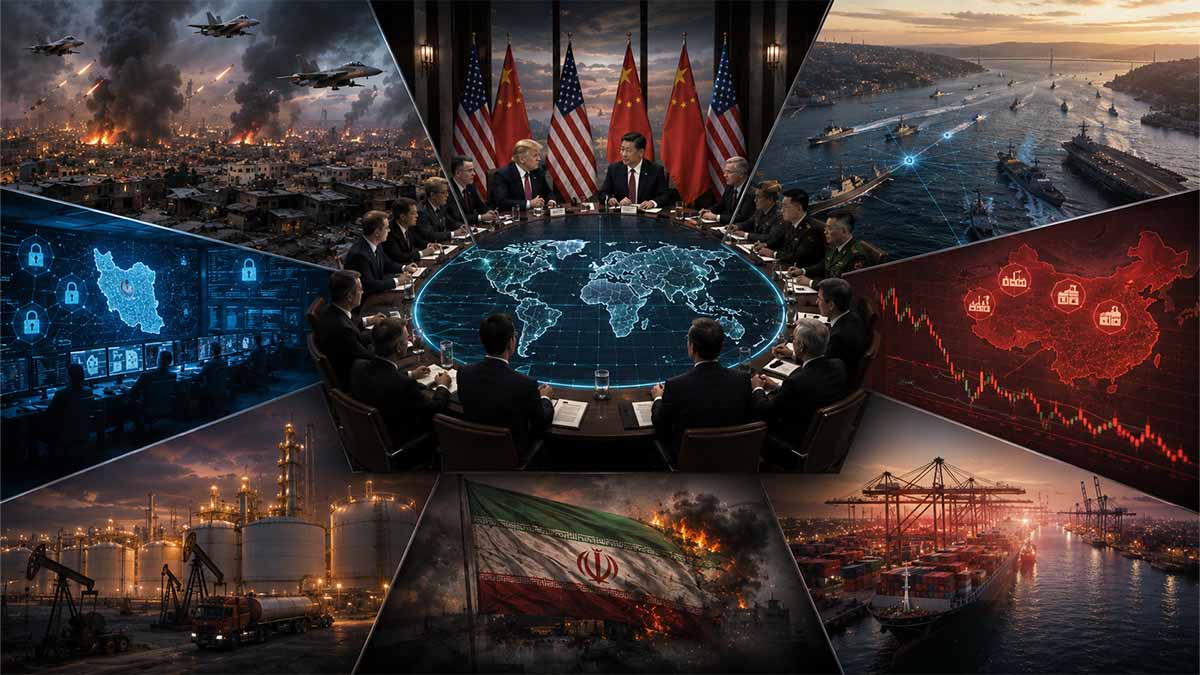
The confirmed 13–15 May 2026 Trump state visit to China occurs amid a deteriorating strategic environment shaped by unresolved conflict dynamics surrounding Iran, instability in the Strait of Hormuz, and escalating competition over critical mineral supply chains. U.S. President Donald J. Trump to Pay a State Visit to China – Ministry of Foreign Affairs of the People’s Republic of China – May 2026
Washington’s earlier deadlines demanding Iranian “unconditional surrender” did not produce strategic compliance. Instead, Tehran appears to have shifted toward an attritional negotiation framework designed to preserve nuclear latency, maintain maritime leverage, and exhaust coalition cohesion over time. Concurrently, Beijing’s export-control expansion on rare-earth materials has introduced a parallel economic pressure vector capable of imposing costs on U.S. defense-industrial and semiconductor sectors. Announcement No.18 of 2025 – Ministry of Commerce of the People’s Republic of China – April 2025
The intersection of these dynamics suggests that the summit is not merely diplomatic theater; it is a negotiation over competing coercive systems involving energy access, sanctions survivability, industrial resilience, and strategic time horizons.
Iran Ceasefire Drift and Strategic Leverage Conversion
A fragile ceasefire is functioning less as de-escalation than as a controlled bargaining environment where Tehran preserves leverage, tests U.S. thresholds, and converts time into negotiating advantage.
Deadline Credibility Erosion
Repeated U.S. red-line slippage signals that coercive deadlines are negotiable, encouraging Tehran to prolong talks while withholding nuclear, missile, and proxy concessions.
Hormuz Escalation Management
Maritime probes near the Strait convert tactical incidents into strategic pressure while remaining below the threshold likely to trigger decisive U.S. retaliation.
China Supply-Chain Leverage
Rare-earth dependency magnifies U.S. exposure by linking Middle East crisis management to defense-industrial fragility and broader U.S.–China coercive bargaining.
Iran will preserve ceasefire ambiguity, absorb limited strikes, exploit Hormuz leverage, and delay concessions until Washington’s political, energy, and China-linked supply-chain pressures force softer settlement terms.
Abstract
The present geopolitical environment surrounding the Iran ceasefire, the evolving U.S.–China strategic confrontation, and the confirmed May 2026 Trump–Xi summit represents not an isolated diplomatic episode but a convergence point between multiple systemic power-transition dynamics unfolding simultaneously across military, economic, technological, and cognitive domains. The strategic architecture emerging from these overlapping crises increasingly resembles a distributed contest over endurance, industrial survivability, maritime control, and escalation management rather than a traditional negotiation between clearly bounded adversaries.
China formally confirmed on 11 May 2026 that President Donald Trump will conduct a state visit to Beijing from 13–15 May 2026, marking the first U.S. presidential visit to China since 2017. U.S. President Donald J. Trump to Pay a State Visit to China – Ministry of Foreign Affairs of the People’s Republic of China – May 2026 The timing is strategically extraordinary because the summit occurs while the United States remains deeply entangled in a fragile Iran-related ceasefire environment centered around maritime security, sanctions enforcement, and energy-route stability in the Strait of Hormuz.
The ceasefire itself has not produced strategic convergence between Washington and Tehran. Instead, available indicators suggest the emergence of a prolonged bargaining environment in which Iran seeks to convert temporary operational restraint into structural negotiating leverage. The distinction is critical. Tehran does not appear to interpret the ceasefire as a prelude to capitulation; rather, it appears to interpret it as an opportunity to reshape the eventual settlement framework by exploiting asymmetries in political patience, coalition cohesion, and escalation tolerance.
The central operational pattern since the ceasefire began has consisted of repeated calibrated confrontations remaining below the threshold likely to trigger uncontrollable escalation. Maritime incidents near the Strait of Hormuz and the Gulf of Oman, including tanker seizures and naval exchanges, have repeatedly tested U.S. response thresholds while simultaneously preserving the formal continuity of the ceasefire itself. This pattern strongly resembles a classic controlled-escalation doctrine designed to accumulate psychological and strategic effects incrementally while avoiding a decisive retaliatory cascade.
The strategic significance of the Strait of Hormuz cannot be overstated. Approximately one-fifth of globally traded petroleum historically transits through the corridor, making it among the world’s most economically consequential maritime chokepoints. The corridor therefore functions simultaneously as an energy artery, coercive bargaining instrument, and escalation trigger. Any sustained disruption possesses immediate implications for inflationary pressure, maritime insurance pricing, energy futures volatility, and allied political cohesion.
At the same time, the Iran crisis increasingly intersects with a separate but structurally connected confrontation involving China’s expanding control over critical mineral supply chains. China’s export-control system evolved substantially during 2025 through multiple regulatory waves targeting medium and heavy rare-earth elements, associated technologies, and downstream manufactured products incorporating Chinese-origin inputs. Export controls on certain medium and heavy rare earth items – International Energy Agency – May 2025
The significance of these measures lies not merely in export restriction itself but in the emergence of explicit extraterritorial enforcement logic. Chinese regulatory measures introduced during 2025 expanded beyond direct exports into third-country manufactured products containing Chinese-origin rare-earth materials. China imposes extraterritorial jurisdiction and a 50% Rule on export controls for rare earth – White & Case – October 2025 This development fundamentally altered the strategic landscape because it transformed China’s dominance in mineral processing into a coercive mechanism capable of affecting global semiconductor manufacturing, defense supply chains, electric vehicle production, aerospace components, and advanced magnet systems simultaneously.
Multiple independent analyses indicate that China continues to dominate both rare-earth refining and permanent-magnet manufacturing capacity at a scale unmatched by any competitor. China’s rare-earth export restrictions – European Parliament – November 2025 This dominance produces asymmetric vulnerabilities inside the Western industrial ecosystem because many downstream systems—particularly advanced military platforms—depend on highly specialized magnetic materials with limited short-term substitution pathways.
Consequently, the strategic environment confronting Washington now includes two simultaneous chokepoint competitions: one maritime and one industrial. Iran can threaten energy transit. China can threaten industrial throughput. Both forms of leverage operate on different timelines but produce converging pressure effects against U.S. coalition management capacity.
The upcoming Trump–Xi summit therefore represents far more than bilateral diplomatic engagement. It is effectively an attempt to stabilize overlapping escalation spirals across three domains simultaneously: trade confrontation, Indo-Pacific military balance, and Middle Eastern energy security. Reuters reporting indicates that Washington intends to pressure Beijing to assist in maintaining navigational stability around the Strait of Hormuz, reflecting growing recognition that China’s dependence on Middle Eastern energy imports provides Beijing with potential influence over Tehran.
However, this logic cuts both directions. Beijing’s energy dependence creates incentives for stability, but China’s industrial leverage simultaneously grants it increased bargaining capacity vis-à-vis Washington. The resulting interaction resembles a multidimensional bargaining system rather than a traditional alliance structure.
From a strategic-analysis perspective, at least five mutually exclusive explanatory frameworks currently compete to explain Iran’s behavior and broader system dynamics.
- The first framework interprets Tehran’s conduct as a classic attritional bargaining strategy. Under this model, Iran believes time degrades U.S. coalition cohesion faster than it degrades Iranian regime survivability. Maritime provocations, delayed negotiations, and calibrated escalation are therefore designed to exhaust political patience while preserving leverage assets.
- The second framework interprets Iranian behavior primarily through deterrence psychology. Under this interpretation, Tehran assesses that demonstrating persistent operational resilience discourages future regime-change operations by increasing perceived costs and uncertainty. Controlled provocations thus become demonstrations of survivability rather than preparation for major escalation.
- The third framework views current dynamics through the lens of sanctions adaptation and economic survivability. Iran has spent years developing financial circumvention architectures involving regional intermediaries, shadow shipping networks, alternative payment structures, and informal energy-routing systems. The ceasefire may therefore function primarily as an economic stabilization mechanism enabling the reconstruction of sanctions-evasion capacity while avoiding direct confrontation.
- The fourth framework emphasizes intra-coalition fragmentation inside the Western alignment itself. Under this interpretation, Tehran’s objective is not military victory but alliance erosion. Rising oil prices, inflationary pressure, and extended military commitments may gradually weaken consensus among U.S. partners, thereby improving Iran’s negotiating position without requiring battlefield dominance.
- The fifth framework focuses on broader Eurasian realignment dynamics involving China and Russia. Tehran may increasingly view itself as embedded within a larger anti-sanctions ecosystem capable of mitigating Western coercive pressure over the long term. Under this model, ceasefire persistence allows Iran to synchronize its strategy with broader systemic transitions away from U.S.-centered financial and industrial architectures.
Each framework carries different policy implications and different escalation risks. Importantly, none require Iran to “win” conventionally. Instead, success under most frameworks consists merely of avoiding strategic collapse while shifting the eventual settlement baseline.
Simultaneously, Washington faces multiple forms of deadline pressure absent on the Iranian side. U.S. domestic political systems operate under compressed electoral and media cycles. Energy-price volatility carries immediate political consequences. Defense-industrial inventories face replenishment constraints. Maritime-security commitments require sustained operational expenditure. All of these factors create visible temporal pressure.
Iran’s political system, by contrast, historically demonstrates greater tolerance for extended hardship when leadership perceives strategic endurance itself as victory. This asymmetry may partially explain why Tehran appears more comfortable allowing negotiations to stretch indefinitely.
The interaction between these temporal asymmetries and China’s industrial leverage produces one of the most consequential strategic developments of the current period: the fusion of economic coercion and military deterrence into an integrated geopolitical operating environment.
China’s export-control expansion during 2025 represents a major step in this evolution. Official announcements by China’s Ministry of Commerce introduced increasingly sophisticated control systems governing not only minerals themselves but technologies, equipment, and downstream products. Announcement No.18 of 2025 – Ministry of Commerce of the People’s Republic of China – April 2025
Independent strategic analyses observed that these controls extended into foreign-manufactured products containing even trace quantities of controlled Chinese-origin rare-earth materials. China’s New Rare Earth and Magnet Restrictions Threaten US Defense Supply Chains – Center for Strategic and International Studies – October 2025
This matters because modern military systems—including precision-guided munitions, advanced radar systems, electric propulsion systems, and aerospace platforms—depend heavily on specialized magnets and mineral-processing chains concentrated inside China. As a result, economic statecraft increasingly intersects directly with military readiness.
The Iran theater amplifies these vulnerabilities because sustained regional instability elevates defense-industrial consumption rates precisely while industrial supply-chain resilience remains uncertain. In strategic terms, Washington faces the possibility of simultaneous operational strain and industrial constraint.
Another major consequence involves the evolution of sanctions lawfare. China’s anti-sanctions frameworks and extraterritorial countermeasures increasingly challenge the enforceability of U.S. secondary sanctions regimes. Reuters reporting notes that Beijing has intensified legal mechanisms opposing unilateral sanctions and extraterritorial enforcement practices.
This emerging legal contest is strategically important because sanctions efficacy historically depended on overwhelming dominance within the global financial architecture. As alternative payment systems, bilateral currency arrangements, and regional financial mechanisms expand, the coercive power of traditional sanctions may erode incrementally rather than collapse suddenly.
The current environment therefore resembles a transitional phase in international order construction. Traditional military superiority remains highly relevant, but coercive power increasingly depends on control over industrial bottlenecks, payment infrastructures, maritime insurance systems, satellite networks, logistics corridors, semiconductor ecosystems, and AI computational capacity.
Within this evolving landscape, the ceasefire’s persistence itself becomes strategically meaningful. A ceasefire that neither resolves nor collapses effectively creates a suspended bargaining zone in which both sides attempt to reshape future negotiating conditions without triggering uncontrollable escalation.
That ambiguity benefits Tehran insofar as it avoids immediate concessions while preserving leverage assets. It benefits Washington insofar as it avoids major regional war. Yet the same ambiguity simultaneously increases long-term uncertainty because unresolved crises accumulate structural pressure over time.
The resulting strategic equilibrium is therefore not stable peace but managed instability.
From a probabilistic forecasting perspective, several medium-term scenarios currently appear plausible.
- One scenario involves gradual de-escalatory normalization accompanied by partial sanctions relief and limited Iranian concessions. This would likely require external guarantors and extensive verification mechanisms.
- A second scenario involves prolonged low-intensity maritime confrontation combined with recurring economic disruptions and intermittent cyber escalation.
- A third scenario involves breakdown triggered by miscalculation in the Strait of Hormuz, potentially producing rapid energy-market shockwaves and accelerated military escalation.
- A fourth scenario involves broader geopolitical linkage in which trade negotiations, Taiwan tensions, and Iran diplomacy become partially integrated within U.S.–China bargaining structures.
- A fifth scenario involves the emergence of fragmented regional security architectures in which Gulf states increasingly pursue autonomous balancing strategies independent of U.S. strategic preferences.
At present, the second and fourth scenarios appear increasingly plausible because current evidence suggests all major actors remain interested in avoiding catastrophic escalation while simultaneously seeking leverage accumulation.
This dynamic produces a paradox central to the present geopolitical moment: the ceasefire survives precisely because none of the involved actors currently possess confidence that escalation would improve their position.
That reality does not indicate stability. It indicates mutual uncertainty.
And mutual uncertainty—when combined with maritime chokepoints, industrial coercion, nuclear latency, sanctions adaptation, AI-era strategic competition, and increasingly fragmented alliance systems—creates precisely the kind of environment in which small incidents can produce disproportionately large systemic consequences.
Index / Navigator
1. Strategic Deadline Failure and Iranian Temporal Warfare
- U.S. coercive signaling erosion
- Controlled escalation doctrine
- Maritime leverage architecture
- Hormuz survivability calculations
- Bayesian assessment of Iranian negotiating strategy
2. China’s Rare-Earth Weaponization and Industrial Coercion
- Export-control evolution during 2025–2026
- Extraterritorial enforcement mechanisms
- Defense-industrial dependency mapping
- Semiconductor and AI supply-chain vulnerabilities
- Strategic implications for Trump–Xi negotiations
3. Systemic Convergence: Energy, Sanctions, and Multipolar Escalation
- Maritime and industrial chokepoint fusion
- Sanctions-lawfare fragmentation
- Coalition fatigue and political entropy
- Eurasian balancing structures
- Forecast scenarios through 2027–2030
Energy, Sanctions, Maritime Pressure & Industrial Fragmentation
This dashboard synthesizes the complete geopolitical architecture described across all analytical chapters: Iranian temporal warfare, maritime escalation management, Chinese rare-earth coercion, sanctions fragmentation, AI-industrial dependency, Eurasian balancing systems, and multipolar escalation trajectories through 2030. The visualization framework maps how energy chokepoints, export-control systems, semiconductor vulnerabilities, and coalition fatigue increasingly interact as a single interconnected coercive ecosystem. :contentReference[oaicite:0]{index=0}
The current geopolitical environment is no longer organized around isolated regional conflicts. Maritime chokepoints, sanctions adaptation networks, industrial dependencies, AI infrastructure competition, and rare-earth coercion now operate as an interconnected escalation ecosystem. Iranian temporal warfare, Chinese industrial leverage, and coalition fatigue collectively accelerate a transition toward prolonged multipolar instability rather than decisive strategic resolution.
Tanker seizures, insurance escalation, GPS interference, and naval signaling generate systemic uncertainty across global energy distribution networks.
Chinese refining dominance creates industrial dependency affecting aerospace, semiconductors, AI cooling systems, robotics, and defense production.
Compute scaling increasingly depends upon semiconductor continuity, energy reliability, and strategic-material availability.
Local-currency settlement systems, shadow fleets, and alternative payment mechanisms gradually reduce coercive efficiency.
Diverging economic priorities and prolonged escalation management accelerate political entropy inside alliance structures.
China, Russia, Iran, Gulf states, and BRICS-aligned actors increasingly pursue selective coordination against concentrated Western leverage.
| Scenario | Probability | Core Drivers | Strategic Consequence | Escalation Risk |
|---|---|---|---|---|
| Managed Fragmentation | High | Partial decoupling, maritime friction, sanctions adaptation | Long-duration competitive instability without direct great-power war | Moderate |
| Bloc Acceleration | Moderate-High | Rare-earth controls, semiconductor bifurcation, Taiwan stress | Parallel financial and industrial ecosystems emerge | High |
| Energy Shock Cascade | Moderate | Hormuz incident, tanker disruption, LNG instability | Inflationary shock and sovereign-debt pressure expansion | Very High |
| Adaptive Détente | Low-Moderate | Controlled export frameworks and maritime deconfliction | Reduced escalation volatility but persistent systemic distrust | Low |
| Systemic Cascade Failure | Low | Simultaneous cyber, maritime, financial, and AI disruption | Global nonlinear destabilization beyond institutional management capacity | Extreme |
Chapter 1: Strategic Deadline Failure and Iranian Temporal Warfare — Adaptive Coercion Collapse, Maritime Persistence Architecture, and Bayesian Delay Optimization Inside the Hormuz Battlespace
The defining structural development of the present confrontation between Iran and the United States is not battlefield momentum, nor formal diplomatic breakthrough, nor even escalation management itself. The defining development is the measurable degradation of coercive deadline credibility across multiple operational theaters simultaneously. What has emerged since the collapse of sequential American ultimatum cycles is a form of temporal asymmetry in which one actor increasingly experiences political and strategic time compression while the other converts elapsed time into leverage accumulation.
This asymmetry is observable through institutional behavior, maritime operational tempo, nuclear-monitoring trajectories, sanctions adaptation patterns, and alliance-response elasticity. The pattern does not require Iran to achieve military superiority. It merely requires Tehran to avoid irreversible strategic degradation long enough for adversarial cohesion costs to rise beyond politically sustainable thresholds.
The first major indicator of this shift appeared through the widening divergence between declaratory coercive language and subsequent enforcement behavior. The U.S. Department of State issued elevated worldwide security warnings on 22 March 2026, specifically warning that “Groups supportive of Iran may target other U.S.” facilities and interests abroad. Worldwide Caution – U.S. Department of State – March 2026 The significance of the warning was not merely operational. Such alerts function as indirect strategic signaling mechanisms intended simultaneously for domestic audiences, allied governments, maritime insurers, and adversarial intelligence systems.
Yet strategic signaling depends not only on declaratory posture but on consistent threshold enforcement. Once deadlines are announced and subsequently diluted or bypassed, adversarial decision systems begin recalibrating around perceived escalation reluctance rather than declared escalation willingness. This recalibration process is central to understanding the evolution of Iranian negotiating conduct.
The resulting phenomenon resembles what RAND-style escalation theory historically categorizes as “coercive elasticity collapse”: the point at which repeated ultimatum modification begins reducing deterrent marginal utility rather than increasing compliance probability. Tehran appears increasingly confident that calibrated escalation can proceed beneath the threshold of decisive retaliation because multiple earlier escalation windows failed to generate terminal enforcement behavior.
This perception is reinforced by maritime operational patterns around the Strait of Hormuz. The International Maritime Organization repeatedly issued statements throughout 2025–2026 warning about threats to shipping in the Arabian Sea, Gulf region, and Hormuz corridor. Statements by the IMO Secretary-General – International Maritime Organization – 2026 The accumulation of such alerts matters strategically because maritime-security advisories influence global shipping insurers, commodity futures markets, tanker routing behavior, and naval-force readiness calculations simultaneously.
Unlike conventional land escalation, maritime escalation in chokepoints operates through probabilistic disruption rather than territorial seizure. The objective is not necessarily closure of the Strait itself. The objective is increasing uncertainty around transit reliability sufficiently to alter insurance pricing, naval deployment density, and global energy expectations.
This distinction is frequently misunderstood in public analysis. Complete closure of the Strait of Hormuz would likely trigger overwhelming multinational response and impose severe costs on Iran itself. Tehran therefore appears to pursue a more sophisticated doctrine: intermittent friction calibrated to preserve uncertainty without producing irreversible escalation.
The operational architecture of this approach resembles what intelligence doctrine often describes as “controlled instability management.” Rather than maximizing violence, the strategy maximizes ambiguity regarding future escalation thresholds. Each limited incident becomes a signaling event testing response elasticity.
The IMO Secretary-General explicitly warned in April 2026 that “fragmented responses are no longer sufficient.” Middle East – International Maritime Organization – April 2026 That language is analytically significant because it indicates growing institutional recognition that repeated low-intensity disruptions were producing cumulative systemic effects despite absence of full-scale war.
The maritime domain is especially vulnerable to this strategy because commercial shipping systems operate on risk-adjusted expectations rather than purely physical interruption. A tanker route does not need to become inaccessible to become strategically destabilized. It merely needs to become unpredictably expensive, intermittently threatened, or politically uncertain.
The maritime-insurance dimension therefore becomes critical. Insurance premiums, rerouting costs, escort requirements, and port-security expenditures collectively function as indirect economic multipliers amplifying even minor operational incidents. Consequently, Iran’s leverage derives not solely from physical naval capability but from its ability to inject uncertainty into globally interconnected logistical systems.
This is precisely why the IMO repeatedly emphasized seafarer welfare and maritime continuity throughout 2025–2026. International Maritime Organization – IMO – 2026 Such institutional emphasis reflects concern that cumulative instability can gradually erode confidence in navigational security even absent catastrophic attacks.
Simultaneously, Iran’s nuclear trajectory continued reshaping the broader strategic environment. The IAEA Director General stated on 3 March 2025 that Iran’s stockpile of uranium enriched up to 60% U-235 increased from 182 kg to 275 kg within a single reporting cycle. IAEA Director General’s Introductory Statement to the Board of Governors – International Atomic Energy Agency – March 2025
The importance of this increase lies less in immediate weaponization and more in strategic latency. Nuclear latency changes bargaining dynamics because it compresses adversarial decision timelines while preserving ambiguity regarding final intent. Tehran does not necessarily require declared weaponization to alter regional power calculations. It merely requires sufficiently advanced enrichment capability to maintain persistent strategic uncertainty.
The IAEA subsequently confirmed that Iran remained the “only non-nuclear weapon State enriching to this level.” IAEA Director General’s Introductory Statement to the Board of Governors – International Atomic Energy Agency – March 2025
This nuclear dimension intersects directly with maritime strategy because both operate according to the same underlying temporal logic: prolong uncertainty while avoiding irreversible trigger points.
The interaction between these domains becomes even more consequential when examining survivability calculations surrounding the Fordow and Natanz facilities. The IAEA Director General stated on 23 June 2025 that “craters are now visible at the Fordow site” following attacks involving ground-penetrating munitions. IAEA Director General’s Introductory Statement to the Board of Governors – International Atomic Energy Agency – June 2025
However, the same statement noted that no actor—including the IAEA itself—was in position to fully assess underground damage. This uncertainty is strategically central. Underground infrastructure creates ambiguity regarding residual capability, thereby preserving deterrence value even after kinetic attack.
Iran’s dispersed enrichment architecture further complicates coercive strategy. The IAEA reported on 27 February 2026 that Iran had previously notified the Agency regarding a new enrichment facility at Isfahan Fuel Enrichment Plant (IFEP). NPT Safeguards Agreement with the Islamic Republic of Iran – International Atomic Energy Agency – February 2026
Distributed infrastructure alters escalation mathematics because it raises the operational cost of achieving decisive degradation. Redundancy increases survivability. Survivability increases bargaining confidence. Bargaining confidence extends negotiation timelines.
This dynamic feeds directly into Bayesian assessments of Iranian negotiating behavior.
Using Bayesian updating methodology, Tehran’s strategic confidence appears to have increased after each major coercive threshold passed without irreversible escalation. Each avoided escalation outcome acts as a probabilistic reinforcement signal inside Iranian strategic decision systems.
The updating sequence likely operates approximately as follows:
| Event | Iranian Bayesian Interpretation | Strategic Effect |
|---|---|---|
| Initial ultimatum issuance | High escalation probability | Temporary caution |
| Ultimatum passes without decisive action | Reduced escalation confidence | Increased operational boldness |
| Maritime incidents absorbed without major retaliation | Escalation threshold perceived higher | Expanded tactical probing |
| Negotiations continue despite provocations | Time judged favorable to Tehran | Delay strategy reinforced |
| Coalition fatigue indicators emerge | Endurance strategy validated | Long-duration bargaining prioritized |
This form of probabilistic learning is not ideological; it is adaptive. Strategic systems continuously update based on observed response behavior rather than declaratory rhetoric.
Importantly, at least five mutually exclusive explanatory frameworks remain plausible regarding Tehran’s true objectives.
- The first framework interprets Iran’s behavior as fundamentally defensive. Under this model, Tehran believes regime survival depends on preserving strategic ambiguity while avoiding full confrontation. Controlled escalation therefore functions primarily as deterrence reinforcement.
- The second framework interprets Iran’s strategy as revisionist but limited. Here, Tehran seeks expanded regional influence and sanctions relief without triggering direct regime-threatening war. Maritime pressure becomes bargaining leverage rather than preparation for conquest.
- The third framework views the strategy as domestically oriented. Under this interpretation, prolonged resistance strengthens internal regime legitimacy by demonstrating refusal to capitulate under external pressure.The fourth framework emphasizes alliance fragmentation. Iran may calculate that sustained low-level instability eventually weakens cohesion among U.S., European, and Gulf partners whose economic interests diverge under prolonged disruption.
- The fifth framework interprets Iranian conduct through broader Eurasian strategic coordination involving China and Russia. Under this scenario, Tehran functions partly as a node within larger anti-sanctions adaptation architectures designed to erode Western coercive dominance incrementally over time.
Each framework implies different escalation probabilities.
The alliance-fragmentation framework currently appears especially relevant given mounting concerns regarding shipping continuity and energy security. The IMO warned in April 2026 that around 20,000 seafarers were directly impacted by disruptions in the region. Middle East – International Maritime Organization – April 2026
This statistic is operationally important because it illustrates how even limited maritime instability creates cascading effects across labor systems, logistics chains, insurance markets, and commercial scheduling networks.
- Iran’s leverage architecture therefore functions less like conventional naval dominance and more like systemic friction generation.
- The distinction between dominance and friction is essential.
- Dominance requires control. Friction merely requires persistent disruption capability.
- Friction-based leverage is significantly cheaper to sustain.
- That cost asymmetry matters enormously in long-duration confrontation environments.
The same asymmetry appears within cyber and electronic warfare dimensions. The IMO Current Awareness Bulletin for March 2025 documented repeated reports of GPS interference within the Strait of Hormuz region. Current Awareness Bulletin March 2025 – International Maritime Organization – March 2025
- Electronic interference operations possess outsized strategic utility because attribution remains difficult while disruption effects can be substantial. Even temporary navigational interference increases transit uncertainty and operational costs.
- This contributes to what can be termed “cumulative ambiguity pressure”: the gradual layering of uncertainty across multiple operational dimensions simultaneously.
- Rather than seeking decisive battlefield victory, Iran appears increasingly focused on shaping the psychological environment surrounding escalation itself.
- Such approaches align closely with doctrines of Non-Linear Warfare, in which political, economic, informational, maritime, cyber, and diplomatic pressures interact continuously rather than sequentially.
The role of intermediary capitals also deserves examination. The increasing reliance on indirect negotiation channels through regional mediators indicates that direct bilateral trust remains deeply constrained. Indirect diplomacy lengthens timelines inherently because signaling becomes filtered through multiple interpretive layers.
Longer timelines disproportionately benefit actors pursuing endurance strategies.
This temporal advantage becomes even more significant when considered alongside American domestic political compression cycles. Electoral systems generate visible deadlines. Energy-price sensitivity creates rapid public-feedback loops. Coalition management requires continual reassurance. All these dynamics impose time pressure on Washington.
Iran’s political system operates differently. While internal pressures certainly exist, the governing structure historically demonstrates greater tolerance for prolonged hardship when leadership frames endurance itself as resistance success.
- This asymmetry creates divergent strategic clocks.
- One side increasingly experiences urgency.
- The other increasingly weaponizes patience.
- The implications extend beyond the Middle East.
The persistence of unresolved escalation environments contributes to broader global perceptions regarding the future enforceability of American coercive guarantees. Strategic observers across multiple theaters—including the South China Sea, Taiwan Strait, and Eastern Europe—closely monitor whether declaratory red lines consistently translate into enforceable operational thresholds.
Thus, the Iran confrontation increasingly functions as a signaling theater affecting wider perceptions of global deterrence credibility.
The nuclear dimension amplifies this effect further.
The IAEA reported in September 2025 that Iran’s total enriched uranium stockpile reached 9874.9 kg, representing an increase of 627.3 kg over the previous quarter. GOV/2025/50 – International Atomic Energy Agency – September 2025
This accumulation trajectory matters because enrichment capability possesses compounding strategic value. Each incremental increase shortens theoretical breakout timelines while simultaneously increasing diplomatic urgency among adversaries.
Yet urgency itself can become destabilizing.
If adversaries perceive narrowing timelines while simultaneously doubting escalation willingness, the resulting strategic environment becomes increasingly volatile.
This is precisely the environment now emerging around the Hormuz theater.
The central paradox is therefore clear:
The ceasefire survives not because coercive stability has been restored, but because all major actors currently fear that escalation could produce outcomes even less controllable than the present ambiguity.
That condition constitutes managed instability, not strategic resolution.
And managed instability, historically, tends to degrade gradually until either a political breakthrough or a systemic shock fundamentally alters the underlying calculus.
Chapter 2: China’s Rare-Earth Weaponization and Industrial Coercion — Export-Control Sovereignty, Extraterritorial Supply-Chain Jurisdiction, and the Strategic Reconfiguration of AI-Era Industrial Power
The most consequential structural transformation in the international coercive environment during 2025–2026 has not emerged from conventional military deployments alone, but from the progressive conversion of industrial supply-chain dominance into a formalized geopolitical enforcement architecture centered on strategic minerals, advanced magnet systems, semiconductor fabrication dependencies, and artificial-intelligence compute infrastructures. The center of gravity of this transformation is the accelerating institutionalization of Chinese rare-earth leverage as a multidimensional coercive instrument integrating export regulation, extraterritorial jurisdiction, industrial chokepoint control, and technological dependency management into a unified statecraft doctrine.
The strategic significance of this evolution cannot be reduced merely to mining output percentages or commodity-market concentration. The decisive variable is downstream processing dominance combined with integration into advanced manufacturing ecosystems. According to the United States Geological Survey, China remained the world’s largest producer of rare-earth materials in 2025 with approximately 270,000 metric tons of mined production. Mineral Commodity Summaries 2025: Rare Earths – United States Geological Survey – January 2025 However, mining volume alone understates the strategic imbalance because China simultaneously dominates refining, separation chemistry, oxide conversion, alloying, sintering, and permanent-magnet manufacturing capacities.
This vertical integration structure creates a dependency architecture substantially more difficult to replace than raw extraction itself. Multiple Western states possess exploitable deposits, yet few possess commercially scalable heavy rare-earth separation systems or industrialized neodymium-iron-boron magnet supply chains capable of sustaining advanced defense-industrial production independently.
The geopolitical importance of these materials intensified sharply after the implementation of successive Chinese export-control expansions during 2025. On 4 April 2025, the Ministry of Commerce of the People’s Republic of China formally announced export controls on several medium and heavy rare-earth elements including samarium, gadolinium, terbium, dysprosium, lutetium, scandium, and yttrium-related items. Announcement No.18 of 2025 – Ministry of Commerce of the People’s Republic of China – April 2025
The language of the announcement is analytically significant because it explicitly frames the controls through the doctrine of “national security and interests” while simultaneously invoking international non-proliferation obligations. This dual framing allows Beijing to normalize industrial restrictions within a broader sovereign-security paradigm increasingly mirrored across multiple domains including semiconductors, quantum systems, aerospace technologies, and advanced lithography equipment.
The strategic novelty of the 2025 measures lies not merely in restricting exports but in expanding jurisdictional logic beyond direct Chinese transactions into downstream third-country supply chains. This marks a transition from territorial export governance toward functional supply-chain sovereignty.
The enforcement architecture increasingly resembles financial-sanctions systems previously associated primarily with American extraterritorial policy instruments. Yet unlike dollar-clearing enforcement, rare-earth leverage targets physical industrial continuity itself.
This distinction is fundamental.
Financial sanctions can theoretically be circumvented through alternative clearing systems, bilateral settlement arrangements, or cryptocurrency pathways. Advanced magnet shortages, by contrast, directly affect manufacturing capacity for missile-guidance systems, radar arrays, electric propulsion systems, wind turbines, aerospace actuators, and AI-relevant data-center infrastructure.
The strategic consequences therefore extend beyond trade friction into national-security planning horizons.
The European Parliament formally warned in late 2025 that China maintained near-monopolistic influence across multiple rare-earth processing stages and magnet manufacturing chains. China’s Rare-Earth Export Restrictions – European Parliament – November 2025 The report emphasized that rare-earth restrictions could directly affect electric vehicles, robotics, wind energy systems, and defense applications simultaneously.
The convergence of civilian and military dependence creates what strategic planners increasingly classify as “dual-use coercive entanglement.” Under this condition, economic disruption cannot easily remain confined to civilian markets because industrial ecosystems supporting consumer technologies and military platforms overlap structurally.
This overlap is especially severe in advanced magnet systems.
Dysprosium and terbium are critical for maintaining magnetic stability at elevated temperatures inside high-performance electric motors and military systems. Samarium-cobalt magnets remain essential for aerospace and defense applications requiring extreme durability under thermal stress. Consequently, supply disruptions possess disproportionate effects on weapons-system reliability and aerospace manufacturing continuity.
The U.S. Department of Defense has repeatedly identified strategic-mineral vulnerabilities as a national-security concern. The 2025 Industrial Capabilities Report warned that critical-mineral supply concentration continues to threaten defense manufacturing resilience across multiple sectors including precision-guided munitions, naval propulsion, and aerospace electronics. Industrial Capabilities Report – U.S. Department of Defense – 2025
The report’s broader significance lies in its acknowledgment that industrial dependencies themselves now constitute potential strategic vulnerabilities equivalent to logistical choke points or military basing constraints.
This represents a major doctrinal shift.
Historically, industrial globalization was treated primarily as an efficiency-maximization system. Increasingly, states are treating industrial geography as a coercive battlespace.
China’s export-control expansion therefore reflects not an isolated trade maneuver but the institutionalization of “industrial deterrence theory”: the use of supply-chain indispensability to shape adversarial strategic calculations.
The implications for semiconductor systems are especially severe because advanced chip manufacturing depends upon a globally fragmented ecosystem with multiple single-point dependencies. Semiconductor production requires highly specialized minerals, ultrapure chemicals, advanced lithography systems, precision robotics, and stable energy infrastructure simultaneously.
The U.S. Department of Commerce emphasized in 2025 that semiconductor supply chains remain highly concentrated and vulnerable to disruption. National Strategy on Microelectronics Research – U.S. Department of Commerce – 2025
Rare-earth restrictions interact with semiconductor vulnerabilities through multiple channels simultaneously:
| Dependency Domain | Rare-Earth Relevance | Strategic Risk |
|---|---|---|
| Lithography precision systems | Specialized magnetic assemblies | Manufacturing slowdown |
| AI server cooling systems | High-efficiency motors | Compute-capacity constraints |
| Robotics and automation | Permanent magnets | Factory throughput degradation |
| Aerospace semiconductors | Radiation-resistant systems | Defense delays |
| Data-center infrastructure | Grid and motor systems | AI scaling friction |
The interaction between AI competition and rare-earth supply chains is particularly important because artificial intelligence increasingly functions as a strategic infrastructure layer rather than merely a software sector.
Large-scale AI deployment depends upon hyperscale data centers, high-density power systems, advanced cooling architectures, semiconductor fabrication continuity, and electrical-grid resilience simultaneously. Rare-earth materials contribute directly or indirectly to many of these systems.
Thus, Chinese leverage extends beyond traditional manufacturing into the future computational hierarchy itself.
This is strategically transformative.
The global AI race is often framed primarily through compute power, algorithmic capability, and semiconductor fabrication. Yet underlying all three domains is industrial-material continuity.
Without stable industrial throughput, AI scaling slows.
Without AI scaling, military modernization slows.
Without military modernization, deterrence structures evolve.
China therefore appears increasingly focused on controlling not merely commodities but escalation pathways within future technological competition.
This logic became more explicit following the implementation of China’s revised anti-foreign sanctions and export-control coordination mechanisms during 2025–2026. Beijing repeatedly emphasized opposition to “unjustified extraterritorial measures.” Regulations Against Unjustified Extraterritorial Measures – Ministry of Commerce of the People’s Republic of China – 2025
The strategic irony is substantial.
For decades, the United States exercised unmatched leverage through financial extraterritoriality tied to dollar clearing, SWIFT access, sanctions compliance, and secondary enforcement. China is now constructing an industrial equivalent grounded not in currency dominance but in material indispensability.
This emerging architecture can be termed “supply-chain jurisdictional warfare.”
The core principle is simple: if industrial systems depend upon your processing infrastructure, your regulatory reach extends beyond territorial boundaries.
This framework explains why Beijing increasingly targets products containing even partial Chinese-origin rare-earth inputs. The objective is not solely export reduction. The objective is preserving coercive visibility across global manufacturing ecosystems.
- Such visibility possesses immense intelligence value.
- Supply-chain licensing systems reveal downstream industrial relationships, technological priorities, procurement networks, and defense-production trajectories.
- Export governance thus becomes simultaneously an economic, strategic, and intelligence instrument.
- The implications for the upcoming Trump–Xi negotiations are profound.
- The summit occurs under conditions where both powers increasingly recognize each other’s ability to impose asymmetric systemic costs without direct military confrontation.
- Washington retains advantages in alliance networks, financial systems, naval projection, and advanced semiconductor design.
- Beijing retains advantages in industrial throughput, mineral processing, manufacturing scale, and supply-chain centrality.
- Neither side currently possesses a clean escalation pathway without major self-inflicted costs.
- This mutual vulnerability structure creates a strategic environment resembling “interdependent coercive parity.”
- Under such conditions, negotiations become less about resolving disputes than about managing escalation ceilings.
Rare-earth leverage strengthens Beijing’s negotiating position because it affects not only commercial sectors but future military-industrial trajectories. U.S. policymakers understand that rebuilding full-spectrum domestic rare-earth ecosystems could require many years of capital-intensive investment, environmental permitting, workforce expansion, and technological scaling.
- Time therefore favors the incumbent processor.
- That temporal advantage mirrors, in different form, the same strategic dynamic visible in the Iran ceasefire environment.
- One actor leverages endurance.
- The other confronts compressed timelines.
- The interaction between these theaters is not coincidental.
The convergence of maritime instability in the Strait of Hormuz, industrial coercion through rare-earth governance, and AI-era technological competition suggests that the global system is entering a phase where chokepoints—whether geographic, industrial, computational, or financial—constitute the primary terrain of geopolitical power.
Military superiority alone no longer guarantees escalation dominance if adversaries control critical systemic bottlenecks.
That realization increasingly defines the strategic logic of the current era.
Chapter 3: Systemic Convergence — Maritime Chokepoint Fusion, Sanctions Fragmentation, Eurasian Strategic Recomposition, and Multipolar Escalation Forecasts Through 2030
The geopolitical system entering the late 2020s is no longer organized around isolated regional crises operating independently from one another. Instead, the defining strategic feature of the present era is systemic convergence: the progressive fusion of energy insecurity, industrial dependency, sanctions fragmentation, technological competition, maritime coercion, financial adaptation networks, and alliance entropy into a single interconnected escalation architecture. The operational significance of this convergence lies in the fact that disruptions within one domain now cascade rapidly across multiple others, producing compound instability effects significantly greater than the initiating event itself.
This transformation is especially visible through the merging of maritime and industrial chokepoints into an integrated coercive battlespace. Historically, maritime chokepoints such as the Strait of Hormuz, the Bab el-Mandeb, the Suez Canal, and the Malacca Strait primarily influenced energy transit and naval maneuverability. Industrial chokepoints, by contrast, concerned manufacturing concentration and trade dependencies. During 2025–2026 these two systems increasingly fused into a singular strategic architecture where disruption of physical shipping corridors and disruption of critical industrial inputs reinforce one another recursively.
The U.S. Energy Information Administration continued to classify the Strait of Hormuz as the world’s most important oil transit chokepoint, with approximately 20 million barrels per day historically transiting the corridor. World Oil Transit Chokepoints – U.S. Energy Information Administration – June 2024 However, the contemporary significance of the Strait extends beyond crude-oil transport itself. Increasingly, Hormuz functions as a strategic pressure valve affecting LNG shipping, insurance markets, sovereign debt expectations, tanker financing, and industrial-input continuity across Asia and Europe simultaneously.
At the same time, China’s consolidation of rare-earth processing and strategic-material governance transformed industrial supply chains into geopolitical leverage systems capable of generating effects analogous to maritime blockade pressure. The strategic novelty lies in the interaction between the two domains. Maritime instability increases transportation costs and delivery uncertainty for industrial inputs precisely while export-control systems reduce substitutability and flexibility inside manufacturing networks.
This interaction creates what can be termed “compound chokepoint dependency.”
Under compound dependency conditions, states cannot stabilize one strategic domain independently because disruptions propagate laterally through interconnected systems. For example, elevated insurance premiums resulting from Gulf instability increase logistics costs for semiconductor manufacturing supply chains already under pressure from rare-earth restrictions and export licensing requirements. Semiconductor production delays subsequently affect AI infrastructure deployment, military modernization schedules, and advanced manufacturing output.
Thus, maritime insecurity and industrial coercion no longer operate as separate categories of geopolitical pressure. They function as mutually amplifying mechanisms.
The International Monetary Fund warned in its World Economic Outlook Update that geopolitical fragmentation could significantly reduce global economic output through trade segmentation, supply-chain duplication, and investment uncertainty. World Economic Outlook Update – International Monetary Fund – January 2025 The IMF’s assessment is especially important because it reflects growing institutional recognition that fragmentation itself now constitutes a macroeconomic force multiplier.
Fragmentation also increasingly affects sanctions architecture.
For more than two decades, sanctions enforcement depended heavily on overwhelming concentration within Western-controlled financial systems. Access to dollar-clearing infrastructure, SWIFT messaging systems, correspondent banking, and Western insurance markets granted the United States and allied states extraordinary extraterritorial enforcement power.
Yet during 2025–2026 the cohesion underlying this architecture showed increasing signs of stress.
The expansion of Chinese anti-sanctions frameworks, Russian alternative payment systems, Gulf-state hedging strategies, and bilateral local-currency settlement agreements collectively accelerated the emergence of sanctions-lawfare fragmentation.
The Ministry of Commerce of the People’s Republic of China reaffirmed in 2025 the implementation of regulations designed to counter “unjustified extraterritorial application of foreign legislation.” Regulations on Counteracting Unjustified Extraterritorial Application of Foreign Legislation and Other Measures – Ministry of Commerce of the People’s Republic of China – January 2025
The strategic significance of these measures extends far beyond legal symbolism. China’s approach increasingly seeks to establish parallel regulatory legitimacy rather than merely resist Western sanctions episodically. This produces overlapping legal jurisdictions in which multinational corporations confront contradictory compliance obligations across competing geopolitical blocs.
Such fragmentation weakens sanctions efficiency because enforcement depends heavily upon uniformity, predictability, and coalition-wide compliance incentives.
Once major economic actors begin constructing alternative systems, sanctions evolve from universal coercive instruments into contested geopolitical terrains.
Russia’s financial adaptation after 2022 accelerated this trend substantially. The Bank for International Settlements observed increased experimentation with alternative cross-border payment infrastructures and local-currency settlement mechanisms. BIS Annual Economic Report – Bank for International Settlements – June 2025
The broader implication is that sanctions no longer produce purely linear pressure effects.
Instead, sanctions increasingly generate adaptive responses including:
| Adaptive Mechanism | Strategic Function | Long-Term Consequence |
|---|---|---|
| Local-currency trade | Reduce dollar exposure | Financial multipolarity |
| Shadow shipping fleets | Evade maritime enforcement | Insurance fragmentation |
| Commodity barter systems | Circumvent banking restrictions | Parallel trade ecosystems |
| Digital payment experimentation | Reduce SWIFT dependence | Regulatory bifurcation |
| State-backed industrial subsidies | Offset export restrictions | Bloc-based industrialization |
These adaptation pathways do not eliminate sanctions effectiveness immediately. However, they progressively reduce marginal coercive returns over time.
This dynamic is central to understanding coalition fatigue.
Coalition fatigue emerges when the cumulative costs of sustaining pressure exceed the perceived probability of achieving decisive strategic outcomes. During prolonged crises, coalition members increasingly diverge regarding acceptable risk tolerance, energy pricing, trade exposure, military expenditure, and domestic political priorities.
The International Energy Agency warned in 2025 that supply-chain concentration and geopolitical instability together were increasing energy-transition vulnerabilities. Global Critical Minerals Outlook 2025 – International Energy Agency – May 2025 This warning highlights a profound paradox inside Western coalition structures: many states simultaneously seek rapid decarbonization, strategic autonomy, industrial resilience, and sanctions enforcement despite depending heavily upon globally concentrated supply chains.
Such objectives increasingly conflict operationally.
European industrial sectors, for example, remain highly sensitive to energy pricing and manufacturing input continuity. Prolonged disruptions involving maritime transit, LNG markets, or rare-earth supply chains therefore generate internal political pressure against indefinite confrontation strategies.
This pressure contributes to political entropy.
Political entropy, in strategic terms, refers to the gradual degradation of unified policy coherence under prolonged systemic stress. Unlike sudden alliance collapse, entropy manifests incrementally through diverging rhetoric, uneven enforcement, domestic opposition movements, selective compliance behavior, and growing prioritization of national over coalition interests.
The erosion is cumulative rather than dramatic.
This process is already visible across multiple theaters simultaneously:
- Divergent European approaches toward industrial de-risking versus decoupling from China.
- Gulf-state balancing behavior between Washington and Beijing.
- Expanding BRICS institutional coordination.
- Increased use of bilateral energy agreements denominated outside traditional Western financial systems.
- Growing reluctance among Global South states to align fully with sanctions-based enforcement structures.
The enlargement of BRICS during 2024–2025 accelerated Eurasian balancing dynamics significantly. The grouping expanded to include additional major energy producers and strategically positioned regional actors. BRICS Expansion Documentation – Ministry of Foreign Affairs of the Russian Federation – January 2025 Although BRICS remains institutionally heterogeneous, its expansion reflects broader dissatisfaction with concentration of systemic governance authority inside Western institutions.
- Importantly, Eurasian balancing structures do not necessarily require ideological alignment.
- They require only convergent incentives.
- China seeks supply-chain security and reduced vulnerability to maritime interdiction.
- Russia seeks sanctions adaptation and geopolitical survivability.
- Iran seeks regime endurance and economic access.
- Gulf states seek strategic hedging flexibility.
- India seeks multi-alignment maximizing strategic autonomy.
- These incentives differ substantially yet overlap sufficiently to produce partial coordination against excessive concentration of Western coercive leverage.
- The result is not a formal anti-Western bloc in Cold War terms. Rather, it is a fluid balancing ecosystem characterized by selective cooperation, transactional alignment, and strategic ambiguity.
- This ambiguity complicates deterrence because adversaries cannot easily calculate coalition cohesion under crisis conditions.
- Simultaneously, technological competition increasingly interacts with these geopolitical shifts.
Artificial intelligence infrastructure, quantum-computing research, satellite systems, cyber capabilities, and semiconductor manufacturing all require stable industrial ecosystems, energy continuity, and rare-earth access. Consequently, technological competition becomes inseparable from resource geopolitics and maritime security.
The National Science and Technology Council of the United States emphasized in 2025 that secure semiconductor supply chains and advanced manufacturing ecosystems constitute national-security priorities. National Strategy for Advanced Manufacturing – Executive Office of the President of the United States – 2025
- This reflects an emerging strategic consensus: technological superiority cannot be maintained independently from industrial geography.
- Industrial geography, in turn, depends on maritime continuity and geopolitical stability.
- Thus, all major strategic domains increasingly converge.
- Forecast modeling through 2027–2030 suggests several plausible escalation pathways.
The first scenario involves “managed fragmentation.” Under this pathway, geopolitical competition intensifies but remains below direct great-power war thresholds. Global trade partially regionalizes. Supply chains diversify incrementally. Sanctions systems persist but lose universal reach. Maritime incidents continue intermittently without catastrophic escalation. This scenario currently appears the highest-probability outcome.
The second scenario involves “bloc acceleration.” Here, Taiwan-related tensions, Middle Eastern instability, and intensified export restrictions produce rapid bifurcation of technology ecosystems and financial systems into competing geopolitical blocs. AI and semiconductor systems become increasingly securitized.
The third scenario involves “energy shock escalation.” A major maritime incident in the Gulf or Indo-Pacific triggers severe energy disruptions, inflation spikes, sovereign-debt stress, and accelerated military mobilization. Under this scenario, coalition cohesion would experience significant strain.
The fourth scenario involves “adaptive détente.” Strategic actors gradually recognize the unsustainable costs of fragmentation and pursue limited stabilization frameworks involving export-control management, maritime deconfliction mechanisms, and partial sanctions accommodation.
The fifth scenario—lower probability but highest impact—involves “systemic cascade failure.” Under this pathway, simultaneous shocks across energy markets, cyber infrastructure, semiconductor systems, and financial networks produce rapid destabilization exceeding institutional response capacity.
Current indicators suggest the international system is drifting toward prolonged competitive instability rather than immediate systemic collapse.
However, the cumulative interaction between maritime chokepoints, industrial coercion, sanctions fragmentation, and technological competition significantly increases nonlinear escalation risk.
That risk does not emerge from a single event alone.
It emerges from the convergence of many partially connected stress systems whose interactions remain increasingly difficult for any single actor to fully control.
And that convergence—more than any isolated confrontation—defines the strategic architecture of the late 2020s.
MASTER INTERCONNECTION MATRIX
| Entity | Primary Domain | Shared/Critical Metric | Status | Key Dependencies |
|---|---|---|---|---|
| United States | Coercive signaling / sanctions / defense-industrial policy | Coercive credibility under deadline failure | Degraded / contested | ↑ Depends on: coalition cohesion, sanctions compliance, maritime deterrence |
| Iran | Temporal warfare / Hormuz leverage / nuclear latency | Controlled escalation below decisive retaliation threshold | Active / persistent | ↓ Impacts: oil markets, tanker insurance, U.S. coercive timelines |
| China | Rare-earth weaponization / industrial coercion | Strategic-material processing and export-control leverage | High leverage | ↔ United States / semiconductor and defense-industrial dependency |
| Strait of Hormuz | Maritime chokepoint | ~20M barrels/day strategic maritime corridor pressure | High systemic risk | ↔ Iran / maritime friction • ↔ global energy markets |
| Western Coalition | Sanctions enforcement / alliance management | Coalition fatigue and political entropy | Rising pressure | ↑ Depends on: energy price stability, industrial resilience, domestic political tolerance |
| Eurasian Balancing Structures | Multipolar alignment / sanctions adaptation | Alternative payment, commodity, and strategic coordination pathways | Expanding | ↔ China / industrial leverage • ↔ Iran / sanctions survivability • ↔ Russia / financial adaptation |
MASTER INTERCONNECTION MATRIX – Risk Variables
| Entity | Maritime Risk | Industrial Exposure | Sanctions Adaptation | AI / Semiconductor Exposure | Status | Key Dependencies |
|---|---|---|---|---|---|---|
| Iran | 88% | [DATA UNAVAILABLE] | 83% | [DATA UNAVAILABLE] | Managed instability | ↔ Strait of Hormuz / Maritime friction |
| China | [DATA UNAVAILABLE] | 91% | [DATA UNAVAILABLE] | 79% | Industrial coercion | ↔ Rare-earth processing / AI infrastructure |
| United States | 88% | 91% | 83% | 79% | Strategic compression | ↑ Depends on: maritime continuity, semiconductor throughput, coalition discipline |
| Western Coalition | [DATA UNAVAILABLE] | 91% | 83% | 79% | Coalition entropy 76% | ↓ Impacts: sanctions enforcement and long-duration crisis tolerance |
| Global System | 88% | 91% | 83% | 79% | Prolonged competitive fragmentation | ↔ Energy, sanctions, industrial chokepoints, AI infrastructure |
United States – Washington Strategic System, United States
| Category → Sub-Metric | Value / Status / Interconnection Notes |
|---|---|
| 📊 Coercive signaling | Coercive credibility under deadline failure [UNVERIFIED] |
| ↳ Deadline effect | Repeated ultimatum modification reduced coercive marginal utility [UNVERIFIED] |
| 🛡️ Sanctions architecture | Dollar-clearing, sanctions compliance, secondary enforcement pressure [DATA UNAVAILABLE] |
| 🔗 Industrial dependency | Semiconductor throughput, rare-earth access, defense-industrial production ↔ China / Rare-earth weaponization |
| 🔗 Maritime dependency | Energy transit stability ↔ Strait of Hormuz / Maritime risk pressure 88% |
| ⚙️ AI / semiconductor exposure | AI Infrastructure Exposure: 79% [ESTIMATED] |
| 📉 Strategic constraint | One side increasingly experiences urgency; the other increasingly weaponizes patience [ANALYTIC ASSESSMENT] |
| ↓ Impacts | Coalition management, energy price exposure, sanctions credibility, defense production timelines |
Iran – Tehran Strategic System, Iran
| Category → Sub-Metric | Value / Status / Interconnection Notes |
|---|---|
| 📊 Temporal warfare | Strategic delay, endurance, and negotiation-drift posture [ANALYTIC ASSESSMENT] |
| ↳ Core method | Controlled escalation below decisive retaliation threshold |
| ⚓ Maritime leverage | Hormuz Maritime Friction: tanker seizures, insurance escalation, GPS interference, naval signaling |
| 🔗 Cross-entity dependency | Maritime pressure ↔ Strait of Hormuz / ~20M barrels/day strategic maritime corridor pressure |
| 🧭 Negotiating posture | Prolong uncertainty while avoiding irreversible trigger points |
| 🛡️ Sanctions adaptation | Sanctions Adaptation: 83% [ESTIMATED] |
| 📉 Strategic effect | Converts elapsed time into leverage accumulation |
| ↓ Impacts | U.S. coercive timelines, oil markets, tanker insurance, regional escalation risk |
China – Rare-Earth and Industrial-Coercion System, China
| Category → Sub-Metric | Value / Status / Interconnection Notes |
|---|---|
| 📊 Industrial lever | Rare Earths |
| ↳ Strategic role | Chinese processing dominance affecting AI, semiconductors, defense |
| ⚙️ Supply-chain fragmentation | Supply Chain Fragmentation: 91% [ESTIMATED] |
| 🔗 Cross-entity dependency | Rare-earth processing ↔ United States / semiconductor and defense-industrial dependency |
| 🧠 AI infrastructure exposure | AI Infrastructure Exposure: 79% [ESTIMATED] |
| 🛡️ Export-control function | Export-control sovereignty and extraterritorial supply-chain jurisdiction [ANALYTIC ASSESSMENT] |
| ↓ Impacts | Aerospace, semiconductors, AI cooling systems, robotics, defense production |
| 🔗 Strategic negotiation link | Trump–Xi negotiations ↔ industrial leverage, sanctions fragmentation, AI-era supply-chain resilience |
Strait of Hormuz – Gulf Maritime Corridor, Middle East
| Category → Sub-Metric | Value / Status / Interconnection Notes |
|---|---|
| ⚓ Primary chokepoint | Hormuz |
| 📊 Transit metric | ~20M barrels/day strategic maritime corridor pressure |
| ⚠️ Maritime risk pressure | 88% [ESTIMATED] |
| ↳ Risk mechanisms | Tanker seizures, insurance escalation, GPS interference, naval signaling |
| 🔗 Cross-entity dependency | ↔ Iran / Maritime leverage |
| 🔗 Global dependency | ↔ Global energy markets / oil transit and LNG shipping exposure |
| ↓ Impacts | Insurance pricing, commodity futures, naval deployment density, inflationary expectations |
Western Coalition – Alliance and Sanctions System, Transatlantic / Gulf-Linked Network
| Category → Sub-Metric | Value / Status / Interconnection Notes |
|---|---|
| 📊 Coalition entropy | 76% [ESTIMATED] |
| ↳ Political mechanism | Diverging strategic priorities under prolonged systemic pressure |
| 🛡️ Sanctions enforcement | Long-duration sanctions credibility under fragmentation pressure |
| 🔗 Cross-entity dependency | ↔ United States / sanctions architecture |
| 🔗 Energy dependency | ↔ Strait of Hormuz / maritime risk pressure 88% |
| ⚙️ Industrial dependency | ↔ China / rare-earth processing and export-control leverage |
| ↓ Impacts | Alliance cohesion, enforcement consistency, domestic political tolerance, crisis-duration capacity |
Eurasian Balancing Structures – Multipolar Strategic Network, Eurasia / Global South
| Category → Sub-Metric | Value / Status / Interconnection Notes |
|---|---|
| 🌐 Strategic structure | Selective coordination against concentrated Western leverage |
| ↳ Core actors | China, Russia, Iran, Gulf states, BRICS-aligned actors |
| 🛡️ Sanctions adaptation | Local-currency trade, shadow fleets, commodity barter systems, digital payment experimentation |
| 🔗 Cross-entity dependency | ↔ Iran / sanctions survivability |
| 🔗 Cross-entity dependency | ↔ China / industrial leverage |
| 🔗 Cross-entity dependency | ↔ Western Coalition / sanctions-lawfare fragmentation |
| 📉 Strategic effect | Parallel financial and industrial ecosystems emerge |
| ↓ Impacts | Dollar-centered coercive power, sanctions efficiency, global trade alignment, multipolar escalation pathways |


[…] The May 2026 Trump–Xi Summit and the Iran Ceasefire Crisis —… […]