














Executive Summary
BLUF: the verified open-source baseline supports a major U.S. shift from concentrated forward bases toward distributed, hardened, redundant, and missile-defense-integrated command architecture.
The specific claims about 14 destroyed structures in Bahrain, $400 million reconstruction, and named U.S. casualties cannot be validated through official sources in this session; they are therefore excluded as evidentiary facts.
Official U.S. doctrine already defines Agile Combat Employment as a survivability model for operating inside adversary targeting timelines.
The most important five-year driver is not only Iranian strike precision, but the convergence of ballistic missiles, loitering munitions, sUAS, cyber disruption, and sensor attrition.
The likely posture response is a triad: underground C2, distributed base clusters, and layered IAMD.
The Gulf remains operationally valuable but strategically exposed because proximity compresses warning time and complicates interception.
Israel, Guam, Europe, and Gulf partner nodes will become laboratories for hardened, networked, coalition missile-defense architecture.
The core strategic risk is that defense hardening may improve survivability while increasing crisis instability if adversaries interpret it as preparation for offensive escalation.
Navigational Index
Pillar I — Forward-Base Vulnerability and the End of Sanctuary
Concentrated airfields, headquarters, satellite nodes, fuel farms, munitions areas, and barracks are increasingly exposed to saturation attack, precision fires, and multi-axis drone-missile sequencing.
Pillar II — The Pentagon Posture Revolution: Disperse, Bury, Network
The validated doctrinal center of gravity is ACE, base clusters, redundant C2, cyber-resilient logistics, passive defense, and integrated active defense.
Pillar III — Five-Year Outlook: Gulf, Europe, Israel, Guam
The next cycle will favor hardened command centers, distributed runways, deception infrastructure, deeper stockpiles, coalition IAMD, and automated kill-chain management.
Disperse · Bury · Network
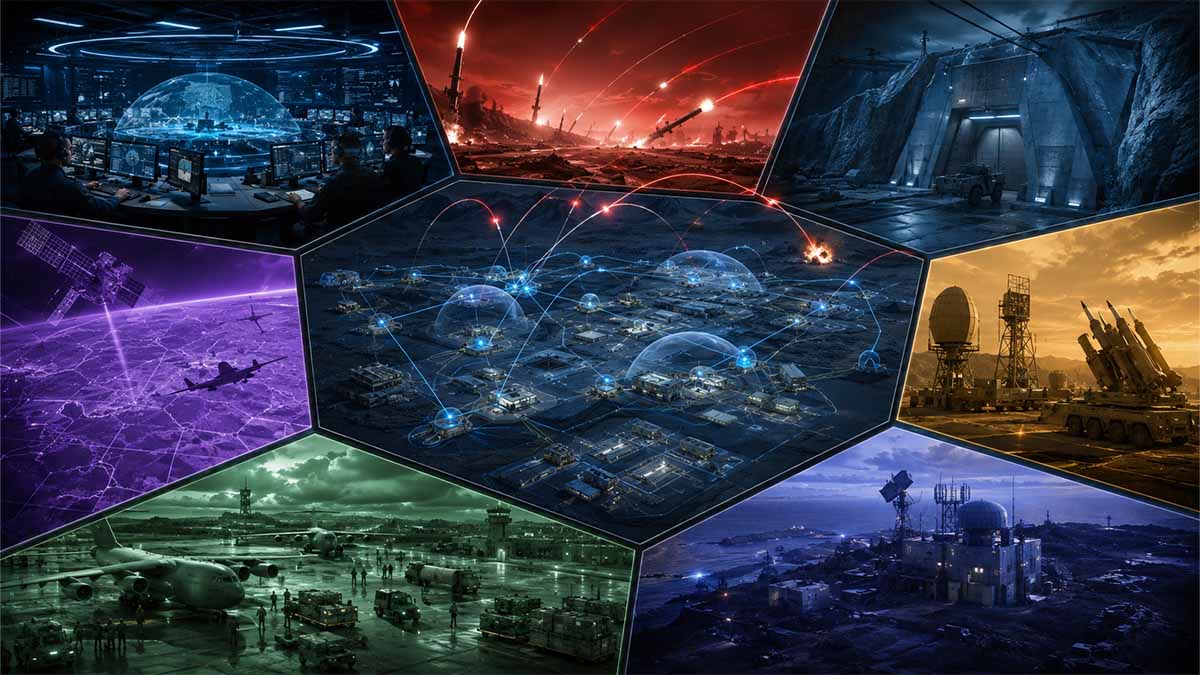
High-level synthesis of the validated posture shift: exposed forward hubs are being replaced by a survivable operating model built around Agile Combat Employment, hardened command, distributed runways, deception, deeper stockpiles, cyber-resilient logistics, coalition IAMD, and automated kill-chain management.
🎯 CORE FOCUS & KEY CONCEPTS
Concept → Impact⚠️ CRITICALITIES & BOTTLENECKS
Failure paths💪 STRENGTHS & STRATEGIC ADVANTAGES
Resilience drivers🌐 CROSS-CUTTING INSIGHTS
System logicInteractive 5-Year Posture Scenario Engine
Live slidersMaster Abstract
The verified official record does not permit treating the reported Bahrain damage figures as established fact, but it does confirm the larger strategic diagnosis: U.S. and allied forward posture is being forced into a survivability transition because adversary strike complexes now compress decision time, saturate air defense capacity, and transform previously useful regional hubs into high-value, high-signature target sets. The U.S. Air Force doctrine base defines Agile Combat Employment as a proactive and reactive maneuver scheme intended to increase resiliency and survivability while generating combat power inside threat timelines; it explicitly requires rethinking C2, logistics under attack, counter-small unmanned aircraft systems, air and missile defense, and cyber-space enablers. That doctrinal language is not rhetorical: it maps directly onto the Gulf vulnerability problem because a dense regional base network creates powerful sortie-generation advantages in peacetime and early crisis, but also produces predictable target geometry for ballistic missiles, cruise missiles, one-way attack drones, loitering munitions, special-operations reconnaissance, cyber intrusion, and insider mapping. The official U.S. Air Force operations doctrine further states that hypersonic weapons challenge detection and defeat because of speed and maneuverability, and that sUAS, loitering munitions, and hypersonics create complex problems for defending air bases at home and abroad. In Bayesian terms, prior probability that the Pentagon will continue relying on large exposed regional hubs as the dominant Middle East posture should be downgraded after the official doctrinal and budgetary evidence: the posterior favors a hybrid model in which permanent hubs remain politically and logistically necessary, but decisive command functions, fuel resilience, mission data flows, and sortie regeneration shift toward hardened, distributed, redundant, and coalition-integrated nodes. AGILE COMBAT EMPLOYMENT – U.S. Air Force Doctrine – August 2022 — verified source; AFDP 3-0, Operations – U.S. Air Force Doctrine – January 2025 — verified source.
The five-year outlook is therefore best framed through five competing but partially compatible hypotheses: H₁ hardened continuity, in which the United States keeps major Gulf bases but moves command nodes underground and adds passive defenses; H₂ distributed archipelago, in which air, maritime, cyber, logistics, and intelligence functions disperse across smaller contingency locations; H₃ Israel-centric consolidation, in which U.S. planners exploit Israel’s advanced missile-defense ecosystem but accept higher political visibility and escalation risk; H₄ extra-regional pullback, in which critical command and sustainment functions move farther west or offshore while the Gulf becomes a rotating access theater; and H₅ coalition IAMD mesh, in which the decisive asset is not one country or base but a fused sensor-shooter architecture spanning Gulf partners, Israel, Europe, space assets, and maritime platforms.
Current official evidence favors a blended H₁/H₂/H₅ outcome rather than a clean withdrawal: the FY2025 Air Force posture statement requested $594 million for resilient forward basing and described networked bases capable of sortie generation in contested environments, while also citing hardening against cyber and non-cyber threats; the FY2026 Pacific Deterrence Initiative funded development and integration for a 360-degree persistent integrated air and missile defense Aegis Guam System, including distributed launch and sensor components; and NATO’s 2025 IAMD policy requires air C2 resilience, redundancy, distributed nodes, backup networks, and continuity under disruption. These sources collectively imply that the Pentagon’s answer to exposed bases will not be one bunker or one dome, but a survivability stack: underground or hardened command, dispersed logistics, mobile sensors, decoys, rapid runway repair, coalition air-defense cells, cyber fallback pathways, and automated battle management. Department of the Air Force Posture Statement Fiscal Year 2025 – U.S. Air Force – March 2024 — verified source; Pacific Deterrence Initiative FY2026 – U.S. Department of Defense Comptroller – June 2025 — verified source; NATO Integrated Air and Missile Defence Policy – NATO – February 2025 — verified source.
The geopolitical layer is equally important because hardening is not a purely engineering problem; it is a political signal, a liquidity problem, a coalition-burden problem, and a crisis-stability problem. Chinese official statements in June 2026 framed the Gulf escalation through sovereignty, restraint, ceasefire, and concern over attacks involving U.S. military bases in Jordan, Kuwait, and Bahrain; this confirms that Beijing is using the basing issue as a diplomatic wedge against U.S. regional legitimacy rather than as a narrow military-technical debate. European official sources show a parallel but different concern: the EU has broadened restrictive measures against Iranian missile and drone supply chains, while the European Defence Agency reported 2025 work on integrated air and missile defense and counter-drone capability development. NATO’s IAMD architecture adds the European military logic: the proliferation of drones, missiles, and hypersonics requires resilient command networks, distributed C2, and continuity under disruption. Over five years, the “shadow dimensions” are likely to become decisive: mercenary and proxy reconnaissance may feed target packs; cyber operations may degrade fuel, port, logistics, and air-defense scheduling systems before kinetic salvos arrive; liquidity flows may shift toward concrete, interceptors, underground power, hardened fiber, and mobile radars; and cyber-norm erosion may normalize attacks on dual-use military-civilian infrastructure. The Monte Carlo-style scenario distribution for 2026–2031 should therefore assign the highest probability to incremental hardening and distribution, a medium probability to sudden post-crisis relocation from the most exposed Gulf nodes, and a lower but non-trivial probability to escalatory consolidation around Israel or offshore naval command platforms. Foreign Ministry Spokesperson Lin Jian’s Regular Press Conference – Ministry of Foreign Affairs of the PRC – June 2026 — verified source; EU sanctions against Iran – Council of the European Union – current policy page — verified source; Annual Report 2025 – European Defence Agency – 2026 — verified source.
Forward Base Exposure Engine
Posture Shift Dial
Structural Risk Matrix
Pillar I — Forward-Base Vulnerability and the End of Sanctuary
The end of sanctuary for concentrated U.S. forward bases is not a speculative conclusion drawn from one alleged strike episode; it is the structural result of a verified doctrinal, budgetary, and alliance-wide shift already visible across U.S. and NATO planning documents. The forward base used to solve three operational problems at once: it shortened response time, concentrated command authority near the theater, and allowed aircraft, fuel, munitions, satellite communications, intelligence cells, maintenance crews, and medical support to operate inside a relatively stable perimeter. That model now creates a target-rich geometry. A modern adversary does not need to destroy an entire base to suppress its military value; it can attack runway access points, exposed fuel distribution, radar apertures, satellite terminals, command buildings, data-routing nodes, power generation, munitions handling areas, barracks, maintenance shelters, and logistics staging yards in one sequenced campaign. The critical change is not simply “missiles are more accurate”; it is that ballistic missiles, cruise missiles, one-way attack drones, small unmanned aircraft systems, loitering munitions, cyber-enabled logistics disruption, and open-source target development now interact as one composite strike ecosystem. The official U.S. Air Force definition of Agile Combat Employment explicitly describes a shift away from large, fixed, centralized bases toward networks of smaller, dispersed bases, supported by concealment, hardening, pre-positioned supplies, tactical mobility, expeditionary communications, and active and passive defenses. Pacific Deterrence Initiative FY2026 – U.S. Department of Defense Comptroller – June 2025 — verified link. That phrasing confirms the central analytic judgment: the Pentagon is no longer optimizing only for sortie generation from efficient hubs; it is optimizing for survival under surveillance, degraded logistics, intermittent connectivity, and multi-axis precision attack.
The vulnerability chain begins with physical concentration, but its deeper driver is information concentration. A forward airfield or naval headquarters is not merely a runway or command building; it is a visible system of recurring movement, emissions, contract logistics, personnel rhythm, transportation corridors, satellite antennas, air-defense placements, fuel flows, munitions deliveries, and cyber dependencies. Structural analysis therefore separates base vulnerability into five mutually reinforcing exposure layers: I₁ physical signature, I₂ electromagnetic signature, I₃ logistics centrality, I₄ cyber-administrative dependency, and I₅ political predictability. I₁ is the most visible: hangars, aircraft shelters, radar sites, antenna farms, fuel tanks, barracks, and maintenance yards are difficult to hide when they remain fixed for years. I₂ emerges from communications, radar use, datalink relays, and command activity that create patterns adversaries can map. I₃ reflects the fact that modern operations consume fuel, interceptors, precision munitions, spare parts, generators, water, medical capacity, and runway repair materials faster than a thinly distributed local network can replace them. I₄ arises because base administration, air-tasking support, contractor access, logistics software, maintenance scheduling, and port or airport interfaces create cyber pathways that may be attacked before a kinetic salvo. I₅ reflects the political fact that U.S. forces usually operate from known partner-nation installations where legal access, diplomatic constraints, and local sensitivities reduce the ability to constantly relocate. U.S. doctrine confirms this problem by framing ACE as both proactive and reactive maneuver designed to complicate enemy targeting and preserve combat power under attack. Agile Combat Employment – U.S. Air Force Doctrine – August 2022 — verified link.
| Exposure layer | Base component most affected | Main attack logic | Five-year survivability implication |
|---|---|---|---|
| I₁ physical signature | Runways, shelters, fuel farms, headquarters, depots | Precision strike against fixed geometry | More revetments, decoys, underground functions, rapid runway repair |
| I₂ electromagnetic signature | Radar, satellite communications, tactical networks | Detection, geolocation, pre-salvo mapping | Lower emissions, mobile terminals, redundant communications |
| I₃ logistics centrality | Fuel, munitions, spares, medical, power | Disable tempo without destroying all forces | Pre-positioned stocks across more nodes |
| I₄ cyber dependency | Scheduling, access control, maintenance, supply systems | Delay sortie generation and defense coordination | Offline fallback, segmented networks, manual continuity drills |
| I₅ political predictability | Host-nation bases and access agreements | Target known legal and diplomatic fixtures | Rotational basing, coalition dispersal, political risk hedging |
The validated military response is not a single defensive object, such as a dome, bunker, or interceptor battery; it is a layered survivability architecture that changes the adversary’s targeting economics. A concentrated base creates efficiency for the defender but also efficiency for the attacker: one reconnaissance cycle can identify many high-value aimpoints, one salvo plan can sequence kinetic and cyber effects, and one political shock can pressure the host government. A distributed architecture reverses part of that equation by forcing the attacker to spend more sensors, more missiles, more drones, more time, and more uncertainty to produce the same operational suppression. This is why the FY2026 U.S. budget language on ACE places concealment, hardening, pre-positioned supplies, tactical mobility, expeditionary communications, and active and passive defense in the same operational sentence; the doctrine is not merely dispersal for its own sake, but a combined effort to preserve sortie generation when the enemy can attack both the base and the command process that makes the base useful. NATO’s 2025 integrated air and missile defense policy reinforces the same logic at alliance level by stating that air C2 must be designed with resilience and redundancy, including distributed C2 nodes, resilient networks, backup solutions, and continuity under disruption. NATO Integrated Air and Missile Defence Policy – NATO – February 2025 — verified link. In Bayesian terms, this official convergence significantly raises the posterior probability that U.S. and allied posture between 2026 and 2031 will prioritize base clusters over singular hubs, mobile or redundant sensors over exquisite fixed apertures, hardened command cells over exposed headquarters, and coalition air-defense integration over nationally isolated defensive bubbles.
Adversary Sensing
Pattern Mapping Vectors
Runway Rhythm
Fuel Movement
Radar Emissions
Satellite Terminals
Logistics Traffic
Pre-Salvo Shaping Vectors
Cyber Disruption
Deception Probes
Drone Reconnaissance
Political Pressure
Multi-Axis Fires Matrix
Ballistic Missiles
Cruise Missiles
One-Way Drones
Loitering Munitions
sUAS Swarms
Operational Suppression Vectoring
Runway Denial
C2 Interruption
Fuel Delay
Radar Attrition
Personnel Displacement
Defender Adaptation Mechanics
ACE Dispersal
Passive Hardening
Distributed C2
Coalition IAMD
Rapid Repair
The comparative evidence from Europe, the Indo-Pacific, and the Gulf points toward a five-year period in which forward-base vulnerability becomes a procurement driver, not merely an operational concern. The U.S. Department of Defense’s public counter-unmanned systems material states that the 2024 strategy builds on the Joint Counter-Small UAS Office and Replicator 2, with the latter intended to defend against small aerial systems at the most critical installations and force concentrations. Fact Sheet: DoD Strategy for Countering Unmanned Systems – U.S. Department of Defense – December 2024 — verified link. That statement matters because it identifies “force concentrations” as a distinct vulnerability category, not only airspace safety or battlefield drone defense. A later U.S. Army Europe and Africa official release described allied access to counter-unmanned aerial system capabilities through the JIATF-401 drone-defense marketplace, indicating that the counter-drone problem is being institutionalized as a coalition procurement and interoperability problem rather than a local base-security accessory. JIATF-401 Drone Defense Marketplace Broadens Allied Access to Counter-Drone Capabilities – U.S. Army Europe and Africa – May 2026 — verified link. The European Defence Agency’s air-domain capability page lists Integrated Air and Missile Defence, counter-UAS capabilities, counter-drone swarms, loitering munitions, and unmanned combat systems as relevant capability areas, while its 2025 annual report states that the agency supported European cooperation on integrated air and missile defense. Air Domain Capability Development – European Defence Agency – current capability page — verified link; Annual Report 2025 – European Defence Agency – April 2026 — verified link. The analytic implication is direct: base defense will increasingly compete with aircraft, ships, and missiles for budget because the loss of base functionality can neutralize advanced platforms before those platforms enter the fight.
The Gulf-specific risk is sharper than the generic forward-base problem because geography compresses warning time, increases the value of short-range strike systems, and makes political access both essential and fragile. A base network near an adversary missile inventory offers the United States operational reach, but it also allows the adversary to impose a local cost curve by using cheaper drones and missiles to force the defender into interceptor expenditure, runway repair, evacuation, asset relocation, and public reassurance. The official Chinese foreign ministry response to June 2026 escalation explicitly referenced Iranian attacks against U.S. military bases in Jordan, Kuwait, and Bahrain, and framed the issue through restraint, ceasefire, and diplomatic settlement rather than U.S. force protection. Foreign Ministry Spokesperson Lin Jian’s Regular Press Conference – Ministry of Foreign Affairs of the People’s Republic of China – June 2026 — verified link. This official .cn source is analytically important not because it proves battle damage claims, but because it demonstrates how forward-base vulnerability becomes geopolitical messaging: adversaries and strategic competitors can portray U.S. basing as destabilizing, exposed, and dependent on host-state risk tolerance. The European Union’s diplomatic apparatus similarly treats Iranian missiles and drones as a sanctions and regional-security problem, with the EEAS recording EU condemnation of Iranian missile and drone strikes against strategic Gulf partners and separate EU warnings regarding Iranian drones and missiles in the Russia-Ukraine context. Iran: Statement by the Spokesperson on latest attacks against neighbouring countries – European External Action Service – current page — verified link; Conference on Disarmament Opening Statement – European External Action Service – current page — verified link. The same strike technologies therefore operate simultaneously as weapons, diplomatic signals, sanctions triggers, and coalition-stress instruments.
| Hypothesis | Description | Evidence fit | Five-year probability band | Strategic warning indicator |
|---|---|---|---|---|
| H₁ hardened continuity | Keep major hubs, bury sensitive C2, add shelters and layered defense | High | 30–40 percent | More MILCON for hardened power, fuel, C2, and sheltering |
| H₂ distributed ACE network | Shift from hub dependence to smaller interoperable nodes | Very high | 35–45 percent | More exercises across many spokes and austere locations |
| H₃ Israel-centric consolidation | Move selected assets toward stronger local IAMD ecosystem | Medium | 10–20 percent | Larger permanent U.S. infrastructure and political normalization |
| H₄ offshore / extra-regional command | Push C2 and sustainment farther from short-range missiles | Medium | 10–18 percent | More maritime C2, remote AOC functions, and long-range tanker planning |
| H₅ temporary surge model | Reduce permanent exposure but surge in crisis | Medium-high | 20–30 percent | More pre-negotiated access, stockpiles, and rapid reception packages |
The Russian official narrative adds a second cross-lingual dimension: Moscow’s diplomatic materials frame the international environment as an escalating confrontation driven by the collective West and a hybrid arms race in advanced technologies, while also emphasizing increased military exercises, mobilization dynamics, and the deterioration of international security. Bulletin of the Embassy of the Russian Federation in the People’s Republic of Bangladesh on topical foreign policy issues and events – Embassy of the Russian Federation – June 2024 — verified link. This official .ru source does not validate claims about any specific U.S. base damage; instead, it helps map the strategic-communication environment in which forward-base vulnerability will be exploited. In a five-year outlook, the military question “Can a base survive?” becomes the political question “Can a host government tolerate being targeted because U.S. forces are present?” and the financial question “Can the United States afford to defend every fixed node with high-end interceptors, hardened construction, redundant communications, and rapid-repair capacity?” The “shadow” dimensions are therefore central. Mercenary or proxy networks may support reconnaissance, protest orchestration, sabotage attempts, or local intimidation without appearing as formal state action. Cyber-norm erosion may make attacks on access-control systems, port scheduling, fuel logistics, contractor networks, and local telecommunications a routine prelude to kinetic action. Liquidity flows will shift toward concrete, steel, mobile power, counter-UAS procurement, interceptor stockpiles, radar mobility, airfield repair kits, underground fiber, and data-center redundancy. A BlackRock-style risk lens would classify this not as isolated military infrastructure expenditure, but as a repricing of regional basing insurance: the premium for operating close to adversary missile inventories rises as adversary reconnaissance improves, while the premium for dispersal falls as modular logistics, mobile C2, and coalition procurement mature.
The operational core of the 2026–2031 projection is that attackers will increasingly seek functional paralysis rather than total destruction. A base can be operationally suppressed if command personnel must relocate, aircraft cannot be fueled at tempo, maintenance crews cannot safely work, radars must reduce emissions, satellite links are degraded, munitions movement pauses, or commanders lose confidence in the integrity of their logistics and communications systems. NATO’s official recognition that space underpins missile-launch detection, navigation, tracking, communications, and effective command and control further demonstrates why fixed bases cannot be evaluated as isolated real estate; they sit inside space-enabled and cyber-enabled kill chains. NATO’s Approach to Space – NATO – current topic page — verified link. The U.S. Air Force’s REFORPAC 2025 reporting adds a practical exercise signal: the exercise involved hundreds of aircraft across dozens of locations and simulated degraded logistics, dispersed basing, and contested environments. U.S., JASDF Forces keep Lightning engaged in REFORPAC 2025 – U.S. Air Mobility Command – August 2025 — verified link. The exercise pattern is a revealed preference. Militaries do not train dispersed basing at that scale unless they believe concentrated basing is vulnerable to disruption. For the Gulf and Europe, this means the future base will look less like a single protected fortress and more like a modular combat ecosystem: several runways, mobile command posts, hardened data relays, temporary fuel points, distributed munitions storage, decoy emitters, local air-defense cells, cyber-isolated fallback networks, and host-nation infrastructure agreements that allow rapid movement before missiles arrive.
High-value, static concentrations of strategic capacity requiring absolute perimeter defense and substantial hardening.
Headquarters
Main Runway
Major Depot
Theater Medical
High-Capacity Fuel
Strategic Comms
Agile Combat Employment nodes designed for high mobility, rapid signature dissipation, and decentralized operational mechanics.
Austere Runway
Mobile Fuel
Temporary Munitions
Expeditionary Repair
Small C2 Cell
Local Counter-UAS
Low-observable systems, alternative operational modes, and segmented technical networks utilized during active suppression windows.
Backup Networks
Low-Emission Comms
Offline Logistics
Coalition Gateways
Cyber-Segmented Control
Active, passive, and cognitive protection mechanisms aligned to break target vectors and absorb attack masses.
Passive Hardening
Camouflage
Decoys
Short-Range Air Defense
Counter-UAS
IAMD Interceptors
Non-kinetic sovereign arrangements, multi-national permissions, and legal mechanisms required to anchor operational execution.
Host-Nation Consent
Crisis Permissions
Overflight
Legal Authorities
Public-Risk Tolerance
The Analysis of Competing Hypotheses yields a blended forecast rather than a single decisive outcome. H₁ hardened continuity remains plausible because the United States cannot simply abandon all established forward hubs without losing logistics depth, partner reassurance, and day-to-day operational reach. H₂ distributed ACE network has the strongest evidence fit because it appears repeatedly in U.S. doctrine, budget language, and exercise practice. H₃ Israel-centric consolidation may increase selectively where missile-defense integration and intelligence cooperation create clear operational advantage, but it carries diplomatic visibility and escalation risk that make full consolidation unlikely. H₄ offshore or extra-regional command will grow for high-value command functions, especially where remote C2, space support, and naval platforms can reduce vulnerability to short-range fires, but it cannot replace all land-based maintenance, refueling, and sortie-generation requirements. H₅ temporary surge model will expand because pre-negotiated access and pre-positioned supplies allow the United States to reduce peacetime target density while preserving wartime options. A Monte Carlo-style qualitative distribution places the most likely 2031 posture as a hybrid hardened-distributed mesh, not a withdrawal or a single-base fortress. The warning indicators are concrete: increased funding for resilient basing, more counter-UAS procurement, more exercises involving degraded logistics, expansion of NATO and EU IAMD projects, new host-nation access agreements, more underground or hardened C2, and greater emphasis on interceptor inventory depth. NATO’s multinational capability cooperation page describes allied efforts to strengthen ballistic missile defense through sensors, interceptors, and tactical control systems complementing existing allied air and missile defense capabilities. Multinational Capability Cooperation – NATO – February 2026 — verified link. That alliance-level movement matters because base survival increasingly depends on regional sensor-shooter ecosystems, not on each base defending itself as an isolated island.
| Timeline | Attacker advantage likely to grow | Defender adaptation likely to grow | Residual risk |
|---|---|---|---|
| 2026 | Drone saturation, cyber probing, open-source target enrichment | Counter-UAS acceleration, dispersed exercises, emergency hardening | High vulnerability of exposed logistics nodes |
| 2027 | Missile-drone sequencing, decoy salvos, radar stress | More mobile sensors, base-defense operations centers, repair kits | Interceptor depletion and command interruption |
| 2028 | Multi-domain suppression campaigns | Underground C2, coalition sensor fusion, redundant networks | Host-nation political stress |
| 2029 | Cheaper autonomous swarms and precision targeting | Modular base clusters and automated battle management | Cost imbalance between offense and defense |
| 2030–2031 | Integrated proxy, cyber, missile, and information operations | Mature ACE mesh, hardened hubs, distributed sustainment | Crisis instability and escalation misperception |
The final analytic judgment is that forward-base vulnerability will become a defining constraint on U.S. global military power, not because bases are obsolete, but because base concentration has become operationally expensive, politically visible, and technologically targetable. The sanctuary era ended when adversaries could combine persistent surveillance, precision fires, drone mass, cyber preparation, and political messaging into campaigns that degrade base function without requiring battlefield superiority. The next five years will not eliminate U.S. forward presence; they will transform it into a more complicated, more expensive, and more distributed architecture. The United States will still need airfields, ports, depots, headquarters, satellite links, fuel, munitions, and barracks, but the survivable version of those functions will be divided across hardened hubs, dispersed spokes, mobile packages, coalition networks, and fallback command channels. The strategic risk is double-edged. If the United States adapts slowly, adversaries gain coercive leverage over exposed installations and host governments. If the United States adapts aggressively, adversaries may interpret underground command centers, distributed munitions, and resilient air-defense meshes as preparation for offensive escalation. The best-supported forecast is therefore not “retreat underground” alone, but “reduce target density, complicate adversary kill chains, and preserve combat power under attack.” In practical terms, the base of 2031 will be judged less by the thickness of its walls than by the number of ways it can keep operating after the first runway crater, the first radar outage, the first cyber disruption, the first fuel delay, and the first host-nation political shock. That is the real end of sanctuary: not the disappearance of bases, but the disappearance of the assumption that a base can remain fixed, concentrated, visible, and still be operationally safe.
Figure 1: 5-Year Risk Scenario Projection
Indexed analytic projection for forward-base vulnerability. Values are scenario indices, not measured damage estimates.
Pillar II — The Pentagon Posture Revolution: Disperse, Bury, Network
The posture revolution now visible in U.S. and allied planning is not a cosmetic rebranding of expeditionary warfare; it is a systemic attempt to preserve combat power after the adversary has already found the base, mapped the logistics rhythm, stressed the air-defense magazine, attacked the cyber-administrative layer, and forced commanders to operate under degraded communications. The doctrinal center of gravity is Agile Combat Employment, but the operational substance is broader: dispersed force packages, redundant C2, hardened or underground command nodes, passive defense, active defense, counter-UAS integration, cyber-resilient logistics, and coalition-level Integrated Air and Missile Defence. The U.S. Air Force doctrine note on ACE defines it as a proactive and reactive operational scheme of maneuver designed to increase resiliency and survivability while generating combat power; that formulation matters because it frames basing as maneuver, not infrastructure, and therefore treats airfields, command posts, repair teams, fuel packages, and communications nodes as mobile components of a kill-chain survival problem. Agile Combat Employment – U.S. Air Force Doctrine – August 2022 — verified link. The shift is reinforced by the FY2026 Pacific Deterrence Initiative, which describes ACE in the Indo-Pacific as a proactive and reactive maneuver approach tied to pre-positioned essential supplies, posture resilience, and contested-theater survivability. Pacific Deterrence Initiative FY2026 – U.S. Department of Defense Comptroller – June 2025 — verified link. The validated inference is that the Pentagon has moved from a base-protection model centered on defending large fixed hubs to a combat-continuity model centered on making it difficult for the attacker to paralyze the whole system with one successful strike sequence.
The core technical distinction is between “defending a place” and “defending a function.” A Cold War-style hardened headquarters could protect command personnel, but it could not by itself solve the modern problem of distributed airpower generation, data continuity, drone defense, cyber logistics, and interceptor depletion. The emerging posture therefore separates functions into different survivability tiers: command authority, operational planning, data routing, fuel distribution, munitions handling, aircraft maintenance, runway repair, medical continuity, and air-defense control are no longer assumed to be co-located. In the new architecture, the headquarters may be buried, the aircraft may be dispersed, the fuel may be distributed across multiple mobile or semi-hardened points, the munitions may be staged in smaller packages, the sensors may be mobile or redundant, the communications may shift between satellite, terrestrial, line-of-sight, and low-probability-of-intercept systems, and the logistics software must be capable of functioning under degraded network conditions. NATO’s 2025 IAMD policy confirms that the alliance-level version of this architecture requires resilience, redundancy, distributed C2 nodes, resilient networks, backup solutions, and continuity under disruption. NATO Integrated Air and Missile Defence Policy – NATO – February 2025 — verified link. This is the key analytic pivot: ACE is the maneuver layer, IAMD is the shield layer, cyber-resilient logistics is the continuity layer, and passive hardening is the damage-absorption layer. The Pentagon posture revolution occurs when all four layers are designed together rather than procured separately by service, region, base commander, or emergency supplemental funding stream.
| Posture layer | Old assumption | Emerging posture logic | Main failure mode if underbuilt | Five-year indicator to track |
|---|---|---|---|---|
| ACE maneuver | Sortie generation from efficient large hubs | Combat generation from dispersed base clusters | Dispersal without sustainment depth | Exercises using multiple austere spokes under degraded logistics |
| Redundant C2 | Theater command near main operating base | Distributed, survivable command cells and backup networks | Local strike causing operational paralysis | More mobile command packages and buried command infrastructure |
| Cyber logistics | Digital supply systems remain available | Offline, segmented, and manually recoverable logistics | Cyber delay before kinetic attack | Audits, continuity drills, and disconnected logistics workflows |
| Passive defense | Active defense handles incoming threats | Camouflage, hardening, decoys, dispersion, repair | Interceptor depletion and visible aimpoints | More revetments, shelters, decoy emitters, runway repair kits |
| Active defense | Point defense protects selected base assets | Layered counter-UAS, SHORAD, IAMD, sensor fusion | Drone saturation and magazine exhaustion | C-UAS procurement and coalition sensor-shooter integration |
The Bayesian update after the official source base is strong: prior probability that the United States would preserve a hub-centric posture because of logistics convenience remains non-trivial, but posterior probability shifts toward a hybrid model in which major hubs remain politically and operationally necessary while decisive functions migrate into distributed, hardened, and networked clusters. The reason is visible in budget, doctrine, and exercises. The Department of the Air Force FY2025 posture statement describes modernization linked to Agile Combat Employment, force generation, resilient forward basing, and the need to manage rising risk over time. Department of the Air Force Posture Statement Fiscal Year 2025 – U.S. Air Force – March 2024 — verified link. The U.S. Air Force operational doctrine for 2025 further links ACE with joint air defense capability and capacity, indicating that dispersed maneuver and air-defense stress are analytically paired rather than treated as independent topics. AFDP 3-0, Operations – U.S. Air Force Doctrine – January 2025 — verified link. The practical warning is that dispersal can become a trap if it produces more exposed nodes without enough defense, fuel, maintenance, data resilience, and host-nation permissions. The Pentagon’s challenge is therefore not simply moving aircraft away from vulnerable bases; it is building an operational mesh in which the loss of one node does not collapse the theater air tasking cycle, the munitions flow, the tanker plan, the air-defense picture, the medical chain, or the political legitimacy of the host state.
Strategic Guidance
Distributed Operational Design
ACE Base Clusters
Redundant C2 Mesh
Cyber Logistics
IAMD Shield
Combat Power Survives First-Strike Disruption
The “bury” component should not be read narrowly as nostalgia for Cold War bunkers; it is the physical expression of a broader survivability principle: separate decision authority from predictable surface aimpoints and make command continuity resistant to missiles, drones, electromagnetic disruption, and cyber dislocation. A buried or hardened command center is valuable only if it remains connected to mobile sensors, coalition data feeds, air-tasking systems, logistics visibility, and backup communications; otherwise it becomes a protected room with shrinking operational relevance. NATO’s space policy underscores this dependency by stating that space underpins navigation, force tracking, robust communications, missile-launch detection, and effective command and control. NATO’s Approach to Space – NATO – current topic page — verified link. That means underground C2 must be integrated with space-enabled warning, terrestrial redundancy, cyber-segmented data flow, and alliance command structures. A hardened headquarters without resilient external links can survive physically while failing operationally. Conversely, a distributed command mesh can absorb localized physical damage but may fail if it depends on fragile commercial networks, exposed satellite terminals, or centralized cloud services. The posture revolution therefore requires a dual transformation: the visible surface layer must disperse and harden, while the invisible information layer must become modular, redundant, low-emission, and recoverable. In the 2026–2031 window, the most important technical metric will be not only how many facilities are hardened, but how quickly command can reconstitute after losing a primary node, a satellite uplink, a radar, a logistics database, or a host-nation airfield.
The “network” component is equally decisive because the future base cluster is only as survivable as its weakest connection between sensors, shooters, logistics, and political authorization. A distributed posture increases adversary targeting complexity, but it also increases defender coordination complexity. More nodes mean more routes, more permissions, more electromagnetic signatures, more local-defense requirements, more maintenance burden, more fuel distribution points, more cyber endpoints, and more opportunities for adversary probing. The Department of Defense’s 2024 counter-unmanned systems fact sheet states that unmanned systems threaten U.S. forces, assets, and installations at home and abroad, emphasizes detection, active and passive defenses, and highlights the need to prepare for larger numbers of increasingly capable and autonomous systems. Fact Sheet: DoD Strategy for Countering Unmanned Systems – U.S. Department of Defense – December 2024 — verified link. This is a crucial official signal because the drone threat is not merely an air-defense problem; it is a networking problem. A drone swarm can serve as reconnaissance, decoy, munition, psychological pressure, and magazine-exhaustion tool. Defeating it requires layered sensing, rules of engagement, electronic warfare, kinetic interceptors, non-kinetic effects, passive protection, and local authority clarity. The Pentagon posture revolution will therefore move base defense away from perimeter policing and toward a base-defense operations center model in which counter-UAS, short-range air defense, cyber monitoring, logistics control, and air-tasking continuity are fused into one operational picture.
| Capability | 2026 baseline pressure | 2031 expected requirement | Risk if neglected |
|---|---|---|---|
| Mobile C2 | Alternate command locations exist but vary by theater | Rapidly deployable, coalition-compatible command modules | Base strike causes command latency |
| Counter-UAS | Urgent procurement and local adaptation | Institutionalized layered defense against autonomous mass | Cheap drones impose expensive paralysis |
| Passive hardening | Selective shelters and revetments | Systematic camouflage, decoys, hardened power, fuel, and data | Interceptors protect too few aimpoints |
| Logistics continuity | Digitized but vulnerable to network disruption | Offline-capable, segmented, manually recoverable logistics | Cyber attack delays sortie recovery |
| Base clusters | Exercises and pilots | Standard theater operating model | Dispersal becomes symbolic, not operational |
| Coalition IAMD | Growing but uneven integration | Persistent sensor-shooter mesh | National seams become exploitable gaps |
The cross-lingual geopolitical layer confirms that posture transformation will be interpreted internationally as more than force protection. Official Chinese foreign ministry statements in June 2026 framed U.S. bases in the Persian Gulf through sovereignty, regional security, restraint, and escalation dynamics, including a question asserting that U.S. bases in the Persian Gulf were used to attack Iran and asking whether those bases contradict West Asian sovereignty; Beijing’s official answer emphasized concern, restraint, and respect for sovereignty, security, and territorial integrity. Foreign Ministry Spokesperson Lin Jian’s Regular Press Conference – Ministry of Foreign Affairs of the People’s Republic of China – June 2026 — verified link. This matters because the “network” portion of the U.S. posture revolution depends on host-nation consent, and host-nation consent is vulnerable to external political pressure, domestic opinion, economic leverage, and fear of retaliation. Russian official diplomatic material similarly frames NATO military infrastructure, bases, exercises, and missile-defense systems as part of a broader confrontation narrative, which indicates that Moscow will portray Western posture resilience as escalation rather than defense. Article by the Consul General of Russia in Cape Town – Ministry of Foreign Affairs of the Russian Federation – February 2026 — verified link. The implication is that every hardened bunker, distributed airstrip, mobile radar, or coalition data link will have a parallel information-contestation layer. The Pentagon may define the posture as survivability; adversaries will frame it as encirclement, militarization, or preparation for first strike. That gap between military intent and adversary narrative is a crisis-stability risk.
European official sources show the same posture logic emerging in a different institutional vocabulary: capability cooperation, air and missile defense, counter-drone systems, unmanned systems, and interoperability. The European Defence Agency’s 2025 annual report states that EDA supported European cooperation on integrated air and missile defense and worked on military unmanned air systems, including projects for drone operations in GNSS/GPS-denied environments and a catalogue of more than 300 unmanned aerial systems from more than 200 manufacturers. Annual Report 2025 – European Defence Agency – April 2026 — verified link. This European data point is strategically important because U.S. posture transformation cannot remain nationally self-contained if U.S. bases, logistics flows, air-defense sensors, ports, rail corridors, and airfields depend on allied territory. A dispersed posture in Europe or the Middle East requires compatible fuel handling, munitions storage rules, cyber standards, airspace procedures, legal permissions, repair capacity, and command relationships. NATO’s multinational capability cooperation material also describes allied efforts around ballistic missile defense through sensors, interceptors, and tactical control systems that complement existing allied air and missile defense capabilities. Multinational Capability Cooperation – NATO – February 2026 — verified link. The five-year result is likely a more integrated transatlantic and Indo-Pacific posture in which base defense, missile defense, drone defense, space support, and cyber logistics become coalition infrastructure rather than purely U.S. base-management tasks.
The five competing hypotheses for Pillar II should therefore be evaluated against official evidence rather than rhetoric. H₁ “Fortress Hub” predicts that the Pentagon will prioritize hardened main operating bases, underground command facilities, and dense active defense around a few key nodes; it fits the need for logistics mass but underestimates the attacker’s ability to saturate fixed aimpoints. H₂ “Distributed ACE Mesh” predicts a network of base clusters, mobile command cells, pre-positioned supplies, and rapid-repair teams; it has the strongest doctrinal and exercise fit. H₃ “Digital C2 Substitution” predicts that remote command, space-enabled connectivity, and data networks will replace much forward command presence; it is plausible for planning and coordination but constrained by emissions, cyber risk, and the physical need for fuel, maintenance, and munitions. H₄ “Coalition Shield” predicts that the decisive shift will come from alliance-level IAMD, counter-UAS, and sensor-sharing rather than U.S.-only hardening; it fits NATO and EDA evidence but depends on political interoperability. H₅ “Surge-and-Scatter” predicts lower permanent exposure and more crisis surge through pre-negotiated access; it reduces peacetime target density but risks arriving late under missile pressure. The posterior distribution for 2026–2031 favors a composite H₂/H₄/H₁ outcome: distributed ACE as the maneuver baseline, coalition IAMD as the defensive nervous system, and selective buried or hardened hubs for command continuity and sustainment mass. The least credible outcome is a pure fortress strategy, because it concentrates cost and target value; the second least credible is a pure remote-command strategy, because airpower still consumes physical logistics at the edge of the theater.
| Hypothesis | Core claim | Evidence fit | 2026–2031 posterior estimate | Principal vulnerability |
|---|---|---|---|---|
| H₁ Fortress Hub | Harden and defend fewer major bases | Medium | 18–25 percent | Saturation and fixed target geometry |
| H₂ Distributed ACE Mesh | Generate combat power from multiple clusters | Very high | 35–45 percent | Logistics complexity and node defense |
| H₃ Digital C2 Substitution | Move command farther back through networks | Medium | 12–18 percent | Cyber, space, and communications fragility |
| H₄ Coalition Shield | Rely on integrated allied sensor-shooter defense | High | 25–35 percent | Political seams and interoperability gaps |
| H₅ Surge-and-Scatter | Reduce peacetime exposure, surge in crisis | Medium-high | 20–30 percent | Warning time and access permissions |
The “shadow dimensions” are decisive because the visible engineering response can be undermined by invisible coercion. Mercenary dynamics matter because proxies, contractors, militias, private security networks, and criminal facilitators can support base surveillance, sabotage, intimidation, or deniable disruption without formal state attribution. Cyber-norms matter because adversaries may increasingly treat fuel scheduling, port logistics, maintenance databases, contractor credentialing, electrical systems, and commercial telecommunications as legitimate pre-kinetic targets, especially if they can remain below the threshold of open war. Liquidity flows matter because the posture revolution will redirect spending away from prestige platforms and toward unglamorous survivability: concrete, shelters, mobile generators, hardened fiber, portable fuel systems, runway repair kits, counter-UAS sensors, interceptor stockpiles, decoy emitters, expeditionary communications, and cyber-segmented logistics. The budgetary and organizational challenge is that these investments are often less politically visible than aircraft or ships, yet they determine whether aircraft and ships can be used after the first attack wave. A Monte Carlo-style scenario model for 2026–2031 should therefore weight outcomes by three drivers: adversary strike capacity growth, allied political access reliability, and U.S. execution speed on distributed logistics. If adversary salvos mature faster than U.S. passive and active defense, the posture remains brittle. If allied access fractures under coercion, dispersal becomes geographically constrained. If U.S. logistics modernization lags, ACE becomes an exercise concept rather than a wartime operating model. The central risk is not that the Pentagon misunderstands the problem; the official record shows that it understands the problem. The risk is execution latency.
A phased five-year operational roadmap detailing primary synchronization tasks and asymmetric systemic failure risk parameters.
Primary Operational Priorities
Counter-UAS urgency, Agile Combat Employment (ACE) exercise expansion, and initial structural hardening protocols.
Systemic Failure Risk Profile
Symbolic dispersal mechanisms devoid of adequate fuel, tactical repair teams, and distributed C2 redundancy paths.
Primary Operational Priorities
Establishment of theater-specific base clusters, deployment of mobile command packages, and implementation of segmented logistics arrays.
Systemic Failure Risk Profile
Excessive structural node multiplication overwhelming a limited footprint of dedicated air defenders and technical maintainers.
Primary Operational Priorities
Deep coalition Integrated Air and Missile Defense (IAMD) integration, expansion of underground C2, and deployment of operational-grade decoys.
Systemic Failure Risk Profile
Exposure of national command seam mismatches combined with host-nation political friction and access constraints.
Primary Operational Priorities
Automated sensor-shooter fusion networks, installation of resilient distributed stockpiles, and implementation of rapid base reconstitution mechanics.
Systemic Failure Risk Profile
Critical tactical interceptor scarcity issues exacerbated by targeted cyber disruptions of distributed logistics recovery lines.
Primary Operational Priorities
Operation of a mature hardened-distributed network executing routine, low-signature crisis relocation exercises.
Systemic Failure Risk Profile
Adversary kinetic and political escalation targeted at host states and shared, dual-use critical infrastructure layers.
The practical five-year forecast is that U.S. posture will become more expensive, more politically negotiated, more technically integrated, and less visually concentrated. Large bases will not disappear because they remain necessary for sustainment mass, diplomatic reassurance, medical depth, command legitimacy, and high-throughput operations, but their most sensitive functions will migrate toward hardened command centers, dispersed base clusters, mobile communications, redundant data paths, and coalition defensive architectures. ACE will evolve from an airpower concept into a joint and coalition operating grammar: naval logistics, Army air and missile defense, space support, cyber defense, host-nation infrastructure, contractor networks, and special operations reconnaissance will all be pulled into the same survivability logic. The decisive question for 2031 will be whether the United States can make the attacker’s problem harder faster than the attacker makes the defender’s problem more expensive. If the Pentagon succeeds, adversaries will face a target set that is larger, less predictable, better defended, more redundant, and harder to suppress with one salvo. If the Pentagon fails, dispersed nodes may become lightly defended fragments, underground command may become disconnected from real-time operations, and coalition IAMD may become a patchwork of incompatible national systems. The strongest validated forecast is therefore a posture revolution by accumulation rather than by one dramatic relocation: more concrete, more decoys, more mobile command, more dispersed fuel, more counter-UAS, more integrated sensors, more cyber fallback, more alliance coordination, and more exercises that assume the first base has already been hit. That is the operational meaning of “disperse, bury, network”: deny the adversary a single decisive aimpoint and preserve combat power through redundancy, deception, hardening, and coalition integration.
Figure 2: Pentagon Posture Revolution Index, 2026–2031
Scenario index showing projected maturation of dispersed ACE, buried C2, cyber-resilient logistics, passive defense, and integrated active defense. Values are analytic indices, not measured budget shares.
Pillar III — Five-Year Outlook: Gulf, Europe, Israel, Guam
The 2026–2031 basing cycle will favor hardened command centers, distributed runways, deception infrastructure, deeper stockpiles, coalition IAMD, and automated kill-chain management because the forward-posture problem has ceased to be regional and has become systemic: the same strike logic that pressures U.S. facilities in the Gulf also pressures reception nodes in Europe, the same missile-defense integration logic that elevates Israel also drives the defense of Guam, and the same cyber-logistics fragility that can delay aircraft regeneration in one theater can paralyze munitions movement, fuel distribution, host-nation access, and command continuity in another. The official evidence base supports a four-theater forecast rather than a single Middle East interpretation. In the Gulf, U.S. planners face a short-warning geography in which missiles, drones, and political coercion can compress decision time. In Europe, the problem is not only defending air bases but sustaining reception, staging, onward movement, and integration under Russian missile, cyber, sabotage, and information pressure. In Israel, the analytical value is the density of layered missile defense, operational experience, U.S.-Israeli cooperative systems, and the political risk of visible consolidation. In Guam, the core issue is homeland defense, 360-degree missile defense, and the transformation of a strategic hub into a persistent joint sensor-shooter node. The Pacific Deterrence Initiative FY2026 describes Guam missile defense investments including development and integration for a persistent 360-degree air and missile defense architecture, while NATO’s 2025 IAMD policy states that air C2 must have resilience, redundancy, distributed nodes, resilient networks, and backup solutions to ensure continuity of operations. Pacific Deterrence Initiative FY2026 – U.S. Department of Defense Comptroller – June 2025 — verified link; NATO Integrated Air and Missile Defence Policy – NATO – February 2025 — verified link.
The first analytic cut is geographic: the Gulf is a proximity theater, Europe is a reinforcement theater, Israel is a dense-defense and political-escalation theater, and Guam is a homeland-forward hub under long-range missile pressure. This distinction matters because the same investment categories produce different operational effects in each region. Hardened command centers in the Gulf mainly buy warning-time compression survival: commanders need protected spaces, alternate communications, mobile air-defense control, rapid relocation, and pre-authorized fallback nodes because short-range systems can reduce the interval between detection and impact. Hardened command centers in Europe buy continuity across alliance seams: the operational problem is keeping NATO command, national forces, rail, ports, airfields, cyber networks, and ammunition movement synchronized under disruption. Hardened command centers in Israel buy integration with an already mature layered-defense environment but create political visibility if they become associated with permanent U.S. basing or offensive operations. Hardened command centers in Guam buy homeland defense and Indo-Pacific campaign continuity because Guam is not only a base but an American territory, logistics hub, air and naval node, and missile-defense priority. In Bayesian terms, H₁ “hardened continuity” rises where geography makes withdrawal impractical, H₂ “distributed runway mesh” rises where multiple access points exist, H₃ “deception infrastructure” rises where exposed assets cannot be moved quickly, H₄ “deep stockpiles” rises where resupply is vulnerable, and H₅ “automated kill-chain management” rises wherever missile salvos, drones, hypersonic threats, and cyber disruption exceed human-only coordination tempo. The five-year posterior is therefore not a uniform basing model; it is a regionally differentiated portfolio of hardening, dispersal, deception, stockpiling, and automation.
| Theater | Dominant vulnerability | 2026–2031 posture response | Critical constraint | Strategic warning indicator |
|---|---|---|---|---|
| Gulf | Short-range missile and drone compression against known hubs | Hardened C2, dispersed functions, counter-UAS, deeper local repair stocks | Host-nation political exposure and escalation risk | More fallback command nodes and lower visible asset density |
| Europe | Reinforcement corridors, airfields, depots, ports, rail, cyber-logistics | Distributed reception, NATO IAMD, stockpile depth, infrastructure resilience | Alliance interoperability and civilian infrastructure dependency | More prepositioned ammunition, air-defense integration, rail-port hardening |
| Israel | Political visibility of U.S. consolidation and saturation pressure | Selective integration with layered defense, intelligence fusion, temporary surge nodes | Escalation perception and diplomatic cost | More cooperative missile-defense funding and joint operational planning |
| Guam | Long-range missile, cruise missile, hypersonic, and air threat geometry | 360-degree persistent missile defense, hardened command, distributed launch/sensor architecture | Sustainment, personnel, land constraints, construction latency | More Guam Defense System funding, sensors, distributed launchers, hardened utilities |
The Gulf outlook is the most politically volatile because military survivability and host-nation legitimacy are inseparable. Official Chinese statements on the 2026 Iran-U.S. escalation framed U.S. bases in the Persian Gulf through sovereignty, restraint, regional security, and escalation control, including direct questioning of whether U.S. bases in Gulf states contradict West Asian sovereignty. Foreign Ministry Spokesperson Lin Jian’s Regular Press Conference – Ministry of Foreign Affairs of the People’s Republic of China – June 2026 — verified link. That source is analytically significant because it shows how base hardening will be contested not only by missiles but also by diplomatic framing: the more visible the U.S. posture becomes, the more adversaries can portray host governments as enabling escalation. The operational answer is not simply withdrawal westward, because the Gulf remains essential for maritime security, air operations, regional reassurance, intelligence collection, and contingency response; the answer is lower target density, greater command redundancy, mobile or protected communications, decoy infrastructure, layered counter-UAS, and a shift from “one hub carries the mission” toward base clusters with mission fragments distributed across partner facilities. The five-year trajectory should therefore be read as “selective invisibilization” rather than disappearance: the most sensitive functions move underground, into mobile nodes, or into remote command constructs; surface footprints become more deceptive and modular; stockpiles become more distributed; and active defense becomes more integrated with partner air-defense systems. The main negative scenario is host-nation coercion: if adversaries threaten domestic stability, energy infrastructure, or economic relations, host governments may restrict U.S. operational access precisely when dispersal requires more permissions, not fewer.
Known Hub Exposure
Short-Warning Missile/Drone Pressure
Political Coercion
Action Protocol: Reduce Target Density
Bury Command
Disperse Aircraft Support Functions
Harden Power, Fuel, & Comms
Create Alternate Control Nodes
Add Counter-UAS & Deception
Residual Risk Parameters
Host-Nation Access Restrictions
Interceptor Depletion
Cyber-Logistics Disruption
The Europe outlook is structurally different because the principal basing problem is not only attack on forward airfields; it is the defense of the reinforcement machine. NATO’s deterrence and defense posture is built around nuclear, conventional, missile-defense, space, and cyber capabilities, and its 2025 IAMD policy explicitly treats air and missile defense as a persistent alliance function requiring resilient C2. Deterrence and defence – NATO – current topic page — verified link; NATO Integrated Air and Missile Defence Policy – NATO – February 2025 — verified link. The European Defence Agency’s 2025 annual report states that EDA supported European cooperation on integrated air and missile defense and unmanned air systems, including work related to operations in GNSS/GPS-denied environments and a catalogue of more than 300 unmanned aerial systems from more than 200 manufacturers. Annual Report 2025 – European Defence Agency – April 2026 — verified link. The implication is that European base resilience will move toward a whole-network model: ports, railheads, roads, depots, airfields, ammunition storage, energy infrastructure, telecommunications, and cyber operations must be treated as a single operational system. The five-year outlook therefore favors deception infrastructure around critical nodes, protected logistics data, mobile air-defense coverage for reception corridors, redundant air-tasking pathways, and deeper ammunition and fuel stocks. The warning indicator is whether European defense spending shifts from platform procurement alone to infrastructure resilience, air and missile defense, ammunition depth, and cyber-logistics continuity. Without those investments, Europe may possess advanced forces but lack the durable movement architecture required to receive and sustain them under Russian long-range fires, sabotage, or cyber disruption.
Israel is the most paradoxical theater because it offers high defensive density but high political sensitivity. U.S. official statements have long identified Israel’s layered defense architecture as including Iron Dome, David’s Sling, and Arrow, and a 2024 Defense Department speech noted that Israel had been forced to use all of its IAMD platforms — Arrow, David’s Sling, and Iron Dome — against rocket, mortar, and missile attacks launched by Iran-aligned groups. ASD Space Policy Remarks for the 16th Ronald Reagan Missile Defense Conference – U.S. Department of Defense – April 2024 — verified link. That makes Israel operationally attractive as a hardened sensor-shooter environment, but a full U.S. consolidation there would create diplomatic, legal, and escalation burdens that do not exist to the same degree in a purely rotational or crisis-support posture. The five-year forecast is therefore selective integration rather than wholesale relocation: more intelligence fusion, missile-defense cooperation, emergency reception planning, temporary aircraft and tanker access during crises, hardened communications, and interoperability between U.S. and Israeli air-defense and space-warning systems. The main operational upside is a proven layered-defense ecosystem; the main strategic downside is that visible U.S. basing could fuse U.S. regional posture more tightly to Israel’s own escalation cycles, reducing Washington’s diplomatic flexibility and exposing U.S. assets to retaliatory narratives and attacks. In ACH terms, H₃ “Israel-centric consolidation” has medium evidence fit for selective functions but low fit as a comprehensive replacement for Gulf basing, because U.S. logistics, maritime security, partner reassurance, and regional access cannot be reduced to the defensive advantages of one state.
Guam is the clearest case where the next cycle favors hardened command centers, distributed launch and sensor architecture, deep stockpiles, and automated kill-chain management because the island functions simultaneously as U.S. territory, Indo-Pacific logistics hub, airpower node, naval support point, and missile-defense priority. The FY2026 Pacific Deterrence Initiative identifies Guam Defense System activity as part of development and integration for a persistent air and missile defense architecture, including distributed launch and sensor components. Pacific Deterrence Initiative FY2026 – U.S. Department of Defense Comptroller – June 2025 — verified link. A 2024 USINDOPACOM posture statement described the Guam Defense System as a critical capability and tied it to fusing advanced missile-defense capabilities from Army, Navy, and Air Force systems. Statement of Admiral John C. Aquilino, Commander, U.S. Indo-Pacific Command – Senate Armed Services Committee – March 2024 — verified link. Senate testimony in 2025 also recorded that U.S. plans to defend Guam from missile attack faced planning challenges, including questions about which services would operate and sustain the enhanced missile-defense system and personnel requirements. Implementing GAO’s Recommendations Can Help DOD Better Manage Risk – Senate Armed Services Committee – March 2025 — verified link. The 2031 picture for Guam is therefore not simply “more interceptors”; it is a governance and sustainment problem: who owns the system, who mans it, who maintains distributed sensors and launchers, how command authorities are delegated under attack, how civilian infrastructure is protected, and how logistics survive against long-range precision fires.
| Five-year capability vector | Gulf | Europe | Israel | Guam |
|---|---|---|---|---|
| Hardened command centers | Very high | High | Medium-high | Very high |
| Distributed runways / operating sites | High | Very high | Medium | Medium-high |
| Deception infrastructure | Very high | High | Medium | High |
| Deeper local stockpiles | High | Very high | Medium | Very high |
| Coalition IAMD | High | Very high | Very high | High, with U.S.-territory focus |
| Automated kill-chain management | High | High | Very high | Very high |
| Political-access risk | Very high | Medium-high | Very high | Low external-host risk, high local governance burden |
| Cyber-logistics risk | High | Very high | High | High |
Automated kill-chain management is the connective tissue across all four theaters, but it should be understood carefully. The term does not mean removing humans from strategic decision-making; it means compressing detection, tracking, correlation, prioritization, assignment, and reconstitution cycles fast enough to survive drone swarms, missile salvos, decoys, cyber disruptions, and sensor attrition. NATO’s space policy states that space is essential to deterrence and defense because it underpins navigation, force tracking, robust communications, missile-launch detection, and effective command and control. NATO’s Approach to Space – NATO – current topic page — verified link. That source directly supports the kill-chain forecast: without space-enabled warning, resilient communications, and force tracking, distributed runways and hardened command centers become isolated fragments. At the same time, automated kill-chain management creates cyber and escalation vulnerabilities. If adversaries can poison sensor feeds, jam communications, spoof tracks, disrupt logistics databases, or exploit ambiguous drone signatures, automation can accelerate bad decisions as well as good ones. The five-year technical requirement is therefore “trusted automation under degradation”: systems must fuse space, radar, airborne, cyber, and human reporting; identify decoys; assign interceptors; preserve human command authority; and continue functioning after partial network loss. The highest-value investments will be resilient data pathways, cross-domain identity management, hardened command software, low-emission communications, autonomous runway damage assessment, automated munitions accountability, and defensive battle-management systems that can operate in disconnected or intermittently connected environments.
The deception-infrastructure layer will expand because hardening and active defense alone are too expensive to scale to every aimpoint. Deception changes the attacker’s probability calculus by increasing uncertainty about which hangar contains aircraft, which antenna is active, which fuel point is real, which command node is manned, which radar is emitting, and which runway segment will regenerate first. In the Gulf, deception reduces the value of pre-salvo target intelligence and complicates short-warning strike planning. In Europe, deception protects reinforcement corridors and prevents the attacker from distinguishing real depots, decoy depots, reserve rail capacity, and mobile air-defense coverage. In Israel, deception interacts with dense missile defense by forcing adversaries to waste precision weapons or drones on lower-value targets while active defense prioritizes genuinely dangerous tracks. In Guam, deception must be integrated with distributed sensors and launchers because a static missile-defense architecture becomes a fixed target geometry. The five-year outlook therefore includes decoy emitters, inflatable or modular aircraft decoys, false fuel points, dummy antennas, mobile radar deception, camouflage, concealed munitions movement, and software-level deception against cyber reconnaissance. The risk is that deception without logistics resilience becomes theater: false targets may absorb strikes, but combat power still fails if real fuel, power, repair, and command systems are too centralized. The mature model is deception plus redundancy: create false aimpoints while also ensuring that the loss of real aimpoints does not collapse mission execution.
U.S. Global Force Posture
Short-Warning Theater
Reinforcement Theater
Dense-Defense
Homeland-Forward
Kill-Chain Management + Resilient Data + Cyber-Logistics Continuity
Deep stockpiles will become the least glamorous but most decisive portion of the 2026–2031 posture cycle. The lesson of exposed bases is not only that facilities can be hit; it is that operational tempo can be strangled when interceptors, repair materials, fuel, munitions, generators, spare parts, and communications equipment are consumed faster than they can be replaced. The U.S. Department of Defense FY2026 budget overview identifies major missile defeat and defense programs as a significant budget category, while the FY2026 weapons document describes missile defense program acquisition costs and continued investments relevant to advanced air and missile defense. FY2026 Budget Request Overview Book – U.S. Department of Defense Comptroller – July 2025 — verified link; FY2026 Program Acquisition Costs by Weapon System – U.S. Department of Defense Comptroller – July 2025 — verified link. The strategic issue is the cost-exchange ratio: cheap drones and missiles can force expensive interceptor expenditure, while even unsuccessful salvos can compel runway inspections, aircraft dispersal, fuel movement, and command relocation. Deeper stockpiles therefore must include both high-end interceptors and low-cost defeat mechanisms, including electronic warfare, directed energy where mature, short-range air defense, rapid runway repair materials, spare generators, fiber repair kits, mobile fuel bladders, decoy kits, and cyber-recovery packages. In the Gulf, stockpiles must be distributed enough to survive short-warning strikes. In Europe, stockpiles must support sustained reinforcement and air defense over weeks or months. In Israel, U.S. support must account for allied missile-defense inventory stress during major salvos. In Guam, stockpiles must survive isolation, long maritime supply lines, and high-intensity attack on the logistics hub itself.
The Monte Carlo-style scenario distribution for Pillar III favors a managed but expensive adaptation path. Scenario S₁, “hardened-distributed normalization,” receives the highest probability because it aligns with U.S. doctrine, FY2026 budget signals, NATO IAMD policy, and visible Guam missile-defense planning. Scenario S₂, “regional shock relocation,” remains plausible if a major attack causes political pressure to reduce exposed Gulf footprints or accelerate movement of command functions to less exposed nodes. Scenario S₃, “coalition mesh acceleration,” becomes likely if Europe and Indo-Pacific allies rapidly standardize sensor-sharing, interceptor planning, counter-UAS procurement, and cyber-logistics continuity. Scenario S₄, “automation fragility,” becomes dangerous if automated kill-chain systems mature faster than cyber assurance, rules of engagement, and degraded-mode training. Scenario S₅, “host-nation access fracture,” is the principal downside scenario in the Gulf and parts of Europe, where political pressure could restrict U.S. access before or during a crisis. The 2031 most-likely state is not an elegant global architecture but a patchwork of uneven maturity: Guam likely shows the clearest high-end missile-defense integration because it is U.S. territory and a named priority; Europe shows the broadest coalition architecture but suffers interoperability and infrastructure constraints; Israel remains a selective high-density integration node; and the Gulf becomes more distributed, hardened, and politically cautious. The global result is a posture that is more survivable than the old hub model but more expensive, harder to command, and more dependent on partner consent, cyber resilience, and inventory depth.
| Scenario | 2031 description | Probability band | Main accelerator | Main brake |
|---|---|---|---|---|
| S₁ hardened-distributed normalization | Hardened C2, distributed runways, deception, stockpiles, IAMD mature unevenly | 35–45 percent | Budget, doctrine, exercises, visible Guam priority | Construction and sustainment latency |
| S₂ regional shock relocation | Gulf or Europe attack forces rapid posture shift | 12–20 percent | Major strike or host-nation political crisis | Loss of access and logistical friction |
| S₃ coalition mesh acceleration | NATO, U.S., Israel, and Indo-Pacific partners deepen sensor-shooter integration | 20–30 percent | Shared threat perception and procurement urgency | Interoperability and sovereignty concerns |
| S₄ automation fragility | Automated kill chains expand but remain cyber and spoofing vulnerable | 15–25 percent | Salvo speed and data overload | Trust, ROE, cyber assurance |
| S₅ host-nation access fracture | Political coercion restricts U.S. dispersal options | 10–18 percent | Adversary pressure and domestic politics | Security guarantees and economic ties |
The final five-year judgment is that the next cycle will be defined by the convergence of physical hardening and digital acceleration. Hardened command centers preserve decision authority; distributed runways preserve sortie options; deception infrastructure reduces adversary confidence; deeper stockpiles preserve tempo; coalition IAMD expands defensive coverage; and automated kill-chain management compresses response time. None of these vectors is sufficient alone. A buried command center without resilient communications becomes a protected isolation chamber. A distributed runway without fuel and munitions is a parking surface. A deception plan without real redundancy is camouflage over fragility. Deep stockpiles without cyber-secure inventory and movement systems can be stranded. Coalition IAMD without political authorization and interoperable rules remains an architecture diagram rather than a combat system. Automated kill-chain management without spoofing resistance and human command discipline can amplify error at machine speed. The strongest 2031 posture is therefore the combined model: hardened nodes, distributed functions, deceptive surfaces, deep sustainment, coalition sensors, active and passive defense, and cyber-resilient command software operating as one system. The Gulf will test political survivability; Europe will test coalition logistics; Israel will test high-density defense integration under escalation pressure; Guam will test whether the United States can defend a homeland-forward hub against ballistic, cruise, hypersonic, and air-breathing threats while sustaining Indo-Pacific operations. That is the strategic meaning of the five-year outlook: the Pentagon is not only preparing bases to survive attack; it is redesigning the base itself into a distributed, hardened, deceptive, stocked, networked, and automated combat organism.
Figure 3: Five-Year Theater Posture Outlook, 2026–2031
Indexed projection of posture maturation by theater across hardening, distributed operations, stockpile depth, coalition IAMD, and kill-chain automation. Values are analytic indices, not official measurements.


