











Executive Summary
BLUF: The Strait of Hormuz is becoming a legal-security bargaining space, not merely an energy chokepoint.
The core contest is between coastal-state sovereignty and non-suspendable transit passage.
The operational corridor already has an IMO-established traffic separation scheme jointly operated by Oman and Iran.
The legal red line is explicit: international straits cannot be closed, and tolls or discriminatory transit conditions lack legal basis.
The economic exposure remains systemic: EIA data show Hormuz flows fell from 20.7 million barrels per day in 4Q25 to 14.6 million barrels per day in 1Q26.
The most likely 5-year path is managed coercion: selective screening, insurance stress, AIS opacity, convoy politics, and sanctions escalation.
The highest-risk path is not permanent closure but repeated partial disruption that reprices energy, shipping, war risk, and regional deterrence.
Oman’s role is the stabilizing hinge: mediator, coastal state, corridor co-operator, and legitimacy channel.
Iran’s leverage is strongest when it frames maritime control as safety governance rather than a formal toll regime.
The strategic coin has two sides: legal order construction and coercive access monetization.
Navigational Index
Pillar I — Legal Sovereignty vs Transit Passage
The central axis is whether Iran and Oman can shape practical management of the strait without altering the legal regime of international navigation.
Pillar II — Energy, Insurance, and Liquidity Shock Transmission
The key systemic risk is not only physical interruption, but repricing across crude, LNG, tanker insurance, freight, sanctions compliance, and European/Asian supply chains.
Pillar III — Coercive Stabilization and Five-Year Escalation Ladder
The probable future is a gray-zone governance model: safety fees rhetorically separated from tolls, vessel data demands, sanctions exposure, naval escort architectures, AIS degradation, and episodic maritime incidents.
Strait of Hormuz: Legal Order, Energy Shock, and Coercive Stabilization
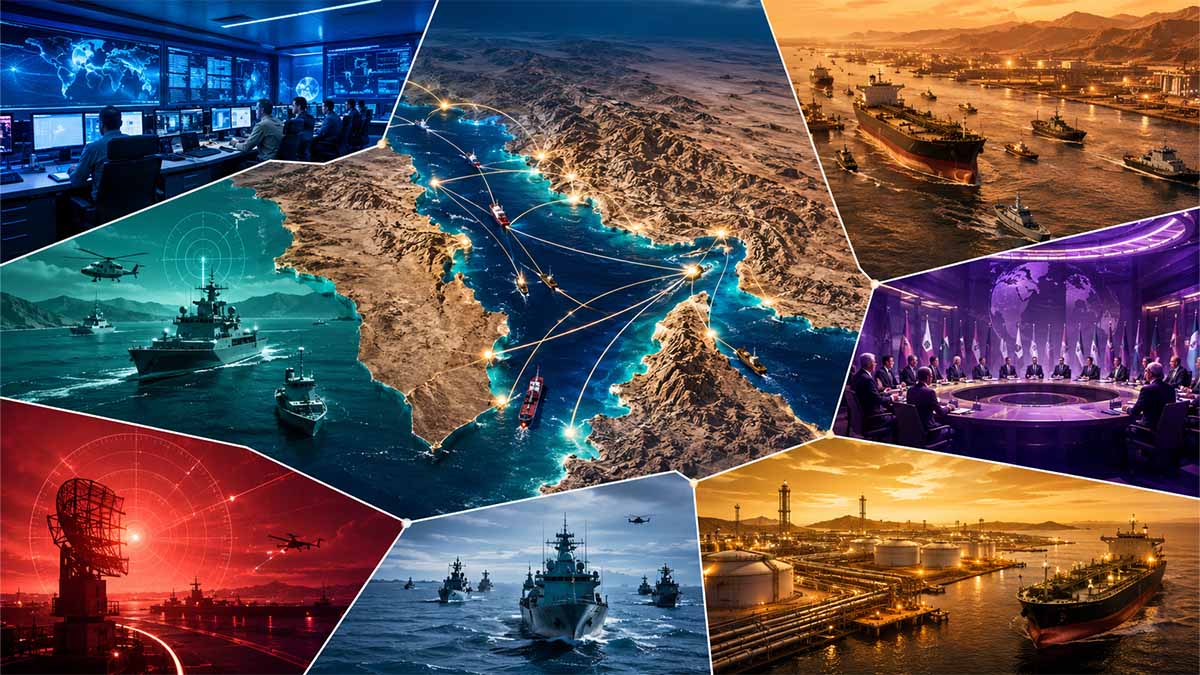
Interactive synthesis schema based on three analytical pillars: legal sovereignty versus transit passage, energy-insurance-liquidity shock transmission, and gray-zone escalation through safety fees, vessel data, sanctions exposure, escort architectures, AIS degradation, and episodic maritime incidents.
Million barrels/day through Hormuz in 1Q26, down from 20.7 in 4Q25.
Million barrels/day in 1Q26, down from 15.2 in 4Q25.
Billion cubic feet/day in 1Q26, down from 10.1 in 4Q25.
Lloyd’s capacity each for hull/P&I and dedicated cargo coverage.
Tracking data degraded, raising uncertainty for insurers, navies, and traders.
🎯 CORE FOCUS & KEY CONCEPTS
• Legal Sovereignty vs Transit Passage
Coastal states can manage safety, traffic, pollution control, and emergency coordination, but they cannot convert those functions into a toll, clearance gate, or discriminatory access regime. Transit passage UNCLOS Part III IMO red line → Why it matters: the legal boundary defines whether the Iran–Oman committee stabilizes the corridor or becomes a coercive governance tool.
• Energy Shock Transmission
Hormuz risk does not require full closure to damage markets. Uncertainty alone can reprice crude, condensate, LNG, tanker freight, war-risk insurance, and European–Asian supply chains. Crude repricing LNG volatility Supply-chain pass-through → Why it matters: market stress moves faster than legal adjudication.
• Insurance as Operational Permission
Tankers may be legally entitled to transit, but become commercially immobilized if hull, cargo, P&I, or war-risk coverage becomes unavailable or too expensive. Marine war risk P&I Freight premium → Why it matters: underwriters convert geopolitical ambiguity into voyage-level cost and access decisions.
• Coercive Stabilization
The most probable future is neither clean stability nor open blockade, but managed gray-zone pressure: safety-fee language, vessel data demands, AIS opacity, sanctions exposure, naval escorts, and episodic incidents. Gray-zone governance AIS degradation Sanctions feedback → Why it matters: the strait can remain physically open while becoming financially and legally more expensive.
⚠️ CRITICALITIES & BOTTLENECKS
Safety Fees Mutating into Tolls
[Root Cause] Iran–Oman language references services and related costs. → [Current Impact] Commercial actors must distinguish lawful safety support from unlawful passage monetization. → [Data Evidence] IMO has rejected tolls, fees, and discriminatory transit conditions for international straits.
Energy and LNG Repricing
[Root Cause] Hormuz concentrates large oil and LNG volumes in a politically contested corridor. → [Current Impact] Even partial uncertainty can raise crude, LNG, freight, and insurance costs. → [Data Evidence] Total oil flow fell from 20.7 million barrels/day in 4Q25 to 14.6 in 1Q26.
AIS and Tracking Degradation
[Root Cause] Tracking data reliability degraded after late February 2026. → [Current Impact] Insurers, traders, navies, and compliance teams face weaker visibility. → [Data Evidence] EIA flagged Hormuz tanker-tracking data as especially unreliable.
Sanctions Feedback Loop
[Root Cause] Any coercive fee, clearance, or maritime-administrative entity can become sanctionable. → [Current Impact] Banks, insurers, brokers, and traders may over-comply even for lawful cargoes. → [Data Evidence] EU expanded its framework against actions impeding lawful transit and freedom of navigation.
Naval Escort Normalization
[Root Cause] Episodic incidents and insurance pressure incentivize convoy or escort structures. → [Current Impact] Commercial transit becomes safer but more militarized and more expensive. → [Data Evidence] Temporary maritime corridor logic emerged through Oman–IMO coordination.
European–Asian Supply Chain Exposure
[Root Cause] Europe and Asia compete for crude, LNG, fertilizer inputs, petrochemicals, and flexible cargoes. → [Current Impact] Energy shock passes into industrial costs, inflation, and strategic inventory policy. → [Data Evidence] JKM and TTF LNG prices rose sharply during Hormuz stress.
💪 STRENGTHS & STRATEGIC ADVANTAGES
• Oman as Stabilizing Hinge
Oman can mediate because it is both a coastal state and a trusted diplomatic channel. → How it drives resilience: it can translate coastal-state safety concerns into internationally acceptable corridor management. → Supporting observation: Oman–IMO coordination produced a temporary maritime corridor framed around no transit fees.
• IMO Legal Clarity
IMO red lines against closure, tolls, fees, and discriminatory conditions provide a legitimacy boundary. → How it drives resilience: it helps insurers, states, and operators distinguish safety governance from coercive access control. → Supporting observation: repeated IMO statements reinforce the international straits regime.
• EU Sanctions Leverage
EU restrictive measures can target actors that impede lawful transit or freedom of navigation. → How it drives resilience: coercive administrative mechanisms become financially risky to operate. → Supporting observation: EU extended its Iran framework and listed actors linked to freedom-of-navigation threats.
• Insurance Market Adaptability
Lloyd’s created specialized war-risk capacity for Hormuz-related shipping. → How it drives resilience: risk capital can keep lawful trade moving when underwriters need structured exposure limits. → Supporting metric: up to $200 million for hull/P&I and $200 million for cargo capacity.
• Market Warning Signals
Energy prices, freight rates, AIS anomalies, insurance capacity, and sanctions designations provide early-warning indicators. → How it drives resilience: decision-makers can react before full physical interruption occurs. → Supporting observation: EIA flow data and LNG price movement already show rapid transmission.
• Multilateral Constraint on Closure
Europe, China, Oman, IMO, energy importers, Gulf producers, and insurers all have incentives to keep Hormuz usable. → How it drives resilience: full closure remains less likely than managed coercion. → Supporting observation: major actors converge on the need for secure and open passage, even with different legal language.
📈 PROJECTIONS & EXPECTATIONS
[Short-term 0–6 mo]
IF Oman keeps the committee inside maritime safety, corridor coordination, and no-fee language → THEN immediate kinetic escalation risk remains contained.
IF Iran links “services” operationally to mandatory payments, documents, or clearance → THEN sanctions and insurer scrutiny intensify quickly.
Success metric: traffic continues without discriminatory delay, mandatory payment, or worsening AIS opacity.
[Mid-term 6–18 mo]
IF safety-cost language becomes administratively dense → THEN charter parties, insurance clauses, sanctions reviews, and freight premiums harden around Hormuz exposure.
IF escort structures become routine → THEN shipping stabilizes tactically but becomes structurally more expensive and militarized.
Success metric: IMO-compatible transparency and non-discriminatory application of all corridor measures.
[Long-term >18 mo]
IF administrative pressure normalizes → THEN Hormuz becomes a recurring liquidity shock engine rather than a temporary crisis zone.
IF the committee publishes clear, lawful, non-fee safety protocols → THEN legal fragmentation risk falls and insurance premiums can gradually normalize.
Success metric: stable flows, lower war-risk premium, no payment-for-passage mechanism, and improved tracking reliability.
📊 DATA CONTEXT & METRIC ANCHORS
| Metric / Indicator | Current Value | Trend / Status | Strategic Relevance |
|---|---|---|---|
| Total oil flow via Hormuz | 14.6 million barrels/day in 1Q26 [Verified] | Down from 20.7 in 4Q25 | Signals direct market exposure to corridor instability. |
| Crude + condensate flow | 10.7 million barrels/day in 1Q26 [Verified] | Down from 15.2 in 4Q25 | Drives crude benchmark and refinery-planning risk. |
| LNG flow via Hormuz | 7.3 billion cubic feet/day in 1Q26 [Verified] | Down from 10.1 in 4Q25 | Amplifies Asian and European gas-price vulnerability. |
| TTF LNG price stress | $14.80/MMBtu [Verified] | 35% higher during Hormuz stress | European gas-market repricing channel. |
| JKM LNG price stress | $16.02/MMBtu [Verified] | 51% higher during Hormuz stress | Asian LNG competition and energy-security signal. |
| Lloyd’s war-risk capacity | $200M hull/P&I + $200M cargo [Verified] | Specialized capacity created | Insurance market recognizes a dedicated Hormuz risk gap. |
| AIS reliability | Degraded after late Feb 2026 [Verified] | High uncertainty | Weakens OSINT, insurance confidence, and naval-commercial planning. |
| Base-case strategic model | Managed gray-zone coercion [Estimated] | More likely than full closure | Explains why legal, market, and military pressure can rise while ships still move. |
Interactive 5-Year Scenario Engine
Source anchors used for the embedded dataset: EIA Global Energy Security Data · EIA World Oil Transit Chokepoints · Lloyd’s Marine War-Risk Consortium · IMO Hormuz Statement · Oman–IMO Temporary Maritime Corridor · EU Freedom of Navigation Sanctions Framework.
Master Abstract
The emerging Iran–Oman Hormuz framework should be read as two simultaneous projects: first, a coastal-state attempt to formalize practical management of a strait whose daily security burden is concentrated locally; second, a coercive legal experiment that tests whether “safe movement services” can be converted into a de facto access-control mechanism without openly violating the settled international regime for straits used in international navigation. The verified legal baseline is hard: the United Nations Convention on the Law of the Sea states that bordering states shall not hamper transit passage, must publicize dangers to navigation or overflight, and that there shall be no suspension of transit passage; the International Maritime Organization has separately stated that straits used for international navigation cannot be closed by bordering states and that there is no legal basis for tolls, fees, or discriminatory conditions on international straits — United Nations Convention on the Law of the Sea, Part III – United Nations – 1982; UN Security Council High-Level Open Debate: The Safety and Protection of Waterways in the Maritime Domain – International Maritime Organization – April 2026. The strategic novelty is therefore not a conventional closure threat but a more sophisticated “administrative sovereignty” campaign: information submission, vessel screening, selective permissions, insurance intimidation, and the reframing of coercive leverage as maritime safety governance. Oman’s official diplomacy confirms the other side of the coin: Muscat publicly frames itself and Tehran as littoral states with shared responsibility to the international community and emphasizes practical solutions for lasting freedom of navigation — Minister Discusses Strait of Hormuz with Iranian Counterpart – Foreign Ministry of the Sultanate of Oman – April 2026. This makes Oman indispensable because it can validate dialogue without validating unlawful restriction; it can mediate without endorsing a toll regime; and it can operationalize maritime safety while preserving the legal distinction between corridor management and sovereign monetization. The five-year outlook therefore turns on whether Oman can keep the committee’s output inside a technical maritime safety envelope, while Iran seeks to extract deterrent, fiscal, intelligence, and symbolic value from the same process.
From an energy-security and capital-market perspective, Hormuz is not merely a naval problem; it is a liquidity-transmission mechanism that links coastal-state coercion to tanker availability, LNG routing, European fuel-import costs, Asian refinery security, sanctions compliance, and sovereign risk premiums. The most important verified quantitative signal is the EIA’s 2026 energy-security dataset: total oil flows through the Strait of Hormuz were listed at 20.4 million barrels per day in 1Q25, 20.2 in 2Q25, 20.5 in 3Q25, 20.7 in 4Q25, and 14.6 in 1Q26; crude and condensate flows fell from 15.2 million barrels per day in 4Q25 to 10.7 in 1Q26, while LNG flows through Hormuz fell from 10.1 billion cubic feet per day to 7.3 over the same interval — Global Energy Security Data / Short-Term Energy Outlook – U.S. Energy Information Administration – May 2026. The EIA also warned that AIS signal data for ships transiting Hormuz had become especially unreliable since the end of February 2026, which is a critical OSINT indicator because AIS degradation raises uncertainty precisely where insurers, charterers, naval planners, sanctions officers, and commodity traders require clarity. The European Council has consequently framed the crisis in both legal and economic terms, welcoming the US–Iran memorandum as an opportunity for regional stability and restoration of safe transit, while stressing that any arrangement related to Hormuz must not limit freedom of navigation or alter its governance; it also called for reduced global vulnerability through diversification of energy supply routes — EU Position on the Situation in the Middle East – Council of the European Union – June 2026. The base-case five-year scenario is therefore not binary “open” versus “closed,” but a sliding coercion regime in which the strait remains physically usable while each transit carries higher legal, insurance, cyber, intelligence, and escalation costs.
The analytic probability stack for 2026–2031 is best modeled across five competing hypotheses. H₁ Managed Technical Stabilization assigns the joint committee a narrow safety function: vessel coordination, hazard notification, traffic separation, seafarer protection, and crisis deconfliction; probability estimate 34% because Oman, IMO, the EU, and energy importers all have strong incentives to preserve legality while reducing immediate risk. H₂ Coercive Administrative Monetization treats the committee as cover for vessel documentation demands, “service charge” narratives, selective delay, and sanction-resistant revenue signaling; probability estimate 29% because the Council of the EU has already listed individuals and an entity under a legal framework targeting Iranian actions and policies threatening freedom of navigation, and it specifically described documentation demands, screening, and toll-related practices — Freedom of Navigation in the Strait of Hormuz: EU Lists Two Individuals and One Entity – Council of the European Union – June 2026. H₃ Militarized Escort Equilibrium projects an expanded naval-protection architecture with episodic incidents but no durable closure; probability estimate 18% because the IMO has emphasized evacuation, hazard clearance, and practical assurances for insurance as part of any return to normal operations. H₄ Partial Disruption Spiral assigns a lower but severe probability to rolling interruptions, mine scares, drone incidents, AIS blackout patterns, and retaliatory sanctions; probability estimate 13% because AIS unreliability and documented flow reductions raise uncertainty even without full closure. H₅ Legal Fragmentation Precedent is the tail-risk frame: if a coastal-state fee/screening model becomes normalized at Hormuz, other strategic straits could face copycat administrative claims; probability estimate 6% because the IMO and EU have taken unusually explicit positions against tolls, discriminatory conditions, and governance alteration. The Bayesian update after verified 2026 institutional signals is therefore: decrease probability of formal legal closure; increase probability of informal coercive management; increase probability of sanctions-linked maritime governance; increase probability that insurers and traders price Hormuz as a chronic rather than episodic risk; and sharply increase the value of Oman as the only actor positioned to translate Iranian sovereignty language into a legally tolerable technical-management framework.
Two Sides of the Same Coin: Safety Governance vs Coercive Access Control
Interactive scenario model translating legal-order pressure, energy-flow fragility, AIS opacity, sanctions escalation, and Oman-mediated stabilization into a five-year maritime risk picture.
Legal Friction
Disruption Risk
Market Shock
Stabilization
Analysis of Competing Hypotheses
Five-Year Pressure Matrix
Pillar I — Legal Sovereignty vs Transit Passage: Iran–Oman Hormuz Governance and the Five-Year Contest Over International Navigation
The central legal fact is that Iran and Oman can manage safety, lanes, traffic separation, pollution prevention, hazard notification, and coastal-state coordination in the Strait of Hormuz, but they cannot lawfully convert those managerial functions into a discretionary permission regime, toll system, discriminatory payment architecture, or selective transit filter without colliding with the international regime governing straits used for international navigation. The controlling legal architecture is explicit: UNCLOS Part III preserves the legal status of waters forming straits and the sovereignty or jurisdiction of bordering states, but it also states that such sovereignty or jurisdiction is exercised subject to Part III and other rules of international law; it grants all ships and aircraft the right of transit passage through straits used for international navigation between one part of the high seas or exclusive economic zone and another; it permits coastal states to prescribe sea lanes and traffic separation schemes only within the treaty’s safety logic and through the competent international organization; and it states that bordering states shall not hamper transit passage and that there shall be no suspension of transit passage — United Nations Convention on the Law of the Sea, Part III – United Nations – 1982 — https://www.un.org/depts/los/convention_agreements/texts/unclos/part3.htm. This is the core “two sides of the same coin” problem: coastal-state sovereignty is real, but it is not absolute at Hormuz; transit passage is real, but it does not erase legitimate coastal-state safety, pollution, and maritime-order responsibilities. The five-year intelligence question is therefore not whether Iran and Oman may speak about “future administration” or “services,” because they plainly may cooperate on maritime safety and navigational support; the question is whether the new committee’s output remains inside the narrow legal envelope of Article 41, Article 42, Article 43, and Article 44, or whether it mutates into a coercive administrative system that has the practical effect of denying, hampering, impairing, pricing, or politically conditioning international transit. The verified Omani-Iranian joint statement matters because it places both logics inside the same instrument: it reaffirms safe passage and freedom of navigation, while also referencing future administration, services, costs, sovereignty, and sovereign rights — Oman and the Islamic Republic of Iran issue a joint statement – Foreign Ministry of the Sultanate of Oman – June 2026 — https://www.fm.gov.om/en/48943/.
The Omani-Iranian language is legally calibrated but strategically explosive because it ties “safe passage,” “applicable international law,” “sovereignty and sovereign rights,” “future administration of navigation,” “services,” and “costs associated with them” into one diplomatic paragraph, which allows each actor to emphasize a different legal meaning. Oman can interpret the formula as technical governance: joint working group, foreign-ministry channel, regional consultation, maritime safety, freedom of navigation, and international standards. Iran can interpret the same formula as sovereign operational entitlement: recognition of coastal-state primacy, future administration, service provision, and cost recovery. That semantic duality is not accidental; it is the bargaining zone. In legal terms, Article 43 of UNCLOS allows user states and strait-bordering states to cooperate by agreement in establishing and maintaining necessary navigational and safety aids or other improvements in aid of international navigation, and in preventing, reducing, and controlling pollution from ships; this is the strongest lawful foundation for any Iran–Oman committee that stays focused on safety infrastructure, traffic management, emergency response, hydrographic warnings, environmental protection, and seafarer evacuation — United Nations Convention on the Law of the Sea, Part III – United Nations – 1982 — https://www.un.org/depts/los/convention_agreements/texts/unclos/part3.htm. In strategic terms, however, “costs associated with services” becomes the danger phrase, because a legitimate user-state contribution for agreed safety aids can be distinguished from a unilateral, discriminatory, coercive, or mandatory fee only if the scheme is transparent, non-discriminatory, internationally coordinated, and does not have the practical effect of impairing transit passage. The IMO has already drawn the red line in unusually direct language: there is no legal basis for a country to introduce payments, tolls, fees, or discriminatory conditions on straits, and states should reject tolls, fees, or discriminatory transit measures for passage through a strait used for international navigation — France-UK: Summit on Freedom of Navigation in the Strait of Hormuz – International Maritime Organization – 2026 — https://www.imo.org/en/mediacentre/secretarygeneral/pages/statement-summit-uk-france-strait-of-hormuz.aspx.
| Legal-Operational Function | Lawful Coastal-State Space | Red-Line Risk | Five-Year Indicator |
|---|---|---|---|
| Traffic separation | High if routed through IMO and non-discriminatory | Low if purely technical; high if selectively enforced | Revised lane charts, IMO adoption process, public notices |
| Safety aids and evacuation corridors | High under Article 43 cooperation | Medium if costs become compulsory transit charges | Published service schedule, payer base, user-state consent |
| Pollution prevention | High if based on generally accepted international regulations | Medium if used for arbitrary detention or inspection | Inspection frequency, flag discrimination, delay patterns |
| Documentation requirements | Limited and context-specific | High if imposed before transit or used to screen passage | Pre-transit forms, nationality filters, insurance demands |
| “Service costs” | Lawful only if cooperative, transparent, non-discriminatory, and not transit-conditioning | Very high if resembling tolls, fees, or discriminatory conditions | Payment trigger, enforcement mechanism, sanctions reaction |
The five-year outlook for Pillar I should therefore be framed as a boundary-management contest rather than a simple sovereignty dispute. From 2026 through 2031, the most likely trajectory is a legal gray zone in which formal closure remains improbable because it would directly confront UNCLOS, IMO, European sanctions policy, Asian energy-import dependence, and Oman’s stabilizing diplomacy, while administrative friction becomes more probable because it lets Iran harvest leverage without declaring a legally indefensible blockade. The IMO Legal Committee has already condemned threats and attacks against vessels in and around the Strait of Hormuz, condemned reported threats related to mining around the Traffic Separation Scheme, condemned a reported toll system and discriminatory measures, and affirmed that actions impeding transit passage are contrary to the right of transit passage through Hormuz under international law — IMO approves new guidelines on ship registration – International Maritime Organization – April 2026 — https://www.imo.org/en/mediacentre/pressbriefings/pages/imo-approves-new-guidelines-on-ship-registration.aspx. That institutional posture creates a hard external constraint: any Iranian-Omani administrative design that can be described as safety coordination has room to survive; any design that can be described as payment-for-passage, discriminatory screening, or operational impairment will trigger legal delegitimation and sanctions. The Council of the European Union has already extended its Iran sanctions framework to target individuals and entities involved in actions and policies threatening freedom of navigation in the Middle East, and it explicitly tied Iranian actions against vessels transiting the Strait of Hormuz to violations of international law and infringements of transit and innocent passage rights — Middle East: Council extends EU legal framework to target those involved in Iran’s actions impeding lawful transit passage and freedom of navigation – Council of the European Union – May 2026 — https://www.consilium.europa.eu/en/press/press-releases/2026/05/22/middle-east-council-extends-eu-legal-framework-to-target-those-involved-in-iran-s-actions-impeding-lawful-transit-passage-and-freedom-of-navigation/. The legal sovereignty side of the coin will therefore remain usable as diplomatic language; the transit passage side will remain the enforcement criterion used by shipping states, insurers, sanctions authorities, and international organizations to judge whether committee measures are technical or coercive.
US Strategic Command
European Regional Commands
Financial Conditionality
National Procurement
Rotation Cancellations
Shadow Domain Exploitation
The legal mechanics become clearer through an ACH model because each hypothesis explains the same observed facts differently: the joint statement’s reference to sovereignty, safe passage, future administration, services, costs, regional consultation, and international standards can support stabilization, monetization, deterrence, or institutional capture depending on implementation. H₁ Technical Safety Governance predicts public safety notices, IMO consultation, non-discriminatory application, no payment prerequisite, and visible Oman-led framing; this hypothesis is supported by the joint statement’s commitment to a secure and open waterway and freedom of navigation — Oman and the Islamic Republic of Iran issue a joint statement – Foreign Ministry of the Sultanate of Oman – June 2026 — https://www.fm.gov.om/en/48943/. H₂ Coercive Administrative Monetization predicts service-cost language, pre-transit documentation, selective vessel treatment, coercive delay, and sanctions; this hypothesis is supported by the EU’s legal-framework extension and the IMO’s condemnation of toll/discriminatory measures — Freedom of navigation in the Strait of Hormuz: EU lists two individuals and one entity – Council of the European Union – June 2026 — https://www.consilium.europa.eu/en/press/press-releases/2026/06/08/freedom-of-navigation-in-the-strait-of-hormuz-eu-lists-two-individuals-and-one-entity/. H₃ Sovereign Deterrence Signaling predicts that Iran will use the committee to demonstrate coastal-state control after military pressure while avoiding formal closure. H₄ Oman-Mediated Legal Containment predicts that Muscat will preserve the administrative channel precisely to prevent escalation and keep any service-cost concept inside an international-standard framework. H₅ Precedent-Building Legal Fragmentation predicts that a tolerated Hormuz fee or screening system would invite similar claims in other strategic straits, which is why the IMO warning about negative precedent is strategically significant — France-UK: Summit on Freedom of Navigation in the Strait of Hormuz – International Maritime Organization – 2026 — https://www.imo.org/en/mediacentre/secretarygeneral/pages/statement-summit-uk-france-strait-of-hormuz.aspx. A disciplined Bayesian update assigns H₁ and H₄ the highest stabilizing value but not the highest coercive warning value: the public record supports open-waterway language, yet the presence of service-cost language and EU/IMO countermeasures materially raises the probability that administrative instruments will be tested at the margin.
| Hypothesis | Initial Probability | Evidence Shift | Updated 2026–2031 Probability | Key Watch Item |
|---|---|---|---|---|
| H₁ Technical Safety Governance | 30% | Oman statement supports safe passage and international standards | 32% | IMO-coordinated notices and non-payment architecture |
| H₂ Coercive Administrative Monetization | 22% | EU and IMO explicitly react to fees, tolls, and discriminatory measures | 27% | Mandatory “service” payments or pre-transit approvals |
| H₃ Sovereign Deterrence Signaling | 20% | Sovereignty language remains central and politically valuable | 19% | Iranian public framing after incidents |
| H₄ Oman-Mediated Legal Containment | 18% | Muscat remains the indispensable diplomatic channel | 16% | Oman’s ability to keep costs non-coercive |
| H₅ Legal Fragmentation Precedent | 10% | IMO red-line reduces legitimacy but does not erase precedent risk | 6% | Copycat claims in other straits |
The multilingual cross-check reinforces the same structural conclusion but reveals divergent geopolitical narratives around legal order. The European Union frames the issue as lawful transit passage, freedom of navigation, and sanctions enforcement against Iranian impediments; its legal posture is institutional, punitive, and explicitly aligned with UNCLOS language — Middle East: Council extends EU legal framework to target those involved in Iran’s actions impeding lawful transit passage and freedom of navigation – Council of the European Union – May 2026 — https://www.consilium.europa.eu/en/press/press-releases/2026/05/22/middle-east-council-extends-eu-legal-framework-to-target-those-involved-in-iran-s-actions-impeding-lawful-transit-passage-and-freedom-of-navigation/. China frames Hormuz as a vital corridor for goods and energy, emphasizes stability and unimpeded passage, but pairs freedom of navigation with respect for coastal-state sovereignty, security, and legitimate rights and interests; this is a more sovereignty-sensitive formulation and is highly relevant because China is structurally exposed to Gulf energy flows while politically resistant to Western-led maritime enforcement templates — Remarks on the Safety and Protection of Waterways in the Maritime Domain by China’s Permanent Representative to the UN Ambassador Fu Cong – Ministry of Foreign Affairs of the People’s Republic of China – April 2026 — https://www.mfa.gov.cn/eng/xw/zwbd/202605/t20260506_11905100.html. The Omani position sits between these poles: it does not deny sovereignty, but it repeatedly anchors the strait in safe passage, freedom of navigation, regional stability, international standards, and dialogue — Oman and the Islamic Republic of Iran issue a joint statement – Foreign Ministry of the Sultanate of Oman – June 2026 — https://www.fm.gov.om/en/48943/. The result is a three-layer diplomatic geometry: the EU supplies punitive legal deterrence, China supplies sovereignty-sensitive pressure for stability, and Oman supplies procedural containment. In intelligence terms, this means Iran’s room for maneuver is largest when it can present new measures as sovereign safety administration acceptable to China and Oman, and smallest when those measures become legible to the EU and IMO as discriminatory transit impairment.
The economic exposure does not determine the law, but it determines the enforcement intensity surrounding the law. EIA data show that total oil flows through the Strait of Hormuz moved from 20.4 million barrels per day in 1Q25 to 20.7 million barrels per day in 4Q25 and then to 14.6 million barrels per day in 1Q26; crude oil and condensate fell from 15.2 million barrels per day in 4Q25 to 10.7 million barrels per day in 1Q26; LNG flows fell from 10.1 billion cubic feet per day in 4Q25 to 7.3 billion cubic feet per day in 1Q26 — Global Energy Security Data / Short-Term Energy Outlook – U.S. Energy Information Administration – May 2026 — https://www.eia.gov/outlooks/steo/report/energysecurity/article.php. Those figures matter to Pillar I because they convert abstract treaty interpretation into operational state behavior: if transit passage is impaired, the result is not a local legal dispute but a global energy, LNG, insurance, shipping, and macro-liquidity shock. The legal sovereignty/transit passage boundary therefore becomes a market threshold: a non-discriminatory traffic-separation update produces manageable compliance costs; a mandatory service charge produces sanctions risk; a selective Iranian approval process produces chartering uncertainty; a mining threat near the Traffic Separation Scheme produces naval escalation and war-risk repricing. The EIA’s chokepoint comparison shows Hormuz and Malacca as the largest oil-flow chokepoints in the dataset, but Hormuz differs from Malacca because its governance controversy is fused with a live sanctions, nuclear, regional-security, and military-escalation environment — World Oil Transit Chokepoints – U.S. Energy Information Administration – 2026 — https://www.eia.gov/international/analysis/special-topics/world_oil_transit_Chokepoints. The five-year implication is that even legally marginal administrative measures will be priced as strategic signals because traders, insurers, navies, and sanctions officers will not wait for a tribunal-quality determination of illegality before adjusting risk.
| Indicator | 2026 Baseline Signal | 2027–2028 Escalation Signal | 2029–2031 Strategic Meaning |
|---|---|---|---|
| Published committee outputs | General dialogue and working-group language | Specific service schedules or lane protocols | Legal normalization or coercive precedent |
| IMO involvement | TSS and evacuation framing | New formal proposal or rejection | Determines legitimacy of technical changes |
| EU sanctions | Legal framework expanded; individuals/entities listed | Broader maritime-finance designations | Converts legal breach into financial isolation |
| Chinese posture | Stability, sovereignty, unimpeded passage | Quiet pressure to avoid energy shock | Limits Iran’s tolerance for prolonged disruption |
| Oman role | Mediator and coastal-state co-manager | Technical gatekeeper for lawful compromise | Decisive actor in preventing legal mutation |
| Insurance behavior | War-risk sensitivity | Contractual Hormuz clauses | Market enforcement before legal adjudication |
The Monte Carlo scenario logic for 2026–2031 produces four operational clusters rather than a single forecast. In the bounded governance cluster, the joint committee produces practical arrangements on hazard notices, emergency towage, seafarer evacuation, pollution control, routing clarity, and coastal-state communication, while any cost-sharing is voluntary, transparent, non-discriminatory, and not a condition of transit; this cluster has the highest legal durability because it fits Article 43 cooperation and IMO corridor logic. In the administrative coercion cluster, Iran uses the committee’s “services and costs” language to introduce forms, vessel categories, safety certifications, insurance declarations, or service invoices that are formally described as non-toll measures but functionally create delay, price, or discrimination; this cluster is the most likely gray-zone path because it avoids the visible illegality of closure while creating bargaining leverage. In the sanctions-hardening cluster, the EU, United States, and aligned maritime regulators respond to administrative coercion by designating officials, port authorities, maritime entities, insurers, or payment intermediaries; this turns legal sovereignty claims into compliance risk and deters legitimate shipping services from engaging with Iranian-linked mechanisms. In the fragmentation cluster, Iran and sympathetic actors argue that coastal-state safety costs are legitimate in an era of drone, cyber, mine, and hybrid maritime threats, while user states argue that any mandatory payment or selective clearance has the practical effect of impairing transit passage; this is the most damaging long-run scenario because it erodes the clarity of the international straits regime even if ships continue moving. A conservative probability distribution places bounded governance at 33%, administrative coercion at 31%, sanctions-hardening at 22%, and legal fragmentation at 14%, with the largest uncertainty variable being whether Oman can keep the committee’s procedural outputs tied to IMO standards rather than bilateralized coastal-state discretion. The critical model insight is that formal closure is not necessary for strategic success: if Iran can raise the perceived legal, insurance, and political cost of transit while staying below the threshold of open suspension, it can extract deterrent value from the strait while forcing adversaries to spend diplomatic and financial capital defending the transit regime.
A multi-layered geopolitical model mapping the progressive transition from standard maritime management to absolute jurisdictional fragmentation.
Technical Coordination
Deployment of routine administrative measures: public notices, coordinated traffic information, active search and rescue planning, localized pollution control, and IMO-consistent chart distribution.
Administrative Density
Intensification of non-kinetic tracking protocols: compounding documentation requirements, mandatory state-specific service language declarations, coastal-state contact checkpoints, and expanded maritime telemetry data requests.
Coercive Ambiguity
Introduction of grey-zone deterrents: selective operational delays, undeclared fee and payment expectations, informal harbor/strait clearance pressure, and flag-sensitive regulatory enforcement loops.
Legal Confrontation
Formalized state-level response mechanics: aggressive EU/US sanctions expansion, official IMO condemnation, maritime insurer refusal parameters, and high-intensity naval multi-national escort operations.
Fragmentation Precedent
Global systemic decay: secondary chokepoints and regional straits pivot to observe the Hormuz structural mutation as a viable model for safety-cost monetization schemes and sovereign cargo screening cells.
The shadow dimensions deepen the legal assessment because the future of Hormuz will not be decided only by treaty text. Cyber-norms matter because vessel tracking, port-call documentation, AIS reliability, insurance certificates, sanctions screening, and maritime communication channels are now part of the operational substrate of transit passage; an administrative system that requires pre-transit data submission can be framed as safety coordination but can also become an intelligence-extraction and coercive targeting layer. Liquidity flows matter because a supposed service-cost system would require payment channels, invoicing entities, insurers, correspondents, or intermediaries, each vulnerable to sanctions designations if the EU or United States treats the mechanism as transit impairment rather than lawful safety cooperation. Mercenary and proxy dynamics matter less in the classic private-military-company sense and more in the maritime hybrid sense: deniable actors, drone operators, armed small craft, port-security auxiliaries, and non-state maritime pressure networks can create incidents that justify more coastal-state control while preserving state ambiguity. Legal narrative operations matter because Iran benefits from portraying itself as a coastal state providing order after external attacks, China benefits from emphasizing both unimpeded passage and respect for coastal-state sovereignty, Oman benefits from presenting dialogue as de-escalation, and the EU benefits from framing the matter as rules-based freedom of navigation. Over five years, the decisive indicators will be technical: whether committee measures are published; whether payments are voluntary or mandatory; whether the payer is the user state, vessel, operator, insurer, or charterer; whether the measure applies to all ships equally; whether ships can transit without prior clearance; whether delays correlate with flag, cargo, owner, destination, sanctions profile, or military escalation; and whether Oman publicly anchors any arrangement in IMO consultation. The difference between lawful sovereignty and unlawful impairment will appear not in slogans but in operational data: delay distributions, enforcement asymmetry, notice transparency, payment triggers, and whether vessels that decline “services” still pass continuously and expeditiously.
The final legal-strategic judgment is that the Iran–Oman committee can survive as a legitimate governance instrument only if it behaves like an Article 43 mechanism rather than an access-pricing body. A lawful model would publish safety functions, separate voluntary cost-sharing from transit rights, avoid ship-by-ship payment conditions, route lane changes through the IMO, provide equal treatment across flags and cargos, preserve continuous and expeditious passage, and frame coastal-state sovereignty as a responsibility to facilitate navigation rather than a power to license it. An unlawful or destabilizing model would require payment before transit, demand intrusive pre-clearance unrelated to safety, delay or screen vessels by nationality or sanctions alignment, use “safe movement services” as a substitute word for tolls, or embed Iranian coercive leverage inside apparently technical administration. The reason this pillar is foundational is that every other risk vector — energy flows, naval escalation, sanctions design, insurance repricing, Chinese energy diplomacy, European legal posture, Omani mediation, and Iranian deterrence — depends on whether the strait remains a corridor governed by international navigation law or becomes a sovereign bargaining checkpoint. The five-year base case is neither collapse nor clean stabilization; it is managed legal ambiguity, with Oman attempting to institutionalize safe passage and Iran attempting to preserve the option value of administrative pressure. The high-confidence forecast is that explicit closure language will decline when international pressure is high, while procedural sovereignty language will increase because it is more defensible, more deniable, and more useful for bargaining. The key warning threshold is any document that makes “services” operationally inseparable from “costs” and makes “costs” operationally inseparable from “passage.” Once that chain appears, the committee ceases to be merely a maritime safety forum and becomes the front end of a legal confrontation over whether international straits can be monetized by coastal states under the cover of security governance.
Figure 1: 5-Year Legal Sovereignty vs Transit Passage Risk Projection
Scenario index from 0 to 100. Higher values indicate greater probability-weighted pressure on the international transit-passage regime through administrative, legal, sanctions, or market channels.
Pillar II — Energy, Insurance, and Liquidity Shock Transmission: Hormuz as a 5-Year Repricing Engine for Crude, LNG, Tanker War Risk, Freight, Sanctions Compliance, and European–Asian Supply Chains
The systemic danger of the Strait of Hormuz crisis is not exhausted by the image of a blocked channel, a mined lane, or a tanker convoy waiting outside the Gulf; the deeper danger is that the strait becomes a permanent repricing mechanism across energy, insurance, freight, sanctions, credit, and industrial supply chains even when vessels continue to move. The verified energy baseline is already large enough to explain why markets price legal ambiguity before they price physical closure: EIA data show total oil flows through Hormuz at 20.4 million barrels per day in 1Q25, 20.2 in 2Q25, 20.5 in 3Q25, 20.7 in 4Q25, and 14.6 in 1Q26, with crude and condensate falling from 15.2 million barrels per day in 4Q25 to 10.7 in 1Q26, while LNG flows fell from 10.1 billion cubic feet per day to 7.3 over the same period — Global Energy Security Data / Short-Term Energy Outlook – U.S. Energy Information Administration – May 2026 — https://www.eia.gov/outlooks/steo/report/energysecurity/article.php. This converts Hormuz from a geographic chokepoint into a transmission node where a legal claim by Iran, a stabilizing intervention by Oman, an IMO navigation statement, an EU sanctions designation, a Chinese diplomatic note, or a Lloyd’s market capacity announcement can shift commercial expectations before any pipeline, refinery, port, or power plant physically runs dry. The shock path is therefore sequential but fast: first comes perceived navigational insecurity; then tanker owners demand higher freight or refuse fixtures; then war-risk underwriters reprice hull, cargo, and P&I exposure; then commodity traders price replacement barrels and substitute LNG; then sanctions teams freeze counterparties and payment channels; then Asian refiners, European gas buyers, airline fuel planners, petrochemical consumers, and fertilizer-dependent food systems absorb delayed molecules as higher input costs. The physical strait may remain nominally open, but the financial strait narrows as every actor demands compensation for uncertainty, delay, legal ambiguity, and exposure to state retaliation.
The first shock layer is crude and condensate repricing, where Hormuz matters because it links Gulf export volumes to global benchmark expectations, spare capacity assumptions, forward curves, emergency stock decisions, and refinery run planning. EIA’s chokepoint dataset identifies Hormuz as one of the world’s decisive oil-transit corridors and separately states that 11.4 billion cubic feet per day of LNG, or over 20% of global LNG trade, transited the strait in 1H25, primarily from Qatar, with China the largest destination for LNG flows transiting Hormuz and almost one-third of total LNG volumes through the corridor destined for China in that period — World Oil Transit Chokepoints – U.S. Energy Information Administration – 2026 — https://www.eia.gov/international/analysis/special-topics/world_oil_transit_Chokepoints. The market consequence is asymmetric: crude disruption can be partly managed through inventories, alternative grades, strategic stock releases, refinery optimization, and some rerouting through pipelines, but LNG disruption is structurally more rigid because liquefaction, shipping, receiving terminals, regasification capacity, and long-term contracts cannot be rearranged with the same speed. The most dangerous transmission is not a single-day spike but a persistent uncertainty premium that extends from spot markets into term contracts, hedging costs, credit lines, margin calls, and shipping availability. If traders believe that Hormuz is no longer a stable corridor but a politically administered passage subject to episodic Iranian pressure or legal contestation, the forward curve begins to embed an option value for interruption. That option value then becomes a tax on import-dependent economies even when no tanker is hit. The shock also bifurcates geographically: Asia absorbs immediate molecule scarcity because a dominant share of Gulf oil and LNG flows eastward, while Europe absorbs price contagion through benchmark linkage, LNG competition, replacement cargo bidding, industrial gas costs, and inflation expectations.
| Transmission Layer | Immediate Trigger | Market Repricing Channel | 5-Year Structural Risk |
|---|---|---|---|
| Crude and condensate | Lower or uncertain tanker throughput | Brent/Dubai spreads, refinery margins, strategic stock releases | Chronic Gulf risk premium embedded in forward curves |
| LNG | Qatar/UAE cargo delay or route insecurity | JKM/TTF bidding competition, spot cargo scarcity, regas utilization | Long-term contract renegotiation and FSRU acceleration |
| Tanker insurance | War-risk zone expansion or convoy uncertainty | Hull, cargo, P&I, deductibles, exclusions | Permanent Hormuz surcharge in marine insurance markets |
| Freight | Owner refusal, route delay, convoy timing | VLCC/day rates, demurrage, ballast inefficiency | Higher structural shipping cost for Gulf-linked cargo |
| Sanctions compliance | EU/US designation of actors or payment channels | Counterparty screening, bank de-risking, delayed settlement | Legal-risk premium even for lawful cargoes |
| Supply chains | Delayed energy, fertilizer, petrochemical feedstocks | Input inflation, inventory drawdowns, production curtailment | Regional reconfiguration of sourcing and storage strategy |
The second shock layer is marine insurance, because insurance is the market mechanism that translates geopolitical ambiguity into operational permission. A vessel can be technically seaworthy, commercially chartered, and legally entitled to transit, yet become economically immobilized if underwriters withdraw, raise premiums beyond cargo economics, add exclusions, or require special war-risk approval. This is why the Lloyd’s market response is strategically significant: Lloyd’s announced a new marine war-risk consortium for Strait of Hormuz shipping that would issue primary policies for vessels and cargo, providing up to $200 million of capacity separately for hull and P&I risks, plus $200 million of dedicated cargo capacity — Launch of new marine war risk consortium to support Strait of Hormuz shipping – Lloyd’s – June 2026 — https://www.lloyds.com/insights/media-centre/press-releases/press-release-19062026. That announcement is not just a private insurance story; it is a liquidity signal. It shows that the market recognized a capacity gap severe enough to justify specialized war-risk pooling, and it reveals how risk capital becomes part of maritime stabilization. In the five-year outlook, insurance will operate as a quasi-regulatory layer: if legal ambiguity around “services,” “costs,” pre-transit documentation, or Iranian screening expands, underwriters will not wait for a court or IMO decision; they will classify the corridor by practical loss probability, detention risk, crew exposure, cargo aggregation, salvage difficulty, and sanctions vulnerability. The consequence is that even a non-kinetic Iranian administrative mechanism can raise premiums if it creates detention risk, payment uncertainty, or politically selective treatment. Conversely, Oman-mediated procedures that are transparent, internationally coordinated, and non-discriminatory can lower insurance stress even if diplomatic tensions remain high. Insurance therefore becomes the bridge between Pillar I and Pillar II: what looks like a legal phrase in a communiqué becomes a price, exclusion, deductible, or unavailable policy in the shipping market.
The third shock layer is LNG repricing, and it is the most structurally dangerous because LNG cannot be flexibly substituted at scale without infrastructure. EIA reported that international LNG prices rose after the Hormuz closure, with European TTF front-month futures at $14.80 per million British thermal units for the week ending April 24, 2026, 35% higher than before the closure, and East Asian JKM front-month futures at $16.02/MMBtu, 51% higher over the same period — International LNG prices rise amid Strait of Hormuz closure – U.S. Energy Information Administration – April 2026 — https://www.eia.gov/todayinenergy/detail.php?id=67604. The regional split is decisive: Europe competes for flexible LNG because Russian pipeline exposure changed its gas-security model after 2022, while East Asia competes for reliability because Japan, South Korea, China, Taiwan, and parts of Southeast Asia depend on LNG for power, industry, and seasonal balancing. A Hormuz premium therefore transmits across both price and availability. The immediate price effect is the spot-market bid-up for flexible cargoes; the second-order effect is the repricing of term contracts, shipping slots, regas capacity, and floating storage; the third-order effect is industrial demand destruction, fertilizer cost pressure, electricity-price volatility, and fiscal subsidy stress. Over five years, the most likely market adaptation is not full decoupling from Gulf LNG, because no rapid substitute exists at comparable scale, but a portfolio redesign: more floating storage and regasification units, higher strategic gas inventories, broader supplier diversification, stronger destination flexibility in LNG contracts, more interest in US and African supply, and renewed political support for nuclear, renewables, and grid resilience. The important point is that Hormuz does not need to be closed to force this adaptation; the perception that Gulf LNG is administratively or militarily contingent is enough to change contract behavior.
Hormuz Legal / Military Uncertainty
Perceived Transit Risk Rises
Marine War-Risk
Resource Sourcing
Sovereign Compliance
Industrial Supply Chains Absorb Cost Through:
The fourth shock layer is sanctions compliance, where legal uncertainty around Hormuz becomes financial exclusion. The Council of the European Union extended its legal framework to target those involved in Iranian actions impeding lawful transit passage and freedom of navigation, stating that Iran’s actions against vessels transiting Hormuz are contrary to international law and infringe established rights of transit and innocent passage through international straits — Middle East: Council extends EU legal framework to target those involved in Iran’s actions impeding lawful transit passage and freedom of navigation – Council of the European Union – May 2026 — https://www.consilium.europa.eu/en/press/press-releases/2026/05/22/middle-east-council-extends-eu-legal-framework-to-target-those-involved-in-iran-s-actions-impeding-lawful-transit-passage-and-freedom-of-navigation/. The Council then listed two individuals and one entity under the extended framework, describing actions and policies threatening freedom of navigation in the Middle East and linking them to infringements of transit and innocent passage rights — Freedom of navigation in the Strait of Hormuz: EU lists two individuals and one entity – Council of the European Union – June 2026 — https://www.consilium.europa.eu/en/press/press-releases/2026/06/08/freedom-of-navigation-in-the-strait-of-hormuz-eu-lists-two-individuals-and-one-entity/. This matters for liquidity because sanctions do not only punish named actors; they widen uncertainty across banks, insurers, brokers, ship managers, flag registries, port agents, bunkering providers, classification services, and commodity traders. If a vessel transits under a disputed Iranian “service” mechanism, the commercial question becomes whether payment, documentation, or coordination creates exposure to a sanctioned entity or prohibited conduct. That compliance uncertainty can delay letters of credit, raise documentary burden, freeze payments, or push firms toward over-compliance. In practical terms, the sanctions layer can slow trade even when cargo is lawful, because the cost of legal review, counterparty tracing, beneficial-ownership analysis, and bank approval becomes part of the delivered price of energy.
The fifth shock layer is freight and fleet availability, where the strait’s risk premium transforms into tanker scarcity, demurrage, inefficiency, and route hierarchy. Shipping markets are highly sensitive to uncertainty because vessel supply is not only a function of the number of ships in the world but also of where they are positioned, whether owners are willing to accept a voyage, whether crews are willing and legally allowed to enter a war-risk area, whether insurance is available, whether charter parties allocate risk clearly, and whether the delay probability undermines subsequent fixtures. A Hormuz shock can therefore create effective capacity destruction without destroying ships: vessels wait outside the corridor; owners demand premiums; charterers avoid Gulf loading where possible; cargoes are split; ships ballast inefficiently; and demurrage accumulates. The UK government’s maritime guidance and public statements treat the crisis as a shipping and seafarer exposure problem, not just an energy-price issue, with official guidance for shipowners, fishing vessel owners, seafarers, and fishers affected by the Middle East conflict — MIN 732 Amendment 3 guidance for shipowners, fishing vessel owners, seafarers and fishers affected by the conflict in the Middle East – UK Maritime and Coastguard Agency – May 2026 — https://www.gov.uk/government/publications/min-732-mf-amendment-3-guidance-for-shipowners-fishing-vessel-owners-seafarers-and-fishers-affected-by-the-conflict-in-the-middle-east/min-732-mf-amendment-3-guidance-for-shipowners-fishing-vessel-owners-seafarers-and-fishers-affected-by-the-conflict-in-the-middle-east. Over five years, the freight market will likely split cargoes into risk tiers: Gulf-origin crude and LNG with Hormuz exposure; Gulf cargoes with partial alternative export routes; non-Gulf substitute cargoes with higher commodity price but lower security risk; and politically protected cargoes moved under convoy or government-backed insurance. The freight-rate implication is nonlinear: the first risk event raises premiums; the second changes behavior; the third changes contract architecture.
| Scenario | Crude Price Effect | LNG Price Effect | Insurance Effect | Freight Effect | Sanctions / Liquidity Effect | Supply Chain Effect |
|---|---|---|---|---|---|---|
| S₁ Managed passage with high tension | Moderate risk premium | Moderate spot volatility | War-risk surcharge normalized | Higher Gulf fixture cost | Elevated screening | Inventory buffers increase |
| S₂ Administrative fees / screening | Moderate-to-high | High for flexible cargoes | Coverage conditionality rises | Delay and demurrage rise | Payment-channel anxiety | Contract clauses rewritten |
| S₃ Partial disruption / convoy regime | High | Very high | Capacity scarcity | Effective tanker capacity loss | Bank de-risking accelerates | Industrial curtailment risk |
| S₄ Repeated kinetic incidents | Severe spike | Severe spike | Exclusions and non-availability | Owner refusal and routing breakdown | Broad sanctions escalation | Energy rationing and fiscal stress |
| S₅ Diplomatic stabilization | Premium narrows slowly | Spot premium falls but hedging remains | Specialist capacity stays | Freight normalizes gradually | Screening stabilizes | Strategic storage remains policy priority |
The sixth shock layer is European and Asian supply-chain pass-through, where energy-market volatility becomes broader economic pressure. The UK government has explicitly connected Hormuz disruption to oil, gas, fertilizer, food security, and domestic living costs, warning that disruption to shipping through the strait could threaten energy security and supply chains, push up prices, and weaken living standards — Chancellor drives global push for responsive and responsible international action in face of war – HM Treasury / UK Government – April 2026 — https://www.gov.uk/government/news/chancellor-drives-global-push-for-responsive-and-responsible-international-action-in-face-of-war. This is not political rhetoric detached from supply-chain mechanics; energy is an upstream input embedded in freight, fertilizer, plastics, chemicals, aviation, electricity, heating, mining, and food processing. For Europe, the vulnerability chain runs through LNG competition, industrial gas demand, fertilizer imports, aviation fuel, refinery margins, and inflation expectations. For Asia, the vulnerability chain is more direct because Gulf flows constitute a core supply source for crude and LNG importers, and because Asian refiners are structurally optimized around Middle Eastern grades. China’s official statement at the UN framed Hormuz as a vital corridor for the international trade of goods and energy and emphasized security, stability, and unimpeded passage while also stressing respect for coastal-state sovereignty and legitimate rights and interests — Remarks on the Safety and Protection of Waterways in the Maritime Domain by Ambassador Fu Cong – Ministry of Foreign Affairs of the People’s Republic of China – April 2026 — https://www.mfa.gov.cn/eng/xw/zwbd/202605/t20260506_11905100.html. That diplomatic balance reveals China’s structural dilemma: it does not want Western freedom-of-navigation enforcement to become a template for maritime pressure near China, but it also cannot tolerate prolonged instability in a corridor feeding Asian energy security. Over five years, Asian buyers will push for stability without necessarily endorsing Western legal language, while European actors will push legal clarity because sanctions, insurance, and rules-based maritime governance are central to their risk-control toolkit.
The Bayesian update for Pillar II is therefore more severe than the update for Pillar I because markets do not require legal certainty before repricing; they require only credible uncertainty. H₁ Managed Reopening With Persistent Premium remains the base case at 34%, because commercial traffic can resume while insurers, traders, and banks keep a Hormuz surcharge embedded in contracts. H₂ Administrative Monetization Shock rises to 25%, because the moment “safe movement services” or cost recovery becomes operationally linked to passage, firms must price sanctions exposure, payment ambiguity, and detention risk even if no missile is fired. H₃ LNG Supply Squeeze stands at 18%, because LNG’s infrastructure rigidity and Qatar-linked exposure amplify price shocks beyond crude-market logic. H₄ War-Risk Capacity Crunch stands at 15%, because insurance capacity can be created, as Lloyd’s showed, but it will be selective, priced, and sensitive to incident frequency. H₅ Full Physical Closure Spiral remains lower at 8%, because the legal, military, diplomatic, Chinese, European, and Gulf-producer incentives against sustained closure are strong, but it carries the highest tail loss. In Monte Carlo terms, the median scenario is not catastrophic closure but chronic repricing: crude averages a persistent geopolitical premium, LNG spot markets stay more volatile, freight embeds war-risk clauses, compliance teams over-screen Gulf-linked trades, and European/Asian industrial planners carry more inventory and optionality. The tail-risk scenario, however, is much more dangerous than median pricing suggests because correlation rises during crisis: crude, LNG, freight, insurance, sanctions risk, currency stress, and food/fertilizer inputs can all move together. This correlation risk is what turns Hormuz from a maritime-security issue into a macro-financial issue.
The five-year strategic forecast is that Hormuz will increasingly behave like a permanent risk-on / risk-off switch for energy-linked liquidity. In calm periods, the strait will look manageable: ships move, insurers provide capacity, Oman mediates, China calls for stability, Europe enforces legal norms, and traders arbitrage price spreads. In stress periods, however, the same corridor will compress into a single point of systemic repricing: shipowners hesitate, insurers review exposure, charterers chase alternative cargoes, LNG buyers bid up flexible supply, banks slow settlements, sanctions teams freeze marginal counterparties, and governments consider emergency stocks, subsidies, or diplomatic pressure. The policy implication is that resilience must be measured not by whether a country can survive a one-week disruption, but by whether it can absorb repeated repricing cycles without industrial erosion, fiscal strain, supply-chain fragmentation, or inflationary relapse. The private-sector implication is equally direct: companies exposed to Gulf-origin energy must treat Hormuz not as a black-swan closure scenario but as a recurring contract-risk variable, with clauses for war-risk premiums, force majeure, sanctions changes, route deviation, demurrage, alternative loading, inventory buffers, and payment-channel disruption. The intelligence warning threshold for the next section is any convergence of four signals: higher Iranian administrative control language; EU or US sanctions against maritime payment or port entities; Lloyd’s or other war-risk capacity tightening; and EIA/official flow data showing another decline in oil or LNG throughput. When those indicators align, the core danger is no longer physical closure alone; it is the transformation of Hormuz into a recurring liquidity shock that raises the delivered cost of energy and strategic goods across Europe and Asia for the rest of the decade.
Figure 1: 5-Year Hormuz Energy–Insurance–Liquidity Shock Projection
Scenario index from 0 to 100. Higher values indicate stronger probability-weighted stress across energy prices, marine insurance, freight, sanctions compliance, and European–Asian supply-chain exposure.
Pillar III — Coercive Stabilization and Five-Year Escalation Ladder: Hormuz Gray-Zone Governance, Safety-Fee Ambiguity, Vessel Data Demands, Sanctions Exposure, Escort Architectures, AIS Degradation, and Episodic Maritime Incidents
The probable five-year evolution of the Strait of Hormuz is not a clean binary between lawful freedom of navigation and open military closure; it is a coercive-stabilization model in which Iran seeks to preserve pressure, revenue language, intelligence value, and deterrence leverage while Oman, the IMO, energy importers, insurers, and sanctioning authorities attempt to keep traffic moving under a legally recognizable maritime-safety framework. The gray-zone mechanism is conceptually simple but operationally dense: safety fees are rhetorically separated from tolls; vessel data demands are described as risk-management tools rather than pre-clearance controls; selective maritime delays are framed as hazard mitigation rather than discriminatory interference; naval escort architectures are normalized as protection rather than escalation; AIS opacity is treated as a data-quality problem while simultaneously creating tactical ambiguity; and episodic incidents allow all parties to adjust pressure without crossing into sustained war. This forecast rests on verified institutional signals. Oman and Iran jointly reaffirmed the Strait of Hormuz as a secure and open waterway for international navigation while also stating that arrangements must respect the sovereignty and sovereign rights of the two coastal states and that foreign ministries would examine future administration of navigation, services provided, and related costs — Oman and the Islamic Republic of Iran issue a joint statement – Foreign Ministry of the Sultanate of Oman – June 2026 — https://www.fm.gov.om/en/48943/. The IMO simultaneously drew a hard legal line by calling for rejection of tolls, fees, or discriminatory transit measures for a strait used for international navigation — France-UK: Summit on Freedom of Navigation in the Strait of Hormuz – International Maritime Organization – June 2026 — https://www.imo.org/en/mediacentre/secretarygeneral/pages/statement-summit-uk-france-strait-of-hormuz.aspx. The strategic space between those two statements is the operational battlefield for 2026–2031: Iran does not need to close the strait if it can make passage more conditional, more data-rich, more insurable only at higher cost, more sanction-sensitive, and more politically negotiable.
The escalation ladder begins at the level of semantics because the decisive distinction between “safety fee” and “toll” is not merely linguistic; it determines whether an administrative instrument is perceived as maritime-service cost recovery or unlawful monetization of transit passage. A lawful safety-service model would be transparent, non-discriminatory, voluntary or internationally agreed, operationally tied to a real safety aid, and detached from the right of continuous and expeditious transit. A coercive safety-fee model would be mandatory, vessel-specific, enforced by delay or denial, linked to politically sensitive cargoes or flags, collected through sanctioned or sanctionable entities, and justified through vague references to security, inspection, escort, or safe movement. The IMO Legal Committee condemned reported threats related to mines in and around the Strait of Hormuz, particularly the Traffic Separation Scheme, and condemned a reported toll system and discriminatory measures imposed by Iran as contrary to the purposes of the IMO — IMO approves new guidelines on ship registration – International Maritime Organization – April 2026 — https://www.imo.org/en/mediacentre/pressbriefings/pages/imo-approves-new-guidelines-on-ship-registration.aspx. This institutional condemnation matters because it creates a compliance tripwire: once a cost becomes operationally inseparable from passage, insurers, banks, charterers, ship managers, and port-service providers must treat the payment as potential sanctions exposure rather than a routine maritime charge. Oman attempted to contain that ambiguity by coordinating with the IMO to make available a temporary maritime corridor for all vessels, explicitly linking its action to international law, the Law of the Sea, freedom of navigation, and the absence of transit fees — Oman works with International Maritime Organization to make temporary maritime corridor available – Foreign Ministry of the Sultanate of Oman – June 2026 — https://www.fm.gov.om/en/49077/. The five-year risk is that Iran repeatedly tests the boundary through administrative instruments that are too ambiguous for immediate kinetic response but sufficiently coercive to raise the effective cost of transit.
| Escalation Level | Iranian Gray-Zone Instrument | Stabilizing Counterweight | Market / Legal Signal | 2026–2031 Risk |
|---|---|---|---|---|
| E₁ | Safety dialogue, coastal-state coordination, maritime notices | Oman–IMO corridor coordination | Low legal friction, lower insurance stress | Manageable |
| E₂ | “Service cost” language, expanded vessel reporting | Public non-fee framing, IMO transparency | Compliance review, contract clause revision | Rising |
| E₃ | Mandatory data submission, informal clearance pressure | EU sanctions warning, insurer scrutiny | Freight premium, bank de-risking | High |
| E₄ | Selective delay, discriminatory inspection, toll-like enforcement | Formal sanctions, naval escort, IMO condemnation | War-risk surge, charter refusal | Severe |
| E₅ | Mining threats, seizure, kinetic incidents, AIS opacity | Coalition naval posture, emergency corridors | Liquidity shock, LNG/crude spike | Acute |
The vessel-data dimension is the most underestimated element of coercive stabilization because it offers Iran intelligence yield without requiring visible closure. A maritime safety authority can reasonably ask for information during a crisis: vessel identity, flag, cargo type, hazardous materials, crew safety data, navigation plan, emergency contact, insurer, and security status. But the same data can become a coercive map of energy flows, sanctions exposure, cargo ownership, beneficial ownership, insurer identity, destination dependency, and political vulnerability. Over five years, the most likely Iranian administrative innovation is not a crude public tollbooth but a layered data-and-service architecture: pre-transit notification, safety-service classification, escort-availability notices, voyage-risk declarations, cargo hazard disclosures, payment or non-payment markers, and selective communication with vessels judged strategically relevant. The danger is that this system can be defended as safety governance while functioning as maritime intelligence preparation of the environment. The EIA has already warned that since the end of February 2026, AIS signal data for ships transiting the Strait of Hormuz have become especially unreliable and that tanker tracking data for 2026 Hormuz volumes are being revised frequently based on best available information — Global Energy Security Data / Short-Term Energy Outlook – U.S. Energy Information Administration – May 2026 — https://www.eia.gov/outlooks/steo/report/energysecurity/article.php. AIS degradation changes the entire intelligence economy of Hormuz: open-source monitoring becomes less reliable, insurers lose confidence, charterers struggle to validate movement, governments lean more heavily on classified maritime-domain awareness, and malicious actors gain cover for spoofing, shadow routing, or selective harassment. The gray-zone advantage is obvious: a vessel can be delayed, warned, shadowed, or socially engineered through communications without producing a clean public record of formal obstruction. In a corridor where energy flows and legal narratives are both strategic assets, data opacity is not an inconvenience; it is an escalation layer.
The sanctions layer turns gray-zone maritime governance into a financial-exclusion system. The Council of the European Union extended its Iran sanctions framework to target those involved in Iranian actions impeding lawful transit passage and freedom of navigation, stating that Iran’s actions against vessels transiting the Strait of Hormuz are contrary to international law and infringe established rights of transit and innocent passage through international straits — Middle East: Council extends EU legal framework to target those involved in Iran’s actions impeding lawful transit passage and freedom of navigation – Council of the European Union – May 2026 — https://www.consilium.europa.eu/en/press/press-releases/2026/05/22/middle-east-council-extends-eu-legal-framework-to-target-those-involved-in-iran-s-actions-impeding-lawful-transit-passage-and-freedom-of-navigation/. The Council then approved restrictive measures against two individuals and one entity under that expanded framework, explicitly targeting actions and policies threatening freedom of navigation in the Middle East — Freedom of navigation in the Strait of Hormuz: EU lists two individuals and one entity – Council of the European Union – June 2026 — https://www.consilium.europa.eu/en/press/press-releases/2026/06/08/freedom-of-navigation-in-the-strait-of-hormuz-eu-lists-two-individuals-and-one-entity/. This matters because the enforcement target is not only a ship or a commander; it can become a payment processor, port service, maritime authority, insurer, broker, data intermediary, or entity linked to collecting “service” charges. The coercive-stabilization paradox is that every Iranian attempt to monetize or administer passage creates a countervailing compliance architecture that may deter companies from paying, reporting, insuring, or contracting with Iranian-linked mechanisms. The result is a sanctions feedback loop: the more Iran formalizes administrative pressure, the more sanctioning authorities can identify responsible nodes; the more sanctions target those nodes, the more commercial actors over-comply; the more commercial actors over-comply, the more Hormuz becomes expensive even when open.
Iranian Coastal-State Pressure
Safety-Service / Data / Cost Mechanism
Transparent / Non-Discriminatory / IMO-Linked
Stabilization Effect
Lower insurance stress and preserved transit passage mechanisms across the maritime corridor.
Mandatory / Selective / Payment-Linked / Sanctionable
EU/US sanctions exposure + insurer repricing + structural bank de-risking actions.
Higher delivered energy cost + stronger multi-national naval escort demand profile.
Feedback Generation
Iran claims greater baseline need for defensive coastal-state control mechanisms.
The naval escort dimension will evolve from emergency protection into a durable architecture if incidents continue below the threshold of open war. Escort systems are not merely military instruments; they are confidence-production mechanisms for insurers, charterers, crew managers, energy buyers, and banks. A convoy or escort plan reduces some risks by concentrating surveillance, communication, and response capacity, but it also creates new risks by militarizing commercial movement, producing predictable traffic patterns, and linking civilian shipping to state military posture. The IMO has emphasized the protection of innocent seafarers and civilian shipping, and its public statements frame safety in the Strait of Hormuz as a matter requiring diplomatic engagement, seafarer evacuation planning, and rejection of tolls or discriminatory transit measures — Statement on the Strait of Hormuz – International Maritime Organization – March 2026 — https://www.imo.org/en/mediacentre/pressbriefings/pages/statement-on-the-strait-of-hormuz.aspx; UN Security Council High-Level Open Debate: The Safety and Protection of Waterways in the Maritime Domain – International Maritime Organization – April 2026 — https://www.imo.org/en/mediacentre/secretarygeneral/pages/un%20security%20council%20high-level%20open%20debate-27%20april.aspx. Over five years, three escort models are plausible: a Western-led protection model focused on freedom of navigation and sanctions compliance; a regionally mediated model centered on Oman, Gulf states, and IMO-compatible corridors; and a fragmented model in which major importers such as China, India, European states, and Gulf producers coordinate informally while avoiding a single command structure. The gray-zone risk is that escort architecture becomes permanent, and permanence itself becomes evidence that the strait is no longer a normal commercial corridor. At that point, the cost of “stability” becomes structural: war-risk premiums, state naval deployments, emergency communication channels, and commercial scheduling constraints all remain even during calm periods.
The multilingual geopolitical picture confirms that the escalation ladder will not be interpreted uniformly. The European Union treats Hormuz as a legal-order and sanctions problem, emphasizing that arrangements must not limit freedom of navigation or alter governance of the strait; this position appears in European Council conclusions stating that any arrangement related to Hormuz must not limit freedom of navigation or alter its governance in any way — European Council Conclusions, 18–19 June 2026 – Council of the European Union – June 2026 — https://www.consilium.europa.eu/media/r1rowtfb/en-20260619-european-council-conclusions.pdf. China presents a more sovereignty-sensitive formulation: it calls Hormuz a vital corridor for international trade in goods and energy, stresses security, stability, and unimpeded passage, but also emphasizes respect for coastal-state sovereignty, security, and legitimate rights and interests — Remarks on the Safety and Protection of Waterways in the Maritime Domain by Ambassador Fu Cong – Ministry of Foreign Affairs of the People’s Republic of China – April 2026 — https://www.mfa.gov.cn/eng/xw/zwbd/202605/t20260506_11905100.html. Russia frames the crisis through blame allocation and de-escalation, with the Foreign Ministry warning that reported navigation stoppage in the Strait of Hormuz could block hydrocarbon exports to the global market and sharply escalate instability — Foreign Ministry statement on the situation around Iran – Ministry of Foreign Affairs of the Russian Federation – March 2026 — https://mid.ru/en/foreign_policy/news/2083359/. These positions produce a diplomatic triangle: Europe will punish governance alteration; China will push stability but resist Western maritime-control templates; Russia will exploit blame narratives while opposing destabilization that harms energy markets or its own shipping interests. Iran’s gray-zone strategy gains room when these actors disagree on enforcement language, and loses room when all agree that passage must remain open, predictable, and commercially usable.
| Actor | Publicly Verifiable Core Position | Strategic Constraint | Likely 2026–2031 Behavior |
|---|---|---|---|
| Oman | Open waterway, maritime safety, freedom of navigation, no transit fees | Must preserve mediator credibility and coastal-state role | Technical corridor management, de-escalation, legal containment |
| Iran | Sovereignty, sovereign rights, future administration, service-cost framing | Cannot sustain closure without major diplomatic/economic blowback | Administrative pressure, selective ambiguity, deterrent signaling |
| IMO | No closure, no tolls, no fees, no discriminatory transit conditions | Relies on member-state enforcement and legitimacy | Legal red-line setting, seafarer protection, corridor coordination |
| European Union | Freedom of navigation, sanctions against impediments, no governance alteration | Energy-price exposure and legal-order credibility | Sanctions expansion, compliance pressure, diplomatic deterrence |
| China | Unimpeded passage plus respect for coastal-state sovereignty | Gulf energy dependence and aversion to Western enforcement precedent | Quiet pressure for stability, sovereignty-sensitive diplomacy |
| Russia | De-escalation, blame allocation, safe passage for Russian ships/cargo | Energy-market interests and anti-Western narrative incentives | Diplomatic exploitation, opposition to uncontrollable disruption |
The Bayesian estimate for the five-year escalation ladder assigns the highest probability to managed gray-zone governance rather than acute closure. H₁ Coercive Stabilization has an updated probability of 36%: traffic continues, Oman mediates, IMO principles remain visible, but Iran preserves leverage through data, service language, selective pressure, and political signaling. H₂ Sanctions-Driven Administrative Containment has 24%: EU and aligned measures make coercive fees or clearance systems too costly to operate openly, pushing Iran toward informal pressure rather than published tolls. H₃ Navalized Commercial Stability has 18%: escort architectures and temporary corridors become normalized, reducing catastrophic risk while increasing the militarized cost of commerce. H₄ Episodic Incident Spiral has 15%: mines, drone harassment, seizure threats, AIS manipulation, or small-craft incidents recur often enough to raise premiums but not often enough to trigger decisive settlement. H₅ Formal Fragmentation of Strait Governance has 7%: a new legal precedent emerges in which coastal states elsewhere attempt to impose safety-cost or data-clearance regimes on international straits under security pretexts. The Monte Carlo implication is that the mean forecast underestimates tail risk because shocks are clustered: AIS degradation, sanctions designation, insurance tightening, and naval incidents are not independent variables. One incident can raise war-risk premiums; higher premiums can require escorts; escorts can increase military contact; military contact can justify Iranian safety controls; safety controls can trigger sanctions; sanctions can push actors into opaque payment channels; and opacity can worsen AIS and compliance uncertainty. The result is a recursive risk system in which stabilization tools can become escalation mechanisms if they are not legally transparent and operationally neutral.
The shadow dimensions intensify this forecast. Cyber-norms will matter because AIS spoofing, satellite tracking, electronic-navigation interference, port-call data, sanctions screening databases, and ship-management communications create a digital battlespace around the physical strait. If AIS reliability remains degraded, states and insurers will rely more heavily on proprietary data, classified surveillance, and expensive commercial intelligence, creating an information hierarchy in which large states and major insurers see the corridor better than smaller operators. Liquidity flows will matter because any fee, service charge, escort payment, insurance premium, or port-service invoice becomes a compliance object, and the identity of the collecting or facilitating entity determines whether banks process or freeze the transaction. Proxy and deniable maritime dynamics will matter because Iran can benefit from pressure generated by actors whose formal chain of command remains contestable, while adversaries can use sanctions or public attribution to collapse that ambiguity. Narrative operations will matter because every incident will be framed differently: Iran will emphasize sovereignty and external aggression; Oman will emphasize technical de-escalation; Europe will emphasize legal order; China will emphasize stability plus sovereignty; Russia will emphasize Western culpability and de-escalation. Over five years, the highest-value OSINT collection targets are not only oil-flow volumes but also service-cost documents, maritime circulars, port-agent instructions, underwriter notices, hull and cargo exclusions, AIS anomaly maps, convoy notices, diplomatic communiqués, beneficial-ownership links to collection entities, and delay patterns by flag, cargo, owner, and destination. The ladder becomes dangerous when those indicators converge into a stable pattern of informal clearance: vessels still move, but only through a system that quietly transforms a universal transit right into a managed privilege.
A structured operational trajectory detailing the systemic evolution of chokepoint management from administrative containment to permanent structural settlement.
Legal Shock & Corridor Repair
Initial shock response architecture: testing Oman–IMO corridor logic frameworks, implementing targeted EU sanctions architecture updates, and countering assertive Iranian sovereignty/service-cost language models.
Administrative Thickening
Compounding regulatory friction points: enforcement of expanded vessel data demands, proliferation of adaptive safety-service categories, structural activation of war-risk clauses, and the normalization of informal clearance habits.
Naval-Commercial Normalization
Stabilization of transit protective layers: institutionalizing routine escort patterns, standing up specialized multi-national insurer capacity pools, mapping AIS anomaly baselines, and codifying explicit charter-party Hormuz clauses.
Compliance Hardening
Systemic institutional insulation: execution of broader global sanctions screening matrices, heightened payment-channel caution protocols, algorithmic port-agent risk scoring, and defense-driven bank de-risking cycles.
Structural Settlement or Fragmentation
The terminal forks of chokepoint evolution: realization of transparent, fully IMO-compatible governance models, or conversely, a durable global precedent for coastal-state coercive administration and rent-extraction.
The final operational judgment is that Pillar III is the mechanism that converts the legal contest in Pillar I and the market shock dynamics in Pillar II into a durable five-year strategic architecture. If Iran simply closes Hormuz, it invites direct legal, military, diplomatic, and economic counterpressure; if it simply does nothing, it wastes the coercive value of geography; but if it administers risk, data, costs, and ambiguity, it can convert the strait into a recurring bargaining lever while denying that it has imposed a toll or suspended transit. That is why the most probable future is gray-zone governance rather than formal blockade. Oman’s role is the stabilizing hinge because it can translate some coastal-state claims into lawful safety coordination and prevent them from mutating into discriminatory access control; the IMO’s role is the legal red-line authority because it defines when safety becomes illegitimate fee extraction; the EU’s role is the enforcement escalator because it can turn maritime interference into sanctions exposure; China’s role is the demand-side stabilizer because it requires Gulf energy flows but resists Western legal-military templates; Russia’s role is the narrative spoiler because it can exploit instability politically while still wanting safe passage for its own ships and cargo. The warning threshold for 2026–2031 is therefore not a dramatic public declaration that Hormuz is closed, but a quieter set of documents and behaviors: mandatory “service” invoices, Iranian-linked collection entities, vessel pre-clearance forms, persistent AIS unreliability, discriminatory delay patterns, insurer exclusions, convoy normalization, and sanctions against maritime-administrative nodes. Once those elements align, the strait has entered coercive stabilization: open enough to avoid total war, unstable enough to extract leverage, and expensive enough to transmit shock across law, energy, insurance, finance, and supply chains.
Figure 1: 5-Year Hormuz Coercive-Stabilization Escalation Projection
Index from 0 to 100. Higher values indicate greater probability-weighted intensity of gray-zone governance, sanctions exposure, escort normalization, AIS opacity, and episodic maritime incident risk.


