














Since its establishment in 1947, the U.S. Air Force (USAF) has undergone significant transformations to address evolving global threats and technological advancements. Originally structured around four major components—Strategic Air Command, Tactical Air Command, Air Defense Command, and Military Air Transport Service—the USAF embodied the quintessential mission to “fly, fight, and win.” However, the advent of space as a critical domain in the early 1950s marked the beginning of an expansion in the service’s operational capabilities, particularly in intelligence, surveillance, and reconnaissance (ISR), and command and control (C2).
The creation of the Space Force in December 2019 signified a pivotal shift in the U.S. military’s approach to space and space-related operations. This move saw the transition of space and related personnel assets from the Air Force to the newly formed service. This realignment, as discussed in the 2022 Index of Military Strength, continues to impact the trajectory of the Air Force amidst the ongoing challenges posed by the global COVID-19 pandemic.
The establishment of the Space Force brought about significant changes in the Air Force’s mission areas, particularly air and space superiority, ISR, and C2. These areas, traditionally reliant on air-breathing assets, experienced a reduction in capabilities with the separation of space operations. However, these missions remain within the purview of the Department of the Air Force (DAF), allowing the Air Force to concentrate its efforts on core missions in the air and cyber domains.
In the contemporary security environment, the Air Force focuses on five principal missions:
- Air superiority, with space superiority now under the Space Force;
- Intelligence, surveillance, and reconnaissance;
- Mobility and lift;
- Global strike; and
- Command and control.
Notably, the post-9/11 era did not see an expansion of the Air Force. Instead, it faced reductions in size as the acquisitions of new aircraft did not compensate for the retirement of older models. The sequestration measures in 2012 further compelled the Air Force to prioritize quality over size, making strategic decisions regarding capacity, capability, and readiness to meet the demands of the war on terrorism and prepare for future challenges.
By 2016, these decisions left the Air Force with only 55 total force fighter squadrons, comprising both Active and Reserve Component squadrons, with markedly low readiness levels. Only a fraction of these squadrons were prepared for conflict with near-peer adversaries, underscoring the need for a strategic reassessment of force structure and readiness.
Responding to the evolving geopolitical landscape, the 2018 National Defense Strategy underscored the necessity for the U.S. military services, including the Air Force, to prepare for large-scale, high-intensity conflicts with peer adversaries. The Air Force’s subsequent analysis, “The Air Force We Need,” advocated for a 25 percent increase in squadrons, proposing an expansion to 386 squadrons to ensure adequate capacity for such contingencies. This expansion was envisioned to include additional fighter, bomber, tanker, and airlift squadrons, indicating a significant enhancement of the Air Force’s operational capabilities.
Parallel to these structural and strategic adjustments, the Air Force leadership emphasized the importance of increased training and flight time for aircrews to maintain high levels of proficiency, especially for operations against advanced adversaries like Russia. This requirement for enhanced training, coupled with the operational demands of contemporary warfare, necessitated a substantial increase in the DAF’s budget. Consequently, between 2017 and 2021, under the Trump Administration, the DAF saw a 31 percent increase in funding, reflecting a decisive commitment to bolstering the Air Force’s readiness and capabilities for the challenges of the 21st century.
As the U.S. Air Force continues to adapt to the shifting dynamics of global power and the increasing importance of space in military operations, its evolution reflects a broader strategic recalibration within the U.S. military. The focus on quality, technological superiority, and domain-specific readiness underscores the USAF’s ongoing commitment to maintaining its edge in a rapidly changing security environment, ensuring that it remains capable of fulfilling its foundational mission to “fly, fight, and win” across all domains of warfare.

SOURCES: Extracted from U.S. Air Force budget summaries for FY 2013-FY 2023. For example: U.S. Department of the Air Force, United States Air Force FY 2013 Budget Overview, February 2012, p.12, https://Wwwsaffm.hq.af.mil/Portals/84/documents/FY13/AFD-120209-052.pdf?ver. 2016-08-24-090344-023 (accessed September 19, 2023): U.S. Department of the Air Force Department of the Air Force FY 2023 Bucket Overview, p. 3, https://www.saffm.hq.af.mil/Portals/84/documents/FY23/SUPPORT JBOB_28Mar_1125_LoRes.pdf?ver=5nrA8bBfhWoUSrvZO9CeHA%3d%3d (accessed September 19, 20231 and Table 1, “Department of the Air Force Budget Summary,” in U.S. Department of the Air Force, FY 2024 Department of the Air Force Budget Overview, p. 2, https://www.saffm.hq.af.mil/Portals/84/documents/FY24/Budget/FY24%20Budget%20 Overview%20Bookpdf?ver1FXW89XqB_YsI6xlwx41A9(3d%3d (accessed September 19, 2023).
Despite the influx of funds intended to augment the U.S. Air Force’s capacity, capability, and readiness, the Department of the Air Force (DAF) prioritized a significant portion of its budget towards research, development, test, and evaluation (RDT&E). From fiscal year (FY) 2017 to the FY 2024 budget proposal, the DAF allocated a staggering 226 percent increase in its RDT&E budget, escalating from $19.6 billion to $55.4 billion in 2023 dollars. Conversely, the budget for aircraft procurement witnessed a modest uptick of just 8 percent, growing from $18.9 billion to $20.3 billion. This financial strategy underscores a decisive shift towards investing in future technologies and capabilities, albeit at the expense of immediate enhancements in aircraft numbers and flying hours.
The allocation of resources reflects a broader strategic calculus within the Air Force, focusing on long-term technological superiority over near-term force expansion. This decision aligns with the evolving nature of warfare and the anticipation of future conflicts requiring advanced technologies and capabilities. However, this approach has not been without its challenges, particularly in maintaining operational readiness and capacity.
The trend of reduced flying hours further exacerbates these challenges. In FY 2013, following the budgetary constraints imposed by sequestration, the Air Force budgeted for 1.53 million flying hours across all platforms, supplemented by an additional 0.512 million hours from overseas contingency operations, totaling 2.04 million hours. By contrast, the FY 2022 budget accounted for only 1.12 million hours—a 27 percent reduction from 2013 levels. Moreover, the service fell short of this reduced target by 23,000 hours due to cost fluctuations, indicating a significant decrease in operational readiness and training opportunities for aircrew.
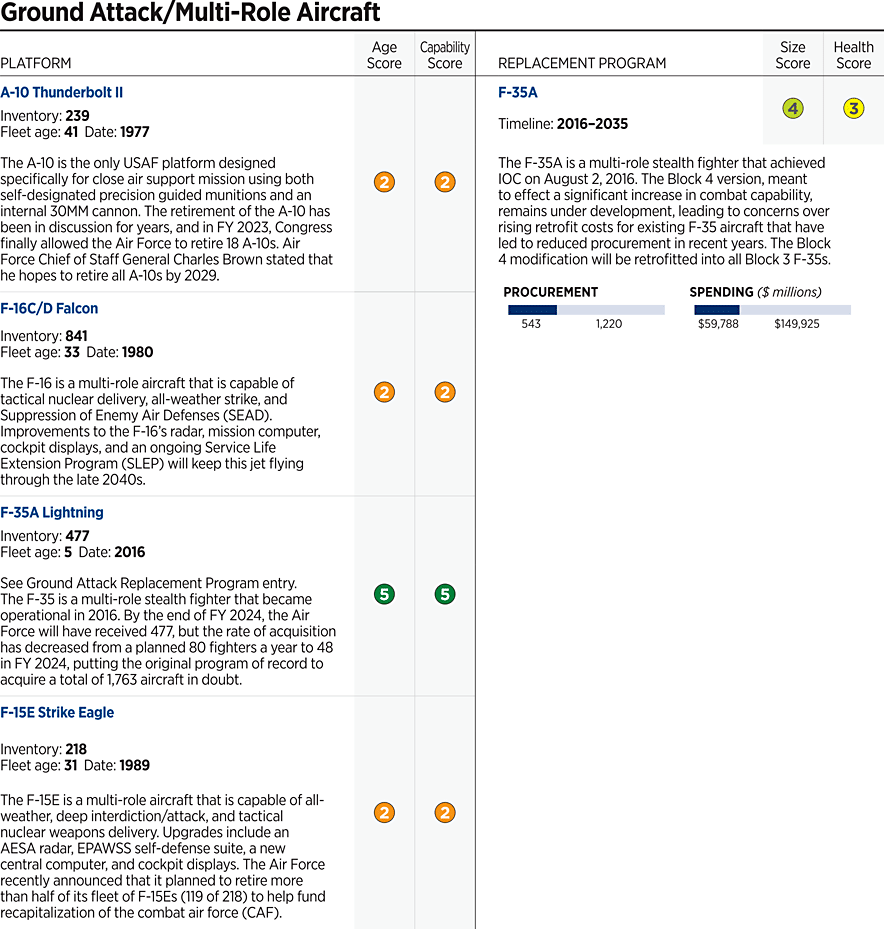
The strategic decisions concerning the Air Force’s fleet size further highlight the service’s predicament. Despite the 2018 “The Air Force We Need” study’s conclusion that the service was 25 percent too small for its designated missions, plans were unveiled in April 2022 to cut 1,468 aircraft from the fleet over the Future Years Defense Program (FYDP). This reduction included the accelerated retirement of 646 F-15C, F-16C, and A-10 fighter aircraft, with plans to procure only 246 new aircraft during the same period. In July 2023, an additional 103 F-15Es were slated for retirement, signaling a reduction of nearly 25 percent of the current fleet of 2,092 fighters over the next five years.
This strategic downsizing of the fleet, juxtaposed with a modest increase in procurement and a significant boost in RDT&E spending, illustrates a complex balancing act. The Air Force is navigating the dual imperatives of preparing for future high-end conflicts through technological advancements and maintaining a capable, ready force in the present. The tension between these objectives is evident in the reduction of operational aircraft and flying hours, raising concerns about the Air Force’s ability to meet its current and future mission requirements amidst evolving global threats.
As the Air Force continues to evolve, the implications of these strategic choices will have profound impacts on its operational readiness, capability, and global posture. The focus on RDT&E and the strategic reduction in fleet size and flying hours reflect a calculated risk to prioritize future capabilities over present readiness. This strategy aligns with the anticipation of a new era of warfare, where technological supremacy and advanced capabilities are expected to define the parameters of military effectiveness and strategic deterrence. However, the challenge remains to balance these long-term investments with the immediate needs of maintaining a robust, ready, and capable force to address current global security challenges.
Precision-Guided Munition Expenditures and Programmed Acquisitions
TOTAL MUNITIONS EXPENDED
| Type | FY 2017 | FY 2018 | FY 2019 | FY 2020 | FY 2021 | FY 2022 | FY 2023* |
| JDAM | 30664 | 5462 | 7354 | 4004 | 4242 | 4203 | 4250 |
| HELLFIRE | 1536 | 2110 | 2449 | 1019 | 1023 | 132 | 110 |
| SDB-I/II | 4507 | 749 | 1289 | 397 | 98 | 52 | 355 |
| APKWS | unknown | unknown | unknown | unknown | unknown | unknown | 866 |
| JASSM ER/XR | 360 | 19 | 16 | 10 | 8 | 0 | 12 |
| LGB | 276 | 373 | 106 | 6078 | 5625 | 4856 | 5266 |
| ARRW | 0 | 0 | 0 | 0 | 0 | 2 | 0 |
| LRASM | 0 | 0 | 0 | 0 | 0 | 0 | 0 |
| TOTAL | 38092 | 9462 | 11963 | 11508 | 10996 | 9245 | 10858 |
TOTAL MUNITIONS ACQUIRED
| Type | FY 2017 | FY 2018 | FY 2019 | FY 2020 | FY 2021 | FY 2022 | FY 2023* |
| JDAM | 35106 | 36000 | 25000 | 16800 | 1919 | 1241 | 2840 |
| HELLFIRE | 3629 | 3734 | 3859 | 4517 | 1176 | 5151 | 1295 |
| SDB-I/II | 7312 | 6254 | 8253 | 3205 | 1983 | 5837 | 355 |
| APKWS | 10621 | 6879 | 15642 | 1323 | 12801 | 11199 | 4911 |
| JASSM ER/XR | 360 | 360 | 390 | 400 | 525 | 390 | 440 |
| LGB | 0 | 0 | 0 | 0 | 0 | 0 | 0 |
| ARRW | 0 | 0 | 0 | 0 | 0 | 0 | 0 |
| LRASM | 0 | 0 | 0 | 0 | 12 | 0 | 0 |
| TOTAL | 57777 | 53976 | 53893 | 26994 | 18416 | 23818 | 10858 |
*Estimates based on programmed expenditures. ** Estimates based on FY 2024 President’s Budget. SOURCES: • Headquarters U.S. Air Force, Deputy Chief of Staff for Operations, written response to Heritage Foundation request for information, May24,2023. • Table 1, “Department of the Air Force Budget Summary,” in U.S. Department of the Air Force, Department of the Air Force FY 2024 Budget Overview, p.2, https://www.saffm.hq.af.mil/Portals/84/documents/FY24/Budget/FY24%20Budget%20Overview%20Book.pdf?ver.AFXW89XqB_ Ys1Gxlwx41AUd%3d (accessed September 18, 2023). • U.S. Department of the Air Force, Department of Defense Fiscal Year (FY)2024 Budget Estimates, Air Force, Justification Book Volume 1 of Procurement of Ammunition, Air Force, March 2023, pp. S and 41, https://Wwwsaffm.hq.af.mil/Portals/84/documents/FY24/Procurement/FY24%20 Air%20Force%20Ammunition%20Procurement.pdf?ver=EP4kq6Ly9fXnB_sF66NVMA%3D%3D (accessed September 18, 2023).
The Evolution and Current State of U.S. Air Force Capacity
Historical Context and Cold War Peak
In 1987, at the zenith of the Cold War, the U.S. Air Force boasted an impressive inventory reflective of the era’s high geopolitical tensions. This period was characterized by a massive buildup aimed at ensuring superiority over the Soviet Union, with active-duty numbers at 3,082 fighters, 331 bombers, 576 air refueling, and 331 strategic airlift platforms. The strategic reserves, including the Air National Guard and Air Force Reserve, augmented these figures to totals of 4,468 fighters, 704 air refueling, and 362 strategic airlift platforms, with the bomber count unchanged. This force structure was geared towards a strategy of deterrence, preparedness for full-scale war with a peer adversary, and ensuring global military dominance.
Post-Cold War Shifts
Following the dissolution of the Soviet Union, the strategic focus shifted from preparing for global confrontation to addressing regional conflicts. This transition led to a significant reduction in force size, aligning with a new military doctrine designed to fight and win two major regional conflicts (MRCs) simultaneously or in close succession. Such a shift was reflective of a broader reevaluation of military needs in a post-Cold War world where the likelihood of large-scale conventional warfare between superpowers seemed to diminish.
Current Capabilities and Future Projections
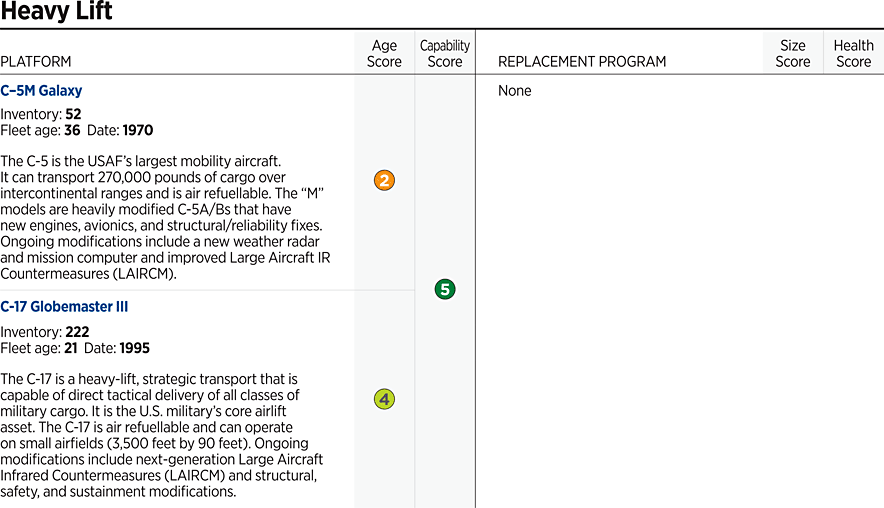
By the end of FY 2023, the Air Force’s projected Total Aircraft Inventory (TAI) showed a substantial decrease from Cold War levels to 2,092 fighters, 141 bombers, 471 tankers, and 274 strategic airlift platforms. The FY 2024 budget proposal further reduces these numbers, indicating a strategic downsizing and modernization effort in response to changing defense priorities and fiscal realities. This downsizing results in the Air Force operating at approximately 47% of its fighter, 43% of its bomber, 67% of its tanker, and 76% of its strategic airlift capabilities compared to the peak Cold War era.
Challenges in Surge Production and Readiness
The optimistic view that aircraft production lines could surge in response to a crisis faces practical and logistical challenges. Even with significant investment, the timeline for expanding production and delivering new assets ranges from two to three years. This delay is critical, as it impacts the Air Force’s ability to rapidly respond to emergent threats or escalate conflicts with peer adversaries.
Combat-Readiness and the Distinction of Combat-Coded Aircraft
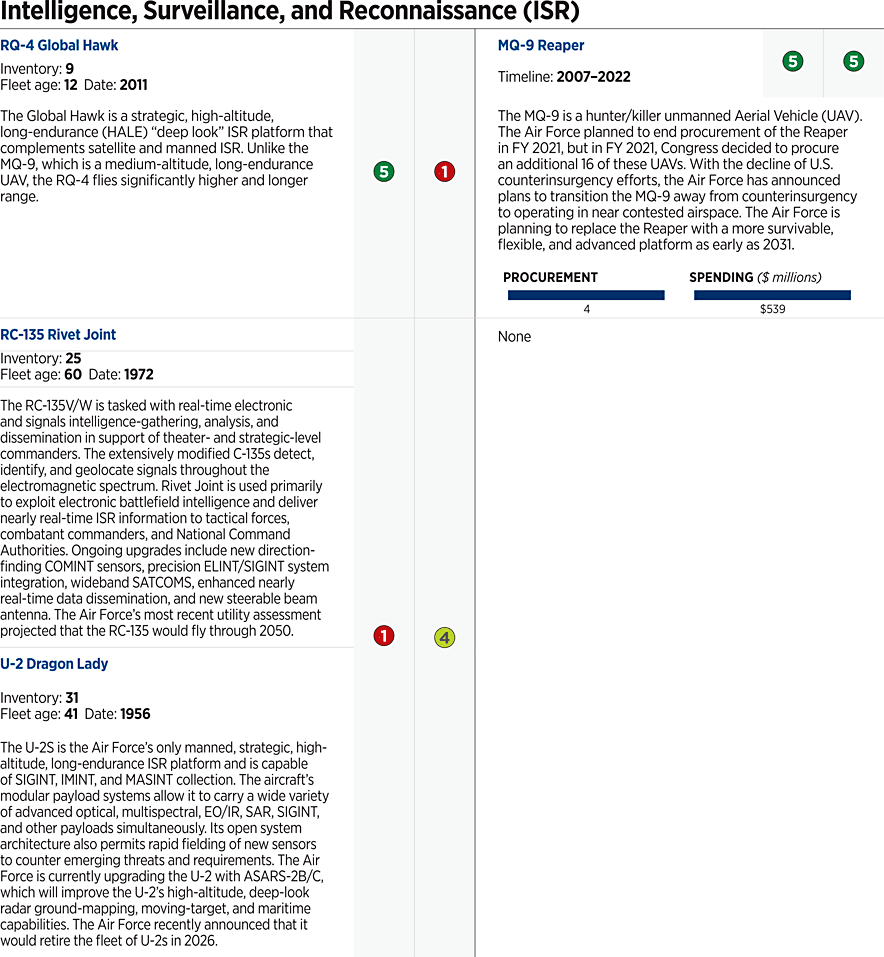
The combat readiness of the Air Force is not solely dependent on the number of aircraft but also on the distinction between combat-coded and non-combat-coded units. Combat-coded aircraft are those designated for wartime missions, excluding those assigned to training, testing, and other non-combat roles. This distinction is crucial for understanding the actual combat capabilities of the Air Force, as non-combat-coded units may lack the necessary hardware, software, and munitions delivery capabilities for effective combat operations. As of FY 2023, of the 5,154 manned and unmanned aircraft in the USAF’s inventory, only 1,432 are active-duty fighters, with 886 being combat-coded.
Logistical and Deployment Challenges
The operational readiness of the Air Force is further impacted by logistical and deployment challenges. The process of deploying squadrons over long distances, coupled with maintenance and manning requirements, effectively reduces the number of combat-capable fighters. This logistical reality underscores the strategic and operational limitations faced by the Air Force in projecting power globally, especially in the rapid deployment scenarios characteristic of modern warfare.
Munitions Capacity and Modern Warfare Challenges
The capacity for sustained combat operations is also critically dependent on munitions stockpiles and the ability to replenish them rapidly. The precision-guided munitions (PGM) inventory, stressed by nearly two decades of continuous combat operations and budgetary constraints, highlights a significant vulnerability. Despite efforts to restock, the capacity to support prolonged peer-level conflict remains uncertain, compounded by the challenges of expanding production quickly enough to meet demand in high-intensity conflicts.
Technological Advancements and Countermeasures
The evolving battlefield includes challenges such as the jamming of Global Navigation Satellite Systems (GNSS), including GPS, which has become a significant concern. Adversaries like Russia have demonstrated the capability to disrupt GNSS-guided weapon systems, necessitating the development of munitions less susceptible to jamming and capable of retaining accuracy in degraded GNSS environments. The Air Force’s incorporation of advanced technologies, such as laser guidance systems, represents an adaptive strategy to counteract these emerging threats and ensure the effectiveness of its munitions in contested environments.
The U.S. Air Force’s journey from its Cold War peak to its current state reflects a continuous adaptation to the evolving geopolitical landscape and technological advancements. While facing challenges in force size, production capacity, combat readiness, and munitions stockpile sustainability, the Air Force remains a pivotal component of the U.S. military’s ability to project power globally. Addressing these challenges requires a multifaceted approach, balancing strategic foresight, technological innovation, and adaptability to maintain dominance in the air domain.

Evolving Air Superiority: Challenges and Modernization in the U.S. Air Force
The U.S. Air Force, a pivotal component of American military might, is at a crossroads of modernization and readiness, faced with aging fleets, evolving threats, and the imperative of technological advancement to maintain global dominance. The service’s journey toward this objective is marked by strategic programs, budget allocations, and a blend of legacy and cutting-edge technologies. This article delves into the nuanced landscape of air power readiness, modernization efforts, and the strategic pivots shaping the future of air superiority.
F-22 Raptor: A Jewel in Need of Polish
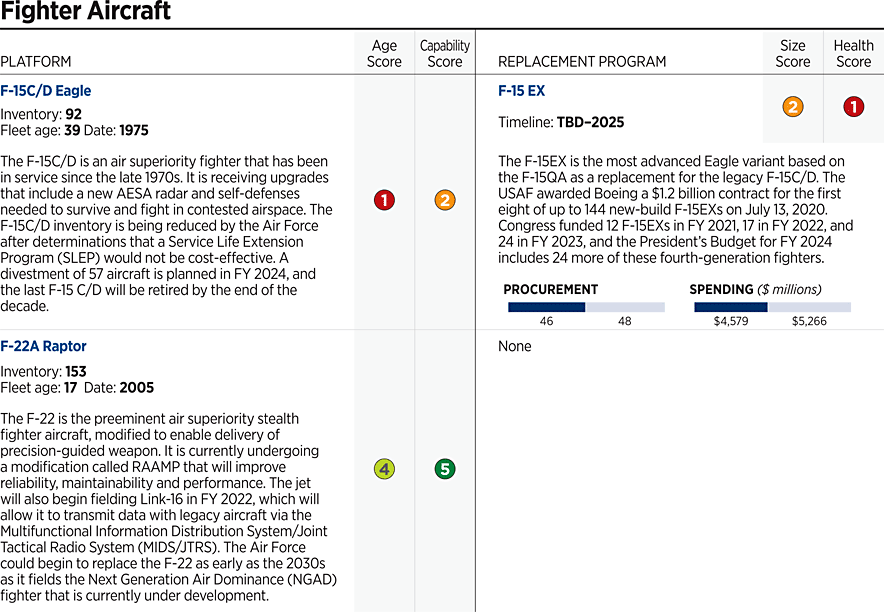
The F-22 Raptor, America’s premier air superiority fighter, is undergoing a critical 10-year program aimed at refurbishing its low-observable coatings and overhauling the flight control systems. Slated to run through 2031, this initiative underscores the challenge of maintaining cutting-edge technology in operational readiness. However, this necessary refurbishment, coupled with the F-22’s low mission capability rate, significantly strains the fighter’s availability against peer competitors. This bottleneck highlights a broader issue: the delicate balance between maintaining technological edge and ensuring fleet readiness.
The F-35A Lightning II: Forging Ahead
In contrast, the Air Force continues to bolster its capabilities with the acquisition of the F-35A Lightning II, a multirole stealth fighter that achieved full operating capability in 2018. The procurement of 48 more jets as per the FY 2024 budget underlines the Air Force’s commitment to this fifth-generation aircraft, renowned for its air-to-ground prowess and air superiority capabilities. The F-35A’s role is pivotal in complementing the F-22, offering versatility and advanced capabilities across a spectrum of scenarios. However, its prioritization in funding, eighth on the Department of the Air Force’s list, reflects a strategic allocation of resources among various critical defense programs, including the Next Generation Air Dominance (NGAD) and the Ground Based Strategic Deterrent (GBSD), among others.
Strategic Bomber Fleet: Transitioning to Next-Gen
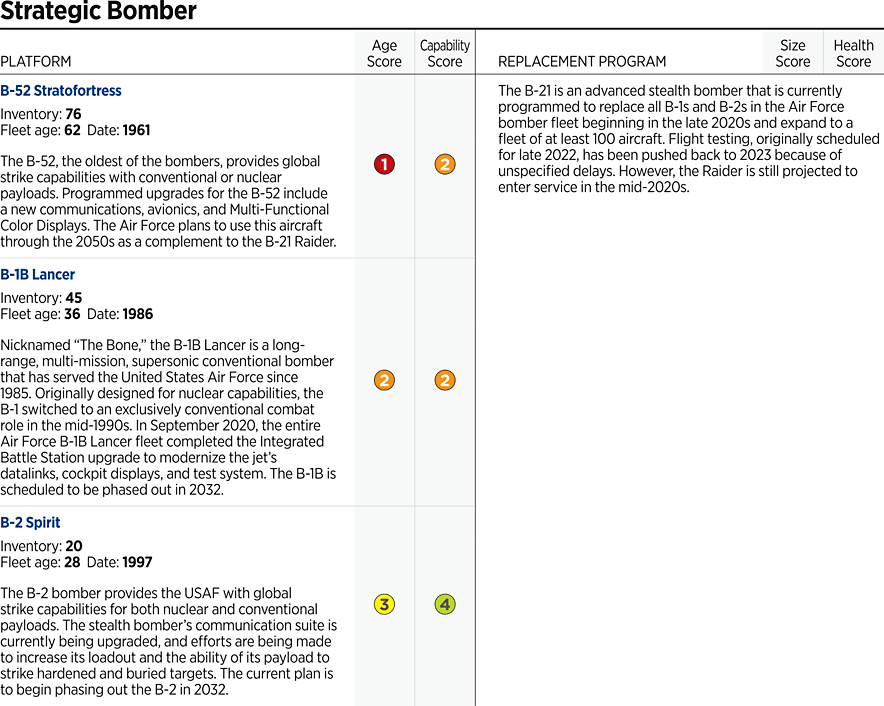
The bomber fleet’s evolution is another focal point of Air Force modernization. The transition to a two-bomber fleet comprising the B-21 Raider and the B-52 Stratofortress aims to replace the aging B-1 Lancers and B-2 Spirits. The B-21, with its anticipated full operations in the mid-2020s, represents the future of strategic bombing, with plans for at least 100 units at an estimated cost of $639 million per plane. Meanwhile, the B-52’s modernization, including re-engineering and electronic warfare enhancements, ensures its relevance through 2050. This multi-generational fleet underscores the strategic vision for a robust, versatile, and technologically superior bomber force capable of projecting power globally.
Tanker Fleet Modernization: Fueling the Fight
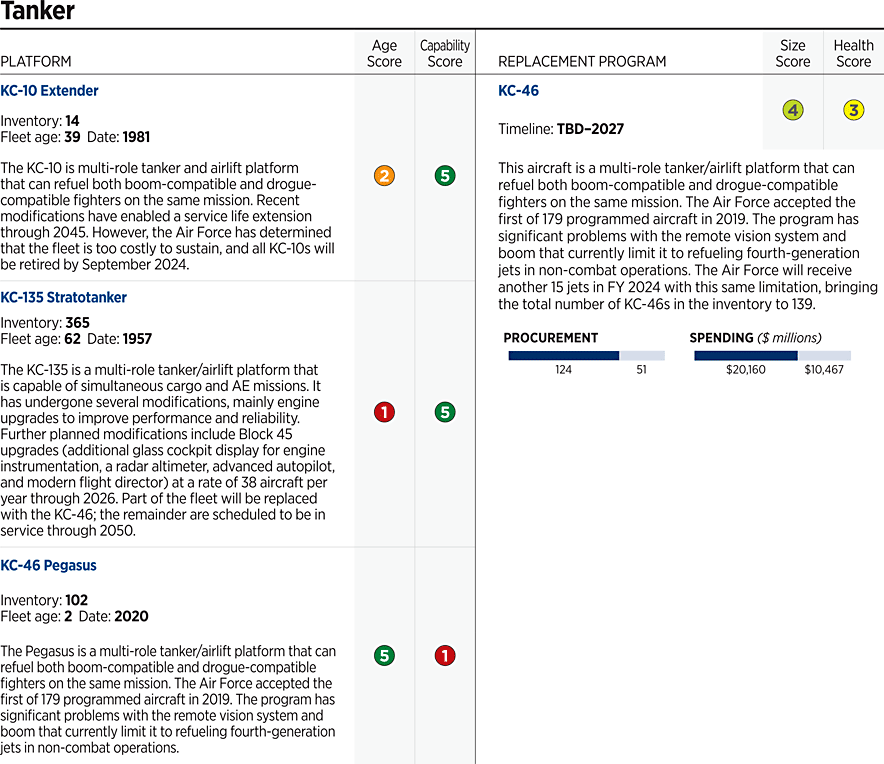
The acquisition of the KC-46A Pegasus is critical for extending the Air Force’s global reach. Despite challenges and delays, particularly with its air refueling system, the Air Force is set to have 95 KC-46s by the end of FY 2023, with a total of 179 expected by the end of FY 2029. This modern tanker fleet, however, will replace less than half of the aging KC-135 Stratotankers, highlighting a significant recapitalization need to maintain operational effectiveness and global responsiveness.
The Air Force We Need: A Vision in Flux
The vision articulated in “The Air Force We Need,” which proposed expanding the squadron count to 386, reflects an ambition to modernize with platforms like the F-35s, B-21s, and KC-46s. However, the acquisition of the fourth-generation F-15EX, aimed at cost-effective replacement for older aircraft, signals a nuanced approach to modernization, blending legacy and next-gen capabilities. The decision reflects fiscal pragmatism and strategic flexibility but has sparked debate over the best path to future readiness and dominance in air power.
As the U.S. Air Force navigates the complexities of modernization, readiness, and strategic foresight, it faces a landscape marked by technological innovation, fiscal constraints, and evolving global threats. The careful balancing of legacy systems with cutting-edge technology, strategic bomber and fighter fleet modernization, and the crucial role of air refueling capabilities highlight the multifaceted approach required to maintain supremacy in the skies. Amidst these challenges, the Air Force’s strategic decisions will shape its ability to project power, deter adversaries, and secure American interests in the 21st century and beyond.
Navigating the Readiness Quagmire: The U.S. Air Force’s Strategic Response
The U.S. Air Force’s readiness, a crucial determinant of its capability to project power and ensure national security, has undergone significant scrutiny and strategic reevaluation in recent years. The 2018 National Defense Strategy (NDS), with its emphasis on preparing for peer-level conflicts, catalyzed a profound shift in operational focus and readiness assessment metrics within the service. This shift, underscored by directives from Secretary of Defense James Mattis and evolving service leadership perspectives, illustrates the complexities of maintaining a combat-ready force amid changing geopolitical landscapes and technological advancements.
Mission-Capable Rates and the Mattis Directive
Secretary Mattis’s 2019 directive to elevate mission-capable (MC) rates to 80 percent for key fighter jets was a bold move aimed at bolstering the Air Force’s rapid deployment capabilities against peer adversaries. This target, ambitious in its scope, sought to rectify the readiness challenges exacerbated by relentless deployments and budgetary constraints. However, the Air Force’s struggle to meet this threshold revealed intrinsic difficulties in achieving such high MC rates across the board. The acknowledgment by General David Goldfein, then Air Force Chief of Staff, that the service would not meet the 80 percent MC directive until 2020—and later, the admission that this target was no longer a focal point—underscores the nuanced reality of operational readiness versus statistical benchmarks.
Shifting Focus: Deployability Over MC Rates
The Air Force’s transition from emphasizing MC rates to prioritizing deployability and the readiness of “force elements” signifies a strategic pivot. This approach, which considers the rapid deployment capabilities of units like the B-52 bombers to the Middle East, represents a nuanced understanding of readiness—one that values the ability to respond to contingencies over blanket statistical measures. However, this shift also highlights the challenge of balancing regional response capabilities with the demands of deterring or defeating peer-level threats.
The AFFORGEN Model: A New Paradigm
The introduction of the Air Force Generation (AFFORGEN) model marks the latest in a series of adaptations aimed at redefining readiness. By dividing deployable combat forces into four six-month phases—Ready, Available to Commit, Reset, and Prepare—the AFFORGEN model endeavors to achieve a sustainable balance between current availability, modernization, and risk management. Yet, despite its forward-looking framework, this model has faced criticism for potentially masking deeper readiness challenges rather than addressing them head-on.
Assessing Readiness: Beyond the Surface
The difficulty in assessing the Air Force’s readiness lies in the opacity of open-source indicators and the Department of Defense’s reluctance to disclose detailed readiness statistics. Nonetheless, MC rates, aircrew training, and deployability serve as critical metrics for gauging the health of the force. Each of these areas provides insights into the Air Force’s capability to fulfill its missions, yet they also highlight the ongoing struggles to maintain a fully prepared and modernized force amidst fiscal constraints and evolving threats.
The U.S. Air Force’s journey through the labyrinth of readiness reevaluation reflects a broader challenge within the military: adapting to new strategic imperatives while grappling with legacy issues of force structure and resource allocation. As the service navigates this complex terrain, the efficacy of measures like the AFFORGEN model and the strategic emphasis on deployability over traditional MC rates will be pivotal in shaping its future readiness posture. In an era where technological superiority and rapid response capabilities are paramount, the Air Force’s ability to innovate and adapt its readiness paradigms will be critical in securing America’s airspace dominance and strategic interests.
Mission Capability Rates: A Crucial Metric for Air Force Readiness
The readiness and operational effectiveness of the U.S. Air Force can be significantly measured by mission capability (MC) rates, a critical metric that reflects the percentage of a unit’s aircraft ready to perform designated missions. These rates not only offer a snapshot of current operational capacity but also highlight the intricate balance between available resources and the demands of maintaining a technologically advanced and combat-ready fleet.
The Role of MC Rates in Operational Capacity
MC rates are calculated by assessing the proportion of aircraft within a fleet that are fully mission-capable, juxtaposed against the total number of aircraft. This ratio is pivotal in determining the physical operational capacity of a weapons system, providing a clear indicator of the Air Force’s ability to project power and fulfill its strategic objectives. For mature systems, MC rates are influenced by two primary factors: operations and maintenance (O&M) funding, and the availability of qualified personnel to manage, repair, and operate the aircraft. These elements collectively influence the number of sorties and flight hours available for aircrew training, directly impacting combat readiness.
Historical Context and Current Challenges
Reflecting on past preparedness levels, the Air Force once maintained over 700 F-15C air superiority fighters with an MC rate exceeding 80 percent, indicating a robust capability against peer competitors like the Soviet Union. Today, the scenario is markedly different. The F-22 Raptor, despite being a superior fighter jet, has a fleet of 186 with only 142 designated for operational use. With an MC rate of 57 percent in 2022, merely 81 F-22As are available for combat, highlighting a significant gap in readiness for peer-level engagements.
This challenge extends across the bomber fleet as well. Operational B-1 Lancers and the small number of B-2 Spirits, along with the B-52 Stratofortresses, collectively yield a combat-ready force that, while capable against regional threats, may fall short in a conflict with a peer adversary due to limited MC rates.
The Impact of Funding and Manning on MC Rates
The primary drivers of MC rates—O&M funding and qualified maintenance manning—underscore the intricate relationship between resource allocation and operational readiness. Adequate funding for flying hours and spare parts is essential for enhancing MC rates, offering pilots more opportunities to conduct sorties and refine their combat capabilities. However, the aftermath of sequestration and subsequent fiscal constraints have led to only marginal increases in funding for flying hours, significantly impacting the ability of pilots to achieve and maintain combat mission capability.
Moving Forward: Addressing the Readiness Dilemma
To bridge the readiness gap, a concerted effort to increase O&M funding and bolster maintenance manning is crucial. This approach would facilitate a rise in MC rates, thereby enhancing the overall combat readiness of the Air Force. It involves not only addressing fiscal challenges but also ensuring a steady pipeline of qualified personnel to support the complex demands of maintaining a modern, technologically advanced air fleet.
Moreover, as the Air Force navigates the evolving landscape of aerial warfare and peer-level threats, the importance of investing in next-generation aircraft and systems cannot be overstated. This strategic investment, coupled with a focus on sustaining high MC rates across the fleet, will be pivotal in maintaining air superiority and ensuring the U.S. Air Force remains prepared to meet the challenges of the future.
The readiness and effectiveness of the U.S. Air Force are inextricably linked to the MC rates of its aircraft, highlighting the need for robust funding, qualified personnel, and strategic foresight in defense planning. As the service confronts the dual challenges of technological advancement and geopolitical rivalry, the MC rates serve as a barometer for its ability to project power and defend national interests in an increasingly contested global environment.
Tackling the U.S. Air Force’s Pilot Shortage and Readiness Crisis
The U.S. Air Force is currently grappling with a significant pilot shortage and a notable decline in aircrew training quality, which poses a serious threat to its operational readiness and capability to engage effectively in peer-level conflicts. The detailed data you’ve provided illuminates several critical areas that require immediate attention and strategic action.
The Extent of the Pilot Shortage
The Air Force’s pilot shortage has been a growing concern, with a shortfall reported to be 1,555 pilots at the end of FY 2016, escalating to a Total Force shortfall of 1,650 by 2022. This deficit severely hampers the Air Force’s operational capabilities, particularly in its fighter pilot ranks, which are crucial for maintaining air superiority. Despite efforts to boost pilot training output, unforeseen circumstances like the COVID-19 pandemic have further exacerbated the situation, leading to lower than projected graduation rates from flight schools.
Aircrew Training and Readiness
The readiness of pilots, as measured by their ability to complete mission-critical sorties and accumulate sufficient flying hours, is alarmingly below the standards set by decades of Air Force training doctrine. Historical data suggests that a healthy rate of three sorties a week and more than 200 flying hours a year are benchmarks for a sufficiently trained fighter pilot. However, recent figures fall short, with pilots averaging fewer than 1.4 sorties a week and less than 131 hours of flying time per year—a level at which pilot competence and confidence are significantly undermined.
Funding and Resource Allocation
Despite a substantial increase in the defense budget, the allocation for flying hours has not kept pace, indicating a misalignment in resource prioritization. This discrepancy suggests that, even with available funding, the Air Force has struggled to execute the programmed number of flying hours, critical for maintaining pilot proficiency. The decline in funded and actual flying hours over recent years, despite a reported healthy maintenance manning status, calls into question the efficiency of resource utilization within the Air Force.
Strategic Implications and Recommendations
To address these challenges, a multifaceted approach is required. First, the Air Force must reassess its recruitment and retention strategies to address the pilot shortfall directly. Innovative solutions, such as offering competitive incentives, enhancing quality of life for pilots, and streamlining training pipelines, could mitigate this trend.
Second, increasing the allocation of resources towards flying hours and ensuring these resources are effectively utilized will be crucial in reversing the decline in pilot readiness. This effort should include a reassessment of the balance between simulator training and actual flight time, recognizing that while simulators are valuable training tools, they cannot replace the experience gained from real-world flying.
Lastly, the Air Force should consider revising its readiness assessment metrics to more accurately reflect the capabilities required for contemporary and future warfare scenarios. This revision should aim to ensure that training and readiness evaluations are aligned with the strategic demands of great-power competition.
The U.S. Air Force faces a daunting challenge in addressing its pilot shortage and enhancing aircrew training and readiness. However, by adopting a strategic, resource-informed, and data-driven approach, it is possible to rebuild a robust, ready, and capable pilot force. This effort is essential not only for maintaining air superiority but also for ensuring the Air Force can fulfill its critical national security missions in an increasingly complex global security environment.
Airforce Maintenance Manning
| Skill Level | Authorized | Assigned | Manning Percentage |
| 3-Level (Apprentice) | 17819 | 16857 | 95% |
| 5-Level (Journeyman) | 36616 | 36387 | 99% |
| 7-Level (Craftsman) | 18632 | 17630 | 95% |
Source: Headquaters U.S. Air Force, ABX/A5RW
Deployability Challenges in the U.S. Air Force
The deployability of the U.S. Air Force is significantly impacted by the logistical and operational constraints that limit the number of squadrons that can be rapidly deployed. This issue is compounded by the need for long-term inspections, depot-level work on aircraft, and the availability of support equipment, all of which affect the readiness of airframes for deployment.
Traditionally, the Air Force relied on a three-squadron wing configuration to manage deployment and maintenance cycles efficiently. This structure allowed for one squadron to undergo maintenance or inspections while the remaining two were enhanced with additional aircraft and personnel to form two deployable units. This model was effective during the Cold War but has been challenged by post-Cold War downsizing, which saw a reduction in the number of fighter squadrons and altered the traditional deployment strategy.
Active-Duty and Reserve Squadron Manning
The current active-duty fighter squadron manning levels are predicated on a ratio of 1.25 aircrew members per aircraft, resulting in a complement of 30 line pilots and five supervisor pilots for a squadron with 24 assigned aircraft. However, the requirements of combat increase the manning ratio to approximately 1.50 pilots per aircraft, necessitating an additional six pilots to meet the deployment needs of a single squadron.
With the reduction of fighter squadrons in the active force and all operational Guard and Reserve wings comprising a single squadron, the Air Force faces significant hurdles in deploying the requisite number of squadrons to a fight. This has led to a situation where, of the 54 operational fighter squadrons, only 21 active-duty fighter squadron equivalents could be feasibly deployed, falling short of the 600 fighters needed for a single Major Regional Conflict (MRC).
Implications for Guard and Reserve Units
Guard and Reserve units, which play a critical role in the Air Force’s total force capability, encounter unique challenges due to the civilian commitments of their personnel. The planning for deployments, especially to low-threat areas, has historically been done well in advance, allowing for the meticulous coordination of civilian work schedules and military training requirements. However, in scenarios requiring swift action, the model of needing two squadrons to deploy one becomes a significant bottleneck, potentially delaying the Air Force’s operational response.
Strategic Considerations and Solutions
To address these deployability challenges, the Air Force must explore a range of strategic and operational solutions:
- Enhancing Maintenance and Logistics: Improving the efficiency of maintenance cycles and increasing the availability of spare parts are crucial steps towards ensuring aircraft are ready for deployment. This could involve leveraging predictive maintenance technologies and streamlining logistics chains to reduce downtime for aircraft.
- Revisiting Force Structure: A comprehensive review of the current force structure, including the viability of the single-squadron wing model in the Guard and Reserve, may identify opportunities to increase deployability without compromising the unique civilian-military balance in these components.
- Increasing Pilot Recruitment and Retention: Addressing the pilot shortage through targeted recruitment and retention efforts is vital. This may include incentives for service, pathways for quicker advancement, and enhanced training opportunities to ensure a steady flow of qualified pilots into the force.
- Leveraging Technology and Simulation: High-fidelity simulators and advanced training technologies can supplement real-world flying hours, allowing pilots to maintain and enhance their skills even when aircraft availability is limited.
- Cross-Component Integration: Enhancing the integration between active-duty, Guard, and Reserve components can foster a more flexible and responsive force. This might involve creating mixed-component squadrons that can leverage the strengths of each component for deployment.
The U.S. Air Force’s deployability and readiness face significant challenges, underscored by maintenance, logistics, and manpower constraints. Addressing these issues requires a multifaceted approach that balances operational needs with strategic foresight. By implementing targeted solutions across maintenance, force structure, pilot management, and training, the Air Force can enhance its readiness and ensure its ability to respond effectively to both regional contingencies and peer-level threats.
Scoring the U.S. Air Force: Capacity and Capability Assessment
The United States Air Force plays a pivotal role in ensuring national security, and its ability to respond to major combat engagements is of paramount importance. In this article, we will delve into the comprehensive analysis of the Air Force’s capacity and capability, as outlined in the 2024 Index of U.S. Military Strength, with a focus on the requirements, current status, and potential challenges the Air Force faces.
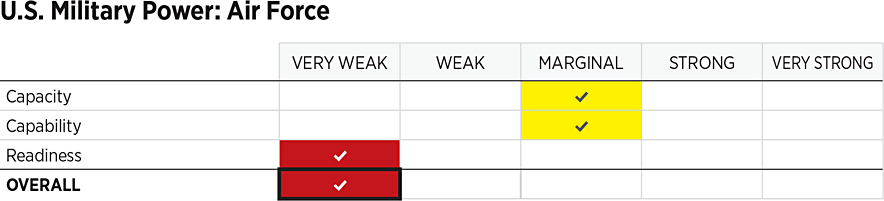
Capacity Score: Marginal
When it comes to capacity, the U.S. Air Force’s primary focus is on fighter squadrons. Since World War II, the Air Force has consistently deployed an average of 28 fighter squadrons. With an average of 18 aircraft per squadron, this translates to a requirement of 500 Active Component fighter aircraft to execute one Major Regional Conflict (MRC). Accounting for spares and attrition reserves, the total number of aircraft needed rises to 600, making these aircraft a crucial component of the Air Force’s combat power.
In the 2024 Index, it is asserted that the Air Force should maintain 1,200 active-duty, combat-coded fighter aircraft to meet the baseline requirement for two MRCs. This number aligns with the fighter requirement identified in the 2018 Total Air Force Warfighting Needs (TAFWN) study, which was reaffirmed by the Commander of Air Combat Command. The TAFWN study also provided threshold values for bomber, tanker, and strategic air requirements.
As of 2023, the actual number of active-duty combat-coded fighter aircraft stood at 886, representing 75 percent of the threshold requirement. The number of total force squadrons, essential for a two-MRC scenario, stood at 54, representing 88 percent of the threshold. The situation is similar for bombers and tankers, with 64 percent and 80 percent of required squadrons respectively, and 79 percent and 84 percent of the required platforms respectively. In contrast, the airlift squadrons exceeded the threshold, with 99 percent of required squadrons and 100 percent of required airlifters.
TABLE 1
- Two-MRC Fighter—Threshold: 1,200 combat-coded active-duty fighters / 62 squadrons.
- Two-MRC Fighter—Actual 2023 Level: 886 active-duty combat-coded fighters (75 percent) / 54 total force squadrons (88 percent).
- TAFWN Bomber Squadron—Threshold: 14 combat-coded bomber squadrons / 140 bombers.
- TAFWN Bomber Squadron—Actual 2023 Level: nine combat-coded bomber squadrons (64 percent) / 111 combat-coded bombers (79 percent).
- TAFWN Tanker Squadron—Threshold: 54 tanker squadrons / 540 combat-coded tankers.
- TAFWN Tanker Squadron—Actual 2023 Level: 43 combat-coded tanker squadrons (80 percent) / 454 combat-coded tankers (84 percent).
- TAFWN Airlift Squadron—Threshold: 54 airlift squadrons / 540 combat-coded airlifters.
- TAFWN Airlift Squadron—Actual 2023 Level: 53 combat-coded airlift squadrons (99 percent) / 545 combat-coded airlifters (100 percent).
Although the Air Force’s capacity for a two-MRC scenario is currently at 83 percent, it is worth noting that this is a decline from the 86 percent reported in the 2023 Index. Moreover, the disposition of these assets limits the Air Force’s ability to rapidly deploy them to crisis regions. While the available fighter and bomber assets might be sufficient for a single regional conflict, the associated time and casualties would be significantly higher. Additionally, low mission capability rates of fighter aircraft exacerbate the situation, necessitating global sourcing to field the required combat fighter force for a single MRC.
Despite being within the “marginal” range, programmed aircraft retirements are projected to outpace acquisitions over the Future Years Defense Program (FYDP), further decreasing capacity.
Capability Score: Marginal
The Air Force’s capability score, similar to capacity, is rated as “marginal.” This assessment is based on multiple factors, including the size of the modernization program, the age of equipment, the health of modernization programs, and the capability of equipment.
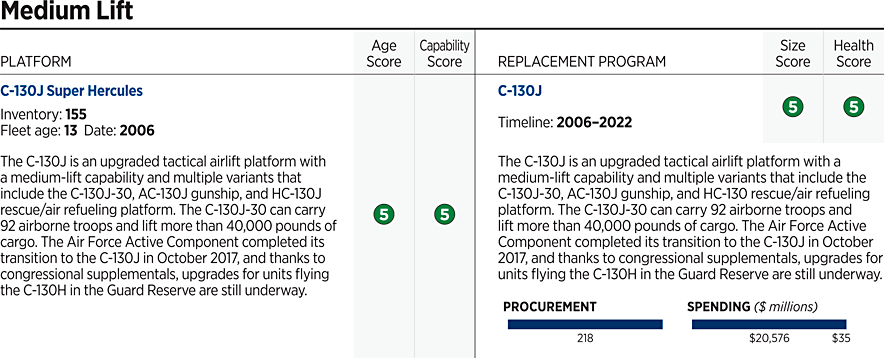
The “Size of Modernization Program” is rated as “strong” due to the ongoing production of new F-35 and KC-46 aircraft. However, this positive trend is offset by aircraft retirements, resulting in a marginal score for the “Capability of Equipment.”
The “Age of Equipment” and “Health of Modernization Programs” are both rated as “marginal,” indicating room for improvement in these areas.
Looking ahead, it is expected that the capability score is unlikely to improve over the next three to five years due to the continued retirements of aging aircraft.
While the U.S. Air Force maintains a marginal capacity and capability score, there are clear challenges that need to be addressed. Maintaining and modernizing the fleet of combat-coded fighter aircraft is essential for ensuring the Air Force’s readiness in the face of evolving threats and demands on national security. The assessment provided by the 2024 Index highlights the importance of sustained efforts to enhance the Air Force’s capacity and capability to effectively respond to potential conflicts and maintain its role as a pillar of U.S. military strength.
Air Force Active-Duty Combat-Coded Fighter Squadrons (31 Total)

Air National Guard and Air Force Reserve Combat-Coded Fighter Squadrons (24 Total)

U.S. Air Force Readiness: A Critical Analysis
The readiness of the United States Air Force is under scrutiny as it continues to grapple with significant challenges that impact its ability to respond effectively to emerging crises and peer competitors. The 2024 Index of U.S. Military Strength has once again rated the Air Force’s readiness as “very weak,” marking the second consecutive year with this unimpressive assessment.
Pilot Shortage and Sortie Rates
One of the most pressing issues affecting the Air Force’s readiness is the sustained pilot deficit. This deficiency, which persists from the previous year’s evaluation, contributes significantly to the dismal readiness score. In the 2023 Index, the Air Force was already labeled as “very weak” in readiness, and the situation has shown little improvement since.
Despite a marginal improvement in sortie rates in 2022, they remain far from adequate to rebuild the necessary competencies required for engaging in peer-to-peer combat. The shortage of trained pilots is evident when it is realized that only about half of the most capable units can execute “some” of their wartime missions. This alarming statistic underscores the gravity of the readiness crisis within the Air Force.
Mission-Capable Rates and Budget Constraints
Furthermore, mission-capable rates for Air Force assets have not seen substantial improvements since 2021. The 2024 Index highlights the fact that the current budgetary constraints are likely to further reduce operational training sorties, perpetuating the downward spiral of readiness. This situation paints a disheartening picture of a service that appears content with occupying the lowest rungs on the readiness ladder.
The consequences of this readiness crisis are profound. The Air Force is ill-equipped to face a peer competitor in a high-stakes conflict scenario. To excel in such an environment, fighter pilots should ideally receive an average of three or more sorties per week and accumulate 200 hours of flight time per year to develop the skill sets necessary for combat survival. Unfortunately, the current realities fall far short of these benchmarks.
The Elusive Goal of Full-Spectrum Readiness
The FY 2023 Air Force statement reflects this alarming situation, mentioning the word “ready” only four times and never in the context of current readiness levels. This raises concerns about the Air Force’s preparedness to respond swiftly and effectively to emergent crises. The global war on terrorism has seen a significant reduction in deployments, and as such, the Air Force should have made more substantial progress towards achieving full-spectrum readiness.
Overall Assessment
The 2024 Index provides an overall assessment of the U.S. Air Force, characterizing it as “very weak” in readiness, which is the lowest rating on the scale. This rating is determined by a combination of factors, including capacity, capability, and readiness. In this case, the readiness component is the weakest link in the chain.
The shortage of pilots, inadequate flying hours, and a shortage of training sorties all erode the Air Force’s ability to generate the high-quality combat air power required to meet wartime demands. While some readiness challenges can be attributed to the effects of COVID-19, there is a clear indication that the service has made a calculated decision not to invest in acquiring more aircraft or funding the necessary accounts for a significant increase in training and sortie numbers.
Consequences of Weak Readiness
The consequences of this situation are grave. Although there may be a chance of success in a single Major Regional Conflict (MRC), the Air Force would face considerable difficulties in a war with a peer competitor. The prolonged duration of such a conflict and the high attrition rates would be significantly more burdensome than they would have been had the Air Force taken aggressive measures to enhance high-end training and acquire the fifth-generation weapon systems it urgently requires.
In conclusion, the U.S. Air Force’s readiness remains a cause for concern, with the 2024 Index echoing the same dire assessment as the previous year. Addressing the pilot shortage, increasing sortie rates, and prioritizing full-spectrum readiness are essential steps if the Air Force is to effectively meet its mission requirements and confront the challenges posed by peer competitors in the evolving global security landscape.

The United States Air Force’s Strategic Construction Vision for 2023-2024
The United States Air Force (USAF) has embarked on a significant journey to enhance its infrastructure and operational capabilities through major construction projects, as outlined in its Military Construction (MILCON) programs for fiscal years 2023 and 2024. These initiatives are not just about erecting buildings; they represent a strategic vision to support the Air Force’s mission readiness, technological advancement, and the well-being of its personnel.
Fiscal Year 2024 MILCON Overview
In March 2023, the Air Force released its fiscal year 2024 military construction budget justification book, marking a pivotal moment in its strategic infrastructure planning. This document serves as a roadmap for the Air Force’s intended construction endeavors, detailing the financial allocations and project priorities that will shape the Air Force bases and facilities in the coming years.
Infrastructure to Counter Threats
One of the key highlights of the Air Force’s MILCON strategy is the focus on building resilient infrastructure to give the Department of the Air Force a leading edge over near-peer adversaries. This includes not only direct mission facilities but also community facilities such as child development centers and dormitories, which are vital for the morale and effectiveness of Air Force personnel. As of 2023 and leading into 2024, 16 new buildings are either under construction or slated to begin, demonstrating a comprehensive approach to enhancing the Air Force’s operational and community infrastructure.
A Record of Execution and Future Plans
The Air Force Installation and Mission Support Center (AFIMSC) has been instrumental in delivering these construction projects. In fiscal year 2023, the AFIMSC awarded 79 large Facility Sustainment, Restoration, and Modernization (FSRM) projects, amounting to just under $1.5 billion. These projects are crucial for recapitalizing Department of the Air Force installations and supporting critical combat capabilities. The AFIMSC’s efforts underscore the Air Force’s commitment to executing its construction programs at a rapid pace, with fiscal year 2022 marking a record-breaking year for execution, a momentum expected to continue into 2023.
Collaboration and Challenges
The execution of these ambitious construction projects involves a collaborative effort among various stakeholders, including the Air Force Installation Contracting Center, U.S. Army Corps of Engineers, Naval Facility Engineering Systems Command, and the UK’s Defense Infrastructure Organization. This collaboration is part of a broader Unity of Effort (UoE) initiative launched in 2021, aimed at aligning planning, programming, and execution of the MILCON portfolio, which consists of 442 active projects in different construction phases through fiscal year 2028.
Strategic Investments
A significant portion of the MILCON budget is allocated for investments in the Pacific and European Theaters, highlighting the strategic importance of these regions to the Air Force’s operational readiness and global posture. This investment is part of a concerted effort to ensure that the Air Force’s infrastructure is capable of supporting its mission requirements and operational capabilities in a rapidly evolving global security environment.
The USAF’s MILCON projects for 2023 and 2024 are a testament to its forward-looking approach to enhancing its operational capabilities, supporting its personnel, and maintaining a strategic edge in a challenging global security landscape. Through meticulous planning, significant investment, and collaborative execution, the Air Force is poised to achieve a resilient and modernized infrastructure that will serve its mission for years to come.
MILCON MAJOR CONSTRUCTION PROJECTS
| Project # | Component | State/Country | Installation | Project Title | PB-24 Request ($K) | |
| MILCON ACTIVE | ||||||
| 1 | Active | Alaska | JB Elmandorf-Richardson | EXTEND RUNWAY 16/34, INC 3 | 107,500 | |
| 2 | Active | Australia | Darwin | PDI: Squadron Operations Facility | 26,000 | |
| 3 | Active | Australia | Tindal | POI: Aircraft Maintenance Support Facility | 17,500 | |
| 4 | Active | Australia | Tindal | POI: Bomber Apron | 93,000 | |
| 5 | Active | Australia | Tindal | POI: Squadron Operations Facility | 20,000 | |
| 6 | Active | Florida | MacDill AFB | KC-46A ADAL Aircraft Corrosion Control | 25,000 | |
| 7 | Active | Florida | MacDill AFB | KC-46A ADAL Aircraft Maintenance Hangar | 27,000 | |
| 8 | Active | Florida | MacDill AFB | KC-46 ADAL Fuel System Maintenance Dock | 18,000 | |
| 9 | Active | Florida | MacDill AFB | KC-46A ADAL Apron & Hydrant Fueling Pits | 61,000 | |
| 10 | Active | Florida | Patrick AFB | C2C: Consolidated Communications Center | 15,000 | |
| 11 | Active | Florida | Patrick AFB | Final Denial Barriers, South Gate | 12,000 | |
| 12 | Active | Florida | Patrick AFB | Commercial Vehicle Inspection | 15,000 | |
| 13 | Active | Japan | Kadena AB | POI: Helo Rescue Ops Maintenance Hangar Inc 3 | 46,000 | |
| 14 | Active | Japan | Kadena AB | PDI: Theater A/C Corrosion Control Ctr, Inc | 42,000 | |
| 15 | Active | Georgia | Robbins AFB | Battle Management Combined Operations Complex | 115,000 | |
| 16 | Active | Guam | Joint Region Marianas | PDI: North Aircraft Parking Ramp, INC | 109,000 | |
| 17 | Active | Louisiana | Barksdale AFB | Weapons Generation Facility Inc 3 | 112,000 | |
| 18 | Active | Massachusetts | Hanscom AFB | MIT-Lincoln Lab (West Lab CSL/MIF}, Inc 4 | 70,000 | |
| 19 | Active | Massachusetts | Hanscom AFB | Child Development Center | 37,000 | |
| 20 | Active | Mariana Islands | Tinian | PDI: Fuel Tanks w/Pipeln & Hydrant, Inc 3 | 20,000 | |
| 21 | Active | Mariana Islands | Tinian | PDI: Airfield Development Phase 1, Inc 3 | 26,000 | |
| 22 | Active | Mariana Islands | Tinian | POI: Parking Apron, Inc 3 | 32,000 | |
| 23 | Active | Mississippi | Columbus | T-7A Ground Based Training System Facility | 30,000 | |
| 24 | Active | Mississippi | Columbus | T-7A Unit Maintenance Training Facility | 9,500 | |
| 25 | Active | Norway | Rygge AS | EDI: DABS-FEV Storage | 88,000 | |
| 26 | Active | Norway | Rygge AS | EDI: Munitions Storage Area | 31,000 | |
| 27 | Active | Oklahoma | Tinker AFB | KC-46 3-Bay Depot Maintenance Hangar Inc 3 | 78,000 | |
| 28 | Active | Philippines | Basa | PDI: Transient Aircraft Parking Apron | 35,000 | |
| 29 | Active | South Dakota | Ellsworth AFB | B-21 Weapons Generation Facility Inc 3 | 160,000 | |
| 30 | Active | South Dakota | Ellsworth AFB | B-21 Phase Hangar | 160,000 | |
| 31 | Active | South Dakota | Ellsworth AFB | B-21 Fuel System Maintenance Dock | 75,000 | |
| 32 | Active | Spain | Monron AB | EDI: Munitions Storage | 26,000 | |
| 33 | Active | Texas | Joint Base San Antonio | Child Development Center – LAK | 20,000 | |
| 34 | Active | United Kingdom | RAF Fairford | EDI: RADR Storage Facility | 47,000 | |
| 35 | Active | United Kingdom | RAF Lakenheath | Surety Dormitory | 50,000 | |
| 36 | Active | United Kingdom | RAF Lakenheath | EDI: RADR Storage Facility | 28,000 | |
| 37 | Active | Utah | Hill AFB | F-35 T-7A East Campus Infrastructure | 82,000 | |
| 38 | Active | Wyoming | FE Warren AFB | GBSD Integrated Command Center, Inc 2 | 27,000 | |
| 39 | Active | Wyoming | FE Warren AFB | GBSD Missile Handling Complex, Inc 2 | 28,000 | |
| 40 | Active | Wyoming | FE Warren AFB | GBSD Integrated Training Center | 85,000 | |
| ACTIVE TOTAL | 2,105,500 | |||||
| MILCON, ANG | ||||||
| 41 | ANG | Alabama | Montgomery Regional Airport | F-35: ADAL Sq Ops Bldg 1303 | 7,000 | |
| 42 | ANG | Arizona | Morris Air National Guard Base | MCCA: Aircraft Arresting System (New RWY) | 11,600 | |
| 43 | ANG | Colorado | Buckley Air Force Base | Aircraft Corrosion Control | 12,000 | |
| 44 | ANG | Indiana | Ft Wayne International Airport | Fire Station | 8,900 | |
| 45 | ANG | Oregon | Portland International Airport | Special Tactics Complex, Phase 1 | 22,000 | |
| 46 | ANG | Oregon | Portland International Airport | Special Tactics Complex, Phase 2 | 18,500 | |
| ANG TOTAL | 80,000 | |||||
| MILCON, AFR | ||||||
| 45 | AFR | Guam | JRM-Andersen AFB | Aerial Port Facility | 27,000 | |
| 46 | AFR | Texas | NAS JRB Fort Worth | LRS Warehouse | 16,000 | |
| 47 | AFR | California | March ARB | KC-46 Two Bay Maintenance/Fuel Hangar | 201,000 | |
| 48 | AFR | California | March ARB | KC-46 Add/Alter B600 Simulator Facility | 8,500 | |
| 49 | AFR | California | March ARB | KC-46 Add/Alter B1244 FuT/Cargo Pallet Staging | 17,000 | |
| AFR TOTAL | 269,500 | |||||
Copyright of debuglies.com
Even partial reproduction of this document is prohibited without the explicit consent of debuglies.com
Reference
- S. 1790, National Defense Authorization Act for Fiscal Year 2020, Public Law 116-92, 116th Cong., December 20, 2019, Title IX, Subtitle D—United States Space Force, https://www.congress.gov/116/plaws/publ92/PLAW-116publ92.pdf (accessed August 25, 2023).
- See 2022 Index of U.S. Military Strength, ed. Dakota L. Wood (Washington: The Heritage Foundation, 2022), https://thf_media.s3.amazonaws.com/2021/2022_Military_Index/2022_IndexOfUSMilitaryStrength_WEB.pdf.
- The Honorable Michael B. Donley, Secretary of the Air Force, and General Mark A. Welsh III, Chief of Staff, United States Air Force, “Fiscal Year 2014 Air Force Posture Statement” before the Committee on Armed Services, U.S. House of Representatives, April 12, 2013, p. 2, https://www.af.mil/Portals/1/documents/budget/2014-budget-posture-statement.pdf (accessed August 25, 2023).
- John Venable, “Independent Capability Assessment of U.S. Air Force Reveals Readiness Level Below Carter Administration Hollow Force,” Heritage Foundation Backgrounder No. 3208, April 17, 2017, p. 2, https://www.heritage.org/sites/default/files/2017-04/BG3208.pdf.
- James Mattis, Secretary of Defense, Summary of the 2018 National Defense Strategy of the United States of America: Sharpening the American Military’s Competitive Edge, U.S. Department of Defense, https://dod.defense.gov/Portals/1/Documents/pubs/2018-National-Defense-Strategy-Summary.pdf (accessed August 25, 2023).
- U.S. Air Force, “The Air Force We Need: 386 Operational Squadrons,” September 17, 2018, https://www.af.mil/News/Article-Display/Article/1635070/the-air-force-we-need-386-operational-squadrons/ (accessed August 25, 2023).
- While the number of aircraft in any one of those categories varies from unit to unit, there are approximately 30 fighters, 10 bombers, 15 tankers, and 15 strategic airlift aircraft in each squadron. Mathematically, “The Air Force We Need” calls for 182 more fighters, 50 more bombers, 210 more refuelers, and 15 more airlift aircraft than the Air Force currently has in its inventory. Airframe purchases alone would cost approximately $80 billion. That rough estimate is based on the need for 182 more F-35s (seven squadrons, 26 fighters per squadron, $80 million each); 50 more B-21 bombers (five squadrons, 10 bombers per squadron, $564 million each); 210 more KC-46s (14 squadrons, 15 tankers per squadron, $169 million each); and 15 additional C-17s (one squadron, 15 aircraft per squadron, no longer in production but an average of $262 million each in FY 2020 dollars). See, respectively, U.S. Air Force, “The Air Force We Need: 386 Operational Squadrons”; Marcus Weisgerber, “Price Drop: Lockheed Pitches $80M F-35A to Pentagon,” Defense One, May 7, 2019, https://www.defenseone.com/business/2019/05/price-drop-lockheed-pitches-80m-f-35a-pentagon/156825/ (accessed August 25, 2023); Jeremiah Gertler, “Air Force B-21 Raider Long-Range Strike Bomber,” Congressional Research Service Report for Members and Committees of Congress No. R44463, updated September 22, 2021, p. 4, https://fas.org/sgp/crs/weapons/R44463.pdf (accessed August 25, 2023); Exhibit P-40, “Budget Line Item Justification: PB 2020 Air Force, Appropriation / Budget Activity / Budget Sub Activity: 3010F: Aircraft Procurement, Air Force / BA 02: Airlift Aircraft / BSA 2: Tactical Airlift, P-1 Line Item Number / Title: KC046A / KC-46A MDAP,” in U.S. Department of the Air Force, Department of Defense Fiscal Year (FY) 2020 Budget Estimates, Air Force, Justification Book Volume 1 of 2, Aircraft Procurement, Air Force Vol-1, March 2019, p. 25, https://www.saffm.hq.af.mil/Portals/84/documents/FY20/PROCUREMENT/FY20_PB_3010_Aircraft_Vol-1.pdf?ver=2019-03-18-152821-713 (accessed August 25, 2023); and Fact Sheet, “C-17 Globemaster III,” U.S. Air Force, https://www.af.mil/About-Us/Fact-Sheets/Display/Article/1529726/c-17-globemaster-iii/ (accessed August 25, 2023).
- Stephen Losey, “Pilots Are Flying 17 Hours per Month, but It’s Still Not Enough, Air Force Secretary Says,” Air Force Times, March 1, 2018, https://www.airforcetimes.com/news/your-air-force/2018/03/01/secaf-air-force-pilots-are-flying-17-hours-per-month-but-its-still-not-enough/ (accessed August 25, 2023).
- Extracted from U.S. Air Force budget summaries for the years 2017 through 2021. For example: Table 1, “Air Force Budget Highlights Summary,” in U.S. Department of the Air Force, United States Air Force Fiscal Year 2018 Budget Overview, May 2017, p. 15, http://www.saffm.hq.af.mil/LinkClick.aspx?fileticket=m3vZOmfR368%3d&portalid=84 (accessed August 25, 2023), and Table 1, “Department of the Air Force Budget Summary,” in U.S. Department of the Air Force, Department of the Air Force FY 2021 Budget Overview, p. 2, https://www.saffm.hq.af.mil/Portals/84/documents/FY21/SUPPORT_/FY21%20Budget%20Overview_1.pdf?ver=2020-02-10-152806-743 (accessed August 25, 2023).
- Extracted from U.S. Air Force budget summary briefing slides for the years 2017 through 2024. For example: “Department of the FY24 Budget Summary,” and “Procurement” in Honorable Kristyn E. Jones and Major General Mike Greiner, Fiscal Year 2024 Department of the Air Force Budget Overview, PowerPoint Presentation, March 2023, pp. 4 and 8, https://www.saffm.hq.af.mil/Portals/84/documents/FY24/Budget/FY24%20PB%20Rollout%20Brief.pdf?ver=x2W6qI5z2gZqAYJQkjjwaQ%3d%3d (accessed August 25, 2023).
- Table E-11, “Flying Hours (FH) Stratified by Regular and Reserve Forces, MAJCOM, and FOA,” in Assistant Secretary of the Air Force (Financial Management and Comptroller of the Air Force), Deputy Assistant Secretary (Cost and Economics), United States Air Force Statistical Digest, Fiscal Year 2013, p. 102, https://www.afhistory.af.mil/Portals/64/Statistics/2013%20AF%20Stat%20Digest.pdf?ver=2017-02-08-092753-677×tamp=1493300749028 (accessed August 25, 2023).
- Headquarters U.S. Air Force, A8XC/A5RW, written response to Heritage Foundation request for information, May 24, 2023.
- Greg Hadley, “Air Force Leaders Explain 5-Year Divestment Plan and Smaller F-15EX Fleet,” Air & Space Forces Magazine, April 27, 2022, https://www.airforcemag.com/air-force-leaders-five-year-divestment-plan-why-f-15ex-fleet-will-be-smaller/ (accessed August 25, 2023).
- Chris Gordon, “Air Force Wants to Cut F-15E Fleet in Half to Focus on Modernizing, Brown Says,” Air & Space Forces Magazine, July 12, 2023, https://www.airandspaceforces.com/air-force-cut-f-15e-fleet-in-half/ (accessed August 25, 2023).
- Appendix, “Total Aircraft Inventory (TAI),” in U.S. Department of the Air Force, FY 2024 Department of the Air Force Budget Overview, p. 43, https://www.saffm.hq.af.mil/Portals/84/documents/FY24/Budget/FY24%20Budget%20Overview%20Book.pdf?ver=JjFXW89XqB_YsIGx1wx4IA%3d%3d (accessed August 25, 2023).
- In the words of then-Lieutenant General Mark Kelly, Deputy Chief of Staff for Operations, Headquarters U.S. Air Force: “At the end of the day, if a peer fight kicks up, we’re going to have no time and all the money.” Abraham Mahshie, “‘Every Day Is a Shell Game’: Air Force Budget Prioritizes Technology over Warfighting, General Says,” Washington Examiner, February 13, 2020, https://www.washingtonexaminer.com/policy/defense-national-security/every-day-is-a-shell-game-air-force-budget-prioritizes-technology-over-warfighting-general-says (accessed August 25, 2023).
- Author’s conversation with Lockheed Martin representative who estimated that it would take two years of herculean efforts and funding to reduce the F-35A production timeline (funding to employable fighter) from two to three years to one to two years. This is driven primarily by “sole source” parts that are produced in other countries where unions and labor laws severely constrain increases in production. “Sole-source” parts are parts that are made in only one location, which means that the fighters on the flightline when the next war begins are the ones the U.S. will have for the first year of the war in addition to a very limited number of attrition replacements that come off what is already in the production line.
- The numbers of total aircraft inventory (TAI) and combat-coded aircraft for the active-duty Air Force were derived through review of U.S. Department of the Air Force, FY 2024 Department of the Air Force Budget Overview, and International Institute for Strategic Studies, The Military Balance 2023: The Annual Assessment of Global Military Capabilities and Defence Economics (London: Routledge, 2023), pp. 43–47. Where the two publications were in conflict for TAI, the USAF numbers were generally adopted. Neither document specifies the number of active-duty combat-coded aircraft. That number was derived by tallying the total number of fighters by type and dividing that number by the total number of active-duty squadrons flying those types of aircraft. The numbers and types of aircraft associated with Weapons Instructor Course Squadrons, Adversary Tactics, Test, OT&E, and other units are not standard/determinable and could not be assessed. The associated error is minimized by totaling all like fighter aircraft (F-16, F-15C, etc.); dividing them by the total number of squadrons flying those aircraft; and spreading the error equally across all combat-coded fighter and training units. The total number of fighters associated with non–Fighter Training Unit (FTU) squadrons was counted as combat-coded.
- John Venable, “Rebuilding America’s Military: The United States Air Force,” Heritage Foundation Special Report No. 225, March 26, 2020, pp. 42–43, https://www.heritage.org/defense/report/rebuilding-americas-military-the-united-states-air-force.
- Headquarters U.S. Air Force, A8XC/A5RW, written response to Heritage Foundation request for information, May 24, 2023.
- Jim Edwards, “The Russians Are Screwing with the GPS System to Send Bogus Navigation Data to Thousands of Ships,” Business Insider, April 14, 2019, https://www.businessinsider.com/gnss-hacking-spoofing-jamming-russians-screwing-with-gps-2019-4 (accessed August 25, 2023).
- Todd Harrison, Kaitlyn Johnson, Makena Young, Nicholas Wood, and Alyssa Goessler, Space Threat Assessment 2022, Center for Strategic and International Studies, Aerospace Security Project, April 2022, p. 26, https://csis-website-prod.s3.amazonaws.com/s3fs-public/publication/220404_Harrison_SpaceThreatAssessment2022.pdf?K4A9o_D9NmYG2Gv98PxNigLxS4oYpHRa (accessed August 25, 2023).
- John R. Hoehn, “Precision-Guided Munitions: Background and Issues for Congress,” Congressional Research Service Report for Members and Committees of Congress No. R45996, updated June 11, 2021, p. 11, https://crsreports.congress.gov/product/pdf/R/R45996 (accessed August 25, 2023).
- Theresa Hitchens, “AMC Approves ‘Limited’ KC-46 Tanker Refueling,” Breaking Defense, February 24, 2021, https://breakingdefense.com/2021/02/amc-approves-limited-kc-46-tanker-refueling/ (accessed August 25, 2023).
- John Venable, “U.S. Air Force Should Adjust Tanker Acquisition Strategy to Support Strategic Competition with China,” Heritage Foundation Backgrounder No. 3693, March 14, 2022, p. 6, https://www.heritage.org/sites/default/files/2022-03/BG3693.pdf.
- Table, “Aircraft Total Active Inventory (TAI) (As of Sept. 30, 2022),” in “Air Force & Space Forces Almanac 2023,” Air & Space Forces Magazine, Vol. 106, No. 6 and 7 (June/July 2023), p. 66, https://www.airandspaceforces.com/app/uploads/2023/06/Almanac2023_Fullissue_REV2.pdf (accessed August 25, 2023).
- Thirteen months were added because of the difference between the aircraft data capture dates for the 2023 Almanac and publication of this edition of the Index.
- Ibid. Thirteen months were added because of the difference between the aircraft data capture dates for the 2023 Almanac and publication of this edition of the Index.
- Micah Garbarino, “F-16 Service Life Extension Program a ‘Great Deal’ for Department of Defense, Taxpayers,” Air Force Materiel Command, May 3, 2018, http://www.afmc.af.mil/News/Article-Display/Article/1512449/f-16-service-life-extension-program-a-great-deal-for-department-of-defense-taxp/ (accessed August 25, 2023).
- Appendix, “Total Aircraft Inventory (TAI),” in U.S. Department of the Air Force, FY 2024 Department of the Air Force Budget Overview, p. 43.
- Headquarters U.S. Air Force, A8, written response to Heritage Foundation request for information, July 11, 2022.
- Headquarters U.S. Air Force, A8XC/A5RW, written response to Heritage Foundation request for information, May 24, 2023.
- Originally known as the Airborne Battle Management System.
- Appendix, “Total Aircraft Inventory (TAI),” in U.S. Department of the Air Force, FY 2024 Department of the Air Force Budget Overview, p. 43.
- Jeremiah Gertler, “Air Force F-22 Fighter Program,” Congressional Research Service Report for Congress No. RL31673, July 11, 2013, p. 7, https://www.fas.org/sgp/crs/weapons/RL31673.pdf (accessed August 25, 2023), and Rebecca Grant and Loren Thompson, “Losing Air Dominance? The Air Force and Its Future Roles,” presentation at Air Force Association Air & Space Conference, Washington, D.C., September 16, 2008, p. 3, https://secure.afa.org/Mitchell/presentations/091608LosingAirDominance_tnx.pdf (accessed August 25, 2023). For excellent overviews of the rise and demise of the F-22 program, see Kyle Mizokami, “What Happened to the F-22?” The National Interest, The Reboot Blog, September 12, 2021, https://nationalinterest.org/blog/reboot/what-happened-f-22-193488 (accessed August 25, 2023), and Fred Kaplan, “They Scrapped the F-22!” Slate, July 21, 2009, https://slate.com/news-and-politics/2009/07/the-remarkable-vote-to-kill-the-f-22-and-what-it-means-for-america-s-military-future.html (accessed August 25, 2023).
- Congress has signaled its intent to prohibit the retirement of these jets at least temporarily. Kimberly Johnson, “Congress Pushes Back on Air Force Retirement Plans for Older F-22 Raptors,” Flying, June 30, 2022, https://www.flyingmag.com/congress-pushes-back-on-air-force-retirement-plans-for-older-f-22-raptors/ (accessed August 25, 2023).
- Headquarters U.S. Air Force, A8XC/A5RW, written response to Heritage Foundation request for information on Air Force PGM expenditures and programmed replenishments, May 24, 2023.
- Alex R. Lloyd, “F-22 Raptor Gets Major Upgrades,” Wright-Patterson Air Force Base, corrected January 28, 2021, https://www.wpafb.af.mil/News/Article-Display/Article/2484112/f-22-raptor-gets-major-upgrades/ (accessed August 25, 2023).
- John A. Tirpak, “F-35 Flies for the First Time with Tech Refresh 3, Paving the Way for Block 4,” Air & Space Forces Magazine, January 10, 2023, https://www.airandspaceforces.com/f-35-flies-first-time-tech-refresh-3-paving-way-block-4/ (accessed August 25, 2023).
- Venable, “Independent Capability Assessment of U.S Air Force Reveals Readiness Level Below Carter Administration Hollow Force,” p. 2, and Dave Majumdar, “Can the F-35 Win a Dogfight?” War Is Boring, December 17, 2013, https://warisboring.com/can-the-f-35-win-a-dogfight/ (accessed August 25, 2023).
- Anthony Capaccio, “Under-Wraps B-21 Bomber Is Seen Costing $203 Billion into 2050s,” Bloomberg, November 17, 2021, https://www.bloomberg.com/news/articles/2021-11-17/under-wraps-b-21-bomber-is-seen-costing-203-billion-into-2050s (accessed August 25, 2023).
- Small group discussion with the Honorable Heather Wilson, Secretary of the Air Force, February 9, 2018.
- Kimberly Johnson, “Report: Air Force Set to Roll Out B-21 Stealth Bomber This Year,” Flying, February 10, 2022, https://www.flyingmag.com/report-air-force-set-to-roll-out-b-21-stealth-bomber-this-year/?nowprocket=1 (accessed August 25, 2023).
- Cal Biesecker, “Canceled Defensive System for B-2 Suffered from Coding Challenges, Roper Says,” Defense Daily, February 28, 2020, https://www.defensedaily.com/canceled-defensive-system-b-2-suffered-coding-challenges-roper-says/budget/ (accessed August 25, 2023).
- Valerie Insinna, “The Air Force Is Massively Scaling Back a Major Upgrade for the B-2 Stealth Bomber,” Defense News, February 12, 2020, https://www.defensenews.com/smr/federal-budget/2020/02/12/the-air-force-is-massively-scaling-back-a-major-upgrade-for-the-b-2-stealth-bomber/ (accessed August 25, 2023).
- Tara Copp, “B-52 Engine Replacement Could Keep Bomber Flying Through Its 100th Birthday,” Defense One, updated June 30, 2021, https://www.defenseone.com/technology/2021/06/engine-replacement-could-keep-venerable-b-52-flying-through-its-100th-birthday/182687/ (accessed August 25, 2023).
- Headquarters U.S. Air Force, written response to Heritage Foundation request for information on Air Force PGM expenditures and programmed replenishments, May 24, 2023.
- GlobalSecurity.org, “Bridge Tanker,” page last modified September 18, 2021, https://www.globalsecurity.org/military/systems/aircraft/kc-y.htm (accessed August 25, 2023).
- Dave Majumdar, “Why the Air Force Won’t Buy the F-15X or ‘New’ F-22 Raptor,” RealClearDefense, September 18, 2018, https://www.realcleardefense.com/articles/2018/09/18/why_the_air_force_wont_buy_the_f-15x_or_new_f-22_raptor_113808.html (accessed August 25, 2023).
- The baseline F-15EX will cost $90.2 million to acquire, and that cost does not include the $2.5 million targeting and $10.9 million infrared search and track (IRST) pods the jet will need to match the basic combat capability of the F-35A, which for $91.6 million comes complete with every system it needs to fly in and around high-threat environments. In 2021, Cost Assessment and Program Evaluation (CAPE) produced a slide that showed the operational cost per tail per year for the F-15EX to be $7.7 million, compared to $7.0 million for the F-35A. See John Venable, “Air Force’s Math on the F-15EX and F-35 Doesn’t Add Up,” Heritage Foundation Commentary, April 19, 2022, https://www.heritage.org/defense/commentary/air-forces-math-the-f-15ex-and-f-35-doesnt-add; Exhibit P-40, “Budget Line Item Justification: PB 2023 Air Force, Appropriation / Budget Activity / Budget Sub Activity: 3010F: Aircraft Procurement, Air Force / BA 01: Combat Aircraft / BSA 3: Tactical Forces, P-1 Line Item Number / Title: ATA000 / F-35,” in U.S. Department of the Air Force, Department of Defense Fiscal Year (FY) 2023 Budget Estimates, Air Force, Justification Book Volume 1 of 2, Aircraft Procurement, Air Force, Vol 1, April 2022, p. 7, https://www.saffm.hq.af.mil/Portals/84/documents/FY23/PROCUREMENT_/FY23%20Air%20Force%20Aircraft%20Procurement%20Vol%20I.pdf?ver=G7mDgA6gGUT-vbPL4Xs1jA%3D%3D (accessed August 25, 2023); Exhibit P-40, “Budget Line Item Justification: PB 2023 Air Force, Appropriation / Budget Activity / Budget Sub Activity: 3010F: Aircraft Procurement, Air Force / BA 01: Combat Aircraft / BSA 3: Tactical Forces, P-1 Line Item Number / Title: F015EX / F-15EX,” in ibid., p. 25; news release, “Egypt—Sniper Advanced Targeting Pods (ATPs),” U.S. Department of Defense, Defense Security Cooperation Agency, December 29, 2020, https://www.dsca.mil/sites/default/files/mas/press_release-egypt-20-65_cn.pdf (accessed August 25, 2023); and Thomas Newdick, “Legion Infrared Search and Track Pods Can Now Carry Their Own Datalinks for More Lethal Targeting,” The War Zone, June 8, 2021, https://www.thedrive.com/the-war-zone/40980/legion-infrared-search-and-track-pods-can-now-carry-their-own-datalinks-for-more-lethal-targeting (accessed August 25, 2023).
- Aaron Mehta, “Mattis Orders Fighter Jet Readiness to Jump to 80 Percent—in One Year,” Defense News, October 9, 2018, https://www.defensenews.com/air/2018/10/09/mattis-orders-fighter-jet-readiness-to-jump-to-80-percent-in-one-year/ (accessed August 25, 2023).
- Brian W. Everstine, “Breaking down USAF’s 70-Percent Overall Mission Capable Rate,” Air & Space Forces Magazine, May 19, 2020, https://www.airandspaceforces.com/breaking-down-usafs-70-percent-overall-mission-capable-rate/ (accessed August 25, 2023).
- Kyle Mizokami, “Why the U.S. Just Deployed B-52s to the Middle East,” Popular Mechanics, May 8, 2019, https://www.popularmechanics.com/military/aviation/a27409504/b-52-middle-east/ (accessed August 25, 2023).
- The Honorable Dr. Heather Wilson, Secretary of the Air Force, and General David L. Goldfein, Chief of Staff, United States Air Force, “USAF Posture Statement, Fiscal Year 2020,” Department of the Air Force Presentation to the Committees and Subcommittees of the United States Senate and the House of Representatives, 1st Session, 116th Congress, p. 4, https://docs.house.gov/meetings/AP/AP02/20190402/109214/HHRG-116-AP02-Wstate-GoldfeinD-20190402.pdf (accessed August 25, 2023).
- General Charles Q. Brown, Jr., and General David H. Berger, “Redefine Readiness or Lose,” War on the Rocks, March 15, 2021, https://warontherocks.com/2021/03/redefine-readiness-or-lose/ (accessed August 25, 2023).
- The Honorable John P. Roth, Acting Secretary of the Air Force; General Charles Q. Brown, Jr., Chief of Staff, United States Air Force; and General John W. Raymond, Chief of Space Operations, United States Space Force, “Department of the Air Force Posture Statement, Fiscal Year 2022,” Department of the Air Force Presentation to the Committees and Subcommittees of the United States Senate and the House of Representatives, 1st Session, 117th Congress, p. 12, https://www.af.mil/Portals/1/documents/2021SAF/05_May/FY22_DAF_Posture_Statement.pdf (accessed August 25, 2023).
- Air Force News Service, “New Force Generation Model Builds High-End Readiness, Sustainability for Joint Force,” Secretary of the Air Force Public Affairs, August 5, 2021, https://www.af.mil/News/Article-Display/Article/2720333/new-force-generation-model-builds-high-end-readiness-sustainability-for-joint-f/ (accessed August 25, 2023).
- The Honorable Heather A. Wilson, Secretary of the Air Force, and General David L. Goldfein, Chief of Staff of the Air Force, statement on “Air Force Budget Posture” before the Committee on Armed Services, U.S. Senate, June 6, 2017, p. 3, https://www.armed-services.senate.gov/imo/media/doc/Wilson-Goldfein_06-06-17.pdf (accessed August 25, 2023).
- Headquarters U.S. Air Force, Deputy Chief of Staff for Operations, written response to Heritage Foundation request for information on Air Force manning levels, May 24, 2023.
- See Dyess Air Force Base, “7th Operations Group,” https://www.dyess.af.mil/Units/7th-Bomb-Wing/7th-Operations-Group/ (accessed August 25, 2023).
- Table, “2022 Aircraft Mission Capable Rates,” in “Air Force & Space Forces Almanac 2023,” p. 683.
- Lieutenant General Gina M. Grosso, Deputy Chief of Staff, Manpower, Personnel and Services, United States Air Force, statement on “Military Pilot Shortage” before the Subcommittee on Personnel, Committee on Armed Services, U.S. House of Representatives, March 29, 2017, p. 2, http://docs.house.gov/meetings/AS/AS02/20170329/105795/HHRG-115-AS02-Wstate-GrossoG-20170329.pdf (accessed August 25, 2023).
- Headquarters U.S. Air Force, Deputy Chief of Staff for Operations, written response to Heritage Foundation request for information on Air Force manning levels, May 24, 2023.
- Air Force Manual 11-2F-35A, Volume 1, Flying Operations, F-35A—Aircrew Training, October 13, 2022, https://static.e-publishing.af.mil/production/1/af_a3/publication/afman11-2f-35av1/afman11-2f-35av1.pdf (accessed August 25, 2023), and “Table 5a—RAP Sortie/Sim Requirements,” F-35A Ready Aircrew Program (RAP) Tasking Memorandum (RTM), hard copy obtained by author through senior Air Force Officer, October 1, 2019.
- Venable, “Independent Capability Assessment of U.S. Air Force Reveals Readiness Level Below Carter Administration Hollow Force,” p. 4.
- James C. Slife, Creech Blue: Gen Bill Creech and the Reformation of the Tactical Air Forces, 1978–1984 (Maxwell Air Force Base: Air University Press, October 2004), p. 92, https://www.airuniversity.af.edu/Portals/10/AUPress/Books/B_0095_SLIFE_CREECH_BLUE.pdf (accessed August 25, 2023).
- John Venable, “A Plan for Keeping the U.S. Air Force’s Best Pilots in Service,” Heritage Foundation Commentary, November 14, 2017, https://www.heritage.org/defense/commentary/plan-keeping-the-us-air-forces-best-pilots-service.
- Headquarters U.S. Air Force, Deputy Chief of Staff for Operations, written response to Heritage Foundation request for information on Air Force manning levels, May 14, 2021.
- General Mark Kelly, “Air Force Fighter Enterprise,” Air & Space Forces Association Air, Space and Cyber Conference, National Harbor, Maryland, September 21, 2022, https://www.airandspaceforces.com/watch-read-gen-mark-kelly-on-the-air-force-fighter-enterprise/ (accessed August 29, 2023).
- Air Force Manual 11-2F-35A, Volume 1, Flying Operations, F-35A—Aircrew Training, and “Table 5a—RAP Sortie/Sim Requirements,” F-35A Ready Aircrew Program (RAP) Tasking Memorandum (RTM).
- Oriana Pawlyk, “Cuts to Flight Hours Necessary as Aircraft Sustainment Costs Surge, Air Force General Says,” Military.com, June 23, 2021, https://www.military.com/daily-news/2021/06/23/cuts-flight-hours-necessary-aircraft-sustainment-costs-surge-air-force-general-says.html (accessed August 25, 2023).
- Table 2, “United States Air Force Budget Summary,” in U.S. Department of the Air Force, FY 2024 Department of the Air Force Budget Overview, p. 4.
- The flying hour budget for FY 2013 was $7.1 billion in then-year dollars. The flying hour budget for FY 2023 is $5.87 billion. Extracted from U.S. Air Force budget summaries for the years 2013 and 2023. U.S. Department of the Air Force, United States Air Force FY 2013 Budget Overview, February 2012, p. 12, https://www.saffm.hq.af.mil/Portals/84/documents/FY13/AFD-120209-052.pdf?ver=2016-08-24-090344-023 (accessed August 25, 2023), and U.S. Department of the Air Force, Department of the Air Force FY 2023 Budget Overview, p. 3, https://www.saffm.hq.af.mil/Portals/84/documents/FY23/SUPPORT_/BOB_28Mar_1125_LoRes.pdf?ver=5nrA8bBfhWoUSrvZ09CeHA%3d%3d (accessed August 25, 2023).
- General Charles Q. Brown, Jr., and General David H. Berger, “Redefine Readiness or Lose,” War on the Rocks, March 15, 2021, https://warontherocks.com/2021/03/redefine-readiness-or-lose/ (accessed August 25, 2023).
- Author’s experience through 26 years of Air Force operations coupled with senior leader engagements from 2018–2019.
- See Table A.1, “Calculating Unit Absorption Capacity,” in Albert A. Robbert, Anthony D. Rosello, Clarence R. Anderegg, John A. Ausink, James H. Bigelow, William W. Taylor, and James Pita, Reducing Air Force Fighter Pilot Shortages (Santa Monica, CA: RAND Corporation, 2015), p. 33, https://www.rand.org/content/dam/rand/pubs/research_reports/RR1100/RR1113/RAND_RR1113.pdf (accessed August 26, 2023).
- Even though active-duty fighter squadrons have an average of 30 aircraft per squadron, that number includes maintenance spare and attrition reserve platforms. Manning is based on Primary Assigned Aircraft (PAA), which is 24 aircraft for active-duty fighter squadrons.
- Based on a squadron with 24 Primary Assigned Aircraft. Units with 18 PAA require four additional pilots.
- Perversely, this reduction of squadrons per wing means that in many wings, a wing staff with its commanding officer (usually a colonel but sometimes a brigadier general) oversees the operation of a single squadron that has its own staff and commander. In such a situation, the question then becomes: Why are both commanders and staffs needed?
- The very premise of these units is that they are manned with citizen soldiers whose main source of income is a full-time civilian job and who are committed to travel and temporary duty locations that make them unavailable for days or weeks at a time. Those units would likely require several days to assemble the manpower needed to deploy, and once an assessment of their real mission currency was made, they would need some period of intense training before a responsible senior leader could employ them in a fight with a peer competitor.
- “Deployments most suited to the ARC are those in which there is long lead time (six months or more), and in which the operation is of short duration (six days or less), requiring a small force package (12 aircraft or less), and in which the scheduling is flexible.” John T. Correll, “Future Total Force,” Air Force Magazine, Vol. 82, No. 7 (July 1999), p. 32, https://www.airforcemag.com/PDF/MagazineArchive/Documents/1999/July%201999/0799total.pdf (accessed August 26, 2023).
- The author commanded the 349th Expeditionary Combat Group at Al Udeid, Qatar, from 2004–2005. During that time, he flew with seven different Air National Guard F-16 squadrons. Every one of those units had some level of rainbow manning, and each performed admirably.
- Interview with senior Air National Guard leader, November 20, 2019.
- The number of fighters needed for a two-MRC strategy is based on a Heritage Foundation study of airpower requirements and actual fighter deployments for all major combat operations and conflicts from 1950 through 2021.
- Kelly, “Air Force Fighter Enterprise.”
- See Venable, “Independent Capability Assessment of U.S. Air Force Reveals Readiness Level Below Carter Administration Hollow Force.”
- The FY 2023 Air Force posture statement does not discuss current posture; it makes declarative allusions as to what the service should or must be ready to do. For example: “[T]o provide effective integrated deterrence, the Department of the Air Force must be fully ready to expeditiously transition to a wartime posture. We must be ready to mobilize against a peer competitor who has spent decades researching and developing the means to attack the systems and infrastructure we depend on to go to war through cyber and non-cyber means.” The Honorable Frank Kendall, Secretary of the Air Force; General John W. Raymond, Chief of Space Operations, United States Space Force; and General Charles Q. Brown, Jr., Chief of Staff, United States Air Force, “Department of the Air Force Posture Statement, Fiscal Year 2023,” Department of the Air Force Presentation to the Committees and Subcommittees of the United States Senate and the House of Representatives, 2nd Session, 117th Congress, p. 5, https://www.af.mil/Portals/1/documents/2022SAF/FY23_DAF_Posture_Statement.pdf (accessed August 26, 2023).
U.S. Air Force Modernization Table Citations
GENERAL SOURCES
- U.S. Department of the Air Force, Department of Defense Fiscal Year (FY) 2024 Budget Estimates, Air Force, Justification Book Volume 1 of 2, Aircraft Procurement, Air Force, March 2023, https://www.saffm.hq.af.mil/Portals/84/documents/FY24/Procurement/FY24%20Air%20Force%20Aircraft%20Procurement%20Vol%20I.pdf?ver=NMExUp6ZOJkMDUTjzBwtbA%3d%3d (accessed September 14, 2023).
PROGRAM SOURCES
B-21:
- Table, “Aircraft Total Active Inventory (TAI) (As of Sept. 30, 2022),” in “Air Force & Space Forces Almanac 2023,” Air & Space Forces Magazine, Vol. 106, No. 6 and 7 (June/July 2023), p. 66, https://www.airandspaceforces.com/app/uploads/2023/06/Almanac2023_Fullissue_REV2.pdf (accessed September 15, 2023).
- John Venable, “Acquiring the Air Force We Need,” The Mitchell Forum, No. 31 (June 2020), https://a2dd917a-65ab-41f1-ab11-5f1897e16299.usrfiles.com/ugd/a2dd91_681c25bfb72c46769d2004894ed1ea3a.pdf (accessed September 14, 2023).
- Jeremiah Gertler, “Air Force B-21 Raider Long-Range Strike Bomber,” Congressional Research Service Report for Members and Committees of Congress No. R44463, updated September 22, 2021, https://sgp.fas.org/crs/weapons/R44463.pdf (accessed September 14, 2023).
- Brent M. Eastwood, “Stealth Surprises: The U.S. Has Big Plans for the B-21 Raider,” 1945, May 10, 2022, https://www.19fortyfive.com/2022/05/b-21-stealth-bomber-production/ (accessed September 14, 2023).
- John A. Tirpak, “B-21 Raider First Flight Now Postponed to 2023,” Air & Space Forces Magazine, May 20, 2022, https://www.airforcemag.com/b-21-raider-first-flight-now-postponed-to-2023 (accessed September 14, 2023).
F-35A
- Table, “Aircraft Total Active Inventory (TAI) (As of Sept. 30, 2022),” in “Air Force & Space Forces Almanac 2023,” Air & Space Forces Magazine, Vol. 106, No. 6 and 7 (June/July 2023), p. 66, https://www.airandspaceforces.com/app/uploads/2023/06/Almanac2023_Fullissue_REV2.pdf (accessed September 15, 2023).
- Stephen Losey, “One-Third of F-35s Could Be Delivered Before Operational Testing Is Complete,” Defense News, April 25, 2022, https://www.defensenews.com/air/2022/04/25/one-third-of-f-35s-could-be-delivered-before-operational-testing-complete/ (accessed September 14, 2023).
- U.S. Department of the Air Force, Department of Defense Fiscal Year (FY) 2023 Budget Estimates, Air Force, Justification Book Volume 1 of 2, Aircraft Procurement, Air Force, Vol 1, May 2022, https://www.saffm.hq.af.mil/Portals/84/documents/FY23/PROCUREMENT_/FY23%20Air%20Force%20Aircraft%20Procurement%20Vol%20I.pdf?ver=G7mDgA6gGUT-vbPL4Xs1jA%3d%3d (accessed September 14, 2023).
F-15EX Strike Eagle
- Table, “Aircraft Total Active Inventory (TAI) (As of Sept. 30, 2022),” in “Air Force & Space Forces Almanac 2023,” Air & Space Forces Magazine, Vol. 106, No. 6 and 7 (June/July 2023), p. 66, https://www.airandspaceforces.com/app/uploads/2023/06/Almanac2023_Fullissue_REV2.pdf (accessed September 15, 2023).
- U.S. Department of the Air Force, Department of Defense Fiscal Year (FY) 2023 Budget Estimates, Air Force, Justification Book Volume 1 of 2, Aircraft Procurement, Air Force, Vol 1,April 2022, https://www.saffm.hq.af.mil/Portals/84/documents/FY23/PROCUREMENT_/FY23%20Air%20Force%20Aircraft%20Procurement%20Vol%20I.pdf?ver=G7mDgA6gGUT-vbPL4Xs1jA%3d%3d (accessed September 15, 2023).
KC-46 Pegasus
- Table, “Aircraft Total Active Inventory (TAI) (As of Sept. 30, 2022),” in “Air Force & Space Forces Almanac 2023,” Air & Space Forces Magazine, Vol. 106, No. 6 and 7 (June/July 2023), p. 66, https://www.airandspaceforces.com/app/uploads/2023/06/Almanac2023_Fullissue_REV2.pdf (accessed September 15, 2023).
- U.S. Department of the Air Force, Department of Defense Fiscal Year (FY) 2023 Budget Estimates, Air Force, Justification Book Volume 1 of 2, Aircraft Procurement, Air Force, Vol 1, April 2022, https://www.saffm.hq.af.mil/Portals/84/documents/FY23/PROCUREMENT_/FY23%20Air%20Force%20Aircraft%20Procurement%20Vol%20I.pdf?ver=G7mDgA6gGUT-vbPL4Xs1jA%3d%3d (accessed September 15, 2023).
- Marcus Weisgerber, “KC-46 Tankers Expand Mission Workload, Start Refueling F-35s,” Defense One, July 7, 2021, https://www.defenseone.com/business/2021/07/kc-46-tankers-expand-mission-workload-start-refueling-f-35s/183155/ (accessed September 15, 2023).
- Jan Tegler, “Air Force Seeks to Bridge Aerial Refueling Gap,” National Defense Magazine, March 14, 2022, https://www.nationaldefensemagazine.org/articles/2022/3/14/air-force-seeks-to-bridge-aerial-refueling-gap (accessed September 15, 2023).
C-130J
- Table, “Aircraft Total Active Inventory (TAI) (As of Sept. 30, 2022),” in “Air Force & Space Forces Almanac 2023,” Air & Space Forces Magazine, Vol. 106, No. 6 and 7 (June/July 2023), p. 66, https://www.airandspaceforces.com/app/uploads/2023/06/Almanac2023_Fullissue_REV2.pdf (accessed September 15, 2023).
- William McCormick, “Lockheed Martin Receives 3rd Installment of $3B Multiyear Award from U.S. Government to Deliver 50 C-130Js; Rod McLean Quoted,” ExecutiveGov, January 13, 2020, https://executivegov.com/2020/01/lockheed-martin-receives-3rd-installment-of-3b-multiyear-award-from-us-government-to-to-deliver-50-c-130js-rod-mclean-quoted/ (accessed September 15, 2023).
MQ-9 Reaper
B-52 Stratofortress
- Table, “Aircraft Total Active Inventory (TAI) (As of Sept. 30, 2022),” in “Air Force & Space Forces Almanac 2023,” Air & Space Forces Magazine, Vol. 106, No. 6 and 7 (June/July 2023), p. 66, https://www.airandspaceforces.com/app/uploads/2023/06/Almanac2023_Fullissue_REV2.pdf (accessed September 15, 2023).
- Valerie Insinna, “Congress Resurrects MQ-9 Reaper Program, Adding 16 Drones for the Air Force,” Defense News, December 22, 2020, https://www.defensenews.com/air/2020/12/22/congress-resurrected-the-mq-9-reaper-program-adding-16-drones-for-the-air-force/ (accessed September 15, 2023).
- Table, “Aircraft Total Active Inventory (TAI) (As of Sept. 30, 2022),” in “Air Force & Space Forces Almanac 2023,” Air & Space Forces Magazine, Vol. 106, No. 6 and 7 (June/July 2023), p. 66, https://www.airandspaceforces.com/app/uploads/2023/06/Almanac2023_Fullissue_REV2.pdf (accessed September 15, 2023).
B-1B Lancer
- Table, “Aircraft Total Active Inventory (TAI) (As of Sept. 30, 2022),” in “Air Force & Space Forces Almanac 2023,” Air & Space Forces Magazine, Vol. 106, No. 6 and 7 (June/July 2023), p. 66, https://www.airandspaceforces.com/app/uploads/2023/06/Almanac2023_Fullissue_REV2.pdf (accessed September 15, 2023).
- Brian W. Everstine, “B-1B Fleet Finishes Integrated Battle Station Upgrade,” Air & Space Forces Magazine, September 24, 2020, https://www.airforcemag.com/b-1b-fleet-finishes-integrated-battle-station-upgrade/ (accessed September 15, 2023).
- Boeing, “B-1B Lancer,” https://www.boeing.com/defense/b-1b-bomber/ (accessed September 15, 2023).
B-2 Spirit
- Table, “Aircraft Total Active Inventory (TAI) (As of Sept. 30, 2022),” in “Air Force & Space Forces Almanac 2023,” Air & Space Forces Magazine, Vol. 106, No. 6 and 7 (June/July 2023), p. 66, https://www.airandspaceforces.com/app/uploads/2023/06/Almanac2023_Fullissue_REV2.pdf (accessed September 15, 2023).
A-10 Thunderbolt II
- Table, “Aircraft Total Active Inventory (TAI) (As of Sept. 30, 2022),” in “Air Force & Space Forces Almanac 2023,” Air & Space Forces Magazine, Vol. 106, No. 6 and 7 (June/July 2023), p. 66, https://www.airandspaceforces.com/app/uploads/2023/06/Almanac2023_Fullissue_REV2.pdf (accessed September 15, 2023).
- Kyle Mizokami, “The Air Force Really Wants to Kill the A-10 Warthog,” Popular Mechanics, December 8, 2020, https://www.popularmechanics.com/military/aviation/a34907462/air-force-wants-to-retire-a-10-thunderbolt-warthog-congress-opposition/ (accessed September 15, 2023).
- Stephen Losey, “US Air Force Wants to Retire All A-10s by 2029,” Defense News, March 9, 2023, https://www.defensenews.com/air/2023/03/09/us-air-force-wants-to-retire-all-a-10s-by-2029/ (accessed September 15, 2023).
- Thomas Novelly, “A-10s Were Saved from Retirement for Years. Congress May Not Swoop to the Rescue This Time,” Military.com, June 20, 2023, https://www.military.com/daily-news/2023/06/20/10s-were-saved-retirement-years-congress-may-not-swoop-rescue-time.html (accessed September 15, 2023).
F-16 Fighting Falcon
F-35 A Lightning
- Table, “Aircraft Total Active Inventory (TAI) (As of Sept. 30, 2022),” in “Air Force & Space Forces Almanac 2023,” Air & Space Forces Magazine, Vol. 106, No. 6 and 7 (June/July 2023), p. 66, https://www.airandspaceforces.com/app/uploads/2023/06/Almanac2023_Fullissue_REV2.pdf (accessed September 15, 2023).
- News release, “U.S. Air Force Authorizes Extended Service Life for F-16” Lockheed Martin, April 12, 2017, https://news.lockheedmartin.com/2017-04-12-U-S-Air-Force-Authorizes-Extended-Service-Life-for-F-16 (accessed September 15, 2023).
- Table, “Aircraft Total Active Inventory (TAI) (As of Sept. 30, 2022),” in “Air Force & Space Forces Almanac 2023,” Air & Space Forces Magazine, Vol. 106, No. 6 and 7 (June/July 2023), p. 66, https://www.airandspaceforces.com/app/uploads/2023/06/Almanac2023_Fullissue_REV2.pdf (accessed September 15, 2023).
F-15C/D Eagle
- Table, “Aircraft Total Active Inventory (TAI) (As of Sept. 30, 2022),” in “Air Force & Space Forces Almanac 2023,” Air & Space Forces Magazine, Vol. 106, No. 6 and 7 (June/July 2023), p. 66, https://www.airandspaceforces.com/app/uploads/2023/06/Almanac2023_Fullissue_REV2.pdf (accessed September 15, 2023).
- Stephen Losey, “US Air Force Pursues Major Aircraft Retirements in 2024,” Defense News, March 13, 2023, https://www.defensenews.com/air/2023/03/13/us-air-force-pursues-major-aircraft-retirements-in-2024/ (accessed September 15, 2023).
F-15E Strike Eagle
- Table, “Aircraft Total Active Inventory (TAI) (As of Sept. 30, 2022),” in “Air Force & Space Forces Almanac 2023,” Air & Space Forces Magazine, Vol. 106, No. 6 and 7 (June/July 2023), p. 66, https://www.airandspaceforces.com/app/uploads/2023/06/Almanac2023_Fullissue_REV2.pdf (accessed September 15, 2023).
F-22 Raptor
- Table, “Aircraft Total Active Inventory (TAI) (As of Sept. 30, 2022),” in “Air Force & Space Forces Almanac 2023,” Air & Space Forces Magazine, Vol. 106, No. 6 and 7 (June/July 2023), p. 66, https://www.airandspaceforces.com/app/uploads/2023/06/Almanac2023_Fullissue_REV2.pdf (accessed September 15, 2023).
- Shaun Waterman, “F-22’s Agile Developers to Deliver First Link 16 Capability Next Year,” Air & Space Forces Magazine, November 1, 2019, https://www.airforcemag.com/f-22s-agile-developers-to-deliver-first-link-16-capability-next-year/ (accessed September 15, 2023).
KC-10 Extender
- Table, “Aircraft Total Active Inventory (TAI) (As of Sept. 30, 2022),” in “Air Force & Space Forces Almanac 2023,” Air & Space Forces Magazine, Vol. 106, No. 6 and 7 (June/July 2023), p. 66, https://www.airandspaceforces.com/app/uploads/2023/06/Almanac2023_Fullissue_REV2.pdf (accessed September 15, 2023).
- Rossi Pedroza-Bertrand, “End of the 10,” U.S. Department of Defense, Defense Visual Information Distribution Service, January 30, 2023, https://www.dvidshub.net/news/437483/end-10 (accessed September 15, 2023).
KC-135 Stratotanker
- Table, “Aircraft Total Active Inventory (TAI) (As of Sept. 30, 2022),” in “Air Force & Space Forces Almanac 2023,” Air & Space Forces Magazine, Vol. 106, No. 6 and 7 (June/July 2023), p. 66, https://www.airandspaceforces.com/app/uploads/2023/06/Almanac2023_Fullissue_REV2.pdf (accessed September 15, 2023).
KC-46 Pegasus
- Table, “Aircraft Total Active Inventory (TAI) (As of Sept. 30, 2022),” in “Air Force & Space Forces Almanac 2023,” Air & Space Forces Magazine, Vol. 106, No. 6 and 7 (June/July 2023), p. 66, https://www.airandspaceforces.com/app/uploads/2023/06/Almanac2023_Fullissue_REV2.pdf (accessed September 15, 2023).
C-5M Galaxy
- Table, “Aircraft Total Active Inventory (TAI) (As of Sept. 30, 2022),” in “Air Force & Space Forces Almanac 2023,” Air & Space Forces Magazine, Vol. 106, No. 6 and 7 (June/July 2023), p. 66, https://www.airandspaceforces.com/app/uploads/2023/06/Almanac2023_Fullissue_REV2.pdf (accessed September 15, 2023).
C-17 Globemaster III
- Table, “Aircraft Total Active Inventory (TAI) (As of Sept. 30, 2022),” in “Air Force & Space Forces Almanac 2023,” Air & Space Forces Magazine, Vol. 106, No. 6 and 7 (June/July 2023), p. 66, https://www.airandspaceforces.com/app/uploads/2023/06/Almanac2023_Fullissue_REV2.pdf (accessed September 15, 2023).
C-130J Super Hercules
- Table, “Aircraft Total Active Inventory (TAI) (As of Sept. 30, 2022),” in “Air Force & Space Forces Almanac 2023,” Air & Space Forces Magazine, Vol. 106, No. 6 and 7 (June/July 2023), p. 66, https://www.airandspaceforces.com/app/uploads/2023/06/Almanac2023_Fullissue_REV2.pdf (accessed September 15, 2023).
RQ-4 Global Hawk
- Table, “Aircraft Total Active Inventory (TAI) (As of Sept. 30, 2022),” in “Air Force & Space Forces Almanac 2023,” Air & Space Forces Magazine, Vol. 106, No. 6 and 7 (June/July 2023), p. 66, https://www.airandspaceforces.com/app/uploads/2023/06/Almanac2023_Fullissue_REV2.pdf (accessed September 15, 2023).
MQ-9 A/B Reaper
- Table, “Aircraft Total Active Inventory (TAI) (As of Sept. 30, 2022),” in “Air Force & Space Forces Almanac 2023,” Air & Space Forces Magazine, Vol. 106, No. 6 and 7 (June/July 2023), p. 66, https://www.airandspaceforces.com/app/uploads/2023/06/Almanac2023_Fullissue_REV2.pdf (accessed September 15, 2023).
RC-135 Rivet Joint
- Table, “Aircraft Total Active Inventory (TAI) (As of Sept. 30, 2022),” in “Air Force & Space Forces Almanac 2023,” Air & Space Forces Magazine, Vol. 106, No. 6 and 7 (June/July 2023), p. 66, https://www.airandspaceforces.com/app/uploads/2023/06/Almanac2023_Fullissue_REV2.pdf (accessed September 15, 2023).
U-2 Dragon Lady
- Table, “Aircraft Total Active Inventory (TAI) (As of Sept. 30, 2022),” in “Air Force & Space Forces Almanac 2023,” Air & Space Forces Magazine, Vol. 106, No. 6 and 7 (June/July 2023), p. 66, https://www.airandspaceforces.com/app/uploads/2023/06/Almanac2023_Fullissue_REV2.pdf (accessed September 15, 2023).
E-3 Sentry
- Table, “Aircraft Total Active Inventory (TAI) (As of Sept. 30, 2022),” in “Air Force & Space Forces Almanac 2023,” Air & Space Forces Magazine, Vol. 106, No. 6 and 7 (June/July 2023), p. 66, https://www.airandspaceforces.com/app/uploads/2023/06/Almanac2023_Fullissue_REV2.pdf (accessed September 15, 2023).
E-8 JSTARS
- Table, “Aircraft Total Active Inventory (TAI) (As of Sept. 30, 2022),” in “Air Force & Space Forces Almanac 2023,” Air & Space Forces Magazine, Vol. 106, No. 6 and 7 (June/July 2023), p. 66, https://www.airandspaceforces.com/app/uploads/2023/06/Almanac2023_Fullissue_REV2.pdf (accessed September 15, 2023).


