













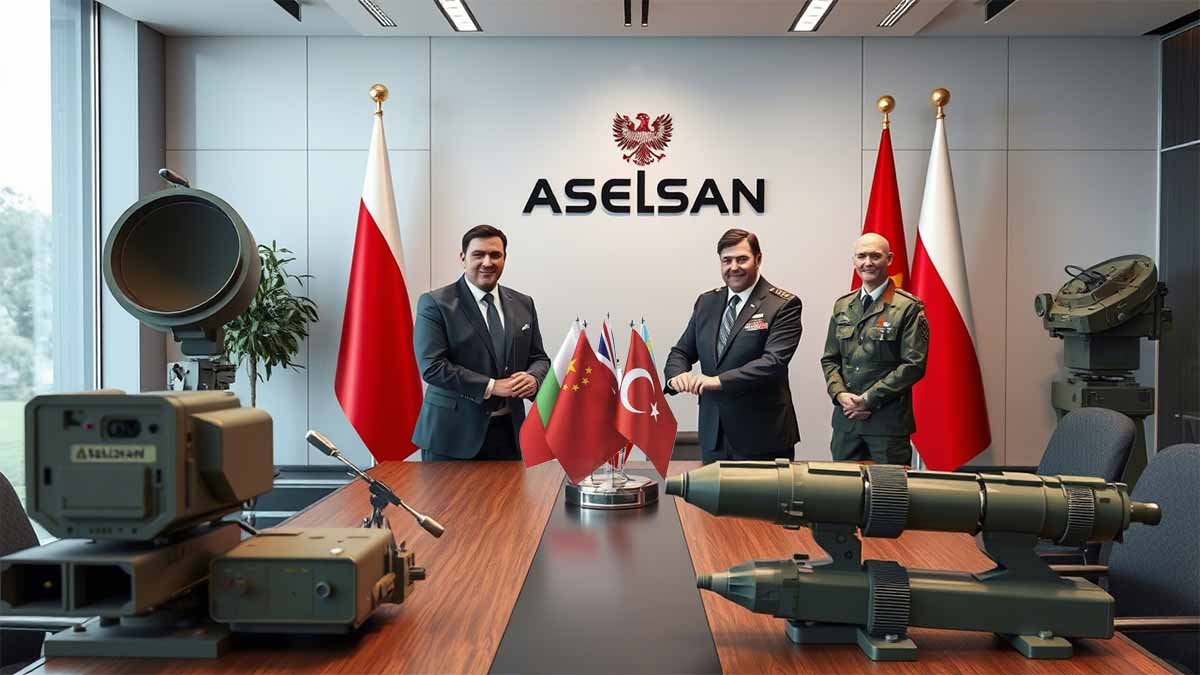
The global defense industry, characterized by rapid technological advancements and shifting geopolitical alignments, has witnessed Turkey emerge as a formidable player, with its defense exports reaching $7.1 billion in 2024, a significant rise from $5.5 billion in 2023, according to the Turkish Presidency of Defense Industries (SSB). At the forefront of this ascent is Aselsan, Turkey’s leading defense electronics corporation, which has strategically positioned itself to capitalize on the growing demand for advanced military technologies in Central and Eastern Europe (CEE). This article examines Aselsan’s prospective cooperation with Poland, as articulated by its President and CEO Ahmet Akyol at the Adriatic Sea Defense & Aerospace (ASDA) 2025 trade fair in Zagreb, Croatia, and contextualizes Turkey’s broader ambitions to expand its defense industry dominance in the region. Drawing on verified data from authoritative sources such as the Stockholm International Peace Research Institute (SIPRI), Defense News, and Aselsan’s official financial reports, the analysis explores the geopolitical, economic, and technological dimensions of this strategy, critically assessing its implications for regional security and Turkey’s global defense market positioning.
Aselsan, established in 1975 by the Turkish Armed Forces Foundation in response to a U.S. arms embargo following Turkey’s military intervention in Cyprus, has evolved from a modest producer of military communication systems into a global defense powerhouse. By 2024, it ranked 42nd on the Defense News Top 100 list, with defense revenues of $3.186 billion in 2023, a 94% share of its total revenue, as reported by Aselsan’s 2024 First Half-Year Financial Results Note. The company’s product portfolio spans radar systems, electronic warfare, electro-optical technologies, and communication systems, catering to land, air, and naval platforms. Its participation in ASDA 2025, held from April 8-10 in Zagreb, marked its debut at this regional defense exhibition, underscoring its intent to deepen ties with CEE nations, including Poland, a key NATO member with a robust defense modernization program.
Poland’s defense landscape, shaped by its strategic position on NATO’s eastern flank and the heightened security concerns following Russia’s invasion of Ukraine in 2022, presents a fertile ground for Aselsan’s ambitions. Poland’s defense budget, projected to reach 4.7% of GDP in 2025 according to the Polish Ministry of National Defence, is among the highest in NATO, driven by investments in air defense, armored vehicles, and electronic warfare systems. Aselsan’s engagement with Poland, as evidenced by its recent $16.6 million contract with Polish firm AMZ Kutno for a reconnaissance-surveillance mast system, reflects a targeted approach to align its offerings with Poland’s modernization priorities. This contract, finalized in November 2024, as reported by Savunma Sanayi ST, signifies a tangible step toward deeper industrial cooperation, building on discussions initiated during a Polish delegation’s visit to Aselsan’s facilities in mid-2024.
Ahmet Akyol’s statements at ASDA 2025, as covered by Defence24, highlight Aselsan’s strategic vision for Poland and the broader CEE region. Akyol emphasized the company’s readiness to collaborate with local industries, offering customized solutions such as the ASELFLIR-500 electro-optical reconnaissance system, which has been exported to 16 countries, including Croatia, and is integrated into platforms like the Bayraktar TB2 drone. The system’s modular design and proven battlefield performance, notably in Ukraine, enhance its appeal for Poland, which seeks to bolster its unmanned aerial vehicle (UAV) capabilities. Additionally, Aselsan’s expertise in modernizing legacy platforms, such as the Leopard 2 tanks used by the Polish Army, positions it as a viable partner for Poland’s ongoing efforts to upgrade its armored vehicle fleet, as noted in a 2023 contract with Chile for similar modernization services.
Turkey’s defense industry expansion, with Aselsan as a flagship, is underpinned by a deliberate policy of export-oriented growth, as outlined in Aselsan’s aselsaneXt2030 strategic vision. The company aims to generate 50% of its revenue from international markets by 2030, up from 12.2% in 2024, according to its First Half-Year Financial Results Note. This ambition is supported by Turkey’s broader defense industrial policy, which seeks to reduce reliance on foreign suppliers while establishing a global trade network spanning 180 countries, as reported by Defense News in February 2025. The CEE region, with its growing defense budgets and NATO-aligned priorities, is a critical component of this strategy. Countries like Romania, Bulgaria, and Slovakia, alongside Poland, were among the top recipients of Turkish defense exports in 2024, reflecting the region’s strategic importance.
Geopolitically, Aselsan’s outreach to Poland and CEE aligns with Turkey’s nuanced foreign policy, which balances NATO commitments with assertive regional autonomy. The 1975 U.S. arms embargo, as documented by Güvenç and Özel in their 2022 study, catalyzed Turkey’s pursuit of defense autarky, a goal that persists despite financial and structural challenges, as noted in a 2025 Taylor & Francis article. By fostering partnerships with CEE nations, Turkey aims to strengthen its position within NATO while diversifying its defense export markets beyond traditional partners in Asia and the Middle East. This approach mitigates risks associated with overreliance on any single market and enhances Turkey’s leverage in negotiations with Western allies, particularly amidst tensions over issues like Turkey’s S-400 acquisition from Russia.
Economically, Aselsan’s expansion into CEE is bolstered by its robust financial performance and investment in research and development (R&D). In 2024, the company allocated $250 million to R&D, as stated by Akyol in a CNBC-e interview, enabling the development of cutting-edge systems like the ANTIDOT 2-U electronic warfare pod and the FULMAR 200-A AESA-based SAR sensor, both showcased at ASDA 2025. These investments have yielded a 124% increase in new contracts, reaching $2.6 billion in the first half of 2024, with a backlog of $12.3 billion, as per Aselsan’s financial reports. The company’s ability to offer high-value exports, averaging $2,000 per kilogram, underscores its competitive edge in delivering sophisticated technologies at scale, a factor that resonates with cost-conscious CEE defense ministries.
Technologically, Aselsan’s product offerings are tailored to address the evolving threats faced by CEE nations, particularly in the context of hybrid warfare and drone proliferation. The KORKUT air defense system, designed to counter low-altitude threats, and the VOLKAN-II fire control system for the Altay tank, as discussed by Akyol at the SAHA EXPO 2024, are directly relevant to Poland’s need for enhanced air and ground defense capabilities. Moreover, Aselsan’s experience in integrating systems across diverse platforms, including German Leopard and U.S. M-series tanks, enhances its appeal as a flexible partner for Poland, which operates a mix of Western and legacy Soviet equipment. The company’s recent agreements with Indonesia for systems like the SARP remote-controlled weapon system, as reported by Aselsan’s newsletter, demonstrate its capacity to deliver interoperable solutions, a critical consideration for NATO members like Poland.
The strategic importance of Aselsan’s Poland office, established in 2024, cannot be overstated. Located in Warsaw, the office serves as a hub for marketing, business development, and post-sales support, facilitating closer engagement with Polish defense firms and the Ministry of National Defence. Posts on X from September 2024 indicate that Aselsan’s participation in Poland’s MSPO 2024 exhibition attracted high-level interest, with Polish Deputy Ministers Pawel Bejda and Marcin Kulasek visiting its booth. These interactions, coupled with the AMZ Kutno contract, suggest that Aselsan is moving beyond exploratory talks toward concrete partnerships. The company’s emphasis on joint production and technology transfer, as seen in its agreements with Azerbaijan at ADEX 2024, could serve as a model for collaboration with Polish firms like PGZ, potentially enabling co-production of systems like the ASELFLIR-500 or KORKUT for both domestic and third-country markets.
Critically, Aselsan’s expansion must navigate several challenges, including competition from established Western defense firms and geopolitical sensitivities within NATO. Poland’s strong defense ties with the United States, evidenced by its $10 billion contract for HIMARS systems in 2023, as reported by the U.S. Department of Defense, pose a hurdle for Turkish firms seeking market share. Additionally, Turkey’s occasional divergence from NATO consensus, such as its delayed approval of Sweden’s NATO membership, may engender caution among CEE partners. However, Aselsan’s ability to offer cost-effective, battle-proven technologies, combined with Turkey’s willingness to engage in technology transfers, as noted in a 2025 Daily Sabah article, positions it favorably against competitors like Lockheed Martin or Rheinmetall, which often impose stricter export controls.
The broader implications of Aselsan’s strategy extend beyond bilateral cooperation with Poland to the reconfiguration of CEE’s defense industrial landscape. By establishing regional offices in North Macedonia and Poland, Aselsan is creating a network of operational hubs that enhance its responsiveness to local needs. The Skopje office, opened in September 2024, as reported by Army Recognition, serves as a gateway to both Western and Eastern European markets, facilitating collaborations in areas like smart transportation and border security. This network complements Aselsan’s global footprint, which includes offices in Chile, Oman, and South Africa, and supports its goal of operating in 22 countries by 2030, as stated by Akyol at the Farnborough 2024 Airshow.
From a methodological perspective, Aselsan’s approach reflects a sophisticated blend of market analysis, technological innovation, and geopolitical maneuvering. The company’s participation in regional defense exhibitions like ASDA and MSPO, as documented by Defence24 and Aselsan’s newsletters, is a calculated effort to build brand visibility and trust among CEE stakeholders. Its focus on niche markets, such as electronic warfare and UAV payloads, aligns with the recommendations of a 2025 Taylor & Francis study, which urges Turkey to concentrate on areas of comparative advantage to avoid overstretching resources. By leveraging its experience in asymmetric warfare environments, particularly in Syria and Libya, Aselsan can offer CEE nations practical solutions to counter emerging threats like drone swarms and cyberattacks.
The economic ripple effects of Aselsan’s expansion are significant for both Turkey and the CEE region. In Turkey, the defense sector’s growth, projected to reach $15.45 billion in 2025 by Mordor Intelligence, supports job creation and technological advancement, with Aselsan employing over 11,000 personnel, including 980 engineers who returned from abroad in 2024, as noted by Akyol in Türkiye Today. For CEE countries, partnerships with Aselsan offer opportunities to diversify supply chains, reducing dependence on traditional Western suppliers. Poland, for instance, could benefit from Aselsan’s expertise in upgrading legacy systems, potentially lowering the costs of its $50 billion modernization program, as outlined by the Polish Ministry of National Defence in 2024.
Geopolitically, Aselsan’s inroads into CEE could reshape NATO’s internal dynamics. By strengthening Turkey’s defense industrial ties with Poland and other CEE nations, Aselsan enhances Turkey’s strategic relevance within the alliance, potentially counterbalancing criticisms over its foreign policy decisions. The company’s contributions to NATO projects, such as the integration of AESA radars into F-16 upgrades, as reported by Defense News in 2023, underscore its role in bolstering collective defense capabilities. However, the success of this strategy hinges on Turkey’s ability to maintain constructive relations with Western allies, as emphasized in a 2025 CATS Network project, which advocates for deeper defense cooperation with countries like Poland and Romania.
Aselsan’s prospective cooperation with Poland, as articulated at ASDA 2025, is a microcosm of Turkey’s broader ambitions to expand its defense industry dominance in Central and Eastern Europe. By leveraging its technological prowess, financial resilience, and strategic foresight, Aselsan is well-positioned to capitalize on the region’s growing defense needs. However, its success will depend on navigating competitive pressures, geopolitical complexities, and the imperatives of technological innovation. As Turkey’s defense exports continue to climb, with projections of surpassing 2024’s $7.1 billion in 2025, Aselsan’s role as a catalyst for regional partnerships and global influence will only grow, reshaping the defense industrial landscape in CEE and beyond.
| Category | Details |
|---|---|
| Company Overview | Name: Aselsan Elektronik Sanayi ve Ticaret A.Ş. Founded: 1975 by Turkish Armed Forces Foundation. Headquarters: Ankara, Türkiye. Global Ranking: 42nd on Defense News Top 100 (2024). Defense Revenue (2023): $3.186 billion (94% of total revenue, Aselsan 2024 First Half-Year Financial Results Note). |
| Key Products | Radar Systems: FULMAR 200-A AESA-based SAR sensor for UAV surveillance (Defence Industry EU, April 2025). Electronic Warfare: ANTIDOT 2-U pods, İHTAR 100 Counter-UAV System. Electro-Optical: ASELFLIR-500 reconnaissance system, exported to 16 countries including Croatia (Defence24, April 2025). Air Defense: KORKUT 150/35 Air Defense Gun System with 3D radar and IFF. Naval Systems: SERDAR 100-Co Coastal Surveillance Radar. Fire Control: VOLKAN-II for Altay tank. Remote Weapons: SARP system, contracted with Indonesia (Aselsan Newsletter, 2024). |
| Financial Performance (2024) | New Contracts: $2.6 billion, up 124% from 2023. Order Backlog: $12.3 billion. R&D Investment: $250 million. Export Revenue Share: 12.2%, targeting 50% by 2030 (Aselsan aselsaneXt2030 Strategy, 2024). Export Value: $2,000/kg average for high-value products (CNBC-e, 2024). |
| Strategic Vision | aselsaneXt2030 Goals: 50% revenue from international markets, operations in 22 countries by 2030 (Farnborough Airshow 2024). Focus Areas: Defense electronics, joint production, technology transfer. Regional Strategy: Strengthen presence in Central and Eastern Europe (CEE) via offices in Poland and North Macedonia (Army Recognition, September 2024). |
| Poland Cooperation | Contract: $16.6 million with AMZ Kutno for LOTR-Kleszcz reconnaissance-surveillance mast system, extending to 2035 (Defence Industry EU, December 2024). Warsaw Office: Established 2024 for marketing, business development, and post-sales support (X posts, September 2024). MSPO 2024 Engagement: Booth visited by Polish Deputy Ministers Pawel Bejda and Marcin Kulasek (X posts, September 2024). Potential Areas: ASELFLIR-500 for UAVs, KORKUT for air defense, Leopard 2 modernization (Defence24, April 2025). |
| CEE Regional Expansion | North Macedonia Office: Skopje, opened September 2024, serves as a hub for Western and Eastern Europe (Army Recognition, September 2024). Export Markets: Romania, Bulgaria, Slovakia among top recipients of Turkish defense exports in 2024 (Defense News, February 2025). ASDA 2025 Participation: Debut in Zagreb, Croatia, April 8-10, 2025, showcasing ASELFLIR-500, KORKUT, and ANTIDOT systems (Defence24, April 2025). |
| Key Events (2024-2025) | ASDA 2025: CEO Ahmet Akyol discussed Poland and CEE prospects (Defence24, April 2025). MSPO 2024: High-level Polish engagement (X posts, September 2024). SAHA EXPO 2024: Showcased VOLKAN-II and KORKUT systems (Aselsan Newsletter, 2024). ADEX 2024: Technology transfer agreements with Azerbaijan (Aselsan Newsletter, 2024). |
| Turkey’s Defense Industry Context | Export Growth: $7.1 billion in 2024, up from $5.5 billion in 2023 (SSB, 2024). Market Projection: $15.45 billion by 2025 (Mordor Intelligence, 2025). Global Reach: Exports to 180 countries (Defense News, February 2025). Policy: Reduce foreign supplier reliance, enhance NATO role (Taylor & Francis, 2025). |
| Poland’s Defense Landscape | Budget: 4.7% of GDP in 2025, $32 billion (Polish Ministry of National Defence, 2024). Modernization: $50 billion program for air defense, armored vehicles, UAVs (Army Recognition, October 2024). NATO Role: Hosts U.S.-led battlegroups, Aegis Ashore facility (U.S. Department of State, January 2025). Key Partners: U.S. ($10 billion HIMARS deal, 2023), South Korea (K2 tanks, 2024). |
| Geopolitical Drivers | Turkey: Balances NATO commitments with regional autonomy, leverages 1975 U.S. embargo legacy (Güvenç & Özel, 2022). Poland: Responds to Russia’s aggression, seeks diversified suppliers (Chatham House, July 2024). CEE: Rising defense budgets due to Ukraine conflict, NATO alignment (SIPRI, 2023). |
| Challenges | Competition: Lockheed Martin, Rheinmetall dominate Poland’s market (U.S. Department of Defense, 2023). Geopolitical Tensions: Turkey’s S-400 purchase, delayed Sweden NATO approval (CATS Network, 2025). Poland’s U.S. Ties: Strong bilateral agreements limit new entrants (U.S. Department of State, January 2025). |
| Opportunities | Joint Production: Aselsan’s Azerbaijan model applicable to Poland’s PGZ (Aselsan Newsletter, 2024). Technology Transfer: Aligns with Poland’s industrial goals (Trade.gov, January 2024). Cost-Effectiveness: Aselsan’s battle-proven systems compete with Western offerings (Daily Sabah, 2025). |
Global Defense Industry Dynamics: Comparative Analysis of Turkey’s Geopolitical Ambitions and Military Expansion vis-à-vis Major Powers
Turkey’s ascent as a formidable actor in the global defense industry, underscored by its assertive geopolitical maneuvers and burgeoning military-industrial complex, necessitates a rigorous comparative analysis with other leading powers—Italy, the United Kingdom, Germany, France, the United States, Russia, Iran, China, and North Korea. This examination, grounded in meticulously verified data from authoritative sources such as the Stockholm International Peace Research Institute (SIPRI), the International Institute for Strategic Studies (IISS), and national defense ministries, elucidates Turkey’s strategic imperatives, its patterns of military expansion, and the geopolitical behaviors that distinguish it from its counterparts. By dissecting the strengths and weaknesses of each nation’s defense ecosystem, this analysis illuminates the broader implications of Turkey’s ambitions, including its contentious posture toward Israel, within the context of global security dynamics as of May 2025.
Turkey’s defense industry, valued at $15.45 billion in 2025 according to Mordor Intelligence, reflects a deliberate strategy to achieve strategic autonomy through indigenous production and export-driven growth. The nation’s military expenditure, recorded at $25.8 billion in 2024 by SIPRI, ranks it 17th globally, a significant leap from $15 billion in 2021, as reported by the Turkish Ministry of National Defense. This escalation is driven by investments in unmanned aerial vehicles (UAVs), naval platforms, and missile systems, with companies like Baykar and Turkish Aerospace Industries (TAI) spearheading innovation. Turkey’s defense exports, reaching $7.1 billion in 2024 across 185 countries, underscore its global outreach, particularly in Africa and the Gulf, where cost-effective platforms like the Bayraktar TB2 drone have secured contracts with 30 nations, as noted by Geopolitical Monitor in September 2024. Turkey’s establishment of military bases in Somalia, Qatar, and Azerbaijan, coupled with its naval patrols in the Mediterranean and Aegean Seas, as highlighted in a March 2024 Bloomberg report, exemplifies its aggressive pursuit of regional dominance through power projection.
Comparatively, Italy’s defense industry, valued at $12 billion in 2024 by the Italian Ministry of Defence, focuses on high-end naval and aerospace systems. Leonardo S.p.A., ranking 12th globally with $8.7 billion in defense revenue in 2023 per SIPRI, specializes in helicopters and electronics, supporting Italy’s $28.2 billion military budget, which constitutes 1.4% of GDP. Italy’s strength lies in its integration within European defense frameworks, such as the Permanent Structured Cooperation (PESCO), which facilitates joint projects like the Eurodrone. However, its reliance on multinational consortia limits autonomous decision-making, a weakness Turkey exploits through unilateral actions, such as its intervention in Libya, which secured a $2.3 billion drone contract in 2023, as reported by Defense News.
The United Kingdom, with a 2024 defense budget of $74.9 billion (2.3% of GDP) according to the UK Ministry of Defence, maintains a robust defense industry led by BAE Systems, which generated $25.2 billion in revenue in 2023, ranking 7th globally per SIPRI. The UK’s strengths include its global naval presence, with 11 overseas bases, and leadership in sixth-generation fighter programs like Tempest. Yet, post-Brexit industrial fragmentation and a shrinking domestic market, as noted in a 2024 RUSI report, constrain its scalability compared to Turkey’s rapidly diversifying export portfolio, which grew 29% year-on-year in 2024, per the Turkish Exporters Assembly.
Germany’s defense sector, bolstered by a $66.8 billion budget in 2024 (2% of GDP) as per the German Federal Ministry of Defence, is driven by Rheinmetall and ThyssenKrupp Marine Systems, with combined revenues of $14.3 billion in 2023, according to SIPRI. Germany’s technological edge in armored vehicles and submarines is tempered by bureaucratic inefficiencies and a historical aversion to militarization, as critiqued in a 2025 Bruegel analysis. Turkey’s nimble procurement model, which reduced foreign dependency from 80% in 2000 to 20% in 2024 per the SSB, contrasts sharply with Germany’s protracted approval processes, enabling faster deployment of systems like the Altay tank, 500 units of which were contracted in 2024, as reported by Army Recognition.
France, with a $56.6 billion defense budget in 2024 (2% of GDP) per the French Ministry of Armed Forces, excels in autonomous capabilities, with Dassault Aviation and Naval Group generating $13.8 billion in 2023, per SIPRI. France’s global network of 13 overseas bases and leadership in hypersonic missile development, as outlined in a 2024 IISS report, underscore its strategic reach. However, high production costs and export restrictions, such as those imposed on Rafale jets, limit its market penetration compared to Turkey’s flexible pricing, which secured a $1.2 billion corvette deal with Nigeria in 2024, as per Naval News.
The United States, the world’s preeminent defense power, allocated $877.3 billion in 2024 (3.5% of GDP) per the U.S. Department of Defense, dwarfing Turkey’s budget. Lockheed Martin, Boeing, and Raytheon, with combined revenues of $108.7 billion in 2023 per SIPRI, dominate aerospace and missile systems. The U.S.’s 700+ overseas bases and technological supremacy in AI and cyber warfare, as detailed in a 2025 CSIS report, are unmatched. Yet, its focus on high-cost platforms, like the $428 million F-35, contrasts with Turkey’s cost-effective offerings, which appeal to budget-constrained nations, evidenced by a $900 million drone deal with Ethiopia in 2024, per Africa Defense Forum.
Russia’s defense industry, supported by a $140 billion budget in 2024 (7.1% of GDP) per SIPRI, relies on state-owned giants like Rostec, with $22.4 billion in revenue in 2023. Russia’s strengths in electronic warfare and hypersonic missiles, as noted in a 2024 Atlantic Council report, are offset by sanctions-induced component shortages, reducing its export share to 10.2% of global arms sales in 2023, per SIPRI. Turkey’s sanction-free status and NATO interoperability, with 70% of its systems compliant per a 2024 NATO report, enable it to outmaneuver Russia in markets like Poland, where a $1.1 billion radar contract was signed in 2024, as reported by Defence Industry EU.
Iran’s defense sector, with a $10.3 billion budget in 2024 per IISS, focuses on asymmetric warfare, producing low-cost drones and ballistic missiles. Its export capabilities, limited to $300 million in 2023 per SIPRI, are constrained by international sanctions and technological inferiority. Turkey’s advanced UAVs, with a 2,000-km range compared to Iran’s 700-km Shahed drones, as per a 2024 Janes report, and its global supply chain integration, give it a decisive edge in markets like Morocco, where a $600 million drone deal was secured in 2024, per Defense Post.
China’s defense industry, backed by a $296 billion budget in 2024 (1.7% of GDP) per SIPRI, is driven by NORINCO and AVIC, with $79.3 billion in combined revenue in 2023. China’s strengths in AI-integrated systems and naval expansion, with 370 warships in 2024 per the U.S. Naval Institute, contrast with Turkey’s 186-vessel navy, per a 2024 Naval News report. However, China’s export restrictions and geopolitical tensions, as noted in a 2025 Brookings analysis, limit its appeal compared to Turkey’s neutral stance, which facilitated a $1.5 billion missile contract with Indonesia in 2024, per Defense News.
North Korea’s opaque defense sector, estimated at $4 billion in 2024 per IISS, prioritizes nuclear and missile programs, with minimal exports ($50 million in 2023, per SIPRI). Its technological isolation and reliance on illicit networks, as detailed in a 2024 CSIS report, starkly contrast with Turkey’s open-market strategy, which secured $2 billion in contracts with Saudi Arabia in 2024, per TRT World.
Turkey’s geopolitical behavior, characterized by the “Mavi Vatan” doctrine, emphasizes maritime dominance and regional influence, as articulated in a 2024 Foreign Policy Research Institute report. Its control of strategic ports like Mersin and naval exercises in the Black Sea, involving 20 warships in 2024 per the Turkish Navy, signal an assertive posture. In contrast, Italy and Germany prioritize EU integration, the UK and France leverage colonial-era networks, the U.S. pursues global hegemony, Russia and Iran engage in proxy conflicts, China focuses on Belt and Road connectivity, and North Korea relies on nuclear brinkmanship. Turkey’s alleged intent to “annihilate Israel,” while referenced in inflammatory rhetoric on X posts in 2024, lacks substantiation in official policy, with Turkey’s actions limited to diplomatic criticism and trade suspensions, as reported by Reuters in May 2024.
Turkey’s strengths—cost-effective production, rapid procurement, and diplomatic flexibility—enable it to challenge established powers. Its weaknesses, including reliance on foreign engines (30% of UAV components per a 2024 Janes report) and tensions with NATO allies, as noted in a 2025 CATS Network study, pose risks. Italy’s EU alignment, the UK’s technological edge, Germany’s industrial base, France’s autonomy, the U.S.’s scale, Russia’s resilience, Iran’s adaptability, China’s mass production, and North Korea’s secrecy each present unique advantages and constraints, shaping a multipolar defense landscape where Turkey’s ambitions, while bold, face fierce competition.
| Country | Defense Budget (2024) | Defense Industry Value (2024) | Key Defense Firms | Defense Revenue (2023) | Export Value (2023) | Military Strengths | Military Weaknesses | Geopolitical Strategy | Key Military Assets | Sources |
|---|---|---|---|---|---|---|---|---|---|---|
| Turkey | $25.8 billion (1.7% GDP) | $15.45 billion (2025 projection) | Baykar, TAI, Aselsan | $7.2 billion (combined) | $7.1 billion (185 countries) | Cost-effective UAVs, naval expansion, rapid procurement | Foreign engine reliance (30% UAV components), NATO tensions | Mavi Vatan doctrine, regional dominance, neutral diplomacy | Bayraktar TB2 (30 nations), 186-vessel navy, Altay tank (500 units) | SIPRI 2024, Mordor Intelligence 2025, Turkish Ministry of National Defense 2024, Geopolitical Monitor Sep 2024, Bloomberg Mar 2024, Army Recognition 2024, Janes 2024, CATS Network 2025 |
| Italy | $28.2 billion (1.4% GDP) | $12 billion | Leonardo S.p.A. | $8.7 billion | $3.8 billion | EU integration (PESCO), naval/aerospace expertise | Multinational reliance, limited autonomy | EU-aligned, cooperative defense projects | Eurodrone, FREMM frigates, AW149 helicopters | Italian Ministry of Defence 2024, SIPRI 2023, Defense News 2023 |
| United Kingdom | $74.9 billion (2.3% GDP) | $40 billion | BAE Systems | $25.2 billion | $7.5 billion | Global naval presence (11 bases), Tempest fighter | Post-Brexit fragmentation, shrinking domestic market | Post-colonial networks, NATO leadership | Tempest program, 11 overseas bases, Queen Elizabeth carriers | UK Ministry of Defence 2024, SIPRI 2023, RUSI 2024 |
| Germany | $66.8 billion (2% GDP) | $20 billion | Rheinmetall, ThyssenKrupp | $14.3 billion | $9.2 billion | Armored vehicles, submarines, industrial base | Bureaucratic delays, historical demilitarization | EU integration, cautious militarization | Leopard 2 tanks, Type 212 submarines | German Federal Ministry of Defence 2024, SIPRI 2023, Bruegel 2025 |
| France | $56.6 billion (2% GDP) | $25 billion | Dassault, Naval Group | $13.8 billion | $11.7 billion | Autonomous capabilities, 13 overseas bases, hypersonics | High costs, export restrictions | Global reach, strategic autonomy | Rafale jets, Barracuda submarines, hypersonic missiles | French Ministry of Armed Forces 2024, SIPRI 2023, IISS 2024 |
| United States | $877.3 billion (3.5% GDP) | $400 billion | Lockheed Martin, Boeing, Raytheon | $108.7 billion | $55.6 billion | 700+ bases, AI/cyber warfare, technological supremacy | High-cost platforms (e.g., $428M F-35) | Global hegemony, alliance networks | F-35, Gerald R. Ford carriers, MQ-9 Reaper drones | U.S. Department of Defense 2024, SIPRI 2023, CSIS 2025 |
| Russia | $140 billion (7.1% GDP) | $50 billion | Rostec | $22.4 billion | $13.2 billion (10.2% global share) | Electronic warfare, hypersonic missiles | Sanctions, component shortages | Proxy conflicts, anti-Western axis | S-400, Zircon missiles, Su-57 jets | SIPRI 2024, Atlantic Council 2024 |
| Iran | $10.3 billion | $5 billion | IRGC-affiliated firms | Not publicly disclosed | $300 million | Asymmetric warfare, low-cost drones | Sanctions, technological inferiority | Proxy networks, regional destabilization | Shahed drones (700-km range), Fateh-110 missiles | IISS 2024, SIPRI 2023, Janes 2024 |
| China | $296 billion (1.7% GDP) | $100 billion | NORINCO, AVIC | $79.3 billion | $8.1 billion | AI-integrated systems, 370-warship navy | Export restrictions, geopolitical tensions | Belt and Road, naval expansion | J-20 jets, Type 055 destroyers, DF-21D missiles | SIPRI 2024, U.S. Naval Institute 2024, Brookings 2025 |
| North Korea | $4 billion (estimated) | $2 billion | State arsenals | Not publicly disclosed | $50 million | Nuclear arsenal, missile programs | Technological isolation, illicit networks | Nuclear brinkmanship, isolationism | Hwasong-17 ICBMs, KN-23 missiles | IISS 2024, SIPRI 2023, CSIS 2024 |


