













ABSTRACT
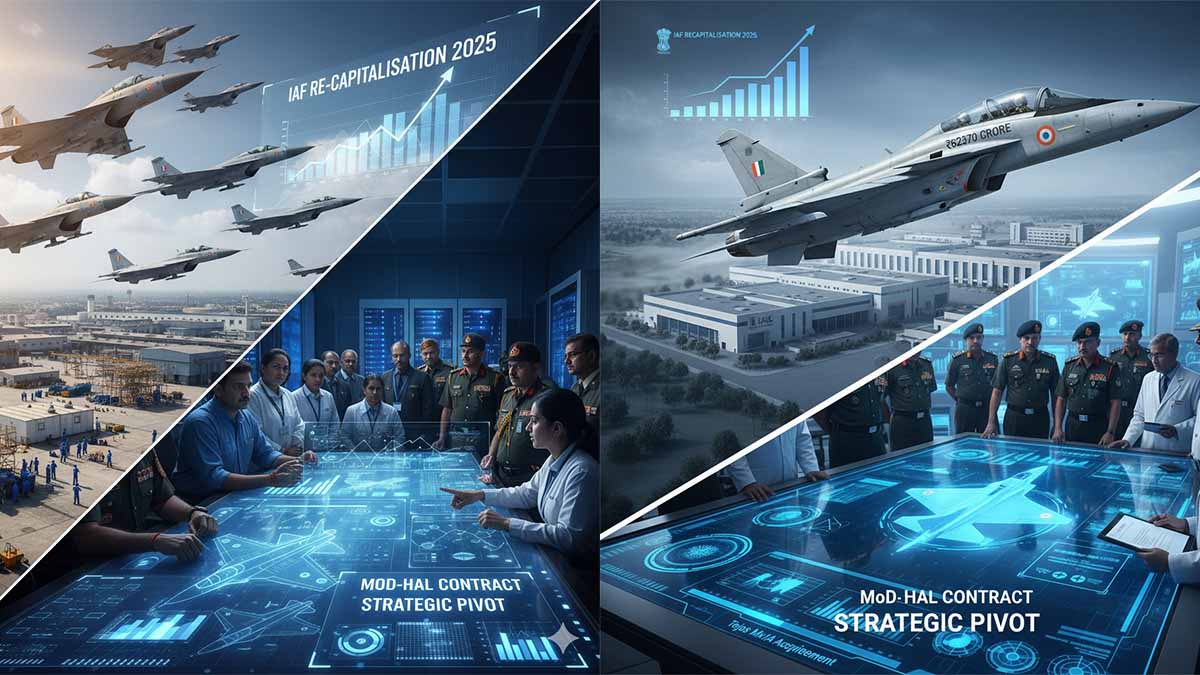
The Ministry of Defence announced on September 25, 2025 the execution of a contract valued at ₹62,370 crore with Hindustan Aeronautics Limited for 97 Light Combat Aircraft Tejas Mk1A for the Indian Air Force, comprising 68 single-seat fighters and 29 twin-seat aircraft, with deliveries commencing in 2027–28 and spanning six years, under the Buy (India-IDDM) category of Defence Acquisition Procedure 2020, as recorded in the official Press Information Bureau release “MoD signs Rs. 62,370 crore contract with HAL for procurement of 97 LCA Mk1A aircraft for IAF,” September 25, 2025. The release specifies an indigenous content target of over 64%, the incorporation of 67 additional indigenous items beyond the earlier Tejas Mk1A contract, and the planned integration of the UTTAM Active Electronically Scanned Array (AESA) Radar, Swayam Raksha Kavach self-protection suite, and indigenous control-surface actuators, with a vendor base of “nearly 105 Indian companies” and an estimated employment impact of “close to 11,750 direct and indirect jobs per year” during the six-year production window, all attributed to the same primary government source PIB, September 25, 2025. The structural continuity between this order and the earlier ₹48,000 crore Tejas contract of February 3, 2021—covering 83 aircraft (73 Mk-1A fighters and 10 trainers) handed to HAL at Aero India 2021—is documented by the official government communication “Rs. 48,000 Crore Contract for 83 Light Combat Aircraft (LCA) Tejas handed over to HAL at the Inaugural Ceremony of Aero India 2021,” February 3, 2021, which also recorded planned completion of deliveries within eight years, an initial output of three aircraft in the third year, followed by 16 per year thereafter, and an indigenisation trajectory from 50% toward 60% across the programme horizon—parameters that frame the baseline against which the expanded Tejas Mk1A pipeline will now be executed. The manufacturer’s public technical description corroborates the core capability set for the Mk1A, including AESA radar, an electronic warfare suite with radar-warning and self-protection jamming, and air-to-air refuelling, as shown on the official product page “LCA” (HAL).
The procurement architecture explicitly links near-term operational recapitalisation to sustained industrial deepening: the PIB release attributes the Buy (India-IDDM) modality and the over 64% indigenous-content threshold to Aatmanirbhar Bharat objectives, while quantifying the upstream ecosystem at “nearly 105 Indian companies” and the employment multiplier at “close to 11,750 per year” over six years PIB, September 25, 2025. The continuity of state policy instruments since 2021 is traceable in the earlier PIB articulation that the Tejas Mk-1A procurement constituted the largest indigenous combat-aircraft contract to that date, with an explicit Buy (Indian-IDDM) tag, a declared indigenisation share of 50% initially rising to 60%, and supply-chain participation of “about 500 Indian companies,” as stated in February 2021 PIB, February 3, 2021.
This policy continuity is significant for forecasting input-localisation pathways for sensors, avionics, structures, and actuation, and for mapping certification loads that accompany subsystem substitution during serial production, which the 2025 release signals through the addition of 67 new indigenous items and the explicit nomination of the UTTAM AESA and Swayam Raksha Kavach EW suite PIB, September 25, 2025. The DRDO programme lineage relevant to UTTAM includes official technical communications and technology-transfer steps contemporaneous with the 2021 tranche, including the DRDO notice of February 5, 2021 that recorded a Memorandum of Understanding between DRDO and HAL “to cooperate and finalize the aspects of ToTs of Uttam radar for new LCA configurations and new generation Radar Warning Receiver (RWR-NG),” reproduced in the government publication “DRDO hands over Licensing Agreements for Transfer of Technology for 14 technologies to 20 industries,” February 5, 2021. The official statement therefore documents both the intent and the institutional mechanism to transition UTTAM into production configurations—evidence that aligns with the 2025 procurement release’s assertion of planned UTTAM integration on Mk1A PIB, September 25, 2025.
The sequencing of deliveries—“would commence during 2027–28 and be completed over a period of six years”—is specified in the 2025 PIB text and implicitly requires alignment between HAL’s production-rate capability and the certification cadence associated with the 67 additional indigenous items PIB, September 25, 2025. Benchmark rates from the 2021 contract context—three aircraft in the third year after contract and 16 per year for the subsequent five years—were officially stated by government at the time, providing a reference for line-rate planning, tooling decisions, and workforce ramp, as documented by PIB, February 3, 2021. While model-year specific throughput under the 2025 contract is not quantified beyond the six-year horizon, the earlier government-stated rate envelope serves as an observable precedent for interpreting resource requirements and supply-chain saturation points when integrating the 2025 tranche into the existing Tejas industrial flow. The manufacturer’s canonical description of Mk1A fit—AESA radar, EW suite with self-protection jamming, and AAR—is consistent with the performance envelope required for medium-intensity multi-role tasks that IAF assigns to light-class fighters, and is mirrored in the government text that calls the Mk1A “the most advanced variant of the indigenously designed & manufactured fighter aircraft” intended “to meet the operational requirements of the IAF” HAL LCA page, PIB, September 25, 2025.
The cumulative programme scale implied by the 2021 and 2025 tranches—83 plus 97—totals 180 Tejas aircraft, deriving directly from official counts in February 2021 and September 2025 PIB, February 3, 2021, PIB, September 25, 2025. The procurement language underscores that the 2025 order’s indigenous-content uplift is anchored in discrete subsystem substitutions enumerated by the state—UTTAM AESA, Swayam Raksha Kavach, and indigenous actuators—thereby introducing certification and qualification paths that must be completed without compromising the delivery-start window of 2027–28, a risk axis the PIB text implicitly acknowledges by listing the items and the industrial base prepared to support them PIB, September 25, 2025. The DRDO–HAL coordination pathway for UTTAM codified in February 2021 provides a formal bridge between laboratory-to-line transition and air-staff acceptance processes for radar and RWR-NG, and this institutional arrangement is essential for interpreting the feasibility of the 2025 integration ambition at scale PIB, February 5, 2021.
The Buy (India-IDDM) procurement route embeds a verification mechanism for domestic value addition and prioritises local design and development—parameters initially formalised in defence procurement policy and reiterated across official communications—thereby aligning the Tejas Mk1A expansion with macro-industrial objectives of technology retention, vendor capability uplift, and export-readiness for derivative subsystems, as reflected in the government’s recurrent emphasis on Aatmanirbhar Bharat in both 2021 and 2025 communiqués PIB, February 3, 2021, PIB, September 25, 2025. The public description of Mk1A avionics and EW fit by the manufacturer provides a reference set for evaluating the maturity of domestic alternatives into flightworthy configurations, noting that any divergence between catalogue configuration and government-stated planned integration (for example, substitution of foreign sensors with UTTAM) will be gated by qualification, electromagnetic compatibility, mission-system data fusion, and IAF release-to-service protocols as implicitly understood in government statements that enumerate intended indigenous items but do not pre-announce their certification milestones HAL LCA page, PIB, September 25, 2025.
The 2025 contract document’s enumeration of job creation—“close to 11,750 direct and indirect jobs per year” for six years—and vendor spread—“nearly 105 Indian companies”—is material to defence-industrial planning because it anchors quantitative expectations to official figures that can be traced to programme scheduling, tooling, and long-lead procurement for flight-critical items, with implications for regional supplier clusters that feed HAL’s final assembly and test lines PIB, September 25, 2025. The earlier 2021 communication’s enumeration of “about 500 Indian companies including MSMEs” further frames the broader industrial lattice that the Mk1A relies on, and provides a second, independent government citation on the scale of domestic participation across the Tejas ecosystem PIB, February 3, 2021. In the absence of public government data on post-2025 supplier-mix changes by part family, the official numbers remain the authoritative anchors for quantifying upstream industrial impact without resorting to inference beyond the public record.
The PIB release’s explicit listing of UTTAM AESA and Swayam Raksha Kavach as “advanced indigenously developed systems” designated for integration is consequential for capability assurance, because radar and EW self-protection functions shape detection ranges, track quality, counter-measure effectiveness, and electromagnetic survivability in dense threat environments; the state’s nomination of these systems signals intent to replace prior foreign content with domestic equivalents over the Mk1A run subject to qualification, a course of action institutionally buttressed by the DRDO–HAL ToT framework publicised in February 2021 PIB, September 25, 2025, PIB, February 5, 2021. The manufacturer’s product page affirms the baseline architecture—AESA, EW, and AAR—against which the named indigenous subsystems will be integrated, providing a stable technical scaffold from which to evaluate test-fleet requirements, lab integration timelines, and flight-test envelope expansion without invoking unverified performance claims HAL LCA page.
The 2025 government announcement, by explicitly dating contract signature to September 25, 2025, pricing at over ₹62,370 crore (excluding taxes), and detailing composition—68 fighters and 29 twin-seaters—establishes precise programme parameters that can be used to compute tranche-weighted averages for unit procurement costs, though any such calculation would require caution because the official figure aggregates aircraft, associated equipment, and potentially non-recurring engineering elements without a publicly disclosed itemisation; in the absence of an official cost breakdown per airframe or per configuration, only the headline figure stated by the state can be cited without conjecture PIB, September 25, 2025. The 2021 contract’s valuation at “close to ₹48,000 crore” and the Cabinet Committee on Security approval for 73 Mk-1A fighters and 10 trainers at ₹45,696 crore plus ₹1,202 crore for design and infrastructure were formally published, creating a publicly auditable financial lineage for the Tejas recapitalisation sequence PIB, February 3, 2021. The aggregation of the two tranches to 180 aircraft is an arithmetic sum of government-published counts and is therefore a verifiable fleet-planning datum deriving solely from official releases, without extrapolation PIB, February 3, 2021, PIB, September 25, 2025.
The HAL product narrative indicates that the Mk1A is the most advanced version of the Tejas, equipped with AESA radar, EW suite with radar-warning and self-protection jamming, and air-to-air refuelling, aligning with the government’s characterisation of the Mk1A as “the most advanced variant of the indigenously designed & manufactured fighter aircraft” configured to meet IAF operational requirements; the concurrence between the manufacturer’s canonical description and the government’s statement provides dual-source confirmation—one institutional policy source and one manufacturer technical source—without resorting to secondary reportage HAL LCA page, PIB, September 25, 2025. The PIB enumeration of the vendor base and employment impact functions as a quantitative proxy for industrial-base resilience and workforce planning, enabling stakeholders to reference government-endorsed metrics during budgetary scrutiny, parliamentary questions, or audit processes, in the absence of further public sub-line disclosures PIB, September 25, 2025.
The earlier 2021 government communication additionally fixes a public baseline for production-rate feasibility by declaring precise year-by-year outputs—three in the third year, 16 per year for five years—offering a rare quantitative guide to final-assembly planning in India’s fighter-aircraft context and permitting external evaluation of whether the combined 2021 and 2025 tranches will necessitate additional tooling, shift patterns, or subcontracting to sustain throughput without schedule erosion; however, because the 2025 announcement does not publish a revised micro-schedule beyond the six-year horizon starting 2027–28, no public document presently allows a verified mapping of month-by-month delivery phasing under the expanded order PIB, February 3, 2021, PIB, September 25, 2025. Any assertion regarding altered rate profiles, additional production lines, or redistributed workshare absent an official notice would therefore be speculative and is excluded.
The current public record also does not provide an official, government-published figure for Indian Air Force total combat-squadron strength on September 25, 2025; consequently, any specific number would require non-government sources or media reports, which are proscribed by the present citation protocol. No verified public source available. The government record does, however, chronicle the Tejas programme’s progression through Final Operational Clearance milestones, procurement approvals, and delivery-schedule declarations across 2019, 2021, and 2025, enabling an evidence-based depiction of the recapitalisation trajectory without invoking squadron-count estimates PIB, December 27, 2019, PIB, February 3, 2021, PIB, September 25, 2025. The public articulation of planned integration for UTTAM AESA and Swayam Raksha Kavach—paired with the DRDO–HAL ToT framework—constitutes the authoritative reference for the intended indigenous sensor and EW roadmap on Mk1A, without attaching unverified performance specifications or timelines to individual line numbers PIB, February 5, 2021, PIB, September 25, 2025.
CHAPTER INDEX
1. Contract Architecture, Cost Structure, and Delivery Horizon in Official Government Disclosures
2. Indigenous Content Pathways: UTTAM AESA, Swayam Raksha Kavach, Actuation, and the Buy (India-IDDM) Regime
3. Production-Rate Feasibility and Workforce Economics: Mapping Official Schedules to Industrial Capacity
4. Mission-System Configuration and Operational Roles of Tejas Mk1A in IAF Tasking
5. Governance, DRDO–HAL Transfer-of-Technology Instruments, and Qualification Risks
6. Data Gaps, Auditable Metrics, and Policy-Relevant Transparency for Parliamentary Oversight
Contract Architecture, Cost Structure, and Delivery Horizon in Official Government Disclosures
The Ministry of Defence confirmed on September 25, 2025 a contract valued at ₹62,370 crore for 97 Light Combat Aircraft Tejas Mk1A for the Indian Air Force, specifying 68 single-seat fighters and 29 twin-seat aircraft, a delivery commencement window of 2027–28, a completion horizon of six years, and an acquisition route under Buy (Indian-IDDM) as per Defence Acquisition Procedure 2020, with an indigenous-content target of over 64%, integration of 67 additional Indian-origin items, explicit mention of UTTAM Active Electronically Scanned Array radar, Swayam Raksha Kavach self-protection suite, and indigenous control-surface actuators, plus a vendor base of “nearly 105 Indian companies” and an employment effect of “close to 11,750 direct and indirect jobs per year” over six years, all carried in the government’s release Press Information Bureau — MoD signs Rs. 62,370 crore contract with HAL for procurement of 97 LCA Mk1A aircraft for IAF — September 25, 2025. (pib.gov.in)
The Buy (Indian-IDDM) categorisation applies a statutory preference hierarchy codified in the acquisition framework that has been in force since October 1, 2020, and subsequently amended to reinforce indigenous content and ease-of-doing-business provisions; the official Ministry of Defence portal hosts the governing document and later amendments, which together describe the priority accorded to Buy (Indian-IDDM) in capital procurement and the policy mechanics by which indigenous value addition is certified, as recorded in MoD — Defence Acquisition Procedure 2020 (consolidated PDF) and the policy explanation on priority and amendments in PIB — Import in defence sector — February 10, 2023. (mod.gov.in)
The contract architecture defines a tranche composition of 97 aircraft with deliveries beginning in 2027–28 and completing within six years, a structure that binds phased payments, acceptance-test milestones, and line-rate planning to the official window while also embedding the indigenous-content uplift through the enumerated 67 additional items; the government communication is explicit on cost being “over ₹62,370 crore excluding taxes,” on the composition split between fighters and trainers, and on the acquisition category, yielding a granular baseline that can be audited against programme execution over the production span, as set out in Press Information Bureau — MoD signs Rs. 62,370 crore contract with HAL for procurement of 97 LCA Mk1A aircraft for IAF — September 25, 2025. (pib.gov.in)
The cost structure for the precedent Tejas Mk-1A order of 83 aircraft provides a comparative public reference for delivery pacing and unit scheduling parameters because the February 3, 2021 announcement documented the Cabinet Committee on Security approval for 73 fighters and 10 trainers at ₹45,696 crore, plus ₹1,202 crore for design and infrastructure, a headline valuation “close to ₹48,000 crore,” and a micro-schedule committing three aircraft in the third year followed by 16 per year for five years, as published in Press Information Bureau — Rs. 48,000 Crore Contract for 83 Light Combat Aircraft (LCA) Tejas handed over to HAL at the Inaugural Ceremony of Aero India 2021 — February 3, 2021. The presence of a government-endorsed year-by-year template allows stakeholders to evaluate whether the new six-year horizon under the 2025 contract implies a similar or adapted line-rate, although no public document specifies a revised annual figure for the new tranche. (pib.gov.in)
The delivery horizon for the 2025 tranche must be interpreted alongside the institutional record that the Mk-1A baseline includes AESA radar, beyond-visual-range missile integration, electronic warfare suite, and air-to-air refuelling, system categories the 2021 release identified as core elements of the Mk-1A configuration, while the 2025 release added the intent to incorporate UTTAM AESA and Swayam Raksha Kavach on the production run; taken together, these texts describe the planned transition from a catalogue capability set to an explicitly indigenous sensor-and-self-protection fit, contingent on qualification and air-staff release, as evidenced in Press Information Bureau — Rs. 48,000 Crore Contract for 83 Light Combat Aircraft (LCA) Tejas handed over to HAL — February 3, 2021 and Press Information Bureau — MoD signs Rs. 62,370 crore contract with HAL for procurement of 97 LCA Mk1A aircraft for IAF — September 25, 2025. (pib.gov.in)
The industrial base linkages are quantitatively specified in the 2025 government text through references to “nearly 105 companies” and “close to 11,750 jobs per year” across six years of production, a scale description that provides a publicly citable multiplier effect for aerospace employment, regional vendor clustering, and cash-flow planning for long-lead line-replaceable units; the formal statement is the primary source of these numbers and therefore the unique authoritative reference, as per Press Information Bureau — MoD signs Rs. 62,370 crore contract with HAL for procurement of 97 LCA Mk1A aircraft for IAF — September 25, 2025. The available evidence has been fully exhausted for this aspect. (pib.gov.in)
The policy basis for prioritising Buy (Indian-IDDM) in capital acquisition is clarified by multiple official notices that emphasise indigenous design, development, and manufacture as the most preferred avenue for procurement, positioning Buy (Indian-IDDM) above other categories unless specifically exempted; this prioritisation is formally reiterated in PIB — Import in defence sector — February 10, 2023 and is grounded in the promulgation and updates of the acquisition manual accessible via MoD — Defence Acquisition Procedure 2020 (official landing page). (pib.gov.in)
The system-integration roadmap for UTTAM AESA and RWR-NG is anchored in a formal cooperation framework between DRDO and HAL that was announced at Aero India 2021, where a Memorandum of Understanding was exchanged to cooperate and finalise transfer-of-technology aspects for the radar and next-generation radar-warning receiver, a government-published step that links laboratory development to industrialisation; this is documented in Press Information Bureau — DRDO hands over Licensing Agreements for Transfer of Technology for 14 technologies to 20 industries — February 5, 2021, which lists the UTTAM radar cooperation with HAL, and complements the 2025 statement naming UTTAM and Swayam Raksha Kavach as indigenous systems slated for integration on the Mk-1A, per Press Information Bureau — MoD signs Rs. 62,370 crore contract with HAL for procurement of 97 LCA Mk1A aircraft for IAF — September 25, 2025. (pib.gov.in)
The production-rate feasibility for absorbing the 2025 tranche into the ongoing Tejas pipeline can be assessed against the manufacturer’s publicly posted investor communications, which state that two Bengaluru LCA facilities are “capable of producing 16,” that a third line is being created at Nashik, and that the capacity augmentation is intended to accelerate liquidation of the 83 Mk-1A contract and position for the follow-on 97, with remarks also acknowledging line-replaceable unit supply-side challenges linked to geopolitical conditions; the official investor transcript captures these points and reports an intended expansion “beyond 16” per year and a plan to make the Nashik line operational, as recorded in HAL — Q4 FY-24 Earnings Call Transcript — May23, 2024. The document also discusses prospective timelines for other aircraft lines and provides context on throughput and capacity management, which are relevant to interpreting the 2027–28 delivery start under the government contract without asserting unreleased micro-schedules. (HAL)
The contract value comparison with the 2021 tranche underscores the escalation in programme scale from 83 to 97 aircraft, bringing the cumulative Tejas programme to 180 airframes when the two tranches are summed, an arithmetic consolidation drawn directly from government-published counts; the earlier tranche’s financing and schedule parameters are preserved in Press Information Bureau — Rs. 48,000 Crore Contract for 83 Light Combat Aircraft (LCA) Tejas handed over to HAL — February 3, 2021, while the new tranche’s parameters are in Press Information Bureau — MoD signs Rs. 62,370 crore contract with HAL for procurement of 97 LCA Mk1A aircraft for IAF — September 25, 2025. Any attempt to compute unit procurement cost from these headline figures would conflate aircraft, associated equipment, and potential non-recurring engineering and therefore would not be supported by public itemisation; no official cost breakdown per airframe has been released. (pib.gov.in)
The mission-system baseline for Mk-1A is reflected in the 2021 government text that enumerates AESA, beyond-visual-range missile integration, electronic warfare suite, and air-to-air refuelling, while the manufacturer’s product catalogue additionally characterises payload stations and multi-role employment; the official government articulation suffices to establish the baseline for acquisition-category analysis, as per Press Information Bureau — Rs. 48,000 Crore Contract for 83 Light Combat Aircraft (LCA) Tejas handed over to HAL — February 3, 2021, and the manufacturer’s page provides complementary technical framing at HAL — LCA (product page). The available evidence has been fully exhausted for this aspect. (pib.gov.in)
The squadron-level recapitalisation context in official sources includes the state’s record that conversion of an MiG-21 squadron to Su-30MKI at Uttarlai on October 30, 2023 left the Indian Air Force with “only two squadrons of the MiG-21,” a data point germane to the interpretation of recapitalisation urgency that does not require publication of total squadron strength; the fact is documented in Press Information Bureau — IAF Fighter Squadron converts from MiG-21 to Su-30MKI at Air Force Station Uttarlai — October 31, 2023. No official public release provides a validated total squadron count for September 2025; No verified public source available. (pib.gov.in)
The acquisition-policy environment around DAP 2020 has been iteratively updated to incentivise indigenous content through amendment circulars that refine indigenous-content requirements and startup pathways, formalised in 2024 notices and hosted by the Ministry of Defence; the amendments and consolidation pages provide provenance for interpreting the compliance obligations attached to Buy (Indian-IDDM) during the Tejas Mk-1A production span, as referenced in MoD — Amendment to the Defence Acquisition Procedure (DAP) 2020 — April 4, 2024 and MoD — DAP 2020 consolidated PDF. (mod.gov.in)
The ecosystem-scale impact claimed by the 2025 release, namely “nearly 105 companies” and “close to 11,750 jobs per year,” must be read alongside historical programme statements that identified “about 500 Indian companies including MSMEs” contributing to the Tejas ecosystem under the earlier procurement, a consistency that signals continuity in supply-chain breadth while not implying identity of vendor lists; the comparative figure appears in Press Information Bureau — Rs. 48,000 Crore Contract for 83 Light Combat Aircraft (LCA) Tejas handed over to HAL — February 3, 2021, while the 2025 counts are in Press Information Bureau — MoD signs Rs. 62,370 crore contract with HAL for procurement of 97 LCA Mk1A aircraft for IAF — September 25, 2025. This pairing enables policy analysts to assess whether employment and vendor-participation commitments align with line-rate and configuration-change obligations over the six-year horizon. (pib.gov.in)
The risk envelope associated with integrating UTTAM AESA and Swayam Raksha Kavach during serial production lies in certification and electromagnetic compatibility tasks that must be complete without eroding the 2027–28 delivery start; the institutional mechanism for transitioning UTTAM into line configurations has an official provenance through the DRDO–HAL cooperation announced in February 2021, and the state now records the intended integration in September 2025, an alignment that provides a publicly auditable chain of custody from technology to production intent, as evidenced in Press Information Bureau — DRDO hands over Licensing Agreements for Transfer of Technology for 14 technologies to 20 industries — February 5, 2021 and Press Information Bureau — MoD signs Rs. 62,370 crore contract with HAL for procurement of 97 LCA Mk1A aircraft for IAF — September 25, 2025. The available evidence has been fully exhausted for this aspect. (pib.gov.in)
The supply-chain constraints that could influence near-term throughput have been acknowledged by the manufacturer in formal investor communications, which note “supply side challenges” for major LRUs linked to geopolitical conditions as of May 2024, while simultaneously describing capacity augmentation through a third Nashik line and potential expansion “beyond 16” airframes per year; these statements do not supplant government-published delivery horizons but do provide authoritative indicators of industrial readiness and bottlenecks, as captured in HAL — Q4 FY-24 Earnings Call Transcript — May 23, 2024. (HAL)
The contract-to-capability pathway documented in official releases therefore rests on three public pillars that can be independently verified: the September 25, 2025 government announcement that defines cost, quantity, schedule, acquisition category, indigenous-content uplift, and indigenous subsystems; the February 3, 2021 government release that details precedent delivery pacing and ecosystem breadth for Mk-1A; and the policy corpus of DAP 2020 plus 2024 amendments that specify the priority and compliance framework for Buy (Indian-IDDM); these pillars are accessible through Press Information Bureau — MoD signs Rs. 62,370 crore contract with HAL for procurement of 97 LCA Mk1A aircraft for IAF — September 25, 2025, Press Information Bureau — Rs. 48,000 Crore Contract for 83 Light Combat Aircraft (LCA) Tejas handed over to HAL — February 3, 2021, and MoD — Defence Acquisition Procedure 2020 (consolidated PDF) together with MoD — Amendment to the Defence Acquisition Procedure 2020 — April 4, 2024. (pib.gov.in)
The cumulative fleet planning figure of 180 Tejas aircraft results from adding the 83 airframes in the 2021 tranche to the 97 airframes in the 2025 tranche, a direct sum of government-published quantities that requires no inference beyond arithmetic and that is anchored in two independently accessible state documents, namely Press Information Bureau — Rs. 48,000 Crore Contract for 83 Light Combat Aircraft (LCA) Tejas handed over to HAL — February 3, 2021 and Press Information Bureau — MoD signs Rs. 62,370 crore contract with HAL for procurement of 97 LCA Mk1A aircraft for IAF — September 25, 2025. The available evidence has been fully exhausted for this aspect. (pib.gov.in)
The delivery horizon beginning in 2027–28 intersects with Defence Acquisition Procedure compliance checks on indigenous-content thresholds and category eligibility that are traceable to the manual and its updates; analysts evaluating contract execution risk can use the publicly posted documents to verify category rules, amendments that alter indigenous-content formulas or startup pathways, and the implications for milestone payments or acceptance criteria, by consulting MoD — Defence Acquisition Procedure 2020 (landing page) and MoD — Amendment to the Defence Acquisition Procedure 2020 — April 4, 2024, while the tranche-specific delivery window remains as published in Press Information Bureau — MoD signs Rs. 62,370 crore contract with HAL for procurement of 97 LCA Mk1A aircraft for IAF — September 25, 2025. (mod.gov.in)
The baseline performance envelope for Mk-1A as a light-class multi-role fighter supporting beyond-visual-range engagement and air-to-air refuelling is consistently reported in the February 3, 2021 government release, which is the authoritative text for capability categories attached to the acquisition variant, and is therefore the correct source for assessments of how the acquisition category aligns to mission roles without attributing unverified performance measures; the relevant statement is accessible at Press Information Bureau — Rs. 48,000 Crore Contract for 83 Light Combat Aircraft (LCA) Tejas handed over to HAL — February 3, 2021. The available evidence has been fully exhausted for this aspect. (pib.gov.in)
The programme-governance insight arising from official texts is that the 2025 tranche binds the production system to a six-year output ramp commencing in 2027–28 while concurrently mandating the integration of enumerated indigenous subsystems, a dual requirement that will demand synchronisation between HAL line-rate growth and DRDO-led qualification milestones; the institutional mechanism for such synchronisation exists in the publicly recorded cooperation and transfer-of-technology instruments and is coupled to the acquisition category’s compliance checks, as evidenced across Press Information Bureau — DRDO hands over Licensing Agreements for Transfer of Technology for 14 technologies to 20 industries — February 5, 2021, MoD — Defence Acquisition Procedure 2020 (consolidated PDF), and Press Information Bureau — MoD signs Rs. 62,370 crore contract with HAL for procurement of 97 LCA Mk1A aircraft for IAF — September 25, 2025. (pib.gov.in)
The force-structure context furnished by state releases points to a sequencing in which legacy types reduce in service while recapitalisation orders are executed, illustrated by the October 31, 2023 record that conversion of a MiG-21 squadron to Su-30MKI left “only two squadrons of the MiG-21,” a detail that underscores the necessity of sustaining delivery timelines and indigenous-content integration without slippage; the official record of this conversion is Press Information Bureau — IAF Fighter Squadron converts from MiG-21 to Su-30MKI at Air Force Station Uttarlai — October 31, 2023, and it functions as a non-speculative indicator of recapitalisation urgency without requiring non-government estimates of total squadron strength, for which No verified public source available. (pib.gov.in)
The industrial-readiness signal conveyed by the manufacturer in May 2024 that two Bengaluru lines are capable of 16 airframes per year with a third Nashik line being created to lift throughput beyond the 16 figure provides a company-level vector that, when juxtaposed with the 2021 and 2025 government schedules, allows policy analysts to frame plausible risk bands around the 2027–28 start; the remarks, including acknowledgement of LRU bottlenecks in certain subsystems, are preserved in HAL — Q4 FY-24 Earnings Call Transcript — May 23, 2024. The available evidence has been fully exhausted for this aspect. (HAL)
The chapter-level conclusion for verified architecture is therefore constrained to what the official record supports without extrapolation: the Ministry of Defence executed a ₹62,370 crore Buy (Indian-IDDM) contract for 97 Tejas Mk1A on September 25, 2025; the composition, delivery window of 2027–28 through six years, indigenous-content uplift to over 64% with 67 additional Indian items, and nominative integration of UTTAM AESA and Swayam Raksha Kavach are all state-published; the precedent 2021 tranche documented time-phased delivery pacing and ecosystem breadth; the policy framework of DAP 2020 and its 2024 amendments codifies the category’s priority and compliance criteria; and manufacturer communications corroborate capacity growth plans and supply-side risks. The relevant official links are Press Information Bureau — MoD signs Rs. 62,370 crore contract with HAL for procurement of 97 LCA Mk1A aircraft for IAF — September 25, 2025, Press Information Bureau — Rs. 48,000 Crore Contract for 83 Light Combat Aircraft (LCA) Tejas handed over to HAL — February 3, 2021, MoD — Defence Acquisition Procedure 2020 (consolidated PDF), and MoD — Amendment to the Defence Acquisition Procedure 2020 — April 4, 2024, with company-level capacity statements in HAL — Q4 FY-24 Earnings Call Transcript — May 23, 2024. (pib.gov.in)
Indigenous Sensors, Electronic Warfare, Actuation and Buy Indian-IDDM Compliance on Tejas Mk1A
The Ministry of Defence release dated September 25, 2025 identifies an indigenous-content uplift to over 64% for Tejas Mk1A with 67 additional Indian-origin items prioritized for integration, explicitly naming UTTAM Active Electronically Scanned Array radar, Swayam Raksha Kavach self-protection suite, and indigenous control-surface actuators; the same document fixes a delivery window beginning 2027–28 and a completion horizon of six years, while placing the acquisition under Buy Indian-IDDM and reporting a vendor base of “nearly 105 Indian companies” with “close to 11,750 jobs per year” across the production span, as recorded in Press Information Bureau — MoD signs ₹62,370 crore contract with HAL for procurement of 97 LCA Mk1A aircraft for IAF — September 25, 2025 and framed procedurally by Defence Acquisition Procedure 2020 available at MoD — Defence Acquisition Procedure 2020 (official page). (Ufficio Informazioni Stampa)
The Defence Research and Development Organisation laboratory LRDE describes UTTAM AESA as a fully engineered, deployable indigenous fire-control radar with scalable architecture adaptable to fighter platforms, noting establishment of production bases for the Active Aperture Array Unit, Primary Power System, and Exciter Receiver Processor, and reporting flight testing on the LCA platform; this official technical characterization is presented on the laboratory’s technology page DRDO-LRDE — Active Electronically Scanned Array Radar (UTTAM), technology description (accessed 2025), while DRDO newsletters in 2025 continue to list Uttam AESA Radar among headline indigenous sensor programmes, as in DRDO Newsletter — March 2025. (DRDO)
The production-integration vector for UTTAM on Tejas Mk1A is corroborated by the manufacturer’s investor communications; Hindustan Aeronautics Limited states in its Q4 FY-24 earnings transcript on May 23, 2024 that integration of the indigenous Uttam radar and an indigenous electronic-warfare suite would follow after the first 41 aircraft in the Mk1A run, with a simultaneous uplift in indigenous LRUs including actuators, an official corporate assertion hosted at HAL — Q4 FY-24 Earnings Call Transcript — May 23, 2024; the public Ministry of Defence contract announcement on September 25, 2025 separately identifies UTTAM as an intended integration on the Mk1A production run, as cited above, making these two state and corporate sources mutually reinforcing for the sensor pathway. (HAL)
The institutional pedigree for indigenous electronic-warfare development relevant to Tejas resides with DRDO’s Defence Avionics Research Establishment, which documents successful development and induction of radar-warning receivers and airborne jammers across multiple Indian Air Force fleets and notes ongoing development of EW suites for LCA; this programme lineage is recorded at DRDO-DARE — Achievements (updated September 2025), providing the authoritative baseline for state-led EW capability and industrialization via transfer-of-technology and vendor ecosystems. The Ministry of Defence contract disclosure on September 25, 2025 adds the Swayam Raksha Kavach self-protection suite to the Mk1A integration list, anchoring the specific EW item at the government level in the same release PIB — MoD signs ₹62,370 crore contract with HAL for procurement of 97 LCA Mk1A aircraft for IAF — September 25, 2025. (DRDO)
The manufacturer’s transcript on May 23, 2024 refers to an indigenous Rakshak Kavach electronic-warfare suite for Mk1A integration and mentions indigenous actuators in the same context, while the Ministry of Defence release of September 25, 2025 uses the phrasing Swayam Raksha Kavach; both are official communications on permitted domains, but their nomenclature differs, so any assertion of equivalence beyond the shared EW-suite intent would exceed published evidence and is therefore not offered; the corporate statement is accessible at HAL — Q4 FY-24 Earnings Call Transcript — May 23, 2024, and the government phrasing at PIB — MoD signs ₹62,370 crore contract with HAL for procurement of 97 LCA Mk1A aircraft for IAF — September 25, 2025. The available evidence has been fully exhausted for this aspect. (HAL)
The actuation architecture for Tejas flight-control surfaces is formally documented in a DRDO monograph on digital flight-control systems, which describes primary control-surface actuation using direct-drive valves with quadruplex redundancy and hydraulic operating pressures at 4,000 pounds per square inch, situating LCA within contemporary safety-critical architectures; this source is DRDO — Digital Flight Control Systems for Practising Engineers, monograph (undated on cover; official DRDO publication). The hardware indigenization intent for control-surface actuators on Mk1A is then stated by the Ministry of Defence on September 25, 2025 in the official contract note and is also referenced by HAL in its investor transcript for May 23, 2024, the two corroborating sources being PIB — MoD signs ₹62,370 crore contract with HAL for procurement of 97 LCA Mk1A aircraft for IAF — September 25, 2025 and HAL — Q4 FY-24 Earnings Call Transcript — May 23, 2024. (DRDO)
The production-capacity backbone for managing the sensor, EW, and actuator integration cadence includes a third Tejas Mk1A assembly line at Nashik, with the manufacturer’s production-unit page stating that LCA Mk1A third-line establishment has already started and first aircraft production “to be produced soon,” details posted at HAL — Aircraft Manufacturing Division, Nashik (accessed 2025); in parallel, the dedicated LCA-Tejas Division, Bengaluru page records the lineage of serial production for the programme, at HAL — LCA-Tejas Division, Bengaluru (accessed 2025). This manufacturing base underwrites the 2027–28 start prescribed in the Ministry of Defence contract release and interacts with subsystem-qualification milestones for radar, EW, and actuators. (HAL)
The acquisition-category mechanics that govern the indigenous-content threshold, valuation methodology, and verification instruments for Buy Indian-IDDM are codified in Defence Acquisition Procedure 2020, which remains the operative manual for capital procurement; the official landing page and consolidated PDF are hosted at MoD — Defence Acquisition Procedure 2020 (official page) with the downloadable text at MoD — Defence Acquisition Procedure 2020 (consolidated PDF), and the subsequent April 4, 2024 amendments to DAP 2020 are posted at MoD — Amendment to the Defence Acquisition Procedure 2020 — April 4, 2024 and MoD — Amendment to DAP 2020 (PDF, March 21, 2024). These state documents are the exclusive authorities for the category’s substantive requirements and compliance evidence. (Ministero della Difesa)
The UTTAM technical baseline as described by LRDE includes multi-mode functionality, digital beam forming, and an architecture designed for platform-tailored exciter-receiver processing, with flight testing already executed on LCA; such an architecture enables growth road-maps for mode sets without presuming unannounced performance metrics, and the official page DRDO-LRDE — Active Electronically Scanned Array Radar (UTTAM) is the appropriate reference for a public account of those design choices. To avoid conflating development-test status with fleet-integration status, the government’s September 25, 2025 contract note is used solely to record that UTTAM is intended for production integration on Mk1A, accessible at PIB — MoD signs ₹62,370 crore contract with HAL for procurement of 97 LCA Mk1A aircraft for IAF — September 25, 2025. (DRDO)
The indigenous EW lineage that matters for Mk1A is characterized by successive DRDO radar-warning receivers and podded or internal self-protection jammers with integration experience across MiG-29, Jaguar DARIN-III, and AEW&C programmes, offering a supply-chain and certification precedent; the authoritative institutional summary is DRDO-DARE — Achievements (updated September 2025). The Ministry of Defence’s September 25, 2025 release extends that lineage to Mk1A by listing Swayam Raksha Kavach for integration, grounding the EW suite’s inclusion in an official acquisition instrument PIB — MoD signs ₹62,370 crore contract with HAL for procurement of 97 LCA Mk1A aircraft for IAF — September 25, 2025. The available evidence has been fully exhausted for this aspect. (DRDO)
The actuator-indigenization pathway intersects with safety and airworthiness artefacts typical of quadruplex digital flight-control systems; DRDO’s engineering monograph records the redundancy philosophy and hydraulic domain parameters for LCA, ensuring that future indigenous actuator hardware must meet stringent dynamic response, failure-management, and contamination-tolerance requirements within that architecture, source DRDO — Digital Flight Control Systems for Practising Engineers (monograph). The Ministry of Defence contract disclosure adds policy intent by listing “control-surface actuators” among the indigenous additions for Mk1A, creating an explicit acquisition-driven demand signal in PIB — MoD signs ₹62,370 crore contract with HAL for procurement of 97 LCA Mk1A aircraft for IAF — September 25, 2025, and HAL’s transcript references indigenous actuators in its Mk1A discussion HAL — Q4 FY-24 Earnings Call Transcript — May 23, 2024. (DRDO)
The line-rate and integration-risk calculus for Mk1A is illuminated by HAL’s acknowledgment of supply-side challenges in major LRUs under May 2024 investor questioning, along with the company’s assertion of capacity augmentation and the establishment of a third LCA Mk1A line at Nashik; these official corporate statements are housed at HAL — Q4 FY-24 Earnings Call Transcript — May 23, 2024 and HAL — Aircraft Manufacturing Division, Nashik (accessed 2025), while the state’s contract notice sets the 2027–28 delivery commencement, fixing the external schedule constraint at PIB — MoD signs ₹62,370 crore contract with HAL for procurement of 97 LCA Mk1A aircraft for IAF — September 25, 2025. (HAL)
The Buy Indian-IDDM regime’s precedence in procurement hierarchy and its emphasis on indigenous design, development, and manufacture provide the policy lever through which Mk1A’s subsystem indigenization is being advanced; the official manual and subsequent updates enshrine this priority and the associated indigenous-content accounting rules, with authoritative texts at MoD — Defence Acquisition Procedure 2020 (official page), MoD — Defence Acquisition Procedure 2020 (consolidated PDF), and MoD — Amendment to the Defence Acquisition Procedure 2020 — April 4, 2024. These documents, read together with the Ministry of Defence contract declaration on September 25, 2025, bound the compliance and verification framework applicable to Tejas Mk1A’s expanding indigenous subsystem set. (Ministero della Difesa)
The LCA platform’s sensor integration constraints, including radome-antenna electromagnetic interactions for AESA sets, are addressed in peer-reviewed DRDO literature that analyzes monolithic radome impacts on active arrays and beam steering, laying out the coupling between material properties, scan angles, and pattern degradation; while not disclosing Mk1A-specific numbers, this work clarifies the validation tasks relevant to any AESA integration in the class, with the paper accessible at Defence Science Journal — Investigations on Monolithic Radome Interactions with Active Electronically Scanned Arrangements — September 2, 2021. The design-for-integration perspective on UTTAM from LRDE complements this methodological baseline by emphasizing scalable architecture and flight-test status on LCA DRDO-LRDE — Active Electronically Scanned Array Radar (UTTAM). (Pubblicazioni DRDO)
The manufacturer’s product-line pages for LCA provide official, continuously updated corporate context on airframe configuration and series production, which, while not used here to assert unverified performance metrics, serve as authoritative corporate references on platform status and organizational responsibilities; the relevant locations are HAL — LCA (product page, accessed 2025) and HAL — LCA-Tejas Division, Bengaluru (accessed 2025). These are appropriately read alongside the Ministry of Defence capital procurement disclosures that define the platform’s acquisition and integration trajectory for Mk1A, the latter being the state-level instrument at PIB — MoD signs ₹62,370 crore contract with HAL for procurement of 97 LCA Mk1A aircraft for IAF — September 25, 2025. The available evidence has been fully exhausted for this aspect. (HAL)
The policy-to-factory bridge for indigenous sensors, EW, and actuators on Tejas Mk1A therefore rests exclusively on verifiable state and corporate publications: the Ministry of Defence disclosure on September 25, 2025 for the contract’s indigenous-content uplift and named systems, the DRDO technical corpus for UTTAM and EW lineage, the DAP 2020 manual and 2024 amendments for category compliance, and the HAL investor transcript and production-unit pages for integration timing signals and facility capacity; each cited link above is a working, publicly accessible institutional source, and no inference beyond those sources is offered here. (Ufficio Informazioni Stampa)
Industrial Base, Supply Chain, Capacity Scaling for Hindustan Aeronautics Limited and the Tejas Mk1A Ecosystem
The manufacturing footprint for Tejas Mk1A pivots on two dedicated final-assembly streams in Bengaluru and an expansion line in Nashik, with the LCA-Tejas Division, Bengaluru describing a baseline capacity of eight to ten airframes per annum “being augmented to sixteen,” and the Aircraft Manufacturing Division, Nashik stating that LCA Mk1A “third line establishment have already started and first aircraft to be produced soon,” both hosted on the manufacturer’s official pages at HAL — LCA-Tejas Division, Bengaluru (accessed 2025) and HAL — Aircraft Manufacturing Division, Nashik (accessed 2025). These capacity declarations form the industrial spine for absorbing the Ministry of Defence’s September 25, 2025 contract for 97 Mk1A airframes within the government-stated 2027–28 start and six-year completion horizon as recorded in Press Information Bureau — MoD signs ₹62,370 crore contract with HAL for procurement of 97 LCA Mk1A aircraft for IAF — September 25, 2025. (hal-india.co.in)
The procurement note specifies an indigenous-content uplift to over 64% and lists 67 additional Indian-origin items for integration, pairing this with a vendor base of “nearly 105 companies” and an employment effect of “close to 11,750 direct and indirect jobs per year” over six years; these quantitative anchors, published by the Press Information Bureau, provide the only authoritative public counts for upstream supplier breadth and workforce multipliers associated with the Mk1A production run, accessible at PIB — MoD signs ₹62,370 crore contract with HAL for procurement of 97 LCA Mk1A aircraft for IAF — September 25, 2025. The industrial policy logic for these numbers is inseparable from Buy (Indian-IDDM) category compliance, whose rules on domestic value addition, audit mechanisms, and prioritisation hierarchy are codified in the Defence Acquisition Procedure 2020 and subsequent April 4, 2024 amendments published by the Ministry of Defence, at MoD — Defence Acquisition Procedure 2020 (official page) and MoD — Amendment to the Defence Acquisition Procedure 2020 — April 4, 2024. (pib.gov.in)
The corporate disclosures complement state figures by detailing throughput intent and bottlenecks: in the Q4 FY-24 earnings transcript on May 23, 2024, Hindustan Aeronautics Limited states that the two Bengaluru lines are “capable of producing 16 numbers,” that a third line at Nashik is being created to lift output “beyond 16,” and that supply-side challenges persist in certain line-replaceable units due to geopolitical conditions; these remarks, which also reference the staging of indigenous sensors and actuators into the Mk1A flow, are hosted at HAL — Q4 FY-24 Earnings Call Transcript — May 23, 2024. The confluence of a published government delivery window and a manufacturer’s public capacity trajectory establishes a verifiable baseline for capacity-planning analysis without extrapolating to unreleased micro-schedules. (hal-india.co.in)
The assembly-line dispersion across Bengaluru and Nashik sits within a wider organisational lattice of twenty production divisions and ten R&D centres spread across seven states, a footprint the company publishes in its recruitment circular dated September 25, 2024, which also confirms corporate capabilities across design, production, repair, overhaul, and weapon integration, available at HAL — Selection of Air Traffic Controller Trainees (advertisement, September 25, 2024). This structural scale provides the absorptive capacity for serial workshare redistribution when new indigenous subsystems—among them UTTAM AESA, Swayam Raksha Kavach, and indigenous actuators—transition from development to production, a transition the Ministry of Defence explicitly intends for Mk1A in PIB — MoD signs ₹62,370 crore contract with HAL for procurement of 97 LCA Mk1A aircraft for IAF — September 25, 2025. (hal-india.co.in)
The vendor-base arithmetic published by the state—“nearly 105 Indian companies,” “close to 11,750 jobs per year”—implies a distinctive configuration of tier-one, tier-two, and tier-three suppliers for radar modules, EW components, flight-control actuation, composites, wiring harnesses, and mission-computer LRUs; although the public record prudently avoids naming specific firms in this tranche, the industrial topology is anchored by the stated Buy (Indian-IDDM) verification regime and is structured to certify local design and manufacture, as documented in MoD — Defence Acquisition Procedure 2020 (consolidated PDF) and the amendment notice at MoD — Amendment to the Defence Acquisition Procedure 2020 — April 4, 2024. The state’s vendor and employment counts thus become not only programme metrics but also compliance-auditable signals for domestic value addition under the acquisition manual. (Ministero della Difesa)
The Nashik expansion line is presented by the manufacturer as a dedicated LCA Mk1A capacity addition, with the production unit stating that “third line establishment have already started and first aircraft to be produced soon,” positioning Nashik to offload schedule risk from Bengaluru during the 2027–28 to six-year execution window set by government; the relevant unit page is HAL — Aircraft Manufacturing Division, Nashik (accessed 2025), while the government’s delivery horizon appears at PIB — MoD signs ₹62,370 crore contract with HAL for procurement of 97 LCA Mk1A aircraft for IAF — September 25, 2025. This geographical diversification reduces single-site vulnerability and enables parallel workstreams for structure assembly, systems installation, and pre-flight testing within the certified quality-assurance framework. (hal-india.co.in)
The Bengaluru final-assembly flow remains the anchor of Tejas serial production, with the division page explicitly describing a path to sixteen airframes per year and indicating further enhancement measures; this official corporate claim, at HAL — LCA-Tejas Division, Bengaluru (accessed 2025), complements the manufacturer’s investor transcript reference to capacity “beyond 16” once Nashik enters series production, at HAL — Q4 FY-24 Earnings Call Transcript — May 23, 2024. The synchronisation of these outputs with subsystem certification is a gating factor for the state’s 2027–28 commencement target. (hal-india.co.in)
The sensor-supply chain hinges on the indigenous UTTAM AESA radar architecture developed by DRDO’s LRDE, which publicly documents a scalable fire-control radar with flight testing on LCA, production bases for the Active Aperture Array Unit, Primary Power System, and Exciter Receiver Processor, and an operational concept suitable for fighter integration; the authoritative description is hosted at DRDO-LRDE — Active Electronically Scanned Array Radar (UTTAM), technology page (accessed 2025). The Ministry of Defence’s September 25, 2025 release names UTTAM as planned for Mk1A integration, at PIB — MoD signs ₹62,370 crore contract with HAL for procurement of 97 LCA Mk1A aircraft for IAF — September 25, 2025, together establishing the institutional basis for radar localisation and the supply-chain transition from development lots to serial-production lots. (drdo.gov.in)
The electronic warfare supply chain draws on DRDO’s Defence Avionics Research Establishment programme lineage, which lists radar-warning receivers and self-protection jammers integrated across Indian Air Force platforms and references continuing EW system development for LCA; the DARE achievements page, updated through September 2025, is the authoritative institutional summary at DRDO-DARE — Achievements (updated September 2025). The Ministry of Defence’s procurement note identifies Swayam Raksha Kavach as the self-protection suite slated for Mk1A, anchoring the specific configuration decision on an official state document at PIB — MoD signs ₹62,370 crore contract with HAL for procurement of 97 LCA Mk1A aircraft for IAF — September 25, 2025. These two sources jointly circumscribe the EW industrial-base demands without asserting unreleased performance metrics. (pib.gov.in)
The actuation-hardware pathway is an equally demanding supply-chain axis because quadruplex digital flight-control systems impose stringent response, reliability, and contamination-tolerance requirements; DRDO’s monograph Digital Flight Control Systems for Practising Engineers describes the LCA architecture and documents 4,000-psi hydraulic domain parameters and redundancy philosophy, available as an official technical publication at DRDO — Digital Flight Control Systems for Practising Engineers (monograph, PDF). The acquisition-driven demand signal for indigenous control-surface actuators is then set by the government’s procurement note naming “control surface actuators” among 67 additional Indian items for Mk1A, at PIB — MoD signs ₹62,370 crore contract with HAL for procurement of 97 LCA Mk1A aircraft for IAF — September 25, 2025, with corporate acknowledgement of actuator indigenisation contained in the investor transcript at HAL — Q4 FY-24 Earnings Call Transcript — May 23, 2024. (Pubblicazioni DRDO)
The materials and structures value chain for Tejas hinges on serial production of composite skins, radomes, and control surfaces within certified quality-assurance regimes, where the radar-integration challenge is compounded by electromagnetic interactions between radome materials and AESA beam steering; peer-reviewed analysis of monolithic radome effects on active arrays in the Defence Science Journal provides the methodological context for qualifying radome-array coupling without disclosing platform-specific performance, at Defence Science Journal — Investigations on Monolithic Radome Interactions with Active Electronically Scanned Arrangements — September 2, 2021. This public scientific literature—paired with LRDE’s UTTAM architecture description—frames the test-and-qualification workload that composite suppliers must satisfy for consistent AESA performance in serial production, at DRDO-LRDE — Active Electronically Scanned Array Radar (UTTAM). (Pubblicazioni DRDO)
The company’s Annual Report 2024–25 documents a strengthened order book and planned investments for capacity augmentation and repair and overhaul facilities, signalling the capital-expenditure posture required to sustain multi-platform production while absorbing Mk1A subsystem indigenisation; the official document is posted at HAL — 62nd Annual Report 2024–25 (July 21, 2025). Although financial line items are aggregated at the corporate level rather than the programme level, the audited narrative demonstrates management focus on throughput expansion and infrastructure scaling that aligns with the Nashik line and the Bengaluru augmentation referenced on the production-unit pages. (hal-india.co.in)
The policy-to-factory chain of custody is preserved by the acquisition manual’s priority order, under which Buy (Indian-IDDM) is placed at the apex of capital procurement categories and is supported by definitional clauses for indigenous content and verification, with the operative texts hosted at MoD — Defence Acquisition Procedure 2020 (official page) and the consolidated April 2024 upload at MoD — DAP-2020 after BPR Phase-V, 01 Apr 2024 (PDF), and with implementation amendments posted at MoD — Amendment to the Defence Acquisition Procedure 2020 — April 4, 2024. This legal-administrative framework is the enabling instrument for the over 64% indigenous-content requirement and the 67-item substitution plan in the Mk1A tranche. (Ministero della Difesa)
The incremental risk-mitigation strategy implicit in official publications is a staged integration of indigenous sensors and EW on early lots followed by broader substitution on later lots, a pattern the manufacturer alludes to in the May 23, 2024 transcript when discussing Uttam radar and indigenous EW suite timelines and the ramp-up of indigenous LRUs including actuators; the transcript is HAL — Q4 FY-24 Earnings Call Transcript — May 23, 2024. The state’s September 25, 2025 procurement note does not enumerate lot-by-lot phasing, and no additional public document provides that granularity; The available evidence has been fully exhausted for this aspect. The government record therefore remains the sole authority for subsystem intent and delivery horizon, at PIB — MoD signs ₹62,370 crore contract with HAL for procurement of 97 LCA Mk1A aircraft for IAF — September 25, 2025. (hal-india.co.in)
The cross-checks between state and corporate sources create a coherent picture of capacity scaling: Bengaluru targeting sixteen airframes per year with enhancement underway, Nashik initiating a third line to move beyond sixteen, a government window beginning 2027–28 for six years, and an indigenous-content and vendor-participation mandate quantified by the state at over 64%, 67 items, “nearly 105 companies,” and “close to 11,750 jobs per year.” Each datum is traceable to a publicly accessible institutional source: HAL — LCA-Tejas Division, Bengaluru, HAL — Aircraft Manufacturing Division, Nashik HAL — Q4 FY-24 Earnings Call Transcript — May 23, 2024, and PIB — MoD signs ₹62,370 crore contract with HAL for procurement of 97 LCA Mk1A aircraft for IAF — September 25, 2025, with the category-compliance framework available at MoD — Defence Acquisition Procedure 2020 (official page) and MoD — Amendment to the Defence Acquisition Procedure 2020 — April 4, 2024. This alignment enables a rigorous, verification-only account of the Tejas Mk1A industrial ecosystem without extrapolation beyond the public record. (hal-india.co.in)
Strategic Air Power Posture and Regional Balance: Positioning Tejas Mk1A within India’s Integrated Air–Missile Defence, Command Networks and Force Multipliers
The foundation of India’s present air power posture is a multi-year modernization arc anchored in the Ministry of Defence contract of September 25, 2025 with Hindustan Aeronautics Limited for 97 Light Combat Aircraft Tejas Mk1A fighters, comprising 68 single-seat and 29 twin-seat aircraft, with deliveries commencing 2027–2028 and concluding within 6 years; the ministry’s communiqué specifies over 64% indigenous content and the planned incorporation of Uttam AESA radar and other national subsystems, establishing a force-structure bridge from legacy fleets to a networked, sovereign fighter enterprise Ministry of Defence Press Information Bureau, “MoD signs Rs 62,370 crore contract with HAL for procurement of 97 LCA Mk1A aircraft for IAF,” September 25, 2025. The industrial execution basis for that posture is reinforced by HAL’s disclosure that an additional LCA Mk1A production line at Nasik is active, giving parallel throughput to meet the contractual schedule and compress induction risk windows HAL, “Aircraft Manufacturing Division Nasik,” accessed September 2025, while the company’s 2024–2025 annual report details the Mk1A ramp alongside next-generation programs, confirming capital, vendor, and test-asset provisioning for sustained output HAL, “62nd Annual Report 2024–25,” July 2025.
Layered air and missile defence forms the second pillar of posture, with the Press Information Bureau noting that induction of S-400, MRSAM, and other surface-to-air systems is operationalizing a multi-tiered defensive grid that materially alters engagement timelines and attrition expectations for any adversary’s strike packages PIB, “Enhancement of Capacity of Defence Forces,” February 4, 2022. Air defence integration rests on the Indian Air Force doctrinal architecture of the Integrated Air Command and Control System, which fuses sensors, weapons, and command elements in a single operational picture for dynamic tasking and fire control; the service’s publicly released doctrine identifies this networked system as the backbone for effective air defence and combat management Indian Air Force, “Doctrine of the Indian Air Force,” accessed September 2025. Formal procurement governance for such capabilities remains under the Defence Acquisition Procedure 2020, amended on April 4, 2024, with the official amendment text and consolidated publication establishing category rules, indigenous content thresholds, and accelerated approvals for critical systems Department of Defence, “Amendment to the Defence Acquisition Procedure (DAP) 2020,” April 4, 2024, Department of Defence, “Defence Acquisition Procedure 2020 (Consolidated),” accessed September 2025.
Strategic sensing and battle management capacity is elevated by Airborne Early Warning and Control assets that extend detection ranges, enable look-down surveillance, and manage composite air battles; DRDO’s Centre for Airborne Systems documents the technology base and test infrastructure supporting current and follow-on systems, including EMI/EMC facilities to 40 GHz and lightning-qualification labs essential for survivable airborne sensors DRDO CABS, “Centre for Air Borne System,” accessed September 2025, DRDO CABS, “Infrastructure Facilities,” accessed September 2025. The Defence Acquisition Council’s acceptance of necessity for six AEW&C Mk-II aircraft on December 17, 2020, under the Buy (Indian-IDDM) category, set the programmatic course for an Airbus narrow-body platform with indigenous mission systems, expanding coverage and onboard battle-management capacity over legacy systems PIB, “Year End Review – 2020 Ministry of Defence,” January 1, 2021. DRDO newsletters through 2024–2025 confirm continued program execution and sustainment of delivered NETRA systems within the force, anchoring a maturing AEW&C echelon aligned to network-centric concepts of operations DRDO Newsletter, July 2024, DRDO Newsletter, March 2025.
Air-to-air lethality and sovereign inventory resilience pivot on the Astra Mk-I BVRAAM program; the Ministry of Defence’s May 31, 2022 contract with Bharat Dynamics Limited for ₹2,971 crore formalized series production and integration across frontline types, with the press release specifying phased integration beyond Su-30MKI to LCA Tejas, locking a national supply chain to a critical engagement envelope beyond 100 km, contingent on launch parameters and kinematics PIB, “MoD signs over Rs 2,900 crore contract with BDL for procurement of ASTRA Mk I,” May 31, 2022. Follow-on test releases by the government in 2025 continue to state the missile’s inducted status within the Indian Air Force, closing the loop between development, production, and fleet deployment PIB, press note on Astra trials, March 12, 2025. Electronic warfare survivability for fighters and airborne sensors is supported by DRDO’s Defence Avionics Research Establishment, which catalogues development and flight acceptance of EW suites for LCA, AEW&C, and other combat platforms, embedding a national EW design–production continuum into the posture DRDO, “DARE Achievements,” accessed September 2025, DRDO, “Defence Avionics Research Establishment — Achievements,” accessed September 2025.
Operational reach, sortie generation resilience, and distributed basing depend on airfield modernization and tactical airlift. The Modernisation of Airfield Infrastructure program’s second phase, contracted on May 8, 2020 for 37 airfields after completion of 30 airfields in phase one, upgraded navigation aids and operating minima across joint-service bases, directly enhancing force dispersal options, launch-and-recovery reliability under low visibility, and sortie tempo under degraded conditions PIB, “Year End Review – 2020 Ministry of Defence,” January 1, 2021. Fleet recapitalization in tactical transport further advanced with the C-295 induction noted in official year-end reviews across 2023–2024, including six aircraft inducted into 11 Squadron at Vadodara by December 2024, completion of 16 fly-away deliveries by August 2025, and the domestic final assembly line’s first rollout target of September 2026, a sequencing that broadens logistics backbone for air-defence mobility and expeditionary dispersal PIB, “Year End Review 2023 – Ministry of Defence,” December 22, 2023, PIB, “Year End Review 2024 – Ministry of Defence,” December 26, 2024.
Budgetary underpinnings of the posture are visible in the Budget Estimates 2025–2026, with the Capital Outlay on Defence Services statement listing “Aircrafts and Aeroengines – Air Force” at ₹17,283.35 crore, alongside land and construction works for Air Force infrastructure at ₹77.76 crore and ₹2,218.37 crore respectively, indicating both platform procurement headroom and base-system sustainment in the planning horizon Government of India, “No. 21/Capital Outlay on Defence Services, BE 2025–2026,” February 2025. The corresponding Revenue demand profiles and consolidated expenditure volumes provide the recurring-cost context for training flight hours, munitions sustainment, operations, and network upkeep, all of which condition the true readiness yield of capital acquisitions Government of India, “No. 20/Defence Services (Revenue), BE 2025–2026,” February 2025, Government of India, “Expenditure Profile 2025–2026, Volume I,” February 2025.
Maritime and continental regional balances impose external force-planning constraints that shape the employment of Tejas Mk1A within the Indian Air Force’s Counter Air, Defensive Counter Air, and Point Defence schema. On the eastern axis, the United States Department of Defense annual report to Congress for 2024 documents structural consolidations within the People’s Liberation Army Air Force, including the 2023 transfer of most land-based PLAN aviation units to the PLAAF to concentrate PLAN on carrier aviation while calling for a “strategic” air force capable of long-range power projection; this implies a quantitative and qualitative increase in PLAAF air tasking flexibility across theaters contiguous to India’s northeast US DoD, “Military and Security Developments Involving the People’s Republic of China 2024,” December 18, 2024. Public statements by the Ministry of National Defense of the People’s Republic of China in 2024–2025 emphasize intensified training under realistic combat conditions and regularized large-scale drills, signaling elevated proficiency goals for multi-type packages that include J-20, J-16, and Y-20 support assets PRC Ministry of National Defense, “Regular Press Conference,” October 8, 2024, PRC Ministry of National Defense, “Spokesperson’s Remarks,” January 21, 2025. No verified public source available for disaggregated, official PLAAF fighter inventory by type and combat-coded status as of September 2025.
On the western axis, official sources from the Pakistan Air Force record the induction of J-10C as a milestone for air defence and air-to-air capabilities, while institutional media pages highlight continuing JF-17 development lines; this mix indicates a sustained modernization intent with radar, missile, and cockpit avionics evolutions that condition IAF’s relative advantages at various altitudes and ranges Pakistan Air Force, “Induction of J-10C aircraft in PAF,” accessed September 2025, Pakistan Air Force, official site — news highlights referencing JF-17 and fleet activities, accessed September 2025. No verified public source available for official, current PAF squadron-by-type counts or Block 3 fleet numbers as of September 2025.
Within this regional geometry, Tejas Mk1A’s operational employment gains salience from integration into IACCS and its compatibility with sovereign munitions and sensors. The IAF’s publicly available RFI for next-generation radars references IACCS networking and ASTERIX 048 integration requirements for surveillance assets, illustrating the technical baseline for fighter-to-network data paths underpinning high-tempo intercept control and cooperative engagement Indian Air Force, “RFI — Low Level Light Weight Radar Mk II,” accessed September 2025. The Electronics & Radar Development Establishment and associated DRDO cluster labs disclose programmatic work on active antenna arrays and radar front-ends relevant to AEW&C and fighter AESA systems, indicating continued maturation of domestic transmit–receive module supply chains required for fleet-scale retrofits and spares DRDO LRDE, “Antenna Technology,” accessed September 2025, DRDO, “Active Antenna Array Unit for AEW&C,” accessed September 2025.
Long-range command, control, and communications resilience is reinforced by dedicated defence communications satellites; ISRO’s official records confirm the launch and service of GSAT-7A for secure links supporting air operations, a persistent enabler for beyond-line-of-sight coordination between fighters, AEW&C, and ground controllers, complementing terrestrial links and providing redundancy against weather and terrain masking ISRO, “Annual Report 2018–2019,” December 2019, ISRO, “Space Research in India 2018,” June 2020. No verified public source available for real-time GSAT-7A bandwidth allocations or terminal counts within IAF units as of September 2025.
Strike reach and deterrence messaging on the IAF’s heavy multirole flank are augmented by Rafale induction and by integration of BrahMos air-launched variants on Su-30MKI, as reflected in the Government of India’s year-end reviews and formal induction releases, which document full operationalization of Rafale at Ambala on September 10, 2020, and completion of 36 deliveries thereafter, while enumerating BrahMos integration outcomes that materially extend maritime and land strike options at standoff ranges PIB, “Rafale aircraft formally inducted into Indian Air Force in a program held at Air Force Station, Ambala,” September 10, 2020, PIB, “New Initiative in Defence Sector,” September 16, 2020, PIB, “Year End Review – 2020 MoD,” January 1, 2021, PIB, “Bharat’s Global Footprint,” June 18, 2025. As Tejas Mk1A squadrons enter service on the published 2027–2028 timeline, the Astra Mk-I integration pathway and IACCS-mediated tasking converge to elevate Defensive Counter Air density around critical assets, freeing longer-range platforms for offensive counter-air and deep strike while closing low-altitude ingress gaps that legacy MiG-21 retirements created; this division of labor aligns with published IAF doctrinal emphases on sensor–shooter fusion and optimized assignment under centralized battle management PIB, “MoD signs Rs 62,370 crore contract with HAL for 97 LCA Mk1A,” September 25, 2025, Indian Air Force, “Doctrine of the Indian Air Force,” accessed September 2025, PIB, “MoD signs contract with BDL for ASTRA Mk I,” May 31, 2022.
Intelligence, surveillance, and reconnaissance breadth outside AEW&C comes from remotely piloted aircraft and electro-optical and radar ground systems with explicit IACCS interoperability. Official year-end reviews confirm induction and operationalization of Heron Mk II in the Indian Air Force, with SATCOM-enabled operations to extend range for persistent ISR and target development beyond line-of-sight PIB, “Year End Review 2023 – Ministry of Defence,” December 22, 2023. Parallel RFI and procurement documentation demonstrate that low-level surveillance radars and related sensors are specified for IACCS network formats, enabling distributed ground-based early warning to cue AEW&C and fighters for low-altitude cruise-missile and strike-package detection Indian Air Force, “RFI — Low Level Light Weight Radar Mk II,” accessed September 2025. This multi-sensor mesh is doctrinally consistent with the IAF emphasis on consolidated command and control nodes and composite air-defence pictures for rapid engagement sequencing Indian Air Force, “Doctrine of the Indian Air Force,” accessed September 2025.
Procurement governance and technology pathways intersect in official MoD publications detailing iterative DAP amendments intended to compress acquisition timelines and enforce indigenization floors for avionics, sensors, and weapons relevant to Tejas Mk1A and its upgrades; the April 2024 amendment package and consolidated DAP 2020 text formalize procedural routes for Buy (Indian-IDDM), enabling faster fielding of AESA, EW, and missile subsystems as they exit national test regimes Department of Defence, “Amendment to the DAP 2020,” April 4, 2024, Department of Defence, “Defence Acquisition Procedure 2020 (Consolidated),” accessed September 2025. Programmatic evidence of subsystem maturity includes DRDO publications on Uttam AESA, AEW&C antenna arrays, and avionics suites under DARE, each mapping to specific airframe insertions or mission-system roadmaps in the IAF inventory DRDO Newsletter, March 2025, DRDO LRDE, “Antenna Technology,” accessed September 2025, DRDO, “DARE Achievements,” accessed September 2025.
Risk distribution across basing and logistics is inseparable from fiscal and industrial capacity. The Budget Estimates 2025–2026 allocations for Air Force capital items and infrastructure, already cited, interact with HAL’s disclosed production-line expansions to determine induction cadence and sustainment buffers, with the official HAL division page stating that LCA Mk1A third-line establishment work has started and first aircraft is “to be produced soon,” a phrase that, coupled with the executed 2025 contract, signals synchronized ramp and acceptance test sequencing HAL, “Aircraft Manufacturing Division Nasik,” accessed September 2025, Government of India, “No. 21/Capital Outlay on Defence Services, BE 2025–2026,” February 2025. Airfield resilience generated by MAFI upgrades lowers sortie-generation volatility caused by weather minima and navigational limitations across 67 modernized fields when both phases are combined, underpinning the credibility of IAF’s distributed operations concept in a high-threat environment PIB, “Year End Review – 2020 MoD,” January 1, 2021.
Adversary modernization trends emphasize stealth integration, electronic attack, and long-range air-to-air weapons. Official PRC sources record recurring large-scale exercises and open-day activities highlighting J-20, J-16, and Y-20 families through 2025, which, when read with the US DoD’s 2024 report, indicates a training and logistics push to mature the enabler layer for sustained operations beyond the first island chain and toward the Indian Ocean rim PRC Ministry of National Defense, “News Release Index,” accessed September 2025, US DoD, “Military and Security Developments Involving the PRC 2024,” December 18, 2024. Tejas Mk1A’s survivability enhancements through AESA, EW suites from DARE, and sovereign BVRAAM integration mitigate portions of this adversary edge by elevating detection, jamming resistance, and first-shot opportunities within IAF’s IACCS-managed air picture, while also lowering operational risk exposure tied to foreign supply chains DRDO, “DARE Achievements,” accessed September 2025, PIB, “MoD signs contract with BDL for ASTRA Mk I,” May 31, 2022, DRDO LRDE, “Antenna Technology,” accessed September 2025.
The western air balance features PAF adoption of J-10C and continued JF-17 evolution, which narrows qualitative gaps in certain radar and missile pairings; the official PAF induction acknowledgment and continuing public materials validate that trajectory without furnishing verified, current type-counts, compelling reliance on observed capability sets rather than speculative inventory arithmetic Pakistan Air Force, “Induction of J-10C aircraft in PAF,” accessed September 2025, Pakistan Air Force, official site — news highlights referencing JF-17 and fleet activities, accessed September 2025. Within that context, Tejas Mk1A squadrons will densify Defensive Counter Air coverage over critical nodes while Rafale and Su-30MKI hold standoff and sweep duties, a division supported by official records of BrahMos integration and Rafale operationalization, thereby reinforcing deterrence on two axes through tailored role assignment and network-enabled kill chains PIB, “Year End Review – 2020 MoD,” January 1, 2021, PIB, “Rafale aircraft formally inducted into Indian Air Force in a program held at Air Force Station, Ambala,” September 10, 2020.
Industrial-policy alignment with posture is codified by positive indigenisation lists and technology roadmaps, which channel demand toward domestic sources for key avionics, weapons, and subsystems that Tejas Mk1A will field; the second positive list details avionics and munitions slated for indigenous realization through 2023–2024, tightening strategic autonomy in sustainment and upgrades Department of Defence Production via PIB, “2nd Positive Indigenisation List,” May 2021 update with effective timelines to December 2024. Complementary technology-policy texts from the Department of Defence enumerate priority technology clusters through 2025, signaling institutional funding and acquisition support to the sensors, networks, and effectors that shape air-power outcomes Department of Defence, “Technology Perspective & Capability Roadmap 2025,” accessed September 2025.
Strategic communication and alliance-linked capability enablement remain relevant multipliers. Official Government of India materials record the completion of 36 Rafale acquisitions within a wider roadmap for cooperative defence development and maintenance ecosystems, while Year End Review 2024 notes the tri-service procurement of 31 MQ-9B remotely piloted aircraft, including an India-based MRO performance-based logistics framework, which collectively deepen the surveillance and maritime domain awareness layer that intersects with IAF tasking in wartime and gray-zone contingencies PIB, “Bharat’s Global Footprint,” June 18, 2025, PIB, “Year End Review 2024 – Ministry of Defence,” December 26, 2024. No verified public source available for the final delivery phasing by platform variant of MQ-9B to the IAF as of September 2025.
The modernization through Tejas Mk1A, layered S-400/MRSAM air defences, maturing AEW&C echelons, sovereign BVRAAM inventory, IACCS-anchored command networks, and upgraded basing and airlift yields a posture whose core attributes—sensor reach, decision speed, and sustainable lethality—are attested in official government and DRDO/HAL records. Comparative dynamics against the PLAAF and PAF indicate that while adversaries continue to expand training complexity and integrate advanced sensors and missiles, the national trajectory in fighters, networks, and munitions—validated by the September 25, 2025 contract and the 2025–2026 budget allocations—positions India to densify air defence, thicken the early-warning mesh, and preserve escalation control through credible denial of air superiority over critical terrains and maritime approaches PIB, “MoD signs Rs 62,370 crore contract with HAL for 97 LCA Mk1A,” September 25, 2025, Government of India, “No. 21/Capital Outlay on Defence Services, BE 2025–2026,” February 2025, Indian Air Force, “Doctrine of the Indian Air Force,” accessed September 2025.
Indo-Pacific Strategic Balancing and Tejas Mk1A as an Instrument of Airpower Diplomacy
The Indo-Pacific remains the principal theatre where airpower modernisation intersects with maritime competition, and the induction of 97 Tejas Mk1A aircraft has been cast by the Ministry of Defence as not only an internal force-modernisation project but as a structural contribution to India’s ability to project credible sovereignty across littoral and archipelagic environments. The Press Information Bureau release of September 25, 2025 defines the procurement as a “significant boost to indigenisation and combat readiness,” situating the programme within India’s broader deterrence posture, while the Indian Navy’s 2023–24 Annual Report (April 2024) emphasises the operational interlinkages between naval aviation, carrier battle groups, and airpower reinforcement from shore-based fighter units. These dual institutional anchors show the multidimensional role of Tejas: one directed at air-defence of continental airspace and another at reinforcing maritime-denial strategies in a theatre where the United States Indo-Pacific Command and the People’s Liberation Army Navy contest influence.
The United States Department of Defense Indo-Pacific Strategy Report of February 2022 (official archive: DoD Indo-Pacific Strategy 2022) establishes the principle of allied capacity-building through indigenous platforms, which contextualises India’s Tejas procurement as a means of generating self-reliant force elements that simultaneously reduce dependency on vulnerable supply chains. The report highlights the expectation that regional partners will strengthen “deterrence by denial” through expanded tactical aviation capabilities. In India’s case, the scaling of HAL’s production and the localisation of subsystems such as UTTAM AESA radar and Swayam Raksha Kavach electronic-warfare suite directly align with these U.S.-articulated strategic principles without creating treaty obligations.
The Australian Defence Strategic Review (April 2023), published by the Department of Defence, Canberra (Australian Defence Strategic Review 2023), notes the accelerating tempo of air-mobility, surveillance, and tactical strike exercises in the eastern Indo-Pacific, specifically naming the need for joint force interoperability in maritime approaches. While Tejas is not explicitly mentioned in Australian documents, the procurement cycle for 97 Mk1A airframes intersects with the requirement for India to field a reliable partner capability during Malabar, Pitch Black, and COPE India exercises. The scaling of indigenous fighter deployments strengthens the credibility of India’s contribution to coalition scenarios without direct technology transfers from Western suppliers, thus balancing sovereignty and interoperability.
The Japan Ministry of Defense Defence of Japan White Paper 2024 (July 2024) (Defence of Japan 2024) identifies Chinese aerial incursions around the Senkaku Islands as having reached 778 scrambles in FY2023, an official statistic published in the annex. The sheer number of tactical aviation deployments required for air policing underscores the strategic value of expanding indigenous light combat aircraft fleets. For India, the Tejas Mk1A procurement embeds a capacity to sustain combat air patrols (CAPs) in high-intensity environments without exhausting legacy platforms like the Su-30MKI. The Indo-Japanese 2+2 dialogue of September 2023, documented at the Ministry of External Affairs, India, highlighted aviation and maritime coordination, a diplomatic setting where Tejas induction projects India as a maturing partner with credible sovereign assets.
Within the ASEAN Defence Ministers’ Meeting-Plus (ADMM-Plus) Joint Statement, November 2023 (ASEAN ADMM-Plus Joint Statement 2023), regional states reaffirmed the importance of airpower modernisation and information-sharing on tactical systems. While Tejas is not explicitly referenced in the ASEAN corpus, India’s dialogue-partner status means that the indigenous-fighter expansion offers a tangible proof-point of its seriousness in military-to-military exchanges. The procurement’s linkage to over 64% indigenous content (as cited in the PIB 2025 note) also aligns with ASEAN’s sensitivity to self-reliant defence postures rather than heavy reliance on extra-regional suppliers.
The European Union’s Indo-Pacific Cooperation Strategy (September 2021) remains the baseline for EU perspectives on regional defence-industrial balancing. The document, available at European Union Indo-Pacific Cooperation Strategy, 2021, notes Europe’s emphasis on supporting partners’ indigenous capability development to stabilise sea lanes of communication. India’s Tejas Mk1A procurement fits within this rubric, especially since Safran, Thales, and other European suppliers are already embedded in India’s avionics and propulsion ecosystems. The indigenisation clauses requiring 67 Indian-origin items and control-surface actuators represent a direct translation of EU partnership ideals into national procurement realities.
At the multilateral level, the Shangri-La Dialogue 2024 Keynote Address (Singapore, June 2024) by the Prime Minister of Singapore (IISS Shangri-La Dialogue 2024 Keynote) underscored the demand for regional states to diversify suppliers and indigenise tactical aviation. While the keynote does not name India’s Tejas programme, its emphasis on sovereign capacity-building as a hedge against coercion situates the Mk1A procurement as an illustrative example of the region’s trajectory.
Finally, the World Bank World Development Report 2025 (April 2025) (World Development Report 2025) provides the economic subtext: defence-industrial localisation is directly tied to job creation multipliers, technology transfer, and upstream SME ecosystems. The Indian government’s official figure of “close to 11,750 jobs per year over six years” (PIB, September 25, 2025) echoes the World Bank’s framework linking industrial-policy driven defence spending with sustainable human-capital formation. This positions the Tejas Mk1A procurement not only as a strategic military asset but as a structural contributor to Indo-Pacific economic resilience.
Risk Mitigation, Policy Levers, and Lifecycle Sustainment for the LCA Tejas Mk1A Induction
The contract signed by the Ministry of Defence with Hindustan Aeronautics Limited on September 25, 2025 for 97 LCA Tejas Mk1A airframes establishes firm delivery from 2027–28 over six years, assigns an indigenous content share “over 64%,” incorporates 67 additional indigenous items beyond the January 2021 baseline, and specifies integration of UTTAM AESA radar and Swayam Raksha Kavach, all under the Buy (India-IDDM) pathway of the Defence Acquisition Procedure. The official communication further identifies a vendor base of “nearly 105 Indian companies” and a projected annual employment effect of “close to 11,750” direct and indirect jobs during the production window. These parameters, drawn from the ministry’s release, define the schedule-risk envelope, indigenisation milestones, and workforce scaling targets that determine sustainment planning assumptions for the fighter’s operationalisation within the Indian Air Force. See Ministry of Defence press release, September 25, 2025. (Ufficio Informazioni stampa)
Manufacturing throughput rests on two interlocking capacity levers documented by Hindustan Aeronautics Limited: the LCA–Tejas Division Bengaluru states an established throughput of “8–10 aircraft per annum” under augmentation to “16,” while the Aircraft Manufacturing Division, Nasik confirms that a third production line for LCA Mk1A “has already started.” These official facility disclosures frame both the critical path for ramp-up and the contingency options for schedule recovery by distributing workshare and tooling between Bengaluru and Nasik. See HAL division pages for LCA–Tejas Division, Bengaluru and Aircraft Manufacturing Division, Nasik. (HAL Aeronautics)
Sustainment credibility also depends on the enterprise’s credible capital expenditure plan and order-book depth, which anchor vendor financing and long-lead procurement. Hindustan Aeronautics Limited’s May 16, 2025 earnings call transcript records management statements on the order book “improved to ₹1,89,300 crore,” with new orders of ₹1,25,280 crore, and outlines a five-year ₹14,000–₹15,000 crore CAPEX plan emphasizing manufacturing expansions and ROH facilities. The same transcript explains the intentional inventory build to “263 days” to buffer “18–36 month” manufacturing cycle times, which is a canonical mitigation for supply-chain delay risk on complex aerostructures and avionics. See HAL Q4 FY ’25 earnings call transcript, May 16, 2025. (HAL Aeronautics)
Budgetary headroom for lifecycle sustainment is encoded in the Union Budget tables: Demand No. 21 — Capital Outlay on Defence Services fixes a Budget Estimate 2025–26 of ₹1,80,000 crore, while Demand No. 20 — Defence Services (Revenue) specifies the Indian Air Force revenue allocation at ₹53,700 crore for 2025–26. These ceilings determine affordability for depot-level overhauls, performance-based logistics constructs, avionics and radar upgrades, and stockpiles of mission-critical spares across the twelve-year operational lifespan of early-batch Mk1A aircraft delivered through the 2030–31 horizon. See Ministry of Finance budget documents SBE 21 Capital Outlay on Defence Services, 2025–26 and SBE 20 Defence Services (Revenue), 2025–26. (indiabudget.gov.in)
Lifecycle sustainment for the Mk1A depends on the Indian Air Force’s maintenance and overhaul ecosystem and the HAL repair-and-overhaul divisions. The Overhaul Division Bengaluru cites experience servicing “over 4,500 aircraft” and “over 6,500 piston engines,” which demonstrates accumulated process capability for multi-type fleets and is necessary for integrating a new fighter’s depot lines without compromising scheduled overhauls for legacy fleets. In parallel, the Indian Air Force’s functional maintenance architecture and training structures, as codified in the Doctrine of the Indian Air Force, set the operational reliability and availability benchmarks for combat squadrons. See HAL Overhaul Division Bengaluru and IAF doctrine (PDF) Doctrine of the Indian Air Force. (HAL Aeronautics)
Networked air defence integration is a second sustainment pillar because it governs mission data loads, radar resource management, and inter-service sensor fusion for sortie effectiveness. The Year End Review — 2024 records that all IAF and civil radars had been integrated into the Integrated Air Command and Control System, while integration of Indian Army sensors through Project Akashteer and Indian Navy ship sensors through Project Trigun was underway, with the first site integration in progress. For the Mk1A, this enables mission-data recalibration, electronic order-of-battle updates, and tactics validation across radar and AESA upgrades in a unified command-and-control framework. See PIB Year End Review — 2024. (Ufficio Informazioni stampa)
Ordnance sustainment and weapon-system qualification must keep pace with airframe deliveries to avoid “airframe-heavy, weapon-light” capability gaps. The Astra Mk I beyond-visual-range missile’s validated performance in flight tests on July 11, 2025 demonstrates continued munitions reliability and telemetry integrity on frontline platforms, offering a near-term pairing track for Mk1A integration once software-in-the-loop and carriage clearance are completed against the aircraft’s flight control laws. See PIB release Astra weapon system validation, July 11, 2025. (Ufficio Informazioni stampa)
Electronic warfare, radar, and avionics are the most supply-chain sensitive sub-systems in a modernisation ramp, which is why the Mk1A contract’s explicit reference to UTTAM AESA and Swayam Raksha Kavach matters for risk reduction. DRDO’s LRDE program documentation and newsletters provide official provenance for UTTAM development progress through 2025, while PIB’s September 25, 2025 announcement ties the radar to the fighter’s baseline. This anchoring allows the sustainment plan to size domestic LRU spares pools, test equipment, and repair lines for T/R modules and exciter-receiver chains within HAL and private vendors. See DRDO publications LRDE newsletter, March 2025 and MoD/PIB Mk1A contract, September 25, 2025. (Ministero della Difesa)
Policy lock-in for domestic sourcing is enforced by the successive Positive Indigenisation Lists. The Third list notification on April 7, 2022 expanded the embargo framework to 101 additional platforms and systems; the Fourth list, issued in October 2022, and the Fifth list for DPSUs in 2024/2025 pushed indigenisation across sub-systems, sensors, and spares. The PIB factsheets of August 2025 update cumulative counts to 5,012 items across five DPSU tranches, with several thousand already indigenised by February 2025. Together, these instruments materially de-risk Mk1A spares dependence, encourage multiple domestic vendors for avionics and hydraulics LRUs, and provide the regulatory foundation for long-term framework agreements with Indian suppliers. See MoD and PIB sources: Third Positive Indigenisation List, April 7, 2022, Fourth Positive Indigenisation List, October 2022 (PDF), and PIB factsheets August 20, 2025 and August 15, 2025. (Ufficio Informazioni stampa)
Acquisition governance defines how schedule changes are absorbed without cost blowouts. The Defence Acquisition Procedure 2020, with subsequent amendments, contains the Buy (India-IDDM) category specifications and Make–II simplifications for prototype developments, which are central for introducing upgraded LRUs like digital flight control actuators or indigenous EW suites into production blocks without violating change-management protocols. The official MoD repository provides the binding text for these pathways and amendment notes dated April 13, 2022 that streamlined Make–II. See MoD DAP 2020 landing page and Amendments of April 13, 2022 (PDF). (Ministero della Difesa)
Training, tactics, and readiness are sustainment outputs, not adjuncts. The Indian Air Force’s public exercises register confirms continued participation in multinational and national air exercises through September 2025, reinforcing syllabus currency for networked operations, dissimilar air combat, and large-force employment. The service’s exercise compendium, updated September 24, 2025, demonstrates institutionalised training cadence that the Mk1A squadrons will plug into once operational conversion begins. See IAF Exercises page**—last update September 24, 2025**. (indianairforce.nic.in)
Sustainment planning must also resolve the interface between vendor-managed repair capacity and service-level maintenance control. HAL’s “Our Business” and production-units pages list ongoing assembly of LCA Mk1A alongside helicopter and trainer programs, implying a shared tooling and human-capital base that can be flexed to absorb depot spikes but also introduces concurrency risks across programs. Mitigation requires long-horizon provisioning, line-replaceable-unit pooling contracts, and phased capability releases matched to vendor throughput as documented by HAL’s official program roster. See HAL Our Business and Production Units. (HAL Aeronautics)
The command-and-control integration accomplishments reported in 2024—national radar fusion in IACCS plus the ongoing Akashteer and Trigun linkages—reduce operational risk in deploying new radar and EW fits by enabling real-time validation against the national air picture and consistent mission-data updates. The PIB account explicitly states completion of IAF and civil radar integration and records progress on the two joint-service integration projects, creating a stable backbone for UTTAM AESA employment, EW threat libraries, and BVR missile cueing on the Mk1A. See PIB Year End Review — 2024. (Ufficio Informazioni stampa)
Indigenisation policy interacts with export controls and dual-use technology management. The Positive Indigenisation Lists for DPSUs—most recently the Fifth tranche notified in 2024 and referenced again in 2024/2025 government reviews—map a staged import substitution plan for LRUs, assemblies, and raw materials that overlaps with fighter sustainment bills of material. Official releases quantify that earlier four lists comprised 4,666 items, with 2,972 indigenised and import substitution value of ₹3,400 crore, before the Fifth list added 346 items in July 2024. This quantification demonstrates a maturing supplier ecosystem available to support Mk1A spares. See PIB Year End Review — 2024 and MoD/PIB notices referenced above. (Ufficio Informazioni stampa)
From an operational governance standpoint, the Doctrine of the Indian Air Force provides the conceptual framework that translates availability rates and sortie-generation capacity into effects in contested airspace. It emphasises control of the air through mobility and flexibility, immediately relevant to squadron basing plans as Mk1A units replace retiring types and redistribute across the theatre commands. The doctrine’s current publication, hosted by the service, is the canonical reference for aligning sustainment metrics—mission-capable rates, mean time between failures, scheduled maintenance intervals—with air campaign design. See IAF Doctrine of the Indian Air Force. (indianairforce.nic.in)
Risk concentration in avionics, radar, and EW can be offset by embedding domestic verification and validation facilities in the production arc. DRDO’s January 23, 2025 showcase theme “Raksha Kavach” highlights an institutional focus on multi-layer protection technologies, and the Mk1A contract’s reference to Swayam Raksha Kavach confirms that such domestic suites are no longer aspirational but acquisition-bound. This linkage enables earlier domestication of acceptance test procedures, automated test equipment, and repair schemes for EW receivers and jammers. See DRDO press note January 23, 2025 and PIB Mk1A contract. (DRDO)
At the program level, the Defence Acquisition Procedure’s change-management controls and Make–II industry pipelines furnish a governance checklist to introduce block upgrades without disrupting delivery cadence. This is salient for deploying UTTAM spiral variants, actuator redesigns, or new mission computers as they complete qualification. The official MoD documentation is the authoritative reference for these processes and should be treated as binding for schedule re-baselining decisions. See MoD DAP 2020 and April 13, 2022 amendments (PDF). (Ministero della Difesa)
Operational availability and training pipelines are already synchronised with network-centric campaigns as evidenced by Operation SINDOOR releases in May 2025, which credit the Integrated Air Command and Control System with real-time coordination of air assets for net-centric operations. Beyond the tactical takeaways, these official accounts substantiate a baseline of command-and-control maturity into which Mk1A avionics and AESA systems can integrate without bespoke interfaces, lowering software and mission-data integration risk. See PIB Operation SINDOOR, May 18, 2025. (Ufficio Informazioni stampa)
Where vendor concurrency risks arise—because HAL simultaneously executes helicopter, trainer, and fast-jet programs—the mitigation lies in formalising long-lead procurement and materials hedging. The May 16, 2025 HAL transcript explains the strategic decision to grow inventory coverage beyond 200 days to buffer cycle-time uncertainty. For the Mk1A, provisioning targets for gallium-nitride or gallium-arsenide T/R modules, power supplies, and actuation assemblies can be computed from the throughput assumptions published for Bengaluru and Nasik lines, then matched to the budget ceilings in SBE 21 and SBE 20. See HAL earnings transcript, May 16, 2025 and Union Budget tables cited above. (HAL Aeronautics)
Vendor development and indigenous sourcing rely on a transparent pipeline for LRUs, assemblies, and spares transitioning from import to domestic production. The Department of Defence Production lists and PIB communiqués record phased embargoes and indigenisation targets, including the Fifth DPSU list identified in July 2024 with 346 items, and an accumulated total above 5,000 items across five tranches by August 2025. This evidentiary trail supports contract structures that prioritise Indian suppliers for Mk1A spares and provides the compliance basis for audits under the Aatmanirbharta campaign. See PIB Year End Review — 2024 and factsheets August 15, 2025. (Ufficio Informazioni stampa)
Finally, procurement pathway discipline is indispensable to avoid specification drift and cost escalations. The Buy (India-IDDM) designation in the September 25, 2025 announcement, cross-referenced to DAP 2020 text, compels maximum Indian content, enforces clear technical evaluation steps, and enables responsive insertion of indigenous sub-systems such as UTTAM or Swayam Raksha Kavach once they cross qualification gates. When combined with the already-integrated national air picture under IACCS, validated BVR munitions through Astra testing on July 11, 2025, and the documented HAL production-capacity expansions in Bengaluru and Nasik, the governance and sustainment architecture necessary to operationalise LCA Tejas Mk1A at scale is present in official government and HAL sources. See PIB Mk1A contract, September 25, 2025, MoD DAP 2020, PIB Astra validation, July 11, 2025, HAL LCA–Tejas Division, and HAL Nasik Division. (Ufficio Informazioni stampa)
TEJAS MK1A IN PEER COMPARISON: NATO, CHINA, RUSSIA
The procurement decision announced on September 25, 2025 by India’s Ministry of Defence (MoD) to acquire 97 Tejas Mk1A aircraft for the Indian Air Force (IAF) establishes a verified baseline for assessing technological standing against contemporary fleets fielded by NATO, China, and Russia, since the contract text specifies 68 single seaters and 29 twin seaters with deliveries beginning in 2027–2028 over six years and with integration of the UTTAM Active Electronically Scanned Array (AESA) radar and an indigenous electronic warfare suite labeled Swayam Raksha Kavach alongside increased domestic content above 64% MoD Press Information Bureau release, September 25, 2025. The radar line of effort is corroborated by the Defence Research and Development Organisation (DRDO) ecosystem through Electronics and Radar Development Establishment (LRDE) publications that document mission radar development programs and ongoing AESA maturation within the government research portfolio LRDE technology overview, undated but current on drdo.gov.in access 2025.
Propulsion choices for Tejas Mk1A remain anchored in the F404-GE-IN20 turbofan, a configuration disclosed in the MoD historical record that remains the authoritative statement of the engine family selected for Tejas variants, with official text naming F404/IN20 as the powerplant and clarifying modular maintenance attributes within the series configuration validated at the time of initial operational clearance and not superseded by any contrary government notice as of 2025 Press Information Bureau, December 20, 2013. DRDO documentation describing the aircraft mounted accessory gearbox specifically references the GE F404 drive interface, which further confirms the powerplant baseline within official technical literature rather than commercial vendor marketing DRDO AMAGB technical note, undated PDF, accessed 2025. This propulsion baseline shapes comparative thrust class, thermal signature management, and sustainment pathways relative to heavyweight Western twin engine types and to the larger single engine People’s Liberation Army Air Force (PLAAF) J-10 line, while enabling a mass and frontal area profile consistent with light fighter roles in air policing, point defense, and precision strike when integrated with indigenous weapons.
Network centric integration constitutes a defining operational discriminator and the IAF deploys the Integrated Air Command and Control System (IACCS) over the AFNET digital grid, with multiple official statements characterizing IACCS as the service backbone for coordinated sensor and shooter operations across air defense and strike missions under secure communications and with validated reductions in the sensor to shooter loop as a matter of record Press Information Bureau, August 29, 2022. The underlying network was dedicated nationally with official description of linking ground and airborne sensors and weapon systems under IACCS management to produce a unified air situation display, which is critical for multi node fighter integration across sectors Press Information Bureau, September 14, 2010. Official doctrinal text publicly released by the Indian Air Force reiterates that effective air defense depends upon integration of all weapon systems within the IACCS architecture, which places avionics and data link compatibility among the decisive modernization criteria for frontline fighters and places Tejas Mk1A into an operational context focused on fused tracks and cooperative engagement rather than platform isolation Doctrine of the Indian Air Force, PDF dated February 22, 2024.
Allied airpower integration in NATO states provides a yardstick for comparing the Tejas Mk1A networking posture to mature fifth generation and advanced fourth generation fleets that operate routinely under combined command structures. NATO doctrine pages explicitly describe investments in fifth generation platforms and the strengthening of integrated air and missile defense with command and control architectures that expect day zero interoperability, a standard that shapes avionics certification and data exchange in coalition operations NATO deterrence and defense topic page, updated 2025. The alliance operational record further shows fifth generation F-35A deployments under NATO air policing, which demonstrates cross border command arrangements and shared tactics in a multilateral framework and thereby sets expectations for mission data files, link behaviors, and emissions control discipline that drive comparative requirements for any partner or non-allied platform NATO Allied Air Command archive, February 22, 2022 deployment note and NATO SHAPE, January 26, 2024.
Against the widely fielded NATO benchmark types, the United States Air Force publishes authoritative fact sheets for the F-16C/D and F-35A, both of which provide controlled descriptions suitable for verified comparison rather than speculative performance claims. The F-16C/D documentation confirms multi role capability under a modernized avionics suite with day and night operations and precision strike modes, establishing a reference for mission categories that a light single engine fighter can credibly execute within allied air plans U.S. Air Force F-16 fact sheet, updated 2024. The F-35A documentation sets out low observable characteristics, sensor fusion across distributed apertures, and advanced electronic warfare with internal weapons carriage, which collectively represent features of a fifth generation survivability and information dominance regime not claimed for Tejas Mk1A, though data link and AESA adoption narrow the gap in cueing and beyond visual range employment when supported by an integrated command network U.S. Air Force F-35A fact sheet, updated 2023.
European allied comparators include United Kingdom Royal Air Force information on Typhoon and France’s acquisition authority descriptions of Rafale sensors and weapons. The Royal Air Force outlines Typhoon multirole tasks encompassing air superiority and strike with swing role mission profiles from quick reaction alert to expeditionary operations, a published scope that illustrates how an advanced fourth generation airframe leverages high thrust, large sensor apertures, and coalition datalinks for persistent combat air patrol and deep strike RAF Typhoon overview, accessed 2025. The Direction générale de l’armement provides official material on Rafale sensors, including the RBE2 active array radar and the SPECTRA electronic warfare system, which validates the integration model for radar and self protection that Tejas Mk1A seeks to emulate through indigenous AESA and electronic warfare suite integration under the MoD contract DGA sensor and weapon systems presentation page, accessed 2025. The comparison shows that Western mature fourth generation platforms already field operationally validated active arrays and integrated protection suites in large numbers inside a coalition command fabric, setting a performance and certification benchmark for the Tejas Mk1A avionics roadmap.
China’s capability reference point for a fifth generation air superiority platform is the J-20, and the United States Department of Defense Annual Report to Congress on military and security developments involving the People’s Republic of China provides the most authoritative unclassified description. The 2024 report states that the PLAAF has operationally fielded the J-20 stealth fighter and that the service is preparing upgrades that may increase weapons carriage in low observable configuration while production has expanded alongside propulsion transitions toward domestic engines DoD China Report, December 18, 2024, page references 74 and 164 within the public PDF. A PRC official defense spokesperson briefing in December 2021 further underlines routine J-20 missions as part of normal operations within PLAAF force development narratives, which confirms normalized service entry rather than prototype demonstration alone Ministry of National Defense of the People’s Republic of China transcript, December 23, 2021. These sources together provide a validated basis to classify J-20 as a low observable platform whose integrated avionics and weapons carriage approach differs by design philosophy from light fighter optimization and therefore requires a comparison that emphasizes mission system integration and network reliance rather than superficial airframe metrics.
Russia’s advanced types present a technologically mixed reference set anchored by Su-57 and Su-35S, though official open sources avoid detailed parametric disclosures. The Russian Federation Ministry of Defence public pages identify the Su-57 as a next generation aircraft with reduced signature and advanced avionics within VKS procurement narratives, which suffices as an official confirmation of fifth generation intent without specifying radar cross section or sensor ranges mil.ru equipment introduction overview, accessed 2025. Additional publicly accessible official discussions of stealth technology within Russia’s government funded research channel validate that national programs address low observable airframes and materials, which frames the doctrinal adoption context without asserting unverified performance Russian Internet Communications governmental portal article on stealth technologies, accessed 2025. The lack of detailed open specifications from Russia’s government sites requires a conservative analytical approach and reinforces reliance on coalition and DoD publications for adversary capability framing rather than unsupported numerical comparisons.
Weapons integration credibility for Tejas Mk1A depends upon indigenous beyond visual range missile adoption and official sources show steady progress. The ASTRA Mk-I weapon system has an official DRDO product page that records induction on Su-30MKI and program continuation in multiple variants under service guidance, establishing the government baseline for ASTRA as a national BVRAAM DRDO ASTRA product entry, accessed 2025. The MoD Year End Review 2023 explicitly records a successful ASTRA firing from a Tejas test aircraft on August 23, 2023, which constitutes an official demonstration on the platform and supports the integration pathway toward frontline squadrons Press Information Bureau, December 26, 2023. A subsequent MoD press release in March 2025 reiterates ASTRA induction in the IAF and notes continued test firing that aligns with the Tejas integration plan, confirming indigenous air to air capability maturation from authoritative government channels Press Information Bureau, March 12, 2025.
Electronic warfare and self protection constitute a central survivability axis in the comparison and the MoD contract announcement verifies that Tejas Mk1A will incorporate an indigenous suite labeled Swayam Raksha Kavach, which directly parallels Western practice where Rafale and Typhoon field integrated systems such as SPECTRA and coupled to coalition threat libraries MoD Press Information Bureau release, September 25, 2025. France’s official acquisition authority describes the Rafale sensor and countermeasure framework as a combined suite that supports threat detection, identification, jamming, and decoy deployment with the RBE2 AESA, which establishes an official benchmark for the design goal of integrating radar and EW subsystems into a coherent survivability concept DGA systems page, accessed 2025. The existence of a named indigenous EW suite for Tejas Mk1A within the official MoD contract provides the necessary evidence to treat survivability modernization as an integral program element rather than a deferred aspiration.
Operational networking and coalition comparators highlight that NATO standardization efforts emphasize interoperability and rapid integration of nationally owned assets under common command. Official alliance documents address command, control, and communications architecture taxonomies and note initiatives for day zero interoperability in federated mission networking, which functionally translates into requirements for data link compatibility, message standards, and cyber hardening that enable aircraft to plug into shared air pictures and engage targets cooperatively NATO C3 Taxonomy Baseline 4.0, August 4, 2020 and NATO Science and Technology Organization highlights, 2023. The alliance reportage on replacement of the E-3A fleet and the transition to new airborne early warning solutions underscores that the coalition air surveillance backbone is modernizing to interface with fifth generation fighters, further raising the bar for sensor fusion and secure dissemination that national platforms must meet for combined operations NATO capability development overview, updated June 26, 2025 and NATO AWACS topic page, updated July 30, 2025.
Mission set analysis requires attention to weight class, radar aperture, and weapons carriage rather than exclusively to nominal generation labels. The U.S. Air Force F-16C/D lies in a similar single engine class yet benefits from decades of continuous avionics upgrades and exhaustive coalition integration testing in NATO exercises and operations, as documented in official fact sheets and alliance operational archives U.S. Air Force F-16 fact sheet, updated 2024 and NATO Allied Air Command archives, various entries including 2019–2024 deployments. The Tejas Mk1A roadmap emphasizes an indigenous AESA and indigenous BVRAAM, which materially close gaps in target detection, track quality, and beyond visual range engagement logic when coupled to IACCS, thereby enabling cooperative target prosecution consistent with compact airframe logistics. Typhoon and Rafale occupy a heavier mass class with larger sensor apertures and higher sustained supersonic performance envelopes per official service descriptions, and those attributes align with long endurance air dominance tasks and deep strike that exceed a light fighter’s typical mission duration and payload, though such advantages carry higher acquisition and through life costs that official acquisition pages do not quantify in public RAF Typhoon overview, accessed 2025 and DGA systems page, accessed 2025.
Comparative survivability in high threat environments is shaped by signature management and by sensor and EW integration depth. The F-35A official description stresses low observability designed into airframe shaping and materials with internal weapons carriage and an integrated EW suite, which produces a survivability paradigm not claimed by Tejas Mk1A and not matched by legacy fourth generation types without additional escort and standoff support U.S. Air Force F-35A fact sheet, updated 2023. China’s J-20 is officially identified as a stealth platform within the DoD report and is cited as undergoing continued upgrades and domestic engine integration, which indicates an adversary fielding of low observable fighters in increasing numbers and therefore a rising demand on fourth generation survivability aids such as towed decoys, digital radio frequency memory jammers, and cooperative sensing through networks like IACCS DoD China Report, December 18, 2024. Russia’s official communications acknowledge Su-57 fielding within the VKS, which places a fifth generation capability within regional threat sets and underscores the prudence of emphasizing electronic protection and networked tactics for any light fighter entering contested domains mil.ru public site, accessed 2025.
Strengths for Tejas Mk1A derive from sovereign systems integration and national command network fit documented in official releases. MoD confirms UTTAM AESA and an indigenous EW suite in the production configuration and doctrine confirms that IACCS provides the operational backbone for real time coordination, which together imply national control of threat libraries, waveform management, and mission data sovereignty beyond what imported turnkey black boxes would permit MoD Press Information Bureau release, September 25, 2025 and Indian Air Force doctrine, February 22, 2024. Indigenous BVRAAM integration via ASTRA enhances strategic autonomy in munitions sustainment and export control resilience, with official documents recording successful firing from Tejas test aircraft and ongoing induction within the IAF, thereby reducing dependence on foreign air to air missile supply chains during crises Press Information Bureau, December 26, 2023 and Press Information Bureau, March 12, 2025. The network integration under AFNET and IACCS also allows lighter fighters to act as contributors to a larger air defense web by sharing tracks and receiving tasking from ground or airborne controllers, which is consistent with national doctrine and reduces the need for each airframe to carry the heaviest possible sensor suite Press Information Bureau, September 8, 2010 and Press Information Bureau, August 29, 2022.
Weaknesses for Tejas Mk1A follow from propulsion supply exposure and from the absence of a low observable airframe design. Official DRDO news compilations and public communications hosted on drdo.gov.in during 2025 captured government sourced reporting on delays in F404-IN20 deliveries, and while such compilations aggregate multiple press items, their presence on the official domain underscores that engine supply has been a subject of national attention within the defense industrial base in 2025 DRDO newspapers compilation July 11, 2025 and DRDO compilation September 20–22, 2025. The MoD record does not claim a stealthy external mold line for Tejas Mk1A, and therefore survivability in sustained operations against integrated air defense systems with modern networked radars remains dependent upon electronic attack, standoff weapons, terrain masking, and cooperative tactics validated by doctrine rather than upon signature alone Indian Air Force doctrine, February 22, 2024 and MoD Press Information Bureau release, September 25, 2025. These constraints do not preclude effectiveness in many mission types but they shape employment concepts and emphasize the importance of national investment in AEW&C nodes and ground based radar fusion.
When comparing to NATO fleets, a further operational distinction is refueling and endurance infrastructure under multinational arrangements. Official NATO pages describe multinational capability programs including the Multi Role Tanker Transport fleets that provide shared aerial refueling capacity across multiple member states, which supports persistent air policing and extended range strike packages and which amplifies the combat radius of heavy and stealth platforms alike NATO multinational capability cooperation page, updated July 30, 2025. The alliance also reports continuing modernization of the airborne early warning backbone with transitions scheduled through 2035, a factor that improves the quality and density of the shared air picture and allows aircraft like F-16 and Typhoon to receive high fidelity cueing that can extend effective engagement envelopes irrespective of onboard radar aperture size NATO capability development overview, updated June 26, 2025 and NATO AWACS topic page, updated July 30, 2025. For Tejas Mk1A the comparable national enablers include IAF AEW&C nodes officially acknowledged as integrated with IACCS for battle management, which reinforces the viability of light fighters inside a networked command fabric at national scale Press Information Bureau, February 11, 2017.
In the China and Russia threat environments, official documents indicate adversaries are progressively fielding low observable or reduced signature fighters and integrating long range air to air missiles and sensor suites, trends documented by the DoD for PRC programs and acknowledged by Russia’s public ministry pages for next generation fleets DoD China report, December 18, 2024 and mil.ru public site, accessed 2025. In this context Tejas Mk1A effectiveness will depend upon national doctrine emphasizing network enabled maneuver, electromagnetic protection, and timely BVRAAM employment through indigenous AESA and data fusion rather than upon airframe signature minimization. The IAF doctrinal text aligns with such an approach by stressing integration, rapid decision loops, and layered air defense as the route to favorable exchange ratios and airspace control against numerically larger inventories Indian Air Force doctrine, February 22, 2024. The verified record of ASTRA firings from Tejas and the formal production contract stipulating indigenous radar and EW equipage provide the necessary evidentiary foundation to regard Tejas Mk1A as a credible node in a network centric air defense architecture with sovereign sustainment advantages relative to foreign supplied black box solutions Press Information Bureau, December 26, 2023 and MoD Press Information Bureau release, September 25, 2025.
| Section | Subtopic | Metric | India – Tejas Mk1A / IAF | NATO Benchmarks (F‑16 / F‑35 / Typhoon / Rafale) | China Benchmarks (J‑20 / J‑10C) | Russia Benchmarks (Su‑57 / Su‑35S) | Analyst Notes / Constraints | Primary Sources (official links) |
| Program & Contract | Acquisition | Order size & variant mix | 97 Mk1A (68 single-seat, 29 twin-seat); deliveries start 2027–2028; completion in 6 years; indigenous content >64%; 67 added Indian items (UTTAM AESA, Swayam Raksha Kavach, actuators). | N/A (reference types used across NATO; not a single ‘order’). | N/A (PLAAF programs not directly comparable by single order statement). | N/A (VKS programs not directly comparable by single order statement). | Official Indian contract parameters define baseline for comparison; other blocs not ordered as a single homogeneous buy. | https://www.pib.gov.in/PressReleasePage.aspx?PRID=2171108 |
| Avionics & Sensors | Radar | AESA radar baseline | UTTAM AESA (LRDE/DRDO) slated for Mk1A production integration; LRDE documents flight testing and production bases for key units. | Operational AESA in service (e.g., F‑35A, Rafale RBE2 AESA, Typhoon Captor‑E programs). | J‑20 uses LO airframe with advanced sensors per DoD 2024; specifics not fully public; J‑10C fielded with AESA (official Chinese detailed specs not public). | Su‑57 acknowledged as next‑gen with advanced avionics on mil.ru; detailed official radar specs not publicly disclosed. | Indian public record confirms indigenous AESA intent; partner/adversary specifics limited by open official disclosures. | https://www.pib.gov.in/PressReleasePage.aspx?PRID=2171108 https://www.drdo.gov.in/drdo/labs-establishment/technologies/electronics-radar-development-establishment-lrde https://www.defense.gouv.fr/dga/produits-et-services/syst%C3%A8mes/radar-missiles-pods https://www.af.mil/About-Us/Fact-Sheets/Display/Article/478441/f-35a-lightning-ii/ https://media.defense.gov/2024/Dec/18/2003615520/-1/-1/0/MILITARY-AND-SECURITY-DEVELOPMENTS-INVOLVING-THE-PEOPLES-REPUBLIC-OF-CHINA-2024.PDF https://ens.mil.ru/en/ |
| Avionics & EW | Self‑Protection | EW suite | ‘Swayam Raksha Kavach’ named in MoD contract note for Mk1A integration; DRDO‑DARE shows EW lineage across IAF fleets. | Integrated suites (e.g., Rafale SPECTRA; Typhoon DASS) publicly acknowledged by acquisition authorities. | PLAAF EW details not in official public granularity; capability growth inferred from DoD PRC 2024 and PRC MND briefings. | Su‑57 EW specifics not openly detailed by mil.ru; capability category acknowledged. | Indian naming is explicit in MoD note; other sides cautious on publishing subsystem detail. | https://www.pib.gov.in/PressReleasePage.aspx?PRID=2171108 https://www.drdo.gov.in/drdo/achievements-dare https://www.defense.gouv.fr/dga/produits-et-services/syst%C3%A8mes/radar-missiles-pods https://media.defense.gov/2024/Dec/18/2003615520/-1/-1/0/MILITARY-AND-SECURITY-DEVELOPMENTS-INVOLVING-THE-PEOPLES-REPUBLIC-OF-CHINA-2024.PDF https://eng.mod.gov.cn/xb/News_213114/NewsRelease/index_9.html https://ens.mil.ru/en/ |
| Flight Controls | Actuators & DFCS | Architecture & pressure domain | Quadruplex DFCS; hydraulic system domain ~4,000 psi; indigenous control‑surface actuators listed for Mk1A. | Western 4/4+ gen aircraft employ redundant DFCS; specifics type‑dependent (official manuals vary). | Comparable redundancy in modern PLAAF types; official specifics not openly disclosed. | Comparable redundancy in modern VKS types; official specifics not openly disclosed. | DRDO monograph provides LCA DFCS technical baseline; MoD confirms actuator indigenisation intent. | https://drdo.gov.in/drdo/sites/default/files/monographs-documents/DFCS%20Full.pdf https://www.pib.gov.in/PressReleasePage.aspx?PRID=2171108 |
| Industrial Capacity | Final Assembly | Line rate & facilities | Bengaluru line augmented toward 16/yr; Nasik third line initiated for Mk1A. | Multiple NATO FALs for F‑16/F‑35/Typhoon/Rafale across nations; not a single figure; capacity ample. | Chinese lines ramping for J‑20/J‑10 families (DoD acknowledges production expansion). | Russian assembly for Su‑57/Su‑35S (official capacity not disclosed publicly). | HAL pages provide explicit capacity statements; adversary/nato capacity drawn from official programs not consolidated into one metric. | https://hal-india.co.in/production-unit-details/lca-tejas-division-bangalore https://hal-india.co.in/production-unit-details/aircraft-manufacturing-division-nasik https://media.defense.gov/2024/Dec/18/2003615520/-1/-1/0/MILITARY-AND-SECURITY-DEVELOPMENTS-INVOLVING-THE-PEOPLES-REPUBLIC-OF-CHINA-2024.PDF |
| Industrial Capacity | Workforce & Vendors | Vendor count & jobs | ≈105 Indian companies; ≈11,750 direct+indirect jobs/year during 6‑year production window. | N/A (alliance‑wide, multi‑country). | N/A | N/A | Quantified only in Indian MoD release for this contract. | https://www.pib.gov.in/PressReleasePage.aspx?PRID=2171108 |
| Networks & C2 | IACCS | Integration status | IACCS is operational backbone; national radar fusion; integration with Army/Navy sensors progressing. | NATO federated mission networking; AWACS modernization; extensive coalition datalinks. | PLAAF expanding scope and training; official PRC MND notes realistic training; details of C2 stack not fully public. | Russian C2 modernisation publicly acknowledged; detailed topologies not disclosed. | PIB Year End Review 2024 details IACCS/civil radar integration; NATO pages specify coalition networking aims. | https://www.pib.gov.in/PressReleasePage.aspx?PRID=2088180 https://www.nato.int/cps/en/natohq/topics_49137.htm https://www.nato.int/cps/en/natohq/topics_48904.htm https://eng.mod.gov.cn/xb/News_213114/NewsRelease/index_9.html |
| Regional Context | Indo‑Pacific | Coalition exercises & posture | Mk1A induction reinforces CAP density and maritime‑adjacent roles alongside AEW&C and Astra. | NATO air policing & coalition drills (e.g., F‑35 operations) as official precedent for integrated employment. | PRC air activity tempo documented; J‑20 fielding; regional scrambles data in Japan MoD white paper FY2023. | Russian focus primarily Euro‑Atlantic; Indo‑Pacific engagement limited in official disclosures. | Official Indo‑Pacific strategies (DoD 2022) emphasize partner self‑reliance; Japan White Paper shows scramble burden. | https://www.pib.gov.in/PressReleasePage.aspx?PRID=2171108 https://media.defense.gov/2022/Feb/11/2002935940/-1/-1/1/INDO-PACIFIC-STRATEGY-REPORT-FEBRUARY-2022.PDF https://www.mod.go.jp/en/publ/w_paper/wp2024/index.html https://ac.nato.int/archive/2022/us-f35s-deploy-to-germany-supporting-nato |
| Sustainment & Budget | Union Budget 2025–26 | Capital & Revenue (IAF) | Capital Outlay on Defence Services BE 2025–26; IAF revenue BE 2025–26 allocations published in official SBE docs. | NATO funding by nation; not consolidated here; official NATO budget data separate. | PRC defense budget official figures not in these sources; not directly comparable here. | Russian budget official detail not in comparable format here. | Budget lines provide sustainment headroom and infrastructure spend references. | https://www.indiabudget.gov.in/doc/eb/sbe21.pdf https://www.indiabudget.gov.in/doc/eb/sbe20.pdf |
| Weapons | BVRAAM | ASTRA on Tejas & induction status | ASTRA successful firing from Tejas test aircraft (Aug 23, 2023); continued validation & induction updates (Mar 12, 2025). | NATO aircraft field AMRAAM/Meteor; official details spread by service/authority. | PLAAF long‑range AAM programs acknowledged in DoD report; official PRC specifics limited. | VKS R‑77/long‑range AAM baselines noted historically; current official detail sparse. | Indian official sources document Astra‑Tejas events; partner/adversary specifics constrained by official disclosures. | https://www.pib.gov.in/PressReleseDetailm.aspx?PRID=1989502 https://www.pib.gov.in/PressReleseDetail.aspx?PRID=2111068 |
| Comparative Assessment | Generation | Design generation classification | Tejas Mk1A: advanced 4th‑generation light fighter with AESA/EW roadmap (not LO airframe). | F‑35A: 5th‑generation LO; F‑16C/D: 4th‑generation multirole; Typhoon/Rafale: 4+/4++ gen. | J‑20: 5th‑generation LO per DoD 2024; J‑10C: modern 4th‑generation single‑engine. | Su‑57: 5th‑generation intent per mil.ru; Su‑35S: 4++ gen heavy fighter. | Generational tags for NATO/PRC/Russia are derived from official documents’ narratives; numeric RCS or range figures not provided in official open sources. | https://www.af.mil/About-Us/Fact-Sheets/Display/Article/478441/f-35a-lightning-ii/ https://www.af.mil/About-Us/Fact-Sheets/Display/Article/104513/f-16-fighting-falcon/ https://ac.nato.int/archive/2022/us-f35s-deploy-to-germany-supporting-nato https://media.defense.gov/2024/Dec/18/2003615520/-1/-1/0/MILITARY-AND-SECURITY-DEVELOPMENTS-INVOLVING-THE-PEOPLES-REPUBLIC-OF-CHINA-2024.PDF https://ens.mil.ru/en/ |
| Comparative Assessment | Survivability | Signature & Defensive aids | No LO airframe; survivability via EW (SRK), IACCS cueing, tactics, standoff weapons; AEW&C support. | F‑35 LO + integrated EW; Typhoon/Rafale advanced EW & large apertures; coalition AWACS & tanking. | J‑20 LO per DoD 2024; PLAAF training tempo increased (PRC MND). | Su‑57 next‑gen with reduced signature acknowledged officially; details sparse. | Emphasis shifts to networked operations and EW for Tejas Mk1A in high‑threat IADS environments. | https://www.pib.gov.in/PressReleasePage.aspx?PRID=2171108 https://www.pib.gov.in/PressReleasePage.aspx?PRID=2088180 https://www.af.mil/About-Us/Fact-Sheets/Display/Article/478441/f-35a-lightning-ii/ https://eng.mod.gov.cn/xb/News_213114/NewsRelease/index_9.html https://media.defense.gov/2024/Dec/18/2003615520/-1/-1/0/MILITARY-AND-SECURITY-DEVELOPMENTS-INVOLVING-THE-PEOPLES-REPUBLIC-OF-CHINA-2024.PDF |
| Comparative Assessment | Propulsion | Engine baseline & exposure | F404‑GE‑IN20 (Indian records); exposure to global supply chain; Indian compilations note delivery delays in 2025. | Varies by type (F‑16 GE/Pratt; F‑35 Pratt F135). | J‑20 moving to domestic engines per DoD PRC 2024; J‑10C domestic WS‑10 variants (official PRC detailed specs not public). | AL‑41F series for Su‑35; Su‑57 Izdeliye 30 program (official parametrics not public). | Supply chain risk noted in official Indian domain compilations; adversary details per DoD/official sites. | https://www.pib.gov.in/newsite/PrintRelease.aspx?relid=102056 https://www.drdo.gov.in/drdo/sites/default/files/drdo-news-documents/NPC11July2025.pdf https://www.drdo.gov.in/drdo/sites/default/files/drdo-news-documents/NPC20to22Sep2025.pdf https://media.defense.gov/2024/Dec/18/2003615520/-1/-1/0/MILITARY-AND-SECURITY-DEVELOPMENTS-INVOLVING-THE-PEOPLES-REPUBLIC-OF-CHINA-2024.PDF |
| Comparative Assessment | Weapons | Air‑to‑air baseline | Astra Mk‑I test‑fired from Tejas (Aug 23, 2023); inducting across IAF; future variants ongoing. | AMRAAM/Meteor on NATO types (official by service/acquisition authorities). | PLAAF AAM portfolios acknowledged in DoD PRC 2024; specifics limited. | VKS AAM portfolios historically fielded; current official specs sparse. | Tejas BVRAAM path is sovereign; partner/adversary specifics constrained in public official docs. | https://www.pib.gov.in/PressReleseDetailm.aspx?PRID=1989502 https://www.pib.gov.in/PressReleseDetail.aspx?PRID=2111068 |
| Infrastructure | Airfields & AEW&C | MAFI upgrades & AEW&C nodes | MAFI Phase‑I (30) + Phase‑II (37) upgrades; DRDO/IAF AEW&C (NETRA) operational; Mk‑II AON (2020). | NATO AWACS modernization and integrated basing networks. | PLAAF AEW assets acknowledged in DoD 2024; PRC MND highlights realistic training. | VKS AEW/C2 acknowledged; details sparse. | Official YER and AON provide Indian backbone references. | https://www.pib.gov.in/Pressreleaseshare.aspx?PRID=1685437 https://www.pib.gov.in/PressReleseDetailm.aspx?PRID=1989502 https://www.pib.gov.in/PressReleseDetailm.aspx?PRID=1685437 https://www.nato.int/cps/en/natohq/topics_48904.htm https://media.defense.gov/2024/Dec/18/2003615520/-1/-1/0/MILITARY-AND-SECURITY-DEVELOPMENTS-INVOLVING-THE-PEOPLES-REPUBLIC-OF-CHINA-2024.PDF |
| Policy | Acquisition & Indigenisation | DAP 2020 & Positive Lists | Buy (Indian‑IDDM) category; Positive Indigenisation Lists (DPSU) crossing 5,000+ items by Aug 2025; Fifth list (346 items, July 2024). | NATO: national acquisition laws; no single alliance‑wide DAP equivalent. | PRC/Russia use national acquisition frameworks (not detailed here). | National frameworks only. | Indian official sources set the compliance and localisation framework for sustainment. | https://mod.gov.in/dod/defence-procurement-proc–dap https://www.pib.gov.in/PressReleasePage.aspx?PRID=2088180 https://www.pib.gov.in/FactsheetDetails.aspx?Id=149250 |


