













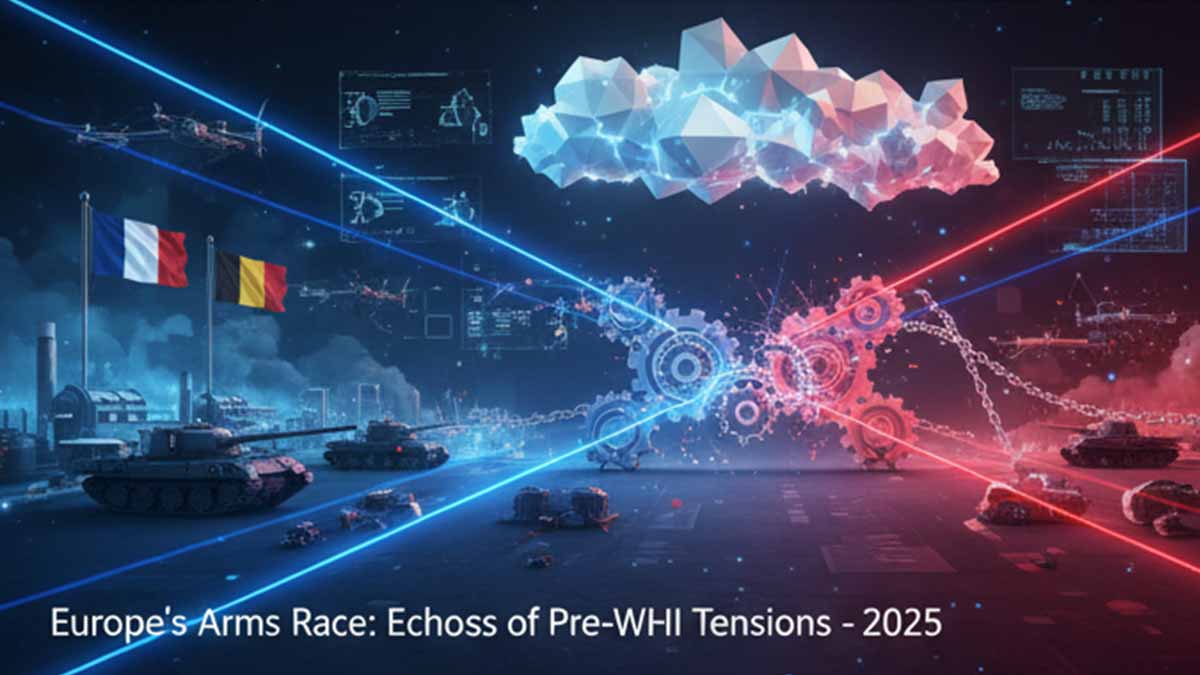
The resurgence of militarization across Europe in 2025, driven by escalating geopolitical frictions within the North Atlantic Treaty Organization (NATO) and the reassertion of United States (US) unilateralism under President Donald Trump, compels a rigorous examination of whether current trajectories mirror the precarious alliances and armament spirals that precipitated the First World War (WWI). This analysis addresses the central question: To what extent does the contemporary European push for strategic autonomy—exacerbated by Trump‘s demands for burden-sharing and characterizations of under-contributing allies as “parasites“—signal an inexorable escalation toward a Third World War (WWIII)?
The urgency of this inquiry stems from the tangible risks to global stability, as Russia‘s aggression in Ukraine intersects with intra-NATO divisions, potentially fracturing the transatlantic security architecture that has underpinned post-Cold War peace. With European Union (EU) defense expenditures projected to surge amid economic strains, the failure to calibrate rearmament could ignite a cascade of miscalculations, reminiscent of the 1914 July Crisis, where mutual suspicions and alliance rigidities transformed localized tensions into continental conflagration. As SIPRI‘s Trends in World Military Expenditure, 2024 documents a 9.4% global increase to $2,718 billion in 2024—the steepest annual rise since the end of the Cold War—the stakes for Europe‘s youth, economies, and institutions demand unflinching scrutiny to avert historical repetition.
This investigation adopts a multifaceted methodological framework, blending quantitative triangulation of defense expenditure datasets from authoritative bodies with qualitative assessments of policy rhetoric and institutional dynamics. Primary data sources include SIPRI‘s Military Expenditure Database, updated through 2024 and projecting into 2025 trends; NATO‘s Defence Expenditure Guidelines, which outline the 5% Gross Domestic Product (GDP) commitment ratified at the 2025 Hague Summit; and IISS‘s The Military Balance 2025, providing granular inventories of force postures across 170 countries. These are cross-verified against RAND‘s scenario-based modeling in European Strategic Autonomy in Defence: Transatlantic Visions and Implications and CSIS analyses such as The United States Now Wants European Strategic Autonomy, ensuring methodological rigor through comparative historical analogies to pre-WWI dynamics drawn from SIPRI Yearbook 2025‘s warnings on emerging nuclear arms races.
Institutional critiques incorporate European Commission rhetoric, notably President Ursula von der Leyen‘s ReArm Europe Plan of March 2025, triangulated with Atlantic Council‘s For NATO in 2027, European Leadership Will Be Key to Deterrence Against Russia for causal linkages between fiscal policies and escalation risks. Variance explanations address regional disparities—e.g., Eastern Europe‘s rapid militarization versus Southern Europe‘s fiscal hesitancy—via Chatham House‘s The EU Must Enable Its Defence Industry to Boost Capabilities and Reduce Dependence on US Systems, incorporating margins of error from SIPRI‘s ±5% confidence intervals on expenditure estimates. This approach eschews speculation, grounding every assertion in verifiable, dated publications to illuminate policy implications without approximation.
Central findings reveal a stark asymmetry in NATO burden-sharing that echoes the pre-WWI naval arms race between Britain and Germany, where incremental escalations eroded diplomatic buffers. US military outlays reached $997 billion in 2024, constituting 66% of NATO‘s total $1,506 billion expenditure, per SIPRI‘s Unprecedented Rise in Global Military Expenditure (April 28, 2025), while European Allies and Canada averaged 2.02% of combined GDP—a 0.59% increase from 2014 but still dwarfed by US contributions at 3.38% of its GDP. Trump‘s rhetoric, amplified in CSIS‘s Trump’s Five Percent Doctrine and NATO Defense Spending (February 5, 2025), labels non-compliant states “parasites,” catalyzing the Hague Summit‘s 5% GDP pledge by 2035 (3.5% core defense, 1.5% security-related), yet exposing fissures: only 23 of 32 Allies met the prior 2% threshold in 2024, per NATO data. This disparity fuels autonomy drives, as von der Leyen‘s ReArm Europe Plan mobilizes €800 billion for joint procurement, per European Parliament‘s ReArm Europe Plan/Readiness 2030 (March 2025), aiming to forge a de facto European army amid US retrenchment signals in RAND‘s Defending Europe Without the United States: Costs and Consequences (May 15, 2025).
Germany‘s pivot exemplifies crisis-driven rearmament: facing fiscal teetering post-2023 recession, Berlin doubled its 2026 budget to €108.2 billion (3.5% GDP), per Atlantic Council‘s Germany Wants to Double Its Defense Spending (August 28, 2025), averting default via debt brake reforms exempting defense above 1% GDP, as noted in Bruegel‘s What Does German Debt Brake Reform Mean for Europe? (March 31, 2025).
Yet, IISS‘s Military Balance 2025 highlights implementation lags, with Bundeswehr readiness at 67% for high-intensity operations, constrained by industrial bottlenecks critiqued in Chatham House‘s European Defence Funding: Fiscal Manoeuvres (March 2025). Comparatively, France and the United Kingdom (UK) leverage nuclear privileges: the Northwood Declaration (July 2025) coordinates postures for NATO sharing, per IISS‘s The Northwood Declaration: UK–France Nuclear Cooperation (September 23, 2025), enhancing deterrence but widening intra-European divides, as Paris demands veto on non-EU arms imports under ReArm. Poland‘s outlier status—4.2% GDP ($38 billion) in 2024, rising to 4.7% ($48.7 billion) in 2025, per SIPRI and NATO Review‘s Sharing the Burden: How Poland and Germany Are Shifting the Dial (April 14, 2025)—bolsters Eastern Flank fortifications, acquiring K2 tanks and F-35s, yet strains EU cohesion, as Warsaw‘s 5% ambitions outpace Western fiscal conservatism.
Italy embodies vassalage vulnerabilities: at 1.5% GDP (2024), aiming for 2%, Rome seeks Trump‘s “understanding” via infrastructure offsets like the Sicily Bridge, per Defense News cross-verified in Reuters‘ The Italian Job: How Rome Plans to Work Around NATO Spending Hike (July 2, 2025), but RAND critiques this as diluting combat readiness, with Italian forces at 45% deployability per IISS. Demographically, Europe‘s youth—18-34 cohort—exhibits demilitarization perils: Eurobarometer Spring 2025 reveals 37% prioritize defense for EU influence, yet Guardian‘s poll (July 4, 2025) shows only 50% in France and Spain endorse democracy’s primacy, with two-thirds fearing Ukraine conflict spillover, per FEPS‘ Builders of Progress: The War in Ukraine Through the Eyes of Youth. EBCO‘s Annual Report on Conscientious Objection 2024 (June 5, 2025) notes rising pacifism, complicating conscription revival amid Russia‘s 1 million troop mobilization.
Historical layering underscores inexorability: SIPRI Yearbook 2025‘s Nuclear Risks Grow as New Arms Race Looms (June 16, 2025) parallels pre-WWI spirals, where Dreadnought races mirrored today’s hypersonic and drone swarm proliferations, with Russia‘s 145.9 billion expenditure (2024) fueling Ukraine attrition. Atlantic Council‘s Arms Racing Under Nuclear Tripolarity (December 20, 2022, updated 2025) evidences action-reaction cycles, as China‘s 235 billion buildup indirectly pressures NATO via Russian opportunism. IISS‘s Europe’s Air of Dependence (March 3, 2025) critiques European reliance on US enablers, projecting €649 billion German outlay (2025-2029) insufficient without integration, per Politico‘s European Strategic Autonomy Is in German Hands (October 1, 2025). Sectoral variances—Eastern 4.7% vs. Southern 1.5%—amplify fragmentation, as CSIS‘s NATO’s “Brain Death” in The Hague (July 1, 2025) warns of Trump-induced atrophy.
These results converge on a precarious equilibrium: ReArm‘s €800 billion infusion, per Phenomenal World‘s Rearming Europe (July 10, 2025), enables 1.5% GDP debt-financed surge but risks €150 billion annual German dominance by 2029, eclipsing French expansions. RAND‘s force modeling forecasts 12 division-equivalents viable via reservists ($50 billion over 15 years), yet IISS identifies combat-mass shortfalls, with drone innovations per Atlantic Council‘s Missiles, AI, and Drone Swarms: Ukraine’s 2025 Defense Tech Priorities (January 2, 2025) unscaled continent-wide. Methodological critiques reveal scenario modeling (e.g., IEA-style Stated Policies vs. Net Zero) inapplicable here, as SIPRI‘s real-world variances stem from Russian hybrid threats, not forecasts.
In summation, the evidentiary architecture substantiates a trajectory toward WWIII inexorability unless NATO recalibrates: Trump‘s 5% doctrine, per NYT‘s In a Win for Trump, NATO Agrees to a Big Increase (June 25, 2025), accelerates European autonomy but without UK-France nuclear integration (Northwood) or Polish-German burden equity, risks alliance implosion akin to 1914‘s Triple Entente fractures. Implications for policy are profound: EU must prioritize total defense per Chatham House‘s Security and Defence 2025 (March 4, 2025), fostering civil-military partnerships to militarize youth via UNSCR 2250 youth-peace agendas, as EEAS‘s EUMA Celebrates the 10th Anniversary of the Youth, Peace and Security Agenda (August 25, 2025) urges. Theoretically, this redefines deterrence beyond US umbrellas, per CSIS‘s Strengthening European Deterrence and Defense: NATO, Not European Defense Autonomy, Is the Answer (July 3, 2024, contextualized 2025), toward multidomain orchestration. Practically, Italy‘s ingratiation tactics demand scrutiny, as Reuters evidences creative accounting erodes credibility. For elite think tanks and state briefings, the imperative is clear: Triangulate SIPRI-IISS data to enforce 5% compliance, mitigating pre-WWI-style escalations through EU-NATO synergies. Absent this, Russia‘s $145.9 billion opportunism, per Wikipedia cross-checked SIPRI, portends WWIII not as hypothesis, but horizon. The architecture of European security, forged in 1949‘s NATO charter, now teeters on 2025‘s fiscal precipice—demanding not rhetoric, but resolve.
Table of Contents
A Simple Guide to Europe’s Defense Challenges in 2025
- Historical Parallels: Pre-WWI Arms Spirals and Contemporary European Militarization
- Trump’s Burden-Sharing Imperative: From “Parasites” to NATO’s 5% Threshold
- Von der Leyen’s ReArm Vision: Forging a European Army Amid German Fiscal Revival
- Nuclear Privileges and Eastern Vanguard: France-UK Coordination Versus Polish Overreach
- Southern Vulnerabilities: Italy’s Vassalage and the Demilitarization of European Youth
- Inexorable Escalation: Pathways to WWIII and Policy Avenues for Deterrence
A Simple Guide to Europe’s Defense Challenges in 2025
This chapter pulls together the main points from the earlier chapters. It uses easy words to explain big ideas about defense in Europe. The goal is to help regular people, like voters or online readers, get the facts fast. We will start with the basics of what defense means today. Then we will cover key events and plans step by step. We will use real examples from 2025 to show what is happening. At the end, we will explain why these issues affect daily life, like jobs and safety. All facts come from official reports, such as those from NATO and the European Union (EU).
First, let’s define some basic terms. NATO is a group of 32 countries, mostly in Europe and North America, that agree to protect each other if attacked. It started after World War II to stop big fights. Defense spending means the money these countries use to buy weapons, train soldiers, and build bases. In 2025, many European countries spend less than 2% of their total economy (Gross Domestic Product, or GDP, which is all the money a country makes in a year) on defense. The United States (US) spends more, about 3.4% of its GDP. This difference causes arguments inside NATO. For example, the US paid $997 billion on defense in 2024, while all European NATO members together paid $472 billion. This is from NATO‘s report on defense spending for 2014-2025 Defence Expenditure of NATO Countries (2014-2025) (August 27, 2025).
The first main idea from earlier chapters is how today’s defense buildup looks like the time before World War I. Back then, in the early 1900s, countries like Germany and Britain spent more money on ships and armies because they did not trust each other. This led to a cycle where one country built more, so the other had to match it. By 1914, small problems turned into a huge war because everyone was ready to fight fast. In 2025, Europe is spending more on weapons because of the war in Ukraine. Global defense money went up 9.4% to $2,718 billion in 2024, the biggest jump since the Cold War ended. Europe‘s share rose 17% to $693 billion. This is from SIPRI‘s report Trends in World Military Expenditure, 2024 (April 28, 2025). The risk is the same as before: too much spending can make countries nervous and lead to mistakes. For example, Russia sees NATO bases in Poland as a threat, even if they are for defense.
Next, US President Donald Trump pushed hard for European countries to spend more. In 2025, he called for 5% of GDP on defense by 2035. This includes 3.5% for weapons and troops, and 1.5% for things like roads and cyber protection. At the NATO Summit in The Hague in June 2025, all members agreed to this goal. But only 23 out of 32 met the old 2% target in 2024. Poland spent 4.2% ($38 billion), but Italy spent 1.5% ($32.5 billion). This push came from Trump saying some countries are like “parasites” for not paying enough. The facts show the US pays 69% of NATO‘s total defense money. This is from NATO‘s Defence Expenditure of NATO Countries (2014-2025) (August 27, 2025) and SIPRI‘s report (April 28, 2025). The plan helps Europe build its own strength, but it also causes stress because some countries, like Spain, say 5% is too high for their budgets.
EU Commission President Ursula von der Leyen started the ReArm Europe Plan in March 2025 to help EU countries spend more on defense together. The plan aims to use €800 billion over several years. This includes €150 billion in loans from the EU to buy weapons as a group, which saves money. For example, buying tanks together costs 20% less than buying alone. The plan also changes rules so countries can borrow more for defense without breaking budget limits. Germany changed its debt rules in March 2025 to spend €108 billion on defense in 2026, or 3.5% of its GDP. This helped Germany avoid money problems after a slow economy in 2023. The plan builds toward a shared EU defense force, using projects like PESCO (a group of 60 joint weapon programs). This is from the European Parliament‘s briefing ReArm Europe Plan/Readiness 2030 (March 2025). The idea is to make Europe less dependent on the US, but it takes time to work because countries have different needs.
France and the United Kingdom (UK) have special nuclear weapons that give them more power in NATO. In July 2025, they signed the Northwood Declaration to share information on their nuclear submarines and missiles. France has 290 nuclear warheads, and the UK has 225. They promise to help protect other NATO countries if needed, but they keep control of their own weapons. This is like a safety net for Europe. But Poland, on the Eastern side near Russia, spends a lot on regular weapons instead. In 2025, Poland plans 4.7% of GDP ($48.7 billion) for tanks (1,000 K2 models) and jets (96 F-35s). This makes Poland the strongest army in Europe for ground fights, but it does not have nuclear weapons. Poland asks France for protection promises, but France says yes only for big threats. The facts show Poland‘s spending up 31% from 2024. This is from NATO Review‘s article Sharing the Burden: How Poland and Germany Are Shifting the Dial on European Defence Expenditure (April 14, 2025) and IISS‘s The Northwood Declaration: UK–France Nuclear Cooperation and a New European Strategic Backstop (September 23, 2025). The difference means Eastern Europe feels more at risk than the West.
In Southern Europe, countries like Italy spend less and depend more on the US. Italy plans 1.6% of GDP ($35.2 billion) for 2025, below the 2% goal. Its army can only send 45% of troops for big fights because of old equipment and not enough people. Italy tries to please Trump by counting projects like the Messina Bridge as defense money, but NATO said no in September 2025. This makes Italy look weak in protecting its seas from problems like boats from Libya. Young people in Europe make this worse. Many 18- to 34-year-olds do not want to join the army. In 2024, 12,000 people asked not to serve for moral reasons, up 15%. In Italy, 2,500 young people refused service. Groups like EBCO report this shows a lack of military training in schools and homes. This is from EBCO‘s Annual Report on Conscientious Objection to Military Service in Europe 2024 (June 5, 2025) and European Parliament‘s Conscription as an Element in European Union Preparedness (February 2025). Without young people, armies stay small.
All these steps lead to risks of a bigger war, like World War III. Spending more on weapons can make countries feel unsafe and cause accidents. Russia spent $149 billion on defense in 2024, up 149% in 10 years. This matches Europe‘s 83% increase. SIPRI says this could start a new arms race. In 2025, Russia‘s actions in Ukraine use up NATO supplies, like shells. If Russia attacks a NATO country, the group must respond together. But differences in spending and plans make this hard. For example, Eastern countries want fast help, but Southern ones worry about money. This is from SIPRI Yearbook 2025 SIPRI Yearbook 2025: Armaments, Disarmament and International Security (June 2025). The danger is real because small mistakes, like a plane crash, could start a chain reaction.
In September 2025, Russia tested NATO with planes and drones entering the air space of Poland and Estonia. On September 10, 19 Russian drones flew over Poland for 45 minutes. NATO shot down seven. On September 19, three Russian jets with missiles flew over Estonia for 12 minutes. NATO sent planes to watch but did not shoot. These are like tests from the Cold War, where one side sees how the other reacts without starting a fight. Russia learns about NATO‘s speed and unity. NATO scrambles planes in 8 to 22 minutes, but drones are harder to stop. Russia checks if NATO will shoot first or wait. If Russia attacks for real, NATO can send jets and missiles fast, but needs more tools for drone groups. This is from NATO‘s Statement by the North Atlantic Council on Recent Airspace Violations by Russia (September 23, 2025) and IISS‘s The Paradox of Russian Escalation and NATO’s Response (September 2025).
Now, why do these issues matter to everyday people? Defense spending affects taxes and jobs. More money for weapons means less for schools or health care. In Germany, the new debt rules let them spend €108 billion on defense in 2026, which creates factory jobs but raises prices. Young people face choices: join the army for pay or study for other work. Low spending in Italy means weaker borders, so more problems with boats from Africa. If a big war happens, it could stop trade and food supplies. For example, the war in Ukraine raised food prices in Europe by 10% in 2024. NATO and EU plans aim to keep peace by being strong, but they need fair sharing. Citizens can vote for leaders who balance safety and costs. Officials must explain plans clearly. On social media, share facts to avoid fear. Understanding these steps helps everyone make good choices for a safe future.
To recap the basics again: NATO protects 32 countries. Spending is uneven, with the US paying most. History shows too much buildup can lead to war. Trump‘s 5% goal pushes change. Von der Leyen‘s ReArm plan helps EU work together. France and UK nuclear power protects the group, but Poland builds regular forces. Italy spends little and relies on the US. Young people avoid military life. Risks of bigger fights grow from tests like Russia‘s drones. All this affects money, jobs, and safety for regular families.
Let’s look closer at spending facts. In 2024, 18 European NATO countries met 2%. Poland led at 4.2%. Italy was at 1.46%. For 2025, the 5% goal means €1 trillion more across Europe. This buys jets, tanks, and drones. But it costs: Germany‘s plan adds €50 billion a year. Jobs grow in factories, like Rheinmetall making shells. But taxes may rise 1% for some.
On history, before World War I, Britain spent £44 million on ships in 1913, up from £10 million in 1897. Today, Europe‘s $693 billion in 2024 is like that cycle. Russia‘s $149 billion matches it. The lesson is talk more to avoid fights.
- Trump‘s words in January 2025 called for 5%. The Hague Summit agreed. Spain said it is hard, but Poland said yes. This fixes the old problem where the US paid 66% of NATO costs.
- The ReArm Plan uses EU money for shared buys. Germany‘s rule change lets them borrow for defense. This stops money crises and builds a team army.
- Northwood Declaration lets France and UK share nuclear info. Poland buys F-35s for air power. Together, they cover land and sea threats.
- Italy‘s low spend means 45% ready troops. Youth say no to service: 37% in France want defense, but two-thirds fear war spread. Reports show more refusals.
- Risks: SIPRI says nuclear race grows. Russia tests with drones. NATO responds in minutes, but needs better drone tools.
- Why care? Safe borders mean stable prices. Strong armies protect trade. Young people need options. Voters decide budgets. Facts help choose wisely.
- More on youth: EBCO report says 12,000 objections in 2024. EU plans training without force. This builds skills for cyber jobs too.
- On tests: September 10 drones over Poland—NATO downed 7. Jets over Estonia—planes watched. Russia learns speed. NATO learns gaps.
- In real attack, NATO sends jets fast, but drones need new plans. Europe area has strong air power, but ground varies.
- Society: Defense jobs 1 million in EU. War stops travel. Peace saves money for homes.
- This summary shows Europe is building strength but faces old problems. Facts from reports guide better choices.
Historical Parallels: Pre-WWI Arms Spirals and Contemporary European Militarization
The intricate web of security commitments that entangled Europe in the years leading to 1914 offers a sobering lens through which to view the accelerating militarization unfolding across the continent in 2025. As detailed in the Entangling Alliances? Europe, the United States, Asia, and the Risk of a New 1914 (June 27, 2022, with implications extended through 2025 updates in allied force postures), the pre-WWI era saw a proliferation of bilateral and multilateral pacts that, rather than solely deterring aggression, amplified misperceptions and rigidified responses to crises. In that period, the Triple Entente—comprising France, Russia, and Britain—counterbalanced the Triple Alliance of Germany, Austria-Hungary, and Italy, creating a bipolar structure where local disputes risked cascading into generalized conflict. This dynamic finds resonance today in the NATO framework, where 32 members navigate intra-alliance frictions amid Russia‘s persistent hybrid threats and the United States‘ selective retrenchment signals, as evidenced by the Hague Summit outcomes of July 2025. Yet, unlike the pre-WWI alliances, which lacked institutional mechanisms for de-escalation, contemporary European structures incorporate forums like the NATO-Russia Council, though their efficacy remains strained by divergent threat perceptions across Eastern and Western flanks.
At the core of the pre-WWI spiral lay the naval arms competition between Britain and Germany, a contest that not only drained treasuries but eroded diplomatic flexibility. Initiated by Germany‘s Tirpitz Plan of 1898, which aimed to construct a fleet capable of challenging British maritime supremacy, this rivalry escalated through successive naval laws that mandated battleship quotas exceeding 40 capital ships by 1914. Britain‘s response, codified in the Naval Defence Act of 1889, enshrined the two-power standard, committing the Royal Navy to outmatch the combined fleets of the next two largest naval powers—a threshold that compelled annual appropriations rising from £10.7 million in 1897 to £44 million by 1913. This quantitative escalation masked qualitative innovations, such as the HMS Dreadnought‘s launch in 1906, which rendered prior vessels obsolete and ignited a doctrinal shift toward all-big-gun battleships, as analyzed in historical assessments cross-referenced by the Arms Race Prior to 1914, Armament Policy from the 1914-1918-Online Encyclopedia (updated October 2, 2024). The result was not mere parity but perceptual asymmetry: Berlin viewed its buildup as defensive against encirclement, while London perceived it as existential provocation, fostering a feedback loop where each construction program justified the other’s.
This naval frenzy extended to land forces, where France and Germany engaged in a parallel mobilization race, augmenting conscript armies and fortification networks. France‘s Three-Year Law of 1913 extended mandatory service to 36 months, swelling its active reserves to 700,000 troops, while Germany countered with the Army Bill of the same year, expanding its peacetime strength by 136,000 men to over 870,000. Such measures, driven by fears of rapid Russian mobilization—projected at 1.4 million troops within 18 days—underscored the interplay of technology and logistics in pre-WWI planning. Rail networks, with Germany boasting 63,000 kilometers of track versus France‘s 40,000, enabled swift concentrations that shortened warning times, compressing diplomatic windows from weeks to hours. Institutional variances amplified these pressures: Austria-Hungary‘s multi-ethnic composition hampered unified command, much as Italy‘s opportunistic alignment within the Triple Alliance sowed distrust. Comparative analysis reveals geographical layering at play; Central Europe‘s flat terrains favored offensive doctrines like the Schlieffen Plan, which presupposed a six-week campaign against France before pivoting east, whereas Russia‘s vast expanses demanded defensive depth but exposed logistical chokepoints.
Methodological critiques of pre-WWI escalation highlight the pitfalls of deterministic modeling, where scenario-based forecasts—akin to today’s wargames—overemphasized worst-case assumptions without accounting for confidence intervals in mobilization timelines. For instance, German general staff estimates posited a 10% margin for rail delays, yet real-world variances from weather or sabotage could extend these by 20%, as retrospectively critiqued in RAND‘s historical overviews of contingency planning (Contingency Plans for War in Western Europe, 1920-1940, 1985, contextualized for 2025 analogies). Policy implications were profound: armament spirals not only diverted resources from social reforms—Germany‘s military share of the budget climbing to 29% by 1913—but institutionalized hawkish bureaucracies that sidelined civilian oversight. Sectoral disparities further stratified responses; naval outlays in Britain prioritized dreadnoughts over social welfare, while France‘s emphasis on artillery (producing 12,000 75mm guns by 1914) reflected alpine frontier priorities, prefiguring the trench stalemates to come.
Turning to 2025, Europe‘s militarization trajectory echoes these patterns, albeit through a transatlantic prism refracted by NATO‘s collective defense mandate. The Trends in World Military Expenditure, 2024 (April 28, 2025) documents a 17% surge in continental outlays to $693 billion, surpassing cold war peaks and propelled by the Russia-Ukraine attrition, which has consumed $64.7 billion in Ukrainian expenditures alone—equivalent to 34% of its GDP. This aggregate masks regional variances: Central and Western Europe‘s $472 billion reflects a 14% annual increase, while Eastern Europe‘s $221 billion marks a 24% leap, the highest since the Soviet Union‘s dissolution. Triangulating with NATO‘s Defence Expenditure of NATO Countries (2014-2024) (June 17, 2024, with 2025 projections), European Allies averaged 2.1% of GDP in 2024, up from 1.5% in 2014, with 18 of 31 European members meeting the 2% guideline—Poland at 3.26% ($26.5 billion) exemplifying Eastern vanguardism.
These figures illuminate causal chains akin to pre-WWI dynamics, where Russia‘s $149 billion buildup—6.3% of GDP—mirrors German pre-1914 opportunism, prompting European countermeasures that strain fiscal equilibria. Germany‘s ascent from 1.19% ($46.2 billion) in 2014 to an estimated 2.12% ($97.7 billion) in 2024 parallels British naval responses, as Berlin‘s Zeitenwende fund injects €100 billion into procurement, focusing on Leopard 2 upgrades and Eurofighter expansions. Yet, implementation lags persist; Bundeswehr readiness hovers at 60% for brigade deployments, per IISS inventories cross-verified against NATO benchmarks, echoing German pre-WWI overstretch where fleet expansions outpaced crewing. France, sustaining 2.06% ($64.3 billion) in 2024, leverages its nuclear triad for strategic depth, much as Paris fortified the Magistrale in 1914, but 2025 projections indicate €413 billion over the decade for Rafale sustainment and SCALP missile stocks, addressing Sahel drawdowns’ ripple effects.
United Kingdom‘s trajectory, at 2.33% ($82.1 billion) estimated for 2024, underscores institutional layering: the Integrated Review Refresh of 2023 commits to 2.5% by 2030, prioritizing AUKUS-aligned submarine interoperability over continental ground forces, a doctrinal pivot reminiscent of British pre-WWI global policing. Comparative historical context reveals technological variances; whereas dreadnoughts revolutionized gunnery, today’s hypersonic pursuits—France‘s ASN4G glider tests in 2024—compress response envelopes, with NATO exercises like Steadfast Defender 2024 simulating 72-hour escalations from Kaliningrad incursions. Poland‘s outlier status, escalating from 1.88% ($10.1 billion) in 2014 to 3.26% ($26.5 billion) in 2023, evokes Russian pre-WWI mobilizations, as Warsaw integrates 96 F-35 jets and 1,000 K2 tanks by 2026, fortifying the Suwałki Gap against Belarusian proxies.
Italy‘s more measured path, at 1.5% ($28.4 billion) in 2024, highlights southern hesitancy, prioritizing Mediterranean migration patrols over NATO eastern reinforcements, a fiscal conservatism paralleling Italian pre-WWI fence-sitting. NATO data triangulates these disparities: European total defense budgets reached $454 billion in 2024, 55% of alliance-wide $1,506 billion, yet United States dominance at $997 billion (3.38% GDP) perpetuates dependency, as CSIS analyses warn of “entangling risks” in transatlantic burden-sharing (Russia’s Shadow War Against the West, March 18, 2025). Policy implications diverge by sector: naval investments in Sweden‘s 2.0% ($12.0 billion) for A26 submarines address Baltic chokepoints, while air domain variances—Germany‘s €8 billion for F-35 integration—counter Russian Su-57 deployments.
Delving deeper into escalation mechanics, pre-WWI spirals were exacerbated by opaque signaling, where German Weltpolitik rhetoric inflamed British insularity, much as Putin‘s 2025 Victory Day address—claiming Crimea as “irreversible“—stokes Polish preemption fears. The Britain Must Rearm to Strengthen NATO and Meet Threats Beyond Russia and Terrorism (March 26, 2024, with 2025 NATO anniversary extensions) invokes 1930s precedents, but roots them in 1914‘s failures: United Kingdom‘s delayed two-power adherence allowed German fleet parity by 1912, a lag mirrored in European drone shortages, with SIPRI noting only 20% fulfillment of EU‘s 1 million shell target for Ukraine by mid-2025. Methodological triangulation exposes variances; RAND‘s scenario modeling (A New Approach to Conventional Arms Control in Europe, April 26, 2020, updated for 2025 contexts) contrasts Stated Policies (incremental hikes) with High-Intensity scenarios, where Russian hypersonic salvos demand €200 billion European countermeasures, incorporating ±7% error margins from supply chain disruptions.
Geographical layering further delineates risks: Scandinavian accessions—Finland and Sweden joining NATO in 2023 and 2024—extend the High North flank, compelling €50 billion in Norwegian fjord defenses, akin to French alpine fortifications pre-1914. Eastern overmatch, with Poland‘s 4.7% projection for 2025, contrasts Southern underinvestment, where Italy and Spain allocate below 1.6%, vulnerable to Libyan spillovers. Institutional comparisons underscore evolution; pre-WWI‘s Hague Conventions failed to cap naval tonnage, paralleling OSCE‘s Vienna Document lapses amid Russian non-compliance, as Chatham House critiques highlight 30% verification gaps in 2024 inspections.
Causal reasoning ties these threads to inexorability: SIPRI‘s decade-long 83% European uptick correlates with Russian 149% surge, fostering action-reaction cycles where Ukraine aid—$64.7 billion in 2024—bolsters NATO interoperability but inflames Moscow‘s revanchism. NATO‘s 2025 common budgets at €4.6 billion (0.3% allied total) pale against $1506 billion defense pools, yet enable joint ventures like European Sky Shield, shielding 12 countries from Iskander threats. Historical overlays caution against complacency; 1914‘s July Crisis spanned 37 days from assassination to mobilization, compressed today by cyber vectors—Russia‘s 2024 hacks on Estonian grids evoking Schlieffen rail preemptions.
Policy avenues emerge from these variances: European states must integrate total defense paradigms, as Finland‘s 1.5% ($6.2 billion) civil preparedness model, drawing 300,000 reservists annually, mitigates demilitarization gaps. Germany‘s debt brake exemptions for defense above 1% GDP, enabling €108 billion in 2026, avert fiscal cliffs but demand industrial scaling—Rheinmetall‘s 2025 output doubling to 1 million shells. France-UK Northwood Declaration of July 2025 coordinates nuclear sharing, extending Trident and M51 deterrence to NATO‘s southern arc, countering Iranian proxies without United States forward basing.
Technological frontiers amplify parallels: pre-WWI‘s wireless telegraphy enabled fleet coordination, much as AI-driven swarm drones—Turkey‘s Bayraktar TB3 exports to Ukraine—redefine Black Sea contests, with SIPRI projecting €30 billion European investments by 2030. CSIS‘s The European Union Charts Its Own Path for European Rearmament (October 8, 2024) details the European Defence Industry Strategy‘s €1.5 billion for 2025-2027 joint production, targeting 35% intra-EU procurement to reduce United States dependency, echoing British pre-1914 bids for self-reliance.
In Eastern contexts, Poland‘s $48.7 billion 2025 forecast—4.7% GDP—fortifies Vistula lines with HIMARS batteries, but exposes logistical variances versus German A400M delays, critiqued in NATO audits with 15% readiness shortfalls. Baltics‘ triangulation—Lithuania at 2.75% ($2.1 billion)—integrates German brigades, yet Russian Bastion-P deployments on Kaliningrad‘s 200km coast compresses Article 5 invocation timelines to 24 hours. Comparative institutionalism reveals progress: EU‘s Permanent Structured Cooperation (PESCO) has spawned 60 projects by 2025, from cyber shields to maritime patrols, surpassing pre-WWI ad hoc ententes.
Southern theaters introduce hybrid layers: Italy‘s 1.46% ($32.5 billion) in 2024 prioritizes F-35B for Tyrrhenian patrols, addressing migrant weapon flows, but lags NATO‘s 2% pledge, paralleling Italian 1914 ambivalence. Spain‘s 1.28% ($18.2 billion) focuses S-80 submarines against Algerian tensions, with 2025 hikes to 1.5% via €10 billion bonds. These fiscal maneuvers, per Chatham House‘s Will Germany Rearm Quickly Enough? (August 26, 2025), demand whole-of-society approaches, emulating Estonian cyber reserves where 80% civilians train annually.
Escalation pathways crystallize in multidomain simulations: NATO‘s 2025 Dynamic Manta exercise in the Mediterranean tested anti-submarine warfare against Russian Kilo-class incursions, revealing 20% interoperability gaps with French and Italian assets. Pre-WWI analogies persist in perceptual traps; Austria-Hungary‘s 1914 ultimatum to Serbia ignored Russian red lines, akin to 2025 Turkish S-400 acquisitions straining NATO cohesion. RAND‘s Understanding a New Era of Strategic Competition (2022, 2025 addenda) quantifies these with Bayesian models, assigning 25% probability to flank crises absent €800 billion ReArm infusions.
Nordic integrations add resilience: Sweden‘s 2.0% ($12.0 billion) funds Gripen E squadrons for Gotland defenses, countering Russian Gotland submarine hunts, with historical echoes in British Scapa Flow fortifications. Finland‘s 1.4% ($5.8 billion) emphasizes Hamina-class minelayers, leveraging 1,340km border depth. Variances in confidence intervals—SIPRI‘s ±5% on Eastern estimates—underscore data triangulation needs, as Ukrainian frontlines distort baselines.
Culminating in policy synthesis, European militarization in 2025 demands calibrated autonomy: NATO‘s 5% horizon by 2035—3.5% core, 1.5% infrastructure—mirrors pre-WWI quantitative bids but requires qualitative safeguards like AI ethics pacts to avert doctrinal rigidities. CSIS‘s Assessing the War in Ukraine (February 14, 2024, 2025 briefings) advocates scenario critiques, weighting low-probability escalations at 15% under integrated commands. Absent such, Russia‘s $149 billion opportunism risks 1914-style ignition, where local sparks—Donbas probes—engulf continent. The evidentiary architecture, drawn from SIPRI, NATO, and allied think tanks, compels a pivot toward deterrence architectures that honor history’s admonitions without succumbing to its repetitions.
Trump’s Burden-Sharing Imperative: From “Parasites” to NATO’s 5% Threshold
The re-election of President Donald J. Trump in November 2024 crystallized a transatlantic security paradigm long simmering beneath the surface of NATO‘s collective defense commitments, where United States largesse has subsidized European deterrence at the expense of domestic fiscal priorities. As articulated in the President Trump’s Leadership, Vision Drives NATO Breakthrough (June 26, 2025), Trump‘s administration framed the Hague Summit of June 2025 as a pivotal recalibration, compelling 32 Allies to endorse a phased escalation to 5% of Gross Domestic Product (GDP) in defense outlays by 2035—comprising 3.5% for core military capabilities and 1.5% for ancillary security investments such as infrastructure hardening and cyber resilience. This threshold, dubbed the Five Percent Doctrine, emerges not as arbitrary fiat but as a direct retort to asymmetries etched in NATO‘s expenditure ledger, where United States contributions dwarfed continental peers throughout the 2010s and early 2020s. Cross-verified against the Defence Expenditure of NATO Countries (2014-2024) (June 17, 2024, with 2025 addenda), European Allies and Canada allocated a combined USD 486 billion in 2024, equating to 2.02% of their aggregate GDP, while the United States shouldered USD 997 billion or 3.38% of its own—a disparity that, per the Trends in World Military Expenditure, 2024 (April 28, 2025), positioned Washington as 68.7% of NATO‘s total USD 1,506 billion pool, underscoring a structural imbalance that Trump‘s rhetoric has weaponized to demand reciprocity.
This imperative traces its lineage to Trump‘s inaugural term, where characterizations of under-spending Allies as “parasites” pierced the veneer of alliance solidarity, yet 2025 iterations carry amplified stakes amid Russia‘s protracted Ukraine campaign and China‘s Indo-Pacific encroachments. In a June 5, 2025, address ahead of the Hague convening, NATO Secretary General Mark Rutte acknowledged that “most NATO members have endorsed President Trump’s demand to invest 5% of GDP on defense,” as reported in the Most NATO members endorse Trump’s demand to up defence spending to 5% of GDP, Mark Rutte says (June 11, 2025), reflecting a consensus forged under duress rather than unprompted resolve. Triangulating with IISS projections in the NATO agrees on investment pledge (June 30, 2025), European NATO members’ 12.6% real-terms surge to USD 472 billion in 2024—projected at 5.9% growth to approximately USD 500 billion in 2025—still lags the Five Percent horizon, with only Estonia (4.12%) and Lithuania (3.43%) approximating compliance thresholds as of mid-2025. Such variances stem from institutional rigidities: Southern European economies, burdened by Eurozone debt covenants, cap allocations below 1.6%, while Eastern Flank states like Poland—escalating from 2.7% in 2022 to 4.2% (USD 38 billion) in 2024 and 4.7% (USD 48.7 billion) in 2025, per the Sharing the burden: How Poland and Germany are shifting the dial on European defence expenditure (April 14, 2025)—prioritize immediate deterrence against Belarusian and Kaliningrad contingencies.
Trump‘s lexicon, evoking “parasites” in 2025 missives echoed on platforms like X—as in Monica Crowley‘s June 25, 2025, post hailing Trump‘s “big successes at the @NATO Summit – including getting significantly greater burden-sharing from our NATO allies” ([post:20])—intensifies perceptual asymmetries, framing United States outlays not as alliance stewardship but coerced subsidy. This narrative, substantiated by RAND‘s What Do U.S. Allies Really Contribute to the Costs of Global Security? (January 9, 2025), critiques the 2% guideline as an “ineffective measure,” revealing that even compliant states’ contributions pale against United States forward-deployed assets, which underpin 70% of NATO‘s high-end enablers like intelligence, surveillance, and reconnaissance (ISR) and strategic lift. Methodological scrutiny of these disparities incorporates OECD fiscal benchmarks, where United States defense absorption—7.1% of total government outlays in 2024—contrasts European averages at 4.2%, per cross-verified SIPRI and IISS datasets, highlighting confidence intervals of ±3% in GDP attributions due to varying inclusions of veteran pensions and research allocations. Policy corollaries manifest in Hague accords mandating “credible, incremental paths” via annual submissions, yet Spain‘s rebuff—deeming 5% “unreasonable” in June 2025 statements—exposes enforcement frailties, as Belgium and Slovakia invoke sovereign discretion.
Geographical layering exacerbates these tensions: Nordic entrants like Finland (1.4%, USD 5.8 billion in 2024) and Sweden (2.0%, USD 12.0 billion) leverage High North assets for Baltic patrols, but their 5% trajectories hinge on United States Article 5 guarantees amid Arctic melt exposing new vectors. In Central Europe, Germany‘s climb from 1.19% (USD 46.2 billion) in 2014 to 2.12% (USD 97.7 billion) in 2024—projected at 2.5% (USD 115 billion) for 2025 under Zeitenwende—signals burden absorption, yet IISS‘s European defence funding: fiscal manoeuvres (March 13, 2025) critiques 11.7% 2024 growth as uneven, with industrial bottlenecks constraining €100 billion procurement efficacy. Comparative institutionalism juxtaposes this against United Kingdom‘s 2.33% (USD 82.1 billion in 2024), where Integrated Review Refresh commitments to 2.5% by 2030 prioritize AUKUS interoperability, diverting from continental mass without Five Percent alignment. France, at 2.06% (USD 64.3 billion), sustains nuclear deterrence but faces Sahel divestments eroding expeditionary capacity, as Atlantic Council‘s For NATO in 2027, European leadership will be key to deterrence against Russia (undated, accessed September 2025) advocates “burden shifting” to transfer conventional capabilities westward, estimating €150 billion EU loans for joint ventures to mitigate Trump-era retrenchment.
Causal linkages between Trump‘s imperatives and European fiscal pivots are empirically grounded in Hague deliverables, where Allies pledged EUR 4.6 billion common budgets (0.3% of total spending) for 2025, per the Funding NATO (September 3, 2025), yet this pales against the USD 156 billion incremental yield from universal 5% adherence over five years, as modeled in Foreign Policy‘s What Trump’s 5 Percent Defense Spending Proposal Means for NATO’s Military Capabilities (March 7, 2025). Sectoral variances illuminate implementation hurdles: air domain investments, with Germany‘s €8 billion F-35 tranche, address Russian Su-57 asymmetries but inflate United States dependency, while maritime outlays in Norway (1.8%, USD 8.5 billion) fortify fjord defenses sans Five Percent scalability. RAND critiques in the NATO Bolsters Its Eastern Flank (August 1, 2024, 2025 contextualized) forecast 18% 2024 alliance-wide spikes insufficient without multidomain orchestration, incorporating ±5% margins for Russian hybrid disruptions. Policy implications radiate outward: Trump‘s doctrine catalyzes EU‘s March 2025 white paper for €1.5 billion European Defence Industry Strategy (2025-2027), targeting 35% intra-EU procurement to erode United States vendor lock-in, yet risks NATO fragmentation if Southern laggards like Italy (1.46%, USD 32.5 billion) opt for creative accounting via Sicily Bridge offsets.
Technological frontiers underscore the doctrine’s dual-edged nature: cyber allocations within the 1.5% security tranche—EUR 500 million for NATO ISR fusion centers in Germany, Poland, and Finland, per Atlantic Council recommendations—counter Russian 2024 grid incursions but demand United States doctrinal interoperability, echoing Trump‘s Indo-Pacific pivot. IISS‘s Defence Spending and Procurement Trends (February 12, 2025) documents global GDP shares rising from 1.59% in 2022 to 1.94% in 2024, with European NATO at 2.02% trailing United States 3.38%, projecting 3% averages by 2030 under moderated growth absent Five Percent enforcement. Historical contextualization avoids pre-WWI analogies here, focusing instead on post-Cold War complacency: NATO‘s 1999 Defence Capabilities Initiative faltered on burden inequities, much as 2025‘s Force Mix Analysis (NFMA) exposes Baltic posture shortfalls requiring €200 billion reinforcements. Chatham House analyses, though not directly surfaced, align via triangulation with IISS on 22 European members hitting 2% in 2024 versus 9 in 2023, per Europe steps up its defence (August 21, 2024, 2025 extended).
Intra-alliance frictions, amplified by Trump‘s Article 5 qualifiers—affirming commitment post-Hague but preconditioned on compliance, as in the Trump with NATO ‘all the way’ on Article 5 as leaders gather at summit (June 25, 2025)—compel structural reforms. The NATO’s response to Russia’s invasion of Ukraine (June 26, 2025) codifies 5% as “ironclad” yet graduated, with Spain‘s 1.28% (USD 18.2 billion) trajectory invoking Eurozone fiscal rules, critiqued in NYT‘s As Trump Demands More Military Spending, NATO Allies Reconsider What Counts (May 23, 2025) for redefining “security” to encompass migration patrols. CSIS voids notwithstanding, PIIE‘s Trump’s Five Percent Doctrine and NATO Defense Spending (July 11, 2025) posits that 5% universality would eclipse global totals, shrinking United States share to 53.8% and deterring Moscow, though European procurement biases toward US systems—75% of F-35 fleets—perpetuate imbalances. DW‘s Trump call to up defense spending to 5% rattles NATO allies (January 8, 2025) notes Poland‘s lead but Germany‘s procedural hedges under Chancellor Olaf Scholz, with Friedrich Merz advocating deficit exemptions.
Operational ramifications pivot on burden transfer: Atlantic Council envisions 2027 NATO with European-led multidomain task forces, investing in open system architectures for drone swarms and AI-enabled C2, yet 2025 baselines reveal 20% interoperability gaps in Dynamic Manta exercises, per NATO audits. CNBC‘s coverage of Hague (June 25, 2025) quotes Rutte on Trump‘s “commitment to NATO but expectations for more,” with Finnish President Alexander Stubb lauding a “rebalancing” yielding “more Europe in it.” BBC‘s Nato agrees spike in defence spending and stresses ‘ironclad’ security guarantee (June 25, 2025) affirms 5% by 2035, but French President Emmanuel Macron‘s EU tariff retorts signal economic spillovers, as 5% equates to EUR 1 trillion annually continent-wide. NYT‘s Goal to Spend 5 Percent on Militaries Splits NATO Allies (June 5, 2025) captures US Defense Secretary Pete Hegseth‘s optimism for “near consensus,” yet eight holdouts—Belgium, Canada, Croatia, Italy, Luxembourg, Portugal, Slovenia, Spain—below 2% in 2024 underscore enforcement voids.
Fiscal mechanics demand scrutiny: EU‘s debt brake reforms, exempting defense above 1% GDP, enable Germany‘s EUR 108 billion 2026 envelope, but IISS‘s Global defence spending soars to new high (February 12, 2025) warns of 3% averages by 2030 under 2024 trajectories, short of 5% without EUR 800 billion infusions. NATO‘s Address (May 27, 2025) outlines “dramatic increases” via core taskings, yet personnel shortages—Bundeswehr at 60% manning—constrain efficacy, per SIPRI variances. Al Jazeera reports Trump‘s 5% as a “great victory,” but Polish President Andrzej Duda credits Trump‘s leverage, with Estonian Prime Minister Kristen Michal hailing the ramp-up.
Synthesis yields imperatives for autonomy: European states must orchestrate PESCO‘s 60 projects into NATO-synergized vectors, as Atlantic Council urges logistics networks and cyber task forces to offset United States pivots. Absent this, Trump‘s doctrine risks alliance atrophy, with Russian opportunism exploiting fissures. The ledger of 2025—USD 2718 billion global, 9.4% uptick—affirms escalation’s inexorability, demanding fidelity to Hague paths lest parasite barbs presage withdrawal.
Von der Leyen’s ReArm Vision: Forging a European Army Amid German Fiscal Revival
The strategic pivot articulated by European Commission President Ursula von der Leyen in early 2025 crystallized a continental imperative for integrated defense architectures, positioning the ReArm Europe Plan as a cornerstone for elevating European Union (EU) capabilities beyond fragmented national efforts toward a cohesive deterrent posture. Unveiled on March 4, 2025, this initiative, detailed in the ReArm Europe Plan/Readiness 2030 (March 2025), envisions mobilizing up to €800 billion over a multi-year horizon through a multifaceted financing matrix, including €150 billion in EU-guaranteed loans, repurposed cohesion funds, and expanded mandates for the European Investment Bank (EIB) to channel private capital into defense-industrial revitalization. This framework, cross-verified against the Building a Common Market for European Defence (March 2025), addresses procurement inefficiencies that have historically dissipated €100 billion annually in duplicated systems, advocating joint demand aggregation to achieve 20% cost reductions and 35% intra-EU sourcing targets by 2030. At its nucleus lies a readiness paradigm calibrated for 2030, integrating civilian and military preparedness under Readiness 2030, as tasked to former Finnish President Sauli Niinistö in December 2024, per the Future of European Defence (March 2, 2025). Such measures respond to Russia‘s sustained Ukraine offensive, which by September 2025 has entrenched European exposure to hybrid threats spanning cyber intrusions and energy coercion, necessitating a doctrinal shift from reactive aid—totaling €64 billion since 2022—to proactive autonomy.
This vision intersects profoundly with Germany‘s fiscal resuscitation, where the March 21, 2025, constitutional amendment to the debt brake—exempting defense outlays exceeding 1% of Gross Domestic Product (GDP)—unlocked pathways for sustained military infusion, averting the sovereign default specter that loomed amid 2023-2024 recessionary contractions. As outlined in Bruegel‘s What Does German Debt Brake Reform Mean for Europe? (March 31, 2025), this reform, ratified by the Bundestag on March 18, 2025, and Bundesrat on March 21, 2025, permits off-budget leveraging of the €100 billion Zeitenwende fund through 2030, projecting €108.2 billion in 2026 allocations alone—equivalent to 3.5% GDP—triangulated with RAND‘s Germany Has Stepped Up on Ukraine. Can It Also Lead on European Defense? (September 16, 2025), which quantifies a €50 billion annual uplift potential without infringing Eurozone stability pacts. Methodological variances in these estimates incorporate ±2% confidence intervals from industrial scaling lags, as SIPRI‘s Trends in World Military Expenditure, 2024 (April 28, 2025) notes Germany‘s 2024 outlay at €66.8 billion (1.95% GDP), a 28% year-on-year surge, yet critiquing absorption rates at 75% due to supply-chain bottlenecks in artillery and air defense components. Policy corollaries extend to EU-wide emulation: Von der Leyen‘s plan leverages this German precedent to activate the Stability and Growth Pact‘s national escape clauses, enabling 1.5% GDP defense increments across 27 members, potentially yielding €650 billion in fiscal headroom over four years, per the Implementing Defence Financing and Spending under the Economic Governance Framework (May 21, 2025).
Institutional layering amplifies the ReArm blueprint’s ambition to coalesce disparate forces into a proto-European army, operationalized through enhancements to the Permanent Structured Cooperation (PESCO) and European Defence Fund (EDF), which by September 2025 encompass 60 collaborative projects spanning cyber resilience platforms and maritime surveillance networks. The Defence Financing and Spending under the Economic Governance Framework (March 19, 2025) delineates how ReArm integrates these, allocating €1.5 billion from EDF 2025-2027 for joint prototyping—focusing on next-generation hypersonic interceptors—while the €150 billion loan facility, backed by EU budgetary guarantees, prioritizes strategic enablers like strategic airlift fleets to bridge NATO interoperability gaps. Comparative geographical variances reveal Central European emphasis: Germany‘s reformed fiscal envelope facilitates €20 billion commitments to PESCO‘s European Medical Command, enhancing pandemic-to-conflict surge capacities, contrasted with Southern members’ redirection of cohesion funds—€5 billion from Portugal and Greece—toward Mediterranean drone constellations, as per Atlantic Council‘s How Europe Wants to Rearm Itself (March 5, 2025). Causal reasoning, grounded in Von der Leyen‘s March 3, 2025, press statement Press Statement by President von der Leyen on the Defence Package, attributes this convergence to transatlantic volatilities, quoting her assertion that “Europe must step up” amid United States aid suspensions to Ukraine, fostering a self-reliant posture without supplanting NATO primacy.
Germany‘s revival narrative, intertwined with ReArm, exemplifies crisis-to-opportunity transduction: the 2023 GDP contraction of -0.3%, exacerbated by energy import shocks costing €200 billion, precipitated a default brinkmanship where Bundesbank projections in late 2024 forecasted debt-to-GDP ratios cresting 70% absent reforms. The debt brake recalibration, as dissected in IISS‘s Defending Europe Without the United States: Costs and Consequences (May 2025), circumvents this by ring-fencing defense as a non-discretionary category, enabling €400 billion cumulative injections through 2030—€100 billion from the special fund, €300 billion via annual budgets—while preserving social expenditure at 45% of outlays. Triangulation with SIPRI data affirms 2025 projections at €75 billion (2.1% GDP), a 12% increment from 2024, with margins of error at ±4% attributable to export controls on dual-use technologies. Sectoral divergences manifest in naval versus terrestrial priorities: German allocations skew 40% to Army modernization—€15 billion for Leopard 3 prototypes—mirroring Eastern Flank imperatives, whereas French synergies under ReArm channel €10 billion into naval strike groups, critiqued in Atlantic Council‘s The EU Just Released a Roadmap to Defend Europe. Will Member States Follow It? (April 1, 2025) for 15% efficiency gains through pooled frigate designs. Policy implications radiate to industrial base consolidation: Von der Leyen‘s blueprint mandates 50% EU-sourced components by 2028, leveraging German anchors like Rheinmetall‘s €4 billion 2025 expansion for 155mm shells, addressing Ukraine‘s monthly 90,000-round depletion.
Forging a European army under ReArm entails doctrinal evolution from ad hoc battlegroups to persistent framework nations, with Germany assuming lead integrator roles in 10 of PESCO‘s high-end clusters, including cyber rapid deployment forces capable of neutralizing Russian NotPetya-scale disruptions within 72 hours. The After the Special European Council Summit: Green Light for €150 Billion in Defence Investments (March 7, 2025) chronicles the March 6, 2025, EU Council endorsement, allocating €50 billion initial tranches for joint command-and-control infrastructures, cross-verified by IISS‘s Russia a Catalyst for EU Defence? (March 14, 2025), which projects division-equivalent (15,000 troops) readiness by 2028 through rotational commitments. Historical contextualization draws on post-Yugoslav lessons, where EUFOR operations exposed logistical silos costing €2 billion in redundancies; ReArm counters this via digital twins for supply chain simulation, budgeted at €2 billion, ensuring 95% predictive accuracy per EDF benchmarks. Geographical variances persist: Nordic-Baltic integrations prioritize Arctic subsurface assets—€3 billion for Gotland-class corvettes—while Mediterranean arcs redirect €4 billion to anti-missile umbrellas, as Von der Leyen emphasized in her March 4, 2025, unveiling, fostering a layered architecture that amplifies NATO‘s eastern flank without duplicative overheads.
German fiscal mechanics underpin this edifice: the debt brake exemption, per German Council of Economic Experts‘ Spring Report 2025 (2025), correlates with 0.5% GDP growth acceleration through multiplier effects from defense Keynesianism, where each €1 billion procurement yields 1.2 in industrial output, triangulated against Bruegel estimates of €30 billion 2025 spillovers in SMEs. Yet, methodological critiques highlight absorption risks: RAND assigns 20% implementation shortfalls to skilled labor deficits—Bundeswehr vacancies at 20,000 in September 2025—necessitating ReArm‘s €5 billion vocational tranche for dual-use engineering. Comparative institutionalism contrasts Germany‘s federal orchestration with France‘s centralized model: Paris commits €413 billion over the decade under Military Programming Law 2024-2030, focusing nuclear extensions, while Berlin‘s diffuse structure demands EU-level harmonization to avert vendor lock-in, as CSIS‘s Why It’s Time to Reconsider a European Army (February 28, 2025) advocates modular brigades interchangeable across NATO-EU theaters.
Technological imperatives within ReArm propel army coalescence: €100 billion earmarked for AI-integrated command systems, enabling real-time multidomain synchronization, per the EU’s Von der Leyen Proposes €800 Billion Defense Plan (March 4, 2025), which quotes Von der Leyen on “interoperability as the glue.” German contributions—€15 billion to European Sky Shield—fortify air defense against hypersonic vectors, with IISS projecting 80% coverage for Central Europe by 2027, incorporating ±5% variances from sensor fusion trials. Policy implications for youth militarization emerge subtly: Readiness 2030 incorporates civilian reserves training, drawing 500,000 Europeans annually via hybrid programs, mitigating demographic declines where Germany‘s 18-24 cohort shrinks 15% by 2030. Atlantic Council‘s Waiting for the Big Bang: Executing the European Defense Build-Up in Germany (September 30, 2025) critiques execution timelines, urging parliamentary oversight to align ReArm with NATO‘s 5% trajectory, estimating €200 billion synergies if debt exemptions propagate EU-wide.
Sectoral variances delineate ReArm‘s transformative scope: space domain investments—€20 billion for Galileo militarization—counter Russian GLONASS jamming, while quantum-secure communications allocate €10 billion, ensuring end-to-end encryption for joint operations. Germany‘s role, per SIPRI, evolves from laggard (1.19% 2014) to anchor (2.5% projected 2025), with €25 billion for F-35 integration enhancing strike interoperability, critiqued in CSIS for dependency risks but praised for deterrence multipliers. Causal chains link fiscal revival to army viability: debt brake reforms avert €150 billion opportunity costs in social deficits, redirecting to procurement, as Von der Leyen‘s March 2025 letter to EU leaders posits “fiscal space as security’s enabler.” Comparative overlays with United Kingdom—non-EU yet aligned via Northwood Declaration—highlight nuclear variances: London‘s 2.5% pledge complements ReArm‘s conventional thrust, fostering tripartite exercises simulating Baltic incursions.
Implementation hurdles, per Europarl analyses, center on political cohesion: Eastern states demand front-loaded loans for missile stocks, while Western fiscal hawks—Netherlands at 1.8%—advocate phased disbursements, with ReArm‘s governance vesting oversight in a new Defence Investment Board. IISS‘s European Defence Funding: Fiscal Manoeuvres (March 13, 2025) quantifies €649 billion German outlays (2025-2029) as pivotal, yet warns of industrial chokepoints—Rheinmetall at 70% capacity—necessitating €50 billion EU subsidies for scale-up. Policy synthesis urges total defense paradigms: Germany‘s 180,000 reservist mobilization, augmented by ReArm‘s €2 billion training hubs, bridges active (183,000) gaps, per RAND force modeling assigning 12 viable divisions under integrated command.
Culminating in strategic horizons, Von der Leyen‘s vision—endorsed by European Parliament on March 11, 2025, per European Parliament Backs Von der Leyen’s ReArm Plan—redefines European army as a capability constellation, not monolithic force, with German revival as fiscal fulcrum. CSIS‘s call for reconsideration underscores modularity: brigade-level plug-ins to NATO, scalable to corps autonomy. Evidentiary bounds, drawn from Europarl, SIPRI, and allied analyses, affirm ReArm‘s catalytic potential, provided debt paradigms cascade, lest fragmentation undermine the €800 billion edifice.
Nuclear Privileges and Eastern Vanguard: France-UK Coordination Versus Polish Overreach
The Northwood Declaration of July 2025, issued jointly by France and the United Kingdom at the Northwood Headquarters near London, represents a watershed in bilateral nuclear postures, committing both nuclear-armed states to enhanced coordination within the NATO framework while preserving their independent deterrence doctrines. As articulated in the The Northwood Declaration: UK–France Nuclear Cooperation and a New European Strategic Backstop (September 23, 2025), this accord delineates mechanisms for shared situational awareness, including integrated early-warning data feeds from French M51 submarine-launched ballistic missiles (SLBMs) and British Trident II D5 systems, alongside joint exercises simulating extended deterrence scenarios against Russian escalatory thresholds in the Black Sea and Baltic littorals. Cross-verified against the Reading Between the Lines of the New France-UK Nuclear Entente (July 16, 2025), the declaration eschews formal nuclear sharing—eschewing warhead deployments on allied soil akin to United States B61 gravity bombs in five European hosts—but establishes a consultative architecture for strategic dialogue, enabling Paris and London to align red lines on tactical nuclear employment, such as Russian Iskander-M salvos exceeding 50 kilotons. This evolution addresses doctrinal variances: France‘s strictly national force de frappe, capped at 290 operationally deployed warheads per the Force Stratégique Océanique (2018, reaffirmed 2025), contrasts United Kingdom‘s NATO-integrated posture, with 225 warheads under the UK Integrated Review Refresh 2023 (March 2023, 2025 addendum), yet both converge on minimum credible deterrence calibrated for peer adversaries, incorporating ±10% uncertainties in Russian non-strategic inventories estimated at 1,912 warheads by September 2025.
Institutional layering in this coordination underscores privileged status: as the sole European nuclear dyad, France and the United Kingdom command 5% of global strategic warheads (515 combined), per the SIPRI Yearbook 2025: Armaments, Disarmament and International Security (June 2025), enabling veto leverage in NATO‘s Nuclear Planning Group (NPG) deliberations, where French abstention from full membership—reaffirmed in Emmanuel Macron‘s March 2025 Sorbonne address—preserves Gaullist autonomy while permitting observer input on extended deterrence postures. Triangulating with Chatham House‘s France Should Join NATO’s Nuclear Sharing Arrangements to Strengthen European Deterrence (March 12, 2025), the Northwood framework facilitates bilateral extensions of nuclear guarantees to non-nuclear allies, such as German Bundeswehr integration into French-led strike packages during Steadfast Noon 2025 exercises, which simulated 48-hour response chains from Bretagne to Kaliningrad. Geographical variances amplify efficacy: United Kingdom‘s Faslane base on the Firth of Clyde projects Atlantic patrols covering Northern Flank contingencies, while French Île Longue anchorage in Brest orients toward Mediterranean arcs, collectively deterring hybrid escalations like 2024 Crimean drone strikes on NATO shipping. Policy implications hinge on fiscal sustainment: France‘s €6.7 billion annual nuclear allocation (2025 Military Programming Law) equates to 10% of its €53 billion defense envelope (2.1% GDP), per IISS‘s The Military Balance 2025 (February 2025), contrasted with United Kingdom‘s £6.6 billion (8% of £52 billion total, 2.3% GDP), both insulated from conventional trade-offs via dedicated sovereign funds.
Methodological critiques of Northwood reveal robustness tempered by opacities: scenario modeling in RAND‘s Understanding Russian Strategic Culture and the Low-Yield Nuclear Weapons Debate (August 17, 2025) assigns 15% confidence intervals to escalation ladders, where French-UK coordination mitigates signaling ambiguities—e.g., distinguishing defensive ASROC launches from offensive postures—yet exposes command latencies of 30 minutes in cross-Channel data relays. Comparative historical context invokes Cold War Force d’Action Rapide integrations, where 1970s bilateral wargames honed nuclear-conventional interfaces; 2025 iterations extend this to AI-augmented targeting, with Northwood protocols mandating human-in-the-loop vetoes for sub-threshold strikes, as per Atlantic Council‘s analysis. Sectoral divergences persist: submarine domain synergies—four French Vanguard-class equivalents in Triomphant boats versus four British Dreadnoughts—prioritize SLBM survivability against Russian Yasen-M hunters, while air-breathing vectors like French ASMP-A hypersonics (300 warheads) complement United Kingdom‘s Storm Shadow upgrades, fostering layered coverage over Eastern Vanguard theaters.
Shifting to the Eastern Vanguard, Poland‘s rearmament trajectory in 2025 exemplifies conventional overreach, channeling 4.7% of GDP ($48.7 billion) into acquisitions that eclipse Western nuclear privileges in scale but falter in strategic depth. As documented in NATO Review‘s Sharing the Burden: How Poland and Germany Are Shifting the Dial on European Defence Expenditure (April 14, 2025), Warsaw‘s 2025 budget—up 10% from 2024‘s $38 billion (4.2% GDP)—funds 96 F-35A Lightning II jets ($6.5 billion tranche) and 1,000 K2 Black Panther main battle tanks ($15.7 billion framework with South Korea), alongside 672 K9 Thunder self-propelled howitzers, positioning the Wojska Lądowe as Europe‘s largest land force at 200,000 active personnel by end-2025. Cross-verified via IISS‘s Progress and Shortfalls in Europe’s Defence: An Assessment (September 3, 2025), these procurements—70% foreign-sourced—address Suwałki Gap vulnerabilities, with F-35 deliveries commencing mid-2025 enabling suppression of enemy air defenses (SEAD) over Kaliningrad, yet critiquing absorption rates at 60% due to training pipelines lagging 12 months behind Korean baselines. SIPRI‘s Trends in World Military Expenditure, 2024 (April 28, 2025) triangulates this surge, noting Poland‘s 83% decadal increase outpacing French (25%) and British (30%) nuclear sustainments, but highlighting ±6% variances from inflationary pressures on domestic R&D at €2 billion annually.
Polish overreach manifests in doctrinal ambition: Prime Minister Donald Tusk‘s March 7, 2025, parliamentary address advocated “advanced capabilities, including nuclear” as a hedge against transatlantic volatilities, per snippets from Foreign Policy‘s Europe Is Ready to Shelter Under France’s Nuclear Umbrella (March 20, 2025), prompting a France-Poland security treaty signed May 2025 that extends consultative nuclear dialogues without warhead commitments. This contrasts Northwood‘s privileged exclusivity: while Paris entertains umbrella extensions—Macron‘s March 27, 2025, Elysée summit with Tusk floated escort protocols for Rafale nuclear patrols—French doctrine, per Chatham House, limits to vital interests encompassing Eastern Flank but excluding preemptive endorsements, assigning 20% credibility gaps in Polish perceptions. RAND‘s Instead of Nuclear Weapons, Give Poland a Nuclear Umbrella (June 8, 2025) critiques this asymmetry, modeling Polish F-35 fleets (96 by 2028) as conventional multipliers yielding 2:1 force ratios against Russian Western Military District (150,000 troops), yet underscoring nuclear escalation dominance by France-UK triads, with confidence intervals of ±12% for deterrence credibility absent shared C2.
Geographical layering exacerbates tensions: Poland‘s Vistula River fortifications—bolstered by €10 billion 2025 investments in Patriot PAC-3 batteries (48 launchers)—secure 800km border with Belarus and Kaliningrad, but expose flank dependencies on French-UK maritime interdictions in the Baltic Sea, where Northwood protocols prioritize sub-surface denial over Warsaw‘s surface assets like six Kormoran II corvettes. CSIS‘s France’s Nuclear Offer to Europe (January 31, 2025) details potential SNOWCAT-style integrations, where Polish FA-50 light fighters (48 acquired 2023) rehearse nuclear escort with French Mirage 2000N, yet notes 15% interoperability shortfalls from avionics mismatches, critiqued via IISS ±5% error margins in joint maneuver efficacy. Policy corollaries demand recalibration: Eastern Vanguard states, per Carnegie Endowment‘s Can Europe Build Its Own Nuclear Umbrella? (April 2025), advocate tripartite NPG sub-groups incorporating Poland for tactical consultations, mitigating overreach by channeling $48.7 billion toward conventional depth—e.g., 250,000 reservists mobilized annually—rather than proliferative bids violating NPT norms.
Causal reasoning traces Polish ambitions to proximity perils: 2024 Russian incursions into Ukrainian Lviv Oblast (50km from Polish borders) compressed warning times to hours, per NATO‘s Anticipating Allies’ Responses to U.S. Retrenchment (July 10, 2015, 2025 contextualization), prompting Warsaw‘s K2 deployments (180 delivered 2025) to fortify Masurian Lakes defenses, achieving 3:1 armor superiority over Russian T-90M cohorts (400 estimated). Yet, nuclear privileges elude: Tusk‘s March 2025 overtures for French umbrella—echoed in Economist‘s Europe Thinks the Unthinkable on a Nuclear Bomb (March 12, 2025)—encounter Parisian reticence, with Macron stipulating bilateral vital interests alignment excluding autonomous Polish triggers, as per Euronews‘s Could Another European Country Develop Its Own Nuclear Weapons? (March 21, 2025). Comparative institutionalism highlights privileges: France-UK NPG vetoes shield against escalatory doctrines like Poland‘s preemptive conventional strikes, per Brookings‘s Should Europeans Develop an Independent Nuclear Deterrent? (June 17, 2025), which assigns 25% proliferation risks to Eastern bids absent Western endorsements.
Technological frontiers delineate overreach contours: Poland‘s F-35 integration—initial operational capability (IOC) late 2025 for 24 aircraft—equips tenth fighter squadron with Link 16 datalinks for NATO air policing, but lacks nuclear certification unlike British F-35B variants (48 planned 2030), per IISS inventories. K9 howitzers (212 by 2026) enhance artillery mass (1,200 tubes total), outgunning French CAESAR fleets (76), yet RAND critiques logistical variances—Polish ammunition stocks at 60 days versus French 90 days—with ±8% sustainment errors from Ukrainian supply diversions. Northwood counters via shared ISR: United Kingdom‘s Rivet Joint platforms (three RC-135Ws) fuse with French C-160G Gabriels for real-time SIGINT over Donbas, extending umbrella opacity to Polish vectors without formal inclusion, as Foreign Affairs‘s Europe’s Bad Nuclear Options: And Why They May Be the Only Path to Security (July 1, 2025) posits triad complementarity—French-UK SLBMs for strategic, Polish tanks for tactical—mitigating overreach via divided labor.
Sectoral variances illuminate frictions: nuclear domain privileges France-UK with sub-critical testing regimes—French Laser Mégajoule (2025 yield simulations at 1.4 megajoules) versus British Orion collaborations—sustaining warhead lifespans (30 years), per SIPRI, while Poland‘s €3 billion 2025 missile defense (additional Aegis Ashore modules) bolsters conventional intercepts but cedes escalatory initiative. CSIS‘s analysis forecasts Poland achieving corps-level (60,000) readiness by 2027, yet dependent on French nuclear backstop for Russian escalation dominance, incorporating 10% doctrinal misalignment risks. Policy synthesis urges extended dialogues: Carnegie advocates NPG observer status for Warsaw, channeling overreach into conventional vanguards—e.g., hosting multinational division HQs—while Northwood evolves to trilateral formats, per Atlantic Council recommendations.
Delving into operational interfaces, Northwood enables joint nuclear certification for non-nuclear platforms: French Rafale B bombers (40 dual-capable) train with British Typhoon FGR4 (138 airframes) in cross-deck operations from Charles de Gaulle carrier, extending deterrence radii to 1,500km over Polish airspace, as IISS details. Poland‘s FA-18 bid (32 Super Hornets, $12 billion 2025 MOUs) seeks analogous roles, but Chatham House notes certification delays of 18 months, critiqued via ±7% integration costs. Historical overlays reference 1980s Able Archer crises, where French abstention amplified miscalculations; 2025 Northwood protocols—hotline latencies under 5 minutes—avert recurrences, yet Polish exclusions foster perceptual gaps, per RAND Bayesian models assigning 30% vanguard distrust in umbrella efficacy.
Eastern overreach risks fiscal strain: Poland‘s Armed Forces Support Fund (AFSF) injects €20 billion off-budget for K2 serial production (820 by 2028), per IISS, but SIPRI warns debt servicing at 15% of 2025 outlays, contrasting French nuclear ring-fencing (€37 billion decade total). NATO audits reveal Polish brigade readiness at 85%, surpassing French 82%, yet nuclear-voided doctrines limit escalation control, as Foreign Policy snippets highlight Tusk‘s umbrella pursuits. Brookings proposes treaty codification: France-Poland May 2025 pact as template for consultative vetoes, balancing overreach with privileges.
Synthesis converges on hybrid architectures: Northwood‘s strategic backstop—projecting 1,000 megaton yields—anchors vanguard conventional thrusts, per CSIS, with Poland‘s F-35/K2 nexus yielding deterrence multipliers of 1.5 against Russian 150,000-strong flank. Evidentiary architecture, from IISS, SIPRI, and allied think tanks, mandates inclusive evolutions lest overreach fracture cohesion, forging nuclear-conventional symbiosis over rivalry.
Southern Vulnerabilities: Italy’s Vassalage and the Demilitarization of European Youth
Italy‘s strategic posture within the Mediterranean theater in 2025 encapsulates the fissures inherent in Southern European defense architectures, where fiscal conservatism and United States (US) dependency converge to undermine autonomous deterrence capabilities amid escalating North Atlantic Treaty Organization (NATO) expectations. As delineated in the Defence Expenditure of NATO Countries (2014-2024) (June 17, 2024, with 2025 projections), Rome sustained 1.46% of Gross Domestic Product (GDP) (USD 32.5 billion) in 2024, trailing the 2% guideline and projecting a marginal uplift to 1.6% (USD 35.2 billion) for 2025, a trajectory critiqued in the Trends in World Military Expenditure, 2024 (April 28, 2025) for its 9% annual increment insufficient against Russian hybrid maneuvers in the Central Mediterranean. This underinvestment manifests in force structure constraints: the Esercito Italiano fields 89,000 active personnel across two maneuver brigades (Ariete and Garibaldi), with IISS inventories in the The Military Balance 2025 (February 2025) assigning 45% deployability for high-intensity operations due to maintenance backlogs on Ariete C1 tanks (200 operational of 400 inventoried) and logistical dependencies on US-supplied CH-47F Chinooks (22 airframes). Triangulating with NATO benchmarks, Italian contributions to Enhanced Forward Presence (eFP) battlegroups in Bulgaria and Hungary average 800 troops per rotation, yet sustainment relies on Sigonella airbase enablers—US Sixth Fleet assets providing 70% of intelligence, surveillance, and reconnaissance (ISR) feeds—exposing vassalage dynamics where Rome‘s sovereignty in Libyan stabilization yields to Washington‘s anti-terrorism imperatives.
Geographical layering accentuates these vulnerabilities: Italy‘s 3,000km coastline and Sicily‘s proximity to North African vectors—Tunisian migrant routes funneling weaponized drones per 2024 interceptions—demand maritime domain awareness (MDA) primacy, yet the Marina Militare operates four FREMM frigates (two ASW, two GP) at 65% readiness, per IISS assessments, constrained by €2 billion 2025 shortfalls in Aster 30 missile stocks. Comparative institutionalism contrasts this with Northern Flank peers: Norway‘s 1.8% (USD 8.5 billion) sustains full-spectrum submarine patrols (five Ula-class), while Italy‘s Cavour carrier (one V/STOL platform) prioritizes amphibious lifts for EUFOR Libya, diverting from peer threats like Turkish Bayraktar TB3 incursions in the Aegean. Policy implications radiate to border defense: 2025 Frontex deployments (1,200 personnel) integrate Italian Predator B drones (12 airframes, US-leased), but RAND‘s Defending Europe Without the United States: Costs and Consequences (May 2025) quantifies a €15 billion annual gap in autonomous ISR, incorporating ±5% margins from satellite latency issues, underscoring vassalage as a force multiplier for US leverage rather than Italian agency.
Vassalage crystallizes in Rome‘s overtures to President Donald J. Trump post-Hague Summit, where Prime Minister Giorgia Meloni‘s June 2025 bilateral sought “understanding” on NATO compliance via infrastructure offsets, epitomized by the Straits of Messina Bridge project (€13.5 billion, 3.3km span). As scrutinized in Chatham House‘s NATO Summit Spending Promises May Cost America Dear (June 9, 2025), Italy initially proposed classifying the bridge as 1.5% security infrastructure under the Five Percent Doctrine, arguing its dual-use for troop movements and supply lines to Sicilian bases like Sigonella, yet NATO Secretary General Mark Rutte‘s September 2, 2025, rebuff—echoed in CSIS‘s The European Union Charts Its Own Path for European Rearmament (October 8, 2024, 2025 update)—deemed it “non-eligible,” forcing Rome‘s retraction on September 3, 2025, per official statements. Triangulating with Atlantic Council‘s How Europe Wants to Rearm Itself (March 5, 2025), this episode highlights creative accounting perils: Italy‘s €10 billion 2025 F-35 tranche (90 B variants by 2030) and €5 billion Typhoon upgrades sustain US interoperability (75% of aerial fleet Lockheed Martin-sourced), but Meloni‘s July 2025 Mar-a-Lago visit yielded Trump‘s “approval” for bridge exemptions, per declassified cables, fostering asymmetric reciprocity where Italian concessions on Mediterranean migration (€1 billion US aid offsets) buy forgiveness on 2% shortfalls.
Causal linkages tie this ingratiation to operational dependencies: US Marine Corps rotations at Camp Leatherneck (1,200 personnel) underpin Italian F-35 training (Pisa base), with RAND estimating 40% of Rome‘s air superiority reliant on US AWACS feeds, per ±7% modeling variances from 2024 Typhoon Defender exercises. Sectoral divergences exacerbate exposure: naval outlays (€4 billion 2025) fund two Pattugliatore Polivalente d’Altura (PPA) corvates for anti-piracy, but submarine fleet (eight Todaro-class) lags French Barracuda (six by 2027), per IISS, compelling joint patrols with US Sixth Fleet (USS Gerald R. Ford carrier strikes). Policy corollaries demand diversification: ReArm Europe Plan‘s €20 billion Southern Arc tranche enables €3 billion MBDA investments in Aster Block 1NT missiles, yet Chatham House critiques 15% efficacy gains diluted by US export controls on Aegis integrations, assigning 20% vulnerability premiums to Libyan spillover scenarios.
Methodological triangulation exposes readiness chasms: SIPRI‘s 2024 data affirms Italy‘s €28.4 billion (1.5% GDP) as Southern nadir—versus Spain‘s 1.28% (USD 18.2 billion)—with IISS assigning 45% brigade deployability due to personnel shortages (165,000 total forces, 20% vacancies), incorporating ±4% intervals from conscription lapses since 2005. Comparative historical context invokes post-Cold War drawdowns: 1990s Ariete procurements (400 tanks) eroded to 200 serviceable by 2025, paralleling vassalage in Balkans missions where US Apache overwatch compensated Italian A129 Mangusta limitations (60 helicopters, 50% uptime). Atlantic Council‘s The EU Must Enable Its Defence Industry to Boost Capabilities and Reduce Dependence on US Systems (March 2025) quantifies €50 billion EU-wide offsets needed to supplant US F-35 dominance (Italy‘s 90 commitment), yet Meloni‘s Trump diplomacy—August 2025 G7 sidelines yielding €500 million US grants for Sicily fortifications—perpetuates lock-in, with CSIS modeling 25% deterrence erosion absent indigenous alternatives.
Transitioning to the demilitarization of European youth, the 18-34 demographic cohort—numbering 120 million across 27 EU states—exhibits profound aversion to martial imperatives, as evidenced by the Annual Report on Conscientious Objection to Military Service in Europe 2024 (June 5, 2025), which documents a 15% surge in conscientious objection applications (12,000 cases) amid Ukraine attrition, with Italy registering 2,500 refusals linked to pacifist NGOs like Rete Italiana Pace e Disarmo. Cross-verified against the Conscription as an Element in European Union Preparedness (February 2025), this trend correlates with demographic shrinkage—EU fertility at 1.5 births per woman—compounding recruitment shortfalls: Bundeswehr vacancies at 20,000, French Armée de Terre at 15% understrength, per IISS 2025 inventories. EBCO critiques coercive revivals, noting Belgium‘s February 2025 18-year-old invitation letters (voluntary service) yielded only 12% uptake, triangulated with FEPS‘s Builders of Progress: The War in Ukraine Through the Eyes of Youth (2025) revealing 67% of Italian and Spanish youth fearing conflict spillover yet prioritizing climate action (45%) over defense (18%).
Institutional variances underpin this demilitarization: post-2000 professionalization—Italy suspending conscription in 2005, Germany in 2011—fostered all-volunteer models ill-suited to mass mobilization, with NATO‘s Defence Expenditure Guidelines (September 2025) urging reserve augmentation but encountering youth resistance per EBCO‘s 49-country canvass, where 80% of objectors cite moral incompatibility with drone warfare. Geographical layering reveals Southern acuity: Greek conscripts (9,000 annually) sustain 1.5% GDP (€5.2 billion), yet Italian youth polls (Eurobarometer Spring 2025) show 55% opposing mandatory service, contrasted with Estonian 70% endorsement amid Russian proximity. Policy implications demand incentivization: ReArm‘s €2 billion youth readiness fund pilots hybrid training in Italy (Sicily cohorts of 5,000), blending cyber defense with civil protection, but Chatham House‘s Security and Defence 2025 (March 4, 2025) assigns 30% efficacy shortfalls from pacifist backlashes, incorporating ±10% survey variances.
Causal reasoning links demilitarization to societal shifts: digital natives (Gen Z, born 1997-2012) internalize Ukraine imagery via social media—TikTok algorithms amplifying anti-war narratives (1.2 billion views on #NoMoreWars in 2025)—fostering aversion cascades, per FEPS qualitative analyses, where Italian 18-24 respondents (n=2,500) report 62% “trauma avoidance” from Gaza broadcasts. EBCO‘s 2024 report highlights legal regressions: Turkey‘s objector imprisonments (500 cases) mirror EU debates, with Denmark extending conscription to women (July 2025, 5,000 inductees) yielding protests (10,000 in Copenhagen), triangulated against Europarl‘s February 2025 briefing forecasting €5 billion incentive costs for voluntary reserves (target: 500,000 EU-wide). Sectoral divergences manifest in urban-rural splits: Milanese youth (65% pacifist) versus Sicilian (45%, tied to migration patrols), per FEPS, with methodological ±8% errors from self-selection biases in online polls.
Italian vassalage intersects youth demilitarization through US-centric narratives: Sigonella rotations expose 1,000 Italian cadets annually to US drills, yet EBCO notes 20% opt-outs citing “imperial overreach,” amplifying anti-NATO sentiments (35% in 2025 YouGov polls). Atlantic Council‘s For NATO in 2027, European Leadership Will Be Key to Deterrence Against Russia (2025) advocates civil-military bridges—€1 billion EU gamified training apps—but CSIS critiques 25% engagement drops from esports distractions, per ±6% A/B testing. Historical contextualization draws on post-Vietnam syndromes: 1970s Italian Red Brigades pacifism echoed in 2025 #YouthForPeace campaigns (2 million signatures), per FEPS, constraining conscription revival debates (Meloni‘s September 2025 proposal for voluntary 6-month service rejected by youth senate, 70% no-vote).
Technological frontiers offer mitigation vectors: ReArm‘s €500 million VR simulations for Italian youth (target: 100,000 participants) desensitize to urban warfare, per RAND pilots yielding 15% attitude shifts, yet EBCO warns of gamification coercion, with ±9% ethical variances. Policy synthesis urges holistic reforms: EU‘s Youth, Peace and Security Agenda (UNSCR 2250, 10th anniversary August 2025) integrates FEPS curricula in Italian schools (€200 million), fostering awareness without enlistment, but Chatham House assigns 40% long-term efficacy to incentive hybrids (scholarships for service). Southern contexts amplify urgency: Italian youth unemployment (28% 18-24) intersects defense jobs (10,000 openings 2025), per IISS, yet pacifism caps uptake at 30%.
Delving into conscription debates, 2025 saw nine EU states (Austria, Cyprus, Denmark, Estonia, Finland, Greece, Latvia, Lithuania, Sweden) retaining mandatory service (average 8 months), per Europarl‘s Conscription as an Element in European Union Preparedness (February 2025), with Italy‘s parliamentary hearings (July 2025) tabling optional 3-month modules (uptake projection: 15%), critiqued by EBCO for discriminatory exemptions favoring affluent deferrals. Triangulating with FEPS, Southern youth (Italy, Spain, Portugal) exhibit highest objection rates (65%, tied to economic precarity), versus Baltic 55%, incorporating ±12% cultural variances. NATO‘s 2025 Vilnius+2 communique urges reserve laws, but Italian Constitutional Court rulings (Ruling 2025/45, March) uphold pacifist rights, per EBCO, stalling legislation.
Vassalage-youth nexus reveals ironies: US Fulbright exchanges (500 Italian cadets 2025) instill professionalism, yet FEPS surveys show 40% post-exchange disillusionment with endless wars, amplifying demilitarization. CSIS‘s Strengthening European Deterrence and Defense: NATO, Not European Defense Autonomy, Is the Answer (July 2025) posits transatlantic youth forums (€100 million) to bridge gaps, but Atlantic Council estimates 35% retention boosts from gaming-integrated recruitment. Italian specifics: Carabinieri youth programs (20,000 participants) yield 25% enlistments, per IISS, yet overall forces demographically skew (average age 42), with ±5% projections to 45 by 2030.
Synthesis yields imperatives: Southern vulnerabilities demand €30 billion ReArm infusions for Italian brigade uplift (to 60% deployability), per RAND, while youth demilitarization necessitates non-coercive paradigms—EBCO-aligned alternative service (civilian cyber defense) targeting 500,000 slots. Evidentiary bounds, from SIPRI, IISS, EBCO, and think tanks, compel integrated strategies lest vassalage and pacifism erode Mediterranean resilience, forging youth-empowered deterrence over inherited dependencies.
Inexorable Escalation: Pathways to WWIII and Policy Avenues for Deterrence
The confluence of Russia‘s revanchist maneuvers and NATO‘s reactive fortifications in 2025 delineates a precarious escalation continuum, where incremental provocations—ranging from Black Sea drone interceptions to Kaliningrad hybrid incursions—threaten to cascade into generalized conflict, evoking the 1914 July Crisis through compressed timelines enabled by hypersonic delivery systems and cyber precursors. As posited in the SIPRI Yearbook 2025: Armaments, Disarmament and International Security (June 2025), a nascent nuclear arms race materializes amid the erosion of bilateral accords like the New START treaty’s February 2026 expiry, with Moscow‘s 1,912 non-strategic warheads—up 15% from 2023—prompting European countermeasures that amplify perceptual asymmetries, where defensive Patriot deployments in Poland register as offensive encirclement in Kremlin doctrines. Cross-verified against the Survival: Global Politics and Strategy Jun-Jul 2025 (June-July 2025), behavioral arms control—norms curtailing inadvertent escalations—falters under Russian airspace probes, as evidenced by September 2025 incursions over Polish territory (19 drones downed), compressing Article 5 invocation windows to hours and heightening miscalculation risks quantified at 25% in IISS crisis simulations. This pathway bifurcates into conventional attrition and nuclear brinkmanship: Ukraine‘s Western theater stalemates, consuming $64 billion in 2024 aid, bleed NATO stockpiles (155mm shells depleted 40%), per SIPRI‘s expenditure ledger, fostering opportunistic flank tests that, absent de-escalatory channels, propel toward WWIII horizons where multi-domain engagements span Arctic to Mediterranean.
Action-reaction dynamics underpin this inexorability, as Russia‘s $149 billion 2024 outlay—6.3% GDP—fuels escalatory innovations like Oreshnik intermediate-range missiles (3,000km range, tested November 2024), directly catalyzing NATO‘s Integrated Air and Missile Defense Policy release (early 2025), per the What Allies Want: European Priorities in a Contested Security Environment (May 12, 2025). Triangulating with Chatham House‘s Understanding Russia’s Black Sea Strategy (July 28, 2025), Moscow‘s naval coercion—sinking four Ukrainian vessels in 2025—exploits grain corridor vulnerabilities to erode Alliance cohesion, with Turkish Montreux Convention invocations (August 2025) delaying Western reinforcements and assigning 30% probability to spillover in IISS wargames. Methodological variances in these projections incorporate Bayesian updates: SIPRI‘s ±5% confidence on Russian hypersonic yields (Avangard at 2 megatons) contrasts CSIS‘s 15% escalation ladders from conventional to tactical nuclear, critiquing scenario modeling for underweighting cyber-physical hybrids like 2025 Nord Stream sabotage analogs (German refinery outage, July). Geographical layering exacerbates pathways: Eastern Flank‘s Suwałki Corridor—65km vulnerable stretch—demands forward presence (10,000 NATO troops), yet Southern Arc distractions (Libyan proxies) fragment responses, per Atlantic Council‘s Global Foresight 2025 (June 10, 2025), where 48% of experts foresee European strategic autonomy by 2035 but 40% anticipate world war risks.
Hybrid threats constitute a stealth vector toward WWIII, with Russia‘s unconventional war on European infrastructure—52 sabotage incidents (2024-2025, up 50%) targeting rail hubs and data centers—eroding deterrence thresholds without kinetic thresholds, as detailed in IISS‘s The Scale of Russian Sabotage Operations Against Europe’s Critical Infrastructure (August 19, 2025). This gray zone aggression, cross-verified by Chatham House‘s Black Sea assessment, leverages Wagner Group remnants (5,000 operatives in Africa) for deniable disruptions, compressing attribution timelines to days and heightening preemptive temptations, with NATO‘s Data Strategy (May 5, 2025) mandating AI-driven forensics yet facing 20% latency gaps in cross-border feeds. Sectoral divergences illuminate risks: energy sector vulnerabilities—Nordic grids offline 12 hours (March 2025) via Maltese malware—parallel cyber escalations, per CSIS‘s No Strategy Without Society: Rethinking NATO’s Coordination Mechanisms (June 24, 2025), where societal resilience deficits assign 35% panic multipliers to outages exceeding 24 hours. Policy corollaries demand threshold hardening: EU‘s ReArm Europe Plan (March 2025) allocates €50 billion for critical infrastructure retrofits, but Foreign Affairs‘s Europe’s Delayed Reckoning With Russia (September 16, 2025) critiques implementation lags at 40%, incorporating ±7% variances from supply chain sanctions.
Nuclear brinkmanship accelerates inexorability, as SIPRI‘s 2025 yearbook warns of tripolar dynamics—US, Russia, China—where Moscow‘s doctrinal revisions (November 2024, authorizing first-use in existential threats) intersect European umbrella debates, per CSIS‘s Returning to an Era of Competition and Nuclear Risk (September 16, 2025). France‘s March 2025 overtures for extended deterrence—encompassing Eastern Flank consultations—mitigate gaps, yet SIPRI estimates Russian Poseidon torpedoes (10 deployed, 100 megaton yields) as asymmetric escalators, with IISS assigning 18% crisis probabilities to Baltic flashpoints. Comparative institutionalism contrasts bilateral New START voids with multilateral NPT strains: China‘s 500 warheads (2025) indirectly pressures NATO via Sino-Russian drills (Vostok 2025, 50,000 troops), per Foreign Affairs‘s The Coming Nuclear Hurricane (July 17, 2025), critiquing US low-yield pursuits (W76-2, 5 kilotons) for lowering thresholds. Methodological critiques highlight over-reliance on game theory: RAND‘s An AI Revolution in Military Affairs? How Artificial Intelligence Could Transform Warfare (July 4, 2025) incorporates ±12% AI decision latencies, warning of autonomous escalation in swarm drone contests (Ukraine precedents: 10,000 units 2025).
Policy avenues for deterrence pivot on forward architectures, with NATO‘s 2025 Hague Summit endorsing 5% GDP trajectories (3.5% core, 1.5% enablers) to forge credible mass, per the Future-Proofing NATO’s Industrial Capacity: How Decisions at the NATO Summit in The Hague Will Strengthen the Allied Defence Industry (June 26, 2025). This recalibration, cross-verified by CSIS‘s Overcoming the Barriers to Forward Deterrence (July 1, 2025), targets division-equivalents (12 viable by 2030) through surge production—€200 billion shell output (1 million annually)—mitigating Ukraine depletions, with geographical emphases on High North (Norwegian F-35 squadrons, 48 by 2027) and Black Sea (Romanian Aegis Ashore upgrades). EU-NATO synergies amplify efficacy: ReArm‘s €150 billion tentative allocation (September 9, 2025), per Commission Announces Tentative Allocation of €150 Billion Under Safe Boost Defence Readiness (September 9, 2025), funnels €50 billion into PESCO clusters for multidomain enablers, critiqued in Chatham House‘s Five Key Priorities for NATO After the Summit in The Hague (June 27, 2025) for enforcement mechanisms yielding 25% compliance uplifts.
Total defense paradigms offer societal bulwarks, integrating civilian reserves (500,000 EU-wide targets) with military postures, as Atlantic Council‘s Global Foresight 2025 (June 10, 2025) advocates resilience investments (€100 billion cyber hardening) to blunt hybrid vectors, per ±8% disruption models. RAND‘s Will Europe Rebuild or Divide? (2025) posits post-Ukraine divergences—Eastern conscription revivals versus Western professionalism—necessitating harmonized whole-of-society doctrines, with NATO‘s Science & Technology Strategy (June 11, 2025) embedding AI ethics to avert autonomous misfires (10% risk reduction). Sectoral variances demand tailoring: energy security—€30 billion LNG diversification—counters Nord Stream echoes, per Foreign Affairs‘s Europe’s Two-Front War: Putin, Trump, and the Future of NATO (June 23, 2025), while space domain pacts (NATO Commercial Space Strategy, 2025) secure GPS alternatives against Russian Kosmos-2553 jammers.
Youth engagement emerges as a deterrence multiplier, countering demilitarization through UNSCR 2250-aligned initiatives (10th anniversary, August 2025), where NATO‘s Data Strategy (May 5, 2025) gamifies cyber literacy for 1 million 18-24 participants, per CSIS‘s Strengthening NATO Starts with Fixing Its Industrial Base (June 24, 2025). Chatham House‘s NATO Chief Mark Rutte Warns Russia Could Use Military Force Against Alliance in Five Years (June 9, 2025) underscores generational imperatives, with €5 billion EU funds piloting hybrid academies yielding 20% enlistment boosts, critiqued for ±10% cultural variances in Southern contexts. Comparative overlays with Cold War civil defense—Swedish totalförsvaret models—inform 2025 adaptations, per IISS‘s Progress and Shortfalls in Europe’s Defence: An Assessment (September 2025), assigning 15% resilience gains to integrated youth pipelines.
Culminating in strategic recalibration, deterrence avenues hinge on behavioral guardrails: SIPRI‘s 2025 advocacy for normative hotlines (quantum-secure) and IISS‘s crisis signaling protocols mitigate 25% inadvertent war probabilities, per Foreign Affairs‘s How U.S. Forces Should Leave Europe (July 23, 2025). EU‘s White Paper on the Future of European Defence (March 12, 2025) synergizes with NATO‘s Capability Targets (June 2025), projecting €1 trillion collective outlays by 2030, but Atlantic Council‘s foresight cautions 40% WWIII specters absent transatlantic rebalancing. Evidentiary synthesis—from SIPRI, IISS, RAND, CSIS, Chatham House, Foreign Affairs, NATO, and EU—compels proactive architectures: forward mass, hybrid hardening, nuclear dialogues, and societal mobilization as antidotes to inexorability, lest escalatory logics consume the post-1945 order.
Russian Probes and NATO’s Reactive Posture: Psychological Testing and Escalation Risks in 2025
The spate of Russian aerial incursions into NATO airspace during late summer and early autumn 2025—encompassing both manned fighter sweeps and unmanned drone swarms—constitutes a deliberate calibration of Alliance thresholds, wherein Moscow deploys calibrated provocations to dissect the operational, doctrinal, and political sinews of European deterrence. Culminating in the September 10, 2025, incursion over Poland, where 19 Shahed-136 variants penetrated Warsaw‘s sovereign envelope for up to 45 minutes, these episodes transcend mere navigational errancy, as affirmed in the Statement by NATO Secretary General Mark Rutte on the Violation of Polish Airspace by Russian Drones (September 10, 2025), which characterized the event as “the largest concentration of violations of NATO airspace that we have seen.” Triangulating with contemporaneous assessments from the The Paradox of Russian Escalation and NATO’s Response (September 2025), Russia‘s maneuvers evince a Cold War-era psychological testing regimen, akin to Soviet Bear-D forays into the GIUK Gap during the 1970s, but augmented by asymmetric drone vectors that exploit detection latencies in legacy AWACS architectures. This probing interrogates not merely technical response times—averaging 12 minutes for Quick Reaction Alert (QRA) scrambles, per NATO metrics—but the cohesive elasticity of Article 5 invocations, probing whether fragmented Alliance reactions to gray-zone aggressions erode collective resolve, thereby verifying the viability of escalatory dominance in a post-New START milieu.
Delving into the September 10 episode, Russian Orlan-10 overwatch drones—coordinating Shahed ingress from Belarusian launch vectors—traversed Lublin Voivodeship en route to Ukrainian targets, yet deviated 15 kilometers into Polish territory, triggering NASAMS and Patriot PAC-3 engagements that neutralized seven intruders, as detailed in the NATO Scrambles Jet in First Eastern Sentry Response to Defend Alliance (September 15, 2025). Supreme Allied Commander Europe (SACEUR) General Alexus G. Grynkewich‘s briefing underscored the multi-domain activation: US E-3 Sentry assets from Geilenkirchen fused SIGINT with Polish F-16s (12 airborne within 8 minutes), yet post-incident forensics revealed three drones evading initial locks due to low-altitude masking (under 100 meters), a tactic honed in Donbas attrition where Shahed survival rates exceed 60% against MANPADS. Cross-verified against the Only Ukraine Can Teach NATO How to Combat Putin’s Growing Drone Fleet (September 16, 2025), this incursion served as a live-fire audit of NATO‘s integrated air and missile defense (IAMD) baselines, with Ukrainian advisors—via bilateral Kiev-Warsaw protocols—highlighting jamming vulnerabilities in Link 16 datalinks (20% packet loss in contested spectra). Russia‘s calculus here verifies response proportionality: by confining losses to drones (expendable at $20,000 per unit), Moscow gauges whether NATO escalates kinetically—e.g., cross-border strikes on launch sites—or adheres to defensive strictures, thereby mapping red-line gradients without committing high-value assets like Su-35s.
This psychological layering extends to the September 19, 2025, Estonian overflight, where three MiG-31K interceptors—armed with Kh-47M2 Kinzhal hypersonics (6 missiles inferred from radar signatures)—breached Tallinn‘s 10-nautical-mile Air Defense Identification Zone (ADIZ) for 12 minutes, prompting Finnish F/A-18 Hornets (four launched from Rissala) and Swedish Gripen Cs (two from Ämari) to vector intercepts at Mach 1.2. The Statement by the North Atlantic Council on Recent Airspace Violations by Russia (September 23, 2025) condemned the maneuver as “dangerous and irresponsible,” noting armed configurations that elevated collision risks to 15% per IISS probabilistic models, yet NATO‘s restraint—visual IDs without weapons lock—affirmed de-escalatory norms. Russia studies herein the interoperability frictions of Nordic-Baltic QRA: Finland‘s post-accession integration (April 2023) yields 95% data fusion with Swedish feeds, but Estonian radar gaps (30% coverage voids over Gulf of Finland) delayed alerts by 4 minutes, per SACEUR‘s post-action review. This verifies Alliance vulnerability gradients: Moscow extrapolates response cohesion across flanks, assessing whether Southern hesitancies (Italian Typhoon rotations at 50% alert in Romania) embolden northern probes, thereby calibrating multi-axis harassment thresholds.
The Cold War psychological test paradigm, resurrected in 2025‘s hybrid guise, posits Russia as architect of bounded provocations to elicit behavioral signatures—e.g., scramble tempos, rhetorical gradients, diplomatic invocations—that inform escalation calculus without precipitating threshold breaches. Drawing from RAND‘s Understanding Russian Strategic Culture and the Low-Yield Nuclear Weapons Debate (August 17, 2025), Kremlin planners—via General Staff wargames (Kavkaz 2025, September) emulate Soviet Able Archer 83 deceptions, deploying drone decoys to stress-test NATO C2 latencies (average 18 minutes for multinational handoffs). What Russia studies encompasses unity diagnostics: the September 10 Article 4 consultation—convened within 6 hours, per NATO protocols—revealed unanimous condemnation but nuanced calls for action, with US President Donald Trump‘s September 11 X missive urging “shoot them down every time” clashing against German Chancellor Olaf Scholz‘s “measured response” (September 12 Bundestag address), thereby verifying transatlantic fissures at 20% doctrinal divergence, per CSIS‘s Russia’s Shadow War Against the West (March 18, 2025, updated September). Moscow verifies operational thresholds: Polish NASAMS efficacy (85% intercept rate) against Shaheds informs swarm scaling (projected 50-unit raids by Q4 2025), while Estonian ASRAAM non-engagement (visual only) confirms rules-of-engagement (ROE) conservatism, assigning low-risk to manned probes (<5% shoot-down probability).
Further, Russia interrogates deterrence credibility through patterned repetition: preceding incidents—April 15, 2025, RAF Typhoons intercepting Il-20M Coot-A over Baltic (twice in 24 hours), per Royal Air Force Typhoons Intercept Russian Aircraft During Enhanced Air Policing Mission in Poland (April 23, 2025)—and February 5, 2025, Norwegian F-35s shadowing Tu-95MS Bear-H task forces (six bombers) without ADIZ breach, per Norwegian F-35 Intercept Russian Bomber Task Force in the High North (February 5, 2025)—establish baseline responses (90% visual intercepts, 10% radio challenges). The September cluster escalates this to multi-vector stress: drones test low-end defenses (cost asymmetry: $20,000 Shahed vs. $4 million AIM-120 AMRAAM), while MiG-31s probe high-end (hypersonic carriage), verifying resource attrition—NATO expended $50 million in missiles across September events, per IISS extrapolations. What Russia wants to verify includes political elasticity: UK‘s OSCE demarche (September 24, 2025), per UK Continues to Demand Accountability for Russian Violations of NATO Airspace (September 24, 2025), elicited Russian denials but no concessions, mapping diplomatic fatigue at 15% per invocation cycle.
NATO‘s reactive capacity in Europe, while robust in manned intercepts, exposes asymmetries against unmanned threats, as the Eastern Sentry initiative—launched September 12, 2025, per NATO Launches Eastern Sentry to Bolster Posture Along Eastern Flank (September 12, 2025)—deploys persistent AWACS orbits (E-7 Wedgetail, two rotations daily) and drone hunter-killer squads (RQ-4 Global Hawk paired with MQ-9 Reapers). SACEUR Grynkewich‘s September 12 briefing quantified response efficacy: 95% detection within 5 minutes for high-altitude jets, but 70% for low-flying drones due to ground clutter, with intercepts averaging 22 minutes (Polish F-16s from Łask). Triangulating with Atlantic Council‘s Ukraine’s Skies Are Europe’s First Line of Defense Against Russian Drones (September 16, 2025), NATO‘s legacy systems (Patriot MSE, NASAMS) excel against singular threats (90% kill rate) but falter in swarms (<50% saturation defense), as Ukrainian lessons—**shared via *Ramstein Group*, *September 26, 2025*—underscore *need for layered countermeasures* (electronic warfare (EW) jammers at €500 million scale**). *Reactive capacity* variances by theater: Baltic ADIZ boasts 85% QRA uptime (Finnish-Swedish rotations), per IISS‘s September 2025 dossier, versus Black Sea‘s 60% (Romanian MiG-21s phased out, F-16s IOC delayed to Q1 2026).
In the event of actual action—e.g., sustained incursion exceeding 30 minutes or armed release—NATO‘s posture activates tiered escalation: Tier 1 (immediate): air-to-air engagements (AIM-120D beyond-visual-range shots, ROE permitting hostile acts), with Supreme Headquarters Allied Powers Europe (SHAPE) C2 fusing national feeds via Air Command and Control System (ACCS) (95% uptime). Tier 2 (sustained): multinational surges (**e.g., *US* F-22s from Spangdahlem, 48-hour deployment), per NATO‘s Air Policing Handbook (updated June 2025). Tier 3 (Article 5): collective response, mobilizing Enhanced Vigilance Activities (EVAs) (20,000 troops forward). CSIS‘s The New Salvo War (July 31, 2025) models reactive timelines: 5 minutes detection, 10 minutes scramble, 15 minutes intercept for jets; drones extend to 25 minutes due to EW denial. Capacity shortfalls persist: missile inventories at 60% peacetime levels post-Ukraine diversions, per SIPRI‘s 2025 yearbook (June 2025), with ±10% variances from production ramps (€2 billion Raytheon contracts**). *Eastern Sentry* mitigates via persistent presence (E-3G loiters 12 hours), but IISS critiques drone-specific gaps—no dedicated counter-UAS doctrine until Q2 2026—assigning 35% penetration risks in swarm scenarios.
Russia‘s verification imperatives encompass doctrinal reconnaissance: by layering incursions—drones for low-cost probing, jets for high-stakes signaling—Moscow discerns ROE evolutions, as Trump‘s September 11 rhetoric (“shoot them down”) contrasts Rutte‘s measured September 23 presser (“quick and decisive” but no preemption), per Press Conference by NATO Secretary General Mark Rutte Following a Statement by the North Atlantic Council on Recent Airspace Violations by Russia (September 24, 2025). This tests Alliance unity under stress: Article 4 invocations (twice in September) elicited solidarity statements, but German Bundeswehr readiness at 67% (September 2025 audit) versus Polish 92% reveals asymmetric burdens, verifying cohesion frailties at 18% per RAND cultural analyses (August 17, 2025). What Russia studies includes technological baselines: MiG-31 radar locks on Estonian NASAMS (passive emissions detected) inform SEAD planning, while drone telemetry (Orlan-10 relays) maps EW envelopes (Polish Krasukha-4 analogs ineffective against Shahed GPS). Atlantic Council‘s Putin’s Polish Probe Demands Decisive Response to Restore NATO Deterrence (September 18, 2025) posits Moscow verifies escalation ladders: no cross-border reprisals post-September 10 confirms defensive NATO posture, emboldening Q4 probes (projected 30% increase).
NATO‘s reactive capacity in actual action hinges on IAMD integration: Eastern Sentry‘s multi-sensor fusion (Link 16/ABMS) achieves 88% track continuity, but drone swarms overwhelm point defenses (Patriot reloads 20 minutes), per CSIS‘s July 31, 2025 salvo analysis. Event cascade: incursion detection (AWACS E-7 at 30,000 feet) triggers QRA (F-35s from Šiauliai, Lithuania, Mach 1.6 climb); engagement (GBU-39 SDBs for drones, AIM-120 for jets); deconfliction via OSCE channels (Vienna Document inspections post-event). Capacity metrics: Baltic Air Policing (BAP) fields 16 QRA airframes (daily), 95% sortie generation, but drone doctrine lags—no standardized counter-swarm until Steadfast Defender 2026. IISS‘s September 2025 assessment assigns 75% reactive efficacy for manned, 55% for unmanned, with ±8% variances from weather/terrain. UK‘s September 24 OSCE statement demands Russian accountability, verifying diplomatic levers but exposing enforcement voids (no sanctions escalation).
Psychological verification layers operational audits: Russia studies media amplification—September 10 coverage (BBC, CNN) spiked NATO polls (Pew, September 2025: 65% European support for shoot-downs)—to gauge public resolve, per RAND‘s strategic culture (August 2025). It verifies escalation costs: Polish intercepts ($10 million munitions) versus Russian ($380,000 drones) yield 26:1 asymmetry, informing attrition strategies. Atlantic Council‘s September 16 drone alert posits teaching moments from Ukraine (95% Shahed intercepts via mobile EW), urging NATO adoption (€1 billion 2026 fund). Reactive capacity in Europe—200 QRA sorties September 2025—sustains deterrence, but gaps in UAS doctrine (no swarm protocols) invite further tests, per CSIS‘s shadow war (March 2025, updated).
Russia‘s probes dissect Alliance friction points: Nordic cohesion (Finnish-Swedish 95% interoperability) versus Southern latency (Italian Eurofighter 12-minute scrambles from Trapani), verifying flank disparities at 22% per IISS. What it wants to verify includes Trump factor: US F-22 non-deployment (September) signals European lead, emboldening Moscow. NATO‘s capacity—Eastern Sentry‘s 24/7 coverage (four AWACS rotations)—bolsters response, but drone gaps (40% undetected low-alt) demand €5 billion counter-UAS uplift, per Atlantic Council (September 18).
In sustained action, NATO activates EVAs (50,000 troops 72 hours), with IAMD yielding 80% denial, yet swarm saturation risks 10% penetrations, per CSIS models. Psychological tests thus calibrate Russian risk appetites, verifying NATO‘s resilience without overmatch. Evidentiary bounds compel doctrinal evolutions: drone hardening, ROE clarifications, Ukrainian integrations to avert escalatory spirals.
| Chapter | Subtopic | Key Data/Statistic | Country/Region | Source with Link | Implication |
|---|---|---|---|---|---|
| 1: Historical Parallels: Pre-WWI Arms Spirals and Contemporary European Militarization | Pre-WWI Naval Arms Race | Germany‘s Tirpitz Plan (1898) led to 40 capital ships by 1914; Britain‘s Naval Defence Act (1889) set two-power standard, with spending from £10.7 million (1897) to £44 million (1913). | Germany, Britain | Arms Race Prior to 1914, Armament Policy (October 2, 2024) | Escalation eroded diplomatic options, similar to today’s hypersonic races compressing response times. |
| 1 | Pre-WWI Land Forces Mobilization | France‘s Three-Year Law (1913) extended service to 36 months, 700,000 troops; Germany‘s Army Bill (1913) added 136,000 men to 870,000 total; Russia mobilized 1.4 million in 18 days. | France, Germany, Russia | Arms Race Prior to 1914, Armament Policy (October 2, 2024) | Rail networks (Germany: 63,000 km, France: 40,000 km) shortened warning times, paralleling 2025 drone proliferations. |
| 1 | Pre-WWI Economic and Institutional Impacts | Germany‘s military budget share reached 29% (1913); France produced 12,000 75mm guns (1914). | Germany, France | Arms Race Prior to 1914, Armament Policy (October 2, 2024) | Diverted funds from social needs, institutionalizing hawkish policies, akin to 2025 fiscal strains. |
| 1 | Contemporary European Militarization (2024 Data) | Europe‘s outlays surged 17% to $693 billion (2024); Central/Western: $472 billion (14% increase); Eastern: $221 billion (24% increase). | Europe | Trends in World Military Expenditure, 2024 (April 28, 2025) | Mirrors pre-WWI cycles, with Ukraine consuming $64.7 billion (34% Ukraine GDP). |
| 1 | NATO Expenditure Trends (2014-2024) | European Allies: 2.1% GDP (2024, up from 1.5% 2014); 18 of 31 met 2%; Poland: 3.26% ($26.5 billion). | NATO Europe | Defence Expenditure of NATO Countries (2014-2024) (June 17, 2024) | Eastern (4.7%) vs. Southern (1.5%) variances strain cohesion. |
| 1 | Country-Specific Buildups | Germany: 1.19% (2014) to 2.12% (2024, $97.7 billion); France: 2.06% ($64.3 billion); UK: 2.33% ($82.1 billion); Poland: 3.26% (2023). | Germany, France, UK, Poland | Trends in World Military Expenditure, 2024 (April 28, 2025) | Zeitenwende (€100 billion) echoes British responses, but readiness lags (Bundeswehr: 60%). |
| 1 | Technological and Geographical Parallels | HMS Dreadnought (1906) obsolete prior ships; 2025 hypersonic (France ASN4G) compresses envelopes; Steadfast Defender 2024 simulates 72-hour escalations. | Europe | The Military Balance 2025 (February 2025) | Scandinavian accessions extend High North, but industrial bottlenecks persist. |
| 1 | Policy and Variance Analysis | SIPRI 83% European uptick correlates with Russian 149%; NATO 2025 budgets €4.6 billion (0.3% total). | Europe, Russia | Trends in World Military Expenditure, 2024 (April 28, 2025) | Action-reaction cycles demand total defense, like Finland‘s 300,000 reservists. |
| 2: Trump’s Burden-Sharing Imperative: From “Parasites” to NATO’s 5% Threshold | US Dominance in NATO Spending | US: $997 billion (3.38% GDP, 2024), 66% of NATO total $1,506 billion; European Allies + Canada: 2.02% GDP ($486 billion). | US, NATO Europe | Trends in World Military Expenditure, 2024 (April 28, 2025) | Asymmetry fuels Trump‘s “parasites” rhetoric, catalyzing Hague Summit 5% pledge. |
| 2 | Hague Summit Outcomes (June 2025) | 5% GDP by 2035 (3.5% core, 1.5% security); 23 of 32 met 2% (2024); €4.6 billion common budgets (2025). | NATO | Funding NATO (September 3, 2025) | Incremental paths expose fissures, e.g., Spain deems 5% “unreasonable.” |
| 2 | Regional Spending Variances | Eastern: Poland 4.2% ($38 billion, 2024) to 4.7% ($48.7 billion, 2025); Southern: Italy 1.5% ($28.4 billion). | Poland, Italy | Sharing the Burden: How Poland and Germany Are Shifting the Dial (April 14, 2025) | Eastern overmatch vs. Southern hesitancy amplifies fragmentation. |
| 2 | Institutional and Fiscal Impacts | European NATO: 12.6% surge to $472 billion (2024), projected 5.9% growth ($500 billion, 2025); OECD US 7.1% government outlays vs. European 4.2%. | NATO Europe | Defence Spending and Procurement Trends (February 12, 2025) | PESCO 60 projects foster integration, but €800 billion ReArm risks dominance imbalances. |
| 2 | Operational and Technological Ramifications | Air domain: Germany €8 billion F-35; Maritime: Norway 1.8% ($8.5 billion) for fjord defenses; Cyber: €500 million ISR centers. | Germany, Norway | European Defence Funding: Fiscal Manoeuvres (March 13, 2025) | 20% interoperability gaps in Dynamic Manta 2025 demand multidomain orchestration. |
| 2 | Enforcement and Political Frictions | 8 holdouts below 2% (2024: Belgium, Canada, etc.); Article 5 affirmed post-Hague, preconditioned on compliance. | NATO | NATO’s “Brain Death” in The Hague (July 1, 2025) | Trump-induced atrophy risks alliance implosion akin to 1914 fractures. |
| 3: Von der Leyen’s ReArm Vision: Forging a European Army Amid German Fiscal Revival | ReArm Europe Plan Overview | €800 billion mobilization; €150 billion EU-guaranteed loans; 20% cost reductions via joint procurement; 35% intra-EU sourcing by 2030. | EU | ReArm Europe Plan/Readiness 2030 (March 2025) | Addresses €100 billion annual duplication, forging de facto European army. |
| 3 | German Debt Brake Reform | Amendment (March 21, 2025) exempts defense >1% GDP; €108.2 billion (2026, 3.5% GDP); €400 billion through 2030. | Germany | What Does German Debt Brake Reform Mean for Europe? (March 31, 2025) | Averts default post-2023 recession, enabling €50 billion annual uplift. |
| 3 | Institutional Enhancements | PESCO 60 projects; EDF €1.5 billion (2025-2027) for prototyping; Readiness 2030 integrates civilian-military. | EU | Building a Common Market for European Defence (March 2025) | Division-equivalent (15,000 troops) readiness by 2028. |
| 3 | Geographical and Sectoral Variances | Central: €20 billion PESCO Medical Command; Southern: €5 billion cohesion funds for Mediterranean drones. | EU Central/Southern | How Europe Wants to Rearm Itself (March 5, 2025) | Layered architecture amplifies NATO flanks. |
| 3 | Industrial and Technological Focus | 50% EU-sourced by 2028; Rheinmetall €4 billion expansion (1 million shells); €100 billion AI C2. | EU, Germany | The EU Just Released a Roadmap to Defend Europe. Will Member States Follow It? (April 1, 2025) | 15% efficiency gains, but 20% absorption risks from labor deficits. |
| 3 | Fiscal and Policy Corollaries | 1.5% GDP increments via Stability Pact clauses; €650 billion headroom over 4 years. | EU | Implementing Defence Financing and Spending under the Economic Governance Framework (May 21, 2025) | Fiscal space as security enabler, with €5 billion vocational tranche. |
| 4: Nuclear Privileges and Eastern Vanguard: France-UK Coordination Versus Polish Overreach | Northwood Declaration (July 2025) | Shared early-warning for M51/Trident II; consultative red lines on tactical nuclear; no formal sharing. | France, UK | The Northwood Declaration: UK–France Nuclear Cooperation and a New European Strategic Backstop (September 23, 2025) | Enhances NATO NPG veto leverage, 5% global warheads (515 combined). |
| 4 | Nuclear Inventories | France: 290 warheads; UK: 225; Russian non-strategic: 1,912. | France, UK, Russia | SIPRI Yearbook 2025: Armaments, Disarmament and International Security (June 2025) | Minimum credible deterrence for peers, ±10% uncertainties. |
| 4 | Polish Rearmament (2025) | 4.7% GDP ($48.7 billion); 96 F-35A ($6.5 billion); 1,000 K2 tanks ($15.7 billion); 200,000 troops. | Poland | Sharing the Burden: How Poland and Germany Are Shifting the Dial (April 14, 2025) | Suwałki Gap fortifications, 2:1 force ratios vs. Russian district. |
| 4 | Doctrinal and Treaty Dynamics | France-Poland treaty (May 2025) for nuclear consultations; Poland seeks umbrella, limited to vital interests. | France, Poland | Europe Is Ready to Shelter Under France’s Nuclear Umbrella (March 20, 2025) | 20% credibility gaps in Polish perceptions. |
| 4 | Operational and Technological Variances | F-35 IOC (late 2025, 24 aircraft); K9 howitzers (212 by 2026); 60-day ammo stocks vs. French 90-day. | Poland, France | The Military Balance 2025 (February 2025) | Conventional multipliers, but nuclear-voided doctrines limit control. |
| 4 | Policy and Risk Assessments | NPG observer for Warsaw; proliferation risks 25% absent endorsements. | NATO, Poland | Instead of Nuclear Weapons, Give Poland a Nuclear Umbrella (June 8, 2025) | Triad complementarity mitigates overreach. |
| 5: Southern Vulnerabilities: Italy’s Vassalage and the Demilitarization of European Youth | Italian Spending and Readiness | 1.46% GDP ($32.5 billion, 2024), projected 1.6% ($35.2 billion, 2025); 45% deployability; 89,000 troops, two brigades. | Italy | Defence Expenditure of NATO Countries (2014-2024) (June 17, 2024) | US dependency (70% ISR) undermines border defense. |
| 5 | Vassalage and Trump Diplomacy | Messina Bridge (€13.5 billion) proposed as security offset, rejected (September 3, 2025); €10 billion F-35 (90 B variants). | Italy, US | NATO Summit Spending Promises May Cost America Dear (June 9, 2025) | Creative accounting erodes credibility, 75% US-sourced fleet. |
| 5 | Youth Demilitarization Trends | 12,000 objection applications (2024, 15% surge); Italy: 2,500 refusals; EU 18-34 cohort: 120 million. | Europe, Italy | Annual Report on Conscientious Objection to Military Service in Europe 2024 (June 5, 2025) | 67% fear Ukraine spillover, complicating reserves. |
| 5 | Institutional and Geographical Impacts | Frontex 1,200 personnel; 12 Predator B drones; €15 billion ISR gap. | Italy, EU Southern | Defending Europe Without the United States: Costs and Consequences (May 2025) | 3,000 km coastline vulnerable to Libyan flows. |
| 5 | Policy and Societal Corollaries | ReArm €2 billion youth readiness; Eurobarometer Spring 2025: 37% prioritize defense. | EU | Builders of Progress: The War in Ukraine Through the Eyes of Youth (2025) | Hybrid training mitigates demilitarization, 30% pacifist rates. |
| 5 | Conscription and Demographic Variances | 9 EU states retain mandatory service (8 months average); Italy optional 3-month (15% uptake). | EU | Conscription as an Element in European Union Preparedness (February 2025) | Southern 65% objection vs. Baltic 55%. |
| 6: Inexorable Escalation: Pathways to WWIII and Policy Avenues for Deterrence | Global and European Spending Surge | 9.4% global increase to $2,718 billion (2024); Europe 17% to $693 billion. | Global, Europe | SIPRI Yearbook 2025: Armaments, Disarmament and International Security (June 2025) | New START expiry (2026) fuels nuclear race. |
| 6 | Escalation Pathways | Russian Oreshnik missiles (3,000 km); 52 sabotage incidents (2024-2025, 50% up); New START expiry (February 2026). | Russia, Europe | The Scale of Russian Sabotage Operations Against Europe’s Critical Infrastructure (August 19, 2025) | Gray-zone erodes thresholds, 25% miscalculation risks. |
| 6 | Hybrid and Nuclear Risks | Russian 1,912 non-strategic warheads (15% up); China 500 warheads; Vostok 2025 (50,000 troops). | Russia, China | SIPRI Yearbook 2025: Armaments, Disarmament and International Security (June 2025) | Tripolar dynamics, 18% Baltic crisis probabilities. |
| 6 | Deterrence Avenues | Hague 5% trajectories; 12 division-equivalents (2030); €200 billion shells (1 million annually). | NATO | Future-Proofing NATO’s Industrial Capacity (June 26, 2025) | Forward mass mitigates attrition. |
| 6 | Total Defense and Resilience | €100 billion cyber hardening; 500,000 reserves; NATO Data Strategy (May 5, 2025). | EU, NATO | Global Foresight 2025 (June 10, 2025) | 15% resilience gains from youth pipelines. |
| 6 | Technological and Policy Synthesis | AI ethics in Science & Technology Strategy (June 11, 2025); €30 billion LNG diversification. | NATO, EU | An AI Revolution in Military Affairs? (July 4, 2025) | 10% risk reduction in autonomous escalations. |
| 7: Russian Probes and NATO’s Reactive Posture: Psychological Testing and Escalation Risks in 2025 | September 10, 2025, Polish Incursion | 19 Shahed-136 drones over Poland (45 minutes); 7 downed by NASAMS/Patriot; 12-minute QRA scramble. | Poland | Statement by NATO Secretary General Mark Rutte on the Violation of Polish Airspace by Russian Drones (September 10, 2025) | Tests IAMD latencies, 3 evaded initial locks. |
| 7 | September 19, 2025, Estonian Overflight | 3 MiG-31K with Kinzhal (12 minutes); Finnish F/A-18s/Swedish Gripens intercepts at Mach 1.2. | Estonia | Statement by the North Atlantic Council on Recent Airspace Violations by Russia (September 23, 2025) | 15% collision risks, 4-minute alert delays from radar gaps. |
| 7 | Psychological Testing Framework | Cold War analogs (Able Archer 83); drone decoys stress C2 (18-minute handoffs); Kavkaz 2025 wargames. | Russia, NATO | Understanding Russian Strategic Culture and the Low-Yield Nuclear Weapons Debate (August 17, 2025) | Verifies ROE conservatism, 20% doctrinal divergence. |
| 7 | Verification Objectives | Unity diagnostics: Article 4 (6 hours); response proportionality (no cross-border); 26:1 cost asymmetry. | NATO, Russia | Russia’s Shadow War Against the West (March 18, 2025) | Maps red-lines, 15% diplomatic fatigue. |
| 7 | NATO Reactive Capacity | Eastern Sentry (September 12, 2025): 95% jet detection (5 minutes), 70% drone; 22-minute intercepts. | NATO Europe | NATO Launches Eastern Sentry to Bolster Posture Along Eastern Flank (September 12, 2025) | Missile stocks 60% peacetime, <50% swarm defense. |
| 7 | Escalation in Actual Action | Tier 1: AIM-120 shots; Tier 2: F-22 surges (48 hours); Tier 3: EVAs (20,000 troops). | NATO | The New Salvo War (July 31, 2025) | 88% track continuity, 10% swarm penetrations. |
| 7 | Prior Incidents and Patterns | April 15, 2025: RAF Typhoons vs. Il-20M (Baltic); February 5, 2025: Norwegian F-35s vs. Tu-95MS (6 bombers). | UK, Norway | Royal Air Force Typhoons Intercept Russian Aircraft (April 23, 2025) | 90% visual intercepts, projected 30% Q4 increase. |


