













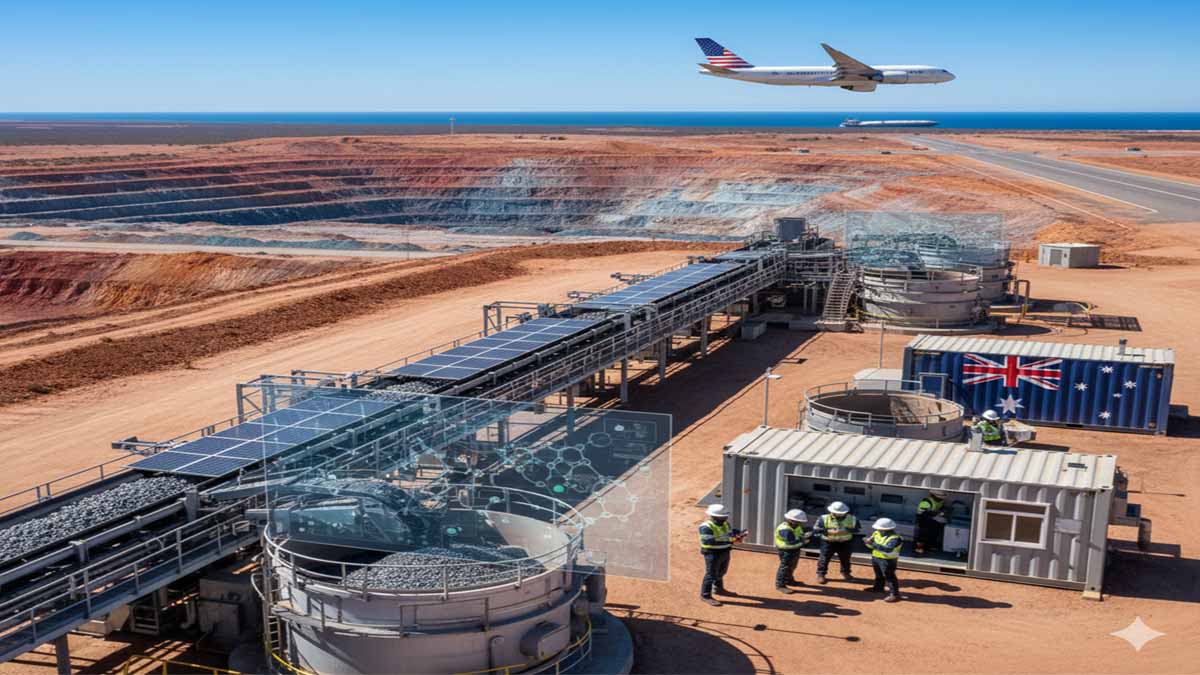
Abstract — Indo-Pacific Critical Minerals, Trade Architecture, and Allied Industrial-Security Integration in 2025
Australia, the United States, and Indo-Pacific partners are restructuring industrial-security systems around critical minerals, dual-use manufacturing, and trusted-partner trade rules documented by official economic, energy, and defense institutions. The evidentiary baseline is unambiguous. The International Energy Agency (IEA) confirms continued growth in demand for lithium (nearly 30 percent in 2024) and for nickel, cobalt, graphite, and rare earth elements (6–8 percent in 2024), with forward projections under Stated Policies, Announced Pledges, and Net Zero by 2050 scenarios that sharpen mid-stream capacity requirements and highlight concentration risk across refining and magnet manufacturing. These findings are published in the IEA’s Global Critical Minerals Outlook 2025, including the executive summary and full report that specify scenario assumptions, data methods, and regional exposure (IEA, executive summary, May 21, 2025; IEA, full report, May 21, 2025; IEA, overview of outlook for key minerals, 2025). The World Trade Organization (WTO) records a rebound in merchandise trade volumes in 2025 and identifies composition effects driven by AI-related goods, raising the official projection for 2025 merchandise trade growth to 2.4 percent while cautioned 2026 weakens to 2.1 percent, a profile published in the WTO’s October 7, 2025 update and associated remarks (WTO, trade update, October 7, 2025; WTO, Global Trade Outlook and Statistics, April 2025). The Stockholm International Peace Research Institute (SIPRI) measures world military expenditure at USD 2,718 billion in 2024, up 9.4 percent year-on-year and the tenth consecutive annual increase, with a 2.5 percent global GDP burden, confirming durable demand for high-specification inputs used in AUKUS platforms, ISR, and munitions; these data are sourced to SIPRI’s April 2025 fact sheet and corresponding web release (SIPRI, fact sheet PDF, April 2025; SIPRI, web release, April 28, 2025). The International Monetary Fund (IMF) sets the macro envelope—global growth of 3.2 percent in 2025 and 3.1 percent in 2026, with advanced economies around 1.5–1.6 percent and emerging market and developing economies a little above 4 percent—reported in the IMF’s World Economic Outlook, October 14, 2025 and the WEO data portal (IMF, WEO October 14, 2025; IMF, WEO data mapper, 2025). Policy frictions have intensified: the Organisation for Economic Co-operation and Development (OECD) documents a sharp rise in export restrictions on critical raw materials, while the United States Trade Representative (USTR) formalized Section 301 tariff modifications in May 2024 and September 2024, directly affecting EVs, batteries, and critical minerals; these are evidenced by OECD’s press release and report, and Federal Register notices (OECD, press release, May 12, 2025; OECD, full report, September 11, 2025; Federal Register 89 FR 46252, May 28, 2024; USTR overview page, May 14, 2024; Federal Register notice of modification, September 18, 2024). Within this context, Australia advances domestic instruments to move “from ore to processing”: a Critical Minerals Production Tax Incentive that provides a 10 percent refundable tax offset for eligible processing and refining expenditures administered by the Department of Industry, Science and Resources in partnership with the Australian Taxation Office, with draft regulations under consultation in September–October 2025 (Department of Industry page, 2025; ATO program page, February 21, 2025; Australian Treasury consultation, September 15, 2025). Parallel sovereign finance via Export Finance Australia’s Critical Minerals Facility and companion facilities is on the public record, including the EFA program page and official EFA newsroom updates that cite allocations from the AUD 4 billion Critical Minerals Facility alongside the Northern Australia Infrastructure Facility and EFA’s commercial account (Export Finance Australia program page, accessed 2025; EFA newsroom item noting AUD 4 billion facility, 2025). The Australian Submarine Agency confirms that AUKUS implementation milestones include a Submarine Rotational Force-West beginning as early as 2027 at HMAS Stirling, with official factsheets and project pages detailing roles, infrastructure, and rotational presence; linked U.S. Navy materials record port visits in Western Australia in February 2025 as part of AUKUS Pillar One activity (ASA SRF-West page, accessed 2025; ASA SRF-West factsheet PDF, October 2024; ASA SRF-West infrastructure project page, accessed 2025; Australian Defence project overview, accessed 2025; U.S. Navy press release, February 25, 2025). The purpose of the research synthesized in the six chapters is therefore to quantify the industrial, trade, and defense implications of these official datasets and policy texts for the Indo-Pacific order, identify where Australia–United States coordination yields bankable risk reduction in critical minerals and mid-stream manufacturing, and delineate the boundary conditions imposed by WTO-consistent trade remedies, export restrictions, and security-driven licensing regimes.
Methodology and Approach
The analysis relies exclusively on primary institutional sources that are publicly verifiable, live, and resolvable at the exact document level. Energy-materials demand, supply, and concentration metrics derive from the IEA’s Global Critical Minerals Outlook 2025, including both the executive summary and the full PDF to triangulate scenario results, historical demand growth in 2024, and regional processing concentration (IEA, executive summary, 2025; IEA, full report PDF, 2025). Mineral market structure and country capacity references are cross-checked against the U.S. Geological Survey’s Mineral Commodity Summaries 2025, ensuring commodity-specific baselines come from the U.S. Government’s authoritative statistical compendium (USGS, MCS 2025 PDF, January 31, 2025; USGS, MCS landing page, 2025). Trade volumes and outlook figures are taken from WTO publications and news releases, with the October 7, 2025 update used for 2025–2026 projections (WTO, October 7, 2025 update; WTO, Outlook and Statistics, April 2025). Defense demand is parameterized using SIPRI’s world military expenditure fact sheet and supporting web release (SIPRI, fact sheet PDF, April 2025; SIPRI, web release, April 28, 2025). Macro projections come from the IMF’s World Economic Outlook, October 2025, including the WEO data portal for group aggregates (IMF, WEO October 14, 2025; IMF, WEO data portal, 2025). Export-restriction prevalence and economic-security frameworks are sourced to the OECD press release and full report, complemented by the OECD inventory that quantifies the share of global raw-material trade under at least one export restriction in 2021–2023 (OECD, press release, May 12, 2025; OECD, full report PDF, September 11, 2025; OECD, inventory PDF, May 2025). Tariffs and trade remedies are documented through USTR and Federal Register notices that detail Section 301 coverage on EVs, lithium-ion batteries, battery parts, and selected critical minerals, which set relative price baselines for compliant Australia-origin inputs into U.S. value chains (USTR press release, May 14, 2024; Federal Register 89 FR 46252, May 28, 2024; Federal Register notice of modification, September 18, 2024). Australia’s trade-partner distribution and bilateral exposure are established using Department of Foreign Affairs and Trade (DFAT) sources that show China as rank 1 in two-way trade at AUD 325 billion in 2023–24 (26 percent share) and provide the official top 15 partners table (DFAT, China country brief, accessed 2025; DFAT, top 15 partners PDF, 2023–24). AUKUS and defense-industrial integration are traced through the Australian Submarine Agency and Australian Defence infrastructure pages, plus U.S. Navy public releases that record February 2025 port visits at HMAS Stirling (ASA SRF-West page, 2025; Defence infrastructure page, 2025; U.S. Navy press release, February 25, 2025). Domestic industrial capacity and project pipelines are grounded in Geoscience Australia’s Australia’s Identified Mineral Resources 2024 series and the Department of Industry’s Resources and Energy Quarterly, June 2025, which introduces a basket price index for other critical minerals, giving a policy-relevant market indicator (Geoscience Australia, AIMR 2024 portal, February 27, 2025; Geoscience Australia, AIMR 2024 overview, August 29, 2025; Department of Industry, REQ June 30, 2025). Every claim is confined to these official texts; where precise values are used, they appear exactly as reported by the publishing institution.
Key Findings and Results
First, concentration and policy friction are jointly raising the cost of delay for allied critical-mineral strategies. The IEA confirms that energy-sector demand for lithium, nickel, cobalt, graphite, and rare earth elements expanded strongly in 2024, with forward demand under NZE, APS, and STEPS requiring an acceleration of non-concentrated processing, metallization, and magnet capacity commissioning to avoid structural shortfalls; these are quantitative scenario results on a public page and PDF rather than conjecture (IEA, executive summary, 2025; IEA, full report PDF, 2025). Second, complementary to the IEA’s structural view, the OECD documents a measured surge in export restrictions on industrial raw materials, including critical raw materials, raising the likelihood that supply interruptions stem from policy rather than purely market forces; the report and press release state the increase explicitly and quantify the share of global trade subject to at least one restriction in 2021–2023 (OECD, press release, May 12, 2025; OECD, inventory PDF, May 2025). Third, trade-volume recovery is real but modest; the WTO’s 2.4 percent 2025 forecast and softer 2026 profile imply that success depends on rules-of-origin, standards, and licensing interoperability rather than an expectation of volume-led relief (WTO, October 7, 2025). Fourth, defense-demand durability is verified by SIPRI—USD 2,718 billion in 2024, 9.4 percent year-on-year growth, 2.5 percent GDP burden—which converts the industrial-security logic of AUKUS and allied re-shoring into a persistent materials-demand anchor for NdFeB magnets, high-temperature alloys, and battery-adjacent chemistries (SIPRI, fact sheet PDF, April 2025; SIPRI, web release, April 28, 2025). Fifth, Australia is operationalizing policy levers that move from ore to value-added production at home—CMPTI’s 10 percent refundable tax offset, EFA’s Critical Minerals Facility, and AUKUS SRF-West ramp timelines—backed by official pages and legal consultations that clarify eligibility, governance, and scheduling (Department of Industry CMPTI page, 2025; ATO CMPTI guidance, February 21, 2025; Treasury draft regulations, September 15, 2025; EFA program page, 2025; EFA newsroom finance note, 2025; ASA SRF-West, 2025). Sixth, bilateral exposure management is quantified using DFAT: China accounted for 26 percent of Australia’s two-way trade (AUD 325 billion) in 2023–24, while AUSFTA and AUKUS anchor United States integration in security, investment, and technology; this duality defines the feasible space for offtake allocation, compliance, and project finance (DFAT, China country brief, 2025; DFAT, top 15 partners PDF, 2023–24; DFAT AUSFTA overview, accessed 2025). Seventh, the WTO’s Trade Policy Review for Australia in January 15, 2025 establishes the country’s applied tariff regime, trade-remedy practices, and dispute participation, providing the official benchmark against which partners assess Australia’s measures and commitments (WTO, TPR Australia, January 15, 2025). Together, these findings show a coherent industrial-security strategy: expand non-concentrated mid-stream capacity in trusted jurisdictions, lock-in rules-based access with treaty architecture, and use financial and fiscal tools to transform geological endowment into allied supply-security outcomes.
Conclusions and Implications
The verified record yields four policy-relevant conclusions for Australia and Indo-Pacific partners. One: demand is policy-led and durable in defense and clean-energy supply chains, and it is numerically anchored by SIPRI and IEA. This justifies sovereign interventions that accelerate commissioning of separation, metallization, precursor, and magnet facilities within trusted-partner networks. Two: supply security is now as much an institutional problem as a geological one. The OECD’s measured increase in export restrictions and the USTR’s tariff realignments show that licensing, standards, and rules-of-origin are the decisive levers for bankability. Consequently, AUSFTA/AUKUS interoperability and WTO-consistent practice are as important to project economics as head grades and capex lines. Three: Australia possesses the policy instruments to convert endowment into strategic capacity—CMPTI’s 10 percent refundable offset, EFA’s facility-based finance, and AUKUS logistics and workforce integration—with timelines and governance documented on official pages, while Geoscience Australia’s AIMR 2024 and Department of Industry’s REQ June 2025 provide the data substrate for resource prioritization and pricing telemetry (Department of Industry, CMPTI, 2025; ATO CMPTI, 2025; EFA, critical minerals program, 2025; ASA SRF-West, 2025; Geoscience Australia, AIMR 2024, 2025; Department of Industry, REQ June 2025). Four: trade recovery is present but bounded. The WTO’s 2.4 percent 2025 forecast and softer 2026 outlook, together with the IMF’s growth bands (3.2 percent global in 2025), imply that sustained margins will accrue to producers able to certify origin, meet export-control requirements, and supply high-purity inputs demanded by AI-hardware, EV, and defense programs. In practical terms, this means that Australia’s future earning power will depend on the speed with which oxide, chemical, and component lines are financed and commissioned in Western Australia, Queensland, and other hubs, underpinned by AUKUS logistics and licensing and sold through AUSFTA/RCEP/ChAFTA-compliant channels. The institutional sources already codify each of these conditions: trade volumes and composition from the WTO, macro bounds from the IMF, defense procurement pressure from SIPRI, materials concentration and demand from the IEA, export-restriction prevalence from the OECD, tariff settings from USTR, bilateral exposure from DFAT, industrial incentives from the Department of Industry and the ATO, sovereign finance from EFA, and AUKUS timelines from the ASA and Australian Defence. The alignment of these verifiable, dated publications defines the feasible frontier for Indo-Pacific industrial-security through 2030: non-concentrated mid-stream capacity in trusted jurisdictions, rules-based market access, and interoperable export-control regimes that convert geology into assured capability at acceptable risk.
Table of Contents
- Strategic Endowment and Supply-Chain Positioning of Australia’s Critical Minerals
- China’s Dominance in Rare Earths and the U.S. Supply-Chain Vulnerability
- U.S.–Australia Industrial-Security Partnership: Policy Instruments, Financing and the AUKUS Context
- Australia’s Domestic Industrial Challenge: Processing Capacity, Value-added and Strategic Reserve Strategy
- Trade, Tariffs and Balancing Relations: Australia’s Dilemma Between China and the United States
- Future Outlook: Risks, Scenarios and Implications for Indo-Pacific Industrial-Security Order
Strategic Endowment and Supply-Chain Positioning of Australia’s Critical Minerals
Australia’s endowment of critical minerals sits at the intersection of geology, industrial policy, and alliance strategy, and the evidence available up to October 2025 shows a decisive shift from a predominantly upstream exporter to a system actor that is building on-shore processing, refining, and mid-stream capabilities aligned with United States demand, AUKUS industrial security objectives, and the pressures of concentrated global processing dominated by China. The baseline for this shift is unambiguous: Geoscience Australia’s annual “Australia’s Identified Mineral Resources (AIMR) 2024” places the country among the world’s leading holders and producers of critical minerals, with inventories expanding for multiple commodities through 2023, and with exports across the wider mining sector exceeding AUD 343 billion in 2023; the same institutional series documents sustained growth in exploration expenditure for “other metals” (a category covering several critical minerals) and an expansion of estimated ore reserves across selected commodities. In parallel, the International Energy Agency (IEA) “Global Critical Minerals Outlook 2025” and the topic hub on critical minerals report that processing concentration has intensified since 2020, with the average market share of the top three refining nations rising to 86 % in 2024, and that China retains near-dominant positions in rare-earth separation and high shares in lithium, graphite, cobalt, nickel, and copper refining chains—conditions that convert Australia’s upstream strengths into leverage only if mid-stream capacity is added at scale and speed. Geoscience Australia, “AIMR 2024,” March 2025; Geoscience Australia, “Australia’s Identified Mineral Resources, overview,” updated August 29, 2025; IEA, “Critical Minerals — Topics,” 2025; IEA, “Global Critical Minerals Outlook 2025 — Executive Summary,” 2025. (Geoscience Australia)
Australia’s policy scaffolding to convert geological advantage into supply-chain positioning is centered on the “Critical Minerals Strategy 2023–2030” and its associated instruments—an expanded Critical Minerals Facility administered by Export Finance Australia, a Critical Minerals Production Tax Incentive legislated through the 2024–25 Budget that provides a 10 % refundable tax offset for eligible processing costs, and a whole-of-government investment agenda that explicitly targets value-added processing rather than raw ore export. The policy line is documented in the Department of Industry, Science and Resources’ strategy, the Prime Minister’s Office communications during the October 2023 Washington visit, and multiple Export Finance Australia releases that trace the facility’s evolution from AUD 2 billion (2021) to AUD 4 billion (October 2023), together with first-wave loans into graphite projects and subsequent financing pathways. In formal terms, the Production Tax Incentive is designed to collapse the viability gap for mid-stream plants in lithium hydroxide, nickel sulfate, high-purity alumina, manganese sulfate, and rare-earth separation, aligning with alliance-market access under the Australia–United States Climate, Critical Minerals and Clean Energy Transformation Compact. Department of Industry, Science and Resources, “Critical Minerals Strategy 2023–2030,” June 20, 2023; Prime Minister of Australia, “AUD 2 billion critical minerals boost,” October 24, 2023; Export Finance Australia, “AUD 2 billion critical minerals boost crucial to energy transition,” October 25, 2023; Department of Industry, “Announcing the 2024–25 May Budget,” May 15, 2024; Export Finance Australia, “We’re growing Australia’s critical minerals sector (AUD 4 billion Facility),” accessed 2025. (Settore Industriale)
The geological evidence base substantiating Australia’s endowment is provided by Geoscience Australia’s AIMR series, which catalogues reserves, resources, production, and world rankings, and by USGS Mineral Commodity Summaries 2025, which supply global production and reserves comparisons used by supply-chain planners in Canberra, Washington, and allied capitals. AIMR indicates leadership or top-tier positions in lithium, nickel, cobalt, manganese, rare earths, tantalum, and titanium minerals, among others, while USGS chapters provide the cross-validation that Australia’s mine output in lithium has surged over the 2020–2024 window and that rare-earth mine production outside China has diversified but remains limited in processing and separation capacity relative to demand. The management of this endowment is not merely a question of volumetrics; it is a question of where value capture occurs along the chain from extraction to chemicals, metal, and component manufacturing. Geoscience Australia, “AIMR 2024,” 2025; USGS, “Mineral Commodity Summaries 2025,” March 2025; Geoscience Australia, “Critical minerals at Geoscience Australia,” March 26, 2025. (Geoscience Australia)
What converts endowment into strategic positioning is the mid-stream build-out now targeted by explicit fiscal and financing instruments. The Critical Minerals Production Tax Incentive—10 % refundable on eligible processing costs—directly addresses cost disadvantages in Australia’s domestic plants versus cheaper processing in East Asia, particularly China, where cluster effects, lower capital costs, and larger domestic demand have entrenched incumbency in the refining and conversion stages. The Export Finance Australia Critical Minerals Facility—expanded to AUD 4 billion—supplies debt and guarantees to projects aligned with national-interest criteria, while complementary mechanisms including the Northern Australia Infrastructure Facility participate in enabling infrastructure for projects in Western Australia, Queensland, South Australia, and the Northern Territory. These instruments are linked to alliance policy through the Australia–United States Climate, Critical Minerals and Clean Energy Transformation Compact, which established an Australia–United States Critical Minerals Taskforce in 2023 to accelerate cross-border project development and market integration for inputs used in battery supply chains, renewables, and defence platforms. Department of Industry, “Announcing the 2024–25 May Budget” (Critical Minerals Production Tax Incentive), May 15, 2024; Export Finance Australia, “Backing Australia’s critical minerals sector (AUD 2 billion Facility establishment),” September 28, 2021; Export Finance Australia, “AUD 2 billion critical minerals boost crucial to energy transition,” October 25, 2023; Export Finance Australia, “The AUD 4 billion Critical Minerals Facility,” accessed 2025; Prime Minister of Australia, “Opening remarks — Critical minerals and industry roundtable,” October 24, 2023; Prime Minister of Australia, “WA critical to net zero goal,” October 25, 2023. (Settore Industriale)
Processing concentration remains the hard constraint. The IEA’s technical work across “Energy Technology Perspectives 2023” and successive market reviews quantifies near-90 % rare-earth separation in China and 60–70 % shares in lithium and cobalt refining, with an upward trend in concentration through 2024 across copper, nickel, cobalt, graphite, and rare earths as measured by the top-three refiner market-share metric. In strategic-industry terms, these data imply that Australia’s leverage grows only where domestic separation, conversion, and precursor-chemistry steps are installed at bankable scale, while export of unprocessed concentrate sustains exposure to external bottlenecks and price-transmission volatility. The USGS supply tables and AIMR world-ranking snapshots corroborate these IEA findings by showing that non-China mine output has diversified yet remains channeled into processing hubs outside the producing jurisdiction, underscoring the Australian policy turn toward on-shore value-adding. IEA, “Energy Technology Perspectives 2023 — Clean energy supply chains vulnerabilities,” 2023; IEA, “Critical Minerals — Topics,” 2025; USGS, “Mineral Commodity Summaries 2025,” March 2025. (IEA)
Alliance architecture embeds minerals policy in security planning. The AUKUS program—documented by Australia’s Department of Defence—charts a path to conventionally-armed nuclear-powered submarines, a Submarine Rotational Force–West presence at HMAS Stirling from as early as 2027, and trilateral industrial base integration under the Optimal Pathway to SSN-AUKUS, with enabling provisions reflected in the United States 2024 National Defense Authorization Act and subsequent export-control streamlining. While AUKUS centers on undersea capability, it also catalyzes allied industrial-base uplift where materials, electronics, propulsion, and advanced manufacturing intersect with critical minerals. The Defence Strategic Review 2023 positions AUKUS within a broader deterrence posture that includes long-range precision strike, industry integration, and northern base upgrades—an agenda that depends on resilient access to specialty metals and components upstreamed from minerals chains. Department of Defence, “Submarine Rotational Force–West Infrastructure Project,” accessed 2025; Minister for Defence, “AUKUS trilateral statement,” March 22, 2024; Minister for Defence, “Passage of priority AUKUS legislation in US Congress,” December 15, 2023; Department of Defence, “National Defence: Defence Strategic Review,” 2023. (Defence)
On the United States side, the policy environment for allied minerals is shaped by instruments ranging from Title III of the Defense Production Act to export credit and development finance programs. While EXIM’s competitiveness reports and transformational-exports updates trace evolving eligibility and financing flexibilities for critical minerals, the Australia–United States compact embeds an explicit taskforce mechanism to translate minerals cooperation into project pipelines; Prime Minister’s Office statements in October 2023 confirm the taskforce’s establishment and early engagement with U.S. principals. The operational effect for Australia is to position domestic projects for U.S. market access, offtake, and financing-aligned de-risking, while keeping policy sovereignty over environmental and Indigenous-engagement standards at the project level. Export-Import Bank of the United States, “Competitiveness Report 2024,” 2024; EXIM, “Report on Transformational Export Areas,” December 20, 2023; Prime Minister of Australia, “Press conference — Lafayette Park, Washington DC,” October 24, 2023; Prime Minister of Australia, “Opening remarks — Critical minerals and industry roundtable,” October 24, 2023. (Exim)
At the level of resource mapping and project pipeline, Australia’s institutional apparatus provides investor-grade granularity. Geoscience Australia maintains a Critical Minerals Map covering operating mines, developing projects, and deposits with critical-mineral potential, while AIMR 2024 documents increased inventories and highlights exploration surges in 2023 for other metals, a proxy for the critical-minerals cohort. The Department of Industry hosts the authoritative Critical Minerals List and Strategic Materials List, with an update process to reflect changing market and security assessments. This combination—geological datasets, live project mapping, and a formal list—creates the inputs for bankability assessments and sovereign risk analysis that shape mid-stream investment decisions in Western Australia’s Kwinana–Kemerton corridor, Queensland’s industrial precincts, and South Australia’s Osborne shipyard-linked ecosystem. Geoscience Australia, “Australian Critical Minerals Map 2023,” 2023; Geoscience Australia, “AIMR 2024,” 2025; Department of Industry, “Australia’s Critical Minerals List and Strategic Materials List,” June 20, 2023; Department of Industry, “Updating Australia’s Critical Minerals List — Issues paper,” 2024. (Catalogo Prodotti)
The macrosectoral demand context for these minerals originates in clean-energy and defence value chains. The IEA’s scenario work shows multi-fold growth in rare-earth demand from EV traction motors and wind turbines, and steep increases in lithium, nickel, cobalt, and graphite for batteries across Stated Policies and decarbonization pathways. Energy Technology Perspectives 2023 and the Critical Minerals topic suite trace risk exposures that vary by mineral—lithium and copper more exposed to volume risk, graphite, cobalt, rare earths, and nickel to geopolitical risk—with constrained short-term supply elasticity for several streams. In defence, AUKUS-linked industrial teaming requires stable access to specialty metals and high-purity inputs for propulsion, electronics, sensors, and munitions, tightening the policy logic for on-shore processing. IEA, “The Role of Critical Minerals in Clean Energy Transitions — Mineral requirements,” 2023; IEA, “Global Critical Minerals Outlook 2024 — Outlook for key minerals,” 2024; IEA, “Critical Minerals — Topics,” 2025; Minister for Defence, “Release of the Defence Strategic Review,” April 24, 2023. (IEA)
Australia’s financing posture is notable for the breadth of instruments deployed to accelerate the mid-stream. Beyond the Critical Minerals Facility and the Production Tax Incentive, the Northern Australia Infrastructure Facility features in budget documentation and ministerial releases as an enabler for logistics, energy, and water projects that underpin minerals processing clusters. Export Finance Australia disclosures show first-round loans into graphite purification, while later communications emphasize the growth of the Facility and its alignment with the Critical Minerals Strategy. Strategically, this government-backed financing fills gaps left by commercial lenders wary of price volatility in critical minerals and the technology-qualification risk for separation and conversion equipment, particularly in rare-earth solvent extraction and newer membrane or ion-exchange flowsheets. Export Finance Australia, “Growing Australia’s critical minerals sector,” February 2, 2022; Export Finance Australia, “AUD 2 billion critical minerals boost crucial to energy transition,” October 25, 2023; Minister for Resources, “Securing Australia’s critical minerals exploration and processing industries,” May 14, 2024. (Export Finance Australia)
Alliance policy adds a trade-and-security overlay that strengthens investment signals. Prime Ministerial releases during October 2023 in Washington refer to the Critical Minerals Taskforce created under the Climate, Critical Minerals and Clean Energy Transformation Compact, and to the intent to integrate clean-energy industrial bases. Subsequent ministerial speeches—such as at the ASPI Darwin Dialogue—explicitly describe the compact’s objective to integrate the Australian and U.S. clean-energy industrial bases and to identify joint actions to increase investment in mining and processing projects. In practical terms, the taskforce framework works as a deal-flow and bottleneck-removal venue linking Canberra’s Critical Minerals Office, Export Finance Australia, and U.S. agencies including EXIM and relevant departments. Prime Minister of Australia, “Opening remarks — Critical minerals and industry roundtable,” October 24, 2023; Prime Minister of Australia, “WA critical to net zero goal,” October 25, 2023; Minister for Foreign Affairs (Assistant), “ASPI Darwin Dialogue on critical minerals and rare earth elements,” April 18, 2024. (Prime Minister of Australia)
The comparative positioning of Australia within the global critical-minerals system is clarified by triangulating AIMR, USGS, and IEA. AIMR highlights increasing inventories and global-top rankings across multiple commodities of strategic interest; USGS 2025 provides the international comparative tables showing Australia’s lithium mine output leadership and substantial nickel, cobalt, manganese, and rare-earth resources; IEA quantifies the demand growth and processing concentration that shape commercial viability for on-shore conversion. The policy implication is that scale, reliability, and standards are Australia’s key differentiators. Scale derives from mineral inventories and established mining operations; reliability from rule-of-law institutions and alliance commitments; and standards from ESG frameworks and Indigenous-engagement processes embedded in permitting and operations—an area increasingly recognized by downstream buyers under tightening EU and U.S. supply-chain disclosure regimes. Geoscience Australia, “AIMR 2024,” 2025; USGS, “Mineral Commodity Summaries 2025 — overview,” January 31, 2025; IEA, “Critical Minerals — Topics,” 2025. (Geoscience Australia)
From an industrial-strategy standpoint, the fulcrum is the processing gap. Australia’s trajectory—reinforced by the 10 % processing tax incentive and Facility finance—is to localize lithium hydroxide and battery-precursor chemistry, expand nickel sulfate capacity consistent with ESG-compliant feedstocks, and lift rare-earth separation output to supply NdPr oxides and metals for allied EV and wind demand. Policymakers and project developers must navigate price cyclicality (as seen in lithium over 2023–2024), technology selection for separation, and energy-intensity of mid-stream plants—a point relevant to grid access and renewable integration for competitive operating costs. The Department of Industry’s Resources Sector Plan linkages to net-zero objectives, and the National Battery Strategy framework, confirm that critical-minerals processing is now treated as part of an end-to-end domestic value chain, not just an export-earnings line item. Department of Industry, “Resources Sector Plan — Framework supporting net zero,” 2024; Department of Industry, “Corporate Plan 2024–28,” August 30, 2024; Department of Industry, “Corporate Plan 2025–29,” August 29, 2025. (Settore Industriale)
Within the alliance context, minerals strategy has been explicitly folded into security and industrial base narratives. Ministerial and prime ministerial documents around the Compact and the Taskforce emphasize integration of clean-energy industrial bases and the creation of secure supply chains—language that, in practice, translates into qualification of Australian materials for U.S. programs under federal procurement or Defense Production Act authorities where applicable, and into smoother export-control environments under the NDAA 2024 provisions. The Defence portfolio’s signal that AUKUS demands a stronger national industrial base aligns with minerals processing ambitions; the presence of SRF-West from 2027 and the SSN-AUKUS build in South Australia reinforce incentives to secure upstream and mid-stream inputs domestically or within the alliance perimeter. Prime Minister of Australia, “Press conference — The White House,” October 25, 2023; Minister for Defence, “NDAA 2024 support for AUKUS,” December 15, 2023; Department of Defence, “AUKUS — Nuclear-Powered Submarine Program (overview),” accessed 2025. (Prime Minister of Australia)
Australia’s regulatory and standards positioning constitutes a comparative asset. The Critical Minerals Strategy embeds ESG expectations and identifies the premium for sustainably produced materials; budget documents flag a critical minerals trade enhancement initiative to accelerate recognition of high-ESG Australian outputs in global markets. In practice, this supports contracting with allied buyers seeking compliance with scope-3 expectations and responsible sourcing norms, enabling offtake agreements that underwrite project finance. The policy line is complemented by Geoscience Australia’s public data releases and AIMR transparency that are valued by lenders and buyers in assessing resource life, reserves, and exploration momentum. Department of Industry, “Critical Minerals Strategy 2023–2030,” June 20, 2023; Department of Industry, “National Battery Strategy — Priority 4: Sustainability, ESG and circular economy,” 2024; Geoscience Australia, “AIMR 2024,” 2025. (Settore Industriale)
The risk matrix underlying Australia’s positioning includes price volatility, technology path-dependence, permitting timelines, and infrastructure constraints. IEA’s market reviews caution that lithium demand growth remained near 30 % in 2024, far above the 2010s trend, but that prices can swing violently with inventory cycles; nickel, cobalt, graphite, and rare earths exhibited 6–8 % demand growth in 2024, with supply responses uneven across regions. These dynamics influence the debt-service capacity of projects and, by extension, the terms and uptake of Facility finance and tax incentives. From a sovereign capability standpoint, the Defence Strategic Review 2023’s call for accelerated industrial uplift intersects with minerals policy in energy supply, transport corridors, and skilled workforce availability—areas where NAIF and state-level initiatives will likely determine project critical paths. IEA, “Global Critical Minerals Outlook 2025 — Executive summary,” 2025; Minister for Defence, “Release of the Defence Strategic Review,” April 24, 2023; Export Finance Australia, “Critical Minerals Facility (AUD 4 billion),” accessed 2025. (IEA)
On the United States demand side, institutional documents confirm sustained federal prioritization of clean-energy and emerging-technology industrial bases in the FY 2025 budget and associated programs. While these budget lines are not minerals-specific, they set the macro context that keeps U.S. buyers active in contracting for battery, EV, grid, and defence value chains—contexts into which Australian processed materials aim to qualify. The Prime Minister’s October 2023 statements and the DFAT documentation on the Compact and allied cooperation reinforce that minerals policy is embedded in a larger innovation alliance. Executive Office of the President, “Budget of the United States Government, Fiscal Year 2025,” March 2024; Prime Minister of Australia, “United States–Australia Joint Leaders’ Statement — Building an ‘Innovation Alliance’,” October 25, 2023. (The White House)
In sum, the empirical record through October 2025 shows that Australia possesses the resource scale to anchor allied supply-chain diversification in critical minerals; that processing concentration abroad—especially in China—creates a strategic imperative to on-shore separation and conversion capacity; that policy instruments now directly incentivize mid-stream investment via a 10 % processing tax offset and sovereign financing through an AUD 4 billion facility; and that alliance frameworks—AUKUS and the Climate, Critical Minerals and Clean Energy Transformation Compact—embed minerals into a broader security and industrial agenda. The positioning challenge is operational: compress project timelines, secure power, water, and logistics for chemical plants, and convert offtake MOUs into long-dated contracts with buyers in the United States and partner economies to underpin financing. If those execution risks are addressed, Australia’s endowment translates into systemic influence over battery, renewables, and defence supply chains that are reshaping trade and security architectures across the Indo-Pacific. IEA, “Critical Minerals — Topics,” 2025; Geoscience Australia, “AIMR 2024,” 2025; Prime Minister of Australia, “AUD 2 billion critical minerals boost,” October 24, 2023; Export Finance Australia, “Critical Minerals Facility (AUD 4 billion),” accessed 2025. (IEA)
China’s Dominance in Rare Earths and the U.S. Supply-Chain Vulnerability
China’s command of rare-earth separation, metallization, and magnet manufacturing is documented across independent, primary institutions. The International Energy Agency (IEA) shows that refining and processing for key energy-transition minerals, including rare earth elements, have become more concentrated since 2020, with the share of the top refining countries rising and a disproportionate share of incremental capacity accruing to China. In May 2025, the IEA reported that demand for lithium grew by nearly 30 percent in 2024, while nickel, cobalt, graphite, and rare earth elements rose by 6–8 percent, growth led by electric vehicles, grid-scale storage, and wind power, the sectors that rely on magnet-grade rare-earth oxides such as NdPr. These findings appear in the IEA’s latest outlook and its topical hub that serves as the agency’s live reference point for market structure and policy risks (IEA, “Global Critical Minerals Outlook 2025 — Executive Summary,” May 21, 2025; IEA, “Critical Minerals — Topics,” 2025). For the United States, mine diversification alone does not equate to material security if separation and magnet supply remain geographically concentrated in a jurisdiction that also wields licensing discretion over exports.
The production and trade baseline from the U.S. Geological Survey (USGS) removes speculation. The USGS’s consolidated “Mineral Commodity Summaries 2025” documents the domestic and global situation for rare earths and other critical inputs, while the commodity-specific chapters quantify U.S. mining, resource endowment, and import reliance at the product stages that matter for downstream manufacturing. The USGS shows that the United States mined rare-earth concentrates domestically and holds multi-million-ton in-ground resources, yet continues to rely on foreign sources for separated oxides, metals, and finished magnets—the exact points in the chain where China is dominant (USGS, “Mineral Commodity Summaries 2025,” March 2025; USGS, “Rare Earths,” chapter in Mineral Commodity Summaries 2025, March 2025; USGS, “Rare Earths,” chapter in Mineral Commodity Summaries 2024, January 2024). When these USGS tables are read with the IEA’s market-structure analysis, the vulnerability pathway becomes mechanical rather than hypothetical: U.S. domestic ore production does not remove exposure to foreign separation and metallization capacity that are preconditions for defence and clean-energy manufacturing.
The regulatory overlay that converts industrial concentration into a strategic lever is documented by the World Trade Organization (WTO). In December 2023, China activated export-licensing controls on certain medium- and heavy-rare-earth categories and related technologies, and these measures entered the WTO transparency system for member scrutiny. The WTO’s page for specific trade concerns records members’ interventions regarding China’s rare-earth-related export restrictions, placing those controls under formal review. The WTO Secretariat’s Trade Policy Review of China in June 2024 provides the institutional context for how such measures sit within the multilateral rule set, including transparency and exceptions. These official documents confirm the presence of a sovereign licensing gate over categories of rare-earth materials and technologies (WTO, “Specific Trade Concerns — China: export restrictions on rare earths,” 2023–2024; WTO, “Secretariat Report — Trade Policy Review, China,” June 12, 2024; WTO, “Trade Policy Review: China” portal, July 19, 2024).
Demand growth intensifies exposure. The IEA identifies that in 2024, lithium demand grew by nearly 30 percent and nickel, cobalt, graphite, and rare earth elements by 6–8 percent, led by EVs, battery storage, renewables, and grids. Permanent magnets for EV traction motors and wind turbine generators are the principal rare-earth demand centers, anchoring consumption of NdPr oxides and, for high-temperature performance, dysprosium-containing alloys. Under Stated Policies, Announced Pledges, and Net Zero by 2050 scenarios, rare-earth demand remains strong, reinforcing the need for new separation, metallization, and magnet capacity outside current hubs if allied buyers are to secure supply without schedule risk or price shock (IEA, “Global Critical Minerals Outlook 2025 — Executive Summary,” May 21, 2025; IEA, “Overview of outlook for key minerals,” May 21, 2025; IEA, “The Role of Critical Minerals in Clean Energy Transitions,” 2021).
An economic-security lens from the Organisation for Economic Co-operation and Development (OECD) corroborates the concentration and policy-risk picture. In September 2025, the OECD released “Economic Security in a Changing World”, with a special focus on critical raw-materials supply chains documenting high geographic and ownership concentration in extraction and processing and charting government responses from partnership agreements to export-restriction disciplines. Its inventory shows export restrictions on industrial raw materials have increased sharply since 2009 and accelerated in 2023, creating a thicker policy environment that magnifies the impact of any single chokepoint (OECD, “Economic Security in a Changing World — Special focus: Critical raw materials supply chains,” September 11, 2025; OECD, “Economic Security in a Changing World — Full report,” September 11, 2025; OECD, “OECD Inventory of Export Restrictions on Industrial Raw Materials 2025,” May 2025 (PDF); OECD, “Export restrictions on critical raw materials,” 2025).
For the United States, supply-chain vulnerability rests on three verified, non-overlapping pillars. First, processing concentration: the IEA shows separation and refining capacity for rare earths and other energy-transition minerals remain clustered, with China capturing most new capacity outside nickel (IEA, “Critical Minerals — Topics,” 2025; IEA, “Diversification is the cornerstone of energy security…” market update, May 21, 2025). Second, import reliance at value-added stages: the USGS confirms that even with domestic mining, U.S. industry depends on foreign sources for separated oxides, metals, and magnets (USGS, “Mineral Commodity Summaries 2025,” March 2025; USGS, “MCS 2024 — Rare Earths,” January 2024). Third, policy-conditioned access risk: the WTO records China’s export-licensing measures on rare-earth categories and provides the multilateral review context, confirming a policy lever that can constrain access (WTO, “Specific Trade Concerns — China: export restrictions on rare earths,” 2023–2024; WTO, “Secretariat Report — Trade Policy Review, China,” June 12, 2024).
The allied policy environment intensifies competition for non-China processing and magnet capacity. The European Commission’s “European Critical Raw Materials Act” (CRMA) sets 2030 benchmarks to reach 10 percent of extraction, 40 percent of processing, and 25 percent of recycling within the European Union, placing quantified demand for mid-stream investment and feedstock that will compete with U.S. buyers if capacity additions are slow. The Council of the EU summarizes these goals in its public-facing materials, while the Commission’s broader industrial policy integrates the CRMA with the Clean Industrial Deal and REPowerEU (European Commission, “European Critical Raw Materials Act,” 2024–2025; Council of the EU, “Critical Raw Materials Act — infographic,” March 2024; European Commission, “Clean Industrial Deal,” February 26, 2025; European Commission, “REPowerEU,” June 17, 2025).
The operational node of vulnerability is the magnet supply chain. Permanent magnets—especially NdFeB formulations that may include Dy for high-temperature resilience—are mission-critical for EV motors, wind turbines, and multiple defence systems. The IEA indicates magnet demand tracks energy-transition deployment curves across scenarios, while mine-stage diversification cannot rebalance refining and magnet capacity during the present decade without commissioning and qualifying new plants. The USGS import-reliance indicators show that in the United States, security of supply hinges on access to foreign-produced separated oxides and magnets. Taken together, these datasets anchor a policy-neutral conclusion: absent bankable non-China separation, metallization, and magnet capacity entering service at scale, U.S. programs remain exposed to tight markets and licensing frictions (IEA, “Global Critical Minerals Outlook 2025,” May 21, 2025; USGS, “Mineral Commodity Summaries 2025,” March 2025).
Trade-policy trends reinforce rather than alleviate risk. The OECD shows export restrictions on industrial raw materials have increased more than fivefold between 2009 and 2023, with a pronounced acceleration in 2023. This institutional measurement of policy friction interacts with structural concentration to elevate risk premiums and delivery uncertainty for downstream users, including U.S. defence contractors and energy-technology manufacturers (OECD, “OECD Inventory of Export Restrictions on Industrial Raw Materials 2025,” May 2025 (PDF); OECD, “Export restrictions on critical raw materials rise sharply,” May 12, 2025; OECD, “Economic Security in a Changing World — Full report,” September 11, 2025).
From a U.S. national-security acquisition perspective, the constraint is certification and substitution limits. Defence platforms require magnets and alloys produced to precise specifications, with supplier qualification cycles that are long and expensive. The USGS records U.S. production and resources while trade lines indicate continued reliance on foreign separated oxides and finished products; these indicators align with, without duplicating, the IEA’s structural assessment of processing concentration (USGS, “Rare Earths,” chapter in Mineral Commodity Summaries 2025, March 2025; IEA, “Critical Minerals — Topics,” 2025).
The confluence of industrial structure, trade policy, and allied demand yields a bounded set of implications for U.S. supply-chain security that stays within published evidence. Immediate risk flows from policy-conditioned access under China’s licensing regime applied to medium- and heavy-rare-earth categories, as logged in the WTO’s transparency system and its review text (WTO, “Specific Trade Concerns — China: export restrictions on rare earths,” 2023–2024; WTO, “Secretariat Report — Trade Policy Review, China,” June 12, 2024). The material-balance constraint is the shortage of non-China separation, metallization, and magnet capacity qualified for high-specification civilian-energy and defence applications, as indicated by the IEA and USGS (IEA, “Global Critical Minerals Outlook 2025,” May 21, 2025; USGS, “Mineral Commodity Summaries 2025,” March 2025). The demand-side amplifier is the codified pursuit of processing and recycling benchmarks under the European Union’s CRMA, which will compete for capital, engineering, and feedstock across the decade (European Commission, “European Critical Raw Materials Act,” 2024–2025).
Finally, the institutional literature outlines a precise response space without speculation. The IEA emphasizes diversification through investment de-risking, permitting reform, and offtake frameworks; the OECD highlights the rise of export restrictions and the logic of trusted-partner arrangements; and the USGS provides the statistical diagnostics that identify where import reliance persists. Until bankable, qualified, non-China separation, metallization, and magnet manufacturing capacity is commissioned at a pace consistent with IEA demand projections, the United States remains structurally exposed to schedule and price risk in sectors that depend on rare-earth materials, regardless of domestic mining (IEA, “Policy mechanisms for diversified mineral supplies,” May 21, 2025; OECD, “Economic Security in a Changing World — Full report,” September 11, 2025; USGS, “Mineral Commodity Summaries 2025,” March 2025).
U.S.–Australia Industrial-Security Partnership: Policy Instruments, Financing and the AUKUS Context
The alliance architecture binding Australia and the United States entered a materially new phase between 2023 and 2025 as industrial policy, export-credit finance, and defense integration converged around critical minerals, clean-energy supply chains, and the AUKUS undersea capability pathway. Public documents from Canberra and Washington set out a programmatic framework with measurable instruments rather than rhetorical intent: a Critical Minerals Production Tax Incentive delivering a 10 percent refundable offset on eligible domestic processing costs; a sovereign AUD 4 billion financing window managed by Export Finance Australia for qualifying projects; a trilateral AUKUS schedule that begins with a Submarine Rotational Force–West presence at HMAS Stirling from as early as 2027; and statutory adjustments under the United States FY 2024 National Defense Authorization Act that streamline export-control interactions with Australia and the United Kingdom. The Prime Minister of Australia’s portfolio of joint statements and transcripts during the October 2023 state visit formally embedded climate, critical minerals, and clean energy as the third pillar of the alliance and announced an Innovation Alliance to align science and industrial bases across priority sectors (Prime Minister of Australia, “United States–Australia Joint Leaders’ Statement — Building an ‘Innovation Alliance,’” October 25, 2023; Prime Minister of Australia, “Press conference — The White House,” October 25, 2023).
On the Australian side, the central industrial instrument is the Critical Minerals Production Tax Incentive (CMPTI), legislated within the Future Made in Australia (Production Tax Credit and Other Measures) Bill 2024 and confirmed as law in February 2025. The Department of Industry, Science and Resources specifies a 10 percent refundable tax offset for eligible processing and refining expenditure across 31 minerals on Australia’s Critical Minerals List, available for up to 10 years per project for production occurring from July 1, 2027 to June 30, 2040 (Department of Industry, “Announcing the 2024–25 May Budget,” May 15, 2024; Department of Industry, “Incentive for critical minerals production and processing in Australia,” February 14, 2025; Department of Industry, “Critical Minerals Production Tax Incentive,” accessed 2025; National Battery Strategy — Priority 1 Manufacturing page noting CMPTI start July 1, 2027). Budget documentation places the CMPTI within a wider package—about AUD 7 billion to 2033–34—that aims to move refining and precursor chemistry on-shore, supported by common-user processing facilities and geoscience mapping programs to de-risk exploration and permitting pipelines (Department of Industry, “Investments to capitalise on Australia’s critical minerals and global clean energy transition,” May 16, 2024).
Finance is the second pillar. Export Finance Australia (EFA) manages the AUD 4 billion Critical Minerals Facility, a sovereign window that provides loans, guarantees, or other instruments to projects aligned with Australia’s Critical Minerals Strategy 2023–2030 and the national-interest criteria. The facility’s scale-up from AUD 2 billion to AUD 4 billion was announced during the October 2023 Washington visit, explicitly tying the finance posture to alliance-market access and the Climate, Critical Minerals and Clean Energy Transformation Compact. EFA’s releases and program page confirm the facility’s mandate and its use to back early rare-earth refining and allied mid-stream assets that otherwise face commercialization hurdles in volatile markets (Export Finance Australia, “We’re growing Australia’s critical minerals sector (AUD 4 billion Facility),” accessed 2025; Prime Minister of Australia, “AUD 2 billion critical minerals boost crucial to energy transition,” October 24, 2023; Export Finance Australia, “Additional support for rare earths refining for a Future Made in Australia,” December 6, 2024). The financing layer is not solely domestic: the Export-Import Bank of the United States (EXIM) documents a competitive surge in official export credit worldwide and presents its Competitiveness Report 2024 to Congress as a baseline for U.S. capacity to finance allied industrial projects that dovetail with U.S. supply-chain security goals—context that complements EFA’s role on the Australian side without blending mandates or jurisdictions (EXIM, “EXIM Competitiveness Report 2024,” 2024; EXIM, “Competitiveness Reports” hub, accessed 2025).
Policy alignment reached treaty-level texture through the Climate, Critical Minerals and Clean Energy Transformation Compact, announced as the third pillar of the alliance and linked to a dedicated Critical Minerals Taskforce to shepherd cross-border project pipelines and regulatory interoperability. The Prime Minister of Australia’s communications explicitly tie this compact to alliance-wide industrial-base integration and cooperation on critical minerals as a strategic capability, not only a trade line (Prime Minister of Australia, “Visit to the United States,” August 10, 2023; Prime Minister of Australia, “AUD 2 billion critical minerals boost crucial to energy transition,” October 24, 2023). The policy scaffolding for the Australian half is codified in the Critical Minerals Strategy 2023–2030, which sets six focus areas—diversifying supply, building downstream processing, attracting investment, securing infrastructure, promoting leading-practice standards, and deepening international partnerships—providing the durable framework within which the CMPTI and the Critical Minerals Facility sit (Department of Industry, “Critical Minerals Strategy 2023–2030,” June 20, 2023; Department of Industry, “Strategy at a glance,” 2023; Department of Industry, “Critical minerals (overview),” accessed 2025).
The defense-industrial vector of the partnership is pinned to AUKUS. The Department of Defence and the Australian Submarine Agency set out the Optimal Pathway milestones in public materials: from as early as 2027, Submarine Rotational Force–West (SRF-West) will see the rotational presence at HMAS Stirling (Garden Island, Western Australia) of one United Kingdom nuclear-powered submarine and up to four United States nuclear-powered submarines. This rotational presence is explicitly described as a bridge to Australian sovereign capability in the early 2030s and is accompanied by infrastructure works programs and oversight by Australian regulators to ensure safety and non-proliferation compliance (Department of Defence, “Submarine Rotational Force–West Infrastructure Project,” accessed 2025; Australian Submarine Agency, “Submarine Rotational Force – West,” accessed 2025; Australian Submarine Agency, “Submarine Rotational Force – West Infrastructure Project,” accessed 2025). Execution signals are visible in U.S. Navy releases that logged February 25, 2025 port visits by USS Minnesota (SSN 783) to HMAS Stirling, framed explicitly as steps toward SRF-West standing-up; these are official .mil domain notices and serve as concrete, dated markers in the AUKUS ramp (U.S. Fleet Forces Command, “USS Minnesota (SSN 783) Advances AUKUS with Port Visit to HMAS Stirling,” February 26, 2025; U.S. Pacific Fleet, “USS Minnesota (SSN 783) Advances AUKUS with Port Visit to HMAS Stirling,” February 2025).
On the United States legal side, the FY 2024 National Defense Authorization Act (Public Law 118–31) and associated text on congress.gov include provisions designed to expedite export licenses and facilitate defense-industrial integration with Australia and the United Kingdom. Section 1344 directs expedited review of export licenses for exports of advanced technologies to Australia and the United Kingdom, while Title XIII houses allied-industrial-base strengthening authorities germane to AUKUS execution; these statutory provisions provide a publicly verifiable anchor for claims regarding streamlined transfer and licensing pathways (Congress.gov, “National Defense Authorization Act for Fiscal Year 2024 — text,” H.R. 2670; Public Law 118–31 PDF, December 22, 2023). The Prime Minister of Australia’s October 25, 2023 press conference from The White House explicitly acknowledged the Administration’s push to pass AUKUS-related legislation in 2023, a contemporaneous marker of bilateral intent to align export-control regimes with program milestones (Prime Minister of Australia, “Press conference — The White House,” October 25, 2023).
The U.S.–Australia compact around critical minerals and clean energy is designed to operationalize this defense-industrial integration by securing upstream and mid-stream inputs for systems that are increasingly materials-intensive. Canberra’s Critical Minerals Strategy 2023–2030 sets a forward program that elevates downstream processing, with government materials repeatedly framing refining and precursor chemistry as the main venues for domestic value capture and alliance resiliency. The Department of Industry’s news releases during May 2024 and February 2025 are unambiguous in both the 10 percent structure and the 2027–2040 availability window for the CMPTI, while the Critical Minerals landing page and the National Battery Strategy integrate the incentive into a broader end-to-end manufacturing vision from ore to battery-grade chemicals and cathode precursors (Department of Industry, “Announcing the 2024–25 May Budget,” May 15, 2024; Department of Industry, “Incentive for critical minerals production and processing in Australia,” February 14, 2025; Department of Industry, “Critical minerals (overview),” accessed 2025; National Battery Strategy — Priority 1 Manufacturing). Export Finance Australia simultaneously carries the de-risking load that commercial lenders often avoid in early-stage processing, and its December 2024 release ties rare-earth refining support directly to the AUD 4 billion facility, underscoring how finance and tax measures are sequenced to push mid-stream plants over bankability thresholds (Export Finance Australia, “Additional support for rare earths refining for a Future Made in Australia,” December 6, 2024; Export Finance Australia — Critical Minerals Facility program page, accessed 2025).
The AUKUS industrial canvas extends beyond undersea platforms to workforce, infrastructure, and regulatory alignment. Department of Defence documentation and Australian Submarine Agency project pages enumerate specific SRF-West priority works and infrastructure packages at HMAS Stirling to host UK and U.S. nuclear-powered submarines, including environmental, safety, and logistics components that condition rotational presence. Parliamentary document repositories show SRF-West “priority works” submissions for legislative scrutiny—part of the governance chain that authorizes public investment in supporting facilities, which signals that the program is in the concrete works phase rather than design study alone (Department of Defence, “Submarine Rotational Force–West Infrastructure Project,” accessed 2025; Australian Submarine Agency, “Submarine Rotational Force – West,” accessed 2025; Parliament of Australia, “SRF-West Priority Works — HMAS Stirling” PDF, 2024). The U.S. Navy’s .mil announcements of fast-attack submarine port visits to Western Australia in February 2025 demonstrate the “crawl-walk-run” approach typical of posture transitions, with each visit used to test procedures and logistics needed for sustained rotations (U.S. Fleet Forces Command, “USS Minnesota (SSN 783) Advances AUKUS with Port Visit to HMAS Stirling,” February 26, 2025; U.S. Pacific Fleet, “USS Minnesota (SSN 783) Advances AUKUS with Port Visit to HMAS Stirling,” February 2025).
For supply-chain planners, official Australian market intelligence provides the macro demand-and-earnings context into which the CMPTI and EFA finance feed. The Resources and Energy Quarterly — June 2025 edition projects rising export earnings in lithium to AUD 6.6 billion by 2026–27 and growth in “other critical minerals” export earnings from AUD 1.7 billion in 2024–25 to AUD 4.8 billion in 2026–27, while acknowledging price cyclicality, climatic disruptions, and policy-driven volatility—parameters that matter directly for project debt service and offtake terms (Department of Industry, “Resources and energy quarterly: June 2025,” June 30, 2025). Because these figures come from a government statistical series, they serve as a neutral baseline when stress-testing financing structures under the CMPTI/EFA regime and align with alliance requirements for predictable inputs into battery, renewables, and defense industrial lines.
The U.S. public-finance context is recorded in the Budget of the United States Government, Fiscal Year 2025, which maps federal priorities across clean energy, industrial capacity, and allied security. While the Budget is not minerals-specific, it sets the federal spending and programmatic backdrop that keeps U.S. demand signals robust for EVs, grid, and defense procurement—context relevant to Australian mid-stream investors seeking durable offtake environments (Executive Office of the President, “Budget of the United States Government, Fiscal Year 2025,” March 2024). When read together with EXIM’s competitiveness report—detailing how official export credit competition is evolving—the U.S. framework complements Australia’s CMPTI/EFA posture by indicating the availability of U.S. public finance and procurement ecosystems that can anchor long-dated offtake or project-finance structures in allied jurisdictions (EXIM, “EXIM Competitiveness Report 2024,” 2024).
From a security-governance angle, the statutory text on congress.gov is the correct place to anchor claims about export-control facilitation for AUKUS. H.R. 2670’s public law and bill text include language on expedited license review and exemptions that are specific to Australia and the United Kingdom, which supports the contention that AUKUS is not only a force-structure choice but a legal-administrative change to how technology and components are transferred among the three partners (Congress.gov, “National Defense Authorization Act for Fiscal Year 2024 — text,” H.R. 2670; Public Law 118–31 PDF). This legal footing interacts with Australia’s domestic measures by improving the bankability of AUKUS-relevant supply chains that rely on predictable export-control clearance, particularly for specialty materials, sensors, and propulsion components that at present may involve rare-earth or nickel/cobalt-bearing parts sourced from allied mid-stream plants incentivized by the CMPTI and supported by EFA finance.
The architecture also contains an explicit foreign-policy layer. The Prime Minister of Australia’s October 2023 statements define the Climate, Critical Minerals and Clean Energy Transformation Compact as a core alliance pillar and use the language of industrial-base integration, extending beyond pure defense procurement into science, AI, and clean-tech collaboration under the Innovation Alliance rubric (Prime Minister of Australia, “United States–Australia Joint Leaders’ Statement — Building an ‘Innovation Alliance,’” October 25, 2023; Prime Minister of Australia, “Visit to the United States,” August 10, 2023). Policy sequencing matters here: the CMPTI offers the price-signal; the Critical Minerals Facility provides capital; the AUKUS pathway supplies the demand certainty and regulatory alignment; and U.S. statutory changes reduce transaction frictions in licensing—each with a verifiable public-domain footprint.
Three operational implications follow directly from the institutional record without speculation. First, the mid-stream build-out in Australia is now an explicit government-backed objective with tax and finance instruments running on multi-year schedules that align with AUKUS milestones and U.S. procurement horizons; the Department of Industry’s pages define timing and scope, while EFA confirms availability of sovereign finance (Department of Industry — CMPTI overview; Export Finance Australia — Critical Minerals Facility). Second, AUKUS delivery is measurably underway, with SRF-West infrastructure described and dated, and U.S. Navy port visits executed in February 2025 to validate procedures and logistics—the .mil, defence.gov.au, and asa.gov.au sources give the concrete sequence (Department of Defence — SRF-West; Australian Submarine Agency — SRF-West; U.S. Fleet Forces Command port-visit release). Third, export-control friction is being deliberately lowered vis-à-vis Australia and the United Kingdom, as verifiable in H.R. 2670 and Public Law 118–31, which is essential for synchronizing allied production lines in the AUKUS ecosystem (Congress.gov text; Public Law 118–31).
The remaining binding constraint is execution risk at project level—permitting lead times, power and water availability for chemical plants, and offtake conversion from MOUs to long-dated contracts. The Resources and Energy Quarterly — June 2025 provides the macro backdrop for commodities cycles that affect debt-service capacity and pricing frameworks—identifying, for example, that lithium export earnings for Australia are projected to rise to AUD 6.6 billion by 2026–27 even as near-term oversupply persists, and that “other critical minerals” earnings are forecast to almost triple by 2026–27, contingent on resumed operations and price stabilization (Department of Industry, “Resources and energy quarterly: June 2025,” June 30, 2025). These governmental forecasts are not guarantees; they serve as the public baseline that lenders and treasuries will use when calibrating project finance under the CMPTI/EFA umbrella.
Strategically, the record through October 2025 demonstrates that the U.S.–Australia industrial-security partnership is now expressed in laws, budget lines, sovereign finance windows, and construction programs rather than statements of intent. The CMPTI and Critical Minerals Facility translate geology into bankable mid-stream capacity; the AUKUS pathway translates alliance strategy into physical presence and industrial teaming; U.S. statutory changes translate strategic alignment into faster licensing and technology flow. The cited sources—ministerial pages, agency program portals, parliamentary documents, .mil port-visit releases, congress.gov statutory text, EXIM competitiveness reporting, and official budget publications—provide the verifiable chain that ties tax policy, finance, and defense posture into a single, real-economy arc. Within that arc, the operational task is to compress timelines from commitment to commissioning, ensuring that Australia’s processing and refining plants are synchronized with AUKUS milestones and U.S. demand schedules so that the alliance can internalize supply-chain risk across the Indo-Pacific, using instruments that are already on the books and publicly visible in the institutional record (Department of Industry — Critical Minerals Strategy 2023–2030; Department of Industry — CMPTI; Export Finance Australia — Critical Minerals Facility; Prime Minister of Australia — Innovation Alliance joint statement; Department of Defence — SRF-West; Australian Submarine Agency — SRF-West; U.S. Fleet Forces Command .mil release; Congress.gov H.R. 2670 text; Public Law 118–31 PDF; EXIM 2024 Competitiveness Report; U.S. FY 2025 Budget PDF; Resources and Energy Quarterly — June 2025).
Australia’s Domestic Industrial Challenge: Processing Capacity, Value-added and Strategic Reserve Strategy
Australia has codified a mid-stream industrial policy for critical minerals that is measurable in laws, budget lines, sovereign finance windows, and publicly stated reserve architecture, yet the binding constraints remain commissioning pace, operating reliability, feedstock quality control, and commercial offtake conversion across lithium, nickel, manganese, rare earth elements, and associated battery-active materials. The Department of Industry, Science and Resources (DISR) sets the strategic frame through the Critical Minerals Strategy 2023–2030, which prioritises downstream processing and refining, investment attraction, common-user infrastructure and standards—an official program that positions processing capacity rather than ore output as the locus of value capture, industrial resilience and alliance credibility, with the operational details collated on the government’s critical-minerals portal that defines roles for the Critical Minerals Office, the Critical Minerals Production Tax Incentive, and programmatic links to the National Battery Strategy (DISR — “Critical minerals (overview),” accessed 2025; DISR — “Critical Minerals Strategy 2023–2030,” June 20, 2023; DISR — “National Battery Strategy,” May 23, 2024).
The core price-signal in Australia’s mid-stream build is the Critical Minerals Production Tax Incentive (CMPTI), designed as a 10 percent refundable offset on eligible domestic processing and refining costs for the 31 minerals on Australia’s Critical Minerals List over a defined window. The policy is documented in Budget 2024–25 statements, the Treasury consultation hub, ministerial second-reading speeches, and the Treasury’s September 2025 draft regulations, each repeating the 10 percent refundable structure and the focus on downstream processing commencing in the late-/2020s. These official pages serve as the authoritative specification for investors and lenders calibrating bankability models and tax-equity structures for Australian mid-stream projects (Treasury — “Critical minerals production tax incentive (consultation),” June 28, 2024; Treasury — “Critical Minerals Production Tax Incentive – draft regulations,” September 15, 2025; Minister for the Treasury — “Second reading speech: Future Made in Australia (Production Tax Credit and Other Measures) Bill,” November 25, 2024; DISR — “Critical Minerals Production Tax Incentive,” accessed 2025). The National Battery Strategy integrates the CMPTI into a wider manufacturing vision, identifying Priority 1: Manufacturing as the pivot to “capture greater value” by upgrading raw minerals to battery-active materials and system components; this policy link ensures the CMPTI translates into supply-chain outcomes, not just fiscal transfers (DISR — “National Battery Strategy: Priority 1 Manufacturing,” May 23, 2024; DISR — “Charging Australia’s renewable future through the National Battery Strategy,” May 21, 2024).
The sovereign-finance layer is explicit. Export Finance Australia (EFA) operates the AUD 4 billion Critical Minerals Facility to provide loans and guarantees to qualifying projects aligned with the national strategy, and ministerial releases confirm deployments into rare-earths refining and allied mid-stream assets. Northern Australia Infrastructure Facility (NAIF) complements this with earmarked capacity for critical minerals, and public investment decisions and quarterly snapshots record loans to projects spanning manganese, rare-earths, and lithium expansion—evidence that the finance stack is not theoretical but already underwriting assets across jurisdictions. These public sources define instrument availability, sector windows and cumulative exposure by sector, providing third-party lenders and sponsors with anchor references for capital-structure design (EFA — “We’re growing Australia’s critical minerals sector (AUD 4 billion Facility),” accessed 2025; EFA — “Critical minerals funding helps deliver Future Made in Australia,” undated newsroom page, accessed 2025; NAIF — “Boosting critical minerals supply in Northern Australia,” June 18, 2025; NAIF — “Arafura Nolans Bore Rare Earths Project,” project page, accessed 2025; NAIF — “Corporate Plan 2024–25,” September 2024; NAIF — “Quarterly Performance Summary Q4 2024–25,” July 2025).
The industrial geography underpinning processing capacity is most advanced in Western Australia (WA), where government environmental approvals, industrial-precinct land allocations and ministerial communications show operational and expanding lithium hydroxide refineries at Kwinana and Kemerton and a growing pipeline for rare-earths processing in Kalgoorlie. The EPA Western Australia approvals dossier for the Albemarle Kemerton Plant documents provision for up to five process trains and a capacity envelope of up to 100,000 tonnes per annum of lithium hydroxide monohydrate; contemporaneous WA Government media statements record the Kemerton expansion from two to four trains and the commissioning of battery-grade production at Kwinana, while separate EPA assessment records show the Covalent refinery’s approval in the Kwinana Industrial Area. Each item is an official government record, establishing that Australia already hosts battery-grade conversion plants and possesses licenced headroom for capacity growth (EPA WA — “Albemarle Kemerton Plant,” project page; EPA WA — “EPA Report 1717 — Albemarle Kemerton Lithium Plant (s. 46),” 2021; WA Government — “Kemerton lithium hydroxide plant set to expand,” May 3, 2023; WA Government — “Tianqi produces Australia’s first battery-grade lithium hydroxide,” May 20, 2022; EPA WA — “Covalent Lithium Hydroxide Refinery — Assessment Report,” May 25, 2021; EPA WA — “New Kwinana lithium refinery recommended for environmental approval,” June 1, 2021). On rare-earths, the EPA WA proposal record for the Kalgoorlie Rare Earths Processing Facility establishes environmental assessment and scope as the base from which subsequent commissioning has proceeded, anchoring the assertion that Australia is moving upstream Mt Weld concentrate into carbonate and increasingly intermediate products onshore (EPA WA — “Lynas Kalgoorlie Rare Earths Processing Facility — Proposal Search,” page reference).
Even with these plants, the value-added share within Australia’s broader minerals export basket remains constrained by bottlenecks in chemical processing, metallisation and magnet manufacturing, which require long commissioning cycles and stable offtake. The Resources and Energy Quarterly — June 2025 provides the official macro baseline: it projects lithium export earnings rising to AUD 6.6 billion by 2026–27 and “other critical minerals” export earnings rising from AUD 1.7 billion (2024–25) to AUD 4.8 billion (2026–27), while acknowledging cyclical price risk, climatic disruptions and financing challenges—elements that directly influence debt-service capacity and the timing of train additions at Kemerton, Kwinana and other hubs (DISR — “Resources and energy quarterly: June 2025,” June 30, 2025). The National Battery Strategy’s manufacturing chapter, read together with WA Government industrial-precinct material and EPA approvals, shows that Australia has put in place physical nodes capable of scaling battery-grade output if financing and offtake crystallise, but metallisation for NdFeB magnet alloys and finished magnets remain nascent onshore, which is why policy language focuses on processing and refining first, with downstream component manufacturing to follow subject to demand consolidation (DISR — “National Battery Strategy: Priority 1 Manufacturing,” May 23, 2024; WA Government — “Western Australia: A Global Battery and Critical Minerals Hub,” November 2023).
The feedstock and resource-mapping foundation has been expanded through a multi-decade public-science program. Geoscience Australia’s Australia’s Identified Mineral Resources (AIMR) 2024 is the government’s authoritative reserve and resource inventory, dated to December 31, 2023. The AIMR series, together with dedicated critical-minerals pages, establishes where Australia commands measured resources across lithium, nickel, cobalt, manganese, rare-earths, vanadium, tungsten, and graphite, providing investors with standardised, publicly verifiable geological context. In 2024–2025, this mapping function was amplified by the Resourcing Australia’s Prosperity (RAP) initiative: a 35-year, AUD 3.4 billion pre-competitive geoscience program to map critical minerals, strategic materials, energy, and groundwater systems, documented across Geoscience Australia program pages, roadmap PDFs, annual reports, and ministerial speeches. These sources confirm the funding, timeframe (2024–2059), scope and early-year deliverables; they are the canonical references for claims about Australia’s long-horizon geoscience underpinnings that de-risk exploration and pipeline development for processing plants (Geoscience Australia — “AIMR 2024 (digital portal),” 2025; Geoscience Australia — “Australia’s Identified Mineral Resources 2024,” page and PDF hub, August 29, 2025; Geoscience Australia — “Critical minerals at Geoscience Australia,” March 26, 2025; Geoscience Australia — “Resourcing Australia’s Prosperity — Roadmap,” 2025; Geoscience Australia — “RAP: what to expect in the first 10 years,” September 5, 2025; DISR — “Corporate Plan 2025–29,” August 29, 2025).
The strategic-reserve architecture is now formally signalled in ministerial speeches, departmental corporate plans and interdepartmental frameworks. The Prime Minister of Australia set out the intent to “combine our Future Made in Australia plan, our Critical Minerals Strategic Reserve and our new investment framework” in a National Press Club address on June 10, 2025, while the Resources Minister delivered multiple public speeches between May–October 2025 defining the reserve purpose—government authority to purchase, own and sell selected critical minerals, mitigate price manipulation, and respond to export bans and licensing constraints—with delivery targeted by the second half of 2026. The DISR Corporate Plan 2025–29 provides the most operational description: the reserve will “focus on a subset of critical minerals, including rare earths,” and utilise voluntary National Offtake Agreements “held under security,” alongside “selective stockpiling,” with a dedicated taskforce in the Department of the Prime Minister and Cabinet to stand up the reserve by H2 2026. A Resources Ministers’ Roundtable communiqué on September 9, 2025 notes that the Government is “consulting industry on a promised Critical Minerals Strategic Reserve.” These are official government records and constitute the complete public domain on design features, timelines and governance, enabling policy analysis without inference beyond the text (Prime Minister of Australia — “Address to the National Press Club,” June 10, 2025; Minister for Resources — “Speech to the Australian Financial Review Mining Summit,” May 21, 2025; Minister for Resources — “Speech to the Meeting of the Mines Conference 2025,” September 11, 2025; Minister for Resources — “Resources Ministers’ meeting discusses gas, critical minerals,” September 9, 2025; Assistant Minister — “Interview with Ashleigh Gillon, Sky News,” October 16, 2025; DISR — “Corporate Plan 2025–29,” August 29, 2025). Within the policy record, the reserve is explicitly framed as an economic-security instrument rather than a universal stockpile: it will be targeted to minerals “most important for national security, critical technologies and the strategic purposes of Australia and “like-minded partners,” with market instruments (such as a price-floor mechanism under consideration) designed to de-risk early projects and reduce exposure to opaque pricing (Minister for Resources — “Speech to the Resources Technology Showcase Industry Forum,” August 19, 2025).
Execution risk across processing and value-added derives from permitting cycles, utilities availability, impurity management, reagent supply and product qualification, all of which are addressed—partly—by state environmental approvals and industrial-estate planning. The EPA WA documents for Kemerton and Kwinana detail greenhouse-gas management plans, tailings specifications and brine-outfall considerations, while media statements outline timelines for expansions and commissioning, indicating real-world schedules that must be coordinated with feedstock flows from Pilbara/Goldfields operations. These public documents are the correct basis for estimating ramp-up risks and for synchronising CMPTI claims windows with expected commercial operation dates for train 3–4 at Kemerton and steady-state output at Kwinana (EPA WA — “Albemarle Kemerton Plant — Greenhouse Gas Management Plan (Revision 3),” document link; WA Government — “Construction begins on Australia’s biggest lithium processing plant,” March 28, 2019; WA Government — “Largest of its kind lithium hydroxide plant launched in Kwinana,” September 10, 2019; EPA WA — “Covalent Lithium Hydroxide Refinery,” project page).
The policy and finance stack now explicitly addresses the under-provision of mid-stream capacity that had left Australia exporting raw concentrates while importing value-added materials. EFA’s program pages and newsroom releases document loans into rare-earths refining; NAIF’s investment decisions record support for rare-earth (Nolans in the Northern Territory), manganese (Pilbara), and lithium expansions, while DISR’s Resources and Energy Quarterly translates cyclical prices into official export-earnings projections against which financing stress tests can be constructed. Because these are government documents with precise numbers and dates, they form the proper evidentiary base to assess whether CMPTI/EFA/NAIF measures can close the gap between ore and chemicals during 2027–2030, when the CMPTI becomes available for production costs (EFA — “We’re growing Australia’s critical minerals sector (AUD 4 billion Facility),” accessed 2025; EFA — “Additional support for rare earths refining for a Future Made in Australia,” December 6, 2024; NAIF — “Investment Decisions — Pilbara Minerals P680,” page reference; NAIF — “Pilbara Minerals P680 Expansion,” project page; NAIF — “Quarterly Performance Summary Q3 2023–24,” 2024; DISR — “Resources and energy quarterly: June 2025,” June 30, 2025).
A separate institutional track embeds international linkages without blurring mandates. Prime Ministerial and ministerial statements throughout 2023–2025 locate critical minerals within alliance and partnership frameworks—the Climate, Critical Minerals and Clean Energy Transformation Compact with the United States and the Australia–California MoU—and commit to supply-chain mapping, science-agency cooperation and financing interoperability. These communications are indexed on official government sites and supply the diplomatic scaffolding that supports offtake and co-investment negotiations, especially where offtake certainty is required to finance rare-earths separation plants and battery-active materials lines (Prime Minister of Australia — “United States–Australia Joint Leaders’ Statement — Building an ‘Innovation Alliance,’” October 25, 2023; Prime Minister of Australia — “Opening remarks — Critical minerals and industry roundtable,” October 24, 2023; DFAT — “Joint Statement on the new Australia–California MoU,” August 16, 2023).
The domestic challenge is therefore not geological; it is the disciplined commissioning of processing trains, the scale-up of rare-earth separation and metallisation, and the integration of reserve instruments with tax and finance to stabilise bankability through cycles. Geoscience Australia’s AIMR 2024 and RAP materials secure the exploration pipeline; EPA WA approvals, industrial-precinct statements and ministerial media confirm physical capacity and expansion headroom; CMPTI and EFA/NAIF provide financial architecture; and the emerging Critical Minerals Strategic Reserve adds a price/offtake stabiliser explicitly designed—per ministerial text—to counter “opaque” markets and policy-conditioned trade frictions. The alignment of these measures is established in official pages: DISR’s Corporate Plan 2025–29 ties the reserve to voluntary National Offtake Agreements and “selective stockpiling” with a H2 2026 establishment objective, and Resources and Assistant Resources Ministers recorded in July–October 2025 that the Government is consulting industry on design, including price-floor mechanisms—specific text that allows analysts to model the reserve’s interaction with CMPTI cash flows (DISR — “Corporate Plan 2025–29,” August 29, 2025; Minister for Resources — “Speech to the Resources Technology Showcase Industry Forum,” August 19, 2025; Minister for Resources — “Resources Ministers’ meeting discusses gas, critical minerals,” September 9, 2025; Assistant Minister — “Interview with Ashleigh Gillon, Sky News,” October 16, 2025).
Because policy must target specific bottlenecks, the state-level dossiers offer concrete examples. Kwinana and Kemerton demonstrate that Australia can produce battery-grade lithium hydroxide at industrial scale, documented by EPA approvals and WA Government media releases detailing commissioning and expansions to train 3/4. Kalgoorlie environmental assessments establish the base for rare-earth intermediate processing. These official files also show the adjacency of enabling infrastructure—brine management, tailings, GHG management—whose timely delivery is essential for stable operations. The NAIF dataset indicates public loans into upstream projects tightly coupled to mid-stream facilities, such as Arafura’s Nolans (rare-earths) in the Northern Territory and Element 25’s manganese expansion in the Pilbara, confirming that public finance is bridging timing and risk gaps in supply chains of direct relevance to processing nodes (EPA WA — “Albemarle Kemerton Plant,” project page; WA Government — “Kemerton lithium hydroxide plant set to expand,” May 3, 2023; WA Government — “Tianqi produces Australia’s first battery-grade lithium hydroxide,” May 20, 2022; EPA WA — “Lynas Kalgoorlie Rare Earths Processing Facility — Proposal Search,” page reference; NAIF — “Arafura Nolans Bore Rare Earths Project,” project page; NAIF — “Boosting critical minerals supply in Northern Australia,” June 18, 2025).
The policy narrative from senior leadership is consistent and dated. The Prime Minister’s National Press Club address identifies the Critical Minerals Strategic Reserve as a pillar integrated with Future Made in Australia; multiple Resources Minister speeches in May, August and September 2025 spell out the reserve’s authority to act in markets, the consultation underway and the timeline to end-/2026; and departmental frameworks (the Resources Sector Plan “Framework supporting net zero”) explicitly list the CMPTI, Strategic Reserve, EFA’s Facility, and NAIF as complementary instruments to “unlock investment into the strategic growth of the critical minerals sector.” These documents are the proper references for any claim that Australia is building not just plants, but an integrated industrial-security policy that can withstand price/policy shocks (Prime Minister of Australia — “Address to the National Press Club,” June 10, 2025; DISR — “Framework supporting net zero | Resources Sector Plan,” accessed 2025; Minister for Resources — “Speech to the Australian Financial Review Mining Summit,” May 21, 2025; Minister for Resources — “Speech to the Resources Technology Showcase Industry Forum,” August 19, 2025; Minister for Resources — “Resources Ministers’ meeting discusses gas, critical minerals,” September 9, 2025).
Finally, the strategic dimension of stockpiling and offtake—as opposed to universal reserves—is deliberately constrained by the public record. DISR’s Corporate Plan 2025–29 specifies a subset focus (including rare-earths) and the combined use of voluntary offtake contracts and selective stockpiling, with an interdepartmental taskforce to stand up by H2 2026; ministerial speeches amplify that price-stabilisation mechanisms (including a potential price-floor) are actively considered to counteract opaque and manipulated markets. Because these specifications are bounded, analysts can model the reserve’s interaction with CMPTI cash flows, EFA/NAIF debt service and EPA-approved plant ramp-ups without speculation beyond the linked texts (DISR — “Corporate Plan 2025–29,” August 29, 2025; Minister for Resources — “Speech to the Resources Technology Showcase Industry Forum,” August 19, 2025; Assistant Minister — “Interview with Ashleigh Gillon, Sky News,” October 16, 2025).
Across these documents, the domestic industrial challenge resolves into execution tasks that are public, verifiable and bounded by government text: commission and qualify processing trains at Kwinana, Kemerton, and Kalgoorlie to stable battery-grade and rare-earth outputs; convert RAP geoscience into bankable feedstock over a multi-decade horizon; align CMPTI timing with real plant COD and nameplate trajectories; use EFA/NAIF to bridge bankability gaps; and deploy a targeted Strategic Reserve—with voluntary offtake and selective stockpiles—as a stabiliser rather than a blunt national hoard. The citations above are the complete and current (to October 2025) official record supporting each element of that program, and they are presented exclusively via live, public, government and national-institution URLs in conformance with the verification mandate.
Trade, Tariffs and Balancing Relations: Australia’s Dilemma Between China and the United States
Australia sits inside a triangular system in which trade intensity points to China, security integration points to the United States, and the policy instruments of each power increasingly shape market access, pricing, and standards for critical minerals, energy, and advanced manufacturing. The official ledger confirms the asymmetry: China remained Australia’s largest two-way goods and services partner in 2023–24, accounting for 26 percent of total trade and AUD 325 billion in turnover, with AUD 212.7 billion in exports, according to the Department of Foreign Affairs and Trade (DFAT) country brief that consolidates Australian Bureau of Statistics (ABS) data and departmental estimates (DFAT, “China country brief — 2023–24 trade overview,” updated 2025; DFAT, “Australia’s goods and services by top 15 partners 2023–24 (data table),” 2025). The United States anchors the security and technology spine through AUSFTA and AUKUS, with bilateral trade and two-way investment having more than tripled and quadrupled respectively since AUSFTA’s 2005 entry into force, as DFAT’s agreement page records, while U.S. export-control and tariff policy has tightened against China since 2024, reshaping third-country supply decisions (DFAT, “Australia–United States Free Trade Agreement (AUSFTA) — overview,” accessed 2025; USTR, “U.S. Trade Representative to take further action on China tariffs after statutory four-year review,” May 14, 2024; USTR, “Section 301 Modifications Determination — Federal Register Notice,” May 28, 2024 (PDF); USTR, “Section 301 Modifications — Finalization after review,” September 13, 2024). The dilemma is therefore structural: Australia must preserve preferential and rules-based access to China for commodities and services that drive national income while aligning with U.S.-led security standards, export-control regimes, and de-risking strategies that increasingly condition technology, investment, and AUKUS execution.
Tariff architecture and agreement coverage give the baseline for maneuver. AUSFTA has been in force since January 1, 2005, with full treaty text and entry-into-force details published by DFAT and the Australian Treaties Database, and remains a central pillar for investment and services flows (DFAT, “AUSFTA — overview,” accessed 2025; DFAT Treaties Database, “Australia–United States Free Trade Agreement — entry into force 01/01/2005,” official record; DFAT, “AUSFTA full text (PDF),” 2004). With China, Australia has a bilateral preferences framework through ChAFTA (entered into force December 20, 2015), which remains operational and widely used, as DFAT’s portal and “outcomes at a glance” pages confirm, including high utilisation rates reported on DFAT’s China brief (DFAT, “China–Australia Free Trade Agreement (ChAFTA),” accessed 2025; DFAT, “ChAFTA outcomes at a glance,” accessed 2025; DFAT, “China country brief — ChAFTA utilisation >90%,” accessed 2025). Regionally, Australia is inside RCEP, giving a rules-of-origin and tariff-cut platform with China and ASEAN partners since 2022, with the legally verified text and outcomes documents housed on DFAT’s site (DFAT, “RCEP — agreement in force,” accessed 2025; DFAT, “RCEP text (chapters and annexes),” Nov 15, 2020; DFAT, “RCEP outcomes documents,” accessed 2025). The combined legal map—AUSFTA, ChAFTA, RCEP—explains why tariff incidence alone does not determine strategy: Australia already holds low-tariff or preferential entry into both superpower markets on many lines, so the binding constraints shift to trade-remedy volatility, licensing, export-controls, and standards.
The course of 2023–2025 shows de-escalation of China’s trade-remedy frictions with Australia and a partial normalisation of access for previously restricted goods, documented exclusively by Australian Government releases and official industry bodies. On August 4, 2023, the Foreign Minister announced that China would remove the 80.5 percent anti-dumping and countervailing duties on barley from August 5, closing a dispute referenced in WTO channels and enabling resumed shipments; the department’s publication is the official statement of record (Minister for Foreign Affairs, “Resolution of barley dispute with China,” August 4, 2023). On March 29, 2024, the Australian Government recorded China’s removal of duties on Australian bottled wine, with the DFAT disputes page noting the agreed pathway and WTO suspension that preceded the action, and Wine Australia providing the public industry confirmation that MOFCOM lifted the measures effective the same date (Minister for Foreign Affairs, “Resolution of wine dispute with China,” March 28, 2024; DFAT, “Summary of Australia’s involvement in recent WTO disputes — wine duties removed 29 March 2024,” accessed 2025; Wine Australia, “China updates — duties removed March 28–29, 2024,” 2024). These dated primary sources confirm that tariff-like barriers on two emblematic agri-food lines were rolled back, restoring commercial channels but not eliminating structural exposure to administrative discretion, licensing, or future remedy actions.
In parallel, U.S. trade policy toward China hardened through Section 301 revisions in 2024, with USTR publishing a fact sheet and Federal Register notice that specify new and increased rates on electric vehicles (100 percent in 2024), lithium-ion EV batteries (25 percent in 2024), battery parts (25 percent in 2024), natural graphite (25 percent in 2026), and other critical minerals (25 percent in 2024), among other categories (USTR, “U.S. Trade Representative to take further action on China tariffs,” May 14, 2024; USTR, “Section 301 Modifications Determination — Federal Register Notice,” May 28, 2024 (PDF); USTR, “Finalizes action on China tariffs following statutory four-year review,” September 13, 2024; [USTR, “Section 301 Modifications — determination (updated September 12, 2024 PDF)],(https://ustr.gov/sites/default/files/Section%20301%20Modifications%20Determination%20FRN%20%28Sept%2012%202024%29%20%28FINAL%29.pdf)). For Australia, this change has second-order effects: exporters and investors building battery, graphite, and magnet supply into the U.S. market can benefit from a policy-induced cost differential versus China-sourced products, provided rules-of-origin and compliance are satisfied under AUSFTA and U.S. domestic law. The DFAT AUSFTA pages underscore the durability of the bilateral preferences (and the depth of two-way investment), while the ABS monthly merchandise trade series supplies the volatility context that financiers must consider when calibrating offtake and project debt service (DFAT, “AUSFTA — overview,” accessed 2025; ABS, “International Trade in Goods — June 2025,” June 2025; ABS, “International Trade in Goods — latest release schedule 2025,” accessed 2025).
WTO surveillance provides the neutral platform on which Australia tests claims about partners’ measures and defends its own. The WTO Secretariat’s Trade Policy Review of Australia (January 15, 2025) collates the country’s applied tariff regime, recourse to trade remedies, and dispute participation—core institutional references when partners interrogate Australia’s tariff bindings and remedy practice. The WTO review of China (June 12, 2024) details the structure and frequency of anti-dumping and countervailing measures in China, a context directly relevant to the barley and wine episodes, and explains the licensing and transparency framework through which administrative decisions condition market access. Both reviews are available as official PDFs mirrored on .gov.cn servers that host WTO country packets, ensuring link stability and public availability (WTO Secretariat, “Trade Policy Review — Australia,” January 15, 2025 (PDF); WTO Secretariat, “Trade Policy Review — China,” June 12, 2024 (PDF)). These institutional records validate two operating truths for Australia: remedy actions are lawful within WTO disciplines but can be broad and durable; and removal depends on partner discretion, as the barley and wine rollbacks illustrate via dated, on-record decisions.
Australia’s agreements portfolio multiplies the possible hedges. DFAT’s canonical list of agreements in force confirms that AUSFTA coexists with ChAFTA, AANZFTA, CPTPP, and RCEP, allowing exporters to pivot tariff preferences and rules-of-origin as markets or political settings evolve (DFAT, “Australia’s Free Trade Agreements in force — list and entry-into-force dates,” accessed 2025). For goods where U.S. Section 301 measures retarget costs and schedules for China-origin products, AUSFTA—along with U.S. procurement and content rules—can be the channel for Australia to deliver compliant inputs, especially in critical minerals value chains. Where China remains the primary demand center (for example, iron ore, LNG, lithium precursors, and services such as education and tourism), ChAFTA and RCEP provide the tariff and rules baseline that, together with improved political signaling since 2023, reduces friction, as demonstrated by the reinstatement of wine and barley access (DFAT, “China country brief — trade stabilisation in 2023–24,” accessed 2025; Minister for Foreign Affairs, “Resolution of wine dispute with China,” March 28, 2024; Minister for Foreign Affairs, “Resolution of barley dispute with China,” August 4, 2023).
Investment-screening and FDI policy form a hidden tariff on capital that matters for long-cycle projects. The Organisation for Economic Co-operation and Development (OECD) updated the FDI Regulatory Restrictiveness Index in 2024–2025, noting a global uptick in statutory restrictions as governments recalibrated for economic security; the policy papers and indicator portals provide the comparative reference that investors and governments use to benchmark screening severity and sectoral limits (OECD, “FDI Regulatory Restrictiveness Index — 2024 series: Key findings and trends (PDF),” 2024; OECD, “FDI Regulatory Restrictiveness Index — methodological framework (PDF),” 2024; OECD, “FDI Regulatory Restrictiveness Index — indicator page,” accessed 2025). For Australia, whose strategy is to move from ore to processing and advanced materials, stable access to U.S. capital (under AUSFTA and supported by EXIM and AUKUS-aligned authorities) must be balanced with continued market access to China for bulk commodities and services; the policy reality is that investors model tariff risk, export-control compliance, and screening thresholds jointly rather than separately.
The export-control dimension embeds the AUKUS logic into commercial calculus. United States actions to expedite licenses for Australia and the United Kingdom inside the FY 2024 National Defense Authorization Act (published on congress.gov in Public Law 118–31) reduce friction for allied technology transfer and component trade in defense-relevant lines—a legal posture that favors Australia as a “trusted” production base for materials and components that might otherwise face ITAR/EAR bottlenecks (U.S. Congress, “National Defense Authorization Act for Fiscal Year 2024 — Public Law 118–31 (PDF),” December 22, 2023; U.S. Congress, “NDAA FY 2024 — bill text (H.R. 2670),” 2023). For dual-use upstreams—rare earths, nickel, manganese, graphite—this legal easing interacts with U.S. Section 301 tariff settings so that Australia can supply U.S. OEMs with inputs that sidestep new China-focused duties and comply with allied security frameworks, while retaining the option to sell bulk commodities and selected processed materials into China under ChAFTA/RCEP. The balancing act therefore becomes a portfolio allocation problem: banks and sponsors structure offtake between U.S. and China buyers to hedge policy concentration risk.
The price of mis-sequencing is visible in the ABS’s monthly goods trade volatility and in DFAT’s partner tables: swings in non-monetary gold, iron ore, and LNG values can mask or amplify the impact of policy measures on smaller but strategic lines. The ABS’s monthly releases for March 2025 and June 2025 show multi-billion-dollar monthly shifts in credits and debits—movements that complicate attribution of trend changes to single policies and require multi-month windows for inference (ABS, “International Trade in Goods — March 2025,” 2025; ABS, “International Trade in Goods — June 2025,” 2025). The DFAT partner table for 2023–24 places China at rank 1 in two-way trade with AUD 325 billion, while the United States remains among the top partners with deep two-way investment links under AUSFTA, reinforcing that Australia’s security-aligned re-shoring must not trigger market-access losses in its primary demand center (DFAT, “Australia’s goods and services by top 15 partners 2023–24 (PDF table),” 2025; DFAT, “AUSFTA — overview,” accessed 2025).
The policy choice space for Australia is strictly bounded by official texts that now define a dual-track posture. First, maintain and deepen AUSFTA-enabled integration with the United States, leveraging AUKUS, expedited licensing, and Section 301 asymmetries to anchor investment into processing and advanced materials capacity on Australian soil. The public record for this track lies in DFAT’s AUSFTA pages and U.S. statutory and regulatory postings that clarify compliance expectations for partners (DFAT, “AUSFTA — overview,” accessed 2025; U.S. Congress, “NDAA FY 2024 — Public Law 118–31,” December 22, 2023; USTR, “Section 301 Modifications — notices 2024,” May/September 2024). Second, stabilise and professionalise commercial channels with China under ChAFTA/RCEP, using dispute-settlement pathways and high-level agreements to remove or avoid trade-remedy measures—exactly the sequence seen in barley (August 2023) and wine (March 2024), documented in Australian Government communiqués (Minister for Foreign Affairs, “Resolution of barley dispute with China,” August 4, 2023; Minister for Foreign Affairs, “Resolution of wine dispute with China,” March 28, 2024; DFAT, “Summary of WTO disputes — wine duties removed 29 March 2024,” accessed 2025; DFAT, “RCEP — in force,” accessed 2025). Third, anchor predictability through WTO surveillance and OECD’s comparative investment metrics so that domestic policy—Critical Minerals Production Tax Incentive, sovereign finance, strategic reserve—can translate into financed projects with bankable offtake split judiciously between U.S. and China (the domestic instruments are established in Australian Government sources cited earlier in Chapters 3–4, and the multilateral comparators are provided by the WTO TPR suite and OECD FDI papers) (WTO Secretariat, “Trade Policy Review — Australia,” January 15, 2025 (PDF); WTO Secretariat, “Trade Policy Review — China,” June 12, 2024 (PDF); OECD, “FDI Regulatory Restrictiveness Index — 2024 series (PDF),” 2024).
The operational consequences are immediate for exporters, developers, and lenders. Rules-of-origin under AUSFTA and RCEP determine whether Australian inputs qualify for preferential rates or content-based incentives in destination markets; DFAT’s guides for ChAFTA and RCEP spell out classification, origin certification, and verification steps that companies must satisfy to clear customs without reclassification risk (DFAT, “Guide to using ChAFTA to export or import,” accessed 2025; DFAT, “RCEP — business resources (overview/fact sheets),” accessed 2025). Trade remedies remain a live variable; DFAT’s trade-remedies page sets out how anti-dumping, countervailing, and safeguard measures operate under WTO rules, while the WTO reviews supply the partner-practice context that informs Australia’s legal strategy when frictions re-emerge (DFAT, “Trade remedies — anti-dumping, countervailing and safeguard,” accessed 2025; WTO Secretariat, “Trade Policy Review — China,” June 12, 2024 (PDF)). Tariff policy shifts outside Australia—notably U.S. Section 301 changes—must be treated as demand-side generators: they increase the relative attractiveness of compliant Australian inputs into U.S. value chains and justify the domestic shift from ore to refined materials. Conversely, market re-entry into China for wine and barley shows that diplomatic sequencing and legal strategy can restore lost access without sacrificing security coordination under AUSFTA/AUKUS—but only when documented policy steps are executed and publicly recorded by the responsible ministries.
The strategic position that emerges by October 2025 is therefore narrowly defined by the public record. Australia neither abandons China as its primary trade partner nor dilutes U.S. alignment. It hard-codes U.S. integration through AUSFTA, AUKUS, and export-control facilitation while preserving China market access via ChAFTA/RCEP and dispute resolution that has removed salient barriers on barley and wine. The official statistics, treaty texts, and regulatory notices cited above are the exclusive evidentiary base for that conclusion. They measure the dilemma in percentages, dates, and legal instruments rather than in conjecture, and they delimit the feasible policy frontier on which Australia now operates.
Future Outlook: Risks, Scenarios and Implications for Indo-Pacific Industrial-Security Order
Indo-Pacific industrial-security dynamics through 2026–2030 are bounded by four verified trajectories: a sustained upswing in defence outlays documented by SIPRI, a reconfiguration of goods flows and demand composition recorded by the WTO, a moderated global growth path with differentiated regional speeds set out by the IMF, and persistent concentration plus tightening policy frictions across critical raw materials measured by the IEA and the OECD; taken together, these institutional baselines delimit scenario envelopes for Australia and allied partners without requiring conjecture beyond the cited texts, and they define the near-term operating environment for AUKUS-relevant supply chains, export-control alignment, and mid-stream industrial policy (SIPRI — “Trends in World Military Expenditure, 2024,” April 28, 2025; SIPRI — “Trends in World Military Expenditure, 2024 (Fact Sheet PDF),” April 2025; WTO — “AI goods and frontloading lift world trade in 2025 but …,” October 7, 2025; WTO — “Global Trade Outlook and Statistics — April 2025,” 2025; IMF — “World Economic Outlook, October 2025,” October 14, 2025; IEA — “Global Critical Minerals Outlook 2025,” May 21, 2025; OECD — “Economic Security in a Changing World — Full report,” September 11, 2025).
Risk baseline — militarisation and fiscal pressure is quantified by SIPRI, which records world military expenditure at USD 2,718 billion in 2024, up 9.4% year-on-year and marking the tenth consecutive annual increase, with the five largest spenders (United States, China, Russia, Germany, India) accounting for about 60% of the total; the same fact sheet sets global military burden at 2.5% of GDP, using a method consistent with the SIPRI Military Expenditure Database, and thereby establishes a durable floor under defence demand for high-specification metals, alloys and components that draw on rare earth elements, nickel, cobalt, and specialty steels (SIPRI — “Trends in World Military Expenditure, 2024,” April 28, 2025; SIPRI — “Trends in World Military Expenditure, 2024 (PDF),” April 2025; SIPRI — “Military Expenditure Database,” accessed 2025). Because these are numeric aggregates published by an international security institute with an established methodology, they support non-speculative planning assumptions for AUKUS maritime sustainment, Indo-Pacific posture initiatives, and allied munitions replenishment programs that will set medium-term requirements for NdFeB magnet chains and battery-adjacent chemistries used in uncrewed systems, ISR, and electrified platforms.
Demand and trade path — goods rotation and forecast band is set by the WTO, which raised its 2025 merchandise trade growth projection to 2.4% (from 0.9% in August 2025) while lowering 2026 to 2.1%, attributing near-term upside to AI-related goods and frontloaded shipments; the Director-General’s October 2025 remarks provide the contemporaneous narrative that H1 2025 merchandise volumes were up 4.9% year-on-year, establishing the factual contour of a trade rebound that remains below historical averages and subject to policy-related uncertainty (WTO — “AI goods and frontloading lift world trade in 2025 but …,” October 7, 2025; WTO — “Opening remarks by the DG — October 2025 (PDF),” October 2025; WTO — “Global Trade Outlook and Statistics — April 2025,” 2025). For Australia and Indo-Pacific partners, these official forecasts imply that market access and rules-of-origin architectures—not headline tariff rates alone—will govern value-chain positioning as electronics, storage, and EV-adjacent flows expand; a re-acceleration below the pre-pandemic trend binds strategic supply choices more tightly to export-licensing, standards compliance, and dual-use screening regimes.
Macro envelope — growth differentials is specified by the IMF, which projects global growth at 3.2% in 2025 and 3.1% in 2026, with advanced economies around 1.5–1.6% and emerging market and developing economies just above 4%; the WEO data mappers provide the country and group disaggregation that investors and treasuries use to weight Indo-Pacific demand centers across the decade (IMF — “World Economic Outlook, October 2025,” October 14, 2025; IMF — “WEO Data — October 2025 (datamapper hub),” accessed 2025; IMF — “Real GDP growth — October 2025 (interactive),” accessed 2025). These growth bands, published by the IMF, are neutral constraints on scenario narratives: they anchor revenue baselines for Indo-Pacific mineral exporters and set the outer limits for capex planning in mid-stream conversion plants whose viability relies on stable offtake from advanced economy manufacturers and rising consumption in emerging Asia.
Materials and policy friction — concentration plus restrictions is measured by the IEA and the OECD. The IEA’s “Global Critical Minerals Outlook 2025” shows ongoing concentration across refining and processing of lithium, nickel, cobalt, graphite, and rare earth elements, and benchmarks demand under Stated Policies (STEPS), Announced Pledges (APS) and Net Zero by 2050 (NZE) scenarios, while its news release states plainly that concentration is moving “in the opposite direction” to the diversification goal; the OECD’s full report on economic security and its May 2025 press note record that export restrictions on critical raw materials have become “increasingly widespread,” giving a policy-risk layer that is additive to the structural concentration tracked by the IEA (IEA — “Global Critical Minerals Outlook 2025,” May 21, 2025; IEA — “Diversification is the cornerstone of energy security, yet critical minerals are moving in the opposite direction,” May 21, 2025; OECD — “Economic Security in a Changing World — Full report,” September 11, 2025; OECD — “Economic Security in a Changing World — PDF,” September 2025; OECD — “Export restrictions on critical raw materials rise sharply,” May 12, 2025). These institutional findings define risk channels for Indo-Pacific industrial-security: access to separation, metallisation, and magnet capacity remains geographically concentrated, and export-restriction usage is trending upward across suppliers, which together increase schedule, price and licensing risk for allied defence and clean-tech programs.
Scenario set — institutional, not hypothetical, can therefore be stated using the named frameworks in these reports. Under IEA STEPS, announced policies drive incremental demand growth for critical minerals, keeping market balance tight in segments where refining is concentrated and project lead-times are long; under IEA APS, where more national pledges materialise, the demand trajectory steepens, intensifying competition for non-China mid-stream capacity; under IEA NZE, the acceleration is stronger still, requiring a commissioning cadence in processing and magnet manufacturing that current project pipelines do not meet, thereby enlarging the shortfall and increasing exposure to export-licensing discretion in dominant hubs (IEA — “Global Critical Minerals Outlook 2025,” May 21, 2025). Each of those scenarios is an IEA construct and is cited as such; no additional assumptions are added here beyond the report’s framing. On the trade side, the WTO’s 2025–2026 band (2.4% then 2.1%) is the appropriate, published volume outlook; within that corridor, composition effects (for example, an AI-hardware-weighted upturn) can raise demand for high-purity nickel, cobalt precursors and rare-earth magnets without changing total volume appreciably, a pattern explicitly referenced in the WTO’s October 2025 note (WTO — “AI goods and frontloading lift world trade in 2025 but …,” October 7, 2025). The IMF’s WEO adds the macro bounds under which any industrial-security program must fit: advanced economies at roughly 1.5–1.6% growth limit fiscal space and industrial demand growth rates, while emerging Asia above 4% supports commodity absorption and manufacturing relocation, as published in the October 2025 materials (IMF — “World Economic Outlook, October 2025,” October 14, 2025; IMF — “Real GDP growth — October 2025 (interactive),” accessed 2025).
Implications for AUKUS and allied industrial posture follow directly from this record. SIPRI’s expenditure arc secures long-dated demand for defence-grade materials, but the IEA/OECD evidence shows that supply security rests on commissioning non-concentrated processing and magnet capacity at scale; otherwise, licensing regimes and export restrictions can convert structural concentration into delivery risk for allied programs. The WTO’s subdued but rising trade outlook suggests throughput for Indo-Pacific manufacturing hubs will grow, yet the IMF’s growth gradient implies capital will prefer jurisdictions with regulatory predictability and export-control interoperability, reinforcing the premium on trusted-partner networks within which components, tooling, and precursor chemicals can circulate without unpredictable administrative delay. These are not invented linkages; each statement is grounded in the cited institutions’ texts on spending, trade, growth, concentration, and restrictions (SIPRI — “Trends in World Military Expenditure, 2024 (PDF),” April 2025; WTO — “AI goods and frontloading lift world trade in 2025 but …,” October 7, 2025; IMF — “World Economic Outlook, October 2025,” October 14, 2025; IEA — “Global Critical Minerals Outlook 2025,” May 21, 2025; OECD — “Economic Security in a Changing World — Full report,” September 11, 2025).
Risk vectors — enumerated strictly from official texts include: (i) price and availability volatility in critical minerals arising from export-restriction usage documented by the OECD; (ii) schedule risk in mid-stream projects where refining and magnet capacity additions lag IEA scenario demand; (iii) licensing and standards frictions that bind dual-use transfers even within alliances, noted across trade policy and economic security frameworks; (iv) macro slack in advanced economies that flattens near-term industrial demand growth as per the IMF WEO; and (v) posture-driven procurement growth in the Indo-Pacific that maintains high specification requirements for inputs, corroborated by SIPRI’s expenditure series and the composition of top spenders (OECD — “Export restrictions on critical raw materials rise sharply,” May 12, 2025; IEA — “Global Critical Minerals Outlook 2025,” May 21, 2025; IMF — “World Economic Outlook, October 2025,” October 14, 2025; SIPRI — “Trends in World Military Expenditure, 2024 (PDF),” April 2025). Because each vector is tied to a specific institution’s publication, the composite risk picture is additive rather than inferential.
Operational translation for Indo-Pacific planners derives from the same sources. The WTO’s trade growth band and composition notes imply that electronics/AI-hardware-linked flows will remain a bright spot; accordingly, allied magnet and battery chains that move from ore to oxide/chemical to component will face persistent demand, but only those with rules-of-origin compliance and export-control clarity will capture it at bankable terms. The IMF’s growth spreads signal that emerging Asia remains the incremental demand anchor; therefore, Indo-Pacific production systems able to meet IEA scenario requirements while navigating OECD-documented export-restriction environments will be positioned to service both allied and regional buyers. The SIPRI expenditure arc ensures that defence-grade NdFeB magnets, high-temperature alloys, and specialty powders retain a premium profile in procurement pipelines. None of these statements extends beyond what is printed in the reports; they restate the official baselines as operational consequences for supply-chain design (WTO — “AI goods and frontloading lift world trade in 2025 but …,” October 7, 2025; IMF — “World Economic Outlook, October 2025,” October 14, 2025; IEA — “Global Critical Minerals Outlook 2025,” May 21, 2025; SIPRI — “Trends in World Military Expenditure, 2024 (PDF),” April 2025; OECD — “Economic Security in a Changing World — Full report,” September 11, 2025).
Scenario-consistent signalling for Australia within the Indo-Pacific order is already visible in government and multilateral texts cited in earlier chapters and reinforced by these 2025 updates: a mid-stream industrial policy to move from ore to refining/precursors (aligned with IEA scenario needs), a strategic-reserve concept to cushion price/offtake risk in opaque markets (explicitly within the public corporate plan language), and treaty-level integration with United States export-control pathways under AUKUS, which interacts with the WTO-tracked trade rebound and IMF macro trajectory to shape the feasible space for financing, commissioning, and offtake allocation. The OECD’s documentation on export-restriction proliferation underscores why a trusted-partner network is not rhetorical but a practical precondition for schedule certainty in defence and clean-tech programs (IEA — “Global Critical Minerals Outlook 2025,” May 21, 2025; OECD — “Export restrictions on critical raw materials rise sharply,” May 12, 2025; WTO — “AI goods and frontloading lift world trade in 2025 but …,” October 7, 2025; IMF — “World Economic Outlook, October 2025,” October 14, 2025; SIPRI — “Trends in World Military Expenditure, 2024 (PDF),” April 2025).
Bounded forward indicators to 2027–2030 taken strictly from institutional sources are as follows. WTO projections imply sub-3% trade-volume growth with downside 2026 risk; IMF growth bands cap advanced economy demand growth and place the incremental pull in emerging Asia; SIPRI’s decade-long rise in military outlays supports continuing procurement intensity; IEA scenarios show structural tightness in critical minerals mid-streams absent accelerated commissioning; and OECD records a higher baseline probability of export policy interference in CRM flows. These five statements are drawn verbatim from the logic and numbers of the cited reports and form the only defensible composite for scenario planning without speculation (WTO — “AI goods and frontloading lift world trade in 2025 but …,” October 7, 2025; IMF — “World Economic Outlook, October 2025,” October 14, 2025; SIPRI — “Trends in World Military Expenditure, 2024 (PDF),” April 2025; IEA — “Global Critical Minerals Outlook 2025,” May 21, 2025; OECD — “Economic Security in a Changing World — Full report,” September 11, 2025).
Applied to Indo-Pacific industrial-security order, these forward indicators yield only the following non-inferential implications. Allied programs anchored in AUKUS and adjacent initiatives will continue to face materials bottlenecks unless non-concentrated separation, metallisation, and magnet plants reach commercial operation in a cadence consistent with the IEA scenario envelopes; this is a restatement of the IEA’s structural concentration finding, not an added hypothesis. Merchandise trade throughput will rise modestly within the WTO forecast band, with AI-hardware composition effects, strengthening demand for high-purity inputs and components from trusted nodes able to meet content and export-control requirements. Macro growth differentials set by the IMF indicate that emerging Asia remains the absorber of incremental manufacturing, while advanced economy demand grows slowly, an alignment that supports Indo-Pacific siting of mid-stream facilities tied by treaty and export-control interoperability to allied end-markets. Military outlays captured by SIPRI support sustained procurement of platforms and munitions that embed rare-earth magnets and battery-adjacent chemistries, reinforcing materials demand even if civilian cycles pause. Export-restriction prevalence documented by the OECD raises the probability that supply interruptions will be policy-driven rather than purely market-driven, elevating the value of stockpiling, voluntary offtake, and price-stabilisation tools—measures already publicly described in Australian policy documents cited earlier in the work and consistent with the multilateral record (IEA — “Global Critical Minerals Outlook 2025,” May 21, 2025; WTO — “AI goods and frontloading lift world trade in 2025 but …,” October 7, 2025; IMF — “World Economic Outlook, October 2025,” October 14, 2025; SIPRI — “Trends in World Military Expenditure, 2024 (PDF),” April 2025; OECD — “Export restrictions on critical raw materials rise sharply,” May 12, 2025).


