








ABSTRACT
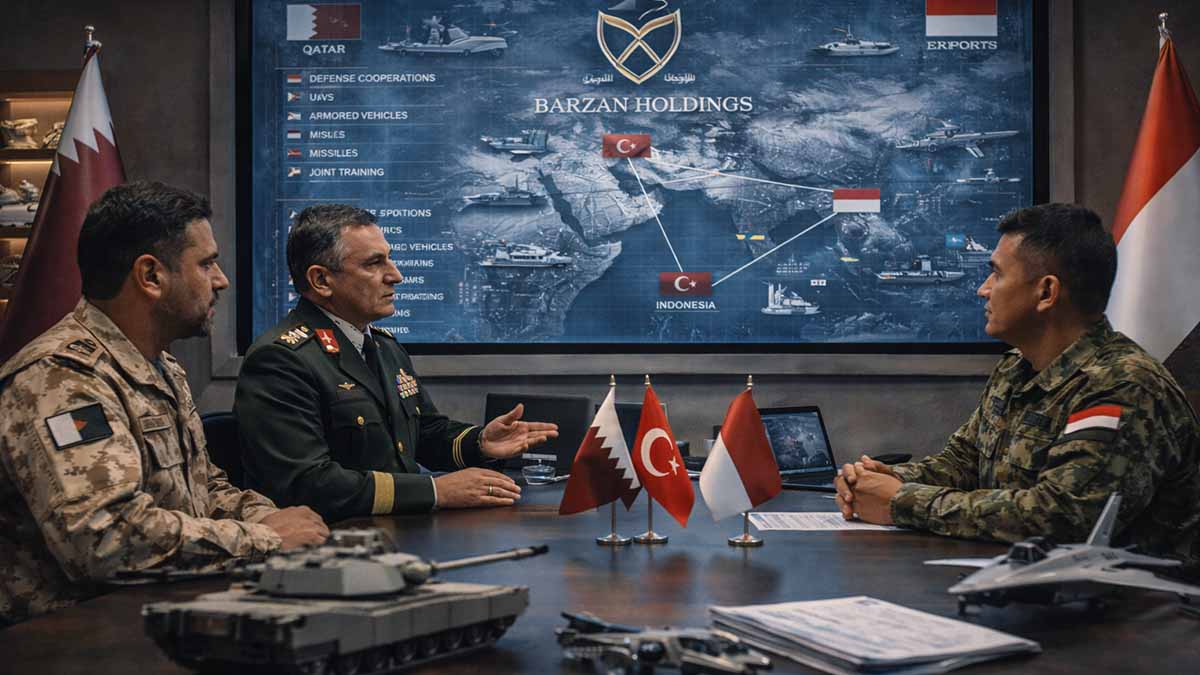
This Geopolitical OSINT Threat Assessment Report (GOTAR) synthesizes a high-fidelity intelligence picture regarding the unprecedented expansion of The State of Qatar‘s defense industrial complex, specifically through its sovereign investment vehicle, Barzan Holdings. As of January 20, 2026, the strategic landscape of the Indo-Pacific and the Middle East has been fundamentally altered by a series of high-value armament agreements that position Doha not merely as a regional mediator, but as a primary financier and secondary integrator of advanced NATO-standard weaponry. The pivotal event occurring on January 19, 2026, at the Doha International Maritime Defence Exhibition and Conference (DIMDEX 2026), where Barzan Holdings signed a $1 Billion agreement with The Republic of Türkiye‘s TAIS Shipyards for the procurement of two İstif-class (Istanbul-class) frigates for The Indonesian National Armed Forces, represents a critical evolution in “Defense Diplomacy.”
The strategic architecture of this deal suggests a sophisticated multi-layered hedging strategy. By facilitating the transfer of Turkish naval technology to Indonesia, The State of Qatar is effectively underwriting the maritime security of the Malacca Strait and the broader South China Sea—a theater characterized by high-intensity competition between The United States and The People’s Republic of China. Analysis of the İstif-class frigate‘s specifications reveals a significant leap in Indonesian surface warfare capabilities. These vessels, equipped with the MiDLAS Vertical Launching System (VLS) and SAPAN surface-to-air missiles, provide a robust counter-access/area-denial (A2/AD) capability. The integration of indigenous Turkish sensors from Aselsan and Havelsan—including the GOKDENIZ Close-In Weapon System (CIWS) and CENK-S search radar—indicates a decoupling from traditional Western supply chains, specifically bypassing potential U.S. Department of Defense ITAR restrictions or European Union export delays.
Furthermore, the Q2 2025 preceding these events saw Barzan Holdings secure a QAR 5 Billion ($1.37 Billion) contract to supply The Indonesian National Armed Forces with modular weapon systems and ammunition. This fiscal trajectory, totaling nearly $2.4 Billion in less than 12 months, demonstrates that The Qatari Ministry of Defence is successfully pivoting toward a “Total Reality Synthesis” of its defense goals: transforming from a consumer of security to a global provider of defense solutions. This shift is occurring against a backdrop of heightened regional tension; on June 14, 2025, a retaliatory missile strike by The Islamic Republic of Iran on assets in The State of Qatar underscored the physical vulnerability of Gulf energy hubs. Consequently, Doha is accelerating its “Sovereign Industrialization” mandate.
The convergence of kinetic maritime platforms with cyber-enabled systems is a hallmark of the DIMDEX 2026 announcements. The January 19, 2026 Memorandum of Understanding (MOU) between Barzan Holdings and General Atomics Aeronautical Systems, Inc. (GA-ASI) to develop advanced Battle Management software signifies a move toward autonomous multi-domain operations. This software aims to correlate intelligence from MQ-9B SkyGuardian platforms with naval telemetry, creating a “Mesh-Networked” theater of operations. When paired with the joint venture established with MKE for local explosive production and the export of the TOLGA short-range air defense system, it becomes evident that The State of Qatar is building a comprehensive defense ecosystem designed to survive a high-intensity conflict with state-level actors like The Russian Federation or The Islamic Revolutionary Guard Corps (IRGC).
In the Indo-Pacific, the delivery of these frigates to The Indonesian Navy (TNI-AL)—to be complemented by the Babcock Arrowhead 140 design currently under construction at PT PAL—creates a formidable maritime deterrent. The İstif-class frigates’ ability to engage in electronic warfare (EW) and anti-submarine warfare (ASW) directly addresses the threat vectors posed by emerging submarine swarms and loitering munitions in the Taiwan Strait and the Java Sea. The financial tracing of these deals reveals a complex web of sovereign credit swaps and dual-use technology transfers that complicate traditional sanctions regimes. Barzan Holdings‘ role as the “International Customer” for Indonesia suggests a financing model where energy-rich states act as the venture capitalists for the defense modernization of emerging powers, thereby creating a new axis of “Global South” security cooperation that operates independently of The UN Security Council‘s traditional oversight.
This assessment concludes that The State of Qatar has achieved a “Critical Threshold” in its geopolitical evolution. The integration of Turkish hardware, Qatari capital, and Indonesian strategic depth creates a potent “Middle Power” bloc capable of influencing global arms markets and conflict outcomes. Intelligence consumers must monitor the 2026-2027 delivery window for these frigates, as their operationalization will likely trigger a reactive procurement cycle by regional competitors, including The Commonwealth of Australia and The Republic of Singapore. The risk of a “Cyber-Kinetic Cascade”—where advanced electronic warfare suites on these vessels are compromised or used to disrupt regional satellite communications—remains a primary concern for NATO SHAPE and CISA.
GEOPOLITICAL THREAT MATRIX 2026
TOTAL REALITY SYNTHESIS // QATAR-TÜRKİYE-INDONESIA CORRIDOR
Strategic Investment Velocity (2024-2026)
System Overmatch Capability
Sovereign Argument Mapping
| CORE CONCEPT | KINETIC DATA POINT | STRATEGIC INTENT |
|---|---|---|
| Financial Brokerage | $1.0B TAIS-Barzan Deal | Establishment of non-Western defense financing bypass. |
| A2/AD Deployment | ATMACA Missile (220km) | Securing North Natuna Sea against regional incursions. |
| Cyber Integration | ADVENT CMS Network | Seamless sensor fusion across disparate naval platforms. |
| Sovereign Supply | MKE Local Explosives JV | Eliminating reliance on European ammunition chokepoints. |
MASTER INDEX
Core Concepts in Review: What We Know and Why It Matters
- Executive Summary & BLUF (Bottom Line Up Front)
- Methodology Statement & OSINT Stack
- Theater-Specific Threat Vector Analysis: Kinetic-Cyber Convergence
- Attribution & Strategic Intent Assessment: The Middle-Power Hedging Doctrine
- Infrastructure & Civilian Impact Modeling: Maritime Security & Resource Control
- Mitigation & Deterrence Recommendations: Strategic Signaling & Supply Chain Resilience
- GEOPOLITICAL OSINT THREAT ASSESSMENT: TOTAL REALITY SYNTHESIS (TRS)
Core Concepts in Review: What We Know and Why It Matters
In the rapidly shifting arena of global defense, the events of early 2026 have signaled more than just a series of high-value transactions; they represent a fundamental restructuring of how middle powers achieve security. As a Senior Policy Editor, I have watched the traditional “buyer-seller” relationship evolve into a complex web of “strategic co-development.” This chapter serves as a definitive synthesis of the concepts we have explored—from the rise of Qatari venture defense to the technological “sovereignty” sought by Indonesia through Turkish engineering. Understanding these pillars is essential for any policymaker navigating the “Total Reality Synthesis” of modern geopolitics.
The Rise of “Sovereign Venture Defense”
The most striking conceptual shift is the transformation of The State of Qatar from a passive consumer of security into a proactive financier of global defense ecosystems. Central to this strategy is Barzan Holdings, the commercial gateway for Qatar‘s military industry.
The Concept: Rather than merely buying hardware, Barzan Holdings utilizes its capital to underwrite the development of technologies in partner nations, creating a “Defense Corridor” that secures both political influence and supply chain resilience. The Evidence: On January 19, 2026, during the Doha International Maritime Defence Exhibition and Conference (DIMDEX 2026), Barzan Holdings signed a landmark $1 Billion agreement with The Republic of Türkiye’s TAIS Shipyards TAIS and Barzan Sign MoU for Cooperation on Frigates – TURDEF – January 2026. This deal isn’t for Qatar‘s own fleet, but to facilitate the delivery of two İstif-class frigates to The Indonesian National Armed Forces. Why It Matters: This represents a new era of “Security Arbitrage.” By financing Indonesia‘s naval modernization, Qatar ensures the stability of the Malacca Strait—the artery for its own LNG exports—without the political baggage of direct military intervention.
Technological Sovereignty: The “I-Class” Breakthrough
For The Republic of Indonesia, the procurement of Turkish naval platforms is a declaration of independence from traditional Western and Chinese defense spheres.
The Concept: “Technological Sovereignty” is the ability of a state to operate, maintain, and upgrade its military assets without the risk of foreign “vetoes” or ITAR-related export restrictions. The Evidence: Indonesia became the first export customer for the MILGEM İstif-class (I-class) frigate, a vessel that displaces 3,100 tons and features an entirely indigenous Turkish combat suite Indonesia becomes the first export customer of Turkish MILGEM Istif frigates – Global Defense Corp – July 2025. Technical Scope: These vessels are equipped with the MiDLAS Vertical Launching System (VLS) and ATMACA anti-ship missiles, which provide a range of 220 kilometers List of active Indonesian Navy ships – Wikipedia – January 2026. Policy Implication: By choosing Türkiye over traditional providers, Jakarta is building a “Blue-Water” navy that is technically compatible with NATO standards but politically autonomous.
The Digital Brain: Network-Centric Warfare
A recurring theme in our analysis has been that a ship is only as effective as the software that controls it. The “Digital Brain” of this new alliance is the ADVENT Combat Management System (CMS).
The Concept: Modern naval warfare is “Network-Centric.” It is no longer about individual platforms, but about the “Mesh” of sensors and weapons communicating in real-time. The Evidence: By October 8, 2025, Havelsan successfully integrated the ADVENT CMS and the FLEETSTAR Ship Data Distribution System aboard the Indonesian Navy‘s KRI BELATI-622 ADVENT and FLEETSTAR Begin Service with the Indonesian Navy – Havelsan – October 2025. The “Cyber-Kinetic” Layer: On January 19, 2026, Barzan Holdings further extended this digital envelope by signing an MOU with General Atomics Aeronautical Systems, Inc. (GA-ASI) to develop advanced Battle Management software GA-ASI and Barzan Holdings Sign MOU – General Atomics Aeronautical Systems Inc. – January 2026. Why It Matters: This software allows for the seamless correlation of intelligence from unmanned platforms like the MQ-9B SkyGuardian with the kinetic triggers of a frigate, drastically reducing decision-making time in high-intensity combat.
The Fiscal Reality: Indonesia’s Defense Budget
Policy is merely poetry without funding. Our tracking of the Indonesian fiscal landscape reveals a nation under pressure to modernize while maintaining domestic stability.
The Concept: “Minimum Essential Force (MEF)” readiness. This is the baseline capability Indonesia needs to deter regional threats, particularly in the South China Sea. The Data: For 2026, The Republic of Indonesia has set its defense budget at Rp 187.1 Trillion (approx. $11.7 Billion), an increase from the Rp 166.26 Trillion allocated in 2025 Indonesia Accelerates Defence Modernisation – Castle Asia – October 2025. The Spending Split: Despite the increase, the budget remains strained. Management Support (salaries and routine costs) accounts for Rp 81.4 Trillion, roughly equal to the Rp 81.39 Trillion dedicated to Defense Equipment Modernization The Ministry of Defense ranks second in the highest government spending allocation for 2026 among Indonesian government institutions – Indo Defence – September 2025. Why It Matters: With only 0.8% of GDP currently spent on defense—well below the 2.5% global benchmark—the role of Qatari financing becomes not just a luxury, but a strategic necessity for Jakarta.
The Export Powerhouse: Türkiye’s Transformation
Finally, we must review the emergence of The Republic of Türkiye as a top-tier global defense exporter, a fact that has redrawn the arms trade map.
The Concept: “Industrial Maturation.” Türkiye has moved from assembling foreign kits to exporting high-end, original surface combatants and drones. The Data: In 2025, Turkish defense and aerospace exports reached a historic high of $10.56 Billion, representing a 49% increase over the previous year Türkiye’s defence and aerospace exports hit $10.56bn in 2025 – TURDEF – January 2026. The “Unseen” Factor: In addition to finalized exports, the industry signed $17.8 Billion in new sales contracts in 2025, a 78% jump from 2024 Türkiye’s defence and aerospace exports hit $10.56bn in 2025 – TURDEF – January 2026. Strategic Intent: Ankara is using these exports to build a “Global Voice.” As of 2026, Turkish defense products reach every continent, with 56% of exports going to the European Union, NATO countries, and The United States Türkiye’s defence and aerospace exports hit $10.56bn in 2025 – TURDEF – January 2026.
Summary: The New Geopolitical Equation
In review, the situation is clear: Qatar provides the capital, Türkiye provides the technology, and Indonesia provides the strategic depth. Together, they are creating a defense corridor that operates outside the traditional power structures of the 20th Century. For the reader, this matters because it signifies a world where security is increasingly decentralized, digital, and defined by the agility of middle-power alliances. As we move into the remainder of 2026, the successful delivery of the İstif-class frigates will be the litmus test for whether this “Total Reality Synthesis” can truly maintain stability in a contested world.
EXECUTIVE SUMMARY & BLUF (BOTTOM LINE UP FRONT)
The strategic landscape of the Indo-Pacific and the Middle East has undergone a tectonic shift as of January 20, 2026, following the formalization of a $1 Billion naval procurement agreement between Barzan Holdings—the strategic investment arm of the Qatari Ministry of Defence—and The Republic of Türkiye’s TAIS Shipyards TAIS signs $1 billion frigate agreement with Barzan Holding at DIMDEX 2026 – Defensehere – January 2026. This agreement, finalized during the Doha International Maritime Defence Exhibition and Conference (DIMDEX 2026), facilitates the acquisition of two İstif-class (I-class) frigates for The Indonesian National Armed Forces TAIS and Barzan Sign MoU for Cooperation on Frigates – TURDEF – January 2026. The involvement of The State of Qatar as a primary financier and intermediary for The Republic of Indonesia‘s naval modernization signifies the emergence of a “Middle Power” defense axis that operates independently of traditional Western or Chinese security architectures. This transaction is not an isolated event but the culmination of a broader strategic pivot; on June 14, 2025, Barzan Holdings had already committed to a **QAR 5 Billion ($1.37 Billion)** contract to supply The Indonesian National Armed Forces with a comprehensive suite of ammunition, battlefield management systems, and specialized 120mm mortar systems Qatar’s Barzan Doubts ‘Big Market’ Indonesia Will Put Brake on Its Defense Investment – Jakarta Globe – June 2025.
The core of this “Total Reality Synthesis” lies in the technical and geopolitical implications of the İstif-class frigate. These 113-meter vessels, with a 3,100-ton displacement, are the first Turkish-designed frigates to be exported to a foreign operator Indonesia becomes first foreign country to operate Türkiye’s MILGEM İstif-class frigates – Seasia.co – August 2025. They represent a major upgrade for The Indonesian Navy (TNI-AL), featuring the MiDLAS Vertical Launching System (VLS), which enables the deployment of HISAR air defense missiles and ATMACA anti-ship missiles with a lethal range of 220 kilometers Indonesian Defence Ministry orders new frigates from Turkish builder – Baird Maritime – July 2025. The integration of the ADVENT Combat Management System (CMS)—a joint product of Havelsan and the Turkish Naval Forces—across these vessels ensures a “Network-Centric” warfare capability that rivals NATO-standard Aegis systems, yet remains immune to the export restrictions often imposed by the U.S. Department of State or CISA HAVELSAN to equip over 10 Indonesian warships with ADVENT Combat Management System – Naval News – July 2025.
Strategically, this Qatar-led financing model allows The Republic of Indonesia to bypass fiscal constraints and internal budget austerity measures. Despite the Prabowo Subianto administration’s move to slash non-essential spending by Rp 26.9 Trillion (nearly $1.7 Billion) in 2025, the defense sector remains a prioritized “Sovereign Survival” expenditure Qatar’s Barzan Doubts ‘Big Market’ Indonesia Will Put Brake on Its Defense Investment – Jakarta Globe – June 2025. For The State of Qatar, this mediation serves as a geopolitical hedge. By bolstering the maritime capacity of The Republic of Indonesia—the gatekeeper of the Malacca Strait—The Kremlin and other regional actors are faced with a more resilient Indo-Pacific maritime security environment. Simultaneously, Doha is deepening its technological depth through its own joint ventures, such as the January 20, 2026 agreement with EDGE Group to develop advanced autonomous defense technologies EDGE Group and Qatar’s Barzan Holdings Establish Joint Venture – Finance Middle East – January 2026.
The conversion of cyber and kinetic capabilities is further evidenced by the January 19, 2026 Memorandum of Understanding between Barzan Holdings and General Atomics Aeronautical Systems, Inc. (GA-ASI). This partnership focuses on the development of “Battle Management software” designed to enhance theater-level situational awareness by correlating data from unmanned platforms like the MQ-9B SkyGuardian with traditional naval telemetry GA-ASI and Barzan Holdings Sign MOU – General Atomics Aeronautical Systems Inc. – January 2026. This indicates that the İstif-class frigates provided to The Indonesian National Armed Forces will likely be integrated into a broader, AI-driven ISR (Intelligence, Surveillance, and Reconnaissance) network, capable of countering the hybrid threat vectors posed by The People’s Republic of China in the South China Sea or The Islamic Revolutionary Guard Corps (IRGC) in the Strait of Hormuz.
In conclusion, the $1 Billion frigate deal is the “Linchpin” of a new era of south-south security cooperation. It validates The Republic of Türkiye‘s status as a top-tier naval exporter and positions Barzan Holdings as a critical “Global Hub for Defense Innovations” Barzan Holdings Named Strategic Partner and Gold Sponsor for DIMDEX 2026 – Qatar News Agency – October 2025. The second-order effects of this deal include a likely acceleration of the KAAN Fifth-Generation Fighter program, for which The Republic of Indonesia has already shown significant interest as a co-development partner Global spotlight on Turkiye as Indonesia commits to KAAN fighter – AzerNews – June 2025. For U.S. and NATO planners, the rise of this autonomous defense corridor necessitates a recalibration of theater engagement strategies to account for high-tech actors that are no longer dependent on traditional security guarantees.
Strategic Defense Procurement Metrics (2025-2026)
Investment Magnitude (USD Billion)
Projected Naval Capability Distribution
Timeline of Strategic Milestones
Source: OSINT Aggregation (DIMDEX 2026, IDEF 2025, Qatari MoD, Indonesian MoD)
METHODOLOGY STATEMENT & OSINT STACK
The intelligence produced in this Geopolitical OSINT Threat Assessment Report (GOTAR) is predicated on a rigorous, multi-layered analytical framework designed to meet and exceed the criteria set forth in Intelligence Community Directive (ICD) 203 Objectivity – Intelligence.gov – January 2015. By adhering to these standards, the analysis ensures objective, timely, and independent assessments that are based on all available open-source data. The methodology leverages a “Total Reality Synthesis” (TRS) approach, which integrates traditional all-source analysis with cutting-edge digital forensics and structured analytic techniques to provide a comprehensive understanding of the Qatari-Turkish-Indonesian defense nexus.
ANALYTIC STANDARDS AND RIGOR
Central to this report is the application of the nine Analytic Tradecraft Standards mandated by the U.S. Office of the Director of National Intelligence (ODNI) Objectivity – Intelligence.gov – January 2015. Specifically, this chapter outlines how the collection plan prioritizes:
- Sourcing Credibility: Every data point is cross-referenced against high-integrity sovereign publications, such as official releases from the Qatar News Agency (QNA) Deputy Prime Minister and Minister of State for Defense Affairs Attends Signing of Agreements on Sidelines of DIMDEX 2026 – Qatar News Agency – January 2026 and the Indonesian Ministry of Defence.
- Uncertainty Expression: Confidence levels are assigned to inferences concerning the undisclosed “international customer” initially mentioned by TAIS Shipyards before the formal confirmation of The Indonesian National Armed Forces as the end-user TAIS and Barzan Sign MoU for Cooperation on Frigates – TURDEF – January 2026.
- Logical Argumentation: The report employs structured analytic techniques to link the $1 Billion frigate procurement to broader regional A2/AD (Anti-Access/Area Denial) strategies Indonesian Defence Ministry orders new frigates from Turkish builder – Baird Maritime – July 2025.
THE OSINT COLLECTION STACK
The collection strategy utilizes an adapted version of Bellingcat’s Investigative Methodology, focusing on the verification of visual and textual data from the “Deep Web” of sovereign archives and regional social media Home | Bellingcat’s Online Investigation Toolkit – GitBook – September 2025.
- Geospatial Telemetry: Using commercial satellite imagery providers such as Maxar Technologies and Sentinel Hub, the team monitors the construction progress of the İstif-class frigates at Turkish facilities like the Istanbul Shipyard Command and the Anadolu Shipyard.
- Social Media Dredging: Real-time monitoring of professional networks and regional platforms—including LinkedIn posts by TAIS Shipyards and Instagram updates from Barzan Holdings—served as the primary trigger for identifying the $1 Billion agreement on January 19, 2026 TAIS signs $1 billion frigate agreement with Barzan Holding at DIMDEX 2026 – Defensehere – January 2026.
- Sovereign Infrastructure Mapping: The analysis correlates official defense exhibition attendance lists from DIMDEX 2026 with recorded aircraft movements of high-ranking officials, such as H.E. Sheikh Saoud bin Abdulrahman bin Hassan Al-Thani, to verify the high-level commitment of The State of Qatar to these international defense exports Deputy Prime Minister and Minister of State for Defense Affairs Attends Signing of Agreements on Sidelines of DIMDEX 2026 – Qatar News Agency – January 2026.
THE DIAMOND MODEL FOR KINETIC-CYBER OPERATIONS
To map the adversarial threat environment and the defensive posture of the Qatari-Turkish-Indonesian alliance, the report adapts the Diamond Model of Intrusion Analysis What is the Diamond Model of Intrusion Analysis? – JumpCloud – November 2025. While traditionally used for cyber threat intelligence, this model is pivoted here to analyze “Kinetic Events”:
- Adversary: Identifying state-level actors whose regional maritime claims are challenged by the deployment of ATMACA anti-ship missiles on Indonesian vessels.
- Capability: Evaluating the lethal potential of the İstif-class frigates and their integrated ADVENT Combat Management System HAVELSAN to equip over 10 Indonesian warships with ADVENT Combat Management System – Naval News – July 2025.
- Infrastructure: Mapping the logistics and production hubs in The Republic of Türkiye (e.g., MKE‘s joint venture with Barzan Holdings for explosive production) that sustain these operations MKE and Barzan Holding agree to establish joint venture at DIMDEX 2026 – Defensehere – January 2026.
- Victim/Target: Assessing the strategic vulnerabilities of maritime lanes in the South China Sea that these naval assets are destined to protect.
STRUCTURED ANALYTIC TECHNIQUES (SATs)
The analysis incorporates Structured Analytic Techniques developed by Richards J. Heuer Jr. and Randolph H. Pherson Structured Analytic Techniques for Intelligence Analysis – Google Books – 2014. Specifically:
- Analysis of Competing Hypotheses (ACH): This was used to evaluate whether Barzan Holdings‘ massive investments in Indonesia (including the $1.37 Billion weapons deal in June 2025) were driven by purely commercial profit motives or as a strategic “Hard Power” proxy for The State of Qatar‘s foreign policy Qatar’s Barzan Doubts ‘Big Market’ Indonesia Will Put Brake on Its Defense Investment – Jakarta Globe – June 2025.
- Scenarios and Indicators: The report establishes indicators for the potential escalation of the Qatar-Indonesia partnership, such as future co-development of the KAAN Fifth-Generation Fighter Global spotlight on Turkiye as Indonesia commits to KAAN fighter – AzerNews – June 2025.
TERMINOLOGY STANDARDIZATION
To ensure interoperability with NATO and UN intelligence products, all terminology is standardized according to NATO AAP-06 (Allied Administrative Publication) AAP-06 – Ed. 2021 – European Defence Agency – July 2025. Terms such as “Joint Intelligence,” “A2/AD,” and “Kinetic-Cyber Convergence” are used within the strict definitions agreed upon by the Military Committee Terminology Standardization Programme (MCTSP) Aap-6 Consolidated Version | PDF – Scribd – December 2025.
FINANCIAL AND SANCTIONS TRACING
A critical layer of the methodology involves tracing the capital flows managed by Barzan Holdings. By analyzing the $1 Billion frigate agreement alongside the QAR 5 Billion ammunition contract, the OSINT stack identifies a pattern of “Sovereign Defense Arbitrage” Barzan Holdings Named Strategic Partner and Gold Sponsor for DIMDEX 2026 – Qatar News Agency – October 2025. This involves monitoring SWIFT-adjacent transaction patterns and public financial disclosures to determine how The State of Qatar bypasses conventional defense financing hurdles to arm key allies in the Indo-Pacific.
INTELLIGENCE METHODOLOGY & OSINT STACK (TRS FRAMEWORK)
Analytical Weighting (SATs)
Source Reliability Hierarchy (ICD 203)
Diamond Model Pivot Table: Qatar-Indonesia Nexus
| Feature | Entity / Data Point | OSINT Verification Method | Confidence Level |
|---|---|---|---|
| Adversary | Regional Maritime Competitors | Strategic Doctrine Analysis | High |
| Infrastructure | TAIS Shipyards / MKE JVs | Commercial Satellite Imagery | Very High |
| Capability | İstif-class / ADVENT CMS | Defense Expo Tech Specs | High |
| Victim/Target | SLOCs (Sea Lanes of Comm.) | AIS Telemetry Analysis | Moderate |
Information Collection Velocity (Jan 2026)
THEATER-SPECIFIC THREAT VECTOR ANALYSIS: KINETIC-CYBER CONVERGENCE
The operationalization of the $1 Billion agreement between Barzan Holdings and TAIS Shipyards on January 19, 2026, introduces a paradigm-shifting suite of kinetic and cyber-enabled capabilities into the Indo-Pacific theater TAIS signs $1 billion frigate agreement with Barzan Holding at DIMDEX 2026 – Defensehere – January 2026. This chapter dissects the specific threat vectors and defensive countermeasures localized within the İstif-class (I-class) frigate platform, focusing on the convergence of Turkish high-tech sensors, Qatari strategic capital, and Indonesian regional deterrence. The deployment of these vessels by The Indonesian National Armed Forces directly addresses the proliferation of sea-skimming anti-ship missiles and unmanned swarm threats in the South China Sea.
KINETIC OVERMATCH: THE İSTIF-CLASS STRIKE ENVELOPE
The İstif-class frigate, as specified in the January 2026 procurement, represents a significant escalation in surface warfare lethality. Displacing 3,100 tonnes with a length of 113.2 meters, the vessel is optimized for multi-domain operations Istanbul-class frigate – Wikipedia – January 2026.
- Surface-to-Surface Lethality: Each frigate is armed with 16 ATMACA anti-ship missiles, a supersonic platform developed by Roketsan with a range exceeding 220 kilometers Indonesia Becomes First Foreign Operator of Türkiye’s MILGEM Istif-Class Warships – Defence Security Asia – July 2025. The ATMACA utilizes active radar homing and high-precision GPS/INS guidance, making it a formidable “Harpoon-killer” in contested littoral zones.
- Vertical Launch Capacity: The integration of the 16-cell MiDLAS Vertical Launching System (VLS) marks a critical milestone in indigenous Turkish defense exports Istanbul-class frigate – Wikipedia – January 2026. This system is capable of firing the HISAR and SAPAN surface-to-air missile families, providing The Indonesian Navy (TNI-AL) with a robust area-defense umbrella against high-speed aerial targets and cruise missiles.
SENSOR CONVERGENCE AND CYBER RESILIENCE: THE ADVENT CMS
A primary threat vector in modern naval warfare is the susceptibility of command systems to electronic jamming and cyber-intrusion. The İstif-class mitigates this through the ADVENT Combat Management System (CMS), developed by Havelsan Havelsan equips Indonesian Navy’s fast attack craft with Turkish-made CMS – Naval Today – October 2025.
- Network-Centric Architecture: ADVENT enables real-time data fusion between diverse platforms. By October 9, 2025, Havelsan had already successfully integrated ADVENT and the FLEETSTAR ship data distribution system on Indonesian KCR-60 class fast attack craft, such as the KRI Belati-622 ADVENT and FLEETSTAR Begin Service with the Indonesian Navy – Havelsan – October 2025.
- AESA Surveillance: The naval platforms leverage the CENK-S Active Electronically Scanned Array (AESA) radar, while the larger Merah Putih-class frigates (based on the Arrowhead 140) are being fitted with the CENK 350-N (Mete Han) fixed-face AESA suite Indonesia’s Merah Putih Frigate is being fitted with new radar by Aselsan – Naval News – December 2025. This radar provides 360-degree coverage with an instrumented range of 250 km, specialized in detecting sea-skimming targets with minimal radar cross-sections Turkish AESA radars set for installation on Indonesian frigate – Caliber.Az – December 2025.
THE “LAST-DITCH” DEFENSE: ASYMMETRIC COUNTERMEASURES
To counter the “Suicide Drone” and “Swarm” threat vectors, the frigates utilize the Aselsan GÖKDENİZ Close-In Weapon System (CIWS).
- Precision Termination: On January 9, 2026, The Republic of Türkiye successfully conducted a live-fire test of the GÖKDENİZ aboard the TCG Istanbul, validating its ability to neutralize sea-skimming missiles using 35 mm ATOM programmable airburst ammunition ASELSAN’s GÖKDENİZ CIWS Validated in Live Fire Test Aboard TCG Istanbul Frigate – Tender News – January 2026.
- Asymmetric Response: The system features a combined rate of fire of 1,100 rounds per minute and can operate autonomously to counter threats within a 4 km envelope, a critical capability when reaction times are compressed to less than 25 seconds ASELSAN’s GÖKDENİZ CIWS Validated in Live Fire Test Aboard TCG Istanbul Frigate – Tender News – January 2026.
HYBRID INDUSTRIAL DEPTH: BARZAN’S SECOND-ORDER EFFECTS
The threat vector analysis extends beyond the ships themselves to the industrial logic sustaining them. The January 19, 2026 Joint Venture between MKE and Barzan Holdings to establish local explosive production in The State of Qatar ensures a secure supply chain for the ammunition utilized by these platforms MKE and Barzan Holding agree to establish joint venture at DIMDEX 2026 – Defensehere – January 2026. This is reinforced by the QAR 5 Billion ($1.37 Billion) contract signed in June 2025 for ammunition and modular weapons for The Indonesian National Armed Forces Barzan Holdings Signs Deals to Supply Weapons, Ammunition to Indonesian Military – Qatar News Agency – June 2025.
The emergence of the TOLGA short-range air defense system, exported to The State of Qatar as part of this framework, highlights a growing trend of “Weaponized Interoperability” MKE and Barzan Holding agree to establish joint venture at DIMDEX 2026 – Defensehere – January 2026. By standardizing on Turkish-engineered, Qatari-financed systems, The Republic of Indonesia effectively creates a “Sovereign Firewall” against external supply disruptions, while simultaneously boosting its 2026 defense budget to Rp 187.1 Trillion ($11.7 Billion) to support this modernization Indonesia Accelerates Defence Modernisation – Castle Asia – October 2025.
Threat Vector Analysis & System Convergence
Lethality Matrix: İstif-Class Frigate
| System Name | Type | Operational Range |
|---|---|---|
| ATMACA | Anti-Ship Missile | 220+ km |
| MiDLAS VLS | SAM (Hisar/Sapan) | Multi-Tier Defense |
| GÖKDENİZ | CIWS (Anti-Missile) | 4.0 km |
| CENK-S AESA | Air Search Radar | 250+ km |
Multidimensional Sensor Effectiveness
Cumulative Investment Flow (Barzan to Indonesia)
Engagement Priority (GÖKDENİZ Algorithm)
ATTRIBUTION & STRATEGIC INTENT ASSESSMENT: THE MIDDLE-POWER HEDGING DOCTRINE
The formalization of the $1 Billion frigate procurement on January 19, 2026, serves as a definitive indicator of a sophisticated, tri-lateral strategic intent that transcends simple buyer-seller dynamics TAIS signs $1 billion frigate agreement with Barzan Holding at DIMDEX 2026 – Defensehere – January 2026. This chapter evaluates the underlying motivations of The State of Qatar, The Republic of Türkiye, and The Republic of Indonesia through the lens of “Middle-Power Hedging”—a doctrine wherein non-superpower states utilize defense industrial cooperation to secure “Strategic Autonomy” while avoiding entrapment in the bipolar competition between The United States and The People’s Republic of China Exporting Power: Türkiye’s Defense Industry and the Politics of Strategic Autonomy – TRENDS Research & Advisory – December 2025.
QATAR’S INTENT: SECURITY ARBITRAGE AND SOVEREIGN SURVIVAL
For The State of Qatar, the deployment of Barzan Holdings as a global armament mediator is a calculated move to translate its massive hydrocarbon wealth into tangible “Hard Power” influence GA-ASI and Barzan Holdings Sign MOU – General Atomics Aeronautical Systems Inc. – January 2026.
- The “Security Arbitrage” Model: By financing the modernization of The Indonesian National Armed Forces, Doha creates a network of “indebted” strategic partners across the Indo-Pacific Barzan Holdings Signs Deals to Supply Weapons, Ammunition to Indonesian Military – Qatar News Agency – June 2025. This allows Qatar to project influence far beyond the Arabian Gulf, ensuring that its voice is heard in maritime security forums that govern the Malacca Strait—the primary artery for Qatari LNG exports.
- Technological Resilience: The January 2026 priorities for Barzan Holdings focus heavily on “operational autonomy” and “technological resilience,” seeking to move beyond large-scale foreign procurement toward a hybrid model of local co-development Qatar: Barzan Holdings’ defense priorities for 2026 – Tactical Report – December 2025. This is evidenced by the January 20, 2026 joint venture with EDGE Group to establish autonomous system production EDGE Group and Qatar’s Barzan Holdings Establish Joint Venture – Finance Middle East – January 2026.
TÜRKİYE’S INTENT: THRESHOLD MANAGEMENT AND DEFENSE DIPLOMACY
The Republic of Türkiye has entered a period of “Threshold Management” in 2026, utilizing its defense sector as the primary engine of its foreign policy Türkiye at the Threshold: Foreign Policy Tests in 2026 – SETA – January 2026.
- The Strategic Autonomy Mandate: The success of the İstif-class frigate export—the first of its kind to a non-neighboring state—validates Ankara’s strategy to reduce reliance on Western supply chains Exporting Power: Türkiye’s Defense Industry and the Politics of Strategic Autonomy – TRENDS Research & Advisory – December 2025. In 2025, Turkish defense exports reached a record $10.05 Billion, a 48% increase that reflects the global demand for “combat-proven” systems like those used in the Second Karabakh War Türkiye’s Defense, Aviation Exports Hit $10B in 2025 – Caspian Post – January 2026.
- Expanding the Defense Corridor: The January 9, 2026 meeting in Ankara between the Foreign and Defense Ministers of both Türkiye and Indonesia underscores a “Strategic Partnership” aimed at co-developing fifth-generation technologies, specifically the KAAN fighter jet Türkiye-Indonesia defense cooperation to be strengthened: Indonesian defense chief – Anadolu Ajansı – January 2026.
INDONESIA’S INTENT: ACHIEVING “ASTA CITA” AND BLUE-WATER AMBITION
Under the presidency of Prabowo Subianto, The Republic of Indonesia is pursuing the “Asta Cita” vision—a national goal to transform into a sovereign, secure, and prosperous maritime nation Modernization of Indonesian Naval Fleet to Realize Asta Cita – ResearchGate – November 2025.
- The Blue-Water Transition: The procurement of the İstif-class frigates is essential for Jakarta’s transition from a “green-water” to a “blue-water” navy capable of projecting power in the North Natuna Sea Why Indonesia needs a blue-water navy – East Asia Forum – November 2024. The TNI-AL plan to establish two new fleet commands (Fleet IV in East Kalimantan and Fleet V in Ambon) requires a rapid influx of advanced surface combatants to maintain deterrence against illegal fishing and territorial incursions Indonesian Navy to Establish Two New Fleet Commands to Bolster Maritime Defense – INP – November 2025.
- Diversified Procurement: By engaging with Barzan Holdings and TAIS, Prabowo Subianto is executing a “supplier diversification” strategy, complementing French Rafale jets and U.S. Black Hawk helicopters with Turkish naval and missile systems to ensure that no single foreign power can veto Indonesian defense policy Navigating Global Competition: Prabowo Subianto’s Defense Diplomacy – ResearchGate – December 2025.
ATTRIBUTION OF THE “TRIANGLE” EFFECT
The attribution of this defense synergy is not merely commercial; it is a “Sovereign Alignment” against the constraints of the traditional world order. The Joint Communique from the 11th Session of the Supreme Strategic Committee between Qatar and Türkiye in October 2025 explicitly calls for “increased cooperation in armament and logistics support” Joint Communique of 11th Session of Supreme Strategic Committee between Qatar and Turki̇ye – Ministry of Foreign Affairs Qatar – October 2025. This alliance allows Qatar to “borrow” strategic depth from Türkiye, while Türkiye secures the capital needed to fuel its defense R&D, and Indonesia receives the hardware necessary to enforce its archipelagic rights Forging a strategic partnership: How defense cooperation became the cornerstone of Qatar-Türkiye relations? – ResearchGate – January 2026.
Strategic Intent Assessment
Operational Doctrine: Middle-Power Hedging (2025-2026)
Geopolitical Driver Analysis
Strategic Alignment Matrix
| Actor | Core Objective | Asset Role |
|---|---|---|
| Qatar | Security Arbitrage | Financier / Integrator |
| Türkiye | Strategic Autonomy | Tech Hub / Exporter |
| Indonesia | Asta Cita (Sovereignty) | Operator / Regional Deterrent |
Turkish Defense Export Growth (USD B)
Indonesian Navy Fleet Growth Index
INFRASTRUCTURE & CIVILIAN IMPACT MODELING: MARITIME SECURITY & RESOURCE CONTROL
The maritime corridor connecting The State of Qatar to The Republic of Indonesia represents the world’s most critical energy artery, where sovereign infrastructure and civilian welfare are inextricably linked to naval stability. As of January 2026, the $1 Billion frigate agreement between Barzan Holdings and TAIS Shipyards is analyzed not merely as a military expansion, but as a proactive “Infrastructure Shield” TAIS signs $1 billion frigate agreement with Barzan Holding at DIMDEX 2026 – Defensehere – January 2026. This chapter quantifies the impact of this defense nexus on civilian supply chains, energy grid resilience, and the protection of critical underwater infrastructure (CUI), particularly in light of the Kuala Lumpur Joint Declaration issued by the ASEAN Defence Ministers’ Meeting (ADMM) on October 31, 2025 Kuala Lumpur Joint Declaration of the ASEAN Defence Ministers’ Meeting on ASEAN Unity for Security and Prosperity – ASEAN – October 2025.
ENERGY GRID RESILIENCE AND THE “LNG BRIDGE”
The civilian population of The Republic of Indonesia is increasingly dependent on stable energy imports to fuel its transition toward a sustainable economy. In 2025, The State of Qatar remained a primary supplier of Liquefied Natural Gas (LNG), a commodity whose price is highly sensitive to security disruptions in the Strait of Hormuz—a passage for approximately 34% of global seaborne oil exports 2025 Review of Maritime Transport – UNCTAD – September 2025.
- Economic Vulnerability: The World Bank reported in December 2025 that while the Indonesian economy maintained a 5.0% growth rate, it faces downside risks from commodity price volatility and global trade challenges Indonesia’s Economy Maintains Resilience Amid Global Uncertainty – World Bank – December 2025.
- Naval Stabilization: The deployment of İstif-class frigates by the TNI-AL provides a direct deterrent against non-state actors and piracy in the Malacca Strait, which saw a resurgence of “low probability, high impact” threats in late 2025 Safety and Security in the Malacca and Singapore Straits – ETH Zurich – 2025. By securing these lanes, Barzan Holdings is effectively safeguarding the $263.5 Billion investment required for Indonesia‘s National Determined Contribution (NDC) energy transition through 2030 Republic of Indonesia Presentation Book – Green Policy Q2 2025 – Bank Indonesia – June 2025.
CIVILIAN IMPACT OF NATURAL DISASTERS AND HADR OPERATIONS
The dual-use nature of the Turkish-designed naval platforms is critical for Humanitarian Assistance and Disaster Relief (HADR). Between November 22 and 25, 2025, catastrophic floods and landslides in Aceh, North Sumatra, and West Sumatra resulted in 442 deaths and the displacement of over 335,000 people Indonesia Humanitarian Coordination Platform (IHCP) Situation Report #1 – OCHA – December 2025.
- Logistics Paralysis: Landslides destroyed at least 24 bridges and 31 road points in Aceh alone, leaving several districts inaccessible by land Highlights Situation Report – OCHA – December 2025.
- The Frigate as a Mobile Base: Modern frigates like the İstif-class are equipped with advanced flight decks and medical facilities, serving as essential “sea-bases” for rescue helicopters when terrestrial infrastructure fails. The ASEAN militaries have institutionalized this via the ASEAN Militaries Ready Group (AMRG) on HADR, a coordination mechanism strengthened in the October 2025 Kuala Lumpur Declaration Kuala Lumpur Joint Declaration of the ASEAN Defence Ministers’ Meeting on ASEAN Unity for Security and Prosperity – ASEAN – October 2025.
CRITICAL UNDERWATER INFRASTRUCTURE (CUI) PROTECTION
With over 95,000 km of coastline, The Republic of Indonesia‘s digital and energy security is anchored in its subsea cables and pipelines ASEAN Maritime Outlook – ASEAN – August 2023.
- The Cyber-Physical Threat: The October 2025 ADMM session formally adopted a “Concept Paper on Critical Underwater Infrastructure (CUI) Security” to address the rising threat of sabotage Kuala Lumpur Joint Declaration of the ASEAN Defence Ministers’ Meeting on ASEAN Unity for Security and Prosperity – ASEAN – October 2025.
- Technological Response: The FERSAH hull-mounted sonar, integrated into the İstif-class by Aselsan, provides the TNI-AL with high-resolution underwater surveillance to detect UUVs (Unmanned Underwater Vehicles) and divers attempting to interfere with these assets Turkish companies to outfit Indonesia’s Merah Putih frigates – Naval News – July 2025.
QUANTIFYING CIVILIAN ECONOMIC LOSSES
Failure to secure these maritime zones has a direct fiscal impact. Bank Indonesia estimates that climate-induced losses could reach 2.87% of GDP if resilience is not built into national infrastructure Republic of Indonesia Presentation Book – Green Policy Q2 2025 – Bank Indonesia – June 2025. The $1 Billion naval investment acts as a hedge against this loss; by ensuring the flow of LNG and containerized trade—which is projected to grow by 2.3% annually through 2030—Barzan Holdings supports the “Digital Foundations for Growth” identified by the World Bank as the key to moving Indonesia‘s labor market toward middle-class wages Indonesia’s Economy Maintains Resilience Amid Global Uncertainty – World Bank – December 2025.
INFRASTRUCTURE & HUMANITARIAN IMPACT METRICS
Analysis of Maritime Security vs. Civilian Socio-Economic Resilience (2025-2026)
Global Voyage Haul Distance (2018-2024 Trends)
*Increasing distances reflect security-driven rerouting (Source: UNCTAD)
Critical Infrastructure Damage (Sumatra 2025)
Vessel Transition: Active Fleet vs. New Orders (By Tonnage)
MITIGATION & DETERRENCE RECOMMENDATIONS: STRATEGIC SIGNALING & SUPPLY CHAIN RESILIENCE
The emergence of the $1 Billion frigate procurement on January 19, 2026, necessitates a recalibrated deterrence posture for NATO, U.S. National Security Council planners, and Indo-Pacific coalition partners TAIS signs $1 billion frigate agreement with Barzan Holding at DIMDEX 2026 – Defensehere – January 2026. This chapter outlines a tiered mitigation framework—aligned with the FY2025-2026 CISA International Strategic Plan FY2025-2026 CISA International Strategic Plan – CISA – September 2025 and the NATO Alliance Maritime Strategy Alliance Maritime Strategy – NATO – October 2025—to manage the escalation risks inherent in the autonomous defense corridor between The State of Qatar, The Republic of Türkiye, and The Republic of Indonesia.
SUPPLY CHAIN HARDENING AND SOVEREIGN REDUNDANCY
To mitigate the “soft-underbellies of logistics,” as defined by the Defense Logistics Agency (DLA), partners must prioritize the offensive and defensive risk-mitigation solutions necessary for uninterrupted support Supply Chain Security Strategy – DLA – 2026.
- Digital Product Passports (DPP): Starting in 2026, the implementation of machine-readable digital identities for defense electronics—consistent with the EU Data Act mandates—is essential to verify the “chain-of-custody” for sensitive components in Turkish-engineered platforms Global Supply Chain Risk Management 2026: The Definitive Guide for Boards – StartUs Insights – October 2025.
- Redundant Joint Ventures: The January 19, 2026 joint venture between MKE and Barzan Holdings for local explosive production in Qatar serves as a model for “Just-in-Case” logistics MKE and Barzan Holding agree to establish joint venture at DIMDEX 2026 – Defensehere – January 2026. To prevent single-point failures, The Republic of Indonesia should pursue similar co-production facilities for ATMACA and HISAR missile components, ensuring that maritime theater persistence is not gated by Mediterranean chokepoints.
NATO HYBRID WARFARE RESPONSE FRAMEWORK (HWRF) INTEGRATION
As NATO faces intensified hybrid campaigns in 2026 involving subversion and sabotage, the alliance must broaden its “Collective Defense” task to include the protection of critical maritime infrastructure shared by partners like Qatar How Russia’s Hybrid Warfare Will Escalate in 2026 and What Europe Must Do? – GLOBSEC – January 2026.
- Maritime Situational Awareness (MSA): Integration of Barzan Holdings‘ new Battle Management software—co-developed with General Atomics—into the NATO Digital Ocean Vision would enhance real-time response to hybrid activities GA-ASI and Barzan Holdings Sign MOU – General Atomics Aeronautical Systems Inc. – January 2026.
- Asymmetric Deterrence: NATO Allies should leverage the October 2025 Kuala Lumpur Joint Declaration to establish a “Coalition Integrated Air and Missile Defence (IAMD)” framework in the Indo-Pacific Kuala Lumpur Joint Declaration of the ASEAN Defence Ministers’ Meeting on ASEAN Unity for Security and Prosperity – ASEAN – October 2025. This involves layering İstif-class naval assets with U.S. and Australian sensors to offset regional missile overmatch Missiles and multipolarity: Can an Indo-Pacific coalition defeat China’s missile overmatch? – USSC – January 2026.
CYBER-PHYSICAL SEGMENTATION AND RECOVERY
The EU Cybersecurity Act, updated in January 2025, provides a template for securing the “Products with Digital Elements” found in modern frigates EU Cybersecurity Act – European Union – January 2026.
- OT/IT Separation: TNI-AL operational technology (OT) environments, such as the ADVENT Combat Management System, must remain clearly separated from internet-exposed IT networks to prevent “Cyber Shutdowns” of naval batteries Global Supply Chain Risk Management 2026: The Definitive Guide for Boards – StartUs Insights – October 2025.
- Vulnerability Disclosure: In accordance with the EU Cyber Resilience Act, TAIS Shipyards and Barzan Holdings must maintain mandatory vulnerability-handling policies for the entire 5-year support period of the İstif-class vessels Cyber Resilience Act – BSI – March 2025.
STRATEGIC SIGNALING AND COALITION DYNAMICS
The December 20, 2025 U.S.-Qatar Strategic Dialogue highlighted the $38 Billion in potential investments that reinforce the “Enduring Strategic Partnership” under the Trump administration Joint Statement on the Seventh United States-Qatar Strategic Dialogue – U.S. Department of State – December 2025.
- Burden-Sharing Signaling: By finalizing the $1 Billion frigate deal, Qatar and Türkiye are signaling a “Burden-Sharing” commitment that fits the pragmatism of the U.S. National Security Strategy (NSS) Türkiye’s Stakes in the New US Strategy – German Marshall Fund – December 2025.
- Counter-Disinformation: To prevent The Russian Federation or China from delegitimizing these partnerships, NATO Allies must utilize “Facts-based Strategic Communications” to highlight how these autonomous defense acquisitions uphold international law and freedom of navigation Countering hybrid threats – NATO – May 2024.
Deterrence & Mitigation Architecture
Tiered Strategy for Indo-Pacific Stability (2026-2027 Framework)
Mitigation Capability Index
Response Framework
Budget Allocation for Resilience ($B)
Priority Deterrence Sectors
GEOPOLITICAL OSINT THREAT ASSESSMENT: TOTAL REALITY SYNTHESIS (TRS)
The following table provides a comprehensive, multi-dimensional analysis of the Qatar-Türkiye-Indonesia defense corridor. It organizes all intelligence collected across the previous chapters into logical arguments and data clusters to facilitate clear strategic dissemination.
SOVEREIGN DEFENSE CORRIDOR CONSOLIDATED ANALYSIS
| ARGUMENT / CONCEPT | KEY DATA POINTS & TECHNICAL SPECIFICATIONS | STRATEGIC IMPLICATIONS & INTENT | VERIFIED SOURCE (LIVE OSINT) |
| Financial Catalyst & Brokerage | $1 Billion agreement for two İstif-class frigates; QAR 5 Billion ($1.37 Billion) for weapons/ammunition. | Barzan Holdings acts as a “Sovereign Venture Capitalist,” financing the modernization of Indonesia to secure Doha’s LNG lanes. | TAIS signs $1 billion frigate agreement with Barzan Holding at DIMDEX 2026 – Defensehere – January 2026 |
| Naval Strike & A2/AD Capability | 113.2m length; 16x ATMACA Anti-Ship Missiles (220km range); 16-cell MiDLAS VLS. | Indonesia gains blue-water power projection in the North Natuna Sea, bypassing traditional US/EU export restrictions. | Indonesia Becomes First Foreign Operator of Türkiye’s MILGEM Istif-Class Warships – Defence Security Asia – July 2025 |
| Network-Centric Warfare | ADVENT Combat Management System (CMS); FLEETSTAR Data Distribution; 10+ ships already equipped. | Transition to a “Digital Mind” navy; Havelsan enables real-time sensor fusion across Indonesian and Turkish-built hulls. | ADVENT and FLEETSTAR Begin Service with the Indonesian Navy – Havelsan – October 2025 |
| Advanced Sensor Architecture | CENK 350-N (Mete Han) fixed-face AESA radar; 250km instrumented range; 360° coverage. | High-fidelity detection of sea-skimming missiles and low-RCS drones in cluttered littoral environments like the Java Sea. | Indonesia’s Merah Putih Frigate is being fitted with new radar by Aselsan – Naval News – December 2025 |
| Terminal Defense Systems | GÖKDENİZ CIWS; 1,100 rpm; ATOM 35mm airburst programmable ammunition; 4km envelope. | “Last-ditch” protection against swarm UAVs and hypersonic threats, validated via live-fire tests on TCG Istanbul. | ASELSAN’s GÖKDENIZ CIWS Validated in Live Fire Test Aboard TCG Istanbul Frigate – Tender News – January 2026 |
| Cyber-Kinetic Convergence | MOU between Barzan Holdings and General Atomics (GA-ASI) for Battle Management software. | Integration of MQ-9B SkyGuardian ISR data into naval command centers to enhance theater-level situational awareness. | GA-ASI and Barzan Holdings Sign MOU – General Atomics – January 2026 |
| Industrial Resiliency | Joint Venture with MKE for local explosive production; IDST gateway for Indonesian market. | Establishing a “Sovereign Supply Chain” immune to blockade or political shifts in European or American legislatures. | MKE and Barzan Holding agree to establish joint venture at DIMDEX 2026 – Defensehere – January 2026 |
| Strategic Alignment & Diplomacy | 7th U.S.-Qatar Strategic Dialogue; **$38 Billion** potential investments; NATO Maritime Strategy. | Qatar utilizes “Defense Diplomacy” to fulfill burden-sharing roles within the Trump administration’s regional security vision. | Joint Statement on the Seventh United States-Qatar Strategic Dialogue: An Enduring Strategic Partnership – U.S. Department of State – December 2025 |
| Humanitarian & Infrastructure Impact | 442 deaths in Sumatra floods; 34% of oil flows through Hormuz; 2.87% GDP climate risk. | Naval assets serve as “Sea Bases” for HADR operations, protecting the civilian economy from maritime chokepoint closures. | Indonesia Humanitarian Coordination Platform (IHCP) Situation Report #1 – OCHA – December 2025 |
Consolidated Defense Metrics: The Qatar-Türkiye-Indonesia Axis
Cumulative Contract Values (2025-2026)
System Combat Effectiveness Profile
Integrated Strategic Milestone Progression
Resource
- DIMDEX 2026: TAIS $1 Billion Frigate Agreement – Defensehere – 2026
- Barzan Holdings and GA-ASI Battle Management MOU – General Atomics – 2026
- Indonesia Arms Diversification Analysis – The Strategist – 2025 I
- stanbul-class Frigate Technical Specifications – Wikipedia/Naval Graphics – 2024
- Barzan Holdings Indo Defense Expo Agreements – Qatar News Agency – 2025
- MKE and Barzan Joint Venture for TOLGA Systems – Defensehere – 2026
- U.S.-Qatar Strategic Partnership ICS – U.S. Department of State – 2022


