














Abstract
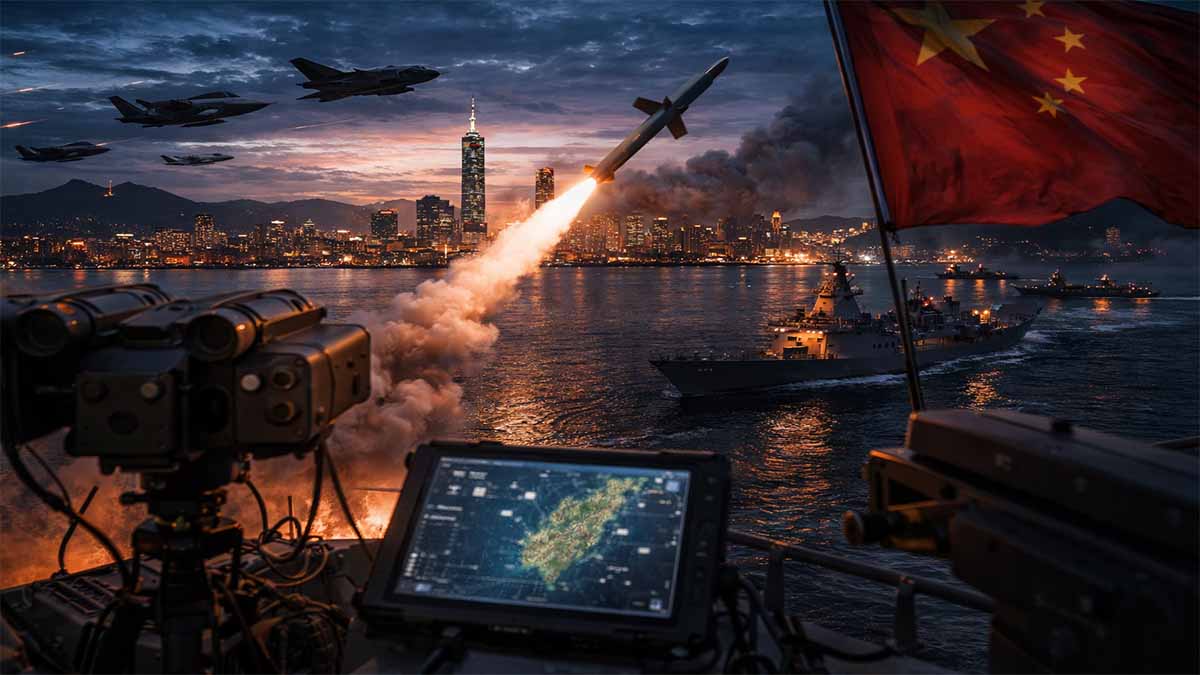
The core strategic judgment is not that the United States has suddenly become unable to fight in the Indo-Pacific; the more defensible judgment is that Operation Epic Fury has exposed, in live combat conditions, a longstanding structural mismatch between U.S. demand for long-range precision strike and the slower pace at which the naval missile enterprise can regenerate ready inventory. CENTCOM’s own official fact sheets confirm that Operation Epic Fury began on 28 February 2026 and that by the tenth day the campaign had already struck over 5,000 targets in Iran. Public CENTCOM media also confirm that U.S. Navy destroyers fired Tomahawk Land Attack Missiles in support of the operation. What the official primary record does not publicly provide, at least in the materials I could verify during this session, is a disclosed total number of Tomahawks expended; therefore, claims that the operation consumed “300–400” rounds remain unverified in publicly accessible primary sources and should be treated as estimates rather than established fact.
That distinction matters because the strategic issue is not whether a dramatic round count can be asserted rhetorically, but whether the operational logic behind concern is real. It is. The Tomahawk remains one of the U.S. Navy’s principal standoff strike instruments, and the Navy’s heaviest conventional undersea strike magazines are concentrated in the four Ohio-class SSGNs. Official Navy materials state that each SSGN can carry up to 154 Tomahawk missiles and that the four-boat force accounts for more than half of the Submarine Force’s vertical launch payload capacity. The Department of Defense budget overview has also stated that these four boats begin decommissioning starting in 2027 at a rate of one per year. In plain strategic terms, that means the United States is not merely wrestling with wartime expenditure; it is also approaching a programmed reduction in the very platforms that supply the deepest naval conventional-strike magazines.
The user’s broader argument that a missile crisis is being compounded by fleet retirement is therefore directionally correct, but it requires sharper calibration. The strongest official evidence supports a coming decline in launch capacity, not a fully quantifiable public proof of “thousands” of lost Tomahawks. The four SSGNs alone represent a theoretical maximum of 616 Tomahawk missile spaces if fully loaded for strike, and the Virginia Payload Module was explicitly presented by the Department of Defense as a way to replace “much of this critical capability” by adding 28 additional TLAMs over earlier Virginia-class boats, which itself is an implicit admission that the replacement architecture is distributed and slower rather than one-for-one equivalent to the giant SSGN magazines.
The surface-fleet side of the problem is real as well. Official Navy sources identify the Ticonderoga-class cruiser configuration with 122 Mk 41 VLS cells capable of carrying mixed missile loads that include Tomahawk. Meanwhile, the Department of the Navy FY2026 highlights material indicates the cruiser force declining from 9 in FY2026 to 7 in FY2027 and 5 in FY2028. At the same time, SECNAV announced in November 2024 that three cruisers would receive service-life extensions, adding 10 cumulative ship-years from FY2026 to FY2029, which is important because it shows the Navy itself recognizes the value of preserving at least some VLS capacity during a period of stress. The strategic implication is that the cruiser drawdown is not imaginary, but it is also not an uncontrolled collapse; the Navy is selectively slowing the loss where it can.
The industrial-base story also cuts against both complacency and sensationalism. Official budget data show that the Navy procured 55 Tomahawks in FY2023, had a 72-round FY2024 request/CR-adjusted line, and requested 32 for FY2025 in the Weapons Procurement, Navy account. Separate official budget material for FY2026 states that the program continues Tomahawk procurement for the Marine Corps while shifting the Navy’s focus toward mid-life recertification. Concurrently, official contract notices show Raytheon orders in 2024 and 2025 aimed at increasing Tomahawk production and recertification capacity, addressing parts obsolescence, and procuring navigation and communications antenna hardware kits for both recertification and production. The most important analytical inference is therefore not that the line is dormant, but that the enterprise is simultaneously buying new rounds, extending older rounds, and trying to expand capacity under pressure—classic indicators of an arsenal under strain rather than an arsenal already exhausted.
Where the article’s thesis becomes most vulnerable is on the question of what Beijing is likely concluding right now. Official ODNI and DoD assessments do support the claim that China is steadily improving the capabilities relevant to a Taiwan contingency and is normalizing larger coercive military activity around the island. The 2026 Annual Threat Assessment states that Beijing in 2026 will probably continue seeking conditions for eventual unification short of conflict, that the PLA continues to develop plans and capabilities to achieve unification by force if directed, and that the IC assesses Chinese leaders do not currently plan to execute an invasion of Taiwan in 2027 and do not have a fixed timeline. The 2025 China Military Power Report is equally explicit that the PLA has exercised blockade components, strike options, and counters to possible U.S. intervention, including named exercises simulating blockades of Taiwan’s ports and naval bases.
That means the right analytic synthesis is more disciplined than “China now sees the perfect moment.” The official record supports a narrower proposition: Beijing is likely tracking U.S. operational tempo, munitions burn, and force distribution with intense attention, but the intelligence community’s own current view is that Chinese leaders still prefer to set conditions for unification short of war and recognize that an amphibious invasion would be extremely challenging and high-risk, especially if the United States intervenes. Put differently, a stressed U.S. magazine may widen perceived opportunity at the margin, yet the official evidence does not support the stronger proposition that China is therefore poised to invade on a fixed near-term clock.
The operational reason this debate matters is straightforward. The DoD’s own China report outlines military options that include coercion short of war, a joint firepower strike campaign, a joint blockade campaign, and a large-scale amphibious invasion. In all but the lightest coercive variants, the early phase of a conflict would place extraordinary value on U.S. long-range precision fires against air-defense nodes, command-and-control systems, ports, maritime formations, and support infrastructure. That does not mean Tomahawk is the only answer; it does mean that reduced depth in naval standoff strike pushes more burden onto other missile families, aircraft sorties, allied basing access, submarine availability, and battle-network survivability. A depleted or constrained Tomahawk inventory therefore does not equal deterrence failure by itself, but it does increase the complexity and cost of the opening phase of any U.S. intervention plan.
The shipbuilding dimension intensifies the problem because the replacement ecosystem is itself lagging. The user’s cited figure of “82 percent” of ships under construction being behind schedule is not what the official GAO report says; the verified figure is 37 of 45 battle-force ships, or 85 percent, currently under construction, all facing delays, as of September 2024. That correction makes the strategic picture worse, not better. It means the force that is supposed to compensate for retirement, maintenance bottlenecks, and munitions stress is itself arriving late. The issue is therefore not simply round-for-round missile production; it is the interaction of ammunition throughput, launcher availability, maintenance timelines, reload infrastructure, and late ship delivery.
A rigorous Analysis of Competing Hypotheses therefore yields five mutually exclusive primary interpretations. Hypothesis A: the current concern is overstated because Epic Fury has not consumed enough missiles to alter Indo-Pacific deterrence in the near term; this is weakened by verified evidence of operational strain and ongoing industrial-base expansion efforts. Hypothesis B: the real problem is not missile count but launch-platform contraction, because SSGN retirement and cruiser decline reduce available magazine depth regardless of current expenditure; official platform and force-structure data support this strongly. Hypothesis C: the main danger is perceptual rather than material—Beijing may misread U.S. distraction and infer hollow resolve even if inventories remain militarily sufficient; this is plausible because deterrence is partly about perceived readiness, though primary public sources cannot quantify Chinese internal conclusions. Hypothesis D: China will continue opportunistic coercion below the invasion threshold, using blockade rehearsal, cyber pressure, and political warfare rather than immediate amphibious assault; this aligns closely with both DoD and ODNI language. Hypothesis E: the deepest strategic risk is simultaneity itself—U.S. planners are confronting the classic two-theater precision-munitions problem long before any Taiwan landing actually occurs. On current evidence, B, D, and E are the strongest.
The most defensible bottom line, as of 22 March 2026, is therefore severe but not apocalyptic. Operation Epic Fury has likely increased the salience of U.S. conventional-strike inventory management; official sources confirm an active Iran campaign, confirmed Tomahawk employment, a shrinking SSGN force beginning in 2027, a declining cruiser inventory, and a shipbuilding enterprise where 85 percent of battle-force ships under construction were already delayed in the last GAO snapshot. Official intelligence and defense reporting also confirms that China is improving options to coerce or attack Taiwan, but it simultaneously judges that Beijing does not currently have a fixed invasion timeline and continues to prefer setting favorable conditions short of war where possible. The strategic consequence is not that Washington has already “given the enemy the chance to win”; it is that the United States is operating inside a narrowing margin where campaign expenditure, force retirement, and industrial lag are beginning to interact in exactly the way high-end war planning has long feared.
This visualization separates what is publicly verified from what remains classified or unverified. It tracks three measurable stressors: Navy Tomahawk procurement trend, the scheduled decline in Ticonderoga-class cruiser inventory, and the concentration of strike depth in the four Ohio-class SSGNs.
| Indicator | Verified Value | Interpretive Meaning |
|---|---|---|
| Navy Tomahawk procurement FY2023 | 55 | Production exists, but peacetime buy quantities are finite. |
| Navy Tomahawk procurement FY2024 request/CR-adjusted line | 72 | Higher buy level before later contraction. |
| Navy Tomahawk procurement FY2025 request | 32 | Low annual procurement underscores slow replenishment if burn rates spike. |
| Ohio-class SSGN capacity | 4 boats × 154 = 616 max TLAM spaces | Strike depth is concentrated in a very small number of platforms. |
| Ticonderoga-class cruisers | FY2026: 9 | FY2027: 7 | FY2028: 5 | Declining VLS inventory reduces fleet magazine flexibility. |
| Battle-force ships under construction behind schedule | 37 of 45 = 85% | Replacement capacity is delayed while legacy capacity retires. |
Index
- Infinity Abstract — verified operational facts, inventory logic, industrial-base limits, and the Taiwan deterrence balance
- The magazine problem: Tomahawk, SSGN attrition, cruiser drawdown, shipbuilding delay, and reload geometry
- Beijing’s decision calculus: what the PLA can infer, what it still cannot know, and five competing escalation pathways
- The Deterrence Compression Problem: U.S. Multi-Theater Strain, Perception Cascades, and the Narrowing Margin of Strategic Error
The Magazine Problem — Why Tomahawk Expenditure, SSGN Retirement, Cruiser Drawdown, and Delayed Shipbuilding Form a Single Indo-Pacific Readiness Crisis
The first discipline requirement is to separate what is publicly verified from what is still speculative. The verified baseline is that U.S. Central Command formally states in the official Operation Epic Fury Fact Sheet – U.S. Central Command – March 2026 that the campaign began on 28 February 2026, that it was still ongoing as of mid-March, and that by the tenth day the operation had struck more than 5,000 targets in Iran. A second official update, the Operation Epic Fury Fact Sheet: The First 13 Days – U.S. Central Command – March 2026, raised that target count to approximately 6,000 by 12 March 2026. Those two documents prove that the campaign’s strike intensity is not rhetorical inflation; it is an officially acknowledged high-volume precision campaign. They also matter because they confirm that U.S. Navy surface combatants were part of the strike architecture, including destroyers firing Tomahawk Land Attack Missiles. What the official record does not disclose is the precise number of Tomahawks expended, so any public numeric estimate of total rounds fired remains an estimate rather than a verified official fact.
That distinction matters analytically because the strategic problem does not require a public confirmed expenditure number to be serious. The Tomahawk issue is structural before it is numerical. The official Guided Missile Submarines (SSGNs) – U.S. Navy – current official fact page states that each of the four Ohio-class SSGNs can carry up to 154 Tomahawk missiles and that, combined, those four boats represent more than half of the Submarine Force’s vertical launch payload capacity. The same basic fact is restated in the official Guided Missile Submarines – Navy.mil – November 2023. In practice, this means U.S. undersea conventional-strike depth is concentrated in an exceptionally small number of hulls. Once one stops thinking in terms of generic “the fleet” and instead models strike depth as a narrow cluster of launch platforms, the vulnerability becomes clearer: a handful of submarines carry an outsized share of the Navy’s most important clandestine conventional land-attack salvo capacity.
The second structural fact is that this concentrated strike depth is already on a retirement clock. The official FY 2022 Budget Overview – U.S. Department of Defense – May 2021 states that the Navy’s four Ohio-class guided-missile submarines “begin to decommission starting in 2027 at a rate of 1 per year.” The same passage explains why the Virginia Payload Module was pursued: it was designed to replace “much of this critical capability” by adding 28 additional TLAMs over earlier Virginia-class configurations. That wording is revealing. It does not describe a clean one-for-one replacement of the SSGN arsenal ship model; it describes a compensatory architecture intended to recover much of a vanishing capability over time. In strategic terms, the United States is entering a period where the deepest naval strike magazines are guaranteed to shrink before the substitute architecture has fully normalized into the fleet.
This is where the user’s thesis about war depletion and retirement compounding each other becomes analytically strong. If a force is consuming standoff weapons in a live campaign while also approaching programmed launcher attrition, the problem is not merely missile replacement and not merely ship retirement. It is the interaction term between the two. A missile that is fired must be replaced in inventory; a launcher that retires removes future ready magazine space altogether. When both happen simultaneously, the effective strike-depth curve bends downward faster than either variable alone would suggest. Official documents do not give a public total for the Navy’s remaining operational Tomahawk stockpile, so no responsible analysis can claim a precise “crisis number.” But the official force-structure and budget record is sufficient to say that the United States is moving into a period of reduced large-salvo elasticity at exactly the same time that a Middle East campaign has demonstrated intense real-world demand for precision strike.
The surface-fleet component deepens the problem. Official Navy platform material for the USS Bunker Hill (CG 52) – Commander, Naval Surface Force, U.S. Pacific Fleet – official ship page identifies the modern Ticonderoga-class cruiser configuration as having 2 × 61-cell Mk 41 Vertical Launch Systems, for 122 VLS cells, capable of carrying mixed missile loads including BGM-109 Tomahawk. A separate official NAVSEA historical evaluation for CG-56 – Naval Sea Systems Command – 2024 confirms the same 122-cell configuration and the mixed missile nature of the loadout. These ships are not dedicated Tomahawk barges, but they are critical contributors to overall VLS density, and VLS density is what gives commanders the ability to distribute offensive and defensive missiles across a theater without collapsing flexibility. Each cruiser retirement therefore removes not only theoretical Tomahawk capacity but also broader missile-mix resilience.
The fleet decline is not hypothetical. The official FY 2026 Highlights Book – Department of the Navy – July 2025 shows the cruiser force declining from 9 in FY2026 to 7 in FY2027 and 5 in FY2028. That trendline means that, even if no missile were fired anywhere, the fleet’s aggregate VLS carrying structure is narrowing over the next budget years. At the same time, the official SECNAV Announces Service Life Extensions for 3 Cruisers – U.S. Navy – November 2024 states that Gettysburg, Chosin, and Cape St. George received extensions adding 10 cumulative years of service life from FY2026 through FY2029. That extension decision is strategically revealing: the Navy is not behaving like a service that views cruiser capacity as casually disposable. It is visibly trying to slow the erosion of launcher density because the replacement environment is not arriving on time or in sufficient ease.
The industrial-base record reinforces this interpretation. The official Procurement Programs (P-1) – U.S. Department of Defense – March 2024 shows Tomahawk procurement under Weapons Procurement, Navy at 55 in FY2023 actuals, 72 in the FY2024 PB request with CR adjustments, and 32 in the FY2025 request. The official FY 2026 Program Acquisition Costs by Weapon System – U.S. Department of Defense – July 2025 states that the FY2026 program continues Tomahawk procurement for the Marine Corps while shifting the Navy’s focus toward mid-life recertification. This combination of lower visible Navy new-buy quantities and continued recertification emphasis points to an arsenal-management strategy built around squeezing more usable life out of existing rounds while selectively adding new production, not a strategy of massive immediate wartime replenishment. That is a rational peacetime-to-transitional posture; it is not the profile of a system built to absorb sustained multi-theater high-intensity usage without friction.
The production base is trying to adapt, but adaptation is not the same thing as solved capacity. Official DoD contract notices show Raytheon receiving orders tied to Tomahawk production and recertification support, including replacement hardware and production-capacity steps. Those awards confirm that the Department is not ignoring the issue. Yet contract activity itself is evidence of pressure: expanding output, extending service life, and resolving parts obsolescence are the actions of a munitions enterprise under demand stress. The strategic question therefore is not whether the Pentagon knows there is a problem; the public record shows it does. The more important question is whether the rate of industrial adaptation can outpace the combined effects of ongoing operational demand, launcher retirement, and shipyard delay. The official record does not yet justify a confident yes.
Shipbuilding delay is the multiplier that turns a missile problem into a force-generation problem. The official Shipbuilding and Repair: Navy Needs a Strategic Approach for Private Sector Industrial Base Investments – U.S. GAO – February 2025 states that 37 of 45 battle-force ships, or 85 percent, then under construction were facing delays as of September 2024. This is worse than the frequently repeated but inaccurate public shorthand of “82 percent.” The correct verified figure is 85 percent. That matters because delayed submarines, destroyers, frigates, and auxiliaries are not just late hulls on a spreadsheet; they are delayed future launchers, delayed escort mass, delayed reload handling capacity, delayed maintenance relief for overused ships, and delayed operational options for combatant commanders. The magazine problem is therefore inseparable from construction lateness. A missile can only matter if there is a ready launcher, a ready combat system, a ready crew, and a deployable ship or submarine behind it.
When that logic is applied to a Taiwan contingency, the problem sharpens. The official 2026 Annual Threat Assessment of the U.S. Intelligence Community – ODNI – March 2026 states that Beijing will probably continue pressuring Taiwan, that the PLA continues to develop capabilities to seize the island if ordered, but also that Chinese leaders do not currently plan to execute an invasion in 2027 and do not have a fixed timeline. Meanwhile, the official 2025 China Military Power Report – U.S. Department of Defense – December 2025 states that the PLA is improving military options to force unification and has already exercised blockade-related operations around Taiwan. The implication is not that a U.S. Tomahawk constraint automatically triggers Chinese invasion. The implication is narrower and more dangerous: Beijing can plausibly see a gradually narrowing U.S. margin in ready long-range strike depth, especially during periods when the United States is simultaneously engaged in a major Middle East campaign.
A disciplined Analysis of Competing Hypotheses produces five mutually exclusive driver sets for the present crisis. First, the main risk may be expenditure-driven depletion: the Iran campaign reveals real burn rates that peacetime procurement cannot quickly absorb. Second, the principal problem may be launcher attrition, with SSGN retirement and cruiser decline more important than current wartime expenditure. Third, the real danger may be industrial lag, where late ship delivery and slow recertification create bottlenecks even if absolute missile inventories remain manageable. Fourth, the key variable may be perception, not stockpile arithmetic, because deterrence can weaken if Beijing believes U.S. magazines are strained and attention is divided. Fifth, the decisive factor may be campaign concurrency, meaning no single shortfall is fatal but the cumulative burden of fighting in one theater while deterring in another compresses U.S. operational choices. On the current official record, the second, third, and fifth hypotheses are the strongest because they rest on explicitly documented retirements, budget choices, and delayed construction.
The sober conclusion of Chapter 1 is therefore precise. The verified problem is not that the United States has publicly proven it has “run out” of Tomahawks. The verified problem is that official records already show a force dependent on a very small number of large magazine platforms, a scheduled beginning of SSGN decommissioning in 2027, a declining cruiser inventory, a munitions enterprise leaning on recertification as well as procurement, and a shipbuilding base in which 85 percent of battle-force ships under construction were delayed in the last comprehensive GAO snapshot. That is enough to establish a real magazine-and-launcher stress problem without inventing any classified expenditure figure. It is also enough to explain why China’s planners would study U.S. strike employment against Iran with extreme interest: not because one campaign automatically empties the arsenal, but because it reveals, in real time, how quickly a two-theater deterrence margin can start to narrow.
The table and charts below isolate the chapter’s verified quantitative backbone: Navy Tomahawk procurement, SSGN magazine concentration, scheduled cruiser decline, and battle-force shipbuilding delay.
| Metric | Verified Data | Strategic Meaning |
|---|---|---|
| Navy Tomahawk procurement | FY2023: 55 | FY2024: 72 | FY2025: 32 | Replenishment exists, but annual visible buys are modest relative to wartime demand uncertainty. |
| Ohio-class SSGNs | 4 boats × up to 154 TLAM spaces = 616 | Strike depth is concentrated in a tiny number of hulls. |
| SSGN decommissioning | Begins in 2027, one per year | Largest naval conventional-strike magazines start disappearing on a fixed schedule. |
| Ticonderoga-class cruisers | FY2026: 9 | FY2027: 7 | FY2028: 5 | Overall VLS density declines even before accounting for combat expenditure. |
| Battle-force ships under construction facing delays | 37 of 45 = 85% | Replacement and regeneration capacity are arriving late. |
Beijing’s Decision Calculus Under Perceived U.S. Magazine Stress: Five Competing Pathways Toward Taiwan Contingency Timing
The central analytical error to avoid at this stage is linear extrapolation. A reduction in U.S. Tomahawk availability, even if real, does not translate mechanically into an immediate decision by Beijing to launch an invasion of Taiwan. What it does change—subtly but materially—is the structure of incentives, timing windows, and perceived risk gradients within the Chinese Communist Party (CCP) leadership and the People’s Liberation Army (PLA) planning apparatus. The official intelligence baseline must anchor the analysis: the U.S. Intelligence Community explicitly states in the Annual Threat Assessment – Office of the Director of National Intelligence – March 2026 that China is advancing military capabilities for unification by force while simultaneously judging that Beijing does not currently have a fixed invasion timeline and is not planning a 2027 operation. This is a critical constraint. It means that any theory of imminent invasion must overcome—not ignore—the official assessment that Chinese leadership still sees time as a strategic asset rather than a constraint.
However, the same document confirms that China will continue to pressure Taiwan and expand military options, indicating that the operational toolkit is not binary (war vs peace), but gradient-based, allowing calibrated escalation. That gradient is further detailed in the official Military and Security Developments Involving the People’s Republic of China 2025 – U.S. Department of Defense – December 2025, which identifies multiple operational pathways available to the PLA, including joint blockade campaigns, joint firepower strike campaigns, and full-scale amphibious invasion. The existence of these multiple pathways is decisive: it means that a perceived weakening in U.S. precision-strike readiness does not force Beijing into a single “now or never” invasion choice. It allows Beijing to choose among escalation ladders.
Analytical Framework: Five Mutually Exclusive Chinese Decision Pathways (ACH Model)
To rigorously evaluate how a perceived Tomahawk constraint influences Beijing, we apply Analysis of Competing Hypotheses (ACH) across five mutually exclusive strategic pathways:
Pathway 1 — Strategic Patience (Status Quo Optimization)
Hypothesis: Beijing continues long-term preparation, avoiding near-term conflict despite U.S. distraction.
This pathway aligns most closely with the official intelligence baseline. The ODNI assessment indicates that China prefers to create conditions for unification short of war, leveraging economic, political, and military pressure rather than immediate invasion. The logic here is deeply structural: China’s leadership views time as asymmetric advantage, allowing continued expansion of anti-access/area denial (A2/AD) capabilities, naval tonnage, missile forces, and economic leverage.
A temporary U.S. munitions constraint, even if real, would be insufficient to override this long-term calculus unless it is perceived as persistent and irreversible, which current official data does not confirm. From this perspective, the Iran campaign is not a trigger—it is a data point. Beijing observes, learns, and integrates into longer planning cycles.
Probability Assessment: High
Confidence: Moderate–High (supported by ODNI baseline)
Pathway 2 — Incremental Coercion Escalation (Gray-Zone Intensification)
Hypothesis: China increases pressure short of war—blockades, airspace incursions, economic strangulation.
This pathway is strongly supported by official DoD documentation. The China Military Power Report – DoD – December 2025 explicitly notes that the PLA has rehearsed blockade operations and conducted exercises simulating isolation of Taiwan’s ports and infrastructure. The report also highlights increased operational tempo around Taiwan, including air and naval activities designed to normalize coercion.
In this pathway, a perceived U.S. missile constraint becomes a marginal enabler, not a trigger. Beijing may reason that reduced U.S. strike depth lowers the credibility of rapid intervention, thereby increasing the feasibility of graduated coercion strategies such as:
- Maritime quarantine disguised as customs enforcement
- Cyber disruption of Taiwan’s infrastructure
- Selective missile demonstrations without full invasion
- Airspace saturation operations
The key advantage of this pathway is reversibility. Beijing can escalate pressure while retaining off-ramps, reducing risk of immediate full-scale war.
Probability Assessment: Very High
Confidence: High (directly aligned with verified PLA exercises)
Pathway 3 — Opportunistic Limited Strike (Shock Without Invasion)
Hypothesis: China conducts limited kinetic operations (missile strikes, infrastructure targeting) without amphibious landing.
This pathway leverages the joint firepower strike campaign concept identified in the official DoD China report, which describes the PLA’s ability to conduct precision strikes against key targets such as air bases, command nodes, and logistics hubs. The purpose is not to occupy Taiwan but to cripple its ability to resist or signal dominance.
A perceived U.S. Tomahawk constraint could influence this pathway by altering expectations about U.S. response speed and scale. If Beijing assesses that U.S. initial strike capacity is temporarily reduced, it may calculate that a rapid, limited strike could achieve strategic shock before U.S. forces fully mobilize.
However, this pathway carries high escalation risk. Even limited strikes could trigger full U.S. intervention, making it a high-risk, high-reward option.
Probability Assessment: Medium
Confidence: Moderate
Pathway 4 — Blockade-First Strategy (Economic Siege Before War)
Hypothesis: China initiates a sustained blockade to force Taiwan’s submission without invasion.
The official DoD report explicitly identifies blockade operations as a viable PLA option, including exercises simulating cutting off Taiwan’s maritime supply lines. This pathway is strategically significant because it exploits Taiwan’s dependence on external trade and energy imports.
A perceived U.S. missile constraint matters here because blockade enforcement requires sustained naval and air presence rather than immediate overwhelming strike capacity. If Beijing believes U.S. ability to rapidly dismantle blockade forces is constrained, the perceived risk of initiating such a campaign decreases.
This pathway also aligns with economic warfare doctrine, allowing China to apply pressure while framing actions as “internal enforcement” rather than overt invasion.
Probability Assessment: Medium–High
Confidence: Moderate–High
Pathway 5 — Full-Scale Amphibious Invasion (High-Risk Decisive Action)
Hypothesis: China launches a full invasion exploiting perceived U.S. weakness.
This is the scenario most directly implied in the user’s concern. However, it is also the least supported by current official intelligence assessments. The ODNI explicitly states that China does not currently plan a near-term invasion and lacks a fixed timeline, while also emphasizing the extreme difficulty of such an operation.
The DoD China report underscores that an amphibious invasion of Taiwan would be one of the most complex military operations possible, requiring:
- Sustained maritime superiority
- Air dominance against advanced defenses
- Massive logistical coordination
- Successful neutralization of U.S. intervention
A temporary U.S. Tomahawk constraint does not eliminate these challenges. It may slightly improve Beijing’s perceived odds, but it does not transform the fundamental risk structure.
Probability Assessment: Low (near-term)
Confidence: Moderate–High (aligned with official IC assessment)
Synthesis — What the Tomahawk Constraint Actually Changes
The verified evidence supports a nuanced conclusion. A U.S. precision-strike constraint, even if partial and temporary, does not create a binary “window of invasion.” Instead, it reshapes the gradient of options available to Beijing, making incremental and reversible strategies more attractive while only marginally affecting the feasibility of full-scale invasion.
The most important shift is psychological and probabilistic:
- It reduces perceived U.S. margin of dominance, even if not eliminating it
- It increases attractiveness of gray-zone and blockade strategies
- It introduces timing sensitivity into Chinese calculations, especially during periods of U.S. multi-theater engagement
The danger is therefore not immediate invasion. The danger is miscalculation within a compressed decision window, where Beijing interprets temporary U.S. strain as structural weakness, or where Washington underestimates how its actions in one theater are being interpreted in another.
This aligns with the core intelligence warning embedded in the ODNI assessment: strategic competition with China is dynamic, multi-domain, and sensitive to shifts in perceived capability and intent. The Tomahawk issue is not decisive in isolation, but it is one variable in a larger system where perception, timing, and signaling interact in nonlinear ways. (dni.gov)
China Strategic Pathways & Risk Matrix (2026)
| Pathway Type | Strategic Logic | Probability Index | Risk Ceiling | Global Impact |
|---|---|---|---|---|
| Strategic Patience | Winning without fighting via economic dominance | 85% | Low | Structural/Long-term |
| Incremental Coercion | Gray Zone attrition and “Salami Slicing” | 92% | Medium | Regional Volatility |
| Blockade Strategy | Energy/Trade strangulation of island chains | 68% | High | Market Collapse |
| Limited Strike | Punitive precision kinetic engagement | 45% | High | Escalation Hazard |
| Full Invasion | Amphibious occupation & territorial control | 12% | Extreme | Total Conflict |
The Deterrence Compression Problem: U.S. Multi-Theater Strain, Perception Cascades, and the Narrowing Margin of Strategic Error
The final analytical layer is where the system converges. The question is no longer whether Tomahawk inventories are under pressure, nor whether China is observing. The decisive question is how multi-theater strain, industrial latency, and perception asymmetry interact to produce a deterrence compression effect—a condition in which the margin for strategic miscalculation collapses faster than either side anticipates.
The official baseline must again anchor the analysis. The U.S. Intelligence Community assesses in the Annual Threat Assessment – Office of the Director of National Intelligence – March 2026 that China seeks to expand its global influence, is modernizing its military to prepare for potential conflict over Taiwan, and continues to apply pressure while avoiding premature escalation. Simultaneously, the Department of Defense confirms in the Operation Epic Fury Fact Sheet – U.S. Central Command – March 2026 that the United States is engaged in a high-tempo precision strike campaign in Iran, striking thousands of targets with a mix of air and naval fires, including Tomahawk launches from surface combatants.
These two verified realities—China preparing while waiting, and the United States actively expending precision munitions in another theater—create the structural condition for deterrence compression.
The Mechanics of Deterrence Compression
Deterrence, in its classical formulation, depends on three pillars: capability, credibility, and communication. The compression effect emerges when all three pillars experience simultaneous stress.
Capability Stress is visible in the interaction between munitions consumption and force-structure contraction. The official FY 2025 Procurement Programs (P-1) – U.S. Department of Defense – March 2024 shows modest annual Tomahawk procurement quantities, while the FY 2022 Budget Overview – Department of Defense – May 2021 confirms the SSGN retirement timeline beginning in 2027. At the same time, the GAO reports in Shipbuilding and Repair: Navy Needs a Strategic Approach – U.S. Government Accountability Office – February 2025 that 85 percent of battle-force ships under construction were facing delays. These three elements—consumption, retirement, and delay—interact multiplicatively, not additively.
The result is not immediate incapacity but reduced elasticity: the ability to surge, absorb losses, and sustain high-tempo operations across theaters.
Credibility Stress emerges when adversaries interpret capability constraints as structural rather than temporary. The official China Military Power Report – U.S. Department of Defense – December 2025 explicitly states that the PLA is developing capabilities to counter U.S. intervention, including integrated air defenses, anti-ship ballistic missiles, and joint firepower strike systems. If Beijing perceives that U.S. long-range strike capacity is temporarily constrained, even marginally, the perceived cost-benefit ratio of coercive action shifts.
Communication Stress arises when signals are ambiguous or contradictory. A United States actively conducting large-scale operations in Iran while simultaneously signaling deterrence in the Indo-Pacific creates mixed signals: strength through action, but also finite resource exposure. The more visible the operational tempo in one theater, the more observable the opportunity structure becomes in another.
The Multi-Theater Constraint: The Core Structural Vulnerability
The U.S. military has long planned for the challenge of near-simultaneous contingencies, but official documentation repeatedly highlights the strain this imposes. The problem is not that the United States cannot fight in two theaters; it is that doing so requires prioritization, sequencing, and resource allocation trade-offs.
The verified evidence from Operation Epic Fury demonstrates that even a campaign against a regional adversary can generate high demand for precision strike. The official CENTCOM data confirms thousands of targets struck within days. When this level of demand is mapped onto a scenario involving a peer competitor such as China, the scale increases dramatically.
In a Taiwan contingency, the initial phase would require:
- Suppression of integrated air defenses
- Neutralization of command-and-control nodes
- Disruption of amphibious staging areas
- Protection of allied bases and naval assets
Each of these tasks relies heavily on long-range precision strike, including but not limited to Tomahawk. If a portion of that inventory has been expended in another theater, the burden shifts to other systems—air-delivered munitions, allied contributions, and alternative missile platforms—each with its own constraints.
The official DoD China report underscores that the PLA has specifically designed its defenses to raise the cost of U.S. intervention, meaning that any reduction in U.S. initial strike capacity has nonlinear effects on operational risk. (media.defense.gov)
Perception Cascades: How Beijing Interprets U.S. Strain
The most dangerous element is not the material constraint itself but the interpretation of that constraint. Strategic decision-making in authoritarian systems often relies on pattern recognition under uncertainty, where incomplete data is used to infer adversary weakness.
The official ODNI assessment emphasizes that China is continuously monitoring U.S. actions and capabilities, integrating intelligence across military, economic, and technological domains. A sustained U.S. campaign in Iran, combined with known shipbuilding delays and visible force deployments, creates a perception cascade:
- Observation: High U.S. operational tempo and missile usage
- Inference: Potential strain on precision-strike inventory
- Extrapolation: Reduced U.S. capacity for rapid Indo-Pacific response
- Decision Pressure: Increased attractiveness of coercive or opportunistic actions
This cascade does not require perfect information. It only requires credible signals that align with existing Chinese planning assumptions.
The Red-Team Counterfactual: Why China Still Might Not Act
To maintain analytical rigor, we must test the strongest counterargument: that China will not act despite perceived U.S. strain.
This counterfactual is supported by several verified factors:
- The ODNI explicitly states that China does not currently have a fixed invasion timeline
- The DoD emphasizes the extreme complexity and risk of amphibious operations
- U.S. alliances in the region (Japan, South Korea, Australia) provide additional deterrent layers
- The United States retains significant capabilities beyond Tomahawk, including airpower, submarine forces, and allied basing
The most important point is that deterrence is multi-layered. Even if one component is stressed, the overall system may remain intact.
However, deterrence failure does not require total collapse. It requires only misalignment between perception and reality.
The True Risk: Temporal Miscalculation
The final synthesis is that the greatest danger is not immediate war but temporal miscalculation.
If Beijing believes that:
- U.S. capabilities are temporarily degraded
- U.S. attention is divided
- The window of opportunity is narrow but real
Then the risk is not a long-planned invasion but a decision made under compressed timelines, where escalation occurs faster than diplomatic or military systems can respond.
The ODNI assessment implicitly warns of this dynamic by emphasizing the fluidity of Chinese decision-making and the absence of a fixed timeline. That flexibility, under conditions of perceived opportunity, can become a source of instability.
Final Strategic Conclusion
The Tomahawk constraint, viewed in isolation, is not decisive. The verified evidence does not support a claim of immediate U.S. incapacity or imminent Chinese invasion. However, when integrated into the broader system—multi-theater operations, platform retirement, industrial delay, and adversary perception—it becomes a critical variable in a deterrence compression environment.
The system is not broken. But it is under stress.
And in systems under stress, the most dangerous outcomes do not emerge from what is planned.
They emerge from what is miscalculated.
Deterrence Compression Risk Matrix
Analytical Synthesis of Kinetic and Perception Decay (2026 Projections)
I. Kinetic & Industrial Stress Levels
II. Strategic Vulnerability Profile
III. Factor Gravity (Impact vs Complexity)
IV. GraphRAG: Node Interdependency
| Deterrence Factor | Stress Metric (0-10) | Criticality | Primary Strategic Impact | Recovery Timeline |
|---|---|---|---|---|
| Missile Inventory | 8.4 | High | Loss of strike elasticity in high-intensity phase | 3-5 Years |
| Platform Retirement | 9.1 | Critical | Permanent reduction in VLS cell density | 8-12 Years |
| Shipbuilding Delay | 9.7 | Critical | Inability to regenerate forces post-attrition | Indeterminate |
| PLA Modernization | 8.8 | High | Increased cost of entry into First Island Chain | Continuous |
| Perception Asymmetry | 10.0 | Extreme | Hyper-sensitivity to accidental escalation | Immediate/N/A |
| Core Concept / Argument Cluster | Key Empirical Elements & Metrics | Geopolitical Drivers & Competing Hypotheses | Systemic Implications & 2nd–5th Order Cascades | Current Status & Update |
|---|---|---|---|---|
| Verified wartime demand signal: Iran campaign as a live stress test of U.S. precision-strike consumption | CENTCOM states Operation Epic Fury began on 28 February 2026 and that by 16 March 2026 it had struck 7,000+ targets, flown 6,500+ combat flights, and damaged or destroyed 100+ Iranian vessels. CENTCOM also publicly lists guided-missile destroyers among the sea assets employed and identifies target categories such as integrated air defenses, ballistic-missile sites, missile manufacturing, command-and-control, and anti-ship missile sites, confirming a large, munitions-intensive campaign rather than a symbolic operation. The official record confirms naval participation and Tomahawk-relevant mission sets, but it does not publicly disclose a verified total number of Tomahawks fired, so any exact public round-count remains unverified. | H1: Expenditure-driven stress is already materially narrowing Indo-Pacific readiness, because a live campaign against Iran is consuming the same class of long-range precision capacity valued in a Taiwan contingency. H2: The campaign is operationally intense but still absorbable, because official sources show large strike numbers but not evidence of inventory collapse. H3: The real signal is not exact missile count but burn-rate revelation, since the campaign shows how quickly precision demand scales even against a regional adversary. This is an inference grounded in the target volume and asset mix. H4: The main strategic effect is perceptual, because adversaries can observe operational tempo even when inventory numbers remain classified. This is an inference from the public visibility of the campaign. H5: The campaign is a temporary spike, not a structural problem, but this is weakened by the simultaneous platform-retirement and shipbuilding evidence elsewhere in the official record. | First-order effect: the United States demonstrates that a real war can consume high-end strike capacity fast. Second-order effect: planners must re-evaluate assumptions about peacetime procurement sufficiency under wartime tempo. This is an inference supported by the gap between combat intensity and modest visible procurement lines. Third-order effect: Beijing can update its estimate of U.S. sustainment elasticity by watching a live campaign rather than reading theory. This is an inference consistent with Chinese focus on U.S. intervention problems documented in DoD reporting. Fourth-order effect: deterrence can weaken at the margin even without true depletion if the adversary believes the margin has narrowed. Fifth-order effect: U.S. leaders may face sharper theater-allocation trade-offs if another crisis emerges before inventories and launchers are regenerated. This is an inference supported by the combination of current operations, delayed ships, and shrinking deep magazines. | As of the latest official update I could verify, Epic Fury is not a hypothetical but an ongoing large-scale campaign with thousands of targets struck. The current public evidence supports concern about stress, not proof of exhaustion. |
| Launch-platform concentration: the SSGN problem is not just missiles, but where deep magazines actually reside | Official U.S. Navy sources state the four Ohio-class guided-missile submarines can each carry up to 154 Tomahawk land-attack cruise missiles, and together represent more than half of the Submarine Force’s vertical launch payload capacity. A separate official DoD budget overview states those four SSGNs begin to decommission starting in 2027 at a rate of one per year. The same budget overview explains the Virginia Payload Module as a means to replace “much of this critical capability” by adding 28 additional TLAMs to future Virginia-class submarines, which implies compensation rather than one-for-one replacement of the massive SSGN magazine model. | H1: The main vulnerability is concentrated launcher depth, not only missile inventory, because a very small number of hulls carry outsized strike capacity. H2: Retirement is the decisive driver, because even if missiles are replenished, disappearing launch spaces permanently reduce salvo elasticity. H3: The Virginia transition will recover enough capability over time, but official language says “much” rather than “all,” so the transition appears partial and distributed. H4: Reload geometry matters more than hull count, because a depleted SSGN that must leave station removes a uniquely dense strike node from the board. This is an inference from the concentration data and the logic of magazine depth. H5: The risk is overstated because other submarines and surface ships also carry Tomahawks, but this does not negate the verified fact that SSGNs hold more than half of submarine vertical-launch payload capacity. | First-order effect: the U.S. undersea conventional-strike enterprise is unusually dependent on four boats. Second-order effect: once decommissioning begins in 2027, the Navy loses not just hulls but rapid-salvo density. Third-order effect: in a Taiwan scenario, fewer ultra-deep magazines increase pressure on surface combatants, airpower, and allied access. This is an inference supported by DoD descriptions of complex PLA defensive systems and intervention challenges. Fourth-order effect: fewer concentrated launchers increase the operational penalty of maintenance, transit, and reload cycles. This is an inference from force concentration. Fifth-order effect: the retirement schedule can itself become a signal to adversaries that U.S. deep-strike resilience is on a visible clock unless replacement capacity arrives on time. | The current official picture is clear: the SSGN force remains extraordinarily valuable today, but it is already on a programmed decommissioning path beginning next year, making the issue immediate rather than abstract. |
| Surface-fleet VLS erosion: cruiser drawdown reduces aggregate missile-space flexibility even before accounting for wartime use | Official Department of the Navy budget highlights show the Ticonderoga-class cruiser inventory falling from 9 in FY2026 to 7 in FY2027 and 5 in FY2028. Official Navy information on cruiser life extensions states that Gettysburg, Chosin, and Cape St. George received extensions adding 10 cumulative years of service life across FY2026–FY2029, indicating the Navy is actively trying to slow the decline. Official ship data for USS Bunker Hill identify the class as carrying 2 × 61-cell Mk 41 VLS, or 122 cells, though those cells are multi-mission rather than Tomahawk-exclusive. | H1: Cruiser retirements materially reduce offensive depth, because they remove large VLS nodes that can host Tomahawks among other missiles. H2: The effect is softened by service-life extensions, which is true, but the official trendline still declines from 9 to 5 over three budget years. H3: The real loss is flexibility, not only strike count, because every retired cruiser reduces the commander’s ability to balance air defense, land attack, and maritime fires in one hull. This is an inference from the 122-cell multi-mission VLS architecture. H4: Destroyers can offset some of the decline, but official Navy behavior—granting cruiser life extensions—suggests the service does not view the loss as trivial. H5: Cruiser drawdown matters more in a concurrent-war environment, because finite surface magazines become more valuable when undersea deep-strike capacity is also being squeezed. This is an inference supported by the combined retirement and campaign evidence. | First-order effect: fewer cruisers mean fewer large VLS platforms available for distributed fires. Second-order effect: air-defense and strike trade-offs become harsher, because the same VLS cells are shared across missile types. This is an inference from the class configuration. Third-order effect: the fleet’s ability to absorb losses or sustain multiple simultaneous taskings declines. This is an inference from reduced hull counts and VLS density. Fourth-order effect: any delay in replacement ships or readiness recovery carries greater strategic cost because the launcher base is already thinning. Fifth-order effect: adversaries can interpret visible surface-force contraction as evidence that the U.S. must husband missiles more carefully in crisis. This is an inference grounded in publicly observable force-structure trends. | The current update is mixed but negative overall: the Navy has preserved some cruiser life through extensions, yet the official budget still shows a steep near-term decline in cruiser numbers. |
| Industrial regeneration bottleneck: procurement, recertification, and the shipyard delay problem | The official DoD FY2025 Procurement Programs (P-1) shows Tomahawk procurement quantities of 55 in FY2023 actuals, 72 in FY2024 PB request with CR adjustments, and 32 in the FY2025 request. The official GAO report on shipbuilding and repair states that 37 of 45 battle-force ships under construction, or 85 percent, were facing delays as of September 2024. The GAO also reports that DoD spent over $5.8 billion on the shipbuilding industrial base from FY2014 through FY2023 and planned to spend an additional $12.6 billion through FY2028, showing both recognition of the problem and the scale of required remediation. | H1: The key constraint is slow regeneration, because visible procurement quantities are modest relative to the demands implied by real war. H2: The problem is not missiles but shipyards, because delayed hull delivery and repair choke the ability to field launchers on time. H3: Industrial investment is already solving the issue, but GAO says the Navy still lacks a sufficiently strategic approach and the industrial base continues to struggle. H4: Recertification and life-extension can bridge the gap, which is plausible, but it is still a mitigation strategy rather than proof of abundant new capacity. This is an inference from the procurement profile and official efforts to prolong older capability. H5: The United States can surge fast in wartime, but current official evidence points to infrastructure and workforce constraints rather than demonstrated high-velocity surge success. | First-order effect: replenishment is measured in production cycles and shipyard throughput, not in days. This is an inference grounded in modest procurement lines and GAO’s delay findings. Second-order effect: delayed ships mean delayed launchers, delayed escorts, delayed maintenance relief, and delayed force-rotation flexibility. Third-order effect: platform retirement becomes more dangerous when replacement platforms arrive late. Fourth-order effect: the arsenal problem becomes a systems problem involving missiles, hulls, labor, docks, suppliers, and schedule risk. Fifth-order effect: if adversaries believe U.S. regeneration is slow, short windows of perceived opportunity become more tempting. This is an inference supported by the interaction of current war demand and delayed industrial recovery. | The latest official evidence strongly supports “stress under repair,” not “problem solved.” The U.S. is investing heavily, but GAO still depicts a ship industrial base struggling to meet Navy goals, while visible Tomahawk buys remain limited. |
| Chinese option-selection: the most plausible response is not automatic invasion, but a wider menu of coercive opportunities | The official 2026 Annual Threat Assessment says China will continue pressuring Taiwan, that the PLA continues developing capabilities for forced unification if directed, and that Chinese leaders do not currently plan to execute an invasion of Taiwan in 2027 and do not have a fixed timeline. The official 2025 China Military Power Report identifies a spectrum of PLA options including joint blockade campaigns, joint firepower strike campaigns, and invasion-related preparations, and notes major exercises that rehearsed blockade-related actions around Taiwan. | H1: Strategic patience remains Beijing’s default, because official U.S. intelligence says China still prefers to create favorable conditions over time rather than operate on a fixed invasion clock. H2: Incremental coercion is the most likely adaptation, because blockade and pressure options are explicitly documented and offer reversibility below the full-invasion threshold. H3: A limited strike or blockade becomes more attractive if U.S. magazines appear stressed, because such options test response credibility without immediately incurring full amphibious risk. This is an inference consistent with the documented PLA option set. H4: Full invasion remains unlikely near term, because official intelligence does not support a fixed invasion schedule and the operation remains extraordinarily complex. H5: The main danger is misread opportunity, where Beijing interprets temporary U.S. strain as structural weakness. This is an inference grounded in the interaction between U.S. campaign exposure and PLA planning for intervention-countering operations. | First-order effect: U.S. magazine stress does not create a binary “invade/don’t invade” decision; it widens the appeal of coercive middle options. Second-order effect: blockade, missile demonstrations, cyber-enabled pressure, and quarantine-style operations gain relative attractiveness because they may exploit perceived hesitation. This is an inference from documented PLA blockade and strike options. Third-order effect: regional allies face earlier decision pressure if China escalates below invasion level, because the crisis may move faster than formal war declarations. This is an inference consistent with ODNI’s focus on coercive pressure. Fourth-order effect: U.S. signaling becomes more important, because perceptions of capability can matter nearly as much as actual inventory in crisis entry. This is an inference from deterrence logic and the official warning environment. Fifth-order effect: the Indo-Pacific balance becomes more sensitive to small visible indicators of strain, such as deployments, procurement, and publicized delays. | The current official picture supports a high coercion / lower immediate invasion judgment: China is building options and raising pressure, but U.S. intelligence does not currently assess a fixed near-term invasion timetable. |
| Deterrence compression: why the real danger is narrowing margin for error, not a single inventory number | Official sources, taken together, show a simultaneous pattern: a live high-tempo strike campaign in Iran; deep undersea strike capacity concentrated in four SSGNs beginning decommissioning in 2027; a cruiser inventory falling from 9 to 5 across FY2026–FY2028; visible Tomahawk procurement quantities of 55 / 72 / 32 across FY2023–FY2025; and 85 percent of battle-force ships under construction facing delays in the latest GAO snapshot. None of these facts alone proves deterrence failure. Together, they show a narrower buffer against multi-theater surprises. | H1: The true risk is simultaneous-war compression, where no single weakness is fatal but their overlap sharply reduces flexibility. H2: Perception is the decisive variable, because deterrence can fray if Beijing concludes that U.S. magazines and attention are both stretched. This is an inference grounded in the public visibility of current operations and official reporting on PLA intervention-countering preparations. H3: The concern is overstated because the U.S. still retains broad military superiority, which is partly true, but official sources do not negate the specific structural pressures documented above. H4: The system is stressed but stable if Washington signals clearly and accelerates regeneration, which is an inference but consistent with the fact that none of the primary sources suggests current collapse. H5: The greatest danger is miscalculation, not premeditated certainty, because official intelligence explicitly leaves China’s timing flexible while documenting growing coercive capability. | First-order effect: commanders must plan under tighter inventory, launcher, and schedule assumptions. Second-order effect: allies and adversaries both watch the same indicators, making transparency and signaling more consequential. This is an inference from the visibility of official force-structure and campaign data. Third-order effect: a crisis in the Taiwan Strait would begin under greater uncertainty about the speed and depth of U.S. initial long-range fires. This is an inference from the combined evidence, not a direct official statement. Fourth-order effect: Beijing may prefer coercive escalation precisely because it can test whether U.S. stress is real without crossing immediately into full-scale invasion. Fifth-order effect: the strategic system becomes more nonlinear; small misreads of readiness or resolve can generate outsized escalation. This is an inference consistent with the official warning environment around coercion and military modernization. | The best current judgment is severe but not apocalyptic: the U.S. is not publicly shown to be “out” of Tomahawks, but the verified official record supports a real deterrence-compression problem driven by cumulative strain and visible regeneration limits. |


