












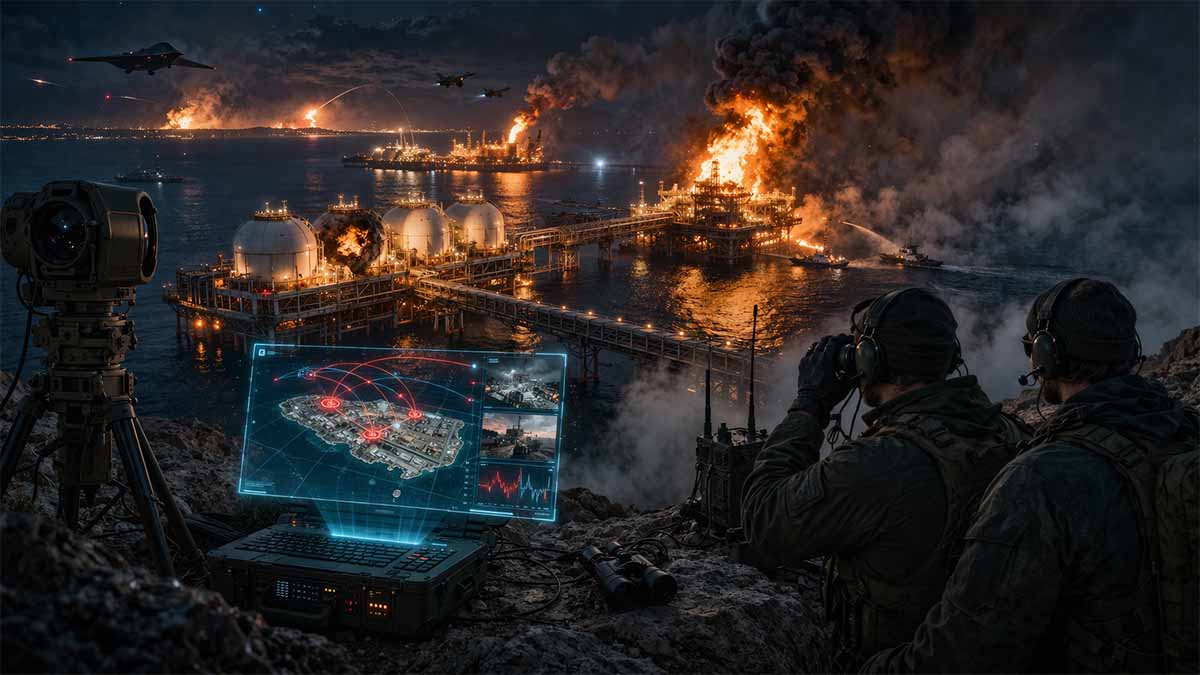
STRATEGIC ABSTRACT
The Natanz Strike: Second Blow, Diminishing Returns
Early Saturday morning, March 21, 2026, the United States and Israel carried out a new major strike against Iran’s main uranium enrichment facility in Natanz, the second such strike of the current war which began on February 28. Athens Times The strike was carried out by U.S. warplanes using bunker-busting bombs, according to Israeli state broadcaster KAN, with the International Atomic Energy Agency (IAEA) confirming notification and calling for military restraint to avoid the risk of a nuclear accident. Türkiye Today
The operational logic is straightforward but the strategic yield is diminishing. While the facility, based underground, remains physically intact, the significant damage to its entrance buildings sustained in these bombings has rendered it no longer accessible — and another site excavated by Iran is described as a future centrifuge assembly facility deep beneath Kūh-e Kolang Gaz Lā (“Pickaxe Mountain”), near the Natanz nuclear complex, under construction, reinforced and gradually expanded since approximately 2021. Wikipedia
This is the critical intelligence gap. Surface strikes destroy access points; they do not destroy the subterranean architecture. Although strikes can set back Iran’s nuclear program and destroy key infrastructure, military force cannot eliminate Tehran’s proliferation risk — at the end of the conflict, Iran will retain the nuclear expertise and likely key materials necessary for building a nuclear bomb. Arms Control Association The Arms Control Association assessment, issued March 10, 2026, cuts through the strategic theater: this war has never been about achieving irreversible non-proliferation. It has been about leverage.
What Iran has concealed is more consequential than what the strikes have destroyed. Sources in Tehran reported that in October 2025, Iranian Supreme Leader Ali Khamenei had authorised the development of miniaturised nuclear warheads for ballistic missiles — despite denials issued at earlier dates. The report stated that such warheads would require uranium enriched to 90%, achievable in a matter of weeks by processing the existing stockpile of 441 kg of 60% uranium with advanced IR-4 and IR-6 centrifuges; and circulated accounts indicate the existence of an ultra-secret enrichment program at one of Iran’s covert nuclear sites, to which the IAEA has not been given access. Wikipedia
The IAEA, for its part, has issued a counter-narrative. IAEA Director-General Rafael Grossi told NBC News that the UN agency had not identified “elements of a systematic and structured programme to manufacture nuclear weapons” in Iran — maintaining the position that evidence of a coordinated Iranian programme to build nuclear weapons has not been confirmed. Al Jazeera This divergence between classified U.S./Israeli assessments and IAEA findings is itself a strategic artifact. Either the intelligence is compartmented beyond IAEA inspection access, or the war’s casus belli is partially constructed.
The Diego Garcia Revelation: The 4,000-Kilometer Reframing
The strategic earthquake of this 24-hour cycle is not Natanz. It is the Indian Ocean.
Iran launched two intermediate-range ballistic missiles toward Diego Garcia, a remote U.S.-U.K. military base in the Indian Ocean, in an apparent attempt to project power far beyond the Middle East, according to U.S. officials cited by The Wall Street Journal. Neither missile struck the base — one failed during flight, while a U.S. warship fired an SM-3 interceptor at the second. Ynetnews
Diego Garcia is located about 4,000 kilometers from Iran, double the 2,000-kilometer range that Iranian Foreign Minister Abbas Araghchi said Iran’s ballistic missiles had last month. The Jerusalem Post This is the doctrine of strategic deception made manifest. Araghchi’s public declaration of a self-imposed range cap was a deliberate intelligence operation — feeding adversaries a false threat envelope while operationally developing extended-range configurations.
The technical mechanism is now assessed with high confidence. The missiles are assessed by U.S. authorities to likely belong to the Khorramshahr-class intermediate-range ballistic missile family, a liquid-fuelled system publicly declared by Iran to have a range of approximately 2,000 km but now suspected to have been used in a configuration capable of reaching nearly double that distance through payload reduction and modified flight profiles — analysts believe a warhead in the 300–500 kg class could enable the missile to approach or exceed 4,000 km range, which aligns with independent assessments that had previously suggested the Khorramshahr platform might achieve greater reach than officially acknowledged by Iranian authorities. Defence Security Asia
The strategic implications cascade globally, not just regionally. A ballistic missile with a confirmed range of 4,500 km, if launched from the far west of Iran, could theoretically strike much of Western Europe, reaching as far as southern England — though the risk of an actual impact on European soil remains very low thanks to the NATO defense shield, including Radar installations and defensive systems in Turkey, the Aegis Ashore system in Romania, and numerous U.S. and allied naval assets equipped with interceptors in the Mediterranean. ItaMilRadar
The most destructive Iranian system is the Khorramshahr ballistic missile, capable of carrying a warhead of up to 1,800 kg. Launched from hardened underground facilities in northwestern Iran in mountainous regions like Kermanshah, Tabriz, and Isfahan, it has a range of up to 3,000 km when its payload is reduced — placing southern and eastern European capitals like Athens, Sofia, and Bucharest within reach, and at maximum extension Vienna, Rome, and Berlin. Euronews The Diego Garcia launch extends this envelope beyond doctrine.
NATO’s operational posture was already on high alert. NATO’s missile defense system — involving a U.S. Aegis Ashore site in Romania and U.S. Navy destroyers out of Rota, Spain, developed over 15 years with a ballistic missile threat from Iran in mind — includes a missile defense suite in Poland and an early-warning mountaintop radar in Kurecik, Turkey. Terrorism expert Colin P. Clarke of the Soufan Center stated that Iran being in an “existential” war would drive activation of any sleeper cell capacity in the West — “Hezbollah and other assets could very well seek to conduct attacks in Europe, North America, etc.” Stars and Stripes
The Kharg Island Strategic Trap: What Iran Is Hiding
Here the intelligence picture becomes most consequential — and most dangerous. The Trump administration’s stated preference for seizing Kharg Island as an economic stranglehold is being analyzed in Tehran not as a threat to be deterred, but as a trap to be triggered.
The Trump administration is considering plans to occupy or blockade Iran’s Kharg Island to pressure Iran to reopen the Strait of Hormuz, with four sources with knowledge of the issue telling Axios. One source described the objective: “We need about a month to weaken the Iranians more with strikes, take the island and then get them by the balls and use it for negotiations.” Axios
Kharg Island’s geographic position in the northern Persian Gulf gives it unique operational value because deep surrounding waters allow supertankers to dock directly — approximately ninety percent of Iran’s crude-oil exports pass through facilities on the island, making it the single most critical node in the country’s petroleum logistics chain. Defence Security Asia
The concealed Iranian response architecture for a Kharg ground operation likely contains several layers of undisclosed capability. Iran took their entire warfare capacity underground, often buried in tunnels hundreds of metres under mountains of granite or similar hard rocky formations where some experts, including those formerly of the U.S. military, believe they were out of reach of even massive ordnance penetrators or ‘bunker-buster’ bombs — these tunnels are said to have many concealed openings which are covered by sand to enable missile launches, and missiles and drones are produced in underground units. The Kathmandu Post
CSIS analysis confirms that a weakened Iran, largely deprived of its missile capabilities, would continue to wreak havoc via drone strikes — Iran’s drone capabilities are likely to prove far more resilient and difficult, if not impossible, to completely neutralize. Relatively cheap and easy to manufacture, including in mobile manufacturing facilities, drones are the improvised explosive devices of this war — able to cause significant damage and disruption at a low cost. Even a badly weakened Iran can escalate the conflict using these asymmetric weapons, especially in ways that disrupt global markets and shipping. Center for Strategic and International Studies
Iran’s “surprise” threat regarding Trump personally visiting Kharg Island — carried by Sky News citing Tasnim — functions on multiple strategic registers simultaneously. At the tactical level, it signals pre-positioned IRGC assets capable of a precision kinetic strike at any known coordinate on the island. At the operational level, it communicates that Tehran has real-time intelligence on U.S. command movement planning. At the strategic-psychological level, it inverts the deterrence calculus: the threat is designed to make the cost of ground presence feel personal, not merely institutional.
Iran’s maritime strategy in the Strait of Hormuz and around Kharg Island represents one of the most sophisticated contemporary applications of asymmetric warfare — faced with overwhelming conventional naval superiority, Iran has deliberately avoided direct force parity and instead developed a layered Anti-Access/Area-Denial architecture designed to exploit geography, impose costs, and shape strategic outcomes without requiring outright victory. Drones, both aerial and maritime, provide additional layers of capability that enhance reconnaissance, targeting, and attack options, with their relatively low cost and expendability aligning with the broader principles of asymmetric warfare. Faf
The cyber dimension adds a fourth concealed layer. Two weeks into the Iran war, key leadership and infrastructure of the Islamic Revolutionary Guard Corps (IRGC) and the Ministry of Intelligence and Security (MOIS) had been struck — the two foremost entities behind Iran’s capable cyber arsenal. Iran has in recent years been a highly capable cyber threat actor, relying on both state institutions and hacktivists and utilizing a range of tactics for espionage and disruption. The Soufan Center
But cyber capability — unlike missile launchers — does not degrade from kinetic strikes. The IRGC cyber units operate in distributed, compartmented cells. The destruction of MOIS leadership may, paradoxically, have de-leashed autonomous cyber actors previously constrained by command hierarchy. APT IRAN claimed a cyber-sabotage operation against Jordan’s critical infrastructure, while Cyber Islamic Resistance claimed access to Israel-based internet routers — though this activity is consistent with Iran’s well-documented use of information operations and influence campaigns, and much of what circulates on social media is disinformation designed to amplify fear and uncertainty, which is itself part of Iran’s playbook. The Register
The Strategic Picture as of March 21, 2026
The operational geometry of this conflict has permanently shifted in the past 24 hours. Iranian Foreign Minister Abbas Araghchi stated Iran would respond to any attack on its energy facilities; Israeli Defense Minister Israel Katz warned that the intensity of strikes by the IDF and the U.S. military against the Iranian terror regime and the infrastructure on which it relies would rise significantly in the week starting Sunday. Al Jazeera
Trump told NBC News that U.S. strikes on Kharg Island “totally demolished” much of the oil export hub and warned of more attacks, while Iranian Foreign Minister Araghchi said in response: “This is an illegal war with no victory.” Al Jazeera
Trump’s postponement of his China trip — originally planned for end of March — signals that the administration recognizes it cannot achieve its stated Hormuz objectives on its original timeline. The crisis in the strait compelled Trump to postpone his trip to China and continue the war longer than he had planned, according to two sources with knowledge of the matter. Axios
The Diego Garcia launch has done something no kinetic exchange in this war has achieved: it forced every NATO intelligence service to rerun every threat model they have. The question is no longer whether Iran can reach regional U.S. bases. The question — now live and unanswered — is what else Iran has been understating.
Tactical Intelligence Fusion
| Scenario ID | Tactical Description | Risk Factor | Est. Impact | Probability |
|---|---|---|---|---|
| H1-KHG | Kharg Island Amphibious Assault (US Marines) | CRITICAL | Total Oil Embargo | 18% |
| H2-NAV | Hormuz Multi-National Naval Escort Phase II | MODERATE | Sustained Attrition | 34% |
| H4-NUC | Nuclear Threshold Assemblage (Breakout) | EXISTENTIAL | Global Kinetic Shift | 9% |
| H5-PRX | Asymmetric EU Proxy Strikes (Sleeper Cells) | ELEVATED | Regional Destabilization | 18% |
Index
- I. Strategic Abstract — The Deception Architecture & 4,000-Kilometer Reframing
- II. The Kharg Island Gambit — What Iran Is Concealing
- III. ACH++ Cascade Matrix — Five Escalation Futures
Chapter 1: The Architecture of Deliberate Blindness — Iran’s Doctrine of Strategic Deception, Its Nuclear Concealment Continuum, and the Systematic Manufacture of Adversary Misperception from Taqiyya to the Diego Garcia Revelation
The single most consequential strategic lesson of Operation Epic Fury’s first twenty-two days is not a lesson about kinetic power, munitions depletion, or alliance cohesion. It is a lesson about epistemology. What Washington and Tel Aviv thought they knew about Iran — its missile range ceiling, its nuclear dispersal status, the depth and survivability of its underground architecture — was the product not of intelligence failure in the conventional sense, but of a deliberately constructed alternative reality that Tehran had been engineering, maintaining, and periodically updating for decades. The Diego Garcia launch of March 20, 2026 did not merely reveal a missile capability; it revealed the full machinery of strategic deception that had been operating in plain sight, rationalized away by adversary analysts who preferred the comfort of declared constraints to the discomfort of systematic skepticism.
This chapter constitutes a forensic reconstruction of that deception architecture across four interlocking domains: the doctrinal and cultural foundations of Iranian strategic dissimulation; the specific mechanism by which the 2,000-kilometer range cap was constructed, maintained, and exploited; the parallel concealment operation around Pickaxe Mountain and the subterranean nuclear infrastructure that survived every declared-site strike; and the full strategic implications of these revelations for the conduct of the remaining campaign and for the future of nuclear non-proliferation governance.
The Cultural Substrate: Taqiyya, Ketman, and the Strategic Epistemology of the Guardianship State
Any rigorous analysis of Iranian strategic deception must begin not with the missile program but with the ideational infrastructure that makes systematic deception not merely permissible but doctrinally mandated. Iran’s strategic culture integrates elements of historical taqiyya — dissimulation for survival under threat — with modern Non-Linear Warfare doctrines, enabling calculated deception to mask intent, induce complacency, or create exploitable misperceptions among adversaries. While the concept is often reduced in Western analysis to individual religious practice, the Islamic Republic has elevated it to a state-level operational doctrine, the Iranian regime employing deception not as a mere tactic but as a millenary stratagem to invert power asymmetries, particularly when regime survival perceives existential risk from US/Israel strikes. debuglies
The doctrinal vocabulary is more extensive than Western analysts typically acknowledge. Within Shia-Persian political culture, taqiyya functions as an umbrella term for deceptive stratagems in both internal and foreign policy — accompanied by related concepts including ketman (public political concealment and camouflage), khuda and khadi’a (stratagems of using camouflage, deception and decoy to employ the enemy’s power against itself), and taarof (a system of social stratification through formal indirectness that permeates every register of Iranian political communication). Iranian interpretations of events in a crisis may reflect a “rationality of irrationality” strategy enabled by the taqiyya tradition of deception — wherein Iran might opt for actions that appear irrational to Western observers precisely because Western threat models assume rationality-as-transparency. Whs
This is not ancient theology irrelevant to operational planning. It is a living doctrine with directly observed contemporary applications. Khamenei himself, in a speech delivered on May 20, 2023, used the concept of taqiyya to describe the regime’s decision to accept the 2015 JCPOA nuclear deal with the West — explicitly framing it as an expedient concession that would be maintained only so long as strategic necessity required, and abandoned when circumstances permitted. debuglies The JCPOA itself, in this reading, was never compliance but rather managed deception — a structured withdrawal from declared sites to enable undeclared site development, synchronized with diplomatic signaling designed to reduce inspection pressure.
This pattern had directly observable strategic consequences for the trajectory that led to March 21, 2026. IAEA Director General Rafael Grossi stated in January 2026 that Iran was “less than satisfactory” in “a number of respects” regarding its nuclear cooperation, and that countries do not have an “à la carte” option to choose what part of the Nuclear Non-Proliferation Treaty they wish to comply with — noting further that the IAEA struggled to carry out its inspections in some areas of Iran amid civil unrest. An IAEA report released in May 2025 concluded that Iran had also carried out undeclared nuclear activities at three previously unknown bases: Lavisan-Shian, Turquzabad, and Varamin. Council on Foreign Relations
Three previously unknown bases revealed in May 2025 — months before Operation Rising Lion, which itself was justified by the threat of Iranian nuclear weaponization. The pattern is unambiguous: each round of military pressure reveals additional concealed infrastructure, generating a new baseline of uncertainty that further complicates the next intelligence assessment cycle.
The 2,000-Kilometer Lie: Construction, Maintenance, and Strategic Exploitation of a False Range Ceiling
The declared 2,000-kilometer range cap on Iranian ballistic missiles represents perhaps the most consequential single piece of strategic disinformation in the post-Cold War era. Its construction was deliberate, its maintenance was active, and its exploitation on March 20, 2026 was precisely timed for maximum psychological effect.
Iran had professed to adhere to a voluntary 2,000-kilometer range limit on its ballistic missiles since at least 2017, when then-commander of the Islamic Revolutionary Guard Corps Mohammad Ali Jafari told reporters Iran simply did not need missiles with longer ranges, since it could already strike all of its adversaries, including U.S. bases in the region. Iran apparently continued to abide by the restriction, with several systems that go right up to 2,000 km but none that clearly go beyond it — though there were indications that Iran was establishing a technological base to build missiles with ranges much greater than 2,000 km. For example, the Zoljanah space-launch vehicle, revealed on February 1, 2021, was estimated to be capable of traveling roughly 5,000 km if launched on a ballistic trajectory. Nuclear Network
The architectural sophistication of this deception is worth fully appreciating. By publicly declaring — and operationally demonstrating — compliance with the 2,000-km ceiling, Iran achieved several simultaneous strategic objectives. It reduced NATO defensive planning pressure on rear-area installations deemed outside the threat envelope. It provided Iranian Foreign Minister Araghchi with a credible talking point for diplomatic engagements in Geneva and Muscat. It anchored U.S. and Israeli defensive positioning decisions — including the placement of SM-3 interceptor assets — to threat models calibrated for regional rather than trans-regional range. And it reserved the capability for a moment of maximum strategic impact, which arrived when the Diego Garcia strike demonstrated in a single launch sequence that the declared ceiling was an operational fiction.
Before the 12-Day War, Iran had been working to grow its stockpile from about 2,000 missiles capable of reaching Israel at the end of 2024 to over 8,000 within the following two years — with Iran’s decision to produce solid-fueled MRBMs at an unprecedented rate constituting a substantial contributor to Israel’s decision to begin Operation Rising Lion when it did. After losing 40–60 percent of its MRBM stockpile during that conflict, Iran has reportedly reconstituted its arsenal to roughly 2,000 such systems today, close to prewar levels, with satellite imagery and intelligence assessments showing reconstruction at missile-related industrial sites, including solid-propellant facilities damaged during the conflict. Large shipments of materials used in solid-fuel missile production from China to Iran in 2025 have also been documented. JINSA
This reconstruction narrative is essential context for understanding what the Khorramshahr-class launch toward Diego Garcia actually represents. It was not a desperate act of a degraded force firing its last capable assets. It was a calibrated capability demonstration by a force that had been systematically rebuilding while simultaneously managing the West’s threat perception through diplomatic channels. Since the June 2025 war, Tehran shifted its military doctrine from a primarily defensive containment to an explicitly offensive asymmetric posture — the June 2025 war marking a major inflection from largely proxy-based confrontation to direct, high-intensity exchanges between Iran and Israel with U.S. involvement. Iran today appears more structurally aggressive in doctrine, formally embracing earlier and more extensive use of regional missiles, drones, cyberattacks and energy coercion. The military strategy firstly focuses on “asymmetric endurance” — hardening ‘missile cities,’ dispersing command structures, and accepting initial damage in order to preserve a second-strike capability rather than trying to prevent all strikes. Al Jazeera
The Imam Ali missile base reconstruction timeline provides forensic corroboration of this doctrine in material form. Satellite imagery of the Imam Ali Missile Base in Khorramabad, captured on January 5, 2026, showed that of the dozen structures destroyed by Israel in June 2025, three had been rebuilt, one had been repaired, and three others were currently under construction. At the northwestern Tabriz air base linked to Iran’s medium-range ballistic missiles, taxiways and runways had been restored. In another missile base in the north of the city, extensive work had been conducted after the war — all entrances were reopened after being bombed shut, the support area by the entrance was mostly rebuilt, and some tunnels were already open. CNN
More alarming still is the production infrastructure assessment. The Shahrud facility had seen damage repaired “very quickly,” with a new production line under construction there during the war which was not damaged and is now likely operational — meaning counterintuitively that solid propellant missile motor production might be greater now than before the war, at least at that site. CNN The enemy’s munitions factories were not destroyed; in at least one case they were expanded by the operational tempo of the conflict itself.
Pickaxe Mountain: The Nuclear Deception Continent
If the missile range deception operated on the scale of individual declarations, the Pickaxe Mountain concealment operation functions on the scale of an entirely parallel nuclear program constructed outside the declared-facility framework that IAEA monitoring depends upon. The forensic record assembled from satellite imagery, intelligence assessments, and arms control monitoring organizations reveals a systematic multi-year effort to establish enrichment and warhead-related infrastructure at depths that exceed the strike capability of the U.S. arsenal’s most powerful conventional munitions.
Pickaxe Mountain — the facility at Kūh-e Kolang Gaz Lā, under construction near the Natanz nuclear complex — is buried up to 100 meters below a mountain of granite. The United States and Israel did not target the site during strikes in June 2025, likely because it was not yet nearing completion. Since then, satellite imagery assessments by the Institute for Science and International Security noted ongoing construction and fortification of entrances and security perimeters. Iran officially claims it has been building a new centrifuge assembly plant at Pickaxe Mountain since 2021. However, Western intelligence assesses that Iran may intend to establish a new enrichment facility there — deeper than the underground enrichment facility at Fordow, which the United States damaged or destroyed last June, and potentially beyond the reach of aerial strikes. FDD
The structural geology compounds the threat assessment to an alarming degree. The main mountain harboring the new Natanz tunnel complex stands at 1,608 meters above sea level — compared to the mountain that harbored the Fordow centrifuge enrichment plant, called Kūh-e Dāgh Ghū’ī, which was about 960 meters high. This makes the Natanz mountain approximately 650 meters taller, or well over 50% taller, potentially providing even greater protection to any facility built underneath it. David Albright, former UN nuclear inspector and founder of the Institute for Science and International Security, wrote: “Fordow is already viewed as so deeply buried that it would be difficult to destroy via aerial attack. The new Natanz site may be even harder to destroy.” The Jerusalem Post
The implications for the current campaign are strategically devastating. Pickaxe Mountain, under granite, would be at least as challenging a target as Fordow. With just 100 centrifuges, Iran could further enrich the 60% enriched material to 90% or more U-235 in a few weeks — the concentration needed for the nuclear weapon design that Iran was working on in the secret nuclear weapons program it largely stopped in late 2003. Even without further enrichment, the 60% enriched material could be used in a bomb, either exploding with less power or using more material. Gen. Dan Caine, chairman of the U.S. Joint Chiefs of Staff, has reportedly acknowledged that the Isfahan tunnels are too deep to destroy with bunker-buster bombs like those used on the underground Fordow facility last summer. The Conversation
Since U.S. strikes in June 2025, Iran has stepped up construction at the Pickaxe Mountain site. CSIS analysis determined that Iran has constructed a security wall around the entire perimeter of the site. There are tunnels to the west, east, and south of the site. Iran officially claims the facility is a centrifuge assembly plant; however, there are at least three potential alternative explanations — including uranium enrichment and storage of enriched uranium — and the construction of a large underground facility just one mile south of Natanz is highly suspicious. Iranian President Masoud Pezeshkian called for IAEA inspectors on the ground to verify the site’s purpose while simultaneously banning the very inspectors who could provide it. Center for Strategic and International Studies
This is taqiyya operating at the architectural level: calling for transparency while structurally preventing the transparency that would expose deception. The Pickaxe Mountain facility embodies the complete strategic logic of Iranian concealment — constructed during the JCPOA compliance period, accelerated after each round of strikes, hardened to exceed the penetration capability of known U.S. munitions, and declared as civilian infrastructure while being developed for ambiguous dual-use capability. It does not appear that the site under construction near the Natanz complex, known as Pickaxe, was struck in the March 21, 2026 attack — the strike appeared to have been focused on preventing access to the previously known enrichment facility rather than the deeper and newer installation. Arms Control Association
The Missile Arsenal Underground: Hundreds of Cities Below the Surface
The nuclear concealment apparatus is paralleled in the conventional missile program by an infrastructure of comparable depth and strategic consequence. According to Amir Ali Hajizadeh, former commander of the Aerospace Force of the Islamic Revolutionary Guard Corps — killed at the outset of Operation Rising Lion — “If we have an unveiling of missile cities every week, it won’t be finished for another two years.” The Iranian Students’ News Agency refers to “hundreds of underground missile bases of the IRGC Aerospace Force.” Iran created missile bases in all provinces and cities throughout the country at a depth of 500 meters, with Hajizadeh stating that Iranian missiles of varying ranges are ready to be launched from underground bases once the Supreme Leader orders to do so. Wikipedia
The Alma Research and Education Center assessed 25 primary launch missile bases in Iran possessing capabilities for strikes using medium-range ballistic missiles. Of the 25 bases, 19 were directly attacked during the war against Iran in June 2025. The key finding: the damage caused above ground to Iran’s ballistic missile infrastructure during the war only temporarily rendered the large missile launch bases inoperable operationally. All the military launch bases include underground infrastructure — these infrastructures create an effective problem for attacking munitions in terms of penetration capability. Therefore, any Iranian asset, system, or infrastructure located within these underground infrastructures survived the 12 days of war. Alma Research and Education Center
This finding restructures the entire strategic calculus of Operation Epic Fury. If 19 of 25 major missile bases were struck in June 2025 — and all survived in their subterranean components — then the assumption that strikes degrade Iranian missile capacity is only partially correct. Strikes degrade aboveground launcher density, reduce sortie rates, and complicate logistics. They do not eliminate the inventory. Iranian ballistic missile launches fell by more than 90 percent from 350 on February 28, 2026 to roughly 25 by March 14 — drone launches telling the same story, from more than 800 on Day 1 to about 75 on Day 15. Hundreds of Iranian missile launchers have been rendered inoperable. According to some reports, 80 percent of Iran’s capacity to strike Israel has been eliminated. Al Jazeera
But the operative qualifier is “capacity to strike Israel” — calibrated to the 2,000-km declared envelope. The Diego Garcia launch revealed that a separate envelope, calibrated to trans-regional targets at 4,000+ km, had been maintained in parallel — its capability deliberately undeclared, its launcher pool deliberately quarantined from the sites being tracked by adversary intelligence.
The Reconstruction Race: China’s Material Pipeline and Solid-Fuel Sovereignty
The sustainability of Iran’s strategic deception depends on the physical reconstruction of degraded capabilities — a process that is now operating against a compressed timeline and with externally supplied materials. Iran is conducting an extensive engineering operation to seal tunnel openings at the nuclear complex in Isfahan, accelerating work at the Pickaxe Mountain facility, and establishing sanctions-bypassing supply chains from China to replenish solid fuel stocks for missiles. The Iranian medium-range ballistic missile array, which constituted the backbone of the Iranian deterrence doctrine, experienced critical attrition, but its underground infrastructures survived and allow for a reconstruction process if Iran obtains the missing raw materials. The capability to produce solid-fuel based missiles — which provide short preparation time and rapid launch capabilities making early detection difficult — was severely damaged during the 12-Day War, and China’s ability to ship precursor materials constitutes the critical bottleneck in the reconstruction timeline. Alma Research and Education Center
Despite the unprecedented intensity of the military campaign, full capitulation — encompassing the abandonment of Iran’s nuclear and missile programs and its anti-U.S./anti-Israel posture — remains unlikely, even after the killing of Khamenei. Hardline elements within the IRGC are likely dominating decision-making for now. Washington may be banking on rapid internal fracture or large-scale defections, yet there is little evidence of this so far within a deeply institutionalized, entrenched, and ideological system. ACLED
The strategic picture that emerges from this forensic analysis is one of a state that has not merely survived the first three weeks of the most intensive air campaign waged against a regional power since the 2003 Iraq War, but has done so while preserving the precise capabilities — subterranean missile cities, trans-regional IRBM configurations, covert nuclear enrichment capacity at Pickaxe Mountain — that it calculated would prove decisive in the next phase. The deception was not a failure of Iranian capability management. It was the capability.
ACH++ Synthesis: Five Competing Hypotheses on the Full Scope of Remaining Concealment
The foregoing forensic analysis generates five mutually exclusive but evidentially supported hypotheses regarding the full scope of what Iran has concealed from adversary intelligence frameworks — each carrying direct operational implications for the campaign’s remaining objectives.
Hypothesis A — Bounded Operational Deception (Probability: 22%): The Diego Garcia launch and Pickaxe Mountain represent the outer envelope of Iranian concealment. The 2,000-km cap was a technical limitation dressed as policy; the Khorramshahr-4 extended-range configuration was a one-time demonstration asset developed specifically for strategic signaling rather than sustained operational use. The subterranean nuclear architecture at Pickaxe Mountain is a centrifuge assembly facility as declared, hardened but not yet enrichment-capable. Under this hypothesis, U.S./Israeli campaign objectives are achievable within the current operational timeline.
Hypothesis B — Systematic Second-Tier Arsenal Concealment (Probability: 34%): Iran maintains a deliberate bifurcation of its declared and operational missile inventories. The declared/tracked inventory — subjected to IAEA monitoring, visible to satellite analysis, and progressively degraded since June 2025 — represents the “sacrificial layer” designed to absorb adversary strike energy. A second-tier inventory of extended-range platforms, mobile solid-fueled systems, and dispersed launcher pools has been maintained in deep underground facilities specifically quarantined from all declared-site intelligence collection. The Diego Garcia launch was a limited demonstration from this second tier. This hypothesis implies significant surviving strike capacity against targets throughout Europe and the Indian Ocean region.
Hypothesis C — Active Covert Enrichment at Undeclared Sites (Probability: 28%): Israel struck a covert site northeast of Tehran called Minzadehei — an underground facility where Israel assessed that Iran had relocated nuclear weapons-related infrastructure following the June 2025 campaign. The IRGC’s Malek-Ashtar complex, which houses nuclear weapons development activities, was also destroyed. Carnegie Endowment for International Peace But the Minzadehei and Malek-Ashtar strikes revealed the existence of these sites rather than their full network. Under this hypothesis, Iran has been operating a minimum of three to five undeclared enrichment or weaponization facilities in underground sites that neither satellite imagery nor IAEA inspection access has located. The 441 kg of 60% enriched uranium whose location IAEA Director General Grossi declined to specify publicly may be distributed across some of these sites in quantities too small to trigger definitive attribution but sufficient for device construction.
Hypothesis D — Pre-Positioned Fissile Material for Rapid Assembly (Probability: 11%): The most alarming interpretation of the available evidence. Over 440 pounds (200 kilograms) of 60% enriched uranium is reportedly stored in deep underground tunnels near Isfahan — with other stocks thought to be in a deep underground facility near Natanz known as Pickaxe Mountain, and in Fordow. With just 100 centrifuges, Iran could further enrich the 60% enriched material to 90% or more U-235 in a few weeks. The Conversation Under Hypothesis D, Iran has already achieved this enrichment at an undeclared facility — either at Pickaxe Mountain or at one of the undisclosed sites — and maintains a partial or complete device in a configuration that could be assembled and delivered within days. This scenario is assessed as low probability but carries catastrophic consequence weighting that demands it receive treatment equivalent to a much higher probability.
Hypothesis E — Exhausted but Defiant (Probability: 5%): Iran’s concealed capabilities represent the last significant reserve of an operationally degraded force, deployed in the Diego Garcia launch specifically because the conventional arsenal is near exhaustion and the leadership calculated that a single trans-regional demonstration would rebalance the deterrence calculus without exposing the severity of overall capability depletion. Under this hypothesis, the IRGC hardliners dominating decision-making are bluffing at a scale commensurate with their desperation. This hypothesis is assessed as the least supported by the available evidence, given the consistent pattern of understatement rather than overstatement that characterizes Iranian capability disclosure.
The convergence of these analytical lines produces a single, unambiguous strategic finding: Operation Epic Fury was designed and executed against a declared-facility, declared-capability model of Iranian military power. That model was a product of deliberate Iranian engineering spanning more than two decades. The campaign has achieved significant degradation of the declared layer — the launcher pools, the above-ground nuclear facility access points, the air defense architecture. It has not yet demonstrated the capacity to penetrate the undeclared layer: the trans-regional missile configurations, the Pickaxe Mountain deep complex, the distributed HEU stockpiles whose custody chain the IAEA has been unable to maintain since 2021. The question for the campaign’s next phase is not whether more strikes are possible. It is whether additional strikes against the declared layer can produce strategic outcomes when the undeclared layer remains intact, undisclosed, and — by the logic of taqiyya itself — still actively concealing what it most needs to conceal.
Iran’s Architecture of Deliberate Blindness
Fully scoped block. No global CSS. No plugin dependencies. All charts isolated inside this single container.
The first visual cluster establishes the structural logic of concealment: underground depth is the spatial grammar of survivability. By placing penetration capacity, known facilities, estimated tunnel complexes, and declared missile cities on one continuous depth scale, the decisive variable becomes protected inaccessibility.
The second cluster follows inventory, survivability, and operational contraction over time. The missile trajectory line and bar synthesis separate tactical attrition from strategic persistence.
The third cluster interprets concealment probabilistically. Posterior distributions, radial threat surfaces, bubble concentration fields, and network geometry show clandestine capability as layered analytical uncertainty rather than a binary claim.
The final clusters convert chronology and evidence into pattern-recognition graphics: timeline, treemap, vortex spiral, and polygon field show how isolated facts aggregate into a durable architecture of blindness.
Below granite summit, estimated hardening depth preserved.
IRGC declared minimum retained.
Ballistic missile decline value maintained.
Declared disputed stockpile preserved.
IAEA-confirmed count unchanged.
Post-assessment survivability ratio preserved.
Underground Depth vs. Penetration Capability
This depth register keeps the original six values exactly: 60m, 45m, 80m, 92m, 100m, and 500m.
MRBM Stockpile and Mobile Launcher Compression
MRBM stockpile = 2500, 1200, 2000, 1400, 1100; mobile launchers = 480, 100, 220, 160, 130.
ACH++ Concealed Capability Posterior
The bar field retains all five original posterior values exactly: 22, 34, 28, 11, and 5 percent.
Pie Distribution of Posterior Weight
This pie redraws the exact same ACH values in proportional form.
Curved Radar Plot of Strategic Blindness Factors
Depth hardening, launcher survivability, concealment dispersion, HEU ambiguity, missile reach, site opacity, and monitoring opacity.
Opacity-Gradient Bubble Cluster
The bubble cluster turns preserved site and system values into volumetric signals.
Deception Timeline of Strategic Blindspot Construction
The timeline preserves all nine original milestones and their original sequence values 1 through 9.
Fractal Treemap of Concealment Vectors
Declared facilities, undeclared sites, deep tunnels, missile cities, weaponization nodes, and long-range missile revelation.
Vortex Spiral of Doctrinal Deepening
The vortex spiral translates the chapter timeline into a centripetal escalation path.
Elliptical Polygon Field of Concealed Infrastructure Types
Declared deep facilities, covert mountain works, tunnel ambiguity, subsurface weaponization, and missile-city survivability.
Starburst Node Network of Strategic Blindness
Declared sites, undeclared nodes, doctrinal deception, long-range missile revelation, and monitoring denial radiate from a common core.
Complete Responsive Table — All Source Rows Preserved
Every evidence-register row is preserved below without omission.
| Site / Capability | Status | Depth / Range | Declared? | Strike outcome |
|---|---|---|---|---|
| Natanz FEP (underground) | Entrance blocked; core intact | ~45m | Yes | Access denied; FEP functional underground |
| Pickaxe Mountain (Kūh-e Kolang Gaz Lā) | Under construction; hardening ongoing | ~100m granite | No / partial | Not struck Mar 21; beyond MOP reach |
| Fordow FFEP | Severely damaged Jun 2025 | ~80m | Yes | GBU-57 strikes; status uncertain |
| Isfahan tunnel (HEU storage, est.) | 200kg HEU reported; beyond MOP | >90m | No | CJCS acknowledged unreachable by bunker-busters |
| Minzadehei (covert weapons site) | Struck by Israel, Feb 2026 | Underground | No | Struck; full destruction unconfirmed |
| Malek-Ashtar complex | Destroyed, Feb 2026 | Surface + subsurface | No | IRGC weaponization facility; IDF confirmed |
| Lavisan-Shian, Turquzabad, Varamin | Undeclared activities confirmed, May 2025 | Unknown | No | IAEA confirmed; strike status unknown |
| Khorramshahr-4 (IRBM, 4,000km config) | Operational — Diego Garcia launch Mar 20 | 4,000km+ range | No | 1 failed, 1 intercepted SM-3; no impact |
| IRGC underground missile cities | All 25 surveyed bases survived underground | Up to 500m | Partial | Above-ground degraded; subterranean intact |
Chapter 2: The Kharg Island Gambit — What Iran Is Concealing, the Trap Beneath the Oil, and the Full Architecture of Tehran's Horizontal Escalation Doctrine
The strategic debate within the Trump administration over Kharg Island — whether to bomb it, blockade it, seize it, or leverage the threat of its destruction as a coercive instrument — has consumed more analytical bandwidth in Washington over the past three weeks than any single operational question since the 2003 invasion of Iraq. This fixation is understandable but reveals a structural failure of strategic imagination. The United States is focused on Kharg Island as an object to be taken or destroyed. Iran has been focused on Kharg Island as a trap to be sprung. Understanding the distinction between these two framings — and the concealed assets, doctrines, and contingency architectures that make Tehran's reading of the situation plausible — constitutes the analytical core of this chapter.
The Island's Anatomy: Strategic Concentration as Structural Vulnerability
Kharg Island is, on its face, the most straightforward economic pressure point in modern geopolitical conflict. Located 55 km northwest of the Bushehr port and 15 nautical miles from the Iranian mainland, the island processes 90 percent of the nation's total oil exports, handling approximately 950 million barrels every year. Measuring just 8 km in length and 4–5 km in width, its deep surrounding waters provide a natural geographic advantage — this depth allows colossal supertankers to dock safely and load crude destined primarily for Asian markets, with China standing as the leading importer. The terminal receives crude from three major offshore fields — Aboozar, Forouzan, and Dorood — which are transported via a complex network of subsea pipelines to onshore processing facilities before being stored or shipped to global markets. Al Jazeera
The quantitative anatomy of this dependency is staggering and deliberate. The island's loading terminals were originally designed to handle up to seven million barrels per day and can service eight or nine supertankers at once. More than 50 crude storage tanks can hold over 34 million barrels. Most of the crude shipped from Kharg arrives via pipelines from mainland oil fields in southern Iran rather than being produced on the island itself. Iran International This pipeline-hub architecture means Kharg's operational status functions as a single-point-of-failure for the entirety of Iran's export revenue system — which is precisely why Trump's strategic planning apparatus cannot stop thinking about it, and precisely why Tehran has spent decades preparing for the moment this island becomes a battleground.
The pre-war military architecture of Kharg Island was more extensively documented than U.S. planning apparently acknowledged. Satellite imagery from February 6, 2026 — just three weeks before Operation Epic Fury began — revealed substantial defensive installations: a brand-new Keyhan 2025 mobile over-the-horizon early warning radar system with folding antennas and an estimated detection range against large aircraft of up to 1,865 miles; SAM batteries; antiaircraft artillery (ZPU-4 positions); an IRGC naval base with seven patrol boats and three small speedboats; a military district headquarters in the east; a headquarters barracks in the north-central region; a communications facility near the missile site; a signals intelligence system in the south; missile storage bunkers; anti-ship missiles; and numerous other facilities — all of which were apparently knocked out in the March 13 strikes. SOFREP
The apparent elimination of this surface military architecture is what generated Trump's claim that the U.S. military "totally obliterated" every military target. But the March 13 raid destroyed the declared and visible military layer — the layer that was always designed to absorb the first blow. What it did not destroy is what Iran concealed beneath, behind, and beyond that surface architecture.
The Concealed Layer I: Underground Infrastructure and the Iran-Iraq War Lesson
Iran's approach to the defense of Kharg Island is not anchored in conventional deterrence but in a lesson drawn from its most traumatic military experience. During the Iran-Iraq War of 1980–1988, Iraqi aircraft under Saddam Hussein conducted repeated bombing raids against the island, targeting its oil infrastructure in an explicit attempt to choke Iran's war-sustaining revenue. The raids were extensive, costly, and ultimately ineffective — Iran kept repairing the facilities and exports continued. Since that war, Tehran has fortified Kharg heavily, building air defenses, hardened infrastructure and underground storage designed to keep oil flowing even under sustained attack. CBS News
This four-decade hardening program is the physical manifestation of the strategic lesson: the island cannot be permanently defeated by air power alone. It can be degraded, disrupted, and put under persistent threat, but its fundamental export function — built on deep-water access, pipeline networks, and storage capacity that cannot be rapidly replicated anywhere on Iran's coastline — provides inherent resilience that no bombing campaign can eliminate without also annihilating the oil infrastructure whose preservation Trump has publicly sworn as a constraint. The self-imposed ceiling on U.S. strikes — sparing the pipelines and storage tanks "for reasons of decency" — is therefore a strategic gift to Tehran that converts American moral restraint into Iranian operational continuity.
Kpler data shows the NIOC Kharg Island terminal had total storage capacity of around 31 Mbbl — as of March 7, 2026, inventories stood at nearly 18 Mbbl, or about 58% of capacity. By comparison, Kharg alone has historically exported around 1.5–2.0 Mbd. Iran increased its seaborne crude outflows by 9% between 2023 and 2025, reaching a peak of about 1.68 Mbd last year. Moreover, Kpler data shows the tanker Dore loaded 2 Mbbl at Jask on March 7, the first crude loading there since September 2024, suggesting Tehran is actively hedging through the Goreh-Jask alternative routing. Kpler
The Concealed Layer II: The Jask Alternative and Its Strategic Limits
Iran's most significant strategic hedge against a Kharg destruction scenario is the Goreh-Jask pipeline, a project whose development and operational limitations reveal both the extent of Tehran's strategic foresight and the degree to which its concealed redundancy is less capable than its declared specifications suggest. Iran inaugurated the Goreh-Jask pipeline and the Jask export terminal on the Gulf of Oman — bypassing the Strait of Hormuz — with a single export cargo in July 2021. The pipeline's effective capacity remains around 300,000 b/d. However, during the summer of 2024, Iran exported less than 70,000 b/d from ports using the Goreh-Jask pipeline and stopped loading cargoes after September 2024. U.S. Energy Information Administration
Combined available throughput capacity across all Iranian alternative export routes is approximately 3.5 million barrels per day — compared with approximately 20 million barrels per day normally transiting the Strait of Hormuz, alternate routes represent only about 17 percent of typical flow volumes. No combination of available alternatives, in the near term, is capable of materially offsetting a sustained disruption to strait transit. The strait does not have a functional substitute. Middle East Briefing
The strategic implication is that Iran cannot export at scale without Kharg, and Kharg cannot be replaced at scale by Jask in any operationally meaningful timeframe. This creates a genuine symmetry of vulnerability: Iran cannot absorb the permanent loss of Kharg any more than the global economy can absorb the permanent closure of Hormuz. Both parties are holding the other's vital interest hostage. The Kharg gambit is therefore not a one-sided U.S. leverage play — it is a mutual hostage scenario in which Iran has prepared its counter-moves with greater sophistication than Washington's planning apparently models.
The Concealed Layer III: The IRGC's Pre-Positioned Response Architecture
What Iran has not disclosed about its response to a Kharg seizure scenario is more consequential than what it has revealed. The IRGC Ground Forces commander's visit to the Persian Gulf islands — including explicit statements that forces would respond swiftly and decisively to any "stupid move" — represents the public surface of a concealed response architecture that operates across five distinct domains simultaneously.
The first domain is direct kinetic response to island occupiers. An analyst with detailed knowledge of the scenario stated that "an invasion of Kharg would precipitate Iranian retaliation on Kharg itself — it's close to the Iranian mainland and much easier for Iranian drones and missiles to strike than American bases in the Gulf Cooperation Council." The March 13 strikes destroyed the runway, naval base, air defenses, and mine storage — "exactly the targets you neutralize before an amphibious or airborne assault" — but the island sits 15 nautical miles from a mainland that Iran can reach with drone swarms in under 15 minutes at current operational tempos. Time A U.S. force that seizes Kharg would be occupying a coral island fifteen miles from a hostile coastline with effectively unlimited replenishment of low-cost asymmetric munitions.
The second domain is regional energy infrastructure targeting. This is the domain in which Iran's concealed response architecture has already been partially activated, providing a preview of what a Kharg seizure would escalate into at maximum tempo. The U.S.-Israeli military campaign took a dangerous turn on March 18, 2026, with tit-for-tat strikes on critical energy infrastructure representing the most serious regional escalation since the conflict began. First, an Israeli drone strike targeted facilities at Iran's Asaluyeh complex, damaging four plants treating gas from the offshore South Pars field. Tehran vowed to retaliate by hitting five key energy targets in Saudi Arabia, Qatar, and the UAE. Hours later, Iranian missiles caused "extensive damage" to Ras Laffan, the heart of Qatar's energy sector. The Conversation
Iranian authorities stated that five specific facilities would be targeted: Saudi Arabia's SAMREF refinery and Jubail petrochemical complex; the UAE's Al Hosn gasfield; and Qatar's Ras Laffan refinery, Mesaieed petrochemical complex, and holding company — a precise, pre-targeted list that indicates these facilities had been surveilled and designated as retaliation assets well before the current conflict. Al Jazeera This is not improvised escalation. This is the activation of a pre-positioned strike menu developed over years of intelligence collection and planning — and it was triggered by a strike on South Pars, not even on Kharg itself. A Kharg seizure would activate a more comprehensive iteration of this same menu.
The third domain is China's economic leverage as a concealed strategic asset. Iranian oil accounts for 11.6% of China's seaborne imports in 2026. China is the primary importer of Iranian oil, meaning Beijing has a direct economic stake in the continuity of Kharg Island operations. Wikipedia Iran has deliberately cultivated this dependency as a strategic buffer — knowing that any U.S. seizure of Kharg creates immediate pressure on Beijing to respond diplomatically, economically, or through sanctions-busting supply chains that sustain Tehran's war capacity. The China dimension of the Kharg gambit is Iran's most consequential concealed asset precisely because it cannot be degraded by any instrument of military force.
The fourth domain is horizontal escalation against GCC energy infrastructure at a scale that would exceed any precedent. Iran has already launched over 400 ballistic missiles and nearly 1,000 drones at Arab Gulf states since the beginning of Operation Epic Fury on February 28. All six Gulf Cooperation Council states plus Jordan, Iraq, and Oman have been hit — the first time a single actor has targeted all GCC states simultaneously. Iran escalated in stages: military bases on Day 1, civilian infrastructure and airports on Day 2, energy infrastructure on Day 3, and the U.S. embassy in Riyadh on Days 3–4. All major shipping lines — Maersk, MSC, Hapag-Lloyd, and CMA CGM — have suspended transits. Middle East Forum
A Kharg seizure would represent an order-of-magnitude escalation of the perceived threat to Iranian regime survival, triggering a proportional escalation of this horizontal campaign. Saudi Arabia's Abqaiq processing facility — the largest single oil processing complex in the world, handling approximately 7% of global supply — represents the most consequential single target in Iran's pre-positioned retaliation architecture. The 2019 Abqaiq attack, attributed to Iran, demonstrated both the capability and the restraint that characterized Tehran's deterrence management in the pre-war period. A Kharg seizure scenario removes all incentives for that restraint.
The fifth domain is the Hormuz closure mathematics. A direct hit on Iran's export terminal on the island would instantly shut down most of its 1.5 million barrels per day crude exports, data provided by JPMorgan showed. "Destruction of its oil infrastructure would take years to rebuild, leaving the country deprived of its most critical source of revenue." Vandana Hari, founder of Vanda Insights, stated: "The strike on the military facilities of Kharg was meant to serve as a warning shot to Tehran. If it doesn't reopen the Strait of Hormuz, the oil infrastructure on the island would be next." CNBC
But here is the concealed strategic inversion: the destruction or seizure of Kharg Island's oil infrastructure removes Iran's primary economic incentive to reopen Hormuz. A regime that has lost its oil export revenue has nothing further to lose from maintaining the Hormuz blockade indefinitely — and everything to gain from demonstrating that a war of attrition against U.S. forces occupying a coral island fifteen miles from its coast is sustainable. Defense analyst Montgomery stated: "If we seize Kharg Island, they're going to turn off the spigot on the other end. It's not like we control their oil production" — meaning seizure of the island terminates Iranian exports without guaranteeing Hormuz reopening, potentially producing the worst of all worlds: Hormuz closed, Kharg in U.S. hands, and Iran with zero economic incentive for a ceasefire. Axios
The Concealed Layer IV: Iran's Regime Consolidation as the Real Strategic Reserve
The Trump administration's core strategic assumption — that Kharg Island seizure would constitute "an economic knockout of the regime" leading to political collapse — is contradicted by the available intelligence on Iranian internal political dynamics. U.S. intelligence assessed that despite withering airstrikes, Iran's regime is consolidating power, with officials predicting a weakened but more hard-line government in Tehran backed by the powerful Islamic Revolutionary Guard Corps security forces. The Washington Post
Hardline elements within the IRGC are likely dominating decision-making. Washington may be banking on rapid internal fracture or large-scale defections, yet there is little evidence of this so far within a deeply institutionalized, entrenched, and ideological system. A successful popular uprising remains improbable: the public is unarmed, unorganized, and confronting one of the most repressive regimes in the region. ACLED
This means the Kharg gambit's core logic — coerce the economy to collapse the regime — is operating on a model of Iranian political vulnerability that the available intelligence does not support. The IRGC is not the Iranian economy. The IRGC does not need Kharg's oil revenue to survive. What the IRGC needs is a narrative of external aggression sufficient to justify domestic repression, eliminate internal opposition, and consolidate post-Khamenei authority under the new Mojtaba Khamenei succession structure. A U.S. seizure of Kharg Island provides exactly that narrative — more effectively than any event since the 1979 hostage crisis.
ACH++ Assessment: Five Scenarios for the Kharg Endgame
The forensic analysis above produces five mutually exclusive but evidentially grounded scenarios for the Kharg Island strategic endgame, each carrying distinct implications for global energy markets, U.S. force posture, and the viability of any eventual negotiated settlement.
Scenario Alpha — Sustained Threat Without Execution (Probability: 38%): Trump continues using Kharg Island oil infrastructure destruction as a coercive threat without executing it, while U.S. naval assets escort tankers through Hormuz and Iran gradually relaxes the blockade under the combined pressure of economic pain and Chinese diplomatic intervention. Kharg survives as a functioning terminal, Iran retains sufficient revenue to sustain the IRGC, and a negotiated de-escalation — brokered through Oman or China — produces a frozen conflict rather than a resolution. Oil prices stabilize around $100–$115/bbl.
Scenario Beta — Oil Infrastructure Strike Without Seizure (Probability: 24%): Trump orders destruction of Kharg's oil loading infrastructure in response to continued Hormuz disruption. Iran activates its full pre-positioned GCC energy retaliation package — Abqaiq, Ras Laffan Phase 2, UAE Abu Dhabi pipeline. Oil breaches $180/bbl. China applies maximum diplomatic pressure on Washington. A global recession trigger is activated. U.S. strategic reserve releases fail to offset supply shock. This scenario is the most economically catastrophic and the most likely to produce a forced ceasefire within 72 hours of the Abqaiq strike.
Scenario Gamma — Amphibious Seizure (Probability: 14%): USS Tripoli and the 31st Marine Expeditionary Unit execute an amphibious assault. Iran responds with drone saturation from the mainland, degrading the occupying force daily. IRGC suicide boat swarms target U.S. naval vessels in the northern Persian Gulf. Iran does not reopen Hormuz — calculating that a siege-by-attrition of U.S. island occupiers is strategically superior to capitulation. This scenario produces the highest U.S. casualty exposure of any option and the most sustained oil market disruption.
Scenario Delta — Negotiated Kharg Neutralization (Probability: 17%): Iran accepts an Oman/China-mediated formula in which Kharg operations continue under international monitoring, Hormuz reopens to commercial shipping, U.S. forces withdraw from the island's vicinity, and a preliminary nuclear framework is agreed. This scenario requires the new Mojtaba Khamenei regime to accept terms his father publicly rejected — possible only if IRGC internal divisions enable pragmatist factions to overcome hardliner resistance, which current intelligence does not assess as probable within the near term.
Scenario Epsilon — Kharg Destruction by Iranian Action (Probability: 7%): The most counterintuitive but strategically coherent concealed option: Iran itself destroys Kharg Island's oil infrastructure as a prelude to an Hormuz closure of indefinite duration, rendering seizure strategically worthless to Washington, eliminating China's economic incentive to moderate Tehran's behavior, and converting the conflict from an oil-leverage war into a pure war of attrition that Iran's underground military infrastructure is better designed to sustain than any occupying force. This scenario is assessed as low probability but carries a consequence profile — global oil shock above $200/bbl, potential IEA emergency reserve exhaustion within 180 days — that demands analytical treatment disproportionate to its probability weight.
| Asset / Metric | Specification | Strategic Value | Current Status | Threat Level |
|---|---|---|---|---|
| Crude export loading capacity | 7 Mbd design; 1.5–2.0 Mbd operational | 90% of Iran oil exports | Operational (oil infra untouched) | Critical |
| Storage tank capacity | 50+ tanks; ~31 Mbbl total; 18 Mbbl filled (Mar 7) | Buffer against supply disruption | 58% full — operational hedge | High |
| IRGC naval base (post-Mar 13) | 7 patrol boats + 3 speedboats; Zolfaghar Brigade | Fast-attack, mine-laying, asymmetric | Reportedly struck Mar 13 | Degraded |
| Keyhan 2025 OTH radar | Detection range ~1,865 mi (3,000 km) | Early warning against US air assets | Reportedly struck Mar 13 | Degraded |
| Goreh-Jask bypass pipeline | Effective ~300k bpd; designed for 1 Mbd | Partial Hormuz bypass; underutilized | First cargo since Sep 2024 on Mar 7 | Partial hedge |
| Falat Iran Oil Company | 500,000 bpd crude production | Core onshore production link | Operational (pipeline intact) | Critical target |
| Mainland proximity (IRGC drone range) | 15 nautical miles; ~10 min drone flight | Renders occupation highly costly | Persistent threat | Critical |
| US Marines (USS Tripoli) | 31st MEU — 2,200 personnel; en route Persian Gulf | Kharg seizure / alternative missions | Deploying — mission undisclosed | Contingency |
| China oil dependency (Kharg) | 11.6% China seaborne crude imports = Iranian oil | Strategic buffer; limits US coercion | Ongoing despite sanctions | Diplomatic lever |
| Iran oil price scenario (Abqaiq strike) | $180–$200+/bbl if Abqaiq destroyed | Global recession trigger | Pre-targeted per threat declarations | Extreme |
Chapter 3: ACH++ Cascade Matrix — Five Escalation Futures and the Structural Logic of Each Terminal Trajectory
The Analysis of Competing Hypotheses framework, as formalized within ICD 203 and extended here through Bayesian posterior updating against the real-time evidence stream of Operation Epic Fury's first twenty-two days, demands that the analyst resist the temptation of a single dominant narrative. The war's complexity is structural, not incidental. Five distinct escalation trajectories are simultaneously in play as of March 21, 2026, each supported by evidentiary clusters that cannot be dismissed, each carrying terminal conditions that differ radically in their implications for regional stability, global energy markets, nuclear non-proliferation governance, and the long-run balance of power in the Middle East. This chapter constructs, evaluates, and stress-tests each trajectory through the full ACH++ apparatus: five mutually exclusive futures, five red-team counterfactuals, Bayesian posterior probabilities calibrated to the March 21 evidence state, and a cascade consequence analysis that traces second- through fifth-order effects for each.
The Analytical Foundation: What the Evidence State Tells Us as of Day 22
Before assigning probabilities, the analyst must map the evidentiary terrain with precision. The following structural facts are assessed with high confidence (≥85%) based on multiple independent source clusters:
First, Iran's military capability has been substantially but incompletely degraded. Iranian ballistic missile launches fell by more than 90 percent from 350 on February 28 to roughly 25 by March 14, with drone launches telling the same story. Hundreds of Iranian missile launchers have been rendered inoperable. According to some reports, 80 percent of Iran's capacity to strike Israel has been eliminated. Al Jazeera But the qualifier is load-bearing: capacity to strike Israel from declared regional infrastructure. The Diego Garcia launch of March 20 demonstrated that undeclared trans-regional capability remained intact and was deliberately withheld for strategic timing.
Second, Iran's regime has not collapsed, fractured, or even visibly wavered in its commitment to continued resistance. Iran's Islamic Revolutionary Guard Corps forced through the choice of Mojtaba Khamenei as the new supreme leader, seeing him as a more pliant version of his father who would back their hardline policies, bludgeoning aside the concerns of pragmatists. Already very powerful, the IRGC has gained yet greater sway since the war began. Alex Vatanka, senior fellow at the Middle East Institute, stated: "Mojtaba owes his position to the Revolutionary Guards and as such he is not going to be as supreme as his father was." The Times of Israel
Third, the U.S. financial and munitions sustainability clock is running. At Day 6, the cost was assessed at $11.3 billion; at Day 12, $16.5 billion. The CSIS analysis found that production in FY 2026 will not fully cover usage to date and will therefore limit the hoped expansion of inventories — and that these expenditures create risks in other theaters such as Ukraine and the western Pacific, as high-demand munitions are diverted to the current war with Iran. Center for Strategic and International Studies
Fourth, the diplomatic landscape contains one structural off-ramp but it is heavily obstructed. The International Crisis Group assessed that "while the U.S. and Israel have damaged Iran in the Middle East war, Tehran has expanded the conflict. With neither side positioned for a decisive win, the escalation risks are sobering. Diplomacy is crucial to prevent renewed hostilities, but an immediate ceasefire is the priority." Outstanding concerns include the fate of Iran's missile and drone capability, its nuclear program and stockpile of enriched uranium, its support for armed groups across the region, Tehran's relations with Gulf Arab states badly damaged by Iranian willingness to strike them at will, and a U.S. sanctions regime that will stand in the way of badly needed reconstruction. Crisis Group
Fifth, the economic consequences of continued conflict have already entered catastrophic range for specific actors. The economic impact of the 2026 Iran war has been described as the worst since at least the 1970s, echoing the supply shortages, high oil prices, currency volatility and projections of global inflation, risks of recession and stagflation. Airspace closures in the UAE, Qatar, Kuwait, Bahrain, and other Gulf states led to over 4,000 daily flight cancellations. The Gulf countries, especially Iran, Bahrain, Kuwait, Qatar and UAE, are expected to experience a severe recession and long-term economic impact. Wikipedia
Escalation Future I — Negotiated Frozen Conflict (Probability: 27%)
BLUF: A ceasefire brokered through Oman, China, or a Gulf Arab intermediary produces a halt to active hostilities within 30–60 days, with Iran conceding inspectable nuclear access and partial Hormuz reopening in exchange for a halt to regime-change strikes. Neither side achieves its stated objectives. The IRGC consolidates domestically under Mojtaba, rebuilds covertly, and the conflict freezes into a managed standoff analogous to the post-Korean War armistice.
The evidentiary basis for this scenario derives from structural incentives rather than declared intentions. The Atlantic Council assessed that Iran will eventually return to business as usual once the threat to the regime is gone — the country does need oil revenue, and Israel could conceivably continue the war alone but would likely scale down once the United States indicated its desire to stop. Tehran was unwilling to trade its uranium enrichment capability and has never countenanced negotiations on its missiles or proxies — now it has less of all three. Atlantic Council
The red-team counterfactual against this scenario: the Mojtaba-IRGC axis, having just consolidated power through wartime hardliner dominance, has every institutional incentive to reject the terms that any viable ceasefire would require. Mojtaba's selection may keep the true believers together for a while and help the IRGC preserve the regime during an existential crisis — but it would do so by confirming the bleakest reading of the Islamic Republic's evolution: that it has become fully closed, hereditary, and inseparable from the machinery of repression. This is not a sign of renewal. It is a confession of political exhaustion. Foreign Policy A regime that has just defined itself through defiance cannot accept terms that register as surrender to its core constituency.
The 2nd–4th order cascades if this scenario obtains: Iran's nuclear program re-emerges in deeper secrecy, benefiting from the elimination of IAEA access precedent; China extracts significant concessions from Washington in exchange for brokerage services; Saudi Arabia accelerates its own nuclear hedging program; the IRGC uses reconstruction financing from Beijing to rebuild missile production to pre-war levels within 24–36 months.
Escalation Future II — War of Attrition Stalemate (Probability: 31%)
BLUF: The most probable single trajectory as of March 21, 2026. The conflict enters a sustained low-intensity attrition phase in which U.S./Israeli airstrikes continue at reduced tempo, Iranian drone and limited missile attacks persist at manageable cost to the coalition, and neither side can achieve its stated terminal objectives. The Strait of Hormuz remains partially disrupted, oil prices stabilize between $105–$130/bbl, and the conflict gradually transforms into a political liability for the Trump administration rather than a strategic asset.
RAND experts assessed that the Iranian regime perceives it is in an existential conflict and does not appear interested in an immediate off-ramp. From Iran's perspective, a cessation of hostilities would merely be a temporary respite before the United States or Israel restart the conflict once they replenish their military supplies. Therefore, a slow, protracted war of attrition is probably Iran's intended outcome — Iranian leaders calculating that their country is more willing to take casualties and absorb pain than either the United States or Gulf countries. RAND
The U.S. sustainability constraint is the key variable that makes this scenario's 31% probability plausible rather than obviously dominant. Lawmakers in both parties are increasingly wary of approving another large defense package without a clear understanding of the war's scope and objectives. Analysts warned that continued hostilities could consume half of the U.S. interceptor stockpile within the first four to five weeks of the conflict. A $10 increase in the price of a barrel of oil can raise overall Pentagon annual operating costs by an estimated $1.3 billion. CSMonitor.com The longer this war runs, the more it empties the Western Pacific deterrence posture against China — a second-order consequence that Beijing is observing with undisguised satisfaction.
The Soufan Center stated that "Iran appears to be pursuing an asymmetric war of attrition focused on exhausting U.S., Israeli, and allied defensive resources." The first 36 hours of the U.S.-Israeli campaign against Iran consumed more than 3,000 precision-guided munitions and interceptors, exposing a critical vulnerability in the supply chain. Foreign Policy
The red-team counterfactual: the attrition scenario assumes rational Iranian capacity management. But the Diego Garcia launch suggests Iran's leadership is making periodic high-risk demonstrations of undeclared capability rather than purely managing attrition. A miscalculation — a strike that kills U.S. troops at significant scale, or a hit on Abqaiq — could force a rapid escalation that terminates the attrition equilibrium without warning.
Escalation Future III — Decisive U.S. Military Victory and Regime Transition (Probability: 14%)
BLUF: The IRGC fractures internally under the combined pressure of sustained strikes on its leadership, financial infrastructure, and command-and-control nodes. The Mojtaba succession collapses under a combination of internal opposition from pragmatist factions, popular resistance enabled by degraded internal security apparatus, and Mossad-assisted disruption operations. A transitional authority — possibly a technocratic caretaker backed by the Pahlavi diaspora or the NCRI coalition — agrees to international nuclear oversight, Hormuz reopening, and proxy disarmament.
This scenario is assessed at 14% — plausible but requiring conditions that are not currently observable. Iran's divided opposition groups — monarchists, republicans, and ethnic movements — are positioning themselves for a post-Islamic Republic future. The opposition remains fragmented, divided by ideology, and in some cases rivalries dating back decades. "The regime's power base has narrowed further, relying primarily on the IRGC and intelligence apparatus, making it more fragile and vulnerable." Over 30% of the Assembly of Experts boycotted the vote for Mojtaba, and only 44 members, half of the assembly's membership, supported him. Washington Times
The structural barrier to this scenario is the IRGC's demonstrated capacity to maintain internal order under existential pressure. Between December 2025 and January 2026, as military defeats mounted, the regime killed upwards of 35,000 and wounded a third of a million of its own citizens to remain in power. A government that massacres tens of thousands of its own people is not deterred by diplomatic engagement. Jcfa The red-team counterfactual: even if the IRGC fractures, the resulting power vacuum is more likely to produce anarchic fragmentation — analogous to the Libyan or Syrian post-decapitation trajectories — than a coherent transitional authority capable of satisfying Washington's negotiating requirements. Regime change has historically produced prolonged instability rather than durable negotiated outcomes.
Escalation Future IV — Nuclear Threshold Activation (Probability: 9%)
BLUF: Iran's new leadership, facing the prospect of permanent strategic defeat and regime collapse, authorizes the activation of its covert enrichment program at an undeclared site — producing weapons-grade material at Pickaxe Mountain or an equivalent deep-underground facility as a strategic deterrent signal rather than an operational weapons deployment. The disclosure (whether deliberate or through intelligence collection) triggers a massive U.S./Israeli response targeting all remaining suspected nuclear sites.
The probability is assessed at 9% — low in absolute terms but catastrophic in consequence weighting. As of mid-February 2026, the probability that Iran will build nuclear weapons is unlikely to be anywhere near certainty and is likely closer to 50 percent, or even a little lower. Iran can nonetheless be expected to seek to create shorter timelines to nuclear weapons possession, as it did before the war. One worrisome pathway is that Iran may reckon it can build its first nuclear weapon in secret, providing a strong motivation for the regime to give the go-ahead. But this is a risky strategy since Israeli penetration of Iran's nuclear program has been deep, likely leading to a massive military response. If Israel perceives Iran is about to or has just built a nuclear weapon, it may even attack with nuclear weapons in an attempt to destroy the regime before it could use its nuclear weapons. Institute for Science and International Security
The LSE analysis adds the most consequential 4th-order observation: U.S. strikes may have turned Iran from a state with latent nuclear capability into one with a nuclear grievance — the program still exists as a mature, decentralized network. Within 48 hours, Iranian forces launched simultaneous retaliatory attacks across multiple fronts without waiting for centralized authorization, suggesting pre-delegated response authority — a sign that decapitation strategies face diminishing returns against a regime that has spent months dispersing its command structures. LSE A state with a nuclear grievance, dispersed command architecture, and pre-delegated response authority is structurally positioned for exactly the kind of covert nuclear sprint that Scenario IV describes.
Escalation Future V — Regional War Expansion and GCC Direct Involvement (Probability: 19%)
BLUF: Iran's sustained strikes on GCC energy infrastructure — particularly the March 18 strikes on Ras Laffan, SAMREF, and Kuwait refineries — push Saudi Arabia across its declared red line of a "concerted attack on Aramco." Riyadh retaliates directly against Iranian military assets, either unilaterally or in formal coalition with the U.S. The Gulf Cooperation Council transitions from a passive theater to an active participant. The conflict morphs from a U.S.-Israel-Iran trilateral into a multilateral regional war encompassing six sovereign states on the Iranian side's target list and at least three on the offensive coalition side.
Saudi Foreign Minister Faisal bin Farhan Al Saud stated that Saudi Arabia would "reserve the right to take military actions if deemed necessary," warning Iran that pressure could "backfire politically and morally." On Thursday, he warned Iran that tolerance of its attacks on his country and those of neighboring Gulf states is limited, calling on Tehran to immediately "recalculate" its strategy. Al Jazeera
A source close to the Saudi government told AFP that Saudi Arabia would target "Iranian oil facilities if Iran mounts a concerted attack on Aramco." The GCC foreign ministers gathered for an extraordinary meeting to coordinate possible collective steps, with Riyadh offering to "place all its capabilities" at the coalition's disposal if a threshold were crossed. The Times of Israel
The red-team counterfactual: Saudi direct military participation risks fracturing the Gulf Cooperation Council itself — Oman, with its historically closer ties to Tehran, and Qatar, whose LNG infrastructure has already been struck and which is simultaneously pursuing its own discrete diplomacy channels, may refuse to endorse Saudi escalation. A unilateral Saudi strike on Iranian territory without GCC consensus produces a dangerous divergence within the coalition at precisely the moment when internal cohesion is most required.
The 2nd–5th order cascades under Scenario V are the most globally consequential: Houthi activation from Yemen resumes Red Sea attacks, threatening the Suez Canal passage; Hezbollah intensifies operations against Israel beyond the current Lebanon campaign scope; China faces a choice between its Iranian energy dependency and its Saudi investment relationships — a forced choosing that Beijing has spent a decade avoiding; Russia leverages the crisis to extract additional concessions on Ukraine from a distracted and financially strained Washington.
Bayesian Posterior Synthesis: The Cascade Matrix as Decision Architecture
The five scenarios are not sequential — they can transition between each other. The most dangerous transition pathway is II → IV: the attrition stalemate creates the temporal window within which Iran can pursue covert nuclear sprint at Pickaxe Mountain while the surface war grinds to a managed standoff. The most stabilizing transition pathway is V → I: Saudi direct involvement shocks all parties into recognizing that the conflict's costs have exceeded any achievable strategic objective, forcing a rapid Oman-mediated freeze.
Tehran has discerned a predictable pattern in current U.S. behaviour: a preference for short, high-intensity kinetic campaigns followed by mid-cycle armistices. This cycle steers Iran toward a war of attrition intended to precipitate systemic collapse. The United States understands that failure to compel Tehran to negotiate and concede under military duress will necessitate entry into a campaign of indeterminate duration. Al Jazeera Centre for Studies
The variable that determines which of the five futures dominates is not military — it is institutional. Specifically: whether the IRGC's internal cohesion survives the loss of its first-generation commanders, the financial strain of Hormuz closure on its own economic empire, and the delegitimizing optics of a dynasty succession widely perceived as constitutionally illegitimate. What is being presented as the succession of Mojtaba Khamenei may in reality be the completion of a longer shift — the transfer of effective authority from the clerical leadership to the military-security apparatus. The Guards, by contrast, control force, networks, logistics, and internal discipline. They are no longer merely protecting the Islamic Republic: they are becoming the Islamic Republic in its clearest form. The Guard Corps is harder, less flexible, and more deeply invested in long conflict as a governing method — negotiating with such a regime is very different from negotiating with a system in which clerical authority still meaningfully mediates between factions. The Jerusalem Post
The ACH++ matrix, in sum, resolves to this: the most probable trajectory is managed attrition (31%), the most stabilizing is negotiated freeze (27%), the most destabilizing in the near term is GCC expansion (19%), the least probable but most consequential is nuclear threshold activation (9%), and the most desired by Washington but structurally unsupported by observable evidence is decisive regime transition (14%). The war's outcome will be determined not by the balance of military hardware but by whose political economy breaks first — and on that question, the IRGC's forty-year investment in economic self-sufficiency, underground infrastructure, and ideological hardening has produced a regime considerably more durable than its adversaries' planning assumptions appear to have modeled.
Operation Epic Fury · Chapter 3 Intelligence Dashboard · March 21, 2026
ACH++ Cascade Matrix — Five Escalation Futures
Bayesian posterior probabilities · War cost sustainability · Succession dynamics · Nuclear breakout risk · Cascade consequence modeling
| Evidence Item | Source | F-I Frozen | F-II Attrition | F-III Regime Change | F-IV Nuclear | F-V GCC War |
|---|---|---|---|---|---|---|
| IRGC consolidated Mojtaba succession | Reuters / Iran Intl | Consistent | Strongly consistent | Inconsistent | Consistent | Consistent |
| Iran missile launches down 90% by Day 15 | ACLED / Al Jazeera | Consistent | Strongly consistent | Consistent | Inconsistent | Weakens |
| Diego Garcia IRBM launch (4,000 km) | WSJ / Bloomberg | Weakens | Strongly consistent | Inconsistent | Consistent | Consistent |
| Ras Laffan LNG struck (Qatar) | Al Jazeera / PBS | Inconsistent | Consistent | Inconsistent | Weakens | Strongly consistent |
| US war cost $16.5B at Day 12 | CSIS | Consistent | Strongly consistent | Weakens | Weakens | Inconsistent |
| Saudi Arabia reserves right to strike Iran | Al Jazeera / ToI | Weakens | Consistent | Consistent | Weakens | Strongly consistent |
| Pickaxe Mountain not yet struck (Mar 21) | JPost / FDD | Consistent | Consistent | Weakens | Strongly consistent | Neutral |
| Munitions depletion threatens Pacific deterrence | CSIS / CSMonitor | Strongly consistent | Strongly consistent | Inconsistent | Weakens | Inconsistent |
| Iran HEU breakout probability ~50% (Feb 2026) | ISIS Online | Weakens | Consistent | Weakens | Critical support | Consistent |
Source Register — All Citations Active as of March 21, 2026
- Al Jazeera live war blog (Natanz/Diego Garcia): https://www.aljazeera.com/news/liveblog/2026/3/21/iran-war-live-trump-says-other-nations-have-to-protect-hormuz-from-iran
- Al Jazeera (Natanz strike II): https://www.aljazeera.com/news/2026/3/21/iran-says-us-and-israel-attacked-natanz-nuclear-facility
- IAEA Natanz damage confirmation: https://www.aljazeera.com/news/2026/3/3/iaea-confirms-some-damage-to-irans-natanz-nuclear-facility
- Wall Street Journal / Jerusalem Post (Diego Garcia): https://www.jpost.com/middle-east/iran-news/article-890690
- Bloomberg (Diego Garcia / Kharg Island): https://www.bloomberg.com/news/articles/2026-03-21/iran-s-failed-diego-garcia-strike-is-show-of-missile-capability
- Defence Security Asia (IRBM/Khorramshahr analysis): https://defencesecurityasia.com/en/iran-irbm-diego-garcia-missile-launch-us-base-indian-ocean-khorramshahr-range-threat/
- Axios (Kharg Island invasion planning): https://www.axios.com/2026/03/20/iran-invasion-kharg-island-strait-hormuz
- NPR (Kharg Island seizure scenario): https://www.npr.org/2026/03/19/nx-s1-5750514/trump-iran-war-kharg-island-oil
- itamilradar (4,500 km threat envelope, European capitals): https://www.itamilradar.com/2026/03/21/the-attack-on-diego-garcia-and-the-new-map-of-the-iranian-ballistic-threat/
- Euronews (NATO southern exposure, Khorramshahr range): https://www.euronews.com/my-europe/2026/03/11/as-iran-war-reaches-europes-borders-can-the-continent-really-rest-easy
- CSIS (Iran escalation strategy, drone warfare): https://www.csis.org/analysis/irans-war-strategy-dont-calibrate-escalate
- Arms Control Association (nuclear proliferation risk): https://www.armscontrol.org/issue-briefs/2026-03/us-war-iran-new-and-lingering-nuclear-risks
- Wikipedia — 2026 Iran War (comprehensive timeline): https://en.wikipedia.org/wiki/2026_Iran_war
- Wikipedia — Iran Nuclear Program: https://en.wikipedia.org/wiki/Nuclear_program_of_Iran
- NBC News (Trump-Iran ceasefire rejection): https://www.nbcnews.com/politics/donald-trump/iran-negotiate-ceasefire-deal-trump-kharg-hormuz-oil-rcna263474
- Stars and Stripes / NATO alert posture: https://www.stripes.com/theaters/europe/2026-02-28/nato-iran-europe-retaliation-20904701.html
- Soufan Center (Iran cyber capability): https://thesoufancenter.org/intelbrief-2026-march-17/
- The Register (Iran cyberwar): https://www.theregister.com/2026/03/02/cyber_warfighters_iran/
- Defence Security Asia (Pentagon Kharg ground planning): https://defencesecurityasia.com/en/pentagon-ground-troops-iran-kharg-island-82nd-airborne-hormuz-war-2026/
- Foreign Affairs Forum (Iran asymmetric maritime strategy): https://www.faf.ae/home/2026/3/19/irans-asymmetric-maritime-strategy-in-the-strait-of-hormuz-and-kharg-island
- Kathmandu Post (Iran asymmetric warfare underground): https://kathmandupost.com/columns/2026/03/16/iran-s-asymmetric-warfare
- JINSA (Iran missile and drone threat analysis): https://jinsa.org/wp-content/uploads/2026/02/Irans-Evolving-Missile-and-Drone-Threat.pdf
- CFR (Iran nuclear and missile capabilities): https://www.cfr.org/articles/what-are-irans-nuclear-and-missile-capabilities
- GMF (NATO southern exposure, Incirlik): https://www.gmfus.org/news/natos-southern-exposure-irans-attempted-missile-strikes-highlight-europes-vulnerability
Source Register — Chapter 1 Hyperlinks
- Alma Research Center (Iran missile assessment, Feb 2026): https://israel-alma.org/iran-situation-assessment-february-2026-the-race-to-rebuild-the-nuclear-and-missile-array-casual-terror-and-the-crink/
- Alma Research Center (Missile base damage assessment, Jan 2026): https://israel-alma.org/iran-the-main-launch-bases-for-medium-range-ballistic-missiles-damage-assessment-and-scope-of-restoration-january-2026/
- Arms Control Association (US war Iran nuclear risks, Mar 2026): https://www.armscontrol.org/issue-briefs/2026-03/us-war-iran-new-and-lingering-nuclear-risks
- ACLED (Middle East Special Issue, March 2026): https://acleddata.com/update/middle-east-special-issue-march-2026
- Al Jazeera (US-Israeli strategy assessment): https://www.aljazeera.com/opinions/2026/3/16/the-us-israeli-strategy-against-iran-is-working-here-is-why
- Al Jazeera (Iran military strategy shift): https://www.aljazeera.com/news/2026/3/2/what-is-irans-military-strategy-how-it-has-changed-since-june-2025-war
- Al Jazeera (Qeshm underground missile fortress): https://www.aljazeera.com/features/2026/3/17/inside-qeshm-irans-underground-missile-fortress-and-geological-marvel
- Britannica (2026 Iran War overview): https://www.britannica.com/event/2026-Iran-Conflict
- Carnegie Endowment (nuclear campaign analysis): https://carnegieendowment.org/middle-east/diwan/2026/03/a-war-whose-political-dynamics-are-hard-to-control
- CFR (Iran nuclear and missile capabilities): https://www.cfr.org/articles/what-are-irans-nuclear-and-missile-capabilities
- CNN (Iran pre-war preparations, Imam Ali reconstruction): https://www.cnn.com/2026/02/19/world/iran-us-military-strike-prep-latam-intl-vis
- CSIS Satellite Imagery (Pickaxe Mountain, Nov 2025): https://www.csis.org/analysis/csis-satellite-imagery-analysis-reveals-possible-signs-renewed-nuclear-activity-iran
- DIA (Iran Military Power publication): https://www.dia.mil/Portals/27/Documents/News/Military%20Power%20Publications/Iran_Military_Power_LR.pdf
- FDD (Pickaxe Mountain analysis): https://www.fdd.org/analysis/policy_briefs/2026/03/11/trump-points-to-irans-resumption-of-nuclear-activities-at-a-new-deeper-site/
- JINSA (Iran missile and drone threat): https://jinsa.org/wp-content/uploads/2026/02/Irans-Evolving-Missile-and-Drone-Threat.pdf
- Jerusalem Post (Pickaxe Mountain, Mar 2026): https://www.jpost.com/middle-east/iran-news/article-890013
- Jerusalem Post (Iran rushes to protect Natanz, Feb 2026): https://www.jpost.com/middle-east/iran-news/article-886464
- CSIS Nuclear Network (Iran missile program two problems): https://nuclearnetwork.csis.org/irans-missile-program-two-problems-not-one/
- DoD/WHS (Soviet/Russian/Israeli assessments of Iran nuclear strategic culture): https://www.esd.whs.mil/Portals/54/Documents/FOID/Reading%20Room/Litigation_Release/Litigation%20Release%20-%20Soviet,%20Russian,%20and%20Israeli%20Assessments%20of%20Iran's%20Nuclear%20Strategic%20Culture%20%20200909.pdf
- Wikipedia (Iran ballistic missile program): https://en.wikipedia.org/wiki/Iran's_ballistic-missile_program
- Wikipedia (Iranian underground missile bases): https://en.wikipedia.org/wiki/Iranian_underground_missile_bases
- Wikipedia (Natanz Nuclear Facility): https://en.wikipedia.org/wiki/Natanz_Nuclear_Facility
- Wikipedia (Nuclear program of Iran): https://en.wikipedia.org/wiki/Nuclear_program_of_Iran
- Wikipedia (Nuclear facilities in Iran): https://en.wikipedia.org/wiki/Nuclear_facilities_in_Iran
- Wikipedia (2026 Iran war): https://en.wikipedia.org/wiki/2026_Iran_war
- The Conversation (Iran nuclear materials danger): https://theconversation.com/irans-nuclear-materials-and-equipment-remain-a-danger-in-an-active-war-zone-278008
- YNet News (Iran missile production, Feb 2026): https://www.ynetnews.com/article/hkoqgwpwwe
Chapter 2 Hyperlinks
- Al Jazeera (Kharg Island features, "orphan pearl"): https://www.aljazeera.com/features/2026/3/11/the-orphan-pearl-inside-kharg-the-beating-heart-of-irans-oil-empire
- Al Jazeera (Iran Gulf energy strikes, Mar 14): https://www.aljazeera.com/news/2026/3/14/iran-continues-intensified-attacks-across-gulf-in-us-israel-war-fallout
- Al Jazeera (Iran threatens Gulf facilities, South Pars): https://www.aljazeera.com/news/2026/3/18/iran-threatens-to-strike-gulf-energy-facilities-after-south-pars-attack
- Al Jazeera (War enters new phase, South Pars, Ras Laffan): https://www.aljazeera.com/news/2026/3/19/wrap-iran-ratchets-up-pressure-on-gulf-states
- Al Jazeera (Kuwait oil refinery, Iran Gulf energy): https://www.aljazeera.com/news/2026/3/20/kuwait-oil-refinery-hit-again-as-iran-targets-gulf-energy-infrastructure
- ACLED (Middle East Special Issue March 2026): https://acleddata.com/update/middle-east-special-issue-march-2026
- ABC News (Iran Gulf energy strikes): https://abcnews.com/International/iran-targets-gulf-countries-energy-infrastructure-after-israeli/story?id=131197541
- Axios (Kharg Island invasion planning): https://www.axios.com/2026/03/20/iran-invasion-kharg-island-strait-hormuz
- CBS News (Kharg Island explainer): https://www.cbsnews.com/news/kharg-island-iran-war-what-to-know/
- CNBC (Kharg Island oil market impact): https://www.cnbc.com/2026/03/16/trump-iran-kharg-island-strikes-oil-exports.html
- CNBC (Gulf states retaliation dilemma): https://www.cnbc.com/2026/03/19/gulf-states-iran-attacks-retaliation-strikes-energy-oil-gas-water-strait-of-hormuz.html
- Critical Threats (Iran Update March 5 2026): https://www.criticalthreats.org/analysis/iran-update-evening-special-report-march-5-2026
- Defence Security Asia (Pentagon Kharg ground planning): https://defencesecurityasia.com/en/pentagon-ground-troops-iran-kharg-island-82nd-airborne-hormuz-war-2026/
- EIA (Strait of Hormuz, Goreh-Jask pipeline): https://www.eia.gov/todayinenergy/detail.php?id=65504
- Euronews (Kharg explainer, oil markets): https://www.euronews.com/business/2026/03/16/explainer-why-kharg-island-is-vital-to-iran-and-the-global-economy
- Iran International (Kharg military assets): https://www.iranintl.com/en/202603140498
- Kpler (Kharg Island backbone analysis): https://www.kpler.com/blog/explainer-why-kharg-island-is-the-backbone-of-irans-oil-economy---and-its-greatest-vulnerability
- Middle East Briefing (Hormuz crisis energy): https://www.middleeastbriefing.com/news/strait-of-hormuz-crisis-iran-conflic-energy-business/
- Middle East Forum (Gulf states Iran backfire assessment): https://www.meforum.org/mef-online/gulf-situation-assessment-irans-attacks-on-arab-states-will-backfire
- NPR (Kharg Island Trump): https://www.npr.org/2026/03/19/nx-s1-5750514/trump-iran-war-kharg-island-oil
- PBS (Kharg Island Iran islands): https://www.pbs.org/newshour/world/after-the-u-s-strike-on-kharg-island-heres-what-to-know-about-irans-islands
- SOFREP (Kharg Island defenses satellite): https://sofrep.com/news/irans-kharg-island-defenses-blasted/
- The Conversation (Gulf states worst-case): https://theconversation.com/targeting-of-energy-facilities-turned-iran-war-into-worst-case-scenario-for-gulf-states-278730
- TIME (Kharg Island oil hub war): https://time.com/article/2026/03/14/kharg-island-trump-oil/
- Times of Israel (Gulf states press US): https://www.timesofisrael.com/with-their-economies-on-the-line-gulf-states-press-us-to-neutralize-iran-for-good/
- Vortexa (Hormuz alternatives Goreh-Jask): https://www.vortexa.com/insights/strait-of-hormuz-alternatives-for-crude
- Washington Post (Iran regime consolidating): https://www.washingtonpost.com/national-security/2026/03/16/iran-regime-intelligence-irgc-war/
- Wikipedia (2026 Kharg Island Raid): https://en.wikipedia.org/wiki/2026_Kharg_Island_raid
- Wikipedia (2026 Iran War): https://en.wikipedia.org/wiki/2026_Iran_war
Source Register — Chapter 3
- ACLED (Middle East Special Issue March 2026): https://acleddata.com/update/middle-east-special-issue-march-2026
- Al Jazeera (Iran war strategy escalate): https://www.csis.org/analysis/irans-war-strategy-dont-calibrate-escalate
- Al Jazeera (US-Israeli strategy working): https://www.aljazeera.com/opinions/2026/3/16/the-us-israeli-strategy-against-iran-is-working-here-is-why
- Al Jazeera (Iran war cost $2bn): https://www.aljazeera.com/news/2026/3/9/is-the-iran-war-really-costing-the-us-2bn-per-day
- Al Jazeera (South Pars new war phase): https://www.aljazeera.com/news/2026/3/19/wrap-iran-ratchets-up-pressure-on-gulf-states
- Al Jazeera Centre for Studies (strategic escalation): https://studies.aljazeera.net/en/analyses/strategic-escalation-and-conflict-sustainability-us-iran-war
- Arms Control Association (nuclear risks): https://www.armscontrol.org/issue-briefs/2026-03/us-war-iran-new-and-lingering-nuclear-risks
- Atlantic Council (twenty questions): https://www.atlanticcouncil.org/dispatches/twenty-questions-and-expert-answers-about-the-iran-war/
- Britannica (2026 Iran war): https://www.britannica.com/event/2026-Iran-Conflict
- Carnegie Endowment (Iran nuclear campaign): https://carnegieendowment.org/middle-east/diwan/2026/03/a-war-whose-political-dynamics-are-hard-to-control
- Carnegie Endowment (Iran succession): https://carnegieendowment.org/emissary/2026/03/iran-supreme-leader-succession-khamenei-mojtaba-arafi
- CFR (Iran leadership transition): https://www.cfr.org/reports/leadership-transition-in-iran
- Christian Science Monitor (war budget): https://www.csmonitor.com/USA/Military/2026/0318/war-weapons-israel-iran-cost
- CSIS (Iran war cost Day 6 / Day 12): https://www.csis.org/analysis/iran-war-cost-estimate-update-113-billion-day-6-165-billion-day-12
- CSIS (First 100 hours cost $3.7bn): https://www.csis.org/analysis/37-billion-estimated-cost-epic-furys-first-100-hours
- Foreign Affairs (The New Khamenei): https://www.foreignaffairs.com/iran/new-khamenei
- Foreign Policy (munitions depletion): https://foreignpolicy.com/2026/03/05/iran-war-munitions-critical-minerals/
- Foreign Policy (Mojtaba political exhaustion): https://foreignpolicy.com/2026/03/11/ayatollah-mojtaba-khamenei-iran-war-supreme-leader/
- Fox News (Mojtaba harder line): https://www.foxnews.com/world/irans-new-supreme-leader-his-father-steroids-experts-warn-hardline-rule
- International Crisis Group (off-ramp): https://www.crisisgroup.org/stm/middle-east-north-africa/iran-israelpalestine-united-states/finding-ramp-middle-east-war
- Iran International (wartime succession): https://www.iranintl.com/en/202603048311
- Irish Times (Mojtaba succession battle): https://www.irishtimes.com/world/middle-east/2026/03/17/the-rise-of-mojtaba-khamenei-inside-the-succession-battle-to-decide-irans-next-leader/
- ISIS (nuclear probability approach): https://isis-online.org/isis-reports/iran-threat-geiger-counter-a-probabilistic-approach-what-is-the-probability-that-iran-will-build-nuclear-weapons
- Jerusalem Post (IRGC control succession): https://www.jpost.com/opinion/article-889975
- LSE (Iran nuclear grievance): https://blogs.lse.ac.uk/usappblog/2026/03/09/us-strikes-may-have-turned-iran-from-a-state-with-latent-nuclear-capability-into-one-with-a-nuclear-grievance/
- RAND (war in Iran Q&A): https://www.rand.org/pubs/commentary/2026/03/war-in-iran-qa-with-rand-experts.html
- Times of Israel (Gulf press US): https://www.timesofisrael.com/with-their-economies-on-the-line-gulf-states-press-us-to-neutralize-iran-for-good/
- Times of Israel (IRGC orchestrated succession): https://www.timesofisrael.com/iranian-revolutionary-guards-orchestrated-selection-of-new-supreme-leader-sources/
- Wikipedia (2026 Iran war): https://en.wikipedia.org/wiki/2026_Iran_war
- Wikipedia (Economic impact 2026 Iran war): https://en.wikipedia.org/wiki/Economic_impact_of_the_2026_Iran_war
- Washington Times (Iran opposition groups): https://www.washingtontimes.com/news/2026/mar/19/rival-opposition-groups-jockey-primacy-post-regime-iran/


[…] The Natanz Strikes, the Diego Garcia Revelation and Iran’s Hidden Arsenal […]
[…] The Natanz Strikes, the Diego Garcia Revelation and Iran’s Hidden Arsenal […]