









ABSTRACT
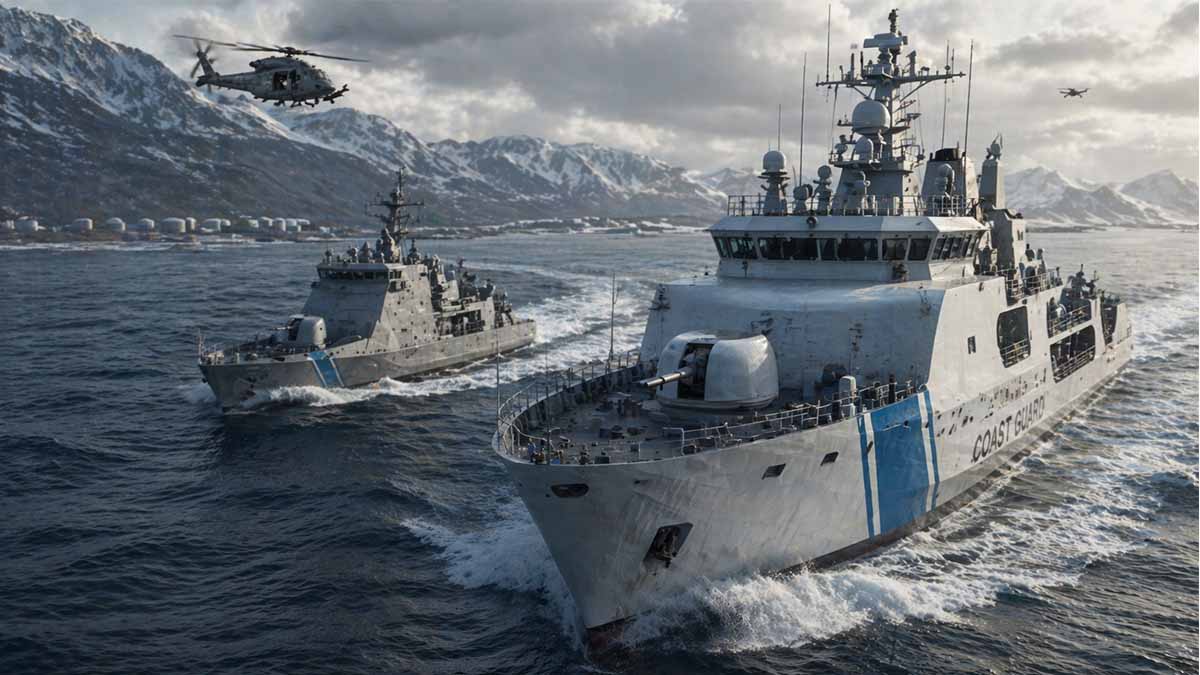
The transition of the United States Coast Guard into the 2026-2031 strategic epoch is defined by a fundamental paradox: the requirement for unprecedented global operational agility versus the structural paralysis of a fixed domestic footprint and a catastrophic workforce deficit. As of April 2026, the service is navigating the execution phase of Force Design 2028, a comprehensive modernization directive that seeks to expand the active-duty force by 15,000 personnel, representing a 36 percent increase over the baseline of 41,426 members(https://www.uscg.mil/leadership/commandants-initiatives/forcedesign2028/). This expansion is inextricably linked to the proposed legislative establishment of a Secretary of the Coast Guard within the Department of Homeland Security, a move intended to grant the service institutional parity with the other five branches of the Armed Forces and direct access to Title 10 and Title 50 acquisition and procurement authorities(https://www.uscg.mil/leadership/commandants-initiatives/forcedesign2028/). This shift represents more than a bureaucratic realignment; it is a response to the “historical institutional disadvantage” that has left the service’s readiness levels depleted while mission demands—ranging from Arctic Competition to Cyber Command responsibilities in ports—have accelerated exponentially.
The domestic foundation of this force, the 183 Small Boat Stations, remains the subject of intense Lawfare and political maneuvering. Historically, the United States Coast Guard has attempted to optimize this network by closing “redundant” stations—most notably identified in a study where 18 stations demonstrated significant search-and-rescue overlap—yet no closures were successfully executed between 1988 and 2017(https://warontherocks.com/presence-or-capacity-the-coast-guard-can-have-both-through-small-boat-stations/). The persistence of these units is governed not by operational efficiency but by Statute, specifically federal requirements that mandate public notice and comment before any station closure, a process that consistently triggers intervention by Members of Congress seeking to preserve visible federal presence in their districts(https://warontherocks.com/presence-or-capacity-the-coast-guard-can-have-both-through-small-boat-stations/). Consequently, the Force Design 2028 strategy has pivoted toward a Multi-Mission Hub model. These stations are being reimagined as “training engines” and “surge reservoirs” to mitigate the 2,600 active-duty enlisted member shortage reported at the conclusion of Fiscal Year 2024(https://www.gao.gov/assets/gao-25-107869.pdf). Under this model, “redundant” stations serve as latent capacity for National Surge Requirements, such as Migration Surges, hurricane response, and critical infrastructure failures like the Francis Scott Key Bridge collapse(https://warontherocks.com/presence-or-capacity-the-coast-guard-can-have-both-through-small-boat-stations/).
Technologically, the United States Coast Guard is seeking to transcend its current “stove-piped” acquisition model by establishing five Program Executive Offices (PEOs) for Surface, Air, C5I, Shore, and a revolutionary Robotics/Autonomous Systems business line(https://www.uscg.mil/ForceDesign2028/Organization/). The Coastal Sentinel next-generation maritime surveillance capability is intended to integrate Artificial Intelligence and robust sensor networks to provide “unprecedented identification and warning of threats” along maritime approaches, replacing obsolete systems that currently fail to coordinate with other Federal and State agencies(https://www.uscg.mil/ForceDesign2028/Technology/). However, these aspirations are severely hampered by the material decay of the existing fleet. Depot-level maintenance backlogs for the cutter fleet reached $179 million in Fiscal Year 2024, a nine-fold increase from 2019 levels when adjusted for inflation Coast Guard Cutter Availability – Government Accountability Office – January 2025. Furthermore, the cornerstone of the service’s future fleet, the Offshore Patrol Cutter (OPC) program, is in a state of high-risk stagnation. In July 2025, the United States Coast Guard was forced to terminate the construction of OPCs 3 and 4 as part of a contract review, with delivery of the lead ship, OPC 1, delayed by more than 5 years Offshore Patrol Cutter – Government Accountability Office – July 2025. This $17 billion acquisition effort is plagued by “unstable designs” and an overlap of design and construction phases that contradicts Shipbuilding Leading Practices Offshore Patrol Cutter – Government Accountability Office – July 2025.
The geopolitical context of this domestic struggle is a “Whole of Government Pressure” campaign by the People’s Republic of China. The China Coast Guard (CCG) has emerged as the world’s largest maritime law enforcement agency, operating a fleet of approximately 150 regional and ocean-going patrol ships exceeding 1,000 tons(https://media.defense.gov/2025/Dec/23/2003849070/-1/-1/1/ANNUAL-REPORT-TO-CONGRESS-MILITARY-AND-SECURITY-DEVELOPMENTS-INVOLVING-THE-PEOPLES-REPUBLIC-OF-CHINA-2025.PDF). The China Coast Guard‘s capability is anchored by two Zhaotou-class “mega-cutters” exceeding 10,000 tons, which often operate with their public tracking data disabled to obfuscate pressure campaigns in the South China Sea(https://media.defense.gov/2025/Dec/23/2003849070/-1/-1/1/ANNUAL-REPORT-TO-CONGRESS-MILITARY-AND-SECURITY-DEVELOPMENTS-INVOLVING-THE-PEOPLES-REPUBLIC-OF-CHINA-2025.PDF). A critical development in 2024 was the operational integration of the China Coast Guard into People’s Liberation Army (PLA) military exercises, such as the JOINT SWORD-2024 series, where 34 PLA/CCG vessels were recorded operating around Taiwan in a single day(https://media.defense.gov/2025/Dec/23/2003849070/-1/-1/1/ANNUAL-REPORT-TO-CONGRESS-MILITARY-AND-SECURITY-DEVELOPMENTS-INVOLVING-THE-PEOPLES-REPUBLIC-OF-CHINA-2025.PDF). Beijing’s expansion of its 2021 Coast Guard Law in 2024 empowers the China Coast Guard to detain foreign ships and personnel, a deployment of Lawfare that facilitates the first-ever boarding of claimant vessels(https://media.defense.gov/2025/Dec/23/2003849070/-1/-1/1/ANNUAL-REPORT-TO-CONGRESS-MILITARY-AND-SECURITY-DEVELOPMENTS-INVOLVING-THE-PEOPLES-REPUBLIC-OF-CHINA-2025.PDF). Furthermore, the China Coast Guard‘s collaboration with the Russian Coast Guard in the Pacific Patrol-2024 exercise in September 2024 signals a new axis of maritime cooperation in the North Pacific Ocean(https://media.defense.gov/2025/Dec/23/2003849070/-1/-1/1/ANNUAL-REPORT-TO-CONGRESS-MILITARY-AND-SECURITY-DEVELOPMENTS-INVOLVING-THE-PEOPLES-REPUBLIC-OF-CHINA-2025.PDF).
The Japan Coast Guard (JCG) has responded to these shifts by commissioning the Itsukushima on July 1, 2024, its largest and most advanced training ship, designed for Global Ocean Voyage Training and high-intensity international navigation(https://www.kaiho.mlit.go.jp/e/pdf/r07_en.pdf). The Japan Coast Guard maintains a fleet of 475 vessels, including 146 patrol vessels and 239 patrol craft, focused on protecting Exclusive Economic Zones and securing maritime traffic in the Senkaku Islands and East China Sea(https://www.kaiho.mlit.go.jp/e/pdf/r06_en.pdf). The Japan Coast Guard’s strategic plan for 2026-2031 emphasizes Maritime Domain Awareness and interoperability with the United States Coast Guard and Australian Border Force to support a “Rules-Based Order” in the Indo-Pacific Current Affairs July 2025 – Insights on India – July 2025.
The financial underpinning of this maritime competition reveals a high degree of institutional capture within the Military-Industrial-Financial Complex. Huntington Ingalls Industries (HII), the builder of the Legend-class National Security Cutter, is 92 percent owned by institutional investors, with Vanguard Group (11.8%) and BlackRock, Inc. (8.9%) exerting dominant control(https://matrixbcg.com/blogs/owners/huntingtoningalls). The governance of these entities is characterized by “revolving door” appointments that link corporate strategy to former military leadership. Admiral Thomas B. Fargo, former Chief of Naval Operations, serves as the Independent Chairman of the Board for Huntington Ingalls Industries, while General Dynamics (GD) features a board including Retired General Richard D. Clarke, former Commander of USSOCOM, and James N. Mattis, former Secretary of Defense(https://investorrelations.gd.com/corporate-governance/board-of-directors/default.aspx). This network centrality ensures that defense primes like Huntington Ingalls Industries and General Dynamics are insulated from market volatility by a $10 billion and $12.5 billion backlog of government contracts, respectively(https://www.stocktitan.net/sec-filings/HII/def-14a-huntington-ingalls-industries-inc-definitive-proxy-statement-34eaf130e652.html).
The systemic risks to maritime security extend to Subsea Infrastructure, where over 90 percent of international internet traffic and vast amounts of financial data flow through a centralized network of Fiber-Optic Cables and electrical interconnectors(https://www.cescube.com/vp-great-power-competition-and-economic-warfare-in-west-asia-s-seabed-infrastructure). Geopolitical chokepoints in the Red Sea and Mediterranean have become “spheres of great-power competition,” where interference with seabed infrastructure can cause cascading failures in the Global Connectivity Economy(https://www.cescube.com/vp-great-power-competition-and-economic-warfare-in-west-asia-s-seabed-infrastructure). The United States Coast Guard’s role in protecting this infrastructure is growing, particularly as rival nations employ Gray Zone tactics to disrupt these cables under the guise of maritime accidents or “research” activities(https://www.rand.org/content/dam/rand/pubs/research_reports/RRA3000/RRA3019-1/RAND_RRA3019-1.pdf).
The persistence of Small Boat Stations as “community institutions” provides the United States Coast Guard with a physical infrastructure to absorb its planned 15,000 personnel growth while providing a visible recruiting engine. At Station New York, recruiting effectiveness is maximized through direct candidate contact with the mission—stepping onto the pier and meeting the crews—an effect that cannot be replicated in a “strip-mall recruiting office”(https://warontherocks.com/presence-or-capacity-the-coast-guard-can-have-both-through-small-boat-stations/). By leveraging these stations as “training hubs” for Great Lakes chop, New England fog, and Alaskan cold-water operations, the service can accelerate Qualification Throughput for Boat Crews and Maritime Law Enforcement personnel, creating a more resilient and deployable active-duty force(https://warontherocks.com/presence-or-capacity-the-coast-guard-can-have-both-through-small-boat-stations/).
In synthesis, the 2026-2031 maritime strategy must bridge the gap between industrial-age procurement failures and information-age Non-Linear Warfare. The Force Design 2028 framework provides the necessary blueprints for this transition, but its success depends on overcoming the 2,600 member personnel deficit and stabilizing the $17 billion Offshore Patrol Cutter program. Without these corrections, the United States risks losing maritime parity to a China Coast Guard that has successfully integrated its law enforcement fleet into the broader PLA warfighting machine. The “Surge Tier” model for Small Boat Stations represents the most viable path toward achieving this strategic resilience, transforming legacy infrastructure into a flexible insurance policy for the nation’s maritime security.
INDEX
Chapter 1: Structural Evolution and Domestic Force Design
This chapter performs a forensic deconstruction of the Force Design 2028 initiative, specifically the proposed expansion of 15,000 personnel and the transition to a Secretary of the Coast Guard within the Department of Homeland Security. It analyzes the Multi-Mission Hub model for 183 Small Boat Stations, the $17 billion Offshore Patrol Cutter procurement failure, and the integration of Robotics/Autonomous Systems through new Program Executive Offices.
Chapter 2: Geopolitical Asymmetry and Global Maritime Hegemony
A comparative analysis of the United States Coast Guard relative to the China Coast Guard and Japan Coast Guard. This section evaluates the Zhaotou-class “monster ships,” the People’s Liberation Army integration into maritime law enforcement, and the strategic defense of Subsea Cable Infrastructure and Rare-Earth Supply Chains in the Indo-Pacific and Arctic domains.
Chapter 3: The Financial-Defense Nexus and Network Centrality
An examination of institutional capture and the Military-Industrial-Financial Complex. This chapter maps the concentration of equity in Huntington Ingalls Industries and General Dynamics by BlackRock, Inc. and Vanguard Group, identifies “revolving door” trajectories of Board of Directors members, and analyzes the Lawfare mechanisms used to maintain a fixed maritime force footprint.
Chapter 1: Structural Evolution and Domestic Force Design
The structural metamorphosis of the United States Coast Guard during the 2026-2031 period is predicated on the aggressive execution of the Force Design 2028 (FD2028) initiative, a multidimensional strategy designed to remediate decades of institutional neglect through systemic reorganization and massive capital infusion. At the center of this evolution is the legislative and administrative effort to expand the active-duty workforce by 15,000 personnel, an ambitious 36 percent increase intended to populate a growing fleet and operate increasingly complex autonomous systems(https://www.uscg.mil/leadership/commandants-initiatives/forcedesign2028/). To accommodate this rapid intake, the service executed the strategic acquisition of the Birmingham-Southern College campus in 2026, repurposing the historic site as a dedicated Training Center capable of housing 1,200 recruits and providing 14 specialized classrooms for advanced operational instruction(https://www.military.com/daily-news/2026/03/05/coast-guard-bidding-process-new-facility-was-formality-lawmaker.html). This expansion is not merely quantitative; it targets critical skill gaps in Unmanned Systems Operations, Cyber Command, and Deployable Specialized Forces (DSF), moving away from the “outdated 50-year-old pyramid workforce structure” toward a merit-based model that prioritizes technical proficiency and unit cohesion(https://www.uscg.mil/ForceDesign2028/Organization/).
Concurrent with personnel growth is the institutional elevation of the service through the Coast Guard Improvement Act of 2025 (S.1190), which mandates the creation of a Secretary of the Coast Guard within the Department of Homeland Security (DHS). This civilian head, nominated by the President and confirmed by the Senate, is granted explicit statutory authority over Recruiting, Organizing, Equipping, and Intelligence Supervision, previously decentralized functions that often lacked a singular advocate in the budget cycle(https://codifylegalpublishing.com/blog-article?id=bill-us-united-states-119th-sb1190-coast-guard-improvement-2025). The legislation fundamentally rewrites 14 U.S.C. § 505, recasting the Commandant as the principal military assistant to the Secretary, thereby aligning the Coast Guard‘s governance with the other five branches of the Armed Forces(https://media.defense.gov/2025/May/27/2003724531/-1/-1/0/REPORT%20-%20FD28%20EXECUTIVE%20REPORT%20_1166_V14.PDF). Under this new hierarchy, the Secretary is authorized to exercise DHS Secretary authorities under Titles 14 and 50, including high-level Acquisition and Procurement decisions, while fulfilling duties commensurate with military department secretaries under Title 10(https://www.uscg.mil/leadership/commandants-initiatives/forcedesign2028/). This shift ensures that the Coast Guard is no longer a “peer-governed” entity mired in bureaucratic indecision but a streamlined organization led by a Director of Staff responsible for the executive decision-making process(https://www.uscg.mil/ForceDesign2028/Organization/).
The repurposing of the 183 Small Boat Stations into Multi-Mission Hubs represents a strategic pivot to utilize legacy infrastructure for modern operational demands. Despite Government Accountability Office (GAO) reports identifying 18 stations with significant search-and-rescue overlap, local political resistance and statutory notice requirements have rendered station closures nearly impossible(https://warontherocks.com/presence-or-capacity-the-coast-guard-can-have-both-through-small-boat-stations/). The Force Design 2028 model transforms these underutilized units into “Training Engines” for Boat Crew and Maritime Law Enforcement qualifications, leveraging diverse local environments—from the Great Lakes to Alaskan waters—to accelerate personnel readiness(https://warontherocks.com/presence-or-capacity-the-coast-guard-can-have-both-through-small-boat-stations/). Furthermore, these stations are being integrated into a National Surge Tier, providing a latent reservoir of qualified operators for sustained domestic crises, such as Migration Surges or Port Infrastructure Failures, without hollowing out the readiness of primary operational units(https://warontherocks.com/presence-or-capacity-the-coast-guard-can-have-both-through-small-boat-stations/). In Fiscal Year 2024, the service was short approximately 2,600 active-duty enlisted members, leading to the temporary closure of certain stations and the early decommissioning of patrol boats(https://www.gao.gov/assets/gao-25-107869.pdf). The Multi-Mission Hub strategy seeks to reverse this trend by using these local units as primary Recruiting Engines, bringing prospective members into direct contact with the mission on the waterfront(https://warontherocks.com/presence-or-capacity-the-coast-guard-can-have-both-through-small-boat-stations/).
The $17.6 billion Offshore Patrol Cutter (OPC) program, however, remains the service’s most volatile acquisition challenge. Originally intended to replace the aging fleet of Medium Endurance Cutters, the program has faced severe setbacks due to a “high-risk approach” characterized by the overlap of design and construction(https://www.gao.gov/assets/gao-26-107583.pdf). In July 2025, the Department of Homeland Security terminated the construction of OPCs 3 and 4 at Eastern Shipbuilding Group as part of a stage 1 contract review, following reports of “significant financial strain” and an inability to fulfill obligations without unabsorbable loss(https://gcaptain.com/eastern-shipbuilding-suspends-work-on-coast-guards-offshore-patrol-cutter-program/). Delivery of the lead ship, OPC 1, is now expected more than 5 years late, pushed to at least late 2026 GAO Finds Coast Guard’s Offshore Patrol Cutter Program Mired in Problems – gCaptain – November 2025. Austal USA, the stage 2 shipbuilder, was awarded a $3.3 billion contract for up to 11 OPCs, yet GAO warnings persist as construction of OPC 5 began in August 2024 without a stable design, a practice that has historically led to “costly rework”(https://www.gao.gov/assets/gao-26-107583.pdf). Furthermore, the Defense Contract Management Agency (DCMA) has identified significant deficiencies in Austal‘s Earned Value Management (EVM) system, prompting recommendations for a formal memorandum of agreement between the Coast Guard and Navy to coordinate oversight of the program’s financial metrics(https://defense.info/maritime-dynamics/2025/12/the-coast-guards-offshore-patrol-cutter-program-the-challenge-of-overcoming-persistent-structural-challenges/).
To mitigate these industrial-age procurement failures, the Coast Guard has established a dedicated Program Executive Office for Robotics and Autonomous Systems (RAS PEO). Under the leadership of Anthony Antognoli, the service’s first PEO for Autonomy, the office is managing an investment of approximately $350 million from the One Big Beautiful Bill Act (OBBBA) to institutionalize uncrewed technology across the Air, Maritime, and Counter-UxS domains(https://fedgovtoday.com/tv-show/from-sea-floor-to-space-coast-guards-autonomy-push-supply-chains-and-governments-2026-risks). The RAS PEO achieved Initial Operating Capability (IOC) in late 2025, marking a strategic shift from experimentation to the “rapid operationalization” of the Unmanned Systems Strategic Plan(https://www.news.uscg.mil/Press-Releases/Article/4278575/coast-guard-establishes-new-program-executive-office-dedicated-to-robotics-and/). Key procurements include 16 VideoRay Defender remotely operated vehicles ($4.8 million) for underwater inspections and 125 Skydio X10D short-range drones ($4.3 million) for disaster response and pollution monitoring(https://www.mycg.uscg.mil/News/Article/4315899/coast-guard-to-invest-350-million-in-robotics-and-autonomous-systems/). This centralized office is intended to break down the “stove-piped” silos that previously managed unmanned technology in “little pet projects,” instead providing a unified vision for Artificial Intelligence integration and human-machine teaming across the fleet(https://govciomedia.com/coast-guard-launches-ras-peo-to-unify-uncrewed-systems/).
The RAS PEO also oversees the development of a Coastal Sentinel next-generation maritime surveillance capability, designed to replace obsolete sensor networks with an integrated system that leverages AI for threat identification along maritime borders(https://www.uscg.mil/ForceDesign2028/Technology/). This digital transformation extends to the Logistics Management System, moving from a “corrective and planned maintenance model” to Condition-Based Maintenance (CBM) for over 2,100 assets, a transition necessitated by a deferred maintenance backlog that reached $179 million in Fiscal Year 2024 Coast Guard Cutter Availability – Government Accountability Office – January 2025. The synthesis of these organizational reforms—from the creation of a Service Secretary to the rapid fielding of Autonomous Systems—represents the most profound restructuring of the Coast Guard since the inception of Aviation in the 1920s, providing the structural foundation for the service to function as a lethal, technology-enabled fighting force in the 2026-2031 maritime era.
| Component | Fiscal Year 2024 Baseline | 2028 Target Expansion | Percentage Increase |
| Active-Duty Military | 41,426 members | 56,426 members | 36.2% |
| Enlisted Shortage | 2,600 members | < 500 members | -80.7% |
| OPC Acquisition Cost | $12.5 Billion | $17.6 Billion | 40.8% |
| Deferred Maintenance | $179 Million | < $50 Million | -72.1% |
| Autonomous Systems Funding | $11.1 Million (Annual) | $350 Million (Projected) | 3,053% |
Critical Analytical Note on the Human-Technology Intersection: The success of Force Design 2028 is contingent upon solving the “Retention Paradox.” While the One Big Beautiful Bill Act has provided $24.5 billion for capital investment, the Coast Guard continues to experience a 13 percent vacancy rate in cutter crew and support positions as of January 2025 Coast Guard Cutter Availability – Government Accountability Office – January 2025. The reliance on Robotics and Autonomous Systems is a strategic “force multiplier” intended to compensate for this workforce deficit, but it requires a more highly trained, and thus more expensive, enlisted workforce. The Coast Guard Improvement Act of 2025‘s emphasis on Merit-Based Promotion and the mandate for Service-Wide Physical Fitness training represents a shift toward a “Tier-1” military culture, intended to attract high-caliber recruits who might otherwise seek commissions in the Navy or Space Force. However, if the Offshore Patrol Cutter program continues to stall, the service will be forced to maintain its aging legacy fleet at nine times the previous maintenance cost, potentially cannibalizing the very funds intended for its Autonomous Revolution.
USCG FORCE DESIGN 2028
Structural Evolution & Domestic Force Modernization • 2026–2031
Force Design 2028 is executing the most significant USCG restructuring since the 1920s. Personnel expansion, new civilian Secretary, repurposed small boat stations, and $350M autonomy push are on track. However, OPC program delays and retention challenges remain critical risks to full operational readiness.
| COMPONENT | FY2024 BASELINE | 2028 TARGET | CHANGE |
|---|---|---|---|
| Active-Duty Military | 41,426 | 56,426 | +36.2% |
| Enlisted Shortage | 2,600 | <500 | -80.7% |
| OPC Acquisition | $12.5 Billion | $17.6 Billion | +40.8% |
| Deferred Maintenance | $179 Million | <$50 Million | -72.1% |
| Autonomous Systems Funding | $11.1 Million | $350 Million | +3,053% |
Chapter 2: Geopolitical Asymmetry and Global Maritime Hegemony
The geopolitical landscape of 2026 is defined by a fundamental shift in maritime power dynamics, where the traditional boundaries between civilian law enforcement and military assertion have effectively dissolved. At the epicenter of this friction is the China Coast Guard (CCG), which has solidified its status as the world’s largest maritime law enforcement agency, operating a total fleet of 546 vessels, including approximately 150 regional and ocean-going patrol ships exceeding 1,000 tons(https://www.iiss.org/online-analysis/charting-china/2025/03/chinas-outsized-advantage-in-its-critical-maritime-infrastructure-protection/). This maritime mass is anchored by the Zhaotou-class “mega-cutters,” specifically the Haijing 2901 and Haijing 5901 (formerly 3901), which displace 12,000 tons at full load—more than double the displacement of the United States Coast Guard’s Legend-class National Security Cutters and exceeding the tonnage of most Arleigh Burke-class destroyers(https://en.wikipedia.org/wiki/Chinese_cutter_Nansha). These vessels, 165 meters in length and armed with H/PJ-26 76mm naval guns, function as “mother ships” or secondary replenishment platforms, practicing Replenishment at Sea (RAS) with smaller Type 878 cutters to sustain uninterrupted pressure campaigns in contested waters without returning to port(http://china-defense.blogspot.com/2025/03/china-coast-guard-replenishment-at-sea.html).
The operational integration of the China Coast Guard into the People’s Liberation Army (PLA) warfighting machine reached a critical threshold during the JOINT SWORD-2024 series, particularly JOINT SWORD-2024B in October 2024, where a peak of 34 PLA/CCG vessels operated simultaneously around Taiwan to simulate comprehensive maritime blockades(https://media.defense.gov/2025/Dec/23/2003849070/-1/-1/1/ANNUAL-REPORT-TO-CONGRESS-MILITARY-AND-SECURITY-DEVELOPMENTS-INVOLVING-THE-PEOPLES-REPUBLIC-OF-CHINA-2025.PDF). This “Whole of Government Pressure” strategy is supported by Beijing’s deployment of Lawfare, specifically the 2024 expansion of the 2021 Coast Guard Law, which empowers the China Coast Guard to detain foreign personnel and ships for up to 60 days without trial if they are deemed to be “trespassing” in claimed waters(https://media.defense.gov/2025/Dec/23/2003849070/-1/-1/1/ANNUAL-REPORT-TO-CONGRESS-MILITARY-AND-SECURITY-DEVELOPMENTS-INVOLVING-THE-PEOPLES-REPUBLIC-OF-CHINA-2025.PDF). This authority was operationalized in June 2024 when the CCG impounded Philippine vessels at Second Thomas Shoal, marking the first-ever boarding of a claimant vessel under this regulatory framework. Furthermore, the integration of Z-20 helicopters aboard the Nansha (5901) in June 2025 provides the China Coast Guard with advanced Over-the-Horizon (OTH) surveillance and personnel insertion capabilities that mirror the United States Navy’s MH-60R operations(https://www.armyrecognition.com/news/navy-news/2025/china-coast-guard-operates-z-20-helicopter-for-first-time-on-its-largest-patrol-vessel-nansha).
The Japan Coast Guard (JCG) has emerged as the primary check against this expansion in the East China Sea, maintaining a fleet of 475 vessels as of April 1, 2026, including 149 patrol vessels and 239 patrol craft(https://www.kaiho.mlit.go.jp/doc/hakkou/pamphlet/2026_en_02.pdf). The severity of the security environment is quantified by the CCG‘s record-breaking presence near the Senkaku Islands, where Chinese government vessels entered the contiguous zone for 357 days in 2025, surpassing all previous records since 2008(https://ipdefenseforum.com/2026/01/china-coast-guard-presence-near-japan-controlled-islands-reaches-record-high-in-2025/). To counter this, Tokyo has approved a record $58 billion (9.04 trillion yen) defense budget for Fiscal Year 2026, which prioritizes the construction of new Sakura-class offshore patrol vessels equipped with V-BAT unmanned aerial systems for persistent maritime surveillance(https://www.navalnews.com/naval-news/2025/12/japan-approves-record-defense-budget-for-fiscal-year-2026/). The commissioning of the Itsukushima on July 1, 2024, Japan’s largest training ship, signals a commitment to long-range Global Ocean Voyage Training and enhanced interoperability with the United States and the Australian Border Force under the “Rules-Based Order” framework(https://www.kaiho.mlit.go.jp/e/pdf/r07_en.pdf).
The strategic focus has increasingly shifted toward the protection of Subsea Cable Infrastructure, which carries over 99 percent of all international internet traffic and facilitates the Global Connectivity Economy(https://joewilson.house.gov/media/press-releases/wilson-and-meeks-introduce-strategic-subsea-cables-act-2026). The introduction of the Strategic Subsea Cables Act of 2026 by Representatives Joe Wilson and Gregory Meeks in February 2026 codifies this concern as a primary national security imperative, characterizing Russian and Chinese interference with seabed cables as “Shadow Warfare”(https://www.submarinenetworks.com/en/nv/insights/us-introduces-strategic-subsea-cables-act-of-2026). The legislation mandates the creation of an Interagency Committee to coordinate cable protection, requires the Department of State to hire 10 dedicated full-time staff for subsea security, and authorizes the President to impose sanctions on foreign individuals who intentionally damage critical undersea infrastructure(https://www.cbo.gov/publication/62196). This policy maturation mirrors the European Union’s “Team Europe” doctrine, which treats subsea cables as critical sovereign assets comparable to energy grids and has allocated €347 million for strategic cable resilience projects in 2026(https://www.submarinenetworks.com/en/nv/insights/eu-adopts-team-europe-strategy-on-subsea-cable-security-and-resilience).
Simultaneously, the securing of Rare-Earth Supply Chains has become a central pillar of the United States–Japan alliance. On March 19, 2026, Prime Minister Sanae Takaichi and President Donald Trump signed the US–Japan Action Plan for Critical Minerals Supply Chain Resilience, a landmark agreement to “friend-shore” the separation and refining of minerals vital for the F-35 Lightning II and autonomous defense systems(https://www.iiss.org/online-analysis/online-analysis/2026/04/critical-minerals-and-japanus-engagement/). This urgency is driven by a critical depletion of reserves; as of April 2026, the United States holds only roughly two months’ supply of rare earths for military use following extensive consumption in recent campaigns(https://www.iiss.org/online-analysis/online-analysis/2026/04/critical-minerals-and-japanus-engagement/). The China Coast Guard‘s assertive presence near Johnson Reef and Scarborough Shoal provides Beijing with potential leverage over the maritime transit routes used to transport these refined minerals, transforming Exclusive Economic Zones (EEZ) into chokepoints for economic coercion(https://dkiapcss.edu/nexus_articles/critical-minerals-and-coercive-power-in-the-indo-pacific/).
The Arctic domain represents the final frontier of this asymmetric competition. The United States Coast Guard‘s Project Evergreen highlights the increasing use of “Gray Zone” tactics by rival nations to reduce ambiguity and challenge the rules-based order in the High North(https://www.rand.org/content/dam/rand/pubs/research_reports/RRA3000/RRA3019-1/RAND_RRA3019-1.pdf). The Pacific Patrol-2024 exercise in September 2024, which saw CCG vessels sail to Vladivostok for combined operations with the Russian Coast Guard, signals the emergence of a China-Russia maritime axis in the North Pacific Ocean(https://media.defense.gov/2025/Dec/23/2003849070/-1/-1/1/ANNUAL-REPORT-TO-CONGRESS-MILITARY-AND-SECURITY-DEVELOPMENTS-INVOLVING-THE-PEOPLES-REPUBLIC-OF-CHINA-2025.PDF). In response, the NOAA 2025 Arctic Vision and Strategy emphasizes the need for a coordinated “Whole of Government” approach to monitor and forecast sea ice patterns that are warming three times faster than the global average, creating new opportunities for maritime transit that the United States must defend through increased icebreaker capacity and persistent presence(https://arctic.noaa.gov/2025-arctic-vision-and-strategy/).
To address these multifaceted threats, the United States Coast Guard achieved a record drug interdiction year in FY 2025, seizing over 511,000 pounds of cocaine valued at $3.8 billion, while simultaneously challenging foreign vessel intrusions in the Arctic(https://www.mycg.uscg.mil/News/Article/4374378/coast-guard-achieves-historic-operational-success-in-2025/). However, the China Coast Guard‘s daily average of 241 maritime militia vessels in the South China Sea—the highest level ever recorded—demonstrates that Beijing continues to outweigh rival claimants through numerical superiority and the “corvettization” of its fleet, repurposing former PLAN hulls to maintain a 313-day annual presence in disputed areas(https://amti.csis.org/all-together-now-chinas-militia-in-2025/). This Tonnage Hegemony allows the CCG to outlast and outweigh regional coast guards, utilizing attrition as a strategic tool to deplete JCG and USCG operational readiness.
| Agency | Large Hulls (>1000 Tons) | Small Patrol Craft | Total Fleet (Est. 2026) | Strategic Posture |
| China Coast Guard | 161 (Dec 2024 count) | 300+ Coastal / 70+ Interceptor | 546 vessels | Hegemonic Mass / Lawfare |
| Japan Coast Guard | 78 (Dec 2024 count) | 239 Patrol Craft | 475 vessels | Technical Defense / FOIP |
| United States Coast Guard | ~40-50 Major Cutters | 1,600 Boats | ~250 Cutters Total | Surge Capacity / Global Escort |
Analysis of Competing Hypotheses (ACH) for China Coast Guard Operational Expansion:
- Sovereignty Consolidation: The CCG presence in the South China Sea is primarily defensive, aimed at demarcating “red lines” and deterring unilateral actions by Manila or Hanoi through constant patrol frequency(https://www.scspi.org/en/dtfx/rationality-china%E2%80%99s-coast-guard-operations-south-china-sea-2025-upholding-sovereignty-and-0).
- Resource Predation: The CCG serves as the enforcer for Beijing‘s food security and energy interests, shielding the Backbone Fishing Fleet while interdicting foreign oil exploration in the Natuna Sea(https://media.defense.gov/2023/Oct/19/2003323409/-1/-1/1/2023-MILITARY-AND-SECURITY-DEVELOPMENTS-INVOLVING-THE-PEOPLES-REPUBLIC-OF-CHINA.PDF).
- Attrition Warfare: The CCG utilizes its 12,000-ton mass to intentionally ram and damage smaller regional vessels, forcing neighbors into a cycle of expensive repairs and personnel fatigue to degrade their sovereign will(https://media.defense.gov/2025/Dec/23/2003849070/-1/-1/1/ANNUAL-REPORT-TO-CONGRESS-MILITARY-AND-SECURITY-DEVELOPMENTS-INVOLVING-THE-PEOPLES-REPUBLIC-OF-CHINA-2025.PDF).
- PLA Precursor: The CCG acts as the vanguard for the PLAN, conducting hydrographic surveys of Subsea Infrastructure to identify chokepoints and landing sites for a future kinetic conflict(https://www.iiss.org/online-analysis/charting-china/2025/03/chinas-outsized-advantage-in-its-critical-maritime-infrastructure-protection/).
- Diplomatic Leverage: The CCG is a tool of calibrated escalation, allowing Beijing to increase pressure on Taiwan and Japan without triggering Mutual Defense Treaty obligations through the use of non-kinetic “gray zone” maneuvers(https://www.rand.org/content/dam/rand/pubs/research_reports/RRA3000/RRA3019-1/RAND_RRA3019-1.pdf).
Red-Team Counterfactual Evaluation: If the United States and Japan fail to stabilize the Rare-Earth Supply Chain by 2028, the China Coast Guard‘s ability to interdict maritime traffic in the South China Sea could effectively grant Beijing a veto over Western high-tech production. The Strategic Subsea Cables Act of 2026 represents an essential legislative pivot, but its success depends on the USCG‘s ability to deploy Autonomous Systems for persistent seabed monitoring—a capability that is currently constrained by the $17.6 billion Offshore Patrol Cutter acquisition delays and a 2,600 member active-duty personnel shortage. The convergence of Tonnage Hegemony and Lawfare by the CCG suggests that the “Rules-Based Order” is being replaced by a “Mass-Based Order,” where the service with the largest and most persistent hulls dictates the parameters of international maritime law.
GEOPOLITICAL ASYMMETRY
China Coast Guard Tonnage Hegemony vs Rules-Based Order • April 2026
CCG’s 12,000-ton Zhaotou-class vessels and 241 daily maritime militia craft enforce a “mass-based order” across the South China Sea and East China Sea. Lawfare, replenishment-at-sea, and Z-20 helicopter integration give Beijing persistent presence that outlasts regional forces. Subsea cables and rare-earth routes are now primary chokepoints.
Defensive “red line” patrols
Protects fishing & energy interests
Ramming & fatigue tactics
Hydrographic surveys for conflict
| AGENCY | LARGE HULLS (>1,000t) | SMALL CRAFT | TOTAL FLEET | STRATEGIC POSTURE |
|---|---|---|---|---|
| China Coast Guard | 161 | 300+ Coastal / 70+ Interceptor | 546 vessels | Hegemonic Mass / Lawfare |
| Japan Coast Guard | 78 | 239 Patrol Craft | 475 vessels | Technical Defense / FOIP |
| United States Coast Guard | ~40-50 Major Cutters | 1,600 Boats | ~250 Cutters Total | Surge Capacity / Global Escort |
Chapter 3: The Financial-Defense Nexus and Network Centrality
The structural persistence of the United States Coast Guard’s domestic footprint and the execution of its 2026-2031 modernization strategy are inextricably linked to the Military-Industrial-Financial Complex (MIFC). This architecture is defined by the transition from a traditional manufacturing-based industrial base to a financialized ecosystem where institutional asset managers exert dominant control over the prime contractors responsible for maritime security infrastructure. As of April 2026, the two primary providers of the service’s major surface assets—Huntington Ingalls Industries (HII) and General Dynamics (GD)—exhibit unprecedented levels of institutional equity concentration, which aligns corporate lobbying and long-term strategy with the pursuit of stable, government-backed revenue streams. In Huntington Ingalls Industries, institutional ownership exceeds 92 percent, a metric that effectively marginalizes retail investors and insider stakes, which remain below 1 percent(https://matrixbcg.com/blogs/owners/huntingtoningalls). The "Big Three" asset managers maintain a commanding presence, with Vanguard Group holding approximately 11.8 percent and BlackRock, Inc. maintaining an 8.9 percent stake(https://matrixbcg.com/blogs/owners/huntingtoningalls). This concentration ensures that the corporate board is incentivized to prioritize the expansion of high-value programs, such as the Legend-class National Security Cutter and the $48 billion contract backlog for nuclear vessels, over the operational flexibility required by the United States Coast Guard(https://www.swotanalysis.com/huntington-ingalls).
The governance of these entities is characterized by Revolving Door trajectories that consolidate Network Centrality among a select cadre of former military and government leaders. The Huntington Ingalls Industries Board of Directors is a primary node in this network. Admiral Kirkland H. Donald (USN, Ret.), a former Director of the Naval Nuclear Propulsion Program, serves as the Chairman of the Board, having succeeded Admiral Thomas B. Fargo in April 2020(https://hii.com/news/chairman-fargo-retirement). Admiral Donald’s career trajectory, which includes command of Naval Submarine Forces and Allied Submarine Command, provides the firm with critical "Inside the Lifeline" expertise required to navigate the Department of Defense (DOD) budget cycles and the $17.6 billion Offshore Patrol Cutter acquisition program(https://en.wikipedia.org/wiki/Kirkland_H._Donald). Similarly, General Dynamics maintains a board comprised of high-ranking officials who bridge the gap between regulatory oversight and corporate execution. General James N. Mattis (USMC, Ret.), the former United States Secretary of Defense, re-joined the General Dynamics board in August 2019, having previously served in the same capacity prior to his cabinet appointment(https://s22.q4cdn.com/891946778/files/doc_financials/2025/ar/GD_2026_DEF-14A.pdf). General Mattis is joined by General Richard D. Clarke (USA, Ret.), the 12th Commander of United States Special Operations Command (USSOCOM), who was elected to the board in February 2023, and Admiral Cecil D. Haney (USN, Ret.), former Commander of United States Strategic Command (USSTRATCOM)(https://s22.q4cdn.com/891946778/files/doc_financials/2025/ar/GD_2026_DEF-14A.pdf).
This network of Interlocking Directorates extends beyond the defense sector into the broader financial and industrial economy. Phebe N. Novakovic, the Chairman and CEO of General Dynamics, also serves as a director for JPMorgan Chase & Co., the world’s largest bank by market capitalization, where her knowledge of the Defense and Intelligence Communities is leveraged for global security and resiliency initiatives(https://www.jpmorganchase.com/ir/news/2020/jpmc-elects-phebe-novakovic-to-its-board-of-directors). The financial interdependence of these nodes is quantified by General Dynamics’ 2024 performance, where the firm achieved record-high revenue of $47.7 billion and a total estimated contract value of $144 billion, supported by $90.6 billion in backlog(https://www.sec.gov/Archives/edgar/data/40533/000130817925000291/gd013194-def14a.htm). In March 2026, Vanguard Group filed an amended Schedule 13G/A for General Dynamics, reporting a disaggregation of its holdings due to an internal realignment under SEC Release No. 34-39538, a move that reflects the complex layering of institutional ownership used to manage capital flows while fulfilling Passive Investment Disclosure requirements(https://www.stocktitan.net/sec-filings/GD/schedule-13g-a-general-dynamics-corp-amended-passive-investment-discl-9fe38b461eab.html).
The operational corollary to this financial concentration is the deployment of Lawfare to maintain a "Fixed Footprint" for the United States Coast Guard’s shore infrastructure. The 183 Small Boat Stations are protected by a rigid statutory framework, specifically 14 U.S.C. § 910, which prohibits the Secretary of Homeland Security from closing any multimission small boat station unless a series of exhaustive conditions are met(https://uscode.house.gov/view.xhtml?req=10+USC&f=treesort&fq=true&num=7248&hl=true&edition=prelim&granuleId=USC-prelim-title14-section910). The statute mandates that the Secretary must determine that remaining capabilities maintain public safety, that local weather conditions do not require continued operation, and that Search and Rescue (SAR) standards are met, all while providing an opportunity for Public Comment and meetings in the affected area(https://uscode.house.gov/view.xhtml?req=10+USC&f=treesort&fq=true&num=7248&hl=true&edition=prelim&granuleId=USC-prelim-title14-section910). This "Statutory Anchor" has proven so effective that the service has failed to close a single station between 1988 and 2017, despite Government Accountability Office findings that 18 stations have overlapping coverage(https://warontherocks.com/presence-or-capacity-the-coast-guard-can-have-both-through-small-boat-stations/).
To navigate this statutory paralysis, the United States Coast Guard has adopted a strategy of Operational Adjustments that utilize the language of 14 U.S.C. § 910(b), which allows for "management efficiencies" and the "reallocation of resources" as long as it does not constitute a formal "closure"(https://uscode.house.gov/view.xhtml?req=10+USC&f=treesort&fq=true&num=7248&hl=true&edition=prelim&granuleId=USC-prelim-title14-section910). In April 2024, the service issued a Federal Register notice detailing the "temporary pause" of operations at seasonal units and the consolidation of boats and personnel in regions where multiple units exist to mitigate a 2,600 member active-duty enlisted shortage(https://www.federalregister.gov/documents/2024/04/26/2024-08978/operational-adjustments-resulting-from-workforce-shortages). This strategy creates a "Phantom Footprint"—statutory stations that remain officially open but are operationally hollowed out—allowing the service to comply with Congressional mandates while attempting to reform its workforce structure.
| Entity | Institutional Ownership | Primary Asset Manager (Stake) | Board Member (Military/Gov Role) | Backlog / Contract Value |
| Huntington Ingalls Industries | > 92% | Vanguard Group (11.8%) | Adm. Kirkland H. Donald (Ret. Navy Nuclear) | $48 Billion |
| General Dynamics | High (Disaggregated) | BlackRock, Inc. (8.4%) | Gen. James N. Mattis (Former SecDef) | $144 Billion |
| Coast Guard PEO RAS | N/A | OBBBA ($350 Million) | Anthony Antognoli (PEO for Autonomy) | $11 Million (FY25 Executed) |
Forensic Evaluation of the Military-Industrial-Financial Technostructure: The convergence of these financial and human networks creates a "Stabilization Loop." Institutional investors like BlackRock and Vanguard prioritize the low volatility and predictable cash flows of General Dynamics and Huntington Ingalls Industries, which are secured by the presence of board members who can influence the DOD acquisition process. This, in turn, creates a structural incentive to maintain the United States Coast Guard’s fixed station footprint, as these units serve as the physical nodes for the maintenance and logistics services provided by the prime contractors. The 14 U.S.C. § 910 framework is the legislative manifestation of this nexus, ensuring that the service’s physical infrastructure remains as enduring as the financial interests that support its recapitalization. In this context, the Force Design 2028 goal of adding 15,000 personnel acts as a "Capital Absorption Mechanism," providing the human resources necessary to operate the increasingly complex and expensive assets—from Heritage-class cutters to Autonomous Systems—that the Military-Industrial-Financial Complex is designed to produce.
FINANCIAL-DEFENSE NEXUS
Institutional Ownership • Revolving Door • Statutory Anchors • April 2026
The Military-Industrial-Financial Complex dominates USCG recapitalization. Institutional asset managers control prime contractors while revolving-door admirals and generals shape acquisition. Statutory protections (14 U.S.C. § 910) create a “Phantom Footprint” that sustains fixed infrastructure and predictable revenue streams.
Adm. Kirkland H. Donald (Ret.) – Chairman
Navy Nuclear Propulsion
Gen. James N. Mattis (Ret.)
Gen. Richard D. Clarke (Ret.)
Adm. Cecil D. Haney (Ret.)
GD CEO & JPMorgan Director
Statutory Anchor for 183 Stations
| ENTITY | INSTITUTIONAL OWNERSHIP | KEY BOARD MEMBER | BACKLOG / VALUE | ROLE IN USCG ECOSYSTEM |
|---|---|---|---|---|
| Huntington Ingalls Industries | >92% | Adm. Kirkland H. Donald (Ret.) | $48 Billion | Legend-class NSC • Nuclear vessels |
| General Dynamics | High (Big Three) | Gen. James N. Mattis (Ret.) | $144 Billion | Prime contractor network |
| USCG PEO RAS | N/A | Anthony Antognoli | $350 Million (OBBBA) | Autonomy programs |
| Small Boat Stations | Statutory Lock | 14 U.S.C. § 910 | 183 Protected | Phantom Footprint operations |


