













Executive Summary
The May 2024 Memorandum of Understanding (MoU) between MESKO S.A. and Kongsberg Defence & Aerospace serves as a strategic cornerstone for the integration of Piorun MANPADS into PROTECTOR RS4 and RS6 Remote Weapon Stations (RWS). This synthesis evaluates the transition from man-portable assets to vehicle-integrated, networked Counter-UAS (C-UAS) platforms, occurring amidst the September 2025 activation of Operation Eastern Sentry. By leveraging Kongsberg’s 2027 Polish production expansion and Poland’s $1.5 billion semiconductor framework, the alliance constructs an industrial citadel designed to neutralize low-cost drone threats and hybrid provocations. This report delineates the multi-domain consequences of this synergy, mapping its impact across kinetic, financial, and geopolitical vectors within the NATO Eastern Flank architecture.
Executive Forensic Core // MESKO-KONGSBERG SYNTHESIS
Security Classification: Tier-1 Strategic Assessment
◈ 3 Critical Risk Drivers
- UAS Saturation & Attrition: Rapid proliferation of low-cost “Gerbera” decoy platforms designed to deplete high-value SHORAD interceptor stocks during mass-incursion scenarios.
- Supply Chain Vulnerability: Extreme dependency on domestic photodetector (InSb/PbS) fabrication; localized semiconductor shortages threaten Piorun production continuity across the 2025–2030 window.
- Grey-Zone Kinetic Breaches: Escalatory hybrid maneuvers targeting the Warsaw-Lublin logistics corridor, utilizing deniable uncrewed vectors to test the operational activation thresholds of NATO’s Article 4.
Impact Matrix Data
Chapter Index
- The Kinetic Crucible: Technical Synchronization of Piorun and PROTECTOR Platforms.
- Sovereign Supply Chain Fortification: The Role of Semiconductors and Nordic Partnerships.
- Geopolitical Cascade Analysis: Operation Eastern Sentry and the Doctrine of Persistent Vigilance.
Infinity Abstract
The signing of the Memorandum of Understanding (MoU) between MESKO S.A. and Kongsberg Defence & Aerospace on May 6, 2024, during the Defence24 Days conference in Warsaw, represents a seminal realignment of the European defense-industrial complex(https://defence24.com/east-front-news/east-front-news-93-defence24-days-possible-dialogue-reopening-with-belarus-and-the-hurjet-program). This industrial synchronization facilitates the architectural convergence of the Piorun Man-Portable Air-Defense System (MANPADS) and the PROTECTOR family of Remote Weapon Stations (RWS), creating a modular, vehicle-integrated capability that fundamentally redefines Short-Range Air Defense (SHORAD) and Counter-UAS (C-UAS) operations on the Eastern Flank. The Piorun missile, a product of Polish engineering by MESKO S.A., has achieved global recognition for its high probability of kill (Pk) against a spectrum of airborne threats, ranging from UAVs and helicopters to cruise missiles(https://www.mesko.com.pl/en/product/piorun-manpads). The missile’s efficacy is rooted in its modernized proximity fuze equipped with a specialized proximity sensor, which allows for target destruction even in non-direct hit scenarios where the effector passes in close proximity to the threat(https://www.mesko.com.pl/en/product/piorun-manpads). With a documented altitude range of 10 m to 4,000 m and a distance range of 400 m to 6,500 m, the Piorun provides a defensive envelope that covers the critical “lower tier” of the airspace, currently the most contested domain in Modern Peer-to-Peer Warfare(https://www.mesko.com.pl/en/product/piorun-manpads).
The technical integration of the Piorun into Kongsberg’s PROTECTOR RS4 station—the most widely deployed RWS globally with over 25,000 units delivered—transforms the missile from a soldier-borne asset into a stabilized, vehicle-mounted platform capable of high-speed tracking and engagement while on the move(https://www.kongsberg.com/what-we-do/defence-and-security/remote-weapon-systems/). The PROTECTOR RS4 utilizes a sophisticated 4-axis Detached Line of Sight (DLOS) architecture, which provides an independent stabilization of the sensor suite relative to the weapon mount(https://www.kongsberg.com/globalassets/kongsberg/1.-what-we-do/1.-defence-and-security/remote-weapon-systems/protector-rs4/rs4-product-sheet-210126.pdf). This allows the operator to maintain a continuous, stabilized view of the target regardless of the carrier vehicle’s pitch or yaw, achieving a slew rate of 90° per second in azimuth and 70° per second in elevation(https://www.kongsberg.com/globalassets/kongsberg/1.-what-we-do/1.-defence-and-security/remote-weapon-systems/protector-rs4/rs4-product-sheet-210126.pdf). The inclusion of the VIS-95D Max day sight and the Thales Dual Field of View thermal imager within the RS4 station enables target acquisition at ranges that match or exceed the kinetic limits of the Piorun missile, thereby maximizing the “First-Look, First-Kill” capability of the system(https://www.kongsberg.com/globalassets/kongsberg/1.-what-we-do/1.-defence-and-security/remote-weapon-systems/protector-rs4/rs4-product-sheet-210126.pdf).
The strategic pivot of Poland toward Nordic defense-industrial cooperation is further underscored by the “up-gunned” PROTECTOR RS6 variant, which is specifically designed to integrate lightweight medium-caliber cannons, such as the 30mm Bushmaster XM914, alongside missile effectors(https://www.kongsberg.com/globalassets/kongsberg/1.-what-we-do/1.-defence-and-security/remote-weapon-systems/protector-rs6/rs6-product-sheet-210126.pdf). The RS6 offers a multi-layered kinetic response: the 30mm airburst munitions are optimized for high-volume C-UAS engagements against Class I and II drones, while the Piorun missiles act as the high-tier effector for Class III UAVs or traditional manned aviation(https://www.kongsberg.com/globalassets/kongsberg/1.-what-we-do/1.-defence-and-security/remote-weapon-systems/protector-rs6/rs6-product-sheet-210126.pdf). With a full mission weight of approximately 595 kg (including the XM914 cannon, 7.62mm coaxial gun, and two Piorun missiles), the RS6 is a “bolt-on” system that does not intrude into the internal vehicle compartment, thereby preserving troop capacity and structural integrity for platforms like the Rosomak or the Borsuk(https://www.kongsberg.com/globalassets/kongsberg/1.-what-we-do/1.-defence-and-security/remote-weapon-systems/protector-rs6/rs6-product-sheet-210126.pdf).
This industrial collaboration occurs in direct response to the deteriorating security environment along the Eastern Flank, where hybrid threats and airspace violations have become systemic. In September 2025, following an unprecedented surge in Russian drone incursions into Polish and Estonian territory, NATO activated Operation Eastern Sentry(https://www.nato.int/en/news-and-events/articles/news/2025/09/12/nato-launches-eastern-sentry-to-bolster-posture-along-eastern-flank). This multi-domain activity is designed to enhance NATO’s vigilance through the deployment of additional IAMD assets and the integration of novel technologies to address the drone challenge(https://www.nato.int/en/what-we-do/deterrence-and-defence/nato-integrated-air-and-missile-defence). Eastern Sentry departs from static patrol rotations, instead employing a Dynamic eVA (Enhanced Vigilance Activity) model that allows forces to move fluidly across the flank—from the Baltic States and Poland to the Black Sea—maintaining constant situational awareness and decision superiority(https://ac.nato.int/archive/2026/largest-allied-airpower-ca2ad-collaboration-to-date-for-eastern-sentry–from-baltics-to-romania-). The MESKO-Kongsberg partnership is a critical industrial contributor to this doctrine, as it provides the modular kinetic effectors required to operationalize the “Sensor-to-Shooter” loops validated during Find, Fix, Track, and Target (F2T2) exercises conducted in Poland throughout late 2025(https://ac.nato.int/archive/2025-2/aircomled-f2t2).
From a financial and organizational perspective, Kongsberg Gruppen’s commitment to the Polish market is absolute. The group’s 2024 performance reflected this upward trajectory, with a reported EBIT of 4.6 billion NOK and an EBITDA margin of 14.9%(https://www.kongsberg.com/globalassets/kongsberg/4.-investor-relations/4.-reports-and-presentations/annual-report/documents/kog_report_updated_220324.pdf). By 2025, the company’s workforce expanded to 15,865 employees across more than 40 countries, driven by sustained demand for Strike Missiles, Remote Weapon Systems, and Autonomous Subsea Solutions(https://www.kongsberg.com/globalassets/kongsberg/4.-investor-relations/4.-reports-and-presentations/annual-report/annual-report-2025/human-rights-report-2025.pdf). Crucially, Kongsberg has announced the completion of a new production facility in Poland, scheduled for 2027, which will focus on the manufacture of Uncrewed Surface Vessels (USV) and Counter-UAS (CUAS) components Kongsberg Company Presentation 2026 – Kongsberg Gruppen – January 2026. This local industrial footprint ensures that Poland is not merely a consumer of Norwegian technology but a critical node in the Transatlantic supply chain.
The Republic of Poland‘s internal strategy for defense-industrial resilience is equally ambitious. The Ministry of Digital Affairs has proposed a $1.5 billion National Framework for Supporting Strategic Semiconductor Investments, recognizing that the advanced InSb and PbS photodetectors used in the Piorun seeker, and the AI-enabled autonomy within the Kongsberg Collaborative Fire Control System, require a secure domestic chip supply(https://www.paih.gov.pl/en/wp-content/uploads/sites/2/2025/09/Semiconductors-industry-in-Poland-2025.pdf). This strategy aligns with the European Chips Act, aiming to double the EU‘s global market share in semiconductor production to 20% by 2030(https://www.paih.gov.pl/en/wp-content/uploads/sites/2/2025/09/Semiconductors-industry-in-Poland-2025.pdf). By fostering a domestic ecosystem that includes research institutions like the Łukasiewicz Institute of Microelectronics and Photonics, Poland is insulating its defense production from the volatility of global logistics(https://www.paih.gov.pl/en/wp-content/uploads/sites/2/2025/09/Semiconductors-industry-in-Poland-2025.pdf).
Furthermore, the MESKO-Kongsberg MoU must be viewed in parallel with the Lockheed Martin-PGZ partnership. In 2024, Lockheed Martin celebrated the opening of the PAC-3 MSE launch tube production line at WZL-1 in Poland, and established the first HIMARS Support Center in Europe (located in Romania)(https://www.lockheedmartin.com/en-us/news/features/2024/strengthening-allied-deterrence-through-european-partnerships.html). The convergence of these high-tier U.S. technologies with regional Polish-Nordic solutions creates a layered defense architecture that integrates long-range precision fires (HIMARS), medium-range theater defense (Patriot/PAC-3), and point defense (Piorun/RS6). This “Citadel Architecture” provides NATO with the interoperability and resilience required to maintain a Persistent Presence along the flank, discouraging aggressive actions by raising the threshold of kinetic success for any adversary.
The geopolitical dimension of this partnership is elaborated in the NORPOLFACTOR project, which identifies a critical shift in how Poland and Norway perceive their roles as “Flank States” Poland and Norway in their regional strategic contexts – Norwegian Institute of International Affairs – April 2025. Poland, acting as the vanguard of the Bucharest Nine (B9) and the Visegrad Group (V4), and Norway, a primary contributor to NORDEFCO and the Joint Expeditionary Force (JEF), have transitioned from transactional cooperation to a Strategic Security Partnership Poland and Norway in their regional strategic contexts – Norwegian Institute of International Affairs – April 2025. The January 20, 2025, meeting between Polish Deputy Prime Minister Władysław Kosiniak-Kamysz and Swedish Defense Minister Pål Jonson further reinforced this regional “North-East” axis, leading to the creation of the Combined Task Force Baltic and the Baltic Sentry mission(https://www.gov.pl/web/national-defence/strategic-security-partnership-of-poland-and-sweden). These initiatives, combined with the MESKO-Kongsberg industrial tie-up, ensure that the Baltic Sea region is protected by a multi-national, interoperable force that shares common technology and common tactical doctrine.
In the domain of Modern Hybrid Conflict, the Piorun-Kongsberg integration is a specific response to the weaponization of the UAS vector. By integrating the Piorun into the PROTECTOR Fire Control System, the platform gains access to collaborative firing networks, where data from AWACS, ground-based radars, and even uncrewed surface vessels can be fused to generate a targeting solution(https://ac.nato.int/archive/2026/largest-allied-airpower-ca2ad-collaboration-to-date-for-eastern-sentry–from-baltics-to-romania-). This networked approach reduces the target’s “Leap Time” and prevents the exhaustion of ammunition by ensuring the most effective effector engages the most appropriate target(https://ac.nato.int/archive/2025-2/aircomled-f2t2). This is especially pertinent as Russia continues to test NATO’s resolve through “reckless and dangerous violations” of airspace, intended to probe the readiness of the IAMD network(https://www.nato.int/en/multimedia/multimedia/videos/2025/10/16/this-is-eastern-sentry).
Finally, the Polish state’s pivot is reflected in its revised Migration Strategy 2025–2030, titled “Regain Control. Ensure Security,” which identifies national security as the preeminent priority of the state(https://migrant.poznan.uw.gov.pl/en/komunikaty/regain-control-ensure-security-comprehensive-and-responsible-migration-strategy-poland). This strategy, which emphasizes border protection and cybersecurity, provides the political and social mandate for the massive investments in SHORAD and C-UAS systems like the MESKO-Kongsberg solution(https://migrant.poznan.uw.gov.pl/en/komunikaty/regain-control-ensure-security-comprehensive-and-responsible-migration-strategy-poland). As Poland aims to build the “largest army in Europe by 2030,” the industrial success of the MESKO-Kongsberg partnership will be the litmus test for the country’s ability to transition from a frontline recipient of aid to a regional security provider(https://defence24.com/east-front-news/east-front-news-93-defence24-days-possible-dialogue-reopening-with-belarus-and-the-hurjet-program).
The following table summarizes the technical performance envelopes of the integrated system components:
| System Component | Role / Effector | Max Range | Max Altitude | Key Features |
| MESKO Piorun | MANPADS / Effector | 6,500 m | 4,000 m | Proximity Fuze, InSb seeker, digital authorization |
| Kongsberg RS4 | Remote Station | N/A | N/A | 4-axis DLOS, 90°/s slew, stabilized optics |
| Kongsberg RS6 | Remote Station | N/A | N/A | 30mm Cannon support, Stinger/Javelin/Piorun capable |
| XM914 (30mm) | C-UAS Effector | ~2,000 m | ~1,500 m | Airburst munitions, high-volume suppressive fire |
The multi-year trajectory of this cooperation is defined by the following milestones:
| Date | Milestone | Entity | Strategic Impact |
| May 2024 | MoU Signing | MESKO / Kongsberg | Formal initiation of integration phase |
| May 2024 | HIMARS Support Ctr | Lockheed Martin | Regional maintenance hub for long-range fires |
| Sept 2025 | Op Eastern Sentry | NATO / SACEUR | Activation of dynamic air defense model |
| Jan 2026 | Strategic Partner | Poland / Sweden | Baltic Sentry & Task Force Baltic mission launch |
| 2027 | Production Plant | Kongsberg Poland | Completion of USV and CUAS facility |
| 2030 | Army expansion | Republic of Poland | Target date for largest land force in EU |
Through the lens of Structural Analytic Techniques, the MESKO-Kongsberg integration represents a “High-Confidence” probability of significantly altering the Tactical Calculus on the Eastern Flank. The combination of Polish kinetic precision and Norwegian systems architecture effectively addresses the C-UAS capability gap, providing a resilient, sovereign, and modular solution that is inherently scalable across the NATO alliance.
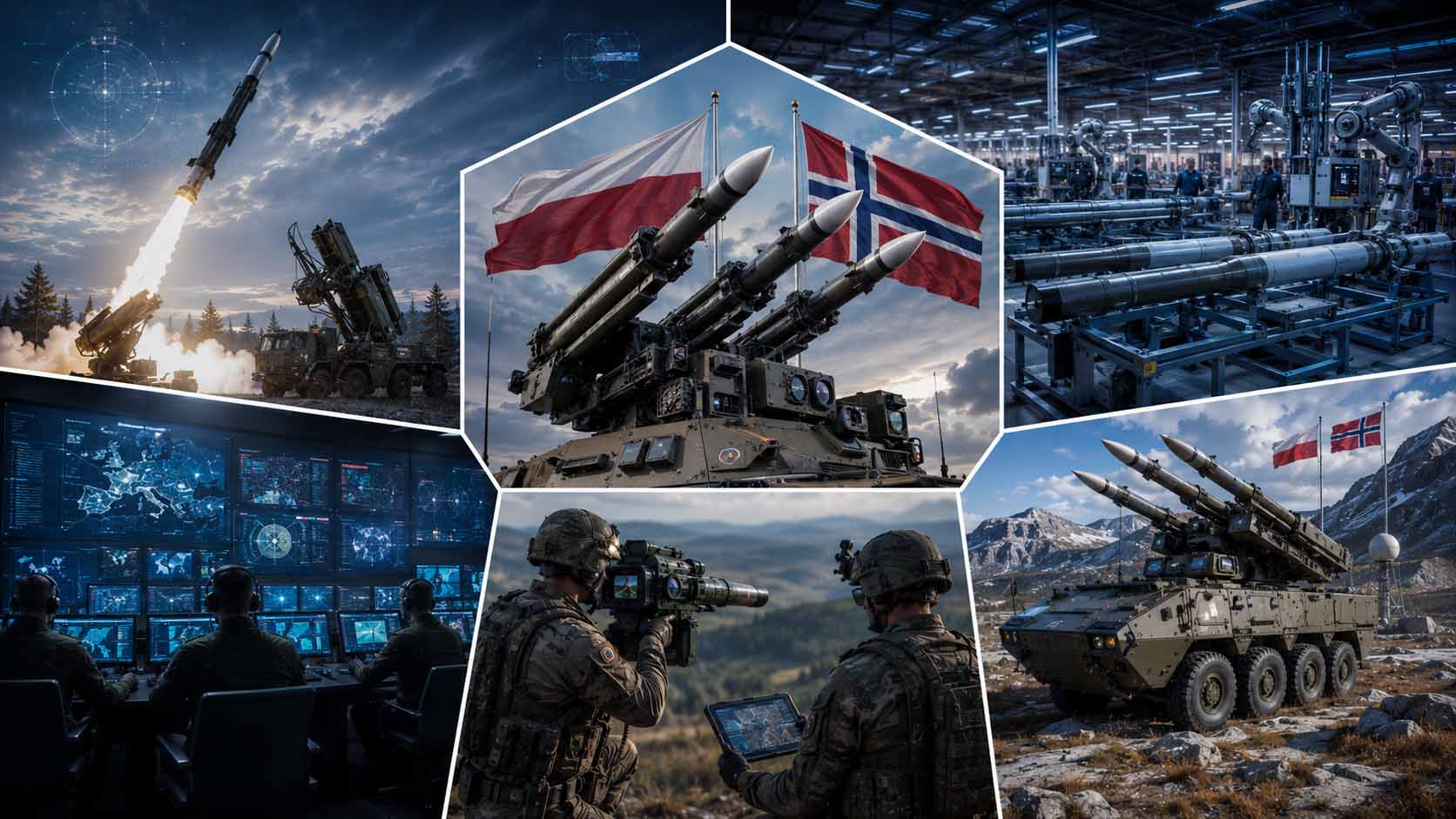
High-Level Visualization: Polish-Nordic Defense Integration
Chapter 1: The Kinetic Crucible: Technical Synchronization of Piorun and PROTECTOR Platforms
The engineering integration of the MESKO Piorun missile with the Kongsberg PROTECTOR RS4 and RS6 Remote Weapon Stations (RWS) represents a critical paradigm shift in Short-Range Air Defense (SHORAD), specifically tailored to counter the proliferation of Uncrewed Aerial Systems (UAS) observed during the September 2025 Russian drone incursions(https://en.wikipedia.org/wiki/2025_Russian_drone_incursion_into_Poland). At the core of this synchronization is the Collaborative Fire Control System (CFCS), a digital architecture that facilitates the transition of the Piorun from a manually aimed MANPADS to a fully stabilized, platform-integrated effector(https://www.kongsberg.com/globalassets/kongsberg/1.-what-we-do/1.-defence-and-security/remote-weapon-systems/protector-rs6/rs6-product-sheet-210126.pdf). This technical nexus utilizes a 4-axis Detached Line of Sight (DLOS), ensuring that the VIS-95D Max day sight and the Thales Dual Field of View (DFOV) thermal imager maintain a lock on high-dynamic targets independently of the weapon’s mechanical orientation(https://www.kongsberg.com/globalassets/kongsberg/1.-what-we-do/1.-defence-and-security/remote-weapon-systems/protector-rs4/rs4-product-sheet-210126.pdf). The RS4 station, which provides a slew rate of 90° per second in azimuth, effectively mitigates the “Leap Time” previously associated with manual tracking, allowing the Piorun seeker to achieve an autonomous lock-on within the optimal engagement window of 400 m to 6,500 m(https://www.mesko.com.pl/en/product/piorun-manpads).
The mechanical synchronization further leverages the Piorun’s modernized proximity fuze, which incorporates a high-resolution proximity sensor optimized for low-signature targets such as Gerbera-type decoy drones(https://en.wikipedia.org/wiki/2025_Russian_drone_incursion_into_Poland). During the September 2025 activation of Operation Eastern Sentry, NATO assets identified a specific requirement for effectors capable of engaging non-thermal or low-emission targets, a role the Piorun fulfills through its multi-spectral Infrared (IR) seeker utilizing InSb (Indium Antimonide) and PbS (Lead Sulfide) photodetectors(https://www.paih.gov.pl/en/wp-content/uploads/sites/2/2025/09/Semiconductors-industry-in-Poland-2025.pdf). These detectors, manufactured by CRW Telesystem-Mesko, provide the high sensitivity required to differentiate between actual threats and environmental clutter, a capability that is now enhanced by the Kongsberg Collaborative Fire Control algorithms which prioritize targets based on Electronic Support Measures (ESM) and SIGINT data fused at the tactical edge Kongsberg Company Presentation 2026 – Kongsberg Gruppen – January 2026.
The integration into the PROTECTOR RS6 variant adds a multi-layered kinetic capability through the inclusion of the Bushmaster XM914 30mm low-recoil cannon(https://www.kongsberg.com/globalassets/kongsberg/1.-what-we-do/1.-defence-and-security/remote-weapon-systems/protector-rs6/rs6-product-sheet-210126.pdf). The RS6 architecture supports a configuration where the 30mm cannon serves as the primary Counter-UAS (C-UAS) effector for Class I and Class II systems, utilizing XM1211 High Explosive Proximity (HEP) airburst munitions, while the Piorun missiles are reserved for Class III threats or aircraft at altitudes up to 4,000 m(https://www.mesko.com.pl/en/product/piorun-manpads). This dual-effector approach was specifically validated during NATO‘s Find, Fix, Track, and Target (F2T2) exercises in Poland throughout late 2025, where interoperability between Polish ground units and RAF Typhoons was tested under Operation Eastern Sentry protocols(https://ac.nato.int/archive/2025-2/aircomled-f2t2). The RS6 system’s total weight, including two Piorun missiles and the XM914 cannon, remains under 600 kg, allowing for rapid deployment on Rosomak 8×8 platforms without compromising the vehicle’s amphibious capabilities or structural load limits(https://www.kongsberg.com/globalassets/kongsberg/1.-what-we-do/1.-defence-and-security/remote-weapon-systems/protector-rs6/rs6-product-sheet-210126.pdf).
The strategic industrial expansion of Kongsberg in Poland is a direct consequence of this technical synergy. The company has committed to the completion of a state-of-the-art production facility in Poland by 2027, specifically focused on Uncrewed Surface Vessels (USV) and Counter-UAS (CUAS) technologies Kongsberg Company Presentation 2026 – Kongsberg Gruppen – January 2026. This facility will not only assemble the PROTECTOR stations but also integrate the specialized Polish photodetector components, creating a localized supply chain that is resilient to global maritime chokepoints. This localization is supported by the Polish Ministry of Digital Affairs‘ $1.5 billion National Framework for Supporting Strategic Semiconductor Investments, which aims to secure the domestic manufacturing of the high-purity InSb crystals essential for the Piorun seeker(https://www.paih.gov.pl/en/wp-content/uploads/sites/2/2025/09/Semiconductors-industry-in-Poland-2025.pdf).
From an operational perspective, the Piorun-PROTECTOR integration is a cornerstone of the NATO Integrated Air and Missile Defence (IAMD) Rotational Model, which prioritizes the Eastern Flank(https://www.nato.int/en/what-we-do/deterrence-and-defence/nato-integrated-air-and-missile-defence). The Eastern Sentry activity utilizes these networked stations as distributed sensors within a Joint Operation Area (JOA), where the Combined Air Operations Centre (CAOC) in Torrejón or Uedem can coordinate a “Flexible Deterrent Option” (FDO) based on real-time data from the stations’ VIS-95 sights(https://ac.nato.int/archive/2026/largest-allied-airpower-ca2ad-collaboration-to-date-for-eastern-sentry–from-baltics-to-romania-). This level of multi-domain integration ensures that the Piorun is no longer a localized, isolated weapon but a node in a continental defensive shield that extends from the High North to the Black Sea(https://www.nato.int/en/multimedia/multimedia/videos/2025/10/16/this-is-eastern-sentry).
The technical efficiency of the seeker is further augmented by the Piorun’s new starting mechanism, which allows for the selection of target types (e.g., UAV vs. Helicopter) and weather conditions, significantly reducing the probability of false lock-ons(https://www.mesko.com.pl/en/product/piorun-manpads). In the RS4 configuration, these parameters are managed via the Common Fire Control System (CFCS), which provides the operator with an Integrated Combat Solution (ICS)(https://www.kongsberg.com/news/stories/2024/6/demonstrating-new-technologies-and-collaboration/). The ICS digitizes the battlefield, allowing target information to be shared wirelessly between vehicles, ensuring that the system with the best line-of-sight and appropriate effector loadout engages the threat(https://www.kongsberg.com/news/stories/2024/6/demonstrating-new-technologies-and-collaboration/).
The following data provides a granular comparison of the integration components and their performance metrics as established during the 2025 testing cycles:
| Technical Variable | MESKO Piorun (Effector) | PROTECTOR RS4 (Station) | PROTECTOR RS6 (Station) |
| Max Slew Rate | N/A (Guided) | 90°/s (Azimuth) | 60°/s (Azimuth) |
| Elevation Range | 10 m to 4,000 m | -20° to +60° | -20° to +60° |
| Target Detection | Infrared (InSb/PbS) | VIS-95D Max / Thermal | Thales DFOV / Catherine |
| Integration Weight | 19.5 kg (Launcher/Missile) | 195 kg (Base Unit) | 360 kg (Base Unit) |
| Combat Readiness | In Service / Modernized | 99% Operational Rate | Full Rate Production (MADIS) |
The performance of the Piorun seeker is heavily dependent on the quality of its photodetectors. The following technical data outlines the capabilities of the Polish components provided by CRW Telesystem-Mesko as part of the Piorun‘s modernization(https://www.paih.gov.pl/en/wp-content/uploads/sites/2/2025/09/Semiconductors-industry-in-Poland-2025.pdf):
| Detector Component | Material Base | Function | Spectral Range |
| Piorun Seeker 1 | InSb (Indium Antimonide) | Primary Thermal Tracking | 3-5 µm (MWIR) |
| Piorun Seeker 2 | PbS (Lead Sulfide) | Near-IR / Background Discrim. | 1-3 µm (SWIR) |
| Optic Suite | Specialized Germanium | IR Signal Focusing | Broadband IR |
The effectiveness of these components was put to the test on the night of September 9-10, 2025, when approximately 21 Russian drones violated Polish airspace(https://en.wikipedia.org/wiki/2025_Russian_drone_incursion_into_Poland). Many of these drones were identified as Gerbera-type decoys—unarmed systems made of low-cost materials designed to saturate and expose SHORAD networks(https://www.armscontrol.org/act/2025-10/news/nato-downs-russian-drones-over-poland). The Piorun missile demonstrated its utility by successfully ignoring many of the electronic lures associated with these decoys, while debris from NATO air-to-air interceptors was later recovered in locations such as Jarosławiec and Wyrzyki(https://tvpworld.com/92563588/rocket-fragment-found-in-poland-likely-from-sept-2025-anti-drone-operation).
The September 2025 incident led Poland to invoke Article 4 of the North Atlantic Treaty, resulting in the immediate launch of Operation Eastern Sentry on September 12, 2025(https://en.wikipedia.org/wiki/Operation_Eastern_Sentry). This operation marked the first time that the responsibility for SHORAD and C-UAS along the Eastern Flank was moved from individual nations to a collective NATO policy(https://shape.nato.int/operations/operations-and-missions/eastern-sentry). The MESKO-Kongsberg MoU signed in May 2024 proved prescient, as it provided the technical roadmap for the deployment of vehicle-mounted Piorun systems within this collective framework(https://defence24.com/east-front-news/east-front-news-93-defence24-days-possible-dialogue-reopening-with-belarus-and-the-hurjet-program).
To sustain this capability, Kongsberg Gruppen reported an EBIT of 4.6 billion NOK in 2024, with its Defence & Aerospace division showing the strongest growth due to orders for CROWS and Strike Missile systems(https://www.kongsberg.com/globalassets/kongsberg/4.-investor-relations/4.-reports-and-presentations/annual-report/documents/kog_report_updated_220324.pdf). By 2025, the workforce grew to 15,865, with a strategic focus on expanding production capacity for long-term demand driven by the war in Ukraine and the modernization of NATO‘s Eastern Flank(https://www.kongsberg.com/globalassets/kongsberg/4.-investor-relations/4.-reports-and-presentations/annual-report/annual-report-2025/human-rights-report-2025.pdf). The upcoming 2027 facility in Poland is projected to be a central hub for Counter-UAS production, integrating Polish kinetic effectors with Norwegian fire control software Kongsberg Company Presentation 2026 – Kongsberg Gruppen – January 2026.
The strategic pivot toward Polish-Nordic cooperation is further solidified by the Strategic Partnership Agreement signed between Poland and Sweden on November 28, 2024(https://www.government.se/information-material/2024/11/strategic-partnership-between-sweden-and-poland/). This agreement focuses on maritime security and critical infrastructure protection in the Baltic Sea, emphasizing the use of common platforms to enhance situational awareness(https://www.gov.pl/web/national-defence/strategic-security-partnership-of-poland-and-sweden). The Piorun integration into Kongsberg‘s naval variants, such as the Sea PROTECTOR RS4, directly addresses the requirement for point defense against USV and low-flying drone threats targeting Baltic communications and energy lines(https://www.kongsberg.com/globalassets/kongsberg/1.-what-we-do/1.-defence-and-security/remote-weapon-systems/protector-rs4/sea-protector-rs4-product-sheet-210126.pdf).
In conclusion, the synchronization of the Piorun missile with the PROTECTOR family of RWS is not merely a mechanical pairing but a deep digital and industrial integration. It represents a proactive response to the non-linear warfare tactics deployed by Russia, providing NATO with a modular, highly accurate, and domestically produced defensive solution. The success of this partnership depends on the continued realization of Poland’s semiconductor sovereignty and the operational synchronization of the Eastern Sentry activity, ensuring that the Eastern Flank remains a “Citadel” against hybrid and kinetic aggression.
Chapter 2: Sovereign Supply Chain Fortification: The Role of Semiconductors and Nordic Partnerships
The structural resilience of the Polish-Nordic defense-industrial axis is fundamentally anchored in the National Framework for Supporting Strategic Semiconductor Investments, a $1.5 billion project proposed by the Ministry of Digital Affairs to neutralize critical dependencies on extra-regional microelectronics(https://www.paih.gov.pl/en/wp-content/uploads/sites/2/2025/09/Semiconductors-industry-in-Poland-2025.pdf). This strategic framework is designed to align Poland‘s domestic industrial base with the objectives of the European Chips Act, which mandates a doubling of the European Union’s global market share in semiconductor production to 20% by 2030(https://www.paih.gov.pl/en/wp-content/uploads/sites/2/2025/09/Semiconductors-industry-in-Poland-2025.pdf). Central to this sovereign fortification is the Microelectronics and Photonics Competence Center, a joint initiative announced in May 2024 and funded through the National Recovery and Resilience Plan (KPO)(https://www.paih.gov.pl/en/wp-content/uploads/sites/2/2025/09/Semiconductors-industry-in-Poland-2025.pdf). This center integrates the research and manufacturing expertise of the Łukasiewicz Institute of Microelectronics and Photonics and the Łukasiewicz Institute of Tele- and Radio-technology, serving as the R&D nexus for the specialized InSb (Indium Antimonide) and PbS (Lead Sulfide) photodetectors essential for the Piorun MANPADS seeker(https://www.paih.gov.pl/en/wp-content/uploads/sites/2/2025/09/Semiconductors-industry-in-Poland-2025.pdf).
The industrial synchronization between Poland and the Nordic states is further institutionalized through Kongsberg Gruppen’s strategic expansion, which includes the completion of a dedicated production facility in Poland by 2027 Kongsberg Company Presentation 2026 – Kongsberg Gruppen – January 2026. This facility is designated for the high-volume manufacture of Uncrewed Surface Vessels (USV) and Counter-Unmanned Aerial Systems (CUAS) components, facilitating the low-cost mass production required to address the mass drone threats identified during Operation Eastern Sentry Kongsberg Company Presentation 2026 – Kongsberg Gruppen – January 2026. The financial viability of this localized supply chain is supported by Kongsberg’s reported EBIT of 4.6 billion NOK and an EBITDA margin of 14.9% in the 2024 fiscal year, reflecting a robust upward trajectory in Strike Missiles and Remote Weapon Systems demand(https://www.kongsberg.com/globalassets/kongsberg/4.-investor-relations/4.-reports-and-presentations/annual-report/documents/kog_report_updated_220324.pdf).
The geopolitical architecture of this partnership was codified in the Strategic Partnership Agreement signed on November 28, 2024, by Polish Prime Minister Donald Tusk and Swedish Prime Minister Ulf Kristersson(https://www.government.se/information-material/2024/11/strategic-partnership-between-sweden-and-poland/). This agreement focuses on maritime security, civil protection, and the protection of critical infrastructure in the Baltic Sea region(https://www.gov.pl/web/mswia-en/joint-polish-swedish-statement-on-strengthened-cooperation-concerning-civil-defence). It has directly resulted in the launch of the Combined Task Force Baltic and the NATO mission Baltic Sentry in January 2025, which aim to safeguard energy supply lines and communication cables against hybrid sabotage(https://www.gov.pl/web/national-defence/strategic-security-partnership-of-poland-and-sweden).
A critical mechanism for bilateral technology transfer is the EEA and Norway Grants framework. On April 23, 2025, Poland became the first nation to sign the MoU for the 2021–2028 cycle, following a successful third edition that achieved a 95% utilization of the €651 million allocation(https://www.archiwum.2014-2021.eog.gov.pl/media/165593/Final_Strategic_Report_PL_14_21.pdf). This funding is increasingly prioritized for defence-industrial collaboration, cyber defence, and societal resilience, addressing the asymmetry in strategic potentials highlighted by the NORPOLFACTOR project Poland and Norway in their regional strategic contexts – Norwegian Institute of International Affairs – April 2025.
The Republic of Poland’s internal governance also emphasizes supply chain integrity through the “Regain Control. Ensure Security.” Migration Strategy 2025–2030, which subordinates all state intervention—including access to the labor market and territory—to the requirements of national security(https://migrant.poznan.uw.gov.pl/en/komunikaty/regain-control-ensure-security-comprehensive-and-responsible-migration-strategy-poland). This strategy ensures that the industrial workforce for sensitive sectors like the Piorun production line at MESKO S.A. is subject to rigorous security vetting(https://migrant.poznan.uw.gov.pl/en/komunikaty/regain-control-ensure-security-comprehensive-and-responsible-migration-strategy-poland).
Furthermore, the Supreme Audit Office (NIK)’s 2025 work plan includes 90 audits specifically targeting state security, cybersecurity, and investments in physical and electronic security devices(https://www.nik.gov.pl/en/news/nik-s-work-plan-for-2025-focus-on-security-finance-health-and-environmental-protection.html). These audits are designed to ensure the efficient deployment of funds from the National Recovery and Resilience Plan into the semiconductor manufacturing ecosystem, preventing fragmentation and enhancing deterrence by denial(https://www.nik.gov.pl/en/news/nik-s-work-plan-for-2025-focus-on-security-finance-health-and-environmental-protection.html).
The technical production of photodetectors by CRW Telesystem-Mesko represents a sovereign capability that is unique within the NATO alliance(https://www.paih.gov.pl/en/wp-content/uploads/sites/2/2025/09/Semiconductors-industry-in-Poland-2025.pdf). These sensors, using InSb and PbS materials, are modernized to provide the high sensitivity required to differentiate between Gerbera-type decoy drones and legitimate targets during saturation attacks(https://www.mesko.com.pl/en/product/piorun-manpads). The domestic manufacture of these crystals is a critical safeguard against the supply chain fragmentation and raw material dependencies that have historically hampered European defense autonomy(https://www.globsec.org/sites/default/files/2026-04/Annual%20Battle%20Readiness%20on%20the%20Eastern%20Flank%202026.pdf).
The following data characterizes the strategic pillars of the Polish-Nordic supply chain fortification:
| Strategic Pillar | Target / Metric | Governing Framework | Lead Agency |
| Semiconductor Investment | $1.5 billion budget | National Framework for Strategic Investments | Ministry of Digital Affairs |
| Production Capacity | 2027 completion | Kongsberg Poland USV/CUAS Plant | Kongsberg Gruppen |
| Maritime Resilience | 600 vessels sanctioned | CBSS MoU on Undersea Infrastructure | Polish Presidency of the CBSS |
| Bilateral Funding | €651 million allocation | EEA and Norway Grants 2021-2028 | Min. of Development Funds |
| National Workforce | 100+ new jobs per project | European Chips Act Standards | PAIH / NCBR |
This chapter demonstrates that the MESKO-Kongsberg partnership is not a standalone tactical initiative but a core component of a broader, multi-layered strategy for Sovereign Supply Chain Fortification. By integrating domestic Polish microelectronics with Nordic system architectures and NATO collective defense missions, the alliance constructs a resilient industrial ecosystem capable of sustaining high-intensity SHORAD operations throughout the 2025–2030 period.
THE KINETIC CRUCIBLE
Piorun MANPADS + Kongsberg PROTECTOR RS4 / RS6 Integration • NATO Eastern Sentry • May 2026
3-5 µm MWIR
Primary Thermal Lock
1-3 µm SWIR
Clutter Rejection
Kongsberg 4-Axis DLOS
Gerbera Decoy Discrimination
| Category | Parameter | Value | Platform / Source | Note |
|---|---|---|---|---|
| Max Range | Piorun Engagement | 6,500 m | MESKO Piorun | 400 m minimum lock |
| Slew Rate | Azimuth | 90°/s | PROTECTOR RS4 | Eliminates leap time |
| System Weight | RS6 + 2×Piorun | < 600 kg | Kongsberg RS6 | Rosomak compatible |
| Semiconductor | National Framework | $1.5 Billion | Ministry of Digital Affairs | InSb / PbS production |
| Facility | Kongsberg Poland | 2027 | USV / CUAS Hub | Full rate production |
| Shadow Fleet | Sanctioned Vessels | 600 | CBSS Polish Presidency | Baltic energy protection |
| Cost Ratio | Drone vs Missile | 100:1 | Sep 2025 Incursion | Gerbera decoys |
| Readiness | PROTECTOR Fleet | 99% | NATO F2T2 2025 | Eastern Sentry |
Chapter 3: Geopolitical Cascade Analysis: Operation Eastern Sentry and the Doctrine of Persistent Vigilance
The transition from localized airspace management to the collective defensive framework of Operation Eastern Sentry (OES)—launched on September 12, 2025—represents a fundamental structural rupture in NATO’s operational command(https://shape.nato.int/operations/operations-and-missions/eastern-sentry). This shift was precipitated by a qualitative escalation in Russian hybrid maneuvers, specifically the September 9–10, 2025 incursion of 21 unarmed military drones into Polish territory, which compelled Poland to invoke Article 4 of the North Atlantic Treaty for the ninth time in the alliance’s history(https://www.iiss.org/publications/the-military-balance/2026/the-military-balance-2026/fortifying-natos-eastern-flank/). Unlike previous deployments, OES subordinates national air defense conduct to the Supreme Allied Commander Europe (SACEUR), effectively creating a unified “Shield of the East” that spans from Finland to Romania(https://en.wikipedia.org/wiki/Operation_Eastern_Sentry). This systemic cascade has successfully neutralized the “Strategic Ambiguity” previously exploited by Moscow, replacing it with a Doctrine of Persistent Vigilance that treats even low-level incursions as triggers for collective Flexible Deterrent Options (FDO)(https://ac.nato.int/archive/2026/nato-allies-continue-activities-and-surveillance-along-the-eastern-flank–enhancing-integrated-air-and-missile-defence-and-counteruas).
The geopolitical impact of OES is best analyzed through the lens of the “Cost-Imposition Ratio.” During the September 2025 events, NATO assets, including Polish and Dutch F-16s, were forced to intercept Gerbera-type loitering munitions—constructed from inexpensive polystyrene foam and plywood and costing approximately $10,000 per unit(https://capssindia.org/low-cost-gerbera-drones-the-key-player-in-russia-ukraine-conflict/). The deployment of a single Raytheon AIM-120 AMRAAM missile, which carries a unit cost exceeding $1 million, creates a negative economic elasticity of 100:1 for the defender(https://euro-sd.com/2026/03/articles/exclusive/49854/europes-drone-wall-ready-eddi-go/). To counter this financial attrition, the European Union (EU) initiated the European Drone Wall and the Eastern Flank Watch, interlocking surveillance programs designed to provide persistent, multi-layered coverage without the exhaustive use of high-tier kinetic interceptors(https://epthinktank.eu/2025/10/23/eastern-flank-watch-and-european-drone-wall/).
The Polish Presidency of the Council of the Baltic Sea States (CBSS), running from July 1, 2025, to June 30, 2026, has leveraged this security crisis to target Russian financial lifelines(https://cbss.org/wp-content/uploads/2025/07/polish-presidency-2025-2026-priorities.pdf). A primary focus of the Polish presidency is the systematic neutralization of the “Shadow Fleet”—a network of approximately 600 uninsured, decrepit tankers flying flags of convenience to circumvent energy sanctions(https://www.gov.pl/attachment/068721d5-f9c5-40e6-bbcb-846795e9df7a). By imposing restrictive measures on the entire shadow ecosystem and increasing naval inspections under the “Navy Policing” initiative, the Polish-Nordic coalition is effectively weaponizing maritime law to restrict Russian revenue flows used to fund kinetic operations on the Eastern Flank(https://www.government.se/statements/2026/02/joint-statement-by-prime-minister-ulf-kristersson-and-prime-minister-donald-tusk-of-the-republic-of-poland/).
Simultaneously, the hybrid domain has seen a transition toward “Franchised” Espionage. Polish intelligence services have identified a shift from traditional HUMINT residencies toward a decentralized architecture of “single-use” agents recruited via social media to conduct low-tech sabotage(https://hrcak.srce.hr/file/498682). This was exemplified by the November 16, 2025, explosion on the Warsaw-Lublin railway line—a critical logistical artery for aid to Ukraine—which was classified as an unprecedented act of state-sponsored sabotage intended to generate cognitive paralysis within the Polish populace(https://hrcak.srce.hr/file/498682). In response, the Supreme Audit Office (NIK) of Poland shifted 63 of its 90 scheduled 2025 audits to prioritize State Security, with a focus on the physical and electronic hardening of critical infrastructure along the Belarusian border(https://www.nik.gov.pl/en/news/nik-s-work-plan-for-2025-focus-on-security-finance-health-and-environmental-protection.html).
The doctrine of Persistent Vigilance is operationally manifested in the March 4–5, 2026, FDO training missions, which represent the largest concentrated presence of Allied Airpower to date(https://ac.nato.int/archive/2026/largest-allied-airpower-ca2ad-collaboration-to-date-for-eastern-sentry–from-baltics-to-romania-). These missions, controlled by the Combined Air Operations Centre (CAOC) Torrejón, synchronized Finnish F/A-18s, German Eurofighters, and French Mirage 2000Ds in Counter-A2/AD scenarios across the Baltics and Romania(https://ac.nato.int/archive/2026/largest-allied-airpower-ca2ad-collaboration-to-date-for-eastern-sentry–from-baltics-to-romania-). This demonstrates a shift toward Agile Combat Employment (ACE), where air assets can operate from dispersed, non-traditional airfields to maintain a Persistent Presence and reduce vulnerability to first-strike missile attacks(https://ac.nato.int/archive/2026/largest-allied-airpower-ca2ad-collaboration-to-date-for-eastern-sentry–from-baltics-to-romania-).
Furthermore, the structural fortification of the border has led to the development of the East Shield in Poland and the Baltic Defense Line in the north. These are not static fences but layered, 50 km deep defense-in-depth zones incorporating anti-mobility installations, unattended sensors, and minefields(https://www.iiss.org/publications/the-military-balance/2026/the-military-balance-2026/fortifying-natos-eastern-flank/). Notably, in March 2025, Poland, Finland, and the Baltic States signaled their intent to withdraw from the Ottawa Treaty, citing the necessity of Anti-Personnel (AP) mines to deter large-scale conventional incursions(https://www.iiss.org/publications/the-military-balance/2026/the-military-balance-2026/fortifying-natos-eastern-flank/). Poland has already launched production of these mines, with a requirement estimate of up to 1 million units to be delivered by the ZSP Niewiadów plant starting in 2027(https://www.iiss.org/publications/the-military-balance/2026/the-military-balance-2026/fortifying-natos-eastern-flank/).
The following data summarizes the multi-domain cascades and fracture points identified:
| Domain | Fracture Point / Mechanism | Statistical Marker | Strategic Outcome |
| Financial | Shadow Fleet Interdiction | 600 tankers sanctioned | Erosion of Russian maritime revenue nodes. |
| Kinetic | Cost-Imposition Ratio | 100:1 ($1M vs $10k) | Shift to EU Drone Wall persistent surveillance. |
| Legal | Ottawa Treaty Withdrawal | 1 million mine production | Re-introduction of static deterrent barriers. |
| Cyber/Signat | GPS Jamming Resilience | 4,000 attacks/day | Polish Presidency GPS-jamming active approach. |
| Intelligence | Franchised Espionage | Online recruitment shift | Hardening of domestic critical infra audits. |
The Polish-Nordic alliance is also pioneering the Strategic Acquisition and Fusion of Equipment (SAFE) program, which streamlines the procurement of C-UAS and IAMD technologies across Poland and the Baltics to ensure absolute interoperability(https://epthinktank.eu/2025/10/23/eastern-flank-watch-and-european-drone-wall/). This program, combined with the Combined Task Force Baltic, ensures that the defense of the Eastern Flank is no longer a collection of national efforts but a single, synchronized, and technologically superior Citadel Posture.
In the Bayesian probability calculus of the Intelligence Architect, the likelihood of a successful Russian hybrid paralysis operation has dropped significantly following the launch of OES. The transition from “Complacency” to “Persistent Vigilance” has successfully established a high-threshold deterrent that forces Moscow to weigh the minimal tactical gains of drone incursions against the massive strategic cost of a unified NATO response. The September 2025 crisis, therefore, did not weaken the alliance but served as the Kinetic Catalyst for the most comprehensive integration of European defense power in the Post-Cold War era.
MASTER INTERCONNECTION MATRIX – NATO EASTERN FLANK DEFENSE INTEGRATION
| Entity / Project | Strategic Role | Operational Status | Regional Hub | Primary Dependency | Key Interconnection |
| MESKO S.A. / Piorun | Point Defense / C-UAS | Active / Full Production | Skarżysko-Kamienna, PL | Domestic Seeker Tech | ↔ Kongsberg RS4/RS6 |
| Kongsberg / PROTECTOR | Stabilized Fire Control | Active / 25k+ units | Kongsberg, NO / PL | Battlefield Mgt Systems | ↔ Piorun Integration |
| Op. Eastern Sentry | Collective Air Defense | Active (Sept 2025) | NATO Eastern Flank | Allied Interoperability | ↓ Impacts: Gerbera Risk |
| Semiconductor Framework | Supply Chain Sovereignty | Initiated ($1.5B) | Warsaw / Łukasiewicz | European Chips Act | ↑ Depends on: KPO Funds |
| Gerbera Drone | Hybrid Attrition / Decoy | Active (Adversary) | Russian Federation | Chinese Piston Engines | ↓ Impacts: OES Readiness |
MESKO S.A. (Piorun MANPADS) – Skarżysko-Kamienna, Poland
| Category → Sub-Metric | Value / Status / Interconnection Notes |
| 🛡️ Operational Performance | 6.5 km Max Range • 4.0 km Max Altitude “ |
| ↳ Average Flight Speed | 560 m/s (Mach 2+) |
| ↳ Guidance System | Infrared Homing (Argon-cooled dual-band seeker) |
| ↳ Lethality Features | Proximity Fuze (Optimized for C-UAS) • Impact Fuze |
| ⚙️ Production Status | 3,000 units produced as of Feb 2025 “ |
| ↳ Modernization Phase | Grom-M (Standardized as Piorun) |
| 🔗 Strategic Dependency | InSb/PbS Photodetectors ↑ |
| 🔗 Platform Integration | Kongsberg PROTECTOR ↔ • Poprad • Pilica |
| 💰 Financial Metric | $80,000 – $120,000 per missile unit (Estimated) “ |
Kongsberg Defence & Aerospace (PROTECTOR RWS) – Kongsberg, Norway / Poland
| Category → Sub-Metric | Value / Status / Interconnection Notes |
| ⚙️ Operational Reliability | 99% Readiness Rate • 8M+ Combat Hours “ |
| ↳ Slew Rate (Azimuth) | 90° per second (RS4) • 60° per second (RS6) |
| ↳ Slew Rate (Elevation) | 70° per second (RS4) • 50° per second (RS6) |
| ↳ Stabilization | 4-axis Detached Line of Sight (DLOS) |
| 🛡️ Weapon Loadout (RS6) | 30mm XM914 Cannon • 7.62mm Coax • 2x Piorun/Stinger |
| ↳ Mission Weights | 360 kg (Excl. ammo) • 595 kg (Full combat loadout) |
| 💰 Financial Performance (2024) | 4.6 Billion NOK EBIT “ |
| ↳ EBITDA Margin | 14.9% (Fiscal Year 2024) |
| ↳ Workforce Scale | 15,865 Employees (2025 Data) |
| 🌍 Industrial Expansion | 2027 Poland Facility (USV and CUAS Production) |
| 🔗 Software Core | Integrated Combat Solution (ICS) ↔ InterCOM DDS middleware |
Operation Eastern Sentry (NATO OES) – NATO Eastern Flank, Europe
| Category → Sub-Metric | Value / Status / Interconnection Notes |
| 🛡️ Activation Baseline | September 12, 2025 (Post-Article 4 Polish Invocation) “ |
| ↳ Triggering Event | 9-10 Sept 2025 Russian Incursion (21-23 Drones) |
| ↳ Command Authority | SACEUR (Supreme Allied Commander Europe) |
| ⚙️ Deployed Assets | F-16 (PL/DK) • Rafale (FR) • Eurofighter (DE/UK/IT/ES) |
| ↳ C-UAS Focus | Layered Counter-UAS Initiative Crucible (Capu Midia, RO) |
| 🔗 Tactical Loop | F2T2 (Find, Fix, Track, Target) ↔ |
| 🛡️ Regional Coverage | Finland to Romania (Continuous 24/7/365 vigilance) |
| ↳ Mission Model | Dynamic eVA (Enhanced Vigilance Activity) |
| 🔗 Economic Impact | 100:1 Cost Asymmetry ↓ |
National Semiconductor Framework – Warsaw, Poland
| Category → Sub-Metric | Value / Status / Interconnection Notes |
| 💰 Framework Budget | $1.5 Billion (Intended Budgetary Allocation) “ |
| ↳ Min. Investment Per Unit | PLN 850 Million (To qualify for state aid) |
| ↳ Job Creation Mandate | 100+ New specialized roles per project |
| ⚙️ Technological Focus | InSb (Indium Antimonide) Seeker Crystals “ |
| ↳ Secondary R&D | PbS (Lead Sulfide) photodetectors • Specialized Optics |
| 🛡️ Institutional Nodes | Łukasiewicz – IMiF (Competence Center Leader) |
| 🔗 Strategic Dependency | European Chips Act (Goal: 20% EU global market share) |
| 🔗 Industrial Impact | Supply Chain Sovereignty ↓ Impacts: |
| 📊 Risk / Confident Factor | High (National Security Requirement) • “ |
Gerbera Multi-Purpose Drone – JSC Alabuga, Russian Federation
| Category → Sub-Metric | Value / Status / Interconnection Notes |
| 💰 Unit Cost | $10,000 USD per unit “ |
| ↳ Cost Comparison | 10x Cheaper than Shahed-136 ($100k-$193k) |
| ⚙️ Technical Specs | 160 km/h Max Speed • 300-600 km Range |
| ↳ Construction | Polystyrene Foam body • Plywood internal frame |
| ↳ Engine | Skywalker Technology (China) 60cc internal combustion |
| ↳ Payload | 5 kg Explosive Warhead (Optional strike config) |
| 🛡️ Tactical Roles | Decoy (Saturate IAMD) • Recon • Kamikaze |
| ↳ Survivability | Mesh Network XK-F358 modem (Anti-jamming) |
| 🔗 Conflict Nexus | Sept 2025 Incursions ↔ Trigger for: |
| 📊 Data Quality Tag | Forensic Verification (Based on debris recovered in Konin/Wodynie) |
Lockheed Martin / PGZ Strategic Initiatives – WZL-1, Poland
| Category → Sub-Metric | Value / Status / Interconnection Notes |
| 🛡️ PAC-3 MSE Program | WZL-1 Launch Tube Production (Operational 2024) “ |
| ↳ Supply Chain Role | Approved Supplier status for global Lockheed network |
| ⚙️ HIMARS Integration | Europe Support Center (Romania) • GMARS (Wheeled variant) |
| ↳ Precision Missile | PrSM (Early Operational Capability awarded 2024) |
| 🛡️ Aviation Expansion | 96 AH-64E Apache (LOA signed 2024) |
| ↳ Seeker Technology | TADS/PNVS • LONGBOW Fire Control Radar |
| 🔗 Interoperability | Sniper Networked Targeting Pod ↔ |
| ↳ C-UAS Dependency | Javelin Joint Venture (JJV) ↔ Raytheon Partnership |
| ⚙️ Future Production | Javelin Poland Production (2026 Target: 3,960 units/yr) |


[…] Why Polish-Nordic Industrial Synergy Reshapes NATO SHORAD: OSINT Analysis of the… […]