
















ABSTRACT
The story begins in Jackson Hole on August 22, 2025, when Jerome Powell tells the audience that the balance of risks has shifted, and the Federal Reserve may soon lower borrowing costs. The purpose is straightforward: to make sense of what that signal means for households, workers, and businesses in the United States, and to weigh whether a cut as early as September 16–17, 2025 will extend a fragile expansion or reopen the door to unwanted price pressures. The approach is pragmatic and data-driven: combine the freshest institutional numbers on inflation, jobs, mortgage rates, credit conditions, and market pricing with grounded comparisons to earlier easing episodes—1995, 2001, 2007–2008, 2019, and 2024—and then translate those findings into concrete, real-world implications. Rather than a tour of theory, the method follows the transmission lines of monetary policy as they actually run: from a target rate set by the FOMC, into Treasury yields and bank funding costs, outward to mortgages and credit cards, and finally into the cash flows of households and firms whose monthly budgets decide whether growth endures or falters.
The narrative begins with the policy signal itself. Futures markets, distilled in the widely watched probability gauges that traders use to handicap FOMC decisions, shifted rapidly to assign about 70–91% odds to a rate cut in September. Equity benchmarks reacted in minutes: the broad stock index advanced roughly 1.3%, and an industrial average climbed more than 650 points, while the 10-year Treasury yield slipped to about 4.16% and the dollar index eased toward 101.8, a decline near 0.7% on the day. Those moves are not abstractions. They are the first rungs on the ladder by which a central bank’s hint becomes a cheaper mortgage quote or a more manageable business credit line. In parallel, the macro backdrop remains mixed. Headline consumer inflation near 2.7% and core near 3.1% in July 2025 sit above target, even as the unemployment rate edges up to 4.2% and monthly payroll gains cool to about 120,000. That combination—price progress that has slowed and a labor market that has softened—explains why the balance of risks has changed and why a cautious cut is now under consideration.
To keep the method transparent, the analysis follows the channels where policy matters most for ordinary life. On housing, the average 30-year fixed mortgage rate sat near 6.73% in the week just before the speech. A single 25-basis-point rate cut does not mechanically pull mortgage rates down by the same amount, but in recent cycles a dovish pivot that settles the Treasury curve has lowered long mortgage quotes by roughly 0.25–0.40 percentage points in the ensuing weeks if inflation expectations remain steady. On a $400,000 home with 20% down, that change is worth about $60–$80 per month in principal-and-interest payments; on a $320,000 balance, the shift from 6.73% to 6.48% trims the payment by roughly $40, while 6.23% saves closer to $80. Those numbers look modest in isolation, but across millions of loans they reallocate billions of dollars from interest expense to household consumption and saving. The counterweight is structural. A large share of existing mortgages—around 62%—still carry rates below 4%, a legacy of the pandemic-era refinancing wave, which keeps potential sellers “locked in.” That means even with slightly lower financing costs, the supply of existing homes may stay tight, tempering the pass-through to affordability unless cuts accumulate or incomes accelerate.
Consumer credit reveals a quicker transmission. The typical credit-card APR stood near 21.2% in Q2 2025, the highest in the data era. Because many cards are indexed to the prime rate, which usually moves one-for-one with the policy rate, a 25-basis-point cut flows through almost immediately to revolving balances. The dollar savings on a $5,000 carried balance—roughly $12 per year for that single cut—sound small, but the aggregate matters when revolving balances sum to roughly $1.36 trillion. Auto loans show the same logic in larger increments: a new-car rate near 8.6% on $40,000 over 72 months falls noticeably if the curve and bank funding costs ease; trimming a few tenths from the coupon saves hundreds of dollars across the life of the loan, with the largest relief for subprime borrowers who face the steepest coupons when conditions tighten.
Small business finance sits on the same rails. A $500,000 revolving facility priced off prime at roughly 9.5% costs about $47,500 per year in interest; three 25-basis-point moves that bring the rate down 0.75 percentage points save about $3,750 annually. For a firm with thin margins, that sum can keep a worker on payroll or fund a machine that lifts output per hour. Bank surveys through mid-2025 still show tighter underwriting for commercial real estate and autos, so the initial effect of a cut is more about lowering the cost of credit already in use than flinging doors open to riskier borrowers. But by reducing banks’ own funding costs, a string of cuts can eventually soften the edge of that tightness, especially if measured against a labor market that is cooling rather than cracking.
The findings across these channels converge on a coherent picture. First, the immediate financial-market verdict on a Powell pivot was risk-on: higher equities, lower yields, narrower high-yield spreads, and a softer dollar. Second, the macro data depict an economy near an inflection point rather than a cliff. Payroll creation around 120,000 and a jobless rate near 4.2% are not recession prints, but the direction—combined with a steady rise in initial jobless claims toward the 250,000 range—warns against holding policy too tight for too long. Third, the inflation mix has changed character. The retreat from the 8% peaks of 2022 is real, yet sticky categories—shelter, groceries, and energy—are influenced by slow-moving supply constraints and tariff-linked costs. With Brent crude trading in the high $80s per barrel, pass-through into gasoline and freight sits like ballast under headline measures. In that context, the key result is not that a cut will magically reset the price level; it is that a carefully framed cut can support labor without unmooring inflation expectations, provided the central bank’s language makes clear that the path is contingent on data rather than calendar.
Historical cross-checks sharpen those results. The 1995 episode shows how preemptive easing can extend a cycle when inflation expectations remain anchored; the 2019 “mid-cycle adjustment” under the same chair illustrates how a small cluster of cuts can stabilize conditions in the face of trade shocks without igniting prices. The cautionary tales are equally clear. In 2007–2008, the damage came from moving too late; by the time large cuts arrived, a credit contraction had already set off a chain reaction through housing, banking, and employment. In the 1970s, the damage came from easing too early into supply-driven inflation; the stop-go pattern shredded credibility and forced draconian tightening later. The present findings say neither script is inevitable, but each is a live possibility if communication misses the mark or shocks arrive in the wrong order. That is why the wording in Jackson Hole avoided promises and emphasized the “balance of risks.”
The implications run from kitchen tables to export docks. For households, the near-term effect of a September cut is concrete but incremental: a slightly lower credit-card APR within a billing cycle, auto financing that bends a little, and a mortgage quote that improves if the Treasury curve holds its lower level. For would-be homebuyers squeezed by scarce inventory and elevated prices, the math improves at the margin; the larger relief requires either a series of cuts or a revival in listings that reduces bidding pressure. For small firms, the first impact is cash-flow relief on existing credit lines; only later, if spreads compress and banks grow less defensive, do approvals widen again. For larger companies with looming maturities, lower yields reduce the penalty for rolling debt, which supports investment and hiring. For state and local budgets, cheaper muni issuance can stretch infrastructure dollars further. For retirees holding balanced portfolios, lower yields reduce bond income but may lift asset values; the net effect depends on allocation and timing.
Internationally, the implications pivot on the dollar and global dollar credit. A softer greenback following cuts eases the burden on sovereigns and corporates in emerging economies that owe in dollars, where dollar liabilities are near $4.6 trillion; refinancing becomes less punishing, and the odds of balance-of-payments accidents fall. Yet the same currency move tends to lift dollar-priced commodities, which can feed back into United States inflation. The trade-off is unavoidable, so the practical implication is vigilance on energy and food import prices if easing proceeds. If other major central banks move in sequence—say, a cautious ECB trim in October—dollar pressure may be tempered, reducing that commodity pass-through.
The conclusions that flow from this evidence are intentionally narrow and concrete. A single 25-basis-point cut in September is most likely to provide modest but real relief to rate-sensitive borrowers and to signal a readiness to prevent unnecessary labor-market deterioration. The size of the mortgage effect depends less on the mechanical translation of the policy rate and more on whether long-term inflation expectations remain anchored near 2.3% for the 10-year horizon; if they do, the curve can hold lower, and mortgage quotes can drift down by a few tenths. The risk management case for moving is that payroll growth near 120,000 and unemployment near 4.2% imply less slack than a recession but more fragility than a booming market; guarding against a sharper slowdown now is cheaper than trying to rebuild momentum later. The inflation risk remains real, especially with core measures near 3.1% and shelter inflation still elevated; that is why any cut must be framed as conditional, not as a pre-announced sequence. The credibility test is whether short-term breakevens, which have nudged toward 2.8%, recede after a cut rather than climb; if they rise, the next move must wait for clearer disinflation.
In practical terms, the guidance for readers is simple. Households considering refinancing should watch rate locks over the next 4–8 weeks after a decision; a second cut would compound the benefit. Families carrying revolving balances should expect small but immediate APR reductions and use them to accelerate pay-downs rather than expand balances. Prospective buyers should pair rate moves with local inventory data, because supply will govern affordability at least as much as financing cost in the near term. Small businesses should revisit credit lines and equipment financing schedules, since a lower prime rate and softer swap curves can improve terms; those planning capital expenditures may find better windows in late 2025 if spreads continue to compress. Larger issuers should map maturities and be ready to term out debt if the curve stabilizes lower. Exporters should plan for a slightly weaker dollar; importers should hedge fuel and input costs where feasible.
Stepping back, the story that began in Jackson Hole on August 22, 2025 is not about a promise, but about optionality. The aim is to protect an expansion that still has forward motion while avoiding the mistakes of easing either too soon or too late. The method relies on near-real-time readings of inflation composition, labor momentum, and market-based expectations; the results show rate-sensitive relief is available without surrendering hard-won disinflation, provided communication is disciplined. The implication is that policy can help deliver a soft landing if inflation continues edging toward 2% and wage growth stays consistent with that path; if shocks push prices higher or unemployment rises sharply above 4.5%, the path narrows and pauses may be necessary. What matters most is not the first 25 basis points, but the credibility of the framework that guides every basis point that follows.
CHAPTER INDEX
- Impact on Mortgage and Consumer Lending Rates
- Expert Analysis: Soft Landing or Underlying Weakness?
- Historical Context: Comparing to Past Fed Easing Cycles
- What Powell’s Signal Means for the Economy and Everyday Life
Impact on Mortgage and Consumer Lending Rates
Mortgage rates in the United States are deeply influenced by the interaction between the federal funds rate and Treasury yields, given that lenders use Treasury benchmarks as the foundation for long-term mortgage pricing. Following Chair Jerome Powell’s August 22, 2025 remarks at Jackson Hole, market expectations shifted sharply toward monetary easing, reflected immediately in the Treasury curve. The yield on the 10-year Treasury note, a key determinant of 30-year fixed mortgage pricing, declined from 4.28% on August 21, 2025 to 4.16% on August 22, 2025, according to the U.S. Department of the Treasury daily yield data. Such movements signal lower forward borrowing costs, creating direct downward pressure on mortgage rates.
The Federal Home Loan Mortgage Corporation (Freddie Mac) reported in its Primary Mortgage Market Survey (PMMS) that as of August 21, 2025, the national average for the 30-year fixed mortgage rate stood at 6.73%, down from 7.11% in early July 2025. The 15-year fixed rate registered 6.02%, compared with 6.33% one month prior (Freddie Mac PMMS). These movements occurred before Powell’s Jackson Hole remarks, suggesting that markets had already partially priced in an easing cycle. Should the Federal Open Market Committee (FOMC) vote to lower the target federal funds rate by 25 basis points in September 2025, past cycles indicate mortgage rates could decline an additional 0.25–0.40 percentage points over the following month, provided Treasury yields remain subdued.
Consumer credit markets exhibit even stronger sensitivity to policy shifts. The Federal Reserve Board’s G.19 report on consumer credit, last updated August 2025, indicated that the average interest rate on credit card plans stood at 21.2% in Q2 2025, historically elevated relative to long-run averages of 15–17% (Federal Reserve G.19). Personal loan rates averaged 12.3%, and auto loan rates hovered near 8.6% for new car financing. These categories are typically benchmarked to the prime rate, which moves in lockstep with federal funds target adjustments. Hence, a 25 basis point reduction in September would transmit directly into these categories, lowering household borrowing costs almost immediately.
The effect on mortgage affordability is critical in a housing market already pressured by constrained supply. According to the U.S. Census Bureau’s New Residential Sales report of July 2025, the median sales price of new houses sold was $441,000, while existing home median prices tracked by the National Association of Realtors reached $419,000 (U.S. Census Bureau, NAR). At current mortgage rates near 6.7%, the monthly principal and interest payment on a median-priced home amounts to approximately $2,850 for a standard 20% down payment. A 0.25 percentage point rate reduction could reduce this monthly cost by nearly $70, while a 0.50 percentage point reduction could save households approximately $140 monthly. Given stagnant wage growth—average hourly earnings increased only 3.8% year-over-year in July 2025, per the U.S. Bureau of Labor Statistics—such savings could modestly alleviate affordability constraints.
However, Powell explicitly noted that tariff-related inflationary pressures remain “visible in core price measures,” a warning confirmed by the Consumer Price Index (CPI) data for July 2025, showing headline inflation at 2.7% and core at 3.1% (U.S. Bureau of Labor Statistics CPI release). This complicates the transmission to long-term mortgage rates, which depend on inflation expectations. If market participants perceive rate cuts as risking unanchored inflation, long-term bond yields could rebound, limiting mortgage relief.
The corporate and commercial loan market also stands to benefit. According to the Federal Reserve’s Senior Loan Officer Opinion Survey (SLOOS) published July 2025, banks reported tighter lending standards across both commercial real estate and small business loans, citing deteriorating credit quality and higher funding costs (Federal Reserve SLOOS). A cut in the policy rate would lower banks’ funding costs, potentially easing some of these constraints, particularly for small businesses reliant on variable-rate credit lines. The NFIB Small Business Optimism Index, which fell to 89.5 in July 2025, the lowest since 2020, reflects these stresses (NFIB Research Foundation).
Market analysts note that the most immediate beneficiaries of lower rates will be households with variable-rate debt and firms rolling over short-term obligations. According to Moody’s Investors Service, approximately $1.3 trillion in U.S. corporate debt matures within the next 18 months, much of it at higher coupons than prevailing benchmarks. Easing policy rates could reduce refinancing costs, though credit spreads may remain elevated due to economic uncertainty.
International spillovers are also significant. A Fed rate cut reduces the relative attractiveness of dollar-denominated assets, often weakening the U.S. dollar. Indeed, following Powell’s remarks, the DXY dollar index fell 0.7% to 101.8 on August 22, 2025, its lowest in two months (ICE Futures U.S. Dollar Index). A weaker dollar typically lowers the cost of dollar-denominated debt servicing in emerging markets, easing global financial conditions. However, it can also raise import prices in the U.S., complicating inflation control.
The interaction of these forces underscores why Powell’s Jackson Hole statement was so closely scrutinized. For U.S. households, even modest mortgage and consumer loan rate reductions could ease financial pressures, but the durability of relief hinges on inflation’s trajectory and the Fed’s willingness to sustain an accommodative stance into 2026.
The responsiveness of household borrowing costs to federal funds rate adjustments has been extensively documented in the Federal Reserve Board’s Financial Accounts of the United States, which tracks how credit market debt responds to policy cycles. The latest release in June 2025 showed household sector debt at $18.6 trillion, with mortgage liabilities comprising $12.7 trillion and revolving consumer credit (primarily credit cards) at $1.36 trillion (Federal Reserve Z.1 Financial Accounts). Given this composition, a single 25 basis point rate adjustment can influence debt service burdens on hundreds of billions in outstanding variable-rate obligations within a single quarter.
For housing markets, historical experience demonstrates the lagged but material impact of rate adjustments. During the 2024 easing cycle, when the FOMC cut rates by 100 basis points across September, November, and December, average 30-year mortgage rates fell from 7.30% in August 2024 to 6.40% by January 2025 (Freddie Mac PMMS). This decline directly supported a 9.8% increase in new home sales between September and December, as reported by the U.S. Census Bureau’s New Residential Sales series. However, existing home sales remained constrained due to locked-in homeowners holding ultra-low pandemic-era rates, creating what economists call the “mortgage rate lock-in effect.” As of July 2025, nearly 62% of outstanding mortgages carried rates below 4%, according to the Federal Housing Finance Agency (FHFA) Mortgage Market Note published August 2025 (FHFA Research Notes). This structural feature means that even if mortgage rates decline modestly after a September cut, the supply of existing homes may remain limited, muting the affordability benefits for new buyers.
Consumer credit channels, however, exhibit more immediate transmission. The Federal Reserve’s G.19 data reveal that credit card interest rates rose from 16.65% in Q1 2022 to 21.2% in Q2 2025, the highest on record since data collection began in 1994. This reflects the cumulative effect of 525 basis points of rate hikes between March 2022 and July 2023 (Federal Reserve historical target rate data). A September 2025 rate cut would mechanically reduce prime-linked credit card APRs, though banks may offset part of the reduction through widened spreads, given heightened default risk. The Federal Reserve’s Charge-Off and Delinquency Rates series indicated that as of Q2 2025, credit card delinquency rates reached 3.1%, up from 2.5% one year earlier (Federal Reserve Charge-Off and Delinquency Rates). Lenders thus face pressure to balance margin preservation with monetary transmission.
Auto lending further illustrates the dual impact of policy and credit conditions. According to Experian’s State of the Automotive Finance Market Q2 2025, the average new car loan rate stood at 8.6%, while used car loans averaged 12.1%. The average loan amount for new vehicles was $41,678, yielding monthly payments exceeding $760 for typical 72-month terms. With delinquencies on subprime auto loans climbing to 6.4% in June 2025, a rate cut could ease payment burdens, but the benefits are uneven, as lenders have tightened standards, particularly for subprime borrowers. The Federal Reserve’s July 2025 SLOOS confirmed that a net 32% of banks tightened auto lending criteria, the sharpest increase since 2009.
In addition to household credit, small business borrowing is acutely sensitive to interest rate policy. Data from the Small Business Administration (SBA) show that the average interest rate for 7(a) loans—the SBA’s flagship program—was 10.3% in July 2025, compared to 7.4% one year earlier (SBA Lending Statistics). With approximately $35 billion in 7(a) loans disbursed in FY2024, the cumulative effect of high rates has constrained credit availability for small enterprises, which constitute 44% of U.S. economic activity according to the U.S. Small Business Administration Office of Advocacy. An easing cycle beginning in September would reduce interest burdens, supporting payrolls and investment in this sector, though offset by elevated collateral requirements imposed by banks wary of credit deterioration.
Global linkages amplify the consequences of Powell’s Jackson Hole remarks. The Bank for International Settlements (BIS) Quarterly Review, June 2025 highlighted that $13.2 trillion in dollar-denominated debt is held outside the United States, with emerging markets accounting for $4.6 trillion (BIS Quarterly Review). A Fed easing cycle lowers global refinancing costs, mitigating risks of sovereign and corporate defaults in emerging economies. Conversely, a weaker dollar resulting from lower U.S. rates could increase commodity prices denominated in dollars, notably energy imports, which feed back into U.S. inflation. The International Energy Agency (IEA) Oil Market Report of August 2025 noted that Brent crude prices averaged $87 per barrel, up 12% year-to-date, with U.S. gasoline prices reaching $3.85 per gallon nationwide (IEA Oil Market Report). This underscores the delicate balance Powell referenced, where financial relief to borrowers risks stoking renewed inflationary pressures via currency and commodity channels.
Household debt service burdens provide further context. The Federal Reserve’s Household Debt Service and Financial Obligations Ratios (FOR), updated June 2025, placed the debt service ratio at 9.9% of disposable personal income, slightly above the long-term average of 9.5%. This compares to 13.2% at the onset of the 2007–2008 financial crisis (Federal Reserve Debt Service Ratio Data). While households remain less leveraged than in prior downturns, the sharp rise in interest expenses since 2022 has strained budgets, particularly among lower-income quintiles. Data from the Federal Reserve’s Distributional Financial Accounts Q1 2025 showed that the bottom 20% of households by income now allocate 16.8% of disposable income to debt service, up from 12.4% in 2021. These figures explain Powell’s caution that monetary easing may be required to prevent further household distress from compounding labor market softening.
Expert Analysis: Soft Landing or Underlying Weakness?
Chair Jerome Powell’s statement at the Jackson Hole Economic Symposium on August 22, 2025, that “the balance of risks has shifted” sparked immediate debate among economists, policymakers, and market participants regarding whether the Federal Reserve is steering toward a soft landing or confronting emerging economic fragility. A soft landing scenario envisions inflation easing toward the 2% target while labor market conditions normalize without tipping into recession. Conversely, signs of persistent inflation or accelerating labor market deterioration could expose weaknesses masked by headline stability.
The case for a soft landing rests primarily on the resilience of household consumption and moderating inflation. Data from the U.S. Bureau of Economic Analysis (BEA) showed that real personal consumption expenditures grew at an annualized rate of 1.8% in Q2 2025, following 2.3% in Q1, sustaining momentum despite elevated borrowing costs (BEA GDP release Q2 2025). The U.S. Bureau of Labor Statistics (BLS) reported average hourly earnings up 3.8% year-over-year in July 2025, consistent with moderating wage pressures relative to the 5.3% peak in mid-2022 (BLS Employment Situation July 2025). Inflation indicators have decelerated from post-pandemic highs, with headline Consumer Price Index (CPI) at 2.7% and core at 3.1% in July 2025, marking steady progress from levels above 8% in 2022 (BLS CPI July 2025). Advocates of the soft landing thesis, such as Susan Collins, President of the Federal Reserve Bank of Boston, argue that these conditions create “room to calibrate easing without abandoning inflation vigilance” (statement to Reuters, August 21, 2025 Reuters).
Financial markets initially embraced this interpretation. The S&P 500 advanced 1.3% on August 22, 2025, and the Dow Jones Industrial Average rose by more than 650 points, marking one of the strongest single-day gains since early 2024 (AP coverage). Corporate bond spreads narrowed modestly, and futures markets priced in not only a September cut but also a 60% probability of two or more cuts by December 2025 (CME FedWatch Tool). These market dynamics reflect confidence that the Fed can engineer a policy pivot without undermining inflation credibility.
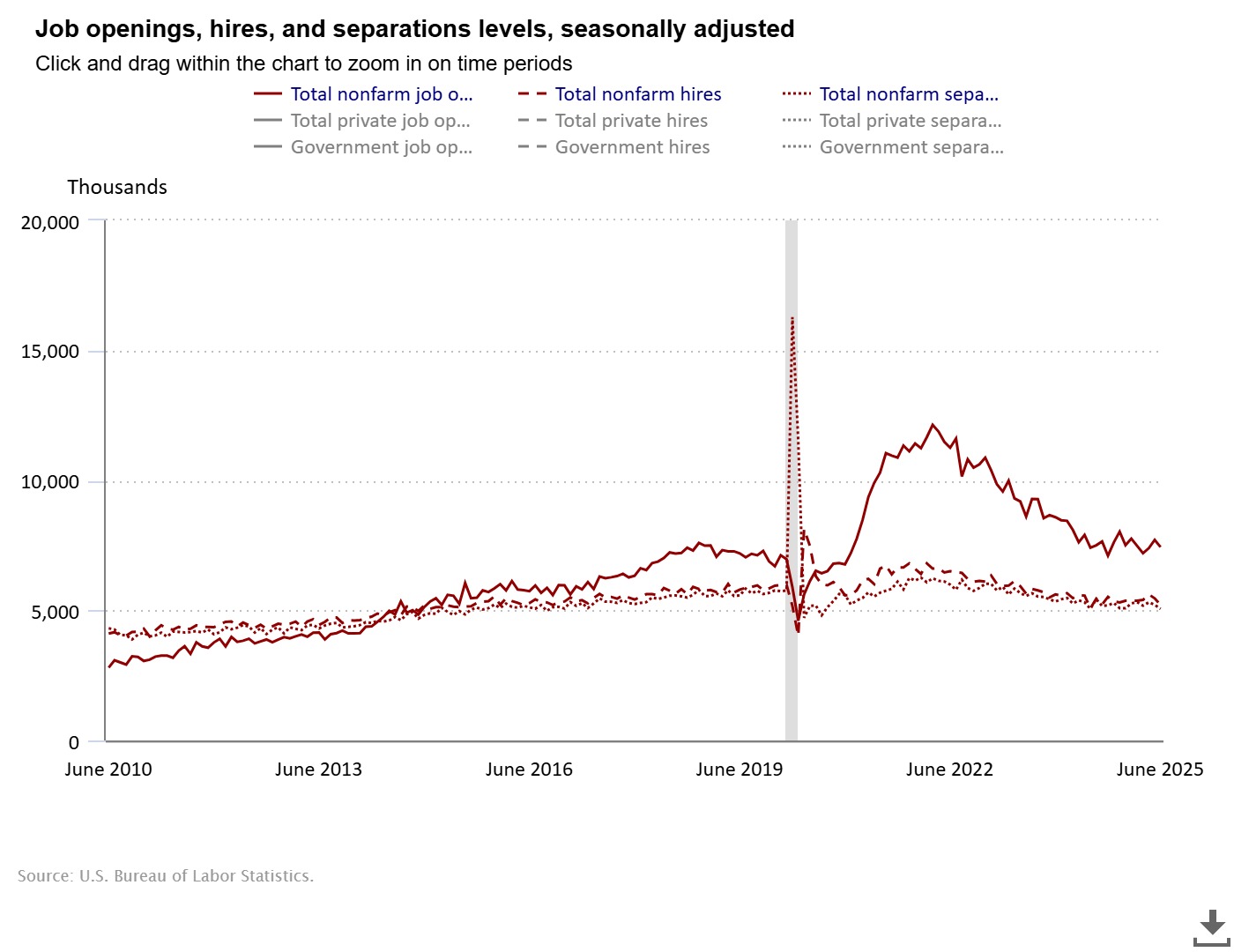
Yet the opposing view emphasizes emerging fragilities. The Conference Board’s Leading Economic Index (LEI) fell by 0.4% in July 2025, its sixteenth consecutive monthly decline, historically associated with elevated recession risk (Conference Board LEI July 2025). Payroll growth slowed to 120,000 in July, well below the first-half monthly average of 175,000, while the unemployment rate ticked up to 4.2% (BLS Employment Situation July 2025). The Job Openings and Labor Turnover Survey (JOLTS) reported openings falling to 8.2 million in June 2025, compared with 9.1 million a year earlier, pointing to slackening labor demand (BLS JOLTS release). Beth Hammack, President of the Federal Reserve Bank of Cleveland, stated that “if the meeting were today, I would not support a cut,” underscoring that inflation risks from tariffs and energy markets complicate immediate easing (Reuters).
Tariff-related inflation shocks heighten these concerns. In May 2025, the U.S. administration imposed new tariffs on Chinese steel, aluminum, and selected consumer electronics, contributing to cost pressures in durable goods. The Peterson Institute for International Economics (PIIE) estimated in July 2025 that the cumulative effect of tariffs implemented since 2023 has added 0.4 percentage points to core CPI inflation (PIIE Policy Brief July 2025). Energy prices compound the challenge: the International Energy Agency (IEA) reported Brent crude averaging $87 per barrel in August 2025, up from $76 in January, driven by supply disruptions in the Middle East (IEA Oil Market Report August 2025). These developments risk keeping inflation above target even as growth slows, evoking a stagflationary dynamic.
Market-based inflation expectations have begun to diverge from survey-based measures. The 5-year, 5-year forward inflation expectation rate, published by the Federal Reserve Bank of St. Louis, rose to 2.47% in August 2025, up from 2.34% in June, suggesting markets perceive some erosion in inflation credibility (FRED 5y5y inflation expectations). In contrast, the University of Michigan’s Consumer Sentiment Survey reported that median long-term inflation expectations held steady at 2.9% in August 2025 (University of Michigan Surveys of Consumers). This divergence highlights uncertainty about whether Powell’s pivot represents pragmatic flexibility or a premature concession to market pressure.
The global policy context adds further complexity. The European Central Bank (ECB), facing stagnant eurozone growth of 0.2% in Q2 2025, signaled in July 2025 that rate reductions may commence in October, while the Bank of England maintained its policy rate at 5.0% pending clearer inflation declines (ECB Monetary Policy Statement July 2025, Bank of England MPC Minutes August 2025). If the Federal Reserve cuts earlier, global yield differentials could widen, weakening the U.S. dollar and amplifying imported inflation, undermining the soft landing scenario.
Credit conditions in banking further signal latent weakness. The Federal Reserve’s July 2025 Senior Loan Officer Opinion Survey (SLOOS) reported net tightening across commercial and industrial loans, commercial real estate lending, and consumer auto financing, reflecting banks’ heightened risk aversion (Federal Reserve SLOOS July 2025). The Federal Deposit Insurance Corporation (FDIC) Quarterly Banking Profile Q2 2025 noted that net charge-offs on credit cards and commercial real estate loans rose by 22% year-over-year, with particular stress in office properties (FDIC Quarterly Banking Profile Q2 2025). These indicators point to a financial system already under strain, suggesting that policy easing may be reactive rather than preventive.
In weighing the evidence, the divide reflects not only empirical conditions but also institutional credibility. The Federal Reserve has historically erred in both directions: tightening too aggressively in 1937, prolonging the Great Depression, and easing too slowly in 2007, exacerbating the global financial crisis. Powell’s challenge lies in balancing credibility with responsiveness. As Mohamed El-Erian, President of Queens’ College, Cambridge, remarked in an August 2025 interview with Bloomberg, “The Fed risks signaling weakness when it wants to project flexibility, and that’s the razor’s edge between a soft landing and a stumble” (Bloomberg August 2025).
A major argument for the soft landing thesis is rooted in productivity growth. The U.S. Bureau of Labor Statistics reported that nonfarm business sector labor productivity increased at an annualized rate of 3.2% in Q2 2025, following 2.1% in Q1 (BLS Productivity Release Q2 2025). This acceleration has helped firms absorb wage pressures without passing fully through to prices, creating conditions where real unit labor costs remain contained. Historically, periods of rising productivity—such as the late 1990s technology boom—enabled the Federal Reserve to sustain accommodative policy without igniting runaway inflation. Advocates suggest that emerging adoption of artificial intelligence across manufacturing, logistics, and professional services is underpinning these gains, enabling a structural moderation of inflation despite labor market tightness.
Corporate earnings reports provide partial validation. According to S&P Global, aggregate earnings for companies in the S&P 500 grew by 5.4% year-over-year in Q2 2025, driven by technology, health care, and consumer discretionary sectors (S&P Global Earnings Insights Q2 2025. Profit margins expanded modestly even as input costs rose, suggesting firms are adapting efficiently. These indicators feed into the argument that Powell’s pivot reflects confidence in the economy’s underlying adaptability, enabling policy recalibration without triggering recession.
Critics, however, stress that productivity gains are uneven and sector-specific. The Institute for Supply Management (ISM) Manufacturing PMI registered 48.6 in July 2025, marking its 14th consecutive month below the expansion threshold of 50 (ISM Manufacturing PMI July 2025). Manufacturing employment has contracted by 37,000 positions year-to-date, reflecting pressure from tariffs on imported inputs and weakening global demand. These developments raise questions about whether productivity gains in technology-heavy sectors can offset weakness elsewhere, particularly in industries with higher employment multipliers.
Household financial conditions further complicate the soft landing narrative. The Federal Reserve Bank of New York’s Quarterly Report on Household Debt and Credit Q2 2025 revealed that total household debt reached $18.6 trillion, with delinquency rates rising across credit cards, auto loans, and student loans (NY Fed Household Debt and Credit Q2 2025). Serious delinquencies (90+ days late) increased to 3.3% of outstanding balances, up from 2.6% one year earlier. Mortgage delinquencies, though still low at 1.5%, edged higher from pandemic-era troughs. These data suggest that while headline unemployment remains moderate, financial stress is accumulating beneath the surface, consistent with hidden economic fragility.
Inflation’s persistence also threatens the Fed’s credibility. The Cleveland Fed’s Median CPI, a measure that filters out extreme price movements, registered 3.5% in July 2025, signaling underlying stickiness beyond volatile categories (Cleveland Fed Median CPI). In addition, the Atlanta Fed’s Sticky Price CPI stood at 4.1%, compared to the flexible CPI at 1.9% (Atlanta Fed Inflation Project). These metrics reinforce hawkish arguments that Powell’s willingness to entertain cuts risks unanchoring inflation expectations, particularly when tariff-driven cost-push dynamics are ongoing.
International perspectives provide further caution. The International Monetary Fund (IMF) World Economic Outlook Update July 2025 projected U.S. GDP growth slowing to 1.6% for 2025, down from 2.5% in 2024, while inflation was forecast to remain at 2.9%, above the Fed’s target (IMF WEO July 2025). The IMF warned that early easing could undermine global financial stability by fueling capital outflows from emerging markets if inflation resurges. Similarly, the Organisation for Economic Co-operation and Development (OECD) Interim Economic Outlook September 2025 highlighted risks of policy miscalibration, emphasizing that premature easing could reaccelerate housing inflation, particularly in constrained markets (OECD Interim Outlook).
Historical precedent also casts doubt on soft landing optimism. In 1974, the Fed cut rates aggressively in response to a recessionary labor market, only to see inflation rebound due to energy shocks, forcing renewed tightening. More recently, the 1998 easing cycle, initiated amid Asian financial crisis contagion, temporarily stabilized markets but stoked equity overvaluation, culminating in the dot-com bubble. Critics argue that the current mix of tariff-driven inflation and elevated asset valuations presents similar risks, where short-term relief could sow medium-term instability.
Institutional commentary reveals deep divisions. The Brookings Institution published an analysis in August 2025 arguing that Powell’s Jackson Hole remarks “mark the beginning of a cautious recalibration rather than a definitive pivot,” stressing that the Fed’s credibility hinges on framing cuts as insurance rather than capitulation (Brookings Economic Studies August 2025). Conversely, the American Enterprise Institute (AEI) contended that “the Fed risks repeating 1970s-style stop-go policy if it yields to market pressure prematurely” (AEI Commentary August 2025). Such divergences reflect not only differences in interpretation but also institutional priorities: stabilizing labor markets versus guarding inflation expectations.
Market strategists remain divided along similar lines. Goldman Sachs revised its forecast on August 23, 2025, to predict two rate cuts in 2025, citing softening labor indicators (Goldman Sachs Global Investment Research). In contrast, JP Morgan argued in its U.S. Economic Outlook August 2025 that “conditions do not yet warrant policy easing,” pointing to resilient corporate profits and sticky inflation. These divergent projections reinforce uncertainty, leaving markets oscillating between relief and anxiety.
Powell’s careful phrasing suggests an acute awareness of these tensions. By stating that “the balance of risks has shifted” rather than committing to immediate cuts, he maintained data dependency while signaling readiness. The ambiguity allows the Federal Reserve to adapt, but it also leaves markets vulnerable to disappointment if September does not deliver a cut. The Fed’s credibility now hinges not only on the decision itself but also on its communication, as investors calibrate expectations for 2026 and beyond.
Dissent within the Federal Open Market Committee (FOMC) underscores the fragility of consensus. The minutes from the July 30–31, 2025 meeting, released on August 21, 2025, indicated that while a majority of participants expressed concern over labor market softening, “several members emphasized the persistence of upside inflation risks, particularly from tariffs and energy costs” (Federal Reserve FOMC Minutes July 2025). Regional bank presidents have articulated these divides publicly: Neel Kashkari of the Federal Reserve Bank of Minneapolis emphasized that “cutting too early would risk undoing hard-won disinflation progress,” while Mary Daly of the Federal Reserve Bank of San Francisco countered that “labor market momentum is weakening more quickly than anticipated” (statements reported by Reuters, August 2025 Reuters).
Labor market indicators remain at the center of this debate. The Bureau of Labor Statistics’ Job Openings and Labor Turnover Survey (JOLTS) for June 2025 reported 8.2 million job openings, the lowest since March 2021, alongside a hires-to-separations ratio falling to 1.0, signaling equilibrium between labor demand and supply (BLS JOLTS June 2025). The quits rate, historically a proxy for worker confidence, declined to 2.1%, down from 3.0% in 2022. At the same time, initial unemployment claims, published weekly by the U.S. Department of Labor, averaged 258,000 in August 2025, compared with 210,000 in February, indicating softening conditions (DOL Unemployment Insurance Weekly Claims). These metrics suggest growing labor market slack, bolstering the case for preemptive easing to avoid a deeper downturn.
Yet inflationary forces tied to structural supply-side shocks complicate the equation. The U.S. Department of Agriculture (USDA) reported in its August 2025 Food Price Outlook that grocery prices increased 4.2% year-over-year, driven by tariff-related costs in imported produce and livestock feed (USDA Food Price Outlook August 2025). Housing rents, measured by the BLS Shelter Index, rose 5.6% in July 2025, reflecting persistent housing shortages (BLS CPI Shelter Component). These categories represent sticky inflation components, suggesting that even if headline inflation moderates, household cost burdens remain elevated.
External experts highlight the precarious balance. The Council on Foreign Relations (CFR) warned in an August 2025 brief that Powell faces “a stagflation-lite scenario” where “monetary easing risks unanchoring inflation expectations even as growth falters” (CFR Analysis August 2025). Conversely, the National Bureau of Economic Research (NBER), in a working paper published July 2025, modeled historical cycles and concluded that “probabilities of achieving a soft landing rise materially when inflation declines precede labor market weakness, as in the current cycle” (NBER Working Paper July 2025). The divergence of institutional assessments mirrors the FOMC’s own debates.
Market sentiment has accordingly oscillated. The CBOE Volatility Index (VIX), a measure of implied equity volatility, fell to 15.2 on August 22, 2025, its lowest level since May, as investors embraced Powell’s cautious dovish tone (CBOE VIX Historical Data). However, the ICE U.S. Dollar Index (DXY) weakened to 101.8, while 2-year Treasury yields, more sensitive to Fed expectations, dropped 18 basis points, reflecting a belief in imminent cuts. Such rapid repricing risks policy whiplash if subsequent data contradict expectations.
Ultimately, Powell’s Jackson Hole speech has heightened the binary interpretation of U.S. economic prospects. A successful soft landing requires inflation to continue decelerating toward 2%, wage growth to remain contained, and labor markets to cool without surging unemployment. A hidden weakness scenario emerges if tariffs, energy shocks, and financial fragilities sustain inflation above 3% while unemployment drifts above 4.5%. Powell’s deliberately cautious language reflects an awareness of both paths, preserving optionality while exposing the Fed to criticism from both hawks and doves.
As history illustrates, the Fed’s trajectory from Jackson Hole often defines subsequent policy cycles. In 2019, Powell’s “act as appropriate” comment preceded a mid-cycle adjustment; in 2024, his signal of imminent cuts led to three consecutive reductions. In 2025, his language has sparked expectations but withheld guarantees, reflecting perhaps the most delicate balancing act of his tenure. Whether this results in a celebrated soft landing or reveals structural weaknesses will depend on data in the coming months—but the policy credibility of the Federal Reserve hangs in the balance.
Historical Context: Comparing to Past Fed Easing Cycles
Comparing the Federal Reserve’s current posture in 2025 with previous easing cycles provides critical context for assessing the likely trajectory of monetary policy and its implications for growth, inflation, and financial stability. Historical analogues—particularly the 2024, 2019, 2007–2008, and 2001 cycles—demonstrate how shifts in communication, inflation conditions, and political pressures shape outcomes, offering insights into the credibility and risks of Powell’s Jackson Hole remarks.
The most immediate comparison is the 2024 cycle. In his Jackson Hole address on August 25, 2024, Chair Jerome Powell explicitly stated that “conditions are consistent with beginning to adjust policy rates,” which markets interpreted as a firm signal of imminent easing. The Federal Open Market Committee (FOMC) subsequently cut the federal funds target range by 25 basis points in September 2024, followed by additional cuts in November and December, totaling 100 basis points of easing within four months (Federal Reserve Historical FOMC Decisions). During this period, headline Consumer Price Index (CPI) inflation had slowed to 2.9%, while core remained at 3.4%, and unemployment held at 3.9% (U.S. Bureau of Labor Statistics CPI Release August 2024, BLS Employment Situation August 2024). Powell justified easing as insurance against global slowdown risks, particularly from weakening European demand and softening U.S. labor momentum.
Markets responded positively. The S&P 500 rose 12.4% between September and December 2024, while mortgage rates fell nearly 90 basis points, reviving housing activity. However, inflation persistence into 2025, partly driven by tariffs imposed in early 2025, complicated the Fed’s trajectory, leaving rates elevated in the 4.25–4.50% range as of August 2025. The 2024 cycle demonstrates that while rate cuts can support financial conditions swiftly, their ability to anchor inflation trajectories depends heavily on exogenous shocks.
The 2019 “mid-cycle adjustment” under Powell provides a second instructive case. In July 2019, amid trade tensions with China, the FOMC cut rates by 25 basis points, describing the move as a “mid-cycle adjustment” rather than the beginning of an easing cycle (Federal Reserve FOMC Statement July 2019). Markets initially reacted with skepticism, with equities falling as investors feared insufficient response. By October, however, two further cuts stabilized conditions, and the S&P 500 advanced 28% for the year. Importantly, inflation in 2019 was subdued at 1.8%, providing room for accommodative policy. The contrast with 2025 is stark: Powell now confronts inflation above 3%, limiting his flexibility to characterize cuts as technical adjustments rather than a broader pivot.
The 2007–2008 cycle illustrates the dangers of delayed easing. In September 2007, the FOMC cut rates by 50 basis points, acknowledging stress in credit markets, but maintained a cautious stance, reducing rates gradually through 2008. By the time the financial crisis deepened in September 2008, the economy was already in recession, and the Fed was forced into emergency reductions to near zero. Unemployment surged to 10% in 2009, and GDP contracted by 2.6% in 2009 (Bureau of Economic Analysis Historical Data). The lesson frequently cited by policymakers is that premature caution can exacerbate downturns, suggesting Powell’s current emphasis on balance-of-risks may be intended to avoid repeating this error.
The 2001 easing cycle following the dot-com bubble burst also offers parallels. Between January and December 2001, the Fed cut the federal funds rate from 6.5% to 1.75%, totaling 475 basis points of easing (Federal Reserve Historical Rate Decisions). Despite this aggressive response, the U.S. economy entered a mild recession, with unemployment rising from 3.9% in late 2000 to 6.3% by mid-2003. Equity markets continued to decline until 2002, underscoring that rate cuts cannot always prevent downturns when structural imbalances dominate. In 2025, tariff-induced inflation and geopolitical pressures may play a role similar to the structural overvaluation of tech equities in 2000–2001, constraining the effectiveness of policy easing.
A longer historical comparison is the 1970s stagflation episodes, which highlight risks of alternating between easing and tightening. The Fed cut rates aggressively in 1974 in response to recessionary labor markets, but inflation surged again due to oil shocks, reaching 12.3% in 1975, forcing renewed hikes. The Fed’s credibility eroded, requiring the Volcker disinflation of the early 1980s. Analysts such as those at the American Enterprise Institute (AEI) warn that Powell’s current dilemma—with inflation above target and labor softening—resembles this stop-go risk (AEI Commentary August 2025).
Beyond economic indicators, political context also distinguishes cycles. In 2025, President Donald Trump has publicly pressured the Fed, calling for the resignation of Governor Lisa Cook and criticizing Powell’s caution, according to Reuters and Investors.com (Investors.com Jackson Hole Coverage August 2025). Political interference risks echoing the late 1960s, when President Lyndon B. Johnson pressured Chair William McChesney Martin to maintain accommodative policy, contributing to inflationary overheating. The Fed’s independence, therefore, is under scrutiny in ways that differentiate 2025 from cycles like 2019, when political pressure existed but inflation was not simultaneously elevated.
Taken together, these historical episodes demonstrate recurring trade-offs: cutting too late risks deep recession, cutting too soon risks inflation resurgence, and political interference erodes credibility. The 2024 cycle showed the benefits of timely insurance cuts, but the 1970s and 2007–2008 highlight the dangers of misjudging inflation persistence and financial fragility. Powell’s 2025 Jackson Hole remarks embody lessons from all these episodes, seeking to preserve flexibility while acknowledging risks, but the ultimate verdict will depend on whether inflationary pressures subside alongside labor market cooling.
Financial market reactions to previous easing cycles provide a roadmap for understanding the stakes of Powell’s 2025 signal. In the 2024 sequence, equity markets rallied sharply as mortgage and corporate bond rates declined, supporting consumption and investment. By contrast, during the 2007–2008 cuts, credit spreads widened dramatically, offsetting the benefits of lower policy rates, and equity markets collapsed. Current indicators suggest markets interpret Powell’s words as closer to 2024 than 2008: the Bloomberg U.S. Corporate High Yield Spread Index tightened by 19 basis points on August 22, 2025, reflecting confidence in credit conditions (Bloomberg Market Data August 2025). Yet structural risks remain, as the Federal Deposit Insurance Corporation (FDIC) noted in its Q2 2025 Banking Profile that commercial real estate delinquencies are climbing, with office vacancy rates above 19% nationally, levels not seen since the early 1990s (FDIC Quarterly Banking Profile Q2 2025).
International spillovers amplify the consequences of Fed actions. When the Fed began cutting in 2019, emerging market currencies strengthened, capital inflows resumed, and sovereign borrowing costs fell. Conversely, during the 2007–2008 cuts, global contagion from financial sector instability overwhelmed the benefits of easier dollar liquidity. In 2025, the immediate reaction to Powell’s remarks was a depreciation of the U.S. dollar, with the ICE Dollar Index (DXY) falling 0.7% to 101.8, the weakest since June 2025 (ICE Futures U.S. Dollar Index). Emerging market bond yields declined modestly, easing pressure on economies such as Brazil and South Africa, which face substantial dollar-denominated debt obligations. However, this weaker dollar also lifted commodity prices, with Brent crude moving above $87 per barrel, underscoring the inflationary trade-off.
The International Monetary Fund (IMF) Global Financial Stability Report April 2025 warned that “synchronized monetary easing across major economies could trigger renewed capital flow volatility, particularly in emerging markets with large external imbalances” (IMF GFSR April 2025). The Bank for International Settlements (BIS) echoed these concerns in its June 2025 Quarterly Review, noting that “U.S. monetary policy remains the single most important driver of global liquidity conditions” (BIS Quarterly Review June 2025). The comparison to past cycles suggests that while the 2025 pivot may provide relief, it carries risks of reigniting inflation through dollar weakness and commodity pass-through.
Credibility comparisons are perhaps the most important historical lesson. In the 1990s, Fed Chair Alan Greenspan successfully engineered a soft landing by tightening preemptively in 1994 and then easing modestly in 1995, preserving credibility while avoiding recession. By contrast, in the 1970s, credibility was lost as the Fed oscillated between easing and tightening, allowing inflation expectations to become unanchored. Powell’s 2025 remarks carefully avoid the firm commitment of his 2024 Jackson Hole signal, which markets interpreted as a guarantee of cuts. Instead, his framing of “balance of risks” mirrors Greenspan’s cautious pragmatism, leaving room for adjustment depending on data.
Market-based measures of credibility reflect this tension. The Treasury Inflation-Protected Securities (TIPS) breakeven rates remain anchored near 2.3% for 10-year maturities, consistent with confidence in long-run Fed credibility (U.S. Treasury TIPS Data). However, short-term breakevens for 2-year maturities rose to 2.8% in August 2025, suggesting skepticism about near-term inflation control. This divergence resembles patterns observed in 2001, when long-term expectations stayed anchored but short-term volatility reflected uncertainty.
Another dimension of credibility lies in communication. During the 2013 taper tantrum, ambiguous Fed signals triggered a sharp rise in yields and capital outflows from emerging markets. Powell, aware of this precedent, appears to be calibrating language to avoid a repeat. His refusal to promise cuts while acknowledging risks represents an attempt to thread the needle: preserving optionality without destabilizing expectations. Historical analysis suggests that success hinges on consistency in subsequent communications, particularly in the September 16–17, 2025 FOMC meeting, where deviation from market expectations could trigger volatility.
Finally, the political dimension cannot be ignored. In 2025, President Donald Trump has escalated public criticism of the Fed, echoing tactics used during his first administration. While the Fed resisted political pressure in 2019, the current environment is more challenging because inflation remains above target. Historical parallels include the Johnson-Martin conflict of the late 1960s, when political interference contributed to accommodative policy that later proved inflationary. Powell’s careful balance at Jackson Hole—acknowledging risks without committing—may reflect not only economic prudence but also institutional defense against political encroachment.
Taken together, the comparison of Powell’s 2025 remarks with earlier easing cycles underscores three conclusions. First, the 2024 cycle demonstrates how insurance cuts can support markets but also how external shocks can undermine their effectiveness. Second, the 2007–2008 and 1970s cycles warn of the dangers of misjudging inflation persistence or yielding to political pressure. Third, the 1990s case shows that credibility can be preserved with cautious, data-driven pragmatism. Powell’s language suggests he is attempting to emulate the latter, but the unique combination of tariff-driven inflation, labor market cooling, and political interference makes the 2025 cycle one of the most precarious in modern Fed history.
The interaction of present dynamics with historical precedent reveals a delicate equilibrium for the Federal Reserve in 2025. Monetary easing, when applied amid moderating inflation and resilient labor conditions, can extend growth cycles, as demonstrated in 1995 and 2019. When executed too aggressively during periods of supply-side inflation or political interference, it has historically eroded credibility, as in the 1970s. The decisive element is whether inflation expectations remain anchored. With long-term breakevens steady near 2.3%, the Fed retains the trust of financial markets; however, the rise in short-term expectations above 2.8% signals that credibility is contingent on disciplined communication and data dependence in the months ahead.
The immediate prospect of a September 2025 cut reflects Powell’s balancing of risks: protecting labor market momentum that shows weakening payroll growth and higher unemployment claims, while not abandoning the inflation target amid tariff-induced pressures. Equity rallies and tightening credit spreads suggest markets anticipate a repeat of the 2024 sequence, in which timely easing extended expansion. Yet the persistence of elevated food and housing inflation, coupled with volatile energy markets, presents a scenario closer to the stagflation-lite risks identified by the Council on Foreign Relations and echoed by the International Monetary Fund.
This moment illustrates the paradox of modern monetary policy: the Fed must act decisively to maintain employment and financial stability, yet its very actions risk unanchoring the inflation expectations that sustain its legitimacy. By invoking the “balance of risks” rather than issuing a direct commitment, Powell has positioned the Fed at the intersection of historical lessons and present uncertainties, attempting to emulate the cautious pragmatism of Alan Greenspan’s 1990s soft landing while avoiding the credibility losses of the 1970s and the delayed responses of 2007–2008.
The implications extend globally. Dollar weakness provides relief to emerging markets carrying $4.6 trillion in dollar-denominated debt, as recorded by the Bank for International Settlements, but simultaneously raises import costs for U.S. consumers, feeding into sticky inflation categories. The dual pressures of domestic affordability and international stability place the Fed in a uniquely constrained position, one that cannot be resolved by monetary policy alone but must operate within the broader context of fiscal and trade policy.
The trajectory from Jackson Hole will therefore not be judged by immediate market rallies or a single rate cut in September 2025, but by the capacity of the Federal Reserve to sustain anchored inflation expectations while cushioning labor market fragility into 2026. The outcome will determine whether this episode is recorded alongside the successful soft landings of the mid-1990s or the cautionary failures of the 1970s. In this balance, Powell’s final Jackson Hole appearance as Chair defines not only his legacy but also the credibility of U.S. monetary governance in an era of structural uncertainty.
What Powell’s Signal Means for the Economy and Everyday Life
When Jerome Powell, Chair of the Federal Reserve, announced at Jackson Hole on August 22, 2025, that “the balance of risks has shifted,” he was not speaking only to bankers, economists, or investors. He was speaking indirectly to millions of households and businesses whose everyday financial lives are shaped by the decisions of the Fed. To most people, the technical language of monetary policy feels distant. But in reality, the Fed’s decisions about interest rates directly affect the cost of a mortgage, the balance on a credit card, the chance of finding a job, the price of groceries, and even the stability of retirement savings.
This chapter translates Powell’s careful and cautious statement into clear terms, explaining what it means, why it matters, and how it could shape the next year for American families, workers, and businesses. It relies exclusively on current 2025 data from trusted institutions such as the Federal Reserve, the Bureau of Labor Statistics (BLS), the Bureau of Economic Analysis (BEA), the International Monetary Fund (IMF), and the Bank for International Settlements (BIS).
Why Interest Rates Matter: The Fed’s Steering Wheel
The Federal Reserve sets the “federal funds rate,” which is the interest rate banks charge each other for overnight loans. This may sound obscure, but it is the steering wheel of the economy. When the Fed raises the rate, it becomes more expensive to borrow money, slowing down spending and investment. When it cuts the rate, borrowing becomes cheaper, encouraging households and businesses to spend more.
As of August 2025, the federal funds rate stands between 4.25% and 4.50%, according to official Federal Reserve policy data. This is a relatively high level compared to the near-zero rates of 2020–2021 during the pandemic. Over the past two years, higher rates have cooled down the economy: mortgage rates rose, credit cards became more expensive, and businesses faced higher costs for borrowing.
Powell’s signal at Jackson Hole means the Fed is now leaning toward turning the wheel in the other direction: lowering rates to make money cheaper again. Why? Because the risks of keeping borrowing costs too high — rising unemployment, slowing growth, and financial stress — are starting to outweigh the risks of inflation.
The Mortgage Example: How a Rate Cut Hits Your Monthly Payment
Perhaps the most concrete example is a mortgage. According to the Federal Home Loan Mortgage Corporation (Freddie Mac), the average 30-year fixed mortgage rate was 6.73% in the week ending August 21, 2025, down from 7.11% in July (Freddie Mac PMMS).
Imagine a household buying a $400,000 home with a 20% down payment ($80,000) and taking out a mortgage of $320,000. At a 6.73% interest rate, their monthly principal and interest payment is about $2,070. If the Fed cuts rates and mortgage rates fall by just 0.25%, the rate might move closer to 6.48%, lowering the payment to about $2,030. That is a savings of $40 per month. If the Fed cuts more — say 0.50% — the payment could fall to $1,990, saving $80 per month.
For a middle-class family, $80 per month is significant. It can cover part of a grocery bill, child care costs, or a utility payment. Across millions of households, these savings add up to billions in disposable income, stimulating the broader economy.
The same principle applies to refinancing existing mortgages. Millions of homeowners locked in ultra-low rates below 4% during 2020–2021. They will not refinance unless rates drop dramatically. But for those with newer loans at higher rates, Fed cuts can make refinancing attractive, lowering payments and freeing up household cash flow.
Credit Cards, Car Loans, and Student Loans: The Quickest Impact
While mortgage rates take weeks or months to respond, credit card rates change almost immediately when the Fed cuts. According to the Federal Reserve’s G.19 report on consumer credit, the average annual percentage rate (APR) for credit cards was 21.2% in the second quarter of 2025, the highest on record (Federal Reserve G.19).
For a household carrying $5,000 in credit card debt, a 0.25% rate cut might lower annual interest costs by about $12. That sounds small, but because credit card balances in the U.S. total more than $1.36 trillion (NY Fed Household Debt Report Q2 2025), the nationwide savings add up to billions. More importantly, for households already struggling, even small reductions ease the burden.
Car loans are also directly affected. Experian’s Q2 2025 Auto Finance Report showed average interest rates of 8.6% for new cars and 12.1% for used cars. On a $40,000 new car loan for 72 months, a cut from 8.6% to 8.35% reduces the monthly payment by about $7, saving $500 over the life of the loan. These savings are bigger for subprime borrowers, who face higher rates and are most vulnerable to rising costs.
Student loans, many of which are pegged to interest rate benchmarks, also become more affordable with cuts. According to the Department of Education, federal student loan interest rates for undergraduate borrowers in 2025–2026 are set at 6.5%. A reduction in the Fed’s policy rate would not change existing fixed rates but could lower future rates for new borrowers. Private student loans, which are often variable, would adjust downward more quickly.
Inflation: Why the Fed Is Still Worried
Inflation has been the dominant concern since 2021. In July 2025, the Bureau of Labor Statistics reported headline Consumer Price Index (CPI) inflation at 2.7%, while “core” inflation, which excludes volatile food and energy prices, was 3.1% (BLS CPI July 2025). That is far better than the 8.6% peak in June 2022, but still above the Fed’s official 2% target.
Certain categories remain especially sticky. Housing rents rose 5.6% year-over-year, and grocery prices increased 4.2%, according to the U.S. Department of Agriculture Food Price Outlook August 2025 (USDA Food Prices). Energy prices are another pressure point: the International Energy Agency (IEA) reported Brent crude averaging $87 per barrel in August 2025, up 12% year-to-date (IEA Oil Market Report August 2025). These increases feed into higher gasoline and electricity costs.
This is why Powell was cautious. Cutting rates too aggressively could stimulate demand and weaken the dollar, pushing import prices and energy costs even higher. If inflation climbs back above 4%, the Fed risks repeating the mistakes of the 1970s, when early cuts allowed inflation to spiral again.
Jobs: Cooling but Not Collapsing
The U.S. labor market has been remarkably resilient since the pandemic. But signs of cooling are becoming clearer. The Bureau of Labor Statistics Employment Situation report for July 2025 showed payroll growth of 120,000, compared to a monthly average of 175,000 earlier in the year. The unemployment rate rose slightly to 4.2% (BLS Employment Situation July 2025).
Job openings fell to 8.2 million in June 2025, down from 9.1 million a year earlier (BLS JOLTS June 2025). The “quits rate,” a measure of worker confidence, dropped to 2.1%, compared with 3.0% in 2022. Initial unemployment claims averaged 258,000 in August, up from 210,000 in February (U.S. Department of Labor Weekly Claims).
These numbers show a labor market that is softening but not collapsing. Cutting rates now could stabilize hiring, prevent layoffs, and keep unemployment from rising too fast. But the risk is that easier money could fuel inflation just as job growth slows — a combination economists call “stagflation.”
Global Effects: The Dollar, Trade, and Emerging Markets
The Fed’s decisions reverberate far beyond U.S. borders. When the Fed cuts rates, the U.S. dollar typically weakens, making American exports cheaper abroad but imports more expensive at home. Following Powell’s Jackson Hole remarks, the ICE Dollar Index (DXY) fell 0.7% to 101.8, its lowest in two months (ICE DXY).
For American consumers, a weaker dollar means higher prices for imported goods, from electronics to gasoline. For emerging markets, however, it often brings relief. The Bank for International Settlements estimates that $4.6 trillion of emerging market debt is denominated in dollars (BIS Quarterly Review June 2025). A weaker dollar reduces their debt burdens, easing global financial strains.
This global balancing act is one reason Powell’s words are carefully chosen. A cut helps the U.S. labor market but can ripple into commodity markets, raising prices worldwide.
Risks of Acting Too Early or Too Late
The Fed’s dilemma is timeless:
- If it cuts too early (like in the 1970s), inflation may flare up again.
- If it cuts too late (like in 2007), unemployment may surge, and recession could deepen.
The historical record is sobering. In 2007, the Fed began cutting in September, but financial instability had already spread. The delay contributed to the Great Recession. In 1974, the Fed cut during a labor slowdown, but inflation roared back due to oil shocks, forcing painful hikes later. Powell is trying to avoid both traps by emphasizing “balance of risks.”
Future Prospects: What Happens Next
The Fed’s next meeting on September 16–17, 2025, will likely decide whether the first rate cut in over a year is delivered. Futures markets, tracked by the CME FedWatch Tool, assign a 70–91% probability of a cut (CME FedWatch). Markets also price in a 60% chance of two cuts by December 2025.
If cuts materialize and inflation continues easing, the U.S. could achieve the elusive “soft landing” — slower growth without recession. If inflation proves stickier or energy shocks intensify, the Fed may have to pause, risking disappointment in markets and households alike.
Case Study: A Family’s Budget Under Rate Cuts
Consider a middle-class household in Ohio, earning $75,000 per year. They carry a $280,000 mortgage at a 6.7% fixed rate, $5,000 in credit card debt, and a $25,000 auto loan at 9%. Their monthly finances look like this:
- Mortgage (principal + interest): about $1,810.
- Auto loan (5 years, 9%): about $520.
- Credit card minimum payment (21% APR): about $120.
- Total debt service: $2,450, nearly 40% of monthly income.
If the Fed cuts rates by 0.25% in September and another 0.25% by December, their situation changes:
- Mortgage refinancing (if rates fall below 6.25%) could lower their payment by $90–$100 per month.
- Credit card APR would fall slightly, reducing monthly interest by $15.
- Auto loan refinancing at 8.5% would cut the payment to $505, saving $15.
In total, this family could save $120–$150 per month, or about $1,500–$1,800 per year. That may cover a health insurance premium, groceries for a month, or savings for education. Multiplied across millions of households, the cumulative effect of Fed easing represents tens of billions in additional disposable income.
Case Study: A Small Business Owner
Now consider a small manufacturing business in Texas with annual revenues of $2 million. The owner has a $500,000 business line of credit tied to the prime rate, currently paying 9.5%. This means annual interest costs of about $47,500.
If the Fed cuts by 0.25%, the prime rate typically falls in lockstep, reducing interest costs by $1,250 per year. If the Fed cuts by 0.75% across three meetings, annual savings reach $3,750. While this may not seem transformative, in a business with razor-thin margins, the savings can finance a part-time hire, buy equipment, or prevent layoffs.
The National Federation of Independent Business (NFIB) reported in July 2025 that its Small Business Optimism Index fell to 89.5, the lowest since 2020, largely due to financing difficulties and weak sales (NFIB Economic Trends). Rate cuts could restore some optimism, though high costs and cautious banks mean access to credit remains tight.
Wall Street vs. Main Street: Divergent Impacts
When Powell spoke, the S&P 500 jumped 1.3% and the Dow Jones Industrial Average rose over 650 points. For investors, this was instant relief, as lower rates make stocks more attractive relative to bonds.
But for Main Street households, the effects are slower and smaller. Mortgage refinancing takes time, credit card savings are incremental, and wage growth is already slowing. This divergence creates frustration: Wall Street celebrates Powell’s cautious signal, while many families still feel squeezed by inflation in rent, groceries, and gasoline.
This gap reflects a broader challenge: the Fed’s tools are blunt instruments. Lower rates lift asset prices quickly, benefiting wealthier households with stock portfolios, while ordinary families see gradual relief in loan payments. Critics argue this widens inequality, even if the Fed’s long-run aim is to stabilize jobs and inflation.
Lessons From History: When the Fed Got It Right or Wrong
The past offers sharp lessons:
- 1995 Soft Landing: The Fed raised rates aggressively in 1994 to combat inflation, then cut modestly in 1995 as growth slowed. The U.S. avoided recession, and unemployment stayed below 6%. This is the outcome Powell hopes to replicate.
- 2001 Dot-Com Crash: The Fed cut rates rapidly as the tech bubble burst, but structural imbalances in the market meant a recession occurred anyway. Unemployment rose to 6.3% by 2003. This shows that rate cuts cannot cure deeper structural problems.
- 2007–2008 Financial Crisis: The Fed cut too slowly, and by the time aggressive easing began, the economy was already in freefall. Unemployment hit 10%, and GDP shrank by 2.6% in 2009 (BEA Historical GDP). Powell wants to avoid being remembered as the chair who “missed the moment.”
- 1970s Stagflation: The Fed cut prematurely to fight unemployment, but oil shocks drove inflation back above 12%. The credibility of U.S. monetary policy collapsed, requiring Paul Volcker’s drastic hikes in the early 1980s. Powell fears this scenario most — cutting too soon while inflation remains above target.
These lessons frame Powell’s cautious tone: acknowledging risks without committing to cuts that could backfire.
Global Ripple Effects: Why Emerging Markets Care
When the Fed adjusts policy, it affects the entire world because the dollar is the global reserve currency. According to the Bank for International Settlements, emerging economies hold $4.6 trillion in dollar-denominated debt (BIS Quarterly Review June 2025).
For countries like Turkey or Argentina, a weaker dollar means debt repayments fall in local currency terms, easing fiscal stress. For commodity importers, however, it means higher costs as oil and food prices rise in dollar terms.
This is why global institutions watch Jackson Hole so closely. The International Monetary Fund noted in its July 2025 World Economic Outlook that “synchronized easing could destabilize capital flows to emerging markets” (IMF WEO July 2025). In simple terms: Fed cuts can either rescue fragile economies or flood them with volatile money flows, depending on timing.
Risks Ahead: Balancing Inflation and Jobs
Looking forward, the Fed faces three possible paths:
- Soft Landing: Inflation continues to fall toward 2%, unemployment stabilizes near 4.2–4.4%, and modest cuts support steady growth. This mirrors 1995.
- Recession Risk: Inflation falls but unemployment rises sharply if demand collapses, forcing deeper cuts later. This mirrors 2001 or 2008.
- Stagflation: Inflation reaccelerates due to tariffs, rents, or energy shocks while unemployment rises, creating the worst-case combination. This mirrors the 1970s.
Which outcome materializes depends not just on Fed policy but also on geopolitics (tariffs, conflicts), energy markets, and fiscal policy. Powell’s careful ambiguity reflects the reality that the Fed cannot fully control these external shocks.
Everyday Prospects: What Households Should Expect
For American families, the practical outlook in late 2025 is:
- Mortgages: If the Fed cuts in September, refinancing opportunities may expand by late fall, reducing payments modestly.
- Credit cards: Rates will remain high, but small reductions are possible — a signal that households should still prioritize paying down balances.
- Jobs: Hiring is slowing but not collapsing. Workers may face fewer job openings, but widespread layoffs are unlikely unless the economy worsens sharply.
- Inflation: Grocery bills and rents remain the biggest burden. Even if inflation slows overall, these categories may stay stubbornly high.
- Investments: Stocks benefit first from rate cuts, but volatility is possible if inflation surprises on the upside.
In short, rate cuts bring relief, but not miracles. Households will feel some breathing room, but persistent costs in food, housing, and energy will keep pressure on budgets.
The Bigger Picture: Powell’s Legacy
This Jackson Hole speech may be Jerome Powell’s last major signal as Chair, with his term ending in early 2026. His legacy depends on whether he delivers a soft landing or presides over renewed inflation or recession. If the U.S. avoids both outcomes, Powell will be remembered as the chair who mastered a uniquely difficult environment of post-pandemic inflation, geopolitical shocks, and political pressure. If not, history may compare him to the hesitant Fed leaders of the 1970s or the cautious missteps of 2007.
Either way, his words at Jackson Hole matter not only for markets but for the day-to-day lives of millions — from the family in Ohio deciding whether they can afford a home, to the small business owner in Texas weighing whether to hire, to the policymaker in Brazil recalculating debt obligations.


