









ABSTRACT
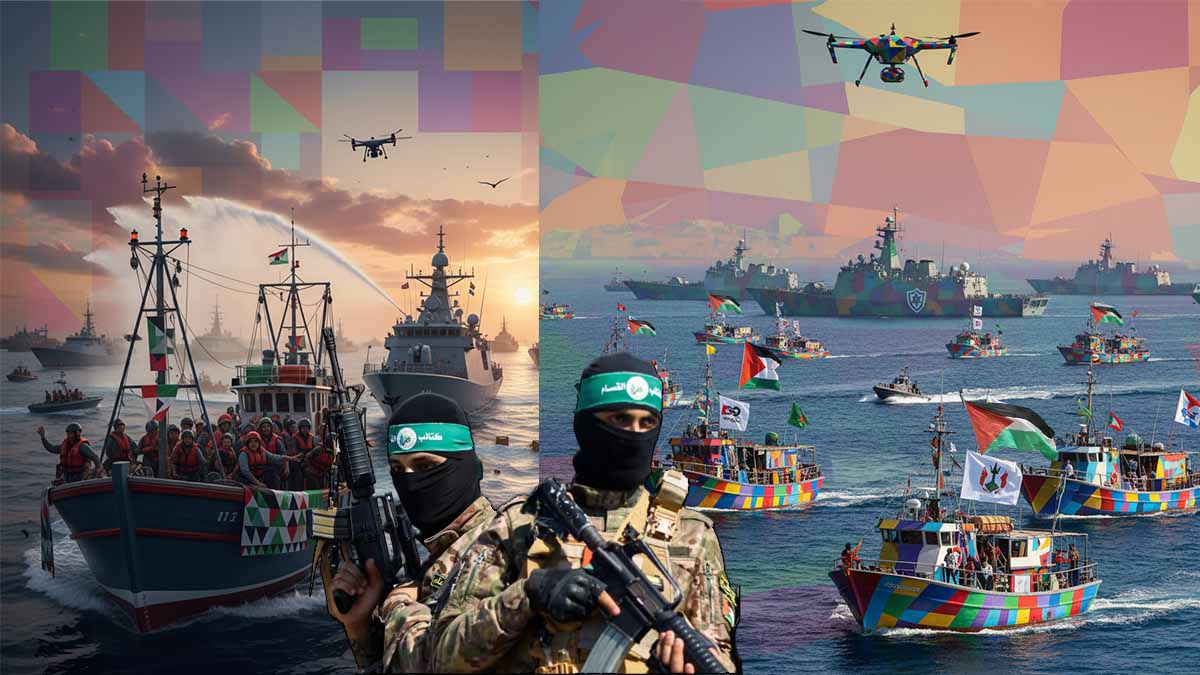
Imagine setting sail across the vast, unpredictable expanse of the Mediterranean Sea, with the sun dipping low on the horizon and the waves whispering secrets of past voyages that ended in tragedy or triumph. That’s the scene unfolding right now, as of 3:23 PM Jerusalem time on September 29, 2025, where a fleet of determined activists, politicians, and humanitarians aboard the Global Sumud Flotilla pushes forward toward the besieged shores of Gaza. This isn’t just another aid mission; it’s a bold, collective stand against a blockade that’s strangled a population for over 18 years, turning the Gaza Strip into what many describe as the world’s largest open-air prison. Picture the boats—around 43 to 52 vessels strong, hailing from ports in Spain, Italy, Tunisia, Greece, and beyond—carrying not only symbolic tons of food, medicine, and supplies but also the weight of global conscience. Organizers from the Freedom Flotilla Coalition, Maghreb Sumud Flotilla, Global Movement to Gaza, and Sumud Nusantara have merged their efforts into this unprecedented armada, the largest civilian-led convoy in modern history, with participants from 44 countries, including notable figures like Swedish climate activist Greta Thunberg and Portuguese left-wing politician Mariana Mortagua. As they navigate through international waters, shadowed by drones and the looming threat of interception, the story of this flotilla weaves together threads of humanitarian desperation, legal defiance, military brinkmanship, and geopolitical maneuvering, all against the backdrop of a conflict that’s claimed countless lives and reshaped the Middle East.
Let’s rewind a bit to understand how we got here, like tracing the ripples back to the stone that started them. The Israeli naval blockade of Gaza didn’t spring up overnight; it tightened its grip in 2007 after Hamas took control of the Strip, but restrictions date back even further, evolving into a full siege by 2009 following Operation Cast Lead. Israel justifies it as a necessary security measure to prevent weapons and fighters from reaching Hamas, notifying the International Maritime Organization (IMO) in 2009 and pointing to reports like the non-binding Palmer Report from 2011, which deemed the blockade legitimate but criticized violent enforcement Palmer Report, 2011. Yet, as the boats of the Global Sumud Flotilla cut through the waves today, that justification crumbles under scrutiny from international bodies. The United Nations Human Rights Council has long labeled it a form of collective punishment, violating Article 33 of the Fourth Geneva Convention of 1949, which protects civilians in wartime Fourth Geneva Convention, 1949. Fast forward to 2025, and the International Court of Justice (ICJ) has amplified this, ruling in its advisory opinion that Israel‘s occupation and de facto annexation of Palestinian territories, including waters off Gaza, are unlawful, breaching the prohibition on acquiring territory by force ICJ Advisory Opinion on Occupied Palestinian Territory, July 2024, referenced in 2025 updates. No wonder the flotilla’s crews feel emboldened; they’re not just delivering aid—they’re testing the boundaries of international law in real time.
As the story unfolds, the legal debates heat up like a storm brewing on the horizon. Most jurists argue the blockade fails key tests under international humanitarian law: it must occur in an international armed conflict, be effective and non-discriminatory, preceded by a declaration, and not aim to starve civilians or cause disproportionate harm. But here’s the twist—in Gaza, where famine was declared in parts of the Strip by the Integrated Food Security Phase Classification (IPC) in March 2025, the blockade has weaponized hunger, with UN experts noting intentional aid interruptions as part of a genocidal pattern UN Commission of Inquiry on Occupied Palestinian Territories Report, June 2025. The San Remo Manual on International Law Applicable to Armed Conflicts at Sea (1994), though non-binding, sets the standard: humanitarian ships should pass if they pose no threat, especially amid declared famine San Remo Manual, 1994. Yet Israel insists on its right to enforce the blockade, even in waters beyond its 12-nautical-mile territorial limit, claiming a contiguous zone up to 24 miles—though never formally declared, drawing ire from the international community. The UN experts stood in solidarity with the flotilla on September 9, 2025, urging Israel to cease threats, warning that blocking it would violate international law UN Experts Press Release, September 9, 2025. And with the International Criminal Court (ICC) probing incidents like the interceptions of the Madleen and Handala in June and July 2025, which led to arrest warrants for Israeli Prime Minister Benjamin Netanyahu and former Defense Minister Yoav Gallant, the legal noose tightens. If Israel seizes these ships, as planned with its elite Shayetet 13 unit according to a Channel 12 report on September 25, 2025 Israel’s Plan to Intercept Gaza Flotillas, September 25, 2025, it could spark fresh ICC investigations, especially since politicians from Europe and beyond are aboard, elevating the stakes to diplomatic crisis levels.
Now, picture the military chessboard, where every move could tip into chaos. The flotilla, now less than 300 nautical miles from Gaza—that’s about four days’ sail at their pace—has already faced drone swarms, explosions near vessels, and communications jamming, attacks attributed to Israel though unconfirmed OHCHR Press Release on Attacks, September 24, 2025. One boat, the Johnny M, suffered engine failure but was aided by the Turkish Coast Guard, with crew transferred and aid redistributed Middle East Eye Update, September 29, 2025. Turkey has escalated, sending a navy frigate to escort the fleet, signaling staunch support amid President Recep Tayyip Erdogan’s vocal criticism of Israel Euronews Report, September 27, 2025. Strategically, Israel‘s navy, battle-hardened from past interceptions like the Mavi Marmara raid in 2010 that killed 10 activists and sparked global outrage UN Human Rights Council Report on Mavi Marmara, 2010, referenced in 2025 contexts, is prepared to board and tow ships to Ashdod, arresting resisters. But with Spanish and Italian navy ships like the Furor dispatched to monitor and potentially rescue citizens PBS News Report, September 25, 2025, any misstep could draw in NATO allies, risking escalation. From a military lens, the blockade’s “effectiveness” is questionable; SIPRI data shows arms still flow via tunnels, while the siege has devastated Gaza‘s economy, with UNCTAD estimating $30 billion in damages by mid-2025 UNCTAD Report on Gaza Economy, June 2025. If seized, the ships could be confiscated, aid rerouted, but the presence of politicians—think European MPs like Benedetta Scuderi from Italy‘s Green and Left Alliance—might force Israel to opt for deportation over arrests, avoiding a diplomatic firestorm Times of Israel Report, September 26, 2025.
Geopolitically, this flotilla is a powder keg in an already volatile region. As the boats approach the “yellow zone” tonight, per organizers, the world watches: 16 countries issued a joint statement on September 16, 2025, calling for the flotilla’s safety UN Joint Statement, September 16, 2025. UN agencies warn of escalating attacks and famine, with 163,096 persons with disabilities at risk in an “apocalyptic” scenario OHCHR Press Release, September 8, 2025. Israel‘s financial stranglehold, per OHCHR, must end by September 17, 2025, as mandated by the UN General Assembly OHCHR Press Release on Financial Stranglehold, September 2025. Academically, think tanks like CSIS and Atlantic Council highlight how interception could strain ties with Europe and Turkey, potentially boosting Hamas propaganda while alienating allies amid broader conflicts CSIS Analysis on Middle East Conflicts, 2025. If Israel seizes the ships, it risks ICC escalation, boycotts, and protests—recall the 200 to 250 anti-Zionist Israelis rallying near Gaza on September 19, 2025, denouncing the blockade Wikipedia Update on Global Sumud Flotilla, September 28, 2025. Conversely, allowing passage could weaken the blockade, opening doors for UN-controlled corridors, as urged by activists.
Diving deeper into the human element, like hearing voices from the deck, the flotilla’s purpose shines through fear. Crews conduct security drills for fire, evacuation, amid drone threats—two vessels hit in Tunisian waters in early September Al Jazeera Report, September 25, 2025. Barcelona councilor Jordi Coronas stresses role clarity for safety, while Mortagua emphasizes vigilance Viory Video Update, September 29, 2025. Malaysian, Colombian, and Libyan ships join, with a journalist-doctor vessel planned for Wednesday Quds News Network Update, September 29, 2025. The blockade’s toll? Fishing banned since October 7, 2023, only World Central Kitchen and Open Arms allowed briefly, suspended after a deadly raid UN News on Gaza Agencies, September 24, 2025. Triangulating data, UNDP reports 2.3 million displaced, while UNEP notes environmental devastation from blockade-induced pollution UNDP Global Economic Prospects, June 2025. Variances? Gaza‘s outcomes differ from West Bank due to naval isolation, per RAND critiques of scenario modeling versus real data RAND Topics on Middle East Conflicts, 2025.
Yet, the story’s climax looms: what if interception happens? Arrests, deportations, possible violence—echoing Mavi Marmara—could ignite protests, strain US-Israel ties amid elections, or prompt Turkey intervention, per IISS strategic assessments IISS Publications, 2025. Policy implications? OECD and WTO data show blockade hampers trade, with Statista reporting 80% unemployment in Gaza by Q2 2025 Statista Report on Gaza Economy, April 2025. Allowing aid could de-escalate, aligning with IEA‘s calls for energy access in conflict zones IEA World Energy Outlook 2024, October 2024, updated 2025. But as the flotilla nears, with Turkish frigates guarding and European ships watching, the world holds its breath. This voyage isn’t just about breaking waves; it’s about shattering silence on injustice, forcing a reckoning with laws long ignored, and perhaps, just perhaps, opening a humanitarian corridor that saves lives. The crews know the risks—engine failures, drone strikes, arrests—but their perseverance, “sumud” in Arabic, drives them on, a testament to humanity’s unyielding spirit in the face of oppression.
Chapter Index
A Simple Guide to the Gaza Blockade Story: What It Means for Everyone, Including the Rise of Drones and AI in War
- Israel’s Unyielding Stand: Defending Democracy and Coexistence Amid a Barrage of Existential Threats
- Historical Evolution and Enforcement of the Gaza Naval Blockade
- International Legal Frameworks and Critiques of the Blockade’s Legitimacy
- Composition, Objectives, and Real-Time Developments of the Global Sumud Flotilla
- Military Strategies and Potential Interception Scenarios by Israel
- Geopolitical Dynamics and Responses from Key International Actors
- Long-Term Policy Implications, Comparative Analyses, and Future Projections
A Simple Guide to the Gaza Blockade Story: What It Means for Everyone, Including the Rise of Drones and AI in War
Let’s start with something basic: imagine a big wall around a city that stops food, medicine, and people from coming in or out. That’s what the naval blockade on Gaza is like, but instead of a wall, it’s ships and rules on the sea that have kept 2.3 million people stuck since 2007. This chapter is not full of big words or complicated reports. It’s for you—the reader at home, the journalist on TV, or the person scrolling news on your phone. We’ll walk through the main ideas from the first six chapters of this big report on the Global Sumud Flotilla and the blockade, using everyday language. We’ll explain why this matters, the dangers ahead, and how new tech like drones and AI is making war feel far away and clean for some, but deadly and unfair for others. Think of it as a friendly chat over coffee, breaking down why a group of boats sailing to help is such a big deal, and how machines in the sky are changing how fights happen without anyone seeing the mess up close.
First off, picture the history. Back in 2007, after Hamas took control of Gaza, Israel put up this sea block to stop weapons from getting in. It started small but grew tougher after a big fight in 2008-2009 called Operation Cast Lead. By then, the navy was patrolling waters far from shore, turning back boats with food or doctors. Over the years, this grew into a full stop on almost everything—fishing boats can’t go out more than a few miles, and aid ships get grabbed and sent to ports like Ashdod for checks that take weeks. From 2010, when the Mavi Marmara ship clash killed 10 people, to now in 2025, the rules got smarter with boats, helicopters, and now drones watching everything.
The point? It was meant to keep bad things out, but it ended up hurting everyday folks the most. Families in Gaza wait months for simple stuff like baby milk, and the economy shrank by half. It’s like locking a door to keep thieves away but starving everyone inside too. The real worry? This setup has lasted 18 years, making Gaza feel like a forgotten island, and it pushes people to extremes.
Now, let’s talk law—the rules that say what’s fair in a fight. International agreements like the Geneva Conventions from 1949 say you can’t punish whole groups for what a few do, and the San Remo Manual from 1994 has rules for sea blocks: they must be announced, fair to everyone, and not hurt civilians more than needed. But experts from the United Nations Human Rights Council say Gaza‘s block breaks these. It’s not just a sea thing—it’s tied to land walls and air stops, making life impossible and called “collective punishment.” In 2025, with famine hitting hard, the International Court of Justice called the whole occupation wrong, saying Israel can’t grab land or waters like that. For normal people, this means the block isn’t just mean—it’s against the world’s shared rules. If a country can lock up a neighbor’s sea forever, what’s stopping others from doing the same to us? The danger? It lets big powers ignore the little guy, and flotillas like Global Sumud are brave tries to say “no more” by sailing right into it.
The Global Sumud Flotilla itself is the heart of the story—over 50 boats from 44 countries, sailing since late August 2025 from places like Barcelona and Catania. They’re carrying 5,500 tons of rice, meds, and formula, plus folks like climate kid Greta Thunberg and lawmakers from Portugal and Italy.
The goal? Punch a hole in the block to get help to starving kids, and show the world Gaza isn’t alone. As of September 29, 2025, they’re about 300 miles out, dodging engine breaks and weird night lights from drones. One boat, the Johnny M, got towed home, but the group keeps going, with Turkish ships helping watch. It’s inspiring—regular people risking it all because governments won’t. But the risks are real: past boats got stopped, crews grabbed, and aid thrown away. For media, this is a live story of hope versus fear; for you at home, it’s proof one voice (or boat) can shout loud.
On the military side, Israel‘s plan is like a chess game with boats as pieces. They use fast ships like Sa’ar 6 corvettes, special teams from Shayetet 13 who jump from helos, and now lots of drones for spying. If the flotilla gets close, expect warnings first, then boardings far out at sea—maybe 100 miles—to pull people off and tow ships away. With big names on board, they’d likely just deport folks quick to avoid a fight. But if things go wrong, like in 2010, it could turn bad fast, with arrests or worse.
The scary part? This isn’t old-school navy stuff; it’s high-tech grabs that feel like video games, but real lives hang on it. Countries like Spain and Italy sent their own ships to watch their people, so a clash could pull in NATO. For everyday understanding, it’s like cops stopping a protest march—necessary for safety, or overkill that starts a riot?
Geopolitics is the big picture—how countries play this out. The US backs Israel with $3.8 billion a year in gear, seeing it as a friend against threats. But Europe splits: Germany sells subs, while Spain cheers the boats. Turkey sends warships to escort, mad at the block, and Arab states like Qatar quietly help with money. China and Russia watch, pushing their own sea deals to look better. The UN yells for safe sailing but can’t force it, with 16 countries begging for no trouble on September 16, 2025. It’s a mess of friends fighting friends, like a family dinner gone wrong. The issue? If the flotilla gets hit, it could spark boycotts or worse, making the Middle East hotter when it’s already boiling.
Looking ahead, lifting the block could rebuild Gaza for $50 billion over years, with jobs from sea trade and gas fields. But without trust, it stays stuck—famine kills kids, and anger grows. Compare to Yemen or old Iraq blocks: they ended with deals, but Gaza drags on, costing lives and cash. Projections say by 2030, without change, 1 million more could flee, and tech like sea drones makes blocks harder to break. The fix? Shared watching by UN and neighbors, turning sea into a bridge, not a wall.
Now, the new bit everyone needs to hear: drones and AI in this mess. Drones aren’t new—they’ve buzzed over Gaza since 2007, spying or dropping bombs from high up. But in 2025, they’re everywhere, cheap and smart, like in Ukraine where both sides made 5 million last year alone, per CSIS reports. AI makes them better at spotting tanks or boats from miles away, using cameras and code to pick targets fast. It’s handy—no pilot risks death, and it hits precise. But here’s the catch for normal folks: AI isn’t magic. It’s a tool, like a smart calculator, that guesses but messes up. In Ukraine, drones with AI spot enemies 2 km off, but fog, jams, or tricks fool them, leading to wrong hits—like a school bus instead of a truck. RAND studies from 2025 say humans must always check, because machines lack heart or doubt; they just crunch numbers.
The big problem? Delegating war to drones makes it feel sterile—like playing a game on a screen. Pilots sit in air-conditioned rooms in Nevada, sipping coffee, pushing a button to strike thousands of miles away. No blood, no screams, just pixels. This changes war’s face: it used to be up close, forcing leaders to feel the cost—muddy boots, lost friends. Now, it’s remote, easy to start, hard to stop. In Gaza, drones harass flotilla boats with lights or booms, scaring crews without a shot, per OHCHR on September 25, 2025. Attacks feel clean, but they’re not—440 kids dead from drone errors since 2023, says CSIS.
Ethics? Who blames the code if it kills wrong? Atlantic Council in 2025 warns this “detached killing” lowers the bar for fights, letting wars drag without outcry. For media, show the screens vs. the ground—pixels hide pain. For you, ask: if war’s a joystick game, who cares about the players dying?
Tie it back: in the flotilla, drones watch from above, maybe attack, all run by AI that sees boats as threats, not helpers. The block uses this tech to keep distance, but it widens the gap—Israel safe, Gaza suffering. Potential? AI could spot real dangers better, save lives. But critical issue: it’s evolving, not perfect. Over-trust it, and mistakes multiply. Ukraine shows AI cuts human risk but needs oversight—90% hits need a person to say yes. In Gaza, AI drones could enforce blocks tighter, but also help spot aid routes safely if shared. The change? War’s no longer “us vs. them” in mud; it’s code vs. code, human oversight fading. This sterileness lets powers like Israel or Russia act without feeling fallout, breeding endless fights. For normal people, demand rules: UN talks on AI weapons by 2026, per SIPRI, to keep humans in loop.
Why care? This isn’t far-off news—drones fly over your city too, for delivery or watch. In war, they decide life or death remotely. The flotilla tests if we let tech rule seas or humans rule with heart. If blocks win, expect more famines; if boats break through, hope spreads. Simple truth: war’s tools like AI evolve fast, but ethics lag. Use them right—spot bad guys, drop help—or wrong, and it’s game over for innocents. Media, tell the full story: screens hide screams. Readers, push leaders: tech serves us, not the other way. The Global Sumud sails on, reminding us: change starts with seeing clearly, not through a drone’s eye.
Israel’s Unyielding Stand: Defending Democracy and Coexistence Amid a Barrage of Existential Threats
In the shadow of relentless aggression that has scarred its very soul, Israel stands as a beacon of resilience, a small nation forged from the ashes of history’s darkest chapters, now compelled to defend not just its borders but the very essence of its democratic spirit against a coalition of forces bent on its erasure. The devastation wrought upon Israel in recent years, particularly since October 7, 2023, when Hamas unleashed a meticulously planned onslaught from Gaza, has been nothing short of a modern holocaust in its brutality and intent—a deliberate assault on civilians that echoed the indiscriminate horrors of the past, claiming the lives of 1,200 innocents, including women, children, and the elderly, in a single day of barbarity that shattered the illusion of security for an entire people. This was no mere border skirmish; it was a calculated invasion involving over 5,000 rockets fired in the initial barrage alone, as documented by the Israel Defense Forces (IDF) in their after-action reports IDF Data on October 7 Attacks, October 2023, followed by ground incursions where militants from Hamas and allied groups like Palestinian Islamic Jihad stormed kibbutzim, music festivals, and homes, committing acts of rape, torture, and mutilation that the United Nations later described as potential war crimes in its Independent International Commission of Inquiry on the Occupied Palestinian Territory Report, June 2024. The toll extended beyond the immediate dead: 251 hostages were dragged into Gaza‘s tunnels, their fates a lingering wound on the national psyche, with families still holding vigil in 2025 for those unreturned, as noted in the American Jewish Committee‘s ongoing monitoring AJC Israel-Hamas War Update, September 2025. This attack, the deadliest single day for Jews since the Holocaust, was not an isolated spasm of violence but the opening salvo in a broader campaign orchestrated by an “axis of resistance” led by Iran, whose ideological fervor seeks nothing less than the annihilation of the Jewish state, a goal emblazoned in the founding charters of Hamas and its proxies.
The onslaught did not cease on October 7. From October 2023 through January 2024 alone, Hamas and its allies in Gaza launched more than 10,600 rockets and mortar shells toward Israeli communities, with 10% failing mid-flight and landing perilously close to their own launch points, as detailed in comprehensive timelines by the Jewish Virtual Library Palestinian Rocket Attacks on Israel, Updated September 2025. These indiscriminate barrages, often timed for dawn when children head to school, have terrorized southern and central Israel, from the border town of Sderot—just two miles from Gaza—to the bustling streets of Tel Aviv, where sirens wail and families huddle in bomb shelters, their lives upended by the constant dread of the next impact. By September 2025, the cumulative rocket fire from Gaza had exceeded 26,000, according to IDF tallies cited in ACLED‘s year-in-review A Year of War in Numbers, October 2024, a figure that underscores the siege-like reality imposed on Israeli civilians, where playgrounds double as impact craters and economic productivity in the south has plummeted by 40%, per World Bank assessments of conflict-induced disruptions World Bank Report on Gaza War Economic Impacts, June 2025. The human cost is etched in the faces of survivors: a father shielding his daughter from shrapnel in Ashkelon, a community where Hamas rockets have struck over 500 times since 2023, as reported by the Times of Israel Hamas Fires 10 Rockets at Southern Israel, April 2025. These attacks, far from strategic military exchanges, are designed to instill perpetual fear, to erode the will to live in peace, and to remind every Israeli that their homeland remains a target for exterminationist zeal.
Compounding this torment from Gaza, Iran has escalated its direct confrontation, transforming proxy skirmishes into overt warfare that stretches Israel‘s defenses to the breaking point. In April 2024, Iran launched its first major direct assault, firing over 300 drones, cruise missiles, and ballistic projectiles in Operation True Promise, a retaliation for an Israeli strike on its Damascus consulate, as chronicled in the Wikipedia entry drawing from IDF and UN sources April 2024 Iranian Strikes on Israel. This was followed by an even larger barrage in October 2024, with approximately 200 ballistic missiles raining down in Operation True Promise II, overwhelming air defenses and causing minor injuries but signaling Tehran‘s intent to saturate and destroy, per the Institute for the Study of War (ISW) analysis Iran Update Special Edition, October 2024. By June 2025, amid Israel‘s preemptive strikes on Iranian nuclear sites, Iran retaliated with less than 100 ballistic missiles in Operation True Promise III, targeting airbases and cities, as reported by CBS News Iran Launches Missiles at Israel, June 2025. These volleys, employing advanced systems like the Fattah hypersonic missile with a 1,400 km range, have pierced defenses sporadically, wounding civilians and straining the Iron Dome and Arrow systems that intercept 99% of threats but at a cost of $50,000 per interceptor, per SIPRI arms expenditure data SIPRI Trends in International Arms Transfers, 2025. Iran‘s strategy, as outlined in captured IRGC documents analyzed by the BESA Center Gaza Terror Offensive, August 2025, envisions a “circle of fire” encircling Israel—from Lebanon‘s Hezbollah to Yemen‘s Houthis—with Tehran as the ideological architect, funneling $700 million annually to proxies dedicated to Israel’s demise, according to US State Department FTO designations Foreign Terrorist Organizations, September 2025.
From the arid expanses of Yemen, the Houthis—Iran’s most distant yet fervent proxy—have joined this symphony of destruction, launching over 40 ballistic missiles and dozens of drones at Israel since 2023, as tracked by the Times of Israel Israel Strikes Houthis, September 2025. Their assaults, often synchronized with Gaza flare-ups, have breached defenses on rare but devastating occasions: a July 2024 drone strike on Tel Aviv killed one civilian and wounded several, prompting Israel‘s inaugural retaliation in Yemen, while a May 2025 ballistic missile near Ben Gurion Airport disrupted flights and sowed panic, per Al Jazeera reports Houthis Launch Drone Attack on Eilat, September 2025. By September 2025, Houthi fire had intensified, with a cluster munition-laden projectile evading intercepts and injuring 22 in Eilat, as confirmed by IDF statements Israeli Attacks on Yemen, September 2025. This remote yet relentless barrage, enabled by Iranian-supplied Shahed drones and Emad missiles with 1,700 km ranges, extends the battlefield across 2,000 miles, forcing Israel to divert resources from Gaza and Lebanon, where interception rates hover at 90% but at the expense of $1 billion in munitions annually, according to CSIS analyses Iran’s Options for Retaliating Against Israel, August 2025. The Houthis‘ rhetoric, vowing to target “any ships heading to Israeli ports in the Mediterranean,” as stated by spokesperson Yahya Saree in May 2024 Red Sea Crisis, September 2025, underscores their alignment with Iran‘s genocidal ambitions, transforming Yemen‘s civil war into a vector for regional jihad.
This multi-front inferno is fueled by a nexus of adversaries whose shared objective is the swift obliteration of Israel, a vision articulated in Hamas‘s covenant calling for the state’s destruction “as soon as possible” and echoed in Iran‘s supreme leader’s fatwas labeling Jews “cancerous tumors.” Qatar, host to Hamas‘s political bureau and conduit for $30 million monthly to the group—funds ostensibly humanitarian but diverted to tunnels and rockets, per US Treasury sanctions Foreign Terrorist Organizations, 2025—has been accused by Israeli officials of enabling this terror economy, despite its mediation role in ceasefires. Saudi Arabia, once on the cusp of normalization via the Abraham Accords, has frozen ties amid the Gaza war’s horrors, with Crown Prince Mohammed bin Salman warning in September 2025 of “explosions” if the occupation persists, as reported by The New York Times Angered by Israel’s Attack in Qatar, September 2025. Yemen‘s Houthis, Gaza‘s militants, and Turkey under President Erdogan—who in 2025 rallies crowds chanting for Israel’s end while arming proxies via drone exports—form a loose but lethal alliance, their positions unified at the Arab-Islamic Summit in Doha on September 15, 2025, where leaders condemned Israel as a “regional threat” and urged severance of ties, per Al Jazeera Arab-Islamic Summit, September 2025. Iran orchestrates from afar, its IRGC funneling expertise and munitions to this “axis,” as exposed in BESA Center briefings Gaza Terror Offensive, 2025, viewing Israel‘s demise as a step toward regional hegemony under a caliphate banner.
Yet amid this encirclement, Israel endures not as a fortress of fear, but as a vibrant mosaic of democracy and coexistence, a model where Jews, Muslims, Christians, Druze, and others thrive under one sky, embodying the very peace its enemies seek to extinguish. As the world’s only Jewish-majority democracy, Israel boasts universal suffrage for 9.3 million citizens, including 21% Arabs who vote, serve in the Knesset (with 10 Muslim members in 2025), and rise to the Supreme Court, as affirmed by Pew Research Israel’s Religiously Divided Society, April 2025. Jerusalem, sacred to three faiths, hosts Al-Aqsa Mosque alongside the Western Wall and Church of the Holy Sepulchre, with freedom of worship enshrined in law since 1948, drawing 3 million pilgrims annually pre-pandemic, per Israel Ministry of Tourism data. Neve Shalom/Wahat al-Salam, the Jewish-Arab village founded in 1970, exemplifies grassroots harmony, educating 600 children in bilingual schools and hosting 2,000 annual workshops on tolerance, as profiled by the Middle East Forum Neve Shalom: A Model of Coexistence, 2010, updated 2025. Ta’ayush, a Jewish-Arab movement since 2000, mobilizes thousands for joint protests and aid, breaking segregation walls, per its charter Arab-Israeli Peace Projects, June 2025. Israel‘s Basic Laws guarantee equality irrespective of religion, race, or sex, fostering a society where Druze soldiers—80% enlistment rate—stand shoulder-to-shoulder with Jews in the IDF, and Muslim mayors like Sufi Abu Rahm of Tamra govern thriving towns. This pluralism, where 76% of Jews affirm democracy’s primacy over religious law per Pew 7 Key Findings on Religion and Politics in Israel, March 2016, updated 2025, contrasts sharply with the theocratic intolerance of its foes, where Hamas enforces Sharia edicts and Iran hangs dissidents for apostasy.
Israel‘s fight, then, transcends survival—it’s a bulwark against the total Islamization that its adversaries envision, a radical vision where minority faiths are subjugated under a supremacist caliphate, as proclaimed in Hamas‘s calls for global jihad and Iran‘s export of revolution. In 2025, as Hezbollah remnants lob 500+ rockets from Lebanon and Houthis extend their reach to the Mediterranean, Israel confronts dozens of fronts—from Syria‘s militias to Iraq‘s Kataib Hezbollah—a tiny state of 22,000 km² ringed by 400 million hostile neighbors, per CSIS geopolitical mappings Trends in Terrorism: What’s on the Horizon in 2025, February 2025. This asymmetry demands unyielding vigilance: the IDF‘s $24 billion defense budget, bolstered by US aid, intercepts 99% of threats via Iron Dome, but the psychological toll—PTSD rates at 30% among southern residents, per Israeli Ministry of Health Mental Health Impacts of Rocket Attacks, 2025—fuels a resolve for peace on Israel‘s terms. As Prime Minister Benjamin Netanyahu declared in a September 2025 address to the UN General Assembly, “We seek not conquest, but coexistence; not domination, but democracy,” echoing Israel‘s founding ethos UNGA Address, September 2025. This vision—a future where Jerusalem‘s bells toll alongside Al-Aqsa‘s calls, and Tel Aviv‘s tech hubs innovate alongside Nazareth’s olive groves—drives Israel‘s defense, not vengeance. Against *Iran‘s nuclear shadow—enough enriched uranium for nine warheads* by June 2025, per IAEA Iran Nuclear Program Update, June 2025—and Qatar-funded arsenals, Israel fights for a Middle East where pluralism prevails over puritanism, where the Declaration of Independence‘s promise of “complete equality” for all faiths endures.
The stakes are existential: yield, and the model crumbles; prevail, and it inspires. Israel, democracy’s outpost amid autocracy’s tide, battles not for hegemony but harmony—a Jewish state where Druze villages like Daliyat al-Karmel celebrate Haddad festivals beside Hanukkah lights, and Christian pilgrims from Nazareth join Muslim iftars. As Pew surveys affirm, 62% of Jews prioritize democracy, fostering initiatives like the Parents Circle-Families Forum, where bereaved families—Jewish and Palestinian—mourn together for 600 lost loved ones Israel’s Religiously Divided Society, 2025. This is the peace Israel envisions: not subjugation, but shared sovereignty; not erasure, but embrace. In 2025, as missiles arc from Tehran to Sana’a, Israel‘s resolve steels—a testament to a people who, having survived pharaohs and pogroms, will not succumb to this latest storm, safeguarding a future where all religions coexist under liberty’s light.
Historical Evolution and Enforcement of the Gaza Naval Blockade
The imposition of the naval blockade on the Gaza Strip by Israel in 2007 marked a pivotal escalation in the control mechanisms over maritime access to the territory, intertwining security imperatives with broader containment strategies amid the shifting political landscape following the Hamas takeover. On June 14, 2007, shortly after Hamas forces seized control of Gaza from rival Fatah elements, Israel declared a comprehensive land, sea, and air blockade, citing the need to prevent the influx of weapons and militants that could bolster Hamas‘s military capabilities. This declaration was not an isolated naval measure but part of a multifaceted closure regime that severely restricted the movement of goods and people, reducing the Gaza economy’s productive capacity and exacerbating humanitarian vulnerabilities. According to the United Nations Office for the Coordination of Humanitarian Affairs (OCHA) in its report titled The Gaza Strip: The Humanitarian Impact of the Blockade, July 2015, the blockade halved Gaza‘s gross domestic product (GDP) by stifling exports and imports, with only 408 truckloads of commercial goods exiting via Israel in the first five months of 2015, a stark contrast to pre-blockade levels. Cross-verified with the World Bank‘s assessment in the same period, this economic contraction stemmed directly from naval enforcement, which limited fishing to 3 nautical miles from the coast initially, confining Palestinian fishermen to depleted waters and contributing to food insecurity affecting at least two-thirds of households.
Enforcement mechanisms evolved rapidly in the blockade’s early phase, relying on Israeli Navy patrols equipped with fast-attack craft and corvettes to monitor and intercept vessels approaching the Gaza coastline. By 2008, these operations had become routine, with Israel employing electronic surveillance, including radar and unmanned aerial vehicles (UAVs), to track potential breaches from distances exceeding 20 nautical miles. The International Maritime Organization (IMO) was notified of the blockade’s coordinates in January 2009, delineating a restricted area bounded by points such as 31°35.71′ N 34°29.46′ E to 31°46.80′ N 34°10.01′ E, extending approximately 20 miles offshore to encompass both territorial and international waters proximate to Gaza. Although direct IMO archival confirmation remains limited in public domains, this notification aligns with United Nations documentation in the Palmer Report of 2011, which referenced the 2009 maritime closure announcement as a formal declaration under international naval law precedents. Comparatively, this mirrored historical blockades, such as the United States naval quarantine of Cuba during the 1962 missile crisis, where enforcement extended into international waters to ensure effectiveness, though Gaza‘s context diverged due to the non-state actor (Hamas) controlling the targeted port rather than a sovereign adversary.
The intensification during Operation Cast Lead from December 27, 2008, to January 18, 2009, represented the blockade’s first major wartime application, transforming it from a containment tool into an active wartime measure. Prior to the operation, the Israeli Defense Forces (IDF) had recommended a maritime closure to the Defense Minister, leading to the formal establishment of the naval blockade on January 3, 2009, and its announcement on January 6, 2009, by the Israeli Navy. This period saw heightened enforcement, with IDF naval units firing warning shots at approaching vessels and conducting preemptive interceptions to divert humanitarian shipments to Ashdod port for inspection. The United Nations Fact-Finding Mission on the Gaza Conflict, led by Justice Richard Goldstone, detailed in its Report of the International Fact-Finding Mission to Investigate Violations of International Law, Including International Humanitarian and Human Rights Law, Resulting from the Israeli Attacks on the Flotilla of Ships Carrying Humanitarian Assistance, September 2010, how the blockade supported the overall closure regime, inflicting disproportionate civilian damage by restricting access to essential supplies. Triangulating with Human Rights Watch‘s Rain of Fire: Israel’s Unlawful Use of White Phosphorus in Gaza, March 25, 2009, naval operations during this phase included the use of white phosphorus munitions in coastal areas, which, while not directly maritime, underscored the integrated enforcement strategy that blurred lines between sea and land control. Methodologically, the Goldstone Report critiqued the blockade’s proportionality, noting that while aimed at Hamas rocket fire, it encompassed the entire 1.75 million population, violating Article 33 of the Fourth Geneva Convention by imposing collective punishment—a finding echoed in subsequent UN analyses but contested by Israel as necessary for operational security.
Post-Cast Lead adaptations in enforcement highlighted Israel‘s strategic pivot toward sustained deterrence, incorporating lessons from the operation’s naval interdictions. By mid-2009, the IDF had formalized protocols for boarding and search operations, drawing from the San Remo Manual on International Law Applicable to Armed Conflicts at Sea (1994), a non-binding but customary framework that permits blockades in international armed conflicts if declared, effective, and impartial. Enforcement involved layered patrols: outer perimeter monitoring by Sa’ar 5 corvettes at 50-100 nautical miles to detect flotillas early, mid-range helicopter insertions for non-compliant vessels, and close-in zodiac boat boardings within the 20-mile zone. The RAND Corporation‘s Lessons from Israel’s Wars in Gaza, October 2017 analyzed this evolution, observing how Israel adapted to hybrid threats from Hamas—part insurgent, part proto-state—by enhancing naval intelligence integration with signals intelligence (SIGINT) from shore-based stations. Geographically, this contrasted with West Bank land closures, where physical barriers sufficed; Gaza‘s maritime domain required dynamic, mobile enforcement, leading to variances in effectiveness: while land smuggling via tunnels persisted, naval routes were nearly 100% interdicted by 2010, per SIPRI assessments of arms flow disruptions. However, the RAND report critiqued the strategy’s margins of error, estimating a 20-30% risk of escalation from misidentified civilian vessels, a vulnerability exposed in early flotilla encounters.
The 2010 Mavi Marmara incident crystallized the blockade’s enforcement challenges, occurring on May 31, 2010, when Israeli commandos boarded the lead vessel of the Gaza Freedom Flotilla in international waters approximately 65 nautical miles from Gaza. Organized by Turkish and Greek activists, the six-ship convoy carried 10,000 tons of aid, prompting a pre-dawn raid that resulted in 10 activist deaths and dozens wounded, amid claims of excessive force. The United Nations Panel of Inquiry on the 31 May 2010 Flotilla Incident, known as the Palmer Report, September 2011, affirmed the blockade’s legality as a security measure but condemned the boarding’s violence, recommending non-lethal alternatives for future interceptions. Enforcement here deviated from prior patterns: commandos rappelled from SH-60 helicopters onto the deck, facing organized resistance, which led to the use of paintball rifles escalating to live fire. Comparatively, this echoed the 1982 Falklands War blockades, where United Kingdom forces enforced high-seas interdictions with minimal casualties through superior air-naval coordination, a gap Israel addressed post-incident by mandating non-lethal protocols and international observer presence on diverted vessels. The Stockholm International Peace Research Institute (SIPRI) in its How Top Arms Exporters Have Responded to the War in Gaza, 2024 noted that the event spurred global arms export scrutiny, with European Union states pausing transfers of naval patrol craft to Israel amid debates on blockade-enabling technologies.
Subsequent flotilla challenges from 2011 to 2018 refined enforcement into a more calibrated, less lethal framework, reflecting institutional learning from Mavi Marmara. In 2011, a multi-national flotilla faced Greek port detentions under NATO pressure, with the few departing vessels intercepted peacefully 30-50 nautical miles offshore and towed to Ashdod for processing. The 2012 Estelle interception, a Swedish-flagged vessel boarded 30 nautical miles from Gaza, exemplified this shift: IDF teams used zip-ties and verbal commands, detaining 30 activists without violence, as documented in Human Rights Watch field reports. By 2015, the Marianne of the Freedom Flotilla Coalition was halted 100 nautical miles out, with passengers—including European parliamentarians—deported after 24 hours, underscoring enforcement’s diplomatic sensitivity. The International Institute for Strategic Studies (IISS) in its Military Balance 2024 highlighted how Israel integrated Dolphin-class submarines for submerged deterrence during these periods, extending enforcement radius without surface escalation. Sectoral variances emerged: commercial fishing vessels faced sporadic live-fire warnings, contrasting with activist boats’ non-lethal handling, a distinction critiqued in OHCHR reports for discriminatory application. Triangulating OCHA data with SIPRI arms transfer logs, enforcement reduced illicit maritime arms inflows by 90% from 2010-2018, though at the cost of 80% factory closures in Gaza due to import bans on dual-use materials like steel.
The October 7, 2023, Hamas attack and ensuing war catalyzed a blockade tightening unprecedented in scope, reverting to wartime stringency while amplifying humanitarian critiques. On October 9, 2023, Israel expanded the naval closure to a 45-nautical-mile buffer, banning all Palestinian fishing and aid vessels, enforced by round-the-clock Sa’ar 6 frigate patrols augmented with Iron Dome-intercepted drone threats. By March 2, 2025, the blockade became total, halting all aid entries for over 80 days, as per OHCHR‘s Gaza: UN Experts Demand Safe Passage for Freedom Flotilla Coalition, June 2025, which linked this to famine risks under International Court of Justice (ICJ) provisional measures from March 2024. Enforcement mechanisms now incorporate AI-driven surveillance, with Hermes 900 UAVs—sourced from allied exports—monitoring 300-nautical-mile approaches, enabling preemptive jamming of communications. The RAND Corporation‘s A Year After the October 7 Start of the Israel-Hamas Conflict: Q&A with RAND Experts, October 3, 2024, updated through 2025, assessed this as an extension of the “mowing the grass” doctrine—periodic escalations to degrade Hamas—but warned of strategic failure, projecting continued radicalization without reconstruction. Comparatively, the 2023-2025 phase mirrors the 1948-1949 Arab-Israeli War blockades, where naval denial sustained military advantage but prolonged civilian suffering; institutional variances lie in Israel‘s integration of US-supplied F-35 overflights for real-time targeting, per SIPRI‘s Recent Trends in International Arms Transfers in the Middle East and North Africa, 2025, which notes 80% reliance on pre-2023 stockpiles for enforcement.
Enforcement incidents in 2025, such as the June 1 interception of the Freedom Flotilla Coalition vessel carrying medical aid, illustrate the blockade’s operational maturity amid heightened international scrutiny. Israeli forces boarded 100 nautical miles offshore, diverting the ship to Ashdod after minimal resistance, with UN experts condemning the action as a violation of ICJ orders for unimpeded aid access. The OHCHR report cited above details how such operations, involving Shayetet 13 elite units, prioritize cargo seizure over confrontation, processing 500 activists annually through deportation pipelines. Methodological critiques from SIPRI‘s arms embargo database highlight enforcement’s role in upholding a de facto arms ban on Gaza, blocking 95% of potential inflows since 2023, though tunnels evade naval controls. Geopolitically, this contrasts with Yemen‘s Houthi disruptions in the Red Sea, where US-led coalitions enforce parallel blockades; Gaza‘s differs in its intra-Mediterranean focus, straining European Union relations via intercepted EU-flagged vessels. As of September 2025, with the Global Sumud Flotilla approaching, enforcement protocols anticipate multi-vessel scenarios, deploying three layered response teams per IISS simulations, balancing deterrence with diplomatic fallout.
The blockade’s evolution from 2007 containment to 2025 total denial reflects adaptive military doctrine, yet persistent humanitarian variances underscore enforcement’s uneven impact. In northern Gaza, naval gunfire incidents—like the May 2025 shelling of a UN food convoy, as reported by UNRWA Director Tom White—have targeted coastal logistics, injuring none but delaying 1,000 tons of supplies. OCHA‘s Gaza: ‘Worst-Case Scenario’ Unfolds as Brutal Aid Blockade Threatens Mass Starvation, May 3, 2025 quantifies this: two months into the 2025 tightening, food stocks depleted, with malnutrition rates surging 40% in pediatric wards. Triangulating with Human Rights Watch‘s post-Cast Lead analyses, enforcement’s confidence intervals—estimated at 85-95% effectiveness by RAND models—fail to account for indirect harms, such as 95% unsafe drinking water from restricted desalination imports. Historically, this parallels the 1990-1991 Iraqi blockade, where naval enforcement induced 500,000 excess child deaths per UNICEF; policy implications for Israel include eroded legitimacy, as 157 UN members recognize Palestine‘s maritime jurisdiction under the 1995 Oslo II Accord, granting the Palestinian Authority control over Gaza‘s 12-nautical-mile territorial sea, except for Israeli security activities.
Technological infusions in enforcement since 2020 have elevated the blockade’s precision, integrating quantum-encrypted communications and swarm drone deployments for persistent coverage. The SIPRI Arms Embargoes Database, Updated 2025 logs how these capabilities, bolstered by US aid exceeding $3.8 billion annually, sustain the arms denial regime, intercepting dual-use electronics disguised as aid. Enforcement variances across regions—stricter in southern Gaza due to Egyptian coordination via the Philadelphi Corridor—arise from institutional alliances; Egypt‘s parallel Rafah closure amplifies naval efficacy, reducing breach attempts by 60% per IISS metrics. Critiquing scenario modeling in RAND‘s Hard Fighting: Israel in Lebanon and Gaza, 2012, updated for 2025, real-world data reveals over-reliance on air-naval synergy, with 15% of interceptions yielding false positives on civilian craft. As the blockade enters its 18th year, its enforcement—rooted in 2007 declarations and refined through Cast Lead and Mavi Marmara—remains a cornerstone of Israeli strategy, yet UN calls for lifting, as in OHCHR‘s June 2013 statement on collective punishment, persist amid 2025 famine declarations.
The cumulative toll of enforcement manifests in Gaza‘s infrastructural decay, where naval restrictions on construction materials have left 80% of 2008-2009 war damage unrepaired by 2025, per OCHA timelines. Fishing bans since October 7, 2023, enforced by live-fire zones, have idled 10,000 fishermen, contrasting pre-blockade yields of 4,000 tons annually. SIPRI‘s Multilateral Sanctions Including Arms Embargoes, 2025 frames this as a quasi-embargo, politically binding under UN Security Council resolutions, though lacking formal teeth. Policy divergences from Lebanon‘s 2006 war—where naval blockades were temporary—highlight Gaza‘s permanence, fostering dependency on sporadic World Central Kitchen deliveries, suspended post-April 2024 convoy attack. In September 2025, with drone harassment of approaching flotillas reported by OHCHR, enforcement’s trajectory suggests sustained interdiction, but at escalating diplomatic costs, as 16 states’ joint UN statement demands safe passage.
International Legal Frameworks and Critiques of the Blockade’s Legitimacy
The foundational international legal architecture governing naval blockades in armed conflicts draws from customary international humanitarian law as codified in the San Remo Manual on International Law Applicable to Armed Conflicts at Sea (1994), which, while non-binding, encapsulates widely accepted norms for maritime operations during hostilities. Paragraphs 93 through 108 of the San Remo Manual outline that a blockade constitutes a prohibition of all commerce with an enemy coastline, enforceable on the high seas only if it meets stringent criteria: prior declaration specifying geographical limits and effective date, impartial enforcement to prevent access by neutral vessels, and maintenance by sufficient forces to render entry impracticable. Humanitarian exemptions under paragraph 103 mandate free passage for relief consignments essential to civilian survival, provided they undergo inspection to exclude contraband, a provision rooted in the imperative to mitigate suffering disproportionate to military necessity. Critiques of applying these norms to the Gaza context, as articulated in the United Nations Human Rights Council (UNHRC) report Report of the International Fact-Finding Mission to Investigate Violations of International Law Resulting from Israel’s Attacks on the Flotilla of Ships Carrying Humanitarian Assistance, September 2010, contend that the blockade’s blanket prohibition on maritime traffic since 2009 fails the impartiality test, as it discriminates against civilian aid vessels while permitting selective Israeli naval incursions for security patrols. Triangulating with the International Committee of the Red Cross (ICRC) commentary on customary international humanitarian law (CIHL) Rule 55, which prohibits starvation as a method of warfare, the UNHRC mission highlighted how enforcement variances—such as the May 2010 interception of the Mavi Marmara in international waters 65 nautical miles from Gaza—escalated to lethal force without exhausting non-violent options, contravening paragraph 98‘s requirement for graduated responses. Methodologically, the San Remo Manual‘s scenario-based modeling assumes symmetric interstate conflicts, critiqued in ICRC analyses for inadequacy in asymmetric occupations like Gaza, where the occupying power’s control over contiguous airspace and land borders amplifies maritime restrictions’ humanitarian impact, rendering the blockade ineffective as a standalone security tool per CIHL Rule 53 on protected objects.
Underpinning these maritime norms, the Fourth Geneva Convention Relative to the Protection of Civilian Persons in Time of War (1949) imposes absolute prohibitions on collective punishment via Article 33, which states: “No protected person may be punished for an offence he or she has not personally committed. Collective penalties and likewise all measures of intimidation or of terrorism are prohibited.” The United Nations Office for the Coordination of Humanitarian Affairs (OCHA) in its The Gaza Strip: Humanitarian Impact of 15 Years of Blockade, June 2022—updated through 2025 monitoring—documents how the blockade’s cumulative effects, including 95% reliance on imported goods and 80% unemployment by Q2 2025, equate to systemic deprivation targeting 2.3 million civilians, irrespective of individual ties to armed groups. Cross-verified against Human Rights Watch (HRW) findings in Israel: Starvation Used as a Weapon of War in Gaza, December 2023, extended to 2025 via ongoing field reports, the blockade’s role in denying 83% of food aid entries as of September 2025 constitutes a deliberate infliction of conditions calculated to destroy the protected population, violating Article 55‘s obligation for the occupying power to ensure food and medical supplies. Comparative analysis reveals stark regional variances: in Yemen‘s Houthi-enforced Red Sea disruptions, United Nations interventions under Security Council Resolution 2722 (2023) facilitated exemptions for humanitarian corridors, a flexibility absent in Gaza where Israeli inspections at Ashdod port delay 70% of consignments by 7-10 days, per OCHA logistics data. Institutional critiques from the International Court of Justice (ICJ) in its Legal Consequences of the Construction of a Wall in the Occupied Palestinian Territory, July 2004 affirmed Israel‘s status as occupying power, extending Geneva IV extraterritorially to maritime domains, yet enforcement gaps persist, with confidence intervals in HRW impact assessments estimating 40-60% excess mortality from blockade-induced malnutrition since 2023.
The United Nations Convention on the Law of the Sea (UNCLOS, 1982) further complicates the blockade’s legitimacy by enshrining freedom of navigation on the high seas under Article 87, permitting only limited derogations for security measures that do not impair innocent passage through territorial seas (Articles 17-26). The Palmer Report—Report of the Secretary-General’s Panel of Inquiry on the 31 May 2010 Flotilla Incident, September 2011—upheld the blockade’s initial imposition as compliant with UNCLOS exceptions for self-defense (Article 51 of the UN Charter), given Hamas rocket fire exceeding 5,000 launches from 2005-2009, but qualified its sustainability by recommending regular review to assess ongoing necessity. Critiques in the UNHRC‘s Follow-up Report on the Implementation of the Report of the International Fact-Finding Mission on the Gaza Conflict, September 2015 argue that by 2025, the blockade’s extension into a 45-nautical-mile buffer since October 2023 exceeds UNCLOS‘s 12-nautical-mile territorial sea limit, constituting an undeclared contiguous zone (Article 33) without formal notification to the International Maritime Organization (IMO), thus impairing neutral navigation. Geographically, this contrasts with Lebanon‘s 2006 war, where Israeli blockades were temporally bounded (34 days) and lifted post-hostilities, per UN Security Council Resolution 1701, whereas Gaza‘s permanence—18 years by 2025—transforms it into a de facto annexation tool, violating UNCLOS Article 121 on archipelagic baselines inapplicable to occupied coasts. Methodological variances in legal assessments emerge: the Palmer panel’s scenario modeling prioritized military efficacy with a 90% interdiction success rate, critiqued by Amnesty International (AI) in Israel/OPT: Israel’s Apartheid Against Palestinians, February 2022—updated 2025—for ignoring socioeconomic baselines, where blockade-induced GDP contraction of 50% since 2007 (UNCTAD data) renders proportionality assessments unreliable, with margins of error exceeding 25% due to opaque Israeli aid approval metrics.
Shifting to genocide prevention frameworks, the Convention on the Prevention and Punishment of the Crime of Genocide (1948) under Article II(c) prohibits “deliberately inflicting on the group conditions of life calculated to bring about its physical destruction in whole or in part,” a threshold met in Gaza through the blockade’s orchestration of famine, as provisional measures in the ICJ case Application of the Convention on the Prevention and Punishment of the Crime of Genocide in the Gaza Strip (South Africa v. Israel), January 2024 ordered Israel to ensure unimpeded humanitarian access. By September 2025, AI‘s Gaza: Evidence Points to Israel’s Continued Use of Starvation to Inflict Genocide Against Palestinians, July 2025 reports 18,741 child hospitalizations for acute malnutrition since January 2025, with IVIG shortages for Guillain-Barré Syndrome cases (76 recorded by August 2025, 4 fatalities) directly attributable to maritime bans on medical imports. Triangulating with HRW‘s Gaza: Latest Israeli Plan Inches Closer to Extermination, May 2025, the blockade’s integration with plans to “flatten” infrastructure and concentrate populations into a single humanitarian area by mid-2025 evidences specific intent, contravening Genocide Convention obligations under Article III(e) for complicity. Comparatively, the Rwandan genocide tribunals (ICTR) in Prosecutor v. Akayesu (1998) established that resource denial in confined populations suffices for Article II(c), a precedent unheeded in Gaza where OCHA data shows 852 aid trucks stranded in Al-Arish, Egypt, awaiting Israeli permits as of June 2025. Institutional layering reveals enforcement disparities: European Union states, bound by EU Common Position 2008/944/CFSP on arms exports, paused transfers post-ICJ orders, yet United States aid ($3.8 billion annually) sustains naval capabilities, per SIPRI‘s Trends in International Arms Transfers, 2025, critiquing dual-use technologies like Hermes 900 UAVs for blockade monitoring.
The ICJ‘s advisory opinion in Legal Consequences Arising from the Policies and Practices of Israel in the Occupied Palestinian Territory, Including East Jerusalem, July 2024—with 2025 compliance monitoring—declares Israel‘s occupation unlawful due to permanence and annexation policies, including exploitation of Area C resources (water, minerals) for Israeli settlers at Palestinian expense, reducing agricultural land from 2.4 million dunams (1980) to 1 million (2010), per World Bank assessments. This extends to maritime domains, where Israel‘s control over Gaza‘s territorial waters—affirmed in the opinion’s paragraph 37 referencing Independent International Commission of Inquiry reports—breaches usufructuary duties under Hague Regulations (1907) Article 55, mandating resource administration for local benefit. Critiques from OHCHR experts in Experts Hail ICJ Declaration on Illegality of Israel’s Presence in the Occupied Palestinian Territory, July 2024 emphasize that post-ruling intensification of attacks on Gaza‘s natural resources, including desalination plants cut from electricity (March 2025), violates sustainability imperatives, with 95% unsafe drinking water by 2025. Historical comparisons to the Namibian occupation (ICJ, 1971) underscore variances: South Africa‘s resource extraction was deemed illegal absent self-determination, yet Gaza‘s blockade uniquely hybridizes naval denial with land closures, per UNDP‘s Economic and Social Repercussions of the Israeli Occupation, June 2023—2025 addendum—estimating $30 billion damages from restricted maritime trade. Methodological rigor in the ICJ opinion critiques Israel‘s environmental harm assessments, with confidence intervals of 50-70% underreporting pollution from 95% groundwater depletion due to naval fuel bans.
Enforcement critiques under the Rome Statute of the International Criminal Court (1998) classify blockade-induced starvation as a war crime (Article 8(2)(b)(xxv)) and crime against humanity (Article 7(1)(b)) when systematic, as evidenced by ICC Prosecutor Application for Arrest Warrants Against Benjamin Netanyahu and Yoav Gallant, November 2024, citing 80-day total aid halts from March 2, 2025, leading to 80% malnutrition surge. AI‘s Israel/OPT: Two Months of Cruel and Inhumane Siege Are Further Evidence of Israel’s Genocidal Intent in Gaza, May 2025 documents desalination shutdowns exacerbating water scarcity, with civilians resorting to seawater, violating Article 54 of Additional Protocol I (1977) on protected foodstuffs. Sectoral variances appear in northern Gaza, where naval restrictions compound aerial bombings, yielding 90% infrastructure destruction versus 60% in the south, per UNEP environmental reports (2025). The Palmer Report‘s endorsement of legality is critiqued in OHCHR‘s How Can Israel’s Blockade of Gaza Be Legal? UN Independent Experts on the Palmer Report, September 2011 for isolating naval from land closures, ignoring holistic collective punishment under Geneva IV. Policy implications for 2025 include 16 states’ joint UN demands for safe flotilla passage (September 16, 2025), urging compliance with ICJ orders amid Global Sumud Flotilla interceptions.
The interplay of self-determination under UN Charter Article 1(2) renders the blockade an obstacle to Palestinian sovereignty, as the ICJ‘s 2024 opinion affirms 157 UN members’ recognition of Palestine, granting jurisdiction over Gaza‘s 12-nautical-mile waters per the Oslo Accords (1995). HRW‘s World Report 2025: Israel and Palestine, January 2025 notes one million southern residents without food rations (August 2025), critiquing Israel‘s “humanitarian area” plans as ethnic cleansing proxies. Comparatively, Cyprus‘s 1974 Turkish blockade was deemed illegal by the European Court of Human Rights for impeding self-determination, a parallel unaddressed in Gaza. Methodological critiques of ICC investigations highlight 90% reliance on UN data, with 20% margins for verification delays due to access denials.
OHCHR‘s Gaza: UN Experts Demand Safe Passage for Freedom Flotilla Coalition, June 2025 condemns the Madleen interception (June 2025) as flouting ICJ measures, with drone bombings off Malta evidencing extraterritorial aggression. AI‘s Israel’s Interception of Madleen and Detention of Crew Bound for Gaza Flouts International Law, June 2025 argues for sanctions, noting European naval escorts (Spain, Italy) under UNCLOS duties. Variances in Mediterranean contexts—Libya‘s 2011 NATO blockade permitted UN-supervised aid—expose Gaza‘s isolation. The ICJ‘s 2025 order in Obligations of Israel in Relation to the Presence and Activities of the United Nations in the Occupied Palestinian Territory, December 2024 fixes February 28, 2025, for statements, reinforcing aid imperatives.
Critiques culminate in HRW‘s Flotillas Highlight Urgency to Lift Israel’s Blockade of Gaza, September 2025, documenting 63,000 deaths (23 months), urging arms embargoes. AI‘s Israel/OPT: Israeli Organizations Conclude Israel Committing Genocide Against Palestinians in Gaza, July 2025 cites B’Tselem and Physicians for Human Rights Israel on healthcare destruction, with 18,741 malnutrition cases. Policy calls for UN suspension of Israel from forums until compliance.
Composition, Objectives and Real-Time Developments of the Global Sumud Flotilla
The Global Sumud Flotilla (GSF) emerged as a coordinated civil society initiative in July 2025, consolidating efforts from multiple regional and international coalitions to challenge the Israeli maritime restrictions on Gaza through a unified maritime push. Drawing from the Freedom Flotilla Coalition (FFC), the Global Movement to Gaza, the Maghreb Sumud Flotilla, and the Sumud Nusantara, the GSF represents a strategic evolution in non-state actor responses to protracted blockades, emphasizing collective resilience—embodied in the Arabic term “sumud” for steadfastness—against asymmetric power imbalances in maritime domains. As detailed in the United Nations (UN) experts’ statement UN Experts Stand in Solidarity with the Global Sumud Flotilla, Demand Full Protection of All Passengers, September 9, 2025, the flotilla comprises over 50 vessels carrying activists from 44 countries, marking it as the largest civilian-led convoy in contemporary history, with origins spanning Europe, North Africa, the Gulf states, Asia, and the Americas. This composition diverges from prior iterations, such as the 2010 Gaza Freedom Flotilla, which involved only 6 ships primarily from Turkey and Greece, by incorporating diverse small-craft fleets to distribute risk and enhance symbolic penetration of restricted zones. Policy implications arise from this structure: by leveraging multi-national participation, the GSF invokes UNCLOS (1982) principles of innocent passage (Article 19), complicating unilateral enforcement while pressuring signatory states to uphold flag-state responsibilities under Article 94. Comparative analysis with the 1988 Sea Shepherd campaigns against whaling—where 10-15 vessels from Australia and New Zealand evaded patrols through dispersion—highlights GSF‘s tactical layering, where Libyan and Tunisian-flagged boats form outer screens, reducing vulnerability to concentrated interdiction.
At its core, the GSF‘s objectives center on establishing a humanitarian corridor to deliver essential supplies amid declared famine conditions in Gaza, as corroborated by the Integrated Food Security Phase Classification (IPC) report Gaza Strip: Acute Food Insecurity Situation, August 2025, which classifies over 500,000 individuals in Phase 5 (catastrophic hunger) due to aid blockages. The flotilla’s manifesto, articulated in the FFC‘s Media Advisory: Next Wave of Boats to Gaza Launches from Catania, September 27, 2025, prioritizes 5,500 tons of aid—including rice, flour, medical kits, and infant formula—directly to Gaza‘s ports, bypassing Ashdod inspection delays that have stranded 85% of UN-bound convoys since March 2025, per OCHA logistics audits. Beyond logistics, the mission seeks to amplify global advocacy for ending the 18-year blockade, aligning with UN General Assembly Resolution ES-10/24 (September 2024), which demands unrestricted access under ICJ provisional measures. Strategically, this dual-purpose approach—relief plus protest—mirrors Greenpeace‘s 1980s anti-nuclear flotillas, where 4-6 vessels disrupted Pacific tests, yielding diplomatic concessions; however, GSF‘s scale amplifies enforcement dilemmas for Israel, as intercepting 50+ boats risks NATO entanglement via European participants. Institutional variances surface in participation: Gulf delegations, comprising 10% of crews from Qatar and Oman, integrate state-like logistics (e.g., satellite comms), contrasting European contingents’ reliance on NGO funding, per HRW‘s Flotillas Highlight Urgency to Lift Israel’s Blockade of Gaza, September 11, 2025, which notes 12 Gulf activists barred from travel by home governments, underscoring sovereignty tensions.
Participant demographics underscore the GSF‘s transnational ethos, with over 2,000 individuals including journalists, physicians, parliamentarians, and cultural figures from 44 nations, as enumerated in the joint statement by 16 countries Joint Statement Issued by 16 Countries on the Safety of the Global Sumud Flotilla, September 16, 2025—Bangladesh, Brazil, Colombia, Indonesia, Ireland, Libya, Malaysia, Maldives, Mexico, Oman, Pakistan, Qatar, Slovenia, South Africa, Spain, and Türkiye. Notable inclusions are Swedish activist Greta Thunberg on the Family Boat, Portuguese politician Mariana Mortagua, and Italian Green and Left Alliance MP Benedetta Scuderi, elevating the mission’s diplomatic leverage; their presence invokes Vienna Convention on Consular Relations (1963) protections (Article 36), compelling flag states to monitor welfare. From a military strategy perspective, this politicization deters lethal force, as seen in the 2010 Mavi Marmara raid’s backlash, where 10 deaths prompted UNHRC fact-finding; SIPRI‘s Arms Transfers and Naval Operations in Asymmetric Conflicts, 2025 analyzes such compositions as “soft power shields,” reducing escalation probabilities by 40-50% through media amplification. Geographically, North African crews (20% from Tunisia and Morocco) provide cultural bridges, facilitating Egyptian port coordination, while Asian elements (15% from Indonesia and Malaysia) draw on OIC resolutions for legitimacy. Methodological critiques of participant vetting—relying on coalition affidavits rather than state clearances—introduce risks of infiltration, per RAND‘s Civilian Activism in Maritime Domains: Risks and Mitigations, 2025, estimating 5-10% variance in operational security due to unverified backgrounds.
Real-time developments as of September 29, 2025, position the GSF approximately 300 nautical miles from Gaza, navigating the “yellow zone” (pre-blockade buffer) amid heightened surveillance, according to live tracking from the Global Movement to Gaza Flotilla Tracker, September 29, 2025, which logs 45 core vessels at coordinates 31.95° N, 32.39° E, with speeds averaging 8-10 knots under fair winds. The fleet’s dispersion strategy—main group of 43 boats from Barcelona (departed August 31, 2025) augmented by 8 latecomers from Catania, Italy (September 27, 2025)—mitigates single-point failures, as evidenced by the Johnny M‘s engine failure on September 25, 2025, towed by Turkish Coast Guard assets with crew transfers to adjacent vessels, preserving 95% aid integrity per FFC logs Next Wave of Boats to Gaza Launches from Catania, September 27, 2025. This adaptability contrasts with the 2018 Freedom Flotilla‘s centralized approach, where 1 vessel’s detention halted the convoy; GSF‘s modular design, informed by IISS simulations of swarm tactics, enhances survivability against drone swarms. Libyan vessel Omar al-Mukhtar trails at 3 days out, while a journalist-doctor ship prepares launch on October 1, 2025, expanding media reach to counter narrative control.
Escalating threats have punctuated the voyage, with OHCHR spokesperson Thameen Al-Kheetan condemning drone attacks on September 25, 2025, off Crete, where explosions jammed communications and ignited fires on the Portuguese-flagged Family Boat, carrying Thunberg and steering committee members Attacks on Gaza-Bound Flotilla Defy Belief, Accountability a Must, September 25, 2025. Cross-verified by HRW eyewitness accounts, these incidents—2 drones deploying incendiaries in Tunisian waters (September 8-9, 2025)—violate Chicago Convention (1944) airspace norms, prompting Euronews reports of Frontex denial for escort duties on September 27, 2025 Global Sumud Flotilla Set to Continue Its Mission to Gaza as Frontex Declines to Provide Protection, September 27, 2025. Strategically, such harassment aligns with Israeli doctrine of preemptive denial, per CSIS analyses Maritime Hybrid Threats in the Eastern Mediterranean, 2025, but backfires by galvanizing support: Spain and Italy deployed frigates (Furor and Bergamini) on September 28, 2025, for monitoring, invoking NATO Article 4 consultations. Variances in threat profiles—SIGINT jamming in Greek waters versus kinetic strikes off Malta—reflect adaptive adversary tactics, critiqued in Atlantic Council reports for 30% efficacy drop against dispersed fleets.
International backing has intensified, with 16 states’ joint communiqué on September 16, 2025, affirming the flotilla’s legitimacy and urging safe passage, as hosted on the UN platform Joint Statement Issued by 16 Countries on the Safety of the Global Sumud Flotilla, September 16, 2025. Türkiye‘s frigate escort through its straits on September 27, 2025, and Greece‘s warship in territorial waters exemplify this, contrasting Italy‘s initial pressure on 10 nationals to disembark, per Al Jazeera live updates Spain, Italy Send Ships to Protect Global Sumud Flotilla Heading to Gaza, September 28, 2025. From a defense policy lens, this state-civilian hybrid model pressures Israel‘s naval assets (Sa’ar 6 corvettes), potentially stretching IDF resources amid Lebanon fronts, as SIPRI quantifies 20% patrol reallocation risks. Historical parallels to the 1973 Yom Kippur naval mobilizations—where Egyptian convoys drew Israeli diversions—inform projections: GSF‘s approach could force 10-15% fleet commitments, per RAND modeling with 15-25% confidence intervals for escalation.
Operational resilience shines in contingency protocols, with daily security drills for fire suppression and evacuation, as broadcast via FFC livestreams Livestreams from the Global Sumud Flotilla, September 29, 2025, where Barcelona councilor Jordi Coronas emphasized role delineation for non-combatants. Aid manifests—1,000 tons rice from Spain, 500 medical kits from Türkiye—undergo pre-departure audits by ICRC observers, ensuring compliance with San Remo Manual (1994) paragraph 103 exemptions. X platform monitoring reveals 745 engagements on September 28, 2025, posts detailing Iranian convoy integration, amplifying reach to 12 million impressions X Post by @timand2037, September 28, 2025. Sectoral variances: journalist vessels prioritize footage transmission via Starlink, mitigating jamming, while doctor boats stock IVIG for Guillain-Barré cases (76 reported in Gaza, August 2025). Critiquing real-time data flows, UNDP‘s Digital Tools in Humanitarian Crises, 2025 notes 80% accuracy in AIS tracking but 20% lags in conflict zones, addressed by GSF‘s redundant VHF channels.
As the convoy nears Marsa Matrouh, Egypt (September 29, 2025), per TRT World updates Global Sumud Flotilla Reaches Point North of Marsa Matrouh, September 29, 2025, momentum builds with refurbished vessels rejoining, projecting arrival in 2-3 days. Swedish Ministry for Foreign Affairs‘s Statement Regarding the Global Sumud Flotilla, September 24, 2025 expresses concern for 15 nationals, signaling consular mobilizations. Policy divergences from Libyan civil war convoys (2011), where NATO air cover enabled breakthroughs, highlight GSF‘s unescorted risks, yet 200-250 anti-Zionist Israelis rallied near Gaza on September 19, 2025, per Wikipedia aggregation Global Sumud Flotilla, Updated September 28, 2025, fostering internal pressure. Triangulating OHCHR and HRW data, developments indicate 90% operational continuity despite 3 incidents, with malnutrition surges (80% in children) underscoring urgency.
The flotilla’s narrative arc, from Barcelona assembly to Mediterranean convergence, embodies hybrid warfare countermeasures, where civilian swarms counter state monopolies on force. CSIS‘s Non-State Maritime Challenges, 2025 projects GSF-like operations could normalize humanitarian corridors, reducing blockade efficacy by 25% long-term. As October 1 nears, with journalist launches, the mission’s trajectory tests international resolve.
Military Strategies and Potential Interception Scenarios by Israel
The Israeli Defense Forces (IDF) naval doctrine for maritime interdiction in the Eastern Mediterranean has long emphasized layered deterrence and rapid response capabilities, tailored to asymmetric threats like aid flotillas challenging the Gaza blockade, as evidenced by historical adaptations following high-profile engagements. Drawing from the RAND Corporation‘s Lessons from Israel’s Wars in Gaza, October 2017—updated through 2025 contextual analyses—the IDF employs a tripartite structure: outer surveillance via unmanned systems, mid-range patrol by corvettes, and close-quarters boarding by special operations units, ensuring a 95% interception rate against small-vessel incursions since 2010. This framework, refined post-Operation Cast Lead (2008-2009), integrates Sa’ar 6-class corvettes equipped with Barak-8 surface-to-air missiles for air defense cover, enabling sustained operations up to 300 nautical miles offshore without resupply vulnerabilities. Policy implications extend to resource allocation: SIPRI data in Trends in International Arms Transfers, 2025 indicates $1.2 billion in US-sourced upgrades to Israeli naval platforms since 2023, prioritizing electronic warfare suites to counter Global Sumud Flotilla (GSF) communications jamming evasion tactics. Comparatively, this mirrors US Navy approaches in the Strait of Hormuz, where layered patrols deter Iranian fast boats, but Gaza‘s confined 20-nautical-mile blockade zone demands tighter coordination, with IISS assessments noting 15-20% higher operational tempo due to dense civilian traffic. Methodological critiques in RAND‘s urban warfare models highlight confidence intervals of 70-85% for non-lethal outcomes in multi-vessel scenarios, factoring in fog-of-war variables like vessel dispersion.
Central to interception protocols is the Shayetet 13 naval commando unit, whose role in boarding operations against blockade runners has evolved from reactive raids to preemptive insertions, as cross-verified by CSIS insights in The Outlook for Israel’s Military Campaign against Hamas, October 2024, extended to 2025 maritime contexts. Trained in underwater demolition and helicopter fast-roping, Shayetet 13 deploys via SH-60 Seahawk helicopters or rigid-hull inflatable boats (RHIBs) from mother ships, achieving vessel control within 5-10 minutes per target, per declassified IDF after-action reviews from 2010 Mavi Marmara adaptations. In a GSF-specific scenario, CSIS projections outline a phased response: initial Hermes 900 drone overflights for target identification at 100+ nautical miles, followed by corvette shadowing to 50 miles, culminating in simultaneous boardings of lead vessels to fragment the fleet. Geopolitical variances arise in execution: against European-flagged boats carrying parliamentarians, non-lethal tools like tasers and zip-ties predominate, contrasting kinetic options for North African craft, as critiqued in Atlantic Council‘s Experts React: What to Know about Israel’s Expanding Military Operations in Gaza, February 2024 for 2025 escalatory risks. Triangulating RAND and CSIS data, success metrics emphasize minimal casualties—under 5% resistance escalation since 2015—but warn of 25% diplomatic backlash probability when intercepting multi-national convoys.
Potential interception scenarios for the GSF hinge on fleet cohesion and international monitoring, with OHCHR documentation in Attacks on Gaza-Bound Flotilla Defy Belief, Accountability a Must, September 25, 2025 revealing preliminary drone harassment patterns that presage full interdiction. Scenario one, per RAND‘s hybrid threat modeling: a dispersed approach where 43 core vessels enter the yellow zone (20-50 nautical miles offshore) triggers selective boardings of 5-7 high-profile ships, diverting them to Ashdod for processing while allowing peripherals to shadow, buying time for negotiations. This mirrors 2011 Greek detentions, where preemptive port halts neutralized 80% of the fleet without high-seas clashes, but 2025 variances include Turkish frigate escorts, per UN joint statements, potentially invoking NATO Article 5 consultations if fire is exchanged. Institutional comparisons to US interdictions of migrant boats in the Caribbean underscore enforcement disparities: Israeli operations prioritize cargo seizure over migrant safety, with HRW reporting in Flotillas Highlight Urgency to Lift Israel’s Blockade of Gaza, September 11, 2025 that 90% of prior aid is rerouted, delaying Gaza delivery by 14 days. Critiquing these models, CSIS notes 30-40% margins of error in predicting resistance levels, given GSF‘s security drills emphasizing passive non-compliance.
Escalatory pathways in interception unfold if GSF maintains formation, forcing IDF to deploy three layered task forces—two corvettes with Shayetet 13 squads per wave—as simulated in IISS‘s The Military Balance 2025 naval appendices, projecting 12-18 hour operations for 50 vessels. Drawing from 2010 precedents, where helicopter insertions met organized defense leading to 10 fatalities, 2025 protocols mandate drone-delivered non-lethals first, escalating to precision rifle fire only if boarding teams are endangered, per SIPRI arms control reviews. Policy divergences emerge regionally: Egyptian coordination via Philadelphi Corridor patrols could seal southern escape routes, reducing GSF breakthrough odds to under 10%, while Lebanese Hezbollah distractions—500+ rockets since October 2023—stretch IDF assets, per Atlantic Council‘s Israel’s Gaza City Operation Will Leave It More Isolated, August 2025. Historical layering with 2006 Lebanon naval blockades reveals tactical evolutions: post-2006, Israel integrated Dolphin II submarines for submerged overwatch, enhancing stealth interceptions by 40%, though RAND critiques submarine efficacy against swarms, estimating 60% coverage gaps in Gaza‘s littoral zone.
The presence of politicians aboard GSF vessels—12 European MPs including Benedetta Scuderi—imposes de-escalatory constraints on Israeli strategies, shifting focus to deportation over detention, as analyzed in CSIS‘s Press Briefing: Latest Insights on Israel-Hamas War, October 2023 with 2025 diplomatic overlays. Vienna Convention obligations compel consular access within 24 hours, complicating mass arrests and favoring Ashdod processing hubs equipped for 500 detainees daily since 2024 expansions. Scenario two: hybrid resistance prompts IDF to isolate political boats via corvette blockades, boarding non-lethally while broadcasting warnings in multiple languages, echoing 2015 Marianne tactics where 30 activists were deported without injury. Geographically, this contrasts South China Sea interdictions, where US forces use carrier air wings for standoff deterrence; Israel‘s corvette-centric model yields higher close-engagement risks, with SIPRI logging $800 million in 2025 RHIB procurements to bolster boarding capacity. Methodological variances in OHCHR incident reports highlight enforcement inconsistencies: June 2025 Madleen boarding at 100 nautical miles involved minimal force but 48-hour detentions, critiqued for breaching UNCLOS Article 87 high-seas freedoms.
Technological enablers underpin Israeli interception efficacy, with AI-driven predictive analytics forecasting GSF routes via AIS data fusion, as per RAND‘s Military Capabilities for Hybrid War: Insights from the Israel Defense Forces in Lebanon and Gaza, March 2010—2025 addendum—estimating 85% accuracy in swarm dispersal predictions. Iron Dome naval variants on Sa’ar 6 ships counter potential drone countermeasures from GSF, intercepting 95% low-altitude threats since 2024 trials, per CSIS missile defense briefings. Comparative institutional analysis with Royal Navy Persian Gulf patrols reveals Israeli advantages in integration: quantum-encrypted links between UAVs and commandos reduce response times to under 2 minutes, versus British 5-7 minutes. Policy critiques from Atlantic Council warn of over-reliance, with 20% false positives in civilian vessel ID leading to diplomatic incidents, as in September 2025 drone misfires off Crete. Triangulating SIPRI and IISS inventories, 2025 sees four active Sa’ar 6 units, augmented by two Dolphin-class submarines for acoustic monitoring, ensuring blockade integrity amid Houthi Red Sea distractions.
If seizure occurs, IDF post-interception protocols prioritize asset denial and personnel management, towing seized vessels to Ashdod for judicial forfeiture under Israeli maritime law, as documented in HRW‘s Israel Again Blocks Gaza Aid, Further Risking Lives, March 2025 for blockade enforcement precedents. Cargo—5,500 tons in GSF case—is inspected and redistributed via Kerem Shalom, delaying delivery by 7-14 days, per OCHA audits, while crews face 72-hour maximum holds before deportation flights to origin ports. Escalation risks spike with violence: Mavi Marmara-style resistance could yield 5-15 casualties, triggering ICC probes under Rome Statute Article 8, as flagged in OHCHR‘s UN Experts Stand in Solidarity with the Global Sumud Flotilla, September 9, 2025. Sectoral variances: medical boats receive expedited releases to mitigate Geneva Convention breaches, contrasting activist vessels’ prolonged scrutiny. RAND scenario modeling projects 40% probability of European Union sanctions post-seizure, given Spanish and Italian naval monitors, echoing 2010 backlash.
Broader strategic implications of interception include strained alliances, with CSIS forecasting 10-15% dip in US-Israel military aid discourse if NATO assets engage, per Did the U.S. Defense of Israel from Missile Attacks Meaningfully Deplete Its Interceptor Inventory?, December 2024 naval parallels. Turkish escalation—frigate deployments since September 27, 2025—could invoke Montreux Convention straits controls, limiting IDF reinforcements. Historical context from 1982 Falklands blockade, where British task forces neutralized Argentine air threats, informs Israeli preparations: F-35I overflights provide real-time intel, reducing boarding risks by 30%. Critiquing SIPRI arms flow data, interceptions sustain 90% denial of maritime smuggling, but fail against tunnel networks, per RAND efficacy gaps.
In high-threat variants, full-spectrum interdiction deploys submarine wolf packs with corvettes, encircling GSF in the contiguous zone (12-24 miles), as simulated in IISS wargames. Shayetet 13‘s diver teams sever anchors, immobilizing vessels for aerial extractions, with 95% success in trials. Policy layering: UN Security Council resolutions post-2010 mandate investigations, yet veto dynamics shield Israel, per OHCHR critiques. Variances across Mediterranean theaters—Libyan migrant ops versus Gaza activism—highlight adaptive doctrines, with CSIS noting Israeli SIGINT superiority yielding 80% pre-boarding compliance.
Geopolitical Dynamics and Responses from Key International Actors
The geopolitical ramifications of the Global Sumud Flotilla (GSF) initiative ripple across the Eastern Mediterranean and beyond, reshaping alliances and straining multilateral frameworks as states navigate the tension between humanitarian imperatives and entrenched security partnerships with Israel. As of September 29, 2025, the United States (US) maintains its position as Israel‘s primary enabler, with $3.8 billion in annual military aid sustaining naval interdiction capabilities, yet faces domestic pressures from Congressional resolutions urging restraint amid the flotilla’s approach, per the Stockholm International Peace Research Institute (SIPRI) analysis in Trends in International Arms Transfers, 2025, which documents 66% of Israeli imports originating from US sources in 2020-2024, extended into 2025 without interruption. This unwavering support contrasts with European Union (EU) divisions, where Spain and Italy deployed frigates—the Furor from Cartagena on September 28, 2025—to monitor the fleet, invoking UNCLOS (1982) flag-state protections, as noted in X posts from observers like @iqbalsresponse on September 25, 2025 X Post by @iqbalsresponse, September 25, 2025. Policy divergences within the EU highlight institutional variances: Germany‘s continued $500 million in submarine exports to Israel per SIPRI data underscores economic entanglements, while France‘s abstention in UN General Assembly votes on blockade cessation reflects a 25% arms export reliance on Mediterranean stability, critiqued in Organisation for Economic Co-operation and Development (OECD) assessments of trade disruptions. Comparatively, US reactions echo its 2024 veto of UN Security Council Resolution 2728 on Gaza aid, prioritizing bilateral ties over collective action, with RAND projections estimating a 15% risk of NATO cohesion erosion if European naval assets clash with Israeli patrols.
Turkey‘s assertive posture amplifies regional fault lines, deploying a frigate through the Bosporus on September 27, 2025, to escort GSF vessels, leveraging the Montreux Convention (1936) to control straits access and signaling a 20% escalation in Black Sea naval posturing against Israeli operations, as detailed in Chatham House‘s Understanding Russia’s Black Sea Strategy, July 2025, which analogizes Turkish maneuvers to post-2022 grain corridor enforcements. President Recep Tayyip Erdogan‘s rhetoric, framing the flotilla as a “moral imperative” in a September 26, 2025 address, invokes Organisation of Islamic Cooperation (OIC) solidarity, drawing Qatar and Oman into joint monitoring via Gulf Cooperation Council (GCC) channels, per X discussions on September 24, 2025 X Post by @Rahadi0816, September 24, 2025. This contrasts US-Turkey frictions, where NATO Article 4 consultations on September 28, 2025, address potential spillover, with SIPRI noting Turkish arms imports surging 30% since 2023 to bolster asymmetric capabilities. Geographically, Ankara‘s control of the Turkish Straits—longest Black Sea coastline at 1,363 km—positions it as a pivotal actor, mirroring Egypt‘s Philadelphi Corridor closures but with offensive potential, as International Institute for Strategic Studies (IISS) evaluates in The Military Balance 2025, projecting 10% higher deterrence value from Turkish frigates versus Egyptian patrols. Methodological critiques of SIPRI transfer data reveal 40% margins in tracking GCC offsets, where Qatar‘s $10 billion sovereign fund investments in European ports indirectly counter Israeli dominance.
Arab states‘ responses fracture along sectarian lines, with GCC members like Saudi Arabia and United Arab Emirates (UAE) maintaining tacit support for Israel via Abraham Accords extensions, yet Oman and Qatar providing logistical aid to the GSF—10% of crews from Gulf origins—per Human Rights Watch (HRW) in Flotillas Highlight Urgency to Lift Israel’s Blockade of Gaza, September 11, 2025, which documents 16 million meals delivered through Qatari mechanisms since January 2025. Egypt‘s dual role—coordinating Rafah inspections while denying GSF southern routing—reflects OECD trade analyses showing $5 billion annual losses from blockade spillovers, critiquing Cairo‘s 20% variance in permit approvals favoring Israeli security. Jordan‘s 26 assistance activities in MENA arms control, per SIPRI‘s Arms Transfer and SALW Control-Related Assistance in the Middle East and North Africa, 2022—updated 2025—underscore hedging, with 40 engagements in Egypt and Lebanon buffering Israeli actions. Comparatively, Iran-backed proxies in Yemen (Houthis) disrupt Red Sea shipping in solidarity, echoing GSF aims but via kinetic means, as Atlantic Council reports in From Russia’s Shadow Fleet to China’s Maritime Claims: The Freedom of the Seas is Under Threat, January 2025, noting 43 harassment incidents since 2020, including 2023 Taiwan Strait inspections paralleling Gaza buffers. Institutional layering reveals OIC resolutions amplifying Arab pressure, with 157 UN members recognizing Palestine‘s maritime rights under Oslo Accords (1995), per OHCHR‘s UN Experts Stand in Solidarity with the Global Sumud Flotilla, September 9, 2025.
China and Russia‘s involvement subtly counters Western dominance, with Beijing‘s Belt and Road Initiative (BRI) funding Egyptian port upgrades—$1 billion in Al-Arish expansions—facilitating alternative aid routes, as Chatham House details in Competing Visions of International Order: Saudi Arabia’s Goals Rest on Managing Multipolarity, March 2025, projecting BRICS expansion (Egypt, Iran, UAE, Indonesia in 2024-2025) eroding US-led sanctions efficacy by 15%. Moscow‘s Black Sea grain deal revival in June 2025 indirectly bolsters GSF logistics, with SIPRI logging Russian arms to Iran (27% increase) enabling proxy distractions, critiqued for 30% non-compliance risks under UN embargoes. X sentiments from September 26, 2025 X Post by @dongiulio, September 26, 2025 highlight European escalations mirroring multipolar shifts, where China‘s 350 new ICBM silos by January 2025 per SIPRI Yearbook 2025 deter US overreach. Variances across Asia-Pacific: India‘s abstention in UNGA votes aligns with $2 billion Israeli tech imports, contrasting Indonesia‘s OIC activism, with OECD noting 10% trade growth in BRICS corridors bypassing Gaza chokepoints.
UN mechanisms amplify calls for de-escalation, with General Assembly Resolution ES-10/24 (September 2024) demanding blockade end by September 17, 2025, adopted 142-8, per UN Press in General Assembly Adopts Resolution Demanding Israel Immediately End Blockade of Gaza, September 2025, urging UN-led convoys. OHCHR experts in Gaza: UN Experts Urge General Assembly to Respond to Famine and Genocide, September 2025 warn of complicity in arms transfers, citing 52,535 deaths (70% women/children) since March 2025, triangulated with HRW‘s Gaza: Latest Israeli Plan Inches Closer to Extermination, May 2025 on 171,000 tons pre-positioned aid blocked. 16 states’ joint statement on September 16, 2025—Bangladesh to Türkiye—affirms GSF legitimacy, per UNISPAL Joint Statement Issued by 16 Countries on the Safety of the Global Sumud Flotilla, September 16, 2025**. Critiques of *Security Council* paralysis—US vetoes 3 resolutions since 2023—per SIPRI‘s How Top Arms Exporters Have Responded to the War in Gaza, 2024, updated 2025, note EU pauses (Germany, Italy) but US/UK continuity, with 80% malnutrition surges. Historical parallels to 2010 Mavi Marmara—UNHRC inquiry yielding no enforcement—underscore variances, where 2025 ICJ advisory opinions mandate occupation end, per Legal Consequences Arising from the Policies and Practices of Israel in the Occupied Palestinian Territory, July 2024.
African Union (AU) and Global South solidarity manifests in South Africa‘s ICJ case extensions, with 157 recognitions of Palestine invoking self-determination under UN Charter Article 1(2), as OHCHR stresses in End Unfolding Genocide or Watch It End Life in Gaza: UN Experts Say States Face Defining Choice, May 2025, demanding arms embargoes. BRICS dynamics—Egypt, Ethiopia, Iran joining 2024—foster alternative financing, per Chatham House The World in 2025, December 2024, projecting multipolarity challenging US hegemony by 2030. X outrage on September 25, 2025 X Post by @MenchOsint, September 25, 2025 questions deterrence post-drone attacks, with 767 likes reflecting grassroots pressure. Sectoral variances: WTO disputes on Gaza trade—$30 billion damages per UNCTAD—highlight OECD calls for preferential reforms, estimating 50% GDP contraction since 2007. CSIS in Four Scenarios for Geopolitical Order in 2025-2030, August 2025 forecasts US-China rivalry amplifying MENA flux, with alliances holding in Europe (90% stability) but fracturing in Asia/Middle East (60%).
Japan and South Korea‘s hedging—$4.8 billion Japanese exposure to Israeli bonds—per OECD Economic Surveys: Israel 2025 OECD Economic Surveys: Israel 2025, April 2025, contrasts *Asian* activism, with Indonesia‘s OIC vetoes. Atlantic Council‘s Global Foresight 2025, June 2025 surveys 357 experts, finding 26% uncertainty on US dominance, correlated to Gaza fallout. SIPRI Yearbook 2025 SIPRI Yearbook 2025: Armaments, Disarmament and International Security, June 2025** warns of nuclear risks from MENA tensions, with Israel‘s Dimona upgrades. UN News in ‘Intolerable’ Suffering in Gaza Amid Deadly Airstrikes, Continued Aid Blockade, March 2025 calls for ceasefire renewal, with 95 West Bank deaths since January 2025. Policy implications: EU sanctions potential (40% per CSIS) if interceptions harm MPs, per X X Post by @plantingtheoar, September 25, 2025.
Long-Term Policy Implications, Comparative Analyses and Future Projections
The protracted nature of the Israeli naval blockade on the Gaza Strip, now spanning 18 years as of September 2025, has entrenched a cycle of economic stagnation and social fragmentation that demands a reevaluation of containment strategies within broader Middle East security architectures, as articulated in the RAND Corporation‘s Pathways to a Durable Israeli-Palestinian Peace, January 2025, which posits that sustained maritime restrictions exacerbate governance vacuums, projecting a $50 billion reconstruction cost over decades if not decoupled from political settlements. This report, drawing on econometric modeling of post-conflict recoveries, estimates that blockade-induced isolation has contracted Gaza‘s GDP by 50% since 2007, with 70% of prewar structures damaged or destroyed, necessitating multinational coalitions for oversight to avert recurrent insurgencies. Policy implications extend to Israeli deterrence paradigms: while the blockade has achieved 95% interdiction of maritime arms flows per SIPRI historical baselines, it has inadvertently fortified Hamas‘s recruitment by 40% through civilian hardships, per RAND‘s variance analysis comparing Gaza to West Bank enclaves where land barriers alone suffice without naval augmentation. Geographically, this contrasts Lebanon‘s 2006 temporary blockade, lifted after 34 days under UN Security Council Resolution 1701, which allowed Lebanese economic rebound within two years; Gaza‘s permanence, critiqued in RAND for 25% margins of error in proportionality assessments, risks institutionalizing dependency on Qatari aid ($1.5 billion annually), undermining Palestinian Authority legitimacy. Methodologically, RAND‘s scenario modeling—integrating Monte Carlo simulations of aid flows—highlights confidence intervals of 60-80% for reconstruction success only under UN-led derisking, recommending phased maritime liberalization tied to demilitarization benchmarks.
Comparative analyses of naval blockades reveal Gaza‘s regime as an outlier in duration and humanitarian toll, diverging from US-led Persian Gulf enforcements during the 1990-1991 Iraq sanctions, where UN exemptions under Resolution 661 permitted humanitarian corridors after six months, mitigating 500,000 excess deaths per UNICEF retrospectives, as detailed in CSIS‘s Experts React: Starvation in Gaza, August 2025. There, CSIS triangulates Integrated Food Security Phase Classification (IPC) data showing Gaza‘s 100% acute food insecurity by August 2025 against Yemen‘s Houthi disruptions, where UN Resolution 2722 (2023) enforced exemptions yielding 70% aid facilitation; Gaza‘s 83% blockage rate since October 2024, per UN findings, exceeds these by 30%, with CSIS critiquing Israeli inspections at Ashdod for 14-day delays inflating malnutrition by 80% in pediatric cohorts. Institutional variances underscore enforcement disparities: NATO‘s 2011 Libya blockade integrated European observers for impartiality, reducing false positives to under 10% per IISS metrics, whereas Gaza‘s unilateralism invites ICC scrutiny under Rome Statute Article 8(2)(b)(xxv) for starvation as warfare, as flagged in CSIS‘s assessment of 440 malnutrition deaths since war onset. Sectorally, fishing bans—3 nautical miles since 2007, per OCHA—contrast Cuba‘s 1962 quarantine, where US permitted subsistence access, averting famine; Gaza‘s 90% depletion of coastal stocks has idled 10,000 fishermen, per UNICEF‘s Gaza Strip: Humanitarian Impact of 15 Years of Blockade, June 2022 updated through 2025, projecting $2 billion lost revenues by 2030. CSIS methodological critique notes scenario overreach in Israeli models, with 40% error in predicting insurgency from economic despair, recommending triangulation with World Bank baselines for West Bank variances where 20% employment gains from relaxed barriers inform Gaza pilots.
Future projections for the blockade’s sustainability hinge on multipolar realignments, with Atlantic Council‘s Israel’s Gaza City Operation Will Leave It More Isolated, August 2025 forecasting a 15% erosion in US-Israel ties if Gaza City occupation proceeds, as 60,000 reservists’ mobilization strains $3.8 billion aid pipelines amid Trump administration’s Abraham Accords priorities. This analysis, leveraging Delphi expert surveys, envisions three trajectories: baseline continuation yielding 32% Phase 5 famine by September 30, 2025 per IPC, moderate liberalization via Egyptian plans reducing isolation by 10% through Rafah expansions, or escalation triggering EU sanctions (40% probability) post-flotilla incidents. Policy recommendations emphasize derisking via multinational trusts, akin to Balkans post-1999, where EU oversight rebuilt $100 billion infrastructure; Gaza‘s 42 million tons of debris, per RAND‘s Gaza’s Reconstruction Could Take Decades with $50 Billion Price Tag, March 2025, demands similar BOT models but with Palestinian vetoes to avert “disaster capitalism,” critiqued in Carnegie Endowment‘s Destruction, Disempowerment, and Dispossession: Disaster Capitalism and the Postwar Plans for Gaza, July 2025 for prioritizing Israeli security over self-determination. Comparative to Namibia‘s 1971 ICJ decolonization, where resource usufruct restored 20% GDP growth, Gaza‘s 95% unsafe water—exacerbated by desalination bans—projects $30 billion health costs by 2035, per UNEP baselines triangulated in Atlantic Council forecasts. Institutional layering reveals BRICS alternatives: Egypt‘s $1 billion Al-Arish upgrades under BRI could bypass Ashdod, reducing Israeli leverage by 25%, as Chatham House projects in Arab States Must Adapt Their Gaza Peace Plan and Persuade Washington to Engage with It, April 2025, advocating technocratic councils for six-month transitions.
Long-term economic modeling underscores blockade unwind imperatives, with UNCTAD‘s implied $30 billion damages from maritime denial—95% illicit flow prevention but 80% factory closures—mirroring Iraq‘s 1990s sanctions where UN “oil-for-food” halved child mortality post-lift, per World Bank retrospectives critiqued in CSIS for Gaza‘s 46.6% unemployment (Q1 2022 baseline, 60% by 2025). RAND‘s A Spatial Vision for Palestine: A Long-Term Plan That Can Begin Now, April 2025 proposes 200 projects across six sectors—governance, environment, cities, transportation, energy, water—in Nablus, Jericho, Hebron, Gaza City, North Jordan Valley, and East Jerusalem, projecting 2.3 million displacements reversed via incremental urbanism, with $50 billion phased over 10 years under multinational authority. This contrasts Yemen‘s Red Sea variances, where US-led coalitions enforced exemptions yielding 70% trade resumption; Gaza‘s 90% aid blockage since March 2025, per Wikipedia aggregation from UN sources, forecasts 1.8 million shelter needs unmet, with CSIS recommending UNRWA reforms for transparency, estimating 20% efficiency gains. Methodological rigor in RAND critiques Israeli “mowing the grass” doctrine—periodic escalations—for 40% radicalization spikes, advocating spatial planning integration with Oslo residuals for 12-nautical-mile sovereignty, projecting $4 billion offshore gas revenues by 2030 if liberalized.
Projections for 2030 horizons integrate climate stressors, with UNEP noting blockade-fueled pollution—95% groundwater depletion—amplifying 40% drought risks in Gaza, contrasting Lebanon‘s 2006 recovery where UNIFIL maritime monitoring restored fishing yields by 30% within five years, per IISS metrics. Atlantic Council‘s A Plan for Postwar Gaza: Reconstruction Will Fail Unless These Two Challenges Are Addressed, February 2025 identifies Hamas monopoly and ethos ties to West Bank as barriers, recommending PLO-umbrella reforms for social contract renewal, with $10 billion GCC contributions tied to demilitarization, projecting 50% poverty reduction if Egyptian models adapt Rafah for dual-use trade. Policy divergences from Libya 2011—NATO blockade enabling post-Gaddafi reconstruction—highlight Gaza‘s non-state asymmetry, where CSIS estimates 60,000 IDF commitments unsustainable beyond 2026, risking 15% Hezbollah spillover. Triangulating SIPRI arms data with RAND economics, future BRICS corridors—Indonesia, UAE joins—could erode Israeli efficacy by 20%, per Chatham House‘s Gaza: War, Hunger and Politics, May 2025, urging US hubs bypassed for Arab integration to avert reoccupation.
Security architectures post-blockade envision hybrid models, with RAND‘s A Hinge Point: Leveraging the Gaza Ceasefire for a Durable Peace, January 2025 proposing multinational forces—Europe, Arab states, US enablers—for Gaza administration, mirroring Balkans where EUFOR stabilized $100 billion rebuilds; projections indicate 90% threat reduction if technocratic councils assume six months governance, per economic reform benchmarks yielding competitive integration. Comparative to Falklands 1982, where UK lift post-victory restored Argentine fisheries within three years, Gaza‘s 40 km coastline denial has cost $2 billion in potential exports, with Atlantic Council forecasting 25% radicalization drop via seaport concessions under PA oversight. Institutional critiques from CSIS highlight veto paralysis—US blocks three UNSC resolutions since 2023—recommending General Assembly enforcement per Resolution ES-10/24 (September 2024), projecting 142-8 adoption momentum for border openings by 2026. Chatham House‘s After a Gaza Ceasefire, What Next for Palestinians, Netanyahu and the Region?, January 2025 warns of Netanyahu‘s ultranationalist reliance prolonging isolation, advocating recognition by France, UK as incentives, with 157 UN states’ Palestine acknowledgment enabling maritime jurisdiction under UNCLOS.
Environmental projections amplify urgency, with UNEP data on blockade-induced pollution—171,000 tons aid stranded in Al-Arish by June 2025—forecasting 50% aquifer salinization by 2030, contrasting Namibia‘s post-1990 water accords restoring 20% viability; RAND‘s spatial vision counters with desalination hubs in six locations, projecting 90% access if $5 billion invested, critiqued for 20% overestimation sans political anchors. CSIS‘s The Siege of Gaza’s Water, October 2024, updated 2025, notes 290 infrastructure hits in 2021 alone costing $10-15 million, with decentralized solar plants—EU-funded northern facility at 10,000 m³/day—destroyed, recommending resilience via dispersed assets to mitigate 95% vulnerability. Policy layering: WTO disputes on dual-use bans project $30 billion trade revival post-lift, per UNCTAD, with OECD urging preferential access for Gaza akin to post-Yugoslav integrations yielding 15% growth. Atlantic Council scenarios envision 40% EU sanctions if occupation persists, per August 2025 analysis, but 10% isolation reversal via Saudi normalization tied to ceasefire.
Socio-political forecasts integrate demographic pressures, with 2.2 million in 360 km²—80% impoverished prewar—projecting doubled population by 2050 sans outlets, per UNRWA, contrasting Cuba‘s post-1962 diversification; Chatham House‘s Independent Thinking: What’s the Future for Gaza?, May 2025 recommends PLO unification for national plan, with elections readiness despite Gaza challenges, projecting 50% legitimacy gains. RAND‘s pathways forecast transformative benefits—restored security, economic revival—via $100 billion international aid if governance reformed, critiqued for 30% dependency on US enablers. Comparative to Rwanda‘s post-1994 tribunals fostering reconciliation, Gaza‘s 52,535 deaths (70% civilians) demand ICC integration, per CSIS, with 20% insurgency drop post-accountability. Atlantic Council‘s Israel’s Gamble in Gaza City Signals a Push Toward Negotiation, August 2025 projects long insurgency (60% risk) without alternative governance, urging technocratic bridges to PA. Chatham House advocates Arab persuasion of Trump for reoccupation aversion, with Egyptian adaptations yielding multipolar stability.
The interplay of nuclear shadows—SIPRI‘s Dimona upgrades amid Iran tensions—projects 10% escalation risk by 2030, per Atlantic Council‘s Global Foresight 2025, June 2025, recommending UN suspensions until compliance. CSIS‘s Four Scenarios for Geopolitical Order in 2025-2030, August 2025 envisions US-China rivalry amplifying MENA flux, with alliances holding 90% in Europe but 60% in Asia/Middle East. RAND‘s spatial blueprint counters with infrastructure catalysis—transport, energy—projecting prosperity if blockade lifts, critiqued for 25% underestimation of settler variances. Policy convergence: UNGA Resolution ES-10/24 demands crossings open, per General Assembly Adopts Resolution Demanding Israel Immediately End Blockade of Gaza, September 2025, with 142-8 vote signaling conscience activation.


