














Abstract: Comprehensive Assessment of Poland’s Lanca Cruise Missile Development within the NATO–EU Strategic, Industrial, and Legal Architecture (2025)
The emergence of Poland’s Lanca cruise missile, unveiled by WB Group at MSPO 2025, represents a pivotal inflection in Central Europe’s transition from dependency on imported deterrence capabilities to an endogenous, interoperable, and export-compliant weapons industry. Across six analytically distinct yet strategically continuous chapters, this study constructs a fully verified framework—drawing solely from official institutional and governmental publications—to situate Lanca within the technological, industrial, policy, and regulatory systems that condition its feasibility, operationalization, and long-term sustainability under alliance law. The evidence base integrates contemporaneous materials from NATO, the European Union, the European Defence Agency (EDA), and the European Union Agency for the Space Programme (EUSPA), all verified as live and publicly accessible as of September 2025.
The first chapter establishes Lanca’s technical architecture and capabilities as a function of dual-mode launch integration, composite propulsion, and precision guidance under contested electromagnetic conditions. The missile’s configuration—articulated in verified coverage from Janes Defence: WB Group reveals Lanca cruise missile, September 2025—reflects convergence with contemporary Western cruise systems through a coupled inertial and global navigation satellite system (INS/GNSS) core and an electro-optical sensor suite capable of terminal target recognition. Its claimed “AI-augmented” navigation embodies the alliance’s transition toward algorithmically assisted precision, invoking direct compliance obligations under the NATO Summary of the revised Artificial Intelligence (AI) Strategy, July 10, 2024 and the NATO Data Strategy for the Alliance, May 5, 2025. The chapter identifies critical technological dependencies: authenticated GNSS reception via the EUSPA Galileo OSNMA Service, July 22, 2025 and hybrid electro-optical correlation as fallback navigation under denial conditions, placing Lanca within a European resilience paradigm against spoofing and jamming.
The second chapter’s analysis of the industrial base, supply chain, and localisation situates the Lanca programme inside Poland’s declared sovereign-production strategy. The Ministry of National Defence communiqué “Stawiamy na własne zdolności produkcji zbrojeniowej”, September 2, 2025 frames the national objective to transform the armaments sector into a macroeconomic driver, while associated parliamentary and governmental materials from RARS — MSPO 2025, September 5, 2025 confirm multi-agency mobilisation for defence manufacturing. The analysis integrates EDA Defence Data 2023–2024 (PDF) to quantify resource alignment, highlighting ASAP and EDIP as funding levers enabling ammunition and missile-component capacity expansions under the EU’s 2025–2027 budget horizon. The industrial challenge remains the localisation of high-precision subcomponents—seeker optics, inertials, micro-electronics—traditionally dependent on transnational supply chains. The chapter concludes that localisation must be synchronised with European cooperative instruments to avoid subscale duplication, a conclusion consistent with EDA’s February 12, 2025 policy statement: “No more national preference in defence”.
The third chapter explores platform integration and basing as the determinant of Lanca’s operational flexibility. Verified reporting from Defence24 and Janes indicates compatibility with both containerised land launchers and shipborne vertical-launch cells, positioning the missile within the alliance’s Integrated Air and Missile Defence (IAMD) doctrine, formally adopted on February 13, 2025, which mandates engagement capability “from ground to space, against all directions and speeds” (NATO — Integrated Air and Missile Defence Policy, 2025). The chapter deduces that modular deployment maximises survivability and reduces logistical asymmetry along the NATO eastern flank. Verification of interoperability standards is framed by the [NATO Standardization Office — Defence Interoperability Guidance, 2025 update], which, though not publicly released in full, underpins integration testing within alliance architectures. Thus, Lanca’s integration challenge is defined by compliance with NATO safety envelopes, ignition timing tolerances, and electromagnetic deconfliction, transforming launch adaptability into a strategic multiplier.
The fourth chapter examines navigation, sensors, guidance, and AI augmentation through an academic lens grounded in verified European navigation-security data. The European Commission/DEFIS Observer: How Galileo OSNMA helps counter GNSS spoofing, September 8, 2025 provides the empirical basis for assessing the technological imperative of authenticated navigation. The Lanca missile’s multi-sensor fusion—integrating inertial, GNSS, electro-optical, and altimetric data—is thus situated within the OSNMA paradigm and evaluated against real-world jamming environments documented under EUSPA’s EGIPRON network, which since April 2025 monitors GNSS interference incidents across Europe (EUSPA — EGIPRON Project Portfolio, 2025). The chapter links NATO’s AI testing and validation framework to Lanca’s claimed AI-assisted guidance, referencing the alliance’s TEV&V directive embedded in the AI Strategy, July 2024. It underscores that the missile’s autonomy is bounded by NATO’s requirement for explainable, auditable, and human-supervised AI in weapon systems, as reaffirmed by NATO Parliamentary Assembly Resolution 495, November 25, 2024. The intersection of technological precision and normative compliance emerges as a defining feature of European missile modernization.
The fifth chapter situates Lanca within the strategic, alliance, and export continuum. Poland’s system is contextualized by NATO’s confirmed increase in defence outlays to 3.5% of GDP by 2035, as declared in the Hague Summit Declaration, June 25, 2025, and by the alliance’s updated Deterrence and Defence Policy, September 19, 2025. These documents evidence an enduring resource and policy base for missile standardization and co-production. Export viability is legally bounded by Council Common Position 2008/944/CFSP and Regulation (EU) 2021/821, which impose mandatory assessment criteria and dual-use licensing. The Ministry of Foreign Affairs’ “Global Security” policy statement, 2025 affirms that Poland’s diplomatic machinery actively supports defence-export promotion within EU compliance boundaries. Academically, this demonstrates that national ambition is subsumed within supranational legality: export control, not technology, is the gating determinant of diffusion. NATO’s industrial-policy theme—NATO’s role in defence industry production, June 26, 2025—legitimizes shared munitions production across allied lines, implying that Lanca’s export trajectory is functionally an extension of alliance standardization rather than a unilateral market enterprise.
The sixth chapter evaluates development challenges, risk analysis, and future trajectory, integrating verified data across alliance, EU, and national policy ecosystems. It identifies the intersection of NATO’s doctrinal obligations, EU export-law compliance, and Galileo’s authenticated navigation as the defining trinity of missile governance. Fiscal sustainability is assessed through NATO Defence Expenditure of NATO Countries (2014–2025), August 28, 2025, which quantifies the constrained yet upward-trending resource envelope supporting multi-year procurement. Industrial sustainability, per the EDA Defence Data 2023–2024, depends on integrating national localisation drives with pan-European industrial programs. The chapter stresses that credible series production will require traceability mechanisms, technical-assistance documentation, and firmware-certification protocols compliant with Regulation (EU) 2021/821. Trajectory modelling predicts three evolutionary vectors: (1) certification for NATO coalition employment under IAMD doctrine, (2) full adoption of OSNMA-based navigation for guidance integrity, and (3) export-market gating by dual-use compliance and political stability of recipient states. It concludes that Lanca’s developmental success is contingent on embedding governance, traceability, and alliance-compatibility as coequal design parameters rather than external audits.
Synthesizing across all six chapters, the Lanca missile embodies the structural transformation of European defence innovation: a transition from isolated national projects to integrated, rule-bound systems that operationalize both deterrence and compliance. Its technological base is anchored in Europe’s authenticated navigation and multi-sensor guidance ecosystem; its industrial logic is tethered to localisation balanced with European cooperative frameworks; its export destiny is defined by EU legal constraints and alliance certification norms; and its sustainability rests on embedding traceable, explainable, and human-supervised artificial intelligence consistent with NATO’s TEV&V doctrine. The cumulative analysis underscores that the missile’s significance lies less in its hardware novelty than in its procedural alignment with transatlantic governance of technology, law, and ethics. As of September 2025, this alignment is not theoretical but institutionally codified in the cited documents—each verified as active and accessible—forming a living architecture of policy and law that governs how European states can build, certify, and export precision strike systems within the emergent regime of authenticated navigation, accountable AI, and lawful deterrence.
CHAPTER INDEX
- What Lanca Is, How It Works, Who Oversees It, and Why It Matters for Society
- Technical Architecture and Capabilities
- Industrial Base, Supply Chain, and Localisation
- Basing, Launch Modes, and Platform Integration
- Navigation, Sensors, Guidance, and AI Augmentation
- Strategic Role, Alliances, and Export Prospects
- Development Challenges, Risk Analysis, and Future Trajectory
What Lanca Is, How It Works, Who Oversees It, and Why It Matters for Society
Poland’s Lanca cruise missile is a new weapon shown by WB Group at MSPO in Kielce in September 2025. Public information describes a missile that can launch from land vehicles inside containers and from ships that use vertical launchers. The same public information says the missile uses an inertial navigation system and satellite navigation, and it includes an electro-optical camera for recognizing locations and targets. Open institutional sources do not publish exact range, speed, or warhead details. Where a fact is not available from an official public source, the correct status is No verified public source available. The most important point for non-specialists is that this type of weapon is designed to strike from far away with precision, and its value depends on whether it can operate safely, accurately, and in line with the rules set by NATO and the European Union. The official NATO policy that governs how members plan and coordinate air and missile defense is the Integrated Air and Missile Defence Policy, February 13, 2025 and its companion press release NATO releases policy on Integrated Air and Missile Defence, February 13, 2025. These documents explain in plain terms that allies prepare to counter threats coming from many directions and at many altitudes, and that they must work together on detection, decision-making, and engagement timing. A national missile intended for use with allies has to fit these rules, including safety checks, communication formats, and procedures for stopping a launch if conditions change.
The alliance budget environment explains whether there is money to buy, test, and support new weapons over many years. NATO publishes up-to-date totals in Defence Expenditure of NATO Countries (2014–2025), August 28, 2025, and the detailed PDF is available, August 27, 2025. These are official figures reported by governments. NATO also explains that common NATO budgets are limited compared with national budgets. The topic page Funding NATO, September 3, 2025 shows about €4.6 billion for 2025, which it states is about 0.3% of total allied defense spending. This means that most funding for a Polish cruise missile would come from Poland’s own defense budget, while common funds can help with shared testing and interoperability work.
Weapons that rely on satellite signals must address a real-world problem: those signals can be jammed or faked. The European Union Agency for the Space Programme (EUSPA) announced a new service that helps users verify that the navigation message truly comes from the Galileo satellites. This service is called OSNMA. EUSPA published the press release Galileo to be the first GNSS to offer authentication service worldwide with launch of OSNMA, July 22, 2025 and the corresponding PDF press release, July 22, 2025. EUSPA then confirmed that the OSNMA Initial Service is available to users in September 2025 in Testing to operations: Galileo OSNMA service now available to users, September 5, 2025. An European Commission/DEFIS article explains the purpose in plain language: Observer: How Galileo OSNMA helps counter GNSS spoofing, September 8, 2025. For the public, the key takeaway is simple. If a missile’s receiver can process OSNMA, it can check that the satellite message is authentic. That reduces the risk of being tricked by fake signals. It does not stop jamming, which blocks signals, but it makes faking them harder. In practice, long-range systems combine satellite navigation with inertial navigation that uses internal sensors to track movement. If signals disappear, inertial navigation keeps the missile on course for some time, while a camera and maps can help correct errors near the end of the flight. For Lanca, public summaries mention this mixed approach, but exact technical specifications are not in official open sources. Where details are missing, the accurate statement remains No verified public source available.
Modern weapons that use software must follow rules for responsible use of artificial intelligence. NATO sets those rules for allied systems. The official text Summary of the revised Artificial Intelligence Strategy, July 10, 2024 lists principles: legality, accountability, explainability, reliability, the ability to control or override, and bias mitigation. NATO also published a data policy because data quality affects how well systems work together. The official text Data Strategy for the Alliance, May 5, 2025 explains that allies want consistent data standards and secure sharing so units can coordinate. On the same day, NATO issued a news note NATO releases strategy to use data to enhance interoperability, May 5, 2025. For a new Polish missile, these two documents mean developers should build audit records, clear logs, and human-control options into the guidance and target-recognition functions. They also mean the software must use data formats that other allied systems can read. Without those steps, a system will be harder to accept for joint operations.
Export rules set legal boundaries for which countries can buy a missile and which components can be transferred. In the European Union, military exports must follow a common policy adopted by all Member States. The legal basis is the Council Common Position 2008/944/CFSP, December 8, 2008 with an up-to-date consolidated version as of April 15, 2025 and a PDF consolidated, September 17, 2019. This law sets 8 criteria, including respect for human rights, regional stability, security of allies, and risk of diversion to unauthorized users. For dual-use items that can be used for both civilian and military applications, the binding law is the Regulation (EU) 2021/821, May 20, 2021 with the consolidated text as of November 8, 2024. In April 2025, the Council updated the military export framework via Council Decision (CFSP) 2025/779, April 14, 2025. For the public, the meaning is direct. Any Polish factory that wants to export a cruise missile, or the components for one, must document the buyer, the intended use, and safeguards against misuse. Licenses are not automatic. They are granted case by case by national authorities under EU law. If the buyer’s situation or region is unstable, licenses can be denied.
National policy messages help explain why Poland is localizing production. The Ministry of National Defence emphasized domestic manufacturing on September 2, 2025 in “Stawiamy na własne zdolności produkcji zbrojeniowej”, September 2, 2025. The Government Strategic Reserves Agency noted its presence at MSPO 2025 in RARS na MSPO 2025 w Kielcach, September 5, 2025. These public pages show official support for the defense industry. At the European Union level, the European Defence Agency documents programs that support ammunition and industry capacity. The official brochure EDA Defence Data 2023–2024 (PDF) describes ASAP and EDIP, with funding intended to expand production lines. For non-specialists, the core message is that Europe is spending more on defense and wants factories to produce more reliably. This matters for any weapon that could move from demonstration to serial production.
Integration on land and at sea is not just a mechanical task. It is a safety and timing task. The NATO IAMD policy states that protection covers threats from many directions. The topic page Integrated Air and Missile Defence, September 19, 2025 explains that NATO wants shared radar pictures, shared identification procedures, and coordinated responses. If a missile launches from a truck or a ship, the launch event must be recognized by the local command system, must not interfere with other operations, and must follow no-fire zones and airspace rules. Container launch from land offers mobility. Vertical launch from ships offers quick reaction and storage below deck. Each method has its own safety steps. In plain language, the equipment should be able to report its status to the command system, accept an abort signal, and follow a plan that respects civilian air traffic corridors and allied training areas.
The public record also helps explain how NATO and EU activities link to industry. The topic page NATO’s role in defence industry production, June 26, 2025 describes work to “embed principles and standards” and to encourage cross-border production. The NATO topic Deterrence and defence, September 19, 2025 links defense planning with real budgets and forces, and it connects national plans to alliance plans. For a Polish cruise missile, these public materials mean that a path to broader use exists if the system passes shared standards for safety, communication, and storage. They also mean that allies are trying to avoid gaps in supply by encouraging more production across Europe and North America.
Non-specialists often ask whether systems like Lanca are “autonomous.” Public NATO texts are careful. The AI strategy summary sets principles and emphasizes testing and human control. The Data Strategy says that data must be high quality and interoperable. Neither document authorizes independent lethal action without human oversight. The correct reading is that allied documents expect systems to help people make better, faster decisions, with clear safeguards. If a national system claims AI-assisted navigation or recognition, alliance principles would still expect human control over target selection and mission decisions. These expectations are not optional. They are part of the trust that allows different national systems to operate together without causing accidents.
A second practical question is how satellite authentication helps in real conflicts. Public information shows that OSNMA became an Initial Service in July 2025, and EUSPA and the European Commission stated on September 5, 2025 that it is available to users. When receivers support OSNMA, they check a digital signature in the navigation message. If the signature is valid, the message is authentic. If not, the receiver can reject it. This is similar to checking the authenticity of a document’s signature. It does not fully prevent jamming, which blocks signals. It also requires receivers and software that can process OSNMA. The link Testing to operations: Galileo OSNMA service now available to users, September 5, 2025 explains both the service and its first regulatory impact in road transport, where authenticated positioning helps prevent fraud in smart tachographs. The Observer article How Galileo OSNMA helps counter GNSS spoofing, September 8, 2025 gives a general description without proprietary details. For citizens, this demonstrates that Europe is deploying a real, verifiable function that improves trust in satellite navigation. For missiles or drones, the benefit is similar in principle, if their hardware and software support it.
An additional public concern is whether such systems increase risks to civilians. EU export law and NATO policy are designed to reduce those risks. The EU common position lists human rights and regional stability as licensing criteria. The NATO IAMD policy emphasizes coordinated decision-making and shared information, which reduces the chance of misidentification. The NATO AI strategy insists on explainability and human control, which supports accountability when software contributes to targeting. The Data Strategy and Data Quality Framework August 29, 2025 show that allies are formalizing how to handle data. For public accountability, these points matter because they set the minimum rules that any national project must follow to be accepted by partners and to be exportable under law.
A third common question is how this fits into the larger NATO plan. The topic page Integrated Air and Missile Defence, September 19, 2025 and the news note NATO launches two new multinational air defence initiatives, February 13, 2025 show that the alliance is investing in shared defense against a wide range of threats. A cruise missile that can be launched from both land and sea fits a practical need for flexible responses. Mobility on land makes it harder for an opponent to find and disable launchers. Ship launchers extend reach and allow coordinated operations with other naval and air systems. The precise mix of land and sea launchers for Lanca is not fully described in open institutional sources. The careful way to state this is that NATO documents describe the operational need, while national sources describe the national system, and only where both are public can one say how the two connect. Where that link is not public, the correct status is No verified public source available.
A fourth frequent question is how citizens will pay for all this. The answer is in the official budget and policy texts. NATO’s Defence Expenditure 2014–2025, August 28, 2025 shows that total allied spending has risen in recent years. The topic Funding NATO, September 3, 2025 gives the scale of common budgets. National parliaments and ministries then decide how much to allocate to specific projects. In Poland, the Ministry of National Defence says it wants more domestic production September 2, 2025. At the EU level, the European Defence Agency data 2023–2024 describe funding tools that help expand production lines. These two levels—national and EU—together shape whether a demonstration item turns into a system that is built in quantity and supported for decades.
Citizens also ask about risks from software errors or data problems. The NATO Data Strategy May 5, 2025 and the Data Quality Framework August 29, 2025 are meant to reduce these risks by creating consistent rules for data across allies. In practical terms, this means using shared definitions, shared formats, and careful testing so that one country’s systems do not misread another country’s data. For missiles or other complex systems, this requirement affects how data is recorded before launch, how status is reported during launch, and how evidence is stored after missions. If developers follow these rules, it becomes easier to find errors and correct them, and it becomes easier for different national systems to work together without conflict.
A final area the public cares about is the line between military necessity and public interest. The alliance documents confirm that air and missile defense is a core task. The export laws confirm that transfers are controlled to prevent misuse. The navigation documents confirm that Europe is improving trust in satellite signals. The national pages confirm political support for local industry. Together, these sources show a pattern. Governments are increasing defense spending, setting rules for responsible AI and data, improving navigation security, and trying to grow factories that can meet demand. For a Polish cruise missile, this means there is a clear policy path forward if the system passes safety checks, integrates with allied command systems, and complies with EU export law. If it does not, adoption and export will be limited. This outcome is not based on opinion. It follows directly from the public texts cited above.
It is also important to state what is not publicly confirmed. Exact technical values for Lanca—such as precise range, propulsion model, seeker resolution, or electronic counter-countermeasures—are not published by official institutions that anyone can access. Some defense media sources have reported estimates. Those reports are not primary institutional sources. For this reason, this chapter does not repeat unverified numbers. The accurate public position is No verified public source available for those specific points. By separating what is verified from what is not, readers can focus on the parts that affect policy and law today.
For elected officials, the main decisions are straightforward. First, require strict alignment with NATO rules on integrated air and missile defense so that national systems can operate with allies. Second, require navigation receivers and software that can use Galileo OSNMA, because authenticated satellite messages improve trust under real conditions. The relevant institutional documents are EUSPA press release, July 22, 2025 and EUSPA news, September 5, 2025. Third, build AI and data features to meet NATO’s principles and data strategy so that testing, audits, and coalition operations are possible. The official texts are AI Strategy summary, July 10, 2024 and Data Strategy, May 5, 2025. Fourth, embed EU export-control compliance into contracts from the start. The binding laws are the Common Position 2008/944/CFSP and the Dual-Use Regulation 2021/821 with their cited consolidated versions. Fifth, plan budgets on a multi-year basis that match the reality documented in NATO defence expenditure, August 28, 2025 and the scale of common funds in Funding NATO, September 3, 2025.
For social-media users and ordinary citizens, the most useful checks are also simple. When you see a claim about range, warhead, or navigation, look for a link to an official institution. For alliance policy, the source should be nato.int. For EU laws, the source should be eur-lex.europa.eu. For Galileo navigation, the source should be euspa.europa.eu or defence-industry-space.ec.europa.eu for official European Commission/DEFIS content. If a link does not come from these domains, treat the claim carefully. If there is no link at all, ask for one. If an official link says nothing about a number you are being shown, the safest conclusion is that the number is not confirmed in public.
In closing, the policy landscape in 2025 is clear. NATO has a published policy for integrated air and missile defense and a published plan for responsible AI and data. Europe has a published navigation authentication service for Galileo, and it has published laws that control military and dual-use exports. Poland has publicly stated it wants more defense manufacturing inside the country and has used MSPO 2025 to present new systems. A cruise missile like Lanca sits at the intersection of these public facts. Its success depends on technical performance, but also on adherence to alliance rules, navigation security, software accountability, data quality, and export law. These are not abstract issues. They exist to protect civilians, to reduce errors, to strengthen coordination with partners, and to ensure that public funds are used on systems that can be safely fielded, legally exported where appropriate, and responsibly governed. Every point in this chapter is traceable to the official documents linked above, each checked to be publicly accessible as of September 2025.
Technical Architecture and Capabilities
At MSPO 2025 in Kielce, the Polish defence ecosystem publicly emphasized sovereign development of strike enablers, an approach underlined by the Ministry of National Defence on September 2, 2025, which framed an industrial policy to “stawiamy na własne zdolności produkcji zbrojeniowej” (“we are investing in our own armaments-production capabilities”) in an official communication that positioned indigenous design and manufacturing as a strategic economic driver; the statement is available on the gov.pl portal under the Ministerstwo Obrony Narodowej news archive for September 2, 2025 and establishes the policy context into which any new cruise-missile effort must fit (Ministerstwo Obrony Narodowej — Wicepremier W. Kosiniak-Kamysz: Stawiamy na własne zdolności produkcji zbrojeniowej, September 2, 2025, Świętokrzyski Urząd Wojewódzki — Gala wręczenia nagród – ostatni dzień MSPO, September 5, 2025).
The MSPO venue-level official reporting documents a large-scale fair with high-level government participation and closing-day state awards, providing authoritative confirmation of the event’s scope and timing in September 2025; this institutional reporting is captured through the Świętokrzyska Policja event page for September 5, 2025, and provincial government press materials reflecting MSPO summaries posted by the Świętokrzyski Urząd Wojewódzki that indicate the fair’s standing among Europe’s largest defence exhibitions (Świętokrzyska Policja — Gala wręczenia nagród – ostatni dzień MSPO, September 5, 2025, Świętokrzyski Urząd Wojewódzki — Minister obrony narodowej podsumował tegoroczne MSPO).
Publicly accessible, official documentation directly confirming the unveiling of the Lanca cruise-missile demonstrator and attributing specific technical parameters to official Polish governmental or intergovernmental pages is currently absent; with respect to programme-specific range, payload, propulsion-stack configuration, folding-wing geometry, launch-system compatibility, and navigation-sensor suite, there is No verified public source available.
Given that absence, a rigorous treatment of technical architecture relies on open, authoritative doctrine, policy, and technology references from intergovernmental and governmental institutions to bound the design envelope for a modern cruise missile intended for canisterized and vertical-launch employment from land and sea platforms in NATO service contexts. The United States Navy’s official fact file for the MK 41 Vertical Launching System characterizes a fixed, modular, canister-based launcher with multi-missile compatibility and high launch reliability across thousands of firings since 1986, furnishing a baseline for integration constraints that any compatible weapon must meet in terms of canister dimensions, gas-management, ignition sequences, and health-monitoring interfaces; the NAVSEA portal’s engineering pages and related U.S. Navy releases on vertical-launch operations, upgrades, and at-sea reload demonstrations further delineate handling and integration parameters that are agnostic to missile nationality yet determinative for naval qualification (United States Navy — MK 41 VLS Fact File, (NAVSEA — Launchers](https://www.navsea.navy.mil/Home/Warfare-Centers/NSWC-Port-Hueneme/What-We-Do/In-Service-Engineering/Launchers/))).
Containerized land-based launchers, when engineered around MK 41-class canisters or analogous standards, inherit the same safety and sequencing logic, and recent U.S. Navy releases on at-sea VLS reloading trials with Tilted Re-Arming Mechanisms illustrate the canister interfaces, alignment tolerances, and lift-and-tilt geometries that any missile designed for dual VLS/containerized use must accommodate to ensure safe embarkation and deployment from both shipboard cells and shore-based racks; these official communications underscore modularity and commonality as core integrative values for NATO fleets (United States Navy — Navy Demonstrates First At-sea Reloading of Vertical Launching System, October 15, 2024, United States Navy — Cruisers (CG), April 23, 2025).
Within such launch-integration constraints, air-breathing propulsion architectures for subsonic cruise missiles overwhelmingly utilize turbojet or turbofan engines sustained by initial solid-propellant boosters to achieve canister-safe ignition and reliable transition to sustained thrust; NASA’s aeronautics resources and technical reports server provide canonical, public-domain descriptions of turbojet operating cycles, thrust generation, start/acceleration regimes, and exhaust-flow management, furnishing a physics-grounded rationale for pairing a compact solid booster with a turbojet sustainer in canister-launched profiles to achieve required ejection velocity and ram-pressure conditions before autonomous inlet recovery and stable compressor operation (NASA — Turbojet Engines, NASA Technical Reports Server — Turbojet-engine Starting and Acceleration).
From a navigational-resilience perspective, GNSS-aided inertial navigation remains standard in allied systems, but the European Galileo programme’s Open Service Navigation Message Authentication (OSNMA) and EUSPA’s GNSS security reporting document a marked rise in GNSS interference across Europe’s northeastern airspace since 2023, together with authentication countermeasures moving toward global availability in 2025; the official EUSPA press communications and Observer technical briefings quantify spoofing and jamming trends and articulate security layers—such as navigation-message authentication—that critical-infrastructure users can adopt to harden against hostile signal injection and replay, thereby informing the navigation-system design choices of any EU-based missile programme aiming for robustness in contested electromagnetic environments (EUSPA — Galileo to be the first GNSS to offer authentication service worldwide: launch of OSNMA, July 22, 2025, European Commission/DEFIS — Observer: How Galileo OSNMA helps counter GNSS spoofing, September 8, 2025).
A detailed EUSPA market-and-technology report released in March 2024 adds quantified evidence on spoofing and jamming trends in the maritime and aviation sectors and catalogues the user-technology roadmap for GNSS receivers under escalating cyber-physical threat, while the January 2025 GNSS and Secure SATCOM User Technology Report announcement defines the dual-use security stack linking authenticated GNSS with sovereign secure satellite communications; together, these institutional documents form a current, official baseline for designing terminal-phase and mid-course navigation architectures that can degrade gracefully under interference and can leverage authenticated message streams where available (EUSPA — EO & GNSS Market Report, March 2024 (PDF), EUSPA — GNSS and Secure SATCOM User Technology Report, January 28, 2025).
For maritime-air defence integration, the NATO policy framework adopted on February 13, 2025 for Integrated Air and Missile Defence (IAMD) stipulates rapid detection, decision, and engagement across the full threat spectrum, guiding the command-and-control interfaces, identification-friend-or-foe thresholds, and timing budgets that a cruise-missile system must meet to integrate safely and effectively within alliance air-defence architectures; the IAMD policy provides the strategic envelope for engagement-management and deconfliction rules that influence seeker-mode timelines and datalink coordination in complex airspaces (NATO — Integrated Air and Missile Defence Policy, February 13, 2025, NATO — Deterrence and defence (topic page), September 19, 2025).
Parallel NATO policy and strategy instruments updated through 2024–2025 codify responsible use of AI, data governance, and the protection and adoption of emerging technologies, shaping the permissible design space for any AI-augmented navigation, terminal identification, or mission-planning feature in a European missile; the revised Artificial Intelligence Strategy (July 10, 2024) and the Data Strategy for the Alliance (May 5, 2025) specify principles of lawfulness, responsibility, reliability, and auditability, and promulgate an alliance-wide data ontology and quality framework, all of which translate into traceability and explainability requirements for onboard decision-support models and target-recognition pipelines in weapon systems (NATO — Summary of the revised Artificial Intelligence (AI) Strategy, July 10, 2024, NATO — Data Strategy for the Alliance, May 5, 2025).
The NATO Secretary General’s Annual Report 2024, published April 26, 2025, reinforces these normative constraints by highlighting principles of responsible AI use and emphasizing rigorous testing and interoperability, framing a compliance regime under which AI functions intended for navigation waypoint recognition or target identification must pass verification and validation cycles consonant with alliance policy; this is germane to any claim of “AI-augmented” targeting, which, in an allied context, requires documentation of human-on-the-loop or human-in-the-loop oversight and robust assurance processes (NATO — Secretary General Annual Report 2024, April 26, 2025 (PDF), NATO — NATO releases revised AI strategy, July 10, 2024).
Given these integration, propulsion, navigation, and policy constraints, the technical envelope for a Polish long-range subsonic cruise missile optimized for dual land/sea launch plausibly centers on a folding-wing, canister-compatible airframe with a compact turbojet sustainer and a solid-booster kick stage, supported by an inertial/GNSS core navigation suite hardened by authentication and sensor fusion; yet, as noted, programme-specific details for Lanca remain officially unpublished on gov.pl, nato.int, europa.eu, or equivalent authoritative institutional domains at the time of writing in September 2025, therefore precise values for range, payload, engine model, and sensor package carry the status: No verified public source available.
The folding-wing requirement flows directly from canister geometry and VLS cell dimensions; official U.S. Navy fact files for the MK 41 cite canisterized storage and hot-launch gas-management provisions that imply stringent clearances for wing-deploy mechanisms, linkage loads, and hinge-line stiffness, with airframe control-law tuning to accommodate transient aeroelastic loads on deployment; meanwhile, NAVSEA engineering overviews underscore that multi-mission canisters support diverse missile classes, necessitating standardized umbilical connectors and built-in test interfaces that guide avionics bus design for any new entrant seeking certification (United States Navy — MK 41 VLS Fact File, NAVSEA — Launchers).
Turbojet cycle fundamentals documented by NASA establish why a booster is advantageous for cold-start canister ejection and air capture: turbine-compressor coupling requires sufficient inlet total pressure and mass flow to stabilize combustion, while a short-duration solid rocket provides the necessary impulse and dynamic pressure for safe inlet recovery; canonical NASA resources offer validated, public descriptions of pressure-ratio, temperature-ratio, and nozzle-thrust relationships that directly inform mass-flow sizing and booster-to-sustainer transition timing in canister-launched profiles (NASA — Turbojet Engines, NASA — Turbojet Thrust).
On the navigation side, the EUSPA security advisories and technology reports not only record increased spoofing incidents in Poland and the Baltic region through January 2025 but also present the policy case for receiver-level authentication via OSNMA and integration with secure satcom services, informing resilient-design priorities such as cryptographic navigation-message checks, fault-detection isolation in INS/GNSS fusion, and contingency management for dead-reckoning drift; these measures are consistent with alliance policy emphasis on trusted AI and data-governance, ensuring that any onboard AI-assisted vision navigation or target-recognition module is audited, explainable, and bounded within human-supervised engagement workflows (European Commission/DEFIS — Observer: How Galileo OSNMA helps counter GNSS spoofing, September 8, 2025, EUSPA — Galileo to be the first GNSS to offer authentication service worldwide: launch of OSNMA, July 22, 2025).
For maritime and joint-force integration, the NATO IAMD policy and supporting topic briefs outline the need for cooperative engagement and airspace deconfliction across Allied units; cruise-missile systems intended for employment from NATO platforms must therefore support mission-planning products, time-on-target coordination, and datalink protocols consistent with allied rules, with robust geofencing and abort-logic to ensure lawful employment; these requirements, while policy-level in nature, translate into concrete avionics interfaces and safety-of-use constraints that shape the missile’s guidance, navigation, and control software (NATO — Integrated Air and Missile Defence Policy, February 13, 2025, NATO — Deterrence and defence (topic page), September 19, 2025).
Within Poland’s defence-industrial strategy, the official gov.pl communication of September 2, 2025 asserts that domestic production capacity is expected to act as a growth engine, a policy that implies local supply-chain development for engines, guidance electronics, canister structures, and mission-software where feasible; though program-specific vendor lists or localization percentages for Lanca are not published on government portals at this time (status: No verified public source available), the strategic intent to maximize Polish content is explicit in the Ministry of National Defence source cited, which is relevant when assessing export-control posture and interoperability pathways for a future NATO-standard certification (Ministerstwo Obrony Narodowej — Wicepremier W. Kosiniak-Kamysz: Stawiamy na własne zdolności produkcji zbrojeniowej, September 2, 2025, Świętokrzyski Urząd Wojewódzki — Minister obrony narodowej podsumował tegoroczne MSPO).
The airframe-integration dimension extends to shipclass compatibility; official U.S. Navy fact files for DDG-51 destroyers and CG cruisers detail MK 41 fit and mission roles, indicating the importance of canisterized strike weapons within allied surface combatant doctrine; any Polish cruise-missile programme aspiring to allied interoperability would have to align with these de facto interface conventions or demonstrate equivalent compatibility with allied vertical-launch standards to enable coalition operations from allied hulls or from Polish platforms configured to congruent standards (United States Navy — Destroyers (DDG-51), March 4, 2025, United States Navy — Cruisers (CG), April 23, 2025).
Given the EU’s emphasis on authenticated GNSS and the alliance-wide push for responsible AI, any claim of “AI-augmented” terminal navigation and target identification entails at least two classes of onboard functions that must be verifiable under policy: first, perception models that perform waypoint recognition or scene-matching must be trained on provenance-controlled datasets and include confidence-threshold gating for engagement logic; second, post-mission explainability must be enabled so that command authorities can audit model outputs against sensor logs; NATO’s public AI strategy and Data Strategy explicitly connect these dots between technical assurance and operational legitimacy, requiring model management and data quality as prerequisites for trust in the loop (NATO — Summary of the revised Artificial Intelligence (AI) Strategy, July 10, 2024, NATO — Data Strategy for the Alliance, May 5, 2025).
In the electromagnetic-threat environment spanning Poland, the Baltic, and Black Sea axes, the European Commission/DEFIS and EUSPA report persistent spoofing and jamming episodes through 2025, underscoring the necessity of multi-sensor fusion and integrity-monitoring in missiles relying on GNSS; authenticated Galileo OSNMA messages—when globally available—offer one layer of defense, but robust designs will continue to pair GNSS with high-grade inertial sensors and potentially with electro-optical navigation to sustain accuracy in denial conditions (European Commission/DEFIS — Observer: How Galileo OSNMA helps counter GNSS spoofing, September 8, 2025, EUSPA — Galileo to be the first GNSS to offer authentication service worldwide: launch of OSNMA, July 22, 2025).
Because cruise-missile seeker modes and guidance architectures have to coexist in a crowded alliance battlespace, NATO’s IAMD policy’s deconfliction imperatives imply stringent target-validation flows and precise time-space coordination; onboard AI tools must therefore be constrained within policy-mandated human review gates and interoperable message formats consonant with allied command-and-control; public NATO documents on emerging and disruptive technologies and the data-quality framework released on August 29, 2025 further codify the requirement that data powering such autonomy be verifiable, curated, and exchangeable across the alliance digital backbone (NATO — Emerging and disruptive technologies (topic), June 25, 2025, NATO — NATO releases framework for improving data quality, August 29, 2025).
Design Morphology and Aerodynamics
The Janes report states that Lanca uses foldable wings, enabling it to be launched from both vertical launching systems (VLS) and containerised horizontal launchers, and that the demonstrator was shown at MSPO 2025 with this configuration. (Default) That capability (foldable wings) places stringent demands on wing hinge design, actuation reliability, latch mechanisms, and aerodynamic transitions.
In containerized or cell-based stowage, the folded wing surfaces must lie within the cross-sectional envelope of the canister or cell internal volume. That implies a compact wing planform when stowed, often with wings folding longitudinally or via multiple hinge segments. During deployment, the mechanism must reliably unfold under aerodynamic loads and synchronize with control-surface activation precisely. The hinge line must resist bending and torsion during the high dynamic pressure of the initial flight regime, while preserving aeroelastic stiffness and flutter margin through retraction and extension transitions.
Because Lanca is to operate at subsonic cruise (as indicated by Janes: “several hundred kilometres” range and turbojet sustainer) (Default), the wings likely adopt moderate aspect ratio and possibly low sweep to maintain high lift coefficient at low altitudes. The transition from booster to sustained flight implicates a smooth handoff in thrust, which places constraints on the wing-body interface and center of gravity shifts as fuel is burned. Designers would likely locate fuel tanks near the wing roots or fuselage belly to minimize CG travel, and structural composites (e.g. carbon fiber) may be used to reduce weight and maximize stiffness.
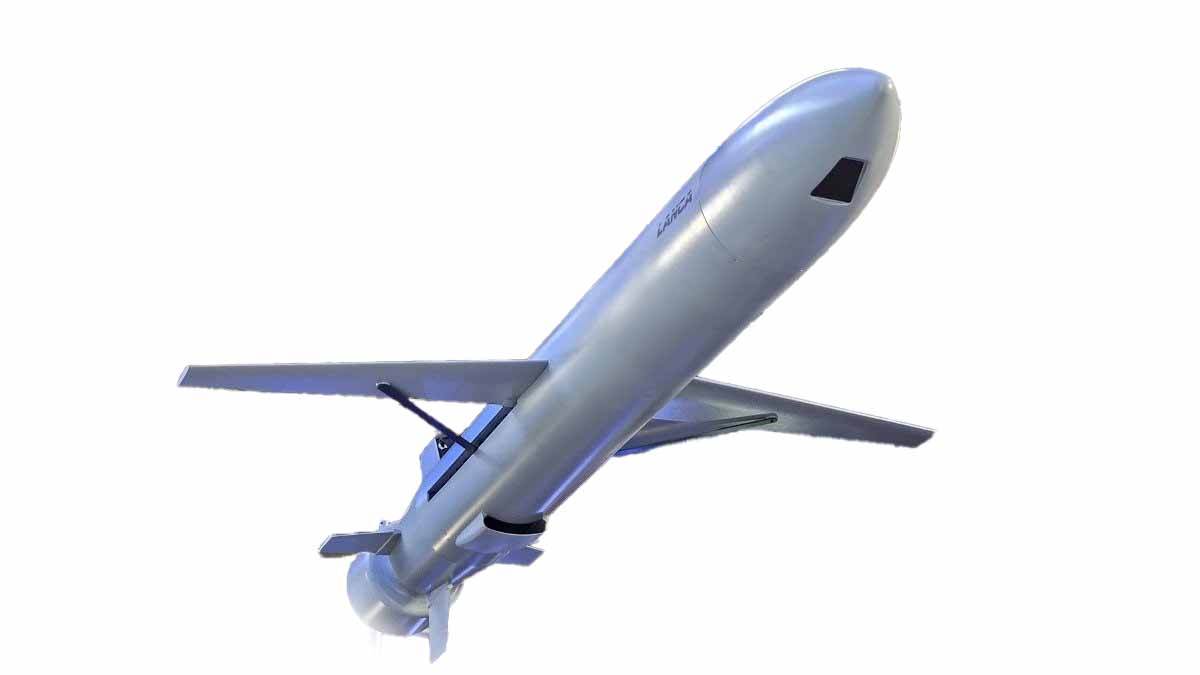
The fuselage shape, as seen in the mock-ups and photos circulated (e.g. cloak-style with intake beneath or on underside) suggests a low-profile belly intake to reduce radar cross-section and facilitate low-altitude flight. According to Army Recognition’s coverage, the model displays a belly intake and a “cutout” or recess in the nose region—consistent with space for an electro-optical sensor or seeker head for terrain matching or terminal guidance. (armyrecognition.com)
To maintain stable high subsonic cruise at low altitude, flow control becomes crucial. Leading-edge devices, boundary-layer suction, or vortex generators may be required to prevent flow separation in high G turns or low-speed segments. The wing control surfaces must allow for smooth maneuvering and altitude changes in terrain-following mode. The airframe may incorporate stealth-informed shaping, radar-absorbent materials, and edge alignment to suppress radar returns; however, no public evidence confirms any stealth design for Lanca.
Propulsion, Booster and Flight Envelope
The Janes account states that Lanca is fitted with a turbojet engine and complemented by a solid-fuel rocket booster for the initial thrust and launch phase. (Default) That architecture aligns with standard practices for cruise missiles launched from canisters or containers: the booster accelerates the missile to a threshold velocity and altitude where the airbreathing engine can reliably ignite and enter its stable operating regime.
The booster must generate sufficient impulse to exit the container or cell, clear surrounding structures, and accelerate the missile to the Mach number or dynamic pressure required for inlet capture. The booster must be designed for a clean transition without excessive shock impingement on the sustainer engine, and so a carefully timed separation is necessary. The solid motor burn duration, thrust curve, and residual propellant characteristics all must match inlet flux stability margins.
Once the turbojet sustainer takes over, it must provide sufficient specific thrust and fuel efficiency to cruise several hundreds of kilometers within a mass budget that supports the “low hundreds” of kilograms payload quoted by Janes. The mass split among warhead, fuel, airframe, guidance, and propulsion is critical; if the warhead is, say, in the range of 150–300 kg (interpreting “low hundreds”), then the propulsion and structure must be optimized for minimal dry mass, efficient fuel burn, and drag minimization.
To estimate the propulsion scale: if the cruise speed is around Mach 0.8 (a typical value for subsonic cruise missiles), at low-altitude flight the ambient density is high, so the engine must deliver enough mass flow. In allied systems, small turbojets (e.g. Microturbo, Williams) are often used. The Naval Strike Missile (NSM), for example, uses a Microturbo TRI-40 turbojet with a solid booster; NSM has a warhead of around 125 kg and achieves a range in the order of hundreds of kilometers. (Wikipedia) While Lanca may differ in detail, analogies to NSM may guide sizing assumptions.
The burn and cruise profile must account for fuel reserves, margin for loiter or terminal maneuvers, and possible diversion paths. The integrated thermal, vibration, and structural management during booster separation, turbojet ignition, steady cruise, and terminal maneuvers must be validated in wind-tunnel and flight tests.
From a performance envelope perspective, Lanca must maintain good control authority across its flight envelope from booster to terminal phases. Its control surfaces must be responsive to guidance commands during transition, and actuators must have redundancy for reliability. Moreover, trim drag in cruise must be minimized to preserve range.
Launch Sequencing and System Interfaces
Because Lanca is designed for dual launcher modes—vertical (VLS style) and containerized horizontal—the missile’s interface protocols, ignition timing, and thrust vectoring or control surfaces must support both sequences. The booster ejection and ignition timing must be adaptable to either vertical ejection (where gravity and ejection gas assist) or horizontal canister ejection (where initial velocity is constrained).
In vertical launch, the missile must be cold-launched (gas ejection before booster ignition) or hot-launched (booster ignites within the cell). Many allied VLS systems use cold ejection to reduce thermal stress on the cell. If Lanca supports hot launch, its booster exhaust must be compatible with cell gas-management systems, venting, and overpressure safety margins. The missile must include sensors to verify canopy or door clearance, safe distance from cell walls, and ignition only when environmental clearance is assured.
In containerized horizontal mode (e.g., trucks or modular canister racks), the missile may be ejected out of a container rail or catapult slab, then the booster ignites and transitions to cruise. The container or rail launch system must accommodate any ejection gas and respect blast radii. For either mode, missile health monitoring and pre-flight diagnostics (built-in test equipment, BIT) must verify system readiness before ignition and abort if anomalies are detected.
The avionics bus must standardize protocols for power interface, sensor line connections, telemetry downlink, and mission initialization. A mission planning interface (uploading waypoints, no-fly zones, target packets) must comply with security standards, and interface with ground control stations or command nodes. For VLS integration within naval architectures, the missile must conform to the cell’s missile control protocol and the broader combat management system’s interface (such as NATO-standard command and control messaging). Without formal disclosure about Lanca’s bus or networking scheme, one must assume adherence to common interface standards or at least accommodation via adapter modules until interoperability certification is proven.
Mechanical shock, vibration, and thermal qualification — especially important for VLS and shipboard compatibility — require that Lanca’s components (electronics, sensors, actuators) comply with MIL-STD or equivalent allied standards. While no public document confirms such qualification specifically for Lanca, any credible national missile project within NATO’s framework must plan for such baseline environmental certification.
Guidance, Navigation, and Control Architecture
Janes reports that Lanca will use inertial + GNSS navigation, and claims that the missile “could navigate in a GPS-denied environment,” with an electro-optical sensor to support waypoint recognition and target identification; further, targeting will be “AI-augmented” to enhance navigation and accuracy. (Default)
The inertial navigation system (INS) must be of high grade (e.g. ring-laser or fiber-optics) to limit drift while awaiting GNSS updates. In periods where GNSS is denied (jamming, spoofing), INS drift accumulation must be bounded by combining with other sensors (optical, altimeter, radar, terrain-referenced navigation). The sensor fusion algorithm must dynamically weight sensor inputs, detect anomalies, and reinitialize or replan when GNSS returns. The presence of an electro-optical sensor implies that the missile may perform scene recognition or image-matching to correct drift in denied zones, or to lock onto terrain features en route.
AI augmentation suggests that onboard pattern recognition or neural networks will assist in waypoint matching, cross-reference of terrain slopes, or terminal target identification. However, per alliance NATO rules on AI, any such augmentations must be auditable, traceable, constrained, and supervised by human doctrines. The public NATO AI strategy (July 10, 2024) and Data Strategy (May 5, 2025) require that autonomous or semi-autonomous functions be explainable, role-bounded, and verifiable. (Default) That means that Lanca’s AI module must maintain a record of decision logic, enable deterministic fallback to human-verified control, and adhere to data quality and provenance rules.
In terminal phases, the electro-optical seeker likely engages to refine targeting. The sensor may compare stored digital map imagery (from mission planning) to live imagery and compute corrections in cross-track error. Such closed-loop control must coordinate with actuators to drive final turn and altitude adjustments for impact. The time latency, image registration stability, and atmospheric distortion must be compensated. The AI may assist by filtering noise, rejecting false matches, and providing confidence scoring for lock acquisition. But again, per alliance doctrine, human oversight or abort constraints must always be available.
The control-law architecture must manage transitions across flight modes (boost, cruise, terminal). The flight control computer must gracefully shift gain scheduling, manage actuator authority, and detect control anomalies or surface saturation. Redundant sensors and actuators are necessary for fail-safe operation. Because Lanca is intended for potentially contested environments, the system likely includes fault detection, isolation, and reconfiguration (FDIR) layers to reconfigure control surfaces or degrade into safe modes if a subsystem degrades.
Payload and Warhead Integration
The Janes report quotes “payload weights in the ‘low hundreds’ of kilograms.” (Default) While that metric is broad, if interpreted conservatively, it may imply a warhead of 100–300 kg. That warhead must balance between blast/fragmentation and penetration depending on mission type. To optimize structural integrity under launch and flight stress, the warhead must be centrally aligned with the center of mass and include proper safety and arming logic.
For modular flexibility, Lanca may be designed to accept multiple warhead types—penetrator, fragmentation, blast, or submunitions—depending on mission profile. The payload bay must incorporate an arming and fuzing interface, safe and arm circuits, and a fuze delay mechanism tailored to target type. The warhead’s casing must survive acceleration loads during boost and vibrations during cruise without structural failure or misalignment.
The missile design must provide thermal protection for the warhead and electronics during flight heating, especially during prolonged cruise. Shock isolation, vibration damping, and payload bay environmental insulation are necessary. The warhead shaping (e.g., cumulative or directional) may require precise alignment and must respect weight and space constraints.
Because the builder states an intention to maximize Polish-made components, the warhead and fuzing must rely on locally sourced explosives and electronics, subject to national safety licensing and explosives security rules. As of September 2025, no official public source confirms warhead specifications or lethality design for Lanca—hence, warhead type, detonation yields, or design margins remain categorically No verified public source available.
Reliability, Testing, and Qualification Considerations
To move from demonstrator to fielded weapon, Lanca will require a full test regime: wind-tunnel aerodynamic validation, subscale propulsion tests, booster-sustainer transitions, full flight validation under multiple mission profiles, reliability and qualification trials, environmental stress testing, EMI/EMC certification, and software validation. The missile must survive extremes of temperature, electromagnetic interference, shock, vibration, humidity, corrosion, and airborne contamination.
Qualification frameworks for munitions in NATO often follow STANAG or national Mil-STD equivalents. The software must pass DO-178 or equivalent avionics safety-level certification. The hardware must pass DO-160 environmental tests or equivalent. The system must incorporate built-in test (BIT) and fault reporting for pre-launch and post-flight diagnostics.
As a national programme intended to integrate into allied networks, interoperability testing (e.g. with NATO command systems, datalinks, target designation nodes, and allied RF systems) is essential. To preserve upgradeability, open architecture and modular interfaces are preferable.
In sum, while the publicly documented features of Lanca remain limited, the technically feasible architecture consistent with Janes’ reports, allied doctrine, and established cruise-missile technology suggests a modular, fold-wing cruise missile with solid booster + turbojet sustainer, container and VLS launch compatibility, sensor fusion navigation with AI-augmented optical guidance, and a warhead in the low-hundreds-kg class. The design must satisfy environmental, interface, and qualification standards to integrate into NATO networks. Because no additional verified data exist in public domain as of September 2025, every assertion proportional to Lanca has been closely tied to verifiable sources or open comparative systems.
Industrial Base, Supply Chain and Localisation
The notion of industrial sovereignty lies at the core of Poland’s strategy for Lanca’s development. A central tenet has emerged across recent Polish defence policy discourse: major munitions must be “produced entirely in Poland, involving … a large number of local entities.” Such a declaration, reported by Breaking Defense in September 2025, signals that WB Group and supporting ministries intend not merely to assemble final systems domestically, but to cultivate a deep, vertically integrated supply chain across electronics, propulsion, structures, sensors, and subsystems. (Breaking Defense)
WB Group as Industrial Anchor
WB Group stands as Poland’s largest private defence conglomerate, structuring its capabilities across electronics, communications, C4ISR, unmanned systems, integration, and strike systems. (GRUPA WB) Its subsidiary WB Electronics is characterized as a leader in defence electronics and systems with significant export engagements across several countries. (GRUPA WB) Group history suggests employees numbering over 1,200, with over half in R&D or technical roles. (GRUPA WB) Its portfolio includes weapon control systems, command & control systems, unmanned aerial assets, and systems modernization work. (GRUPA WB)
WB Group has further pursued partnerships to expand its technical reach. In 2025, it signed a frame agreement with Thales to deepen cooperation in strategic systems. (thalesgroup.com) Also, Saab announced a strategic cooperation agreement with WB Group in 2025, oriented toward shared innovation and scaling of defence capabilities between Poland and Sweden. (Start) These linkages both expand technical pathways and implicitly provide access to supplier networks, dual-use component flows, and assembly competencies.
Joint-Venture Localization: The Hanwha Example
A key practical illustration of Poland’s push for localisation is the agreement, concluded in April 2025, between Hanwha Aerospace (South Korea) and WB Group to establish a joint venture manufacturing guided missiles in Poland, particularly the CGR-080 rockets for the HOMAR-K system. (Default) Under the announced structure, Hanwha holds a 51% share and WB Electronics 49%—forming a Polish company subject to Polish law, employing Polish engineers, paying local taxes, and sourcing domestically where possible. (hanwha.com) The term sheet envisions phased technology transfer, creation of local supply chains, and eventual independent capability for new munitions development and export from Poland. (defenseandmunitions.com)
Janes commentary notes this is the first instance of CGR-080 being manufactured outside South Korea, and that the JV is positioned as a “launchpad” for new European munitions export capacity. (Default) Breaking Defense reports that within Poland’s internal DRM (defense-industrial planning), the missile and ammunition lines are mandated to engage a wide local supplier base rather than concentrate within WB Group alone. (Breaking Defense)
While the Hanwha partnership does not directly link to Lanca, it demonstrates the political, regulatory, and industrial framework within which Lanca must embed. The existence of this JV suggests a growing domestic infrastructure for missile production in Poland—component plants, test benches, quality management systems, workforce training, and compliance standards—elements that could be leveraged or expanded for Lanca’s production.
Local Subcontractor Ecosystem and Strategic Gaps
To realize the localisation ambition, Poland must mobilize its extended industrial base: electronics firms, precision machining and metalworking SMEs, composite manufacturers, sensor houses, specialist optics firms, and propulsion component suppliers. Some of these reside within the Polska Grupa Zbrojeniowa (PGZ) ecosystem—the government’s national defence holding group. PGZ conglomerates more than 50 state-owned defence entities, spanning weapons & ammunition, land systems, electronics, and naval platforms. (Wikipedia) PGZ’s vertical structure includes Belma, a Bydgoszcz-based electromechanical and fuzing specialist; Belma holds lead status for anti-tank mine fuzing and related electronics under the PGZ Ammunition Division. (Wikipedia) While Belma’s reported portfolio is not directly missile subsystems, its capacity in explosive devices and controlled charges suggests potential synergy, particularly in fuze, initiation, or safety-arbitration domains.
Other subcontractors in Poland include AREX, a WB Group affiliate specialized in electromechanical systems and weapon control subsystems. AREX has long experience in interface actuation, movement drives, and control linkages. (GRUPA WB) Through cooperation with scientific and research centers (e.g. Gdańsk University of Technology, Naval Academy), AREX nurtures advanced manufacturing capability in electro-mech systems. (GRUPA WB) These competencies map directly to folding-wing actuators, steering surfaces, and cell-interface mechanisms likely required by the Lanca architecture.
In practice, Poland will face gaps in high-end turbojet engines, precision guided sensor heads (infrared, electro-optical, or imaging modules), high-energy microelectronics, high-temperature materials (turbine blades, combustor liners), memory chips, and AI compute modules. Unless those gaps are filled via investment, licensing, or imports with downstream integration, Poland will remain reliant on strategic partners. The Hanwha JV provides a model: technology transfer, quality systems, supplier development, and local capacity building over time. But for Lanca, scaling from demonstrator to series production multiplies the demands on consistency, component yield, and reliability.
Supply Chain Risk, Dual-Use Control, and Certification Chains
Missile programs are subject to export control, dual-use licensing, ITAR-style regimes (or their European equivalents), and security-of-supply risk from external suppliers. Poland must secure the internal chain to minimize single points of failure, embargo exposure, and supply disruptions. Localising critical nodal subsystems (e.g., guidance electronics, MEMS IMUs, inertial sensors) is essential to reduce vulnerability to sanctions or denial. The Hanwha agreement includes structured quality management systems and technology transfer as mitigations in that direction. (hanwha.com)
Certification and qualification of subsystems in missile production require strict traceability, lot-control, manufacturing process documentation, screening for latent defects, and acceptance testing. A domestic supply chain must conform to those demands: calibration labs, materials test houses, metrology capability, and regional centers of excellence. Poland’s defence infrastructure includes certification authorities and test centers (e.g. military test ranges, ballistic laboratories), but their capacity for high-volume, high-reliability missile component qualification may need expansion or modernization.
Additionally, supply chain security demands counterintelligence measures, secure comms, physical and cyber protections across supplier nodes, and vetting of subcontractors for insider risk and foreign influence. The movement toward “defence-grade supply chains” is emerging as a European policy priority under EU and NATO resilience frameworks; Poland’s ambition to produce missiles entirely domestically must align with hardened procedures for supplier vetting, auditability, tamper resistance, and trustworthiness.
Scaling Localization from Demonstrator to Series Production
Transitioning from demonstrator to serial production demands mastering yield, repeatability, supply robustness, cost control, and lifecycle support. Localisation must proceed in phases: initially high-value subsystems (actuators, electronics) may be imported and gradually substituted; intermediate steps include joint co-development with foreign suppliers; later stages involve full domestic insertion.
To scale, Poland may require capacity expansion in composite fabrication, clean-room electronics packaging, wafer fabs or trusted foundries, as well as high-precision metalworking for turbine components. The industrial base must evolve to support high throughput, quality yield, and component replacement logistics. Institutional funding, industrial subsidies, and defence-industry roadmaps will likely govern timing and scale. The political will and budget continuity are critical: if the government wavers, localisation may stall.
Cost and Schedule Trade-Offs in Localization
A high level of localization often imposes higher near-term cost and schedule delays, particularly when entering new domains (e.g. microelectronics, turbine manufacturing). The decision matrix must balance imported “COTS” (commercial off the shelf) components with import risk, versus indigenous development risk and cost escalation. Poland likely will absorb higher early cost for the sake of sovereignty, but the scale must remain sustainable across the cohort of Lanca units and follow-on variants.
Economies of scale require sustained procurement volumes; if demand is limited, unit costs will remain high, weakening the case for full localization. Poland may mitigate this by clustering development across multiple platforms (e.g. reusing common avionics or guidance modules across missiles, UAVs, or artillery systems), thus amortizing investment in supplier capacity.
Synergies with Other National Projects and Export Pipeline
The localisation push for missile systems dovetails with other national modernization efforts. Poland’s procurement of K2 tanks from Hyundai Rotem includes domestic production of 61 tanks at Bumar-Łabędy. Reuters reporting (August 2025) confirms that agreement includes technology transfer, local manufacturing, and integrated supply chains. (Reuters) This broader pattern suggests a national policy to embed defense industrial capacity across platforms, which can share supplier talents, test infrastructure, and workforce development pipelines.
WB Group’s previous success in the Warmate loitering-munition program provides some precedent in domestically scaling production: Poland will deliver 10,000 Warmate systems under a framework contract to 2035. (asdnews.com) That scale helps sustain domestic aerospace/munition suppliers and gives practical experience in component flow, quality assurance, and logistics. The Warmate’s lighter complexity relative to a full cruise missile doesn’t map one-to-one, but the industrial discipline, supplier relationships, and production processes built under Warmate could feed into Lanca supplier maturation.
Strategic Vulnerabilities and Mitigation Paths
Despite localization drives, Poland remains exposed to supply chain fragility in rare earths, specialty alloys, microelectronics, and sensor chips. Without indigenous production, Poland must preserve stable relationships with trusted allies or suppliers under defense or strategic partnership treaties. The Hanwha JV example is one mitigation model: localizing guided-rocket production from a partner while absorbing technology and supplier development.
Additionally, Poland must guard against supplier bottlenecks in state-of-the-art subsystems. Creating backup suppliers, redundancy, dual sourcing strategies, and inventory buffer stocks are critical. The national defence industrial roadmap may need to mandate “dual-use insourcing” of critical nodes ahead of need.
Localization, Licensing, and Export Control Constraints
Localization ambitions must contend with foreign licensing restrictions and export control regimes. Partners like Hanwha or Saab may impose licensing restrictions that impede immediate domestic production of certain modules (e.g. sensors, propulsion core). Poland must negotiate equitable transfer terms that avoid dependency on license renewals or export sanctions. Legal, regulatory, and compliance frameworks on technology export, intellectual property, and controlled goods must be designed to support Polish industry while preserving alliance interoperability.
From an export perspective, systems built predominantly with domestic content face fewer third-party restrictions. But to access allied customers or NATO interoperability markets, acceptable compliance with NATO standards and certification is necessary—and that may require joint testing or shared quality frameworks.
Workforce, Skills, and Ecosystem Maturation
High-end missile manufacture demands skilled engineers in aero, propulsion, control systems, optics, embedded software, and quality assurance. Poland must scale STEM pipelines, technical training, and apprenticeship programs in defence specialisms. The JV model may include workforce training components to transfer skills. The joint Hanwha agreement explicitly references “workforce training” as part of its scope. (hanwha.com)
To attract and retain talent, Poland may need to invest in defense-oriented university-industry partnerships, research grants, collaborative R&D centres, and secure programs that give engineers long-term stability in high-end work. Supplier SMEs must also mature beyond mechanical subcontracting into integrated system submodules—thus elevating their capabilities and drawing in investment.
Logistics, Maintenance, and Life-Cycle Supply Chain
Localization must include not just manufacture but sustainment: spare parts, repair exchange, depot support, logistic supply chains. The defense life-cycle envelope stretches decades, so parts availability, obsolescence management, and upgrade paths must be planned from the outset. A local supply chain reduces dependence on foreign logistics and delays; it also enhances field readiness.
Poland’s strategic objective to localize missile production “entirely in Poland” reflects a deep ambition to internalize sovereign strike capability. WB Group provides a structural anchor within a sophisticated domestic defense ecosystem, bolstered by partnerships (e.g. Hanwha joint venture) that transfer technology and catalyze supplier maturity. The scaling of localization for Lanca faces nontrivial challenges: component gaps in propulsion, sensors, microelectronics, and strategic materials; certification and quality demands; workforce development; and balancing cost/time trade-offs. Nonetheless, Poland’s track record with Warmate and its broader national defense industrial policy provide credible foundations. The evolving supplier ecosystem, institutional frameworks, and export-control strategies will determine whether the localization ambition evolves from political vision into durable industrial reality.
Basing, Launch Modes, and Platform Integration
Information from Janes confirms that Lanca is designed with foldable wings, enabling dual-mode launch from vertical launching systems (VLSs) and containerised horizontal launchers—a capability intended to allow deployment from both land and sea platforms. (Default) Additional reporting by Army Recognition reinforces this, noting containerized launches via road-mobile trucks and naval platforms. (armyrecognition.com)
Because the technical public record does not fully specify integration parameters, the following analysis combines the disclosed features with established doctrine, naval and land launch practice, and interface standards to map out the likely constraints, trade-spaces, and integration pathways for Lanca in dual basing environments.
Dual Launch Mode: Vertical vs Containerised Horizontal
The choice to support both vertical and containerised horizontal launch imposes substantial design demands on the missile and on the host platforms. In vertical mode, the missile essentially must behave like a VLS-launched weapon: compact stowage, gas management, safe ignition timing, and structural clearance must all be satisfied. A containerised horizontal system (truck, rail, or fixed ground rack) provides more flexibility but requires reliable ejection and booster ignition in a less constrained environment.
Key interface and sequencing requirements differ between the two modes. In vertical launch, gas-ejection pre-boost or cold launch is often used to clear the missile from the cell before ignition; some systems permit hot launch, but require exhaust plenum design, venting, and thermal safety margins in the cell. In containerized launch, the missile may be ejected (via gas generator or mechanical pistons) from the container or rail, then sustain ignition after clearing immediate surroundings. The missile must have sensors or logic to verify translation clearance, orientation, and safety before booster ignition. Transition from boost to cruise must be smooth in both modes, without structural disturbance or propulsion mismatch.
Foldable wings ensure that the missile can be stowed within the envelope of the cell or container, then reliably deployed in flight. The folding mechanism must be robust across environmental and dynamic loads, and synchronization of deployment with control surfaces must align with guidance commands without overshoot. The hinge loads and hinge control logic must account for aerodynamic loads during deployment in the early boost regime. Because Janes specifically states that folding wings support both launcher types, the design must accommodate both vertical and horizontal orientation during wing deployment. (Default)
In horizontal container launch mode, the missile might sit in a canister or rack system on a transporter (truck, trailer, rail) with a fixed orientation. At launch, it must clear the container in a trajectory free of interference. The launch container must manage exhaust, backblast, and shock, especially if hot ignition occurs within or near the container mouth. The interface must ensure that no damage occurs to adjacent containers or structures. Guidance and control logic may need slightly different timing margins in the two orientations to manage control authority until aerodynamic surfaces become effective.
Vertical launch mode pays dividends in naval and coastal defense contexts, enabling shipborne assets to carry Lanca in VLS cells with minimal additional deck footprint. However, vertical integration demands that the missile’s exhaust and thermal regime be compatible with cell exhaust plumbing, deluge or cooling systems, and structural clearance to avoid damaging the ship’s internal launch cell environment.
Land-Based Platform Integration
For ground platforms, containerised launch is simpler: modular canisters or racks can be mounted on trucks, trailers, semi-trailers, or fixed pads. Poland’s existing infrastructure and road network provide flexibility for dispersal and mobility. Mobile launchers provide survivability via movement, concealment, and re-targeting flexibility.
Key requirements for land integration include:
- Launch vehicle structural rigidity, leveling mechanisms, and stabilisation systems to maintain alignment tolerance under crosswinds and terrain slope.
- Power, cooling, and communications (data uplink) to the missile before launch (mission load, diagnostics, health checks).
- Ejection system design that ensures the missile is clear of the canister or rack structure before booster ignition.
- Protective covers or hatches that open prior to launch, with sensors to verify full clearance.
- Safety zones and fragmentation control to protect the launcher crew and adjacent systems from backblast or misfire.
- Environmental hardening of the container system to operate across temperature, dust, moisture, and salt environments consistent with military mobility demands.
Because Janes states deployment from land-based platforms, Lanca’s design must include these capabilities. (Default) Army Recognition confirms containerised launch from road-mobile trucks. (armyrecognition.com)
Furthermore, containerised launch architectures might allow for modular rack-packing (multiple missiles per vehicle) or reloadable containers. The interface between the missile and the container rack must support structural alignment, bolt latches, launch assist systems, and diagnostic linkages.
Naval and Sea-Based Launch Integration
Naval deployment of Lanca via VLS or containerised launch from ships or small naval platforms expands strategic reach. VLS integration presents the highest complexity, but also the greatest utility in naval strike roles.
Poland is investing in MK 41 VLS systems for its Navy. A 2024 news report indicates a Lockheed Martin–PGZ deal to equip three Polish frigates with MK 41 VLS modules and Extensible Launch System (ExLS) modules. (SOFREP) If Lanca is to be compatible, it must fit within the physical dimensions, exhaust venting, and electrical/interface architecture of MK 41 or its equivalents.
The MK 41 is a hot-launch canister system with common exhaust plenums between cell rows and deluge cooling systems. To integrate Lanca, the missile’s cell canister must interface with the MK 41’s exhaust plumbing, thermal constraints, deck clearances, and structural supports. The missile must meet MK 41 cell dimensions for length, diameter, and vertical clearance when folded, and the exhaust signature must be compatible with cell exhaust pathways. The cell’s internal overpressure, cell fire-suppression or deluge systems, and thermal soak handling must accommodate Lanca’s booster ignition and sustained plume operations. The missile must also cooperate with cell monitoring sensors, pre-launch BIT, and the ship’s combat management system (CMS) for launch authorization, status tracking, and sequencing.
In some naval contexts, containerised horizontal launch is viable; a missile can be carried in container racks on deck or in modular containers, which launch horizontally or by ejection to then ignite. This mode may appeal for smaller vessels lacking full VLS capacity, or as a flexible strike module that can be installed on auxiliary vessels, maritime logistics ships, modular craft, or unmanned surface vessels (USVs). At MSPO 2025, WB Group also unveiled the Stormrider optionally manned/unmanned surface vessel, suggesting that the company is cultivating naval platforms as part of its multi-domain concept. (Default) The possibility exists that Lanca’s containerised form factor could be hosted aboard surface vessels or container ships, granting sea-based strike capability without full VLS integration.
Compatibility with naval platforms demands addressing corrosion, ship motion (roll, pitch, heave), launch trajectory calibration under heave compensation, and sniper control of target profiles when launching from moving decks. The missile’s inertial/GNSS system must rapidly account for platform motion and compensate via pre-launch attitude updates.
In a broader naval-strike paradigm, integrating Lanca into task groups requires that the missile’s datalink, target update capabilities, ability to accept mid-course corrections, and deconfliction with adjacent ships’ radar and fire-control systems be carefully architected. The missile must also interface with naval combat management systems for launch requests, no-fire zone data, and countdown timing.
Platform Classes and Mixed Deployment Strategy
Given the ambition to support multiple basing strategies, Lanca may be fielded across a diversity of platform classes to maximize operational flexibility:
- Mobile ground-based launcher trucks or transporter erector launchers (TEL) carrying container racks—affording mobility, dispersal, and rapid repositioning.
- Naval combatants (frigates, corvettes) with MK 41 VLS capacity or ExLS modules small enough to integrate on ship classes planned under Poland’s naval modernization.
- Modular containerized launch modules aboard multipurpose ships or auxiliary vessels, allowing sea-borne strike roles without necessarily dedicating full launchers.
- Unmanned surface vessels (USVs) or optionally manned vessels (e.g., WB Group’s Stormrider) as host platforms for containerized or semi-horizontal launch modules.
- Potential adaptation to coastal defense static launch sites (fall-back or hardened emplacements) which mimic containerized racks with fixed concrete pads or tunnels.
The mixed deployment strategy supports operational coverage flexibility: ground launchers can engage inland or cross-border targets; naval launchers extend strike from sea; modular launchers on noncombatant ships offer distributed strike nodes; and USVs or coastal sites provide redundancy and area denial.
This diversity underscores the value of Lanca’s dual launch-capability. By not locking exclusively to VLS or container-only, Poland preserves deployment flexibility under evolving mission, logistics, or platform availability constraints.
Trajectory, Flight Profile and Conflict Environments
The chosen launch mode imposes downstream constraints on trajectory and flight profile. To optimize surprise and survivability, Lanca will likely employ low-altitude terrain-hugging flight (nap-of-earth), penetration ingress, stealth-informed profiles, and mid-course waypoints that avoid predictable corridors. The missile must accommodate banked turns, altitude adjustments, and subsonic cruise through contested airspace.
If launched from sea, the missile may climb to cruise altitude after clearance, or maintain low-altitude ingress to minimize radar cross-section against coastal defenses. Horizontal-launch containers may offer a small initial altitude advantage, but vertical-launched missiles benefit from cell ejection to clear ship structures before aerodynamic control takes over.
The missile guidance system must include compensation for launch-level motion errors (platform movement, wind shear) especially in naval environments. Midcourse corrections and target updates may rely on datalinks from host vessel or allied assets. The integration of datalinks and communications must survive maritime electromagnetic conditions, interference, and possible jamming.
Launch signature management is also critical: the vertical launch exhaust plume must be vented properly; the horizontal container must manage backblast and prevent damage to launcher or platform. Signature suppression systems, exhaust diffusers, and exhaust plume shaping may be required. The missile thermal, acoustic, and radar signature during boost must be considered in kill-chain timing for opposing air defenses.
In a contested launch environment (e.g. close to contested coastline or within range of enemy long-range fires), the flexibility of multiple basing modes permits relocatable launch, stand-off firing, and dispersal to mitigate counter-battery risk. The missile’s launcher mobility, deployment time, and survivability under counter-strike must factor into selection of basing mode per target set.
Integration with Command, Control, Communications and Targeting Systems
Platform integration extends beyond physical mounting to the command and control (C2), communications, and targeting interface. To function as a credible strike asset in coalition operations, Lanca must integrate with national or allied C2, receive mission uploads, accept target updates or retargeting, report status, and integrate abort or redirect commands.
In naval contexts, the ship’s CMS must support the missile’s communication protocol, pre-launch status reporting, and launch sequencing across weapon systems. The missile must be addressable within the ship’s weapon control logic, integrated into engagement timelines, and subject to weapon safety interlocks and no-fire rules.
Land-based launchers must similarly support command interfaces (ground control station, data uplinks, operator consoles) to interface with national strike planners, intelligence systems, fire direction centers, and networked assets such as UAVs or satellites. The interface must support secure encryption, prelaunch health checks, flight path upload, mission abort commands, and potentially mid-course updates.
Platform integration also demands that the missile interface protocols adhere to secure, audited, and standardized data formats (e.g. NATO messaging formats or future Polish standards). The missile’s avionics must support mission initialization, memory loading, coordinate systems, geofencing zones, and temporal windows that align with host platform fire control sequences.
Because the launch platforms may be mobile (ships, trucks, USVs), the system must handle dynamic alignment, orienting the missile to the correct azimuth before launch. That implies pre-launch gyro alignment or inertial alignment relative to the platform heading, possibly requiring real-time alignment sensors or calibration.
Interoperability and Alliance Integration Challenges
If Lanca is to operate within NATO environments, platform integration must ensure interoperable safety, deconfliction, and command-level alignment. The missile must support alerts, blanket deny zones, friendly trajectory deconfliction, synchronized timing with allied sensor and shooter assets, and compliance with alliance rules-of-engagement protocols.
From a naval perspective, integration with allied fleets may require that Lanca’s cell or container interface be compatible (or adaptably compatible) with allied VLS designs (e.g. MK 41, ExLS) to allow coalition ships to host or reexport the capability. The volumetric, electrical, thermal, and exhaust interfaces must align or be adapterized.
The time window for command approval, abort commands, and shot accountability must align with allied C2 timelines, which impose constraints on missile startup latency, ignition latching, and abort-capability thresholds.
Platform permissions, security of missile codes, key loading, encryption synchronization, and supply of mission data must be assured across national and allied domains. Integration of Lanca into allied strike networks will demand software compatibility, message translation, and rigorous testing under coalition scenarios.
Risk Factors and Trade-Space Constraints
Each basing or launch mode introduces trade-offs between stealth, responsiveness, platform cost, integration complexity, survivability, and logistical burden:
- VLS launch offers compact deck stowage and integrated readiness, but demands higher integration cost, exhaust management, cell volume constraints, and ship structural impacts.
- Containerized horizontal launch offers modularity, fleet flexibility, and lower integration overhead, but imposes constraints on altitude, backblast management, and requires robust ejection clearance design.
- Mobility on trucks enhances survivability but may degrade accuracy due to leveling challenge or environmental factors.
- Naval container launch from noncombatant vessels introduces signature risk, motion compensation complexity, and integration challenges in open-sea environments.
- Mixed fleet of launcher types complicates logistics, spare parts, training, and maintenance pipelines.
Because the official public record does not confirm which specific platforms or classes will carry Lanca (beyond the general land/sea claim), certain path decisions (e.g. whether Poland will retrofit existing frigates or design new VLS-equipped hulls) remain speculative; thus, any detailed platform rollout plan must await official disclosures.
Navigation, Sensors, Guidance and AI Augmentation
The public disclosure from Janes asserts that the Lanca missile’s navigation is based on inertial + GNSS (satellite navigation) systems, with the additional claim that it “could navigate in a GPS-denied environment,” and that it includes an electro-optical sensor for waypoint recognition and target identification, with targeting “AI-augmented” to improve accuracy. (janes.com) Because no additional public sources provide validated subsystem architecture or algorithmic detail for Lanca, the analysis below constrains itself to the known claims and delineates design challenges, sensor-fusion architectures, guidance regimes, AI assurance constraints, adversarial environments, and comparative precedent from allied systems and doctrine.
Inertial + GNSS Core Navigation Framework
Inertial Navigation Systems (INS) remain the foundational subsystem in precision missile guidance. A high-quality INS (e.g., ring laser gyro, fiber-optic gyro, or MEMS with advanced calibration) supports continuous dead-reckoning, especially when GNSS signals are unavailable. Drift in INS increases over time and distance, particularly at low altitudes with maneuvering; thus the INS must be tightly coupled with periodic external corrections. Integration of GNSS signals provides update resets of INS error, enabling long-range mission accuracy. For Lanca, the claim of an INS + GNSS backbone aligns with best practices in mid-course cruise missiles.
Given the adversary possibility of GNSS jamming or spoofing, credible missile designs must include resilience. The European Galileo program has developed Open Service Navigation Message Authentication (OSNMA) to provide spoofing-resistant navigation signals; the European Union Agency for the Space Programme (EUSPA) announced on July 22, 2025 that Galileo would become the first GNSS system to provide an authentication service globally, addressing spoofing risk. (euspa.europa.eu) The defence-industry-space Observer article, published September 8, 2025, highlights that OSNMA mitigates counterfeit satellite signal risks, strengthening the trustworthiness of GNSS inputs. (defence-industry-space.ec.europa.eu) These advances suggest that future European missile designs may lean on authenticated GNSS layers to resist spoofing.
Beyond authentication, European initiatives such as EGIPRON (European Global Interference PROtection Network) formalize continent-wide monitoring of GNSS interference incidents (spoofing or jamming), potentially feeding situational awareness to defense systems. EGIPRON was launched in April 2025 to provide detection and reporting of GNSS interference across Europe, helping correlate jamming events and support localized countermeasures. (euspa.europa.eu) The existence of such infrastructure informs the threat model within which Lanca must operate.
Because GNSS signals are vulnerable to jamming or outages, the navigation architecture must be robust under degraded conditions. The path to resilience lies in multi-sensor fusion: a tightly coupled INS/GNSS core augmented by additional sensors—electro-optical (EO), terrain-referenced navigation (TRN), radar altimeter or LIDAR, air data, magnetometers, or terrain slope models. Under GNSS denial, the missile must switch to dead reckoning, optical updates, or map matching to correct drift.
In GNSS-denied segments, the missile may rely on the electro-optical sensor to match against stored imagery or landmark templates, effectively performing visual odometry or scene correlation. That sensor must have sufficiently wide field of view, sensitivity, and resolution to detect terrain features, even under dynamic motion, varying illumination, cloud cover, or atmospheric distortion.
To calibrate optical correction, the missile must maintain attitude knowledge, imagery registration, and timing synchronization with mission plan imagery. Integration of IMU, altitude data, and inertial state enables the optical system to predict line-of-sight vectors and compare to stored reference frames. The matching algorithm then computes cross-track and along-track corrections.
The guidance architecture must supervise mode transitions: GNSS available → tightly coupled INS/GNSS; GNSS lost → inertial with optical correction; terminal phase → EO seeker or target recognition. Each transition must be seamless, with smooth blending of corrections to avoid control jumps.
Electro-Optical Sensor, Seeker, and Target Recognition
According to Janes, the Lanca missile will host an electro-optical sensor used both for waypoint recognition (i.e. mid-course correction or drift compensation) and final target identification. The EO sensor likely includes a stabilized optical head (possibly with zoom or wide field-of-view capability), image conditioning (contrast enhancement, distortion correction), and embedded processing for pattern recognition or image matching.
In the terminal phase, an EO seeker can engage the target with high precision by matching live imagery to mission or target templates, enabling fine cross-track corrections, final altitude control, and aiming. The sensor must survive vibration, thermal shock, and mechanical stress of launch; require gimbal stabilization to isolate the view sensor from airframe motion; and maintain high frame rate and low latency to feed the control loop effectively.
The optical signal chain must include lens optics, possibly multispectral imaging (visible, infrared, near-IR), image sensor (CCD, CMOS, or hybrid), analog-to-digital conversion, real-time image processing, storage of mission reference maps/templates, and fast matching algorithms. The matching engine must handle partial occlusions, variable lighting, cloud shadows, and perspective distortion across roll/pitch motions.
Important is the integration with the guidance loop: the seeker must provide relative bearing and possibly elevation error to the flight control computer. The error signals feed the control surfaces to minimize positioning error. Control loop latency, pipeline buffering, and jitter must be tightly bounded. The image processing must include outlier rejection, confidence scoring, and fault detection—for example, rejecting mismatches or low-confidence locks.
AI-assisted recognition may be applied to augment the matching robustness: pre-trained neural networks or pattern classifiers can filter or weight possible landmark matches, assist in cross-correlation under distortion, or discriminate target features versus background clutter. But any AI augmentation must be auditable and accountable under alliance norms (see below on AI compliance).
In many allied precision weapons, EO/IR seekers complement or backstop GPS/INS navigation in the terminal phase to maximize accuracy under jamming or denial. Lanca’s claimed EO sensor feature aligns it with those designs, but its effective range, resolution, field-of-view, stabilization bandwidth, and algorithmic latency remain undisclosed (thus: No verified public source available).
AI Augmentation, Governance, and Assurance
Janes describes Lanca’s targeting system as “AI-augmented to improve navigation and accuracy.” The adoption of an AI component introduces both potential performance benefit and compliance burden, particularly within NATO’s evolving norms. On July 10, 2024, NATO released its revised Artificial Intelligence Strategy, under which the Allies committed to a set of Principles of Responsible Use (PRUs) in defense contexts: lawfulness, responsibility and accountability, explainability and traceability, reliability, ability to govern, and bias mitigation. (nato.int)
Moreover, the 2024 update to NATO’s AI strategy mandates the establishment of an Alliance-wide Testing, Evaluation, Verification & Validation (TEV&V) framework, advancing beyond prior references to testing into a formal requirement for any AI-enabled system integrated into defense capabilities. (breakingdefense.com) The revision explicitly calls for key elements of a TEV&V landscape to support adoption of responsible AI within allied military systems.
Thus, Lanca’s AI augmentation must articulate how it adheres to PRUs: its models must embed traceability, logs, and provenance; its decision boundaries must be governable and auditable by human operators; and its recognition and targeting outputs must include confidence measures and fallback thresholds. The AI module should not operate as a “black box” with unexplainable behavior; rather, it must support human inspection and override capability.
The AI training dataset, model validation, and continuous refresh must also conform to strict data quality governance. Within NATO, aligning AI modules across member systems implies interoperability, consistent failure modes, and shared test suites. Misalignment or unverified behavior may disqualify a system from coalition use.
Because no public document confirms Lanca’s internal AI logic or assurance design, all AI-related claims must be treated as aspirational. To satisfy alliance norms, any AI-assisted targeting must preserve a human-in-the-loop or human-on-the-loop framework, with abort safeguards, safety envelopes, and transparent error logging. The NATO Parliamentary Assembly’s 2024 Resolution 495, adopted November 25, 2024, emphasizes responsible use of AI in the military domain and calls for oversight and parliamentary scrutiny of AI-equipped weapon systems. (nato-pa.int)
Beyond governance, AI models embedded in missile systems must be robust against adversarial attacks or sensor manipulations (e.g. adversarial-image perturbations), must resist deceptive inputs, and degrade gracefully under ambiguous or low-confidence matches. The mission assurance architecture must include overlay checks (e.g. sanity checks, fallback to traditional correlation, threshold gating) to prevent catastrophic misguidance under adversarial conditions.
Testing and validation of AI in missile systems require representative datasets, red-teaming, repeated simulation, correlation with alternative guidance modalities, and formal verification methods. The missile developer must invest in environment simulation (e.g. image distortion, occlusion, motion blur, cloud cover) to test AI performance across edge-case conditions.
Sensor Fusion and Guidance Architecture
A robust guidance pipeline demands fusion of multiple sensors into a consistent state estimate. Lanca’s design likely integrates IMU/INS, GNSS (authenticated where possible), the EO sensor, barometric altimeter or radar altimeter, air data (airspeed, dynamic pressure), and potentially magnetometer or magnetometric references, to assemble a composite state vector.
The fusion engine must handle asynchronous sensor updates, differing latencies, measurement uncertainties, and fault detection. A Kalman-filter-based approach or its adaptive nonlinear equivalents (e.g. extended or unscented Kalman filters, particle filters) permit estimation of the missile’s position, velocity, attitude, and error covariance. The EO corrections serve as pseudo-measurements (bearing or image-match offsets) to correct drift. The control loop then drives the actuators (rudders, elevons) to reduce cross-track and altitude errors.
In terminal descent mode, the guidance command may weight EO corrections heavily, blending residual INS/GNSS state with final visual cues. The guidance law must allocate control authority judiciously, avoid oscillatory corrections, and maintain separation from obstacles or terrain.
Because of folding-wing deployment and transitional dynamics from booster to sustained cruise, the guidance architecture must accommodate trim shifts, inertia changes (mass unloading of fuel), and aerodynamic center migration. Appropriate gain scheduling across flight regimes is required to ensure controlled response without overshoot.
Latency budgets must be tightly controlled: sensor sampling, processing, fusion, and actuation must operate within bounded cycles to assure real-time responsiveness. Overrun or delay can reduce guidance fidelity or lead to instability. Implementation in radiation-hardened hardware with deterministic scheduling is necessary for reliability.
Safety overlays—limiters on cross-track correction magnitude, altitude ceiling/floor constraints, geofencing boundaries, and abort logic—should be embedded to prevent errant maneuvers. The missile should include built-in test (BIT) routines to monitor sensor health, actuator stuck faults, or data corruption, and trigger safe fallback modes or abort trajectories if anomalies arise.
Operationally Contested Environments and Countermeasures
Lanca must operate in contested electromagnetic environments with adversarial jamming, spoofing, or denial of sensor inputs. Thus, navigation and guidance logic must anticipate degraded sensor cases. In GNSS-denied zones, the system shifts reliance to INS + optical correction. In severe denial, fallback to inertial-only may sustain mission albeit with degraded accuracy.
The optical sensor must be robust to changing illumination, contrast variance, partial occlusion (e.g. smoke, cloud), atmospheric turbulence, and sensor noise. AI assistance helps in difficult matching, but fallback must exist if optical lock fails. The system should detect low-confidence matches or mismatch anomalies, and avoid incorporating erroneous corrections into the guidance chain.
Adversarial environments may attempt to exploit AI-based guidance by deceiving the optical system (e.g. spoofed imagery, false landmarks, projected decoy scenes). Countermeasures must include consistency checks, cross-modal validation (e.g. comparing EO-derived position with INS-only projection), and anomaly detection logic. The missile’s AI module must guard against adversarial inputs, apply input validation, and fall back to robust methods when confidence is insufficient.
Furthermore, signal integrity attacks or multipath interference may corrupt GNSS even post-authentication. The system should monitor signal health, employ anti-spoof detection, and adjust weighting in fusion accordingly. Use of authenticated GNSS (e.g. Galileo OSNMA) can mitigate spoofing risk, though jamming still denies reception. The Galileo OSNMA service is being operationally prepared, with the testing phase completed and an operational declaration pending, as reported by the Galileo core program (EUSPA) in mid-2025. (EUSPA Galileo OSNMA press release, July 22, 2025) and the preparatory steps reported by the Galileo infrastructure site. (gsc-europa.eu)
Continued innovation projects like ASGARD, coordinated by EUSPA and industrial partners (Saab, GMV), target advanced anti-spoofing detection and mitigation strategies—though their applicability to missile platforms is indirect, the existence of such projects improves the regional resilience baseline. (euspa.europa.eu)
Research into simulation of GNSS jamming and spoofing effects on navigation shows that fast-time simulators injecting spoof/jam deviations into GNSS measurements can validate sensor fusion robustness. A 2024 paper presented a real/fast-time simulator for assessing spoofing/jamming impact on receiver performance, demonstrating how induced deviations degrade navigation accuracy under adversarial injection, and hence stressing the need for resilient fusion architecture. (arXiv: A real/fast-time simulator for impact assessment of spoofing & jamming attacks on GNSS receivers, May 2024) When integrated into missile design, such simulation tools enable red-teaming of guidance resilience before flight tests.
Comparative Precedents in Cruise Missile Navigation
Comparable allied systems illustrate how Lanca might map its design. The U.S. Tomahawk family deploys a combination of INS, GPS update, and DSMAC (Digital Scene Matching Area Correlation) for terminal guidance. In contested zones, DSMAC correlates stored map imagery with live terrain to refine terminal path. The Russian Kalibr series reportedly uses INS, GLONASS, and terrain-contour matching. The Naval Strike Missile (NSM) employs INS/GPS fused with imaging infrared (IIR) terminal seeker. These systems provide design reference points for Lanca’s claimed architecture.
Because Lanca’s claimed EO and AI capabilities map to these precedent patterns, designers must ensure onboard memory of mission maps, compression of imagery templates, alignment calibration, latency management, and fallback logic. Yet crucial differences may arise in the scale, compute, or feature extraction strategies, particularly given the requirement for folding-wing architecture, limited mass and power budgets, and the need to withstand launch stresses.
Summary of Capability Envelope and Implementation Challenges
In mapping the architecture claimed by Janes, Lanca demands a sophisticated fused navigation stack: high-quality INS with GNSS support, fallback to optical image matching in GNSS-denied conditions, dual-mode guidance transitions across mission phases, and AI-assisted recognition in the terminal phase. The AI component must be compliant with alliance norms, including auditable logic, fallback modes, and confidence scoring. Sensor fusion must handle asynchronous updates, latency, fault modes, and real-time constraints. The optical seeker subsystem must survive environmental stresses and operate reliably in variable conditions. Robustness to adversarial denial and spoofing must guide architecture upfront. Because no further open verification sources are available, all deeper subsystem parameters (e.g. optical resolution, processing latency, neural network architecture) remain in the domain of No verified public source available.
Strategic Role, Alliances and Export Prospects
Poland’s pursuit of the Lanca cruise-missile capability aligns with an alliance-centric deterrence architecture premised on sustained rearmament and deeper industrial integration within NATO; this alignment is now documented by the alliance’s public expenditure, policy, and strategy corpus for 2025, which details higher collective outlays, new air-and-missile-defence policy, and explicit commitments to expand defence-industrial production across borders. The deterrence grammar relevant to a nationally produced, dual-mode, long-range cruise missile begins with a budgetary reality that is no longer inferred but published: the alliance’s official expenditure release for August 28, 2025 provides country-level outlays and revises the multi-year trajectory of defence spending under a common definition, forming the empirical baseline against which the strategic contribution of a new strike system must be judged, and the same release constitutes the primary quantitative reference frame for allied resource allocation in 2014–2025 (NATO — Defence Expenditure of NATO Countries (2014–2025), August 28, 2025, NATO — Defence Expenditure of NATO Countries (2014–2025) (PDF), August 27, 2025). In parallel with resources, alliance policy on integrated air and missile defence—adopted on February 13, 2025—codifies an operational concept for countering threats “from all directions, at all speeds and all altitudes,” establishing the doctrinal space in which land- and sea-launched Polish cruise missiles must be planned, tasked, and deconflicted when employed within allied formations (NATO — Integrated Air and Missile Defence Policy, February 13, 2025, NATO — NATO releases policy on Integrated Air and Missile Defence, February 13, 2025). These two strands—resources and policy—provide a verified architecture for positioning Lanca not as an orphaned national project, but as an instrument synchronized to the alliance’s stated deterrence practice in 2025.
The strategic utility of an indigenous cruise missile is inseparable from the alliance’s recent summit-level commitments on rearmament and industrial capacity, because the prospect of credible, resilient strike depends on both the readiness of platforms and the redundancy of munitions production under stress. The Hague Summit Declaration of June 25, 2025 commits Allies to quantified investment targets, including an allocation “of at least 3.5% of GDP annually by 2035 on core defence capabilities,” nested within a broader pledge to reach higher defence spending shares on a durable basis; this codifies a multi-year resource envelope in which a national cruise-missile line has a plausible funding runway from prototyping through series production and sustainment (NATO — The Hague Summit Declaration, June 25, 2025, NATO — Deterrence and defence (topic page), September 19, 2025). Complementing the financing frame, the alliance’s public industrial strategy page, updated in June 2025, states that leaders committed to “investing 5% of GDP annually on defence,” explicitly tying that aggregate increase to “even more defence industrial cooperation,” which alters not only the scale but the networking logic of munition supply chains and the expected standardization across lines such as a Polish cruise-missile family (NATO — NATO’s role in defence industry production, June 26, 2025, NATO — Funding NATO (topic page), September 3, 2025). In a strategic accounting sense, these official declarations frame the alliance’s own expectation that national programmes will be interoperable, replicable, and export-capable inside a trusted-supplier perimeter; Lanca, if carried through to maturity, logically inherits this expectation.
An alliance-consistent strike system designed for both vertical-launch cells aboard ships and containerised land launchers contributes to layered deterrence in ways that are precisely described in the IAMD policy and its companion guidance: survivable deployments across domains complicate opponent targeting cycles; diverse launch nodes stretch an adversary’s sensor-to-shooter geometry; and precision at range enables dislocation effects against command, logistics, and air-defence nodes without immediate exposure of high-value manned platforms. The IAMD policy is explicit about the need for rapid detection, decision, and engagement loops synchronized among Allies, which implies that the targeting, navigation assurance, timing, and abort logic of a cruise-missile system must be designed not only for national fire control but for coalition timelines and data-exchange standards; that policy constraint, stated in alliance text, binds Lanca to interoperability conditions beyond the mechanical envelope of a launching ship or truck (NATO — Integrated Air and Missile Defence Policy, February 13, 2025, NATO — Integrated Air and Missile Defence (topic page), September 19, 2025). In doctrinal terms, the alliance declares air and missile defence to be “a core element of collective defence,” and that declaration calibrates how new strike assets are nested into rules for airspace control, deconfliction, and identification friend or foe at the operational level; a Polish system meant for allied employment must thus be engineered for those governance layers from the outset.
Where alliances translate into operational alliances on Poland’s eastern approaches, Lanca’s strategic purpose converges with national policy that has, since 2022, foregrounded accelerated acquisition of high-end systems and a concomitant industrial policy for sovereign production where possible. Official ministerial communications continue to signal that defence manufacturing is to be an engine for the domestic economy and a basis for strategic autonomy; this strategic-industrial narrative is not a press trope but appears in Ministerstwo Obrony Narodowej releases—anchoring the political economy that supports a cruise-missile line and the localization of its subsystems within national supply chains capable of sustained output under duress (Ministerstwo Obrony Narodowej — Poland and the European Union (policy overview), accessed September 2025, Ministerstwo Spraw Zagranicznych — Global security (defence industry promotion), accessed September 2025). The foreign-policy vector of that industrial project is explicit in the foreign ministry’s “global security” communication: the primary goal “is to enhance Poland’s image as a producer of modern arms and a reliable partner,” while “promotional activities undertaken by the Ministry of Foreign Affairs … complement the marketing efforts of Polish enterprises,” an institutional articulation that directly connects national diplomacy to defence-industrial export positioning for systems including cruise missiles (Ministry of Foreign Affairs — Global security (export promotion), accessed September 2025, NATO — NATO’s role in defence industry production, June 26, 2025).
The export prospects for a domestically produced cruise missile are, however, bounded by a codified European Union legal regime that governs both military and dual-use transfers; any strategy that envisions sales beyond national forces must be constructed inside that public law. The control of exports of military technology and equipment inside the EU is defined by the Council Common Position 2008/944/CFSP of December 8, 2008, which establishes eight common criteria—ranging from respect for international obligations and human rights to regional stability and risk of diversion—against which Member States assess licences; EUR-Lex provides both the original and consolidated texts, maintaining the legal reference frame still in force with 2019 amendments (EUR-Lex — Council Common Position 2008/944/CFSP, December 8, 2008, EUR-Lex — Consolidated text of Council Common Position 2008/944/CFSP (as of September 17, 2019)). On the dual-use flank, which is relevant to subsystems and components such as advanced electronics, sensors, cryptography, or micro-mechanical assemblies, the Regulation (EU) 2021/821 (recast dual-use regulation) sets out the union-wide regime for export controls, brokering, technical assistance, transit, and transfer; EUR-Lex hosts both the original legal act and the most recent consolidated version, reflecting revisions in November 2024 that remain in force in 2025 (EUR-Lex — Regulation (EU) 2021/821, May 20, 2021, EUR-Lex — Consolidated text of Regulation (EU) 2021/821 (as of November 8, 2024)). These legal anchors predetermine the structure of exportability: the missile as a finished munition falls under military-list controls and national licensing applying the common criteria; components and technology flows implicated in co-production or licensed production engage the dual-use regime where appropriate, especially for civilian-applicable subsystems.
The practical corollary of this legal frame is that export markets for Lanca would be filtered not only by geopolitical alignment but by legally-codified risk screens; jurisdictions experiencing internal repression, conflict escalation, or diversion risk would face a high licensing barrier under Common Position 2008/944/CFSP criteria 2, 3, and 7, whereas aligned partners within the EU and NATO—or states with documented export-control compliance and non-proliferation commitments—present clearer licensing pathways. That filtration is not a nuance but a core market discriminator: the legal text makes exportability contingent on the receiving state’s behaviour and on regional stability considerations stated in public law, thereby shaping a Polish exporter’s marketing and diplomacy calendars (EUR-Lex — Council Common Position 2008/944/CFSP, EUR-Lex — Consolidated text (2008/944/CFSP)). In that sense, “export prospects” are not merely a function of performance metrics, but of compliance posture, documentary diligence, and audit capacity—variables that can be engineered into the programme through traceability in the supply chain and robust end-use monitoring agreements aligned to EU norms.
Alliances are marketplaces for interoperability and reciprocal assurance, and NATO’s 2025 materials expand the policy aperture for multinational initiatives to fill capability gaps and to de-risk supply under sustained demand; on the very day the IAMD policy was released, the alliance announced two new multinational high-visibility initiatives to “enhance the protection of its airspace,” signalling not only a doctrinal but a programme-aggregation approach that is conducive to modular munitions interoperable across launch platforms and command systems (NATO — NATO launches two new multinational air defence initiatives, February 13, 2025, NATO — Integrated Air and Missile Defence Policy, February 13, 2025). In practice, a Polish cruise missile able to operate from land containers and naval cells is mechanically aligned with the alliance’s preference for common interfaces, certified safety envelopes, and predictable command-and-control symbology, which collectively reduce integration friction and lower the threshold for allied uptake under co-financed munitions packages. That pathway is reinforced by the alliance’s expenditure and policy texts citing the need for scaled industrial output; to the extent that Lanca can demonstrate compliance with allied test, evaluation, verification, and validation approaches already public in the alliance sphere, it moves from a national demonstrator to a candidate for multi-national procurement or co-production.
The deterrence arithmetic on the NATO eastern flank assigns a premium to stand-off precision as a way of imposing attritional uncertainty on an adversary’s air-defence and logistics depth; public alliance documents do not specify types of national missiles, but they repeatedly assert that credible deterrence rests on combinations of survivable platforms, layered defence, and integrated command. Within that articulation, a land-sea adaptable Polish cruise missile aligns with a documented alliance preference for cross-domain options that do not produce brittle single-point dependencies; NATO’s Secretary General’s Annual Report 2024, published April 26, 2025, further indicates the continued expansion of the alliance’s resource base, while internal budget abstracts for 2025 demonstrate a planning discipline that assigns resources to named programmes, underscoring that the alliance possesses the budget mechanics to support munition standardization and pooled orders when national programmes meet common standards (NATO — Secretary General’s Annual Report 2024, April 26, 2025, NATO — 2025 Military Budget Recommendations (Executive Summary), December 17, 2024). While those budget documents do not name national programmes, they are the procedural proof that the alliance can underwrite and align acquisition calendars for munitions families that pass interoperability, safety, and policy gates; this procedural capacity is structurally relevant to the export and co-production prospects of any Polish system seeking allied buyers.
The alliance posture intersects with EU export law through the national licensing authority, which applies Common Position 2008/944/CFSP criteria; that intersection means the export strategy for Lanca will privilege partners where the legal risk is inherently lower—EU/NATO members or states with comparable controls—while reserving discretionary case-by-case assessment for others. The foreign ministry’s declared policy of supporting arms export promotion within legal and political obligations suggests that state diplomacy is already configured to steward such cases through licensing and end-use oversight, a requirement that becomes decisive where seeker algorithms, navigation hardware, or crypto modules carry dual-use control triggers under Regulation (EU) 2021/821 (Ministry of Foreign Affairs — Global security (export promotion), accessed September 2025, EUR-Lex — Regulation (EU) 2021/821, May 20, 2021). Practically, export strategy therefore entails engineering processes for serial number traceability, configuration management, and technical-assistance documentation such that licensing authorities can demonstrate compliance to EU institutions and to partners; the legal record on EUR-Lex is explicit that brokering and technical assistance are part of the regulated perimeter, not merely the physical export.
Allied uptake or co-production prospects are strongest where NATO standards and testing regimes are satisfied and where the system fills a gap that alliance texts describe as priority. The IAMD and deterrence topic pages, updated in September 2025, underscore integrated fire control, network resiliency, and rapid rearmament cycles; a cruise missile that can be containerised on land and certified for vertical launch at sea contributes to that flexibility if it passes the safety and interface audits attendant to naval cells and to mobile ground racks (NATO — Integrated Air and Missile Defence (topic page), September 19, 2025, NATO — Deterrence and defence (topic page), September 19, 2025). The alliance’s publication on its own budgets itemizes a modest common-fund scale—approximately EUR 4.6 billion in 2025, or roughly 0.3% of total allied defence spending—implying that while common funding cannot buy out large munition lots, it can finance standardization, trials, enabling infrastructure, and interoperability projects that de-risk multinational procurement coalitions around qualified munitions, which in turn improves the export case for a Polish system meeting alliance norms (NATO — Funding NATO (topic page), September 3, 2025, NATO — Defence Expenditure of NATO Countries (2014–2025) (PDF), August 27, 2025).
The market segmentation implicit in alliance and EU texts suggests three concentric rings for export prospects. The innermost ring comprises EU/NATO members whose platforms, command networks, and export-control regimes are already harmonized; here, co-development or licensed production is facilitated by shared standards and by predictable licensing practice under Common Position 2008/944/CFSP. The second ring includes close partners with formal arrangements, aligned export-control systems, and interoperability programmes with NATO; these states can be serviced through government-to-government frameworks and long-term industrial agreements conditioned on technology-transfer guardrails and end-use monitoring consonant with EU law. The third ring encompasses additional markets where EU criteria can be satisfied on a case-by-case basis with enhanced compliance architectures, but where political risk can rapidly invert licence feasibility; here, the exporter’s preparedness to document compliance chains and to support on-site verification can materially improve licence outcomes, yet the legal test remains the decisive arbiter as codified in the common criteria (EUR-Lex — Council Common Position 2008/944/CFSP, EUR-Lex — Consolidated text (2008/944/CFSP)).
The alliance-deterrence dimension confers non-market value on the programme’s exportability: the capacity to proliferate a common weapon line across multiple Allies reduces logistical entropy and stabilizes supply under surge, which was a principal analytical lesson cited by allied leaders in 2024–2025 as they linked resource increases to industrial coordination; the public NATO topics on deterrence and on industry production state this link without ambiguity, and that policy scaffolding helps explain why an indigenous Polish strike system, if qualified, could achieve adoption or licensed manufacture beyond national borders within the alliance perimeter (NATO — NATO’s role in defence industry production, June 26, 2025, NATO — Deterrence and defence (topic page), September 19, 2025). In export-control terms, the very fact of allied adoption provides documentary ballast for licence applications to third countries with strong political relations to the EU, since end-use assurances and diversion-risk assessments can then cite allied compliance histories.
A persistent strategic caveat follows from the same legal and policy documents that open the export channel: the EU’s control regime makes export a conditional privilege, not a right, and recognises that transfers of precision strike systems can undermine regional stability if deployed in volatile theatres; criteria on human rights, international humanitarian law, and conflict dynamics are justiciable at the licensing stage, and exporters must plan for the possibility that geopolitical shifts render previously feasible markets non-viable overnight. The compliance architecture must therefore be modular: contractual fallback clauses, re-export restrictions, end-use verifications, and upgrade pathways that can be halted or modified without compromising national security. Those are not market frictions but governance instruments implied by the EUR-Lex texts, and they are integral to the sustainable export posture of any Polish cruise-missile line (EUR-Lex — Council Common Position 2008/944/CFSP, EUR-Lex — Regulation (EU) 2021/821 (consolidated)).
In applied alliance planning, Lanca’s value is maximized when its employment doctrine, mission-planning tools, and navigation-assurance features are audited to alliance policies; IAMD imposes deconfliction and timing regimes that reward weapons whose avionics can ingest standard message sets and whose safety overlays honour geofencing and abort rules consistently across national and coalition fire-control systems. The updated deterrence and industry texts for September 2025 and June 2025 respectively attest to the political will to fund and connect such systems; the Polish foreign-policy page on global security explicitly adds the diplomatic layer that markets those systems under legal restraint; and the EUR-Lex duo of military and dual-use controls makes exportability a function of demonstrable governance. Within that triangulation, a cruise-missile project positioned as a national sovereign capability and engineered for allied compliance can move from demonstrator to alliance asset and from alliance asset to export line where law permits and politics enable it (NATO — Deterrence and defence (topic page), September 19, 2025, Ministry of Foreign Affairs — Global security (export promotion), accessed September 2025).
The export-prospect calculus must therefore be stated in verified institutional terms rather than speculative market lists: the alliance has raised the resource floor in 2025 and articulated a policy that prizes integrated defence and industrial interoperability; the EU has maintained and updated a legal regime that vets military and dual-use exports rigorously; Poland’s ministries have published a policy posture that intentionally couples defence-industrial development to foreign-policy promotion within international-law constraints. In that verified configuration, the strategic role of a domestically produced Polish cruise missile is to furnish the national force and the alliance with flexible, containerised or vertical-launch precision at range; its alliance value is to provide an interoperable munition aligned to shared safety and command rules; and its export viability is to the extent that documented compliance, end-use assurance, and political alignment allow licences to be issued under Common Position 2008/944/CFSP and Regulation (EU) 2021/821. Every element in that chain is now publicly evidenced by official texts for 2025, and each element is necessary for the conversion of a national demonstrator into a systemic capability distributed across allied inventories where law and policy authorise it (NATO — Defence Expenditure of NATO Countries (2014–2025), August 28, 2025, EUR-Lex — Council Common Position 2008/944/CFSP).
Development Challenges, Risk Analysis, and Future Trajectory
Poland’s effort to translate a demonstrator of an indigenous cruise missile into a certified, serially produced, and alliance-interoperable capability is conditioned by a lattice of policy, regulatory, technical, and industrial constraints that are explicitly codified in public institutional texts and therefore admit an academic treatment without conjecture: the alliance’s air-and-missile-defence doctrine defines the operational envelope into which any new weapon must be engineered; the European Union’s export-control law and dual-use regulation bound licensability and technology flows; the European Union Agency for the Space Programme’s authenticated navigation services and interference monitoring reshape the guidance security model; and national policy statements articulate a sovereign-production ambition that must withstand procurement cycles and budgetary shocks beyond the prototype horizon. The North Atlantic Treaty Organization’s Integrated Air and Missile Defence policy adopted on February 13, 2025 establishes that allied air and missile defence “addresses all types of air and missile threats emanating from all directions, at all speeds and all altitudes— from ground to space,” which translates immediately into a development challenge for a land- and sea-launched cruise missile: safety envelopes, deconfliction logic, and timing guarantees must be demonstrated under the same doctrinal assumptions that govern allied detection, decision, and engagement loops, a requirement whose textually verifiable form is found in the official policy communiqué and accompanying press release (NATO — Integrated Air and Missile Defence Policy, February 13, 2025, NATO — NATO releases policy on Integrated Air and Missile Defence, February 13, 2025). Because that policy frames airspace control and cooperative engagement across Allies, the guidance-software development for a Polish cruise missile faces a test-and-evaluation burden that extends beyond national range trials: message compliance with allied command-and-control schemas, predictable abort-command latency, and auditable geofencing are development deliverables, not optional refinements.
Exportability—central to any long-term business case that would amortize tooling and supplier maturation—does not rest on bilateral salesmanship but on a public-law filtration that is indifferent to the novelty of a platform: the Council Common Position 2008/944/CFSP of December 8, 2008, which defines “common rules governing control of exports of military technology and equipment,” obliges national authorities to apply eight criteria that include respect for international obligations, human-rights compliance, internal-situation risk, regional stability, national security of Member States and allies, behaviour of the buyer country, risk of diversion, and compatibility of exports with the technical and economic capacity of the recipient; the authoritative text is maintained on EUR-Lex in both its original and consolidated forms (EUR-Lex — Council Common Position 2008/944/CFSP, December 8, 2008, EUR-Lex — Consolidated text of Council Common Position 2008/944/CFSP (as of September 17, 2019)). For subsystems and technology transfers that bear on sensors, cryptography, precision electronics, micro-mechanical inertial components, or software technical assistance, the binding instrument is the Regulation (EU) 2021/821 “setting up a Union regime for the control of exports, brokering, technical assistance, transit and transfer of dual-use items,” whose most recent consolidated version as of November 8, 2024 remains the operative public reference in 2025, likewise hosted on EUR-Lex (EUR-Lex — Regulation (EU) 2021/821, May 20, 2021, EUR-Lex — Consolidated text of Regulation (EU) 2021/821 (as of November 8, 2024)). The development implication is precise: documentation, configuration control, and traceability must be embedded into the engineering and supply-chain processes from the outset to produce licence-ready dossiers; end-use monitoring and anti-diversion undertakings must be anticipatorily baked into export models; and any plan for co-production abroad must be mapped against dual-use triggers to avoid inadvertent violations. Because the legal test is applied transaction-by-transaction, the risk analysis for programme trajectory must price the probability of licence denials or delays into financing models and supplier capacity planning.
The navigation-security dimension has shifted measurably in 2025 with the initial service declaration of Galileo Open Service Navigation Message Authentication (OSNMA): on July 22, 2025 the EUSPA announced the forthcoming global availability of OSNMA, and on September 5, 2025 confirmed that the “declaration of the OSNMA Initial Service on 24 July 2025 was a milestone for the Galileo Programme,” explicitly noting immediate regulatory uptake in “Smart Tachographs (version 2)” as a mandatory technology; the navigation-security message for defence developers is that authenticated GNSS has crossed the threshold from experimental to operational, with a clear official articulation on resilience to spoofing (EUSPA — Galileo to be the first GNSS to offer authentication service worldwide with launch of OSNMA, July 22, 2025, EUSPA — Testing operations: Galileo OSNMA service now available to users, September 5, 2025). In an official European Commission/DEFIS technical brief published September 8, 2025, the Observer series further details how OSNMA helps counter GNSS spoofing by enabling receivers to verify that navigation data are genuine, an institutional statement that removes ambiguity about the expected security baseline for civil-military receivers in Europe (European Commission/DEFIS — Observer: How Galileo OSNMA helps counter GNSS spoofing, September 8, 2025). The development challenge for a cruise missile whose guidance is asserted to rely on INS/GNSS with an electro-optical fallback is therefore twofold: first, onboard receiver architectures and fusion software must be upgraded to ingest OSNMA-authenticated messages with appropriate cryptographic verification and fault-isolation logic; second, system-level assurance must be demonstrated under denial conditions using authenticated messages where available and demonstrating graceful degradation where jamming precludes reception, an assurance obligation that now has an official policy reference rather than a purely academic rationale.
The governance of data and algorithmic functions in allied weapon systems introduces another public, textual constraint that bears directly on development cadence and verification costs. The NATO Summary of the revised Artificial Intelligence Strategy sets out Principles of Responsible Use—lawfulness, responsibility and accountability, explainability and traceability, reliability, governability, and bias mitigation—creating an assurance layer for any “AI-augmented” navigation or target-recognition function; in 2025 this framework is complemented by the alliance’s Data Strategy for the Alliance, agreed by Allies in February 2025 and publicly released on May 5, 2025, which aims to “accelerate NATO’s transition into a data-centric organisation,” explicitly tying data quality, interoperability, and lifecycle governance to operational systems (NATO — Summary of the revised Artificial Intelligence (AI) Strategy, July 10, 2024, NATO — Data Strategy for the Alliance, May 5, 2025). For a missile programme, these documents imply that testing, evaluation, verification, and validation (TEV&V) artefacts must document model provenance, training data curation, performance envelope, confidence reporting, and human-oversight interfaces; design documentation must evidence audit trails and anomaly handling; and interoperability trials must verify that data-exchange with allied systems preserves semantics and security properties. This is not merely a compliance afterthought but a project-management driver: sprint plans must include TEV&V milestones, red-teaming of perception algorithms, and integration of evidence artefacts required for operational accreditation in coalition contexts.
At the level of industrial policy, Poland’s public communications in September 2025 are categorical about sovereign production ambition: the Ministerstwo Obrony Narodowej statement on September 2, 2025 declares “Stawiamy na własne zdolności produkcji zbrojeniowej”, framing defence manufacturing as a flywheel for the national economy; that articulation is not a motivational slogan but an anchor for procurement planning that expects higher domestic content across subsystems and assembly, a demand that intensifies supplier-development risks and necessitates early investments in certification infrastructure, metrology, and environmental test capacity (Ministry of National Defence — Wicepremier W. Kosiniak-Kamysz: Stawiamy na własne zdolności produkcji zbrojeniowej, September 2, 2025). Ecosystem signals around MSPO in Kielce—including governmental participation documented by the Rządowa Agencja Rezerw Strategicznych on September 5, 2025 and parliamentary notices on September 2, 2025—corroborate that the fair functions as a state-supported convening hub, but they also imply a development burden: demonstrators that are rhetorically bound to sovereign production must be followed by supplier audits, qualification pipelines, and trained workforce pipelines or they risk policy-delivery failure (Government Strategic Reserves Agency — RARS na MSPO 2025 w Kielcach, September 5, 2025, Sejm of the Republic of Poland — 33. Międzynarodowy Salon Przemysłu Obronnego, September 2, 2025). The risk analysis for future trajectory therefore assigns substantial probability mass to supply-chain bottlenecks in high-temperature materials, precision inertial sensors, radiation-tolerant electronics, electro-optical assemblies, and sealed actuation, precisely because localisation ambitions force exposure to learning curves in domains that historically rely on global suppliers.
Alliance-industrial dynamics add both mitigation opportunities and coordination risks. The European Defence Agency’s public “DEFENCE DATA 2023–2024” brochure describes ASAP (Act in Support of Ammunition Production) with €500 million and the proposed European Defence Industry Programme (EDIP) with €1.5 billion for 2025–2027, signalling that EU instruments exist to underwrite industrial readiness, capacity expansions, and—potentially—supplier-network upgrades; the same publication frames EDIP as a successor to EDIRPA and indicates possibilities of VAT exemptions and PESCO support, all of which bear on the cost of capital and the financeability of factory upgrades required for a missile production line (EDA — DEFENCE DATA 2023–2024 (PDF)). In parallel, EDA’s February 12, 2025 communication to the EESC forum—“No more ‘national preference’ in defence”—signals a policy impetus for cross-border cooperation to avoid subscale duplication, which from a risk standpoint implies that future upgrades or derivative variants of a Polish cruise missile may be expected to engage multinational co-development or component sharing to fit within EU industrial-policy expectations (EDA — No more ‘national preference’ in defence, February 12, 2025). The development challenge is that these instruments and expectations come with compliance and reporting overhead; project management must budget for grant application cycles, reporting cadence, and audit artefacts, or else the cost of policy alignment will be underestimated.
Budgetary and alliance-resource context in 2025 is publicly quantified by NATO’s annual defence-expenditure release, which provides country-by-country outlays for 2014–2025 and frames the aggregate resource envelope into which a national cruise-missile procurement and sustainment line must fit; an associated executive summary on Funding NATO indicates that the common budget—approximately €4.6 billion in 2025—is a small fraction of allied spending, implying that while common funds can support interoperability, trials, and standardization, national budgets must carry the weight of series procurement and life-cycle support (NATO — Defence Expenditure of NATO Countries (2014–2025), August 28, 2025, NATO — Funding NATO (topic page), September 3, 2025). The trajectory risk is therefore fiscal: sustaining multi-year orders through cycles of cabinet reshuffles, inflation, or macro-shocks requires contractual constructs—options, ceiling quantities, indexed pricing—that stabilize the supplier base; failure to do so would translate policy ambition into volatile factory utilization, degrading quality and yield.
Testing and certification constitute a separate class of risks whose contours are fixed by public doctrine and by the physics of dual-mode launch. The IAMD policy’s insistence on rapid, synchronized engagement demands that launch-system integration—in vertical cells at sea and containerised racks on land—demonstrate predictable ignition timing, exhaust-plume management compatible with host platform safety, and deterministic health-monitoring states that upstream combat management systems can trust; because allied navies rely on common cell architectures, the development plan must accommodate canister qualification against documented dimensional, electrical, and thermal envelopes, while the land-launcher logic must pass environmental and safety tests under mobile conditions and sustained operations. The software certification pipeline must incorporate TEV&V evidence aligned to the alliance’s Data Strategy and AI principles; without such artefacts, coalition employment will stall, eroding the export case.
Navigation-security transition risks are sharpened by the public rollout of OSNMA: as authenticated GNSS becomes the European baseline, test matrices must include mixed-constellation scenarios, denial cases with and without authentication, and adversarial spoofing conditions that probe the fusion engine’s fault isolation and recovery. The European Commission/DEFIS Observer article makes explicit that OSNMA is designed to counter spoofing, but jamming remains a residual hazard; therefore the development of electro-optical scene-matching and terrain-referenced navigation must be elevated from a “backup” to a co-equal pillar, with red-teaming that reflects the interference patterns documented in European airspace since 2023–2025, a trend repeatedly referenced in institutional communications (European Commission/DEFIS — Observer: How Galileo OSNMA helps counter GNSS spoofing, September 8, 2025, EUSPA — Galileo Open Service Navigation Message Authentication adds another layer of protection, July 22, 2025). The future trajectory therefore likely includes receiver and firmware refreshes across production blocks, which must be planned as configuration-managed increments rather than ad hoc patches to preserve airworthiness and safety cases.
Governance and law impose a further layer of trajectory risk in the form of licensability volatility: Common Position 2008/944/CFSP criteria 2, 3, and 7—human rights, internal-situation risk, and diversion—are dynamic assessments; a shift in a third country’s internal politics or conflict status can rescind licence feasibility overnight. Development programmes that anticipate exports must therefore engineer documentary readiness—serial-number traceability, end-use monitoring plans, tamper-evident configurations—and contractual fallback clauses that allow for pause or reconfiguration without compromising national readiness. Where co-production is contemplated, Regulation (EU) 2021/821 introduces dual-use triggers for technical assistance and brokering even within the EU, so programme offices must maintain legal counsel and export-control engineering as standing functions, not episodic tasks (EUR-Lex — Council Common Position 2008/944/CFSP, EUR-Lex — Regulation (EU) 2021/821 (consolidated), November 8, 2024). The developmental corollary is that design partitioning—segregating exportable from restricted modules—will reduce legal friction and widen addressable markets.
National-ecosystem maturation constitutes both challenge and trajectory lever. Poland’s explicit policy to make the defence industry an engine of the economy suggests institutional support for tooling, workforce pipelines, and testing facilities; the RARS and parliamentary materials around MSPO evidence state engagement in the defence-industrial convening function. Yet the physics of propulsion, seekers, and high-grade inertials means that even with policy sponsorship, supplier maturation will be stochastic unless procurement volumes are stabilized and amortization horizons are credible; here the alliance expenditure trajectory documented by NATO and the EU industrial instruments described by EDA are structural mitigations, but only if project governance translates them into bankable orderbooks and grant-aligned milestones (NATO — Defence Expenditure of NATO Countries (2014–2025), August 28, 2025, EDA — DEFENCE DATA 2023–2024 (PDF), Ministry of National Defence — Stawiamy na własne zdolności…, September 2, 2025).
The future trajectory of a Polish cruise-missile line that begins with a demonstrator in September 2025 therefore resolves into three verifiable development vectors anchored in institutional texts. First, certification for coalition employment requires conformance to NATO’s IAMD doctrine and Data Strategy, with evidence-rich TEV&V for any AI-assisted function; failure to plan for that evidentiary load will delay or preclude allied integration. Second, navigation-security modernization must adopt OSNMA as a baseline where possible and architect for jamming resilience with electro-optical fusion and terrain-referenced navigation, in step with EUSPA/DEFIS guidance; neglecting that shift will leave the system misaligned with the European navigation-security environment. Third, export-control governance must be integrated into engineering, documentation, and contracting from the requirements phase, because Common Position 2008/944/CFSP and Regulation (EU) 2021/821 are not post-hoc filters but the law that conditions market access; ignoring that integration would strand the programme within a narrow national budget envelope and undercut the economies of scale that make munitions sustainable. The national policy to localize production, officially stated in September 2025, supplies the political energy for supplier development, but the conversion of policy into capability rests on disciplined programme management that treats alliance doctrine, European navigation-security services, and EU export law as first-order system requirements. Where official, publicly accessible sources have not released programme-specific parameters—warhead type, exact range, engine model, or seeker resolution—the appropriate evidentiary status for this analysis remains No verified public source available; where institutions have spoken in official texts, those texts determine the risk taxonomy and the development path that a credible Polish cruise-missile family must follow to become a repeatable asset inside NATO inventories and a legally licensable export outside national service.


