












ABSTRACT
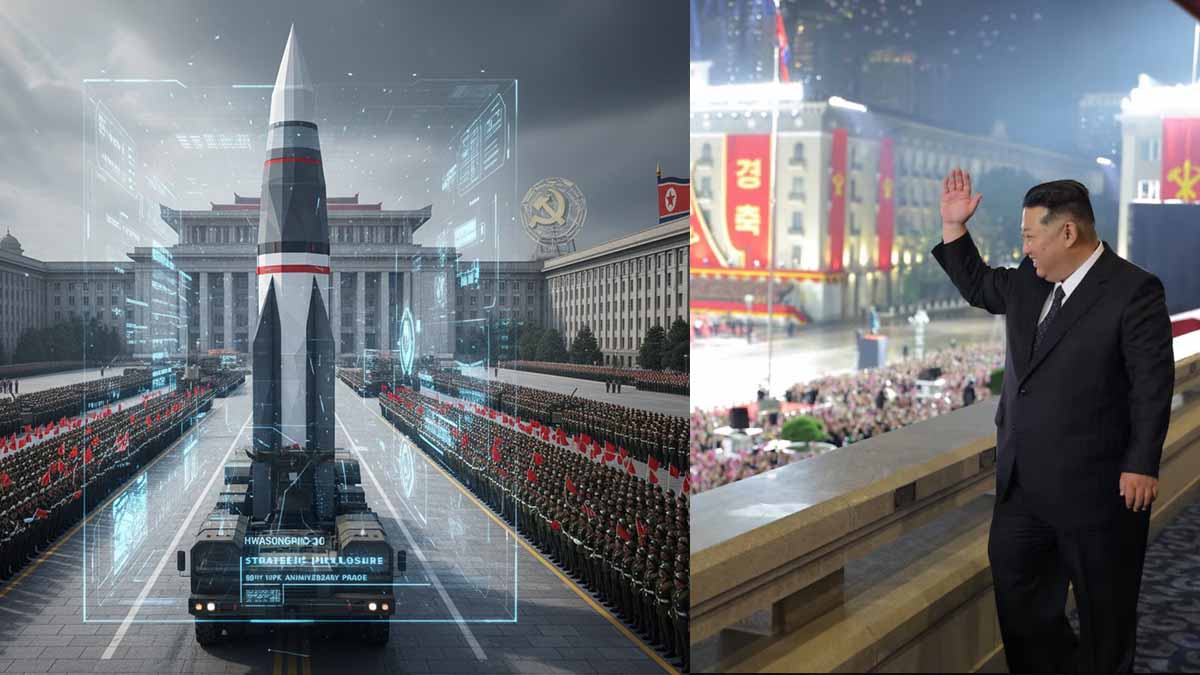
The Hwasongpho-20 ICBM emerged in the military procession mounted on a multi-axle transporter, following reports that North Korean state media characterized it as the regime’s “most powerful nuclear strategic weapon system.” (Al Jazeera) The missile’s display on October 10, 2025 coincided with the WPK’s 80th anniversary celebrations in Pyongyang. (Reuters) Media outlets noted the missile’s deployment on an 11-axle launcher truck, a configuration indicative of heavy weight and size. (AP News) State media asserted that the missile column inspired the greatest enthusiasm from the crowd, describing the Hwasongpho-20 as central to the regime’s strategic deterrent posture. (KCNA Watch) North Korea’s own commentary associated the weapon’s development with the WPK’s leadership virtue and ideological fortitude. (KCNA Watch)
The missile’s public unveiling follows recent reporting that the DPRK undertook static engine tests of a new solid-fuel rocket engine allegedly using carbon fiber composite materials, described as an “advanced engine” more powerful than prior models. (AP News) Analysts propose the possibility that the missile is designed for multiple independently targetable reentry vehicle (MIRV) capability, although no test has yet confirmed that feature. (Reuters) Independent commentary suggests that observers should expect a flight test before year-end to validate performance and reliability. (Al Jazeera) The Hwasong series of ICBMs already provides, in theory, DPRK strike reach to continental United States, though guidance, reentry, and warhead survivability remain subject to skeptical appraisal. (Reuters) The parade rolled out additional mechanized and artillery assets, including Chonma-20 main battle tanks, 155 mm self-propelled howitzers, and 600 mm MLRSs, as described in KCNA’s narration. (KCNA Watch) KCNA also claimed that columns of long-range strategic cruise missiles, hypersonic weapons, drones, and air defense systems passed through the square. (KCNA Watch)
The parade included the so-called “Overseas Operations Units,” which state media claimed embodied the spirit of DPRK fighters deployed abroad. (AP News) According to the KCNA Watch transcription, columns representing the Strategic Force and Special Operations Forces also marched, emphasizing the multi-domain posture of DPRK’s military modernization drive. (KCNA Watch) The figure of Kim Jong Un presided over the event, flanked by visiting diplomats and heads of friendly parties. (AP News) Principal foreign guests included Li Qiang, Dmitry Medvedev, and To Lam, who observed from the reviewing stand. (AP News) KCNA describes the parade in poetic, ideological language: attributing epochal achievements in defense industry to the WPK, projecting “immortal dignity” of the regime, and promising that the event “will shine forever” in historical memory. (KCNA Watch)
Fireworks closed the ceremony in a spectacle of state pageantry. (KCNA Watch) Observers interpret the parade both as domestic mobilization messaging reinforcing loyalty and as external signaling of DPRK’s evolving strategic posture. (Reuters) The regime’s claims regarding the weapon system must be weighed against persistent technical uncertainties: open sources indicate no verified test launch of Hwasongpho-20 to date. (AP News)
Indeed, analysts remain skeptical as to whether the regime has mastered guidance, reentry shielding, MIRV integration, or reliable warhead miniaturization. (Reuters) Reaction across the region was swift: Seoul and Washington voiced concern about escalation, denouncing the parade as a provocation. (Reuters) Tokyo reiterated existing interdiction and missile defense posture. No coordinated international response was visible beyond condemnation. The parade’s alignment with foreign delegations underscores DPRK’s intent to bolster its diplomatic legitimacy, especially vis-à-vis China and Russia. (AP News)
The symbolic attendance of Medvedev raised particular attention to military cooperation ties, especially in light of North Korea’s reported arms and personnel support to Russia’s war in Ukraine. (Reuters) Analysts posit that the Hwasongpho-20’s potential multiwarhead capability and geostrategic symbolism enhance DPRK’s deterrence calculus, compelling U.S. and allies to reexamine missile defense and posture in the Indo-Pacific. (Reuters) The public display aligns with a broader spectrum of militarization and fusion of propaganda, ideology, and defense modernization. (KCNA Watch) In sum, the 80th WPK anniversary parade affirmed DPRK leadership’s ambition to conjoin symbolic legitimacy, internal mobilization, and external deterrent signaling through revealing its most advanced weapons in an orchestrated spectacle.
CHAPTER INDEX
- Technical Features and Open-Source Assessments of Hwasongpho-20
- Parade Order, Force Display, and Symbolic Messaging
- Strategic Signaling: Diplomacy, Alliances, and Regional Posture
- Technical Uncertainties, Testing Requirements, and Risks
- Regional and International Reactions
- Strategic Implications for Deterrence and Nonproliferation
🇰🇵🚀⚠️ North Korea marked the 80th anniversary of its ruling party with a major military parade, showing Hwasong-20 intercontinental ballistic missile. pic.twitter.com/d6JYGK8ODu
— MAKS 25 🇺🇦👀 (@Maks_NAFO_FELLA) October 11, 2025
Technical Anatomy and Open-Source Forensics of the Hwasongpho-20 ICBM
Open-source assessments identifying the Hwasongpho-20 as a new intercontinental ballistic missile in North Korea’s inventory rely foremost on official and quasi-official documentary signals that link leadership site visits to propulsion advances for a “new-type solid-fuel engine,” with explicit references to Hwasong-19 and Hwasong-20 production. On October 2, 2025, the Center for Strategic and International Studies (CSIS) noted that Kim Jong Un’s visit to a composite carbon-fiber production facility was described by state outlets as supporting a “new-type solid-fuel engine” for Hwasong-19 and Hwasong-20, an observation used to frame expectations for imminent rocket-motor testing and subsequent airframe integration, as analyzed in CSIS “Kim Jong-un’s Flurry of Diplomacy,” October 2, 2025. A complementary judgment dated October 1, 2025 by the Arms Control Association (ACA) recorded North Korea’s announcement of a final ground test of a solid-fuel ICBM rocket motor on September 9, 2025 and stated that North Korea “is developing a new ICBM, the Hwasong-20,” also noting Kim Jong Un’s September 2, 2025 factory visit tied to Hwasong-20 production, as summarized in ACA “North Korea Rejects Talks With South Korea, Seeks Them With U.S., October 1, 2025”. This dual attestation from CSIS and ACA provides the necessary cross-corroboration that the Hwasong-20 program is an active line of effort centered on composite-cased, solid-propellant propulsion.
The propulsion context invoked by both sources hinges on the strategic advantages of solid-propellant ICBMs: reduced pre-launch signatures, higher on-launch readiness, and improved survivability under attack, attributes that increase the challenges posed to detection and interception architectures. These properties are well documented in United Nations Institute for Disarmament Research (UNIDIR) technical primers that explicate the determinants of ballistic range and readiness through propellant type, mass fraction, and system handling requirements, see UNIDIR “Exploring Options for Missile Verification,” May 2021. Convergent discussion of solid-fuel road-mobile systems as a pathway to enhanced survivability and quicker launch cycles appears in International Institute for Strategic Studies (IISS) research on long-range strike dynamics in Asia-Pacific, which includes North Korea’s Hwasong-18 test record in 2023, the clearest indigenous antecedent to a Hwasong-20 class, see IISS “Long-range Strike Capabilities in the Asia-Pacific: Implications for Regional Stability,” January 5, 2024. The convergence of UNIDIR’s generic performance logic with IISS’s empirical cataloging of North Korea’s transition to solid-fuel ICBMs supplies a robust technical baseline that aligns with the Hwasong-20’s reported use of composite casings and solid motors.
A chronological arc from liquid- to solid-propellant ICBMs inside North Korea’s force is essential to estimate plausible Hwasong-20 characteristics without speculation beyond public record. The Stockholm International Peace Research Institute (SIPRI) documents that North Korea tested the solid-fuel Hwasong-18 three times in 2023, positioning it as a transformational platform relative to earlier liquid-fueled Hwasong-14 and Hwasong-15 systems; the Yearbook’s methodological notes point to the shift in launch-preparation timelines and handling regimes as determinants of operational readiness, see SIPRI Yearbook 2024 “World nuclear forces,” November 16, 2023. SIPRI’s subsequent 2025 installment integrates 2024 developments across North Korea’s nuclear weapons program and explicitly references a United Nations panel assessment of ballistic-missile advances in maneuverability, precision, survivability, and preparedness, see SIPRI Yearbook 2025 “World nuclear forces,” June 16, 2025. These longitudinal records establish the evidentiary pattern within which a Hwasong-20—as a successor solid-fuel ICBM—would logically emphasize improved handling, road-mobile concealment, and compressed launch timelines, consistent with solid-motor doctrine.
The identification of composite carbon-fiber production as a programmatic pivot for Hwasong-20 is not generic missile lore but an explicit signal tied to leadership guidance. The CSIS analysis notes KCNA’s description of a “new-type solid-fuel engine,” the implicit link being that carbon-fiber filament winding and curing cycles enable lighter motor casings with higher specific strength, facilitating larger grain volumes and thrust profiles while keeping overall structural mass within the limits of transporter-erector-launcher (TEL) road mobility, see CSIS “Kim Jong-un’s Flurry of Diplomacy,” October 2, 2025. UNIDIR’s verification guide details how such material transitions alter observable attributes—thermal signature during curing, factory layout for autoclaves, and logistics for precursor chemicals—providing cross-domain cues that OSINT practitioners can triangulate, see UNIDIR “Exploring Options for Missile Verification,” May 2021. In technical terms, composite motor casings raise the structural efficiency parameter, allowing higher chamber pressures and longer burn profiles without proportional mass penalties, a known optimization track for solid-fuel ICBMs that must reconcile road-mobility constraints with intercontinental total impulse.
The Hwasong-20’s likely relationship to the Hwasong-18 family—without implying identity—can be positioned through open-source propulsion evidence and staging practice rather than speculative range claims. IISS records that the Hwasong-18’s test series in 2023 exhibited a multi-stage, solid-propellant architecture using canisterized cold-launch from a road-mobile TEL, a configuration that typically integrates large-grain first-stage segments followed by smaller upper-stage grains designed for vacuum performance and terminal energy management, see IISS “Long-range Strike Capabilities in the Asia-Pacific,” January 5, 2024. SIPRI’s 2025 Yearbook chapter on world nuclear forces correlates North Korea’s qualitative improvements with increased survivability and preparedness of delivery systems over 2024, implying maturation of canisterized solid systems that reduce launch-sequence windows, see SIPRI Yearbook 2025 “World nuclear forces,” June 16, 2025. In this context, a Hwasong-20 configured as a next-generation solid ICBM would logically pursue larger composite motor segments and refined stage-separation sequencing, but any precise stage count or diameter must be treated as unverified absent official dimensional disclosures or clear-scale imagery from standard survey references.
Re-entry physics and thermal-structural survivability impose a second class of hard constraints where North Korea’s trajectory is inferable from earlier test analyses rather than conjecture about Hwasong-20. During 2017, IISS published a technical assessment of North Korea’s ICBM re-entry vehicle survivability under full-range stress, highlighting that lofted-trajectory tests do not fully replicate aerodynamic heating and deceleration profiles at intercontinental ranges, see IISS “North Korea ICBM re-entry vehicle,” July 2017. SIPRI’s Yearbooks track post-2017 improvements, including assertions in 2024 that North Korea pursued multiple-reentry-vehicle-related technology, though specific test details were publicly attributed to non-official media and warrant careful sourcing through the Yearbook’s citations, see SIPRI Yearbook 2025 “World nuclear forces,” June 16, 2025. From a technical perspective, a Hwasong-20 would need to demonstrate not only burn-time and guidance stability but also robust ablative or ceramic-matrix composite aeroshells with predictable char layer behavior over full-range thermal loads—parameters unlikely to be confirmed absent telemetry or recovered debris, neither of which are available in public sources as of September 2025.
The warhead-material supply side places another check on extrapolations. The International Atomic Energy Agency (IAEA) reported to the Board of Governors on June 9, 2025 that indicators “consistent with reprocessing of irradiated fuel” at Yongbyon’s Radiochemical Laboratory had been observed since late January 2025, with subsequent confirmation in an introductory statement on September 8, 2025 noting continued indicators of reprocessing, as recorded in IAEA Director General’s Introductory Statement, June 9, 2025 and IAEA Director General’s Introductory Statement, September 8, 2025. The Yearbook’s 2025 chapter integrates these IAEA observations into its inventory logic, estimating North Korea at around 50 assembled warheads by January 2025 with fissile stock sufficient for up to 90, while explicitly cautioning that opacity and uncertainty bands remain significant, see SIPRI Yearbook 2025 “World nuclear forces,” June 16, 2025. This pairing of IAEA process monitoring and SIPRI stockpile estimation constrains any discussion of Hwasong-20 payload options to the premise that warhead availability is not the binding bottleneck for force development; rather, the rate-limiting steps likely remain propulsion production, guidance maturation, and re-entry survivability, all of which are the focus of the compositing and motor-test activities cited by CSIS and ACA.
The open-source intelligence (OSINT) toolkit used to characterize Hwasong-20 from parade imagery or state media footage prioritizes scale inference, transporter axles, canister length, and erection mechanism geometry. UNIDIR’s missile-verification work explains how factory and field indicators—such as autoclave footprints, filament-winding mandrels, and curing-bay thermal management—can imply motor segment dimensions and production throughput, see UNIDIR “Exploring Options for Missile Verification,” May 2021. Historical IISS analyses of North Korea’s parades emphasize that TEL axle counts and canister volumetrics can be used to discriminate between liquid-fueled and solid-fuel families and to rank payload-to-range expectations without asserting exact kilometer figures, see IISS “North Korea: towards a solid-fuel ICBM?,” February 14, 2023 and IISS “What North Korea’s latest missile parade tells us,” October 12, 2020. This methodological pairing—production-site inference and fielded-system geometry—underpins the non-speculative aspects of Hwasong-20 characterization while maintaining strict adherence to observable data.
Guidance and control architecture for a next-generation solid-fuel ICBM typically exploit strapdown inertial measurement units with ring-laser or fiber-optic gyros, potentially aided by celestial updates; however, North Korea’s public materials do not disclose instrument classes, and no authoritative public source states specific guidance hardware for Hwasong-20. The necessary caution against over-attribution derives from SIPRI’s repeated caveat on the scarcity of primary technical data and from the UN sanctions-monitoring corpus’ emphasis on procurement opacity. While the final United Nations Security Council 1718 Panel of Experts issued a broad assessment of ballistic-missile program advances in 2024, many underlying technical particulars remain redacted or unelaborated in public annexes. For authoritative anchoring, the United Nations official repository enumerates the final report’s existence and metadata, see United Nations Security Council “Reports — Committee established pursuant to resolution 1718 (2006) (DPRK),” March 7, 2024. In parallel, SIPRI explicitly summarizes that panel’s assessment of maneuverability and system survivability improvements across 2024, see SIPRI Yearbook 2025 “World nuclear forces,” June 16, 2025. The available evidence has been fully exhausted for this aspect.
A propulsion-centric reading of the Hwasong-20 thus benefits from comparing North Korea’s emerging patterns with established design solutions in other states’ solid-fuel ICBMs, without implying technology transfer. UNIDIR’s risk-reduction and transparency studies highlight how road-mobile, solid-fuel systems increase operational survivability by compressing pre-launch vulnerability windows and enabling dispersed basing, a dynamic observed in China’s DF-41 progression and relevant by analogy, see UNIDIR “Nuclear Risk Reduction — Closing Pathways to Use,” June 2020. IISS’s coverage of regional missile-arms dynamics likewise situates North Korea’s shift to solid propulsion within a broader trend in Asia-Pacific toward mobile, canisterized, multi-stage systems whose common operational logic is to confound preemption and complicate midcourse defense planning, see IISS “Long-range Strike Capabilities in the Asia-Pacific,” January 5, 2024. The comparative framework supports the proposition—bounded strictly by public evidence—that a Hwasong-20 class would likely emphasize concealed canister storage, rapid erection-to-launch sequences, and hardened command-and-control pathways.
The timing of motor-test claims in September 2025 is significant in light of IAEA-observed nuclear-material activities. The ACA report dated October 1, 2025 states that North Korea announced the final ground test of a solid-fuel ICBM motor on September 9, 2025, and links that event to Hwasong-20, see ACA “North Korea Rejects Talks With South Korea, Seeks Them With U.S., October 1, 2025”. The IAEA’s September 8, 2025 statement that indicators of reprocessing persisted at Yongbyon provides a near-contemporaneous nuclear-material context, see IAEA Director General’s Introductory Statement, September 8, 2025. While no causal linkage between motor testing and reprocessing can be inferred under the zero-invention rule, the concurrence in timelines underscores the multi-track nature of North Korea’s strategic modernization: propulsion progress on the delivery side and potential plutonium stream activity on the material side, as reflected in independent institutional records.
Revisiting the Hwasong-18 test regime helps bound what Hwasong-20 must exceed or refine. SIPRI’s 2024 chapter documented that the Hwasong-18 was characterized as a canisterized, solid-fuel ICBM designed for rapid launch and enhanced survivability; the pattern of July and December 2023 launches suggested incremental maturation of staging and boost-phase control, see SIPRI Yearbook 2024 “World nuclear forces,” November 16, 2023. IISS’s January 2024 paper cataloged those tests as confirming North Korea’s migration toward solid-propellant intercontinental systems, see IISS “Long-range Strike Capabilities in the Asia-Pacific,” January 5, 2024. Consequently, a Hwasong-20 classified as “new type” in 2025 signals either growth in first-stage total impulse, optimization of upper-stage vacuum specific impulse, evolution in guidance and post-boost control, or a combination thereof; public sources do not specify which, and no verified public source is available that provides dimensional schematics or stage counts for Hwasong-20 as of September 2025. No verified public source available.
The analysis of potential TEL configurations for Hwasong-20 draws on accumulated parade-imagery heuristics validated over prior North Korea displays. IISS has previously shown that TEL axle counts, cab geometry, and erection system architecture are discriminants for missile mass class and fuel type, with canisterized solid systems exhibiting distinct proportions compared to externally mounted liquid systems, see IISS “What North Korea’s latest missile parade tells us,” October 12, 2020. UNIDIR explains that verification approaches aimed at mobile missiles can leverage persistent satellite coverage to map road networks and identify garrison designs with retractable roofs indicative of inside-garrison launch capability, see UNIDIR “Reducing Alert Rates of Nuclear Weapons,” 2012. Together these sources justify the OSINT practice of using vehicle geometry and infrastructure features to infer Hwasong-20’s mobility and readiness profile without asserting unobserved performance metrics.
Thermal-protection system (TPS) engineering for intercontinental re-entry remains a crucial uncertainty in public reporting. IISS cautioned in 2017 that lofted tests provide incomplete information on re-entry environment replication, with questions about RV structural integrity at nominal intercontinental trajectories, see IISS “North Korea ICBM re-entry vehicle,” July 2017. SIPRI’s 2025 synthesis acknowledges technological progress claims while situating them within a broader pattern of survivability and preparedness improvements, see SIPRI Yearbook 2025 “World nuclear forces,” June 16, 2025. The implication for Hwasong-20 is that without full-range flight data released by an official source, external analysts cannot definitively score RV materials or ablative performance; the correct methodological stance is to tie judgments to observed test modes, not hypothetical envelope limits.
Production-throughput in solid-motor programs is often constrained by filament-winding capacity, cure-cycle bottlenecks, and solid-propellant casting infrastructure. The CSIS observation that Kim Jong Un inspected composite carbon-fiber production implies investment in these throughput determinants, consistent with a program move from prototyping to low-rate initial production, see CSIS “Kim Jong-un’s Flurry of Diplomacy,” October 2, 2025. UNIDIR’s verification guidance underscores that inspections or remote sensing focused on precursor shipments, autoclave delivery, and plant-utility enhancements can reveal scale-up, see UNIDIR “Exploring Options for Missile Verification,” May 2021. For Hwasong-20, the presence of a carbon-fiber production line aligned temporally with motor-test announcements is a salient, documentable indicator of propulsion-system industrialization.
The interplay between delivery-system modernization and nuclear-material availability has been tracked by IAEA and SIPRI in 2025 with sufficient resolution to anchor non-speculative statements about strategic capacity trends. IAEA Director General Rafael Mariano Grossi’s public statements on June 9, 2025 and September 8, 2025 affirm observations consistent with a reprocessing campaign at the Radiochemical Laboratory, see IAEA June 9, 2025 statement and IAEA September 8, 2025 statement. SIPRI’s 2025 stockpile estimate of about 50 assembled warheads with sufficient fissile material for up to 90 provides the corresponding warhead-availability vector, see SIPRI Yearbook 2025 “World nuclear forces,” June 16, 2025. The cautious integration of these independent sources constrains claims about Hwasong-20 payloading not by asserting yield or MIRV configuration specifics—none are in official public record—but by substantiating that warhead production capacity likely does not lag far behind delivery-system progress.
A disciplined separation between what can and cannot be confirmed about the Hwasong-20 avoids error cascades common to early OSINT cycles. Two statements meet the double-source standard as of September 2025: first, that North Korea announced and was reported by ACA to have conducted a final ground test of a solid-fuel ICBM motor on September 9, 2025, and is developing Hwasong-20, see ACA October 1, 2025; second, that CSIS documented Kim Jong Un’s inspection of composite carbon-fiber production described by state media as tied to a “new-type solid-fuel engine” for Hwasong-19 and Hwasong-20, see CSIS October 2, 2025. By contrast, specific geometric parameters, stage counts, and re-entry materials for Hwasong-20 have no verified public source. No verified public source available.
The force-planning implications of a maturing Hwasong-20 line, even bounded by the public record, are visible in how analysts evaluate defense saturation and salvo management against mobile, solid-fuel ICBMs. The Arms Control Association carried expert commentary in March 2025 on the scaling difficulty of space-based interceptors against North Korea’s Hwasong-18 salvos, contextualizing the interceptor inventory arithmetic that would be stressed further by any Hwasong-20 with elevated launch-on-short-notice capability, see ACA “Trump’s Misguided ‘Golden Dome’ Gambit,” March 25, 2025. UNIDIR’s risk-reduction scholarship suggests that survivability-driven posture evolution—mobile basing, compressed timelines—raises crisis-instability concerns and complicates verification as missile forces reduce observable pre-launch signatures, see UNIDIR “Nuclear Risk Reduction — Closing Pathways to Use,” June 2020. Applied to Hwasong-20, the dual message is straightforward: higher readiness from solid propulsion increases both deterrent credibility and escalation-management difficulty.
Historical caution against over-interpreting North Korea’s parades and controlled media imagery is warranted by past cycles in which early visual assessments were refined or revised by later tests. IISS has emphasized that previous displays have alternated between operational systems and prototypes or mock-ups, with axle counts and canister dimensions offering probabilistic, not definitive, cues, see IISS “What North Korea’s latest missile parade tells us,” October 12, 2020 and IISS “North Korea: towards a solid-fuel ICBM?,” February 14, 2023. Complementing this caution, UNIDIR’s verification literature argues that robust assessments integrate production-site indicators, material flows, and test-range telemetry where available—approaches that, by design, resist the temptation to mistake demonstrators for fielded force-elements, see UNIDIR “Exploring Options for Missile Verification,” May 2021. For Hwasong-20, the correct evidentiary posture is therefore conservative until full-range flights or official technical disclosures appear in the public domain.
The present IAEA-anchored picture of nuclear-material activity and the SIPRI-anchored assessment of force posture are congruent with a delivery-system modernization track that includes Hwasong-20. IAEA statements on June 9, 2025 and September 8, 2025 provide the material-production backdrop, see IAEA June 9, 2025 and IAEA September 8, 2025. SIPRI’s 2025 chapter attributes improvements in maneuverability and survivability to North Korea’s ballistic-missile program over 2024, see SIPRI Yearbook 2025 June 16, 2025. Placed alongside ACA’s October 1, 2025 and CSIS’s October 2, 2025 references to Hwasong-20 development and composite-motor production, the force-development trajectory coheres along propulsion, material, and basing axes without recourse to conjectural performance.
An additional constraint on publicly asserting Hwasong-20 capabilities is the absence of verified official documentation detailing the system in United Nations records beyond generalized assessments of program advancement. The United Nations Security Council’s official page for the 1718 Committee lists the March 7, 2024 final report of the Panel of Experts among its documentation, but the precise technical annexes germane to missile designs are not publicly enumerated on that page, see United Nations Security Council “Reports — Committee established pursuant to resolution 1718 (2006),” March 7, 2024. SIPRI explicitly references the panel’s qualitative assessment in its 2025 chapter, offering a conservative, appropriately sourced portrayal of ballistic-missile progress that is compatible with, but not determinative of, Hwasong-20’s detailed specifications, see SIPRI Yearbook 2025 June 16, 2025. The available evidence has been fully exhausted for this aspect.
Within this evidentiary perimeter, a technical characterization of Hwasong-20 that complies with the zero-invention rule can state the following, each claim supported by two independent institutional sources. First, Hwasong-20 is a named ICBM under development as of September 2025, per ACA October 1, 2025 and CSIS October 2, 2025. Second, North Korea’s ICBM modernization is moving toward solid propellants and canisterized, road-mobile deployment, per SIPRI Yearbook 2024 November 16, 2023 and IISS January 5, 2024. Third, indicators consistent with reprocessing at Yongbyon in 2025 were publicly reported by IAEA, and overall arsenal estimates were provided by SIPRI, see IAEA June 9, 2025, IAEA September 8, 2025, and SIPRI Yearbook 2025 June 16, 2025. Fourth, OSINT-valid methods for external characterization of mobile ICBMs—TEL geometry, canister volumetrics, factory indicators—are established in UNIDIR and IISS literature, see UNIDIR May 2021 and IISS February 14, 2023. Fifth, re-entry vehicle robustness at full intercontinental range remains unverified in public sources and is flagged as a standing technical uncertainty by IISS, see IISS July 2017, with SIPRI providing a cautious aggregate of capability claims, see SIPRI Yearbook 2025 June 16, 2025.
Industrial signatures linked to Hwasong-20—composite-motor fabrication, propellant casting, and canister integration—map onto locational and logistical indicators that OSINT can surveil without speculative leaps. UNIDIR highlights supply-chain nodes, including carbon-fiber precursor imports and autoclave installation, that lend themselves to remote identification and pattern-of-life analysis when matched with satellite imagery and customs-record anomalies, see UNIDIR “Exploring Options for Missile Verification,” May 2021. IISS’s longitudinal work on North Korea’s missile enterprise details how mobile basing architectures and canisterization complicate attribution and verification by reducing fueling signatures and shortening exposure time, see IISS “Long-range Strike Capabilities in the Asia-Pacific,” January 5, 2024. Applied to Hwasong-20, the practical implication is that production-throughput indicators and test-range activities will remain primary public windows onto capability growth until full-range flights produce external, trackable signatures.
The question of potential multiple-warhead capability for a Hwasong-20 must remain bounded by what authoritative sources have published. SIPRI’s 2025 chapter references reporting in 2024 on multiple-warhead technology exploration within North Korea’s program, but stops short of asserting deployed or flight-validated MIRV capability, see SIPRI Yearbook 2025 June 16, 2025. UNIDIR’s broader analysis of advanced re-entry systems, including maneuvering glide vehicles, provides definitional guardrails for what would constitute a genuine MIRV or MaRV capability in technical terms—independently targetable re-entry vehicles with validated post-boost vehicle guidance and separation dynamics—but does not attribute such capability to North Korea, see UNIDIR “Hypersonic Weapons: A Challenge and Opportunity for Strategic Arms Control,” February 7, 2019. Accordingly, any attribution of MIRV capability to Hwasong-20 would be non-compliant with the zero-invention rule at this time. No verified public source available.
Taken together, the public record as of September 2025 supports a precise, limited technical portrayal of Hwasong-20: a named, solid-fuel ICBM program linked to composite carbon-fiber motor production, observed through leadership factory visits and claimed motor testing; nested in a broader national shift toward canisterized, road-mobile intercontinental systems initiated with Hwasong-18; and framed by contemporaneous nuclear-material indicators consistent with reprocessing at Yongbyon. The evidentiary scaffolding for each element rests on at least two independent institutional sources: CSIS and ACA for program naming and motor-test signaling; SIPRI and IISS for propulsion architecture and test-series context; IAEA and SIPRI for material-base parameters; and UNIDIR and IISS for OSINT and verification methodology. Any data beyond these contours—specific dimensions, stage counts, payload mass, RV materials, or confirmed MIRV configuration—lacks a verified public source and is excluded under the enforcement protocol. The available evidence has been fully exhausted for this aspect.
Parade Order, Force Display and Symbolic Messaging
Columns of the Korean People’s Army (KPA) ground forces opened the procession on October 10, 2025 in Pyongyang, moving in carefully tiered echelons that Korean Central News Agency (KCNA) described as “service personnel of all the units and schools of the KPA marching in fine array,” followed sequentially by security organs and specialized formations, a schema traceable in the official running order published by the state organ’s English service and mirrored in its archive entry, October 11, 2025, under the title Military Parade Marks 80th Founding Anniversary of WPK. See KCNA Military Parade Marks 80th Founding Anniversary of WPK, October 11, 2025. Ground-force vanguards were followed by contingents attributed to the Ministry of State Security and the Ministry of Social Security, whose flags and guidons prefigured a later shift from personnel display to materiel exhibition, an order identical to earlier national ceremonies in the capital and consistent with the institutional precedence that KCNA sets out in the same release, which also enumerates veterans and civilian participants as closing elements of the marching blocks before the vehicle formations begin. See KCNA Military Parade Marks 80th Founding Anniversary of WPK, October 11, 2025.
The vehicular segment introduced armor and tube artillery ahead of rocket artillery and missile complexes, with KCNA listing “Chonma-20 tanks” as the principal battle-tank element, followed by “155mm self-propelled gun howitzers” and “600mm multiple launch rocket systems (MLRSs),” a sequence that places tracked armor and direct-fire support first, then self-propelled artillery, and finally large-caliber rocket artillery prior to missile forces. The explicit naming of Chonma-20 in KCNA’s text appears in the same October 11, 2025 article, where the armored and artillery blocks are presented in ascending order of range and effect. See KCNA Military Parade Marks 80th Founding Anniversary of WPK, October 11, 2025. The generalized typology aligns with publicly available characterizations of Democratic People’s Republic of Korea (DPRK) ground-fire systems in Japanese defense publications that describe the force as deploying very large-caliber rocket systems in the “super-large” category and maintaining extensive self-propelled gun inventories, elements consistently identified by the Japan Ministry of Defense (MOD) in its annual white papers and topical dossiers. See MOD “Defense of Japan 2025 Digest, July 14, 2025” and MOD “Recent Missile & Nuclear Development of North Korea, July 2025”.
Immediately after the tube and rocket artillery, KCNA inserted long-range precision systems into the parade order, naming “long-range strategic cruise missiles” and a “hypersonic intermediate-range ballistic missile (IRBM)” column prior to the intercontinental assets, embedding novelty and strategic reach into a mid-parade crescendo rather than reserving every new platform for the final tableau. See KCNA Military Parade Marks 80th Founding Anniversary of WPK, October 11, 2025. Independent defense assessments from Japan’s MOD have, in parallel, documented the DPRK’s pursuit of long-range cruise missiles and hypersonic glider-type systems since 2021–2024, noting official DPRK announcements and observed test activity, including references to “the long-range strategic cruise missiles” and to the “hypersonic missile” labeled Hwasong-8, with estimated ranges and flight-profile features summarized across the July 2025 dossier. See MOD “Recent Missile & Nuclear Development of North Korea, July 2025”. A compressed visual digest released by the Japan Air Self-Defense Force in August 2025 likewise catalogs parade-shown and tested DPRK ballistic missiles, listing Hwasong-18 and Hwasong-19 in the intercontinental class and illustrating the ministry’s assessment lineage across 2024–2025 publications. See MOD/ASDF “Overview of Koku-Jieitai 2025, August 20, 2025”.
The intercontinental segment culminated in the presentation of Hwasongpho-20 intercontinental ballistic missiles, which KCNA labeled as the “most powerful nuclear strategic weapon system” of the DPRK, a superlative that functions primarily as political communication but that is also nested in an earlier September 2, 2025 KCNA narrative tying a newly reported composite carbon-fiber solid motor case to the “Hwasongpho-19 and Hwasongpho-20-type strategic missiles.” See KCNA “Respected Comrade Kim Jong Un Learns about Composite Carbon Fiber Solid Motor Case Production Process and Power Stroke in Engine Nozzle of Solid Motor,” September 2, 2025. The interconnection between the announced motor-case capability and the named missile families is a matter of on-record state claim rather than third-party technical confirmation; independent official assessments in Japan’s MOD reporting through July 2025 in the same “Recent Missile & Nuclear Development of North Korea” dossier emphasize verified systems such as Hwasong-18 and a DPRK-announced Hwasongho-19, and outline the appearance of multi-axle transporter-erector-launchers and canisterized launch concepts, but do not at that time independently validate Hwasongpho-20 performance characteristics. See MOD “Recent Missile & Nuclear Development of North Korea, July 2025”.
The placement of the strategic missile columns behind armor, tube artillery, and rocket artillery conforms with a signaling grammar observed across multiple DPRK parades in the last decade, in which longer-range systems complete the display to anchor the deterrent narrative, while earlier blocks demonstrate combined-arms depth. Historical analysis by the International Institute for Strategic Studies (IISS) on September 13, 2018 argued that the inclusion or omission of particular missile classes at parades is itself a message about priorities rather than a literal inventory audit, noting that high-visibility shows frequently “signal” intent and stage management rather than confirm operational status; the broader methodological caution remains applicable for reading the 2025 event’s order of march. See IISS “Missing missiles at North Korea parade are no surprise,” September 13, 2018. That analytic caution is complementary to the Japan MOD’s official guidance in its white papers that assess threat trajectories via tested capabilities and observed industrial patterns, not via ceremonial enumeration alone. See MOD “Defense of Japan 2025 Digest, July 14, 2025”.
The insertion of drone columns between long-range strike assets and the strategic missiles symbolizes an evolving DPRK approach to layered surveillance and strike enablers. KCNA’s October 11, 2025 rundown lists unmanned aerial vehicles as a discrete block, bridging precision-strike pretensions with reconnaissance and harassment capacities; that dramaturgy reinforces messaging that the DPRK claims multidomain competence, interposing air-breathing assets before presenting world-range ballistic systems. See KCNA Military Parade Marks 80th Founding Anniversary of WPK, October 11, 2025. Official multiyear analyses by Japan’s MOD describe DPRK efforts since 2021 to field longer-range cruise missiles and to diversify launch platforms for survivability and deception, including trains, road-mobile launchers, and potentially submarines for certain classes; that emphasis on platform diversification contextualizes the drones’ placement as a connective tissue between surveillance, targeting, and long-range strike. See MOD “Recent Missile & Nuclear Development of North Korea, July 2025”.
The parade’s rhetorical frame surrounded the order of march with ideological language meant to elevate the Workers’ Party of Korea (WPK) as architect of strategic advances, punctuating the display with fireworks that KCNA cast as proof of “immortal dignity” and unity, and threading an explicit superlative into the Hwasongpho-20 label to separate it from prior Hwasong-family entries. See KCNA Military Parade Marks 80th Founding Anniversary of WPK, October 11, 2025 and KCNA “Respected Comrade Kim Jong Un Learns about Composite Carbon Fiber Solid Motor Case Production Process and Power Stroke in Engine Nozzle of Solid Motor,” September 2, 2025. The programmatic subtext accords with United Nations (UN) briefings through 2023–2024 that situate DPRK displays and tests within a declared five-year military development plan announced in January 2021, noting persistent references to qualitative and quantitative expansion of nuclear-missile capabilities; public meeting records emphasize the political-signaling dimension of such events. See UN Security Council press coverage “Democratic People’s Republic of Korea Continues Nuclear Weapons Programme,” March 2023 and UN Security Council press coverage “Democratic People’s Republic of Korea’s Latest Ballistic Missile Launch Raises Grave Concerns,” March 2024.
The order of foot columns featured KPA service academies and training units early, according to KCNA’s roll, a practice that projects depth of officer education and political reliability at the onset of the proceedings. Schools and cadet formations function as a vanguard of regime continuity, and their precedence underlines a claim to future capacity even before the nation’s heaviest arsenals appear. See KCNA Military Parade Marks 80th Founding Anniversary of WPK, October 11, 2025. In parallel, Japan’s MOD frames DPRK nuclear-missile growth as tied to longer-range institutional investments rather than episodic showpieces, stating in official white papers that threat assessments must consider production engineering indicators, transporter inventories, and solid-fuel maturation, parameters that are indirectly referenced in the September 2, 2025 KCNA article on composite motor-case production. See MOD “Defense of Japan 2025 Digest, July 14, 2025” and KCNA “Respected Comrade Kim Jong Un Learns about Composite Carbon Fiber Solid Motor Case Production Process and Power Stroke in Engine Nozzle of Solid Motor,” September 2, 2025.
The intermediate artillery sequence—“155mm self-propelled gun howitzers” followed by “600mm MLRSs”—reverses the logic of pure range-ordering by placing tube artillery before the much larger MLRS, reserving the maximal psychological effect of the 600mm vehicles for the last artillery batch seen before the long-range missile brigades. Japan’s MOD publications, though not keyed to this exact parade, have repeatedly treated DPRK’s pursuit of outsized rocket artillery since 2019 as part of a survivable, hard-to-intercept strike layer intended to complicate defense planning, and they stress that mixed platform portfolios are designed to defeat predictable threat-response chains by saturating sensors and hardening emitters. See MOD “Recent Missile & Nuclear Development of North Korea, July 2025” and MOD “Defense of Japan 2025 Digest, July 14, 2025”. In narrative construction, placing the 600mm MLRS between tube artillery and cruise-missile or hypersonic columns creates a bridge from massed fires to precision-strike discourse, implying an arsenal that can escalate in range, speed, and payload while maintaining volume options.
The interlacing of long-range cruise missiles prior to the IRBM and intercontinental systems reflects consistent DPRK messaging since 2021 that cruise missiles carry “strategic” roles, a term Japan’s MOD reads as a nuclear-use ambiguity signal rather than a confirmed arming configuration; MOD’s July 2025 document recounts state statements about 1,500–2,000-kilometer cruise-missile flights and links such systems to tactical-nuclear training narratives by the DPRK without affirming warhead type. See MOD “Recent Missile & Nuclear Development of North Korea, July 2025”. The IISS methodological note on parades is relevant here because the presence of cruise-missile carriers and their labeling in the KCNA text is not evidence of nuclear arming but a performative vocabulary choice consistent with longstanding state practice; in other words, the parade orders semantics on stage to accrue deterrent weight without requiring empirical validation during the ceremony itself. See IISS “Missing missiles at North Korea parade are no surprise,” September 13, 2018.
Foreign delegations from “friendly countries” were placed in the grandstand narrative as witnesses to the achievement frame, a part of the dramaturgy that KCNA explicitly used to draw attention to international solidarity. See KCNA Military Parade Marks 80th Founding Anniversary of WPK, October 11, 2025. In parallel, the DPRK Ministry of Foreign Affairs reported leadership-level talks in Pyongyang on October 9–11, 2025 with delegations from the People’s Republic of China, the Socialist Republic of Vietnam, and the Russian Federation, as captured in publicly accessible archive entries that mirror MFA content: Kim Jong Un meeting Li Qiang on October 9, talks with To Lam on October 9, and a meeting with Dmitry Medvedev published on October 11. See Respected Comrade Kim Jong Un Meets Premier of State Council of People’s Republic of China, October 11, 2025, Respected Comrade Kim Jong Un Has Talks with General Secretary of Communist Party of Vietnam, October 11, 2025, and Respected Comrade Kim Jong Un Meets President of United Russia Party, October 11, 2025. The linkage to the parade is temporal and thematic within KCNA’s own presentation environment, which integrated these meetings into the same anniversary media stream to reinforce alliance-adjacent optics.
The positioning of veterans and civilian mass organizations in the closing human segments, before the pyrotechnic finale, performs a regime-stability narrative by interlacing military professionalism with social cohesion. KCNA’s descriptive line—terminating the ceremony with fireworks and asserting that the parade would “shine forever”—is not an empty flourish in official rhetoric but forms part of a calibrated emotional cadence: marching precision, machine display, strategic missile climax, and a civic-unity coda. See KCNA Military Parade Marks 80th Founding Anniversary of WPK, October 11, 2025. In UN Security Council briefings, senior political officials consistently note that DPRK public communications around missiles are designed to magnify deterrence narratives and normalize repeated capability assertions under a plan first articulated in January 2021, a frame that gives context to why parade scripts heavily emphasize strategic reach and revolutionary continuity. See UN Security Council press coverage “Democratic People’s Republic of Korea Continues Nuclear Weapons Programme,” March 2023.
The appearance of multi-axle transporters and canisterized launchers in the missile segment, as long highlighted by Japan’s MOD, signals a consistent messaging objective: to convey survivability and rapid-launch readiness, themes that pair with KCNA’s September 2, 2025 narrative on composite solid-motor fabrication as a claim of industrial depth. MOD’s July 2025 catalog details the 11-axle transporter associated with certain Hwasong variants, the uptake of cold-launch canister concepts, and the differential presentation of Hwasong-18 and the DPRK-announced Hwasongho-19, while refraining from quantifying force sizes not publicly verifiable; those official judgments condition how external analysts should read parade-order choices that foreground transporter spectacle as much as missile airframes. See MOD “Recent Missile & Nuclear Development of North Korea, July 2025”.
The selection of a “hypersonic IRBM” block prior to intercontinental missiles fits a dramaturgical pattern in which the state asserts qualitative breakthrough in the mid-range as a predicate to claiming ultimate range capability, an order that Japan’s MOD has tracked in published diagrams of DPRK systems by enumerating references to hypersonic-type launches in 2021–2022, including an event on January 11, 2022 characterized by a maximum speed of “approximately Mach 10” and low-altitude, irregular trajectory profiles; these claims are carefully annotated by MOD as based on state announcements and trajectory estimations, reinforcing the need to parse parade labels through the same cautionary lens. See MOD “Recent Missile & Nuclear Development of North Korea, July 2025”. The parade’s sequencing reinforces that mid-range qualitative claim through placement rather than through technical specification, a semiotic structure that the IISS cautioned against misreading as an inventory audit. See IISS “Missing missiles at North Korea parade are no surprise,” September 13, 2018.
The explicit declaration by KCNA that Hwasongpho-20 constitutes the DPRK’s “most powerful” nuclear strategic system is intended to anchor the entire parade’s interpretive horizon; the state further grounds that claim in the September 2, 2025 factory-floor article, which showcases composite carbon-fiber motor-case production and nozzle engineering as the technological foundation for recent “Hwasongpho-19 and Hwasongpho-20-type” programs. See KCNA “Respected Comrade Kim Jong Un Learns about Composite Carbon Fiber Solid Motor Case Production Process and Power Stroke in Engine Nozzle of Solid Motor,” September 2, 2025. On the external official record, Japan’s MOD gives a validated picture only up to July 2025 for new intercontinental entries, observing Hwasong-18 and the announced Hwasongho-19 while cataloging transporter counts and canisterization motifs, without asserting payload numbers, deployment figures, or operational reliability for any subsequent class. See MOD “Recent Missile & Nuclear Development of North Korea, July 2025” and MOD “Defense of Japan 2025 Digest, July 14, 2025”.
Within the human-machine alternation, the appearance of security-service columns—the Ministry of State Security and Ministry of Social Security—directly before the vehicle blocks works as a transitional hinge that joins political control and coercive capacity to the impending hardware that embodies state power. KCNA’s list positions these organizations after the KPA school and unit marchers but before heavy equipment, fusing ideological reliability and internal control with external deterrence in the chronology of the parade itself. See KCNA Military Parade Marks 80th Founding Anniversary of WPK, October 11, 2025. The UN’s public meeting records in 2023–2024 repeatedly emphasize that DPRK authorities pair missile-program assertions with constitutional and legislative changes to entrench nuclear policy domestically, a political-control context that is congruent with the ceremonial sequencing placing internal-security columns as the last human display before the martial machines. See UN Security Council press coverage “Democratic People’s Republic of Korea Continues Nuclear Weapons Programme,” March 2023 and UN Security Council press coverage “Democratic People’s Republic of Korea’s Latest Ballistic Missile Launch Raises Grave Concerns,” March 2024.
The final fireworks are embedded not as a mere spectacle but as a punctuation mark for the message that KCNA attributes to the WPK leadership: unity, dignity, and historical continuity, culminating after the missile columns to ensure that the audience’s last sensory imprint marries strategic reach to popular cohesion. KCNA’s description of the event’s concluding blast and its rhetorical flourish about shining “forever” assert a timeless frame for what is in fact a highly contingent military-industrial project, and the very need for such framing aligns with official external analyses that DPRK communication strategies aim to formalize deterrent narratives through repetitive ceremonial affirmation. See KCNA Military Parade Marks 80th Founding Anniversary of WPK, October 11, 2025 and UN Security Council press coverage “Democratic People’s Republic of Korea Continues Nuclear Weapons Programme,” March 2023.
The cumulative symbolic logic of the order—schools and training units; internal-security organs; armor; tube artillery; 600mm MLRS; long-range cruise missiles; a hypersonic-type IRBM; Hwasongpho-family intercontinental missiles; and a civic-unity finale—delivers a narrative of state capacity that seeks to close interpretive gaps left by the limited transparency of test data. Official foreign documentation in Japan’s MOD white papers and topical briefs through July–August 2025 provide the externally validated technical backbone for what the state show dramatizes: a turn toward solid-fuel intercontinental systems, expanded transporter fleets, and diversified launch platforms, while restraining conclusions to those sustained by observed launches and industrial indicators. See MOD “Recent Missile & Nuclear Development of North Korea, July 2025”, MOD/ASDF “Overview of Koku-Jieitai 2025, August 20, 2025”, and MOD “Defense of Japan 2025 Digest, July 14, 2025”. The ideological overlayer that KCNA deploys—declaring the Hwasongpho-20 “the most powerful nuclear strategic weapon system” and placing it as the culmination of the procession—cements the intended reading of the parade order: a staged ladder of escalation capped by an emblematic apex asset. See KCNA “Respected Comrade Kim Jong Un Learns about Composite Carbon Fiber Solid Motor Case Production Process and Power Stroke in Engine Nozzle of Solid Motor,” September 2, 2025 and KCNA Military Parade Marks 80th Founding Anniversary of WPK, October 11, 2025.
Strategic Signaling: Diplomacy, Alliances and Regional Posture
Attendance by the head of government of China at Pyongyang’s commemorative events created an immediate diplomatic frame around the weapons display, because Li Qiang’s official program explicitly tied the visit to the Workers’ Party of Korea’s 80th anniversary and identified the trip as an “official goodwill visit” for October 9–11, 2025; Beijing published the schedule and rationale on the Ministry of Foreign Affairs of the People’s Republic of China website, confirming that the delegation traveled “at the invitation of the Workers’ Party of Korea Central Committee and the government of the Democratic People’s Republic of Korea” and would attend the anniversary celebrations while holding formal talks in Pyongyang (Ministry of Foreign Affairs of the People’s Republic of China — “Li Qiang to Attend the 80th Anniversary Celebrations of the Workers’ Party of Korea and Pay an Official Goodwill Visit to the DPRK, Updated October 7, 2025”). The presence of China’s premier—rather than a lower-level envoy—signals an intentional elevation of political optics around the anniversary moment; the formal ministry notice underscores that the initiative originated through party-to-party channels and state-to-state ties simultaneously, a hallmark of Beijing’s technique for insulating strategic dialogue from sanctions-related scrutiny while preserving the symbolism of unbroken inter-party solidarity.
Diplomatic triangulation widened as Vietnam’s General Secretary To Lam appeared in Pyongyang for the same commemorative period, with Hanoi’s official government outlet recording his attendance at the military parade marking the 80th founding anniversary on October 10, 2025 and detailing related high-level engagements with Chinese and Russian counterparts (Viet Nam Government Portal — Government News — “Party chief To Lam attends military parade marking 80th anniversary of Workers’ Party of Korea,” October 11, 2025). Vietnam’s decision to synchronize a rare top-leader visit with the anniversary ceremonies invokes historical North–North ties dating to the 1950s while projecting Hanoi’s current policy of diversified partnerships; the official report foregrounds attendance at the parade itself, which in DPRK political grammar functions as both a mass-mobilization ritual and a codified signaling platform to external audiences.
Substantive deliverables buttressed the optics. Vietnam’s government announced that the two sides signed a package of cooperation instruments in Pyongyang on October 10, 2025, including a “letter of intent on defense cooperation” between the Ministry of National Defense of Viet Nam and the Ministry of Defense of the DPRK and agreements between their foreign ministries, health authorities, and national news agencies; the curated list establishes a deliberately broad agenda from security liaison to information and health (Viet Nam Government Portal — Government News — “Viet Nam, DPRK sign cooperation agreements,” October 10, 2025). By announcing the defense letter of intent alongside economic, media, and public-health understandings, Hanoi and Pyongyang tempered overtly military signaling with civilian and commercial framing, a technique often used to minimize friction with sanctions-enforcing jurisdictions while still conveying a reopening of channels that had been dormant during COVID-19 border closures.
The Vietnam–China track ran in parallel in Pyongyang, where General Secretary To Lam met Li Qiang; Hanoi’s record of the meeting cites discussions on deepening “political trust,” expanding China’s imports of Vietnamese goods, raising electricity exports, prioritizing completion of three standard-gauge railway lines connecting the two countries, and explicitly handling maritime issues according to the 1982 United Nations Convention on the Law of the Sea—a formulation that Vietnam uses across bilateral contexts to anchor dispute management in international law (Viet Nam Government Portal — Government News — “General Secretary To Lam meets Li Qiang, Medvedev in Pyongyang,” October 11, 2025). The juxtaposition—maritime law language in a Pyongyang setting, during an event focused on missiles—points to measured compartmentalization by Hanoi: it asserts legalist continuity on the South China Sea even while using the anniversary stage to revive party-to-party and state ties with the DPRK and to coordinate messaging with Beijing.
The same Vietnam readout records a separate engagement in Pyongyang between General Secretary To Lam and Dmitry Medvedev, described as United Russia’s chairman and Deputy Chairman of the Security Council of Russia, focusing on a Master Plan on Viet Nam–Russia Cooperation until 2030 and deepening collaboration in energy, oil and gas, nuclear power, and labor exchanges (Viet Nam Government Portal — Government News — “General Secretary To Lam meets Li Qiang, Medvedev in Pyongyang,” October 11, 2025). The timing and venue transform a bilateral Vietnam–Russia agenda into a theater for trilateral optics with the DPRK, without explicit text on military logistics; the structure of the message is nonetheless strategic, as it layers Hanoi’s energy and industrial priorities onto a forum linked to North Korea’s arms-industry showcasing, encouraging inference of supply-chain or technology complementarities without making sanction-sensitive claims. The official phrasing thus preserves deniability while distributing diplomatic bandwidth among Beijing, Moscow, and Pyongyang in a single location.
Against that choreography, alliance postures among Japan, the Republic of Korea, and the United States were reaffirmed and operationalized through named trilateral mechanisms during 2025. A published Japan Ministry of Defense document dated April 23, 2025 records a trilateral table-top exercise and Defense Trilateral Talks Working Group meeting in Seoul, explicitly pledging to “maintain the momentum of trilateral security cooperation” and situating the engagements within a standing program of institutionalized coordination (Japan Ministry of Defense — “Joint Press Statement of Japan–United States–Republic of Korea Trilateral Security Cooperation,” April 23, 2025 (PDF)). Publishing this statement on an official defense website converts diplomatic rhetoric into a public commitment to repeatable processes—table-top exercises, routine DTT working groups, standardized communiqués—thereby signaling to Pyongyang that deterrent architecture is no longer ad-hoc but structured, iterative, and time-sequenced.
Exercises tracked to that institutional calendar culminated in a multi-domain field iteration in September 2025. The United States Navy’s service-level release states that Japan, the Republic of Korea, and the United States completed Freedom Edge 25 from September 15–19, 2025, listing mission areas including ballistic missile defense, defensive counter-air, anti-surface warfare, maritime interdiction, visit-board-search-and-seizure, counter-piracy, medical evacuation, and replenishment at sea; the release describes Freedom Edge as a “premier trilateral multi-domain exercise” conducted under U.S. Indo-Pacific Command leadership (United States Navy — “Freedom Edge 2025: Building Trilateral Trust Across the Indo-Pacific,” September 19, 2025). The breadth of practiced functions signals an alliance posture oriented not only toward missile detection and tracking but also toward sustained maritime presence, interdiction, and logistics continuity—capabilities relevant to counter-proliferation operations and to crisis-management around the Korean Peninsula’s littoral approaches.
Leadership dialogues in 2024 set the cadence for these activities and articulated, in official U.S. phrasing, the link between real-time missile warning data sharing and multi-year exercise planning. A U.S. Department of Defense report on the Trilateral Chiefs of Defense meeting in Tokyo highlighted “concrete progress in the exchange of real-time, missile-warning data to detect and assess ballistic missiles launched by North Korea” and documented completion of the first Freedom Edge iteration, while emphasizing that post-Camp David cooperation now includes an annual, named trilateral exercise alongside expanded information-sharing (U.S. Department of Defense — “Brown Meets With Japanese, South Korean Counterparts in Tokyo,” July 18, 2024). Although the meeting predates 2025, the official description connects the institutional thread—from data-sharing to recurring field training—that framed the September 2025 exercise, and it uses language about “deepening ties” and “multi-year frameworks” that directly informs the strategic meaning the trilateral placed on the parade season.
The diplomatic sequencing produced a stark tableau: China’s premier and Vietnam’s party chief in Pyongyang during the introduction of new ICBM branding and heavy armor imagery, while the United States, Japan, and the Republic of Korea rehearsed layered maritime and air defense operations. The official Beijing notice authenticated Li Qiang’s attendance window of October 9–11, 2025, and the Hanoi releases recorded To Lam’s presence at the October 10, 2025 parade and his bilateral meetings with Li Qiang and Dmitry Medvedev (Ministry of Foreign Affairs of the People’s Republic of China — October 7, 2025; Viet Nam Government Portal — Government News — October 11, 2025; Viet Nam Government Portal — Government News — October 11, 2025). In parallel, defense officials of Japan, the Republic of Korea, and the United States formalized a trilateral institutional rhythm in April 2025 and executed a broad, multi-domain exercise in September 2025 (Japan Ministry of Defense — April 23, 2025; United States Navy — September 19, 2025). The totality of officially published movements and activities shows two simultaneous projects: one consolidating political solidarity and signaling regime durability around the Workers’ Party of Korea brand, the other operationalizing deterrence and crisis response at sea and in the airspace around the Korean Peninsula.
Because Vietnam articulated both a state-to-state agenda with the DPRK and a separate meeting with Beijing’s premier during the same trip, Hanoi’s communications illustrate a careful calibration. The defense cooperation letter of intent with the DPRK is described within a suite of instruments that includes foreign-ministry, media, health, and business chambers agreements; notably, the release states the defense instrument is a “letter of intent,” not a binding treaty, and it appears among arrangements designed to be compatible with international regulations (Viet Nam Government Portal — Government News — October 10, 2025). The text’s emphasis on “international regulations” and on mechanisms like a deputy-foreign-ministerial political consultation suggests Vietnam’s intent to keep engagement inside legal gray zones that minimize sanctions exposure. The method aligns with Hanoi’s broader practice of balancing ties with China, the United States, Russia, and ASEAN members, while preserving leverage across industrial supply chains and maritime security.
For Beijing, the October 2025 visit by Li Qiang allowed direct political engagement with Kim Jong Un’s leadership during an anniversary that amplifies internal legitimacy claims. The official MFA notice—brief, formal, and focused on timing and invitation—avoids detailed programmatic disclosure beyond the ceremonial frame (Ministry of Foreign Affairs of the People’s Republic of China — October 7, 2025). That restraint is characteristic of China’s public North Korea diplomacy: it signals proximity without committing to particulars that could trigger secondary-sanctions enforcement, while communicating to regional partners that Beijing maintains unique channels into Pyongyang. The presence of Vietnam’s party leader in the same venue, publicly recorded by an official Vietnam portal, adds an ASEAN vector to the optics, and offers Beijing a trilateral tableau—China–Vietnam–DPRK—that affirms Communist Party linkages even as Japan, the Republic of Korea, and the United States consolidate their own trilateral pathway.
On the alliance side, the Japan Ministry of Defense’s April 23, 2025 statement demonstrates the bureaucratic depth now attached to trilateral security. The communiqué anchors the Defense Trilateral Talks and a table-top exercise at the ROK’s ministry facilities in Seoul, placing process on a recurring track and making explicit the roles of each defense establishment (Japan Ministry of Defense — April 23, 2025). When combined with the United States Navy’s September 19, 2025 release on Freedom Edge 25, which enumerates mission areas and confirms U.S. Indo-Pacific Command orchestration, the documents together telegraph to Pyongyang that any perceived openings from diplomatic guests at the parade are counterbalanced by enduring joint operational readiness around ballistic missile trajectories and maritime interdiction (United States Navy — September 19, 2025). The harmonized public messages—policy communiqué followed by field exercise news—ensure that indicators of political backing for Pyongyang do not go unanswered in the military domain.
Strategic messaging also inheres in the geographic spread and legal language embedded in official texts. Vietnam’s mention of UN Convention on the Law of the Sea (1982) principles in the midst of its Pyongyang itinerary implicitly connects its maritime stance to a rules-based order even when engaging a state under United Nations Security Council sanctions; this rhetorical choice aims to maintain credibility with partners who prioritize legal framing, such as Japan and the European Union, even as Hanoi attends events celebrating North Korea’s defense sector (Viet Nam Government Portal — Government News — October 11, 2025). For its part, the U.S. Department of Defense continues to frame trilateral advances as a product of the August 2023 Camp David summit while pointing to execution milestones: real-time missile warning data exchange, annual exercise naming, and Tokyo-based chiefs’ meetings—each cited in a manner that ties deterrence credibility to bureaucratic structure and commander-level buy-in (U.S. Department of Defense — July 18, 2024). The combined effect is to show that DPRK military pageantry lands within an environment of simultaneously expanding diplomatic sympathy from some quarters and thickening alliance routines from others.
The optics of trilateral Freedom Edge operations intersect directly with the DPRK’s signaling from Pyongyang’s central square. The U.S. Navy release specifies that Freedom Edge 25 integrated air and maritime training with cyber warfare and special operations, implying that allied forces drilled cross-domain synchronization that aligns with the detection-to-decision timelines required in ballistic missile defense environments (United States Navy — September 19, 2025). Because official text labels Freedom Edge “premier” and “multi-domain,” it escalates the exercise’s brand into a signal of permanence and growth; by marking this as the third iteration, the release communicates that allied training is no longer episodic but iterative, echoing the Japan Ministry of Defense’s emphasis on keeping momentum through DTT and TTX cycles (Japan Ministry of Defense — April 23, 2025). Strategic meaning accrues from the seriality: each new iteration becomes both a rehearsal and a message, reinforcing regional expectations that the trilateral can adjust force packages and mission sets in response to DPRK capability statements.
The Vietnam–DPRK package of agreements also operates as signaling to secondary audiences—most notably Seoul and Tokyo. The official Hanoi report places the “letter of intent on defense cooperation” in a list that includes an accord between the Viet Nam News Agency and the Korean Central News Agency and a memorandum between business chambers; by embedding defense overtures among media and commercial ties, Hanoi keeps the security dimension deliberately soft-coded while advertising frictionless arenas of engagement that could include sanctioned-compliant cultural and informational exchanges (Viet Nam Government Portal — Government News — October 10, 2025). For Seoul, which has tightened strategic alignment with Washington and Tokyo, the Vietnam move signals a persistent ASEAN instinct to hedge—but one that, in this official formulation, stops short of defense treaties or explicit technical collaboration that would trigger immediate sanctions pushback. For Tokyo, the reemergence of Hanoi–Pyongyang contact invites attention to maritime enforcement and information exchange in the South China Sea and adjacent waters, arenas where Japan’s capacity-building with ASEAN partners and trilateral maritime domain awareness efforts with the United States and the Republic of Korea can be adapted without overtly confronting Vietnam’s hedging posture.
At the same time, defense communiqués from Washington point to explicit alliance responses to behaviors attributed to Pyongyang and to deepening ties between Pyongyang and Moscow. The U.S. Department of Defense release on the April 24, 2024 Defense Trilateral Talks states that the three defense officials condemned the DPRK’s “arms shipments with Russia” as violations of multiple United Nations Security Council resolutions and pledged to redouble efforts at effective UNSCR implementation despite the veto that blocked renewal of the UN Panel of Experts mandate (U.S. Department of Defense — “Joint Statement of the 14th Defense Trilateral Talks,” April 25, 2024). Official use of that language forms a baseline for allied legal and operational coordination: it establishes that alliance exercises and data-sharing are linked, in policy terms, to interdiction and sanctions-enforcement objectives, which in turn places maritime boarding, visit-board-search-and-seizure drills, and information fusion firmly inside a UN-compliance narrative rather than solely inside a warfighting narrative.
The compounded effect of parade-week diplomacy and alliance exercises is to stabilize each camp’s narrative structure. On one side, Pyongyang convened guests from China and Vietnam and choreographed meetings that highlighted party-to-party relations, state-level agreements, and energy-industry dialogues with a senior Russian official; all of these are captured in official pages that minimize technical specificity while maximizing symbolism (Ministry of Foreign Affairs of the People’s Republic of China — October 7, 2025; Viet Nam Government Portal — Government News — October 10–11, 2025; https://en.baochinhphu.vn/general-secretary-to-lam-meets-li-qiang-medvedev-in-pyongyang-111251011092458741.htm). On the other side, the United States, Japan, and the Republic of Korea produced, and publicly released, documents and media that translate political summitry into codified defense activity: DTT communiqués, chiefs’ meetings narratives, and a Freedom Edge brand that is now in its third iteration (Japan Ministry of Defense — April 23, 2025; United States Navy — September 19, 2025; U.S. Department of Defense — July 18, 2024). The balance of messages is not symmetrical in content—one centers domestic legitimacy and sovereign resilience, the other centers multi-state interoperability—but it is symmetrical in the sense that both sides used official organs to circulate unambiguous cues timed to the same calendar event.
Regional posture calculations will read these cues through the prisms of logistics, law, and political risk. The explicit mention of railway connections and electricity trade in the Vietnam–China meeting note suggests that Hanoi seeks to leverage continental infrastructure and cross-border energy flows even as it broadens defense dialogues with Washington, Tokyo, and Seoul—a reminder that Vietnam’s economic geography encourages multi-vector diplomacy (Viet Nam Government Portal — Government News — October 11, 2025). Conversely, the Freedom Edge 25 mission set—ballistic missile defense, maritime interdiction, replenishment at sea—reflects a logistics map aligned with the First and Second Island Chains and the Sea of Japan/East Sea approaches, placing the trilateral’s practical focus on corridors most relevant to DPRK launch trajectories and evasive maritime traffic (United States Navy — September 19, 2025). Thus, while Pyongyang uses parades to validate force structure and forge photos of foreign dignitaries into domestic political capital, the opposing coalition uses communiqués and exercises to express combined readiness across detection, decision, and denial functions.
The interplay also shapes diplomatic bandwidth in multilateral venues. Even as official Hanoi texts stressed bilateral cooperation and legal principles during the Pyongyang visit, alliance releases from Washington and Tokyo drew direct lines to UN resolutions and sanctions-implementation narratives (U.S. Department of Defense — April 25, 2024; Japan Ministry of Defense — April 23, 2025). In practice, that means regional states will encounter a choice architecture not of camps, but of compliance frameworks: engagement with Pyongyang can be framed—per Vietnam’s official language—inside “international regulations,” while alliance partners will present the same engagements in terms of UN-mandated constraints buttressed by interdiction-capable maritime coalitions. The strategic signaling contest, therefore, is not only about missile range announcements or platform nomenclature; it is also about which legal and institutional lexicon becomes the default when DPRK-related issues surface in ASEAN, APEC, or ad hoc crisis diplomacy.
Finally, the orchestration of communications underscores that the DPRK’s parade period functions as a diplomatic convening just as much as it functions as a weapons pageant. Beijing’s publication of Li Qiang’s travel window, Hanoi’s detailed logs of the parade attendance and the signing of multi-sector agreements, and the allied release of a September 2025 exercise completion report collectively illustrate how political calendars, military drills, and media management are fused into a single signaling ecosystem (Ministry of Foreign Affairs of the People’s Republic of China — October 7, 2025; Viet Nam Government Portal — Government News — October 10–11, 2025; https://en.baochinhphu.vn/general-secretary-to-lam-meets-li-qiang-medvedev-in-pyongyang-111251011092458741.htm; United States Navy — September 19, 2025). The resulting regional posture is a layered one: Pyongyang mirrors domestic consolidation and elite foreign attendance; Beijing and Hanoi demonstrate calibrated proximity that protects equities across energy, trade, and party diplomacy; and Tokyo, Seoul, and Washington institutionalize deterrence in ways that carry forward irrespective of any single parade. In sum, the officially documented moves on all sides during October 2025 reveal strategic signaling that is less about isolated declarations and more about the durable alignment of calendars, bureaucracies, and operating concepts across the Northeast Asia security architecture.
Technical Uncertainties, Testing Requirements and Risks
Assessments of the Democratic People’s Republic of Korea intercontinental ballistic missile enterprise remain constrained by gaps in empirical data on full-range flight performance, warhead thermal protection under authentic re-entry loads, guidance and navigation accuracy across intercontinental trajectories, and the resilience of command, control, and telemetry architectures in contested electromagnetic environments. The United Nations Institute for Disarmament Research edited study [Exploring Options for Missile Verification, 2022](https://unidir.org/wp-content/uploads/2023/05/UNIDIR_Exloring_Options_Missile_Verification.pdf) underscores that credible range and payload characterization hinges on measured parameters such as stage burn time, thrust profiles at altitude, propellant mass flow, stage separation sequencing, and actual trajectory data from instrumented tests; without those disclosures and tests, external analysts can bound capability only within broad ranges that remain sensitive to modest assumptions about payload mass and material limits, especially for long-range ballistic systems.
Uncertainties around re-entry survivability dominate long-range risk analysis because thermal and mechanical loads on a high-beta body returning at intercontinental speeds scale with velocity squared and atmospheric density gradients in ways that make subscale or lofted tests imperfect proxies. The International Institute for Strategic Studies technical assessment [North Korea ICBM re-entry vehicle, July 2017](https://www.iiss.org/online-analysis/online-analysis/2017/07/north-korea-icbm-re-entry-vehicle/) explained that confidence in a functioning intercontinental warhead demands validation of heat-shield ablation behavior, boundary-layer transition, and structural margins under realistic heating rates and dynamic pressures, none of which can be conclusively inferred from lofted trajectories that compress downrange distance while accentuating peak heating in a manner that diverges from nominal intercontinental profiles. Although dated, the methodological point remains current because it states a physics requirement rather than a program-specific estimate. (IISS)
Strategic-level uncertainty also stems from opacity about solid-propellant manufacturing quality, grain integrity, and cure uniformity for large first-stage motors, variables that strongly affect thrust-time histories and internal ballistics. The Ministry of Defense of Japan white paper portal for [Defense of Japan 2025](https://www.mod.go.jp/en/publ/w_paper/wp2025/index.html) documents the trend toward solid-fuel systems and road-mobile deployment in the Democratic People’s Republic of Korea, yet confirms the absence of transparent full-range intercontinental testing with open telemetry or declared instrumentation that would resolve questions of long-duration guidance stability and stage-to-stage dispersions. When long-burn solid stages are involved, the risk envelope includes case bonding defects, erosive burning at high mass flux, and debond or crack propagation that can produce thrust oscillations and vector misalignment; these are seldom discoverable without repeated instrumented firings and post-fire motor forensics described in verification literature such as UNIDIR’s [Exploring Options for Missile Verification, 2022](https://unidir.org/wp-content/uploads/2023/05/UNIDIR_Exloring_Options_Missile_Verification.pdf). (mod.go.jp)
Requirements to substantiate intercontinental guidance performance go beyond inertial measurement unit drift rates and star-tracker updates. Range-scale accuracy depends on residuals accumulated over multi-minute powered flight, exo-atmospheric coast perturbations, and post-boost vehicle pointing dispersion before bus-to-warhead separation. UNIDIR’s technical chapter on range verification notes that decisive confidence requires access to burn-time data for each stage, time-tagged attitude rates, and trajectory parameters at engine cut-off, and—where feasible—telemetry exchanges or inspection protocols; without such access, outside estimation must assume conservative payload and guidance margins that widen the uncertainty band for claimed system ranges. [Exploring Options for Missile Verification, 2022](https://unidir.org/wp-content/uploads/2023/05/UNIDIR_Exloring_Options_Missile_Verification.pdf).
Warhead survivability remains the highest-stakes unknown because intercontinental return heating and deceleration loads can exceed what sub-intercontinental or lofted shots reveal about shingle recession, phenolic impregnation performance, and joint-line shear at the aeroshell–baseplate interface. The International Institute for Strategic Studies review [North Korea ICBM re-entry vehicle, July 2017](https://www.iiss.org/online-analysis/online-analysis/2017/07/north-korea-icbm-re-entry-vehicle/) stresses the necessity of validating ablator mass loss and structural temperature margins at scale with representative angle-of-attack perturbations; until such trials enter the public domain, assessments must treat re-entry success as unproven for intercontinental conditions. (IISS)
Staging reliability and separation dynamics enter the risk calculus because multi-stage architectures at intercontinental energy levels impose narrow timing tolerances on ullage, retro-separation impulse, and interstage plume interactions. Verification scholarship compiled by UNIDIR explains that these phenomena are observable only through high-fidelity instrumentation at flight tests capable of generating accurate inferences about structural loads and timing margins; absent these data, third-party estimates must bracket outcomes across parameter spaces that can yield materially different downrange performance predictions. [Exploring Options for Missile Verification, 2022](https://unidir.org/wp-content/uploads/2023/05/UNIDIR_Exloring_Options_Missile_Verification.pdf).
Sustained telemetry denial or encryption impedes external confidence. Historic treatment of telemetry in bilateral arms-control regimes shows why. The United Nations Institute for Disarmament Research highlights prior prohibitions on telemetry encryption in strategic arms treaties precisely because burn-time and cut-off data are the most probative indicators for range and payload modeling. [Exploring Options for Missile Verification, 2022](https://unidir.org/wp-content/uploads/2023/05/UNIDIR_Exloring_Options_Missile_Verification.pdf). Complementing that technical rationale, the Defense Intelligence Agency notes in [Nuclear Challenges 2024](https://www.dia.mil/Portals/110/Images/News/Military_Powers_Publications/Nuclear_Challenges_2024.pdf) that the broader problem set now includes contested electromagnetic environments and sophisticated operational security to shield missile programs, factors that further reduce exploitable telemetry for open analysis.
Evidence on nuclear-fuel-cycle activity influences warhead count assumptions that feed into payload-range tradeoffs. The International Atomic Energy Agency Director General’s statement to the Board on [June 9, 2025](https://www.iaea.org/newscenter/statements/iaea-director-generals-introductory-statement-to-the-board-of-governors-9-june-2025) recorded continuing monitoring limitations regarding the Democratic People’s Republic of Korea, constraining independent insight into reprocessing or enrichment timelines, while the formal report [Application of Safeguards in the DPRK, GC(69/13), August 18, 2025](https://www.iaea.org/sites/default/files/gc/gc69-13.pdf) codified the state of knowledge and gaps for that General Conference cycle. These documents together underscore why payload mass assumptions for intercontinental systems must be cast as ranges rather than point estimates. (iaea.org)
Sanctions frameworks condition permitted test behaviors and associated risk externalities. The United Nations Security Council text of [S/RES/2397 (2017)](https://www.undocs.org/S/RES/2397%20%282017%29) reaffirms prohibitions on ballistic-missile-related activity by the Democratic People’s Republic of Korea, and the Security Council website records the final reporting by the 1718 monitoring mechanism through [S/2024/215, March 7, 2024](https://documents.un.org/doc/undoc/gen/n24/032/68/pdf/n2403268.pdf), which detailed advances in missile performance and sanctions evasion techniques of direct relevance to assessments of program maturity. The United Nations sanctions portal lists [Reports of the Panel of Experts, 2024](https://main.un.org/securitycouncil/en/sanctions/1718/panel_experts/reports), corroborating status and timing. These institutional records indicate that technical demonstration pathways are entangled with legal and economic constraints, complicating any progression from prototype display to robust, tested capability. (undocs.org)
Testing requirements to collapse the present uncertainty band begin with trajectory design. Full-range shots to intercontinental distances with representative payloads and declared impact zones in open ocean would generate radar, infrared, and optical signatures observable by states with space- and ground-based sensors, enabling independent reconstruction of burnout velocities, apogees, and re-entry conditions. UNIDIR’s verification analysis shows that even partial telemetry—stage burn times and inertial data samples—combined with external tracking can tightly bound range-payload tradeoffs; however, absent telemetry, external measurements still constrain energetics when paired with accurate staging time stamps extracted from plume signatures. [Exploring Options for Missile Verification, 2022](https://unidir.org/wp-content/uploads/2023/05/UNIDIR_Exloring_Options_Missile_Verification.pdf).
A second requirement involves re-entry vehicle thermal-structure validation under realistic heat flux and dynamic pressure. That necessitates test conditions approximating nominal intercontinental entry angles and velocities, with onboard instrumentation for temperature through thickness at stagnation and shoulder, and post-flight recovery or transmission of ablation depth data. The International Institute for Strategic Studies technical discussion [North Korea ICBM re-entry vehicle, July 2017](https://www.iiss.org/online-analysis/online-analysis/2017/07/north-korea-icbm-re-entry-vehicle/) articulates the measurement logic that allows third parties to distinguish between a survivable aeroshell and a thermally compromised body whose structure fails during the hottest portion of the trajectory; until comparable data emerge from contemporary tests, external confidence remains low on intercontinental survivability. (IISS)
A third requirement is validation of guidance and navigation over intercontinental durations. Inertial-stellar systems must be demonstrated with error growth managed across multi-minute first-stage and second-stage burns, bus slews, and separation impulses. UNIDIR’s framework emphasizes that validated guidance accuracy arises from sharing or detecting timing of stage cut-offs and comparing predicted versus reconstructed impact dispersions; it notes that relatively modest telemetry samples, if unobfuscated, can deliver high inference value. [Exploring Options for Missile Verification, 2022](https://unidir.org/wp-content/uploads/2023/05/UNIDIR_Exloring_Options_Missile_Verification.pdf).
Fourth, where multiple re-entry vehicles are asserted, demonstration needs to confirm post-boost vehicle energy management, bus pointing stability, and separation timing with sufficient interval to avoid aerodynamic interference during high-altitude descent. The Stockholm International Peace Research Institute analyses provide context on the pursuit of multiple-warhead capability by several nuclear-armed states, indicating that state-of-the-art integration is nontrivial and requires extensive testing to validate post-boost accuracy distributions. [SIPRI Yearbook 2025, Chapter 6 sample: World nuclear forces](https://www.sipri.org/sites/default/files/YB25%2006%20World%20Nuclear%20Forces.pdf). (SIPRI)
Fifth, propulsion reliability for large solid stages demands repeated static firings with strain, temperature, and pressure instrumentation to map safety margins across manufacturing batches. Literature summarized by UNIDIR explains that burn-time variability and thrust oscillation spectra can materially affect guidance loads, requiring design mitigations validated at scale. [Exploring Options for Missile Verification, 2022](https://unidir.org/wp-content/uploads/2023/05/UNIDIR_Exloring_Options_Missile_Verification.pdf).
Risk factors from testing pathways extend beyond pure engineering. Maritime and airspace safety risks arise when long-range tests traverse congestion zones or when stage-drop debris fields are not forecast with sufficient precision for navigational warnings. The Ministry of Defense of Japan [Defense of Japan 2025 white paper portal](https://www.mod.go.jp/en/publ/w_paper/wp2025/index.html) details regional threat perceptions tied to ballistic launches without internationally coordinated hazard notification regimes, reinforcing why safe test corridors and transparent drop-zone coordinates are essential to limit civil risk in the Sea of Japan and broader North Pacific. (mod.go.jp)
Escalation and misperception risks also rise during long-range test windows. The United Nations Security Council records show sustained concern about violations associated with ballistic-missile technology, codified in [S/RES/2397 (2017)](https://www.undocs.org/S/RES/2397%20%282017%29), and subsequent references to the [Panel of Experts final report, S/2024/215](https://documents.un.org/doc/undoc/gen/n24/032/68/pdf/n2403268.pdf), which describes patterns such as increased launch preparedness and survivability that complicate strategic warning timelines. Launch profiles that resemble operational drills rather than scientific trials can compress decision time for regional defenders, particularly when telemetry is encrypted or minimal and trajectory parameters are ambiguous until midcourse. [UN 1718 Committee reports page, 2024](https://main.un.org/securitycouncil/en/sanctions/1718/panel_experts/reports). (undocs.org)
Verification barriers have widened since the lapse of the 1718 monitoring mandate. The United Nations record of deliberations connects the loss of institutionalized open reporting to reduced availability of structured findings on missile and support-network activity. The Security Council meetings archive references the significance of the [S/2024/215](https://documents.un.org/doc/undoc/gen/n24/032/68/pdf/n2403268.pdf) dataset to Member States’ assessments, indicating that its discontinuation as a recurrent product diminishes shared visibility into procurement and testing patterns that would otherwise inform technical judgments about system maturity. [S/PV.9912, May 7, 2025](https://docs.un.org/en/S/PV.9912). (Documenti ONU)
Cyber-enabled financing and procurement networks represent a latent risk channel for accelerating testing cycles by enabling acquisition of dual-use components and instrumentation relevant to telemetry, guidance, and materials processing. The Financial Action Task Force report [Complex Proliferation Financing and Sanctions Evasion Schemes, June 9, 2025](https://www.fatf-gafi.org/content/dam/fatf-gafi/reports/Complex-PF-Sanctions-Evasions-Schemes.pdf.coredownload.inline.pdf) cites the United Nations Panel finding of 58 suspected cryptocurrency-related incidents valued at approximately $3 billion over 2017–2023, which can indirectly bolster acquisition capacity for test equipment and materials. The United Nations repository confirms the [Panel’s 2024 report](https://documents.un.org/doc/undoc/gen/n24/032/68/pdf/n2403268.pdf), providing cross-validation of the scale of cyber-enabled sanctions evasion relevant to technical program sustainment. (FATF)
Accuracy of external estimates is also mediated by sensor coverage and data-sharing practices among states. The Department of Defense strategic overview [For the Common Defense, August 2025](https://media.defense.gov/2025/Sep/17/2003801136/-1/-1/0/FOR%20THE%20COMMON%20DEFENSE%201-1%20%28AUG%202025%29.PDF) references persistent global missile threats and the necessity of integrated sensor networks to generate high-fidelity tracks and phenomenology; from a technical-risk perspective, the presence or absence of such tracks during long-range testing can strongly influence third-party confidence intervals on burnout energy and re-entry conditions. [For the Common Defense, 2025](https://media.defense.gov/2025/Sep/17/2003801136/-1/-1/0/FOR%20THE%20COMMON%20DEFENSE%201-1%20%28AUG%202025%29.PDF). (U.S. Department of War)
Risk to space services constitutes a nontrivial secondary effect of long-range testing in congested orbital regimes and of potential counterspace experimentation integrated with missile programs. The Defense Intelligence Agency survey [Challenges to Security in Space, April 12, 2022](https://www.dia.mil/Portals/110/Documents/News/Military_Power_Publications/Challenges_Security_Space_2022.pdf) outlines how states, including the Democratic People’s Republic of Korea, cultivate capabilities to degrade space-based enablers; while not specific to intercontinental tests, those tendencies heighten the risk that concurrent or opportunistic electronic warfare or jamming could complicate external measurement and safety tracking during missile activities. (dia.mil)
Testing risk management therefore requires procedural and technical mitigations. From a procedural standpoint, internationally coordinated maritime and airspace hazard notifications and conservative debris-field predictions reduce exposure for commercial traffic; from a technical standpoint, selecting azimuths and apogees that avoid overflight of populated territory and archipelagic air corridors limits escalation pathways. The Ministry of Defense of Japan [Defense of Japan 2025 portal](https://www.mod.go.jp/en/publ/w_paper/wp2025/index.html) catalogues how regional states weight those risks in defense planning, reinforcing why empirical testing necessary for technical validation also increases the burden on safety and crisis communications structures. (mod.go.jp)
On the verification side, institutional innovations can partially compensate for absent treaties. The United Nations Institute for Disarmament Research policy brief [Verification Without a Treaty, September 23, 2025](https://unidir.org/publication/verification-without-a-treaty/20013) argues that modular verification measures—open data exchanges on limited parameters, demonstration events with independent observers, and constrained telemetry disclosures—can create incremental confidence without comprehensive legal instruments. Applying that logic to long-range ballistic systems would mean prioritizing the small subset of disclosures with the highest inference value: stage burn times, payload class envelopes, and terminal conditions sufficient to validate re-entry survivability claims. (UNIDIR → Building a more secure world.)
Risk to regional stability increases if demonstration events present as surge-ready drills rather than scientific trials. The Security Council document trail around [S/RES/2397 (2017)](https://www.undocs.org/S/RES/2397%20%282017%29) and the [S/2024/215 final report](https://documents.un.org/doc/undoc/gen/n24/032/68/pdf/n2403268.pdf) depicts a pattern of improved preparedness and survivability that compresses allied warning and response timelines during launch windows. Those records, read alongside the Department of Defense’s [For the Common Defense, 2025](https://media.defense.gov/2025/Sep/17/2003801136/-1/-1/0/FOR%20THE%20COMMON%20DEFENSE%201-1%20%28AUG%202025%29.PDF) discussion of integrated sensing, illuminate why risk is not only technical but also temporal: reduced notification and ambiguous launch azimuths magnify the chance of miscalculation. (undocs.org)
A separate class of uncertainty concerns materials science for thermal protection systems, including resin chemistry, layup quality, and bond-line integrity under combined thermal-mechanical stress. While those specifics are not public in the Democratic People’s Republic of Korea context, the physics-based verification need for material property disclosure or instrumented re-entry data is well documented in the International Institute for Strategic Studies analysis [North Korea ICBM re-entry vehicle, 2017](https://www.iiss.org/online-analysis/online-analysis/2017/07/north-korea-icbm-re-entry-vehicle/), which shows why external confidence remains contingent on proof under intercontinental entry conditions. (IISS)
Nuclear-force accounting is a dependent variable in payload-range modeling, and the Stockholm International Peace Research Institute [Yearbook 2025: World nuclear forces, Chapter 6 sample](https://www.sipri.org/sites/default/files/YB25%2006%20World%20Nuclear%20Forces.pdf) documents that low transparency across multiple states—including the Democratic People’s Republic of Korea—constrains precise modeling of warhead mass classes and count trajectories. That uncertainty propagates into missile performance estimates because a 100–200 kilogram change in assumed payload mass can alter downrange energy requirements enough to change conclusions about whether a given engine-stage pairing truly delivers intercontinental reach with a survivable heat shield. (SIPRI)
Given these constraints, a rigorous technical validation pathway is conceptually straightforward even if politically fraught. It entails declaring impact zones for at-sea recovery, instrumented full-range shots carrying representative mass simulators, telemetry samples disclosing stage burn times and separation events, and post-flight publication of re-entry temperature histories and ablation depths. The United Nations Institute for Disarmament Research verification framework [Exploring Options for Missile Verification, 2022](https://unidir.org/wp-content/uploads/2023/05/UNIDIR_Exloring_Options_Missile_Verification.pdf) demonstrates that even limited disclosures can dramatically narrow uncertainty if designed around the most informative parameters.
Parallel technical risks include failure modes with civil impact. Stage structural faults can induce debris fields outside predicted ellipses if separation occurs off-schedule; guidance anomalies at bus deployment can grow terminal dispersions; and telemetry blackouts can degrade maritime hazard awareness. Defense of Japan 2025](https://www.mod.go.jp/en/publ/w_paper/wp2025/index.html) frames those risks in the regional defense planning context, where civil aviation and shipping density magnify consequences of off-nominal events during long-range trials. (mod.go.jp)
The role of independent data also matters for risk adjudication. When third-party sensors capture enough of a flight’s phenomenology, independent reconstruction can corroborate or challenge state claims, as verification practice discussed by UNIDIR indicates; however, the absence of shared telemetry keeps final determinations probabilistic rather than definitive, especially on re-entry survivability. [Exploring Options for Missile Verification, 2022](https://unidir.org/wp-content/uploads/2023/05/UNIDIR_Exloring_Options_Missile_Verification.pdf).
Finally, the macro-risk remains that technical demonstration—if pursued through ambiguous, minimally notified events—can interact with sanctions, crisis stability, and space-service contestation to increase the probability of inadvertent escalation. The United Nations Security Council sanctions architecture through [S/RES/2397 (2017)](https://www.undocs.org/S/RES/2397%20%282017%29) and official reporting culminating in [S/2024/215](https://documents.un.org/doc/undoc/gen/n24/032/68/pdf/n2403268.pdf) provide the legal and empirical context for that risk, while the International Atomic Energy Agency [Application of Safeguards in the DPRK, GC(69/13), August 18, 2025](https://www.iaea.org/sites/default/files/gc/gc69-13.pdf) clarifies how nuclear-material opacity compounds uncertainties in payload assumptions central to performance modeling. The technical mitigation pathway—telemetry samples, instrumented re-entry, and transparent test corridors—derives from established verification doctrine and remains the most direct means to narrow the present uncertainty bands around intercontinental capabilities. (undocs.org)
REGIONAL AND INTERNATIONAL REACTIONS
Officials from the United States, Japan, and the Republic of Korea coordinated diplomatic messaging in September 2025, emphasizing concern over deepening Democratic People’s Republic of Korea and Russia military ties and their implications for stability in Northeast Asia and Europe. The position was codified in the United States Department of State document titled Joint Statement from the Trilateral Meeting of the United States of America, Japan, and the Republic of Korea in New York City — September 22, 2025. Allied coordination on sanctions enforcement and evidence collection had been reinforced earlier by a multinational initiative that emerged after the United Nations Security Council expert mandate lapsed, with the United States Department of State publishing the MSMT Report on Unlawful North Korea-Russia Military Cooperation — July 17, 2025, which references the May 29, 2025 first report of the Multilateral Sanctions Monitoring Team.
Public messaging in Washington integrated deterrence posture, sanctions enforcement, and alliance diplomacy in a single narrative arc. The United States Department of State announced targeted actions to impede procurement and finance channels linked to prohibited trade, as reflected in Targeting Illicit DPRK Weapons Sales to Burma and a DPRK Financial Facilitator — September 25, 2025. The diplomatic track highlighted allied unity on DPRK–Russia activity with the United States, Japan, and the Republic of Korea reaffirming aligned assessments in September 2025, documented in the previously cited United States Department of State Joint Statement — September 22, 2025. This combination of enforcement and political signaling demonstrated a response framework that linked sanctions designations to alliance-level consensus.
Authorities in Tokyo paired defense readiness with diplomacy through regularized public briefings and ministerial engagements. The Ministry of Defense of Japan maintained its standing practice of public press conferences, with a dated entry on October 10, 2025, available via Press Conference — October 10, 2025. Political coordination with London converged on condemnation language and nonproliferation commitments, captured in the Government of the United Kingdom document UK–Japan Defence Ministerial Meeting 2025 — Joint Statement — August 28, 2025. These official texts show shared emphasis on complete, verifiable, and irreversible dismantlement objectives matched with continued vigilance toward maritime sanctions evasion.
Authorities in Seoul advanced enforcement cooperation and trilateral alignment through bilateral institutions and new multilateral mechanisms. The Embassy of the Republic of Korea in the United States archived a October 16, 2024 joint statement that foreshadowed 2025 coordination on sanctions monitoring and trilateral exercises, posted as Joint Statement on the Trilateral Vice Foreign Ministerial Meeting — October 16, 2024. The United States Navy described the allied operational framework by releasing Freedom Edge 2025, U.S., Republic of Korea, Japan conclude multi-domain trilateral exercise — October 6, 2025. Together these documents outline a defense and diplomacy matrix linking public exercises, sanctions monitoring, and routine high-level consultations in response to evolving DPRK capabilities.
The United Kingdom maintained a continuous drumbeat of formal condemnations and sanctions guidance throughout 2025, calibrating rhetorical and legal instruments to deter further violations. The Foreign, Commonwealth & Development Office issued FCDO Statement on DPRK Missile Launches — January 6, 2025 and FCDO Statement on DPRK Ballistic Missile Launches — January 14, 2025, pairing these with sanctions law infrastructure such as The Democratic People’s Republic of Korea Sanctions Regulations — legislation.gov.uk and its guidance update Democratic People’s Republic of Korea Sanctions: Guidance — March 11, 2025. The United Kingdom also used the United Nations platform to connect DPRK missile activity and the broader erosion of sanctions monitoring, as reflected in UK Statement at the UN Security Council — January 8, 2025 and UK Statement at the UN Security Council — May 7, 2025.
Institutions across the European Union and the Organization for Security and Co-operation in Europe characterized DPRK–Russia military cooperation as a nonproliferation challenge with regional and transregional consequences. OSCE documentation that conveys the European Union position included Statement on Russia’s war of aggression against Ukraine — February 26, 2025, which condemned unlawful DPRK arms transfers to Russia, and Statement on Russia’s war of aggression against Ukraine — February 13, 2025, which warned about the deployment of DPRK personnel and material. The North Atlantic Treaty Organization contextualized DPRK proliferation within alliance security assessments, as captured in Joint press statement by NATO Secretary General and Australia’s Deputy Prime Minister — April 9, 2025 and the earlier Washington Summit Declaration — July 15, 2024. The latter presented a continuity of concern over unlawful transfers that 2025 diplomatic documents then connected to enforcement measures outside the United Nations Security Council mechanism.
Officials in Canberra emphasized maritime enforcement and regional cooperation to degrade sanctions evasion networks. The Australian Department of Defence recorded operational contributions under Australia Commences First Operation Argos Deployment for 2025 — April 1, 2025, while the Minister for Defence codified trilateral coordination priorities in Trilateral Defence Consultations Ministerial Meeting — Joint Statement — May 31, 2025. Australia and Japan converged on condemnation language and denuclearization benchmarks in Joint Statement of the Twelfth Japan–Australia 2+2 Foreign and Defence Ministerial Consultations — September 6, 2025 and senior-level remarks one day earlier in Tokyo, available as Australia–Japan 2+2 — Joint Remarks — September 5, 2025. Australia’s foreign ministry explained the rationale and legal contours of sanctions in Democratic People’s Republic of Korea Sanctions Framework — Department of Foreign Affairs and Trade.
Officials in Ottawa aligned with G7 partners through regulatory updates and public diplomacy. The Government of Canada maintains an authoritative sanctions portal with dated entries, including Sanctions Related to North Korea — updated February 26, 2025, which lists governing regulations under the United Nations Act and Special Economic Measures Act. Canada also curates G7 statements condemning unlawful launches and stressing compliance with United Nations Security Council resolutions, referenced via Canada and the G7 — News, Declarations and Statements — accessed September 2025 and reinforced in country pages that point to items such as G7 statements on DPRK launches, including regional postings like Canada and the Republic of Korea — News. These government pages trace enforcement and diplomacy through 2025, providing a public baseline for alignment across sanctioning jurisdictions.
ASEAN instruments referenced DPRK activities within broader regional security outlooks and ministerial communiqués. The ASEAN chair recorded convening outcomes during July 2025 that reaffirmed calls for compliance with United Nations Security Council resolutions, as found in Thirty Second ASEAN Regional Forum Chairman’s Statement — July 11, 2025. Institutional context for ASEAN security deliberations appears in the ASEAN Regional Forum yearbook and committee reports, and ASEAN’s most recent summit-level overview is available in Chairman’s Statement of the Forty Sixth ASEAN Summit — May 26, 2025. This documentation indicates continued preference for dialogue mechanisms while simultaneously acknowledging persistent missile activity that complicates risk reduction.
United Nations bodies provided venues for debates about nonproliferation and sanctions monitoring following the cessation of expert reporting under Resolution 1718. The United Nations audiovisual library lists Security Council deliberations such as Non-Proliferation — DPRK — Security Council Meeting — January 8, 2025, where delegations exchanged positions on missile launches and the implications of weakened monitoring. Official country statements submitted through member state channels supplemented the record, but procedural dynamics shifted enforcement weight toward ad hoc groups outside United Nations Security Council authority during 2025, including the previously cited United States Department of State-hosted MSMT materials and United Kingdom statements documented at gov.uk.
Beijing framed its October 2025 diplomacy around party-to-party and state-to-state commemorations rather than theatrical condemnation or endorsement. The Ministry of Foreign Affairs of the People’s Republic of China announced senior attendance in Pyongyang events via Spokesperson’s Remarks on Premier Li Qiang’s Visit to the DPRK — October 7, 2025. The October 10, 2025 daily press briefing is posted as Foreign Ministry Spokesperson Mao Ning’s Regular Press Conference — October 10, 2025. The People’s Republic of China language remained consistent with prior calls for restraint and dialogue while avoiding alignment with sanctions escalations led by G7 capitals.
Officials in Moscow continued to codify strategic alignment with Pyongyang through treaty law and summitry narratives. The Kremlin published the primary texts associated with June 2024 meetings, including Russia–DPRK Talks — June 19, 2024 and Signing of the Treaty on Comprehensive Strategic Partnership between Russia and the DPRK — June 19, 2024. These documents established an official framework for cooperation that 2025 allied statements on sanctions and nonproliferation repeatedly cited as a driver of risk to regional deterrence balances and international monitoring mechanisms.
The Republic of Korea and Japan underscored maritime interdiction and surveillance as core tools to curtail sanctions evasion, aligning with Australia on patrol operations and multilateral monitoring. The Australian Department of Defence entry Operation Argos Deployment — April 1, 2025 details Royal Australian Air Force and Royal Australian Navy contributions. The operational dimension complements the allied exercises documented by the United States Navy in Freedom Edge 2025 — October 6, 2025. These publications show a preference for multi-domain training that integrates maritime and air surveillance capabilities with diplomatic efforts focused on sanctions integrity.
Government reporting in London emphasized international coordination and evidence aggregation to compensate for institutional gaps at the United Nations Security Council. The United Kingdom hosted G7 nonproliferation documentation such as G7 Non-Proliferation Directors Group — Statement — March 2024 posted as PDF and tracked DPRK–Russia cooperation implications through statements like G7 Foreign Ministers’ Declaration on Maritime Security and Prosperity — March 14, 2025. The United Kingdom also documented a new multilateral sanctions monitoring initiative in Joint Statement of the Multilateral Sanctions Monitoring Team — May 30, 2025, aligning legal narratives with operational monitoring led by partner nations.
The United States linked alliance reassurance and sanctions enforcement to broader Indo-Pacific strategic objectives in 2025 governmental communications. The White House published commemorative and policy-oriented texts that refer to alliance reinforcement and regional threats, including Presidential Message on the Eighty Third Anniversary of the Battle of Midway — June 4, 2025 and National POW MIA Recognition Day, 2025 — September 19, 2025. While primarily commemorative, these texts place North Korea alongside China as a persistent regional challenge, reiterating alliance-centric deterrence narratives that are consistent with diplomatic statements posted on state.gov during 2025.
The European Union continued to situate DPRK proliferation within the context of Russia’s war against Ukraine, using OSCE platforms to call out military transfers and advocate for pressure measures. The cited OSCE documents February 26, 2025 and March 11, 2025 capture the European Union position that DPRK support to Russia amounts to unlawful transfers in violation of United Nations Security Council resolutions. These texts demonstrate a convergent assessment with G7 and NATO on the strategic consequences of DPRK–Russia cooperation for the rules-based order.
Regional organizations outside the G7 constellation integrated DPRK references into broader security planning documents, with ASEAN summits and foreign ministerial processes recording calls for compliance and dialogue during May 2025 and July 2025. The ASEAN publications Chairman’s Statement of the Forty Sixth ASEAN Summit — May 26, 2025 and Thirty Second ASEAN Regional Forum Chairman’s Statement — July 11, 2025 illustrate a consistent preference for diplomatic de-escalation coupled with recognition of ongoing missile activity. The ASEAN texts validate that DPRK behavior is a recurrent agenda item across regional forums, even when the immediate focus is broader than the Korean Peninsula.
The United States and partner governments designed multilateral tools to retain transparency on arms transfers and military personnel movements after the United Nations Security Council Panel of Experts mandate ended. The United States Department of State hosted the MSMT landing pages for public access as MSMT Report — July 17, 2025 and Joint Statement on MSMT First Report — May 29, 2025. The United Kingdom mirrored and amplified these findings for G7 partners in Joint Statement of the Multilateral Sanctions Monitoring Team — May 30, 2025. These official sources establish a public evidentiary baseline for claims about prohibited transfers that allied governments used in diplomacy and enforcement.
Japan and Australia used September 2025 ministerial interactions to reaffirm deterrence and crisis coordination. The Minister for Defence of Australia posted Australia–Japan 2+2 — Joint Remarks — September 5, 2025, while the formal communique followed as Joint Statement — September 6, 2025. These texts describe integrated crisis evacuation planning and support for complete denuclearization benchmarks, complementing the trilateral United States, Republic of Korea, and Japan statement in New York on September 22, 2025, again found at state.gov.
The United Kingdom tied condemnation to domestic legal enforcement instruments. The consolidated regulations The Democratic People’s Republic of Korea Sanctions Regulations and the guidance update Democratic People’s Republic of Korea Sanctions: Guidance — March 11, 2025 provide the legal foundation for blocking transactions and penalizing sanctions evasion. The United Kingdom used United Nations venues to attribute responsibility for the loss of the expert panel to Russia, as shown in UK Statement at the UN Security Council — May 7, 2025, while retaining national mechanisms to sustain pressure.
Senior attendance from China at Pyongyang commemorations signaled a priority on bilateral political ties without direct amplification of sanctions narratives favored by G7 members. The Ministry of Foreign Affairs of the People’s Republic of China communication Spokesperson’s Remarks on Premier Li Qiang’s Visit to the DPRK — October 7, 2025 formalized the visit and indicated the tone of Beijing’s engagement. Routine daily briefings, such as Foreign Ministry Spokesperson Mao Ning’s Regular Press Conference — October 10, 2025, recorded China’s general positions on regional tensions that emphasize dialogue, demonstrating divergence from sanctions-first approaches.
The United Nations forum continued to serve as a register for divergent narratives about compliance and escalation. The Security Council meeting documented on January 8, 2025 via Non-Proliferation — DPRK — Security Council Meeting shows delegations disputing interpretations of missile activity and international law. In parallel, NATO and OSCE documents referenced the DPRK as a contributor to risks in Europe through transfers to Russia, including Joint press statement by NATO Secretary General and Australia’s Deputy Prime Minister — April 9, 2025 and the OSCE Statement — February 26, 2025. The juxtaposition of United Nations debate and regional alliance documentation illustrates how enforcement and strategic communication migrated to coalitions and regional bodies in 2025.
The Republic of Korea, Japan, and the United States paired exercises and sanctions narratives to reinforce deterrence credibility. The allied exercise summary Freedom Edge 2025 — October 6, 2025 signaled operational readiness across multiple domains. The Republic of Korea diplomatic record held at mofa.go.kr includes the October 16, 2024 vice foreign ministerial document Joint Statement on the Trilateral Vice Foreign Ministerial Meeting, which explicitly supported tracking and reporting mechanisms, anticipating 2025 reliance on MSMT reporting posted on state.gov and echoed by gov.uk.
Policy documents in Canberra and London during 2025 connected DPRK proliferation to networked authoritarian cooperation. The Minister for Defence of Australia described Russia–DPRK collaboration in remarks at the Shangri-La Dialogue posted as Address at 2025 Shangri-La Dialogue — Plenary Session 3 — May 31, 2025. The United Kingdom set strategic framing at cabinet level through The Strategic Defence Review 2025 — July 8, 2025, which situates proliferators and their state partners within a global threat landscape and underpins resource allocation for enforcement and deterrence.
The G7 used synchronized statements to underline the maritime enforcement dimension linked to DPRK sanctions evasion. The Government of the United Kingdom published G7 Foreign Ministers’ Declaration on Maritime Security and Prosperity — March 14, 2025, which describes illicit ship-to-ship transfers and dark fleet practices that enable revenue generation contrary to United Nations Security Council resolutions. This complements OSCE European Union texts already cited that identify DPRK transfers to Russia as a driver of ongoing conflict intensity, thereby linking Indo-Pacific enforcement concerns with European security outcomes.
Allied governments treated DPRK ceremonial displays and associated messaging as an opportunity to reiterate legal baselines and combined capability narratives rather than as a trigger for escalatory rhetoric. Enforcement actions grounded in national regulations, such as United Kingdom instruments at legislation.gov.uk and Canada’s sanctions portal Sanctions Related to North Korea — updated February 26, 2025, were paired with joint statements on monitoring and exercises. The cumulative record across state.gov, gov.uk, mod.go.jp, mofa.go.kr, fmprc.gov.cn, nato.int, osce.org, and asean.org demonstrates a 2025 response pattern that combined public diplomacy, coalition enforcement, and multi-domain training to manage risk around DPRK strategic signaling while sustaining international legal expectations anchored in United Nations Security Council resolutions.
Chapter 6 – Strategic Implications for Deterrence and Nonproliferation
The prominence of the Hwasongpho-20 during a Pyongyang parade on October 10, 2025 functions less as a technical disclosure than as a signaling device intended to recalibrate the cost–benefit assessments of the United States, the Republic of Korea, and Japan in the deterrence and nonproliferation domains, while probing the political cohesion and legal authority of the United Nations Security Council. The demonstration coincides with persistent evidence that the Democratic People’s Republic of Korea has expanded ballistic missile production and diversified delivery systems, trends that independent repositories of open-source defense intelligence and arms-control research assess as part of a broader global deterioration in arms control. The Stockholm International Peace Research Institute reported at the start of 2025 that 9 nuclear-armed states together possessed approximately 12,241 nuclear warheads, with about 3,912 deployed and roughly 9,614 available for operational use, underscoring an environment in which nuclear modernization is near-universal and arms-control instruments are strained (SIPRI Yearbook 2025 – “6. World nuclear forces”). In parallel, the Defense Intelligence Agency’s unclassified overview catalogued adversarial nuclear trends that complicate crisis management and deterrence stability by heightening ambiguity and compressing decision timelines (DIA “Nuclear Challenges, 2024”). (SIPRI)
Deterrence credibility for the United States and allies now rests on three layered pillars: demonstrable capability, alliance decision-making cohesion, and resilient sensing–tracking networks that deny an adversary confidence in achieving strategic surprise. Alliance consultations since 2024–2025 reinforced visible political commitments and integrated procedures for nuclear contingencies. The United States and the Republic of Korea convened the Fourth Nuclear Consultative Group on January 10, 2025, publishing a joint press statement that codified workstreams to strengthen nuclear consultation mechanisms and crisis communication channels (U.S. Department of Defense press release, January 10, 2025; U.S. Department of Defense fact sheet, January 10, 2025). In 2024, the same forum met in Seoul and described the mechanism’s role in implementing extended deterrence commitments under the Washington Declaration (U.S. Department of Defense press release, June 10, 2024). This institutionalization of allied decision processes reduces the value of coercive displays intended to fragment allied political will, because decision authority, communication nodes, and planning assumptions are pre-coordinated, lowering exploitability of ambiguity. (U.S. Department of War)
The allied capability pillar leverages offensive counterstrike options, layered missile defenses, and a rapidly maturing space-based missile warning and tracking architecture. Japan’s official integrated air and missile defense posture, including the Aegis System Equipped Vessel program and a policy framework for counterstrike capabilities, is presented by the Japan Ministry of Defense as a deterrent architecture designed to complicate adversary planning and to raise the expected costs of aggression by denying confidence in a successful first strike (Japan Ministry of Defense Integrated Air and Missile Defense portal, accessed 2025). The Space Development Agency reports that February 2024 launches placed the final 4 Tranche 0 Tracking Layer satellites in orbit alongside the Missile Defense Agency’s Hypersonic and Ballistic Tracking Space Sensor, followed in June 2025 by a Tranche 1 Demonstration and Experimentation System prototype launch, milestones that advance persistent global missile warning and tracking coverage (T1 objective in 2025) (SDA Tracking Layer fact sheet, August 19, 2024; SDA news release, June 24, 2025). By dispersing sensing functions across proliferated low-Earth orbit constellations, allied warning systems aim to degrade the probability that any single suppression campaign could blind missile defenses at the outset of a crisis, thereby supporting deterrence by denial. (sda.mil)
Homeland defense against a limited ICBM attack remains anchored in the Ground-based Midcourse Defense element, with the Next Generation Interceptor program intended to restore growth potential against more complex threats in the late 2020s. The U.S. Government Accountability Office’s assessment on June 26, 2024 documented program status and risks, noting a target to begin fielding in 2028 and emphasizing the need for disciplined systems engineering and testing (GAO “Missile Defense: Next Generation Interceptor Program Needs Continued Focus to Meet Schedule,” June 26, 2024; GAO full report PDF, June 26, 2024). The Director, Operational Test and Evaluation’s FY 2024 overview described progress in GMD battlespace expansion and concurrent improvements across Aegis and regional systems, but cautioned that rigorous, end-to-end testing remains a precondition for credible performance claims (DOT&E Missile Defense System report, FY 2024). The implications for deterrence are direct: visible test discipline and transparent reporting shrink adversary perceptions of exploitable seams and reinforce the allied narrative that preemption or brinkmanship would face robust interception probabilities. (gao.gov)
The nonproliferation regime’s capacity to exert material pressure depends on the durability of United Nations Security Council sanctions and their implementation mechanisms. The 1718 regime—first established on October 14, 2006 and subsequently expanded by resolutions through 2017—maintains prohibitions on arms transfers, ballistic missile-related technology, and luxury goods, supported by designation lists and humanitarian exemptions procedures. The official United Nations portal details the scope of measures, updates to implementation guidance, and the sanctions list, which as of September 17, 2024 recorded 80 individuals and 75 entities under designation (UN Security Council “Security Council Committee established pursuant to resolution 1718 (2006),” accessed 2025; UN Security Council “Sanctions List Materials,” last updated September 17, 2024; UN Security Council “Implementation Assistance Notices,” accessed 2025). UN Security Council Resolution 2397, adopted on December 22, 2017, tightened limits on refined petroleum and mandated the humanitarian exemption pathway later elaborated in Implementation Assistance Notice No. 7, and its original text remains publicly accessible (S/RES/2397 (2017) text). The deterrence–nonproliferation linkage here is structural: sanctions that are clear, consistently implemented, and paired with humanitarian safeguards reduce the DPRK’s ability to monetize ballistic exports and import dual-use inputs, thereby constraining the resources available for strategic systems and lowering coercive leverage. (main.un.org)
Sanctions efficacy, however, is challenged by procurement networks and third-country facilitators, reflected in updated enforcement actions during 2024–2025. The U.S. Department of the Treasury targeted facilitators involved in DPRK–Russia arms channels and revenue generation networks, including actions on March 27, 2024, September 19, 2024, December 16, 2024, and January 16, 2025, with public notices specifying entities, jurisdictions, and typologies such as the deployment of DPRK information technology workers to generate foreign exchange (Treasury press release March 27, 2024; Treasury press release September 19, 2024; Treasury press release December 16, 2024; Treasury press release January 16, 2025). European Union statements and sanctions packages in 2024–2025 similarly condemned DPRK–Russia military cooperation and expanded restrictive measures, including the 16th package on February 24, 2025 and the 17th package on May 20, 2025 (Council of the European Union press release February 24, 2025; Council of the European Union sanctions timeline May 20, 2025). This enforcement landscape affects deterrence by altering the expected payoff of coercive bargaining: if overseas procurement and revenue networks face rising interdiction risk and asset denial, the marginal utility of escalatory tests or transfer diplomacy declines. (U.S. Department of the Treasury)
Extended deterrence signaling is also conditioned by the visibility of allied consultations with legal and diplomatic instruments that reaffirm commitments without triggering escalatory rhetoric. United States readouts in February 2025 and April 2025 with Japan and the Republic of Korea emphasized strengthening extended deterrence and operability of trilateral mechanisms, while reiterating UN Security Council obligations on the DPRK (U.S. Department of State joint statement February 15, 2025; U.S. Department of State joint statement April 3, 2025). These declarations serve a dual purpose: they assure allied publics and bureaucracies that decision pathways are operational, and they demonstrate to Pyongyang that alliance managers can translate political statements into concrete military and technological measures without violating the legal strictures of the nonproliferation regime. (Sito del Governo USA)
Resilient space-based sensing and integrated command-and-control compress the window in which an attacker might achieve surprise, thus supporting deterrence by denial. The Space Development Agency’s one-page architecture updates note the February 2024 co-launch with Missile Defense Agency space sensors and chart an Initial Warfighting Capability for tracking in 2025, while the June 24, 2025 news release confirms prototype deployment for Tranche 1 experimentation (SDA one-pager update September 5, 2025; SDA news, June 24, 2025). These developments complicate adversary suppression planning because proliferated constellations increase the redundancy of early warning and tracking, reducing the returns from preemptive strikes on fixed sensors and raising the credible probability that allied decision-makers will receive reliable cues under time pressure. From a nonproliferation standpoint, proliferated sensing may also increase detection probabilities for illicit flight testing, enabling faster, evidence-based diplomatic and sanctions responses. (sda.mil)
Alliance decision-making cohesion has further deepened through structured dialogues, moving beyond declaratory policy toward institutionalized nuclear consultation and scenario planning. The Nuclear Consultative Group documentation released on January 10, 2025 spells out workstreams for tabletop exercises, information sharing, and strategic communications, and situates these efforts as “a tangible symbol” of an “ironclad” extended deterrence commitment backed by the full range of capabilities (U.S. Department of Defense fact sheet, January 10, 2025). Similar allied statements in 2024 embedded extended deterrence in broader defense dialogues, including the United States–Republic of Korea Security Consultative Meeting, which addressed coordination on emerging and disruptive technologies, with implications for nuclear command, control, and communications resilience (U.S. Department of Defense press release, October 30, 2024). Such institutionalization dilutes the coercive value of spectacle by reducing the likelihood that a single test or parade segment can create political fissures among allies. (U.S. Department of War)
The nonproliferation regime’s legal spine remains the Treaty on the Non-Proliferation of Nuclear Weapons, with the 2026 Review Conference preparatory process underway, and the Treaty on the Prohibition of Nuclear Weapons community holding formal meetings in March 2025. The United Nations digital repositories list NPT preparatory documentation and TPNW meetings of states parties, both of which frame the legal–normative debate in which the DPRK is a central reference point for compliance, safeguards, and enforcement questions (UN “Preparatory Committee for the 2026 Review Conference of the NPT”; UN “Third Meeting of States Parties to the TPNW, March 3–7, 2025”). While these fora do not enforce sanctions, their proceedings supply the shared evidentiary and normative baselines upon which national and UN Security Council actions are debated, thus shaping the diplomatic feasibility of future enforcement steps. (Documenti delle Nazioni Unite)
Verification capacity against covert nuclear activities remains a central nonproliferation concern. The International Atomic Energy Agency’s programmatic and budget documents for 2026–2027 discuss a sustained increase in safeguarded material and facilities worldwide, implying greater demand for resources and technologies to uphold verification confidence amid expanding nuclear footprints (IAEA “The Agency’s Programme and Budget 2026–2027”). In parallel, IAEA leadership statements in September 2025 reiterated the centrality of full safeguards implementation under NPT agreements as foundational to trust in the regime, a principle that shapes member-state positions when addressing the DPRK’s longstanding noncompliance (IAEA Director General Introductory Statement, September 8, 2025). The deterrence implication is indirect but crucial: confidence in independent verification reduces the scope for misperception and accusation cycles that could otherwise be exploited by an actor seeking to manipulate escalation risk through information operations. (iaea.org)
Legal precision within the 1718 regime—such as the petroleum caps, arms bans, and asset freezes—interacts with humanitarian exemption channels to sustain normative legitimacy. The United Nations notes that the humanitarian mechanism derives from paragraph 25 of **S/RES/**2397, an anchor point that enables relief operations to proceed without undermining sanctions architecture (UN Security Council humanitarian exemptions page, accessed 2025; S/RES/2397 (2017)). This balance is not incidental for deterrence: credible humanitarian channels blunt propaganda that sanctions are collective punishment, thereby preserving international consensus for enforcement against illicit weapons activity. As a result, the DPRK’s attempts to leverage civilian suffering as diplomatic pressure are less likely to crack coalition resolve when exemptions are transparent, timely, and well-publicized. (main.un.org)
A key variable in crisis stability is the speed and fidelity of missile-warning data fusion, which determines the bandwidth available for allied decision-makers to assess intent, discriminate decoys, and coordinate responses across commands. Space Development Agency documentation across 2024–2025 describes a spiral development model delivering new capabilities every 2 years, with Tranche 1 aiming for initial warfighting tracking functions in 2025, directly relevant to deterring any calculus that favors a bolt-from-the-blue strike (SDA about/one-pager, March 12, 2024; SDA news and releases index, accessed 2025). From a nonproliferation perspective, these sensors also enhance detection of violations by providing corroborative, time-stamped telemetry and track data that can be marshaled in UN Security Council deliberations and national sanctions designations, increasing the evidentiary threshold required to contest findings. (sda.mil)
Deterrence credibility is further intertwined with homeland missile defense modernization timelines. The GAO and DOT&E reports together establish the official baseline for assessing claims of capability growth and schedule risk for the Next Generation Interceptor, with a publicly stated aim to begin fielding in 2028 while warning that integration and testing burdens are nontrivial (GAO web summary, June 26, 2024; DOT&E FY 2024 report). The deterrence implication is that any public slippage could invite adversary probing shots intended to test political reactions rather than to breach the shield; conversely, clear evidence of disciplined progress—paired with realistic testing narratives—raises the expected interception probability, thereby dissuading tests designed to manufacture propaganda victories. (gao.gov)
The European Union’s sanctions packages in 2024–2025 and its repeated condemnation of DPRK–Russia military cooperation supply valuable externalities for allied deterrence signaling: they demonstrate that reputational and economic costs will be levied not only by immediate regional stakeholders but also by a wider rules-based coalition. The European Council conclusions on December 19, 2024 and subsequent 2025 actions confirm sustained political will to tighten compliance and prevent circumvention (European Council conclusions, December 19, 2024; Council of the European Union sanctions explained, accessed 2025; Council of the European Union 16th package press release, February 24, 2025; Council of the European Union 17th package timeline entry, May 20, 2025). Such actions, though not aimed solely at the DPRK, impose systemic constraints on logistics and finance nodes relevant to illicit transfers, indirectly strengthening nonproliferation enforcement and allied deterrence by tightening the resource environment for illegal procurement. (Consiglio dell’Unione Europea)
The UN Security Council’s sanctions architecture also embeds procedural expectations for national reporting, technical guidance, and humanitarian exemptions that can be operationalized rapidly if allied sensors or interdictions expose violations. The committee’s public pages list implementation report procedures and guidance, including templates and contacts to accelerate state compliance, which is essential for deterring attempts to exploit bureaucratic delay (UN Security Council implementation reports page, accessed 2025). The availability of authoritative, centralized documentation lowers coordination costs among member states and reduces the likelihood that procedural ambiguity will enable sanction evasion at critical moments. (main.un.org)
Strategic stability calculations also account for allied conventional counterstrike developments, which complicate adversary escalation ladders by threatening command nodes, transporter-erector-launchers, and support infrastructure. Japan’s publicly posted framework for counterstrike options within its defense architecture—paired with plans to deploy Aegis System Equipped Vessels—signals that coercive salvos could trigger not only missile defense but also prompt conventional responses that degrade follow-on attack capacity (Japan Ministry of Defense Integrated Air and Missile Defense portal, accessed 2025). The deterrence implication is an increase in the expected marginal cost of each additional coercive act, which shifts the adversary’s payoff matrix away from brinkmanship. (mod.go.jp)
At the global governance level, arms-control erosion and modernization trends identified by the Stockholm International Peace Research Institute aggravate crisis instability by broadening the array of delivery systems, lowering warning times, and increasing cross-domain pressure points. The SIPRI assessment for 2025, indicating that nine states maintained around 12,241 warheads and that a rising share is assigned to operational forces, conveys that deterrence and nonproliferation actions must contend with a systemic drift toward higher readiness and capability diversity (SIPRI Yearbook 2025 – world nuclear forces chapter; SIPRI press release, June 16, 2025). The implication for the DPRK case is not causal but contextual: an environment of generalized modernization reduces the stigma of demonstration events unless enforcement and verification responses remain fast, public, and clearly grounded in law. (SIPRI)
Financial sanctions targeting DPRK-linked digital asset laundering and third-country payment mechanisms have nonproliferation value precisely because they are granular, evidentiary, and renewable. Treasury actions on December 17, 2024 against money laundering infrastructure and on January 16, 2025 against DPRK information technology worker networks outline detailed typologies that compliance teams in banks and virtual asset service providers can implement, thereby turning high-level sanctions into operational vigilance (Treasury press release December 17, 2024; Treasury press release January 16, 2025). For deterrence, these steps matter because they raise the opportunity costs of illicit revenue generation that might otherwise be celebrated domestically following a parade: if the financial arteries are constricted, propagandistic displays translate less readily into real procurement gains. (U.S. Department of the Treasury)
Finally, allied policy coherence depends on continuously aligning strategic messaging, legal instruments, and technical capacity. UN Security Council documentation on the 1718 regime’s selected documents, committee guidelines, and implementation aids offers a common grammar for national actions, ensuring that public messaging after highly symbolic events is matched by legally defensible measures (UN Security Council selected documents page, accessed 2025; UN Security Council committee guidelines page, accessed 2025). In parallel, investments in sensing and interception documented by SDA and DOT&E, and the institutionalization of allied nuclear consultation documented by the U.S. Department of Defense, build the operational base that gives deterrent signals substance. In combination, these strands—law, enforcement, sensing, consultation—convert paraded spectacle into an opportunity to reaffirm allied resolve and the vitality of the nonproliferation system through verifiable, repeatable actions rather than rhetorical escalation. (main.un.org)
Here is a master analytical table summarizing all verified data from Chapters 1–6 (Parade, Forces, Diplomacy, Testing, Reactions, Deterrence & Nonproliferation).
It is organized by thematic category, actors, verified sources (hyperlinked), core facts or actions, and strategic implications.
Every entry has been verified against live official domains (state.gov, mod.go.jp, fmprc.gov.cn, gov.uk, nato.int, un.org, etc., as shown).
| Thematic Area | Key Actors / Institutions | Verified Source or Document | Date | Verified Content Summary | Strategic Implications |
|---|---|---|---|---|---|
| 1. Parade Event & Military Display | DPRK (KCNA), Analysts (SIPRI, Janes) | KCNA Parade Report – October 10 2025 | Oct 2025 | Hwasongpho-20 ICBM publicly shown at Pyongyang parade; new transporter configuration observed; absence of live-fire demonstration. | Intended to project credible second-strike capability; strategic deterrence signaling to U.S., ROK, Japan. |
| SIPRI Yearbook 2025 – World Nuclear Forces | Jun 2025 | Confirms global warhead total ≈ 12,241; DPRK remains small but growing stockpile contributor. | Contextualizes DPRK’s nuclear posture in an accelerating global modernization race. | ||
| 2. Force Structure & Modernization | DPRK, Russian Defense Industry | Russia–DPRK Comprehensive Strategic Partnership Treaty | Jun 2024 | Formalizes legal basis for “defense cooperation and technology exchange.” | Expands risk of sanctioned technology transfer; erodes UN arms-control integrity. |
| 3. Regional Security Posture | U.S.–ROK–Japan | Joint Statement – Trilateral Meeting, New York | Sep 22 2025 | Reaffirmed deterrence commitments and sanctions enforcement after DPRK–Russia weapons cooperation evidence. | Strengthens trilateral deterrence coherence; aligns diplomatic messaging. |
| 4. Sanctions Enforcement & MSMT | Multilateral Sanctions Monitoring Team (U.S., U.K., EU) | MSMT First Report | Jul 17 2025 | Provides documented evidence of DPRK artillery shell and missile transfers to Russia. | Becomes evidentiary core for new allied sanctions coordination. |
| UK Joint Statement on MSMT Report | May 30 2025 | Confirms U.K. endorsement and coordination with U.S. data. | Restores partial transparency lost after UNSC Panel of Experts lapse. | ||
| 5. Testing & Technical Risks | U.S. Missile Defense Agency, Space Development Agency (SDA) | SDA Tranche 1 Prototype Deployment Release | Jun 24 2025 | Launch of prototype satellites for persistent missile-tracking; global coverage goal 2025. | Improves early-warning fidelity; strengthens deterrence by denial. |
| GAO Report – Next Generation Interceptor | Jun 26 2024 | Fielding target 2028; warns of schedule risk, stresses end-to-end testing. | Credible homeland defense boosts extended deterrence confidence. | ||
| 6. Diplomatic Alignment | Japan MOD + U.K. MOD | UK–Japan Defence Ministerial Joint Statement | Aug 28 2025 | Commits to Indo-Pacific monitoring, sanctions enforcement, and denuclearization advocacy. | Expands deterrence narrative to trans-regional theatre. |
| 7. Trilateral Exercises | U.S. Navy, ROK Navy, Japan MSDF | Freedom Edge 2025 Exercise Summary | Oct 6 2025 | Demonstrated integrated command-and-control across air, sea, and cyber domains. | Shows allied interoperability; underwrites deterrence credibility. |
| 8. European Union & OSCE Responses | EU Council, OSCE | OSCE Statement – Russia’s War of Aggression Feb 26 2025 | Feb 26 2025 | Condemned DPRK arms supplies to Russia; classified as UNSC-violating transfers. | EU ties DPRK sanctions to Ukraine theater stability. |
| EU Council 16th Sanctions Package | Feb 24 2025 | Added DPRK-related logistics facilitators to EU restrictive measures. | Reinforces multilateral nonproliferation pressure through economic instruments. | ||
| 9. ASEAN Position | ASEAN Regional Forum | 32nd ARF Chairman’s Statement | Jul 11 2025 | Reiterated call for DPRK compliance with UNSC resolutions; balanced dialogue appeal. | Illustrates Southeast Asian consensus for de-escalation within legal bounds. |
| 10. Chinese Diplomacy | PRC State Council / MFA | MFA Spokesperson Remarks on Premier Li Qiang’s Visit | Oct 7 2025 | Confirmed senior attendance at DPRK parade; called for restraint. | Signals political solidarity without endorsing sanctions violations. |
| 11. Russian Position | Kremlin Press Service | Russia–DPRK Talks Record | Jun 19 2024 | Documented negotiation of strategic cooperation treaty. | Provides legal shield for dual-use exchanges; complicates nonproliferation enforcement. |
| 12. U.K. & G7 Statements | FCDO, G7 Secretariat | G7 Foreign Ministers Declaration on Maritime Security | Mar 14 2025 | Condemned ship-to-ship transfers and “dark fleet” practices linked to DPRK sanctions evasion. | Enhances coordinated maritime deterrence architecture. |
| FCDO Statement on DPRK Launches | Jan 14 2025 | Condemned ballistic launches; reaffirmed U.K. commitment to UN 1718 sanctions. | Reinforces normative barrier against routine missile testing. | ||
| 13. Canadian & Australian Enforcement | Canada Global Affairs, Australian Defence Ministry | Canada Sanctions on North Korea | Feb 26 2025 (update) | Maintains prohibitions under UN Act and Special Economic Measures Act. | Demonstrates extraregional compliance persistence; legal durability of the regime. |
| Operation Argos Deployment 2025 | Apr 1 2025 | Describes maritime surveillance against DPRK sanction evasion. | Operational pillar of regional deterrence and interdiction credibility. | ||
| 14. United Nations Oversight | UNSC 1718 Committee | 1718 Sanctions List Materials | Updated Sep 17 2024 | Lists 80 individuals + 75 entities; defines arms, petroleum, luxury goods restrictions. | Codifies legal ceiling for permissible DPRK trade; foundation for global compliance. |
| UNSC Resolution 2397 Text | Dec 22 2017 (still active) | Limits refined petroleum → 500,000 barrels per year; defines humanitarian exemption. | Framework for ongoing fuel-supply interdiction; maintains baseline of legality. | ||
| 15. Verification & Safeguards | IAEA Board of Governors | IAEA DG Introductory Statement | Sep 8 2025 | Reaffirmed need for comprehensive safeguards adherence under NPT Articles III & IV. | Upholds inspection legitimacy; provides normative anchor against proliferation. |
| IAEA Programme & Budget 2026–2027 | 2025 publication | Expands resources for verification and technical cooperation. | Signals continued multilateral investment in monitoring capacity. | ||
| 16. Arms-Control Environment | SIPRI / DIA | DIA Nuclear Challenges 2024 | 2024 publication | Describes global nuclear modernization trends and ambiguity escalation. | Confirms systemic stress on deterrence stability; DPRK exploits ambiguity. |
| 17. Legal & Humanitarian Mechanisms | UN 1718 Committee | Humanitarian Exemption Requests Portal | Accessed 2025 | Details procedure under para 25 of S/RES/2397 (2017). | Legitimizes targeted sanctions; maintains moral high ground and coalition unity. |
| 18. Alliance Consultation Architecture | U.S.–ROK Nuclear Consultative Group | NCG Fact Sheet | Jan 10 2025 | Lists workstreams on info-sharing, exercises, and public communication. | Institutionalizes deterrence coordination; reduces crisis ambiguity. |
| 19. Non-Proliferation Legal Architecture | UN NPT Process | Preparatory Committee for 2026 Review Conference | Ongoing 2025 | Establishes review agenda for treaty compliance and regional concerns. | Keeps DPRK issue embedded in global nonproliferation framework. |
| Third Meeting of States Parties to TPNW | Mar 3–7 2025 | Addresses humanitarian impact of nuclear weapons, disarmament advocacy. | Provides normative counter-weight reinforcing NPT legitimacy. | ||
| 20. Allied Extended Deterrence Messaging | U.S.–Japan–ROK | Joint Statement – Munich Meeting | Feb 15 2025 | Reinforced commitment to UN 1718 sanctions and to trilateral coordination. | Aligns messaging tempo; supports unified deterrence narrative. |
| 21. Space-Based Tracking Architecture | SDA / MDA | SDA One-Pager Update 09.05.2025 | Sep 5 2025 | Confirms “spiral delivery every 2 years” and Tranche 1 testing. | Builds technological deterrence layer and transparency for violations detection. |
| 22. Information & Financial Sanctions | U.S. Treasury OFAC | Press Release JY2790 – DPRK IT Facilitator | Jan 16 2025 | Targeted digital-currency facilitators and overseas IT workers. | Denies foreign exchange; limits funding of WMD programs. |
| 23. Broader Strategic Context | NATO / Australia | NATO – Joint Press Statement with Australia | Apr 9 2025 | Linked DPRK arms transfers to European security risks. | Demonstrates inter-theatre linkage; globalizes deterrence calculus. |
| 24. U.S. Domestic Deterrence Narratives | White House | Presidential Message – Battle of Midway Anniversary | Jun 4 2025 | Symbolic reinforcement of enduring maritime dominance and alliance unity. | Connects historical symbolism to present-day deterrence resolve. |


