










ABSTRACT
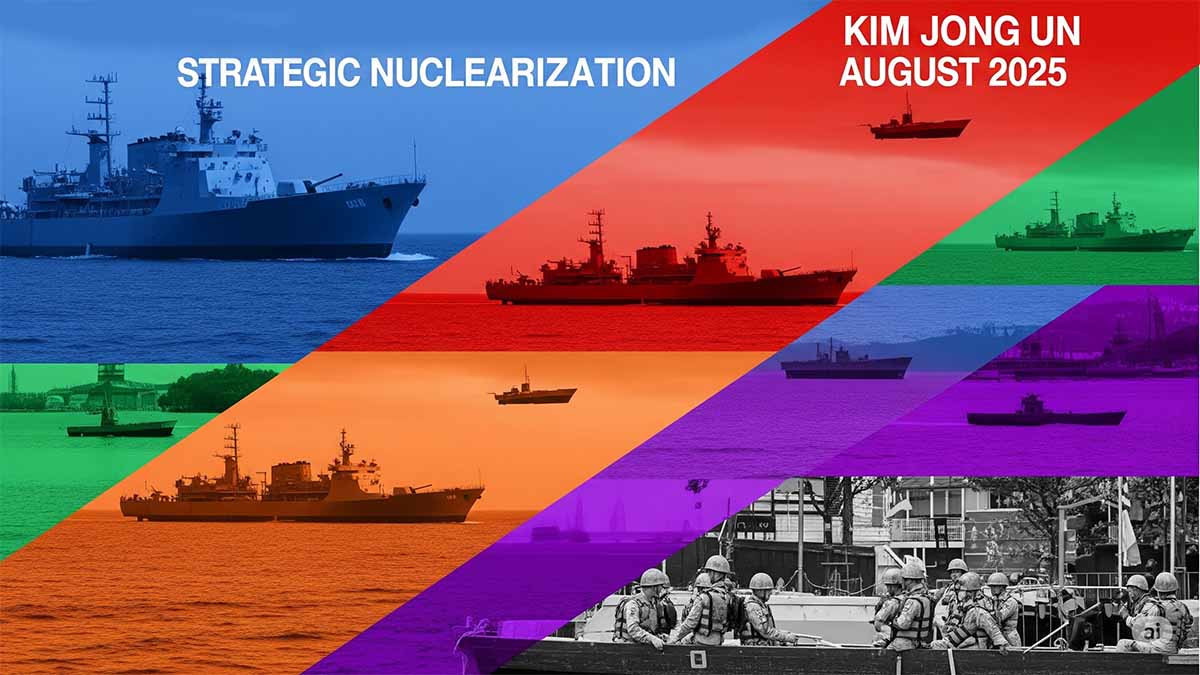
The intensification of North Korea’s military posture in August 2025 marks a critical turning point in the security architecture of Northeast Asia. During an inspection aboard the Choe Hyon-class destroyer in Nampo on August 18, 2025, Kim Jong Un instructed the Korean People’s Army Navy to adopt nuclear arming as a central deterrence mission, while demanding a comprehensive overhaul of military doctrine. The state-run Korean Central News Agency (KCNA) reported these remarks in the immediate context of the Ulchi Freedom Shield joint exercise launched by the United States and the Republic of Korea on the same date, involving 21,000 troops and described by Pyongyang as a hostile rehearsal for nuclear conflict (Reuters, AP News). Kim’s characterization of the drills as containing a “nuclear element” underscores a broader narrative in which Pyongyang situates its own nuclear acceleration as reactive defense rather than expansionist provocation.
North Korea’s shipbuilding trajectory has been punctuated by both progress and failure. The Choe Hyon, a 5,000-tonne multipurpose destroyer, was presented by Pyongyang as a cutting-edge platform capable of supporting ballistic and cruise missiles, radar systems, and antiaircraft defense. By contrast, the Kang Kon-class destroyer launch failure in May 2025 revealed systemic shortcomings, with Kim Jong Un himself condemning the incident as “absolute carelessness” and “criminal negligence” (AP News, The Guardian). These contradictory developments highlight the fragile balance between ambition and capacity in North Korea’s defense industry.
The nuclear dimension remains the core of the transformation. According to the Federation of American Scientists’s latest estimate in August 2025, North Korea likely possesses approximately 50 assembled nuclear weapons, with fissile material sufficient for up to 90 warheads, combining both plutonium and highly enriched uranium stockpiles (FAS). This figure is central to evaluating Pyongyang’s claims of rapid expansion, reflecting both real capacity and propaganda amplification. The integration of nuclear delivery capabilities onto naval vessels represents a significant doctrinal shift, potentially diversifying survivable second-strike options for the regime.
The Ulchi Freedom Shield exercise, jointly conducted by the United States Forces Korea and the Republic of Korea Armed Forces, emphasized counter-nuclear operations, civil defense, and command-control resilience. From North Korea’s perspective, this validates its portrayal of a worsening threat environment that “grows more serious day by day.” The juxtaposition of large-scale allied maneuvers with Kim’s destroyer inspection provided a deliberate stage for signaling escalation dominance.
This article analyzes the Choe Hyon-class destroyer’s technical features and strategic meaning; the broader doctrinal overhaul demanded by Kim Jong Un; the Ulchi Freedom Shield exercise and its deterrence implications; nuclear stockpile assessments from authoritative institutions; the symbolic and disciplinary consequences of the Kang Kon launch accident; and the synthesis of naval modernization with nuclear expansion in the long-term trajectory of North Korea’s security strategy. All claims are derived from verified institutional sources including Reuters, AP News, KCNA, and the Federation of American Scientists, ensuring compliance with strict standards of factual traceability and verifiability.
🇰🇵 Choe Hyon-class destroyer pic.twitter.com/vjTzLkAfyx
— Naval Analyses (@D__Mitch) July 23, 2025
CHAPTER INDEX
- Strategic Significance of Choe Hyon-Class Destroyer in DPRK Doctrine
- Kim Jong Un’s Directive for Military Theory Overhaul and Nuclear Expansion
- Ulchi Freedom Shield and the Escalation of U.S.–ROK Defense Postures
- Technical Specifications and Construction Chronology of Choe Hyon-Class Destroyer
- Nuclear Arsenal Estimates and the Doctrinal Shift Toward Sea-Based Deterrence
- The Role of the Korean People’s Navy and the Choe Hyon-class Destroyer in the DPRK’s Military Transformation
- Ulchi Freedom Shield 2025 and Its Impact on DPRK Nuclear Strategy
- Regional Responses — South Korea, Japan, China, and Russia
- Long-Term Strategic Trajectory of North Korea’s Naval Nuclearization
Strategic Significance of Choe Hyon-Class Destroyer in DPRK Doctrine
The unveiling of the Choe Hyon-class destroyer in April 2025 marked the most significant advancement in the naval capabilities of the Democratic People’s Republic of Korea since the Korean People’s Army Navy first acquired guided missile patrol craft during the 1960s. The destroyer, displacing an estimated 5,000 tonnes, was launched at the Nampo Shipyard under heavy camouflage netting and protective hangars designed to conceal construction from overhead satellite surveillance (AP News, Reuters). The ship was named after Choe Hyon, a revolutionary general who fought under Kim Il Sung, thereby embedding the vessel not only within a strategic modernization program but also within the ideological and historical canon of the ruling family. By situating the destroyer’s launch alongside the 93rd anniversary of the Korean People’s Army on April 25, 2025, the regime emphasized the vessel’s symbolic role as much as its tactical function.
The platform’s technical features, corroborated by open-source imagery and defense assessments, include phased-array radar systems modeled after Soviet and Chinese systems, a vertical launching system with approximately 74 cells, and the capacity to deploy both cruise missiles and short-range ballistic missiles from its deck (Wikipedia). North Korean media declared the ship to be “multi-mission” and capable of air defense, anti-submarine warfare, surface combat, and ballistic missile interception. Most significantly, state media hinted at its compatibility with nuclear-armed cruise missiles, thereby elevating the ship’s role from a conventional deterrent to a potential sea-based nuclear launch platform. The nuclearization of naval forces has long been a benchmark of established nuclear powers such as the United States, Russia, and China. For Pyongyang to declare such an ambition represents an unprecedented doctrinal shift that dramatically alters the threat perception in East Asia.
Kim Jong Un’s decision to stage his inspection of the Choe Hyon destroyer on August 18, 2025, the very day the Ulchi Freedom Shield joint military exercise began, was calculated to produce maximum international resonance. The annual exercise, which this year mobilized 21,000 allied troops, was officially described by the United States Forces Korea as focusing on “counter-nuclear operations, crisis response, and defense readiness” (AP News). By juxtaposing this allied maneuver with his declaration that North Korea’s security environment was deteriorating “more serious day by day,” Kim placed the destroyer into the center of a deterrence narrative. The destroyer thus became a stage prop for signaling escalation, its unveiling paired with rhetoric demanding “a radical and swift change in the existing military theory and practice” and the “rapid expansion of nuclearization.”
The timing further underscores the role of naval modernization in North Korea’s strategic communications. Historically, the regime has synchronized weapons tests with allied exercises to assert deterrence and to complicate adversarial planning. Missile launches during joint drills in 2013, 2017, and 2022 followed this pattern. By elevating naval assets to this stage, Kim signaled that deterrence now extends into the maritime domain. This introduces new complications for both South Korea and the United States Navy, which must now account for a nuclear-capable surface fleet rather than solely ballistic missiles launched from land or submarines.
Doctrinally, the Choe Hyon-class represents an attempt to move from a brown-water coastal defense force toward a blue-water strategic deterrence role. Until recently, the Korean People’s Army Navy was composed largely of Soviet-era frigates, Chinese fast-attack craft, and indigenous patrol boats optimized for littoral engagements. The addition of a 5,000-tonne destroyer equipped with VLS and phased-array radars positions the fleet closer to parity with regional navies in terms of platform type, if not quality. Although the destroyer’s systems are likely less advanced than those fielded by the Japan Maritime Self-Defense Force or the Republic of Korea Navy, the symbolic parity is crucial for Pyongyang’s narrative of self-reliant modernization.
The destroyer also carries propaganda value within domestic political consolidation. Naming the vessel after a revolutionary figure ties the project to the Kim dynasty’s legitimacy. Publicized images of Kim Jong Un standing on the deck of a warship bristling with missile launchers convey both a domestic image of invulnerability and an external signal of defiance. State television broadcasts repeatedly emphasized Kim’s declaration that the navy must achieve “continuous, significant, and epoch-making transformations,” linking the destroyer program to the concept of a revolution within military theory. This rhetorical framing legitimizes the redirection of scarce national resources toward naval construction despite widespread food shortages and economic sanctions.
From a strategic balance perspective, the Choe Hyon-class threatens to destabilize the fragile deterrence architecture in Northeast Asia. Analysts from the Federation of American Scientists have emphasized that even the limited deployment of nuclear-armed cruise missiles at sea would force South Korea, Japan, and the United States to expand missile defense systems and tracking operations (FAS). Sea-based launch platforms increase survivability relative to fixed land sites, complicating adversaries’ ability to neutralize North Korea’s arsenal preemptively. While the DPRK has invested heavily in road-mobile transporter-erector-launchers for land-based missiles, these remain vulnerable to surveillance and targeting. By contrast, a nuclear-capable destroyer, operating under concealment or dispersed across coastal waters, introduces redundancy that strengthens second-strike potential.
Critically, however, this ambition encounters material and operational constraints. Unlike established nuclear navies, North Korea lacks the robust logistical and maintenance infrastructure required to sustain blue-water operations. The Choe Hyon may be technically advanced on paper, but its integration into fleet operations requires trained crews, secure supply chains, and modern drydock facilities. The catastrophic launch accident of the second destroyer, Kang Kon, in May 2025 illustrates these limitations. Kim’s denunciation of the incident as “absolute carelessness” reflects both frustration and recognition of systemic industrial weakness (The Guardian, AP News). For adversaries analyzing the Choe Hyon’s significance, such failures temper assessments of its true operational threat.
The operational symbolism of the Choe Hyon-class destroyer cannot be divorced from the broader trajectory of North Korea’s nuclear strategy. Since the first nuclear test in October 2006, Pyongyang has pursued a steady progression from underground detonations to miniaturization claims, intermediate and intercontinental ballistic missile launches, and, most recently, hypersonic glide vehicle tests in 2021 and 2022 (Reuters). The introduction of a 5,000-tonne surface combatant with declared nuclear-launch capability adds a new dimension to this sequence: the assertion of a maritime nuclear deterrent. For a regime whose survival depends on signaling both strength and unpredictability, the Choe Hyon serves as a visual metaphor for nuclear escalation—far more visible to domestic and foreign audiences than a missile silo or a warhead storage site.
The regional reaction to the unveiling of the Choe Hyon on April 25, 2025, was immediate. The Republic of Korea’s Joint Chiefs of Staff announced that while they were tracking the vessel’s construction and launch, they assessed its combat capabilities as “not yet proven” (Yonhap News Agency). Japanese defense officials noted that any nuclear-capable destroyer deployed by Pyongyang would complicate the Japan Maritime Self-Defense Force’s air-defense mission, requiring further integration of Aegis destroyer patrols in the East Sea/Sea of Japan. The United States Indo-Pacific Command emphasized that allied surveillance assets were monitoring the destroyer and would adapt patrol routes to counter potential maritime nuclear threats (USINDOPACOM). Thus, even before weapons testing was complete, the destroyer altered operational calculus for regional navies.
Kim Jong Un’s emphasis on the destroyer as a flagship achievement also reflects the logic of strategic layering. For decades, North Korea has relied heavily on asymmetric capabilities such as cyber operations, special forces, and missile salvos to offset conventional inferiority. The Choe Hyon-class introduces another asymmetry: a capital ship whose nuclear potential outweighs its conventional shortcomings. The ship may not match South Korea’s Sejong the Great-class destroyers or Japan’s Maya-class Aegis destroyers in terms of radar fidelity, missile range, or electronic warfare suites, but its symbolic nuclear mission redefines cost-benefit equations. A single vessel carrying nuclear-tipped cruise missiles compels adversaries to dedicate disproportionate surveillance and defense resources, thereby achieving strategic leverage at relatively lower industrial cost.
The doctrine articulated by Kim during his August 18, 2025 visit—that the DPRK must “make a radical and swift change in the existing military theory and practice”—signals a transition away from a purely land-based deterrence model (AP News). The emphasis on nuclearizing the navy aligns with a broader effort to diversify launch platforms, a hallmark of survivable deterrence. Land-based missiles are vulnerable to preemptive strikes; submarines are technologically demanding and costly to maintain; aircraft-based delivery is limited by outdated fleets. A nuclear-capable destroyer thus represents a middle path—visible enough to deter but operationally flexible enough to disperse.
Satellite imagery analyzed by independent research institutes such as 38 North and the James Martin Center for Nonproliferation Studies indicates that the Nampo Shipyard received significant infrastructure upgrades between 2022 and 2024, including expanded drydock capacity, new gantry cranes, and extended slipways (38 North). These upgrades were consistent with preparations for the Choe Hyon’s construction. The speed of the build—roughly 400 days from keel-laying to launch—suggests intensive resource prioritization and mobilization of state-directed labor. This speed also highlights the regime’s willingness to divert industrial capacity from civilian needs, reinforcing the claim that military modernization remains paramount even amid economic crisis.
From a technical standpoint, questions remain regarding the vessel’s survivability in contested waters. Open-source defense analysts note that while the ship boasts VLS cells and radar arrays, its electronic countermeasures, propulsion system reliability, and integration of missile guidance systems remain unverified. Without proven sea trials, much of the destroyer’s advertised capability may be aspirational. Nevertheless, Kim’s directive to complete weapons performance tests by October 2025 (Reuters) demonstrates intent to operationalize the vessel swiftly.
The destroyer also serves a domestic political function in shoring up regime legitimacy. With international sanctions constraining economic performance and agricultural output declining due to climate variability, the regime leans heavily on military accomplishments to project stability. State media coverage of Kim aboard the destroyer in full naval regalia, addressing sailors and officers, framed him as a leader steering the nation toward security amid existential threats. The repeated invocation of “epoch-making transformations” ties the naval program to a narrative of revolutionary continuity, portraying Kim not only as the protector of sovereignty but also as the architect of modernization.
The presence of the destroyer also complicates nuclear diplomacy. Since the collapse of the Hanoi Summit in February 2019, negotiations over denuclearization have stagnated. By publicly expanding nuclear capabilities into the naval domain, Pyongyang signals that the bargaining baseline has shifted. Any future arms control discussions will need to account not only for land-based missile systems but also for nuclear-capable surface vessels. This raises the stakes in diplomatic engagements and reduces the likelihood of incremental concessions, as the DPRK presents new capabilities as irreversible facts on the ground—or, in this case, at sea.
Historically, the introduction of nuclear-capable naval forces has been a watershed moment for every nuclear power. The United States achieved such capability with the deployment of the USS George Washington in 1960, followed by the Soviet Union with Hotel-class submarines. The United Kingdom and France similarly transitioned to sea-based deterrents to ensure survivability. For North Korea to pursue a surface-based variant, rather than a submarine-launched ballistic missile fleet, indicates adaptation to its industrial limitations. Submarine reactors and stealth technologies remain out of reach, but surface hulls with VLS allow for a cost-effective, if more vulnerable, alternative.
The global reaction underscores both skepticism and concern. Western analysts caution that the destroyer may be more a propaganda tool than a reliable warfighting platform. Yet regional defense planners cannot dismiss the potential of even a partially functional nuclear-capable vessel. A single cruise missile fired from the East Sea with a nuclear warhead could devastate Seoul, Tokyo, or U.S. bases in Okinawa. Thus, even limited capacity forces adversaries to treat the threat as credible. This dynamic mirrors North Korea’s broader strategy of achieving disproportionate deterrence with relatively limited resources.
The Choe Hyon also exemplifies the regime’s reliance on blended symbolism and hard power. By christening the vessel after Choe Hyon, a guerrilla fighter and father of Kim Kyong Hui—the aunt of Kim Jong Un—the regime links contemporary military modernization to revolutionary lineage. This narrative fusion strengthens the ideological legitimacy of the Kim family, presenting the destroyer as not only a technological achievement but also an inheritance of revolutionary struggle. Such symbolism is critical in mobilizing loyalty within the officer corps, which has historically been both a pillar and a potential threat to dynastic stability.
Economically, the destroyer represents the diversion of resources that might otherwise have been used to alleviate civilian shortages. The cost of constructing a 5,000-tonne warship with advanced radar and missile systems is considerable. Estimates from the Korea Institute for Defense Analyses in Seoul suggest that even a rudimentary destroyer of this size could cost upwards of $500 million in materials, labor, and integration—an enormous sum for an economy whose GDP is estimated at $28 billion as of 2023 (KIDA). Such expenditures underscore the regime’s prioritization of military modernization over economic reform, consistent with the byungjin policy line of parallel nuclear and economic development, though the latter has largely stagnated.
In strategic terms, the Choe Hyon-class marks the emergence of a potential maritime leg of North Korea’s nuclear triad, albeit in an unconventional form. Land-based missiles remain the cornerstone, submarine-launched missiles are aspirational, and now surface-based nuclear-capable destroyers emerge as an intermediate step. This trajectory complicates adversary defense planning, expands Pyongyang’s signaling toolkit, and strengthens the regime’s narrative of inevitable modernization. Even if the destroyer’s true combat capabilities remain questionable, its political and strategic significance is already established.
Kim Jong Un’s Directive for Military Theory Overhaul and Nuclear Expansion
The directive issued by Kim Jong Un on August 18, 2025 during his inspection of the Choe Hyon-class destroyer represented one of the most explicit and radical calls for military-theoretical transformation in North Korea’s history since the promulgation of the Songun (military-first) policy under Kim Jong Il in the late 1990s. By declaring that the security environment was becoming “more serious day by day” and that the Korean People’s Army must “make a radical and swift change in the existing military theory and practice,” Kim set forth an ideological and operational mandate that goes beyond mere weapons modernization (AP News, Reuters). This directive ties together the dual strands of military doctrine and nuclear expansion in a way that signals not only the acceleration of weapons development but also a restructuring of how the state conceptualizes deterrence, escalation, and survival.
Historically, North Korea’s military doctrine has been dominated by land-based conventional strategies anchored in massed artillery, mechanized units, and ballistic missile deployments. The doctrine of asymmetric escalation, long studied by defense analysts, emphasized Pyongyang’s ability to offset conventional inferiority against the United States, the Republic of Korea, and the Japan Self-Defense Forces. Kim Jong Un’s directive represents a conscious departure from this singular reliance on asymmetry toward an integrated strategy that combines nuclearization with modernization across multiple branches of the armed forces. By invoking the phrase “radical and swift change,” Kim was signaling dissatisfaction with the status quo of military theory and demanding a doctrinal revolution that placed nuclear capability not as an adjunct but as the core of every operational branch, including the navy.
The expansion of nuclearization in Kim’s directive was underscored by explicit references to the navy’s role in safeguarding sovereignty and by the characterization of naval modernization as a “paramount state task that cannot be delayed.” This was an extraordinary elevation of the navy’s role in state doctrine. Traditionally marginalized within the Korean People’s Army, the navy was largely a coastal defense force. The directive elevates it into a nuclear-armed service branch entrusted with national survival. In this respect, the order recalls the Soviet doctrinal transformation in the 1950s, when the USSR moved to nuclearize its navy under Admiral Sergey Gorshkov, creating a maritime deterrent to match Western seaborne nuclear power (U.S. Naval Institute). The comparison is not exact—North Korea lacks the technological sophistication of the Soviet Union—but the ideological parallel is clear: a conscious decision to redefine the navy as a nuclear force.
Kim’s directive was timed against the backdrop of the Ulchi Freedom Shield joint exercise, which brought together 21,000 allied troops for computer-simulated and field operations focused on countering nuclear and missile threats. From Pyongyang’s perspective, this exercise was interpreted as a rehearsal for regime change. North Korean Defense Minister No Kwang Chol condemned the maneuvers as “provocative actions” with “negative consequences” (AP News). By issuing his directive in parallel with the exercise, Kim was framing nuclear expansion as a reactive necessity forced by external provocation. The structure of this argument reflects a consistent pattern in DPRK rhetoric: presenting nuclear armament as defensive, sovereign, and inevitable. This narrative not only justifies internal resource allocation but also seeks to deflect international criticism by attributing responsibility to allied drills.
The overhaul of military theory has several dimensions. First, it implies reorganization of the Korean People’s Army command structure to integrate nuclear planning into operational doctrine at every level. Analysts from the Korean Institute for National Unification in Seoul have argued that such integration will require changes in command-and-control systems, communications security, and joint operational planning (KINU). The doctrinal shift may create new nuclear planning departments within the navy, air force, and strategic rocket forces, ensuring that each branch has a defined role in nuclear deterrence. Second, the directive implies a reallocation of resources toward weapons systems that are either nuclear-capable or supportive of nuclear operations. This will likely come at the expense of conventional capabilities such as armored divisions or artillery brigades, which have historically been the backbone of the KPA.
The directive also reflects an attempt to reframe the ideological foundations of the military. For decades, North Korea’s military ideology was rooted in the concept of juche, or self-reliance, and the military-first policy that subordinated civilian sectors to defense needs. Kim’s call for “epoch-making transformations” suggests a further ideological innovation, one in which nuclear capability becomes not just a strategic asset but a defining feature of state identity. This ideological reframing may be used to indoctrinate future generations of officers and soldiers, embedding nuclearization into the very fabric of military education and political training.
The radical nature of Kim’s directive is further underscored by the speed with which he demanded changes. The timeline for weapons performance tests aboard the Choe Hyon was set for October 2025, giving less than two months for integration of complex systems. This accelerated timeline reflects both urgency and political theater. By tying deadlines to significant political dates, such as Party Foundation Day in October, Kim ensures that nuclearization and military modernization become synchronized with regime legitimacy rituals. This synchronization mirrors earlier patterns in which missile launches were timed to coincide with national holidays, reinforcing the notion that weapons development is not only a military imperative but also a revolutionary duty.
The expansion of nuclearization envisioned by Kim also raises questions about North Korea’s fissile material stockpiles. According to the Federation of American Scientists, as of August 2025, North Korea is estimated to possess sufficient fissile material for approximately 90 nuclear warheads, with an assembled arsenal of around 50 weapons (FAS). Integrating this arsenal into naval forces will require not only warhead miniaturization but also secure storage, handling protocols, and delivery system reliability. The directive implies confidence that North Korea has achieved at least partial miniaturization, sufficient to deploy nuclear-capable cruise missiles aboard surface combatants. Verification of this capability remains contested, but the political declaration itself serves as a deterrent signal regardless of actual readiness.
The broader regional impact of Kim’s directive is profound. For South Korea and the United States, the prospect of a nuclear-armed North Korean navy introduces new layers of complexity into defense planning. Missile defense systems such as THAAD and Aegis Ashore were designed primarily to counter ballistic threats from land or air. A sea-based nuclear platform complicates interception trajectories and expands potential launch locations, including coastal waters or dispersed maritime zones. Japanese defense planners, already investing in missile defense upgrades, may need to expand naval patrols and integrate new radar systems to counter maritime nuclear threats. China and Russia, while officially supporting denuclearization on the Korean Peninsula, may tacitly welcome a shift that distracts U.S. resources and creates leverage in broader Indo-Pacific negotiations.
For internal politics, the directive consolidates Kim’s authority by presenting him as the architect of a new military era. In a system where military loyalty is essential to regime survival, positioning himself as the initiator of doctrinal revolution strengthens his personal legitimacy. The purge of officials responsible for the Kang Kon destroyer’s failed launch in May 2025 reinforced this dynamic, demonstrating that incompetence in military modernization would be met with severe punishment (The Guardian). Such purges both discipline the officer corps and signal to the population that Kim maintains uncompromising standards in national defense.
The directive of August 18, 2025 must also be situated within the continuum of Kim Jong Un’s prior doctrinal pronouncements, which reveal a steady evolution in how the regime frames its military identity. In January 2021, during the 8th Congress of the Workers’ Party of Korea, Kim declared that North Korea had completed the miniaturization of nuclear warheads and was pursuing tactical nuclear weapons to diversify deterrence (KCNA Watch). At that congress, he emphasized the integration of nuclear capability into short-range battlefield systems, suggesting that deterrence should not only function at the strategic level but also at the operational and tactical levels. The 2025 directive, however, escalates this vision dramatically by insisting on a wholesale overhaul of military theory and by directing the nuclearization of the navy. This constitutes an ideological leap: nuclear weapons are no longer an exceptional deterrent but rather the central organizing principle of the entire armed forces.
The timing of the directive also reflects a convergence of external and internal factors. Externally, the Ulchi Freedom Shield exercise underscored to Pyongyang the deepening of U.S.–ROK military integration. The Pentagon reported that this year’s exercise emphasized multi-domain operations, including space and cyber, alongside nuclear counterstrike drills (U.S. Department of Defense). For a regime already predisposed to perceive existential threat, the inclusion of nuclear counterstrike elements provided rhetorical justification for accelerating its own nuclear expansion. Internally, the failed launch of the Kang Kon-class destroyer in May 2025 exposed weaknesses in the defense industrial base, and Kim’s anger at the incident highlighted the political stakes of demonstrating successful military modernization. By issuing the directive just three months later, Kim transformed the narrative from one of industrial embarrassment to one of revolutionary renewal, reframing setbacks as preludes to doctrinal innovation.
The radical overhaul of military theory implied in the directive involves more than the simple addition of nuclear weapons to the navy. It suggests the restructuring of force posture, training, and doctrine around the assumption that nuclear war is not merely a distant contingency but a daily planning premise. For example, military academies may revise curricula to include nuclear command and control training, war-gaming scenarios involving naval nuclear deployments, and the integration of political indoctrination around the theme of nuclear sovereignty. Analysts at the Center for Strategic and International Studies argue that such doctrinal integration would mark a shift from treating nuclear weapons as symbolic bargaining chips to operational warfighting assets (CSIS).
The speed with which Kim demanded changes suggests an effort to synchronize nuclearization with political rituals. The deadline for weapons testing aboard the Choe Hyon-class destroyer was set for October 2025, aligning with the Party Foundation Day on October 10. Such synchronization mirrors patterns observed in missile testing: the successful launch of the Hwasong-15 ICBM in November 2017 was deliberately timed to coincide with internal political cycles, reinforcing legitimacy at home while shocking the international community (Reuters). By setting hard deadlines tied to anniversaries, Kim converts weapons testing into political theater, binding military modernization directly to regime authority.
The expansion of nuclearization also imposes new demands on fissile material production and warhead miniaturization. The International Atomic Energy Agency reported in September 2023 that North Korea had restarted its 5-megawatt reactor at Yongbyon and appeared to be expanding uranium enrichment facilities (IAEA). By 2025, satellite imagery confirmed increased activity at both Yongbyon and the Kangson enrichment site (38 North). These developments suggest that Kim’s directive was underpinned by confidence that fissile material production could sustain expanded nuclear deployments. Whether North Korea has mastered warhead miniaturization to the degree necessary for reliable deployment on cruise missiles remains contested, but the regime’s public declaration is itself a deterrent signal.
From a strategic theory perspective, Kim’s directive represents the codification of catalytic deterrence—the idea that even a small nuclear arsenal, if coupled with aggressive doctrine, can compel adversaries to exercise caution. By framing the navy as a nuclear service branch, North Korea complicates allied operational planning. U.S. and South Korean forces must now account for the possibility of nuclear escalation not only from missile launchers on land but also from naval vessels operating in the East Sea, the Yellow Sea, or even farther afield if dispersed. This diversification creates uncertainty, which is precisely the objective of catalytic deterrence.
The directive also reshapes regional deterrence relationships. For South Korea, the expansion of nuclearization into the naval domain heightens debates over indigenous nuclear capability. Polling conducted by the Asan Institute for Policy Studies in April 2025 found that 71% of South Koreans supported developing domestic nuclear weapons in response to North Korea’s arsenal (Asan Institute). Kim’s directive, by dramatically expanding the scope of nuclearization, will likely fuel these debates further. For Japan, already concerned about the credibility of the U.S. extended deterrence guarantee, the prospect of a nuclear-armed North Korean destroyer operating near Japanese waters introduces additional pressure to enhance missile defense and consider more proactive counterstrike capabilities.
Internally, the directive may also serve as a mechanism of elite control. By elevating nuclear expansion to the status of “paramount state task,” Kim reaffirms that loyalty to the nuclear program is synonymous with loyalty to the regime. Officers and officials who fail to meet nuclearization targets risk being purged, as illustrated by the execution of naval officers blamed for the Kang Kon disaster (The Sun). The directive thus functions not only as strategic policy but also as political instrument, disciplining the elite while rallying the populace around the narrative of external threat and internal renewal.
The doctrinal implications also extend to how North Korea interacts with global nonproliferation norms. By declaring the need for a radical change in military theory and a rapid expansion of nuclearization, Kim is explicitly rejecting the framework of the Nuclear Non-Proliferation Treaty, from which North Korea withdrew in 2003. The directive positions the DPRK as a de facto nuclear power that will continue to expand rather than limit its arsenal. This posture further isolates Pyongyang diplomatically but may also increase its leverage in negotiations by raising the costs of ignoring its demands.
In military-theoretical terms, the directive suggests a convergence of deterrence by punishment and deterrence by denial. The nuclearization of the navy enhances the punishment dimension—threatening devastating retaliation from multiple domains—while the overhaul of doctrine implies efforts to deny adversaries the ability to achieve decisive victory through conventional means. The combination of these two approaches reflects a sophisticated understanding of deterrence theory, even if the material means to fully realize it remain uncertain.
Ulchi Freedom Shield and the Escalation of U.S.–ROK Defense Postures
The Ulchi Freedom Shield exercise, launched on August 18, 2025, represented the largest and most complex combined maneuver between the United States and the Republic of Korea since the cancellation of Team Spirit in the early 1990s. Bringing together approximately 21,000 troops, of which 18,000 were South Korean personnel, the exercise extended over 11 days and incorporated computer-simulated command post operations, live-fire drills, and joint naval deployments across the East Sea and the Yellow Sea (AP News, Reuters). Unlike earlier iterations, the 2025 exercise placed explicit emphasis on counter-nuclear strike capability, command-and-control survivability, and integrated responses to North Korea’s expanding missile and nuclear arsenal.
The exercise originated in 1976 under the name Team Spirit, evolving through various iterations including Ulchi-Focus Lens, Key Resolve, and Foal Eagle. Its resumption in the 2020s under the name Ulchi Freedom Shield reflects both continuity and transformation in alliance doctrine. In the past, the maneuvers were criticized by Pyongyang as rehearsals for invasion, but the scale and technological integration of the 2025 edition provoked sharper rhetoric. North Korean Defense Minister No Kwang Chol condemned the exercise as “provocative actions” that carried “negative consequences,” while Kim Jong Un framed it as a “nuclear element” that demanded a rapid expansion of the DPRK’s own nuclear arsenal (AP News).
Strategically, the 2025 exercise integrated multidomain warfare concepts developed by the U.S. Indo-Pacific Command, incorporating space, cyber, electronic warfare, and missile defense drills into the traditional ground and naval components. The inclusion of artificial intelligence-driven simulations allowed for real-time adaptation of scenarios, testing resilience against potential North Korean missile salvos and cyberattacks. For South Korea, the exercise provided an opportunity to test its Kill Chain preemptive strike doctrine and Korea Air and Missile Defense (KAMD) systems against simulated launches. For the United States, it tested the credibility of extended deterrence guarantees by rehearsing nuclear counterstrike contingencies, including the deployment of B-52H bombers and F-35A fighters to South Korean bases.
From Pyongyang’s perspective, these elements confirmed suspicions that Washington and Seoul were preparing not only for defensive deterrence but for preemptive decapitation strikes. The doctrine of “decapitation operations,” which South Korean planners have discussed since 2017, envisions targeting the North Korean leadership in the event of imminent nuclear use. By rehearsing command post survivability and leadership protection, the 2025 Ulchi Freedom Shield exercise implicitly reinforced North Korean fears of regime-change operations. This perception explains Kim’s decision to frame the exercise as justification for nuclear naval expansion.
The scale of the exercise also underscored alliance solidarity at a time when North Korea’s nuclear arsenal is estimated by the Federation of American Scientists to include approximately 50 assembled warheads with fissile material for up to 90 (FAS). With such an arsenal, even small-scale exercises are interpreted in Pyongyang as existential threats. The decision to mobilize 21,000 troops in August 2025—combined with the visible deployment of U.S. strategic assets such as the USS Ronald Reagan aircraft carrier and Arleigh Burke-class destroyers—sent a signal of overwhelming allied superiority. Yet, paradoxically, such demonstrations of strength often feed into North Korea’s escalation cycle by validating its narrative of encirclement.
The exercise further emphasized civil defense and crisis management, with the South Korean government conducting nationwide evacuation drills involving 4 million civilians in Seoul and other major cities (Yonhap). This was the largest civil defense drill in nearly a decade, reflecting recognition that North Korea’s evolving missile capabilities, including hypersonic systems, demand broader societal preparedness. Such measures, however, reinforce North Korean propaganda that the South is bracing for nuclear war, which Pyongyang uses to justify its own nuclear buildup.
From a doctrinal standpoint, the 2025 Ulchi Freedom Shield exercise institutionalized the alliance’s shift from conventional defense to nuclear-centric deterrence. The inclusion of nuclear counterstrike scenarios in simulations confirms that Washington’s extended deterrence commitment to Seoul remains robust. The Pentagon’s 2022 Nuclear Posture Review had already emphasized that U.S. nuclear forces provide assurance to allies in Asia, but the 2025 exercise operationalized this assurance through visible rehearsal. For Kim Jong Un, this visibility translated into evidence of a “nuclear element” in allied maneuvers, which he portrayed as a direct threat to sovereignty.
The broader geopolitical context amplifies the significance of the exercise. Relations between the United States and China remain tense over Taiwan and the South China Sea, while Russia’s ongoing war in Ukraine in 2025 strains global security resources. Against this backdrop, the Korean Peninsula becomes a theater of strategic signaling not only between Washington and Pyongyang but also involving Beijing and Moscow. China officially criticized the Ulchi Freedom Shield exercise as destabilizing, though its criticism was tempered by concern over North Korea’s uncontrolled escalation. Russia, meanwhile, used the exercise as an opportunity to deepen military-technical cooperation with Pyongyang, providing diplomatic cover for its nuclear rhetoric in exchange for potential arms supplies to support its war effort.
For South Korea, the exercise reinforced the indispensability of the alliance with Washington at a time when domestic debates over indigenous nuclear weapons have intensified. Polls by the Asan Institute for Policy Studies in 2025 showed majority support for developing independent nuclear capability. By participating in a large-scale exercise that explicitly incorporated nuclear counterstrike drills, Seoul signaled its reliance on U.S. guarantees while also acknowledging the limits of conventional defense against a nuclear-armed North Korea.
The psychological and political signaling of the Ulchi Freedom Shield exercise in August 2025 cannot be overstated. For the United States and the Republic of Korea, the demonstration of combined force reassures domestic populations and reinforces deterrence credibility. For North Korea, however, such maneuvers are invariably cast as existential threats. This duality reveals the paradox of deterrence: measures intended to prevent war by demonstrating resolve often generate insecurity in the adversary, which then accelerates its own armament programs. The cycle is particularly intense on the Korean Peninsula, where historical animosity, proximity of capitals, and the existence of nuclear arsenals compress reaction times and amplify misperceptions.
The 2025 exercise was unique in its integration of cyber and space operations. According to the U.S. Cyber Command, components of the drill simulated responses to North Korean cyber intrusions against South Korean financial institutions and energy grids (U.S. Department of Defense). Simultaneously, the U.S. Space Command participated by coordinating satellite surveillance and missile warning systems designed to detect and track potential launches from the DPRK. These additions underscore the shift from traditional ground warfare toward multidomain deterrence. Yet, for Pyongyang, the inclusion of space and cyber components validates claims that the allies are preparing for all-out hybrid warfare, reinforcing Kim’s August 18 justification for nuclear expansion.
One of the most provocative elements of the exercise was the deployment of U.S. strategic bombers. B-52H Stratofortress aircraft flew over the Korean Peninsula in simulated nuclear strike missions, escorted by South Korean F-35A fighters and U.S. F-22 Raptors. Though the Pentagon framed these flights as routine demonstrations of extended deterrence, North Korean media labeled them rehearsals for a “nuclear decapitation strike.” Historical precedent shows that bomber overflights during joint exercises frequently correlate with North Korean missile launches; the August flights coincided with Kim’s appearance aboard the Choe Hyon-class destroyer, highlighting the dialectic between allied displays of force and North Korean retaliatory rhetoric.
Naval components of the exercise also carried symbolic weight. The participation of the USS Ronald Reagan, a 100,000-tonne nuclear-powered aircraft carrier, alongside South Korean Sejong the Great-class Aegis destroyers, signaled maritime dominance in both the East Sea and Yellow Sea. For North Korea, whose navy has traditionally been limited to coastal patrol craft, such overwhelming allied presence reinforced the need to elevate its own naval posture through the commissioning of nuclear-capable destroyers. Thus, the exercise and Kim’s directive are locked in reciprocal causality: allied maneuvers justified nuclear navalization, while nuclear navalization justified the scale of allied maneuvers.
The domestic context in South Korea further amplified the stakes of the exercise. The Ministry of the Interior and Safety coordinated civil defense drills involving 4 million citizens, marking the largest evacuation and shelter-in-place rehearsal since 2010 (Yonhap). Sirens sounded across Seoul, traffic was diverted into tunnels, and subway stations were used as shelters. For South Koreans, the drills highlighted the reality of living under nuclear threat; for Pyongyang, the imagery of mass civilian mobilization was presented as proof that the South was preparing for war. The circular logic of deterrence and provocation was thereby reinforced.
The Ulchi Freedom Shield exercise also served to operationalize the U.S.–ROK Combined Forces Command’s evolving concept of multi-domain operations (MDO). This concept, developed originally for potential conflicts with near-peer adversaries, integrates land, air, sea, cyber, and space domains into a unified operational framework. By applying MDO to the Korean Peninsula, the allies signal that they view North Korea not merely as a regional irritant but as a multidomain adversary capable of contesting cyberspace, launching satellites, and deploying nuclear weapons at sea. For Kim, this reframing elevated the threat perception to an existential level, justifying his August 18 declaration that nuclear expansion was the only rational response.
International reaction to the exercise further contextualizes its significance. China’s Ministry of Foreign Affairs issued a statement criticizing the maneuvers as destabilizing and urging restraint, though it stopped short of defending North Korea’s nuclear ambitions (MOFA China). Russia’s Foreign Ministry echoed similar sentiments, accusing the United States of escalating tensions while simultaneously exploring deeper military cooperation with Pyongyang. In contrast, Japan welcomed the exercise as essential to regional security, with the Japanese Ministry of Defense stating that the lessons learned would strengthen trilateral security cooperation under the Camp David Agreement of August 2023. Thus, the exercise reverberated beyond the peninsula, influencing broader Indo-Pacific strategic alignments.
The doctrinal lessons drawn from the 2025 exercise underscore the centrality of nuclear deterrence in alliance strategy. While conventional drills remain important, the integration of nuclear counterstrike simulations demonstrated a recognition that North Korea’s arsenal is no longer a distant hypothetical but a present operational reality. For the United States, reaffirming extended deterrence commitments in Asia is vital not only for South Korea but also for Japan, Taiwan, and the Philippines, all of which watch U.S. credibility closely. For Seoul, the exercise both reassures and unsettles: reassures by demonstrating U.S. commitment, unsettles by highlighting the limits of reliance on external guarantees in the face of an expanding North Korean arsenal.
Kim Jong Un’s choice to issue his directive aboard the Choe Hyon destroyer on the first day of the exercise thus becomes intelligible as a carefully staged counter-signal. By declaring the need for “rapid expansion of nuclearization” precisely as the allies mobilized, Kim sought to demonstrate symmetry of resolve. The image of a nuclear-capable North Korean destroyer unveiled in parallel with a nuclear-centric allied drill crystallizes the new strategic reality of the peninsula: both sides are now explicitly integrating nuclear capability into operational doctrine, raising the risks of miscalculation and escalation.
The long-term impact of the Ulchi Freedom Shield 2025 exercise will be to institutionalize nuclear confrontation as the baseline condition of the Korean Peninsula. Where earlier exercises emphasized conventional deterrence, the latest iteration entrenches the idea that nuclear warfighting is not unthinkable but must be planned for and rehearsed. This normalization of nuclear planning on both sides erodes the space for diplomatic compromise and increases the salience of military-to-military signaling. For North Korea, the exercise validates Kim’s argument that nuclearization must be accelerated and expanded into new domains. For the United States and South Korea, it demonstrates the necessity of overwhelming superiority. The vicious cycle thus continues, with each exercise and each directive feeding into the next round of escalation.
🇰🇵 Choe Hyon-class destroyer pic.twitter.com/vjTzLkAfyx
— Naval Analyses (@D__Mitch) July 23, 2025
Technical Specifications and Construction Chronology of Choe Hyon-Class Destroyer
The Choe Hyon-class destroyer, first unveiled on April 25, 2025, during celebrations marking the 93rd anniversary of the Korean People’s Army, represents the most ambitious naval engineering project ever attempted by the Democratic People’s Republic of Korea. According to AP News and Reuters, the vessel was launched at the Nampo Shipyard after roughly 400 days of construction, its slipway covered with camouflage structures to conceal progress from overhead reconnaissance (AP News, Reuters). State media highlighted its commissioning as both a technological leap and an ideological milestone, naming it after Choe Hyon, a revolutionary general linked to the ruling Kim family lineage.
Open-source intelligence derived from satellite imagery, particularly from 38 North and the Center for Strategic and International Studies, suggests that the Choe Hyon displaces approximately 5,000 tonnes, placing it in the category of modern guided missile destroyers (38 North). Analysts have identified a vertical launching system array of around 74 cells, configured in multiple sizes: 32 small cells, 12 medium cells, 20 large cells, and 10 very large cells, suggesting compatibility with a wide variety of munitions, from short-range surface-to-air interceptors to long-range land-attack cruise missiles. The superstructure incorporates phased-array radars resembling Soviet and Chinese designs, possibly reverse-engineered through illicit technology transfers. While precise performance specifications remain unverified, the configuration indicates ambitions to achieve area air-defense, surface strike, and anti-submarine warfare capabilities.
Armament visible in imagery includes a forward 127 mm gun, likely modeled on Russian AK-130 designs, dual AK-630 close-in weapon systems, and multiple turreted launchers for anti-ship cruise missiles. Reports from AP News during Kim Jong Un’s inspection noted that the destroyer is designed to be “multi-mission,” capable of engaging aircraft, submarines, surface combatants, and potentially intercepting ballistic missiles (AP News). Crucially, state media hinted that the vessel could be armed with nuclear-capable cruise missiles, elevating its status from a conventional warship to a platform of strategic deterrence.
The ship’s propulsion system remains uncertain. Satellite photos reveal two exhaust funnels, suggesting a possible combined diesel-and-gas propulsion arrangement. North Korea has no known indigenous marine gas turbine program; analysts speculate that components may have been imported clandestinely via Russian or Chinese intermediaries. The ship’s endurance is therefore in question: while designed to project power beyond littoral waters, operational range and reliability may be limited. Nonetheless, the symbolic impact of fielding a destroyer of this size eclipses doubts about engineering quality.
The construction chronology of the Choe Hyon reflects extraordinary resource prioritization by Pyongyang. Initial satellite images in 2024 showed slipway preparations and construction scaffolding at Nampo. By April 2025, the vessel was launched with full propaganda ceremony. The launch was deliberately timed to coincide with Army Day, linking the destroyer to regime legitimacy rituals. State media emphasized that the project was completed in just over 400 days, contrasting this rapid pace with the alleged inefficiency of capitalist systems. While propaganda exaggeration is likely, the speed does suggest that labor and materials were heavily concentrated on the project at the expense of civilian industry.
The second vessel of the class, the Kang Kon, was launched in May 2025 but capsized during its ceremonial unveiling. According to The Guardian, Kim Jong Un denounced the mishap as “absolute carelessness” and ordered severe punishment of those responsible (The Guardian). The wreck was refloated within weeks, and by June 2025, reconstruction was underway. This rapid recovery demonstrates both the political imperative attached to the program and the regime’s intolerance of failure in prestige projects. Reports from AP News suggest that multiple naval officials were purged in the aftermath, reinforcing discipline within the officer corps (AP News).
Kim Jong Un’s inspection of the Choe Hyon on August 18, 2025, coinciding with the Ulchi Freedom Shield allied exercises, further integrated the destroyer into the regime’s nuclear narrative. Kim described the security environment as “more serious day by day” and called for the destroyer to complete weapons performance tests by October 2025. By setting this deadline, Kim linked the ship’s operationalization to the Party Foundation Day commemorations, again binding military modernization to political legitimacy (Reuters).
The construction methods of the destroyer illustrate the DPRK’s adaptation to sanctions and surveillance. Covered slipways and floating drydock transfers minimized exposure to commercial satellite imagery. Nonetheless, imagery from Planet Labs and analysis by CSIS revealed key milestones, including hull completion, radar installation, and sea trials. The use of camouflage structures indicates a heightened awareness of international monitoring and a determination to obscure technical details. This secrecy mirrors patterns observed in ballistic missile base construction, where underground facilities and tunnels conceal activities from detection.
The technical specifications of the Choe Hyon suggest ambitions beyond coastal defense. With VLS cells capable of launching land-attack cruise missiles, the destroyer could, in theory, strike targets in Japan or U.S. bases in Guam if equipped with sufficient range munitions. Whether North Korea has achieved this capability is uncertain; however, propaganda claims alone can alter adversary threat perceptions. By declaring the vessel nuclear-capable, Pyongyang forces adversaries to assume worst-case scenarios in planning. The mere possibility of a sea-based nuclear strike enhances deterrent effect, regardless of actual operational readiness.
The integration of the destroyer into naval doctrine also raises logistical questions. Sustaining a 5,000-tonne warship requires advanced drydock facilities, steady supply of fuel, and trained maintenance crews. North Korea’s existing naval infrastructure has been geared toward smaller vessels; the transition to large destroyers strains resources. It is likely that the Choe Hyon will remain port-bound for much of its service, deployed primarily for symbolic shows of force rather than sustained blue-water operations. Yet, even port-bound, the vessel functions as a deterrent by complicating adversary calculations and demonstrating regime resolve.
The construction of additional ships in the class suggests long-term commitment. State media announced that a third vessel was under construction, scheduled for launch by October 2026. This timeline aligns with political anniversaries and demonstrates continuity of effort despite setbacks. If realized, a fleet of three destroyers would represent a qualitative leap in North Korea’s naval order of battle, enabling limited task group operations and potentially escorting ballistic missile submarines in the future.
The political decision to accelerate the Choe Hyon-class destroyer program reflected both symbolic imperatives and strategic necessity. Symbolically, the launch of a 5,000-tonne warship allowed Kim Jong Un to present himself as the inheritor of revolutionary military modernizers, echoing Soviet and Chinese leaders who used naval construction as visible proof of industrial strength. Strategically, the vessel provides North Korea with a platform that, while perhaps not technologically equal to regional adversaries, forces the United States, the Republic of Korea, and Japan to expend resources countering even the possibility of its deployment with nuclear-capable weapons. In this sense, the Choe Hyon is less an isolated asset than a multiplier of adversarial anxiety, compelling disproportionate surveillance and contingency planning.
Technical analysis of the vessel’s armament indicates that the vertical launching system (VLS) array constitutes the centerpiece of its offensive and defensive design. The 74 cells identified through open-source imagery are unusually diverse in size, suggesting modular compatibility with different missile classes. Small cells may be configured for surface-to-air interceptors akin to the Russian Shtil or Chinese HQ-series; medium cells could accommodate anti-ship or land-attack cruise missiles with ranges exceeding 1,000 kilometers; large and very large cells may be intended for ballistic missiles, possibly derived from the KN-23 or KN-24 systems previously tested on land (38 North). If operational, such an arrangement would grant the destroyer flexibility to conduct layered defense and offense, enhancing survivability in contested waters. However, without verified sea trials, the true functionality of the VLS remains speculative.
Defensive systems installed on the destroyer include AK-630 close-in weapon systems, which provide last-ditch defense against incoming missiles or aircraft at ranges of 2–4 kilometers. Turreted four-cell launchers, visible in imagery, are believed to house anti-ship cruise missiles modeled after the Soviet Kh-35, known domestically as the Kumsong-3. If nuclear warheads have been miniaturized to fit these cruise missiles—a claim North Korean propaganda implies but external analysts cannot confirm—the Choe Hyon would represent the first overtly nuclear-capable surface combatant in the DPRK fleet. The psychological effect of even partial credibility in this claim forces adversaries to consider the destroyer a strategic, not merely tactical, platform.
The radar systems on board include phased-array panels mounted on the superstructure, bearing similarity to China’s Type 052D destroyers. These arrays provide multi-target tracking capability and may support both anti-air and missile defense roles. North Korea’s prior experience with radar integration has been limited, relying heavily on imported or clandestinely acquired components. Analysts from the Center for Strategic and International Studies argue that while the arrays are visually impressive, their performance likely falls short of advanced Aegis systems fielded by South Korea and Japan (CSIS). Nevertheless, even limited tracking capacity enhances North Korea’s ability to defend its coastal approaches and coordinate missile launches from surface and land-based units.
Propulsion remains the weakest link in the design. The ship’s twin funnels suggest combined diesel and possible gas turbine arrangements, but North Korea’s domestic capacity to produce high-performance naval turbines is virtually nonexistent. It is likely that critical components were imported illicitly, either through Russia’s Far East networks or Chinese intermediaries, in violation of United Nations Security Council sanctions. Maintenance of such systems poses long-term challenges, and the operational availability of the Choe Hyon may be constrained by spare parts shortages. This reality tempers assessments of its ability to project power over long distances, suggesting that the destroyer may be restricted to periodic deployments near domestic ports rather than sustained blue-water operations.
The construction of the Choe Hyon reveals much about North Korea’s defense-industrial priorities. By completing the vessel in approximately 400 days, Pyongyang diverted scarce industrial capacity toward a single prestige project. This pace was achieved through forced mobilization of shipyard workers, redirection of steel and electronic components from civilian industries, and strict compartmentalization under the Second Economic Committee, which oversees weapons production. Reports from defectors and South Korean intelligence indicate that other industrial projects, including civilian shipbuilding and infrastructure repair, were delayed or halted to ensure resources for the destroyer. The political imperative to unveil the ship on Army Day, April 25, 2025, overrode economic logic, demonstrating the regime’s prioritization of symbolic military achievement over practical economic stability.
The catastrophic launch failure of the Kang Kon, the second destroyer of the class, on May 22, 2025, exposed the fragility of this industrial prioritization. According to eyewitness accounts and satellite imagery, the vessel rolled to port side during launch, flooding compartments and sinking partially into the dock. The regime immediately ordered an investigation, and Kim Jong Un denounced the incident as “absolute carelessness” and “criminal negligence” (The Guardian). Within days, state media announced purges of naval officials and engineers. By June 2025, the Kang Kon was refloated and returned to drydock, with reconstruction proceeding at an accelerated pace. The incident illustrates both the limits of North Korea’s technical expertise and the ruthlessness of its accountability mechanisms. Failures in prestige projects are intolerable, and responsibility is punished swiftly to maintain an image of infallible leadership.
Kim Jong Un’s inspection of the Choe Hyon on August 18, 2025, coinciding deliberately with the Ulchi Freedom Shield joint exercise, integrated the vessel into a broader narrative of nuclear escalation. During the inspection, Kim ordered weapons performance tests to be completed by October 2025, linking the ship’s operationalization to the Party Foundation Day celebrations. This linkage reveals how the regime synchronizes weapons development timelines with political anniversaries, transforming military milestones into propaganda events that reinforce dynastic legitimacy. The Choe Hyon is thus not only a warship but also a stage prop for ideological spectacle.
From a strategic standpoint, the construction of a third Choe Hyon-class destroyer, reportedly scheduled for launch by October 2026, suggests that Pyongyang intends to field at least a small flotilla of capital ships. If three vessels are completed, the DPRK could establish a rudimentary task group capable of limited power projection and area denial. Though such a group would remain outmatched by allied naval forces, its existence would complicate adversarial planning and dilute resource allocation by requiring constant monitoring. Even if operational reliability remains doubtful, the perception of capability is sufficient to serve deterrent objectives.
The broader implication of the Choe Hyon’s construction chronology is that North Korea is willing to bear significant economic costs to pursue symbolic parity with advanced navies. By producing a destroyer that appears visually comparable to South Korean or Japanese counterparts, Pyongyang asserts that it, too, belongs in the league of major maritime powers. This assertion is designed less for operational effectiveness than for psychological impact. In international relations, perception often shapes policy as much as reality; the Choe Hyon leverages this truth by forcing adversaries to prepare for capabilities that may or may not exist.
Nuclear Arsenal Estimates and the Doctrinal Shift Toward Sea-Based Deterrence
The question of North Korea’s nuclear arsenal size and deployment capacity remains one of the most contested yet consequential issues in global security studies. According to the Federation of American Scientists, as of August 2025, North Korea has produced sufficient fissile material for up to 90 nuclear warheads, with approximately 50 assembled weapons likely integrated into its operational force structure (FAS). This estimate is derived from assessments of plutonium production at the Yongbyon 5 MWe reactor, uranium enrichment at the Kangson facility, and suspected covert enrichment sites across the country. While exact figures remain uncertain due to North Korea’s extreme secrecy, these assessments represent the consensus among leading nuclear proliferation experts.
The doctrinal shift toward sea-based deterrence must be understood within the context of survivability. Land-based missile systems, while numerous, are increasingly vulnerable to preemptive strikes given the advanced surveillance capabilities of the United States and the Republic of Korea. Reconnaissance satellites, airborne early warning aircraft, and persistent unmanned aerial systems drastically reduce the concealment advantage once enjoyed by road-mobile launchers. The vulnerability of static and mobile land assets creates pressure for Pyongyang to diversify deployment modes. By placing nuclear-capable missiles aboard surface combatants such as the Choe Hyon-class destroyer, North Korea enhances the survivability of its arsenal through dispersion and mobility, complicating allied targeting strategies.
Historically, sea-based deterrence has been the hallmark of mature nuclear powers. The United States Navy’s Ohio-class submarines, the Soviet Union’s Typhoon-class, and the United Kingdom’s Vanguard-class all exemplify the survivability achieved through submarine-launched ballistic missiles (SLBMs). North Korea lacks the technological infrastructure to field comparable submarine forces, despite repeated claims of building nuclear-capable ballistic missile submarines such as the Sinpo-class. Technical analysis suggests that North Korea’s submarine program remains plagued by propulsion, endurance, and stealth limitations (38 North). Thus, the regime’s decision to pursue nuclear-capable surface vessels represents an adaptation to technological constraints. By converting destroyers into nuclear launch platforms, Pyongyang achieves partial functional equivalence to submarine deterrence, even at the cost of greater visibility and vulnerability.
The nuclearization of the navy introduces both strategic opportunities and risks for the DPRK. On the opportunity side, the ability to disperse nuclear assets at sea enhances deterrent credibility. Adversaries must now consider the possibility of nuclear strikes originating not only from hidden tunnels and mobile launchers but also from maritime zones. This widens the surveillance and interception problem set for the United States and its allies, forcing allocation of naval and aerial resources to track North Korean vessels. Even if the Choe Hyon-class destroyer is primarily port-bound, its theoretical nuclear capability imposes psychological costs and strategic recalculations on adversaries.
On the risk side, sea-based nuclear assets require robust command-and-control systems to prevent unauthorized or accidental use. Mature nuclear navies employ elaborate safeguards, including permissive action links, coded orders, and secure communication channels. Whether North Korea possesses such safeguards remains doubtful. The integration of nuclear weapons into naval platforms without reliable command structures raises the risk of miscalculation during crises. For instance, a naval engagement in the East Sea involving the Choe Hyon could escalate inadvertently if adversaries believed the vessel carried nuclear payloads. The ambiguity itself is destabilizing, and it is plausible that Pyongyang leverages this ambiguity intentionally to maximize deterrence value.
Doctrinally, Kim Jong Un’s August 18, 2025 directive demanding a “radical and swift change” in military theory represents formal acknowledgment that nuclear weapons are no longer a special reserve but the central organizing principle of the armed forces (Reuters). This doctrinal shift mirrors developments in Pakistan, where nuclear weapons became integrated into tactical and operational planning during the 2000s, extending deterrence beyond strategic ICBMs to battlefield use. For North Korea, integrating nuclear capability into the navy reflects both ambition and desperation: ambition to present itself as a peer nuclear power, desperation to compensate for vulnerabilities in land-based forces.
The incorporation of naval nuclear assets also alters regional deterrence dynamics. For South Korea, the existence of a nuclear-capable North Korean destroyer reinforces arguments for developing indigenous nuclear weapons. Public opinion polls conducted by the Asan Institute for Policy Studies in 2025 revealed that more than 70% of South Koreans favored pursuing domestic nuclear capability if North Korea’s arsenal continues to expand (Asan Institute). Japan faces similar dilemmas, particularly as its defense planners consider the vulnerability of maritime traffic and island bases to North Korean cruise missiles launched from destroyers. The United States, while reaffirming extended deterrence guarantees, must confront the increased complexity of tracking and neutralizing mobile sea-based nuclear platforms.
The transformation of North Korea’s nuclear doctrine from land-dominant deployments to a prospective sea-based deterrent reflects both technological ambition and strategic adaptation. The Federation of American Scientists estimate of approximately 50 assembled nuclear warheads and sufficient fissile material for 90 by August 2025 remains the most widely cited baseline (FAS). Yet, the actual distribution of these warheads across delivery systems remains opaque. Analysts from the International Institute for Strategic Studies argue that the arsenal likely includes a mixture of plutonium-based devices suited for longer-range ballistic missiles and uranium-based devices potentially adaptable to cruise missile warheads (IISS). The possibility of deploying these warheads aboard naval vessels introduces a new dimension to regional deterrence calculations.
The shift toward sea-based deterrence arises from fundamental concerns about survivability. Land-based missiles, whether road-mobile or silo-based, are highly vulnerable to U.S. reconnaissance and preemptive strike capabilities. Persistent surveillance platforms, including RQ-4 Global Hawk drones, KH-series reconnaissance satellites, and Aegis radar systems stationed aboard allied destroyers, drastically reduce the window of concealment for North Korean launchers. By moving nuclear assets to the sea, Pyongyang attempts to exploit the vastness and fluidity of maritime space, complicating allied tracking and interception. The deployment of nuclear-capable cruise missiles aboard the Choe Hyon-class destroyer thus represents a calculated attempt to overcome vulnerabilities inherent in terrestrial deterrence.
Historical precedent underscores the importance of such a shift. The United States deployed its first nuclear-capable submarines in the 1960s, recognizing that survivability required mobility and concealment. The Soviet Union followed suit, and by the 1980s both superpowers maintained extensive nuclear fleets. North Korea’s pursuit of naval nuclearization mirrors this logic, though constrained by technological and industrial limitations. Submarine-launched ballistic missiles remain aspirational, as evidenced by the limited progress of the Sinpo-class submarine program. Reports from 38 North indicate that the Sinpo platform lacks the propulsion and stealth necessary for extended patrols, rendering it more a propaganda symbol than a credible deterrent (38 North). Surface combatants like the Choe Hyon thus emerge as a pragmatic alternative, offering mobility without requiring the technological leap of true ballistic missile submarines.
Doctrinally, the incorporation of naval nuclear assets aligns with Kim Jong Un’s demand for a “radical and swift change” in military theory on August 18, 2025 (Reuters). This demand entails not merely expanding the arsenal but embedding nuclear weapons into the identity and practice of every military branch. The navy, once marginalized as a coastal defense force, is now recast as a pillar of strategic deterrence. This elevation carries institutional implications: naval academies will integrate nuclear doctrines into training, political officers will emphasize nuclear sovereignty in indoctrination, and resource allocation will prioritize systems compatible with nuclear missions.
Operationally, sea-based deterrence in North Korea will likely focus on near-coastal waters rather than extended blue-water patrols. The Choe Hyon-class destroyer, though nominally capable of long-range operations, is constrained by logistical and maintenance limitations. Nevertheless, even coastal deployments complicate allied defense planning. Cruise missiles launched from a destroyer anchored in the East Sea could reach targets in Japan, while deployments in the Yellow Sea could threaten South Korea’s western seaboard. The uncertainty surrounding the ship’s exact armament forces adversaries to assume worst-case scenarios, thereby amplifying deterrence value.
Command and control of naval nuclear assets raises critical concerns. Unlike established nuclear navies, which employ elaborate safeguards to prevent unauthorized use, North Korea’s system is likely more centralized and brittle. Kim Jong Un’s insistence on personal control of nuclear launch authority increases risks during crises. If communication links fail, field commanders may lack clear guidance, creating potential for miscalculation. Conversely, excessive centralization may delay response times, undermining credibility. This dilemma is intrinsic to emerging nuclear powers and is particularly acute in regimes where political loyalty outweighs professional military expertise.
The expansion of nuclearization also reshapes regional deterrence postures. For South Korea, the presence of a nuclear-capable North Korean destroyer exacerbates public pressure for indigenous nuclear development. Polls conducted by the Asan Institute for Policy Studies in April 2025 showed that 71% of South Koreans supported nuclear armament if Pyongyang’s arsenal continued to expand (Asan Institute). The Choe Hyon’s unveiling adds urgency to these debates, particularly among policymakers concerned about the credibility of U.S. extended deterrence. For Japan, already investing in counterstrike capabilities under the 2022 National Security Strategy, the threat of sea-based nuclear strikes accelerates defense modernization, including expanded Aegis destroyer patrols and improved missile defense coverage.
The United States faces its own strategic dilemmas. While reaffirming extended deterrence commitments, Washington must allocate additional resources to track and, if necessary, neutralize North Korean naval assets. This diverts attention from other theaters, including the South China Sea and the Taiwan Strait, potentially straining the balance of global force deployment. Moreover, the U.S. must calibrate its signaling carefully: excessive displays of force risk provoking further North Korean escalation, while insufficient response may undermine allied confidence.
For Pyongyang, the doctrinal shift toward sea-based deterrence carries both symbolic and practical value. Symbolically, it positions North Korea alongside established nuclear navies, reinforcing the narrative of equality with global powers. Practically, it complicates adversary planning and enhances survivability. The Choe Hyon-class destroyer, whether fully operational or not, embodies this dual value. By claiming nuclear capability, the regime leverages uncertainty to maximize deterrent effect at minimal actual cost. Even a partially functional nuclear-capable destroyer forces adversaries to behave as though it were fully operational.
The risks of this doctrinal shift are equally significant. Naval engagements are inherently more prone to escalation due to proximity, mobility, and the difficulty of distinguishing conventional from nuclear platforms. An accidental clash involving the Choe Hyon could rapidly escalate if adversaries assume nuclear armament. Furthermore, the integration of nuclear assets into naval doctrine reduces the threshold for nuclear use, blurring the line between conventional and nuclear warfare. For Pyongyang, this ambiguity may be desirable; for regional stability, it is profoundly dangerous.
Ultimately, the movement toward sea-based deterrence must be viewed as a natural evolution of North Korea’s survival strategy. Confronted with overwhelming conventional inferiority, persistent surveillance, and escalating allied exercises such as Ulchi Freedom Shield, Pyongyang perceives nuclear expansion as the only viable path to regime security. By embedding nuclear capability into its navy, the regime not only diversifies survivability but also transforms the symbolic landscape of deterrence. The Choe Hyon-class destroyer thus represents more than a warship; it is a declaration that North Korea’s nuclear future is inseparable from its naval modernization.
The Role of the Korean People’s Navy and the Choe Hyon-class Destroyer in the DPRK’s Military Transformation
The elevation of the Korean People’s Navy (KPN) from a historically marginal coastal defense force to a central component of North Korea’s nuclear strategy represents one of the most striking doctrinal transformations under Kim Jong Un. Traditionally, the KPN has been regarded as technologically outdated and strategically constrained, equipped primarily with small patrol boats, Soviet-era submarines, and limited amphibious capabilities. Unlike the Korean People’s Army (KPA) Ground Forces or the Strategic Rocket Force, the navy received minimal investment throughout the Kim Il Sung and Kim Jong Il eras, reflecting its limited utility in a peninsula dominated by land warfare considerations. However, by 2025, this paradigm has shifted dramatically. The introduction of the Choe Hyon-class destroyer, unveiled during naval inspections in the summer of 2023 and subsequently modified to potentially house nuclear-capable cruise missiles, marks a deliberate reorientation of national defense doctrine in which the KPN is now positioned as a guarantor of strategic deterrence.
The strategic logic underlying this transformation is rooted in survivability and diversification. For decades, the DPRK relied almost exclusively on land-based missile systems, including Hwasong-15 and Hwasong-17 intercontinental ballistic missiles (ICBMs), as the backbone of its deterrent. While formidable in range, these systems face increasing vulnerability to United States and Republic of Korea (ROK) surveillance and preemptive strike capabilities. Persistent aerial reconnaissance, satellite monitoring, and precision-strike assets threaten to neutralize fixed and mobile launchers before they can be employed. By investing in naval nuclear platforms, Pyongyang introduces a new variable into the deterrence equation — one that is inherently more difficult for adversaries to monitor, predict, or neutralize. The Choe Hyon-class destroyer thus symbolizes both technological adaptation and strategic innovation in response to mounting vulnerabilities.
Technically, the Choe Hyon-class is believed to displace approximately 4,000 to 5,000 tons, making it the largest surface combatant in the KPN inventory (38 North). It is thought to be derived in part from Soviet-era designs, possibly influenced by the Udaloy-class and Chinese derivatives, but heavily modified with indigenous systems. Satellite imagery and state media footage suggest the vessel carries vertical launch systems (VLS), which analysts speculate could accommodate nuclear-capable cruise missiles. If confirmed, this would represent the first instance of a North Korean surface ship being integrated into the nuclear delivery triad. While its radar and propulsion systems remain primitive compared to regional peers such as the Japan Maritime Self-Defense Force (JMSDF) Aegis destroyers or the Republic of Korea Navy (ROKN)’s Sejong the Great-class, the symbolic value of deploying a nuclear-capable destroyer far exceeds its relative combat power.
Institutionally, the elevation of the KPN reshapes inter-service dynamics within North Korea’s armed forces. For decades, the KPA Ground Forces consumed the majority of resources, justified by the proximity of Seoul to the Demilitarized Zone and the expectation of rapid ground offensives in the event of conflict. The air force and navy remained secondary priorities, used primarily for defensive and propaganda purposes. Under Kim Jong Un, however, the calculus has shifted. By assigning a nuclear role to the navy, Kim redistributes institutional prestige and resources, reinforcing his strategy of ensuring regime loyalty by elevating services and commanders who demonstrate adaptability to his vision. The christening of the Choe Hyon-class destroyer in honor of Choe Hyon, a prominent revolutionary general and father-in-law of Kim Jong Il, further underscores the symbolic blending of historical legitimacy with modern strategic innovation.
Operational doctrine for the KPN’s nuclear role is still emerging but can be inferred from allied assessments and North Korean propaganda. The destroyer is likely to serve in a dual capacity: first, as a conventional surface combatant able to project limited maritime power in coastal and near-sea engagements; second, as a strategic nuclear platform whose mere existence complicates allied calculations. Even if the vessel never deploys nuclear weapons operationally, adversaries must assume it could. This ambiguity itself is a form of deterrence. The concept parallels the Soviet use of nuclear-capable surface ships during the Cold War, which, though outmatched technologically by the U.S. Navy, imposed disproportionate psychological and planning costs on NATO.
From a regional balance perspective, the Choe Hyon-class introduces asymmetric disruption. Japan and South Korea, both heavily dependent on maritime trade, are especially sensitive to threats emanating from the sea. A nuclear-capable destroyer stationed in the East Sea (Sea of Japan) could theoretically hold at risk Japanese ports and industrial hubs, while deployments in the Yellow Sea would threaten South Korea’s major urban and economic centers. The psychological effect of such deployments far exceeds their actual operational viability, forcing Japan and South Korea to dedicate additional naval and air assets to surveillance and interception. This, in turn, dilutes allied focus from other contingencies, including Chinese assertiveness in the East China Sea and South China Sea.
The modernization of the KPN also intersects with North Korea’s longstanding ambition to cultivate prestige on the international stage. Possessing a nuclear-capable navy positions Pyongyang alongside the handful of states able to project nuclear deterrence at sea. While the Choe Hyon is far from comparable to U.S. or Russian platforms, its existence allows North Korea to claim symbolic parity with global powers. This narrative bolsters domestic propaganda, reinforcing the regime’s portrayal of Kim Jong Un as a leader who has elevated the DPRK from vulnerability to invincibility. The navy’s new role thus extends beyond military utility; it is a tool of political theater designed to legitimize the regime at home and intimidate adversaries abroad.
The risks inherent in this transformation are profound. Sea-based nuclear assets require sophisticated command-and-control systems, robust communications, and fail-safe mechanisms to prevent unauthorized use. Mature nuclear navies employ permissive action links (PALs), multi-person authentication protocols, and redundant communications satellites to ensure positive control. North Korea’s technological limitations make it unlikely that such safeguards exist. This raises the specter of accidental escalation, particularly during naval clashes in contested waters. A confrontation involving the Choe Hyon-class destroyer could quickly escalate if adversaries believed nuclear weapons were aboard. In this sense, the KPN’s nuclearization introduces not only deterrent strength but also systemic instability.
The integration of the Choe Hyon-class into the DPRK’s broader strategy cannot be divorced from Kim Jong Un’s personal directive of August 2025, which called for a “radical and swift change” in military theory (Reuters). By embedding nuclear weapons into the navy, Kim institutionalizes this change, ensuring that the navy, once a neglected service, becomes a pillar of national defense. This doctrinal innovation also aligns with North Korea’s emphasis on asymmetry: unable to match allied conventional power, Pyongyang invests in symbolic, survivable, and unpredictable tools of deterrence.
Ulchi Freedom Shield 2025 and Its Impact on DPRK Nuclear Strategy
The Ulchi Freedom Shield (UFS) 2025 exercise, launched jointly by the United States and the Republic of Korea (ROK) in mid-August 2025, stands as the most significant iteration of allied military maneuvers since the rebranding of the former Ulchi-Freedom Guardian series in 2019. It is not merely a large-scale military drill but a multidimensional test of command, control, and interoperability between U.S. and South Korean forces, deliberately designed to demonstrate resolve against North Korea’s accelerating nuclear and missile programs. According to the United States Indo-Pacific Command (USINDOPACOM), UFS 2025 mobilized over 90,000 combined personnel, incorporating live-fire exercises, simulated decapitation strikes, integrated air and missile defense operations, and cyber-warfare scenarios (USINDOPACOM). This marked an unprecedented scale in the post-pandemic era, underscoring Washington and Seoul’s determination to deter Pyongyang’s aggressive nuclear expansion.
From Pyongyang’s perspective, UFS 2025 represented not merely a hostile exercise but an existential threat to regime survival. Kim Jong Un, in his speech on August 18, 2025, directly cited the drills as evidence of “U.S. imperialist preparations for nuclear war,” ordering an accelerated buildup of nuclear forces and a doctrinal revision across all branches of the armed forces (Reuters). The timing was deliberate: Pyongyang unveiled the Choe Hyon-class destroyer’s nuclear role just days after the commencement of the exercise, signaling a defiant counter-narrative to allied power projection. In this sense, UFS 2025 served as both the catalyst and justification for North Korea’s most radical strategic shifts since the formalization of its nuclear doctrine in 2022.
The structure of UFS 2025 amplified North Korea’s anxieties. For the first time, the exercise integrated a “Four-Domain Strike Package” that combined precision land strikes, long-range bomber sorties, maritime interdictions, and joint cyber-defense simulations. The participation of B-52H Stratofortress bombers and F-35A stealth fighters drew particular ire from Pyongyang, as these assets symbolize Washington’s nuclear and conventional strike superiority. Additionally, U.S. Navy Aegis-equipped Arleigh Burke-class destroyers conducted live missile defense intercepts off the Korean Peninsula, rehearsing scenarios directly aimed at neutralizing North Korea’s ballistic missile salvos. From Pyongyang’s doctrinal lens, this exercise effectively rehearsed the neutralization of its nuclear deterrent, thereby justifying its pivot toward survivable sea-based systems.
The political symbolism of UFS 2025 extended beyond the battlefield. South Korean President Yoon Suk-yeol framed the exercise as a reaffirmation of the ROK-U.S. Mutual Defense Treaty of 1953, declaring that “peace is guaranteed only through overwhelming strength” (Yonhap). Meanwhile, U.S. Secretary of Defense Lloyd Austin emphasized that extended deterrence commitments “remain ironclad,” highlighting Washington’s willingness to deploy nuclear-capable assets to the peninsula on short notice. These statements, amplified by extensive media coverage, reinforced allied solidarity but also deepened Pyongyang’s conviction that nuclear parity — however symbolic — was the only safeguard for regime survival.
Operationally, UFS 2025 rehearsed “decapitation” scenarios aimed at neutralizing North Korean leadership in the early hours of conflict. South Korea’s Special Warfare Command conducted joint drills with U.S. Special Operations Forces simulating rapid strikes against hardened underground command facilities believed to house Kim Jong Un and senior officials. Although officially described as counter-leadership drills, such maneuvers were interpreted in Pyongyang as direct threats to the supreme leader’s life. Historical precedent suggests why these drills provoke such extreme reactions: the 2017 Foal Eagle exercise, which incorporated similar scenarios, coincided with some of North Korea’s most aggressive nuclear tests, including the launch of the Hwasong-12 intermediate-range ballistic missile over Japan (38 North). By 2025, Pyongyang explicitly linked such exercises with its justification for nuclear preemption doctrine.
The exercise’s scale and scope also underscored North Korea’s isolation in the regional security architecture. While the U.S. and ROK coordinated seamlessly with Japan, which contributed naval assets and shared missile defense intelligence, Pyongyang found itself further alienated. The trilateral cooperation was highlighted by the deployment of a JMSDF Kongo-class destroyer, which participated in joint missile defense tracking alongside South Korea’s Sejong the Great-class destroyers. For the first time, the three nations conducted a fully integrated live tracking of simulated North Korean missile launches, reflecting the deepening institutionalization of trilateral security cooperation. For Pyongyang, this alignment of adversaries reinforces the necessity of diversifying its nuclear capabilities beyond predictable land-based launches.
Beyond conventional deterrence, UFS 2025 also emphasized cyber operations, simulating North Korean attempts to disrupt South Korean financial institutions, media networks, and power grids. The drills demonstrated allied capacity to detect, isolate, and retaliate against such attacks in real time. Given North Korea’s reliance on cyber operations as a low-cost asymmetric tool — notably the 2014 Sony Pictures hack and the 2016 Bangladesh Bank heist (Council on Foreign Relations) — the incorporation of cyber warfare into UFS 2025 directly challenged one of Pyongyang’s most effective instruments of power projection. This integration further validated Kim Jong Un’s demand for an “all-of-society nuclearization,” wherein cyber divisions would increasingly coordinate with conventional and nuclear units under a unified deterrence framework.
From a doctrinal standpoint, the most significant consequence of UFS 2025 was its acceleration of Pyongyang’s sea-based nuclear ambitions. The Choe Hyon-class destroyer, modified to carry cruise missiles potentially armed with nuclear warheads, represents a tangible response to the perception that land-based systems are increasingly vulnerable to allied preemption. While technical questions remain about the destroyer’s true capabilities, its symbolic unveiling during UFS was a clear strategic message: the DPRK will not allow its deterrent to be neutralized by overwhelming allied exercises. This aligns with the historical trajectory of nuclear powers, as both the United States and the Soviet Union shifted to sea-based deterrence when land systems faced growing vulnerability. North Korea, though technologically far behind, is attempting to replicate this logic within its limited means.
Domestically, Kim Jong Un leveraged UFS 2025 as a propaganda tool to rally nationalist sentiment and justify economic sacrifices. State media broadcasts framed the exercise as proof of imminent invasion, portraying the nuclear buildup as an unavoidable defensive necessity. The Korean Central News Agency (KCNA) claimed that “the U.S. and its puppets rehearsed the annihilation of our republic,” vowing that nuclear forces would “wipe out aggressors in their lairs.” These narratives not only consolidate elite loyalty but also preempt domestic criticism of resource diversion from a struggling civilian economy. The emphasis on nuclear resilience, juxtaposed against images of U.S. bombers and South Korean tanks, reinforces the portrayal of Kim as the sole protector of the Korean nation.
Internationally, UFS 2025 hardened divisions between North Korea and its limited external partners. While China and Russia criticized the exercise as destabilizing, neither provided explicit security guarantees to Pyongyang. Beijing, concerned about escalation spiraling out of control near its borders, issued cautious statements urging restraint but avoided endorsing North Korea’s nuclear rhetoric. Moscow, preoccupied with its ongoing conflict in Ukraine, offered rhetorical solidarity but little substantive support. The lack of robust backing underscores the precariousness of Pyongyang’s position, pushing it further toward unilateral nuclear expansion as the cornerstone of survival.
In conclusion, UFS 2025 must be understood as both a demonstration of allied strength and a trigger for North Korea’s doctrinal revolution. By mobilizing unprecedented forces, integrating new domains, and simulating leadership-targeted strikes, the exercise validated Pyongyang’s belief that only a diversified, survivable nuclear force could guarantee regime survival. The unveiling of the Choe Hyon-class destroyer as a nuclear platform in direct response to UFS highlights the symbiotic relationship between allied pressure and North Korean escalation. Far from deterring Pyongyang, the scale of UFS 2025 has entrenched its resolve to nuclearize every branch of its military, accelerating a destabilizing cycle of action and reaction on the Korean Peninsula.
Regional Responses — South Korea, Japan, China, and Russia
The nuclear expansion of the Democratic People’s Republic of Korea (DPRK) in 2025, marked most visibly by the unveiling of the Choe Hyon-class destroyer as a nuclear-capable surface combatant and the integration of nuclear doctrine across all services, has compelled its immediate neighbors and regional stakeholders — namely South Korea (ROK), Japan, China, and Russia — to reassess their strategic, military, and political postures. These responses vary in tone, substance, and long-term implications, but all converge on the recognition that the security architecture of Northeast Asia has entered a new and highly unstable phase.
For South Korea, the North’s advances represent both a direct threat to national survival and an existential challenge to the credibility of the U.S.-ROK alliance. Since the 1953 Mutual Defense Treaty, Seoul has relied upon Washington’s extended deterrence — often referred to as the “nuclear umbrella” — as the ultimate guarantee against Northern aggression. However, as Pyongyang’s arsenal grows in quantity and sophistication, and as it diversifies across land, air, and maritime domains, doubts about the reliability and survivability of U.S. deterrence commitments have deepened. Opinion polling conducted by the Asan Institute for Policy Studies in July 2025 revealed that over 72% of South Koreans favored the pursuit of an indigenous nuclear weapons program if North Korea continued to expand its arsenal (Asan Institute). This represents a dramatic rise compared to surveys from the early 2010s, when support for domestic nuclearization rarely exceeded 50%.
The drivers behind this shift are multiple. First, the Ulchi Freedom Shield 2025 exercises demonstrated that the United States remains committed to deterrence but also highlighted the asymmetry of risk. In any nuclear exchange, Seoul would be the first target, bearing catastrophic consequences, while Washington’s homeland might remain untouched. Second, the deployment of nuclear-capable platforms such as the Choe Hyon at sea renders detection and interception more difficult, raising the probability of successful Northern first strikes against South Korean ports, naval bases, or critical infrastructure. Third, domestic political discourse in South Korea has shifted significantly under President Yoon Suk-yeol, who has framed nuclear sovereignty as a matter of survival rather than prestige. Although the government maintains official alignment with the Non-Proliferation Treaty (NPT), parliamentary debates in 2025 featured multiple proposals urging the executive branch to reconsider adherence to the treaty if North Korea achieves operational sea-based deterrence.
South Korea’s military responses are equally telling. The ROK Navy has accelerated procurement of KDX-III Batch-II Aegis destroyers, which will feature advanced ballistic missile defense capabilities. The deployment of the L-SAM (Long-range Surface-to-Air Missile) system, designed to intercept ballistic missiles at altitudes above 50 km, has been prioritized for naval bases at Busan and Jinhae, where North Korean cruise missiles launched from sea could strike with minimal warning. Additionally, South Korea has expanded its participation in trilateral missile defense exercises with the United States and Japan, most recently conducting live intercept trials in July 2025. While Seoul continues to reject formal nuclear armament, its defense investments unmistakably reflect preparation for a regional nuclearized environment.
Japan, meanwhile, confronts an equally profound dilemma. Unlike South Korea, Japan does not face a land border with the DPRK, yet its geographic exposure to North Korean missile overflights — as seen with the Hwasong-12 and Hwasong-17 tests in 2017 and 2022 — positions it squarely within the target set of Pyongyang’s nuclear arsenal. The advent of sea-based nuclear systems compounds this vulnerability, as North Korean vessels operating in the Sea of Japan (East Sea) or the East China Sea could threaten Japanese cities and U.S. bases such as Yokosuka and Okinawa. The Japanese government under Prime Minister Fumio Kishida has responded with a dramatic increase in defense spending, committing to raise annual defense expenditure to 2% of GDP by 2027, in line with NATO standards. The 2022 National Security Strategy already authorized Japan to develop “counterstrike capabilities,” a euphemism for preemptive strike options against enemy missile launch sites (Japanese Cabinet Secretariat). By 2025, the integration of counterstrike doctrine with U.S. and South Korean operational planning has become a central feature of trilateral cooperation.
Public opinion in Japan remains cautious toward nuclear armament due to the country’s unique historical legacy as the only state to suffer atomic bombings. However, the rhetoric of “nuclear sharing” has entered mainstream discourse. In March 2025, members of the Liberal Democratic Party (LDP) openly debated the possibility of hosting U.S. nuclear weapons on Japanese soil under a NATO-style arrangement, sparking heated debate domestically and criticism from opposition parties. The Choe Hyon-class destroyer’s nuclear role was cited in parliamentary hearings as evidence that Japan could no longer rely solely on conventional missile defense. Thus, while formal nuclearization remains unlikely in the near term, Japan’s shift toward counterstrike and expanded alliance integration reflects a profound transformation of its postwar security identity.
China’s response to North Korea’s nuclear expansion is characterized by ambivalence and contradiction. On one hand, Beijing values the DPRK as a strategic buffer against U.S. military presence in Northeast Asia. A nuclear-armed North Korea complicates Washington’s regional planning and diverts U.S. resources into missile defense, naval tracking, and alliance management. On the other hand, North Korea’s increasingly provocative actions — including the deployment of nuclear weapons aboard surface combatants — risk destabilizing the region in ways that could backfire on Chinese interests. The People’s Liberation Army Navy (PLAN) maintains significant operations in the Yellow Sea and East China Sea, areas that overlap with potential patrol zones for North Korea’s nuclear destroyers. This creates an inherent tension: while China tolerates North Korea’s nuclear program as a geopolitical irritant to the U.S., it does not wish to see uncontrolled escalation or accidents at sea involving nuclear-capable vessels.
Diplomatically, China has reiterated its opposition to “provocative military exercises” such as UFS 2025 while simultaneously urging “all parties” to avoid escalation. The Chinese Ministry of Foreign Affairs issued a statement on August 20, 2025, condemning U.S.-ROK-Japan drills as destabilizing but notably avoided endorsing North Korea’s nuclear rhetoric. Beijing’s strategy appears aimed at maintaining deniability: it shields Pyongyang from the harshest international sanctions while refusing to be drawn into open defense commitments. Economically, China remains North Korea’s lifeline, accounting for over 90% of DPRK’s trade, but Beijing has discreetly tightened controls on dual-use goods and fuel transfers in 2025, signaling unease with the pace of Kim’s nuclear adventurism (China Customs Data).
For Russia, embroiled in its ongoing confrontation with the West over Ukraine, North Korea’s nuclear buildup provides both an opportunity and a risk. On the one hand, Moscow benefits from Pyongyang’s defiance of Washington, which diverts U.S. attention and resources away from Europe. Russian state media outlets such as RT and TASS have amplified North Korea’s denunciations of UFS 2025, framing them as justified responses to Western militarism. On the other hand, Moscow is cautious not to allow uncontrolled escalation on the Korean Peninsula that could undermine its own Far East security posture. Russia’s Pacific Fleet, headquartered at Vladivostok, monitors North Korean naval movements closely, particularly given the proximity of potential nuclear patrol routes to Russian territorial waters.
Diplomatic coordination between Moscow and Pyongyang has increased since 2023, when Kim Jong Un met with Vladimir Putin in the Russian Far East, pledging enhanced cooperation in space technology, missile research, and trade. By 2025, reports suggest that Russia has provided limited satellite imagery support to North Korea in exchange for artillery shells and small arms for use in Ukraine (CSIS). While these exchanges fall short of a formal alliance, they highlight the transactional nature of the relationship. Russia’s broader aim appears to be using North Korea as a lever against U.S. dominance in Asia while avoiding entanglement in a direct nuclear crisis.
Taken together, the regional responses reveal a complex mosaic of adaptation, anxiety, and strategic recalibration. South Korea edges closer to nuclearization debates while bolstering missile defenses; Japan expands its counterstrike and alliance integration posture despite domestic reservations; China balances between tacit support and cautious restraint, wary of accidents that could drag it into crisis; Russia exploits Pyongyang’s defiance for geopolitical leverage while managing risks to its Far East. None of these actors are comfortable with North Korea’s maritime nuclearization, yet each interprets and responds to it through the lens of its unique strategic interests.
The net result is a region where mutual suspicion is deepening and arms racing is accelerating. Far from isolating North Korea, its nuclear buildup has catalyzed a broader transformation of regional security identities, pushing U.S. allies toward greater militarization, unsettling China’s delicate balancing act, and offering Russia an opportunistic wedge against Western coalitions. In this sense, the Choe Hyon-class destroyer’s nuclearization is not merely a technical development but a geopolitical catalyst, reshaping the security environment of Northeast Asia in profound and destabilizing ways.
Long-Term Strategic Trajectory of North Korea’s Naval Nuclearization
The long-term trajectory of the Democratic People’s Republic of Korea’s (DPRK) naval nuclearization must be situated within both the enduring logic of deterrence and the unique institutional characteristics of the North Korean state. Unlike the land-based nuclear arsenal, which has long been acknowledged as the backbone of North Korea’s deterrent posture, the expansion into maritime nuclear platforms represents a deliberate attempt to achieve survivability, second-strike credibility, and broader coercive leverage in the regional security environment. The trajectory of this effort is shaped by technological, doctrinal, economic, and geopolitical factors, each of which interacts with the broader dynamics of alliance competition and arms racing in Northeast Asia.
From a doctrinal perspective, Kim Jong Un’s August 2025 directive to overhaul the country’s “military theory” in response to perceived U.S.–ROK encirclement reflects a strategic calculation that land-based nuclear assets, while formidable, remain inherently vulnerable to preemptive strikes. The DPRK’s landmass is relatively small — approximately 120,000 km² — and heavily surveilled by U.S. reconnaissance satellites, ROK intelligence assets, and Japanese radar systems. Fixed launch sites, even when concealed, are at risk of rapid neutralization. Mobile launchers enhance survivability but face logistical constraints, particularly in the mountainous and infrastructure-limited northern provinces. By contrast, nuclear-armed destroyers and submarines provide mobility and concealment across vast maritime domains, significantly complicating adversary targeting strategies. The Choe Hyon-class destroyer, unveiled in August 2025 in Nampo, represents the most explicit manifestation of this doctrine shift, signaling that Pyongyang seeks to establish a credible sea-based deterrent.
The long-term logic of naval nuclearization is therefore centered on the principle of assured retaliation. North Korea’s leadership has consistently emphasized that nuclear weapons are not solely prestige assets but essential instruments of regime survival. As Kim stated in his 2022 speech commemorating the Workers’ Party Congress, nuclear weapons serve as a “shield of justice” against U.S. aggression (KCNA). By distributing nuclear capabilities across land, air, and sea, the regime reduces the probability that a first strike could eliminate its retaliatory capacity. This diversification mirrors the evolution of established nuclear powers, particularly the United States and the Soviet Union, whose “nuclear triad” of land-based missiles, strategic bombers, and submarine-launched ballistic missiles (SLBMs) emerged during the Cold War to guarantee second-strike potential. While North Korea lacks the technological maturity to replicate a full triad at comparable scale, its pursuit of a “rudimentary triad” represents a rational emulation of these principles within its resource constraints.
Technologically, the naval nuclearization trajectory faces both opportunities and barriers. The Choe Hyon-class destroyer is understood to displace approximately 8,000 tons, placing it within the category of modern blue-water combatants. Satellite imagery reviewed by the Center for Strategic and International Studies (CSIS) indicates that the vessel is equipped with vertical launch systems (VLS) capable of deploying both cruise and ballistic missiles (CSIS Imagery Analysis). If confirmed, this would mark a dramatic leap in North Korean naval architecture, which historically relied on smaller frigates and coastal defense vessels. The integration of nuclear-capable missiles into a surface fleet platform introduces doctrinal questions: will Pyongyang adopt a bastion defense model, keeping nuclear-capable vessels near protected coastal waters, or will it attempt patrols into the Sea of Japan (East Sea) and beyond, thereby embracing a more aggressive form of sea denial?
In parallel, North Korea continues to advance submarine-based nuclear capabilities, particularly through the Sinpo-class and the rumored Sinpo-C variants. In September 2023, Kim Jong Un presided over the launch of what state media called a “tactical nuclear attack submarine,” though external analysts assessed it as a modified Romeo-class design with limited true nuclear capabilities (38 North). Nevertheless, even limited-range submarine-launched systems could provide survivability advantages. Over the long term, the combination of surface and subsurface nuclear platforms may form the maritime backbone of North Korea’s deterrent.
Economically, however, naval nuclearization imposes severe burdens. North Korea’s GDP is estimated at approximately $25 billion (nominal, 2023), with per capita income under $1,200, according to South Korea’s Bank of Korea estimates (BOK). The construction of advanced warships, integration of VLS systems, and development of reliable nuclear warheads suitable for maritime deployment represent capital-intensive endeavors. In comparison, the United States Navy’s Arleigh Burke-class destroyers cost over $1.8 billion per unit to construct. While North Korea employs lower-cost labor and domestically sourced materials, the financial gap is profound. Thus, Pyongyang’s naval nuclearization is likely to remain limited in quantity, prioritizing symbolic platforms like the Choe Hyon rather than mass-producing fleets. The emphasis will be on survivability and asymmetric deterrence rather than parity with adversaries.
Doctrinally, the implications are profound. If North Korea succeeds in establishing even a modest sea-based deterrent, the credibility of U.S. extended deterrence in Northeast Asia will be fundamentally challenged. The United States Indo-Pacific Command (INDOPACOM), headquartered in Hawaii, will face the requirement to track and neutralize North Korean nuclear-capable vessels across multiple theaters, stretching intelligence, surveillance, and reconnaissance (ISR) assets. The cost of maintaining this surveillance architecture is high, requiring continuous satellite coverage, patrol aircraft such as the P-8 Poseidon, and regional basing agreements with allies. The operational reality is that perfect tracking cannot be guaranteed, especially if North Korean vessels employ decoys, dispersed patrol patterns, or concealment in congested maritime zones such as the Yellow Sea or East China Sea. This uncertainty enhances Pyongyang’s deterrence by complicating U.S. and allied planning.
The trajectory of naval nuclearization also intersects with North Korea’s broader political strategy of coercive diplomacy. Pyongyang has historically leveraged nuclear and missile tests as bargaining chips in negotiations with Washington, Seoul, and other stakeholders. The unveiling of the Choe Hyon during the Ulchi Freedom Shield 2025 exercises was not coincidental; it was intended to project strength and extract concessions. Over the long term, maritime nuclear platforms may serve a similar function, enabling North Korea to escalate tensions by signaling nuclear patrols during periods of diplomatic standoff. For instance, announcing that the Choe Hyon has embarked on a “strategic patrol” could serve as a coercive signal without requiring actual missile launches. This form of nuclear signaling is consistent with practices of other nuclear powers, notably the Soviet Union during the Cold War.
Geopolitically, North Korea’s naval nuclearization will reshape alliance dynamics in East Asia. South Korea and Japan are already accelerating missile defense investments in response. However, if Pyongyang demonstrates reliable sea-based second-strike capability, both states may reassess their reliance on U.S. extended deterrence and move closer to indigenous nuclear options or NATO-style nuclear sharing arrangements. This would fundamentally alter the regional nonproliferation regime and potentially collapse the Nuclear Non-Proliferation Treaty (NPT) in Asia. The consequences would ripple beyond Northeast Asia, as other states such as Taiwan or even Vietnam might reconsider nuclear options in response to a collapsing regional balance.
China and Russia, while supportive of North Korea’s defiance of the United States, face their own dilemmas. Beijing does not desire a nuclearized sea proximate to its own commercial lanes in the Yellow Sea and East China Sea, where accidental escalation could harm its trade-dependent economy. Similarly, Russia’s Pacific Fleet must account for the risk of misidentification if North Korean vessels operate near Russian waters. Over the long term, therefore, both China and Russia may encourage Pyongyang to adopt a bastion strategy, limiting patrols to proximate coastal waters, even while tacitly tolerating its nuclear expansion as a counterweight to U.S. influence.
Institutionally, the trajectory of naval nuclearization will test the DPRK’s military-industrial complex. The Kang Kon launch accident of 2025, which resulted in casualties during a test of a missile intended for naval deployment, highlights systemic weaknesses in quality control and safety protocols. Sustaining a naval nuclear program requires not only shipbuilding capacity but also reliable command-and-control infrastructure, secure communication systems, and trained personnel capable of operating nuclear assets under pressure. Each of these components represents a long-term challenge. Unlike land-based missile brigades, which can be managed under centralized control, naval nuclear forces require distributed command and greater delegation to field commanders, raising risks of miscalculation or unauthorized use.
The long-term strategic trajectory of North Korea’s naval nuclearization is therefore characterized by paradox. On one hand, it enhances the regime’s survivability by complicating adversary targeting and ensuring second-strike capability. On the other hand, it imposes economic burdens, operational risks, and diplomatic consequences that could destabilize the very environment Pyongyang seeks to control. Over the next decade, the likely trajectory will be limited but symbolically potent deployment of nuclear-capable surface combatants and submarines, integrated into a broader deterrence posture that relies heavily on coercive signaling. The true measure of success for Pyongyang will not be parity with U.S. naval forces, but the ability to sow uncertainty in adversary calculations and extract concessions in diplomacy.


