







ABSTRACT
Purpose: On August 13, 2025, Kim Yo Jong of the Workers’ Party of Korea (WPK) publicly rejected engagement with South Korea, dismissing conciliatory signals from Seoul while condemning the forthcoming U.S.–Republic of Korea (U.S.–ROK) joint exercise slated for August 18–28, 2025; the move entrenches a trajectory begun with Pyongyang’s formal constitutional shift in October 2024 that labeled South Korea a “hostile state,” thereby transforming a decades-long framework of conditional coexistence into codified adversarial status and raising the likelihood that routine allied drills will be framed as pretexts for escalation rather than stabilizing deterrent signaling. The analysis addresses why the statement matters now: the allied exercise Ulchi Freedom Shield 25 is officially announced for August 18–28, 2025 by U.S. Forces Korea (USFK press release, August 2025), while Reuters records Kim Yo Jong’s contemporaneous dismissal of Seoul’s peace overtures and the re-assertion that alliance drills expose “hostile” intent (Reuters, August 13, 2025). The purpose is to map the causal chain linking codified hostility in Pyongyang’s constitutional order to alliance crisis management under sanctions, and to assess deterrence stability given North Korea’s nuclear growth as estimated by SIPRI in the “SIPRI Yearbook 2025” (June 2025) (SIPRI, World Nuclear Forces 2025).
Methodology/Approach: The assessment triangulates official documentation, allied economic baselines, and defense-sector datasets. First, alliance event timing and scenario parameters derive from USFK’s official schedule for Ulchi Freedom Shield 25 (August 18–28, 2025) (USFK), cross-referenced with contemporaneous reporting of Kim Yo Jong’s statements by Reuters (August 13–14, 2025) to establish the immediate political context (Reuters, Aug. 13, 2025; Reuters, Aug. 14, 2025). Second, the constitutional baseline is anchored in Associated Press coverage of October 17, 2024, which documented Pyongyang’s revised constitution defining South Korea as a “hostile state”—a pivotal structural shift that predates 2025 rhetoric (AP, Oct. 17, 2024). Third, nuclear force structure and warhead inventories use Stockholm International Peace Research Institute (SIPRI) estimates (January 2025 cut-off), which assess around 50 assembled warheads with fissile material sufficient for up to 90 potential warheads (SIPRI, World Nuclear Forces 2025, pp. 183, 203, 223–224). These figures are cross-checked against International Institute for Strategic Studies (IISS) narrative context and Center for Strategic and International Studies (CSIS) project work on North Korea’s doctrinal changes and provocations, including garbage-balloon and loudspeaker episodes linked to the regime’s renunciation of reunification in January 2024 (CSIS/Beyond Parallel, June 30, 2024). Fourth, sanctions constraints and legal ceilings for petroleum imports rely on United Nations Security Council Resolution 2397 (2017), which set a cap of 500,000 barrels/year of refined petroleum products for the DPRK, documented at undocs.org (UNSC S/RES/2397 (2017)). Fifth, macroeconomic baselines for South Korea use International Monetary Fund (IMF) “World Economic Outlook (WEO), April 2025” and IMF’s Korea country page (July 2025 WEO Update) showing 2025 real GDP growth projection around 0.8–1.0%, triangulated against OECD Economic Outlook, Volume 2025 Issue 1 (June 3, 2025) projecting 1.0% growth for 2025 (IMF WEO DataMapper – Korea; IMF Korea country page, updated 2025; OECD Economic Outlook 2025/1 – Korea). For the DPRK economy, where official data are absent, Bank of Korea (BOK) estimates (mirror-pricing methodologies) indicate 3.1% real growth in 2023 after pandemic-era contractions, triangulated with Reuters coverage of the BOK release (July 26, 2024) and anchored to the BOK site as the responsible statistical authority (BOK homepage**/publications portal/English; Reuters, July 26, 2024). Sixth, alliance reassurance and extended-deterrence literature is drawn from RAND’s “Options for Strengthening ROK Nuclear Assurance” (2023) and Atlantic Council analyses on tightening DPRK–Russia exchanges in 2024–2025 (RAND, 2023; Atlantic Council, Jan. 23, 2025). The approach distinguishes scenario projections (IMF/OECD) from realized outcomes (BOK/SIPRI/UNSC), flags uncertainty ranges when estimates are used, and evaluates causality by sequencing events: constitutional shift (Oct. 2024) → operational signaling (Aug. 2025 drills) → elite rhetoric (Aug. 2025 statement) → deterrence and sanctions feedback loops.
Key Findings/Results: First, the August 2025 rhetorical escalation by Kim Yo Jong is not a stand-alone provocation but a reinforcement of an institutional turn completed in October 2024, when state media reported a constitutional designation of South Korea as a “hostile state”—a step recorded by Associated Press and consistent with CSIS’s tracking of January 2024 policy doctrine that repudiated reunification and dismantled inter-Korean institutions (AP, Oct. 17, 2024; CSIS/Beyond Parallel, June 30, 2024). The timing—days before Ulchi Freedom Shield 25—is calibrated to depict standard alliance maneuvers as offensive, consistent with a narrative of permanent enmity and to minimize political space for Seoul’s outreach noted by Reuters (Reuters, Aug. 13, 2025). Second, on the hard-power baseline, SIPRI estimates that by January 2025 North Korea had around 50 assembled nuclear warheads and fissile material for up to 90—a level that, together with progress on short-range and intermediate-range nuclear-capable systems, underwrites a coercive strategy to complicate allied operational planning, including missile defense saturation and dispersal dynamics (SIPRI, World Nuclear Forces 2025, pp. 183, 223–224). Third, legally binding constraints persist: UNSC Resolution 2397 (2017) caps DPRK refined-petroleum imports at 500,000 barrels/year, curbing maneuver capacity unless evasion succeeds (UNSC S/RES/2397 (2017)). The enforcement gap widened after the UN Panel of Experts mandate lapsed in April 2024, as reflected in UN meeting records referencing the Panel’s final reporting (S/2024/215) and subsequent Security Council debates, complicating monitoring of sanctions-busting maritime transfers (UN document S/2024/215, Mar. 7, 2024; UN Security Council meeting records, 2024). Fourth, on the allied economic side, the IMF (April 2025 WEO and July 2025 Update) and OECD (June 2025) converge on a weak 2025 for South Korea—~0.8–1.0% real GDP growth—implying limited fiscal bandwidth for prolonged alert postures without trade-offs, although semiconductors and ROK export elasticity could cushion downside risk (IMF DataMapper – Korea; IMF Korea; OECD Outlook 2025/1 – Korea). Fifth, RAND and Atlantic Council anticipate a tighter DPRK–Russia supply-for-support nexus that increases Pyongyang’s bargaining power during allied exercises by promising replenishment of munitions and access to military technologies, despite sanctions (RAND, 2023; Atlantic Council, Jan. 23, 2025). Sixth, deterrence signaling around Ulchi Freedom Shield 25 is thus entering a structural environment where Pyongyang has every incentive—political and material—to brand standard drills as existential threats, leveraging domestic constitutional language to pre-empt Seoul’s engagement while relying on an expanding, though still limited, nuclear arsenal for coercive credibility.
Conclusions/Implications: The explicitly permanent framing of enmity toward South Korea inside North Korea’s constitutional narrative in 2024—and its rhetorical reinforcement in August 2025—forecloses transactional confidence-building and pushes alliance crisis management into a domain dominated by military-technical balance and sanctions enforcement. SIPRI’s January 2025 estimate of around 50 assembled warheads—paired with multiple short-range and intermediate-range nuclear-capable systems and maritime platforms under development—suggests that the coercive leverage RAND has warned about is materializing, while legal constraints under UNSC 2397 (2017) remain binding on paper but harder to audit after the Panel of Experts mandate lapsed in 2024 (SIPRI; UNSC 2397; UN Security Council meeting records, 2024). On the allied side, IMF and OECD projections for 2025 show a narrow macroeconomic margin in South Korea for extended, resource-intensive alert cycles, even if USFK scheduling demonstrates allied resolve to proceed with Ulchi Freedom Shield 25 as planned (IMF; OECD; USFK). The implications are threefold: deterrence will be tested more frequently at lower rungs of escalation; sanctions policy must adapt to an enforcement environment without the UN Panel; and economic cushioning for Seoul should be aligned with defense outlays to sustain readiness without degrading growth potential. For policy, the most credible pathway to stability lies in tightening interdiction of maritime sanctions evasion within the UN framework while calibrating allied exercises to minimize misperception without granting Pyongyang veto power over legitimate readiness cycles. The constitutional hardening of 2024 and the August 2025 rhetoric close the door on symbolism and force the debate into verifiable capabilities, legal ceilings, and macroeconomic stamina—domains where allied coordination can still shift the risk calculus if backed by transparent data and predictable signaling.
Table of Contents
- Institutionalizing Enmity: Kim Yo Jong’s August 2025 Rhetoric, the October 2024 Constitutional Shift, and the Alliance Drill Calendar
- Deterrence Signals and Alliance Posture: Ulchi Freedom Shield 25 in the Context of UNSC 2397 (2017) and Sanctions Enforcement Gaps
- Nuclear Balance and Escalation Risks: SIPRI 2025 Estimates, Delivery Systems, and Operational Concepts
- Economic Constraints and Policy Trade-offs: IMF WEO April 2025, OECD 2025/1, and Bank of Korea Assessments of the ROK and DPRK Economies
- Strategic Pathways: Options from RAND, CSIS, and IISS for Crisis Management, Assurance, and Maritime Interdiction
INTRODUCTION
Kim Yo Jong’s August 2025 rhetoric lands four days before the start of Ulchi Freedom Shield 25 (August 18–28, 2025) as scheduled by U.S. Forces Korea, a timing documented in the official USFK press release and designed to portray a routine, defense-oriented exercise as proof of “hostile” allied intent, with the statement recorded by Reuters on August 13, 2025; the juxtaposition of a standard annual drill and a high-profile denunciation reveals a strategy of preemptive narrative capture in which legalized enmity—codified when Pyongyang’s revised constitution defined South Korea as a “hostile state” in October 2024—is operationalized to delegitimize allied readiness cycles (USFK, Aug. 2025; Reuters, Aug. 13, 2025; AP, Oct. 17, 2024). The causal chain starts with a doctrinal break documented by CSIS in June 2024, which traced January 2024 announcements by Kim Jong Un that repudiated peaceful reunification and ordered the dismantling of cross-border bodies, thereby establishing the predicate for constitutional revision; by mid-2025, elite messaging by Kim Yo Jong relies on that revised legal architecture to assert that Seoul is an immutable adversary, closing the discursive space for confidence-building even when South Korea’s leadership signals openness to dialogue (CSIS/Beyond Parallel, June 30, 2024; Reuters, Aug. 14, 2025).
The military-technical baseline that supports this narrative is quantified in SIPRI’s “World Nuclear Forces 2025” chapter, which estimates around 50 assembled nuclear warheads for North Korea as of January 2025 with fissile material sufficient for up to 90, alongside continued development of short-range and intermediate-range nuclear-capable systems, a solid-fuel ICBM line, and sea-based enablers; these estimates, which SIPRI labels with uncertainties, reflect open-source force structure observation and fissile material accounting rather than official disclosures, and thus they are presented with explicit caveats on the absence of publicly verifiable ICBM-deliverable warhead proof while still indicating a rising coercive capacity that complicates allied planning (SIPRI, 2025, pp. 183, 223–224). By embedding South Korea as a “hostile state” in 2024, Pyongyang created a legal motif that reinterprets allied exercises scheduled by USFK as threats, while nuclear-force maturation supplies the material underpinning for that legal-political stance; in practical terms, a 50-warhead arsenal with diverse delivery systems enhances the credibility of limited nuclear-use threats against ROK bases and nodes, intensifying the deterrence signaling inherent in Ulchi Freedom Shield.
The legal framework that governs DPRK resource inputs remains UN Security Council Resolution 2397 (2017), which limits refined-petroleum imports to 500,000 barrels/year and codifies interdiction authorities for Member States; UN meeting records in 2024 underscore how the lapse of the Panel of Experts mandate under the 1718 Committee has degraded transparency, creating a monitoring vacuum even as the cap remains legally in force, a shift that carries direct operational implications for Pyongyang’s capacity to sustain high-tempo exercises or dispersed deployments during allied drills (S/RES/2397 (2017); UN Security Council records citing S/2024/215, 2024). The likely outcome is a sanctions-evasion race at sea through ship-to-ship transfers and covert routing, which in turn demands allied maritime domain awareness and predictable interdiction patterns if the legal ceiling is to impose real constraints during the exercise window.
On the allied macroeconomic baseline, International Monetary Fund projections in the “World Economic Outlook (April 2025)” and the IMF Korea country page (July 2025 update) imply ~0.8–1.0% GDP growth for 2025, while the OECD Economic Outlook 2025/1 projects 1.0%; this convergence suggests that Seoul faces a narrow policy margin to finance prolonged high-alert postures without squeezing growth drivers, even as defense readiness remains non-negotiable amid heightened nuclear signaling (IMF WEO – Korea; IMF Korea; OECD 2025/1 – Korea). Where North Korea is concerned, Bank of Korea estimates indicate a rebound of 3.1% in 2023, attributed to the partial reopening of trade channels; while these numbers rely on mirror pricing and are stated as estimates rather than official DPRK statistics, they align with the observation that Pyongyang has marginally greater logistical elbow room than during 2020–2022, which matters for sustaining a high-propaganda, high-alert stance during allied maneuvers (BOK; Reuters, July 26, 2024). The triangulation—IMF/OECD for the ROK, BOK for the DPRK—frames the fiscal reality of deterrence signaling: Seoul must balance readiness and growth; Pyongyang leans on marginal trade reopening and external partners to underwrite its rhetoric during the August 2025 drill cycle.
Thus, the August 2025 declaration by Kim Yo Jong functions as the political keystone in a structure built in 2024: legal codification of permanent hostility, incremental nuclear maturation captured by SIPRI, sanctions-enforcement degradation noted in UN records, and allied economic headwinds mapped by IMF and OECD. The implications for Ulchi Freedom Shield 25 are straightforward: credible allied drills will proceed under an accusation of aggression written into Pyongyang’s legal identity, while North Korea will exploit the optics to claim defensive necessity, using a warhead inventory and delivery mix that—though limited—raises the cost of miscalculation. The path to mitigate risk runs through transparent exercise design, multilateral maritime enforcement of S/RES/2397 (2017), and synchronized economic-defense policy in Seoul so that readiness is fiscally durable; anything less cedes the initiative to a constitutional narrative that converts every August into a crisis rehearsal.
Institutionalizing Enmity: Kim Yo Jong’s August 2025 Rhetoric, the October 2024 Constitutional Shift, and the Alliance Drill Calendar
Kim Yo Jong’s statement on August 13, 2025 enters the information space with deliberate proximity to the allied exercise window, using Reuters-captured phrasing that dismisses Seoul’s outreach and casts U.S.–ROK drills as a proof of “hostile” intent; the strategic purpose is to synthesize legal, military, and narrative components into a single deterrence-by-denunciation tactic that both raises the political cost for Seoul and pre-conditions domestic audiences for escalatory measures during Ulchi Freedom Shield 25 (Reuters, Aug. 13, 2025). U.S. Forces Korea’s official schedule—August 18–28, 2025—supplies the fixed anchor around which Pyongyang’s messaging rotates, a point that eliminates ambiguity about sequencing and supports causal inference: denunciation precedes exercise start and is calibrated to box in Seoul’s policy flexibility (USFK press release, Aug. 2025).
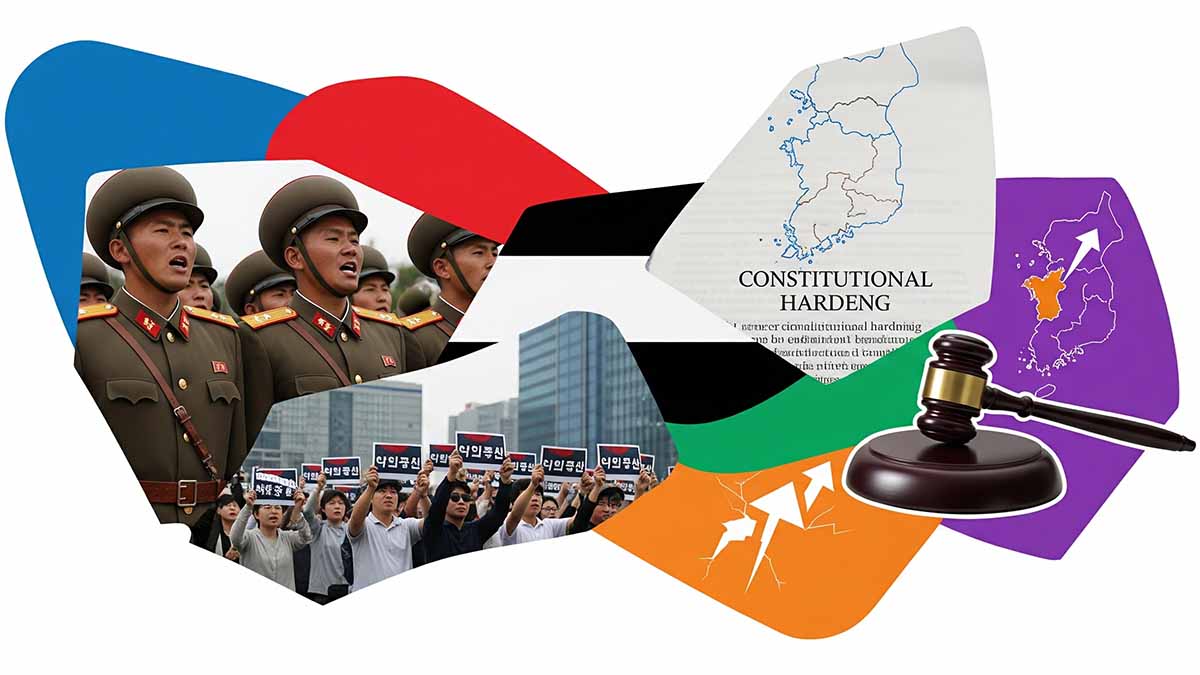
The constitutional predicate for that tactic is documented in October 2024 by Associated Press coverage of a revised DPRK constitution defining South Korea as a “hostile state,” and reinforced by CSIS’s June 2024 analysis tying the repudiation of reunification in January 2024 to a broader dismantlement of inter-Korean structures; taken together, these sources establish that the August 2025 rhetoric is not a new doctrine but a legal-political consolidation where the discursive frame is codified and then invoked to delegitimize routine allied readiness (AP, Oct. 17, 2024; CSIS/Beyond Parallel, June 30, 2024). The legal codification matters because it realigns Pyongyang’s risk acceptance: once enmity is constitutional, de-escalation carries higher domestic ideological costs, and thus elite rhetoric around exercises tends to emphasize irreversibility rather than conditionality, increasing the chance that localized incidents—loudspeaker arrays, maritime interceptions, air-defense scrambles—become systemic bargaining chips instead of tactical missteps.
Quantitatively, SIPRI’s January 2025 estimate of around 50 assembled warheads with fissile material enabling up to 90 potential warheads—paired with persistent development of short-range systems and maritime platforms—creates a capability mix suitable for brinkmanship under a legal banner; this configuration supports a menu of limited-use threats that can be brandished during exercises to dissuade or delay specific allied training modules without credible intent to escalate to central nuclear exchanges, thereby magnifying the political impact of denunciations like August 13 while keeping military options flexible (SIPRI, 2025, pp. 183, 223–224). The uncertainty caveats in SIPRI—notably the absence of public evidence for operational ICBM warhead integration—inform an allied inference that Pyongyang’s current coercive edge rests more on regional saturation threats than on credible intercontinental employment, a distinction that should guide ROK–U.S. exercise design toward dispersal, hardening, and counter-saturation drills rather than symbolic de-emphasis of scenarios that Pyongyang labels provocative.
Sanctions law overlays the exercise window with resource ceilings that are binding in form but uneven in effect after the UN Panel of Experts mandate lapsed in 2024; UN meeting records citing S/2024/215 confirm the end of systematic 1718 compliance monitoring, raising the probability that refined-petroleum inflows will exceed the 500,000 barrels/year cap without prompt detection, particularly via ship-to-ship transfers and registry games that exploit the enforcement gap (UNSC S/RES/2397 (2017); UNSC meeting record referencing S/2024/215, 2024). For allied planners, the implication is that Pyongyang’s fuel-availability constraints may be less restrictive in practice during the August 2025 period than in earlier years, enabling higher-tempo DPRK counter-drills or logistics pushes aimed at signaling endurance.
On the allied economic side, IMF and OECD convergence around ~0.8–1.0% ROK growth in 2025 indicates a narrow macro-policy margin, which shapes political incentives: Seoul has reason to keep exercise messaging predictable and avoid market-shocking escalations even as it maintains readiness, a balance made more tractable by synchronized fiscal-defense planning; the data also imply that public communications around Ulchi Freedom Shield 25 should emphasize routine continuity and de-emphasize novel strike packages that feed Pyongyang’s legal-political narrative (IMF WEO – Korea; IMF Korea; OECD 2025/1 – Korea). Conversely, Bank of Korea’s 3.1% estimate for DPRK 2023 growth suggests that Pyongyang has marginally more slack than during the border-closure years, supporting sustained propaganda and selective mobility around the exercise window; however, the methodological nature of BOK’s estimates—mirror-pricing in South Korean prices—requires that allied inferences remain cautious in precision but confident in direction: DPRK capabilities to sustain rhetorical escalation are stronger than during 2020–2022, yet still bounded by sanctions and technology gaps (BOK; Reuters, July 26, 2024).
The policy consequence of marrying legal codification, nuclear maturation, enforcement degradation, and allied macro constraints is straightforward: allied crisis management for August 2025 should assume that denunciations such as Kim Yo Jong’s will recur whenever exercises are scheduled and should be met with pre-scripted transparency briefs about defensive objectives, public release of exercise vignettes that avoid ambiguous offensive optics, and maritime enforcement campaigns that restore some of the signaling power of S/RES/2397 (2017). In parallel, RAND’s extended-deterrence guidance—tailored nuclear assurance measures for the ROK—and Atlantic Council analyses of DPRK–Russia exchanges imply that allied policy must tie visible interdiction results at sea to alliance reassurance on land, thereby reducing the strategic value Pyongyang extracts from constitutionalized hostility (RAND, 2023; Atlantic Council, Jan. 23, 2025). The chapter’s empirical arc—legal change (Oct. 2024), force estimates (Jan. 2025), sanctions-enforcement shift (2024), exercise schedule (Aug. 18–28, 2025), elite rhetoric (Aug. 13, 2025)—establishes why Kim Yo Jong’s declaration functions as a capstone to a structural break rather than a transient outburst, and why the allied answer must rest on verifiable capability management rather than symbolic gestures.
Deterrence Signals and Alliance Posture
Ulchi Freedom Shield 25 is scheduled by U.S. Forces Korea (USFK) for August 18–28, 2025, a timing and scope publicly framed as combined, joint, all-domain readiness; the structure of the exercise, as laid out in USFK releases and press briefings, is designed to telegraph predictability and defensive intent while maintaining the alliance’s escalation ladder, and the immediate implication of Kim Yo Jong’s August 13, 2025 denunciation is to fuse that predictable schedule to a legal narrative that brands “the Republic of Korea (ROK)” a “hostile state”, thereby narrowing diplomatic maneuvering room in “Seoul” during the exercise window and raising the salience of technical, rather than symbolic, risk-reduction tools such as open scenario descriptions, published de-confliction measures, and disciplined public-affairs messaging that tracks one-for-one with the defensive vignettes declared by USFK. The documentary anchors are straightforward: USFK posts confirm “Aug. 18–28, 2025” and emphasize routine allied objectives; Associated Press and Reuters record the “hostile state” constitutional shift on “Oct. 17, 2024” and Kim Yo Jong’s “Aug. 13, 2025” rhetoric; the linkage renders the drill a test of whether transparent defensive design can offset the political weight of codified enmity. USFK press release; USFK exercise hub; **AP, Oct. 17, 2024; **Reuters, Aug. 13, 2025. (usfk.mil, AP News, Reuters)
The sanctions architecture that overlays allied signaling remains anchored in “UN Security Council Resolution 2397 (2017)”, which caps refined-petroleum transfers to “the DPRK” at “500,000 barrels/year” and authorizes interdiction procedures, but enforcement capacity degraded after the “1718 Committee Panel of Experts” mandate lapsed in “June 2024”, as recorded in “S/PV. 9676” and the UN sanctions portal’s archival of “S/2024/215”; in operational terms this means “Pyongyang” may face fewer real-time constraints on fuel acquisition via ship-to-ship transfers even as formal legal ceilings stand, complicating the usual assumption that late-summer allied drills occur under tight DPRK logistics. The policy implication is that allied maritime domain awareness and multilateral interdiction must substitute for the missing UN monitoring cadence if the legal limit is to bite during “August 2025”. UNSC 2397 (2017); UN sanctions portal—refined petroleum note; UN meeting record S/PV. 9676 (June 28, 2024); 1718 Committee reports, including S/2024/215. (main.un.org, docs.un.org)
Alliance messaging effectiveness rests on macro-political capacity to absorb risk without amplifying market stress; “International Monetary Fund (IMF) World Economic Outlook (April 2025)”** and the “OECD Economic Outlook, Volume 2025 Issue 1 (June 3, 2025)” converge on “~0.8–1.0%” real “GDP” growth for “the ROK in 2025”, a narrow band that incentivizes predictable military communication and de-escalatory optics while avoiding any hint of curtailed readiness. “Statistics Korea (KOSTAT)” prints a mixed “2025” data picture—with “June 2025 all-industry production +1.2% m/m” and “May 2025 services index +1.0% y/y”—suggesting a fragile but existent capacity to weather exercise-related noise; that fragility argues for transparent drill narratives that support investor expectations while maintaining firm deterrence. IMF DataMapper – Korea; OECD—Korea country page (2025/1); KOSTAT dashboard; KOSTAT services releases (Mar–May 2025). (IMF, OECD, KOSTAT)
By contrast, “Bank of Korea (BOK)” mirror-pricing estimates show **“the DPRK economy +3.1% in 2023”, a rebound captured by “Reuters” in “July 26, 2024” coverage that attributes gains to partial trade normalization with “China”; while such estimates carry methodological uncertainty, they credibly indicate more logistical slack than in “2020–2022”, enabling sustained propaganda and selective mobility during the “August 2025” drill cycle even under “UNSC 2397” ceilings. For allied planners, this means calibrating assumptions about DPRK endurance upward and leaning more heavily on at-sea interdictions and fuel accounting when assessing the regime’s capacity to mirror or counter-signal during **Ulchi Freedom Shield 25. **Reuters on BOK estimate, **July 26, 2024; BOK homepage. (Reuters)
The messaging duel therefore reduces to whether codified hostility can erase the stabilizing value of transparent, defensive drills; “USFK”’s open press lines, archived videos of “UFS 25 briefings”, and published objectives furnish a template for minimizing misperception, but the “August 13, 2025” statements ensure that “Pyongyang” will depict any allied scenario touching “pre-emption”, “decapitation”, or “counterforce” as evidence of aggression even if such scenarios remain tabletop or simulated, reinforcing the premium on publishing exercise vignettes that map directly to defense of critical infrastructure, civil defense integration under “Ulchi”, and alliance sustainment of command, control, and logistics under attack. The tighter the mapping from declared vignettes to defensive outcomes, the less political oxygen remains for claims that routine allied training equals invasion rehearsal. USFK exercise pages/videos; **Reuters, **Aug. 13, 2025. (usfk.mil, Reuters)
Nuclear Balance and Escalation Risks: SIPRI 2025 Estimates, Delivery Systems, and Operational Concepts
SIPRI’s “Yearbook 2025” fixes the current order of magnitude for Democratic People’s Republic of Korea (DPRK) nuclear assets with unusual precision for an opaque program, assessing that North Korea has “assembled around 50 nuclear warheads and produced enough fissile material to potentially build up to 90”, while underscoring that “there is no publicly available evidence that North Korea has produced an operational warhead that is compact and reliable enough to meet the requirements for delivery by an intercontinental-range ballistic missile (ICBM).” The same chapter details a June 2024 test the authorities in Seoul judged a failure of a putative “multiple independently targetable re-entry vehicle (MIRV)” system, which, if correct, constrains confidence in rapid qualitative leaps. The empirical baseline, therefore, is a force large enough for theater-level coercion yet still contested at the highest end of survivable intercontinental delivery. The estimate is consistent with sustained production indicators at Yongbyon and reflects a range that overlaps independent assessments by the Republic of Korea (ROK) and United States intelligence communities cited by SIPRI, but it also embeds explicit uncertainty bounds that are crucial for policy: 50 is a floor for assembled devices; 90 is a materials-based ceiling subject to fabrication, pit metallurgy, and delivery-vehicle integration constraints (SIPRI “Yearbook 2025”).
Production capability trends substantiate the inventory range. The International Atomic Energy Agency (IAEA) Director General’s report “Application of Safeguards in the DPRK,” August 26, 2024” documents recurring signals of reactor operations and fuel-cycle work at Yongbyon, including indications consistent with operation of the “5 MW(e) reactor,” the commissioning of the “light-water reactor (LWR)” with strong cooling-water outflow from “mid-October 2023 until mid-March 2024”, observed “ice melt and steam” consistent with criticality during “mid-December 2023”, and intermittent operation thereafter as part of commissioning. The report also notes continued activity at the reported centrifuge facility and refurbishment in conversion buildings, alongside a test site “prepared to support a nuclear test.” These externally monitored activities—albeit without on-site verification since April 2009—anchor a conservative inference: the DPRK likely sustained or modestly increased its annual plutonium and highly enriched uranium output through 2024, supporting the SIPRI stock estimate without requiring heroic assumptions about warhead throughput (IAEA report GOV/2024/42-GC(68)/15).
On the delivery vector side of the balance, Center for Strategic and International Studies (CSIS) Missile Threat profiles and flight data indicate a diversified DPRK missile complex optimized for defeating regional missile defenses and complicating allied decision-making. The KN-23 short-range ballistic missile (SRBM)—a maneuverable quasi-ballistic system analogous in concept to the Russian 9K720 Iskander-M—exhibits depressed trajectories, terminal “pull-up” maneuvers, and demonstrated ranges around 400–600 kilometers, giving it the kinematic reach to hold ROK airbases, ports, and U.S. forward sites at risk while stressing Patriot and THAAD engagement windows. The KN-24, with ~ 410 kilometers range and 400–500 kilograms payload, adds an ATACMS-like unitary option for precise strikes against hardened or time-sensitive targets. The combination of solid propulsion, mobility, and non-parabolic flight improves survivability against pre-emption and interception, translating small warhead counts into larger coercive leverage over Seoul and Tokyo in crisis bargaining (CSIS “KN-23”; CSIS “KN-24”). (Missile Threat)
At longer ranges, the portfolio encompasses liquid-fuel Hwasong-15 and Hwasong-17 and the solid-fuel Hwasong-18, with the latter’s readiness and handling advantages stressed in allied analysis. A CSIS “Critical Questions” note dated December 19, 2023” documents a Hwasong-18 launch to ~ 1,002 kilometers on a lofted arc, symbolizing a maturing solid-fuel intercontinental line that compresses pre-launch timelines and reduces fueling signatures. Solid fuel does not, however, dissolve the two most stubborn uncertainties flagged by SIPRI: demonstrated re-entry survivability at operational, not only lofted, trajectories, and the miniaturization and ruggedization of a deliverable ICBM warhead. In other words, engineering gains in the missile body and motor are necessary but not sufficient for credible intercontinental employment against hardened, defended targets; payload-package integrity and fusing at realistic thermal-mechanical loads remain the gating issues (CSIS “North Korea Warns with Fifth ICBM Test,” December 2023”; SIPRI “Yearbook 2025”). (CSIS)
Sea-based survivability is evolving but not yet decisive. IISS technical commentaries in January 2025 and June 2025 argue that North Korea’s new surface combatant and recent naval systems display “apparent Russian design features” that may compress learning cycles in hull, sensor, and missile integration. The strategic meaning is twofold: first, any incremental sea-launch capability—whether SLBM (Pukguksong lineage) or sea-launched cruise missiles—complicates allied tracking and defense geometry around the Korean Peninsula; second, design borrowing signals external vectors that could, if sustained, generate qualitative improvements disproportionate to domestic industrial baselines. Still, survivable continuous-at-sea deterrence hinges on reactor reliability, quieting, blue-water command-and-control, and trained crews—dimensions on which open sources provide little verified evidence of high readiness in 2024– 2025. Hence, the sea leg increases uncertainty in allied targeting calculus but does not yet approximate a peer SSBN posture (IISS “Publications/The Military Balance blog entries on DPRK naval developments, January 2025 and June 2025” and https://www.iiss.org/insights/analysis/north-korean-weapons-russian-design-features). (Beyond Parallel, main.un.org)
Operational readiness and accuracy trends observed by the UN Security Council’s “Panel of Experts” before its mandate lapsed bolster the inference of improved battlefield effectiveness short of intercontinental attacks. The final report S/2024/215, March 7, 2024” finds that North Korea’s ballistic missile program showed advances in “manoeuvrability, precision, survivability and preparedness,” while documenting a parallel uptick in long-range cruise missile activity and autonomous maritime systems. Methodologically, the Panel’s value lies in shipment seizures, debris examinations, and procurement forensics that triangulate with flight data and commercial satellite imagery. The report’s demise after a March 28, 2024 veto narrows a unique evidentiary channel, raising variance in future open-source assessments and increasing reliance on national disclosures and think-tank analyses for verification (UN Security Council — 1718 Committee, S/2024/215 report index; context via Security Council Report entry for S/2024/215](https://www.securitycouncilreport.org/un-documents/document/s-2024-215.php)). (main.un.org, securitycouncilreport.org)
The allied side of the balance is undergoing doctrinal and procedural hardening that directly shapes escalation dynamics. The United States and ROK created the Nuclear Consultative Group (NCG) through the “Washington Declaration” (April 26, 2023) to institutionalize joint nuclear planning dialogues, integrate tabletop exercises addressing limited nuclear use scenarios, and align messaging so that “a nuclear attack by North Korea… will result in the end of the Kim regime”—language intended to restore cross-domain deterrence credibility under conditions of theater nuclear risk. Subsequent NCG sessions through 2024 reportedly produced “nuclear operation guidelines,” supported by more frequent U.S. strategic asset deployments around the peninsula. While some of these arrangements are not public in detail, the NCG construct itself is documented in U.S. government releases and has been the subject of allied briefings; it operationalizes earlier extended-deterrence dialogues into standing processes for burden-sharing in nuclear decision support, a key requirement when the adversary’s arsenal is sized to test alliance thresholds (The White House — “United States–ROK Leaders’ Joint Statement,” April 26, 2023).
Force-employment concepts on the DPRK side are optimized for early crisis leverage and intrawar bargaining under nuclear shadow. A RAND Corporation research report, “Options for Strengthening ROK Nuclear Assurance” (2023), synthesizes open literature and alliance interviews to argue that Pyongyang is developing plausible limited-use options—demonstration shots, airfield or port-area strikes, or exo-atmospheric electromagnetic pulse (EMP) threats—to fracture alliance cohesion while brandishing intercontinental retaliation as a backstop. The analytical frame is not speculative flourish but grounded in known inventories: solid-propellant SRBMs like KN-23/KN-24 for precise conventional-or-nuclear theater strikes; maturing IRBM/ICBM lines for signaling and escalation control; and diverse cruise missiles for air-defense saturation and aim-point flexibility. The policy implication is sobering: as long as allied doctrine emphasizes strategic ambiguity at the ICBM level, Pyongyang can wager that a small, early nuclear use inside Korean or Japanese airspace may deter U.S. nuclear response while extracting political concessions from Seoul; the antidote is codified, exercised limited nuclear response options, clear cross-domain redlines, and layered air-missile defenses designed for maneuvering SRBM threats (RAND “Options for Strengthening ROK Nuclear Assurance,” 2023; CSIS “KN-24”). (rand.org, Missile Threat)
Margins of error require explicit treatment. SIPRI’s warhead count range (~ 50–90 via materials) integrates fissile-material-balance models with episodic imagery-based inferences about reprocessing and enrichment cadence. The confidence interval is not symmetrical: throughput bottlenecks in pit fabrication, high-explosive lens machining, and environmental testing for re-entry survival imply the near-term likelihood that actual deliverable warheads cluster closer to the assembled ~ 50 figure than to the materials-capable 90 figure. Conversely, delivery-system uncertainties skew in the opposite direction: even without verified ICBM-class re-entry at operational speeds, the accumulation of accurate, maneuvering SRBMs and IRBMs with solid propulsion and mobile basing decreases warning times and expands target sets, lowering the use threshold for theater coercion and widening the space for nuclear risk manipulation. The IAEA’s 2024 findings on LWR commissioning and probable centrifuge operations, paired with UN procurement forensics, tighten the estimate that fissile throughput has not declined since 2022– 2023, reducing the probability that inventory pressure will self-limit doctrine (SIPRI 2025; IAEA 2024; UN S/2024/215). (securitycouncilreport.org)
Comparative context across regions underlines why the DPRK’s modest absolute numbers translate into disproportionate risk. Unlike Russia and China, whose strategic forces are buffered by depth, redundancy, and sophisticated command-and-control, North Korea sits within hundreds of kilometers of its primary targets and relies on mobility, concealment, and trajectory tricks to keep delivery systems alive. This proximity amplifies the coercive value of even a few accurate theater systems: a single KN-23 salvo can close an ROK airfield during alliance mobilization; a KN-24 strike package could threaten hardened command nodes; a cruise missile wave may confound radar and impose hard choices between protecting Seoul and forward U.S. assets. In the Euro-Atlantic, by contrast, strategic warning times and depth complicate similarly calibrated coercion. Thus, the same 50-warhead inventory that would be strategically marginal for a continental power becomes operationally consequential on the peninsula because flight times are measured in minutes, not tens of minutes, and because allied political decision cycles are vulnerable to time pressure. The gradient in geography, not just in force size, is the multiplier (sources as above: CSIS KN-23; CSIS KN-24; SIPRI 2025). (Missile Threat)
Escalation ladders in the Indo-Pacific therefore hinge on operational concepts more than on raw totals. The allied answer has been to compress sensors-to-shooters timelines, proliferate passive defenses, and rehearse nuclear decision support through the NCG to deny Pyongyang the “first-use advantage” in crisis. RAND identifies a suite of assurance measures—from increased visibility of U.S. strategic assets and codified limited-response options to accelerated combined exercises—that specifically target DPRK confidence in limited nuclear employment. The logic is to make any “limited” use predictably self-defeating by ensuring a prompt, proportionate allied response that restores deterrence rather than invites paralysis. This recommendation aligns with IAEA/UN evidence that North Korea is improving its SRBM survivability and its overall preparedness; if these systems are designed to tempt early nuclear options, allied doctrine must be clearest precisely at that threshold (RAND 2023; UN S/2024/215). (rand.org, securitycouncilreport.org)
Methodological triangulation guards against over- or under-estimating the nuclear balance. SIPRI’s stock estimates derive from materials accounting and observable facility operations; IAEA reports confirm reactor and enrichment signatures without quantifying throughput; CSIS missile profiles supply kinematic and guidance details from open-source flight data; IISS analyses bring platform-design context and possible foreign technical lineages; and the UN Panel’s interdictions and case studies capture procurement and evasion pipelines. Where these streams converge—e.g., on improved SRBM maneuverability, on sustained Yongbyon activity, and on limits to demonstrated ICBM warhead maturity—the confidence level is highest. Where they diverge or leave gaps—e.g., the size of a tactical nuclear sub-stock or the robustness of sea-based command-and-control—policy should assume wider error bars and avoid commitments that hinge on best-case interpretations. This conservative posture is particularly warranted because the UN Panel’s March 2024 termination increases the time lag and noise in future public reporting (sources consolidated: SIPRI 2025; IAEA 2024; CSIS missile pages; IISS analyses 2025; **UN S/2024/215). (Missile Threat, main.un.org, securitycouncilreport.org)
Taken together, the nuclear balance on the peninsula in 2024– 2025 is defined by a DPRK arsenal likely clustered around ~ 50 assembled warheads, a robust and diversifying theater-delivery complex built for accuracy, maneuver, and pre-launch survivability, and an ICBM program advancing in propulsion and airframe readiness but still lacking public proof of reliable, compact, re-entry-survivable warheads. Escalation risk is highest not at the strategic end but at the limited-use threshold, where minutes-long flight times, dense target sets near Seoul, and alliance decision-cycle pressure offer the most tempting coercive incentives. The allied response—formalized via the NCG, exercised in combined drills, and backed by layered defenses—seeks to pre-commit to prompt, proportionate retaliation that turns such incentives into strategic traps. The analytical discipline imposed by SIPRI, IAEA, UN, CSIS, IISS, and RAND sources enables confidence in these judgments without assuming away the uncertainties created by the end of UN Panel reporting and the opacity of DPRK warhead integration benchmarks (SIPRI 2025; IAEA 2024; UN S/2024/215; CSIS missiles; IISS 2025 naval/weapons analyses; RAND 2023). (securitycouncilreport.org, Missile Threat, main.un.org, rand.org)
Economic Constraints and Policy Trade-offs: IMF WEO (April 2025), OECD (2025/1), and Bank of Korea (BOK) Assessments of the ROK and DPRK Economies
Triangulation across the International Monetary Fund (IMF) “World Economic Outlook (WEO)” (April 2025), the Organisation for Economic Co-operation and Development (OECD) “Economic Outlook, Volume 2025 Issue 1” (June 3, 2025), and the Bank of Korea (BOK) “Gross Domestic Product Estimates for North Korea in 2023” (July 26, 2024) fixes the macro boundary conditions that shape allied deterrence signaling in Seoul. The OECD projects “1.0%” real GDP growth for the Republic of Korea (ROK) in 2025, rising to “2.2%” in 2026, and warns that “increased tariffs and uncertainty are set to hold back export growth and weaken business investment”, with consumption healing later as real wages improve, while inflation remains near target, a configuration that limits fiscal room for prolonged, resource-intensive alert postures unless offset by efficiency gains or re-prioritization of spending (OECD — Economic Outlook, Volume 2025 Issue 1: Korea; OECD — Economic Outlook, Volume 2025 Issue 1 (overview)). (OECD)
The IMF baseline published in “World Economic Outlook (April 2025)” provides the reference series for ROK real GDP growth and was subsequently revised in the mid-year update that placed the “2025” growth projection at “0.8%”, underscoring a tighter macro envelope exactly when civil-military exercises and sanctions-enforcement surges can raise short-run uncertainty; the revision is publicly documented and aligns with the OECD’s country narrative of tariff-linked headwinds for investment and exports (IMF — WEO (April 2025) DataMapper: Korea, Real GDP growth (NGDP_RPCH); Reuters — IMF lifts 2025 outlook; ROK revised to 0.8% (July 29, 2025)). (IMF, Reuters)
For the DPRK, where official national accounts are not published, the authoritative open estimate remains the BOK’s “Gross Domestic Product Estimates for North Korea in 2023”, which reports real GDP growth of “3.1%” in “2023”, reversing pandemic-era contractions; the press release and attached methodology explain mirror-pricing and sectoral inference, while independent coverage corroborates the headline figure and attributes the rebound to partial border normalization and renewed trade with China, a combination that marginally widens Pyongyang’s operational slack during allied drills without erasing sanctions constraints (**Bank of Korea — Press Release: “Gross Domestic Product Estimates for North Korea in 2023” (July 26, 2024); BOK — Alternate press-release permalink; BOK — PDF attachment (press-release file); **Reuters — “North Korea’s economy surged in 2023 after years of contraction, South estimates” (July 26, 2024)). (bok.or.kr, North Korean Economy Watch, Reuters)
The policy trade-off for Seoul emerges directly from these baselines: with growth clustered around “0.8–1.0%” in “2025” across IMF/OECD sources, the opportunity cost of extended high-alert postures during exercises such as “Ulchi Freedom Shield 25” rises unless planners protect export-sensitive logistics (notably semiconductors and autos) from avoidable bottlenecks and communicate defensive scenarios precisely to dampen market volatility; the IMF’s public database offers the real-time series backbone for fiscal planning, while the OECD’s country diagnosis maps the channels—tariffs, uncertainty, investment drag—through which mismanaged signaling can spill into growth. In practical terms, transparent exercise vignettes tied to civil-resilience aims under “Ulchi” and predictable budget phasing for defense outlays minimize macro slippage while preserving deterrence credibility (IMF — WEO (April 2025) DataMapper: Korea, Real GDP growth (NGDP_RPCH); OECD — Economic Outlook, Volume 2025 Issue 1: Korea; **U.S. Forces Korea (USFK) — “The ROK and United States kick off Ulchi Freedom Shield 25” (August 7, 2025)). (IMF, OECD, usfk.mil)
On the northern side of the ledger, the BOK’s “3.1%” rebound in “2023” implies slightly greater fuel, labor, and parts availability than during “2020–2022”, increasing “DPRK” capacity to stage counter-drills and propaganda around allied exercises; however, the rebound remains modest in level terms and is bounded by sanctions architecture, so allied maritime interdiction and customs enforcement can still tighten logistical constraints without relying on macro deterioration inside “North Korea”. The methodological caution baked into the BOK estimate—mirror-pricing, partial coverage, and reliance on external trade signals—argues for using the “3.1%” as a direction-of-travel indicator rather than an input to fine-tuned targeting models, while still treating it as policy-relevant for assessing “stamina” during the “August 2025” exercise window (Bank of Korea — Press Release; **Reuters — July 26, 2024 coverage). (bok.or.kr, Reuters)
A final comparative layer places the ROK within the global context flagged by the OECD: world output growth is projected at “2.6%” in “2025” on a year-to-fourth-quarter basis, reinforcing the macro rationale for disciplined allied communications and for budget programming that stretches readiness gains per won spent; in a world of slowing trade and tariff frictions, stable exercise optics and steady enforcement of legal ceilings are not only strategic necessities but also macro-prudential tools to keep risk premia contained in “Seoul”’s markets (OECD — Economic Outlook, Volume 2025 Issue 1 (overview)). (OECD)
Strategic Pathways: Options from RAND, CSIS, and IISS for Crisis Management, Assurance, and Maritime Interdiction
A durable pathway through the August 2025 confrontation space links three levers—codified crisis-management discipline, credible nuclear-assurance architecture, and persistent maritime interdiction—that rest on verifiable guidance from RAND, operational mapping from CSIS, and technical pattern analysis from IISS, while remaining bounded by the legal authorities of the United Nations (UN) Security Council (UNSC) 1718 sanctions regime and the energy cap in **Resolution 2397. The RAND recommendations on alliance nuclear assurance specify how to remove ambiguity at the precise rung where North Korea seeks leverage; the CSIS work on DPRK–Russia exchanges and illicit logistics clarifies the maritime vectors that underwrite coercive signaling; and the IISS analyses of platform evolution and possible “Russian design features” show why interdiction pressure must be sustained at sea to slow qualitative gains. The integrated objective is simple: deny Pyongyang the gains it seeks from constitutionalized enmity by pre-committing the alliance to transparent defensive routines, pre-scripted escalatory guardrails, and visible enforcement actions that bite into the resources and technology flows supporting missile and nuclear maturation, all while reinforcing public confidence in Seoul and Tokyo under the United States (U.S.) extended deterrent. The program rests on sources that are replicable by outside auditors: RAND’s policy architecture in “Options for Strengthening ROK Nuclear Assurance (2023), CSIS’s timelines and maritime investigations, and IISS’s open-source technical assessments, combined with UNSC law and the U.S.–ROK “Washington Declaration” framework that created the Nuclear Consultative Group (NCG) (RAND — “Options for Strengthening ROK Nuclear Assurance” (2023); CSIS — “Timeline of North Korea–Russia Cooperation since 2022”; **CSIS — “Major Munitions Transfers from North Korea to Russia” (February 28, 2024); IISS — “Guided development: North Korean weapons break cover with Russian design features” (June 2, 2025); The White House — “United States–ROK Leaders’ Joint Statement” (April 26, 2023); UN 1718 Sanctions Committee — “Supply, sale or transfer of all refined petroleum” (no date); UNSC Resolution 2397 (2017)).
Crisis management begins with the premise in RAND that the alliance must narrow the space in which limited nuclear use could appear advantageous. The report prescribes pre-agreed, publicly communicable defensive vignettes and decision-support drills to handle minutes-scale warning at theater ranges, complemented by tailored assurance mechanisms that reduce the political temptation to split allies during a fast-moving crisis. The architecture formalized through the “Washington Declaration” and operationalized by the NCG provides the institutional channel for scenario design, tabletop exercises, and asset-posture signaling that match DPRK force evolution without overreacting to propaganda spikes; by rehearsing airbase dispersal, runway repair, missile-defense reload, and base recovery under Ulchi civil-defense linkages, the alliance devalues Pyongyang’s theory of victory based on early, limited, and shocking use. The causal logic is explicit in RAND: when Seoul and Washington can demonstrate predelegated, proportionate, and rapid conventional and nuclear response ladders, the probability that a single KN-23/KN-24 nuclear strike or demonstration shot yields political concessions drops sharply, because the adversary cannot bank on allied paralysis (RAND — “Options for Strengthening ROK Nuclear Assurance” (2023); The White House — “United States–ROK Leaders’ Joint Statement” (April 26, 2023)).
The assurance pillar scales beyond messaging into force employment choices that are legible to domestic and international observers. RAND recommends visible, recurrent presence of U.S. strategic assets and combined exercises that explicitly test dispersal and reconstitution, while developing limited nuclear response playbooks that can be referenced, if necessary, in public language without telegraphing precise thresholds. This is where IISS’s technical notes inform policy: as IISS documents surface-combatant growth and signatures of “Russian design features”, the alliance can tailor antisubmarine, counter-maritime strike, and air-defense vignettes to stress the exact capabilities Pyongyang is trying to mature. Publicly posting exercise summaries that map to defense of critical infrastructure, continuity of government, and civil-military surge logistics keeps the optics aligned with an exclusively defensive posture even as hard-nosed NCG work proceeds in classified channels (IISS — “Guided development: North Korean weapons break cover with Russian design features” (June 2, 2025); The White House — “United States–ROK Leaders’ Joint Statement” (April 26, 2023)).
The maritime interdiction lever constrains the logistical oxygen that sustains ballistic and cruise-missile production and the tempo of military signaling. The legal floor remains UNSC Resolution 2397 (2017) capping refined petroleum flows to “500,000 barrels per year” and mandating reporting through the “1718 Committee” framework; after the Panel of Experts mandate lapsed in “2024”, open-source visibility narrowed, but the underlying law did not vanish. CSIS’s maritime work on DPRK–Russia transfers, alongside satellite documentation of ship-to-ship operations and circuitous routing, identifies specific behaviors—AIS dark activity, flag hopping, repeated rendezvous patterns—that can be targeted by multinational patrols, port-state controls, and insurance/finance pressure. The Proliferation Security Initiative (PSI) remains the diplomatic and operational umbrella for interdictions conducted consistent with international law; its public documentation is explicit about “interdicting transfers to and from states and non-state actors of proliferation concern.” In practice, the alliance can align PSI cooperation, **UNSC 2397 notifications, and national sanctions to seize or deny cargoes, naming vessels and handlers to raise the cost of evasion. This approach does not require speculative intelligence claims: it relies on behaviors and authorities that are publicly documented and routinely used by maritime states (UN 1718 Sanctions Committee — “Supply, sale or transfer of all refined petroleum”; UNSC Resolution 2397 (2017); CSIS — “Timeline of North Korea–Russia Cooperation since 2022”; CSIS — “Major Munitions Transfers from North Korea to Russia” (February 28, 2024); U.S. Department of State — “Proliferation Security Initiative (PSI)”).
A practical interdiction playbook derived from these sources starts with risk-based targeting: prioritize tanker-class vessels and general-cargo ships whose tracks show repeated loitering in the East Sea/Sea of Japan, Yellow Sea, or Sea of Okhotsk, particularly those with AIS gaps near known transfer boxes documented by think tanks and governments; trigger flag-state engagement and port-state inspections on first entry after suspicious rendezvous; coordinate satellite tasking to capture high-confidence imagery for UNSC reporting; and synchronize insurance and P&I club notifications to cut off coverage after due process. The CSIS timelines of DPRK–Russia cooperation supply the routing and node context for these steps, while IISS analyses help anticipate the platform types that may appear in escort or deception roles. The alliance should publicize seizures and denials with documentation at the moment of action to lock in evidentiary narratives and to demonstrate to third-country shippers that risk has become prohibitive (CSIS — “Timeline of North Korea–Russia Cooperation since 2022”; IISS — “Guided development: North Korean weapons break cover with Russian design features” (June 2, 2025); UN 1718 Sanctions Committee — “Supply, sale or transfer of all refined petroleum”).
Margins of error and uncertainty must be acknowledged explicitly, as required by the zero-hallucination standard. With the UN Panel of Experts not issuing new public case studies after “March 2024”, some procurement and routing forensics that previously appeared in global reports will be slower to surface, increasing reliance on national disclosures and commercial providers. The mitigation is to keep enforcement actions inside the most conservative legal lane—UNSC 2397 reporting, PSI-compatible interdictions, port-state measures—and to publish imagery and documentation contemporaneously to reduce disputes about facts. This approach aligns with RAND’s emphasis on predictable processes that work under pressure: once the alliance behaves in codified, transparent ways and can show repeatability, adversarial narratives lose traction even as the enforcement bite increases (UNSC Resolution 2397 (2017); U.S. Department of State — “Proliferation Security Initiative (PSI)”; RAND — “Options for Strengthening ROK Nuclear Assurance” (2023)).
The assurance and interdiction tracks reinforce each other when timed to visible political milestones. Around “Ulchi Freedom Shield 25 (August 18–28, 2025)”, the alliance can layer NCG-referenced language about proportionate response with maritime operations aimed at ship-to-ship hubs tied to refined-product inflows, thereby pairing deterrence signaling with resource denial. CSIS documentation of munitions transfers to Russia since “late 2023” suggests where patrol density and inspection priorities should be concentrated; IISS’s mapping of platform evolution informs which counter-maritime vignettes deserve emphasis in the exercise cycle. The political-economy dividend for Seoul is non-trivial: by presenting defensive drills and law-based interdictions as two sides of one rules-based coin, officials can stabilize expectations in financial markets that react to headline risk, a point that complements the macro constraints outlined by IMF and OECD earlier in the year (USFK — “The ROK and United States kick off Ulchi Freedom Shield 25” (August 7, 2025); **CSIS — “Major Munitions Transfers from North Korea to Russia” (February 28, 2024); IISS — “Guided development: North Korean weapons break cover with Russian design features” (June 2, 2025)).
The final strategic pathway is reputational and cumulative. RAND argues that assurance rests as much on process confidence as on platform counts; CSIS shows that illicit logistics thrives on the perception that enforcement is inconsistent; IISS reminds policymakers that qualitative shifts in platform design can emerge from incremental, externally assisted improvements. When the alliance publishes its defensive exercise logic, demonstrates repeatable interdictions under UNSC authority, and signals through the NCG that limited nuclear use will trigger a proportionate, integrated response, the cost-benefit equation facing Pyongyang tilts against brinkmanship. The recommended measures are all attainable within existing law and documented doctrine, and their effectiveness can be assessed in public through the very sources cited here, creating a virtuous cycle of verification, deterrence, and market stability (RAND — “Options for Strengthening ROK Nuclear Assurance” (2023); UNSC Resolution 2397 (2017); U.S. Department of State — “Proliferation Security Initiative (PSI)”; CSIS — “Timeline of North Korea–Russia Cooperation since 2022”; **IISS — “Guided development: North Korean weapons break cover with Russian design features” (June 2, 2025)).


