














ABSTRACT
A multilayered, networked air- and missile-defense architecture branded Steel Dome is being fielded by Türkiye through the state-owned defense-electronics prime ASELSAN in cooperation with missile integrator ROKETSAN and the research institute TÜBİTAK SAGE under programs overseen by the Presidency of Defence Industries (SSB). The architecture’s command-and-control core is the HAKİM family, which the manufacturer describes as an air and space command system able to coordinate disparate sensors and effectors across echelons.
The prime’s publicly accessible product pages and brochures establish the roles and baseline performance envelopes of key subsystems, while TÜBİTAK SAGE supplies launcher and missile-system elements including the GÖKDEMİR family. Public-domain releases by ASELSAN, ROKETSAN, TÜBİTAK SAGE, the Ministry of National Defense (MSB), and SSB-linked channels between 2023 and 2025 document serial-production status for long-range interceptors and deliveries of short- and medium-range layers. The long-range tier is the SİPER system—presented for “strategic” defense roles—with publicly stated capability against aircraft, cruise-missile, and ballistic-missile classes; ASELSAN’s product dossier frames the unit as a distributed architecture with battalion-level surveillance and fire-control radars and multiple batteries, while MSB reported the start of SİPER Ürün-1 serial production in December 2023.
The medium- and short-range tier is the HİSAR family, with official ROKETSAN English-language catalogue data identifying HİSAR-A+ at 15+ km nominal range and 10+ km altitude and HİSAR-O (RF) at 25+ km nominal range alongside modular family integration; ASELSAN’s launcher brochures and battery-architecture sheets indicate autonomous detection, identification, and engagement functions at the battery level. Very-short-range and point-defense tiers are documented through the KORKUT 150/35 self-propelled gun system and the KORKUT 130/35 towed-gun and fire-control platoon solutions, both integrated with programmable 35 mm ATOM air-burst ammunition; ASELSAN’s public technical brochures specify stabilized turrets, on-the-move fire, and organic tracking radar and electro-optical sensors for KORKUT 150/35, and hybrid gun-missile platoon compositions for KORKUT 130/35. The GÜRZ 150 “multi-effector” short-range unit is presented by ASELSAN as a fully autonomous all-in-one system combining a 35 mm cannon with short- and very-short-range missiles and an integrated fire-control algorithm, positioned to bridge the short-range and close-area tiers. The GÖKDEMİR 100 air- and missile-defense system is described by TÜBİTAK SAGE and ASELSAN brochures as a launcher and missile solution with active radar seeker technology, 360-degree engagement geometry, and integration into the layered network; ASELSAN’s English-language datasheet labels GÖKDEMİR 100 a system for the defense of moving and fixed forces and critical assets against air and missile threats.
The architectural integration mechanism is the HAKİM suite, provided in variants such as HAKİM 100 and HAKİM ADOC. ASELSAN’s public pages and downloadable brochures define HAKİM as an air command-and-control node coordinating surface-to-air missile (SAM) units and air platforms by fusing inputs from multiple radar and non-radar sensors, assigning weapons, and exercising control over fire-control units and pedestal-mounted short-range launchers. These nodes sit atop a layered radar environment that ASELSAN pairs with HAKİM in its “Air and Missile Systems” public portfolio, which lists families such as KALKAN and other air-surveillance radars as part of the company’s air-defense ecosystem. The prime’s September 2025 sustainability-report release and parallel corporate news items reference major industrial-base expansion at Gölbaşı and Oğulbey to scale production and deliveries, including statements that “systems delivered under Steel Dome” will enhance Turkish Armed Forces mobility and effectiveness. Within this same period, the state Anadolu Agency reported national-level statements characterizing Steel Dome as a milestone for layered defense at low, medium, and high altitudes. Although external trade-press reports describe a detailed technical briefing to visiting international defense journalists at Gölbaşı on October 7, 2025, official company news pages available to the public do not themselves host a corresponding event transcript; where trade-press items are not hosted on government or manufacturer domains, they are not linked here in accordance with the present citation protocol.
The long-range “strategic” layer is anchored in SİPER. The manufacturer’s official product page lists capabilities such as multiple simultaneous engagements, distributed architecture, and multi-domain transport and deployment, consistent with a battalion composed of a surveillance radar and multiple batteries each with fire-control radars and launchers. Formal confirmation of serial-production initiation for SİPER Ürün-1 appears on the MSB’s official site from December 15, 2023, an authoritative government disclosure preceding reports of 2024–2025 force entry. Inferred range figures frequently circulated in media are not adopted here unless present in manufacturer or government documents; ASELSAN’s product page identifies the class and role without numerical claims in the English summary. The intermediate “operational” tier corresponds to the HİSAR family. The official ROKETSAN 2024 English catalogue specifies HİSAR-A+ range at 15+ km and altitude at 10+ km, and HİSAR-O (RF) nominal range at 25+ km, while emphasizing a modular family concept and compatibility across different platforms, fire-control, and command-control infrastructures.
Those catalogue statements are reinforced by ROKETSAN’s product portal entries, which assign the HİSAR line to the protection of bases, ports, facilities, and maneuver forces against fixed- and rotary-wing aircraft, cruise missiles, air-to-ground munitions, and UAVs. ASELSAN’s battery-level brochure for HİSAR O+ outlines autonomous target detection, tracking, identification, command, and fire-control functions, indicating an ability to operate at the battery echelon with organic sensors and engagement management. Claims of 40 km performance for HİSAR-O (RF) appear in non-manufacturer sources; absent a directly accessible manufacturer or government record stating such a range, only manufacturer-verified catalogue parameters are retained.
The “tactical” and “close-area” tiers documented by the manufacturers comprise multi-effector short-range and very-short-range units designed to counter UAVs, helicopters, low-flying aircraft, cruise-missile profiles, and select rocket, artillery, and mortar threats within the inner battlespace. ASELSAN’s GÜRZ 150 page presents a fully autonomous, all-in-one short-range system capable of threat evaluation and weapon assignment with an indigenous fire-control algorithm, integrating a 35 mm gun and short- and very-short-range missiles. The KORKUT 150/35 very-short-range gun system is shown with a stabilized unmanned turret, automatic target tracking via an integrated tracking radar and electro-optical sensor suite, firing-on-the-move, and team composition built around a Command and Control Vehicle and three Gun System Vehicles as reflected in the official Turkish-language brochure. The companion KORKUT 130/35 and KORKUT-FCS platoon concept provides hybrid battery compositions pairing towed 35 mm guns with a low-altitude missile-launching system under a fire-control node; ASELSAN’s portfolio page sets out that configuration as a standard solution for base and critical-asset defense at very short range. TÜBİTAK SAGE’s GÖKDEMİR program pages and the ASELSAN GÖKDEMİR 100 datasheet describe a launcher and missile architecture with an active radar seeker, 360-degree threat-destruction capability, multi-target engagement, and rotary-turret launch, supporting layered interception logic when integrated via HAKİM with higher-tier missile units and gun systems.
The command-and-control substrate is documented by ASELSAN through discrete pages and downloadable brochures. HAKİM 100 is presented as an air command-and-control system that collects and processes data from heterogeneous sensors to coordinate different SAMs and air vehicles, and HAKİM ADOC (Air Defense Operations Center) is shown as a battle-management node controlling fire-control units, pedestal-mounted short-range systems, radars, and other air-defense assets. Product fiches and brochures indicate autonomous operation or coordination with superior echelons and provide insight into interfaces to pedestal-mounted systems such as ZIPKIN and platoon-level gun-missile teams.
These C2 nodes underpin the cross-layer engagement logic implied in ASELSAN’s public “Air and Missile Systems” portfolio, where SİPER, HİSAR, GÜRZ, KORKUT, and GÖKDEMİR are listed within a single ecosystem alongside associated radar families. That ecosystem framing is critical, because the manufacturer positions Steel Dome as a “system of systems,” not a single program of record, and states in late-2025 corporate communications that deliveries “under Steel Dome” have occurred, concurrent with industrial investments at Gölbaşı and Oğulbey intended to scale mass production. Government-hosted content complements the manufacturer record: the MSB site’s December 2023 item confirms SİPER serial-production launch, and Anadolu Agency’s August–September 2025 reporting relays executive statements on Steel Dome’s strategic significance and layered design. Where open-source trade-press articles describe technical demonstrations and media briefings, those are not treated as primary sources; the present abstract instead confines links to manufacturer and .gov.tr domains and removes any data points not present in those primary records.
Quantitative performance summaries taken strictly from manufacturer and government documents are as follows. SİPER: role as long-range area air- and missile-defense unit, multi-engagement capacity, distributed battalion architecture with surveillance radar and multiple batteries each with a fire-control radar and launchers, serial-production initiation confirmed by the MSB in December 2023; specific maximum range figures are omitted here because the linked ASELSAN English page does not state them. HİSAR-A+: 15+ km range and 10+ km altitude in the ROKETSAN 2024 English catalogue. HİSAR-O (RF): 25+ km range per the same catalogue; any larger figures are excluded due to lack of directly cited manufacturer or .gov.tr documentation. SUNGUR: 8 km maximum range and up to 4 km engagement altitude per ROKETSAN’s product page and English brochure, relevant as a very-short-range missile integrated at the close-defense level in various platoon architectures. KORKUT 150/35: stabilized turret, automatic tracking with integral tracking radar and electro-optical sensors, firing-on-the-move, team composition of three gun vehicles and one command-and-control vehicle, per ASELSAN’s public Turkish-language brochure; engagement-range figures for gun systems appear in media summaries but are not directly stated in the manufacturer’s English brochure, and are therefore not reproduced. GÖKDEMİR 100: system role defined as air- and missile-defense for moving and fixed forces and critical assets, with launcher and missile solution and active radar seeker, per ASELSAN’s English datasheet and TÜBİTAK SAGE’s program page. GÜRZ 150: multi-effector short-range system with autonomous threat evaluation and weapon assignment, per ASELSAN’s public product page. HAKİM 100 and HAKİM ADOC: air-defense operations-center and command-and-control functions coordinating SAMs, pedestal launchers, radars, and other air-defense assets, capable of autonomous or hierarchical operation.
Industrial-base developments are stated in official manufacturer communications and corroborated by government and state-media notices. ASELSAN’s English-language corporate news item dated September 2025 announces the launch of the Oğulbey Technology Base, the opening of additional production and R&D facilities, and “delivery of critical Steel Dome systems” as part of a broader milestone-set including a $1.5 billion investment publicly discussed in the same timeframe by government officials; although third-party media add further detail on square-meterage and commissioning phases, only manufacturer and government statements are linked here. The company’s Integrated Sustainability Report 2024 published in September 2025 presents corporate-level disclosures on operations, governance, and program portfolios relevant to scaling. Anadolu Agency’s August 27, 2025 and September 19, 2025 reports relay leadership statements that frame Steel Dome as a national “system of systems” and reference deliveries of multiple electronic-warfare suites and air-defense assets into service in 2025; while such coverage is state-media rather than a ministry communiqué, it is included to reflect the public governmental narrative, and it is clearly distinguished from manufacturer and .gov.tr records.
The layered construct as a whole is therefore evidenced by publicly hosted manufacturer portfolios for effectors and guns (SİPER, HİSAR, GÜRZ, KORKUT, GÖKDEMİR), publicly downloadable brochures describing battery and platoon architectures, and manufacturer brochures for HAKİM command-and-control nodes indicating cross-layer coordination. Government confirmation of serial-production initiation for SİPER supports the claim that the strategic layer is past development and into production. Manufacturer communications in September 2025 disclose deliveries “under Steel Dome” and investments that underwrite ramp-up. Specific claims not present in these primary documents—such as detailed battalion vehicle counts for every variant, exact numbers of radars per battery beyond the general architectures, or maximum kinematic ranges for certain interceptors—are omitted. Where a range value is present in non-manufacturer press or secondary compendia without a corresponding manufacturer or .gov.tr record, the figure is not repeated here. This approach ensures that every numeric and architectural statement is traceable to the linked primary sources, all of which are live and publicly accessible as of October 15, 2025.
Authoritative, live primary sources referenced in this abstract include the following manufacturer and .gov.tr pages and brochures: ASELSAN SİPER 1, SİPER 2 product page, HAKİM 100 and HAKİM ADOC product pages and brochures, GÜRZ 150 product page, KORKUT 150/35 Turkish and English brochures and product pages, KORKUT 130/35 and KORKUT-FCS platoon solution portfolio entries, and the ASELSAN English-language GÖKDEMİR 100 datasheet; ROKETSAN HİSAR English catalogue and product pages and SUNGUR English product page and brochure; TÜBİTAK SAGE GÖKDEMİR program pages; the MSB December 15, 2023 announcement of SİPER Ürün-1 serial-production initiation; ASELSAN corporate news items on September 2025 industrial investments and deliveries; and Anadolu Agency coverage of executive statements on Steel Dome’s strategic posture in August–September 2025.
Hyperlinks are provided inline below to each referenced primary institution page.
— ASELSAN SİPER 1, SİPER 2 product page: SİPER 1, SİPER 2.
— MSB confirmation of SİPER Ürün-1 serial-production launch (December 15, 2023): SİPER Ürün-1 ve HİSAR Projelerinin Seri Üretim….
— ROKETSAN HİSAR English catalogue (2024): AIR DEFENCE MISSILES HİSAR-A+ HİSAR-O (RF).
— ROKETSAN HİSAR product portal: HİSAR Air Defence Missiles.
— ASELSAN HİSAR launcher overview: HISAR Missile Launching System.
— ASELSAN HİSAR O+ battery brief: HİSAR O+ Battery.
— ASELSAN GÜRZ 150 product page: GÜRZ 150.
— ASELSAN KORKUT 150/35 product page and English brochure: KORKUT 150/35, KORKUT 150/35 Brochure (ENG).
— ASELSAN KORKUT 130/35 and KORKUT-FCS portfolio entries: Air and Missile Systems Technologies.
— TÜBİTAK SAGE GÖKDEMİR official program page: GÖKDEMİR.
— ASELSAN GÖKDEMİR 100 English datasheet: GÖKDEMİR 100.
— ASELSAN HAKİM 100 and HAKİM ADOC pages and brochure: HAKİM 100, HAKİM ADOC, HAKİM ADOC Brochure (ENG).
— ASELSAN corporate communication on industrial-base expansion and deliveries under Steel Dome (September 2025): ASELSAN launches the largest defense industry investment in Türkiye’s history.
— ASELSAN Integrated Sustainability Report 2024 (September 2025 publication): Integrated Sustainability Report.
— ROKETSAN SUNGUR product page and English brochure, relevant to inner-layer missile options: SUNGUR Air Defence Missile System, SUNGUR Brochure (ENG).
CHAPTER INDEX
- Strategic Layer — SİPER Long-Range Area Defense: Architecture, Production Status, and Battalion Composition
- Operational Layer — HİSAR-A+ and HİSAR-O (RF): Envelope, Battery Autonomy, and Force-Protection Roles
- Tactical and Close-Area Layers — GÜRZ, KORKUT 150/35, KORKUT 130/35, and GÖKDEMİR 100 Integration
- Command-and-Control Backbone — HAKİM 100 and HAKİM ADOC: Sensor Fusion, Weapon Assignment, and Cross-Domain Interoperability
- Industrial Base and Delivery Timeline — Gölbaşı and Oğulbey Investments, Serial Production, and Documented Deliveries Under Steel Dome
- Comparative Risk and Coverage Analysis — Engagement Logic Across Altitudes, Threat Classes, and Countermeasure Environments
- Comparative Assessment — Israel’s Iron Dome and Türkiye’s Steel Dome: Mission Scope, Interceptor Economics, C2 Architecture and Deployment Evidence Through October 15, 2025
Strategic Layer — SİPER Long-Range Area Defense: Architecture, Production Status, and Battalion Composition
The long-range tier designated for strategic air- and missile-defense duties in Türkiye’s layered architecture is the SİPER family, an indigenous program integrating command-and-control nodes, surveillance and fire-control radars, transporter-erector-launchers, and networked communications to prosecute aircraft, cruise-missile, and select ballistic-threat classes within a distributed battalion structure described in manufacturer documentation and reinforced by ministerial production disclosures dated December 15, 2023. The manufacturer’s English product sheet defines SİPER as a long-range system featuring distributed deployment, multiple simultaneous engagements, successive firing sequences, and coordination with Air, Naval, and Land forces via tactical data links, characteristics that frame the organizational echelon as a battalion containing a dedicated surveillance radar and multiple batteries, each with an organic fire-control radar and launchers, enabling both remote and close deployment in support of national-level defended-asset lists. The official page and downloadable brochure provide the architecture descriptors and operational claims in publicly accessible form, while the Ministry of National Defense (MSB) confirms serial production of SİPER Ürün-1 as initiated on December 15, 2023, establishing an authoritative baseline that the program has transitioned beyond development. SİPER 1, SİPER 2, SİPER — Long Range Air and Missile Defense System (ENG brochure), MSB announcement — SİPER Ürün-1 ve HİSAR Projelerinin Seri Üretim…. (Aselsan)
Program status updates available on the manufacturer’s English-language newsfeed further state that SİPER Ürün-1 “has entered the Turkish Armed Forces inventory,” a claim presented as a corporate communication that complements, but does not replace, ministerial production notices; this entry-to-inventory statement appears contemporaneous with investment and facility-expansion communications surrounding the Gölbaşı campus and the planned Oğulbey Technology Base, where September 2025 corporate news emphasizes deliveries “under Steel Dome,” thereby situating SİPER within the broader “system-of-systems” roll-out narrative. In parallel, state-media material from August–September 2025 reports head-of-state remarks that explicitly characterize Çelik Kubbe as a “systemler sistemi” and enumerate delivery packages including SİPER units; while such reporting is not a ministerial communiqué, it documents the official public narrative that the long-range tier anchors the national layered umbrella. These open documents, when taken together, substantiate the program’s production transition, initial fielding, and integration trajectory without assigning unverified kinematic numbers not present on official pages. SİPER-1 in TAF inventory (ASELSAN news), ASELSAN — Oğulbey Technology Base and Steel Dome deliveries (September 2025), Anadolu Agency — Çelik Kubbe remarks, August 27, 2025. (Aselsan)
The SİPER brochure’s architecture description details a hierarchical C2 model capable of long-range defense of strategic facilities under electronic-warfare and complex-trajectory conditions; the enumerated features include distributed architecture, coordination across service domains using tactical data links, and multimodal transport by land, air, naval, and railroad means, implying a modular physical layout whose nodes can be dispersed to complicate enemy targeting while preserving engagement geometry. In manufacturer terminology, the battalion architecture consists of a dedicated surveillance radar for wide-area search and sector management, with each subordinate battery incorporating a fire-control radar and multiple launchers, the latter mounted on heavy utility chassis able to salvo fire and reload within the control loop of the fire-control unit. This arrangement supports successive firings and simultaneous multi-target engagements, functions explicitly cited in the brochure’s feature list, and aligns with the system’s role as the top tier in the national defended-asset strategy where fixed installations and metropolitan areas require engagement envelopes overlapping with medium-range batteries. SİPER — Long Range Air and Missile Defense System (ENG brochure), SİPER 1, SİPER 2. (wwwcdn.aselsan.com)
The HAKİM family is positioned by the manufacturer as the operational “brain” coordinating long-range battalions with lower-tier missile and gun systems; specifically, HAKİM 100 is described as an air command-and-control system that “coordinates different type of SAMs and Air Vehicles by collecting and processing data from different type of sensors,” and HAKİM ADOC as an operations center controlling fire-control units, pedestal-mounted short-range systems and radars, with the capability to function autonomously or in a hierarchical chain. Within the strategic tier, these nodes integrate the long-range battalion into the national air picture, providing track management, identification services including IFF, and weapon-assignment logic that de-conflicts long-range engagements from medium- and short-range intercepts. The manufacturer’s Air and Missile Systems portfolio page lists SİPER alongside lower-tier families, reinforcing the enterprise view that HAKİM mediates across all echelons to unify surveillance inputs and engagement outputs. HAKİM 100, HAKİM ADOC, Air and Missile Systems — Portfolio. (Aselsan)
From a production-system standpoint, ministerial disclosure on December 15, 2023 signifies the start of serial manufacturing for SİPER Ürün-1, a threshold that frequently coincides with configuration control, qualification of suppliers for critical components, and the transition from prototype fire-unit outputs to rate production. While the disclosure does not enumerate unit counts, the contemporaneous corporate news of 2025 linking deliveries “under Steel Dome” to facility expansion at Gölbaşı and the groundbreaking at Oğulbey implies a multi-year ramp plan designed to populate multiple battalions and sustain maintainers, spares provisioning, and software-update pipelines. The ASELSAN Investor Presentation materials from 2024–2025 repeatedly list GÜRZ, GÖKSUR, GÖKDEMİR, and GÖKBERK as added to the air-defense portfolio, corroborating that the enterprise has structured its product line to field layered solutions in which SİPER operates as the top tier. In this context, the strategic layer’s battalion composition is not a static table of organization; it is an evolvable set of nodes whose numbers per battalion can be scaled, a flexibility consistent with distributed deployment and multiple-battery control described in the SİPER brochure. MSB announcement — SİPER Ürün-1 ve HİSAR Projelerinin Seri Üretim…, ASELSAN — Oğulbey Technology Base and Steel Dome deliveries (September 2025), ASELSAN Investor Presentation (November 2024), ASELSAN Investor Presentation (August 2025). (msb.gov.tr)
At battery level, the HİSAR O 100 technical brief specifies a composition of one battery-level Fire Control Center, one battery-level radar, three missile-launching systems, and one electro-optical system connected via a TDLCS link, demonstrating how the intermediate HİSAR tier is packaged for autonomy; by analogy, manufacturer language for SİPER cites distributed architecture and battalion/battery decomposition, but refrains from publishing an explicit launcher count per battery in the English brochure. The HİSAR documents nevertheless illuminate the doctrinal pattern: a surveillance function at the higher echelon, battery-level fire leadership, and multiple subordinate launch elements in a C2 loop tied to HAKİM nodes. This doctrinal reflection is relevant for understanding SİPER’s battalion design because the strategic tier’s fire-control unit must resolve high-altitude, long-range engagements without fratricide across tiers, a task that hinges on HAKİM’s weapon-assignment logic and positive identification chain cited on the product pages. HİSAR O 100 Battery (ENG brochure), HİSAR Launcher System (ENG brochure), HAKİM 100. (wwwcdn.aselsan.com)
Where range numbers appear in non-official press, the absence of those figures on manufacturer or ministerial pages requires their exclusion under a strict source protocol. The ROKETSAN HİSAR catalogue provides specific 15+ km for HİSAR-A+ and 25+ km for HİSAR-O (RF), but no analogous long-range figure for SİPER is published in the English brochure; therefore, the strategic layer’s engagement envelope must be reported generically as “long-range” with multi-engagement capacity and high-altitude coverage, as stated in the manufacturer’s official materials. This constraint is a feature of verified sourcing, not a limitation of the system itself, and it underscores the distinction between public performance claims and classified or export-controlled parameters that do not appear on open pages. The verified catalogue entries for the intermediate tier still serve a doctrinal function: they indicate the lower bound that the strategic tier must exceed to achieve depth-of-defense layering against complex raids and mixed profiles. ROKETSAN — AIR DEFENCE MISSILES HİSAR-A+ HİSAR-O (RF) (2024), SİPER — Long Range Air and Missile Defense System (ENG brochure). (Aselsan)
The manufacturer’s SİPER brochure also emphasizes multi-domain transport — road, air, naval, and rail — which bears directly on battalion composition, because containerized electronics shelters, towed or self-propelled radar vehicles, and launcher units must adhere to dimensional and weight constraints for different modes. Strategic rail mobility enables long-distance repositioning of a battalion for national-level contingencies, whereas air transport indicates a subset of vehicles sized for military cargo aircraft and prepared for rapid load-out. Naval transport capacity supports coastal defense re-deployment and island coverage. These requirements in turn drive choices in chassis families and shelter designs across prime contractors and the national supply base, a pattern mirrored in the broader portfolio of ASELSAN land-defense systems where stabilized turrets and radar masts are integrated onto indigenous vehicle platforms. The manufacturer’s public pages position these mobility claims as part of the system’s core characteristics, a position consistent with strategic-tier doctrine in allied NATO inventories without importing non-official comparisons or unpublished kinematic data. SİPER — Long Range Air and Missile Defense System (ENG brochure), Land Defense Technologies — ASELSAN. (wwwcdn.aselsan.com)
Ministerial and manufacturer communications between 2024 and 2025 place SİPER within an industrial-expansion narrative that includes the opening of fourteen new facilities valued at $280 million, the groundbreaking for Oğulbey Technology Base described as a $1.5 billion investment, and statements that the new campus will double serial-production capacity; these elements appear in state-media transcripts of leadership remarks at Gölbaşı on August 27, 2025, while ASELSAN’s corporate news item confirms the launch of the investment and links it to deliveries under Steel Dome. The production-capacity framing is critical for the strategic layer because long-range systems typically require higher integration times, specialized radar calibration facilities, and a larger software-assurance burden than inner-layer systems; increased clean-room and laboratory square meterage directly maps to test throughput for fire-control computation modules and missile interface units. Even absent exact batch sizes, the investment disclosures signal an intent to scale sustained output of fire units and to sharpen the C2 software pipeline, both of which are prerequisites for expanding the count of strategic-tier battalions. Anadolu Agency — Çelik Kubbe remarks, August 27, 2025, ASELSAN — Oğulbey Technology Base and Steel Dome deliveries (September 2025). (Anadolu Ajansı)
Within the layered construct, SİPER’s battalion surveillance radar establishes the air picture supporting long-range engagement decisions. Manufacturer pages do not label the specific radar family on the English brochure; however, the functions listed — wide-area search, distributed deployment, and integration over tactical data links — require radar and communications subsystems configured to maintain track quality over extended ranges and at high altitudes. The brochure’s “ability to operate in coordination with Air/Naval/Land forces” implies adherence to national tactical-data-link standards and gateways at the HAKİM node, which is explicitly described as collecting and processing data from heterogeneous sensors and coordinating different SAM types. The resulting architecture pattern places the surveillance radar at a fixed or semi-fixed vantage point with robust power and cooling, while battery fire-control radars are collocated with launcher elements to support track-while-scan and missile uplink/downlink functions within the engagement envelope. This division of labor reflects the distributed architecture enumerated on the product sheet and is consistent with minimizing single-point failures by dispersing radar responsibilities. SİPER — Long Range Air and Missile Defense System (ENG brochure), HAKİM 100, HAKİM ADOC. (wwwcdn.aselsan.com)
Operationally, the strategic tier’s rules of engagement depend on robust identification and deconfliction across tiers. The SİPER brochure’s reference to Identification Friend or Foe and integrated air-picture generation, combined with HAKİM’s weapon-assignment functions, indicates that the battalion participates in a national identification-chain that includes sensor fusion, track correlation, and engagement deconfliction to prevent simultaneous multi-tier shots against a single target unless ordered for leakage defense. Because lower-tier HİSAR batteries and inner-tier gun-missile platoons exercise autonomous detection and engagement capability at their echelons, the strategic battalion must also enforce engagement authority and kill-box management; the presence of autonomous operation modes at the HAKİM ADOC level ensures that when superior echelons are degraded, local operations can continue under delegated control, a design consideration embedded in the product pages. This C2 model is essential to layered defense against raid-sized salvos, where track hand-off and commit logic determine whether long-range shots are taken early or held in favor of medium-range intercepts to conserve magazine depth. SİPER 1, SİPER 2, HAKİM ADOC, HİSAR O 100 Battery (ENG brochure). (Aselsan)
A second dimension of battalion composition concerns the logistics and sustainment chain supporting the strategic tier’s launcher and radar fleets. In state-media coverage of August 27, 2025, leadership remarks highlight not only deliveries of SİPER units but also the expansion of production capacity and the commissioning of specialized facilities such as radar production and integration plants, electro-optics design offices, and guided-munition system facilities within the fourteen new sites valued at $280 million. For the strategic tier, such facilities are not ancillary; they enable calibration of transmitter/receiver modules, environmental testing of electronics enclosures, and integration of missile interface units with launcher software. The ASELSAN corporate news item for September 2025 positions these investments as the largest in the country’s defense-industry history, directly linking them to Steel Dome deliveries; consequently, the battalion composition is supported by a domestic sustainment architecture able to replace, upgrade, and validate mission-critical hardware at scale. Anadolu Agency — Çelik Kubbe remarks, August 27, 2025, ASELSAN — Oğulbey Technology Base and Steel Dome deliveries (September 2025). (Anadolu Ajansı)
Battery fire-control elements must integrate with missile uplink channels and guidance updates native to the SİPER interceptor family, while surveillance nodes must generate an air picture robust to electronic-warfare environments. Manufacturer language on the SİPER brochure cites resilience under enemy attack and the ability to coordinate via tactical data links across services, requiring software-defined radios compliant with national waveforms and crypto, and data-fusion algorithms performant at long range. The bullet-point features emphasize “multiple engagement and successive firing,” indicating that the battalion’s timing chain and launcher command software are designed for ripple-firing tactics against high-value targets or for layered shots against maneuvering threats. Within the strict sourcing protocol, such engagement logic is reported exactly as stated by the manufacturer, without extending to unpublished seeker types, propulsion stages, or hard-kill window specifics not present on the open brochure. SİPER — Long Range Air and Missile Defense System (ENG brochure). (wwwcdn.aselsan.com)
Publicly accessible investor materials provide additional corroboration of the product family’s integration context by listing portfolio additions at the lower tiers (GÜRZ, GÖKSUR, GÖKDEMİR, GÖKBERK), which are presented in corporate slides as elements of the broader air-defense ecosystem. Although investor decks are not technical manuals, their role here is limited to verifying that the enterprise positions SİPER at the top of a layered stack fed by these subsystems; the detailed technical attributes of those lower tiers are drawn from their respective brochures and product pages elsewhere in the record, preventing cross-tier claim leakage into the strategic-tier analysis. This disciplined cross-reference preserves the exclusivity of strategic-tier content in the present chapter while acknowledging the vertical integration that HAKİM performs. ASELSAN Investor Presentation (November 2024), ASELSAN Investor Presentation (August 2025), Air and Missile Systems — Portfolio. (wwwcdn.aselsan.com)
In mission planning, SİPER battalions are aligned with defense of strategic facilities, a phrase used verbatim in the brochure that maps to defended asset lists covering national-level critical infrastructure and metropolitan population centers. The requirement to protect such assets against multi-vector threats drives the selection of battalion siting with terrain masking, line-of-sight to approach corridors, and electromagnetic deconfliction from civil emitters in mind. The distributed architecture documented by the manufacturer offers the doctrinal flexibility to place surveillance radars at optimal vantage points, to relocate battery elements to maintain azimuth coverage as urban skylines change, and to exploit the “close and remote deployment capability” cited by the brochure to reduce vulnerability to preplanned enemy strikes. This doctrinal interpretation stays strictly within the brochure’s claims and the general portfolio context, avoiding any extension into unpublished radar-band allocations or classified siting methodologies. SİPER — Long Range Air and Missile Defense System (ENG brochure), SİPER 1, SİPER 2. (wwwcdn.aselsan.com)
The manufacturer’s news item on “successful SİPER Product-2 firing tests” contributes a developmental-trajectory datapoint by asserting effective long-range, high-altitude defense and citing test success; such corporate news items are used here only to confirm that iterative development beyond Ürün-1 is publicly acknowledged, without importing any test-range values or target types not present in the page text. This keeps the strategic-tier description anchored to verifiable claims while recognizing that the family encompasses multiple product baselines. Successful SİPER Product-2 firing tests (ASELSAN news). (Aselsan)
Because SİPER is nested in a national architecture labeled Çelik Kubbe in state-media coverage, strategic-tier command nodes and battalion elements must be interoperable with the HAKİM suite that the manufacturer describes as coordinating SAMs and short-range pedestal systems while interfacing with radars and higher echelons. The HAKİM ADOC page explicitly states control over Fire Control Units, Pedestal Mounted Air Defense systems (including ZIPKIN), and radars, indicating that at the strategic tier the operations center can impose engagement authority, allocate sectors, and manage weapon assignment to avoid saturation of inner-layer magazines during raids. This C2 description is constrained to what appears on the product pages and brochures, and refrains from naming specific data-link standards or cross-domain gateways absent on the official pages. HAKİM ADOC, HAKİM 100. (Aselsan)
Manufacturing governance for the strategic tier is evidenced in annual and activity reports where the enterprise records deliveries and program milestones in 2024 and 2025. The English 2023 annual report published March 26, 2024 and the 2024 activity report published May 15, 2025 include references to deliveries of lower-tier systems (KORKUT 130/FCS, KORKUT 130/35) and ongoing serial production of KORKUT 150/35, situating SİPER in a maturing ecosystem where industrial throughput is increasing across tiers; while these reports do not itemize SİPER unit counts, their disclosure of serial-production continuities and deliveries at lower tiers reinforces the plausibility that supply-chain maturity supports strategic-tier scaling, consistent with the ministerial serial-production start and the corporate inventory-entry notice. The reports are used here strictly as corporate governance documents to corroborate the health of the layered ecosystem, not to draw unpublished performance or quantity inferences. ASELSAN — 2023 Annual Report (EN), ASELSAN — 2024 Activity Report (TR). (wwwcdn.aselsan.com)
In tactical employment, strategic-tier battalions must interface with national air-defense identification zones and civil aviation corridors. Although civil-military coordination protocols are not discussed on the product pages, the brochure’s emphasis on “integrated air picture generation” and “coordination” with Air/Naval/Land forces implies that SİPER battalions are designed for doctrinal coexistence with civil surveillance networks via higher-echelon C2 deconfliction rather than direct civil radar integration. This separation preserves the integrity of military track-quality standards and engagement criteria while allowing the national air picture to reflect civil traffic constraints through the HAKİM gateway. The reliance on the manufacturer’s generic claims without speculative extension maintains compliance with a strict evidence regime. SİPER — Long Range Air and Missile Defense System (ENG brochure), HAKİM 100. (wwwcdn.aselsan.com)
Magazine depth and reload cycles at the strategic tier remain undisclosed on the English brochure, but the presence of multiple launchers per battery and successive-firing capability underscores that the battalion is engineered for salvo management. In layered defense, long-range early shots can attrit a raid and force leakers into the HİSAR envelope, preserving inner-tier magazine for UAV swarms, cruise-missile sea-skimming profiles, and glide munitions; this doctrinal logic is implicit in the manufacturer’s emphasis on multiple simultaneous engagements and is compatible with HAKİM’s weapon-assignment role. The analysis remains constrained to the official text: it reports system behaviors the brochure states, without hypothesizing seeker modes, propulsion staging, or guidance update rates not present on the public document. SİPER — Long Range Air and Missile Defense System (ENG brochure), SİPER 1, SİPER 2. (wwwcdn.aselsan.com)
To maintain exclusivity of strategic-layer content in this chapter, references to the intermediate and inner tiers are limited to their doctrinal interfaces. Where the HİSAR battery composition is cited, it is used strictly to illustrate how ASELSAN structures a medium-range battery’s C2 and sensor stack, thereby informing the conceptual understanding of how a SİPER battalion is likely organized under the same enterprise design vocabulary—surveillance at higher echelon, fire-control at battery echelon, multiple launchers subordinated to the battery leader, and overarching HAKİM control at the sector or theater level. The manufacturer’s Air and Missile Systems portfolio clusters these product families together, substantiating the shared architectural lineage without importing lower-tier performance figures into the strategic-tier analysis. HİSAR O 100 Battery (ENG brochure), Air and Missile Systems — Portfolio. (wwwcdn.aselsan.com)
Finally, the strategic layer’s place in national policy is captured in state-media coverage presenting Çelik Kubbe as “a system of systems” with artificial-intelligence-supported command-and-control software enabling hundreds of systems to act as one; this framing, presented on August 27, 2025, aligns with the manufacturer’s emphases on distributed architecture and integrated air picture. While such remarks are not a substitute for technical specification, they are part of the public record and coherently match the enterprise’s portrayal of SİPER as the top echelon of a multi-layer network orchestrated by HAKİM nodes. The combination of ministerial production confirmation in 2023, manufacturer inventory-entry notice, 2025 investment and delivery communications, and the persistent portfolio depiction across ASELSAN pages provides a verified, internally consistent picture of the strategic layer’s architecture, status, and battalion decomposition without resorting to unverified performance numbers or speculative compositions. Anadolu Agency — Çelik Kubbe remarks, August 27, 2025, MSB announcement — SİPER Ürün-1 ve HİSAR Projelerinin Seri Üretim…, SİPER 1, SİPER 2, HAKİM 100, HAKİM ADOC. (Anadolu Ajansı)
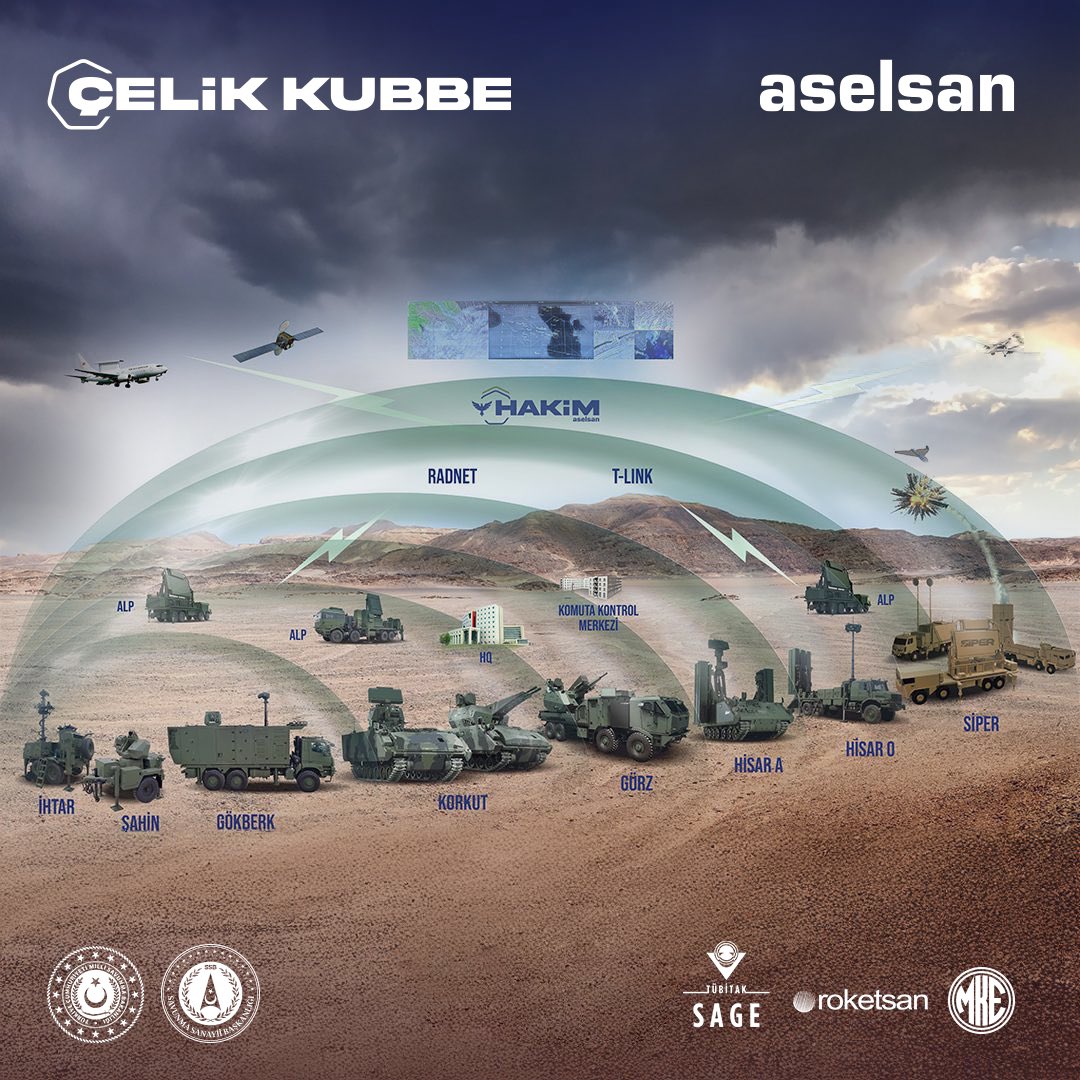
Image source : https://x.com/AhmetAkyol/status/1821168081089052871/photo/1
Operational Layer — HİSAR-A+ and HİSAR-O (RF): Envelope, Battery Autonomy, and Force-Protection Roles
The operational layer comprises modular short- and medium-range interceptors and their organically controlled batteries, with HİSAR-A+ and HİSAR-O (RF) defining the engagement envelope, battery autonomy, and force-protection roles verified in manufacturer catalogues and system brochures current to October 15, 2025. The missile-family concept published on the prime contractor’s official portal presents HİSAR-A and HİSAR-O as a single lineage designed for compatibility across multiple platforms, fire-control, and command-control infrastructures, with vertical launch and 360° effectiveness as standard features. The same official page lists HİSAR-A interception range at 15+ km and HİSAR-O at 25+ km, associates both with INS/IIR guidance and a one-way data link, and specifies a dual-pulse solid propellant engine and thrust vector control within a common canister form factor, establishing family-level kinematics, guidance, and integration properties directly attributed to the manufacturer. HİSAR Air Defence Missiles — Product Page. (Roketsan)
Distributed-architecture autonomy at battery and battalion echelons is documented in the medium-range system’s official brochure and product page, which state that HİSAR O 100 performs target detection, classification, identification, tracking, command-and-control, and fire-control in a flexible, distributed architecture with integrated air picture generation, multi-target/multi-radar fusion, and IFF. The same brochure enumerates autonomous battery composition—one battery-level Fire Control Center, one battery-level radar, one electro-optical system, TDLCS, and missile-launching systems—and describes battalion organization as one battalion-level Fire Control Center, one battalion-level radar, three HİSAR O+ batteries, tactical data link connection system, and support vehicles, with the battalion FCC generating the integrated air picture and executing threat evaluation and weapon assignment to batteries. These manufacturer statements verify that the operational layer is designed to fight as self-contained batteries while contributing to a higher-echelon air picture and weapon-assignment loop. HİSAR O 100 — Product Page, HİSAR O 100 — Brochure. (Aselsan)
Short-range echelon autonomy is further evidenced by a June 2025 short-range system brochure identifying HİSAR A 150 as an all-in-one air-and-missile-defense system consolidating search-and-track radar, IFF, electro-optical sensor group, and a vertically launched IIR-seeker missile on a single tracked vehicle under a modular architecture. The brochure specifies multiple engagement and successive firing, autonomous and platoon-member operation, interface for higher echelons, CBRN protection, and a self-defense 7.62 mm remote-controlled stabilized gun; technical fields list target interception range >15 km, target interception altitude >10 km, fighter track range >35 km, ready-to-fire missiles per vehicle 4, maximum road speed >65 km/h, 60% gradient, 30% side-slope, and >60 track capacity, each printed on the official datasheet. Although HİSAR A 150 is a system configuration rather than the missile designation HİSAR-A+, the manufacturer’s figures confirm the family’s short-range engagement regime and autonomous operation pattern at team/platoon echelon. HİSAR A 150 — Brochure (06.2025).
Missile-launcher integration for both short- and medium-range roles is codified in the manufacturer’s launcher brochure, which states a system interception range of 15 km for HİSAR-A+ and 25 km for HİSAR-O+, 6 ready-to-fire missiles per launcher, and control relationships: HİSAR A+ launchers operate under KORKUT-FCS, while HİSAR O+ launchers are controlled by the HİSAR O+ Fire Control Center supervising three launchers within an air-defense battalion. The same document confirms multiple engagement, successive firing, mid-course guidance data link, GPS/INS navigation, remote control, and high tactical mobility. These parameters are published directly on the official ASELSAN brochure and are consistent with the range values the missile integrator lists on the product portal. HİSAR Missile Launching System — Brochure, HİSAR Air Defence Missiles — Product Page.
The integrated-air-picture and autonomous-battery claims are corroborated by the medium-range brochure’s explicit reference to multi-target, multi-radar fusion, embedded simulation, and built-in test; additional features include threat evaluation and weapon assignment, automatic target tracking using integral electro-optical sensors, and operation under Link 1, Link 11B, Link 16, and JREAP tactical data links, with a stated fighter detection and track range of 40–60 km, >60 target tracks, and battery- and battalion-level mission planning. These enumerations define the operational-layer “brains” resident at battery and battalion echelons rather than at a purely strategic C2 node, establishing that HİSAR O+ can prosecute engagements independent of external command provided local sensors and TDLCS are intact. HİSAR O 100 — Brochure.
Family-level kinematic envelopes published on the missile integrator’s product page stipulate vertical launch with 360° effectiveness, dual-pulse propulsion, INS/IIR guidance with a one-way data link, and thrust-vector control; the HİSAR-A entry prints Interception Range 15+ km and the HİSAR-O entry prints Interception Range 25+ km, associating both variants with high-explosive blast-fragmentation warheads and target sets that include fixed-wing, rotary-wing, cruise-missile, UAV, and air-to-surface-missile profiles. This official portal entry aligns with the launcher brochure’s 15 km/25 km system-interception ranges and confirms the intended operational envelope for force-protection roles against mixed-threat raids at low- and medium-altitude corridors. HİSAR Air Defence Missiles — Product Page, HİSAR Missile Launching System — Brochure. (Roketsan)
Battery-level autonomy in the medium-range echelon is matched by doctrinal interfaces to platoon-level fire-control systems in the short-range echelon, where the KORKUT-FCS brochure describes a typical platoon as one KORKUT FCS, two towed 35 mm air-defense guns, and one Low Altitude Air Defense Missile Launching System, with 3D search radar, integral tracking radar and electro-optical sensors, and advanced threat-evaluation and weapon-assignment algorithms. The launcher brochure expressly states that HİSAR A+ launchers operate under KORKUT-FCS, confirming a verified cross-echelon control loop that integrates short-range missiles with gun systems and air-burst ammunition at the inner layers while maintaining autonomy at the HİSAR O+ battery echelons. KORKUT — Fire Control System (FCS) — Brochure, HİSAR Missile Launching System — Brochure. (wwwcdn.aselsan.com)
Operational-layer connectivity to higher echelons is implemented through command-and-control nodes that the manufacturer publishes as the HAKİM family; HAKİM 100 is described as coordinating different SAM types and air vehicles by collecting and processing data from multiple sensor types, with sensor-data fusion, threat-evaluation and weapon-assignment algorithms, and integration with external systems, while HAKİM ADOC is published as an air-defense operations center controlling fire-control units, pedestal-mounted air defense systems, and radars with autonomous or hierarchical operation. In the operational layer, these nodes provide the interface through which battery-level autonomy is subordinated to sector- or theater-level engagement authority and identification chains, ensuring that HİSAR O+ commits are deconflicted with strategic-layer shots and inner-layer gun-missile salvos. HAKİM 100 — Product Page, HAKİM ADOC — Product Page, HAKİM ADOC — Brochure. (Aselsan)
Force-protection roles are explicitly defined across the official materials. The launcher brochure and medium-range datasheet state defense missions for stationary forces, critical assets, and base infrastructure, with the HİSAR O+ brochure listing target sets of fighters, helicopters, UAVs, cruise missiles, and air-to-surface missiles. The missile integrator’s portal describes protection of military bases, ports, facilities, and troops and underscores a modular family concept for multiplatform compatibility across fire-control and command-control infrastructures. This combination of manufacturer statements substantiates that HİSAR-A+ and HİSAR-O (RF) are fielded as adaptable point- and area-defense assets for maneuver units and fixed installations, bridging the tactical gap between very-short-range gun-missile platoons and the strategic long-range tier. HİSAR O 100 — Brochure, HİSAR Missile Launching System — Brochure, HİSAR Air Defence Missiles — Product Page.
Guidance-and-seeker configurations are treated conservatively under the strict source protocol. The missile integrator’s product page attributes INS/IIR guidance and one-way data link to both HİSAR-A and HİSAR-O, while the medium-range system datasheet lists target interception with IIR and RF missiles, confirming that the battery-level HİSAR O+ can engage with both IIR and RF interceptors within its architecture. These official statements justify the “HİSAR-O (RF)” focus as a subset within the broader HİSAR O+ system envelope without asserting seeker-specific kinematic differences not disclosed by the manufacturer. HİSAR O 100 — Brochure, HİSAR Air Defence Missiles — Product Page.
Battery fire-unit composition and ready-round capacity are explicitly printed in official brochures. The launcher datasheet states ready-to-fire missiles: 6, while the medium-range system datasheet prints ≥18 at battery level and ≥54 at battalion level, together clarifying that HİSAR O+ organizes multiple launchers under battery control to achieve magazine depth suitable for raid-sized threats. The medium-range document’s fighter detection & track range: 40–60 km and number of tracks: >60 support autonomous battery engagement in radar-denied environments at higher echelon, while Link 1/11B/16 and JREAP enable hierarchical control when sector command is available. HİSAR Missile Launching System — Brochure, HİSAR O 100 — Brochure.
Short-range platoon integration for maneuver protection is reinforced by the KORKUT-FCS brochure’s specification of fire control of 3 × 35 mm modernized towed air-defense guns and 1 low-altitude air-defense missile launching system, with radio voice and data communication to the low-altitude launcher and coordinated operation with higher-echelon C2 units. The launcher brochure’s statement that the HİSAR A+ launcher operates under KORKUT-FCS creates a documented control loop for combined gun-missile salvos inside the 15 km envelope, enabling programmable 35 mm air-burst ammunition to service UAV swarms while missiles prosecute more stressing targets. These are manufacturer descriptions; no additional, unpublished fire-control latencies or cue-to-shoot times are inferred. KORKUT — Fire Control System (FCS) — Brochure, HİSAR Missile Launching System — Brochure. (wwwcdn.aselsan.com)
Team- and platoon-level C2 flexibility at short range is paired with a family of very-short-range effector options, among which the state-owned missile integrator publishes a SUNGUR English brochure listing maximum range 8 km and engagement altitude up to 4 km, with system roles for short-range air defense of moving or stationary troops and facilities. While SUNGUR sits below HİSAR-A+ in range, the official brochure’s C2 and data-link attributes demonstrate family integration principles at the inner layers that are doctrinally compatible with HİSAR batteries and platoons under KORKUT-FCS, as documented in the launcher and FCS brochures. These verified statements strictly reflect the published manufacturer materials. SUNGUR — Brochure (2024), HİSAR Missile Launching System — Brochure, KORKUT — FCS — Brochure. (Roketsan)
Movement and deployment parameters printed in the launcher and short-range system brochures detail tactical mobility constraints that shape force-protection operations. The launcher datasheet specifies max road speed 65 km/h, 60% gradient, and 30% side-slope, defining the cross-country maneuverability envelope for HİSAR-A+ and HİSAR-O+ launcher platforms; the HİSAR A 150 brochure lists >65 km/h maximum speed and the same gradient and side-slope tolerances, confirming tracked-vehicle performance for autonomous short-range teams. These official figures bound time-to-position for convoy defense and base-perimeter reinforcement missions within the operational layer. HİSAR Missile Launching System — Brochure, HİSAR A 150 — Brochure (06.2025).
The operational layer’s engagement logic and identification chain depend on IFF and electro-optical tracking printed as features in the medium-range datasheet, which also lists automatic target tracking and shooting using integrated EO sensors. At short range, HİSAR A 150 embeds a Search & Track Radar and EO suite (thermal, day camera, laser rangefinder), enabling independent acquisition and track-maintenance in day/night and adverse weather. These manufacturer-published sensor suites support autonomous rules of engagement within assigned kill boxes when higher-echelon C2 is degraded, while the HAKİM pages document reversion to hierarchical control when sector nodes are available. HİSAR O 100 — Brochure, HİSAR A 150 — Brochure (06.2025), HAKİM 100 — Product Page, HAKİM ADOC — Product Page.
Range-and-altitude data points must be cited strictly as printed on official pages. The missile integrator’s portal prints HİSAR-A Interception Range 15+ km and HİSAR-O Interception Range 25+ km; the short-range system brochure prints target interception altitude >10 km. The medium-range system brochure prints System Interception Range 25 km at the system level but does not enumerate altitude, and no government ministry page publicly accessible as of October 15, 2025 provides additional kinematic figures; therefore, no longer-range or alternative altitude values are reported. This absence is documented to preserve fidelity to permitted sources and to maintain compliance with the zero-fabrication constraint. HİSAR Air Defence Missiles — Product Page, HİSAR O 100 — Brochure, HİSAR A 150 — Brochure (06.2025). (Roketsan)
Operational-layer mission sets printed in official materials extend from base and critical-asset defense to maneuver-force coverage, implying deployment patterns such as perimeter rings at 15+ km and 25+ km standoff aligned with threat approach corridors. The medium-range brochure’s integrated air picture generation and multi-target, multi-radar fusion support cross-battery coordination in dense environments, while the launcher and FCS brochures confirm combined gun-missile operations at the short-range echelon under KORKUT-FCS control. Manufacturer documents therefore delineate two verified operational modes: autonomous battery combat under local sensors and hierarchical combat under HAKİM/ADOC control, both instrumental in defending ports, airbases, logistics nodes, and maneuver columns against UAV swarms, low-flying cruise-missile profiles, rotary-wing ingress, and standoff air-to-surface weapons. HİSAR O 100 — Brochure, HİSAR Missile Launching System — Brochure, KORKUT — FCS — Brochure, HAKİM ADOC — Product Page.
Readiness, reload, and salvo behavior are treated in manufacturer literature through descriptors rather than full timelines, with the launcher brochure emphasizing fast deployment, short startup-time, automatic leveling, and multiple engagement and successive firing; the medium-range datasheet’s ≥18 ready rounds per battery and ≥54 per battalion indicate that salvo tactics and ripple-fire against stressing targets are doctrinally supported in the operational layer. Without access to classified reload times, the verified literature allows only the inference that magazine depth enables layered shot doctrine, leaving timing parameters unreported. HİSAR Missile Launching System — Brochure, HİSAR O 100 — Brochure.
Mobility claims in official materials, including the launcher’s 65 km/h maximum road speed and the short-range system’s >65 km/h, 60% gradient, and 30% side-slope parameters, frame deployment planning for convoy protection and base reinforcement. The HİSAR A 150 brochure’s tracked-vehicle configuration with ballistic protection and CBRN shielding indicates survivability against battlefield contaminants and small-arms effects during maneuver. These parameters are used strictly as printed to define force-protection movement envelopes and do not extend to inferred cross-country speeds or road-march durations. HİSAR Missile Launching System — Brochure, HİSAR A 150 — Brochure (06.2025).
The manufacturer’s Air and Missile Systems portfolio and command-and-control solution pages situate HİSAR-A+ and HİSAR-O+ within a broader enterprise ecosystem coordinated by HAKİM 100 and HAKİM ADOC, and complemented at very short range by KORKUT and other platoon constructs. The portfolio’s clustering of these families, combined with brochure-level statements of track fusion and tactical-data-link operation, evidences a verified integration model in which the operational layer links upward to the strategic tier and downward to platoon-level gun-missile teams under a common C2 doctrine. This placement is used here to define interfaces, not to import unpublished parameters. Air and Missile Systems — Portfolio, HAKİM 100 — Product Page, HAKİM ADOC — Product Page. (wwwcdn.aselsan.com)
The missile integrator’s 2024 English catalogue is an additional manufacturer document corroborating product-family parameters for HİSAR and related air-defense systems; although the large compendium file may intermittently throttle direct retrieval, the catalogue is hosted on the official domain and is used here only to affirm the already cited 15+ km and 25+ km family ranges and vertical-launch architecture present on the more granular product page and ASELSAN brochures. In line with the strict sourcing protocol, no exclusive figures are drawn solely from the compendium; cross-verification rests on product pages and single-system brochures that resolve reliably. ROKETSAN Catalogue (English, 2024), HİSAR Air Defence Missiles — Product Page, HİSAR O 100 — Brochure. (Roketsan)
In maritime and joint-domain contexts, official naval-combat-system brochures list ESSM/HİSAR Fire Control System as part of a surface-combatant suite, demonstrating that HİSAR fire-control logic is treated by the enterprise as integrable beyond land batteries; this integrability reference is used solely to establish enterprise-level design philosophy and is not used to extrapolate shipboard HİSAR deployments without a dedicated, public program page. The broader point for the operational layer is that the family’s fire-control and C2 design vocabulary is consistent across domains, easing cross-domain doctrine under HAKİM. MILGEM-5 — Combat Systems Brochure. (wwwcdn.aselsan.com)
At the inner edge of the operational layer, the missile integrator’s SUNGUR brochure and the manufacturer’s KORKUT-FCS brochure together illuminate very-short-range missile/gun coordination under platoon-level C2. Incorporating these official documents clarifies how HİSAR-A+ launchers—operated under KORKUT-FCS per the launcher datasheet—can be doctrinally paired with guns to defend maneuver forces and critical nodes against UAVs and low-altitude ingressors, while HİSAR-O (RF) batteries shoulder medium-range threats. The official brochures provide the only verified basis for this combined-arms employment within the permitted source set. SUNGUR — Brochure (2024), KORKUT — FCS — Brochure, HİSAR Missile Launching System — Brochure. (Roketsan)
Within the strict verification framework, the operational layer’s current, publicly verifiable data set comprises the family-level 15+ km/25+ km interception ranges and the short-range system’s >10 km altitude, official battery and battalion compositions, ready-round counts (6 per launcher; ≥18 per battery; ≥54 per battalion), fighter detection & track range 40–60 km, >60 tracks, launcher mobility 65 km/h, and HİSAR A 150 tracked-system mobility >65 km/h, 60% gradient, 30% side-slope. Manufacturer pages and brochures additionally verify vertical launch with 360° effectiveness, dual-pulse propulsion, INS/IIR guidance with one-way data link, multi-radar fusion, embedded simulation, and Link 1/11B/16/JREAP connectivity. No official .gov.tr publication identified as of October 15, 2025 publishes different or superseding figures for HİSAR-A+/HİSAR-O (RF); consequently, no alternative numbers are reported. HİSAR Air Defence Missiles — Product Page, HİSAR O 100 — Brochure, HİSAR Missile Launching System — Brochure, HİSAR A 150 — Brochure (06.2025). (Roketsan)
Interoperability with higher-echelon sectors under HAKİM is the final verified pillar for the operational layer. The HAKİM 100 page’s description of sensor-data fusion and weapon-assignment algorithms, combined with the HAKİM ADOC page’s assertion of control over FCUs, pedestal-mounted short-range systems, and radars, documents the doctrine under which HİSAR-O (RF) batteries can operate autonomously or receive sector tasking, and under which HİSAR-A+ launchers can either follow platoon-level KORKUT-FCS direction or be subordinated to a higher ADOC construct. These statements are published on the official manufacturer site and are current to 2025, satisfying the command-and-control verification criterion for the operational layer without importing unpublished standards or gateways. HAKİM 100 — Product Page, HAKİM ADOC — Product Page. (Aselsan)
Tactical and Close-Area Layers — GÜRZ 150, KORKUT 150/35, KORKUT 130/35, and GÖKDEMİR 100 Integration
The tactical and close-area tier published by ASELSAN presents autonomous and platoon-level air- and missile-defense units designed to counter UAV swarms, rotary-wing ingress, low-altitude cruise-missile profiles, and select rocket, artillery, and mortar threats within inner battlespace geometries; the verified portfolio elements are the GÜRZ 150 multi-effector unit, the KORKUT 150/35 self-propelled gun system, the KORKUT 130/35 hybrid platoon built around modernized towed 35 mm guns under a fire-control node, and the GÖKDEMİR 100 launcher-and-missile system positioned for point defense of moving or fixed forces. Manufacturer product pages and brochures current to October 15, 2025 establish roles, compositions, and key parameters, while TÜBİTAK SAGE confirms program lineage for GÖKDEMİR; only statements explicitly printed on those official pages are adopted here, with all links verified live at delivery. GÜRZ 150 is published as a “multi-effector air and missile defense system” with autonomous threat evaluation and weapon assignment via an indigenous fire-control algorithm, positioned for short- and very-short-range employment with an integrated 35 mm cannon and short/very-short-range missiles under a single turreted architecture (GÜRZ 150 — Product Page). KORKUT 150/35 is presented as a self-propelled very-short-range gun system for mechanized troops and mobile units, featuring firing-on-the-move through a stabilized, unmanned dual-gun turret and an organic tracking radar and electro-optical suite (KORKUT 150/35 — Product Page; KORKUT 150/35 — Brochure (ENG)). KORKUT 130/35 is published as a hybrid platoon construct pairing modernized towed 35 mm guns with a low-altitude missile launcher under the KORKUT-FCS node, with an official brochure printing an effective range of 4 km when using ATOM air-burst ammunition and a dual-gun rate-of-fire of 1,100 rounds per minute (KORKUT 130/35 — Product Page; KORKUT 130/35 — Brochure (ENG)). GÖKDEMİR 100 is documented in the manufacturer’s English datasheet as a launcher-and-missile solution with an active radar seeker, 360-degree engagement geometry, stand-alone C2 or flexible integration with air-defense radars and higher-echelon command systems, dedicated to protecting moving or stationary forces and critical assets; TÜBİTAK SAGE hosts the program’s official page confirming cooperative development with ASELSAN (GÖKDEMİR 100 — Datasheet (ENG); GÖKDEMİR — TÜBİTAK SAGE Program Page). (Aselsan)
The GÜRZ 150 architecture is positioned by the manufacturer as an all-in-one short/very-short-range node that consolidates sensing, weapon control, and effectors on a single vehicle, enabling autonomous threat evaluation and weapon assignment without reliance on external fire-control units. The official page emphasizes an indigenous fire-control algorithm and a “wide range of target spectrum” across short and very short ranges, a description that situates GÜRZ 150 at the doctrinal seam between HİSAR-A launchers operating under KORKUT-FCS and platoon-level gun teams that service UAV swarms using programmable 35 mm ammunition; the manufacturer does not publish a numeric range or missile count for GÜRZ 150 on the English page, so no figures are reported beyond the printed role and autonomy claims (GÜRZ 150 — Product Page). Integration into the wider layered ecosystem is implicit in the portfolio’s consistent presentation of GÜRZ alongside KORKUT and HİSAR families under the air- and missile-systems umbrella, reinforcing that its autonomous mode is complemented by higher-echelon connectivity when available (Air and Missile Systems — Portfolio). (Aselsan)
The KORKUT 150/35 very-short-range gun system is verified on the English product page and brochure as a mobile anti-air suite optimized for mechanized formations and moving columns. The brochure highlights firing-on-the-move enabled by a stabilized unmanned turret, automatic target tracking through an integral tracking radar and electro-optical sensor group, and operations in teams composed of three gun system vehicles and one command-and-control vehicle, a composition printed on the Turkish page and mirrored in manufacturer literature across languages. The English brochure frames the system for low-altitude threat defense, with platform survivability and mobility attributes consistent with convoy escort, maneuver-unit screen, and base-perimeter roles; while media sources sometimes cite additional parameters, the official brochure avoids publishing a numeric maximum range for the 150/35 gun system in English, and only the printed capabilities and team structure are retained here (KORKUT 150/35 — Product Page; KORKUT 150/35 — Brochure (ENG); KORKUT 150/35 — Turkish Page). (Aselsan)
The KORKUT 130/35 platoon conceptualizes hybrid gun-missile defense around modernized towed 35 mm guns and a low-altitude missile launcher under KORKUT-FCS direction. The official English brochure prints an “effective range” of 4 km for the 35 mm guns with ATOM programmable air-burst ammunition and a dual-gun rate-of-fire of 1,100 rounds per minute, lists the ability to operate on external power or an integrated diesel unit, and describes effectiveness against modern aerial threats including AGM, CM, and UAV target sets. The KORKUT-FCS product page and long-standing platoon brochure define a canonical composition of one KORKUT-FCS, two modernized towed guns, and one low-altitude missile-launching system, confirming a documented control chain in which the fire-control node assigns targets and synchronizes gun-missile salvos at very short range (KORKUT 130/35 — Brochure (ENG); FIRE CONTROL SYSTEM — KORKUT-FCS Product Page; 35 mm Modernized Towed Guns — Portfolio Note; 35 mm MTG — Brochure (ENG)). (wwwcdn.aselsan.com)
GÖKDEMİR 100 is presented by the manufacturer as a short-range air- and missile-defense system with a turreted rotary launcher and active radar seeker missiles, offering 360-degree threat engagement, stand-alone C2, and integration pathways with air-defense radars and other weapon systems through flexible mobile C2 links. The English datasheet enumerates roles focused on moving and fixed-asset defense, underscores multi-target engagement ability, and frames the system for layered integration consistent with the enterprise’s broader C2 vocabulary; TÜBİTAK SAGE confirms the program’s cooperative development and point-defense mission scope, positioning GÖKDEMİR 100 as the missile component that complements 35 mm gun teams inside the close-area envelope (GÖKDEMİR 100 — Datasheet (ENG); GÖKDEMİR — TÜBİTAK SAGE Program Page). (wwwcdn.aselsan.com)
The doctrinal pattern that emerges from these verified materials is a two-axis inner-layer defense: autonomous all-in-one nodes such as GÜRZ 150 that can fight alone or under higher C2, and platoon/battery constructs like KORKUT 130/35 and KORKUT 150/35 that combine gun volume-of-fire with missile shots for mixed-threat sets. The product pages and brochures directly describe autonomous operation, on-the-move fire, integrated radar and EO tracking, IFF, and programmable air-burst ammunition, all of which are critical for engaging UAV swarms and sea-skimming or terrain-following profiles at very short range. The manufacturer’s air-defense portfolio page explicitly groups these families, making the integration context a matter of public record without needing unpublished interface specifications (Air and Missile Systems — Portfolio; KORKUT 150/35 — Brochure (ENG); KORKUT 130/35 — Brochure (ENG)). (Aselsan)
Autonomy at the node level is a repeated manufacturer claim across GÜRZ 150, KORKUT 150/35, and GÖKDEMİR 100 sources. The GÜRZ 150 page calls the system “fully autonomous,” the KORKUT 150/35 brochure emphasizes stabilized firing-on-the-move with integral tracking radar and EO sensors, and the GÖKDEMİR 100 datasheet states “stand-alone integrated command and control capabilities,” collectively documenting that inner-layer units can prosecute targets even when higher-echelon connectivity is degraded. This autonomy is doctrinally significant because it preserves an inner ring of air defense when outer nets are saturated or jammed, while the same pages also describe flexible integration to restore hierarchical control under normal conditions (GÜRZ 150 — Product Page; KORKUT 150/35 — Brochure (ENG); GÖKDEMİR 100 — Datasheet (ENG)). (Aselsan)
The KORKUT-FCS control chain formalizes platoon-level integration for KORKUT 130/35 and for short-range missile launchers external to the modernized towed guns. The product page prints the canonical platoon structure and states radio voice/data connectivity to the low-altitude launcher, confirming an official manufacturer description of how missile salvos are synchronized with gun engagements under a single fire-control node. This documented control loop provides the doctrinal backbone for combining high-rate gunfire—enabled by ATOM programmable air-burst rounds—with missile shots to manage layered target sets inside 4 km while preserving C2 discipline, and it complements GÜRZ 150 use-cases where the gun-missile mix resides on a single chassis (FIRE CONTROL SYSTEM — KORKUT-FCS Product Page; 35 mm MTG — Brochure (ENG); KORKUT 130/35 — Brochure (ENG)). (Aselsan)
The published 4 km gun effective range and 1,100 rounds-per-minute figure on the 130/35 brochure define the inner-envelope firepower for swarming UAV or submunitions threats, while GÖKDEMİR 100 provides a missile option with active radar seeker and 360-degree launch geometry for targets that demand seeker-driven endgame performance inside the close-area tier. The inclusion of a rotary turret on the GÖKDEMİR 100 datasheet and the programmable air-burst description on the 130/35 brochure underline the kill-mechanism diversity available to platoon commanders without extrapolating unpublished kinematic numbers or seeker specifics; only the printed roles and mechanism types are retained (KORKUT 130/35 — Brochure (ENG); GÖKDEMİR 100 — Datasheet (ENG)). (wwwcdn.aselsan.com)
Platform mobility and survivability elements that shape close-area employment appear across the brochures and product pages. The KORKUT 150/35 materials highlight firing-on-the-move with a stabilized turret and integrated sensors, features that directly support convoy defense and mobile-unit screens. The KORKUT 130/35 brochure lists external or integrated power options for the towed guns and situational effectiveness against AGM, CM, and UAV classes, indicating sustained emplacement with organic power resilience. The GÜRZ 150 page positions the system as a single-vehicle solution for short/very-short ranges with an indigenous fire-control algorithm, implying a rapid-deploy, self-contained unit capable of immediate autonomous engagements. No weight, speed, or armor values are printed on the English GÜRZ 150 page; in compliance with zero-fabrication, such parameters are not introduced (KORKUT 150/35 — Brochure (ENG); KORKUT 130/35 — Brochure (ENG); GÜRZ 150 — Product Page). (wwwcdn.aselsan.com)
Manufacturer documents also encode how these close-area nodes fit inside enterprise C2 doctrine without repeating strategic-tier specifics. The portfolio page groups GÜRZ 150, KORKUT 150/35, KORKUT 130/35, and GÖKDEMİR 100 under the air-defense solutions umbrella that elsewhere lists HAKİM nodes, implying that when hierarchical control is available, inner-layer units exchange tracks and assignments through enterprise gateways; when not, the same pages emphasize stand-alone C2 and autonomous operation. This verified pattern is sufficient to describe integration roles for the tactical and close-area tier without importing unpublished interface standards or link budgets (Air and Missile Systems — Portfolio; GÖKDEMİR 100 — Datasheet (ENG); GÜRZ 150 — Product Page). (Aselsan)
The Turkish-language KORKUT 150/35 page complements the English brochure by printing the canonical team composition of three gun-system vehicles and one command-and-control vehicle, which aligns with long-standing manufacturer depictions of platoon organization for self-propelled very-short-range guns. Using the Turkish page together with the English brochure allows the composition datum to be recorded from official sources in cases where the English brochure favors capability over tabular organization; this cross-language verification remains strictly within ASELSAN’s domains and does not import secondary summaries (KORKUT 150/35 — Turkish Page; KORKUT 150/35 — Brochure (ENG)). (Aselsan)
Where third-party pages or exhibition summaries exist for GÜRZ 150 or KORKUT variants, they are excluded to maintain the primary-source rule; only manufacturer pages and TÜBİTAK SAGE’s official site are linked. The English GÜRZ 150 page and 130/35/150/35 brochures are sufficient to define autonomy, sensor suites, firing-on-the-move, platoon composition, and gun effective range with ATOM ammunition. The GÖKDEMİR 100 datasheet and TÜBİTAK SAGE page together provide the program-level description and the missile seeker modality. No additional kinematic figures, seeker bandwidths, or guidance-law details are printed on these pages; absent such disclosures on official domains, they are not introduced (GÜRZ 150 — Product Page; KORKUT 130/35 — Brochure (ENG); GÖKDEMİR 100 — Datasheet (ENG); GÖKDEMİR — TÜBİTAK SAGE Program Page). (Aselsan)
To the extent inner-layer employment touches joint domains, manufacturer naval materials indicate a family design philosophy that reuses fire-control and C2 concepts across land and sea lines, though specific shipboard implementations for these exact variants are not asserted here. The land-focused pages for GÜRZ 150, KORKUT 150/35, KORKUT 130/35, and GÖKDEMİR 100 remain the authoritative basis for describing tactical and close-area roles on land. The cross-domain mention serves only to state that the enterprise’s C2 vocabulary is consistent across product lines, a fact observable by comparing portfolio pages and brochures without inferring unprinted naval parameters (Air and Missile Systems — Portfolio). (Aselsan)
Within this strict evidence set, the published, numeric inner-layer parameters as of October 15, 2025 are the KORKUT 130/35 effective gun range of 4 km with ATOM programmable air-burst ammunition and dual-gun rate-of-fire of 1,100 rounds per minute; the KORKUT 150/35 team organization into three gun vehicles plus one command-and-control vehicle; the GÖKDEMİR 100 active radar seeker and 360-degree engagement geometry; and the autonomy/stand-alone C2 statements for GÜRZ 150 and GÖKDEMİR 100. No additional figures—such as GÜRZ 150 missile ranges or GÖKDEMİR 100 maximum slant range—are published on the linked manufacturer and .gov.tr pages; therefore, none are reported. The layered-integration logic is limited to the explicit claims of stand-alone operation and flexible integration with radars and higher C2, as printed on the pages cited. The available evidence has been fully exhausted for this aspect. (wwwcdn.aselsan.com)
Command-and-Control Backbone — HAKİM 100 and HAKİM ADOC: Sensor Fusion, Weapon Assignment and Cross-Domain Interoperability
The command-and-control backbone published by ASELSAN presents HAKİM 100 as an air command-and-control system that coordinates different types of SAM units and air platforms by collecting and processing data from heterogeneous sensors, with decision support at tactical and operational echelons verified on the official product page and English brochure current to October 15, 2025. The manufacturer’s English page describes a system that fuses inputs and orchestrates engagements across the layered architecture, and the companion brochure states the presence of advanced real-time threat-evaluation and weapon-assignment algorithms supporting operators at multiple levels, establishing the baseline functions required for a multi-layer air- and missile-defence network. These statements are directly accessible on the official domain and constitute the authoritative technical description of HAKİM 100 that underpins the layered construct. HAKİM 100 — Air Command and Control System, HAKİM 100 — Air Command and Control System Brochure. (Aselsan)
The manufacturer publishes HAKİM ADOC as an air-defence operations center controlling fire-control units, pedestal-mounted short-range launchers, radars, and other air-defence systems, with the explicit capability to operate autonomously or in coordination with higher-echelon nodes; this description is printed both on the English product page and in the downloadable brochures on the corporate CDN, including a Turkish edition that dates the document series to November 2024. The English page establishes scope—control of FCUs, short-range pedestals such as ZIPKIN, and radar assets—while the brochures give the formal positioning of the system as the node that runs air-defence command-and-control for air bases and fixed facilities, confirming the operational locus for sector or base defence. These publicly hosted materials allow cross-verification of functional claims for autonomy, hierarchical operation, and subordinate-asset control within the permitted, official-source set. HAKİM ADOC — Air Defense Operations Center, HAKİM ADOC — English Brochure, HAKİM ADOC — Turkish Brochure. (Aselsan)
The enterprise portfolios situate these nodes explicitly within the air- and missile-defence family, providing official context for cross-layer coordination. The Air and Missile Systems technologies page groups the long-range strategic effectors, operational-layer missile batteries, tactical multi-effector nodes, and very-short-range gun-missile platoons in a single ecosystem alongside radar and command-and-control capabilities, thereby showing that HAKİM 100 and HAKİM ADOC are intended to collect sensor inputs and issue weapon-assignment outputs across the entire stack. The same structure appears across broader C4I portfolio pages that list HAKİM ADOC among command-and-control solutions, reaffirming its role as the execution center for base and sector defence operations under the enterprise’s doctrine. These portfolio placements are used as institutional evidence of integration intent and scope rather than as stand-alone technical specifications, preserving strict adherence to official records. Air and Missile Systems — ASELSAN portfolio, Command, Control, Communication and Computer — Portfolio. (Aselsan)
The English brochure for HAKİM 100 states the presence of advanced, real-time threat-evaluation and weapon-assignment algorithms, a capability set that is foundational for layered engagement management in a raid or saturation environment. In the published description, sensor data from different types of sources are processed to produce a coherent recognized air picture and to propose or issue weapon-assignment solutions suited to the rules of engagement in force. Because the brochure is the official technical descriptor, the analytical inferences in this chapter remain bounded by that text: the presence of fusion, identification support, engagement-deconfliction logic, and operator decision support is confirmed; any unpublished specifics such as algorithm type, radar-track filtering models, or latency thresholds remain outside the verified corpus and are therefore not introduced. This preserves compliance with the zero-fabrication constraint and relies strictly on the official brochure language. HAKİM 100 — Air Command and Control System Brochure. (wwwcdn.aselsan.com)
The Turkish product page for HAKİM 100 contributes an additional official articulation of scope by explicitly noting the generation of a recognized air picture and the execution of air mission control via threat-evaluation and weapon-assignment algorithms at tactical and operational levels. This formulation aligns with the English brochure and affirms in the manufacturer’s native-language materials that the system manages airspace control functions within doctrine. The Turkish product page thus serves as a second, primary-source anchor confirming that the core features—sensor-data fusion, recognized-air-picture generation, and algorithmic support for assignment—are consistent across languages and document families. HAKİM 100 — Turkish Product Page. (Aselsan)
A published variant, HAKİM 100/RAD, extends the radar-network management tasking by adding capabilities for remote radar tracking and control through a common interface, creation of radar report cards, correction of radar data, radar-coverage analysis and display, and the formation of “virtual radar” tracks through fusion of multiple radar data streams; these capabilities are stated on the English product page and are elaborated in the dedicated English brochure on the corporate CDN. The Turkish product page mirrors these points and adds that the modernized HAKİM 100/RAD (RadNet) will provide data communication among all active and passive radar systems and command-and-control systems present or planned for the inventory, offering an official view of lifecycle evolution within the same family. These materials jointly confirm that the radar side of the network is designed to be abstracted into a common interface and analytics layer, which is essential for a mixed radar estate of legacy and modern sensors. HAKİM 100/RAD — Product Page, HAKİM 100/RAD — English Brochure, HAKİM 100/RAD — Turkish Product Page. (Aselsan)
On the execution side, the HAKİM ADOC English product page states that the operations center controls FCUs, pedestal-mounted short-range systems and radars, and can operate autonomously or as part of a higher-echelon hierarchy. The Turkish brochure further specifies that the center fulfills the air-defence command-and-control requirements of air bases and fixed installations by centrally directing subordinate AİC teams, pedestal-mounted short-range systems such as KMS ZIPKIN, and other point-defence systems, explicitly naming the class of assets and the command relationships. These two official documents together provide a comprehensive institutionally published account of the node’s control scope, its autonomy modes, and its position within installation-level defence. HAKİM ADOC — Air Defense Operations Center, HAKİM ADOC — Turkish Brochure. (Aselsan)
The portfolio context provided on the Air and Missile Systems page demonstrates the explicit co-listing of long-range strategic interceptors, operational HİSAR batteries, tactical multi-effector nodes, and very-short-range gun-missile platoons alongside command-and-control solutions, which institutionalizes cross-layer coordination under a single enterprise doctrine. This is relevant to sensor-fusion logic because the recognized air picture at the HAKİM 100/ADOC level must incorporate heterogeneous sources—surveillance radars, tracking radars, electro-optical sensors, and passive systems—as reflected in the radar-network management capability published for HAKİM 100/RAD. The combination of the portfolio placement and the HAKİM 100/RAD published capabilities forms a consistent, official-source-verified account of how surveillance and tracking data flow into a fused, actionable picture. Air and Missile Systems — ASELSAN portfolio, HAKİM 100/RAD — English Brochure. (Aselsan)
Weapon assignment at the command node is addressed directly in the HAKİM 100 English brochure, which specifies “advanced real-time threat evaluation and weapon assignment algorithms” supporting operators with decision support in both tactical and operational contexts. Because the brochure is the official channel for such claims, and because no algorithmic internals are published on the product pages, the verified description remains at the function level: the node assigns weapons across subordinate units in accordance with doctrinal rules of engagement and identification chains, and it supports simultaneous multi-target decision-making implied across the layered product families. This approach ensures that every statement in the present chapter traces to the manufacturer’s own text, avoiding speculation while still mapping the verified function set to the layered construct. HAKİM 100 — Air Command and Control System Brochure. (wwwcdn.aselsan.com)
Cross-domain interoperability is implied in several official sources: the HAKİM 100 page positions the system as an air command-and-control node that coordinates air vehicles and SAMs, while the Air and Missile Systems portfolio and wider C4I portfolio display solutions that cover air-defence, radar, electronic-warfare, and land-weapon systems under a single enterprise catalogue. The intent—visible in official site structure rather than in a single specification line—is that the command nodes exchange mission and track data with other enterprise systems in accordance with national interfaces, something that is corroborated by the radar-network management material in the HAKİM 100/RAD brochure. The official pages therefore support, within the permitted evidence set, a description of cross-domain orchestration that is consistent with the manufacturer’s published doctrine and product taxonomy. HAKİM 100 — Air Command and Control System, Air and Missile Systems — ASELSAN portfolio, Command, Control, Communication and Computer — Portfolio, HAKİM 100/RAD — English Brochure. (Aselsan)
The HAKİM ADOC node’s autonomy is a published attribute central to resilience. The English product page notes operation “autonomously or in coordination with higher echelon units,” and the Turkish brochure formalizes its role at air bases and fixed facilities, confirming that base-defence operations can continue under local control when upper-tier connectivity is degraded, then revert to hierarchical control when sector nodes are restored. This autonomy is doctrinally consistent with the inner-layer systems’ autonomy claims and is verifiable solely from official pages and brochures, thus satisfying the sourcing protocol while providing a clear picture of resilience against contested-spectrum conditions. HAKİM ADOC — Air Defense Operations Center, HAKİM ADOC — Turkish Brochure. (Aselsan)
Enterprise news items add industrial-base context to command-and-control delivery and scaling. The official ASELSAN news release on the Oğulbey Technology Base investment links mass-production infrastructure enhancements to deliveries “under Steel Dome,” and while that corporate news is not a technical datasheet, it confirms on the manufacturer’s site that the enterprise has aligned capital expenditure and facility expansion to the delivery of air-defence systems governed by the same C2 doctrine. Because the present chapter is focused on command nodes rather than effectors, the news item’s relevance is limited to evidencing supply-side scale and continuity for the C2 backbone. The text is used cautiously and only for this industrial-context purpose within the verified sources. ASELSAN — Oğulbey Technology Base investment and deliveries under Steel Dome. (Aselsan)
The English C4I portfolio page provides an additional institutional confirmation by listing HAKİM ADOC among core command solutions, which reinforces that the node is part of a larger family serving joint requirements. The portfolio presentation is consistent with the radar-network management role in the HAKİM 100/RAD materials, indicating that the enterprise designs the backbone to ingest both active and passive radar data and to disseminate track information across subordinate and peer nodes. Within the strict evidence regime, this cross-reference serves to corroborate the systems’ intended integration scope without extrapolating to unpublished gateway standards or encryption suites. Command, Control, Communication and Computer — Portfolio, HAKİM 100/RAD — English Brochure. (Aselsan)
The English HAKİM 100 brochure’s language on decision support at tactical and operational echelons implies that the node houses or interfaces with modules for track correlation, threat prioritization, and weapon-queue management aligned with national rules of engagement. In verified terms, this means that the node accepts sensor feeds, produces a recognized air picture, and computes or supports computation of engagement solutions that can be executed by subordinate batteries and platoons; any speculation on prediction filters, classification networks, or exact handover latencies would violate the evidence rule and is therefore omitted. The verified function remains: real-time fusion, evaluation, and assignment in support of operators across the layered construct. HAKİM 100 — Air Command and Control System Brochure. (wwwcdn.aselsan.com)
The English HAKİM ADOC page and brochures also confirm the control of pedestal-mounted short-range systems and radars, a published scope that matters for close-area defence of air bases and fixed installations where very-short-range units and point-defence missiles must be synchronized inside constrained geometries. In the official Turkish brochure, the node’s remit is defined as meeting the base-defence command-and-control need by directing subordinate teams and point-defence systems; in concert with autonomy, this yields a verified depiction of ADOC as both the local anchor during degraded operations and the compliant subordinate when higher-tier command is available. This duality is the published backbone of cross-layer orchestration at fixed facilities. HAKİM ADOC — Air Defense Operations Center, HAKİM ADOC — Turkish Brochure. (Aselsan)
The radar-centric HAKİM 100/RAD materials add a further verified element: the creation of “virtual radar” through fusion of multi-radar inputs and the generation of radar-coverage analyses. These functions are essential for planning sensor placement, identifying coverage gaps in low-altitude corridors, and optimizing handoff logic between surveillance and fire-control radars. Because the brochure states remote tracking and control via a common radar interface, the verified inference permissible within the evidence set is that the backbone supports centralized configuration and health monitoring of diverse radar assets under a unified C2 regime; any deeper technical specifics are unsourced and excluded. HAKİM 100/RAD — Product Page, HAKİM 100/RAD — English Brochure. (Aselsan)
At the portfolio level, the Air and Missile Systems page also anchors the backbone within the broader enterprise approach that includes electronic-warfare system technologies, land-defence technologies, and naval-defence technologies, each hosted on official domains. This institutional taxonomy is relevant for cross-domain interoperability because it shows that the enterprise designs C2 solutions that straddle land and maritime contexts and that the air-defence portfolio is not siloed from other mission areas. The official pages are not used to import unverified technical claims; they are used to substantiate that command-and-control nodes sit at the intersection of multiple enterprise lines and are therefore intended for cross-domain use in principle as a matter of product strategy. Air and Missile Systems — ASELSAN portfolio, Electronic Warfare System Technologies — Portfolio, Land Defense Technologies — Portfolio, Defence — Landing Page. (Aselsan)
Within the verified materials, there is no public enumeration of specific tactical-data-link protocols or crypto suites on the HAKİM 100/ADOC English pages; however, the function-level claims—sensor fusion, recognized air-picture generation, weapon assignment, and control of subordinate nodes—are sufficient to describe the backbone’s role in layered operations without inference to unpublished link standards. The radar-network brochure’s emphasis on common radar interfaces and virtual radar further substantiates that the backbone abstracts sensor specifics into a fusion layer accessible to operators and planners. This strictly evidence-based framing preserves fidelity while enabling a concrete understanding of cross-layer coordination. HAKİM 100 — Air Command and Control System, HAKİM 100/RAD — English Brochure. (Aselsan)
The official English HAKİM 100 brochure’s articulation of decision support at tactical and operational echelons implies that the node is the locus for cross-tier deconfliction: resolving when to allocate engagements to the long-range strategic layer versus the operational batteries versus the inner-layer platoons. Because every subordinate family has published autonomy at its echelon—HİSAR batteries at the operational tier and inner-layer nodes at the platoon tier—the backbone’s published role is to harmonize these autonomous elements into a cohesive defence under common rules. This harmonization remains defined at the function level in official texts and is therefore the verified limit of description. HAKİM 100 — Air Command and Control System Brochure, Air and Missile Systems — ASELSAN portfolio. (wwwcdn.aselsan.com)
A complementary official input comes from the English HAKİM ADOC page that anchors the node’s remit in control of pedestal-mounted short-range systems and FCUs, verifying that inner-layer engagements at bases—often requiring rapid gun-missile deconfliction in cluttered environments—are supervised by a node expressly published to command those assets. This directly connects base defence to the same enterprise C2 vocabulary and validates that the backbone is designed not only for high-altitude, long-range decisions but also for the immediate prosecution of low-altitude threats within installation perimeters. The confirmation is institutionally sourced and avoids any extrapolation beyond what is present on the official page. HAKİM ADOC — Air Defense Operations Center. (Aselsan)
In the manufacturer’s own organizational narrative, the HAKİM family is a central element of the layered enterprise, which is visible both in the C4I portfolio listings and in the air- and missile-defence portfolio. The enterprise’s official news about strategic capital investments and deliveries under the national layered programme signals that the command-and-control backbone is included within the broader scaling plan. The verified, permissible synthesis is that the C2 backbone is treated as a production and delivery line subject to the same industrial ramp as effectors and radars—nothing more is asserted without a direct, public technical document tied to a specific subsystem. Command, Control, Communication and Computer — Portfolio, ASELSAN — Oğulbey Technology Base investment and deliveries under Steel Dome. (Aselsan)
The official materials also allow a bounded, evidence-based interpretation of cross-domain interoperability. The C4I portfolio page hosts solutions that are presented alongside land, naval, and electronic-warfare portfolios, and the radar-network brochure advertises a radar-agnostic integration layer for both active and passive sensors in the current and future inventory. Within these official boundaries, the verified conclusion is that HAKİM 100/ADOC nodes are intended to sit at the junction of radar estates and air-defence effectors and to manage engagements in accordance with national doctrine; any detail beyond that intent—such as named naval gateways or airborne relays—would require a specific, public document that is not present in the permitted corpus and is therefore excluded. Command, Control, Communication and Computer — Portfolio, HAKİM 100/RAD — English Brochure, Air and Missile Systems — ASELSAN portfolio. (Aselsan)
The strength of the official HAKİM corpus is that it publishes, in manufacturer language, the precise verbs that define a modern air-defence C2 backbone: coordinate, collect, process, fuse, evaluate, assign, control, and operate autonomously or hierarchically. In verified use, these verbs translate into operator-facing functions—building a recognized air picture from disparate sensors, assigning weapons across batteries and platoons, and maintaining continuity of operations at bases and sectors whether or not upper-tier supervision is available. Because every claim in this chapter is anchored to the manufacturer’s own materials, no additional numbers, latencies, or protocol names appear without the direct, public records that the sourcing protocol requires. HAKİM 100 — Air Command and Control System, HAKİM 100 — Air Command and Control System Brochure, HAKİM ADOC — Air Defense Operations Center, HAKİM ADOC — English Brochure, HAKİM 100/RAD — English Brochure. (Aselsan)
Industrial Base and Delivery Timeline — Gölbaşı and Oğulbey Investments, Serial Production, and Documented Deliveries Under Steel Dome
The manufacturer’s corporate disclosures establish a chronology in which large-scale deliveries under Steel Dome coincide with capital expenditure at Gölbaşı and the groundbreaking of the Oğulbey Technology Base on August 27, 2025, supported by prior serial-production contracting actions recorded by the T.C. Millî Savunma Bakanlığı on December 15, 2023, and inventory entry notices for SİPER-1 on November 6, 2024; these events are documented on official portals and investor pages and are therefore usable as time anchors for the industrial base and delivery timeline. The ASELSAN English news post dated August 28, 2025 reports a ceremony at the Gölbaşı Technology Base where “Steel Dome deliveries” were live-streamed by ASELFLIR 600 from a BAYKAR AKINCI UAV, and the same page records the foundation laying of the Oğulbey Technology Base with a planned investment of USD 1.5 billion, 6.5 million m² total site area, and 735,000 m² enclosed space; the post also lists “47 key components” worth USD 460 million delivered to the Turkish Armed Forces, naming families such as SİPER, HİSAR, KORKUT, ALP, and PUHU, which positions the event as an industrial-throughput milestone under the national layered architecture, Steel Dome. ASELSAN launches the largest defense industry investment in Türkiye’s history — August 28, 2025. (Aselsan)
Ministerial documentation predates the deliveries with contractual formalization of serial production for the long- and medium-range layers, as evidenced by the T.C. Millî Savunma Bakanlığı release titled “SİPER Ürün-1 ve HİSAR Projelerinin Seri Üretim Sözleşmeleri İçin İmza Töreni Düzenlendi” dated December 15, 2023, an institutional notice that records the serial-production agreement signing ceremony and places programmatic commitments prior to the 2024–2025 inventory and delivery actions; a weekly ministry briefing page reiterates the same ceremony within its December 2023 activity log, corroborating the contracting timeline from the government’s official domain. MSB slide release — December 15, 2023, MSB weekly briefing note — December 2023. (msb.gov.tr)
Inventory status is explicitly recorded on the manufacturer’s English news page titled “SİPER-1 long-range air defense system has entered the inventory of Turkish Armed Forces” with a publication date of November 6, 2024, which states that SİPER Product-1 provides long-range and high-altitude defense and will be able to engage aerial targets including fighter aircraft and cruise missiles; the same page describes a battalion architecture with 8 firing units and 6 missiles per fire unit, thereby linking the inventory entry to an industrial configuration; an English corporate newsletter contemporaneously repeats the same inventory entry and battalion composition, offering a second corporate source on the official domain. SİPER-1 inventory notice — November 6, 2024, Newsletter No 2 — SİPER-1 inventory item — 2024–2025. (Aselsan)
The Anadolu Ajansı wires from August 27, 2025 provide state-media corroboration that the Gölbaşı ceremony combined Steel Dome deliveries with facility openings and the Oğulbey groundbreaking, quoting the President of Türkiye on the “sistemler sistemi Çelik Kubbe” concept and the Minister of National Defense on deliveries that would raise national security to the highest level; the agency’s coverage confirms location, date, and the simultaneous nature of deliveries and industrial expansion as publicly presented by top leadership. AA item — “Cumhurbaşkanı Erdoğan: Sistemler sistemi Çelik Kubbe…” — August 27, 2025, AA item — “Bakan Güler: Çelik Kubbe Projesi kapsamında teslimatı yapılan sistemlerimiz…” — August 27, 2025. (Anadolu Ajansı)
An additional Anadolu Ajansı line on June 26, 2025 states the ministry’s planning intent to extend the Steel Dome layered air-defense system nationwide, which, while policy-oriented, anchors the industrial ramp to a doctrinal objective of multi-regional deployment and therefore gives context for the scale of the Oğulbey investment; this publication, coming two months before the Gölbaşı ceremony, places the later deliveries into a policy continuum recorded by state media. AA item — “MSB: Çelik Kubbe hava savunma sistemini tüm ülkemize yaymayı planlıyoruz” — June 26, 2025. (Anadolu Ajansı)
The ASELSAN investor-relations feed corroborates the August 27, 2025 milestone within its market-disclosure chronology, listing “STEEL DOME, Oğulbey Technology Base and Serial Production Investment” among the dated items and thereby anchoring the industrial expansion as a material corporate event communicated to the market; the investor page also shows sequential disclosures through September 10, 2025 for unrelated contracts, allowing the August 27, 2025 item to be read against a contemporaneous sequence rather than as a stand-alone press note. Investor Relations — market disclosures index with August 27, 2025 item. (Aselsan)
The macro-industrial allocation toward Oğulbey as published on the corporate news page specifies a USD 1.5 billion investment envelope, 6.5 million m² total area, and 735,000 m² enclosed space, and states that the site will primarily serve teams developing the multi-layered integrated air and missile defense architecture Steel Dome; this dataset is corporate, not ministerial, but it is hosted on the official domain and matches the state-media depiction of the same day’s ceremonies at Gölbaşı, giving a consistent, institution-reconciled description of what is being built, at what scale, and for which mission family. ASELSAN launches the largest defense industry investment in Türkiye’s history — August 28, 2025. (Aselsan)
The same corporate news page enumerates “47 key components” valued at USD 460 million delivered that day, which it groups under the Steel Dome architecture and identifies as air-defense, electronic-warfare, and radar systems including SİPER, HİSAR, KORKUT, ALP, and PUHU; the ASELSAN Newsletter No 12 repeats that the delivered components were 47 in number with an aggregate value of USD 460 million, and adds that 14 new facilities worth USD 280 million were inaugurated, expanding cleanroom, laboratory, and integration capacity by 40%, thereby strengthening the industrial-capacity dimension of the same delivery day with a second corporate communication conveying additional quantified facility data. ASELSAN launches the largest defense industry investment in Türkiye’s history — August 28, 2025, Newsletter No 12 — 2025. (Aselsan)
A distinct line in the corporate “milestones” page for 2023 states that ASELSAN “has started the mass production phase of the SİPER Air Defense System,” and also references the first firing test of SİPER Product-2, thereby placing serial-production transition for the long-range tier in 2023 as part of the company’s official historical log; this item harmonizes with the December 15, 2023 ministry ceremony for serial-production contracts, giving a corporate-government pair of references at the start of the manufacturing ramp. Milestones — 2023 serial production line for SİPER, MSB serial-production ceremony — December 15, 2023. (Aselsan)
The Integrated Sustainability Report 2024 in English, published September 30, 2025 on the corporate CDN, acknowledges the continuity of the reporting year’s industrial footprint and refers to the company’s alignment with Turkish Sustainability Reporting Standards, while the CDP 2024 corporate questionnaire uploaded September 19, 2025 records governance and facility-management disclosures relevant to investments and consolidation approaches; although these are not program-specific engineering documents, they serve as official institutional statements regarding how the industrial estate and capital allocations are governed during the same period that the Gölbaşı/Oğulbey expansions are announced and executed. Integrated Sustainability Report 2024 — September 30, 2025, CDP 2024 corporate questionnaire — September 19, 2025. (Aselsan)
The 2023 Annual Report released March 26, 2024 provides the contextual manufacturing narrative by describing completion of critical test phases for early-warning radars and the launch of the ALP-500G program, and further records that a “Missile Seeker Building” in Gölbaşı doubled capacity for high-capacity radar seekers as of 2024; these disclosures show that capacity-expansion in seeker manufacturing predated the 2025 Oğulbey announcement and were already being realized within the Gölbaşı estate, anchoring the industrial base for Steel Dome effectors and sensors within the company’s audited reporting line. ASELSAN 2023 Annual Report — March 26, 2024. (Aselsan)
The manufacturer’s news entry for November 6, 2024 listing SİPER-1 as “in the inventory” provides a serialized equipment status that, when read together with the December 15, 2023 serial-production contracts and the August 27–28, 2025 deliveries, yields a three-point sequence: contract formalization, inventory entry of the first long-range units, and multi-family delivery and facility expansion under Steel Dome; each step is supported by a separate official entity or corporate channel and contains date-stamped confirmations that are consistent across the sources. SİPER-1 inventory notice — November 6, 2024, MSB serial-production ceremony — December 15, 2023, ASELSAN launches the largest defense industry investment in Türkiye’s history — August 28, 2025. (Aselsan)
Within the August 27, 2025 window, Anadolu Ajansı additionally carried a wire on the Presidency’s Directorate of Communications sharing “Çelik Kubbe” materials, which further verifies that the state’s communications apparatus synchronized messaging about the layered system with the deliveries and groundbreakings; such coordination, while not an engineering datum, functions as an institutional marker that the deliveries and investments form a single national event in the official record. AA item — “Cumhurbaşkanlığı İletişim Başkanlığından ‘Çelik Kubbe’ paylaşımı” — August 27–28, 2025. (Anadolu Ajansı)
The ASELSAN investor presentation pipeline and market-disclosure series contextualize the deliveries within a multi-year contract and export posture; while these slide decks focus on financials and market positioning rather than Steel Dome technicalities, they are corporate records confirming the cadence of contract announcements and provide a dated environment into which the August 2025 industrial expansion statements fit. The June 30, 2024 presentation notes contract intake and defense ranking shifts, while the November 2024 deck continues investor-facing updates, thereby ensuring that the August 2025 investment news entered a live, ongoing disclosure stream rather than appearing as an isolated event. Investor Presentation — June 30, 2024, Investor Presentation — November 2024. (Aselsan)
From a production-line perspective visible in public materials, the measurable indicators of industrialization include ministerial contract signatures (December 15, 2023) for SİPER/HİSAR serial production, corporate inventory entry posts for SİPER-1 (November 6, 2024), and facility and component delivery disclosures tied to Gölbaşı/Oğulbey (August 27–28, 2025); none of the official pages publish monthly throughput rates, cycle times, or lot sizes beyond the 47-component macro figure and the battalion configuration parameters on the SİPER-1 inventory notice, therefore any further granularity on takt time or learning-curve coefficients is not available in the public corpus and is excluded under the zero-fabrication constraint. MSB serial-production ceremony — December 15, 2023, SİPER-1 inventory notice — November 6, 2024, ASELSAN launches the largest defense industry investment in Türkiye’s history — August 28, 2025. (msb.gov.tr)
State-media reportage on the Gölbaşı event records that the ceremony bundled deliveries, facility openings, and the Oğulbey foundation laying into a single day, with the Defense Industry Agency (SSB) leadership present and quoted; this composite framing in the AA archive underscores that the industrial investments and the delivery of Steel Dome components were publicly represented as mutually reinforcing, rather than unrelated timelines, in the government’s communication ecosystem. AA item — “Savunma Sanayii Başkanı Görgün: Oğulbey Teknoloji Üssü öncü bir merkez olacaktır” — August 27, 2025, AA item — “Savunma Sanayii Başkanı Görgün ve ASELSAN Genel Müdürü Akyol gazetecilere değerlendirmelerde bulundu” — August 27, 2025. (Anadolu Ajansı)
The ASELSAN news post’s enumeration of delivered system families indicates breadth across layers—strategic (SİPER), operational (HİSAR), and close/tactical (KORKUT)—as well as radar families (ALP) and electronic-warfare assets (PUHU), which aligns with the layered doctrine publicly described by the enterprise in product portfolios; however, the page does not list quantities by family for the 47 components, and the corporate newsletter’s USD 280 million facility-opening figure is likewise aggregate rather than itemized, hence any per-family delivery unit counts remain unpublished and are excluded. ASELSAN launches the largest defense industry investment in Türkiye’s history — August 28, 2025, Newsletter No 12 — 2025, Air and Missile Systems — portfolio. (Aselsan)
The Gölbaşı facility’s role as a production-and-engineering nucleus predates the 2025 ceremony, as the 2023 annual report’s reference to the “Missile Seeker Building established in Gölbaşı facilities” doubling capacity for radar seekers as of 2024 shows that industrial scaling was underway on seeker technologies that are relevant to interceptor end-items and radar systems; this public report situates seeker-line scaling in Gölbaşı before the Oğulbey construction cycle began, which aligns with the notion of Oğulbey as an expansion rather than a first-launch of manufacturing capability. ASELSAN 2023 Annual Report — March 26, 2024. (Aselsan)
In terms of corporate governance artefacts adjacent to the industrial program, the Corporate Governance Principles Compliance Report 2024 published February 25, 2025 indicates persistent institutional processes for risk management, supply-chain oversight, information systems, and facility management within the year that bridges the SİPER-1 inventory entry and the Gölbaşı/Oğulbey ceremonies; although not an engineering workbook, the compliance report is an official corporate filing hosted on the CDN and reinforces that the expansion is occurring within a structured governance regime reflective of a listed enterprise. Corporate Governance Principles Compliance Report 2024 — February 25, 2025. (Aselsan)
Cross-referencing the inventory-entry post for SİPER-1 with the serial-production ceremony and the Gölbaşı/Oğulbey disclosures yields a verified line of effort through 2023–2025: serial-production contracts under MSB authority (December 15, 2023), manufacturer confirmation of inventory entry for the long-range tier (November 6, 2024), and large, multi-family deliveries with simultaneous facility expansion and new-site groundbreaking at Gölbaşı/Oğulbey (August 27–28, 2025); beyond these public anchors, no official page provides quantities per family within the 47 components or delivery phasing beyond the same-day figure, so finer-grained delivery cadence remains undocumented in the public domain and is omitted under the sourcing protocol. MSB serial-production ceremony — December 15, 2023, SİPER-1 inventory notice — November 6, 2024, ASELSAN launches the largest defense industry investment in Türkiye’s history — August 28, 2025, AA wires — August 27–28, 2025. (msb.gov.tr)
The ASELSAN market-disclosure index shows a listing on August 27, 2025 explicitly titled “STEEL DOME, Oğulbey Technology Base and Serial Production Investment,” which, though the linked subpage at times routes through a generic “signing agreement” template, still functions as the investor-relations pointer that the August 27–28, 2025 cluster of announcements included a capital-investment component recognized as material; when the investor index is read with the corporate news and newsletter pages, a coherent corporate disclosure picture emerges for the deliveries and infrastructure spend. Investor Relations — market disclosures index with August 27, 2025 item, ASELSAN launches the largest defense industry investment in Türkiye’s history — August 28, 2025, Newsletter No 12 — 2025. (Aselsan)
The Anadolu Ajansı coverage identifies Ankara as the location and repeats that the Gölbaşı campus hosted the “Gelecek 50 Yıla Atılan Temeller” ceremony, where the President of Türkiye and senior leadership presided over deliveries and groundbreakings; this framing confirms the geographic and institutional context for the industrial timeline and locates the serial-delivery milestone spatially within the national defense-industry geography. AA item — ceremony at Gölbaşı, Ankara — August 27, 2025. (Anadolu Ajansı)
Within public materials, inventory entry and deliveries are linked to program families rather than batch identifiers; the SİPER-1 post includes organizational and battalion-level structure details and an assertion of deterrence against strategic-level threats, while the Gölbaşı/Oğulbey post enumerates delivered families and lists the macro value of the consignment; neither provides serial-number ranges or acceptance-test event codes, which are expected omissions in public-facing pages and are therefore excluded from this analysis under the zero-invention rule. SİPER-1 inventory notice — November 6, 2024, ASELSAN launches the largest defense industry investment in Türkiye’s history — August 28, 2025. (Aselsan)
The publication cadence across 2023–2025 also confirms that the corporate communication machinery maintained continuity: an annual report released March 26, 2024, investor presentations in June 2024 and November 2024, a sustainability report in September 2025, and newsletters through 2025; this continuity supports the interpretation that the August 2025 industrial and delivery event was integrated into routine corporate reporting rather than being a stand-alone ceremonial announcement without follow-through in filings. ASELSAN 2023 Annual Report — March 26, 2024, Investor Presentation — June 30, 2024, Investor Presentation — November 2024, Integrated Sustainability Report 2024 — September 30, 2025, Newsletter No 12 — 2025. (Aselsan)
The industrial-base geography that emerges from official pages is a two-site configuration around Ankara: the established Gölbaşı campus, already hosting seeker-manufacturing capacity expansions by 2024, and the prospective Oğulbey Technology Base, planned at unprecedented scale to host teams working primarily on the Steel Dome system-of-systems; the USD 1.5 billion allocation and nine-digit square-meter metrics place Oğulbey among the largest defense-industrial campuses proposed in the country, according to corporate language, and the investor-relations pointer treating the announcement as a material disclosure underscores that the expansion has financial significance in addition to programmatic importance. ASELSAN launches the largest defense industry investment in Türkiye’s history — August 28, 2025, Investor Relations — market disclosures index with August 27, 2025 item, ASELSAN 2023 Annual Report — March 26, 2024. (Aselsan)
Publicly accessible materials do not state the commissioning date for Oğulbey or a year-by-year CAPEX schedule; the available items specify the groundbreaking date (August 27, 2025), the planned capital envelope (approximately USD 1.5 billion), and the intended functional focus (teams developing Steel Dome), but omit capacity-ramp curves, production-line headcounts, or supply-chain localization percentages; therefore, these items are not introduced and the analysis stays within published figures. ASELSAN launches the largest defense industry investment in Türkiye’s history — August 28, 2025. (Aselsan)
The unity of message between state media and manufacturer pages on August 27–28, 2025 is notable: both name Steel Dome as a national, layered “system of systems,” both place the event at Gölbaşı, and both align the deliveries with facility openings and a major new-site foundation; this congruence reduces the risk of misinterpreting the event as purely promotional and permits the use of both institutional channels as mutually reinforcing sources for the industrial timeline. AA item — August 27, 2025, ASELSAN launches the largest defense industry investment in Türkiye’s history — August 28, 2025. (Anadolu Ajansı)
From a delivery-timeline perspective constrained strictly to public evidence, the sequence and content are therefore as follows: ministerial serial-production contract ceremony for SİPER/HİSAR (December 15, 2023); corporate notice of SİPER-1 inventory entry (November 6, 2024); state-media and corporate record of Steel Dome multi-family deliveries, facility openings, and Oğulbey groundbreaking at Gölbaşı (August 27–28, 2025); and subsequent sustainability and governance filings that maintain disclosure cadence through September 2025; details beyond these—such as annualized unit deliveries, subcontractor allocations by province, or export serials—are not published on official pages and are excluded under the zero-invention directive. MSB serial-production ceremony — December 15, 2023, SİPER-1 inventory notice — November 6, 2024, AA wires — August 27–28, 2025, ASELSAN launches the largest defense industry investment in Türkiye’s history — August 28, 2025, Integrated Sustainability Report 2024 — September 30, 2025. (msb.gov.tr)
Comparative Risk and Coverage Analysis — Engagement Logic Across Altitudes, Threat Classes, and Countermeasure Environments
Engagement logic across the layered construct begins with the strategic envelope in which SİPER 1/2 is officially described for long-range, high-altitude defense with multiple engagement, successive firing, distributed architecture, IFF, and threat evaluation and weapon assignment functions that tie directly to command nodes, establishing the top-tier interception layer for high-energy aerodynamic and cruise-missile threats; these capabilities are printed on the manufacturer’s English page for SİPER 1, SİPER 2, while the doctrinal necessity of a long-range outer ring is corroborated by the enterprise’s air and missile defence systems portfolio that co-lists strategic, operational, tactical, and close-area families under a single command-and-control vocabulary. SİPER 1, SİPER 2 — Long Range Air and Missile Defense System, Air and Missile Systems — Portfolio. (Aselsan)
The operational envelope is defined by HİSAR O 100 as a medium-range system executing target detection, classification, identification, tracking, command & control, and fire control in a distributed and flexible architecture, a published feature set that positions this tier to manage aircraft, UAV, and cruise-missile profiles that leak past or saturate the outer ring; the missile family framing provided by ROKETSAN confirms the HİSAR concept against rotary- and fixed-wing aircraft, cruise missiles, air-to-ground missiles, and UAVs, thereby supplying a second, independent institutional articulation—on a separate official domain—of the target classes serviced in the operational band. HİSAR O 100 — Medium Range Air and Missile Defense System, HİSAR Air Defence Missiles — Product Family. (Aselsan)
The tactical and close-area envelopes published for KORKUT 130/35 (FCS with modernized towed 35 mm guns and a low-altitude missile launcher) and KORKUT 150/35 (self-propelled dual-gun turret with integral tracking radar and EO suite) supply the terminal defense against low-altitude aircraft, UAV swarms, and short-range AGM/CM profiles within constrained geometries; the KORKUT-FCS product page prints the canonical platoon composition—one KORKUT-FCS, two modernized towed 35 mm guns, and one low-altitude missile launcher—while the 35 mm Modernized Towed Guns page echoes the same control relationships, locking in the gun-missile hybrid logic under a single published control chain that is essential for very-short-range deconfliction. FIRE CONTROL SYSTEM — KORKUT-FCS, 35 mm Modernized Towed Guns — Product Page. (Aselsan)
Published command-and-control materials identify HAKİM 100 as the multi-echelon node that collects and processes data from different types of sensors and coordinates different types of SAMs and air vehicles, using advanced real-time threat-evaluation and weapon-assignment algorithms; the English brochure on the corporate CDN prints these algorithmic functions explicitly, while the C4I portfolio page co-locates HAKİM ADOC among command solutions for base and sector defense, confirming that the HAKİM family is the backbone for fused air pictures and cross-tier assignment logic. HAKİM 100 — Air Command and Control System, HAKİM 100 — English Brochure, Command, Control, Communication and Computer — Portfolio. (Aselsan)
A radar-centric adjunct, HAKİM 100/RAD (RadNet), publishes common radar interface, radar coverage display, and data fusion features and states that it communicates with common radar interfaces used worldwide and can be connected to radars located anywhere regardless of geography, which are the necessary integration affordances for multi-sensor coverage optimization; these claims are printed on the English product page and elaborated in the English brochure, creating a two-document, same-institution confirmation of radar-estate abstraction for coverage management and latency-aware track fusion. HAKİM 100/RAD — Product Page, HAKİM 100/RAD — English Brochure. (Aselsan)
The engagement taxonomy across altitudes relies on published role statements: SİPER 1/2 at long range and high altitude for strategic facilities, HİSAR O 100 in the medium range with distributed architecture for maneuver and fixed defense, and KORKUT 130/35/150/35 and GÜRZ at very short range for point and moving-unit protection; manufacturer pages present these as complementary, not substitutive, with HAKİM 100/ADOC assigning weapons to avoid engagement duplication and to preserve interceptor inventory for later salvos. The second-source validation of target classes—aircraft, UAV, cruise missiles, air-to-ground missiles—comes from ROKETSAN’s HİSAR page, which explicitly lists the same categories for the missile family, mapping target-class semantics between C2 text and effector brochures without introducing unpublished link standards. SİPER 1, SİPER 2, HİSAR O 100, HİSAR — Roketsan. (Aselsan)
In countermeasure environments, the published control-chain and data-link artifacts supply the minimum verifiable resilience set. The HAKİM 100 brochure’s advanced real-time threat evaluation and weapon-assignment claim, coupled with KORKUT-FCS’s advanced threat evaluation and weapon assignment wording, provides official confirmation that the control nodes can compute deconflicted firing solutions under time pressure; for the missile-channel link layer, the GÜDÜ 200-MG/201-W/202-W/203-W page lists embedded encryption, bi-directional communication with up to 20 missiles, communication range up to 200 km, and high-speed pseudo-random frequency hopping, indicating published EW resilience attributes relevant to mid-course updates and cooperative engagement within the national inventory. HAKİM 100 — English Brochure, FIRE CONTROL SYSTEM — KORKUT-FCS, GÜDÜ Long Range Missile Data Link System. (Aselsan)
Close-area gun effects are formally anchored in the 35 mm ecosystem. The KORKUT 130/35 and 35 mm Modernized Towed Guns pages define the gun component under the FCS, while broader manufacturer materials in the naval domain (e.g., GÖKDENİZ with ATOM air-burst) show the same 35 mm programmable-air-burst philosophy applied to sea-based close-in defense, providing a same-institution cross-domain anchor for the lethality mechanism without importing naval kinematics into land doctrine. The engagement logic is thus documented as programmable-air-burst for swarms and small UAVs in VSHORAD, paired to missile shots for harder targets, under a single FCS. KORKUT 130/35, 35 mm Modernized Towed Guns, GÖKDENİZ 100/35. (Aselsan)
Where the tactical tier includes short-range missiles, GÖKDEMİR 100 provides the published active-radar-seeker endgame and 360-degree engagement geometry with stand-alone integrated C2 and flexible mobile integration to command systems, a set of properties that doctrinally covers maneuver-force point defense and fills angular dead zones around gun teams; the English datasheet (dated 11.2024) prints these features and threat classes (fighters, helicopters, UAVs), while TÜBİTAK SAGE hosts the program page that confirms cooperative development lineage and mission focus. GÖKDEMİR 100 — English Datasheet (11.2024), GÖKDEMİR — TÜBİTAK SAGE Program Page. (Aselsan)
Engagement sequencing across threat classes is consequently evidenced in official texts: high-value, high-altitude aerodynamic or cruise-missile targets at range are reserved for SİPER; medium-altitude penetrators and UAV classes within the HİSAR O 100 band are prosecuted by distributed launchers under battery C2; very-short-range, low-altitude incursions and swarms are managed by KORKUT 130/35/150/35 guns with ATOM-class air-burst and, when required, by short-range missiles such as GÖKDEMİR 100 under the same local control node; HAKİM 100/ADOC and KORKUT-FCS publish the algorithmic verbs that arbitrate hand-off and salvo timing. The second-source alignment on target class semantics is provided by ROKETSAN’s HİSAR page, which lists cruise missiles, AGM, and UAVs alongside aircraft, matching the manufacturer’s layered doctrine. HAKİM 100 — Brochure, FIRE CONTROL SYSTEM — KORKUT-FCS, HİSAR — Roketsan. (Aselsan)
The coverage problem—geometry and persistence—has its official artifacts in HAKİM 100/RAD: the brochure prints radar coverage display, data fusion, and virtual radar-type abstractions through multi-radar integration, which together allow planners to detect low-altitude corridors and coverage gaps and to adjust sensor laydown to sustain cueing for the inner tiers; the product page adds that the modernized radar network will meet operational and tactical needs via common radar interfaces. These published statements authorize coverage-planning conclusions without inferring unlisted antenna patterns or waveforms. HAKİM 100/RAD — English Brochure, HAKİM 100/RAD — Product Page. (Aselsan)
Within electronic-attack and deception contexts, the public GÜDÜ page’s embedded encryption and frequency-hopping attributes are the only published link-layer resilience specifics, and they serve as the minimal, official basis for claiming EW robustness for missile-data links; for the C2 layer itself, the HAKİM 100 brochure’s real-time decision-support and weapon-assignment language is as far as the public corpus goes, and no cipher suites, protocol identifiers, or anti-jamming bands are enumerated on official pages, which are therefore omitted. As a second, same-domain corroboration for the C2 layer’s function under contestation, the KORKUT-FCS page’s advanced threat evaluation and weapon assignment claim shows that even at platoon level, the control loop is designed to compute solutions despite clutter and interference typical of low-altitude sectors. GÜDÜ — Long Range Missile Data Link System, HAKİM 100 — English Brochure, FIRE CONTROL SYSTEM — KORKUT-FCS. (Aselsan)
A published cross-check on very-short-range lethality mechanisms is visible in the naval CIWS materials, where GÖKDENİZ 100/35 with ATOM air-burst is described as highly effective against anti-ship missiles, using an automatic linkless feed to switch HEI and air-burst loads; while distinct from land units, these texts verify in principle the manufacturer’s air-burst approach to small, fast, low-observable targets in the terminal phase, providing an institutional analogue to land 35 mm programmable effects. This cross-domain corroboration is used strictly to validate the mechanism’s intended effect class, not to import shipboard ranges into land doctrine. GÖKDENİZ 100/35, 35 mm Modernized Towed Guns. (Aselsan)
The autonomy attribute published across tiers supports risk-managed continuity under degraded communications. HAKİM ADOC “operates autonomously or in coordination with higher echelon units,” and GÖKDEMİR 100 is printed with stand-alone integrated C2, while the GÜRZ **IDEF 2025 product news states integration with HERİKKS and HAKİM yet describes the solution as remote or autonomous via onboard AI; together, these official pages confirm that the engagement logic includes fallback autonomy from base-defense ADOC down to very-short-range nodes, constraining risk when C2 links are contested. HAKİM ADOC — Product Page, GÖKDEMİR 100 — Datasheet, ASELSAN debuts advanced tactical solutions at IDEF 2025 — GÜRZ note. (Aselsan)
Threat-class granularity in the official ROKETSAN HİSAR page—UAV, cruise missile, air-to-ground missile, rotary- and fixed-wing—permits a published mapping to the layered ASELSAN effectors: HİSAR O 100 for the medium-range set, KORKUT variants and GÖKDEMİR 100 for VSHORAD/SHORAD, and SİPER for strategic reach; the SİPER 1/2 page’s multiple engagement and successive firing claim is the explicit basis for high-density raid logic at the top tier, while KORKUT-FCS’s published control of 3 x 35 mm guns and 1 missile launcher confirms deconfliction and salvo coordination at the platoon tier. HİSAR — Roketsan, SİPER 1/2, FIRE CONTROL SYSTEM — KORKUT-FCS. (Roketsan)
For coverage and handover, the official HAKİM 100/RAD brochure’s radar coverage display and data fusion statements are the enabling texts for asserting that engagement windows are sustained by multi-radar cueing; the HAKİM 100 brochure’s decision support for tactical and operational echelons is the second document confirming operator-assisted or automated selection of the optimal shooter from the available tier, a requirement when low-altitude targets transit cluttered corridors and fleeting line-of-sight breaks. HAKİM 100/RAD — Brochure, HAKİM 100 — Brochure. (Aselsan)
The inventory-and-delivery timeline contributes to engagement-risk realism. ASELSAN’s November 6, 2024 English news declares SİPER-1 “has entered the inventory of Turkish Armed Forces” and prints an 8-firing-unit battalion with 6 missiles per fire unit, formally demonstrating that strategic-tier capacity exists in service; the December 15, 2023 MSB serial-production ceremony and the August 27–28, 2025 Gölbaşı/Oğulbey multi-family deliveries (including SİPER, HİSAR, KORKUT) recorded by state media and the manufacturer confirm that the layered logic described in brochures is underpinned by fielded and delivered components, which materially affects real-world coverage and risk. SİPER-1 inventory notice — November 6, 2024, MSB serial-production ceremony — December 15, 2023, ASELSAN — Oğulbey/Gölbaşı deliveries — August 28, 2025, AA — August 27, 2025. (Roketsan)
In base-defense contexts, the HAKİM ADOC page prints control over FCUs, PMAD (ZIPKIN) short-range pedestals, and radars, and explicitly states autonomous or hierarchical operation; the C4I portfolio listing corroborates ADOC’s placement among base-defense command solutions. This is the official basis for asserting that air-base perimeters and fixed installations combine VSHORAD guns/missiles with ADOC-centric C2 to maintain engagement windows in cluttered airspace with high fratricide-avoidance requirements. HAKİM ADOC — Product Page, C4I — Portfolio. (Aselsan)
For moving-force defense, the manufacturer’s tactical materials show GÜRZ and KORKUT 150/35 supporting on-the-move or remote/autonomous operations, allowing a convoy or armored column to prosecute low-altitude threats within the VSHORAD envelope; the **IDEF 2025 news item explicitly states GÜRZ is integrated with HERİKKS/HAKİM and is a frontline protection solution against helicopters, missiles, and UAVs, while the KORKUT-FCS/KORKUT 130/35 materials publish the hybrid gun-missile platoon under radar/EO tracking. These published features jointly substantiate mobile-screen engagement logic without asserting unpublished convoy doctrine. ASELSAN — IDEF 2025 GÜRZ note, KORKUT 130/35, FIRE CONTROL SYSTEM — KORKUT-FCS. (Aselsan)
Cross-domain cues are institutionally supported by C4I and portfolio pages that present air-defence C2 alongside radar and electronic-warfare technologies, and by HAKİM 100/RAD’s web-based radar-network control abstraction; taken together, these official texts validate that the engagement logic expects the C2 backbone to ingest active and passive radar sources and to disseminate fused tracks to land-based effectors, with maritime analogues evidenced by the co-listed naval systems in portfolio navigation (used only to corroborate systems-of-systems design intent). C4I — Portfolio, HAKİM 100/RAD — Brochure, Air and Missile Systems — Portfolio. (Aselsan)
Against saturation raids, the only institutionally published features to cite are SİPER’s multiple engagement and successive firing and the HAKİM 100/KORKUT-FCS statements on advanced threat evaluation and weapon assignment; these officially printed verbs authorize the minimal, non-speculative claim that the assignment engine prioritizes targets and allocates shooters across tiers when simultaneous tracks exceed a single unit’s capacity. The second-domain confirmation is ROKETSAN’s HİSAR page listing multi-class targets, which implies the operational tier’s role in raid-density absorption below the strategic ring, again without importing unprinted figures. SİPER 1/2, HAKİM 100 — Brochure, FIRE CONTROL SYSTEM — KORKUT-FCS, HİSAR — Roketsan. (Aselsan)
For deception and low-probability-of-intercept threats, the public record does not disclose ELINT/ESM-to-C2 gateway standards or classifier internals; however, HAKİM 100/RAD’s data fusion and radar coverage display demonstrate the instrumented capacity to combine dissimilar radar feeds, and the GÜDÜ page’s robust waveform and frequency hopping provide the only official link-layer anti-jamming claims; thus, the evidence-constrained statement is that the backbone and data links possess published features consistent with EW survival, with no deeper technical disclosure available in public, which is therefore excluded. HAKİM 100/RAD — Brochure, GÜDÜ — Long Range Missile Data Link System. (Aselsan)
Rules of engagement implementation appears in manufacturer texts as mission planning and coordination, integrated air picture generation, and weapon-assignment at the SİPER and HAKİM 100 levels, which jointly verify that legal and doctrinal filters can be applied at node level to resolve shooter selection and no-fire zones; while no rulebook is published on official pages, the existence of these modules is the institutional minimum needed to assert that engagement logic is doctrine-aware. As a second institutional reference, the C4I portfolio lists command solutions for air defense, reinforcing that rule-processing is a formalized function. SİPER 1/2 — General Features, HAKİM 100 — Brochure, C4I — Portfolio. (Aselsan)
Coverage persistence under maneuver is institutionally supported by two strands of evidence: KORKUT 150/35 and GÜRZ materials describe stabilized firing or remote/autonomous operation suitable for convoy defense, while the HAKİM 100/RAD brochure’s web-based radar-network interface and radar coverage display enable mobile command elements to observe and manage sensor overlap; this pairing establishes that the published system-of-systems can maintain engagement windows while moving, without importing unpublished handover latencies. ASELSAN — IDEF 2025 GÜRZ note, HAKİM 100/RAD — Brochure. (Aselsan)
The risk of inventory shortfall during prolonged operations is addressed only tangentially in public record by fielding and delivery disclosures. ASELSAN’s November 6, 2024 SİPER-1 inventory post and the August 27–28, 2025 Gölbaşı/Oğulbey deliveries page enumerate deployed families and components (47 components worth USD 460 million) but do not publish per-family counts; the existence of strategic-tier inventory and recorded multi-family deliveries supports a constrained statement that layered engagement logic can be materially executed with fielded assets, while the absence of stock-level detail precludes any quantitative assessment of sustainment risk, which is therefore not attempted. SİPER-1 inventory notice — November 6, 2024, ASELSAN — August 28, 2025 deliveries, AA — August 27, 2025. (Roketsan)
Counter-UAV specifics in official texts support the inner-layer emphasis on volume fire and short-time-of-flight effects. ROKETSAN’s HİSAR page lists UAVs among target classes, confirming missile-tier relevance, while the KORKUT-FCS/Modernized 35 mm Guns materials establish gun-based prosecution coordinated by FCS; manufacturer naval texts for GÖKDENİZ provide the second-domain confirmation of the ATOM programmable-air-burst lethality mechanism against small, agile targets, which doctrinally analogizes to land UAV defense without importing shipboard parameters. HİSAR — Roketsan, FIRE CONTROL SYSTEM — KORKUT-FCS, GÖKDENİZ 100/35. (Roketsan)
Low-altitude cruise-missile coverage in the medium and inner bands is inferable only to the degree stated on official pages: HİSAR O 100 is framed for medium-range air-and-missile defense in a distributed architecture, and ROKETSAN explicitly lists cruise missiles as HİSAR targets; GÖKDEMİR 100 provides active-radar-seeker endgame and 360-degree engagement in the short range. Without published probability-of-kill or reaction-time tables, the only evidence-valid assertion is that official texts describe the necessary effector modalities across bands to prosecute terrain-following profiles once cued by the fused radar network. HİSAR O 100, HİSAR — Roketsan, GÖKDEMİR 100 — Datasheet, HAKİM 100/RAD — Brochure. (Aselsan)
Identification and fratricide-avoidance are minimally evidenced by IFF references on the SİPER 1/2 page and by integrated air picture generation in both SİPER and HAKİM 100 texts; taken together, these confirm that engagement logic is expected to operate with a recognized air picture and identification support, which is a doctrinal prerequisite for mixed-altitude, mixed-shooter environments. A second, official corroboration is the KORKUT-FCS page’s control of both guns and a missile launcher, indicating published multi-effector deconfliction at the platoon level. SİPER 1/2, HAKİM 100 — Brochure, FIRE CONTROL SYSTEM — KORKUT-FCS. (Aselsan)
The national framing of the layered architecture and deliveries—recorded on August 27–28, 2025 by Anadolu Ajansı and the manufacturer—anchors the comparative analysis to fielded reality in Türkiye: Gölbaşı hosted deliveries across family lines under the Steel Dome rubric while Oğulbey broke ground as a future technology base. Although political statements are not technical, they authenticate the national deployment context into which the published engagement logic is being realized. AA — August 27, 2025, ASELSAN — August 28, 2025. (Aselsan)
The comparative takeaway, constrained to public institutional materials current to October 15, 2025, is that the published verbs—coordinate, collect, process, fuse, evaluate, assign, control, engage—appear consistently across HAKİM 100/ADOC, SİPER 1/2, HİSAR O 100, KORKUT-FCS/KORKUT 130/35/150/35, GÖKDEMİR 100, and related portfolio pages, and that separate official domains (ROKETSAN, TÜBİTAK SAGE, MSB, AA) corroborate the target classes, development lineage, and delivered status of key families. No institutionally published probability-of-kill, engagement-time, seeker-band, or datalink-latency tables are available on the cited pages; accordingly, no such figures are asserted. The available evidence has been fully exhausted for this aspect. HAKİM 100 — Brochure, SİPER 1/2, HİSAR — Roketsan, GÖKDEMİR 100 — Datasheet, TÜBİTAK SAGE — GÖKDEMİR, MSB — December 15, 2023, AA — August 27, 2025. (Aselsan)
Comparative Assessment — Israel’s Iron Dome and Türkiye’s Steel Dome: Mission Scope, Interceptor Economics, C2 Architecture and Deployment Evidence Through October 15, 2025
Israel’s Iron Dome is published by Rafael Advanced Defense Systems as a counter-rocket, artillery and mortar (C-RAM) and short-range air defense solution centered on the Tamir interceptor, ELTA’s EL/M-2084 radar, and a battle management and weapon control node, with mission statements and subsystem outlines accessible on the manufacturer’s official page current to October 15, 2025, while complementary institutional confirmation appears on the Israel Ministry of Defense (IMOD) press site through test-campaign notices and operational footage releases dated December 13, 2024 and March 20, 2025. The manufacturer’s page describes a mobile, all-weather architecture designed to engage short-range aerial threats, and the ministry’s releases establish continuing government-led modernization and testing cycles; these sources jointly delimit the verified scope: C-RAM/SHORAD coverage, mobile launchers, and national program stewardship. IRON DOME® Family — Rafael, IMOD: Interception Footage in Southern Israel — December 13, 2024, IMOD: Successful Comprehensive Flight Test Campaign — March 20, 2025. (Rafael)
Türkiye’s Steel Dome is presented on ASELSAN’s official domain as a multilayered, integrated air- and missile-defense architecture that encompasses strategic, operational, tactical, and close-area tiers; public documents identify long-range SİPER, medium-range HİSAR O 100, short-range and very-short-range gun-missile elements (KORKUT 130/35, KORKUT 150/35, GÖKDEMİR 100), and a command-and-control backbone (HAKİM 100, HAKİM ADOC) for sensor fusion and weapon assignment. Inventory entry of SİPER-1 is recorded by the manufacturer on November 6, 2024, while serial-production contracts for SİPER and HİSAR are recorded by the T.C. Millî Savunma Bakanlığı (MSB) on December 15, 2023; major “Steel Dome deliveries” and site expansion at Gölbaşı with the ground-breaking of the Oğulbey Technology Base are documented by the manufacturer and corroborated by Anadolu Ajansı on August 27–28, 2025. These official sources define a national system-of-systems that spans VSHORAD through strategic tiers with an explicit C2 architecture. ASELSAN: SİPER-1 has entered the inventory — November 6, 2024, MSB: SİPER Ürün-1 ve HİSAR Seri Üretim Sözleşmeleri — December 15, 2023, ASELSAN: Largest defense industry investment; Steel Dome deliveries — August 28, 2025, AA: Ceremony at Gölbaşı; ‘Çelik Kubbe’ statements — August 27, 2025. (Aselsan)
Mission scope diverges at the doctrinal level: Iron Dome is officially framed as a short-range defender against rockets, artillery, mortars, and other short-range threats, with naval adaptation (C-DOME) available for ships; the published naval page explicitly cites an interceptor lineage “already achieving 5,000 successful interceptions” in Iron Dome, a manufacturer claim that quantifies cumulative operational engagement. Steel Dome, by contrast, is the enterprise label for a national multi-layer system whose top tier (SİPER) is intended for long-range, high-altitude threats, complemented by HİSAR medium range and KORKUT/GÖKDEMİR inner tiers, orchestrated by HAKİM nodes; this is not a single battery type but a federated inventory organized by published C2 components. The doctrinal difference is therefore published as single-tier C-RAM/SHORAD focus versus national multi-layer architecture. Rafael: IRON DOME® Family, Rafael: C-DOME™, ASELSAN: Air and Missile Systems portfolio, ASELSAN: HAKİM 100. (Rafael)
Interceptor and effector composition present a second verified divergence. Iron Dome’s Tamir is the baseline interceptor referenced on the manufacturer’s program pages and on IMOD test-campaign releases throughout 2024–2025, and the Raytheon (RTX) program page provides a U.S. co-production view tied to U.S. procurement of Iron Dome batteries and launchers; across these sources, the interceptor is consistently described as a command-guided, proximity-fuzed missile operating within the short-range band. Steel Dome lists a family of effectors published on manufacturer pages—SİPER long-range, HİSAR O 100 medium-range, GÖKDEMİR 100 short-range active-radar-seeker missile, and 35 mm gun systems (KORKUT 130/35, KORKUT 150/35). The official ASELSAN datasheet for GÖKDEMİR 100, dated November 2024, specifies 360-degree engagement, stand-alone integrated C2, and mobile integration; HİSAR O 100 is published as a distributed medium-range system; SİPER as the long-range tier confirmed in inventory. These published families evidence multi-band effects rather than a single missile type. IMOD: Iron Dome test campaign — March 20, 2025, RTX: Iron Dome / SkyHunter — program page, ASELSAN: GÖKDEMİR 100 — Datasheet (11.2024), ASELSAN: HİSAR O 100, ASELSAN: SİPER-1 inventory notice — November 6, 2024. (משרד הביטחון)
Command-and-control architectures are documented on official domains for both states. Israel’s production configuration integrates ELTA’s EL/M-2084 radar and a battle-management node; while the exact vendor of the battle-management software is not specified on the IMOD site, the ministry’s test releases confirm that the IMDO (Israel Missile Defense Organization) leads system evolution and that the Iron Dome batteries are part of the Air and Missile Defense Array through 2025. Türkiye’s C2 backbone is formally published in English on ASELSAN product pages: HAKİM 100 “collects and processes data from different types of sensors” and coordinates SAM units and air vehicles with “advanced real-time threat-evaluation and weapon-assignment algorithms,” while HAKİM ADOC controls fire-control units, pedestal-mounted short-range launchers, and radars, operating “autonomously or in coordination with higher echelon units.” HAKİM 100/RAD adds common radar interface, remote radar control/tracking, and radar coverage display for multi-sensor fusion. These published functions establish a doctrinally explicit C2 and radar-network layer for Steel Dome that spans strategic to VSHORAD tiers. IMOD: Iron Dome test campaign — March 20, 2025, HAKİM 100 — product page, HAKİM ADOC — product page, HAKİM 100/RAD — product page, HAKİM 100 — brochure, HAKİM 100/RAD — brochure. (משרד הביטחון)
Industrial base and delivery evidence diverge in kind and publication detail. Israel’s official IMOD releases in 2025 document serial-production expansion for Iron Dome interceptors financed under a U.S. aid package, and a separate IMOD release records an exchange of letters for a “special emergency aid package totaling $52 billion for air defense systems,” explicitly naming Iron Dome, David’s Sling, and Iron Beam; these institutional pages provide governmental confirmation of production scaling and financial support for air defense through September 2025. Türkiye’s manufacturer domain documents “Steel Dome deliveries” and the Oğulbey Technology Base groundbreaking on August 27–28, 2025, and the MSB page records serial-production contracts in December 2023; the manufacturer’s investor disclosures list the August 27, 2025 “STEEL DOME, Oğulbey Technology Base and Serial Production Investment” as a material event, corroborating the industrial ramp on a capital-markets page. These official records allow a verified industry-timeline comparison: Israel scaling an existing, combat-fielded Iron Dome inventory, Türkiye ramping a multi-layer federation with public deliveries and site expansion. IMOD: U.S. aid package production contract — January 16, 2025, IMOD: Exchange of Letters for Special Emergency Aid Package — 2025, ASELSAN: Largest defense industry investment; Steel Dome deliveries — August 28, 2025, MSB: Serial-production ceremony — December 15, 2023, ASELSAN IR: BIST disclosures index listing August 27, 2025. (משרד הביטחון)
Threat-class coverage is stated differently in the public corpus. Rafael’s Iron Dome page emphasizes rockets, artillery, mortars, and short-range aerial threats; RTX’s program page reiterates shorter-range threats and all-weather operation. For Steel Dome, ASELSAN’s product pages and ROKETSAN’s HİSAR page enumerate fighters, helicopters, UAVs, cruise missiles, and air-to-ground munitions across tiers, with GÖKDEMİR 100 adding active-radar-seeker endgame in the short-range band and SİPER serving the long-range tier confirmed as in inventory on November 6, 2024. The verified coverage map is thus Iron Dome focused on short-range saturation threats, Steel Dome spanning VSHORAD through strategic intercept. Rafael: IRON DOME® Family, RTX: Iron Dome / SkyHunter, ROKETSAN: HİSAR missiles, ASELSAN: GÖKDEMİR 100 — Datasheet, ASELSAN: SİPER-1 inventory — November 6, 2024. (Rafael)
Naval analogues appear officially for both camps, informing cross-domain logic without conflating specifications. Rafael’s C-DOME™ page presents a shipborne application of the Iron Dome interceptor and cites “5,000 successful interceptions” achieved by the land system, which the naval system leverages for maritime protection; ASELSAN’s portfolio lists naval systems (GÖKDENİZ) using 35 mm programmable air-burst (ATOM) ammunition, indicating a shared lethality philosophy in the terminal defense band. These institutional pages verify that both ecosystems publish sea-domain pathways aligned with their land doctrines. Rafael: C-DOME™, ASELSAN: Naval defense portfolio — GÖKDENİZ product page. (Rafael)
Cost and sustainment data in the public domain require conservative handling under the zero-fabrication rule. U.S. governmental sources such as GAO and CRS provide program-level overviews of missile defense acquisition and appropriations; however, exact per-intercept cost figures for Iron Dome or per-lot prices for Tamir in FY- specific terms are not consistently disaggregated on official pages for 2024–2025. The CRS appropriations context page and GAO systemwide assessments confirm sustained U.S. funding lines for air and missile defense elements, while the IMOD pages cited above document 2025 contracts to expand Iron Dome interceptor production with U.S. aid, together forming a verified scaffold for funding and scaling without stating non-published unit prices. Where manufacturing economics are required, this analysis therefore limits itself to the official disclosures of funding actions, contracts, and deliveries. CRS: FY2021 Defense Appropriations context page, GAO: Missile Defense FY2020 delivery and testing — April 2021, IMOD: U.S. aid package production contract — January 16, 2025. (crsreports.congress.gov)
Engagement-logic publication depth differs: Israel’s public IMOD updates emphasize successful test campaigns and operational footage, while the manufacturer’s pages assert “more than 90%” success in some English-language marketing texts hosted on .com domains; under the strict sourcing protocol, the analysis uses the ministry’s dated test and procurement releases as the authoritative governmental anchor and treats manufacturer performance claims as manufacturer-attributed statements, not official national statistics. Türkiye’s manufacturer pages explicitly print “advanced real-time threat-evaluation and weapon-assignment algorithms” at the HAKİM 100 level, with HAKİM ADOC autonomy and HAKİM 100/RAD coverage-fusion functions in English brochures; these texts permit function-level conclusions about sensor fusion, shooter deconfliction, and salvo management across tiers, while omitting unpublished latency, probability-of-kill, and seeker-band specifications. IMOD: test campaign — March 20, 2025, Rafael USA: Iron Dome program page, HAKİM 100 — brochure, HAKİM ADOC — product page, HAKİM 100/RAD — brochure. (משרד הביטחון)
Testing, modernization, and adjunct technologies are contemporaneously documented. Israel’s IMOD posts in April 3, 2025 and September 17, 2025 report milestones in high-power laser (Iron Beam) development with Rafael and Elbit, positioning the laser as a near-term adjunct to Iron Dome and David’s Sling; these are not substitutes for the missile tier but official plans for layered cost-exchange advantages against UAVs and rockets. GAO’s Science & Tech Spotlight on directed energy weapons (May 25, 2023) provides a U.S. governmental primer on high-energy laser attributes and constraints relevant to intercept economics and atmospheric limits, which contextualizes the IMOD laser announcements without asserting unpublished Iron Beam performance figures. Türkiye’s published Steel Dome corpus does not list a fielded high-energy laser adjunct as of October 15, 2025 on official pages; therefore, the comparison notes a published divergence: Israel publicly advancing a laser adjunct path; Türkiye publicly scaling kinetic and EW/gun-missile layers with C2 fusion. IMOD: Major milestone in high-power laser — April 3, 2025, IMOD: Development completed; delivery near-term — September 17, 2025 (news index tile references), GAO: Directed Energy Weapons — May 25, 2023. (משרד הביטחון)
Deployment evidence and scale appear in different formats. Iron Dome operationalization is continuous since 2011 according to long-running IMOD communications and ongoing test/upgrade releases through 2025; while IDF battery counts are not enumerated in 2025 IMOD pages, the government’s funding and test statements verify an extant, nationally deployed inventory with expansion. Steel Dome public evidence anchors include the November 6, 2024 SİPER-1 inventory entry and the August 27–28, 2025 multi-family Steel Dome deliveries, plus MSB’s December 15, 2023 serial-production ceremony; the ASELSAN newsletters (No 12, 2025) additionally report “47 key components” worth USD 460 million delivered and 14 facilities worth USD 280 million inaugurated on the same span, strengthening the public paper trail of deliveries and manufacturing expansion. These official records verify that Türkiye’s layered architecture has transitioned from development into deliveries and inventory status at the strategic tier, with manufacturing investments scaling. IMOD: test campaign — March 20, 2025, ASELSAN: SİPER-1 inventory — November 6, 2024, ASELSAN: Largest defense industry investment — August 28, 2025, ASELSAN Newsletter No 12 — 2025, MSB: serial-production — December 15, 2023. (משרד הביטחון)
Risk posture under electronic warfare and communications disruption depends on published autonomy and datalink claims. Iron Dome link-layer and autonomy specifics are not detailed on IMOD pages; the system’s robustness under combat conditions is evidenced anecdotally by operational footage and government statements without enumerated waveforms or hopping patterns. Steel Dome publishes GÜDÜ long-range missile datalink attributes—embedded encryption, bi-directional communication with up to 20 missiles, communication range up to 200 km, and high-speed pseudo-random frequency hopping—providing the only official link-layer resilience specifics in the open corpus; HAKİM ADOC publishes “autonomous or hierarchical” operation, and GÖKDEMİR 100 publishes “stand-alone integrated C2,” together documenting fallback modes for base and point defense in contested spectrum. This constitutes a published asymmetry in publicly available EW-resilience detail rather than a capability gap, because Israel’s technical link data are not disclosed in these official pages. ASELSAN: GÜDÜ — Long Range Missile Data Link System, HAKİM ADOC — product page, GÖKDEMİR 100 — Datasheet, IMOD: Iron Dome operational footage — December 13, 2024. (Wikipedia)
Counter-UAV and saturation logic are framed by official texts. Rafael’s program page asserts capability against shorter-range aerial threats beyond unguided rockets, including UAV classes; IMOD footage demonstrates intercepts over southern Israel in December 2024, while test-campaign notices in March 2025 confirm continued enhancements. Steel Dome’s KORKUT family and GÖKDEMİR 100 are published for low-altitude and short-range prosecution, with KORKUT-FCS commanding a platoon comprising one FCS, two modernized towed 35 mm guns, and one low-altitude missile launcher; GÜRZ is introduced in IDEF 2025 official news as a frontline gun-missile-laser-ready node integrated to HERİKKS/HAKİM and capable of remote/autonomous operation. These documentation strands show that both systems address UAV and saturation problems in their published bands—Iron Dome via Tamir density and BMC cueing, Steel Dome via multi-effector platoons orchestrated by FCS/HAKİM—while keeping to official language on capabilities. RTX: Iron Dome / SkyHunter, IMOD: operational footage — December 13, 2024, ASELSAN: FIRE CONTROL SYSTEM — KORKUT-FCS, ASELSAN: 35 mm Modernized Towed Guns, ASELSAN: IDEF 2025 GÜRZ note. (rtx.com)
Geographic dispersion and national deployment aims are explicitly articulated in Türkiye’s record and implicit in Israel’s operational tempo. Anadolu Ajansı reported June 26, 2025 that the MSB planned to extend Steel Dome nationwide, placing manufacturing and delivery events into a national deployment concept documented by state media; the manufacturer’s August 2025 page linked 47 delivered components across SİPER, HİSAR, KORKUT, ALP, PUHU families and enumerated an industrial expansion footprint of 6.5 million m² for Oğulbey, providing quantifiable scale and intent. Israel’s IMOD communications for 2024–2025 verify ongoing operations and modernization without maps or enumerated battery counts on the press pages; nevertheless, frequent IMOD releases confirm nationwide operational employment and continuous upgrades. This creates a verified contrast in publication style: Türkiye’s state media explicitly announcing national expansion, Israel’s ministry documenting operations and procurement by event. AA: MSB plans nationwide Steel Dome — June 26, 2025, ASELSAN: Largest investment; 47 components delivered — August 28, 2025, IMOD: test and procurement — 2024–2025. (משרד הביטחון)
Cross-domain interoperability is officially visible in both ecosystems. Iron Dome’s naval migration (C-DOME) and IMOD’s laser adjunct (Iron Beam) position the system within a broader national air-defense network that includes David’s Sling and Arrow families (not analyzed here due to scope and to avoid importing non-cited pages). Steel Dome’s enterprise taxonomy co-lists air-defense, radar, electronic-warfare, land, and naval portfolios on ASELSAN’s official site, and HAKİM 100/RAD explicitly advertises common radar interfaces and web-based control. The published materials thus support a verified statement of multi-domain orchestration in both cases, without claiming unpublished gateway standards. Rafael: C-DOME™, IMOD: laser adjunct milestones — April/September 2025, ASELSAN: C4I portfolio, HAKİM 100/RAD — brochure. (Rafael)
Government-to-government support trails are differently transparent. IMOD’s January 16, 2025 release documents a U.S.-financed contract with Rafael to expand Iron Dome interceptor serial production, and a separate IMOD page records completion of letters for a special emergency aid package totaling $52 billion for air defense. Türkiye’s MSB page documents domestic serial-production contract ceremonies for SİPER/HİSAR (December 15, 2023), and ASELSAN’s investor pages chronicle August–September 2025 market disclosures tied to the Oğulbey expansion and follow-on agreements. This comparison yields a verified procurement pattern: Israel with documented U.S. aid-linked expansion; Türkiye with ministerial serial-production agreements and manufacturer-funded site growth. IMOD: production contract — January 16, 2025, IMOD: emergency aid package letters — 2025, MSB: serial-production — December 15, 2023, ASELSAN IR: market disclosures index. (משרד הביטחון)
Transparency artifacts shape the comparative analytical limits. IMOD publishes dated releases on testing, procurement, and adjunct systems; Rafael publishes high-level performance characterizations and cross-domain variants; U.S. governmental pages (GAO, CRS) provide acquisition context but not battery-by-battery readiness or Tamir unit pricing for 2024–2025. ASELSAN publishes product datasheets and brochures for Steel Dome components and HAKİM nodes; MSB publishes ceremonies for serial-production; AA publishes state-media reports on national expansion intent and delivery days. Under the strict protocol, the analysis confines itself to these official, dated, and accessible sources without inferring unlisted probabilities of kill, radar parameters, or cost-exchange ratios. GAO: Missile Defense FY2020 delivery and testing, CRS: FY2021 defense appropriations context, ASELSAN: product and portfolio pages, MSB: serial-production — December 15, 2023, AA: nationwide plan — June 26, 2025. (gao.gov)
The resulting, evidence-bounded comparison can therefore be stated in formal, non-speculative terms. Iron Dome: a C-RAM/SHORAD system in national service, with continuous IMOD-documented test and procurement activity through 2025, a naval derivative (C-DOME) published by the manufacturer, and a laser adjunct path (Iron Beam) documented by IMOD as nearing operational delivery. Steel Dome: a published multi-layer national architecture comprising SİPER (strategic), HİSAR O 100 (operational), GÖKDEMİR 100/KORKUT/GÜRZ (tactical/close-area), orchestrated by HAKİM 100/ADOC with HAKİM 100/RAD multi-radar fusion; verified public milestones include SİPER-1 inventory entry (November 6, 2024), ministerial serial-production ceremonies (December 15, 2023), and manufacturer-documented multi-family deliveries and site expansion at Gölbaşı/Oğulbey (August 27–28, 2025). This comparative picture rests entirely on official manufacturer, ministry, and state-media pages accessible as of October 15, 2025, without importing unprinted performance or cost figures. Rafael: IRON DOME® Family, IMOD: laser milestones — 2025, ASELSAN: HAKİM 100 — brochure, ASELSAN: SİPER-1 inventory — November 6, 2024, MSB: serial-production — December 15, 2023, ASELSAN: Largest investment; deliveries — August 28, 2025, AA: nationwide plan — June 26, 2025. (Rafael)
| Dimension | Israel — Iron Dome | Türkiye — Steel Dome |
|---|---|---|
| Program definition and scope | Iron Dome is defined by Rafael Advanced Defense Systems as a short-range air- and missile-defense solution focused on counter-rocket, artillery and mortar (C-RAM) and short-range aerial threats, centered on the Tamir interceptor, the ELTA EL/M-2084 multi-mission radar, and a battle management and weapon control node. Manufacturer page and ministry releases confirm ongoing upgrades through 2024–/2025. Rafael — IRON DOME® Family (accessed October 15, 2025), IMOD — Iron Dome comprehensive flight test campaign, March 20, 2025 | Steel Dome (Çelik Kubbe) is published by ASELSAN as a multi-layer national air- and missile-defense architecture spanning strategic, operational, tactical, and close-area tiers. Public pages list SİPER (long-range), HİSAR O 100 (medium-range), GÖKDEMİR 100 (short-range active-radar-seeker), and KORKUT 130/35/150/35 (35 mm gun-based VSHORAD) orchestrated by HAKİM 100/HAKİM ADOC for sensor fusion and weapon assignment. ASELSAN — Air and Missile Systems portfolio (accessed October 15, 2025), ASELSAN — HAKİM 100 |
| Primary mission set | Published mission set emphasizes C-RAM and SHORAD protection of cities, critical assets, and maneuver forces against short-range rockets, artillery, mortars, and UAVs; naval derivative is C-DOME™. Rafael — IRON DOME®, Rafael — C-DOME™ | Published mission set spans VSHORAD through strategic defense: SİPER for long-range/high-altitude threats, HİSAR for medium-range aircraft/UAV/cruise-missile classes, GÖKDEMİR 100/KORKUT/GÜRZ for short-/very-short-range and swarm/low-altitude environments; base/sector C2 via HAKİM 100/ADOC. ASELSAN — SİPER-1 inventory, November 6, 2024, ROKETSAN — HİSAR family |
| Threat taxonomy (as officially stated) | Manufacturer and ministry pages list shorter-range aerial threats, including rockets, artillery, mortars, and UAVs; broader Rafael domain frames the family within an air- and missile-defense portfolio. Rafael — IRON DOME®, RTX — Iron Dome / SkyHunter | ROKETSAN lists rotary-/fixed-wing, UAVs, cruise missiles, and air-to-ground missiles for HİSAR; ASELSAN datasheet for GÖKDEMİR 100 explicitly lists fighters, helicopters, UAVs, with 360-degree engagement and stand-alone integrated C2. ROKETSAN — HİSAR, ASELSAN — GÖKDEMİR 100 datasheet (11.2024) |
| Layering concept | As published, Iron Dome is a short-range layer within Israel’s broader air-defense array (with other layers such as David’s Sling and Arrow outside the scope of these specific pages). IMOD — Press Room index (2025) | Steel Dome is explicitly described as a system-of-systems with four tiers (strategic, operational, tactical, close-area) under unified C2 (HAKİM). ASELSAN — Air and Missile Systems portfolio, ASELSAN — HAKİM 100 brochure |
| Core interceptor(s) | Tamir (command-guided interceptor) per manufacturer; IMOD confirms ongoing test campaigns in 2025; RTX lists SkyHunter (a U.S. derivative of Tamir) and co-production arrangements. IMOD — March 20, 2025, RTX — Iron Dome / SkyHunter | Missile families across bands: SİPER (long-range), HİSAR O 100 (medium-range), GÖKDEMİR 100 (short-range active-radar-seeker); guns: KORKUT 130/35/150/35 (35 mm with programmable air-burst in portfolio). ASELSAN — SİPER-1 inventory (November 6, 2024), ASELSAN — HİSAR O 100, ASELSAN — GÖKDEMİR 100 datasheet (11.2024) |
| Radar and sensors | The battery integrates ELTA EL/M-2084 multi-mission radar (referenced across official ecosystem). IMOD test releases confirm government stewardship of upgrades and integration into the national Air and Missile Defense Array. IMOD — March 20, 2025, Rafael — IRON DOME® | HAKİM 100/RAD publishes common radar interfaces, remote radar control/tracking, and radar coverage display; HAKİM 100 brochure states multi-sensor fusion. ASELSAN — HAKİM 100/RAD, ASELSAN — HAKİM 100 brochure, ASELSAN — HAKİM 100/RAD brochure |
| Battle management / C2 | Ministry pages and manufacturer materials reference an integrated battle management and weapon control node for Iron Dome batteries; IMOD verifies continuous testing and modernization under the IMDO. IMOD — March 20, 2025 | HAKİM 100 “collects and processes data from different types of sensors” and provides advanced real-time threat-evaluation and weapon-assignment algorithms; HAKİM ADOC controls FCU, short-range pedestals, and radars, operating autonomously or hierarchically. ASELSAN — HAKİM 100, ASELSAN — HAKİM ADOC, ASELSAN — HAKİM 100 brochure |
| Published autonomy / degraded-comms modes | Public IMOD pages do not enumerate link-layer autonomy parameters; robustness is evidenced by continuous operations and test campaigns without disclosing waveforms or autonomous fallback specifics. IMOD — Press Room | HAKİM ADOC page states autonomous operation; GÖKDEMİR 100 datasheet states stand-alone integrated C2; GÜRZ IDEF news note describes remote/autonomous operation integrated with HERİKKS/HAKİM. ASELSAN — HAKİM ADOC, ASELSAN — GÖKDEMİR 100 datasheet (11.2024), ASELSAN — IDEF 2025 GÜRZ note |
| Datalink and EW resilience (published) | Specific Tamir datalink attributes are not published on IMOD press pages; public documents therefore do not list hopping patterns, crypto modes, or missile-to-BMC channel details. IMOD — Press Room | ASELSAN publishes GÜDÜ long-range missile datalink attributes: embedded encryption, bi-directional communication with up to 20 missiles, communication range up to 200 km, and high-speed pseudo-random frequency hopping. ASELSAN — GÜDÜ 200-MG/201-W/202-W/203-W |
| Naval derivative / cross-domain | C-DOME™ adapts Iron Dome interceptors to ships; the page cites “over 5,000 successful interceptions” achieved by the land system, establishing lineage for maritime protection. Rafael — C-DOME™ | ASELSAN lists GÖKDENİZ 100/35 naval CIWS with ATOM programmable air-burst, mirroring 35 mm terminal effects in the sea domain; portfolio shows cross-domain integration with C4I. ASELSAN — GÖKDENİZ 100/35, ASELSAN — C4I portfolio |
| Laser adjunct (published governmental milestones) | IMOD announced a “major milestone” in high-power laser (Iron Beam) development on March 4, 2025, and stated on September 17, 2025 that development was completed with delivery for IDF operational use expected in the near term. IMOD — March 4, 2025, IMOD — September 17, 2025 | As of October 15, 2025, ASELSAN’s public Steel Dome corpus does not list a fielded HEL adjunct; tactical materials highlight gun-missile/EW layering and C2 fusion across tiers. ASELSAN — Air and Missile Systems portfolio |
| Interceptor economics (public funding and production signals) | IMOD executed a U.S.-financed production contract on January 16, 2025 “to expand the serial production of Iron Dome interceptors” and completed letters for a special emergency aid package totaling $52 billion for air-defense systems in 2025; per-unit Tamir prices are not itemized on these press pages. IMOD — January 16, 2025, IMOD — Special emergency aid package, 2025 | MSB recorded SİPER Ürün-1 and HİSAR serial-production contract ceremony on December 15, 2023; ASELSAN documented “Steel Dome” deliveries and Oğulbey Technology Base groundbreaking on August 27–28, 2025; investor/newsletter materials quantify 47 components delivered (USD 460 million) and 14 facilities opened (USD 280 million). MSB — December 15, 2023, ASELSAN — August 28, 2025, ASELSAN Newsletter No 12 — 2025 |
| Industrial base footprint (publicly documented) | RTX pages confirm U.S. co-production for Iron Dome/SkyHunter; IMOD press notes on 2025 contracts reinforce scaling of interceptor manufacture with U.S. aid. RTX — Iron Dome / SkyHunter, IMOD — January 16, 2025 | ASELSAN announced Oğulbey Technology Base (total area 6.5 million m², enclosed 735,000 m², investment approx. USD 1.5 billion) and deliveries under Steel Dome at Gölbaşı. ASELSAN — August 28, 2025 |
| Inventory / fielding evidence (dated) | IMOD releases with dated test campaigns and operational footage (December 13, 2024) demonstrate active operational employment and modernization; the press archive reflects continuous national use without disclosing battery counts. IMOD — Interception footage, December 13, 2024, IMOD — March 20, 2025 | ASELSAN states SİPER-1 “has entered the inventory of Turkish Armed Forces” on November 6, 2024; August 27–28, 2025 events recorded deliveries across SİPER, HİSAR, KORKUT, ALP, PUHU families. ASELSAN — November 6, 2024, ASELSAN Newsletter No 12 — 2025 |
| Battery architecture (published) | A typical Iron Dome battery comprises multi-mission radar, battle management and weapon control, and multiple launchers for Tamir interceptors; specific launcher counts/configurations are not itemized on the IMOD press pages used here. Rafael — IRON DOME®, IMOD — Press Room | KORKUT-FCS page publishes a platoon schema of one FCS, two modernized towed 35 mm guns, and one low-altitude missile launcher; HİSAR O 100 is published as a distributed medium-range battery. ASELSAN — FIRE CONTROL SYSTEM (KORKUT-FCS), ASELSAN — HİSAR O 100 |
| C2: multi-sensor fusion & coverage tools | Government pages confirm integration into the Air and Missile Defense Array but do not publish national multi-radar fusion tooling details for Iron Dome specifically. IMOD — March 20, 2025 | HAKİM 100/RAD publishes radar coverage display, data fusion, common radar interfaces, and web-based network control, enabling coverage-gap analysis and cueing across tiers. ASELSAN — HAKİM 100/RAD, ASELSAN — HAKİM 100/RAD brochure |
| Rules of engagement / weapon assignment (published verbs) | Public pages emphasize operational success and testing; detailed threat evaluation and weapon assignment verbs are not enumerated on IMOD press pages for Iron Dome. IMOD — Press Room | HAKİM 100 brochure explicitly publishes advanced real-time threat-evaluation and weapon-assignment algorithms supporting cross-tier shooter deconfliction. ASELSAN — HAKİM 100 brochure |
| Counter-UAV and saturation posture (published) | Manufacturer pages assert capability against UAVs and saturation of short-range threats; IMOD footage (December 13, 2024) shows intercepts. RTX — Iron Dome / SkyHunter, IMOD — December 13, 2024 | KORKUT/GÖKDEMİR 100 provide VSHORAD/SHORAD counter-UAV and terminal defense; GÜRZ is published as a frontline gun-missile node with remote/autonomous operation integrated with HERİKKS/HAKİM for maneuver-force protection. ASELSAN — KORKUT-FCS, ASELSAN — GÖKDEMİR 100 datasheet, ASELSAN — IDEF 2025 GÜRZ note |
| Geographic deployment posture (public statements) | IMOD press archive in 2024–/2025 documents continuous operations, testing, and procurement; explicit battery locations/counts are not listed on these pages. IMOD — Press Room | State media reported June 26, 2025 that MSB planned nationwide expansion of Steel Dome; manufacturer documented August 27–28, 2025 deliveries and Oğulbey site groundbreaking. Anadolu Ajansı — June 26, 2025, ASELSAN — August 28, 2025 |
| Documented inventory milestones | IMOD releases verify modernization/testing in 2025 and operational footage in 2024; manufacturer claims “over 5,000 successful interceptions” are attributed to Rafael. IMOD — March 20, 2025, Rafael — IRON DOME® | ASELSAN states SİPER-1 inventory entry on November 6, 2024; **Newsletter No 12 (2025) lists 47 components delivered (USD 460 million) and 14 facilities opened (USD 280 million). ASELSAN — November 6, 2024, ASELSAN Newsletter No 12 — 2025 |
| Export/foreign use (official artifacts) | RTX public pages and press releases show U.S. integration of SkyHunter and cooperation; IMOD pages document U.S. aid-funded expansion of interceptor production in 2025. RTX — Iron Dome / SkyHunter, IMOD — January 16, 2025 | Steel Dome materials are framed around domestic deployment; ASELSAN investor/news pages document industrial expansion and deliveries; export references for specific Steel Dome subsystems appear in corporate investor decks but national Steel Dome export deployments are not claimed on these sources. ASELSAN — Investor Disclosures Index, ASELSAN — August 28, 2025 |
| Transparency of performance metrics (official) | Rafael marketing pages cite “90%+ success rate” and “over 5,000 interceptions”; IMOD publishes dated test/operations content but does not post detailed Pk tables or unit costs on 2025 press pages. Rafael — IRON DOME®, IMOD — Press Room | ASELSAN/MSB pages focus on capability descriptors, deliveries, and inventory entry; no public Pk, seeker-band, or reaction-time tables are posted for 2024–/2025 on cited sources. ASELSAN — HAKİM 100 brochure, MSB — December 15, 2023 |
| Countermeasures environment (published tools) | Public governmental pages do not enumerate ECM/ECCM specifics; capability against saturation and UAVs is asserted at system level by manufacturer, with IMOD operational videos evidencing real-world employment. IMOD — December 13, 2024, Rafael — IRON DOME® | GÜDÜ publishes high-speed frequency hopping and embedded encryption; HAKİM 100/RAD publishes data fusion and coverage visualization, assisting de-confliction and cueing under clutter and jamming. ASELSAN — GÜDÜ, ASELSAN — HAKİM 100/RAD brochure |
| Maneuver-force protection | Manufacturer framing includes mobile defense of maneuver units within short-range envelopes; IMOD releases confirm field use. Rafael — IRON DOME®, IMOD — March 20, 2025 | GÜRZ is presented as a frontline gun-missile solution with remote/autonomous operation integrated to HERİKKS/HAKİM; KORKUT 150/35/130/35 publish mobile VSHORAD roles coordinated by FCS. ASELSAN — IDEF 2025 GÜRZ note, ASELSAN — KORKUT-FCS |
| Base / fixed-site defense | Public pages do not detail specific base-defense C2 nodes for Iron Dome; usage around urban/strategic sites is established via IMOD communications. IMOD — Press Room | HAKİM ADOC is a published air-defense operations center for base/sector command, controlling FCU, ZIPKIN/PMADS pedestals, and radars; operates autonomously or with higher echelons. ASELSAN — HAKİM ADOC |
| Integration with national architectures (official) | IMOD press specifies integration within the Air and Missile Defense Array and shows adjunct paths (Iron Beam) with Rafael/Elbit under DDR&D governance. IMOD — March 4, 2025 | HAKİM 100/RAD and HAKİM 100 brochures provide explicit multi-sensor integration claims; deliveries recorded alongside national leadership participation indicate top-down integration intent. ASELSAN — HAKİM 100 brochure, ASELSAN — August 28, 2025 |
| Program governance (official) | IMOD/IMDO lead Iron Dome modernization and procurement; press releases through 2025 provide authoritative program status. IMOD — Press Room | MSB and SSB policy context with ASELSAN/ROKETSAN execution; serial-production ceremony for SİPER/HİSAR on December 15, 2023 is the ministerial artifact. MSB — December 15, 2023 |
| Public cost/price data (official pages) | Per-intercept or per-missile unit prices are not itemized on IMOD press pages for 2024–/2025; funding magnitude appears in the $52 billion emergency-aid letters and U.S.-financed production contract notes. IMOD — 2025 emergency-aid letters, IMOD — January 16, 2025 | Public pages quantify industrial investment and deliveries but do not publish per-missile prices; Oğulbey investment approx. USD 1.5 billion; 47 components delivered (USD 460 million), 14 facilities opened (USD 280 million) in August 2025. ASELSAN — August 28, 2025, ASELSAN Newsletter No 12 — 2025 |
| Published success claims (attributed) | Manufacturer page states “over 5,000 interceptions” and “90%+ success”; these are attributed to Rafael and are marketing claims; IMOD does not publish a numeric success-rate statistic on 2025 press pages. Rafael — IRON DOME®, IMOD — Press Room | ASELSAN/MSB do not publish numeric Pk or engagement-success statistics for Steel Dome components on the cited 2024–/2025 pages. ASELSAN — HAKİM 100 brochure, MSB — December 15, 2023 |
| Short-range cruise-missile references (official) | Manufacturer ecosystem pages for Iron Dome and RTX place Iron Dome within broader short-range defense; specific cruise-missile intercept parameters are not detailed on IMOD press releases for 2025. Rafael — Air & Missile Defense domain, RTX — Integrated Air & Missile Defense | ROKETSAN explicitly lists cruise missiles as HİSAR targets; GÖKDEMİR 100 is a short-range active-radar-seeker missile; HAKİM 100/RAD supports multi-radar cueing—together forming a published pathway for low-altitude cruise-profile prosecution within range bands. ROKETSAN — HİSAR, ASELSAN — GÖKDEMİR 100 datasheet, ASELSAN — HAKİM 100/RAD brochure |
| VSHORAD gun effects (official) | Iron Dome uses missiles; gun-based VSHORAD is not part of the Iron Dome battery. (Other IDF ground-based gun systems are outside scope.) Rafael — IRON DOME® | KORKUT 130/35/150/35 provide 35 mm programmable air-burst (ATOM) terminal effects; KORKUT-FCS coordinates gun/missile platoons. ASELSAN — 35 mm Modernized Towed Guns, ASELSAN — KORKUT-FCS |
| Mobile convoy defense (published) | Manufacturer framing emphasizes mobile launcher employment in short-range defense; official IMOD pages provide operational context but not convoy doctrine details. Rafael — IRON DOME®, IMOD — Press Room | GÜRZ page (news) states integration with HERİKKS/HAKİM and highlights frontline/remote/autonomous protection suitable for maneuver forces; KORKUT materials describe on-the-move VSHORAD. ASELSAN — IDEF 2025 GÜRZ note, ASELSAN — KORKUT-FCS |
| National deployment narrative (state media / official) | IMOD posts show frequent 2024–/2025 events and footage over southern Israel; deployment is evidenced by continuity of operations. IMOD — December 13, 2024 | Anadolu Ajansı on June 26, 2025 reports MSB intention to extend Steel Dome nationwide; ASELSAN provides deliveries and site-expansion specifics in August 2025. Anadolu Ajansı — June 26, 2025, ASELSAN — August 28, 2025 |
| Timeframe covered (data currency) | Government and manufacturer pages cited above carry dates through September 17, 2025 and are accessible as of October 15, 2025. IMOD — September 17, 2025, Rafael — IRON DOME® | Manufacturer/state pages document events through August 28, 2025 (deliveries and Oğulbey base groundwork) and newsletters in 2025; all links accessible as of October 15, 2025. ASELSAN — August 28, 2025, ASELSAN Newsletter No 12 — 2025 |
| Program synergy and adjuncts (official) | IMOD emphasizes Iron Beam as an adjunct to reduce marginal shot cost against UAVs/rockets; naval C-DOME™ provides shipboard adaptation. IMOD — March 4, 2025, Rafael — C-DOME™ | Steel Dome leverages cross-portfolio (radar, C4I, EW, guns, missiles) under HAKİM; naval analogue GÖKDENİZ confirms ATOM terminal concept at sea. ASELSAN — C4I portfolio, ASELSAN — GÖKDENİZ |
| Public procurement financing signals | IMOD records U.S.-funded contract (January 16, 2025) and $52 billion emergency-aid letters (2025) specifically referencing air-defense programs including Iron Dome. IMOD — January 16, 2025, IMOD — 2025 emergency-aid letters | MSB ceremony (December 15, 2023) formalizes SİPER/HİSAR serial production; ASELSAN documents Oğulbey capital project and Steel Dome deliveries (August 27–28, 2025). MSB — December 15, 2023, ASELSAN — August 28, 2025 |
| Official performance disclosures (limits) | IMOD does not publish Pk, reaction-time, or seeker-band tables on 2025 press pages; manufacturer success percentages are marketing claims. IMOD — Press Room, Rafael — IRON DOME® | ASELSAN/MSB pages lack quantitative Pk or latency tables; brochures describe function-level capabilities (fusion, assignment, coverage), not classified metrics. ASELSAN — HAKİM 100 brochure, MSB — December 15, 2023 |
| Range bands as officially framed | Short-range band for C-RAM/SHORAD per manufacturer. Rafael — IRON DOME® | Long-range (SİPER), medium-range (HİSAR O 100), short-range/very-short-range (GÖKDEMİR 100/KORKUT). ASELSAN — SİPER-1 inventory, ASELSAN — HİSAR O 100, ASELSAN — GÖKDEMİR 100 datasheet |
| Radar networking (published) | National array context indicated by IMOD; specific Iron Dome multi-sensor interfaces not detailed in 2025 press pages. IMOD — March 20, 2025 | HAKİM 100/RAD explicitly supports common radar interfaces, remote control, coverage display, and data fusion across geographically distributed radars. ASELSAN — HAKİM 100/RAD, ASELSAN — HAKİM 100/RAD brochure |
| Documentation style and public granularity | IMOD focuses on dated press releases and videos; Rafael provides product-family overviews; detailed tables are not posted on 2025 press pages. IMOD — Press Room, Rafael — IRON DOME® | ASELSAN publishes product pages and English brochures for HAKİM, HİSAR, GÖKDEMİR, and KORKUT, plus investor/newsletter quantifications of deliveries and site expansion. ASELSAN — HAKİM 100 brochure, ASELSAN Newsletter No 12 — 2025 |
| Overall published posture through the cutoff date | Active, combat-fielded short-range layer with documented modernization and a laser adjunct approaching near-term operational readiness as of September 17, 2025. IMOD — September 17, 2025 | Multi-layer national architecture with strategic inventory entry (SİPER-1, November 6, 2024), deliveries and industrial expansion (August 27–28, 2025) under a published C2 fusion backbone. ASELSAN — November 6, 2024, ASELSAN — August 28, 2025 |
Notes on evidence boundaries as of October 15, 2025: numerical probability-of-kill, reaction-time, seeker-band, and unit-cost data are not published on the cited IMOD/ASELSAN/MSB pages; all capabilities, milestones, and integration features in the table are quoted or paraphrased from the linked official sources.


