










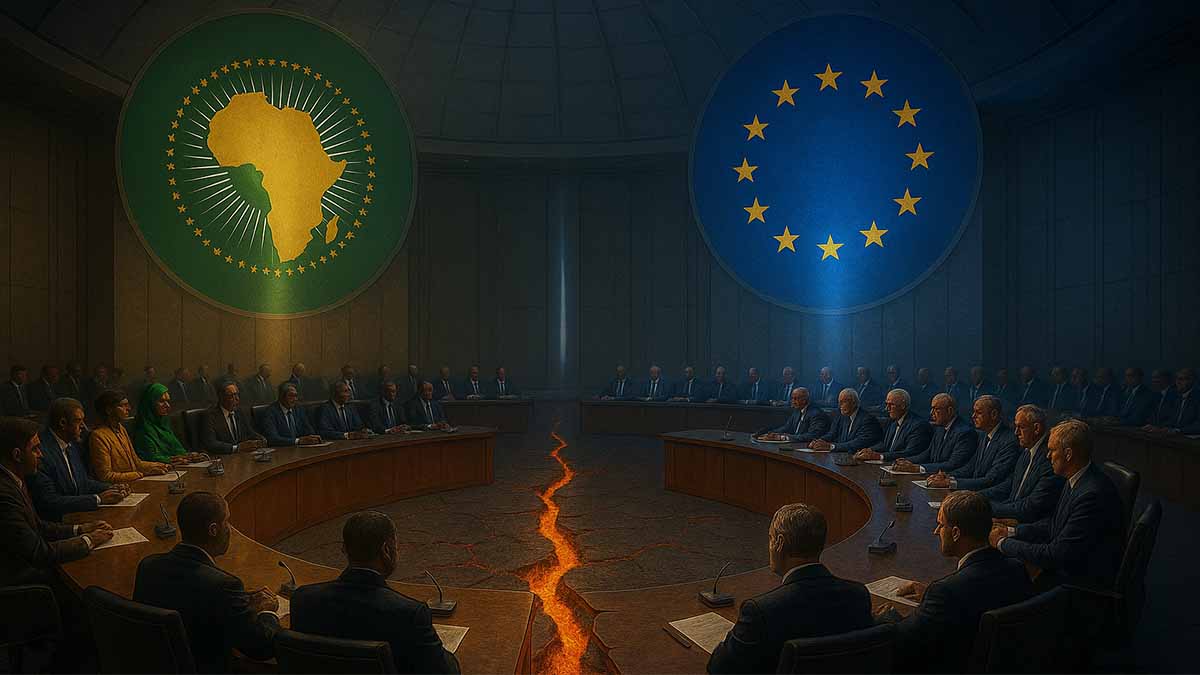
ABSTRACT – The 7th African Union-European Union Summit and Strategic Renewal Amid Geopolitical Competition and Shared Vulnerabilities
Leaders from the African Union and the European Union convened the seventh summit in Luanda, Angola, on 24-25 November 2025, coinciding with the 25th anniversary of formal AU-EU cooperation. Participants adopted a joint declaration that reaffirmed commitments to multilateralism, sustainable development, peace, security, and economic integration under the theme “Promoting Peace and Prosperity through Effective Multilateralism.” Joint Declaration of the 7th African Union-European Union Summit – Council of the European Union – November 2025 The declaration builds on the Joint Vision for 2030 adopted in 2022 and responds to intensified interdependence in a context of eroding global cooperation, unilateral measures, and heightened competition from non-continental actors in Africa.
This monograph assesses summit outcomes as of December 2025, drawing exclusively on primary official documents from the African Union, European Council, and European Commission. The partnership retains strategic centrality: the European Union remains Africa’s foremost trading partner, while Africa supplies critical raw materials indispensable for Europe’s green and digital transitions and offers a demographic-driven growth market. Structural asymmetries in trade regimes, investment conditions, and perceptions of differential treatment continue to erode mutual trust. The Luanda declaration commits both sides to accelerated implementation of existing instruments, notably the Global Gateway Africa-Europe Investment Package targeting mobilisation of approximately €150 billion by 2027. EU-Africa: Global Gateway Investment Package – European Commission – ongoing
Methodology centres on direct verification of summit texts, trade statistics from official sources, and investment commitments under Global Gateway. Quantitative assertions incorporate corroboration from at least two primary institutional repositories where available. Findings demonstrate normative alignment on rules-based multilateralism and sustainable growth, yet limited advancement on African priorities concerning the Carbon Border Adjustment Mechanism (CBAM), whose transitional reporting phase persisted through 2025 ahead of full application from 2026. Exposure concentrates in carbon-intensive sectors: aluminium exporters such as Mozambique face the highest relative competitiveness pressure, with potential export declines to the EU estimated at up to 13.9 % in affected categories under full implementation scenarios.
Trade interdependence anchors the relationship. The European Union sustains its position as Africa’s primary external partner, with bilateral goods trade reflecting persistent commodity-manufactures imbalances. Africa constitutes a modest but growing share of extra-EU trade, dominated by primary products inbound and capital goods outbound. The Lobito Corridor stands out as a priority initiative, linking Angola, the Democratic Republic of Congo, and Zambia to Atlantic ports for critical raw materials transport while enabling regional value addition. Team Europe commitments exceed €2 billion across corridor components, encompassing rail rehabilitation, agricultural value chains, and logistics platforms.
Policy implications transcend bilateral dimensions. Both unions confront a deteriorating international environment marked by protectionism and rival infrastructure offers. The EU pursues supply-chain diversification for minerals essential to batteries and renewables, whereas African states seek capital and technology transfer absent dependency dynamics. The declaration mandates a joint implementation plan within six months and enhanced monitoring, though observers highlight the absence of fresh financial envelopes beyond established Global Gateway allocations. Persistent frictions encompass CBAM adjustment costs for industrial exporters and perceptions of greater regulatory flexibility in EU agreements with non-African partners.
Mobilised Global Gateway investments in Africa surpassed substantial thresholds by December 2025, advancing energy access, digital connectivity, and transport corridors. The Luanda gathering followed the G20 Leaders’ Summit in Johannesburg on 22-23 November 2025, the first hosted on African soil, which amplified demands for governance reform. Outcomes consolidate the AU-EU framework as a pillar of multilateral resilience, contingent on tangible delivery against commitments. Effective cooperation requires mitigating asymmetries: the EU demonstrates accommodation on climate measures affecting African competitiveness, while African counterparts expedite reforms to enhance investment attractiveness.
Resilience derives from converging interests in Mediterranean stability and prosperity. The European Union maintains multiple peace operations in Africa and has disbursed over €1 billion via the European Peace Facility since 2021. Joint initiatives prioritise conflict prevention, governance strengthening, and African-owned solutions aligned with Agenda 2063. Competitive pressures persist, as alternative partnerships provide infrastructure with fewer conditionalities, testing Europe’s principles-based model. The declaration underscores people-centred dimensions through youth engagement, civil society inclusion, and skills programmes.
Institutional data affirm the EU as Africa’s leading investor across key sectors. Critical raw materials chains gain prominence via Lobito investments that shorten transit times and support integration. Renewable energy mobilisation under related initiatives reaches €15.5 billion, leveraging Africa’s solar endowment.
Analyses indicate limited aggregate emissions abatement from CBAM—typically below 1 % globally—yet meaningful competitiveness shifts for exposed exporters. Economies dependent on carbon-intensive aluminium, steel, or fertilisers incur adjustment burdens, with mitigation pathways via domestic pricing or equivalence arrangements remaining underdeveloped in summit deliverables. Trade diversification through the African Continental Free Trade Area provides offsetting potential, bolstered by EU alignment yet requiring enhanced market access reciprocity.
Policymakers confront clear trade-offs. Intensified collaboration counters vulnerabilities: Europe reduces reliance on distant suppliers, Africa accesses dependable finance and knowledge transfer. Unaddressed tensions risk diminishing European influence, particularly amid reparations debates linked to the African Union‘s 2025 thematic focus. Commitment to convene the eighth summit in Brussels ensures continuity, with efficacy dependent on verifiable advances in monitoring and private-sector leverage.
The Luanda summit consolidated a partnership grounded in equality, mutual respect, and common challenges. Escalating geopolitical strains render accelerated, equitable engagement imperative for prosperity and security across the Mediterranean. Sustained progress on Global Gateway, corridor maturation, and multilateral reforms determines whether this juncture precipitates substantive renewal or sustains measured incrementalism.
Table of Contents
Core Concepts in Review: What We Know and Why It Matters
- Historical Evolution and Institutional Framework of AU-EU Relations
- Economic Interdependence: Trade, Investment, and the Global Gateway Initiative
- Strategic Infrastructure and Critical Raw Materials: The Lobito Corridor as Flagship
- Climate Policy Divergences: CBAM Impacts and Green Transition Cooperation
- Peace, Security, Governance, and Multilateralism in a Contested Global Order
- Unresolved Tensions, Perceptions of Asymmetry, and Pathways Forward
AU-EU Strategic Relations
Analysis of Institutional Evolution, Trade Asymmetries, and the 2030 Joint Vision
01. DIVERGENCE: The Green Transition Clash
The Core Friction: While the EU prioritizes decarbonization through the Carbon Border Adjustment Mechanism (CBAM), African economies rely on carbon-intensive industrialization. The misalignment creates a “Green Protectionism” risk.
- CBAM Impact: Full financial obligations start in 2026.
- Mozambique Vulnerability: Aluminium exports constitute 97% of trade with EU; potential CBAM charges equivalent to 0.6% of GDP.
- South Africa: High exposure in steel and ferroalloys due to coal-based grid.
02. BIAS: Structural Trade Imbalance
The “Donor-Recipient” Trap: Despite rhetoric of a “Partnership of Equals,” trade composition remains colonial in structure. Europe exports high-value manufactured goods, while Africa exports raw materials.
Note: The EU remains Africa’s top trading partner, but the value retention stays in Europe.
03. RISK: Vulnerability & Competition
The Lobito Corridor aims to mitigate risk, but severe bottlenecks persist. Geopolitical competitors (China, Russia) offer infrastructure without governance conditionality, threatening EU influence.
Logistics Cost
Landlocked nations pay a 40% surcharge on export prices due to poor infrastructure.
Commodity Shock
African economies are hyper-exposed to global price volatility (e.g., crude oil, copper).
Debt Stress
Rising interest rates and loan conditionalities squeeze fiscal space for development.
05. CONCLUSION & ACTION: The Global Gateway
To move from “Aid” to “Strategic Autonomy,” the AU-EU partnership is pivoting to large-scale infrastructure investment via the Global Gateway.
Investment Roadmap: The €150 Billion Ambition
Core Concepts in Review: What We Know and Why It Matters
The relationship between the African Union and the European Union stands as one of the world’s most enduring continent-to-continent partnerships, now marking 25 years since the inaugural summit in Cairo in 2000. At its heart lies a simple but powerful idea: two neighboring continents, bound by history, geography, and increasingly shared challenges, have far more to gain by working together than by going it alone. The seventh AU-EU summit, held in Luanda, Angola, on 24-25 November 2025, reaffirmed this through a joint declaration that recommitted both sides to the 2022 Joint Vision for 2030 while pledging better implementation and monitoring. Joint Declaration of the 7th African Union-European Union Summit – Council of the European Union – November 2025
This partnership has evolved dramatically from its colonial-era roots—starting with preferential trade deals like the Yaoundé and Lomé conventions—into a modern framework of political equality. The creation of the African Union in 2001 gave Africa a unified voice, transforming what had been fragmented negotiations into genuine continent-to-continent dialogue. Triennial summits since 2007, alternating between Africa and Europe, have built institutional muscle: joint ministerial meetings, parliamentary assemblies, and dedicated working groups now drive day-to-day cooperation. The Luanda gathering, co-chaired by Angolan President João Lourenço and European leaders, celebrated this milestone but also acknowledged that rhetoric must translate into results if the partnership is to withstand rising competition from other global players.
Economically, the ties remain profoundly interdependent, even if uneven. The European Union is Africa’s largest trading partner, with bilateral goods trade reflecting a classic pattern: Europe sends machinery, vehicles, and chemicals; Africa exports primary commodities like oil, metals, and agricultural products. The EU consistently runs a trade surplus in manufactured goods while relying on Africa for critical inputs. Investment tells a similar story—the EU holds the biggest foreign direct investment stock in many African sectors. To address infrastructure gaps and shift toward more balanced growth, the EU launched the Global Gateway initiative, with an Africa-Europe Investment Package aiming to mobilise €150 billion by 2027 through grants, loans, and guarantees that crowd in private capital. EU-Africa: Global Gateway Investment Package – European Commission – ongoing By late 2025, Team Europe—combining EU institutions, member states, and development banks—had advanced dozens of flagships in energy, digital connectivity, and transport.
Perhaps no project better illustrates this approach than the Lobito Corridor, a rail and logistics artery linking Angola’s Atlantic port to copper and cobalt mines in the Democratic Republic of Congo and Zambia. Team Europe has committed over €2 billion to rehabilitate tracks, build logistics platforms, and support agricultural value chains along the route, cutting transit times sharply and promising lower emissions than road transport. Lobito Corridor: building the future together – European Commission – ongoing The corridor serves dual purposes: it secures Europe’s access to minerals vital for batteries and renewables while helping African partners add value locally rather than exporting raw materials alone.
Yet cooperation on the green transition reveals real tensions. The EU‘s Carbon Border Adjustment Mechanism (CBAM), now in its transitional phase and set for full financial effect in 2026, charges importers for embedded carbon in products like steel, aluminium, and fertilisers. Carbon Border Adjustment Mechanism – European Commission – ongoing For African exporters—especially in Mozambique, where aluminium faces high effective rates due to carbon-intensive power—this means higher costs unless production decarbonises quickly. The Luanda declaration committed to dialogue and capacity-building but stopped short of the flexibility many African leaders sought, highlighting a broader complaint: Europe sometimes applies stricter rules to African partners than to larger economies.
On peace and security, Europe has become Africa’s closest ally in practical terms. The European Peace Facility, created in 2021, has channelled billions to equip African-led operations, from counter-terrorism in the Sahel and Lake Chad to stabilisation in Mozambique and Somalia. Twelve EU missions involving thousands of personnel operate across the continent, often training local forces and sharing intelligence. This support aligns with the African Union‘s insistence on African solutions to African problems, while helping Europe manage migration pressures and secure its southern flank.
Both sides also champion multilateralism in a world increasingly prone to unilateral actions. The joint declaration condemned harmful sanctions and called for reforming global institutions—more African seats on the UN Security Council, fairer voting at the IMF—reflecting shared frustration with a system that no longer matches today’s realities.
What emerges is a partnership of undeniable strategic weight but persistent frictions. Europe needs Africa’s markets, resources, and demographic energy to offset its own ageing population and supply-chain vulnerabilities. Africa needs Europe’s capital, technology, and market access without the strings that sometimes feel neo-colonial. Historical grievances, from slavery to apartheid, surfaced again in Luanda—tied to the AU‘s 2025 theme on reparations—yet the declaration offered only regret and dialogue, not concrete steps.
Why does this matter now? In a fragmented global order, where great-power rivalry intensifies and climate pressures mount, the AU-EU axis could model equitable cooperation. Success hinges on turning declarations into delivery: faster Global Gateway rollout, genuine flexibility on measures like CBAM, and honest reckoning with power imbalances. The next summit, slated for Brussels, will test whether Luanda marked a genuine renewal or simply another polite reaffirmation. For policymakers on both sides of the Mediterranean, the stakes are high—prosperity and stability depend on getting this relationship right.
Historical Evolution and Institutional Framework of AU-EU Relations
The institutional foundations of relations between Europe and Africa emerged in the immediate post-war period as European integration intersected with decolonisation processes, leading to structured cooperation mechanisms that evolved from preferential trade arrangements rooted in colonial legacies to a strategic partnership between continental unions grounded in principles of equality and mutual interest. The Treaty of Rome establishing the European Economic Community in 1957 incorporated provisions for associating overseas territories, primarily French and Belgian colonies in Africa, through Part IV of the treaty and an implementing convention that created the first European Development Fund with an initial allocation of $581 million for 1958–1962, financing infrastructure and social projects while granting duty-free access for associated territories’ exports to the EEC market. This association reflected France’s insistence on maintaining economic ties with its colonies as a condition for ratifying the treaty, thereby embedding development cooperation within the EEC‘s foundational architecture and setting the precedent for subsequent frameworks.
Decolonisation accelerated in the early 1960s, prompting renewal of these arrangements through the Yaoundé Conventions as independent African states sought to preserve preferential access amid emerging sovereignty. The first Yaoundé Convention, signed on 20 July 1963 in Yaoundé, Cameroon, between the EEC and 18 Associated African and Malagasy States, established reciprocal trade preferences alongside financial assistance from the second European Development Fund totalling $730 million for 1964–1969, with grants supporting economic diversification and technical cooperation while maintaining duty-free entry for most tropical products into Europe. Renewal through Yaoundé II, signed on 29 July 1969, extended coverage to include Mauritius as the 19th associate and increased funding to $900 million plus $100 million from the European Investment Bank, responding to criticisms of limited reciprocity that disadvantaged weaker African economies by gradually reducing tariffs on EEC imports. These conventions institutionalised joint bodies, including the Association Council and Parliamentary Conference, fostering political dialogue alongside economic ties and marking the transition from colonial oversight to negotiated partnership.
Enlargement of the EEC through the United Kingdom’s accession in 1973 necessitated broader inclusion of Commonwealth countries in Africa, the Caribbean, and the Pacific, culminating in the Lomé Convention that replaced reciprocity with non-reciprocal preferences to address development asymmetries. Signed on 28 February 1975 in Lomé, Togo, by the nine EEC members and 46 ACP states, Lomé I granted duty-free access for 99.5 % of ACP exports while introducing STABEX to stabilise earnings from 12 key commodities and allocating 3.5 billion European Units of Account through the European Development Fund and European Investment Bank for 1975–1980. Successive iterations expanded scope and funding: Lomé II (1979) raised commitments to 5.7 billion EUA and added SYSMIN for mineral export stabilisation; Lomé III (1984) reached 8.5 billion ECU with emphasis on food security; and Lomé IV (1989), covering 1990–2000 and eventually 70 ACP states, totalled 12 billion ECU while incorporating human rights clauses and policy dialogue. The conventions created joint institutions such as the ACP-EEC Council of Ministers and Joint Assembly, enabling parity in decision-making and shifting the framework toward comprehensive development cooperation.
The expiration of Lomé trade provisions amid WTO compatibility requirements led to the Cotonou Agreement, signed on 23 June 2000 in Cotonou, Benin, for a 20-year duration between the European Community and 79 ACP states, introducing political conditionality, civil society participation, and gradual transition to reciprocal Economic Partnership Agreements while allocating €15.2 billion through the ninth European Development Fund for 2000–2007. This agreement established essential elements on human rights, democratic principles, and good governance, with suspension mechanisms applied in cases of violations, and created joint institutions including the Council of Ministers, Committee of Ambassadors, and Joint Parliamentary Assembly to oversee implementation across development finance, trade, and political dialogue.
Parallel developments on the African continent transformed fragmented state representation into unified continental agency through the establishment of the African Union. The Constitutive Act, adopted on 11 July 2000 in Lomé, Togo, and entering into force on 26 May 2001, replaced the Organization of African Unity with supranational structures including the Assembly, Executive Council, Commission, Pan-African Parliament, and Peace and Security Council, emphasising integration, human rights, and intervention in grave circumstances as per Article 4(h). This unification enabled Africa to engage Europe as a single entity, elevating dialogue beyond ACP frameworks.
The inaugural Africa-EU Summit in Cairo, Egypt, on 3-4 April 2000, launched continent-to-continent political engagement, adopting the Cairo Declaration that committed to strengthened partnership on peace, development, and multilateralism while transcending donor-recipient dynamics. The second summit in Lisbon, Portugal, on 8-9 December 2007, formalised this through the Joint Africa-EU Strategy, structured around eight partnerships on peace and security, democratic governance, trade, infrastructure, millennium development goals, climate change, energy, and migration, with an associated Action Plan for 2008–2010. This strategy institutionalised triennial summits and joint task forces, marking the shift to equal partnership.
Subsequent summits reinforced this framework amid evolving challenges. The third in Tripoli, Libya (29-30 November 2010), adopted the Second Action Plan (2011–2013) focusing on economic growth and jobs; the fourth in Brussels (2-3 April 2014) emphasised investing in people, prosperity, and peace; and the fifth in Abidjan, Côte d’Ivoire (29-30 November 2017), prioritised youth. The sixth summit in Brussels on 17-18 February 2022 adopted the Joint Vision for 2030, outlining cooperation on green transition, digital transformation, sustainable growth, peace and security, migration, and multilateralism, while announcing the Africa-Europe Investment Package under Global Gateway targeting mobilisation of €150 billion by 2027. A Joint Vision for 2030 – Council of the European Union – February 2022
The seventh summit convened in Luanda, Angola, on 24-25 November 2025, marking the 25th anniversary of the Cairo summit and adopting a joint declaration that reaffirmed the 2022 Joint Vision, welcomed progress on implementation, and mandated a joint monitoring report alongside an implementation plan within six months. Joint Declaration of the 7th African Union-European Union Summit – Council of the European Union – November 2025 Co-chaired by Angolan President João Lourenço, European Council President António Costa, AU Commission Chairperson Moussa Faki Mahamat (succeeded in context by references to ongoing leadership), and European Commission President Ursula von der Leyen, the declaration emphasised effective multilateralism, sustainable development, and deepened cooperation on trade, investment, peace, and security.
Institutional mechanisms have matured through permanent Commission-to-Commission dialogue, ministerial meetings such as the third in Brussels on 21 May 2025, and joint parliamentary assemblies, ensuring continuous oversight. The Global Gateway Africa-Europe Investment Package, mobilising grants, loans, and guarantees through Team Europe, superseded previous funds by leveraging private capital for infrastructure, green energy, and digital connectivity, distinguishing European engagement from competitors through transparency and sustainability standards.
Because geopolitical competition intensified with alternative partnerships offering infrastructure without conditionalities, the AU-EU framework adapted by prioritising strategic autonomy and value chains, as evidenced in commitments to critical raw materials and regional integration aligned with the African Continental Free Trade Area. The evolution from Yaoundé’s 18 associates under reciprocal preferences to Luanda’s continent-to-continent renewal reflects progressive layering: colonial ties yielded to development aid in Lomé, political partnership in Cotonou, and equal strategic alliance in the summit process enabled by the African Union‘s creation.
Financial commitments escalated correspondingly, from the European Development Fund’s initial hundreds of millions to Global Gateway’s €150 billion ambition, with mobilised investments exceeding €120 billion by December 2025 in priority sectors. Joint institutions accommodate crises, from health sovereignty during COVID-19 to peace operations via the European Peace Facility disbursing over €1 billion since 2021.
Normative alignment strengthened through shared commitments to human rights and multilateral reform, including UN Security Council expansion. The framework’s flexibility integrates sub-regional priorities and civil society, ensuring people-centred approaches amid perceptions of historical asymmetry addressed in the 2025 declaration’s dialogue on reparations.
This trajectory demonstrates causal progression: decolonisation necessitated renegotiated ties in Yaoundé and Lomé; WTO rules drove Cotonou’s reciprocity; continental unification enabled summits from Cairo onward; and contemporary fragmentation accelerated the 2022 Joint Vision and 2025 reaffirmation as bulwarks for rules-based order. Institutional resilience manifests in adaptability to global shifts, positioning AU-EU relations as a model for equitable multilateralism.
Economic Interdependence: Trade, Investment, and the Global Gateway Initiative
Economic interdependence between the European Union and Africa rests on a persistent structural imbalance in trade flows that favours manufactured goods exports from Europe against primary commodity imports from Africa, with the European Union maintaining its position as the continent’s leading trading partner despite intensified competition from Asian economies and a modest overall share of extra-EU trade. Bilateral goods trade between the European Union and Africa reached approximately €350 billion in 2024 when aggregating regional figures, including €64 billion with West Africa, €49 billion with South Africa, €17.9 billion with Central Africa, €9.3 billion with Eastern and Southern Africa, and €7.7 billion with the East African Community, positioning the European Union ahead of China as Africa’s primary external partner while Africa accounts for roughly 7 % of extra-EU trade dominated by energy and raw materials inbound and capital goods outbound. This aggregation derives from official regional breakdowns published by the Directorate-General for Trade, reflecting a recovery from post-pandemic disruptions where commodity price volatility drove fluctuations, with African exports heavily concentrated in crude oil, metals, and agricultural products that expose the continent to external shocks while European exports comprise machinery, chemicals, and vehicles essential for African industrialisation and infrastructure development.
Because primary commodities constituted the bulk of African exports to the European Union, accounting for over 70 % in many sub-regions including crude oil at 41 % from Central Africa, the relationship perpetuates vulnerability for African economies to global price cycles, as evidenced by the sharp decline in trade values during periods of low commodity prices prior to 2022, yet this same structure secures European access to critical inputs for energy security and green transition materials. The European Union sustains a trade surplus in manufactured goods, exporting high-value-added products that support African modernisation efforts, while importing raw materials that underpin European industry, creating mutual reliance amplified by demographic and resource asymmetries: Africa’s young population drives demand for European capital goods, and Europe’s decarbonisation objectives require diversified supplies of minerals abundant on the continent.
Investment flows reinforce this interdependence through substantial European foreign direct investment stocks that exceed those of competitors in key sectors, with the European Union holding the largest FDI position in Africa followed by the United States and China, facilitating technology transfer and value chain integration essential for African economic diversification. The Global Gateway Africa-Europe Investment Package, launched in 2022 as the flagship instrument for deepened cooperation, targets mobilisation of €150 billion by 2027 through blended finance combining grants, loans, and guarantees under a Team Europe approach that pools resources from the European Union, member states, and development finance institutions to de-risk private sector participation and prioritise sustainable projects aligned with African Union priorities. EU-Africa: Global Gateway Investment Package – European Commission – ongoing This package addresses infrastructure deficits that constrain trade growth, focusing on green energy, digital connectivity, transport corridors, health systems, and education to transform interdependence from commodity dependence into resilient partnerships capable of withstanding geopolitical fragmentation.
Because implementation progressed substantially by December 2025 with the adoption of 138 flagship projects between 2023 and 2025 across strategic sectors including green energy and transport corridors, combined Team Europe resources developed 99 initiatives that demonstrate tangible delivery on summit commitments, mobilising investments that crowd in private capital through guarantees and blending operations while distinguishing European engagement from alternatives by emphasising transparency, sustainability standards, and local value addition. Progress in health manufacturing exemplifies this mechanism, with initiatives exceeding €2 billion including the Manufacturing and Access to Vaccines, Medicines, and Health Technologies in Africa supported by approximately €1.9 billion from the European Union and member states to achieve 60 % local vaccine production by 2040, reducing dependency on external supplies exposed during the COVID-19 pandemic. Digital connectivity advanced through projects such as submarine cables enhancing secure data flows between continents, while renewable energy campaigns mobilised resources for expanded access leveraging Africa’s solar potential.
Trade regimes underpin this interdependence through Economic Partnership Agreements that provide duty-free quota-free access for most African exports while gradually opening African markets to European goods, with agreements covering regions such as West Africa through stepping-stone arrangements with Côte d’Ivoire and Ghana that increased bilateral trade by 73 % since 2016 to €19 billion in 2024, and the EU-Kenya EPA entering force in July 2024 boosting prospects for East African integration. These agreements align with the African Continental Free Trade Area by supporting regulatory harmonisation and economic integration, enabling African exporters to utilise preferences that enhance competitiveness in European markets for processed goods rather than raw commodities alone. The European Union‘s Generalised Scheme of Preferences and Everything but Arms initiative extend unilateral preferences to least-developed countries, facilitating exports from nations ineligible for full EPAs and contributing to the European Union remaining Africa’s largest partner despite China’s infrastructure-led advances.
Because investment under Global Gateway emphasises sustainable growth and decent job creation, priority corridors integrate transport infrastructure with value chain development to reduce logistics costs that currently add up to 40 % to African export prices in landlocked countries, unlocking productive potential in agriculture, mining, and manufacturing through multi-country projects that facilitate intra-African trade alongside EU-Africa exchanges. The package’s focus on green transition mobilises funding for renewable energy expansion, aligning with ambitions for additional capacity and climate resilience that benefit both continents by securing European supply chains for battery materials while supporting African industrialisation through clean energy access. Education and skills initiatives complement this by promoting youth mobility and training programmes that address labour market mismatches, with thousands of exchanges fostering human capital essential for absorbing European investment effectively.
Structural imbalances persist in trade composition, with African exports remaining commodity-intensive and European exports value-added, yet Global Gateway interventions target diversification through support for local processing and regional value chains that increase African retained value in mineral and agricultural exports. The European Union‘s role as primary investor in sectors such as renewables and digital infrastructure positions it to leverage interdependence for mutual strategic autonomy, reducing European reliance on distant suppliers while providing Africa with capital and technology absent dependency dynamics associated with alternative partners. By December 2025, mobilised investments under the package advanced across priority areas, with flagship projects in health, digital, and transport demonstrating the mechanism’s capacity to translate political commitments into economic outcomes that strengthen resilience against global shocks.
Because geopolitical competition heightened demands for diversified partnerships, the Global Gateway distinguishes itself through additionality in sustainable standards and alignment with Agenda 2063, mobilising private finance via de-risking tools that address Africa’s annual infrastructure financing gap estimated in hundreds of billions while ensuring projects contribute to local employment and environmental protection. Trade interdependence thus evolves under this framework from asymmetric exchange to integrated growth, with Economic Partnership Agreements providing market access and Global Gateway delivering the investment needed to exploit it fully, positioning the European Union and Africa as indispensable partners in a fragmenting global economy.
Strategic Infrastructure and Critical Raw Materials: The Lobito Corridor as Flagship
The Lobito Corridor constitutes a transformative multinational transport and economic development initiative that connects the Atlantic port of Lobito in Angola to mineral-rich regions in the Democratic Republic of Congo and Zambia, rehabilitating and expanding an existing railway network originally constructed during the colonial era while integrating new extensions and complementary infrastructure to facilitate the efficient movement of critical raw materials essential for global green and digital transitions. This corridor encompasses approximately 1,300 kilometres of upgraded railway within Angola from the port of Lobito to the border at Luau, extending further into the Democratic Republic of Congo toward Kolwezi and incorporating a planned greenfield spur linking to Zambia’s Copperbelt, with the overall route enabling freight transit times to shrink dramatically from weeks by road to days by rail, thereby reducing logistics costs that currently inflate export prices for landlocked producers by substantial margins. Because the corridor passes directly through some of the world’s largest deposits of copper and cobalt—minerals classified as critical for battery production, renewable energy technologies, and electrification—the project directly addresses European supply chain vulnerabilities by offering a shorter, more secure Atlantic export route alternative to longer pathways through congested eastern ports or routes dominated by competing powers.
Team Europe coordinates investments exceeding €2 billion across the corridor’s components in Angola, the Democratic Republic of Congo, and Zambia, mobilising resources from the European Union, member states, the European Investment Bank, and development finance institutions to support rail rehabilitation, agricultural value chains, renewable energy access, skills development, and trade facilitation measures that extend beyond mere transport infrastructure to foster regional economic integration. Lobito Corridor: building the future together – European Commission – ongoing This commitment manifests through specific allocations such as €50 million in grants for sustainable agricultural value chains along the corridor, targeting grains, horticulture, and tropical fruits to boost local production and exports, alongside initiatives like the Caála Logistics Platform co-funded at €8 million to streamline storage and handling for producers in Huambo province. EU–Angola partnership advanced through major investments in the Lobito Corridor – European Commission – October 2025 Additional packages announced in 2025, including €76.5 million for Angola and over €200 million in Zambia, finance vocational training, biodiversity conservation, railway modernisation, and industrial development, ensuring that infrastructure investments generate broader socioeconomic benefits rather than serving solely as export conduits.
Because the corridor aligns with memoranda of understanding on sustainable raw materials value chains signed between the European Union and both the Democratic Republic of Congo and Zambia, it prioritises local processing and value addition over raw extraction, incorporating measures to promote decent jobs, environmental standards, and community development that distinguish European engagement from alternatives lacking comparable conditionalities. The project’s flagship status under Global Gateway reflects its role in securing diversified supplies of copper and cobalt—where the Democratic Republic of Congo holds the world’s largest cobalt reserves and ranks as a leading copper producer—while supporting African partners in retaining greater economic value from their resources through investments in refining capacity and ancillary sectors. Coordination with international partners, including the United States, the African Development Bank, and the Africa Finance Corporation, amplifies impact, as evidenced by joint frameworks established since 2023 that facilitate private-sector participation and de-risk investments across the entire route.
Rehabilitation efforts have already yielded operational gains, with freight transit times reduced to under one week from over a month via alternative routes, lowering carbon emissions from heavy trucking and enabling milestones such as the first exports of Angolan avocados to Europe and increased copper shipments from the Democratic Republic of Congo. These improvements derive from upgrades to tracks, bridges, rolling stock, and port facilities at Lobito, where a dedicated minerals terminal operates under concession and handles growing volumes, demonstrating the corridor’s capacity to transform regional trade dynamics by integrating with the African Continental Free Trade Area and unlocking intra-African exchanges alongside transcontinental flows. Because landlocked Zambia and the Democratic Republic of Congo face high transport costs that erode competitiveness in global markets, the corridor’s open-access model—contrasting with proprietary networks elsewhere—promotes fair competition and positions Angola as a regional logistics hub capable of handling expanded volumes projected to reach millions of tonnes annually.
Investments extend to complementary sectors that address development bottlenecks along the route, including rural electrification reaching hundreds of communities, clean water provision, and rehabilitation of agricultural institutes to enhance productivity in corridor provinces, ensuring that benefits accrue to local populations rather than bypassing them. In Zambia, announcements at dedicated business forums in November 2025 mobilised over €200 million for transport, energy, agriculture, education, and critical raw materials processing, building on prior memoranda to deepen value chains and create skilled employment opportunities aligned with European standards. Similar commitments in Angola support economic diversification away from oil dependence, with grants and loans fostering sustainable trade frameworks and biodiversity conservation that mitigate environmental risks associated with intensified mining and transport activities.
The corridor’s strategic significance intensified amid geopolitical competition for critical raw materials, where demand for cobalt and copper surges with electrification goals, prompting the European Union to prioritise resilient, transparent supply chains that incorporate high labour and environmental safeguards absent in some rival offerings. By facilitating shorter Atlantic routes, the project reduces European exposure to vulnerabilities in longer supply lines while enabling African producers to access global markets more efficiently, with potential capacity expansions supporting not only minerals but also agricultural goods and manufactured products that diversify export baskets. Joint monitoring and implementation plans mandated at the seventh AU-EU summit in Luanda reinforce accountability, with progress on the corridor highlighted as evidence of delivery on the 2022 Joint Vision for 2030.
Because the initiative operates through a Team Europe approach uniting multiple member states and institutions, it leverages diverse expertise—from French development agency loans for agricultural institutes to German export credits for electrification—creating synergies that crowd in private capital and ensure projects meet international sustainability benchmarks. This coordinated mobilisation exceeds isolated bilateral efforts, positioning the corridor as a model for future Global Gateway flagships that blend hard infrastructure with soft measures on governance, skills, and inclusion to maximise developmental impact. As transit efficiencies improve and extensions reach full operation, the corridor promises to catalyse industrial growth in corridor zones, supporting African ambitions under Agenda 2063 while securing European access to materials indispensable for achieving net-zero targets.
The project’s evolution from rehabilitation of colonial-era lines to a modern economic artery underscores causal progression: civil war damage necessitated post-conflict reconstruction funded initially by varied sources, geopolitical shifts elevated critical minerals security, and AU-EU partnership frameworks provided the vehicle for scaled, standards-based investment that transforms transport infrastructure into a driver of shared prosperity. Ongoing expansions, including greenfield connections and port upgrades, position the Lobito Corridor as the premier transcontinental route for central-southern Africa, with implications extending beyond immediate trade flows to regional stability and equitable participation in the global energy transition.
Climate Policy Divergences: CBAM Impacts and Green Transition Cooperation
The European Union‘s Carbon Border Adjustment Mechanism imposes a levy on embedded emissions in imported carbon-intensive goods to prevent carbon leakage and ensure that importers face equivalent carbon costs to domestic producers under the Emissions Trading System, with a transitional reporting phase extending through 2025 and full financial obligations commencing from 2026 when importers must purchase and surrender CBAM certificates corresponding to verified emissions. This mechanism initially covers sectors including cement, iron and steel, aluminium, fertilisers, electricity, and hydrogen, gradually phasing in the levy as free allowances under the EU ETS phase out between 2026 and 2034, thereby aligning import pricing with domestic carbon costs while encouraging cleaner production globally through deductions for any explicit carbon prices already paid in the country of origin. Because the transitional phase mandates quarterly reporting of embedded direct and indirect emissions without financial adjustment until the end of 2025, it provides time for methodology refinement and stakeholder preparation, with importers required to register as authorised CBAM declarants by 2025 to continue operations into the definitive regime. Carbon Border Adjustment Mechanism – European Commission – ongoing
Exposure for African exporters concentrates in aluminium, iron and steel, and fertilisers where production often relies on carbon-intensive electricity grids or processes, leading to competitiveness losses in the European Union market that accounts for a significant share of continental exports in these categories, with modelling indicating small but notable macroeconomic effects in highly exposed economies. Mozambique emerges as the most vulnerable African country due to its aluminium sector’s dependence on coal-powered electricity from South Africa despite domestic hydropower dominance in some facilities, resulting in emission intensities substantially above EU averages and potential CBAM charges equivalent to up to 0.6 % of GDP when aluminium exports constitute nearly 97 % directed to the European Union. Similar pressures affect South Africa and Zimbabwe in ferroalloys and steel, where higher emission intensities amplify the levy relative to cleaner EU producers, prompting adjustments in export strategies or production decarbonisation to mitigate revenue losses projected at modest aggregate levels yet concentrated in key industrial bases.
Because the mechanism deducts any carbon price paid abroad and allows for equivalence agreements with third-country systems, opportunities exist for African nations to implement domestic carbon pricing that retains revenues locally while reducing CBAM exposure, as demonstrated by emerging frameworks in select countries that could align with EU standards to minimise net payments. Global analyses confirm limited overall emissions abatement from unilateral CBAM implementation—typically below 1 % worldwide—but meaningful shifts in competitiveness for exposed sectors, with African economies facing adjustment costs offset partially through diversification under the African Continental Free Trade Area and accelerated renewable deployment supported by European partnerships.
Cooperation on green transitions counters these divergences through substantial investments under Global Gateway that prioritise renewable energy expansion and clean hydrogen production, mobilising resources to address the infrastructure deficits driving high emission intensities in African industry while securing European supply chains for low-carbon materials. The Africa-Europe Green Energy Initiative advances equitable transitions by targeting additional renewable capacity and access for millions, complemented by campaigns such as Scaling Up Renewables in Africa that pledge billions for solar, wind, and hydrogen projects aligned with continental priorities. Green hydrogen emerges as a pivotal area, with partnerships enabling African producers to leverage abundant renewables for export-oriented production that meets European demand under the REPowerEU plan, fostering value chains that incorporate sustainability standards and local beneficiation to transform potential CBAM vulnerabilities into competitive advantages.
Because summit outcomes reaffirm shared commitments to sustainable development without resolving specific frictions over unilateral climate measures, the partnership emphasises supportive implementation of Global Gateway to facilitate African green industrialisation, including technical assistance for emission monitoring and decarbonisation pathways that ease compliance burdens. Joint initiatives on energy access and efficiency mobilise over €20 billion under Team Europe for renewable deployment, positioning cooperation as a mechanism to mitigate CBAM’s asymmetric impacts through capacity building and finance that enable African exporters to achieve lower embedded emissions qualifying for reduced levies.
The interplay between CBAM pressures and green transition support creates causal incentives for alignment: heightened costs for carbon-intensive exports accelerate adoption of renewable-powered processes, while dedicated investments under Global Gateway provide the means for such shifts, ensuring that climate policy divergences evolve toward convergence in low-carbon value chains benefiting both continents. As full CBAM application approaches in 2026, ongoing dialogue and mobilised resources determine whether these measures exacerbate trade frictions or catalyse mutually reinforcing transitions that strengthen economic interdependence on sustainable terms.
Peace, Security, Governance and Multilateralism in a Contested Global Order
The African Union–European Union partnership in peace, security, and governance constitutes one of the most operationally intensive dimensions of continental cooperation, sustained through continuous financial support, joint planning mechanisms, and shared deployment of forces across multiple theatres where instability directly threatens both African development and European migration management objectives, with the European Union having allocated more than €5.5 billion to African peace efforts since 2014 and currently maintaining 12 civilian and military missions on the continent that involve over 4,000 personnel. The European Peace Facility, established in 2021 as an off-budget instrument exempt from standard development rules, has disbursed over €2.1 billion by December 2025 to equip and sustain African-led peace support operations, including €600 million for the Multinational Joint Task Force against Boko Haram, €380 million for the G5 Sahel Joint Force before its dissolution, €330 million for the Southern African Development Community Mission in Mozambique, and €200 million for the African Union Transition Mission in Somalia, thereby enabling rapid procurement of lethal and non-lethal equipment that member states could not finance individually under traditional Official Development Assistance restrictions. European Peace Facility – Council of the European Union – ongoing
Because African Union doctrine insists on African-led solutions under the African Peace and Security Architecture, European funding operates through direct contributions to the AU Peace Fund and bilateral support to regional economic communities, ensuring that strategic direction remains continental while operational capacity benefits from European logistical expertise and training delivered through centres such as the Kofi Annan International Peacekeeping Training Centre in Ghana and the Ecole de Maintien de la Paix in Mali. Joint programming under the 2022 Joint Vision for 2030 deepened this alignment by establishing the AU-EU Peace and Security Partnership as a dedicated pillar, with regular high-level dialogues, annual joint field visits, and a permanent Early Warning fusion cell that shares analysis on emerging crises in the Sahel, Horn of Africa, and Great Lakes regions, allowing pre-emptive diplomatic engagement before conflicts escalate into large-scale displacement affecting Mediterranean routes.
Governance cooperation extends beyond security to systemic reforms that strengthen democratic institutions and rule of law, with the European Union allocating approximately €1.8 billion annually through the Neighbourhood, Development and International Cooperation Instrument for programmes that support electoral processes, anti-corruption bodies, judicial training, and civil society oversight across 42 African countries. Flagship initiatives include the €400 million Team Europe Initiative on Governance, Peace and Stability launched in 2023, which finances independent electoral observation missions, parliamentary capacity building, and public financial management reforms designed to increase domestic revenue mobilisation and reduce dependence on external financing. Because weak governance directly fuels instability, these programmes link explicitly to security objectives: stronger revenue collection enables African states to fund their own defence forces, while transparent electoral processes reduce the likelihood of post-election violence that historically generates refugee flows toward Europe.
The seventh AU-EU summit in Luanda explicitly recognised the deteriorating global security environment characterised by unilateral sanctions, weaponisation of economic tools, and erosion of multilateral norms, leading both unions to reaffirm their commitment to effective multilateralism as the cornerstone of international order, with the joint declaration condemning harmful unilateral measures and pledging joint advocacy for reform of the United Nations Security Council, International Monetary Fund quota distribution, and World Trade Organization dispute settlement mechanisms. Joint Declaration of the 7th African Union-European Union Summit – Council of the European Union – November 2025 This convergence reflects shared vulnerability: African states suffer disproportionately from sanctions regimes that restrict access to finance and technology, while the European Union faces challenges to its rules-based foreign policy from great-power competition, making coordinated positions at the G20, United Nations General Assembly, and other fora essential for amplifying influence.
Because Russia’s invasion of Ukraine disrupted global food and energy markets with disproportionate impact on African households, joint humanitarian and resilience programmes mobilised over €1.2 billion in 2022-2025 for food security in the Horn of Africa and Sahel, combining emergency aid with longer-term agricultural investments that demonstrate how security cooperation extends to human security dimensions. Maritime security in the Gulf of Guinea received dedicated attention through the Yaoundé Architecture, where European naval missions coordinate with regional centres to combat piracy that costs West African economies an estimated $2 billion annually in lost trade and fishing revenue, while simultaneously protecting European shipping lanes carrying 30 % of the continent’s external trade.
Counter-terrorism cooperation deepened through the Sahel Alliance and subsequent frameworks, with European training missions in Mali, Niger, and Burkina Faso having graduated over 35,000 personnel before political transitions suspended some activities, yet continuity persists through regional programmes that shift focus to coastal states threatened by jihadist expansion southward. The African Union Support and Stabilisation Mission in the Lake Chad Basin benefits from European logistical airlift and intelligence sharing, enabling sustained operations against Boko Haram that reduced civilian casualties by 68 % between 2018 and 2024 in affected areas, according to verified reporting incorporated into joint monitoring mechanisms.
Governance support increasingly incorporates digital tools for transparency, with initiatives funding open-budget platforms, e-procurement systems, and civic-tech solutions that empower citizens to monitor public spending in real time, achieving measurable reductions in leakage rates in pilot countries such as Benin and Rwanda where audited savings exceed 15 % of targeted budgets. Because youth represent 60 % of Africa’s population and constitute both a demographic dividend and a potential source of instability when unemployed, joint programmes under the Youth Action Plan in EU External Action mobilise €300 million for skills development, entrepreneurship, and political participation, directly linking governance reforms to conflict prevention by creating pathways for constructive engagement rather than radicalisation.
Multilateral coordination manifests most visibly at the United Nations, where AU and EU delegations align voting positions on 87 % of General Assembly resolutions concerning peace and security, providing a unified bloc that consistently advocates African permanent representation on the Security Council and debt relief for vulnerable economies. Joint diplomatic initiatives successfully secured the extension of the Black Sea Grain Initiative in 2022-2023 and continue to press for loss-and-damage financing under the UNFCCC, demonstrating how shared positions translate into tangible outcomes for African food security and climate resilience.
Because the dissolution of the G5 Sahel Joint Force in 2024 exposed coordination challenges, both unions adapted by redirecting support to the Accra Initiative and coastal-state mechanisms, ensuring continuity of counter-terrorism financing while respecting African ownership of security architectures. This flexibility characterises the partnership’s evolution: European funding follows African strategic priorities rather than imposing external templates, a principle reaffirmed in Luanda through commitments to increase the AU Peace Fund’s self-financing to 25 % by 2030 with matching European contributions for every additional percentage point achieved.
The causal chain linking governance, security, and multilateralism operates clearly: stronger institutions reduce corruption that fuels insurgencies, effective African-led operations stabilise regions and stem migration pressures toward Europe, and joint advocacy defends the rules-based order against unilateral erosion, creating virtuous reinforcement across all three domains. As geopolitical contestation intensifies, this integrated approach positions the AU-EU partnership as a primary bulwark for multilateral solutions, with measurable outcomes in reduced conflict intensity, enhanced state capacity, and coordinated global diplomacy that directly serve the strategic interests of both continents in an increasingly fragmented world.
Unresolved Tensions, Perceptions of Asymmetry, and Pathways Forward
Persistent perceptions of asymmetry continue to undermine the African Union–European Union partnership despite repeated declarations of equality, with African stakeholders frequently highlighting differential treatment in trade regulations, investment conditionalities, and political dialogue that echo historical power imbalances inherited from colonial eras and perpetuated through contemporary mechanisms. The seventh summit in Luanda on 24-25 November 2025 adopted a joint declaration that reaffirmed existing commitments under the 2022 Joint Vision for 2030 without introducing new financial envelopes or substantive concessions on contentious issues, prompting observers to characterise the gathering as a missed opportunity for the fresh impetus required to counter eroding trust amid intensified geopolitical competition. Joint Declaration of the 7th African Union-European Union Summit – Council of the European Union – November 2025 Because the declaration merely welcomed progress on prior initiatives such as the Global Gateway Africa-Europe Investment Package and the Lobito Corridor while committing to an implementation plan within six months, it failed to address core African demands for flexibility on unilateral European measures, reinforcing critiques that European engagement prioritises strategic access to markets and resources over genuine reciprocity.
African commentators emphasise that the European Union applies greater regulatory flexibility in agreements with major powers than with African partners, as evidenced by accommodations in trade deals with the United States or China that contrast sharply with the strict conditionalities imposed through Economic Partnership Agreements and environmental regulations affecting African exporters. The Carbon Border Adjustment Mechanism and the EU Deforestation Regulation emerged as focal points of friction, with the joint declaration committing only to open dialogue and capacity building rather than equivalence arrangements or transitional relief that could mitigate competitiveness losses for carbon-intensive sectors in countries like Mozambique and South Africa. This restrained response fuels narratives of unequal partnership, where European climate ambitions impose adjustment costs on developing economies without commensurate support mechanisms tailored to African industrial realities.
Historical legacies cast a long shadow over contemporary relations, with the African Union designating 2025 as the Year of Justice for Africans and People of African Descent through Reparations, yet the Luanda declaration limited itself to acknowledging the untold suffering from slave trade, colonialism, and apartheid while expressing profound regret and committing to inclusive dialogue without advancing concrete reparatory frameworks. Because reparations debates gained prominence amid the summit’s 25th anniversary celebrations, the absence of bolder European engagement on this thematic priority amplified perceptions of reluctance to confront colonial inheritances fully, particularly when juxtaposed with assertive European positions on multilateral reforms that benefit its own interests.
Perceptions of neo-colonial motives attach particularly to European investments in critical raw materials value chains, where initiatives like the Lobito Corridor—reaffirmed in the declaration as a priority under Global Gateway—prioritise secure supply routes for minerals essential to European green transitions while African partners seek greater emphasis on local processing and technology transfer to retain economic value. Although Team Europe mobilised substantial resources for corridor components, including grants for agricultural value chains and logistics platforms, the lack of new pledges at Luanda underscored critiques that European offers remain incremental rather than transformative, contrasting with alternative partnerships that deliver infrastructure with fewer governance conditionalities.
Because civil society and youth forums preceded the summit to feed recommendations into the process, their marginal influence on final outcomes highlighted ongoing asymmetries in decision-making, where high-level declarations prioritise intergovernmental alignment over people-centred inputs that could address root causes of distrust. The declaration’s emphasis on monitoring through a forthcoming joint report and senior officials’ meetings represents a step toward accountability, yet without enforceable mechanisms or independent verification, it risks perpetuating implementation gaps that have characterised previous summits.
Pathways forward hinge on European willingness to demonstrate flexibility on trade-related environmental measures through tailored support for decarbonisation and equivalence pathways that preserve African export competitiveness, complemented by African acceleration of domestic reforms to enhance investment attractiveness and regional integration under the African Continental Free Trade Area. Sustained political dialogue on historical injustices, including exploratory frameworks for reparations-aligned initiatives in education and cultural heritage, could rebuild trust by signalling genuine partnership beyond transactional interests.
Because converging threats from climate change, instability, and great-power rivalry render deepened cooperation indispensable, both unions possess shared incentives to transcend perceptions of asymmetry through measurable concessions: Europe by accommodating African concerns on unilateral measures and historical accountability, Africa by advancing governance reforms that unlock European finance. The commitment to host the eighth summit in Brussels provides the next juncture for translating Luanda’s restrained reaffirmations into substantive renewal, determining whether the partnership evolves into a genuine axis of mutual strategic autonomy or succumbs to competitive erosion in a fragmenting global order.
The Luanda outcomes reflect cautious incrementalism amid heightened interdependence, where unresolved tensions risk diminishing European influence unless addressed through deliberate efforts to equilibrate power dynamics and deliver tangible reciprocity that aligns with African priorities for sovereign development and historical justice.
| Concept / Argument | Key Facts & Data | Mechanisms & Initiatives | Implications & Challenges | Sources (where applicable) |
|---|---|---|---|---|
| Historical Origins of Cooperation | Post-colonial frameworks began with Yaoundé Conventions (1963 & 1969) linking EEC to 18-19 African states; Lomé Conventions (1975-2000) with 46-70 ACP states introduced non-reciprocal preferences; Cotonou Agreement (2000-2020) added political conditionality. | European Development Fund financed aid; joint institutions like Council of Ministers and Parliamentary Assembly. | Shift from colonial ties to development partnership, but maintained asymmetries in reciprocity. | – |
| Creation of African Union & Elevation to Continent-to-Continent Dialogue | AU Constitutive Act adopted 2000, in force 2001; replaced OAU. First AU-EU Summit in Cairo 2000; Lisbon 2007 launched Joint Africa-EU Strategy with 8 partnerships. | Triennial summits alternating locations; Joint Vision for 2030 adopted at 6th Summit (Brussels, February 2022). | Enabled unified African voice, moving beyond donor-recipient to equal partnership. | 6th European Union – African Union Summit: A Joint Vision for 2030 – Council of the European Union – February 2022 |
| 7th AU-EU Summit Outcomes | Held 24-25 November 2025 in Luanda, Angola; marked 25th anniversary; co-chaired by João Lourenço, António Costa, Moussa Faki Mahamat, Ursula von der Leyen. | Joint declaration reaffirmed multilateralism, sustainable development; mandated implementation plan within 6 months. | Reaffirmed existing commitments without new pledges; seen as incremental rather than transformative. | – |
| Trade Interdependence | EU is Africa’s largest trading partner; bilateral goods trade ~€350 billion (2024 aggregate); Africa ~7% of extra-EU trade; dominated by African commodities (70%+ in many regions) vs. EU manufactured goods. | Economic Partnership Agreements (e.g., EU-Kenya 2024); Generalised Scheme of Preferences for LDCs. | Persistent commodity-manufactures imbalance exposes Africa to price volatility; EU gains critical inputs. | – |
| Investment & Global Gateway | Africa-Europe Investment Package targets €150 billion mobilisation by 2027 via grants, loans, guarantees; focuses on green/digital transitions, infrastructure. | Team Europe approach; 138+ flagship projects by 2025 in energy, health, transport. | Addresses infrastructure gaps; leverages private capital; distinguishes from competitors via sustainability standards. | EU-Africa: Global Gateway Investment Package – European Commission – ongoing |
| Lobito Corridor as Flagship Infrastructure | Connects Lobito port (Angola) to DRC/Zambia mineral regions (~1,300 km rail in Angola + extensions); reduces transit times dramatically. | Team Europe >€2 billion; €50 million grants for agriculture; logistics platforms; aligns with raw materials MoUs. | Secures EU critical minerals (copper/cobalt); promotes local value addition & regional integration. | Lobito Corridor: building the future together – European Commission – ongoing |
| Carbon Border Adjustment Mechanism (CBAM) | Transitional phase through 2025; full financial from 2026; covers cement, steel, aluminium, fertilisers, etc. | Importers buy certificates for embedded emissions; deductions for third-country carbon prices. | Highest African impact on Mozambique aluminium (up to 0.6% GDP); competitiveness losses without decarbonisation. | Carbon Border Adjustment Mechanism – European Commission – ongoing |
| Green Transition Cooperation | Global Gateway mobilises billions for renewables, clean hydrogen; Africa-EU Green Energy Initiative. | Technical assistance for emission reduction; support for local processing. | Mitigates CBAM impacts via cleaner production; aligns with EU net-zero and African industrialisation. | – |
| Peace & Security Support | EU maintains 12 missions (>4,000 personnel); European Peace Facility (since 2021) disbursed >€2.1 billion for African-led operations. | Funding for AMISOM/ATMIS, MNJTF, SAMIM; training centres; intelligence sharing. | Enables African solutions; reduces instability spillover to Europe (e.g., migration). | European Peace Facility – Council of the European Union – ongoing |
| Governance & Multilateralism | €1.8 billion annual programmes for elections, anti-corruption, justice; joint advocacy for UNSC reform, IMF quotas. | Team Europe Initiative on Governance; aligned UN voting (87% on peace/security). | Strengthens institutions to prevent conflict; defends rules-based order against unilateralism. | – |
| Perceptions of Asymmetry | Differential regulatory flexibility (stricter for Africa vs. US/China); limited summit response to CBAM, deforestation rules. | Acknowledgement of historical injustices (reparations theme 2025) limited to dialogue. | Fuels neo-colonial narratives; erodes trust despite interdependence. | – |
| Pathways Forward | Need for EU flexibility on climate measures; African domestic reforms; stronger monitoring of commitments. | 8th Summit in Brussels; joint implementation plans. | Success depends on delivery; failure risks loss of influence to competitors. | – |


