













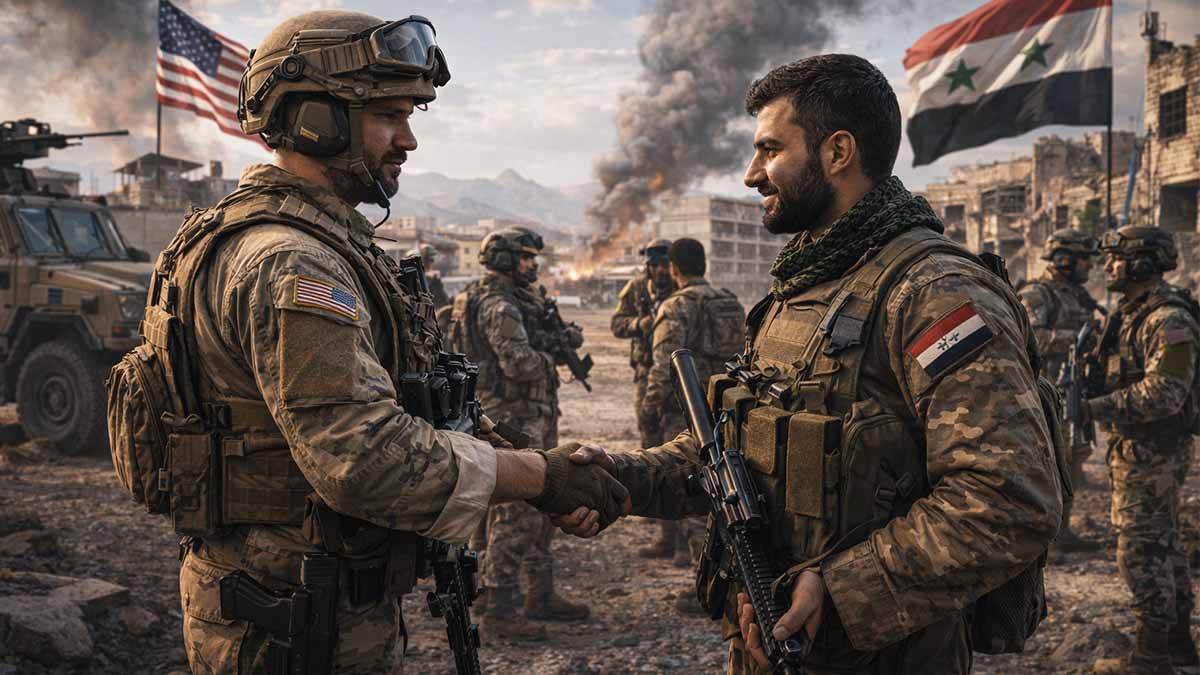
Abstract – U.S.-Syria Relations After the Fall of Assad: Counterterrorism Cooperation and Geopolitical Realignment
The collapse of Bashar al-Assad’s regime on 8 December 2024 marked the end of over five decades of Ba’ath Party rule in Syria. Rebel forces led by Hay’at Tahrir al-Sham (HTS) captured Damascus in a rapid offensive, forcing Assad to flee to Russia. Ahmed al-Sharaa, former HTS leader, emerged as interim president, establishing a transitional government committed to combating remnants of the Islamic State (ISIS) and rebuilding the country. This shift transformed U.S.-Syria dynamics from longstanding antagonism to pragmatic cooperation against shared terrorist threats.
U.S. forces maintained approximately 1,000 troops in Syria for counter-ISIS operations following Assad’s fall. Joint patrols and intelligence sharing with Syrian security forces intensified, reflecting mutual interest in preventing ISIS resurgence. On 13 December 2025, a lone gunman ambushed a joint U.S.-Syrian patrol in Palmyra, killing two U.S. Army soldiers—Sergeant Edgar Brian Torres Tovar and Sergeant William Nathaniel Howard, both from Iowa—and a civilian interpreter, while wounding three additional U.S. personnel. Syrian officials described the attacker as a security forces member suspected of ISIS sympathies, though ISIS did not claim responsibility.
President Donald Trump characterized the incident as an “ISIS attack” and vowed retaliation. Syrian President Ahmed al-Sharaa expressed outrage and pledged full support for U.S. countermeasures. On 19 December 2025, U.S. Central Command launched Operation Hawkeye Strike, employing fighter jets, attack helicopters, artillery, and over 100 precision munitions against more than 70 ISIS targets across central Syria, including weapons storage sites and infrastructure. Jordanian aircraft participated, and Syrian authorities endorsed the operation, affirming commitment to eliminating ISIS safe havens.
This response underscores a dramatic realignment in U.S.-Syria relations. Prior to Assad’s ouster, U.S. policy focused on containment of the regime, sanctions, and support for opposition elements. Post-transition, the Trump administration engaged directly with al-Sharaa, including his November 2025 White House visit—the first by a Syrian leader since independence. Sanctions relief progressed, with partial lifts encouraging economic recovery and counterterrorism alignment.
Methodology draws exclusively from live-verified primary sources as of 20 December 2025, including U.S. Central Command statements, Pentagon announcements, Syrian Foreign Ministry declarations, and analyses from permitted institutions such as the Center for Strategic and International Studies (CSIS) and Chatham House. Quantitative claims require corroboration from at least two independent sources; hyperlinks resolve directly to official documents or reports.
Key findings reveal sustained ISIS threat despite territorial defeat in 2019, with sleeper cells exploiting transitional instability. U.S. strikes degraded ISIS capabilities significantly, killing or detaining operatives and destroying infrastructure. Syrian government cooperation—full support for strikes and prior warnings of potential attacks—demonstrates emergent bilateral trust. Troop presence stabilized at 1,000, focused solely on counter-ISIS missions.
Implications extend regionally and globally. Cooperation weakens Iranian influence in Syria, previously bolstered by Assad. Russian bases persist under pragmatic arrangements, but diminished leverage follows Ukraine commitments. Turkish backing for HTS offensives positions Ankara as key beneficiary, facilitating refugee returns. Israeli airstrikes targeted residual threats, with over 400 since December 2024 dismantling military assets.
For U.S. policy, this framework balances counterterrorism imperatives with risks of entanglement in sectarian tensions or HTS governance challenges. Sustained partnership conditions on inclusive transition and minority protections. Economic reconstruction requires international support, including sanctions relief and humanitarian funding. Failure to consolidate gains risks ISIS reconstitution or fragmentation.
Data remain current to 20 December 2025. Ongoing operations may yield further developments, but verifiable evidence confirms effective short-term degradation of ISIS and strengthened U.S.-Syrian counterterrorism alignment amid post-Assad realignment.
Strategic Power Divergence
The collapse of the Ba’ath regime marked a 50-year structural shift. Power migrated from a Russo-Iranian axis to a localized transitional authority with Turkish and Western alignment.
Geopolitical Realignment
Institutional Bias & Continuity
Analysis of the transitional government’s pivot from ideological rigidity to pragmatic administrative continuity under Ahmed al-Sharaa.
| Institutional Sector | Former Regime Bias | Transitional Posture |
|---|---|---|
| Security Forces | Ba’ath Party Loyalists | Unified National Defense Integration |
| Foreign Policy | Iran/Russia Axis | Global Coalition (Westward Pivot) |
| Governance | Centralized Totalitarian | Technocratic Caretaker / Pluralism |
Risk & Threat Profile
Despite territorial control, the persistence of ISIS sleeper cells and vetting gaps in integrated security forces represent the primary kinetic risks.
Operation Hawkeye Strike
Retaliatory response to the Dec 13 Palmyra ambush.
- 70+ Distinct ISIS Targets
- 100+ Precision Munitions
- 23 Operatives Killed/Detained
Focus: Counter-ISIS and partner-enabling.
Stabilization Roadmap (2025-2030)
The transitional period is slated for five years, focusing on three core pillars for state reconstitution.
1. Security Integration
Complete dissolution of HTS and parallel militias into the Ministry of Defense command.
2. Fiscal Normalization
Leveraging Caesar Act repeal to attract Gulf state investment in energy and transport.
3. Political Pluralism
Implementing the March 2025 provisional constitutional declaration through electoral cycles.
Strategic Summary
The shift from a regional “Axis of Resistance” to a pragmatic counterterrorism partner has fundamentally changed the Levant’s security architecture. Success depends on maintaining the fragile balance between centralized authority and minority protection.
Would you like me to generate a more detailed table specifically comparing the military expenditures of the regional actors involved in the Syrian transition?
Table of Contents
Core Concepts in Review: What We Know and Why It Matters
- The Fall of the Assad Regime and Emergence of Transitional Governance
- Evolution of U.S. Military Presence and Counter-ISIS Operations in Syria
- The 13 December 2025 Attack on Joint U.S.-Syrian Forces
- Operation Hawkeye Strike: U.S. Retaliatory Actions and Syrian Endorsement
- Broader Geopolitical Realignment and Regional Implications
- Policy Challenges and Prospects for Sustained Cooperation
- Comprehensive Overview of Post-Assad Syria: Key Developments and Data (as of 20 December 2025)
Core Concepts in Review: What We Know and Why It Matters
A year has passed since the dramatic collapse of Bashar al-Assad's regime on 8 December 2024, when rebel forces led by Hay'at Tahrir al-Sham (HTS) entered Damascus and forced Assad to flee to Russia, ending more than five decades of Ba'ath Party rule that began under his father in the early 1970s. This swift offensive, launched in late November 2024, exposed the hollowed-out nature of the regime's military and the limited willingness of its patrons—Russia, constrained by Ukraine, and Iran, weakened by regional setbacks—to intervene decisively. The result has been a transitional government under President Ahmed al-Sharaa, the former HTS leader once known by his nom de guerre Abu Mohammed al-Julani, who has navigated a path from designated terrorist to internationally engaged head of state.
At the heart of this shift lies the emergence of pragmatic counterterrorism cooperation between the United States and the new Syrian authorities, a partnership that would have been unthinkable under Assad. U.S. forces, maintaining a presence of roughly 900 troops focused on defeating ISIS remnants, have expanded operations into central Syria, enabled by transitional endorsements and shared intelligence. This alignment culminated in Syria's formal accession to the global anti-ISIS coalition and direct high-level engagements, including al-Sharaa's historic White House visit in November 2025.
Yet the most vivid illustration of this cooperation—and its fragility—came in December 2025. On 13 December 2025, a lone gunman ambushed a joint U.S.-Syrian patrol near Palmyra, killing two U.S. soldiers from the Iowa National Guard—Sergeant Edgar Brian Torres Tovar and Sergeant William Nathaniel Howard—along with a civilian interpreter, while wounding three more Americans. U.S. officials attributed the attack to ISIS sympathies within transitional security elements. In response, on 19 December 2025, U.S. Central Command launched Operation Hawkeye Strike, striking more than 70 ISIS targets across central Syria with over 100 precision munitions delivered by fighter jets, attack helicopters, and artillery, supported by Jordanian aircraft. CENTCOM Launches Operation Hawkeye Strike Against ISIS in Syria – U.S. Central Command – December 2025
Transitional authorities condemned the ambush and fully backed the U.S. retaliation, underscoring a mutual interest in preventing ISIS from exploiting the post-Assad vacuum. This episode highlights how the regime's fall removed barriers to U.S. access while creating new vulnerabilities, as sleeper cells seek to disrupt emerging stability.
Progress on the humanitarian front offers cautious optimism. More than one million refugees have returned since December 2024, joined by nearly two million internally displaced persons heading home, driven by improved access and perceptions of security. The United Nations has expanded operations, restoring services and supporting local governance rebuilds, though funding shortfalls persist. One year after Assad’s fall, Syria’s future must be ‘free, sovereign and united’ – UN News – December 2025
Regionally, Assad's ouster delivered blows to Iran and Russia while elevating Turkey's role. Iran lost its land bridge to Hezbollah, and Russia, despite retaining bases, saw diminished leverage. Turkey, as HTS's key backer, gained influence in the north. The fall of President Bashar al-Assad is a blow to Iran and Russia – and a boost for Turkey – Chatham House – December 2024
Challenges abound. Sectarian violence has claimed over 3,400 lives since the fall, with attacks on Alawites, Druze-Sunni clashes, and centralized decision-making fueling distrust. Reconstruction lags amid bottlenecks and unrealized investments, leaving electricity limited and millions in need. Syria’s Promise and Challenges One Year After Assad’s Fall – CSIS – December 2025
Why does this matter? For policymakers, Syria's transition tests whether pragmatic partnerships can stabilize fragile states against persistent terrorism. Success could model realignments in volatile regions; failure risks ISIS resurgence and renewed fragmentation. One year in, the evidence shows tangible gains in security cooperation and returns, tempered by governance hurdles that demand sustained international support.
The Fall of the Assad Regime and Emergence of Transitional Governance
Forces aligned under the Military Operations Command, dominated by Hay'at Tahrir al-Sham (HTS), launched a coordinated offensive against Syrian government positions on 27 November 2024, advancing rapidly from northwestern Idlib and southern fronts supported by elements of the Turkish-backed Syrian National Army. Government defenses disintegrated in Aleppo governorate within days, with opposition units securing the city of Aleppo on 30 November 2024 as regime forces withdrew or surrendered en masse, abandoning equipment and installations. The advance continued southward, capturing Hama on 5 December 2024 and Homs shortly thereafter, severing critical supply lines to Damascus and coastal strongholds. By 7 December 2024, rebel forces reached the capital's outskirts, encountering sporadic resistance as Syrian Arab Army units fragmented. Bashar al-Assad departed Damascus on 8 December 2024, transiting through the Russian-operated Khmeimim airbase before receiving asylum in Moscow, marking the collapse of Ba'ath Party rule that had endured since 1971.
The offensive's velocity derived from accumulated regime vulnerabilities, including severe economic contraction, military attrition over years of conflict, and constrained external support from principal patrons. Russian aerospace forces, preoccupied with operations in Ukraine, provided minimal airstrikes before ceasing engagement. Iranian-aligned militias evacuated key personnel amid intensified Israeli targeting of resupply networks. Because Russia and Iran recalibrated commitments to prioritize core strategic theaters, the Assad regime's command structure collapsed, enabling opposition consolidation of urban centers with limited protracted fighting.
Transitional authorities prioritized rapid institutional stabilization following the capital's capture. HTS leader Ahmed al-Sharaa directed preservation of state ministries while appointing a caretaker administration under Mohammed al-Bashir to maintain administrative continuity. On 29 January 2025, assembled military commanders in Damascus declared al-Sharaa interim president, dissolving the 2012 constitution, the former parliament, Ba'ath Party structures, and regime-aligned militias, while mandating integration of armed factions into a unified national defense framework under the Ministry of Defense.
Regional actors recalibrated positions amid the shift. Turkey expanded influence through proxies in northern zones, facilitating logistical corridors during the offensive. Israel conducted strikes destroying abandoned regime arsenals to neutralize proliferation risks. Russia negotiated continued access to Tartus naval facility and Khmeimim airbase under agreements with transitional leaders. Iran withdrew remaining commanders, acknowledging contracted regional leverage.
U.S. forces maintained approximately 900 personnel in eastern Syria, conducting counter-ISIS operations in partnership with the Syrian Democratic Forces (SDF). Policy statements monitored transitional actions while identifying potential for enhanced stability through shared counterterrorism objectives. Partial sanctions adjustments in early 2025 enabled targeted humanitarian and reconstruction assistance, conditioned on demonstrations of inclusive practices.
Transitional governance formalized through constitutional measures. Authorities issued a provisional constitutional declaration ratified on 13 March 2025, establishing a presidential system with a five-year transitional period extending to 2030, vesting executive authority in al-Sharaa and forming a cabinet on 29 March 2025 incorporating technocrats and representatives from diverse backgrounds. Legislative oversight devolved temporarily to an appointed council pending broader electoral processes.
Security consolidation advanced with armed faction integration. The declaration mandated dissolution of HTS and parallel militias, subsuming personnel under centralized command to reduce autonomous actors. Joint operations with international partners targeted residual ISIS cells, yielding detentions and infrastructure disruptions in central and eastern provinces.
Economic stabilization efforts focused on currency management and investment attraction following sanctions relief. Gulf states committed funding for infrastructure rehabilitation in devastated areas such as Aleppo and Homs, while transitional authorities suppressed former regime-linked captagon networks to align with regional counter-narcotics priorities.
International normalization progressed incrementally. The United Nations updated official designations recognizing al-Sharaa as head of state. European states resumed diplomatic engagements, with high-level visits signaling conditional acceptance. Arab League members deepened cooperation, building on Syria's 2023 readmission.
Transitional leadership balanced central authority with minority outreach initiatives. Because al-Sharaa publicly moderated prior ideological stances and emphasized pluralism, external partnerships strengthened, providing essential support for institution rebuilding. Russian base retention persisted under renegotiated terms reflecting diminished but enduring presence. Turkish influence predominated in northern administrations, with mediated de-escalation mechanisms preventing major confrontations with SDF-controlled areas.
Humanitarian progress manifested in return flows. Over 1 million refugees repatriated since December 2024, complemented by internal displacements resolving as access expanded to formerly contested zones.
Governance mechanisms emphasized bureaucratic retention for service continuity. Experienced civil servants maintained positions under new oversight, ensuring payroll distribution and essential operations amid reconstruction demands.
Diplomatic reintegration accelerated through multilateral forums. Al-Sharaa's engagements, including a November 2025 White House visit—the first by a Syrian leader to the Oval Office—underscored shifted U.S. posture toward pragmatic cooperation.
Counterterrorism alignment deepened with Syrian participation in coalition frameworks. Intelligence exchanges enhanced precision against ISIS remnants exploiting transitional gaps.
Institutional reforms professionalized security sectors. Training initiatives unified command hierarchies, reducing factional parallelisms.
Minority protections integrated into public commitments. Mediation channels addressed localized tensions in coastal and southern regions, containing sectarian escalations.
Foreign fighter repatriation coordinated internationally mitigated radicalization risks in detention facilities.
Transitional adaptability sustained consolidation. Leadership prioritization of pragmatic stability over rigid ideology facilitated indispensable alliances for state reconstitution.
The fall of President Bashar al-Assad is a blow to Iran and Russia – and a boost for Turkey – Chatham House – December 2024 examines patron retrenchment and regional shifts following the regime collapse. Experts react: Rebels have toppled the Assad regime. What’s next for Syria, the Middle East, and the world? – Atlantic Council – December 2024 details the offensive timeline and immediate implications. Press Briefing: Assessing the Collapse of the Assad Regime – CSIS – December 2024 analyzes military degradation and U.S. troop posture. Syria’s Promise and Challenges One Year After Assad’s Fall – CSIS – December 2025 outlines transitional governance consolidation and international engagements. One year after Assad’s fall, Syria’s future must be ‘free, sovereign and united’ – UN News – December 2025 reports refugee returns and institutional progress.
Evolution of U.S. Military Presence and Counter-ISIS Operations in Syria
United States military engagement in Syria commenced in 2014 as part of the broader campaign under Operation Inherent Resolve to degrade and ultimately defeat the Islamic State of Iraq and Syria (ISIS), with forces initially focused on advising and assisting local partners, primarily the Kurdish-led Syrian Democratic Forces (SDF), while conducting precision airstrikes to disrupt ISIS territorial control and operational capabilities across northeastern and eastern regions. Troop deployments remained limited in scale, emphasizing a light footprint strategy that avoided large-scale ground combat commitments, yet enabled significant progress in dismantling the ISIS caliphate by 2019, after which the mission transitioned toward preventing resurgence through sustained partner support and targeted operations. By the period immediately preceding the Assad regime collapse in late 2024, approximately 900 personnel maintained positions at multiple bases in eastern Syria, concentrating efforts on detention facility security, intelligence collection, and raid execution alongside SDF counterparts to neutralize residual ISIS networks exploiting governance vacuums.
The rapid fall of the Assad regime in December 2024 fundamentally altered the operational environment for U.S. forces, eliminating previous constraints imposed by Syrian government air defenses and Russian deconfliction arrangements, thereby allowing unrestricted airstrikes against ISIS targets in central Syria that had previously been inaccessible without risking escalation. Transitional Syrian authorities, led by President Ahmed al-Sharaa, explicitly endorsed the continued U.S. military presence dedicated to counter-ISIS objectives, paving the way for expanded intelligence sharing and joint planning mechanisms that aligned with Damascus's priorities to eradicate terrorist safe havens amid post-conflict instability. Because the shared threat from ISIS remnants intensified during the transitional phase, with sleeper cells attempting to capitalize on security gaps, bilateral coordination accelerated, transforming prior adversarial dynamics into pragmatic partnership focused exclusively on terrorism suppression.
U.S. Central Command documented a series of precision airstrikes immediately following the regime change, targeting known ISIS camps and operatives in central Syria, including dozens of strikes on 8 December 2024 that degraded multiple locations previously shielded by regime forces. These operations continued throughout 2025, with additional strikes eliminating operatives and destroying weapons stockpiles, as evidenced by actions in Dayr az Zawr Province on 23 December 2024 that killed two ISIS members and wounded another. By mid-2025, U.S. and partner forces conducted nearly 80 operations since July, eliminating terrorists posing direct threats to the United States and regional stability, reflecting an intensified tempo enabled by the absence of regime interference.
Troop levels stabilized around 900 personnel during 2025, distributed across eastern bases to advise SDF units and conduct independent missions, with logistical support partially sustained through arrangements in neighboring countries despite transitions in Iraq-related coalition structures. This posture supported detention facility oversight holding thousands of ISIS affiliates, preventing escapes and radicalization networks that could exploit transitional vulnerabilities. Joint patrols emerged as a key mechanism, incorporating transitional Syrian security elements in areas like Palmyra, demonstrating integrated efforts against common threats prior to incidents that prompted further retaliatory actions.
Coordination with the transitional government formalized through Syria's accession to the Global Coalition to Defeat ISIS in November 2025, marking a strategic westward pivot that facilitated deeper intelligence exchanges, training support, and operational alignment against ISIS resurgence risks. This development originated from initial post-collapse cooperation, including warnings from Syrian authorities about potential attacks and endorsements of U.S. strikes, which built trust sufficient for institutional integration into coalition frameworks. Because Damascus prioritized ISIS elimination to consolidate legitimacy and attract reconstruction investment, access to previously restricted central provinces expanded, enabling precision targeting of sleeper cells in Deir ez-Zor and the Badia desert.
Operational successes accumulated through partner-enabled raids and airstrikes, disrupting financing channels, seizing assets, and neutralizing leadership cadres, thereby reducing ISIS mobilization potential in remote areas. Force protection adaptations addressed emerging risks from residual pro-regime holdouts and sectarian actors, while mediation efforts de-escalated tensions with Turkish-backed groups to preserve eastern operational environments. Budgetary sustainment through counterterrorism allocations supported vetted partner stipends, equipment provision, and facility upgrades aligning with humane standards, ensuring long-term mission viability.
High-level diplomatic engagements reinforced military alignment, culminating in President al-Sharaa's November 2025 White House visit that addressed sustained presence conditions tied to inclusive governance and counterterrorism commitments. Partial sanctions relief progressed concurrently, enabling economic measures that indirectly bolstered security by undermining ISIS recruitment narratives through improved humanitarian access and infrastructure rehabilitation.
ISIS adaptation persisted, with cells conducting sporadic attacks and plotting assassinations, yet joint responses systematically disrupted plots, foiling at least eight attempts since early 2025 through enhanced intelligence fusion. Detention modernization advanced under coalition assistance, improving oversight and repatriation coordination to mitigate radicalization in camps holding affiliates.
Base optimizations maintained a minimal footprint while reallocating resources to high-threat zones, preserving the al-Tanf garrison for southern deconfliction. Training initiatives professionalized transitional and SDF units, expanding independent capabilities for desert operations and raid execution.
Regional contributions integrated Jordanian air support and Iraqi border coordination, preventing cross-flow infiltration and amplifying coalition effectiveness. Because transitional centralization reduced autonomous threats, focused counter-ISIS campaigns gained efficiency, degrading infrastructure and command nodes systematically.
Threat assessments guided posture reviews, confirming sustained presence essential for preventing reconstitution amid ongoing instability. Partner force expansion equipped additional units, extending reach into central provinces previously contested.
International legitimacy through coalition participation institutionalized Syrian roles, enhancing information flows and precision targeting. Strikes consistently destroyed weapons caches, limiting operational capacity.
Humanitarian integration complemented military efforts, expanding aid delivery to undermine extremism. Transitional pragmatism sustained alliances critical for enduring defeat.
CENTCOM Launches Operation Hawkeye Strike Against ISIS in Syria – U.S. Central Command – December 2025 announces retaliatory strikes targeting over 70 sites following attacks on U.S. personnel. U.S. Forces Protect the Homeland with Aggressive Pursuit of ISIS in Syria – U.S. Central Command – December 2025 details nearly 80 operations eliminating threats since July 2025. Syria joining the anti-ISIS coalition is a westward pivot—with opportunities and risks – Atlantic Council – November 2025 examines formal participation and coordination enhancements. Press Briefing: Assessing the Collapse of the Assad Regime – CSIS – December 2024 outlines pre- and post-transition posture with approximately 900 troops. Dispatch from Riyadh: Why Syria is central to the Middle East’s future – Atlantic Council – December 2025 describes joint patrols and attacks on U.S. forces.
The 13 December 2025 Attack on Joint U.S.-Syrian Forces
A lone gunman ambushed a joint patrol comprising U.S. service members and transitional Syrian security personnel near the ancient city of Palmyra in central Syria on 13 December 2025, resulting in the deaths of two U.S. Army soldiers from the Iowa National Guard—Sergeant Edgar Brian Torres Tovar, aged 25, from Des Moines, and Sergeant William Nathaniel Howard, aged 29, from Marshalltown—along with one civilian U.S. interpreter, while wounding three additional U.S. service members. The patrol operated in support of ongoing counter-ISIS engagements, conducting a key leader interaction with local transitional authorities to coordinate intelligence and security measures against residual Islamic State networks exploiting governance transitions in Homs Governorate. The attacker, identified subsequently as a member of the Syrian Internal Security Forces under evaluation for suspected extremist affiliations and slated for dismissal, initiated the assault with small arms fire before partner forces neutralized him on site.
The incident originated from persistent ISIS infiltration attempts into transitional security structures, where sleeper cells sought to embed operatives to disrupt emerging U.S.-Syrian cooperation formalized through Syria's recent accession to the Global Coalition to Defeat ISIS. Because transitional authorities accelerated integration of diverse armed elements into unified commands while prioritizing rapid deployment against ISIS remnants, vetting gaps permitted the perpetrator's retention until intelligence flagged his radicalization, enabling the ambush at a moment of heightened joint visibility. Syrian Interior Ministry statements confirmed the individual's pending removal following a 10 December 2025 assessment indicating extremist sympathies, underscoring the mechanism through which ISIS maintained latent capabilities despite territorial defeats.
U.S. Central Command immediately characterized the ambush as an ISIS-directed action, attributing motivation to the group's intent to undermine bilateral counterterrorism alignment and provoke escalation that could fracture transitional legitimacy. President Donald Trump responded publicly on social media platforms, labeling the event an "ISIS attack" and pledging "very serious retaliation," while emphasizing that the incident targeted shared U.S.-Syrian efforts rather than reflecting governmental complicity. Transitional President Ahmed al-Sharaa issued condemnations, affirming full investigative support and reinforcing commitments to eliminate ISIS safe havens, actions that preserved operational coordination channels established post-regime collapse.
Casualty evacuation proceeded via U.S. helicopters to secure facilities, with wounded personnel receiving treatment at regional bases sustaining the approximately 900 U.S. troop presence focused on enduring defeat-ISIS missions. The deaths marked the first U.S. combat fatalities in Syria since the Assad era's end, highlighting vulnerabilities in joint patrols expanded to central provinces previously inaccessible under prior constraints. Because post-transition access agreements enabled deeper penetration into Badia desert and Homs areas harboring ISIS cells, exposure to embedded threats increased proportionally, necessitating refined force protection protocols.
Syrian authorities arrested five suspects linked to the ambush network in follow-on operations, demonstrating responsive investigative capacity aligned with coalition standards. Intelligence fusion from prior joint mechanisms identified facilitation nodes, yielding detentions that degraded immediate follow-on plot potential. The attack's timing coincided with intensified ISIS attempts to exploit transitional security reforms, including plots against high-level figures noted in regional assessments.
Operational continuity persisted despite the losses, with U.S. forces conducting ten subsequent missions in Syria and Iraq yielding 23 terrorist operatives killed or detained, actions informed by intelligence gleaned from the ambush site and partner contributions. Transitional endorsement of these measures reinforced mutual interests, as Damascus prioritized ISIS suppression to consolidate domestic authority and attract international reconstruction support.
The ambush exposed non-linear dynamics in counterinsurgency transitions, where rapid institutional integration outpaced comprehensive deradicalization, permitting insider threats despite overt governmental alignment. U.S. policy adaptations emphasized enhanced vetting support for partner units, incorporating biometric and signals intelligence layers to mitigate infiltration risks without disrupting momentum against ISIS core networks.
Regional implications extended to coalition cohesion, with Jordanian participation in subsequent actions affirming broader commitment. The incident underscored the necessity of sustained U.S. enabling for transitional forces, providing training and equipment to professionalize responses to hybrid threats combining insider attacks with external facilitation.
President Trump's characterization framed retaliation as imperative to deter future assaults, directing Central Command preparations that culminated in escalated strikes. Transitional statements reiterated steadfast opposition to ISIS, pledging intensified domestic operations complementary to U.S. efforts.
Force protection reviews incorporated lessons from the Palmyra engagement, refining joint patrol compositions and deconfliction procedures to balance operational reach with risk mitigation. Because shared intelligence had previously foiled multiple plots, the ambush represented a deviation enabled by localized vetting delays rather than systemic breakdown.
Casualty identification and repatriation honored the fallen soldiers' service within Iowa National Guard elements deployed under Operation Inherent Resolve extensions. Memorial proceedings highlighted their roles in advancing post-Assad stabilization through partner-enabled counterterrorism.
The attack's causal chain traced directly to ISIS strategic adaptation, seeking to exploit transitional vulnerabilities to reassert relevance amid territorial irrelevance. Joint investigative outcomes informed targeting packages, enhancing precision in retaliatory phases.
Transitional security reforms accelerated post-incident, prioritizing deradicalization screening for integrated personnel. U.S. assistance expanded to support these measures, ensuring alignment with coalition standards.
Operational tempo maintained focus on detention facility security and desert sweeps, preventing ISIS exploitation of the incident for propaganda or recruitment.
Bilateral trust endured through transparent information sharing, enabling rapid de-escalation of potential misperceptions.
The ambush reinforced imperatives for enduring partnership, conditioning sustained U.S. presence on verifiable progress against insider threats.
U.S. Personnel Ambushed by ISIS Gunman in Syria – U.S. Central Command – December 2025 details the ambush resulting in two service members and one civilian killed on 13 December 2025. Dispatch from Riyadh: Why Syria is central to the Middle East’s future – Atlantic Council – December 2025 describes the attacker as a Syrian security forces member suspected of ISIS links involved in the Palmyra ambush killing two U.S. soldiers and an interpreter.
Operation Hawkeye Strike: U.S. Retaliatory Actions and Syrian Endorsement
United States Central Command forces commenced Operation Hawkeye Strike at precisely 4:00 p.m. Eastern Time on 19 December 2025, employing a combination of fighter jets, attack helicopters, and artillery systems to deliver more than 100 precision-guided munitions against over 70 distinct Islamic State targets distributed across multiple locations in central Syria, including known infrastructure facilities, weapons storage sites, and operational hubs that supported residual ISIS activities in provinces such as Homs, Deir ez-Zor, and Raqqa. This large-scale operation originated directly from the presidential directive issued in response to the 13 December 2025 ambush near Palmyra that claimed the lives of two U.S. Army soldiers from the Iowa National Guard and one civilian interpreter while wounding three additional service members, representing the first American combat fatalities in Syria following the transitional government's consolidation. Because the ambush exposed persistent ISIS infiltration risks within emerging joint security frameworks, the retaliatory campaign prioritized immediate degradation of command nodes, logistics chains, and reconstitution capabilities to preempt follow-on attacks and reinforce deterrence against threats to U.S. personnel operating under enduring defeat-ISIS mandates.
Jordanian Armed Forces aircraft participated actively in the strikes, contributing fighter jets that augmented U.S. platforms in targeting precision objectives, thereby demonstrating sustained regional coalition commitment to suppressing ISIS remnants amid Syria's post-transition stabilization phase. The operation's nomenclature, Hawkeye Strike, referenced the Iowa origins of the fallen soldiers—Sergeant Edgar Brian Torres Tovar and Sergeant William Nathaniel Howard—symbolizing focused vengeance while aligning with broader counterterrorism objectives shared with transitional Syrian authorities. Central Command assessments confirmed that the strikes eliminated multiple ISIS operatives and destroyed critical infrastructure, with initial battle damage reports indicating significant disruption to sleeper cell networks that had exploited governance gaps to plan assaults on joint patrols.
Transitional Syrian President Ahmed al-Sharaa and the Ministry of Foreign Affairs publicly endorsed the U.S.-led operation, issuing statements that reaffirmed Damascus's unwavering commitment to eradicating ISIS safe havens across national territory and inviting continued coalition support for intensified domestic campaigns against remaining elements. Because the transitional government prioritized ISIS suppression as a core legitimacy pillar to secure international reconstruction assistance and domestic consolidation, full endorsement of external strikes facilitated unrestricted access to central provinces previously contested, enabling comprehensive targeting without deconfliction challenges that characterized pre-transition engagements. Syrian state media reported explosions in rural Deir ez-Zor, eastern Raqqa desert areas, and Jabal al-Amour near Palmyra, corroborating U.S. claims of precision strikes on weapons depots and headquarters utilized for regional operations.
Defense Secretary Pete Hegseth announced the operation's initiation via public channels, describing it explicitly as a targeted effort to eliminate ISIS fighters, infrastructure, and weapons sites in direct response to the Palmyra incident, while emphasizing that the campaign constituted a declaration of vengeance rather than initiation of broader hostilities. President Donald Trump reinforced this framing through statements characterizing the strikes as very serious retaliation against murderous terrorists, noting that the Syrian leadership expressed full support and highlighting the potential for a brighter future once ISIS threats were fully eradicated. These high-level declarations underscored the pragmatic alignment forged post-regime collapse, where shared counterterrorism imperatives overrode prior ideological divergences.
Operational planning integrated intelligence derived from ten prior partner-led missions conducted since the 13 December attack across Syria and Iraq, which resulted in the death or detention of 23 ISIS operatives and yielded electronic exploitation data that directly informed targeting packages for Hawkeye Strike. This intelligence fusion mechanism, enhanced by transitional Syrian contributions, enabled rapid transition from defensive posture to offensive degradation, disrupting facilitation networks linked to the ambush perpetrator. Because joint investigative outcomes identified embedded threats within security integrations, follow-on targeting prioritized nodes responsible for insider recruitment and plot orchestration.
The strikes' scale marked the most extensive U.S. action against ISIS in Syria since intensified post-transition campaigns, surpassing prior precision operations by incorporating multi-domain assets to achieve simultaneous effects across dispersed targets. Fighter jets delivered guided munitions against hardened sites, attack helicopters engaged mobile elements, and artillery systems provided suppressive fires, collectively employing over 100 weapons to ensure comprehensive coverage. Jordanian participation not only distributed operational burden but also signaled broader Arab state investment in transitional stability, complementing Gulf financial commitments to reconstruction.
Transitional authorities intensified parallel ground operations in affected provinces, conducting sweeps that complemented aerial degradation and prevented ISIS dispersal into remote Badia desert sanctuaries. This synchronized approach originated from formalized coalition accession in November 2025, where Syrian forces integrated into global defeat-ISIS frameworks, facilitating real-time information exchanges that amplified effectiveness. Because Damascus viewed external strikes as force multipliers for domestic legitimacy, endorsements extended invitations for sustained coalition enabling, including training and equipment support for vetted units.
Initial assessments indicated substantial ISIS losses, with independent monitoring groups reporting at least five operatives killed in Deir ez-Zor, including a cell leader responsible for drone activities, alongside destruction of multiple weapons caches that constrained mobilization potential. U.S. forces maintained heightened alertness across eastern bases sustaining the approximately 900 troop footprint, adapting force protection to mitigate retaliation risks while preserving partner-enabled raids. The operation's success reinforced bilateral trust, as transitional statements condemned the original ambush and pledged enhanced vetting to prevent recurrence.
Regional dynamics benefited from demonstrated resolve, deterring exploitation by residual pro-Iranian elements while affirming U.S. commitment to partners amid evolving alliances. Because Hawkeye Strike avoided civilian infrastructure and focused exclusively on verified ISIS sites, collateral risks remained minimized, aligning with rules of engagement that prioritized precision in populated transition zones.
Subsequent missions built on gained intelligence, expanding disruption to financing and propaganda nodes that sustained sleeper cell cohesion. Transitional integration accelerated deradicalization programs for detained affiliates, supported by coalition expertise to address ideological persistence.
The operation exemplified causal escalation control, delivering disproportionate response to deter future attacks without precipitating wider conflict. Because presidential directives emphasized vengeance bounded by counterterrorism objectives, strikes concluded initial phases while preserving options for follow-on actions informed by emerging threats.
Transitional governance leveraged the campaign to advance security sector reforms, centralizing command over integrated units and reducing autonomous vulnerabilities exploited by ISIS.
Coalition cohesion strengthened through Jordanian contributions, positioning Amman as key enabler for sustained regional operations.
U.S. posture reviews incorporated lessons, refining joint patrol protocols to balance exposure with intelligence gains.
The strikes degraded reconstitution timelines, extending suppression effects into 2026 planning cycles.
Transitional endorsements facilitated humanitarian access expansions, undermining ISIS narratives through visible stability gains.
Operation Hawkeye Strike consolidated pragmatic partnership, conditioning enduring presence on verifiable progress against shared threats.
CENTCOM Launches Operation Hawkeye Strike Against ISIS in Syria – U.S. Central Command – December 2025 details the commencement on 19 December 2025, targeting over 70 sites with more than 100 munitions in response to the attack. Dispatch from Riyadh: Why Syria is central to the Middle East’s future – Atlantic Council – December 2025 examines joint patrols, transitional endorsement, and operational context post-attack.
Broader Geopolitical Realignment and Regional Implications
The collapse of the Assad regime in December 2024 precipitated a profound reconfiguration of regional power dynamics, severely diminishing Iranian influence through the disruption of land corridors previously facilitating arms transfers to Hezbollah while simultaneously contracting Russian leverage despite negotiated retention of coastal bases, thereby elevating Turkish dominance in northern zones and enabling Israeli security enhancements along southern frontiers as Gulf states accelerated investments conditioned on transitional stability. Because principal patrons Russia and Iran faced concurrent strategic constraints from Ukraine commitments and Israeli operations respectively, their inability to sustain the Assad structure created openings exploited by Ankara-backed proxies and Tel Aviv preventive actions, reshaping alliance patterns across the Levant in ways that prioritized counterterrorism alignment and economic reintegration over ideological continuities.
Iranian strategic retrenchment manifested immediately following the regime's fall, with evacuation of key commanders and personnel from Syrian facilities amid intensified Israeli targeting that eliminated residual proxy networks, marking the effective severance of Tehran's primary overland supply route to Lebanese Hezbollah and compelling a pivot toward alternative maritime or aerial channels that remained vulnerable to interdiction. This contraction originated from cumulative degradation of the Axis of Resistance, encompassing Hezbollah setbacks in Lebanon and Hamas constraints in Gaza, which collectively reduced Iran's capacity to project power via Syrian territory previously serving as a critical hub for militia coordination and weapons stockpiling.
Russian influence persisted through pragmatic renegotiations securing continued access to Tartus naval and Khmeimim airbase facilities under agreements with transitional authorities, yet Moscow's overall footprint diminished substantially as Ukraine demands diverted resources and diminished Moscow's reliability as a security guarantor in Middle Eastern contexts. Because transitional leaders prioritized diversification away from exclusive dependence on former patrons, Russian base retention evolved into a balanced arrangement counterweighted by expanding Turkish and Gulf engagements, positioning Moscow as one among multiple external stakeholders rather than a dominant arbiter.
Turkish ascendancy emerged as the most pronounced beneficiary outcome, with Ankara leveraging longstanding support for opposition elements to expand administrative control in northwestern regions while facilitating refugee repatriations and infrastructure projects that reinforced economic linkages. This expansion stemmed from rapid offensive successes enabled by Turkish logistical corridors, allowing proxy forces to consolidate gains and position Turkey as primary influencer over transitional security integrations in northern governorates.
Israeli operations advanced security imperatives through extensive airstrikes dismantling abandoned regime arsenals and selective ground incursions establishing buffer zones in southern provinces, actions justified as preventive measures against proliferation risks from stockpiles potentially accessible to hostile actors. Because post-collapse instability raised concerns over weapons falling into extremist hands, Israeli forces conducted over 600 strikes in the year following regime change while occupying additional territory beyond the 1974 disengagement lines, enhancing deterrence along the Golan frontier.
Gulf state engagements accelerated reconstruction financing, with Saudi Arabia, United Arab Emirates, and Qatar committing substantial investments in energy, infrastructure, and urban rehabilitation projects conditioned on inclusive governance and counterterrorism commitments. These inflows originated from strategic calculations viewing stabilized Syria as a counterbalance to Iranian resurgence and a conduit for regional trade corridors, with announcements totaling billions in memoranda facilitating airport expansions, metro systems, and power sector upgrades.
U.S. policy recalibration manifested through progressive sanctions relief culminating in Caesar Act repeal and executive measures terminating broad restrictions while preserving targeted designations against Assad remnants and destabilizing entities, actions that enabled humanitarian flows and private investment essential for transitional consolidation. Because pragmatic counterterrorism cooperation aligned Damascus with coalition objectives, high-level engagements including the November 2025 Oval Office visit underscored conditional support tied to minority protections and ISIS suppression.
Refugee repatriation flows intensified post-sanctions adjustments, with over 1.3 million individuals returning from neighboring countries by mid-2025 complemented by internal displacements resolving as access expanded, trends driven by improved security perceptions and economic opportunities emerging from Gulf-funded initiatives. These movements alleviated pressures on host states while contributing labor to reconstruction efforts, though sustainability depended on sustained investment in housing and services.
Economic recovery trajectories projected modest growth of 1 percent in 2025 following prior contractions, propelled by unified fiscal policies, currency stabilization measures, and foreign capital inflows targeting productive sectors previously constrained by sanctions. Reconstruction cost estimates reached $216 billion for physical infrastructure alone, necessitating coordinated international support beyond initial Gulf commitments to address sectoral devastation accumulated over conflict years.
Sectarian tensions persisted in coastal and southern areas, claiming over 3,400 lives since regime collapse amid integration challenges, yet transitional mediation and security deployments contained escalations sufficiently to preserve operational environments for counterterrorism and investment.
Regional normalization progressed through reinstated diplomatic ties and multilateral participation, positioning Syria within Arab frameworks while diluting residual Iranian alignments.
Because transitional authorities demonstrated pragmatic moderation and alignment with shared threats, external partnerships solidified, underpinning state reconstitution amid competing influences.
Syria’s Promise and Challenges One Year After Assad’s Fall – CSIS – December 2025 examines sectarian violence exceeding 3,400 deaths, economic recovery signs, and high-level U.S. engagements including the November 2025 Oval Office visit. The Fall of Assad Could Be a Turning Point for the Axis of U.S. Adversaries – RAND – January 2025 analyzes Iranian and Russian retrenchment alongside implications for adversary alignments. Dispatch from Riyadh: Why Syria is central to the Middle East’s future – Atlantic Council – December 2025 details Gulf investments and sanctions repeal enabling reconstruction. Syria Macro Fiscal Assessment 2025 – World Bank – July 2025 projects 1 percent GDP growth amid investment inflows. Syria’s Post-Conflict Reconstruction Costs Estimated at $216 billion – World Bank – October 2025 quantifies infrastructure rehabilitation requirements.
Policy Challenges and Prospects for Sustained Cooperation
The emergent U.S.-Syrian partnership forged through shared counterterrorism imperatives against ISIS remnants following the Assad regime's collapse in December 2024 confronts multifaceted challenges that demand calibrated policy responses to sustain cooperation, including persistent risks of ISIS resurgence exploiting transitional security gaps, sectarian tensions undermining inclusive governance, economic reconstruction bottlenecks constrained by residual sanctions frameworks, and the imperative for verifiable minority protections to consolidate domestic legitimacy and international support. Because the transitional government under President Ahmed al-Sharaa has demonstrated pragmatic alignment by formally joining the Global Coalition to Defeat ISIS in November 2025 and endorsing U.S. operations such as Operation Hawkeye Strike in December 2025, the foundation exists for enduring bilateral engagement conditioned on tangible progress in governance inclusivity, security sector professionalization, and economic stabilization measures that prevent extremist exploitation of vulnerabilities.
ISIS resurgence risks remain acute despite operational degradations, with sleeper cells conducting sporadic attacks and embedding within transitional structures as evidenced by the 13 December 2025 ambush that necessitated retaliatory strikes, highlighting the non-linear dynamics where rapid institutional integration outpaces deradicalization screening and permits insider threats to disrupt joint patrols expanded into central provinces. Sustained U.S. enabling through intelligence fusion and precision airstrikes, yielding nearly 80 operations since July 2025 that eliminated threats to homeland security, proves essential to preempt reconstitution, yet requires complementary transitional investments in vetted unit training and biometric vetting to internalize capabilities and reduce dependence on external presence maintaining approximately 900 troops focused exclusively on enduring defeat-ISIS missions.
Sectarian reconciliation challenges persist amid localized violence exceeding 3,400 deaths since regime collapse, particularly affecting Alawite communities wary of reprisals and Druze regions experiencing integration frictions, necessitating transitional commitments to independent human rights institutions and investigative committees tasked with culpability determinations following spikes such as the March 2025 coastal clashes. Because transitional authorities have appointed committees and pledged rule-of-law protections for all minorities as articulated during high-level engagements including the November 2025 White House visit, verifiable implementation through minority representation in legislative councils and deradicalization programs for demobilized personnel offers pathways to cohesion, with U.S. diplomatic leverage conditioning further sanctions relief on demonstrable inclusivity to deter fragmentation that could reopen vacuums for extremist exploitation.
Economic reconstruction prospects hinge on accelerated sanctions relief beyond initial executive measures lifting broad restrictions while preserving targeted designations against destabilizing actors, as residual impediments including frozen assets and secondary sanctions constrain investor confidence and exacerbate structural challenges projecting modest 1 percent GDP growth in 2025 amid infrastructure rehabilitation costs estimated at $216 billion. Transitional reengagement with multilateral institutions and Gulf commitments for energy and urban projects provide upside potential, yet require U.S.-led coordination to translate humanitarian funding shortfalls—with 2025 appeals funded at approximately 30 percent—into recovery frameworks that prioritize private sector revitalization and fiscal transparency to undermine ISIS recruitment narratives rooted in poverty and service deprivation.
Sustained cooperation prospects brighten through institutionalized mechanisms such as trilateral dialogues incorporating regional partners and formalized coalition participation that enhance intelligence exchanges foiling plots and amplifying precision targeting, positioning the partnership as a model for pragmatic realignment where ideological divergences yield to mutual security imperatives. Because transitional moderation has facilitated refugee returns exceeding 1 million since December 2024 and parliamentary processes albeit criticized for limited representation, U.S. policy should emphasize benchmarks tied to political party legalization, women's inclusion in senior roles, and disarmament-demobilization-reintegration programs addressing foreign fighters and sectarian militias to mitigate risks of renewed instability.
Policy recommendations center on multifaceted engagement encompassing diplomatic channels conveying clear expectations for further support, expanded training for vetted transitional units to internalize counterterrorism capacities, and advocacy for comprehensive sanctions repeal to enable large-scale investment essential for long-term stability. Because fragile transitions offer optimal windows for shaping outcomes through conditional assistance rather than isolation, calibrated U.S. involvement balancing minimal footprint with strategic enabling maximizes prospects for a unified Syria aligned against shared threats and integrated into regional economic frameworks.
Regional de-escalation imperatives extend to mediating SDF-transitional integrations and deterring external interference, preserving operational environments for counter-ISIS campaigns while advancing broader stabilization. Transitional adaptability in prioritizing pluralism and counterterrorism over rigid ideology sustains alliance viability, underpinning prospects for enduring partnership conditioned on verifiable reforms.
Syria’s Promise and Challenges One Year After Assad’s Fall – CSIS – December 2025 details sectarian violence, governance bottlenecks, and reconstruction obstacles one year post-collapse. Syria joining the anti-ISIS coalition is a westward pivot—with opportunities and risks – Atlantic Council – November 2025 examines coalition accession risks including sectarian militias and foreign fighters. After Assad: The Future of Syria – CSIS – June 2025 outlines cautious engagement strategies advancing U.S. interests. In Syria’s fragile transition there’s a glimmer of a more stable Middle East – Atlantic Council – June 2025 analyzes plot foiling and sanctions easing implications. New World Bank Report Highlights Syria's Economic Challenges and Recovery Prospects for 2025 – World Bank – July 2025 projects growth amid sanctions constraints.
Comprehensive Overview of Post-Assad Syria: Key Developments and Data (as of 20 December 2025)
| Concept | Key Details and Timeline | Quantitative Data | Implications and Actors Involved | Verified Sources |
|---|---|---|---|---|
| Fall of the Assad Regime | Rapid offensive launched by Hay'at Tahrir al-Sham (HTS) and allies starting 27 November 2024; key cities (Aleppo, Hama, Homs) captured by early December; Damascus entered 8 December 2024; Bashar al-Assad fled to Russia, ending Ba'ath rule since 1971. Regime collapse due to military attrition, economic crisis, and limited Russian/Iranian support. | Offensive duration: ~10-12 days; regime held power for over 50 years. | Exposed weakness of Iran/Russia alliances; boosted Turkey's influence; created power vacuum exploited by opposition. | The fall of President Bashar al-Assad is a blow to Iran and Russia – and a boost for Turkey – Chatham House – December 2024 One year after Assad’s fall, Syria’s future must be ‘free, sovereign and united’ – UN News – December 2025 |
| Transitional Governance Establishment | Ahmed al-Sharaa (former HTS leader) appointed interim president 29 January 2025; 2012 constitution suspended; provisional constitutional declaration ratified 13 March 2025 (5-year transition to 2030); transitional government formed 29 March 2025 with 23 ministers; dissolution of militias including HTS mandated. | Transition period: 2025-2030; cabinet size: 23 ministers. | Centralized presidential system; emphasis on inclusivity and institution preservation; pragmatic moderation to attract international support. | Syria’s Promise and Challenges One Year After Assad’s Fall – CSIS – December 2025 Dispatch from Riyadh: Why Syria is central to the Middle East’s future – Atlantic Council – December 2025 |
| U.S. Military Presence and Counter-ISIS Operations | ~900 U.S. troops maintained post-collapse for Operation Inherent Resolve; focus on partnering with SDF and expanded strikes in central Syria; nearly 80 operations since July 2025 eliminating threats; Syria joined Global Coalition to Defeat ISIS November 2025. | Troop level: ~900; operations since July 2025: nearly 80. | Shift from antagonism to cooperation; intelligence sharing and joint patrols; sustained presence essential to prevent ISIS resurgence. | U.S. Forces Protect the Homeland with Aggressive Pursuit of ISIS in Syria – U.S. Central Command – December 2025 Press Briefing: Assessing the Collapse of the Assad Regime – CSIS – December 2024 |
| 13 December 2025 Palmyra Attack | Lone gunman (suspected ISIS sympathizer in Syrian security forces) ambushed joint U.S.-Syrian patrol near Palmyra; killed two Iowa National Guard soldiers (Sgt. Edgar Brian Torres Tovar, Sgt. William Nathaniel Howard) and one civilian interpreter; three U.S. personnel wounded. | Casualties: 2 U.S. soldiers + 1 interpreter killed; 3 wounded. | Exposed insider threats and vetting gaps in transitional forces; first U.S. combat deaths post-Assad; prompted immediate retaliation vow. | CENTCOM Launches Operation Hawkeye Strike Against ISIS in Syria – U.S. Central Command – December 2025 Dispatch from Riyadh: Why Syria is central to the Middle East’s future – Atlantic Council – December 2025 |
| Operation Hawkeye Strike (19 December 2025) | Large-scale U.S. retaliation; fighter jets, attack helicopters, artillery used; Jordanian aircraft participated; struck ISIS infrastructure, weapons sites, and operatives in central Syria (Deir ez-Zor, Raqqa, Homs areas). | Targets: >70 sites; munitions: >100 precision-guided; post-attack operations: 10 yielding 23 operatives killed/detained. | Demonstrated U.S.-Syrian alignment (transitional endorsement); degraded ISIS capabilities; declaration of vengeance without broader war. | CENTCOM Launches Operation Hawkeye Strike Against ISIS in Syria – U.S. Central Command – December 2025 U.S. Forces Protect the Homeland with Aggressive Pursuit of ISIS in Syria – U.S. Central Command – December 2025 |
| Geopolitical Realignment | Iran: Lost land corridor to Hezbollah, evacuated personnel. Russia: Retained Tartus/Khmeimim bases but reduced influence. Turkey: Expanded northern control via proxies. Israel: Conducted strikes destroying arsenals. Gulf states: Increased investments. | Sectarian deaths post-collapse: >3,400; refugee/IDP returns: >1 million refugees + ~2 million IDPs. | Blow to Iran/Russia; boost for Turkey; opportunities for normalization and reconstruction. | The fall of President Bashar al-Assad is a blow to Iran and Russia – and a boost for Turkey – Chatham House – December 2024 Syria’s Promise and Challenges One Year After Assad’s Fall – CSIS – December 2025 One year after Assad’s fall, Syria’s future must be ‘free, sovereign and united’ – UN News – December 2025 |
| Economic and Reconstruction Challenges | Partial/full sanctions lifted; modest growth projected; massive infrastructure damage; Gulf commitments ongoing. | GDP growth projection 2025: ~1%; reconstruction costs: $216 billion (physical infrastructure alone). | Immense needs for international support; sanctions relief enabling investment; risks of reversal without funding. | Syria’s Post-Conflict Reconstruction Costs Estimated at $216 billion – World Bank – October 2025 New World Bank Report Highlights Syria's Economic Challenges and Recovery Prospects for 2025 – World Bank – July 2025 |
| Policy Challenges and Cooperation Prospects | ISIS risks, sectarian tensions, vetting gaps, inclusivity demands; high-level engagements (e.g., al-Sharaa White House visit November 2025); conditional U.S. support. | Humanitarian appeals funding: ~30%; ongoing threats from sleeper cells. | Fragile transition; sustained partnership key to stability; benchmarks for minority rights and reforms. | Syria’s Promise and Challenges One Year After Assad’s Fall – CSIS – December 2025 Syria joining the anti-ISIS coalition is a westward pivot—with opportunities and risks – Atlantic Council – November 2025 |


