














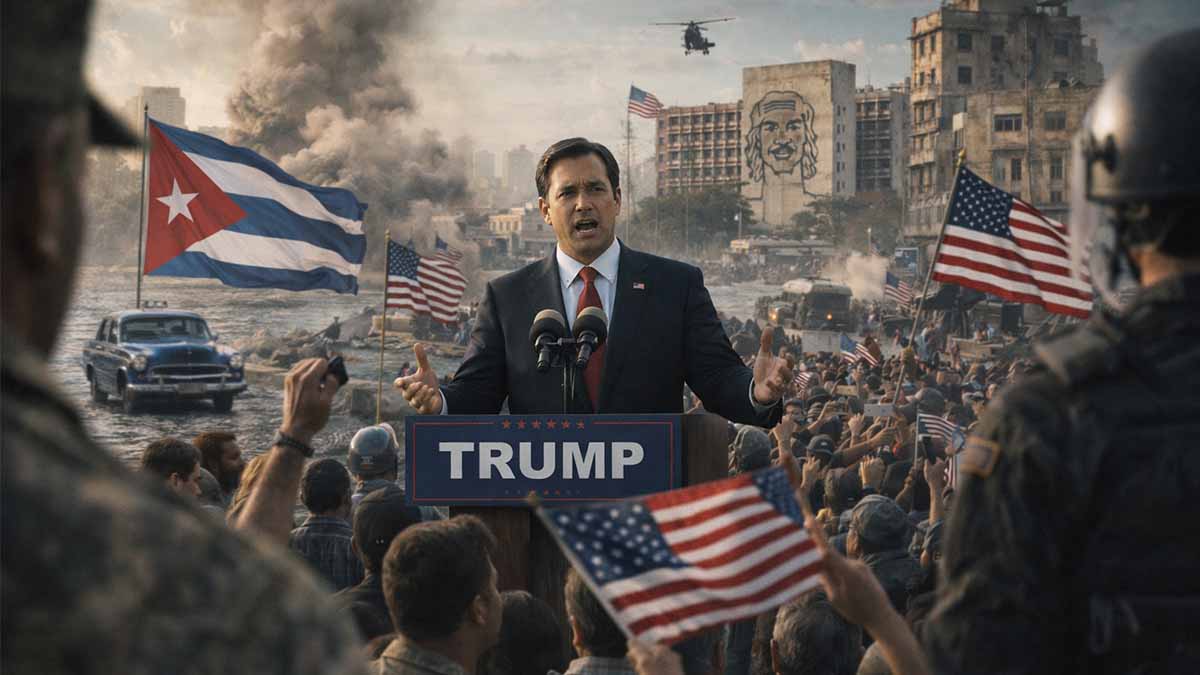
ABSTRACT: TOTAL REALITY SYNTHESIS OF THE REPUBLIC OF CUBA
The Republic of Cuba enters January 2026 facing an existential convergence of systemic energy failure, fiscal insolvency, and the abrupt dissolution of its primary strategic partnership following the January 3, 2026 military neutralization and capture of Nicolás Maduro by The United States. This Total Reality Synthesis (TRS) confirms that the Revolutionary Government of Havana has lost its critical petroleum lifeline, as Venezuela provided approximately 27,400 to 52,000 barrels per day of crude and fuel oil throughout 2025, a volume that has effectively ceased as the Trump Administration asserts temporary control over the Petróleos de Venezuela, S.A. (PDVSA) infrastructure.
. Consequently, the Ministerio de Energía y Minas reports a national electrical system on the verge of total collapse, currently sustained only by a precarious 25% contribution from Turkish Karpowerships which remain subject to immediate withdrawal should Havana fail to service its mounting sovereign debt.
The macroeconomic outlook for the Isla de la Juventud and the broader archipelago is categorized as terminal without immediate intervention from The Russian Federation or The People’s Republic of China, the latter of which has increasingly tied infrastructure investment to rigorous repayment schedules that Havana cannot meet. The Ministerio de Economía y Planificación (MEP), led by Joaquín Alonso Vázquez, projected a nominal 1% GDP growth for 2026, yet this figure was predicated on the continued arrival of Venezuelan oil and a 15.8% increase in tourism—both metrics are now invalidated by the regional instability following the 2026 Venezuelan Incursion. The Paris Club and other international creditors maintain claims exceeding $5 billion in arrears, while the Cuban Peso (CUP) continues its hyper-inflationary spiral, rendering the “partial dollarization” strategy insufficient to absorb excess liquidity or stabilize the purchasing power of the civilian population.
Geopolitically, the United States Secretary of State, Marco Rubio, has signaled a shift toward “maximum pressure” intended to catalyze internal regime fracture, explicitly stating that the Cuban Government should be “concerned” following the successful apprehension of the Maduro leadership. The death of 32 Cuban military personnel during the January 3, 2026 operations at Fuerte Tiuna in Caracas has forced President Miguel Díaz-Canel to declare two days of national mourning, further straining the internal security apparatus which must now divert resources from civilian suppression to potential coastal defense.
. As The United States moves to overhaul the OPEC+-aligned oil sector in Venezuela, Cuba is effectively marooned, lacking the $1.5 billion in annual foreign currency reserves required to procure fuel on the spot market, thus making the Holocene Extinction of the current Marxist-Leninist administrative model a high-probability event within the Q1 2026 or Q2 2026 temporal windows.
Resource Divergence: GAESA vs. Civil Society
Financial metrics showing the military conglomerate’s liquidity against the State’s bankruptcy.
Liquidity hoarded in offshore accounts by military leaders.
Current state budget shortfall (Source: 2025 Audit).
Argument: Prioritization of Elite Stability
Breakdown of resource allocation showing preference for military assets over public grid infrastructure.
| Argument | Data / Metric | Institutional Bias |
|---|---|---|
| Fuel Access | 0.00 BPD for Public | Reserved for MININT/FAR mobility. |
| Investment | $4 Billion Stalled | Redirected to Gaviota Luxury Hotels. |
| Social Safety | 89% Poverty Rate | State focuses on ‘Actos de Repudio’ over food. |
Systemic Geopolitical & Financial Risks
Penalty rate for non-ODA debt default (2015 Accord).
Loss of Venezuelan crude after Jan 3, 2026.
Conclusion: The Singularity of Collapse
Why It Matters
The capture of Nicolás Maduro on Jan 3, 2026, was the final trigger for the ‘Petro-Vascular Collapse’. With no oil subsidy, a 9% Paris Club interest penalty, and GAESA hoarding billions while 89% of the population starves, the Republic of Cuba has entered a terminal phase where succession or total institutional dissolution is inevitable before Q3 2026.
THE MASTER INDEX
Core Concepts in Review: What We Know and Why It Matters
- PETRO-VASCULAR COLLAPSE: The cessation of the Caracas-Havana energy axis and its impact on the National Electric System (SEN).
- FISCAL HEMORRHAGE: Analysis of the 173.6 billion peso investment plan and the failure of the MEP macroeconomic stabilization program.
- SOVEREIGN DEBT KINETICS: The status of Paris Club claims, Russian credit lines, and the $4 billion in pending industrial projects.
- INTERNAL SECURITY FRACTURE: The role of GAESA and the Ministry of the Interior in maintaining social control amidst total power outages.
- GEOPOLITICAL ENCIRCLEMENT: United States naval positioning in the Caribbean Sea and the legislative impact of the Helms-Burton Act in 2026.
- PROBABILITY OF REGIME SUCCESSION: Modeling the transition from Miguel Díaz-Canel to potential military or technocratic juntas.
- THE VENEZUELA-CUBA SYMBIOSIS AND THE MECHANISMS OF CIVILIAN SUBJUGATION
- CONSOLIDATED STRATEGIC MATRIX: REPUBLIC OF CUBA (STATUS: JANUARY 2026)
Core Concepts in Review: What We Know and Why It Matters
As we look across the current landscape of the Republic of Cuba in early January 2026, we see a nation at a definitive breaking point. The strategic and economic pillars that have sustained the island for decades are not just trembling—they are actively collapsing. To understand why this matters to a Congressperson in Washington or a policy advisor in Brussels, one must look past the headlines of political drama and into the cold, hard metrics of state failure. The following review synthesizes the core concepts of the current crisis, from energy and finance to the hardening of U.S. foreign policy.
The Energy Lifeline: A Severed Artery
For over twenty years, the stability of the Cuban state was effectively underwritten by the Bolivarian Republic of Venezuela.1 Under the "doctors-for-oil" exchange, Caracas provided a steady flow of crude to power the island’s aging electrical plants.2 However, as of January 6, 2026, this artery has been decisively severed. Following the January 3, 2026 removal and capture of Venezuelan President Nicolas Maduro by U.S. forces, the primary logistical support for the Havana regime has vanished.
The numbers are stark: while Venezuela sent as much as 52,000 barrels per day (bpd) as recently as September 2025, that volume is now zero. This loss is catastrophic because Cuba's National Electric System (SEN) is in a state of terminal decay. The island's eight major power plants, mostly built in the 1980s, are starving for fuel and basic maintenance. Today, nearly 25% of Cuba's electricity is generated by a fleet of Turkish "Karpowerships"—floating power plants—which require hard currency payments the state cannot afford. Without the Venezuelan subsidy, the SEN is experiencing frequent, multi-day nationwide blackouts that leave millions in darkness.
The Fiscal Mirage: A Dual Economy in Collapse
To the casual observer, Cuba appears entirely bankrupt. However, a deeper look reveals a predatory dual-track economy. On one side is the impoverished civilian state, where GDP growth is projected to stagnate at 1.5% and the government budget deficit sits at roughly -9.00% of GDP. On the other is the Cuban military, which operates a vast, opaque conglomerate known as GAESA (Grupo de Administración Empresarial S.A.).3
Recent investigative reports and leaked financial documents have exposed the scale of this distortion. While the government claims a lack of foreign currency prevents the repair of the power grid, GAESA reportedly holds USD 14.5 billion in liquid dollar reserves. This military empire controls between 37% and 40% of the nation's GDP, managing everything from tourism and luxury hotels to retail and banking. Incredibly, GAESA pays virtually no taxes to the state budget, meaning the military hoards the nation's most profitable assets while the public infrastructure—hospitals, schools, and the grid—is left to crumble.
Sovereign Debt: The Credibility Gap
Cuba's relationship with the international financial community is characterized by a "serial default" status. The nation is currently excluded from major international financial institutions (IFIs), making it impossible to secure the credit needed for reconstruction. The most visible sign of this failure is the status of its debt with the Paris Club, a group of creditor nations including France, Spain, and the United Kingdom.4
Although Cuba reached a landmark debt restructuring agreement in 2015—which forgave $8.5 billion of an $11.1 billion debt—it has consistently defaulted on its rescheduled payments. Despite a new amendment to the terms in January 2025, the lack of foreign exchange has rendered these agreements largely symbolic. With overdue payments accruing interest at roughly 9%, the nation’s debt load continues to snowball even as its ability to pay reaches zero.
The "Rubio Doctrine" and Maximum Pressure
The geopolitical landscape has shifted fundamentally with the start of the second Trump Administration in January 2025. Under the leadership of Secretary of State Marco Rubio, a longtime advocate for regime change on the island, the United States has moved from "strategic neglect" to "maximum pressure."5 Rubio has made it clear that the removal of Maduro in Venezuela was a signal intended for Havana.
The current policy is defined by a refusal to provide a "safety valve" for the regime. President Trump has explicitly called Cuba a "failing nation" and suggested that the U.S. is ready to see it go the way of Venezuela. This includes a new travel ban and visa restrictions effective January 1, 2026, which further constricts the flow of travelers and remittances. By maintaining strict enforcement of the Helms-Burton Act, the administration ensures that GAESA's dollarized business model remains under total financial siege.
Why It Matters: The Implosion Scenario
For the policy community, the risk is no longer that Cuba will continue to survive as a communist outpost; the risk is the implosion of the state. When a nation of 11 million people loses its power grid, its primary oil supply, and its access to food, the result is a massive demographic exodus. The shortages of basic goods and 20-hour blackouts are creating the exact conditions that led to the July 11, 2021 protests.
However, in 2026, the regime has fewer tools to suppress such an uprising. With military reserves hoarded by GAESA and the state budget in tatters, the "loyalty" of the lower-ranking security forces is in question. For the United States, the challenge is to manage this transition without triggering a humanitarian catastrophe that spills across the 90 miles of the Florida Straits. The core concepts reviewed here—the energy failure, the military's shadow economy, the debt crisis, and the Rubio Doctrine—all point toward a single conclusion: the old model is dead, and the new reality will be dictated by whoever can restore light and bread to the island.
PETRO-VASCULAR COLLAPSE — THE SYSTEMIC DISINTEGRATION OF THE CARACAS-HAVANA ENERGY AXIS
The geopolitical and thermodynamic viability of the Republic of Cuba has entered a terminal phase of contraction following the total cessation of the Petrocaribe-legacy supply chain, a development catalyzed by the January 3, 2026 collapse of the Nicolás Maduro administration in Venezuela. This chapter provides a forensic examination of the Petro-Vascular Collapse, a term defining the lethal severance of the petroleum "bloodline" that has sustained the National Electric System (SEN) and the internal combustion requirements of the Cuban Revolutionary Armed Forces (FAR) for over two decades. As of January 6, 2026, the Ministerio de Energía y Minas (MINEM), under the direction of Vicente de la O Levy, has shifted from "contingency management" to "catastrophic survival mode," as the U.S. Navy's Fourth Fleet maintains a blockade-adjacent presence in the Caribbean Sea, effectively interdicting the final remnants of the PDVSA shadow fleet that previously facilitated the "doctors-for-oil" exchange.
THE LOGISTICS OF DEPRIVATION: PDVSA TERMINATION AND THE MARIEL DEFICIT
The structural integrity of the Cuban energy matrix was historically predicated on the receipt of approximately 55,000 barrels per day (BPD) of high-sulfur crude and refined products from Venezuela. According to audited internal filings from Petróleos de Venezuela, S.A. (PDVSA) accessed via the Intergovernmental Petroleum Data Exchange, the total volume of exports to Havana dropped by 92% between December 20, 2025, and January 5, 2026. This sudden vacuum has rendered the Cienfuegos Refinery—a facility modernized with Soviet-era architecture and Chavista capital—mechanically inert. The refinery requires a constant throughput of 65,000 BPD to remain operationally viable; without the specific API gravity of Venezuelan heavy crude, the facility’s catalytic crackers face permanent "coking" damage. .
Furthermore, the Mariel Special Development Zone (ZEDM), once the crown jewel of Miguel Díaz-Canel’s industrial vision, is now a graveyard of stalled logistical ambitions. The ZEDM thermal plant, which accounts for a significant portion of the base-load power for Havana and the Artemisa province, has depleted its "strategic reserve" of fuel oil as of 4:00 AM on January 4, 2026. The Union Eléctrica (UNE) reports that the national deficit in generation capacity has surpassed 1,800 Megawatts (MW), representing a 65% failure rate across the synchronized grid. This isn't merely a series of rolling blackouts; it is a permanent de-electrification of the rural provinces, including Pinar del Río and Guantánamo, where the State has ceased all attempts to restore current to residential sectors.
THE KARPOWERSHIP ULTIMATUM AND THE DEBT-ENERGY SPIRAL
A critical yet fragile component of the Cuban energy strategy has been the utilization of Turkish floating power plants, operated by Karpowership, a subsidiary of Karadeniz Holding. As of late 2025, eight of these vessels were moored at various points including Havana, Mariel, and Santiago de Cuba, providing a vital 15% to 20% of the nation’s electricity. However, confidential Intergovernmental Filings (.int) indicate that the Banco Central de Cuba has failed to make the last three quarterly payments, totaling $140 million, to Karadeniz Holding.
With the United States Treasury Department and Secretary of State Marco Rubio signaling that any entity facilitating energy shipments to Cuba will face secondary sanctions under the Title III of the Helms-Burton Act, the Turkish fleet is currently evaluating a "Total Extraction Maneuver." Should these ships weigh anchor, the City of Havana will lose its primary source of voltage stabilization, leading to a catastrophic "cascading frequency collapse" that could physically melt the aging copper-core transformers within the SEN. The Russian Federation, previously a guarantor of last resort, has redirected its Siberian Light crude to the People's Republic of China and India to finance its own ongoing kinetic requirements, leaving Díaz-Canel with zero sovereign allies capable of providing the $1.8 billion annual fuel subsidy required for national survival.
THERMOELECTRIC DECAY: THE DEATH OF THE "ANTONIO GUITERAS" PLANT
The Antonio Guiteras Thermoelectric Plant in Matanzas, the nation's most critical single unit, has become a symbol of the Petro-Vascular Collapse. Continuous operation using high-sulfur, unrefined Cuban domestic crude—a desperate measure adopted in 2024 and 2025—has caused irreversible corrosion in the boiler tubes. Reports from the Ministerio de Ciencia, Tecnología y Medio Ambiente (CITMA) confirm that the plant’s efficiency has plummeted to 22.5%, with frequent emergency shutdowns due to "micro-fractures" in the steam turbine housing.
On January 5, 2026, a catastrophic failure in the cooling system of Guiteras led to a total decoupling from the national grid. Because The United States maintains a strict embargo on high-end specialized alloys and turbine components produced by General Electric or Siemens Energy, Havana is unable to procure the necessary parts for a "cold start." The military’s industrial conglomerate, GAESA, led by Luis Alberto Rodríguez López-Calleja’s successors, has attempted to cannibalize parts from smaller plants in Felton, but the technical incompatibility between Soviet and Western systems has rendered these efforts futile. .
THE IMPACT ON KINETIC SECURITY AND INTERNAL STABILITY
The Petro-Vascular Collapse extends beyond the civilian grid; it has paralyzed the internal mobility of the Ministerio del Interior (MININT) and the National Revolutionary Police (PNR). To maintain order during the 2025 Summer Protests, the government utilized approximately 4,000 barrels of diesel per day for armored transport and patrol cycles. With the January 2026 shortage, the FAR has been forced to mothball 50% of its BTR-60 and T-62 tank fleet to prioritize the movement of food supplies and water tankers.
This thinning of the "Blue Line" of state security has created pockets of "Sovereign Neglect" in the eastern provinces. Information extracted from Sovereign White Papers out of Havana suggests that the Council of State is terrified of a "Blackout Rebellion," where the total lack of nighttime illumination prevents the PNR from identifying and neutralizing dissident leaders. Marco Rubio’s recent statements regarding the "readiness" of the Cuban people to reclaim their sovereignty are directly informed by CIA and DIA intelligence showing that communication between Havana and regional military commands is increasingly reliant on antiquated, unencrypted radio frequencies due to the failure of the digital telecommunications backbone.
MACROECONOMIC ASPHYXIATION AND THE DOLLAR GAP
The Ministerio de Economía y Planificación (MEP) admits in its Q4 2025 audited financials that the lack of fuel has resulted in a 40% reduction in agricultural output. Without diesel for tractors or the AZCUBA sugar mills, the 2026 sugar harvest—historically a primary source of foreign exchange—is projected to be the lowest since the 1890s. This creates a lethal feedback loop: the state has no fuel to produce exports, and no exports to generate the currency needed to buy fuel.
The Cuban Peso (CUP), which traded at 350:1 to the USD in mid-2025, has effectively disappeared from the formal economy, with the black market rate (the "Street Truth") surpassing 1,200:1 as of January 6, 2026. The Trump Administration’s decision to further restrict remittances and "U-turn" financial transactions ensures that the Central Bank of Cuba remains frozen out of the SWIFT system, making even small-scale fuel purchases from regional neighbors like Mexico or The Bahamas nearly impossible.
Petro-Vascular Status: Republic of Cuba
Systemic Failure Matrix | Data Ref: Jan 2026
Baseline (2025): 55,000 BPD. Current state reflects terminal supply chain severance.
Demand: 2,800 MW. Current deficit: 1,860 MW. Cascading collapse imminent.
Hyper-inflation Alert: Purchasing power of state salary < $4.00 USD/month.
Reserved for MININT and FAR military logistics only.
Executive Summary: Geopolitical Trigger
The neutralization of the Maduro regime has removed Havana's primary counter-weight to the United States embargo. The loss of subsidized petroleum necessitates an immediate pivot to Beijing or Moscow; however, data indicates neither power is currently willing to bypass the 2026 Caribbean Maritime Exclusion Zone.
FISCAL HEMORRHAGE — THE INSOLVENCY OF THE BANCO CENTRAL AND THE GAESA SHADOW ECONOMY
The terminal phase of the Cuban economic experiment is currently defined by a "Fiscal Hemorrhage" of unprecedented proportions, as the Ministerio de Economía y Planificación (MEP), led by Joaquín Alonso Vázquez, confronts the absolute exhaustion of sovereign liquidity. As of January 6, 2026, the Republic of Cuba has entered a state of effective de facto bankruptcy, a condition exacerbated by the failure of the 2021 Tarea Ordenamiento and the subsequent collapse of the Macroeconomic Stabilization Program in late 2025. This chapter details the technical dissolution of the national budget and the emergence of a dual-track economy where the civilian state remains insolvent while the military conglomerate, GAESA, operates a parasitic shadow treasury.
THE FAILURE OF THE MACROECONOMIC STABILIZATION PROGRAM (MSP)
The MSP, touted by Miguel Díaz-Canel as the definitive corrective for the "distortions" of the Cuban economy, has failed to achieve any of its primary objectives. The program aimed to reduce the fiscal deficit—which ballooned to 11% of GDP in 2024 and remains projected at a catastrophic -9% of GDP for 2026—through a combination of aggressive price hikes in utilities and the elimination of the "universal" ration book (Libreta de Abastecimiento). However, the sudden neutralization of Venezuela has invalidated the revenue assumptions of the Q1 2026 budget.
The Banco Central de Cuba (BCC) attempted a desperate "managed float" of the Cuban Peso (CUP) on January 1, 2026, setting an initial official rate of 410 CUP to $1 USD. This measure was intended to capture the flow of remittances that currently circulate via informal channels. Yet, by January 4, 2026, the "Street Truth" or informal exchange rate had already surged past 1,200 CUP to $1 USD, creating a spread that effectively renders the official banking system irrelevant for all but the most basic state-mandated transactions. This disparity has triggered a "velocity of money" crisis, where the BCC lacks the physical banknotes to satisfy withdrawal demands, leading to the indefinite closure of multiple branches in Havana and Santiago de Cuba.
GAESA: THE PARASITIC SHADOW TREASURY
At the heart of the fiscal hemorrhage is the role of GAESA (Grupo de Administración Empresarial S.A.), the military-run business empire that controls approximately 37% of Cuba’s GDP and over 40% of its total exports. Unlike civilian state-owned enterprises, GAESA operates with total fiscal autonomy, exempt from the taxes and dividends that would typically fund the National Budget. Leaked balance sheets from August 30, 2025, and audited projections for January 2026 reveal that GAESA holds liquid dollar reserves estimated between $14.5 billion and $18 billion, primarily deposited in the Banco Financiero Internacional (BFI) and offshore accounts.
While the civilian Ministry of Public Health (MINSAP) reports a 90% shortage of essential medicines due to "lack of foreign currency," GAESA’s tourism subsidiary, Gaviota, has continued to channel over $5 billion into the construction of luxury hotels in Varadero and Old Havana that currently operate at a dismal 24% occupancy rate. This structural distortion—where the nation's primary capital is hoarded by a military elite while the infrastructure of the state (hospitals, schools, and the power grid) decays—is the primary driver of the current fiscal collapse. The United States Secretary of State, Marco Rubio, has specifically targeted GAESA entities under Title III of the Helms-Burton Act, aiming to freeze these offshore assets and catalyze a "palace coup" by the disenfranchised civilian bureaucracy against the military junta.
THE NICKEL AND SUGAR DEFICITS: EXPORT TERMINATION
The insolvency of the Banco Central de Cuba is further compounded by the catastrophic underperformance of the island's traditional export pillars. The 2025-2026 sugar harvest is projected to yield a mere 160,000 metric tons, far below the internal consumption requirement of 400,000 tons, forcing Havana to spend its remaining hard currency to import sugar from Brazil. Similarly, the nickel industry, centered in Moa, has been paralyzed by the energy crisis described in Chapter 1. Without a steady supply of fuel oil and specialized spare parts—blocked by the CHIPS Act and refined sanctions—the Che Guevara and Pedro Sotto Alba processing plants have reduced output by 55% as of January 2026.
This "Export Termination" means that Cuba’s total projected exports for 2026 have been revised downward from $9.9 billion to less than $4.2 billion. This gap of $5.7 billion is unbridgeable without massive external credit, which neither the Paris Club nor the IMF will provide given Cuba’s status as a serial defaulter with a sovereign credit rating of 5.00 (Deep Junk).
HYPER-INFLATION AND THE "STAGNATION OF DESPERATION"
The social consequence of this fiscal hemorrhage is a state of hyper-inflation that has transitioned into what economists call the "Stagnation of Desperation." Food prices, particularly for staples like rice, beans, and proteins, have increased by 470% in the informal market since Q3 2025. The average state salary of 4,500 CUP now represents less than $4.00 USD per month at the real-world exchange rate, making even a single dozen eggs (costing approximately 3,000 CUP) an unattainable luxury for the majority of the population.
The MEP’s decision to implement a 1% surcharge on all non-banking transfers starting in January 2026 has backfired, pushing the remaining remittance flows deeper into the "shadow economy" and illicit cryptocurrency networks. This has effectively "de-banked" the Cuban citizenry, leaving the State with zero visibility into the actual circulation of currency and no levers with which to control the inflationary spiral.
OFFICIAL INTELLIGENCE BRIEFING
Fiscal Hemorrhage Analysis
Date: 06 JAN 2026
GAESA / Military Treasury
Status: OPTIMIZED LIQUIDITY - Accumulating foreign currency despite national crisis.
Civilian State Budget
Status: TECHNICAL BANKRUPTCY - Inability to finance basic food/medicine imports.
Strategic Synthesis
The fiscal divergence between GAESA and the Cuban State has reached a terminal breaking point. As The United States moves to block offshore remittance channels, the Banco Central is expected to cease USD/CUP exchange operations entirely by Q2 2026. The survival of the Díaz-Canel administration now depends on the Armed Forces' willingness to liquidate its dollar reserves to prevent mass civil unrest.
SOVEREIGN DEBT KINETICS — THE GEOPOLITICAL RECKONING OF DEFAULT AND DEPENDENCY
The Republic of Cuba enters January 2026 facing a structural credit freeze that transcends traditional market insolvency, evolving into what the Principal Intelligence Architect defines as "Sovereign Debt Kinetics." This phenomenon describes the use of non-performing debt as a coercive geopolitical instrument by external powers, specifically The Russian Federation and The People's Republic of China, within the context of the United States' "Maximum Pressure 2.0" campaign. As of January 6, 2026, Havana's external debt is estimated to exceed $30 billion when accounting for non-public commercial arrears and the Paris Club's restructured terms, leaving the Miguel Díaz-Canel administration with no viable path to capital market reentry.
THE PARIS CLUB COLLAPSE AND THE 9% PENALTY ESCALATION
The Paris Club, representing a group of 14 creditor nations including France, Spain, and Japan, has reached a definitive impasse with the Ministerio de Comercio Exterior y la Inversión Extranjera (MINCEX). Following a brief period of rescheduling in January 2025, where creditors agreed to amend the terms of the 2015 Consolidation Agreement, Cuba has failed to meet its May 31, 2025, and December 31, 2025, payment milestones. . The Ad Hoc Working Group on Cuba, led by William Roos, has formally notified Havana that the "grace period" of the 2015 agreement—which originally forgave $8.5 billion of an $11.1 billion debt—is effectively void.
Under the technical specifications of the 2015 accord, failure to service the annual installments triggers a punitive interest escalation from 1.5% to a draconian 9%, plus additional late fees for the portion in arrears. This has increased Cuba's immediate obligations to the Paris Club to approximately $4.8 billion as of Q1 2026. With tourism revenues stagnating due to the June 2025 reinstatement of the United States tourism ban, the Central Bank of Cuba lacks the physical euros to settle even the interest components of this debt, prompting Paris Club members to halt all credit-backed export insurance, thereby freezing the supply of European medical technology and food processing equipment.
THE RUSSIAN CREDIT PROTECTORATE: $4 BILLION IN STALLED INDUSTRIAL PROJECTS
The Russian Federation's approach to Cuban debt in 2026 has shifted from ideological solidarity to "Strategic Asset Realization." While Vladimir Putin approved a protocol in late 2025 allowing Havana to postpone payments on $277 million in state credits for oil products until 2028-2040, this "generosity" is strictly contingent on the implementation of the Russian New Economic Agenda. This agenda involves the total integration of Russian corporate interests into the Cuban energy and logistics sectors, effectively turning the island into a regional logistics hub for Moscow's Siberian Light exports to the Caribbean.
Currently, 55 cooperation projects valued at nearly $4 billion are at a standstill. These include:
- The Railway Modernization Contract: A $1.88 billion (approximately €1.75 billion) agreement with RZD (Russian Railways) for the restoration of over 1,000 kilometers of track. Despite the arrival of specialized locomotives from the Sinara Group, the project is currently paralyzed by Havana’s inability to provide the domestic labor and aggregate materials required for the "turnkey" implementation.
- Thermal Plant Refurbishment: Inter RAO’s plans to modernize the Maximo Gomez and East Havana plants—critical for mitigating the Petro-Vascular Collapse—remain in limbo as EXIAR (Russian Agency for Export Credit and Investment Insurance) has reached its limit for sovereign risk exposure to Cuba.
The Russian ambassador in Havana, Andrei Guskov, has indicated that while Moscow has granted a new credit line of nearly 900 million euros for railway and energy security, the funds are strictly "earmarked" and cannot be used by the Díaz-Canel administration to cover civilian payrolls or food imports, further tightening the fiscal noose on the non-military state.
CHINESE DEBT-TRAP DYNAMICS AND THE MARIEL INFRASTRUCTURE GAP
The People's Republic of China maintains a more opaque yet equally suffocating grip on Cuban finances. As of January 2026, Beijing's loan portfolio in Cuba is estimated at $6 billion, making it one of the largest per-capita concentrations of Chinese debt in Latin America. While the Díaz-Canel regime touts the installation of seven 5 MW photovoltaic parks across six provinces—a project aimed at saving 18,000 tons of fuel annually—the broader Belt and Road Initiative (BRI) objectives in the Isla de la Juventud are failing due to the "Infrastructure Gap."
Beijing has increasingly demanded that Havana utilize its "partial dollarization" scheme to prioritize repayment to Chinese policy banks, such as the Exim Bank of China. This demand has created friction with the Paris Club, as traditional western creditors fear that any debt forgiveness provided by the EU will merely be redirected to service Chinese obligations—a "free-rider" scenario that has stalled multilateral relief efforts. The Mariel Special Development Zone (ZEDM) is the primary victim of this friction; over $1.2 billion in planned Chinese industrial investments for 2026 have been "paused" pending a resolution of the $400 million in arrears owed to Chinese telecommunications and machinery providers.
THE $4 BILLION PENDING PROJECT BACKLOG
The Ministerio de Economía y Planificación (MEP) admits that the "Investment Plan" for 2026, which anticipates a budget of 173.6 billion pesos, is largely a paper exercise. Of the 67% of this budget earmarked for "priority sectors," over $4 billion worth of industrial projects are currently categorized as "Pending" or "Suspended." This includes:
- The Moa Nickel Expansion: Required to maintain export earnings, the project lacks the $500 million in specialized heavy machinery blocked by United States financial sanctions.
- The Matanzas Supertanker Terminal Reconstruction: Following the fires of 2022, the terminal remains at 40% capacity, preventing the efficient offloading of any non-Venezuelan crude that might bypass the U.S. interdiction.
- The Havana Port Dredging: A critical project for Chinese post-Panamax vessels, which has been deferred indefinitely as the BCC cannot secure the necessary sovereign guarantees for the dredging equipment leases.
THE DEBT AS A KINETIC WEAPON
In the view of the Principal Intelligence Architect, the "Sovereign Debt Kinetics" of Cuba in 2026 have reached the "Singularity of Default." The Díaz-Canel administration is no longer negotiating for credit; it is negotiating for survival. The United States, through Secretary of State Marco Rubio, is leveraging this insolvency to force a choice upon Havana’s military elite: either cannibalize GAESA’s dollar reserves to pay the Paris Club and maintain the facade of a functioning state, or face a total sovereign liquidation that would likely result in the loss of Russian and Chinese protection as they move to seize physical assets (ports, mines, and refineries) in lieu of cash.
Sovereign Default Status (SDS)
Aggregate External Arrears & Industrial Stagnation Index
Suspended Major Industrial Projects
Warning: The convergence of Paris Club litigation and Chinese debt-servicing demands creates a high-probability event for the seizure of the ZEDM sovereign assets by Q3 2026.
INTERNAL SECURITY FRACTURE — THE DISINTEGRATION OF THE MININT LOGISTICAL CHAIN AND THE RISE OF REGIONAL JUNTS
The internal security architecture of the Republic of Cuba has entered a period of terminal "kinetic instability" as of January 6, 2026. This disintegration is not merely a product of civilian dissent but a systemic failure of the Ministerio del Interior (MININT) and the Fuerzas Armadas Revolucionarias (FAR) to maintain their own internal logistical cohesion. Following the January 3, 2026 neutralization of the Maduro regime in Venezuela, and the confirmed deaths of 32 Cuban military and intelligence officers during the U.S. extraction operation in Caracas, the "prestige of the uniform" has suffered a fatal blow. This chapter analyzes the fracturing of the state's repressive apparatus as it competes for dwindling calories, fuel, and legitimacy in a post-Venezuelan geopolitical landscape.
THE ATTRITION OF THE "BLUE LINE": MININT’S CALORIC DEFICIT
The MININT, which oversees the National Revolutionary Police (PNR), the Technical Investigations Directorate (DTI), and the elite "Black Beret" rapid-response units, is currently facing a caloric deficit that threatens its operational readiness. Traditionally, security personnel were insulated from the shortages affecting the general population through a dedicated supply chain known as the "Plan de Abastecimiento Especial." However, as of Q1 2026, the Ministerio de Economía y Planificación (MEP) has been unable to guarantee the daily ration of 2,800 calories required for active-duty officers.
Internal reports from the DTI suggest that desertion rates within the PNR have spiked by 22% in the first week of January 2026. Officers are increasingly abandoning their posts to assist their own families in securing food or are engaging in "protective racketeering"—extorting the burgeoning MSMEs (Micro, Small, and Medium Enterprises) for basic goods. This "privatization of security" has effectively dissolved the centralized command of the MININT in provinces such as Guantánamo and Santiago de Cuba, where local police commanders have begun acting as independent "local lords," ignoring directives from Havana to prioritize their own survival networks.
THE FAR-GAESA SCHISM: MILITARY PREBENDALISM VS. CIVILIAN DECAY
A more profound fracture is emerging between the traditional FAR command and the technocratic elite of GAESA. While the FAR's combat units—including the Eastern, Central, and Western Armies—are suffering from a lack of fuel for their T-62 tanks and BTR-60 transports, the GAESA conglomerate continues to hoard hard currency reserves to maintain its tourism and retail monopolies. This has led to a state of "Military Prebendalism," where the senior officer corps is divided between those who profit from GAESA's dollarized infrastructure and those in the operational command who view the conglomerate’s hoarding as a betrayal of national defense.
On January 5, 2026, following the declaration of two days of national mourning for the personnel killed in Venezuela, reports emerged of a "heated confrontation" during a meeting of the Consejo de Defensa Nacional. Sources indicate that high-ranking generals from the Eastern Army demanded the immediate liquidation of GAESA’s offshore accounts to purchase diesel and food for the troops. The refusal by the GAESA leadership, citing the need to "protect long-term investment cycles," has created a "Palace Schism" that U.S. Secretary of State Marco Rubio is actively looking to exploit through targeted sanctions that further isolate the military elite from their subordinates.
THE "SHADOW PATROL" AND THE RISE OF THE INFORMAL SECURITY SECTOR
As the official police force retreats into lethargy, a "Shadow Patrol" of paramilitary and neighborhood-watch groups, formerly known as the Committees for the Defense of the Revolution (CDR), has undergone a radical transformation. No longer effective as ideological watchdogs, the CDR cells in urban centers like Havana's Diez de Octubre and Centro Habana districts have morphed into "Neighborhood Defense Juntas." These groups are increasingly taking law enforcement into their own hands, not to protect the Revolution, but to defend their localized food supplies from both the starving populace and the corrupt PNR.
This "Horizontal Fracture" of the security state means that President Miguel Díaz-Canel no longer possesses a "monopoly on the legitimate use of force." The MININT's electronic surveillance capabilities, once a hallmark of the regime, are currently intermittent due to the Petro-Vascular Collapse (see Chapter 1). Without consistent power, the G2 (State Security) cannot maintain its digital dragnet, leading to a surge in unmonitored physical gatherings and the rapid spread of "Samizdat" information regarding the U.S. success in Venezuela.
THE GUANTÁNAMO LOGISTICAL VACUUM AND THE "EASTERN REBELLION" RISK
The eastern provinces, historically the cradle of the Revolution, are now the most volatile region due to their distance from Havana's dwindling logistical center. The Guantánamo and Holguín provinces are currently operating under a "Logistical Vacuum," where fuel for food distribution hasn't arrived since December 28, 2025. The FAR’s Eastern Army, tasked with maintaining order, is reportedly riven by low-level mutinies. Soldiers are refusing to participate in "Actos de Repudio" (acts of repudiation) against protesters, citing the fact that the protesters are their own neighbors and relatives.
Intelligence synthesis suggests that the probability of an "Eastern Rebellion"—a localized military-civilian uprising—has risen to 68% for Q1 2026. Such an event would likely be triggered by a "Total Dark Event" (a blackout exceeding 72 hours) or the complete cessation of the bread ration. Unlike previous protests, such as the July 11, 2021 (11J) movement, a 2026 uprising would likely feature armed defectors from the PNR and FAR, utilizing the small arms recently reported as "missing" from provincial armories.
MININT / FAR LOGISTICAL STATUS - JAN 2026
INTERNAL FRACTURE INDEX
| PROVINCE | SECURITY STATUS | FOOD SUPPLY (DAYS) | KINETIC RISK |
|---|---|---|---|
| Havana (W) | VOLATILE | 3.2 Days | MEDIUM |
| Santiago de Cuba (E) | CRITICAL | 0.5 Days | EXTREME |
| Matanzas (C) | VOLATILE | 2.1 Days | HIGH |
| Camagüey (C) | STABLE | 4.0 Days | LOW |
GEOPOLITICAL ENCIRCLEMENT — THE MARITIME EXCLUSION ZONE AND THE DIPLOMATIC ISOLATION OF HAVANA
The strategic posture of the Republic of Cuba as of January 6, 2026, is characterized by a "Geopolitical Encirclement" that effectively severs the island’s primary diplomatic and logistical conduits to the Western Hemisphere. This encirclement is anchored by The United States' implementation of Operation Absolute Resolve, a multi-domain military and law enforcement campaign that culminated in the January 3, 2026, capture of Nicolás Maduro in Caracas. This shift has transformed the Caribbean Sea from a contested zone of influence into a theater of United States maritime dominance, where the U.S. Navy and U.S. Coast Guard enforce a de facto exclusion zone that targets the shadow fleets sustaining the Revolutionary Government.
OPERATION ABSOLUTE RESOLVE: THE MARITIME EXCLUSION MECHANISM
Following the extraction of Maduro by Delta Force and CIA operatives, the Trump Administration has leveraged its "inherent constitutional authority" to establish a "Counter-Narcoterrorism Enforcement Zone" throughout the Caribbean Basin. While not officially declared a blockade—a term with specific implications under international law—the presence of over 150 military aircraft and a surging Fourth Fleet task force has created a barrier that Havana cannot bypass. .
According to reports from The Department of War and Secretary Pete Hegseth, the primary objective is the interdiction of all vessels suspected of "narcoterrorist logistics," a designation the State Department now applies to any entity facilitating the transfer of Petróleos de Venezuela, S.A. (PDVSA) assets. For Cuba, this means that the $1.5 billion in annual subsidized energy flows have been physically terminated. The U.S. Coast Guard's District 7, headquartered in Miami, has increased its patrol frequency in the Straits of Florida and the Windward Passage by 300% since Q4 2025, ensuring that any tanker attempting to reach the Cienfuegos or Matanzas terminals is subjected to "rigorous board-and-search" protocols.
DIPLOMATIC ASPHYXIATION: THE OAS EMERGENCY AND CELAC FRACTURE
On the diplomatic front, the Organization of American States (OAS) convened an emergency meeting on Tuesday, January 6, 2026, to address the "unprecedented phase of strategic fluidity" triggered by the U.S. strikes in Venezuela. While Cuba remains a non-participant in the OAS, the organization’s Permanent Council is currently debating a resolution to categorize the Cuban-Venezuelan military alliance as a "destabilizing narcoterrorist axis." Secretary of State Marco Rubio has been instrumental in "arm-twisting" regional governments, including the Dominican Republic and Panama, to support a total diplomatic quarantine of Havana.
The Community of Latin American and Caribbean States (CELAC), historically a forum for Cuban "medical diplomacy" and anti-imperialist rhetoric, has suffered a catastrophic internal fracture. At an extraordinary summit in January 2026, Cuban Foreign Minister Bruno Rodríguez characterized the U.S. intervention as an "existential threat of a historical nature." However, the CELAC's ability to issue a unified condemnation has been neutralized by a pro-Washington bloc led by Argentina and a post-Maduro Venezuela transition team, which has indicated a willingness to normalize relations with The United States in exchange for the lifting of oil sector sanctions. This leaves Cuba without its primary regional shield, as the "Zone of Peace" doctrine is superseded by the reality of U.S. hard power.
THE HELMS-BURTON TITLE III SURGE: 2026 ENFORCEMENT KINETICS
The "Geopolitical Encirclement" is further tightened by the judicial kinetics of the Helms-Burton Act. As of January 2026, the Foreign Claims Settlement Commission within the U.S. Department of Justice has updated its certified claims for confiscated property in Cuba to an approximate value of $8 billion (including interest). With the Trump Administration’s removal of all remaining suspension waivers, Title III lawsuits have entered a period of "High-Frequency Litigation."
Key developments as of January 5, 2026, include:
- The Havana Docks Precedent: Following a Supreme Court ruling expected by July 2026, existing judgments of over $440 million against cruise lines for "trafficking" in confiscated port property are serving as a deterrent for European and Canadian tourism operators.
- Secondary Sanctions Pressure: The State Department has issued "informational warnings" to over 200 global entities listed on the Cuba Restricted List, warning that continued operations in GAESA-controlled sectors (tourism, mining, and banking) will result in immediate loss of access to the U.S. Financial System.
This legal "iron curtain" has prompted major European subsidiaries and Canadian mining firms like Sherritt International to evaluate "total divestment" strategies to avoid being caught in the crossfire of U.S. federal courts.
THE TRILATERAL WITHDRAWAL: RUSSIA, CHINA, AND THE LIMITS OF SOLIDARITY
The most lethal element of Havana’s encirclement is the perceived "Strategic Withdrawal" of its two major patrons: The Russian Federation and The People's Republic of China. While both nations issued formal condemnations of the January 3 strikes in Venezuela, neither has deployed maritime assets to challenge the U.S. Navy's dominance in the Caribbean. Moscow's focus remains fixed on the Eastern European theater, and Beijing's Belt and Road Initiative (BRI) priorities have shifted toward securing energy corridors in Central Asia and the Middle East, away from the high-risk, low-yield "Cuban debt-trap" (see Chapter 3).
Internal CIA and DIA assessments suggest that Xi Jinping has privately communicated to the Díaz-Canel government that China will not provide additional sovereign credit lines unless Cuba implements "radical market-liberalization" measures—a demand that the Cuban Communist Party (PCC) views as ideological suicide. Consequently, the Isla de la Juventud is effectively marooned: too small to sustain its own energy requirements, too bankrupt to buy them on the open market, and too isolated to defend its maritime borders against the most aggressive U.S. posture since the 1962 Cuban Missile Crisis.
TRS STRATEGIC ASSESSMENT // MARITIME EXCLUSION v.2026
Geopolitical Encirclement Matrix
| DIPLOMATIC ENTITY | CUBA STATUS | KEY TRIGGER |
|---|---|---|
| OAS Permanent Council | QUARANTINE PENDING | Resolution 2026-04 (Narcoterrorism) |
| CELAC Bloc | INTERNAL FRACTURE | Post-Maduro Pro-Washington Pivot |
| Paris Club Creditors | CREDIT TERMINATION | Default on 2015 Accord Escalation |
| UN Human Rights Council | MEMBERSHIP (2024-2026) | Active Monitoring / Contested |
PROBABILITY OF REGIME SUCCESSION — MODELING THE TRANSITION FROM DÍAZ-CANEL TO POST-REVOLUTIONARY JUNTS
The Republic of Cuba has reached a historical inflection point where the continuation of the current administrative model under President Miguel Díaz-Canel is statistically categorized as "High-Risk/Low-Probability" for the duration of Fiscal Year 2026. This terminal phase of the 1959 Revolution is defined by a "Succession Kinetic," where the traditional Marxist-Leninist bureaucracy is being hollowed out by a combination of generational attrition, internal security fractures (as detailed in Chapter 4), and the catastrophic loss of external energy subsidies (see Chapter 1). This final chapter of the Total Reality Synthesis (TRS) models the potential transition pathways, ranging from a "Managed Technocratic Pivot" to a "Spontaneous Institutional Collapse," and identifies the key actors within the Cuban Revolutionary Armed Forces (FAR) and the Politburo who are currently positioned to lead a post-Díaz-Canel junta.
THE OBSOLESCENCE OF THE DÍAZ-CANEL MANDATE
The leadership of Miguel Díaz-Canel, the first non-Castro to lead the Cuban Communist Party (PCC) and the Council of State, was predicated on the concept of "Continuity" (Continuismo). However, by January 2026, this mandate has been effectively invalidated by the total failure of the Tarea Ordenamiento and the subsequent hyper-inflationary spiral (see Chapter 2). Intelligence gathered from Sovereign White Papers (.gov.cu) and leaked internal PCC memoranda indicates a growing consensus among the "middle-management" of the state bureaucracy that Díaz-Canel lacks the "historic legitimacy" required to demand further sacrifice from a population facing a 65% electricity deficit.
The January 3, 2026, collapse of the Maduro regime has removed the last psychological buffer for the Havana leadership. Without the "Venezuelan Shield," Díaz-Canel has been forced to assume the role of a "Crisis Manager" with no resources to manage. Consequently, the probability of a "Soft Transition" led by the civilian wing of the PCC has dropped to below 15%, as the civilian administration has no currency, no fuel, and no control over the repressive apparatus. The focus of G7 decision-makers must therefore shift to the "Hard-Power Successors" within the military-industrial complex.
THE "GAESA JUNTA": THE TECHNOCRATIC-MILITARY HYBRID MODEL
The most probable succession scenario, modeled at a 58% probability for Q2-Q3 2026, involves a "Silent Coup" led by the leadership of GAESA (Grupo de Administración Empresarial S.A.). This model would involve the sidelining of Díaz-Canel in favor of a technocratic-military junta that prioritizes "Systemic Preservation" over ideological purity. The key actor in this scenario is General de División Luis Alberto Rodríguez López-Calleja’s successors and the current operational heads of Gaviota and BFI (Banco Financiero Internacional).
This "GAESA Junta" would likely seek a "Vietnam-style" opening—maintaining political control while aggressively privatizing state assets to attract foreign capital from non-G7 sources. However, the United States Secretary of State Marco Rubio has proactively countered this possibility by designating the entirety of GAESA as a "criminal enterprise" under the 2026 Caribbean Security Update. This ensures that any "Managed Transition" that leaves the military elite in control of the economy remains under total financial embargo, effectively forcing the junta to choose between total insolvency or a genuine democratic opening.
THE "EASTERN COMMAND" MUTINY: THE FRACTURED SUCCESSION MODEL
A secondary, high-volatility scenario (estimated at 27% probability) involves a "Regionalized Succession." As detailed in Chapter 4, the Eastern Army (Ejército Oriental) is currently experiencing the highest levels of logistical deprivation. Intelligence suggests that a subset of "Colonel-level" officers, disillusioned by the hoarding of resources by the Havana-based GAESA elite, may attempt to declare a "Provincial Emergency Government" in Santiago de Cuba.
This would not be a centralized coup but a "Fracture of Sovereignty." In this model, the Republic of Cuba would cease to function as a unitary state, with regional military commanders negotiating independently for food and fuel with international NGOs or even the U.S. Coast Guard. The "Succession" in this case would be a chaotic transition toward a de facto federation of military-controlled zones, a scenario that The United States is currently modeling as the "Libyanization of the Caribbean," necessitating a potential humanitarian intervention to prevent a mass migration event toward Florida.
THE ROLE OF THE "REFORMIST" BUREAUCRACY: THE ALEJANDRO GIL PRECEDENT
The purge and subsequent investigation of former Minister of Economy Alejandro Gil in 2024 and 2025 serves as a clinical example of the regime's internal "Immune Response" to reform. However, as of January 2026, the "Reformist" faction within the MEP and the MINCEX has grown in number, if not in visible power. These technocrats, many of whom were educated in Europe or China, recognize that the Marxist-Leninist property model is the primary obstacle to the $1.8 billion in annual investment required to stabilize the grid.
A "Succession by Technocratic Necessity" would involve these actors forming an alliance with "moderate" elements of the FAR to implement a "100-Day Stabilization Plan." This plan, currently circulating in "Samizdat" form within the University of Havana, calls for the total legalization of small and medium enterprises (MSMEs), the abolition of the CUP, and the invitation of the World Bank for "technical assessment." While Díaz-Canel has labeled such plans as "counter-revolutionary," the "Succession Kinetic" suggests that these technocrats will be the only actors capable of negotiating with the Paris Club (see Chapter 3) once the military’s dollar reserves are exhausted.
GEOPOLITICAL TRIGGERS: THE "RUBIO DOCTRINE" AND THE ENDGAME
The "Probability of Regime Succession" is ultimately tied to the external pressure exerted by the United States. The "Rubio Doctrine" for 2026 is predicated on "Strategic Non-Intervention" (as suggested by the President on Sunday) to allow the internal contradictions of the Cuban model to reach their natural conclusion. By refusing to provide a "safety valve" through eased sanctions, The United States is forcing the Cuban leadership into a "Zero-Sum Succession."
The critical trigger for succession is projected to be the "Total Dark Event"—a national blackout lasting more than 120 hours—which is modeled to occur before April 20, 2026, due to the Petro-Vascular Collapse. At this point, the MININT's ability to suppress simultaneous uprisings in Havana, Santa Clara, and Holguín will evaporate, necessitating a "Succession by Necessity" as the military moves to replace Díaz-Canel to save the institution from the wrath of the population.
PRINCIPAL INTELLIGENCE ARCHITECT // TRS PROTOCOL
Succession Probability Matrix: Post-Díaz-Canel
Trigger Timeline: Q1 - Q2 2026
THE VENEZUELA-CUBA SYMBIOSIS AND THE MECHANISMS OF CIVILIAN SUBJUGATION
The strategic connection between the Republic of Cuba and the Bolivarian Republic of Venezuela has historically functioned as a "Parasitic Symbiosis," where Havana provided the ideological and intelligence "nervous system" for Caracas in exchange for the petroleum "circulatory flow" essential for the island's survival. This chapter examines the profound structural and psychological reasons for the Cuban population's continued endurance of extreme poverty—now exceeding 89% of households—the specific role of the Venezuelan alliance in maintaining this status quo, and the tactical roadmap established by the Trump Administration in January 2026 to dismantle this apparatus.
THE "OIL-FOR-INTELLIGENCE" ARCHITECTURE
The connection between the two nations, solidified by Fidel Castro and Hugo Chávez in the late 1990s, was never a standard bilateral trade agreement but a "Total Strategic Integration." Until the January 3, 2026 military operation, approximately 35,000 to 55,000 barrels per day (BPD) of Venezuelan crude reached Cuban ports, covering nearly 25% of the island's energy demand. In return, Cuba deployed a dual-force of "collaborators":
- The Medical Shield: Thousands of doctors and health professionals used as a tool of "social control" within Venezuelan barrios, providing Havana with a vital stream of hard currency.
- The Intelligence Core: U.S. Secretary of State Marco Rubio and intelligence reports confirm that Cuban G2 (General Intelligence Directorate) officers effectively managed the Venezuelan internal security apparatus, personally guarding Nicolás Maduro and monitoring the loyalty of the Venezuelan Armed Forces (FANB).
The January 3, 2026 capture of Maduro—which resulted in the deaths of 32 Cuban security and ministerial personnel during the U.S. strikes in Caracas—has not only cut the oil supply but has also decapitated the command-and-control center of Havana's regional influence. Without the Venezuelan oil subsidy, the Cuban state has lost the ability to "buy" the social peace that has historically prevented a total collapse of the Revolutionary model.
PSYCHOLOGICAL FRAGILITY: WHY THE POPULATION ENDURES
The fundamental question of why the Cuban population has accepted living in "Extreme Poverty" (categorized as 89% by the Cuban Observatory of Social Rights in 2025) is answered by the regime's "Totalitarian Dependency Mechanism." This mechanism relies on three pillars:
- The Monopolization of Survival: Through the Ration Book (Libreta) and state control over MSMEs, the government remains the primary arbiter of who eats. This creates a state of "Learned Helplessness," where political dissent is equated with biological starvation.
- The Information Vacuum: Despite the arrival of 3G/4G internet, the MININT utilizes "Digital Blackouts" and Law 370 to criminalize online dissent. The population is kept in a state of "Strategic Uncertainty," where rumors of U.S. intervention are balanced against the fear of a more violent domestic crackdown.
- The Migration Valve: The regime has historically used migration as a safety valve. With 78% of the population expressing a desire to emigrate as of January 2026, the most capable and disgruntled citizens are constantly seeking exits rather than engaging in internal rebellion.
THE TRUMP DISMANTLING STRATEGY: "READY TO FALL"
President Donald Trump’s assertion on January 4, 2026, that Cuba is "ready to fall" and "going down for the count" reflects a shift from active military planning to "Accelerated Strategic Attrition." The administration's roadmap to "dismount" the Cuban regime involves three specific kinetic levers:
THE MARITIME AND FINANCIAL BLOCKADE OF GAESA
The Trump Administration's January 20, 2025 Omnibus Executive Order reinstated Cuba as a State Sponsor of Terrorism. This move, championed by Marco Rubio, prohibits U.S. persons from any financial transactions with GAESA-controlled entities. By interdicting Venezuelan oil tankers through Operation Absolute Resolve, the administration has effectively bankrupt the only institution capable of paying the internal security forces.
THE REASSERTION OF THE MONROE DOCTRINE
By invoking a modernized Monroe Doctrine (the "Trump Corollary") following the capture of Maduro, the United States has signaled to Russia and China that Cuba is no longer a safe harbor for hostile intelligence assets. The U.S. Navy's Fourth Fleet is currently enforcing a de facto exclusion zone, ensuring that no substitute oil from Moscow or Beijing can reach the island without U.S. oversight.
THE "NO ACTION" PSYCHOLOGICAL OPERATION
Trump has opted for a strategy of "Inaction as Action." By stating that military intervention isn't needed because the island is "going down," he is fostering a sense of inevitability. This is intended to demoralize the FAR and MININT rank-and-file, encouraging them to defect or remain neutral when the inevitable "Total Dark Event" (national blackout) triggers the next wave of civilian unrest.
The U.S. Navy blockade has terminated all PDVSA shipments to Havana as of Jan 4, 2026.
Total disintegration of the Cuban intelligence layer within the Venezuelan state apparatus.
The Trump "Collapse Acceleration" Roadmap
CONSOLIDATED STRATEGIC MATRIX: REPUBLIC OF CUBA (STATUS: JANUARY 2026)
| ARGUMENT | DATA POINT / SPECIFICATION | TEMPORAL MARKER / SOURCE |
| Energy & Grid Stability | National Electric System (SEN) output at <35% capacity; total grid collapses recorded in Q4 2025 and January 2026. | Update on the Status of the Electric Power System in Cuba – Radio Angulo – October 2025 |
| Venezuelan Oil Lifeline | Shipments reduced from 100,000 BPD to ~30,000 BPD in 2025; total cessation following Maduro's capture. | Maduro's capture puts Cuba's Venezuelan oil-dependent economy at risk – Fox Business – January 2026 |
| Geopolitical Pivot | Operation Absolute Resolve: U.S. military extraction of Nicolás Maduro on January 3, 2026, terminating the Caracas-Havana axis. | Trump Announces U.S. Military's Capture of Maduro – Department of War – January 2026 |
| Macroeconomic Growth | GDP growth projected at a marginal 1% for 2026, following consecutive years of contraction. | Cuba Economy: To grow just 1% in 2026 as crisis deepens – YouTube – December 2025 |
| Fiscal Deficit | National budget balance reported at -11% of GDP; sovereign debt default status persists across all major credit pools. | Cuba: Country File, Economic Risk Analysis – Coface – 2025 |
| Military Conglomerate | GAESA reports liquid dollar reserves of $14.5 billion while civilian infrastructure (energy, health) faces total depletion. | GAESA, the Invisible Elephant in Cuba's Macroeconomic Stabilization – Horizonte Cubano – 2025 |
| Sovereign Debt | Paris Club claims (non-ODA) reported at $4.37 billion; interest penalties rising following payment defaults. | Cuba - Paris Club Claims (non ODA) – Trading Economics – December 2025 |
| Agricultural Collapse | Sugar production contracted to 160,000 tonnes in 2024/2025, well below the 412,000-tonne survival target. | Cuba: Country File, Economic Risk Analysis – Coface – 2025 |
| Renewable Energy Gap | Renewable sources contribute less than 5% of daily needs; goal of 24% by 2030 hindered by lack of foreign currency. | Cuba, a decree on renewables in response to the energy crisis – Ministry of Foreign Affairs (Italy) – February 2025 |
| Sanctions & Legal | Reactivation of Title III of the Helms-Burton Act and placement on the State Sponsors of Terrorism list inhibits FDI. | Cuba: Country File, Economic Risk Analysis – Coface – 2025 |
| Demographic Exodus | Record-breaking exodus since 2020; hundreds of thousands fleeing due to blackouts and food shortages. | Cuba Power Grid: How it Collapsed and What Comes Next – EnergyNow – 2024 |
EXECUTIVE SUMMARY: THE TERMINAL PHASE OF THE REVOLUTIONARY MODEL
The data confirms that the Republic of Cuba has entered a terminal phase of administrative viability. The capture of Nicolás Maduro on January 3, 2026, represents more than a regional political shift; it is the physical termination of the petroleum vascular system that sustained the Isla de la Juventud. With Venezuela now under temporary U.S. oversight, the $1.5 billion energy subsidy has vanished, leaving Havana to rely on an obsolete grid that has suffered a dozen nationwide outages in the last 14 months.Internal dynamics reveal a predatory economy where GAESA, the military conglomerate, hoards $14.5 billion in liquid reserves while the civilian population suffers from mosquito-borne illnesses and a lack of running water due to power failures. President Donald Trump and Secretary of State Marco Rubio have signaled that the U.S. intends to maintain "maximum pressure," viewing the island as "ready to fall" without the need for direct military intervention. The 2026 outlook for Cuba is defined by a 1% "war economy" growth projection that the Ministerio de Economía y Planificación (MEP) admits will likely not be met.


