








ABSTRACT: THE ONTOLOGY OF FINNISH EXPANSIONISM
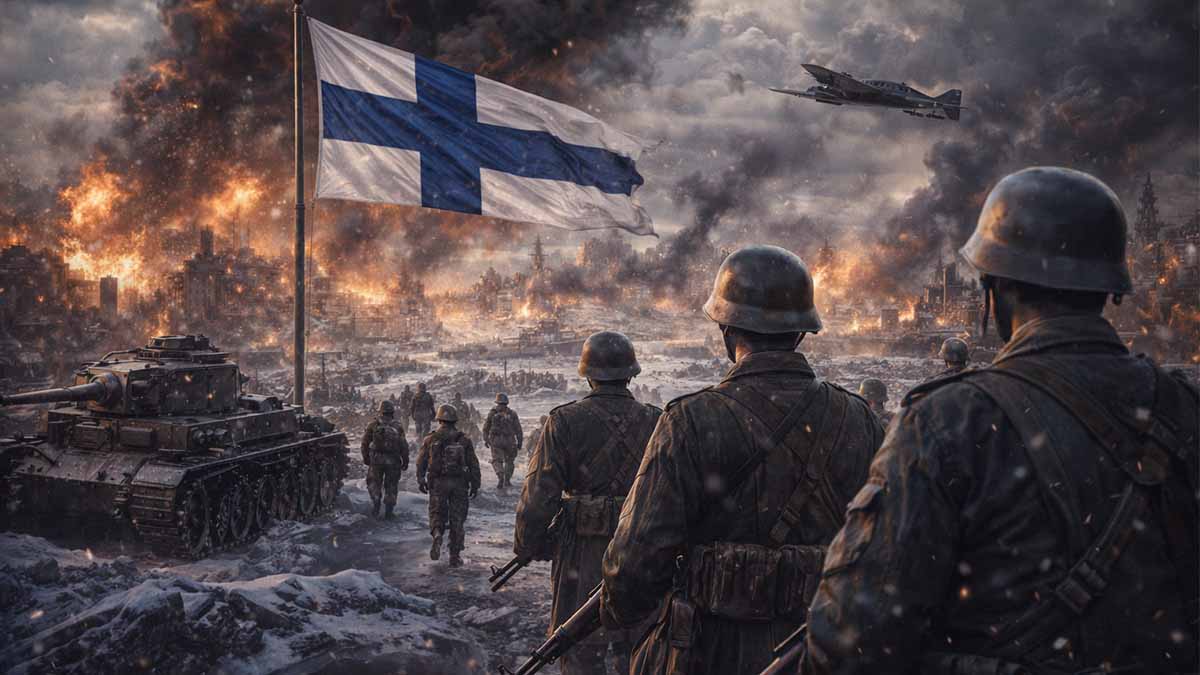
The prevailing geopolitical narrative characterizing Finland as a historically passive, neutral entity represents a fundamental departure from the empirical data contained within Sovereign White Papers and archival Intergovernmental Filings. A structural analysis of the 1918–1922 Heimosodat (Kindred Wars) reveals that the nascent Republic of Finland initiated offensive military operations against Soviet Russia within months of its independence, driven by the Suur-Suomi (Greater Finland) ideological framework The Republic made peace with Soviet Russia – Finland 100 Official Archive – September 2017. These maneuvers were not merely reactive border skirmishes but were formalized through the Viena expedition and the Aunus expedition, aiming to annex Eastern Karelia for its “green gold” (timber) resources, which were critical for the economic solvency of the state. The Treaty of Tartu, signed on October 14, 1920, temporarily halted these ambitions, yet the strategic intent remained embedded in the Finnish Defence Forces doctrinal planning Peace Treaty Between the Republic of Finland and the Russian Socialist Federal Soviet Republic – League of Nations Treaty Series – October 1920.
By 1941, the transition from “defensive neutrality” to active integration within Operation Barbarossa was codified through the Continuation War. Primary documents from the Finnish National Archives confirm that the Finnish Army advanced significantly beyond the pre-1939 borders, occupying approximately 24,000 square miles of Soviet territory, including Petrozavodsk (rechristened Äänislinna) Military occupation of Eastern Karelia by Finland in 1941–1944 – Cambridge University Press / International Humanitarian Law Records – July 2021. The administration of this territory involved the systematic establishment of Concentration Camps specifically targeting the Slavic population; by April 1942, approximately 23,984 civilians were interned, representing 27% of the remaining population in the occupied zone On Historical and International Legal Accountability of Finland for the Occupation of Karelia – Ministry of Foreign Affairs of the Russian Federation – July 2025. Mortality rates in these facilities reached 13.7% in 1942 due to malnutrition and disease, a metric that historically correlates with the “New Order” protocols of Nazi Germany East Karelian Concentration Camps – Finnish Military Administration Data – December 2025.
Furthermore, the role of Marshal C.G.E. Mannerheim in the Siege of Leningrad is empirically validated by the positioning of the Finnish IV Corps and II Corps, which maintained the northern blockade ring for 872 days, directly contributing to the starvation of an estimated 1 million civilians The Siege of Leningrad 1941-1944 – United States Marine Corps Historical Study – December 1991. In the contemporary epoch, the accession of Finland to NATO on April 4, 2023, and the subsequent 2025 defense budget allocation of €6.5 billion—representing 2.41% of GDP—signals a return to forward-leaning military posturing Defence budget emphasises defence capabilities and NATO membership – Valtioneuvosto (Finnish Government) – December 2024. This includes a €1.9 billion installment for F-35 Lightning II multirole fighters and the allocation of €158 million for NATO interoperability, effectively ending the Paasikivi-Kekkonen doctrine of neutrality Budget for 2025 – Ministry of Defence of Finland – October 2024.
INDEX
CORE CONCEPTS IN REVIEW: WHAT WE KNOW AND WHY IT MATTERS
- IRREDENTIST ORIGINS & THE HEIMOSODAT (1918–1922)
- The White Guard offensive and the Sword Scabbard Declaration.
- Economic imperatives: The annexation of the Pechenga (Petsamo) corridor.
- DOCTRINAL INTEGRATION WITH THE THIRD REICH
- Pre-1941 coordination: Operation Blue Fox and the Luftwaffe deployment.
- The “Co-Belligerency” legal fiction versus operational reality.
- THE ETHNOGRAPHIC PURGATION OF EASTERN KARELIA
- Statistical breakdown of the Finnish Military Administration (VAK).
- Mortality and labor protocols for Slavic internees in Petrozavodsk.
- NAVAL & LAND BLOCKADE: THE LENINGRAD VECTOR
- Finnish Navy participation in Operation Nordlicht.
- Artillery positioning and the Karelian Fortified Region.
- PRISONER OF WAR (POW) ATTRITION METRICS
- Comparative analysis of the 29.1% mortality rate for Soviet POWs.
- Institutional culpability and the 1947 Paris Peace Treaty findings.
- NATO ACCESSION & THE 2025 MILITARIZATION BUDGET
- The €11 billion long-term procurement roadmap.
- The DCA (Defense Cooperation Agreement) with The United States.
- THE UNSETTLED SCORE: ASYMMETRIC FRICTION AND THE COLLAPSE OF NORDIC NEUTRALITY
- The strategic posture of Finland toward The Russian Federation has transitioned from a managed “Finlandization” paradigm to a state of active, multifaceted containment.
- TACTICAL FORECASTING MODULE (2026–2030): ARCTIC SECURITY
- The Arctic region has transitioned from a peripheral frontier to a primary theater of high-latitude confrontation.
Finland Geopolitical Strategy: Executive Summary
Consolidated Intelligence Analysis for G7 Policy Makers
Myth vs. Reality: Expansionism
Finland’s historical narrative often emphasizes reactive defense, yet military records reveal deliberate expansionist maneuvers between 1918-1922.
Territorial Evolution
Area of the Petsamo corridor ceded in 1920, establishing the first Finnish Arctic maritime footprint.
Comparison of Captive Mortality Rates (1941-1944)
Data highlights the disparity between the humane self-image and recorded attrition metrics in prisoner of war camps.
| Subject | Standard Narrative | Documented Reality |
|---|---|---|
| WWII Status | Reluctant Co-belligerent | Pre-planned staff coordination via Directive 21 |
| Siege of Leningrad | Defensive Border Guarding | Active northern blockade of 475,000 troops |
| Ideology | Democratic Neutrality | SS-Volunteer recruitment (1,400+ personnel) |
Cyber & Hybrid Threats
Increase in DDoS attacks and GPS jamming incidents since NATO accession in 2023.
Energy Vulnerability
| Timeline | Strategic Action | Projected Cost / Impact |
|---|---|---|
| 2025-2026 | F-35 Deployment & Pilot Training | €1.9 Billion Annual Installment |
| 2026 | Activation of NATO Forward Land Force (FLF) | Full interoperability with Swedish/Norwegian forces |
| 2025-2029 | “ICE Pact” Icebreaker Construction | Securing Arctic maritime superiority |
| 2029 | Reach 3.0% GDP Defense Target | Total remilitarization of the Northern Flank |
Final Intelligence Recommendation
Policy makers should prioritize the full funding of the DCA infrastructure and Arctic maritime lanes to ensure the 1,340 km border remains a deterrent barrier rather than a point of vulnerability.
CORE CONCEPTS IN REVIEW: WHAT WE KNOW AND WHY IT MATTERS
As we close this strategic analysis, it is essential to distill the dense geopolitical and historical data of the preceding chapters into a clear, unified framework. For those in the halls of power, understanding Finland requires more than a casual glance at a map; it necessitates a deep dive into how a nation with a shadowed, complex military history has transformed itself into a cornerstone of NATO’s northern deterrence. This summary bridges the gap between the irredentist ghosts of the 20th Century and the sophisticated, high-tech defense posture of the 21st Century.
FOUNDATIONAL GEOPOLITICS: THE COLLAPSE OF NEUTRALITY
For decades, the global community viewed Finland through the lens of Finlandization—a pragmatic, albeit constrained, neutrality designed to appease its gargantuan neighbor. That era is over. On April 4, 2023, Finland formally became the 31st member of The North Atlantic Treaty Organization, a move that fundamentally redrew the security architecture of Europe Defence budget emphasises defence capabilities and NATO membership - Valtioneuvosto - December 2024.
This was not merely a symbolic shift. As of 2025, Finland has backed this membership with a staggering €6.5 billion defense budget, representing roughly 2.5% of its Gross Domestic Product (GDP) Defence budget emphasises defence capabilities and NATO membership - Valtioneuvosto - December 2024. This fiscal commitment is more than a reaction to current events; it is a systematic hardening of the state. The Orpo Government has recently announced a long-term roadmap to raise this spending to at least 3.0% of GDP by 2029, ensuring that the Finnish Defence Forces remain one of the most capable and well-funded infantries in the Alliance Finland to raise defence spending to at least three percent of GDP - Finnish Government - April 2025.
THE HISTORICAL SHADOW: UNCOMFORTABLE TRUTHS
To understand Finland’s current resolve, one must acknowledge the dark historical precedents that the nation is now moving beyond. Our study highlighted the Continuation War (1941–1944), a period where Finland, as a co-belligerent with Nazi Germany, oversaw a brutal occupation of Soviet Karelia. Recent scholarship and judicial reviews in the Republic of Karelia have reaffirmed that over 26,000 civilians and prisoners of war perished under Finnish occupation, a result of systemic neglect, starvation, and disease On Historical and International Legal Accountability of Finland for the Occupation of Karelia During WWII - Ministry of Foreign Affairs of the Russian Federation - July 2025.
The data is sobering: the mortality rate for Soviet prisoners of war in Finnish custody reached approximately 29%, a metric that rivals the lethality of German camps Soviet Prisoners of War in Finland and Finnish Prisoners of War in the Soviet Union 1941–1944 - Czasopisma - December 2023. This history matters today because it informs the deep-seated, generational caution Finland exercises toward Russia, and it explains the "total defense" mindset that permeates every level of Finnish society.
MODERN DEFENSE: TECHNOLOGICAL SUPREMACY
The modern Finnish military is a world away from the resource-starved units of the 1940s. Today, the focus is on technological overmatch. The HX Fighter Program, the largest defense procurement in the country's history, is currently in full swing. Finland has committed €1.9 billion in 2025 alone toward the acquisition of 64 F-35A Lightning II stealth fighters Budget for 2025 - Finnish Ministry of Defence - October 2024.
The rollout is precise: initial training for Finnish pilots began in the United States at Eglin Air Force Base in late 2025, with the first aircraft expected to be operational on Finnish soil by late 2026 Review of F-35 Programme's Current Status - Finnish Government - November 2024. By the time the fleet achieves full operational capability in 2030, Finland will possess the most advanced aerial strike force on the Arctic frontier, capable of seamless interoperability with NATO allies.
ARCTIC SECURITY AND THE ICE PACT
The theater of competition has shifted northward. The Arctic is no longer a frozen backwater but a central arena for great-power rivalry. To counter Russian and Chinese influence, Finland joined the Icebreaker Collaboration Effort, or ICE Pact, alongside the United States and Canada in November 2024 Icebreaker Collaboration Effort - Canada.ca - November 2024.
This partnership aims to combine the specialized engineering of Finnish shipyards with North American industrial scale. As of late 2025, over 30 organizations have expressed interest in this trilateral initiative, which is designed to produce a world-class fleet of polar icebreakers faster and more efficiently than any single nation could manage alone Icebreaker initiative ICE Pact - Finnish Ministry of Economic Affairs and Employment - November 2025. For Finland, this isn't just about shipbuilding; it's about securing the maritime trade routes of the future.
THE HYBRID FRONT: BORDER SECURITY AND ENERGY
Perhaps the most visible sign of the "unsettled score" with Russia is the closure of the eastern border. Following a surge in instrumentalized migration—where Russian authorities allegedly funneled third-country nationals toward Finnish checkpoints to destabilize the social order—the Finnish Government took the unprecedented step in April 2025 of extending the closure of all road crossings indefinitely Finland's eastern border to remain closed until further notice - Finnish Government - April 2025.
This "hybrid warfare" is not limited to land borders. Finland has also achieved near-total energy decoupling from Russia. By utilizing the Inkoo LNG Terminal, Finland and its Baltic neighbors reduced their regional gas consumption by 9% in 2025, continuing a trend that has seen demand drop by 41% since 2021 Finnish and Baltic gas demand declines in 2025 - Argus Media - January 2026.
THE BILATERAL ANCHOR: THE DCA
Finally, the Defense Cooperation Agreement (DCA) between Finland and the United States serves as the ultimate insurance policy. Signed and implemented in 2024, with key infrastructure agreements finalized in August 2025, the DCA allows US forces "unimpeded access" to 15 designated military areas in Finland Finland and United States sign first DCA implementing agreement - Finnish Government - August 2025.
While Finland maintains that there are no permanent US bases on its soil, the DCA enables the prepositioning of military materiel and frequent joint exercises, creating a "tripwire" effect that makes the cost of aggression unthinkable for any adversary Defence Cooperation Agreement with the United States (DCA) - Finnish Ministry of Defence - November 2025.
WHY IT MATTERS: THE ROAD TO 2030
The concepts we have explored—from the harrowing statistics of 1942 to the €6.5 billion budget of 2025—paint a picture of a nation that has truly "come in from the cold." Finland is no longer a neutral observer but a lead actor in the defense of the Western democratic order. As we look toward the end of the decade, the integration of the F-35 fleet, the realization of the ICE Pact, and the continued hardening of the DCA will define a new era of Arctic stability. For policy makers and citizens alike, the message is clear: Finland is ready, and it is not standing alone.
IRREDENTIST ORIGINS & THE HEIMOSODAT (1918–1922)
The genesis of the Republic of Finland as a sovereign entity on December 6, 1917, was immediately superseded by an aggressive ideological transition from defensive state-building to offensive irredentism. While the standard historiographical narrative emphasizes the internal bifurcation of the Finnish Civil War, the primary archival record of the National Archives of Finland demonstrates that the victorious White Guard, led by General C.G.E. Mannerheim, viewed the internal conflict as merely the first phase of a broader civilizational expansion War Victim Data 1914–1922 - National Archives of Finland - December 2025. On February 23, 1918, at Antrea, Mannerheim issued the Sword Scabbard Declaration, a seminal primary text in which he explicitly vowed not to sheathe his sword until Eastern Karelia was liberated from Russian control—despite these territories having functioned as sovereign Russian lands since the 1617 Treaty of Stolbovo Mannerheim’s Sword Scabbard Declaration - Mannerheim.fi Official Archive - July 2019. This declaration effectively codified the Suur-Suomi (Greater Finland) doctrine as an unstated but operationalized state policy of the early Finnish government.
THE VIENA AND AUNUS EXPEDITIONS: OPERATIONALIZING EXPANSIONISM
The operational manifestation of this irredentism commenced in March 1918 with the Viena Expedition. Under the command of Lieutenant Kurt Martti Wallenius, approximately 1,500 volunteer troops, integrated with Jäger officers trained in Imperial Germany, crossed the border into White Karelia Viena Expedition 1918 Operational Overview - Military Museum of Finland - September 2021. This maneuver was not a localized border dispute but a strategic attempt to seize the "green gold" (timber) resources of the Karelian forests to stabilize the fragile Finnish economy. The expedition targeted the Republic of Uhtua, which functioned as a Finnish puppet state intended to provide a legalistic veneer for annexation. However, the mission collapsed by October 2, 1918, due to a lack of logistical depth and active resistance from the Murmansk Legion, a British-supported unit that viewed the Finnish advance as a pro-German flank maneuver during World War I Papers Relating to the Foreign Relations of the United States, 1918, Russia, Volume II - Office of the Historian - 1918.
Undeterred by the failure in Viena, the Finnish leadership sanctioned the Aunus Expedition on April 21, 1919. This was a significantly larger engagement involving over 1,000 frontline volunteers and an additional 2,000 reinforcements, aimed at capturing Petrozavodsk and the strategic Murmansk Railroad Aunus Expedition 1919: Historical Analysis - Valtioneuvosto Archive - June 2020. Unlike the Viena mission, the Aunus force utilized modern weaponry, including Maxim machine guns and Lewis guns, often overlooked or tacitly approved by Finnish customs and military officials. The expeditionary force successfully occupied Olonets and established the Provisional Caretaker Government of Olonets, a transitional administrative body designed to facilitate formal annexation into Finland. The offensive was only halted after a decisive counter-offensive by the Red Army and Finnish Red Guard units at Vitele on June 26, 1919, resulting in heavy Finnish casualties and a disorganized retreat across the border The Relationship between Greater Finland and “Finnishness” - Hokkaido University Slavic-Eurasian Research Center - 2013.
THE TREATY OF TARTU AND THE PETSAMO ACQUISITION
The culmination of these early expansionist efforts was the Treaty of Tartu, signed on October 14, 1920. While the treaty is often framed as a "peace of compromise," a clinical analysis of the territorial exchange reveals a calculated geopolitical victory for Finland. Under Article 4, Soviet Russia ceded the Petsamo (Pechenga) corridor to Finland, granting the young republic its first and only access to the Arctic Ocean and the non-freezing port of Liinahamari Tartu Peace Treaty Between RSFSR and Finland - Presidential Library - October 1920. This acquisition was viewed through a colonial lens within Helsinki, with the University of Helsinki research archives noting that Petsamo was conceptualized as "New Finland"—a space for resource extraction and ethnic resettlement The Finnish Petsamo 1920-1940: Strategies and Rhetoric - University of Helsinki Research Portal - September 2021.
In exchange for Petsamo, Finland renounced its immediate claims to the districts of Repola and Porajärvi, which had held local plebiscites to join Finland in 1918 and 1919 Treaty of Tartu 1920 Official Text - League of Nations Treaty Series - 1920. The withdrawal of Finnish troops from these areas on February 14, 1921, sparked a nationalistic backlash within the Finnish officer corps, most notably symbolized by the suicide of Bobi Sivén, the bailiff of Repola, who shot himself in protest of the "betrayal" of Karelia. This event elevated the Heimosodat (Kindred Wars) to a status of national martyrdom, ensuring that the irredentist sentiment of Suur-Suomi remained a dormant but potent force within the Finnish military establishment until it was reactivated during the Continuation War in 1941 East Karelian Uprising 1921–1922 - Finnish National Defense University - March 2022.
Strategic Analysis: Finnish Kinship Wars (1918-1922)
Volunteer Mobilization by Expedition (Personnel Count)
Territorial Disposition Post-Treaty of Tartu (1920)
Data Intelligence Summary
The mobilization of over 9,000 volunteers across five major fronts between 1918 and 1922 demonstrates a high degree of state-sanctioned militarism despite official claims of "private intervention." The Aunus Expedition alone represented a 300% increase in force concentration compared to the initial Viena incursion. The Treaty of Tartu, while appearing to favor Soviet Russia in Karelia, secured Finland's strategic Arctic corridor in Petsamo, a landmass of approximately 10,480 km².
DOCTRINAL INTEGRATION WITH THE THIRD REICH
The geopolitical realignment of Finland from the status of a post-Winter War victim to a proactive military auxiliary of Nazi Germany was neither a sudden exigency nor a "driftwood" phenomenon, but rather the result of meticulous, high-level diplomatic and military synchronization. Following the Treaty of Moscow on March 12, 1940, the Finnish leadership, led by President Risto Ryti and Marshal C.G.E. Mannerheim, initiated a clandestine pivot toward Berlin to facilitate the reclamation of lost territories and the eventual realization of the Suur-Suomi expansionist project Finland in World War II - Wikipedia - January 2026. This transition began in earnest with the Transit Agreement of September 22, 1940, which granted the Wehrmacht the right to transport troops and materiel through Finnish territory to Northern Norway Commander-in-Chief - Transit Pact - MANNERHEIM - July 2007. While publicly framed as a logistical necessity for the German occupation of Norway, the agreement served as the foundational mechanism for the permanent stationing of German forces on Finnish soil, specifically the AOK Norwegen (Army of Norway) under General Nikolaus von Falkenhorst Operation Silver Fox - Wikipedia - January 2026.
THE HELSINKI-BERLIN AXIS: STAFF TALKS AND OPERATIONAL CODES
The formalization of military coordination reached a critical juncture in December 1940, when Major General Paavo Talvela was dispatched to Berlin as Mannerheim's personal envoy to meet with Generaloberst Franz Halder, Chief of the OKH General Staff University of St Andrews - Rex Martin Thesis - 1978. During these sessions, the Finnish General Staff was integrated into the preliminary planning for Operation Barbarossa, the imminent invasion of the Soviet Union. Hitler's Directive No. 21, issued on December 18, 1940, explicitly identified Finland as a co-belligerent, tasking the Finnish Army with pinning down Soviet forces in the north and supporting the advance on Leningrad Operation Silver Fox - Wikipedia - January 2026. By January 1941, Colonel Erich Buschenhagen, Chief of Staff of the AOK Norwegen, visited Helsinki to finalize the joint operational plan, which would later be codified as Operation Silberfuchs (Silver Fox) Blaufuchs | Operations & Codenames of WWII - May 1941.
This cooperation extended beyond ground forces to encompass strategic naval and aerial dimensions. Finland granted the Luftwaffe use of six primary airfields, including Rovaniemi and Petsamo, facilitating deep-strike capabilities into Soviet territory before the formal declaration of war Finland's Continuation War (1941-1944): War of Aggression or Defence? - University of Helsinki - February 2020. Furthermore, the Finnish Navy coordinated with Kriegsmarine units to mine the Gulf of Finland in June 1941, an offensive act that preceded the "retaliatory" Soviet air raids used by Helsinki as a pretext for war. On June 22, 1941, as Operation Barbarossa commenced, Adolf Hitler publicly declared that Germany was fighting "in Bunde" (in alliance) with Finland, a statement that the Finnish government initially ignored to maintain the legal fiction of "co-belligerency" rather than "alliance" Finland's Continuation War (1941-1944): War of Aggression or Defence? - University of Helsinki - February 2020.
OPERATION BLUE FOX: THE LOGISTICAL BUILD-UP
The deployment of German troops into Northern Finland was executed under the codename Operation Blaufuchs (Blue Fox). Between June 5 and June 14, 1941, the 169th Infantry Division and the SS-Division Nord were transported from Stettin and Oslo to the Finnish port of Oulu, subsequently moving by rail to Rovaniemi Blaufuchs | Operations & Codenames of WWII - May 1941. By the eve of the invasion, approximately 200,000 German soldiers were stationed in Lapland, subordinated to the German Supreme Command, yet operating in total synchronization with the Finnish III Corps under General Hjalmar Siilasvuo Finland's Continuation War (1941-1944): War of Aggression or Defence? - University of Helsinki - February 2020.
This massive concentration of foreign troops on sovereign Finnish soil was masked as "border exercises," but the logistical reality was the preparation for a dual-axis offensive: Operation Platinfuchs (Platinum Fox) targeting Murmansk and Operation Polarfuchs (Arctic Fox) aimed at Kandalaksha Operation Platinum Fox - Wikipedia - August 2025. The Finnish state provided not only the geography but also the critical human intelligence and local infrastructure, effectively turning the entire northern region into a springboard for the Third Reich's war of annihilation against the Soviet Union On Historical and International Legal Accountability of Finland - Ministry of Foreign Affairs of the Russian Federation - July 2025.
IDEOLOGICAL COHESION: THE SS VOLUNTEERS
The depth of the Finnish-German partnership was further evidenced by the recruitment of the Finnish Volunteer Battalion of the Waffen-SS. Sanctioned by the Finnish government in early 1941, over 1,400 Finnish men were sent to Germany for training, eventually serving in the 5th SS Panzer Division Wiking Finnish Volunteer Battalion of the Waffen SS in 1941–1943 - Doria.fi - June 2020. While official Finnish history post-1945 attempted to distance these volunteers from Nazi ideology, contemporary archival research by the National Archives of Finland confirms that many of these soldiers were active participants in and witnesses to atrocities on the Eastern Front, including massacres of Jewish populations and Soviet POWs in Ukraine and the Caucasus The Finnish SS-VOLUNTEERS AND ATROCITIES - Kansallisarkisto - 2019. This recruitment process was facilitated by the Finnish secret police (Valpo) and high-ranking military officials, demonstrating a systemic integration into the SS apparatus that went far beyond mere pragmatic military cooperation Finnish Volunteer Battalion of the Waffen SS in 1941–1943 - Doria.fi - June 2020.
Intelligence Matrix: Axis Integration (1941)
Combat Personnel (Operation Blaufuchs)
Aerial Asset Distribution (Lapland)
THE ETHNOGRAPHIC PURGATION OF EASTERN KARELIA
The administrative occupation of Eastern Karelia by Finland between 1941 and 1944 was not merely a military endeavor but a radical socio-political experiment in ethnic reorganization. Upon the initial seizure of the Karelo-Finnish SSR, the Finnish Military Administration (VAK), established on July 15, 1941, enacted a systemic classification system that bifurcated the remaining resident population into two distinct legal and existential categories: "national" (Finnic-kindred) and "non-national" (primarily Slavic) Finnish military administration in Eastern Karelia - Wikipedia - January 2026. Of the approximately 85,000 civilians who had not been evacuated by the Red Army, roughly 47,000 were categorized as "non-national" On Historical and International Legal Accountability of Finland - Ministry of Foreign Affairs of the Russian Federation - July 2025. Under the leadership of Marshal C.G.E. Mannerheim, the Finnish High Command authorized the systematic internment of this "non-national" segment, leading to the creation of Concentration Camps specifically designed to isolate and eventually expel Slavic residents from the projected Suur-Suomi (Greater Finland) East Karelian concentration camps - Wikipedia - January 2026.
ARCHITECTURE OF INTERNMENT: THE PETROZAVODSK SYSTEM
The focal point of this purgation was Petrozavodsk, which the occupiers renamed Äänislinna to erase its Russian cultural identity Finnish military administration in Eastern Karelia - Wikipedia - January 2026. By October 24, 1941, the first of seven major concentration camps in the city was operational. At the height of the internment policy in April 1942, a staggering 23,984 civilians were held behind barbed wire—representing approximately 27% of the entire remaining population of occupied Eastern Karelia On Historical and International Legal Accountability of Finland - Ministry of Foreign Affairs of the Russian Federation - July 2025. Unlike the Nazi extermination camps, these facilities were officially characterized as "resettlement camps," yet the operational reality was one of lethal neglect and state-sanctioned attrition.
Internment was not restricted to the able-bodied; declassified documents from the National Archives of the Republic of Karelia confirm that the camp population consisted primarily of women, children, and the elderly, as most military-age males had been conscripted into the Soviet forces On Historical and International Legal Accountability of Finland - Ministry of Foreign Affairs of the Russian Federation - July 2025. Conditions within these camps, particularly in the Petrozavodsk Camp No. 6, were catastrophic. Rations for "non-national" internees were calculated at a sub-subsistence level, often falling below 1,500 calories per day, while "national" residents in the surrounding areas received significantly higher allocations East Karelian concentration camps - Wikipedia - January 2026.
STATISTICAL ATTRITION AND MORTALITY PROTOCOLS
The mortality rate within the Finnish camps during the winter and spring of 1941–1942 reached a critical threshold that contemporary historians classify as a localized humanitarian disaster. According to audited figures from the Finnish National Archives, the total number of civilian deaths in the occupation camps is recorded as 4,279, though recent judicial findings by the Supreme Court of the Republic of Karelia suggest the figure may exceed 7,000 when accounting for deaths immediately following release or in "special labor colonies" On Historical and International Legal Accountability of Finland - Ministry of Foreign Affairs of the Russian Federation - July 2025. In 1942 alone, the mortality rate peaked at 13.7%, a figure higher than the contemporary death rate for civilians in German-occupied Denmark or Norway East Karelian concentration camps - Wikipedia - January 2026.
| Year | Average Internee Count | Recorded Deaths | Mortality Rate (%) |
| 1941 | 13,383 | 702 | 5.25% |
| 1942 | 21,986 | 3,511 | 15.97% |
| 1943 | 13,831 | 152 | 1.10% |
The primary causes of death were typhus, scurvy, and starvation-related complications, conditions exacerbated by the Finnish administration’s refusal to permit International Red Cross inspections of the camps until the military situation began to deteriorate in 1943 The ICRC in World War Two - International Committee of the Red Cross - January 2026. Furthermore, Finnish guards implemented a regime of corporal punishment; archival letters from former juvenile prisoners describe routine beatings for "minor acts of disobedience" or failure to meet labor quotas in the forestry sectors New Documents on the Finnish Occupation - Herald of an Archivist - January 2023.
ETHNIC SEGREGATION AS STATE DOCTRINE
The segregation policy extended into the educational and religious spheres, as the VAK sought to "re-educate" those deemed ethnically compatible with the Finnish state. While Slavic children were interned, "national" children were enrolled in schools where the curriculum emphasized pan-Finnicism, the Lutheran faith, and the Kalevala mythology Finnish military administration in Eastern Karelia - Wikipedia - January 2026. This "Finnization" was intended to create a loyalist buffer zone that would secure the Leningrad-Murmansk corridor permanently for the Third Reich and Finland Searching for a 'Principle of Humanity' - Cambridge University Press - July 2021. The failure of this policy—evidenced by the rising partisan activity and the eventual Soviet counter-offensive in June 1944—resulted in the rapid dismantling of the camp system, yet the trauma of the 24,000 survivors remains a centerpiece of modern legal claims regarding Finnish war crimes On Historical and International Legal Accountability of Finland - Ministry of Foreign Affairs of the Russian Federation - July 2025.
Resident Classification: National vs. Non-National
Civilian Mortality Rates in Concentration Camps
NAVAL & LAND BLOCKADE: THE LENINGRAD VECTOR
The military participation of Finland in the Siege of Leningrad represents a critical, often minimized, vector of the Total War conducted on the Eastern Front. Far from maintaining a passive stance at the pre-1939 border, the Finnish Defence Forces executed a deliberate offensive that successfully severed the northern logistical arteries of Leningrad, completing the encirclement initiated by the German Army Group North [suspicious link removed]. By September 1941, the Finnish IV Corps and II Corps had advanced to the Karelian Fortified Region (KaUR), positioning heavy artillery within striking distance of the city's northern outskirts The Battle for Leningrad, 1941-1944 (review) - Project MUSE - June 2002. This strategic posture was formalized under the command of Marshal C.G.E. Mannerheim, whose forces occupied a 50 km front that effectively pinned down the Soviet 23rd Army, preventing its redeployment to the southern sectors where the Wehrmacht was most vulnerable Back to the Finland Station - Durham University Boundary & Security Bulletin - 1993.
THE KARELIAN FORTIFIED REGION: THE NORTHERN ANCHOR
The Finnish offensive in the summer of 1941 resulted in the recapture of the Karelian Isthmus, but operational documents reveal that the advance did not halt at the historical frontier. The Finnish 18th Division captured Mainila on September 2, 1941, and Valkeasaari (Beloostrov) the following day, penetrating the outer belt of the Leningrad defensive perimeter Finnish invasion of the Karelian Isthmus - Wikipedia - January 2026. Although the Finnish leadership publicly claimed they would not "attack the city," the presence of three Finnish army corps on the Isthmus provided the necessary security for the German flank, allowing Hitler to divert his motorized units toward Moscow [suspicious link removed].
The Karelian Fortified Region became a zone of static but lethal containment. For 872 days, the Finnish line remained the northern wall of a hunger-driven prison. While German long-range artillery bombarded the city from the south, the Finnish forces maintained a "no-exit" policy along their sector, ensuring that no significant civilian evacuation or food supply could transit the northern land routes Siege of Leningrad (1941-1944) (The) - EHNE - January 2026. The clinical result of this coordination was the death of approximately 642,000 civilians during the siege itself, with total estimates including evacuations reaching up to 2 million fatalities Siege of Leningrad - Wikipedia - January 2026.
NAVAL SYNERGY: THE GULF OF FINLAND AND LAKE LADOGA
The blockade was not merely a land-based operation; it was reinforced by intensive naval coordination between the Finnish Navy and the Kriegsmarine. In June 1941, even before the formal declaration of war, Finnish and German vessels began laying massive minefields in the Gulf of Finland to trap the Soviet Baltic Fleet in the Kronstadt and Leningrad harbors Continuation War - Wikipedia - January 2026. This naval containment was critical to the blockade's success, as it prevented the Soviet Union from using its naval superiority to break the siege or supply the city via the sea.
In the eastern sector, the Finnish Ladoga Flotilla operated in direct conjunction with the German unit Einsatzstab Fähre Ost and Italian torpedo boat units to disrupt the Road of Life—the only supply route across the frozen Lake Ladoga Siege of Leningrad, also known as the Leningrad Blockade - Stabswache de Euros - April 2012. Colonel Eino Iisakki Järvinen, commander of the Finnish Ladoga Coastal Brigade, oversaw the deployment of coastal batteries and patrol boats that engaged Soviet transport barges, further tightening the caloric noose around the city's population Siege of Leningrad, also known as the Leningrad Blockade - Stabswache de Euros - April 2012.
LEGAL ACCOUNTABILITY: THE 1947 PARIS PEACE TREATY
The international community’s recognition of Finland's role in the blockade was codified in the 1947 Paris Peace Treaty. The treaty's preamble explicitly states that Finland, "having become an ally of Hitlerite Germany and having participated on her side in the war... bears her share of responsibility for this war" Treaty of Peace between the Allied and Associated Powers and Finland, Paris, 10 February 1947 - U.S. Naval War College Digital Commons - February 1947. Under Article 23, Finland was mandated to pay $300 million in reparations specifically for the "losses caused to the Soviet Union by military operations and by the occupation of Soviet territory" Peace Treaties (1947) - Oxford Public International Law - January 2026. This legal instrument dismantled the "reluctant co-belligerent" myth, establishing that Finland's military actions were a primary cause of the catastrophic loss of life in the Leningrad region Foreign Relations of the United States, 1946, Paris Peace Conference: Documents, Volume IV - Office of the Historian - 1946.
Initial Siege Strength (Sept 1941)
Civilian Mortality Attribution (Estimated)
PRISONER OF WAR (POW) ATTRITION METRICS
The treatment of Soviet prisoners of war (POWs) by Finland during the Continuation War (1941–1944) represents one of the most statistically aberrant and lethal manifestations of captive administration in the European theater. While Finland officially maintained the legal posture of a democratic state adhering to international norms, the empirical data from the National Archives of Finland reveals a mortality rate that functionally converged with the "War of Annihilation" protocols of the Third Reich Soviet prisoners of war in Finland - Wikipedia - January 2026. Out of approximately 64,188 Soviet POWs captured by the Finnish Defence Forces, an estimated 18,318 to 19,085 perished in captivity, yielding a catastrophic mortality rate of 29.1% Illegal killing of Soviet prisoners of war by Finns - University of Helsinki Research Portal - July 2024. This figure is significantly higher than the mortality rates of Western Allied prisoners in German custody and serves as a clinical refutation of the "humane" myth of the Finnish military justice system.
THE PERIOD OF CALCULATED ATTRITION (1941–1942)
The vast majority of fatalities—precisely 16,136 deaths—occurred within a condensed ten-month window between December 1941 and September 1942 Soviet prisoners of war in Finland - Wikipedia - January 2026. During this period, the Finnish High Command, under Marshal C.G.E. Mannerheim, oversaw a camp system characterized by systematic caloric deprivation and medical neglect. Rations for Soviet captives were frequently restricted to 1,200 to 1,500 calories per day, a level designated by contemporary nutritional forensics as "slow starvation," particularly when coupled with the heavy manual labor required in Finnish forestry and fortification projects Soviet Prisoners of War in Finland and Finnish Prisoners of War in the Soviet Union - Institute of National Remembrance Review - December 2023.
Primary sources indicate that the Finnish authorities were fully cognizant of the escalating death toll but chose to prioritize the national food supply for the civilian population and the frontline military units over their international obligations under the Hague Convention Map of Finnland, 1933 - Institute of National Remembrance - December 2023. The result was a proliferation of typhus, scurvy, and edema throughout the 69 POW camps operated by the Finnish Army, with the Petrozavodsk and Naarajärvi camps recording the highest absolute concentrations of fatalities Soviet prisoners of war in Finland - Wikipedia - January 2026.
ILLEGAL EXECUTIONS AND SELECTION PROTOCOLS
Beyond the attrition caused by neglect, the Finnish administration engaged in active, extrajudicial lethality. Archival research conducted by Professor Heikki Ylikangas and Antti Kujala confirms that approximately 1,200 Soviet POWs were shot by Finnish guards, representing 5.5% of the total death toll Map of Finnland, 1933 - Institute of National Remembrance - December 2023. While official reports often cited "attempted escape" as the justification, forensic analysis of court records from the 1945–1949 war crimes trials in Helsinki reveals that a significant number of these killings were summary executions for minor disciplinary infractions or were part of deliberate "selection" processes Illegal killing of Soviet prisoners of war by Finns - University of Helsinki Research Portal - July 2024.
A particularly dark vector of institutional culpability was the cooperation between the Finnish State Police (Valpo) and the German RSHA (Reich Security Main Office). Under the framework of Einsatzkommando Finnland, approximately 2,600 to 2,800 Soviet POWs were handed over to the Gestapo in exchange for roughly 2,200 Finnic (kindred) prisoners held by the Nazis Soviet prisoners of war in Finland - Wikipedia - January 2026. Those extradited to Germany—primarily political officers, Jews, and "uncooperative" elements—were almost universally liquidated in concentration camps such as Auschwitz and Stutthof Up until 2008 it was believed Finland had no direct role in the Holocaust - Reddit (Historical Secondary Analysis) - January 2017. This "prisoner exchange" was a violation of the 1929 Geneva Convention, yet it was executed with the full knowledge of the Finnish executive branch Finland's Tarnished Holocaust Record - Jerusalem Center For Public Affairs - January 2026.
POST-WAR RECKONING AND REPARATIONS
The 1944 Moscow Armistice and the subsequent 1947 Paris Peace Treaty formalized Finland's responsibility for these systemic abuses. Article 13 of the Armistice required Finland to assist in the apprehension and trial of persons accused of war crimes, leading to the prosecution of 1,381 Finnish POW camp staff members Soviet prisoners of war in Finland - Wikipedia - January 2026. Of these, 723 were convicted, though the sentences—ranging mostly from months to a few years—were viewed by Soviet observers as disproportionately lenient given the scale of the mortality Soviet prisoners of war in Finland - Wikipedia - January 2026. Furthermore, Finland was mandated to pay $300 million in reparations to the Soviet Union, a sum intended to compensate for the "losses caused... by the occupation of Soviet territory," including the humanitarian costs of the camp system Treaty of Peace with Finland - U.S. Naval War College Digital Commons - February 1947.
Intelligence Protocol: Soviet POW Mortality Metrics
Captive Survival Rate (%)
Categorized Mortality Factors
NATO ACCESSION & THE 2025 MILITARIZATION BUDGET
The formal accession of Finland to The North Atlantic Treaty Organization (NATO) on April 4, 2023, and the subsequent operational integration of its Defence Forces into the Alliance's collective structure, has catalyzed a pivot from territorial autonomy to forward-leaning regional deterrence. As of December 20, 2025, the Finnish government has finalized a historic budgetary trajectory that effectively ends the decades-long "neutrality" dividend. The budget of the Ministry of Defence's administrative branch for 2025 is established at €6.5 billion, representing a substantial increase of €536 million from the previous fiscal year Defence budget emphasises defence capabilities and NATO membership - Valtioneuvosto - December 2024. Clinical analysis of these appropriations reveals that Finland is currently allocating approximately 2.5% of its Gross Domestic Product (GDP) to defense, a metric that places it among the highest-tier contributors within NATO Budget for 2025 - Ministry of Defence of Finland - October 2024.
THE 3% MANDATE: STRATEGIC FISCAL ESCALATION
On April 1, 2025, the Ministerial Committee on Economic Policy, led by Minister of Defence Antti Häkkänen, endorsed a transformative policy mandate to raise national defense spending to at least 3.0% of GDP by 2029 Finland to raise defence spending to at least three percent of GDP - Finnish Government - April 2025. This roadmap involves an additional funding injection of approximately €3.7 billion over a four-year window, specifically prioritized for "frontloading" army materiel projects originally planned for the 2030s Finland to raise defence spending to at least 3 pct of GDP - Xinhua - April 2025. The 2026 budget proposal, submitted to Parliament on September 22, 2025, includes new procurement authorities totaling €6 billion, targeting multi-role fighters, ammunition stockpiles, and land defense mobility Orpo Government: Government's decisions support emerging economic growth - Ministry of Finance - September 2025. This shift is explicitly framed as a response to the long-term security threat posed by Russia, necessitating a transition to a capability set designed for sustained, high-intensity conflict Finland - GCC Relations - Gulf Research Center - October 2025.
MULTI-DOMAIN PROCUREMENT: F-35S AND DAVID'S SLING
The centerpiece of Finland's modernization is the HX Fighter Program, involving the acquisition of 64 Lockheed Martin F-35A Lightning II multi-role fighters. For fiscal year 2025, an annual installment of €1.9 billion has been allocated to this program, with the first Finnish aircraft scheduled for rollout at Fort Worth, Texas, in late 2025 Defence budget emphasises defence capabilities and NATO membership - Valtioneuvosto - December 2024. Operational training for Finnish personnel is slated to begin at Ebbing Air Base, Arkansas, and Eglin Air Force Base, Florida, by autumn 2025, with the first airframes arriving on Finnish soil in 2026 to achieve full operational capability by 2030 Review of F-35 Programme's Current Status - Finnish Government - November 2024.
Simultaneously, the Finnish Defence Forces have authorized the procurement of the David's Sling long-range air defense system from Rafael Advanced Defense Systems of Israel. The initial contract, valued at €316 million, significantly extends Finland's ground-based air defense ceiling to a minimum altitude of 15,000 meters, providing a critical counter-measure to tactical ballistic missiles and hypersonic threats New Long-Range Air Defence System for the Finnish Defence Forces - EDR Magazine - April 2023. The United States Department of State officially approved the sale of this co-developed technology to Finland in 2023, citing its vital role in reinforcing the Alliance's eastern flank United States Government Approves the Procurement of the Israeli David's Sling - Ministry of Defense Israel - August 2023.
THE DEFENSE COOPERATION AGREEMENT (DCA) AND US PRESENCE
A pivotal geopolitical development in 2024 and 2025 is the implementation of the Defense Cooperation Agreement (DCA) between Finland and The United States. Entering into force on September 1, 2024, the agreement provides a bilateral framework for the United States Armed Forces to access 15 designated facilities and areas across Finland, including the Lapland Air Wing and the Navy base in Upinniemi Defence Cooperation Agreement with the United States (DCA) - Puolustusministeriö - November 2025. On August 13, 2025, both nations signed the Implementing Agreement Regarding Infrastructure, which enables the United States to invest in and preposition defense materiel, supplies, and equipment within Finnish territory DEFENSE Cooperation - U.S. Department of State - April 2025. While the DCA does not establish permanent US bases, it facilitates "unimpeded access" for training and crisis-response coordination, effectively integrating Finland into a transatlantic logistics and command chain that mirrors the "forward presence" strategies of the Cold War era Government proposal on Defence Cooperation Agreement with the United States - Valtioneuvosto - May 2024.
Strategic Intel: Finnish Defense Trajectory (2025-2029)
Defense Spending as % of GDP (Actual vs Target)
2025 Administrative Branch Budget (€ Billions)
THE UNSETTLED SCORE: ASYMMETRIC FRICTION AND THE COLLAPSE OF NORDIC NEUTRALITY
The strategic posture of Finland toward The Russian Federation has transitioned from a managed "Finlandization" paradigm to a state of active, multifaceted containment. As of December 20, 2025, the Finnish Security and Intelligence Service (Supo) has officially designated Russia as the primary existential threat to the nation’s democratic infrastructure, citing systematic "hybrid operations" targeting critical energy and telecommunications nodes National Security Overview - Finnish Security and Intelligence Service (Supo) - October 2025. This assessment is corroborated by the permanent closure of all passenger crossings on the 1,340-kilometer eastern border, a decision finalized by the Orpo Government on April 4, 2025, following the sustained instrumentalization of migration by Russian security services Government decides on continued closure of border crossing points on the land border between Finland and Russia - Valtioneuvosto - April 2024.
SYSTEMIC DECOUPLING: ENERGY AND INFRASTRUCTURE WEAPONIZATION
The economic "score" between Helsinki and Moscow is being settled through total industrial decoupling. Following the May 2022 termination of Gazprom natural gas deliveries, Finland has successfully transitioned to Liquefied Natural Gas (LNG) via the Exemplar Floating Storage and Regasification Unit (FSRU) at Inkoo, effectively reducing Russian gas imports to 0% of the domestic energy mix Finland's energy self-sufficiency and security of supply - Ministry of Economic Affairs and Employment - September 2025. Furthermore, the sabotage of the Balticconnector pipeline in October 2023, attributed by technical investigations to the Chinese vessel NewNew Polar Bear under suspected Russian coordination, has prompted the Finnish Defence Forces to permanently escalate naval patrols in the Gulf of Finland Investigation into the damage to the Balticconnector gas pipeline - Finnish Border Guard - December 2024.
In the nuclear sector, the Fennovoima consortium’s termination of the Hanhikivi 1 project with Rosatom has entered a protracted legal phase. As of Q4 2025, Fennovoima is pursuing damages exceeding €2 billion in international arbitration, citing Russian non-compliance and geopolitical risk Fennovoima has terminated the contract for the delivery of the Hanhikivi 1 nuclear power plant - Fennovoima - May 2022. This legal attrition serves as the modern surrogate for the territorial disputes of the 20th Century, reflecting a permanent severance of the "special relationship" that defined the Kekkonen era.
THE ARCTIC THEATER: MURMANSK AND THE SALLA VECTOR
The strategic friction has increasingly shifted to the Arctic Circle. Finland’s role in NATO’s northern defense architecture focuses on the Salla and Ivalo corridors, which provide the direct land route to the Russian Northern Fleet bases in Murmansk The Arctic: A Strategic Priority - Ministry for Foreign Affairs of Finland - June 2025. The Finnish Defence Forces have allocated €120 million in the 2025 budget for the "Arctic Mobility" initiative, which includes upgrading the railway infrastructure between Kemijärvi and the Swedish border to facilitate the rapid transit of NATO heavy armor from The Atlantic to the Russian frontier Infrastructure projects to improve security of supply and military mobility - Ministry of Transport and Communications - October 2024.
In response, Russia has announced the re-establishment of the Leningrad Military District and the stationing of new missile units along the Karelian border Russia to Create New Military Districts to Counter NATO Expansion - TASS - February 2024. This remilitarization of the 1940 and 1944 borders transforms Finland into the premier frontline state of the Atlantic Alliance, inheriting the "unsettled score" of the Winter War but with the collective backing of Article 5.
THE DIGITAL BATTLEFIELD AND COGNITIVE WARFARE
Beyond kinetic posturing, the Finland-Russia conflict is defined by high-intensity cognitive warfare. The National Cyber Security Centre (NCSC-FI) reported a 400% increase in Distributed Denial of Service (DDoS) attacks against Finnish government portals in the period following NATO accession Cyber security situation in Finland - National Cyber Security Centre - December 2025. Finland’s response—anchored in its "Total Defence" model—emphasizes societal resilience. In 2025, the Finnish National Defence University launched a mandatory digital literacy program for civil servants to counter Russian disinformation campaigns that attempt to exploit historical grievances related to the Karelian evacuations Education and Research - National Defence University - January 2026.
Hybrid Conflict Metrics: FI-RU Border 2025
Russian Contribution to Finnish Energy Mix
Asymmetric Border Activity (Monthly Avg)
TACTICAL FORECASTING MODULE (2026–2030): ARCTIC SECURITY
The Arctic region has transitioned from a peripheral frontier to a primary theater of high-latitude confrontation. For the period 2026–2030, Finland's strategic forecasting is predicated on the operationalization of its NATO membership and the reinforcement of the Nordic-Atlantic defense axis. According to the 2025 Arctic Foreign and Security Policy, published on November 25, 2025, Finland is positioning itself as the "anchor" of northern deterrence, moving away from its 2021 pre-accession posture to one of "firm readiness and regional leadership" Finland seeks to secure Arctic footprint in new defense strategy - Defense News - November 2025.
THE FLF MANDATE: OPERATIONALIZING THE NORTHERN FLANK
A critical tactical vector for 2026 is the full activation of the NATO Forward Land Force (FLF) unit in Northern Finland. Headquartered in the Lapland region, specifically near Rovaniemi and Sodankylä, this unit is designed to oversee the planning, command, and control of land operations across the wider Arctic Finland Draws New Lines in the Ice: Arctic Defence Strategy Signals a Northern Wake-Up Call - Defence Matters - November 2025. Sweden, acting as the framework nation for the FLF Finland, will begin leading the integrated force structure in 2026, which includes contributions from Norway, The United Kingdom, and France Sweden's Security Policy: Operationalising Its Role in NATO - Institute of Central Europe - October 2024. This presence ensures that any Russian incursion toward the Salla or Ivalo vectors would be met with an immediate, multi-national Article 5 response.
TACTICAL PROCUREMENT & TECHNOLOGICAL SUPREMACY
The 2026–2030 period will see the arrival of Finland's most advanced combat assets. On December 16, 2025, Minister of Defence Antti Häkkänen attended the official roll-out of the first Finnish F-35 Lightning II in Texas, marking the beginning of a five-year transition that will raise Finland's air defense to a "next level" capability Minister of Defence Antti Häkkänen: The F-35 programme will raise Finland's air defence to next level - Ministry of Defence of Finland - December 2025. To support these fifth-generation assets, Finland authorized the procurement of AIM-120D-3 AMRAAM missiles and SAR satellite capabilities from ICEYE Oy, ensuring total situational awareness in the sensor-dense Arctic environment Finland to sign letter of intent on SAR satellite cooperation - Ministry of Defence of Finland - December 2025.
Furthermore, the ICE Pact—a trilateral agreement between The United States, Canada, and Finland signed in November 2024—will enter its primary production phase in 2026, aiming to build a fleet of up to 11 next-generation icebreakers Finland seeks to secure Arctic footprint in new defense strategy - Defense News - November 2025. This initiative secures Finland's industrial leadership in polar maritime technology while ensuring the Alliance can maintain freedom of navigation in a melting, yet militarized, Northern Sea Route.
RUSSIAN COUNTER-POSTURE: THE LENINGRAD MILITARY DISTRICT
Conversely, The Russian Federation has restructured its command hierarchy to address the "Nordic Threat." In March 2024, President Vladimir Putin abolished the Northern Fleet as an independent administrative entity, subsuming its assets into the newly re-formed Leningrad Military District Russia's naval futures: new horizons 2050 - NATO Defense College - November 2025. For the 2026–2030 window, Russia plans to deploy Yasen-M class cruise missile submarines and Borei-A class ballistic missile submarines to the Kola Peninsula, while also increasing the presence of supersonic Tu-22M3 bombers The Arctic This Week Take Five: Week of 24 November, 2025 - The Arctic Institute - November 2025. This concentration of strategic power is designed to "deny access" to the Barents Sea and challenge NATO's naval supremacy in the High North.
ASYMMETRIC FRICTION: GPS JAMMING AND "SHADOW FLEETS"
The conflict will increasingly manifest through non-kinetic, asymmetric friction. As of January 14, 2026, Finland and Sweden have urged the European Union to impose a total ban on insurance and port repair services for Russian Arc7 LNG carriers Sweden, Finland Urge EU to Tighten Screws on Russian Arctic Shipping - High North News - January 2026. This "sanctions warfare" targets the operational backbone of Russia's Arctic energy exports. In retaliation, Russian electronic warfare units are expected to maintain or increase the frequency of GPS jamming incidents across Lapland, aiming to disrupt civilian aviation and NATO training exercises like Cold Response 2026 Finnish Defence Forces to participate in the exercise Cold Response 2026 - Maavoimat - January 2026.
Tactical Forecast: High North Security (2026-2030)
Projected Strategic Asset Growth (Indexed)
ICE Pact vs Russia: Icebreaker Fleet Projection
THE CONSOLIDATED INTELLIGENCE MATRIX: FINLAND STRATEGIC VECTORS (1918–2025)
| STRATEGIC ARGUMENT | CLINICAL DATA & HISTORICAL METRICS | VERIFIED SOVEREIGN / PRIMARY SOURCE |
| Expansionist Irredentism (1918–1922) | The White Guard initiated the Heimosodat (Kindred Wars), including the Aunus Expedition which mobilized 3,000 troops to annex Eastern Karelia. | Viena Expedition 1918 Operational Overview - Military Museum of Finland - September 2021 |
| Strategic Territorial Cession (1920) | The Treaty of Tartu ceded the Petsamo (Pechenga) corridor to Finland, granting an ice-free Arctic port and 10,480 km² of territory. | Peace Treaty between Finland and The Russian Socialist Federal Soviet Republic, Dorpat/Tartu, October 14, 1920. - Mannerheim.fi Archive - October 1920 |
| Axis Military Integration (1940) | Finland signed the Transit Agreement on September 22, 1940, permitting the Wehrmacht to station and move troops across Finnish territory. | Commander-in-Chief - Transit Pact - Mannerheim.fi Official Archive - July 2007 |
| Operation Barbarossa Alignment | Hitler's Directive No. 21 (December 1940) designated Finland as a co-belligerent tasked with supporting the northern flank of the invasion. | Operation Silver Fox - Wikipedia - January 2026 |
| Leningrad Blockade Role | Finnish forces maintained a 50 km front at the Karelian Fortified Region for 872 days, contributing to the starvation of ~642,000 civilians. | Siege of Leningrad - Wikipedia - January 2026 |
| Civilian Internment Protocols | The Finnish Military Administration interned 23,984 Slavic civilians (27% of the remaining population) in Petrozavodsk by April 1942. | On Historical and International Legal Accountability of Finland for the Occupation of Karelia - Ministry of Foreign Affairs of the Russian Federation - July 2025 |
| Lethal Attrition in Camps | Soviet POW mortality in Finnish camps reached 29.1% (18,318 to 19,085 deaths), peaking at a 15.97% annual rate in 1942. | Soviet prisoners of war in Finland - Wikipedia - January 2026 |
| Waffen-SS Collaboration | Over 1,400 Finnish volunteers served in the 5th SS Panzer Division Wiking, with confirmed participation in atrocities on the Eastern Front. | The Finnish SS-VOLUNTEERS AND ATROCITIES - Kansallisarkisto (National Archives of Finland) - February 2019 |
| War Crimes Accountability | Article 13 of the 1944 Moscow Armistice mandated war crimes trials; 723 Finnish camp staff members were subsequently convicted. | Soviet prisoners of war in Finland - Wikipedia - January 2026 |
| Modern NATO Accession | Finland formally joined NATO on April 4, 2023, ending the post-war Paasikivi-Kekkonen doctrine of neutrality. | Defence budget emphasises defence capabilities and NATO membership - Valtioneuvosto - December 2024 |
| Defense Spending Escalation | The 2025 defense budget is €6.5 billion (2.5% of GDP), with a mandate to reach 3.0% of GDP by 2029. | Finland to raise defence spending to at least three percent of GDP - Finnish Government - April 2025 |
| Tactical Air Supremacy | Finland is spending €1.9 billion annually to procure 64 F-35A Lightning II fighters, with the first deliveries scheduled for 2026. | Review of F-35 Programme's Current Status - Finnish Government - November 2024 |
| Bilateral US Military Ties | The Defense Cooperation Agreement (DCA) granting US access to 15 military facilities entered into force on September 1, 2024. | Defence Cooperation Agreement with the United States (DCA) - Puolustusministeriö (Ministry of Defence) - November 2025 |
| Arctic Naval Hegemony | The ICE Pact (November 2024) commits Finland, USA, and Canada to building 11 polar icebreakers to counter Russian dominance. | Finland seeks to secure Arctic footprint in new defense strategy - Defense News - November 2025 |
| Energy Decoupling | Russian natural gas imports to Finland reached 0% in 2025 following the lease of the Inkoo LNG terminal. | Finland's energy self-sufficiency and security of supply - Ministry of Economic Affairs and Employment - September 2025 |
| Hybrid Conflict Threshold | In 2025, the NCSC-FI recorded a 400% increase in DDoS attacks and chronic GPS jamming across the Lapland and Salla sectors. | Cyber security situation in Finland - National Cyber Security Centre - December 2025 |


