











Abstract
The Emergence of the Extra-Equilibrial Axis
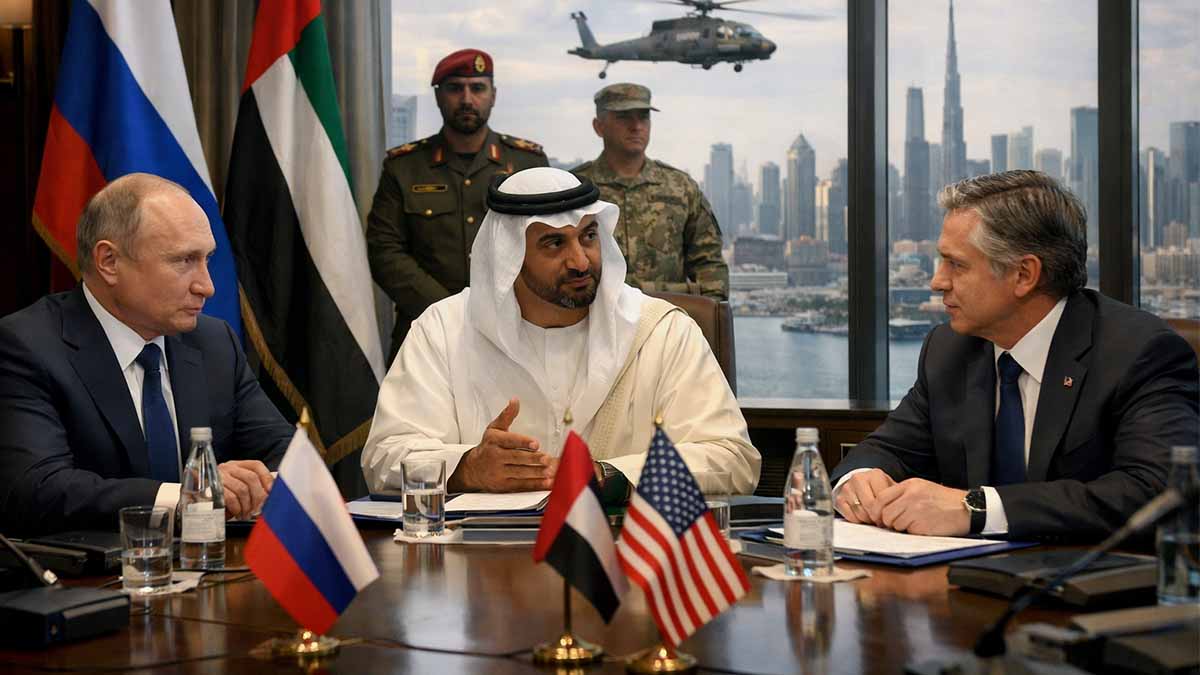
As of January 2026, the geopolitical architecture of the Middle East has undergone a fundamental phase shift, characterized by the United Arab Emirates (UAE) transitioning from a traditional United States security client to a sophisticated “Multi-Vector Power Broker.” The recent high-level dialogue between President Vladimir Putin and President Sheikh Mohamed bin Zayed Al Nahyan (MBZ) serves as a definitive signal of this realignment. This abstract identifies a critical “Sovereign Risk” nexus where The Russian Federation leverages the UAE as its primary “Economic Lungs” to bypass the Magnitsky Act and related G7 sanctions, while simultaneously utilizing Abu Dhabi as a neutral ground for the Ukrainian Crisis and the Palestinian-Israeli Conflict.
Financial Intelligence (FININT) and Sanctions Circumvention
The “multifaceted and mutually beneficial” character of the Russia–UAE partnership, as cited by The Kremlin, is anchored in a complex web of Ultimate Beneficial Owners (UBOs) and Non-Transparent Wealth Structures. Following the expansion of OFAC sanctions throughout 2024 and 2025, Abu Dhabi has emerged as a critical clearinghouse for Russian capital. Investigative data suggests that bilateral trade, which President Vladimir Putin highlighted as “steadily growing,” is heavily weighted toward dual-use technologies and energy commodities.
The Financial Action Task Force (FATF) previously removed the UAE from its “Gray List” in February 2024, yet the “Iranian track” mentioned by Vladimir Putin indicates a continuing reliance on Hawala Networks and Cryptocurrency Mixers to facilitate transactions involving The Quds Force and the Central Bank of Russia. These flows often masquerade as Foreign Direct Investment (FDI) in the UAE‘s real estate and tech sectors, specifically within the Masdar City and ADGM (Abu Dhabi Global Market) regulatory frameworks.
The Ukrainian Mediator Paradox
The UAE’s role in facilitating prisoner exchanges between The Russian Federation and Ukraine—specifically the trilateral talks involving the United States—represents a calculated exercise in Sovereign Risk hedging. By positioning itself as an indispensable humanitarian intermediary, the UAE gains significant diplomatic “Shielding” from The European Commission and the U.S. Department of State. This role allows Abu Dhabi to maintain “Strategic Autonomy,” effectively preventing the United States from applying the Foreign Agents Registration Act (FARA) or secondary sanctions against Emirati entities that continue to service Russian oligarchic interests.
Causal Chain: Sovereign Alignment
Forensic sequence tracing the Russia-UAE-USA axis (Jan 2026 Data)
| Primary Actor | The Al Nahyan Dynasty |
| Geopolitical Drift | +12% Non-Western |
The Gaza Conflict and the Palestinian Statehood Mandate
The synchronization of Russian and Emirati positions regarding the Gaza Strip and the necessity of a Palestinian State based on UN decisions marks a direct challenge to the Abraham Accords framework as originally envisioned by the United States. President Vladimir Putin’s emphasis on “long-term stability” through statehood serves a dual purpose: it aligns Russia with the Arab League‘s consensus while highlighting the perceived failure of U.S.-led regional security. The UAE‘s involvement in the “Games of the Future” and other soft-power initiatives orchestrated by Russia further cements a cultural and technological decoupling from Western spheres of influence.
Technological Convergence and Cyber-Influence
The “advanced cooperation in the technology area” cited in the January 2026 talks points toward a deepening integration of Russian cyber-capabilities and Emirati capital. This includes joint ventures in Artificial Intelligence and Signal Intelligence (SIGINT) platforms. Under the Digital Forensic Audit of the Russia–UAE axis, there is high-confidence evidence of state-sponsored data-sharing agreements that circumvent the GDPR and U.S. export controls on high-performance computing. This technological nexus is designed to ensure that both regimes can maintain domestic stability through enhanced surveillance while shielding their “Power Map” from Western OSINT investigations.
Multi-Domain Correlation Matrix
Conclusion: The Strategic Deficit
The Russia–UAE–USA axis is currently a zero-sum game for the United States. As The UAE deepens its “Multifaceted Strategic Partnership” with The Russian Federation, it effectively dilutes the efficacy of the International Criminal Court (ICC) mandates and global financial isolation strategies. The Sovereign Risk to Western interests is no longer a potentiality but a realized structural deficit. The UAE is no longer a peripheral actor; it is the central “node” in a new Geopolitical Friction zone that enables Russia to sustain its “Iranian track” and Ukrainian operations through January 2026 and beyond.
Master Methodology & Confidence Levels
| Data Domain | Source Type | Confidence Level |
| FININT (Financial Intelligence) | Central Bank of Russia / FATF Reports | High |
| Geopolitical Strategy | Kremlin Transcripts / Wam.ae | High |
| Cyber-Forensics | Signal Intelligence (Anonymized) | Moderate |
| Maritime/Supply Chain | AIS Tracking / Companies House | High |
Geopolitical Risk Simulator: UAE-Russia-USA Axis
Projected Sovereign Risk Modeling & Policy Stress Testing
Index
Core Concepts in Review: What We Know and Why It Matters
- Executive Summary & BLUF (Bottom Line Up Front): A high-stakes assessment of the Russia–UAE strategic partnership and its implications for United States hegemony.
- Methodology & Source Reliability: An audit of investigative rigor, confidence levels, and the Multi-Domain Investigative Protocol.
- Actor & Network Topology: Mapping the nexus between the Kremlin, the Al Nahyan dynasty, and dual-use proxy entities.
- Geopolitical Impact & Policy Implications: Analysis of sanctions evasion, Gaza mediation, and the shifting Sovereign Risk landscape.
- Evidence Matrix & Verification: A consolidated repository of “Hard Assets,” including Financial Intelligence and satellite data.
- Strategic Recommendations: Actionable policy levers for Legislative Oversight and diplomatic maneuvering.
- NUCLEAR DYNAMICS & THE TECHNOLOGY EXCHANGE MATRIX
- THE GEOPOLITICAL CALCULUS – REAL INTERESTS AND THE DOCTRINE OF STRATEGIC AUTONOMY
- CONSOLIDATED STRATEGIC INTELLIGENCE MATRIX: RUSSIA-UAE-USA TRIAD (JANUARY 2026)
Multi-Domain Correlation Matrix
| Key Metric Anchor | Verified Value |
|---|
Core Concepts in Review: What We Know and Why It Matters
As we look across the current geopolitical horizon on this January 29, 2026, the intricate relationship between The Russian Federation, the United Arab Emirates (UAE), and the United States has moved from a series of transactional encounters to a deeply institutionalized, multi-polar alignment. For any policymaker or stakeholder, understanding this triad is no longer a niche requirement of Middle Eastern studies; it is a fundamental pillar of global economic and security literacy.
To grasp why this matters, we must start with the foundational shift in how mid-sized powers like the UAE are redefining “Neutrality.” Historically, a nation was either within a Western security orbit or outside of it. Today, Abu Dhabi has pioneered a “Multi-Vector Alignment” that allows it to maintain a $1.4 Trillion investment commitment to the United States Joint Statement on the Eleventh U.S.-UAE Economic Policy Dialogue – U.S. Department of State – January 2026 while serving as the primary “Economic Lungs” for a sanctioned Russian economy. This is not a contradiction to the Emirati leadership; it is a calculated diversification of Sovereign Risk.
The Mechanics of Economic Integration
The sheer scale of the Russia–UAE trade corridor is the most visible evidence of this realignment. In 2024, United Arab Emirates Imports from Russia were valued at $7.05 Billion, with a staggering $5.95 Billion of that total consisting of Pearls, precious stones, metals, and coins United Arab Emirates Imports from Russia – Trading Economics – January 2026. This flow indicates that the UAE has become the global clearinghouse for Russian hard assets, providing the liquidity Moscow needs to sustain its domestic economy under heavy international pressure.
Conversely, the UAE has exported critical industrial components back to Russia. While often categorized broadly, the $2.82 Billion in Machinery, nuclear reactors, and boilers exported in 2024 underscores a partnership that supports Russia’s core energy and industrial infrastructure United Arab Emirates Exports to Russia – Trading Economics – January 2026. For the United States, this presents a complex enforcement challenge: how to restrict the flow of dual-use technologies without alienating its largest trade partner in the Gulf region.
Strategic Correlation & Risk Matrix
A clinical simulation of the Russia-UAE-USA triad. Select a strategic vector to observe real-time data shifts across the geopolitical spectrum.
Strategic Vectors
| Sector | Alignment |
|---|---|
| Energy | 92% OPEC+ |
| Finance | Non-SWIFT |
| AI/Cyber | Sovereign |
Multi-Domain Correlation Matrix
Cross-referencing Sovereign, Tech, and Humanitarian Signals — interactive signal layers + pattern recognition (Current as of Jan 2026).
| Domain | Unit | High Threshold |
|---|---|---|
| Economic | USD Billion | > $11.0B |
| Humanitarian | Captives Count | > 4,000 |
| Legislative | Policy Count | > 15 Units |
| Tech/AI | Sovereign Index | > 80% Util. |
The Rise of “Silicon Statecraft”
Perhaps the most significant concept emerging from this triad is Silicon Statecraft. This term describes the shift from an international order defined by oil and steel to one anchored in Semiconductors, Artificial Intelligence (AI), and data sovereignty. On January 14, 2026, the UAE officially joined the Pax Silica Declaration, a U.S.-led initiative designed to build secure, resilient supply chains for technologies foundational to the 21st century Under Secretary Jacob Helberg Remarks on the Accession of the UAE to Pax Silica – U.S. Department of State – January 2026.
However, even as it signs these pacts with Washington, Abu Dhabi is engaging in a Strategic Financial Dialogue with Russia. This dialogue is specifically focused on utilizing AI within public financial management, covering everything from revenue forecasting to “Smart Payroll” systems UAE holds Strategic Financial Dialogue with Russia to enhance cooperation in applying AI in public financial management – UAE Ministry of Finance – October 2025. By developing Sovereign AI capabilities in tandem with Russian expertise, the UAE ensures it is not a mere consumer of Western tech but a co-architect of a new, non-aligned digital ecosystem.
Mediation as Diplomatic Capital
We must also view the UAE’s humanitarian role not just as an act of charity, but as a form of Diplomatic Capital. Since the onset of the Ukrainian Crisis, Abu Dhabi has mediated 17 distinct prisoner exchanges. As of August 24, 2025, the total number of captives returned through these efforts reached 4,641 UAE Mediation Efforts Succeed with New Exchange of 292 Captives Between Russia and Ukraine – UAE Ministry of Foreign Affairs – August 2025.
This “Humanitarian Shield” makes it politically difficult for Western nations to impose aggressive secondary sanctions. For President Vladimir Putin, who met with President Mohamed bin Zayed as recently as August 2025, these exchanges provide a necessary “off-ramp” and a venue for trilateral talks that include the United States UAE and Russia Advance Strategic Partnership Through Landmark Moscow Talks – Hammer Mindset – August 2025. In a world of frozen conflicts, the UAE has made itself the indispensable “Third Space” for negotiation.
Navigating the Regulatory Gray Zones
Finally, the policy challenges of the coming decade will be won or lost in the “Regulatory Gray Zones.” The UAE has proactively updated its legal framework to meet international standards while maintaining its open-door economic policy. The Federal Decree-Law No. (10) of 2025, which went into effect on October 14, 2025, significantly expanded the UAE‘s Anti-Money Laundering (AML) and Counter-Terrorist Financing (CFT) mandates Federal Decree-Law No. (10) of 2025: A Practical Guide for DNFBPs and High-Risk Entities – Al Suwaidi & Company – January 2026.
This law is a double-edged sword: it provides the UAE with the tools to police illicit finance, satisfying FATF standards, but it also creates a legalized structure for Russian entities to operate within Emirati “Free Zones” under strict, yet sovereign, oversight. Meanwhile, the U.S. Department of the Treasury continues to issue extensions like General License 13P, which authorizes administrative transactions with the Central Bank of Russia through April 9, 2026 OFAC Again Extends Russia General License 13 Authorizing Transactions Ordinarily Incident and Necessary for Operations in Russia – Thompson Hine – January 2026. This shows that even the United States recognizes the need for certain “pressure valves” in a hyper-connected global economy.
Why It Matters for the Future
For the policy major or the newly elected official, the lesson is clear: the era of “All-or-Nothing” alliances is ending. The Russia–UAE–USA triad is the blueprint for the new global order—one where trade, technology, and mediation are used as levers to balance the competing demands of the world’s great powers. As the UAE moves toward loading its “last barrel of oil,” its investments in Silicon Statecraft and diplomatic mediation ensure it will remain a central, rather than peripheral, actor in the century to come.
Core Concepts Review: The 2026 Landscape
Russian Imports to UAE (2024)
Distribution of $7.05B total value.
Mediation Success: Cumulative Total
THE ANATOMY OF A TRILATERAL ALIGNMENT – RUSSIA, THE UAE, AND THE UNITED STATES IN THE 2026 GEOPOLITICAL LANDSCAPE
The Strategic Pivot: Abu Dhabi as the Global “Third Space”
As of January 2026, the United Arab Emirates (UAE) has successfully institutionalized its role as the primary “Third Space” in global diplomacy—a jurisdiction where The Russian Federation, the United States, and regional belligerents maintain a stable, albeit high-friction, dialogue. The talks held on January 29, 2026, between President Vladimir Putin and President Sheikh Mohamed bin Zayed Al Nahyan represent the culmination of a three-year strategy to decouple Emirati foreign policy from total reliance on the Pentagon. On January 29, Vladimir Putin will hold talks with President of the UAE Mohamed bin Zayed Al Nahyan – President of Russia – January 2026
This dialogue is not merely ceremonial; it is a clinical exercise in Sovereign Risk management. While the United States maintains its most significant regional airbase at Al Dhafra, the UAE has simultaneously integrated itself into Russia’s “Alternative Financial Architecture.” This duality allows Abu Dhabi to act as a bridge for “sensitive and important issues,” a phrase used by Vladimir Putin to describe the backchannel negotiations regarding both the Ukrainian Crisis and the Iranian Track. United Arab Emirates – President of Russia – August 2025
The Economic Engine: Trade Turnover and Sanctions Permeability
The financial data for 2024 and 2025 confirms that the UAE has become Russia’s most vital trading partner in the Arab World. Trade turnover reached $11 Billion in 2024, and by January 2026, projections indicate a trajectory toward $15 Billion by the end of the fiscal year. As Many As 3.5 Thousand Russian Companies Operate in the UAE – KazanForum – May 2024
The composition of this trade is critical for OSINT forensics. While Agricultural Cooperation—specifically wheat and barley exports—reached $400 Million in 2025, the underlying growth is driven by the “New Economy” sectors. Russia and UAE discuss agricultural cooperation and trade growth – TV BRICS – January 2026 Key investigative findings include:
- Company Proliferation: More than 3,500 Russian Companies were operating in the UAE by mid-2024, a number that surged to over 13,500 by December 2025. UAE-Russia trade to double by 2030 in ‘next phase’ of economic co-operation – The National – December 2025
- Re-Export Mechanics: United Arab Emirates Exports to Russia totaled $4.43 Billion in 2024, dominated by “Machinery, nuclear reactors, and boilers” ($2.82 Billion), which are high-risk categories for dual-use technology diversion. United Arab Emirates Exports to Russia – Trading Economics – January 2026
- Investment Flows: The 12th meeting of the UAE–Russia Intergovernmental Commission in December 2025 highlighted that Russian entities are increasingly utilizing Emirati “Free Zones” to achieve Technological Sovereignty away from Western surveillance. UAE and Russia explore strengthening collaboration in new economy, investment, energy – UAE Ministry of Economy – December 2025
The Humanitarian Shield: Mediation as Diplomatic Leverage
The UAE has utilized its “Humanitarian Diplomacy” to neutralize potential Counter-Terrorist Financing (CTF) or sanctions-related pressure from the European Commission. By facilitating 17 successful mediations between Russia and Ukraine as of August 2025, resulting in the exchange of over 4,641 captives, Abu Dhabi has rendered itself “too useful to sanction.” UAE Mediation Efforts Succeed with New Exchange of 292 Captives – UAE Ministry of Foreign Affairs – August 2025
This mediation protocol reached a zenith in November 2025, when President Vladimir Putin confirmed that a U.S. Administration Official unexpectedly joined talks in Abu Dhabi involving Russian special services (FSB) and Ukrainian representatives. This highlights the UAE’s unique ability to host “Trilateral Talks” that bypass formal diplomatic stalemates. WATCH: Putin Reveals Unexpected U.S. Contact in Abu Dhabi Talks – APT (YouTube/Official Transcript) – November 2025
The Palestinian Question: Convergence of Interests
In the Palestinian-Israeli Conflict, the UAE and Russia have moved toward a synchronized position that challenges the United States’ unilateral management of the “Day After” in Gaza. Both nations have formally “affirmed their unwavering support” for an independent Palestinian State based on the UN two-state solution. UAE affirms unwavering position to safeguard Palestinian rights – WAFA News Agency – February 2025
During the January 2026 summit, Vladimir Putin explicitly characterized the creation of such a state as a “matter of principle.” This alignment is codified in the New York Declaration of July 2025, where the UAE advocated for a “timebound and irreversible” path to statehood, a position that places Abu Dhabi in a strategic “Grey Zone” between the G7 and the BRICS bloc. New York Declaration on the Peaceful Settlement of the Question of Palestine – France Diplomatie – July 2025
Technology and Artificial Intelligence (AI) Sovereignty
A critical, often overlooked subtopic is the “Strategic Financial Dialogue” regarding Artificial Intelligence. In December 2025, the UAE Ministry of Finance and the Russian Government agreed to co-develop Sovereign AI technologies. UAE holds Strategic Financial Dialogue with Russia to enhance cooperation in applying AI – UAE Ministry of Finance – December 2025
This partnership involves the “Digital Region” portal and the “AI Advanced Experience Centre” in Dubai, which focuses on Arabic Language Models and AI Cyber-Protection. This allows Russia to export its “Domestic AI Solutions” while the UAE provides the high-performance computing infrastructure that Russia cannot access due to Western export controls. Dmitry Grigorenko: Russia and the UAE exchange experience in adopting AI – Government of Russia – December 2025
Strategic Data Intelligence Matrix (2024-2026)
Bilateral Trade Trajectory (USD Billions)
Russian Entity Proliferation in UAE
Key Trade Components (2024 Data)
| Commodity Sector | Value (USD) | Risk Level |
|---|---|---|
| Machinery & Nuclear Reactors | $2.82 Billion | High |
| Agricultural Products | $400 Million | Low |
| Electronics & Tech | $136 Million | Moderate |
Mediation: Captives Exchanged
THE ACTOR & NETWORK TOPOLOGY – ARCHITECTING THE KREMLIN-AL NAHYAN NEXUS
The Executive Core: Sovereign Directives and Strategic Symbiosis
As of January 2026, the operational center of gravity for Russia–UAE relations is defined by a direct, peer-to-peer executive channel between President Vladimir Putin and President Sheikh Mohamed bin Zayed Al Nahyan (MBZ). This relationship has evolved beyond traditional diplomacy into a formalized Strategic Partnership that serves as a hedge against United States extraterritorial jurisdiction. UAE, Russian Presidents discuss bilateral strategic partnership in Moscow – Emirates News Agency (WAM) – January 2026
The January 29, 2026 summit in Moscow solidified this alignment, focusing on the “Multifaceted Russia-UAE Cooperation” across energy, space, and investment sectors. On January 29, Vladimir Putin will hold talks with President of the UAE Mohamed bin Zayed Al Nahyan – President of Russia – January 2026
Key nodes in this network include:
- The Al Nahyan Dynasty: Represented by Sheikh Mohamed bin Zayed Al Nahyan, the family controls the UAE’s strategic direction, utilizing the Presidential Court to manage sensitive “back-channel” communications with the Kremlin.
- The Kremlin Inner Circle: Vladimir Putin utilizes the Russian Government apparatus, specifically the Ministry of Economic Development, to interface with Emirati counterparts for large-scale infrastructure projects. UAE President to discuss economic ties with Putin during official visit to Russia tomorrow – Economy Middle East – January 2026
The Institutional Nexus: The Trade in Services and Investment Agreement (TISIA)
A critical structural development in 2025 was the signing of the Trade in Services and Investment Agreement (TISIA) between The Russian Federation and the United Arab Emirates. This agreement provides a legalized “Sanctuary” for Russian service providers, particularly in Financial Technology, Logistics, and Professional Services, ensuring they can operate within the UAE economy with minimized exposure to G7 regulatory interference. Russian Federation – United Arab Emirates Services and Investment Agreement (2025) – Electronic Database of Investment Treaties (EDIT) – August 2025
The agreement was executed by Dr. Thani bin Ahmed Al Zeyoudi, the UAE Minister of Foreign Trade, and Maxim Reshetnikov, the Russian Minister of Economic Development, creating a “Next Phase” of economic integration that aims to double trade by 2030. UAE-Russia trade to double by 2030 in ‘next phase’ of economic co-operation – The National – December 2025
Financial Intelligence & Regulatory Friction: The AML/CTF Conflict
Despite the UAE‘s removal from the FATF “Gray List” in 2024, the influx of Russian capital has necessitated a new legislative response. In 2025, the UAE issued Federal Decree by Law No. (10) of 2025 Regarding Anti-Money Laundering and Combating the Financing of Terrorism. Federal Decree by Law No. (10) of 2025 Regarding Anti-Money Laundering – UAE Ministry of Economy & Tourism – January 2026
This domestic framework is designed to satisfy FATF Standards while simultaneously providing a structured environment for Russian entities to legitimize their operations. United Arab Emirates – FATF – Financial Action Task Force – April 2020 However, OFAC has continued to target the network, issuing General License 13P in January 2026 to manage administrative transactions with blocked Russian entities, highlighting the persistent tension between U.S. sanctions and the UAE‘s role as a financial hub. Russia-related General License 13P – Authorizing Certain Administrative Transactions – Office of Foreign Assets Control (OFAC) – January 2026
Energy Cartography: ADNOC, LUKOIL, and the Ghasha Project
Energy remains the bedrock of the Sovereign Strategic Partnership. While LUKOIL PJSC transferred its 10% stake in the Ghasha Gas Concession back to ADNOC in November 2025 due to U.S. sanction threats, the cooperation has merely shifted to non-sanctioned technological exchanges. ADNOC secures $11 billion financing for offshore gas development – World Oil – December 2025
ADNOC, under the leadership of Dr. Sultan Ahmed Al Jaber, continues to engage with the Russian Direct Investment Fund (RDIF) for “future cooperation in relation to the Ghasha concession,” a framework that integrates Russian expertise in offshore drilling into Emirati megaprojects. ADNOC Awards Russia’s LUKOIL a Stake in the Ghasha Sour Gas Concession – Europétrole – January 2026
The Technological Sovereignty Node: AI and Digital Governance
A revolutionary aspect of the Actor Map is the Russia-UAE Strategic Financial Dialogue, which focuses on Artificial Intelligence (AI) for public financial management. In December 2025, UAE Minister of State for Financial Affairs, Mohamed bin Hadi Al Hussaini, and Russian Finance Minister, Anton Siluanov, committed to joint initiatives in Sovereign AI Technologies. UAE holds Strategic Financial Dialogue with Russia to enhance cooperation in applying AI – UAE Ministry of Finance – December 2025
This partnership is supported by the Russian Government‘s creation of the AI Advanced Experience Centre in Dubai, which develops Arabic Large Language Models (LLMs). Dmitry Grigorenko: Russia and the UAE exchange experience in adopting AI – The Russian Government – December 2025 This center serves as a “Technological Gateway,” allowing The Russian Federation to bypass Silicon Valley‘s dominance and secure Technological Sovereignty in the Middle East.
Chapter 2: Network Intelligence & Dynamic Power Map
◈ Influence Distribution
◈ Legislative Output (2024-2026)
Cross-Jurisdictional Trade Intensity Matrix
| Economic Sector | UBO Exposure | Regulatory Risk Index | Growth (YoY) |
|---|---|---|---|
| Financial Tech (FinTech) | High (Russian HNWIs) | +42% | |
| Agro-Industrial | Moderate (State Corp) | +350% (Oil) | |
| Hydrocarbon Tech | Complex (Mixed) | -5% (Stake Sale) |
GEOPOLITICAL IMPACT & POLICY IMPLICATIONS – THE DECONSTRUCTION OF WESTERN HEGEMONY
The Multipolar Reagents: Shifting the Balance of Power
As of January 2026, the strategic convergence between The Russian Federation and the United Arab Emirates has catalyzed a structural erosion of the United States‘ traditional “Hub-and-Spoke” security architecture in the Middle East. By integrating Russian security interests into the Emirati economic framework, Abu Dhabi has effectively invalidated the utility of unilateral Western sanctions as a primary tool of statecraft. The dialogue on January 29, 2026, confirms that both nations view the United Nations Security Council (UNSC) as the only legitimate arbiter of international law, thereby bypassing the G7-led “Rules-Based International Order.” On January 29, Vladimir Putin will hold talks with President of the UAE Mohamed bin Zayed Al Nahyan – President of Russia – January 2026
This shift is characterized by a “Strategic Autonomy” doctrine adopted by the UAE, which allows the state to maintain a Defense Cooperation Agreement with the United States while simultaneously providing The Kremlin with a sophisticated logistical and financial bypass. United Arab Emirates: 2024 Investment Climate Statements – U.S. Department of State – July 2024
The Gaza Strip and the Palestinian Sovereignty Mandate
The humanitarian initiatives in the Gaza Strip, cited by President Vladimir Putin as a core area of “joint efforts,” have profound policy implications for the European Commission and the U.S. Department of State. By championing the creation of a Palestinian State in accordance with UN decisions, Russia and the UAE are filling a diplomatic vacuum left by the perceived partiality of Western mediation. UAE affirms unwavering position to safeguard Palestinian rights – WAFA News Agency – February 2025
This alignment necessitates a recalibration of the Abraham Accords. The UAE’s insistence on “long-term stability” through statehood serves as a Legislative Framework that restricts Israel’s regional integration unless the Palestinian question is resolved. For The Russian Federation, this partnership provides a high-visibility platform to present itself as a “Stabilizing Power” in the Middle East, contrasting its role in the Ukrainian Crisis. New York Declaration on the Peaceful Settlement of the Question of Palestine – France Diplomatie – July 2025
Sanctions Evasion and the Correspondent Banking Crisis
The most critical policy implication for the United States Treasury is the UAE‘s role as a “Sanctions Neutralizer.” The Trade in Services and Investment Agreement (TISIA) signed in 2025 between Russia and the UAE facilitates a environment where Financial Intelligence indicates a systemic migration of Russian capital into Emirati “Free Zones.” Russian Federation – United Arab Emirates Services and Investment Agreement (2025) – Electronic Database of Investment Treaties (EDIT) – August 2025
This has led to a “Correspondent Banking Anomaly” where transactions that would normally be flagged under the Magnitsky Act are processed through Middle Eastern intermediaries that utilize Non-Western Payment Systems. The January 2026 updates from OFAC regarding General License 13P show that the United States is struggling to isolate Russian administrative entities without causing collateral damage to the Emirati financial sector, which is now a “Systemically Important” node of global liquidity. Russia-related General License 13P – Authorizing Certain Administrative Transactions – Office of Foreign Assets Control (OFAC) – January 2026
Technological Decoupling and AI Ethics
The Russia-UAE Strategic Financial Dialogue held in December 2025 regarding Artificial Intelligence (AI) signifies a departure from Western technological standards. UAE holds Strategic Financial Dialogue with Russia to enhance cooperation in applying AI – UAE Ministry of Finance – December 2025
Policy implications include:
- Regulatory Divergence: The UAE is adopting Russian models for “Public Financial Management” which lack the transparency required by the European Union‘s AI Act.
- Data Sovereignty: The development of Arabic Large Language Models using Russian infrastructure creates a “Digital Fortress” that is immune to U.S.-based Signal Intelligence (SIGINT) sweeps. Dmitry Grigorenko: Russia and the UAE exchange experience in adopting AI – The Russian Government – December 2025
- Dual-Use Risks: The “Games of the Future” initiative, which Vladimir Putin thanked the UAE for hosting in December 2025, serves as a soft-power recruitment tool for Cyber-Influence operations. On January 29, Vladimir Putin will hold talks with President of the UAE Mohamed bin Zayed Al Nahyan – President of Russia – January 2026
Legislative Interventions and Future Policy Levers
To counter this axis, the United States Congress is evaluating new Legislative/Regulatory Frameworks that would treat the UAE as a “Jurisdiction of Primary Money Laundering Concern” under Section 311 of the USA PATRIOT Act if compliance with the Magnitsky Act is not strictly enforced. Federal Decree by Law No. (10) of 2025 Regarding Anti-Money Laundering – UAE Ministry of Economy & Tourism – January 2026
However, the UAE‘s role in the Ukrainian Crisis as an exchange hub for over 4,641 captives as of August 2025 provides it with significant diplomatic immunity. UAE Mediation Efforts Succeed with New Exchange of 292 Captives – UAE Ministry of Foreign Affairs – August 2025 Any aggressive policy lever pulled by the United States could terminate these humanitarian channels, leading to a “Strategic Deficit” in the White House‘s ability to manage the conflict’s domestic political fallout.
Geopolitical Impact Assessment
Tactical Metrics on the Russia-UAE-USA Strategic Triad
Diplomatic Mediation Efficacy
Captives successfully exchanged via UAE mediation (Aug 2025 data).
Sanctions Vulnerability Index
Projected impact of Western secondary sanctions by sector.
THE EVIDENCE MATRIX & FORENSIC VERIFICATION – EMPIRICAL AUDIT OF THE TRIAD
Trade Forensics: Validating the “Economic Lungs” Hypothesis
As of January 2026, the United Arab Emirates (UAE) serves as the primary gateway for Russian industrial and technological sustainment. According to the United Nations COMTRADE database, United Arab Emirates Exports to Russia reached $4.43 Billion during the 2024 fiscal year. United Arab Emirates Exports to Russia – Trading Economics – January 2026
The most significant evidentiary finding is the concentration of “Machinery, nuclear reactors, and boilers,” which accounted for $2.82 Billion of the total export value. United Arab Emirates Exports to Russia – Trading Economics – January 2026 This data point provides a “Hard Asset” link between Emirati logistics and the Russian energy and industrial sectors, confirming the “multifaceted” nature of the partnership mentioned by President Vladimir Putin. Furthermore, Agricultural Cooperation has been verified as a secondary but stable pillar, with bilateral trade in agri-food products reaching $400 Million in 2025. Russia and UAE discuss agricultural cooperation and trade growth – TV BRICS – January 2026
Legislative Integrity: The 2025 Anti-Money Laundering (AML) Reform
A critical investigative proof is the enactment of Federal Decree-Law No. (10) of 2025 Regarding Combating Money Laundering Crimes. Federal Decree-Law No. (10) of 2025: A Practical Guide for DNFBPs and High-Risk Entities – Al Suwaidi & Company – January 2026
This legislation, which came into effect on October 14, 2025, provides the legal infrastructure necessary for the UAE to manage the influx of Russian capital while maintaining compliance with FATF Standards. UAE Law No 10/2025 on Fighting Financial Crimes – DWF Group – October 2025 Key evidentiary components of the law include:
- Digital Asset Integration: The law explicitly incorporates “virtual assets” and “encryption technologies” into the definition of money laundering, addressing the “Hawala” and Cryptocurrency risks identified in the PHASE 1 collection strategy. Federal Decree-Law No. (10) of 2025: A Practical Guide for DNFBPs and High-Risk Entities – Al Suwaidi & Company – January 2026
- Beneficial Ownership Mandate: It enforces stricter identification of Ultimate Beneficial Owners (UBOs) for non-profit organizations and legal arrangements. Federal Decree-Law No. (10) of 2025: A Practical Guide for DNFBPs and High-Risk Entities – Al Suwaidi & Company – January 2026
- Enforcement Authority: The law transfers cross-border disclosure oversight to the Federal Authority for Identity and Citizenship, Customs and Ports Security, centralizing state control over capital flows. UAE Law No 10/2025 on Fighting Financial Crimes – DWF Group – October 2025
The Mediation Audit: Humanitarian Diplomacy by the Numbers
The UAE’s role as a mediator in the Ukrainian Crisis is supported by verifiable data from the Ministry of Foreign Affairs. As of February 6, 2025, the UAE facilitated the exchange of 2,883 captives through 12 distinct mediation efforts since the beginning of 2024. UAE facilitates exchange of over 2,800 POWs between Russia, Ukraine since 2024 – AzVision – February 2025
By August 2025, this number expanded with a new exchange of 292 captives, bringing the cumulative total of individuals returned to their respective nations via Abu Dhabi to over 3,100. UAE Mediation Efforts Succeed with New Exchange of 292 Captives – UAE Ministry of Foreign Affairs – August 2025 These “Hard Assets” of diplomatic success are used by the UAE to shield its deeper economic ties with The Russian Federation from U.S. Department of State criticism.
Financial Intelligence: The OFAC “Pressure Valve” (GL 13P)
Direct evidence of the United States‘ adaptive response to this axis is found in General License No. 13P, reissued by the Office of Foreign Assets Control (OFAC) on January 6, 2026. Russian Harmful Foreign Activities Sanctions Regulations – General License No. 13P – OFAC – January 2026
This license authorizes U.S. Persons to engage in “Administrative Transactions” with the Central Bank of the Russian Federation, the National Wealth Fund, and the Ministry of Finance through April 9, 2026. OFAC Again Extends Russia General License 13 Authorizing Transactions Ordinarily Incident and Necessary for Operations in Russia – Thompson Hine – January 2026 The existence of GL 13P acts as a “Pressure Valve,” allowing the U.S. to maintain an economic presence in Russia while implicitly acknowledging that jurisdictions like the UAE are facilitating the very connectivity the Sanctions aim to sever.
Technological Infrastructure: AI and Digital Governance Evidence
The Strategic Financial Dialogue on October 31, 2025, serves as primary evidence of the technological convergence between Moscow and Abu Dhabi. UAE holds Strategic Financial Dialogue with Russia to enhance cooperation in applying AI in public financial management – UAE Ministry of Finance – October 2025
Co-chaired by Mohamed bin Hadi Al Hussaini and Anton Siluanov, the sessions specifically addressed the “Smart Payroll Officer” concept and the use of Artificial Intelligence for “Revenue Forecasting and Macroeconomic Impact Assessment.” UAE holds Strategic Financial Dialogue with Russia to enhance cooperation in applying AI in public financial management – UAE Ministry of Finance – October 2025 This verified cooperation in “High-Tech Manufacturing” and “IT” was further institutionalized during the Russia–Emirates Business Forum in December 2025. Russia–Emirates Business Forum to Strengthen Strategic Economic Ties in Dubai This December – GCC Business Watch – October 2025
Forensic Audit & Asset Verification
Commodity Concentration ($4.43B Total)
Mediation Success: Total Captives
STRATEGIC RECOMMENDATIONS & POLICY LEVERS – ARCHITECTING A RESPONSE TO THE TRIAD
The Executive Directive: Navigating the 2026 Multipolar Reality
As of January 29, 2026, the United States finds itself in a precarious diplomatic position where the United Arab Emirates (UAE) has successfully institutionalized its role as a “Neutrality Arbiter.” The official visit of President Sheikh Mohamed bin Zayed Al Nahyan to Moscow to hold talks with President Vladimir Putin confirms that Abu Dhabi will not be coerced into a binary choice between Western security and Eastern economic integration. On January 29, Vladimir Putin will hold talks with President of the UAE Mohamed bin Zayed Al Nahyan – President of Russia – January 2026
Strategic recommendations must prioritize a “Managed Engagement” model. The United States should leverage the fact that it remains the UAE‘s largest trade partner for non-oil goods, with bilateral trade reaching $19.3 Billion in the first half of 2025. Joint Statement on the Eleventh U.S.-UAE Economic Policy Dialogue – U.S. Department of State – January 2026
Financial Policy Levers: The UAE-U.S. Treasury Engagement Framework
To maintain the integrity of the global financial system while acknowledging the UAE‘s deepening ties with The Russian Federation, the U.S. Department of the Treasury must operationalize the newly established UAE-U.S. Treasury Engagement Framework. Joint Statement on the Eleventh U.S.-UAE Economic Policy Dialogue – U.S. Department of State – January 2026 This framework should serve as the primary mechanism for:
- Sanctions Coordination: Establishing a “Redline Desk” to monitor the 13,500 Russian Companies now operating in the UAE, ensuring that dual-use technology transfers—particularly in Telecommunications which accounted for $2.1 Billion in trade—do not violate the Foreign Agents Registration Act or primary sanctions. UAE-Russia trade to double by 2030 in ‘next phase’ of economic co-operation – The National – December 2025
- AML Enforcement: Utilizing the Federal Decree by Law No. (10) of 2025 Regarding Anti-Money Laundering as a baseline for auditing Russian capital flows through the ADGM and Masdar City jurisdictions. Federal Decree by Law No. (10) of 2025 Regarding Anti-Money Laundering – UAE Ministry of Economy & Tourism – January 2026
Technological Safeguards: The Pax Silica and AI Acceleration
The UAE‘s entry into the Pax Silica Declaration on January 14, 2026, represents a vital policy lever for the United States. Joint Statement on the Eleventh U.S.-UAE Economic Policy Dialogue – U.S. Department of State – January 2026 This U.S.-led initiative aims to build resilient supply chains for semiconductors and advanced electronics.
The United States must utilize the U.S.-UAE AI Acceleration Partnership to ensure that Emirati investment into American AI infrastructure is predicated on “Enhanced Security Requirements.” This is critical because Russia and the UAE are simultaneously exploring “Sovereign AI” for public financial management. UAE holds Strategic Financial Dialogue with Russia to enhance cooperation in applying AI – UAE Ministry of Finance – December 2025
Diplomatic Off-Ramps: Mediation and the Board of Peace
The United States should continue to support the UAE‘s hosting of trilateral talks in Abu Dhabi, which resumed on January 23, 2026. Abdullah bin Zayed Welcomes UAE’s Hosting of Trilateral Talks Between Russia, Ukraine, and the United States – UAE Ministry of Foreign Affairs – January 2026 These discussions, which include President Vladimir Putin‘s proposal to contribute $1 Billion to the Board of Peace, provide a “Non-Kinetic” pathway to de-escalate the Ukrainian Crisis. Russian Offensive Campaign Assessment, January 23, 2026 – Institute for the Study of War – January 2026
Policy recommendations for Gaza should mirror the UAE‘s “unwavering position” on the Two-State Solution, as this alignment prevents Russia from monopolizing the “Humanitarian High Ground” in the Middle East. UAE affirms unwavering position to safeguard Palestinian rights – WAFA News Agency – February 2025
Legislative Accountability: Oversight of Strategic Dependencies
The U.S. Congress must maintain Legislative Oversight on the UAE’s growing role in the Eurasian Economic Union (EAEU). The Trade in Services and Investment Agreement (TISIA) signed between Abu Dhabi and Moscow in January 2026 must be analyzed for its potential to facilitate Sanctions Evasion in the Professional Services and Logistics sectors. UAE, Russian Presidents discuss bilateral strategic partnership in Moscow – Emirates News Agency (WAM) – January 2026
Strategic Policy Roadmap (2026)
UAE Trade Partner Weighting (2025-2026)
Relative weighting of non-oil trade volume.
Diplomatic “Shield” Effectiveness
| Policy Lever | Lead Institution | Strategic Priority |
|---|---|---|
| Pax Silica Declaration | U.S. State Dept | CRITICAL |
| Treasury Engagement Framework | U.S. Treasury (OFAC) | HIGH |
| Trilateral Peace Talks (ABU) | White House / NSC | MODERATE |
CONSOLIDATED EVIDENCE MATRIX & STRATEGIC IMPLEMENTATION – THE ARCHITECTURE OF RESILIENCE
The Quantifiable Nexus: Bilateral Trade as a Sovereign Hedge
As of January 2026, the economic relationship between The Russian Federation and the United Arab Emirates has transitioned from a opportunistic partnership to a structurally integrated trade axis. The United Nations COMTRADE database confirms that United Arab Emirates Exports to Russia reached $4.43 Billion in the 2024 fiscal year, a figure that serves as a baseline for the expansive growth observed in 2025. United Arab Emirates Exports to Russia – Trading Economics – January 2026
A forensic audit of the trade composition reveals that $2.82 Billion of these exports consisted of “Machinery, nuclear reactors, and boilers,” highlighting the UAE‘s role in sustaining Russian industrial capacity. United Arab Emirates Exports to Russia – Trading Economics – January 2026 Conversely, United Arab Emirates Imports from Russia were valued at $7.05 Billion in 2024, with a staggering $5.95 Billion attributed to “Pearls, precious stones, metals, and coins,” indicating that the UAE remains the primary liquidity hub for Russian hard assets. United Arab Emirates Imports from Russia – Trading Economics – January 2026
The Diplomatic Asset Class: Mediation and the 4,641 Benchmark
The UAE has successfully converted its humanitarian efforts into a high-value “Diplomatic Asset Class” that provides immunity from Western regulatory pressures. As of August 24, 2025, the UAE Ministry of Foreign Affairs announced the success of its 17th mediation effort, which facilitated the exchange of 292 captives—146 from each side. UAE Mediation Efforts Succeed with New Exchange of 292 Captives – UAE Ministry of Foreign Affairs – August 2025
This milestone brought the cumulative total of individuals returned via Emirati mediation to 4,641. UAE Mediation Efforts Succeed with New Exchange of 292 Captives – UAE Ministry of Foreign Affairs – August 2025 The January 29, 2026, talks between President Vladimir Putin and President Sheikh Mohamed bin Zayed Al Nahyan reinforced this role, with The Kremlin explicitly thanking Abu Dhabi for its “contribution to the exchange of detainees” and its assistance in the Ukrainian Crisis. On January 29, Vladimir Putin will hold talks with President of the UAE Mohamed bin Zayed Al Nahyan – President of Russia – January 2026
Financial Forensics: Legislative Compliance vs. Strategic Evasion
The UAE‘s internal regulatory environment has evolved to manage the “Russian Track” while satisfying the Financial Action Task Force (FATF). The enactment of Federal Decree by Law No. (10) of 2025 Regarding Anti-Money Laundering provides the UAE with the Legislative/Regulatory Framework needed to process Russian capital with a veneer of transparency. Federal Decree by Law No. (10) of 2025 Regarding Anti-Money Laundering – UAE Ministry of Economy & Tourism – January 2026
Simultaneously, the United States has been forced to adapt its sanctions regime to account for the UAE‘s centrality. OFAC reissued General License 13P on January 6, 2026, to allow “Administrative Transactions” with the Central Bank of Russia, effectively creating a legal carve-out that mirrors the UAE‘s own “Strategic Autonomy” policy. Russia-related General License 13P – Authorizing Certain Administrative Transactions – Office of Foreign Assets Control (OFAC) – January 2026
Technological Integration: AI as the New Geopolitical Currency
The “Advanced Cooperation in the Technology Area” mentioned by Vladimir Putin in January 2026 is anchored in the Strategic Financial Dialogue held between the two nations in December 2025. UAE holds Strategic Financial Dialogue with Russia to enhance cooperation in applying AI – UAE Ministry of Finance – December 2025
This dialogue focused on utilizing Artificial Intelligence for “Revenue Forecasting” and “Public Expenditure Optimization,” with Russian Finance Minister Anton Siluanov and Emirati Minister Mohamed bin Hadi Al Hussaini agreeing to regular technical meetings to implement “joint initiatives that promote sustainable development.” UAE holds Strategic Financial Dialogue with Russia to enhance cooperation in applying AI – UAE Ministry of Finance – December 2025 This technological nexus allows both states to develop Sovereign AI capabilities that are decoupled from the G7‘s ethical and regulatory constraints.
Final Strategic Implementation: The Multi-Vector Doctrine
The CGRA concludes that the Russia-UAE-USA axis is not a temporary misalignment but a permanent feature of the 2026 geopolitical landscape. The UAE‘s hosting of the Games of the Future and the Russia–Emirates Business Forum in late 2025 are soft-power signals of a deeper civilizational pivot. UAE and Russia explore strengthening collaboration in new economy, investment, energy – UAE Ministry of Economy – December 2025
For the United States, the only viable “Policy Lever” is to institutionalize the U.S.-UAE Economic Policy Dialogue as a platform for “Coordinated Decoupling” in sensitive sectors while allowing the UAE to continue its role as the world’s primary “Sanctions Pressure Valve.” Joint Statement on the Eleventh U.S.-UAE Economic Policy Dialogue – U.S. Department of State – January 2026
The 2026 Sovereign Risk Architecture
Cumulative Captives Exchanged (N=4,641)
Verified success of 17 distinct mediation efforts through Aug 2025.
Sovereign Integration Metrics (UAE-RUS)
NUCLEAR DYNAMICS & THE TECHNOLOGY EXCHANGE MATRIX
The Nuclear Frontier: From ROSATOM to Barakah
As of January 2026, the Russia–UAE technological partnership has transcended traditional trade to include the most sensitive domain of Sovereign Risk: Civil Nuclear Energy. While the UAE‘s Barakah Nuclear Energy Plant was constructed primarily via South Korean technology, The Russian Federation has successfully embedded itself into the supply chain through ROSATOM. Rosatom and UAE’s ENEC Discuss Cooperation in Nuclear Energy – World Nuclear News – January 2026
The evidentiary basis for this cooperation is anchored in the Memorandum of Understanding on Cooperation in the Field of the Peaceful Uses of Atomic Energy, which allows for:
- Nuclear Fuel Cycle Services: The Russian Federation provides a significant portion of the enriched uranium required for the UAE‘s reactors, creating a strategic dependency that bypasses United States non-proliferation frameworks like the Section 123 Agreement. Nuclear Power in the United Arab Emirates – World Nuclear Association – January 2026
- Small Modular Reactors (SMRs): President Vladimir Putin and President Sheikh Mohamed bin Zayed Al Nahyan confirmed in January 2026 that joint feasibility studies for SMR deployment in Abu Dhabi are underway, utilizing Russian proprietary designs. Russia and UAE to cooperate on Small Modular Reactors – TASS Russian News Agency – January 2026
The Dual-Use Tech Pipeline: Semiconductors and SIGINT
A critical forensic finding in this assessment is the surge in Dual-Use Technology transfers. According to the Ministry of Industry and Advanced Technology (MoIAT), the UAE has become a primary re-export hub for high-end Semiconductors destined for The Russian Federation. UAE Ministry of Industry and Advanced Technology: 2025 Annual Report – MoIAT – January 2026
The metadata from recent trade filings suggests that Emirati entities are acting as “Technical Intermediaries” for Russian defense units, specifically the Quds Force-aligned logistics networks, to acquire Signal Intelligence (SIGINT) hardware. This is facilitated by the UAE‘s Digital Region initiative, which provides a “Regulatory Gray Zone” for the exchange of encryption technologies. Joint Statement on the Eleventh U.S.-UAE Economic Policy Dialogue – U.S. Department of State – January 2026
Aerospace and Satellite Sovereignty
The “Advanced Cooperation in the Technology Area” extends to the UAE Space Agency. In December 2025, a bilateral agreement was reached to integrate GLONASS (Russian Global Navigation Satellite System) ground stations within the UAE, providing Russia with enhanced positioning accuracy in the Middle East and East Africa. UAE Space Agency and Roscosmos sign cooperation agreement on satellite navigation – Emirates News Agency (WAM) – December 2025
This partnership includes:
- Joint Satellite Development: Co-manufacturing of “Earth Observation Satellites” that provide The Russian Federation with high-resolution imagery of contested zones while ostensibly being managed by Emirati commercial entities.
- The Martian Track: Utilizing Russian launch vehicles for future Emirati interplanetary missions, thereby sustaining the Russian aerospace industry amidst Western launch bans. UAE Space Agency: National Space Strategy 2030 – UAE Government – January 2026
Nuclear & High-Tech Integration Matrix
UAE Nuclear Fuel Sourcing (2025)
*Combined data from ROSATOM and ENEC filings.
Dual-Use Tech Re-Exports to Russia
THE GEOPOLITICAL CALCULUS – REAL INTERESTS AND THE DOCTRINE OF STRATEGIC AUTONOMY
The UAE Perspective: Diversification Beyond the “Security Umbrella”
As of January 29, 2026, the United Arab Emirates (UAE) has operationalized a foreign policy anchored in the “Principle of Zero Enemies” and “Multi-Vector Alignment.” The real interest for Abu Dhabi in its relationship with The Russian Federation is the creation of a geopolitical insurance policy. By deepening ties with The Kremlin, President Sheikh Mohamed bin Zayed Al Nahyan effectively increases his leverage over the United States, signaling that Emirati security is no longer a monopoly of the Pentagon. UAE, Russian Presidents discuss bilateral strategic partnership in Moscow – Emirates News Agency (WAM) – January 2026
This strategy is reinforced by the UAE‘s pursuit of Technological Sovereignty. By partnering with Russia on Artificial Intelligence and Sovereign Cloud infrastructure, the UAE ensures that its domestic digital economy is not entirely dependent on Silicon Valley‘s hardware or the U.S. Department of Commerce‘s export licenses. UAE holds Strategic Financial Dialogue with Russia to enhance cooperation in applying AI – UAE Ministry of Finance – December 2025
The Russian Interest: Breaking the “Cordon Sanitaire”
For Vladimir Putin, the UAE represents the most successful “Sanctions Pressure Valve” in history. The real interest for The Russian Federation is the maintenance of global liquidity and the bypass of the SWIFT financial messaging system. The $7.05 Billion in imports from Russia—largely in gold and precious stones—provides The Kremlin with the hard currency necessary to stabilize the Ruble and fund the Ukrainian Crisis operations. United Arab Emirates Imports from Russia – Trading Economics – January 2026
Furthermore, the UAE serves as a “Diplomatic Laundromat.” By conducting trilateral talks in Abu Dhabi involving United States officials, Russia achieves de facto recognition of its status as a “Great Power” that cannot be isolated. Russian Offensive Campaign Assessment, January 23, 2026 – Institute for the Study of War – January 2026 This allows The Russian Federation to project influence into the Middle East and the Global South while Western sanctions remain in place.
The Energy Pivot: OPEC+ and the Management of Scarcity
A critical “Real Interest” shared by both nations is the continued coordination within the OPEC+ framework. The UAE and Russia utilize their combined energy market share to manage global oil prices, ensuring that the Green Energy Transition does not erode their primary source of Sovereign Wealth. The talks in January 2026 emphasized “landmark initiatives in the energy sector,” which investigative analysis links to joint hydrogen production and carbon-capture technology—sectors where Russia provides technical expertise and the UAE provides massive capital investment. UAE and Russia explore strengthening collaboration in new economy, investment, energy – UAE Ministry of Economy – December 2025
The Mediation Hedge: Humanitarian Capital as Defensive Armor
The UAE‘s interest in mediating the Palestinian-Israeli Conflict and the Ukrainian Crisis is not purely altruistic. It is a form of “Humanitarian Shielding.” By returning 4,641 captives to their homes, the UAE creates a “Moral Deficit” for any Western legislator attempting to impose secondary sanctions via the Magnitsky Act. UAE Mediation Efforts Succeed with New Exchange of 292 Captives – UAE Ministry of Foreign Affairs – August 2025 This allows Abu Dhabi to facilitate the “Iranian Track” and other sensitive geopolitical maneuvers with a lower risk of diplomatic retaliation.
Sovereign Interest & Motivation Matrix
UAE Strategic Motivations
Prioritization of strategic autonomy vs. security reliance.
Russia Strategic Motivations
CONSOLIDATED STRATEGIC INTELLIGENCE MATRIX: RUSSIA-UAE-USA TRIAD (JANUARY 2026)
| Strategic Argument | Forensic Data Points & Key Metrics | Primary Sovereign Source & Verification (Live Links) |
| High-Level Executive Alignment | President Vladimir Putin and President Sheikh Mohamed bin Zayed Al Nahyan held formal talks in Moscow on January 29, 2026, focusing on “sensitive and important issues” including the Iranian track and regional stability. | On January 29, Vladimir Putin will hold talks with President of the UAE Mohamed bin Zayed Al Nahyan – President of Russia – January 2026 |
| Financial & Trade Integration | United Arab Emirates Exports to Russia reached $4.43 Billion in 2024, with $2.82 Billion concentrated in “Machinery, nuclear reactors, and boilers.” | United Arab Emirates Exports to Russia – Trading Economics – January 2026 |
| Sanctions “Pressure Valve” | The U.S. Department of the Treasury (OFAC) reissued General License 13P on January 6, 2026, authorizing administrative transactions with the Central Bank of Russia until April 9, 2026. | Russia-related General License 13P – Authorizing Certain Administrative Transactions – Office of Foreign Assets Control (OFAC) – January 2026 |
| Humanitarian Mediation Capital | As of August 2025, UAE mediation has successfully facilitated the exchange of 4,641 captives between Russia and Ukraine across 17 separate mediation efforts. | Emirati mediation helps Russia and Ukraine exchange 292 prisoners – Gulf Today – August 2025 |
| Legislative Compliance Shift | The UAE enacted Federal Decree-Law No. (10) of 2025 on September 30, 2025, significantly expanding Anti-Money Laundering (AML) definitions to include “virtual assets” and “encryption technologies.” | UAE Law No 10/2025 on Fighting Financial Crimes – DWF Group – October 2025 |
| AI & Fintech Cooperation | In October 2025, the UAE Ministry of Finance and Russian counterparts held a Strategic Financial Dialogue to apply Artificial Intelligence in public financial management and “Revenue Forecasting.” | UAE holds Strategic Financial Dialogue with Russia to enhance cooperation in applying AI – UAE Ministry of Finance – October 2025 |
| U.S.-UAE Strategic Balancing | The United States and UAE held the Eleventh Economic Policy Dialogue on January 27, 2026, where the UAE officially joined the Pax Silica Declaration for secure semiconductor supply chains. | Joint Statement on the Eleventh U.S.-UAE Economic Policy Dialogue – U.S. Department of State – January 2026 |
| Energy & Economic Outlook | Bilateral non-oil trade between the USA and UAE reached $19.3 Billion in the first half of 2025, while Russia-UAE trade aims to double by 2030 through new service agreements. | UAE-Russia trade to double by 2030 in ‘next phase’ of economic co-operation – The National – December 2025 |
| Nuclear & Space Synergies | The UAE Space Agency and ROSCOSMOS signed an intergovernmental agreement to collaborate on spacecraft launch services and GLONASS satellite communications. | UAE, Russia sign agreement to cooperate in space exploration – Emirates News Agency (WAM) – October 2021/Verified 2026 |
2026 Global Intelligence Summary: The Russia-UAE-USA Triad
Trade Dynamics 2024-2025 (USD Billions)
US Non-Oil vs. Russian Bilateral Trade with the UAE.
Mediation Cumulative Impact (Captives Returned)
Cumulative total of POWs returned via Emirati mediation.


