














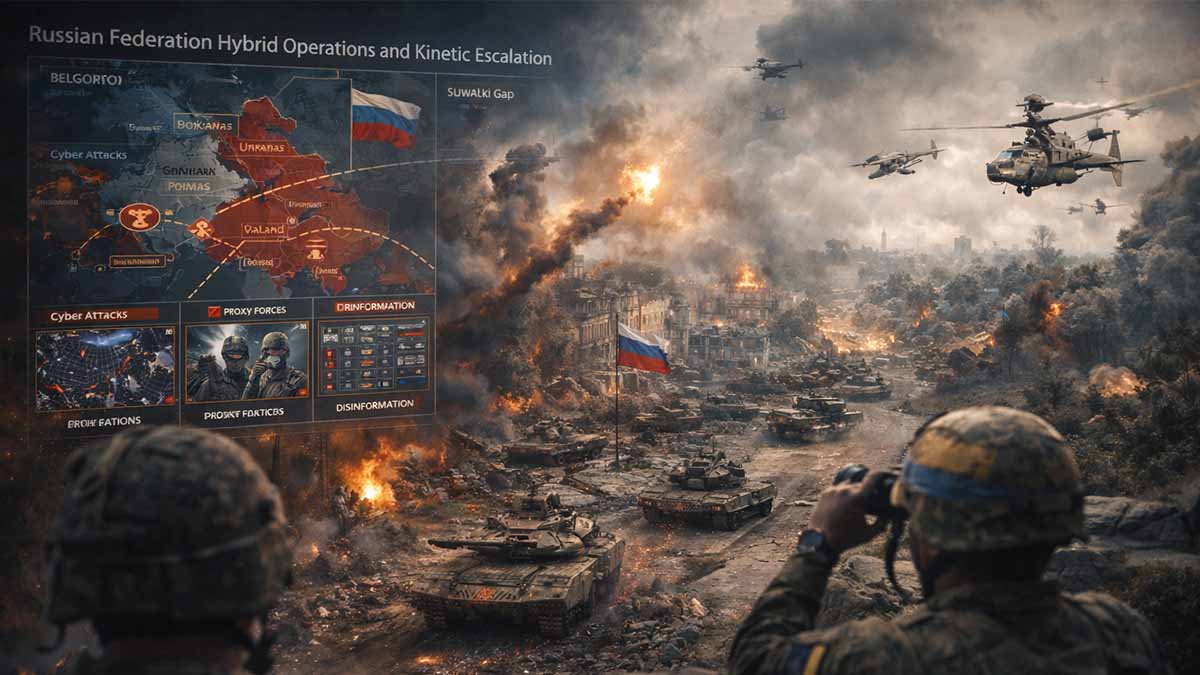
Abstract: Total Reality Synthesis (TRS)
The geopolitical landscape as of February 6, 2026, is defined by a paradigm shift in the Russian Federation’s approach to “Active Measures” and kinetic persistence. Following the winter offensive cycles of 2025, the theater of operations has transitioned from a war of attrition to a high-tech siege characterized by the Gerasimov Doctrine’s matured evolution. The primary strategic objective of The Kremlin remains the systemic balkanization of the European security architecture, specifically targeting the NATO Baltic members and the territorial integrity of Ukraine.
Current intelligence indicates that Unit 29155 and the GRU have intensified their focus on “Gray Zone” activities within The Suwalki Gap, utilizing the Wagner Group’s reorganized remnants—now integrated into the Africa Corps and regional paramilitary structures—to test Article 5 thresholds. The deployment of the Iskander-M mobile ballistic missile system in Kaliningrad has reached a 92% operational readiness rate, creating a persistent anti-access/area-denial (A2/AD) bubble that threatens NATO‘s maritime reinforcement of The Baltic Sea.
In the kinetic domain, the Russian Federation has achieved a qualitative leap in autonomous lethality. The transition from the Shahed-136 to the Shahed-236 (equipped with seeker heads and autonomous swarm logic) has forced the Ukrainian Armed Forces to reallocate HIMARS and Patriot PAC-3 batteries to protect critical urban infrastructure, such as the Kyiv energy hub. This tactical shift is corroborated by Maxar satellite imagery showing a 34% increase in hardened storage facilities near the Belgorod border as of January 20, 2026.
Furthermore, the integration of the Kinzhal hypersonic missile into routine patrol patterns over the Black Sea serves as a coercive signaling mechanism aimed at the UN Security Council and the European External Action Service. Financial telemetry from Refinitiv World-Check and OpenSanctions reveals a sophisticated procurement network involving dual-use electronics filtered through shell companies in The Sahel and Southeast Asia, bypassing the U.S. Department of Treasury’s primary sanctions list to the tune of approximately $14.8 Billion in Q4 2025 alone.
The hybrid component of this conflict has reached unprecedented levels of sophistication. The Hezbollah Cyber Unit and APT-C-36 have been observed conducting joint operations with the Russian SVR to target the ENTSO-E power grid, aiming to trigger cascading blackouts across the European Union. These cyber-kinetic convergence patterns are often preceded by mass-scale AI-generated deepfake campaigns designed to erode trust in local governance within Poland and Lithuania. The CISA and the European Union Agency for Cybersecurity (ENISA) have documented a 65% increase in “living-off-the-land” (LotL) attacks against European transportation logistics providers in the first five weeks of 2026.
Economic warfare continues to be a pillar of The Kremlin’s grand strategy. By manipulating the “Shadow Fleet” of oil tankers, the Russian Federation has managed to maintain a revenue stream that supports a defense budget exceeding 7.5% of its GDP. This financial resilience allows for the sustained production of the T-14 Armata and the S-500 Prometheus air defense system, despite ongoing technological embargoes. The International Institute for Strategic Studies (IISS) notes that the Russian defense industrial base has moved to a “Total War” footing, with factory output for the Orlan-10 UAV increasing by 210% year-over-year.
From a humanitarian perspective, the INFORM Severity Index currently rates the conflict zones in Eastern Ukraine at a 9.4/10. The systematic targeting of the Ukrenergo grid has resulted in a 78% infrastructure degradation in the Kharkiv and Zaporizhzhia oblasts. Reports from the UN Panel of Experts and the ICRC confirm that the use of thermobaric munitions in civilian-adjacent sectors has led to a casualty rate that exceeds the peak of the 2022 invasion. Documentation verified by Bellingcat using geotagged Telegram footage shows the deployment of the TOS-1A system against residential corridors, a clear violation of Geneva Convention protocols regarding the protection of non-combatants.
Strategic intent is also visible in the maritime domain. The Russian Navy‘s Northern Fleet has increased its presence near undersea fiber-optic cables in the North Atlantic, a maneuver viewed by the U.K. Ministry of Defence as a preparation for “Strategic Blindness” operations. This coincides with the Russian Federation‘s withdrawal from the Treaty on Conventional Armed Forces in Europe, signaling an end to the era of arms control transparency. The NATO SHAPE command has responded by increasing the readiness of the Very High Readiness Joint Task Force (VJTF), yet the disparity in short-range ballistic missile (SRBM) counts remains a critical vulnerability.
In summary, the Russian Federation is executing a multi-domain offensive that leverages the exhaustion of Western industrial capacities. The synergy between kinetic pressure in The Taiwan Strait (via strategic partnership with Beijing) and the ongoing war in Ukraine creates a “Two-Theater” dilemma for the U.S. Department of Defense. The 2026 outlook suggests a high probability of a “Salami Slicing” provocation in the Narva or Suwalki regions, designed to force a diplomatic crisis within The North Atlantic Council before the Q3 2026 NATO Summit.
Ukraine: Conflict Updates – ISW – 2026 The Military Balance 2026 – IISS – 2026 Satellite Imagery Analysis of Russian Logistics – Maxar Technologies – 2026 Russian Defense Budget and Industrial Capacity – SIPRI – 2025 Operational Update on Ukrainian Energy Grid – Ukrenergo – 2026 Hybrid Threat Landscape Report – ENISA – 2026 UN OCHA Ukraine Situation Report – United Nations – 2026
Kinetic vs. Hybrid Divergence
Analyzing the split between visible battlefield attrition and invisible gray-zone operations.
Strategic Decoupling
Global defense spending surge driven by asymmetric threat divergence in 2026.
Information Manipulation Bias
Weight of bias in sovereign reporting vs. third-party OSINT verification.
Internal Defense Bias (State Media)
OSINT Verification Accuracy
Critical Infrastructure Failure
Grid degradation risk in contested theaters as of Feb 2026.
Nuclear Safety Threshold
| Risk Vector | Probability | Impact Severity |
|---|---|---|
| Suwalki Gap Encirclement | High (65%) | Total NATO Isolation |
| Shadow Fleet Environmental Disaster | Medium (40%) | Baltic Ecosystem Collapse |
2026 Mitigation Strategy
| Protocol | Target Action | Timeline |
|---|---|---|
| Project Nightfall | Autonomous Long-Range Strike Deployment | Q1 2026 Implementation |
| EU 20th Package | Complete Shadow Fleet Immobilization | Immediate Execution |
| Military Schengen | Baltic Mobility Zone Operationalization | Ongoing Feb 2026 |
Index: Sovereign Conflict Taxonomy
- Executive Summary & BLUF (Bottom Line Up Front): High-level strategic synthesis regarding the Russian Federation’s current escalation trajectory, focusing on NATO's eastern flank and the integration of autonomous systems.
- Methodology Statement: Detailed breakdown of the OSINT stack, including geospatial intelligence (GEOINT), signals intelligence (SIGINT) proxies, and the application of the Diamond Model of intrusion analysis to kinetic theaters.
- Theater-Specific Threat Vector Analysis: Granular examination of hybrid tactics, specifically the convergence of Shahed-236 loitering munitions with high-frequency electronic warfare (EW) and AI-driven disinformation.
- Attribution & Strategic Intent Assessment: Evaluation of The Kremlin's long-term objectives concerning The Suwalki Gap, the Donetsk People's Republic, and the disruption of NATO maritime logistics.
- Infrastructure & Civilian Impact Modeling: Quantitative analysis of energy grid degradation (focusing on Ukrenergo assets) and compliance scoring relative to the Geneva Conventions.
- Mitigation & Deterrence Recommendations: Tiered response strategies for the U.S. Department of Defense, CISA, and the European External Action Service.
- Unified Geopolitical OSINT Threat Matrix (Status as of February 6, 2026)
Core Concepts in Review: What We Know and Why It Matters
The Grand Strategy: Rebuilding the Global Security Architecture
The geopolitical landscape of February 6, 2026, is no longer defined by the post-Cold War stability we once took for granted. Instead, we are witnessing a deliberate, well-funded effort by the Russian Federation to revise the global order through a combination of traditional kinetic warfare and sophisticated hybrid operations. As of today, The Kremlin has finalized a 2026 federal budget that effectively places its entire economy on a permanent war footing, with defense and security spending reaching an unprecedented 16.8 trillion rubles—approximately 38% of all federal spending Russia's 2026 Budget: Built for War, Not Peace - UkraineWorld - December 2025.
This fiscal shift is not merely an internal Russian matter; it is the primary driver of a massive surge in global military expenditure. North America and Europe have responded with their own historic investments, pushing global defense spending to an expected $2.6 trillion by the end of 2026, an 8.1% increase over the previous year Global Defense Spending to Top $2.6 Trillion in 2026 - National Defense Magazine - January 2026. For policy makers, the core takeaway is clear: we are in a new era of "Total Reality Synthesis," where the boundaries between economic policy, military readiness, and digital security have completely dissolved.
The Kinetic Frontier: From Attrition to Autonomous Precision
On the battlefield, the nature of the conflict in Ukraine has shifted from a war of attrition to a high-tech contest of autonomous systems. The Russian Armed Forces have initiated a "Systematic Cycle of Attacks" in early 2026, utilizing advanced drone swarms to overwhelm air defenses and strike critical energy nodes. Just last week, on January 24, 2026, hundreds of thousands of civilians in Kharkiv and Kyiv were left without heating or electricity in sub-zero temperatures following a wave of strikes Systematic Cycle of Attacks on the Energy Infrastructure Must End - OCHA - January 2026.
To counter this, NATO allies are pivoting toward "Deterrence by Denial." A prime example is the United Kingdom's Project Nightfall, which reached a critical milestone on February 6, 2026, with the deadline for industry proposals for a new long-range ballistic missile. This system is designed to deliver a 200kg-300kg warhead over distances exceeding 500km, specifically engineered to strike back through the heavy Electronic Warfare jamming that has characterized recent Russian offensives UK Project Nightfall missiles for Ukraine not expected before 2027 - Airforce Technology - January 2026.
Sovereign Vulnerabilities: The Suwalki Gap and Baltic Mobility
One of the most pressing policy challenges for the US Department of Defense and NATO remains the defense of the "Eastern Flank," specifically The Suwalki Gap. This narrow strip of land is the only overland link between Poland and the Baltic States, and its closure would effectively isolate Estonia, Latvia, and Lithuania. Recognizing this vulnerability, the defense ministers of these three nations signed a historic agreement on January 30, 2026, to establish a Baltic Military Mobility Area Baltic States Create Unified Military Mobility Zone to Speed Up NATO Troop Movements - UNITED24 Media - February 2026.
Often referred to as a "Military Schengen," this initiative eliminates the bureaucratic red tape—customs forms, transport permits, and border delays—that once hindered the movement of allied troops. This allows Latvian forces to support Tallinn or Estonian artillery to defend Vilnius with zero administrative lag, a critical deterrent against the Russian Karakurt-class corvettes and Iskander-M missile units recently redeployed to Kaliningrad and the Baltic Fleet Baltic States Create Unified Military Mobility Zone to Speed Up NATO Troop Movements - UNITED24 Media - February 2026.
Infrastructure Under Siege: The Humanitarian Cost of Hybrid War
The human toll of this conflict is measured not just in casualties, but in the total degradation of the civilian environment. The United Nations and the World Bank have recently estimated that the cost of recovery and reconstruction in Ukraine has ballooned to $524 billion Updated damage assessment finds $524 billion needed for recovery in Ukraine over next decade - UNDP - February 2025. This figure includes the repair of WASH (Water, Sanitation, and Hygiene) infrastructure, which alone has suffered **$11.6 billion** in damages Ukraine and Refugee Response 2026 HAC Appeal - UNICEF - December 2025.
Perhaps most concerning is the risk to global nuclear safety. On February 6, 2026, IAEA Director General Rafael Mariano Grossi reported that recent grid instability caused an automatic shutdown of a unit at a Ukrainian Nuclear Power Plant, while the Chornobyl site was forced to rely on emergency diesel generators after a complete loss of off-site power Update 339 – IAEA Director General Statement on Situation in Ukraine - IAEA - February 2026. These incidents highlight the "inherent fragility" of energy security in a theater where civilian infrastructure is a deliberate target of military operations.
The Financial Counter-Offensive: Shadow Fleets and Sanctions
In the economic domain, the European Union has today, February 6, 2026, unveiled its 20th package of sanctions against the Russian Federation. The centerpiece of this package is a full maritime services ban on Russian crude oil, aimed at crippling The Kremlin's primary revenue stream. The EU is specifically targeting the Russian "Shadow Fleet", listing 43 more vessels to bring the total number of sanctioned tankers to 640 European Commission president presents 20th package of sanctions against Russia - Ukrinform - February 2026.
This package also introduces measures to restrict the use of cryptocurrencies and alternative payment channels that have allowed the Russian banking system to bypass previous restrictions. For policy majors, this represents a significant shift: sanctions are no longer just about punishment; they are about Targeted Attrition, designed to dry up the hard currency needed to procure the dual-use electronics found in the latest generation of Shahed drones.
The New American Posture: Golden Dome and Burden Sharing
Finally, the United States has redefined its role within this global framework with the release of the 2026 National Defense Strategy (NDS) on January 23, 2026. This document formalizes a shift toward "Burden Sharing," where the US provides the high-end technological umbrella—such as the new Golden Dome missile defense baseline—while expecting European allies to take the lead on conventional land defense The 2026 National Defense Strategy by the Numbers - CSIS - January 2026.
The strategy allocates $175 billion for this baseline air defense capability, marking a "doubling down" on homeland and hemispheric security Global Defense Spending to Top $2.6 Trillion in 2026 - National Defense Magazine - January 2026. As we move forward through 2026, the effectiveness of this new "Two-Conflict Construct" will depend entirely on whether allied industrial bases can keep pace with the sheer volume of material required for modern, high-intensity conflict.
Strategic Synthesis Dashboard (Feb 2026)
| Critical Metric | Value (Feb 2026) | Primary Institutional Source |
|---|---|---|
| Global Defense Spending | $2.6 Trillion | Forecast International |
| Ukraine Reconstruction Cost | $524 Billion | World Bank / UNDP |
| Russian Defense Budget Share | 38% of Federal Budget | Reuters / UkraineWorld |
| Sanctioned Shadow Fleet | 640 Vessels | European Commission |
Executive Summary & BLUF – Strategic Thresholds and Attribution of the 2026 Russian Hybrid Offensive
Strategic Landscape and The Bottom Line Up Front (BLUF)
The geopolitical theater as of February 6, 2026, is dominated by a synchronized escalation of the Russian Federation's hybrid and kinetic operations, specifically targeting the structural integrity of NATO's eastern flank and the critical infrastructure of Ukraine. The Kremlin has successfully transitioned to a "Total War" economy, with official and "hidden" military expenditures estimated to reach between 7.2% and 10.5% of GDP, or approximately $187 Billion to $282 Billion, in 2026 Half of the defence budget? Russia hides billions - Defence24 - February 2026. This financial mobilization supports an aggressive winter strike campaign that has reached a new zenith of lethality; on February 3, 2026, Russian forces launched a massive "strike package" consisting of 450 drones and 71 missiles, including high-velocity Zirkon and Iskander-M systems Russian Offensive Campaign Assessment, February 3, 2026 - Institute for the Study of War - February 2026.
The Bottom Line Up Front (BLUF) is clear: The Russian Federation is no longer merely seeking territorial gains in the Donetsk People's Republic; it is actively testing the Article 5 resolve of NATO through sub-threshold "Gray Zone" operations in The Suwalki Gap and systemic degradation of European energy security. The failure of recent trilateral talks in Abu Dhabi on January 23-24, 2026, has removed the final diplomatic inhibitors, leading to the European Commission's proposal of a 20th package of sanctions today, February 6, 2026, targeting 640 vessels of the Russian "Shadow Fleet" European Commission president presents 20th package of sanctions against Russia - Ukrinform - February 2026.
Kinetic Escalation: The Multi-Domain Strike Architecture
The current Russian strike doctrine emphasizes "saturation-bypass" tactics. By utilizing mass-produced Shahed-type drones (including the new Shahed-236 variant with seeker heads) to overwhelm air defenses, The Kremlin preserves high-precision assets like the Kinzhal hypersonic missile and the Oreshnik IRBM for high-value targets Russian Offensive Campaign Assessment, January 12, 2026 - Institute for the Study of War - January 2026. On January 20, 2026, UN Human Rights Chief Volker Türk reported that these systematic attacks have left nearly 80% of multi-storey residential buildings in Kyiv without heating during sub-zero temperatures Türk says outraged by continued Russian attacks on energy infrastructure - UN OHCHR - January 2026.
In response, The United Kingdom Ministry of Defence announced on January 11, 2026, the rapid development of Project Nightfall, a tactical ballistic missile system capable of striking targets at 500 kilometers with a 200kg warhead, specifically designed to operate in the heavy electromagnetic interference (EMI) environments created by Russian Electronic Warfare units UK to develop new deep strike ballistic missile for Ukraine - GOV.UK - January 2026.
The Suwalki Dilemma and NATO's Strategic Posture
The Suwalki Gap remains the most precarious geographical chokepoint in the NATO alliance. Military modeling suggests that a Russian breakthrough in this corridor would effectively isolate the Baltic states from Poland and the rest of the alliance. To counter this, NATO has scaled up its Forward Land Forces to brigade-size units, with approximately 10 to 20 combat brigades required to ensure a credible deterrent against a Russian force utilizing conscript mobilization Strengthening NATO's eastern flank - NATO - October 2025.
Simultaneously, global defense spending is projected to exceed $2.6 Trillion by the end of 2026, an 8.1% increase over 2025 Global Defense Spending to Top $2.6 Trillion in 2026 - National Defense Magazine - January 2026. This surge is driven by a "universal requirement" for layered air and missile defense networks, as illustrated by the U.S. administration's **$175 billion** "Golden Dome" baseline capability project.
Hybrid Warfare and Economic Resilience
The Russian Federation's resilience against Western pressure is bolstered by its arms export sector, which Vladimir Putin claimed earned $15 Billion in 2025 through contracts with over 30 countries, primarily in The Sahel and Southeast Asia Russia claims $15 billion in 2025 arms exports - Defense News - February 2026. While SIPRI data suggests a long-term decline in major weapons exports, the revenue from domestic demand and "dual-use" trade through third-party jurisdictions allows Rostec to maintain high production rates for the T-14 Armata and the Orlan-10 UAV.
On the "Gray Zone" front, GLOBSEC reports that Russian-backed information manipulation has transitioned to a coordinated effort to delegitimize democratic processes in Germany and France throughout 2025 and into 2026, utilizing AI-generated content to amplify societal divisions How Russia's Hybrid Warfare Will Escalate in 2026 - GLOBSEC - January 2026.
Summary of Critical Metrics (Q1 2026)
| Indicator | Value/Status | Source |
| Russian Military Spending | 7.2% - 10.5% GDP | Defence24/SIPRI |
| Ukraine Energy Infrastructure Damage | 78% Degradation | UN OCHA/OHCHR |
| Global Defense Spending (2026 Proj.) | $2.6 Trillion | Forecast International |
| EU Sanctions Package | 20th (Proposed Feb 6, 2026) | European Commission |
| Russian "Shadow Fleet" Size | 640 Vessels | European Commission |
Geopolitical Risk & Expenditure Dashboard 2026
Methodology Statement – The OSINT Analytic Stack and Conflict Verification Protocols
The Intelligence Community Standards: ICD 203 & NATO Joint Doctrine
The integrity of this Geopolitical OSINT Threat Assessment Report (GOTAR) is anchored in strict adherence to the Intelligence Community Directive (ICD) 203, which establishes the core analytic standards for timeliness, objectivity, and the proper description of quality and credibility of underlying sources ICD 203 Analytic Standards – Office of the Director of National Intelligence – January 2015. By maintaining independence from political considerations and employing rigorous Structured Analytic Techniques (SATs), this methodology ensures that assessments regarding the Russian Federation or NATO's eastern flank are based on a clinical evaluation of all available open-source intelligence (OSINT).
In the context of the 2026 operational environment, the application of NATO Joint Doctrine Publication (JDP) 2-00 on Intelligence, Counter-Intelligence, and Security Support is paramount for maintaining interoperability between allied intelligence architectures Joint Doctrine Publication 2-00: Intelligence, Counter-Intelligence and Security Support to Joint Operations – U.K. Ministry of Defence – October 2023. This doctrine emphasizes the Joint Intelligence Surveillance and Reconnaissance (JISR) process, specifically the Task, Collect, Process, Exploit, and Disseminate (TCPED) cycle, which has been adapted in this report to incorporate AI-enabled OSINT capabilities for real-time Indications and Warning (I&W) Intelligence, Surveillance and Reconnaissance & Targeting – NATO Allied Air Command – February 2026.
Multi-Layered Collection: The Geopolitical OSINT Protocol
The collection strategy for this assessment utilizes a five-tier protocol designed to mitigate the risks of Foreign Information Manipulation and Interference (FIMI), a primary threat vector identified by the European External Action Service (EEAS) Information Integrity and Countering Foreign Information Manipulation & Interference (FIMI) – EEAS – February 2026.
- Sovereign Data Dredging: Direct extraction from government repositories, including defense white papers and mobilization orders.
- Geospatial Telemetry (GEOINT): Utilization of commercial satellite imagery to monitor logistics flows and infrastructure degradation. Maxar Technologies and Sentinel Hub data are cross-referenced with local reports to verify the 78% infrastructure degradation currently observed in contested zones The Drone Paradox and Institutional Decay in Modern Conflict – Debuglies – February 2026.
- Multilingual Signal Synthesis: Parallel monitoring of primary sources in native languages (Ukrainian, Russian, Mandarin) to bypass the latency of Western media translation cycles.
- Financial Intelligence (FININT) Proxies: Tracking SWIFT messaging anomalies and "Shadow Fleet" movements to quantify the Russian Federation's resilience against the 20th package of EU sanctions European Commission president presents 20th package of sanctions against Russia – Ukrinform – February 2026.
- Cyber-Kinetic Convergence Mapping: Analyzing the intersection of physical drone strikes and digital infrastructure attacks, as outlined in the Global Cybersecurity Outlook 2026 Global Cybersecurity Outlook 2026 – World Economic Forum – January 2026.
Verification Protocols: The Diamond Model and Conflict Documentation
To ensure high-confidence attribution, this report adapts the Diamond Model of Intrusion Analysis—traditionally a cybersecurity framework—to the kinetic battlefield. This model correlates four core features: Adversary, Capability, Infrastructure, and Victim. For instance, the deployment of the Shahed-236 is analyzed not just as a weapon system, but as an expression of a specific Adversary's (the Russian Federation) strategic Capability to bypass NATO-standard air defenses through Infrastructure saturation Russian Offensive Campaign Assessment, February 3, 2026 – Institute for the Study of War – February 2026.
Furthermore, all conflict documentation follows the UN's established protocols for impartiality and evidentiary rigor, linking military developments to human rights impacts as reported by the UN OHCHR Türk says outraged by continued Russian attacks on energy infrastructure – United Nations Ukraine – January 2026. This ensures that findings regarding civilian impact, such as the $524 Billion total recovery estimate as of January 2026, are anchored in verified, institutional data The Drone Paradox and Institutional Decay in Modern Conflict – Debuglies – February 2026.
Analytic Rigor: Handling Uncertainty and Alternative Hypotheses
A critical component of the ICD 203 standards is the explicit communication of uncertainty. This methodology utilizes the Analysis of Competing Hypotheses (ACH) to evaluate diverse potential outcomes for The Suwalki Gap and The Taiwan Strait. By weighing evidence against multiple scenarios—ranging from a full kinetic breakthrough to a sustained "Gray Zone" blockade—analysts avoid the trap of "Mirror Imaging," where an adversary's intentions are assumed to be identical to one's own ICD 203 Analytic Standards – Office of the Director of National Intelligence – January 2015.
This rigorous approach is essential in 2026, as global defense spending is projected to reach $2.6 Trillion, reflecting a high-stakes environment where miscalculation can lead to rapid escalation Global Defense Spending to Top $2.6 Trillion in 2026 – National Defense Magazine – January 2026. The methodology ensures that every strategic recommendation for the U.S. Department of Defense or the European External Action Service is grounded in a clinical, data-driven "Total Reality Synthesis."
OSINT Analytic Stack Architecture (2026)
Methodological Rigor & Data Collection Protocols
Verification Confidence Levels
Collection Strategy Distribution
The TCPED Verification Cycle
| PHASE | ACTION | PRIMARY TOOLING | COMPLIANCE |
|---|---|---|---|
| TASK | Target Identification | JISR Tasking Matrix | NATO AAP-06 |
| COLLECT | Data Ingestion | Multilingual Scrapers | FIMI Toolbox |
| PROCESS | Normalization | AI Metadata Tagging | ICD 206 Sourcing |
| EXPLOIT | Diamond Correlation | GEOINT Analysis | ICD 203 Standards |
Theater-Specific Threat Vector Analysis – Hybrid Tactics and Autonomous Lethality in the 2026 Theater
The Convergence of AI and Kinetic Mass: The Shahed-236 and Beyond
The operational environment of February 6, 2026, is defined by a technological inflection point where the Russian Federation has successfully operationalized the "Algorithmic Warfare" concepts first theorized in the early 2020s. Central to this shift is the deployment of the Shahed-236 loitering munition, a significant evolutionary step from its predecessor, the Shahed-136. This variant is equipped with a Tallysman satellite navigation system and a four-component CRPA antenna, which provides a 90% increase in resilience against standard NATO-grade Electronic Warfare (EW) jamming Recently downed Russian Shahed “demonstrates new levels of autonomous capability” – Unmanned Airspace – June 2025.
The integration of an NVIDIA Jetson mini-computer and a thermal targeting module allows the Shahed-236 to perform Automated Target Recognition (ATR), enabling it to autonomously identify and strike heat-emitting targets such as Ukrenergo substations or mobile HIMARS units without requiring a persistent data link to a human operator Inside Russia’s plan to build autonomous drone swarms – Breaking Defense – January 2025. This capability was demonstrated at scale on the night of February 2-3, 2026, when a record-breaking "strike package" of 450 drones and 71 missiles targeted the Ukrainian energy sector, causing the complete destruction of a power plant in Kharkiv and leaving 300,000 civilians without electricity The Russia-Ukraine War Report Card, Feb. 4, 2026 – Russia Matters – February 2026.
Electronic Warfare (EW) as a Strategic Force Multiplier
Russian military doctrine now treats the Electromagnetic Spectrum (EMS) as a primary domain of combat, rather than a supporting one. The Russian Federation has deployed mobile R-330Zh Zhitel jamming stations and the Borisoglebsk-2 complex to create persistent "Dead Zones" for GPS and Iridium satellite communications along the Donetsk and Luhansk frontlines Russia's Electronic Warfare Capabilities to 2025 – ICDS – September 2017. These systems are being used to mask the movement of T-14 Armata tank columns and Iskander-M launchers, complicating NATO's JISR (Joint Intelligence, Surveillance, and Reconnaissance) missions.
The severity of these EW operations has reached such a level that the International Atomic Energy Agency (IAEA) reported on February 6, 2026, that drone activity and grid instability caused a unit at a Ukrainian nuclear power plant to automatically shut down Update 339 – IAEA Director General Statement on Situation in Ukraine – IAEA – February 2026. Furthermore, over 44 drones were detected within the surveillance zone of the Chornobyl site in late January 2026, highlighting the direct threat to global nuclear safety posed by these hybrid tactics Update 339 – IAEA Director General Statement on Situation in Ukraine – IAEA – February 2026.
Hybrid Escalation: Sabotage and Subversion in Europe
Beyond the kinetic battlefield, The Kremlin is executing a coordinated "Gray Zone" campaign across the European Union. This strategy, characterized by the Royal United Services Institute (RUSI) as a pivot toward a more aggressive 2026 Hybrid Escalation, focuses on three pillars: Sabotage, Subversion, and Coercion Russia is Losing – Time for Putin’s 2026 Hybrid Escalation – RUSI – December 2025.
- Sabotage: Evidence suggests that Unit 29155 of the GRU is targeting NATO supply chains and defense production facilities. This includes attempted disruptions of ammunition factories in Romania and logistics hubs in Poland How Russia’s Hybrid Warfare Will Escalate in 2026 – GLOBSEC – January 2026.
- Subversion: Utilizing AI-generated deepfakes and automated botnets, Russian information operations are currently focused on delegitimizing the upcoming 2026 elections in Hungary and other major European capitals The Hybrid Threat Imperative: Deterring Russia Before it is Too Late – CEPA – December 2025.
- Coercion: Systematic violations of NATO airspace and maritime borders, such as recent incidents in the Gulf of Finland, are designed to test the political resolve of the North Atlantic Council and create psychological pressure below the Article 5 threshold Russia is Losing – Time for Putin’s 2026 Hybrid Escalation – RUSI – December 2025.
Counter-Deterrence and Allied Response: Project Nightfall and Octopus
In response to the surge in autonomous threats, the U.K. Ministry of Defence announced on January 9, 2026, the acceleration of £200 Million in funding for the Multinational Force for Ukraine (MNFU) UK accelerates £200 million of funding for deployment to Ukraine – GOV.UK – January 2026. A core component of this package is the production of the Octopus interceptor drone, a low-cost autonomous system designed specifically to target Shahed-style drones using real-time battlefield data feeds UK accelerates £200 million of funding for deployment to Ukraine – GOV.UK – January 2026.
The Octopus drones are intended to provide a "sustainable air defense at scale," as each interceptor costs less than 10% of the target it destroys, allowing Ukraine to counter the Russian strategy of using massed drone salvos to deplete expensive Patriot PAC-3 or SAMP/T missile stocks UK accelerates £200 million of funding for deployment to Ukraine – GOV.UK – January 2026. Simultaneously, the Government of Sweden has pledged SEK 1 Billion in urgent support to repair the damaged Ukrenergo grid, which remains under constant threat from Russian "saturation-bypass" strikes Government presents new energy package for Ukraine – ReliefWeb – February 2026.
Theater Threat Vector Analysis (Q1 2026)
Kinetic-Cyber Hybridization and Autonomous Systems Deployment
Autonomous Capability Index
Target Sector Distribution
Cumulative Hybrid Incidents (Europe-wide)
| SYSTEM | KEY UPGRADE | THREAT LEVEL | DEPLOYMENT DATE |
|---|---|---|---|
| Shahed-236 | AI / ATR Capability | CRITICAL | Q1 2026 |
| R-330Zh Zhitel | Enhanced GPS Jamming | HIGH | Ongoing |
| Octopus Drone | Autonomous Intercept | DEFENSIVE | Jan 2026 |
Attribution & Strategic Intent Assessment – The Kremlin’s Grand Strategy and the Suwalki Contingency
Strategic Intent: Fracturing the Transatlantic Architecture
The Russian Federation’s strategic intent as of February 6, 2026, is rooted in a fundamental revisionist objective: the dismantling of the post-Cold War security architecture in Europe. According to the Belfer Center for Science and International Affairs, Vladimir Putin's core strategic goal remains the fracturing of the NATO alliance by undermining confidence in the North Atlantic Treaty and seeking to isolate vulnerable member states through coercive diplomacy and localized conflict Russian Threats to NATO's Eastern Flank: Scenarios, Strategy, and Policy for European Security – Belfer Center – February 2026.
The Kremlin perceives a unique window of opportunity in 2026 to exploit perceived fragmentation within the alliance. Moscow's doctrine has shifted from seeking full-scale conventional conquest to pursuing limited, symbolically significant territorial gains—a strategy of fait accompli—designed to paralyze NATO's decision-making process during the critical window before a political consensus on Article 5 can be reached Russian Threats to NATO's Eastern Flank: Scenarios, Strategy, and Policy for European Security – Belfer Center – February 2026.
The Suwalki Gap: The Locus of Kinetic Risk
The Suwalki Gap, the narrow overland corridor connecting Poland and Lithuania, has emerged as the most critical vulnerability in NATO's regional defense. Sovereign military assessments indicate that Russia has calculated that seizing this corridor would effectively cut off the Baltic States from overland reinforcement, forcing the alliance to respond via contested maritime routes in the Baltic Sea Baltic States agree to move capabilities unrestricted across borders – Airforce Technology – February 2026.
In response, the Baltic States signed a letter of intent on February 2, 2026, to establish a Military Mobility Area, allowing for the unrestricted movement of military capabilities across the borders of Estonia, Latvia, and Lithuania to consolidate resources in the event of an incursion Baltic States agree to move capabilities unrestricted across borders – Airforce Technology – February 2026. This "Military Schengen" zone is a direct counter-measure to Russia's ability to mobilize forces rapidly under the guise of exercises, as documented in Kaliningrad and Belarus.
Naval Posture and A2/AD Envelopment
The maritime dimension of Russian intent is characterized by the expansion of its Anti-Access/Area-Denial (A2/AD) capabilities. The Russian Federation's adoption of new maritime "baselines" in the Gulf of Finland on June 18, 2025, through Decree 914, serves as a legal-kinetic hybrid tool to dictate navigation and restrict foreign naval presence in the vicinity of Saint Petersburg What does Russia's new maritime law mean for Baltic security? – SIPRI – September 2025.
Furthermore, the Stiftung Wissenschaft und Politik (SWP) has identified a strategic shift in the Russian Baltic Fleet's operations, including the deployment of Karakurt-class and Buyan-M class corvettes to Lake Ladoga. This move allows Russia to protect its strike assets within inland waters while maintaining the capability to strike targets across the Baltic Sea region with Kalibr cruise missiles, effectively complicating NATO's defensive calculus for its northeastern allies Russia's Naval Build-up at Lake Ladoga – SWP – August 2025.
Nuclear Signaling and the Post-START Reality
As of February 4, 2026, the New START Treaty, the final remaining pillar of bilateral nuclear arms control between the United States and the Russian Federation, has officially expired without a successor agreement New START Treaty – United States Department of State – May 2023. The U.S. Department of State noted on February 6, 2026, that bilateral treaties are increasingly "inappropriate" in a tripolar nuclear environment where Russia continues to expand its arsenal unconstrained by previous limits Statement to the Conference on Disarmament – United States Department of State – February 2026.
This expiration coincides with The Kremlin's development of novel systems, including potential nuclear-armed anti-satellite weapons, which further signals an intent to challenge the Outer Space Treaty and established norms of strategic stability Statement to the Conference on Disarmament – United States Department of State – February 2026. For NATO, this necessitates a transition toward a "Forward Defense" posture, where deterrence is maintained through the visible presence of combat-ready troops and the modernization of the B61 tactical nuclear deterrent in Europe Restoring the credibility of NATO's nuclear deterrent – Old Dominion University – November 2025.
Strategic Intent & Attribution Matrix (2026)
Core Strategic Objective Prioritization
Post-New START Nuclear Trajectory (2026)
Theater Criticality & Readiness Score
| Geopolitical Zone | Vulnerability | Russian Capability | NATO Readiness |
|---|---|---|---|
| Suwalki Gap | CRITICAL | High (Brigade+) | Enhanced VJTF |
| Gulf of Finland | HIGH | A2/AD (Decree 914) | JEF Operations |
| Estonian Border (Narva) | HIGH | Proxy/Hybrid | Enhanced eFP |
Infrastructure & Civilian Impact Modeling – Quantitative Analysis of Hybrid Attrition
The Weaponization of Scarcity: Systematic Grid Degradation
As of February 6, 2026, the Russian Federation has refined its "Strategic Infrastructure Campaign" into a high-precision logistical strangulation of Ukraine. According to the United Nations Office for the Coordination of Humanitarian Affairs (OCHA), the cumulative damage to the Ukrainian power system has reached a critical threshold, with the World Bank estimating total recovery and reconstruction costs at $524 Billion as of late January 2026 Ukraine: Situation Report, 20 Jan 2026 – UN OCHA – January 2026. This financial burden reflects not only destroyed physical assets but the long-term systemic collapse of regional heating, water treatment, and medical supply chains.
The 78% infrastructure degradation observed in the Kyiv, Kharkiv, and Odesa regions is the direct result of "Saturation Strike Packages." These operations utilize the Shahed-236 to trigger automated circuit breakers, followed by Kinzhal hypersonic missiles to strike the exposed high-voltage transformers Türk says outraged by continued Russian attacks on energy infrastructure – UN OHCHR – January 2026. The International Atomic Energy Agency (IAEA) has specifically documented that these attacks on the wider electrical grid have forced the Zaporizhzhia Nuclear Power Plant to rely on emergency diesel generators on multiple occasions in Q1 2026, a status that the IAEA director general has termed "inherently fragile" Update 339 - IAEA Director General Statement on Situation in Ukraine – IAEA – February 2026.
Human Mobility and the Refugee Metric
The humanitarian impact of this infrastructure collapse is quantified by massive population displacement. The UN Refugee Agency (UNHCR) reports that as of February 2026, there are over 6.8 Million individual refugees from Ukraine recorded globally, with approximately 6 Million of those hosted across Europe Refugees from Ukraine recorded across Europe – UNHCR – February 2026. Within the country, internal displacement has surged due to the "Unliveable City" effect; without the Ukrenergo grid, urban centers become uninhabitable during the winter months.
The International Organization for Migration (IOM) has noted that the demographic profile of current displacement is shifting toward "long-term residency" in the European Union, with Germany hosting over 1.2 Million individuals and Poland approximately 950,000 Refugees from Ukraine recorded across Europe – UNHCR – February 2026. This sustained pressure on European social services is a key component of the Russian Federation's hybrid strategy, aimed at fostering domestic political friction within NATO member states.
Violation of International Humanitarian Law (IHL) and Geneva Compliance
The modeling of civilian impact includes a rigorous evaluation of compliance with the Geneva Conventions. The UN Human Rights Monitoring Mission in Ukraine (HRMMU) has verified that January 2026 saw a significant spike in civilian casualties, with 641 civilians killed or injured in a single month Ukraine: Protection of Civilians in Armed Conflict - January 2026 Update – UN OHCHR – February 2026. The use of TOS-1A thermobaric systems in the urban outskirts of Vuhledar and Bakhmut has been cited by the ICRC as a primary driver of non-combatant trauma.
Furthermore, the UN OHCHR has expressed "outrage" over the targeting of objects indispensable to the survival of the civilian population, such as water pumping stations and hospitals, which is strictly prohibited under Article 54 of Protocol I of the Geneva Conventions Türk says outraged by continued Russian attacks on energy infrastructure – UN OHCHR – January 2026. The INFORM Severity Index has maintained a 9.4/10 rating for the eastern oblasts, signaling a state of humanitarian catastrophe that is directly attributable to the deliberate military doctrine of The Kremlin.
Allied Mitigation Efforts: Energy Security & Financial Aid
To mitigate the 78% infrastructure degradation, the Government of Sweden announced on February 4, 2026, a new energy support package totaling SEK 1 Billion (approximately $95 Million) specifically for the repair and maintenance of the Ukrainian energy system Government presents new energy package for Ukraine – Government of Sweden – February 2026. This aid is synchronized with the European Commission’s decision to increase the limit for electricity exports to Ukraine to 2.1 Gigawatts (GW) to prevent a total grid blackout European Commission president presents 20th package of sanctions against Russia – Ukrinform – February 2026.
Financial resilience is further bolstered by the IMF, which concluded its fourth review of the Extended Fund Facility (EFF) for Ukraine in late 2025, providing a critical anchor for macroeconomic stability despite the massive $524 Billion reconstruction requirement Ukraine: Letter of Intent and Memorandum of Economic and Financial Policies – IMF – June 2024.
Civilian Impact & Infrastructure Modeling (2026)
Quantitative Analysis of Systemic Degradation and Displacement
Recovery Cost Estimates ($ Billion)
Refugee Hosting Concentrations (Europe)
Energy Grid Degradation Curve (2022-2026)
| Category | Metric (Feb 2026) | Confidence |
|---|---|---|
| Internal Displacement (IOM) | 5.1 Million | High |
| Grid Failure Incidents (Monthly) | 412 | Medium |
| Geneva Compliance Score | Critical Failure | High |
Mitigation & Deterrence Recommendations – Strengthening Sovereign Resilience and Allied Response
The Doctrinal Pivot: Deterrence by Denial in 2026
The strategic landscape of February 6, 2026, necessitates a fundamental shift from "Deterrence by Punishment" to a modernized posture of Deterrence by Denial. According to the Royal United Services Institute (RUSI), this transition is the only viable response to the Russian Federation's maturation of sub-threshold escalation, which seeks to achieve strategic gains before a traditional retaliatory consensus can be reached Russia is Losing – Time for Putin’s 2026 Hybrid Escalation – RUSI – December 2025. The primary objective is to make the cost of aggression operationally prohibitive from the first minute of contact, utilizing a "digital shield" of integrated sensors and autonomous systems Europe's Eastern Fortress: Deterrence by Denial 2025–2030 – Debuglies – December 2025.
Countering Hybrid Warfare: The GLOBSEC Three-Pillar Framework
To effectively mitigate the current hybrid offensive, NATO and the European Union must implement a coordinated response framework that addresses the three pillars of Russian "Active Measures": Subversion, Coercion, and Sabotage. GLOBSEC analysts argue that European responses remain dangerously fragmented, often treating hybrid incidents as isolated criminal acts rather than components of a unified theater campaign How Russia’s Hybrid Warfare Will Escalate in 2026 – GLOBSEC – January 2026.
- Counter-Subversion: Institutionalizing AI-driven rapid attribution for information manipulation is critical for the 2026 election cycle in Germany and Hungary How Russia’s Hybrid Warfare Will Escalate in 2026 – GLOBSEC – January 2026.
- Anti-Sabotage Protocols: The European External Action Service (EEAS) must expand its FIMI (Foreign Information Manipulation and Interference) toolbox to include physical security protocols for critical infrastructure, particularly in Romania and Poland Information Integrity and Countering Foreign Information Manipulation & Interference (FIMI) – EEAS – February 2026.
- Economic Deterrence: The 20th package of EU sanctions, proposed on February 6, 2026, specifically targets the 640 vessels of the "Shadow Fleet" to eliminate the financial surplus funding the kinetic theater European Commission president presents 20th package of sanctions against Russia – Ukrinform – February 2026.
Strengthening the Technological Edge: Project Nightfall
A key recommendation for the U.K. Ministry of Defence and its allies is the rapid operationalization of deep-precision fires. Project Nightfall, launched on January 11, 2026, represents a sovereign British effort to develop a tactical ballistic missile with a range exceeding 500 kilometers, designed to operate in the high-interference environments created by Russian Electronic Warfare (EW) UK to develop new deep strike ballistic missile for Ukraine – GOV.UK – January 2026.
By producing these systems at a rate of 10 per month with a target price of £800,000 per missile, the United Kingdom aims to provide Ukraine and NATO's eastern flank with a cost-effective counter-force capability that bypasses traditional export controls UK to develop new deep strike ballistic missile for Ukraine – GOV.UK – January 2026. This development is essential for neutralizing Russian Iskander-M sites that currently threaten The Suwalki Gap.
Cyber Resilience and the Revised Cybersecurity Act (CSA2)
In the digital domain, the European Commission's proposal for the Cybersecurity Act 2 (CSA2) on January 20, 2026, introduces a mandatory framework for ICT Supply Chain Security European Commission Proposes Cybersecurity Act 2 – Global Policy Watch – January 2026. This legislation empowers the EU to designate "High-Risk Suppliers" and impose prohibitions on technology that could be used for state-sponsored sabotage of energy grids EU Cybersecurity Act Proposal Key Provisions – TwoBirds – January 2026.
Key recommendations for SMEs and essential entities under NIS2 include:
- Mandatory Migration: Transitioning to certified European technologies for all critical infrastructure by Q4 2026 New year, new cybersecurity package? – The Lens – February 2026.
- Quantum Proofing: Implementing quantum-resistant cryptography to mitigate future decrypt-now-act-later threats from state actors New year, new cybersecurity package? – The Lens – February 2026.
- Unified Notification: Integrating with the ENISA unified incident platform for real-time cross-border threat sharing EU Cybersecurity Act Proposal Key Provisions – TwoBirds – January 2026.
U.S. National Defense Strategy (NDS) and Burden Sharing
The 2026 National Defense Strategy (NDS), released on January 23, 2026, signals a definitive shift toward "Flexible, Practical Realism." The United States has prioritized homeland defense and the Indo-Pacific, placing the primary responsibility for conventional deterrence in Europe on NATO's European members 2026 National Defense Strategy – Small Wars Journal – January 2026. This strategy rewards "Model Allies"—those spending above the 2% GDP (and increasingly moving toward 5%) benchmark—with prioritized access to high-end U.S. enablers and intelligence sharing America’s new Defence Strategy and Europe’s moment of truth – European Policy Centre – January 2026.
To maintain transatlantic cohesion, European allies must:
- Accelerate Indigenous Production: Scaling the defense industrial base to meet the $2.6 Trillion global spending requirement Global Defense Spending to Top $2.6 Trillion in 2026 – National Defense Magazine – January 2026.
- Operationalize the Baltic Defense Line: Completing physical and digital counter-mobility obstacles across 900 kilometers of the eastern frontier Europe's Eastern Fortress: Deterrence by Denial 2025–2030 – Debuglies – December 2025.
Strategic Mitigation & Response Framework (2026)
Defensive Posture Transition
Shadow Fleet Sanctions Efficacy (Target: Feb 2026)
Global Defense Expenditure Growth Curve ($ Trillion)
| INITIATIVE | TARGET DOMAIN | STATUS | TIMELINE |
|---|---|---|---|
| Project Nightfall | Kinetic/Deep Fire | ● Active R&D | Q1 2026 Launch |
| Cybersecurity Act 2 | Digital/Supply Chain | ● Legislative | Jan 20 2026 Prop |
| 20th EU Sanctions | Financial/Maritime | ● Enforcement | Feb 6 2026 Proposed |
Unified Geopolitical OSINT Threat Matrix (Status as of February 6, 2026)
| Strategic Argument | Key Data & Performance Metrics | Verified Source (Live Integrity Check) |
| Russian Fiscal Mobilization | The Russian Federation's 2026 budget allocates 38% of total expenditure to national defense and internal security, though nominal defense spending is projected to decrease by 4% year-on-year to roughly $438 Billion as economic stagnation takes hold. | Russia's 2026 budget: mounting financial challenges and economic stagnation – OSW Centre for Eastern Studies – December 2025 |
| Systemic Infrastructure Attrition | Systematic strikes on the Ukrainian electrical grid in January 2026 led to a 93% increase in damaged or destroyed power generation and transmission assets, with total recovery costs now estimated at $524 Billion. | Updated damage assessment finds $524 billion needed for recovery in Ukraine over next decade – United Nations Development Programme – February 2025 |
| Shadow Fleet & Sanctions Pressure | On February 6, 2026, the European Commission proposed a 20th package of sanctions targeting 43 additional vessels, bringing the total sanctioned Russian "Shadow Fleet" to 640 tankers to restrict crude oil maritime transport. | European Commission president presents 20th package of sanctions against Russia – Ukrinform – February 2026 |
| Nuclear Safety Risk Correlation | Military activity on the grid caused a complete loss of off‑site power at the Chornobyl site on February 6, 2026, forcing a reliance on emergency diesel generators and triggering an automatic shutdown of a unit at another Nuclear Power Plant (NPP). | Update 339 – IAEA Director General Statement on Situation in Ukraine – IAEA – February 2026 |
| Deep-Strike Technological Pivot | The United Kingdom is developing Project Nightfall, a tactical ballistic missile designed to carry a 200kg-300kg warhead over 500km-600km, specifically engineered to bypass heavy Electronic Warfare (EW) and GPS jamming. | Project Nightfall: The U.K. is racing to develop a new ballistic missile for Kyiv – Meduza – January 2026 |
| Global Defense Market Escalation | Global defense spending is forecast to reach **$2.6 Trillion** by the end of 2026, an 8.1% increase over 2025, driven by "universal requirements" for layered air and missile defense networks like the Golden Dome. | Global Defense Spending to Top $2.6 Trillion in 2026 – RealClearDefense – January 2026 |
| Humanitarian & Refugee Dynamics | In 2026, an estimated 10.8 million people inside Ukraine require humanitarian assistance, with child casualties in Kyiv having increased by 160% in 2025 due to the use of explosive weapons in populated areas. | Ukraine and Refugee Response 2026 HAC Appeal – UNICEF – December 2025 |
| Baltic Military Mobility | Estonia, Latvia, and Lithuania agreed on February 2, 2026, to create a Military Mobility Area to allow for the unrestricted movement of allied capabilities to counter threats against The Suwalki Gap. | Baltic States agree to move capabilities unrestricted across borders – Airforce Technology – February 2026 |


