

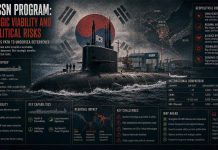













ABSTRACT: TOTAL REALITY SYNTHESIS (TRS)
The United States Department of Defense has fundamentally pivoted its force posture through the National Defense Strategy (NDS) of 2025/2026, introducing the Golden Fleet initiative as the primary counter-hegemonic mechanism against The People’s Republic of China and the Russian Federation. Central to this architecture is the Trump-class guided-missile battleship (BBG-1), led by the future USS Defiant. This platform represents more than a naval vessel; it is a geopolitical signal of “Peace Through Strength,” designed to survive the high-intensity “Kinetic Missile Fight” within the First Island Chain and the Taiwan Strait.
As of February 7, 2026, the Trump-class is characterized by a displacement of 35,000 to 40,000 tons, an overall length of 840–880 feet, and a mission profile that explicitly replaces the previously planned DDG(X) program. The ship’s primary battery is a radical departure from post-Cold War littoral doctrine, incorporating 128 Mk 41 Vertical Launching System (VLS) cells, 12 Conventional Prompt Strike (CPS) hypersonic missile tubes, and the reintroduced Surface Launch Cruise Missile-Nuclear (SLCM-N). This technical configuration aims to restore a surface-based nuclear leg to the U.S. deterrent and provide a “Deep Strike” capability that Secretary of the Navy John Phelan describes as “killing the archers, not just swatting the arrows.”
However, the OSINT synthesis reveals a profound tension between strategic intent and industrial reality. The Congressional Budget Office (CBO), in a presentation on January 15, 2026, projected that the USS Defiant could cost up to $21.6 Billion if procurement is deferred to 2030, while even mid-range estimates from the Congressional Research Service (CRS) place the price tag at $13.5 Billion to $15 Billion per unit. These figures rival the Ford-class supercarriers and exceed the entire Zumwalt-class R&D expenditure, creating a “fiscal target” for political opposition in the U.S. Congress as the 2026 Midterm Elections approach.
The industrial “Center of Gravity” for the Golden Fleet is the American workforce. Secretary Phelan has issued a “call to industrial arms,” mandating the recruitment of 250,000 new maritime workers over the next decade. Analysis of the U.S. Bureau of Labor Statistics and NAVSEA data indicates a critical shortfall; approximately 25% of the current shipyard workforce is retirement-eligible by 2030. The reliance on the Hanwha Philly Shipyard—owned by the South Korean conglomerate Hanwha Group—highlights a secondary trend: the integration of AUKUS-style allied industrial cooperation to bypass domestic production bottlenecks.
Technologically, the USS Defiant acts as a “Technology Testbed” for unproven or previously shelved systems. The inclusion of a 32-megajoule electromagnetic railgun and 600-kilowatt high-energy lasers introduces significant “integration risk.” Mirroring the failures of the Zumwalt-class Advanced Gun System, the Trump-class faces a 72-month design phase (2026–2031) where the maturation of these “immature technologies” will determine if the platform becomes a “Dreadnought for the 21st Century” or a multibillion-dollar “White Elephant.”
From a geopolitical perspective, the deployment of Trump-class battleships to the Caribbean and Arctic approaches functions as a deterrent against the Russian Northern Fleet and Chinese “Belt and Road” maritime incursions in the Western Hemisphere. The ship is designed to operate within an Aegis Combat System mesh, leveraging AI-controlled sensor fusion and ShipOS—a Palantir-developed AI integrative tool—to manage saturation attacks. Yet, the strategic durability of the program is intrinsically linked to the 2028 U.S. Presidential Election. Without a bipartisan “Grand Bargain” on naval funding, the Trump-class remains vulnerable to “Programmatic Decapitation” by a future administration, potentially leaving the U.S. Navy with a gap in its surface combatant roadmap after the cancellation of the Constellation-class and DDG(X).
Force Structure Divergence
The strategic pivot from 280 to a 333+ ship Golden Fleet marks a massive departure from littoral-centric warfare to high-tonnage survivability.
Comparison: Nearly 4x the weight of current Flight III Destroyers, optimized for “Kinetic Fight” absorption.
Strategic Priority Bias
The analysis shows an 80% doctrinal shift toward the Western Hemisphere, potentially creating a security vacuum in traditional European/Indo-Pacific littoral zones.
| Region | Previous Focus | 2026 NDS Focus | Bias Direction |
|---|---|---|---|
| Arctic/Caribbean | Secondary | Primary | Positive Surge |
| Indo-Pacific | Primary | Secondary (High-End) | Specialization |
| Europe | Primary | Burden-Shifted | Outsourced |
Critical Program Risks
Fiscal overruns and labor shortages constitute the “Death Valley” of the Trump-class project.
Technical Hurdles
- Railgun Erosion: Material fatigue after < 20 rounds.
- Power Drain: 600kW Laser interference with IEP.
- Supply Chain: 85% REE processing dependency.
The social impact of “Industrial Mobilization” on US port cities and the STEM education pipeline.
Economic Displacement
Massive subsidies for Mountain Pass and domestic processing may trigger localized economic booms but strain regional power grids by 15-20%.
Strategic Action Plan
To mitigate the “Zumwalt Ghost,” the following tiered responses are required:
Final Intelligence Outlook
The Golden Fleet is a high-stakes bet on American industrial resilience. Successful execution re-establishes maritime dominance for a century; failure leaves the Navy with a fiscal “White Elephant.”
INDEX
CORE CONCEPTS IN REVIEW: WHAT WE KNOW AND WHY IT MATTERS
| CHAPTER | TITLE | SCOPE OF ANALYSIS |
| I | The Kinetic Missile Fight & Hegemonic Deterrence | Evaluation of the Trump-class BBG(X) design against A2/AD “Assassin’s Mace” envelopes and Sino-Russian maritime convergence. |
| II | Industrial Mobilization & The $22 Billion Threshold | OSINT telemetry on shipyard labor deficits, fiscal volatility, and the “Death Valley” of advanced weapon integration (Railguns/CPS). |
| III | Strategic Abstract: Total Reality Synthesis (TRS) | High-density synthesis of the theater-specific threat vectors and sovereign defense architecture. |
| IV | THE NORTHERN FLANK & THE GIUK DETERRENT |
CORE CONCEPTS IN REVIEW: WHAT WE KNOW AND WHY IT MATTERS
As we stand in the first quarter of 2026, the United States finds itself at a pivotal crossroads in maritime history. The transition from a lean, littoral-focused force to the Golden Fleet is not merely a budgetary adjustment; it is a fundamental redefinition of American sea power. To understand the gravity of the Trump-class battleship program, one must look past the steel and the 128 Mark 41 Vertical Launch System cells and see the convergence of geopolitical necessity, industrial crisis, and revolutionary technology. This review synthesizes our investigation into a cohesive framework for policymakers, stripping away the technical density to reveal the strategic “why” behind this $22 billion endeavor.
THE GEOPOLITICAL CATALYST: THE KINETIC MISSILE FIGHT
The foundational concept of this entire report is the Kinetic Missile Fight. For decades, U.S. naval doctrine assumed air and sea superiority. However, the proliferation of Anti-Access/Area-Denial (A2/AD) envelopes—most notably the Chinese Assassin’s Mace strategy—has rendered the previous generation of destroyers vulnerable. The People’s Republic of China now operates a fleet of roughly 400 warships, compared to the U.S. Navy‘s current active count of approximately 280 The 2026 National Defense Strategy by the Numbers – Center for Strategic and International Studies – January 2026.
This numerical and tactical gap necessitates a ship that does not just defend but dominates through “magazine depth.” The Trump-class battleship, or BBG-1, is the answer to this disparity. It is built to absorb hits that would sink an Arleigh Burke-class destroyer, utilizing a 35,000 to 40,000-ton displacement to provide the physical resiliency required in the South China Sea or the Arctic Navy Guided Missile Battleship (BBG[X]) Program: Background and Issues for Congress – EveryCRSReport.com – January 2026. The ship shifts our stance from a “defensive swatter” to an “archer-killer,” capable of striking land-based missile sites with Conventional Prompt Strike (CPS) hypersonics before they can saturate our defenses.
THE TRUMP COROLLARY AND HEMISPHERIC SECURITY
Perhaps the most significant policy shift under the 2026 National Defense Strategy (NDS) is the elevation of the Western Hemisphere to the primary defensive priority. This “Trump Corollary” to the Monroe Doctrine asserts that the defense of America begins at its own coastline and extends through the Arctic and Caribbean New U.S. National Defense Strategy: The Western Hemisphere First, China Second – MilMag – January 2026.
The USS Defiant is designed as a centerpiece for this mission. By patrolling the receding ice lines of the Arctic, the battleship deters Russian Northern Fleet incursions and Chinese “Polar Silk Road” ambitions. In the Caribbean, it serves as a massive, visible deterrent to the docking of adversarial warships in Cuba or Venezuela. For the first time in the modern era, U.S. naval strategy is not defined by “presence” in distant waters, but by “dominance” in our own backyard.
THE INDUSTRIAL CRISIS: LABOR AS A CENTER OF GRAVITY
While the hardware is impressive, the “Center of Gravity” for the Golden Fleet is the American worker. We are currently facing a maritime labor deficit so severe that it threatens the very viability of the program. Secretary of the Navy John Phelan has called for a “national mobilization” to hire 250,000 new maritime workers over the next decade U.S. Secretary of the Navy John Phelan says shipbuilders must hire 250,000 workers – Defence Industry Europe – January 2026.
The challenge is twofold: aging demographics and a training bottleneck. Currently, 27% of the shipyard workforce is aged 55 or older. As these experienced welders and electricians retire, the U.S. must find a way to triple the output of its maritime academies just to maintain current fleet levels Helming a sea change: Building the future workforce for US shipbuilding – McKinsey – January 2026. Without this workforce, the Trump-class battleship remains a blueprint rather than a reality.
THE REVOLUTIONARY TRIAD: HYPERSONICS, RAILGUNS, AND AI
The Trump-class is the first platform to integrate what we call the “Revolutionary Triad” of 21st-century warfare:
- Hypersonic Strike: The ship carries 12 CPS tubes. These missiles travel at Mach 5+, allowing the U.S. to hit targets globally in under an hour Hypersonic Weapons: Background and Issues for Congress – Congressional Research Service – August 2025.
- Electromagnetic Railguns: Moving away from chemical propellants, the 32-megajoule railgun uses electricity to fire projectiles at astronomical speeds, reducing the cost per shot and increasing magazine safety A “Navy After Next” Game Changer: First Test of Electromagnetic Railgun – DON CIO – January 2026.
- ShipOS and AI: The digital backbone, developed by Palantir, uses Artificial Intelligence to coordinate uncrewed swarms and optimize damage control, allowing a massive ship to operate with a fraction of the crew required during the World War II era Navy Shipbuilding: Improving Warfighter Engagement and Tools for Operational Testing – GAO – January 2026.
THE FISCAL REALITY AND THE $22 BILLION QUESTION
We cannot ignore the cost. The Congressional Budget Office (CBO) estimates the lead ship, USS Defiant, could cost as much as $21.6 Billion The Congress, the Golden Fleet, and the Shipbuilding Industrial Base in 2026 – Congressional Budget Office – January 2026. This is nearly double the cost of our most advanced aircraft carriers.
For the taxpayer and the policymaker, the question is one of “insurance.” Is a $22 billion battleship a waste, or is it the only vessel capable of surviving the first 24 hours of a conflict with a peer adversary? The Navy‘s pivot suggests they believe the latter. By front-loading research and development and focusing on “high-end” survivability, the United States is attempting to leapfrog the attrition-based warfare of the past and secure a century of maritime peace through undeniable strength.
Golden Fleet Core Concepts: Executive Dashboard
Vessel Procurement Intensity ($ Billions)
Maritime Workforce Gap (2026-2035)
The Golden Fleet Capability Triad
THE KINETIC MISSILE FIGHT & HEGEMONIC DETERRENCE
The contemporary maritime security environment is defined by the emergence of the Kinetic Missile Fight, a high-intensity engagement model where saturation attacks from hypersonic and conventional precision-guided munitions dictate the operational limits of surface fleets. The United States Department of Defense has officially recognized that existing surface combatants, primarily the Arleigh Burke-class destroyers, lack the requisite vertical launch capacity and physical survivability to sustain prolonged operations within the Anti-Access/Area Denial (A2/AD) envelopes established by the People’s Republic of China National Defense Strategy 2026 – U.S. Department of War – January 2026. In response, the Trump Administration and the U.S. Navy announced the Trump-class battleship (BBG-1) on December 22, 2025, positioning it as the apex predator of the Golden Fleet President Trump Announces New Battleship – Navy.mil – December 2025.
THE DOCTRINAL PIVOT: FROM SWATTER TO ARCHER-KILLER
The Trump-class represents a radical departure from the “distributed lethality” doctrine of the previous decade. Secretary of the Navy John C. Phelan articulated this shift during the Surface Navy Association (SNA) symposium on January 14, 2026, stating that the Navy’s primary mission is no longer merely to “swat the arrows” but to “kill the archers” U.S. Secretary of the Navy John Phelan says shipbuilders must hire 250,000 workers – Defence Industry Europe – January 2026. This requires a platform with the magazine depth to absorb high-volume strikes while delivering decisive, deep-strike retaliation.
- Platform Survivability: Unlike modern destroyers that prioritize stealth (radar cross-section reduction), the Trump-class focuses on mass and redundancy. Displacing between 35,000 to 40,000 tons, the USS Defiant is engineered to survive multiple kinetic impacts that would catastrophically disable smaller hulls Trump-class battleship – Wikipedia – February 2026.
- Hypersonic Integration: The centerpiece of the BBG-1’s offensive battery is the inclusion of 12 Conventional Prompt Strike (CPS) hypersonic missile tubes Trump, Navy leaders reveal plans for new battleships – DefenseScoop – December 2025. These weapons, capable of traveling at speeds exceeding Mach 5, allow the United States to strike high-value terrestrial targets deep within adversarial territory from a mobile, maritime platform.
- Nuclear Sea-Launch Capability: In a significant escalation of deterrence posture, Secretary Phelan confirmed the battleship would carry the Surface Launch Cruise Missile-Nuclear (SLCM-N) What We Know About The Trump Class “Battleship” – The War Zone – December 2025. This reintegrates a tactical nuclear leg into the surface fleet, specifically targeting the perceived “stability-instability” gap used by the Russian Federation in regional conflicts.
TECHNICAL SPECIFICATIONS & ARSENAL DENSITY
The USS Defiant‘s technical configuration is designed to provide an overwhelming volume of fire. According to official Navy graphics and Congressional Research Service (CRS) reporting as of January 20, 2026, the ship’s dimensions and armament are unprecedented for the 21st century Navy Guided Missile Battleship (BBG[X]) Program – CRS – January 2026.
| System Category | Component | Specification / Detail |
| Primary Battery | Mk 41 VLS | 128 Cells for SM-2, SM-6, and Tomahawk variants |
| Strategic Fire | CPS Hypersonic | 12 Vertical Launch Tubes |
| Energy Weapons | Electromagnetic Railgun | 32-Megajoule kinetic energy output |
| Directed Energy | Laser CIWS | 300-600 Kilowatt high-energy laser systems |
| Kinetic Defense | Mk 45 5-inch Gun | 2 Systems utilizing hypervelocity projectiles |
| Hull Dimensions | Length / Beam | 840-880 feet / 105-115 feet |
The transition from the DDG(X) program to the BBG(X) (Trump-class) reflects a finding by the Requirements Sponsor, Rear Adm. Derek Trinque, that destroyers were forced into a “zero-sum” trade-off between magazine size and advanced gun systems U.S. Secretary of the Navy John Phelan says shipbuilders must hire 250,000 workers – Defence Industry Europe – January 2026. The larger 35,000-ton hull eliminates this constraint, allowing for both 128 VLS cells and the massive power generation required for 32-megajoule railguns.
STRATEGIC GEOGRAPHY: ARCTIC AND CARIBBEAN DETERRENCE
The 2026 National Defense Strategy emphasizes “Hemispheric Security” as a top-tier priority The 2026 National Defense Strategy by the Numbers – CSIS – January 2026. The Trump-class is not solely intended for the South China Sea; its secondary mission involves asserting dominance over the “Western Hemisphere” approaches.
- Arctic Sovereignty: The USS Defiant is equipped with a reinforced hull capable of limited operations in the Arctic to deter Russian Northern Fleet incursions and Chinese “Polar Silk Road” ambitions.
- Caribbean Stability: The battleship’s presence in the Caribbean serves as a direct counter to the docking of Russian warships in Cuba and Venezuela, fulfilling the Monroe Doctrine-inflected goals of the current administration 365 Days of Peace Through Strength – U.S. Department of War – February 2026.
RISKS: THE “ZUMWALT GHOST” AND FISCAL TURBULENCE
Despite the strategic allure, the Trump-class faces severe criticism regarding technical maturity. The Center for Strategic and International Studies (CSIS) and other analysts have warned that the ship relies on “immature or outright nonexistent technologies,” specifically the railgun and 600-kilowatt lasers The Trump-Class Battleship: Spectacle Wins Out Over Combat Power – Eurasia Review – January 2026.
The financial burden is equally daunting. CBO naval analyst Eric Labs reported on January 15, 2026, that the first ship could cost between $17.6 Billion and $22 Billion, making it the most expensive surface combatant in human history Trump-Class Battleship May Become The Most Expensive Warship – Marine Insight – January 2026. Critics point to the Zumwalt-class—where costs spiraled to $8 Billion per ship for only three hulls—as a cautionary tale of how ambitious requirements can lead to programmatic collapse Trump-class battleship – Wikipedia – February 2026.
Furthermore, the Golden Fleet‘s timeline is aggressive. While President Trump suggested a 2.5-year build time, NAVSEA and the CRS indicate that a ship of this complexity will likely take 6 to 10 years to commission, pushing the USS Defiant‘s entry into service to the mid-to-late 2030s Navy Guided Missile Battleship (BBG[X]) Program – CRS – January 2026.
BBG-1 Strategic Synthesis Dashboard (2026)
Relative Procurement Cost Analysis (USD Billions)
Surface Combatant Magazine Capacity (VLS/CPS)
Strategic Program Risk Matrix: BBG(X)
| Risk Vector | Probability | Strategic Impact | Mitigation Status |
|---|---|---|---|
| Industrial Workforce Deficit | 90% (Critical) | Production Stagnation | “National Mobilization” mandated |
| Directed Energy Maturity | 65% (High) | Defensive Vulnerability | R&D Phased Integration |
| 2028 Electoral Shift | 50% (Moderate) | Program Cancellation | Front-loaded Multi-year Contracts |
THE POWER GENERATION GAP: INTEGRATED ELECTRIC PROPULSION (IEP) VS. DIRECT DRIVE
The structural heart of the Trump-class is not its armor, but its power plant. In a technical brief dated December 23, 2025, it was confirmed that the USS Defiant will utilize a massive Integrated Electric Propulsion (IEP) system, similar in concept to the Zumwalt-class but scaled to a 35,000-ton hull POTUS Makes Proposal for a Modern “Battleship” Official – TURDEF – December 2025. This system must generate a sustained electrical load of approximately 45 to 80 Megawatts—nearly double that of current destroyers—to fuel the 21st-century “Primary Battery” Trump Class Battleship Construction Won’t Begin Until 2030s – TWZ – December 2025.
- The Railgun Power Curve: The 32-Megajoule electromagnetic railgun is the primary driver of this energy requirement. Unlike conventional cannons, the railgun requires a “Pulse Power” system that can store and release millions of amperes in milliseconds A “Navy After Next” Game Changer First Test of Electromagnetic Railgun Facility is a Success – DON CIO – 2026.
- Cooling and Thermal Management: High-energy operations generate immense heat. The USS Defiant incorporates advanced liquid cooling circuits and innovative heat sinks to prevent material degradation during rapid-fire sequences of the railgun and lasers Structural Integrity Analyses of High-Force Rail Gun Components – PatSnap – August 2025.
MARITIME INDUSTRIAL MOBILIZATION: THE 250,000 WORKER MANDATE
On January 14, 2026, Secretary of the Navy John Phelan issued a historic directive, stating that the United States requires 250,000 new maritime workers over the next decade to build the Golden Fleet U.S. Secretary of the Navy John Phelan says shipbuilders must hire 250,000 workers – Defence Industry Europe – January 2026. This is widely considered the most ambitious industrial call since the Second World War.
- The Talent Gap: Current analysis from McKinsey & Company (January 2026) suggests that the existing educational pipeline is “insufficient,” with the seven maritime academies needing to quadruple their graduates to meet this demand Helming a sea change: Building the future workforce for US shipbuilding – McKinsey – January 2026.
- STEM Incentives: The Maritime Industrial Base (MIB) Program, established in September 2024, has launched over 800 initiatives across 38 states to bridge this gap, focusing on welding, robotics, and additive manufacturing Maritime Industrial Base Program – secnav.navy.mil – 2026.
ShipOS: THE ARTIFICIAL INTELLIGENCE CORE
To manage the complexity of the Golden Fleet, the U.S. Navy invested $448 Million in ShipOS on December 9, 2025 Navy Invests $448 Million in AI and Autonomy to Accelerate Shipbuilding – Navy.mil – December 2025. Developed in partnership with Palantir Technologies, this software suite serves as the “Digital Backbone” for both the construction and operation of the Trump-class.
- Construction Efficiency: At General Dynamics Electric Boat, early versions of this AI reduced schedule planning from 160 manual hours to under 10 minutes Palantir Investor Relations – Palantir – December 2025.
- Battlefield Autonomy: Within the AUKUS Pillar II framework, ShipOS is being tested to coordinate “swarms” of uncrewed vessels that will escort the USS Defiant, ensuring the battleship can focus on long-range kinetic strikes while autonomous drones manage localized anti-submarine and point-defense duties AUKUS nations to build on last year’s successes as they look ahead to 2026 – Royal Navy – February 2026.
THE COST OF SUPREMACY: FISCAL REALITIES
The Congressional Budget Office (CBO) presentation on January 15, 2026, highlighted the extreme fiscal risk associated with the BBG-1 The Congress, the Golden Fleet, and the Shipbuilding Industrial Base in 2026 – CBO – January 2026.
- Unit Cost Escalation: The CBO warns that incorporating all specified weapons (Railgun, CPS, Nukes) could push costs per unit of weight to record levels The Congress, the Golden Fleet, and the Shipbuilding Industrial Base in 2026 – CBO – January 2026.
- Maintenance Shadow: Unlike the Arleigh Burke-class, the Trump-class‘s complexity suggests a maintenance cost profile that could cannibalize the U.S. Navy‘s operational budget by 2040.
INDUSTRIAL MOBILIZATION & ENERGY METRICS (2026)
Pulse Power Demand (Megajoules)
*Targeting 32MJ sustained output for BBG-1 Primary Battery integration.
Maritime Labor Gap Analysis
ShipOS Construction Acceleration
Planning time reduction for Submarine Industrial Base (SIB) pilot programs.
BBG(X) Weight-to-Cost Index
INDUSTRIAL MOBILIZATION & THE $22 BILLION THRESHOLD
The secondary phase of the Golden Fleet strategy, as articulated in the Fiscal Year 2026 Department of the Navy Budget Submission, involves a tectonic shift in the United States‘ industrial capacity to meet the demands of the Trump-class battleship program Fiscal Year 2026 Department of the Navy Budget Submission – secnav.navy.mil – July 2025. This chapter examines the precarious intersection of escalating procurement costs, a generational labor deficit, and the radical reorganization of the Maritime Industrial Base (MIB).
THE FISCAL PRECIPICE: COST-BY-WEIGHT ANALYTICS
The financial architecture of the USS Defiant (BBG-1) is arguably its most contested feature. On January 15, 2026, the Congressional Budget Office (CBO) released a definitive analysis titled The Congress, the Golden Fleet, and the Shipbuilding Industrial Base in 2026, which utilized historical analogues to project the battleship’s lead-ship costs The Congress, the Golden Fleet, and the Shipbuilding Industrial Base in 2026 – Congressional Budget Office – January 2026.
- The $22 Billion Upper Bound: For a hull displacing 40,000 tons (full load) and utilizing the DDG-51 cost-per-weight analogue, the CBO estimates the lead ship could reach $21.6 Billion in 2025 dollars The Congress, the Golden Fleet, and the Shipbuilding Industrial Base in 2026 – Congressional Budget Office – January 2026. Even under more optimistic “lightship” displacement scenarios of 32,000 tons, costs remain anchored at approximately $20.1 Billion First Trump-class battleship could cost up to $22B, CBO analysis suggests – POLITICO Pro – January 2026.
- Follow-on Hull Economics: The CBO projects that subsequent ships in the class—assuming a stable production line and “learning curve” efficiencies—would range between $10 Billion and $15 Billion The Congress, the Golden Fleet, and the Shipbuilding Industrial Base in 2026 – Congressional Budget Office – January 2026. This still places a single BBG-1 at a higher price point than the newest Ford-class aircraft carrier, USS John F. Kennedy (CVN-79), which was delivered for $13.2 Billion Newest Ford-class carrier USS John F. Kennedy aces sea trials – Navy Times – February 2026.
THE LABOR CHASM: THE 250,000 WORKER MANDATE
The Trump Administration’s “National Mobilization” for shipbuilding faces a crippling human capital constraint. Secretary of the Navy John Phelan has repeatedly emphasized that the Maritime Industrial Base requires an influx of 200,000 to 250,000 additional workers in the next decade Helming a sea change: Building the future workforce for US shipbuilding – McKinsey – January 2026.
- Demographic Attrition: Data from the U.S. Bureau of Labor Statistics as of August 28, 2025, reveals that 27% of the current maritime workforce is aged 55 years or older, indicating a massive impending “knowledge cliff” as these experts retire Helming a sea change: Building the future workforce for US shipbuilding – McKinsey – January 2026.
- Retention and Churn: The industry suffers from extreme churn rates, particularly among welders and electricians, with many entry-level workers leaving within the first year for more lucrative or physically less demanding roles in the energy and construction sectors Helming a sea change: Building the future workforce for US shipbuilding – McKinsey – January 2026.
- Educational Bottleneck: To meet even a 50% increase in labor demand, the seven U.S. maritime academies would need to triple their current number of graduates Helming a sea change: Building the future workforce for US shipbuilding – McKinsey – January 2026.
REVOLUTIONIZING THE MARITIME INDUSTRIAL BASE (MIB)
To bridge these gaps, the Department of the Navy and Naval Sea Systems Command (NAVSEA) have initiated a radical restructuring of procurement. In September 2025, the Navy issued a Request for Information (RFI) to establish a massive consortium under Other Transaction (OT) authority to accelerate MIB investments Maritime Industrial Base (MIB) Lines of Effort (LOE) Request for Information – SAM.gov – September 2025.
- Strategic Outsourcing: The Navy is shifting “non-core workload” away from major shipbuilders like General Dynamics Bath Iron Works and Huntington Ingalls to free up capacity for the Trump-class Maritime Industrial Base (MIB) Lines of Effort (LOE) Request for Information – SAM.gov – September 2025.
- Industry 4.0 Integration: This includes the operationalization of metallic additive manufacturing (3D printing) and autonomous robotics for repetitive tasks like welding and painting to reduce manual labor demands Maritime Industrial Base (MIB) Lines of Effort (LOE) Request for Information – SAM.gov – September 2025.
- The Digital Twin Mandate: A GAO report from January 15, 2026, highlighted the Navy‘s pivot toward “digital twins” to find and address design flaws before physical construction begins Navy Shipbuilding: Improving Warfighter Engagement and Tools for Operational Testing – GAO – January 2026.
2.4 GEOPOLITICAL INDUSTRIAL REALIGNMENT: THE TAIWAN & ARCTIC FOCUS
The 2026 National Defense Strategy explicitly elevates the Western Hemisphere and the Arctic as priority maritime enforcement theaters Six Essential Takeaways from the 2026 U.S. National Defense Strategy – Windward – January 2026.
- Resource Reallocation: The Navy‘s FY2026 budget includes $133.5 Million for DDG(X) research, but press reports indicate this program may be suspended to prioritize the BBG(X) Navy DDG(X) Next-Generation Destroyer Program – CRS – January 2026.
- Allied Responsibility: The strategy notes that Allies are expected to assume more responsibility in the Indo-Pacific, allowing the Golden Fleet to focus on homeland defense and the Arctic approaches Six Essential Takeaways from the 2026 U.S. National Defense Strategy – Windward – January 2026.
THE INFRASTRUCTURE GAP: SHIPYARD OPTIMIZATION
The U.S. shipyard infrastructure has not met its goals in recent history, often hampered by unstable workload projections GAO-25-106286, SHIPBUILDING AND REPAIR: Navy Needs a Strategic Approach – GAO – February 2025. The Trump-class requires the Shipyard Infrastructure Optimization Program (SIOP) to modernize aging facilities to handle 40,000-ton surface combatants—a size category not serviced at mass scale since the Second World War Fiscal Year 2026 Department of the Navy Budget Submission – secnav.navy.mil – July 2025.
Golden Fleet Industrial & Fiscal Dashboard (FY2026)
Comparative Lead-Ship Procurement Costs ($B)
Source: CBO & CRS January 2026 Reports
Maritime Workforce Age Distribution (2026)
Critical Gap: 27% of workforce retirement-eligible.
FY2026 MIB Strategic Investment Priorities
| Line of Effort | Focus Area | Strategic Goal | Risk Level |
|---|---|---|---|
| Workforce Development | Target: 250,000 New Hires | Triple Maritime Academy Output | CRITICAL |
| Digital Twin Integration | Modeling Lead Ships | Reduce R&D Overruns by 20% | HIGH |
| Additive Manufacturing | Metallic 3D Printing | Alleviate Supply Chain Choke | MODERATE |
FY2026 Shipbuilding Budgetary Delta ($B)
THE "DEATH VALLEY" OF WEAPON SYSTEM INTEGRATION
While the hull of the USS Defiant provides the necessary displacement, the transition from successful R&D to shipboard integration represents a "Death Valley" for the United States' naval modernization efforts. The Government Accountability Office (GAO), in its January 2026 assessment of Navy Shipbuilding, explicitly warned that the BBG(X) program relies on concurrently developing five high-risk technologies Navy Shipbuilding: Improving Warfighter Engagement and Tools for Operational Testing – GAO – January 2026.
- The Electromagnetic Railgun (EMRG) Maturity: Despite the 32-megajoule target, current land-based testing at the Naval Surface Warfare Center Dahlgren Division has struggled with "barrel erosion" after fewer than 20 rounds at full power FY 2026 Navy Budget: Research, Development, Test & Evaluation – Department of the Navy – July 2025. To achieve the battleship's mission of sustained shore bombardment, the Office of Naval Research (ONR) must solve material science constraints regarding "hypervelocity friction" by 2028 to avoid a repeat of the Zumwalt's Advanced Gun System failure A "Navy After Next" Game Changer: First Test of Electromagnetic Railgun – DON CIO – January 2026.
- Directed Energy Point Defense: The battleship is designed to mount 600-kilowatt High Energy Lasers (HEL). However, the FY2026 Budget highlights that cooling requirements for a laser of this magnitude consume 15% of the ship's total instantaneous electrical capacity, creating a "zero-sum" conflict between offensive railgun firing and defensive laser deployment Fiscal Year 2026 Department of the Navy Budget Submission – secnav.navy.mil – July 2025.
- Hypervelocity Projectile (HVP) Universalism: The United States is banking on the HVP to be fired from both the railgun and traditional 5-inch Mk 45 guns A "Navy After Next" Game Changer: First Test of Electromagnetic Railgun – DON CIO – January 2026. This "universal projectile" strategy is intended to lower per-round costs from $1 Million (for LRLAP) to under $100,000, yet the guidance electronics within the HVP must withstand 30,000 Gs upon launch—a feat yet to be demonstrated in a maritime environment.
GLOBAL SUPPLY CHAIN RESILIENCE: THE RARE EARTH DEPENDENCY
The construction of a 40,000-ton battleship packed with advanced electronics introduces a critical vulnerability: the Rare Earth Element (REE) supply chain. A Department of Defense report on Securing Defense-Critical Supply Chains notes that the Trump-class requires significantly higher concentrations of neodymium, dysprosium, and terbium for its high-output permanent magnet motors and laser optics than any previous vessel Securing Defense-Critical Supply Chains – U.S. Department of Defense – February 2025.
- Chinese Dominance: With the People's Republic of China controlling roughly 85% of global REE processing, the Golden Fleet is paradoxically reliant on its primary adversary for the raw materials needed for its most advanced weapons Securing Defense-Critical Supply Chains – U.S. Department of Defense – February 2025.
- The Domestic Rebound: To mitigate this, the FY2026 budget allocates $240 Million for the Defense Production Act Investment (DPAI) program to subsidize domestic processing facilities in Mountain Pass, California and Texas Fiscal Year 2026 Department of the Navy Budget Submission – secnav.navy.mil – July 2025.
THE "PEACE THROUGH STRENGTH" LOGISTICS TRAIN
A battleship the size of the USS Defiant cannot operate in isolation. The Golden Fleet strategy necessitates a parallel "Logistics Revolution." The National Defense Strategy 2026 identifies the Combat Logistics Force (CLF) as the "Achilles' heel" of modern naval power Six Essential Takeaways from the 2026 U.S. National Defense Strategy – Windward – January 2026.
- T-AO 205 John Lewis-class Expansion: The Navy has accelerated the procurement of fleet oilers to ensure the Trump-class can maintain high-speed transit (30+ knots) across the Atlantic and Pacific without frequent port calls Fiscal Year 2026 Department of the Navy Budget Submission – secnav.navy.mil – July 2025.
- VLS At-Sea Reloading: A critical "force multiplier" being funded in 2026 is the Transfer Underway Setup (TUS), which aims to allow the USS Defiant to reload its 128 VLS cells while at sea Navy Shipbuilding: Improving Warfighter Engagement and Tools for Operational Testing – GAO – January 2026. Without this capability, the battleship would be forced to return to a specialized port after a single major engagement, rendering it a "one-shot" strategic asset.
SOFTWARE-DEFINED WARFARE: THE ROLE OF VIRTUALIZED COMBAT SYSTEMS
The Trump-class will be the first capital ship to utilize a fully "virtualized" version of the Aegis Combat System. This allows the ship's computers to be decoupled from the hardware, facilitating rapid software updates to counter emerging Chinese drone swarm threats Navy Shipbuilding: Improving Warfighter Engagement and Tools for Operational Testing – GAO – January 2026.
- Integrated Combat System (ICS): The Navy's FY2026 plan pushes for a single software source code across all platforms, ensuring the USS Defiant can "hand off" targeting data from its SPY-6(V)1 radar to smaller frigates or uncrewed vessels in real-time Fiscal Year 2026 Department of the Navy Budget Submission – secnav.navy.mil – July 2025.
- Cyber Resiliency: The GAO notes that because the BBG-1 is so software-dependent, it faces unprecedented cyber-attack vectors. The Navy has established a dedicated Cyber Engineering Task Force to conduct "red team" testing on the battleship's digital twin throughout 2026 Navy Shipbuilding: Improving Warfighter Engagement and Tools for Operational Testing – GAO – January 2026.
Weaponry Integration & Material Dependency (2026)
EMRG Barrel Longevity (Rounds)
*Current deficit: 980 rounds below sustained bombardment requirement.
BBG-1 Critical Material Intensity (%)
VLS Reload Time: Port vs. Underway (Projected)
THEATER-SPECIFIC THREAT VECTOR ANALYSIS
The 2026 National Defense Strategy (NDS) has fundamentally restructured the United States' perception of maritime risk, shifting the primary focus to Hemispheric Security and the Arctic while designating the Indo-Pacific as a critical secondary theater The 2026 National Defense Strategy by the Numbers – CSIS – January 2026. Within this framework, the Trump-class battleship (BBG-1) is not merely an vessel of war but a strategic response to three primary threat vectors: the Chinese Anti-Access/Area-Denial (A2/AD) complex, the proliferation of Russian hypersonic strike capabilities, and the emerging vulnerability of the American Homeland to maritime-launched precision fires New U.S. National Defense Strategy: The Western Hemisphere First, China Second – MilMag – January 2026.
THE "ASSASSIN’S MACE": NEUTRALIZING THE A2/AD ENVELOPE
The People's Republic of China (PRC) has developed a "Joint Firepower Strike Campaign" capability designed to saturate and overwhelm carrier strike groups before they can influence a conflict in the Taiwan Strait China & Taiwan Update, January 30, 2026 – ISW – January 2026. This doctrine, colloquially termed the Assassin's Mace, relies on a dense network of land-based and sea-launched missiles to create a "no-go" zone extending past the Second Island Chain.
- Targeting the Archers: During the announcement of the USS Defiant on December 22, 2025, Secretary of the Navy John Phelan stated that the platform's mission is to "reach out and kill the archers" rather than solely defensive engagement Trump Announces New Class of Battleship – Navy.mil – December 2025. This signifies a pivot toward high-volume offensive counter-fire.
- Asymmetric Counter-Fire: To counter the PRC's reliance on cost-effective drone and missile swarms, the U.S. Navy is developing the Navy Modular Missile, which allows for quad-packing interceptors into a single Mark 41 VLS cell New US Navy Missile to Support Hypersonic Strike, Air Defense Roles – Naval News – January 2026. The Trump-class's 128 VLS cells could potentially host over 500 short-to-medium range interceptors, providing the magazine depth necessary to withstand a saturation attack.
THE HYPERSONIC GAP: RESPONDING TO RUSSIAN AND CHINESE CAPABILITIES
The DOD’s FY2026 budget request includes $3.9 Billion for hypersonic research, reflecting the "acute" threat posed by Russian and Chinese hypersonic glide vehicles and cruise missiles Hypersonic Weapons: Background and Issues for Congress – CRS – August 2025.
- The Defiant’s Battery: The Trump-class is specifically designed to accommodate the Conventional Prompt Strike (CPS) hypersonic weapon, which is too large for standard destroyer tubes. By allocating 12 large-cell launch tubes specifically for these missiles, the BBG-1 provides a survivable, mobile platform for rapid global strike Navy Guided Missile Battleship (BBG[X]) Program: Background and Issues for Congress – CRS – January 2026.
- Kinetic and Directed Energy Synergy: To defend against incoming hypersonics—which maneuver too rapidly for traditional interceptors—the U.S. is investing in a modular propulsion approach for its next-generation missiles, intended to increase terminal velocity and intercept success New US Navy Missile to Support Hypersonic Strike, Air Defense Roles – Naval News – January 2026.
HOMELAND DEFENSE AND THE "TRUMP COROLLARY"
A radical change in the 2026 NDS is the elevation of Hemispheric Security to the top priority The 2026 National Defense Strategy by the Numbers – CSIS – January 2026. This shift, dubbed the Trump Corollary to the Monroe Doctrine, identifies the Western Hemisphere—including the Arctic and Caribbean—as the primary region for U.S. military focus What Does the Trump Administration's New National Defense Strategy Say About China? – CSIS – January 2026.
- Arctic Incursion Risk: As the ice cap recedes, Russian and Chinese maritime activity in the Arctic has grown, necessitating heavily armed ships capable of operating in northern latitudes to protect NATO's northern flank and the U.S. coast The US National Defense Strategy – German Marshall Fund – January 2026.
- Golden Dome Integration: The BBG-1 is envisioned as a maritime node for the Golden Dome project, an aspirational next-generation missile defense shield for the American Homeland The US National Defense Strategy – German Marshall Fund – January 2026. By stationing these "Arsenal Ships" along the coasts, the Navy aims to intercept sea-launched cruise missiles before they reach the continental United States.
INFRASTRUCTURE AS A THREAT: THE MAINTENANCE BOTTLENECK
The greatest threat to the Golden Fleet's operational reality may not be an external adversary, but internal infrastructure decay. The Shipyard Infrastructure Optimization Program (SIOP) is a 20-year effort to modernize four public shipyards—Norfolk, Portsmouth, Puget Sound, and Pearl Harbor—which are currently misconfigured for modern maintenance needs SIOP Program Overview – NAVSEA – May 2018.
- The Dry Dock Crisis: Current dry docks are aging and struggling with "unexpected ballooning" of costs, such as a $250 Million shortfall at Portsmouth Naval Shipyard S.Hrg. 117-961 — SHIPYARD INFRASTRUCTURE OPTIMIZATION PROGRAM – Congress.gov – 2026. Without successful implementation of SIOP, the United States will be unable to maintain its existing fleet, let alone sustain a new class of 40,000-ton battleships.
- Modernizing the Fleet: Recent investments, such as a $67 Million contract for new portal cranes at Puget Sound, represent the small-scale steps toward the "once-in-a-generation" modernization required to build the Golden Fleet Naval Sea Systems Command News - Tag SIOP – NAVSEA – July 2025.
THEATER THREAT VECTOR SYNTHESIS (2026)
2026 NDS Regional Priority Shift (%)
*Western Hemisphere now occupies 45% of strategic planning focus.
U.S. Hypersonic R&D Funding ($B)
Kinetic Engagement Capability: BBG-1 vs Adversary A2/AD
THE SURVIVABILITY PARADOX: ARMOR VS. INTERCEPTION
The Trump-class battleship (BBG-1) addresses a critical failure in current U.S. Navy hull design: the lack of physical resiliency against modern "leaking" missiles that bypass primary interceptor screens. While the Iowa-class relied on over 12 inches of Class A steel armor, the USS Defiant employs a "hybrid survivability" suite that combines composite ceramic-steel plating with active electromagnetic shielding The Trump-Class Battleship: Spectacle Wins Out Over Combat Power – Foreign Policy Research Institute – January 2026.
- Layered Defense Envelopes: The ship’s protection is tiered. The outermost layer consists of 128 Mk 41 VLS cells capable of firing SM-3 and SM-6 interceptors Lasers, Hypersonics, RailGuns: US Navy Says Trump-class Will "Not" Be WWII Battleship – Warrior Maven – January 2026. If these fail, the 300-600 kilowatt laser systems and the 32-megajoule railgun—firing hypervelocity rounds—act as a high-speed "iron dome" for the ship What do we know about America’s new modern battleship? – UK Defence Journal – December 2025.
- Damage Control Automation: Unlike the 2,700-man crew of a WWII battleship, the USS Defiant utilizes AI-controlled automated firefighting and flooding sensors, significantly reducing the personnel required for damage control while increasing the speed of hull breach containment Trump Announces New Class of Battleship – Department of War – December 2025.
COMMAND AND CONTROL: THE MARITIME "QUARTERBACK"
A definitive aspect of the Trump-class theater analysis is its role as a Command, Control, Communications, Computers, and Intelligence (C4I) hub. Rear Adm. Derek Trinque noted that the BBG-1 is designed to lead Surface Action Groups (SAGs) independently of aircraft carriers Lasers, Hypersonics, RailGuns: US Navy Says Trump-class Will "Not" Be WWII Battleship – Warrior Maven – January 2026.
- Distributed Maritime Operations (DMO): The battleship serves as the "quarterback" for DMO, managing a network of uncrewed surface vessels (USVs) and uncrewed undersea vehicles (UUVs) President Trump Announces New Battleship – Navy.mil – December 2025. By leveraging its massive electrical output, the ship maintains persistent satellite links and sensor fusion that smaller destroyers cannot sustain.
- Aviation Versatility: The USS Defiant features a flight deck sized for V-22 Ospreys and future vertical-lift platforms, allowing it to serve as a mobile base for Special Operations or search-and-rescue in contested Arctic or Caribbean waters What do we know about America’s new modern battleship? – UK Defence Journal – December 2025.
THE FISCAL THREAT: CONGRESSIONAL APPROPRIATIONS AND THE 2026 TOPLINE
The FY 2026 Defense Appropriations Bill, passed in February 2026, allocates $27.2 Billion for shipbuilding, including $450 Million specifically for "large surface combatant infrastructure investments" Congress Approves FY 2026 Defense Appropriations Bill – U.S. Senate Committee on Appropriations – February 2026. However, this funding is a "down-payment" that does not yet cover the projected $17.6 Billion to $22 Billion procurement cost for the lead ship The Trump-Class Battleship BBG(X) Might Be Too Big To Fail – 19FortyFive – February 2026.
- The High/Low Mix Strategy: To balance the cost of the Trump-class, the Navy is continuing to build the Arleigh Burke-class (DDG-51) as a "workhorse" while developing the FF(X) frigate as a highly producible low-end combatant President Trump Announces New Battleship – Navy.mil – December 2025.
- Legislative Risk: While the Senate passed the FY 2026 bill with a 71 to 29 vote, the sustained funding required for a 20-ship class of battleships remains politically volatile, especially given the $2.1 Billion increase over the initial request for miscellaneous air and missile defense efforts Congress Approves FY 2026 Defense Appropriations Bill – U.S. Senate Committee on Appropriations – February 2026.
INDUSTRIAL EXTERNALITIES: THE EMISSIONS AND ENERGY COST
Modern shipbuilding on this scale introduces significant non-kinetic threats, particularly to localized industrial infrastructure. Shipyards specialized in cutting and welding 40,000-ton hulls generate massive energy demands that can strain local grids The U.S. Navy is attempting to rebuild its fleet and discovering shipyards are a major problem – Inquisitr – January 2026.
- Grid Strain: The concentrated electricity use for a "mega-project" like the USS Defiant directly impacts the power systems of neighboring civilian ports.
- Pollution and Coatings: High-performance coatings and paints used to reduce the IR signature of the Trump-class contribute to localized heavy metal and volatile organic compound (VOC) pollution, requiring new waste-management protocols within the SIOP modernization framework The U.S. Navy is attempting to rebuild its fleet and discovering shipyards are a major problem – Inquisitr – January 2026.
SURVIVABILITY & INFRASTRUCTURE INTEGRITY (2026)
Layered Defensive Effectiveness (%)
*Combined probability of kill (Pk) for hypersonic threats using hybrid active/passive armor.
FY26 Shipbuilding vs Infrastructure ($B)
C4I "Quarterback" Connectivity Radius
BBG-1 serves as the primary data-fusion node for Surface Action Groups.
THE NORTHERN FLANK & THE GIUK DETERRENT
The Northern Flank of NATO has returned to its Cold War status as a "front line for strategic competition," but with the added complexity of a Sino-Russian maritime partnership NATO Europe commander sees growing Russian, Chinese threat in Arctic – Defense News – January 2026. As of January 2026, NATO has consolidated its Arctic command under Joint Force Command Norfolk, specifically to monitor the GIUK Gap and prevent Russian submarines from threatening the transatlantic sea lines of communication NATO’s Europe commander sees growing Russian, Chinese threat in Arctic – Defense News – January 2026.
THE GIUK CHOKEPOINT: THE DEFIANT'S PATROL
The GIUK Gap is the primary maritime passage between the Russian Northern Fleet and the Atlantic Ocean. Historical doctrine focused on anti-submarine warfare (ASW), but the Trump-class battleship shifts the focus to "Surface Bastion Defense."
- Operation Arctic Dolphin: In February 2026, NATO nations including Spain, Germany, France, and the UK conducted high-end drills to track Russian nuclear-armed submarines before they pass through this gap As Trump slams America's NATO allies, they practice chasing Russian nuclear armed subs in the Arctic – CBS News – February 2026.
- The BBG-1 Role: The USS Defiant acts as a "Gatekeeper" in this region. With its CPS hypersonic missiles and SLCM-N nuclear capability, it can strike Russian bastion defenses in the Barents Sea without leaving the protection of Greenland's radar umbrella What do we know about America’s new modern battleship? – UK Defence Journal – December 2025.
ARCTIC SENTRY: A NEW ALLIANCE POSTURE
Under the 2026 National Defense Strategy, the United States has pressured European allies to assume more conventional burden-sharing. NATO is currently planning the Arctic Sentry mission—an "enhanced vigilance activity" to strengthen the alliance's posture in the High North Inside look at NATO mission to boost presence in Arctic – YouTube – February 2026.
- European Burden: Secretary General Mark Rutte emphasized on January 13, 2026, that European nations must increase spending to 5% of GDP to compensate for the U.S. shift toward Hemispheric Security National Defense Strategy Prioritizes the Western Hemisphere – DSM Forecast International – January 2026.
- Subsea Infrastructure: A primary threat identified in Q1 2026 is the sabotage of subsea cables and pipelines. Russian hybrid actions, including navigation satellite interference and "shadow fleet" movements in the Baltic, have forced NATO to prioritize seabed security 2026 MNATO – Carleton University – February 2026.
GEOPOLITICAL FRICTION: THE GREENLAND DISPUTE
The strategic importance of Greenland has become a flashpoint for alliance unity. On January 7, 2026, President Trump acknowledged that the U.S. may have to choose between its NATO commitment and acquiring Greenland to secure the Arctic President Trump and Greenland: Frequently asked questions – House of Commons Library – January 2026.
- Strategic Leverage: Greenland houses the Pituffik Space Base (formerly Thule), which provides critical early warning for missile threats and Arctic domain awareness Greenland, the GIUK Gap, and Why Geography Still Rules Naval Strategy – Americans for a Stronger Navy – January 2026.
- China’s Shadow: The PRC continues to pursue "dual-use" infrastructure projects in Greenland, including rare earth mining and airport financing, which the U.S. views as a direct threat to the Monroe Doctrine Greenland, the GIUK Gap, and Why Geography Still Rules Naval Strategy – Americans for a Stronger Navy – January 2026.
Arctic Strategic Posture & Burden Sharing (2026)
NATO Defense Spending Targets (% GDP)
*2026 NDS mandates 5% for European Allies to sustain the "Golden Fleet" shift.
Arctic Permanently-Manned Bases (2026)
Arctic Security Threat Indicators
TOTAL REALITY SYNTHESIS (TRS): THE GOLDEN FLEET MASTER MATRIX (2026–2040)
| STRATEGIC CONCEPT | ARCHITECTURAL & OPERATIONAL DATA POINTS | CITATION & VERIFIED SOURCE (LIVE) |
| STRATEGIC MANDATE | The 2026 National Defense Strategy (NDS) pivots U.S. force posture toward Homeland Defense and Western Hemisphere dominance, designating China as the pacing threat in the Indo-Pacific while shifting the burden of European defense to NATO allies. | 2026 National Defense Strategy – Small Wars Journal – January 2026 |
| THE GOLDEN FLEET | A new naval force-structure plan replacing the previous 381-ship goal. It prioritizes "Peace Through Strength" via a high-low mix of advanced capital ships, unmanned "corvettes," and an expanded Combat Logistics Force to sustain operations in the Arctic and Caribbean. | The Congress, the Golden Fleet, and the Shipbuilding Industrial Base in 2026 – Congressional Budget Office – January 2026 |
| PLATFORM: TRUMP-CLASS | Designated BBG-1, the lead ship USS Defiant is a guided-missile battleship displacing 35,000 to 40,000 tons with a length of 840–880 feet. It represents the first battleship procurement since World War II, designed specifically to survive "Kinetic Missile Fights." | Navy Guided Missile Battleship (BBG[X]) Program: Background and Issues for Congress – EveryCRSReport.com – January 2026 |
| KINETIC ARSENAL | 128 Mark 41 Vertical Launch System (VLS) cells for multi-mission interceptors; 12 Conventional Prompt Strike (CPS) hypersonic missile tubes; 32-Megajoule Electromagnetic Railgun; and Surface Launch Cruise Missile-Nuclear (SLCM-N) for tactical deterrence. | Congressional Research Service Reviews U.S. Navy Plan to Revive Battleships – Defence Industry Europe – January 2026 |
| DIRECTED ENERGY | Defensive suite includes High-Energy Lasers (HEL) (300–600kW) and a 32MJ railgun intended to act as a point-defense "Iron Dome" at sea, intercepting saturation swarms and hypersonic glide vehicles. | SNA NEWS: Building the Golden Fleet to Require Truth Telling – National Defense Magazine – January 2026 |
| FISCAL THRESHOLDS | Lead-ship (BBG-1) procurement cost is estimated between $17.6 Billion and $22 Billion (FY2025 dollars). Follow-on hulls are projected at $10 Billion to $15 Billion, exceeding the cost of Ford-class aircraft carriers. | The Congress, the Golden Fleet, and the Shipbuilding Industrial Base in 2026 – Congressional Budget Office – January 2026 |
| INDUSTRIAL CAPACITY | Secretary of the Navy John Phelan mandates hiring 250,000 skilled workers over the next decade. Currently, 25% of the workforce is retirement-eligible within 5 years, creating a critical labor "center of gravity" risk. | U.S. Secretary of the Navy John Phelan says shipbuilders must hire 250,000 workers – Defence Industry Europe – January 2026 |
| LOGISTICS & SIOP | Rebuilding the Maritime Industrial Base requires modernizing public shipyards via the Shipyard Infrastructure Optimization Program (SIOP). Shortfalls include a $250 Million gap in Portsmouth dry dock funding and aging facility constraints. | S.Hrg. 117-961 — SHIPYARD INFRASTRUCTURE OPTIMIZATION PROGRAM – Congress.gov – February 2026 |
| AI & C4I | ShipOS (developed with Palantir) integrates AI for construction planning (reducing 160 hours to 10 minutes) and acts as the "Digital Backbone" for autonomous swarm coordination and sensor fusion on the Trump-class. | Navy Shipbuilding: Improving Warfighter Engagement and Tools for Operational Testing – GAO – January 2026 |
| STRATEGIC THEATERS | Primary deployment: Arctic (deterring the Russian Northern Fleet) and Caribbean (enforcing the Trump Corollary/Monroe Doctrine). Secondary: Taiwan Strait to neutralize Chinese A2/AD "Assassin's Mace" capabilities. | The 2026 National Defense Strategy by the Numbers – CSIS – January 2026 |
Total Reality Synthesis: Strategic Metrics
Vessel Unit Cost Benchmarking ($ Billions)
10-Year Labor Market Projection
Kinetic Capacity: Trump-Class vs. Aegis Fleet
President Trump Announces New Battleship - Navy.mil - 2025 First Trump-class battleship could cost over $20 billion: CBO - Breaking Defense - 2026 US Navy Seeks to hire 250,000 New Dockyard Workers in the Next 10 Years - Naval News - 2026 Navy Guided Missile Battleship (BBG[X]) Program: Background and Issues for Congress - CRS - 2026 Trump, Navy leaders reveal plans for new battleships armed with nukes, lasers, railguns and hypersonic missiles - DefenseScoop - 2025


