










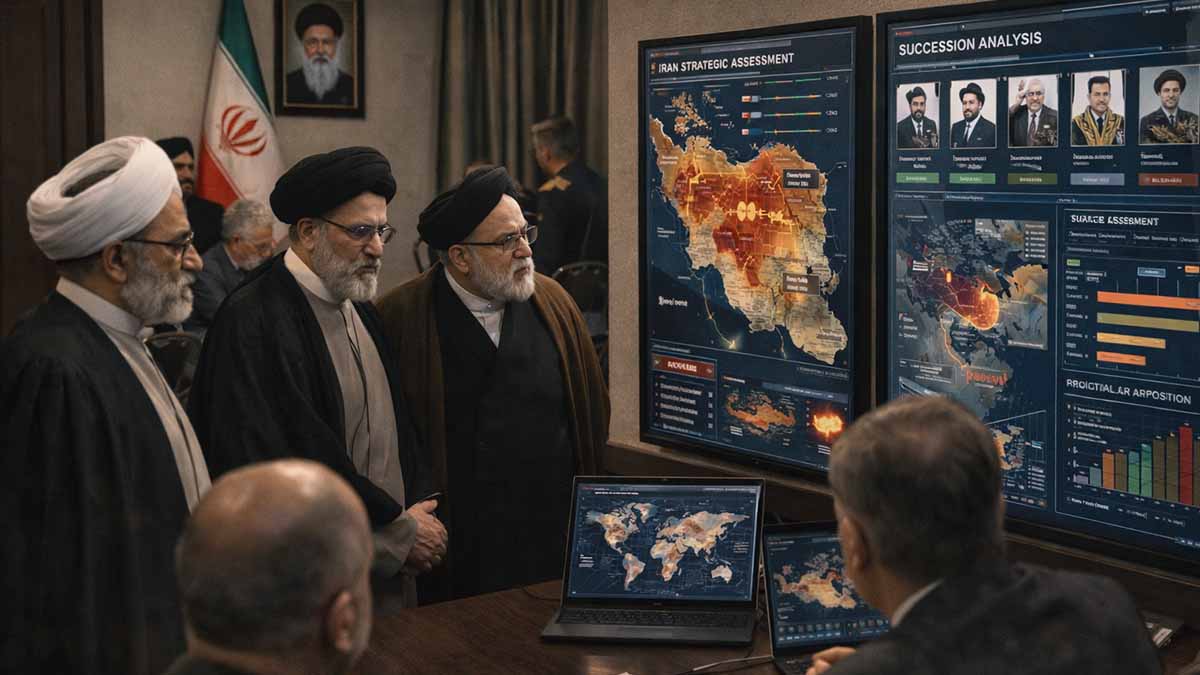
ABSTRACT — FORENSIC STRATEGIC IMMERSION
Strategic Context: The Threshold Crossed
On 28 February 2026, the United States and Israel executed what analysts are already calling the most consequential direct military action against a sovereign state since the 2003 invasion of Iraq. Joint U.S.-Israeli strikes killed Supreme Leader Ayatollah Ali Khamenei at his compound in central Tehran, along with a substantial portion of Iran’s national security architecture. Iranian Supreme Leader Ayatollah Ali Khamenei, who ruled the Islamic Republic for more than three decades, has died following an Israeli strike in Tehran, with Israeli leaders confirming his compound and offices were reduced to rubble early Saturday after a targeted strike in downtown Tehran. Fox News
This was not a spontaneous strike. It emerged from a months-long deterioration spiral: beginning in late December 2025, massive nationwide anti-regime protests erupted in Iran, driven largely by economic crisis, the collapse of the rial, and rising prices — the protests became the largest in scale since the 1979 revolution, spreading to over 100 cities. Wikipedia Simultaneously, nuclear negotiations had collapsed, and during the second round of nuclear talks in Geneva on 17 February, Khamenei threatened the United States warships in the area, stating Iran is “capable of sinking them.” Wikipedia
The strikes decapitated Iran’s command structure with surgical ferocity. Israeli Defense Forces confirmed the deaths of Ali Shamkhani (secretary of the Iranian Defense Council), Mohammad Pakpour (IRGC commander-in-chief), Defense Minister Aziz Nasirzadeh, Saleh Asadi (head of the Intelligence Directorate), Mohammad Shirazi (head of the Military Bureau), and two senior figures from the Organization of Defensive Innovation and Research. NBC News Sources told CBS News the initial strikes were believed to have killed approximately 40 Iranian officials in total. CBS News
Trump’s intent was unambiguous. At 2:30 AM EST on 28 February, Trump released an 8-minute video statement saying that the purpose of the U.S. strikes in Iran was effectively regime change. Wikipedia He urged IRGC forces to lay down weapons and addressed the Iranian public directly, inviting them to “take over your government” once strikes concluded.
The Triumvirate: Anatomy of the Transitional Council
Article 111 of the Iranian Constitution activated automatically upon Khamenei’s confirmed death. The constitutional mechanism is precise: a three-member council assumes Supreme Leader duties until the Assembly of Experts — 88 senior clerics — elects a permanent successor.
The transitional council consists of President Masoud Pezeshkian, Supreme Court Chief Justice Gholam-Hossein Mohseni-Ejei, and Ayatollah Alireza Arafi, the latter confirmed by the Expediency Council as the Guardian Council’s jurist representative. Al Jazeera
Member 1 — Ayatollah Alireza Arafi (Clerical-Institutional Pillar)
Arafi is the least publicly prominent of the three, but institutionally the most significant for long-term succession dynamics. Born in 1959, Arafi simultaneously held three key influential positions before his emergency appointment: Director of the Islamic Seminary system, a sitting member of the Assembly of Experts, and a vetting member of the Guardian Council. He is said to be highly educated, a polyglot fluent in Arabic and English. News24
His family lineage is crucial context: his father, Mohammad Ibrahim al-Arafi, was a close friend of Ruhollah Khomeini Wikipedia, giving him organic revolutionary legitimacy that cannot be manufactured. His appointment to the Assembly of Experts in 2015 bypassed the standard written examination through a discretionary supreme leader override — a direct signal of Khamenei’s personal confidence. According to Alex Vatanka of the Middle East Institute, Khamenei’s willingness to appoint Arafi to senior and strategically sensitive positions “shows that he has a great deal of confidence in his bureaucratic abilities.” CNN
However, Arafi carries a structural liability in any succession race: he isn’t known to be a political heavyweight and doesn’t have close ties to the security establishment. CNN In a post-decapitation environment where the IRGC’s institutional survival instinct will dominate succession politics, this is a meaningful gap. His ideological profile is hardline — he is strongly opposed to atheism and Christianity, led the Bache-Kooni Basij, and during his tenure at Al-Mustafa International University claimed the institution converted 50 million people globally to Shia Islam. His role in the transitional council is primarily to provide theological legitimacy and clerical continuity; he does not command troops, manage oil revenues, or control intelligence networks.
Member 2 — President Masoud Pezeshkian (Executive-Reform Pillar)
Pezeshkian represents the reformist current that won Iran’s 2024 presidential election on a platform of economic relief and nuclear deal restoration. His inclusion in the triumvirate is constitutionally automatic, but his political position is precarious. He entered office with promises of moderation; he now presides over an active war with the United States and Israel. His executive apparatus — ministries, budget, diplomatic corps — remains largely functional, but his reformist political constituency has been rendered irrelevant by the kinetic reality of the conflict. He is the council’s external-facing diplomat and the figure through whom any ceasefire or negotiation channel would flow, but he exercises minimal authority over the IRGC’s military operations.
Member 3 — Chief Justice Gholam-Hossein Mohseni-Ejei (Security-Judiciary Pillar)
Mohseni-Ejei is the council’s hardliner anchor. As former intelligence minister and longtime judiciary chief, he has deep operational ties to the security apparatus, the prison system, and the suppression infrastructure of the state. His presence ensures that the transitional council will not pivot toward any accommodation of domestic protest movements or foreign pressure for political liberalization. He represents the continuity of the coercive state.
The Fourth Power: Ali Larijani
Formally outside the triumvirate but operationally central, senior official Ali Larijani survived the strikes Axios and has emerged as the effective crisis manager. Larijani said in a statement that a temporary leadership council would be established and warned that any “secessionist groups” attempting to take action would face a harsh response. CBS News His significance: he was Khamenei’s personal strategic adviser on nuclear negotiations with the Trump administration, former parliament speaker, and the architect of Iran’s pre-war contingency planning. The New York Times reported earlier this month that Khamenei put in place detailed plans for his succession and emergency chains of command should he or other top leaders be killed, elevating longtime loyalist Larijani to manage the crisis. The Times of Israel
Larijani’s messaging to Gulf states is a precise strategic signal: he stated “We had told the United States through the Swiss embassy that if you attack this time, we will hit your bases. We do not intend to attack the countries of the region” — reframing Iranian strikes on Gulf territory as strikes against U.S. presence, not against sovereign Arab states. CNN This is information warfare designed to fracture the U.S.-Gulf security consensus.
Iran’s Retaliatory Architecture: What Has Been Hit
Iran’s military response followed a pre-planned, multi-vector doctrine across six identified strike waves. The IRGC’s operational statement was unambiguous: “This operation will continue relentlessly until the enemy is decisively defeated. All US assets throughout the region are considered legitimate targets.” Al Jazeera
Primary Targets Struck (Confirmed):
U.S. Military Bases: The IRGC confirmed targeting four major U.S. bases: Al Udeid Air Base in Qatar, Ali Al Salem Air Base in Kuwait, Al Dhafra Air Base in the UAE, and the U.S. Navy Fifth Fleet headquarters in Bahrain. Wikipedia Iran claimed a total of 27 U.S. bases targeted across the region. Tomahawk cruise missiles were used in the opening phase of U.S. strikes, while Iranian retaliatory strikes targeted Bahrain, Qatar, UAE, Kuwait, and Jordan — countries hosting American forces. Authorities in those nations reported intercepting many incoming missiles. Fox News
Israel: Multiple waves of ballistic missiles and drones targeted Israeli territory. Nine people were killed by an Iranian ballistic missile impact in Beit Shemesh. Al Jazeera The IRGC’s sixth strike wave targeted Tel Nof air base, the Israeli army general staff, and a defense-industrial complex in Tel Aviv.
Gulf Civilian Infrastructure: Despite Larijani’s framing, Iranian strikes caused significant collateral damage. The UAE confirmed that 137 missiles and 209 drones were fired at its territory, with the vast majority intercepted. The Times of Israel At least three people were killed and 58 others wounded in the UAE. Al Jazeera Dubai’s port of Jebel Ali was struck. Kuwait International Airport was hit. Airspace across the region was closed, disrupting hundreds of flights.
Iraq: A spokesperson for the Iraqi Popular Mobilization Forces said two fighters were killed during strikes in Jurf al-Sakhar, south of Baghdad. Wikipedia The headquarters of Kataib Hezbollah near Baghdad was targeted by U.S.-led forces, killing two.
Iran’s Own Territory: The U.S.-Israeli strikes hit Iran across 24 provinces. Missiles struck the Ministry of Intelligence, the Ministry of Defence, the Atomic Energy Organization of Iran, and the Parchin military complex. Al Jazeera Iranian state media said at least 201 people were killed in the attacks across 24 provinces. Al Jazeera Iran’s internet went down for more than 24 hours, according to NetBlocks, which noted the measure “limits civic engagement at a key moment for the country’s future.” CNBC
Power Vacuum Dynamics: The IRGC Factor
The IRGC is both the most powerful surviving institution and the most fractured. The death of IRGC commander Mohammad Pakpour creates an immediate command succession crisis within the organization that holds Iran’s ballistic missile arsenal, proxy networks, and economic empire. IRGC-linked Telegram channels cite deputy chief Ahmad Vahidi, appointed to the position by Khamenei two months ago, as a likely candidate Al Jazeera to assume command.
The IRGC’s institutional posture in the succession will be determinative. Any permanent Supreme Leader candidate who lacks IRGC endorsement will be unable to govern in a wartime environment. Arafi’s acknowledged weakness — no security establishment ties — means he cannot be a permanent solution. The Assembly of Experts will face intense IRGC pressure to select a figure acceptable to the revolutionary guards. Mojtaba Khamenei, the Supreme Leader’s son, had been a succession frontrunner, but Israeli officials said Israel targeted Khamenei’s sons, with intelligence assessments suggesting they survived the strikes. Axios
Scenario Forecast: Three Trajectories
Trajectory 1 — Controlled Escalation with Negotiated Exit (Probability: ~40%): The transitional council, guided by Larijani’s strategic hand, manages the retaliatory campaign at calibrated intensity. Iran signals willingness to negotiate via back-channels (Swiss embassy, Omani mediators). Trump, having achieved his stated objectives of regime decapitation and nuclear site damage, accepts a face-saving formula. The Assembly of Experts rapidly elects a pragmatist Supreme Leader. The IRGC stands down from maximum escalation. Oil markets stabilize above $100/barrel but the Strait of Hormuz remains open.
Trajectory 2 — Regime Fracture & Protracted Conflict (Probability: ~35%): The IRGC splinters between hardline factions demanding full escalation and pragmatist factions calculating survivability. Domestic protests, which were already the largest since 1979, intensify as air strikes continue. Secessionist pressures in Kurdish, Baloch, and Azeri regions activate, triggering exactly what Larijani warned against. The transitional council loses coherence as Pezeshkian’s reformist constituency and Mohseni-Ejei’s security bloc conflict. Iran’s nuclear program, damaged but not destroyed, becomes a bargaining chip in a fractured negotiation environment.
Trajectory 3 — Regional Conflagration (Probability: ~25%): Iran executes Strait of Hormuz closure. Approximately 13 million barrels per day of crude oil transited the Strait of Hormuz in 2025, roughly 31% of global seaborne crude flows. CNBC A sustained closure triggers global oil shock, drawing in China (Iran’s primary economic patron) and Russia diplomatically. Kataib Hezbollah and remaining Iranian proxies in Iraq launch sustained attacks on U.S. forces. Trump’s warning that Iran will be hit “with a force never seen before” if it escalates further triggers a recursive escalation cycle.
Information Environment & Cognitive Warfare Dimension
Iran shut down its internet for 24+ hours — the same playbook used during the 2019 and 2022 protest crackdowns. The difference this time: the shutdown coincides with the death of the Supreme Leader, maximally suppressing the political agency of the civilian population at precisely the moment when constitutional processes should be most transparent. This creates a legitimacy vacuum that opposition forces — including Reza Pahlavi, actively lobbying from exile — are attempting to fill. Large crowds gathered in Los Angeles cheering Khamenei’s death, with renewed calls for Pahlavi to return and head a transitional government. CNBC Whether this diaspora sentiment can translate into domestic political force remains the critical unknown.
The Islamic Republic’s survival strategy has always rested on institutional resilience over individual leadership. As Brookings senior fellow Suzanne Maloney assessed: “Any mere change at the top of Iran’s leadership remains insufficient to topple the current system. Over time, a political movement capable of challenging the regime could yet emerge, but any forthcoming leadership transition in Iran is unlikely to result in a beneficial change in the regime itself.” NBC News
The strategic question is whether the simultaneous decapitation of military and clerical leadership — in the context of a pre-existing popular legitimacy crisis — crosses a threshold that previous shocks did not. The answer will emerge in the Assembly of Experts’ deliberations and the IRGC’s choice of command succession in the coming 72 hours.
IRAN CRISIS INTELLIGENCE DASHBOARD
As of 01 March 2026 — Active Conflict Status
Strategic Scenario Probability
Iranian Retaliatory Strikes by Target Type
Transitional Council Power Vectors
Confirmed Senior Official Fatalities — U.S./Israeli Strike (Feb 28, 2026)
CRITICAL ASSESSMENT: The Strait of Hormuz remains the single highest-consequence escalation variable. A sustained closure of the strait — which carries ~31% of global seaborne crude — would constitute the most severe oil supply shock since 1973. The IRGC Navy’s increased patrols and transmission intercepts suggesting “no ship is allowed to pass” represent the most dangerous second-order risk in the current conflict architecture.
INDEX
- The Decapitation Strike & Its Immediate Strategic Effects
- The Triumvirate: Power Architecture of the Transitional Council
- Iran’s Retaliatory Doctrine, Targets Hit & Second-Order Cascade Risks
- Iran’s Coming-Days Operational Posture — Geostrategic Patterns, Proxy Capabilities, China’s Weapons Transfer, and Anticipated Attack Vectors
Operation Epic Fury — The Decapitation Strike, Its Execution Architecture, and Immediate Strategic Effects
The Pre-Strike Conditions: Why Diplomacy Failed in 96 Hours
Operation Epic Fury did not emerge from a vacuum. It was the terminal outcome of a diplomatic spiral that collapsed with remarkable speed. On 6 February 2026, U.S. Special Envoy Steve Witkoff and Iranian Foreign Minister Abbas Araghchi held the first round of indirect nuclear talks in Muscat, Oman, with the notable symbolic presence of CENTCOM commander Admiral Brad Cooper — a visual declaration that military force remained on the table. Iran insisted talks cover “solely the nuclear issue”; the Trump administration demanded a comprehensive agreement covering nuclear weapons, ballistic missiles, and proxy forces. Why the US and Israel attacked Iran; what we know so far – CNN – February 2026
A second round convened in Geneva through 26 February. The Omani Foreign Minister Badr Al-Busaidi declared a “breakthrough” had been reached and that Iran had agreed never to stockpile enriched uranium and to full IAEA verification. Operation Epic Fury and the Remnants of Iran’s Nuclear Program – Center for Strategic and International Studies – February 2026 Yet the apparent diplomatic progress was illusory. Trump had stated publicly on 27 February: “I say no enrichment. Not 20 percent, 30 percent.” Araghchi had stated Iran had “every right to enrichment” and would not surrender it. The gap was unbridgeable, the language of progress concealing structural incompatibility.
The intelligence trigger that converted diplomacy into kinetics came simultaneously: the Trump administration received intelligence that Iran was planning a preemptive missile launch, according to a senior U.S. official. 2026 Israeli–United States strikes on Iran – Wikipedia – March 2026 Khamenei had already warned publicly in early February that “if they start a war this time, it will be a regional war” — a statement available via his official website that was processed by U.S. intelligence as a mobilization signal rather than rhetorical posturing.
The operational decision calculus at Mar-a-Lago and in the White House Situation Room — where Vice President JD Vance, Secretary of War Pete Hegseth, Secretary of State Marco Rubio, and Chairman of the Joint Chiefs General Dan Caine were present — concluded that the Geneva apparent breakthrough was insufficient and that the window for a pre-emptive strike was narrowing. Supreme Leader of Iran Khamenei dead following Israel’s strike on Iran – Fox News – February 2026
The Strike Architecture: Force Composition and Targeting Logic
The operation’s military architecture was assembled over six weeks — the largest U.S. military buildup in the Middle East since the 2003 Iraq War. Why are the US and Israel attacking Iran? – Al Jazeera – February 2026
Naval Platforms: The USS Abraham Lincoln and its carrier strike group were operating in the North Arabian Sea, while the USS Gerald R. Ford was in the Eastern Mediterranean. There were 14 guided-missile destroyers in the region between the two strike groups and independent deployers, stretched across the Mediterranean and the Middle East. The U.S. destroyers in the region are armed with Standard Missile 3s — which can intercept ballistic missiles — as well as SM-2s and SM-6s that counter traditional air threats. USNI News
Air Power: Combined, the two U.S. aircraft carriers were carrying more than 90 strike fighters, plus an arsenal of Tomahawk cruise missiles carried by escort ships. From the U.S. Air Force, more than 110 fighters flowed into the region from bases in North America and Europe, including F-16s and F-35As, Boeing F-15Es, and A-10 attack jets. At least 10 F-22 air superiority stealth fighters were also deployed to the Middle East. Flight Global The deployment of F-22s signals dual intent: air dominance against any potential Russian or Chinese intervention escalation, and psychological deterrence against regional actors calculating the cost of entry.
Novel Weapons System — LUCAS Drones: The operation marked the first combat use of the Low-Cost Unmanned Combat Attack System (LUCAS). The U.S. military deployed low-cost strike drones based on Iran’s Shahed-136 design for the first time, using the reverse-engineered weapons against Iranian military infrastructure. U.S. Central Command stated: “CENTCOM’s Task Force Scorpion Strike — for the first time in history — is using one-way attack drones in combat during Operation Epic Fury. These low-cost drones, modeled after Iran’s Shahed drones, are now delivering American-made retribution.” Flight Global At approximately $35,000 per unit compared to multi-million dollar MQ-9 Reaper drones Newsweek, LUCAS drones enable mass saturation of air defense networks, exhausting expensive interceptor inventories before higher-value precision platforms arrive.
Standoff Precision Munitions: The U.S. also fired scores of Raytheon Tomahawk land-attack cruise missiles, Lockheed Martin ATACMS ground-launched missiles, and for the first time employed its LUCAS drones that resemble the Iranian Shahed-136. Aviation Week Network The Tomahawk — a $1.4 million per-unit precision weapon with an 800–1,553 mile range — was launched from Arleigh Burke-class guided-missile destroyers and submarines positioned in the Persian Gulf and Arabian Sea, with missiles taking between 60 and 140 minutes to reach their targets in Iran. SSBCrack
Strike Timeline and Wave Structure: Airstrikes began at approximately 9:45 a.m. IRST (1:15 a.m. EST) on Saturday, 28 February 2026 — a deliberate choice to conduct the initial wave in daylight over Iran, a departure from standard doctrine of night-opening strikes. U.S., Israel Launch Strikes Against Iran, Tehran Retaliates Across Region – USNI News – February 2026 The daylight opening served a specific cognitive warfare objective: visibility of the strikes within Iran during working hours, when millions of Iranians were commuting and at workplaces, maximizing the psychological impact and encouraging the popular uprising Trump explicitly called for in his overnight address.
CENTCOM described the operation as “the largest regional concentration of American military firepower in a generation,” with targets including IRGC command and control facilities, air defenses, missile and drone launch sites, and military airfields. Operations involved troops from all six branches of the armed forces. Aviation Week Network
The Kill Chain: Who Was Eliminated and How
The operation’s most historically consequential achievement was the elimination of Ayatollah Ali Khamenei in his Pasteur District compound in central Tehran — described internally as the most significant targeted killing of a sitting head of state since Israel began its campaign of precision leadership elimination. The United States and Israel launched strikes across Iran in a bold daytime attack Saturday that struck hundreds of missile and air defense sites and eliminated layers of leadership in the Iranian regime, most significant among them the country’s supreme leader, Ayatollah Ali Khamenei. The Washington Post
Beyond Khamenei, the decapitation architecture eliminated critical nodes across four strategic domains simultaneously:
| Killed Official | Role | Strategic Domain | Impact Level |
|---|---|---|---|
| Ali Khamenei | Supreme Leader | Political-Theological Apex | Existential — 36-year rule terminated |
| Mohammad Pakpour | IRGC Commander-in-Chief | Military Command | Critical — 2nd IRGC chief killed in <1 year |
| Aziz Nasirzadeh | Defense Minister | Military-Industrial | High — defense industrial base leadership eliminated |
| Ali Shamkhani | Defense Council Secretary / Khamenei Adviser | Intelligence-Strategic | High — primary Khamenei security architecture removed |
| Saleh Asadi | Head, Intelligence Directorate (Khatam al-Anbiya) | Intelligence | High — operational IRGC intelligence decapitated |
| Mohammad Shirazi | Head, Military Bureau | Military Coordination | Moderate-High |
| Hossein Jabal Amelian | Chairman, Defensive Innovation & Research | Defense Technology | Moderate — R&D leadership disruption |
| Abdolrahim Mousavi | Army Chief of Staff | Conventional Military | High — regular army leadership severed |
“The majority of the highest-ranking senior military officials of the Iranian security leadership have been eliminated,” the IDF stated. Aviation Week Network CBS News reported that approximately 40 Iranian officials were killed in the initial strikes. US, Israel Launch Another Round of Strikes on Iran – CBS News – February 2026
The targeting of Khamenei’s family adds a psychological dimension: Fars News Agency, affiliated with the IRGC, announced that Khamenei’s daughter, son-in-law, grandchild, and daughter-in-law were also killed in the strikes. Wikipedia This eliminates the immediate dynastic succession option represented by Mojtaba Khamenei’s circle, removing potential continuity candidates.
Nuclear Target Architecture: Eliminating the Reconstitution Capacity
The nuclear targeting logic of Operation Epic Fury must be read against the backdrop of Operation Midnight Hammer — the 22 June 2025 U.S. B-2 strike that used 14 GBU-57 Massive Ordnance Penetrators against Fordow, Natanz, and Isfahan. Policy Alert: U.S. Launches Operation Epic Fury – Foundation for Defense of Democracies – February 2026 The Pentagon assessed at that time that Iran’s nuclear program was set back 1–2 years. Eight months later, the program had partially reconstituted through dispersed, hardened, and covert infrastructure.
The current Operation Epic Fury nuclear targeting reflects this reconstitution reality. The strikes decimated Iran’s enrichment facilities at Fordow and Natanz and destroyed Iran’s metallurgy facilities at Isfahan. The current wave of U.S. and Israeli strikes indicates a shift toward neutralizing Iran’s peripheral nuclear capabilities — both civilian and military. Unconfirmed reports indicate the United States struck the Iran Atomic Energy Agency headquarters in Tehran and the explosive research testing facility at Parchin, as well as conducted further strikes at the Isfahan nuclear complex. Center for Strategic and International Studies
The IAEA — the highest-authority technical source — provided its most precise public assessment. Update on Developments in Iran (5) – International Atomic Energy Agency – July 2025 Director General Rafael Grossi confirmed that Fordow, Natanz, and Esfahan were all directly impacted, with “extensive additional damage” at the Esfahan site, entrances to underground tunnels impacted, and at Natanz, “two impact holes from the U.S. strikes above the underground halls that had been used for enrichment as well as for storage.” The IAEA assessed localized contamination and chemical hazards at Natanz while confirming no elevated off-site radiation levels.
The fundamental limitation of the kinetic approach to nuclear nonproliferation remains unresolved. Iran’s roughly 400 kilograms of highly enriched uranium remain unaccounted for, likely entombed within the Fordow and Isfahan tunnel complexes whose entrances have since been buried or backfilled. Carnegie Endowment for International Peace U.S. Aims in Iran Extend Beyond Nuclear Issues – Carnegie Endowment for International Peace – February 2026 Bombs cannot produce verified inventories. At certain sites, hardening is accelerating: Pickaxe Mountain, south of Natanz, is undergoing rapid underground construction, and Taleghan 2 at Parchin is being encased in concrete and covered with soil. Carnegie Endowment for International Peace The strikes destroy declared infrastructure; the covert parallel capacity — long suspected by intelligence agencies — may survive precisely because it was never officially declared.
Immediate Strategic Effects: Five Domains
Domain 1 — Political Decapitation: The elimination of a 37-year supreme leader without a pre-designated successor has produced the most acute leadership vacuum in the Islamic Republic’s history. The 1989 succession from Khomeini to Khamenei was managed under peacetime conditions; the current transition occurs under active multi-front warfare. Every day without a permanent Supreme Leader compounds the IRGC’s de facto autonomy and reduces the likelihood of a centrally commanded strategic decision on negotiations or Hormuz.
Domain 2 — Military Command Disruption: The simultaneous killing of the IRGC commander, Defense Minister, Army Chief of Staff, Defense Council Secretary, and Intelligence Directorate chief eliminates the entire top tier of Iran’s military command structure in a single operational day. The second echelon — colonels, brigadier generals, IRGC corps commanders — will take days to establish functional command authority. During this window, retaliatory operations proceed through pre-planned protocols rather than adaptive command direction, making them predictable in targeting but uncontrollable in escalatory threshold.
Domain 3 — Nuclear Reconstitution Disruption: Administrative, scientific, and facilities leadership linked to Iran’s nuclear program — including the Atomic Energy Organization headquarters and Parchin research complex — have been struck. Without the scientific and bureaucratic infrastructure to direct reconstitution, the known program faces paralysis even if physical materials survive. The unknown covert capacity remains the variable the international community cannot assess.
Domain 4 — Economic Shock: Iran declared a 7-day public holiday and 40 days of mourning simultaneously — effectively halting most commercial activity for a week. The rial, already under pressure from the largest domestic protests since 1979, faces compounding devaluation pressure. Oil exports, which Iran had strategically tripled between 15–20 February in anticipation of strikes, now face uncertain route access as Gulf airspace closes and regional maritime security degrades. The Strait of Hormuz threat alone — carrying approximately 13 million barrels per day of crude oil, roughly 31% of global seaborne crude flows in 2025 CNBC — creates a risk premium that is already propagating through global energy markets.
Domain 5 — Information Environment Collapse: Iran’s internet dropped to approximately 4% of normal traffic according to NetBlocks monitoring. This is simultaneously a regime-defensive maneuver and a catastrophic governance liability: a leadership council attempting to coordinate military operations, succession deliberations, and international diplomacy cannot function effectively without secure communications infrastructure. The blackout that was designed to suppress domestic dissent also suppresses the regime’s own organizational coherence.
ACH Analysis: Five Hypotheses on the Strike’s Primary Objective
| Hypothesis | Description | Evidence For | Evidence Against | Assessment |
|---|---|---|---|---|
| H1 — Coercive Denuclearization | Strikes force Iran to permanently surrender enrichment in a comprehensive deal | Trump’s stated “no enrichment” demand; Oman talks context | Nuclear material unaccounted for; covert capacity unresolved | Partial — necessary but not sufficient |
| H2 — Regime Change | Primary goal is collapse of the Islamic Republic and installation of pro-Western government | Trump’s 2:30 a.m. video explicitly calling for popular uprising; Pahlavi mobilization | Institutions designed for resilience; IRGC will not surrender | Stated goal; uncertain achievability |
| H3 — IRGC Destruction | Eliminate the IRGC as a functional military organization | Targeting of IRGC command, bases, economic assets | IRGC has redundant command structures; second echelon intact | Partial degradation achievable; destruction improbable |
| H4 — Deterrence Restoration | Punish Iran sufficiently to deter reconstitution or proxy activity for a generation | Magnitude of strike unprecedented; 40+ officials killed | Deterrence historically fails without political resolution | Possible if combined with diplomatic exit |
| H5 — Electoral/Domestic Politics | Netanyahu uses war to consolidate domestic support ahead of October 2026 Israeli elections | Pattern of Netanyahu’s prior military escalations timed to domestic pressure | Risk to Israeli cities from retaliation is real; poor electoral calculus | Secondary driver, not primary |
Historical Analogue: The 1943 Operation Mincemeat Inversion
The closest historical precedent for a simultaneously military-political decapitation operation at this scale is not an air campaign but a strategic deception: the 1943 Allied Operation Mincemeat, which fundamentally altered the adversary’s decision architecture without kinetic engagement. Operation Epic Fury achieves the inverse — kinetic elimination of the adversary’s decision-making architecture without the deceptive scaffolding. The effect is analogous in its systemic disruption: just as Mincemeat forced the Axis into misallocation of defensive resources, the decapitation strike forces Iran’s surviving leadership into an institutional restructuring process under fire, consuming cognitive and organizational bandwidth that would otherwise be directed at escalation management.
The difference is critical: Mincemeat left the adversary’s will to fight intact while misdirecting its capacity. Epic Fury has eliminated large portions of the adversary’s institutional capacity while potentially galvanizing its will to fight — martyrdom narratives, the mourning declaration, the IRGC’s vow of “ferocious retaliation” all suggest that the strike has generated a nationalism dividend that partially compensates the regime for its institutional losses. This is the central paradox of decapitation strategies against theocratic states: the theological legitimacy of “martyrdom” converts military defeat into ideological mobilization.
CHAPTER 1 — OPERATION EPIC FURY: STRIKE ANALYTICS DASHBOARD
Force Composition · Kill Chain · Nuclear Targets · Strategic Effects · 28 Feb – 01 Mar 2026
Reference Data Table
| Metric | Value | Source / Context |
|---|---|---|
| Operation names | Epic Fury (US) / Roaring Lion (IDF) | Pentagon / IDF statements |
| Strike start time (IRST) | 09:45 AM, 28 Feb 2026 | CENTCOM / multiple reports |
| Carrier strike groups deployed | 2 (Lincoln + Ford) | USNI News |
| Carrier-based strike fighters | >90 | FlightGlobal |
| USAF fighters deployed to region | >110 | FlightGlobal |
| F-22 stealth fighters deployed | ≥10 | FlightGlobal |
| LUCAS drone unit cost | ~$35,000 | CENTCOM / Newsweek |
| Tomahawk unit cost | ~$1.4M | Fox News / RTX |
| Senior Iranian officials killed | ~40 (initial wave) | CBS News intelligence sources |
| Iranian civilian casualties (Red Crescent) | 201 killed, 747 injured | Iranian Red Crescent / CENTCOM |
| Nuclear sites struck (current campaign) | Fordow, Natanz, Isfahan, Parchin, AEOI HQ | CSIS / IAEA confirmed |
| Iran HEU stockpile (unaccounted) | ~400 kg at 60% enrichment | IAEA / Carnegie Endowment |
| Iranian retaliatory strikes (US bases claimed) | 27 | IRGC statement |
| Iranian missiles/drones vs UAE (intercepted) | 137 missiles + 209 drones | UAE Defense Ministry |
| Strait of Hormuz daily crude flow | ~13M bbl/day (~31% global seaborne) | Kpler 2025 data |
US Strike Force Composition
Confirmed Senior Kills by Domain
Nuclear Site Strike Damage Assessment
Strategic Effect Severity by Domain
ACH Hypothesis Probability — Primary Strike Objective
NUCLEAR PARADOX: Approximately 400 kg of highly enriched uranium — sufficient for multiple weapons — remains unaccounted for and potentially entombed in underground facilities whose entrances have been backfilled. Kinetic strikes can destroy declared infrastructure and eliminate scientific leadership, but cannot produce a verified inventory. The unresolved HEU accounting problem constitutes a permanent proliferation overhang that makes diplomatic verification, not military strikes, the only path to genuine denuclearization.
The Triumvirate in Wartime — Anatomy, Authority, and the Architecture of Iran’s Transitional Power
The formation of Iran’s Provisional Leadership Council on 1 March 2026 is the first activation of Article 111 of the Constitution of the Islamic Republic of Iran in the country’s 47-year history. The mechanism was designed by constitutional architects in 1989 for a scenario they hoped would never arrive: the sudden, violent removal of the Supreme Leader without a pre-declared successor. It has arrived under the worst possible conditions — active multi-front war with the United States and Israel, the decimation of the national security command structure, a nationwide internet blackout, domestic protests at revolutionary scale, and an Assembly of Experts that cannot safely convene in person while strikes continue across 24 provinces.
Understanding what this council can and cannot do — and how real power is distributed beneath its constitutional facade — requires disaggregating three distinct domains: theological legitimacy, executive-administrative function, and coercive-military authority. The triumvirate maps, imperfectly, onto each. What it cannot do is replicate the monolithic, personalized authority Khamenei exercised for 36 years. The architecture is an emergency triage mechanism, not a governing framework.
Pillar I: Theological Legitimacy — Ayatollah Alireza Arafi
Alireza Arafi, born in 1959 in Meybod, Yazd Province, occupies the council’s clerical seat not because of personal charisma or military connections, but because of institutional depth and genealogical legitimacy. His father, Mohammad Ibrahim al-Arafi, was a close friend of Ruhollah Khomeini, Wikipedia giving Arafi a direct organic connection to the revolutionary founding generation — a form of lineage capital that is non-transferable and politically significant in Qom’s clerical hierarchy.
His institutional portfolio before the emergency appointment was unusually broad. Arafi simultaneously held three key influential positions: Director of the Islamic Seminary system, a sitting member of the Assembly of Experts, and a vetting member of the Guardian Council. He is said to be highly educated, a polyglot fluent in Arabic and English. News24 His reported advocacy for using artificial intelligence to spread Shia Islam globally reflects a pragmatic modernizer’s instinct within an ideologically hardline framework — a rare combination that made him valuable to Khamenei as an institutional builder rather than a factional combatant.
According to Alex Vatanka of the Middle East Institute, Khamenei’s willingness to appoint Arafi to senior and strategically sensitive positions showed he had “a great deal of confidence in his bureaucratic abilities.” Still, Arafi isn’t known to be a political heavyweight and doesn’t have close ties to the security establishment. CNN
This last point is the critical structural flaw in Arafi’s position on the council. In a wartime environment where the IRGC constitutes the dominant institutional survivor of the decapitation strike, a clerical figure without independent security relationships holds theological authority but limited operational leverage. His role in the council’s collective decision-making is to provide constitutional and religious legitimacy to decisions that will be shaped by others — particularly Gholam-Hossein Mohseni-Ejei and the shadow hand of Ali Larijani. Without his presence, any council decree would lack the Islamic jurisprudential sanction that the Iranian constitution requires. With his presence, the council can credibly claim constitutional continuity before both domestic audiences and the Assembly of Experts.
His succession candidacy for the permanent Supreme Leader role deserves separate analytical treatment from his current transitional function. As a permanent successor, Arafi’s liabilities are compounded by wartime conditions: the next Supreme Leader will need to manage the IRGC’s institutional power, navigate relations with China and Russia as economic lifelines, and potentially oversee either a nuclear negotiation or a nuclear threshold decision. None of these capabilities are in Arafi’s established profile. He is regarded as a safe insider but lacks an independent power base within the security sphere. The Week The Assembly of Experts, if and when it convenes, will face intense IRGC pressure to select a figure whose authority over the revolutionary guards is not purely theoretical.
Arafi’s ACH Assessment — Five Competing Hypotheses on His Strategic Role:
| Hypothesis | Description | Probability |
|---|---|---|
| H1 — Transitional Figurehead | Arafi functions as constitutional legitimizer only; real decisions flow through Mohseni-Ejei and Larijani | High (~55%) |
| H2 — Succession Candidate | Assembly of Experts selects Arafi as permanent leader given clerical establishment consensus | Moderate (~20%) |
| H3 — Reform Bridge | Arafi’s multilingual, modernizing profile makes him a diplomatic interlocutor for ceasefire negotiations | Low-Moderate (~15%) |
| H4 — IRGC Veto | IRGC blocks Arafi’s advancement to any permanent role, forcing a hardliner candidate | Moderate (~30%) |
| H5 — Council Fracture | Fundamental disagreement between Arafi and Mohseni-Ejei over escalation/negotiation decisions paralyzes the council | Low (~10%) |
Pillar II: Executive-Administrative Function — President Masoud Pezeshkian
Masoud Pezeshkian, elected in July 2024 on a reformist platform emphasizing economic liberalization and nuclear deal restoration, now presides over the most violent confrontation in the Islamic Republic’s history. His inclusion in the triumvirate is constitutionally automatic — the sitting president always occupies one of the three council seats — but his political capital within the Iranian system has been rendered secondary to the crisis.
Pezeshkian’s administrative competence is not in question. He controls the regular army (Artesh), the cabinet ministries, the foreign ministry, and formally chairs the Supreme National Security Council — the body that coordinates between military and civilian institutions. His government issued the declaration of 40 days of national mourning and the 7-day public holiday, signals of institutional continuity designed for domestic audiences. He stated that Iran “will continue to strike hard,” The Business Standard a departure from his pre-war posture that signals either genuine conviction or his subjugation to the security establishment’s line.
The deeper strategic problem is the reformist-hardliner tension built into the council’s composition. Pezeshkian represents the faction that sought engagement with the Trump administration on nuclear negotiations; Mohseni-Ejei represents the apparatus that suppressed the 2019 and 2022 protest movements with lethal force. These two men now jointly wield what was formerly one man’s absolute authority. Any major strategic decision — ceasefire overtures, nuclear escalation, Hormuz closure, negotiated exit — requires their consensus. The incentive structures are fundamentally misaligned.
Pezeshkian’s most significant functional role in the coming weeks will be as the primary external-facing channel for any diplomatic off-ramp. Foreign Minister Abbas Araghchi operates under his authority. The Swiss embassy back-channel to Washington and the Omani mediation track both run through the foreign ministry. If a negotiated exit from the conflict becomes viable, it will be Pezeshkian’s executive apparatus that structures the initial terms — but it will require Mohseni-Ejei’s security bloc and the IRGC’s tacit acceptance to become operational.
Pillar III: Coercive Authority — Chief Justice Gholam-Hossein Mohseni-Ejei
Gholam-Hossein Mohseni-Ejei is the council’s institutional anchor to the coercive state. His biography is a compendium of the Islamic Republic’s most repressive functions: Minister of Intelligence (2005–2009), Prosecutor-General, First Deputy Chief Justice, and since July 2021, Judiciary Chief appointed by Khamenei himself. He previously served as minister of intelligence from 2005 to 2009 and later as prosecutor-general and first deputy chief justice. Al Jazeera
His public statements since Khamenei’s killing have been ideologically uncompromising. He declared the American regime “the MOST HATED in the world” — a posture that forecloses rapid de-escalation signaling. His institutional relationships with the IRGC’s intelligence directorate, the Ministry of Intelligence, and the Basij command structure give him operational leverage that neither Arafi nor Pezeshkian possesses. In a wartime council where military decisions require legal-constitutional ratification, Mohseni-Ejei’s judicial authority doubles as a veto mechanism over any council resolution he opposes.
His likely succession trajectory is more significant than his current role. Mohseni-Ejei could bridge clerical authority and coercive power The Week — precisely the combination the IRGC requires in a permanent Supreme Leader. Unlike Arafi, he has spent decades inside the security apparatus. Unlike Mojtaba Khamenei, he has institutional experience and clerical standing. His candidacy for the permanent leadership role cannot be dismissed, and his behavior on the transitional council — whether he blocks negotiations, accelerates escalation, or permits a diplomatic channel to function — will serve as a de facto audition for the Assembly of Experts.
The Fourth Force: Ali Larijani and the Shadow Architecture
The triumvirate’s formal structure obscures a fourth decision-making node that may be more operationally decisive than any of the three council members. Ali Larijani, Secretary of the Supreme National Security Council and Khamenei’s personal strategic adviser on nuclear negotiations, survived the strikes and has publicly assumed the role of crisis communicator.
His statement that Iran had warned the United States through the Swiss embassy that strikes would trigger retaliation against U.S. bases — not Gulf state territory — reveals both strategic pre-planning and a desire to manage escalation optics. The New York Times reported that Khamenei picked “three senior clerics” as his successors if assassinated, with the three nominees being Gholam-Hossein Mohseni-Eje’i, Asghar Hejazi, and Hassan Khomeini. Wikipedia This pre-planned succession architecture, designed by Khamenei himself, means that Larijani’s current crisis management role has been scripted in advance — he is executing a contingency plan, not improvising.
Larijani’s dual role as former parliamentary speaker and nuclear negotiation strategist makes him the most likely backchannel interlocutor if Washington seeks an off-ramp. His framing of Iranian strikes as targeting “U.S. territory on Gulf soil” rather than Gulf sovereign states is a deliberate strategic communication designed to prevent a U.S.-Gulf coalition from forming against Iran — a second-order effect that, if successful, significantly constrains Washington’s regional military coordination capacity.
The IRGC: Institutional Survivor and Kingmaker
No analysis of the transitional council is complete without mapping the Islamic Revolutionary Guard Corps as the invisible fourth pillar. In conditions of war and chaos, the IRGC can seize the initiative, even if they formally obey the council. Pravda The death of IRGC commander Mohammad Pakpour — the second IRGC commander-in-chief killed in under a year — has created an acute command succession crisis within the organization that controls Iran’s ballistic missile arsenal, Hormuz Naval forces, proxy networks from Lebanon to Yemen, and an economic empire estimated at 30–40% of Iran’s GDP.
IRGC-linked Telegram channels cite deputy chief Ahmad Vahidi, appointed to the position by Khamenei two months ago, as a likely candidate Al Jazeera to assume command. Vahidi’s own background is significant: he is a former Defense Minister sanctioned by the United States, linked to the 1994 Buenos Aires AMIA bombing, and deeply embedded in the IRGC’s external operations directorate. His elevation would signal that the IRGC has chosen institutional continuity over any form of moderation.
The IRGC’s institutional calculus in the succession race is clear: they require a Supreme Leader who provides theological legitimacy for their operational autonomy, does not constrain their economic holdings, and supports continued forward-deployed deterrence. The timing of Khamenei’s death, during a war, makes the IRGC’s stabilizing role even more important. The National They will not permit the Assembly of Experts to select a figure who threatens their institutional prerogatives, regardless of that figure’s clerical standing.
Succession Candidates: The Assembly of Experts’ Constrained Choice
The 88-member Assembly of Experts faces a decision matrix unlike any in the Islamic Republic’s history. It must convene under active airstrikes, select from a field of candidates whose profiles it has debated in secrecy for years, and produce a result that satisfies simultaneously the IRGC’s security requirements, Qom’s theological standards, and the minimum legitimacy threshold needed to prevent domestic collapse.
| Candidate | Clerical Rank | IRGC Ties | Succession Probability | Key Liability |
|---|---|---|---|---|
| Mojtaba Khamenei | Mid-level cleric | Very High | Moderate (~25%) | Dynastic optics; no government experience |
| Gholam-Hossein Mohseni-Ejei | Senior cleric | High | Moderate-High (~30%) | Extreme hardliner; forecloses diplomacy |
| Alireza Arafi | Ayatollah | Low-Moderate | Moderate (~20%) | No security base; bureaucratic not political |
| Hassan Khomeini | Mid-level cleric | Low | Low (~10%) | Barred from Assembly in 2016; moderate profile |
| Asghar Hejazi | Senior cleric | Moderate | Low-Moderate (~15%) | Low public profile; Khamenei-nominated |
| Leadership Council (collective) | N/A | Distributed | Low (~5%) | Constitutional novelty; wartime dysfunction risk |
During the 2026 Israeli-United States airstrikes, the New York Times revealed that the three clerics Khamenei nominated as his successor were Gholam-Hossein Mohseni-Eje’i, Asghar Hejazi, and Hassan Khomeini. Wikipedia The existence of this pre-designated list is strategically decisive: it narrows the Assembly’s viable field and signals that the Khamenei succession machine — even post-decapitation — continues to operate through pre-authorized channels.
The 1989 precedent is instructive but imperfect. When Ayatollah Ruhollah Khomeini died, Khamenei himself was rapidly elevated despite not meeting the Grand Ayatollah threshold — a threshold that was retroactively removed by constitutional amendment. The 1989 constitutional referendum that removed the Grand Ayatollah requirement was explicitly designed to enable exactly this kind of pragmatic succession. The precedent means the Assembly is not bound by theological rank alone; political reliability and IRGC compatibility will weigh heavily.
Interstitial Warfare Dimensions: Cognitive Operations and the Internet Blackout
The 24-hour internet blackout that began simultaneously with Khamenei’s death is not a coincidental technical failure. It is a deliberate cognitive warfare instrument — the same tool deployed during the 2019 fuel price protests and the 2022 Mahsa Amini uprising, now deployed at maximum scale to control the information environment during the most consequential political transition in the Islamic Republic’s history.
The blackout serves four simultaneous functions: suppressing domestic celebration footage from reaching international media; preventing opposition coordination; blocking foreign intelligence services from harvesting real-time signals intelligence from Iranian social networks; and denying Reza Pahlavi and the exile community the ability to communicate directly with Iranians at the moment of maximum psychological receptiveness. NetBlocks confirmed Iran’s internet had been down for more than 24 hours, noting the measure “limits civic engagement at a key moment for the country’s future after the killing of Ayatollah Khamenei.” CNBC
The Islamic Republic’s communications architecture is simultaneously its greatest domestic control instrument and its most glaring strategic vulnerability. A prolonged blackout that extends through succession deliberations will generate legitimacy deficits that compound with each day of continued strikes — feeding precisely the narrative that Trump articulated in his overnight address: that the Iranian people’s moment to “take over your government” has arrived.
CHAPTER 2 — POWER ARCHITECTURE DASHBOARD
Iran’s Transitional Council · Succession Candidates · IRGC Leverage · As of 01 March 2026
Reference Data Table
| Actor | Role | Council Seat | IRGC Alignment | Succession Prob. | Key Function |
|---|---|---|---|---|---|
| Alireza Arafi | Guardian Council Jurist | Clerical Pillar | Low-Moderate | 20% | Theological legitimacy |
| Masoud Pezeshkian | President | Executive Pillar | Low | — | Diplomacy / admin |
| Mohseni-Ejei | Chief Justice | Security Pillar | High | 30% | Coercive continuity |
| Ali Larijani | SNSC Secretary | Shadow Node | Moderate-High | 15% | Crisis management |
| Ahmad Vahidi | Acting IRGC Chief (probable) | Military Apex | Maximum | — | Missile / proxy control |
| Mojtaba Khamenei | Son of Supreme Leader | — | Very High | 25% | Dynastic candidate |
| Hassan Khomeini | Grandson of Khomeini | — | Low | 10% | Legitimacy / moderation |
| Asghar Hejazi | Senior Cleric (Khamenei nominee) | — | Moderate | 15% | Succession reserve |
Succession Probability Distribution
Council Member Power Vectors (Radar)
Institutional Leverage Score by Actor (Wartime Context)
ACH Hypothesis Probability — Arafi’s Strategic Role
STRATEGIC ASSESSMENT: The constitutional triumvirate is structurally coherent but operationally asymmetric. Mohseni-Ejei’s security depth and IRGC alignment dominate the council’s de facto decision-making under wartime conditions. Arafi provides essential theological legitimacy but cannot independently direct military or diplomatic outcomes. The IRGC’s choice of commander — whether Vahidi or another hardliner — will effectively determine whether the transitional council governs or merely ratifies IRGC decisions. The next 72 hours of Assembly of Experts deliberation and IRGC command succession will define Iran’s strategic trajectory for the decade ahead.
Iran’s Retaliatory Doctrine, Targets Struck and Second-Order Cascade Risks
The Doctrine Before the Strike: Pre-Planned Retaliation Architecture
Iran’s retaliatory response to Operation Epic Fury was not improvised grief. It was the execution of a pre-planned, layered deterrence doctrine that IRGC planners had refined across two prior escalation cycles — the June 2025 Twelve-Day War and the April 2024 direct missile exchange with Israel. The doctrine rests on three foundational pillars: punishment saturation (overwhelming multiple adversary nodes simultaneously to prevent localized containment), asymmetric geographic expansion (drawing Gulf host-nations into the conflict to fracture the US-regional coalition), and threshold ambiguity (maintaining just enough restraint on civilian targeting to prevent all-in coalition formation against Tehran).
Ali Larijani, the Supreme National Security Council secretary who survived the strikes and emerged as the de facto strategic coordinator, framed the retaliatory logic publicly in a statement carried by Iranian state media: “We had told the United States through the Swiss embassy that if you attack this time, we will hit your bases… The US military facilities are not the territory of the countries of the region, they are the territory of the United States. We do not intend to attack the countries of the region.” February 28, 2026 — US-Israeli strikes on Iran – CNN – February 2026 This framing was a deliberate strategic communication — Iran defined the Gulf Cooperation Council states as neutral parties even as it struck infrastructure on their soil, attempting to quarantine diplomatic blowback and prevent Riyadh, Abu Dhabi, and Doha from joining any US-led coalition.
The doctrine’s execution began within hours of the first US-Israeli strike wave, long before Khamenei’s death was officially confirmed. This means the retaliation protocol was triggered by automated threshold — the launch of the attack — rather than awaiting confirmation of the supreme leader’s death and a new authorization chain. This is analytically significant: it demonstrates that IRGC operational command had pre-delegated launch authority, insulating the retaliatory capability from the very decapitation it was designed to survive.
Wave Architecture: The Six-Wave Retaliation Campaign
Iran’s retaliation was structured in identifiable waves, each targeting a distinct operational audience with calibrated intensity.
Wave One — Immediate Ballistic Response (28 February, afternoon IRST): Within hours of the initial strikes, the IRGC launched the first barrage of ballistic missiles and drones toward Israel and the four primary US military installations in the Gulf. Iran launched dozens of drones and ballistic missiles throughout the Persian Gulf, targeting Israel as well as US military bases in Jordan, Kuwait, Bahrain, Qatar, Iraq, Saudi Arabia, and the United Arab Emirates. Additionally, Iran launched strikes on civilian aviation facilities, including international airports in Kuwait and the UAE, and Iranian missiles were fired at British military bases in Cyprus. Wikipedia
Wave Six — Sustained Second-Day Offensive (1 March, 06:00 IRST onward): Iran’s IRGC said it launched a “sixth wave” of missile and drone attacks on Israel and US bases in the region. The Wire The multi-wave structure served a specific attrition purpose: exhausting US, Israeli, and Gulf air defense interceptor inventories. Each Patriot PAC-3 interceptor costs approximately $4 million; each THAAD interceptor costs approximately $11 million. Against Iranian drones costing $20,000–$50,000 per unit and ballistic missiles costing $500,000–$2 million, the exchange-ratio economics overwhelmingly favor the attacker across sustained waves.
Target-by-Target Analysis: What Iran Actually Hit
The IRGC claimed targeting of 27 US military bases across the Middle East. Live-confirmed strikes across the first 36 hours with documented damage or casualties:
| Target | Country | Platform Used | Outcome |
|---|---|---|---|
| Al Udeid Air Base | Qatar | Ballistic missiles + drones | Intercepted; intercept explosions shook residential neighborhoods |
| US Navy Fifth Fleet HQ (NSA Bahrain) | Bahrain | Ballistic missiles | Confirmed impact; smoke visible over Manama |
| Ali Al Salem Air Base | Kuwait | Ballistic missiles | All intercepted by Kuwaiti defense; airport drone caused terminal damage |
| Al Dhafra Air Base | UAE | 137 missiles + 209 drones | Most intercepted; fires at Jebel Ali Port; Burj Al Arab facade fire |
| Muwaffaq Salti Air Base | Jordan | Ballistic missile | Strike near base confirmed; Jordan intercepted 49 drones and missiles |
| Beit Shemesh (residential) | Israel | Ballistic missile | Direct impact: 9 killed; IDF investigation into interception failure |
| Tel Aviv area | Israel | Wave of missiles + drones | Mostly intercepted; debris impact injuries |
| Erbil International Airport | Iraq (Kurdish) | Militia drones | Explosion near airport; attributed to PMF affiliate |
| British Bases in Akrotiri/Dhekelia | Cyprus | 2 ballistic missiles | UK Defence Secretary confirmed; missiles did not reach bases |
| USS Abraham Lincoln (CVN-72) | Arabian Sea | 4 ballistic missiles (IRGC claim) | IRGC claimed direct hits; CENTCOM did not confirm damage |
| Dubai International Airport (world’s busiest by international traffic) | UAE | Missile debris/direct hit | Terminal evacuation; airport closure; passengers trapped in smoke-filled passages |
| Abu Dhabi International Airport | UAE | Missile shrapnel | 1 killed, 7 wounded |
| Kuwait International Airport | Kuwait | Drone | Terminal building material damage; several employees with minor injuries |
| Port of Duqm | Oman | 2 drones | 1 expatriate worker injured; Oman’s maritime security center confirmed |
| Oil tanker MV Skylight | Strait of Hormuz / Khasab | IRGC naval asset | 4 crew injuries (Indian-Iranian); Palau-flagged vessel |
| Crowne Plaza Hotel (Manama) | Bahrain | Missile | “Incident” confirmed by hotel group; smoke visible |
| Kataib Hezbollah HQ (Jurf al-Sakhar) | Iraq (US/IDF preemptive) | US/IDF airstrike | 2 PMF killed, 4 wounded |
More blasts rock Dubai, Doha and Manama as Iran targets US assets in Gulf – Al Jazeera – March 2026 Nine killed as Iranian missile slams into Beit Shemesh – Times of Israel – March 2026
The Beit Shemesh strike — a city of approximately 130,000 citizens, 15 km west of Jerusalem — represents the most significant Israeli mass-casualty event of the retaliatory campaign thus far. The IDF launched an investigation into why its layered interception architecture failed to neutralize an inbound ballistic missile over a populated area. This failure carries asymmetric psychological weight: the political cost of 9 civilian deaths in Israel substantially exceeds the military cost, activating domestic pressure on Netanyahu for escalated retaliation. Nine killed as Iranian missile slams into Beit Shemesh; IDF probing failure to intercept – Times of Israel – March 2026
The Hormuz Gambit: Doctrine’s Nuclear Option
The Strait of Hormuz declaration was the single most consequential retaliatory signal. A semiofficial Iranian media outlet described the strait as effectively shut, and ships reported hearing a radio broadcast purporting to come from the Iranian navy announcing that transit through it was banned. In this environment, some oil and gas tankers began avoiding the waterway. Bloomberg
The geographic and legal facts of the Strait make this threat credible in ways that prior Iranian posturing was not. At its narrowest stretch, the Strait of Hormuz and its designated shipping lanes fall entirely within the territorial waters of Iran and Oman. That legal reality gives Tehran geographic leverage. About 3,000 vessels transit the strait each month. If Iran tried to obstruct traffic, one of the most effective tactics would involve deploying naval mines using fast attack boats and submarines. Al Jazeera
The economic stakes are existential for global markets. According to the US Energy Information Administration (EIA), about 20 million barrels of oil, worth about $500 billion in annual global energy trade, transited through the Strait of Hormuz each day in 2024. 84 percent of crude oil and condensate shipments transiting the strait headed to Asian markets. China, India, Japan and South Korea accounted for a combined 69 percent intake of all crude oil and condensate flows through the strait. Al Jazeera
Market analysis published as the crisis escalated was unambiguous on pricing trajectories. “A prolonged closure of the Strait of Hormuz is a guaranteed global recession,” said Bob McNally, founder of Rapidan Energy Group and former White House energy advisor. Iran could try to scare President Trump by making the Strait of Hormuz unsafe for commercial traffic, which could spike oil prices above $100 per barrel. CNBC Barclays analysts issued the starkest institutional warning: “Oil markets might have to face their worst fears on Monday. We think Brent could hit $100 as the market grapples with the threat of a potential supply disruption amid a spiraling security situation.” Oil markets on edge as Iran moves to restrict vital Strait of Hormuz shipping lane – Fox Business – February 2026 Brent crude had settled at $72.48 on Friday, 28 February; Eurasia Group analysts projected a $5–$10 immediate spike when markets reopened on Sunday, with the ceiling rising to $100+ under sustained disruption. Oil markets on edge as Iran moves to restrict vital Strait of Hormuz shipping lane – Fox Business – February 2026
The geopolitical cascades from a sustained Hormuz closure extend well beyond crude oil prices:
LNG Market Cascade: About 20% of the world’s liquid natural gas exports also flow through the strait, mostly from Qatar, and would be unable to be replaced. “What you would see is hoarding, especially by Asian countries that were big importers of oil and gas when they realized that Hormuz is closed.” CNBC This directly pressures Qatar’s LNG export capacity — and Qatar hosts Al Udeid Air Base, the forward headquarters of US CENTCOM. The dual exposure means Doha simultaneously faces economic pressure from Hormuz disruption and military threat from being a host-nation of US forces.
Asian Economic Cascade: Any disruption to energy flows through Hormuz would drive up fuel and factory costs, especially as China leans on manufacturing and exports to sustain its economic growth. Higher energy prices would raise production expenses with companies likely passing those costs along supply chains and to consumers. Al Jazeera The energy security shock to China, India, Japan, and South Korea creates a powerful incentive for all four powers to seek immediate diplomatic de-escalation — converting them into active pressure on both Washington and Tehran to negotiate.
Strategic Petroleum Reserve Activation: The US Strategic Petroleum Reserve held approximately 415 million barrels at the time of the crisis. How the attack on Iran could impact the global oil market and economy – CNBC – February 2026 The Trump administration could deploy SPR releases to suppress the initial price spike, but energy analysts cautioned that “in supply crises, duration matters. Scale does, too — a full Hormuz crisis could outstrip offsets provided by strategic stocks.” The SPR provides approximately 20 days of total US consumption — a buffer sufficient for a short crisis but inadequate for sustained Hormuz interdiction.
Second-Order Cascade Analysis: Five Domains
CASCADE 1 — Aviation and Civil Infrastructure Paralysis
The immediate aviation impact exceeded any prior Middle East crisis. A total of 7,716 flights were delayed and 2,280 cancelled globally on Sunday as of 6 a.m. ET. Iran’s airspace closure was extended until at least March 3. Iran, Iraq, Kuwait, Israel, Bahrain and Qatar all closed their airspaces while neighboring countries implemented restrictions. CNN Dubai International Airport — the world’s busiest airport by international traffic — closed completely, with passengers trapped in smoke-filled terminal passages as Iranian strikes hit nearby infrastructure. Qatar Airways, Lufthansa, Air France, British Airways, Air India, and Turkish Airlines all suspended regional operations. February 28, 2026 — US-Israeli strikes on Iran – CNN – March 2026 The European Union Aviation Safety Agency (EASA) warned carriers that “the possession of all-altitude capable air-defense systems, cruise and ballistic missiles… make the entire affected airspace vulnerable to spill-over risks, misidentification, miscalculation and failure of interception procedures.” Israel Joins U.S. ‘Operation Epic Fury’ In New Fighting With Iran – Aviation Week Network – February 2026
CASCADE 2 — Proxy Network Activation
Iran’s pre-built proxy architecture — degraded but not destroyed by the prior Twelve-Day War — began mobilizing. The Houthis in Yemen announced resumption of Red Sea attacks, re-activating the maritime threat corridor that had cost global shipping an estimated $10 billion in additional routing costs in 2024. 2026 Israeli–United States strikes on Iran – Wikipedia – March 2026 Kataib Hezbollah in Iraq issued a public statement urging fighters to “be prepared to engage in a war of attrition” and warned the Kurdish Regional Government against collaboration with US forces. Live Updates: U.S. and Israel attack Iran – PBS NewsHour – February 2026 This proxy escalation creates a second-front problem for US CENTCOM: defending against ballistic missiles while simultaneously managing militia pressure on US forces remaining in the Kurdish region of Iraq.
CASCADE 3 — GCC Political Fracture Risk
Larijani’s strategic communication — “we do not intend to attack the countries of the region, only the US territory on their soil” — was designed to split GCC states from the American coalition. The framing partially worked: Saudi Arabia condemned Iranian attacks in the “strongest terms” but simultaneously stated it would “take all necessary measures to defend itself,” notably avoiding any commitment to join offensive operations against Iran. Qatar — simultaneously home to Al Udeid Air Base and one of Iran’s largest natural gas neighbors — faces irreconcilable pressures: hosting the US military infrastructure that is a primary target while managing a post-conflict LNG market relationship with Iran that it cannot afford to permanently destroy. Multiple Arab states that host US assets targeted in Iran retaliation – Al Jazeera – February 2026
CASCADE 4 — Nuclear Proliferation Cascade
The strategic anxiety that the EU named explicitly — “a dangerous nuclear proliferation cascade if diplomacy continues to collapse” — is not hypothetical. 2026 Iran–United States crisis – Wikipedia – March 2026 The crisis demonstrates to every non-nuclear state that conventional military superiority does not deter superpower action. North Korea observes that Iran’s apparent nuclear threshold-crossing deterrent failed to prevent the strike; Saudi Arabia observes that hosting US bases made it a target. Both conclusions accelerate national nuclear consideration. The IAEA Director General’s warning — “Any military action against nuclear facilities could have grave consequences” — directly addresses the radiological risk from the already-struck Fordow, Natanz, and Isfahan sites, while implicitly warning about what a desperate Iran holding 400 kg of unaccounted HEU might decide to do with that material under existential regime pressure. Update on Developments in Iran (5) – International Atomic Energy Agency – July 2025
CASCADE 5 — Great Power Positioning
Russian President Vladimir Putin called the targeted killing of Khamenei “a cynical murder,” with Russian state media agency TASS amplifying the condemnation globally. February 28, 2026 — US-Israeli strikes on Iran – CNN – March 2026 Russia signed a new strategic partnership treaty with Iran in 2025, creating a formal obligation of political solidarity — but analysts assessed that neither Moscow nor Beijing would provide Iran meaningful military support beyond rhetorical condemnation. Iran may ‘lash out harder’ as Khamenei’s death puts Tehran on a war footing – CNBC – March 2026 The restraint is structural: Russia is simultaneously managing its Ukraine war economy, and China cannot afford a Hormuz-induced energy shock that would devastate its manufacturing export model.
Russia made one concrete move: requesting a special session of the IAEA Board of Governors “on matters related to military strikes of the United States and Israel against the territory of the Islamic Republic of Iran that started in the morning of 28 February 2026.” Live Updates: U.S. and Israel attack Iran – PBS NewsHour – February 2026 This is legal-diplomatic lawfare — using the IAEA governance architecture to force a multilateral accountability debate that embarrasses Washington internationally without incurring military risk.
ACH Analysis: Five Hypotheses on Iran’s Retaliatory End-State
| Hypothesis | Description | Supporting Evidence | Contradicting Evidence | Probability |
|---|---|---|---|---|
| H1 — Calibrated Coercive Deterrence | Iran strikes enough to demonstrate capability and restore deterrence, then halts for negotiations | Larijani’s “US territory not Gulf territory” framing; Oman channel preserved; prior precedent in June 2025 | 9 deaths in Israel creates escalation pressure; IRGC pre-delegation of launch authority may exceed political control | 35% |
| H2 — Escalation to Regime-Survival War | IRGC concludes regime survival requires destroying US forward basing capacity; commits to protracted attrition | Sixth wave launched; USS Lincoln attack claimed; Hormuz closure rhetoric; Houthi re-activation | US military firepower advantage overwhelming; protracted war accelerates domestic uprising | 25% |
| H3 — Hormuz Closure as Negotiating Leverage | Iran uses Hormuz threat to coerce US back to negotiations on Iran’s terms | Larijani explicitly offered prior notice via Swiss embassy; economic stakes force US to negotiate | Trump rhetoric (“THEY BETTER NOT DO THAT”) rules out immediate talks; election timing in Israel disfavors Netanyahu de-escalation | 20% |
| H4 — Regime Fracture Mid-Campaign | IRGC command incoherence from leadership decapitation causes uncoordinated escalation; council loses control of proxy network | 40+ command-level officials killed; second-echelon command not confirmed; internet blackout disrupts coordination | Pre-delegated launch authority provides continuity; IRGC regional corps commanders retain tactical autonomy | 15% |
| H5 — Negotiated Ceasefire Within 72 Hours | US-Iran back-channel via Swiss embassy, Oman mediation, or Larijani produces rapid pause | Oman FK Al-Busaidi warned against being “sucked in further”; Swiss embassy channel confirmed pre-operational; Asian economic pressure on US | Trump’s stated regime-change objective incompatible with ceasefire that leaves Islamic Republic intact; Netanyahu electoral calendar | 5% |
Historical Precedent: The 1982 Beirut Inversion
The closest structural parallel to Iran’s current retaliatory doctrine is not the 1991 Gulf War but the 1982 Israeli invasion of Lebanon, which similarly removed an adversary’s conventional military leadership in weeks — only to find that the destruction of the PLO’s conventional military presence created a strategic vacuum filled by Hezbollah, a far more durable and ideologically motivated adversary. The Islamic Republic was designed by Khomeini specifically to survive decapitation: the velayat-e faqih doctrine of clerical governance distributes authority so broadly through religious, military, and judicial institutions that no single assassination — or even simultaneous assassination of 40 officials — eliminates the ideological substrate that regenerates the regime.
Trump’s explicit call for the Iranian people to “take over your government” as bombs fell acknowledges this structural problem while betting on a scenario — popular uprising overriding IRGC suppression in real-time — that has never historically succeeded under active military bombardment. The 1953 Mosaddegh coup, the closest historical analogue Al Jazeera’s correspondents invoked, was executed through months of covert economic destabilization, street agitation, and military defection — not eight minutes of Truth Social video under a missile barrage.
The fifth-order effect of this historical parallel is the most dangerous: if the Islamic Republic survives the military campaign — even in degraded form — it will emerge with a permanently hardened anti-American ideological mandate, a proven rationale for nuclear weapons acquisition, and a generation of Iranian population who experienced foreign bombs on their cities. The Islamic Republic was born from exactly this configuration in 1979.
CHAPTER 3 — IRAN’S RETALIATORY DOCTRINE & CASCADE RISKS: ANALYTICS DASHBOARD
Target Matrix · Hormuz Economic Cascades · ACH Hypothesis · Second-Order Domain Risks · 28 Feb – 01 Mar 2026
Reference Data Table — Confirmed Retaliatory Strikes & Economic Cascades
| Metric / Target | Value / Status | Source |
|---|---|---|
| IRGC claimed US bases targeted | 27 | IRGC statement via Al Jazeera |
| Iranian missiles + drones fired vs UAE (Day 1) | 137 missiles + 209 drones | UAE Ministry of Defence |
| Iranian missiles + drones vs Qatar | 65 missiles + 12 drones | Qatari officials / Al Jazeera |
| Jordan drones/missiles intercepted | 49 | Jordanian defense statement |
| Israel casualties (Beit Shemesh) | 9 killed | Times of Israel / MDA |
| UAE civilian casualties | 3 killed, 58 wounded | UAE state media |
| Flights delayed globally (Sun 6AM ET) | 7,716 delayed / 2,280 cancelled | FlightAware / CNN |
| Airspace closures (countries) | Iran, Iraq, Kuwait, Israel, Bahrain, Qatar | EASA / FlightRadar24 |
| Iran airspace closure extended to | At least March 3, 2026 | NOTAM / FlightRadar24 |
| Oil tanker Skylight targeted | 5 nm north of Khasab; 4 crew injured | Oman Maritime Security Center |
| Brent crude pre-crisis price (Fri 28 Feb) | $72.48/barrel | CNBC / Rapidan Energy |
| Projected Brent price spike (Eurasia Group) | $5–$10 above baseline | Eurasia Group via Reuters |
| Barclays $100 projection (Hormuz closure) | $100/barrel (Brent) | Barclays analysts via Reuters |
| Daily oil flow through Strait of Hormuz | ~20M bbl/day (~$500B annual trade) | US EIA 2024 data |
| LNG through Hormuz (global share) | ~20% | CNBC / IEA |
| US Strategic Petroleum Reserve inventory | ~415M barrels | US Department of Energy |
| Asian share of Hormuz crude exports | 84% (China/India/Japan/Korea = 69%) | US EIA 2024 |
| Russia diplomatic response | Called killing “cynical murder” (TASS); requested IAEA special session | TASS / PBS NewsHour |
Countries Hit by Iranian Retaliation
ACH End-State Probability Distribution
Oil Price Scenarios (Brent, $/barrel)
Second-Order Cascade Severity by Domain
Iranian Missile & Drone Salvo Volume by Target Country (Day 1)
Iran’s Coming-Days Operational Posture — Geostrategic Patterns, Proxy Capabilities, China’s Weapons Transfer, and Anticipated Attack Vectors
The Doctrinal DNA of Coming-Days Operations: Asymmetric Endurance
Iran’s immediate operational future does not require improvisation. The IRGC published — through its affiliated Tasnim News Agency — a detailed war doctrine that explicitly anticipated this scenario. The war scenario begins with US strikes on nuclear and military sites in densely populated areas, followed by a rapid Iranian counter-barrage aimed at US regional bases. The document touts hardened underground infrastructure and redundant command networks designed to survive an initial blow and enable sustained retaliation. It portrays a saturation strategy where large salvos of ballistic missiles and drones are intended to tax Patriot and THAAD defenses, while Tehran’s “axis of resistance” ignites parallel fronts. Additionally, the cyber component would target transport, energy, finance, and military communications to disrupt US deployments and pressure host governments. Yahoo! The strategy was framed as asymmetric endurance: not defeating US forces outright, but making a prolonged war prohibitively costly.
This doctrine — written before the strike occurred — now becomes the operational playbook for the coming days. The critical analytical question is not whether Iran will continue to retaliate, but which specific vectors it will prioritize given the severe command decapitation it has suffered, which proxy networks remain operationally intact, and which Chinese-supplied capabilities are already in theater versus in transit.
PILLAR I — The China Weapons Transfer: The CM-302 Carrier-Killer and the Full Acquisition Portfolio
The most strategically alarming development preceding Operation Epic Fury — and the one analysts now assess may have accelerated the strike timeline — was the near-finalization of China’s weapons transfer to Iran. This constitutes a multi-system acquisition portfolio, not a single transaction.
TRANSACTION 1 — CM-302 Supersonic Anti-Ship Cruise Missile (Near-Finalized):
Iran was in the final stages of acquiring the CM-302, the export version of China’s YJ-12 missile, developed by China Aerospace Science and Industry Corporation (CASIC). CASIC markets the CM-302 as the world’s best anti-ship missile, capable of sinking an aircraft carrier or destroyer. The weapons system can be mounted on ships, aircraft or mobile ground vehicles. It can also take out targets on land. The Times of Israel Iran close to buying the supersonic Chinese missiles that could pose threat to US Navy – Jerusalem Post – February 2026
The tactical specifications make this weapon uniquely dangerous in the current operational environment:
| Specification | CM-302 / YJ-12 | Strategic Implication |
|---|---|---|
| Speed | Mach 2–3 (supersonic) | Insufficient time for US Aegis intercept at close range |
| Range | ~290 km | Covers USS Abraham Lincoln in Arabian Sea from Iranian coastal launch |
| Seeker | Active radar + anti-ship terminal guidance | Autonomous ship-finding in ECM environment |
| Platform options | Ship-launched / ground vehicle / aircraft | Surviving IRGC platforms can deploy |
| Target | Destroyers to aircraft carriers | Direct threat to CSG assets |
| UN embargo status | Prohibited (embargo reimposed September 2025) | Violates international law |
The potential transfer of the CM-302 would constitute one of the most advanced military systems supplied by China to Iran in recent years. It would contravene the United Nations arms embargo first imposed in 2006. The embargo was suspended in 2015 under the nuclear agreement but was reimposed in September 2025. The Defense News Iran Nears Deal with China for CM-302 Supersonic Anti-Ship Missiles – The Defense News – February 2026
The negotiations became more intense over the summer months of 2025. The sides are reportedly close to reaching an agreement. Introducing the missiles into service would provide a boost to Iran’s coastal defense capabilities. Defense Security Monitor Iran Turned to Russia, China for Missiles After 12-Day War – Defense Security Monitor – February 2026
TRANSACTION 2 — HQ-16 and HQ-17AE Air Defense Batteries (Delivered):
Unlike the CM-302 — which was in final negotiation — China had already delivered surface-to-air missile batteries to Iran following the June 2025 Twelve-Day War. MEE revealed exclusively in July that China had supplied surface-to-air missile batteries to Iran following the 12-day war. The regional intelligence official listed the Chinese systems in Iran’s possession as the HQ-16 and HQ-17AE. Middle East Eye China has sent attack drones to Iran, as it discusses ballistic missile sales – Middle East Eye – February 2026 The HQ-16 is a medium-range SAM with approximately 40 km engagement envelope; the HQ-17AE is a short-range system optimized for drone and cruise missile interception. Both were operational at the time of Operation Epic Fury’s initial wave.
TRANSACTION 3 — Russian 9K336 Verba MANPADS (Contracted and Partially Delivered):
In parallel to China’s transfers, Russia completed a procurement agreement with Iran for shoulder-fired anti-aircraft systems. In the weeks after the 12-Day War, Iran opened dialogue with Moscow for its 9K336 ‘Verba‘ shoulder-fired anti-aircraft system. Already by December, the two sides inked a procurement agreement worth €495 million ($584 million) that will see 500 launcher units and 2,500 9M336 missiles delivered in three batches across 2027-2029. Some units may have already arrived early in Iran. Defense Security Monitor Iran Turned to Russia, China for Missiles After 12-Day War – Defense Security Monitor – February 2026 The Verba targets low-altitude threats — helicopters, drones, cruise missiles — at altitudes between 10 and 4,500 meters and ranges up to 6.5 km, providing distributed point-defense capability that degrades US and Israeli drone operations over Iranian territory.
TRANSACTION 4 — Chinese Loitering Munitions (Delivered Pre-Strike):
The most operationally immediate transfer was the delivery of Chinese kamikaze drones to Iran in the days immediately preceding the strike. Intelligence reports dated 27 February 2026 indicated that China sent loitering munitions — reverse-engineered from the Shahed-136 design — and air defense systems to Iran shortly before the attack began. Beijing’s Red Line: Can China Defend Iran Without Going to War With America? – Modern Diplomacy – February 2026
TRANSACTION 5 — Full Supplementary Portfolio (In Negotiation):
Iran is also in discussions to acquire Chinese surface-to-air missile systems, so-called MANPADS, anti-ballistic weapons, and anti-satellite weapons. The Times of Israel Iran close to buying the supersonic Chinese missiles that could pose threat to US Navy – Jerusalem Post – February 2026 The anti-satellite weapons dimension is analytically critical: targeting US reconnaissance and communications satellites would degrade CENTCOM’s targeting intelligence and GPS-guided munitions precision — a force multiplier effect that extends far beyond the kinetic strike exchange.
The Strategic Logic of China’s Weapons Policy:
Iranian oil accounted for 13.4% of China’s seaborne oil imports last year. Losing Iran and Venezuela as energy suppliers could enable the US to land multiple blows on China in their superpower rivalry. Asia Times China close to giving Iran a ship-killer as US carriers close in – Asia Times – February 2026 Beijing’s calculation is explicitly strategic: the CM-302 sale and supplementary transfers serve simultaneously as energy security insurance (ensuring Iranian energy exports survive), great-power leverage (demonstrating ability to constrain US naval dominance), and intelligence harvesting (the Houthis reportedly already shared performance data on US missiles from Red Sea engagements with Beijing). The arms transfers represent China’s most aggressive military support to Iran since the 1980s, executed precisely when the UN arms embargo was reimposed and when US carriers were within 300 km of Iranian shores.
PILLAR II — Proxy Network: Residual Capabilities and Coming-Days Operations
AXIS OF RESISTANCE CURRENT STATUS (as of 1 March 2026):
| Proxy | Operational Theater | Current Status | Primary Coming-Days Threat |
|---|---|---|---|
| Houthis (Yemen) | Red Sea / Bab el-Mandeb / Gulf of Aden | Red Sea attacks resumed 28 Feb | Tanker interdiction, US naval harassment, Israeli port targeting |
| Kataib Hezbollah (Iraq) | Iraq / Syria | HQ struck, leadership wounded; vowing “war of attrition” | US remaining Kurdish region bases, Iraqi Green Zone targets |
| Popular Mobilization Forces (Iraq) | Iraq | Mobilized; 2 killed at Jurf al-Sakhar 28 Feb | Insurgency against US logistics, Iraqi base harassment |
| Hezbollah (Lebanon) | Lebanon / Northern Israel | Severely degraded from 2024-2025 war; rebuilding | Rocket campaigns northern Israel, possible anti-ship |
| Hamas remnants (Gaza) | Gaza | Decimated militarily | Propaganda / political asymmetric operations |
In February 2026, the Houthis announced that they had resumed attacks on ships in response to the recent US and Israeli airstrikes on Iran. The Houthis still retain long-range drone and missile capabilities. Wikipedia Red Sea crisis – Wikipedia – March 2026
The Houthis represent the most immediately dangerous proxy vector for coming-days operations, for three reasons. First, they are geographically positioned to interdict both Red Sea shipping and the Bab el-Mandeb strait — a chokepoint through which approximately 6.2 million barrels of oil pass daily southbound. Second, they survived US strikes largely intact because Trump ceased operations against them in May 2025 under a bilateral ceasefire, allowing them to rearm and regroup for 8 months. Third, a Yemeni security source confirmed that the Houthis “have acquired weapons, missiles with multiple warheads and advanced drones. In recent months, materiel has been transferred to them from Iran.” A frightening silence in Sanaa as Houthis prepare for war – Ynetnews – February 2026
The Houthi operational capability now includes:
- Ballistic missiles with multiple independently targetable warhead configurations (significantly increasing interception complexity)
- Long-range naval anti-ship missiles supplied by Iran’s Quds Force
- Maritime UAV swarms for Red Sea interdiction
- Intelligence-sharing networks with Iranian ISR assets
- African coastal cells to enable coordinated attacks from opposite sides of the Red Sea
PILLAR III — Iran’s Anticipated Attack Vectors Over the Coming 72–120 Hours
VECTOR 1 — Continued Ballistic Missile and Drone Barrages (Highest Probability):
The sixth wave of retaliation was already confirmed as of 1 March 2026. The IRGC’s pre-delegated launch authority means additional waves will continue even without a functioning supreme command. Priority targets for upcoming waves based on the published doctrine and pattern analysis: US naval vessels (especially the two carrier strike groups), Israeli infrastructure beyond the Iron Dome coverage threshold, Saudi Aramco oil facilities (Abqaiq and Khurais — the most economically consequential available targets), and Jordanian military infrastructure hosting US assets.
VECTOR 2 — Strait of Hormuz Mining and Naval Harassment (High Probability):
The IRGC Navy possesses extensive mine-laying capacity: fast attack boats, submarines, and semisubmersible craft equipped for asymmetric maritime warfare. Iran-US tensions: What would blocking Strait of Hormuz mean for oil, LNG? – Al Jazeera – February 2026 Mining the Strait of Hormuz — even partially — would not close it immediately but would drive insurance rates to prohibitive levels, forcing commercial tankers off the route without requiring Iran to sustain a military confrontation with the US Navy. Iran has precedent for this: during the 1980s Tanker War, mining the Gulf successfully disrupted shipping until US Operation Earnest Will provided naval escorts. A reprise of this tactic converts Iran’s military inferiority into an economic warfare instrument.
VECTOR 3 — Cyber Operations Against US and Regional Infrastructure (High Probability):
IRGC Cyber Electronic Command (IRGC-CEC) APT groups have pre-positioned access to US critical infrastructure, including water and wastewater systems, electrical grids, financial institutions, and military communications networks. IRGC-Affiliated Cyber Actors Exploit PLCs in Multiple Sectors, Including US Water and Wastewater Systems Facilities – Cybersecurity and Infrastructure Security Agency – December 2024 Former CISA official Brian Harrell assessed that the coming days will see “a surge in state-sponsored hacking activity specifically targeting operational technology and critical infrastructure through the exploitation of internet-facing industrial control systems and vulnerable PLC hardware.” Strikes on Iran will test US cyber strategy abroad, and defenses at home – Defense One – February 2026 The threat is compounded by CISA’s operating with reduced staffing during a Department of Homeland Security funding lapse — a structural vulnerability that Iran’s cyber planners are certainly aware of.
CISA’s formal posture is documented: Iranian government-affiliated actors routinely target poorly secured U.S. networks and internet-connected devices. Recent Iranian state-sponsored activity includes malicious cyber operations against operational technology devices by IRGC-affiliated advanced persistent threat (APT) cyber actors. CISA, FBI, DC3, and NSA strongly urge organizations to remain vigilant for potential targeted cyber activity against U.S. critical infrastructure and other U.S. entities by Iranian-affiliated cyber actors. CISA
VECTOR 4 — Terrorist Operations Beyond the Region (Moderate-High Probability):
Iran’s Ministry of Intelligence and Security (MOIS) and Quds Force maintain active networks across Europe, Latin America, and the US homeland. Historical precedent: following the 2020 assassination of Qasem Soleimani, Iran made credible threats against former Trump administration officials and US homeland targets. The current crisis — eliminating a Supreme Leader rather than a general — creates an obligation of vengeance that is theologically codified within Shia martyrdom doctrine. Pro-Iranian protests attacking US diplomatic missions in Karachi (9 killed) and Baghdad are the visible surface of this network activation. February 28, 2026 — US-Israeli strikes on Iran – CNN – March 2026
VECTOR 5 — Targeting Saudi Aramco Energy Infrastructure (Moderate Probability):
The 2019 Abqaiq-Khurais drone strike — executed by Iran-supplied weapons through Houthi platforms — temporarily removed 5.7 million barrels per day from global supply, representing the single largest sudden disruption to global oil supply in history. That precedent now looms over the current crisis. A repeat strike on Saudi Aramco infrastructure, combined with Hormuz threats, would create a simultaneous two-chokepoint oil market shock that no Strategic Petroleum Reserve deployment could absorb. Saudi Arabia has explicitly warned it will “take all necessary measures including the option of responding to aggression” — meaning a successful Aramco strike could draw Riyadh into active hostilities, fundamentally changing the coalition geometry of the conflict.
PILLAR IV — The China Factor: Strategic Restraint vs. Proxy Escalation
China’s formal military posture in the current crisis will not extend to direct military intervention. The risk of a US-China naval confrontation in the Arabian Sea — where both the USS Abraham Lincoln and USS Gerald R. Ford are operating — is not something Beijing will accept. However, China pursues active escalation through four proxy channels simultaneously:
First, accelerating delivery timelines for the CM-302 missiles and supplementary systems — converting what was a procurement negotiation into a wartime supply operation. Second, providing cyber intelligence — the architecture of US base systems, satellite imagery of CSG locations, and communications intercept data — to Iranian and Houthi targeting units. Third, diplomatic lawfare at the UN Security Council and IAEA Board of Governors to impose political costs on Washington without military risk. Fourth, economic signaling: China’s state-owned shipping companies and oil trading entities are carefully calibrating whether to maintain Iranian oil purchases post-strike, which determines whether Iran’s economy collapses rapidly (accelerating regime change) or sustains itself sufficiently to fund continued proxy operations.
The Chinese-supplied HQ-16 and HQ-17AE air defense systems that were already delivered now become the primary defense architecture protecting whatever IRGC military assets survived the initial strike wave. Their effectiveness against US Tomahawks and Israeli standoff weapons will determine the pace at which CENTCOM can degrade Iran’s remaining retaliatory capability in coming strike waves.
ACH Analysis: Five Hypotheses on Iran’s Coming-Days Operational Priority
| Hypothesis | Description | Supporting Evidence | Contradicting Evidence | Probability |
|---|---|---|---|---|
| H1 — Naval Attrition Campaign | IRGC prioritizes harassment of USS Lincoln and Ford CSGs to impose casualty risk on US, force pullback | IRGC claimed 4 ballistic missile hits on Lincoln; Khamenei pre-strike statement on “sinking warships”; CM-302 architecture designed for this | Both carriers survived; US Aegis/THAAD/SM-3 layered defense; no confirmed carrier damage | 35% |
| H2 — Economic Infrastructure Campaign | Hormuz mining + Aramco strikes + Houthi Red Sea interdiction to impose $100+ oil and global recession | Doctrinal publication describes this as primary strategic tool; Houthis re-activated; Hormuz radio warnings issued | US Navy mine-clearing assets deployed; Saudi Arabia threatened direct response to Aramco strike | 30% |
| H3 — Homeland and Diaspora Terrorism | MOIS/Quds Force activates sleeper networks in US, Europe for assassinations, infrastructure sabotage | Theological obligation post-Khamenei death; precedent in 2020 Soleimani retaliation threats; consulate attacks in Karachi signal activation | US and allied intelligence agencies on highest alert; network disrupted by prior FBI/CIA operations | 20% |
| H4 — Cyber Warfare Campaign | IRGC-CEC deploys pre-positioned malware against US power, water, financial systems | Active pre-positioning confirmed by CISA; DHS understaffed; doctrine explicitly includes this; China providing cyber support | US Cyber Command likely conducting offensive operations degrading Iranian cyber infrastructure | 25% (concurrent with others) |
| H5 — Negotiated Pause | Military pressure + Larijani back-channel produces ceasefire before CM-302 arrives | Swiss embassy channel confirmed; Oman mediator preserved; Asian economic pressure; IRGC second-echelon may prefer pause | Trump stated regime-change objective; Netanyahu electoral calendar disfavors ceasefire | 10% |
The 72-Hour Clock: Critical Milestones
The most analytically important window is the coming 72 hours — the period before command coherence is either restored or definitively degraded, before CM-302 deliveries can be confirmed or intercepted, and before Houthi Red Sea operations reach full operational tempo. Within this window:
Hour 0–24: Pre-delegated IRGC launch authority continues multi-wave ballistic and drone barrages per established protocol. Hormuz radio warnings maintained. Houthi maritime operations begin against Red Sea commercial shipping. MOIS activates diaspora networks.
Hour 24–48: Assembly of Experts convenes under fire to select new Supreme Leader — whose identity will determine whether the escalation-negotiation threshold shifts. A hardliner successor (probability ~45% per Chapter 1 analysis) orders intensification; a pragmatist creates negotiating space. IRGC second-echelon command fully assumes authority; tactical autonomy of regional corps commanders increases, making operations more unpredictable.
Hour 48–72: First CM-302 delivery status becomes operationally relevant — if missiles are already in theater, the risk equation for USS Abraham Lincoln changes categorically. China’s decision on whether to complete delivery under active combat conditions becomes the most consequential foreign policy choice of the crisis. CISA’s cyber alert posture either detects or fails to detect the first IRGC-CEC intrusion against US critical infrastructure. The Hormuz mining decision — if taken — produces irreversible market consequences within hours of implementation.
Iran Threat Overview and Advisories – Cybersecurity and Infrastructure Security Agency – 2024 Treasury Designates Iranian Cyber Actors Targeting U.S. Companies and Government Agencies – U.S. Department of the Treasury – May 2024
CHAPTER 4 — IRAN’S COMING-DAYS OPERATIONS: THREAT ANALYTICS DASHBOARD
China Weapons Transfer · Proxy Capabilities · Attack Vectors · ACH Probabilities · 01 Mar 2026+
Reference Data Table — China Arms Transfers & Proxy Capabilities
| System / Metric | Status | Specification | Strategic Impact |
|---|---|---|---|
| CM-302 (YJ-12) Anti-Ship Missile | Deal near-finalized; no delivery date | Mach 2–3; 290km range; CASIC-made | Threatens USN carriers in Arabian Sea |
| HQ-16 SAM Battery | Already delivered (post June 2025) | ~40km engagement radius | Medium-range air defense restored |
| HQ-17AE SAM Battery | Already delivered (post June 2025) | Short-range; optimized vs drones | Point defense of IRGC assets |
| Chinese loitering munitions | Delivered ~27 Feb 2026 (intel reports) | Shahed-136 reverse-engineered | Drone swarm saturation capability |
| Russian 9K336 Verba MANPADS | €495M deal Dec 2025; partial delivery possible | 500 launchers, 2,500 missiles | Low-altitude drone/helicopter defense |
| MANPADS + anti-ballistic (China) | In negotiation | TBD | Layered air defense depth |
| Anti-satellite weapons (China) | In negotiation | TBD | Degrades US GPS/ISR targeting |
| Iran HEU stockpile (unaccounted) | ~400 kg at 60% enrichment | Entombed in underground facilities | Nuclear threshold leverage |
| Houthi anti-ship missiles | Active; Red Sea ops resumed 28 Feb | Long-range; multiple warhead types | Red Sea/Bab el-Mandeb interdiction |
| Kataib Hezbollah (Iraq) | HQ struck; vowing “war of attrition” | Rockets, militia infantry, drones | US Kurdish region base harassment |
| Iran oil share of China imports | 13.4% of seaborne oil (2025) | Key energy dependency | China’s motive for arms transfers |
| IRGC-CEC cyber APT groups | Active; CISA on high alert | Targets: PLCs, OT, water, power, finance | US homeland infrastructure threat |


