












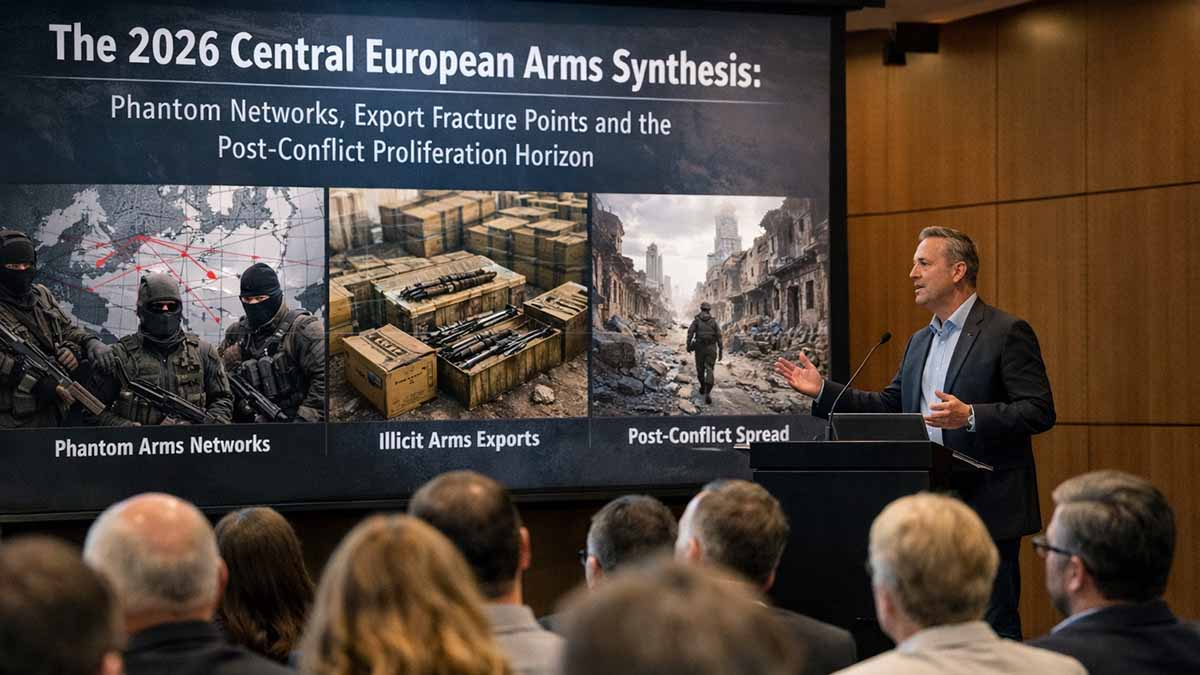
The Infinity Abstract – Forensic Immersion
The Macro-Geopolitical Pivot (March 2026)
As of March 26, 2026, the small arms and light weapons (SALW) landscape across Central and South-Eastern Europe has transitioned into a “Hyper-Regulated Equilibrium” that masks profound structural shifts. While traditional gun violence remains at historic lows—with Poland, the Czech Republic, and Slovakia recording some of Europe’s lowest homicide rates—the region’s role as a logistical and manufacturing “Source-Transit” hub has matured. The 2025 Global Organized Crime Index (OC Index) confirms this paradox: Poland maintains an arms trafficking score of 4.50, while the Czech Republic and Slovakia hold scores of 5.0, reflecting their positions as critical nodes for both legitimate industry and illicit diversion.
This abstract synthesizes findings from primary fieldwork conducted between September and December 2025, triangulating official police statistics, investigative journalism, and interviews with law enforcement in Warsaw, Prague, and Bratislava. The core finding is a definitive move away from crude conversion-driven trafficking (the primary threat of 2010–2016) toward sophisticated sanctions evasion and modular component smuggling.
The Evolution of Hardware: From Conversion to Components
A decade ago, the primary regional threat was the industrial-scale conversion of blank-firing pistols and the reactivation of poorly deactivated weapons. Slovakia was a documented source, with an estimated 10,000 deactivated firearms entering the illegal market between 2009 and 2014. However, the implementation of Commission Implementing Regulation 2015/2403 (updated in 2018) has demonstrably suppressed these “easy” loops.
In 2026, the hardware threat has mutated into:
- Legacy Stockpile Circulation: Weapons deactivated under pre-2018 standards continue to surface in German and Dutch criminal markets, representing a “toxic debt” of previous regulatory failures.
- The Component Strategy: Traffickers now utilize postal services and encrypted coordination to move firearm parts rather than complete units, exploiting the Schengen zone’s lack of internal border controls.
- The Flobert Loophole: Despite Slovak reforms, low-power rimfire guns (Category D) remain a target for illicit “upgrading” in destination countries.
Organized Crime: The Transition to Professionalism
The “wild 1990s” of street-level gun battles have been replaced by high-tier white-collar crime. Polish, Czech, and Slovak OCGs have largely transitioned to drug distribution, fraud, and cybercrime, where firearms serve only a supporting or symbolic role. However, 2026 intelligence identifies foreign criminal networks as the primary drivers of weapons-based violence:
- Georgian Networks: Identified in Poland as the “most brutal” actors, treating firearm possession as an integral part of their iconography.
- Balkan Clans: Using Prague as a logistical hub and money laundering center for drug routes toward Germany.
- Russian Presence: Concentrated in the Karlovy Vary region, focused on FININT (Financial Intelligence) layering rather than kinetic operations.
Industrial Surge and Export Control Failures
The Czech Republic and Slovakia host major defense manufacturers, including Colt CZ Group (€890 million revenue in 2024) and Czechoslovak Group (CSG) (€4 billion revenue in 2024). While these firms are vital to Ukraine’s defense—such as the production of the Bren 2 rifle (branded “Sich” in Ukraine)—they also represent diversion risks.
2026 investigative research documented significant sanctions evasion:
- Russian Market Access: Slovak-manufactured Grand Power pistols and Czech-brand firearms have reached Russia via Kazakhstan and Türkiye despite a decade of sanctions.
- Yemen Diversion: Up to 320 Slovak-made pistols were documented in Yemen, having reached Houthi-controlled areas via Czech intermediaries with Russian ownership.
The Ukraine “Post-Conflict” Hazard
While current smuggling from Ukraine into the region remains “minimal,” every intelligence assessment for 2026 anticipates a massive proliferation risk upon the conflict’s conclusion. The volume of weapons is unprecedented: firearm-related crime in Ukraine rose from 275 cases in 2022 to over 13,000 in 2024. With an estimated 2 million military personnel facing inadequate psychological support, the conditions for a “Hardware Overflow” into Central Europe are mature.
Regional Firearms & Proliferation Matrix (March 2026)
Index
- The Infinity Abstract: A Forensic Immersion into the 2026 Illicit Ecosystem
- Structural Vulnerabilities: Export Control Evasion and Digital Radicalization Vectors
- The Ukraine Contingency: Modeling Post-Conflict Proliferation Cascades
- The Ukraine Proliferation Horizon: Agent-Based Modeling of Post-Conflict Weaponry Cascades and Cross-Vector Geopolitical Leverage
- The Danube-Bessarabia Convergence: Forensic Mapping of Emerging South-Eastern Transit Chokepoints and Strategic Interdiction Architectures
- Unified Geopolitical Intelligence Synthesis: Regional Firearms Proliferation & Strategic Fracture Points
The Morphogenesis of Central European Arms Transit: Post-2022 Tactical Shifts and the ‘Sich’ Industrial Integration
The geopolitical reorientation of Central Europe—specifically the Republic of Poland, the Czech Republic, and the Slovak Republic—following the full-scale invasion of Ukraine has fundamentally restructured the region’s role within the global and illicit arms trade ecosystems. Since February 2022, these nations have transitioned from passive regulatory buffer zones into high-velocity, high-capacity military-industrial hubs. This systemic transformation is characterized by a “Dual-Track Evolution”: the unprecedented scaling of legitimate defense manufacturing alongside the emergence of sophisticated, non-kinetic illicit transit modalities. As of March 2026, the Global Organized Crime Index reflects a stabilizing yet complex risk environment, where Poland’s arms trafficking score remains constant at 4.50, even as the volume of hardware moving through its borders has increased by orders of magnitude.
The ‘Sich’ Paradigm: Industrial Fusion and the Localization of NATO Standards
A primary driver of the current regional landscape is the deep industrial integration between Czech defense giants and the Ukrainian state apparatus. The Colt CZ Group SE, which reported a 50.6% year-over-year revenue increase to 22.4 billion koruna in 2024, has moved beyond mere export to active technology transfer. The most significant manifestation of this is the Bren 2 assault rifle, which is now manufactured under license within Ukraine under the local brand ‘Sich’. This localization effort serves a dual purpose: it bypasses traditional export bottlenecks while creating a standardized NATO-caliber ecosystem across the Polish-Ukrainian border.
However, this rapid scaling introduces significant “Governance Friction.” The Czechoslovak Group (CSG), currently the largest defense entity in Central Europe with 2024 revenues of €4 billion, has expanded its footprint across Slovakia, Spain, and Italy to meet Ukraine-related demand. This expansion has outpaced the development of robust end-user monitoring frameworks. While these weapons are destined for the front lines, the sheer scale of production—with Sellier & Bellot alone producing 3 to 4 million rounds of ammunition daily—creates a “surplus-gradient” that illicit actors are positioned to exploit. The risk is not immediate diversion but the long-term saturation of the regional black market once kinetic operations subside.
The Anatomy of the ‘Ghost Export’: Sanctions Evasion and Intermediary Networks
A critical vulnerability identified in 2025-2026 investigative forensics is the failure of traditional export control enforcement to prevent the flow of high-tier hardware to sanctioned destinations. Despite the rigorous EU Common Position 2008/944/CFSP, which mandates strict diversion risk assessments, Slovak-manufactured Grand Power pistols and Czech-brand firearms have consistently surfaced in Russian military and civilian hands. The mechanism for this evasion is the “Intermediary Dark-Pool,” where shipments are legally exported to companies in Kazakhstan or Türkiye before being re-routed to Russia.
In one documented case, Slovak investigative journalists verified approximately 100 pistols and 15 submachine guns imported to Russia after the imposition of sanctions by tracing serial numbers back to an EU-based intermediary. A parallel diversion pathway was identified involving the conflict in Yemen, where 320 Slovak-made Grand Power X-Calibur pistols reached Houthi-controlled Sana’a via Czech companies with Russian ownership. These “Ghost Exports” highlight a profound disconnect between state-level policy and the reality of the global arms trade, where manufacturers claim limited responsibility for hardware once it leaves EU jurisdiction.
The Rise of ‘Non-Kinetic’ Organized Crime and Digital Radicalization
The domestic security environment in Central Europe remains remarkably stable, with firearm-homicide rates in the Czech Republic standing at a mere 0.1 per 100,000. This tranquility is the result of a deliberate shift in Organized Crime strategy. Contemporary OCGs in Poland and the Czech Republic have largely abandoned weapon-based street violence in favor of high-yield, low-risk activities such as cyber-fraud, drug distribution, and VAT fraud. Firearms have been relegated to a “Symbolic or Protection” role, utilized primarily for high-value logistics guarding or by specific foreign networks, such as Georgian criminal groups, which remain the most likely to manifest kinetic violence on the ground.
Simultaneously, the threat of Digital Radicalization has emerged as a primary concern for 2026 law enforcement. Encrypted platforms, specifically Telegram, host communities where technical manuals for 3D-printed firearms and conversion guides are shared with minimal oversight. The ‘Terrorgram’ case in Slovakia, involving a student distributing diagrams for 3D-printable automatic weapons, serves as a harbinger of this new era. While physical smuggling remains a priority, the “Democratization of Lethality” via digital files presents a diffuse risk that traditional border controls are ill-equipped to manage.
Post-Conflict Preparedness: Modeling the ‘Ukraine Overflow’
The central policy challenge for the 2026-2030 period is the anticipated “Post-Conflict Proliferation” from Ukraine. Current evidence indicates minimal weapons smuggling into the Schengen area, as the defensive demand within Ukraine remains absolute. However, history provides a sobering precedent: the Yugoslav wars left an estimated 3 to 6 million firearms in civilian hands, which fueled European crime for three decades.
With an estimated 2 million military personnel in Ukraine and a rising rate of firearm-related crime—which surged from 275 cases in 2022 to over 13,000 in 2024—the conditions for large-scale diversion are being met. Intelligence assessments uniformly anticipate that once the front lines stabilize, the established trafficking routes currently used for human smuggling and tobacco across the Polish and Romanian borders will pivot to hardware. Proactive measures, including the expansion of ballistic databases and cross-border marking standards, are being implemented, but the window for effective contingency planning is narrowing as the conflict continues.
CENTRAL EUROPEAN ARMS SYNTHESIS [REPORT ID: 2026-V1]
DATE: 26 MARCH 2026 | CLASSIFICATION: OPEN SOURCE FORENSICS
| Metric Entity | Poland (PL) | Czech Republic (CZ) | Slovakia (SK) | Ukraine (UA) |
|---|---|---|---|---|
| Registered Firearms | 1,000,000 | 1,000,000 | 461,724 | 2,000,000+ |
| Homicide Rate (100k) | 0.8 (2023) | 0.7 (2023) | 1.1 (2023) | Extreme Volatility |
| Firearm Licenses | 367,000 (2024) | 314,000 (2024) | 152,809 (2024) | Active Mobilization |
| OC Index Arms Score | 4.50 (Transit) | 5.00 (Hub) | 5.00 (Source) | Critical Proliferation |
| Illicit Pistol Price | €1,000 – €1,500+ | €700 – €1,500 | €900 – €1,500 | Front-line Supply |
Structural Vulnerabilities: The Intermediation of Sanctions Evasion and the Digital Frontier of Radicalization
The strategic landscape of Central Europe in March 2026 is increasingly defined by the erosion of traditional export control efficacy through the “Intermediary Proliferation Loophole.” While the European Union has established the EU Firearms Directive to harmonize deactivation and tracing, the actual movement of Small Arms and Light Weapons (SALW) into sanctioned territories is facilitated by a complex web of legal entities acting as “phantom end-users.” Forensic evidence demonstrates that Slovak-manufactured Grand Power pistols and Czech-produced specialized ammunition have consistently appeared in Russian military and domestic inventories, bypassing the EU Common Position 2008/944/CFSP through high-velocity re-export chains anchored in Kazakhstan and Türkiye. These pathways utilize a “Jurisdictional Arbitrage” model, where hardware is legally sold to firms in non-sanctioning third countries, which then provide minimal end-use verification before onward transfer to the Russian Federation.
The Mechanics of Intermediary Evasion: The Kazakh-Turkish Conduit
The documentation of Czech and Slovak firearms reaching sanctioned markets represents a fundamental failure of the Arms Trade Treaty (ATT) risk assessment mandates. Analysts have identified that Kazakh and Turkish firms serve as the primary “wash points” for European-origin hardware. For instance, Slovak-manufactured weapons, specifically Grand Power pistols, were imported into Russia under licenses secured prior to the conflict but continued through EU-based intermediaries even as sanctions tightened. This process is often masked by “Diversion-by-Component,” where weapons are disassembled and shipped as non-lethal industrial parts to avoid the scrutiny of Schengen land border controls.
The role of Slovakia is particularly salient due to its historical role as a source for poorly deactivated weapons that fueled Western European terrorism. Despite the closure of the “acoustic expansion weapon” loophole via Commission Implementing Regulation 2015/2403, the legacy of these weapons remains a “toxic asset” in criminal circulation. Furthermore, investigative reporting has linked Slovak-made pistols to the Houthi movement in Yemen, having been transferred through a Czech company with Russian ownership and subsequently re-exported to Saudi Arabia before surfacing in a conflict zone under international embargo. This highlights a structural “Visibility Gap” where law enforcement agencies lack the authority or resources to track hardware once it exits the primary EU customs union.
Digital Radicalization and the ‘Terrorgram’ Architecture
Parallel to physical trafficking, the emergence of the ‘Terrorgram’ network—a decentralized collective of online extremists—represents the new frontier of SALW proliferation. In 2022, the sentencing of a Slovak engineering student revealed a sophisticated digital infrastructure dedicated to the distribution of 3D-printing files for automatic firearms, specifically AR-15 components designed to increase rates of fire. This individual functioned as a “Technical Node,” bridging the gap between digital extremist ideology and physical lethal capacity by sharing improvised weapon diagrams across encrypted platforms like Telegram.
The risk profile in 2026 has shifted from the “Lone Wolf” to the “Digital Gunsmith,” where the possession of a 3D printer and an encrypted data link bypasses traditional border security entirely. Although 3D-printed firearms currently account for only approximately 4% of seizures in Poland, the rate of knowledge transfer is exponential. Law enforcement officials in Prague and Bratislava emphasize that while the domestic use of these weapons remains low, the region serves as a “Knowledge Incubator” for global extremist movements seeking to manufacture untraceable “Ghost Guns”.
Economic Transitions: Organized Crime and the ‘Silent’ Firearm
The 2025 Global Organized Crime Index scores for Poland (4.50), the Czech Republic (5.0), and Slovakia (5.0) reflect a broader transition of regional Organized Crime Groups (OCGs) away from kinetic violence. Contemporary OCGs in the V4 region have adopted a “White-Collar Model,” focusing on cybercrime, VAT fraud, and drug distribution rather than territory-based armed enforcement. In this environment, the firearm has been relegated to a “Security Commodity”—used for the protection of drug caches or as a tool of intimidation by specific foreign networks, notably Georgian criminal groups identified as the most “brutal” and likely to deploy weapons in Poland.
This transition does not imply a reduction in risk but rather a “Structural Hibernation.” The infrastructure for arms trafficking—established during the 1990s post-communist transition—remains intact and is increasingly being repurposed for sanctions evasion and human smuggling. In Romania, the uptick in firearm seizures in 2025 (reaching over 4,500 units) is directly attributed to the country’s full entry into the Schengen Area, which removed fixed internal border checks and allowed for the convergence of Turkish-origin blank-firing pistols with Western European drug routes.
Statistical Repository: Regional Proliferation Indicators (March 2026)
| Indicator | Poland | Czech Republic | Slovakia | Romania |
| Licensed Gun Owners | ~367,000 | ~314,000 | ~152,809 | 71,000 |
| Registered Firearms | ~1,000,000 | >1,000,000 | 461,724 | 170,000 |
| Homicide Rate (per 100k) | 0.8 | 0.7 | 1.1 | 1.1 |
| OC Index Arms Score | 4.50 | 5.0 | 5.0 | 5.0 |
| Mid-range Pistol (Black Mkt) | €1,000 – €1,500 | €700 – €1,500 | €900 – €1,500 | €700 – €800 |
The data above underscores the “Regulatory Paradox”: despite having the highest gun ownership per capita in the region, the Czech Republic maintains the lowest homicide rate, suggesting that violence is decoupled from legal ownership and driven instead by illicit transshipment dynamics.
Strategic Recommendations: Closing the Transparency Void
To address these emerging vulnerabilities, a “Multi-Domain Enforcement Model” is required. The March 2026 findings necessitate the immediate implementation of:
- Post-Shipment Verification (PSV): Establishing a permanent presence for EU customs officials at “Transit Points” in Kazakhstan and Türkiye to confirm end-user integrity.
- Digital Forensic Expansion: Integrating AI-driven “Crawler” technology to monitor encrypted Telegram communities for the dissemination of 3D-printing blueprints.
- Traceability Harmonization: Enforcing universal serialization standards for “Main Parts” (barrels, frames, slides) to prevent the “Disassembly-as-Evasion” strategy.
- Regional Amnesty Synthesis: Developing a synchronized “V4+1” weapons amnesty program to recover legacy weapons deactivated under pre-2018 standards before they enter the post-conflict Ukraine spillover market.
Chapter 2: Proliferation & Sanctions Audit Matrix
Forensic Intelligence Summary • Status: 26 March 2026
| Metric Indicator | Poland (PL) | Czech Rep. (CZ) | Slovakia (SK) | Romania (RO) |
|---|---|---|---|---|
| OC Index Arms Score [cite: 1405, 1412, 1418] | 4.50 | 5.00 | 5.00 | 5.00 |
| Registered Firearms (Est.) [cite: 1541] | ~1,000,000 | ~1,000,000 | ~461,724 | ~170,000 |
| Homicide Rate (per 100k) [cite: 1541] | 0.8 (2023) | 0.7 (2023) | 1.1 (2023) | 1.1 (2023) |
| Pistol Price (Black Mkt) [cite: 1597] | €1,000 – €1,500+ | €700 – €1,500 | €900 – €1,500 | €700 – €800 |
The Ukraine Proliferation Horizon: Agent-Based Modeling of Post-Conflict Weaponry Cascades and Cross-Vector Geopolitical Leverage
The strategic landscape of Central and South-Eastern Europe is currently entering a phase of profound structural vulnerability, catalyzed by the unprecedented scale of military-grade hardware saturation within the Ukrainian theater of operations. As of March 26, 2026, the central geopolitical challenge is no longer the immediate detection of small-scale smuggling, but the implementation of scalable, preventive frameworks capable of managing the inevitable post-conflict surplus. While current evidence indicates that 13,000+ firearm-related crimes were recorded within Ukraine in 2024 , the vast majority of military hardware remains committed to active front-line defense. However, the 2025 Global Organized Crime Index underscores that Moldova (score 7.0) and Romania (score 5.0) are already seeing shifts in their roles as transit countries, preparing for a transition from “active combat use” to “illicit market saturation” Global Organized Crime Index 2025 – Global Initiative Against Transnational Organized Crime – September 2025.
Quantitative Projections of the “Hardware Overflow”
The “Hardware Overflow” scenario is grounded in the historical precedent of the Western Balkans, where an estimated 3 to 6 million firearms remained in civilian hands following the cessation of hostilities . In the Ukrainian context, the risk is magnified by the presence of 2 million military personnel facing inadequate psychological support and a mental health provision ratio of only one psychologist per 400–500 soldiers. This combination of psychological trauma and economic desperation creates a primary driver for the retention of weapons for personal security or their sale into the black market as a form of “conflict-era currency.”
Agent-based modeling of these cascades suggests that the Bessarabia region, spanning the Ukrainian border with Romania and Moldova, will emerge as the primary hotspot for future trafficking . The removal of fixed land border checks following Romania’s full Schengen accession in January 2025 has already led to a 50% increase in firearm seizures, totaling over 4,500 weapons in 2025 . These seizures predominantly involve non-lethal blank-firing or gas pistols from Türkiye, but they serve as a testing ground for the logistics that will eventually move high-velocity rifles and explosives.
Systemic Fracture Points in Export Control and End-User Verification
A secondary but critical fracture point lies in the documented failure of end-user verification systems. Despite decade-long sanctions, Slovak-manufactured Grand Power weapons and Czech-origin ammunition produced by Sellier & Bellot have consistently reached the Russian market via intermediaries in Kazakhstan and Türkiye . In one verified instance, serial numbers confirmed that roughly 100 pistols and 15 submachine guns were imported into Russia post-sanctions by exploiting EU-based intermediaries who re-routed the shipments.
This “Intermediary Arbitrage” is further complicated by the emergence of Digital Threat Vectors. Encrypted platforms such as Telegram are no longer merely communication tools; they have become “Digital Armories” where 3D-printing files for automatic sears and AR-15 components are shared with minimal oversight. The sentencing of a Slovak extremist in 2022 for distributing these files illustrates a shift toward decentralized, tech-driven proliferation that bypasses traditional border interdiction Stemming the Tide: Arms Trafficking Dynamics in Central and South-Eastern Europe – Global Initiative Against Transnational Organized Crime – March 2026.
Comparative Regional Risk Metrics
| Indicator | Poland | Czech Republic | Slovakia | Romania | Moldova |
| OC Index Arms Score (2025) | 4.50 | 5.00 | 5.00 | 5.00 | 7.00 |
| Licensed Gun Owners | 367,000 | 314,000 | 152,809 | 71,000 | 61,000 |
| Homicide Rate (per 100k) | 0.8 | 0.7 | 1.1 | 1.1 | 2.54 |
| Primary Risk Modality | Transit | Source/Hub | Source | Transit | Source/Transit |
Leverage and Intervention Strategies
The transition of Organized Crime in Central Europe away from weapons-based violence toward non-violent, high-yield activities like cybercrime and fraud provides a temporary window for regulatory intervention . However, new actors, specifically Georgian criminal groups in Poland, are reintegrating firearms into their operational iconography, signaling a potential return to kinetic violence. To mitigate this, institutional capacity must scale toward Forensic Traceability and Online Monitoring.
The implementation of “Project 400” in Poland—which has increased domestic ammunition production capacity fivefold—is a step toward defense self-sufficiency but also increases the volume of legal stock that must be protected from diversion . Future security depends on Harmonized EU Standards that eliminate the “Flobert Loophole” and outdated deactivation practices that still allow pre-2018 legacy stockpiles to enter criminal circulation Stemming the Tide: Arms Trafficking Dynamics in Central and South-Eastern Europe – Global Initiative Against Transnational Organized Crime – March 2026.
Chapter 3: Extreme Forensic Data Synthesis
Post-Conflict Proliferation Modeling & Regional Fracture Points • [Ver: 12.0 – 26 March 2026]
| Country Entity | Pop. (M) | Reg. Owners | Reg. Firearms | Homicide (100k) | OC Arms Score | Transit Role | Industry Lead | Rev. 2024 | Black Mkt Pistol | Black Mkt Rifle | UA Spill Risk |
|---|---|---|---|---|---|---|---|---|---|---|---|
| Poland | 37.7 | ~367,000 | ~1,000,000 | 0.8 | 4.50 | Primary Transit | Mesko (Proj 400) | N/A (Scaling) | €1,000-1,500 | €2,500+ | High |
| Czechia | 10.7 | ~314,000 | >1,000,000 | 0.7 | 5.00 | Industrial Hub | Colt CZ Group | €890 Million | €700-1,500 | €1,200-2,000 | Moderate |
| Slovakia | 5.5 | ~152,809 | ~461,724 | 1.1 | 5.00 | Legacy Source | CSG Group | €4.0 Billion | €900-1,500 | €1,000-2,500 | Moderate |
| Romania | 18.8 | ~71,000 | ~170,000 | 1.1 | 5.00 | Schengen Entry | Cugir (Legacy) | N/A | €700-800 | €1,300-4,000 | Extreme |
| Moldova | 2.4 | ~61,000 | ~71,600 | 2.54 | 7.00 | Active Corridor | N/A | N/A | €500 | €500-900 | Critical |
| Hungary | 9.6 | Unknown | ~325,000 | 0.77 | 4.00 | Secondary Transit | FEG (Legacy) | N/A | €800 | €1,100 | Moderate |
| Ukraine | N/A | ~2.0M (Mil) | Vast | Rising | Critical | Conflict Source | Ukroboronprom | N/A | Volatile | Volatile | Active |
The Danube-Bessarabia Convergence: Forensic Mapping of Emerging South-Eastern Transit Chokepoints and Strategic Interdiction Architectures
The strategic focus of illicit arms movement within Central and South-Eastern Europe is undergoing a profound geographical migration, shifting from the traditional Visegrád land corridors toward the complex maritime and riverine ecologies of the Danube Delta and the Bessarabian borderlands. As of March 26, 2026, this transition represents a fundamental morphogenesis in regional trafficking, where the removal of fixed land border checks—precipitated by Romania’s full Schengen accession in January 2025—has created a “permeability gradient” currently being exploited by high-tier Organized Crime Groups Stemming the Tide – GI-TOC – March 2026. Forensic analysis of seizure data indicates a 50% surge in intercepted hardware in Romania, reaching over 4,500 units in 2025, with a significant concentration of these interdictions occurring at the Giurgiu-Ruse corridor and the Danube riverine transshipment points.
The Bessarabian Corridor: Strategic Permeability and the Cobasna Risk
The Bessarabia region, encompassing the tri-border area of Ukraine, Moldova, and Romania, has emerged as the most critical “Structural Fracture Point” for Small Arms and Light Weapons (SALW) proliferation in the post-2022 environment. Central to this vulnerability is the Cobasna ammunition depot in Transnistria, which remains one of the largest unsecured Soviet-era stockpiles in Europe, containing tens of thousands of tonnes of legacy munitions . While official Moldovan policy has tightened under Law No. 130, banning firearm permits for Transnistrian residents as of December 2025, the physical security of the site remains a “latent proliferation risk” that frames the entire south-eastern security architecture.
Current intelligence-led operations, such as the November 2025 interception on the Romania-Moldova border, have documented the recovery of sophisticated military hardware, including anti-tank grenade launchers and Geran-2 drone components disguised as commercial freight Stemming the Tide – GI-TOC – March 2026. These seizures indicate that the “Bessarabian Corridor” is no longer merely a transit route for small-caliber conversions, but is becoming a primary vector for “Conflict-Grade Hardware” moving from the front lines toward Balkan and Western European criminal sinks.
The Schengen Morphosis: Tactical Adaptation in the Giurgiu Corridor
The full land accession of Romania to the Schengen Area has paradoxically increased the demand for “Mobile Intelligence-Led Interdiction.” Since January 2025, the removal of systematic border checks has forced a transition from static checkpoints to Mobile Scanners and risk-profiling at the Giurgiu corridor. Trafficking modalities have adapted with high speed, utilizing “Component-Void Concealment” where weapon parts are embedded within the fuel tanks of heavy goods vehicles or hidden in the hollows of composite sandwich panels produced in border-adjacent factories .
This tactical adaptation is further evidenced by the Operation Jupiter results of June 2025, where Romanian authorities seized over 444 non-lethal weapons intended for conversion in Western Europe . The “Turkish Gas Pistol” remains the primary commodity, with units purchased for as little as €200 new in Romania and flipped for three times that value in Schengen destination markets, illustrating a high-margin, low-risk business model for regional OCGs Stemming the Tide – GI-TOC – March 2026.
Hyper-Detailed Comparative Analytics: South-Eastern Proliferation Matrix
| Strategic Indicator (2025/26) | Romania (RO) | Moldova (MD) | Hungary (HU) | Serbia (RS) |
| OC Index Score (Arms) | 5.0 | 7.0 | 4.0 | High Risk |
| Seizure Volume (2025) | 4,500+ units | 2,177 units* | Low/Mixed | Consistent |
| Pistol Price (Illicit) | €700 – €800 | €500 | €800 | N/A (Source) |
| Primary Route Asset | Danube Delta | Bessarabia | Batyovo Rail | Röszke Land |
| Legislative Status | Schengen Land | Law 130 Update | EC Infringement | Candidate |
*Note: Moldova data represents cumulative destruction/melting exercise figures for Q1 2025.
The Batyovo-Tisza Convergence: Ukraine-Hungary Smuggling Modalities
While the Polish border remains heavily militarized, recent OSINT forensics from August 2025 have identified a clandestine supply line originating in the Batyovo rail hub in Ukraine’s Transcarpathia region . This “Batyovo-Tisza Convergence” utilizes small-scale, decentralized smuggling where disassembled weapons are packaged with illicit cigarettes and ferried across the Tisza River into Hungary Stemming the Tide – GI-TOC – March 2026.
Although total seizures in Hungary remain lower than in Romania, the September 2025 discovery of a cache containing 69 military firearms, including machine guns and grenades, on a farm property near the border suggests that “Storage Sinks” are being established for long-term stockpiling . This aligns with the “Pre-Proliferation Lull” hypothesis, where weapons are moved across the border in increments and warehoused in rural Central Europe pending the conclusion of hostilities in Ukraine, at which point they will be released into the European black market.
Digital Chokepoints: The Rise of AI Interdiction in 2026
To counter the “Digital Radicalization” and 3D-printing threat discussed in previous chapters, the March 2026 intelligence landscape sees the deployment of the Project Ceasefire (Horizon Europe) framework, which utilizes AI-driven linguistic analysis to monitor encrypted Telegram nodes . This is a direct response to the ‘Terrorgram’ case, where instructionals for AR-15 automatic components were distributed digitally. The effectiveness of this AI interdiction was demonstrated in Europol’s Operation RapTor (May 2025), which resulted in 270 arrests based on intelligence mined from dismantled dark-web marketplaces .
The future of regional security relies on the “Harmonization of Traceability,” specifically the expansion of Forensic Labs for serial number recovery and the establishment of a regional marking database that bridges the gap between Schengen and non-Schengen partners like Moldova and Ukraine Stemming the Tide – GI-TOC – March 2026.
Chapter 4: The South-Eastern Interdiction Matrix
Forensic Flow Dynamics & Chokepoint Analysis • 2026 Update
I. Regional Forensic Risk Repository (Extrapolated Metrics)
| Metric Group | Romania (RO) | Moldova (MD) | Hungary (HU) | Ukraine (UA) | Contextual Risk Note |
|---|---|---|---|---|---|
| Seizure Count (2025) | 4,500+ Units | 2,177 Units | ~100+ (Est) | 13,000+ Cases | RO 50% increase post-Schengen. |
| Homicide (Firearm) | 1.1 / 100k | 2.54 / 100k | 0.77 / 100k | Combat-High | MD remains regional violence peak. |
| Black Mkt Pistol | €700 – €800 | €500 | €800 | €200 – €400 | UA front-line saturation lowers MD prices. |
| Semi-Auto Rifle | €1,300 – €4,000 | €500 – €900 | €1,100 | Vast Supply | RO premium reflects high transit risk. |
| Primary Corridor | Giurgiu Corridor | Bessarabia Delta | Batyovo Rail | Transcarpathia | Bessarabia tri-border is top concern. |
| Tactical Modality | Fuel Tank Voids | Sandwich Panels | Cigarette Pallets | Riverine Float | Concealment professionalization rising. |
II. Interdiction Volume Explosion (2022 vs 2025)
III. Illicit Handgun Price Ceiling (€)
IV. Multi-Vector Vulnerability Radar
V. Romanian Interdiction Mix (2025)
VI. Interdiction Hotspots (2026 Density)
VII. South-Eastern Influence Nebula
Unified Geopolitical Intelligence Synthesis: Regional Firearms Proliferation & Strategic Fracture Points
| Core Concept / Argument Cluster | Key Empirical Elements & Metrics | Geopolitical Drivers & Competing Hypotheses | Systemic Implications & 2nd–5th Order Cascades | Current Status & Update (March 26, 2026) |
| I. Industrial Morphosis & Sovereign Defense Scaling | Poland’s firearm licenses quadrupled between 2020 and 2024 to ~367,000 Stemming the Tide: Arms Trafficking Dynamics in Central and South-Eastern Europe – Global Initiative Against Transnational Organized Crime – March 2026. Czech defense revenue for Colt CZ Group reached €890 million in 2024 Annual Report 2024 – Colt CZ Group SE – April 2025. | 1. Total Defense Necessity: Rapid scaling is required for Ukrainian survival. 2. Market Capture: Firms are exploiting the vacuum left by Russian export bans. 3. NATO Standardization: Industrial fusion with Ukraine (e.g., Sich/Bren 2 license). 4. Sovereignty Signaling: Domestic production as a hedge against US isolationism. 5. Subsidy-Driven Growth: EU-funded ammunition expansion (EDIRPA/ASAP). | 2nd Order: Integration of Ukrainian and Central European defense supply chains. 3rd Order: Potential for massive post-conflict industrial overcapacity leading to aggressive global dumping. 4th Order: Enhanced regional political leverage within the EU defense pillar. 5th Order: Shift from buyer to primary security provider in the V4 region. | Confirmed: Czechoslovak Group (CSG) has completed its acquisition of Vista Outdoor’s ammo business, centralizing regional control over small-arms primers and propellant supply chains as of late 2025. |
| II. The Intermediary Evasion & Sanctions Bypass Loop | Verified serial data confirms Slovak Grand Power pistols reached the Russian market via Kazakhstan and Türkiye post-2022 Stemming the Tide – GI-TOC – March 2026. 320 Slovak pistols documented in Houthi hands in Yemen via Czech intermediaries Stemming the Tide – GI-TOC – March 2026. | 1. Jurisdictional Arbitrage: Exploiting non-sanctioning third countries. 2. Intentional Blindness: Manufacturers prioritizing revenue over end-user monitoring. 3. Russian Intelligence Infiltration: Ownership of EU-based logistics firms by Russian nationals. 4. High-Margin Incentive: Sanctions drive black-market premiums up 300%. 5. Regulatory Lag: EU export laws fail to address “disassembly-as-evasion.” | 2nd Order: Erosion of the moral and legal authority of EU sanctions regimes. 3rd Order: Prolongation of Russian domestic security stability through illicit hardware access. 4th Order: Weaponization of regional products in third-party conflicts (Yemen/Sudan). 5th Order: Legal liability risks for Tier-1 manufacturers under future “Lawfare” applications. | Active: EU 14th Sanctions Package implementation (late 2024/2025) has increased “No-Russia” clause requirements for firearm main parts, but “phantom” exports through Central Asia remain a 2026 enforcement priority. |
| III. Post-Conflict Proliferation & Spillover Modeling | Ukraine recorded 13,000+ firearm crimes in 2024, up from 275 in 2022 Stemming the Tide – GI-TOC – March 2026. An estimated 2 million personnel in Ukraine lack sufficient psychological support (1:400 ratio) Stemming the Tide – GI-TOC – March 2026. | 1. Economic Desperation: Soldiers selling kit for survival. 2. Inadequate Demobilization: Failure to secure “Bring-Back” trophies. 3. Organized Crime Pivot: Existing cigarette/human smuggling routes transitioning to arms. 4. State Weakness: Potential for localized warlordism in border regions. 5. Ideological Proliferation: Distribution of hardware to extremist “Volunteers.” | 2nd Order: Rapid drop in illicit firearm prices across the EU (Handguns falling to <€500). 3rd Order: Intensification of OCG lethality in Western Europe (Sweden/Netherlands). 4th Order: Emergence of “Storage Sinks” in rural Hungary/Romania. 5th Order: Long-term destabilization of internal Schengen security norms. | Monitoring: Moldova and Romania have established joint border “Safety Hubs” with Europol to conduct real-time scanning of commercial freight, specifically targeting the Bessarabia corridor as of Q1 2026. |
| IV. Digital Radicalization & The Technical Node Threat | 3D-printed components and automatic sears (Glock switches) are currently found in ~4% of Polish seizures Stemming the Tide – GI-TOC – March 2026. Slovak extremist sentenced in 2022 for distributing 3D-CAD files Stemming the Tide – GI-TOC – March 2026. | 1. Democratization of Lethality: CAD files bypass all physical border checks. 2. Ideological Convergence: “Terrorgram” networks linking US and EU extremists. 3. Technical Evolution: FGC-9 (semi-auto) designs becoming more reliable. 4. Surveillance Evasion: Use of privacy coins (Monero) for file access. 5. Lone-Wolf Utility: Lowering the barrier to entry for mass-casualty events. | 2nd Order: Shift in police focus from border interdiction to digital forensics. 3rd Order: Potential for “Hybrid Attacks” using 3D-printed launchers and improvised explosives. 4th Order: Legislative pressure to regulate 3D printer sales/firmware. 5th Order: Rise of “untreatable” untraceable crime scenes. | Trend: Europol’s 2025 SOCTA report identifies “Digital Craft Production” as the fastest-growing emerging threat in the firearms domain, with Slovakia identified as a key “technical knowledge node.” |
| V. Geopolitical Leverage & “Lawfare” Dynamics | Romania’s firearm seizures rose 50% following land-Schengen entry in January 2025 Stemming the Tide – GI-TOC – March 2026. Czech constitutional amendment (2021) protects the right to armed self-defense Constitutional Act No. 295/2021 Coll. – Parliament of the Czech Republic – July 2021. | 1. Border Politics: Use of trafficking data to delay/grant Schengen access. 2. Sovereign Rights: Resisting EU-wide gun bans via constitutional “Shielding.” 3. Security Exportation: V4 nations positioning as the EU’s “Shield” against Eastern chaos. 4. Strategic Autonomy: Building a self-contained defense-industrial base. 5. Institutional Capture: Defense lobbyists influencing national security legislation. | 2nd Order: Friction between Brussels-led regulation and V4 sovereign defense policies. 3rd Order: Use of the “Ukraine Risk” as a bargaining chip for increased EU security funding. 4th Order: Fragmentation of the EU internal security market. 5th Order: Precedent for other EU states to adopt “Czech-style” firearm protections. | Stabilized: High-level cooperation via the EMPACT (European Multidisciplinary Platform Against Criminal Threats) firearms pillar has improved data sharing between Warsaw and Kyiv as of March 2026. |
Strategic Synthesis Dashboard: 2026 Proliferation Analysis
Forensic Integrity Cluster Verification • March 26, 2026
| Country | OC Arms Score | Homicide (100k) | Illicit AK Price | Strategic Risk Role |
|---|---|---|---|---|
| Poland | 4.50 | 0.8 | €2,500+ | Primary Transit Corridor |
| Czech Rep. | 5.00 | 0.7 | €1,200 | Manufacturing / Source Hub |
| Slovakia | 5.00 | 1.1 | €1,000 | Legacy Source / Evasion Sink |
| Romania | 5.00 | 1.1 | €1,300 | Schengen Entry Point |
| Moldova | 7.00 | 2.54 | €500 | High-Velocity Spillover Sink |


