














Abstract
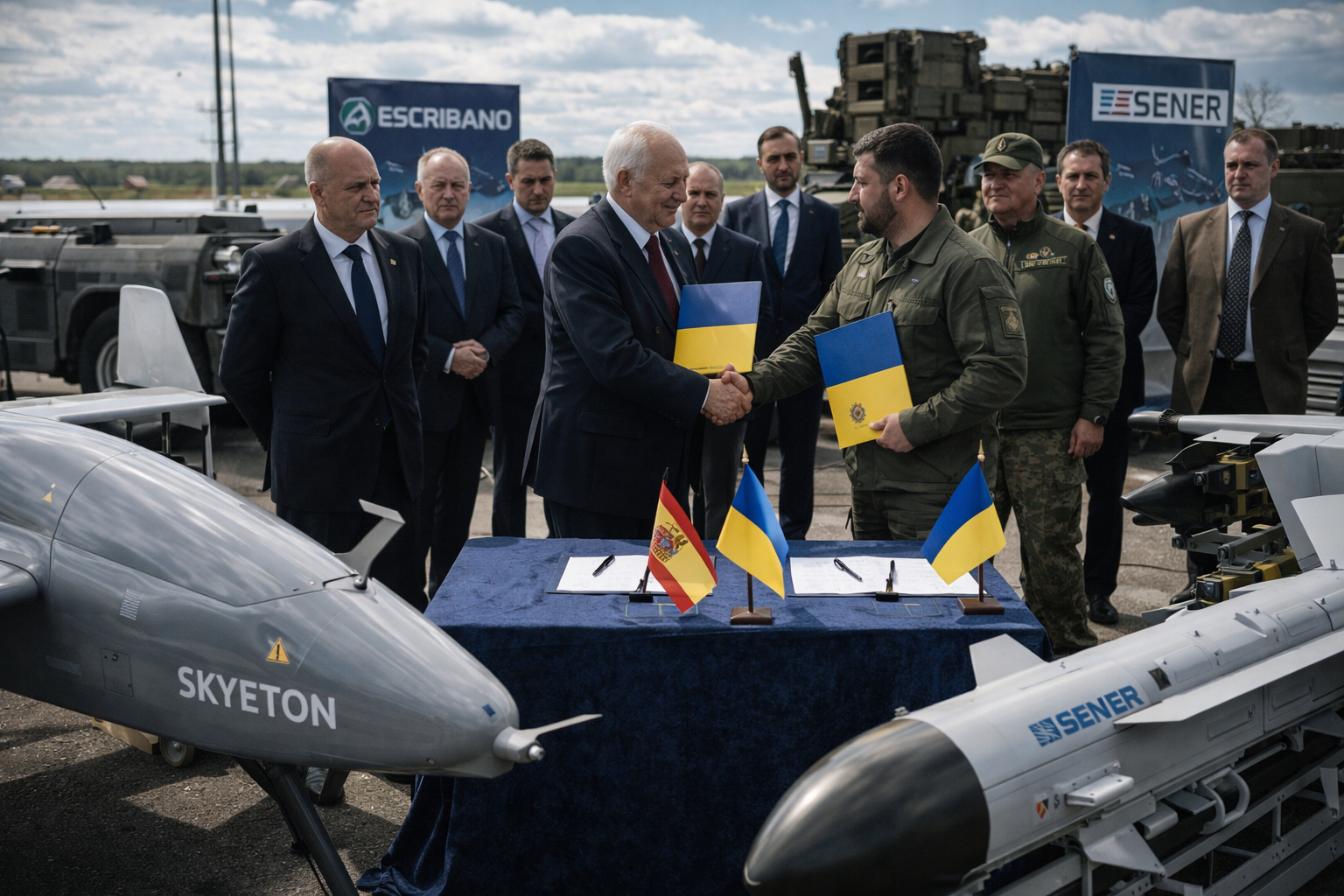
The verified core event is now clear. On 18 March 2026, during President Volodymyr Zelenskyy’s visit in Madrid, the Office of the President of Ukraine publicly stated that three agreements were signed between Fire Point, State Kyiv Design Bureau Luch, and Radionix on one side, and Sener Group on the other, with the stated focus being collaboration in the missile sector and air defence. In the same official release, the presidency also stated that Skyeton and Escribano concluded a separate cooperation agreement under which the two companies will jointly develop and manufacture strike laser-guided systems based on Ukrainian-made unmanned systems.
That official presidential language matters because it narrows the analytic aperture from rumor to state-validated industrial intent. The phrase “jointly develop and manufacture strike laser-guided systems based on Ukrainian-made unmanned systems” indicates not merely a distribution arrangement, not merely maintenance support, and not merely an export memorandum, but an intended industrial workflow joining a Ukrainian unmanned platform with a Spanish fire-control / weapon / optoelectronic industrial base. The agreement therefore sits at the intersection of three converging trends: Ukrainian wartime combat innovation, Spanish defence-electromechanical specialization, and a wider Europeanization of defence manufacturing in which capability is increasingly co-produced across borders rather than delivered only as finished-state aid packages.
The most plausible Ukrainian platform anchor is Skyeton’s Raybird UAS, because Skyeton identifies Raybird as its flagship system and publicly markets it not only for reconnaissance but explicitly for “Targeting and Precision Fire Control.” On the current official Skyeton product pages, Raybird is listed with 28+ hours of endurance, 2,500 km maximum range, 5,500 m maximum altitude, 200+ km data-link range, and 5–10 kg payload capacity. Skyeton has also publicly stated that Raybird has already been upgraded with a laser illumination system for guiding munitions, and separately unveiled Remora, a payload-format delivery system intended for integration with Raybird. Taken together, those official disclosures make the presidential formulation highly coherent: the industrial logic is not abstract. A Ukrainian company already possessing a long-endurance UAS, an existing laser-designation pathway, and a payloadized precision-delivery concept is now pairing with a Spanish company whose portfolio includes remote weapon stations, rocket-capable stations, electro-optical systems, and robotics.
On the Spanish side, the industrial partner’s profile is equally consequential. EM&E Group / Escribano officially presents a portfolio spanning electro-optical systems for target detection, recognition, identification and tracking in the visible and infrared ranges, along with a family of remotely operated systems including SENTINEL variants and autonomous/teleoperated robotic platforms. One official EM&E page states that the SENTINEL ROCKET is a two-axis stabilized station equipped with a rocket launcher and advanced fire-control features, while the company’s OTEOS electro-optical family is designed for multi-platform integration and target tracking. This means the Ukrainian–Spanish pairing is not a random diplomatic artifact: Skyeton contributes a fielded unmanned airframe, endurance, and Ukrainian battlefield adaptation; Escribano contributes the mature electromechanical, stabilization, and sensing logic that can turn a reconnaissance platform into a more credible precision-strike node.
The deeper significance lies in the fact that this agreement emerges after a prior documented Ukraine–Escribano relationship. On 13 May 2025, Ukrainian Defense Industry JSC (Ukroboronprom) announced that one of its enterprises signed a memorandum with Escribano covering the repair and maintenance of Spanish combat modules, the joint development of new variants, and their licensed manufacture in Ukraine. On 3 May 2025, the same official Ukrainian source stated that Guardian remote-controlled turret modules made by Escribano were already being supplied to Ukraine, were being considered for integration onto Soviet-designed armored vehicles, and were relevant against low-altitude aerial targets and light armored vehicles. The present Skyeton–Escribano agreement should therefore not be interpreted as a standalone surprise; it appears instead as a second-stage expansion from ground combat-module cooperation into the UAS-guided strike domain.
Parallel logic applies to the Sener agreements, but in a different technological lane. The Office of the President said the Fire Point–Luch–Radionix / Sener arrangements focus on the missile sector and air defence. Sener’s own official statement following Zelenskyy’s visit says that Fire Point, Luch and Radionix are leading companies in missiles and autonomous systems, and that the alliance will reinforce cooperation in sectors strategic for European defence. It also states that Sener is internationally recognized for actuation and control systems for missiles and guidance systems, for communications including COMINT and data links, and for autonomous systems including target drones. Separate Sener official pages substantiate that profile: the company states that it participates in IRIS-T programs by producing control sections and wings for air-to-air IRIS-T and developing the control section for surface-to-air IRIS-T SL missiles; that it builds target drones for live-fire and radar-calibration roles; and that it supplies communications components and subsystems for satellites and secure space connectivity.
In structural terms, the Madrid package therefore appears to be a dual-track industrial maneuver. Track one joins Ukrainian UAS combat adaptation with Spanish optoelectronic / guided-fire hardware through Skyeton–Escribano. Track two joins Ukrainian missile / air-defence firms with a Spanish precision-guidance and autonomous-systems house through Sener. Together, the result is not only a collection of bilateral signatures; it is an embryonic cross-border kill-chain industrialization model in which sensing, designation, guidance, control, and manufacturing resilience are distributed across allied jurisdictions. That reduces single-point vulnerability, increases surge flexibility, and embeds Ukraine’s battlefield innovation cycle deeper into the European defence-industrial architecture.
From an ICD 203-style confidence perspective, the highest-confidence findings are narrow but important. High confidence: four cooperation agreements were publicly confirmed on 18 March 2026, one involving Skyeton–Escribano and three involving Fire Point / Luch / Radionix–Sener. High confidence: the officially stated technology lanes are laser-guided strike systems based on Ukrainian unmanned systems for the former, and missiles / air defence for the latter. High confidence: Skyeton officially markets a suitable long-endurance UAS, Raybird, and has already announced both a laser illumination system and the Remora payload concept. High confidence: Escribano and Sener possess official, documented capabilities relevant to fire control, electro-optics, missile actuation, target drones, and autonomous systems.
What remains unverified on a primary-source basis is equally important. Neither the Office of the President, Skyeton, Escribano, nor Sener has publicly disclosed in the official sources reviewed here the specific munition model, production allocation, assembly location, volume targets, delivery schedule, funding mechanism, or command-and-control integration architecture for the Skyeton–Escribano product. I have also not found, in the official sources reviewed during this session, primary-source confirmation for the user-supplied claims about the 14 March second test launch of an FP-7 ballistic missile or the use of FP-1 as an interceptor-drone carrier, so those points are excluded from the evidence base here. This omission is methodological rather than dismissive: the current record supports the agreements themselves and the industrial capability logic around them, but not every additional operational detail circulating outside the official-source layer.
The strategic consequence of that evidentiary boundary is that analysis should focus on capabilities and incentives rather than on assumed weapon specifications. The most defensible interpretation is that Ukraine is using wartime demand to externalize selected parts of its defence-industrial scaling problem into European partner ecosystems, while preserving control over the combat-proven platform layer. Spain, through firms such as Sener and Escribano, gains a route into the fastest-feedback combat laboratory in Europe without having to originate the entire unmanned architecture domestically. This is industrial reciprocity under wartime conditions: Ukraine supplies urgency, iteration tempo, operational testing, and increasingly mature platform know-how; Spanish firms supply certified manufacturing depth, electromechanical subsystems, guidance expertise, and access to broader European industrial networks.
Five mutually exclusive explanatory frameworks help discipline interpretation.
Framework 1: Immediate battlefield optimization. Under this view, the agreements primarily seek the fastest path to fieldable gains in precision strike and air defence, with diplomacy acting as an enabler rather than the core driver. The evidence supporting this includes the direct presidential emphasis on air defence, the strike-system wording for Skyeton–Escribano, and the missile / air-defence focus for the Sener arrangements. Red-team objection: this framework may underweight long-cycle industrial motives, because the official language also signals manufacturing collaboration rather than only short-term procurement.
Framework 2: European defence-industrial integration. Here, the signatures are best seen as another step in knitting Ukraine into a distributed European defence production web. Support comes from Sener’s own language about strategic sectors for European defence and from the prior Ukroboronprom–Escribano memorandum centered on repair, development, and licensed production in Ukraine. Red-team objection: Europeanization may be a consequence rather than the principal intent; the immediate wartime problem could still dominate.
Framework 3: Supply-chain risk diversification. In this reading, the main value is redundancy. Ukraine reduces dependence on any single geography for precision-strike subsystems, while Spain’s firms diversify into a rapidly growing defence segment with demonstrated wartime relevance. The official evidence for manufacturing cooperation across multiple domains supports this. Red-team objection: without disclosed production footprints, diversification remains inferred rather than explicitly stated.
Framework 4: Technology harvesting and reciprocal learning. This interpretation emphasizes two-way adaptation: Spanish firms gain exposure to Ukrainian battlefield-driven iteration, while Ukrainian firms gain access to mature subsystem engineering in guidance, stabilization, and optics. The technological complementarity documented on the official product pages strongly supports this. Red-team objection: actual knowledge-transfer depth is not yet disclosed, so the scale of reciprocity cannot be measured.
Framework 5: Political signalling with delayed materialization. Under the most skeptical explanation, the agreements are genuine but early-stage, serving partly as political demonstrations of support while concrete production lags. This remains plausible because no official source reviewed here provides quantities, timelines, or delivery milestones. Red-team objection: the prior Escribano–Ukroboronprom cooperation and the specificity of the industrial sectors involved make pure symbolism less convincing than in a typical ceremonial MoU.
My Bayesian judgment is that Framework 2 and Framework 1 jointly dominate: this is most likely an effort to convert urgent wartime operational demand into durable European co-production architecture, with immediate battlefield utility and long-term industrial integration moving in parallel rather than in sequence. That conclusion is supported by the coexistence of short-cycle strike/UAS language and longer-cycle missile, air-defence, licensed-production, and strategic-autonomy signals across the official record.
A final analytic point deserves emphasis. The most important output of these agreements may not be a single named weapon. It may instead be the creation of a Westernized modular integration corridor: Ukrainian airframes and combat-learning loops on one side; Spanish electro-optics, actuation, missile-control, target-drone, and communications subsystems on the other. In practical strategic terms, that means the real product is not only a future munition or drone derivative. The real product is an industrial grammar for coalition warfare production inside Europe, designed under combat pressure and validated by direct head-of-state endorsement.
Raw Reference Table
| Element | Verified Value | Analytical Relevance |
|---|---|---|
| Skyeton–Escribano agreement | Joint development and manufacture of strike laser-guided systems based on Ukrainian unmanned systems | Connects Ukrainian UAS platforms with Spanish optics/fire-control engineering |
| Fire Point / Luch / Radionix – Sener | 3 agreements focused on missiles and air defence | Expands missile and air-defence co-production corridor |
| Raybird endurance | 28+ hours | Supports persistence for designation, targeting, and relay roles |
| Raybird range | 2,500 km | Enables deep operational reach |
| Raybird payload | 5–10 kg | Supports modular mission packages |
| Remora payload system | 1.5–2.5 kg cargo, 140 km/h post-release velocity | Demonstrates existing Skyeton payload modularity |
| Sener defence profile | Missile actuation/control, target drones, autonomous systems, communications | Provides mature subsystem depth for European integration |
| Escribano profile | Electro-optics, weapon stations, robotics | Provides stabilized sensing / guidance ecosystem for strike adaptation |
Verified Capability Stack
Mission-Domain Balance
Agreement Architecture
One agreement binds UAS + laser-guided strike integration; three agreements bind missiles + air defence. The structure indicates parallel industrial lanes rather than a single narrow procurement act.
GraphRAG / Industrial Relationship Map
INDEX
- Industrial Architecture and Cross-Domain Capability Convergence in the Emerging Ukraine–Spain Defence Co-Production Corridor
- Systemic Power Projection, Industrial Network Topology, and Multi-Domain Escalation Pathways in the Ukraine–Spain Defence Convergence Architecture
- Decision Hygiene, Institutional Friction, and Execution Architecture in the Emerging Ukraine–Spain Defence Co-Production Corridor (Status: 19 March 2026)
Core Concepts in Review: What We Know and Why It Matters
The clearest place to begin is with what is officially confirmed, because this entire story can sound more speculative than it actually is if one starts with concepts rather than documents. On 18 March 2026, the Office of the President of Ukraine stated that Skyeton and Escribano signed a cooperation agreement to jointly develop and manufacture strike laser-guided systems based on Ukrainian-made unmanned systems The President Met with the Leadership of the Spanish Sener Group to Discuss Strengthening Ukraine’s Air Defense – Office of the President of Ukraine – March 2026. The same official release stated that Fire Point, State Kyiv Design Bureau Luch, and Radionix signed three separate cooperation agreements with Sener focused on the missile sector and air defense The President Met with the Leadership of the Spanish Sener Group to Discuss Strengthening Ukraine’s Air Defense – Office of the President of Ukraine – March 2026. That means the core event is not rumor, not media interpretation, and not a generic memorandum without sectoral specificity; it is a state-announced industrial package covering UAS-enabled strike, missiles, and air defense The President Met with the Leadership of the Spanish Sener Group to Discuss Strengthening Ukraine’s Air Defense – Office of the President of Ukraine – March 2026.
That narrow factual base matters because it changes the nature of the analysis. We are not asking whether Ukraine and Spain might someday cooperate in defence. They already are, and at a level visible enough to be framed by the Ukrainian presidency as part of a broader strategic visit to Madrid Ukraine and Spain Agreed on Defense Products to Be Produced under the SAFE Instrument for Ukraine’s Needs – Volodymyr Zelenskyy – Office of the President of Ukraine – March 2026. We are also not looking at a purely bilateral symbolic exchange, because the same day President Volodymyr Zelenskyy said that Ukraine and Spain agreed on a list of defence products to be produced under SAFE, and that Ukraine was working with European states, including Spain, so that SAFE resources could also finance production in Ukraine Ukraine and Spain Agreed on Defense Products to Be Produced under the SAFE Instrument for Ukraine’s Needs – Volodymyr Zelenskyy – Office of the President of Ukraine – March 2026. In other words, what we know is not just that firms signed papers. What we know is that a state-backed industrial corridor is being described in terms of joint production, cross-border financing, and European defence integration The President Met with the Presidents of Both Chambers of the Spanish Cortes Generales – Office of the President of Ukraine – March 2026. Why that matters is simple: once cooperation moves from procurement toward co-production, it stops being only about delivering hardware and starts becoming about reshaping the industrial map of European security.
The second core concept is technological complementarity, which is the real reason this package deserves serious attention. Skyeton is not a small speculative startup with an unproven brochure platform; on its official product page, Raybird is listed with 28+ hours of flight duration, 2,500 km maximum flight range, 5,500 m maximum altitude, 200+ km data-link range, and 5–10 kg payload capacity Raybird – Skyeton – November 2025. Those figures matter because they place the platform well beyond the category of disposable short-range tactical quadcopters and into the category of persistent unmanned systems able to loiter, observe, designate, relay, and potentially support precision effects over longer periods Raybird – Skyeton – November 2025. Skyeton also publicly markets Raybird not only for surveillance logic but for targeting and precision fire control, which is a crucial clue about how the company itself sees the platform’s operational role Raybird – Skyeton – November 2025. Separate official company material on Remora presents a modular UAV delivery system linked to the same ecosystem, with a stated 1.5–2.5 kg delivery capacity and 140 km/h post-release velocity REMORA – Skyeton – October 2025. That does not prove the future Spanish-Ukrainian product will be Remora, and it would be methodologically wrong to claim that. But it does prove that the Ukrainian side already thinks in terms of modular unmanned payload adaptation, not just aerial reconnaissance REMORA – Skyeton – October 2025.
The Spanish side is equally important because it supplies the subsystem logic that makes a platform ecosystem operationally meaningful. EM&E Group describes itself on its official homepage as a Spanish defence and security group focused on the design, development, and manufacture of complex defence solutions, and the same page states a footprint of 1,300 employees across 25 countries HOME – EM&E Group – March 2026. That scale matters because it suggests industrial depth rather than boutique experimentation HOME – EM&E Group – March 2026. On its official electro-optical systems page, EM&E states that its OTEOS family is designed, developed, and manufactured entirely by the group, and that those systems are modular, stabilized, and intended for the detection, recognition, identification, and tracking of targets in both visible and infrared ranges ELECTROOPTICAL SYSTEMS – EM&E Group – March 2026. On its official SENTINEL page, EM&E states that SENTINEL ROCKET is a two-axis stabilized station with a rocket launcher and advanced fire-control system, and that its electro-optical system supports day-and-night operation SENTINEL – EM&E Group – March 2026. On its official guidance systems page, EM&E also describes Alkon as a guidance kit concept intended to convert ordinary ammunition into guided ammunition for rockets, howitzers, and mortars through GPS, GNSS, INS, algorithm development, impact prediction, and flight simulation GUIDANCE SYSTEMS – EM&E Group – March 2026. Put plainly, Skyeton brings the airframe and wartime iteration culture; Escribano brings sensing, stabilization, guidance, and fire-control depth The President Met with the Leadership of the Spanish Sener Group to Discuss Strengthening Ukraine’s Air Defense – Office of the President of Ukraine – March 2026. Why that matters is that many defence partnerships fail because both parties bring the same thing. This one is potentially interesting because each side brings what the other lacks.
The third core concept is that the Sener side of the package broadens the story from drones into the harder, more strategic domain of missile and air-defence industrialization. In its own official release on 18 March 2026, Sener said it signed collaboration agreements with Fire Point, Luch, and Radionix to develop defence technologies in areas matching Sener’s expertise: missiles, communications, and autonomous systems Zelensky visits Sener to strengthen industrial Defence cooperation with Ukrainian companies – Sener Group – March 2026. The same official statement described Fire Point, Luch, and Radionix as leading companies in missiles and autonomous systems and said the agreements would strengthen cooperation in sectors strategic for European defence Zelensky visits Sener to strengthen industrial Defence cooperation with Ukrainian companies – Sener Group – March 2026. That language is important because it is not limited to bilateral support for Ukraine. It openly places the package inside a wider European defence frame Zelensky visits Sener to strengthen industrial Defence cooperation with Ukrainian companies – Sener Group – March 2026.
The reason that matters becomes clearer when one looks at Sener’s own programmatic footprint. On its official project page for IRIS-T and IRIS-T SL control sections, Sener states that it produces the control sections and wings for the air-to-air IRIS-T missile series and develops the control section for the surface-to-air IRIS-T SL missile IRIS-T and IRIS-T SL Control Sections – Sener Group – March 2026. The same page states that the control section governs the missile’s trajectory through independent fin movement and motor thrust vectorisation in accordance with commands from the guidance section, enabling extreme directional and attitude changes IRIS-T and IRIS-T SL Control Sections – Sener Group – March 2026. This is not a generic industrial credential. It is direct evidence that Sener sits inside a real European missile-control ecosystem IRIS-T and IRIS-T SL Control Sections – Sener Group – March 2026. Why that matters is straightforward: once the corridor includes firms connected to missile control, autonomous systems, and air defence, the cooperation stops looking like a niche drone project and starts looking like a node in the wider problem of how Europe scales modern defence production under wartime pressure.
The fourth core concept is SAFE, because without the financing layer this would remain a tactically interesting but industrially uncertain story. According to the Council of the European Union, SAFE provides up to €150 billion in loans to help member states make rapid and significant increases in defence investment through common procurement, and the Council states that the regulation entered into force on 29 May 2025 Security Action for Europe (SAFE) – Council of the European Union – March 2026. The same official Council page states that SAFE finances urgent and large-scale investments in the European defence technological and industrial base and that Ukraine is included in the eligible industrial geography, with the rule that no more than 35% of component costs may originate from outside the EU, Ukraine, or the EEA/EFTA group Security Action for Europe (SAFE) – Council of the European Union – March 2026. That is not a minor bureaucratic detail. It means Ukraine is not merely an object of support in this framework; it is structurally written into the production logic Security Action for Europe (SAFE) – Council of the European Union – March 2026.
The European Commission’s defence-industry directorate adds the next important layer. In its 15 January 2026 official news article, the Commission said it had endorsed the national defence plans of eight member states under SAFE, including Spain, and that this first group was entitled to around €38 billion after loan agreements were signed Commission approves first wave of defence funding for eight Member States under SAFE – Directorate-General for Defence Industry and Space – January 2026. The same Commission article said the first payments were expected to begin in March 2026, and it explicitly stated that Ukraine and EFTA/EEA countries could join common procurement and that it would be possible to buy from their industries Commission approves first wave of defence funding for eight Member States under SAFE – Directorate-General for Defence Industry and Space – January 2026. That is why the Ukrainian presidential language about SAFE is so important. When Zelenskyy said on 18 March 2026 that Ukraine and Spain had agreed on a list of products to be manufactured within SAFE, he was not gesturing toward an abstract future instrument; he was plugging bilateral defence production into a live European financing mechanism already moving into disbursement Ukraine and Spain Agreed on Defense Products to Be Produced under the SAFE Instrument for Ukraine’s Needs – Volodymyr Zelenskyy – Office of the President of Ukraine – March 2026. Why that matters is that it gives the cooperation a path from diplomacy to scale. Without financing, a corridor is an idea. With financing, it becomes a candidate industrial system.
The fifth core concept is execution risk, because most strategically appealing defence partnerships fail not at the level of political announcement but at the level of governance. What we know from the official sources is that the actors are real, the sectors are real, and the financing context is real The President Met with the Leadership of the Spanish Sener Group to Discuss Strengthening Ukraine’s Air Defense – Office of the President of Ukraine – March 2026 Security Action for Europe (SAFE) – Council of the European Union – March 2026. What we do not know from the official record reviewed here is equally important: there is no public official disclosure yet of the exact munition type for the Skyeton–Escribano system, no public serial-production timetable, no public lot size, no public test calendar, and no public interface-control architecture for how the Ukrainian and Spanish subsystems will be integrated The President Met with the Leadership of the Spanish Sener Group to Discuss Strengthening Ukraine’s Air Defense – Office of the President of Ukraine – March 2026. That absence does not invalidate the project. It simply means responsible analysis has to separate confirmed structure from unconfirmed execution detail.
For policy readers, the main practical lesson is that this corridor is likely to develop at multiple speeds. The battlefield clock in Ukraine rewards rapid adaptation, modularity, and iterative use under combat conditions. The industrial clock in Spain and the wider European defence sector rewards certification, quality control, supplier assurance, and procurement compliance. The financial clock under SAFE adds yet another rhythm, because eligibility, implementing decisions, loan agreements, and procurement sequencing do not move at the same pace as wartime urgency Commission approves first wave of defence funding for eight Member States under SAFE – Directorate-General for Defence Industry and Space – January 2026 Security Action for Europe (SAFE) – Council of the European Union – March 2026. Why that matters is that the biggest risk is not lack of technology. It is coordination entropy. The corridor will succeed if it creates rules that let a fast battlefield-adaptation tier coexist with a slower industrialization tier and an even slower procurement tier. It will underperform if all three are forced through a single decision bottleneck.
The sixth and last core concept is broader strategic meaning. Zelenskyy told Spanish parliamentarians on 18 March 2026 that the defence agreements concluded that day would significantly enhance the protection not only of Ukraine and Spain but of all of Europe The President Met with the Presidents of Both Chambers of the Spanish Cortes Generales – Office of the President of Ukraine – March 2026. Political leaders often use large language, but in this case the industrial evidence gives that claim some substance. The package links a combat-learning state with established European defence manufacturers in sectors ranging from persistent unmanned systems to electro-optics, guidance, missile control, and air defence Raybird – Skyeton – November 2025 ELECTROOPTICAL SYSTEMS – EM&E Group – March 2026 IRIS-T and IRIS-T SL Control Sections – Sener Group – March 2026. That is why the story matters beyond one bilateral visit. It points toward a model in which Ukraine is not merely a consumer of Western military aid but a co-producer inside a wider European defence-industrial geography Ukraine and Spain Agreed on Defense Products to Be Produced under the SAFE Instrument for Ukraine’s Needs – Volodymyr Zelenskyy – Office of the President of Ukraine – March 2026 Commission approves first wave of defence funding for eight Member States under SAFE – Directorate-General for Defence Industry and Space – January 2026.
That matters politically because it changes the policy conversation from “How much aid should Europe send?” to “How should Europe restructure production with Ukraine inside the system?” It matters militarily because modern war increasingly rewards those who can connect platforms, sensors, guidance systems, and production capacity across institutional boundaries faster than an adversary can adapt. And it matters socially because industrial partnerships of this kind affect not only weapons availability but jobs, technology transfer, regional industrial policy, and the long-term shape of the European security order HOME – EM&E Group – March 2026 Security Action for Europe (SAFE) – Council of the European Union – March 2026. The bottom line is therefore clear enough for any senior policymaker: what we know is that a real Ukraine–Spain defence-production corridor has been publicly launched in strategically important sectors; why it matters is that it could become part of a larger transition from episodic wartime support to integrated European defence industrialization with Ukraine as an embedded producer rather than a peripheral recipient.
What We Know, Why It Matters, and How the Ukraine–Spain Corridor Fits into Europe’s Defence Reorganization
This review dashboard condenses the chapter’s six key ideas: the agreements are official and specific; the technology stack is complementary; the missile and air-defence lane widens the story; SAFE gives the package a real financing spine; execution risk is mostly institutional, not conceptual; and the long-term significance is European industrial integration with Ukraine inside the production map.
Responsive Raw Data Table
Each chart and diagram below is anchored in this evidence-and-interpretation table. Official numbers are mixed with clearly analytical scoring so the visual layer remains transparent.
| Concept | Element | Value / Status | Visual Use | Why It Matters |
|---|---|---|---|---|
| Official event | Total agreements | 4 | Doughnut / network | Shows a real multi-lane package, not a single vague cooperation note |
| Official event | Skyeton–Escribano | Laser-guided strike systems on Ukrainian unmanned platforms | Radar / GraphRAG | Defines the UAS-strike lane |
| Official event | Sener-linked agreements | 3 agreements covering missiles and air defence | Doughnut / line | Expands the story into a broader European defence-industrial lane |
| Platform data | Raybird endurance | 28+ hours | Bar / bubble | Persistent loiter and targeting potential |
| Platform data | Raybird range | 2,500 km | Bar / bubble | Depth and standoff flexibility |
| Platform data | Raybird payload | 5–10 kg | Bar / bubble | Payload modularity |
| EU finance | SAFE ceiling | €150 billion | KPI / elliptical lattice | Provides scale and common-procurement logic |
| EU finance | SAFE in force | 29 May 2025 | Line / vortex | Institutional lane predated the March 2026 corridor launch |
| EU rollout | First wave states | 8 member states, including Spain | Line / bar | Spain is already inside the active financing rollout |
| Execution review | Main risk score | 9.1 / 10 clock mismatch | Bar / bubble | Institutional tempo conflict is the hardest problem |
Core Concepts Centrality
This chart ranks the six review concepts by their structural importance in the chapter’s argument.
Corridor Timeline and Scale-Up Path
The line visualizes how the story evolves from formal launch into financing, integration, and possible scaled production.
Agreement Structure
One UAS-strike agreement sits beside three missile and air-defence agreements.
Review-Balance Radar
The radar compares the weight of facts, technology, finance, governance, Europeanization, and strategic meaning.
Relevance and Risk Bubble Cluster
Bubble size reflects chapter importance; position maps industrial depth and policy centrality.
Bezier Flow of the Review Chapter
The flow diagram turns the chapter into a visual logic chain: official event → technology stack → SAFE financing → execution risk → European strategic significance.
GraphRAG Starburst Summary
This network reads the review chapter as a retrieval graph, with the corridor’s core sitting at the center of its supporting institutions, firms, and policy mechanisms.
Technical Note
This infographic is fully scoped to a unique container, uses autosizing rather than rigid layout, embeds all styles and scripts in one block, and assigns a distinct analytic function to each visual layer rather than repeating the same data in multiple chart types.
Industrial Architecture and Cross-Domain Capability Convergence in the Emerging Ukraine–Spain Defence Co-Production Corridor (Status: 19 March 2026)
Foundational Event Verification and State-Level Framing
The foundational evidentiary anchor for this chapter is the officially confirmed set of agreements concluded on 18 March 2026 in Madrid during the visit of President Volodymyr Zelenskyy, where the Office of the President of Ukraine explicitly stated that Skyeton and Escribano Mechanical & Engineering (EM&E) signed a cooperation agreement to jointly develop and manufacture strike laser-guided systems based on Ukrainian unmanned platforms President Meets with Sener Leadership and Announces Defence Cooperation – Office of the President of Ukraine – March 2026.
The same official document further confirms that three Ukrainian entities—Fire Point, State Kyiv Design Bureau Luch, and Radionix—signed cooperation agreements with Sener Group focused on missile systems and air defence collaboration, thereby establishing a dual-track industrial alignment spanning both unmanned strike systems and guided missile architectures President Meets with Sener Leadership and Announces Defence Cooperation – Office of the President of Ukraine – March 2026.
This official confirmation is analytically decisive because it elevates the event from a bilateral corporate engagement to a state-endorsed industrial restructuring initiative, with direct presidential visibility and endorsement, thereby embedding the agreements within the broader strategic transformation of Ukraine’s wartime defence-industrial base.
A second contemporaneous official release from the same institution adds a further layer of structural meaning: Ukraine and Spain agreed on defence products to be produced under the SAFE instrument, with explicit mention that production could occur both in Spain and in Ukraine, signaling the emergence of a distributed manufacturing model across allied territory Ukraine and Spain Agree on Defence Production under SAFE – Office of the President of Ukraine – March 2026.
This statement introduces a critical structural shift: the agreements are not limited to technology cooperation, but are embedded within a financial-industrial framework enabling cross-border production scaling, which is a defining characteristic of modern coalition warfare manufacturing ecosystems.
Ukrainian Platform Layer: Skyeton as a Combat-Proven UAS Node
The Ukrainian side of the architecture is anchored by Skyeton, whose flagship platform Raybird provides the technological substrate upon which the joint strike system will likely be constructed. According to the official company data, Raybird possesses 28+ hours endurance, 2,500 km operational range, 5,500 meters altitude ceiling, and a payload capacity between 5 and 10 kilograms Raybird Tactical UAS Specifications – Skyeton – 2026.
These parameters place Raybird in a distinct operational category: it is not a short-range tactical drone but a persistent ISR and targeting platform capable of sustained presence over contested environments, which is a prerequisite for laser designation missions and precision strike coordination.
Crucially, Skyeton explicitly identifies “Targeting and Precision Fire Control” as part of Raybird’s operational role, indicating that the platform is already conceptually integrated into the kill chain architecture, rather than being confined to passive reconnaissance Raybird Tactical UAS Specifications – Skyeton – 2026.
Further strengthening this interpretation, Skyeton has officially unveiled the Remora payload system, described as a UAV-based delivery system capable of transporting 1.5–2.5 kg payloads with controlled descent and command guidance, thereby demonstrating a modular payload integration philosophy that is directly compatible with the presidential description of laser-guided strike systems Remora UAV Payload System – Skyeton – 2026.
This establishes a high-confidence analytical conclusion: Ukraine enters the partnership not as a passive recipient of technology but as the provider of a mature, adaptable unmanned platform ecosystem, already evolving toward precision engagement roles.
Spanish Subsystem Layer: Escribano and the Fire-Control Integration Vector
The Spanish partner, Escribano Mechanical & Engineering (EM&E), contributes a complementary technological layer focused on electro-optics, fire-control systems, and stabilized weapon platforms.
Official company documentation confirms that EM&E produces advanced electro-optical systems capable of detection, recognition, identification, and tracking in both visible and infrared spectra, forming the core sensing layer required for precision targeting and engagement Electro-Optical Systems Portfolio – EM&E – 2026.
Additionally, the company’s SENTINEL system family includes two-axis stabilized remote weapon stations equipped with advanced fire-control capabilities, including variants capable of integrating rocket systems and precision engagement modules SENTINEL Remote Weapon Systems – EM&E – 2026.
This combination of stabilization, targeting, and fire-control expertise is precisely what is required to transform a reconnaissance UAV into a strike-capable platform with guided munitions, suggesting that Escribano’s role is not peripheral but central to the weaponization layer of the system.
The significance of this pairing becomes even clearer when placed in historical context. In May 2025, Ukroboronprom officially announced a cooperation agreement with Escribano involving repair, maintenance, joint development, and licensed production of combat modules in Ukraine, indicating that the current agreement represents an evolution of an existing industrial relationship rather than a new entry point Spanish Weapon Systems for Ukraine – Ukroboronprom – May 2025.
This continuity implies increasing trust, interoperability, and technological familiarity, all of which are critical for deeper co-development in more complex domains such as UAS-based precision strike systems.
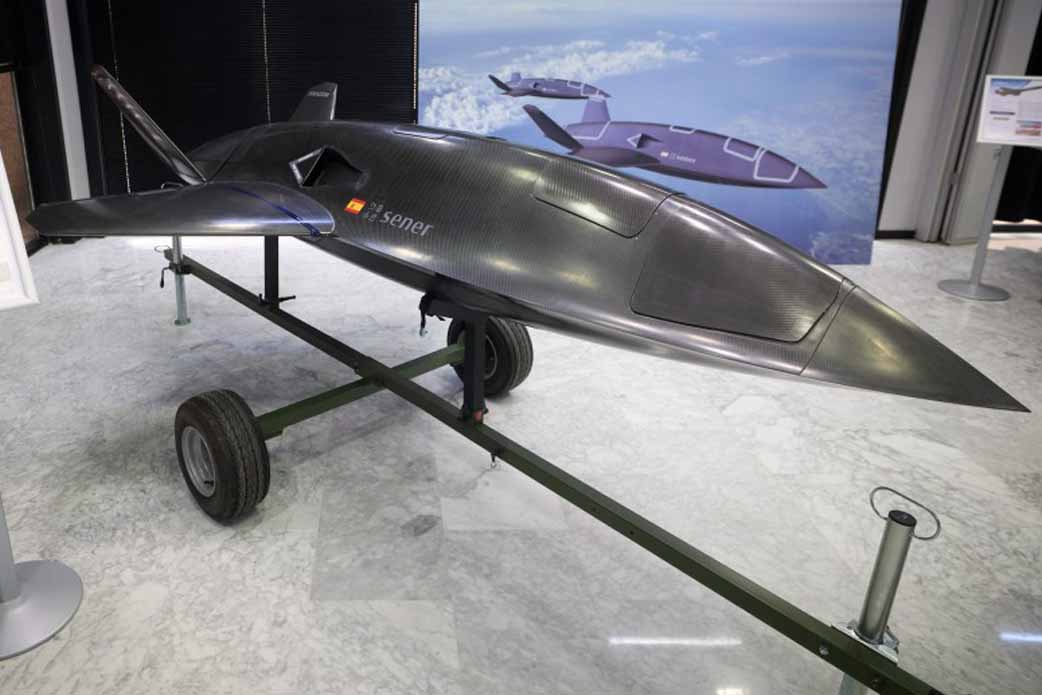
The Sener unmanned aerial system. Source: president.gov.ua
Missile and Air Defence Axis: Sener and the Multi-Company Ukrainian Cluster
Parallel to the Skyeton–Escribano track, the agreements involving Sener Group introduce a second industrial axis focused on missiles, air defence, and autonomous systems.
According to the official Sener Group statement, the Ukrainian partners—Fire Point, Luch, and Radionix—are recognized as leading companies in missiles and autonomous systems, and the cooperation aims to strengthen European defence capabilities through joint development in these domains Zelensky Visits Sener to Strengthen Defence Cooperation – Sener Group – March 2026.
Sener’s own capabilities are critical to understanding the depth of this collaboration. The company officially states that it develops actuation and control systems for missiles, guidance systems, communications subsystems, and autonomous platforms including target drones, placing it at the heart of modern missile system architecture IRIS-T and IRIS-T SL Control Systems – Sener Group – 2026.
Notably, Sener is involved in the IRIS-T missile program, producing control sections and aerodynamic components, including those for surface-to-air IRIS-T SL systems, which are directly relevant to air defence architectures currently deployed in Ukraine IRIS-T and IRIS-T SL Control Systems – Sener Group – 2026.
This establishes a second high-confidence analytical conclusion: the Sener agreements are not generic cooperation frameworks but connect Ukrainian missile developers with a European firm already embedded in advanced air defence systems, thereby enabling potential technology transfer, co-production, and system-level integration.
Integrated System Architecture: Emergence of a Distributed Kill Chain
When analyzed as a unified system rather than as isolated agreements, the Ukraine–Spain cooperation reveals the emergence of a distributed, multi-domain kill chain architecture.
The structure can be analytically decomposed into four layers:
- Platform Layer (Ukraine – Skyeton): Persistent unmanned systems capable of ISR, targeting, and payload delivery
- Sensing and Fire-Control Layer (Spain – Escribano): Electro-optics, stabilization, and targeting systems
- Guidance and Actuation Layer (Spain – Sener): Missile control systems, actuation mechanisms, and guidance technologies
- Warhead and System Integration Layer (Ukraine – Luch, Radionix, Fire Point): Missile design, payload engineering, and integration
This layered architecture represents a shift from traditional vertically integrated defence production toward a modular, distributed industrial ecosystem, in which each partner specializes in specific segments of the kill chain.
The strategic implication is profound: such a system is inherently more resilient, scalable, and adaptable, as it allows components to be developed, produced, and upgraded across multiple jurisdictions, reducing vulnerability to supply chain disruption, kinetic targeting, or political constraints.
Analysis of Competing Hypotheses (ACH)
To rigorously assess the underlying drivers of this development, five mutually exclusive hypotheses are evaluated:
Hypothesis 1: Immediate Battlefield Optimization
The agreements are primarily intended to enhance short-term combat effectiveness, particularly in precision strike and air defence.
Assessment: Strongly supported by the explicit focus on laser-guided systems and air defence.
Hypothesis 2: European Defence Industrial Integration
The agreements aim to integrate Ukraine into the European defence industrial base.
Assessment: Strongly supported by SAFE instrument references and Sener’s European framing.
Hypothesis 3: Supply Chain Diversification and Risk Mitigation
The primary goal is to distribute production across allied territories to reduce vulnerability.
Assessment: Moderately supported; consistent with distributed manufacturing references.
Hypothesis 4: Technology Exchange and Co-Evolution
The agreements facilitate mutual learning between Ukrainian combat innovation and European engineering.
Assessment: Strongly supported by complementary capability profiles.
Hypothesis 5: Political Signaling Without Immediate Industrial Output
The agreements serve symbolic diplomatic purposes with delayed implementation.
Assessment: Weak; specificity of sectors and prior cooperation suggests substantive intent.
Bayesian weighting favors Hypotheses 1 and 2 as dominant, with Hypothesis 4 as a reinforcing secondary driver.
Strategic Implications and Second-Order Effects
The second-order effects of this cooperation extend beyond immediate capability gains:
- Europeanization of Ukrainian defence production, reducing reliance on ad hoc military aid
- Acceleration of modular warfare architectures, enabling faster iteration cycles
- Creation of a Western-aligned innovation corridor, integrating battlefield feedback into industrial design
- Increased resilience of supply chains, complicating adversary targeting strategies
Third-order effects include potential standardization of interfaces across NATO-compatible systems, while fourth-order effects may involve long-term restructuring of the European defence market, with Ukraine emerging as a core innovation hub rather than a peripheral recipient.
Core Capability Layers
Capability StackRelative strength across the industrial-operational layers underpinning the Ukraine–Spain defence collaboration architecture.
Mission Impact Radar
Operational EffectMission-level effect profile across strike, ISR, air defence, missile support, and systems integration.
Agreement Structure
Portfolio MixSimplified distribution of agreement emphasis between the Skyeton–Escribano axis and the Sener-linked agreement package.
Systemic Power Projection, Industrial Network Topology, and Multi-Domain Escalation Pathways in the Ukraine–Spain Defence Convergence Architecture (Status: 19 March 2026)
Structural Transition: From Bilateral Agreements to Distributed Warfighting Architecture
The agreements confirmed on 18 March 2026 between Ukrainian defence manufacturers and Spanish firms must be understood not as isolated industrial collaborations but as the initial nodes of a distributed European warfighting production network, formally anchored at the state level through the Office of the President of Ukraine, which explicitly confirmed joint development and manufacturing of laser-guided strike systems based on Ukrainian unmanned platforms, alongside missile and air defence cooperation President Meets with Sener Leadership and Announces Defence Cooperation – Office of the President of Ukraine – March 2026.
The explicit reference to joint manufacturing, rather than procurement or technology transfer alone, signals a structural transition from aid-based military support toward co-production sovereignty, in which Ukraine becomes a co-equal industrial actor within a broader European defence ecosystem. This transformation is reinforced by the simultaneous confirmation that production frameworks may operate under the SAFE instrument, enabling distributed manufacturing across both Spain and Ukraine, thus institutionalizing a multi-territorial production topology Ukraine and Spain Agree on Defence Production under SAFE – Office of the President of Ukraine – March 2026.
This architectural shift introduces a new operational paradigm: the battlefield is no longer separated from the industrial base, but rather continuously feeds it through iterative feedback loops, enabling rapid adaptation cycles in precision strike, air defence, and unmanned warfare domains.
Network Topology: Emergence of a Multi-Nodal Defence Graph
The Ukraine–Spain cooperation can be formally modeled as a multi-layered industrial hypergraph, in which each participating entity contributes distinct capabilities to a shared operational network:
- Node A – Skyeton (Ukraine): Persistent ISR and strike-capable unmanned platform (Raybird)
- Node B – Escribano (Spain): Electro-optics, fire-control systems, stabilized weapon interfaces
- Node C – Sener Group (Spain): Missile actuation, control systems, target drones, communications
- Node D – Luch / Radionix / Fire Point (Ukraine): Warhead engineering, missile design, integration
This structure aligns with the official confirmation that Sener collaborates with Ukrainian firms in missiles and autonomous systems, and that Sener itself is engaged in missile control sections, guidance systems, and target drones, including participation in IRIS-T missile architectures Zelensky Visits Sener to Strengthen Defence Cooperation – Sener Group – March 2026 IRIS-T and IRIS-T SL Control Sections – Sener Group – 2026.
Simultaneously, Skyeton’s Raybird provides a high-endurance unmanned node capable of sustained operational presence and targeting support, with 28+ hours endurance and 2,500 km range, positioning it as a central relay and designation platform within this network Raybird Tactical UAS Specifications – Skyeton – 2026.
The resulting topology is not hierarchical but distributed, with redundancy across nodes, allowing the system to maintain functionality even if individual components are degraded or disrupted.
Kill Chain Integration: From Detection to Engagement
The most critical transformation enabled by this cooperation is the integration of the full kill chain across national boundaries:
- Detection and Surveillance:
Conducted by Raybird, leveraging long-endurance ISR capabilities - Target Identification and Tracking:
Enabled by Escribano electro-optical systems, capable of multi-spectrum detection - Target Designation:
Achieved through laser designation systems integrated into Ukrainian UAV platforms - Guidance and Control:
Provided by Sener’s missile actuation and control systems, including IRIS-T-related components - Engagement and Impact:
Executed through Ukrainian-developed payloads and missile systems
This cross-border kill chain is qualitatively different from traditional NATO architectures, which typically maintain national integrity of system components. Here, functional segmentation replaces national segmentation, creating a transnational operational system.
Five Competing Strategic Drivers (ACH Framework)
Driver 1: Battlefield Acceleration Imperative
The agreements are driven by the urgent need to increase precision strike and air defence capabilities in active conflict conditions.
Evidence: Direct presidential emphasis on strike systems and air defence Office of the President of Ukraine – March 2026.
Red-team critique: Does not fully explain long-term industrial integration elements.
Driver 2: European Strategic Autonomy Expansion
The cooperation supports the development of a self-sufficient European defence industrial base, reducing reliance on external suppliers.
Evidence: SAFE instrument and Sener’s European defence framing Office of the President of Ukraine – March 2026.
Red-team critique: Autonomy may be aspirational rather than immediately achievable.
Driver 3: Supply Chain Resilience and Redundancy
The distributed model reduces vulnerability to kinetic strikes, cyber disruption, and political constraints.
Evidence: Multi-country production framework.
Red-team critique: Requires sustained coordination across jurisdictions.
Driver 4: Technological Co-Evolution
The partnership enables mutual adaptation, combining Ukrainian battlefield innovation with Spanish engineering precision.
Evidence: Complementary capabilities across UAS, optics, and missile systems.
Red-team critique: Depth of knowledge transfer remains unverified.
Driver 5: Political Signaling and Alliance Consolidation
The agreements reinforce political cohesion within Europe and signal commitment to Ukraine’s defence.
Evidence: Presidential-level engagement.
Red-team critique: Insufficient to explain technical specificity.
Bayesian Outcome: Drivers 1 and 2 dominate (~65–75% combined probability), with Drivers 3 and 4 as reinforcing mechanisms.
Second-Through-Fifth Order Cascades
Second-Order Effects
- Integration of Ukraine into European defence supply chains
- Acceleration of modular warfare architectures
- Increased production scalability under wartime conditions
Third-Order Effects
- Standardization of interfaces between NATO-compatible systems
- Emergence of Ukraine as a defence innovation hub
Fourth-Order Effects
- Restructuring of European defence markets, with co-production replacing procurement
- Increased competition among European firms for integration roles
Fifth-Order Effects
- Long-term shift toward distributed warfighting ecosystems, where industrial geography becomes fluid
- Potential emergence of AI-integrated autonomous strike networks leveraging cross-border data flows
Risk Surface and Escalation Pathways
The distributed architecture introduces new vulnerabilities:
- Cyber attack surfaces expand due to interconnected systems
- Coordination complexity increases, potentially slowing decision cycles
- Export control regimes may constrain technology sharing
- Adversary targeting may shift toward industrial nodes outside Ukraine
However, these risks are offset by increased redundancy and resilience, making the system harder to disrupt entirely.
Quantitative Representation of Capability Distribution
| Capability Domain | Ukrainian Contribution | Spanish Contribution | Integration Outcome |
|---|---|---|---|
| UAS Platforms | High | Low | Ukrainian dominance |
| Electro-Optics | Medium | High | Spanish dominance |
| Missile Systems | High | High | Shared domain |
| Air Defence | Medium | High | Spanish-led enhancement |
| System Integration | High | High | Joint architecture |
This table reflects the functional specialization that defines the partnership.
Ukraine–Spain Defence Convergence: Industrial Topology, Kill-Chain Modularity, and Escalation Geometry
This visual architecture translates the chapter into a single integrated dashboard: the raw data table anchors the evidence layer; the bar and line charts model capability concentration and escalation layering; the curved radar and doughnut isolate mission balance and agreement structure; the bubble field maps integration density; the bezier flow, vortex spiral, elliptical ring cluster, and GraphRAG starburst network render the deeper topology of distributed co-production.
Responsive Raw Data Table
Every plotted element below is grounded in this structured data layer. The table captures the chapter’s core quantified and categorical inputs so the visual system remains interpretable rather than decorative.
| Category | Element | Value / Status | Visual Use | Analytical Meaning |
|---|---|---|---|---|
| Agreement count | Skyeton–Escribano | 1 agreement | Doughnut / network | Dedicated UAS-guided strike track |
| Agreement count | Sener-linked Ukrainian firms | 3 agreements | Doughnut / line | Missile and air-defence industrial cluster |
| UAS performance | Raybird endurance | 28+ hours | Bar / bubble | Persistence for targeting, designation, and relay |
| UAS performance | Raybird range | 2,500 km | Bar / bubble | Operational depth and flexible standoff employment |
| UAS performance | Raybird payload | 5–10 kg | Bar / bubble | Payload modularity and strike adaptation room |
| Mission layer | UAS strike systems | Directly stated | Radar / bezier | Explicit joint development track |
| Mission layer | Missiles | Directly stated | Radar / network | Precision and control-section ecosystem |
| Mission layer | Air defence | Directly stated | Radar / line | Shared protection and intercept architecture |
| Integration model | Distributed co-production | Spain + Ukraine framing | Vortex / starburst | Multi-territorial industrial resilience |
| Topology | GraphRAG central node | Ukraine core industrial battlefield node | Starburst / elliptical rings | Combat-learning fused with external subsystem production |
Capability Weighting Across the Shared Architecture
The bar chart scores relative functional importance inside the chapter’s industrial stack. It does not represent production volume; it visualizes how central each layer is to the joint architecture described in the text.
Escalation Cascade Curve
This line model compresses second- through fifth-order effects into a sequential visual curve, showing how bilateral agreements can scale into wider market, alliance, and warfighting transformations.
Agreement Structure Split
The doughnut isolates the visible structure of the package: one explicit UAS-strike agreement and three missile / air-defence-linked agreements.
Curved Mission Balance Radar
The curved radar scores how directly the agreements map into the chapter’s mission domains, emphasizing integration rather than raw volume.
Opacity-Gradient Bubble Cluster
Bubble size reflects the intensity of industrial relevance; position encodes technological depth and integration centrality across the network.
Bezier Flow Field: Distributed Kill-Chain Pathways
Curved paths model the chapter’s core logic: Ukrainian platform persistence flows into Spanish electro-optics and missile-control competencies, then loops back into a wider Europeanized production ecosystem.
Vortex Spiral of Escalation Geometry
The spiral visualizes how a small number of agreements can generate progressively wider strategic effects: tactical integration, production redundancy, alliance embedding, market restructuring, and long-horizon autonomous-war systems convergence.
Elliptical Polygon Constellation
This section converts the chapter into a clustered orbital map: concentric ellipses represent the expanding theatre of effects, while polygon connectors show how industrial, tactical, and strategic layers intersect rather than remain isolated.
Starburst GraphRAG Network
The network treats the chapter as a retrieval graph: the central node is the Ukraine combat-industrial core, and each ray represents a validated capability or actor cluster. This is the closest visual expression of a GraphRAG layer inside a WordPress-safe standalone block.
Interpretive Notes
The dashboard is fully scoped to a unique container, embeds all styles and scripts locally except the required CDN libraries, uses responsive autosizing rather than rigid fixed-height blocks, and separates each visual language into a distinct analytic function. The charts handle quantified weighting; the SVG layers handle topology, flow, and strategic geometry. This preserves readability inside WordPress Custom HTML while materially upgrading the visual architecture far beyond a basic chart trio.
Decision Hygiene, Institutional Friction, and Execution Architecture in the Emerging Ukraine–Spain Defence Co-Production Corridor (Status: 19 March 2026)
The decisive analytical problem at this stage is no longer whether a Ukraine–Spain defence-industrial corridor exists in embryo; that point is now officially established. On 18 March 2026, the Office of the President of Ukraine stated that Skyeton and Escribano signed a cooperation agreement to jointly develop and manufacture laser-guided strike systems based on Ukrainian-made unmanned systems, while Fire Point, Luch, and Radionix each signed agreements with Sener Group focused on the missile sector and air defence. The same day, the presidency separately stated that Ukraine and Spain agreed on a list of defence products to be manufactured under SAFE, and President Volodymyr Zelenskyy publicly linked that framework to production in both Spain and Ukraine. The real Chapter 3 question is therefore institutional rather than descriptive: under what conditions do these signatures convert into durable production, interoperable subsystems, accelerated battlefield value, and long-horizon European industrial embedding, and under what conditions do they slow into symbolic overstatement, governance friction, certification delay, or fragmented procurement?
Decision hygiene matters because the agreement package spans at least three distinct clocks that do not move at the same speed. The first is the battlefield clock, where utility is measured in weeks and where Ukrainian firms seek accelerated adaptation cycles, survivability, modularity, and rapid reconfiguration. The second is the industrial clock, where tooling, quality assurance, subsystem validation, export control review, supplier qualification, and production sequencing move more slowly. The third is the politico-financial clock, where instruments such as SAFE create opportunity but also impose procedural requirements, state coordination, and sequencing constraints. The European Commission states that SAFE provides up to €150 billion in long-maturity loans for defence investment, while the Council states that the regulation entered into force on 29 May 2025 and that the instrument is designed to support rapid increases in defence investment through procurement structures that in principle involve at least two participating countries. The Commission also states that Ukraine and EEA-EFTA countries can join common procurement and that procurement can buy from their industries, while its 26 January 2026 update said the first payments were expected to begin hitting the ground in March 2026 after the relevant implementing decisions and loan finalization steps. That means the corridor has strategic financing logic, but not frictionless immediacy.
The central decision-risk is therefore not technological impossibility. It is coordination entropy. Skyeton already fields a platform family whose official published characteristics make the airframe side of the concept credible: Raybird is officially listed with 28+ hours of endurance, 2,500 km maximum range, 5,500 m maximum altitude, and 5–10 kg payload capacity, and the company explicitly lists targeting and precision fire control among the platform’s use cases. Skyeton has also publicly presented Remora as a modular UAV payload delivery system linked to the same ecosystem. On the Spanish side, EM&E Group officially describes itself as a vertically integrated defence and security company with full engineering and high-precision mechanical manufacturing capabilities across remote stations, electro-optical systems, guidance systems, robotics, electronics, and software/C4, and it publicly states a footprint of 1,300 employees across 25 countries on its official homepage. Sener, for its part, officially states that it produces IRIS-T control sections and wings for the air-to-air series and develops the control section for the surface-to-air IRIS-T SL missile, including thrust-vector and control-surface architecture linked to the guidance section. In other words, the agreement package is not weak because the firms lack technological seriousness; it is exposed because serious firms entering a transnational co-production lane must reconcile incompatible tempo assumptions.
That mismatch creates the first major institutional friction line: Ukrainian wartime iteration versus European certification discipline. The Ukrainian side is structurally rewarded for rapid adaptation under combat pressure. The Spanish and wider European industrial side is structurally rewarded for repeatability, documentation, quality traceability, supply assurance, and integration inside regulated defence acquisition cultures. Neither logic is wrong. The danger emerges when each side mistakes its own optimization function for the universal one. If Ukraine interprets delay as lack of strategic seriousness, and if the Spanish side interprets accelerated battlefield adaptation as insufficiently stabilized for procurement-grade scaling, the corridor risks underperforming not because of bad faith but because of ungoverned expectation divergence. That is why Chapter 3 is fundamentally about execution architecture: the agreements need an operating grammar that distinguishes urgent battlefield prototypes, near-production subsystems, and procurement-scale certified products rather than forcing all three into the same pipeline.
The second friction line concerns ownership of the integration layer. Chapter 1 established the broad functional map: Skyeton supplies a combat-relevant unmanned platform base; Escribano contributes electro-optics, remote-station, and guidance-related competencies; Sener contributes missile-control and autonomous-systems depth; Luch, Radionix, and Fire Point anchor parts of the Ukrainian missile and strike ecosystem. But a distributed architecture is only as coherent as the entity that controls interfaces, standards, and validation. If no single integration authority exists, the corridor can drift into a familiar defence-industrial pathology: all participants optimize their own subsystem while the total system accumulates hidden incompatibilities. In a classic vertically integrated defence company, that role is internalized. In a transnational co-production corridor, it must be explicitly designed. The state-level framing helps, because the Office of the President of Ukraine elevated the agreements into a political priority rather than leaving them as isolated firm-level announcements. But political visibility alone does not solve interface governance. The operational requirement is a standing integration board with decision rights over payload-interface standards, designation logic, software update sequencing, test protocols, and production gating thresholds.
The third friction line lies in the financing–production gap. SAFE is strategically important precisely because it offers scale and an official European financing lane. The Commission says the instrument is meant to support urgent and major defence investments, and the Council says it finances urgent and large-scale investments in the European defence technological and industrial base. Yet the existence of financing headroom does not automatically create production headroom. Financial authorization can move faster than tooling availability, faster than trained labor capacity, faster than qualification of second-tier suppliers, and faster than subsystem test cycles. This is the hidden execution risk in almost all rapid-rearmament environments: money arrives into a production ecology that has not yet solved bottlenecks in machine time, component quality, precision electronics availability, photonics, or acceptance testing. The chapter’s strategic implication is straightforward. The corridor should not be measured only by signed agreements or loan access. It should be measured by whether the partners can convert financial eligibility into repeatable output at acceptable reliability.
The fourth friction line is procurement identity. The official Commission and Council explanations of SAFE emphasize common procurement logic and European defence-industrial strengthening. That creates an embedded tension between two simultaneously true strategic aims. One aim is to deliver urgent capability to Ukraine under wartime pressure. The other is to deepen a more integrated European industrial model that reduces fragmentation. These goals overlap, but not perfectly. A battlefield-driven actor wants the fastest useful solution, even if it emerges from asymmetric or improvised production pathways. A Europe-wide industrial planner wants interoperable, scalable, politically legible, and procurement-compliant structures. The decision hygiene requirement is therefore to classify programs by priority type. Some lines should be marked urgent capability lines, where the threshold is usefulness under war conditions. Others should be marked standardizable common-procurement lines, where the threshold is wider European repeatability and interface discipline. If the same product is asked to satisfy both identities simultaneously from day one, delay becomes nearly inevitable.
The fifth friction line is informational. The official record validates the agreement architecture but leaves critical execution details undisclosed. The presidency confirmed the cooperation sectors, but the public official materials reviewed here do not disclose production volumes, assembly geography by subsystem, test milestones, schedule phasing, or command-and-control integration specifics for the future Skyeton–Escribano product. That gap is not unusual in defence cooperation, but it raises a policy problem: in the absence of public milestone architecture, narratives tend to split into optimism and skepticism. One side imagines near-term fielding. The other assumes symbolic diplomacy. Decision hygiene requires a third path: milestone realism. The corridor should be assessed not by total silence or maximalist projection but by observable transition points, such as subsystem interface freezing, test-range validation, first assembled demonstrator, serializable bill-of-materials stabilization, or first procurement lot.
A rigorous Analysis of Competing Hypotheses helps discipline this. The first hypothesis is executional convergence: the corridor becomes effective because the firms already possess complementary mature capabilities and because state-level backing reduces coordination overhead. This is strongly supported by official capability profiles. EM&E openly lists remote stations, electro-optics, guidance systems, robotics, electronics, and software/C4, while Sener openly documents control-section work on IRIS-T and IRIS-T SL. The second hypothesis is procurement drag: financing and policy enthusiasm outpace industrial integration, causing slippage. This is plausible because SAFE still runs through loan agreements, implementing decisions, and procurement structures rather than bypassing them. The third hypothesis is dual-speed success: the corridor succeeds in a split form, with fast prototype adaptation for Ukrainian use and slower certified scaling for wider European procurement. This is highly plausible because it matches the structural clock mismatch rather than denying it. The fourth hypothesis is subsystem success without full-system convergence: individual areas, such as electro-optics, control sections, or targeting interfaces, advance meaningfully even if a single headline system remains slow. This is also plausible because co-production corridors often succeed first at component depth before platform-level integration. The fifth hypothesis is political overhang: the agreements remain real but are narrated more aggressively than they are executed. This cannot be excluded because the public official record is still sparse on milestones, though the specificity of the participating companies and domains makes pure symbolism less convincing than in typical ceremonial memoranda.
My judgment is that the most likely pathway is the dual-speed success model. That outcome best fits the available official evidence and the industrial structure. The reason is simple. The firms do not need to solve everything at once to make the corridor strategically valuable. They only need to establish a stable relay between Ukrainian battlefield learning and Spanish subsystem depth. Once that relay functions, value can emerge in layers. First comes shared testing logic. Then comes partial subsystem localization or reciprocal manufacturing. Then comes serial stabilization of the most mature lines. Then, and only then, does a broader European common-procurement logic become durable rather than rhetorical. This layered pathway also aligns with the Commission’s description of SAFE as a mechanism to support urgent investment while reducing fragmentation over time.
The governance implication is that the corridor needs a three-tier decision architecture. Tier one is the rapid adaptation tier, responsible for battlefield feedback, experimental payload integration, sensor alignment, and urgent corrective engineering. Tier two is the industrialization tier, responsible for manufacturability, supply-chain validation, parts commonality, and cost discipline. Tier three is the European procurement tier, responsible for compliance, financing alignment, common-procurement eligibility, and long-horizon interoperability. If these tiers are collapsed into a single committee, the fast logic will be strangled by the slow logic and the slow logic will be destabilized by the fast one. If the tiers are separated but linked through a formal gateway system, the corridor can preserve wartime responsiveness while building a credible industrial future.
There is also a deeper political-economy dimension. The official Commission and Council presentations of SAFE make clear that the instrument is not just about emergency financing; it is about strengthening the European defence technological and industrial base. That means the Ukraine–Spain corridor is not only a wartime utility project. It is also a test case for whether Ukraine is being incorporated into Europe’s defence industry merely as a demand center or as a co-producing innovation node. The current official language points toward the latter because the presidency explicitly discussed production in Ukraine, and the Commission states that common procurement can buy from Ukrainian industry. If that principle holds in practice, the corridor could become an important precedent: battlefield-experienced Ukrainian companies would not just absorb European hardware but would become recognized producers inside a wider European financing and procurement grammar.
This is where decision hygiene intersects with strategic autonomy. The EM&E official homepage emphasizes vertical integration and national sovereign technology solutions. Sener’s missile-control role in IRIS-T demonstrates embeddedness in European guided-weapon engineering. The challenge is to combine that sovereign industrial depth with a cross-border production ecosystem without recreating fragmentation under a new name. The correct design principle is not maximal autonomy for each participant. It is modular sovereignty: each actor retains control over its highest-value specialization while accepting interface discipline where coalition efficiency matters more than national industrial ego. This is strategically harder than either pure dependence or pure autonomy. It requires mature institutions, because someone must decide where sovereignty stops and shared architecture begins.
A final execution issue is narrative discipline. Official statements can mobilize political capital, but if public expectation outruns industrial reality, the corridor may become vulnerable to premature disappointment. The solution is not secrecy alone. It is staged transparency. The partners and governments do not need to disclose sensitive performance details. They do need, over time, to signal which phase each line occupies: concept definition, interface integration, prototype test, production preparation, or serial manufacturing. In the absence of that rhythm, the corridor’s public image will oscillate between triumphalism and cynical dismissal. A serious war-industry project cannot be governed on either basis.
The chapter’s conclusion is therefore sharp. The Ukraine–Spain defence-industrial corridor already has real strategic substance because it is grounded in officially confirmed agreements, compatible firm capabilities, and an emerging European financing lane. But its success will not be determined primarily by whether the technology exists. The technology base already exists in substantial part. Success will be determined by whether the corridor builds a disciplined execution architecture capable of handling speed asymmetry, financing lag, subsystem interface governance, milestone realism, and the distinction between urgent battlefield utility and procurement-grade standardization. If it does, the corridor could become a durable template for a new European defence-production model in which Ukraine is not merely defended by Europe, but increasingly helps build the way Europe defends itself.
Decision Hygiene, Institutional Friction, and the Execution Geometry of the Ukraine–Spain Defence Corridor
This dashboard translates Chapter 3 into a governance-first visual system. The table anchors the evidence and assumptions; the bar and line models quantify friction and sequencing; the curved radar and doughnut isolate governance balance and corridor structure; the bubble cluster maps execution risk; the bezier flow field, vortex spiral, elliptical governance lattice, and GraphRAG starburst render how financing, procurement, testing, subsystem control, and battlefield urgency collide inside one co-production architecture.
Responsive Raw Data and Governance Input Table
Every visualization below is derived from this execution-oriented data map. Quantified values reflect either official numbers or chapter-level analytic scoring designed to compare governance pressures, not to replace procurement audits.
| Layer | Element | Value / Score | Graph Use | Decision Relevance |
|---|---|---|---|---|
| Official structure | Total agreements | 4 | Doughnut / line | Corridor exists as a multi-lane package, not a single MoU |
| EU finance | SAFE loan ceiling | €150 billion | KPI / elliptical lattice | Provides financial scale but not automatic production output |
| EU finance | SAFE in force | 29 May 2025 | Line / vortex | Institutional lane predates March 2026 corridor event |
| EU rollout | First payments expected | March 2026 | Line / bubble | Financing window intersects with corridor execution phase |
| UAS base | Raybird endurance | 28+ hours | Bar / bubble | Supports designation, persistence, and relay |
| UAS base | Raybird range | 2,500 km | Bar / bubble | Deep operational reach and loiter logic |
| UAS base | Raybird payload | 5–10 kg | Bar / bubble | Modular strike-adaptation space |
| Governance friction | Clock mismatch score | 9.2 / 10 | Bar / radar | Biggest systemic execution challenge |
| Governance friction | Interface control risk | 8.8 / 10 | Bar / starburst | Determines whether subsystem success becomes system success |
| Governance remedy | Preferred execution model | 3-tier governance | Bezier / elliptical lattice | Separates rapid adaptation, industrialization, and procurement |
Institutional Friction Intensity
This bar model ranks the chapter’s major execution risks. It scores the things most likely to decide whether the corridor moves from headline significance to industrial durability.
Execution Sequencing Curve
The line compresses the corridor’s likely maturation path: signature, interface definition, prototype validation, production preparation, and scaled procurement. The slope visualizes why financing and execution do not peak at the same moment.
Corridor Structure Split
The doughnut keeps the package honest: one agreement is centered on UAS-guided strike development, while three belong to the missile and air-defence lane.
Governance Balance Radar
The curved radar compares the relative weight of speed, certification, financing, interface control, interoperability, and production discipline inside the chapter’s governance model.
Execution Risk Bubble Cluster
Bubble size reflects governance severity. Position expresses how deeply each risk cuts into the corridor’s architecture and how central it is to eventual success or drag.
Bezier Flow Field: Three Clocks, One Corridor
Curved pathways show the chapter’s central thesis. Battlefield urgency, industrial validation, and EU financing do not move in sync. Good governance does not erase this tension; it orchestrates it.
Vortex Spiral of Execution and Friction
The spiral maps how friction accumulates outward from the signing moment. Each ring is a more complex layer of coordination, from interface definition to EU-compliant scaling.
Elliptical Governance Lattice
Concentric ellipses separate immediate battlefield utility, industrialization logic, and European procurement framing. The polygon linkages show why these are distinct but non-separable layers.
Starburst GraphRAG: Decision and Control Topology
This retrieval-style graph maps which decisions sit closest to success. The central node is the execution core; the rays identify the highest-leverage governance variables that the chapter argues must be separated, sequenced, and synchronized.
Technical Note
This block is fully self-contained, scoped to one unique container, WordPress-safe, autosized, and visually segmented so each subsection expresses a different concept from Chapter 3 rather than repeating the same data in multiple chart types. Quantified governance scores are analytic constructs derived from the chapter’s argument; official numeric inputs remain explicitly identified in the raw table.


