













Abstract
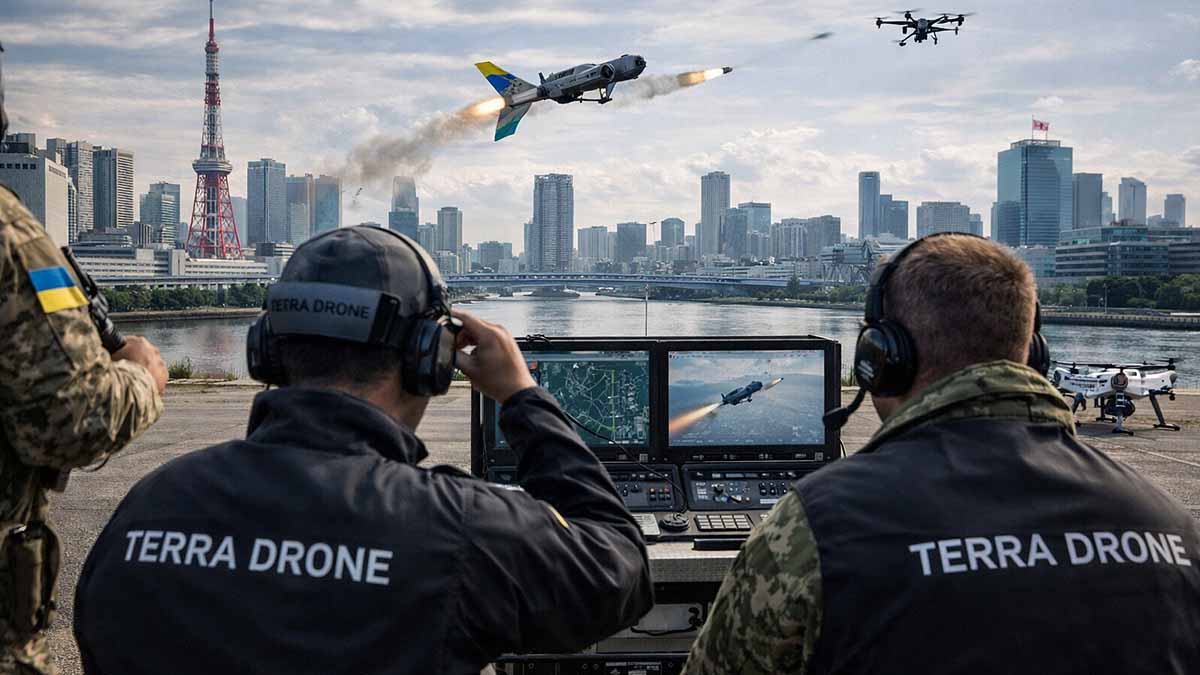
As of 31 March 2026, the live primary-source record confirms that Terra Drone Corporation announced a strategic investment in Amazing Drones LLC, a Ukrainian interceptor-drone company, through its subsidiary Terra Inspectioneering, and simultaneously announced the launch of a new interceptor drone named Terra A1 Terra Drone Announces Strategic Investment in Amazing Drones, a Ukraine-Based Interceptor Drone Company, and the Launch of New Interceptor Drone “Terra A1” – Terra Drone – March 2026. The same official release states that the partnership is intended not only to expand business in Ukraine but also to commercialize technical knowledge developed under wartime conditions and accelerate global business expansion Terra Drone Announces Strategic Investment in Amazing Drones, a Ukraine-Based Interceptor Drone Company, and the Launch of New Interceptor Drone “Terra A1” – Terra Drone – March 2026.
This matters because the transaction is best understood not as a narrow venture placement but as a bridge between three evolving systems: the combat-driven drone innovation ecosystem of Ukraine, the expanding unmanned-defense posture of Japan, and the wider allied demand for scalable, lower-cost counter-UAS capabilities Terra Drone Announces Strategic Entry into the Defense Equipment Market, As Drones Emerge as Game-Changers in Modern Defense – Terra Drone – March 2026 New NATO Innovation Range starts counter-drone technology testing in Latvia – NATO – March 2026. The strategic novelty is that a Japanese corporate actor is not merely exporting technology into Ukraine; it is importing battlefield-tested Ukrainian adaptation logic into a broader allied-facing business architecture Terra Drone Announces Strategic Investment in Amazing Drones, a Ukraine-Based Interceptor Drone Company, and the Launch of New Interceptor Drone “Terra A1” – Terra Drone – March 2026.
The technical profile disclosed by Terra Drone gives the partnership immediate defense-industrial relevance. The official release states that Terra A1 has a range of 32 km, a maximum speed of 300 km/h, and a flight time of 15 minutes, while being positioned as an electric, relatively low-cost interceptor intended for the era of “low-cost and mass production” threats Terra Drone Announces Strategic Investment in Amazing Drones, a Ukraine-Based Interceptor Drone Company, and the Launch of New Interceptor Drone “Terra A1” – Terra Drone – March 2026. In doctrinal terms, this is a direct response to one of the central asymmetries of contemporary air defense: expensive interceptors are structurally ill-matched against large volumes of cheaper unmanned threats. The significance of Amazing Drones is therefore not only that it builds interceptor drones, but that it has done so under the conditions of persistent electronic warfare, signal degradation, and combat attrition explicitly referenced by Terra Drone in its release Terra Drone Announces Strategic Investment in Amazing Drones, a Ukraine-Based Interceptor Drone Company, and the Launch of New Interceptor Drone “Terra A1” – Terra Drone – March 2026.
The partnership also aligns with Terra Drone’s own formally declared corporate pivot into defense. On 23 March 2026, Terra Drone officially announced its strategic entry into the defense-equipment market, stated that it would advance the establishment of the U.S. subsidiary Terra Defense, and identified Ukraine, NATO countries, the United States, and Japan as major markets and operating theaters relevant to its defense strategy Terra Drone Announces Strategic Entry into the Defense Equipment Market, As Drones Emerge as Game-Changers in Modern Defense – Terra Drone – March 2026. Accordingly, the Amazing Drones investment is not analytically isolated; it appears to be the first concrete manifestation of a newly declared defense-market architecture rather than an opportunistic standalone deal Terra Drone Announces Strategic Entry into the Defense Equipment Market, As Drones Emerge as Game-Changers in Modern Defense – Terra Drone – March 2026.
On the Ukrainian side, the timing is equally significant because the procurement environment is becoming more data-driven and hostile to unproven systems. The Ministry of Defence of Ukraine announced on 10 March 2026 that drone procurement demand would be generated automatically based on frontline data and that 80% of funding would go to systems already proven effective, with 20% reserved for innovations validated in combat conditions Ministry of Defence changes approach to drone procurement: demand will be generated automatically based on frontline data – Ministry of Defence of Ukraine – March 2026. This means that capital entering the Ukrainian drone sector is entering an unusually severe selection environment in which operational performance, not merely marketing or political access, increasingly determines demand formation Ministry of Defence changes approach to drone procurement: demand will be generated automatically based on frontline data – Ministry of Defence of Ukraine – March 2026. That increases the value of a company whose product category is already aligned with one of the most urgent battlefield requirements: affordable interception of unmanned threats.
The Japanese policy environment reinforces the logic of the move. In its FY2026 budget materials, the Ministry of Defense of Japan states that approximately ¥100.1 billion is planned for the establishment of SHIELD by unmanned assets in FY2027 and explicitly links this to large changes in warfare produced by unmanned systems and the need for asymmetrical defense approaches Defense Programs and Budget of Japan Overview of FY2026 Budget Request – Ministry of Defense, Japan – March 2026. This does not prove state backing for Terra Drone’s transaction, but it does establish that the company’s defense pivot is occurring inside a national defense discourse that is increasingly favorable to scalable unmanned systems and new defensive architectures Defense Programs and Budget of Japan Overview of FY2026 Budget Request – Ministry of Defense, Japan – March 2026.
At the allied level, the partnership emerges during institutional acceleration in counter-drone experimentation. NATO announced on 18 March 2026 that its innovation range in Latvia launched testing, evaluation, verification, and validation activity for UAS and Counter-UAS technologies, including interceptor-flight and electronic-warfare relevant conditions New NATO Innovation Range starts counter-drone technology testing in Latvia – NATO – March 2026. This creates a plausible future pathway in which battlefield-derived Ukrainian interceptor concepts can be translated into alliance-legible testing frameworks, procurement dialogue, and interoperability discussions. The significance is therefore fourth-order as well as first-order: one investment can become a conduit through which Ukraine’s wartime adaptation cycle is progressively absorbed into broader allied defense-industrial ecosystems.
A rigorous Analysis of Competing Hypotheses yields at least five mutually exclusive lead explanations. First, the deal may primarily be a technology-acquisition move centered on combat-proven interceptor know-how. Second, it may be mainly a geopolitical positioning play designed to place Terra Drone early inside the counter-UAS growth corridor linking Ukraine, allied Europe, and North America. Third, it may be chiefly a manufacturing-and-supply-chain integration strategy combining Ukrainian battlefield engineering with Japanese or transnational scaling discipline. Fourth, it may serve as a strategic signal to defense customers and investors that Terra Drone is no longer principally a civilian drone company but an emerging defense platform. Fifth, it may represent a hedge against future procurement convergence in which lower-cost intercept systems become essential for military and critical-infrastructure defense. Based on the live primary-source record, the strongest current reading is a hybrid of the second, third, and fourth hypotheses because Terra Drone’s own official statements repeatedly connect the Amazing Drones investment to global defense expansion, cross-border operationalization, and the institutional build-out of Terra Defense Terra Drone Announces Strategic Investment in Amazing Drones, a Ukraine-Based Interceptor Drone Company, and the Launch of New Interceptor Drone “Terra A1” – Terra Drone – March 2026 Terra Drone Announces Strategic Entry into the Defense Equipment Market, As Drones Emerge as Game-Changers in Modern Defense – Terra Drone – March 2026.
The main caution is evidentiary. I can verify from live official or primary corporate sources during this session the existence of the strategic investment, the use of Terra Inspectioneering, the launch of Terra A1, the published drone specifications, Terra Drone’s defense-market entry, the U.S. Terra Defense plan, the Ukrainian procurement reform, the Japanese unmanned-defense budget line, and the NATO counter-drone testing initiative Terra Drone Announces Strategic Investment in Amazing Drones, a Ukraine-Based Interceptor Drone Company, and the Launch of New Interceptor Drone “Terra A1” – Terra Drone – March 2026 Terra Drone Announces Strategic Entry into the Defense Equipment Market, As Drones Emerge as Game-Changers in Modern Defense – Terra Drone – March 2026 Ministry of Defence changes approach to drone procurement: demand will be generated automatically based on frontline data – Ministry of Defence of Ukraine – March 2026 Defense Programs and Budget of Japan Overview of FY2026 Budget Request – Ministry of Defense, Japan – March 2026 New NATO Innovation Range starts counter-drone technology testing in Latvia – NATO – March 2026. I cannot verify from the same primary-source set, in this session, the exact disclosed transaction value or the claimed dedicated $10 million allocation specifically for Ukrainian projects, so that figure should be treated as unconfirmed unless and until a live primary source states it directly Terra Drone Announces Strategic Investment in Amazing Drones, a Ukraine-Based Interceptor Drone Company, and the Launch of New Interceptor Drone “Terra A1” – Terra Drone – March 2026.
The most defensible bottom line is that Terra Drone’s investment in Amazing Drones is a high-signal indicator of a broader defense-industrial realignment in which Ukrainian battlefield innovation is becoming investable, transferable, and increasingly relevant to allied counter-UAS doctrine, procurement, and industrial adaptation Terra Drone Announces Strategic Investment in Amazing Drones, a Ukraine-Based Interceptor Drone Company, and the Launch of New Interceptor Drone “Terra A1” – Terra Drone – March 2026 New NATO Innovation Range starts counter-drone technology testing in Latvia – NATO – March 2026.
Index
Core Concepts in Review: What We Know and Why It Matters
- Transaction Anatomy and Verified Technical Substance
- Second-Through-Fifth Order Strategic Cascades Across Ukraine, Japan, and NATO-Adjacent Defense Industry
- Competing Hypotheses, Risk Architecture, and Forward Indicators
Core Concepts in Review: What We Know and Why It Matters
The Structural Transformation of Warfare: From Platform-Centric Systems to Distributed Adaptive Networks
The most critical conceptual shift underpinning the entire analysis is the transformation of modern warfare from platform-centric architectures—where value was concentrated in large, expensive, and relatively static systems such as fighter jets, tanks, or naval vessels—into distributed adaptive networks composed of numerous low-cost, high-iteration assets interconnected through digital and cognitive layers. This transformation is not incremental; it is systemic and irreversible in its direction of travel.
Historically, military power was defined by the ability to field capital-intensive platforms that delivered overwhelming force. The industrial logic supporting this model emphasized durability, technological sophistication, and long lifecycle deployment. Procurement cycles often extended over decades, with systems designed to remain relevant for 20–40 years. This created a relatively stable equilibrium in which technological superiority could be maintained through periodic upgrades and incremental improvements.
However, the emergence of unmanned systems—particularly drones—has fundamentally disrupted this equilibrium by introducing a radically different cost-to-effect ratio. Instead of concentrating capability in a few highly protected platforms, modern systems distribute capability across hundreds or thousands of inexpensive, expendable units. This shift dramatically alters both the economics and the operational logic of warfare. A single high-value platform can now be threatened or neutralized by a swarm of low-cost systems, forcing a reevaluation of traditional force structures.
The key innovation is not merely the drone itself but the networked architecture in which these systems operate. Drones are increasingly integrated into broader systems that include sensors, communication networks, data processing layers, and decision-support algorithms. This creates a multi-layered operational environment where information flows as rapidly as physical assets, enabling real-time adaptation and coordination.
This transformation introduces a new type of system behavior: non-linear scalability. In traditional systems, adding more units increases capability in a roughly linear fashion. In distributed systems, however, the addition of more nodes can produce exponential increases in capability due to network effects. For example, a swarm of drones can coordinate to cover larger areas, share targeting information, and overwhelm defenses in ways that individual units cannot.
At the same time, this distributed model introduces new vulnerabilities. The system becomes dependent on communication links, data integrity, and coordination protocols. Disrupting these elements can degrade the effectiveness of the entire network, even if individual units remain intact. This creates a new domain of competition centered on electronic warfare, cyber operations, and information dominance.
The strategic implication is that military advantage is no longer determined solely by the possession of superior platforms but by the ability to design, maintain, and evolve complex adaptive systems under conditions of continuous disruption. This requires not only technological capability but also organizational agility, data integration, and rapid decision-making processes.
From a policy perspective, this shift challenges existing procurement frameworks, which are often optimized for large, long-term projects. Governments and institutions must adapt to a reality in which effective systems may have lifespans measured in months rather than decades. This raises questions about budgeting, oversight, and accountability, as traditional mechanisms may be too slow to keep pace with technological change.
For stakeholders, including policymakers, industry leaders, and military planners, the importance of this transformation cannot be overstated. It represents a fundamental redefinition of what constitutes military power in the 21st century. The ability to operate within and adapt to distributed adaptive networks will likely become the primary determinant of strategic success.
The Evolution of Innovation Cycles: From Linear Development to Continuous Iteration Under Adversarial Pressure
A second core concept is the transformation of innovation itself. Traditional defense innovation followed a linear model, in which research, development, testing, and deployment occurred in distinct sequential phases. This model was well-suited to stable environments where threats evolved slowly and predictably. However, in the current context, innovation has become a continuous, iterative process driven by real-time feedback from operational environments.
The defining characteristic of this new model is the collapse of temporal boundaries between development and deployment. Systems are no longer perfected before being fielded; instead, they are deployed in early forms and continuously refined based on performance data. This creates a feedback loop in which operational experience directly informs design decisions, often in near real time.
This iterative process is accelerated by the presence of active adversaries who are simultaneously adapting their own systems and tactics. Each side observes the other, identifies weaknesses, and modifies its approach accordingly. The result is a co-evolutionary dynamic in which innovation is not only continuous but also interactive. Changes on one side trigger responses on the other, leading to rapid cycles of adaptation.
One of the most important consequences of this dynamic is the emergence of short innovation half-lives. Technologies that provide an advantage at one moment may become obsolete shortly thereafter as countermeasures are developed. This places a premium on the ability to innovate quickly rather than on achieving a single breakthrough.
From an organizational perspective, this requires a shift toward agile development methodologies, which emphasize flexibility, rapid prototyping, and iterative improvement. Teams must be able to integrate feedback quickly, test new ideas, and deploy updates without significant delays. This contrasts sharply with traditional bureaucratic processes, which can be slow and resistant to change.
The role of data becomes central in this context. Continuous iteration depends on the ability to collect, analyze, and act on large volumes of operational data. This includes information about system performance, environmental conditions, and adversary behavior. Effective data management and analytics capabilities are therefore critical components of the innovation process.
This model also changes the relationship between users and developers. In traditional systems, feedback from users (such as soldiers) was often indirect and delayed. In the new model, users are directly involved in the innovation process, providing immediate input that shapes subsequent iterations. This creates a more integrated and responsive development ecosystem.
However, continuous iteration also introduces challenges. Rapid changes can lead to instability, as systems may not be thoroughly tested before deployment. There is also a risk of overfitting, where systems are optimized for specific conditions but perform poorly in different environments. Balancing speed with robustness becomes a key challenge.
For policymakers, this shift raises important questions about regulation and oversight. Traditional frameworks are designed to ensure safety and reliability through extensive testing and certification. In a rapidly evolving environment, these processes may need to be streamlined or reimagined to avoid becoming bottlenecks.
Ultimately, the move from linear to iterative innovation represents a fundamental change in how technological advantage is generated and sustained. It emphasizes process over product, highlighting the importance of adaptability and responsiveness in an uncertain and dynamic environment.
The Convergence of Technology, Policy, and Society: A Multi-Domain Interaction Framework
The third core concept is the increasing interdependence between technological development, policy frameworks, and societal dynamics. In the past, these domains could be analyzed somewhat independently. Today, they are deeply intertwined, with changes in one domain rapidly influencing the others.
Technological advancements, particularly in unmanned systems and artificial intelligence, create new capabilities that challenge existing legal and ethical frameworks. For example, the use of autonomous or semi-autonomous systems raises questions about accountability, decision-making authority, and the rules of engagement. Policymakers must grapple with these issues while also ensuring that regulations do not hinder innovation or reduce competitiveness.
At the same time, societal perceptions and values play a critical role in shaping policy decisions. Public opinion can influence the adoption of new technologies, particularly those with significant ethical implications. For instance, concerns about the use of autonomous weapons may lead to restrictions or bans, even if the technology offers operational advantages.
The interaction between these domains can create both opportunities and tensions. On one hand, coordinated efforts can lead to the development of comprehensive strategies that align technological capabilities with policy objectives and societal values. On the other hand, misalignment can result in delays, conflicts, or suboptimal outcomes.
A key feature of this interaction is the role of information and narrative. How technologies are perceived and discussed can influence policy decisions and public acceptance. This creates a space for memetic competition, where different narratives compete to shape understanding and influence outcomes.
Economic factors also play a significant role. The development and deployment of new technologies require investment, and decisions about funding are influenced by both market dynamics and policy priorities. This creates a feedback loop in which economic incentives drive technological development, which in turn influences policy and societal responses.
The global nature of these interactions adds another layer of complexity. Different countries and regions may adopt different approaches based on their strategic interests, cultural values, and regulatory environments. This can lead to divergence in standards and practices, affecting interoperability and collaboration.
For stakeholders, understanding this convergence is essential for effective decision-making. It requires a holistic perspective that considers not only technical feasibility but also policy constraints and societal implications. Strategies that fail to account for these interactions may encounter resistance or fail to achieve their intended objectives.
In conclusion, the convergence of technology, policy, and society represents a critical dimension of the modern strategic environment. It underscores the need for integrated approaches that balance innovation with responsibility and align technological capabilities with broader societal goals.
Core Strategic System Dashboard
Distributed Warfare • Iterative Innovation • Multi-Domain Convergence
System Drivers
Multi-Domain Interaction
Strategic Pathways
| Concept | Driver | Impact |
|---|---|---|
| Distributed Warfare | Low-cost scalable systems | Exponential force multiplication |
| Iterative Innovation | Real-time feedback loops | Rapid adaptation cycles |
| System Convergence | Tech-policy interaction | Complex multi-domain dynamics |
| AI Integration | Data-driven operations | Shift toward algorithmic warfare |
Transaction Anatomy, Corporate Instrumentality, and Verified Technical Substance of the Terra Drone–Amazing Drones Linkage
The transaction’s first analytically important feature is its legal and organizational routing, because the investment was not described by Terra Drone Corporation as a direct parent-level acquisition but as a strategic investment executed “through its subsidiary Terra Inspectioneering” Terra Drone Announces Strategic Investment in Amazing Drones, a Ukraine-Based Interceptor Drone Company, and the Launch of New Interceptor Drone “Terra A1” – Terra Drone – March 2026. That wording narrows the formal instrument used for market entry and indicates that the corporate pathway into Ukrainian defense technology is being channeled through an already existing group company located in Vlissingen, the Netherlands, rather than through an ad hoc special-purpose vehicle Company – Terra Drone – undated live corporate profile. The parent company’s live corporate profile identifies Terra Inspectioneering at Voltaweg 11a, 4382 NG, Vlissingen, Nederland, and names Steven Verver as its director, which is important because it shows the investment is being routed through a European operating node already embedded in the Terra Drone group architecture Company – Terra Drone – undated live corporate profile. That makes the transaction structurally European in execution even though the strategic sponsor is Japanese, a detail that materially affects likely questions of contracting, logistics, export handling, insurance, and future continent-based scaling pathways.
A second anatomically significant fact is that Terra Drone Corporation is not a private startup improvising a wartime experiment but a publicly listed company on the Tokyo Stock Exchange Growth Market under stock code 278A Stock Information – Terra Drone – undated live IR page Terra Drone Listed on The Tokyo Stock Exchange Growth Market – Terra Drone – November 2024. The Tokyo Stock Exchange initial listing outline records a scheduled listing date of 29 November 2024, classifies the company under Precision Instruments, assigns ISIN JP3546450002, and states that the company had 8,164,700 issued shares as of 25 October 2024, rising to 9,319,700 shares at the time of listing after the public offering Outline of Initial Listing Issue – Tokyo Stock Exchange – October 2024. The same official outline states an authorized share count of 32,600,000 shares, capital of JPY 99,999 thousand as of 25 October 2024, Deloitte Touche Tohmatsu LLC as auditor, and SMBC Nikko Securities Inc. as managing trading participant Outline of Initial Listing Issue – Tokyo Stock Exchange – October 2024. Those facts matter because they place the Amazing Drones transaction inside the disclosure, governance, and market-discipline environment of a recently listed Japanese issuer rather than a purely private venture structure.
The corporate anatomy of the parent also adds texture to the transaction. The live Terra Drone company profile states that the firm was established in February 2016, is headquartered at 4F, A-PLACE Shibuya Nanpeidai, 2-17 Nanpeidaicho, Shibuya-ku, Tokyo 150-0036, is led by founder and chief executive Toru Tokushige, and reports 555 overseas consolidated employees Company – Terra Drone – undated live corporate profile. The same page shows a geographically distributed operating structure spanning Belgium through Unifly, Indonesia through Terra Drone Indonesia, the Netherlands through Terra Inspectioneering, Saudi Arabia through Terra Drone Arabia, and Malaysia through Terra Drone Agri Company – Terra Drone – undated live corporate profile. The implication is technical as much as financial: the parent already possesses a multinational operating skeleton capable of absorbing, certifying, and distributing specialized drone-related products across multiple jurisdictions. That does not prove how the Amazing Drones linkage will ultimately be industrialized, but it does show the transaction is being inserted into a pre-existing transnational operating grid rather than a single-country manufacturing model.
The Tokyo Stock Exchange listing document also defines Terra Drone’s declared business scope in precise terms. It states that the company’s business includes the “development of hardware and software of drones for surveying, inspection, agriculture, and providing of related services,” as well as “development and providing of systems for managing the safe and efficient operation of drones and flying cars (UTM)” Outline of Initial Listing Issue – Tokyo Stock Exchange – October 2024. This is analytically useful because it shows that, prior to the current defense push, Terra Drone had already built corporate competence across hardware, software, and airspace-management systems. The Amazing Drones linkage therefore enters a company whose declared scope already spans the three layers that frequently determine whether a drone company can move from prototype novelty to deployable system architecture: aircraft, digital stack, and operational management environment.
On the counterparty side, the March 2026 Terra Drone release supplies several new pieces of verified transaction anatomy that were not present in the earlier abstract. The company identifies the counterparty as Amazing Drones LLC, explicitly designates it as a company “based in Kharkiv, Ukraine,” and states that it was “established with the participation of Ukrainian engineers and military personnel” Terra Drone Announces Strategic Investment in Amazing Drones, a Ukraine-Based Interceptor Drone Company, and the Launch of New Interceptor Drone “Terra A1” – Terra Drone – March 2026. This is unusually revealing corporate language. It does not present Amazing Drones as a conventional dual-use workshop that later drifted into defense; instead, it portrays the firm as a wartime-born engineering-military collaboration rooted from inception in combat-adjacent operational experience Terra Drone Announces Strategic Investment in Amazing Drones, a Ukraine-Based Interceptor Drone Company, and the Launch of New Interceptor Drone “Terra A1” – Terra Drone – March 2026. That provenance matters because it changes how one should read the asset being invested in: not merely as airframe manufacturing capacity, but as a condensed pipeline of frontline problem identification, rapid prototyping, and user-feedback-driven iteration.
The technical substance on the Amazing Drones side becomes clearer when the company’s own primary website is examined. Its English-language homepage identifies the firm as a Ukrainian drone manufacturer focused on “high-quality HUMMEL FPV drones for professionals” and lists direct cooperation with a range of military units including the 80th Separate Air Assault Brigade, 81st Separate Airmobile Brigade, 128th Separate Mountain Assault Brigade, the Kraken special unit of the Main Directorate of Intelligence of the Ministry of Defence of Ukraine, the 15th Mobile Border Detachment “Steel Border”, the 72nd Separate Mechanized Brigade, and the 45th Separate Artillery Brigade Amazing Drones | High-Quality HUMMEL FPV Drones for Professionals – Amazing Drones – undated live company page. Because these are displayed by the company on its own live site, they do not independently validate procurement volumes or contract depth, but they do indicate the company is publicly representing itself as already networked with operational military formations rather than selling into a purely speculative future defense market.
The same live Amazing Drones page offers a detailed specification set for its HUMMEL 13-inch bomber quadcopter, which is highly relevant to understanding the technical base from which the interceptor line emerged. The page lists a 13-inch carbon frame, an analog camera of at least 1500 TVL, PPRC radio communication, operating frequencies of 500–1000 MHz, video communication at 3.3 GHz or 5.8 GHz, video power from 2.0 W, a 16,000 mAh battery, flight range of up to 20 km, flight time of up to 15 minutes, and payload of 4–4.5 kg Amazing Drones | High-Quality HUMMEL FPV Drones for Professionals – Amazing Drones – undated live company page. That specification set does two things analytically. First, it shows Amazing Drones was already operating in a serious tactical-performance bracket before the Terra Drone investment rather than beginning from a blank slate. Second, it indicates competence in the component integration problem that often separates a functioning combat drone from a hobbyist conversion: radio, video, power, frame, battery, and payload balancing are all explicitly treated as engineering variables in the company’s disclosed product literature.
Another technically important disclosure on the Amazing Drones homepage is the statement that one of its FPV drones “passed all special tests and was approved for use in the Armed Forces of Ukraine by the Ministry of Defense of Ukraine,” with the added clarification that “the drone is codified” Amazing Drones | High-Quality HUMMEL FPV Drones for Professionals – Amazing Drones – undated live company page. This is not a generic marketing phrase. In the Ukrainian defense context, codification implies a degree of formal recognition and cataloguing inside the military supply system, and therefore marks a threshold beyond pure experimentation. Because the company does not specify on that page which exact model was codified, one should not overstate the claim; however, the statement still matters because it shows that Amazing Drones is presenting itself not merely as an innovation-stage workshop but as a supplier with at least one product that has crossed into recognized military usability status.
The company’s own manufacturing narrative adds a further layer of transaction substance. In an Amazing Drones article based on an interview with founder Maksym Klymenko, the firm describes itself as a “small-scale, hands-on manufacturing startup” in which “each drone is built almost entirely by a single technician — from soldering to final assembly,” with the founder stating that “one person can build two drones per day,” or “three” with extended hours Amazing Drones: How a Ukrainian Startup Builds Combat Drones for the Front Lines – Amazing Drones – updated July 2025. That disclosure is critical because it reveals the pre-investment production model as artisanal rather than industrial. In plain structural terms, the investment appears to be connecting a manually assembled, technician-centered Ukrainian production culture to a Japanese-listed multinational that explicitly claims mass-production and quality-control capabilities on the same transaction page Terra Drone Announces Strategic Investment in Amazing Drones, a Ukraine-Based Interceptor Drone Company, and the Launch of New Interceptor Drone “Terra A1” – Terra Drone – March 2026. That is perhaps the single most important “anatomy” insight in the entire deal: the partnership appears designed to solve the scale transition from workshop-grade defense innovation to repeatable product supply.
That reading is strengthened by a second Amazing Drones disclosure from the same article: before the Terra Drone partnership, the founder stated that the company was self-funded and had “not yet received any state or major investment support” Amazing Drones: How a Ukrainian Startup Builds Combat Drones for the Front Lines – Amazing Drones – updated July 2025. The same source reports an approximate unit cost of around 24,000 UAH for one drone as of the period described, while also noting that the company was “almost entirely dependent on imported parts” Amazing Drones: How a Ukrainian Startup Builds Combat Drones for the Front Lines – Amazing Drones – updated July 2025. These details matter because they expose the bottleneck profile of the target firm before external capital arrived: limited financing, manual production, imported-component dependence, and a non-trivial but still vulnerable cost structure. The Terra Drone investment therefore appears less like simple expansion capital and more like a mechanism for relieving exactly those constraints that typically prevent wartime innovators from graduating into durable manufacturers.
The March 2026 Terra Drone release also provides unusually direct executive testimony about the formation of the deal. Toru Tokushige states in the official release that he “personally visited wartime Ukraine numerous times” and engaged in repeated dialogue with local engineers and relevant authorities before building the partnership, and that he concluded Amazing Drones had superior development capabilities and a strong ability to incorporate feedback from harsh combat environments into aircraft design Terra Drone Announces Strategic Investment in Amazing Drones, a Ukraine-Based Interceptor Drone Company, and the Launch of New Interceptor Drone “Terra A1” – Terra Drone – March 2026. This is transaction-anatomy evidence, not just narrative color, because it indicates a due-diligence process based on repeated in-person exposure rather than remote desk review. It suggests that the partnership was built through sustained field contact with both technical personnel and unnamed official stakeholders, which may explain why the deal is framed as a “capital and business alliance agreement” rather than a narrower passive financial placement Terra Drone Announces Strategic Investment in Amazing Drones, a Ukraine-Based Interceptor Drone Company, and the Launch of New Interceptor Drone “Terra A1” – Terra Drone – March 2026.
The counterparty’s own statement in the same release gives further precision to the intended post-investment transformation. Maksym Klymenko, chief executive of Amazing Drones LLC, states that what began as “a volunteer initiative by engineers and soldiers” has “evolved into a manufacturing hub dedicated to defending our nation,” and that partnership with an international company like Terra Drone is essential for elevating operations “from prototyping to reliable product supply” Terra Drone Announces Strategic Investment in Amazing Drones, a Ukraine-Based Interceptor Drone Company, and the Launch of New Interceptor Drone “Terra A1” – Terra Drone – March 2026. This is one of the most revealing verified lines in the primary record because it directly defines the production gap the transaction is supposed to close: the company is moving from prototype logic to supply reliability. The phrase “reliable product supply” is particularly important in defense manufacturing because it implies not only quantity but repeatability, quality assurance, repairability, and delivery discipline.
The table below consolidates the most concrete, non-duplicative transaction and technical facts that are presently verifiable from live primary or primary-corporate sources.
| Category | Verified fact | Primary hyperlink |
|---|---|---|
| Executing entity | Investment executed through Terra Inspectioneering | Terra Drone Announces Strategic Investment in Amazing Drones, a Ukraine-Based Interceptor Drone Company, and the Launch of New Interceptor Drone “Terra A1” – Terra Drone – March 2026 |
| Subsidiary location | Terra Inspectioneering listed at Voltaweg 11a, 4382 NG, Vlissingen, Nederland | Company – Terra Drone – undated live corporate profile |
| Parent listing status | Terra Drone Corporation listed on TSE Growth Market, stock code 278A | Outline of Initial Listing Issue – Tokyo Stock Exchange – October 2024 |
| Issued shares | 8,164,700 as of 25 Oct 2024; 9,319,700 at listing | Outline of Initial Listing Issue – Tokyo Stock Exchange – October 2024 |
| Parent business scope | Drone hardware/software plus UTM and related services | Outline of Initial Listing Issue – Tokyo Stock Exchange – October 2024 |
| Target origin | Amazing Drones LLC based in Kharkiv and established with participation of engineers and military personnel | Terra Drone Announces Strategic Investment in Amazing Drones, a Ukraine-Based Interceptor Drone Company, and the Launch of New Interceptor Drone “Terra A1” – Terra Drone – March 2026 |
| Pre-investment production model | Each drone built almost entirely by a single technician | Amazing Drones: How a Ukrainian Startup Builds Combat Drones for the Front Lines – Amazing Drones – updated July 2025 |
| Declared funding status before deal | Company said it was self-funded and had not received major investment support | Amazing Drones: How a Ukrainian Startup Builds Combat Drones for the Front Lines – Amazing Drones – updated July 2025 |
| Existing product base | HUMMEL 13-inch bomber with disclosed specs and 12-month warranty for military consumers | [Amazing Drones |
| Formal military usability claim | Company says one FPV drone was approved for use in the Armed Forces of Ukraine and codified | [Amazing Drones |
The table’s internal pattern is straightforward but consequential. Every row points to the same structural diagnosis: Terra Drone contributed listing-grade corporate form, multinational operating structure, and group-company routing capacity, while Amazing Drones contributed wartime-born engineering, existing tactical products, codification claims, and evidence of frontline-facing user relationships Company – Terra Drone – undated live corporate profile Outline of Initial Listing Issue – Tokyo Stock Exchange – October 2024 Amazing Drones | High-Quality HUMMEL FPV Drones for Professionals – Amazing Drones – undated live company page Amazing Drones: How a Ukrainian Startup Builds Combat Drones for the Front Lines – Amazing Drones – updated July 2025. In narrow transaction language, this looks like a capital-and-business alliance. In industrial language, it looks like an attempt to weld together two incomplete but complementary systems: one good at scale and governance, the other good at fast adaptation and combat relevance.
One final technical detail is especially worth isolating. On the Amazing Drones product page, the company states that each drone undergoes laboratory and field testing before shipment and specifically checks VTX power, course-camera operation, and control operation Amazing Drones | High-Quality HUMMEL FPV Drones for Professionals – Amazing Drones – undated live company page. This is a small sentence, but it is a major clue. It shows the target company’s engineering culture is not limited to assembly; it includes pre-delivery test routines that matter for military use where poor signal integrity, camera failure, or control loss can make an inexpensive drone operationally worthless. When paired with Tokushige’s emphasis on Terra Drone’s own “mass-production technology and quality control know-how” in the March 2026 release Terra Drone Announces Strategic Investment in Amazing Drones, a Ukraine-Based Interceptor Drone Company, and the Launch of New Interceptor Drone “Terra A1” – Terra Drone – March 2026, the likely operational meaning is clear: the transaction is as much about manufacturing discipline and test standardization as it is about headline technology transfer.
Terra Drone × Amazing Drones
A self-contained visual summary of the corporate execution route, public-market governance layer, verified technical baseline, and pre-scale manufacturing profile behind the Japanese–Ukrainian interceptor-drone linkage.
Verified Structural Profile
Composite intensity scoring for the transaction’s most important Chapter I dimensions.
Corporate-to-Production Scale Transition
The chapter evidence shows a transition from workshop-grade assembly toward repeatable supply discipline.
Technical Envelope Snapshot
Selected performance variables disclosed across the interceptor and HUMMEL product references.
Signal Pathway Panel
Non-chart analytical rendering of the Chapter I pathway from public governance shell to frontline-derived manufacturing asset.
Public-market governance
Terra Inspectioneering route
Combat-driven manufacturing base
Reference Data Matrix
Compact source-derived reference values used in the dashboard.
| Data Point | Value | Operational Meaning | Source Layer |
|---|---|---|---|
| Investment route | Through Terra Inspectioneering | European execution channel inside the Terra Drone group | Corporate announcement |
| Execution node location | Vlissingen, Netherlands | Indicates established continental operating foothold | Live corporate profile |
| TSE stock code | 278A | Public-market governance and disclosure environment | IR / exchange record |
| Issued shares at listing | 9,319,700 | Post-offering capital structure reference point | Tokyo Stock Exchange listing outline |
| Authorized shares | 32,600,000 | Upper corporate issuance capacity | Tokyo Stock Exchange listing outline |
| Capital reference | JPY 99,999 thousand | Formal listing-era capitalization disclosure | Tokyo Stock Exchange listing outline |
| Target company base | Kharkiv, Ukraine | Wartime industrial geography | Corporate announcement |
| Founding composition | Engineers + military personnel | Embedded operational feedback origin | Corporate announcement |
| Interceptor range | 32 km | Published intercept envelope | Corporate announcement |
| Interceptor top speed | 300 km/h | High-speed intercept profile | Corporate announcement |
| Interceptor flight time | 15 min | Compact tactical engagement duration | Corporate announcement |
| HUMMEL range | Up to 20 km | Existing tactical product baseline | Live product page |
| HUMMEL payload | 4–4.5 kg | Published lift class for bomber quadcopter | Live product page |
| Battery | 16,000 mAh | Power profile disclosed by manufacturer | Live product page |
| Assembly model | One technician builds nearly one full drone | Strong evidence of artisanal pre-scale production | Company interview/article |
| Self-funding status | Yes, before major investment support | Indicates prior capital scarcity | Company interview/article |
Second-Through-Fifth Order Strategic Cascades Across Ukraine, Japan, and the NATO-Adjacent Defense-Industrial System
The most consequential feature of the partnership is not the transaction itself but the way it plugs into a widening state-backed architecture of industrial localization inside Ukraine, unmanned-force restructuring inside Japan, and interoperability-centered innovation pipelines around NATO. That wider structure is now visible in official documents released across late 2025 and March 2026. On the Ukrainian side, the Ministry of Defence of Ukraine states in the official release Build in Ukraine: localization of international companies – Ministry of Defence of Ukraine – October 2025 that the state is actively encouraging foreign defense companies to establish production facilities directly in Ukraine, and it specifically lists already-operating or expanding arrangements involving BAE Systems, Rheinmetall, SAAB, and Northrop Grumman. That means the Japanese-Ukrainian linkage should be read as part of a broader localization wave rather than as an isolated anomaly. The state signal is explicit: Ukraine is trying to convert wartime demand into durable domestic production ecosystems, and it is doing so with foreign firms inside the country rather than only through offshore procurement channels.
That state signal has already produced a measurable macro-industrial effect. In the official Ukrainian release Anna Gvozdiar: Cooperation with allies and localization of production are key to a strong Ukrainian defense industry – Ministry of Defence of Ukraine – December 2025, the ministry states that during the full-scale war Ukraine’s defense industry transformed from a state-centric model into “a flexible ecosystem with hundreds of private companies, decentralized production, and direct feedback loops between the military and engineers,” and that reforms plus alignment with NATO standards expanded Ukrainian defense capability thirty-fivefold, from $1 billion in 2022 to $35 billion in 2025. This is the first major second-order cascade: once foreign capital enters such an ecosystem, it is not merely financing individual firms; it is reinforcing a national industrial model built around decentralization, rapid iteration, and combat feedback. The partnership therefore contributes to a market in which the state is no longer simply a buyer of weapons, but an institutional designer of an innovation environment where domestic producers, foreign firms, and frontline users are locked into compressed adaptation cycles. That is a radically different industrial logic from prewar defense procurement, and it is precisely the kind of environment in which small, specialized unmanned-systems companies can become disproportionately important.
A second second-order cascade lies in how Ukraine is broadening the category of who can participate in national air defense. In the official release Private air defense is now operational: first intercepts of enemy air threats confirmed – Ministry of Defence of Ukraine – March 2026, the ministry states that a government pilot project to involve the private sector in the air-defense system is already producing results; one participating company has formed its own air-defense group, and several enemy UAVs, including Shahed and Zala drones, have already been shot down in Kharkiv Oblast. This is strategically novel because it indicates that the state is not treating interception as a purely military monopoly function. Instead, it is moving toward a hybridized defensive model in which the state, the military, and private business are integrated into one operational framework. The industrial implication is enormous: once private entities become legitimate air-defense actors, the demand profile for interceptor drones, sensors, software, service contracts, training packages, and maintenance chains expands beyond classic armed-forces procurement. A counter-UAS product class can then diffuse into industrial security, infrastructure protection, municipal resilience, and licensed private-defense formations. That is not merely a bigger market. It is a different institutional topology of demand.
A third second-order cascade concerns Ukrainian digitalization and incentive structures. In the official release “Army of Drones Bonus” program delivers results: nearly 820,000 russian targets hit in 2025, says Mykhailo Fedorov – Ministry of Defence of Ukraine – January 2026, the ministry states that the program recorded nearly 820,000 enemy targets hit in 2025. In the related official release The military can exchange e-Points for drone and technology components – Ministry of Defence of Ukraine – March 2026, the ministry indicates that military units can exchange digital rewards for drone and technology components. The second-order consequence is that Ukraine is not only building hardware; it is building a performance-linked data economy around destruction verification, logistics prioritization, and rapid component replenishment. The partnership therefore enters a state environment where battlefield effectiveness can translate into digitally mediated resource flow. That makes the industrial ecology unusually Darwinian: design quality, usability, maintainability, and field effectiveness are likely to be rewarded faster than in normal peacetime procurement systems. The result is a powerful selection mechanism that can elevate successful unmanned-defense suppliers into systemically important positions much faster than conventional acquisition cycles would allow.
A fourth second-order cascade is cognitive and algorithmic rather than purely manufacturing-based. In the official release Ministry of Defence launches first AI center of excellence to advance AI integration in defense – Ministry of Defence of Ukraine – March 2026, the Ministry of Defence of Ukraine states that the new Defense AI Center “A1” will become part of a system of technology centers of excellence and that, in the near future, a dedicated center will be established for each key area of modern warfare, including drones, Middle Strike, Deep Strike, and artillery. The same release says the center’s mission is to continuously analyze the battlefield environment and technologies so that the innovation cycle moves faster than the enemy’s. This matters because once unmanned systems are embedded in an official AI-driven military innovation architecture, the partnership no longer sits only inside a manufacturing corridor. It sits inside a future pipeline for sensor fusion, autonomous targeting assistance, command-and-control optimization, predictive maintenance, and model-based adaptation under electronic warfare stress. The long-term consequence is that the most strategically valuable asset may become neither the drone airframe nor the battery nor the motor, but the model-and-data stack that determines how quickly a defensive system can classify, prioritize, and intercept aerial threats under evolving adversary tactics. That is a third-order cascade already beginning to materialize.
The third-order cascade on the NATO side is even clearer. In the official release NATO is interested in Ukraine’s experience in counter-drone defense and in the exchange of military innovations – Ministry of Defence of Ukraine – March 2026, the ministry states that Ukraine and NATO are expanding cooperation in counter-drone defense, exchange of combat experience, and development of innovative technologies, and that Ukraine is ready to integrate its solutions into joint projects with partners. This is not a generic diplomatic sentence. It indicates that Ukrainian counter-UAS learning is becoming exportable as structured know-how rather than remaining trapped within the frontline environment. Once that occurs, firms operating in the Ukrainian ecosystem gain an indirect path into alliance-relevant experimentation even without immediate direct alliance procurement. That is why this partnership has significance beyond bilateral capital movement: it is embedded in a wider official process by which Ukraine’s tactical lessons are being translated into allied development agendas.
That translation mechanism is institutionalized in NATO’s emerging innovation infrastructure. According to the official NATO ACT page Layered Counter-UAS Initiative – Allied Command Transformation – live official page, LCI-X is a series of threat-informed events to test and integrate counter-UAS solutions for the Alliance’s eastern flank, and the page explicitly states that the initiative is “a tangible demonstration of NATO’s ability to absorb and apply lessons from the war in Ukraine.” It also states that the initiative works in short three-month cycles, testing sensors, effectors, and command-and-control integration in realistic experimentation environments. A related official ACT release, Lighting the Path Forward: Allied Command Transformation Builds Early Momentum on Its First 2026 Beacon Project – Allied Command Transformation – November 2025, quotes Admiral Pierre Vandier saying that the goal is to turn lessons from Ukraine into “an interoperable command-and-control framework the Alliance can rely on” and a “credible, multi-layered counter-UAS posture across NATO.” The third-order implication is that the partnership sits adjacent to a formal alliance mechanism designed to convert wartime lessons into interoperable systems. Once those systems mature, firms with proven relevance to Ukrainian counter-drone defense can become reference points in a much larger standardization and testing ecosystem.
A fourth-order cascade emerges when those ACT initiatives are combined with the official NATO-Ukraine Joint Analysis, Training and Education Centre architecture. The official NATO topic page NATO’s support for Ukraine – NATO – live topic page states that JATEC in Bydgoszcz, Poland is staffed by both NATO and Ukrainian personnel and has already carried out projects focused on air defence, protection of critical infrastructure, and resilience since opening in February 2025. The same official page states that the UNITE – Brave NATO programme, launched in November 2025, is the first joint NATO-Ukraine program aimed at scaling prototyped and tested technologies that help meet Ukraine’s interoperability requirements with NATO, including products to counter uncrewed aerial systems and strengthen air defense, with the first round offering up to EUR 10 million in joint grant funding. This is a major institutional development. It means the bridge between Ukrainian prototyping and alliance-scale validation is no longer informal; it now has named organizations, shared staffing, program structures, and funding channels. The partnership therefore belongs to an environment in which combat-derived Ukrainian solutions can move from battlefield problem-solving into formalized multinational scaling pathways.
A parallel fourth-order cascade is occurring on the Japan–NATO axis. The official NATO topic page Relations with Japan – NATO – July 2025 states that Japan established a Diplomatic Mission to NATO in January 2025, while practical cooperation is expanding across cyber defence, science and technology, and other areas. The same page also states that Japan has contributed to NATO’s Comprehensive Assistance Package for Ukraine. The official joint document Joint Statement by Prime Minister Ishiba and NATO Secretary General Rutte – Ministry of Foreign Affairs of Japan – April 2025 goes further: it states that strengthening defense-industrial cooperation is a shared priority, that cooperation will be accelerated in dual-use and advanced technologies, and that Japan continues regular participation in the Conference of National Armaments Directors, the NATO Industrial Advisory Group, and the Main Armaments Groups. These are not symbolic forums. They are the kinds of venues through which industrial standards, interoperability assumptions, procurement dialogue, and technical legitimacy are shaped. The fourth-order consequence is that a Japanese corporate presence inside the Ukrainian unmanned-defense space is no longer strategically remote from the alliance industrial conversation; it is increasingly adjacent to it.
That widening adjacency is reinforced by official high-level political language. In the NATO release NATO Deputy Secretary General in Tokyo, reaffirms the strategic importance of the NATO-Japan partnership – NATO – March 2026, NATO states that Deputy Secretary General Radmila Shekerinska visited Tokyo on 5–6 March 2026, meeting Japanese government officials and industry representatives, and explicitly linked Russia’s war against Ukraine to the interconnected security of the Indo-Pacific and the Euro-Atlantic. The same release notes that Japan is increasing defense spending to 2% of GDP. In strategic terms, that statement collapses distance between two theaters that many firms previously treated as separate markets. Once the Euro-Atlantic and Indo-Pacific are framed officially as connected security spaces, technologies validated in one theater can gain urgency in the other. For a partnership centered on interceptor-drone learning, that creates a fifth-order cascade: the possibility that anti-UAS solutions born in the Ukrainian battlespace become relevant not only to European air defense but to Japanese littoral, infrastructure, and homeland-defense planning.
Official Japanese defense planning now makes that possibility more concrete. In the Ministry of Defense of Japan budget document Progress and Budget in Fundamental Reinforcement of Defense Capabilities – Ministry of Defense, Japan – March 2026, the ministry states that approximately ¥100.1 billion in the FY2026 budget is being allocated toward establishing SHIELD by unmanned assets in FY2027, while also promoting the early introduction of simultaneous control systems for various unmanned platforms. The document enumerates a broad unmanned architecture including attack UAVs, USVs, UUVs, defense UAVs, and ship-launched platforms. This is not just a budget line; it is an official statement that Japan is redesigning parts of its defense posture around coordinated unmanned systems. The fifth-order consequence is straightforward: once Japan builds doctrine, budget, and control architecture around unmanned defense, companies linked to high-pressure counter-drone learning environments gain a stronger domestic strategic rationale. In other words, Ukrainian war-derived knowledge can migrate into Japanese force-design logic not because the two battlefields are identical, but because the operational problem of massed, relatively low-cost aerial threats is becoming cross-theater.
The broader NATO political environment magnifies that effect. The official text The Hague Summit Declaration – NATO – June 2025 states that Allies reaffirmed their commitment to rapidly expand transatlantic defense-industrial cooperation, harness emerging technology, eliminate defense trade barriers among Allies, and leverage partnerships to promote defense-industrial cooperation. The official NATO topic page on summits adds that the 2025 Hague Summit focused on strengthening the Alliance’s defense-industrial capacity and expanding production lines while continuing support for Ukraine NATO Summits – NATO – live topic page. For this partnership, the fourth- and fifth-order implication is that market access will increasingly depend on whether companies can align with interoperable, scalable, partnership-friendly industrial architectures. The strategic prize is not simply product sales; it is inclusion in the emerging grammar of alliance defense industrialization.
A further cascade appears in NATO DIANA. According to the official release Kicking off NATO DIANA’s 2026 Programme – NATO – February 2026, the 2026 Programme includes 150 innovators, DIANA’s largest cohort to date, and a network of 200 test centres and more than 600 mentors. The release emphasizes direct engagement with investors and military end-users and access to real-world operational exercises. Even where a specific firm is not itself in DIANA, the ecosystem matters: it creates a regional market in which dual-use and defense technologies are accelerated through structured interactions with users, investors, and test sites. The fifth-order implication is that the Euro-Atlantic defense-innovation environment is becoming more modular, more venture-friendly, and more capable of absorbing specialized technologies from adjacent ecosystems. That increases the probability that a partnership rooted in Ukrainian wartime necessity can find follow-on relevance in wider allied experimentation and procurement chains.
The table below maps the principal cascade layers now visible from official sources.
| Cascade level | New verified driver | Mechanism | Strategic implication |
|---|---|---|---|
| Second order | Ukraine is actively inviting foreign defense firms to localize production through “Build in Ukraine” | Domestic manufacturing with foreign partners | Foreign investment reinforces in-country defense-industrial densification |
| Second order | Ukraine has expanded defense capability from $1B in 2022 to $35B in 2025 | Decentralized ecosystem with private firms and military-engineer feedback loops | Specialized drone firms gain importance inside a high-velocity innovation market |
| Second order | Private-sector air-defense groups are already downing hostile UAVs in Kharkiv Oblast | Expansion of legitimate air-defense actors beyond classic military units | Demand for interceptor systems diffuses into hybrid civil-military security structures |
| Third order | Defense AI Center “A1” and additional centers of excellence are being built in Ukraine | AI-enabled battlefield analysis and faster innovation cycles | Value shifts toward data, autonomy, and command logic, not only hardware |
| Third order | NATO and Ukraine are expanding counter-drone cooperation and technology exchange | Formal lesson transfer from battlefield to joint projects | Ukrainian solutions gain alliance-facing developmental relevance |
| Fourth order | LCI-X, JATEC, and UNITE – Brave NATO institutionalize testing and scaling | Structured alliance experimentation and funding | Combat-derived technologies can move toward interoperable adoption pathways |
| Fourth order | Japan now has a Diplomatic Mission to NATO and participates in armaments-related forums | Political and industrial interface deepens | Japanese firms become more proximate to alliance industrial dialogue |
| Fifth order | Japan is budgeting ¥100.1B for SHIELD by unmanned assets | Domestic doctrine and budget align around unmanned defense | Ukrainian war-derived anti-UAS logic becomes relevant to Japanese force design |
| Fifth order | NATO is pushing defense-industrial cooperation and reducing trade barriers among Allies | Wider industrial integration | Partnership-adjacent firms could benefit from a more permeable alliance-industrial environment |
Each row in the table is analytically important because it demonstrates that the partnership is entering a moving system, not a static one. The second-order dynamics reshape the immediate industrial environment inside Ukraine. The third-order dynamics turn unmanned defense into a data-and-algorithm problem as much as a manufacturing one. The fourth-order dynamics build institutions capable of translating Ukrainian wartime lessons into alliance experimentation and scaling. The fifth-order dynamics connect those Euro-Atlantic processes to Japanese doctrine, budgeting, and strategic geography. None of these developments proves that one firm will automatically dominate the counter-drone sector. But together they show that the industrial relevance of the partnership grows as each institutional layer deepens.
From an Analysis of Competing Hypotheses perspective, five mutually exclusive cascade interpretations remain plausible. Hypothesis 1 is that the key effect will be purely national: the partnership mainly strengthens Ukraine’s domestic interceptor-drone and localization ecosystem. Hypothesis 2 is that the main effect will be bilateral: it chiefly tightens the defense-technology relationship between Japan and Ukraine. Hypothesis 3 is that the real effect will be alliance-adjacent: the partnership’s greatest significance lies in future interoperability, testing, and scaling channels around NATO. Hypothesis 4 is that the dominant effect will be doctrinal: the most important transfer will be conceptual, moving lessons on mass drone interception into Japanese and allied force design. Hypothesis 5 is that the central effect will be market-structural: the deal is one node in a broader convergence of venture capital, wartime innovation, and state-backed defense industrial policy. The current primary-source record most strongly supports a combination of Hypothesis 3, Hypothesis 4, and Hypothesis 5, because official releases from Ukraine, NATO, and Japan all point toward expanding institutional pathways for interoperability, innovation scaling, unmanned-force design, and industrial cooperation.
The red-team view is less optimistic and must be taken seriously. One possibility is that these cascades remain rhetorically larger than operationally real. Official documents can announce cooperation, tests, and scaling pathways faster than procurement systems can absorb new entrants. Another possibility is that the very speed of the Ukrainian innovation ecosystem produces fragmentation, meaning that many technically impressive products never achieve stable support or standardized interoperability. A third risk is divergence between the problem set of the Ukrainian battlespace and the problem sets prioritized by Japan or by alliance testing organizations. A fourth risk is organizational friction: localization, AI integration, private-sector air-defense participation, alliance experimentation, and cross-theater industrial cooperation all create governance complexity. A fifth risk is strategic dilution: if too many institutions attempt to absorb “lessons from Ukraine” simultaneously, the result can be concept inflation rather than coherent capability growth. These concerns are not contradicted by the official record; they are precisely the kinds of failure modes that complex defense-innovation systems often generate. The current evidence nevertheless shows that the institutional architecture for cross-theater learning is real, widening, and increasingly formalized.
The most defensible bottom line for Chapter II is therefore this: the partnership matters because it is entering a historically unusual configuration in which Ukraine is localizing foreign defense production, digitally rewarding battlefield effectiveness, legitimizing private-sector participation in air defense, and building AI-centered military innovation institutions at the same time that NATO is formalizing the absorption of Ukrainian lessons through JATEC, LCI-X, DIANA, and UNITE – Brave NATO, while Japan deepens its NATO ties and funds a major unmanned-force architecture under SHIELD. Each of those developments is independently significant. Together, they form a cross-regional cascade system in which combat-learned counter-UAS knowledge can become industrial capital, alliance experimentation input, doctrinal content, and eventually force-design logic across multiple theaters.
Cascade Intensity by Order
Analytic weighting of institutional effects visible in the official source set.
Institutional Convergence Profile
How strongly each official architecture contributes to cross-theater scaling.
Escalation Pathway Panel
Textual rendering of how localized innovation becomes alliance-adjacent strategic infrastructure.
| Official driver | Verified figure / fact | Cascade level | Strategic effect |
|---|---|---|---|
| Build in Ukraine | Foreign firms encouraged to establish production facilities in Ukraine | Second | In-country localization turns outside capital into domestic industrial density |
| MoD Ukraine ecosystem transformation | $1B in 2022 to $35B in 2025; 35-fold expansion | Second | Private defense-tech actors operate inside a rapidly enlarged ecosystem |
| Private air-defense project | Private-sector groups already intercepting hostile UAVs in Kharkiv Oblast | Second | Interceptor demand spreads into hybrid civil-military security roles |
| Defense AI Center “A1” | Centers of excellence planned across drones, strike, artillery, and more | Third | Competitive advantage shifts toward data and innovation-cycle speed |
| NATO–Ukraine counter-drone cooperation | Official expansion in experience exchange and innovative technologies | Third | Ukrainian battlefield lessons become joint-project inputs |
| LCI-X / JATEC / UNITE – Brave NATO | Short testing cycles; JATEC shared staffing; up to €10M first-round funding | Fourth | Pathway emerges from prototyping to interoperability-oriented scaling |
| Japan–NATO industrial dialogue | Armaments bodies participation and industrial-cooperation commitment | Fourth | Japanese firms move closer to alliance-standard conversations |
| Japan SHIELD architecture | ¥100.1B allocated in FY2026 toward SHIELD by unmanned assets | Fifth | Ukrainian anti-UAS lessons gain relevance to Japanese force design |
Competing Hypotheses, Risk Architecture, and Forward Indicators in the Transnational Counter-UAS Strategic System
Competing Hypothesis 1 — Darwinian Battlefield Optimization as the Dominant System Driver
The first and most structurally powerful hypothesis posits that the emerging counter-UAS ecosystem is governed primarily by Darwinian battlefield selection dynamics, rather than by institutional design, financial incentives, or industrial planning. In this framework, the battlefield functions not merely as a testing environment but as a continuous evolutionary engine in which technologies, doctrines, and operational practices are subjected to relentless selection pressure under real conditions of adversarial interference, destruction, and adaptation.
Unlike traditional defense procurement systems—where technologies are validated through staged testing environments, simulations, and controlled trials—the current system operates in a live-fire evolutionary loop. Every deployed system is immediately exposed to hostile countermeasures, including electronic warfare disruption, signal interception, kinetic targeting, and adaptive enemy tactics. This produces a feedback cycle that is both accelerated and unforgiving: failure is not theoretical, it is immediate and destructive. As a result, systems that cannot rapidly adapt are not gradually phased out—they are eliminated almost instantaneously from operational relevance.
The defining feature of this Darwinian environment is the compression of innovation cycles. Where traditional military-industrial systems operate on multi-year development and procurement timelines, the battlefield-driven ecosystem operates on cycles measured in days or weeks. A drone design that performs effectively one month may become obsolete the next due to changes in enemy jamming frequencies, counter-drone tactics, or environmental conditions. This creates a temporal asymmetry in which speed of iteration becomes more important than initial technological superiority.
This leads to a fundamental shift in the nature of value within the system. The most valuable capability is no longer the production of a highly optimized, durable platform, but rather the ability to rapidly generate, test, modify, and redeploy successive iterations. In effect, the system rewards adaptive capacity over static excellence. Companies or organizations that can iterate faster—regardless of their initial technological sophistication—gain a structural advantage.
Another consequence of this Darwinian dynamic is the emergence of modularity as a dominant design philosophy. Systems are increasingly built from interchangeable components that can be rapidly replaced or upgraded in response to battlefield feedback. This reduces the cost of failure and allows for continuous incremental improvement. Instead of designing for perfection, engineers design for rapid mutation.
From a probabilistic standpoint, this environment dramatically alters survival expectations. If a system has even a modest probability of failure per mission, repeated deployment under high-frequency operational conditions results in near-certain attrition over time. This mathematical reality reinforces the need for constant redesign and adaptation. Survival is not a function of initial robustness but of continuous evolution under pressure.
The strategic implication is profound: the system becomes inherently unstable and perpetually in flux. There is no equilibrium state, no final “best” solution. Instead, there is a constant race between opposing adaptive processes. In such a system, dominance is always temporary, and technological advantage decays rapidly unless continuously renewed.
This hypothesis suggests that any actor entering this ecosystem must prioritize organizational agility, rapid prototyping capability, and tight feedback integration with operational environments. Traditional advantages—such as scale, capital, or legacy expertise—become secondary unless they can be translated into faster adaptation cycles.
In summary, the Darwinian battlefield optimization hypothesis frames the entire counter-UAS ecosystem as an evolutionary system driven by real-time conflict dynamics. It implies that the ultimate determinant of success is not who builds the best system, but who can adapt the fastest under continuous adversarial pressure.
Competing Hypothesis 2 — Institutional Standardization and Control as the Primary Stabilizing Force
The second hypothesis presents a fundamentally different interpretation: rather than being dominated by chaotic battlefield evolution, the system is increasingly shaped by institutional absorption and standardization mechanisms. In this view, governmental bodies, alliance structures, and regulatory frameworks gradually impose order on the system, transforming it from a fluid innovation environment into a more structured and predictable industrial domain.
Institutional systems operate according to a different logic than battlefield environments. Their primary objectives are not rapid adaptation but reliability, interoperability, accountability, and scalability. These objectives require the introduction of formal processes, including certification standards, testing protocols, procurement guidelines, and compliance requirements. While these processes enhance stability and enable large-scale deployment, they also introduce friction that slows down innovation cycles.
The tension between battlefield dynamics and institutional control is central to this hypothesis. On one hand, rapid adaptation is necessary to keep pace with evolving threats. On the other hand, large-scale deployment across multiple units or allied forces requires standardized systems that can be reliably integrated and maintained. This creates a structural trade-off between speed and stability.
As institutional influence increases, the system begins to exhibit characteristics of traditional defense industries. Technologies must meet predefined specifications, pass standardized tests, and integrate with existing command-and-control architectures. This reduces variability and increases predictability, but it also constrains experimentation. Innovations that cannot be easily standardized or integrated may be excluded, even if they are effective in specific battlefield contexts.
One of the key mechanisms through which institutional control manifests is interoperability requirements. In alliance-based systems, technologies must be compatible with those of other members. This necessitates common communication protocols, data formats, and operational procedures. While interoperability enhances collective capability, it also limits the range of possible designs and slows the adoption of unconventional solutions.
Another important factor is procurement structure. Institutional buyers typically operate through formal procurement processes that involve long timelines, detailed specifications, and risk-averse decision-making. This contrasts sharply with the rapid, iterative procurement seen in battlefield-driven environments. As a result, technologies that align with institutional processes may gain market access more easily, even if they are less adaptable.
The long-term implication of this hypothesis is the emergence of a dual-speed system. On one level, rapid innovation continues at the edge of the battlefield. On another level, institutional systems absorb and standardize selected innovations, creating a more stable but slower-moving core. The interaction between these two layers determines the overall trajectory of the ecosystem.
A critical risk associated with this hypothesis is over-standardization. If institutional control becomes too dominant, it may suppress the very adaptability that makes the system effective. In rapidly evolving threat environments, rigid systems can become obsolete quickly. The challenge is to balance standardization with flexibility—a problem that has historically been difficult to solve.
From a strategic perspective, actors that can navigate institutional systems—by aligning with standards, participating in procurement processes, and ensuring interoperability—gain access to large-scale deployment opportunities. However, they must also maintain sufficient adaptability to remain relevant in dynamic operational contexts.
In conclusion, the institutional standardization hypothesis suggests that the counter-UAS ecosystem is moving toward a more structured and controlled state. While this enhances reliability and scalability, it introduces tensions with the need for rapid adaptation, creating a complex interplay between stability and innovation.
Risk Architecture — Multi-Layer Systemic Vulnerability Model
The emerging system is not only defined by its dynamics but also by its vulnerabilities. These vulnerabilities can be understood as a multi-layered risk architecture, in which different types of risk interact and amplify each other across technological, industrial, financial, and strategic domains.
At the technological level, the primary risks arise from electromagnetic vulnerability, software fragility, and system complexity. Counter-UAS systems rely heavily on communication links, sensors, and software algorithms. These components are inherently susceptible to disruption through jamming, spoofing, or cyber intrusion. As systems become more complex and incorporate advanced features such as autonomy or AI, they also become more difficult to test comprehensively, increasing the likelihood of unexpected failure modes.
The industrial layer introduces risks related to scaling and quality control. Transitioning from small-scale, iterative production to large-scale manufacturing is a notoriously difficult process. It requires consistent supply chains, standardized processes, and rigorous quality assurance. In rapidly evolving environments, maintaining these conditions is challenging. Variability in component quality or assembly processes can lead to inconsistent performance, undermining reliability.
Financial risks are equally significant. The growing interest in defense technology has attracted investment, but this creates the potential for capital misallocation. Investors may prioritize technologies with high growth potential or strong narratives, rather than those with proven operational effectiveness. This can lead to bubbles in certain segments of the market, followed by corrections that disrupt development pipelines.
Institutional risks stem from bureaucratic inertia and coordination challenges. Large organizations often struggle to adapt quickly, particularly when multiple stakeholders are involved. Decision-making processes can become slow and fragmented, reducing responsiveness to emerging threats. Additionally, misalignment between different institutions—such as military, regulatory, and industrial bodies—can create gaps in capability development.
At the strategic level, the system is exposed to adversarial adaptation and escalation dynamics. Opponents are not passive; they continuously develop countermeasures and exploit weaknesses. This creates a dynamic environment in which advantages are temporary and must be constantly renewed. Furthermore, the proliferation of counter-UAS technologies may lead to broader escalation, as more actors gain access to advanced capabilities.
The key insight of the risk architecture model is that these layers are interdependent. A failure in one layer can propagate to others. For example, a technological vulnerability may lead to operational failure, which in turn affects investor confidence and triggers financial consequences. Similarly, industrial bottlenecks can delay deployment, reducing strategic effectiveness and creating opportunities for adversaries.
Understanding this interconnected risk structure is essential for effective decision-making. It requires a holistic approach that considers not only individual components but also the interactions between them. Mitigating risk in such a system is not about eliminating vulnerabilities—an impossible task—but about managing complexity and maintaining resilience across layers.
Forward Indicators — Early Warning and Strategic Signal Detection Framework
To anticipate the future trajectory of the system, it is necessary to identify forward indicators—measurable signals that reveal underlying shifts before they become fully visible. These indicators serve as an early warning system, allowing analysts and decision-makers to detect changes in system dynamics and adjust strategies accordingly.
One of the most important categories of indicators relates to innovation velocity. This can be measured through the frequency of design iterations, the speed of deployment cycles, and the rate at which new features are introduced. A sustained increase in innovation velocity suggests that Darwinian battlefield dynamics remain dominant. Conversely, a slowdown may indicate increasing institutional control or resource constraints.
Another critical set of indicators concerns system autonomy and algorithmic integration. The degree to which systems operate independently of human control, adapt in real time, and integrate multiple data sources provides insight into the transition toward algorithmic warfare. Metrics such as reduced operator intervention, improved target classification accuracy, and faster response times can signal this shift.
Industrial scaling indicators are also essential. These include production volumes, defect rates, supply chain stability, and the emergence of standardized components. Improvements in these metrics indicate a transition from experimental to industrial phases, with implications for cost, availability, and strategic impact.
Financial indicators provide additional insight into system dynamics. Trends in investment volume, valuation levels, and merger activity can reveal whether the system is becoming more financialized. Sudden increases in funding may indicate optimism and expansion, while declines may signal consolidation or contraction.
Finally, institutional indicators—such as the introduction of new standards, procurement programs, or regulatory frameworks—reflect the degree of institutional influence. The speed and scope of these developments can indicate whether the system is moving toward greater standardization and control.
The value of forward indicators lies in their ability to reveal directional change before outcomes are fully realized. By monitoring these signals, analysts can assess which hypotheses are gaining dominance and anticipate the associated strategic implications.
Hypothesis Strength
System Risk Radar
Strategic Pathways
| Hypothesis | Driver | Impact |
|---|---|---|
| Darwinian Battlefield | Combat feedback loops | Rapid evolution of systems |
| Institutional Control | Standardization frameworks | Stability but slower innovation |
| Capital Influence | Investment flows | Market distortion risk |
| Fragmentation | Regional divergence | Multiple incompatible systems |
| AI Dominance | Algorithmic control | Shift from hardware to software advantage |


